Prindle Of The Apes
June 7, 2007
Prindle Of The Apes
by
R.E. Prindle
Intro.
This is a snapshot of the world as it appeared to one man c. 1960. This was all before the technological advances of the late 70s wiped the old world off the map.
If the reader was born after 1955 it may seem that I am describing a foreign country which in many ways I am.
But, as the wise man said, an unexamined life is not worth living. I hope you like my little memoir such as it is.
Prindle Of The Apes
…he dreams of the sight
of Zulu impis
breaking on their foes
like surf upon the rocks
and his heart rises in rebellion
against the strict limits
of the civilized life.
H. Rider Haggard
from Allan Quatermain
It was the Big Bwana.
Tarzan And The Ant Men
The layers of Prindle’s education as he began his adult life were many. As with no other earlier generation his nervous system had to be organized to differentiate many different forms of experience. Primal of course was the living of his own life: what may be called objective reality. Mixing with his real live memories into a subjective reality in a manner in which they had to be compartmentalized were many forms of pseudo-experience. There was radio which in Prindle’s early life in the forties and fifties was composed of real life news and current events, fictional radio dramas by night, soap operas by day and the fantasy world of pop music. After the advent of Top 40 music radio his listening world converted to the psycho-sexual wailings of the psychologically wounded who made pop music.
The fiction of movies, animated films and the real life portrayals of the news reels entered his mind where they had to be stored and differentiated from his real life experiences as well as categorized as truth or fiction or a combination of the two.
Television added another several dimensions of experience to his young mind. For the first time he could watch actual events as they happened in far off locations like New York or Washington and after the introduction of the coaxial cable about 1950 he could watch or listen to real time events on the West Coast a full three times zones away. What was happening in daylight on the West Coast was relayed to the nighttime Eastern Standard Time.
Thus he could watch an LA Rams game live or view the Kefauver organized crime investigations and the demise of the demigod, Joe McCarthy in the Army hearings.
He watched the Bill Paley/Edward R. Murrow character assassination of McCarthy from which Big Joe had no defense or recourse.
And then there was the printed word. Newspapers and magazines poured out an endless stream of matter of which so much seemed of such timeless quality that he swore he would never forget it. He read the daily poem of Edgar A. Guest which entranced him by the seeming facility of composition while he was disgusted by the maudlin content. Yet day after day, month after month, year after year a new poem of creditable quality appeared.
page 2.
There were the comic strips of the papers and the comic books of super heroes that stood in large stacks until his mother threw them away. What did any mother ever know? He didn’t understand why but then how much ephemera can one boy, let alone a family, accumulate.
And then there was that great body of literature called Juvenilia. Some was truly drivel like the beloved Hardy Boys written as mere enterainment for immature minds. Yet much of it was great literature which had been degraded over the decades to be considered suitable for juveniles. Not least of these were Dumas’ Three Musketeers and Scott’s Ivanhoe both among the greatest creations of literature. Not that Prindle understood these complex works except on the action level but he was to return to them more than once in the succeeding years.
He read the pulps regularly, magazines printed on the cheapest pulp paper. He read them all: Westerns, Science Fiction (lots and lots of Science Fiction), Detective and True Romance as well as Argosy and True Magazines. His mind was well stocked with the incredible and fantastic yet he never confused fiction with reality. His intellectual life was a feast. The wonder of it all.
The greatest of all his early reading was the stuff that was the staple of B movies. L. Frank Baum, Conan Doyle’s great detective hero Sherlock Holmes who actually exists in most people’s minds on the cusp between fiction and reality. And of course, the one, the only, the most incredible hero of all times: Tarzan Of The Apes.
page 3.
Around the figure of Tarzan formed the immense and important psychological complex of the Dark Continent. The very heart of darkness, the Africa of both fact and fiction.
He imbibed the mystery of Africa that was no longer believable after the watershed year of 1960 when what was over ended and what would be began. A whole aspect of the education of Prindle became obsolete and slid to the ground like one of the towers of the World Trade Center. There was no better obituary for the European past in Africa than Alan Moorehead’s fine recapitulation issued in that year under the title of ‘The White Nile.’
One associates the history of White rule in Africa as being several hundreds of years in duration so Prindle was astonished to learn that central Africa only came under European dominion between 1860 and 1900. The Scramble For Africa. In fact two life spans of sixty years each bridged the entire era. The whole period could be encompassed by the memories passed down to no more than three generations. In 1960 one man could have remembered the whole history of European discovery and annexation from the Scramble till then.
One of the natives standing in one of those National Geographic photos of 1920 could tell the whole story. At least from his point of view. He would be unable to tell of the impact of Africa on the White Man.
page 4.
The Heart Of Darkness.
The savage primitiveness of Africa and its art made a deep impression on the European psyche ripping asunder several layers of civilized overburden to reveal the primitive origins of its naked self. At the time this was called ‘the thin veneer of civilization.’ The primal call of the wild beckoned to White men with irresistibility.
The bizarre untutored art of African tribes invaded the European subconscious to call forth wondrous responses. The crude wooden images, the strong primal masks, the scrawled designs all roused the subliminal imagination of Europeans.
About 1960 a recording of a mass by Blacks titled: The Missa Luba, performed by the Luba people of the Lower Congo took White Bohemia by storm. The combination of the primitive Luba recitation and the sophistication of the Catholic Mass was a stunning performance that seemed to unite the subconscious mind of Africa with the conscious mind of the White man. The power of the Missa Luba is undeniable. It is as moving today as it was in 1960.
Beginning in 1959 the Nigerian Ibo writer, Chinua Achebe, writing from the African point of view describes the designs drawn on the bodies of women as beautiful. To a Western eye they merely appear as rude but interesting squiggles. Go through some Geographics of the twenties.
The great explorers wrote the books describing the discovery or rediscovery of the source of the White Nile from which Moorehead drew his account. the great books by Burton, Speke and H.M. Stanley had appealed strongly to an earlier generation of writers. At the fount of imaginative novels of the mysteries of the Dark Continent stood the fantastic H. Rider Haggard. Himself a onetime resident of Natal, South Africa for several years, Haggard’s triumverate of African novels, King Solomon’s Mines, She and Allan Quatermain set the trend of an Africa full of undiscovered valleys, deserts and moutain ranges that could only be reached, even if only in your imagination, by the most intrepid or desperate of travelers. Strange places that time forgot still lived according to the ways of some distant epoch often prehistoric.
page 5.
Africa was still mysterious and unknown when Haggard began to write in 1885. Central Africa had not yet been explored. General Gordon was making his last stand at Khartoum. Explorers outfitted themselves for treks into Africa at the then legendary Abercrombie and Fitch store in New York City as they sat around explorer’s clubs just before setting out. After his terms as President ending in 1908 Teddy Roosevelt trekked across Africa shooting at anything that moved, big game or small.
I don’t know whether his trek fired the imagination of the greatest of the novelists of Africa but in 1912 Edgar Rice Burroughs began the series chronicling the adventures of the Big Bwana himself, Tarzan Of The Apes.
Tarzan Of The Apes found a place in the imagination of every American male from the series’ inception to the watershed year of 1960 when he was replaced by the Lord Of The Flies. That was a significant transition from what was to what was to be.
page 6.
Burroughs himself has never had his place in American literature and psychology recognized. From 1912 to his death in 1950 thirty-eight years later Burroughs turned out a total of 22 Tarzan books as well as dozens of other titles.
His creation Tarzan created a life for Burroughs as incredible as the Big Bwana’s. Tarzan’s success in books and movies was such a bonanza for Burroughs that he was able to found a city named after his hero in the San Fernando Valley of California named Tarzana.
In the light of racial events after 1960 the name is ironic, for Tarzan in Burroughs’ invented lingo means White from Tar and skin from from Zan. Must be a joke in Tar meaning White. Tarzan is named White Skin while Tarzana would therefore mean White Skin City. An amusing fact.
Burroughs was very fortunate to begin writing just as the movies came into prominence. Tarzan was a natural for the screen. Many silent movies featuring various Tarzans were made.
The movies incidentally rescued Rider Haggard who had fallen on hard times of destitution.
Burroughs had a marvelous facility for incorporating current developments into his novels. While Rider Haggard relied on time worn themes of Esoterica for his stories Burroughs was very up to date on the latest scientific discoveries. This was sometimes woven into the story completely unawares to the reader such as his answer to the Freudian interpretation of dreams in 1919’s Jungle Tales Of Tarzan. Only after finishing the passage does one realize what one has just read.
This was often done in fantastic juxtapositions. In Tarzan Lord Of The Jungle of 1928 Jim Blake a contemporary New york executive on a photo shoot safari gets lost somewhere North of Victoria Falls where he enters a hidden valley populated by descendants of the Third Crusade of Richard I who became lost ending up in this hidden valley. Finding them dressed in Templar chain mail Blake asks them to lead him to their Director. He has confused an authentic seven hundred year old Knight Templar society with extras from a movie set.
page 7.
Of course by 1928 Burroughs was very familiar with movie sets of Tarzan. With the advent of sound in 1927 the Tarzan that Prindle’s generation knew was about to hit the screen. The great Olympic swimmer Johnny Weissmuller assumed the role as sound came into existence. This truly Tarzanic figure epitomized the great Tarmangani. Mangani- ape in Burroughs’ talk, Tar= White, Tarmangani, white ape. The role was adapted to feature Weissmuller’s swimming acrobatics. Crocodile fights became much more common.
Weissmuller perfected the triumphant victory cry of the Great Bull Ape which every boy tried to emulate and perfect. Even today the icon of victory is that the victor puts his right foot on the body of his dead victim, beats his breasts with both fists and yodels out the cry of the great bull ape. The jungle was relatively quiet until Tarzan arrived.
Many hours were spent in basements and attics as boys practiced the famous yell. Many were the discussions and arguments over who had mastered it and who hadn’t.
Even movie heroes grow old so it became necessary for Weissmuller to retire. The fierce competition for the job went to a guy named Lex Barker who nobody had ever heard of. Most of us turned our backs on Barker. His own successors in the fifties never had a chance. I didn’t even know there were successors at the time. The role is still assumed but it is just not the same.
page 8.
The age of exploration was over; social conditions prevented the notion of the Great White Ape ruling over a Black Africa and living on. Dracula, Frankenstein, the Phantom Of The Opera and Sherlock Holmes had long successful careers before them but the Great White Ape vanished like the legendary Africa of old. (Revived on Broadway since I wrote this essay.)
Still, Edgar Rice Burroughs succeeded in creating a mythic character who could take his place alongside the timeless emanations of the subconscious. Few creations have. Homer hit the groove sharp as a knife in the Iliad. The knights of Arthur’s Round Table fill the need. Conan Doyle’s Sherlock Holmes gratifies the itch in spades. Frankenstein, Dracula, the Wolf Man and The Mummy rank with H.G. Wells’ The Invisible Man. They fill specific but limited areas of the subconscious but Tarzan Of The Apes encapsulates the psychic needs of the nineteenth century and the first half of the twentieth. A new or improved expositor of the faith is needed now.
No matter that so much of Tarzan is implausible not counting finding Crusaders in contemporary Africa. If one looks closely at Tarzan swinging through ‘the middle terraces’ of the trees of the jungle faster than you and I can sprint a hundred one wonders why no branches impede his swings on his trusty grass rope. While monkeys chatter in the ‘upper terraces’ Tarzan swings through the ‘middle terraces’ to escape an arboreal panther.
page 9.
But to examine the problem of ‘the middle terraces’ is to miss the point. It is like searching for the historical Arthur and the locations of his twelve battles or trying to find Sherlock Holmes address at 221B Baker Street.
Perhaps Arthur and his twelve battles did exist but they have no bearing on the story. Prindle has stood across the street from the approximate address of Holmes on Baker Street but the reality bears no relationship to the fiction. Prindle looked at the windows across the street for Dr. Moriarty and his air gun but could find no evidence the arch villain had ever been there.
So Prindle disregarded the difficulties of the middle terrace and all other difficulties. He just allowed Burroughs to amaze him. Prindle only read seven of the earliest novels. Over the years the stories and plot lines faded from his mind. He remembered only a few details of the stories and often those inaccurately.
What did stick with him was a vision of Africa. What affected him although the notions had slipped through his conscious mind into the subconscious were the beliefs and ideals of Burroughs as placed in the Tarzan stories.
Tarzan was a very scrupulous man of high ideals. While others might stoop to skullduggery to achieve their ends Tarzan never did. He faced every problem squarely, solved it and acted on the highest principles.
Prindle ‘remembered’ many maxims which he was able to repeat verbatim although he had no idea not only where he got them but that they weren’t his own original thoughts. There were half a dozen from Sherlock Holmes that were actual guidelines for his life. Chief among them was Holmes dictum that whenever you eliminate the impossible whatever remains must be the truth no matter how improbable. Prindle repeated the dictum constantly as his own not knowing where it came from. In rereading Holmes in later life he was startled to come across these dicta word for word.
page 10.
One of the most astonishing remembrances not from Tarzan but from the movie ‘The Incredible Shrinking Man’ which he saw in 1957 almost shattered him. Prindle had had a dream in which a spectacular image had occurred to him which seemed so original that he was amazed at himself. In the dream the detail was that he was standing before two men holding up a huge Gordian Knot on a large dowel. Standing in front of them Prindle’s only way to cut the knot was to manipulate a huge pair of scissors. The scissors were so large that he could barely raise the handles from the ground let alone open them to cut the knot.
He asked for help from the two men but all they did was hold the knot higher and shake it. Dream Prindle put the scissors under his right arm and leaned on them like a crutch.
This unusual image struck him as something entirely original of which he was very proud. However on reviewing the Incredible Shrinking Man he came across a scene in which The Shrinking Man is battling a spider. The Man is of the size where a needle is an appropriately sized means of defense. On the table beside him is a spool of thread and a pair of small child’s scissors. He drops the needle off the edge dangling from the string. He then tries to use these now huge scissors to cut the string which he cannot do.
page 11.
Thus this image worked away in Trueman’s subconscious to emerge transformed as an impossible solution to his own psychological problem twenty-five years later. Prindle was forced to ask himself; Is anything truly of one’s own making?
page 12.
Tarzan in any size, and in Tarzan And The Ant Men he was shrunk to minature, or situation would have been superior to anyone and ever triumphant. He was always magnanimous. Having experienced the entire range of existence from beast to civilized man he never ill treated the African natives or even the prehistoric men and women he met along the way. The Blacks or Gomangani (Go = Black, Mangani = apes) may have been primitive savages but they were worthy of respect as men in every way. The same attitude was true of Rider Haggard. Neither he himself nor his heroes ever referred to Blacks as Niggers.
Haggard’s hero, Henry Curtis, in King Soloman’s Mines even goes native in battle donning the Black’s headdress and gear to take his place in the Black army’s ranks where of course he proved that with or without the veneer of civilization the Englishman was best of all warriors.
The Blacks may have been almost another species but they were always thought of and treated as men among men. This was quite in contrast to Joseph Conrad’s Heart Of Darkness in which the Blacks were seen as sub-human.
In Burroughs’ fantastic Africa the Black natives were only one of many species of hominids. Burroughs himself was very widely read, educated on the up to the minute scientific theories. He was well versed in evolution. He seemed to intuit that there were many vanished varieties of hominids and he peopled his Africa with them back in those hidden valleys.
In Tarzan The Terrible Burroughs has a cave man riding a Tricertops like Alley Oop of the Funnies plus two varieties of tailed monkey-like hominids that undoubtedly came before the cave man but were more highly developed. Of course there is the crown of creation Tarzan himself. As is habitual with Burroughs he introduces the present into the prehistoric past bringing World War I into it with a struggle between a German officer and Tarzan for Jane. Son Jack and his rifle are also on the way. All this going on in a land that time not only forgot but never imagined.
page 13.
Prindle recalled none of these details but they prepared his mind to deal with scientific realities when it became necessary for him to resolve the issues in his own mind.
The balance tipped in the watershed year of 1960.
Whites and Blacks presented an insoluble problem to any thinking person coming of age in 1960. That there was and had been racial inequality was an undeniable fact. Prior to 1960 however the general consensus was and had been that racial equality was based on fact and not prejudice. Tarzan had, of course, treated all people of good will well regardless of race as deserving of respect. Underlying his feelings as well as those of American society was the notion that White people were the crown of creation while the yellow and Black peoples, poor fellows, were in fact evolutionarily inferior. The Whites were Bwanas to the lower races and Tarzan in Burroughs’ words was the Big Bwana.
Not their fault so no reason to condemn them but rather to pity them. They were, in fact, ‘the White Man’s burden.’
Prindle never took anyone’s word for anything so he neither sided with those who said all men were in fact created equal or those who said White men were created superior. The question was one to be decided at some future time. The two avenues open to him were personal observation and experience and study.
page 14.
Of the Negroes with which he came into contact he saw that they were quick at learning manual skills like football and basketball but when it came to perceiving general principles and applying them there seemed to be something lacking in their minds that prevented them from making connections. Not that Blacks couldn’t take an item and perceive different uses for it than that for which it was intended but they failed to understand the underlying principle.
This was true in all fields of endeavor, they seemed unable to move from the specific to the general on their own initiative.
When, looking at Blacks in their home environment of Africa it was obvious that from the moment Homo Sapiens evolved from the Last Hominid Predecessor to the beginning of the nineteenth century when Africa fell under the White Man’s dominion that Blacks had made no advances from the Stone Age. They had merely matured as Stone Age peoples.
They had never discovered the wheel, they had no writing, they had no metallurgy, no plow had broken the African plain, they had nothing but the most primitive social organization. They were in fact untutored savages.
This fact was somewhat puzzling to Prindle as everwhere else in the world with the exception of the aborigines of Australia and the various tribes in backward areas every people had advanced up the ladder of civilization. In fact the most advanced was the White civilization of Euroamerica; regretable to many but undeniable to all.
Whether White guilt prevented acknowledging the fact or not, it was so. The Peace Corps of 1961 created by Kennedy tacitly observed that truth. White superiority was so in every field of endeavor from art and literature to science and mathematics. There was no other people that competed with the White race most especially they of Africa.
Prindle could offer no explanation in 1960 at the age of twenty-two so we will have to use the year 1960 as a fulcrum balancing the past with the future.
A Nigerian Ibo writer began his literary career in 1959 when he published a book entitled ‘Things Fall Apart.’ Chinua Achebe began to explain the Black point of view of what happened when Black and White culture collided in his part of Africa. He directed his polemics at the West as he was from Southern Christian Nigeria and not the Moslem North.
He is not very explicit as to time, dates and location but it gradually emerges from his corpus that his home was on the coast in Eastern Nigeria. The times he describes seem to be between 1910 and 1930. As was Prindle’s experiences with the American Blacks Achebe doesn’t seem to be able to relate the specific to the general; in other words, he has no science. He has a wealth of carefully selected detail but no penetration.
Insofar as the details he does use they appear to be the same as those noted by White observers but seen from the other side. The photos of Africa taken in the 1920s and 1930s which portray a completely primitive people with bizarre body piercing, strange ornaments and squiggly designs on their bodies, strange scars and tattoos are seen as beautiful and exquisite by Achebe. Truly, beauty is in the eye of the beholder.
page 16.
While reading Achebe late in life Prindle’s ideas
formed in his early life were merely reinforced. He could see no reason to change opinions of Africans so eloquently expressed in Mooerhead’s White Nile. Those opinions were edited out in later editions to conform to subsequent notions. Nevertheless subsequent events in Zimbabwe, South Africa and elsewhere merely reconfirmed Prindle’s earlier opinions.
Nor were contacts with Europeans of the nineteenth century the first outside contacts Africans had made. As Moorehead pointed out a map prepared by the Greek geographer Ptolemy in 150 AD clearly and with very reasonable accuracy depicted sub-Saharan Africa from West Africa to Central and East Africa. The course of the Niger in West Africa was accurately shown minus the effluent which remained a mystery until the nineteenth century when the Niger was related to the Oil Rivers at the Bight of Benin. The true course of the White Nile was also depicted although the strong arrogance of academic European scholars forbade their acknowledging the accuracy of any of the ancient writers.
Ptolemy’s information came from Greek traders who penetrated Central Africa from the area of future Zanzibar so we may assume that ancient intercourse with Central Africa had been going on for centuries. Yet African developed little or technology.
The same is true with West Africa for Herodotus records a Libyan expedition which occurred well before his time of c. 450 BC.
The Romans built roads across the Sahara that were well trafficked.
After the ancients the Arab slave traders made descents on Africa continually for perhaps two thousand years or more. Black slaves are common in the Arabian Nights depicting a time of 700-800 AD. By the time Europeans came into conflict with the Arab slavers in the eighteenth and nineteenth centuries the slavers were all Moslems.
page 18.
This fact gave Trueman matter to wrestle with as American Blacks decried the slave trade as something peculiarly American. In fact slavery had been endemic to Africa from time immemorial. In Chinua Achebe’s story ‘Things Fall Apart’ he makes no mention of Moslem slavers or indigenous slavery dealing only with European slavers.
Yet from c1500 to 1830 African slave raiders abducted untold numbers of Europeans from Mediterranean shores who disappeared into the Dark Continent never to be seen again.
The European slave trade was in existence only a couple hundred years after which shame made them abandon the trade. By the time Europeans came into contact with Moslems in Africa they had abolished the slave trade amongst themselves now taking what must have appeared as a hypocritical stance to Moslems in attempting to force them to desist from slaving.
As inhumane as the European slave trade may have been it was peanuts compared to the inhuman attitude of the Moslems. Anyone who has read The Arabian Nights must be struck by the contemptuous attitude of the Moslems toward Blacks. This was certainly reflected in their methods of capture and transportation.
Moorehead quotes Stanley’s account of the great slave roundup he witnessed after he met Livingstone. The Moslem slavers opened fire on the Blacks like Teddy Roosevelt opening fire on the fauna of Africa slaughtering many while dozens of others who took to the river to escape drowned. Once captured the Blacks were marched yoked together hands tied behind their backs for a thousand miles to the coast.
page 18.
Once there they were packed into decks only eighteen inches apart for the long torrid voyage to Arabia, Persia and India. The torture of being unable to roll over or change your position must have been exquisite not to mention the stench and filth. If it doesn’t kill you as they say it makes you stronger.
There was nothing in the Koran to forbid such practices although there was in the Christian bible. However the very humanity of the New Testament may have placed Christianity at a disadvantage compared to Moslemism.
Moslemism did not call for any changes in social conduct or the organization of society. The introduction of Moslemism left the African social structure intact calling only for a belief in Allah and his prophet Muhammed. Slavery was already endemic to African society so that, strangely, while the Arab slavers annually corralled tens of thousands of Black Africans into slavery or death there was an acceptance rather than a rejection of Arab religion.
Christianity clashed with nearly every tenet of African religion including slavery, polygamy, native medicine men and nearly the whole fabric of African society. Therefore while Moslemism shared most native beliefs the issue of slavery was a man to man thing and not a moral problem.
The European invaders placed themselves in opposition to both. The enslaved Blacks and the enslaving Moslems. While Europeans were successful in eliminating the Moslem slave trade centered from Zanzibar they were never successful in eliminating the slave trade above Victoria Falls. Even today the slavers are active in the Sudan and the Horn of Africa.
page 19.
At the present time several thousand Somalian female slaves and their masters are transported to Portland, Oregon every year as immigrants to the United States. It is indeed a strange world.
Christianity also tended to destroy the social order of African tribes. The tribes were all small organizations located in specific geographical locales. There was no such thing as nations or countries such as Kenya or what was then Tanganyika now Tanzania. These agglomerations were artificial administrative units set up for the convenience of Europeans.
Thus the natives no longer were able to look to their old center for the resolution of their problems but to White men located in an administrative center far from their own tribal boundaries.
As Christianity made no allowance for native customs the established order had no incentive to adopt the religion unlike Moslemism which required no change of conduct. The appeal of Christianity and the White Man’s Power then was to the disenfranchised and outcast classes. As Achebe’s Thing Fall Apart clearly shows the ‘untouchables’ were the first to respond. Christianity in which all men are equal then made the ‘untouchables’ discard the trapping of their class making them visual equals of the ‘big men’ of their tribes.
As the representatives of the White Christians these native outcasts became the political superiors of the former upper classes. That was the meaning of Achebe’s title: Things Fall Apart.
page 20.
While the Moslem areas of Black Africa were relatively complacent a huge antagonistic split existed in the Christian areas. The antagonism did not take long to surface. Within less than sixty years from their actual annexation the Central and West Africans had thrown off their White colonial rulers.
The French and English had no real liking for West Africa with its oppressive heat and humidity but the English were more desirous of holding on to the more equable Central and Southern Africa. While it can’t be said that civilian English settlers moved into West Africa they did in Central and Southern Africa. In these areas the Whites resisted Black independence movements more staunchly.
The Europeans bequeathed a national state to men like Kenya’s Jomo Kenyatta who was himself merely a member of a small tribe. He now posed as a national ruler over both diverse Black tribesmen and a unified civilized English population.
The fearsome Mau Mau, a group of natives straight out of Tarzan erupted on the world consciousness in the early fifties as they terrorized and murdered the English settlers in the most primitive manner.
Alan Moorehead didn’t concentrate on the Mau Mau which he obviously found distasteful but the Mau Mau showed the obvious difference between Europeans and Black Africans.
Fifty or sixty years is a very short time to convert stone age peoples to a level of civilization that took many thousands of years to achieve even if the two peoples had been of equal mental abilities.
page 21.
Edgar Rice Burroughs who was a fairly astute student of evolution seems to have captured the general feel of the evolutionary process. He has his hero Tarzan experience each level of development from animal to Homo Sapiens. Thus Tarzan on one level is a pure beast raised among the great apes of Africa in the tribe of Kerchak by Kala his ape mother. Following Freudian theory Tarzan kills his father Kerchak although he mourns his mother’s death rather than following in his father’s wake.
At the age of twenty he leaves Africa for Europe and America where within the short space of two years he takes on the ‘thin veneer of civilization.’ Well, it was thin, you know.
Returning to the jungle he becomes the chief of a Black African tribe named the Waziri. While for Burroughs the Black Africans are by no means despicable they nevertheless appear to be an evolutionary way station between the pure beasts and the civilized Whites.
Tarzan, of course, inherits the English title Viscount Lord Greystoke so as John Clayton he stands at the apex of civilization as well as evolution as an English gentleman entitled to sit in the House of Lords.
Although the current genetic information wasn’t available to him Burroughs intuited, or accepted, the obvious evolution of the hominid from beast to Homo Sapiens.
While it may be controversial to place the White species at the top of the evolutionary scale there is evidence that such may be actually so. All men may not, in fact, be created equal. Perhaps an unpleasant fact but then nature is not concerned with pleasantness.
page 22.
It is generally assumed by scientists that because 97% of Homo Sapiens genes are shared by the Great Mountain Ape while the Chimpanzee shares 98% that those two species of anthropoids are evolutionary predecessors of Homo Sapiens. In other words that the earliest hominid predecessor of Homo Sapiens mutated from the Chimpanzee. I don’t know what the actual percentage is but I am sure that fifty percent or more of the genes of the fruit fly are shared by Homo Sapiens. All species most likely utilize fifty percent or more of the same genes as why not if evolution is indeed a fact.Are all the product of evolution? You bet. So what are you going to make of that?
One may assume that if evolution is progressing from the less intelligent to the more intelligent that the process need not necessarily stop at the apex of Homo Sapiens. In fact, there are three obvious main species of Homo Sapiens as well as two or more at the upper end of the scale not so obvious and a couple at the lower end of the scale also going unnoticed.
In coventional parlance if race is admitted as a fact those three divisions are known as races although they may be differentiating species. Scientists tell us that there is only four tenths of one percent genetic difference between the races as though a mere four tenths disproves something. Recent genetic discoveries indicate that genetic mutation is still occurring so that differences are accruing rather than remaining static or decreasing.
If we are going to accept and apply scientific evidence this then raises the issue of which race or sub-species in actuality is the most evolved and bears the evolutionarily active gene line.
It is assumed that the first hominid came into existence in Africa somewhere about two million years ago because the earliest traces of hominids yet found have been found there. Many unwarranted assumptions based on this notion have been made for racist reasons. For instance, because only Blacks were found in modern sub-Saharan Africa it is assumed that this early hominid was also Black or Negro as though there were some distinction in being possibly the same color as the Last Hominid predecessor. In fact no one knows what color the Last Hominid Predecessor was nor is there any way of ascertaining the fact.
page 23.
The distance between this early hominid who must have been much more closely related to the Chimpanzee following the logic is unknown. Perhaps it was merely half of one percent genetic difference. Perhaps the visual relationship between this hominid and the Chimp and Ape was approximately that as now exists between the Homo-Sapiens sub-species. No one knows.
Homo Sapiens is said to have appeared in sub-Saharan Africa only one hundred fifty thousand years ago.
So far as I know there are no remains existing of the hominid from which Homo Sapiens evolved. Nor is there much of a record for extinct hominids between the remains found in Olduvai Gorge and the evolution of Homo Sapiens. All earlier forms have disappeared. The various forms of another anthropoid, Homo Erectus, all existed alongside Homo Sapiens. Whether they preceded him is not clear but that they became extinct possibly with the passing of the last ice age.
Everyone agrees that the sub-Saharan Homo Sapiens was in fact Black and that the Whites and Mongolids evolved from this Black predecessor. This may be proven true if it is allowed to examine genetics objectively rather than impose subjective hopes on the facts.
However objectivity may be denied because reason suggests that the first species evolved from the Last Hominid Predecessor is probably the least evolved Homo Sapiens intellectually. It is possible that the first evolved Homo Sapiens is physically superior in the animal sense to subsequent mutations.
page 24.
There may be some physical law that a sub-species once manifested is no longer capable of further evololution. Thus the Great Mountain Ape probably is little different than its two million year old predecessor. The same would apply to the Chimp. Once having attained perfection for its specific limitations a species is as it were fossilized in form. Thus the Black as the earliest Homo Sapiens sub-species is probably as developed intellectually as it was, is and ever will be. Further Homo Sapiens evolution will be carried to conclusion by the Whites. Each step in the evolutionary scale however leaves the others behind as the Chimp left the ape behind and Homo Sapiens left the Chimp behind. Whatever color predecessors may be they must become predecessors and hence less evolved. This is a fact that if you can’t accept then you merely refuse to accept it for ideological reasons and your reasoning is invalid.
One must assume that at some point another evolutionary step will occur creating an entire new species leaving Homo Sapiens behind in the same relation to it as the Chimp is to Homo Sapiens. You must be able to grasp this point.
Politically and socially this conclusion must be unpopular but one either adheres to scientific truth no matter how unpopular or falsehood is allowed to reign.
If one goes from mere appearances it would seem that a hierarchy of intellectual ability leads upwards from the Blacks to the Mongolids to the Whites.
While all scientific achievement may not be attributable to Whites yet all scientific achievment is based on methods introduced by Whites. In an age where all scientific information is shared almost instantaneously Black and Mongolid contributions are miniscule compare to that of Whites. Further no people in the world have made scientific contributions which were not based on White science. Nothing has come from the Orient, nothing has come from the Semitic lands and nothing has come from Africa.
page 25.
While today Joseph Conrad’s Heart Of Darkness is dismissed for racial and political reasons yet the novel has its basis in fact. The contrast between the European invaders and native Blacks throughout Africa was too pronounced to dismiss. Nor was the difference merely quantative but qualitative too.
There is an ancientness to the Africans. There is the sense that they were and are incapable of rising above the stone age mental processes that characterize them. The Africans seem to have developed stone age thinking to a logical and stultifying conclusion by the time the Whites arrived.
The Uganda described by the earliest explorers was organized in such a sophisticated stone age way that terrifying customs abandoned by Europeans over two thousand years before had fossilized into a permanent and unchangeable way of looking at things.
When Moorehead describes the king of Uganda killing thirty people for the entertainment of a visiting dignitary one has to recoil in horror. Yet in one form or another such was the case throughout Africa.
The delicacy of Europeans prevents their acknowledging certain facts primarily because if they did they would have to accept the truth. Cannibalism was a norm nor did the Africans give up such customs. In addition to the Mau Mau Leopard Men in Kenya in the fifties Moorehead reluctantly concedes that medicine men still donned the skins of the great cats to ritually murder infants at the time of his writing in 1960. Chinua Achebe admits that humans were still sacrificed in times of great need in Nigeria in his time.
page 26.
Sekou Toure who was the Prime Minister of Guinea after 1960 famed as a poet in France still kept human flesh in his refrigerator like the American madman Jeffrey Dahmer. He explained that there were certain things White Men couldn’t understand. Well, apparently Dahmer could. With that explanation the ‘poet’ was excused while Jeffrey Dahmer who wrote no poetry was sentenced to life imprisonment.
In general the Black nations of Africa have rejected an uplifting Christianity which would force them to change their ways for a more tolerant Moslemism which makes no such demands on them.
Thus the Africa of Tarzan, the National Geographic and the Explorers Clubs passed away by 1960. Moorehead’s interesting book was the epitaph of the period.
Not all Blacks remained in Africa. The forced diaspora of the seventeenth, eighteenth and nineteenth centuries had spread the species throughout the New World from Brazil through the Caribbean to the United States.
The predominant slave populations of the Caribbean quickly politically dominated their areas reducing the White population to an ancillary status without any real rights. Whites lived apologetically on the islands barely tolerated by the Blacks.
page 27.
There even after extended contact with Whites and White science the Blacks made no advances over their Black brethren in Africa. They remained on the same intellectual level. Anyone who would deny that would deny the Holocaust.
In the United States the story was no different. It is true that from the seventeenth century to emanicipation in 1863 the Blacks were slaves. Still, there were ‘house niggers’ and ‘field niggers’. If the field Black was given no opportunities for education this could not have been true of the household help. Yet by 1960 as Prindle was entering young manhood there was no indication to him that Blacks had made any intellectual advance.
The Black situation was not a small problem to him while as the Black rebellion then in progress developed the problem became of the first magnitude.
The practical effect was a barbarian assault on the institutions of the United States hitorically unparalleled since the incursion of the Roman Empire by the German barbarians which culminated in the fifth century AD.
The result of the invasions in both cases will be the same although the Germans bearing the higher genetic development were able to develop civilization over time. The same will not be true of the Blacks who can only bring civilization down to their stone age level. Sad but true.
Were the Germans capable of intellectual development while Blacks are not? This was a burning question of Prindle’s youth. Were Blacks genetically inferior to Whites or was it merely a question of educational opportunities?
page 28.
At the time the only means of determining racial intellectual abilities was testing. This was in the form of the IQ test. Whites invariably scored higher on the average than Blacks and not just by a point or two either but the gap ws significant enough to raise wonder.
The Blacks countered that the tests were racially weighted in favor of the Whites. It was suggested that if tests were written in Black patois Whites wouldn’t do quite so well.
Perhaps.
But classes were not taught in either Black or White patois but in a good clean English which was the language of the people, land and literature. People from educated families probably had a few points advantage over those from families where intellectual prowess was not quite so demanded but such a fact could not be avoided.
Barring these natural variations in opportunity the playing field was level for all. The Blacks also advanced the notion that more money was spent per White student than for a Black student. While well received and even believed against clearly visible evidence to the contrary by Whites this argument too proved fallacious.
By 1970 every school district in America was fully integrated. Those in the North and West had been for decades. In fact the same amount of money was spent on every student White or Black. While this fact should have been clear yet Whites and Blacks advanced the opposite notion as fact.
page 29.
It was also true that all White schools had a better record than integrated schools where the levels were brought down by the Blacks.
Prindle was an independent thinker. He looked beyond the rhetoric at the true facts of education. Beyond education he drew from his personal experience. He noted that no matter how clever or how adaptive a Black might be his intelligence seemed to stop at the training level. They seemed to lack the ability to associate ideas and take the next step forward. This fact was noted by even such a sympathetic observor as Rider Haggard.
There were many, although out of favor and ostracized, who believed that Blacks inherently lacked intellectual ability. Prindle silently concurred with them yet he thought there was insufficient proof to commit himself one way or the other.
Edgar Rice Burroughs had come to definite conclusions as early as 1919. Burroughs was very well read while being absolutely up to date. Most of what he believed was still being put forth by Time/Life books in their series on prehistory although recent advances have invalidated some of Burroughs’ thought while he would have been eager in updating himself.
As Burroughs named it in 1919 the quality to be sought was ‘imagination.’ As he noted the beasts had none at all. He attributed to Blacks a modicum. He thought that only Whites were capable of imaginative flights and this as he judged it was only one in a hundred thousand. That would have been more or less evolutionarily correct.
Since Burroughs time and especially since 1950 the bounds of human knowledge have been moved forward incredibly in all areas. Most importantly for my argument in the field of genetics. With the discovery of DNA in the forties science has progressed to the point where the ‘human’ genome can be read entirely. All twenty-three chromosomes have been completely mapped or soon will be.
The mechanism of mutation or evolution can be understood. And evolution is going on constantly; a mutation that seems to leading to a species of astounding ‘imagination’ or intelligence.
Genetic findings allowed Prindle to put his mind at rest concerning the relative abilities of the three sub-species. It was clear to him that as the first species of Homo Sapiens to evolve from the Last Hominid Predecessor, the Black species stagnated while the Mongolids and Whites contintued to mutate adding intellectual capabilities to their Homo Sapiens shells.
Whatever the genetic difference between Whites and Blacks that difference was expressed in scientific intelligence in Whites while Blacks remained metally lethargic.
It does no good to say that many Whites are mentally lethargic while some Blacks seem to express scientific aptitude. Even if true on an individual basis that has no effect on the general proposition. As of this writing nearly all scientific advancement is coming from Whites. Contributions by Chinese and Japanese are slight involving mainly improvements to existing models and not leaps forward.
The Black species is notably absent in the ranks of scientists.
End of Essay
Part 2 Springtime For Edgar Rice Burroughs
June 5, 2007
Springtime For Edgar Rice Burroughs
Part II
by
R.E. Prindle
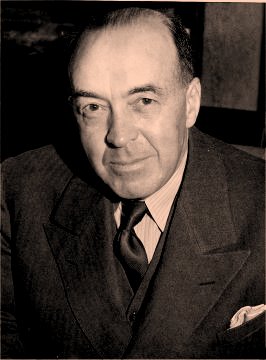
Edgar Rice Burroughs
Civilization And Its Discontents.
The period of Burroughs’ life was one of those great pivotal times of civilization. Civilization was in the midst of one of its great metamorphoses, scientific, political and intellectual. Changes which had been building up the last few centuries could no longer be absorbed by the existing religious structure. That structure was no longer viable. Its bursting mode was not only for the new Scientific Consciousness but the increasing scientific examination of the past opened the way for the revival of forgotten forms such as the Matriarchy. Thus along with the inevitable Patriarchal religious reaction the Matriarchy as well as suppressed occult religions forced their way through.
The reaction from contacts between civilizations sent various alien religions and ideologies into the Western leaven.
Confused with these intellectual challenges the agricultural basis of civilization evolved into a technological one. In the mid-teens for the first time in the United States there were more urban residents than there were rural residents.
New demands were placed on consciousness as more precision was required of the human mind. Man had had little difficulty adapting his methods to cycles of the seasons but the adaptation tothe rigors of the assembly line caused him problems.
That there was a backlash from this tremendous succession of changes should take no one by surprise. Adjustments were difficult and critical. In 1930 the founder of psychoanalysis, Sigmund Freud, published what may be his most famous title: Civilization And Its Discontents in response to this challenge. His notion of who the discontents were and of what they were discontented about is vague, indeed undecipherable.
In my estimation he doesn’t deal with the malaise at all.
On the other hand Edgar Rice Burroughs not only dealt with the malaise but offered a reasonable, if difficult to apply, solution to the problem.
page 1.
The malaise found many expressions. On the political front the socialists, Communists and anarchists were the most prominent reactionaries. Their activities reached a fever pitch in the first two decades of the Twentieth Century resulting in the two phases of the Russian Revolution of 1905 and ’17. The institutionalized discontents had their homeland after the latter date.
While Freud’s discussion of Discontents sounds generalized by the way he writes he is actually talkiking about himself and the members of his own Jewish culture and their problems with Western Civilization.
Thus Freud’s notion of Discontents falls somewhere between a general malaise and the discontent of the Communists.
The Religious Conciousness of course faced a problem that could only be resolved by surrender or reaction. There was no middle way. The evolution into Scientific Consciousness completely invalidated the religious approach. All religions are based on a false premise and Science exposed that falsity.
The transition to the Scientific Consciousness must be difficult and demanding as so few attain it. In my opinion this is because of the ongoing evolution of the brain. The Scientific Consciousness can apparently only be grasped by the further evolved. This doesn’t mean that those of a Religious Consciousness can’t work with scientific knowledge which requires only basic intelligence and a scientific environment provided by others but they are unable to envision advances.
Thus they find themselves left behind intellectually. It is the same as the difference between high and low IQ. Nothing can be done about that. However the Religious reaction is to attack those of the Scientific Consciousness to lower them to their own level.
page 2.
The problem was especially acute with Freud and his culture as Science per se invalidated all Semitic religious pretensions. This means all Semites and not just Jews. Neverthless as Jews were embedded in Western Civilization at that time and other Semites weren’t the Jewish culture was ‘discontented’ and was forced to negate science and the Scientific Consciousness.
Led by the Semitic surge of both Judiaism and Moslemism the very serious attempt to bury the Scientific Consciousness through genocide might just succeed.
As I point out in Part VII of The Deconstruction Of Edgar Rice Burroughs’ America the Jewish campaign to ‘abolish the White ‘race’ should be taken very seriously. Just because it sounds preposterous doesn’t mean it’s a joke. A segment of Whites is the bearer of the evolved gene or genes or combination of genes so that if this advance species were destroyed the wild religious reaction would succeed. Sounds just like some science fiction movie doesn’t it? Well, it isn’t.
The Scientific Consciousness created its own malaise in the newly evolving species. As literary and artistic types are always the monitors who pick up these trends first, if they don’t necessarily understand them, we shouldn’t be surprised to find a number of literateurs immersing themselves in the problem. One of the big texts is H.G. Wells important but neglected novel: The Food Of The Gods. In this novel Wells postulates that the emerging scientific Consciousness is a new species of human being. As with the real religious reaction Wells’ predecessor people wish to kill the new species. In earlier times when the world was less populated new or different species of human beings could move away from the old species. Now, the question is what makes Homo Sapiens Homo Sapiens and makes it different from the Last Hominid Predecessor? It is assumed by our scientific community that the Negro is the first Homo Sapiens species having evolved in Africa. This means that the Negro evolved from some sub-human Homo Sapiens predecessor. It’s easy, it has to be. So far no one has been able to produce an example of the Last Hominid Predecessor.
Now, the Negro was not the only, how shall we say, hominid species in Africa. The Negro apparently orginated in West Africa. The rest of Africa was inhabited by other species such as the Bushmen and Hottentots. These peoples are not Negroes and originated in Africa so the question is are they predecessors of the Negroes who we are told are the first Homo Sapiens or are they Homo Sapiens who precede or follow the Negro in evolution. Or, are they a separate non-Homo Sapiens species or are they perhaps the Last Hominid Predecessor. They are not Negroes so a place has to be found for them.
In any event the Negro and Arab combined to produce a new race or sub-species known as the Bantu peoples. The Bantus then invaded the territories of the Bushmen and Hottentots who ranged all of Africa South of the bulge, so we are told, driving the Bushmen before them. As I understand it the Hottentots are now extinct while Bantu pressure on the Bushmen is driving them toward extinction.
At the same time a newer hybrid of Black and Semite is driving the Bantu before it from its base in the Northeast corner of Africa known as the Horn.
So, Wells novelistic problem was that there was no longer a place on Earth for his new species to isolate itself. He was presented with the choice of his new species either displacing or killing off the anterior species or being eliminated itself much as the Hottentots and Bushman have been eliminated by the Bantu and as the Bantu and Negroes are being displaced and elminated by the new Black and Semitic Hybrid.
page 4.
So this was the problem c. 1900. This solution was repulsive to the existing Religious Consciousness that was psychologically unequipped to deal with this impasse.
As can be seen the Semitic special consciousness does not fear the problem In Africa in Darfur and the South of the Sudan they are actively pursuing genocide. In Euroamerica the Jewish Semitic culture is pursuing or advocating the same resolution of their problem with the White Euroamerican population. Following Semitic actions in Africa it should be clear to American Blacks what is in store for them.
So, Wells dealt with the problem in its political aspect. The internal aspect, the split in consciousness between the old and new was ably handled by a number of writers.
For a good introduction to the contrast between the Scientific Consciousness compare Holmes and Watson in Conan Doyle’s stories. In this essay I will concentrate on three others as well as Freud- H. Rider Haggard, Joseph Conrad and Edgar Rice Burroughs. Not coincidentally, I think, all three writers place their most important work in Africa. Haggard as the earlier writer rising to fame in Burroughs’ youth quite naturally had a great influence on the younger man, although I think Burroughs would have written of Tarzan and Africa with or without Haggard’s influence. The appeal of Africa is the contrast between the civilized White and the primitive Black. The two aspects of White consciousness. I hope to tackle this problem in more detail in my next essay, Edgar Rice Burroughs, Sigmund Freud And The Holy Grail.
There was nothing clearer to the English explorers, as well one might note as to the Southern planters of the US, than that there was a gulf between the intellect of the African and that of the White man.
Haggard expressed this difference in his novel Allan Quatermain. I’ve used the quote before but I will include it again here to keep the problem clear before us:
Quote:
All this civilization what does it come to? Full forty years and more I spent among the savages, and studied them and their ways, and now for several years I have lived here in England, and in my own stupid manner have done my best to learn the ways of the children of light, and what do I find? A great gulf fixed? No, only a very little one, that a plain man’s thought may spring across. I say that as the savage is, so is the white man, only the latter is more inventive and possesses a faculty of combination; save and except also the savage as I have known him, is to a large extent free from the greed of moey, which eats like a cancer in the heart of the white man. It is a depressing conclusion, but in all essentials the savage and the child of civilization are identical.
The great Liberal H.G. Wells was also clear on this difference. The nature of the gulf was the Scientific intellect of the White and the non-Scientific intellect of the Black. The question is how large did these nineteenth century men perceived the gap to be. Haggard in his Allan Quaterman, quoted above perceived the gap to be small while if one is to judge by the distance between Tarzan and the Africans Burroughs perceived it be not only large but insurmountable. Haggard thought the gap easily bridged while judging from Tarzan Burroughs thought it unbridgeable.
page 5.
It should be noted that Haggard was of the Old Religious Consciousness while Burroughs was of the advanced Scientific Consciousness. Of the two men Haggard writes from the experience of having viewed Africa or at least South Africa first hand. Everyone talks of Africa as though it were a county in Kansas whereas it is a huge continent of many diverse cultures. But, perhaps as the cultures seem to share the same level of consciousness perhaps that is the justification for speaking of Africa and Africans as a single unit.
Haggard lived in South Africa for several years as a young man while he was an astute historian and anthropologist. As a mythologist he was of the most gifted. His understanding is astonishing. He was quite familiar with all the Black peoples from the Zulus, Swazis and Basutos tothe Hottentots, Bushemen and Griquas. His judgements of the various intellects seems quite reliable. His writing is of most interest for the current rage of Zulu interest. His actual story telling ability is beyond compare.
Now, this is difficult to speak of because of the ideological stance of the Liberals and their Religious Consciousness that take the procrustean stance of trying to fit facts and reality into ideology whether they can be conveniently forced or not. They are currently anti-White and pro-African even going so far as to call for the genocide of the White species as I pointed out in the Deconstruction Of Edgar Rice Burroughs’ America. This is more than evidenced in their support of the genocide being executed in South Africa by the Shona chief robert Mugabe and the Bantu peoples of the Union of South Africa.
page 6.
There’s not much evidence that Haggard was interested or even aware of the theories of evolution which, if I may be so daring, it seems clear that Burroughs either was at the beginning of his career or became so as he aged aware of all the various strands of evolutionary theory. Thus Haggard comes across as more humane while Burroughs is more accurate.
A third opinion on the nature of the situation was provided by Joseph Conrad in his novelette: The Heart Of Darkness. One can’t be sure how much contact Conrad had with the situation he describes, but the influence of the primitive African mentality had the effect of dragging down the White intellect. As the advance in intellect was not so pronounced as Haggard noted the attraction of the primitive was so strong that many Whites retrogressed. Conrad’s hero Kurtz was an ivory buyer in the heart of the Congo. Through fraternization with the African he indeed loses his ‘thin veneer of civilization’ going native. On his death bed in viewing his period in the interior he exclaims ‘The horror, the horror’ and then ‘Exterminate the brutes.’
In point of fact if, as we are told, Homo Sapiens originated in Africa and the Negro is the departure point from the Last Hominid Predecessor which may be the Bushman or Hottentot then if this departure occurred c. 150,000 years ago, at the time the African came into contact with Whites he had made no move toward becoming civilized. Nor was he inclined to when given the example.
When H.M. Stanley interviewed the Uganda chief Mtese, that chief was incapable of visualizing anything other than trading. As he said he noticed that goods traded by the Arabs, who were first in the area, all came from Europe so he assumed that Europeans were more clever than the Arabs however he had no inclination to acquire the knowledge or skills. Nor have Africans attempted it to this day.
page 7.
As unpleasant as it may be to deal with facts or accept the science of the matter it is nevertheless necessary to consider that in the course of evolution the African brain has evolved to a certain level and stopped much as all the Hominid Predecessors did. Although Bruce Lahn of the Howard Hughes Medical Institute has been silenced his researches made it clear that the human brain was still evolving but not in all human species, only one.
It should be clear to even the most prejudiced observor that Robert Mugabe the Shona leader of Zimbabwe is in way over his head while as savage in his methods as any character Joseph Conrad could create. Nor is the reason unclear to certain Africans.
Writing in the Kampala Monitor of February 7, 2007 in an article entitled Uganda: Why Black People Have Remained Backward by Elias Biryabarema the author examines the problem:
Uganda has been fairly stable long enough. The conditions for an economic takeoff have been there for 20 years. Mr. Musevini has enjoyed generous goodwill from nearly all the world’s rich governments. Their largesse has poured in ceaselessly and in hefty amounts.
Uganda should have taken off. We haven’t. We’re stuck. And so is Tanzania, Sudan, Ethiopia, Mali, Burkina Faso, Kenya, Eretria, Malawi, Congo Republic and pretty much all of Black Africa, excluding the regions sole economic power, South Africa. This led me to pose a question to myself: Can Black people build prosperous societies?
Just about every reason- from slavery, colonialism, neo-colonialism to inequitable world trade rules- cited for the backwardness of Black African nations has been so debunked that it has now become necessary to look beyond the realm of such contemporary explanations.’
http://allafrica.com/stories/200702061131.html
Mr. Biryabarema concludes that Africans ‘only rise and touch a low ceiling.’ A disheartening realization but a cruel fact of nature because of the progression of evolution.
page 8.
So Africa came to represent an attractive past to Whites while the psychical split caused by the evolving brain caused them discomfort too. The brain had not evolved far enough to make a clean break with the animal past. What was Man, all species to do? Haggard relapsed into nostalgia. A longing to go back while nevertheless retaining his cranial development. His hero, Allan Quatermain while retaining his intellectual superiority to the Africans attempts to establish his kinship with his ‘Black brothers.’ Thus he takes a ‘Liberal’ attitude toward African/White relations that while seemingly humane has resulted in the atrocities against Whites being perpetrated by the likes of Mugabe and the South African leaders.
One shudders at Conrad’s Kurtz’s exclamation to ‘exterminate the brutes’ and yet the choice has turned out to be exterminate or be exterminated, while Africans have inexplicably opted for the latter. What can one say?
Burroughs on the other hand working from a philosophical point of view came up with a different solution. Nor is it entirely impracticable on the intellectual level. Both he and Freud begin from the same base. Both are reacting to the inhibitions and repressions placed on Man by civilization.
Burroughs seems willing to accept the ‘thin veneer of civilization’ in certain places and under certain conditions but he demands the right to be able to move freely from the primitive to the civilized state. Thus when Tarzan takes off his clothes he also removes the ‘thin veneer of civilization.’
page 9.
The basic problem for Haggard, Conrad, Freud and Burroughs is that they wish to retain the advantages of the intellectual aspects of civilization; none of them wish to opt for the ‘low ceiling’ of the primitive. They all wish to retain their advantages while indulging their primitive ‘natures.’ In some way each has to remain superior to the primitive state.
One can contrast this attitude with Mugabe of Zimbabwe and the ANC of South Africa who seem to be edging in the direction of removing all vestiges of the civilized state. They seem to be opting for a nostalgic return to the their savage past. They must have some understanding of the results of their destructive acts against civilization but choose to ignor them.
Conrad says simply- exterminate the brutes. Haggard adopts an avuncular attitude toward perpetual children. Burroughs assumes the role of…well…a god. Freud wishes to assume the role of plantation owner. The problem is insoluble except by the Shona method of ‘exterminating the arrogant bastards.’
For Burroughs as well as for Freud sex seems to be the key. Burroughs position is difficult to fathom. In all his cultures, societies and civilizations, and he creates a great many, nudity or near nudity is the ideal although as he is writing for popular consumption his characters remain sexually unexited and incredibly chaste under the most provocative conditions. Freud of course had everybody going at it like bunnies.
In Cave Girl Burroughs’ hero, Waldo Emerson Smith-Jones is the example of the over intellectualized man of extreme and enervating culture. Quite the opposite of Burrughs who obviously feels he has reached an ideal balance between the intellectual and the physical.
Waldo is meager then and consumptive when he lands on the island. He is obligatorily cowardly. He will find his Anima ideal in Nadara who is the antithesis of the civilized Jane being both nude and perhaps the most obviously sexually unihibited of any of ERB’s female characters. Burroughs contrasts her natural uninhibited sexuality with the inhibited sexuality of Waldo. There is a nice comparison with Freud possible here. Also with the Burroughs corpus there is room for an analysis of Nadara, La, and Balza.
During the course of his stay on the island , the natural primitive life will flesh Waldo out, build him up, give him conficence and make him courageous as well as curing his TB. Of course he never loses his intellectual attainments while using them to better his opponents and improve his situation. Thus neither Haggard, Conrad, Freud or Burroughs is able to resolve the conflicts of the discontents caused by civilization. As attractive as the primitive is it must remain an intellectual ideal.
Go to Part 3.
In The Beginning.
During the course
The Deconstruction of
Edgar Rice Burroughs’ America
by
R.E. Prindle
Part III
Organizing The Revolution
Deeds white and black, for minds are clean or foul.
Is the mind clean? Then earth and sky are clean.
Is the mind foul? Then earth and sky are foul.
For it is upon the mind that all depends.
Tibetan Proverb
I quote Christopher Hale, Himmler’s Crusade
Hale quotes Charles Bell, who quotes…
This essay is an investigation of cultures and cultural beliefs especially as they apply to the United States. The above Tibetan proverb as can readily be seen is pre-scientific. It takes no account of the objective world but supposes only that world is a projection of the mind good or bad as the mind is clean or foul.
It tacitly states that all religions are products of the mind or minds that conceived them. As projections they comment on the cleanness or foulness of the projectors.
As my own ideas of psychology are passes through a Freudian lens my argument is based on the scientific aspects Freud assembled while rejecting his religious projection. It should be clear to any thinking person that no religion has been transmitted to man from any god. Such a notion is inconceivable as is the very notion of God which to the Western mind means the Yahweh of the Old Testament. God therefore is the projection of the mind on nature. This concept is clearly brought out in Johann Sebastian Bach’s musical piece; Jehu, Joy Of Man’s Desiring. Man desires redemption in the form of Jesus but the divine Jesus is only a projection of Man’s desiring.
The nature of the fantasy is that God has chosen a certain people to be the bearers and disseminators of his word to all the peoples of the world. The originators of this notion were the Jews who believed and believe themselves to be the elected Ones. After the death of Jesus the English believe that the scepter of empire was passed to them while Anglians in the United States forming the Liberal religion believe the scepter has passed to them as in the adage: Westward the course of Empire.
page 1.
As the notion is based only on desire or wishful thinking its believers were doomed to be disappointed. Thus a defense mechanism must be projected on top of the projection of a chosen people. One then invents the notion of a redeemer- the Messiah, the Mahdi, the Christ. In Christan theology there can be only one Messiah, the Christ, whose mission on Earth was aborted by the crucifixion. Christians await the RETURN of the Christ in a supernatural manner.
For Jews and Moslems the messiah can be any human who so proclaims himself. David Bakan thinks that Freud was the Messiah for instance. Both religions have a surfeit of messiahs all naturally having failed to produce the desired results.
The history of the Jews since their defeat and scattering by the Romans in 70AD has been a succession of failed messiahs. Failure has not daunted this belief but the Jews have changed tactics and strategies. The last Jewish messiah to step forth and be recognized as such, unless like Bakan you include Freud, was the seventeenth century Sabbatai Zevi. (Spelled several different ways so don’t take me to task for my spelling.)
It is significant that a seventeenth century claimant was the last because the European Enlightenment blossomed at nearly the same time. The Enlightenment means Science. Science points out the absurdity of religious projections. Thus all religions have been shown to be based on false premises.
The meaning in terms of Human Consciousness was the consciousness of the mind had now evolved beyond a predecessor Religious Consciousness. Merely because a better method has been found doesn’t mean everyone will embrace it. There are many people and institutions who have a vested interest in the old way and don’t mean to give it up. Moreover they don’t mean for the advance in consciousness to exist.
For our purposes here we are discussing Christianity and Judaism: The West and Judaism. There had been many changes before in the evolution of religious beliefs, most notably the transition from Matriarchy to Patriarchy and they had all involved long and bloody wars. The transition from Religion to Science can be no different. If you haven’t noticed, the reactionary Semitic religions have instigated increasing wars and bloodshed from 1914 to the present Second Irruption From The Desert of the stultified reactionary Moslems.
Vis-a-vis the Roman Catholics and the Protestants the Jews had always been able to hold their own on a theological basis. After all, their religion is the basis of Christianity. The Jews had no chance against Science which acknowledges none of their claims.
The Jews would therefore have to devise new tactics and strategies to defend their atavistic belief system. There was no religious argument they or any other religion could devise to defeat this intelligence; their only alternative was to corrupt it and destroy it from within, thus supplanting Science in the minds of men with their stultifying religion once again. Difficult perhaps, but possible given a shameless exploitation of the good will of Euroamericans.
Now, when the failure of Sabbatai Zevi occurred and the Scientific spirit arose against which religious argument was ineffective, the wisemen of Judaism put thier heads together to devise a strategy. They decided to never again acknowledge a human messiah but to place their hopes in their whole people in the form of a revolution based on the French Revolution.
page 2.
From the French Revolution the modern form of Communism emerged. The Jacobins of Robespierre were proto-Communists. The banner was picked up by a man named Babeuf and the Communist assault on society led through the revolutions of 1830 and 1848. The French Revolution took place at the beginning of the so-called Industrial Revolution so that all the miseries inherent in the transition from one system to another were visited on ‘Labor.’ Labor was subsumed into the Communist agenda. Early socialism was divided between the Utopian Socialists and the Communists. The cleavage was permanent as Socialists and Communists despised each other’s methods.
Now, the Jews were emancipated by the generous feelings of the Revolutionaries. Up to this point the Roman Catholic Church had more or less contained Judaism. That is they isolated the Jews from the body politic much as a computer virus is isolated by a security system. A psychological allegory of this was put into a short story by Charles Beaumont in 1959. The short story was entitled, The Howling Man. In the story monks had imprisoned the Devil. A chance traveler was admitted to the monastery but advised to pay no attention to a captive man, the Devil in disguise, who howled for release. Naturally the traveler listened to the well sounding pleas of the howling man releasing him. Thus evil was set loose on the world.
This is somewhat the situation between the Church, the Revolutionaries and the Jews. Negating the efforts of the Church the released Jews began to subvert society and science. When one says Science in regard to the post-Revolution one is saying actually Science in embryo. Every science and scientific thinking were in the beginning stages of development. Early theories, absurd by today’s understanding, cannot be judged by today’s knowledge. They were the beginning steps. Like everything else Science would evolve. As it had with the Jews, the Revolution released Science from the control of the Church allowing it to develop, but positively, not negatively.
The Jews realized the threat to their religious mental projection understanding that Science was the true danger that had to be subverted. Unlike Catholicism and Protestantism which were based in Judaism and could therefore be defeated in argument there was no religious argument effective against Science. A different approach would have to be taken. That approach was to appropriate a science with mumbo jumbo then slowly eviscerate the science of its content while supposedly making it moral or in other words subservient to Jewish religious beliefs. This required both bold assertions while suppressing discussion or channeling it so that it could be controlled.
The first attempt and the most developed ‘science’ was politics. Thus Karl Marx began to appropriate the Communist Movement giving it a definite shape and direction. Seizing on the discontent of Labor Marx made that the cornerstone of ‘Scientific’ Socialism. Thus from 1789 to 1913 Communism struggled against the established order with minimal result. A mere one hundred twenty-five years after 1789 Communism established itself in Russia while being on a parity with the establishment in Western Europe.
The other Sciences progressed accordingly. Biology assumed its modern form in 1859 when Darwin published his Origin Of Species. Biology remained one science for which no Jewish claimant arose. The study of the mind or psychology was a different story. The study of psychology in a mythopoeic manner goes back as far as can be traced and further. The ancient Egyptians already had a good working model of the mind.
The scientific study, groping as it were, was undertaken by numerous people in the early nineteenth century. There was no organized theory, just investigation in numerous areas. The most noteworthy investigator for our purposes here was Jean Martin Charcot and his investigations into hysteria at the Salpetriere in Paris.
It appears that the basis of psychological malfunctioning is caused by a variety of hypnosis. That is a suggestion is made in a hypnoid state which enters the subconscious as post-hypnotic suggestion directing the individual against his conscious will, as it were.
The modern recognition of hypnosis was made by the Austrian Anton Mesmer who called it ‘animal magnetism.’ After Mesmer hypnotism was in disrepute for about fifty years although subject to serious investigation by responsible scholars.
page 3.
Charcot made hypnotism scientifically respectable again when he discovered its use in dealing with his hysterics. At the same time a man named Auguste Liebeault working with hypnotism in nearby Nancy was discovering the effect of suggestion.
In Vienna a restless Sigmund Freud was casting about for an emerging discipline to appropriate to make his mark. He had been trained as a biologist but despaired of making his name in that discipline. Under the influence of his fellow religionist, Joseph Breuer, he drifted over into psychology.
Freud was of the Jewish culture and he was militantly Jewish. He hated Europeans and the European culture. There is no question but that he intended to replace it with the Jewish culture. At what point he decided to manipulate the emerging science isn’t clear but probably by the time he began attending B’nai B’rith meetings in 1895.
Freud had a Moses Complex, not too dissimilar in effect than Christians with a Jesus complex. He undoubtedly chose psychology as a wide open field with many areas of exciting research possibilities and the opportunity to gratify his Moses Complex by leading his followers out of the psychological wilderness he found Europe to be. Thus as Moses rescued the Jews from Egypt Freud would rescue them from Europe.
Vienna as part of the polyglot Austrian Empire was the original Melting Pot from which Israel Zangwill took his idea. A relatively small German minority governed a multi-cultural empire embracing dozens of cultures and numerous religions. Thus the model for Freud’s conquest by culture was already suggested to him by the rising influence of Jewish culture within the Austrian Empire especially polyglot Vienna.
Having begun his association with Breuer and having heard of Charcot, Freud left for Paris in 1882 to visit what he derogatively would call the Great Man, himself. While Freud resented the ‘Master’ it would seem that Charcot’s influence on his own approach was seminal. There would have been no Freud without Charcot.
During this period of his life Freud was impoverished. He could only wander around Paris without the means to sample the delights of the city. This embittered him. Freud would have us believe that he became a favorite of Charcot, even petted by him. In all likelihood this is a gross exaggeration. Although Charcot may have taken some notice of him it would be characteristic of the Jewish culture to exploit any relationship out of its true proportion. In reading Freud his observations of Charcot are always made from the outside as a seeming voyeur, never as an intimate.
It is clear from the sardonic, belittling tone in which Freud always refers to Charcot that he was profoundly indebted to him. It must have been humiliating to a man with a psychotic attachment to Moses to submit to a man he considered his lesser. In dealing with hysterics Charcot brought hypnosis into respectability. Freud’s understanding of hypnosis was subtle. In Freud’s own psychoanalytic theory he abandoned hypnosis per se choosing a variant he called free association in which the patient was lulled into a hypnoid state so that a form of hypnosis remained the basis of psychoanalysis. Nor did Freud’s researches into hypnosis stop there. After the Great War hypnosis would form the basis of his ideas of Group Psychology. He developed subtler forms of hypnosis.
After returning to Vienna he once again went back to France in 1889 to visit with Liebeault and his disciple or leech, Hippolyte Bernheim. Liebeault had been working with hypnosis for some time. While Charcot failed to understand the signficance of suggestion, the key element of hypnosis, Liebeault did. His researches attracted the attention of Bernheim who like Freud was a Jew on the make. Bernheim succeeded in displacing Liebeault much in the same way as Freud would displace Charcot and his school.
While Liebeault and Bernheim apparently did not understand the relationship of suggestion to the creation of the neurosis or psychosis they had actually discovered that hysteria was caused by a form of suggestion. Ignoring the original suggestion while the patient was hypnotized they tried to use counter-suggestion to remove the affects of the original suggestion or fixation but with limited or temporary success. Since the original suggestion or fixation wasn’t obviated it shortly reestablished its primacy over the counter-suggestion.
While Freud said he rejected the clumsy ineffectiveness of the counter-suggestion he understood suggestion well enough to make it the cornerstone of his version of Group or cultural psychology.,
There is a common misconception that Freud invented psychology, that before him there was no psychology. The notion is completely untrue. Before and after Charcot psychological research was diverse and plentiful throughout Europe and America. There were many theories of the subconscious, for instance, but no one had undeertaken to systematize the various strands. Freud was able to do this while at the same time supplanting all other theories with his own. He actually succeeded in closing off investigation along other lines channeling psychology into his own somewhat flawed system.
All Freud did was to cull the best opinion and put his name on it while shouldering the originators aside as ‘anti-Semites’. For instance, another student of Charcot, Pierre Janet, working from the same teaching came to the same conclusion, namely that ‘neuroses’ are fixed in the subconscious. Whereas Freud named his version of the process ‘repression’ Janet named the result as an ‘idee fixe.’ Both terms mean approximately the same thing, although in my opinion Janet’s is more accurate. My own term is ‘an encysted fixation’. I came to my term independently, or at least I think I did, this is Freudianism you know, but the term I use means, I think, what Janet’s idee fixe means. Freud’s term ‘repression’ may describe the process but doesn’t deal with the result.
As I see it repression implies a voluntary act of will but such is not the case, repression is involuntary functioning independently of the conscious will. This is where Freud’s theory of sex goes wrong. The ‘repression’ is part of a defense mechanism. When the ego or Animus is offered an insult for which it has no defence the response is to repress the insult into an encysted fixation or idee fixe in an effort to control it. In other words, the mind tries to pretend that the insult didn’t occur. As the sexual apparatus is the physical portion of the psychic Animus the expression of the fixation will ivariably be a sexual affect although of differing manifestations from masochism to sadism. Thus the insult is converted into a suggestion of inadequacy of some form.
Thus the use of the sexual apparatus is merely an attempt to massage or exorcise the fixation. Freud actually believed that frequency of ejaculation would make a healthier person or in other words sexual intercourse would cure the ‘neurosis’ or in my and possibly Janet’s term eliminate the fixation. Clearly an impossible method.
One may compare the fixation to a virus on your computer. Once the virus is introduced it must be isolated and removed or it will control or shut down the computer. The virus may be equated with the suggestion that resulted in the fixation. One must eliminate the suggestion or fixation from mind as with the virus from your computer’s memory.
This is where the ‘talking cure’ is effective. Once the fixation is identified if the afflicted person can make the fixation conscious it will disappear or in another word be exorcised. If Freud realized this, which he ought to have, he never published his knowledge.
His use of the unconscious indicates that he at least understood the negative effects of fixations as expressed through their affects or in his terms neuroses and psychoses.
So Freud defamed Janet while organizing psychoanalysis to exclude any opinion but his own no matter how inaccurate. He organized and controlled the magazines and publishing houses, while he controlled and convened the international congresses. Following the Jewish Cultural model, no dissent was allowed, there is no freedom of expression in the Jewish Culture; if you refuse discipline you are merely excommunicated. Once expelled you are defamed and rendered inconsequential. Marginalized in today’s terms. The only analyst to survive this treatment was C.G. Jung who had an awful lot going for him. I can’t think of another dissident who has survived to the present.
page 5.
Thus having evolved an understanding of emasculation to add to the mix this was how Freud’s psychological matters stood in 1915 when his idea of psychoanalysis was essentially complete. He now applied his psychological knowledge to political matters. At this point whatever scientific basis Freud possessed was subsumed to Jewish religious requirements.
Historically the Jews have been a migratory people. When the going get tough the Jews get moving. Wherever the action is that’s where they want to be. Thus when the Promised Land of America became accessible to mass migration, that is reliable steamships had replaced unreliable sail, the People began a mass migration to America. The intent was to move the entire Eastern European population to America. The plan failed only because of the outbreak of the Great War for which signficant scholarship can show the Jewish guiding hand. So, in one way the Jews defeated their own plan.
The important thing to remember is that Jewish activities are backed by an inviolable ideology, tight orgzanization and fairly precise coordination and excecution. There is nothing haphazard in the culture’s activities. This has been true for two millennia with increasing precision. As noted when the messiahship of Sabattai Zevi failed, the plan was formed for the whole people to foment a revolution. The date of the revolution was set for 1913 to 1928. Hence if you study Jewish history you can see the preparations unfold leading to this historical knot.
Since Marx the culture had been in control of the Labor movement of the Socialists so that a significant portion of the whole population was involved not just the minority culture. The more timid or moderate such as the Wilsonites and other ‘parlor pinks’, fellow travelers and whatnot, Liberals, were distributed throughout society where they could exercise control without revealing themselves in their true guise.
While I had sifted the information out except for the dates of the messiahship of the culture all I really had to do was read one book. That book was by the Rabbi Abba Hillel Silver who plainly stated the plan and its objectives giving the years.
This revolutionary schedule could not have been unknown to Freud. Thus his schedule from 1895 on must have been coordinated with it as best he could and that best was very good indeed. By 1910 he had his theories in close to final form. From 1915 on, especially after 1917 he was no longer developing his ideas but organizing them for use by the Revolution.
For years he had been attending weekly meeting of B’nai B’rith, the international Jewish brotherhood. He lectured them on psychology on a regular basis. It would be interesting to know how the lectures differed from his published work.
Now for a moment let us consider some aspects of Freudian doctrine. Freud insisted that the was a scientist but the grounds for such a claim seem tenuous at best, rather Freud was a religionist who used what he learned for the furtherance of the Jewish Revolution. Thus his concepts of the unconscious and sex were tailored to upset the morality of European civilization. His promulgated notions were meant to confuse and obfuscate. When one combines Freud’s interpretation of the unconscious, sex and emasculation, all of which were worked out by 1915, one has in fact a potent weapon of psychological warfare. They called it brainwashing during the Korean War. Combined with conditioning and indoctrination trusting Euroamericans who did consider Freud a disinterested scientist abandoned all defenses.
The really noteworthy fact about Freud is that he offered only negative analyses but nothing positive such as how to reconcile the unconscious and conscious minds or how to understand and improve the conscious mind. Freud discussed the nature of projection and perception very little. The nature of the ‘science’ Freud professed to embrace is the negation of perception and projection without which there can be no science. At least he chose not to address consciousness in any positive manner.
page 6
He did issue the enigmatic statement that where Id was Ego shall be. He also said that the Id was a species of something around which the Ego ensheated itself. That’s a tough one. As Ego is presentative of consciousness and Id unconsciousness it sounds as though Freud was referring to the integration of the personality. He doesn’t explain how he invented or discovered the nature of the relationship of Ego and Id or give any indication of how it actually worked. He never develops the idea.
We feel that he perhaps knew more than he chose to reveal through his analysis of Wilhelm Jensen’s novelette Gradiva that he titled Delusion and Dream In Wilhelm Jensen’s Gradiva. By delusion I presume he means projection. That is what Jensen’s character is doing; he is imposing his inner projection on society which makes actions appear irreal. It is only as the story develops that the character’s projection dissolves as reality intrudes itself more and more. At the end of this short piece the character emerges into a true or truer perception of the world. He no longer casts his projection on reality.
Thus what Freud denotes delusion I would call projection. Ridding onself of a mistaken perception of reality to realize as nearly as possible the actual state of affairs is the goal of mental health.
While what Freud has to say about the unconscious is itself a religious projection it does bear some relationship to the reality. Since Freud wished to and did impose a psychological system on the science of psychology it behooved him to deal with the whole mind and not just half. The question is whether he was dishonest or incapable; I opt for dishonest and criminal.
Freud is as guilty of criminal misconduct as the Sudanese Mahdi at Omdurman who offered his followers the religious projection that the bullets of the massed British machine guns facing them would turn to water at Allah’s will. If the Mahdi had so little scientific knowledge and so much religious fervor then there was no difference between his religion and insanity. The Mahdi at least had the excuse that he was far from the centers of scientific research. Freud didn’t.
By the advent of the Russian Revolution then, through his association with B’nai B’rith Freud had prepared the Jewish cadres for some particularly dirty work.
As the Russian Revolution marked the first great success of the Jewish Revolution Freud now began to manipulate his scientific knowledge of hypnotism and psychology to confuse and obfuscate the minds of the Euroamerican cultures while keeping his culture’s mind focused on the work ahead.
Everything was in order; the tools were developed. Freud had cleverly monopolized the study of the mind if not psychology. Further study would be conducted on his terms. It was only necessary now to skillfully use the tools he developed.
End of Part III. Go to Part IV.
Freud
March 16, 2007
Freud And His Unconscious
Redefining A Fallible Idea
by
R.E. Prindle
Sometime after I wrote the first part of Something Of Value (see erbzine.com) I read David Bakan’s Freud And The Jewish Mystical Tradition. Bakan’s book confirmed my findings while developing Freud’s relationship to his culture’s mystical tradition based on Bakan’s understanding of the Zohar and the Jewish Kabbalah that I haven’t read or studied, nor do I intend to unless I exhaust other pursuits which doesn’t seem likely. You never know though.
However a point to consider is how Jewish is the Jewish mystical tradition, that is, what are its roots? Are they rooted in Judaism or elsewhere? Bakan seems to believe that the Jewish Kabbalah is derived entirely from Jewish sources independent of the general milieu. I don’t believe this to be true. The Jewish mystical tradition like all others is based on the very ancient Egyptian. Bakan believes that the Kabbalah arose in the first century AD. This is probably true.
The Hermetic tradition which is equivalent to a European Kabbalah took form as such in Alexandria during the Ptolemaic period when Greek and Egyptian ideas interreacted. Hermiticism evolved from much earlier doctrines centered around the Egyptian god Thoth. The Zohar and Kabbalah then is Hermetic material adapted for Jewish needs. The whole can be traced back to Alexandria.
The Zohar, or primary mystical book, which is attributed to the first and second century Rabbi, Simeon Ben Yohai, was rewritten, edited and whatever in twelfth century Spain by Moses de Leon reaching the Middle East after the expulsion of the Jews from Spain in the sixteenth century. Its influence then was transmitted to the seventeenth century messiah, Sabbatai Zevi.
According to Mr. Bakan Freud was familiar with the Zohar and Kabbalah. I couldn’t go so far as to claim so myself but Mr. Bakan can quote chapter and verse. While Freud claimed to be scientific Mr. Bakan relates almost all of Freud’s psychology to the Kabbalah showing Freud’s dependence on Sabbatianism and Frankism as I indicated in Something Of Value Part I.
page 1
Thus while seeming to be working from a scientific point of view Freud is actually blending a bit of scientific approach acquired from European sources, as there is no science in Jewish culture, with his Jewish religious material to subvert the European moral order. While Freud himself was at war with European civilization the international Jewish organizations extended his field of operations to the United States and Canada. Thus while Freud speaks specifically of Europe he can be taken to mean Euroamerica.
2.
A further background for his psychology, Freud’s central childhood fixation, appears to be the incident in which a European knocked his father’s hat into the gutter which his father meekly, or wisely, depending on your point of view, accepted without a demur. Because of this story Freud wished to avenge himself on Europeans.
Probably at this point Freud assumed the Moses complex that stayed with him to the end of his life. He, Freud, would lead his people to triumph over the Europeans as Moses had led the People out of Egypt while Pharaoh and his army were drowned in the Red Sea.
However, oddly enough, as he claimed to be wholly Jewish, Freud was conflicted in his attitude toward Europeans. As a child he had a Roman Catholic nurse who introduced him to Christianity by taking him to church. Most probably she also tried to wean him from Judaism. This experience had a great effect on young Freud. In the following anecdote, as with most fixations, he seemed to have lost the exact memory of the situation. From Bakan:
Quote:
…that my ‘primary originator’ [of neuroses] was an ugly, elderly, but clever woman who told me a great deal about God and hell, and gave me a high opinion of my own capacities.
On October 15, 1897, he quotes his mother about the old nurse who took care of him when he was very young.
“Of course,” she said “an elderly woman, very shrewd indeed. She was always taking you to church. When you came home you used to preach, and tell us about how God conducted his affairs.
Unquote.
His memory had become confused while it does not appear that he ever exorcised his fixation, for fixation this is. He apparently loved this nurse at the time rather than hated her. When she was later accused and convicted of stealing from the Freuds being dishonored and actually sent to jail, Freud was heartbroken while changing his opinion of her. But, he had had contact with Christian Europeans which left a lasting impression on him that he could not consciously recognize or acknowledge. If I am correct, this impression resurfaced when he came into contact with C.G. Jung who he adopted as a surrogate for this nurse transferring his love and hatred for her to Jung.
page 2.
Just as he loved this nurse there were apparently strong homosexual overtones in his relationship toward Jung. As Freud would have known, the compulsion toward repitition would have been a component in his relationship with Jung as with his nurse although he apparently did not recognize this. So much for his self-analysis. He found reasons to break off with Jung or drive him away while bitterly claiming to be betrayed by Jung just as his nurse had been accused and convicted of theft thus betraying the child Freud. Thus once again his contact with a Christian European was brief ending in sorrow for himself.
A third situation occurred late in life when he wrote Moses And Monotheism. Rather startlingly he claimed that Moses was not Jewish but was an ethnic Egyptian. This means Freud, who had a Mosaic fixation, split his personality between his Christian longings and his professed Jewish identity. Another result would be that monotheism was not a Jewish invention but actually a goyish invention so that all the evil arising from monotheism was not the fault of the Jews but the goys. They had no one to blame but themselves. Thus Freud’s notion of Moses may have been a sort of dream reversal of the facts.
Whatever the results of Freud’s self-analysis back before the turn of the century it is quite clear that he was unable to resolve his fixations nor, one believes, was he aware of their influence on him. He never integrated his personality remaining under the influence of his subconscious fixations. No wonder he ignored the conscious mind.
3.
Like most people Freud had to find his way from adolescence to adulthood and his true ambitions by a circuitous route.
This editor’s note to 1927’s The Future Of An Illusion says this:
Quote:
In the ‘Postscript’ which Freud added in 1935 to his Autobiographical Study he remarked that a ‘significant change’ had come about in his writings during the previous decade. “My interest,” he explained, “after making a long detour through the natural sciences, medicine, and psychotherapy, returned to the cultural problems which fascinated me long before, when I was a youth scarcely old enough for thinking.
Unquote.
page 3.
He undoubtedly refers to his experiences in church with his Christian nurse contrasted with the ‘Christian’ who knocked his father’s hat into the gutter. As Freud is very duplicitous in his use of language one should try to be very sensitive to the meanings behind the obvious meanings of his words. Thus I believe his use of the term ‘cultural problems’ can usually be understood as his inner conflict between his Christianity and Judaism.
As Bakan points out, that while Freud rejected Rabbinical religious Judaism he was deeply immersed in the Jewish mystical tradition of the Zohar and Kabbalah. Thus one can discount his claim to be an ‘atheistic’ Jew. Or atheism has a more specific meaning for him.
I would place the change of emphasis in his writing or, at least the beginning of the change, in 1915. My guess would be that Freud was unaware of the Jewish Revolution until he joined B’nai B’rith in 1895. That knowledge would have shaped the direction of his researches. Whatever science was involved would have been subordinated toward achieving the Revolution. At the same time that he was working out the nature of psychoanalysis as Bakan indicates he must also have been studying the Zohar and Kabbalah. I haven’t read or studied either so I have to rely on Bakan’s analysis of their influence. Bakan traces strong mystical influences running side by side with what passed for science in Freud’s mind. As Freud persistently says he’s going to ignore facts in favor of projections one must assume that there is more mysticism than science in Freud’s construction of psychoanalysis- as he says ‘his creation.’
Bakan points out that Freud transited from the role of physician to that of ‘healer.’ That is analogous to the hands on approach of Christian Fundamentalism. Freud then for all practical purposes abandoned medicine for healing. Then, sometime between 1913 and 1915 he abandoned psychoanalytical research for his ‘cultural’ studies. In other words, he began to apply his psychological studies to the manipulation of cultures through his developing ideas on Group Pschology.
page 4.
Just as Freud learned that there were screen memories that transformed more painful memories into something more acceptable to salve those injured feelings so Freud learned that he could develop ‘screen’ language to serve up unpalatable meanings in palatable ways. Thus what he says has a reasonable meaning to the uninitiated but has a totally different meaning to the initiated- those with the key. In many ways it is the same as a criminal argot. Those who understand the argot can discuss topics openly while only those with the key can twig it. Ya dig?
The key incident that fixed his mind on ‘cultural interests’ was his father’s story of the guy who knocked his hat into the gutter. Freud then, in attempting to disguise his hatred for ‘Christianity’, while secretly admiring it because of his nurse, and his desire to avenge his father and hence, all Jews, through his Moses fixation developed his program. Thus he acting in his own mind altruistically and need feel no guilt.
Freud was very seriously conflicted, also suffering from depression according to Bakan. Hence his purpose was to knock the whole of European Christianity into the gutter, which is to say the actual persons of Europe.
Thus the use of terms like ‘Culture’ and ‘Civilization’ should always be placed in the context of Jews and Europeans. In this manner he avoids the appearance of bigotry and hatred while sounding ‘scientific.’
Now, this obsession and extreme form of vengeance for something that, after all, didn’t happen to him nor did he witness it, might certainly be considered a neurosis, probably a psychosis and possibly a degree of insanity. In reading Bakan there is a hint that he believes Freud had a disordered mind. Indeed, Lang’s Testament Of Dr. Mabuse should be held steadily in mind when reading of Freud’s later career. Lang must have had Freud in mind when he filmed Mabuse.
page 5.
Lang,s departure from the denouement of the Cabinet Of Dr. Caligari ended on the conventional note of the victim, or whistle blower, being declared insane. Lang reversed this by making the perpetrator, Caligari/Mabuse insane as in real life with Freud. Further the disciple of Mabuse, the head of the asylum, Dr. Baum was also declared insane. Although the problem appears to be solved the threat of the conspiracy continuing from the cell now occupied by Dr. Baum looms like a spectre over the ending.
While Freud was never incarcerated as he should have been, he was imprisoned in his mind no less than Drs. Mabuse and Baum or the character in Gradiva. It is interesting that Freud had a plaster cast of the relief on which the story of Gradiva was based that he displayed prominently in his office. The story obviously had greater significance for him than his ‘objective’ analysis of the story would lead one to suspect.
Thus from 1915 to 1935 like Dr. Mabuse he sat imprisoned in his projection of reality churning out page after page, volume after volume of criminal plans for the subversion of civilization which is to say of Euroamerican civilization but not Jewish culture. He makes a definite point of that illusion of whose future he is discussing applies only to Europe and Christianity rather than religion in general which would include his own Judaism. At this point he is not aware of the burgeoning Wahabi Moslemism so that his message is that Jewish beliefs are real while Christian beliefs and Scientific reality are illusory. One has to penetrate the screen language and convert it into the proper psychological intent.
As David Bakan points out Freud lived his whole life in a sort of Jewish ghetto having very little contact with Europeans.
His choice of Jung as the potential heir to his ‘creation’ may have had as much to do with a desperate attempt to reestablish a connection similar to that of his childhood Christian nurse. Thus his overtures to Jung while under extreme stress were driven from his unconscious while he himself was unaware of his true motivations. This would have been an expression of a repetition compulsion. Thus as his nurse disappeared from his life under discreditable circumstances he replicated the situation in Jung. His attempt to convert Moses (hence himself) into an Egyptian may have been a last attempt to replicate and resolve this early contact with Christianity. His view of European civilization then was filtered wholly through a Jewish projection of possibilities. He really had no intimate knowledge of European mores.
page 6.
From 1915 on, then, his writings were obsessed with hatred for Euroamericans and a desire to wreak vengeance on them by destroying the basis of their civilization. His ideas for the subversion of European civilization were carried to America by the international B’nai B’rith organization to be adopted and employed there. In addition Revolutionary plans executed in Europe in 1917 were financed and organized by the world Jewish government in the US. While functioning according to local conditions the Revolution was conducted an an international scale. Act locally, think globally. Hence Jewish revolutionaries left the US for Russia after 1918 to aid in the consolidation going on there. This is really an incredible if repressed story in the Freudian cultural manner. Very Freudian that such phenomenal criminal activity that were best left invisible was repressed into humanity’s unconscious.
At this point I think it might be well to examine Freud’s vision of the unconscious in more detail. While there can be little doubt that there is a subconscious function to the human mind usually referred to as the unconscious after Freud that had been an accepted fact amongst scientific researchers for a hundred years. The exact nature had not been determined nor does Freud determine it. His view is merely a projection of his own conscious and subconscious needs.
In David Bakan’s view Freud had made ‘a compact with Satan.’
page 7.
Certainly not in the literal sense but in the figurative sense that Freud would do anything, abandon any moral precepts, to achieve fame. Bakan points out the superscription to Freud’s ‘Interpretation Of Dreams’ quote from Virgil: Flectere si nesqueo superos, Acheronta movebo. Translated as: If the gods above are no use to me, then I’ll move all hell. Freud further blurred the line between good and evil or amalgamated the two from the influence of Sabbatai Zevi and Jacob Frank who cast off all morality. Since Freud has been successful in altering both Euroamerican and Jewish morality toward these immoral or amoral beliefs by false ‘Satinic’ criminal doctrines it is imperative to debunk his personal projection of the subconscious.
As he ‘made a pact’ with powers below- the unconscious- against the powers above- the conscious- he invested his projection of the unconscious with the attributes of ‘Satan’ or evil. This view of the subconscious is a self-serving fiction not based on any science.
He sets up the unconscious as an autonomous entity with the main function of blighting the conscious. He give the powers of hell supremacy over the powers of heaven. This notion is mere fantasy; it cannot be. There is no possibility that the function of the subonscious doesn’t have a positive function in and of itself and in relation to the conscious. If you actually think about it for a moment you will realize this must be true; every part of the body works to the benefit of the whole; there can be no exception for the subconscious.
Now, Nature is not flawless. The order that the religious seem to find is not there. Nature functions in a much more haphazard way. It takes only one peek through the Hubble to see that.
However the relationship between the conscious and subconscious is delicate and easily disrupted especially in the early years of the organism when it has no experience with which to evaluate the events occurring to it. The Ego and Anima are not part of the subconscious and possibly not of the conscious but function through the conscious and unconscious minds.
page 8.
The conscious mind perceives phenomena and acts on them but the terrific inflow of impressions is more than it can deal with so the day’s input is received into the subconscious for further reference. Thus a major function of dreams in the sleeping state is to review and process, organize the information into a coherent whole for future reference. The subconscious then is able to compare incoming information with experience for response. When the conscious and subconscious minds are attuned, that is to say the personality is integrated, the system works properly, otherwise the response is distorted by one’s fixations. This is very easy to see in Freud.
However, especially in youth when experience is scant, the mind may be challenged with some devastating new experience for which there are no reference points. If an appropriate response is made there is no problem. If an inappropriate response is made against which future experience is in variance, the earlier resp0nse which has become fixated will over rule an attempt at an appropriate response and substitute the fixated inappropriate response. Thus the current response will constellate around these earlier fixations which gives one bizarre symbolic dreams and inappropriate responses.
The inappropriate response will usally result from an insult to the Ego or, in other words, the Sexual Identity. In turn the response to this insult will be expressed in a sexual affect.
The purpose of psychoanalysis, which is real science, although Freud didn’t see that, is to locate and exorcize them allowing the conscious and subconscious aspects of the mind to function properly as a unit. Dreams are actually important because they are an analysis of life’s experence providing responses. None of this, of course takes in intelligence, discipline and other functions of mind and character that Freud dismisses as irrelevant.
page 9.
Now, in the cultural war between Judaism and Euroamerica, or as Jews express it, Christianity, Freud infused the Jewish subconscious with a disregard for morality a la Jacob Frank in relation to Sabbatai Zevi. Any evil was excused so long as it seemed to advance the cultural war. While this infusion may not have reached down throught the ranks of Jewry- which is to say they behaved in a certain way but didn’t know why- the ideas were thoroughly planted in the minds of what Henry Ford would call the international Jew.
The cold war between Jews and Europeans became a shooting war in the wake of the Great War. Men, money and munitions flowed in a wide steady stream from the United States to Russia. Coordinators established themselves in strategic locations. If one reads restricted, censored literature the impression is made that horrible anti-Semites harassed and hated innocent unresisting Jews. Jews may have been killed but they were not innocent and unresisting. To the contrary freed from guilt, or supposedly so, by Freudian/Sabbatian/Frankist precepts, abattoirs were established throughout Russia where unsuspecting Russians were led in one door and flowed out the other in liquid form. This is not the place to dwell on gruesome details. The literature exists but the collective Jewish mind has repressed the deeds into the collective unconscious. In other words, history has been denied and censored so that the crimes can’t be known. Actually Whittaker Chambers, the Red spy, translated a number of these books concerning the Hungarian atrocities of Bela Kun and Tibor Szmuelly, but those are impossible to come by. All this slaughter was made possible and justified by the doctrines of Freud.
In relation to the 1919 atrocities of the Jews in Hungary and the response which expelled them from power it should be noted that Israeli troops were recently introduced into Hungary to reestablish the tyranny of Kun and Szmuelly. Don’t ever think the historical memories are short.
Freud sat comfortably in Vienna looking on as the carnage occurred. If, as believed, the tenor of his writing changed in 1925 that was probably due to the death of Lenin in 1924. By 1925 it was apparent that the Jewish Revolution was on shaky grounds as Stalin began his rise to power so that Freud may have renewed his cultural attack or, on the other hand, as 1928 was the terminal projected year of the Jewish Revolution Freud may have been celebrating the death of European Civilization when he published The Future Of An Illusion. By the illusion he meant European Christianity and he meant European civilization was finished. The Rome of the Popes would have fallen.
page 10.
In Illusion and Civilization And Its Discontents Freud makes us believe that the malcontents of civilization are synonymous with civilization rather than being a minority that always exists during great revolutionary changes. Freud whose Judaism was challenged by the Scientific Revolution as much as Christianity or Moslemism must have been aware of the reactionary ‘instinct’ as he himself was in reaction to both European Christianity and the Scientific Revolution.
David Bakan closes his volume with these words:
Quote:
…under the ruse of “playing the devil” (Freud) served Sabbatian interests. In this respect, however, just as Freud may be regarded as having infused Kabbalah into science, so may he be regarded as having incorporated science into Kabbalah. Sabbatian-wise, by closing the gap between Jewish culture and Western Enlightenment he acts as the Messiah nor only for Jewish culture but for Western culture as well.
Unquote.
Note that Western Enlightenment is reduced to Western culture putting it on a par with Jewish culture which is a tacit admission that there is no science in Jewish culture and none is wanted in Western culture. Language as a screen.
Bakan’s is a hefty statement. Under the guise of the Devil Freud becomes the Messiah not only for Jews but for Euroamericans. Truly in this scenario good comes from evil, assuming that the Messiah is good. In case you missed it, Freud according to Bakan was the Second Coming. Narrowing the gap between the two cultures means the imposition of Jewish culture as the Chosen or Abelite people over Western or Cainite culture. Thus the age old goal of reversing the Cain and Abel story so that Cain is obligated to give preference to Abel is accomplished.
page 11.
By infusing Kabbalah into science, science has been subjugated to the unscientific Jewish culture so that the Catholic/Jewish situation of Medieval Europe has been restored. The Enlightenment that invalidated Judaism, Christianity and Moslemism has been obliterated, hence the revival of religion happening today. Thus in Bakan’s eyes and according to Freud’s intent Judaism has deconstructed Euroamerican society so the reconstruction according to Jewish cultural mores can commence.
The result has been accomplished by the destruction of the Scientific Consciousness as there is little of science in Freud’s cultural writings. He just says what he believes and wants you to believe and asserts it as fact. As always there were some Westerners who resented the encroachment of the strict limits of science. Rider Haggard in his Allan Quatermain made that as clear as possible. The topic is the dominant theme of Edgar Rice Burroughs’ Tarzan novels. Henry Ford and his mass production methods was a symbol of that rebellion against the strict limits set by the clock. Some denounced it as Taylorism; but with each passing decade the West became more acclimated to the change as the reactionary mood became acclimated to the new reality.
Freud invents ‘instincts’ and their ‘renunciation’ to give sense to his arguments; the ‘renunciation of instincts’ almost sounds scientific but it isn’t. There are no instincts nor does Freud even attempt to demonstrate their existence. Like the rest of Freud’s psychology the notion is just something Freud made up. As always he notes only the negative societal destructive effects. He says nothing of the ‘instinct’ to be around people which would conflict with his instinct against civilization- the last is a vague enough term the way he uses it. But, as Lang points out the hypnotic spell cast by Mabuse negates criticism so that the head psychologist, the objective scientist himself, Baum, suspends critical judgment falling under the spell to the point of becoming a disciple just as Lang himself did. Indeed, as the West has. Hitler was a blessing in disguise for the Jewish Revolution. The guilt caused by Hitler completely disarmed the West allowing the Reconstruction of Western mores to proceed at a faster pace than would have been possible without Hitler. Indeed, the Nazi Era drove the entire pyschotic Jewish Revolution to the shores of the United States beginning in the early thirties. Thus the deconstruction of Edgar Rice Burroughs’ America was assured.
To return to 1919.
 I, Dynamo