A Review: Part II She By H. Rider Haggard
November 20, 2009
A Contribution To The
ERBzine ERB Library Project
She
by
H. Rider Haggard
Review by R.E. Prindle
From London To The The Caves Of Kor
She is dedicated to Andrew Lang:
I Inscribe This History To
ANDREW LANG
In Token Of Personal Regard
And Of
My Sincere Admiration For His Learning
And His Works
One may well ask then who is this Andrew Lang and what is his learning? In point of fact Haggard not only dedicated She to Lang but wrote three books in collaboration with him. Andrew Lang, 1884-1912, was a Scottish scholar specializing in folklore, mythology and religion so you can see where Haggard came by much of his esoteric knowledge. In addition Lang was one of the founding members of the Society For Psychic Research and a past-President. Lang wrote dozens of books over his lifetime. He even wrote a parody of She in 1887 called He. Today he is remembered only for his collections of fairy tales. Twelve volumes in all each titled after a color such as The Crimson, or Blue or Pink or Gray Fairy Book. The volumes are undergoing a fair revival now with a collector’s edition published by Easton Press and several nicely bound volumes by the Folio Society.
The nineteenth century was the one in which advanced knowledge of the past was rapidly extending European knowledge greatly. The Rosetta Stone deciphering Egyptian hieroglyphics had been achieved as recently as the 1830s. Nineveh and the Assyrian ruins had been unearthed. Schlieman had discovered the locations of Troy and Mycenae.
The exoteric side was covered by the academics while the esoteric side was covered by independent scholars like Madame Blavatsky and probably Andrew Lang. There was a clean split between the academic Patriarchal view of ancient history and the emerging Matriarchal view that had just been developed by the Swiss mythologist, J.J. Bachofen. Bachofen organized ancient history into Hetaeric, Matriarchal and Patriarchal periods. He himself was a member of the successor Scientific period.
The academics totally rejected the notion of a Matriarchal period. This, of course, led to a complete inability to understand Homer, both Iliad and Odyssey. The Iliad especially is a description of the war by the Patriarchy to destroy Matriarchy.
Lang seems to have understood the Matriarchal phase of ancient history. He must have passed this knowledge on to Haggard. Ayesha, as She, rules a Matriarchal society. While the ideas represented in She must have seemed bizarre or merely an amusing reversal of the Patriarchal world at the time, today it all reads comprehensibly. It rings true if not exact.
C.G. Jung, the psychologist, who developed such notions as the male Anima and the Shadow was very immpressed by what he saw as the male Anima in She. Madame Blavatsky lauded the book for its esoteric content. But then, Haggard was firing on all eight cylinders when he wrote it, it is difficult to conceive of a more perfect fantasy/adventure novel. Indeed Haggard subtitles the novel: The History Of An Adventure.
Haggard was an excellent Egyptian scholar. He not only visualized Egypt convincingly in his Egyptian novels but his Egyptian ideas pervade the African novels. Many of them involve Egyptian influences and even peoples filtering down into East and Central Africa. The Ivory Child is a case in point as is She.
The set up to the trip out is brilliant incorporating details that become cliches in B movies.
Leo Vincey’s father before he died gave a metal box to Leo’s guadian, Horace Holly, that wasn’t to be opened until Leo was twenty-five. This box is now opened. It contained a letter to Leo, a potsherd (a piece of a broken jar) covered with ‘uncial’ Greek lettering, a miniature and a scarab containing Egyptian hieroglyphics that read ‘Royal Son of the Sun.’
Thus Haggard captured most if not all of the elements that went into the intellectual aura fostered by B moves primarily in the first years of the talkies through the thirties. That entailed things like the Curse of the Pharaohs, movies like The Mummy melding into Wolf Man, Dracula, Frankenstein and African juju spells. Things against which Europeans had no defense because the ancient magic was stronger than modern science, or so we were led to believe. I can’t speak for others but it took me a while to shake this oppressive spirit. This was pretty strong stuff for my ten to twelve year old brain. Not to mention being bombarded by The Creature From The Black Lagoon, The Thing and The Day The Earth Stood Still. We wuz tried in the fire and come through good.
The gist of it is that Leo’s ancestor Kallicrates lived in the time of the last Pharaoh Nectanebo as one of the royal family. Spookier still Nectanebo was said to have fled Egypt before the conquering hordes, going to Macedon where he secretly impregnated Olympia, Philip’s wife, who then gave birth to Alexander which made him the rightful heir to the Pharaohship instroducing Greeks as rulers into his city of Alexandria.
At any rate Kallicrates girl friend, Ayesha, killed him in a jealous rage. The family nursing vengeance for all these two thousand years it is Vincey’s mission if he chooses to accept it, to follow the ancient map to the Caves of Kor and kill Ayesha or, She-Who-Must-Be-Obeyed who has been nursing regrets over killing Kallicrates two thousand years previously. Listen to me, I’m tellin’ ya it’s all here.
So Vincey, Holly and their man Job set out to find this place in Africa even more remote, if possible, than King Solomon’s Mines. And a heck of a lot more hostile too.
The trip out is some of Haggard’s finest writing. They are to be looking for a rock formation on the coast in the shape of a gorilla’s head. Sailing the coast they miraculously spot this head just as a terrific squall sends their felucca, dhow or other exotic ship from foreign climes to the b ottom.
But, even though the ship sinks they beat the reaper because they brought a boat containing unsinkable water tight compartments. As the storm subsides the three survivors along with an Arab float into the mouth of the appropriate stream as though it were all foreordained. What follows is some excellent writing with details I don’t need to recount.
Suffice it to say they are dragging their boat along an ancient canal when they are accosted by men from Kor. Ordinarily these guys would have speared them and moved on, no strangers needed in Kor. Using her magic She had learned of Leo’s coming a week previously thus ordering their lives spared while they were to be brought to her. Uh huh.
The detailing is terrific, this book is tight and well organized. It moves right along. The land is under the thumb of She-Who-Must-Be-Obeyed. This is a tight Matriarchy as we now recognize not just some strange place where a woman is in charge.
While the three are entering the Caves of Kor, Leo Vincey, being the cynosure of all female eyes, a knockout named Ustane steps up and kisses him. Not averse to a public display of affection Leo lays one on her back. New to the area and not aware of the customs of the place Leo had just accepted Ustane as his woman. In town for a few minutes and already married. That’s the way things happen in this particular Matriarchy. Ustane is now in conflict with Ayesha, She-Who-Must-Be-Obeyed.
The stage is now set for the main drama when Ayesha recognizes Leo as her long lost Kallicrates come back from all those reincarnations at last.
The exoteric Catholic Church is thus thrust aside in favor of all the heretical doctrines of the esoteric which have been bubbling under the Hot 100 for two thousand years. These unfamiliar esoteric doctrines would become the mainstay and staple of science fiction/fantasy for the next one hundred years.
Just as an example of how Burroughs probably learned esoterica, I became familiar with estoeric themes myself from reading 1950s science fiction and fantasy- Amazing Stories, William Tenn, Robert Heinlein, Ray Bradbury and all that sort of stuff without realizing what I was taking in, thus Burroughs surrounded by the Society for Psychical Research, Camille Flammarion, George Du Maurier and Stevenson et al. naturally learned the esoteric language. No mystery, he was speaking in tongues before he knew it.
Leo is awaiting the summons from Ayesha which will be covered in Part III.
Themes And Variations
The Tarzan Novels Of Edgar Rice Burroughs
#5 Tarzan And The Jewels Of Opar
Part V
by
R.E. Prindle
Texts:
Du Maurier, George: Peter Ibbetson
Dudgeon, Piers: Captivated: J.M. Barrie, The Du Mauriers & The Dark Side Of Neverland, 2008, Chatto And Windus
Hesse, Herman: The Bead Game
Neumann, Erich: The Origins and History Of Consciousness, 1951, Princeton/Bollingen
Vrettos, Athena: “Little Bags Of Remembrance: Du Maurier’s Peter Ibbetson And Victorian Theories Of Ancestral Memories” Erudit Magazine Fall 2009.
While it is today commonly believed that Sigmund Freud invented or discovered the Unconscious this is not true. As so happens a great cataclysm, The Great War of 1914-18, bent civilization in a different direction dissociating it from its recent past.
Studies in the earlier spirit of the unconscious continued to be carried on by C.G. Jung and his school but Freud successfully suppressed their influence until quite recently actually. Through the fifties of the last century Freud’s mistaken and harmful, one might say criminal, notion of the unconscious held the field. Thus there is quite a difference in the tone of Edgar Rice Burroughs writing before and after the 1917 Bolshevik Revolution.
There are those who argue that Burroughs was some kind of idiot savant who somehow knew how to write exciting stories. In fact he was a well and widely read man of varied interests who kept up on intellectual and scientific matters. He was what might be called an autodidact with none of the academic gloss. He was very interested in psychological matters from hypnotism to dream theory.
The scientific investigation of the unconscious may probably be dated to the appearance of Anton Mesmer and his interest in hypnotism also variously known as Mesmerism and Animal Magnetism. The full fledged investigation of the unconscious began with hypnotism. Slowly at first but by the last quarter of the nineteenth century in full flower with varied colors. Science per se was a recent development also flowering along with the discovery of the unconscious.
While Charles Darwin had brought the concept of evolution to scientific recognition in 1859 the key discipline of genetics to make sense of evolution was a missing component. It is true that Gregor Mendel discovered the concept of genetics shortly after Darwin’s Origin Of Species was issued but Mendel’s studies made no impression at the time. His theories were rediscovered in 1900 but they were probably not widely diffused until after the Great War. Burroughs knew of the earlier Lamarck, Darwin and Mendel by 1933 when he wrote Tarzan And The Lion Man. His character of ‘God’ is the result of genetic mutation.
Lacking the more complete knowledge of certain processes that we have today these late nineteenth century speculators seem ludicrous and wide of the mark but one has to remember that comprehension was transitting the religious mind of the previous centuries to a scientific one, a science that wasn’t accepted by everyone then and still isn’t today. The Society For Psychical Research sounds humorous today but without the advantage of genetics, especially DNA such speculations made more sense except to the most hard nosed scientists and skeptics. The future poet laureate John Masefield was there. Looking back from the perspective of 1947 he is quoted by Piers Dudgeon, p. 102:
Men were seeking to discover what limitations there were to personal intellect; how far it could travel from its home personal brain; how deeply it could influence other minds at a distance from it or near it; what limits, if any, there might be to an intense mental sympathy. This enquiry occupied many doctors and scientists in various ways. It stirred George Du Maurier…to speculations which deeply delighted his generation.
Whether believer or skeptic Burroughs himself must have been delighted by these speculations as they stirred his own imagination deeply until after the pall of the Revolution and Freud’s triumph.
Burroughs was subjected to dreams and nightmares all his life. Often waking from bad dreams. He said that his stories were derived from his dreams but there are many Bibliophiles who scoff at this notion. The notion of ‘directed dreaming’ has disappeared from popular consideration but then it was a serious topic. Freud’s own dream book was issued at about this time. I have already reviewed George Du Maurier’s Peter Ibbetson on my blog, I, Dynamo and on ERBzine with Du Maurier’s notions of ‘Dreaming True’. It seems highly probable that Burroughs read Ibbetson and Du Maurier’s other two novels so that from sometime in the nineties he would have been familiar with dream notions from that source.
Auto-suggestion is concerned here and just as support that Burroughs was familiar with the concept let me quote from a recent collection of ERB’s letters with Metcalf as posted on ERBzine. This letter is dated December 12, 1912.
If they liked Tarzan, they will expect to like this story and this very self-suggestion will come to add to their interest in it.
Athena Vrettos whose article is noted above provides some interesting information from Robert Louis Stevenson who developed a system of ‘directed dreaming’ i.e. auto-suggestion. We know that Burroughs was highly influenced by Stevenson’s Dr. Jekyll And Mr. Hyde while he probably read other novels of Stevenson. How could he have missed Treasure Island? Whether he read any of Stevenson’s essays is open to guess but in an 1888 essay A Chapter On Dreams Stevenson explained his method. To Quote Vrettos:
Rather than experiencing dreams at random, fragmented images and events, Stevenson claims he has learned how to shape them into coherent, interconnected narratives, “to dream in sequences and thus to lead a double life- one of the day, one of the night- one that he had every reason to believe was the true one, another that he had no means of proving false.” Stevenson describes how he gains increasing control of his dream life by focusing his memory through autosuggestion, he sets his unconscious imagination to work assisting him in his profession of writer by creating “better tales than he could fashion for himself.” Becoming an enthusiastic audience to his own “nocturnal dreams”, Stevenson describes how he subsequently develops those dreams and memories into the basis for many of his published stories, most notably his 1886 Dr. Jekyll And Mr. Hyde.
Now, directed dreaming and Dreaming True sound quite similar. One wonder if there was a connection between Stevenson and Du Maurier. It turns out that there was as well as with nearly the entire group of English investigators. Let us turn to Piers Dudgeon again, p. 102:
Shortly after they met, the novelist Walter Besant invited [Du Maurier] to join a club he was setting up, to be named ‘The Rabelais’ after the author of Gargantua and Pantagruel. Its name raised expectations of bawdiness, obscenity and reckless living, (which were not in fact delivered) as was noted at the time. Henry Ashbee, a successful city businessman with a passion for pornography, and reputed to be Robert Louis Stevenson’s model for the two sides of his creation, Dr. Jekyll And Mr. Hyde, denounced its members as ‘very slow and un-Rabelaisian’, and there is a story that Thomas Hardy, a member for a time, objected to the attendance of Henry James on account of his lack of virility.
Virility was not the issue however. The members of the Rabelais were interested in other worlds. Charles Leland was an expert on fairy lore and voodoo. Robert Louis Stevenson was the author of The Strange Case Of Dr. Jekyll And Mr. Hyde (1886) which epitomized the club’s psychological/occult speculations. Arthur Conan Doyle, who became a member of the British Society For Psychical Research, was a dedicated spiritualist from 1916. Henry James was probably more at home than Hardy, for both his private secretary Theodora Besanquet, and brother William, the philosopher, were members of the Psychical Society.
In many ways the Rabelais was a celebration that [Du Maurier’s] time had come. Parapsychological phenomena and the occult were becoming valid subjects for rigorous study. There was a strong feeling that the whole psychic scene would at any moment be authenticated by scientific explanation.
Du Maurier was obviously well informed of various psychical ideas when he wrote Ibbetson. In addition he had been practicing hypnosis since his art student days in the Paris of the late 1850s.
So this was the literary environment that Burroughs was growing up in. As Bill Hillman and myself have attempted to point out, ERB’s mental and physical horizons were considerably broadened by the Columbian Expo of 1893. Everything from the strong man, The Great Sandow, to Francis Galton’s psychological investigations were on display. The cutting edge of nineteenth century thought and technology was there for the interested. Burroughs was there for every day of the Fair. He had time to imbibe all and in detail. The Expo shaped his future life. That he was intensely interested in the intellectual and literary environment is evidenced by the fact that when he owned his stationery story in Idaho in 1898 he advertised that he could obtain any magazine or book from both England and America. You may be sure that he took full advantage of the opportunity for himself. As this stuff was all the rage there can be no chance that he wasn’t familiar with it all if he didn’t actually immerse himself in it. Remember his response to Kipling’s The White Man’s Burden was instantaneous. Thus you have this strange outpost of civilization in Pocatello, Idaho where any book or magazine could be obtained. Of course, few but Burroughs took advantage of this fabulous opportunity. It should also be noted that he sold the pulp magazines so that his interest in pulp literature went further back than 1910.
In addition ERB was enamored of the authors to the point of hero worship much as musical groups of the 1960s were idolized so he would have thirsted for any gossip he could find. It isn’t impossible that he knew of this Rabelais Club. At any rate his ties to psychology and the occult become more prominent the more one studies.
It seems to me that longing as he did to be part of this literary scene, that if one reads his output to 1920 with these influences in mind, the psychological and occult content of, say, the Mars series, becomes more obvious. He is later than these nineteenth century lights so influences not operating on them appear in his own work making it more modern.
At least through 1917 the unconscious was thought of as a source of creativity rather than the source of evil impulses. If one could access one’s unconscious incalculable treasures could be brought up. Thus gold or treasure is always depicted in Burroughs’ novels as buried. The gold represents his stories, or source of wealth, brought up form his unconscious. The main vaults at Opar are thus figured as a sort of brain rising above ground level. One scales the precipice to enter the brain cavity high up in the forehead or frontal lobe. One then removes the ‘odd shaped ingots’ to cash them in. Below the vaults are two levels leading back to Opar that apparently represent the unconscious. Oddly enough these passageways are configured along the line of Abbot’s scientific romance, Flatland.
In Tarzan And The Jewels Of Opar the gold is taken to the Estate and buried replicating the vaults. Once outside Opar and in circulation, so to speak, the ingots are accessible to anyone hence the duel of Zek and Mourak for them. The first gold we hear of in the Tarzan series is brought ashore and buried by the mutineers. This also sounds vaguely like Stevenson’s Treasure Island. The watching Tarzan then digs the gold up and reburies it elsewhere. In The Bandit Of Hell’s Bend the gold is stolen and buried beneath the floorboards of the Chicago Saloon. Thus gold in the entire corpus is always from or in a buried location. These are never natural veins of gold but the refined ingots.
Not only thought of as a source of treasure during this period the unconscious was thought to have incredible powers such as telekinesis, telepathy and telecommunication. One scoffs at these more or less supernatural powers brought down from ‘God’ and installed in the human mind. As they have been discredited scientifically Western man has discarded them.
On the other hand Western Man deludes himself into accepting the oriental Freud’s no less absurd assertion that the unconscious exists independently of the human body somewhat like the Egyptian notion of the ka and is inherently evil while controlling the conscious mind of the individual. This notion is purely a religious concept of Judaism identifying the unconscious as no less than the wrathful, destructive tribal deity of the old testament Yahweh. Further this strange Judaic concept of Freud was allowed to supersede all other visions of the unconscious while preventing further investigation until the writing of C.G. Jung were given some credence beginning in the sixties of the last century.
In point of fact there is no such unconscious. The supernatural powers given to the unconscious by both Europeans and Freud are preposterous on the face of it. For a broader survey of this subject see my Freud And His Vision Of The Unconscious on my blogsite, I, Dynamo.
This so-called unconscious is merely the result of being born with more or less a blank mind that needs to be programmed. The programming being called experience and education. The maturation and learning process are such that there is plenty of room for error. All learning is equivalent to hypnosis, the information being suggestion which is accepted and furthers the development of the individual. Learning the multiplication tables for instance is merely fixing them in your mind or, in other words, memorizing them. All learning is merely suggestion thus it is necessary that it be constructive or education and not indoctrination or conditioning although both are in effect. Inevitably some input will not be beneficial or it may be misunderstood. Thus through negative suggestion, that is bad or terrifying suggestions, fixations will result. A fixation is impressed as an obsession that controls one’s behavior against one’s conscious will, in the Freudian sense. The fixation seems to be placed deep in the mind, hence depth psychology. Thus when ERB was terrified and humiliated by John the Bully certain suggestions occurred to him about himself that became fixations or obsessions. These obsessions directed the content of his work.
To eliminate the fixations is imperative. This is what so-called depth psychology is all about. The subconscious, then, is now ‘seprarated’ from the conscious, in other words the personality or ego is disintegrated. The goal is to integrate the personality and restore control. Once, and if that is done the fixations disappear and the mind become unified, integrated or whole; the negative conception of the unconscious is gone and one is left with a functioning conscious and subconscious. The subconscious in sleep or dreams then reviews all the day’s events to inform the conscious of what it missed and organize it so that it can be acted on. No longer distorted by fixations, or obsessions, the individual can act in his own interests according to his abilities. The sense of living a dream life and a real life disappears.
That’s why experience and education are so important. What goes into the mind is all that can come out.
But, the investigation of the unconscious was blocked by Freudian theory and diverted from its true course to benefit the individual in order to benefit Freud’s special interests.
So, after the War ERB forgot or abandoned the wonderful notions of the unconscious and was forced to deal with and defend himself against Freudian concepts. The charactger of his writing begins to change in the twenties to meet the new challenges of aggressive Judaeo-Communism until by the thirties his work is entirely directed to this defense as I have shown in my reviews of his novels from 1928 to 1934.
Tarzan And The Jewels Of Opar then reflects this wonderful vision of the subconscious as portrayed by George Du Maurier and Robert Louis Stevenson
Then the grimmer reality sets in.
End Of Review.
A Review: Beau Sabreur by P.C. Wren
August 1, 2009
Note: I mistakenly placed the review of Beau Geste on another of my blogs: reprindle.wordpress.com. The review may be found there.
A Contribution To The
Erbzine Library Project
The Beau Ideal Trilogy Of
P.C. Wren
Beau Geste~Beau Sabreur~Beau Ideal
Part III
Review Of Beau Sabreur
by
R.E. Prindle
Part I: Introduction
Part II: A Review Of Beau Geste
Part III: A Review Of Beau Sabreur
Part IV: A Review Of Beau Ideal
Bibliographial Entry: Welland, James: ‘The Merchandise Was Human’, Horizon Magazine, Vol. VII, No. 1, Winter 1965. PP. 111-117
Beau Sabreur shifts from the classic literary style of the mid-nineteenth century to the vernacular of pulp or, perhaps, Wold Newton era. The pulp writers seem to have all read each other and Wren has certainly done his share of reading.
This novel begins at a pre-Zinderneuf time when Charles De Beaujolais was a mere cadet entering the service. If Beau Geste began in c. 1888 Beau Sabreur is set back at the beginning to perhaps 1875. De Beaujolais’ circumstances quite parallel those of the hero of Joseph Conrad’s Heart Of Darkness. Conrad has maintained a very respectable readership down to the present even though stoutly anti-Communist and a colonial writer. Both Communists and Africans are working hard to bury his reputation. It’s amazing how guys like Conrad manage to hang on, but that may not be for long as Western influence in society declines.
So it is that De Beaujolais is a sort of lounger applying himself to nothing in particular when his uncle recruits him for the French secret service as an agent to be attached to the African Spahis, an army corps. His uncle says that he will severely try him and should he fail in any particular he will be immediately dismissed. This essentially means that if De Beaujolais lets a woman come between him and his duty it is all over for him. So we are forewarned that there will a choice between love and duty.
The book was written after 1917 so Wren introduces a subversive Communist or anarchist character. In this book he assumes the name of Becque at the beginning. In Beau Geste he went by Rastignac and late in the novel he will be recognized as Rastignac although he appears to be going by another name. Wren has a good idea of the type describing him thusly under the name Becque:
He was clearly a monomaniac whose whole mental content was hate- hate of France; hate of all who had what he had not; hate of control, discipline and government; hate of whatsoever and whomever did not meet his approval. I put him down as one of those sane lunatics, afflicted with a destructive complex; a diseased egoist, and a treacherous, dangerous mad dog. Also a very clever man indeed, an eloquent, plausible and forceful personality…The perfect agent-provacteur, in fact.
Thus Becque in his various incarnations is always subversive, whether of army morale or working the Moslems up against the French. This will be a major theme of the novel. the same theme will appear in Tarzan The Invincible developed for his own needs.
Having been recruited by his uncle, De Beaujolais is sent to a sort of boot camp to learn the hard way. His ordeal is very convincingly described by Wren. It seems authentic enough to make one believe that Wren himself actually experienced such an indoctrination but there is no record that he did. He is just a consummate artist.
While learning to be a soldier Becque attempts to recruit him as a Communist agent. This leads to a sword fight in which De Beajuolais injures Becque but does not kill him.
Having completed his boot camp De Beaujolais takes his station with the secret service and the Spahis in Africa. Spahis are not FFL but a different corps.
When the French conquered Algeria in 1830 they disrupted a thousand year old social system. The North African Moslems had an insatiable need for slaves. Not only did they raid European shores to abduct Whites but an immense system for deliviering Negro slaves had been in existence since the Moslem conquest. This system had been run by the Tuaregs. This people was descended from Whites dating back to at least the Phoenician conquest of North Africa. Their alphabet probably precedes that of the Phoenicians. Undoubtedly they were the descendants of the former inhabitants of Mediterranean Valley known as Libyans in Egypt flushed out by the melting of the ice age.
What they did before the arrival of the Moslems isn’t known but with the African conquest of the Moslems they became the middle men between Africans of the Sahel and the Moslems of the North. Every year for a thousand years the Tuaregs had collected convoys of Negroes from the South driving them North across the Sahara. This was necessarily done with great loss of life as the Tuaregs were not that tender toward the Negroes.
With the advent of the Atlantic Slave Trade in the sixteenth century the Tuaregs also captured Negroes and drove them to St. Louis in Senegal for sale and transshipment to the Americas. According to James Welland the depredations on the Blacks was so great that the area around Lake Tchad had been cleared of inhabitants. This age old life style was disrupted in 1830 by the French. By that time Europeans had discontinued the slave trade so that the French disrupted the trans-Sahara trade causing a disruption in the Tuareg economy from which there was no recovery. Welland explains:
In short, the official abolition of the slave trade, the desert tribes, the desert itself for that matter began to play a diminished part in human affairs, and the Tuareg, who had been the only link for two and a half thousand years between Central Africa and the Mediterranean- in other words, between the Negro and the White world- began to pass from the stage of history. They were left unemployed and purposeless, with the result that they turned to intertribal war and oasis raiding to keep some semblance of their nationhood. Then again, as the supply of black labor dried up, the palmeries were increasingly neglected and often, as the consequence of a razzia, comepletely destroyed. The size and number of oases decreased, sand filled the wells and cisterns- many of which had been maintained since Roman times- and the age old trails became more hazardous and finally were hardly used at all.
In the secret service in Africa De Beaujolais becomes involved in the maelstrom of change, racial conflict and bad memories which were now exacerbated by the arrival of the non-Moslem, or Christian, French. The novel beomes then a sort of proto-thriller. De Beaujolais is on a mission to a town called Zaguig when he is caught up in a Moslem revolt. In Zaguig he meets the touring Mary and Otis Vanbrugh. Otis, you will remember returns from Beau Geste.
Mary is the love interest in the story and she will conflict De Beaujolais between his love for her and his duty as imposed by his uncle. Frankie Laine or Tex Ritter and songwriters Dimitri Tiomkin and Ned Washington (I tried to work Trad. in there somewhere but couldn’t do it) expressed the balance well in the song High Noon:
Oh to be torn ‘betwixt’ love and duty
Supposin’ I lose my fair haired beauty…
De Beaujolais relates the story of another agent who chose his beauty over duty and was drummed out of the service ultimately being killed. De Beaujolais has a premonition. Wren cleverly resolves the choice so that De Beaujolais gets his beauty while fulfilling his duty.
At the same time Otis Vanbrugh meets the apparent Arab dancing girl, who yet retains European features, who will figure largely in the sequel.
As the revolt erupts these conflicts emerge. As is usual in thrillers things are not what they seem. Raoul D’Auray De Redon, a close friend of De Beaujolais’ remains behind disguised as an Arab to confuse their attack on a small French garrison destined to be wiped out. De Beaujolais has important dispatches which must be delivered. Thus duty makes him appear to be an ingrate and coward humiliating him before Mary. His job is to locate the latest Arab Mahdi and suborn him the the French side.
De Beaujolais thinks little of Otis Vanbrugh and we are meant to accept his opinion. His true story will appear in the sequel.
Mary was one of those women who flirt by taunting or ridiculing her guy. In her case when De Beaujolais was within hearing she mockingly whistled a tune De Beaujolais couldn’t quite place but was called Abdullah Bulbul Amir. This was a very popular song and poem of the time that can be found at http://wiki.answers.com/Q/lyrics_of_bhulbhuliya. A couple of verses of its 19 will suffice to give its tenor but the poem is one you should be familiar with.
The sons of the Prophet are hardy and bold,
And quite unaccustomed to fear,
But the most reckless of life or of limb
Was Abdullah Bulbul Amir.
When they wanted a man to encourage the van
Or harass a foe from the rear,
Storm fort or redoubt, they had only to shout
For Abdullah Bulbul Amir.
Apparently the poem was so well known that Wren felt no need to name it and he doesn’t.
The time to leave Zaguig comes, so taking his entourage of faithful soldiers, Mary and her maid Maud, he sets out into the desert toward Oran.
Soon Tuareg or Arab raiders pick his party up and they are forced to fight a pitched battle although from an advantageous position. Here De Beaujolais has to make a very difficult choice between between loyalty to his men and his duty to get his dispatches through. Getting his men into position he is compelled to abandon them to their fate and push on.
This puts a strain on his relationship with Mary who cannot understand the concept of duty or necessity- the necessity to get the dispatches through. After a long flight the party falls into the hands of a desert tribe. But this is a strange desert tribe. Rather than the usual unorganized tactics these fellows seem to have the scientific training of the French. Another mystery.
As luck would have it De Beaujolais and the women were captured by the Mahdi’s troops. By way of explanation the Moslem Mahdi is equivalent to the Jewish Messiah but not the Christian Messiah. There’s only one Christ but Jewish Messiahs and Moslem Mahdis pop up everywhere.
So now, going back to the ending of Beau Geste, the two Americans Hank and Buddy were out there somewhere trodding the burning sands. Hank was discovered and rescued on the point of death by a kind hearted Sheik while Buddy was captured by hard hearted Tuaregs being saved from death when Hank Sheik’s tribe defeated his captors. Buddy was out there somewhere for a long time because Hank had been rescued years before.
Having been rescued at the point of death Hank was aware of the necessity to pass as a Moslem so he pretends to be dumb until he has learned the language so well he can pass. He then cleverly becomes the tribe’s sheik. The tribe is then threatened by a razzia of Tuaregs. As this takes place in the North Tuaregs no longer having Negroes to convoy have taken to raiding the oases. Normally the tribe would have run and hid leaving their goods and a few token members as slaves for the Tuaregs. Hank has a better idea and using his superior scientific French training the tribe rather than waiting to be attacked unexpectedly attack the Tuareg camp handily defeating them. Buddy is thus rescued. Coincidences are dime dozen out on the burning sands.
Teaching Buddy the language while he too plays dumb, Buddy becomes Hank’s vizier. With Buddy as military commander the tribe is trained in scientific methods in earnest. They then begin to organize the tribes into a confederation thus earning Hank the title of Mahdi in French eyes. De Beaujolais was thus on a mission to co-opt the new Mahdi.
As luck, or coincidence, would have, at the same time De Beaujolais and the girls arrive so does Becque/Rastignac. Becque is now employed one supposes by the Soviet Union to arouse the Moslems to a jihad. He comes bearing gifts not realizing that Hank and Buddy are his old Legion comrades. He doesn’t recognize them but Hank recognizes him. Becque and De Beaujolais have that old unsettled score to settle. De Beaujolais now settles his hash removing that source of irritation.
I’ve pointed out before that Burroughs very likely drew inspiration for his series of political Tarzan novels from 1930 to 1933 after reading this trilogy from 1924 to 1928. The Sahara had fascinated him long before he read Wren. David Innes of Pelucidar even surfaces in the Sahara returning from the Inner World. The great desert and the Sahel is not quite as we Westerners have imagined it. The thousand year long history of amazing suffering boggles the imagination. A thousand years of thousand mile treks from South to North, untold millions of Africans were trekked across the burning sands with equally untold millions falling along the way. This is not all. This is a horror story. Welland again, p. 116:
Even after the slave trade had been suppressed, the old life of the desert survived for a while for one simple reason…the absence of salt in the Sudan. Nearly all the salt in Central Africa had always come from the north across the Sahara on the backs of camels, donkeys, horses and men. The salt mines in the middle of the most terrible wastelands of the desert- at Taghaza, at Taodeni, and at Bilma- had always been worked all the year round by Negro slaves, who died within a few years of their arrival at the mines and were immediately replaced by new workers. The salt they mined was worth its weight in gold in Timbuktu, and its transport across the desert was a considerable enterprise of unbelievable size, involving the assembling of as many as 40,000 camels to make the quick dash from Bilma to Kano.
Think of it. For a thousand years Negroes were dropped down a funnel in a steady stream to live the most miserable of lives for a very few years. Over a millennium! Think of it. I should think those Negroes who travelled the Middle Passage in the Atlantic Slave Trade ending up in the paradise of the Caribbean and the Americas should bless their deliverers from that African hell.
Africans should bless the French for delivering them from total servitude and degradation. When one digs for facts beneath the surfice, the things one finds.
Thus without giving any historical background Wren is telling the story of how Europe saved the Africans from themselves. Indeed, Hank and Buddy singlehandely rearrange North Africa on livable lines. The two, in the story, break the power of the Tuaregs while establishing an African paradise in a hundred square mile oasis. Their people are delivered into prospeirty by a million franc subsidy from France that Hank and Buddy use for the betterment of their people rather than sequestering it in a numbered Swiss bank account. A new day for Africa indeed courtesy of Western enlightenment.
Thus De Beaujolais accomplishes his mission to align the new Mahdi, Hank, with France while winning his fair heared beauty and pleasing his uncle.
Hank marries Maud the maid leaving Buddy hanging out but not for long. We still have the last of the trilogy, Beau Ideal to go. Let’s go.
A Contribution To The
Erbzine Library Project.
Edgar Rice Burroughs, Science And Spiritualism
Camille Flammarion, Scientist and Spiritualist
by
R.E. Prindle

The last story in Ray Bradbury’s Martian Chronicles is about the expulsion from Earth of the various supernatural or imaginary beings such as fairies, elves, the elementals, all those beings external to ourselves but projections of our minds on Nature, to Mars as a last resort and how they were all dieing as Mars became scientifically accessible leaving no place for them to exist.
On Earth the rejection of such supernatural beings began with the Enlightenment. When the smoke and fury of the French Revolution and the Napoleonic years settled and cleared it was a new world with a completely different understanding of the nature of the world. Science, that is, knowing, had displaced belief as a Weltanschauung.
The old does not give way so easily to the new. Even while knowing that fairies did not exist the short lived reaction of the Romantic Period with its wonderful stories and fictions followed the Napoleonic period.
Supernatural phenomena displaced from the very air we breathed reformed in the minds of Men as the ability of certain people called Mediums to communicate with spirits although the spirits were no longer called supernatural but paranormal. Thus the fairies morphed into dead ancestors, dead famous men, communicants from beyond the grave. Men and women merely combined science with fantasy. Science fiction, you see.
Spiritualism was made feasible by the rediscovery of hypnotism by Anton Mesmer in the years preceding the French Revolution. The first modern glimmerings of the sub- or unconscius began to take form. The unconscious was the arena of paranormal activity.
Hypnotism soon lost scientific credibility during the mid-century being abandoned to stage performers who then became the first real investigators of the unconscious as they practiced their art.
While the antecedents of spiritualism go back much further the pehnomena associated with it began to make their appearance in the 1840s. Because the unconscious was so little understood spiritualism was actually thought of as scientific. The investigators of the unconscious gave it incredible powers and attributes, what I would call supernatural but which became known as paranormal. Communicating with spirits, teleportation, telecommunications, all the stuff that later became the staples of science fiction.
Thus in 1882, Jean-Martin Charcot, a doctor working in the Salpetriere in Paris made hypnotism once again a legitimate academic study.
The question here is how much innovation could the nineteenth century take without losing its center or balance. Yeats’ poem The Second Coming presents the situation well. Freud, who was present at this particular creation, was to say that three discoveries shattered the confidence of Man; the first was the Galilean discovery that the Earth was not the center of the universe, the second revelation was Darwin’s announcement that Man was not unique in creation and the last was the discovery of the unconscious. Of these three the last two happened simultaneiously amidst a welter of scientific discoveries and technological applications that completely changed Man’s relationship to the world. One imagines that these were the reasons for the astonishing literary creativity as Victorians grappled to deal with these new realities. There was a sea change in literary expression.
Key to understanding these intellectual developments is the need of Man for immortality. With God in his heaven but disconnected from the world supernatural explanations were no longer plausible. The longing for immortality remained so FWH Myers a founder of the Society For Psychical Research changed the word supernatural into paranormal. As the notion of the unconscious was now wedded to science and given, in effect, supernatural powers under the guise of the paranormal it was thought, or hoped, that by tapping these supernormal powers one could make contact with the departed hence spiritism or Spiritualism.
While from our present vantage point after a hundred or more years of acclimatizing ourselves to an understanding of science, the unconscious and a rejection of the supernatural, the combination of science and spiritualism seems ridiculous. Such was not the case at the time. Serious scientists embraced the notion that spirtualism was scientific.
Now, a debate in Burroughs’ studies is whether and/or how much Burroughs was influenced by the esoteric. In my opinion and I believe that of Bibliophile David Adams, a great deal. David has done wonderful work in esbatlishing the connection between the esotericism of L. Frank Baum and his Oz series of books and Burroughs while Dale Broadhurst has added much.
Beginning in the sixties of the nineteenth century a French writer who was to have a great influence on ERB, Camille Flammarion, began writing his scientific romances and astronomy books. Not only did Flammarion form ERB’s ideas of the nature of Mars but this French writer was imbued with the notions of spiritualism that informed his science and astronomy. He and another astronomer, Percival Lowell, who is often associated with ERB, in fact, spent time with Flammarion exchanging Martian ideas. Flammarion and Lowell are associated.
So, in reading Flammarion ERB would have imbibed a good deal of spiritualistic, occult, or esoteric ideas. Flammarion actually ended his days as much more a spiritualist than astronomer. As a spiritualist he was associated with Conan Doyle.
Thus in the search for a new basis of immortality, while the notion of God became intenable, Flammarion and others began to search for immortality in outer space. There were even notions that spirits went to Mars to live after death somewhat in the manner of Bradbury’s nixies and pixies. In his book Lumen Flammarion has his hero taking up residence on the star Capella in outer space after death. Such a book as Lumen must have left Burroughs breathless with wonderment. Lumen is some pretty far out stuff in more ways than one. After a hundred fifty years of science fiction these ideas have been endlessly explored becoming trite and even old hat but at the time they were
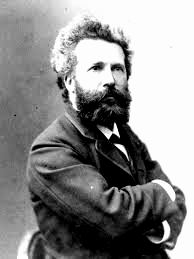
Camille Flammarion
excitingly new. Flammarion even put into Burroughs’ mind that time itself had no independent existence. Mind boggling stuff.
I believe that by now Bibliophiles have assembled a library of books that Burroughs either did read or is likely to have read before 1911 that number at least two or three hundred. Of course, without radio, TV, or movies for all of Burroughs’ childhood, youth and a major portion of his young manhood, although movies would have become a reality by the time he began writing, there was little entertainment except reading. Maybe a spot of croquet.
As far as reading goes I suspect that ERB spent a significant portion of his scantily employed late twenties and early thirties sitting in the Chicago Library sifting through the odd volume. It can’t be a coincidence that Tarzan lounged for many an hour in the Paris library before he became a secret agent and left for North Africa.
I have come across a book by the English author Charles Howard Hinton entitled Scientific Romances of which one explores the notion of a fourth dimension . Hinton is said to have been an influence on H.G. Wells’ The Time Machine. It seems certain that Burroughs read The Time Machine while he would have found many discussions of the fourth dimension as well as other scientific fantasies in the magazines and even newspapers as Hillman has so amply demonstrated on ERBzine. We also know that ERB had a subscription to Popular Mechanics while probably reading Popular Science on a regular basis. Popular Science was established in 1872.
It is clear that ERB was keenly interested in psychology and from references distributed throughout the corpus, reasonably well informed.
I wouldn’t go so far as to maintain that ERB read the French psychologist Theodore Flournoy’s From India To The Planet Mars but George T. McWhorter does list it as a volume in Vern Corriel’s library of likely books read by Burroughs. The book was published in 1899 just as Burroughs was entering his very troubled period from 1900 to 1904-05 that included his bashing in Toronto with subsequent mental problems, a bout with typhoid fever and his and Emma’s flight to Idaho and Salt Lake City. So that narrows the window down a bit.
However the book seems to describe the manner in which his mind worked so that it provides a possible or probable insight into the way his mind did work.
ERB’s writing career was born in desperation. While he may say that he considered writing unmanly it is also true that he tried to write a lighthearted account of becoming a new father a couple years before he took up his pen in seriousness. Obviously he saw writing as a way out. His life had bittely disappointed his exalted expectations hence he would have fallen into a horrible depression probably with disastrous results if the success of his stories hadn’t redeemed his opinion of himself.
Helene Smith the Medium of Fluornoy’s investigation into mediumship was in the same situation. Her future while secure enough in the material sense, as was Burroughs, fell far short of her hopes and expectations. Thus she turned to mediumship to realize herself much as Burroughs turned to literature. She enjoyed some success and notoriety attracting the attention of, among others, the psychologist Theodore Flournoy. Fournoy who enjoyed some prominence at the time, was one of those confusing spiritualism with science because of his misunderstanding of the unconscious. Thus as Miss Smith unfolded her conversations with the inhabitants of Mars it was taken with some plausibility.
If any readers I may have have also read my review of Du Maurier’s Peter Ibbetson he or she will remember that Peter and Mary were restricted in their dream activities to only what they had done, seen and remembered or learned. As I have frequently said, you can only get out of a mind what has gone into it. In this sense Miss Smith was severely handicapped by an inadequate education and limited experience. While she was reasonably creative in the construction of her three worlds- those of ancient India, Mars and the court of Marie Antoinette- she was unable to be utterly convincing. In the end her resourcefulness gave out and the scientific types drifted away. She more or less descended into a deep depression as her expectations failed. Had she been more imagination she might have turned to writing as Burroughs did.
If Burroughs did read Flournoy, of which I am not convinced, he may have noted that Miss Smith’s method was quite similar to his habit of trancelike daydreaming that fulfilled his own expectations of life in fantasy.
In Burroughs’ case he had the inestimable advantage of having stuffed his mind with a large array of imaginative literature, a fairly good amateur’s notions of science and technology, along with a very decent range of valuable experience. His younger days were actually quite exciting. He was also gifted with an amazing imagination and the ability to use it constructively.
Consider this possibility. I append a poem that he would have undoubtedly read- When You Were A Tadpole And I Was A Fish. Read this and then compare it to The Land That Time Forgot.
Evolution
by
Langdon Smith
When you were a tadpole and I was a fish
In the Paleozoic time,
And side by side on the ebbing tide
We sprawled through the ooze and slime,
Or skittered with many a caudal flip
Through the depths of the Cambrian fen,
My heart was rife with the joy of life,
For I loved you even then.
Mindless we lived and mindless we loved
And mindless at last we died;
And deep in the rift of the Caradoc drift
We slumbered side by side.
The world turned on in the lathe of time,
The hot lands heaved amain,
Til we caught our breath from the womb of death
And crept into light again.
We were Amphibians, scaled and tailed,
And drab as a dead man’s hand;
We coiled at ease ‘neath the dripping trees
Or trailed through the mud and sand.
Croaking and blind, with out three-clawed feet
Writing a language dumb,
With never a spark in the empty dark
To hint at a life to come.
Yet happy we lived and happy we loved,
And happy we died once more;
Our forms were rolled in the clinging mold
of a Neocomian shore.
The eons came and the eons fled
And the sleep that wrapped us fast
Was riven away in a newer day
And the night of death was past.
Then light and swift through the jungle trees
We swung in our airy flights,
Or breathed in the balms of the fronded palms
In the hush of the moonless nights;
And, oh! what beautiful years were there
When our hearts clung each to each;
When life was filled and our senses thrilled
In the first faint dawn of speech.
Thus life by life and love by love
We passed through the cycles strange,
And breath by breath and death by death
We followed the chain of change,
Till there came a time in the law of life
When over the nursing side
The shadows broke and the soul awoke
In a strange, dim dream of God.
I was thewed like Auroch bull
And tusked like the great cave bear;
And you, my sweet, from head to feet
Were gowned in your glorious hair,
Deep in the gloom of a fireless cave,
When the night fell o’er the plain
And the moon hung red o’er the river bed
We mumbled the bones of the slain.
I flaked a flint to a cutting edge
And shaped it with brutish craft;
I broke a shank from the woodland lank
And fitted it, head and haft;
Then I hid me close to the reedy tarn,
Where the mammoth came to drink;
Through the brawn and bone I drove the stone
And slew him upon the brink.
Loud I howled through the moonlit wastes,
Loud answered our kith and kin,
From west and east to the crimson feast
The clan came tramping in.
O’er joint and gristle and padded hoof
We fought and clawed and tore,
And cheek by jowl with many a growl
We talked the marvel o’er.
I carved that fight on a reindeer bone
With rude and hairy hand;
I pictured his fall on the cavern wall
That men might understand,
For we lived by blood and the right of might
Ere human laws were drawn,
And the age of sin did not begin
Till our brutal tush were gone.
And that was a million years ago
In a time that no man knows;
Yet here tonight in the mellow light
We sit at Delmonico’s.
Your eyes are deep as the Devon springs,
Your hair is dark as jet,
Your years are few, your life is new,
Your soul untried, and yet-
Our trail is on the Kimmeridge clay
And the scarp of the Purbeck flags;
We have left our bones in the Bagshot stones
And deep in the Coralline crags;
Our love is old, our lives are old,
And death shall come amain;
Should it come today, what man may say
We shall not live again?
God has wrought our souls from the Tremadoc beds
And furnished them wings to fly;
He sowed our spawn in the world’s dim dawn,
And I know that it shall not die,
Though cities have sprung above the graves
Where the crook-bone men make war
And the oxwain creaks o’er the buried caves
Where the mummied mammoths are.
Then as we linger at luncheon here
O’er many a dainty dish,
Let us drink anew to the time when you
Were a tadpole and I was a fish.
With something like that stuffed into his subconscious what wonders might ensue. Obviously The Land That Time Forgot and The Eternal Lover.
As Miss Smith had turned to spiritualism and mediumship, Burroughs turned his talents to writing. According to himself he used essentially mediumistic techniques in hiswriting. He said that he entered a tracelike state, what one might almost call automatic writing to compose his stories. He certainly turned out three hundred well written pages in a remarkably short time with very few delays and interruptions. He was then able to immediately begin another story. This facility lasted from 1911 to 1914 when his reservoir of stored material ws exhausted. His pace then slowed down as he had to originate stories and presumably work them out more rather than just spew them out.
Curiously like Miss Smith he created three main worlds with some deadends and solo works. Thus while Miss Smith created Indian, Martian and her ‘Royal’ identity Burroughs created an inner World, Tarzan and African world, and a Martian world.
Perhaps in both cases three worlds were necessary to give expression to the full range of their hopes and expectations. In Burroughs’ case his worlds correspond to the equivalences of the subconscious in Pellucidar, the conscious in Tarzan and Africa and shall we say, the aspirational or spiritual of Mars. In point of fact Burroughs writing style varies in each of the three worlds, just as they did in Miss Smith’s.
Having exhausted his early intellectual resources Burroughs read extensively and exhaustively to recharge his intellectual batteries. This would have been completely normal because it is quite easy to write oneself out. Indeed, he was warned about this by his editor, Metcalf. Having, as it were, gotten what was in your mind on paper what you had was used up and has to be augmented. One needs fresh experience and more knowledge. ERB was capable of achieving this from 1911 to about 1936 when his resources were essentially exhausted. Regardless of what one considers the quality of the later work it is a recap, a summation of his work rather than extension or innovatory into new territory. Once again, not at all unusual.
As a child of his times his work is a unique blend of science and spiritualism with the accent on science. One can only conjecture how he assimiliated Camille Flammarion’s own unique blend of spiritualism and science but it would seem clear that Flammarion inflamed his imagination setting him on his career as perhaps the world’s first true science-fiction writer as opposed to merely imaginative or fantasy fiction although he was no mean hand at all.
A Review: Peter Ibbetson by George Du Maurier
May 8, 2009
A Review
The Novels Of George Du Maurier
Peter Ibbetson, Trilby, The Martian
Part IV
Peter Ibbetson
Singers and Dancers and Fine Romancers
What do they know?
What do they know?
-Larry Hosford
Review by R.E. Prindle
Table of Contents
I. Introduction
II Review of Trilby
III. Review of The Martian
IV. Review of Peter Ibbetson
Peter Ibbetson is the first of the three novels of George Du Maurier. As elements of the later two novels are contained in embryo in Ibbetson it would seem that Du Maurier had the three novels at least crudely plotted while a fourth dealing with politics but never realized is hinted at. Actually Du Maurier has Ibbetson who writes this ‘autobiography’ write several world changing novels from inside the insane asylum to which he had been committed. In the Martian Barty Josselin wrote several world changing books while ‘possessed’ by an alien intelligence, in a way, not too dissimilar to the situation of Ibbetson. Du Maurier himself comes across, as I have said, as either a half demented lunatic or a stone genius.
He has Ibbetson and the heroine, The Duchess of Towers write in code while they read encrypted books. Du Maurier says that Ibbetson and hence the two following books deal with weighty subjects but in a coded manner that requires attention to understand.
On page 362 of the Modern Library edition he says:
…but more expecially in order to impress you, oh reader, with the full significance of this apocalyptic and somewhat minatory utterance (that may haunt your fever sense during your midnight hours of introspective self-communion), I have done my best, my very best to couch it in the obscurest and most unitelligible phraseology, I could invent. If I have failed to do this, if I have unintentionally made any part of my meaning clear, if I have once deviated by mistake into what might almost appear like sense, mere common-sense- it is the fault of my half French and wholly imperfect education.
So, as Bob Dylan said of the audiences of his Christian tour: Those who were meant to get it, got it, for all others the story is merely a pretty story or perhaps fairy tale. The fairy tale motif is prominent in the form of the fee Tarapatapoum and Prince Charming of the story. Mary, the Duchess of Towers is Tarapatapoum and Peter is Prince Charming. It might be appropriate here to mention that Du Maurier was highly influenced by Charles Nodier the teller of fairy tales of the Romantic period. Interestingly Nodier wrote a story called Trilby. Du Maurier borrowed the name for his novel Trilby while he took the name Little Billee from a poem by Thackeray. A little background that makes that story a little more intelligible.
Those that watch for certain phobias such as anti-Semitism and Eugenics will find this story of Du Maurier’s spolied for them as was Trilby and probably The Martian. One is forced to concede that Du Maurier deals with those problems in a coded way. Whether his meaning is derogatory or not lies with your perception of the problems not with his.
Thus on page 361 just above the previous quote Du Maurier steps from concealment to deliver a fairly open mention of Eugenics. After warning those with qualities and attributes to perpetuate those qualities by marrying wisely, i.e. eugenically, he breaks out with this:
Wherefore, also, beware and be warned in time, ye tenth transmitters of a foolish face, ye reckless begetters of diseased or puny bodies, with hearts and brains to match! Far down the corridors of time shall clubfooted retribution follow in your footsteps, and overtake you at every turn.
Here we have a premonition of Lothrop Stoddards Overman and Underman. The best multiply slowly while the worst rear large families. Why anyone would find fault with the natural inclination to marry well if one’s handsome and intelligent with a similar person is beyond me. Not only is this natural it has little to do with the Eugenics Movement. Where Eugenics falls foul, and rightly so, is in the laws passed to castrate those someone/whoever deemed unworthy to reproduce. This is where the fault of the Eugenics Movement lies. Who is worthy to pass such judgment? Certainly there are obvious cases where neutering would be appropriate and beneficial for society but in my home town, for instance, no different than yours I’m sure, the elite given the opportunity would have had people neutered out of enmity and vindictiveness. that is where the danger lies. There is nothing wrong with handsome and intelligent marrying handsome and intelligent. How may people want a stupid, ugly partner?
Du Maurier had other opinions that have proved more dangerous to society. One was his belief in the virtues of Bohemians, that is say, singers and dancers and fine romancers. On page 284 he says:
There is another society in London and elsewhere, a freemasonry of intellect and culture and hard work- la haute Ashene du talent- men and women whose names are or ought to be household words all over the world; many of them are good friends of ine, both here and abroad; and that society, which was good enough for my mother and father, is quite good enough for me.
Of course, the upper Bohemia of proven talent. But still singers and dancers and fine romancers. And what do they know? Trilby was of the upper Bohemia as was Svengali but Trilby was hypnotized and Svengali but a talented criminal. What can a painter contribute but a pretty picture, what can a singer do but sing his song, I can’t think of the dancing Isadora Duncan or the woman without breaking into laughter. And as for fine romancers, what evil hath Jack Kerouac wrought.
I passed part of my younger years in Bohemia, Beat or Hippie circles, and sincerely regret that Bohemian attitudes have been accepted as the norm for society. Bohemia is fine for Bohemians but fatal for society which requires more discipline and stability. Singers and dancers and fine romancers, wonderful people in their own way, but not builders of empires.
In that sense, the promotion of Bohemianism, Du Maurier was subversive.
But the rules of romancing are in the romance and we’re talking about Du Maurier’s romance of Peter Ibbetson.
Many of the reasons for criticizing Du Maurier are political. The man whether opposed to C0mmunist doctrine or not adimired the Bourgeois State. He admired Louis-Philippe as the Beourgeois king of France. This may sound odd as he also considered himself a Bohemian but then Bohemians are called into existence by a reaction to the Bourgeoisie. Perhaps not so odd. He was able to reconcile such contradictions. Indeed he is accused of having a split personality although I think this is false. Having grown up in both France and England he developed a dual national identity and his problem seems to be reconciling his French identity with his English identity thus his concentration on memory.
In this novel he carefully builds up a set of sacred memories of his childhood. He very carefully introduces us to the people of his childhood. Mimsy Seraskier his little childhood sweetheart. All the sights and sounds and smells. In light of the quote I used telling how he disguises his deeper meaning one has to believe that he is giving us serious theories he has worked out from science and philosophy.
Having recreated his French life for us Peter’s parents die and Ibbetson’s Uncle Ibbetson from England adopts him and takes him back to the Sceptered Isle. Thus he ceases to be the French child Pasquier and becomes the English child Peter Ibbetson. A rather clean and complete break. From this point on his childhood expectations are disappointed with the usual psychological results. He develops a depressed psychology. The cultural displacement prevents him from making friends easily or at all. His Uncle who has a difficult boorish personality is unable to relate to a sensitive boy with a Bohemian artistic temperament. Hence he constantly demeans the boy for not being like himself and has no use for him.
This is all very skillfully handled. We have intimations that bode no good for Peter. The spectre is prison. The hint of a crime enters into the story without anything actually being said. But the sense of foreboding enters Peter’s mind and hence the reader’s. This is done extremely well. It’s a shame the Communists are in control of the media so that they can successfully denigrate any work of art that contradicts or ignores their beliefs. For instance the term bourgeois itself. The word is used universally as a contemptuous epithet even though the Bourgeois State was one of the finest created. Why then contempt? Simply because the Communists must destroy or denigrate any success that they canot hope to surpass. I was raised believing that what was Bourgeois was contemptible without ever knowing what Bourgeois actually meant. It is only through Du Maurier at this late stage in life that I begin to realize what the argument really was and how I came to accept the Communist characterization. I’m ashamed of myself.
Hence all Du Maurier criticism is unjust being simply because it is the antithesis of Communist beliefs. The man as a writer is very skillful, as I have said, a genius. If I were read these novels another couple of times who knows what riches might float up from the pages.
Colonel Ibbetson apprentices Peter to an architect, a Mr Lintot, which, while not unhappy, is well below Peter’s expectations for his fairy Prince Charming self. As a lowly architect he is placed in a position of designing huts for the workers of the very wealthy. The contrast depresses him even further. He has been disappointed in love and friendship and then he is compelled by business exigencies to attend a ball given by a wealthy client. He definitely feels out of place. Psychologically incapable of mixing he stands in a corner.
At this ball the most beautiful woman he has ever seen, The Duchess of Towers, is in attendance. From across the room she seems to give him an interested glance. Peter can only hope, hopelessly. As a reader we have an intimation that something will happen but we can’t be sure how. I couldn’t see. Then he sees her in her carriage parading Rotten Row in Hyde Park. She sees him and once again it seems that she gives him a questioning look.
Then he takes a vacation in France where he encounter her again. After talking for a while he discovers that she is a grown up Mimsey Seraskier, his childhood sweetheart. Thus his French childhood and English adulthood are reunited in her. Wow! There was a surprise the reader should have seen coming. I didn’t. I had no trouble recognizing her from childhood in France but Du Maurier has handled this so skillfully that I am as surprised as was Peter. I tipped my imaginary hat to Du Maurier here.
Perhaps I entered into Du Maurier’s dream world here but now I began to have flashbacks, a notion that I had read this long ago, most likely in high school or some other phantasy existence. I can’t shake the notion but I can’t remember reading the book then at all. Don’t know where I might have come across it. Of course that doesn’t mean an awful lot. If asked if I had ever read a Charles King novel I would have said no but when George McWhorter loaned me a couple to read that he had in Louisville I realized I had read one of them before. Eighth grade. I could put a handle on that but not Peter Ibbetson. Perhaps Du Marurier has hypnotized me. Anyway certain images seem to stick in my mind from a distant past.
It was at this time that Mary, the Duchess if Towers, formerly Mimsy, enters Peter’s dream, in an actual real life way. This is all well done, Peter dreamt he was walking toward an arch when two gnomish people tried to herd him into prison. Mary appears and orders the gnomes to vanish which they do. ‘That’s how you have to handle that.’ She says. And that is very good advice for dreams that Du Maurier gives. As we’ll see Du Maurier has some pretensions to be a psychologist.
She then instructs Peter in the process of ‘dreaming true.’ In such a manner they can actually be together for real in a shared dream. Now, Trilby, while seemingly frivolous, actually displays a good knowledge of hypnotism. More than that it puts Du Maurier in the van of certain psychological knowledge. Hypnotism and psychology go together. Without an understanding of hypnotism one can’t be a good psychologist. If he wasn’t ahead of Freud at this time he was certainly even with him. Remember this is 1891 while Freud didnt’ surface until 1895 and then few would have learned of him. He wrote in German anyway.
Freud was never too developed on auto-suggestion. Emile Coue is usually attributed to be the originator of auto-suggestion yet the technique that Mary gives to Peter is the exact idea of auto-suggestion that Coue is said to have developed twenty or twenty-five years on.
Du Maurier speaks of the sub-conscious which is more correct than the unconscious. He misunderstands the nature of the subconscious giving it almost divine powers but in many ways he is ahead of the game. Now, Ibbetson was published in 1891 which means that Du Maurier was in possession of his knowledge no later than say 1889 while working on it from perhaps 1880 or so on. It will be remembered that Lou Sweetser, Edgar Rice Burroughs mentor in Idaho, was also knowledgable in psychology in 1891 but having just graduated a couple of years earlier from Yale. So Freud is very probably given too much credit for originating what was actually going around. This earlier development of which Du Maurier was part has either been suppressed in Freud’s favor or has been passed over by all psychological historians.
So, Mary gives Peter psychologically accurate information on auto-suggestion so that he can ‘dream true.’ I don’t mean to say that anyone can share another’s dreams which is just about a step too far but by auto-suggestion one can direct and control one’s dreams. Auto-suggestion goes way back anyway. The Poimandre of Hermes c. 300 AD is an actual course in auto-suggestion.
Peter is becoming more mentally disturbed now that his denied expectations have returned to haunt him in the person of Tarapatapoum/Mimsey/Mary. Once again this is masterfully done. The clouding of his mind is almost visible. Over the years he has generated a deep seated hatred for Colonel Ibbetson even though the Colonel, given his lights, has done relatively well by him. Much of Peter’s discontent is internally generated by his disappointed expectations. The Colonel has hinted that he might be Peter’s father rather than his Uncle. This completely outrages Peter’s cherished understanding of his mother and father. The Colonel according to Peter was one of those guys who claimed to have made every woman he’d ever met. One must bear in mind that Peter is telling the story while the reader is seeing him become increasingly unstable.
While Peter doesn’t admit it to himself he confronts the Colonel with the intention of murdering him. He claims self-defense but the court doesn’t believe it nor does the reader. It’s quite clear the guy was psycho but, once again, Du Maurier handles this so skillfully that one still wonders. Given the death penalty his friends and supporters, the influential Duchess of Towers, get the sentence commuted to life imprisonment.
Then begins Peter’s double life in prison that goes on for twenty years. By day a convict, at night Peter projects hemself into a luxurious dream existence with his love, Mary, the Duchess of Towers. Quite insane but he has now realized his expections if only in fantasy. Now, this novel as well as Du Maurier’s other novels is textually rich. The style is dense while as Du Maurier tells us it is written in more than one key, has encoded messages, so I’m concentrating on only the main thread here. That concerns memory.
While it is possible to subconsciously manage one’s dreams, I do it to a minor extent, of course it is impossible for two people to dream toether and share that dream. This is to venture into the supernatural. Spiritualism and Theosophy both dealing with the supernatural as does all religion including Christianity, were at their peak at this time. Du Maurier has obviously studied them. Just because one utilizes one’s knowledge in certain ways to tell a story doesn’t mean one believes what one writes. Ibbetson is written so well that the writer seems to have fused himself with the character. If I say Du Maurier believes that may not be true but as the same themes are carried through all his novels without a demurrer it seems likely.
Du Maurier seems to be pleading a certain understanding of the subconscious giving it as many or more supernatural powers as Freud himself will later. This might be the appropriate place to speculate on Du Maurier’s influence on Mark Twain. We know Twain was an influence on Burroughs so perhaps both were.
Before he died Twain wrote a book titled the Mysterious Stranger. This was twenty-five years after Peter Ibbetson. Operator 44, the Mysterious Stranger, is a time time traveler who has some sort of backstair connecting years as a sort of memory monitor. Peter and Mary over the years work out a system that allows them to travel back through times even to prehistoric times. Thus Peter is able to sketch from life stone age man hunting mastodons, or Napoleon at the Battle of Waterloo. They are present at these events but as sort of ghost presences without substance. they have no substance hence cannot affect reality.
This would be a major them in fifties science fiction in which, for instance, a time traveler steps on a grub, then comes back to his present time finding everyone talking a different language. Change one item and you change all others. Du Maurier avoids this problem that he very likely thought of in this clever way.
We can clearly see the future of twentieth century imaginiative writing taking form here. One can probably trace several twentieth century sci-fi themes back to Du Maurier.
Peter and Mary have a magic window through they can call up any scene within their memories. In their dream existence they are dependent on memory they can only re-experience, they cannot generate new experiences. The memory extends back genetically although Du Maurier speaks in terms of reincarnation. Peter hears Mary humming a tune he has never heard before. Mary explains that the tune is a family melody written by an ancestress hundreds of years before. Thus one has this genetic memory persisting through generations. This gives Du Maurier room to expatiate on the persistence of memory through past, present and future.
Du Maurier has worked out an elaborate scheme in which memory unites past, present and future, into a form of immortality. This is actually a religious concept but a very beautiful concept, very attractive in its way.
Peter and Mary had elected to stay at one age- twenty-six to twenty-eight- so for twenty years they retained their youthful form and beauty. Then one night Peter enters the mansion of his dreams through a lumber room to find the way blocked. He knows immediately that Mary has died. He then learns that in attempting to save a child from a train she was herself killed.
Peter goes into an insane rage attacking the prison guards while calling each Colonel Ibbetson. Clearly insane and that’s where the send him. The mad house. Originally he continues to rage so they put him in a straight jacket where he remains until his mind calms enough to allow him to dream. In his dream he returns to a stream in France. Here he believes he can commit suicide in his dream which should be shock enough to stop his heart in real life. Something worth thinking about. Filling his pockets with stones he means to walk in over his head. Then, just ahead he spies the back of a woman sitting on a log. Who else but Mary. She has done what has never been done before, what even Houdini hasn’t been able to do, make it to back to this side.
Now outside their mansion, they are no longer young, but show their age. This is nicely done stuff. Of course I can’t replicate the atmosphere and feel but the Du Maurier feeling is ethereal. As I say I thought he was talking to me and I entered his fantasy without reserve.
Here’s a lot of chat about the happiness on the otherside. When Peter awakes back in the asylum he is calm and sane. He convinces the doctors and is restored to full inmate rights. Once himself again he begins to write those wonderful books that right the world.
One gets the impression that Du Maurier believes he himself is writing those immortal books that will change the world. Time and fashions change. Today he is thought a semi-evil anti- Semite, right wing Bourgeois writer. I don’t know if he’s banned from college reading lists but I’m sure his works are not used in the curriculum. I think he’s probably considered oneof those Dead White Men. Thus a great writer becomes irrelevant.
It’s a pity because from Peter Ibbetson through Trilby to The Martian he has a lot to offer. The Three States of Mind he records are thrilling in themselves, as Burroughs would say, as pure entertainment while on a more thoughtful read there is plenty of nourishment. Taken to another level his psychology is very penetrating. His thought is part of the mind of the times. Rider Haggard shares some of the mystical qualities. The World’s Desire is comparable which can be complemented by his Heart Of The World. The latter may turn out to be prophetic shortly. H.G. Wells’ In The Days Of The Comet fits into this genre also. Another very good book. Of course Burroughs’ The Eternal Lover and Kipling and Haggard’s collaboration of Love Eternal. Kipling’s Finest Story In The World might also fit in as well, I’m sure there are many others of the period of which I’m not aware. I haven’t read Marie Corelli but she is often mentioned in this context. You can actually slip Conan Doyle in their also.
Well, heck, you can slip the whole Wold Newton Universe, French and Farmerian in there. While there is small chance any Wold Newton meteor had anything to do with it yet as Farmer notes at about that time a style of writing arose concerned with a certain outlook that was worked by many writers each contributing his bit while feeding off the others as time went by.
I don’t know that Du Maurier is included in the Wold Newton Universe (actually I know he isn’t) but he should be. He was as influential on the group as any other or more so. He originated many of the themes.
Was Burroughs influenced by him? I think so. There was no way ERB could have missed Trilby. No possible way. If he read Trilby and the other two only once which is probable any influence was probably subliminable. ERB was not of the opinion that a book could change the world, so he disguised his more serious thoughts just as Du Maurier did his. He liked to talk about things though.
Singers and dancers. What do they know? What do they know? In the end does it really matter what they know. Time moves on, generations change, as they change the same ideas come around expressed in a different manner. They have their day then are replaced. The footprint in the concrete does remain. Genius will out.
A Review: The Martian by George Du Maurier
May 5, 2009
A Review:
The Novels Of George Du Maurier
Peter Ibbetson, Trilby, The Martian
Part III
The Martian
Review by R.E. Prindle
There’s a somebody I’m longin’ to see
I hope that she turns out to be
Someone who’ll watch over me.
-Ella Fitzgerald
Contents:
Part I: Introduction
Part II: Review of Trilby
Part III: Review Of The Martian
Part IV: Review of Peter Ibbetson
If Trilby was a premontion of his death, in the Martian Du Maurier puts his intellecual affairs in order for his long journey into the night. In the novel he even advises us that he has convinced himself that there is life after death. On the completion of The Martian Du Maurier died of a heart attack. The novel appeared posthumously.
I have read that Trilby was meant as a neo-Gothic novel as the Gothic was enjoying a revival at the time. If Trilby was neo-Gothic then The Martian is associated with the Spiritualist revival of the moment. Du Maurier even does a mini dissertation on table turning and rapping, two prominent manifestations of Spiritualism.
At the same time a Martian craze was in progress. ERBzine a while back ran a list of early Martian novels so the topic was under discussion. H.G. Wells’ War Of The Worlds was published at about the same time as The Martian so Burroughs in 1911 was in the genre, possibly he had been thinking of a Martian novel for a few years. At least it was the first notion that popped into his head. With Du Maurier then we have an interplanatary spiritualistic love story for love story it is. A spectucular one.
The notion is that a female Martian was expelled from Mars coming to Earth in a meteor shower a hundred years previously. Must have landed at Wold Newton. During that time she had inhabited thousands of bodies in search of the ideal situation. She settled on Barty Josselin’s family who were especially attractive and English. She inhabited Barty from an early age. When inhabited Barty had an unerring ability to tell the North. No matter how many times he was spun around or disoriented he could always point to due North. Later in the novel we learn that because of peculiar magnetic influences stronger on Mars than on Earth Martia the Martian was oriented to the North. Thus when she was inhabiting Barty he could unerringly feel due North, if she left him for a while he lost the ability. For most of the book we have no idea how he could feel North but it is explained at last. Very clever explanation too.
Martia falls in love with Barty, planning his life for him as he is to be a great success. I’m looking for that kind of angel. But that’s in the second half of the novel while Du Maurier has to get us from here to there. In each of the novels he has long preambles covering half the book in which he carefully builds up character. Everything then falls neatly into place.
Now, as I said in the introduction, the novel is ostensibly a biography of Barty as told by his friend Robert Maurice, illustrated by the real life Du Maurier at Maruice’s request and also edited by him. This gives Du Maurier triple distance as a writer allowing him I should think to say things it might have been difficult to say otherwise. Even then the distance is frequently breached and one has the feeling that Du Maurier is actually Barty, Bob and himself. Talk about table turnings and rappings. Burroughs come close to this feel and complexity in The Eternal Lover. In that novel he also gives himself a role as well as his character Tarzan. Quite similar to the Martian.
The spate of novels Burroughs produced from 1911 to the first quarter of 1914 must all have been in his mind in embryo before he wrote A Princess Of Mars hence all his readings from childhood to early manhood are reflected. It was only when he switched from talented amateur to professional writer in mid-1914 that he had to search for his plots and stories thus taking in more current literary sources as well.
Whereas in Trilby Du Maurier concentrated on the decade from 1860 to 1870 plus a year or two in this novel he lovingly recreates his school years in Paris during the 1840s before taking Barty up through the years until his death. As a projection of himself Barty is an idealized Du Maurier who does many things Du Maurier did and didn’t.
Barty is 6’4″ and impossibly handsome and winning neither of which would describe Du Maurier. Barty has a wonderful singing voice but too thin for grand opera although he tries as did Du Maurier. Barty had the perfect voice for intimate occasions in which he was invariably successful. Du Maurier also was fond of the musical occasion and, perhaps, in this current age of electronic amplification both could have been successful recording stars a la Gordon Lightfoot or Jesse Colin Young.
Like Du Maurier Barty, while not a great artist, enjoys some success an an illustrator before becoming a wildly successful author. Mostly he knocks around from hand to mouth living off his looks and manners. Women just love him.
As with Du Maurier Barty develops a detached retina in his left eye leaving him blind in that eye. Much discussion of eyes and doctors. Always entertainingly done. Thus in search of a good doctor Barty is directed to a Dr. Hasenclever in Dusseldorf which finally congeals the story and get it moving toward its end.
Re-enter Martia, or actually enter Martia. She just shows up out of the blue. Here we get real Spiritualistic. Barty had begun to despair about his eyes. He despaired to the point of organizing his suicide which he would have done if Martia hadn’t intervened. She puts Barty to sleep. When he wakes his poison is gone, quite disappeared, and in its place a long letter from Martia explaining the situation in his own hand. Spooky what?
In the letter Martia advises him that he is not to think of suicide as she has big plans for him and he is destined to move mountains. Apparently an oculist of some note she gives him expert medical advice then directing him to Dusseldorf and Dr. Hasenclever. Being rather promiscuous in inhabiting bodies she may have passed a one nighter in Hasenclever. I’m only speculating.
It seems that all of England is having optical problems all converging on Dusseldorf and the fabled Dr. Hasenclever at one time. Thus Barty is brought together with his destined wife, Leah.
Barty and Bob Maurice were both attracted to Leah when she was fourteen. Attractive as a young girl she has developed into the premier beauty of the world. She has rejected all suitors including the narrator, Bob, who lives his life as a bachelor as a result. Leah has had her eye on Barty all along.
At this point it might be best to give Martia’s history. Du Maurier’s account is interesting so at the risk of offending I’ll give a very lengthy quotation of seven pages. As few readers of this review will read The Martian I don’t think it will hurt.
That Barty’s version of his relations with “The Martian” is absolutely sincere is impossible to doubt. He was quite unconscious of the genesis of every book he ever wrote. His first hint of every one of them was the elaborately worked out suggestion he found by his bedside in the morning- written by himself in his sleep during the preceding night, with his eyes wide open, while more often than not his wife anxiously watched him at his unconscious work, careful not to wake or disturb him in any way.
Roughly epitomized Martia’s story was this:
For an immense time she had gone through countless incarnations, from the lowest form to the highest, in the cold and dreary planet we call Mars, the outermost of the four inhabited worlds of our system, where the sun seems no bigger than an orange, and which but for its moist, thin, rich atmosphere and peculiar magnetic conditions that differ from ours, would be too cold above ground for human or animal or vegetable life. As it is, it is only inhabited now in the neighborhood of tis equator’ and even there during its long winter it is colder and more desolate than Cape Horn or Spitzbergen- except that the shallow, fresh-water sea does not freeze except for a few months at either pole.
All these incarnations were forgotten by her but the last; nothing remained of them all but a vague consciusness that they had once been, until their culmination in what would be in Mars the equivalent of a woman on our earth.
Man in Mars is, it appears, a very different being from what he is here. he is amphibious and descends from no monkey, but from a small animal that seems to be something between our seal and our sea-lion.
According to Martia, his beauty is to that of the seal as that of Theseus or Antinous to that of an orang-outang. His five senses are extraordinarily acute, even the sense of touch in his webbed fingers and toes; and in addition to these he possesses a sixth, that comes from his keen and unintermittent sense of the magnetic current, which is far stronger in Mars than on the earth, and far more complicated and more thoroughly understood.
When any object is too delicate and minute to be examined by the sense of touch and sight, the Martian shuts he eyes and puts it against the pit of his stomach, and knows all about it, even its inside.
In the absolute dark, or with his eyes shut, and when he stops his ears, he is more intensely conscious of what immediately surrounds him than at any other time, except that all colour-perception ceases; conscious not only of material objects, but of what is passing in his fellow-Martian’s mind- and this for an area of many hundreds of cubic yards.
In the course of its evolution this extraordinary faculty- which exists on earth in a rudimentary state, but only among some birds and fish and insects and in the lower forms of animal life- has developed the Martian mind in a direction very different from ours, since no inner life apart from the rest, no privacy, no concealment is possible except at a distance involving absolute isolation; not even thought is free; yet in some incomprehensible way there is, as a matter of fact, a really greater freedom of thought than is conceivable among ourselves; absolute liberty in absolute obedience to law; a paradox beyond our comprehension.
Their habits are simple as those we attribute to cave-dwellers during the prehistoric periods of the earth’s existence. But their moral sense is so far in advance of ours that we haven’t even a terminology by which to express it.
In comparison, the highest and best of us are monsters of iniquity and egoism, cruelty and corruption; and our planet is (a very heaven for warmth and brilliancy and beauty, in spite of earthquakes and cyclones and tornadoes) a very hell through the creatures that people it- a shambles, a place of torture, a grotesque and impure pandemonium.
These exemplary Martians wear no clothes but the exquisite fur with which nature has endowed them, and which constitutes a part of their immense beauty, according to Martia.
They feed exclusively on edible moss and roots and submarine seaweed, which they know how to grow and prepare and preserve. Except for heavy-winged bat-like birds, and big fish, which they have domesticated and use for their own purposes in an incredible manner (incarnating a portion of themselves and their consciousness at will in their bodies), they have cleared Mars of all useless and harmful and mutually destructive forms of animal life. A sorry fauna, the Martian- even at its best- and a flora beneath contempt, compared to ours.
They are great engineers and excavators, great irrigators, great workers in delicate metal, stone, marble, and precious gems (there is no wood to speak of), great sculptors and decorators of the beautiful caves, so fancifully and so intricately connected, in which they live, and which have taken thousands of years to design and excavate and ventilate and adorn, and which they warm and light up at will in a beautiful manner by means of the tremendous magnetic current.
This richly party-colored light is part of their mental and moral life in a way it is not in us to apprehend, and has its exact equivalent in sound- and vice versa.
They have no language of words, and do not need it, since they can only be isolated in thought from each other at a distance greater than that which any vocal sound can traverse; but their organs of voice and hearing are far more complex and perfect than ours, and their atmosphere infinitely more conductive of phonal vibrations.
It seems that everything which can be apprehended by the eye or hand is capable of absolute sonorous translation; light, colour, texture, shape in its three dimensions, weight and density. The phonal expression and comprehension of all these are acquired by the Martian baby almost as soon as it knows how to swim or dive, or move upright and erect on dry land or beneath it; and the mechanical translation of such expression, by means of wind and wire and sounding texture and curved surface of extraordinary elaboration, is the principal business of Martian life- an art by which all the combined past experience and future aspirations of the race receive the fullest utterance. Here again personal magnetism plays an enormous part.
And it is by means of this long and patiently evolved and highly trained faculty that the race is still developing towards perfection with constant strain and effort- although the planet is far advanced in its decadence, and within measurable distance of its unfitness for life of any kind.
All is so evenly and harmoniously balanced, whether above ground or beneath, that existence is full of joy in spite of the tremendous strain of life, in spite also of a dreariness of outlook on barren nature, which is not to be matched by the most inhospitable regions of the earth; and death is looked upon as the crowning joy of all, although life is prolonged by all means in their power.
For when the life of the body ceases, and the body itself is burned and its ashes scattered to the winds and waves, the infinitesimal, imponderable and indestructible something we call the soul is known to lose itself in a sunbeam and make for the sun, with all its memories about it, that it may then receive further development, fitting it for other systems altogether beyond conception; and the longer it has lived in Mars the better for its eternal life in the future.
But it often, on its journey sunwards, gets tangled in other beams, and finds its way to some intermediate planet- Mercury, Venus, or the Earth; and putting on flesh and blood and bone once more, and losing for a space all its knowledge of its own past, it has to undergo another mortal incarnation- a new personal experience, beginning with its new birth; a dream and a forgetting, till it awakens again after the pangs of dissolution, and finds itself a step further on the way to freedom.
Martia, it seems, came to our earth in a shower of shooting-stars a hundred years ago. She had not lived her full measure of years on Mars; she had elected to be suppressed, through some unfitness, physical or mental or moral, which rendered it expedient that she should become a mother of Martians, for they are very particular about that sort of thing in Mars; we shall have to be so here some day, or else we shall degenerate and become extinct; or even worse!
Many Martian souls come to our planet in this way, it seems, and hasten to incarnate themselves in as promising unborn but just begotten men and women as they find, that they may the sooner be free to hie them sunwards, with all their collected memories.
According to Martia, most of the best and finest of our race have souls that have lived forgotten lives in Mars. But Martia was in no hurry; she was full of intelligent curiosity, and for ten years she went up and down the earth, revelling in the open air, lodging herself in the brains and bodies of birds, beasts, and fishes, insects, and animals of all kinds- like a hermit crab in a shell that belongs to another- but without the slightest inconvience to the legitimate owners, who were always quite unconscious of her presence, although she made what use she could of what wits they had.
Thus she had a heavenly time on this sunlit earth of ours- now a worm, now a porpoise, now a sea-gull or a dragon-fly, now some fleet footed, keen-eyed quadruped that did not live by slaying, for she had a horror of bloodshed.
She could only go where these creatures chose to take her, since she had no power to control their actions in the slightest degree; but she saw, heard, smelled and touched and tasted with their organs of sense, and was as conscious of their animal life as they were themselves. Her description of this phase of her earthly career is full of extraordinary interest, and sometimes extremely funny- though quite unconsciously so, no doubt. For instance, she tells how happy she once was when she inhabited a small brown Pomeranian dog called “Schanpfel,” in Cologne, and belonging to a Jewish family who dealt in old clothes near the Cathedral; and how she loved and looked up to them- how she revelled in fried fish and the smell of it- and in all the stinks in every street of the famous city- all except one, that arose from Herr Johann Maria Farina’s renowned emporium in the Julichs Platz, which so offended the canine nostrils that she had to give up inhabiting that small Pomeranian dog for ever, &c.
Then she took to man, and inhabited man and woman, and especially child, in all parts of the globe for many years; and finally, for the last fifty or sixty years or so, she settled herself exclusively among the best and healthiest English she could find.
One can find many threads leading to current science fiction ideas as developed through the intervening years. Mental telepathy is a virtual human fixation. Having once given up the notion of God, man turned to the idea of visitations from outer space to replace that religious impulse. Thus Martia from Mars. There were many notions there to enter Burroughs mind and set him thinking.
Du Maurier enters a thought on Eugenics which was dear to his heart. He always has beautiful and intelligent marrying the same so that the genes (although genes were not yet known) would be transmitted to the offspring.
He also has the soul making for the sun with all its memories intact. Memories are very important to Du Maurier who records impressions of sight, sounds and smells as when Martia inhabited the little dog.
Martia wanted Barty to marry a Julia Royce who was the second most beautiful woman in the world after Leah and one of the richest but Barty defied Martia preferring his long time love Leah Gibson who had shown up in Dusselforf with her mother, friends and rest of England.
Martia leaves Barty in a huff. He and Leah return to England Martialess where he leads a determined life as an illustrator along the lines of that of Du Maurier Martia finally takes pity on him returning to be his collaborator and muse as the pair launch a spectacular literary career, I suppose not unlike that of Du Maurier. If Martia has a sister send her my way. I’m paying attention to those meteor showers now.
Martia advises him to keep his pad and pencil bedside so that when she inhabits him he will be able to write. So Barty writes two hours a night, setting up outlines and plans which he elaborates during the day. I would like such a muse to watch over me as I imagine every writer would. Barty’s books astonish the world changing the course of history. His masterwork is called Sardonyx.
Eventually Martia tires of this, wishing to be incarnated and get on with her journey from Mars to the Sun with Barty in tow.
That Du Maurier has his own death in mind and The Martian is a book about death, we have this quote:
He (Barty) has robbed Death of nearly all its terrors; even for the young it is no longer the grisly phantom it once was for ourselves, but rather of an aspect mellow and benign; for to the most skeptical he (and only he) has restored that absolute conviction of an indestructible germ of Immortality within us, born of remembrance made perfect and complete after dissolution; he alone has built the golden bridge in the middle of which science and faith can shake hands over at least one common possibilty- nay, one common certainty for those who have read him aright. (That might possibly be you and me, I think he means.)
There is no longer despair in bereavement- all bereavement is but a half parting; there is no real parting except for those who survive, and the longest earthly life is but a span. Whatever future may be, the past will be ours forever, and that means our punishment and our reward and reunion with those we loved. It is a happy phrase, that which closes the career of Sardonyx. It has become as universal as the Lord’s Prayer!
One guesses that science had destroyed any hope of immortality for the educated person. Of all human desires the hope of immortality is the strongest hence the fear of losing it is the strongest fear. Thus Barty (and Martia) came up with a scientifically tenable hope of escaping death that satisfied the religious need. It’s a pity that Du Maurier didn’t quote Barty in extenso so that we might learn what the solution was.
Having solved that problem from there we go to Martia’s announcement to Barty that she is going to be his next child. Martia is born to die an early death as she is anxious to complete the journey to the center of the sun. Given the content of Peter Ibbetson and Trilby one begins to question Du Maurier’s own sanity. These books are really convincingly written; one wonders how wobbly the guy really was. Either he was a master writer or he really half believed this stuff.
Martia writes a letter to Barty explaining her intentions to be reincarnated. This is all actually written by Barty in his own handwriting which his wife and intimates, like Bob Maurice, his biographer, know. they have doubts about Barty’s sanity but when a guy is churning out books after book changing the world for the better what is one to say?
“MY BELOVED BARTY,- The time has come at last when I must bid you farewell.
“I have outstayed my proper welcome on earth, as a disembodied conscience by just a hundred years, and my desire for reincarnatin has become an imperious passion not to be resisted.
“It is more than a desire- it is a duty as well, a duty far too long deferred.
“Barty, I am going to be your next child. I can conceive no greater earthly felicity than to be a child of yours and Leah’s. I should have been one long before, but that you and I have had so much to do together for this beautiful earth- a great debt to pay; you, for being as you are; I , for having known you.
“Barty, you have no conception what you are to me, and always have been.
“I am to you but a name, a vague idea, a mysterious inspiration; sometimes a questionable guide, I fear. You don’t even believe all I have told you about myself- you think it all a somnambulistic invention of your own; and so does your wife, and so does your friend.
“Oh that I could connect myself in your mind with the shape I wore when I was last a living thing! No shape on earth, not either yours or Leah’s or that of any child yet born to you both, is more beautiful to the eye that has learned how to see than the fashion of the lost face and body of mine.
Etc.
I don’t know what any readers I may have think of these quotes but these three novels are either the work of a genius or a nut cake. I read with one eyebrow raised in a state of astonishment. Du Maurier is daring. Perhaps it is just as well he died as he finished this, what wonders what he would come up with next.
Martia is born a girl. She is named Marty. Singularly delicate as a spindle. As a young girl Martia falls from a tree injuring her spine. The result is physical degeneration. Within a few years she is dead. As she died Barty died with her.
This poses an interesting reflection. Father and daughter are united in death then married in the after life. I suppose there is many a father and daughter so close that they would like to marry but society and time prevent such unions. Indeed, such marriages could but go sour amid the stresses of life. Nevertheless in a shocking development Barty has not only solved the problem of immoratality but marriage between daughters and fathers. Threw me for a loop when I realized what had happened.
One supposes the pair reached the sun turning into sunbeams that have lighted the Earth continuing on toward Betelguese.
The closing line is: Barty Josselin is no more.
Prophetic of George Du Maurier’s own death shortly.
Thus Du Maurier closed out a singularly influential life. It was perhaps just as well that he died when he did. He was only sixty-two but in another ten or fifteen years the world he knew, loved and reprsented would be swept away forever. He would have had no place in the new order. As with all of us the past retains a hold while the swift moving earth slips from beneath our feet.
It is amusing to think Du Maurier was reincarnated in the career of Edgar Rice Burroughs who penned his own A Princess Of Mars in 1911. One can’t say for sure that Martia and Dejah Thoris are related but I rather think that Du Maurier’s The Martian is a literary antecendent that formed part of ERB’s vision of Mars.
Like Du Maurier he was able to incorporate a multitude of literary worlds within his own.
Thuvia, Maid Of Mars by Edgar Rice Burroughs: A Review
March 14, 2009
Edgar Rice Burroughs On Mars
A Review
Thuvia, Maid Of Mars
by
Edgar Rice Burroughs
Part I
Review by R.E. Prindle
This very interesting sdtory was written shortly after ERB returned to Chicago from his first San Diego excursion. It was placed between the Girl From Fariss’s, the last story written in San Diego and The Cave Man.
The material deals almost exclusively with suggestion and hypnosis. Although hypnosis is a recurring theme in Burroughs one is startled by his concentration on the subject and his seemingly informed ideas of it, especially the role of suggestion.
One wonders why his interest surfaced at this time and where ERB learned or developed this information. He was just back from San Diego and I’m going to suggest he picked it up from his hero, L. Frank Baum. As Baum was such a significant influence on Edgar Rice Burroughs perhaps it may be worthwhile to attempt an assessment on Baum’s role in literature and history. There can be no question but that the OZ series of Baum took a central place in the American psyche and a place in the European psyche. Baum’s books have been in demand since 1900 when he began writing them to the present. Baum put Kansas on the map. The Wizard, Dorothy and Toto are household names. Baum’s play from the Wizard was a box office success while MGM’s movie is certainly in the top ten of influential movies, perhaps even in a tie for first with Gone With The Wind. Even American Negroes made their own Black version called The Wiz. The list goes on.
I’m going to suggest that Fritz Lang, the movie Director, was highly influenced by Baum as reflected in his important film, The Testament Of Dr. Mabuse. I wouldn’t be surprised if Lang was also very familiar with Burroughs.
Baum himself was a committed Theosophist. Introduced to the religion by his mother-in-law Baum picked up his card in 1893. By 1913 when he met Burroughs he had been a practicing member for twenty years. When he left Chicago he first went to Coronado across the Bay from San Diego. Katherine Tingley had established her Theosophical organization on Point Loma near that city. Baum must have been an important member of that congregation. Perhaps he had a falling out with Tingley but he did remove himself to Hollywood in 1910. In Hollywood he undoubtedly connected with the Pasadena Theosophical Society that at present is the mother organization.
As a Theosophist Baum would have had to have been familiar with the works of Madame Helena Blavatsky. Her great works are Isis Unveiled and The Secrect Doctrine. Theosophy of course is on a par with the Semitic religions of Judaism and Christianity. While Madame B is often referred to as nonsense she is in fact very learned in the ancient religious doctrines of the human mind that went to form all Middle Eastern religious expressions. Hence while Madame B’s works are metaphysical in nature they are no less relevant to the development of the human intellect than say, St. Augustine or others of the metaphysical ilk.
Madame B had some strong opinions on hypnotism. Hypnotism had come to the fore of Euroamerican consciousness in the years preceding the French Revolution through the efforts of Dr. Franz Mesmer. Though discredited as as a charlatan he was dealing with the real thing as subsequent history shows. He originally called hypnotism Animal Magnetism. That was changed to Mesmerism and then to Hypnotism. As far as possible influences on Burroughs it will be remembered that Edgar Allan Poe wrote Mesmeric Revelation in 1844 and The Facts In The Case Of M. Valdemar in 1845. There are clear indications that ERB was familiar with the Valdemar story.
Now, the essence of hypnotism is the suggestion. Suggestion is perhaps the most important intellectual or psychological phenomenon. Suggestion isperhaps the basis of intellect, intelligence and psychology. C.G. Jung in his investigations of symbols was dealing with the nature of universal suggestion from nature. Freud early learned to separate suggestion from the hypnotic trance. Artfully used suggestion obviates the need for trancelike states. Thus people don’t understand that and how they are hypnotized by movies and TV.
The art of successful literature is merely to suggest scenes and situations and have the reader visualize them in his own mind. Once accepted the suggestion becomes part of the intellect of the reader. He may be able to reject it later but that is a separate volitional act. The great writers realize this. Freud understood perfectly, while Baum developed the art of the concrete image to a remarkable degree. His works are a series of remarkable images. If Freud had had Baum’s skill, and he wasn’t far short, he would have been even more effective than he has been.
The prescient Fritz Lang picked up on Freud, Baum and hypnotism in his remarkable Dr. Mabuse series of movies. The first story, Dr. Mabuse The Gambler of 1922, concerns a Freudlike megalomaniac named Dr. Mabuse. Freud’s activities during the Great War and after would be known to the cognoscenti. It would be foolish to think that Adolf Hitler and other Volkish leaders wouldn’t have been aware of what Freud was up to. Mabuse is into all kinds of criminal activities to undermine society and the State, as was Freud. He is also a master hypnotist as was Freud. In a scene reminiscent of the scene in Thuvia where Jav says ‘You want to see them? Then, look.’ The scene of ancient bustling Lothar then appears to Carthoris and Thuvia’s wondering hypnotized eyes. As well as mine, certainly. I had no trouble seeing what Burroughs wanted me to see. So Dr. Mabuse in his role of stage hypnotizer, the man wore many hats, makes a parade appear before the wondering eyes of his audience. It can be done. I saw a man make Diamond Head disappear before the whole world on TV. Pretty amazing.
At the end of the movie Mabuse is captured and conveniently tucked away in an insane asylum. He goes catatonic until 1930 or so when Lang made the sequel The Testament Of Dr. Mabuse. The Dr. emerging from his catatonic state makes signs that he wants pen and paper which the head of the asylum, one Dr. Baum, provides.
Mabuse then turns out page after endless page of instructions to destroy civilization not unlike what Herr Dr. Freud was doing from his study in Vienna. The writing had an hypnotic effect on Dr. Baum who executes the plans of the cell bound Dr. Mabuse.
The use of the name Baum could be a coincidence but Dr. Baum like the Wizard Of Oz is an unseen superior. He issues orders but is otherwise an unknown to those he directs. In issuing his orders we are led to believe that he sits behind a curtain unseen while giving his directions. Then, just as Dorothy did, the hero dares to pull back the curtain and he finds…a phonograph player. Unlike Dorothy who finds a tubby timid little imposter, there is no one there. Surely this is a parody of Dorothy’s famous scene which makes the name Dr. Baum less of a coincidence.
So it would seem that L. Frank Baum’s influence extended to Germany and an originator of film noir. Not so unlike as Baum’s stories are much darker than they might appear at first reading. At any rate his literary images make long remembered illusions of reality not unlike that of Dr. Baum while being of a suggestive hypnotic nature. I can still visualize Dorothy pulling the curtain back exposing the mild mannered Big Brother sixty years after. I can remember the image I formed.
So, my suggestion is that L. Frank Baum was the direct inspiration for Thuvia of Mars. As noted ERB was probably familiar with Poe’s stories of hypnotism while I am certain that he had read George Du Maurier’s Trilby concerning the hypnotist Svengali and probably also Du Maurier’s other two novels, Peter Ibbetson, and The Martian both related to unusual psychological states. Len Carter believes that ERB read William Morris who also uses some hypnotic themes in his fantasy novels. Lew Sweetser, ERB’s mentor in Idaho via Yale, might also have given him some information on hypnotism while ERB was still a boy. Plus I’m sure hypnotism was a hot topic of popular discussions.
ERB’s emphasis on suggestion as the operative means of hypnotism points to some more direct instruction. Most think that ERB first met Baum in 1916 which means the two formed a fast friendship immediately. I think it more likely that they met in 1913 renewing the acquanitance in 1916. Whether Baum had read any of Burroughs’ stories in 1913 which seems would be paying pretty close atention to literary trends in pulp magazines he may have heard of Tarzan. Probably aware of this ERB may have brought along a magazine or two to show Baum. If Baum then read the proffered stories he certainly would have seen his influence in the Mars stories if ERB didn’t actually point them out to him hoping for the Zeusian nod of approval from the master.
Probably flattered Baum would have encouraed the relationship. Assuming that to be true the two men having similar interests would certainly engage in conversations on Theosophy, hypnotism, writing techniques and whatever.
Certainly Burroughs writing style which while always colorful was a little heavy on the narrative side seems to open up to a more allusive suggestive style blossoming significantly in 1915’s Tarzan And The Jewels of Opar.
I can’t find a more immediate source for ERB’s sudden interest in hypnotism. But, on to the story.
Part III: Zane Grey, Edgar Rice Burroughs And The Anima And Animus
February 4, 2009
The ERB Library Project
Zane Grey, Edgar Rice Burroughs And The Animus And Anima
Part III
The Rainbow Trail
Bad Blood In The Valley Of Hidden Women
by
R.E. Prindle, Dr. Anton Polarion And Dugald Warbaby
Texts:
Burroughs, Edgar Rice: Corpus 1911-1940
Grey, Zane: The Riders Of The Purple Sage, 1912
Grey, Zane: The Rainbow Trail, 1915
Grey, Zane: The Mysterious Rider, 1921
Prindle, R.E.: Freudian Psycology Updated To Modern Physics, ERBzine, 2004
Prindle, R.E.: Something Of Value Books I, II, III, Erbzine, 2005.
The protagonist of this continuation of Riders Of The Purple Sage is named John Shefford. The appeal of this book and Mysterious Stranger to ERB is evident since John Bellounds and John Shefford are both Johns which was ERB’s favorite male name for both heroes and villains. Shefford is the hero here while Bellounds was a villain.
Symbolical of the religious problems of the period Shefford had been pushed into the ministry, some undefined sect, by his parents. But he had his doubts. These doubts found expression in his sermons to his flock. This may have been just after the Civil War to keep time periods straight. Not sharing his doubts the faithful threw him out of their church. So on the religious level Shefford is searching for a belief system. His old one had been ruined by Science. So we have the science-religion dichotomy here.
Shefford’s congregation was in Beaumont, Illinois which is where Venters and Bess of Purple Sage took Night and Black Star and their bag of gold. They had told their story to Shefford who found Bess strange and wonderful deciding that where she came from there must be others and that he was going there to get him one. In my youth, they called it Kansas City but this is not the case here.
When they told him the story of Fay Larkin he decided to go in search of her himself and locate this duplicate of Bess known as Fay Larkin. We should note that a fay is a fairie, so Fay Larkin is in essence a fairy princess. Thus Shefford is not only looking for redemption for his Animus but he seeks to reconcile his Anima. This is not much different from the Hungarian myth where the Anima was imprisoned in bridge footing, here the Anima is imprisoned in Surprise Valley just over the Arizona line in Utah. Get this, at the foot of the Rainbow Bridge. How elemental can you get.
With the blessing of Venters and the unmasked Rider, Bess, Shefford sets out for the desert in search of redemption. So, we have the religious dilemma of the period caused by Darwin and other scientific advances as the foundation of the story coupled with the Anima-Animus problem of the male.
The book was published in magazine form as The Desert Crucible. For the meaning of this metaphor for Grey check out his 1910 novel The Heritage Of The Desert. For Grey the desert tries a man’s soul either making or breaking him. The hero of Heritage, John Hare, was a ‘lunger’, that is tubercular, who was healed both physically and mentally in the desert crucible. In Shefford’s case he tapped his breast and said: ‘I’m sick here.’ meaning his heart or soul. I haven’t read a lot of Grey but of what I have read he never deviates much from his basic story; it’s all pretty much the same told from different perspectives. Shefford will have his heart or ‘soul’ healed just as Hare had his lung healed while finding himself as a man ‘way out there.’ Out There Somewhere as Knibbs and Burroughs would say.
Pretty much the same notion as Burroughs who believed a return to nature was the solution of the urban problem. Neither writer was unique in this respect but symptomatic of the times.
Whereas the desert was lush in Purple Sage under the dominion of the Great Mother, now under the control of the Patriarchal Mormon men viewed through the heartsick eyes of John Shefford the desert is dry as a bone, the water and the Great Mother are gone, all is barren and bleak.
Even the old landmarks have disappeared. No one has ever heard of Deception Pass although they think it may have been what is now known as the Sagi. Amber Spring has dried up. The town of Cottonwoods razed, only a few walls standing, while nobody reallys wants to discuss it. Verboten. No one has ever heard of Surprise Valley, which after all was sealed off from the world. But the name Fay Larkin does ring a bell. Hope in the wilderness.
Purple Sage took place in 1871, this is twelve years later, hence 1883. The United States Government, interfering in both religious and sexual matters, declared polygamy illegal in 1882 in response to this Mormon threat. In the background then is the US tribunal trying to root out the Mormon vice of polygamy. Time is moving right along on the last frontier.
In Grey and Burroughs’ real time, this book was published in 1915, the problem would have been a different Semitic intrusion, the Jews, who were manipulating US policy, certainly vis-a-vis Czarist Russia, for their own ends. Both writers would have been aware of Jewish political activities as well as the Great War that broke out in 1914. The Mormon-US confrontation may very well be also an examination of the Jewish-Gentile situation which was felt more keenly by contemporaries than the history books wish to tell as well as concern for the Big One in Europe.
The consequences of the situation described by Grey in Purple Sage would have been a serious one for the Mormon government. Clearly the situation had been allowed to get out of hand by Bishop Dyer and Elder Tull. Direct action should never have allowed to develop; it should have been kept more covert as any well managed operation should be. My god, the number of Mormons and others who died should have been a scandal. Wars have reported fewer deaths. The fact that Cottonwoods was destroyed, Amber Spring stopped up, and whatever indicates it was the Mormons who were trying to wipe the past from the history books. No need to talk about this one. One may compare this incident to Egyptian history. When the female Pharaoh Hatshepsut died her name was chiseled off every monument in the land. The idea that you can change the past by chiseling it out of the history books is current as well today.
The Mormons did not forget Lassiter and Jane walled up in Surprise Valley but there was no entry to get at them. Grey, a better writer than astute geologist, hastens erosion in the valley. More erosion occurred in these twelve years than in the previous two or three thousand. There were constant landslides and then the really Big One occurred when the canyon wall opposite the cliff dwellings gave way allowing for an entrance but still too formidable for an escape.
A watching Piute, Navajos are Grey’s noble savages, the Piutes his ignoble savages, Twain excoriated them too, informs the Mormons who invade the Valley seizing Lassiter and Jane. Lassiter had, of course, left his empty guns outside the Valley eleven years before and was unarmed or, in other words, emasculated.
The Mormons were going to string the Hammer up from his own sour apple tree when they decide to spare him if he and Jane will give them Fay Larkin for a fate worse than death, that is being given to a Mormon as one of his multiple wives and educated to the faith. It’s not clear why they asked as Jane and Uncle Jim had no power to refuse. At any rate, they considered it a square deal. The Mormons took the girl, apparently leaving Uncle Jim with his hands tied and the hempen noose still around his neck. Rather ludicrous vision when you think that he was attired in a fairly loose fitting garment made of jackrabbit hides.
Thus as the story begins Lassiter and Jane are alone in Surprise Valley, Fay Larkin is being educated to be the youngest wife of a Mormon Elder but as yet untouched, the US Government is pursuing the Mormons to prevent polygamy and John Shefford is in search of god and himself slogging knee deep through sand dunes in search of an obliterated past.
Do you believe in magic? You’re going to have to.
Because of US pressure the Mormons have gotten very devious. They have moved their extra wives across the Utah border into Arizona in a village of hidden women called Fredonia which means Free Women, are you laughing yet, apparently in the sexual sense. An oxymoron if there ever was one as these women were definitely not free. I find it difficult to follow Grey’s thinking here.
The Mormons forbid men to visit here while they themselves make periodic visits to their wives and children. That these are quality time visits is evidenced by the large numbers of children and no resident men. Hmm, freaky, Fredonia huh?
Of course supplies have to be brought in by men but these are men the Mormons ‘trust.’ Shefford links up with the trader Willets who is one of the trusted ones who vouches for the stranger Shefford so that he is allowed into the Valley Of Hidden Women.
Grey is incredible, in Purple Sage there was only one woman in Surprise Valley, now in Fredonia there is a whole village of delectable females. Willets encourages Shefford to mingle with them, get to know them, make them like him, but don’t touch.
On his way to the ladies Shefford has to pass through the crucible of the desert. It’s hard work but, boy, your muscles feel good, the air is great too. On the way Shefford is befriended by the Navajo, Nas Ta Bega, the navvy actually making him his brother. Say Nas Ta Bega rapidly three or four times and it almost comes out Nasty Beggar. Coincidence. This is the beginning of Shefford’s new religion.
For the Navajos religion was material, they worshipped the sun, the rocks, the winds, anything they see or feel. The natural rock formation, Rainbow Bridge, is their greatest terrestrial god, none daring approach it.
Shefford meets Mary his first day in Fredonia. We all know Mary is Fay Larkin and really so does Shefford but he has to make her say it. As she is his Anima figure they naturally love each other at first sight but as she is the affianced of Elder Waggoner he has to get her away from him.
This is not 1871, there is no longer any wild gunslinging. The law is here. In fact a court of inquiry is taking place in Stonebridge just across the border in Utah. Interesting how closely Grey follows ancient legends of which he probably had no knowledge. The Mormon wives are immured in a hidden valley on the other side of the border from Stonebridge not unlike the Anima figure entombed in the bridge foundation on the other side of the river in Hungarian myth.
The US judge has no luck in making the women admit to being other wives, in fact, to Grey’s horror, they allow themselves to be thought of as prostitutes rather than admit to polygamy. Apparently the US was unable to prove one case of polygamy anywhere in Utah. Them Mormons was close lipped.
Shefford still has to get Fay Larkin away from her prospective Mormon husband. As with all of Grey’s protagonists Shefford procrastinates and vacillates. Fay Larkin invites him into her house, obviously on a sexual pretext which he is slow to pick up. While he is allowing for the information to seep into his brain bootsteps are heard on the porch. It is not the milkman. Fay wants Shefford to kill Waggoner but Shefford has strong moral principles against killing for any reason. As Fay looks imporingly to him for protection her husband is opening the door. Shefford dives through an open window running as fast as his legs will carry him.
Grey seems to consider this natural as Shefford has an aversion to killing; strangely, Fay Larkin does not seem to resent his hasty departure leaving her to the mercy of her husband whose intent is to impose a fate worse than death on her.
In fact, Shefford’s will seems to be paralyzed from here to the end of the story not unlike the paralysis Jane inflicted on Lassiter. Something about those Withersteen women. Fay has after all been renamed Mary after the Mother Mary. Everyone else does things for Shefford as he wanders about in a daze; he seems to be able to do nothing for himself.
Fay’s husband is found dead on her doorstep the next morning. She thinks Shefford did it and is pleased; he thinks she did it and is horrified. Actually the Navajo, Nas Ta Bega, Shefford’s Bi Nai, or blood brother, did it for him. Is Grey thinking about the contemporary Jews? Bi Nai is awfully close to the B’nai of B’nai B’rith. B’nai means brother or brotherhood. B’nai B’rith means Brothers of the Ceremony. I can’t say for certain but it is the little details that give you away.
Nas Ta Bega has been doing the legwork for Shefford all along. He actually discovered that Mary was Fay larkin for certain. Whereas no one had ever heard of Surprise Valley Nas Ta Bega had found it. Shefford is too paralyzed to kill Waggoner so n=Nas Ta Bega does it for him. While Shefford himself could never shed blood and he was horrified that Fay Larkin might have done it he is relieved that Nas Ta Bega did it accepting the gift without any qualms. Grey is a strange one.
There is some resemblance here to Daddy Warbucks of Orphan Annie fame where Warbucks himself kills no one but his confederates the Indian Punjab and indeterminate Asp eliminate people by the dozen for him. Thus Warbucks’ hands are always clean but the job gets done anyway. Here Shefford remains innocent of the murder shuffling the guilt off to Nas Ta Bega his blood brother.
The bunch heads to Surprise Valley to get Lassiter and Jane out. It requires pegs and ropes to get into the valley but there they find a very relaxed, one might even say, comatose, Uncle Jim who says ‘Shore’ to everything, for shore. Very amiable guy for a man with the blood of dozens of Mormons on his hands.
He and Jane are released and now begins a very complicated escape plan down the Colorado River then through the rapids to safety on the Arizona side. The Mormons at this stage of history thought that Utah extended to the North Rim of the Grand Canyon although the US authorities thought differently.
The story effectively ends with the release of Lassiter and Jane from Surprise Valley. Shore, it does. But Grey throws an extra forty pages in the ending mainly to give a description of a boat ride down the rapids of the Colorado which he has apparently taken. Lassiter and Jane are reunited with Venters and Bess, Night and Black Star back in Beaumont, Illinois. Shefford finds his Anima, redeems his soul, finds a true religion and lives happily ever after.
2.
G.M. Farley, the editor of Zane Grey Collector, in his charming appreciation of Zane Grey for the ERBzine says that Grey wrote no fantasy, but these two novels, Purple Sage and Rainbow, are just that, pure fantasy. Lassiter, Venters and Shefford are archetypes. Surprise Valley nor anything like it ever existed nor did the Valley Of The Hidden Women. Both these books are pure fantasy. If appreciated properly these two books should stand as the cornerstones of Grey’s literary legacy. Much better than his ordinary cornpone Westerns. When it come to Westerns I will take those of Burroughs over Grey every day.
Burroughs is absolutely learned compared to Grey. The former’s insatiable curiosity is very evident in his writing while Grey gives the impression of having read nothing. Of course if you’re writing several months out of the year and out to sea for the rest perhaps there isn’t much time for reading. The contrast between land and water in Grey’s fiction was lived out in his real life. Psychoogically land represents the hard, dry Animus while water is representative of the creative Anima. As Roger Miller said, he had too much water for his land which is to say that he was subject to wild flights of fantasy but unable to govern his life. He also said quite correctly, Squares, that is people with a lot of land, make the world go ’round. Thus the Mormon squares controlled the situation while ‘hipsters’ Jane and Lassiter ended up buried in the canyon.
Thus Grey’s concentration on the desert as compared to farmland or the forest is signficant. The opening scenes of Rainbow when Shefford slogs through the sand drifts to arrive at a bitter waterhole is significant of his inner barrenness; a nonfunctioning Anima. Contrast the bitter water with the sweet water Amber Spring of Purple Sage. When Shefford is united with his Anima figure, Fay Larkin, they travel through harsh desert to leave finally on a raging torrent washed over with water until they are nearly drowned to land on a hospitable South shore of the Colorado in Arizona not Utah.
Likewise Grey lived his life between the desert and the sea. On the sea angling for the big fish a la Jonah or perhaps the fish of wisdom of Sumerian Oannes.
Certainly the epic is a search for both wisdom and redemption. Having been disowned by his church Shefford has been set adrift without any new guidelines or directions home.
As Shefford explains to Fay Larkin:
“So when the church disowned me…I conceived the idea of wandering into the wilds of Utah to save Fay Larkin from that canon prison. It grew to be the best and strongest desire of my life. I think if I could save her that it would save me. (Right.) I never loved any girl. I can’t say that I love Fay Larkin. How could I when I’ve never seen her- when she is only a dream girl? But I believe if she were to become a reality- a flesh and blood girl- that I would love her.”
So that Shefford hopes to find redemption in Fay Larkin. He might indeed love her- if she were a flesh and blood girl as well as his Anima ideal- but the Anima ideal can never become a real flesh and blood girl. Real women are different.
Shefford’s situation seems to be that of the Hungarian myth with the Anima trapped in a sealed in valley rather than the buttress of a bridge. As it doesn’t appear that Grey read or studied much, this understanding must have been a realization of his own situation which he was able to objectify on paper.
In many ways this then is exactly what Burroughs was searching for as most of his novels are Anima/Animus novels although ERB did not have such a clear grasp while being much more involved with the psychoses of the subconscious.
And then there were the other two themes: the search for the realization of manhood, or the escape from emasculation , and finding a new religious identity.
As noted, Grey thought the desert brought out manhood. His trip West with Buffalo Jones a few years before Purple Sage must have been a real eye opening experience. The Grand Canyon with its contrast between desert and water must have really inspired the author.
Thus Shefford, before he finds his Anima first learns to be a man ‘way out there.’ The test of manhood involves the carrying of a large stone that proved Navajo manhood.
A few passages:
“Joe placed a big hand on the stone and tried to move it. According to Shefford’s eye measurements the stone was nearly oval (egg shaped), perhaps three feet high, but a little over two in width. (Big egg) Joe threw off his sombrero, took a deep breath and, bending over, clasped the stone in his arms. He was an exceedingly heavy and powerful man, and it was plain to Shefford that he meant to lift the stone if that were possible. Joe’s broad shoulders strained, flattened; his arms bulged, his joints cracked, his neck corded, and his face turned black. By gigantic effort he lifted the stone and moved it about six inches. Then as he relaxed his hold he fell, and when he sat up his face was wet with sweat.
Lucky he lived through that.
“Try it,” (Joe Lake) said to Shefford, with his lazy smile. “See if you can heave it.”
Shefford was strong, and there had been a time when he took pride in his strength. Something in Joe’s supreme effort and in the gloom of the Indian’s eyes (Nas Ta Bega) made Shefford curious about this stone. He bent over and grasped it as Joe had done. He braced himself and lifted with all his power, until a red blur obscured his sight and shooting stars seemed to explode in his head. But he could not even stir the stone.
“Shefford, maybe you’ll be able to lift it some day,” observed Joe. Then he pointed to the stone and addressed Nas Ta Bega.
The Indian shook his head and spoke for moment.
“This is the Isende Aha of the Navajos.” explained Joe. “The young braves are always trying to carry this stone. As soon as one of them can carry it he is a man. He who carries it farthest is the biggest man. And just so soon as any Indian can no longer lift it he is old. Nas Ta Bega says the stone has been carried two miles in his lifetime. His own father carried it the length of six steps.”
So, manhood consists of lifting a stone, carrying that weight. It would seem to me that pale-faced education would have less to do with being built like Louis Cyr or Man Mountain Dean. I, myself, don’t feel any less a man because I can’t lift a 350 lb. rock.
Talking about fantasy: If the stone were moved two miles in Nas Ta Bega’s lifetime while his mighty father movied it six toddling steps, if only ten percent of the Navajos were big enough to move the stone then the Navajos should have been as populous as the sands of the desert.
As as a Patriarchal Mormon Joe Lake could lift the stone, as a Matriarchal Gentile Shefford couldn’t and it was impossible for the completely emasculated Indian, Nas Ta Bega, what we have here is a lesson in masculinity.
For myself, I’ve carried that weight for decades but I wouldn’t waste my time and kill myself by trying to lift some rock.
The search for manhood and faith went on but we’re getting closer if no less ridiculous. Another quote, Shefford to Fay Larkin:
“Listen,” his voice was a little husky, but behind it there seemed a tide of resistless utterance. “Loss of faith and name did not send me into this wilderness. But I had love- love for that lost girl, Fay Larkin. I dreamed about her till I loved her. I dreamed that I would find her- my treasure- at the foot of a rainbow. Dreams!…When you told me she ws dead I accepted that. There was truth in your voice, I respected your reticence. But something died in me then. I lost myself, the best of me, the good that might have uplifted me. I went away, down upon the barren desert (Oh Dan, can you see that great green tree where the water’s running free…) and there I grew into another and a harder man. Yet strange to say, I never forgot her (Water) though my dreams were done. (Clear) As I suffered and changed I loved her, the thought of her- (Water) more and more. Now I have come back to these walled valleys- to the smell of pinon, to the flowers in the nooks, to the wind on the heights, to the silence and loneliness and beauty.”
“And here the dreams came back and she is with me always. Her spirit is all that keeps me kind and good, as you say I am. But I suffer and I long for her live. If I loved her dead, how could I love her living! Always I torture myself with the vain dream that- that she might not be dead. I have never been anything but a dreamer. And here I go about my work by day and lie awake at night with that lost girl in my mind. I love her. Does that seems strange to you? But it would not if you understood. Think. I have lost faith, hope. I set myself a great work- to find Fay Larkin. And by the fire and iron and the blood that I felt it would cost me to save her some faith must come to me again…My work is undone- I’ve never saved her. But listen, how strange it is to feel- now- as I let myself go- that just the loving her and the living here in the wilderness that holds her somewhere have brought me hope again. Some faith must come, too. It was through her that I met the Indian, Nas Ta Bega. He has saved my life- taught me much. What would I have ever learned of the naked and vast earth, of the sublimity of the the vast uplands, of the storm and night and sun, if I had not followed the gleam she inspired? In my hunt for a lost girl perhaps I wandered into a place where I shall find a God and my salvation. Do you marvel that I love Fay Larkin- that she is not dead to me? Do you marvel that I love her, when I know, were she alive, chained in a canon, or bound, or lost in any way my destiny would lead me to her, and she should be saved?’
Wow! You get old Zane wound up and he’s hard to stop. This guy must have been a terror with the girls. Dazzled ’em. Stars in their eyes. Remember from eight to seventeen Fay was locked up in Surprise Valley where with the passing years Jane and Uncle Jim spoke less and less as they slowly became as clams. Now as an eighteen year old girl with absolutely no human intercourse and Jane and Jim weren’t speaking she has been undergoing a heavy course of indoctrination in Mormonism while being isolated in her cabin. Could she understand this torrent of words from Shefford? Think about it. She’s a nature girl from the Stone Age moving into the nineteenth century in the twinkling of an eye.
It seems pretty clear to us, astute in varying degrees, that Shefford is going to find salvation in Fay but how about religion. Once again, bear in mind that Grey has displaced the contemporary situation in 1915 back to 1883. In that way he doesn’t have to deal with all those troubling immigrants while the major religious war between the Semites and Gentiles can be discussed under cover of the conflict between the Mormons and the Gentiles. Polygamy might be compared to the Semitic concept of the Chosen People. End either one and the source of conflict would disappear.
Just as Jane and Lassiter have reverted to the Stone Age so Grey goes to his noble savages, the Navajos, to find Shefford’s religious solution:
The Navajo, dark, stately, inscrutable, faced the sun- his god. This was the Great Spirit, the desert was his mother, but the sun was his life. To the keeper of the winds and rains, to the master of light, to the maker of fire, to the giver of life the Navajo sent up his prayer:
Of all the good things of the earth let me always have plenty.
Of all the beautiful things of the earth let me always have plenty.
Peacefully let my horses go and peacefully let my sheep go.
God of the Heavens, help me to talk straight.
Goddess of the Earth, my Mother, let me walk straight.
Now all is well, now all is well, now all is well, now all is well.
Hope and faith were his.
Hope and faith may be the essence of religion. As I say, I doubt if Grey read much but he has certainly captured the essence of mythology. The bit about the sun as keeper of the wind and rains is astute. As Grey said, the Navajo religion was materialistic. Pantheistic too, perhaps. There is nothing spiritual here just a prayer for plenty of what makes life enjoyable for the Navajo combined with the essence of morality which is to talk and walk straight. Quite admirable really. I can imagine the ERB was very nearly in awe as he read it. Of course, by 1915 ERB had already smashed the old religious system on Barsoom supplanting it with his own vision of the man-god but I’m sure he concurred with Grey.
Then Grey sums up the turbulent Colorado:
“Life was eternal. Man’s immortality lay in himself. Love of a woman was hope- happiness. Brotherhood- that mystic ‘Bi Nai” of the Navajo- that was religion.
Yes, as they passed under the Rainbow Bridge at the foot of the rainbow it all become clear. What happened later when reality hit I don’t know.
Grey’s formula reads well: Life in the general sense, in whatever form, will last for a long time but hardly eternally. ‘Man’s immortality lay in himself’ is difficult to parse. Not exactly sure what that means. ‘Love of a woman was hope- happiness.’ Possibly, if he’s talking about a reconciliation of the X and y chromosomes into a unified whole but for an old philanderer like Grey he should amend his statement to love of any or many women, a quick one in other words. And the mystic and grand “Bi Nai.’ Yep. That was religion.
I imagine ERB was goggle eyed when he finished this one and lovingly patted it back on the shelf.
The good things of this world had come the way of Grey and Burroughs in abundance. Grey was able to ‘get back to the land’ six months of the year while testing his manhood like Ahab landing the big fish on the seas the other part of the year. I used to love those travelogues on Saturdays when they showed those heroes trolling the seas for swordfish off Florida proving that had to be a real man to land those big fellas.
Then they would show the little woman standing proudly by her catch towering over her. They fished ’em out by the time I was in a position to prove my manhood. I’ll have to take up skydiving or bungee jumping; to heck with climbing Everest.
Burroughs also got back to the land in a big way. Some of the letters in Brother Men, the collection of his and Herb Weston’s letters are quite delightful as ERB exults about planting every known species of vegetable while raising most of the better known food animals in great quantities. Just that he couldn’t figure out how to make a profit at it. All expense the way he went about it. That wasn’t according to plan.
In their own way both Grey and Burroughs retreated from the social realities of their day both in their fiction and in their lives. Depending on how one defines fantasy both men retreated into fantasy rather than deal with an uncomfortable reality. At the same time both tried to come up with solutions to the pressing social and relgious problems of their times in fiction.
Of the two I much prefer Burroughs because of his wider ranging intellectual interests as well as his highly developed sense of humor. There isn’t one grain of humor in Grey; the man is deadly serious all the time; he must have played shortstop in baseball.
Times change. I find nothing enduring in Grey save the Purple Sage/Rainbow diptych and that because of his amazing portrayal of the Anima/Animus problem.
Burroughs has a certain quality to what he does. Herb Weston in Brother Men seemed put off by ERB’s Mastermind Of Mars. the novel first appeared in Amazing Stories; Weston thought the story was truly amazing. So do I. I can’t explain exactly why I think Mastermind is an enduring story because on one level it isn’t a very good book; yet on another, while Ras Thavas is a great character there is something being said which still escapes me but seems important.
As Grey and Burroughs are representative of the period 1890-1910 just let me say that I really love this period of history in the United States. I like most of the writers and Burroughs and Grey are two of my favorites. They probably read each other but their intellects were so disparate that I doubt if they could have gotten along if they had met.
Fortunately this is a moot point as they didn’t.
Happy trails to you hoping that if you look you can find Surprise Valley and The Valley Of The Hidden Women. Just don’t take your guns to town, Son, leave the Bad Blood at home.
Zane Grey, Edgar Rice Burroughs And The Anima And Animus
February 1, 2009
Zane Grey, Edgar Rice Burroughs And The Anima And Animus
by
R. E. Prindle And Dr. Anton Polarion and Dugald Warbaby
Bad Blood In The Valley Of The Hidden Women:
Thoughts On Riders Of The Purple Sage And The Rainbow Trail
Texts:
Burroughs, Edgar Rice: Corpus 1911-1940
Grey, Zane: The Riders Of The Purple Sage 1912
Grey, Zane: The Rainbow Trail, 1915
Grey, Zane: The Mysterious Rider, 1921
Prindle, R.E. Freudian Psychology Updated To Modern Physics, ERBzine 2004.
Prindle, R.E. Something Of Value Books I, II, III. Erbzine 2005

Zane Grey
Intro.
Anton and I had never read Zane Grey before reviewing the library of Edgar Rice Burroughs as published on ERBzine by Mr. Hillman. Nor probably would we have but for the Bill Hillman series of articles comparing Zane Grey and Edgar Rice Burroughs. Anton and I dismissed any such connection as being relevant but then Prindle read The Rainbow Trail and said we should check it out. Prindle is a close friend of ours; a little on the independent side but alright.
Grey refers to The Rainbow Trail as a continuation of The Riders Of The Purple Sage so Anton, he’s a psychologist became intrigued by the manner in which Grey treated aspects of the Anima and Animus. We both then read Riders in which we discovered a full blown theory of the Anima and Animus.
It should be noted here that Grey had passages excised by his editors that they thought dealt too explicitly with the sexual aspects of the Anima and Animus while reducing the commerical viability of the story. The unexpurgated version of the story was published under the title The Desert Crucible in 2003. I have the Leisure Historical Fiction edition in mass market paperback.
Grey’s ideas were presented in a very pure manner with complete and intact symbolism so there could be no mistaking that Grey was presenting a well thought out theory. Anton became very excited as he said Grey’s theory certainly rivaled the ideas of Freud and Jung and must have been developed independently of their thought much as Burrughs’ ideas of psychology were.
Although Riders Of The Purple Sage wasn’t among the books listed by Hillman as being in the Library we have to assume that Burroughs read it along with a number of other Grey titles although he must have found Rainbow Trail and The Mysterious Rider the tales of Grey he found most significant for his needs. We will assume that this is so. To understand The Rainbow Trail originally titled The Desert Crucible which was in ERB’s library it is necessary to also review Riders Of The Purple Sage.
1.
Grey in this book examines the nature of the Animus and the Anima of the male as well as the relationship between the living male and female. The micro study of the Anima and Animus is placed in the macro study of Mormon society and law of 1871 versus Gentile society and law. This is also a study of the nature of religion.
The Gentiles- I follow Grey’s thought here- Mormons refer to themselves as the Chosen People and ‘others’ as Gentiles- are all of a stricken Anima which paralyzes their Animus while the Mormons have a strong Animus but disturbed by a stricken relation with the Anima which they completely repress not unlike the Jews and Moslems.
Thus Mormons have a strong affinity with the Semitic religious systems from which they derive their religion in part. Anton, the psychologist, avers that the problem of the Animus and Anima has been known for at least five or six thousand years. Anton is close to Prindle who is a historian, so much of the historical part comes to Anton through him although Anton is well versed in the history of human consciousness.

Edward Borein: Six Riders Of The Purple Sage
Historically the struggle of the male to come to terms with the X chromosome and the y chromosome or Animus is central to history and psychology. During the Matriarchal Age, which is to say a sub- or unconscious age, the X chromosome or Anima ruled the mind of man. As consciousness evolved and the conscious mind emerged from the subconscious the nature of the y chromosome or Animus became apparent. The Patriarchal Consciousness evolved.
To reconcile or not to reconcile?
The Egyptians developed their own theories but here we are not concerned with HS II and IIIs and the Semites. Suffice it to say that the Semites borrowed from the Egyptians while adding very little of their own. If one reads the story of Psyche and Eros in Apuleius’ The Golden Ass one will have a good general introduction to the HS II and III point of view as expressed in Grey’s Gentile characters such as Lassiter and Venters. As said the Mormons reflect the Semitic view on women.
The Semites on the other hand, exaggerted the importance of the Animus in favor of suppressing or subordinating the Anima which has been passed on to the HS IIs and IIIs through the adoption of aspects of the Semitic religions. In a Hungarian myth of the Christian Era the Anima is portrayed as being entombed in the support of a bridge. Thus imprisoned on one side of the river or brain it is denied its rightful function.
The Semitic attitude is reflected in the way the two peoples treat their living females who stand as a symbol and only a symbol of the X chromosome of the male. In both existing Semitic relgions, the Judaic and the Mohammedan, the females are treated as property no different than cattle. Some of these attitudes have been temporarily weakened through contact with the HS II and IIIs. They haven’t gone away or changed.
The Semitic attitude infiltrated the HS II and III consciousness through their religion which was amalgameted into the HS-Semitic hybrid called Christianity.
Then in 1930 in the Unied States a man named Joseph Smith created a religion called Mormonism based on the extreme Patriarchal notions of the Semites. As Grey puts it the religion was based on the notion of ruling women. Smith devised rules by which women were completely subordinated to the Animus much as in the Hungarian myth while the men were required to take multiples wives. Smith himself racked up 30 plus.
According to Grey the women were not happy with the arrangement but in the thrall of religious belief they thought it their god assigned role.
As polygamy is not part of HS II and III culture Smith and the Mormons came into conflict with constituted society in Smith’s home base of Fayette, New York being driven out. They encountered the same opposition in their new homes which led finally to Nauvoo, Illinois. Smith, who apparently overplayed his hand was murdered in 1844. In 1847 Brigham Young led the new Chosen People from Nauvoo to the Promised Land on the shores of the Great Salt Lake. By 1871 when Riders takes place they must have multiplied exponentially because they occupy all of Utah and parts of adjacent states. This prologue of the diptych is placed before the passage of the 1882 law of the United States outlawing polygamy. The denouement of the novel will take place as the US attempts to stamp out the practice.
The action of Riders-Trail takes place on the border of Utah and Arizona and parts of adjacent states with the Grand Canyon of the Colorado as a backdrop.

Edward Borein: Riders On The Mesa
As with the other Semitic religions the Mormon Bishops and Elders with untempered Animi have made their will the law. Thus, according to Grey, the Churchmen have become criminals willing to commit any crime to achieve their personal desires which they equate with the will of God.
As Riders opens a Mormon woman, Jane Withersteen, against all the rules of Mormon society is living as an independent woman in Cottonwoods on the Utah-Arizona border, Gentile Law on one side, Mormon law on the other. She does this in defiance of Bishop Dyer (die-er?) who has ordered her to marry and end her independent status. She has her own duchy among the Mormons owning her own town, the water, aparently several counties, a magnificent bunch of horses (emblematic of the Anima) and six thousand head of cattle divided into two herds, the red and the white. (emblematic of the male and female.)
Her independence is a standing affront to the Mormon Elders and Bishops. Having been ordered to marry Elder Tull as one of his many wives she has no wish to submit to the Bishop’s will. Read- Will of God.
These men are not to be balked. The woman Withersteen has no actual rights under Semitic law. As these men have a crazed Animus untempered by the acknowledgement of the female principle or Anima which they deny they have lost all sense of justice, or rather, they equate justice with their desires which they believe are supported by divine law. They are going to use every concealed criminal means to break Jane Witherspoon down. As their will is law they can’t see the difference between subjective criminal methods and objective legal ones.
Jane is already having trouble hiring Mormon riders, riders are the same as cowboys in Grey’s lexicon, to manage her herds so she has resorted to hiring Gentiles.
The Mormons must be seen as a species of Semite and in the Semitic manner they punish Gentiles, or unbelievers as the Moslems would put it, destroying any attempts at their prosperity. If you read the first few lines of the Koran you will find it plainly stated that unbelievers must be punished. Hence all the Gentiles are kept uneducated and impoverished. Jane’s ramrod, is a young Gentile named Bern Venters. Venters at one time had been a prosperous cattle rancher but the Mormons had emasculated him by lifting his cattle. Venters was rescued by Jane from complete impoverishment by offering him a job.
The Elders hate her for this. They have warned Jane to get rid of him and her other Gentile employees but as a sort of Great Mother figure, an active female principle opposed to their male principle, she has refused. She is sort of a Matriarchal throwback among these Patriarchs. As the story opens Elder Tull has dragged Venters out of Jane’s house where Tull gives Venters the choice of hightailing it out of the Territory, Utah being a territory from 1850 to 1895 when it became a State, or being whipped to an inch of his life. Now, Tull means this, they are going to whip Venters nearly to death for being a Gentile in Mormonland.
Having already been emasculated by the lifting of his cattle which, in reality, he couldn’t prevent, Venters now chooses to take the whipping rather than emasculate himself further by hightailing it. Difficult choice.

Rainbow Bridge
Tull is about to have him stripped when the Hammer Of The Mormons, Lassiter, appears out of the purple sage riding a blind horse- you heard right- a blind horse. This guy is Bad Blood personified. Boy, they’ve heard about him but how. Black hat, black leather chaps, two massive black handled pistols worn very low, apparently at his ankles, his reputation as a Mormon Killer is well established. Tull gets the cold shivers just looking at him on his blind horse. The blind horse probably indicates that at this point Lassiter is oblivious to female charms, the horse being a symbol of the female and he’s riding a blind pony.
Lassiter makes a few mild mannered inquiries then orders the Mormons to let Venters go. We’re talking Animus to Animus here, cojones to cojones, whoever backs down is emasculated in relation to the other, and Lassiter’s twin pistols make him the master Animus. The Mormons have to eat dirt or die. The Mormons powerful as a collective cannot be so man to man. Tull gives a hint of throwing an iron on Lassiter but the latter goes into his famous gunslinger’s crouch so he grab one of those guns around his ankles, intimidating the dickens out of the Mormons who retire leaving this field to him while muttering threats that he’d better watch his back.
As we said, all the Gentiles are stricken in there relationship between their Animas and Animi. Between Riders and Rainbow they will be healed.
Grey handles the symbolism starkly and masterfully. Jane Withersteen is a masterful Matriarch. Her independence and relationship to the Gentile men has left the impression that she is sexually loose. It isn’t clear to the reader whether she is nor not. She is more the Great Mother rather than the Siren.
Her role seems to be the womanly one of tempering the raging Animus of the male. While she has no effect whatsoever on the Mormon men she is successful in emasculating the stricken Gentiles. She had persuaded Venters to abandon his six gun which made it possible for Elder Tull to seize him while it was only Lassiter’s two black handled six pistols that freed him.
In a rather sexually explicit scene Jane would stand in front of Lassiter to seize a gun in each hand in an attempt to dissuade him from carrying them thus emasculating him. This at a time when Mormons were trying to gun him down. Her role seems to be one of civilizing society although her method seems backward.
Lassiter is a wronged individual seeking his personal justice in a vengeful way. He has shot up several Mormon towns being now known as a Mormon slayer or, in other words, the equivalent of an anti-Semite.
The reason for his anti-Semitism is that a Mormon kidnapped his sister, Millie Erne, holding her captive until she consented to become one of his wives. Hint, hint. Her remains are buried on Jane Withersteen’s property.
Edward Borein: Lassiter on his blind horse?
Lassiter’s horse was blinded when men held it down then placed a white hot iron alongside the eyes searing them. The horse as a female mother symbol represents Lassiter’s striken relationship with his Anima.
If one reads this novel in a literal sense then many of its incidents are improbable if not ridiculous. What notorious gunslinger would ride a blind horse? Grey has been criticized for wooden characters which is womewhat unjust. These are archetypal characters who are fully developed and can’t change. As allegories there is no need to change. This is mythology.
The Mormons lift Jane’s red herd. This may represent her female Animus as in iconography the male is usually represented as red while the female is white. They next try to stampede her white herd by devious means which they believe are undetectable such as flashing a white sheet from a distance. As a Chosen People they even have to convince themselves that what happens was not caused by them but was the will of God.
Lassiter notes this taking Jane with him to show her. As they watch the cattle begin to stampede. Three thousand on the hoof they stream down the valley. Lassiter on his blind horse races full speed down the slope, obviously no blind horse could do this, out on the flat to single handedly mill the cows. As the lead cows enter the center of spiral Lassiter disappears in the dust. He emerges sans horse to appear before Jane: ‘My horse got kilt.’ he announces. Jane’s response is ‘Lassiter, will you be my rider?’ Pretty clear sexually I think. Not exactly changing horses in midstream but obviusly the transition from a blind horse to a sighted jane is an improvement in Lassiter’s relationship with his Anima. ‘You bet I will Jane.’ Lassiter promptly and positively responds.
Whether you want to consider this stuff ‘high literature’ or not read properly it is not much different from the Iliad or Odyssey.
As a mother figure Jane is a keeper of horses, a symbol of the mother and female. The blinding of Lassiter’s horse was the equivalent of separating him from the mother figure. Jane not only has a full stable of horses but she has the prized horses Night, Black Star and Wrangler. As Grey makes clear these are the devil’s own mounts. In the big chase scene Grey has Wrangler close to breathing flames as he compares the horse to the devil.
The Mormons steal Jane blind while she refuses to allow Lassiter to defend either himself or her. Seems to be the Great American Dilemma even today.
Remember this is a war between Gentiles and Semites qua Mormons. The Gentiles hands are stayed while the Semites are allowed to run wild. Maybe Grey is making a social comment. Also remember that Jane is a Mormon so that while she is powerless to control her own aging maniac men the only men she can influence are the Gentiles whom she emasculates. As soon as the emasculated Venters gets away from her while pursuing the rustlers he immediately begins to revert to full manhood.
The Mormons set both Mormon men and women to steal from her. They take her bags of gold, this woman is prodigal, rich, her deeds and anything of value. They steal her six thousand cows. They want to kill Lassiter, dozens of Mormons lurk in the cottonwood groves (female places) but something stays their hands; they can’t shoot him either from behind or in front.
The only thing Jane worries about is her horses. Black Star and Night. It is possible that in this instance Jane represents the moon goddess. Finally the Mormons steal these symbols of her power. The independent woman is now completely violated. She has a man who could shoot down all the Mormons in Utah but she won’t let him use his guns.
So why should we care?
2.
Edward Borein: The Three Caballeros
The myth switches to an alternate plot. Young Bern Venters goes in search of the rustler gang. Once again, Jane attempts to emasculate her men by pleading with Venters not to go, to stay beside her. Why anyone would want to hang around such a loser woman isn’t clear.
Venters goes in search of the rustler gang which is led by a man named Oldring. Old Ring. I’m sure the name has significant meaning but I can’t place it. The wind soughing through the caves is known as Old Ring’s Knell. Even though Oldring’s gang consists of a couple dozen men who have punched a herd of three thousand red cows they have somehow left no trail. Over all the years they have been rustling and pillaging there is no one who has been able to find this robber’s roost.
Venters has traced them to the foot of a waterfall where he loses track. While he is mulling this over a group of desperadoes return from pillaging plodding up the stream. Lo and behold they ride right through the waterfall into yet another hidden valley. Big enough to hold three thousand head of cattle. The West was a big country.
Venters rides off to relate this discovery to Jane and Lassiter when he encounters a despearado with the famous Masked Rider, reputed to have shot down dozens of men. He is dressed from head to toe in black wearing a black mask. This Rider is credited with shooting down any Mormons Lassiter overlooked.
Venters takes out his ‘long gun.’ You know how riders despise the long gun or rifle preferring six shooters, and by dint of long practice he shoots the lead rustler dead and wounds the Masked Rider. While examining the Masked One’s wound he unbuttons the shirt to discover the ‘beautiful swell of a female breast.’ Boy, howdy. You got it, the Masked Rider is a woman, a mannish girl. The image of Venter’s Anima.
Stranded in the desert while trying to nurse this girl back to health Venters chases a rabbit up a slope where he notices ancient steps cut in the rock. Following these he comes into ‘Surprise Valley.’ Formerly the home of cliff dwellers the place is a vitual paradise, green and verdant. No one would ever discover him and the Rider there. Carrying the slight figure of the Rider up hill and down for maybe ten miles or so Venters secretes themselves in the Valley which abounds in game and delightsome frolics.
About this time I recognized some teen fantasies of my own. Shooting and wounding a woman while having to tend her wounds in a secluded place where she has to be eternally grateful when healed was just too obvious. In my case, just after the onset of puberty, I think, when the Anima would be making itself known, I came up with the daydream of having this woman I could keep in a milk bottle until I wanted her. When I let her out of the bottle she became full sized and did whatever I wanted then she willingly went back into the bottle until the next time I wanted her.
As a thirteen year old before the advent of universal pornography I didn’t know what I wanted the woman for but I knew it would be fun. Grey here creates his version of the same fantasy. The Rider, who turns out to be Bess, apparently has a past. I say apparently because nearly everyone in this story has an apparent history which turns out to be false. As a member of the gang she was thought to have been, um…the piece…of Oldring. He kept her in a cabin up on a ledge in his valley behind the waterfall. He was gone a lot so we’re not clear that he ever laid a hand on her but Venters believes she is not ‘pure’ which in his great love for her he is willing to over look but it rankles him.
If you want to know the wonders of Surprise Valley read the book yourself. Comes a time when Venters has to go into Cottonwoods for supplies. There he realizes that he and Bess can’t stay hidden away forever. He has enough money for supplies obviously but not enough to flee from Mormonland.
They don’t call it Surprise Valley for nothing. When he returns Bess hauls out a big bag of gold to give to him. This must be the treasure that the female brings the male. The whole several mile length of the river which runs through this valley is lined with pebbles of gold which Bess has collected. Shades of Opar, huh? In her girlish gratitude she wants Bern to have the lot.
‘Gosh,’ says Bern. ‘Now I don’t have to get a job.’ (He didn’t put it quite that way.) ‘We can leave this valley and go far away from Mormonland.’

Edward Borein: Four Navajos Crossing The Desert
Far away from Mormonland, by the way, is either Quincy or Beaumont (beautiful mountain) Illinois. Not too far from Nauvoo which was the Mormon stronghold jumping off place for the long march to the Great Salt Lake into the fantastic scenery Grey either describes or imagines. Certinly the West of Grey’s imagination is as fantastic as anything Burroughs created on Barsoom.
Even though Grey refers to the desert this is certainly the lushest desert anyone has ever seen. The purple sage is the equal to Burroughs red moss of Mars.
Grey wrote an essay about what the desert meant to him. His desert with its plentiful water complements his vision of the Anima and Animus. The desert may answer to Grey’s subconscious which appears to be missing in his analysis of Anima and Animus, so that perhaps the desert stand for the subconscious.
His desert reminds me of a dream I used to have with some frequency. In my dream I was walking across this immense barren desert spotted at invervals with small oases in which I wasn’t allowed to remain. Off in the distance I could see this great brain shaped mountain. On approaching the mountain I found a small stream of water leading down into the mountain. As I descended I noticed that the stream ran through a bed of solid salt which rendered the water bitter.
Descending further the water disappeared beneath a steel chute. Unable to turn back while unwilling to go further I was nevertheless pushed into the chute where dropping into a steel lined entry I was pushed into a steel walled laundry room as the steel door slammed behind me. There was plenty of water but no way out. There was a ventilation shaft along the ceiling of the back wall. I conceived a plan of drinking to repletion then urinating into the ventilation shaft creating such a smell that they would want to find the source.
My plan worked. Three maintenance men opened the door and I dashed out so fast they didn’t know I had been there. Still in a steel lined area I saw a bank of elevators which would take me back to ground level. A door opened but the elevator was filled with classmates from my high school who pushed me back refusing to allow me to enter.
I don’t know how but I gat back to the surface where once again I approached the back side of the mountain which I ascended this time rather than descended. Now, the mountain was deep in a frozen snow but starting from the low grade at the back I had no trouble climbing, walking on top of the snow. The sun was shining brightly but all was frozen white. When I reached the top I found I was standing above the brow of the face of a great idol carved in the snow. Thousands of feet below terified and intimidated people were kneeling in the desert worshipping the great snow face. From where I stood I couldn’t see the face but I conceived the notion of destroying the snow god to free the people. Leaping into the air I came down on the god’s forehead creating an avalanche. The great face slid away as I descended thousands of feet on a cushion of snow to alight unharmed.
As I hoped, the destruction of the god freed the minds of the people from the domination of their morose god. The melting snow created numerous streams watering the desert among which the people danced and sang as the desert bloomed, while I looked on admiringly.
I don’t know enough about Grey’s background to say how unhappy his childhood had been but since his plot of Riders/Rainbow roughly follows my dream I suspect what the desert meant to him was the barrenness of his early life. The appeal of the novels to Burroughs must have been of the same order.
When Venters leaves the Valley Grey begins to lose control of his story. The clarity and focus of the first half becomes jumbled. He finally just crams the ending through as Burroughs so frequently does.
Edward Borein: The Apaloosa
Venters, riding Wrangler, crosses trails with the men who stole Night and Black Star from Jane. A sort of running joke throughout the novel is whether Wrangler is faster than the two blacks. Wrangler proves his mettle in this chase overtaking the two even though they were ridden by the best rider on the range, Jerry Card. Card is sort of a puzzle, at least for me. His horsemanship was so great that racing at full tilt leading one horse he could keep both horses side by side at full pace; in addition he could hop back and forth from horse to horse. Whether Grey was making a joke or not, I can’t really tell, he describes Card’s appearance as froglike. Hop-frog of Poe? Card is a little misshapen runty man. Whatever Grey had in mind for him he forgot to develop.
Card abandons the horses as the race ends disappearing into the purple sage. Wrangler gets away from Venters to be captured by Card. In a rather spectacular scene Card is trying to guide the horse by biting it on the nose. He is actually being dragged with his teeth in Wrangler’s nose. I’m no horseman but I’d really have to have the fine points of this maneuver explained to me.
Unable to hit the small fragile Card with a rifle shot as rider and horse rode alongside an escarpment rather than let Card get away, Venters shot the horse who leaped off the edge in what Grey describes as a fitting end for the greatest horse and greatest rider of the purple sage. I can’t follow his reasoning here but he must be trying to say something.
Venters rides the remaining two horses down the main street of Cottonwoods with apparently no more reason than to enrage Bishop Dyer and Elder Tull and announce in stentorian tones that Jerry Card is dead. Reminds me of the myth in which it is announced that the great God Pan is dead.
Venters packs some saddlebags with provisions then, in what seems a comic touch, since Jane’s wonderful stable of horses is now empty, mounts a burro to return to Surprise Valley. Riding one and leading a string of burros he looks behind him to see if he being followed by men on horses I presume he would have hopped off the burro and started running. The burro appears to represent severe emasculation.
Another essential subplot has been the arrival of a small child still annoyingly gushing babytalk- muvver for mother and oo for you- by the name of Fay Larkin. Fay is going to be the heroine of the sequel. She was the daughter of a Gentile woman who died. The woman asked Jane, who was ever kind to the despised Gentiles, to take the child which Jane did. She now ‘cannot live without the child.’
Having stolen everything else of the woman in the name of God, the Mormons now steal Fay.
This is too much for Lassiter who coldly disregards Jane’s imploring to disregard this insult and injury too, even though a moment before she ‘couldn’t live without the child.’ While it seems that Mormon men emascualte their women, Mormon women in turn emasculate their men. Maybe that’s what the story is about: the conflict between the sexes. Lassiter disregards her, strapping on not only his big blacks but an extra brace that he hides beneath his coat. The extra brace doesn’t figure into the story so it isn’t clear why two gun Lassiter became four gun Lassiter.
Lassiter shoots the Mormons up pretty good killing Bishop Dyer. Elder Tull is out of town at the moment. Lassiter and Jane know they have to get a move on so, packing enough to stagger any ten horses , including bags of gold, they skedaddle riding Night and Black Star.
Somewhere in here Grey must have become stymied in his story not having the progression to Rainbow Trail figured out. Something like the odd ending of Burroughs’ Princess Of Mars. Venters still thinks Bess was Oldring’s girl hence something only his great love for her can make him overlook. Loading up their burros they leave Surprise Valley. Out in the purple sage who should appear much as he had at the beginning of the story but Lassiter, this time with Jane.
It now comes out that Venters thinks Oldring is Bess’ father. Jane lets out the fact that he had then killed his future wife’s dad. Bess is revolted at the thought, calling off the wedding. Lassiter to the rescue. He produces a locket with a picture of his sister Millie Erne and her husband Frank. Lassiter explains that Millie was pregnant by Frank when Millie was kidnapped and that Frank Erne is her real father. The obstacle that had appeared between Venters and Bess now disappears as he hadn’t killed her father, just the guy who reared her. At the same time Bess is no longer the daughter of a low rustler but of a respectable man.
But wait, there’s more. Grey can produce as many twists as Edgar Rice Burroughs. It was the literary fashion of the day.
Not only is Bess the daughter of Millie Erne but the Mormon kidnapper of Millie had been no ther than Jane Withersteen’s father. The ever-forgiving Lassiter, now Uncle Jim to Bess, mutters something like ‘Aw shucks, Jane, I don’t pay thet no nevermind.’ and sister Millie is forgotten. nearly two decades of bad blood goes up in smoke with a shrug.
Venters and Bess head off for the safety and security of civilization in Beaumont, Illinois, while Lassiter and Jane depart for the security of Surprise Valley. Two problems remain for the next ten pages or so, Fay Larkin and Elder Tull.
Just like Tarzan, Lassiter can apparently smell a white girl because there is no other way that he could have located her. She was being held by some Mormons in a side canyon. Setting Jane to one side, Lassiter enters the canyon from which after firing every cartridge in his four guns and belts- Grey didn’t actually make it clear that he was still wearing the extra set up under his coat but he didn’t say he took them off either- of’ four guns Lassiter kills all the varmints, emerging from the canyon with little Fay in his arms and ‘five holes in his carcase.’
As they glory over little Fay, who was problem number one, problem nuber two, Elder Tull and his band of Mormon riders appear on the horizon. Leaping on their burros, did I mention Jane and Uncle Jim swapped Night and Black Star with Venters and Bess for their burros?- the Hammer Of The Mormons and Jane jog off with the Mormons in hot pursuit on horses, but tired ones.
One would think that even tired horses would have the advantage over burros but it is a very tight race. You see why Grey’s stuff translated to the movies so well. Getting all safe within Surprise Valley on the other side of balancing rock (did Grey borrow this detail from the She of Rider Haggard?) Uncle Jim lacks the nerve to roll that stone because Jane has pretty completely emasculated him. ‘Roll that stone’ Jane commands restoring Lassiter’s will. He does just as Elder Tull ad his Mormon band reach the cleft. The stone falls eliminating Tull and his Mormons while sealing off Surprise Valley ‘forever’ with Uncle Jim, Jane and Little Fay Larkin inside. Of course they are well provided because Venters has stocked the Valley with burros, fruit tree stock and plenty of grain seed. At the same time he had eliminated coyotes and other beasts of prey so that jackrabbits, quail and other small food animals have mutiplied exponentially. It’s going to be a long twelve years in the valley so the bunch has to be well provided. Without his gun though Lassiter is going to have to catch those jackrabits with his hands. During their long stay Lassiter and Jane apparently have no sexual relations as there were no additional children when the valley was reentered by the Mormons. Jane must truly have been a mother figure.
On this incomplete note Grey ends his novel.
Edward Borein: Grazing Cattle
3.
Indeed, from the Enlightenment to the present has ben a period of intense religion formation, especially the nineteenth and twentieth centuries.
Utopian and Scientific Socialism may both be considered forms of religion, especially the latter in its Semito-Marxist form.
Mormonism itself, which has no basis in science, orginated from the brain of Joseph Smith in 1830. Madame B’s Theosophy, Mary Baker Eddy’s Christian Science, Ron Hubbard’s Scientology and the Urantia religion all have a basis in science as do most religions formed after Darwin. With the emergence of science none of the old religions were satisfactory. Hence it should come as no surprise that writers like Grey and Burroughs were intensely concerned with the problem.
As I have mentioned in Something Of Value no adequate myth for the scientific age developed, leaving men and women whose faith in the Semitic gods was undermined with a stricken religious consciousness such as in the case of John Shefford, the protagonist of Rainbow Trail, and probably both Grey and Burroughs.
So the search for meaning was endemic in this period not being confined to Burroughs and Grey who were merely symptomatic.
Another attitude that both authors share is a yearning for the wide open spaces of their youth that, while we may look back in envy, were rapidly disappearing before their eyes. Somehow this yearning was also connected to a feeling for the prehistoric past, perhaps as a Golden Age.
Both men were charmed by the notionof cliffdwellers. It would seem that Americans of the period were also absolutely charmed and enamored with the Anasazi of the American Southwest. Burroughs was very nearly obsessed with cliffdwellers. Novel after novel is replete with cliffdwellings whether in Pellucidar, various terrestrial locations or even on Mars.
The inhabitants of the skyscrapers of Chicago were nicknamed cliffdwellers; a replica of Southwest cliffdwellings was built for the Columbian Expo of 1893 that apparently made a great impression on 17-year 0ld ERB. The premier literary club of Chicago was known as the Cliff Dwellers which was on the 8th floor and roof of Orchestra Hall. I think Burroughs had a yearning to be a member of this club.
Thus there were many cliffdweller influences on ERB’s life , whether he had ever seen the Anasazi dwellings before 1920 is doubtful, it would be interesting to know if Grey had before 1910.
At any rate cliffdwellers had carved out homes in Surprise Valley in some distant prehistoric time. Thus both Venters and Bess and Uncle Jim Lassiter and Jane were actual cliffdwellers utilizing the old dwellings. Lassiter, Jane and Fay Larkin would be cliffdwellers for twelve years. This must have had a very romantic appeal for Grey’s contemporary readers.
During that period they dressed in skins living as close to a stone age existence as was possible. So one may compare the Surprise Valley of Lassiter and Jane with the cliffdwellers of Burroughs’ Cave Girl.
As all these themes were in the air of the period it is not necessary for either of these two authors to be influenced by each other to this point but it is probable that both were influenced by the stone age stories of Jack London and H.G. Wells among others.
I doubt Burroughs was influenced during this period by Grey although he did have a copy of Rainbow Trail in his library, one of only two Grey titles. We can’t be sure when he bought Trail. Grey’s stories complement Burroughsian attitudes but only after this formative preriod around 1912. ERB’s Western and Indian novels probably owe something to Grey but they were written after 1920.
Riders Of The Purple Sage sets the scene for its denouement which is The Rainbow Trail. Riders was a wonderful romantic vision of the West which answered the needs of the period when for the first time the percentage of Americans living in cities surpassed that of those living on farms. Indeed, very like these authors, modern cliffdwellers had a heartsick longing for the Paradise they had lost. For decades it would be a crazy dream of city dwellers to buy a farm and ‘get back to the land.’ The movie ‘Easy Rider’ was a good laugh in that respect.
Both Burroughs’ and Grey’s novels addressed that need.
Burroughs’ interest in Rainbow Trail would stem from religious aspects and the perfect union of the Anima and Animus when John Shefford and Fay Larkin unite. It might be noted that a fay is a fairie. Cliffdwelling and the purity of Grey’s noble savages, the Navajos, would have been compelling for ERB.
Before continuing on to The Rainbow Trail let us take a brief interlude to examine some aspects that would have interested ERB from the other Grey title in his library- The Mysterious Rider.
Bob Dylan: Dark As A Dungeon Way Down In A Mind
January 15, 2009
Bob Dylan:
Dark As Dungeon Way Down In A Mind
by
R.E. Prindle
We’re on a bad motorcycle with the devil in the seat
Going ninety miles an hour down a dead end street.
Hank Snow

Dylan Feinstein Photo
My correspondent replied to my post Bob Dylan The Reactionary. An excerpt:
Poetry is a funny thing: it bypasses the cerebral when it is best IMHO…Poetry is nonsense, making the nonsense of mortality a bit more bearable for a moment in time.
I suppose that’s a valid reflection. There has been some debate as to whether song lyrics are poetry. In a lyric’s effort to condense experience into the fewest possible words my own thinking is that they are of the essence of poetry whether or not one considers them ‘true poetry.’
I certainly carry innumerable song lyrics around in my head while very little ‘true poetry’ has had the same effect on me. A great many of the lyrics are Country and Western and what passed for Folk. I find references in Dylan of the same importance of favorites that I have.
I recently ran Hank Snow’s Ninety Miles An Hour Down A Dead End Street on Rhapsody and was surprised to discover that Dylan had actually recorded a heavily edited version as a religious gospel dirge. Don’t get the connection but if Dylan says so…
The part of the lyric that has always struck me the most forcefully is the line: We’re on a bad motorcycle with the devil in the seat going ninety miles an hour down a dead end street. I apply the line to all kinds of situations including the present political quagmire. Dylan seems to emphasize the illicit love affair. Doesn’t really matter, the point is that that little piece of ephemera had a profound influence on us. Dylan resurrected the song fifty years on while I use the image that appealed to me in my writing frequently. Poetry? Well, I think maybe.
There are a couple of other country classics that live in my mind by Merle Travis: Dark As A Dungeon Way Down In A Mine and Nine Pound Hammer. I always imagined those were folk songs dating back to the 1880s or something but Travis wrote as late as 1947. The relevant quotes for me:
It’s dark as a dungeon way down in a mine
Where the wind never blows, and the sun never shines,
Where the dangers are double and the pleasures are few.
Merle Travis- Sixteen Tons
———————–
Roll on buddy, don’t you roll so slow,
Tell me, how can I roll when the wheels won’t go.
This nine pound hammer is a little too heavy
For my size, boys, for my size.
The first quote is from Dungeon, the latter from Nine Pound Hammer.
For myself I always gave the lyrics a psychological twist saying ‘mind’ for mine. Roll on buddy referred to my habitual procrastination, psychological blockage preventing action. Had problems. Solved ’em. Are these songs poetry? They are in my mind. I make all kinds of things out of them even the innocuous line:
It’s a long way to Harlan,
It’s a long way to Hazard,
Just to get a little brew. boys,
Just to get a little brew.
I’m not thinking of booze either as in ‘My Buckets Got A Hole In It.’ Can’t buy no beer.
I’m sure Dylan cherishes both those songs. They’re the classics that people in the know know. They don’t call us cognoscenti for nothing. Roll on buddy…
As a last example before I get to the gist of this thing is the song ‘Grand Coulee Dam written by Woody Guthrie a man I really despise- damn it. But talent will out and while I have my prejudices I’m no bigot. For me this lyric is as poetic as you can get.
Well, the world holds seven wonders that the travelers always tell,
Some gardens and some towers, I guess you know them well,
But now the greatest wonder is in Uncle Sam’s fair land,
It’s the great Columbia River and the big Grand Coulee Dam.
She heads up the Canadian Rockies where the rippling waters glide,
Comes a-roaring down the canyon to meet the salty tide,
Of the wide Pacific Ocean where the sun sets in the West
And the big Grand Coulee country in the land I love the best.
Uncle Sam took up the challenge in the year of thirty-three,
For the farmer and the factory hand and for all of you and me,
He said, “Roll along, Columbia, you can ramble to the sea,
But river, while you’re rambling, you can do some work for me.”
Now in Washington and Oregon you can hear the factories hum,
Making chrome and making manganese and bright aluminum,
And there roars the Flying Fortress now to fight for Uncle Sam,
Spawned upon the King Columbia past the Big Grand Coulee Dam.
In the misty crystal glitter of that wild and windward spray,
Men have fought the pounding waters and met a watery grave,
Well she tore their boats to splinters but she gave men dreams to dream
Of the day the Coulee Dam would cross that wild and wasted stream.
Nice stuff from my point of view. Doesn’t get any better than that. The song gave me dreams to dream. If you want to hear the best rendition ever by Lonnie Donegan click this:
http://www.youtube.com/watch?v=0Jc2efqj5Js
My verdict is that good lyrics are good poetry while bad poetry doesn’t necessarily make a good lyric.
2.
Now as to the lyrics to Highwater by Dylan that my correspondent referred me to that I discussed in the post: Bob Dylan The Reactionary.
As the lyric touched my correspondent’s psychology I tackled the lyric from a different angle as the way I was interpreting it may not have reflected his. For all I know this doesn’t either but I think it’s interesting.
The lyric in question:
Well, George Lewis told the Englishman, the Italian and the Jew
You can’t open up your mind, boys, to
every conceivable point of view
They got Charles Darwin trapped out on Highway 5
Judge says to the high sheriff, I want him dead or alive
Either one, I don’t care
Highwater everywhere.
The format Dylan uses here is that of the genre of old jokes that begins something like this: A Protestant, a Catholic and a Jew… then moves on to the punchline. Dylan’s presentation can be interpreted as flip so he is probably thinking of the verse as a joke.
As I said in my previous post George Lewis represents a Black, the Englishman as Science or Darwin, the Italian Catholicism or Christianity and the Jew Judaism. Four different conceivable views that can’t be held simultaneously no matter how open you think your mind is.
These are four crucial irreconcilable conflicts in Dylan’s mind while they probably represent the major psychological dilemma of most White or Jewish people.
The problem is especially acute for Dylan who was indoctrinated into Jewish Lubavitcher beliefs for his Bar Mitzvah while having
Hank Snow- It Don't Get No Better
been brought up from infancy on Hillbilly music, Country if you prefer, which is quintessential Christian music whether sung in church or honky-tonk. Those good old boys live with their religion even when they’re robbing banks so even with0ut going to church Dylan has a strong Christian background. He did sing a sexual anthem like Ninety Miles An Hour as a hymn. Ponder that for a minute.
So Dylan has had to reconcile his dual religious beliefs seeming to have come down on the side of his Lubavitcher Judaism which is no surprise. He then has to do something about his religious vs. scientific or evolutionary beliefs. Darwin doesn’t go with Judaism. He centers the problem on Darwin as Science. Here he has made the decision to imprison or kill Evolutionary beliefs. Dead or Alive, either way, Judge says, he don’t care. Having eliminated Science and Christianity we have Judasim and the Blacks on the racial issue. Dylan has subordinated himself to the Blacks on the racial issue and is willing to take the inferior position. While he believes he has resolved these for him difficult problems they still trouble him or he wouldn’t be talking about them. Strange.
Why did my correspondent associate me with the verse? He says: Just thought of you and the line(s) for some reason. My correspondent seems to be wrestling with Dylan’s problem himself. As I have written on all four topics fairly extensively and I know the correspondent has read lots of my stuff I suppose the lines suggested me. The song isn’t good poetry and not even good lyrics but if it succeeded at least on my correspondent’s level one would have to concede that lyrics are poetry. The better the lyric the better the poetry. And now for a little circular logic: The better the poetry the better the lyric.
 I, Dynamo