Standard Oil And The Fate Of America
January 15, 2015
America Made A Wrong Turn
by
R. E. Prindle
A Summary
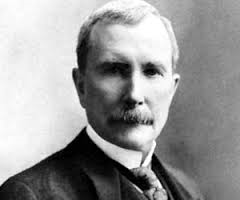
John D. Rockefeller
Contrary to over a hundred years of American history writing industrialists were the innovators while socialists, Communists and Progressives were the reactionaries unable to adjust to innovation. It is time to set the record straight. It was a very serious error when the reactionary agents forced the breakup of the Standard Oil Co. and the trusts. Contrary to the fearful notions of men like Louis Brandeis and Woodrow Wilson small companies are not more efficient than big companies. It is quite the opposite as John D. Rockefeller proved when he brought order out of the chaos of the emerging oil industry. Unfortunately the reactionary ideal of smallness was to forestall the future and cripple America. A second major error perpetrated by historians over the same last hundred years or so is the notion that innovators who became wealthy impoverished the majority by ‘owning’ the wealth. Using that notion as a starting point let us briefly review the progress of the nineteenth century concentrating on the US. The distance between the founding of the US in 1793 and the nineteenth century seven years later is immense. The US was founded at the very tail end of the post-medieval world. Between 1793 and 1800 a whole new psychological outlook came into existence, a change in scale. The world was seen with completely new eyes as the Aryan intellect began the remarkable unfolding shouldering the post-medieval world aside.

Andrew Carnegie
While in Europe there were two thousand years or more of continuity by 1800 the US was a virtual tabula rasa, a new beginning. Still, the US citizen moved to the ancient rhythms until very close to the Civil War. Scientific developments had been accruing in Europe and England for a couple hundred years and as the nineteenth century advanced the unfolding of the Aryan intellect virtually exploded. Discoveries in physics and chemistry were enormous resulting in steam, electricity, photography and at the end of the century a host of related discoveries that made the alchemists look like pikers. Reality had exceeded magic with much more to come. Not least of these was the invention of the railroad that would be the engine that drove industry in the nineteenth century. Prior to the Civil War numerous shortlines led from one city to the next but they were small easily comprehended operations that the average person’s mind could encompass while no truly large fortunes came into existence. To be a millionaire was nearly miraculous. There was ferment and excitement but the connection to the medieval mentality was not yet broken. However, as though a wizard had waved a magic wand, a new world began to form in the wake of the Civil War. It was a very rapid transformation from the village blacksmith under the spreading chestnut tree of Longfellow to the fabulous steel mills turning out hundreds of thousands of steel rails to carry the giant iron locomotives hauling a half mile of fully laden rolling stock of Carnegie. Suddenly there were great multi-millionaires, tens and even a couple hundred millions of dollars. It boggled the post-medieval imagination. Seeing only the millions the awed populace asked where those millions had come from. They hadn’t been there before. The only conclusion those overawed brains could come to was as there was only so much money in the world the rich had stolen it from the masses leaving them poor. This was a very serious error made more dangerous by the constant reporting that, say, five percent of the population owned seventy-five of the country leaving only twenty-five percent to be divided among the impoverished ninety-five percent. The idea of it rocked their senses. Soon they feared the ninety-five percent would be standing naked without two nickels to rub together.

Henry Ford
Most of those very rich people had made their fortunes in railroads. To take then the first transcontinental railroad, the Union Pacific/Central Pacific as an example: the UP/CP was an enormous undertaking uniting the three thousand miles between the East and West coasts. Financing such an enormous undertaking was the problem. The whole idea of the stock company was new. There were no established rules, indeed, really, no one knew what they were doing. It was all done on the fly. Even the New York Stock Exchange was in its infancy, hence all the wild stories about Vanderbilt, Jay Gould, Jim Fisk and Daniel Drew. The period was probably the loosest the world had ever seen or could imagine. Laissez faire in spades until the industrialists like Carnegie, Roosevelt and J.P. Morgan began to impose order. So, before the UP/CP let us assume that the net worth of the US was X dollars in 1865. In 1869 with the completion of the two lines adding enormous value to the country what was the new value? X2? X3, X4, X5 or maybe X6? The wealth to be divided had been increased exponentially. The steel industry had gone from the village blacksmith to the enormous rolling mills of Carnegie steel. Steel wheels had to be made, hundreds of miles of rolling stock. Because the UP/CP went where only open vistas had existed the land was opened to settlement, acreage was available to all, working stiffs or not. Where there had been no millionaires there were thousands of millionaires. There were men with twenty or thirty million who had been penniless ten years earlier. While unskilled labor did less well than skilled labor or the white collar caste the US was still famed for paying the highest wages in the world. Why do you think they came, for religious freedom? No, no, it was the money. This was made possible by the development of the railroads and industry. One must understand the colossal reorganization of society that entailed. A mere forty-five years earlier Lewis and Clark had taken years to slog across the continent and back risking their lives in the process. By 1870 one could ride in comfort from NYC to San Francisco in a few days. This was a transformation of the way life was lived. While White society was sophisticated compared to that of the stoneage Indian through whose territory the roads were driven White society was still primitive compared to today. Financial institutions and knowledge of finance were in a raw state. True, the US government contributed hugely including millions of millions of acres of free land to the roadbuilders yet the railroads couldn’t have been built any other way. The financing had to come from somewhere. As there was no adequate financial system financing had to be done on the run. That is the money followed the added value not preceding it. Something, as it were, had to have been created from nothing. Looked at another way, twenty years after the gold rush with a huge Civil War intervening, the South devastated and under martial law, the Bay Area had been populated and the job was done. The University of California was created in Berkeley, and even Berkeley had been created, while Stanford was in the works. These were sensational achievements. After all, the Mexicans in their hundreds of years had built only a few Missions. While chronic fault finders such as the Jewish writer Gustavus Myers blackened the reputations of the creators and belittled their achievements the builders truly built well. And out of the building the result was unparalleled prosperity and well being for the majority if not for the less qualified few. The next question was the nature of bigness.
2.
John Henry he said to his captain
Now, a man ain’t nothin’ but a man,
But before I let that steam drill drive me down
I’ll die with this hammer in my hand.
Lord, lord
Die with my hammer in my hand.
Trad.
Prior to the Civil War all was on a small scale. Longfellow could celebrate the village smithy under his chestnut tree and it’s a homely and pleasant image. Life was on a very human level unlike the life bigness would create that would require serious reevaluation of reality by the people. Carnegie steel mills with their regimented specialized work forces were a far cry from Longfellow’s blacksmith. In point of fact no blacksmith could compete with a rolling mill. The difference was magnificently told in the story of John Henry the steel driving man of song. As mighty as John Henry was he was no competition with a steam drill. He died of a burst heart with his hammer in his hand. Undoubtedly he was buried with his hammer beside him. Nothing pictures the industrial change so well. With bigness went organization such as was never seen before and consolidation that overawed the people in its bigness. The rather simple minded jurist Louis Brandeis who would be a major influence in the US government from Wilson through Franklin Roosevelt was an anti-bigness critic preaching the efficiency of smallness. Brandeis may or may not have been a wizard lawyer but he knew nothing of business or manufacturing.

Franklin and Eleanor
It would seem that all America trembled before the sight of John D. Rockefeller’s Standard Oil, the most efficient business structure the world had ever seen. He created the model for what was to follow. The contest between what had been and what was was too great an adjustment for the human mind on such short notice. Remember this was happening just as the concept of evolution and the onset of modern psychology were also disturbing the human mind in a very profound way. Within a decade or so the whole of reality was turned upside down or upside right depending on how you look at it. This terrified those unable to make the leap from the horse and buggy mentality to that of the internal combustion engine. The ancient and the modern required two different mindsets. The transition has not yet been made by the majority. For instance, over half of the US population still… still rejects the concept of evolution. The casual imprecision of the horse and buggy mind set within its wide parameters of precision was replaced almost overnight with the need for precision with little or no tolerance for personal idiosyncrasies. Thus when Henry Ford introduced the precision assembly line utilizing the Taylor scientific measurement of motion among its system repeated for as long as an item came down the assembly line at a measured speed it was really too much for the sloppy horse and buggy mentality. The workers didn’t understand why their minds rebelled but their reaction was one of rejection. They were reactionaries as were those of the Wilson-Brandeis school who reacted negatively to the mere thought of bigness. In the coming global economy, which could be seen on the horizon, in which bigness was absolutely necessary, combinations or trusts as they were called were the wave of the future. While Wilson and Brandeis envisioned a country of locally sized or regionally sized at best circumstances called for nationally sized combinations preparatory to international or global organizations.

J.P. Morgan
The industrialists led by J.P. Morgan were preparing for just that development. In other words Rockefeller was anticipating twenty-first century competitive circumstances. Indeed Ford Motors was a global corporation before globalism entered popular parlance. Bigness should have been encouraged rather than inhibited. The muckraking journalists propagandized the breaking up of Standard Oil, that is reducing it to smaller units and that was a very wrong turning. The ideal of smallness prevented the US from assuming its potential role so cherished by the reactionary Liberals as the savior of the world, the manifest destiny that George Bush tried to impose on the world by force. America made a wrong turn as the century passed. The bigness should have been understood and encouraged but perhaps the transition was so sharp that the American mind or at least the reactionary Progressive mind was paralyzed by fear at the sight of Leviathan or the Titanic while the really progressive minds of the Rockefeller type were caught up in a backlash they didn’t know how to resist. Yes, I know that the new truly revolutionary economic order had its faults but then model 1.0 to use computer terms is always less perfect than subsequent models. The bugs have to be worked out. In automobile terms one cannot expect Ford’s Model T, the best selling car of the era to compare to twenty-first century models of any make from the least to the most expensive. Things have to evolve.
3.
Just as technology went from the horse and buggy state to assembly line production so the financial system was passing from a very primitive state through several changes of scale to a more contemporary stage. Forms had to be created to deal with the needs of each successive increase of scale. Before the Civil War the stock market consisted of a few dozen equities while the bond market was non-existent except for a few government issues. The number of shares in equities were not in the millions or billions as today. More of the order of a few tens of thousands, the excesses of cornering a stock or crashing it by short selling, price manipulation, was not prohibitively expensive so that in a laissez faire unregulated market what could be done was done. But as the scale of transactions increased so new rules had to be made with each increase in scale. When what could have been done could no longer be done, well, it wasn’t. As there was no existing plan of action, no sound economic theory, management of the economy had to be done on the fly. There were capable men to step in and bring order out of chaos. The leader who emerged was the now much reviled J.P. Morgan. Like Rockefeller and Ford, Morgan was a great man. At the time the economy and the government were two separate entities, interlocked but not merged. Morgan did a good job. Since the merger of the government and the economy nothing has improved, it has gotten worse. Under Morgan the national debt was non-existent while today the trillions of debt that government merged with the economy has created is pure absurdity. Anyone who thinks one penny of that debt will be returned is an amusing fantasist. As the scale of business increased so necessarily did the amount of currency in circulation. Thus when the Republic was founded money was scarce to non-existent, people at the most were land rich. There were no millionaires. With each successive change in scale more millionaires were created with, for the time a novelty, fortunes of two hundred million having come into existence. In today’s values that would represent billions, still fortunes such as Carlos Slim’s and Bill Gates mounting into the tens of billions are greater. The people having become accustomed to great fortunes are no long irate. Since the novelty of huge fortunes has passed the outcry against these accumulations is much muted. There an now hundreds of billionaires and nearly countless thousands of millionaires. When John Roskab in the twenties said that everyone should be rich his prophecy has been nearly realized. But, then, the thought of that much wealth in the hands of the few made grown men and women shiver. The idiotic response of the time was to take the money away from them; that is gang up on them under government auspices and steal it from them through taxation. This was done under Franklin Delano Roosevelt in the thirties and forties when tax rates shot up to the 90% range. Further, business was saddled with an ‘excess’ profits tax. Reaction is one thing but this was total criminal insanity while undermining the prosperity of the masses. Every time the scale of business bumped up the amount of money required to finance the new growth increased geometrically. If companies were not allowed to generate the increased need internally then it would have to come from the government or be borrowed from banks. In the move to destroy the old Morgan order, the new socialist order created the Federal Reserve to do what Morgan had done. Federal Reserve officers are appointed not made by rising to the top through competition. Hence under Morgan there was no national debt while today it is laughable to even talk of the debt. The pressure is still against bigness and wealth creation. Hence America has been castrated in the now newly created global economy. America cannot now be the leader. The jump in scale is now enormous while the amount of capital to bring the global economy into existence is totally lacking. The global economy is now in the same state as when the necessity to build the transcontinental UP/CP railroad was made but the means of financing it were virtually non-existent. Then the US gave the railroad men millions of acres to open up settlement of virgin lands allowing a sort of boot strap operation; today the only recourse is to print money creating an even greater debt than can never be repaid. It’s like, why even joke about it? Meanwhile from the transition from the Morgans to the Federal Reserve the US government is in such an insolvent position that it cannot even collect enough taxes to meet immediate expenses. Hence it is in the position of increasing the national debt by more trillions each year. Thus it was a sorry day for posterity when our forefathers were overwhelmed by the face of success and began the retreat to failure. The US gave up its preeminent role in the world even as it achieved it. The moral is, think big and rich not small and poor.
Henry Ford And Albert Lasker
December 17, 2014
Henry Ford And Albert Lasker
by
R.E. Prindle
Gunther, John: Taken At The Flood, The Story Of Albert D. Lasker, 1960, Harper, NYC
Hoover, Herbert: Memoirs Of Herbert Hoover: The Great Depression 1929-1941, 1952, MacMillan Company, NYC
Weir, Alison: Against Our Better Judgment: 2014, Self-published.
Schmidt, Sarah, The Parushim: A Secret Episode In American Zionist History, http://ifamericansknew.org/history/parushim.html
Tugwell, Rexford: The Brains Trust, 1968, The Viking Press, NYC
Woeste, Victoria Saker: Henry Ford’s War On The Jews And The Legal Battle Against Hate Speech, 2012, Stanford U. Press, Palo Alto
In 1924 Harold Gray sat down and drew the first panels of his new comic strip. A comic strip that outlived him. Yes, Little Orphan Annie made her first appearance in the newspapers. It was in 1948 that I spread the newspaper out on the floor and made my acquaintance with the little orphan girl and her dog Sandy. I myself had just gotten out of the orphanage so there was an instant bonding.
I hadn’t been reading the strip for too long before the most fascinating character of the comics ever made his appearance. Daddy Warbucks stepped on stage. Warbucks, what a name. Did he make his incredible fortune making munitions in WWI? If so, it was only implied.
Warbucks was tall and slim, supremely confident with an incongruous joyish attitude. I mean this guy killed people who got in his way as a matter of course. Imagine trying to reconcile murder with business as usual in a young boy’s mind. He had his own private army with two killer sidekicks. The sinister looking Asp and the jovial giant East Indian, Punjab. If your transgression was mild Punjab waved his cape over you and you disappeared. If you made Warbucks angry The Asp pulled out his stiletto and you heard a splash. The Asp always killed near water. Daddy knew how to manage his affairs.

The Dangerous Duo
Warbucks was fabulous. He had his own grotto where he moored his own private submarine. He had unlimited cash so he was able to maintain his own secret service. I wasn’t aware enough then but now I think that Daddy Warbucks was modeled on the great industrialist Henry Ford. Henry didn’t have a submarine, but he owned a fleet of Great Lakes ore ships, sort of his own personal navy, with a big F-O-R-D blazoned on the sides you could read a mile or more away. He even had his own personal river up which his ships delivered the ore from his own personal iron mines.
His estate was upstream a bit on the River Rouge, his river, just above the incredible turn around basin he dug so his ships could go back out on the lakes to pick up more iron ore to keep his Model Ts chugging out the other end of the most astonishing factory in the world. One time he unloaded the ore into his huge River Rouge factory and 24 hours later a brand new Model T rolled out the other end. Daddy Warbucks had nothing on Henry Ford.
While the rest of us had to settle for our little electric train sets Henry owned his own personal real life railroad, locomotives, cars and all, real smoke. Henry was pictured sitting on the coal from his own mines in his own coal car playing the harmonica as he chugged on down the line. How cool was that?
Better yet, like Daddy Warbucks, he had his own secret service, the Service Department of Ford Motors led by his own intrepid Edgar Hoover, Harry Bennett. I’m tellin ya, that guy Henry was on the spot, heck, he was the spot. During the twenties he needed a secret service what with kidnappers, bootleggers, the Jewish Purple Gang, the Italian Mafia, and numerous other free lancers going around, labor fanatics waving bombs in the air, it paid to sniff things out.
Shots flying here and there, rough times in Detroit City. All Henry wanted to do was make his cars, not battle in a war zone. And then when the Jews began to war with him he sent his force out to gather incriminating evidence of their activities against him.
Of course the Jews reviled him for defending himself with his Service Department although of course they had no room to talk being awash in paramilitary and terrorists groups themselves. They even had their own personal shadow government conspiring for a quiet takeover of the country. Henry took them a step further pointing out that they had an international government working toward a takeover of Europe and the Americas. He was right too.
2.
All US histories have excised the Jewish influence on politics and social affairs. To mention them is to be defamed as an ‘anti-Semitist.’ Jewish histories written by Jews for Jews are quite explicit. They are seldom read either by Jews or gois. Copies are sent free to libraries however they are seldom and quite often never checked out, even have the presentation slips inside. If they are read they tell a clear tale of Jewish activities.
In point of fact there was and is an international Jewish government.
In the nineteenth century the government was run from France by the Alliance Israelite Universelle. During the first years of the nineteenth century the US was disregarded as a fledgling country while the ocean transit was difficult in small sailing ships. However as the century progressed the country blossomed, large capacity steel ships replaced the wooden ones and failed revolutions like that of 1848 displaced Jews sending them to the US. With the industrial development after the Civil War it was realized that Jewry could be more effectively directed from the US with much better security. Hence beginning in the 1870s the European Jewish population began to be transferred to the US while in 1898 the Alliance Israelite Universelle was shipped from Paris to New York City transferring the Jewish world capital to the latter city. International Jewish activities began to multiply.
A big one was the International Order of B’nai B’rith in the US. It was organized in 1843 but having branches throughout Europe by 1900. The Vienna branch was a key lodge as it was joined by Sigmund Freud in 1895. He remained a lifelong member. Freud was beginning his psychological career at that time. Nineteen years later his system of psycho-analysis was the standard of the emerging discipline.
His influence on world affairs through his association with B’nai B’rith would be increasingly felt throughout the twentieth century. He was essential to forming the Jewish ideology through the death of Roosevelt in 1945.
Now, the Jews had been awaiting a messiah to redeem them for two thousand years. The last bona fide messianic candidate, Sabbatai Zevi failed them in 1666. Unwilling to place their hopes in a single individual the Elders then evolved the notion that the Redemption would come from the whole people. The years set for the Redemption or Jewish Revolution were from 1913 to 1928. As Ford understood, the events in all countries of Europe and North America were coordinated. The two key events of the plan were the assumption of the control of US currency in 1913 through the creation of the Federal Reserve and the Bolshevik Revolution in Russia of 1917. Both countries were seemingly secured although the US Redemption was about to be consummated but was aborted by FDR’s death in 1945.
The history of the Jews in the US from 1900 to 1945 then is the progression or realization of their goal. The first key event of their plan was the fortuitous election of Woodrow Wilson in 1912. Had Theodore Roosevelt not split the Republican vote by his Bull Moose third party candidature William Howard Taft would have been reelected and the Republican program perfected.
As it was the American public clearly did not want Wilson as President as his vote was half that of the combined Roosevelt-Taft total. He got in by a fluke proceeding to begin elaborating a socialist government he called the New Freedom. His administration was a virtual partnership with the Jews who assumed a position of power in his government through 1920.
One of the first acts Wilson performed in 1913 was to sign into law The Federal Reserve System. In recent years it has been publicized to an increasing extent that the Federal Reserve is not an agency of the US government; it is a private corporation wholly owned and operated by nine international Jewish banks in both the US and Europe with a Rockefeller interest being the tenth thus forming a minyan.
The US monetary affairs had previously been managed by the J. P. Morgan interests also from NYC. The Jews thus switched that responsibility from the Morgans and also beyond the control of the US president who had no authority over it or influence on it. When the Fed engineered the Crash of ’29 Herbert Hoover the president bitterly remarked that the Fed had been placed outside of governmental and presidential control specifically to prevent such debacles while guaranteeing that under the Fed they could never again happen. Woody blew it there, bless the Democrats.
In preparation for WW1 the remaining components of the Jewish government were transferred from Germany to the US.
Now, the Federal Reserve is responsible for the currency of the US so that the Fed actually issues the currency then loans it to the government, that is the citizens, for their use at interest. Thus the Jews earn interest on every dollar in circulation. As the currency standard for the world you will understand how many trillions are now out at interest. At the time the upcoming war would expand the currency in circulation exponentially thus providing huge interest to the Jews. This is a key point because Jewish activities during the redemption would require more money than the Jews could ever have raised on their own. While so-called Jewish charity did raise a few millions that was nothing compared to their financial needs. Remember the Jews were supporting dozens of committees and congresses such as the American Jewish Committee at enormous expense as well as hundreds of synagogues along with their rabbis
Organized crime provided huge sums while Prohibition was a positive godsend. All those criminals are buried in consecrated ground. Today a museum in Las Vegas has been built to enshrine the activities of Jewish criminals. No stigma attached.
Organized crime was important to the Jewish program but so were legal activities. Thus it was that in 1916 Wilson appointed Louis Brandeis to the Supreme Court of the United States. This was a break with the past as formerly the court was all Anglo. As imperfect as his appointment was, the fact that Brandeis was a Zionist was even more important. Zionism was and is in conflict with what was then the American system now almost completely eroded.
Perhaps it was not known to Wilson that Brandeis had the dual identity, or perhaps he did and was complicit. An objector to Brandeis’ appointment described him as ‘a man who had certain high ideals in his imagination, but who is actually unscrupulous in reaching them.’ What the objector was describing is what is known as a justified sinner; that is one who is ‘saved’ in Christian terms at birth and thus can be as unscrupulous as he likes to satisfy his desires without sacrificing his guaranteed redemption. The objector might as well have been describing the whole Jewish belief system, essentially the end justifies the means.
The drum roll began to establish a reputation for Brandeis as the greatest living jurist and the purest man alive. Actually Brandeis was a ringleader of both Zionism and the Jewish Revolution. Using his status as a Supreme Court justice one of the first things he did was buy a professorship at Harvard for his lieutenant Felix Frankfurter. The drum roll then began to portray Frankfurter as one of the wisest legal scholars backed by his professorship at Harvard.
Thus he and Brandeis became two secular saints of both societies.
Frankfurter then began recruiting a cadre of acolytes to further Jewish objectives. Over the next twenty years Frankfurter assembled the cadre that became important when Roosevelt brought the Jews back to DC. No sooner installed than Frankfurter filled the Dept. of Agriculture with his acolytes. Thus in one fell swoop he completed the program fostered by Aaron Sapiro that was temporarily frustrated by Henry Ford from 1924-27.
A key event in the establishment of Jewish supremacy was the trial of Leo Frank from 1913-15.
3.
The Leo Frank Affair
The Leo Frank affair is a very important event in the Jewish calendar. They never tire at bringing it up while it had long ranging repercussions.
For those unfamiliar with the story Leo Frank was a Jewish businessman living in Atlanta Georgia. While his personal life is carefully avoided he is depicted as a Jewish secular saint who never did nobody no harm. Contrarily he was described as a sexual pervert. He employed young girls to make his pencils. By young girls we are talking child labor, pre-pubescent and pubescent. So our secular saint was exploiting young children to line his pockets. The temptation of all those young girls may have been too strong for his resistance. On this occasion he called fourteen year old Mary Phagan to the factory on a Saturday when he was alone in the office, all others being absent, to pick up her paycheck. Probably the amount was 1.86 or some such ridiculously low figure as that.
None saw Mary pick up the check obviously, but she was discovered in the basement on Monday murdered. Frank tried to pin the crime on a Negro janitor. Of course there was no hard evidence as to who had committed the crime but Frank was condemned as the perpetrator.
Why call the girl back to get her paycheck on Saturday after all the others? Frank was tried in an American court of law and found guilty. Louis Marshall, president of the American Jewish Committee, considered the conviction and death sentence as an anti-Semitic act somewhat like the blood libel. Frank had been convicted solely because he was a Jew in Marshall’s eyes. Marshall then began to organize a committee to free Frank.
Marshall was the president of the AJC, the AJC was the most important Jewish organization at the time as it is now. It has always kept a low profile or semi-secret existence. My wife’s aunt who was very active in Jewish affairs and the civil rights movement had never heard of the AJC until I told her about it which I find stunningly remarkable.
Mr. Marshall was a lawyer as well as president of the AJC. In his lawyer guise he frequently accuses opponents of being ignorant of the law, yet on page 295 of his Champion of Liberty he says ‘…I am morally convinced that the young man is innocent.’ I have no idea what legal standing being morally convinced of innocence is but I rather imagine, slight.
On p. 297 he writes: It is desirable to eliminate from consideration of the case, that Frank is a Jew. The important thing to consider is, that he was a respected industrious, law-abiding citizen…’
The question is a legal one not a question of the status of Frank’s reputation. In fact there was some question as to whether Frank was a sexual pervert. Certainly his desire to be alone with Mary in his factory, a poor defenseless very young girl, might tend to confirm the opinion. I am morally convinced this was so.
Marshall sets the wheels in motion in his attempt to reverse the conviction. In his reply to the letter from Judge Irving Lehman he further goes on to write, p. 295: “Obviously it would be most unfortunate if anything were done in this case from the standpoint of the Jews. Whatever is to be done must be done as a matter of justice and any action that is to be taken should emanate from non-Jewish sources.”
So, Mr. Marshall is falsely going to act on justice rather than the fact that Frank is a Jew. He is going to conceal the fact while getting non-Jewish persons to front for him. He apparently believes that if Frank were not a Jew the murder would be let drop. On the other hand he seems to feel that Frank has been convicted solely because he is was a Jew not a rapist murderer. Apparently overlooking the dead child he believes a Christian would never have been convicted. Thus it is not a matter of justice but a question of the religion of the murderer but we’re not going to talk about that.
While recruiting a Christian front group to mislead the actual actors Marshall also recruits, one might almost say commands, a Jewish cadre of activists. Now, Marshall was convinced or said so that the Frank case was the most important case since the Dreyfus Affair in France of the 1890s. Dreyfus was a Jewish spy in the French army who was originally convicted but after a furious publicity campaign by the Jews using French front men they had the decision reversed a few years later. It was then that the important French novelist Emile Zola was recruited as a front issuing his famous J’ accuse letter. One guesses that the Dreyfus campaign was the model for the Frank case.
Of the variety of Jews recruited to act behind the front one was the advertising executive from Chicago, Albert Lasker. Today both Marshall and Lasker have been obscured by time and may for practical matters be considered forgotten. Yet both men had significant roles during this time. Lasker as a young man entering his twenties at the turn of the century took a job with a Chicago advertising firm Lord and Thomas. At the turn of the twentieth century advertising had nowhere near the importance or prominence that it has today. Lasker joined the firm just as the advertising industry was about to develop. Lord and Thomas, the founders, were men of the nineteenth century not having yet learned of the psychological learning developing under their noses. Advertising was more educative at the time and less propagandistic. Lasker would develop newer methods based on propaganda and psychology.
We are not too concerned with his work on the Frank case although its work would require a leave of absence from his agency that would continue through the Aaron Sapiro legal battle with Henry Ford. Lasker was much involved in Sapiro’s attempt at a Jewish food monopoly.
4.
The question that is never addressed by goi historians and not fully disguised by the Jewish historians is what were the Jews doing after emancipation. The two key American agencies after 1913 were the American Jewish Committee and the Order of B’nai B’rith while Freud’s psychoanalytic Order played in the background. One should not underestimate the Freudian conspiracy and its activities in Central and Eastern Europe.
Organization stepped up after the inauguration of Wilson in 1913. Brandeis and Frankfurt would be key players from Wilson through FDR. Alison Weir gives some indication of the basic Jewish attitude in her Against Our Better Judgment in her discussion of a Jewish revolutionary group called the Parushim of 1913 and on.
This was a Jewish guerilla group formed as an order with elaborate oaths. As reported by Miss Weir:
Quote:
“You are about to take a step which will bind you to a single cause for all your life. You will for one year be subject to an absolute duty whose call you will be compelled to heed at any time in any place and at any cost. And ever after until our purpose shall be accomplished you will be fellow of a brotherhood whose bond you will regard as greater than any other in your life- dearer than that of family, or school, or nation.”
Unquote.
Horace Kallen the author of the Order made Louis Brandeis, before his Supreme Court appointment, an honorary member. Brandeis’ acceptance may have been more political in nature while as an honorary member he may not have felt bound by the oath, nevertheless as a Supreme Court justice he had pledged himself to an authority higher than the ‘nation’ and actually US law. Of course he had pledged himself as a Zionist to that end. Judaism uber alles.
Whether or not Lasker had pledged himself to the Parushim, as an ardent Jew and Zionist he also would have the same attitude as Brandeis and Frankfurter. After his activities in the Leo Frank case Lasker devoted several years to Jewish activities, the Lord and Thomas interests being managed by his surrogates.
Bearing the Parushim oath in mind, in 1924 Henry Ford used his newspaper to expose the activities of Aaron Sapiro, a Jewish lawyer organizing North American agricultural cooperatives leading to the Jewish goal. According to Ford’s researchers, a competent corps of men, Sapiro was aided in devising the co-op movement by Bernard Baruch, Lasker and Eugene Meyer.
As noted Sapiro had been recruited by the co-op plans deviser, David Lubin. The first step in the plan had been the organization of the Jewish orange growers of Sacramento. Lasker had been called in to promote the sale of oranges which he successfully did, thus it seems that he would have known both Lubin and Sapiro and probably was clued to the plan thus there should be no surprise that he was subsequently involved as Ford’s articles indicated.
Bernard Baruch, the King of the Shadows, served as a commodity expert in the Wilson administration thus he would have been very useful in forming these co-ops of commodities. Working from the shadows Baruch had more power than one would believe. As an instance FDR had to take him into account because as FDR said, he owned sixty congressmen. That almost amounts to a shadow government. Of course you will never learn that from Baruch’s autobiography.
Eugene Meyer was president of the Federal Reserve which would have been very useful although gaining information on him has been difficult.
One must believe that Ford’s exposure made Sapiro’s co-op organizing difficult although his influence was in decline after David Lubin’s death in 1919. Apparently Lubin’s direction was essential. Thus Ford’s exposure was effective regardless of any results of Sapiro’s lawsuit. However the agriculture issue was not settled by Sapiro’s defeat.
As noted Brandeis was given terrific influence over American political affairs when Wilson appointed him a Supreme Court justice. Like Baruch he was a major influence in forcing Jewish affairs forward leading a double life.
Brandeis, in whose honor Brandeis University was is named, bought a Harvard professorship for his disciple Felix Frankfurter. The drum roll then began to blazon Frankfurter as well as his master as the greatest legal minds the world had ever seen. Frankfurter himself began to indoctrinate decades of students, Jew and goi alike in the goals of Parushim. Thus the oaths terms ‘on behalf of the Jews, my [own] people, and of mankind’ were inserted to include not only Jews but any of the goyim Frankfurter might seduce. Plus Frankfurter could control to a great extent who was at the top of their class and who was at the bottom.
Brandeis and Frankfurter were rewarded in 1933 when Roosevelt was inaugurated. Frankfurter immediately filled the Dept. of Agriculture with his disciples, none of whom were farmers. One of the first acts of the Roosevelt administration was the passing the Agricultural Adjustment Act- the AAA. Thus although temporarily derailed in the mid-twenties by Ford, in 1933 the Jews obtained more under Roosevelt than they could have by the laborious and patient work of Sapiro, Baruch, Lasker and Meyer.
Of course the AAA was declared unconstitutional in 1935 by the Supreme Court confirming Ford’s opinion of the plan but that was nullified in after years by its implementation step by step anyway.
It is probable that Ford never met Albert Lasker but their lives touched indirectly.
Part VII: Henry Ford And The Aaron Sapiro Case
February 20, 2014
Henry Ford And The Aaron Sapiro Case
Part VII
by
R.E. Prindle

Whose Heaven On Earth?
Now let’s examine the apparent expectations of the two men, Henry Ford and Aaron Sapiro in light of their ethnic backgrounds and/or religious outlook, what the famed Jewish psychologist would call group psychology. How were their attitudes and opinions conditioned by their respective ethnic educations?
The leading characteristic of the Jews is that their approach is based on domination, the need to be Top Dog ‘by any means necessary.’ While I am not aware of Ford’s religious beliefs, if any, he reflects a Christian-American point of view, that is to say he considered service the highest virtue. Therefore he violated all established business practices by offering the highest value for the lowest price.
In that light then Ford founded his company and conducted its business on the basis of service, possibly what the Communists mean by ‘social justice.’ In constrast Sapiro exploited the farmers he claimed to represent extorting the highest fee for little value while aggrandized his persona. Ford created benefits for the many in everything he did including more than doubling the wage rate.

The Great Henry Ford
Just as Sapiro’s actions were based on his religion or ethnic collective, Ford’s activities were based on Christian-American ideals. Americanism could be placed on the same religious level as Judaism while Ford was busy developing his own variant of Christian-Americanism. It seems to have been his intent to reform the socio-economic basis of American life as a sort of American religion with himself as its prophet.
The clash between Ford and Sapiro was essentially ‘religious.’ As Miss Woeste points out Ford had his own vision of the farmer’s well fare based on service which clashed with Sapiro’s vision of dominance.
Ford had been a farmer while Sapiro never was.
Now, if one considers the psychological yearnings of the Ford Plan and those of the Sapiro Plan one has something like this: Ford’s Plan was essentially utopian in which he sought to create a heaven on earth for everyone while Sapiro’s Jewish Plan was millennial with the intent of creating a heaven on earth for Jews, they dominating everyone else.
Ford, believing he had the industrial key for bettering conditions for all was busy reforming every institution he came into contact with from industrial conditions to hospital care to electricity generation, not to mention his railroad. He was, like many of his generation, including W.K. Kellogg and his corn flakes and Bernarr Macfadden and his juice bars, interested in finding the miracle food, and he thought he may have found it one time in soy beans. In fact it was nearly a miracle bean. Ford established the bean as a premier American crop which had more than a little to do with aiding the farmer.
Sapiro’s notion can be seen in this photograph where he stands at the head of a group of Canadian farmers symbolically their master.
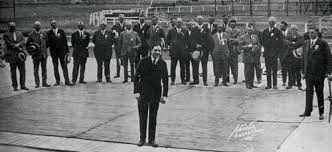
Sapiro In Alberta
As should be clear the Jewish War Against Ford was long standing before the Independent articles. Jewish animosity toward him began with the five dollar day and added to by the six dollar day and eight hour five day week improvements.
Ford in a religious sense was working miracles that threatened to overturn the Jewish system. If Ford were able to establish his earthly utopia that would obviate the Jewish millennium. It will be remembered that the Jews believed the advent of the millennium was imminent at the time so Ford was construed as a very dangerous threat to the Jewish millennium as well as the Communist Revolution in which the Jews were also heavily involved.
Thus when the Communists attacked Ford plants in the thirties, the Jews through Roosevelt were undermining his authority through legislation finally forcing a union on him in 1942.
Ford was quite right to challenge Sapiro. It would be nice if Ford or Uwayne State published the Ford Sapiro articles for all of us to study. While Miss Woeste laughs at them claiming them full of misrepresentations we are obligated to either take or reject her word for it. Uncharacteristically as a historian she offers no examples.
For instance what was Sapiro’s relationship to Albert Lasker and Bernard Baruch? What publicity was Lasker, as a publicist, giving Sapiro? How was he represented in the press? If he was, what kind of advice was the commodity expert Baruch giving Sapiro?
Are we to believe the articles lie when they say Sapiro was involved with these men? It just doesn’t seem reasonable or if not Miss Woeste might have given examples and refuted them. Her charges don’t have to be insinuated. After all, while not a historian, she is a lawyer.
That UStanford, one of the most prestigious universities in these United States, would imply that they accept Miss Woeste is a credible scholar leads me to ask the question, Why?
Anything Less Than Real:
Warren G. Harding Rings In The New Era
by
R.E. Prindle
Dedicated to Ann Coulter who is the only other person I have heard of who realizes the importance of Warren G. Harding.
It is time to reevaluate the Harding presidency as well as perhaps the Republican Interregnum between the Socialist Wilson and FDR administrations.
Perhaps the first thing to do is to dispel the notion that the Harding Administration was extraordinarily corrupt as administrations go. If one is going to call the administration corrupt then it must be against a normal standard and not isolated as a phenomenon. While Harding inherited Wilsonian corruption after the Great War, Roosevelt created the corruption of post-WWII. The money involved in the latter dwarfed anything that preceded it by incalculable amounts.
A major source of corruption after the Great War was the disposal of stores purchased for the war. These were fairly trivial amounts by later standards. In contrast the Roosevelt administration sequestered some piddling amounts of Japanese property and mega enormous amounts of German property including huge companies and scads of patents, copyrights and trademarks. Yet one never hears of these thefts, only a couple refrigerators left on back porches by Japanese. Ask yourself why? These German properties were under the personal authority of Pres. Franklin Delano Roosevelt and the officer of the Alien Properties Custodian of David Bazelon. Bazelon was both a Jew and associated with the Super Mob and Chicago’s Outfit.
After the war Bazelon used his office to enrich both Jews and criminals by selling off the pittance of Japanese properties and, in today’s values billions and billions of German properties for a penny or so on the dollar thus stealing from the Germans and defrauding the US Government of billions.
I don’t think it is necessary to list other financial malfeasances; Bazelon alone surpassed any corruption of the Harding years including Tea Pot Dome and Elk Hills. So yes, there was the inevitable postwar corruption in the Harding Administration, but not by it, of negligible proportions compared to Roosevelt.
Having put that out of the way let us now consider the state of the nation Harding inherited from the Democratic Wilson Administration. Two new developments, unprecedented developments, had occurred that were novel for a new administration to deal with. One was the terrible advent of Prohibition and the other was the women’s vote.
In this first election in which women cast their ballots we had the first landslide victory in US history. Harding captured sixty percent of the vote and all but a hundred or so of those of the Electoral College. Apropos of that Harding has been ridiculed because his campaign manager, Harry Daugherty said that Harding looked like a president should. Well, he did.
His opponent, Cox, on the other hand, looked like a mousy dip, which isn’t to say he was one, he looked like one. He was unhandsome. The choice for women thus was between a nice, big handsome Harding who looked the part and a mousy Cox who didn’t. The election was the first landslide in US history. I leave it to you to draw your own conclusions.
The ground rules had changed whether you believed in it or not, elections could no longer recite the issues as men understood them but campaigns had to be crafted to include the very different concerns of women. In my estimation Harding clearly benefited from the female vote.
Prohibition was an entirely different challenge. Prohibition was an achievement of female politics. The campaign for it was carried out by criminal means. The most famous prohibitionist was the violent, psychotic Carrie Nation who entered people’s places of business and began laying about with an axe. She was allowed to get away with it. The promoters of prohibition were too limp brained to think the matter through to its conclusion apparently unaware that alcohol could easily be smuggled in from abroad or even, heaven forbid, manufactured illegally.
Some form of alcohol, wines and beers, had been part of civilization from its inception and gave some surcease from the cares of life. While the vast majority of drinkers were able to manage the pleasures there was naturally a percentage who abused alcohol. When distilled liquors became available the problem of abuse was compounded.
Nevertheless, wine, beer and strong spirits comprised a huge industry employing undoubtedly tens of thousands of people. In the reformers’ mind, as always, it seemed better to punish the majority to suppress the few.
It should have been obvious to these unhappy reformers trying to make everyone’s life as miserable as theirs that an entire illegal industry would rise from the ashes of the legal and that that illegal industry would necessarily have to be criminal and clandestine. What can one say about reformers?
Thus when the Volstead Act was passed an unprecedented wave of criminality swept over the country like a tsunami. We can blame Prohibition on the Wilson Administration on whose watch the bill was passed and enforced. Thus the Harding Administration was called on to deal with this enormous level of corruption generated by do gooders. Once again Prohibition far exceeded any of the usual political corruption of the twenties.
Now, the control of prohibition passed into the exclusive control of two immigrant groups, those of the Italians, actually Sicilians, and the Jews. Using the incredible profits of Prohibition Jews and Sicilians then were able to assume a dominant if not controlling position in US politics while being able to buy into legitimate businesses. As incredible as it may seem by the mid- to late thirties many people considered crime as just another way of doing business, an industry. Needless to say bootleg profits were used to corrupt politics at every level. How could the Harding Administration escape? Once again, just look at the FDR Administration with open eyes.
The US has always taken a romantic or sentimental view of immigration, still does. As if it justified immigration the Romanticists said that the immigrants were only seeking a better life, content themselves in the superiority of having created not only a better life than anywhere else but the best life. Liberals believe in their own superiority.
One imagines that the only reason to emigrate from one’s homeland at any time in history was to seek a better life. Perhaps invaders drove you from your country making it necessary to find a life, better or worse, somewhere else and at someone else’s expense. Perhaps one’s situation was so bitter that any place else was more attractive. Actually the prime motivating force was US employers seeking cheap labor. Not very romantic really.
Nevertheless unlimited immigration began after the Civil War during the seventies increasing yearly until 1914 when the Great War began cutting off all emigration. It was then that problems not seen as too significant became prominent. US immigration had been from Europe and when the continent went to war these old national loyalties caused fractures. It became apparent that the Melting Pot notion had failed and as Teddy Roosevelt said, the US was nothing more than an international boarding house. Sentiment was strong for the Central Powers, who we have all been taught to despise, but not as strong as that for the Allies, who we have all been taught to revere.
The Irish acting on the principle that the enemy of my enemy is my friend openly sided with the Central Powers against the English hence targeting US shipments to England for sabotage. The Jews whose chief enemy was the Russians refused cooperation with the Allies until Germany took Russia out of the war and then at that time and only at that time, the Jews gave the Allies full cooperation against the Germans who they then believed that they could include in the Bolshevik Revolution post war.
The Italians took a stance but issued a recall of men back from the US to fight in the war. After the war Mussolini attempted to send the Italian wounded back to the US to be medically cared for at US expense.
Of all the immigrants US nativists considered Jews and Italians as unassimilable. If nothing else, Prohibition proved that assertion as US laws meant nothing to either group. Thus it was left to the Harding Administration to deal with the long deferred problem of immigration. It would do so for the first time from a realistic perspective rather than a sentimental or romantic one.
A concomitant of immigration was that a great many of those ’seeking a better life’ had left their homelands a step or two ahead of the police as either criminals or political fugitives. They were revolutionaries seeking to overturn their own governments, Communists in a word. Their position had been strengthened by the success of the Bolshevik Revolution in Russia while the Wilson Administration was actually Socialist in sentiment and had the war lasted a year or two longer, in fact. Wilson was on the verge of establishing a third term dictatorship to do just this, not unlike what Roosevelt achieved, when he was struck down by his stroke thus aborting that plan.
The Revolution did not confine itself to Russia but was actually being attempted through 1919 and 1920 into 1921 and the Harding Administration. The country was nearly in total disorder when Harding was sworn in, March of 1921. A necessity of the first importance was to restore order, that is, put down the Revolution. Harding was equal to that task. The Chinese proverb and curse is that may you be born into interesting times. While the elements defeated by Harding have successfully maligned his memory Warren G. Harding was actually one of the greatest US presidents.
2.
No historian I have ever read regards the problems Harding had to solve or his lack of experience in doing so. Harding was the editor of the small town newspaper of Marion, Ohio, West of the Alleghenies in Middle America. Harding worked hard, applying himself intelligently, making a success of his paper.
He became friends with Harry Daugherty, an Ohio politician who propelled him first to the Senate and then in 1921 to the Presidency. Years before his election Harding began an affair with a young women by the name of Nan Britton by whom he had a child. Naturally Harding had no desire to have this publicized yet he behaved honorably always supporting Nan and his child. He was a decent and good man.
Much has been made of this affair as though this were immorality of an extreme nature. Historically affairs and illegitimate children have been common. No big deal. How can one be expected to condemn Harding when the later John F. Kennedy had mistresses in the White House when Jackie was not about. What is one to think of Kennedy when he had his secret service agents rounding up prostitutes from the street, three at a time, for his dalliance?
FDR publicly lived with his mistress in Georgia while his beauteous wife, Eleanor pined away up North. Bill Clinton kept his member limber by having his female aides give him fellatio during business hours in the Oval Office. Hillary didn’t object.
Was Harding a moral reprobate? Hardly.
Then, the historians attempt to make him an ignorant oaf. A competing presidential candidate William McAdoo described Harding’s oratorical abilities, not surprisingly, as ‘an army of pompous phrases marching across the landscape in search of an idea.’
Oh well, politicians, how much sense do you get out of one of them? As an example of supposedly meaningless blather they offer this pre-election statement of Harding:
Quote:
America’s present need is not heroics but healing;
not nostrums, but normalcy;
not revolution but restoration;
not agitation, but adjustment;
not surgery, but serenity;
not the dramatic, but the dispassionate;
not experiment, but equipoise;
not submergence in internationality, but triumphant nationalism…
Unquote.
Rather than the nonsense it is portrayed as by his detractors, the speech details the problems the country was facing and the results Harding hoped to bring about and in which he largely succeeded. I’m sure his audience would have understood, whether consciously or unconsciously, exactly the issues to which he was referring. Only absurd historians have made a jumble of it. What the list amounts to is an eight point program not too different in approach than Wilson’s fourteen points. So we have a sort of political continuity between the administrations.
Let’s consider the list:
1. Not heroics, but healing. Refers to any number of problems, the waves of industrial unrest, hysterical politics and what not, a general calming down, a reduction from hysterics to the dispassionate.
2. Not nostrums but normalcy. A nostrum is a pet scheme for bringing about some social or political reform. There were enough of those going around- Prohibition, Communism et al. The issue here was the use of the word normalcy which in 1920 was incorrect although in common usage now. Normality would have been the correct word but normalcy actually carries the correct meaning that normality misses. His use of normalcy was a cause of immense hilarity and satisfaction to his detractors.
3. Not revolution but restoration. An obvious reference to the Bolsheviks and the social unrest they were causing.
4. Not agitation but adjustment. Once again political and social agitation were rife calling for the discard of current ways for impossible utopian ideals.
5. Not surgery, but serenity. Agitators called for drastic social surgery when once again calm and reflection were called for.
6. Not dramatics, but dispassion. Calm down, lower the level of hysterical passion.
7. Not experiment, but equipoise. Prohibition was a disastrous social experiment from it conception, what was needed was balance.
8. Not submergence in internationality, but triumphant nationalism. Clear enough, the League Of Nations was unworkable, out; tariffs were in, America First. The Naval Treaty.
As Harding was elected by a landslide one has to believe that the electorate knew exactly what Harding meant and whole heartedly approved of his choices. Nor did Harding disappoint; he was very popular during his presidency only successfully denigrated after his death when he was unable to defend himself.
3.
In office only two and half years before he died in suspicious circumstances how did Harding conduct his administration? One can’t imagine today the tremendous political energy released by the Bolshevik Revolution. The world was terrified while an angry civil war ensued across the Western world financially and militarily over an exhausted Europe. The civil war lasting for several years was fought on several fronts. The war had turned from a national war to an ideological war. Reds versus Whites. In Russia the ideological war was fought on three fronts, the North of Archangel, South in the Ukraine and in Siberia East of the Urals. American troops and munitions were involved. In the end the Whites, or Czarist troops lost.
Revolutionary activities sprang up in all countries including the US. While the US was aiding the Whites, the Jews raised enormous amounts that they traitorously funneled to the Bolsheviks under the eyes of the Wilson Administration. Jacob Schiff, the Jewish Prime Minister, was called to Washington by Wilson to defend himself against charges of Bolshevism. Wilson let him off the hook. Thus as in the Viet Nam war of the 1960s and 70s Government efforts were nullified by Fifth Columnists aiding the enemy.
The Bolshevik victory in Russia gave Socialism a political base from which to operate so the Socialists and Communist cells in the US were activated lending their support to Soviet efforts. Suddenly a socialist presence was clear in labor, the churches, the arts, publishing, across the board. While official Communist membership was relatively low so that it could be denigrated as no threat it must be remembered that the successful Bolshevik Party in Russia was just a splinter of US numbers, so size is irrelevant; organization is the key.
America’s first reaction was sharp as A. Mitchell Palmer, the Attorney General of the Wilson Administration rounded up several thousands of Communists for deportation to Russia. Here the Fifth Columnists sabotaged this wise response citing peacetime US practices for this wartime attack instead of the wartime provisions Wilson had used during WWI. Palmer was compelled to release all but a couple hundred who were put aboard ‘the Soviet Ark’ and sent to Russia including Leon Trotsky who had been living in New York City and without whom the Russian Revolution might have been reversed. Trotsky was actually temporarily detained but then released for some reason.
There were substantial crackdowns on all Socialist activities including the IWW or Industrial Workers Of The World who were reduced to impotence. Their leader, Big Bill Haywood was spirited out of the country to Russia. As Harding came to office there was a virtual civil war in progress. The fact has been obscured or erased by subsequent historians who are compelled to take the Red point of view.
At the same time as this undeclared war was being fought the troops were being brought back from the land of hinky, dinky parlay voo. How ya gonna keep them down on the farm after they’ve seen Paree. Even though their lives had been totally disrupted very often destroyed for no reason now that their job was done they were thrown on the trash heap. Except by Warren G. Harding, the new president.
A not overly favorable biographer, Samuel Hopkins Adams, writing in his biography of Harding, The Tragic Years, comments favorable thusly, p. 284-5.
Quote:
The glory of heroes is soon departed. The public which welcomed with oratory, banquets, and ticker-tape our fighters, returning victorious from Europe, quickly forgot those of them most sorely in need of care. Two years after the Armistice the plight of war’s human debris was pitiable. Of these the most desperate cases were 71,000 mental patients and 38,000 tuberculosis victims. F.W. Galbraith, Jr., National Commander of the American Legion, estimated on the basis of an investigation, that there were 10,000 of the disabled in cellars, poorhouses, and insane asylums. T.W. Salmon, a disinterested and competent investigator, thus reported:
“Veterans with nervous or mental troubles were without provision for care and were quartered in institutions for the criminal insane, addicts, and vicious degenerates, without Federal supervision.”
No agency in Washington was equipped to handle a problem of this magnitude. Nor was there any special public interest in it. The war was over. “Let’s forget its’ expressed the attitude of a people sated and bored with emotion.
The President (Harding) did not feel that way about it. His humanitarianism revolted from such neglect. He acted wisely and constructively in welding the disparate, overlapping guardianships into one official entity, the United States Veterans Bureau…
Unquote.
Compare that to the neglect and humiliation of the returning veterans of Viet Nam. The so-called Red tribunes of the people, these creeps who sabotaged their brave men’s efforts on the battlefields, heaved garbage on them as they debarked from ships and planes.
Even WWI vets who had been promised a bonus or tip for the needless disruption of their lives were denied their due by the People’s Commissar Franklin Delano Roosevelt. They were compelled to storm Washington in a semi-violent attempt to compel the fulfillment of the government’s promise. The same army they had served in was turned against them. So much for FDR and the New Deal.
With the end of the war a whole host of what were actually revolutionary acts were released. Palmer of the Wilson Administration certainly treated them that way. As a result his house was bombed putting his teeth on edge. A huge bomb not unlike that used in OK City of recent memory was detonated on Wall Street. Law and order was rapidly breaking down. Mail robberies were a daily occurrence while millions of dollars of stolen Liberty bonds were being traded. Those millions today would represent a billion dollars or more. This was big money happening. Incredible amounts of money that no group of individuals could possibly spend. Where was the money going?
A very able member of the Harding cabinet, Post Master General Will Hays tackled those problems and solved them in short order. Such a man was a danger to the Lords of Misrule. What happened to Hays? In addition to all the other problems, the Guardians of Decency were alarmed, justifiably so, at the moral content of movies. Rather than accept outside censorship of the movies the moguls decided to police themselves and as their Top Cop they lured Will Hays away from his post by an offer he could have refused but found it impossible to do. The offer was for 100,000 dollars a year. That right 100K in 1922. Was that bribery or what? After only nine months in office Hays was offered the equivalent of five million dollars a year to supervise Hollywood morals. Who wouldn’t take that while being flexible enough not to lose the job?
Since the offer came from Hollywood that tells you who was behind the mail robberies and stolen bonds and lets you know what they were worth.
Harding outlawed the Communist Party briefly in 1921 getting right on that offense too but the Fifth Columnists got that overturned.
Thus within months of being in office Harding had cleaned up a large part of untoward activity while if couldn’t actually suppress Communist activity he was at least able to force them to turn their damper down while forcing them into even deeper clandestine activity.
But, as you can see he was building up a lot of enemies who wished him dead while wanting his memory exorcised.
And then Harding had to deal with the problem of immigration, also within the first months in office. The cry for the restriction of immigration, whether it came from North, East or South had been voiced at least as early as the 1840s when the potato famine drove a couple million Irish to the New Island. Really teeming masses. And then the Forty-eighters came over as a result of the failed Communist Revolution of 1848, more wretched refuse, that led ultimately to the post-war revolutionary activity.
These members were relatively small but in the 1870s Jewish immigration from the Pale of Russia began in earnest resulting in several million people who the restrictionists believed, as it turns out, rightly, were unassimilable. And then in the nineties the Sicilians added New York to the terminal end of their migratory route from Buenos Aires through Brazil and Central America. These people too were thought rightly to be unassimilable.
And then those sweet little old ladies hacked Prohibition through the Amendment process apparently believing that the law was the law and everyone would abide by it. They held that futile belief even though they had engaged in rampant lawlessness to get the Amendment approved.
Well, a void had been created and you know what nature thinks of voids. They get filled; nature abhors them or, so we are told. What people rushed in where angels, or at least, less venturesome mortals fear to tread? These two unassimilable peoples, the Jews and Sicilians.
Nobody gets credit for being right in such situations the restrictionists were right.
In most analyses of any period the activities of Jews are always suppressed; you never are allowed to see them until they want to be seen. Nobel awards time being one. While being Omni-present we are asked to believe that their only effect on society is to win Nobel prizes. In point of fact Jews, having great presence of mind, always work behind and under the scene. Thus to understand their effort on the America of the Harding Administration one has to set a background. I’m not going to go back too far settling on the transfer of the Jewish World Government from France when the Alliance Israelite Universelle was sent to the US and became the American Jewish Committee by 1906. This was the international Jewish government that Henry Ford referred to in his Dearborn Independent articles later collected and published under the misleading but accurate title: The International Jew. The articles were published during the Battle For Ford Motors largely during Harding’s tenure.
The leader or Prime Minister of the world Jewish government was a man named Jacob Schiff, himself descended from the German Forty-eighters rather than being a Russian Jew.
In the Jewish war against the Russian Czarist government Schiff played a leading part. He was personally responsible for engineering the Russian defeat during the Russo-Japanese war of 1905.
During that war the Jews of Europe and the US denied the Russians loans to conduct war properly while Jacob Schiff personally provided the Japanese with the funds without which they couldn’t have waged war.
While Schiff himself lacked enough of the ready for the war he was on the board of the Equitable Life Assurance Society. The Equitable was sitting on a hoard of 200 million, in today’s dollars, billions. Schiff illegally used this money to loan to the Japanese. The loan caused a tremendous scandal in which Schiff skillfully avoided detection shifting the blame to the other directors.
The peace treaty was chaired by Theodore Roosevelt in the US at which proceedings Schiff led a delegation of Jews who participated as a Jewish National delegation. Stacking the deck against the Russians.
Not content to punish the Russians for alleged injustices toward Jews in Russia, Schiff and ‘the international’ Jews worked to cause the US to sever diplomatic relations with Russia which result was achieved in 1913. Thus the US became dupes of the Jews.
In 1913 the Federal Reserve System was created as a private corporation owned by ten other corporations of which nine were Jewish firms from the US and Europe. The tenth was the Rockefellers. This private firm printed US currency that it loaned back to the US government at interest, thus creating a tremendous income to be used for worldwide Jewish machinations for which there was no accounting. I would call it a brilliant move but when you’re dealing with Liberal suckers it isn’t much of an achievement.
While the Jews had had no presence in Washington DC prior to the Wilson Administration, beginning in 1913 Wilson flooded his government with them much to the consternation of the English led government of the previous hundred years plus since independence. You know, it’s not like people couldn’t see what was going on.
Coincidentally as Jews were taken into government the Anti-Defamation League of B’Nai B’rith was established to counter any objections on ethnic grounds. Wilson himself was a socialist so that when the US entered the Great War a socialist takeover of the industrial system began. The railroads were immediately nationalized while the War Industries Board required all industries to submit financial details and to submit them for governmental regulations by the WIB controlled by Jews under Bernard Baruch essentially setting them up for seizure.
Of course, this provoked a violent reaction especially from Detroit and the auto industry. Ford and the Dodge Brothers objected strenuously. The Dodge Brothers used intemperate language reflecting on Baruch’s ethnic heritage that Baruch never forgave. Ford was more restrained but tarred with the Dodge’s brush. The Dodge Brothers died mysterious deaths in 1920 while their company went into limbo for years until Wall Street persuaded Walter Chrysler to take the company. An attempt was made on Ford’s life. This confrontation was also the beginning of the Battle For Ford Motors, begun in 1918 but aborted by the war ending. It was begun again on a financial front by Jewish banks trying to force a takeover.
So, the Socialist/Communist takeover of the US was very narrowly avoided. Yet the Socialist revolution had to be financed with hard cash that the Socialists didn’t have. Where was the cash to come from? From the US. The Jews had created the Federal Reserve System in 1913 very fortuitously it would seem just before the major expansion of the money supply caused by the World War. That war from the Allied side was financed entirely by the US. At war’s end the European debt to the US was enormous while it would never be repaid. It was just forgotten. Consider that when you get exercised by the current US debt. It can be forgotten too.
Yet the ten merchant banking firms who owned the Federal Reserve collected interest on every dollar of that debt. Thus the US dollars went to nine Jewish firms in both the US and Europe plus the Rockefellers.
As I have noted, as soon as the Bolsheviks seized power, Jacob Schiff rushed huge loans provided by those banks to finance the Bolshevik takeover. At the same time the devastation of the peoples of Central and Eastern Europe was total. There were still roughly five million Jews in those areas. Jewish American ‘charitable’ organizations operating under the name of the American-Jewish Joint Distribution Committee began to funnel enormous amounts of cash and supplies destined only for their co-religionists into this volatile political environment where the first people on their feet would have a commanding role. Socialism or no socialism money was the key, as always. As the aforementioned Liberty bonds in Jewish hands had been stolen that was a pile of free money that was laundered. Crime was about to be organized in a way that would provide other funds in large amounts. There was a succession of Jewish crime lords that generated the money. The first in the teens was a fellow called Monk Eastman, as his criminal methods became outdated he was sent to jail to be replaced by the notorious Arnold Rothstein who set up the modern organized crime structure but as his methods became outdated he was replaced, murdered, and Lepke Buchalter took over the role to be replaced in the forties by the major fund raiser Meyer Lansky who engineered that huge cash cow, Las Vegas and gambling. As different methods were needed he, in turn, was replaced by Sidney Korshak of the Super Mob. Thus the Jewish over world was integrated with the Jewish underworld functioning as a unit.
In celebration of these criminals the Jews recently created the National Museum Of Organized Crime in its capitol of Las Vegas, Nevada. The nationality referred to in the National Museum is that of the Jews otherwise they would have called it either the American-Jewish Museum or simply the American Museum Of Organized Crime. So you can go to Vegas and admire the criminals deeds of these stellar Jews.
Seemingly almost a gift from heaven to the criminals, Prohibition came along in 1920. This gave the financial basis for organizing crime as a ‘business’ thus opening vistas only dreamed of before the Volstead Act. Prohibition also created an insuperable problem that plagued the Republican Interregnum. Amazingly Prohibition began in a Democratic Administration and ended almost by fiat in the Democratic Administration of Franklin Delano Roosevelt twelve years later, one of the those coincidental linkages between Wilson and FDR. Upon taking office Roosevelt held up a glass of obviously bootleg beer and announced that Prohibition was over. Just like that. Was the fix in from the beginning to end or wasn’t it?
But, back to the Battle Of Ford Motors for a moment. The bankers wanted Ford Motors not only because they hated Henry Ford but because Ford Motors was a bonanza waiting to be realized almost bigger than Prohibition.
Ford valued his company at something over a billion dollars. He had completely vertically integrated his company. That means he not only made the cars but he owned the metal mines and smelted the ores, he owned huge forests he cut and processed, coal mines to fuel his furnaces and even the railroad that carried the coals from the Line to River Rouge. He had subsidiaries worldwide. By 1920 Fords could be bought actually in any country in the world. Like Sherwin-Williams boasted of their paints, Ford covered the world.
The value of the company was compacted. In the bankers’ hands the company could be broken up into its component parts increasing the stock market value to three or four billion, all free money, especially as they were trying to buy Ford at the bankruptcy rate of 10 cents on the dollar. So you see how fiercely the Battle For Ford Motors was fought. You can see why Ford fought back by running his exposes of Jewish machinations, which were true, in his Dearborn Independent. The Independent was also the first nationally distributed newspaper by the way.
Henry Ford won the battle but ultimately lost the war.
So as you can see, Harding was elected into one of, if not the, most tumultuous times in American history and acquitted himself extremely well. His efforts were also appreciated by the American public that awarded him the highest approval ratings during his term in office.
His actions also made him many enemies not least of whom were the Communists and Jews. While Jews were prominent in Washington during the Wilson years and again in the Roosevelt years they were conspicuously absent during the Republican Interregnum. The Communists too, while if not destroyed, were harassed and suppressed forcing them to adopt different tactics while frustrating their desire for an immediate conquest.
On the immigration front too, Harding’s policy of realistic restricted immigration frustrated the desires of the sentimental immigrationists. Harding passed a restrictive bill quickly in 1921 that was augmented under Coolidge’s Administration in 1924 and survived almost intact until 1965 thus giving the country much needed breathing room to attempt to assimilate those already here to attempt to turn them into one national unit. It didn’t happen.
It is not particularly well known but in 1914 the Jews had formulated a plan and organized it to transfer the entire Jewish population of the Pale of Settlement to the US utilizing the ports of New Orleans and Corpus Christi, those ports being less conspicuous than New York City and Boston.
The war, of course, aborted that plan, and just as the Jews were about to activate the plan after the war Harding slammed through a restricted immigration act based on quotas seemingly aimed directly at excluding Jews period. This was an unforgivable crime in Jewish eyes while also forcing them to change their plan of the conquest of the New Promised Land.
Harding also dealt with internationalism rejecting the League Of Nations in favor of nationalistic policies. In the first years of the new century the Japanese had sent paramilitary troops for the pre-invasion of California, thus all the Japanese immigrants were men without women. The Californians who had already forced passage of the Chinese Exclusion Act of 1882 objected vehemently to the Japanese invasion. Rather than offend the Japanese by protecting his own country the Teddy Roosevelt Administration came to a ‘gentlemen’s agreement’ whereby the Japanese would no longer send ‘working men’ but only doctors and lawyers. I think Teddy called his administration the Square Deal. He must have known what he was talking about; that solution was certainly square.
After the war then with no military invasion imminent these men demanded women. Thus began the strange phenomenon of the Japanese Picture Brides. The men and women exchanged pictures making their selection on that basis and then the women were sent to California for marriage. Many interesting situations arose from that.
Still there was a great deal of hostility between the US and Japan. The hostility was actually caused one sidedly by the US. Very embarrassing situation. It began in 1853 when Admiral Matthew Perry ‘opened’ Japan at the mouths of his cannon. What’ll it be he sneered from the poop deck: Yes or no.
The relationship was exacerbated in the 1870s when anti-slavery Yankee planters landed in Yokohama and forcibly abducted a hundred or so Japanese to labor on their old plantations in Hawaii. I can see how the Yankees got so exercised by Southern slavery in the US. So, while I have to side with the US the Japanese have always had a legitimate grievance that could only be satisfied by war. I mean, come on, they had to regain their manhood after having been emasculated in 1853.
Nevertheless in 1908 TR said we would have to fight those fellows within thirty years and he only missed by a few years.
Thus in 1922 the Washington Naval Treaty was negotiated as, we suppose, an example of triumphant nationalism as opposed to the internationalism of the League of Nations. The Naval Treaty limited the size of naval fleets inadvertently favoring the Japanese. But the belligerence remained at a high level that left the then territory of Hawaii vulnerable. Naval fuel was shifting from coal to oil so while coaling stations had been established there were no oil storage facilities on Oahu the site of the Pearl Harbor Naval Station.
This was a dangerous situation. It was difficult to get Congress to act so some enterprising American oil men, Doheny and Sinclair, set about to remedy the situation on their own. Now, too oil fields, Tea Pot Dome in Wyoming and Elk Hills near Bakersfield, had been set aside as Naval Preserves. The storage facilities in Hawaii would be naval, so there is a connection.
Doheny and Sinclair set about to build the oil storage on their own and to fill the tanks they negotiated to use the naval preserves Teapot Dome and Elk Hills for oil supplies. This deal was used as an excuse to create a huge scandal, although after Harding’s death. Nevertheless the storage facilities were built and filled with oil so that when the Japanese attack on Pearl Harbor duly came the US was duly prepared.
Two and a half years into his presidency Harding began a tour of the West Coast during which he suddenly died. Some said poison some said heart attack but they got him into the ground so quickly there was no autopsy. Anytime the rules are broken its cause for suspicion. Some said his wife killed him but I have a hard time believing that.
Of course we have no way of knowing whether he was assassinated or not but there were many who may have wished his dead. Harding had sidetracked the Revolution, derailing it, while forcing the Bolsheviks further underground. His immigration act had thwarted Jewish plans to bring over five million fellow Jews. So actually Harding was ‘responsible’ for the death of all those Jews in the holocaust although I don’t think he’s ever been officially accused.
Neither the Jews nor the Communists have earned a reputation for being forgiving so both groups certainly had a motive. But, the problem is incapable of solution so let it drop.
Harding was only in office for two and a half years but what a two and a half years, hey? What a bunch of insoluble problems dealt with and well. He defused the Revolution, ended unrestricted immigration, tried to limit naval armaments and battled old Demon Rum. I suppose if he had had the chutzpah of FDR he would have said simply that Prohibition was nonsense and refused to implement the law. Would he had.
The profits of Prohibition went to establish Organized Crime. And from booze the criminals went on to gambling breaking down US legal resistance by using States Rights to legalize gambling in Nevada. From Nevada it has spread to every State in the Union. Carrie Nation is ultimately responsible for creating Organized Crime and hence the corruption of the Nation. That’s what happens when you put the girls in charge. And the little girl didn’t even have the vote. No, but she had the Power Of Positive Thinking. Just get it done.
My point is that Warren G. Harding rather than being the worst president of the United States was perhaps one of the greatest. It was just that he offended some vindictive people and they had the power of the press…and radio…and the movies…and…
The Protocols of Zion were so Nineteenth Century. Post-war America was the New Era of the Twentieth Century.
Exhuming Bob 2-2 Detourning The Folks
December 24, 2007
A Critique
Exhuming Bob 2-2
Detourning The Folks
Greil Marcus has written of detournment extensively especially in his Lipstick Traces. The French word means hijacking, rerouting or diversion, or in other words changing the direction of the flow or meaning. Thus one strips an object of its familiar values and replaces them with others but leaves the object intact. In a conflict of cultures the question becomes who will assign the values or meanings to objects and words.
I will use as a starting point for my purposes here H.L. Mencken of the twenties. The values into which immigrants migrated were those of the Anglo-Saxons. From the immigrant viewpoint the Anglo-Saxons detourned their languages and cultures attempting to replace them with English and Anglo-Saxon values. The inevitable result was that immigrants felt that they had been devalued and demeaned. So it is no wonder that having recovered some balance by the end of WWII they fought back by attempting to detourne Anglo-Saxon culture in their favor.
This is nowhere more apparent than between the Jews and Angl0-Saxons. No matter whether you place the conflict between the Old Dispensation or the New Dispensation the Jews always view themselves as a separate, independant and potentially dominant culture. Hence the drive is always first for autonomy and then detourning the host culture to reflect Jewish laws and customs, hopefully making Hebrew the official language. To Jews, like Greil Marcus and Bob Dylan then ‘freedom’ means the replacement of the Anglo-Saxon law and culture with Jewish law and culture with the Jews as arbiters of the fate of what become essentially subject peoples. The Jews can never be ‘free’ no matter how unrestrained they may be so long as they are subject to others legal and social systems. This is the central problem the United States and the West refuse to face. The same is true of the Semitic Moslems. It is the purpose of Moslems to detourne Western culture for a Moslem Culture. It is quite simple.
By the time H.L. Mencken was making his rise Anglo-Saxon pride was at its maximum. I haven’t been able to determine whether Mencken was Jewish but he allied himself with the Jews making common cause with them. The approach naturally was to defame Anglo-Saxonism. Mencken naturally chose the least sophisticated Anglo-Saxons to represent the whole. Thus he went to the mountain folk of Appalachia and the hill country all along the Line. He began to ridicule these people as representative of all Anglo-Saxons. I mean, he was mean; he was vicious; his Jews caused a huge fuss for much less criticism or in their terms- defamation.
Expanding the arena, using these rural folk as their model the Communists then picked up on these people with the least possibility of education as the example of Anglo-Saxonism. In 1932 and 1933 following Mencken’s example Erskine Caldwell, a Communist writer, published two mammoth best sellers, Tobacco Road and God’s Little Acre. These books were especially mean and vicious making Mencken look laudatory in comparison. Perhaps using Mencken and Caldwell as inspirations a Jewish cartoonist by the name of Al Capp created the L’il Abner comic strip in 1934. This strip also ridiculed Anglo-Saxons but in a less demeaning manner that not only didn’t offend the majority but actually pleased them. There were some few of us who saw through the sham but there was nothing obvious enough that the majority could see.
Capp would be convicted on a morals charge late in his career that effectively ended his influence. The motif was carried forward on television in the series Archie Bunker.
Now, the Anglo-Saxons used to represent the whole were the custodians of the Folk music that was so revered by the New York City Jews of the late fifties and early sixties. So you actually have Jews imitating Hillbillies.
The vilification the Mountain Folk endured actually shamed the city Anglo-Saxons causing a dichotomy in their character. They rejected the Mountain Folk as representing all Anglo-Saxons. This is made quite clear in Caldwell’s novel when his urban relative throws his rural cousins out of his house and tells them to never come back. Something like a son testifying against his father. The Liberal-Conservative split was given a difinitive form.
The Mountain Folk formed what Greil Marcus calls the Weird Old America. After the Roosevelt administration was elected and the New Deal was established as a continuation of the Wilsonian New Democracy Jews flooded back into Washington as under Wilson.
During the twenties as radio became a reality and recording technology became more widespread and available a number of Mountain Folk and/or White Trash as they were alternately known, recorded their distinctive music in their own voice. Nor was this music ill received, many of the recordings were huge sellers according to the standards of the times while some like Jimmie Rodgers and the Carter Family became very successful recording acts. Thus what was known as Hillbilly music until 1954 came into existence. For whatever reason whoever controls these things thought the term Hillbilly was insulting so the various rural flavored musics were grouped under the term, Country and Western. Hicks are hicks to me whatever you call them, Hillbilly or Country, I’ve been called worse. Having ancestors that came down from the Kentucky hills I have no objection to my Hillbilly ancestry.
The Anglo-Saxon dichotomy was such that those who were shamed by Communist efforts had an extreme aversion to Hillbilly or Country music that they considered ignorant while professing to admire the Blues simply because it was performed by Blacks even though the intellectual content was well below that of Hillbilly music.
Nevertheless the Hill Folk were the custodians of the old English folk traditions. Folk music was then separated from Hillbilly music and approved on that basis. Thus after the Roosevelt administration was installed in an effort to counter the Depression certain cultural programs were developed. One involved the attempt to preserve the quaint customs and music of the Hill Folk and the rural Blacks. These two peoples were treated as anthropological specimens on the same level as Tobriand Islanders and others.
The New Deal of the Roosevelt administration was a direct continuation of Wilsonian New Democracy. It was as though they’d never been gone. With the creation of a huge new bureaucracy Jews came flooding back into Washington as they had in the two Wilson administrations. In many if not most cases these people were the ones sent out to deal with our homegrown anthropological specimens as Superior to Inferior. Sort of a domestic Peace Corps. Yes, they did profess to revere the music of these simple folks.
So Folk Music always had an honored place in Anglo-Saxon cultivated circles perhaps spurred to some extent by the ‘field’ recordings of the New Dealers. Folk played a prominent part in popular music from the end of WWII on. Foremost practioners of the genre were the Almanac Singers and their successors The Weavers.
A key member of both groups was Pete Seeger. Pete was both Jewish and Red. This was a bad combination during the post-war anti-Communist reaction. While making hits of a number of Leadbelly songs under Seeger’s guidance The Weavers had a major success with the Jewish melody Hava Nagila. It was a catchy tune. I liked it.
Capitalizing on this success The Weaver’s under Seeger’s guidance concocted a ‘folk’ tune called Song of the Sabra celebrating Jewish ‘pioneer’ efforts in Israel. Apparently the Sabras were some kind of hobo outfit that sat around campfires and ate stew a lot. Thus the effort to detourne American Folk Music began. The Song of the Sabras was so egregiously promotive of Israeli/Jewish interests that the song caused a big reaction. If I remember correctly it was staged at least once on a TV version of the Lucky Strike Hit Parade. That’s where I got the camp fire bit as Pete roasted his weeny and sang. Whether it was an extra or supposedly in the Top Ten I can’t remember.
Somewhere about then Seeger and The Weavers were found to be subservice giving a bad name to Folk Music as long as the genre lasted in 1966 or ’67. The Weavers disappeared from the air waves. However at least one member would be instrumental in guiding the musical direction of the Kingston Trio.
Folk music continued strong between the demise of The Weavers and the emergence of the Kingston Trio both as popular music and ‘purist’ Folk. The greatest of them all was Lonnie Donegan who had a successful career in the US and a tremendous impact on the British scene from England to Australia as Skiffle Music. Josh White, Odetta, Harry Belafonte, Terry Gilkyson and the Easy Riders among others, one might add Mitch Miller, had many memorable folk tunes competing equally with Rock and Roll if not its superior. If one considers the Presley Sun recordings objectively they also can be seen as Folk or highly influenced by Folk. After all Elvis was known as the Hillbilly Cat.
The Kingston Trio with their Tom Dooley that was an actual sensation in 1958 sort of broke the taboo against Folk music although the Kingstons were plenty subversive. The great Chad Mitchell Trio emerged at this time also as an even more politically subversive group but also with a popular sound and enough bite to defuse Dylan’s claim to have introduced serious lyrics into popular music. The Chad Mitchell Trio is probably running neck and neck with the Kingstons as my favorite folk groups although Terry Gilkyson along with the Pozo-Seco Singers are right behind them. The old Seekers from Australia are hot stuff too.
So that brings us up to Grossman’s Gate of Horn in Chicago of ’58 and the founding of the Newport Folk Festival in ’59 as well as Dylan’s entry into the New York Folk Scene in ’61.
3.
After WWII the Jews had introduced the raw form of multi-culturalism designed to replace the Anglo-Saxon model of society with the Jewish. With the election of the Irish Catholic John F. Kennedy it appeared that the Anglos had been defeated.
The next phase of the Jewish program was put in place. The thing was to detourne or hijack American culture.
Detourning Folk music was part of it. The study of Dylan concentrates on the New York City East Village group that was virtually Jewish with its specific outlook. Actually the Folk scene was very diverse and different in its emphasis in each locale. Bob would focus the entire Folk movement in himself.
Boston with the Mel Lyman family and Jim Kweskin Jug Band, Geoff and Maria Muldaur was quite different from NYC. The strictly commercial LA scene with Randy Sparks’ New Christy Minstrels had its own flavor. In San Francisco Jerry Garcia, Robert Hunter and others had credentials that easily matched those of Dylan. The whole San Francisco Sound was Folk based.
The top bands like Kingston Trio, Chad Mitchell Trio and semi-pop groups like the Brothers Four and the Christy Minstrels really carried the banner for folk.
And then there was the Country or Hillbilly faction that was considerable. Great old tunes like Jimmy Brown The News Boy were Country smashes. Hank Snow recorded a passel of old Folk songs like Nobody’s Child. New murder ballads appeared for people who like that sort of thing that were fabulous like Snow’s Miller’s Cave and Lefty Frizzell’s dazzling The Long Black Veil. It would be years before it was known that Veil was newly written and not an old Hillbilly song. If you compare the Kingston’s Tom Dooley with Frizzell’s Long Black Veil you can’t tell the difference.
A word about Harry Smith’s Anthology Of American Folk Music that Greil Marcus and Bob Dylan revere so much. The collection is a very small selection of songs culled from a huge mass of material that just happened to fit Harry Smith’s personal psychosis. Anyone going over the same mass of material could select an entirely different selection of songs that reflected their own personal outlook and would be just as ‘authentic.’ I mean, I heard The Cuckoo and I Wish I Was A Mole In The Ground over the radio decades ago as a kid. I was signally unimpressed. I never called in to hear either again. So as far as being some authentic voice of America I rather think the collection reflects Jewish and Communist ideals.
What is the message exactly of ‘I wish I were a mole in the ground, I would burrow until I brought that mountain down.’
It that isn’t a call to detournement I don’t know what is. So Harry Smith is Harry Smith and welcome to him but I have my own agenda.
So Dylan left his old life behind to begin a new life in New york City but with an old agenda. His secret agenda was to detourne American culture. Of course the word ‘detourne’ was unknown in America at that time. I have to thank Greil Marcus for adding that very useful word to my vocabulary.
Bob started out detourning Woody Guthrie. Within a couple months he had hijacked Woody’s life. Clinton Heylin believes that even the Guthrie persona was second hand having been detourned from Jack Elliot who had of course detourned it from Guthrie. Boy, there was another stone bore I never could listen to, Ramblin’ Jack Elliot.
Dylan more or less confirms this in his Chronicles Vol. I. I’m copying a quote from Chronicles as noted by Jim Kunstler in his excellent review of Bob’s memoir:
http://www.kunstler.com/mags_dylan.html
Quote:
“You’re trying hard, but you’ll never turn into Woody Guthrie,’ (John) Pankake says to me as if he’s looking down from some high hill, like something has violated his instincts. It was no fun being around Pankake. He made me nervous. He breathed fire through his nose. ‘You’d better think of something else. You’re doing it for nothing. Jack Elliot’s already been where you are and gone. Ever heard of him?’ No, I ‘d never heard of Jack Elliot. When Pankake said his name it was the first time I’d heard it. ‘Never heard of him, no….’ Pankake lived in an apartment over McCosh’s bookstore, a place that specialized in eclectic, ancient texts, philosophical political pamphlets from the 1800s on up. It was a neighborhood hangout for intellectuals and Beat types, on the main floor of an old Victorian house only a few blocks away. I went there with Pankake and saw it was true, he had all the incredible records, ones you never saw and wouldn’t know where to get. For somone who didn’t sing and play it was amazing he had so many….Pankake was right. Elliot was far beyond me….I sheepishly left the apartment and went back out in the cold street, aimlessly walked around, I felt like I had nowhere to go, felt like one of the deadmen walking through the catacombs. It would be hard not to be influenced by the guy….He was overseas in Europe, anyway, in a self-imposed exile. The US hadn’t been ready for him. Good. I was hoping he’d stay gone, and I kept hunting for Guthrie songs.”
Unquote.
Of course the US hadn’t been ready for Elliot. One Guthrie was one too many. Who needed a Guthrie detourned by another Jew? Let the English have Elliot. But that didn’t stop Bob from detourning both Guthrie and Elliot when he got to the Big Apple. He followed Elliot around studying and copying his mannerisms. Elliot should have painted on his guitar the slogan: This machine kills copycats.
Well, no matter Bob learned his error when he learned another Guthrie copycat wasn’t needed in NYC but Bob had mastered a style, a persona on which he could build. That was more than he had had before.
Pete Seeger and the Jewish busybodies were busy fomenting discord in the South. Already knee deep in the Big Muddy Seeger was encourging others to write political diatribe songs. The path was clear and Bob met a girl named Suze Rotolo. Rotolo worked at CORE. She then encouraged Bob to write ‘politically relevant’ songs. Well, what are you going to do but go with the flow, swim with the current? Bob didn’t like the topical songs though. You have to give him credit for good sense there. He wrote literary style lyrics that talked around the political issues without dealing with them directly.
Now there were songs that other voices could sing.
As a lyricist Bob was not a tunesmith so he merely borrowed tunes from old ballads and other people. In other words he detourned Anglo-Saxon folk tunes grafting on Jewish sensibilities. Heylin gives a perfect example in an exchange Dylan had with Martin Carthy in England. Carthy showed him the old English ballad Greensleeves. Bob dutifully learned the song. Then he went away for a few weeks. When he came back he collared Carthy and played him Greensleeves. Here’s your Greensleeves he said. Then he played the tune set to the words of Girl From The North Country. Thus he detourned tune after tune to his own Jewish sensibilities.
Now things were heating up on the Jewish revolutionary front. The so-called Free Speech Movement was being launched at UC Berkeley.
As I mentioned Jews could never be ‘free’ so long as they were merely part of a dominant other culture. So ‘Freedom’ meant to them detourning the dominant culture so that their own law and culture was supreme. Freedom for the Jews meant slavery for everyone else. Thus we have Greil Marcus in the bleachers cheering his heart out at Free Speech rallies for ‘freedom.’ There were many of us in the bleachers much less enthusiastic. But then we weren’t Jewish and we weren’t clear as to what was going on.
Dylan as a Jew came to Berkeley to play where he was received as a hero by his fellow Jews. Both must have been aware of what they were doing. Jerry Rubin was the sparkplug whether Greil Marcus slyly disagrees with him or not.
The revolt at Berkeley soon spread to Columbia and the rest of the Ivy League and across the country where it meshed with Mao’s Cultural Revolution.
Dylan himself progressed from his political associations to Another Side of Bob Dylan in which he worked out his own personal problems in a Jewish social context in highly symbolic language. The lyrics are complex, poetical and not easily understood. the concept of ‘Freedom’ plays a prominent role.
4.
Freedom as the idea of a complete lack of constraints developed in the latter half of the twentieth century. Prior to this ‘freedom’ meant to be free so long as your own freedom didn’t conflict with the freedom of others. Latterly it has taken the meaning that others be damned so long as one can do what one wants. This entails the related notion: consequences be damned. Consequences won’t be damned so if one does the crime one must do the time. I suppose the notion is that if you can run fast enough you can avoid the consequences. I don’t know if one can but some have done a very presentable job of it. Mao was one, Dylan is another. Of course there was that one little incident at Redwing that didn’t work out too well but since then it has been fairly smooth sailing for Bob and he may leave the building without suffering too many serious consequences.
Now, in order to be free one has to dominate everyone else. If one is obligated to an other then one isn’t free according to this latter day interpretation of ‘freedom.’ In that sense in the entertainment industry Frank Sinatra was as free as anyone has ever been. The man need only place a call to anyone elses wife and she would leave her husband’s bed and run over and give Frank a blow job and there was nothing the husband could do about it. This is no joke. Sinatra could have anyone beaten up with impunity. When he was offended by President Kennedy, Kennedy was shot. There are those who maintain Frank had a hand in it. Never been proven but there are reasons to so believe. Frank Sinatra had ‘freedom’ while he escaped the most serious consquences dying in bed a very old man. Alone and despised perhaps but then one can’t escape all the consequences.
So while limiting himself to a field in which he could be successful Bob has perhaps been the most ‘free’ of the Rock ‘n Rollers. He never took on Frank however and if he had he would have discovered the limits of his ‘freedom.’ Although Albert Grossman may have limited Bob’s ‘freedom’ somewhat I find it interesting that Bob came out at least even in his brush with the current Hollywood hard-on, David Geffen.
Now, Bob wasn’t so free that he could achieve his goals without leaning on or being dependent on others. However to compensate himself he destroyed, trashed whoever and whatever he had used as stepping stones to achieve his ‘freedom.’ In the pursuit of his freedom he became a very vicious and nasty man.
There is no reason to believe that at the 1965 Newport Folk Festival he wasn’t trashing the whole Folk scene that he had used to get him to the launching pad of his Rock ‘n Roll dream.
The arguments about how or who brought Folk Rock into existence may well be interminable. The fact is that both Folk and Rock at the time were stagnant. Whether the music died in that corn field in Iowa in 1959 or not the big labels had pretty well tamed the music of the fifties. Columbia had separated Dion from the Belmonts and had him singing standards to syrupy instrumentals. Ruby Baby was his last great effort before Columbia detourned him. Safe teen acts and emasculated falsettos dominated the airwaves . By late 1963 and early 1964 the Folk ethic had worn out as Folk groups dressed in loden green pull overs and sang like the Brothers Four. Even the emasculated and detourned version of Michael Row The Boat Ashore couldn’t prop up Folk for long.
So musicians had to be searching for something different if not new. Folk Rock was as new as anything while the electric blues served as different. Thus as the middle sixties came in one had Folk Rock, the electric blues and rough sounding garage bands like the Seeds. Oh yes, that was another development temper tantrum teenagers screaming ‘I don’t want to be like anybody else.’ Not to worry.
Folk rock would have or did develop without any real help from Bob. He already had electric recordings out so that if he didn’t want to stick it in their ear he could have done an acoustic set at Newport and let his electric side take its natural course.
I’m not so sure even then that electricity was the problem. Personally I welcomed the electric Bob. I was glad to see him leave the Folk stuff behind. I was on the West Coast but I didn’t run into many or any people who were emotionally involved. Even Greil Marcus doesn’t seem to be put out by the change.
I think you had to be emotionally invested in Bob the protest singer. When that fellow in Manchester cried out Judas I would have to think that his problem wasn’t an electric guitar but the fact that Bob seemingly betrayed the political stuff he had been singing. He had pandered to the protest crowd and now he wasn’t letting them down easy. He was turning his back on them. Rathr than being the standard bearer of spokesman for the generation that he had let them believe he was he now trashed everything they believed in. They had given him his and now he didn’t need them anymore.
His whole career was based on trashing his believers. Not that I understood any of this at the time. I didn’t even know about it and if I had I wouldn’t have cared.
Positively Fourth Street was his ‘kiss my ass’ song to all those Folkies he had used and abused and now abandoned.
An interesting aside that could use closer examination was his visit to Carl Sandburg in 1964. All the biographers assume that Carl Sandburg snubbed Bob because he hadn’t heard of him. Maybe, I can’t say but it is significant that Sandburg was a folksinger himself or, at least, he sang folk songs. While Bob and Greil are enthusiastic about Harry Smith Sandburg himself had published his American Songbag in 1928 and then followed it up in 1950 with a new collection. Unless he was brain dead in ’64 there is little reason to believe he hadn’t maintained his interest in folk into the sixties and kept up with it.
After all the Christies were doing a number of songs from the 1928 Songbag so Sandburg must have experienced great satisfaction that everything he had been hoping for had come to pass. I don’t know his singing style, and he did publicly perform the songs, but I suspect it was more Christy style than the cacophony of Bob.
I don’t think it improbable that he in fact knew exactly who Bob Dylan was, had probably heard him on record and/or the radio and fully detested him, so that when he opened his door and found Bob Dylan, let us say the folk devil himself, standing there he just froze. It would be nice to know exactly what was said. I think it unlikely that he would have been familiar with Paul Clayton but as Clinton Heylin suggests if he had dropped the needle into the groove there is little doubt which record would have been played through.
If Sandburg had shown any preference for Clayton at all for any reason, manners for instance, there is little doubt that that sealed Clayton’s fate with Bob.
If It’s All Over Now Baby Blue was a put down of Clayton which seems likely then the odds are that it was resentment over something that was said or done at Sandburg’s is the reason.
That would have been added to the fact that Bob had stolen a couple tunes from Clayton that required the trashing of the man in ’64 to cover up the evidence. One can’t hold it against Bob that Clayton committed suicide, after all, we’re all big boys here, but he must certainly have contributed to a deteriorating mental state.
The trashing of Joan Baez also at this time doesn’t require further comment in this place. Suffice it to say that Bob had taken hers to keep with his and now it was her turn for the circular file. It is hard to believe Bob didn’t enjoy what he was doing amidst the flashing gongs on the road to ‘freedom.’
In ’66 Bob’s mind broke. He had what used to be called a nervous breakdown. In his terms a motorcycle accident. There was a long recovery period of several years. I certainly don’t hold the nervous breakdown against him. He was pushing too hard. Even if he had been straight he would have become distraught, but under the influence of what all his biographers agree were monumental amounts of drugs washed down with quantities of alcohol it is a wonder if not a miracle that he lasted as long as he did. Apparently he was driven to complete the sound in his head and vomit out all his rage accumulated up there in the North country before he cracked.
When he went down he went down hard but in pleasant enough circumstances.
Why he came out isn’t clear unless it was to trash his fans. It didn’t take much for me to catch on back then but then on the first hearing of Blonde on Blonde I realized he’d ridden his board all the way to shore. From there he would have to start all over again while he would never catch a wave like that again.
Bob still had a lot of past to bury though.
He achieved this in spectacular fashion in 1975 on his Rolling Thunder tour as an overseer on his very own Maggie’s Farm. The tour mayby be considered as a vision of Plantation Bob. And he was a sadistic overseer too.
As Heylin points out the shows were over four hours long while Bob may have been on stage only a few minutes to a half hour or possibly a little more. Thus his cast of characters were slaving on Maggie’s Farm while Maggie or Bob showed up from time to time to make sure his darkies were singing as they slaved. A very good joke. If you step back and look at it the gig is pretty transparent.
Now, Dylan asked people if they were for it. As the only ‘free’ man in the group Bob had no trouble in getting his victims to come on board his ship that had just come in. The performers couldn’t have been paid much if at all. The payroll and expenses of such an extravaganza couldn’t have been recouped at all. If there was any money left over it went into Bob’s pocket.
Bob reached way back in the past to bring Ramblin’ Jack Elliot aboard. Bob owed Elliot a lot so the old man had to be trashed. McGuinn was brought along because he had traded on Bob’s talent or else had done such sparkling versions of Bob’s songs that he had made Bob look bad.
Phil Ochs wasn’t allowed to come along not because Bob had pity on his fragile mental state but simply because Bob didn’t owe him anything. If he had had reason to trash Ochs you may be sure he would have.
One may guess that he was already finished with Sara, his wife, as he not only allowed her to come along to witness his degenerate behavior but actually cast her as a prositute in his movie Reynaldo and Clara. One just doesn’t allow the mother of one’s children much less a woman one respects to play a prostitute. I find it unforgiveable while Sara took him for much much more than thirty-five million if Heylin and Sounes are correct which is pretty good wages of sin.
As if that wasn’t enough Bob brought along his old inamorata Joan Baez to confront his wife, Sara. Gratuitously cruel and unnecessary so I suppose Bob was attempting to trash his entire pre-1975 past. Like a snake shedding his skin he was attempting to begin a new existence.
Here his Frankist upbringing rose up to bite him because you can’t pour out that quart and half of evil. As Bob said you can change your name but you can’t run from yourself. Bob wasn’t released and one can never be released, only the truth can set you free. You have to come to terms with yourself and acept things as they were and are. Even then your freedom is conditional; at best you are only out on parole. You can’t trash reality.
End of Exhuming Bob 2-2
 I, Dynamo