A Review: Urania by Camille Flammarion
February 13, 2011
A Contribution To The Erbzine
ERB Library Project
A Review
URANIA
by
Camille Flammarion
Review by R.E. Prindle

Looking For Reality
The sources of ERB’s work are always so rich that one is at a loss as to where to begin. This is certainly the case with Camille Flammarion. While little known today he had great influence in ERB’s early years. He incarnated in 1842 and disincarnated in 1925. That may be a fancy way to say born and died but appropiate to Flammarion’s way of thinking. He had very nearly established a superior reputation in his early twenties when his writings first began to appear. Indeed, the narrator of Urania seems to have been Flammarion himself as he is named Camille while the narrator is already very famous in his mid- twenties. Flammarion was a fabulous combination of the scientist and neo-Romantic. A perfect balance to my mind and a balance that I believe Burroughs sought to emulate.
ERB acknowledged that he based his vision of Mars on that of Flammarion. The question of when he read his available translated works probably can’t be answered but one would have to believe that Flammarion was fresh on his mind when he began writing in 1911. He had also been pondering Mars for some time as the trilogy of Under The Moons Of Mars is especially well thought out. Apart from his desperate situation one searches for the nudge that got him started.
The nudge may possible be found in a Chicago Tribune article of August 9, 1908 republished here on ERBzine by Bill Hillman. The article is entitled Are All The Planets Inhabited? The unnamed writer is essentially reviewing the thought of Camille Flammarion which he or she acknowledges. Flammarion wrote a number of sci-fi volumes about Mars many of which were apparently translated but which are unavailable now. There are a great many titles available from Print On Demand publishers in French but few in English. I have only three titles although they seem to contain the information in the Tribune article. It’s not impossible that ERB read only the books I have but it seems from the description I have of it he might also have read an 1864 title, supposedly translated, called Real And Imaginary Worlds.

Worlds In Profusion
Over all Flammarion wrote over fifty titles including what the English called Scientific Romances or proto-Sci-fi as well as popular astronomy titles and volumes based on psychic research. While he was not a member of the Society For Psychic Research he was aware of it and was in frequent contact with Arthur Conan Doyle who was a member. Doyle for a period of time visited him at his private observatory at his home at Juvisy near Paris. Flammarion considered psychic research a science. Spiritualism pervades the romances I have of him so once again it is unquestionable that ERB was conversant in spiritualism although he apparently rejected it.
Apart from Astronomy For Amateurs the volumes I have are titled Lumen and Urania: A Romance. I’ve already mentioned Lumen in my Edgar Rice Burroughs, Camille Flammarion and Theodore Flournoy essay here on ERBzine so I’ll concentrate on a review of Urania. She, Urania, as one of the nine muses of Greek Mythology, was the muse of astronomy and the head of the Muses. I have a POD facsimile reprint. Based on that I would have to say the original was a beautiful volume. The book was published in France in 1889, translated into English and published in 1891. ERB would have had plenty of time to have read it. The translation is by Augusta Rice Stetson. Between the original and the translation it is a stunningly well written book in the Romantic tradition. It reads as well as Charles Nodier’s Trilby, De La Motte Fouque or E.T.A. Hoffman, all great writers from the first Romantic period.
Urania seems to have been a major influence, perhaps a catalyst on the terrific neo-Romantic novels of George Du Maurier which I have also reviewed on ERBzine. Du Maurier was, of course, an ERB influence also. The tone of Urania is also similar to William Morris’ novels who, Lin Carter believes, as do I, was an influence on Burroughs. So a very strong romantic psychical infuence is operating in Burroughs’ imagination.
In addition to the wonderful translation of Urania by Miss Stetson the work was illustrated by no less than three artists with beautifully distinct styles. I think it’s worth picking up a copy just for the illustrations, or download the book at the link above. Really, reading the book was an ethereal experience. The first chapter is even entitled: A Dream Of Youth.
The book is divided into three parts. The first is an imaginary voyage through the universe, the second the love story that sets up the third part which is a wonderful discussion of Mars and its view of Earth. ERB toys with the this while it is very clear where he got his ideas.

Infinite Variety
Part One
All Across The Universe
Flammarion tells a charming story of an astronomy student who became fascinated by his professor’s clock which has a figure of Urania on it. Urania is the muse of astronomy in Greek Mythology. Pygmalion like this figure comes to life and the beautiful Urania conducts Camille on a tour of the universe. Thus the Romantic or Faerie World melds into the scientific. Very satisfying pyschologically.
Urania is apparently capable of traveling a few thousand times the speed of light because she take Camille to the edge of this universe where they behold other universes across immense stretches of empty space. Flammarion is demonstrating the concept of infinity.
Bearing in mind that he is writing in 1889, the concepts he is demonstrating would have been unthought by his readers, certainly unthought by Edgar Rice Burroughs as so much of this was adapted in his own writing virtually unaltered. John Carter’s translation to Mars can be compared to Urania’s trip across the universe. Indeed, on the way out she reaches Mars then gives a wonderful description of how Earth would look from that planet. Flammarion’s version is remakably close to how the Earth really does look from space as we now know from actual pictures.
Flammarion is convinced that life exists on all planets divising a concept of infinite variation of life forms. This is reflected in ERB’s depiction of animal and plant life in his Valley Dor on Mars, or Barsoom in his lexicon.
Flammarion, who studied double stars at his observatory at Juvisy has some spectacular descriptions of stellar phenomena which, once again, are fairly accurately corroborated by the fabulous photography of the Hubble telescope.
Now, having illustrated the concept of infinity, on the way back Urania demonstrates the meaning of eternal. According to Camille’s ideas light emanating from a source is a continual snapshot of that moment of that source. Thus at the speed of light one can intercept the wave at specific times in a source’s history, in this case, Earth. At the proper distance then one can observe, say, the Battle of Thermopolae, Waterloo or whatever one might choose enacted eternally, thus once created these images always exist in that light wave and wherever the wave touches at whatever distance the scene could be perceived, hence each moment is time is eternal.
In fact, no accurate view of the universe is possible because the light arrives from billions of light years distant. The light we see is so old that the stars may no longer exist. The configuration of that place in space is now probably entirely different from what we see. Flammarion is writing pure science fiction. While he is seldom credited with being one of the originators of science fiction it would appear that rather than there being a, or one father of science fiction there are several and Flammarion is one. I think the Scientific Romances of Hinton also qualify as well as Abbott’s Flatland. These years leading up to the twentieth century are very, very rich in absolutely wonderful lore if you approach it in the right frame of mind.
I am no believer in parapsychology and yet if you approach it from the point of view of these late Victorians as possible science then the period begins to glow in irridescent colors, flouresces before your eyes. Flammarion’s merging of romanticism and science is just stunningly beautiful.
So, having shown his character back to Earth Flammarion in an expert and entrancing way introduces the character of the second section, George Spero. I’m sure that Du Maurier found the catalyst that began his writing in Urania and Spero. The feel, the similarities are remarkable. Du Maurier read French so he could easily have read Urania in 1889 so the time frame is right. His books even look like Urania.

Another View Of Reality
Part II
George Spero
…to live like idiots if we do not think,
live like fools if we do.
-Camille Flammarion
This chapter sets up the denouement on Mars. As such it it concerns the love affair and death of Spero and his love, Iclea. Flammarion sets the scene, time and place in such a charming way I feel constrained to quote it. Part Second, Chapter One:
An intense evening glow floated in the atmosphere like a wondrous golden radience. From the heights of Passy the view extended over the whole of the great city, which at that time, more than ever before, was not a city, but a world. The Universal Exhibition of 1867 had lavished all the attractions and delights of the century on imperial Paris. The flowers of civilization were blooming in their most brilliant tints, wasting themselves away by the very ardour of their perfume- fading, dying in the full fervor of youth. The crowned heads of Europe had just heard a deafening trumpet-blast there, which was the last of the monarchy; science, arts, industry had sown their newest creations broadcast, with an inexhaustible prodigality. It was a general delirium of men and things. Regiments were marching, with music at their heads; swifty-rolling vehicles crossed each other from all directions, thousands of people were moving about, in the dust of the avenues, quais and boulevards; but as the very dust, gilded by the rays of the setting sun, crowned the splendid city like an aureole. The tall buildings, towers, and steeples were ablaze with reflection from the fiery orb; tones from a distant orchestra, mingled with a confused murmur of other sounds- the brilliant fit ending of a dazzling summer day- poured into the soul an undefined feeling of contentment, happiness, and satisfaction. There was a kind of symbolical summing up about it of the evidences of the vitality of a great people in the youth of its life and fortune.
Exhilarating what? The sense of discovery, the feeling of perfection just around the corner, the expectation of fulfillment when science- astronomy and psychology leading Flammarion’s way- reveals the blessed secret. The progression to perfection which existed in Flammarion’s paeon still cast a shadow in my childhood. I was raised on it but now I look in vain for evidence of it.
With that sense of the pursuit of the absolute, the squaring of the circle, George and Iclea prepare to step into the brave new world of their dreams.

Actual Martian Landscape
The couple’s meeting is one of the loveliest I’ve read. Iclea, in Norway was standing on a hillock when she saw her reflection in the sky greatly enlarged and in full detail. George standing a little away but out of sight was also projected into Iclea’s celestial image. At that time he chose to lift his hat to the sinking sun which appeared to Iclea that he was greeting her, so she saw his features and gestures but he didn’t see hers or her.
What was a mytery to Iclea George could have explained as a natural phenomenon called an anthelion. Then the next day as they were boarding a ship to leave Norway, Camille, noticed Iclea staring fixedly at George as she recognized him as the figure in the sky. Then moving away he out of sight of Iclea but she within sight of him he repeated his previous gesture as a salute to Norway. Iclea once again mistook his gesture. Thus when they did meet in Paris it was a dream come true for the girl.
The courtship is charmingly described, as with the anthelion Flammarion faultlessly blends science with the faerie, the romantic as a mind exalting anthem. Quite astonishing, really. One of the central problems that Camille dealt with in the clash between the magical and the scientific world views was the question of immortality. The over riding fear of the scientific view was the elimination of life after death. Man can’t accept that he is materialistic, living for the moment and completely ceasing to exist upon death, even though that is so, thus Flammarion seeks a plausible reason for immortality. That quest is the real reason for the ‘science’ of the Society For Psychic Research which is merely a search for the proof of life after death. Just beautifully written though.
Thus George and Iclea have to die tragically to prove life after death ‘scientifically.’ The couple return to Norway where George is going to attempt to discover the height of the aurora borealis by a balloon ascent.
Sparing the details they rise to the height of fifteen thousand feet when the valve controlling the hydrogen gas bursts and the balloon begins to descend. They chuck everything overboard to slow the descent to no avail. Approaching free fall Iclea gives George one last kiss and then sacrificing herself to love she leaps out of the basket at several hundred feet. George bobs up to three thousand feet then he too throws himself out a la Romeo and Juliette to join his beloved in the great beyond. Whew!

Another Martian Landscape
We next see George’s friend and narrator, Camille, at a hypnotic seance in the university town of Nancy. Nancy was one of the two great hypnosis research centers in France. Jean-Martin Charcot presided at the Salpetriere in Paris while Hippolyte Bernstein and Auguste Liebault held court at Nancy. The seance is within the realm of then science but oh so romantic. There, Camille gains concrete evidence that life does exist after death. I transcribe the passage, this is good:
I do not recall how, but it happened that my conversation with him turned on the planet Mars. After describing to me a country situated on the shores of a sea known to astronomers under the name of Kepler’s Ocean, and a solitary island lying in the bosom of this sea; after telling me about the picturesque landscapes and reddish vegetation which adorned the shores, the wave-washed cliffs, and the sandy beaches where the billows break and die away- the subject, who was very sensitive, suddenly grew pale, and raised his hand to his head; his eyes closed, his eyebrows contracted; he seemed desirous of grasping some fugitive idea which obstinatley eluded him. ‘See!’ said Dr. B (ernstein?), standing before him with irresistable command; ‘see! I wish it.’
‘You have friends there,’ he said to me.
‘I am surprised at that,’ I said laughing; ‘I have done enough to deserve them.’
‘Two friends,’ he went on, ‘who are talking about you, this very minute.’
‘Ah, ha! Persons who know me?’
‘Yes.’
‘How is that?’
‘They have known you here.’
‘Here?’
‘Here- on the earth.’
‘How long ago was it?’
‘I do not know.’
‘Have they lived on Mars long?’
‘I do not know.’
‘Are they young?’
‘Yes; they are lovers, who adore each other.’
Then the beloved image of my lamented friends rose distinctly in my mind; but I had no sooner seen them than the subject explained-
‘Yes, it is they!’
‘How do you know?’
‘I see,- they are the same souls, same colors.’
‘What do you mean by the “same colors”?
‘Yes, the souls are suffused with light.’
A few instants afterwards he added, ‘And yet there is a difference.’
Then he was silent, his forehead frowning in his effort to find out. But his face regained all its calmness and serenity as he added-
‘He has become the woman, she is now the man- and they love each other more than ever.’
The Red Planet

Wow! There’s a twist. You really can kiss yourself. So, you see there were things going on on Mars. Perhaps the scene is reflected in Dr. Ras Thavas, the Mastermind Of Mars who could switch minds and bodies. As Burroughs let his mind, his imagination play, flickering across these details that he couldn’t replicate exactly he invented variations to amaze and stun us. Note the similarities of the balloon disaster to the balloon flight in ERB’s Pirate Blood.
The third part of Flammarion’s story Heaven And Earth deals with life on Mars. Let Urania seize your mind, lift it and transport it instantaneously through the void to the Red Planet.

Only A World Away
Part III
Heaven And Earth
The magnetic seance at Nancy had left a strong impression on my mind. I often thought of my departed friend, and his investigations in the unexplored domains of nature and life, of his sincere and original analytical researches on the mysterious problem of immortality; but I could not think of him now without associating him with the idea of a possible reincarnation in the planet Mars.
-Camille Flammarion, Urania
If one looks at John Carter’s first translation to Mars one will remember that he disincarnated before the Arizona cave and reincarnated on Mars, that is he left his old body behind. It was sort of like dragging and dropping on your computer. You somehow magically create a doppelganger of the original. Carter was born again as a full grown man but naked came he. This is exactly the same situation as with George Spero and Iclea. They disincarnated on earth and reincarnated on Mars.
We wonder by what method Carter was transported. Flammarion has possible explanations:
This idea seemed to me to be bold, rash, purely imaginary if you like, but not absurd. The distance from here to Mars is zero for the transmission of attraction; [By this he means the gravitation attraction between the two planets.] it is almost insignificant for that of light, since a few minutes are enough for a luminous undulation to travel millions of leagues. I thought of the telegraph, [action at a distance] the telephone, and the phonograph; of the influence a hypnotizer’s will has on his subject many kilometers distant; [a mistaken idea of hypnotism] and I wondered if some marvelous advance in science might not throw a celestial bridge between our world and others of its kind in infinity.
Alright. ‘Transmission of attraction’ and celestial bridges.’ What kind of argument can one make against that. Transmission of attraction is gravity and as Flammarion explains when Mars and Earth are in alignment the two planets act on each other disturbing their orbits in a measurable degree. I want to be in on that next session with Dr. B. Anyway one or more of the above explanations must have worked for Burroughs although we’re sure that Carter didn’t use a celestial bridge. The distnace was zero by transmission of attraction which required only a short hop so J.C. just stepped from Jasoom to Barsoom shedding his drawers in the process. Right on!
Camille does admit though: …the fantastic ideas flitting through my brain prevented me from making a truly scientific observation. A caveat, no doubt, but then, …It is not this hypothesis which is absurd, it is the simplicity of the pedants. Ah, ha, the bases are covered.
Now after several pages of rumination on the possiblility of telepathy Camille is translated to Mars as in a dream. As a prelude he says, somewhat sagely:
…astronomy and psychology are most closely united to each other since, the psychic universe has the material world for its habitat, while astronomy has for its subject the study of regions of eternal life, and we could form no idea of these regions if we did not know them astronomically. In fact, whether we know it or not, we are living now, at this moment in heavenly regions, and all beings, whatever they may be, are eternally citizens of heaven. It was not without a secret divination of things that antiquity made Urania the muse of all sciences.
While I imagine not many have read the Book Of Urantia, a contemporary astronomical religious text, written during Burroughs time, that text seems directly inspired by Flammarion’s text also. Then in a hot summer ramble Flammarion rests beneath a tree and seems to fall asleep:
I was strangely surprised on waking up after a few minutes’ nap at no longer recognizing the landscape or the trees, nor the river flowing at the foot of the hill, nor the undulating meadows which stretched far away to the distant horizon. The setting sun was smaller than we are accustomed to see it, the air thrilled with harmonious sounds unknown to Earth, and insects as large as birds were fluttering about the leafless trees, which were covered with gigantic red flowers. Astonishment made me spring up with so energetic a bound that I found myhself on my feet feeling singularly light and bouyant. I had taken but a few steps before it seemed to me that more than half the weight of my body had evaporated during my sleep.
Earth From Mars

Compare that to Carter’s arrival in the Valley Dor of his second translation to Mars. As we know from Burroughs, citizens of Mars are able to communicate telepathically. No one on Earth does it but is there a possibility future evolvement might enable us to do so. On Mars Camille has a character say ‘our body is impregnated with the solar electricity that puts all Nature in vibration.’
Electricity is indeed the stuff of life. Let us see how life and evolution began on Earth. Life on Earth is essentially H2O, hydrogen and oxygen. Therefor it is evident that life began in a primordial ocean of water and certain dissolved chemicals whose elements are known. Over millennium it is evident these eventually combined in permutations and floated inert in the ocean until in some way Earth’s magnetic field, electricity, activated the chemicals making life on Earth and beginning the evolution resulting in life as we know it.
There is little doubt that man’s brain while being only superficially different to other mammals is superior to all beasts including apes. It is obviously superior and more highly evolved than any hominid predecessor although they had a certain something that separated them from the anthropoids. So if telepathy is possible then it must travel on electrical currents, radio waves. That means that one mind must act as a transmitter and another as a receiver. Presently our current is too low to allow transmission even if a mind was tuned to our frequency as a receiver. That’s the key problem for telepathy although technically it seems possible.
Camille having been translated to Mars and returned the next occurrence is even more startling. George Spero returns to Earth not as a woman but as a man. This stuff comes from an unusual mind. Remember that on Mars George and Iclea had switiched sexes so on Mars George left a female body behind but he appears here on Earth in his male form. so you can sort that out as you will with the following:
Shortly after the accident on Lake Tyrinfiorden he had felt like a man who awakes from a long and heavy sleep….He was alone in midnight darkness on the border of a lake; he knew that he was living, but could neither see nor feel himself. The air did not affect him; he was not only light but imponderable. Apparently what remained of him was solely a thinking faculty. His first idea on trying to remember was that he had awakened from the fall by the Norwegian lake; but when day broke he saw he was in another world. The two moons revolving rapidly in the sky in opposite directions made him surmise that he was upon our neighbor, Mars. He lived there for a while in the spirit state, and recognized there the presence of a very beautiful humanity, in which the feminine sex reigns supreme, from an acknowledged superiority over the masculine sex. These organisms are light and delicate, their density of body very slight, their weight slighter still. On the surface of this world natural force plays a secondary part in nature; delicacy of sensation checks everything. There is a large number of animal species, and several human races. In these species and races the feminine sex is stronger and handsomer (the strength consisting in the superiority of sensation; than the masculine sex, and it is she who rules the world.
Sunset On Mars

Flammarion was obviously a feminist.
His great desire to know the life before him induced him not to remain long as an unlooker in the spirit state, but to come to life again under a corporeal form, and knowing the organic condition of the planet, in a feminine form.
Right. Be on the dominant side. Iclea apparently wishing to remain dependent to George chose the male sex. The two then unite into one being. It’s not clear what the status of a unisex was on Mars. Naturally Martians are much more advanced than Earthlings as are all extra-terrestrials in our imaginations. Of course they have to know more than we to get from where they were to where we are as the reverse is impossible for us. Like all extraterrestrials Martians know a lot.
They have invented , among other things, a kind of telegraphic apparatus, in which a roll of stuff [film?] constantly receives a picture of our world, and it is impressed by it, unalterably, as it unrolls. An immense museum devoted expressly to the planets of the solar system, preserves all these phtographic pictures, fixed forever in chronolgical order.
George Du Maurier calls these little bags of memory which he is fearful of losing on death. There’s a collecting mania that beats Andy Warhol all to pieces. George reveals that it was he on Mars who spoke to Camille in the form of a beautiful maiden extending his arms to George. Wow! There’s some implications there. As sci-fi this is very advanced.
‘But then,’ I cried, ‘if you are that Martial maiden, how can you appear to me in Spero’s form, when he no longer exists?’
‘I do not act upon your retina or your optic nerve,’ he replied, ‘but on your mental being and your brain. I am in communication with you now; I influence directly the cerebral seat of your sensations.’
I think I bought that bridge once, but excellent sales job here, certainly the reverse of what you see is what you get.
It is the same, too in conditions of hypnotic somnambulism. You see me and hear me, you feel me, too, by your brain, which is under influence; but I am no more in the form, which you see than the rainbow exists in the presence of the eyes that look at it.’
Isn’t that good? Flammarion is a genius even though he is a little off track, not his fault not that much was known then, especially the nature of hypnotism and its actions on the mind. Then here’s the clincher that proves ERB read and was influenced by this book:
‘I must confess,’ I answered, ‘that I cannot understand your Martial beings as having six limbs.’
And then when Flammarion looked away and looked back the apparition had disappeared. The watchman returned and the Martian story ends.
Thus begins the final chapter of the story The Fixed Point In The Universe in which Flammarion tries to tie up the Faerie and Science aspects of his story- the entwining of the Romantic and the Scientific. While it isn’t quite as noticeable in Burroughs, at least in the first burst of stories from 1911 to 1914, that is exactly what Burroughs tries to do, enclose the Faerie within the scientific. Ray Bradbury would try the same thing in his The Illustrated Man and The Martian Chronicles.

Martian Horizon
Flammarion establishes the scientific aspect in a magnificent summation of man’s progress toward understanding the place of the Earth in the universe. I quote it because it is a superb understanding that I don’t believe is universally understood:
The Earth is not what it seems to be. Nature is not what we think….
The natural and direct impression given by the observation of Nature is that we inhabit a solid, stable Earth, fixed in the centre of the universe. It took long centuries of study and a great deal of boldness to free ourselves from that natural conviction, and to realize that the world we are on is isolated in space, without any support whatever, in rapid motion on itself and around the Sun. But to the ages before scientific analysis, to primitive peoples, and even today to three quarters of the human race, our feet are resting on a solid Earth which is fixed at the base of the universe, and whose foundations are supposed to extend into the depths of the infinite.
And yet from the time when it was first realized that it is the Sun which rises and sets every day; that it is the same Moon, the same stars, the same constellations which revolve about us, those very facts forced one to admit with absolute certainty that there must be empty space underneath the Earth, to let the stars of the firmament pass from their setting to their rising. This first recognition was a turning-point. The admission of the Earth’s isolation in space was astronomy’s first triumph. It was the first step, and indeed the most difficult one. Think of it! To give up the foundations of the Earth! Such an idea would never have sprung from any brain without the study of the stars, or indeed without the transparency of the atmosphere. Under a perpetually cloudy sky, human thoughts would have remained fixed on terrestrial ground like the oyster to the rock.
The Earth once isolated in space, the first step was taken. Before this revelation, whose philosophical bearing equals its scientific value, all manner of shapes had been imagined for our sublunary dwelling place. In the first place, the Earth was thought to be an island emerging from a boundless ocean, the island having infinite roots. Then the Earth, with its seas, was supposed to be a flat, circular disc, all around on which rested the vault of the firmament. Later, cubic, cylindrical, polyhedric forms, etc., were imagine. But still the progress of navigation tended to reveal its spherical nature, and when its isolation, with its incontestable proofs, was recognized, this sphericity was admitted as a natural corollary of that isolation and of the circular motion of the celestial spheres around the supposed central globe.
The terrestrial globe being from that time recognized as isolated, to move it was no longer difficult. Formerly, when the sky was looked upon as a dome crowning the massive and unlimited Earth, the very idea of supposing it to be in motion would have been not only absurd but untenable. But from the time we could see it in our minds, placed like a globe in the centre of celestial motion, the idea of imagining that perhaps this globe could revolve on itself, so as to avoid obliging the whole sky and the immense universe to perform this daily task, might come naturally into a thinker’s mind; and indeed we see the hypothesis of the daily rotation of the terrestrial sphere coming to light in ancient civilizations, among the Greeks, the Egyptians, the Indians, etc. It is sufficient to read a few chapters of Ptolemy, Plutarch, or Surya-Siddhanta for an account of these conjectures. But this new hypothesis, although it had been prepared for by the first one, was none the less bold, and contrary to the feelings inspired by the direct contemplation of Nature. Thoughtful mankind was obliged to wait until the sixteenth century, or, to speak more correctly, until the seventeenth century, to learn our planet’s true position in the universe, and to know by supported proofs that it has a double movement- daily about itself, and yearly about the Sun. From that time only, from the time of Copernicus, Galileo, Kepler and Newton, has real astronomy existed.
One Of The Moons Of Mars

A brilliant and remarkable synthesis of astronomical knowledge. Burroughs frequently mentions his debt to Flammarion while I have yet to see where he refers to Percival Lowell. Lowell, himself visited Flammarion at Juvisy where he, it would seem, learned from the master.
We have seen that in 1908 The Chicago Tribune recapitulated Flammarion’s vision of Mars and not Lowell’s on its pages with illustrations. Burroughs said that he based his vision of Mars on Flammarion and adapted to more correct knowledge when it appeared.
It seems clear that Burroughs was fully exposed to the paranormal/Theosophical viewpoints borrowing only what he found useful while rejecting the rest while very like believing none of it. Like Flammarion he accords telepathic powers to Martians but they are not effective with the Earthman, John Carter.
As the magical world of the fairies of the first Romantic period had metamorphosed into the pseudo-scientific paranormal Flammarion too has metamorphosed his magical longings into a scientific framework while accepting modern scientific astronomy. However he still confuses the two because of the longing for personality immortality. He accords full scientific values to the Society For Psychic Research because they seem to follow rigorous scientific methods yet the unconfirmed anecdotes they rely on he accepts as attested facts while they aren’t. It’s odd that with his trained mind he couldn’t see the fallacy.
And then while being a very able astronomer he merely decides that all the planets in the universe are inhabitable and then populates them. Thus he believes that Mars as a fact is fully peopled with flora and fauna like Earth’s but more exotic and spiritual.
He imagines a nearly infinite variety of life, that is human like intelligent life when in fact to this date all planets but Earth are barren of life. Venus isn’t even watery. What a blow that truth was.
Burroughs combined this wonderful fantastic fairyland displaced from Earth with evolution to imagine a fantastic array of life forms both on Earth and other planets, even beyond the farthest star.’
Both men were neo-Romantics although Flammarion having been born earlier was more heavily influenced by the first Romantic period while the much younger Burroughs was more acclimated to the scientific. By the time he began to write autos, planes, telephones and electricity had already transformed the world while radio and television were just round the corner. Talk about action at a distance and telepathy. God, Skype.
It was a wonderful time when all things were possible if improbable. Truly, astronomy and psychology would be he cornerstones of the Brave New World that awaits. Will it be Utopian or Dystopian?

Who Is The Mysterious John Carter?
December 23, 2010
Who Is The Mysterious John Carter?
by
R.E. Prindle

Edgar Rice Burroughs- The Man With The Plan
http://www.coolfrenchcomics.com/wnu1.htm#ARTICLES
There are nine wise men who control the destiny of the world and I am on a first name basis with each of them. Sworn to secrecy I cannot reveal the names of these Unknown Masters. No Wiki-leaks here. Due to the upcoming movie concerning doings under the moons of Mars first revealed by the adept Edgar Rice Burroughs beginning in 1912 I have been advised that it is thought expedient to reveal who John Carter really is.
Elipsis being the favored mode of action of the Nine rather than just give the info straight out I have been given a list of web sites, articles and books from which Carter’s identity may be deduced leaving some room for error on my part from which Carter’s identity may be deduced. Given the nature of the material, much of which I had already read that I have always thought rather fanciful I can’t guarantee that I have succeeded in determining J.C.’s true identity. If I have failed in this great trust placed in me by the Nine I lay the blame at their feet for having made an erroneus choice but it is possible that, as a result of such a possible failure, I may not be heard from again.
Burroughs, who seems to have known the true identity of Carter, whose books were part of the package given to me, as if I hadn’t already read them many times, gives us a clue in that Carter was at least one thousand years old and had enjoyed many identities over the centuries. Actually with a little invention I may be able to whiff this past the Nine.
Amongst the papers entrusted to me was the web address of the French Wold Newton Universe which I abbreviate FWNU. As this site intelligently summarizes a thousand years of history I found it an invaluable resource but just because I’m relying on the FWNU doesn’t mean I’m lazy; I’ve already read the other stuff: the Greek myths, Homer, Grave’s White Goddess, the Bible, De Santillana, Eco and a host of others, besides which I have to use the sources the Nine supplied.
It will be necessary to begin our search with the Knights Templar and the Crusades. It is quite possible that J.C. by whatever identity he may have been known is co-existent with the First Hominid Predecessor. For all we know he was present at the creation, among the artists who painted the caves at Lascaux or he may even have had an intimate acquaintance with the Via Dolorosa; but, that might merely be relying on the coincidence of initials. We have no reliable or even quasi-reliable records that far back.
We will have to content ourselves with beginning at the Crusades. The historical figure who claims an ancient pedigree is the Count de St. Germain. He makes his appearance under that name in revolutionary France. As the name he uses then is demonstrably French we have to assume that over the centuries he has been known under many, many names, many guises, many roles as the concept French is of fairly recent origin. He was perhaps one of the nine who formed the Knights Templar, a very secretive group. The Crusades changed the course of European society just as the Templars were the first catalysts of that change. While Templar history is in the hands of those sympathetic to them who find them wholly admirable I who should be among those sympathsizers have a lurking suspicion that the Order was wholly sinister. Who else, I ask you, would recruit in taverns haunted by criminals and excommunicants? What building material was this?
 The Templars ostensible purpose, good reason as opposed to real reason, for existence was that they were to protect pilgrims to the so-called Holy Land but, once created, they lost interest in such a worthy cause. Perhaps they were created for a much more subversive and less worthy purpose. The Templars are frequently linked with another band of ‘holy’ soldiers, the Assassins of Alamut in Persia. Who were the Assassins? The FWNU: Will There Be Light Tomorrow, Part I:
The word “assassins” is usually linked to hashish, and the name of the group is sometimes spelled “hashishins,” because of their alleged use of the drug to keep their fearsome warriors properly motivated…What is not widely known is that, in fact, the name “Assassins” derives from the word “Assass,” meaning “Guardians,” or “Protectors,” for the Assassins were in reality the Islamic Soldier Monks in charge of the protection of the Holy Land. “Assassins” in Arabic signifies “quardians,” and some commentators have considered this the true origin of the word: “Guardians of the secrets'” – Arkan Daraul, Secret Societies.
If the Assassins had secrets to protect and/or disseminate then they might easily have swayed the minds of a group of simple unsophisticated Nordic warriors. Once swayed then their role would have been to form a fifth column in Europe in alliance with the Assassins to subvert the Church and State which is exactly what the Templars were doing. Thus though the Moslems had been defeated and thrust back by Charles Martel the Templars would be internal allies to achieve the Moslem conquest not unlike the Liberal undermining in favor of the Moslems in the West today. Wheels within wheels, plans within plans. There undoubtedly was constant communication between the two groups for well over a hundred years until the Mongols of Ghengis Khan stormed Alamut putting an end to the Assassins c. +1260. An unforseen event. It was then only a few decades later that Philip Lebel of France terminated the career of the Templars launching Europe on the period of confusion that terminated with the murder of Louis XVI and Marie Antoinette.
From the wreckage of the Templars, for they were only wrecked not destroyed, came great criminal organizations such as the Commora, the Carbonara and the Mafia. All these elements combined to create the revolution in France during which the Compte de St. Germain and the extra sinister Caligliostro, who might have been the same, appeared and who in all possiblility emigrated to America to become…John Carter.
Names and dates in this underworld milieu can never be taken as certain. As the FWNU points out it is clear that Cagliostro left for America after 1795 or at about the same time Edgar Allan Poe was handed the mysterious manuscript detailing the adventures of Arthur Gordon Pym. We’re slipping into the realm of pure fiction here but suppose that Poe did get the story from someone and suppose that someone was merely posing as Cagliostro or St. Germain, probably the same person in two identities. Still fantistic but not impossible.
However contrary to Man’s desire nobody lives forever so at some point Cagliostro has to die but before he does he finds the Virginian John Carter and instructs him in this pious fraud to keep the tradition going. Now, it is clear that whether or not someone gave Burroughs a manuscript which he at least claimed happened in the case of John Clayton he writes of John Carter in the tradition of the Great Conspiracy that had its roots in the Crusades.
Burroughs may very well have been self-indoctrinated in the Traditions as many of us are, however Burroughs was learned in several matters not least of which was psychology by his brothers’ partner, Lew Sweetser.
Sweetser along with the Burroughs Boys was graduated from Yale University which we know is the home of the prominent occult organization the Skull and Bones Club. The Skull and Bones takes its emblem from the pirates of the Caribbean. Their banner was a corruption of the black and white Beauceant banner of the Templars. It is generally thought that the excaping French Templars, or a portion of them, fled to Scotland. After 1492 when the Spanish gold fleets of his Most Catholic Majesty, the Defender of the Faith, the King of Spain began their runs, the Templars set sail for the New World to prey on the treasure fleets to avenge themselves on Church and Throne.
I have seen no record that Lew Sweetser was in the Skull and Bones but if he was or aspired to, if the Skull and Bones have any secrets which they obviously do, Sweetser may have become privy to some and whether intentionally or inadvertantly he probably imparted some to young Burroughs. At the very least, in educating young Burroughs as he obviously did he would have given him his outlook or point of view. Young Burroughs was at an impressionable age.
This point of view was reinforced by all of Burroughs’ reading. That reading was more heavily occult and revolutionary than is usually supposed. By 1912 when he began writing ERB was fully versed in the underground French literature in translation of the day. There doesn’t seem to be a reference to Balzac although he must have read something but maybe not. He did read Eugene Sue, one of the early nineteenth century writers, a veritable mad man. Sue’s The Mysteries Of Paris was in his library while I’m relatively certain he read Sue’s Wandering Jew also. Between

A Boy Named Sue
those two books his mind would have been ripped apart and reassembled as was mine for instance. He read Dumas, Three Musketeers and Count Of Monte Cristo for sure and probably The Man In The Iron Mask. He plowed through Victor Hugo’s sewer epic, Les Miserables. He devoured whatever was translated of Jules Verne. Verne’s works were firmly implanted in his mind: From Earth To The Moon and Mysterious Island absolutely filled his mind. Paul Feval and

E.A. Poe, obviously under mental stress
Emile Gaboriau weren’t translated as yet so these very important crime/revolutionary writers missed him. They write much more directly at what Sue, Dumas, Hugo and Verne imply. But, all four of those guys are powerful writers dealing with life in a very direct way. Edgar Allan Poe, another prime influence of Burroughs, 1808-1849 seems to have been influenced by the early bunch of French writers, probably Balzac and some writers less well known but earlier than Feval and the rest. Poe may be the most astounding writer of all in the French school although its hard to top Sue. I shudder while I write his name. And then it is impossible to know what magazine and newspaer articles about such topics Burroughs may have read. His age was a magazine and newspaper age.

Cagliostro
And, of course, Burroughs read a full slate of English and American writers not least the detective stories of Conan Doyle and many others. One should not overlook George W.M. Reynolds incredible ten volume novel The Mysteries Of The Court Of London which is found in ERB’s library. An amazing 5000 page novel.
All of this reading seemed to come together in the John Carter Martian Trilogy. Burroughs never again wrote anything quite like it. One could remember that one doesn’t have to be fully conscious of what one is writing. One is caught up in the sweep of intellectual currents developing themes whose antecedents began long before so that one is merely developing the themes.
Thus Burroughs was part of the breaking up of the Semito-Aryan mythology of say -2000 to +1000 which was accentuated by the first of the three major blows to Man’s self-confidence picked out by Freud- the place of the Earth in the Universe. Once it was understood that Earth was merely one lone planet spinning in a Universe that if not thought boundless in his time was understood to be more extensive than mythological heaven. The old mythology crubled to the ground, the old gods of the Semitic religions had their teeth pulled, their knees crushed, in other words, they lost their power to command.

Jules Verne
Now, it is often asserted that there is no mythology to replace the old mythology, that science has destroyed the concept. This is not true. The Templars began a new mythology, while Galileo, Copernicus and Kepler forwarded it when they discovered or revealed that the Earth was a point in a surrounding universe. Thus, if the Earth is not the center of the universe with God in his heaven above it then Man can penetrate this boundless space. This is where John Carter enters the mythology of the Scientific Era.
The idea of traveling in space according to the FWNU was almost immediately written in a story by Kepler himself. While this is a sort of change of venue travel in the upper spheres has a long history predating Kepler. To cite only two examples there is Jacob’s Ladder on which Jacob was said to ascend to the heavens or, in other words, space. Mohammed is said to have mounted his horse and risen to the Seventh Heaven, way up there in the ideas of the time, where he conversed face to face with God, or in Moslem terms, Allah. So, now that space became open it isn’t unusual that Kepler immediately translated the old mythology into scientific terms. So while a magic carpet may have served Gullivar Jones if fails as science.
Thus from Kepler to Burroughs the tales of space travel and the complexity of methods increases.

Camille Flammarion
With the development of astronomy, that is space, the concept of Time developed apace. The Earthly year had already been adequately measured so now the conquest of the Earth day, hour, minute and seconds- eventually nanoseconds- began. Thus Time and Space became one word, timeandspace. Along with rocketry came the fantasy of the Time Machine, the time traveler. As we know Burroughs was an expert on both, having some very well developed ideas about Time. Rather than being a merely frivolous romanticist then it can be seen that Burroughs was trying to work out the central problems of his times. to a very large extent, he did. In a literary sense, then, Burroughs is the equal of Freud and Einstein. Hence his writing style is odd. He is trying to convey ideas he is struggling to understand, not unlike Freud and Einstein. While Freud is considered a literary stylist I find him barely comprehensible, not at all clear.
As the FWNU points out, while John Carter takes his place in space travel in the 1860s his amanuensis, Burroughs, only published Carter’s exploits from 1912 to 1914.
Burroughs himself completely distorts the facts as he claims he himself was born c. 1855 in the Trilogy while we know he was actually born twenty years later in 1875. He could not possibly have known Carter as a child and been his ‘favorite nephew.’ Why he would tell such a transparent falsehood isn’t clear. Even when Carter made his second vanishing in 1888 Burroughs would have been entering his teen years while being in Illinois rather than living on the Hudson in the State of New York. Does he think we’re stupid? Perhaps he is concealing his real sources.
Even though the issue is somewhat clouded because of the lapse of time between the historical events and Burroughs’ publication of them only in 1912, one thing is clear, John Carter is the Lord Of Time And Space. As Burroughs recounts Carter’s words claimed to be to him in the prologue to the Gods Of Mars:
I have learned the secret, nephew, and I may traverse the trackless void at my will, coming and going between the countless planets as I list…
Carter’s achievement is of great import because it means that he has become one with the gods. he has joined the heavenly pantheon with the added advantage that he can move equally freely between the spiritual and the temporal. Not even the Great Gods can do that. Although he has the secret he doesn’t choose to divulge it to his ‘favorite nephew’ who we know did not possess this occult secret.
It is interesting in light of Carter’s achievement to pay some attention to the Urania Book that was received by another Chicagoan. Why Chicago was selected to be the center of revelation at this time isn’t known. The book of Urania is a massive volume giving the details of the celestial organization of the gods dispersed throughout the universe of which Carter must have been familiar although he didn’t impart that knowledge to his nephew. Fortunately that vast organization was related by the Uranians.
As Burroughs was left more or less on his own on that score by Carter it is evident that Burroughs must have fleshed out Carter’s bare announcement of having discovered the ‘secret’ of traversing interstellar space by hints from the famed French explorer of space Camille Flammarion. That author discusses outer space in several profound works chief of which are The Plurality Of Inhabited Worlds, The Inhabitants Of Other Worlds, Imaginary And Real Worlds and Lands In The Sky. It is to be noted also that rather than taking his information on the nature of Mars from the American Percival Lowell Burroughs took it from the Frenchman, Camille Flammarion. Lowell and Flammarion were in close communication so it is probable that Lowell’s inspiration was taken from Flammarion. Burroughs speaks of Flammarion many times even going so far as to say he formed his early ideas on him but he never mentions Lowell. Unfortunately Flammarion’s information on Mars turned out to be more inspired than factual. Let us hope his ideas on interplanetary space are more sound. But then he is a pioneer and the lay of the land always looks different to the first comers than the settlers who become familiar with it. Cartographers so to speak. Geographers, that sort of thing.
At any rate the transition from the old astrology to the new astronomy, from myth to science, was achieved through the medium of Edgar Rice Burroughs. There should a BB and AB, before and after Burroughs. Thus with the publication of A Princess of Mars in 1912 world history entered a new phase. The centuries after Keplers’ space epic culminated with Burroughs in 1912 when he more or less perfected the new mythology as far as the heavens were concerned.
Nor was Burroughs finished when Carter using the ‘secret’ transported himself to Mars the second time. One is inclined to believe that Carter stumbled on the secret before the cave in Arizona or else was selected by the Celestial Organization to receive it. The latter would have been impossible for a naive earthling like Burroughs to understand so Carter probably chose to say he discovered the secret.
Burroughs himself who was undoubtedly chosen as the conduit to the New Mythology was immediately recognized as the avatar of the New Mythology as nearly all other mythographers began to develop the ideas in Burroughs framework. His knowledge which was itself almost miraculous seems as though it must have been divinely imparted. Perhaps the two concusssions he received before 1900 rearranged his synapses so that he could intellectually go where no man had gone before. He celebrates the memory of these two concussions by beating a steady tattoo on the skull of Tarzan.
Having organized the way in which inter-stellar planetary travel was to be perceived Burroughs set out to create the man-god of the New Age on earth, the second aspect of the trinity, John Clayton otherwise known as Tarzan Of The Apes. Burroughs retained the JC initials linking Jesus Christ, John Carter and John Clayton as so many have noted although those three are not the Trinity in question- the three in one, one in three. One must beware of the so-called revolutionaries who with their inability to understand common sense deride the triple aspect of mankind as faulty arithmetic. In the course of evolution it would seem that they failed to acquire the advanced intelligence gene.
Three of Burroughs’ most formative years were spent at Harvard Latin School in Chicago where he developed his classical knowledge and fell in love with classical mythology.
Thus, as the mythological god of heaven was Zeus to whom John Carter corresponds, John Clayton, or Tarzan corresponds to the terrestrial god, Poseidon or, perhaps more accurately to the son of Zeus, the great man-god Heracles. Burroughs often refers to Tarzan as the Heracles of the jungle so perhaps he shoved Poseidon aside in favor of the son of Zeus. This leaves only the realm of the underworld ruled by Pluto or Hades in Classical Mythology which Burroughs renamed Pelucidar and placed at the center of the Earth. He doesn’t seem to have felt the need for a ruler of that particular realm. Thus while the three realms exist in his mythology the trinity seems to be curiously truncated by one but perhaps I’m missing something.
Thus Burroughs updated the Trinity. It might be coincidence or maybe it was destiny but Burroughs was chosen to transit the bases of the New Mythology at the first glimmer of the dawning of the Age of Aquarius. Was he conscious of his role as the Man of Destiny? While he could never be sure he undoubtedly hoped the Light was shining on him.
Although obscure this move shows a very astute religious understanding. If one wishes to supplant a religion the wise idea is to appropriate the forms of symbols, shrines and ideas and replace their content with your own. Catholicism did this with Greek and German sites and Jewish and Moslem religions are attempting the same with Christian and or Western sites, symbols and ideas now. There is an eternal religious war. For instance Jews have instituted the new Jewish holiday Hannukah in opposition to the Western Christmas which in itself contains the superposition of the Christian religion on pagan sites. While shining the light on their Hannukah they make vicious attacks on Christmas trying to have it outlawed. Christmas celebrants are thus being nudged to embrace Hannukah at which time they will be left in peace to celebrate their Christmas under the guise of Hannukah. In the time honored manner Christianity will have been superseded, in this case by a lesser religious faith. Undoubtedly they will be happy with an eight day celebration rather than a one. A little bribery works well.
Thus Burroughs makes John Carter the Master of Time and Space in place of Jahweh or Allah. When the scientific British conquered India and scoffed at the Hindu notion that the world rested on the back of the elephant as an impossibility the Hindu priests withdrew, worked it over in their minds and countered: OK. The world rests on the back of the tortoise. The Hindus could not accept the negation of their religious beliefs.
So science made clear to Christians, Jews and and Moslems that there was no god and that instead of the earth nestling in an egg of seven heavens with god in the seventh and highest balanced by seven layers of hell beneath the flat earth and that space was in fact boundless and the earth occupied an infinitessimally small space in the universe, the Christians, Jews and Moslems retired to consider the problem then each gave a new solution based on God in heaven much as the Hindus switched from an elephant to a tortoise. It is impossible to just switch the human mind from one system to another. As Voltaire said: No one ever willed himself an athiest.
Science is abstract while religion is visceral. so even those working in science retain their religious views. The Christians said: Alright then, if God didn’t create mankind what happened is that a comet brought life to Earth. You see, Evolution or Creation must come from outside. It is more comfortable to think that. Thus nothing changed, life came from ‘above.’ As the space idea developed one had the spectacular Uranian religion develop where the entire universe becomes one huge revival camp while ‘visitors’ from outer space landed handing knowledge to dumb ox earthlings. Knowledge wasn’t acquired bit by bit by humble earthlings but was given by superior aliens, i.e. God. The Aliens then began to hover over Earth in flying saucers to monitor our activities until we were ‘ready’ to enter the congress of planets in a peaceful manner. Like God they don’t interfere in our affairs.
Thus John Carter the man-god can replace both God in his heaven and space aliens and God will still be in his heaven and all right with the world. Only the symbols will change which is as it must be. As above, so below. Following that religious formula Burroughs placed the avatar of primitiveness and sophistication, Tarzan, as overlord of Africa. Tarzan remains a savage but is sometimes dressed in a tuxedo, even in the jungle.
How aware is this? Currently certain groups are going into the very heart of darkness to haul Negroes out of the jungle, put them on airplanes which they may only have seen flying high above them and transporting them to the United States where these groups expect these primitives to get a job, eat frozen food, and flush the toilet none of which the primitives have any knowledge. As is well known feral humans are incapable of transiting to human society. The brain can only absorb so much and at such a rate. This inability cannot be accelerated or changed. Even well educated, supposedly sophisticated humans can’t make the transition from a magical religious mindset to a rational scientific one so what is to become of primitives? Scientific thought has had no part in Chinese or Asian thought until very recently so how can these peoples be expected to abandon their essentially mythopoeic thought processes for a scientific one?
So, while Burroughs was attempting to lead the way to an Aquarian scientific conception of the coming New Age he was wisely attempting to do the impossibhle: Putting new wine in old bottles without bursting the bottles. It may be impossible yet it has to be done. The issue has now been complicated, probably irreparably, by the introduction of hundreds of millions of people into Western society for which the transition is a complete impossibility. The enlightened Westerner will be swamped by those incapable of understanding whether it be their natural limitations or not.
In this global society the Aquarian religion must displace several antiquated thought systems. The truth is obvious. A palatable religion has to be packaged for the masses that will make them psychologically comfortable and an elite and priesthood who hopefully understand the issues who can keep society moving forward on an even keel. Is this possible? Even Burroughs could solve the problem only by continuing the institution of slavery. Slavery permeates his entire work.
In our situation it is important to keep the religious warfare confined to the warring elites and away from the masses.
That means of course that the egalitarian character of the last two hundred years has come to an end. Of course, the Semites put a period to that on 9/11.
The question then is who will wear the crown? Burroughsian religious ideas must triumph. The Carter-Clayton ideas must be put into action driving the three Semitic religions off the field as well as conquering the minds of the Asians and Africans.
Not as difficult as it may seem but it takes a steely determination so far shown only by the Jews and Moslems. You have to know who you are, what you want and be prepared to deal with any obstacles as these two groups obviously are an do. Know who you are and the superiority of your beliefs. There is no longer any room for tolerance as with them. Everything else out there is inferior, nothing can successfully slander our beliefs unless we permit it.

Beam Me Up, Scotty
Understanding The Myth And Music Of Bob Dylan
December 1, 2010
Understanding The Myth And Music Of Bob Dylan
by
R.E. Prindle
Stephen Hazan Arnoff: www.forward.com/articles/133344/

Bob Blowin' Smoke
Stephen Hazan Arnoff comes back among us to talk around Sean Wilentz’ Bob Dylan In America and Greil Marcus’ Bob Dylan: Writing 1968-2000 by which is meant Marcus’ writings on Dylan, more specifically reviews of songs and LPs. I have read and reviewed Wilentz while having bought Marcus I flipped through it determining it was more for possible reference than reading, definitely not literature per se.
Startlingly Arnoff is able to compare the Dylan portrayed to both Homer and God.
In “Odysseus’ Scar,’ the first chapter of his study “Mimesis: The Representation of
Stephen Hazan Arnoff
Reality in Western Literature” (1953), Eric Auerbach presents the history of Western literature as a choice between two creative paths. “It would be difficult” he writes, “to imagine styles more contrasted than those of these two equally ancient and equally epic texts.” The first epic mode is that of Homer, a realm where the narrator shines an overwhelmingly bright light on the characters and situations of his story. There are no gaps in the Homeric narrative. No details of circumstance or motivations of characters are left unexplained.
The second mode is biblical. Here, Auerbach finds a storytelling tradition depending on gaps and fragments “fraught with background.” For biblical literature and its narrative decendants, motivation and detail are purposely obscured so that a life of interpretation and commentary thrives continually. While biblical scribes and their rabbinic heirs cluster around laconic narratives that leave the burden of imagination to interpreters, the Homeric mode prefers richly detailed depictions of reality in which the responsibility for imagination lies with the storyteller.

In other words the Bible, like Dylan’s lyrics, is just words. I suppose Homer’s ‘overwhelmingly bright light’ is why the Iliad is the least understood of the world’s great literature while as much commentary on it exists as on the Bible. Mr. Arnoff is sometimes difficult to follow.
One reason that Homer writes so will with relative clarity is that he is the prototype of Western scientific thought in which the purpose is to make things clear with an overwhelmingly bright light while the murky mythopoeic thinking associated with Semitic thought is based on supernatural hocus pocus that defies rational explanation.
Much the same as the latter can Dylan’s approach to ‘literature’ be explained. Dylan’s movie Masked And Anonymous written by himself has his character Penelope explaining Dylan’s lyric approach to his other character Pope John-Paul II thusly as she makes little boxes with her fingers: “I like Jack Fate’s songs because they don’t have definite sense. They don’t mean anything except what you want them to mean. I like that.” (or words to that effect.)
Well, Bob is Jewish as are Wilentz, Marcus, Arnoff and Auerbach so I suppose there is no reason that they wouldn’t reject precise science in favor of biblical gobbledegook. I wouldn’t brag about it though.
Of course one can see any artist’s work through any lens one wants but one always leaves oneself open to ridicule whether just or not. Certainly Arnoff is ridiculous as he goes on:
Christopher Rick’s “Dylan’s Visions Of Sin (Ecco, 2004) and Dylan’s own memoirs, “Chronicles, Volume One (Simon and Schuster, 2004), now share the title of “Brilliant Studies Of Dylan’s Work” because they model how Dylan- a combination of market-savvy rocker, Homeric bard and biblical seer- has carved out a place in popular culture for art “fraught with background.”
I just can’t see Dylan as more than a ‘market-savvy rocker.’ He is in no manner a Homeric bard while he definitely poses as a biblical seer. No matter what his past he is now a mediocre country and western singer in the pattern of 50s artists like Slim Whitman and Hank Snow, who he even imitates, in Masked And Anonymous. His band might be competent, good or, even, excellent but they aren’t playing anything out of the ordinary.
Bob Dylan is a legend only in Stephen Hazan Arnoff’s mind and those of Dylan’s die hard fans which, while numerous, are not universal. He is the product of incessant drum beating by people like Arnoff, Marcus and his house shill, Sean Wilentz.
We are not talking Shakespeare, Homer or even the Bible. We are talking about a market savvy ‘rocker’ who writes meaningless lyrics subject to whatever the hearer chooses to project on them. He admits that his lyrics mean nothing. That is neither poetry or literature.
If a ‘market savvy rocker’ can make hundreds of millions of dollars on this basis I suppose that does make him a legend for his time. However, Mr. Arnoff, spare us the comparison with Homer.
A Review, Pt. 10: Tarzan The Invincible by Edgar Rice Burroughs
November 21, 2010
A Review
Themes And Variations
The Tarzan Novels Of Edgar Rice Burroughs
#14 Tarzan The Invincible
by
R.E. Prindle
Part 10

The Prohpet- Edgar Rice Burroughs
Religion: Standing On The Promises
Even though at the beginning of the novel Burroughs says he does not consider Politics and Religion suitable topics for fiction- unless highly fictionalized- the two topics seem to constitute a major portion of his work.
The Great One does not feel called upon to exhibit a foolish consistency. In Invincible the first sentence is: I am no historian. In Tarzan Triumphant he says: ‘Being merely a simple historian and no prophet…’ So in the few months between Invincible and Triumphant he has gone from no historian to a mere simple one while hinting that while he is no prophet he may become one. We can’t be certain what the future holds in store for him. I’ve already sensed that he is a prophet. Tarzan is the god and Edgar Rice Burroughs is his prophet. So much for Mohammed being the end of the prophetic line.
Under cover of fiction Triumphant will deal extensively with the Jewish and Christian religions so this might be an appropriate place to review some aspects of the history and nature of religion.
Evolution occurs on many levels other than the biological. The biological naturally controls all other forms of evolution. The species has developed from a time of pre-hominid ancestors that must at some time have diverged from that of the other anthropoids as unpleasant as that may be for a certain type of mind although, for the life of me, I can’t imagine why. One of the more significant areas of evolution has been that of the brain. Nothing should be clearer than that the brain of HSIII is superior to the brain of the first Homo Sapiens and species which evolved from the Last Hominid Predecessor. I mean gorillas must have a relatively primitive brain.
There is no reason for this not to be so. The brain of the infant Homo Sapiens continues to develop outside the womb until at least the early twenties. At each stage the ability of the brain to function increases. As above, so below; as in the macro so in the micro.
Thus as in each stage of evolution from the first Homo Sapiens to the present most highly evolved specimen Homo Sapiens III, abilities to think and function have increased. Thus HS’s understanding of the world and universe are immeasurably different from the first Homo Sapiens model. I can’t imagine anyone who would dissent from that conclusion.
Now, except for the intermingling of human species certain human species would still be unacquainted with the approximately true nature of the world and universe that we have attained. I don’t see how this can be disputed. Without European influence the rest of the world would still think the earth was flat. These are facts whether one likes them or not. Indeed, even among the most advanced human species there are very large numbers who resist the scientific explanation of nature. These people still prefer the atavistic, antiquated religious Semitic explanation of natural phenomena. These people can barely accept the notion of a heliocentric solar system, many don’t. Why should anyone pay attention to them?
If one accepts that Homo Sapiens is 150K to 200K years old then it seems to me impossible that all human intellectual development has occurred in the last ten thousand years. Weapons of some sort have been in existence for many tens of thousands of years if not from the beginning of Homo Sapiens having been evolved from the Last Hominid Predecessor. It seems evident to me that a highly developed civilization existed in the Med Basin beginning c. 100K years ago. That doesn’t mean they had advanced Science it merely means that they had an organized society with relatively sophisticated thought processes and tools. Religion is basically an attempt to understand and make order of the world. All interpretations of the natural order must be based on that order.
Hence the North Polar stars which never set are the basis of religion. The Polar stars rotate about the Pole over a period of some 25K odd years forming what is called a Great Year. The Great year was made to conform to the terrestrial year of twelve months therefore being divided into twelve periods called Ages.
The Great Year with it twelve Ages formed the basis of religion. We will call that religion the Astrological Religion. Thus the religion goes back for tens of thousands of years as Sumerian records indicate. These Ancients did not make up their lives or talk through the backs of their necks.
Each Age of the Astrological Religion had its male and female religious archetypes. These are, perhaps most easily traced as far back as four ages, possibly five, in the Greco-Cretan mythology. The historical ages are the Taurian, Arien, Piscean and the next, the Aquarian. I am not a New Ager although I see no reason to disparage them and I am in sympathy with the outlook. One may say that I am of the Astrological religious tradition as we will see, I think, was Edgar Rice Burroughs.
In ancient days the Hom Sapiens species were separated each having distinct territories so that in the Darwinian sense they were not yet in conflict. When the last Ice Age came to an end flooding the Med Basin- this is not speculation, but fact- the civilization of the Basin was forced to higher ground bringing them into contact with the highland savages from West to East. Thus civilization as we now know it began.
The first settlers of Mesopotamia brought the Astrological Religion with them or, according to Mesopotamian mythology a man-god named Oannes- the name Oannes evolved into Johannes or John- appeared from the sea to teach them the rudiments of civilization and the Astrological Religion. Immense amounts of lore must have been lost, that is forgotten, so perhaps that is where the legend of the Lost Word comes in.
Now, off to the East on the Arabian Peninsula a different species lived. These were called the Semites or would be after the later Hebrews so named them after their mythical ancestor, Shem. Mere desert dwellers the Semites were attracted to the glitter of the Astrological Religion. There is no evidence that the Semites had a civilization or anything that could be called an actual culture of their own. They merely mimicked the existing culture infiltrating it much as Europe and America are being infiltrated today by their descendants. Eventually they will succeed the European civilization just as their ancestors did the Sumerian.
The evidence is that they had no religious forms of their own so that they attempted to take over both the physical and cultural edifices of their predecessor civilization, the Sumerian.
The Semites did not have the same mental organization or capabilities as their predecessors so they could maintain neither the civilization nor the religion. The major conflict came at the transition from the Age of Taurus to the Age of Aries. Here is where the real conflict between the Semites and Indo-Europeans or the Semites and HSII & III begins to take its historical form.
When the Astrological Age changes the religious archetypes change. For instance Cronus had been succeeded by Zeus at the transition from Taurus to Aries. Zeus himself was succeeded by Jesus the Christ at the transition from Aries to Pisces. Zeus would have been succeeded by Dionysus but the Semites either had to be accommodated or they forced Jesus of Nazareth on the Age which was later combined with the Kyrios Christos to form the composite deity the Semitic Jesus and Hellenic Christ. The role of Paul was very important in forcing Jesus of Nazareth on the goyim as Burroughs attests in Triumphant.
As we are now about to transit from Pisces to Aquarius a new set of archetypes will emerge representing the current intellectual and psychological development of Homo Sapiens.
This raises the question of whether Burroughs was merely a simple historian or was he also a prophet. Is Tarzan his offering for the role of the male archetype for the Aquarian Age? I think he is. For those who scoff at such an idea it would be wise to examine Burroughs relation to Mormonism during his stay in Salt Lake City. If it was possible for Joseph Smith to befuddle the minds of intelligent Westerners with his nonsense in the middle of the nineteenth century, or Mohammed to impose his twaddle even in the seventh, then I see no reson to be amazed that Burroughs would attempt the same thing in the twentieth century. I mean, look at this stuff for what it is.
Also, believe it or not, I read recently where someone thinks Oprah Winfrey could be the female archetype for the Aquarian Age. Get out of here. I don’t whether to laugh or barf. So, the notion of religious archetypes for the new age is a fairly active one. Any such discussions are in conflict with Semitism. So, we’re back to that problem.
Semitism took identifiable form at the transit from Taurus to Aries.
The record of such happenings is, of course, much more recent than the transition from Taurus to Aries. It could have been made up during the Babylonian captivity. The Old Testament record was only recorded, perhaps even formulated, after the Captivity which began in 586 BC lasting for only fifty years although rather than return to the pleasure of the temple most Jews remained behind by the waters of Babylon just as their ancestors yearned for the fleshpots of Egypt.
To clarify the nature of human species according to Jewish sources: The Jews argue that all mankind is derived from Jewish or Hebrew stock. The only survivors of the great flood were Jews- Noah and his family. The ancient Hebrews while knowing many cultures knew of only three species or stocks. They acccordingly named them Hamites, Shemites and Japhetites after sons of Noah. In their conversations with De Great Lawd which were frequently carried on in public He apparently dispensed information on a need to know basis so he withheld the info on the Mongolids and West African Negroes as no account of them is taken in the descendants of Noah. A little gap in the perfect knowledge of the Old Testament.
Thus the Old Testament acknowledges the differences between the Semites, the Europeans or Japhetites and the Hamites are more than merely racial, which is to say Cosmetic. Such an idea is of course in line with genetic learning.
The Med People or HSII devised a fluid religious system that allowed for the development or evolution of the human mind. In other words they not only accepted but embraced change. This is a quality of mind not shared by HSI, the Semites or the Mongolids.
Depending on what time period the Semites began the infiltration of Mesopotamia which may have overlapped the Geminian and Taurian Ages or perhaps fell completely within the Taurian Age there would have been no conflict with the Semitic need for stasis and the Astrological allowance for development, evolution or growth. However, by the time of the transit from Taurus to Aries the Semites had gained political control of Mesopotamia while the religious control was still in the hands of the Aryan priesthood.
Following Astrological precedents the ancient Aryan priesthood wanted to change to the Arien archetypes. In European Greece where the Semitic influence was lower the transit from Cronus to Zeus was made with only the usual warfare hence the legends of the Cronian Titans and the Olympians.
In Mesopotamia where the Semites were in the ascendant, according to Jewish myhthology, the Terahites, under the tutelage of Abram, disputed the succession with the ancient priesthood. According to Jewish mythology Abram and the Terahites argued that the religious archetypes were eternal and there was no Astrological tradition. Thus in the ancient world the Jews were believed to worship Saturn. If Saturn were the Taurian archetype then this was very likely true as Saturn would then be the basis for the Eternal which the Jews do acknowledge worshipping.
In the Semitic manner, then, the Semitic mind being incapable of accepting change, having been fully developed before they emerged from the desert, went into opposition to the Astrological Religion. Thus the conflict changed from a termporal one to a ‘spiritual’ one. At that point then diaspora was possible without the laws of national identity. As a spiritual entity, Judaism was born. The notion of Semitism developed along with its opposite anti-Semitism. Christ = Anti-Christ. Thus the explanation of the origin of this so-called anti-Semitism is simply explained. In reality Semitism was in conflict with the Astrological Religion and hence was anti-Astrological. Any other religion must perforce be anti-Semitism. The struggle then became a struggle for the souls of men as well as their bodies.
Once again in direct conflict Europe and Asia began a long theological dispute. As the Piscean transition progressed the Semites began their attempt to convert the Astrological religion to Semitism. They were effective in shutting down intellectual inquiry which is the motive force for change. We will see this again in the nineteenth century efforts of Marx, Freud and Einstein.
As the ancient world ended, its religious legatees were the Catholic Church and Judaism. All other ancient religions disappeared from the face of the earth except in ineffective remnants or underground movements.
It is interesting that fourteen hundred years after being forbidden the Arien Age worship of Zeus has been made lawful again in Greece. There’s really no place in the Aquarian Age for the Olympian pantheon but it is an interesting atavistic attempt reviving as it were the struggle between the Arien Age religions of Olympia and Israel.
Gradually the Egyptian and Anatolian elements of the Christian manifestation of the Piscean archetypes have been displaced in favor of the Semitic models. The Catholic Church was able to contain the Semitic influence in Europe from the end of the Western Roman Empire to the Age of the Enlightenment of the seventeenth and eighteenth centuries. The Enlightenment let Simitism loose on the world again.
While the Roman Empire militarily defeated the political entity of Jerusalem from 66 AD to 135 AD the battle weakened the Empire allowing in Asiatic influences like the Emperor Heliogabalus. Then in the seventh century AD the present form of the struggle between Europe and Asia took form when the prophet Mohammed formed the Moslem Religion based largely on its predecessor religion, Judaism.
The Moslems stormed across North Africa into Spain and France where they were stopped at Tours by Charles The Hammer. It took nearly one thousand years to drive the Moslems from France and Spain which result was finally obtained in 1492.
As the Moors were driven from Europe by Ferdinand and Isabella they also expelled the Semitic Jews. In the evolutionary sense this was the other correct response to an invasion of a competing species. The other, of course, would have been extermination. Thus at this stage of European history they were responding in an evolutionarily correct manner. England had expelled the Jews in 1190 and France in 1307. The various small German States fluctuated in their attitude sometimes expelling sometimes readmitting. There were always German States that allowed Semites. Otherwise the great mass of European Semites lived in the no-mans land between Russia and Germany that would after Russian annexation be called the Pale of the Settlement meaning this area was roped off for Jewish residence.
While these actions may have been evolutionarily correct and probably even politically correct the defensive party seldom thinks in such grand terms as evolutionary inevitability. So, really, in evolutionary terms the only correct response is extermination. The Shona of Zimbabwe fully understand this principle. I say this to show I am not springing anything new or unusual on you. These natural responses are going on today in Zimbabawe, South Africa, South and West Sudan, Indonesia, in former Yugoslavia where Moslems are exterminating non-Moslems. If you don’t believe these things, open your eyes, open your eyes.
Now, wars do not end after seeming victory. The expelled Moslems of Spain continued the war establishing the Barbary Pirates who then preyed on Europe for the next three hundred years plundering and enslaving Europeans. The actual invasion of North Africa first by Spain and then by France was an attempt to end this savage warfare.
Burroughs would have been brought up on the legend of millions for defense but not one cent for tribute as was my generation. Until recently I believed that Americans had ended Barbary piracy. This was just something we were told in the fourth grade. Actually the Barbary pirates were put down only in 1830 when France conquered and annexed Algeria.
France at that time ought to have either exterminated or driven out the Moslems. Having once expelled them, if they had had the power, they should have swept across North Africa, as the Moslems had done, driving the Moslems before them until they had reached Suez.
Thus Africa would have been reclaimed for Europe. First it was held by the HSII survivors of the Med Basin flooding, then the Semitic-Carthaginians, then HSII Romans and back again to the Semitic Arabs. So such a preemption was certainly historically justified. The Moslems make a great noise about the Crusades but the modern problem was their offense of the Eruption From The Desert. Get straight.
At the same time the Jewish and Arab Semitic struggles were going on the yeast of the suppressed religions of the Middle East and philosophies of Greece were converting the Europeans from Semitic stasis to Aryan intellectual activity. The Eastern Roman Empire fell at the time of the expulsion of the Jews and Moslems from Spain. Scholars flooded out of the East. These Egyptian, Greek and Syrian influences burst forth in the seventeenth and eighteenth century as the Enlightenment. Previously the discussion had been between the Semitic reigions of Judaism, Moslemism and Christianity. The level of human consciousness between the three was nearly equal although still retaining some measure of the Astrological Religion. This is a very serious subject for study. Christianity, such as it was, was intellectually superior. Remember, however, that Catholicism was so imbued with the limited Semitic intellect that the Pope made Galileo deny the notion of a heliocentric system.
The release of the Scientific Consciousness after the long suppression of several hundreds of years put the inferior religious consciousnesses on the defensive. The Semitic counterattack going on today is the culmination of the Jewish response to the Enlightenment. It is imperative that a Scientific offensive be made against this anterior and surpassed form of the evolution of human consciousness. As in the past a victory cannot be achieved without a perhaps bloody and costly struggle. Such as is going on now.
We, you readers, Burroughs and I, are concerned with the middle of the Englightenment period here, say from 1890 to 1935. I think we will see that Edgar Rice Burroughs is deeply and constructively involved in this struggle between the Religious and Scientific Consciousnesses.
As I’ve noted before, the Christian response to the scientific challenge was to declare either the Pope or the Bible infallible. Protestants didn’t have a Pope so they declared the Bible infallible. Same thing. American Liberals who evolved from the Puritan/Abolitionist nexus essentially became secular religionists. It is to be remembered that the Puritans the Liberals evolved from considered themselves neo-Hebrews hence the new Chosen People. According to John Adams as Neo-Hebrews they even rejected the celebration of Christmas. Thus Liberals tend to give science a religious spin rejecting Christianity.
The Jews on the other hand confronted by a hard edged Science that could not be bent to Semitic ideas decided to co-opt Science perverting it so that it resembles their religion. All these responses have been taking place since the French Revolution of 1789 which emancipated the Jews removing them from Roman Catholic control.
As I pointed out in an earlier essay there was a brilliant episode on the TV show Twilight Zone in which monks had captured and imprisoned Satan. They made the mistake of allowing a lost traveler to stay the night in the monestery. The monks warned the visitor to pay no attention to the entreaties of the prisoner to release him. The traveler did not heed the warning and prisoner who was Satan was released again in the world. A little allegory.
Thus the Revolution and Napoleon emancipated the Jews who immediately began the conquest of Europe. France was the first to fall. Karl Marx then hi-jacked Socialism in the name of Communism. Communism negates change in favor of stasis. Its story is all regulation and control, no different than Judaism. An elite administers to the ‘masses’ as the Chosen People administers to the goys.
Just as the Moslems are called to prayer five times a day and the Jews are expected to apply their 613 commands to every action before they take it, so Communism coopts the individual into the collectivity and regulates his every action.
Using Socialism as its cutting edge the way was paved for Communism in Europe.
Burroughs first encountered Socialism on the streets of Chicago as Socialists marched along under their waving red banners. The scene made an indelible impression on the young boy resulting after the Russian Revolution in his book, Under The Red Flag. Thus the Semites coopted the political ideology of the next one hundred years.
Science unfolded very quickly in the years following Darwin’s Origin Of Species. Particularly great progress was made in the scientific understanding of the mind. Psychology then was coopted by the Jew, Sigmund Freud. It is rather difficult to understand why all research seems to have been channeled through Freudianism. A rather fecund area of research seems to have been enveloped into one train of thought.
Freud quickly established his version of the static ‘unconscious’ as the sole vision of the mind. He demoted the conscious mnd to a position of irrelvance. His intention is quite clear. The conscious mind is the engine of change. By emphasizing the static unconscious combined with is vision of sex, which is to say only sexual intercourse, he was attempting to disarm the conscious mind and hence stop change or in other words establish stasis. Success in such a course is not instantaneous so naturally science continues to progress as the pall of the unconscious spreads. It doesn’t take a genius to understand why scientists are male and white. Once you have established the fact that scientists will be male and white it becomes necessary to stultify and emasculate white males, thereby establishing stasis. One would have to be blind not to see that that is exactly what is happening.
In point of fact the unconscious does not have an objective existence. Its apparent existence is merely a mind in an arrested state of development. The stasis is caused by fixations from challenges too stressful for the conscious mind to handle. Once the fixations are dealt with and disappear, which is included in Freud’s understanding of the mind, the mind or personality is allowed to integrate, the Freudian unconscious disappearing.
Freud never integrated his personality remaining under the influence of his ‘unconscious’ so it is possible he didn’t understand the integration of the personality although his disciple, Jung, did.
However in Freud’s hands the unconscious became a weapon in the Semitic attempt to subjugate mankind. This subjugation is not religious or moral but a matter of one species seeking dominance over the others. Thus as Marx perverted the science of politics so Freud perverted the science of the mind. The third perversion of Science was the conquest of physics by Einstein. As Marx and Freud had interjected Semitic religious concepts into Politics and Psychology so Einstein did the same in Physics. It matters little that there is some scientific content in the the theories of these men. Their intent is to subordinate science to religion just as they had done vis-a-vis the Astrological Religion to the Semitic Religion when the Religious Consciousness was supreme.
That Einsten has been able to befog the minds of very intelligent men with his nonsense about the ‘fabric’ of space and time is nothing short of incredible. Yet, by the second decade of the twentieth century the perverted notions of these three men were directing the course of research in these three essential disciplines.
Thus cored from within the Aryans were made susceptible to the rising time of Wahabi Moslemism that Lothrop Stoddard noted and warned against but which warning was defused due to the machinations of Jewish Semites within Western Civilization.
Running concurrently in the background contra to the Semitic stream was the evolving Astrological Religion. Just as the evolution of the Dionysiac Archetype of the Age of Pisces developed for hundreds of years within the Arien dispensation of Zeus so the formation of the Aquarian has been taking place in the Age of Pisces.
The Enlightenment with its advance in the development of scientific consciousness was undoubtedly the opening salvo. Unlike Semitic development the Astrological evolution was not institutionalized. It is an idea that once set in motion is maintained by volunteers who get the idea and keep it perpetuating.
The principle is known. For instance the notion that America is a land of immigrants has been allowed to develop to the point of self-destruction. Of course that notion is constantly forwarded by the Liberal Coalition. Even though it is obvious to the feeblest intelligence that the land is capable of supporting only a finite number of humans the madness has now reached the point where it is beleived that the whole world can be imported ‘to share what we have.’ One of the most, if not the most, bizarre notions in all history. Such insanity is difficult to understand.
If one assumes, as one must, that human consciousness has been developing over the 150K years since humans evolved from the Last Hominid Predecessor then this transition to the Aquarian Age is the most dramatic development of history. All previous stages of evolution have involved the progression from one stage of supernatural religion to another. In this transition, for the first time, it has been proclaimed that ‘God is dead.’ That is to say a supernatural being who guide’s our destiny.
With the age of Science mankind realizes the true nature of appearances or Nature itself. The concept of Evolution destroyed the basis of the Semitic religion. There is no God, no Yahweh, no Allah, no stasis. Oh, Lord, crikey Massa, don’t put me jail for saying that! People who still believe in such non-existent deities have not been relegated to the dustbin of history.
Burroughs, and I consider this fairly remarkable, seems to have accepted the New Order of Science upon his first contact with Darwin and Evolution. To say that ‘God is dead’ creates a vacuum in human consciousness such as the integration of the personality changes one’s mental structure leaving an aching vacancy between the vacation of the old personality and its replacement by the new. Thus for the last hundred years or so mankind has been seaching for a metaphysical sucessor to the supernatural concept of God.
Just as the Enlightenment may have opened the way to the transition to the new consciousness so men have appeared to direct consciousness into constructive channels. One of these writing as Burroughs writhed through the years between his marriage and the epiphany that produced his writing career and Tarzan was a man called Levi Dowling writing under the name of Levi. His effort, I’m certain what he considered his gift to the world, was a work called The Aquarian Gospel Of Jesus The Christ.
I doubt Burroughs read this book although one never knows. Chicago in the period before Los Angeles was the American hotbed of religious speculation. One should never overlook that. Burroughs lived in a welter of religious speculation. Added to that Burroughs was heavily influenced by Lew Sweetser who was particularly interested and well informed on such topics. Plus Burroughs lived in Mormonland for a decent period of time making a special visit ot the Mormon capital in 1898, while living in Salt Lake City for several months in 1903-04. It would be hard to believe that he wasn’t learning of the Mormon doctrines especially how a noodle brain like Joseph Smith was able in the nineteenth century to impose his religious will on thousands of people.
Joseph Smith, the founder of Mormonism, came from an area highly influenced by the fantastic religious notions of the Rhineland Pietistic Germans who became known as the Pennsylvania Dutch in America. Magazines would have been full of this stuff while the Chicago papers must have covered these religious speculations in detail. There is no reason to believe that Burroughs’ mind wasn’t filled with these speculations. Such ideas spill out all over the pages of his books.
Many writers have noted that the initials of John Carter and John Clayton are JC the same as Jesus the Christ. No Freudian believes in coincidence so there must be an intellectual connection. Burroughs repeatedly says that the next deity must be a man-god and that is explicitly what Tarzan is.
There is nothing supernatural about Tarzan. He is completely a man of science. The most highly involved specimen of humanity ever. If like Jesus the Christ he doesn’t have a magical birth he certainly has a miraculous upbringing from the age of one. Unlike Sargon and Moses who were fished from rivers in baskets thus breaking continuity with human predecessors Tarzan was taken from the cradle by an ape thus breaking continuity with human predecessors while establishing a new human paradigm. He in fact unites nature with civilization or, at least, a thin veneer of it. Now, this is completely in keeping with the Dionysiac paradigm.
Dionysus has two sides. The soft feminine side which has characterized the Piscean Age and the wild natural side which is meant to characterize the Aquarian Age. The undisciplined natural side of human consciousness that the Patriarachy tried to suppress in favor of the strictly rational as characterized by Apollo wouldn’t be suppressed. As mythology relates it, women could not be rational thus they embraced the Dionysiac religion imposing its ecstasies on society. The Dionysiac ethos was so strong that it forced itself on the Delphic Oracle in partnership with Apollo. Thus Delphi came to represent both the rational and irrational sides of consciousness. The conscious and unconscious if you will.
Thus as the Piscean Age dawned and the religious archetypes changed from Zeus and Hera to Dionysus and Isis the struggle was to keep consciousness or the rational uppermost. Of course, Dionysus and Isis were supplanted by the Semitic ideals Jesus and his mother, Mary who later became the Mother of God. Later the Dionysiac Kyrios Christos was grafted onto Jesus of Nazareth and he became Jesus the Christ as Levi Dowling correctly notes.
One can’t be certain how learned Burroughs was in this lore. He most probably was somewhat read in it while brilliantly intuiting the direction the evolution of consciousness must take. One can never be sure although there is little in the surviving library to indicate he read deeply in such lore. But then, so much of his knowledge he does evidence can’t be found in the library either. Suffice it to say that such knowledge seems to be apparent in his stories.
Needless to say the idea of Tarzan expanded and developed over his career. The Tarzan of the teens is quite different from the Tarzan of the thirties. There are a couple of passages in Tarzan Triumphant that make you do a double take. To wit: p. 12
…Tarzan with knitted brows, looked down upon the black kneeling at his feet.
“Rise!” he commanded, and then; “Who are you and why have you sought Tarzan Of The Apes?”
“I am Kabarega, O Great Bwana,” replied the black. “I am chief of the Bangalo people of Bungalo. I come to the Great Bwana because my people suffer much sorrow and great fear and our neighbors, who are related to the Gallas, have told us that you are the friend of those who suffer wrongs at the hands of bad men.”
So here Tarzan as become a Sultan, a King, an Emperor, a great judge and dispenser of justice; shall we say a god? Certainly the Lord Of The Jungle. He also seems to have lost perspective but then, perhaps a god must keep up appearances. We do have a new imperious Tarzan here who was not in any books before Invincible.
And then in Chapter 13, p. 98 in the Bowlderized Ballantine edition:
The “Gunner” was waiting for him upon the summit of the cliff directly behind the village, and for the second time these strangely dissimilar men met- dissimilar and yet, in some respects alike. Each was ordinarily quiet to taciturnity, each was self-reliant, each was a law unto himself in his own environment; but there their similarity ceased for the extremes of environment had produced psychological extremes (opposites) as remotely separated as the poles.
The ape-man had been reared amidst scenes of eternal beauty and grandeur, his associates the beast of the jungle, savage perhaps, but devoid of avarice, petty jealousy, treachery, meanness, and intentional cruelty; while the “Gunner” had known naught but the squalid aspects of scenery defiled by man, of horizons grotesque with screaming atrocities of architecture, of an earth hidden by concrete and asphaltum and littered with tin cans and garbage, his associates, in all walks of life activated by grand and petty meannesses unknown to any but mankind.
“A machine gun has its possibilities,” said the ape-man, with the flicker of a smile.
The last near hundred years has been characterized by the attempt to overturn the Scientific Consciousness in the name of two Arien Age Semitic religions, Judaism and Moslemism. Indeed the ‘hand of God’ moves in mysterious ways. Let’s look at one called ‘The Iron Law Of Wages.’ When you read in the Old Testament that ‘the poor shall be always with us’ you probably didn’t notice the arrogance of the remark nor that it is an actual ‘eternal’ tenet of Semitic religious belief. The remark put into academic terms might be that the price of labor is the lowest price that a man can be gotten to do a job and that they may be worked to death like slaves thereby insuring that the poor shall always be with us.
The religious theory was formulated in scientific terms by David Ricardo in 1817. Described as a British economist Ricardo was actually a Sephardic Jew. That is to say his people fled Spain c.1492 in this case first to Holland and then to England which was undoubtedly done illegally after a period of Dutch acculturation. It will be easily seen that Ricardo is adapting the ancient Semitic belief that the poor will always be with us to British conditions. Indeed, as his formulation became the bedrock of employment practices it may be said he created poverty as the industrial age took shape until Henry Ford disproved this ancient historical bunk in 1914. At that time he ‘unilaterally’ doubled the wages of unskilled labor to begin to create the prosperity that characterized American society until the reemergence of Semitic beliefs in the twenty-first century.
I personally deplore unionism but I also see its necessity. Ford’s action raised the price of labor across the board. Unionism was successfully fought by managers until unionism gained the backing of the government under FDR. Backed by the government support unions made excessive and ridiculous demands until their momentum was stopped when Ronald Reagan sent the Air Controllers back to work which put unionism on the defensive.
Ricardo’s Iron Law Of Wages was not re-instituted at that time. Fordism still prevailed. Then jobs were exported wholesale to ‘multi-cultural’ areas of low wages. This was a crucial mistake for the world. Even this did not break the back of labor.
The next strategic move was simply to open the borders allowing millions of immigrants who would work for lower wages under distressing conditions. While immigration makes no sense on any other level it does put the Biblical managers in control of labor once again. President Bush himself was a primitive religionist unacquainted even with the twentieth century who had surrounded himself with even more primitive Jewish religionists. The war of religion against Science goes on.
Thus the Semitic counterattack against Science goes on. Both major races of Semites, the Jews and Arabs, are waging war on the most primitive basis. The issue is not the issue. Immigration, the ostensible issue, is simply a Red Herring to disguise the true issue which is to defeat Fordism and re-institute Ricardo’s Iron Law Of Wages to ensure that the poor will always be with us. The streets are now filled with the homeless.
This is the real reason Ford is called an anti-Semite and on that basis he certainly was. God bless his memory.
So, the unsuspecting young Burroughs thrust himself into this melee. Just as Ford was in actuality a religious prophet with a new industrial dispensation so Burroughs, judging from results set himself the task of creating an archetype for the Aquarian Age. Something of value for one to aspire to. One can trace the development of Tarzan from the miraculous babe to the finished archetype as the man-god.
As H.G. Wells noted in his First And Last Things there is a necessity for metaphysics. Man does not live by bread alone. While Science reduced everything to its material basis it destroyed the means of ‘spiritual’ or psychological comfort. With God dead mankind lost its identity and sense of direction. As the old psychological projection of its identity had failed a new one was required that would be based on scientific material realities.
Levi Dowling’s vision of an Aquarian Jesus is unsatisfactory. Burroughs vision of the competent Tarzan satisfies on several different levels. Burroughs seems to have caught the essence of the Astrological Religion although there is difficulty in understanding how he came by his knowledge. The rudiments can be clearly seen so the answer must be in his personal digestion of the ideas. Lew Sweetser is obvious while perhaps Burroughs loyalty to a medical charlatan like Dr. Stace may possibly be explained by the man’s esoteric knowledge. Such knowledge frequently goes hand in hand with special diets and medical nostrums. There is no reason to believe that Stace didn’t sincerly believe in his nostums just because science couldn’t find a reason for them to be effective. Men have misled themselves to a much greater degree than that. Nevertheless I am convinced that Burroughs acquired his New Age beliefs as evidenced by Tarzan more from his associates’ conversation than reading.
The idea of Tarzan as the man-god culminates in Tarzan The Invincible and Tarzan Triumphant. With these two novels he is a fully functioning psychological projection of the Aquarian Age. The ‘spritual’ basis for Western man to regain its psychological balance destroyed by the ‘death’ of God.
He is what stands between the immolation of Euroamerican men on the altars of Semitism and the triumph of the scientific Aquarian Age.
Mankind, or at least Euroamerican mankind, must make the great leap for mankind into the Scientific Consciousness, into evolution to the next level. The old Religious Consciousness must be rejected. One cannot tolerate primitive belief systems any more than there can be no tolerance of the intolerant whatever that may mean.
Burroughs has given us an avatar of the future. It is up to us only to accept him and make use of the gifts he brought us.
A Review: Part III Tarzan And The Madman by Edgar Rice Burroughs
October 13, 2010
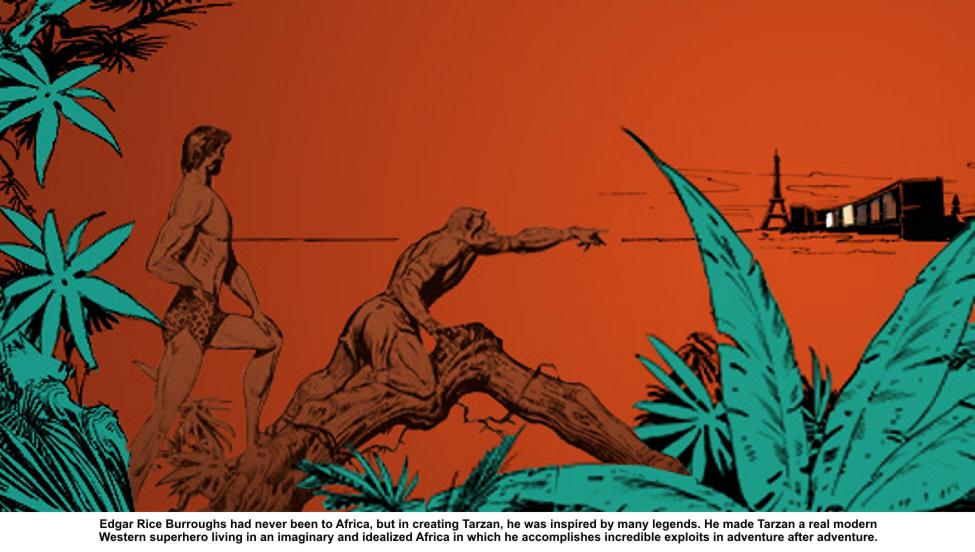
The Aquarian Archetype
The Renowned Arab Traveler- Mohammed Ibn Batuta
Writing in the fourteenth century Ibn Batuta had visited the East African coast trodding the soil of Kilwa Island on the southern border of Tanganyika, now Tanzania. Zanzibar replaced Kilwa as the Moslem trading entropot on the East Coast. Haggard apparently had done the same as he mentions ruins that dated back to before the tenth century. So, we have established commercial activity in Southern Africa before the arrival of the Shona people in Zimbabwe.
Ruiz stood behind a low, stone altar which appeared to have been painted a rusty brown red.For a long time Ruiz the high priest held the center of the stage. The rites where evidently of a religious nature that went on interminably. Three times Ruiz burned powder upon the altar. From the awful stench Sandra judged the powder must have consisted mostly of hair. The assemblage intoned a chant to the weird accompaniment of heathenish tom toms. The high priest occasionally made the sign of the cross, but it seemed obvious to Sandra that she had become the goddess of a bastard religion which bore no relationship to Christianity beyond the symbolism of the cross, which was evidently quite meaningless to the high priest and his followers.She heard mentioned several times Kibuka, the war god; and Walumbe the god of death, was often supplicated, while Mizimo departed spirits, held a prominent place in the chant and the progress. It was evidently a very primitive form of heathenish worship from which voodooism is derived.
Looking up, she saw a dozen naked dancing girls enter the apartment, and behind them two soldiers dragging a screaming Negro girl of about thirteen. Now the audience was alert, necks craned and every eye centered upon the child. The tom-toms beat out a wild cadence. The dancers, leaping, bending, whirling, approached the altar; and while they danced the soldiers lifted the still screaming girl and held her face up, upon its stained brown surface.The high priest made passes with his hands above the victim, the while he intoned some senseless gibberish. The child’s screams had been reduced to moaning sobs, as Ruiz drew a knife from beneath his robe. Sandra leaned forward in her throne-chair, clutching the arms, her wide eyes straining at the horrid sight below her.A deathly stillness fell upon the room broken only by the choking sobs of the girl. Ruiz’s knife flashed for an instant above his victim; and then the point was punged into her heart. Quickly he cut the throat and dabbing his hands in the spurting blood sprinkled it upon the audience, which surged forward to receive it…
“Well, what of it?’ demanded da Gama. “I am king. Do I not sit on a level with God and his goddess? I am as holy as they. I am a god as well as a king; and the gods can do no wrong.”“Rubbish!” exclaime the high priest. “You know a well as I do that the man is not a god, and the woman no goddess. Fate sent the man down from the skies- I don’t know how; but I’m sure he’s as mortal as you or I; then you get the idea that by controlling him you could control the country. You were jealous of me that’s all; then you get the idea that by controlling him you could control the church, for you know that who controls the church controls the country. You were jealous of me that’s all; then you conceived the idea of having a goddess, too, which you thought might double your power. Well, you have them; but they’re going to be just as useful to me as they are to you. Already, the people believe in them, and if I should go to them and say that you had harmed the god, they would tear you to pieces…”
“…you don’t stand any too well with the people, Chris, anyway; and there are plenty of them who think da Serra would make a better king.”“Sh-h-h,” cautioned da Gama. “Don’t talk so loud. Somebody may overhear you. But let’s not quarrel, Pedro. Our interests are identical. If Osorio da Serra becomes king of Alemtejo, Pedro Ruiz will die mysteriously; and Quesada the priest will become high priest. He might become high priest while I am king.”
“You should know,” he said. “You are a woman.”“I am not a mortal woman. I am a goddess.” She grasped at a straw.Rateng laughed at her. “There is no god but Allah.”“If you harm me you will die.” she threatened.“You are an infidel,” said Rateng, “and for every infidel I kill, I shall have greater honor in heaven.”
Pt. IV: H.G. Wells, Sigmund Freud, Edgar Rice Burroughs And The Development Of Contemporary Sexual Attitudes
September 15, 2010
H.G. Wells, Sigmund Freud, Edgar Rice Burroughs
And The Development Of Contemporary Sexual Attitudes
Part IV
by
R.E. Prindle
Edgar Rice Burroughs’ Contribution

The Artist Fidus, 1893 Illustration
That Edgar Rice Burroughs is one of the, if not the most, influential writers, America has produced goes without saying. The only question is in how many different ways did he do it and was an attitude toward sexual mores one of them. I think it can be shown that that is true. Was Burroughs an ideologue in sexual matters. At this point I can’t say yes or no although his attitudes seem consistent throughout his career.
A first hurdle we have to get over is whether Burroughs was some sort of idiot savant who just had the knack for writing adventure stories or was he an auto-didact who educated himself in exemplary fashion. The consensus is more along the idiot savant line which I hope I have shown in my by now voluminous writings that ERB was very well read, had a sound if not spectacular education while being an intelligent man with at least a 120-130 IQ.
Greeks At Play
I think I have shown that he was a full participant in the intellectual culture of 1875-1920 which influenced the first phase of his writing career. We know he was well read because he references hundreds of books that he read in his own pages. He tells us he read Gibbon’s Decline And Fall Of The Roman Empire which is an essential for a liberal education. He tells us he read and reread Plutarch’s Parallel Lives which also is no mean achievement. Those may be isolated instances or, as I think, they are the tip of the iceberg. He was near expert on Evolution while being deeply read in esoteric and exoteric religion. The guy was a virtual marvel. His learning shows up in his writings although in a fantastic manner for enterainment purposes.
Apollo
For our purposes here we can begin when his father placed him in the Harvard Latin School of Chicago. He was to spend what we would call his Junior High years there. It was there he learned Latin and possibly some Greek. He was to complain later that he learned Latin before he learned to write in English which he thought affected his style and it may have as some of his writing reads like he was translating from Latin. While he may not have qualified as a Latin scholar I’m sure that for the rest of his life he could find his way through an extensive Latin quotation. When I was in school that was considered an achievement of a high order. So ERB had a pretty decent founding in the Classics.
Now, there has been a pretty fair controvercy on ERBzine recently over how nude Martians were. I don’t think there is any question but that both men and women hang out, that is ventral and dorsal nudity. One might therefore infer that in Burroughs’ vision of an utopia the style was to be au naturel.
Was this original or did ERB, as usual, borrow from the culture, have his sources?
Let’s start at Harvard Latin School. At the time the Patriarchy was in full control of the culture. There were grumblings from both the Matriarchy and the Hetaerarchy but those were in the beginning stages of the revolt. As late as the 1960s when I was an Ancient History major you would have been thrown out of school for challenging the Patriarchal version of Ancient History, that is to say Greek and Roman. ERB then couldn’t have been given less than a 110% Patriarchal education.
Any illustrations of Greek statues he would have seen showed the genitals fully exposed unless a fig leaf had been placed over them. The Greek vases he may have seen would have shown Greek men at play or leisure with fully exposed genitals, any weapons belted on would look exactly like his Martians. They might have a wrap thrown over the shoulder for protection from inclement weather.
The phallicism, the pride in manhood, runs all through Greek art and literature. At the time men were liberating themselves from the Matriarchy with its cruel attitude toward the males. It had been discovered that the male inseminated the female so men claimed the child as theirs while the women were mere incubators or storehouses rather than the fecund goddesses of creation. Man was the creator. That was the answer the riddle posed by the Theban sphinx to Oedipus was, Man. So the psychological reaction must have been if you’ve got one, show it. Meanwhile as the man was the progenitor of a woman’s offspring, a man’s wife had to be secluded so that another man couldn’t impregnate her. Whereas in the past women were more or less commonly available to the certified they now became the exclusive possession of one man, except for prostitutes or hetaerists. The children were his.
How much, if any, of this ERB understood he at least saw a society where the men went fully nude. As the Martian children were hatched from eggs incubated in the Martian sun it sounds as though he had read Plato where Socrates expatiated on the old days when men and women were hatched from eggs. Indeed, Leda impregnated by Zeus in the form of a swan hatched two eggs that produced Castor and Pollux and Helen and Clytemnestra as two sets of twins. It’s not too far from there to Mars, don’t you think?
Around the turn of the century the Nudist movement took form in German. We tend to think of these earlier times as staid when in reality the modern world was in its birth throes. The nudity thing since the French Revolution had been slowly growing. For the Medieval Free Spirits and Anabatists nudity was a key point as it was for the Libertines and as it was adopted by the Communist offshoots of the Revolution. Men want to look at the female nude.
Early Nudists
In Germany at the turn of the century the nudity movement jelled, an actual movement taking shape in conjunction with the Wandervogel movement. This is turn led to the development of the Nature movement resulting in the incredible Nature Boy scene in the US of the thirties and forties which in turn evolved into the Beat/Hippie phenomenon of the fifties, sixties and seventies and into today.

Eden Ahbez- Writer of Nature Boy
Burroughs would have been aware of this whole phenomenon up to 1950 endorsing it enthusiastically. Tarzan was the ultimate Nature Boy and Burroughs developed the character with that in mind. The ideal. I have no douts that Burroughs intended him as the exemplar of this growing movement. Hence the development of the Nature movement was aided, abetted and intentionally forwarded by ERB clearly linking him to the scene in Bohemian NY of the sixties and the whole Beat/Hippie scene.
So Burroughs’ writings actually promote nudism and the Nature movement throughout his career. John Carter arrives, born again, nude on Mars where he would have been unnoticeable on that account, completely blending in. Indeed, the only difference was that he was white instead of red which was a curiosity. Thus, as soon as he leaves Earth he become a nudist in what was a sort of utopian society to Burroughs.
Tarzan necessarily practiced nudity for his first twenty years, only donning his ‘fig leaf’ or G-string when he came in contact with civilization.
Burroughs always refers to Tarzan’s ‘adornment’ as a G-string in the early novels. A G-string only cover the genitals with a flap and not the rear so Tarzan was essentially nude in the jungle. He was a Nature Boy and that is the way most of his readers have perceived him.

Maxmillian- Star Nature Boy c. 1948
The MGM Tarzan is the exemplar of the Nature Boy living on fruit and nuts. The MGM movies regularly show bowls of fruits and nuts while Tarzan, unless memory fails, is never shown squatting over a haunch eating the flesh raw as in Burroughs’ novels. As with Burroughs and the Nature Boys Tarzan rejects all the appurtenances of civilization except for some mechanical engineering at which Tarzan was apparently a genius. Might even have been a Nuclear Physicist even though he could barely grunt in the MGM movies.
It seems clear that there was vitually no one who hadn’t heard of Tarzan or Burroughs. Nearly everyone was influenced by the two. It therefore seems probable that the Nature Boys, the nudists took Tarzan as an avatar.
Certainly John Derek directed his movie, Tarzan, The Ape Man of the 1980s, concentrating on the sexual and nature aspects of the image. No argument there, I hope.
Now, the Bohemian scene in NYC was among other things a return to the primitive. The crowd surrounding Andy Warhol in his Factory was a bunch of savages stripped of all but the rudiments of civilization. They were the Tarzans of the asphalt jungle. The more affluent savages, the Haute Boheme lived a life of sexual abandon that Burroughs, Wells and Freud could only have dreamed of, and they did dream of it.
Once the attitude was institutionalized at Studio 54 the world Burroughs, Wells and Freud longed for was realized. It was Hetaerism and Matriarchialism on wheels, a complete overthrow of Patriarchalism. Our three musketeers would have gained easy admitance and found each in his own particular utopia. From 1880 to 1980 was only a hundred years. A short time indeed to overturn civilization.
Burroughs was a leading figure in this revolution.
Pt.I: H.G.Wells, Sigmund Freud, Edgar Rice Burroughs And The Development Of Contemporary Sexual Attitudes
August 14, 2010
H. G. Wells, Sigmund Freud, Edgar Rice Burroughs
And The Development Of Contemporary Sexual Attitudes
by
R.E. Prindle
Part I
Certainly it is to be hoped that (the) naturalistic school of writing will never take firm root in England, for it is an accursed thing. It is impossible to help wondering if its followers ever reflect on the mischief that they must do, and, reflecting do not shrink from the responsiblility to look at the matter from one point of view only, Society has made a rule for the benefit of the whole community, individuals must keep their passions within certain fixed limits, and our system is so arranged that any transgression of this rule produces mischief of one sort or another, if not actual ruin, to the transgressor. Especially is this so is she be a woman. Now, as it is, human nature is continually fretting against these artificial bounds, and especially among young people it requires considerable fortitude and self-restraint to keep the feet from wandering. We all know too, how much this sort of indulgence depends upon the imagination, and we all know how easy it is for a powerful writer to excite it in that direction. Indeed, there could be nothing more easy to a writer of any strength or vision, especially if he spoke with an air of evil knowledge and intimate authority. There are probably several men in England at this moment who, if they turned their talents to this end, could equal, if not outdo, Zola himself, with results that would shortly show themselves among the population. Sexual passion is the most powerful lever with which to stir the mind of man, for it lies at the root of all things human; and it is impossible to over-estimate the damage that could be worked by a single English or American writer of genius, if he grasped it with a will.
–H. Rider Haggard
Appendix to the Broadview
Edition Of She

Edgar Rice Burroughs
For a long time now I’ve put off writing about Edgar Rice Burroughs in relation to H.G. Wells. Wells has been difficult to get a handle on, a point of entry. But the Woodrow Nichols’ article on nudity in Burroughs on ERBzine pointed in the direction of changing sexual attitudes in the twentieth century. Coupled with reading the above quote of Rider Haggard I realized that Wells and Burroughs were two of those powerful writers capable of unleashing those sexual passions. They, coupled with Sigmund Freud, did change sexual attitudes in the twentieth century.
That is not to say they were alone but of all of the hundreds of writers between then and now all their books remain in print continuing their work.
The sexual problem is central to civilization while it has been handled differently in the development of civilization. For some time it seemed that the Patriarchal model would be permanent. J.J. Bachofen, the great Swiss mythologist of the mid-nineteenth century, was the first to challenge the Patriarchal model. In his studies of mythologies he perceived that behind the Patriarchy first came a Matriarchy while at the beginning was a Hetaeric period. All three had different sexual approaches while all three attitudes have survived into the current age competing for dominance.
In the first Hetaeric stage of development Bachofen believed men used women, and woman, indiscriminately whether with force of persuasion when the sexual urge hit him. A good picturalization of this can be found in the movie, In Quest Of Fire. As there was no knowledge of how offspring were conceived the women of the horde merely accepted the inevitable bumper crop of children.
Being a sexual object puts an unbearable burden on the female of the species no matter how natural. Since most females began bearing at twelve or thirteen with the onset of puberty they were worn out at twenty with few probably surviving to thirty. Indeed, a huge percentage must have died in child birth from twelve to twenty. One imagines a surplus of males in the horde not unlike affairs in the nineteenth century when men frequently went through two or three wives or more as the women died young in childbirth.

J.J. Bachofen- One Of The Greats
While conception or paternity wasn’t recognized there was no mistaking motherhood. By some process of refinement the sexual mores of hordes evolved into Matriarchy which acknowledged female parentage while giving women some sort of sexual control, preference if you will. The change from the Hetaeric to the Matriarchal inevitably left behind a reactionary or conservative group who saw no reason for change or giving up their sexual prerogatives. Thus conflicts between the two attitudes, perhaps warfare.
The Matriarchy was still thriving when history began to be recorded. Thus Homer’s Iliad and Odyssey concern the Patriarchal revolution against the Matriarchy amongst the Europeans. By now paternity had been discovered by which the male discovered that he impregnated the female which he now considered the most important part of the process and one which involved the exclusive use of the female as he had no wish to care for another man’s children. Hence Patriarchalism- the primacy of the father- evolved putting the three systems into conflict and competition. This is a main theme of Greek mythology.
Concessions had to be made to the Hetaerists who were irate at the loss of their prerogatives. Hence temple prostitution undoubtedly evolved in which all the young females were kept in a temple compound until they had sex with any man who demanded it. Civilization being civilization, of course, there was a fee, hence protitution. Upon completion of the duty the female was released.
The Patriarchal revolt was a long slow drawn out process with many setbacks and compromises such as the above. Indeed, the Patriarchal god, Apollo, wrested Delphi from the Matriarchy but in the Matriarchal reaction he was forced to share the shrine with the effiminate Matriarchal hybrid god, Dionysus who, himself was destined to replace Zeus as the avatar of the Piscean Age. He assumed both male and female characteristics in the attempt to arrange the sexual conflict. That’s why the Jewish prophet Jesus of Nazareth, who substituted for him in yet another compromise is so effiminate. With the admixture of the Semitic influence in European religion with its uncompromising Patriarchalism the evolving Catholic Church was all but able to extinguish the Matriarchal Dionysian influence as well as the Hetaeric. Chastity, celibacy and monogamy became not only dominant but exclusive.
Just as the Matriarchy, while suppressed, has never disappeared or admitted defeat so also the Hetaerists have survived assuming different disguises while waging continued war with the Patriarchy and the Scientific view which is say Western Science and the Roman Catholic Church.
Reviled by the Church and persecuted sometimes to death the various sects fought back often posing as Catholics to become priests, even occasionally a Pope, and bore from within. Thus arose the Free Spirit sect which demanded the right of access to any woman at any time in any place. Thus John Sinclair in 1960s and 70s demanding the right to ‘fuck in the streets.’ An irrational request by any other standard. The Free Spirits delighted in debauching nuns when they had sufficient numbers to seize a place.
The spirit surfaced among the Anabaptists, for instance, who were not only suppressed but destroyed root and branch. With the Enlightenment when the Hetaerists surfaced as the Libertines we hear of them forwarding the French Revolution while their ideals were absorbed by the nascent Communist political movement. The Libertines per se seem to have transmogrifed into La Vie Boheme after the Napoleonic Empire, Bohemianism reaching down to our time.
La Vie Boheme as depicted by the French novelist Henri Murger evolved in the early nineteenth century along with their more overtly criminal cousins, the Mohicans of Paris as the novelist Alexandre Dumas styled them and known as Apaches by the end of the century. In the US fifties the Apaches were represented on TV with a mystifyingly violent effect as Apache dancers from France. I suppose the Apache style was transmogrified into the New York Bohemian style also. So this quasi-criminal Bohemian Apache style pervaded Euroamerican civilization through the nineteenth century and in diluted form into the twentieth and present day. The Fall 2010 Nordstrom catalog for instance celebrates the New York Haut Boheme.
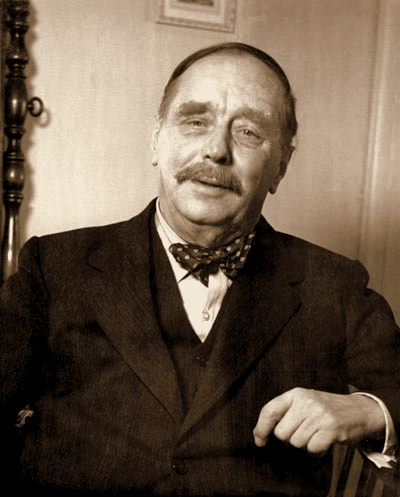
H.G. Wells
I was trying to relate this latter day form of Behemianism to Burroughs in my three part series on Presley, Lennon and Yoko Ono that Bill Hillman courageously published in ERBzine but over some very strenuous objections. I presume I lost the Bibliophiles on that issue.
That Burroughs was fascinated by the Bohemian style while actually furthering the Hetaeric sexual program is fairly obvious. He said that he wrote his first unpublished work, Minidoka, in Ragtime speech, that is to say the Bohemian mode. In other words ERB considered himself plenty hep, at least a closet Bohemian. Some may find that disturbing but, it is so. In ’60s NYC terminology ERB would hve been of the Haut Boheme. Along with those sympathies went a set of Hetaeric sexual mores that Burroughs advocated.
I have already examined the Bohemian influence of George Du Maurier on Burroughs with his novels Peter Ibbetson, Trilby and The Martian. Du Maurier was also of the Haut Boheme. A photograph of ERB behind the camera in Idaho in 1899 shows ERB dressed in full artistic Boho mode. He had just emerged from a short stay at the Chicago Art Institute where he would have immersed himself in Boho mores as artists then and now were virtually all Boho, at least in outlook. Writers too.
It seems quite extraordinary that Libertinism was discouraged and contained between the end of the eighteenth and beginning of the nineteenth century. Perhaps the answer can be found in the transition from aristocratic society to bourgeois society. Perhaps the Bourgeois requiring a different sexual morality than the aristocracy succeeded in imposing their version of sexual mores by sheer numbers.
Libertinism did regain prominence amongst the wealthy Haut Boheme of NYC thence spreading throughout society as a Bohemian sensibility began to displace the Bourgeois.
A book I have reviewed on ERBzine, found in ERB’s library which he read, GWM Reynolds’ The Mysteries Of The Court Of London scrupulously records the libertine activities in a fictional form of Prince George, later King George IV, whose career of seduction ended only in the 1820s. Certainly Reynolds’ depiction of the libertine actiities of George and his circle out Zolaed Zola by more than somewhat.
The whole libertine attitude was nowhere more prominently displayed than in NYC’s Haut Boheme nightclub, Studio 54. So the suppression of the libertine spirit during and since the reign of Queen Victoria was short. Perhaps Haggard’s novel She echoes the memories of the Libertinage of the eighteenth century Hellfire Club in some obscure way.
Haggard had no reason to put on airs because as I pointed out in my review of his King Solomon’s Mines that novel is smutty from top to bottom while ‘She’ has some very salacious passages. As Horace stands watching the scene of She and the dead body of Kallicrates for instance one is more than excited. She had murdered her former lover Kallicrates for running off with another woman. Immediately remorseful she kept the body preserved in perfect condition for two thousand years. She could even psychically animate the body so that it stood although still insensate. The necrotic effect is hypnotizing, making the reader a voyeuristic accomplice of Horace. As he and we watch the bodice of She’s dress slips to her waist exposing her magnificent charms according to your imagination. As we watch she then raises her arms above her head lifting and pointing the golden orbs. She does this not once but twice so it is clear Haggard was exciting and taunting his readers. If one imagines Ursula Andress who played She in one of the movies the effect is exhilarating indeed.

Ursula Andres As She
Haggard aside, as he says there were writers in England and America who were champing at the bit to alter the course of sexual history. Chief among these was H.G. Wells in England and our own Edgar Rice Burroughs. Both would make significant contributions to the ‘change’ but the most effective writer of them all was the secret sexual pervert, the undisputed master of them all, Sigmund Freud. But to go first to H.G. Wells and take things in order.
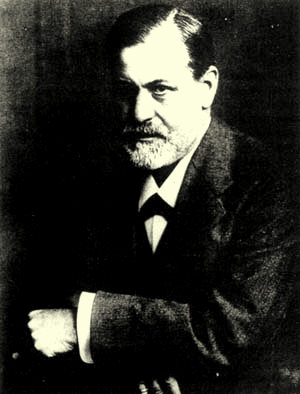
The Mad Herr Doktor Professor

The Last Sane Man Left Alive
Pt. 2 Tarzan And The Madman By Edgar Rice Burroughs
May 26, 2010
A Review
Themes And Variations
The Tarzan Novels Of Edgar Rice Burroughs #23
Tarzan And The Madman
Part II
by
R.E. Prindle
ERB And Florence Bid Goodby To LA
Tarzan novels seem more complex after repeated readings and just sitting and thinking about them. When I first read Tarzan And The Madman I Thought it was a throwaway. In the interim between that first reading and the present I’ve spent a fair amount of time in the Tarzan oeuvre and the Burroughs corpus while having written several hundred pages. One would think it would get easier but it doesn’t.
This novel was written by Burroughs in exile in Hawaii. He’d been run out of LA a couple years previously. Once the possessor of a magnificent collection of cars and planes and a vast estate becoming of the creator of Tarzan he was now living on 250.00 a month in the island paradise. He had returned to his poverty days at Sears, Roebuck in Chicago. Life’s like that.
On one level then Madman can be interpreted as a record of his feud with MGM and subsequent exile. Just look at the disdain on his and Florence’s faces as they board the plane for the last outpost of America. Tells a story in itself.
The MGM feud began with the release of Trader Horn. The book Trader Horn itself can be traced back to the Cave Girl. The movie of Trader Horn led to MGM’s first sound Tarzan. Thus Rand, the false Tarzan of the novel, can be seen as the Weissmuller portrayal of Tarzan in the MGM films. ERB was greatly offended by MGM’s notion of Tarzan hence this novel’s hero Rand is The-Man-Who-Thought-He-Was-Tarzan, a false god made to seem insignficant by the real literary Tarzan.
One should note that the real Tarzan is an intruder in the make believe Tarzanic world of MGM. The Mutia Escarpment on which the action takes place first came into existence in Trader Horn then was perpetuated through five MGM Tarzan films. The sixth MGM movie took place in New York City, of course. That one hadn’t been released as yet.
The opening sequence is even a parody of MGM’s Tarzan, The Ape Man in which an old coot shows up in Africa with his beauteous daughter who is then abducted by Tarzan who doesn’t know any better. There’s a certain amount of humor then when the real Tarzan of Mad Man wants to know who’s been abducting women in his name besmirching his reputation.
The false Tarzan who we may as well designate as Rand to make things easier, after a false start abducts the White woman, Sandra Pickerall, of the Scots Ale fortune taking her to the Mutia Escarpment. The ascent to the Escarpment is nearly identical to the ascent in both Trader Horn and Tarzan, The Ape Man. Burroughs adds his usual lion hoopla having a menagerie of them at the base of the Escarpment who are fed human flesh.
Once on the Escarpment Burroughs fleshes out his story with the usual Lost Civilization theme. In this instance the civilization is derived from Medieval Portuguese invaders of Moslem lands who were defeated in battle retreating to the Escarpment where they built their castle and established their life while becoming a milk chocolate hue. At one point Burroughs says they were part of a seventh century contingent, again Crusaders and yet again having been there four hundred years. So take your pick.
Rand has been there believing himself Tarzan for two years. He, of course, is suffering from amnesia caused when he was parachuting into the castle having been slammed against a wall causing his trauma. He and friend Bolton-Chilton were flying into Africa when in a replication of the MGM movies they entered a clowd bank to find themselves face to face with a mountain wall. In the ascent the plane malfunctioned so having cleared the Escarpment the men were compelled to bail out. Bolton-Chilton was captured by the Moslem/Galla rivals of the men of the Portuguese city of Alemtejo and enslaved. So, is this novel all roads lead to Alemtejo.
Since Rand descended from the sky Christoforo Da Gama, the king of Alemtejo, takes him for a god. I will deal with the religious aspect in the next section. If Rand is a god then Da Gama insists that Rand must have a goddess sending him forth to find one. Hence Rand abducts a number of Black women who prove unsatisfactory to Da Gama who insists on a White Goddess leading Rand to abduct the only possible candidate, Sandra thus besmirching Tarzan’s hitherto unsullied reputation.
After a series of adventures Tarzan arrives before the gates of Alemtejo. Both he and Rand are of the same general build and resemble each other enough to cause confusion but on closer examination their faces were not alike. As it chances when Tarzan arrives Rand and Sandra have absented themselves in the pursuit of freedom.
Interestingly Tarzan’s entrance into Alemtejo parodies the arrival of the Greek hero, Theseus into Athens. As Burroughs thought he invented the name Numa for lion, not realizing he had retrieved from memory the name of the Roman king, in all likelihood he didn’t realize that he was basing the entry of Tarzan on the entry of Theseus.
In the Greek myth Theseus dressed as a woman, don’t ask me, the scene is reminsicent of the Gilgamesh epic of Sumer in which a temple prostitute entices the wild man Enkidu into joining civilization who tears her garment in half giving half to the man, anyway as a transvestite, Theseus draws the jeers of observing workmen. To put them in their place Theseus picks up a bull and throws it over his shoulder. Like I say, I’m working on it but without the semblance of a clue.
Tarzan by replicating the feat wins the admiration of the Alemtejo general who proclaims Tarzan the true god, they overthrow the old order, march on the Moslem Gallas using new tactics devised by the new god and overthrow the Moslems.
The victory scatters all the protagonists who then have to come together.
As with the MGM movies there is a huge gold mine involved. In the movies there is a great seam of gold with huge nuggets lying on the surface so that all you have to do is pick them up. So in Mad Man the two villains Crump and Minsky in company with Rand discover the mine.
Here Burroughs depicts the worthlessness of gold in the manner in which he disparaged the Father of Diamonds in Tarzan And The Forbidden City. Overcome by their greed the starving and dehydrated Crump and Minsky gather more gold than they can carry killing themselves in the process.
Tarzan, Rand, Sandra and Bolton-Chilton as surviving Europeans come together. Sandra convinces Tarzan, who had vowed to kill Rand on sight, that he is merely deluded having lost his memory. Bolton-Chilton turns out to be the buddy who having parachuted from the same plane as Rand had been enslaved by the Gallas.
It turns out that Rand was so entranced by the story of Tarzan that he bet Bolton-Chilton he could live as Tarzan in the wilds of Africa for a month. He was on the way to do so when the two had to bail.
In their seach for the easy way down from the Escarpment the foursome come across Rand’s plane that had landed and coasted to a stop rather than crashing. Rand pumps up the the tires, fixes the carburetor and all four of them fly away. Thus Burroughs rewrites the MGM movie in a more plausible and entertaining way retrieving Tarzan from MGM in a sense.
As in real life Burroughs was exiled from LA so Rand, Sandra and Tarzan are exiled from Africa. Tarzan’s African adventures cease. Just as the Communists had driven Tarzan from Opar so now MGM drives Tarzan from Africa. The next adventure would take place on a mysterious island in the Indian Ocean while the last Tarzan adventure takes place in Indonesia during WWII. A sad ending for the Big Bwana.
Of course the Africa of Livingstone and Stanley on which the Tarzan series was based was also a thing of the past. The Tarzan stories couldn’t have continued to have been wirtten without becoming retrospective. Even the Lesser Tarzan films that succeeded MGM became exotic fantasies rather than African adventure. It was the end of an era.
Beginning in 1932 with the first MGM talkie the Big Ape man began to slip away from ERB’s control. Mad Man records the sad fact that the pale MGM imitation of the ape man had supplanted the real thing. It must have been a bitter moment for ERB writing in Hawaii.
We don’t know why he didn’t publish Mad Man. He placed the story in his safe where it remained until the early sixties when it was discovered and published. It seems likely that as of this date but few have even read it. Of those who have, most probably discuss it as a tired rehash of the themes of doppelganger, amnesia and perhaps the last of terrestrial lost civilizations.
I found it the culmination of those themes. ERB’s long examination of the nature of psychological doubles was drawn to a satisfying conclusion as the false Tarzan awoke from a long sleep to realization. Perhaps the same was true of Burroughs as he viewed his lost hero in the lost land of LA from his place of exile in Hawaii just beforfe the bombs from those airplanes began to fall.
Next an examination of the religious aspects of this amazing novel.
Four Crucial Years
In The Life Of Edgar Rice Burroughs, Pt. I
by
R.E. Prindle
Every artist writes his own autobiography.
Even Shakespeare’s works contain a life of himself for those who know how to read it.
–Havelock Ellis as quoted by Robert W. Fenton

The Great One
Eighteen ninety-six found Edgar Rice Burroughs confronting the first great crisis of his adult life. The weight of his childhood experiences pressed on his mind as he turned twenty. His subconscious mind was directing his actions while his conscious intelligence futilely struggled against it. He had no plans; nor could he form any. He was in a state of emotional turmoil. He obviously did not think out his moves nor weigh the effects of his actions on others. He was to burn many bridges as he flayed about like the proverbial bull in the china shop trying to find his way out.
Having graduated from the Michigan Military Academy he had been serving in the capacity of instructor for the previous year. All his heroes were military men. He fancied a military career as an Army officer even though he had failed the West Point exam the year before. Still, he was in a fine position to realize his objective. Men who could help him were nearby friends. Captain, soon to be General, Charles King, who had befriended him as a cadet, and the Commandant of the MMA, Colonel Rogers. All he had to do was to be patient and those men of some influence would surely have obtained an appointment for him.
They had given a mere boy a position of great trust and responsibility in making him an instructor. They were military men who judged others in the military manner. Then in the Spring of 1896 Burroughs did one of the most inexplicable things in a career of the inexplicable; he abandoned his post. Without notice to those career officers who were depending on him he resigned his post and on May 13th of 1896 he joined the Army as an enlisted man, a common soldier, a grunt. Within days he was on his way to his asignment.
As he was to say of so many of his later fictional heroes: ‘for me to think is to act.’ He oughtn’t have been so precipitate. He should have thought twice. He shouldn’t have had to think about it at all.
If he seriously wanted a military career as an officer he should have known that it is virtually impossible for an enlisted man to rise through the ranks. Even in the rare cases when this occurs, the enlisted man is always an odd duck between the officer caste and the enlisted men.
In this case he had not only forteited caste but as far as Rogers and King were concerned he had deserted, the worst crime that a military man can commit. Both men wrote him off at that time. Strangely he never understood that his precipitate act would be held against him by those he disappointed.
Apparently joining in a fit of despair- for me to think is to act- as the date of the 13th would indicate he requested the worst duty the Army had ensuring his desire to fail. On one level it is almost as though he did have his next move worked out. Not normally too receptive to the desires or needs of its grunts in this case the Army was only too glad to accommodate him. Burroughs was sent into Apacheria to a place called Fort Grant in what was then the territory of Arizona. Neither Arizona nor New Mexico became States until after the turn of the century so Burroughs had actually ‘lit out for the territories’ as Huck Finn would have put it. There was still some Apache resistance going on, thus ERB was a part of the Wild West.
According to Philip R. Burger, writing in the Winter 1999 issue of the Burroughs Bulletin, the standard term of enlistment at the time was three years but, as there would be no reason to join the Army except to make it a career, the reasonable assumption for those left behind in Chicago without a word of goodbye would have been that Burroughs was out of their lives. He was a dead man.
For those of you who have never joined the services, once you leave you’re out of the lives of those left behind. Your traditions have been broken. Even when you come back for leave you are only tolerated as a visitor who will leave, the sooner the better, so you don’t disrupt their lives any longer than necessary.
Burroughs didn’t even have traditions in Chicago except with a few people. From the sixth grade on he had a record of broken attendance at a number of schools, from the girl’s school to Harvard School and then back East, to Idaho and on to the MMA. He would have known but few people well, intimate with none except the lovely Emma Hulbert.
He could have seen her but rarely over the last years which included high school. He really had no ties in Chicago. His relationshlip to Emma dated back to Brown grade school. At sometime before he began his peripatetic education he began to propose to her. As he was gone from Chicago all this time it is very difficult to believe that Emma sat home pining. She must have been dating other boys, however, at the same time she must have been waiting for Burroughs since, at 24, when she married him she was only a couple years from spinsterhood. She must have been giving her parents some cause for alarm.
Thus when Burroughs appeared to walk out of her life in 1896 without a word about his intentions one wonders what her response was. Certainly it was about this time that Frank Martin began to pay his court. We will learn more of Frank Martin a little later.
For Burroughs, like so many of us once we were inducted, ERB speedily learned his mistake. For the men who don’t fit in ‘each fresh move is a fresh mistake.’ He regretted his decision immediately. For him to think was to act, so from his arrival at Fort Grant he began a petition for discharge.
As he had been under twenty-one when he joined, he had had to ask his father for his consent. He now asked him to use his influence to get him out.
Perhaps we do not have enough information on why he now so desperately wanted out. In later life this short ten month period of his life would be fraught with great significance in his mind. Just before he divorced his lovely wife Emma in 1933 ERB took a solo vacation to return to this scene of his young manhood. That would indicate that Emma and Fort Grant were linked in his mind.
Two of his Martian novels are associated with the Fort Grant experience. In his first novel, A Princess Of Mars, John Carter serves in the Army in Arizona, is discharged, then returns as a prospector. Under attack by Apaches he seeks refuge in a mountain cave in which he leaves his body while his astral projection goes to Mars. Viewed from one point that’s as neat a description of going insane as I’ve ever come across.
During his 1933 visit to Arizona, Carter returns to visit a trembling fearful Burroughs in his mountain cabin. One gets the impression that Burroughs felt like a whipped dog.
The Apaches made a terrific impression on the young man. So much so that he could see himself joining them as a Brave as is evidenced by his two Apache novels, The War Chief and Apache Devil. Then too his two cowboy novels are placed in Arizona rather than in Idaho where one would expect them.
In his Return Of Tarzan the trip to the Sahara is an obvious reference to Apacheria. The French government sends Tarzan into the desert rather than the US government sending ERB to Arizona. In the deseart Tarzan develops a strong liking for the Arabs, much as ERB did for the Apaches. Tarzan considered becoming a Son Of The Desert just as ERB thought he might become Apache.
A large part of ERB’s fascination for the military life was based on his respect for Capt. Charles King under whom he had served briefly at the MMA. King was, I would imagine, a boy’s dream of a dashing Calvalry Officer. In this wildly romantic period of the Indian Wars, not to mention the proximity of the Civil War, a man who had served at the same time and the same place General Custer must have been held in some awe. King had also served with and knew Buffalo Bill, a nonpareil hero of the time and one ERB may have met at the 1893 Columbian Expo.
Burroughs names two of his characters after Custer.
On top of all this King was a successful writer of military novels. He wote an excellent analysis of Custer’s defeat, which is available on ERBzine, as well as a first hand account of the resultant campaign to quell the uprising, Campaigning With Crook. the latter is a superb recreation of a time and place we’ll never see again. In just a few words King is able to recreate a Deadwood, South Dakota for which the movies have filmed endless miles of photographs with less result. His single reference to barbaric cowboys wearing their guns on their hips says more than dozens of Hollywood films. ERB was also able to capture some of this feeling in his two excellent Western novels as well as his two Apache novels.
King was prolific writing nearly seventy books in his long career. I have read only a few, which I find of only of journeyman quality. King has an emascualted precious style which is reflected in his photographs. Burroughs enthusiastically said he wrote the best Army novels ever, which may be true, I haven’t come across any other novels of Army life. among his many novels of Army life are three that deal with the Pullman strike when the Seventh was stationed at Fort Sheridan. One, An Apache Princess written in 1903 might possibly have been an influence on A Princess Of Mars.
At any rate King glorifies the officer’s life. He fooled a young green ERB. In any event ERB failed to notice the haughty distinctions King drew between the relative status of the officers and the enlisted men. King had all the prejudices of the officer class seeing the enlisted man as a subhuman species. Knowing this, as Burroughs should have, I am baffled by his enlisting.
Perhaps as at the MMA he thought that one entered as a buck private working up to officer rapidly as he had at the MMA. If so he must have had a very rude awakening. It couldn’t have taken him long to realize that advancing through the ranks was rare while at the same time a long process for such an impatient lad as he.
While he was cleaning those stalls he must have had plenty of time to think out his dilemma. As he thought back over his past actions it must have occurred to him that perhaps he erred in walking out on Colonel Rogers the previous May. Accordingly on December 2 of 1896 he sent a letter back to Rogers of which the reply is extant. We don’t know what ERB said but I imagine he was feeling Rogers out to see if he couldn’t get him an officer’s appointment. Rogers reply was, of course, polite but cool and distant firmly placing Burroughs as oneof the rest of Rogers’ students. Yuh. ERB should have thought twice about abandoning his post.
The many, many references to this period of his life point to a great regret later in life that he had left it. He associated this regret with Emma. Perhaps the visit of the officer, John Carter, to him in his lonely cabin in the White Mountains of Arizona represents his lost career as an Army officer but was one of the reasons for his wanting to get back to Chicago that he hadn’t dealt with his relationship with Emma? Did he now learn that in his absence someone else was playing his old love song to Emma? Someone who Papa Alvin Hulbert much preferred to ERB?
It would be interesting to know what Emma thought when her beau just up and removed himself to Arizona. Perhaps perplexed but still hopeful she sent him her picture on his birthday in September. Remember me, perhaps?
Unhappy with his life at ‘the worst post in the Army’, how one’s attitude changes when one’s dreams are realized, he petitioned his father to use his influence to return him to civilian life.
Surprisingly his father was easily able to do this. By March of 1897 ERB had his discharge papers in his hand. He was a free man again. How many tens of thousands of us would have appreciated such an easy resolution to the problem.
2.
Our Man still didn’t have a plan. What we he going to do with his life? Apparently Colonel Rogers’ reply to his letter didn’t apprise him of the facts of life. Nor did he seem to realize that once you reject the military the Army has no use for you. At the time, the US Army was very small, perhaps seventy-five thousand men. The officer corps was about ten per cent or seventy-five hundred men. This is virtually a club. The officers would have known each other personally, by name or by reputation. The same was more or less true of the enlisted men.
Thus Porges records a letter ERB received in 1936 from one W.L. Burroughs of Charlotte, N.C. who probes:
This morning an old army sergeant whom I soldiered with back in the nineties dropped in my office and our conversation started at Fort Sheridan, ILl. when the 7th US Cavalry and the 15th U.W. Infantry left that post for Arizona and New Mexico. He asked me if I remembered Edgar Rice Burroughs of Troop ‘B’ Seventh Cavalry, said he was discharged during the summer of 1896 at Fort Grant, Arizona account of a ‘Tobacca heart’…will be delighted to know for certain that we soldiered with so distinguished a person back in the nineties.
Whether true or not these men remembered ERB as a malingerer who obtained a fraudulent discharge. I interpet ‘Tobacco heart’ to be a feigned ailment which would make ‘so distinguished a person’ a sarcastic and insulting remark. If W.L. Burroughs is correct then ERB got himself out by reasonable discreditable means rather than through the efforts of his father. Thus forty years on an Army reputation followed ERB.
Burroughs replied cooly a few days later ‘…seldom have been in touch with any of the men I soldiered with since I left Fort Grant.’ ERB didn’t say ‘AND GOODBYE.’ but I think that is implied.
So having committed blunder after blunder it would have been wise for Our Man to reevaluate his position. Strangely he didn’t do this, hoping against hope, as I imagine to pull that particualr rabbit out of the hat over the next few years. Good luck, Edgar Rice Burroughs.
3.
For now he could only think of returning to Chicago. As we know the Burroughs Boys were ranching up in Idaho. ERB always wanted to prove that he was a businessman. Why, I don’t know. The fact of the matter seems to be that the Burroughs family was particularly inept at business. Papa George T. had been burned out of his distillery while his battery business was steadily running down, due for extermination about a decade later.
The Boys would turn to dredging for gold after failing at ranching. Perhaps one of the reasons they failed at ranching was just this operation coming up. They had bought a Mexican herd, apparently sight unseen. They were then in Nogales to receive and transship the herd to KC. I suspect they lost their shirt. In less than two years they would be gold dredging.
The world is full of sharpers. Out West so many salted gold mines were sold to greenhorns that it doesn’t bear telling. Frank Harris, the British magazine editor in his autobiography has a great story about how he and his outfit lifted a Mexican herd driving it back across the Rio Grande. I have no doubt that some Mexican sharpers took advantage of the Burroughs Boys. They would later buy a salted gold claim.
The herd ERB put on board the train he describes as no bigger than jackrabbits while probably being less well fed. The death rate of the cows on the trip back to KC was horrendous, while the survivors became starved and dehydrated. I don’t think the Burroughs Boys did well on that transaction. You gotta watch your back or, hopefully, see ’em coming.
4.
Edgar Rice Burroughs came home. Perhaps he had now reached childhood’s end. At twenty-one perhaps he now realized that he had a life to lead. Perhaps. If so, it was slow dawning. But then ERB’s was not an ordinary mind, a normal bean as he would have put it. No, his was a slow ripening melon. But then, why should everyone develop at the same pace? If up to this point I seem to have been overly critical of Our Young Man it’s because there has been much to be critical of; just as there will be more, but he hasn’t done anything really reprehensible. Your record may not be much better; mine certainly wasn’t. He’s a good sort of guy; just a little on the goofy side. Slow to learn. He doesn’t seem to catch on.
However he’s watching. He’s observing. He’s ingesting and there out of sight he’s digesting all the information coming in. Plus, he will give it a brilliant interpretation when he egests it.
These four years would be of great use to him in his writing career. Always a subtle psychologist ERB was also a skillful employer of the Freudian concepts of condensation, displacement and sublimation and this before he could have read Freud. An attentive reading of any of his novels always reveals layers of hidden meaning. Simply put Edgar Rice Burroughs is the most poetic of novelists.
His poetic tastes weren’t always elevated. He did have a copy or two of Eddie Guest in his library. Edgar A. Guest. Perhaps forgotten today Guest was a people’s poet. In the 1950s when I spread out the Detroit Free Press on the floor one of the first things I read was the daily poem of Edgar Guest. Of course, I thought he had written each one the night before. I marveled at his facility. Nice homey thoughts though.
Burroughs tastes ran to the likes of Rudyard Kipling, H.H. Knibbs, Robert W. Service and others of the jingly-jangly people’s school. Although he did know enough about a high brow like Robert Browning to consider him a bore. Rightly from my point of view. He liked Tennyson, who was considered a high brow, also I suspect Walter Scott, Shelley and Byron. He frequently hints at Longfellow’s ‘Wreck Of The Hesperus’ while he probably had to read Hiawatha in school
He knows all the popular stuff of the day like ‘Over The Hill To The Poor House’ too while he had probably read that anthem of doomed labor, Edward Markham’s Man With The Hoe, too. If that one didn’t gag him he’s not the man I think he was.
Song lyrics were big with him too. On his cross country auto tour he mentions three records by name that his family wore out- of course a battery operated portable played in a field with the plows they called styluses (well, cultured people called them styluses or styli, us near illiterates called them needles) in those days they might have worn out a record in two or three plays. One song was ‘Are You From Dixie?’, another was ‘Do What Your Mother Did; and the last ‘Hello- Hawaii, How Are Ya?’ I guess he liked songs that asked questions. I’ll examine the lurics a little farther on down the road but when we’re considering the literary influences don’t forget the poetry. After all ERB wrote a whole book around the lyrics of H.H. Knibbs ‘Out There Somewhere.’
Just before he returned to Chicago one of the great newspaper literary lights and poets of Chicago Eugene Field had died- 1895. Burroughs had a collection of Field’s writings in his library while Field, when alive, hung out at the McClurg’s book store. Perhaps there were sentimental reasons for Burroughs pursuing McClurg’s so ardently as well as practical ones.
Another Chicago writer among ERB’s collection of books who was reaching an apex at this time was George Ade. While these Chicago stalwarts are mostly forgotten now they were considered immortal at the time. Ade especially is a very clever writer with a real skill at turning a phrase. His ‘Fables In Slang’ would have knocked ERB flat. ERB’s own interest in the colloquial, which is very pronounced, may have been influenced by Ade’s style.
Another columnist of the period, Peter Finley Dunne, with his Irish dialect stuff written around his character Mr. Dooley doesn’t seem to have made much of an impression on ERB.
Thus while involved in his attempts to correct his mistake of enlisting he was very attentive and observant of the life going on around him in whatever milieu.
As I mentioned earlier, when you leave for the military your friends edit you out of their lives. Returning is not so easy. Even when I returned on leave, actually almost ten months after I left, people demanded almost belligerently, ‘What are you doing here? I thought you joined the Navy.’ After explaining I was on leave, nearly asking permission to hang around for a couple weeks, I was grudgingly given permission but let it be known that if I wasn’t gone I would have some explaining to do.
ERB has left a record of his reception by his friends in Chicago. He had sixteen years to let it run around his mind before he wrote it down. It came out in Return Of Tarzan which, I imagine might be read as the Return Of Edgar Rice Burroughs. Actually as Havelock Ellis hints in the opening quote, both Tarzan Of The Apes and The Return Of Tarzan can be read as autobiographical sketches from birth to the marriage with Emma in 1900.
Burroughs describes his reception in Chapter 23 of the The Return. The jungle is a Burroughsian symbol for society as in ‘It’s a jungle out there.’ Tarzan in the jungle can be read as ERB in Chicago. Tarzan is resting in the crotch of a great limb of a jungle giant when he hears a troop of apes approaching the clearing beneath the tree. The tree is a symbol of security or getting out of or above the tumult. Trees probably correspond to his imagination.
Tarzan recognized the troop as his old band of which he is still nominally king. Having been gone for two years he rightly thinks the dull brutes will have trouble remembering him:
‘From the talk which he overheard he learned that they had come to choose a new king- their late chief (the successor of Terkoz?) had fallen a hundred feet beneath a broken limb to an untimely end.
Tarzan walked to the end of an overhanging limb in plain view of them. The quick eyes of a female (Emma?) caught sight ofhim first. With a barking guttural she called the attention of the others. Several fhuge bulls stood erect to get a better view of the intruder. With bared fangs and bristling necks they advanced slowly toward him, with deep ominous growls.
‘Karnath, I am Tarzan Of The Apes,’ said the ape-man in the nernacular of the tribe. ‘You remember me. Together we teased Numa when we were still little apes, throwing sticks and nuts at him form the saftey of high branches.’
‘And Magor,’ continued Tarzan, addressing another, ‘do you not recall your former king- he who slew the mighty Kerchak? Look at me! Am I not the same Tarzan- mighty hunter- invincible fighter- that you knew for many seasons?’
The apes all crowded orward now, but more in curiosity than threatening. They muttered among themselves for a few moments.
‘What do you want among us now?’ Asked Karnath.
‘Only peace.’ answered the ape-man.
Again the apes conferred. At leangth Karnath spoke again.
‘Come in peace, then, Tarzan Of The Apes.’ He said.
So Tarzan and ERB returned to the fold. However there were two young bulls who were not ready to receive Tarzan back. We will find that two young men resented Burroughs’ return. The resentment of the principal young man would nearly cost Burroughs his life while forcing him to commit to a marriage against his will.
Thus Burroughs was received back into Chicago.
5.
He would spend about ten months before he uprooted himself once again to make his second visit to his brothers in Idaho. I should think that this period in Chicago was perhaps the most idyllic of his life. He found gainful employment with his father at the Battery Company. However at fifteen dollars a week it was much less than his allowance had been at the MMA. However he was living and eating at home so one imagines it was all pocket cash which afforded a certain limited affluence. He could afford to take Emma out.
Emma appears to have preferred him but he was no favorite of Papa Alvin and the Mrs. If Frank Martin had begun to pay his court he was much the preferred suitor. The son of Col. A.N. Martin who was a millionaire railroad man he was to be much preferred to a penniless Ed Burroughs whose father had apostacized to William Jennings Bryan in the election of 1896. No, Martin should be given the inside track. Burroughs was forbidden the house in an attempt to disrupt his relationship with Emma.
The Hulberts looked askance at Burroughs patchy history. He was less than promising. While his father had gotten him released from his enlistment, people are wont to say there’s more to that story than meets the eye. Plenty of room for rumor, if you know what I mean. ERB probably had to explain a lot.
So while he could date Emma he couldn’t go hang around all evening every evening as lovers are wont to do.
So what did ERB do with his spare time. He obviously read. H.Rider Haggard was popping them out two or three a year at the time which is clear from the evidence ERB read. Jules Verne was alive and producing although much of his production remained untranslated.
There weren’t any movies or television, however there was the Levee, Chicago’s Sin City. In later novels ERB would show what appears to be first hand rather detailed knowledge of this area of brothels, saloons and gambling joints. Burroughs was certainly no stranger to drinking and gambling, whether he frequented brothels may not be known but, if you’re in the area….
In a city of a million six there were only about forty thousand library cards issued but it is probable that one of them was in the wallet of our investigator of curious and unusual phenomena. He sure knew a lot of odd details. One of the big intellectual questions is whether or not he knew of Theosophy. A volume of William Q. Judge, a leading Theosophist who died in 1896, is to be found among Burroughs’ books. His first story Minidoka 937th Earl of One Mile which is concerned with this period while unpublished until just recently makes mention in the descent to Nevaeh of the Seven Worlds which is a reference to either Theosophy, Dante or both.
Again, hanging around a library one might come across volumes of Dante and Theosophy. Shoot, Tarzan spent his afternoons in the Paris library becoming discouraged by the surfeit of knowledge to be covered.
And all around him floods of changes were rolling over him. The world was moving with breathtaking rapidity. If a guy wasn’t half crazy already trying to keep up would get him the rest of the way. Actually these four years were the intellectual bottom, in the musical sense, of the rest of Burroughs; life. perhaps sensory overload occured culminating with his bashing in Toronto and subsequent marriage to Emma so that he was no longer open to new experiences afater his marriage. Everything after 1900 was interpreted in the light of this experience. the interpretations were inventive enough.
His situation might be compared to that of Zeus and Metis of Greek mythology. Ordinarily when the Patriarchy took over a Matriarchal cult the event was comemorated in a myth of sexual union.
In the case of Metis, a Goddess of wisdom, she went down into the belly of the monster like a plate of oysters perhaps meaning the Patriarchy had attempted to stamp the Metis cult flat or eat it up as the Zulus would say. If so Zeus and the boys had bitten off more than they could chew or digest, as it were.
Metis lived on in his belly giving him unwanted advice until I would imagine the Patriarchy came up with a compromise solution. Thus Metis gave birth to Athene who was born fully formed from the forehead of Zeus, which is to say that the cult of Metis was transformed into the cult of Athene. Athene retained all the attributres of the goddess of Matriarchy but ‘she was all for the Patriarchy.’
So now with Burroughs; he ingested all this experience which he gave a ‘definite impression of fictionalizing’ to appear full blown from his forehead +- twenty years later.
Porges reproduces a political cartoon of Young Burroughs on page 68 of the First Edition in which Uncle Sam and John Bull are watching a scene. One or the other says: ‘How would you like to be a Russian?’
In the cartoon Russian soldiers are shooting and bayonetting obvious Jews while the Jews are bombing the Russians. The villains of the first four Tarzan novels, ‘The Russian Quartet; are two Russians Nikolas Rokoff and Paulevitch. Thus, if the cartoon was drawn in this period, twenty years later the Russians show up as villains.
Now, among all the ‘minor’ events like the depression after 1893, the Pullman Strike, Coxey’s Army, Altgeld’s pardoning of the Haymarket bombers, the Sino-Japanese war and such like trivia was the infamous Dreyfus Affair in France.
This minor event involving a Judaeo-French spy was magnified into an international cause celebre by accusations of anti-Semitism. Alfred Dreyfus was a Jewish French army officer who was accused of spying for the Germans or of selling information to them. Originally convicted and sent to Devil’s Island, a few year later after key evidence was tainted or disappeared and key witnesses had died or been discredited the case was reopened and after a terrific media blitz resulting in Zola’s article with the famous title: J’ Accuse, Dreyfus was acquitted.
The man convicted in his place, strangely enough, was probably also Jewish, one Walsin Esterhazy. Supposedly of Hungarian descent, at the instance of the chief Rabbi of Paris he was given financial assistance by the Rothschild family. It would be very unusual in that case if he weren’t Jewish.
Burroughs must have followed the Affair Dreyfus closely as it unfolded during the lat nineties. In 1913’s Return Of Tarzan he chose to fictionalize Esterhazy’s end of the Affair in the character of Gernois. Burroughs must have studied the Affair because Esterhazy actually served in North Africa where he came in contact with German agents. Of course, Gernois is compromised by our old friend Nilolas Rokoff, the Russian agent. Thus ERB combines his dislike of the Russians as eveidenced by his cartoon with sympathy for Dreyfus.
In real life Esterhazy led a dissipated life which, it is said, led him to be a spy. In ‘Return’ Gernois is led into syping because Rokoff, the hyper-arch villain had something on him.
In a sort of editorial comment on Dreyfus ERB has Rokoff tell Gernois: ‘If you are not agreeable I shall send a note to your commandant tonight that will end in the degradation Dreyfus suffered– the only difference being that he did not deserve it.’
Thus ERB comes down firmly on the side of Dreyfus.
For those who will misread racial and ethnic attitudes I believe ERB’s attitude in the Jewish-Russian conflict and the Dreyfus Affair should exonerate him, if the need exists, of any charges of anti-Semitism. Especially in the light of his portrayal of the worthy Jewish gentleman in ‘The Moon Maid’ trilogy. It would seem that all of ERB’s later attitudes remain consistent with these brought to fruition between 1896 and 1900.
Continue on to Part II
A Review
Woman
by
Alan Clayson
Yoko Ono And The Men Who Influenced Her
Review by R.E. Prindle
Clayson, Alan: Woman: The Incredible Life Of Yoko Ono, Chrome Dreams, 2004.

Girlish Yoko- Warhol School by Richard Bernstein
Yoko Ono involved herself with several of the most influential men in the arts during the sixties, seventies and eighties of the twentieth century. She drew her inspiration from them patterning her own efforts after them. At the same time she was one of the leading feminists of the day having her share in shaping and furthering the movement. The mantra was female liberation, equality between men and women. In fact women were equal to men in the West but only by acknowledging the biological differences between men and women. The fact is the differences are real and not social constructs as women would have us believe. The fact is women are women and men are men. So, in seeking ‘female liberation’ feminists were seeking much more than ‘equality’ however the term may be defined.
The fact is that in the Ages old war between the sexes feminists are seeking to restore the Matriarchy and destroy the Patriarchy. That is why many men favor feminism, they prefer the Matriarchy. Thus the feminists are atavistic. Yoko and her cohorts wished, in her words, to restore ‘heart’ as she viewed the Matriarchy and eliminate ‘reason’ as she viewed quite rightly the basis of Patriarchalism. Nevermind that bilogical science has invalidated the concepts of Matriarachy and Patriarchy. This is a post Matriarchy and Patriarchy world.
Circa -2000 in the West men revolted against the mind stifling Matriarchy and the vaginal swamp of the ‘heart’ seeking to establish

Smilin' Jack Cage
the authority of the infinite power of the mind of Zeus on ethereal Olympus. This is the story of Homer’s Iliad and Odyssey and the Greek myths in general recording the struggle.
The Western male was able to impose the ascendency of reason over the heart for 3000 years until the disestablishment of the old order by science about mid-nineteenth century. The center could not hold during this period of extreme change as W.B. Yeats put it as the rearrangement of the intellectual order moved into the twentieth century.
Yoko Ono sought with her feminist fellows to return to the biological innocence of 2000 BC. She herself had no talent. Filled with audacity she pitted her ‘heart’ against the reason of John Cage, Andy Warhol and John Lennon. I’m sure she had a mentor for her so-called performance art but I am as yet unaware of who he may be. Perhaps Maciunas and the Fluxus group.
Thus her first manifestation as an artist was based on the musical ideas of John Cage while her artistic efforts were at least based in the avant garde ideas of the Fluxus group. Her first assault on the NYC art world failed so in 1961 she returned in defeat to Japan. When she returned to NYC in 1964 she found an entirely different art scene. On the musical side the focus was on Bobby Dylan and the Beatles while on the artistic side Andy Warhol and his Factory had destroyed the Abstract Expressionists and the old avant garde. Dylan, the Beatles and Warhol had in fact usurped the avant garde which now had little meaning. From my point of view held at the time the avant garde had ceased to exist. Of course I didn’t understand exactly why or how.
From 1964 when Yoko returned to NYC until 1966 when she left for London I’m sure Yoko was at a loss. She developed her silly

The Bag Yoko And Tony Are In
notion of Bagism at this time even having a black bag on a stand in Max’s Kansas City that some one or ones were supposed to slide into. This seems to have been thought a lame idea at the time as it seems now.
At this time while retaining allegiance to John Cage’s musical ideas she was falling under the influence of Andy Warhol’s artistic notions. Warhol’s intent had been to destroy the idea of ‘fine art’. In this he pretty well succeeded. As Yoko expressed it you didn’t need any talent to be an artist. She seems to demonstrate this notion in her own artistic efforts. Warhol had also redefined the notion of film with his static studies. He then sought to combine his film ideas with live music, probably in competition with Bob Dylan who was also attempting to move in that direction. Warhol adopted Lou Reed and his band the Velvet Underground as the Factory house band while creating a multi-media show called the Exploding Plastic Inevitable, innovative for its time. Thus a concert at his hall, the Dom, was an ‘experience.’
While Yoko makes no mention about how this, actually, incredible development affected her there can be no doubt that she was well aware of Dylan, the Beatles and the Warhol Experience and was affected by it. Indeed, the first manifestation was the making of her Warhol style films such as Bottoms.
The second manifestation was her removal to London to seduce either Lennon or McCartney of the Beatles, thus in the manner of Warhol’s adoption of the Velvet Underground she sought to co-opt the Beatles, the premier rock group in the world. Real chutzpah and more than one upping Warhol. I think it would be nonsense to think she had any other goal in mind.
She undoubteldy learned that Paul McCartney was actively involved with John Dunbar and his Indica Gallery that opened in 1965.
Psychedelic Dylan
Some say she first set her sights on McCartney but the more vulnerable Lennon showed up and the Spider Woman spread her web.
She was still married to her second husband, Tony Cox, but, regardless of what she says she very aggressively pursued, or attacked, Lennon. Lennon was emotionally under water unable to handle his success while drugging himself out of his mind. He was unwillingly married to his wife Cynthia. It appears that he married Cynthia out of duty when she became pregnant. He doesn’t seem to have been happy in his virtue. Yoko had no difficulty in capturing his affections.
Now, just as Warhol had adopted the Velvets and imposed his female singer, Nico, on the band Yoko sought to imp[ose herself on the Beatles through Lennon. At this time she was still musically completely in thrall to John Cage understanding nothing about Rock music. She and Lennon had made a ridiculous LP called Two Virgins in 1968. She combined her cagian screechings while using an avant garde ‘performance’ notion of the couple posing nude on the cover; full frontal on the obverse, full posterior on the reverse. As no store would carry the cover the couple reverted to Yoko’s idea of Bagism placing the cover inside a plain manila envelope or bag. While it didn’t sell the record this form of Bagism was actually a successful artistic statement. The nude cover given an outer garment so to speak.
Well, the public was prepared to forgive the Beatles anything but the other three Beatles weren’t prepared to forgive Yoko for forcing herself on them thus she broke up the most successful act of the sixties. Still, she had succeeded according to her wildest dream. Lennon and his wonderful reputation and fortune were hers. She had gone from a neglected, nondescript ‘performance’ artist to center stage, not on her own womanly talents but by attaching herself to a talented man. Yoko’s ‘heart’ was useless without the male intellect. Yoko was now the most influencial feminist in the world. She knew what to do with that.
After several ‘performance’ acts such as the ‘Bed In For Peace’ the couple left England to return to the place Yoko wished to subjugate artistically, New York City. She had raised herself to a par with Andy Warhol. She now had to meld her musical and artistic goals through Lennon and Warhol.
On the musical side she began to develop her rock n’ roll skills under the tutelage of Lennon. While not abandoning the avant garde notions of John Cage she now emasculated her husband. Always semi-delusional or perhaps completely so, she fantasized that she was not only equal to Lennon in skill and popularity but superior to him. She imagined herself more popular than Lennon. Thus one has such travesties as the LP Double Fantasy. It was only after Lennon’s death that she was forced to recognize than Lennon’s fans did not appreciate her efforts. So she failed as a musician.
She quickly tired of being Mrs. Lennon. Thus she and Lennon separated for eighteen months or so during the years 1973-75. She then realized that her financial well being and musical acceptance depended on Lennon. In 1975 she called him back resuming their relationship until his death in 1980. But, things had changed.
She began to adopt Warhol’s life style on her return to NYC. While she propagated the notion that she was some sort of business whiz Iam having difficulties discovering any such skills. It appears that with the enormous income of Lennon she emulated Warhol in

Andy the Demon
spending her way to prosperity.
She was in a position to not only match Warhol’s spending but exceeding it by many times. Through the seventies and eighties Warhol came into his own as an artist while reaping a fortune doing portraits. There appears to have been no effort on his part to invest in income producing vehicles. Rather he bought stuff. He purchased buildings in NYC and elsewhere while acquring undeveloped acreage in places like Aspen. He shopped nearly every day buying antiques from furniture to objets d’ art by the bushel almost as though he were trying to excel the incredible W.R. Hearst.
He usually didn’t even look at the stuff once he bought it merely filling rooms with his shopping bags. At his death all this junk was auctioned off for 25 million dollars, a nice appreciation in value.
Yoko followed the exact pattern buying apartments and houses as well as an extensive dairy farm with a herd of prize cows. She not only had but has five apartments in her principal dwelling, the Dakota apartment building and many other houses scattered around.
Like Warhol the Dakota apartments are stuffed with junk. Valuable, but, you know, stuff. She bought at good prices. Her extensive collection of Egyptian antiquities was mostly purchased before a steep rise in value.
Like the Rothschilds of old Yoko didn’t do all her own shopping but employed agents to search things out. Chief among these was an associate of Warhol’s, Sam Green, and an Hungarian immigrant by the name of Sam Havadtoy.

Buddies- Yoko, John, Andy
There should be no surprise then that she now has an extensive collection of Warhol’s artwork as well as his portraits of Lennon. The Warhols would have been purchased for form 25 to 50K while now being listed on her assets at tens of millions. She also has been said to have a good collection of Magrittes as well as one assumes other artists. So, much of her net worth is tied up in artwork purchased through Sam Green.
Sam Havadtoy was an antiques dealer as well as an interior designer. He appears to have been a somewhat shady character. It is very difficult to find much about him, however there is a sharp portrait available from the notorious A.J. Weberman ( http://www.acid-trip.org/lennon/ )
…(the Lennons) hired a sleazy Eastern European bisexual to renovate the pad. (Dakota) I had heard of this dude, whose name escapes me, from an asswipe named BRUCE KIRSH, who worked for him. KIRSH told me that the dude, who worked for the King of Morocco, would form a dummy renovation company, hire employees like Kirsch who were willing to work under false names, then, when it came time to pay taxes, everyone would disappear. I learned of him long before he was hired by John and Yoko, and I was taken aback when Yoko took up with him after John’s death.
I know that Weberman is not particularly well thought of by fandom but this is because of his harassment of Dylan who did, after all, misrepresent himself to the revolutionaries like Weberman. A.J. himself is an intelligent observer who was wading through it when it was deep. I do believe he knows what he’s talking about although his interpretations of Dylan’s lyrics seem absurd.
I would have to question Yoko’s judgment in taking him in. Both he and Sam Green were candidates as successors to Lennon with

Lennon by Warhol
whom she consorted in front of Lennon before he died while Yoko chose Havadtoy as his successor the day he died.
Perhaps she selected Havadtoy over Green because he was more rough trade. With Lennon while managing to reconcile revolution with peace and love with Havadtoy she discarded peace and love in favor of strong arm methods against her former employee Fred Seaman when it was totally unnecessary.
Havadtoy was living in a homosexual arrangement with his business partner when Yoko beckoned him to switch to her. Apparently an able switch hitter he was lured by the money to this much older woman. The arrangement did last for twenty years before Havadtoy removed to his native Hungary taking a nice cash settlement and several of the Warhols.
Thus, just as Warhol had his live-in homosexual arrangement so after Lennon’s death Yoko adopted the exact arrrangement. Today she apparently lives alone, a seventy-eight year old woman.
After Lennon’s death there was an accession of from 30 million to a possible 100 million dollars as their last album, Double Fantasy, sold into the millions while the rest of Lennon’s catalog and one assumes the Beatles’ catalog was reinvigorated while all things Lennon sold. This is, of course, no reflection on Yoko but the inevitable result with intellectual properties when the maker dies.
Post-Lennon, then, Yoko realized that her recording and art careers were nil. Heart without intellect is worthless. She then became the caretaker of the Lennon legacy. His recordings, of course, continued to sell, but even his artwork eclipsed that of Yoko. So she suffered the humiliation of being a mere appendage to a man. The feminine dismal swamp was eclipsed by the Olympian heights of the male intellect. As in ancient times the God had trumped the Goddess. And yet as with Hera and Zeus the Goddess gets her way. Yoko came up with the money and goods while Lennon’s spirit was wafted into the stratosphere.
As any reader of mythology knows Hera ruled the Lernean swamps of Argolis while Zeus ruled the gods on ethereal Olympus. Thus one has the symbolism of the biological difference between the male and female.
In ancient times the female had her share in magic. She knew herbs and plants, was familiar with poisons and cures as with the arch witch of the ancient world, Medea. The reputation of the female witch even as a consort of Satan persisted down through medieval and post-medieval times, indeed, even up to the dawn of the scientific enlightenment. One would have thought that magic and witchery were a thing of the past in the 1960s and yet Yoko embodied the whole female swamp mentality.
She established something called the Spirit Foundation attributing the direction to Lennon who in fact knew nothing of these matters but followed her lead. The Spirit Foundation celebrated the ancient art of the Shaman or witch doctor. Shamanism itself even preceded the Matriarchal swamps of Argolis. It was a rich repository of magical tradition. Further the Foundation was feminist in that it was dedicated to preserving the magical traditions of the women of the Pacific islands still living in such archaic societies. The wealth generated by the male intellect was appropriated by the female vagina or ‘heart.’
In her own life and that of Lennon’s Yoko was addicted to a variety of magical practices- astrology, numerology, Tarot readings, and indeed she traveled to the Caribbean to sell her soul to Satan through the offices of a female curandera. Her Tarot reader, John Green, was a priest in the shamanistic, magical, Yoruban African cult of Santeria.
Her feminism was more a magical effort to restory Matriarchal supremacy over the Patriarchy thus reversing the Patriarchal victory of three thousand years previously. Indeed, what has been called the movement for female equality is nothing more than a covert campaign to restore the Matriarchy.
Thus while Yoko o9riginatd nothing she usurped the abilities of the reason of men- Cage, Warhol, Lennon and male magicians such as John Green. Indeed the Trojan War itself was a war of men in service of women.
In her associations with men she preferrred to deal with emasculated types such as homosexuals like Cage, Warhol, Sam Green and Sam Havadtoy. Lennon claimed to have always been dependent of women for comfort and guidance while Yoko caught him at his most confused and vulnerable.
While she received direction from Cage and Warhol she was able to manipulate Lennon out of his talent somewhat as Vivian did that of Merlin of the Arthurian saga. When Vivian had usurped Merlin’s magical knowledge she buried him deep much as Lennon was put out of the way. Yoko then appropriated his wealth and residual income after his death. It was this constant inflow of cash that allowed her to propagate the notion that she was a financial genius.
Then as the female of the ‘heart’ or vaginal swamp she managed and appropriated the reason of Olympus through Cage, Warhol and Lennon. What she got from Havadtoy other than brute strength is not clear to me.
As such Yoko is Woman. In her case a seeming reversion to the archetypal Shaman of the most ancient times.
 I, Dynamo