A Review

Themes And Variations

The Tarzan Novels Of Edgar Rice Burroughs

#18, Tarzan And The Lion Man

Part 7 of 10 Parts

by

R.E. Prindle

First published on the ezine, ERBzine

The Storyteller

The City Of God

7 a.


     The first to the Falls, Rhonda was then spotted from the plateau by some of the Apes of God.

The Reviewer

     Now begins the story within the story.  A long short story or novelette that is as fine as anything in Fantasy or Science Fiction.  This story is the eighteen caret ruby in the diadem of the Tarzan series.  That this story should have gone unrecognized for over seventy years is incredible.

     Not only is it objectively stunning but the subjective richness is beyond measure.  Just as some background on the number of influences on the story let us begin with two, both of which are interconnected in ERB’s mind.

     The novel by Mary Shelley, Frankenstein, had a profound effect on ERB’s mind.  He apparently read it early which is to say before 1900.  The possibility of creating life had interested him from the beginning of his corpus while references to it are interspersed throughout.  One of the greatest of his creations, the great physician and scientist Dr. Ras Thavas, will succeed in creating life five years hence in The Synthetic Men Of Mars but will botch the job terribly.

     In this story Burroughs’ character, God, doesn’t create life but he manipulates genes to create a whole new species.  Mary Shelley wrote Frankenstein in 1818 and in 1931 Universal made the definitive movie.  That was two years before Burroughs wrote Lion Man so it is reasonable to assume the movie had an effect on him.

     IMDb provides a quote from the movie that may have inspired ERB; I don’t think there is any doubt that he saw this seminal horror film.

     Henry Frankenstein:  Look! It’s moving.  It’s alive.  It’s alive….It’s alive, it’s moving, etc.

     Victory Moritz:  Henry- in the name of god!

     Henry Frankenstein:  Oh, in the name of God!  Now I know what it feels like to be God!

Frankenstein's Monster

     The 1931 Frankenstein is stil an overwhelming experience to watch over seventy years later.  For the audiences of 1931 it must have been overpowering.  The fabulous castle of Dr. Frankenstein was surely an inspiration for the castle of Burroughs’ God.  What Burroughs did with the inspiration is as astonishing as both the Shelley original and the movie.

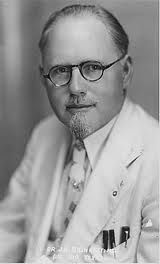
     In the news also at the time for over a period of a decade or more was the spectacular career of John R. ‘Goat Glands’ Brinkley.  This is an astonishing story.  I rely mainly on two accounts:  Vishwas Gatitonde’s excellent article “Magic Men’ in BB New Series #59 and the account in Wlofman Jack’s autobiography.  Wolfman Jack’s autobiography slipped by unnoticed but is one of the great autobiographies of the second half of the twentieth century, probably the twentieth century and possibly of all time.

Also see on the internet:

Dr. John R. Brinkley- A Story You Should Know

Grift, Goats and Gonads by Scott McLemee

Kansas State Historical Papers- John R. Brinkley

Border Radio Quackery by Gene Fowler and Bill Crawford

The Goat Gland Doctor by Joe Schwarcz, PH.D

     The medical practices of God involve gland transplants along with genetic implanting or splicing.  Over the years based on a foundation of Frankenstein ERB had built up a magnificent fantastical scientific edifice of life creation based on Evolution.

     There can be no doubt that he read and thought about the subject a great deal.  He was very well informed on evolutionary matters.  He was a well educated, thoughtful, intelligent man contrary to nearly every opinion about him.  His ideas as presented in Lion Man are probably as far as he could take them based on the knowledge of his time.  The discovery of DNA was only a little over a decade away, actually made a few years before he died.  One wonders what he would have made of it.  Even then ERB’s notion of ‘germ cells’ with their indestructability contains the essence of DNA so ERB was on the right track in his thinking.  I’m going to handle this out of order as the ideas explain what follows better.

     ERB was familiar with the use of cannibalism to ingest certain qualities of slain warriors.  Thus it was thought that to eat the brains of especially intelligent people transmitted that intelligence to oneself.  To eat the flesh of a brave man made oneself also brave, etc.

     From there to cellular therapy is a short step.  Even though there was probably no one who believed in the physical benefits of human cannibalism this side of Africa when it came to animals parts intelligent men threw common sense out the window.

     Cellular Therapy arose at the end of the nineteenth century.  Joe Schwarcz explains:

     Charles-Edouard Brown-Sequard, a noted French physiologist, had shocked the medical community by injecting himself with the crushed testicles of young dogs and gunea pigs.  Afterwards he claimed that he had regained the physical stamina and intellectual vigor of his youth.  Many men availed themselves of ‘La Methode Sequardienne’, but once the placebo effect was filtered out little remained.  In Vienna physiologist Eugen Steinach proposed that youthful vitality could be restored by increasing levels of testosterone.  the easiet way to do this, Steinach said, was through vasectomy.  Sperm production wasted testosterone, and if the channel leading from the testes to the ejaculatory duct were tied off, then blood levels of testosterone would rise.  Brinkley may also have heard of the work of Serge Vorenoff, a French doctor who was stirring u a storm of controversy with his experimental gland transplants.  Vorenof had been a physician in the court of the King of Egypt, and there he had spent a great deal of time treating the court eunuchs, who suffered from a variety of illnesses.  He hyposthesized that maintaining active genital glands was the secret of health.  As proof, he cited his experiments with an aging ram into which he transplanted the testicles of young lamb.  the ram’s wool got thicker, and his sexual vigor returned.  Voreneff then went on to transplant bits of monkey testes into aging men; he claimed success, although he could offer no scientific validation of his claim.  In America the stage was set for the meteoric rise of J.R. Brinkley.

     Brinkley began to transplant goat glands into the testicles of his patients.  As he began his career in the early 1920s radio made its appearance as a commercial entity.  On the qui vive Brinkley realized its potential to increase his business and spread his gospel.  He bought the first radio station in Kansas in 1923, his practice was in Melford, His call leters were KFKB- Kansas First-Kansas Best- as bold a claim as his medical ones.  He was actually a fine broadcaster transmitting Country Music, weather, farm reports and other items of interest as well as infomercials for his medical practice.  This notoriety brought the AMA and government down on him.  By 1930 he had had both his medical and broadcasting licenses revoked.

     Now, here’s where the man showed his innovative brilliance.  This really got him attention.  Nothing daunted he moved down to fabled Del Rio, Texas, Brinkley created the fable, across the Rio Grande from Villa Acuna.  His radio station in Kansas was small, a mere 1000 watts, although probably non-directional.

      In Mexico without US regulations he was able to build a boombox of 75,000 to 100,000 non-directional watts.  This was later incresed, if this is believable, to 500,000 watts and tahen to1,000,000 watts according to Fowler and Crawford who really should know.


Clap For The Wolfman

   Alright.  When I grew up in Michigan in the 1950s I could clearly pick up the successor Del Rio station after dark when its power was only 250,000 watts.  Wolfman Jack who worked the station tells an amusing story of his arrival.  Driving through the desert to the transmitter he noted that all the cars parked there had left their headlights on.  This mystified him but then he learned that the wattage was so powerful that headlights glowed in consequence.  The air crackled around him.  At a half million and a million watts people must have levitated.

     So, Dr. Brinkley was much in the news all these years so that ERB as Gaitonde suggests couldn’t have missed him.  While in our time there is no reason to mention La Methode Sequardienne yet with Brinkley being reviled it is quite possible ERB came across a discussion of cellular therapy in his reading which did mention these earlier experiments.

     ERB has God, a formerly handsome Englishman, create a hybrid hominid between a gorilla and a human.  God himself has regressed being a hybrid human/gorilla.  p. 133:

     “What is this strange purpose we are to serve?”  asked Rhonda.

     “It is purely scientific; but it is a long story and I shall have to start at the beginning,” explained God.

     In the beginning.  God appears to have been a medical student back in England with a strong interest in biology.  p. 134:

     “I had always been intrigued by Lamarck’s investigations and later by Darwin’s.  They were on the right track, but they did not go far enough; then shortly after my graduation, I was traveling in Austria when I met a priest at Brunn who was working along lines similar to mine.  His name was Mendel.  We exchanged ideas.  He was the only man in the world who could appreciate me, but he couldn’t go all the way with me.  I got some help from him; but doubtless, he got more from me; though I never heard anything more about him before I left England.”

     ERB gives us a fair amount of information here.  He is familiar with the Frenchman Lamarck of the eighteenth century who centered on heridity.  A red flag goes up on Darwin because if God left England in 1859 he would have known nothing of Darwin who published that year.  In any event while Darwin’s Origin Of Species sheds light on the mechanics of the variations among a species I can’t find any evidence of how species themselves evolve.  ERB is also familiar with the genetics of the monk, not priest, Gregor Mendel, who published in 1866 sending a copy to Darwin which the latter dismissed as irrelevant.  However, Burroughs through God seems to have taken Darwin less seriously than Mendel.

     He imples that Mendel was on the right track with his peas but that following the same line of reasoning God went well beyond him which indeed he did.  Mendel was disregarded in 1866, his revival beginning in the year 1900.  So Burroughs in 1930 is keeping up his reading.

     Burroughs then goes on to explain God’s theory of heredity.  His theory is not all that bad.  It shows Burroughs obviously doing some reading and thinking on the subject.  p. 134:

     “In 1857 I felt that I had practically solved the myster of heredity, and in that year I published a monograph on the subject.  I will explain the essence of my discoveries in as simple language as possible, so that you may understand the purpose you are to serve.

     “Briefly, there are two types of cells we inherit from our parents- body cells and germ cells.  these cells are composed of chromosomes containing genes- a separate gene for each mental and physical characteristic.  The body cells, dividing and multiplying, changing, growing, determine the sort of individual we are to be; the germ cells remaining practically unchanged from our conception, determine what characteristics our progeny will inherit, through us, from our progentors and from us.

     “I determined that heredity could be controlled through the transference of these genes from one individual to another.  I learned that these genes never die; they are abosolutely indestructible- the basis of life on earth, the promise of immortality through all eternity.

     It appears that ERB’s main concern is heredity and indeed genealogy was important to him.  While his information is a clumsy account compared to what has been learned since then, given the times ERB was quite advanced.  He doesn’t have the handle on DNA which is a decade or so in the future, Watson and Crick published in 1947, but in the germ cells he’s on the track of the right idea.  The notion of the body cells is, of course, superfluous.

      But now God runs up against a brick wall when he publishes his theory in 1857.  Remember Mendel’s discoveries were still eight years in the future while so far ahead of their time that they will be disregarded for thirty-four years.

     I don’t know what horror films have been released by this time, Dracula and Frankenstein for sure, but here the plot seems very familiar, possible Burke and Hareish.  Unable to proceed in a legal manner because of society’s obtuseness God turns to criminal means, but quite novel crime.

     As he has detemined that germ cells are immortal he raids the tombs of Westminster Abbey extracting germ cells from Henry VIII and his court and entourage.  Thus he has a little time capsule when he is discovered and flees England to avoid blackmail.  He decides to conduct his experiments on gorillas in Africa.  He finds the greatest concetration of gorillas in Africa, and hence on earth, in the valleyof diamonds.  In something like seventy years he converts pure gorillas into a hybrid of gorillas and humans capable of speech and human cognition.  They build his magnificent City of God for him which must have been quite new when Tarzan arrived.

     As they are bred from the genes of medieval Englishmen  the effects of Lamarckian heredity are evident as they speak a medieval form of English and replicate the City called London after its medieval progenitor.  Following Burroughs’ earlier thought in Opar the gorillas accept only beings born in gorilla form with human attributes.  Sports and mutations are expelled.  the other are, of course, the result of Mendelian genetics that are beings with odd combination of genes.

     God was born in 1833, the same year as Burroughs’ father, thus in 1933 he is one hundred one years old.  Some forty years back or so as he realized he was aging so he decided to splice in the body cells of young gorillas in a form of cellular therapy to rejuvenate himself.  This worked well in preserving his youth but unfortunately the more gorilla body cells he spliced in the more gorilla-like he became, so that when Tarzan and Rhonda meet him he is a grotesque hybrid, more intellignet than the gorilla hybrids, but reverting rapidly to pure gorilla.  Serious problem.

     God is very pleased to capture two such fine looking human specimens as Tarzan and Rhonda because by splicing in their body cells he will be able to resume his human shape in some style.

     So Burroughs has been developing his ideas in a creditable scientific way.  While it’s true his actual science is speculative he is employing some fairly sound reasoning on the matter that may not have been too dissimilar from the tack taken by Stalin’s scientists, while creating a human-ape hybrid has apparently been a timeless fascination.  It is said that our own scientists have succeeded in actually creating a chimp-human hybrid but that the specimens have been destroyed. I haven’t any confirmed proof that such has been done but rumors are around.

     Having given a reasonable scientific explanation of the gorilla hybrids and God’s purpose for Tarzan and Rhonda, Burroughs with his usual ghoulish delight introduces his favorite topic of cannibalism.  He informs the two that after satisfying his need for body cells he intends to eat them thus imbibing their characteristics.  He also says that he will extract several glands from Rhonda for some special purpose.

      I’m not exactly clear on what cannibalism meant to ERB.  It seems he associates it with his father who was particulary hard on Burroughs in his youth which ERB may have interpreted as being eaten alive by his father.  As we have God, cannibalism and his father associated here his father may be the reason for the recurring  reference to cannibalism is his work.

     The female glands recur again in Tarzan’s Quest where the Kavuru chief Kavandavanda requires female glands for his immortality pills and Vishwas Gaitonde finds the subject mentioned again in Tarzan The Magnificent. 

     So when Rhonda arrives at the Falls and is spotted from above by the seeming gorillas, she is actually spotted by a clone of the real fifteenth century Lord Buckingham in his gorilla guise.

     Now begins a series of astonishments, jokes and twists such as are found in few novels.  As I mentioned, today much of this is old hat, but in 1933 this was startling fresh and new.  At this point we are unaware of the hybrid nature of the gorillas.  The following passage then was not only startling to Rhonda but to us.  p. 94:

     (Rhonda) felt very small and alone and tired.  With a sigh she sat down on a rounded boulder and leaned against another piled behind it.  All her remaining strength seemed to have gone from her.  She closed her eyes wearily, and two tears rolled down her cheeks.  Perhaps she dozed, but she was startled into wakefulness by a voice speaking near her.  At first she thought she was dreaming and did not open her eyes.

     “She is alone,”  the voice said.  “We will take her to God- he will be pleased.”

     it was an English voice, or at least the accent was English, but the tones were gruff and deep and guttural.  The strange words convinced her she was dreaming.  She opened her eyes, and shrank back with a little scream of terror.  Standing close to her were two gorillas, or such she thought them to be until one of them opened his mouth and spoke.

     “Come with us,” it said; “we are going to take you to God;” then it reached out a mighty, hairy hand and seized her.

     There’s a shocking opener to the twilight zone between R2 and R3 as ERB prepares the curiosity of the reader for what is perhaps the most amazing story he ever told.
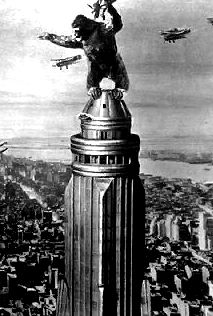
King Kong

     Rhonda, physically and emotionally exhausted by the terrific events of the past few days, slips into a trance in the middle of Africa only to be brought out of it by voices speaking Enalish saying they are taking her to God.  What can that possibly mean?  When she opens her eyes she sees two gorillas are doing the speaking.

     That’s something else, isn’t it?  Had they been on the screen could they have competed with King Kong that was released in that year of 1933?   Out of King Kong came 1949’s Mighty Joe Young while the public’s fascination with gorillas continued until Planet Of The Apes which, if it doesn’t owe anything to Burroughs’ story, develops the theme ad absurdam.  Kong, Young and Planet Of The Apes, Stalin’s experiments all owe their origins to the Tarzan oeuvre.

     Burroughs raises the theme to heights that have never been surpassed.  Combining the human gorillas with the City of God was incomparable genius.

     With the background clear let’s take a leap into the future.

The City Of God
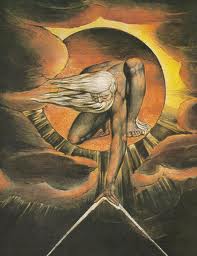
God At Work


7 b.

The whole thing seemed like a hideous and grotesque nightmare,

yet it was so real that she couldn’t know whether or not

she was dreaming.

Lion Man p. 95

     In taking the ‘germ cells’ of individuals from the time of Henry VIII, as the cells were cloned with those of the gorillas the hybrids cloned the environment they knew.  While clones have no mermory of a previous existence, in the popular imagination they do.  Thus in the paranoid classic movie The Boys From Brazil of 1978 the number of clones of Adolf Hitler all exhibited the supposed conditioned responses of the original which they could not have experienced themselves.

     At the same time ERB cleverly replicates the political situation between God, Church and Henry VIII.  When Rhonda was captured, two gorillas named the Dukes of Buckingham and Suffolk quarrel over whether she is to be taken to Henry VIII or God.  As we still have no idea of what is going on we are as mystified as Rhonda.

     And then as Rhonda tries to order her bobbled brain she realized she could communicate with these improbably English speaking apes.  p. 96:

     Now she had an instant in which to think clearly, and with it came the realization that she had the means of communicating with her captors.

     ‘Who are you?”  she damanded.  “And why have you made me a prisoner?”

     ‘The two turned suddenly upon her.  She thought their faces denoted surprise.

     “She speaks English!” exclained one of them.

     There’s a neat turnabout similar to when Tarzan addresses Buckingham in Mangani and the gorilla answers him in English.  The gorilla exclaims, “She speaks English.”

     Then follows an explanation of God, Henry VIII and Cranmer that only succeeds in confusing Rhonda further as she seems to be in some costume play in which for some inexplicable reason actors clad as gorillas are acting out a play  about Henry VIII.  She pinches herself to no avail.  She is awake.  This isn’t theatre, although Hamlet soon would be played in Nazi uniforms which is just about as ridiculous.

     The gorillas take her to Henry VIII where we will leave her until she is joined by Tarzan.

     While Rhonda escaped theArabs Naomi had been recaptured.  In company with the Arabs she is brought to the canyon that leads to an easy ascent of the plateau according to the map.  As the ascent becomes steep they leave the horses with Eyad going ahead on foot.  Awaiting them at the crest is Stalin’s dream corps.  Throughout the oeuvre one is always amazed at the disregard for their own well being the apes exhibit.  They  charge in story after story with complete disregard for their own well being.  Always a signficant portion are left on the field of battle but the survivors never complain while Tarzan complacently accepts their sacrifice as his due.

     So here, barehanded against the Arab firearms the gorillas launch a wave attack reminiscent of the Chinese in Korea that doesn’t stop until all the Arabs are dead.  No regard at all for casualities.  No wonder Stalin thought Burroughs was on to something.  While the apes perform as they have always performed in Tarzan stories the difference here is that these are not mere apes but hybrids with human intelligence.  If Burroughs was aware of Stalin’s experiments was he laughing at the Great Commissar?  Is this battle a reference to Stalin?  One can’t be positive of course but I am sure that the character of God-the formerly handsome Englishman- is partially based on H.G. Wells who was associated with Stalin.

     Naomi was with the Arabs.  She is captured by Buckingham  who asks her how she got away from God;  she is identical to Rhonda so Buckingham naturally confused her for the latter.  The Apes sense of smell was not as developed as Tarzan’s.  I’m sure the Big Bwana would have smelled the difference immediately.

     ERB is now dealing with his sexual problems.  Of the three women involved with the City of God- Naomi, Rhonda and Balza, it is necessary to sort out which woman represents what to ERB.  As Naomi is weak and vacillating she obviously represents Emma.  Rhonda who is strong and self-willed seems to represent ERB’s Anima ideal or in other words, La of Opar.  La disappears from the oeuvre after Tarzan The Invincible of 1930 but as Tarzan and Rhonda in God’s prison replicate Tarzan and La in the Lion’s den of Invincible it seems probable that ERB has transported La from the fantasy world of Opar to the mere imaginary world of the movies.  This leaves Balza- The Golden Girl- who probably represents Florence, but we will deal with her in the appropriate place.

     ERB has now gotten the two women, the Arabs and Tarzan to the Falls.  Orman, West and the safari are assembling at the base of the Falls so, having dissolved his story after the Bansuto attack ERB has now reintegrated it.

     After a series of adventures during which Buckingham kills Suffolk, Tarzan appears to rescue Naomi killing Buckingham.  At this point in Burroughs’ psychology he assumes the identity of his ordinary self and that of Tarzan into one being.  As the movie people have never seen Tarzan they assume that he is Stanley Obroski his identical twin.  Tarzan does not correct anyone but allows them to believe he is Stanley.

      As I perceive it then ERB has now deluded himself into believing that he is Tarzan.  Those who know him still perceive him as Ed Burroughs.  He has no choice but to let them believe that because if he attempted to impose his delusion on them he might have been committed.  Thus for a period of about five to six years from 1934 to 1939-40 Burroughs perceives himself as Tarzan but  capitulates  in Tarzan And The Madman giving up his illusion of being the Big Bwana.  In Lion Man he describes Tarzan as a madman so the two novels are linked by the concept of madness.

     After writing Madman Burroughs left California for Hawaii where he forced Florence away from him.  WWII came along which saved him from himself.  After the war he went back to LA to die.  It is interesting that he didn’t choose to live in Tarzana but bought a house in Encino that backed against the Promised Land.  thus like Moses, with whom there was a connection made in Tarzan Of The Apes, ERB was destined to view the Promised Land but not enter it.

     In Lion Man he is flush with the hope of being able to live out his fantasy.  He is now a few months from abandoning Emma so symbolically he returns Naomi to the safari at the Falls from whence she disappears from the story.

     Only Rhonda and Balza will figure in the rest of the story.  Emma is no more although Jane will appear again in Quest probably as Emma’s replacement Florence.  In Magnificent Florence is mentioned only anonymously as Tarzan’s ‘wife.’  ERB is definitely struggling.

     Having delivered Naomi to the safari Tarzan then reascends the plateau in search of Rhonda and the City of God.

The City Of God

7 c.

Every one of us, I believe, is possessed of two characters.

Often time they are so much alike that the duality is not noticeable,

but again there is a divergence so great

That we have the phenomenon of a Dr. Jekyll and Mr. Hyde

in a single individual.

E.R. Burroughs- The Swords Of Mars

     Tarzan And the Lion Man was followed at the end of 1933 by the Mars story The Swords Of Mars which features the return of John Carter.  ERB had taken a vacation from Emma returning to the scene of his own early adventures- Arizona.  Not coincidentally in the White Mountain of Apache country.  ERB’s motivations are sometimes obscure.  He was in the Army in Arizona in 1896-97 which was before he married Emma.  So he took his leave of absence from Emma to a place before he married her.  Setting the clock back, so to speak, somewhat reminiscent of The Eternal Lover.

     Just as Tarzan and Stanley met in Lion Man so while about to go to sleep, O.B.- The Other Burroughs- hears the door open, the clank of a man in war gear walking across the floor; terrified like an adolescent in a bad dream, O.B. is relieved and pleased when John Carter, back from Mars, greets him.  A real Jekyll and Hyde situation.  Thus as with Tarzan and Stanley the two Martian aspects of Buroughs are reunited but not melded.  John Carter then tells O.B. a bedtime story as though Burroughs were a child again.  I’m not that familiar with the Mars stories but there must be a connection to Lion Man and the MGM situation.  This must be true because this is the novel in which the opening letters of each chapter spell- TO FLORENCE WITH ALL MY LOVE, ED.  One assumes then that although the decision to leave Emma was difficult to make, ERB made the final decision in the Arizona mountains.

     So now a few months earlier Tarzan/Stanley makes the journey to the City of God where he will be reunited with his Anima ideal, Rhonda -La of Opar- in prison.  Thus his whole person both Anima and Animus are locked up by MGM.

     Rhonda had been taken to Henry VIII by Buckingham and Suffolk.  The city was called London, the country England and the river The Thames.  As ERB jokingly smirks- The English always take a little bit of England with them wherever they go.  Pretty funny, actually.

     Here the events of Henry’s reign are being reenacted.  As the apes are clones of Henry and his court who replicate their times one wonders whether each succeeding generation will be stuck in this one period of history reenacting it over and over until the end of time.  Once again I am reminded of The Eternal Lover.  ERB seems to be obsessed by the idea of time.

     Rhonda was first placed with the wives of Henry, a week later being moved to a cell in God’s castle where Tarzan found her when he too was captured.

     For now he was moving through the night until he came up against the ten foot high wall surrounding the City of London and within it the City of God.  Here we have the historical confrontation between the spiritual and temporal powers.  At the least the story is a very humorous parody of the religious situation of Henry VIII.  Once again ERB ridicules religion and this is done so cleverly and with such genius.

     But there are many levels of meaning.  Earlier I mentioned that the capture of Tarzan may have been meant to replicate ERB;’s capture by MGM.  In that sense then the City of God might represent MGM which boasted that it had more stars then Heaven.  So there is probably a joke there too.

     On the other hand, God is described as a formerly handsome Englishman.  The only candidate for that role I can come up with is ERB’s bete noir, H.G. Wells.  I think that I have adequately documented the literary feud between Wells and Burroughs.  Wells began well with his scientific romances.  While not as fresh and stunning as they were at the time of issue they still hold up well today.  Even though ERB denied having ever read Wells I think that claim can be dismissed out of hand.  ERB, then, would have been as impressed with Wells’ early romances as anyone else.  Then when Wells began his campaign of defamation and ridicule which is most clearly represented in his Mr. Blettsworthy On Rampole Island  he fell from favor in Burroughs’ eyes, hence the grotesquely deformed ‘formerly handsome Englishman.’

     As much as I like Wells he does pontificate.  Like all Liberals he has a difficult time distinguishing his opinion from truth, right and wrong, or reality.  While he does sometimes make a hit in his prophesying he is mostly wrong.  Backing the Worker’s Paradise of Stalin’s USSR was certainly wrong and more than enough to discredit him in the staunch anti-Communist Burroughs’ eyes.

     Wells probably shook Burroughs’ faith in the glory of England which had been a keystone of his secular faith fromt he beginning.  Thus, combining MGM, Stalin and the USSR and Wells, Burroughs packages all the troublemakers of this perilous time for him into one big box with a bigger bow on top.

     As his story could have no effect on his situation let us hope it was at least cathartic for him.  When Tarzan ends up in the cage with Rhonda that about epitomizes Burroughs’ situation vis-a-vis MGM, Stalin and Wells.  There are so many coincidences here that the brain revolves like a turret.  Was it wholly coincidental that Wells showed up in Hollywood at the end of ’35 to visit fellow Red Charlie Chaplin just as Burroughs was completely boxed in because of his Guatemalan adventure?

     Isn’t it amazing that Burroughs met his fate in Guatemala, the scene of the adventures of his early hero General Christmas and also the scene of some of the adventures of Ogden McClurg who was killed shortly after this return from the area in 1926?  It may be truly coincidental but the further one digs very often the more dirt one turns up.

      Burroughs may have felt confident he could write his way out of this box just as he was able to escape by self-publishing in 1930; perhaps he thought he could escape this time by making his own movies.  If so, a little analysis would have shown him that the rules had drastically changed.  Especially as he had signed the rights to represent his character Tarzan away.

     Coincidental with the release of the MGM Tarzan movies which preempted the nature of Tarzan from literature came the decline in Burroughs’ own literary powers.  Whereas in 1930 he was able to respond to the challenge with a series of top novels, after Lion Man there is a preciptious decline in the the quality of is work.  While the later novels have their charms for Burroughs’ admirers they do lack commercial appeal.

     By 1935 also Burroughs had antagonized radio which had become the major source of his income so that that medium was closed to him during his lifetime.  With publication revenues declining and the comics by Burroughs’ own admission producing a pittance, ERB had only one major source of income left and that was the moves.  MGM had him over a barrel.

     MGM might have produced a whole series of Tarzan films along the lines of the Charlie Chan movies as Burroughs reuefully remarked but they chose instead to issue only four movies between 1932 and 1939.  Obviously the makret would have borne more.  The limited release schedule kept EBB on a short financial tether.

     It is said that events cast their shadow before them so that it is possible, if not probable, that Burroughs foresaw the shape of things to come even as he wrote Lion Man.

     In 1930 when the Reds invaded his dream land of Opar ERB abandoned that fantasy.  The fabled city ceased to exist in his imagination while disappearing from the oeuvre.  Now in Lion Man it appears that the enemy had captured the castle while building a ten foot wall around it with Tarzan/Burroughs on the outside.  Thus Burroughs’ dream of separating himself from the world by a tne foot wall has been inverted in his imagination.  He wasn’t keeping the world out; the world was keeping him out.

     In the novel succeeding Lion Man, The Swords Of Mars, when the mad inventor Fal Sivas quails at taking hsi invented spaceship to the Martian moon Thuria the following exchange takes place between he and John Carter:

     “But you built this ship to go to Thuria,:  Carter cried.  “You told me so yourself.”

     “It was a dream,” he mumbled; “I am always dreaming, for in dreams nothing bad an happen to me.”

     Fal Sivas can be taken as an alter ego of Burroughs.  The Sivas probably refers to the Hindu god Shiva or Siva with whom Burroughs had become a devotee or developed a fascination for.  Thus while his heroes Tarzan and John Carter are men of action Sivas/Burroughs or any other combination is not.

     So in Lion Man Burroughs is desperately trying to become the man of action rather than the dreamer.  The problem now is that ERB himself is past the point of no return.  He has been walled out from the City of God.

     In dreams however Tarzan enters the Heavenly City by a fantastic feat of strength that recalls Burroughs’ 1890-1920 infatuation with the Strong Men such as the Great Sandow.

     The wall which Tarzan fancies was built to keep out lions i.e. the Lion Man has sharpened stakes pointing downward.  p. 124:

     …he leaped for the stakes.  His hands closed upon two of them; then he drew himself up slowly until his hips were on a level with his hands, his arms straight at his sides.  Leaning forward, he let his body drop slowly forward until it rested on the stakes and the top of the wall.

      That seems to be an impossible feat of strength except in dreams, but then by this point Tarzan thinks he is dreaming.  This might as well be an MGM movie lot such Burroughs spent five weeks on.  Here the dream faces a sort of reality.  As though pasing through a movie set as ERB must have done during those five weeks Tarzan comes to the steps leading to the Heaven of God.  this Stariway to Heaven, Jacob’s Ladder.

     As if to accent the relationship to MGM he passes the Apes of God who are dancing and partying.  The scene will be replicated at the foot of the Falls when the movie company duplicates this scene thus strengthening the connection with MGM.

     Tarzan begins the long climb up the Stairway to Heaven.  The fire flares illuminating him on the steps but the apes below don’t notice- high above on a parapet of Heaven, God does.  Note the resemblance to the move castle of Frankenstein.  A man of action God quickly prepares a trap.

     In real life the trap was probably the promise of the contract and money.  ERB blames the movies for being duplicitous, which is definitely true, still, he had had a dozen or more years to work out the conditions prevailing on his own.  After all, by 1932 he had proven product to sell.  The public had even given a profit to some pretty crummy movies so that had he taken the time, acted on his own conditions, rather than just signing for a few quick bucks he might have retained a position of some control, made himself an equal partner.  So, while MGM did betray him he might have been able to manage the situation.

     Tarzan enters the castle to be confronted by six doors of which only #3 is open.  Depending on how you count them there were six to eight major studios, thus the six doors may represent the Studios of which only MGM was willing to deal with him.  Remember he had been blacklisted since 1922, the blacklist having been broken in 1928 by Joseph Kennedy.

     Tarzan descends the stairs as heedlessly as Burroughs signed the contract and like Burroughs he finds himself trapped.  The nose of noses sniffs the air and detects the delicate scent of a White woman.  He has found she whom he sought, Rhonda.

7 d.

The Confrontation With God

     Now Tarzan is reunited with his Anima ideal in the person of Rhonda formerly La of Opar.  That Rhonda can be associated with La is because this scene is a replication or double of Tarzan and La in the lion’s den of Invincible.  There La and Tarzan were imprisoned in a cell beneath Opar.  They escaped the cell in a duplication of their escape from this prison.  In Invicible there was a runway within which the lion fed.  A shaft led upward to a room in a tower.  There the old man who betrayed them discovered them.

     In this case a breeze passing over the floor indicates an air shaft to Tarzan.  This is probably borrowed from Rider Haggard’s King Solomon’s Mines although it will soon if not already be a staple of the movie genre.  Tarzan locates the shaft in the ceiling in a corner of the cell.  He and Rhonda ascend it to the opening in front of which God is talking to some gorillas.  Thus the scene virtually duplicates Invincible.  La and Rhonda must be associated in ERB’s mind.

     As an aside Burrughs uses a variation of this scenario in The Swords Of Mars when John Carter is imprisoned.  There are beams some twenty feet ot so above the floor to which Carter leaps.  He takes a position above the door dropping on his keeper when he enters.

     At this point in the story Tarzan and Stanley Obroski may be considered to be reunited as one persona.  Rhonda, who has never seen Tarzan, addressed the person in Stanley’s guise as Stanley.  ERB has a little fun as he has Tarzan play along.

      As he says in Swords, he is convinced that every man has a dual Animus, that is two different aspects, sometimes nearly identical but sometimes as different as Dr. Jekyll and Mr. Hyde.  Thus at this point his mind is impressed with Shelley’s Frankenstein and Stevenson’s Dr. Jekyll And Mr. Hyde.  He had read both novels before 1900  while both stories were released as movies in 1931.  So the stories are very fresh in his mind.

     Tarzan/Obroski may be considered of the Jekyll/Hyde variety.  There is little doubt that Burroughs saw the pair and himself that way.  Thus Carter and Fall Sivas in Swords may also be seen as two sides (Jekyll/Hyde) of the same persona.  Tarzan does not try to convince Rhonda that he is not Stanley, but in the Jekyll side of the persona he astounds here with Hydelike feats compelling her to reevaluate him.

     There are undoubtedly snippets of other horror movies here that ERB has seen also but I can’t remember the titles or dates.  There was one about two Scottish body snatchers Burke and Hare which I think I can detect here and another about a mad doctor who operated on the brains of abducted victims that shows up here and in Swords that was called the Black Sleept or somesuch.  The latter would have had a castle along these lines as well as Frankenstein.  Of course, which of that ilk of movie didn’t?  Burroughs is combining an astounding number of influences here both literary and cinematic but both combined.

     Thus, having availed himself of ‘such a God given opportunity’ to find Rhonda he is imprisoned with her.  The joke was ERB’s.  You know, God left the doors open- God given opportunity.  I chuckled softly to myself as I read.

     After an exchange of repartee between Stanley/Tarzan and Rhonda God makes his appearance.  Not exactly what one would expect God to look like.  In fact it is almost amazing that the fundamentalist Christians didn’t create an uproar.  After all according to the Old Testament man was created in God’s image.  There’s a laugh.  Here’s the image.  p. 128:

     It had the face of a man, but its skin was black like that of a gorilla.  Its grinning lips revealed the heavy fangs of an anthropoid.  Scant black hair covered those portions of its body that an open shirt and a loin cloth revealed.  The skin of the body, arms, and legs was black with large patches of white.  The bare feet were the feet of a man; the hands were black and hairy and wrinkled, with long, curved claws; the eyes were the sunken eyes of an old man- a very old man.

     The Scopes Monkey Trial had only been about seven years before.  So here Burroughs is making sport of God with a sort of reverse evolution.  God is a cross between a man and a gorilla.  Yet ERB led such a charmed life that his mockery or parody of God created no comment.  If he wanted to start a ruckus to promote his book sales he failed miserably.

     God might have been half ape but he had a whole hearted sense of;humor.  Overhearing Tarzan say that he had come for Rhonda his opening comments are mock injury.  p. 128:

     “So you are acquainted?”  He said.  “How interesting! And you came to get her, did you?  I thought that you had come to call on me.  Of course it is not quite the proper thing for a stranger to come by night without an invitation- and by stealth.

     “It was just by the merest chance that I learned of your coming.  I have Henry to thank for that.  Had he not been staging a dance I should not have known, and thus I should have been denied the pleasure of receiving you, as I have.

     “You see, I was looking down from my castle into the courtyard of Henry’s palace when his bonfire flared up and lighted the Holy Stairs- and there you were!

     Burroughs is justly criticized for the occasional bit of wooden dialogue but I find the confrontation with God very well written.  The constantly mocking tone of God is carried off very well.  Tarzan’s indignation is very well executed.  The influence of Shelley, Stevenson and the various movies is seamlessly blended into a very tightly executed scene.

     All this is done in a very few pages while it is a remarkable bit of writing.

     God hints at his motives for their use for him.  p. 129:

     “…I shall keep you for a while for the pleasure of conversing with rational human beings.

     “I have not seen any for a long time, a long, long time.  Of course I hate them nonentheless, but I must admit that I shall find pleasure in this companionship for a short time.  You are both very good looking too.  That will make it all the more pleasant, just as it increases your value for the purpose which I intend you- the final purpose, you understand.  I am particularly pleased that the girl is so beautiful.  I always did have a fondness for blonds.  Were I not already engaged along some other lines of research, and were it possible, I should like nothing better than to conduct a scientific investigation to determine the biologial or psychological explanation of the profound attraction the blond female has for the male of all races.”

      Burroughs doesn’t tell us how blonde Rhonda and Naomi are, whether they are platinum blondes like Kali Bwana or merely blondes.  Of course today ERB would be censored for his handling of the sexual and racial preferences for blondes but it is a recurrent theme in his writing and one worth studying.

     Having piqued our curiosity as to his purpose for the couple God leaves to check up on Henry.  p. 130:

“Come back here!” (Tarzan) commanded.  “Either let us out of this hole or tell us why you are holding us- what you intend doing with us.”

     The creature wheeled suddenly, its expression transformed by a hideous snarl.  “You dare issue orders to me!”   It screamed.

     “And why not?” demanded the ape-man.  “Who are you?”

     The creature took a step nearer the bars and tapped its hairy chest with a thorny talon.  “I am God.”  it cried.

     There you go.  The cat’s out of the bag.

     The scene is dramatically successful while the reader is now left to guess the model for God.  We are told that he was a formerly handsome Englishman now deformed as a hybrid ape-human.  The city is London, the territory is England and the river is the Thames.  A reasonable place to look would be among the English.  Who among the English is bedeviling ERB?  H.G. Wells is the only one I can think of.  Regardless of whether Wells considered himself a Communist or not he is sailing his craft so close to the wind that it is impossible to distniguish between the two.  At the very least Wells is throughly subversive.  If anything he resents not being in Stalin’s place.  So Burroughs must consider him Communist.

     To my mind then, Burroughs is mocking Wells much as Wells mocked Burroughs in ‘Blettsworthy.’ God has delusions of grandeur and so does the highly pontificating Wells.  My vote for the model is Wells.

     One also notes that in the last of the MGM Tarzan movies, 1942’s Tarzan’s New York Adventure, Tarzan is captured by the circus roustabouts and thrown into a mobile cage.  The camera then pans around to front which identifies the cage as a lion cage.  One thus has the joke of the Lion Man in a lion’s cage.  A final thumbing of the nose at Burroughs exiled in Hawaii.  MGM then dropped what had been a very lucrative series.  Strange behavior indeed.

     God then returns to give his history as detailed earlier in the essay.  While for some reason everyone, fans and detractors alike, wants to think of Burroughs as a semi-literate boob who is coincidentally a ‘master of adventure’ yet both in content and exposition, God presents his story in a masterly way.  In 1930 there may have been few of his readers who had ever heard of Mendel and possibly Lamarck, although one hopes all had heard of Darwin.  So it is possible that a reader might have been puzzled by the inclusion of Darwin while dismissing Larmarck and Mendel as fictitious.  Of course if you’re reading strictly for fast-paced adventure you may not notice the details even though they are far from concealed.

     God also clears up the mystery of the map.  Surprisingly the map is not a stage prop but authentic.  In fact, God made it about seventy years previously.  It seems that he had been in love with a women back in England but she preferred wealth to being the wife of an impoverished scientist.

     This may be a coincidence but that is the premise of the plot of H.G. Wells’ In The Days Of The Comet.  Perhaps it was a message to Wells in case he hasn’t gotten it yet.  But then God discovered the immense number of diamonds in the valley so he wrote the girl promising her riches beyond imagination.  He had employed a native runner to take the letter to the coast to mail it but since he had never had a reply he wondered if it had ever been received.  Now it came back to him.  A simple but inventive twist.

     When God leaves this time Tarzan sets to work to escape.  Following the draft across the floor he finds the air shaft.  Just as in Invincible he sends La up first now he sends Rhonda up first.  As in the earlier story they are trapped at the top.

     Looking through the entrance to the shaft they spy God and some gorillas in front of it.  Their escape is spoiled.  Now begins the Gotterdamerung.

The City of God

7 e.

The Gotterdamerung

      Burroughs now has both aspects of his Animus with his Anima trapped in the tower unable to go foward or backward.  God and his gorillas stand in anticipation before the opening.  Burroughs has been stalemated.  At this point one aspect of God must be MGM and its contract.

     ERB has spun out his fantasy in a plausible way to this point, but now he has to find a way to resolve his dilemma.  As he is daydreaming and this is a mad dream, as Fal Sivas says in Swords, in dreams nothing bad can happen to you.  In this bind something bad can happen to ERB.  He can lose his grip on reality.  In that way he becomes mad or insane which is what the story is about.

     In speaking of Henry God might also be speaking of ERB. p. 143:

         “You all forget,” (God) cried, “that it was I who created you; it is I who can destroy you.  First I shall make Henry mad, and then I shall crush him.  That is the kind of gods humans like- it is the only kind they can understand.  Because they are jealous and cruel and vindictive they have to have a jealous, cruel and vindictive god.”

     There’s a lot information in that quote.  It refers to the ancient Greek saying:  Those who the gods would destroy they first make mad.  So we have an excellent joke here.  The incredible mind of Burroughs can conceive humor in the midst of the blackest despair.

     He is talking of the Yahweh of the Old Testament while he quite soundly understands that god is a psychological projection of the mind of his creator.  In a masterly grasp of Freudian group psychology, whether he knew it or not, he realized tha the people have created a god in their own image and not vice versa.  Trapped in the tower this is a real agonized cry of despair before losing his grip on reality.

     I don’t mean to say that ERB went stark raving mad but he edged into a fantasy world at least once removed from the fantasy he had been living since 1912.  For the period of his marriage to Florence he can only be described as spaced out.  Bear in mind that it’s going to get worse as he gets trapped into his movie production experience.

     The Masenas in The Swords Of Mars make the threatening moves on John Carter who keeps backing away.  Only too late he realized he had maneuvered himself where they wanted him.  The Masenas were cat-men, i.e. lions who had two mouths.  In a sly way Burroughs is caricaturing the Jews of MGM and their mascot Leo the Lion.  The upper mouth which is sort of pursy and purring to seduce one, is above a lower mouth that is all teeth and no lips to rend one.  So he is saying that he is dealing with two-faced people.  While the upper mouth is assuring, the lower rending mouth is ever ready to destroy you.

     Tarzan realizes that he has no choices left but to stay put or rush God and the gorillas.  Alone he would have had a chance of success but with Rhonda in tow he is lost.  This is an interesting reflection on the relationship of the Animus to the Anima.  I’m at a bit of a loss to explain this.

     God had sent for Rhonda to be told that she was not in the cell.  Knowing that Tarzan was in the air shaft it followed that Rhonda was too as neither could have escaped the cell otherwise.  He orders smudge pots to be  lighted to smoke them  out.  Thus Burroughs acknowledges that his own situation is untenable while he has no solution.  The only one left is the Samson like effort of pulling the temple down on his own head destroying both himself and his enemies.

     God’s plan backfires as he sets his own castle afire.  Unable to stand the smoke any longer Tarzan rushes out to be felled by a blow from one of the apes.  At this precise point ERB goes mad or loses his mental balance.  I don’t believe there is a Tarzan novel in which the Big Bwana isn’t knocked on the head at least once.  In this case when he gets up he won’t have lost his memory but he will be a different man, another round of emasculation.

     Once again he is separated from his Anima.  Rhonda is spirited off to Henry.  God and Tarzan are trapped on the patio as the castle becomes engulfed in flames.

     This chapter is appropriately titled ‘The Holocaust.’  In its way everything that ERB had hoped and dreamed goes up in flames with God’s castle.  Heaven is reduced to ashes.

     Tarzan has his trusty rope so he can escape over the parapet to the roof of a lower level.  God begs him to save him which Tarzan reluctantly does.

     Tarzan, one has difficulty in styling him the Big Bwana in this emasculated state, reverses the actual situation between Burroughs and MGM by placing the rope around God’s neck putting him on a short tether.  Henry is now in full revolt.  Tarzan agrees to help God in exchange for his help in recovering Rhonda and letting them leave.  Perhaps Burroughs was asking MGM for a release from his contract.  Let by Tarzan the forces of God defeat Henry.

     I’m not clear who Henry represents or if he is meant to represent a real individual.  Aware of his defeat Henry abandons his wives for the blonde White woman, Rhonda.  He has a secret subterranean escape route.  Thus Burroughs, who through Tarzan stormed the gates of Heaven, the heights of consciousness, has first returned to earth and now slips back into the subconscious.  In all probability then, his attempt to integrate his personality  had failed while coming so close.

     Henry had followed his tunnel to emerge into the valley of diamonds and mutants.  Here he encounters a lion.  Throwing Rhonda down he runs from the lion which we all know is the exact wrong thing to do.  Rhonda then escapes.

      Tarzan emerges from the tunnel just as the lion is rending Henry.  So Henry perishes.  Tarzan sets off into the valley of diamonds in pursuit of Rhonda or, in another word, his Anima.

The City Of God

7 f.

The Golden Girl

     While one is astonished that there was no uproar because of ERB’s treatment of God, Heaven and the gorillas, one is even more astonished that at no time since 1912 was ERB ever under attack for his views on evolution.  The oeuvre is a veritable compendium on the various possible results of evolution yet no one ever said a word nor has to this day.

     In LIon Man which treats of evolution in perhaps his most daring way yet, his effort is met with stony silence.  God, in his creation of the hybrid gorillas according to the logic of Gregor Mendel, had a large number of sports and variations.  The ‘normal’ hybrid apes refused to accept these either killing them or driving them from their society.

     God laments that the tendency to exclusivity, or like to like, was such a strong characteristic of the new species that he could do nothing to break the hybrid’s attitude.  This must be a wry comment on those who wished to break down racial and special barriers.

     Apart from the role of White women in racial politics, which ERB through God has already commented on, there is not, nor will there ever be, inclusivity of different races on the pshysiological level nor even on the intellectual level of religion.

     Thus the theme of separation in this spurious London, England was a variation on Opar where normal males were killed producing the ape-like male Oparians, while only the beautiful females were preserved.  In this case the rejected hybrids, who bear some resemblance to the Hormads created by Ras Thavas, have taken up residence across the Thames.  Among them, as one might suppose, Mendelian genetics predicts, were two human looking specimens.  The male who was perfectly human in form had a gorilla mind; the female although rumored to have a gorilla mind in fact was a perfect human in mind while also possessing a normal human form.

     She is the mate of the human looking male as kind mates with kind.  Tarzan, having recovered Rhonda, finds Balza, which means Golden Girl, being abused by her mate.  He rescues her but the trio is set upon by the whole tribe of mutants.

     Balza explains to Tarzan that having defeated her former mate Tarzan has claimed her for his own.  She is his, will-he or nil he.  She then becomes hostile to the Anima figure of Rhonda.

     So now we have a difficult psychological situation.  Burroughs, who believes that every man is of a dual personality, has first united the two Lion Men and has now killed off one half of the duality leaving Tarzan as a single psychological unit.  Not integrated but half a man so to speak.  This is in violation of his stated belief which he has clarified no further.  At the same time Balza seems to be driving his old Anima figure of La/Rhonda away, replacing her.  Thus this Wild Thing becomes both Burroughs’ Anima ideal and human woman.   We have single with single, or half with half.  Now we have a single Animus, the Lion Man, Tarzan and Wild Thing as his Anima and woman.  This is quite a combination.  That would certainly explain the nature of the next several years of ERB’s life when he seems to run completely off the rails.

     He expresses this in his work of the thirties in different ways.  The Venus series is born out of this conflict in the second half of 1932 subsequent to the release of the movie Tarzan, The Ape Man.  John Carter does reappear at the end of 1933 in  The Swords Of Mars but Burroughs in the Venus series creates a much lesser man than either Carter or Tarzan; Napier is a pale shadow reflecting Burroughs neo-emasculated state.

     In the first venus volume Napier heads for Mars in his rocket ship.  Mars or the Greek Ares is the manly planet.  But now suffering from his further emasculation Burroughs no longer feels capable of competing with men on Mars.  Thus Napier has miscalculated the influence of the Moon, or female influence,  which bends his trajectory sending him to the female planet Venus instead.  In terms of classical mythology with which Burroughs was very familiar the Moon represents the feminine principle, while Venus, the Roman form of the Greek Aphrodite, represents the force of Love.  Thus in symbolical  terms ERB/Napier is diverted from the Manly principle of Mars by the female principle of the Moon and sent to the planet representing domination by the feminine principle of Love.  Napier is not a warrior.

     In Lion Man, written a  few months after The Pirates Of Venus Tarzan follows his female Anima principle, Rhonda, into the valley of diamonds, where he is attached to The Golden Girl, Balza.  In Burroughs’ terminology diamonds represent the realization of his sexual hopes.  So Rhonda in this instance can be taken to represent Napier’s moon who leads him to Balza, the planet Venus or Florence.  Burroughs is now severely handicapped in his conflict with MGM.  In this chapter of Lion Man when he catches up with Rhonda  comes across Balza being beaten by her man, the sport with the human appearance and gorilla brain.  Balza had been misrepresented earlier, actually having a human brain.  She now attaches herself to the emasculated Tarzan.

     In their flight from the mutants- Tarzan running away again- they discover a pit full of diamonds.  Presaging Tarzan And The Forbidden City in which the father of diamonds is a piece of coal, the huge pile of diamonds has lost any value to him.  Thus Burroughs senses in 1933 that love is going to be a serious disappointment.

     As a matter of fact in his psychological malaise Balza/Florence seems to have lost any value to him.  He leads the women to the foot of the Falls where they rejoin the movie company who are living riotously.  Their dance is a double of the Dum Dum like dance of the gorillas.  Not a favorable comparison, perhaps indicating that man has not advanced much from the apes.  Leaving Balza to become a movie star Tarzan returns to the jungle to find Stanley dead, thus the dead Stanley is rather unaccountably accepted by the movie company who return to LA.  The whole story becomes a sort of mirage which, while we know it did happen, never happened.

     ERB as a writer has now completed Ring 2.  He completes his Ring construction by returning to the site of Ring Left 1, Hollywood as Ring Right 1.  As Holtsmark notes he has followed the classical mode of Homer.  He has not only done that but written his most perfect example.  I find Lion Man masterly on all levels, in fact, ERB’s Magnum Opus.

     A year after the movie company returned to the US Tarzan himself undertakes a visit to the film colony of Hollywood.

Go To Part 8, More Stars Than There Are In Heaven


A Review

Themes And Variations

The Tarzan Novels Of Edgar Rice Burroughs

#18  Tarzan And The Lion Man

Part 6

by

R.E. Prindle

First published on the ezine, ERBzine

The Center Of The Circle


     Burroughs does a remarkable thing in this ring that clearly shows the Greek classical influence per Erling Holtsmark in his Tarzan And Tradition.   ERB disolves his story and cast of characters after the last Bansuto attack.  The cast is dispersed in several directions but ERB will deliver them all to Omwamwi Falls as he begins the three right hand rings:  3-2-1

     In fact this does follow the Homeric tradition.  The story of the Trojan Wars was actually a massive story of which only three parts survive, the Iliad, which concerns the central part of the epic and th two Returns, The Odyssey and The Oresteia.  All the rest has been lost or survives only in fragments such as ‘The Judgement Of Paris.”  Originally the epic was thousands of pages long.  There were undoubtedly few scholars who had ever read the story in its entirety and fewer still who understood it.

     It seems incredible that a very young ERB could have grasped the structure so completely while seeming to understand it so thoroughly.  Holtsmark quotes ERB as saying that he was rereading Plutarch’s Lives in 1923 when he discovered that Numa was the name of a Roman emperor, actually one of the Republican kings,  To that point he had believed that he had made up the name.

     Thus we learn that ERB did some rereading and his subconscious supplied material.  He could have, it is plausible, read the Iliad and Odyssey a number of times over his life.  Along with other classical reading the basic method was established in his subconscious which he was able to consciously manipulate.

     The Trojan War was the first of the three great sprawling European epics, unmatched in any other literatrue.   The second was the Arthurian Saga also huge, sprawling through many thousands of pages and many different variations.  The story has its roots in Greek mythology as well as in the Christian ethos.  The Lancelot-Grail alone is several thousand pages.  Burroughs doesn’t seem to have been much concerned with it.  Indeed, most of it would have been untranslated in his time thus being unavailable to him.

     The third great cycle was the strange nineteenth century English pursuit of the Grail in the search for the source of the Nile.  In my estimation a rather peculiar obsession.  This story too occupies several thousands of pages as all the participants recorded their efforts in copious detail.  Livingston, Stanley, Burton, Baker and Speke have written magnficent narratives.  Speke walking the Nile North after just having discovered the source actually ran into Baker following the Nile South.  A remarkable accidental encounter that goes unnoticed.  The best overview and history of the quest is Alan Moorehead’s The White Nile of 1960.  He provides an adequate background for these modern knights in seach of an unlikely Grail.  The Tarzan oeuvre might be indluded as a fourth cycle based on cycles one and three.

     The first and third epics then involved ERB intimately.  The Tarzan series is based on the Africa of the Nile Quest while framed in the literary construction of the first.

     Burroughs then dissolves his story after the Bansuto attack then telling the story of the several participants on the way to Omwamwi Falls in the manner of the Homeric Returns.  He then reassembles them less Obroski at the Omwamwi or Murchison Falls on the Nile.  Thus the river cascading from the plateau is actually the Nile.  What he calls the Thames on the plateau of the City of God must be indeed a substantial stream.

     We have already dealt with the fate of Stanley Obroski and Tarzan.  After the last Bansuto attack the Arabs agreed to take the midnight to six watch.  During the night they folded their tents and silently stole away taking Rhonda, Naomi and the map with them.

     Orman decides to go off in pursuit of them alone.  Bill West convinces him to take himself along so the two abandon the safari to pursue the girls and Arabs.

     Tarzan neutralizes the Bansuto by having them promise to be kind to Whites so the remaining safari members are able to somehow get their trucks and equpment to the Falls unmolested,  that leaves the girls, the Arabs and Orman and West.

     After leaving Obroski shivering with fright in a tree Tarzan comes upon Orman and West as they are being attacked by a lion.  Plummeting from the convenient tree Tarzan dispatches the lion, immediately disappearing back into his tree.   This is the first incident of the cast mistaking Tarzan for Obroski.  I happen to think Burroughs handles this confusion extremely well.  After all, Burroughs has firmly established Obroski’s cowardice with the safari members.

     Orman and West’s astonishment at the seeming Obroski feat is very genuine.  Later when Tarzan supplies them with a buck while translating Arabic from Atewy their astonishment can’t be more complete.  Very effectively handled.  Having supplied them with food Tarzan points them in the right direction and gets them started with a swift kick so that leaves the Arabs and the girls to account for.  This also begins the comparison of the qualities of Rhonda and Naomi.

     The Arabs have the map to the valley of diamonds that they believe is genuine and indeed it is.  Unable to read English, the language of the map, they make promises of freedom to gain the cooperation of the girls.  Rhonda scoffs at the genuineness of the map believing it a movie prop.  However they can locate their position according to the landmarks provided by the map.  Astonishingly they are able to locate all the landmarks which lead them to the Omwamwi Falls.

     Naomi accepts her captivity while Rhonda plans escape.  She effects this by saddling a couple ponies at night  while driving the rest of the herd off.  This episode is also well handled and quite believable given that this is a fantasy novel.  The net result is that Naomi is recaptured while Rhonda makes it to the falls where the story is forwarded by her capture by the Apes of God.  Another little joke, I presume.

     Following both the map and Rhonda the Arabs and Naomi arrive at the Falls.  The action then finishes the parallel story to Tarzan and Obroski  of the girls and begins the right second ring story of The City Of God.  This is a magnificent story full of many twists and surprises.  In our day this stuff has been used over and over so that the imaginative feat is diluted or lost.  If one places one’s imagination back in 1933 one can marvel at Burroughs; ingenuity while seeing how disappointed ERB was that the novel fell flat.  Such is life.


A Review

Themes And Variations

The Tarzan Novels Of Edgar Rice Burroughs

#18 Tarzan And The Lion Man

Part 5

by

R.E. Prindle

First published on the ezine, ERBzine

Tarzan, Obroski And Burroughs


     Burroughs has been ridiculing Obroski right along as an arrant coward.  Wherever the action is, Stanley isn’t.  When it’s over he shows up ready to fight.  When a call for the safe job of kitchen help is made after the porters desert Stanley raises his hand.

     The cowardice is in contrast to his magnficent physique.  Standing 6’8″ or 9″  in his bare feet while his strength is as prodigious as that of Tarzan.  No one in the safari has yet seen Tarzan but he and Stanley are as identical twins.  When Stanley becomes fever stricken and disappears from the story the movie cast will confuse Tarzan for Obroski providing some amusing moments.

     Over the oeuvre Burroughs uses the divice of a Tarzan double a number of time  times.  Esteban Miranda in Tarzan And The Golden Lion/Ant Men, here as Stanley Obroski and again in Tarzan And The Forbidden City  as Brian Gregory stand out.  The doubles are quite obviously aspects of Burroughs’ own character.  As the doubles are all cowardly, inept or both one has to assume they represent Burroughs as he perceived himself before becoming a success while Tarzan represents Burroughs as a success.  There was obviously a constant psychic tug of war between the two Burroughs.  This was something ERB was desperately trying to resolve in favor of the Tarzan persona.

     The quesiton is, was he ever successful in resolving the problem by psychologically integrating his personality?  At several times in the corpus he seems to have succeeded even to the extent of killing off his old persona.  But then there are doubts and Brian Gregory appears a few years later.

     If I live long enough I will try a comparison of Miranda, Obroski, Gregory and Burroughs.  Notiice the progression of the double from Spanish to Slav to Anglo. The Spaniard was the epitome of worthlessness at the turn of the century while the Slav though higher was despised.  Gregory as an Anglo would indicate that Burroughs may have reconciled his self-esteem at least.

     As a more or less irrelevant aside it is known that Tennessee Williams (1911-83) was a Tarzan fan.  He was twenty-three years old when Lion Man was issued while A Streetcar Named Desire was staged in 1947.  It may seem tenuous to make the connection between the names of Stanley Obroski and Stanley Kowalski but there it is.  There are resemblances between Stanley-Naomi and Stanley-Blanche allowing for the fictionalizing powers of Williams.  There is no proof that Williams specifically read Lion Man that I know of but it is neither impossible or improbable given his admiration for the character.  Perhaps the germ of Stanley-Blanche was placed in Williams’ mind in 1934-35 germinating away in his subconscious to blossom eleven or twelve years later.  I don’t say it’s so but it is worth investigating.

     In the construction of this novel the story of Obroski and Tarzan forms Ring Three.  The story moves from Ring Two, The Safari and will segue into the inner ring.

     In Chaper 8, The Coward, Burroughs devotes six pages to explaining or rather justifying the character of Obroski.  In justifying Obroski Burroughs is justifying himself which is why he took such pains with this book.

     During the last Bansuto attack in Chapter 8 Obroski panicked.  As the Bansuto attacked from one side Obroski ran off in the opposite direction.  Unfortunately the Bansuto were on both sides and Obroski ran into their open arms.  Now cornered Obroski fought from reflex:  pp.  46-47:

     Death stared him in the face!  Heretofore Obroski’s dangers had been more or less imaginary; now he was faced with a stark reality.

     Terror galvanized his mind and his giant muscles into instant action.  He seized the black and lifted him above his head; then he hurled him heavily to the ground.

     The black, fearful for his life, started to rise.  Obroski fearful for his own, lifted him high overhead and again cast him down.  As he did so a half dozen blacks, closed upon him from the tall surrounding grasses and bore him to earth.

     His mind half numb with terror, Obroski fought like a cornered rat.  The blacks were no match for his great muscles.  He seized them and tossed them aside, then he turned to run.  But the black he had first hurled to the ground reached out and seized him by an ankle, gripping him; then the others were upon him again and more came to their assistance…In all his life Stanley Obroski had never fought before.  A good disposition and his strange complex had prevented him from seeking trouble and his great size and strength had deterred others from picking quarrels with him.

     So, while Obroski was a coward when he had time to consider, in the grip of terror he was quite capable of using his great strength and size to fight back.

     His cowardice was not his fault or part of his nature.  Burroughs reflects further.   p. 45:

     We are either the victims or beneficiaries of heredity or environment.

     Obroski was obviously the result of nurture.  Thus we have no responsibility for what we are and can take no credit as we are either victims or beneficiaries.  This is a fairly serious position statement.

     Stanley Obroski (Burroughs) was one of the victims.  Heredity had given him a mighty physique, a noble bearing and a handsome face.  Environment had sheltered  and protected him throughout his life.  Also everyone with whom he had come in contact had admired his great strength and attributed to him courage commensurate with it.

     Never until the past few days had Obroski been confronted by an emergency that might test his courage, and so all his life had been wondering if his courage would measure up to what was expected of it when the emergency developed.

     He had given the matter far more thought than does the man of ordinary physique because he knew so much more was expected of him than of the ordinary man.  It had become an obsession together with the fear that he might not live up to the expectations of his admirers.  And finally he became afraid- afraid of being afraid.

     It is a failing of nearly all large men to be keenly affected by ridicule.  It was the fear of ridicule, should he show fear, rather than the fear of physical suffering, that Obroski shrank from, though perhaps he did not realize this.  It was a psyche far too complex for easy analysis.

     It is impossible to know for certain at this time what psychology texts Burroughs had been studying but ‘a psyche far too complex for easy analysis’ points in the direction of Freud, Jung or both.  ERB seems to have been involved in Depth Psychology of some sort.  David Adams finds traces of Jung.  I am not prepared to concede so much at present but David may be much more sensitive on that score than myself.  I don’t rule it out although I would lean more to Freud as the better known.  Still, as I find ERB to be a very inquisitive guy there is no reason he couldn’t have known of both.  Either would likely have been mentioned in his varied reading and we know he was an omnivorous reader.

     At any rate it seems clear that Obroski’s heredity was overridden by the conditioning of environment.  Unable to overcome the conditioning or hypnotic suggestion he became as we find him.

     There seems little doubt that here ERB is explaining himself.  Obroski and Tarzan are identical in stature and abilities but in order to realize his Tarzanic potential he must overcome his environmental conditionings and assume his proper being.

     Whether the emergency Tarzan/Burroughs is facing in his difficulty with MGM or something else it seems likely MGM as the struggle is placed in the context of the MGM/BO Studios filming Trader Horn/Tarzan, The Ape Man.

     So Obroski is captured by the Bansuto and made prisoner in their village.  Here he encounters Kwamudi, captain of the safari Blacks and a couple porters who had been captured after deserting.  Obroski learns that the Bansuto are cannibals and that he will be the man who came to dinner.

     Burroughs gets in some sly humor here.  Bound and starved Obroski complains about his treatment.  p. 51:

     “This is no way to treat people you’re going to eat.”  grumbled Obroski.  “You ought to get ’em fat, not starve ’em thin.”

     ERB has already given notice that he is in psychological mode.  He says that Obroski’s psyche is too complex for easy analysis, whatever that might be.  That’s what we all say and it’s bosh.  When I was younger I thought my psyche so unique and complex I wanted to offer myself to science as a specimen.  As my own self-psychoanalysis evolved I realized the only thing that made it so complex was the resistance involved in facing the fixations.  So with Burroughs.  In a few pages he lays out out completely the problem he is facing in symbolical or dream imagery.  Only resistance anf fear prevent him from breaking on through.

     A psychoanalyst could lay your whole problem before you but if you weren’t ready to deal with it, in other words, overcome the resistance, you wouldn’t be able to see it.  You’d think he was talking about someone else.  So here ERB lays out his whole problem before you but if you weren’t ready to deal with it, in other words, over come the resistance, you wouldn’t be able to see it.  You’d think he was talking about someone else.  So here ERB lays out his whole problem.  Whether he resolved it is a matter of debate.  David Adams thinks not while I have not yet made up my mind.

     The problem he is dealing with is his central childhood fixation of John The Bully.  I have already gone into this in Doubles and Insanity but it won’t hurt to give a variant interpretation as this very key incident meets with a lot of resistance from Bibliophiles  on its own.

     As has been noted Burroughs was plagued by dreams of appearing naked in public.  Nakedness is a significant theme in the oeuvre.  Tarzan himself runs around naked except for a skimpy g-string; so Tarzan’s natural condition and Burroughs dream fears mesh.  He has made a virtue of necessity.

     In psychological terms John The Bully so emasculated Burroughs that he lost his offensive and defensive armor which is to say to the civilized man his clothes.  Burroughs always says of Tarzan that his veneer of civilization went no deeper than his clothes.  Nothing could be clearer than the relationship to ERB’s situation on the corner.  ERB explains the nature of nakedness to the civilized man.  p. 58:

     “He says for you to take off your clothers, Bwana.”  said Kwamudi,   “he wants them.”

     “All of them?” inquired Obroski.

     “All of them, Bwana.”

     (Note the excruciating deliberateness as ERB painfully drags this scene out.)

     Exhausted by sleeplessness, discomfort, and terror, (Here ERB makes excuses for himself.)  Obroski had felt that nothing but torture and death could add to his misery, but now the thought of nakedness awoke him to new horrors.  To the civlilized man clothing imports a confidence that is stripped away with his garments.

     So, in real life, Burroughs had been psychologically stripped naked by John having lost his self-confidence.  This is an accurate understanding.  When he constructed his alter ego, Tarzan, he made him naked in his uncivilized state, hence full of self-confidence though naked, but then clothed him handsomely in his civilized state in which he was uncomfortable.  Thus ERB attempted to resolve the problem.

     Now when John bullied ERB he forced a split in his personality.  while his physical self was humiliated his psychological self split off symbolically taking to the trees for refuge.  Hence Tarzan’s fabulous arboreal exploits while he views so many scenes from above in a tree.

     Now comes the very interesting scene in Rungula’s village where Tarzan suffers the shock of recognition as he looks down on his own replica from the tree to the ground.

     Tarzan is in no rush to visit Rungula’s village, perhaps indicating resistance.  Here’s how ERB describes it.  p.61:

     Tarzan of the Apes was ranging a district new to him, and with the keen alertness of the wild creature he was alive to all that was strange or unusual.  Upon the range of his knowledge depended his ability to cope with the emergencies of an unaccustomed environment.  Nothing was so trivial that it did not require investigation: and already, in certain matters concerning the haunts and habits of game, both large and small, he knew quite as much if not more than many creatures that had been born here.

     For three nights he had heard the almost continuous booming of tom-toms, faintly, from afar; and during the day following the third night he had drifted slowly in his hunting in the direction from which the sounds had come.

     Surely an old jungle baby like Tarzan could understand the language of the drums?  That is called procrastination.

     And so on the third day ‘He was arisen.’  Hmmm.  In Tarzan Of The Apes the birth of Tarzan replicated that of Moses and now Obroski is to die while a new Tarzan arises a la Jesus.

     I had my attention called to this Moses part while visiting a Jewish site.  The writer was marveling that Superman was Jewish and that his birth replicated that of Moses which it does.  I had always thought that the two teenage Jewish boys who created Superman were replicating Tarzan’s birth and that may be equally true.

     In the Moses story he is born to a Jewish woman who places him in an ark  then puts it in the Nile on which  he floats downstream to be rescued by an Egyptian princess who rears him among a different people.  This story presupposes that heredity overcomes environment which is nonsense.  One is not born a Jew one is educated into the identity.

     Superman is born a Kryptonite, placed in a rocket ship that crashes into this goyish earth couple’s backyard.  They then rear the Kryptonite child as their own who then has a double identity as an ineffective Earthman while retaining his Kryptonite powers.  Thus the Jew represents himself as superior to the goy.

     Tarzan too is born to a human mother who dies.  He is lying in his cradle when the ape, Kala, snatches him up rearing him as her own.  The different people Tarzan grows up with are apes.  Thus he too has a double identity.

     All three stories are identical while Moses is first, Tarzan second and Superman third.  Thus in his first incarnation Tarzan appears to be a Moses figure.

     In Lion Man Tarzan apperas to be born again when he absorbs his other split off half- Obroski.  Thus on the third day Tarzan assumes a Christ like identity.

     Many have noted that the intitials of John Carter and John Clayton are JC and they call attention to the fact that they are the same initials as Jesus Christ.

     So, here we have Tarzan, a walking dead man so to speak, who after three nights -Good Friday to Easter Sunday- looks down on the other half of his split personality and recognizes himself.  The two halves then begin a process of amalgamation becoming one again.  So Tarzan/Burroughs is born again or arises from the dead.

     Tarzan then unites the Old  and New Testaments being at one and the same time both Moses and Jesus Christ.  The old Adam and the new Adam.  Fairly astonishing stuff.  What does it mean?

     Tarzan then hauls Rungula up into his tree i.e. John the Bully is brought up to Burroughs split off personality where Tarzan demands that he release Obroski i.e. John restore Burroughs other half to himself while at the same time making him promise to be always kind to Whites.

     Obroski then leaves Rungula/John’s village where he joins Tarzan.  Thus Burroughs symbolically reunites his split personality or in other words appears to integrate his personality.  At least he makes the attempt.

     At the very least he has analyzed himself to the threshold of integration.  Whether he actually stepped over the threshold is open to doubt.  As a comparison let us examine Feodor Dostoievsky’s great nineteenth century novel Crime And Punishment.  There is no direct evidence that Burroughs might have read the book but the possibility exists that his curiosity led him to this very famous 1866 novel.  If so, Dostoievsky’s analysis of Raskolnikov might have influenced ERB on the unconscious level.  I had to read the novel three times to get a conscious grasp of it.

     The novel concerns the character’s dependence on women.  Raskolnikov is dependent on his mother and sister who make tremendous sacrifices of their own well being to put him through law school.  Raskolnikov resents his dependence yet can’t tear himself from it even when offered a simple and easy opportunity to do so.  His solution to his psychological problem bypasses analysis for an impossible external one.  He decides to symbolically kill his mother and sister hoping thus to free himself.  Psychologically this is not a viable method.

     As his victim he selects an old female pawnbroker.  This woman has large assets stored in her apartment.  Thus Raskolnikov takes valuables from her in lieu of the money he is receiving from his mother.  In the process he kills the old woman and when her daughter appears he kills her too.  Thus he has killed surrogates of his own women.   The pawn broker’s  body lies before him.  To free himself, according to Dostoievsky it is necessary for him to step over the body thus completing the crime.  Raskolnikov cannot do this, walking around the body instead thus negating the benefits of his murder.

     In Burroughs’ case his imaginary alter ego, Tarzan, convinces Rungula/John to release Obroski/Burroughs from custody.  In other words, exorcise the fixation.  However, psychologically Rungula/John cannot do this.  It is necessary for Burroughs to confront his fixation and recognize it thus negating the hypnotic suggestion that made it his fixation that he is a coward thus freeing himself.  That is the only way it can be done.  Thus as Raskolnikov did not step over the pawnbroker’s body so Burroughs does not cross over the threshold of integration at this time.

      Instead his imaginary self, Tarzan, attempts to teach his temporal self, Obroski, to be brave and fearless.  Hence, in what might be seen as high comedy, Tarzan introduces the Faux Lion Man to the real lion.  However Tarzan advises Obroski to be careful around Jad-Bal-Ja’s new love of whom Tarzan has no experience.

     As soon as Tarzan disappears Obroski/Burroughs who had been freed by John scurries for the security of the lower terrace where he cowers until the Big Bwana’s return.  Subsequently he catches fever not unlike Raskolnikov, if Burroughs read Crime And Punishment.   Tarzan entrusts the unconscious Obroski to a native chief to nurse.  From that point on Tarzan assumes both identities as the movie company who have never seen him and are unaware that he and Obroski are twinlike mistake him for Obroski which Tarzan lets them do.  Obroski then dies.

     If Burroughs thought he had solved his problem by wishing himself into the role of Tarzan he had to be mistaken.  As Jung pointed out in Mysterium Coniunctionis one cannot will one’s fixations away.  No matter what temporary success you may enjoy the fixation will out.

     In the role of Tarzan Burroughs set himself an impossible task to perform.  Tarzan is an ideal to hold before oneself for emulation’s sake but an impossible role to fill.  Burroughs admitted this in his posthumously published novel Tarzan And The Madman in which in the end he simply gets into a plane and flies off into the sunset.

     The story of the two Lion Men forms the third ring in the story.  We will now examine the inner ring, the center of the storm, and then the other side of ring three, the parellel story of the two female lookalikes, Naomi and Rhonda.

Advance to Part 6: The Center Of The Circle


A Review

Themes And Variations

The Tarzan Novels Of Edgar Rice Burroughs

#18 Tarzan And The Lion Man

Part 4 of 10 parts

by

R.E. Prindle

First published on the ezine, ERBzine


The Safari To The Capture Of Stanley Obroski


     I consider this novel to be the magnum opus of the Tarzan series.  If it doesn’t have everything it’s not lacking anything essential.  Like most of Burroughs’ stuff the story expands in the transition from the page to the mind.  This one blossoms into a giant bouquet.  The enormous spectacular story is condensed into a hundred eighty-five pages.  As always the pace is astonishingly rapid while entirely coherent; nothing is left our nor is the story jumpy.

     Do the critics condemn ERB?  Well, he was somewhat of the same mind as H.G. Wells of whom it was said:

“…he…had a horror of being ambushed in the grove of academe.  ‘Better the wild rush of the Boomster and the Quack,’  he told Henry James in 1912, ‘than the cold politeness of the established thing.’

As quoted by W. Warren Wagar, H.G. Wells:

Jouranlism and Prophecy 1893-1946, Houghton Mifflin Co. 1964, p. 12

     ERB put it a little differently when he explained that every once and a while an important novel came along but that those were few and far between.  Even time erases that significance except for the specialist.  Burroughs is still read both by the specialist and the hoi polloi.

     That this book was important for the author is evident by the extended period of time of writing, for him, of 110 days that he took to write the novel.  He wanted it to be his major best seller in which hope he was disappointed.

     After a very amusing, even funny, first chapter ERB got his story rolling in the chapter titled ‘Mud’ in which in a masterful five and a half pages he introduces his story in media res, places the scene and introduces several key characters.  The atmosphere is terrific.  In just five and a half pages!

     The amount of content in the first paragraph is actually astonishing.  p. 11:

     Sheykh Ab El-Ghrennem and his swarthy followers sat in silence on their ponies and watched the mad Nasara sweating and cursing as they urged on two hundred blacks in an effort to drag a nine-ton generator truck through the muddy bottom of a small stream.

     The quote features a unique spelling of Sheykh which ERB didn’t use again reverting to the usual Sheik  An oddity.  Plus he couldn’t have gotten more letters into the Sheykh’s title.  That the Sheik and his followers are not good guys is indicated by the word ‘swarthy.’  If you’re swarthy you’re bad.  ERB confirms this as he contrasts the idle Arabs on their ponies with the ‘mad Nasara sweating and cursing.’

     Arabs don’t do the work of the world, they get others to do it for them.  Thus for a thousand years they had depopulated Africa in the search for slaves to fetch and hew.  Their contempt for the mad Nasara, or White people, who are working alongside the Blacks is apparent and accurate.  ERB is a superb multi-culturalist who has studied cultural attitudes, in fact, he could have invented the term.  He is not of either the utopian or sentimental multi-cultural schools however but of the factual kind.

     In the next two pages ERB instroduces the female leads Naomi Madison and Rhonda Terry while quickly establishing their characters.  Then he quickly brings attention back to the Arabs.  p. 12:

     Naomi: …It is no more your fault that you can’t act than it is the fault of that sheik over there that he was not born a white man.”

     “What a disillusionment that sheik was!”  exclaimed Rhonda.

     “How so?”  asked Blaine.

     “When I was a little girl I saw Rudolph Valentino on the screen, ah, brothers, sheiks was sheiks in them days!”

     “This bird doesn’t look much like Valentino,” agreed Blaine.

     “Imagine being carried off into the desert by that bunch of whiskers and dirt!  And here I’ve been waiting all these years to be carried off.”

      Once again we are advised of the unsavoriness of the Arabs while ERB evokes the sentimental memory of Valentino, the female hearthrob whose funeral in 1926 was swamped by adoring admirers.

     He contrasts the film variety to the real thing by portraying the real thing as ‘whiskers and dirt.’  In the novelistic manner he also gives the premonition that Rhonda will be carried off by this repulsive speciment.  We are alerted to watch for when.

     Then the spotlight is turned on the Sheik who explains the Arab presence:

“Which of the benat, Atewy, is she who holds the secret of the valley of diamonds?”

     Thus we are advised again what to expect but not when.  The secret is, of course, a map of doubtful authenicity.  The map serves the function of the Jewels Of Opar, the locket of Ant Men and Kali Bwana of Leopard Men.  It is full of astonishing surprises not least of which is that it is an authentic map.  Working all that out must be part of the reason the book took 110 days to write.

     ERB then once again denotes cultural differences between the Arabs and Whites.  Not in any sense derogatory to the Arabs but merely noting cultural differences in interpretation.  Once again this novel will be an exploration in multi-culturalism

     ERB then introduces the director, Tom Orman.  p. 14:

Sweating, mud covered, Mr. Thomas Orman stood near the line of natives straining on the ropes attached to a heavy truck.  In one hand he carred a long whip.  At his elbow stood a bearer, but in lieu of a rifle he carried a bottle of Scotch.

     Well, that’s quite a description.  Orman is down in the mud ‘working’ which might be commendable by Western standards but not Arab and the long whip indicates he is a cruel taskmaster, once again by Western standards, and the bottle of Scotch gives the reason why.  After some quick but comprehensive scene setting and character sketching the safari gets underway.  By now we know everything we have to know to get a complete image of the story in our minds.

     There may be people who say ERB can’t write but I defy anyone to do a better job in as few pages.  Henry James would have taken a hundred fifty and accomplished no more.

     In the next seven pages ‘Poisoned Arrows’ ERB rings the story to a crux, even a mini-climax.

     ERB once said that he learned Greek and Latin almost before English and that it affected his writing.  I found that difficult to understand until I recently read Erling Holtsmark’s  Tarzan And Tradition.  Holtsmark points out that Burroughs used the ring construction of the Iliad and the Odyssey  of Homer rather than the current construction of a sequence of events leading up to a grand climax and out.  As one is used to the modern usage of the climax the ring construction makes Burroughs read awkwardly.   If one bears in mind the ring construction the stories become more comprehensible.

     In Lion Man ERB constructs a perfect ring novel.

     The opening and closing Hollywood scenes form the outer ring.  Thus once Burroughs wrote The Conference he was obligated to write a closing Hollywood scene.  The safari sequence is balanced by the story of God.  The story of the twin Lion Men is balanced by the story of the twins Naomi and Rhonda just before the story of God.  The inner ring of the concentric circles is the transition from Bansuto territory to the Omwamwi Falls.  If one reads the novel with this construction in mind it reads very smoothly.

     In addition it appears that ERB was writing a movie scenario as each chapter represents a scene in a movie.  After all ERB appears to be telling MGM how to write a truly imaginative movie quite superior to the rather commonplace story of Cyril Hume.  Hume essentially wrote an H. Rider Haggard story based on The  Ivory Child leaving out the imagination.  ERB even supplies snappy dialogue that would come across well on the screen.

     So, in this scene the Bansuto of Rungula begin a series of guerilla attacks to set up the next scene ‘Dissension’ while allowing ERB to develop characters and internal tensions.  In Dissension the porters warn that they will desert if Orman doesn’t retreat and take the longer way around.  Also ERB develops the relationship between Obroski and Naomi while once again contrasting the characters of Naomi and Rhonda.

     ERB makes an interesting comment in this chapter.  On p. 26 he says:

     “No,” (Naomi) acquiesced thoughtfully, “that wouldn’t be good.  He’s (Orman) got a nasty temper, and there’s lots of things a director can do if he gets sore.”

     “In a piture like this he could get a guy killed and make it look like an accident.”  said Obroski.

     She nodded.  “Yes.  I saw it done once.  The director and the leading man were both stuck on the same girl.  The director had the wrong command given to a trained elephant.”

     Here ERB must be alluding to Kamuela Searle who appeared in the 1921 film Son Of Tarzan.  Accounts vary but according to Porges, Edgar Rice Burroughs: The Man Who Created Tarzan, p.20:

     Kamuela Searle, handled roughly by the elephant that was carrying him, sustained injuries which resulted in his death.

     If that is true ERB is explaining why Searle, bound to a pole, was dropped.  ERB may be giving us some very pertinent inside information.

     The chapter also shows Obroski and Naomi in the girl’s tent when the drunken Orman bursts in.  Naomi is shown as cowering while Rhonda with presence of mind orders Orman out of the tent.

     Chapter 5, Death, introduces Tarzan into the story in a rather unusual way for the Big Bwana.  p. 20:

     While the camp slept, a bronzed white giant, naked but for a loin cloth, surveyed – sometimes from the branch of overhanging trees, again from the ground inside the circle of sentries.  Then, he moved among the tents of the whites and the shelters of the natives as soundlessly as a shadow.  He saw everything, he heard much.  With the coming of dawn, he melted away into the mist that enveloped the forest.

      This seems more like a movie stunt than the real Tarzan.

     A number of porters desert and the column is attacked once again.

     In Chapter 6, Remorse, in three and a half pages the Arabs learn the whereabouts of the treasure map, setting up the abduction of both Rhonda and Naomi because the two are identical in appearance.  Orman gives up drinking.

     In chapter 7, ‘Disaster’, the next to worst thing that could happen happens, the porters all desert during the night.  The company slogs on with tensions increasing.  They leave the forest into a grassy area in which they feel safe.  This corresponds to the scene in Trader Horn when the Blacks chase Horn’s party after they leave the village with Nina T.  Instead the safari is attacked by the Bansuto in force.  Fearing the grass might be fired they push on into the forest.  Here they discover that Stanley Obroski is missing.

     This is the transition point from the second ring into the third ring.  Chapter 8, The Coward, is devoted to examining Obroski’s state of mind which we will consider in a moment.  While in Chapter 9 the Arabs abscond abducting Naomi and Rhonda while stealing the treasure map.

     Thus Chapter 8 sets up the third ring dealing with the adventures of Stanley Obroski and Tarzan while Chapter 9 leads into the inner ring or center of the story.

      Up to this point following the classical ring model ERB has ordered Ring 1:  The conference in Hollywood, 2.  Brought the safari to the center of Africa, set the stage for Ring 3 and the center of the ring, all in thirty-eight pages.

     Further he has created a viable movie scenario with both story and dialogue.  It was apparently common usage for one writer to create the story and another to write the dialogue.  So in Tarzan, The Ape Man Cyril Hume had written a commonplace story while Ivor Novello wrote some limp dialogue.  Here Burroughs has written an exciting story with much snappier dialogue than Novello.  He seems to be taking MGM by the hand to show them how.

Now to part 5, the story of Stanley Obroski and Tarzan.


A Review

Themes And Variation

The Tarzan Novels Of Edgar Rice Burroughs

#18  Tarzan And The Lion Man

Part 3 of 10 parts

by

R.E. Prindle

First published on the ezine- ERBzine


Part 3: The Source


     Unlike the rest of Burroughs’ novels you don’t have to look very far for the main source of this one.  While Tarzan And  The Leopard Men was heavily influenced by the MGM movie Trader Horn Lion Man is the story of the famed MGM expedition to Africa to film it.

     In Chapter 1 ERB provides  a fictional account of the decision to make the expedition.  In the next few chapters he gives a fictional account of the safari.  Excising the story within the story Burroughs’ account is reasonably accurate, allowing for a little authorial license that is.

     The safare was active for seven months in 1929.  The safari was a cause celebre in Hollywood as the expedition ran up what were enormous costs for the time.  While they were in Africa Black Friday, the collapse of the stock market, occured plunging the nation into depression so that money became of more consequence to MGM.  There was speculation that the dirctor, W.S. Van Dyke would bankrupt the company.  Like Howard Hughes’ famous difficulties with Hell’s Angels of 1930 the bills kept rolling in but when the receipts were counted like Hughes’ movie there was a tidy profit left over.  If nothing else the hullabaloo was mere advance publicity and cheap at the price.

     MGM even liked the movie so much they did it again in 1953’s Mogambo.  While I see Mogambo as a remake of Trader Horn the movie site lists its antecedents as Red Dust, 1932 and Congo Maisie of 1940.  Haven’t seen either. 

     The 1929 expedition was incredibly audacious.  On the liner notes of my VCR copy of Trader Horn MGM describes the expedition like this:

     When this landmark film ws made, parts of Africa were still uncharted.  The savannahs teemed with big game, the rivers with crocodiles and snakes.  Few Europeans or Americans dared enter what was then called the Congo.

     That was true and still is, MGM rushed in where few Europeans and Americans dared to tread.  Africa was to transit from the stone age to the age of science in the blink of an eye.  As Van Dyke noted, barely pacified, already the Kikiyu or Kukuas as Van Dyke called them were organizing resistance.  A mere savage like Jomo Kenyatta was attending Oxford University in England.  Truly astonishing that a stone age African with no familiarity with either techonology or science could be listened to attentively by the most highly educated Europeans.  What could Kenyatta actually understand?  Would they have given equal attention to the mutterings of an Appalachian farm boy?  The mind boggles.

     It had been a mere forty years since Henry Morton Stanley had covered the same ground to relieve Emin Pasha.  Only Forty years earlier Stanley had been the first Euro-American to penetrate the Ituri Rain Forest  Only forty years earlier Stanley could claim the discovery of the fabled Mountains Of The Moon.  In the interim few Euro-Americans had been there.  Gosh, even the great beast the Okapi had just been discovered in the Ituri..

     Kampala and Entebbe in Uganda were now occupied by British governors.  The ancient kings of Uganda and Unyoro were no more.  As Van Dyke states, the Africans were held down by the few Europeans with an Iron Hand.  Ah, you say, the European Iron hand.  Abominable.  But when weren’t the African tribesmen held down by an Iron Hand.  But then it was Black or Moslem and not White.  The venerable ancient kings of Uganda wanted to hold a funeral for some distant relative during the time of Stanley so they selected a couple thousand Ugandans, slit their throats and dumped them in the grave as company for their dead relative.  The Ugandan king slaughtered a few of his own people in an attempt to amuse Stanley.  TV had not reached Uganda back then.

     King Mteses’ gangs roamed the countryside after dark murdering any citizens they met.  Well, that was normal.  Now White Bwanas arrested troublesome tribesmen and threw them in jail for a period rather than killing them.  That wasn’t normal.  Dead men file no complaints.

     So a benign rule in White hands was less desirable than a malign rule in Black hands.  Such is the way the human mind works.  In the African case the native king owns everything including oneself and that is acceptable.  In another invaders occupy a few thousand acres producing food that makes you better fed than ever you were on your own and that is bad.  Better savagery among equals than civilization as an inferior.

     Africa was not yet familiar with the wheel when a guy with the nickname ‘Woody’ shows up with nine-ton genearator trucks.  Sound trucks!  The talkies had been around only two years and they already had sound trucks.

     Van Dyke in his justification of himself to MGM in his Horning  Into Africa has this to say.  p. 212:

    On the screen we had over thirty-five varieties of African big game, with our actors working in the scenes with them.  We had the dances, the songs, the native life of over fifteen African tribes, and on our film was a thin dark strip running down the edge which constituted the sound they made in all their different activities.

     …on our film we had a thin dark strip running down the edge which constituted the sound they made in all their different activities….  Think of it.  Stone age Africans captured as stone age people by equipment of which the Africans could have no concept, no possible way of accounting for, let alone understanding it, that might have as well have been the work of aliens beamed down from outer space or one of Bertie Well’ visitors slipped through the plane of a parallel universe.  Was there any difference between Wells’ English visitors to his utopia of 1923 when he viewed the men of a parallel universe as gods and the Hollywood Mutia and Riano saw when transported from or ‘beamed’ down from Africa?  Not much I would say.

     If the Africans thought Henry Morton Stanley was supernatural what in the world did they think of Woody Van Dyke, his cameras and fleet of trucks.

     What did Van Dyke think about, talk about, such an excellent adventure?  p. 26:

     I did not realize what he meant by the adjective “amazing”.  It made me think of certain American film producers.  The only thing about it that had been amazing, to my mind, was its inception.  After all, for a Hollywood producer (Irving Thalberg) to conceive the idea of sending twenty-five or thirty Hollywood motion picture actors with ninety-two tons of equipment into the center of Africa, to go prancing around over the thorn bush terrain, considering the great cost in dollars and cents involved was a rather amazing idea.  Nobody but an adventurer would have thought of it, no one but a goof would have tried to do it, and no but a clown could have gotten away with it.

     Van Dyke considering the term ‘amazing’ further:

     Previous to our debut the largest safari to enter Africa had been that of Prince Edward, a stupendous undertaking with about a dozen whites, fifty blacks, ten or twelve cars, and possibly seven or eight tons of equipment.  His safari had not been underway many days when his Royal Highness was called home by the illness of his fathr, King George, but the fact that the white hunters had maneuvered such a large safari over several miles of Africa without a casualty and with no one dying from fever was considered remarkable.

     We had been in Africa more than seven months with thirty-five whites, one hundred ninety-two blacks, thirty-four cars, one generator truck and two sound wagons.  The speedometers on the cars showed that we had traveled over nine thousand miles of African soil, to say nothing of rail, lake and river travel and distances covered on foot, and we had brought everyone back- black and white.

     And furthermore they not only had it on a film strip, which was old technology by white standards but unimaginable by African standards and running down that strip of film was a thin black line indicating sound.  What would a stone age African think seeing and hearing himself on film going around and around on reels like wheels which in themselves had been but recently seen in Africa.  Jomo Kenyatta was at university in England.  They would have laughed at that Appalachian farm boy if he showed up for registration.

     So, MGM and Van Dyke provided ERB with a readymade story of epic proportions.

     We know he read the book.  The question is did Van Dyke regale him with other stories and details during ERB’s five week stint on the MGM lot, a little additional color not found in the book.

     Now we can turn to Burroughs’ story and align it with that of Van Dyke.  ERB is writing a novel so he doesn’t have to stay too close to the facts, he can play fast and loose with them.  Let’s see how he does.

     In the first place he converts the story from that of Trader Horn to Tarzan, The Ape Man.  Rather than filming Trader Horn they are filming the story of a feral boy who was raised among the lions.  p. 9

     “Joe’s written a great story- it’s going to be a knock-out.  You see this fellow’s born in the jungle and brought up by a lioness.  He pals around with the lions all his life- doesn’t know any other friends.  The lion is king of beasts; when the boy grows up he’s king of the lions; so he bosses the whole menagerie.  See?  Big shot of the jungle.”

     “Sounds familiar.”  Commented Orman.

     Yes, it does sound familiar, ERB says with tongue in cheek and a wink at we readers.  It sounds familiar to us too.  As the Lion Man the studio has picked Stanley Obroski, a giant cowardly fellow.

     As Harry Carey, a bete noire of ERB, played Trader Horn Burroughs may be projecting a little Carey into Obroski’s cowardice as vengeance although one assumes that Johnny Weissmuller is the model but Obroski isn’t that similar to him either.

     As a leading lady ERB creates Naomi Madison.  I’m sure there are a lot of insults and jokes about MGM in the book.  A lot or most of them may be lost on us today.  However Naomi may have been modeled on Irving Thalberg’s wife Norma Shearer.  Naomi=Norma.

     Some say Shearer made it on her own while there are those backbiters who say she got all those plum roles because she was married to the producer, Irving Thalberg.  I’m not too hep on early thirties films but it is possible a little favoritism may have been involved.  In the novel Burroughs casts Naomi in a rather unfavorable light as the lover of Director Orman.  Perhaps Thalberg saws such things in a negative light.

     It may be possible that Shearer was or was reported to be seeing someone on the side.  If so, ERB was taking some chances.

     He does have her down as having been a hash slinger before becoming The Madison.  There was a period in New York when the Shearer family was down at the heels when Norma was seeking theatrical work that she waited tables.  Bringing up that fact would not have endeared ERB to the Thalbergs or MGM.  Norma would probably have been more dangerous than Irving.

     The Thalbergs wouldn’t have mattered too much because Irving had a heart attack in 1933.  When he returned to work several months later Mayer had stripped him of his position.  He became just another producer for a couple years before he died in 1936.  Shearer got no more roles, plums or otherwise.  So as it turned out ERB wouldn’t have had to worry about either.

     ERB doubles Naomi with a stunt woman named Rhonda Terry.  As no comparable figure was on the safarie she must have been only necessary for the story.

     Van Dyke organized and led the expedition being the supreme authority, the actual Big Bwana.  As might be expected of a safari of this size and complexity there were numerous problems naturally occurrring while Van Dyke himself as a Hollywood director trying to realize his vision of the movie was rather cavalier with the landscape.  The native hierarchy was in disarray from the time of Stanley now having a Birtish hierarchy overlain on the native.  But the British had only been there for a couple decades while the native revolt led by Kenyatta and his Kikiyu was already underway.  As Burroughs indicates Leopard Men were roaming Africa while the Kikiyu would erupt as the Mau Mau only twenty years hence.

     The African chiefs considered every human, every animal, every stick or tree on their territory as their personal private property.  There hadn’t been enough time as yet for that understanding to die out.  And now we have a real muilti-cultural conflict brewing.  Van Dyke shows up with a fleet of cars and trucks such as was new to the sight of the Africans.  Van Dyke proceeds to drive these trucks all over Kenya, Uganda, the Congo and Tanganyika as they were then known.  Along the way he chops down trees that don’t belong to him, if you see what I mean, as though he was the sovereign of the land and not the chiefs.

     From the African point of view the man was contemptuous of Africans and disrespectful.  Van Dyke, in what we must assume was his innocence, was completely unaware of his desecrations.  His culture was not only White American, which would have been insult enough to the Africans, but he was of the fiilm capitol of the world, Hollywood, which respects no man or mountain in making a movie.  Van Dyke’s mind functioned on one premise alone- make this movie.

     At one point he wanted to shoot a scene near Lake Albert, probably didn’t even make the final cut.  At that point of the lake a volcanic dyke serveral feet high formed a barrier preventing access.  There was no way to get the trucks and equipment over the barrier.   The solution seemed rational to Van Dyke.  When no one was looking he got some dynamite and blew a big hole in this barrier.  Problem solved from Woody’s point of view.  I don’t know what the Africans thought about this desecration of the landscape but Van Dyke does report what seems to be a fair amount of unrest among the African bearers.

     In Burroughs’ story the movie company goes directly to the Ituri Rain Forest but Van Dyke began his filming at Murchison Falls where the  Nile flows from Lake Victoria.  After having brought his crew and equipment to the railhead at Jinja he crossed the lake to Kampala and Entebbe in Uganda.

     He wanted to film at Murchison Falls where, as he says, the entire flood of the Nile passing from Lake Victoria passes through a gorge only fifteen feet wide.  As he said a good broad jumper could leap the Nile at that point.  If he wanted to take the chance.

     Now, the British had determined the area at the foot of the falls to be so infested with the sleeping sickness bearing Tsetse flies that they had made it off limits to man and beast.  Well, Woody had a movie to make and wanted to make it in that exact spot.  In fact several scenes in Trader Horn are filmed there.

     Disregarding what we must assume were the real dangers of the place Van Dyke cajoled an exception for this safari taking his cast and bearers into this Tsetse infested area.  It will be remembered that Edwina Booth, the female star, was incapacitated for life because of diseases contracted in Africa.

     What seems normal to a movie maker may seem bizarre to a less interested observer.  Van Dyke wanted a crocodile scene involving an island.  There was no island where he wanted so he loaded the spot with fill until there was one.  Another neat job of problem solving.  Then he wanted a large nuber of crocodiles around the island so he slaughered game as lure for the crocs.  They came, they saw, the ate, but they wouldn’t spend the night as Woody wanted.

     So now Woody shoots some more wild life to lure the crocs to the island while he built a large barrier.  Once the crocs were within he closed the gate.  Well and good from Woody’s point of view but from the multi-cultural point of view of the crocs they either just broke through or climbed the six foot barrier.  Wasn’t high enough.

     W.S. Van Dyke was one determined guy.  He had a movie to make.  His next step was once the crocs got inside and they wanted out at, oh say, 2:00 AM, Woody got his whole crew of actors armed with torches and poles to place themselves between the crocs and freedom to force them to stay inside.  In a quite thrilling description he tells of stuffing burning torches down the throats of crocodiles.  When he said stay, he meant it.  Harry Carey, apparently some sort of testosterone driven madman, was a stalwart but Van Dyke even had Edwina Booth on the barrier torch in hand.  Van Dyke lauds his crew as well he should have but one is struck by a certain degree of lunacy.  Or, perhaps, Scotch.

     Burroughs draws inference away from Van Dyke by making Tom Orman a different physical type but as ERB was working from Van Dyke’s Horning Into Africa and possibly personal communication from Van Dyke, or members of his crew it is impossible for Orman not to reflect W.W. ‘One Shot’ Woody Van Dyke.

     Burroughs makes Orman a drunk or at least a real tyrant when he has been drinking.  Van Dyke records some heavy drinking of his own.  He slipped right into the colonial practice of’Sundowners’, that is when the sun went down the bottle came out.  There may be some factual basis then for Orman’s behavior.

     Orman heads for the Ituri through an area he has been warned not to go that would correspond to Van Dyke’s insistence on filming at the Murchison Falls where he ws forbidden to go but overcame the injunction.

     The attack of the Bansutos is ERB’s invention however there were a couple serious native disaffections in the safari.  Late in the expedition the Kikiyu show up, which I would think meant that they were unhappy with the expedition while Van Dyke describes them as a surly lot.

     In Burroughs’ story the safari falls apart after the Bansuto attack but then at the end of the story he reforms the safari at the Omwami Falls in the story or Murchison Falls in fact.  The party atmosphere at the Falls may reflect his impression of Van Dyke’s account.

     It was probably with a sigh of relief that the British bid farewell to this troublemaking Hollywood film crew.  Or perhaps, just perhaps, they wired MGM to get these people out of here.  I don’t know but I wouldn’t be surprised.

     So far as I know the only two accounts of Van Dyke’s excellent African adventure are his own and that of Burroughs.

     It is a pity MGM didn’t have the foresight to compile an extended account of the safari with hundreds of pictures.  In the liner notes to my VCR copy they say:

…director W.S. Van Dyke and his heroic cast and crew camped there for a year, hauling eighty tons of equipment through the equatorial jungle.  They battled disease and predators, to risk their lives to film this story of two men- legendary trader Alfred Aloysius Horn (Harry Carey) and his naive protoge Peru (Cisco Kid Duncan Renaldo)- and their struggle to reclaim a beautiful woman (Edwina Booth) who was lost in the jungle as a baby and raised by indigenous tribes.

     True enough as far as it goes.  Van Dyke’s obviously sanitized narrative takes it a little further, Burroughs’ fiction may reveal a little more, but Edwina Booth who was never able to work again adds another detail.  She petitioned MGM for compensation but MGM refused to consider it for this heroic, crocodile battling member of the cast who battled predators and disease and lost.

     What a fabulouss story.  ERB had a lot to work with and turned out a fabulous effort.

Next Part four of ten parts: The Safari To The Capture Of Stanley Obroski


Part 2 Tarzan And The Lion Man


Themes And Variations

The Tarzan Novels Of Edgar Rice Burroughs

#18 Tarzan And The Lion Man

Part 2 of 10 parts

by R.E. Prindle

Doubles And Insanity

First published on the ezine- ERBzine


Sometimes I feel like I’m dreaming.

-Tarzan

Penguin Dictionary Of Symbols p. 306

Doubles:  In every culture artists have depicted double-headed creatures, SERPENTS, DRAGONS, BIRDS, LIONS, BEARS and so on.  This is due neither to mere love of ornamentation nor to some Manichean influence, the creatures so depicted all have a bipolarity, both benign and malign, and this is described in their individual entries in this dictionary.  It is very likely that it is this double aspect of the live creature which is suggested by its depiction with two heads. For example, the lions strength symboizes both sovereign power and a consuming lust, whether it be for justice, or for the exercise of absolute authroity in a bloodthirsty tyrant.  Similarly, ribbons or wreaths depicted round a person’s head may symbolize, if they form a CLOSED circle, confinement in difficulty and misfortune, but if broken, release.

Sometimes duplication serves merely to re enforce and redouble the meaning attached to one of the POLES of the symbol.

Traditonal religions generally thought of the soul as being the double of the living owner, able to leave the body at death, in dreams or through magical practices, and to return to the same or some other body.  Mankind thus provided its own self-portrait in duplicate.  In any case, instances of hysterical or schizophrenic duplication of personality are well known to psychotherapy.

German Romanticism endowed this notion of a person’s double (Doppelganger)  with tragic and fatal overtones….It may sometimes be our complement, but it is more often the foe with whom we are lured to fight….In some ancient traditons, meeting one’s double is an unlucky occurrence, and is sometimes even a presage of death.

—————


Edgar Rice Burroughs

Lion Man is overwhelmingly a novel of doubles or duplicity.  The number of things doubled is bewildering.  I deal only with the most obvious here.  The reason Burroughs concentrates on doubling, I believe is because he discovered the double meaning of the terms of the contract he signed with MGM.  He was stunned by the duplicity.

On p. 154 Burroughs comments on duplicity such as he found at MGM.  Remember he names them BO or Stinky studios in the novel.

Tarzan was suspicious.  He saw a trap, he saw duplicity in every thing conceived by the mind of man.

Thus having been betrayed Burroughs is now alert seeing doubling or duplicitness everywhere.

St. John, the illustrator of the book also picked up on the aspect of doubling.  This novel was so extremely important to Burroughs, he even issued it on his birthday, September 1st, 1934, that he asked St. John for something different for a jacket illustration.  St. John concentrated on the Obraoski/Tarzan doubling, producing a Janus like cameo of Tarzan/Obroski facing in opposte directions.  As in the Penguin definition representing both characters of the Lion Men Tarzan and Obroski.

In this case the two faces represent the earlier cowardly Bureroughs who has to die and the strong masterly Tarzan figure Burroughs wishes to be.

Thus, before considering the story it would be fruitful to examine ERB’s use of doubling and confusion of reality, or in other words craziness, madness or insanity.

It is obvious that when ERB is passing rhough a period of extreme stress Tarzan loses his memory and/or doubles- that is to say splits his personality in a hysterical or schizophrenic way.  At this point in his life Burroughs is enduring the stress of sexual conflict – the change in affections from Emma to Florence- as well as the extreme stress of having lost control of his creation and actual alter ego to MGM as representatives of his Judaeo-Communist enemies.  In point of fact, as Burroughs may have realized, the battle, even the war, was lost.  As MGM’s 1936 movie Tarzan Escapes, indicates Tarzan/Burroughs had been captured.  Hence the tenuous grasp on sanity in this book.

In Burroughs’ mind and in fact he had been trapped by duplicity, itself a form of doubling.  When Tarzan, having climbed the Stairway To Heaven finds the front door standing open he scents a trap but as his intention was to enter anyway he enters.  He is now only in the antechamber of fate, he could still back out.  He notices six doors of which Door #3 is standing open.  He does try the other five doors but they are locked.  Entering Door #3 he begins the descent down a dark stairwell.  He encounters another door.  Rather than checking the door first he merely enters to have the door click shut behind him.  The wall is smooth, there is now no way out.

This scene may well be a fictionalized account of his negotiations with MGM.  The Studio, perhaps representing Door #3 was offering him a contract which no other studio, doors 1,2,4,,5,6 was willing to do.  Granted not everyone can spot a sterling opportunity that is staring them in the face but it does seem odd that no other studio was interested in a proven character.  After all Twentieth Century-Fox was working Charlie Chan movies hard and doing well.  But all doors were closed to Burroughs/Tarzan except Door #3, MGM.  Not a bad thing on the surface of it as MGM was far and away the best studio in Hollywood.

So Burroughs entered into negotiations with MGM in the same manner as Tarzan descended the dark staircase in which he couldn’t see very well, i.e. Burroughs didn’t understand the clauses.  Like Tarzan ERB didn’t exercise caution and while the door snapped shut trapping Tarzan so Burroughs signed the contract which he represented as the prison Tarzan found himself in.

The reader may find the above farfetched but remember the first third of the story is an account of MGM’s Trader Horn expedition that he ridicules.  This book is about MGM.

Before dealing with the main doubles of the story let’s consider the story within the story- a form of doubling itself.  We have God on Earth doubling God in Heaven.  This becomes the source of many jokes.  Stress or no stress Burroughs doesn’t lose his sense of humor.  God’s castle is known as Heaven thus doubling Heaven.  The Stairway to Heaven doubles Jacob’s Ladder thus calling to mind the biblical story.  Tarzan then doubles Jacob.  That’s just part of sly old Burroughs’s humor.

God himself has created a parallel universe doubling England, London and the Thames.  Thus the gorilla plateau is called England while they live in London on the Thames River.  Thus a doubling of Africa and an island off the coast of Europe.

Just as God in Heaven in the biblical story created Man so God in this story has hybridized gorillas into a new species of gorilla men.  The hybrid gorillas are doubles of both gorillas and men while God is a double of man and Gorilla.

In this dizzying array of doubles the gorillas are not just a doubling of men but a doubling of the fifteenth century court of Henry VIII of England.  They have been altered by the use of deathless genes  or, atually, DNA, which was unknown to Burroughs at the time but the nature of which he dimly perceives.  The DNA has been inserted or spliced into the genes of the gorillas, thus the gorilla Henry VIII is actually, Henry VIII.  The Fifteenth century is doubled in the twentieth century while the political scene of the twentieth duplicates that of the fifteenth.  ERB may here be influenced by Mark Twain’s The Mysterious Stanger with his notion of ascending and descending staircases of time.

During this phase of the story within the story Tarzan is actually himself while posing as, or doubling, Stanley Obroski thus actually being self contained twins; in other words the personality formerly split between he and Stanley Obroski is reunited with Tarzan dominant.  Thus Tarzan redeems Burroughs’ former shamed self.  At this moment Stanley is dying of fever and when he does the double disappears leaving Tarzan or Burroughs then undivided.  The dead body of Obroski is shipped back to the States while Tarzan remains in the jungle.

The story within the story is a stunning achievement whose genius has gone unrecognized.

b.

The most obvious examples of doubling is in the main characters.  As incredible as it may seem not only are Tarzan and Stanley Obroski so close they can’t be told apart but so are the female leads Naomi Madison and Rhonda Terry.

I’m sure there are doubles I’m missing here but even Tom Orman, the Dirctor, is a double of himself when he’s under the influence of alcohol.  Drunk he becomes a different Tom Orman than when sober.  Obroski himself is two people.  An errant coward when he has time to think he become ferociously brave when his back is against the wall and there is no time for reflection.

Naomi Madison who has become a prima donna or an artiste was at one time a waitress in a cheap restaurant which role she is forced to assume again which is another form of doubling.  In this joke Naomi is an insult to Irving Thalberg’s wife, Norma Shearer, whose early career is duplicated.

Also this movie Tarzan is a doubling of the literary Tarzan so both Obroski and Tarzan are doubles of Johnny Weissmuller who played the MGM Tarzan.  As Burroughs suggests in this novel he was half out of his mind from the terrific stresses.  The stress did produce however a terrific novel.

It would seem that Burroughs was Tarzan and Obroski as twin aspects of his own Animus while Naomi and Rhonda represented the twin aspects of his Anima.  Naomi obviously represents Emma while Rhonda is an extension of La of Opar combined with Florence.  Naomi disappears from the story apparently replaced by Balza, The Golden Girl, while Burroughs marries Rhonda to Orman.

As regards the doubling of Tarzan who is actually a double of Burroughs himself, Bibliophile David Adams has emphasized that Tarzan usually views from above so that it might be the time to look into this aspect of the character.  In Lion Man Obroski is captured and held prisoner by Rungula, chief of the Bansuto.  this whole scene of Obroski with the Bansuto is one of the numerous variations of the theme of Burroughs humiliation by John the Bully.

Burroughs was plagued with the dream, as he notes the dream frequent among dreamers, of going naked in public.  It is a frequent dream because multitudes of people have suffered similar humiliation as his.

ERB has Obroski stand before Rungula who demands his clothes, in other words his defensive and offensive armor, that without which Obroski is exposed defenseless to the world, he loses his ‘front.’  John had symbolically stripped young ERB.  Burrughs describes his humiliation in excruciating detail as Obroski does a virtual striptease.  First his shirt on down until Burroughs makes a joke of his gaily printed boxer shorts.  While the Bansuto would not have understood the signficance of the shorts ERB takes a certain pleasure in humiliating himself further.  To cover rhis nakedness Obroski pleads for the proverbial fig leaf and is given a skimpy dirty g-string.  Thus when he is led out for torture he fights the Bansuto naked but in a Tarzan guise.  Heck, Tarzan, who is not civilized in the jungle, walks around naked anyway.  Although the natives themselves are naked Obroski is civilized while they are savages.  Having been subdued Obroski is lain before Rungula.  By this time Tarzan is in a tree, apparently planted there for his convenience.  He looks down on Obroski in amazement to see a replica of himself.  p. 104:

In the light of a new day Tarzan of the Apes stood looking down upon the man who resembled him so closely that the ape-man experienced the uncanny sensation of standing apart, like a disembodied spirit, viewing his corporeal self.

What Burroughs is describing here is the splitting of the personality.  He may have the correct psychologically sequence, first the stripping of the armor- i.e. emasculation, and then the disembodiment, the dissociation of the mind and body.  The mind unable to deal with the reality seems to leave the body rising above and looking down on the humiliation of his poor self.  This theme runs all through Burroughs work although this is his most exact and detailed description.

Obroski has been led out to be tortured to death and eaten by Rungula the cannibal chief.  Usually Tarzan is placed in an arena to fight one or more wild beasts.  In a normal confrontation Obroski is a coward which is to say he is unable to defend himself.  In other words his subconscious mind has been conditioned to accept the dominance and authority of hte oppressor.  In still other words in a state of terror his subconscious had been accessed to accept certain hypnotic suggestions.  But, with his back to the wall his instinct of self-preservation overrules the hypnotic suggestion and he fights like the proverbial cornered rat.

In this instance he used his full potential to fell a whole battalion of Rungula’s men, performing authentic Tarzanic feats like lifting men above his head casting them among his foes.  At the time Tarzan is looking down at him he has finally been subdued lying at Rungula’s feet.

You know whre I’m going , don’t you?  Right.  that street corner in Chicago where John the Bully confronted young ERB.  Burroughs didn’t fight like a berserker though, he ran.  (Chief Run-gu-la?) But that was when he split his personality being able to look down on his corporeal self like a disembodied spirit.

As the Penguin Dictionary says:  Instances of hysterical or schizophrenic duplication of personality are well know to psychotherpy.  There are many examples of this phenomenon.  Here are a couple to show how it works.

When a person is enduring an unbearable situation in which he is powerless to resist, rather than believe the situation is happening to him he does split off a psychological projection of himself as a disembodied spirit who sympathetically views his now alter ego’s humiliation.

For instance when Jean Genet, the author and playwright was at the Mettray Reformatory he was caught out by a gang of homosexuals and gang raped.  As the rape progressed, escape being impossible while becoming so unbearable for him, to retain his sanity he split off a projection, a disembodied spirit, if you will, that floated above the scene.  Thus Genet was able to actually observe his rape without participating in it.  As he watched he muttered ‘Poor Jean, poor poor Jean.’  Thus the mind provides a somewhat feeble defense but one that allows one to keep one’s sanity after a fashion.  Of course the hypnotic suggestion  from this terrifically shameful event caused him to relinquish his will to the oppressor, part of the deal to keep one’s sanity.  Genet’s character was changed for life; he became a homosexual who had no will to resist that of men while becoming an active agent in his future degradation.  He was always able to rationalize his actions so that they seemed right.

I will use my own experience as a second example.  In kindergarten the elite group forced a confrontation with me in which they lost and looked bad.  Circumstances removed me to a different school before they had a chance to relaliate on me.   But then in second grade I was returned to that school.  At that point they were waiting for me.  This situation is more analogous to Burroughs than Genet but all three involve a rape of the mind which is what emasculation is.

The general conclusion is that my and Burroughs situations are normal, they happen to everyone.  Perhaps.  And everyone reacts in their individual way but everyone reacts.  A few years later and I would have been able to handle this situation without a problem as would have been true with Burroughs.  Remember with Burroughs however that while John the Bully only threatened him in 1884-85 fifteen years later in a similar to identical situation he had his head broken thus reinforcing the original situation.

In my case the situation formed my central childhood fixation as did Burroughs’.  My subconscious was opened to admit certain hypnotic suggestions which were fixed in my subconscious.  It then closed but refused to allow me to remember which of course is why the situation became a fixation, or suggestion I could not refuse to observe.

At recess in the second grade a group of, shall we say, twelve formed a semi-circle around me.  Like Burroughs I am compelled to make excuses for myself.  For the previous year I had been shuttled between foster homes and thus I had no support or defense.  I was alone.  In kindergarten the boy, the leaderof the pack, had ordered two new kids, the first Negroes in the school, to sit on the sandbox and not move during recess.  I took the Blacks’ side offering to fight the leader.  He, standing at point, declined combat stepping back into the support of his crowd gathered behind him.  That was his mistake.  He and his crowd had realized this.  Now in the second grade the boy still refused to challenge me individually.  Now they formed a semi-circle around me while their leader stood at keystone, still enveloped by his gang so that, I presume, they could fall on me if I resisted.

They all beamed hatred and contempt at me.  I was unable to resist the projected hatred of the boys and girls while at this date having only the vaguest or no notion of what I was guilty of, I was ordered to take a step forward which to my eternal shame I did.  In midstep I was ordered to stop and stay in that suspended step throughout recess.  To my shame, I did.  He said:  You’re going to have to be our nigger now.  The shame killed my personality, my identity, my ego.  I assumed the role of ‘nigger.’  Terror opened the way to the subconscious and the suggestion, you are a nigger, among others was entered.  Like Jean Genet a projection of myself arose above to say something like:  Poor kid, poor poor kid.’

The suggestion was so horrific to me that I immediately forgot it or, perhaps since that ego died the incident was not part of the life of the survivor.  The memory was accepted and encysted in my subconscious what Freud and Jung would call the unconscious.  I not only forgot the situation but I forgot the faces and names of the kids involved.  I could not remember them from that day forward although I could talk to them as though I did know them.

The consequence was that I had to do what I was told to do by nearly anyone.  Much the same as Burroughs who wrote a medieval story, of which he knew nothing, at the suggestion or command of Metcalf and wrote Son Of Tarzan which he later regretted, and Tarzan And The Ant Men at the suggestion or command of Bob Davis.  Buroughs became a variation of the dependent personality as did I.

On the one hand my conscious mind understood the proper means of defense but as I began to do so my subconscious mind overruled or shoved my conscious mind aside and obsequiously obeyed.

This plight was only changed when I succeeded in integrating my personality in the year of around forty-two.  That is to say the subconscious contents of my mind centered around the cyst of my central childhood fixation was made manifest to my conscious mind allowing the subconscious to be integrated into consciousness.  Where the ‘Id’ was ‘Ego’ shall be, as Freud put it.

Burroughs in  Lion Man at fifty-eight is describing the same situation as that experienced by Genet and myself but in a different way.  Like myself and Genet he would have been easy to direct.  So at that age he had not yet exorcised that particular demon.  As ERB kills Obroski off in this novel assuming both identities while discarding that of Obroski, returning the corpse to Hollywood, becoming solely Tarzan of the Apes one wonders if he succeeded in integraing his personality at that point.  That is what he is describing.

His experiences with John The Bully, the splitting of his personality explains why Tarzan observes from above rather than as a participant on the ground. In Lion Man perhaps agitated by the movie duplicate of the literary Tarzan he brought the situation of John the Bully to consciousness. Rungula the Bansuto taking John’s place while the aspect of Tarzan or his split off alter ego watches from above while Obroski fought like a berserker on the ground but was overcome by numbers or in the John situation, size.

Thus Tarzan spies on the safari from the trees by day while walking rhough the camp at night.  Having dealt with his humiliation in some way in Rungula’s village, when Orman and West are threatened by a lion Tarzan plummets from his tree to kill the lion on the ground then without a word vaults back into the tree.  Orman and West mistake him for his lookalike Obroski.  Thus we have the beginning of the reuniting of the split personality which will continue in the Heaven of the gorilla god.

Burroughs was under such extreme stress from both his sexual desires and the MGM betrayal that he must have felt half mad.  While he and Rhonda are captive in Heaven he says:  Sometimes I think I must be dreaming.  A statement that seems to be out of character for the Big Bwana.  The scene might be interpreted as ERB’s Anima and Animus being imprisoned while on one level God might represent MGM.

Tarzan comes into contact with Stanley Obroski which Tarzan finds amusing and lets them do.  Both women pinch tmeselves to see if they are dreaming or mad as well they might.  Tarzan rejects Naomi which must have confused her as she and Obroski were in love with each other.  Having ditched Naomi Tarzan/Obroski goes back for the wise cracking Rhonda.

Then too Burroughs actually describes Tarzan as a madman at one point.  This would be tantamount to describing himself as mad.  Indeed the whole novel centers on mad or insane happenings.

The madness or insanity would be an aspect of Tarzan’s viewing from above as a disembodied spirit.  The splitting off of the aspect from his and ERB’s personality would be the result of the extreme stress of the moment that produced the feeling of dizzying  madness.

Burroughs handling of the stress in what I consider a very extraordinary novel is abolutely masterly.  I can’t think of a finer science fiction story that the story within the story of God’s in his Heaven and all’s wrong with the world.

ADDENDUM

David Adams who had an advance copy of this piece brought up the point that perhaps Tom Orman in his drunken state was a comment on Emma’s drinking problem.  A scenario instantly suggested itself.

Imagine Orman in his drunken state as a personification of John Barleycorn.  Imagine sweet sober Naomi as Emma in her sober state and Obroski as Burroughs in his non-Tarzan, actually Obroski state.

John Barleycorn claimed Emma as his own as Orman claimed Naomi.  Barleycorn is a jealous man and won’t tolerate Burroughs as a lover of Emma.  So the couple have to sneak a moment or two when John Barleycorn isn’t around.  In other words, when Emma is sober.

As Burroughs fictionally represents the situation Obroski/Burroughs is visiting Naomi/Emma in her tent.  they appear to be in love and accord.  Orman is drunk in his tent and isn’t expected to be abroad.  Then Obroski hears the drunken Orman approaching the tent.  Unable to stand up to Orman Obroski obsequiously flees.

So in real life Burroughs and Emma are getting along fine until Emma hits the bottle conjuring up John Barleycorn.  ERB can’t compete with the bottle while Emma becomes verbally abusive under the influence just as Orman used the lash on bearers while drunk.  ERB can’t take it so like the bearers he vanishes into the night.

I think it may be a viable scenario although obviously ERB’s version of the truth.

End of Part II.  Part III, The Source follows.


A Review

Themes And Variations

The Tarzan Novels Of Edgar Rice Burroughs

#18 Tarzan And The Lion Man

Part one of ten parts

by

R.E. Prindle

First published on the ezine-ERBzine

Preface

     As has been seen 1931 was a very eventful year for ERB.  The viewing of Trader Horn was a seminal event in his life.  The movie became a major influence on his next Tarzan novel- Tarzan And The Leopard Men.  As has been noted, in April he signed the contract with MGM.

     Reports vary but it appears that he may have sold the movie rights for the first film for twenty-two thousand dollars plus a five week employment contract at a thousand dollars a week.  It is fair to assume that ERB spent his five weeks on the MGM lot in Culver City.

     During that period of time he obviously attended conferences with Irving Thalberg so his descriptions of the ‘Boy Wonder’ are taken first hand.  One imagines that he became acquainted with the Director Woody ‘One Take’ Van Dyke.  I like to think they hit off with ERB getting some first hand accounts of Africa that showed up in Lion Man.  As he had a copy of Van Dyke’s privately printed Horning Into Africa in his library it would seem obvious that Van Dyke presented him with a copy.  Thus ERB had a fund of first hand information lacking in his earlier novels.

     One also imagines he met the African stars Mutia and Riano when they visited Hollywood.  They would have been the first Africans he had met.  There is a world of difference between Africans and American Negroes.  Perhaps for these reasons his Leopard Men varies somewhat from his usual hidden civilizations formula.

     And also he would have met his script writing counterpart Cyril Hume.  His new partner one might say.  And coincidentally Johnny Weissmuller and Maureen O’ Sullivan.

     One is astonished at the speed with which MGM signed Burroughs, developed a script, found actors for Tarzan and Jane, made a movie and released it a bare ten months later.  What orgzainization.!

     We know that ERB watched the result with sinking heart and bitter remorse for signing the contract.  The MGM version of his creation was the antithesis of his own.  Rather than a literate, cosmopolitan Tarzan at home both in the jungle and the capitols of Europe and cities of America the MGM Tarzan was a feral boy who wasn’t even a lord, let alone  the lord of the jungle.

     Our Man had just finished Tarzan And The City Of Gold  when he viewed the movie.  Now with his brain reeling in shock it would be a year before he got out his reply.

     In my estimation it would be his last great Tarzan novel.  The Big Bwana had been emasculated.  But the greatest of the Tarzan novels was the result.

     ERB also made it a Hollywood novel, perhaps as trenchant a criticism of the film capitol as his 1922 effort The Girl From Hollywood.   He ridiculed the whole thing.  MGM, Thalberg, the African expedition, the movie Tarzan and in a closing chapter Hollywood itself.  In his pain and hurt he drove himself to heights he had never before attained.

     Stunned by the duplicity of MGM his novel is a story of duplicity, of doubles and more doubles until one has doubles coming out one’s ears.  The story within the story, the double of the story itself, of God in Heaven but all wrong with the world is a masterpiece of imaginative fiction that transcends even the exploits of his Martian creation, Ras Thavas.

     As Leopard Men was permeated with sexual desire with a hint of madness, Lion Man is deeply involved with madness, insanity and a complete feeling of unreality.  As Tarzan says:  Sometimes I think I must be dreaming.  Yea, verily, brothers and sisters.  This story is one of dreams and nightmares but a dream of a story.

1.

     In the novel Burroughs had two major objectives: 1.  To ridicule and humiliate MGM and 2.  To show them how to use all new material in a much more imaginative way than Cyril Hume had.  Hume is probably ridiculed as both the writer Joe in the foreword and the scenarist Pluant in the Hollywood afterword.

     There can be no mistake that the introductory story refers to the Trader Horn expedition while Burroughs includes a planning session with Milt Smith/Irving Thalberg in his MGM/BO office.  Let us look at the introductory chapter carefully.

     There can be no doubt that Burroughs was included in such sessions concerning the movie Tarzan, The Ape Man so that the chapter ‘In Conference’ is an authentic snapshot of how business was conducted.

     The opening sentence is:  Mr. Milton Smith, Executive Vice President In Charge Of Productions was in conference.  There is no doubt that here Burroughs is referring to Irving Thalberg.  Burroughs goes on to describe Thalberg’s actions which were considered peculiar by everyone in Hollywood.

     Mr. Smith had a chair behind a big desk, but he seldom occupied it.  He was an imaginative dynamic person.  He required freedom and space in which to express himself.  His large chair was too small; so he paced about his office more often than he occupied the chair, and his hands interpreted his thoughts quite as fluently as his tongue.

p9.  Smith was walking around the room, acting out the scente.  He was the girl bathing in the pool in one corner of the room, and then he went to the opposite corner and was the Lion Man.

     That doesn’t sound unfriendly or hostile to me but as ERB has already identified MGM as BO (Body Odor) or Stinky Pictures Louis B. Mayer, MGM’s president, may have taken all ERB’s comments from then on as intended insults.

     In point of fact ERB’s descriptions of Smith/Thalberg seem to be accurate.  Thalberg was the subject of Scott Fitzgerald’s unfinished final book The Last Tycoon.  The novel was made into a movie of the same name in 1976, the last movie directed by Elia Kazan.  Thalberg is portrayed exactly as Burroughs depicted him.

      The conventional mind seems to be unable to grasp the idiosyncrasies of genius.  The genius of Thalberg was that he was able to visualize the film in the manner Burroughs describes, alsmost as the author.  Had he failed he would have been merely weird but as he was the greatest and surest producer of the studio era the seeming eccentricity becomes an attribute of his genius.  As a writer of genius I think ERB saw Thalberg that way; how the latter of MGM interpreted ERB’s remarks may have been less generous.

     The director, Tom Orman’s character is quite similar to that of Woody Van Dyke although as the physique of Orman is opposite that of Van Dyke it is clear that Orman is intended to be more fictional.  The name Or-man can interpreted as Gold-man from the French Or which translates as gold.  As Goldman ERB may have been slamming the Jews.  ERB was less than careful in that respect in the novel.  In the last chapter ERB definitely characterized Abe Potkin as a Jew placing his conversation in dialect.  By Abe Potkin ERB may have been referring to Louis B. Mayer.  The introduction of Clayton to Abe leaves this open to conjecture.  p. 186:

     This is Mr. Potkin, John Clayton, Abe Potkin, you know,  (italics mine)

     If ERB did ridicule both Thalberg and Mayer or was perceived as doing so then he was definitely asking for trouble.  Fighting the Law in Hollywood as it were.

     Like Van Dyke who had been called in to relieve director Robert J. Flaherty on a behind schedule film White Shadows On The South Seas in which Van Dyke was successful so Orman had been called in to complete a picture being shot in Borneo.

     Just as Van Dyke was then assigned Trader Horn on location in Africa so now Orman is assigned to make the biggest African picture ever in the Ituri Rain Forest.

     ERB probably met Van Dyke in the summer of ’31 on the MGM lot.  It would seem that the two men hit it off as Orman is as well treated as Lion Man allows.  It  is to be presumed that Van Dyke presented ERB with a copy of his privately printed Horning Into Africa  at that time.

      The rest of the chapter is joshing around in a light hearted banter that was characteristic of this type of conference and introducing the members of the cast thus establishing the nature of their characters.

     A detail of interest is the following quote.  p. 8:

     “And are we going to shoot:” inquired Orman, “fifty miles from Hollywood?”

     ‘No, sir!  We’re going to send a company right to the heart of Africa to the -er-ah- what’s the name of that forest, Joe?’

     “The Ituri Forest.”

      “Yes, right to the Ituri Forest with sound equipment and everything.  Think of it, Tom!  You get the real stuff, the real natives, the jungle, the animals, the sounds.  You ‘shoot’ a giraffe and at the same time you record the actual sound of his voice.”

     “You won’t need much sound equipment for that, Milt.”

     “Why?”

     “Giraffes don’t make sounds; they’re not supposed to have any vocal organs.”

     “Well, what of it?  That was just an illustration.  But take the other animals for instance; Lions, elephants, tigers- Joe’s written a gret tiger sequence.  It’s going to yank them right out of their seats.”

     “There ain’t any tigers in Africa, Milt,”  explained the director.

     “Who says there ain’t?”    

     “I do,”  replied Orman grinning.

     “How about it, Joe?”  Smith turned toward the scenarist.

     “Well, Chief, you said you wanted a tiger sequence.”

     “Oh, what’s the difference?  We’ll make it a crocodile sequence.”

     In this instance ERB is spoofing himself.  Over the years he had all kinds of complaints for faunal inaccuracies.  The tiger bit probably hurt him the worst.  He had written a great tiger scene for the first Tarzan novel that had to be changed from the All Story magazine version to the book version.  ERB finally gets a chance to exorcise his frustration over that one.  He was also criticized for having deer in Africa, Bara the deer, of which there are none.  He first tried to bull his way through by saying he just wanted Bara the deer there.  He gave in by Tarzan The Invincible  and spoke of Bara the antelope.  This also apparently proved unacceptable as in Leopard Men he speaks of Wappi the antelope, while the name Bara disappears completely.  In the joke about the giraffe voice he is showing off knowledge while venting a little steam.

     Thus he sets the scene for the first stage of the novel, the penetration of the film company into the Ituri Rain Forest.  I found this sequence as well handled as any movie version might have been.  ERB doesn’t try to follow Van Dyke’s narrative but creates his own story based on Van Dyke’s.

     I have no doubt that there are references in this introduction and throughout the book to real people and real incidents that have gone over my head.  I have located what I can with my present knowledge but I’m sure the novel is loaded with many others.

Go to:  Part 2:  Doubles And Insanity

A Review

The Lad And The Lion

by

Edgar Rice Burroughs

Edgar Rice Burroughs

Review by R.E. Prindle

30 pages,

     Now were moving into the twenties.  The trans-Atlantic cable was laid in 1859 so telegraphic communications have bridged the Atlantic.  Wireless is becoming a reality about to create the great radio networks.  Primitive commercial air routes were still a decade or so in the future while the great passenger ships could cross the Atlantic safely in a week.

     The Atlantic would be flown within a few years but as of the early twenties the speed and ease of our travel had not yet commenced.  Still, it was now possible to closely coordinate activities as was done by the American Communists and their handlers from the Soviet Union.

     By 1923 Freudian sex notions, Marxist political fantasies and the pseudo-science of Einstein’s relativity were melded into one intellectual approach by what is known as the Frankfurt school, also known as critical theory.

[ http://.marxists.org/subject/frankfurt-school/index.htm ]

     The Institut For Sozialforschung…was the creation of Felix Weil, who was able to use money from his father’s grain busines to finance the Institut. Weil was a young Marxist who had written his Phd on the practical problems of implementing socialism.

—–

     Weil negotiated with the Ministry of Education [German] that the Director of the Institut would be a professor from the state system, so that the Institut would have the status of a University.

  The school staffed entirely by Jews was also known as the Institute for Social Research.  As you can see the sectarian nature of the school was concealed behind fine sounding screen names like Social and Research after the Freudian manner when it was a plan to implement the Jewish Revolution itself disguised as Communism.

     In a system of freedom of expression and conscience the School was no problem.  But the Jewish Culture at the same time that it claimed the rights and benefits of freedom of expression and conscience for itself denied them to the very creators of the concepts and this denial was made in terms of Orwellian doublespeak.

     Thus the so-called ‘Critical Theory’ was used to cast a pall of disrepute over the Other or the non-Jews while sanctifying the mores of the in group.  Decontruction went on in both Europe and America.

     During the Nazi era the school would be relocated first to Switzerland in 1932 from which it could operate in Germany, then in 1935 the entire school was transferred to NYC.  In 1941 the school was moved to Hollywood.

     For decades with their control of expression it was virtually impossible to examine problems from any other point of view than the Critical Theory.  I was just at Reed College.  Going through the book store it was clear that the curriculum was based on the Frankfurt School and Critical Theory.

     With the coming of the internet it became possible for opinions that had been savagely repressed to find expression.  The current bugaboo of the Semites is a professor from Long Beach State by the name of Kevin MacDonald.  He began a research into the methods by which the Jewish Culture established itself in the twentieth century as the dominant culture.  That work was titled The Culture Of Critique which has since become the bible of the Right.

     A full scale attempt to marginalize MacDonald is now in progress.  Needless to say the attack as always is ad hominem with the attempt to defame Mr. MacDonald’s scientific researches as ‘anti-Semitic.’ Nevertheless the door is open a crack, at least temporarily.

     The Jewish Culture through Freud established the concept of Multi-culturalism which states that each culture is distanct in identity with a set of objectives that it wishes to implement for itself.  We didn’t need the concept of Multi-culturalism to be aware of that but there you have it. 

     MacDonald’s title the Culture of Critique defines the Jewish cultural technique through the ages as well as that of the Frankfurt School in the twentieth century.  The Culture enters another culture immediately beginning to find fault with what up to then had been a successful effort at dealing with problems of civilization.  Whatever the response and no matter how successful the Jewish Culture criticized it, tore it down and insisted that the Jewish way replace it.

     All of the ancient cultures were grappling with nature through a system of polytheism.  Polytheism was the forerunner of science in that it identified and separated the processes of nature attempting to understand each in isolation.  As with the rise of Science in the nineteenth century there was no way for the Jewish Culture to establish supremacy.  Any argument they had to offer was just another opinion.

     So the Culture countered with monotheism which was supposed to be superior to polytheism in some way they couldn’t explain.  They just asserted it.  Once I slipped from under the conditioning of my religious upbringing that enforced monotheism without an adequate justification I came to the realization that there was nothing superior in monotheism in fact the approach negates scientific inquiry in favor of an inviolable dispensation from ‘G-d’  or, in other words, a projection of the Jewish Weltanschauung.

[ http://deoxy.org/bom.htm ]

     Having subdued polytheism with monotheism when science broke its bonds from the seventeenth to the nineteenth the Jewish Culture had to come up with an approach to contain and negate science.  Hence a number of pseudo-sciences were created to confuse and obfuscate so that these scientific sounding ‘sciences’ that nevertheless served to impose Jewish Culture could be established.

     Foremost among these attempts incorporating Marx, Freud and Einstein as aforementioned was the Institute for Social Research.  I was aware of most of the leading figures of the school such as Wilhelm Reich, Marcuse, Adorno and Fromm from my college days but I wasn’t aware of their association in the Frankfurt School although I was aware of that name. 

     Following Freud’s lead, such as in Lang’s Testament Of Dr. Mabuse the members continued the attacks Freud had launched.  Central to their issues was sexual theory.

     In order to reconstruct society along Jewish Cultural lines they had to deconstruct the existing society.  That is to say by the use of Critical Theory they had to subvert existing customs and mores.  A first step was to belittle existing beliefs attempting the substitution of ‘superior’ Jewish beliefs.  Thus beginning in the twenties a systematic debunking of American heroes and customs began.

     The world was turned upside down.  Everything that previously had been thought good was now bad which means that everything bad was good.  It was all relative; nothing is good or bad but thinking makes it so.  But the maxim only cut one way in the hands of critical theory.  What you believed was bad; what they believed was good.  No one ever thought to ask: Compared to what?  And they got away with this too.  Still don’t know how it worked that way but it did.

     And then they went back and changed the past.  A sort of inverted nostalgia.  The way they wanted it to have been when managed by the other.  John Dos Passos began to turn out his USA trilogy that many people think is one of the top ten books of the twentieth century.  It’s flashy.  Even flashier if you don’t know the historical background.  The first time I read it, much younger then of course, I was bowled over.  Of course my state of mind was perhaps a little more depressed than Dos Passos’ story which is pretty depressed.  Second time I read it I began to waver.  Seemed awfully one sided.  Then I integrated my personality and like the character in Gradiva my projection began to dissolve.  My windshield got clearer and I could see more clearly.  The third time I read the trilogy I was repulsed by the complete and total negativity, the general nastiness of Dos Passos’ mind.  Well, nothing’s good or bad but thinking makes it so.  I thought the trilogy was good when I first read it, neutral the second time and terrible the last.  It’s all relative, of course, but now my opinion is that the trilogy is absolutely bad and as thinking makes it so it must be bad.  Fifty years later or so Greil Marcus’ reinforcing the USA tilogy came out with a book he titled Bad Old America.  That could have been the title of Dos Passos’ USA trilogy.  So who you going to believe novelists and memoirists who speak of the good old America or those like Dos Passos and Marcus who believed it was a bad old America.  Compared to what?  It’s all relative.  Well nothing is good or bad but thinking makes it so so people like Dos Passos and Marcus can get behind their push carts and trundle off into oblivion.

     Well, that was flip and satisfying but ignores the tragedy of the people who lived through that era yet were mystified by what they saw going on around them because they were living by rules formulated thirty or forty years in the past but which didn’t work very well anymore because another culture, actually a couple cultures were changing the game before their eyes by disregarding those very rules.  There you have a multi-cultural society: if you’re not busy setting the rules you’re busy following those who are.  Quite frankly any culture that doesn’t want to set the rules is a culture of saps.  Unfortunately I belong to that sappy culture but I’m doing my best to set them on their feet and point them in the right direction.

     It was too late for Edgar Rice Burroughs back then but he was a game old bird.  This essay started in 1912 with Burroughs scribbling away at a strange story entitled Tarzan Of The Apes.  Well, from a jack to a king.  From a financial and emotional bankrupt Burroughs’ story of Tarzan improbably caught the imagination of not only the United States but pretty much the whole darn world.

     Apart from being an amusing but fantastic story that given your frame of mind is a very difficult tale to take, one is astounded at the influence of Tarzan on the world stage.  The literate were absolutely repulsed by the story and I’m not so starry eyed I can’t see why.  A certain type of mind can only see the ridiculous aspect of Tarzan.  I don’t have any good arguments to convince those who believe so, I see the reason for their revulsion but I don’t share it.

page 5.

     My first introduction to Tarzan was of course the movies.  I was entranced by Johnny Weissmuller, although watching the movies now I’m not sure why.  From there I bought what was available from Grosset and Dunlap.  I found the books better than the movies.  There was that about Burroughs, the man himself, telling his stories of Tarzan that made the stories seem very significant so that not only me but thousands of others accept Tarzan as, what shall I say, their savior, their role model, their leader, their intellectual ideal?

     Whatever it is it is the very antithesis of the Judaeo-Communist-Liberal school.  Tarzan is self-sufficient; he is his own man.  He is the very antithesis of the Liberal ideal which is, in the words of Vance Packard, an organization man, a member of the collective, subordinated completely to the ideology.  Buzzing around in the hive.

     There are many, even among his fans, who think of Burroughs as a simple minded boob who had the skill for escapist literature.  I can see how they form their attitude too but, once again, I don’t share it.

     I think it just as obvious that Burroughs was deeply interested in the social, psychological, political, religious and scientific concerns of his time.  Wisely, he decided to employ such details in a casual way without emphasizing his opinions because to call attention to them would have been beyond the scope of entertainment.  He believed the sole purpose of fiction was entertainment however he construed the word.  Still the serious reflections come through to the perceptive reader.  For instance the Oakdale Affair is a wonderful little study packed full of perceptive and fairly profound observations.

page 6.

     Burroughs had a large public who were devoted to Tarzan. the impact of the character seems to go far beyond the book sales.  Of course book sales were amplified by the movies that became the established form of fictional entertainment as Tarzan’s popularity grew from 1912 to 1920 or so.  In the late teens several very popular movies of Tarzan were made.

     Regardless of what the critics thought of Tarzan the Liberal/Communist faction perceived a threat to their collective mindset.  The ideals Burroughs infused into Tarzan that educated his public were in opposition to the Liberal collectivity.  One good Tarzan novel combined with a movie could more than offset the influence of the whole Frankfurt School plus.

     Before the October Revolution there was no political opposition to Burroughs but as the war ended and the twenties began attention was directed toward Tarzan and Burroughs.  It seems quite obvious that the Jews recognized the importance of the movies for influencing culture from the beginning.  One may argue that they took control of the movies because it was a new industry and it was open to them.  It’s a good argument but not necessarily the real one.  As the technological age dawned all industries were new and open to anybody.  The argument might equally apply to the auto industry in 1908 yet Jews shunned the formative years of the industry.

     The newspaper and publishing industries were dominated by goys yet Jews gained access to the industries and shouldered them aside.  The same may be said of department stores.  Yet Jews seized on movies and as radio became a business that industry and then television.  So there seems to be another reason for Jews seeking control of such culture forming areas as stage, screen, radio and publishing.  One hates to state the obvious.

     After the October Revolution Jews worldwide were in a position to control culture.  Thus, as in the US, they could issue volume after volume debunking older cultural heroes and national customs.  The Liberal/Judaeo/Communist coalition could control the images of current cultural figures like Edgar Rice Burroughs also.  While Burroughs always had publishing difficulties for other reasons, after 1920 it got worse until in 1930 he was forced into self-publishing.

page 7.

     It may be a coincidence that after 1922 no more Tarzan movies were made until 1928 or not.  But it was about this same time that Burroughs began having troubles everywhere.  His English publishers began to neglect him.  His Tarzan novels which were very popular in Germany came under attack because Burroughs’ novels written during he war were considered Germanophobic.  As the campaign was successful it had to be led by Communists.

     And in Russia Burroughs aroused the ire of the Communist government because the proletariat preferred Tarzan novels to Communist doctrine. So, in the period 1920 to 1924 a concerted worldwide attack was carried on against this poor fantasy writer.

     The Soviet government enlisted the services of a writer of great fame to denigrate Burroughs discreetly in print.  That writer was no less than H.G. Wells.  His opening shot across the bow was Men Like Gods which was so discreet I may be the only person who ever saw it other than Burroughs.  However Men Like Gods was followed in 1928 by a work clearly referring to Burroughs entitled Mr. Blettsworthy On Rampole Island.  As his point of departure Wells chose a 1914 novelette entitled The Lad And The Lion.  In Blettsworthy he postulated that Burroughs was insane.  That is a pretty heavy defamation of a living author if anyone read Wells’ book.  Not many did.  After 1920 Wells had a very limited appeal as a novelist.  His attack had an influence on the publishing history of the The Lad And The Lion that will require some detailed attention.

page 8.

      The original of Lad was written in February-March of 1914  immediately followed by Beasts Of Tarzan while The Girl From Farris’s begun in 1913 was finished at the same time.  The three novels then were written at the height of Burroughs recovery from the despair of his earlier failure.  They represent a response to his success as he tried to find a new footing.

     Burroughs’ father had died on February 13th, 1913.  In September, at the time of his birthday, ERB left for an extended stay in California.  All three novels were written or finished in California in the final three months of the stay.  That Lad and Girl were both completed in March indicates their close connection in his mind.  Lad being concerned with his Animus and Girl undoubtedly with his Anima.

     Wells’ analysis of Lad convinced him that Burroughs was insane as he said in his ad hominem attack in Blettsworthy.  Even if Burroughs were ‘insane’ at the time he wrote Lad that would have no effect on the influence of Tarzan.

     While Burroughs suffered from mental distress from the time the events of Lad took place, which I put as his entry into the Michigan Military Academy, to what I would call his emergence and recovery here in 1914, that is far from insanity and I might add no  worse than the symptoms of distress Wells showed in his In The Days Of The Comet.  Even Men Like Gods in 1923 is a lttle bonkers.  Nevertheless his analysis of the state of mind Burroughs displays in Lad seems to me to be fairly accurate.  That Burroughs passed through such a stage of suffering is normal, which Wells if he weren’t in a partisan attack would or should have recognized.

page 9.

     At any rate the story Wells read has to be separated from the book edition that was rewritten and published twenty-four years later.  Every other chapter has to be removed, those concerning the events in Moscow- or at least an imaginary Eastern European city.

     That leaves you with the story of Michael adrift off the Atlantic coast of Africa and his subsequent landing.  The manner in which the story relates to Burroughs’ life and state of mind is fairly transparent if one knows his life and psychology.

     George T., Burroughs father, had transferred him from one school to another jerking him out at the critical moment.  Anyone who has experienced this knows how difficult it is.  It makes you a little bit buggy.  The final straw came when George T. sent him away to the MMA.  Burroughs tried to escape but his father sent him back.  We don’t know what he said to the boy but it must have had a terrific effect on him.

     It was the feeling of rejection from this inident that lay behind the story of the Lad And The Lion.  The MMA completely declassed Burroughs so that he was able to fit in nowhere.  He characterized this feeling as one of shipwreck.  The shipwreck figures into several of his novels not least of which are Tarzan Of The Apes and Son Of Tarzan.

     So, in the story of Lad.  As usual Burroughs weaves in several literary influences.  Underlying the story is that of Mark Twain’s Prince And The Pauper that so influenced Burroughs.  In a 1923 newspaper article the writer declared that he had read Prince approximately six times.  One doesn’t read such a light weight fantasy six times unless it closely relates to one’s own experience.  Thus until the MMA one can conclude that Burroughs thought of himself as a little Prince.  In the same article he said he also had read Little Lord Fauntleroy six times.  After the MMA he lost the feeling of being a Prince and Lord to become a pauper.  In Lad then, the hero (a version of himself) is a prince who after the shipwreck becomes a pauper.

page 10.

     The shipwreck itself was influenced by the sinking of the Titanic in 1912.  Several tales of the Titanic are retold.  The young Prince Michael who because of his age was entitled to a place in a lifeboat generously and manly gives up his place to a woman.

     When the great ship rolled over we are led to believe that Michael was catapulted some distance away.  His guardian had thoughtfully put a life jacket on him so he doesn’t drown.  But just as the shipwreck repesented the second of Burroughs’ great fixations as he is in the water a life raft descending a wave crashes down on his head ‘in a glancing blow’ knocking him unconscious causing a total loss of memory that lasts for over five years.

     When he comes to an empty lifeboat is floating by him.  Not recognizing it as a boat as he has total- and Burroughs means total- memory loss yet Michael reasons that it will be more comfortable than the water.  Clever kid.

     The shipwreck and lifeboat are prominent themes taking several different forms in Burroughs’ work.  Tarzan’s parents are marooned in the opening novel of the series put ashore in a lifeboat while the ship they were sailing on was subsequently wrecked and sunk.  There were several such incidents in the sequel, The Return Of Tarzan, all of them occurring within a few miles of each other and close to where Tarzan’s parents were marooned, which is to say Burroughs himself.  These are one or two too many coincidences for most readers.  If this were a traditional adventure series perhaps that would be true, but in the psychological sense in which Burroughs is writing there is a logical imperative controlled by Burroughs’ fixations.

     Waldo Emerson Smith-Jones is a castaway in 1913’s Cave Girl while the first large scale run through of the theme is in the later novel of 1913 The Mucker.  These two novels were conceived before the father, George T. died.

     His death shifted Burroughs mind back a decade or two so that the shipwreck of Lad is psychologically the first in the sequence.

page 11.

     Discarding Freud’s interpretation of the unconscious let us view Burroughs’ shipwreck through the version of the subconscious I have outlined which is truer than that of Freud.  Now, the events of Burroughs life were filtered through his three great fixations.  Certainly up to 1914 he had been unable to relax their hold at all.  He was subject to terrifying nightmares because of the fixations and why not.  The daily happenings thus would be constellated around these fixations and distorted to meet the experience of their horrific traumas.

     Over the years as his circumstances changed even though he was apparently unable to exorcise these fixations his new circumstances were powerful enough to alter the consequences  of the experiential fixations.  Since he dwelt on these central symbols in which his traumas cast his dreams he uses the same situation over and over which causes some readers to accuse him of repitition.  While the situations do repeat the same symbolism they do not do so in a deadening manner but are variations on the theme that evolve with Burroughs’ evolving consciousness.

     Thus in Lad he is in the lifeboat alone, no Anima figure.  In the Mucker all the survivors of the shipwreck end up in one boat with the Anima figure Barbara Harding.  It must be true as this is dream material that the figures in the boat represent real people that were associated with Burroughs in these traumas.  Later in 1924 when Burroughs has edged back to a prince from a pauper there are two lifeboats, one for the gentlefolks and one for the criminal class.  Chase III, the Burroughs Animus figure was supposed to have been with the gentlefolk but in the confusion he is thrown in with the criminal class.  This undoubtedly represents the MMA.  Marcia, the Anima figure is also taken in that boat by mistake.  Thus we have another variation on the MMA fixation.

page 12.

     It must be true that these differences were reflected in Burroughs’ dreams as his fixations and his reality drew apart and conflicted.  Apparently troubled all his life by this conflict Burroughs even bought a book on scientific dream interpretation in 1932.

    Drifting along in his life boat, breathing being the only thing he can remember, he is spotted from a drifting derelict by its sole human inhabitant, a crazy epileptic deaf mute.  Add to his infirmities the fact that Michael has no memory and one has quite a combination. The old loony draws him from the lifeboat to a four or five year life on this drifting derelict.  Michael drifts thus until the old loon is killed upon which being released from his control or enchantment Michael lands on the coast of North Africa having no memory of land whatsoever.

     The dream ship was adequately provided with all the necessities for this interminable drifting about as a dream ship would.

     As they drift up and down the coast of Africa one is compelled to ask why.  Very likely Africa had taken on a mythic quality for Burroughs from the works of Stanley, Livingstone, Du Chaillu, Buel and others.  Africa was a world where the White man was supreme and unfettered much as was Tarzan.  Thus the Africa of the Tarzan novels should be considered a dream or fantasy Africa that bears little resemblance to the real geographical Africa.  Burroughs’ Africa was a place inhabited by lions and tigers and deer.  More’s the pity for the psychological reality of the continent that his fans wouldn’t allow him to populate the place with tigers and deer.  Psychologically these things were essential to the story he was telling.

     As in all dreams the most improbable coincidences have to be accepted.  Thus as unbelievable as it may be to a rational mind, this old epileptic deaf mute insano  had a very young lion cub in a cage on deck.  It is impossible for him to be there rationally but there you have it.  Psychologically he belongs there.  It is noteworthy that over five years the ship encountered no storms so the lion didn’t wash overboard as he must otherwise have.

page 13.

     The old guy is cruel and sadistic.  He beats the Lad, who no longer has any other identity which must be why he’s called the Lad, on a daily basis as well as torturing the lion.  As a lion is Burroughs’ Anima figure he naturally forms a close friendship with the cub.  Both Lad and cub grow huge with the result that the Lad challenges the old coot who never has a name.  The old coot knocks the Lad senseless with an iron bar.  That’s two blows to the head within twenty pages.  Seeing his friend threatened the lion bursts from his cage grown rickety over the years despatching the coot in one chomp as he tears the old bastard’s face away.  Thus Lad and Lion are delivered from the mastery or enchantment of the old crazy.

     Now, who in Burroughs aching life could this old monster be?  Well, his father died about a year earlier.  His father did rush him from school to school finally placing him with what Burroughs considered the juvenile delinquents of MMA.  Burroughs always professed the greatest love for his father, celebrated his birthday annually; yet on his dad’s hundreth anniversary he created the zany loony mad Doctor, ‘God’ who bears some similarity to this crazy old coot of Lad.  I don’t think there’s any doubt that Burroughs had ambiguous feelings about George T.   It is even quite probable that he didn’t recognize the crazy old coot as his father so he would suffer no guilt from ripping the old loony’s face off.  Indeed, removing his face was removing his identity.

     The Lad and Lion did not land immediately but continued to drift for a period of several months.  From that one might reason that Burroughs and his Anima figure while released from subjugation by George T.’s death took several months to move from beneath the father’s shadow.  Indeed this novel was written approximately nine months after his father’s death.

     If one construes the period from 1891 the year Burroughs entered the MMA to his father’s death as symbolic of the years of drifting under the domination of the old weirdo one might interpret Burroughs situation in this way.

page 14.

      His father had humiliated and shamed him so thoroughly that the boy was psychologically barred from following in his father’s footsteps as a businessman.  Hence from 1891 to 1911 or 12 Burroughs drifted from job to fairly disreputable job a complete failure.  Realizing he could never be a success as his father had Burroughs in desperation was forced to take another tack outside the business world.  Thus he took up pen and began to write.  Here he was successful.  It is significant that he used materials, old letterheads and pencils, from his own failed enterprises.  His father died just as Burroughs was receiving the first fruits of his new career which was probably just as well.  But now he had to get away from the proximity of the man so he packed wife, kids, car and all his belongings fleeing to the West Coast.  At the end of this voluntary exile and just before returning he completed The Lad And The Lion.  Having made the attempt to exorcise the demon he could return to Chicago which he did.

     I haven’t read the magazine version which may differ a little or quite a bit but the above story is the crux of  The Lad And The Lion.  The above must have been what convinced H.G. Wells that Burroughs was insane.

     Dream symbolism is not however an indication of insanity but the problem of the interactions of the conscious and subconscious  trying to make sense of experience it finds difficult to understand.  Contrary to Freud’s belief that dreams are a product solely of the unconscious  it is impossible for consciousness to abandon itself completely to the subconscious.

     Burroughs relation of his dream is no more a sign of insanity than Freud’s dream of Irma’s Injection.  In fact Burroughs, as one aspect of his story may very well have been dealing with his own interpretation of dreams.  As this story was modified in 1938 long after psychoanalysis had entered the popular domain the story that Wells read c. 1920 may be significantly different than the altered 1938 version.  Burroughs may very well have developed his psychological theories significantly since 1914.  This version would also have been written after he had had time to digest the scientific dream book he bought in 1932.

page 15.

     As Burroughs acquired his initial interest in psychology from Lew Sweetser in 1891 which is evidenced from his earliest works there is no reason not to believe that by 1938 he had definite ideas of dream psychology.

     Wells himself was read in Freudian psychology as his analysis of Burroughs in Blettsworthy indicates.  The depth of his undertanding appears to be somewhat superficial but, still, informed.  His attack on Burroughs is ad hominem in the Liberal tradition.  As a writer Wells should have known better than to take Lad at face value, especially as several of his own stories vary into paranoia and other mental disorders or, rather, states of mind.  One might even say that the interest of the stories rise from these projected states of mind.  Two of Wells finest novels reflect disordered states of mind.  The magnificently portrayed paranoia of ‘When The Sleeper Wakes’ is unparalled unless it be by his own ‘In The Days Of The Comet.’  Both can compete with ‘Lad’ in terms of insanity.

     Very likely ‘Blettsworthy’ was a calculated attack motivated by orders from Moscow.  Those orders were probably received about 1921 when Wells visited Lenin and the Soviet Union.  By this time Wells was religiously committed to the Revolution.  Thus, as indicated, during this period the attack on Burroughs was commenced on the international level.  His English publishers inexplicably lost interest in a key commerical product like Tarzan.  The same may be said of his American publishers and movie makers.  His German sales were destroyed on political charges and finally the Soviets ordered Wells to attack him personally to destroy his credibility.  These actions should throw some  light on Burroughs’ financial difficulties of this critical period when he lost control of the Tarzana estate.

     The period from this attack to 1928 and 1930 when Burroughs elected to self-publish has not been examined from this point of view.  Suffice it to say that Burroughs first self-published title, Tarzan The Invincible concerns an actual war between Tarzan and no less than the Soviet dictator, Josef Stalin.  This was continued in the sequel, Tarzan Triumphant, while being continued through 1934 and the release of Tarzan And The Lion Man.

page 16.

     The rewriting of The Lad And The Lion in 1938 may be taken as a heavy salvo in this war.  By 1938 the history of the two Russian Revolutions, 1905 and 1917 would have been known in their broad outlines.  The minor details have been guessed from the very beginning having been recently confirmed by research.  So, his ‘head bloody but unbowed’ Burroughs returned to the battle.

     Aware of Wells’ interpretation of the 1914 magazine version of Lad Burroughs may have altered the details to correspond with his state of mind in 1938 blending the earlier story into the later additions dealing specifically with Wells and his Soviet handlers.

     By 1938 Wells had been abandoned by his Soviet mistress Moura Budberg.  He had met her during his 1921 visit to Russia.  She had then been assigned to him by Stalin from c. 1928 to 1935, the height of the war on Burroughs.  She had abandoned him probably because his usefullness was considered minimal because of his independence and criticism of Stalin.  In 1939’s Holy Terror Wells would actually call for the assassination of Stalin in much the same way he had declared Burroughs insane.  The amazing thing is the casual way in which Wells advocates assassination as a political means.  Wells was an outstanding Liberal who here displays the absolute bigotry of Liberalism.  They denounce capital punishment unless it serves their own purposes.  Once again it is impossible to be religiously  devout without being a bigot.  It make no difference whether it is character assassination, or individual murder, or the genocide of a billion all is justified by religious bigotry, in this case Liberalism.

     Did I see eyebrows raised at the mention of genocide of a billion?  Please to follow the line of argument.

page 17.

     Liberalism began with the French Revolution.  The Liberals began by murdering aristocrats individually or as a group, genocide.  When the aristocrats resisted, revolting in La Vendee, genocidal massacres began.  Barges loaded with the royalist party were towed into the middle of rivers and sunk drowning all aboard.

     These proceedings were justified about seventy years later by the Liberal pundit Victor Hugo in his novel 1793.  He doesn’t mention atrocities like the above but he justified the holocaust in this way:

     These people stand in the way of the New Order.  So long as they live they are a threat to the New Order, therefore it behooves us to kill them all to give birth to the New Utopia.

     This notion has been the guiding principle of Liberals ever since.  At every opportunity they massacre those standing in the way of the New Order.  In the horrific aftermath of the October Revolution Jews massacred millions.  Picking up the baton Stalin engineered a famine in a genocidal attempt to murder independent farmers called Kulaks.  A few years later the Leftist Adolf Hitler attempted to exterminate a number of enemies of his New Order.  Mao added his tens of millions.  But, that’s not a billion you say?  Well, that is a possible if seemingly not probable next step.  It is already in the works.

     I don’t know how many of you have heard of Noel Ignatiev.  He is a Jewish Harvard graduate who has formed an organization called Race Traitor.  In a Winter 1991 article in his magazine called RaceTraitor  [ http://racetraitor.org/abolish.html ]  the lead article was entitled: Abolish The White Race– By Any Means Necessary.  Perhaps wisely, the article is unsigned.  The article is sheer rhetoric with so many logical flaws I can’t begin to go into them here.  The article intends to be divisive.  The intent is to persuade as many White people as possible to renounce their ‘White Skin Privilege’, whatever that might mean.  This will be a step in abolishing the White ‘race’ which Ignatiev perceives as a monolith, perhaps along the lines of his own Jewish culture.  The above notion provides Ignatiev and his Culture an escape clause because, although nominally White, they, we are led to believe, have renounced their White Skin Privilege.

page 18

     As a New Aboloitionist as Ignatiev refers to his organization the Jewish Culture is safely on the side of the colored ‘races’ of the world.  The destruction of a billion Whites still seems improbable but Ignatiev and his fellows have already induced guilt into a very large number of Whites neutralizing them while cadres of White ‘youths’ have been enlisted in the cause.  They are supposed to renounce their Whiteness by breeding with colored people thus losing Whiteness in color.

     At the same time those who seem more aggressively White, refusing to be intimidated have been defamed and castigated as ‘White Supremacists’ being reviled and hated by not only the New Abolitionists and colored peoples but also by all White People who have not been so designated.  So, if you allow for 10% of the Whites to be unrepentant that amounts to about 100 million people spread over hundreds of locations.  As this sub group has now been demonized as sub-human while standing in the way of Ignatiev’s New Order of a world without White people it is historically perfectly permissible to kill them all.

      Now, concentration camps have been set up in the US, you can find pictures of them on the internet, huge tent cities that have ostensibly been set up to house illegal immigrants.  Why anyone would want to house illegal immigrants who no one is interested in arresting anyway remains a mystery.   Then who are these camps on which a vast sum has already been expended for?  I suggest you examine certain legislation before Congress concerning ‘Hate Laws’ and draw your own conclusions.

     So, with the obstructionists of the New Order safely out of the way the next batch of the less than enthusiastic Whites can be safely dealt with by the New Abolitionists.  Diminished, disarmed and defenseless it will be a small matter to finish off a mere half billion or so, if they haven’t already had the sense to blend in with the coloreds.  As I have pointed out before the rule is to keep the women and kill the men so in reality it would only be necessary for a holocaust of a quarter billion.  Get’s easier, doesn’t it?

page 20.

     As a historical process this would complete the Semito-European war that began approximately 6000 years ago with a total victory for the Semites.

     Let us go back to the mano a mano duel between Wells and Burroughs as centered around The Lad And The Lion.  We still have two stories to deal with, one is the desert story when The Lad now known as Aziz is made a member of Arab society and the Moscow story.  Having never read the original  magazine story it still seems reasonable that Burroughs adapted the 1914 story to his 1938 needs.

     When the ship was grounded a new life began for Aziz  and the Lion.  The change was complete.  The ship drifted ashore at high tide, the tide went out so far that the ship left high and dry rolled over on its side allowing the pair to walk ashore over dry land. 

     This is a dream representation of Burroughs own transition from being adrift to realizing success as a writer.  As the old tyrant had died just previously one may believe that the death of his father  coinciding with his success released Burroughs from thrall.

     The situation now is more perfect than Tarzan, indeed this story may be a bridge between the Russian Quartet and the rest of the series.  It falls between Beasts Of Tarzan and Son Of Tarzan prefiguring the latter in many ways, while the lion may be considered the predecessor of the Golden Lion linking the rest of the series.

page 20.

     Naked came Aziz.  Not only naked but illiterate and speechless.  The epileptic deaf mute was unable to teach him anything.  The blow to his head from the raft had obliterated his memory that obviously included the memory of language.  He has learned lion talk however, he has a pretty impressive roar.  Aziz does have remarkable native intelligence however so he learns with an alacrity that is astonishing.

     Actually both he and the lion have no survival skills whatever not even knowing how to hunt.  Contrary to most feral children Aziz is able to evaluate a situation and come up with an appropriate solution.  Thus when he and the lion fail at chasing the prey down Aziz does a quick analysis then places himself above the prey and lion driving the beasts into the jaws of the lion.  Not bad for a complete novice.

     In a scene reminiscent of the Percival story of King Arthur Aziz when he sees his first Arab horsemen is as entranced as Percival was when he first saw the knights.  By 1914 I doubt if Burroughs had read much of the lore of King Arthur but by 1938 he may have, must have.  One odd item that may be coincidence of course is that when Percival is asked his name by the knights in Chretien de Troyes’ Grail he replies that it is ‘darling boy’ which is how his mother referred to him.  When Nakhla names the Lad she calls his Aziz which in Arabic means ‘beloved.’  The French officer’s daughter when she learns his name remarks that he must have been named by his mother or a sweetheart as she explains the meaning of Aziz to him.  Aziz has obviously mastered French within a couple weeks having kicked off his linguistic skills with lion and Arabic.

     Aziz’ romance with Nakhla had been abandoned when he was told she had married.  Thus when with the French woman and a group of French soldiers they visit Nakhla’s Arab camp the young woman is devastated to see Aziz in the company of another woman, dressed as a European soldier.  Burroughs likes the comedy of errors approach.

page 21

     The situation changes rapidly when Aziz overhears the Captain describe himself in an uncomplimentary fashion as unfit for his daughter.  Stripping down to loin cloth Aziz heads back into the desert as the wid beast he is, although by this time he knows lion, Arab and French which places him two languages ahead of most civilized people.  On the way back his two lion friends pounce on him which must have hurt not a little.  Kind of like being embraced by a speeding freight train.

     Burroughs begins to describe Aziz as a lion man.  I think this would be the first reference to a lion man in the corpus unless the reference was only included in the rewrite of ’38.  Tarzan is described as a lion man while at the same time he has parallel indenties as a Monkey Man and an Elephant Man.  In this case Aziz is solely a lion man.  He left the ship with the male lion who has no name and acquired a female lion who was attracted by the male at about the same time Aziz became aware of Nakhla.  As with De Vac of the Outlaw Of Torn the lion seems to be associated with Aziz’ Anima.  With the arrival of the female the Anima shifts to the female with the male moving to the Animus while Aziz makes a ‘real life’ connection to a living female forming the appropriate quaternity.

     Having left the French where he also learned that Nakhla wasn’t married he visits the Sheik’s encampment to make up.  Here the Sheik is indignant at Aziz presumption called him worse names than the Captain did.  Aziz is so crushed that one wonders if Burroughs himself wasn’t grossly insulted by old Mr. Hulbert, Emma’s father.  While he is debating with himself Nakhla is captured by his rival Ben Saada.

     At this point it would be good to have read the magazine version for comparison.  As this story is running parallel with the Moscow story Burroughs may have coordinated the two, changing the orginal version considerably.  If that were the case then the desert story is almost certainly influenced by E.M. Hull’s 1921 novel, The Sheik and the movie of the same year starring Rudolph Valentino.

page 22.

     In any event in the denouement Burroughs does his usual action razzle dazzle but Aziz still has no memory of his origins.  In a battle with the outlaws he gets clubbed with a rifle on the forehead.  He is out of it for a couple days.  There is concern whether he will survive.  His skull is torn open the familiar way.  This is the third major blow Aziz has received in this story and it’s a short one.  When he comes to his head is being bathed on the lap of Nakhla and wonder of wonders his full memory has returned.  He knows who he is: he is no longer a pauper but a Prince.  Little Lord Fauntleroy has come into his own.

     We will leave Aziz at this point and turn to the parallel story of Prince Ferdinand, Hilda de Groot and the Revolution.

     Prince Ferdinand and Hilda is a retelling of George W.M. Reynold’s second series subtitled, Venetia Trelawney.  Hilda is Venetia while Ferdinand represents George IV.  Hilda’s brother Hans probably represents Venetia’s husband, Horace Sackville.  If I am correct in supposing that Burroughs read The Mysteries Of The Court Of London c. 1898 then the memory of the story surfaces here forty years later in 1938.  Not bad.

     Burroughs telling of the story here may be a parody on H.G. Wells.  Like George IV who had rather womanize than pay attention to affairs of State Ferdinand does also.  Unlike George who maintained the throne Ferdinand is caught in the Revolution being murdered, perhaps a reference to Nicholas II.

     I am sure the story is replete with references and insults I am not getting or they are tenuous enough to prevent certainty.  The first revolutionary chieftain for instance is named Meyer which is not too far from Mayer perhaps referring to Louis B. Mayer of MGM.

page 23.

     Burroughs is writing this in 1938 after he has been under attack for twenty years.  This book is addressed to Wells who began his literary attack in 1923.  There is no reason to doubt the major battles took place from 1930 to 1934.  In 1931 MGM whose President was the highest paid executive in the US, Louis B. Mayer, filched control of Tarzan’s image from Burroughs.  By 1934  when the second MGM Tarzan was released Burroughs was thoroughly beaten.

     You know, a man has to think about things.  You have to be pretty slow or psychologically sanguine to think that things just happen.  As we can see from Lad Burroughs was well aware of Wells’ involvement.  The studio heads did not stand in the way of the Red infiltration of Hollywood.  They welcomed the Red movie makers who fled Hitler into the studio system.  They had no trouble blending in the Frankfurt School when it arrived in Hollywood in 1941.  If as John Howard Lawson said that the studio heads approved of every single scene and line in every single movie then while they may have rejected some overt Red inferences it may not have been because they were Red but because they believed the country wasn’t ready for them.

     Even though everyone talks about the Hollywood Black List of HUAC there was always a Hollywood Black List.  After the so-called post-1950 Black List most people who weren’t objected to for other reasons eventually found their way back into movie work.  It didn’t take that long.  This could not have been done if these ultra-authoritarian studio heads hadn’t permitted it.  So while I have never heard that Louis B. Mayer was following a Red agenda yet talking movies have always had a Red tinge becoming more open as the decades wore on.

     Mayer was subservient to the ‘money’ men in New York City.  The actual control of the movies came from that quarter so Mayer in no way was an independent operator.  One would have to examine Loew’s in New York City for Communist influence before one cleared Louis B. Mayer.  I have the feeling that Burroughs may have been telling us something.

page 24.

     In the intervening twenty-four years from the first version of Lad Burroughs was not idle.  Even though not considered a serious writer yet he allows serious topics to creep in that indicate wide reading if not study.  There were two items I found interesting.  The first is a psychological reference.  Even though I was laughed at for suggesting Burroughs had psychological interests consider this:  Lad, p. 56:

     “Meyer was too rabid and too radical,” said Carlyn.  “He wanted to accomplish everything at a single stroke.  I can see now that he was wrong.”

     “Meyer wanted to be dictator,” said Andresy.  “He was mad for power, and too anxious to obtain it quickly.  That came first with Meyer, the welfare of the people second.  It is strange what small, remote things may affect the destiny of a nation.”

     “What do you mean?” asked Carlyn.

     “Because Meyer, as a child, was suppressed and beaten by his father; because on that account, he had a feeling of inferiority, he craved autocratic power that would permit him to strike back in revenge.  Meyer did not realize it himself; but when he struck at government, he was striking at his father.  When he ordered the assassination of the king he was condemning his father to death in revenge for the humiliation and brutalities the father had inflicted on him.  Now the king is dead and Michael and Meyer and Bulvik and hundreds of men and women who believed in Meyer; but Meyer’s father is still alive, basking in the reflected glory of his martyred son.  Life is a strange thing, Carlyn.  Civilization is strange and complex.  The older I grow the more I realize how little any of us know what it is all about.  Why do we strive?  Everything we attain always turns out to be something we do not want, and then we try to change it for something else that will be equally bad.  Oh well, but I suppose that we must keep on.  How do you plan to kill the king?”

page 25.

     Carlyn strarted, as though caught red-handed in a crime.

     “God!” he exclaimed.  “Don’t spring it on me like that.”

     Andresy laughed.  “You have nerves, don’t you?…I shall put it in an emasculated style.”

     In the first place we have a full blown psychoanalysis of Meyer’s motives that demonstrates study and thought.  What is of more interest to me is Carlyn’s reaction to Andresy and the latters unusual joking of let me emasculate my comment for you.  That is a very unusual way of expressing the point.  That would indicate to me that Burroughs has been studying and thinking about emasculation possibly from reading Freud himself or magazine articles discussing Freud’s concept of emasculation.  In any event Burroughs is much deeper into psychology at this point than readers have been willing to acknowledge.  As a response to Wells’ ‘Blettsworthy’ this is turning into a psychology duel to which Burroughs gives the coup de grace in the very short and pointed last chapter.  That chapter would lead me to believe that Burroughs had rewritten the whole of Lad from stem to stern to deal with the Wellsian attack.

     One can imagine Burroughs with Blettsworthy in one hand and the first Lad in the other musing on what course to take.

     Apropos of assassination in general the story of Wesl is a general blueprint.  This gets into a little speculation but in 1937 a year before book publication of Lad Burroughs lived in an apartment building also lived in by the Chicago Outfit mobster Johnny Roselli.  Roselli would later figure in Burroughs’ war novel, Tarzan And The Foreign Legion as Johnny Rosetti.  It would seem more than probable that Roselli would make it a point to get to know the world famous author of Tarzan.  Roselli would wish to impress Burroughs with inside criminal information.  From my study of Burroughs I have come to the conclusion that he borrowed a significant amount of detailing from elsewhere.  I have already mentioned the Venetia Trelawney aspects of th Ferdinand/Hilda story.  If one reads the Wesl story one will notice a general resemblance to Lee Harvey Oswald’s supposed assassination of John F. Kennedy.  There are those who maintain the assassination was a mob hit.  As the assassination fits so well with the Wesl story one is led to believe that the Outfit had a general assassination plan that Roselli related to Burroughs.  I have no proof of this other than the fact that Roselli knew Burroughs and that the latter would probably have borrowed the plan rather than have invented it.

page 26.

     In the story Wesl (pronounce it, Weasel) is told by the revolutionaries to enter the palace grounds at a certain hour and stand in a certain place.  He is told to wear gloves and be unarmed.  He is the Fall Guy.

     The crime involved here is the assassination of King Otto.  Carlyn enters the kings room which was just above Wesl’s post and shoots the King.  Tossing the gun out the window it lands at Wesl’s feet.  While Wesl dithered Carlyn using another gun, different caliber, shot at him.  Wesl began to run.  As he reached the gate Carlyn dropped him.  Thus all the testimony of ‘eye witnesses’ and the circumstantial evidence pointed to Wesl.  Case closed.

     If the outfit were involved in the Kennedy Assassination, which is more than probable, then following the Roselli scenario it is more than probable that Oswald was the Fall Guy as he himself said on television.  He would have realized this as he watched the action in Dealy Plaza from his prime vantage point.  He immediately realized he was the expendable fall guy, threw down his rifle and raced to his apartment to get his hand gun.  Officer Tibbets was on the way to assassinate him but Oswald got the drop on Tibbets first then entered a public place where the hit on him would be obvious.  It therefore follows that like Wesl he had to be eliminated.  It was therefore made easy for Jack Ruby to make the hit on Oswald.  That Ruby was connected to the Outfit makes his ‘patriotic’ story wash ‘thin as piss on a rock’ to use President Nixon’s expression.

page 27.

     While the above proves nothing about the Kennedy Assassination  it should give food for thought.  Johnny Roselli claimed to have risen out of the sewer to deliver the actual shot that did Kennedy in.  I just love this stuff.

     At any rate it is almost certain Burroughs got the assassination plan from somewhere else.  If not from Roselli than from some forgotten short story or elsewhere.  I’m betting on Johnny Roselli.

     So, there we have the Ferdinand/Hilda story adapted from G.W.M. Reynolds and the revolutionary story from events in Russia from 1905 to 1917 and beyond.  A third influence seems to be the Ruritania/Graustark stories of Burroughs first novels which would be constellated around the magazine version of Lad.  The combination with later events gives a nice illusion of continuity.

     The account is very generalized so that there is no obvious reason to retaliate on Burroughs.  There can be no mistaking that Meyer was meant to be a Jew as Meyer is a Jewish name.  That would have been daring enough for Louis B. Mayer to know who Burroughs was referring to.

     The evidence is that this was Burroughs last intended shot in the war as at the very end in reference to Wells he throws in the towel.  It might be well to quote the entire chapter 25 with some commentary.

     Quote:

Chapter Twenty-five.

     Magazines from civilization seep into many far corners of the world.  One such, an illustrated weekly of international renown found its way into the douar of an Arab sheik.  The son-in-law of Ali-Es-Hadji was reading therein an account of happenings in a far-off kingdom.  He read of the assassination of King Ferdinand and Hilda de Groot, and he examined with interest their pictures and pictures of the palace and palace gardens.  There was a full page picture of General Count Sarnya, the new Dictator.  There was also a picture of an elderly, scholarly looking man, named Andresy who had been shot with many others by order of Sarnya because they had attempted to launch a counter-revolution.

     One day General Count Sarnya received a cablegram.  It was from from Sidi Bel Abbes.  All it said was, “Congratulations! You have my sympathy.” and it was signed, “Michael.

That’s a well packed paragraph that might have been expanded to three pages or so.  It weems too compact to me yet I suppose it contains all the information to make its point even if it lacks color and shading.

     The opening sentence is a direct reference to E. M. Hull’s The Sheik.  In that novel the heroine, Diana, is presented in nearly the exact scene.  She was the captive wife of the Sheik; Michael is the husband of the Sheik’s daughter.  So we have a reversal of roles.  I believe Burroughs is an adept at this.

     The question is to whom is the paragraph addressed.  It is obviously meant to be read by someone:  is it Stalin? is it Wells? or is it intended for both?  You may be certain that both men read it.  Let us take Wells first.

     By 1938 Wells had had a definite falling out with Stalin.  As I pointed out, in next year’s Holy Terror He would call for the assassination of Stalin.  Wells had reason to be bitter.  He was definitely in love, even dependent on the Soviet state prostitute, Moura Budberg.  Stalin had sadistically let him see Budberg and Maxim Gorky together when Budberg told him she was somewhere else.  Then Stalin ordered Budberg to break off with Wells.  One can’t be certain but I most certainly believe Burroughs was keeping up on these details of Wells’ life which, while not perhaps common knowledge, were no secret while probably being an item of gossip among the cognoscenti.

page 29.

     Now, Burroughs had recently taken a new young wife so that he was able to flaunt her to a broken hearted Wells.  In Blettsworthy that hero who had been living a fantasy life along the lines of Burroughs’ stories has been under the care of a psychiatrist.  When he regains his sanity he learns he hasn’t been living on Rampole Island but in his imagination in New York City.  New York City?

     As the Lad is an answer to Blettsworthy, consider:  Michael as a child  has a raft fall on his head giving him total amnesia.  Unlike Blettsworthy he is actually living the fantasy at sea and in the African desert.  Than, a la Tarzan, not to mention Burroughs self, he gets his forehead bashed and torn open suffering excruciating head aches, as did Burroughs in real life.  Then Aziz’ collapse.  When he recovers, voila! his memory is completely restored but rather than being in New York City he is still in his exotic location in the desert his head in the lap of his beauteous new wife,  Nakhla.  So we have a probable sneer at Wells who will read the novel.

     To Stalin:  As remote a possibility as it may seem there is every evidence of some kind of duel between Stalin and Burroughs.  There is no other reason for him to introduce Stalin into Invincible and Triumphant by name.  The alternate Russian story of Lad is a fictional account of the two Russian Revolutions.  Count Sarnya is obviously meant to be Stalin.  The execution of Andesy and the counter-revolutionists must refer to the show trials of 1936.

     So here we definitely have a sneer at Stalin.  Burroughs waves both men off as though he’s finished with them.  Burroughs had had enough, he will be content to tend his own garden.

page 30.

     By 1938 Burroughs had been pretty thoroughly plundered in a fight that was not of his own makiing.  MGM had Tarzan, his writing career was effectively over.  If the pulps were inflitrated by Reds giving him trouble the talkies had him on the ropes.  When Burroughs said he no longer read fiction he was still watching many volumes of fiction on the screen.  The fiction laden pulps couldn’t compete with the movies.  That market if not closed was no longer lucrative.  He was out of radio.  The only steady income he had came from the comic strips.  Within a couple years he would be run out of Hollywood.

     All the bright new young writers were Communists, no one else could get their foot in the door.  As one of the old dinosaurs Burroughs had pretty effectively been cut from the tree.

     The America he had known in the nineteenth century was gone.  The last buffalo robe had been sold in the twenties.  Even the America of the first and second decades were gone.  Heck, the twenties were only a fond memory.  The grim Communist politics of FDR had arrived with the Dust Bowl.  Hitler had flushed out all the Freudian Jewish psychoanalysts of Europe into New York and Hollywood.  The Frankfurt School that had fled to Switzerland in 1932 gave up Europe in 1935 fleeing to New York City.  In 1941, probably to escape any danger from a Nazi invasion of New York they fled further West to Hollywood to find Santa Barbara shelled by the Japanese in 1942.

     The extermination camps of Hitler accellerated the success of the Jewish Revolution by more than somewhat.  In 1946 a direct frontal attack on America began with the release of the movie, Gentlemen’s Agreement.

     That tall thin guy watching The Testament Of Dr. Mabuse in 1943 and The Iceman Cometh in 1946 staged his The Death Of A Salesman in 1949.  the play had a curious affect on the nation seeming to undermine its confidence although it is difficult to understand why.  That is the reason Arthur Miller is lauded as a genius not from any ablility as either a thinker, or a playwright.

     From then on the deconstruction of America was a piece of cake.  The reconstruction along Jewish Cultural lines began in earnest in the sixties being nearly complete today except for some counte-revolutionaries in the odd nook and cranny, here and there.