A Review: Peter Ibbetson by George Du Maurier
May 8, 2009
A Review
The Novels Of George Du Maurier
Peter Ibbetson, Trilby, The Martian
Part IV
Peter Ibbetson
Singers and Dancers and Fine Romancers
What do they know?
What do they know?
-Larry Hosford
Review by R.E. Prindle
Table of Contents
I. Introduction
II Review of Trilby
III. Review of The Martian
IV. Review of Peter Ibbetson
Peter Ibbetson is the first of the three novels of George Du Maurier. As elements of the later two novels are contained in embryo in Ibbetson it would seem that Du Maurier had the three novels at least crudely plotted while a fourth dealing with politics but never realized is hinted at. Actually Du Maurier has Ibbetson who writes this ‘autobiography’ write several world changing novels from inside the insane asylum to which he had been committed. In the Martian Barty Josselin wrote several world changing books while ‘possessed’ by an alien intelligence, in a way, not too dissimilar to the situation of Ibbetson. Du Maurier himself comes across, as I have said, as either a half demented lunatic or a stone genius.
He has Ibbetson and the heroine, The Duchess of Towers write in code while they read encrypted books. Du Maurier says that Ibbetson and hence the two following books deal with weighty subjects but in a coded manner that requires attention to understand.
On page 362 of the Modern Library edition he says:
…but more expecially in order to impress you, oh reader, with the full significance of this apocalyptic and somewhat minatory utterance (that may haunt your fever sense during your midnight hours of introspective self-communion), I have done my best, my very best to couch it in the obscurest and most unitelligible phraseology, I could invent. If I have failed to do this, if I have unintentionally made any part of my meaning clear, if I have once deviated by mistake into what might almost appear like sense, mere common-sense- it is the fault of my half French and wholly imperfect education.
So, as Bob Dylan said of the audiences of his Christian tour: Those who were meant to get it, got it, for all others the story is merely a pretty story or perhaps fairy tale. The fairy tale motif is prominent in the form of the fee Tarapatapoum and Prince Charming of the story. Mary, the Duchess of Towers is Tarapatapoum and Peter is Prince Charming. It might be appropriate here to mention that Du Maurier was highly influenced by Charles Nodier the teller of fairy tales of the Romantic period. Interestingly Nodier wrote a story called Trilby. Du Maurier borrowed the name for his novel Trilby while he took the name Little Billee from a poem by Thackeray. A little background that makes that story a little more intelligible.
Those that watch for certain phobias such as anti-Semitism and Eugenics will find this story of Du Maurier’s spolied for them as was Trilby and probably The Martian. One is forced to concede that Du Maurier deals with those problems in a coded way. Whether his meaning is derogatory or not lies with your perception of the problems not with his.
Thus on page 361 just above the previous quote Du Maurier steps from concealment to deliver a fairly open mention of Eugenics. After warning those with qualities and attributes to perpetuate those qualities by marrying wisely, i.e. eugenically, he breaks out with this:
Wherefore, also, beware and be warned in time, ye tenth transmitters of a foolish face, ye reckless begetters of diseased or puny bodies, with hearts and brains to match! Far down the corridors of time shall clubfooted retribution follow in your footsteps, and overtake you at every turn.
Here we have a premonition of Lothrop Stoddards Overman and Underman. The best multiply slowly while the worst rear large families. Why anyone would find fault with the natural inclination to marry well if one’s handsome and intelligent with a similar person is beyond me. Not only is this natural it has little to do with the Eugenics Movement. Where Eugenics falls foul, and rightly so, is in the laws passed to castrate those someone/whoever deemed unworthy to reproduce. This is where the fault of the Eugenics Movement lies. Who is worthy to pass such judgment? Certainly there are obvious cases where neutering would be appropriate and beneficial for society but in my home town, for instance, no different than yours I’m sure, the elite given the opportunity would have had people neutered out of enmity and vindictiveness. that is where the danger lies. There is nothing wrong with handsome and intelligent marrying handsome and intelligent. How may people want a stupid, ugly partner?
Du Maurier had other opinions that have proved more dangerous to society. One was his belief in the virtues of Bohemians, that is say, singers and dancers and fine romancers. On page 284 he says:
There is another society in London and elsewhere, a freemasonry of intellect and culture and hard work- la haute Ashene du talent- men and women whose names are or ought to be household words all over the world; many of them are good friends of ine, both here and abroad; and that society, which was good enough for my mother and father, is quite good enough for me.
Of course, the upper Bohemia of proven talent. But still singers and dancers and fine romancers. And what do they know? Trilby was of the upper Bohemia as was Svengali but Trilby was hypnotized and Svengali but a talented criminal. What can a painter contribute but a pretty picture, what can a singer do but sing his song, I can’t think of the dancing Isadora Duncan or the woman without breaking into laughter. And as for fine romancers, what evil hath Jack Kerouac wrought.
I passed part of my younger years in Bohemia, Beat or Hippie circles, and sincerely regret that Bohemian attitudes have been accepted as the norm for society. Bohemia is fine for Bohemians but fatal for society which requires more discipline and stability. Singers and dancers and fine romancers, wonderful people in their own way, but not builders of empires.
In that sense, the promotion of Bohemianism, Du Maurier was subversive.
But the rules of romancing are in the romance and we’re talking about Du Maurier’s romance of Peter Ibbetson.
Many of the reasons for criticizing Du Maurier are political. The man whether opposed to C0mmunist doctrine or not adimired the Bourgeois State. He admired Louis-Philippe as the Beourgeois king of France. This may sound odd as he also considered himself a Bohemian but then Bohemians are called into existence by a reaction to the Bourgeoisie. Perhaps not so odd. He was able to reconcile such contradictions. Indeed he is accused of having a split personality although I think this is false. Having grown up in both France and England he developed a dual national identity and his problem seems to be reconciling his French identity with his English identity thus his concentration on memory.
In this novel he carefully builds up a set of sacred memories of his childhood. He very carefully introduces us to the people of his childhood. Mimsy Seraskier his little childhood sweetheart. All the sights and sounds and smells. In light of the quote I used telling how he disguises his deeper meaning one has to believe that he is giving us serious theories he has worked out from science and philosophy.
Having recreated his French life for us Peter’s parents die and Ibbetson’s Uncle Ibbetson from England adopts him and takes him back to the Sceptered Isle. Thus he ceases to be the French child Pasquier and becomes the English child Peter Ibbetson. A rather clean and complete break. From this point on his childhood expectations are disappointed with the usual psychological results. He develops a depressed psychology. The cultural displacement prevents him from making friends easily or at all. His Uncle who has a difficult boorish personality is unable to relate to a sensitive boy with a Bohemian artistic temperament. Hence he constantly demeans the boy for not being like himself and has no use for him.
This is all very skillfully handled. We have intimations that bode no good for Peter. The spectre is prison. The hint of a crime enters into the story without anything actually being said. But the sense of foreboding enters Peter’s mind and hence the reader’s. This is done extremely well. It’s a shame the Communists are in control of the media so that they can successfully denigrate any work of art that contradicts or ignores their beliefs. For instance the term bourgeois itself. The word is used universally as a contemptuous epithet even though the Bourgeois State was one of the finest created. Why then contempt? Simply because the Communists must destroy or denigrate any success that they canot hope to surpass. I was raised believing that what was Bourgeois was contemptible without ever knowing what Bourgeois actually meant. It is only through Du Maurier at this late stage in life that I begin to realize what the argument really was and how I came to accept the Communist characterization. I’m ashamed of myself.
Hence all Du Maurier criticism is unjust being simply because it is the antithesis of Communist beliefs. The man as a writer is very skillful, as I have said, a genius. If I were read these novels another couple of times who knows what riches might float up from the pages.
Colonel Ibbetson apprentices Peter to an architect, a Mr Lintot, which, while not unhappy, is well below Peter’s expectations for his fairy Prince Charming self. As a lowly architect he is placed in a position of designing huts for the workers of the very wealthy. The contrast depresses him even further. He has been disappointed in love and friendship and then he is compelled by business exigencies to attend a ball given by a wealthy client. He definitely feels out of place. Psychologically incapable of mixing he stands in a corner.
At this ball the most beautiful woman he has ever seen, The Duchess of Towers, is in attendance. From across the room she seems to give him an interested glance. Peter can only hope, hopelessly. As a reader we have an intimation that something will happen but we can’t be sure how. I couldn’t see. Then he sees her in her carriage parading Rotten Row in Hyde Park. She sees him and once again it seems that she gives him a questioning look.
Then he takes a vacation in France where he encounter her again. After talking for a while he discovers that she is a grown up Mimsey Seraskier, his childhood sweetheart. Thus his French childhood and English adulthood are reunited in her. Wow! There was a surprise the reader should have seen coming. I didn’t. I had no trouble recognizing her from childhood in France but Du Maurier has handled this so skillfully that I am as surprised as was Peter. I tipped my imaginary hat to Du Maurier here.
Perhaps I entered into Du Maurier’s dream world here but now I began to have flashbacks, a notion that I had read this long ago, most likely in high school or some other phantasy existence. I can’t shake the notion but I can’t remember reading the book then at all. Don’t know where I might have come across it. Of course that doesn’t mean an awful lot. If asked if I had ever read a Charles King novel I would have said no but when George McWhorter loaned me a couple to read that he had in Louisville I realized I had read one of them before. Eighth grade. I could put a handle on that but not Peter Ibbetson. Perhaps Du Marurier has hypnotized me. Anyway certain images seem to stick in my mind from a distant past.
It was at this time that Mary, the Duchess if Towers, formerly Mimsy, enters Peter’s dream, in an actual real life way. This is all well done, Peter dreamt he was walking toward an arch when two gnomish people tried to herd him into prison. Mary appears and orders the gnomes to vanish which they do. ‘That’s how you have to handle that.’ She says. And that is very good advice for dreams that Du Maurier gives. As we’ll see Du Maurier has some pretensions to be a psychologist.
She then instructs Peter in the process of ‘dreaming true.’ In such a manner they can actually be together for real in a shared dream. Now, Trilby, while seemingly frivolous, actually displays a good knowledge of hypnotism. More than that it puts Du Maurier in the van of certain psychological knowledge. Hypnotism and psychology go together. Without an understanding of hypnotism one can’t be a good psychologist. If he wasn’t ahead of Freud at this time he was certainly even with him. Remember this is 1891 while Freud didnt’ surface until 1895 and then few would have learned of him. He wrote in German anyway.
Freud was never too developed on auto-suggestion. Emile Coue is usually attributed to be the originator of auto-suggestion yet the technique that Mary gives to Peter is the exact idea of auto-suggestion that Coue is said to have developed twenty or twenty-five years on.
Du Maurier speaks of the sub-conscious which is more correct than the unconscious. He misunderstands the nature of the subconscious giving it almost divine powers but in many ways he is ahead of the game. Now, Ibbetson was published in 1891 which means that Du Maurier was in possession of his knowledge no later than say 1889 while working on it from perhaps 1880 or so on. It will be remembered that Lou Sweetser, Edgar Rice Burroughs mentor in Idaho, was also knowledgable in psychology in 1891 but having just graduated a couple of years earlier from Yale. So Freud is very probably given too much credit for originating what was actually going around. This earlier development of which Du Maurier was part has either been suppressed in Freud’s favor or has been passed over by all psychological historians.
So, Mary gives Peter psychologically accurate information on auto-suggestion so that he can ‘dream true.’ I don’t mean to say that anyone can share another’s dreams which is just about a step too far but by auto-suggestion one can direct and control one’s dreams. Auto-suggestion goes way back anyway. The Poimandre of Hermes c. 300 AD is an actual course in auto-suggestion.
Peter is becoming more mentally disturbed now that his denied expectations have returned to haunt him in the person of Tarapatapoum/Mimsey/Mary. Once again this is masterfully done. The clouding of his mind is almost visible. Over the years he has generated a deep seated hatred for Colonel Ibbetson even though the Colonel, given his lights, has done relatively well by him. Much of Peter’s discontent is internally generated by his disappointed expectations. The Colonel has hinted that he might be Peter’s father rather than his Uncle. This completely outrages Peter’s cherished understanding of his mother and father. The Colonel according to Peter was one of those guys who claimed to have made every woman he’d ever met. One must bear in mind that Peter is telling the story while the reader is seeing him become increasingly unstable.
While Peter doesn’t admit it to himself he confronts the Colonel with the intention of murdering him. He claims self-defense but the court doesn’t believe it nor does the reader. It’s quite clear the guy was psycho but, once again, Du Maurier handles this so skillfully that one still wonders. Given the death penalty his friends and supporters, the influential Duchess of Towers, get the sentence commuted to life imprisonment.
Then begins Peter’s double life in prison that goes on for twenty years. By day a convict, at night Peter projects hemself into a luxurious dream existence with his love, Mary, the Duchess of Towers. Quite insane but he has now realized his expections if only in fantasy. Now, this novel as well as Du Maurier’s other novels is textually rich. The style is dense while as Du Maurier tells us it is written in more than one key, has encoded messages, so I’m concentrating on only the main thread here. That concerns memory.
While it is possible to subconsciously manage one’s dreams, I do it to a minor extent, of course it is impossible for two people to dream toether and share that dream. This is to venture into the supernatural. Spiritualism and Theosophy both dealing with the supernatural as does all religion including Christianity, were at their peak at this time. Du Maurier has obviously studied them. Just because one utilizes one’s knowledge in certain ways to tell a story doesn’t mean one believes what one writes. Ibbetson is written so well that the writer seems to have fused himself with the character. If I say Du Maurier believes that may not be true but as the same themes are carried through all his novels without a demurrer it seems likely.
Du Maurier seems to be pleading a certain understanding of the subconscious giving it as many or more supernatural powers as Freud himself will later. This might be the appropriate place to speculate on Du Maurier’s influence on Mark Twain. We know Twain was an influence on Burroughs so perhaps both were.
Before he died Twain wrote a book titled the Mysterious Stranger. This was twenty-five years after Peter Ibbetson. Operator 44, the Mysterious Stranger, is a time time traveler who has some sort of backstair connecting years as a sort of memory monitor. Peter and Mary over the years work out a system that allows them to travel back through times even to prehistoric times. Thus Peter is able to sketch from life stone age man hunting mastodons, or Napoleon at the Battle of Waterloo. They are present at these events but as sort of ghost presences without substance. they have no substance hence cannot affect reality.
This would be a major them in fifties science fiction in which, for instance, a time traveler steps on a grub, then comes back to his present time finding everyone talking a different language. Change one item and you change all others. Du Maurier avoids this problem that he very likely thought of in this clever way.
We can clearly see the future of twentieth century imaginiative writing taking form here. One can probably trace several twentieth century sci-fi themes back to Du Maurier.
Peter and Mary have a magic window through they can call up any scene within their memories. In their dream existence they are dependent on memory they can only re-experience, they cannot generate new experiences. The memory extends back genetically although Du Maurier speaks in terms of reincarnation. Peter hears Mary humming a tune he has never heard before. Mary explains that the tune is a family melody written by an ancestress hundreds of years before. Thus one has this genetic memory persisting through generations. This gives Du Maurier room to expatiate on the persistence of memory through past, present and future.
Du Maurier has worked out an elaborate scheme in which memory unites past, present and future, into a form of immortality. This is actually a religious concept but a very beautiful concept, very attractive in its way.
Peter and Mary had elected to stay at one age- twenty-six to twenty-eight- so for twenty years they retained their youthful form and beauty. Then one night Peter enters the mansion of his dreams through a lumber room to find the way blocked. He knows immediately that Mary has died. He then learns that in attempting to save a child from a train she was herself killed.
Peter goes into an insane rage attacking the prison guards while calling each Colonel Ibbetson. Clearly insane and that’s where the send him. The mad house. Originally he continues to rage so they put him in a straight jacket where he remains until his mind calms enough to allow him to dream. In his dream he returns to a stream in France. Here he believes he can commit suicide in his dream which should be shock enough to stop his heart in real life. Something worth thinking about. Filling his pockets with stones he means to walk in over his head. Then, just ahead he spies the back of a woman sitting on a log. Who else but Mary. She has done what has never been done before, what even Houdini hasn’t been able to do, make it to back to this side.
Now outside their mansion, they are no longer young, but show their age. This is nicely done stuff. Of course I can’t replicate the atmosphere and feel but the Du Maurier feeling is ethereal. As I say I thought he was talking to me and I entered his fantasy without reserve.
Here’s a lot of chat about the happiness on the otherside. When Peter awakes back in the asylum he is calm and sane. He convinces the doctors and is restored to full inmate rights. Once himself again he begins to write those wonderful books that right the world.
One gets the impression that Du Maurier believes he himself is writing those immortal books that will change the world. Time and fashions change. Today he is thought a semi-evil anti- Semite, right wing Bourgeois writer. I don’t know if he’s banned from college reading lists but I’m sure his works are not used in the curriculum. I think he’s probably considered oneof those Dead White Men. Thus a great writer becomes irrelevant.
It’s a pity because from Peter Ibbetson through Trilby to The Martian he has a lot to offer. The Three States of Mind he records are thrilling in themselves, as Burroughs would say, as pure entertainment while on a more thoughtful read there is plenty of nourishment. Taken to another level his psychology is very penetrating. His thought is part of the mind of the times. Rider Haggard shares some of the mystical qualities. The World’s Desire is comparable which can be complemented by his Heart Of The World. The latter may turn out to be prophetic shortly. H.G. Wells’ In The Days Of The Comet fits into this genre also. Another very good book. Of course Burroughs’ The Eternal Lover and Kipling and Haggard’s collaboration of Love Eternal. Kipling’s Finest Story In The World might also fit in as well, I’m sure there are many others of the period of which I’m not aware. I haven’t read Marie Corelli but she is often mentioned in this context. You can actually slip Conan Doyle in their also.
Well, heck, you can slip the whole Wold Newton Universe, French and Farmerian in there. While there is small chance any Wold Newton meteor had anything to do with it yet as Farmer notes at about that time a style of writing arose concerned with a certain outlook that was worked by many writers each contributing his bit while feeding off the others as time went by.
I don’t know that Du Maurier is included in the Wold Newton Universe (actually I know he isn’t) but he should be. He was as influential on the group as any other or more so. He originated many of the themes.
Was Burroughs influenced by him? I think so. There was no way ERB could have missed Trilby. No possible way. If he read Trilby and the other two only once which is probable any influence was probably subliminable. ERB was not of the opinion that a book could change the world, so he disguised his more serious thoughts just as Du Maurier did his. He liked to talk about things though.
Singers and dancers. What do they know? What do they know? In the end does it really matter what they know. Time moves on, generations change, as they change the same ideas come around expressed in a different manner. They have their day then are replaced. The footprint in the concrete does remain. Genius will out.
Part II A Review: Trilby by George Du Maurier
April 29, 2009
A Review
Trilby
by
George Du Maurier

George Du Maurier
Review by R.E. Prindle
Du Maurier is interesting as a possible influence on Burroughs. Du Maurier not only borrows from authors he admires but tells the reader he’s borrowing. Burroughs borrows without creditation. The great literature of the nineteenth century was written during Du Maurier’s lifetime. Thus Alexandre Dumas’ Three Musketeers of 1845 was a new book. It was also a book that overwhelmed Du Maurier’s imagination while having a later profound effect on Burroughs. Thus Du Maurier tells the reader his plot is based on The Three Musketeers. Like Burroughs Du Maurier incorporates several sources in an obvious manner. He was apparently fascinated by Henry Murger’s Scenes De La Vie Boheme of 1851. I haven’t read the book as yet but other reviewers say the influence is there. I pick up an influence from La Dame Aux Camellias by Dumas fils also. Du Maurier refers to many poets and writers whose writing left him helpless but as I am not that well grounded in many aspects of early nineteenth century literature I can’t identify the influences myself but they are as plentiful and obvious as with Burroughs himself.
In his own life Du Maurier had aspirations to be an opera singer but lacked the powerful voice. He then aspired to be an artist but lacked that talent becoming one of the premier illustrators of the century instead. And then as he felt death approaching he turned to writing. Thus a failure as a singer, a failure as an artist but success as an illustrator he became a huge success as a novelist. The careers of his protagonists generally follow the same course.
He is also a nostalgic writer as he lovingly recreates the scenes of his youth and life. He always retained the impress of La Boheme living his life in a genteel bohemian style. I suppose today he would be like an old hippy walking around in a gray pony tail, sandals and the garb of the sixties while making a fortune as a stock broker.
Thus Trilby opens in an artist’s atelier on the Left Bank of Paris in the Latin Quarter. The Latin Quarter of his time may be compared to New York’s Greenwich Village or San Francisco’s North Beach of the fifties and sixties. Du Maurier himself lived such an existence for a couple years at the end of the eighteen fifties.
We are thus introduced to his three musketeers- Taffy, the Laird and Little Billee. They are fine comrades living the Bohemian life style much as some upper middle class hippies took to a bohemian life style with torn jeans and the pose of the impoverished in the nineteen-sixties.
The whole ensemble is gathered thogether in the atelier for the opening section. Taffy, The Laird and Billy are letting the studio. As Du Maurier says on the title page this is a love story. Trilby O’ Farrell the love interest turns up immediately. She and Billy love each other but Trilby is classed as a grisette which was apparently the equivalent of a hippy chick who was somewhat free living. Trilby declassed herself completely by posing as an artist’s model in the altogether or, in another word, nude. This was no small thing to all concerned although the bohos tended to be a little tolerant.
After Trilby arrives come Svengali and his sidekick Gecko. They are musicians. Svengali is billed as an incomparable musician which is to say performer. He was a great pianist. He taught Gecko his violinist everything he knew.
We are discussing the nineteenth century and nineteenth century views in context. The story can’t be told any other way. If the attitudes and opinions of other times and other people offend y0u be forewarned and proceed at you own risk. I will bowlderize history to suit no one’s whims. As Walter Duranty facetiously said: I write as I please. Du Maurier, the gentlest of men, nevertheless had well formed opinions. Svengali is a Jew and pretty much a stereotype of the Jew at the time. He appears to be a beteljew from the Pale actually although he is said to be German but the accent Du Maurier gives him could just as well be Yiddish as German. It is important to bear all this in mind because in the contest for the possession of Trilby between Billy and Svengali the latter is going to obtain her.
There’s an interesting contrast here the meaning of which isn’t exactly clear to me. Trilby has a beautiful foot, the kind that drives fetichists wild. After this first encounter Billy, the consummate artist, sketches the foot on the wall to perfection. All the others are amazed at the likeness. This sketch occupies as central place in the story as does Svengali’s hypnotism of Trilby. Svengali on the other hand demands that Trilby open her mouth wide so he can look in. Raises your eyebrows when you read this. Not only does Trilby have a beautiful foot but she has a cavernous mouth that made for an amazing sound chamber, the kind that comes along apparently once in ever.
The problem is that Trilby can’t put two notes together nor can she even find the note while finding the key is bothersome. Much is made of her inability to sing as she screeches ludicrously through Sweet Alice, Ben Bolt. (Ben Bolt was one of the most popular songs of the century on both sides of the Atlantic. Due to the wonders of the internet if you’ve never heard Ben Bolt you can get a good performance on the net. I’d heard of the song but never heard it until I checked it out on the net. Just amazing.)
Her rendition was a cause of great merriment. So you have the European sketching the foundation of the girl while the Jew is inspecting the intellectual possibilities. The Jew will win because he’s at the right end. As I say the mystery of these images float over my head. I’m merely making a stab at the meaning. I know there’s a contest and what it’s about but the symbolism is shaky to me.
And so the introduction ends with everyone agreeing that Svengali is a cad after he left and all three musketeers falling in love with Trilby.
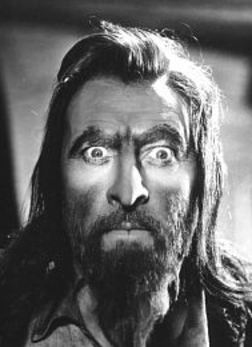
Svengali Type
There is much description of the fine times the musketeers have. One gets the impression that Du Maurier was living the life in the sixties in Paris but such was not the case. He signed on at Punch in 1860 and thus was working as an illustrtor for them from that date until his death. He seems to have been familiar with the Pre-Raphaelite painters of London of whom he speaks highly most especially of Millais. He seems to have been friends with a Fred Walker who he thought was a great artist but who seems to have been lost in the mists of time. I’d never heard of him anyway but one can find his pictures on the internet. Du Maurier loved the artist’s life.
Much of this book as well as the other is a loving recreation of the times and his memory of the times is one of wonderful things. Very refreshing against the unremitting negativity of modern literature. The book is set mainly in the sixties but the ‘horrible’ year of 1871 and the French Commune obtrudes. Du Maurier while recognizing its ugliness nevertheless passes over it quickly with a shrug and back to the good times. He introduces some additional charming characters but then come the crisis.
Billy had asked the declassed Trilby to marry him nineteen times and she had always refused because she knew she wasn’t in his class. After an amazingly wonderful Christmas feast in the atelier Billy asks again. Trilby, as she says, in a moment of weakness accepts. When the news reaches Billy’s mother, Mrs. Bagot, she scurries over to Paris from London to check Trilby out. When she learns that Trilby had posed in the altogether she persuades Trilby to give up her son.
Trilby leaves town without a goodbye. When Billy finds out he has his brain fever or a nervous breakdown that prostrates him for weeks. There was a chance he wouldn’t make it. He does but with psychological consequences. He can no longer love while he lives in a deep melancholia. There are some who know where that’s at. After he recovers he returns to England. the wonderful Bohemian rhapsody is over.
Trilby had left Paris to go to the provinces. She had a little brother who she was supporting and bringing up who she took with her and who then dies of a fever. This devastates Trilby who cuts her hair, dresses as a man and walks back to Paris. Her old haunts have disappeared in the interim so she shows up on the doorstep of Svengali who is but too happy to take her in. The hypnotized Trilby is a small part of the book. The next hundred pages or so describe Billy’s wonderful success as a painter and the loss of camaraderie as the young idealists of the Latin Quarter age and lose their affinity for each other. Charmingly told with just the right touch of heartache.
In the meantime and off stage, as it were, Svengali accompanied by Gecko keeps Trilby in a hypnotic trance as he

Henri Murger
teaches her to use her tremendous oral cavity to sing. While she has the exact equipment to be a great singer she lacks the musical sense and can’t learn it sober. Svengali instills the musical sense through hypnosis but as Gecko later explains Trilby is merely providing the instrument while Svengali is actually singing through her. For three years they labor in the salt mines, as they say, performing on street corners or wherever. Then Trilby is properly trained becoming the rage of Europe as La Svengali becoming bigger and better than such stars as Adelina Patti or Jenny Lind, two real life divas.
Thus while Billy has lost Trilby’s foot or body, Svengali has captured her soul or oral cavity. That’s about the only way I can make sense of foot and cavity.
Now, in real terms the Jews had been emancipated beginning in 1789 by the French Revolution although occuring at different localities in Europe at different times. With the emanicipation a contest began for the soil and soul of Europe. Europeans owned the soil but the Jews while originating nothing became the cultural virtuosi of Europe. Not only in the performing arts but in finance, science and as entrepreneurs. The soil temporarily remained European but the culture was becoming Judaized. It was then that Freud made his assault on European concepts of morality. So Du Maurier has portrayed the situation poetically in a magnificent manner.
Thus the Jews while offering no Beethovens, Bachs or Mozarts became virtuoso interpreters of the music as performers. As Svengali says: Piff, what is the composition compared to my ability to render it. There you have the exploiter’s motto. The Allen Kleins and Albert Grossmans of the world suck the talent, as it were, out of their performers or, boys, as they call them, as agents taking nearly everything leaving the actual talent a pittance.
Nothing changes, this is what Svengali was doing with Trilby or, in another word, Europe. He was making a fortune while Trilby in her hypnotized state was wasting away. Oh, Svengali dressed her well but for the sake of his appearance not hers. When she died, of the fortune that she had made for Svengali none was left to her. Except for presents she had received in appreaciation of her singing she had nothing. They were supposed to be man and wife but, in fact, Svengali never married her. Here I think we have the real import of the story; the competition for Europe between the Jew and the European. Having given up the soul of Europe Europeans were losing their very substanc, the soil, or Trilby’s foot.
Du Maurier is also describing the rise of the artist from a despised menial to the central position in society that they have attained today, especially movie, TV and musical stars. One only has to look at the position Bob Dylan has attained to see the result today. Here is a man with no qualities revered as if he was the savior while poised to begin a tour of stadiums at 67.50 a head that will sell out earning him a fortune within a couple months. Thus as with Svengali he has conquered the soul and wealth of virtually the world. This is truly astonishing.
So Svengali is on top of the world. Despised as a beteljew in the atelier a short five years ago he now has Trilby/Europe and the fortune that goes with her. Alas, he is sucking the life’s blood from her to do this and she is within weeks of death when the Three Musketeers hearing of La Svengali’s fame travel back to Paris to see her perform.
Of course they are so astonished at seeing someone who looks like Trilby singing that they can’t believe it is indeed her. Svengali harbors ill will toward Billy because Billy is always in her heart while her relationship with Svengali is strictly professional.
The Musketeers and the Svengalis are staying at the same hotel where Svengali meeting Billy can’t resist spitting in his face. Billy, who is actually known in the story as Little Billee is much smaller than the six foot Svengali but he nevertheless goes after him getting the worst of the fight until Taffy, a giant body builder type, shows up grabbing Svengali’s ‘huge Hebrew nose’ between his first two fingers leading him around by the nose. Oh, those unintended consequences. The humiliation is too much for Svengali, he becomes vicious toward Trilby in revenge. Readying for their London debut he bullies Trilby in front of Gecko, now his first violinist, who stabs Svengali in the neck with a small knife.
Svengali while wounded is not hurt that bad but his physicians advise him not to conduct the opening performance. This creates a problem because Svengali must make eye contact to sing through Trilby.
He takes a box directly in front of Trilby. But he spots Billy and the other two musketeers in the pit in front of him. The malice and venom he has toward Billy makes his heart fail. His face freezes into a risus sardonicus as he sits lifelessly leering at the Three Musketeers, triumphant in death. Of course Trilby can’t sing a note on her own so that ends a fine career. Now begins the denouement. While seemingly superfluous this is a very important part of the story giving it its secondary meaning.
The Musketeers take Trilby in charge. No one is aware she had been hypnotized while she has no memory of performing and little of the lost five years. The situation between she and Mrs. Bagot, Billy’s mother, are now reversed. Trilby is the great lady while Mrs. Bagot is merely a middle class hausfrau. One might say Svengali has created the real Trilby. Mrs. Bagot still hadn’t posed in the altogether however. Where was Hugh Heffner when you needed him.
On the surface it looks as though Mrs. Bagot has gotten her comeuppance but as Trilby is the creation of Svengali she would have remained the simple little grisette that Billy loved without him. She would have remained the foot without realizing the potential of her oral cavity. Nevertheless this Trilby was Trilby as she should have been.
The woman was fading fast. Svengali had drawn the vital energy from her in his exploitation of her. Mysteriously, just before she dies, a life sized portrait of Svengali is delivered. The contest between he and Billy is still in effect. Gazing in the painted eyes of the hypnotist Trilby breaks into song as a final effort in her best manner.
Billy is grasping desperately for Trilby’s love. On her death bed he leans close to hear her breath out- Svengali, Svengali, Svengali. Thus he believes she loved Svengali more than he. His brain fever is reactivated, he dies. In grand operatic style the love story ends. All because Mrs. Bagot was a snob. But, I think a correct one. Although, what the heck, Billy was just a boho painter.
As an anti-climax in a final chapter titled Twenty Year After as tribute to Dumas whose sequel to The Three Musketeers was title Twenty Years After, Taffy takes a trip to Paris where he finds Gecko playing fiddle in a music hall. He sends a note that Gecko accepts requesting a meeting at his hotel. There Gecko resolves the mystery filling Taffy in on Trilby’s missing five years. He reveals that Trilby had always loved Little Billee and never Svengali.
The reading public then and now has concentrated on the Svengali-Trilby hypnotism aspect of the novel ignoring the rest. That aspect is actually a very small part of the novel but without it I suppose the story woud have fallen flat. Even today a manager like Colonel Tom Parker is thought of as a Svengali to Elvis Presley, so the name has come into common usage for someone’s inexplicable control of someone else.
Edgar Rice Burroughs who had a fascination with hypnotism was probably charmed by that aspect of the story. In his most detailed reference to hypnotism in Thuvia, Maid Of Mars he seems most influenced by stage hypnotism in which the audience is induced to see what is not there rather than the Svengali type. Still, Thuvia-Trilby and the relationship between Jav and Thuvia and Thuvia and Tario has some resonances. I dout that ERB would have been conscious of his borrowing imagining rather that he was creating the story from whole cloth.
End of Part Two, Go to Part Three the Review of The Martian.
Part I, Prologue: A Review of Trilby, The Martian, Peter Ibbetson of George Du Maurier
April 27, 2009
A Review
The Novels Of George Du Maurier
Peter Ibbetson, Trilby, The Martian
Part I
Introduction
by
R.E. Prindle
Contents:
Part I: Introduction
Part II: Review of Trilby
Part III: Review of The Martian
Part: IV: Review of Peter Ibbetson
Occasionally a book finds it way to your hand that seems as if the author had you in mind personally when he wrote it. This one’s for you, Ron. It is as though his mind is communicating directly with yours over perhaps centuries. A couple two or three decades ago one such work that came to my hand was The Secret Memoirs Of The Duc De Roquelaure. I never would have bought it myself, never even suspected its existence, but it came in a bundle of books I bid on at auction containing another book I wanted.
I had the four volumes of the Duc’s life so I read them. The memoirs were ‘Written by himself now for the first time completely translated into English in four volumes.’ Thus in 1896-97 an intermediary on the same wave length as the Duc and myself provided the means for me to read the Duc’s mind. Believe it or not the edition was limited to 1000 copies, privately printed of which 500 were for England and 500 for America. Mine is number 424 of the English set.
There could have been few who had ever read the Duc and I may very well be the only man alive at the present to have shared the Duc’s thoughts. Truly I believed he was speaking directly to me over the 400 intervening years.
I had the same feeling when I read George Du Maurier’s three volumes published from 1891 to 1897. Curious that the Duc de Roquelaure should have been translated in 1896-97 isn’t it? Like the Duc George Du Maurier seemed to speak out to me over more than a hundred years to communicate directly with my mind.
I probably never would have sought out his books except for my Edgar Rice Burroughs studies. I wanted to check out whether there may have been a connection to Burroughs through the second of the novels- Trilby. Then browsing the store I came across a Modern Library 1929 edition of the first of Du Maurier’s efforts- Peter Ibbetson. At that point, I thought, I might as well get the third- The Martian- which I did. This time over the internet.
I have now read each title three times as is my habit if I’m going to review a book. Before moving on to the novels it might be appropriate to say a few words about Du Maurier who may be an unfamiliar name to the reader although he or she may be familiar with the name of his very famous creation, the hypnotist and musician Svengali of the Trilby novel.
Du Maurier was born in 1834 and died in 1896 so he was ideally situated to view the whole Victorian era. Indeed, in his own way he was a symbol of it. As a most famous illustrator of books and an artist satirizing the era for the humorous magazine Punch, he in many ways interpreted English society for itself for nearly fifty years.
He died of heart disease so when he turned to writing to begin what is his virtual literary epitaph in 1891 it may have been with the premonition of his imminent death. He sensed that it was time for a summing up of the life he loved so well. Heart ailments figure prominently in his work. Indeed he died of a heart attack just after finishing The Martian which began publication shortly after his death. Thus while portraying the scenes of his life in Punch and other magazines and books he summarized his life and times magnificently in his three novels.
They are magnificent works. As every man should Du Maurier loved his life and it was a life worth living. The novels are wonderful examinations of exotic altered states of consciousness. In Peter Ibbetson the protagonist is insane, committed to Colney Hatch or some such. At night in his dreams he finds a way to link his dream with the dream of a married woman on the outside. She and his dreams meld into one dream in which they live actual alternate dream lives that are as real as their daytime existences. This went on for a couple decades or more until the lady died. Very eerie.
In Trilby in a love contest between the protagonist Billy and the musician Svengali for the hand of Trilby Billy is denied his love for societal reasons while after a sequence of events Trilby falls into the clutches of Svengali who through hypnotism turns her into a Diva. After his denial Billy becomes temporarily deranged falling into a deep depression which then turns into an equally severe melancholia when he emerges from the mania. So once again we have a description of two altered states of consciousness.
In the third and last novel the protagonist is possessed by an alien intelligence named Martia from Mars. Over the last century she has inhabited thousands of people but only with the hero, Barty Josselin, has she been able to establish contact. In an absolutely astonishing twist she occupies the body of Barty’s daughter. Both Barty and the daughter die enabling Martia to unite pshysically, in the spirit world, with her love. Thus the father and daughter are united which I suppose is the dream of many a father and daughter. The effect on the reader, this one anyway, is ethereal and eerie.
Du Maurier injects real life figures into his fiction. The real personalities of the day lend credibility to the fiction. Du Maurier involves himself in the stories in ingenious ways. While one can’t definitely say that Burroughs learned to inject himself into his stories from Du Maurier yet the framing devices in which Burroughs plays himself are very reminiscent of Du Maurier.
For instance in the Martian the story is a biography of Barty Josselin told by his friend Robert Maurice who then asks George Du Maurier the famous Punch illustrator to illustrate and edit his book. So the biography is ostensibly told in the first person by the fictional Robert Maurice while it is illustrated by the real life George Du Maurier who posing as the editor is actually writing the book. Du Maurier even inserts a long letter of acceptance in which he recapitulates his memories of Barty.
When one realized this the effect is almost supernatural, especially as with a little background on Du Maurier one realizes that the histories of the protagonists are virtually fictionalized histories of Du Maurier himself.
Thus while I haven’t discovered a direct connection to Du Maurier ERB is always telling a fictionalized account of his mental states along with a virtual chronicle of his life. A few points in ERB’s The Eternal Lover bear a very close resemblance to the love themes of Du Maurier especially in Peter Ibbetson and The Martian.
The Martian itself may have been a major influence on Burroughs’ own Martian novels. When John Carter, who was always attracted to Mars,stands naked on a cliff face in Arizona with his arms outstretched toward the Warrior Planet the scene is very reminiscent of Barty Josselin leaning with out stretched arms from his window staring at Mars and imploring Martia for her assistance.
Carter is magically transported to Mars in some unexplained way that may have been no more than an altered state of consciousness much as in the same way Martia inhabited Barty’s mind and body. Once on Mars Carter finds his lady love, Dejah Thoris, in a manner reminiscent of Barty and Martia. Obviously other literary influences abound in ERB’s Martian series but at the core very probably is Du Maurier’s story of Martia and Barty. By 1911 the influence was coming from ERB’s subconscious and he may not have been aware of the resource he was drawing on.
The question is when did Burroughs read, as I believe he did, the three Du Maurier novels? As ERB’s first novel, A Princess Of Mars, had to be built on the Martian it follows that ERB read Du Maurier before 1911. Du Maurier wrote from 1891 to 1896. His novels were serialized in Harper’s Magazine in the US either before or at publication so Burroughs had the opportunity to read them in magazine format as well as the books.
Of the three novels, Trilby was an absolute smash being one of the biggest sellers of the nineteenth century. The sensational story of Trilby and Svengali that everyone concentrated on would certainly have brought Du Maurier to ERB’s attention.
At the time his own life was in turmoil. At the time Trilby was published ERB was in the process of leaving the Michigan Military Academy at which he was employed for what he thought was a career in the Army. Once at his assignment, Fort Grant in Arizona, he would likely have had the odd idle moment to either read the magazine installments or the book.
As Carter’s transfer to Mars takes place in Arizona there is an association with ERB’s army days and Du Maurier’s The Martian. Not proof positive, of course, but not impossible or improbable either. He must then have read the last volume in Idaho when he owned his stationery store there in 1898 and could obtain any book or magazine he wanted, either English or American.
So these wonderful other worldly stories of Du Maurier gestated in his mind for twelve or thirteen years before emerging from his forehead beginning in 1911.
I will now review the novels in detail. These are spectacular, wonderful stories. First the middle volume- Trilby- then the last of Du Maurier’s works- The Martian- followed by the first, Peter Ibbetson.
The review of Trilby is Part II, call that up.
 I, Dynamo