R.E. Prindle 101: Basic Facts, Or Close To It
July 1, 2012
Re: Text
No responsibilty is accepted for the accuracy of any of the below. As Ripley said: Believe it or not.
- FROM:
- TO:

R.E. Prindle
—– Original Message —–From:Ronald E. PrindleSent: Sunday, July 01, 2012 6:03 PMSubject: Re: TextRight clicking won’t allow me to save the page and while I can get the header and footer and the index the text doesn’t show. Try the email if you can.
Reply to Bill and Sue-On Hillman
Part II: Only The Strong Survive
April 3, 2012
Only The Strong Survive
Part II
An Examination Of Bridge And The Oskaloosa Kid
As Created By Edgar Rice Burroughs
(Alternate Title: The Oakdale Affair)
by
R.E. Prindle
Part II
Into The Mysteries
(Some capitalization appears in the text that has no significance. For some reason it just showed up. I didn’t do it)

Young Burroughs With His Camera Eye
Burroughs does a good job in the Holmesian sense in this book enclosing mysteries within mysteries. The central mystery is who is committing the crime wave in Oakdale. Having learned from his mentor, Conan Doyle, Burroughs skillfully withholds details to enhance the suspense then disclosing them to reveal the mysteries. The organization of the scheme of crimes gradually unfolds to show that the real Oskaloosa Kid is one of the perpetrators. So we have a clever doubling of a sweet girl posing as the vicious criminal The Oskaloosa Kid. This is obviously a transfer of his Anima identity from the male De Vac/Oskaloosa Kid to the resumption of a female identity for his Anima through the fake Oskaloosa Kid/Gail Prim.
The girl who was seen with the criminals could have been Gail since she had disappeared without a trace never having arrived at her destination. Gail was not the girl seen with Reginald Paynter, who was robbed and murdered, and the crooks. That person was Hettie Penning who was ejected from the car speeding past the abandoned Squibbs place by the real Oskaloosa Kid. Thus symbolically De Vac/Oskaloosa Kid returns his Anima to Bridge/Burroughs.
As indicated Hettie Pening represents the dead early Anima of Burroughs who has here been resurrected. As in all cases of Burroughs representation of his failed Anima she appears to be a ‘bad’ girl but in reality is merely misunderstood. He compensates for himself.
Bridge himself is a mystery man and double. He is a hobo but with great manners and an excellent education. He is definitely a member of the Might Have Seen Better Days Club. The real club was organized by Burroughs when he served as an enlisted man in the Army in 1896.
In this case Bridge is in actuality the son of a wealthy Virginia aristocrat who has left home because he prefers a life on the road. In the framing story of a Princess of Mars Burroughs portrays himself in his own name as a Virginian. In reality Burroughs was declassed at eight or nine by John the Bully and by his father’s subsequent shuffling of him from school to school finally sending him to a bad boy school that Burroughs describes as little more than a reformatory for rich kids.
If one looks at his career he was on the move quite a bit. During his marriage he seldom lived in one house for more than a year or two then moved on.
Just as Bridge will assume his proper identity at the end of the novel so through his writing Burroughs has abandoned the shame of his hard scrabble years from 1905-13. In a sense he is assuming his proper identity with this novel.
Bridge and the Kid joining together at the fork in the road, one is reminded of Yogi Berra’s quip: When you come to a fork in the road, take it, in this case the less traveled dirt road.
I read word for word frequently dwelling on the scenes created. Burroughs is a very visual writer. Standing at the fork in a driving Midwest summer lightning, thunder and deluge storm they can hear the pursuing hoboes shouting down the road. Ahead of them is a dark unknown and a house haunted by the victims of a sextuple murder.
Indeed, Burroughs describes almost a descent into hell, or at least, the hell of the subconscious.
Over a low hill they followed the muddy road and down into a dark and gloom ravine. In a little open space to the right of the road a flash of lightning, followed one imagines by either the crash of deep loud rumbling of the thunder of perhaps if over head the sonic boom of the air splitting and closing, revealed the outline of a building a hundred yards (that’s three hundred feet, a very large front yard) from the rickety and decaying fence which bordered the Squibb farm and separated it from the road.
There are those who say Burroughs doesn’t write well but in a short paragraph he has economically drawn a verbal picture which is quite astonishing in its detail. The house is a hundred yards from the road. In the rain and muck that might be a walk or two or three minutes or more.
A clump of trees surrounded the house, their shade adding to the utter blackness of the night.
That’s what one calls inspissating gloom. One might well ask how any shade can add to utter blackness but one gets the idea. There is some intense writing thoroughly reminiscent of Poe but nothing like him.
The two had reached the verandah when Bridge, turning, saw a brilliant light glaring through the night above the crest of the hill they had just topped in their descent into the ravine, or, to be more explicit, the small valley, where stood the crumbling house of the Squibbs. The purr of a rapidly moving motor car rose above the rain, the light rose, fell, swerved to the right and left.
“Someone must be in a hurry.” commented Bridge.
There isn’t any better writing than that. Another writer can say it differently but he can’t say it better. Just imagine the movie Frankenstein or Wolf Man when you’re reading it. Burroughs did as well in less than the time it takes to show it.
A body is thrown from the speeding car a shot following after it. Bridge goes to pick up the body.
Thus the mystery and horror and terror of the dark and stormy night has been building. Bridge carrying the body which may or may not be alive asks the Kid to open the door.
Behind him came Bridge as the youth entered the dark interior. A half dozen steps he took when his foot struck against a soft yielding mass. Stumbling he tried to regain his equilibrium only to drop fully upon the thing beneath him. One open palm extended to ease his fall, it fell upon the uplifted features of a cold and clammy face.
Yipes! What more do you need? Cold and dripping, half crazed from fear, overwhelmed by the thought he might be a murderer the Kid’s hand falls on cold and clammy dead flesh. Bridge is standing there with maybe another dead person in his arms. The Kid is also aware that the murderous hoboes are hot on his trail.
If that doesn’t get you then somehow I think you can’t be got.
Not yet finished Burroughs builds up the tension. Striking a match from the specially lined water proof pocket of Bridge’s coat they find a dead man wearing golden earrings. Obviously a gypsy but while staring in unsimulated horror they hear from the base of the stairs of a dark dank cellar the clank of a slowly drawn chain as a heavy weight makes the stairs creak.
This is too much for the nerves of the Kid. Burroughs brilliantly contrasts the terror of the unknown in the basement with the fear of the dark at the top of the stairs. You know where that’s at, I’m sure, I sure do. In a flash the Kid chooses the unknown at the top of the stairs to the horror in the cellar.
What do you want?
The hoboes are still slipping and sliding down the descent into the ravine of the subconscious. Horror in front, terror behind. There is absolutely no place to hide. Nightmare City, don’t you think? How could anyone do it better? What do you mean he can’t write? Put the scenes in a movie and everyone in the theatre would be covering their eyes. Itd\ would be that Beast With Five Fingers all over again. Maybe worse. Never saw that one? Check it out. Peter Lorre. Terrifying. Of course I was a kid.
The clanking of the chain recreates an incident in Burroughs’ own life when he had a job collecting for an ice company. He called on a house and while he was waiting he heard the clanking of a chain coming slowly up the driveway. Waiting with a fair amount of trepidation he saw a huge dog dragging the chain appear. ERB backing slowly away forgot about the delinquent bill.
In this case the chain is attached to Beppo the dancing bear but Bridge and the Kid won’t know that until the next day.
They retreat into an upstairs bedroom. Here what Burroughs describes in capital letters as THE THING and IT pursues them. I remember two movies one called The Thing and the other It.
Just when the thing retreats the murderous gang of hoboes enters the house. Wow! Out of the frying pan and into the fire in this night of terrors as the lightning continues to flash and the thunder crash.
Discovering the dead man and as the bear begins moving again four of the hoboes flee while two who were on the staircase being trapped in the house flee into the same bedroom as Bridge, the Kid and the girl, Hettie. Shortly thereafter a woman’s scream pierces the lightning and the thunder then silences as the storm settles into a steady drizzle.
The rest of the night is one tense affair between the murderous hoboes and the Bridge and the girls. Not a moment to catch your breath.
In the morning when they go downstairs the mystery increases when they find the dead man gone and nothing in the cellar. If they’d had Tarzan along he would have not only been able to smell the bear but to tell whether if was black or brown.
After a brief confrontation Dopey Charlie and the General are driven off. Bridge’s relationship with the Kid is then deepened. Even though all the Kid’s reactions are repulsive to the manhood of Bridge he feels his attraction to the seeming boy growing stronger.
Not since he had followed the open road with Byrne, had Bridge met one with whom he might care to “pal” before.
This brings up an interesting hint of latent homosexuality. My fellow writer, David Adams has objected that in my analysis of Emasculation as applied to ERB is that he should have been a homosexual but wasn’t.
There are degrees of emasculation and there are various degrees of psychotic reaction to it. I don’t say and I don’t believe that ERB was a homosexual but there was a degree of ambiguity introduced into his personality by his emasculation. I have touched on this in my ‘Emasculation, Hermaphroditism and Excretion.’
Here we have another example of it as Bridge is experiencing some homoerotic emotion which is very confusing to him as he has never wanted a ‘pal’ before. In hobo lingo I believe a ‘pal’ has a homosexual connotation.
If Burroughs took his ‘inside’ information on hoboes from Jack London’s The Road then Bridge is the sort of hobo London describes as the ‘profesh’, the hobo highest in the hierarchy of hobodom. London always thought of himself as a quick learner, so one doesn’t have to award his statement too much credibility but Burroughs apparently took him at face value.
As London describes the ‘profesh’ he has been on the road so long he knows all the ropes. Unlike the unkempt bums he realizes the importance of a good front and always dresses neatly. But he is hardened and capable of committing any crime.
While Bridge is obviously intended to be a ‘profesh’ he is neither criminal nor does he dress to put up a good front.
Another category of hobo London lists is the ‘road kid.’ These are young people just starting on the life of the road. The ‘profesh’ would often take one of more of these road kids under his wing as his fag, as the British would say, or in Americanese, a ‘pal.’ In other words a homosexual relationship. Thus this displays ERB’s sexual ambiguity which David couldn’t locate in my psychological analysis of ERB’s emasculation. In this case the ambiguity will be resolved and explained when we learn that the Kid is the beautiful young woman, Abigail Prim, and both Bridge and Burroughs heave a sigh of relief.
Nevertheless ERB is discussing homosexuality in an open and natural way that couldn’t be missed by the knowing and which may be unique for its time. But then, remember that one of ERB’s hats in this story is that of the Alienist, so that in these pages we are deep into the psychological abstractions and Doyle’s mystery stories as influences.
Now comes the time for breakfast. Someone has to ‘rustle’ grub. We have already learned in ‘Out There Somewhere’ that Bridge doesn’t rustle food, he rustles rhyme. Nothing has changed. The Kid goes out to get breakfast and when she comes back with the goods, true to form Bridge bursts forth with several snatches from H.H. Knibbs which surprisingly the demure Miss Prim recognizes. What has she been reading?
How might this apply to Burroughs’ own life. Let’s look at it. Burroughs was enamored of How to books but in his heart he must have considered them a fraud. Willie Case will soon pick up his copy of How To Be A Detective which he finds completely inapplicable to his circumstances. He also has the good sense to throw the book away reverting to his native intelligence which may be a subtle comment on How To books by Burroughs.
ERB always considered himself of the executive class. After his humiliating experience trying to sell door to door he never attempted it again. Instead as a master salesman he preferred to write how to sales manuals for others to use as they went door to door selling his line of pencil sharpeners or whatever while he sat in the office waiting for orders. Hence in his own life he was the ‘rustler of poetry’ or manuals while others rustled grub in the door to door humiliation of the actual selling. Here the Kid will do the door to door gig. ERB always makes me smile.
In this case in what may be a joke the Kid just buys the goods from the homeowner reversing the roles.
There are those who insist Burroughs can’t write but I find his stuff wonderfully condensed getting more mileage out of each word than anyone else I’ve ever read. Just see how he describes breakfast.
Shortly after, the water coming to a boil, Bridge lowered three eggs into it, glanced at his watch (an affluent hobo) greased one of the new cleaned stove lids with a piece of bacon rind and laid out as many strips of bacon as the lid would accommodate. Instantly the room was filled with the delicious odor of frying bacon.
“M-m-m-m!” gloated the Oskaloosa Kid. “I wish I had bo- asked for more. My! But I never smelled anything so good in all my life. Are you going to boil only three eggs? I could eat a dozen”
“The can’ll only hold three at a time,” explained Bridge. “we’ll have some boiling while we are eating these.” He borrowed the knife from the girl, who was slicing and buttering bread with it, and turned the bacon swiftly and deftly with the point, then he glanced at his watch. “Three minutes are up.” He announced and, with a couple small flat sticks saved for the purpose from the kindling wood, withdrew the eggs one at a time from the can.
“But we have no cups!” exclaimed the Oskaloosa Kid, in sudden despair.
Bridge laughed. “Knock an end off your egg and the shell will answer in place of a cup. Got a knife?”
The Kid didn’t. Bridge eyed him quizzically. “You must have done most of your burgling near home,” he commented.
The description of the breakfast between the time Bridge looked at his watch and when the three minutes were up was delightfully done. I could smell the bacon myself while I especially like the detail of swiftly and deftly turning the bacon with the knife point. The knife seemed to have disappeared between the bacon and knocking the end off the egg.
Nice details aren’t they? You’d almost think Burroughs had actually done things like this for years. There’s enough blank spots in his life that he may have had more experiences of this sort than we know about. Take for instance the three days in Michigan between the writing of Out There Somewhere and Bridge And The Oskaloosa Kid. He says it took him twelve hours by train on four different lines to return to Coldwater from Alma. It is not impossible that he was hoboing back for the experience. He knew that he was going to write Bridge And The Kid next; might he not have been picking up local color?
Likewise in Bridge And The Kid he mentions the road from Berdoo to Barstow with seeming familiarity. Had he met Knibbs and the two embarked on a few days road trip as the expert Knibbs showed him some of the ropes?
I don’t know but there is something happening in his life which has not been explained.
Perhaps also the hoboism which appears in 1915-17 in his work when by all rights his success should have permitted him entry into more exalted social circles symbolized a rejection by so-called polite society. If so, why? Certainly the serialization of Tarzan Of The Apes in the Chicago paper must have raised eyebrows when people said something like: Is that the same Edgar Rice Burroughs who’s been tramping around town for the last several years?
After all people live in a town where a reputation is attached to them whether earned or not. In reviewing the jobs Burroughs had after he left Sears, Roebuck there is a certain unsavory character to them. Indeed, one employer, a patent medicine purveyor was shut down by the authorities while ERB then formed a partnership with this disgraced person. Where was Burroughs when the authorities showed up to shut the business down? I make no moral judgments. I’m of the Pretty Boy Floyd school of morality: Some will rob you with a six gun, some use a fountain pen. Emasculation is the name of the game.
It is certainly true that many, perhaps most, of the patent medicines of the time were based on alcohol and drugs therefore either addictive or harmful to the health. Samuel Hopkins Adams was commissioned by Norman Hapgood of Collier’s magazine to write a series of articles exposing the patent medicine business in 1906.
http://www.mtn.org/quack/ephemera/oct7.htm . A consequence of the articles may very well have been the shutting down of Dr. Stace. I think it remarkable that Burroughs didn’t distance himself from Stace at that time.
Even as Adams was presenting his research on patent medicines Upton Sinclair was exposing the hazards of the Chicago meat packing industry whose products were no less hazardous to the public health than patent medicines. Sinclair’s book, The Jungle, as well as perhaps Adams’ articles resulted in the Pure Food And Drug Act of 1906.
The products of meatpackers were so bad the British wouldn’t even feed them to their Tommies. That’s pretty bad.
So, if the Staces of the world were criminal and ought to be put out of business then by logic so should have the Armours and Swifts but what in our day would be multi-billion dollar industries don’t get shut down for the minor offence of damaging the health of millions.
One can’t be sure of Burroughs’ reasoning but his writing indicates that he was keenly aware of the hypocrisy of legalities. Perhaps for that reason he stuck by Dr. Stace.
However Stace was put out of business and the Armours and Swifts weren’t. While I applaud ERB’s steadfastness I deplore his lack of judgment for surely his reputation was tarred with the same brush as Dr. Stace.
When society figures may have asked who this Edgar Rice Burroughs was they were given, perhaps, a rundown on Dr. Stace and patent medicines as well as other employments that seem a little murky to us at present. I’m sure the ERB was seen as socially unacceptable. Thus Bridge who has lived among the hoboes has never partaken of their crimes so there is no reason for society to reject him especially as he is the son of a millionaire.
In any event ERB left Chicago for the Coast returning in 1917 then leaving for good at the beginning of 1919. Life ain’t easy. Ask me.
As Bridge, the Kid and the putative Abigail Prim were finishing breakfast the great detective Burton pulls up in front of the Squibbs place. Burton is obviously a combination of Sherlock Holmes and Allan Pinkerton. We have been advised of the Holmes connection in the opening paragraphs of this book. ERB describes Burton thusly:
Quote:
Burton made no reply. He was not a man to jump to conclusions. His success was largely due to the fact that he assumed nothing; but merely ran down each clew quickly yet painstakingly until he had a foundation of fact upon which to operate. His theory was that the simplest way is always the best way. And so he never befogged the main issue with any elaborate system of deductive reasoning based on guesswork. Burton never guessed. He assumed that it was his business to know; nor was he on any case long before he did know. He was employed now to find Abigail Prim. Each of the several crimes committed the previous night might or might not prove a clew to her whereabouts; but each must be run down in the process of elimination before Burton could feel safe in abandoning it.
That’s a pretty good understanding of Doyle’s presentation of Holmes. ERB did learn Holmes’ dictum that it was necessary to read all the literature on the subject to understand the mentality of one’s subjects. Burton did demonstrate some acumen in his arrest of Dopey Charlie and the General. He deployed an agent fifty yards below and fifty yards above to converge on the two criminals while he approached from the front. Either Burroughs had been doing some reading of his own or he picked up some experience or information from elsewhere.
Another keen point was when Burton went back to where the hoboes had been hiding to dig up the evidence they had concealed that would lead to their conviction for the Baggs murder.
It’s little details like these that always make me wonder where Burroughs picked up this stuff. He does it all so naturally but one can’t write what one doesn’t know. He must have been a curious man, good memory.
So Burroughs has a a pretty good understanding of the methods of Sherlock Holmes. It must be remembered that ERB was reading these stories as they first appeared not as we do as part of literature. Holmes, O.Henry, Jack London, E.W. Hornung, these were all fresh new and extremely stimulating with a great many references and inferences which are undoubtedly lost on us. Even in Bridge And The Kid ERB’s reference to the Kid’s bringing home the bacon is a direct reference to a quip the mother of the ex-heavyweight champion of the world Jack Johnson made just after he won the championship from Jim Jeffries: He said he’d bring home the bacon and he’s done it. I don’t doubt if many caught it then but I’m sure the phrase has become such a commonplace today that only a very few catch the reference and share the laugh.
Doyle’s stories such as A Study In Scarlet dealing with the Mormons and The Valley Of Fear dealing with the Molly Maguires would have had much more thrilling immediacy for ERB than they do for us. Also Burroughs has caught the essence of Holmes which was not so much the stories as the method of Holmes.
I have read the canon four times and while I could not reconstruct any of the stories without difficulty, if at all, maxims like- When you eliminate the impossible whatever remains no matter how improbable must be the truth. – have lodged in my mind since I was fourteen guiding my intellect to much advantage. So also the dictum to read all the literature. Not easy or even possible, but the more one has read the or read again the more things just fall in place without any real effort. You have to be able to remember, remembrance being the basis of all mind, of course. Holmes has been like a god to me.
If you wish to learn a source of Burroughs’ stories then all you have to do is apply the above methods; it will all become clear.
Burton moves the story forward as his appearance causes Bridge who isn’t sure what the status of the Kid and the putative Gail Prim is, elects to avoid the great detective even though they are friends.
The trio slip out the back into the woods following a track leading to ‘Anywhere’. Burroughs in a masterful telling catches the feel of a Spring day on a recently wetted trail littered with the leaves of yesteryear. Ou sont les neiges d’antan?
They come upon a clearing where a gypsy woman is burying a body. By this time Bridge has solved the mysteries of the previous evening.
The girls make noises upon hearing the clank of a chain in a hovel causing the gypsy woman to look around. Rather than spotting the trio she spots Willie Case hiding in the bushes who she drags out.
The gypsy woman, Giova, is as good a character as Bridge, the Kid, Burton and the hoboes, but my favorite of the story is Willie Case, the fourteen year old detective. While to my mind ERB presents Willie as a thoroughly admirable character, he nevertheless vents a suppressed mean streak not only on Willie but on the whole Case family.
ERB doesn’t let his mean streak show very often, it lurks in the background, but he lets it loose in this book. He must have been under personal stress.
He describes Willie as having no forehead and no chin, imbecilic traits, literally beginning with the eyebrows and ending with the lips. A freak of nature, a real grotesque. That means that Willie was a real ‘low brow’ as Emma accused ERB of being, even a no brow. Is it a coincidence that Emma called ERB a low brow or that the literati thought ERB wrote ‘low brow’ literature?
In point of fact Willie strikes me as an intelligent boy. He analyzes the situation always being in the right place at the right moment. Burton himself pays him a high but sneering compliment then cheats him out of the promised reward of a hundred dollars but in the manner McClurg’s published his books Burroughs was cheated out of a large part of his reward.
I don’t say that’s the case but if so it fits the facts.
In any event ERB treats the Case family meanly; they might almost be prototypes of Ma and Pa Kettle of the Egg and I or the meanly portrayed characters of Erskine Caldwell’s Tobacco Road. Jeb Case behaves very reprehensively at the lynching although once again he merely reported the facts that the Kid gave Willie. The Kid did tell Willie that he had burgled a house and killed a man. So, perhaps ERB created some characters that he could kick around as he felt himself being kicked.
And then we have the gypsy woman, Giova. She and her father are not only pariahs in general society as gypsies but because of her father they even have been cast out by the gypsies. Her father was a thief from both general and gypsy society. The former may have been laudable in gypsy terms but the latter wasn’t. They make, or made their living by thieving and cadging coins with Beppo, their dancing bear. Beppo of the evil eye.
Burroughs presents Giova as being sexually attractive with lips that were made for kissing, in echo of the refrain from Out There Somewhere. Here we may have a first inference that Emma was in trouble; the kind of trouble that would have ERB leaving her for another woman a decade or so hence. There are numerous rumblings indicating the trend not least of which was ERB’s fascination with Samuel Hopkin Adams’ novel, Flaming Youth of a few years hence and the subsequent movie starring Colleen Moore.
Bridge is now on the run with three women and a bear and he hasn’t done anything wrong to get into such hot water. One woman his emergent Anima, one, his rejected Anima, and the last a longing for a woman whose lips were made for kissing. Wow! This is all taking place in a ravine that opens into a small valley too.
All this has been accomplished in a compact one hundred pages. One third of the book is left for the denouement that Burroughs scamps as he usually does.
Giova decks them all out as gypsies which must have been an amusing sight to the Paysonites as this troop of madcaps complete with dancing bear in tow troop inconspicuously through town. Surprised they didn’t call out the national guard just for that.
As the story draws to a close ERB contributes a wonderful vignette of low brow Willie dining out at a ‘high brow’ restaurant called the Elite in Payson. The idea of Willie being conspicuous in a burg like Payson which we big city people would refer to as a hick town good only for laughs is amusing in itself. You know, it all depends on one’s perspective:
Willie Case had been taken to Payson to testify before the coroner’s jury investigating the death of Giova’s father, and with the dollar which the Osklaloosa Kid had given him in the morning burning in his pocket had proceeded to indulge in an orgy of dissipation the moment that he had been freed from the inquest. Ice cream, red pop, peanuts, candy, and soda water may have diminished his appetite but not his pride, and self-satisfaction as he sat down and by night for the first time in a public eatery place Willie was now a man of the world, a bon vivant, as he ordered ham and eggs from the pretty waitress of The Elite Restaurant on Broadway; but at heart he was not happy for never before had he realized what a great proportion of his anatomy was made up of hands and feet. As he glanced fearfully at the former, silhouetted against the white of the table cloth, he flushed scarlet, assured as he was that the waitress who had just turned away toward the kitchen with his order was convulsed with laughter and that every other eye in the establishment was glued upon him. To assume an air of nonchalance and thereby impress and disarm his critics Willie reached for a toothpick in the little glass holder near the center of the table and upset the sugar bowl. Immediately Willie snatched back the offending hand and glared ferociously at the ceiling. He could feel the roots of his hair being consumed in the heat of his skin. A quick side glance that required all his will power to consummate showed him that no one appeared to have noticed his faux pas and Willie was again slowly returning to normal when the proprietor of the restaurant came up from behind and asked him to remove his hat.
Never had Willie Case spent so frightful a half hour as that within the brilliant interior of the Elite Restaurant. Twenty-three minutes of this eternity was consumed in waiting for his order to be served and seven minutes in disposing of the meal and paying his check. Willie’s method of eating was in itself a sermon on efficiency- there was no waste motion- no waste of time. He placed his mouth within two inches of his plate after cutting his ham and eggs into pieces of a size that would permit each mouthful to enter without wedging; then he mixed his mashed potatoes in with the result and working his knife and fork alternatively with bewildering rapidity shot a continuous stream of food into his gaping maw.
In addition to the meat and potatoes there was one vegetable side dish on the empty plate, seized a spoon in lieu or a knife and fork and – presto! The side dish was empty. Where upon the prune dish was set in the empty side-dish- four deft motions and there were no prunes in the dish. The entire feat had been accomplished in 6:34 ½ , setting a new world’s record for red headed farm boys with one splay foot.
In the remaining twenty-five and one half seconds Willie walked what seemed to him a mile from his seat to the cashier’s desk and at the last instant bumped into a waitress with a trayful of dishes. Clutched tightly in Willie’s hand was thirty-five cents and his check with a like amount written upon it. Amid the crash of crockery which followed the collision Willie slammed check and money upon the cashier’s desk and fled. Nor did he pause until in the reassuring seclusion of a dark side street. There Willie sank upon the curb alternately cold with fear and hot with shame, weak and panting, and into his heart entered the iron of class hatred, searing it to the core.
The above passage has many charms. First, it is an excellent piece of nostalgia now, although at the time it represented the actuality, thus, as a period piece it is an accurate picture of the times. And then it is excellent comedy as well as a a parody as I will attempt to show.
One has to wonder if ERB really thought the Elite was a pretty fine restaurant. If so, one wonders where he took Emma and kids for a night out. Not too many gourmet Chicago restaurants served breakfast for dinner. Ham and eggs with mashed potatoes? Reminds me of the Galt House Hotel in Louisville where a ‘starch’ is served as a side dish. What exactly was this side-dish Willie wolfed- stewed tomatoes? The dessert prunes- dessert prunes?- was a nice touch too. Dessert for breakfast? Another nice quality touch at the Elite was the cup of toothpicks. Of course, those were the days cuspidors were de riguer so what do I know, maybe the Palmer House had a cup of toothpicks on the table too. I know they had cuspidors.
It does seem clear that little Willie was far down the social scale of little rural Payson. They had electric street lights, though. I’m not even from New York City but I would find the Elite, how shall I say, quaint and charming? Of course, New York City is not what it used to be either. Can’t fool me in either case; I’ve dined out in Hannibal. Good prices. Bountiful. Plenty of side dishes something that I’d never seen before.
I’m sure I’ve been in Willie’s shoes, or would have been if he’d chosen to wear them, too, so I have a great deal of sympathy for the lad. A man with a dollar has the right to spend where and as he chooses. Damn social hypocrisy!
In addition to the charm and light comedy ERB interjects a little parody of Taylorism and mass production into the mix.
For those not familiar with Frederick W. Taylor and his methods I quote from
http://instruct1.cit.cornell.edu/courses/dead453-653/ideabook1/thompson-jones/Taylorism.htm :
Taylor wrote “The Principles of Scientific Management in 1911. These principles became known as Taylorism. Some of the principles of Taylorism include (Management for Productivity, John R. Schermerhorn, Jr. (1991)):
Develop a ‘science’ for every job, including rules of motion, standardized work implements, and proper working conditions.
Carefully select workers with the right abilities for the job.
Carefully train these workers to do the job, and give them proper incentives to cooperate with the job science.
Support these workers by planning their work and by smoothing the way as they go about their jobs.
Taylorism which led to maximum efficiency also give the lie to the unconscious of Sigmund Freud, or at least puts it into perspective. If the twentieth century has been the history of the devil of Freud’s unconscious it has also been the century of the triumph of the god of conscious intelligence. The question only remains which will triumph.
One of the recurring themes in ERB’s writing of the period is efficiency. Indeed, a couple years hence he will write a book entitled The Efficiency Expert.
It was the age of efficient mass production which required standardized motions and produced terrific results where applied as at Henry Ford’s marvelously efficient factories. Ford brought the task to the worker in well lighted clean factory spaces at a level which required no time consuming, fatiguing and unnecessary lifting or bending. Plus Henry Ford blew the industrial world away by doubling the going wage for unskilled labor. He changed the course of economic history singlehanded. He achieved more than the Communists or IWW could have accomplished in a million years earning their undying enmity. He may in one fell swoop have defeated the Reds. They sure thought so.
But, go back and review how Willie organizes his repast for consumption. Taylor-like he eliminated all non-essential motions then with maximum assembly line speed-up he gets production into one continuous stream.
A comic effect to be sure but there is even more comedy in the parody of the assembly line and Taylorism. I’m sure ERB intended it just that way.
Willie may be a joke but there is a certain flavor to be obtained by filling a continuum of food, mouth and time. Such an opportunity for enjoyment may present itself once in ten years or so. Willie saw his opportunity and seized it which he does throughout the story. Willie is OK with me.
I have eaten that way but I now reserve the method for ice cream and highly recommend it. My last opportunity, they present themselves but rarely and can’t be forced, was several years ago when I was insultingly offered a half melted Cherries Jubilee. The dish was of a perfect consistency for assembly line consumption. I saw my chance and like Willie, I took it. I kind of distributed cherries and ice cream chunks in the creamy stew, got mouth in the right position and cleaned the bowl in sixty seconds flat, reared back gripping the bridge of my nose, honked a couple times as the freeze seized my brain and then took a few minutes for consciousness to return. One of the great natural highs in this drug infested time. I tell ya‘, fellas, they was all lookin’ at me but I am much beyond the iron of class hatred. If they can’t take a joke…well, you know the finish. So I think Willie Case did the right thing.
Clumsy waitress to get in his way anyway. Fourteen hours on the job was no excuse.
Willie didn’t feel guilt for too long though, for what ERB calls a faux pas, it put him in the right place at the right time to see Giova and her dancing bear fresh from Beppo’s own slops. How could ERB be so cruel to a dumb animal- the bear, not Willie-, one that was going to save the heroine’s life- both the bear and Willie.
After having had dinner and refreshments Willie still had 20 cents left from a dollar of which he spent 10 cents for a detective movie and had ten cents left over for a long distance phone call to Burton in Oakdale after he spotted Giova and her dancing bear when he came out of the movie theatre.
He followed Giova to Bridge and the girls, fixed their location then called Burton. Not only did Willie spot the fugitives but so did the four leftover bums. Dopey Charlie and the General were impounded for the Baggs murder while we will learn that the real Oskaloosa Kid and the putative Gail Prim remain as well perhaps as the true identity of L. Bridge.
Burroughs is full of interesting details. The hoboes are gathered in an abandoned electrical generating plant which had formerly served Payson but had been discontinued for a larger plant servicing Payson from a hundred miles away. We don’t know when that might have happened but electrical generation and distribution was relatively new. The consolidation into larger generating units was even newer. Samuel Insull, whose electrical empire collapsed about1938 had begun organizing distribution in 1912 when he formed the Mid-West Utilities in Chicago absorbing all the smaller companies such as this one in Payson obviously.
I find details like this the exiting part of reading Burroughs.
The murderous hoboes set out to rob and kill Bridge and the Kid while Sky Pilot and Dirty Eddie elect themselves to return the putative Gail Prim who we will learn is actually Hettie Penning, thus doubling ERB’s Anima figure and connecting the latter to the former.
One is put in mind of the Hettie of H.G. Wells’ novel In The Days Of The Comet. Both Hetties exhibit the same traits. While it may seem a slender connection, still, ERB has so many references to other authors and their works that the connection is not improbable. For obvious reasons ERB always insisted he had never read H.G. Wells. Wells? Wells, who?, but how could he not have?
Bridge and the girls would have met their end except that Willie Case’s call brought Burton on the run who arrives in time to save their lives. Unfortunately Beppo of the evil eye meets his end after having done Burton’s job for him much as Willie always did.
In between the girls, the ‘boes, Bridge and the coppers Burton has a full load so he drops Bridge and Kid at the Payson jail. Willie Case had not only solved the case for the ingrate Burton but saved the life of Gail Prim posing as the Oskaloosa Kid. In a heart wrenching scene little Willie seeking his just reward is cruelly rejected and cheated by the Great Detective. I don’t know, maybe I read too closely and get too involved. Or, just maybe, ERB is a great writer.
It’s all over but the shouting and along comes the mob howling from Oakdale for the blood of Bridge and the Kid. I tell ya, boys, it wuz close. Burton arrived in time but not before Bridge with a well aimed blow broke Jeb Case’s jaw. What did those Cases ever do to ERB I wonder?
In the end Hettie Penning is identified, clearing up that mystery. Burton is able to tell Bridge’s dad who has spent $20,000 looking for him that he is found. It may even have cost less for Stanley to find Livingston. Of course there was a lousy rail system in the Congo in Livingston’s time. Bridge is united with Gail obviously prepared to renounce the roving life. Thus the promise of Out There Somewhere is redeemed. Bridge has found his woman.
Thus on paper, at least, Burroughs is reunited with his Animus in gorgeous female attire. No more men in women’s clothes or women in men’s clothes.
2.
Bridge And The Kid is a very short book, only 152 pages in my Charter paperback edition of 1979 (Septimius Favonius BB #24. Charter didn’t see fit to include a date.) Although first issued in book form so late as 1937, it was reprinted in 1938 and 1940 so there must have been some early readers however when reprinted in 1974 there could have been few who remembered it.
My fellow writer, David Adams wrote a short review in the same issue #24 of the Burroughs Bulletin, October 1995, in which he also recognized the importance of this book to the corpus:
It may come as a surprise that anyone could possibly think of calling the novelette, THE OAKDALE AFFAIR, a major work of such a prolific writer as Edgar Rice Burroughs, but I found it to be such an animal…
I am unaware that any other than Mr. Adams and myself have reviewed the book. To sum up:
There seems to be an obvious connection to Jack London in the Bridge Trilogy (I prefer Bridge to Mucker because the latter draws reproving stares and no one today knows what a mucker is. It sounds slightly obscene.)
Mr. Adams, who is more of an authority on Jack London than myself, I’ve only begun to read London as a result of Bill Hillman’s series of articles in ERBzine, which posits a strong connection between Burroughs and London, and not the other way around, feels the novels have a great deal to do with London. The connection seems to be there but I have only begun to read London’s relevant or major works.
What ERB’s attitude towards London may have been which seems ambiguous isn’t clear. Burroughs never wrote about London and never mentions him explicitly. There are many points of disagreement between the two politically and socially. Burroughs does seem to have liked London and his work although what he read or when he read it isn’t clear. There are no London titles in his library.
The second major influence in the novel is the problem of hoboism connected with the IWW and labor unrest.
In the background Burroughs is working out his Anima/Animus problem.
The whole is framed in the form of a rather magnificent detective story patterned after Arthur Conan Doyle’s Sherlock Holmes stories with a dash, perhaps a soupcon, of E.W. Hornung thrown in.
Attention should be paid to the psychological aspects.
Many of ERB’s favorite themes such as the efficiency expert are also thrown in. Nifty historical details like Samuel Insull’s electrical empire are added to the mix as well as Taylorism.
If anything ERB was too efficient, too economical in his use of words. The Book could easily have been fleshed out another sixty or hundred pages with no loss in the marvelous immediacy of the telling. If anything the story is too condensed. I found myself pausing over each description to recreate a mental image of the depiction. I was willing to do so and the personal reward was great. How much ERB was the creator of my vision of the story and how much my own as collaborator isn’t clear to me. Perhaps ERB just outlined the story ‘suggesting’ the scenario, expecting the reader to ‘customize’ the story as he reads along. This may be the first ‘inter-active’ novel. If so, Burroughs may be an even more innovative and greater writer than he is commonly thought to be.
Pt. II Edgar Rice Burroughs And The Accreted Personality
March 14, 2012
Part II
Edgar Rice Burroughs And The Accreted Personality
by
R.E. Prindle

Time may fly but life seems long. Long enough for circumstances to alter your personality more than once. Consider for instance the National Guardsman secure in job, wife and family who is jerked out of his ideal existence to take a tour of duty in Iran or Afghanistan, foreign wars which betray the promises of his enlistment which were to defend his home state. Do you think a personality change didn’t occur when he received his notice? If he was kept in for several tours of duty over a period of years so that his former existence doesn’t appear to him as a dream that took place in a parallel universe? And if he comes home without an arm or a leg or, perhaps, both, that he doesn’t suffer from reminiscences or have a dual or multiple personality. You can bet he does. Nor does your life have to be as hard as the National Guardsman for your own personality to acquire personality accretions over your lifetime, all of which are stored in your mind and may be reassumed at any time.
As I said in the first part, these various existential states don’t disappear, they become part of your reminiscences whether suppressed or remembered and as possible fixations or idees fixe they influence your daily actions.
So now, let’s turn to the life of Edgar Rice Burroughs to illustrate the idea of the accreted personality. Psychology is simple if you don’t make it complex by mystifying it. I hope I can make Burroughs’ story clear without unnecessarily complicating it. I will try to use Occam’s Razor judiciously.
Edgar Rice Burroughs, who would become very famous as a fiction writer, entered this world of pain of pleasure on September 7, 1875 in Chicago, Illinois. He was parented by George T. and Mary Burroughs, he of Anglo-Irish ancestry and she of Pennsylvania Dutch, that is say, German. Eddie always considered himself pure English at a time when being English meant something, a much depreciated coin these days.
George T. was an upright man who had been an officer on the Union side in the Civil War a scant ten years previously. George Custer had not yet gone down at the Little Big Horn nor was Sitting Bull yet starring in Buffalo Bill’s Wild West. George T. had two other sons, George and Harry, who were born just after the Civil War.
George T. was a whisky distiller while at this time the Whisky Trust was coming into existence. George T. was an independent sort who needed the Trust less than they wanted him. I don’t say the Trust was responsible but George T. was burned out. Chicago loved a good fire.
The relationship between Ed and his parents was not a warm one. His father made his life difficult, seemingly on purpose, while his mother seems to have been rather cold. Burroughs seldom mentions her nor were any of his characters named Mary, or George for that matter.
Nevertheless, born into a world of creature comforts with high expectations in a fine house on Chicago’s West Side with two Irish maids Ed began life in a happy state of mind walking down the street singing Zippity Do Dah or the equivalent. He stayed that way for about eight years until his first personality changing event occurred.
Eddie attended Brown School in his neighborhood. I haven’t been able to find out much about Brown but the schools stands out as special in Ed’s mind. The school had several prominent graduates one of which was the showman, Flo Ziegfeld. As Ziegfeld was Jewish it is quite possible the school was close to Maxwell St. Maxwell St. would figure prominently in Ed’s later novel, The Mucker.
One day when Ed was eight he found a big twelve year old Irish kid by the name of John belligerently blocking his way. It isn’t known whether he was walking with future wife Emma Hulbert or not but I suspect he was. At any rate John threatened to beat him up. Thoroughly terrorized Ed took to his heels and as he did so several suggestions entered his terrorized mind. To be in terror is to enter a hypnoid state in which all ones psychic defenses are lowered or discarded. Suggestions are easily fixated in your mind. Thus at the age of eight Ed’s original personality was submerged, he assumed his central childhood fixation. Not only was he emasculated on his Animus but, perhaps because he shamed himself in front of Emma, he transferred his Anima to John; he then set up John as his ideal of manhood wishing to be just like him.
The result was that John became his favorite name. In his future novels he named a disproportionate number of characters both good and bad John. His two key characters were both named John- John Clayton, aka Tarzan Of The Apes and John Carter of Mars. Both have the initials JC referring to Jesus Christ, one supposes. Thus on the masculine side their names commemorate John the Bully while on the feminine side Jesus Christ. Ed also wore a book under the assume name of John McCullough.
As Ed was shamed by running, defenses against cowardice are liberally sprinkled throughout his works with justifications for the advance to the rear maneuver, or running.
Particularly troubling to him was the occupation of his Anima by a male. Probably not very usual but given the limited range of responses available to humans, probably not that uncommon. But this result of the fixation was particularly troubling to him appearing in a succession of his initial output of the ‘teens.
The clearest exposition of the results of this fixation was reproduced in the pages of Ed’s second novel, The Outlaw Of Torn. The hero of the novel is a boy of Ed’s age on the street corner, who is the king of England’s son c. 1400 AD. The King has a quarrel with his fencing instructor, De Vac, who then avenges himself by kidnapping the son, Norman.
The scene is that Norman is playing in the garden under the watchful eye of his nurse/Anima when De Vac appears outside the garden gate- I. e. Ed’s mind- luring Norman to him. Norman has passed the gate when his nurse who had been chatting with another woman notices. She rushed through the gate where De Vac struck her dead. Thus his Anima was outside Ed’s mind when she was destroyed.
Now, this is the replication of a dream story. The meaning is that Norman/Ed was safe inside when De Vac/John caught him, as it were, with his pants down, killing and assuming the role of his Anima. The nurse represents his Anima or right brain which was then disabled.
So, as an eight year old boy Eddie has an emasculated Animus, left brain, and destroyed or shattered Anima, right brain. This has to be dealt with in some way so he can carry on and survive.
What Burroughs does then is create a myth to repair the damage as well as he can. De Vac now on the run with his prize who he must conceal takes Norman to a three story house in the slums of London built on stilts out over the water of the River Thames. The two live in this attic/mind for three or four years. During this entire period De Vac is dressed as an old woman. So, here we have the emasculated Animus combined with the dead Anima with the waters of the feminine flowing beneath the house, I.e. Burroughs’ self.
The two live this way for three or four years, Norman never leaving the attic. At the end of this period De Vac dons men’s clothes and takes Norman to a ruined castle in the Shires. The remarkable thing about this castle is that on one side, the right side, the roof has completely fallen in, can’t be used.
The interpretation is that Ed so identified himself with John that he had to put his own life on hold until he turned twelve, the same age John had been. At that point he recovered or began to recover some control of his Animus while his Anima remained destroyed.
De Vac then began to train Norman in the manly arts to be a killing machine to attain physical vengeance for De Vac on the King.
One can’t be sure of what effect the encounter had on his personality but the next year after the confrontation his father took him from Brown transferring him to an all girl’s school. George T.’s reason for this was that there was a fever going around and he wanted to protect Ed from it. How one would be safe from a communicable disease in a girl’s school isn’t clear so perhaps Ed’s father had another reason.
In Ed’s psychological state it is not unlikely that he went into a fairly serious depression while emasculated and crippled he may have become very effeminate. The placement in the girl’s school may have been one of disgust and to teach the boy a lesson to act like a man.
The humiliation on top of the emasculation was difficult for Ed to bear. He pleaded and pleaded to be transferred from the girl’s school. His pleas were heard although his father didn’t send him back to Brown but a couple miles across town to Chicago’s Harvard Latin School where Ed stayed through what would have been his Junior High years. During this period, the date isn’t clear, Ed fell off his bicycle banging his head against the curb; it isn’t known whether it was the right or left side. This left him dizzy and walking round in circles for three or four days, then the obvious effects disappeared. George T. then jerked him out the Latin School and sent him West to his brothers’ cattle ranch in Idaho. He doesn’t seem to have attended any school for the year he was in Idaho. However he learned to be a cowboy and had a great time.
Even without school the period was not without intellectual stimulation. George and Harry Burroughs were graduates of the Sheffield Scientific School attached to Yale University but not yet integrated with it, along with their partner Lew Sweetser. Sweetser was a fairly remarkable guy deeply interested in psychology when the subject was just beginning to assume its modern form.
William James had just published his two volumes on Psychology but I haven’t been able to discover who Sweetser’s teachers may have been at Yale. Departments of Psychology were rare at American Universities in the 1880s. However, as Sweetser apparently studied whatever psychology was available it seems certain that he would have been at least aware of Charcot’s experiments at the Salpetriere that were world famous. It is also clear that he was familiar with the idea of the sub- or unconscious. However much Ed may have retained, as he himself was relatively well informed on psychological matters when he began writing the foundations of his knowledge were probably formed at Sweetser’s knee.
Having left Ed in the wilderness for a year, George T. then moved him to the East Coast to Massachusetts’ Phillips Academy. Ed was now being moved around almost with the frequency of a military brat with its devastating personality consequences. Having consorted with a rough bunch of fellows for a year, Ed was now in an elite school without a great deal of preparation.
He was in Idaho at the end of Wyoming’s Johnson County War when the big ranchers squeezed out the small ranchers. Many of the small ranch soldiers whose shootings were classified as murders had fled to Idaho where Ed knew one or two; from the company of murderers, or killers at any rate, he was now in with a bunch of elitist schoolboys.
When his brothers had attended Yale their father had refused them an allowance that would have allowed them to associate with their richer school fellows as equals. If he continued the practice with Ed at Phillips then an extra burden was placed on the kid that would help explain his behavior. At any rate he assumed the posture of clown to gain acceptance while neglecting his studies. Naturally he was requested to leave.
Certainly he could have expected to return home and attend school in Chicago but this was not his father’s plan. His father enrolled him at the Michigan Military Academy outside Detroit billed as The Paris Of The West which is most laughable. This was the second great psychological trauma in his life adding another major accretion to his personality. Ed rebelled at being sent away again.
This was not merely rejection but also a condemnation of him by his father. As Ed saw the situation, with a great deal of accuracy, the Military Academy was just a holding pen for juvenile delinquents whose parents didn’t know how to handle them so they put them away in what was essentially an asylum or reform school where they could get some ‘discipline.’
Ed was horrified at these suggestions about himself coming from his own father. He rebelled at the rejection and its implications. He left the academy to return home or as his biographer Porges puts it, he ran away. George T. wasn’t going to put up with that. He collared Ed and dragged him back to Detroit, told him to stay put or…who can say or what? At any rate crushed and rejected Ed had no choice but to obey, but his mother and father died for him that day, slain by their own hand. Thus when Ed’s literary alter ego Tarzan came into existence in 1912 his parents had been slain by murderous apes and Tarzan was an orphan as Ed imagined himself.

General Charles King, Soldier and Author
Ed stayed at the Academy into 1896 when he was between twenty and twenty-one. He took the Commandant of the Academy, Charles King, as his surrogate father and mother. Because King was a captain in the Army, later a general, Ed decided he wanted to be an Army officer too. It is also noteworthy that King was a successful author of novels which Ed may have wanted to emulate when he too chose to become an author. One of King’s first novels was An Apache Princess while Ed’s first commercial effort was titled A Princess Of Mars.
Ed attempted in vain to win an appointment to West Point but failed. Then in 1896 while serving as an instructor at the Michigan Military Academy Ed foolishly abandoned his post choosing to join the Army as an enlisted man before the school term ended.
By now twenty years old his past with its many personality accretions had formed him. His original personality had been destroyed to be replaced by that caused by John. The accretions accumulated as he was shifted from school to school and West to East to MidWest leaving him dazed and confused while the final accretion of that youthful period was the devastating rejection by his parents all of which left him depressed and fatalistic. The high expectations of his childhood had been completely eliminated. The bright young boy had been transformed into a gloomy young man. But no former personality had disappeared; they all lived on in his unconscious where circumstances could revive any or all at the appropriate moment.
But, one is still alive and one must toddle on. Ed was not lazy or adverse to work. His intellectual interests were vast. He was a great wide ranging reader.
In the next part then, let’s turn to his personality forming accretions from reading and his general intellectual , social and political milieu.
Pt. I: Edgar Rice Burroughs And The Accreted Personality
March 6, 2012
Edgar Rice Burroughs
And
The Accreted Personality
Part I
by
R.E. Prindle

Dr. Pinel Unchaining The Inmates
The post-French Revolution period begins the rapid development of the Aryan mind. The Enlightenment laid the foundation of that development. Shortly after mid-nineteenth century the French astronomer, Camille Flammarion, was able to announce that Astronomy and Psychology would be the key disciplines of the future. The break with the religious consciousness of the past ten thousand years or so would be fraught with immense dangers, dangers which we are still combating.
The social ideology of the present asserts that all people are of the same stage of mental development. This is, of course, absolute nonsense. There are still hundreds of millions if not a billion or two who still maintain a stone age view of the world. Nor are all of them in other parts of the world, a vast number are here in the Americas and Europe. In addition there are billions still enmeshed in a religious consciousness while only perhaps a hundred million or two have actually evolved into the scientific consciousness. Hence we have the terrifically repressive attempted subversion of science by the Semitic religions.
So, it should be clear at first glance that not all people are equally developed or endowed nor are all cultures of the same value.
The French scientist and neo-romantic novelist Camille Flammarion noted mid-nineteenth century that the two most important intellectual disciplines for the future would be Astronomy and Psychology. I think that has proven true.
A major discovery of the century was the notion of the split or multiple personality. A term currently in use is Dissociation. Neither is accurate. I advance the term Accretive Personality. That is one’s personality is made up of many personality variations as a result of growth and experience. In periods of stress it is quite easy to escape oppressive reality by slipping into what is essentially an alternate reality or a parallel personality, if you will.
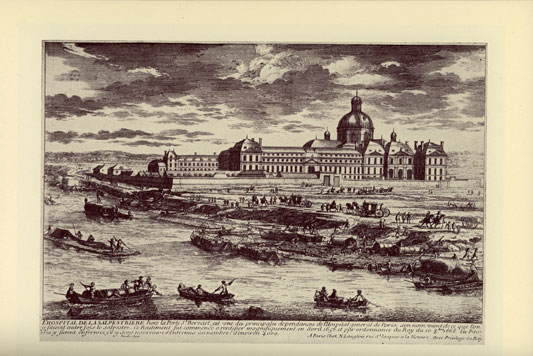
The Salpetriere
This was not a new phenomenon, merely the shock of recognition. In Greek mythology, for instance, when the stress of the mid life crisis hit, the hero went through a period of madness, that is to say he adopted a parallel personality until he was able to reorganize his mental attitude to new realities.
In Europe, under the stress of an insane quasi-Semitic religion in which Satan took a prominent role, it was common for the stressed to become ‘possessed’ by demons or, in other words, to split the personality. That is the person showed a parallel personality. The transition point to the beginning of secular understanding came when Dr. Anton Mesmer matched his secular method of exorcism against the ecclesiastical method of exorcism and won. So one might say that modern psychology derived from the problem of the dual personality- the Jekyll and Hyde effect. However dual or multiple personality was not recognized as such until announced in Jean-Martin Charcot’s clinic at the Salpetriere hospital in Paris in the mid-eighties.
Charcot studied hysterics. Hysterics are dealing with a lot of stress, hence escape through an alternate personality would be an easy choice. Charcot and the Salpetriere aren’t exactly household words so let’s take a moment to explain the situation in which modern psychology was born.
It is also necessary to bear in mind changes in scale. What is good for one stage of growth is not good for another. As the scale of things progresses from tiny to small to medium to large to huge to gigantic new forms have to be adopted to suit the new circumstances. These transition points are difficult to adjust to but once adjusted to are considered so normal that those who resisted the old change are equally resistant to adapt to the next level. Of course the young of each scale is born into it and has no adaptation to make although they will at the next change of scale.
Thus the French Revolution and the Napoleonic Era masked to a very large degree a major change of scale so that after Waterloo a seemingly complete break with the past had taken place. It was a new world in the morning. So in the years leading up to the Great War another change of scale had taken place that masked the new world that popped into place in the twenties. I picked up the concept from that astute observer, H.G. Wells, who noted the emerging change in scale at the turn of the century. That great ship, the Titanic, that went down in ‘12 may be considered as representative of that change.
Thus with the change of consciousness that actually took place in 1795 the new consciousness became clear after Waterloo. Gone was the religious notion of ‘possession by evil spirits’ to be replaced soon by the concept of multiple personality. Thus whereas in the past the insane had been treated as raving beasts, chained to walls and whatever a Dr. Pinel at Paris’ Salpetriere began a more humane treatment with an attempt to understand the causes of insanity. The approach was parodied amusingly by Edgar Allen Poe in his story The System of Dr. Tarr and Professor Fether in which the inmates revolted and took over the asylum.
The Salpetriere was a large compound of several acres with thousands of residents, mainly women from whom the subjects who became the hysterics that the great Dr. Jean-Martin Charcot began to study as a neurologist, as the early psychiatrists were known. The field of Psychology is divided in two. On the one side psychiatrists who must be MDs and who believe mental ailments are biologically derived and hence to be treated medically with drugs or, one shudders to think of it, operations like pre-frontal lobotomy or electric or insulin shock ‘therapy.’ Psychologists, who are PhDs with little or no medical training treat neuroses and psychoses as malfunctions of reason caused by experiential traumas.
Charcot as an MD originally sought biological causes for the hysteria he studied although he was coming around to a psychological viewpoint just before he died in 1893. Thus from being chained before Dr. Pinel released them these women, hysterics, while being confined to the Salpetriere were given freedom of movement within the hospital with its flowers and walkways making for a much more pleasant environment for them and one unobtainable to them on the outside.
Now, the great Dr. Anton Mesmer introduced hypnotism to Europe as a discipline in the years just before the Revolution. Naturally something so new and seemingly revelatory did not find immediate acceptance, indeed, it was treated as nonsense. Nevertheless people of learning, doctors, persisted in experimenting with it. Thus, when Charcot came to be the director of the Salpetriere, to the dismay of his profession he introduced the practice in his treatment of his hysterics and thus legitimized its use. Hypnosis, too, was new and little understood.
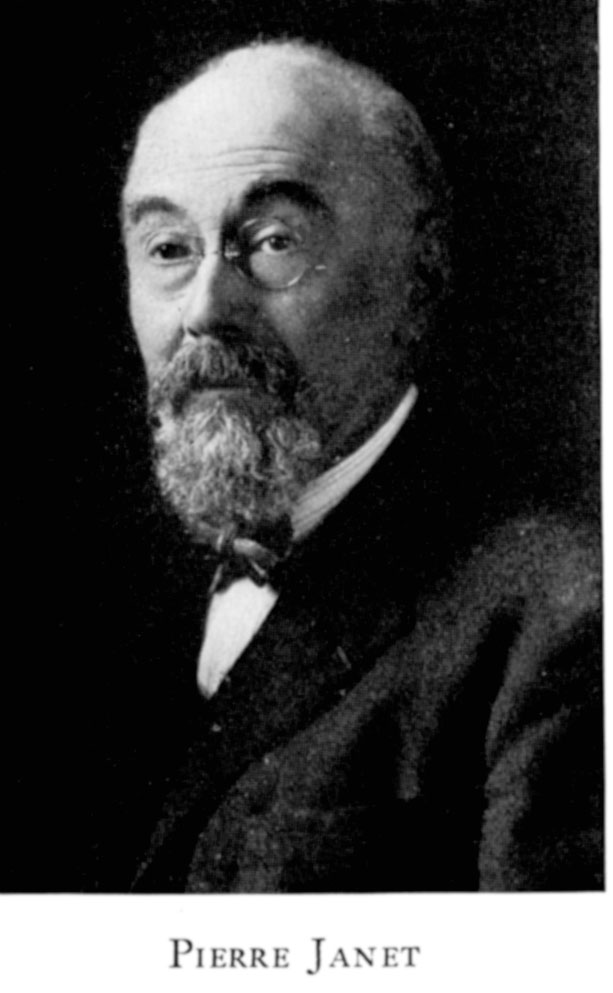
Pierre Janet
The essence of hypnosis is suggestion and Charcot did not understand suggestion. The rival hypnosis school led by Auguste Liebeault and Hippolyte Bernstein at Nancy to the East of Paris was aware of the effect of suggestion but not necessarily the nature of what it was. Actually suggestion is whatever enters the mind and is accepted. If one wakes to a beautiful sunny morning it is suggested to oneself that the day will be a good day. Acting on that suggestion, post-hypnotic one might say, one will try to make the day a great one to hang onto that feeling. The mind is naturally open to suggestion as it must be; in an active mind one can discriminate to some extent as to what suggestions will be accepted and which rejected. Under hypnosis in which the mind has been put into a passive state the ability to discriminate and reject has been greatly reduced so that a hypnotist can plant a suggestion that then becomes what Charcot’s associate, Pierre Janet, called an idee fixe, or in other words, a fixation that will remain in your mind until executed. This notion may be imparted by a human agent, books, movies, radio or any medium that is capable of influencing the mind. One must be aware of this. It isn’t necessary to have a hypnotist standing in front of you saying ‘look into my eyes.’
As I say, Charcot was convinced that hysteria was biological, that is to say caused by a lesion to the brain, so that while he hypnotized his female subjects at the Salpetriere he wasn’t aware of the nature of suggestion.

Marie Corelli
Now, the eighteen seventies and eighties were terrifically exciting at all levels. They did things differently then. As has been said: The past is another country; they do things differently there. The past is never to be judged by current standards although the latter are useful for comparison. Thus when Lister suggested that antiseptics ought to be used in the operating room his suggestion was stoutly resisted although true and nearly universally accepted today. On the other hand Evolution although true is more stoutly resisted today in a religious reaction than it was in the last quarter of the nineteenth century so don’t feel all that superior.
While Charcot was arguing with himself as to whether hysteria was biological or mental, in the mid-eighties two of his associates easily grasped that hysteria was a mental problem. These two were Sigmund Freud and Pierre Janet.
Freud at that time, 1886, was making the transition to psychology from medicine. He was an MD. Charcot was not alone in dealing with mental matters. The understanding of dreams for instance was developing rapidly. When Freud published his Interpretation Of Dreams in 1900 he cited dozens of competent researchers dating as far back as the 1860s. In 1886 alone two novels dealing with the subconscious and split personality were published, Robert Louis Stevenson’s Dr. Jekyll And Mr. Hyde and Marie Corelli’s Wormwood. Corelli cites Charcot as an influence so she very likely had attended his semi-public presentations of hysterics under hypnosis at his hospital.

Sigmund Freud
Going back further, Freud, a German Jew, was undoubtedly familiar with the psychological work of the German romantics. At any rate he spent about four months at the Salpetriere studying Charcot’s work and methods. It is likely that the foundation of his psychoanalysis was laid there. While Charcot was struggling to determine whether hysteria was biological or mental, Freud, himself a neurologist, was able to perceive that, as he later put it, hysterics were suffering from reminiscences. In other words they fixated on past experiences which dominated their minds and behavior.
Pierre Janet, Charcot’s student and associate, came to the same conclusion probably at the same time. He expressed the problem more accurately when he determined that hysterics suffered from one or more idee fixes, that is a fixed idea or, in other words, a fixation centered around a specific past event or events.
Indeed, all the women at the Salpetriere had been battered and brutalized by life with no means of self-assertion or resistance. Unable to express their own will they retreated into ineffective hysterics finally ending up as semi-insane in Charcot’s hospital.
Now, split or multiple personality. No one, especially these women, have the personality they are born with. Over the course of our lives circumstances require us to respond in different ways, sometimes a personality is overwhelmed with a consequent personality adaptation or change and in extreme cases, insanity.
All very well, but what happens to the original and/or various personalities that were submerged. It is impossible for them to vanish from the mind so they must live on submerged by a more powerful personality impulse. Depending on the individual then, everybody must have at least one alternate personality. Stevenson and Corelli were demonstrating this in their novels.
The good Dr. Jekyll had had a wild streak in his youth that he forcefully repressed to become the totally respectable man of medicine. But, he longed for his rough and rowdy days so in Stevenson’s story he invents a potion, I’m sure whisky would have been just as effective, that allows him to free his original personality. In the course of his experiment the earlier personality suppresses the later one assuming control of Jekyll’s mind. Much the same thing happens in Corelli’s novel. Thus we have personality accretion.
Charcot’s hysterics, because of the side show atmosphere the Good Doctor created, became world famous, a sort of show people. Charcot even took them on the road for demonstrations and, heaven forbid, loaned them to other doctors for experimentation.
It was during one such loan in 1888 that Jules Janet, Pierre’s brother, made a startling discovery. He was experimenting on Blanche Wittman, the Queen of Hysterics, when having hypnotized her into what Charcot called the first state, instead of progressing to the second state, he decided to put her into a deeper trance. At that point Blanche was able to dissociate her personality from her normal state to what I assume was her original personality. She turned into a happy effervescent bubbly girl. In other words she had stripped every accreted personality adjustment to return to the period before society violated her womanhood.
One might ask where this personality came from? It is not necessary to assume either the supernatural or the paranormal. The personality did not come from outside her but was merely an early personality that had been submerged and denied existence by repeated abuse. If Jules Janet had pressed on he might have found three, four or more variations of Blanche Wittman. Indeed, when Charcot died in 1893 Blanche ceased having hysterical attacks and became quite normal assuming yet another personality although it was not recognized as such. She then took responsible employment at the hospital until she died under tragic circumstances.
Thus during one’s life one assumes many variations as one’s personal circumstances dictate. And one expresses them in many different ways. As an example of personality accretion I am going to use the history of the American fantasy and science fiction writer, Edgar Rice Burroughs. He has especial value as his biography is well developed and he has talked voluminously about his mental states through his large body of fiction which is all autobiographical in nature.
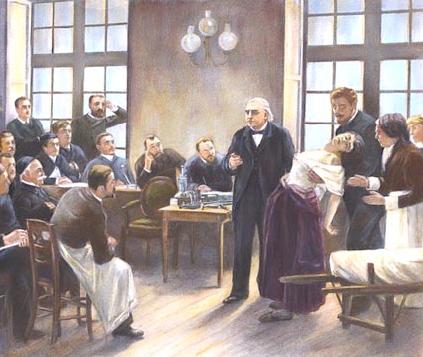
Dr. Jean Martin Charcot Demonstrating Hypnosis And Hysteria
Part II follows.
Pt. I: Edgar Rice Burroughs Rides The Rocket, A Short Life
January 3, 2012
Part I
Edgar Rice Burroughs Rides The Rocket
A Short Life
by
R.E. Prindle

ERB: What, Me Worry?
Eddie was a ramblin’ gambling’ man. He was born in a pair of ramblin’ shoes and he always took the most desperate chances. When he succeeded he was spectacular but when he failed…oh, well.
Perhaps the biggest gamble he ever took was being born but then, as Eddie always said: to me to conceive is to act. Things started out well as he began his life as a little prince but would soon turn sour when he was eight and lost a confrontation with a twelve year old bully on a street corner on the way to school. That was a life changer; he’d gone from prince to pauper and worse was yet to come. But, hey, it’s all education, isn’t it now?
The next year he began a foot race with the plague which he would ultimately lose. But as with being born he was initially successful. In an effort to escape the epidemic he was transferred to an all girls school. Apparently this was a polite plague selecting only boys. So like young Achilles Eddie took his place among the young ladies.
Still pursued, as one imagines, he was put for safety in a Latin School, one imagines as a place the fever would never look for him and if it found him would never enter the abode of such objectionable learning. Still, a young man of means he owned both a pony and a bicycle. The pony he rode back and forth to school leaving it tethered outside while he soaked up the classical knowledge. The bicycle he rode for fun but tipped over banging his head against a curb. This left him dizzy for days perhaps contributing to his later character which was formed by a similar incident.
While secure at the Harvard Latin School of Chicago for a couple years, the plague was not to be baffled forever. Eddie took to his heels running as fast as he could way out across the Western Plains to Idaho to become a Jr. cowboy. No box tops necessary.

If this picture is any indication he was quite a dude. Look at those chaps! The rowels of those spurs were so big they dragged on the ground announcing his approach from some distance. It was not all bravado however as he did have quite a way with the horses. Eddie was quite happy on the ranch and he might have become a Sr. cowboy but fate put some itchin’ powder in Eddie’s ramblin’ shoes and he resumed his ramblin’ ways. Doing an intellectual about face he and his guitar showed up at a Harvard prep school called the Phillips Academy. It was soon discovered that he didn’t know how to play guitar and hadn’t even learned any good cowboy songs such as The Streets Of Laredo, The Chisholm Trail and other titles of that ilk. Didn’t even know how to sing, either.
This disappointed the faculty, as well as his low grades, so that they couldn’t bear Eddie’s presence. Thus he was told to put his ramblin’ shoes back on and git along.
As you can tell, by this time Eddie was accumulating a fair amount of educational experience though not of the academic sort. Still of tender years and still outdistancing the plague Eddie had to find another educational emporium to fill out his youthful years. His father, actually the agent of all this agitation, for some reason thinking him a delinquent, did what all fathers of delinquent kids do, he enrolled the lad in a military academy. Supposed to make you learn to stand up straight or something like that. Yep. If the plague showed up there they’d most likely make him stand at attention until he got tired of it.
After all this ramblin’ Eddie was becoming quite a character. In addition to performing some typical goofy stunts Ed was a star rider on the Equestrian team as well captaining the football team as a quarterback. Just to put in some good words for Eddie here and raise him in your estimation, Ed led the Michigan Military Academy Tigers, or whatever they were called, to a draw against the mighty University Of Michigan Wolverines. Always an odd sobriquet I thought and in a competition between a tiger and wolverine which would you bet on.
Now, this nearly miraculous feat did not go unnoticed. He so impressed the Wolverine coach that Ed was offered a full football ride at Ann Arbor. Well, you might say, that was really wonderful. Yes, it could have been. But the imp of the perverse was down in those ramblin’ shoes as well as the itching powder as Eddie turned the coach down. If the offer had come from Yale that would have been different, but UM? Eddie had his heart set on Yale, which his brothers had attended, and it was Yale or nothing. Yale was uninterested.
That was a positive life changing experience that Eddie missed but fate was cramming the next few years with a bunch more, some of them very memorable. Plus the plague was waiting for him just around the corner. That was going to be a stunner.
First up was one of those glorious once in a lifetime experiences that only succeeds if you’re at the right age. Eddie was and he had one glorious summer in the year of ‘93. The Chicago Columbian Exposition. The promoters couldn’t get it together to open in ‘92 which would have been that actual 400th anniversary year of the intrepid navigator’s voyage but the promoters were ready in ‘93. Eddie was seventeen and spent the summer of his life at the Expo grounds.
I’m going to have to try to set the Expo up for you because in its own way it was the highpoint of Western Civilization before and since. Western confidence just began to sort of evaporate after the fair was over.
II.
Eddie In Wonderland

Built In A Matter Of Months
The nineteenth century was quite something. It was the century of magnificent discoveries and achievement. Society chooses to diminish those wonderful scientists by derogatorily calling them Dead White Men while sneeringly dismissing them. Pardon me, if I’m sentimental but those were the guys that made the present possible and I can’t admire them too much. They’ll always be my revered ancestors to me and not Dead White Men. Down with negativity.
Technology and Science just exploded as scientific research opened new and very broad vistas to human view that never would have been opened without them. The machinery was incredible. The accumulated wonders were first put on display at London’s Crystal Palace Exhibition of 1851. Six million people wandered through. It was breathtaking as the world of tomorrow went on display.

Water Gate From Lake Michigan
The Centennial Exposition of 1876 in Philadelphia followed as an international competition began to form. Next came the 1889 fair in Paris for which the Eiffel Tower was created to form the triumphal arch through people entered the fair. Boy, there was an eye opener. Over a thousand feet tall, 300 steps up to the first level and 300 more up to the second. Tough act to follow but out there on the very edge of civilization existed the city to do it. Chicago. Chicago itself was considered exhibition enough. The Iron Chancellor, Bismarck himself, said that his only regret was dying without ever having seen that Chicago.
By 1893 the conditions for a perfect fair had formed. Steam safely delivered hordes from across the seas and steam brought them to Chicago in long lines of Pullman cars pulled by a mighty eight wheeler. The conditions were perfect and Chicago had the men of vision to realize the perfect fair- and how! And there were men to commemorate it as it deserved. H.H. Bancroft published a large size five volume set displaying its wonders in detail

The setting on Lake Michigan was spectacular; a one of a kind creation, never since replicated or even close to it. The Century Of Progress of 1933 was but a pale imitation. If you’ve read The Devil In The White City you know a fuller description than I’m going to give here. The White City, as the fair grounds were called, was a fairy land, life as it could be. It contrasted with the Black City, life as it was, of everyday Chicago. Industrialism was a recent phenomenon in the nineteenth century so that in the giddiness of creation such things as environmental concerns and labor relations had been neglected or at least not seen in their true importance. Everyday Chicago was a grim place; Eddie often makes unflattering remarks about his home town throughout his novels. It was smelly, smoky and dirty with huge slums not to mention institutionalized crime. They’ve shut down the stockyards but the criminal mentality remains.
The White City in contrast was a city as it could be and should. L. Frank Baum would later use it as the model for his Emerald City. As there was great labor unrest in Chicago at the time the labor force was critical. Those who signed on were quarantined to the site while work was in progress so as not to be corrupted by the labor dissidents. They threw up some of the most massive buildings in existence, practically overnight. They created pleasure gardens and a whole pleasure island. They had the midway of midways, in fact the term Midway was originated at the Expo. In competition with Paris’s Eiffel Tower the worlds’ first monster Ferris Wheel was brought into existence. While in the US the Wheel was turned into a carnival ride now many European capitols display huge four hundred foot Ferris Wheels next to their Houses of Parliament. No US city does; even the original Ferris Wheel was dismantled and has disappeared into some junkyard, perhaps having been converted into the steel beams of a skyscraper.

Japanese Pavilion
The Expo not only featured the technological and scientific triumphs of that fabulous nineteenth century but all the intellectual advances; Francis Galton the English psychologist displayed his achievements; Frederick Jackson Turner announced his seminal work on the disappearance of the frontier; The Congress of World Religions set up its tent over in the Black City to discuss how religion was to meet the challenge of science.
One of the first of the body builders, The Great Sandow, performed his strength stunts and flexed his muscles giving Eddie the germ for his seminal literary creation a few years hence.
Imitation Zuni Cliff Dwellings were created, a whole Dahomian village was thrown up, staffed with real Dahomians brought over for the fair. Eddie was influenced by these but he really enjoyed the peep show- forty beautiful women, count ‘em, forty, on display for your delectation.
Dozens of huge buildings from nearly every State and country, art works created an instant museum to rival the great museums of the world. Just outside the gates, too late to be included within, the fabulous Buffalo Bill’s Wild West. History portrayed while it was still in making out on the Western Plains. As incredible as it may seem among the performers was no less than Sitting Bull himself, the engineer of Custer’s defeat at his Last Stand. Amazing. It’s all show biz, folks.
The White City shot up out of the beach sands and chiggers, existed for a few months and then it was gone, burned to the grounds by the labor malcontents of the Black City. Fire is the devil’s best friend. Before it was gone Eddie and his fellows from the Michigan Military Academy marched into that Sacred City like so many Greeks at Troy, in pomp and circumstance. The troops of the MMA strutted in while the band played on. It filled Eddie’s heart with pride. Five years later, slightly inebriated, he and a friend would hire a band parading along behind it through the street of downtown Denver. Let’s just say the fair entrance was one of those thrills.
The summer of ‘93 was one for Eddie to remember. In a few years automobiles would begin to fill the streets of the Black City. In the White City of ‘93 Eddie beat them to the punch driving fair patrons around in his dad’s electric Morrison. The Morrison wasn’t much in the way of self propelled vehicles, being little more than a buckboard with benches on it, but, there was no horse in front of it and Ed was behind the wheel.
There was so much at the fair that a casual weekend visit was merely the smallest of sips, a week was a swallow, two weeks perhaps a draught. Nobody could take it in, nobody, but Ed that is. He had the full three months of that glorious summer to walk the walks, cross the bridges, stroll the romantic Wooded Island to the fabulous Japanese pavilion, gape and take it all in. You’ve got to remember that in those days before movies, TV, videos and color photography bound in convenient volumes no one, or at least very few, had ever seen such things. The fair was the prototype for all the Disney Lands and Worlds now dotting the planet.
What Ed might have missed he may have spotted in a newspaper account, rushing back to the grounds to take it in. Not everyone would know how to use what he saw and experienced, Ed did. Even if it was impossible for him to understand what he saw at the time, Eddie tucked it into the back of his mind from which it emerged in dribbles into his fiction over the thirty years of his writing career.
How lucky he was to pass the Summer of ‘93 in this wonderland. Truly a life changing experience. Not the only one coming up, Eddie had a lot more awaiting him in what he described as a boring life.
III.
Life Begins To Get Serious
First up was graduation from the MMA and the year he spent as a Geology instructor there. Then at the end of the year a depression seized Ed, probably caused by his failure to get an appointment to West Point. He joined the Army anyway leaving the MMA in the lurch while asking for the worst post in the Army’s jurisdiction. He got it. He was very lucky the Army wasn’t the French Foreign Legion or they might have assigned him to a post that made hell look a luxury resort, with no way out. The Army was more considerate, they sent him to Fort Grant in Arizona which was a few degrees cooler than hell although the accommodations were not much better.
The bad news was that Ed was in the Army finding this particular life changing experience, decidedly unpleasant; the good news was that Eddie really liked the desert and the Apaches. Zane Grey beat him to the punch writing about it but Eddie read Zane’s books assiduously. Both Arizona and Southern Utah, the border was disputed at that time, formed an irresistible attraction to him and he and Emma in their later years of marriage returned to it often. Even as Eddie was sadly contemplating divorcing this woman who had stuck with him through thick and thin, he retreated to the White Mountains Apache Reservation to ponder his situation. A deep respect for the Apaches was another consequence of his abbreviated tour of duty. Abbreviated because Ed developed what the Old Timers called a ‘tobacco heart’ and Ed had his dad use his influence to get him out. When the going got tough Eddie always took off running. He remembered that street corner in Chicago.
Well there he was, nearly twenty-five years old with no directions home although he did find his way back to Chicago, a story in itself, which I’m not going to tell here, but fragments of it can be found in The Return Of The Mucker. Ed knew how to use every scrap of his experience to advantage. For a couple years Ed hopped back and forth between Chicago and Idaho where his brothers were still running the ranch where Eddie earned those gigantic spurs.
It was on one of these trips he and an old Army buddy, a member of the Might Have Seen Better Days Club of that brief Army period, hired the band in Denver. It was also in Denver that Ed showed his gambling proclivities losing the money to cover the stretch from Denver to Idaho. As the baby brother, Big Brother Harry covered his act but Ed had set a dangerous precedent.
Part of the reason for Ed’s motation at this particular stage of his life was the maturing of his relationship with future wife Emma. As girls often do, she matured faster than Eddie and hearing her biological clock ticking was ready for the altar. Time was no longer on her side. Whether she could have ever rustled Ed out of bachelorhood is a topic for some rumination if she wasn’t at the same time being courted also by a rich handsome young fellow by the name of Frank Martin. Irish; always a red flag for Eddie who had some Irish blood of his own but considered himself a full blooded English type.
Rich and Irish. Franks’ dad was a big railroad magnate. Had his own private car to hitch at the back of the train. Well, to make a long story short Frank correctly discerned Ed’s intentions of wanting to remain a bachelor yet keep Emma on his string. Ed would go away but he wouldn’t stay away. Frank sat down and thought for a while, perhaps between breakfast and lunch, and thought he had devised a way to keep Eddie away…permanently.
It was a good plan and should have worked but it didn’t. Frank had his dad hook up the private car to a New York City bound train and then invited Ed along for the ride. Our Blithe Spirit got on the train without a qualm. One should never trust the other guy in matters concerning love or money. There are some guys who take the old saying everything’s fair in love and war quite seriously. Ed was to be given the coup de grace in Toronto on the way back. The boys went to the Toronto equivalent of Chicago’s Levee for a night’s entertainment. A couple thugs approached Ed flashing a black jack of sufficient weight and criminal dexterity to kill him but the coup and the grace separated. Ed was down and bloody but he survived. He promptly went back to Chicago and married Emma to keep her out of Frank’s hands. Now it was Frankie’s turn to cry.
We know he was a sore loser and if he didn’t stalk Ed he didn’t let him out of his sight either. Thirty-four years later when Ed and Emma parted Frank’s man Patchin was sent to LA to gloat over the divorce. Even when Eddie died, Frank had preceded him, Patchin sent a mocking letter to Ed’s son.
What I’m leading up to here is not even conjecture but just a bit of imagination, but since I know more than I’m telling, a possibility. As I pointed out for the last twenty years Ed had been dodging the plague; in 1901 he turned a corner and there he was face to face Mr. Typhoid Fever. Fever shook his hand and that was it. Eddie was down and almost out. It was a terrible bout but Ed did survive or else I might be writing about Zane Grey, a decidedly stuffy creature in whom I have no interest.
It was only a little over a year since Frank had been aced out of Emma. Definitely not long enough to cool off his hot Irish temper. A man who will attempt murder once will hold a long grudge and we know that Martin never stopped thinking of Emma and Ed. It may sound far fetched and may be it is, but as Ed caught the Typhus a year or so after snagging Emma I wouldn’t be surprised to learn that Frank Martin passed a stolen bacillus on to Ed in some way. Certainly he couldn’t have him assaulted again, an accident might have been difficult, so perhaps he introduced the disease into Ed’s food in some way. Just a suspicion.
Eddie didn’t bounce back to his feet but while he convalescing a very important book to him was issued which he devoured as it appealed to his romantic soul. He would read Owen Wister’s Virginian six or seven times by 1920. If one looks at in this way Ed made several attempts to escape Chicago until he finally succeeded in 1919. If one looks at it like that, as I say, Ed fled with Emma in 1903, 1913, 1916 and 1919.
I always look for a chain of events, the reason why. Wister’s The Virginian has a terrific reputation although it is one of those classics that leaves me cold. Wister was one of Teddy Roosevelt’s buddies. The book he wrote smells like a Gent roughing it in the wilds. Perhaps the appeal to Ed. On the one hand the novel deals with the Johnson County Range War in Wyoming of which Eddie was peripherally associated when he was an Idaho cowboy in ‘91. Several of the rebels who had killed men fled Wyoming while one or two went into hiding in Idaho. Ed apparently knew one of these desperadoes so The Virginian would have had a personal interest for him.
The love story of the book concerns a rough hewn poorly educated cowboy and a school teacher much above him who he woos and wins. They then wed while for their cowboy honeymoon the hero takes his new wife out into the picturesque mountains of Wyoming.
IV.
Buttons And Bows.
A Western ranch is just a branch
Of Nowhere Junction to me.
Give me that city
Where the living’s pretty
And the girls wear finery.
Ray Evans, Buttons and Bows
From Paleface of 1948 starring Bob Hope.
I haven’t read a study on Ed that gave any attention to understanding Emma or her history and yet she was a key figure in his success while after Ed divorced her his production declined in both quantity and quality. It would seem then that whatever drove him as a writer was connected to Emma
There were striking differences between Ed and Emma. Whereas Ed was shifted not only from school to school but from Illinois to Idaho to Massachusetts and finally to Michigan, Emma continued on at Brown School to graduation giving her a much more stable outlook on life. After graduation she studied voice in Chicago becoming familiar with the higher culture while Ed was much more familiar with the lower reaches of culture. Emma would often chide Ed for his lack of culture as he preferred boxing to opera and in later life would become a devotee of professional wrestling with all its vulgar connotations.
The Hulberts, Emma’s family, considered themselves as high class people and, indeed they were. Thus when Frank Martin came calling Emma’s father, Alvin was overjoyed finding Frank a perfect match for his daughter. Alvin quite frankly despised Eddie considering him a ne’er do well and young failure. There was certainly enough evidence to support his point of view. Before the marriage, in order to encourage Frank’s attentions to his daughter, Ed was forbidden the house. And yet Emma had her heart set on Ed and would have him. Apparently her affection never wavered although her opinion of her husband varied. As it would turn out Alvin’s view of the marriage was much more correct than Emma’s. She should have listened to her papa.
As a young girl and woman the Hulberts treated Emma to the best of everything. While her heart was set on Ed, it is obvious that she dated during all those years when Ed was not in Chicago. It is important to remember that Ed was from Chicago but his youth was spent elsewhere so that he was only faintly culturally of Chicago.
Emma was a clotheshorse. As the pictures show she was used to finery. Those are not only a lot of clothes she’s wearing but fairly expensive clothes. Clothes that Ed definitely could not provide her during the first decade or so of their marriage. When he did come into his money it was his pride that Emma could buy any clothes she wanted and he was happy to have her do so.
So, Ed, his head spinning from the Toronto bashing, and woozy from his fever attack, never particularly stable anyway, conceived the notion of taking Emma to the foothills of Idaho to reenact Wister’s novel. In 1903 then, Ed packed Emma and all their belongings to catch a train to Idaho riding baggage with Emma and their dog.
We have no record as yet of what Emma may have thought of this or whether she protested vehemently being overruled by Ed’s unreasoning passion. Of course between bashing, fever and excruciating headaches anyone might be excused erratic but innocent behavior.
Emma Riding Baggage Dressed Chicago Style
Perhaps she objected using an analogous argument to Ray Evans’
My bones denounce the buckboard bounce
And the cactus hurts my toes
Let’s stay here where gals keep usin’
Those silks and satins and linen that shows
And I’m all yours in buttons and bows.
If she did use such an argument she was still in the baggage car with Ed and the dog.
I’m sure the trip was wildly romantic to Ed. His dad’s battery factory was on Madison, the hobo main stem so that I’m sure Ed had discussed the hobo life with them. His 1915 novel The Return Of The Mucker would celebrate the hobo life style as well as its successor The Oakdale Affair. So there they were, he, Emma and the dog in the baggage car like three hoboes.
Look at the picture of Emma in her finery standing in the boxcar. The look on her face echoes the lyric:
Don’t bury me in this prairie
Take me where the cement grows
Let’s go back to where I’ll keep on wearin’
Those frills and flowers and buttons and bows
Rings and things and buttons and bows.
I wonder if that was what was going through her mind.
Those long skirts didn’t work well out in the brambles, Emma didn’t have any other clothes, probably wouldn’t have worn pants if available, nor was Emma entranced with the one room balloon shack Ed threw up so their stay way out there was romantic to only one of them and of short duration.

Ed And Emma Dressed To Kill In The Wilds Of Idaho
Now comes an event painful to relate. Emma in her finery is way out there feeling miserable while Ed having removed wife and possessions to the romantic wilderness has only forty dollars in his pocket with no way to earn more. He was a rambler, he was a gambler.
Ed’s brother Harry was off in Parma so he and Emma went down to the station to catch a train to visit Harry. They had to put up for the night in what passed for a hotel room above the saloon. To this point in her life Emma had never even thought of roughing it and now she was learning all about it. To compound matters Eddie kissed her goodbye just like in Frankie and Johnny and went downstairs to find a poker game. His head must really have been hurting. They could have written the song Stagger Lee about him.
Well, he started with forty dollars thinking to inflate his stake to sixty or maybe eighty dollars but fate decreed that he come away with empty pockets. The possible reward wasn’t worth the risk. He had to have been playing with sharpies who took his cash and commiserated with his hard luck.
Let me illustrate how slick it can be. I was nineteen on the California Zephyr and two would be sharpers were trying entice me into a game of poker. They were really obvious and I wasn’t biting, I’d already dealt with sharpers aboard ship and come away cleaned. But, the railroad had an employee on board who must have been an amateur magician, he knew his cards. Dressed like a hick, walking and talking like one, he bustled up with his own deck of cards, invited me to stay, probably would have given me the best hands I’d ever seen because he meant me well, but I wasn’t really interested. Anyway he cleaned those two guys out in ten minutes and bustled off the way he came. They sat there stunned.
Now, I wasn’t present at the game Ed was in but I’d be totally amazed if those boys didn’t have a good laugh and dinner at Ed’s expense. Bad luck, good luck, Ed now stood at the bottom of the stairs swallowing hard, trying to figure out just how he was going to explain their dilemma to Emma. To be short about it, this was another one of those life changing experiences for Ed. No, sir, Ed didn’t have an explanation that Emma would accept. I mean, she could have married a millionaire and here she was in a wretched so-called hotel room a thousand miles from nowhere without a dime. Think about it. What was going through her mind?
Their relationship changed right there. It was a change that Ed would never be able to overcome; I’m sure it was the primary cause for the divorce thirty years later as Emma could never forget while Ed could never get over his shame. But, Ed hung in there for now. He recorded much of this period in his novel The Girl From Ferriss’s While a romanticized view of the years between 1900 and 1922 can be found in Marcia Of The Doorstep when Ed was again in hot water for overextending himself financially in LA.
I’m sure the railroads had a bitter taste for Ed after Frank Martin and Toronto. The memory of that private car shone in Ed’s mind like a diamond, but for now he took a job on the Oregon Shortline as a yard policeman in Salt Lake City. That is until Emma rebelled at taking in boarders ordering Ed to take her back to Chicago:
Let’s move back to that big town
Where they love a gal by the cut o’ her clothes
And I’ll stand out in buttons and bows.
Ed had a garage sale or whatever they called them back then actually selling Emma’s ornately carved marriage bed for a pittance. I’m sure that left a little scar too. Then, perhaps because Emma ragged him about riding baggage he bought a couple first class tickets back to the Black City which now appeared blacker than ever, I’m sure.
Ed was now a lost boy with responsibilities. The next seven years must have been a period of the blackest despair for him. He just couldn’t get his act together. He wandered from job to job. He landed a job at Sears, Roebuck that was a good job paying three thousand dollars a year. Not bad money in those days when unskilled labor worked six twelve hour days for from five hundred to seven-fifty a year. Ed’s prospects were good. He probably could have moved up into the five to ten thousand class in a few years. He showed up at his front door saying: Honey, I quit. Emma’s reaction wasn’t recorded but I’m sure it was voluble.
And then, of course, there were the pencil sharpeners. Ed never did sell one but he did sit down and write half of A Princess Of Mars. Who would have believed it? Munsey’s Magazine to who he had submitted it asked for the other half and gave him four hundred dollars to boot. Whether Ed and Emma sensed it or not they were on their way aboard the rocket, ready to ride.
We all hope for the success of our wildest dreams but few if any of us are prepared to manage the consequences of that success. It’s not as easy as it might seem. It’s sort of like the town bum spending a dollar for a lottery ticket and getting fifty million in return. If the bum thought he knew money before he is now introduced to the real thing.
For Ed who in his conception was born a prince, made a pauper, spending decades in disappointed expectations, now realized his destiny again. Upbraided by Emma for being a poor provider he was now in a position to provide her every desire, after taking care of his first, of course. The past weighed heavy on Eddie. The difficulties of his courtship and the shame of that gambling night in Idaho had to be rectified, reversed.
It couldn’t be, of course. One’s failures can only be recognized, accepted and lived with. But in a frenzy Ed thought that by repeating the private car incident and the disastrous trip to Idaho he could wash away the stains. Thus, having established a market for his goods, most especially with the creation of his ‘meal ticket’ Tarzan, Ed did an incredible thing. Remember he still had no money in the bank, betting entirely on the come.
As with Idaho he packed up all his goods including his useless second hand car, wife and by now three kids, bought five first class tickets to San Diego and made another attempt at fleeing Chicago. First class wasn’t the same as a private car but it was pretty close so Ed hopefully erased the shame of Frank Martin’s trip to New York City and back.
Once in San Diego, which stay lasted nine months, or long enough to be born again as the New Ed, he must have lived a princely existence going through most of the ten thousand he earned that year while returning to Chicago as broke as he had been when he and Emma boarded the train in Salt Lake City. So, he tried to eliminate his shame.
Once back in the Black City, having sold his production while in San Diego, he wrote some more, sold some more and made a seamless transition from the old Ed to the reincarnated Ed.
I would imagine that part of the plan was to get Tarzan published as a book and with that money establish himself as a man of means in his old home town. Move on up to the Gold Coast.
That would seem to be a very reasonable plan from our point of view but it was not that easy. Perhaps Tarzan, which is pure fantasy of the extravagant kind went well beyond publisher’ literary expectations. No one would touch it then, even though from our perspective the story was pure gold as, indeed, it turned out to be although not for Ed. Perhaps the novel appeared to the literary taste of Ed’s day as comic books did to literary lights in the forties and fifties of the last century, something to be burned and banned, hence Ed’s success was of the bastard sort.
He finally did get his novel published in book form in 1914 but he was stripped of most of the financial benefits as it went almost directly to reprint publishers; thus his royalties were more than halved and mere pittances of what they might have been. Still, by the time royalties began to come in Ed had created a backlog of Tarzan novels so that with current production one a year would be published for about ten years.
As the profit motive didn’t seem to be activating his publisher, the Chicago firm of McClurg’s, Ed was reduced to pleading with them to print at least twenty to thirty thousand copies before a novel was sent to the reprint house. It seems incomprehensible that McClurg’s wouldn’t do so on their own but they obstinately refused to make money for themselves and hence for Ed.
Well, the records, as I’ve been told, have been destroyed so what’s to be said. Once again I suspect outside interference. McClurg’s was an Irish house; Frank Martin was Irish. McClurg’s a was semi-public company open to investors one assumes; Frank Martin had money to invest. Until a better explanation is provided I have to believe something along those lines was happening.
But, if Eddie could have lived long enough the wonders he would have seen. At one hundred he would have been a very rich man. Those successful intellectual properties just keep gaining in value. Better than stamp collecting.
While Ed appears to have been stymied at the publishing end, that enterprise was old hat, the new wonder of the authorial imagination was movies. The Big Money, to quote John Dos Passos, Thus to some extent the movies made up for what Ed was being cheated out of in publishing. The first film production of Tarzan was the industries first million grosser. Thus when Ed successfully fled Chicago in 1919 his income was ten times what it had been in 1913. If his work was disparaged, as the say goes, he laughed all the way to the bank. Ed left Chicago with his pockets jingling.
Next: Part II: If Pigs Had Wings
Edgar Rice Burroughs Rides The Rocket: A Short Life
Eddie was a ramblin’ gambling’ man. He was born in a pair of ramblin’ shoes and he always took the most desperate chances. When he succeeded he was spectacular but when he failed…oh, well.
Perhaps the biggest gamble he ever took was being born but then, as Eddie always said: to me to conceive is to act. Things started out well as he began his life as a little prince but would soon turn sour when he was eight and lost a confrontation with a twelve year old bully on a street corner on the way to school. That was a life changer; he’d gone from prince to pauper and worse was yet to come. But, hey, it’s all education, isn’t it now?
The next year he began a foot race with the plague which he would ultimately lose. But as with being born he was initially successful. In an effort to escape the epidemic he was transferred to an all girls school. Apparently this was a polite plague selecting only boys. So like young Achilles Eddie took his place among the young ladies.
Still pursued, as one imagines, he was put for safety in a Latin School, one imagines as a place the fever would never look for him and if it found him would never enter the abode of such objectionable learning. Still, a young man of means he owned both a pony and a bicycle. The pony he rode back and forth to school leaving it tethered outside while he soaked up the classical knowledge. The bicycle he rode for fun but tipped over banging his head against a curb. This left him dizzy for days perhaps contributing to his later character which was formed by a similar incident.
While secure at the Harvard Latin School of Chicago for a couple years, the plague was not to be baffled forever. Eddie took to his heels running as fast as he could way out across the Western Plains to Idaho to become a Jr. cowboy. No box tops necessary.
If this picture is any indication he was quite a dude. Look at those chaps! The rowels of those spurs were so big they dragged on the ground announcing his approach from some distance. It was not all bravado however as he did have quite a way with the horses. Eddie was quite happy on the ranch and he might have become a Sr. cowboy but fate put some itchin’ powder in Eddie’s ramblin’ shoes and he resumed his ramblin’ ways. Doing an intellectual about face he and his guitar showed up at a Harvard prep school called the Phillips Academy. It was soon discovered that he didn’t know how to play guitar and hadn’t even learned any good cowboy songs such as The Streets Of Laredo, The Chisholm Trail and other titles of that ilk. Didn’t even know how to sing, either.
This disappointed the faculty, as well as his low grades, so that they couldn’t bear Eddie’s presence. Thus he was told to put his ramblin’ shoes back on and git along.
As you can tell, by this time Eddie was accumulating a fair amount of educational experience though not of the academic sort. Still of tender years and still outdistancing the plague Eddie had to find another educational emporium to fill out his youthful years. His father, actually the agent of all this agitation, for some reason thinking him a delinquent, did what all fathers of delinquent kids do, he enrolled the lad in a military academy. Supposed to make you learn to stand up straight or something like that. Yep. If the plague showed up there they’d most likely make him stand at attention until he got tired of it.
After all this ramblin’ Eddie was becoming quite a character. In addition to performing some typical goofy stunts Ed was a star rider on the Equestrian team as well captaining the football team as a quarterback. Just to put in some good words for Eddie here and raise him in your estimation, Ed led the Michigan Military Academy Tigers, or whatever they were called, to a draw against the mighty University Of Michigan Wolverines. Always an odd sobriquet I thought and in a competition between a tiger and wolverine which would you bet on.
Now, this nearly miraculous feat did not go unnoticed. He so impressed the Wolverine coach that Ed was offered a full football ride at Ann Arbor. Well, you might say, that was really wonderful. Yes, it could have been. But the imp of the perverse was down in those ramblin’ shoes as well as the itching powder as Eddie turned the coach down. If the offer had come from Yale that would have been different, but UM? Eddie had his heart set on Yale, which his brothers had attended, and it was Yale or nothing. Yale was uninterested.
That was a positive life changing experience that Eddie missed but fate was cramming the next few years with a bunch more, some of them very memorable. Plus the plague was waiting for him just around the corner. That was going to be a stunner.
First up was one of those glorious once in a lifetime experiences that only succeeds if you’re at the right age. Eddie was and he had one glorious summer in the year of ‘93. The Chicago Columbian Exposition. The promoters couldn’t get it together to open in ‘92 which would have been that actual 400th anniversary year of the intrepid navigator’s voyage but the promoters were ready in ‘93. Eddie was seventeen and spent the summer of his life at the Expo grounds.
I’m going to have to try to set the Expo up for you because in its own way it was the highpoint of Western Civilization before and since. Western confidence just began to sort of evaporate after the fair was over.
II.
Eddie In Wonderland
The nineteenth century was quite something. It was the century of magnificent discoveries and achievement. Society chooses to diminish those wonderful scientists by derogatorily calling them Dead White Men while sneeringly dismissing them. Pardon me, if I’m sentimental but those were the guys that made the present possible and I can’t admire them too much. They’ll always be my revered ancestors to me and not Dead White Men. Down with negativity.
Technology and Science just exploded as scientific research opened new and very broad vistas to human view that never would have been opened without them. The machinery was incredible. The accumulated wonders were first put on display at London’s Crystal Palace Exhibition of 1851. Six million people wandered through. It was breathtaking as the world of tomorrow went on display.
The Centennial Exposition of 1876 in Philadelphia followed as an international competition began to form. Next came the 1889 fair in Paris for which the Eiffel Tower was created to form the triumphal arch through people entered the fair. Boy, there was an eye opener. Over a thousand feet tall, 300 steps up to the first level and 300 more up to the second. Tough act to follow but out there on the very edge of civilization existed the city to do it. Chicago. Chicago itself was considered exhibition enough. The Iron Chancellor, Bismarck himself, said that his only regret was dying without ever having seen that Chicago.
By 1893 the conditions for a perfect fair had formed. Steam safely delivered hordes from across the seas and steam brought them to Chicago in long lines of Pullman cars pulled by a mighty eight wheeler. The conditions were perfect and Chicago had the men of vision to realize the perfect fair- and how! And there were men to commemorate it as it deserved. H.H. Bancroft published a large size five volume set displaying its wonders in detail
The setting on Lake Michigan was spectacular; a one of a kind creation, never since replicated or even close to it. The Century Of Progress of 1933 was but a pale imitation. If you’ve read The Devil In The White City you know a fuller description than I’m going to give here. The White City, as the fair grounds were called, was a fairy land, life as it could be. It contrasted with the Black City, life as it was, of everyday Chicago. Industrialism was a recent phenomenon in the nineteenth century so that in the giddiness of creation such things as environmental concerns and labor relations had been neglected or at least not seen in their true importance. Everyday Chicago was a grim place; Eddie often makes unflattering remarks about his home town throughout his novels. It was smelly, smoky and dirty with huge slums not to mention institutionalized crime. They’ve shut down the stockyards but the criminal mentality remains.
The White City in contrast was a city as it could be and should. L. Frank Baum would later use it as the model for his Emerald City. As there was great labor unrest in Chicago at the time the labor force was critical. Those who signed on were quarantined to the site while work was in progress so as not to be corrupted by the labor dissidents. They threw up some of the most massive buildings in existence, practically overnight. They created pleasure gardens and a whole pleasure island. They had the midway of midways, in fact the term Midway was originated at the Expo. In competition with Paris’s Eiffel Tower the worlds’ first monster Ferris Wheel was brought into existence. While in the US the Wheel was turned into a carnival ride now many European capitols display huge four hundred foot Ferris Wheels next to their Houses of Parliament. No US city does; even the original Ferris Wheel was dismantled and has disappeared into some junkyard, perhaps having been converted into the steel beams of a skyscraper.
The Expo not only featured the technological and scientific triumphs of that fabulous nineteenth century but all the intellectual advances; Francis Galton the English psychologist displayed his achievements; Frederick Jackson Turner announced his seminal work on the disappearance of the frontier; The Congress of World Religions set up its tent over in the Black City to discuss how religion was to meet the challenge of science.
One of the first of the body builders, The Great Sandow, performed his strength stunts and flexed his muscles giving Eddie the germ for his seminal literary creation a few years hence.
Imitation Zuni Cliff Dwellings were created, a whole Dahomian village was thrown up, staffed with real Dahomians brought over for the fair. Eddie was influenced by these but he really enjoyed the peep show- forty beautiful women, count ‘em, forty, on display for your delectation.
Dozens of huge buildings from nearly every State and country, art works created an instant museum to rival the great museums of the world. Just outside the gates, too late to be included within, the fabulous Buffalo Bill’s Wild West. History portrayed while it was still in making out on the Western Plains. As incredible as it may seem among the performers was no less than Sitting Bull himself, the engineer of Custer’s defeat at his Last Stand. Amazing. It’s all show biz, folks.
The White City shot up out of the beach sands and chiggers, existed for a few months and then it was gone, burned to the grounds by the labor malcontents of the Black City. Fire is the devil’s best friend. Before it was gone Eddie and his fellows from the Michigan Military Academy marched into that Sacred City like so many Greeks at Troy, in pomp and circumstance. The troops of the MMA strutted in while the band played on. It filled Eddie’s heart with pride. Five years later, slightly inebriated, he and a friend would hire a band parading along behind it through the street of downtown Denver. Let’s just say the fair entrance was one of those thrills.
The summer of ‘93 was one for Eddie to remember. In a few years automobiles would begin to fill the streets of the Black City. In the White City of ‘93 Eddie beat them to the punch driving fair patrons around in his dad’s electric Morrison. The Morrison wasn’t much in the way of self propelled vehicles, being little more than a buckboard with benches on it, but, there was no horse in front of it and Ed was behind the wheel.
There was so much at the fair that a casual weekend visit was merely the smallest of sips, a week was a swallow, two weeks perhaps a draught. Nobody could take it in, nobody, but Ed that is. He had the full three months of that glorious summer to walk the walks, cross the bridges, stroll the romantic Wooded Island to the fabulous Japanese pavilion, gape and take it all in. You’ve got to remember that in those days before movies, TV, videos and color photography bound in convenient volumes no one, or at least very few, had ever seen such things. The fair was the prototype for all the Disney Lands and Worlds now dotting the planet.
What Ed might have missed he may have spotted in a newspaper account, rushing back to the grounds to take it in. Not everyone would know how to use what he saw and experienced, Ed did. Even if it was impossible for him to understand what he saw at the time, Eddie tucked it into the back of his mind from which it emerged in dribbles into his fiction over the thirty years of his writing career.
How lucky he was to pass the Summer of ‘93 in this wonderland. Truly a life changing experience. Not the only one coming up, Eddie had a lot more awaiting him in what he described as a boring life.
3.
Life Begins To Get Serious
First up was graduation from the MMA and the year he spent as a Geology instructor there. Then at the end of the year a depression seized Ed, probably caused by his failure to get an appointment to West Point. He joined the Army anyway leaving the MMA in the lurch while asking for the worst post in the Army’s jurisdiction. He got it. He was very lucky the Army wasn’t the French Foreign Legion or they might have assigned him to a post that made hell look a luxury resort, with no way out. The Army was more considerate, they sent him to Fort Grant in Arizona which was a few degrees cooler than hell although the accommodations were not much better.
The bad news was that Ed was in the Army finding this particular life changing experience, decidedly unpleasant; the good news was that Eddie really liked the desert and the Apaches. Zane Grey beat him to the punch writing about it but Eddie read Zane’s books assiduously. Both Arizona and Southern Utah, the border was disputed at that time, formed an irresistible attraction to him and he and Emma in their later years of marriage returned to it often. Even as Eddie was sadly contemplating divorcing this woman who had stuck with him through thick and thin, he retreated to the White Mountains Apache Reservation to ponder his situation. A deep respect for the Apaches was another consequence of his abbreviated tour of duty. Abbreviated because Ed developed what the Old Timers called a ‘tobacco heart’ and Ed had his dad use his influence to get him out. When the going got tough Eddie always took off running. He remembered that street corner in Chicago.
Well there he was, nearly twenty-five years old with no directions home although he did find his way back to Chicago, a story in itself, which I’m not going to tell here, but fragments of it can be found in The Return Of The Mucker. Ed knew how to use every scrap of his experience to advantage. For a couple years Ed hopped back and forth between Chicago and Idaho where his brothers were still running the ranch where Eddie earned those gigantic spurs.
It was on one of these trips he and an old Army buddy, a member of the Might Have Seen Better Days Club of that brief Army period, hired the band in Denver. It was also in Denver that Ed showed his gambling proclivities losing the money to cover the stretch from Denver to Idaho. As the baby brother, Big Brother Harry covered his act but Ed had set a dangerous precedent.
Part of the reason for Ed’s motation at this particular stage of his life was the maturing of his relationship with future wife Emma. As girls often do, she matured faster than Eddie and hearing her biological clock ticking was ready for the altar. Time was no longer on her side. Whether she could have ever rustled Ed out of bachelorhood is a topic for some rumination if she wasn’t at the same time being courted also by a rich handsome young fellow by the name of Frank Martin. Irish; always a red flag for Eddie who had some Irish blood of his own but considered himself a full blooded English type.
Rich and Irish. Franks’ dad was a big railroad magnate. Had his own private car to hitch at the back of the train. Well, to make a long story short Frank correctly discerned Ed’s intentions of wanting to remain a bachelor yet keep Emma on his string. Ed would go away but he wouldn’t stay away. Frank sat down and thought for a while, perhaps between breakfast and lunch, and thought he had devised a way to keep Eddie away…permanently.
It was a good plan and should have worked but it didn’t. Frank had his dad hook up the private car to a New York City bound train and then invited Ed along for the ride. Our Blithe Spirit got on the train without a qualm. One should never trust the other guy in matters concerning love or money. There are some guys who take the old saying everything’s fair in love and war quite seriously. Ed was to be given the coup de grace in Toronto on the way back. The boys went to the Toronto equivalent of Chicago’s Levee for a night’s entertainment. A couple thugs approached Ed flashing a black jack of sufficient weight and criminal dexterity to kill him but the coup and the grace separated. Ed was down and bloody but he survived. He promptly went back to Chicago and married Emma to keep her out of Frank’s hands. Now it was Frankie’s turn to cry.
We know he was a sore loser and if he didn’t stalk Ed he didn’t let him out of his sight either. Thirty-four years later when Ed and Emma parted Frank’s man Patchin was sent to LA to gloat over the divorce. Even when Eddie died, Frank had preceded him, Patchin sent a mocking letter to Ed’s son.
What I’m leading up to here is not even conjecture but just a bit of imagination, but since I know more than I’m telling, a possibility. As I pointed out for the last twenty years Ed had been dodging the plague; in 1901 he turned a corner and there he was face to face Mr. Typhoid Fever. Fever shook his hand and that was it. Eddie was down and almost out. It was a terrible bout but Ed did survive or else I might be writing about Zane Grey, a decidedly stuffy creature in whom I have no interest.
It was only a little over a year since Frank had been aced out of Emma. Definitely not long enough to cool off his hot Irish temper. A man who will attempt murder once will hold a long grudge and we know that Martin never stopped thinking of Emma and Ed. It may sound far fetched and may be it is, but as Ed caught the Typhus a year or so after snagging Emma I wouldn’t be surprised to learn that Frank Martin passed a stolen bacillus on to Ed in some way. Certainly he couldn’t have him assaulted again, an accident might have been difficult, so perhaps he introduced the disease into Ed’s food in some way. Just a suspicion.
Eddie didn’t bounce back to his feet but while he convalescing a very important book to him was issued which he devoured as it appealed to his romantic soul. He would read Owen Wister’s Virginian six or seven times by 1920. If one looks at in this way Ed made several attempts to escape Chicago until he finally succeeded in 1919. If one looks at it like that, as I say, Ed fled with Emma in 1903, 1913, 1916 and 1919.
I always look for a chain of events, the reason why. Wister’s The Virginian has a terrific reputation although it is one of those classics that leaves me cold. Wister was one of Teddy Roosevelt’s buddies. The book he wrote smells like a Gent roughing it in the wilds. Perhaps the appeal to Ed. On the one hand the novel deals with the Johnson County Range War in Wyoming of which Eddie was peripherally associated when he was an Idaho cowboy in ‘91. Several of the rebels who had killed men fled Wyoming while one or two went into hiding in Idaho. Ed apparently knew one of these desperadoes so The Virginian would have had a personal interest for him.
The love story of the book concerns a rough hewn poorly educated cowboy and a school teacher much above him who he woos and wins. They then wed while for their cowboy honeymoon the hero takes his new wife out into the picturesque mountains of Wyoming.
IV.
Buttons And Bows.
A Western ranch is just a branch
Of Nowhere Junction to me.
Give me that city
Where the living’s pretty
And the girls wear finery.
Ray Evans, Buttons and Bows
From Paleface of 1948 starring Bob Hope.
I haven’t read a study on Ed that gave any attention to understanding Emma or her history and yet she was a key figure in his success while after Ed divorced her his production declined in both quantity and quality. It would seem then that whatever drove him as a writer was connected to Emma
There were striking differences between Ed and Emma. Whereas Ed was shifted not only from school to school but from Illinois to Idaho to Massachusetts and finally to Michigan, Emma continued on at Brown School to graduation giving her a much more stable outlook on life. After graduation she studied voice in Chicago becoming familiar with the higher culture while Ed was much more familiar with the lower reaches of culture. Emma would often chide Ed for his lack of culture as he preferred boxing to opera and in later life would become a devotee of professional wrestling with all its vulgar connotations.
The Hulberts, Emma’s family, considered themselves as high class people and, indeed they were. Thus when Frank Martin came calling Emma’s father, Alvin was overjoyed finding Frank a perfect match for his daughter. Alvin quite frankly despised Eddie considering him a ne’er do well and young failure. There was certainly enough evidence to support his point of view. Before the marriage, in order to encourage Frank’s attentions to his daughter, Ed was forbidden the house. And yet Emma had her heart set on Ed and would have him. Apparently her affection never wavered although her opinion of her husband varied. As it would turn out Alvin’s view of the marriage was much more correct than Emma’s. She should have listened to her papa.
As a young girl and woman the Hulberts treated Emma to the best of everything. While her heart was set on Ed, it is obvious that she dated during all those years when Ed was not in Chicago. It is important to remember that Ed was from Chicago but his youth was spent elsewhere so that he was only faintly culturally of Chicago.
Emma was a clotheshorse. As the pictures show she was used to finery. Those are not only a lot of clothes she’s wearing but fairly expensive clothes. Clothes that Ed definitely could not provide her during the first decade or so of their marriage. When he did come into his money it was his pride that Emma could buy any clothes she wanted and he was happy to have her do so.
So, Ed, his head spinning from the Toronto bashing, and woozy from his fever attack, never particularly stable anyway, conceived the notion of taking Emma to the foothills of Idaho to reenact Wister’s novel. In 1903 then, Ed packed Emma and all their belongings to catch a train to Idaho riding baggage with Emma and their dog.
We have no record as yet of what Emma may have thought of this or whether she protested vehemently being overruled by Ed’s unreasoning passion. Of course between bashing, fever and excruciating headaches anyone might be excused erratic but innocent behavior.
Perhaps she objected using an analogous argument to Ray Evans’
My bones denounce the buckboard bounce
And the cactus hurts my toes
Let’s stay here where gals keep usin’
Those silks and satins and linen that shows
And I’m all yours in buttons and bows.
If she did use such an argument she was still in the baggage car with Ed and the dog.
I’m sure the trip was wildly romantic to Ed. His dad’s battery factory was on Madison, the hobo main stem so that I’m sure Ed had discussed the hobo life with them. His 1915 novel The Return Of The Mucker would celebrate the hobo life style as well as its successor The Oakdale Affair. So there they were, he, Emma and the dog in the baggage car like three hoboes.
Look at the picture of Emma in her finery standing in the boxcar. The look on her face echoes the lyric:
Don’t bury me in this prairie
Take me where the cement grows
Let’s go back to where I’ll keep on wearin’
Those frills and flowers and buttons and bows
Rings and things and buttons and bows.
I wonder if that was what was going through her mind.
Those long skirts didn’t work well out in the brambles, Emma didn’t have any other clothes, probably wouldn’t have worn pants if available, nor was Emma entranced with the one room balloon shack Ed threw up so their stay way out there was romantic to only one of them and of short duration.
Now comes an event painful to relate. Emma in her finery is way out there feeling miserable while Ed having removed wife and possessions to the romantic wilderness has only forty dollars in his pocket with no way to earn more. He was a rambler, he was a gambler.
Ed’s brother Harry was off in Parma so he and Emma went down to the station to catch a train to visit Harry. They had to put up for the night in what passed for a hotel room above the saloon. To this point in her life Emma had never even thought of roughing it and now she was learning all about it. To compound matters Eddie kissed her goodbye just like in Frankie and Johnny and went downstairs to find a poker game. His head must really have been hurting. They could have written the song Stagger Lee about him.
Well, he started with forty dollars thinking to inflate his stake to sixty or maybe eighty dollars but fate decreed that he come away with empty pockets. The possible reward wasn’t worth the risk. He had to have been playing with sharpies who took his cash and commiserated with his hard luck.
Let me illustrate how slick it can be. I was nineteen on the California Zephyr and two would be sharpers were trying entice me into a game of poker. They were really obvious and I wasn’t biting, I’d already dealt with sharpers aboard ship and come away cleaned. But, the railroad had an employee on board who must have been an amateur magician, he knew his cards. Dressed like a hick, walking and talking like one, he bustled up with his own deck of cards, invited me to stay, probably would have given me the best hands I’d ever seen because he meant me well, but I wasn’t really interested. Anyway he cleaned those two guys out in ten minutes and bustled off the way he came. They sat there stunned.
Now, I wasn’t present at the game Ed was in but I’d be totally amazed if those boys didn’t have a good laugh and dinner at Ed’s expense. Bad luck, good luck, Ed now stood at the bottom of the stairs swallowing hard, trying to figure out just how he was going to explain their dilemma to Emma. To be short about it, this was another one of those life changing experiences for Ed. No, sir, Ed didn’t have an explanation that Emma would accept. I mean, she could have married a millionaire and here she was in a wretched so-called hotel room a thousand miles from nowhere without a dime. Think about it. What was going through her mind?
Their relationship changed right there. It was a change that Ed would never be able to overcome; I’m sure it was the primary cause for the divorce thirty years later as Emma could never forget while Ed could never get over his shame. But, Ed hung in there for now. He recorded much of this period in his novel The Girl From Ferriss’s While a romanticized view of the years between 1900 and 1922 can be found in Marcia Of The Doorstep when Ed was again in hot water for overextending himself financially in LA.
I’m sure the railroads had a bitter taste for Ed after Frank Martin and Toronto. The memory of that private car shone in Ed’s mind like a diamond, but for now he took a job on the Oregon Shortline as a yard policeman in Salt Lake City. That is until Emma rebelled at taking in boarders ordering Ed to take her back to Chicago:
Let’s move back to that big town
Where they love a gal by the cut o’ her clothes
And I’ll stand out in buttons and bows.
Ed had a garage sale or whatever they called them back then actually selling Emma’s ornately carved marriage bed for a pittance. I’m sure that left a little scar too. Then, perhaps because Emma ragged him about riding baggage he bought a couple first class tickets back to the Black City which now appeared blacker than ever, I’m sure.
Ed was now a lost boy with responsibilities. The next seven years must have been a period of the blackest despair for him. He just couldn’t get his act together. He wandered from job to job. He landed a job at Sears, Roebuck that was a good job paying three thousand dollars a year. Not bad money in those days when unskilled labor worked six twelve hour days for from five hundred to seven-fifty a year. Ed’s prospects were good. He probably could have moved up into the five to ten thousand class in a few years. He showed up at his front door saying: Honey, I quit. Emma’s reaction wasn’t recorded but I’m sure it was voluble.
And then, of course, there were the pencil sharpeners. Ed never did sell one but he did sit down and write half of A Princess Of Mars. Who would have believed it? Munsey’s Magazine to who he had submitted it asked for the other half and gave him four hundred dollars to boot. Whether Ed and Emma sensed it or not they were on their way aboard the rocket, ready to ride.
We all hope for the success of our wildest dreams but few if any of us are prepared to manage the consequences of that success. It’s not as easy as it might seem. It’s sort of like the town bum spending a dollar for a lottery ticket and getting fifty million in return. If the bum thought he knew money before he is now introduced to the real thing.
For Ed who in his conception was born a prince, made a pauper, spending decades in disappointed expectations, now realized his destiny again. Upbraided by Emma for being a poor provider he was now in a position to provide her every desire, after taking care of his first, of course. The past weighed heavy on Eddie. The difficulties of his courtship and the shame of that gambling night in Idaho had to be rectified, reversed.
It couldn’t be, of course. One’s failures can only be recognized, accepted and lived with. But in a frenzy Ed thought that by repeating the private car incident and the disastrous trip to Idaho he could wash away the stains. Thus, having established a market for his goods, most especially with the creation of his ‘meal ticket’ Tarzan, Ed did an incredible thing. Remember he still had no money in the bank, betting entirely on the come.
As with Idaho he packed up all his goods including his useless second hand car, wife and by now three kids, bought five first class tickets to San Diego and made another attempt at fleeing Chicago. First class wasn’t the same as a private car but it was pretty close so Ed hopefully erased the shame of Frank Martin’s trip to New York City and back.
Once in San Diego, which stay lasted nine months, or long enough to be born again as the New Ed, he must have lived a princely existence going through most of the ten thousand he earned that year while returning to Chicago as broke as he had been when he and Emma boarded the train in Salt Lake City. So, he tried to eliminate his shame.
Once back in the Black City, having sold his production while in San Diego, he wrote some more, sold some more and made a seamless transition from the old Ed to the reincarnated Ed.
I would imagine that part of the plan was to get Tarzan published as a book and with that money establish himself as a man of means in his old home town. Move on up to the Gold Coast.
That would seem to be a very reasonable plan from our point of view but it was not that easy. Perhaps Tarzan, which is pure fantasy of the extravagant kind went well beyond publisher’ literary expectations. No one would touch it then, even though from our perspective the story was pure gold as, indeed, it turned out to be although not for Ed. Perhaps the novel appeared to the literary taste of Ed’s day as comic books did to literary lights in the forties and fifties of the last century, something to be burned and banned, hence Ed’s success was of the bastard sort.
He finally did get his novel published in book form in 1914 but he was stripped of most of the financial benefits as it went almost directly to reprint publishers; thus his royalties were more than halved and mere pittances of what they might have been. Still, by the time royalties began to come in Ed had created a backlog of Tarzan novels so that with current production one a year would be published for about ten years.
As the profit motive didn’t seem to be activating his publisher, the Chicago firm of McClurg’s, Ed was reduced to pleading with them to print at least twenty to thirty thousand copies before a novel was sent to the reprint house. It seems incomprehensible that McClurg’s wouldn’t do so on their own but they obstinately refused to make money for themselves and hence for Ed.
Well, the records, as I’ve been told, have been destroyed so what’s to be said. Once again I suspect outside interference. McClurg’s was an Irish house; Frank Martin was Irish. McClurg’s a was semi-public company open to investors one assumes; Frank Martin had money to invest. Until a better explanation is provided I have to believe something along those lines was happening.
But, if Eddie could have lived long enough the wonders he would have seen. At one hundred he would have been a very rich man. Those successful intellectual properties just keep gaining in value. Better than stamp collecting.
While Ed appears to have been stymied at the publishing end, that enterprise was old hat, the new wonder of the authorial imagination was movies. The Big Money, to quote John Dos Passos, Thus to some extent the movies made up for what Ed was being cheated out of in publishing. The first film production of Tarzan was the industries first million grosser. Thus when Ed successfully fled Chicago in 1919 his income was ten times what it had been in 1913. If his work was disparaged, as the say goes, he laughed all the way to the bank. Ed left Chicago with his pockets jingling.
Next: Part II: If Pigs Had Wings
A Review: Isidor Sadger Recollects Freud: Emasculating Freudian Theory
December 16, 2011
A Review
ISIDOR SADGER RECOLLECTS FREUD
Emasculating Freudian Theory
By
R.E. Prindle
…Jung had been infected with Aryan blood from his family.
Deep in his heart,
he was anything from a philosemite.
Now, however, he encountered Judaism
in its most highly gifted embodiment
Of Jewish knowledge shining in front of him.
Was it any wonder that he began by being blinded
With the feeling that never before had he stood before
The countenance of a greater genius?
But his lineage was not to be denied.
One day he sat down and carried out scholarly studies for months
Which resulted in his finding his way back
Through the Mithraic cult to primitive Christianity.
In practical terms
This may be seen that as a Christian prophet,
He fully stripped the libido of its sexual character
And reduced it to merely spiritual energy.
This was, so to speak, the decontamination
Of the poisonous Freudian teachings
Through Christianization and total cleansing.
But since the master could not easily go along
With the desexualization of his teaching,
Which went to the foundation of his theories,
He saw with a heavy heart
That he needed to cut the cord between him and the clinic. (Bergholzi)
Isidor Sadger, Recollecting Freud pp. 71-72

Sigmund Freud: Smoke Rings
Sadger, Isidor: Recollecting Freud, 1930, first published 2005, UWisconsin
It is very difficult to know where to start in analyzing the above quote from Isidor Sadger. First it might be pertinent to identify Isidor Sadger. He had a history with Freud from 1895 into the 1930s. He attended with two others Freud’s first psychoanalytic lecture. He was a founding member of Freud’s Vienna Psychoanalytic Society. In 1930 he published this little volume of biographical notes on his relationship with Freud.
Freud’s circle did not take kindly to the publication of these memoirs doing everything they could to suppress them. In this they were successful. The book was never distributed and only rumored to be in print until this publication in 2005 by Alan Dundes and UWisconsin. Even acquiring a copy of the book by Dundes was nearly impossible. He relates pp. xlii-xliii:
Recollecting Freud
When I looked up Sadger on my computer data base, I found not only the article (Sadger had written) in question but the title of a book: Sigmund Freud: Personliche Erwinnerunger. As I was not familiar with that work, I decided to send for it via interlibrary loan….In due course, the latter arrived but the effort to procure a copy of the former proved unsuccessful. I was informed that there was no known copy in the United States available for borrowing. Since I knew the book had been published in Vienna, I asked if we could try to locate a copy in Europe and the obliging staff in interlibrary loan agreed to do so. A few weeks later, I learned that there was no known copy in any European library available for borrowing.
I was told, however, that there was one, just one, copy listed that might be utilized and that copy was located in the library of Keio University in Japan. Again, inter library loan made a request on my behalf and this time with some partial success….I next asked interlibrary loan to request a photocopy of the entire book…The Keio University Mata Media Center informed (me) that it was unable to comply with my request….
…One of my anthropology doctoral students…was returning to Japan. I asked him to do me a favor and get me a photocopy…
Which he did and almost by a miracle the text was recovered to be published for human consumption some seventy-five years on. As Freud claimed to be a scientist one is amazed that supposed scientists would go so far as to deny publication of Sadger’s memoirs. But, so it was.
In tackling the quote from Sadger let me approach it from the point of view of ‘Jewish knowledge shining in front of him.’
One must ask the question of what is Jewish knowledge and how is it special to their culture? This is important not only from past implications but also in light of today’s Barbara Spectre and her Paideia organization whose intent is to place ‘Jewish knowledge’ on a par with Aryan knowledge or what Sadger calls Christian knowledge.
While Freud may have been a Jew working in the scientific field of psychology and psychiatry and while he may have made some important discoveries in the field that had been developed by Aryans his own contributions arose from that body of accumulated Aryan learning. Since Dr. Anton Mesmer in the mid-eighteenth century until Freud’s Interpretation of Dreams Aryans had been slowly accumulating the knowledge on which Freud built his theories. That knowledge had no racial identity per se nor did that which Freud added to it. As Freud claimed that he was a scientist then his contributions were scientific, not Jewish, and the common property of mankind. He may have been Jewish but the scientific field he was contributing to had no ethnic identity but Science, which is to say, none at all.
Sadger himself is taking a bigoted view in attempting to sequester Freud’s theories to the Jews. In fact, as Sadger indicates Freud did not want his theories to be studied and furthered by anyone else. When C.G. Jung, who Freud tried to make his disciple attempted to examine Freud’s concept of the libido and came to perhaps a more correct understanding of the concept, which after all was scientifically unproven, Freud broke off his relationship with him and the Bergholzli Clinic of Switzerland. He, in fact, severed any Aryan connections. He became interested only in Jewish contributions which then became Jewish knowledge in Sadger’s mind.
Sadger who had been Freud’s earliest disciple deeply coveted the role of being Freud’s pet or ‘favorite son.’ Freud for whom ambivalence was central to his character, even though he hated Aryans as a homosexual he was attracted to the ‘great blond beast’; hence, while carefully concealing his motive he selected Jung who had the requisite scientific qualification to be not his ‘son’ but a necessarily platonic lover. Sadger could never qualify.
Now, what was Jung’s sin that brought about his rejection by Freud:
One day (Jung) sat down and carried out scholarly studies for months which resulted in his finding his way back through the Mithraic cult to primeval Christianity…this may be seen as a Christian prophet, he fully stripped the libido of its sexual character and reduced it to merely spiritual energy.
Unquote.
So, having committed to Freud although ‘infected with Aryan blood from his family’ that he would abandon certain anti-Semitic understandings that he had. In what seems an obvious betrayal of his pledge to Sadger Jung ‘carried out scholarly studies for months; which resulted in his coming up with a different perception of the libido that downplayed the rutty sexual projection of Freud’s Jewish psyche for what Sadger terms Christian spirituality. To Sadger’s mind Jung had betrayed his pseudo-Judaism pledge to return to Christianity.
This raises several problems. Is anti-Semitism a mere prejudice or is it based on observations of how Semitism functions and its rejection on that basis? In other words, based on observed actions Semitism is rejected and not on prejudicial grounds but for accurate scientific reasons.
Further, in dogmatically insisting on his own interpretation of his creation, the libido, Freud was definitely unscientific. At the same time his topography of the mind was completely off base. In point of fact the libido is neither sexual nor spiritual, it doesn’t exist. While Freud had a good working hypothesis his ideas were merely that based on the scientific, not Jewish, knowledge of his time. Freud became dogmatic at a time when he knew, or should have known, what he didn’t know. There was a lot of physiology to be yet discovered that would uncover the biology of life.
This biology would be clarified in 1947 when Crick and Watson discovered the genetic code of DNA.
Freud in his rutty, close to pornographic, interest in sex, by which he meant sexual intercourse made the absurd statement that the more frequently a man ejaculated the better person he would be. Is it any wonder that Jung was turned away from Freud in disgust? While Freud may have thought he was severing ties with the Bergholzli; the reverse would seem to be true.
With the discovery of DNA the biology became clear making it possible to elucidate the psychological basis of sex based on that biology.
Freud frequently had the right idea but he seldom thought the application through being infected with his own need for greatness by creating a science of his very own and his Judaism to whose Weltanschauung he was totally committed as Sadger indicates.
To take the psychology first: Freud correctly differentiates between the individuals inner wishful thinking and his confrontation with outer reality. Or, in other words, religious superstition versus a scientific understanding of objective reality.
Thus, when the child is expelled from the womb he comes into contact with the outer world. Whatever conception of reality he had in the womb bears no relationship to the reality of the world beyond the womb. In the Freudian sense then the child’s mind is all Id with at best a nascent Ego. As Freud’s desideratum is Ego shall displace Id the child has some serious adjusting to do.
This adjustment is called experience and education. In the absence of education the child would grow up to be ignorant savage with an improper understanding of reality causing him to give all the wrong reasons for the phenomena he encounters. This being mankind’s original condition over the millennia this ignorance was replaced by religious speculation based solely on inner wishful thinking. Nor was not adequately understood. As people might, for instance, decide that they are the chosen people of their god, make that god a universal deity and then weave their notions of external reality around that projection. That was the condition of Freud and his Jewish people.
The conflict for Freud and his Jews became acute when the Aryans with a different Weltanschauung sought to understand external reality on its own terms and adjusted their inner world of wishful thinking to reflect as much as possible objective reality. When Freud mentions the science of Kepler and Darwin as being shocks to the human mind, he meant Jewish mind which was now faced with the irreconcilable fact that their Arien Age Weltanschauung being based on false data was obsolete. While Freud considered the organization of the mind the third great shock it was one that could be manipulated for his own ends, unlike Astronomy and Biology, and perverted to serve those ends. Hence his dogmatic and ridiculous view of the unconscious and sex.
Now let us look at the nature of the human sexual function. DNA with its double helix, one strand from each contributor, each remaining separate but combining information through bridges, visibly demonstrates how the entity is constructed. The spermatic strand contributed by the male forms the stronger, more active, and slightly larger right side of the body and left side of the brain; the ovate strand contributed by the female forms the weaker, more passive, slightly smaller left side of the body and right side of the brain.
This means that the Xy chromosome of the male carries a male version and a female version, thus there is a female component to the male. This was picked up the psychoanalysts as bi-sexuality in the carnal sense. This is not true. A man is not by nature available for sex by either sex. Hormones reaffirm the sexual identity.
As should be easy to see all activity is controlled by the brain. Information is communicated up and down the spinal cords which emanate from the brain. One cord for each chromosome. Thus, there is a nerve connection from each side of the brain to the commensurate testicle or ovary. Sperm is manufactured according to the dictates of the autonomic system. After one reaches puberty the seminal fluid builds up. Without any other release the fluid will discharge automatically whether one wills it or not; these are usually termed nocturnal emissions. These alone are all that is necessary to relieve the over supply.
As the only biological function of sex is reproduction the male is always ready to penetrate the female. In a normal psychological function a comfort level can be maintained by one or two ejaculations a day or even less. That Freud could make the absurd statement that the more ejaculations a day the better the person means that as a homosexual he had a psychic need or that the was merely trying to pervert Aryan society.
Now, the spinal cords run down the length of the body from the brain to the testicles where they terminate, making the brain and testicles a unit. Nerves run from the spine to the various organs. There we have the basis for psychosomatic reactions. While the cords are grounded at the testicles I believe they have more free play at the brain level. The bi-sexuality the psychoanalysts noted is caused by the Xy and XX chromosome combinations. Both Freud and Jung given the biology of their day had differently accounts for the apparent bi-sexuality thus they called the spermatic brain ending the Ego while Jung claimed that the male had an Anima and the female an Animus. In actuality both males and females have an Anima and an Animus or, in Freudian terms, a Libido and Ego.
Freud also discovered the concept of Emasculation. When the Ego or Animus, male or female, is given an affront or insult to which it cannot properly respond this creates a reaction or hypnotic suggestion that forms a fixation. This fixation will have a psychic or physical or both affect. Fixations are of different intensities and qualities; the most severe is the central childhood fixation, also with psychosomatic affects an example of which each fixation creates.
In the case of the homosexual the affront is give by the male who thus creates a severe psychosomatic reaction which is what homosexuality is. In the attempt to negate the reaction the homosexual then seeks to visit his fixations on other males while being compelled to seek multiple ejaculations many times a day which he equates with masculinity.
Thus a normal male can be satisfied with a normal schedule of ejaculation or relieving the pressure of the sperm build up, while a fixated person is compelled to more frequent ejaculation. Thus Freud completely misunderstood sex erring on the side of homosexual emasculation. Thus he was transferring his sexual neurosis or psychosis to Aryan society. Probably in vengeance as he undoubtedly believed his own emasculation was caused by Aryans.
So, Freud’s whole conception of sex is skewed and should be rejected, replaced by a more accurate and balanced interpretation. Jung had good reason to reject the libido or sexual theory of Freud that Sadger and the Psychoanalytic Society was required to embrace because Freud, their master, had spoken. Freud must, or should have known, the limits of the biological knowledge of his time while understanding that great advances would come that might invalidate or require adjustments to his theory. Therefore his attempt to dogmatize his first thoughts was unscientific to the extreme.
Contrary to Sadger’s orthodoxy Jung was quite right to pursue the libido theory further. In desexualizing it, in Sadger’s term, Jung was on the right track as Freud’s interpretation was absurd on the face of it. While Jung was certainly ‘infected’ with a Christian based view, as a scientist he was trying to give a scientific basis to sex rather than ‘Christianizing’ it as Sadger thought. But then, Sadger was definitely intellectually limited by his Judaism.
In using such terms Sadger gives away the intense Jewish separation of Jewish and Aryan Kulturs. There can be no specific Aryan or Jewish knowledge; there can only be one knowledge and that is Scientific truth. If you can’t stand the heat get out of the kitchen.
While Freud built his theories on Aryan scientific psychological investigations he then infused the knowledge with Jewish superstition and goals which bent the science of psychology back toward a religious application which Freud undoubtedly hoped would negate the Astronomical and Biological shocks to the foundations of Judaism or Semitism.
Not only had Freud and his followers buried the reputation of the great French psychologist, Pierre Janet, from whom they borrowed or stole so much but in their successful attempt to freeze psychoanalytic investigation into the Freudian framework they brutally slandered Jung while discrediting his own scientific work. It was not until the sixties of the twentieth century that Jung began to be understood and credited for his contributions which were certainly equal to and mainly independent of Freud.
Thus we have the persistence of Alan Dundes pursuit of Sadger’s little volume to thank for casting a few rays of light on this thorny problem of psychoanalysis.
A Review: Pt. II, The Prague Cemetery By Umberto Eco
November 26, 2011
A Review
The Prague Cemetery
Part II
by
Umberto Eco
Review by:
R.E. Prindle

Umberto Eco
Part II
Tracing The Racial Memory
For what is history but the attempt to remember or reconstruct the racial past and therefore one’s own pre-history. For as the ancients said: The unexamined life is not worth living. Where better to begin than with the origins of life.
The key fact of existence on earth is that the planet is a huge dynamo generating an electro-magnetic field. In other words the core of the planet is moving at a different rate of speed than the outer layers. There could be no life without this fact. The movement of the core also generates a combination of the elements hydrogen and oxygen we humans call water which is extruded to the surface creating the oceans.
Isaac Asimov describes the human body as big sack of water where H2O comprises very nearly the whole body. So, in contradiction to the ignorant Semitic model ‘dirt’ has no part in the composition of the body.
It is said that the early atmosphere was 100% hydrogen. Thus the extrusion of water and its evaporation must have freed oxygen atoms. As air is 21% oxygen, that fixes the origin of life at the time when oxygen displaced hydrogen in the atmosphere to the extent of 21% at which level it remains today. That also means that if the percentage varied by very much life as now constituted could not survive.
All matter can be deconstructed into its constituent chemical atoms, primarily four gases. While hydrogen and oxygen are the bases of life forms, a dozen or so other trace elements are used in the amounts that were in the sea when life began. All were therefore dissolved in water. It therefore follows by a chain of those atoms proto-life was formed. As life is activated by electricity it follows that electricity was imparted from the electro-magnetic field, the sun or possibly activated by an electrical charge from lightning in conjunction with the electro-magnetic field.
Thus life, a single cell, was formed in the ocean waters which as everyone knows is salty. Hence human are salty. From then in some mysterious process not yet discovered the single cell evolved into all the myriad forms of life that have been and are. At some point ocean forms evolved into land forms which became increasingly complex until one has the human form the most evolved and complex of all. Just because the process can’t be described in full as yet doesn’t mean that Evolution isn’t a reality.

The Thought Original World Island
The World Island, Pangaea, is said to have to have begun breaking up 250 million years ago. The planet is said to be about four billion years old so in all probability the land mass was not the same for that entire time period. Pangaea was an intermediate period. As the planet is essentially a top spinning freely in space all the rules of physics pertaining to tops apply.
If you have a water filled top with solid bits in it when you spin the top the solid bits will be drawn to the upper hemisphere. This is what happened to the land mass of the earth. The rotational stresses were such that the surface cracked into large plates that began drifting North. Hence today the land mass forms a circle around the North Pole. Above Russia and Siberia long transverse islands have pulled away from the main mass to gravitate further toward the Pole.

The Disintegration Of Pangaea
Africa occupies the central position of Pangaea so that as the continents moved they were essentially split off from Africa. Asia moved up and curved around the Pole. The Atlantic Rift separated North and South America moving them to the North and West. India split off moving East and North to collide with Asia forcing the great transverse mountain range of the Himalayas up. And of course Indonesia and Australia trailed out across the ocean to their current stations. Antarctica was drawn South to form that Pole.
As the parcels separated whatever life there was must have traveled on their respective parcels. Thus, even though it may be said the life began in Africa the various life forms must have evolved separately on their land masses.

Full Displacement
There have been several mass extinctions not least of all that which occurred at the end of the last ice age when, for instance, many life forms including horses, mastodons, saber tooth tigers and possibly humans disappeared from the Americas. Huge death rate. The remains of least tens of thousands of mammoths were killed and in Siberia and the American North frozen quickly enough and permanently enough to preserve their flesh which was still edible, although gamey, when the bodies were unearthed in recent times.
As this disaster occurred as recently as probably ten thousand years ago it must have left a memory trace in the traditions of humans
We are told that Homo Sapiens came into existence about 150- 200 thousand years ago in Africa. This may possibly or probably be true but it cannot be stated positively. What can be known is that the earliest remains of Homo Sapiens have been found in Africa. At any rate at the beginning of the Age Of Leo dawned, Ages are how the ancients kept track of immense reaches of time, every part of the Earth bore some human population. These populations were in different evolutionary states. The least evolved human species was in Africa. The East of Asia was populated by Mongols who are evidently a sterile branch of the human species. Europe had a population but not a large one of Neanderthals and various human races while the population flooded out of the previously exposed Mediterranean Basin gathered around the shores of the sea, most notably at the effluence of the Nile.
Now, the ancestors of the Folk of which Eugene Sue speaks were centered somewhere in Central Asia probably around the Aral Sea. This was the great hive from which the Aryans were to spread across the World.
There are many, many legends of these distant times such as Atlantis, the land of Mu and Shambala., the last of which was located in Central Asia. These legends must have some basis in fact; the imagination of man is incapable of creating anything out of whole cloth; whatever man believes must have been suggested to it by actual circumstances.
While little is known of the actual origins of the Aryans that can be ascertained as fact is that beginning around the year 2000 BC the Aryans began to move out of their hive lands. We know that they moved West into the Middle East and South into India. There is no reason not to believe that bands or hordes didn’t also move East into China.
The first migrations into India and the West did so with a fully developed religious system or world view, a Weltanschauung. This means that the system and view were well developed in the Hivelands before the Aryans began their migrations. Thus the similarities between the Hindu religion and the Homeric religion were probably deviations from the old time Hive religion adapted to their specific new conditions.
It is possible that there was cross fertilization between India and Greece but since the entire North from Greece to Northern Europe to Iran/Persia and India were invaded and dominated by the Aryans I think it is just as likely that the core beliefs were common to all the Aryans shifting forms to adapt to religions established in the occupied areas.
Thus while I can offer no proof, I think it probable that Shambala did exist and that it was the Aryan home citadel. In legend Shambala was on an island in the middle of a lake in what is now the Gobi Desert. At the end of the ice age both the Caspian and Aral seas were much more extensive than they are while the Gobi may have been wet also. It seems more probable that a temple city may have been on an island of either of those two more expansive seas. Still the legend is the legend. Increasing desiccation would in any event have forced population dislocations in Central Asia. In any event about the year –2000 the Aryans began to move. However they were located, whether strung out from the Himalayas to the Caspian or whatever, one branch crossed the Hindu Kush down into India. Wherever the Aryans went they wrote these huge long Weltanschauungs, at least after writing reached them which they don’t seem to have had on their own.
Because the Indian books were written in Sanskrit and because Sanskrit was determined to be the most ancient Aryan language words common to the Aryan languages were said to be derived from Sanskrit. This needn’t be the case. I think it more likely that since all Aryans derive from the same stock the language was their common inheritance from the Hivelands. Thus while there may have been contacts between Greek and Indian the similarity more likely reflects the common religious heritage of both peoples. Thus, the Indian Aryans wrote their huge corpus while at about the same time the Greeks were composing their own version of the national epic in Greece and Troy.
Over the centuries the various hordes descended into Persia and Anatolia while when the Scyths appeared in Southern Russia they were then nomadic rather than settlers. Assuming that the Aryans of the Shambala period were sedentary it follows then that climatic conditions forced the Folk into a different economic niche. That the Scyths were of the same Aryan stock as the Greeks is evident from their metal working.

Scythic Goldsmithing
After the Scyths we have the Celtic migrations many of whom ended up at the End of the World in Ireland. Along the way they caused havoc in Anatolia where they were known as the Galatians, harassed the Greeks, gave the Romans the willies from their settlements on the Po and finally became the Gauls of what would become France then came the German tribes who would establish themselves in Northern Europe.
When the Aryans migrated into more populous areas they lost their identity. Probably mere hordes, those who reached China were completely absorbed just as later Jewish migrants to China being few in relation the Chinese were also absorbed. Depending on the size of the Indian contingent they were able to shape the mores of the India with its huge Black population but were absorbed racially. The caste system came into existence as a result of the Aryan’s desperate attempt to maintain racial purity.
Even in the Middle East the Aryan influence has been diluted and all but extinguished. The Aryans of Iran are now adherents to the alien Semitic religion of the Arabs.
Over several centuries the Aryan tribes were able to conquer the Romans but in the process destroyed the Roman Civilization bringing about the long social reorganization of society known as the Dark or Middle Ages. It is here in the German or Frankish conquest of France that Eugene Sue must begin his novel of The Mysteries Of The Folk.
It’s a pity the novel has never been translated into English because Sue must cover the whole of European history including the period of the Crusades. The Indian and Greek epics had long been written when the now European Aryans began the third great national epic, the story of Chivalry of King Arthur and his Knights of the Round Table. This is one huge story. The Vulgate-Lancelot alone runs to several thousand pages with numerous very long branches.
Now, the roots of the Arthurian epic still date back to the Homeric epic while receiving input from myths and legends from the Aryan Hivelands. There is then continuity from the very beginning, so to speak.
The Arthurian epic is a curious European recreation of the Indian books and the Homeric cycle with a Semitic add layer of course. In addition to curious crises at the intra changeover of the Piscean Age. We are not talking of the personal astrology of the newspapers here. Astrology was once a serious part of astronomy. We are talking of the great Astrological religious system that began development eons ago. If you wish to believe Sumerian mythology or sources it has vague memories of tens of thousands of years previously. I have no reason to question the veracity of these Sumerian sages. An age, of course, is one twelfth segment of the Great Year of 25 thousand something years. Thus after the cycle of twelve ages Pisces will once again return. The symbol of Pisces is of two connected fish swimming in opposite directions, perhaps indicating Dionysian androgyny. Thus halfway through the age the archetype of the age changed from the male domination of Jesus to the female archetype of Mary in Southern Europe and Diana in Northern Europe. This actually happened.
In the South Mariolatry emerged while in the North Diana replaced Merlin in Pagan circles. According to the legend Vivian (Diana, Artemis) The Lady Of The Lake, charmed Merlin into revealing all his magic to her. Once she obtained it she threw a hex on Merlin entombing him either under a rock or in a tree. Thus Diana replaced Merlin as the pagan archetype of the Piscean Age. Artemis in Greek, Diana in Latin and Vivian with the Norse, the Virgin Huntress, Mistress Of the Animals and The Lady Of The Lake who abhorred the company of men, became Northern Europe’s ruling archetype or Anima while the Virgin Mother became that of the South.
Having eliminated Merlin, Vivian then kidnapped Lancelot as a boy (because she was the Virgin Huntress and couldn’t bear her own son) taking him to her enchanted palace beneath the lake where as the Alpha female she taught him to be a preeminent knight or the Alpha male in Arthur’s court. Arthur was a creature of Merlin but lost the use of the latter’s magic when he was entombed. Thus Arthur was unprotected against Vivian’s purloined magic.
As Lancelot was Vivian’s or Diana’s creature there had to be conflict between the two halves of the Piscean Age. That was naturally caused by a woman, Arthur’s flirtatious wife, Guinevere. As a result the golden age of the Round Table came to an end.
The Arthurians were acquainted with some Homeric traditions that I have not found in the mythological sources. Thus the Arthurian cycle was a continuation in the mold of the Homeric cycle. Vivian or Artemis in Greek, was traced back to the Greek Peloponnese or Lacedaemon. Lacedaemon means the Demon or Lady Of The Lake. So Diana, in Roman Myth or The Lady as she appears in Dumas’ Three Musketeers. But, I can’t find any extant record of the myth.
Arthur and his characteristics can be traced back into the Caspian and Aral Hivelands of the Aryans so that the three traditions come together in the Arthurian cycle of Europe. The cycle also combines Gallic legends of Britain bringing in that great Aryan race.
This is the rich stew then that Eugene Sue had to work with in his mysteries of the Folk. My ancestors and yours. The Arthurian cycle was active from c. 1060 to 1300. Malory is a late compilation. When the Crusades ended and the Templars were suppressed the period ended. Thus the second half of the millennium began.
We will skip the intervening history until the great European upheaval of the Enlightenment and French Revolution.

Eugene Sue
2.
The Jews In Europe
As Eco’s story is centered around the Jews concerning the Protocols of Zion and the Dreyfus case it will be necessary to say a few words concerning their history to set the stage.
I hope I have demonstrated the persistence of the racial memory in my brief tracing of the movements of the Aryans. Their motif is the scientific explanation of nature which they have pursued with varying success in all their movement from the Hivelands to India and Great Britain and from there to North America and Australia and New Zealand. The scientific goal has never been lost sight of.
There is no other people on Earth with a stronger racial memory and an inflexible but criminal will than the Jews while at the same time, like the Aryans, they have recorded their goals in print. They too persist doggedly in the attempt to realize their plan.
Briefly the place and time the tribe came into existence can be pinpointed if their writings are accurate. That place was Ur of the Chaldees and the time was the transition from the Age of Taurus to the Age of Aries c. 2000 BC. Their pedigree goes back no further than that. They are an artificial Semitic creation; they have no roots in antiquity.
Challenging the authority of the Chaldean astronomers the Jews were expelled from Ur for their impertinence. Thus they were born of disappointed expectations; their future was cast; they were doomed to disappointed expectations.
However they knew how to push their luck to the limit; call it chutzpah.
Skipping over two thousand years of conflict we find the Jews established throughout the Roman Empire challenging the Romans for supremacy. Defiant of Roman authority even in the capitol Rome, the Jews taxed their fellows sending the gold to Jerusalem which they established as their capitol contra Rome. Hence the famous Rome-Jerusalem dichotomy. While their prophet Jesus counseled them to cede temporal authority to Rome- render unto to Caesar that which is his and unto God his own- open rebellion began which was crushed, the people killed or dispersed, Jerusalem leveled with Jews being forbidden to set foot in the city again. An early version of the final solution.
Briefly, we next find the Jews in Spain. Here the Roman Catholic Church has established itself and for superstitious reasons granted the Jews an invaluable monopoly, that of loaning money at interest. A one of a kind gift. Wheedling their way into another monopoly, that of being royal tax farmers, they did indeed farm their Spanish cattle, not unlike the Greek and Italian situation today. This was an intolerable situation that took a long time to culminate but in 1492 the Jews were expelled from Spain. This was a crushing blow for them.
Due to the Spanish expulsion and various other expulsions Jews migrated into the sparsely inhabited area of Eastern Poland which then included Byelorussia and the Ukraine, later to be called the Pale Of The Settlement.
Then, the worst catastrophe ever hit the tribe. The Northern Europeans began to assert their birthright of free inquiry while at the same time rejecting the Judaeo-Christian incubus. It was called the Enlightenment. Aryan scientific thought asserted itself against the Semitic stultification throwing the Semitic religions- Christianity, Judaism and Moslemism- into an atavistic status of a prior and lower intellectual state.
The Enlightenment would quickly result in the French Revolution which was to change the course of both Jewish and Aryan history. With the Revolution came the emancipation of the Jews. They were placed on an ‘equal’ footing with the Europeans. Emancipation was more quickly achieved in France while in Central Europe it moved in stages reaching fulfillment after the 1848 revolution.
It was then that Europeans became aware that equality was a one way street; it was not what the Jews were after. In the reaction about 1875 the German Wilhelm Mars invented the term anti-Semitism and the stage was set for the Protocols of Zion and the Dreyfus Affair.
In the wake of the Revolution Eco’s heroes Eugene Sue and Alexander Dumas were born whose novels filled Eco’s imagination and memories with their fantastic works.
We’ll move in that direction in Part III.
A Review: Part I, The Prague Cemetery By Umberto Eco
November 20, 2011
A Review
THE PRAGUE CEMETERY
By
Umbert Eco
Review by R.E. Prindle
Eco, Umberto: The Prague Cemetery, A Novel, 2010, Houghton Mifflin, NYC
Part I: Prologue
Little Bags Of Memory

Umberto Eco As Atlas
In this novel Eco attacks the dark subconscious mind of nineteenth century Europe. It was the moment when Europeans discovered the difference between their conscious and subconscious minds. As a historical novel Eco mines his fifty thousand volume private library to construct his story. His sources range from Dumas and Eugene Sue at one end to George Du Maurier and J.K. Huysmans at the other. At this point in history, other than Dumas I presume the other authors are virtually unread if not unknown. Fortunately I have read most of Eco’s sources with my more modest five thousand volume library.
Eco seems to have a very fond spot in his heart for George Du Maurier and I found his treatment of the author most interesting.. Du Maurier was a long time contributor to the English humor magazine, Punch in both text and artworks through the heart of the nineteenth century. The illustrations Eco uses in his novel are very reminiscent in style to those of Du Maurier. Indeed, Du Maurier is very seductive both artistically and literarily. When he was turned down for the editorship of Punch he was crushed, turning away to write and illustrate his subtly fantastic three novels Peter Ibbetson, Trilby and The Martian, the last finished just before his death in 1896.
Like Eco Du Maurier lugged a lifetime of memories, literary and personal through his novels. I’m still working my way through his sources, or favorites at least. Du Maurier was a Bohemian artist in Paris at about the same time as Henri Murger who wrote his fabulous description of Bohemian life, The Bohemians Of The Latin Quarter that was turned into Puccini’s opera, La Boheme. DuMaurier found Murger’s description of Bohemian life repellent to his own sensibilities so he romanticized the nearly same story into the lovely fairy tale of his own version, Trilby. Trilby was a sensation of its time and remains a classic.
Eco has read and thoughtfully considered Du Maurier and while Du Maurier tended to romanticize painful or repellant memories into order to create a fairy tale existence for himself all that sunshine seems to cover a bitter undergrowth. Eco who astutely perceives this was led to parody him in Eco’s own fabulous first chapter of Prague that is a hilarious stand up comedy routine worthy of the mordant, sick humor of Lenny Bruce. Eco then makes his character Dr. Du Maurier the chief of an insane asylum parodying Du Maurier’s Peter Ibbetson while reversing the roles of Ibbetson and the Duchess of Towers in the character of Diana Vaughan. Very nice bit of inside humor on the part of Eco.
While I make it a rule to not recommend books, a rule I often violate, if you’re reading this I presume you’re simpatico. I heartily recommend any of these sources of Eco if you haven’t already read them.
Obviously Du Maurier’s novels holds a special place in Eco’s heart and a well merited place both in his and mine. However, Eco gives precedence to two of the greatest French novelists of the nineteenth century, Alexander Dumas and Eugene Sue. As it happens I revere both authors as much as Eco. Dumas’ most famous titles are still widely read while Sue’s much less so or, perhaps, not at all.
Eco mentions Dumas’ The Three Musketeers and The Count Of Monte Cristo and the French Revolution novels centered around the magician Cagliostro or by his other name, Joseph Balsamo. I first read The Three Musketeers as a youth while I have reread it again along with first time readings of Monte Cristo and the Cagliostro series within the last ten years.
What Eco is doing in the Prague Cemetery is writing his version of a Dumas novel. While a good novel Prague falls far short of Dumas. What Eco lacked that Dumas had was a collaborator of the quality of Auguste Maquet who researched and worked up the material in outline so that Dumas could concentrate on composing the dramatic touches of the story. This allowed Dumas a much wider scope and deeper detail that brought out the fabulous myth of Three Musketeers or the huge scope and depth of Monte Cristo and the Revolution novels.
I’ve read reviews of Prague where Cagliostro is apparently thought of as a Dumas creation. Oh no, Dumas could write historical novels to place alongside his role model, the great Walter Scott, or as a model here for Eco. While novels, Dumas’ Revolution stories are accurate as history. Cagliostro was a real person. Such a collaborator as Maquet might have given Eco room to expand his horizon and widen the scope of his novel to include for instance the rise of psychology and the discovery of the European unconscious while introducing some of the stage hypnotists and magicians such Robert Houdin, the model for the subsequent Houdini who used his name.
Eco’s novel is OK but he could have made it much better. The Simonini dual personality touch is a surface probe of the unconscious that had real potential perhaps bringing in the Society for Psychic Research but I think the execution of Simonini was weak and not properly developed. Still the character was a nice stab at Dumas’ and more especially the unbelievably fantastic Eugene Sue. What a madman. One could think him insane but I choose to believe he was touched by the divine afflatus. Sue, if mad, had the madness of the gods. If Dumas was more than human, Sue far exceeded Dumas. I have never read anything that comes near Sue’s The Wandering Jew or The Mysteries Of Paris, especially the latter which probes the outer limits of sanity.
The unfortunately named Wandering Jew will drive off most American readers who have been conditioned to avoid anything concerning Jews lest they be considered anti-Semitic. Although as Eco points out the hidden hand of the Jesuit priest Rodin that haunts the novel from beginning to end is one of the most terrifying apparitions in all literature and Sue was the master of terrifying images.
Both he and Dumas were obsessed shall we say by the historical memory. Eco himself is obsessed by memory as am I. I have that in common with these writers. I have explored my personal memories in several novels I have post the internet and most of my essays here on I, Dynamo are concerned with ordering the historical memory. Eco sought to recapture the memories of his youth in his previous novel The Mysterious Flame Of Queen Loana. Both Eco’s and my own efforts are much after the fashion of George Du Maurier. I would recommend Du Maurier highly except that it takes some dedication to understand the luxuriant beauty of his work; his three novels have to be read several times to acquire his intense longing to never lose his memories, taking them with into the Great Beyond. But, if you are of a like mind and feel up to it, have at it.
So, Dumas proposed to novelize the whole of French history, the racial memory and had a magnificent go at it. The guy is really spectacular. Eco mentions also the last novel of Eugene Sue, The Mysteres Du Peuple which is has yet to be translated; as Eco says he labored through the French. Apparently Sue took the task he set for himself quite seriously as Eco says the story is quite complex and I imagine very long. Mysteries Of Paris itself is three volumes or about fifteen hundred pages.
The title translates as I see it, The Mysteries Of The Folk. As Eco says Sue begins his story with the Frankish invasions of the fourth to sixth centuries, then tells his story along two family lines one Frankish, one Gallic. This would be a prodigious feat of historical and racial memory, an explosion of Sue’s past educational imprinting in both society and school. This would be especially important to him as both he and Dumas were of the first post-Revolution generation of which they very likely heard many first hand reminiscences growing up while reading reams of memoirs. As the Revolution was primarily racial in character, Gauls versus Franks, this would give added poignancy to Sue’s search to retrieve the history of the two races.
So, what Eco seems to be doing in the Prague Cemetery is carrying the personal, racial and historical European memory forward from the work of Dumas and Sue. How well I think he did it will be in the concluding part of the review. First we have to take a huge memory detour in order to bring the historical and racial memories from the beginning back up to Dumas, Sue, and Eco and late nineteenth century history. When I say huge detour, let us begin our magical memory tour at the beginning, Pangaea.
Part II will follow.
A Review: Pt. V: Tarzan And The Leopard Men by Edgar Rice Burroughs
November 8, 2011
A Review
Themes And Variations
The Tarzan Novels Of Edgar Rice Burroughs
#16 TARZAN AND THE LEOPARD MEN
by
R.E. Prindle
Part V
How The Story Is Told
Obscure but persistent workers in these decades of disaster
Pieced together the puzzle bit by bit.
There is a scale of fantastic disproportion
Between the scale of the labourers and the immense consequences
They released.
The psychology of association,
group psychology,
Was a side of social biology that had been disregarded
Almost entirely before the time of which we are writing.
People still had only the vaguest ideas
of the social structure in and by which they lived.
They accepted the most arbitrary and simple explanations
Of their accumulated set of relationships
And they were oblivious even to fundamental changes in that set.
Wild hopes, delusions and catastrophes
Ensued inevitably.
–H.G. Wells, The Shape Of Things To Come, pp. 245-46

Possibly The Real Thing
This is actually an interesting story. If you search for references they are there aplenty. I’ve already referred to some but another that might be overlooked is the apparent reference to Edward Bulyer-Lytton’s famous opening sentence to his 1830 novel Paul Clifford. The original goes:
It was a dark and story night, the rain fell in torrents- except at occasional intervals, when it was checked by a violent gust of wind which swept up the streets (for this is in London our scene lies), rattling along the housetops and fiercely agitating the scanty flames of the lamps that struggled against the darkness.
There is even an annual contest to see who can write the most successful parody. The line has such a reputation that many writers seek to write a variation on it to open one of their own stories. ERB has successfully replicated the feel as this story opens on a dark and stormy night.
The lurid horror of the story is set in this opening scene in which the headman of Kali Bwana’s safari attempts to rape her. She shoots him but only wounds him in the arm. Her safari then deserts her leaving her alone in the middle of the Ituri Rain Forest where even on a bright sunny day the gloom is never lifted. Now, that was a dark and stormy night.
She is discovered by Old Timer who himself takes it into his mind to rape her. He is prevented from shaming himself by the abduction of Kali Bwana by the Leopard Men in his abscence. The story of Kali Bwana and Old Timer is set in motion then as he sets out to rescue her from the deplorable fate of being Leopard Goddess to the Leopard God.
The complementary story of Tarzan And The Leopard Men is set in motion by A. The murder of an African swain, Nyamwegi by the Leopard Men during the story. B. The felling of Tarzan by a blown down tree with subsequent amnesia and C. his rescue by Nyamwegi’s friend Orando and his assuming the identity of Orando’s guardian angel or muzimo.
We are first introduced to Old Timer as he sits around the campfire with his partner, The Kid. They are ivory poachers, very disreputable. They split up to search for elephant in two different areas which leads to Old Timer’s discovery of Kali Bwana.
The protagonists of the story are the Leopard Men. They are an African clandestine religious cult who terrorize all the tribes over a large but unspecified area although they originated in a far away place, probably the Calabar Coast as in real life. They have been active as far away as among Tarzan’s Kenyan Waziri which has drawn his attention to them. He doesn’t want that kind of trouble on his estate.
The Leopard Men were a real phenomenon although not too much is known about them. Burroughs was apparently working from newspaper or magazine articles about them, National Geographic maybe. If he had a book or two they don’t appear in his library. To accentuate their horrific nature ERB makes them not only murderous but cannibalistic. They probably were both.
Cannibalism is a theme which recurs throughout ERB’s corpus not just in his African novels. Whether he leaned on the ntion for horrific effect or whether it has some deeper psychological meaning for him I have yet to determine. The fate of the Donner Party with its alleged cannibalism has always been discussed in hushed tones in California so he may have picked up the theme from that although the theme was prominent in earlier novels like The Mucker and Marcia Of The Doorstep. Burroughs has a way of working it in.
It becomes necessary for the Old Timer to rescue Kali Bwana from the Leopard Men. The Utengans wish to destroy them while Tarzan’s goal for coming to the Utengan country in the first place was to seach out their ‘fabled village and temple.’ As ERB explains coincidence allowed Tarzan not only to discover them but to destroy them.
Old Timer in his attempt to rescue Kali Bwana is led to the town of Gato Mgungu who is the political leader of the Leopard Men. Old Timer who has traded with Mgungu never knew his connection with the Leopard Cult. Whereas before he was welcomed now he is made captive to become the feast at the Leopard cult orgy. Then to the temple where he discovers Kali Bwana decked out in the regalia of the Leopard cult presiding at the festivities.
Burroughs introduces some wonderful details such as that the high priest is a ventriloquist who has deluded the Leopard Men into believing that the Leopard God actually speaks in their dialect. Tarzan, watching from the rafters, on behlaf of the Utengans although he has neither heard or seen ventriloquism before applies his mighty intellect, this guy learned to read an unknown language from a picture book, to the problem of divining the secret. Of course Tarzan had been to Paris and was familiar with London music halls so ERB may be laying it on a little thick here. Tarzan was surely sophisticated enough to know of ventriloquism. In his defense, however, he was suffering from amnesia so that while he did know of ventriloquism he had to work it out anew. I do detect a slight inconsistency here nonetheless.
Let us retrace out steps to recover Tarzan’s story after he was released by Oranda the Utengan. Tarzan has absolutely no recollection of who he is or where. Thus when Orando suggests to him that he is his muzimo Tarzan readily accepts the role. His companion, Nkima the monkey, who has not lost his memory can’t understand why Tarzan doesn’t accept the information when he tells Tarzan that Tarzan is Tarzan and Nkima is Nkima and not the spirit of Nyamwegi. Tarzan is unconvinced and even Burroughs refers to Tarzan only as Muzimo until he regains his memory.
Muzimo and Orando then set out on the trail of the Leopard Men to avenge Nyamwegi. Four Leopard Men were involved. Muzimo and Oranda kill three while the fourth escapes.
The next task is lunch. For this Tarzan, who only kills for food, never for sport, dispatches an Okapi described as bigger than a cow. The two hunters cut off a couple pounds for lunch and leave the rest for roving scavengers.
The Okapi would have been unknown to most of Burroughs’ readers. The beast was a native only to the Ituri. Its existence was only confirmed in 1900, so definitely an exotic touch to the story for its time.
The next task is to organize an army to attack the Leopard Men. The Leopard Men were much feared so this was not only difficult but nearly impossible. Only a hundred men showed up for the summons including the secret Leopard Man, Lupingu. Orando also has to counter the influence of the witch-doctor, Sobito, another secret Leopard Man. Even though Sobito’s influence is enormous Muzimo is able to counter it with his own seeming supernatural influence.
Sobito and Lupingu have a conference from which Lupingu is sent to betray Orando’s force to the Leopard Men. While Orando attends to the details of marshalling his force Muzimo acts as the intelligence wing reconnoitering Gato Mgungu’s village. Gazing down from the large lower branch of the ubiquitous tree Tarzan detects Lupingu betraying the force. The Leopard Men arrange a 300 man force within minutes attacking the Utengans while meeting Muzimo on their return.
The Utengan force had been decimated which is to say one in ten had been killed which is what decimated means. As someone interested in military matters one wonders if this is an inside joke of ERB’s.
Reconnoitering further Tarzan attends the installation ceremony of Kali Bwana. He is surprised to find the two white people there, Old Timer was there as a prisoner, but as a Utengan Muzimo, in fact as in name, has no racial interest in Whites.
He returns to Orando to tell him that the Leopard Men will be returning completely hungover so a perfect opportunity has presented itself. Orando takes advantage of the opportunity completely routing the returning Leopard Men while exterminating the men, women and children of Mgungu’s village and appropriating their left over beer. To the victor belongs the spoils.
In the battle Muzimo is knocked unconscious who when he comes to is Tarzan once again. Muzimo disappears from the story. Tarzan informs the awestruck Utengans that he is really the legendary Tarzan of the Apes whose exploits are the stuff of the campfire tales of the Utengans. Yes, friends, even in the depths of the Ituri Rain Forest the legend of Tarzan is a huthold word. The goddess Kali must have been running a close second.
Apparently when amnesia strikes one forgets one’s life prior to the attack but when one regains one’s memory one can remember the amnesicac details because Tarzan now remembers the two White people at the Leopard temple deciding to check up on them because of some faint racial affinity.
In the meantime without the aid of Tarzan Kali Bwana and Old Timer manage to escape with the bumbling aid of the African chief, Bobolo.
They manage to appropriate a gigantic dugout that Old Timer is able to manipulate on his own. Leaving the mysterious and silent river of death they enter the main river, one presumes the Aruwimi. While they are thus engaged the Leopard Men between them and downstream at their village are defeated and the survivors flee back to the temple. Old Timer perceives the first batch of canoes, steering his lumbering craft into the shadows of the bank where he is perceived. Rather than waiting to see if any others are following he immediately heads to center stream where he encounters Bobolo’s contingent. Old Timer is captured while Bobolo captures the glowing white Kali Bwana. Raising a warning cry he is able to detach himself from the little flotilla carrying Kali Bwana back to his own village to be his White wife.
Old Timer is taken back to the Leopard temple to serve the noble function of lunch. All this is convincingly well described by Burroughs with his usual economy. All this takes fewer pages than one might imagine.
Tarzan returning as Tarzan to the Leopard temple sends all the canoes save one downstream. He reenters the temple in the nick of time to save Old Timer who he sends downstream in the single canoe. Apparently all those canoes he released didn’t form a log jam on that narrow nearly stagnant slow moving mysterious and silent river of death.
As Old Timer poles his pirogue laboriously downstream Tarzan demands the Leopard Men give him Sobito who he had recognized behind his mask as a hostage. He then leaves carrying Sobito through the otherwise trackless and impenetrable swamp and jungle. The Leopard Men find all their canoes missing seeing only rows of crocodile eyes facing them. They have no way to escape the temple and…they are all cannibals, if you know what I mean.
So now Tarzan has destroyed this whole Leopard Man contingent. He leaves Sobito with Orando. Sobito contrives to escape himself heading downstream to his old friend Bobolo. So the whole crew is moving toward an assemblage at Bobolo’s village.
Now, when Bobolo showed up with this White wife his Black wives objected especially the Mduze like older wife. Bobolo is compelled to remove Kali Bwana. Rather than giving her up he transfers her to the Betetes, a tribe of Pygmies, for safekeeping intending to visit her on the sly. He promises to send food in recompense for her keep to the hapless Pygmies. Before he can the escaped Sobito shows up placing himself under Bobolo’s protection.
Old Timer who has been treed for several hours notices the canoe of Sobito coming along just behind him while from his tree he hears some native women discussing the fate of Kali Bwana. From them he learns Kali Bwana has been transferred to the Pygmy village. He sets out to the rscue. If you notice, through this whole story there has been nary a lion. Tarzan hasn’t killed his usual half dozen nor has Jad-Bal-Ja made an appearance. Instead Nikima has spent the book complaining about the overwhelming aroma of Sheeta.
Burroughs during his long career has made several errors of fact concerning the fauna of Africa. One of them is placing lions in the jungle. Lions are savanna dwellers. In Invincible Burroughs acknowledged there were no deer in Africa by changing Bara the deer to Bara the antelope. In this volume the antelope is known as Wappi. As there are no lions in the jungle Tarzan finds a savanna in the middle of the Ituri full of lions. While there are no lions in the jungle there are also no savannas in the Ituri but one assumes it will take his critics some time to discover the fact. You always have to be one step ahead.
Apparently Burroughs cannot write a book without a lion kill or two by Tarzan so he gratuitously throws in Chapter XVII: Charging Lions. This is a completely unnecessary episode that adds nothing to the story. It is interesting nonetheless.
Tarzan is hungry. Game is scarce. He reaches a savanna in the forest. The grass is tall, over his head. he spots a herd of herbivores off in the distance. Tarzan has eaten carnivores in the past when necessity dictated it but he much prefers herbivores.
Leaving the cowardly Nkima in a tree quaking because of the smell of Sheeta that pervades the forest Tarzan starts out over the savanna. He hasn’t gone too far when the aroma of lions assails his sensitive nostrils. But, he can smell that they have just fed so he is not worried. Well fed lions never charge. However worse than being unfed he has stumbled upon a mating pair which did escape his sensitive nostrils. Bad news, because a lion disturbed in copulation will always charge. Information like this has prevented me from making reservations for the Serengeti. Now the story actually gets not only improbable but a little bit on the looney side.

Disturbed In This State A Lion Will Always Charge- E.R. Burroughs
Apparently ERB is psychologically compelled to include this episode that adds nothing to the story while being difficult to understand. Tarzan and the lions which include the copulating pair and another four or five males are in tall grass so they can’t see each other. Only the grass waves indicating the seven lions. Tarzan has carefully kept a tree within fifty feet which with his lightning speed he can reach before any lion. However Tarzan is irked at having to run. He doesn’t mind a dignified advance to the rear but he resents having to make a headlong flight. Thus as the great male head appears through the grass the Big Bwana decides to kill him. His giant muscles rolling like molten steel beneath his bronzed skin he launches his heavy war spear at the charging lion. Muscles, weight and charge add up to a skewered lion.
Tarzan hasn’t counted on the female who is right behind her lover so he has to make his undignified pell mell flight anyway.
The female is plenty sore. She won’t go away. Just hangs around, waiting. The other male lions sit in a semi-circle first looking up at Tarzan, over the at the female and then at each other. A very peculiar and incongruous image.
The reluctance to flee and the brutal killing of the male are easy to understand. The male obviously represents John the Bully on the Chicago street corner. Burroughs was ashamed of having run so he stands his ground killing the image of John.
What of the enraged female and other males? Don’t know. Possibly the female represents his failed Anima. The strange image of his Anima and John the Bully copulating is very difficult. The four male lions looking on might easily be imagined as four boys watching ERB’s humiliation on the street corner. As Caz Casadesus points out Tarzan in the tree pelting the lions may represent the story of Kit Carson treed by a bear. The story must have tickled Burroughs so much he often places Tarzan in a tree tormenting the beasts below. Caz is probably correct in making Kit Carson a hero figure to ERB as Carson Napier of Venus is obviously named after him
I will get into this next section but as David Adams points out much of these stories are reported as viewed from above. We may have the reason explained here as John symbolically ran ERB up a tree causing dissociation or a splitting of the personality.
About noon of the next day the female gets tired of waiting, moving off. Tarzan retrieves his spear, which in itself was a great feat of strength withdrawing it from the carcass of the lion, returning to Nkima.
After this strange, irrelevant episode Tarzan is heading for Bobolo’s village because Old Timer had said Bobolo took Kali Bwana there when he passed near, not too near, Betete’s village. In Van Dyke’s Horning Into Africa he mentions that the Pygmies he dealt with had an overwhelming stench. Tarzan is downwind so this stench is wafted by Usha the wind right to him. Amidst this stench he detects a more delicate aroma that reminds him of something. Oh yes, a White Woman. Not bad work even for so sensitive a nose as his. Could there be two White women in the same patch of the Ituri Rain Forest? Not likely. Tarzan will peek in.
Now, Kali Bwana’s situation is getting desperate. No supplies have arrived from Bobolo and these cannibals are pretty darn hungry. You get the idea. Both Tarzan and Old Timer arrive at this particular spot in the Ituri at the same time. Fortunately the Leopard Men had overlooked a jackknife in Old Timer’s pocket so he is able to cut through the hinges of the gate in the nick of time. His daring attempt of rescue is about to fail when a shower of arrows from ye olde overhanging bough cinches his opportunity. Chucking the naked Kali Bwana over one shoulder he hightails out the gate as he hears a crash behind him.
As Tarzan turned to leave the branch he was standing on sheared from the bole. Stunned by the fall, like Lilliputians the Pygmies bound him and tossed him in a hut. ERB uses a device he has fine tuned several times, most recently the previous year in Invincible.
Burroughs always establishes these things. On his way to Bobolo’s Tarzan chanced to run into some great apes he knew who had only recently moved into the Ituri. Zutho and Gayat were old acquaintances for the wide roaming ape man.
Nkima is waiting in a tree trembling in fear of Sheeta. The fear of the feminine is very pronounced in our little monkey. Nevertheless Tarzan gets him to direct Zutho and his fellow tribesmen to the village for his relief. These apes are seven and eight foot giants so when they scramble over the wall the Pygmies move back. Tossing Tarzan over a shoulder they scramble away. An entertaining page or two.
The diabolical Betetes had not only bound the Big Guy with thongs but they had also used copper wire. Nkima could chew through the thongs but neither he nor the apes could manipulate the copper wire.
Tarzan tells Goyat to go find him a Gomangani to unwind the wire.
Back again to Kali Bwana and Old Timer.
Having been gotten safely into the jungle Kali Bwana is surprised that her new abductor is Old Timer. As she wearily says she is getting used to being abducted. As the two tramp through the jungle Old Timer gains his redemption while Kali Bwana falls in love with him. They are busy building a shelter when who shows up but Gayat. His instructions are for a Gomangani but his primitive brain figures a Tarmangani will do just as well. Not only do all the humans in this comedy want the delectable White Woman but Old Timer figures the apes do too. ‘Run, Kali,’ he exlaims, ‘he wants you.’ Old Timer was wrong there as he discovered as Gayat tucks him under his arm.
Old Timer releases Tarzan who hurries back to Kali Bwana. Not only do the humans and apes want Kali but so does a Leopard who now crouches for the leap. Employing a new variation on an old theme as the Leopard leaps Tarzan launches landing on his back in each’s mid leap. Work the geometry out on that one. Although unarmed the Mighty One wrenches the Leopard’s head breaking his neck. Boy, would I have liked to have been there to see that one while sneaking a peek at the voluptuous Kali Bwana at the same time. She doesn’t faze Tarzan though.
OK. We’re almost there. Only a few paragraphs to go but with Burroughs a few paragraphs are always a near lifetime. Tarzan is leading his party through the forest with his unerring nose as a compass when they come upon an army detachment searching for them. The native contingent is led by a couple White French officers. The French are invariably good in Burroughs for some strange reason. With them is the Kid, Jerry Jerome. Old Timer feels out in the cold until Jerry explains that Kali is his sister. ‘Your sister,’ ejaculates the incredulous Old Timer. Why not? Coincidence is coincidence but if Burroughs strains anything in the oeuvre it is coincidence.
Well, you know, it only take another couple paragraphs but everything ends happily. Tarzan takes Sobito back to his just deserts, Bobolo and the remaining Leopard Men are arrested and Old Timer is not only redeemed but gets the girl. What a story, hey? Almost too incredible to believe. Well, it is too incredible to believe. This issue is not the issue though and it’s the other issue that is believable.

Ready, Set...
Next the sixth and last part.
A Review: Part I,Tarzan And The Leopard Men by Edgar Rice Burroughs
October 25, 2011
A Review
The Tarzan Novels Of Edgar Rice Burroughs
Themes And Variations
#16 TARZAN AND THE LEOPARD MEN
by
R.E. Prindle
Introduction

Edgar Rice Burroughs.
While Tarzan And The Leopard Men is not well thought of by Bibliophiles being considered the worst of the series, I can’t find any reason to believe this. I couldn’t place it in the top five but the book is on a general par with the rest of the series, perhaps a little better.
I think the problem arises because it is thought to portray the African in a negative light. As with the Mafia there are those who deny the Leopard cult because it is offensive to their sensibilities. They prefer to see the African as a ‘noble savage.’ I have no problem with this attitude but I prefer historical accuracy to anything I might wish to believe.

Trader Horn
The existence of the Leopard cult in no way diminishes the character of the African. Secret societies are part of every culture in this multi-cultural world. Many of them are murderous. The Assasins of Hasani Sabah of Persia are a notorious example. The Illuminati who were responsible for the worst atrocities of the French Revolution are another. The Freemasons who while perhaps not so violent function, have functioned and do function as a secret brotherhood who help each other against society. The Mafia and Organized Crime in general are secret societies on a par with Leopard Men. During the thirties Lepke Buchalter ran the infamous Murder, Inc. So I see no reason to lower one’s opinion of the book because it may seem to certain sensibilities, by no means shared by all, to disparage the Negro. The events in the Congo after independence and the events in Shonaland happening now are so horrific they make the Leopard Men seem like novices.
The book Tarzan And The Leopard Men was written over July-September of 1931; a trifle of a rush job even for a fast writer like Burroughs. The story was published in Blue Book from Auguast 1932 to January 1933. Book publication was delayed until 1936 so there may have been some editing to reflect personal events over that period.
As the novel shows a rather direct influence from both the book and movie of Trader Horn Burroughs may have received some criticism from the magazine publication hence delaying book publication until time had dimmed the memory.
When Burroughs formed his publishing company he had expected to write a Tarzan novel a year. That schedule would have been adhered to except for this novel that was interjected into the series out of order of its writing.
The cause of the disturbance is very easy to find. In February of 1931 MGM released it great African epic Trader Horn. According to the ERBzine Bio Timeline for the 1930s, on February 23 ERB and Emma drove into Hollywood to catch the show. So we do know exactly when he saw the movie, or, at least, the first half of it. At intermission Emma remembered that they were to babysit for daughter Joan drawing her husband from the theatre. I’m sure ERB steamed over that for more than a day.
At that date he was in the midst of writing Tarzan Triumphant but Trader Horn aroused him so much that he began to plan a rejoinder. After completing Triumphant in May he conceived Leopard Men and rushed it through. Perhaps ERB thought Horn infringed on the Big Bwana’s African domain as Leopard Men is a virtual reformulation of Horn using elements from both the book and movie. Of course ERB ‘adapted’ Horn for his own needs. Trader Horn was to be an influence on the rest of the series.

The African Chief
Trader Horn as a book first appeared in 1927. It was a non-fiction best seller in both ’27 and ’28, in the top five for both years, a tremendous success. That alone might have aroused ERB’s jealousy. Whether he read the book between its issue date and his viewing of the movie isn’t known but that he had read it by the time he wrote Leopard Men is clear. The title does not appear in his library although Director W.S. Van Dyke’s 1931 story of the African filming, Horning Into Africa, does. ERB undoubtedly used Van Dyke’s book as background for his 1933 effort, Tarzan And The Lion Man.
Don’t look for a copy of Van Dyke in your library; the book was privately printed and distributed. Copies are available on the internet but at collector prices of from one to several hundreds of dollars. Thus it will readily be seen how large a space Trader Horn formed in ERB’s consciousness.
I’m sure that when Emma dragged him from the theatre to babysit, ERB had no idea how influential Trader Horn was going to be in his life. For at least three years his career centered around it. In 1931 he saw the movie, possibly read the book for the first time and wrote Leopard Men. In ’31 the contract with MGM surrendering the rights to the portrayal of his Tarzan characters was signed. Then Van Dyke and Hume fashioned Tarzan, The Ape Man after Trader Horn. Tarzan, The Ape Man was a major success changing the public’s understanding of the character of Tarzan from a literate cosmopolite to feral child. In answer Burroughs wrote a parody of Van Dyke’s African filming of Trader Horn. When the screen Tarzan, Johnny Weissmuller, gave up the role in the late forties he put on some clothes and became Jungle Jim who might very well have been modeled on Trader Horn. Perhaps an inside joke.
2.
Trader Horn and Ethelreda Lewis
At the time Alfred Aloysius ‘Wish’ Smith otherwise known as Trader Horn told his story to the woman who wrote it up and got it published, Ethelreda Lewis, he was a seventy year old derelict living in a doss house in Johannesburg, South Africa. Etheldreda Lewis was a well-known South African novelist.
Horn made his meager living by making wire gridirons and selling them door to door. He had developed a sad sack routine meant to induce housewives to buy his gridirons out pity. It worked with Mrs. Lewis.
She engaged him in conversation. As a novelist she realized he had a story to tell, she encouraged him to do so. Horn wrote up a chapter a week bringing it to her on Mondays. As she treated him respectfully offering him tea and cakes and a last chance at self-respect before he peeled off for the other side of the river he managed to prolong his story over twenty-six chapters and one presumes as many weeks of tea and cakes. Trader Horn the book is indicated to be Vol. I. There is a volume two telling of his other adventures. Vol. I is currently in print for 16.95, probably less on Amazon. Highly recommended.
In addition to Horn’s story Mrs. Lewis also recorded their weekly conversation which she appends to each chapter. Horn makes some very interesting and timely observations, a little sad but on the knowing side. I’m sure ERB was sympathetic as Horn confirmed his own beliefs. Altogether a very interesting and entertaining book which should have been a best seller not only for two years but more.
Horn’s experiences were so wonderful that naturally the question has arisen as to how accurate his recollections may be. I have read a number of vulgar opinions stating that Mr. Horn was a liar. I take offense at such an assertion. The man was relating his life. He may possibly have gotten a few details wrong but, as they say in Hollywood, his life was based on a true story.
I have read the book five times now within the last four years. My opinion as to Horn’s veracity is this. He very much wants to please and prolong a pleasant interlude to a rather grim life at the time. He had read a number of books including Burroughs and Du Chaillu. He claims to have known the French explorer De Brazza. He was an educated, intelligent and experienced man. He had apparently always had literary leanings.
Everyone has to be somewhere every moment of their lives and I have no doubt that Horn was on the Ogowe River in Gabon at the time he says he was. As a reader I hope I can perceive the ring of authenticity in a man’s reminiscences . Also I have been around myself enough to have seen some things, even seen some repeatedly, for which I get looks of incredulity, so just because I haven’t seen some things doesn’t mean they aren’t true. I reserve the right to question them to myself but stranger things have happened than I’ve ever seen.
While Horn is telling his own story I think he tries to make a good story better combining fiction with a factual tale. One questions his story of the White Goddess, Nina T. That story just doesn’t ring true. It seems like he borrows a little from ERB. Nina T. has been the Egbo goddess since the age of four, five or six being now in her twenties. She was the daughter of an English trader George T. who died when amongst the Blacks. They then appropriated her to groom as their White Goddess.
While Horn is plotting to spirit her away he has to communicate with her in writing, one imagines cursive. He has to explain how she can read, write and understand English. Nina T. and Tarzan should have gotten together. Horn explains that before George T. died he taught the very young Nina how to read and write using a picture alphabet book. Over the intervening twenty years or so Nina never forgot, itself a great feat of memory. Not quite as amazing an accomplishment as Tarzan teaching himself to read and write from possibly the identical picture alphabet book but still very impressive.
The natives also have a giant ruby as a fetish that Horn says he lifted by having a replica made solely from a description he sent to his friend Peru. As he was the first White man to be initiated into Egbo such a betrayal of his oath doesn’t speak well for his integrity or trustworthiness.
Thus, while I don’t have any trouble believing his trading and hunting adventures I have to conclude that as Burroughs would say, he was ‘fictionizing’ the rest. Nevertheless it makes a good story and if relating it made him feel good so much the better. No reason to call him a liar and his story lies.
One has conflicting reports on his subsequent life. On one hand there is a story he lived well off the proceeds of the book in England. When he was about to die the story goes that he said: Where’s me passport, boys, I’m off to Africa. Famous last words, indeed. On the other hand it is said that he died in 1927 in SA before he received the fruits of his labor. I would like to think he lived long enough to see a version of his story on the silver screen. If he had one imagines he would have been brought to Hollywood for the premier. He wasn’t.
So, whichever way he went, a tip of the hat for you Trader Horn.

Filming Trader Horn
3.
Horn, Van Dyke, Hume and Burroughs
Had ERB known of Trader Horn in far off South Africa turning in his weekly installments to Mrs. Lewis I doubt if he would have realized how large a part Horn’s story was to play in his own life.
When the book was published and became a bestseller, something which Burroughs must have heard of, there must have been a glimmer of interest but still no recognition of Horn’s future impact on his life. When he saw Van Dyke’s movie he was duly impressed and was influenced but still probably had no idea of what loomed ahead.
By 1932’s MGM movie, Tarzan, The Ape Man, he had begun to realize the significance of Trader Horn to his own life. When he sat down to write Tarzan And The Lion Man the Old Campaigner was aware. While no copy of Trader Horn found its way into his library we know for certain he read it. A book that did find its way into his library was W.S. Van Dyke’s account of the filming of Trader Horn, Horning Into Africa of 1931. This book was used as the basis for Tarzan And The Lion Man.
It seems certain that Van Dyke read Trader Horn shortly after issue. By 1929 as the book was moving down the charts Van Dyke, a cast of many and several tens of tons of equipment were moving to Africa to form a safari to end all safaris. Not since Henry Morton Stanley in his quest for Livingstone had Africa seen such a spectacle.
Trader Horn was the first entertainment film shot on location in Africa. All the footage was authentic except those scenes shot on lot in Hollywood. I’m learning to talk Hollywood…all, except. The movie was a mind blower when it hit the theatres being one of the biggest grossers of all time. Burroughs saw it, picked up his pen, dictaphone or whatever, and following the script and book closely dashed off Tarzan And The Leopard Men leaving out the bit about the music box. Let’s compare the three versions of Trader Horn.
In the book Horn is the central character. He is a young man of seventeen or eighteen who has run away from school. Peru, his schoolhood chum, does not enter the story until the very end. His faithful Black companion, Renchoro, plays a very secondary auxliary role.
In the movie Horn is a grizzled Old Africa Hand tutoring his young pal, Peru. In the opening scene they are sitting around the campfire before setting out for the interior.
Burroughs follows the movie in having Old Timer teaming up with his young pal, The Kid. Even though the character of Old Timer seems to be based on a man of Burroughs’ age it is explained that he is under thirty while the Kid is twenty-two. Maybe ERB looked old but felt young.
In Horn Nina T. is a dark haired beauty the daughter of an Englishman George T. and an octaroon which means Nina is one sixteenth Negro but not so’s you could tell. She is literate, after a fashion, being able to read Horn’s handwritten notes in English. Horn buys her European clothes which she wears while yet a goddess.
In the movie Nina is a real primitive with the brain of an ape. Burroughs may have been thinking of her when he created Balza of Lion Man. She is astonishingly well played by Edwina Booth who has a mane of blond hair that would have gained her entrance as the queen of the Hippies in the sixties. A very exciting appearance. Just as Van Dyke and Hume made Tarzan an illiterate they show no favors to Nina. She couldn’t have begun the the alphabet let alone recite it.

The White Goddess And Her Subjects
In the book her mother died before her father. In the movie Horn and Peru encounter her mother walking through the jungle in search of a daughter lost twenty years previously. I laughed. I wouldn’t know if anyone else did as I was watching alone in front of my TV. By the way the VHS I was fortunate enough to buy new for twenty dollars, now out of print, is advertised on Amazon for up to one hundred seventy-five dollars. What a strange world. I hope they issue it on DVD. Maybe this essay will spur enough interest.
Horn coyly refused to give Nina’s last name as she is an heiress to the T. fortune which had been claimed long before. The movie boldly proclaims her as Nina Trent.
As Burroughs tells it, the future White Goddess is known as Kali Bwana, a name the natives gave to her. Her real name is Jessie Jerome. Her brother is Jerome Jerome. This is probably a coy reference to the English writer Jerome K. Jerome whose classic Three Men In A Boat was in ERB’s library as well as Idle Thoughts Of An Idle Fellow. Three Men is supposed to be one of the most comic books in the English language. If so, it was too subtle or too broad for this reader. I didn’t find it amusing. ERB must have liked it. Jerry Jerome covers the Jerome Jerome parts of the name while the K of Kid provides the middle initial. Jerome K. Jerome.
The names are conceald from us until the very end of the book so there must be a haw haw there for the knowing reader. ERB calls Jerome Jerry never calling him Jerome Jerome.
Kali Bwana or Jessie Jerome is ‘what is known as a platinum blonde.’ So the goddess has gone from dark hair to the blondest. Jean Harlow had starred in Howard Hughes 1930 production of Hell’s Angels making her the Blonde Bombshell of Htown so ERB was duly impressed.
In the book Horn was a bright young man, in the movie, an old African hand. In Burroughs although ‘not yet thirty’ he is an Old Timer, a bum because of what a woman done to him. Since Kali Bwana/Florence redeems his attitude toward women we are free to assume that Emma was the woman what done it to ERB.

Kali Bwana is deserted in the jungle by her safari because she refuses to submit to the embraces of her Negro headman. Old Timer discovers her camp where she tells him she is looking for her brother Jerry Jerome, in yet another parody of Stanley and Livingstone. Old Timer and the Kid have never asked each other’s names so Old Timer has never heard of Jerry Jerome, even though he is Old Timer’s partner. Thus the rest of the story need never have happened had they known each other’s names. ERB likes this sort of thing, using it often.
Old Timer puts Kali Bwana under his protection which proves ineffective against the Leopard Men who seize her and carry her away to their Josh house to be their goddess.
In the book Renchoro is merely an associate of Horn. In the movie Renchoro becomes virtually a romantic interest of Horn. Several scenes are tinged with homosexual overtones, especially Renchoro’s death scene while when Peru and Nina T. board the paddle wheeler for the return to civilization and Horn remains behind a big balloon containing a picture of Renchoro appears as a hearthrob for Horn. Horn returns to the jungle presumably to find a substitute for Renchoro. Interesting comment on the Black-White relationship.
In the Burroughs’ story the Black-White relationship is removed to one between Tarzan and Orando. Tarzan has a tree fall on his head as the story opens not unsurprisingly giving him another case of amnesia. Orando happens along. He is about to put an arrow through the Big Bwana when Tarzan speaks to him in his own dialect. A handy thing to not only know every dialect in Africa, human and animal, but to know when to employ the appropriate one. Probably has something to do with a refined sense of smell.
Speaking of ape languages, Spain is about to vote on a measure giving apes human status in the country. So not only is the human species to be counted politically in Spain but leaping the Last Hominid Predecessor, an entirely different evolutionary strain is to be accounted human. It will be interesting to see how the Spanish ape population votes.
Orando then mistakes Tarzan for Muzimo or his guardian spirit. Thus for most of the book the relationship between Muzimo and Orando is that of the movie between Horn and Renchoro. And also between God and Human.
Horn traded on the Ogowe River in Gabon. Much of his story concerns his navigation of the Ogowe and its tributaries. Unlike every other African explorer I have read Horn makes Africa seem a wonderland. Every other writer makes Africa dark and forboding with piles of human skulls laying around, walkways lined with skulls. Horn’s Africans are laughing back slappers who are merry even as they are shooting and killing each other. The rain forest along the Congo depresses all other explorers but Horn finds the Ogowe otherwise. The skulls are still there but Horn apparently finds them amusing. The river Horn navigates unlike those of Conrad’s Heart Of Darkness or Stanley’s Through The Dark Continent and In Darkest Africa is a bright cheery place. Maybe it’s all a state of mind.
Van Dyke has only one river and that does not play a central role while it is on the dark side, a river of death. It is also the Nile in East Africa. Most of the movie takes place on terra firma.
Burroughs makes the rivers central to his story but they are dark, violent rivers of death. ERB borrows more heavily from Stanley on this score than he does from Horn. Actually, if one is looking for similarities there is some resemblance of Horn’s story to the Beasts Of Tarzan, but the latter is based on Edgar Wallace’s Sanders Of The River. We don’t know what of Burroughs Horn read; it is quite possible that he read a few of the six or seven Tarzans available in his time.
Horn has the Egbo fraternity practicing their rites in a long building quite similar to that employed in Burroughs’ Cave Girl of 1913. Horn would have had to have read that in magazine form which is possible but seems a stretch.
Van Dyke has his rites practiced in the open. Horn originates the idea of crucifying the victims upside down so that when the head is cut off the blood drains into a pot for ritual uses. Van Dyke includes an upside down crucifixion but leaves out the more grisly details.
Burroughs dispenses with the crucifixion scene entirely relying on his often used cannibalism. This may be one of the reasons the book is disliked. In the sixties the traditional cannibal cooking pot was derided as a false stereotype of the African. It was denied that cannibalism had ever been practiced in Africa. Black musical groups in the US like Cannibal And The Headhunters ridiculed the facts. Thus imputing cannibalism to Africa became bad taste. Perhaps when Leopard Men was reprinted in 1964 its heavy reliance on such rituals prejudiced a certain mental outlook against it so the story was derided as the worst of Burroughs novels. While very dark and even gruesome the story isn’t noticeably inferior to any of the others.
In the book Horn is not only on good terms with the various tribes but he was the first White man initiated into the Egbo society. Egbo is at its most innocent a sort of Freemasonic society and at its worst on a par with the Leopard Men. Horn describes Egbo as a sort of vigilante society who do in anyone any member has a grievance against. Neither Egbo nor Leopard Men figure into Van Dyke’s movie. As I understand it , Nina T.’s people merely practice savage primitive rites.
Burroughs who has moved his story from the Ogowe of Gabon to the Aruwimi of the Ituri Rain Forest with which he was familair from Stanley’s account in his In Darkest Africa relates the Leopard cult that was notorious at the time. Horn does have a lot of leopards in his story giving a detailed description of how their talons leave cuts looking like they were sliced by knives. His natives wear a lot of leopard skins. There isn’t much on Egbo available on the internet except a notice that it originated on the Calabar Coast which, if I’m not mistaken is where the Leopard cult comes from.
Fellow Bibliophile David Adams gives a good short account of the Leopard Men.
Burroughs undoubtedly had sources so that his presentation is based on facts of the Leopard Men but adapted for his own purposes. Thus he makes the Leopard Men the central idea of the story. Tarzan becomes involved with the Leopard Men through his role as the Muzimo of Orando. As an ally of Orando’s Utenga people Tarzan engineers the destruction of the Leopard Men’s village and cult in that part of his domain.
In Horn’s book as a member of Egbo he is familiar with the Negroes, a member of the cult and has full access to the ldge and, in fact, Nina T. He has no difficulty in rescuing her whatever. He had just previously defeated the Egbo chief in battle so that worthy was thoroughly cowed refusing to even give chase.
In Van Dyke’s movie Horn and Peru wander into an African Chief’s village attempting to trade. The chief is uninterested in trading seizing them as victims for his sacrifical rites.
Horn and and Peru as trade goods offer the chief a music box that the chief scorns. In the book the music box is known as Du Chaillu’s Music Box. At some earlier time Du Chaillu while researching gorillas had left a music box and compass behind that enthralled the Africans. Peru shows up with another that they leave behind, presumably in payment for the monster ruby.
Van Dyke apparently thought the music box ridiculous while Burroughs doesn’t use it at all although he does follow the movie scene with the African chief closely.
In his version the Old Timer in pursuit of Kali Bwana learns that she was abducted by Gato Mgungu and taken to his village. Gato means cat so perhaps the name has some reference to leopards. Gato Mgungu is chief of the Leopard Men. Old Timer who has traded with Mgungu before barges into his village alone demanding he release Kali Bwana. In the movie the chief is a tall, extremely well built, handsome fellow. Quite astonishing actually, while Burroughs gives Mgungu a huge pot belly. Old Timer is given as short a shrift as the movie Horn. He is seized, dumped in a canoe and taken down river to the Leopard Men’s lodge also, as in the movie, destined for the stew pot.
In the book Horn and Nina T. are well acquainted. She trusts him and is eager to be rescued. They easily escape down river in Horn’s boat. In the movie Horn and Peru are shown o Nina T. who falls in love with Peru. Somehow an escape plan is concocted that she more or less leads. They are hotly pursued by her people. The band finds its way to the trading post on the river although Renchoro is killed.
Burroughs has Kali Bwana taken to the lodge where with titillating details involving gorgeous nudity she is prepared to serve as chief goddess of the Leopard King who is a real leopard along the lines of the various lion kings of Burrough’s stories.
Old Timer is held captive among the crowd of Leopard Men gathered for the rites. As Kali Bwana is led out they both recognize each other and gasp. Unknown to everyone the Big Bwana is up in the rafters observing everything. From then on he becomes the agent of deliverance.
In the book Nina T. having been rescued, Horn provides the happiest of endings. Horn and Peru have only one goddess between them. She must go to one or the other. The happy-go-lucky goddess is willing to take either the one or the other so they flip a coin for her. The outcome is obvious since Horn didn’t marry her. Peru wins the toss and gets the goddess. Peru is the son of the owner of one of the richest silver mines in the world in his namesake Peru. He has just come of age so he is one Porfirio Rubirosa. Nina T. has left the jungle to fall into unimaginable wealth. As I see her as nearly a feral child I do not envy Peru.
The two are married aboard ship by the captain then after a pleasant interlude in Madeira Peru and Nina go their way while Trader Horn and his ruby go another. Horn sells his ruby to Tiffany’s from whom he does quite well. The stone while large has flaws so he didn’t do was well as he might have.
In this volume at least Horn doesn’t mention ever hearing from Peru and Nina T. again. He may mention them in volume two but I haven’t read it.
In the movie with Nina’s tribesmen hot on their trail Nina and Peru go off in one direction while Horn and Renchoro lead the tribesmen on a wild goose chase. Renchoro is killed but Horn makes it back to the trading post. Peru and Nina are now an item. She has either quickly picked up enough English to understand a proposal and say yes or she just likes the color of Peru’s eyes. They offer to take Horn with them but that balloon of Renchoro pops up with the implication that Horn can find himself another African ‘boy’, which he seems to prefer. The paddlewheeler steams down the river with Nina and Peru while Horn turns back toward the jungle presumably in search of another ‘boy.’
Burroughs version is much more involved. Suffice it to say that after many tribulations the French army shows up to suppress the remnants of the Leopard Men who were destroyed by Tarzan and the Utengas. Jerome K. Jerome locates Old Timer and the goddess Kali Bwana. The latter two have been reconciled and now are in love with each other. When Old Timer learns that her real name is Jessie Jerome he fears the worst.
In one of Buroughs, name games Kali Bwana had refused to give him her real name insisting he should call her Kali. Old Timer refused to give his last name but confessed to being named Hiram. Perhaps his last name was Walker. Kali could him ‘Hi.’ Just as there is a joke in the Kid being Jerome K. Jerome there is probably a joke in Old Timer being called Hi.
I refer you to Lewish Carroll’s Hunting Of The Snark:
There was one who was famed for the number of things
He forgot when he entered the ship- but the worst of it was
He had wholly forgotten his name.
He would answer to “Hi!” or any loud cry,
Such as “Fry me!” or
Fritter My Wig!”
There is a copy of The Hunting Of The Snark in ERB’s library so he must have read and reread the poem, as well as, one might note, The Rubaiyat Of Omar Khayyam, so I think telling Kali Bwana she could call him Hi or any old thing is another of his literary jokes which are sprinkled throughout the novels.
Old Timer is overjoyed when he learns that Jerry and Jessie are brother and sister instead of husband and wife. As they are about to board the old paddle-wheeler, as in the movie, Jessie asks Old Timer to come with her. (Old Timer plays coy.)
The sun was sinking behind the western forest, the light playing on the surging current of the great river that rolled past the village of Bobolo. A man and a woman stood looking out across the water that plunged westward on its long journey to the sea, down to the trading posts and the towns and the ships, which are the frail links that connect the dark forest with civilization.
“Tomorrow you will start,” said the man. “In six or eight weeks you will be home. Home!” There was a world of wistfulness inn the simple, homely word. He sighed, “I am so glad for both of you.”
She came closer to him and stood directly in front of him, looking straight into his eyes. “You are coming with us,” she said.
“What makes you think so?” he asked.
“Because I love you, you will come.”
It can be plainly seen how all three versions of this scene are related while being derived from the original of the novel. As Burroughs adapted the movie version of the relationship between Horn and Peru he followed the movie ending.
Thus the novel and movie reoriented his own approach to Tarzan novels. The relationship of the three stories has literary repercussions. While it is plainly seen that Burroughs was, shall we say, highly inspired by Horn’s novel and Van Dyke’s movie, what might not be so apparent to the untrained eye is the extent to which both Horn and Van Dyke were influenced by the work of Burroughs which preceded theirs by a couple decades.
Horn admits to being familiar with the Tarzan stories. He was a first time writer here, while he had his own story to tell, he needed a format. He has chosen to emphasize many characteristics of the few Tarzan novels he could have read by 1925. While the Ogowe River figures in his life he probably would have been excited by the river scenes in Beasts Of Tarzan. He treats elephants and gorillas that he had actually seen in the wild differently than Burroughs but includes generous doses of both because they have worked for Burroughs.
Viewing from a distance as we are compelled to do one loses the savor of the times. A Burroughs reading Horn carefully might easily have picked up many references that slip by us.
Van Dyke and Hume on the other hand had been exposed to Tarzan movies for a dozen years or so. What they read can’t be so obvious. But the very format of the jungle thriller would have derived from previous Tarzan movies. ERB may have felt he was entering a turf war as the Big Bwana’s domain was being invaded.
Timber Raft On Ogowe River
He may have believed himself justified in expropriating the expropriators. If Horn died in 1927 his opinion no long mattered. What Ethelreda Lewis may have thought isn’t known. She apparently had a hand in writing the movie script for Swiss Family Robinson. Whether she came to Hollywood to do it I am not informed although she was around the movie capitol for a number of years. A meeting between her and ERB would have been interesting.
What Van Dyke and Hume may have thought I am equally uninformed, however between the release of Horn in February 1931 and the release of Tarzan, The Ape Man in March of 1932 was a year during which a contract was negotiated between MGM and Burroughs for the use of his characters but not of any of his material on April 15 of 1932. (Erzine Bio Timeline, 1930s). Within nine months then the movie Tarzan, The Ape Man was in the theatres.
The generally expressed view is that Hume first wrote up a script involving a combination Horn and Tarzan story. This was before they might have seen Leopard Men in print. To quote William Armstrong from ERBzine 0610:
Cyril Hume who had turned the filming of “Trader Horn” in Africa into a suitable story outline, was given the assignment of writing the script for Tarzan The Ape Man, Hume’s original script had Trader Horn leading an expedition to Africa to search for a lost tribe. En route, they discover Tarzan, who kidnaps the woman scientist member of the safari. She eventually returns to the safari and they are captured by the tribe they seek (who worship the moon), and are to be human sacrifices to a sacred gorilla. Tarzan leading a pack of elephants, arrives in time to save the safari. The woman scientist decides to stay with Tarzan while Trader Horn and his party return to the trading post.
Map Of Gabon And Ogowe River

This script may give some idea of how conventional Hollywood minds viewed both Horn and Tarzan. Apparently the relationship between th two was very close in their minds. This script leaves little room for the development of the Tarzan yell while it gives the feel of making Tarzan a subordinate character to Horn. Tarzan might or might not have been a part of the next Horn movie. If MGM continued to use Harry Carey in the Horn role he may very likely have had a stronger film presence than Tarzan who, one imagines would still have been portrayed as a feral boy as he essentially was in Tarzan, The Ape Man.
It would be interesting to know when MGM decided to film a Tarzan movie and in what connection to Trader Horn. The success of Horn may have prodded them but one is astonished at the speed at which the project was conceived and executed especially as we are led to believe that they had no actor to play Tarzan in mind when the contract with ERB was signed.
As Leopard Men was probably not even fully conceived in ERB’s mind when he signed it could have had no effect on the signing. The release of Tarzan, The Ape Man in 1932 did have an effect on Burroughs. After writing Tarzan And the City Of Gold from November of 1931 to January of 1932 he was stunned by the MGM characterization of his great creation.
That shock resulted in early 1933’s novel Tarzan And The Lion Man.
As influential as Horn was for the main frame of the story of Leopard Men ERB had all his usual themes and variations to employ which he lavishly did. This is a very dark story that I do not fully understand. The Trader Horn connection was the easy part. Now to the hard stuff.

 I, Dynamo