Ragtime Talking Eddie Burroughs
July 18, 2008
Ragtime Talking Eddie Burroughs:
Another Look At Minidoka
by
R.E. Prindle

While I was wandering through the pages of Minidoka one day looking for some firm dating device I came across what may very well be a key to explaining the method of reading the story. When I first read the story I tried to read it straight which was a very unsatisfying experience. The story seemed to be a clumsy first effort. While a first effort, perhaps, the story is far from clumsy, indeed it is a well crafted and polished tale.
The story isn’t written in plain English; it seems that our very hep ERB is ‘talking ragtime.’ First the proof and then an attempt to understand the concept of talking ragtime.
On page 22 there is an exchange between Minidoka and the Hoobody:
“Now, don’t be frightened,” said the Hoobody. “I’m really very fond of young people, expecially hash browned. But candidly, I have come to you as a friend, sent by the Little Horned Toad whom we all obey. You are in terrible danger and if you don’t do just what I tell you, your name is Alkalai dust.”
“I’m in the hand of my friends,: replied Minidoka. “But I glean that you are talking rag-time,” he added to himself.
The Hoobody’s speech can then be understood as an example of ragtime talking. One can’t write what one doesn’t know so it is clear that ERB knows what ragtime talking is and knows it well enough to confidently reproduce it. Hence ERB is a hep dude. I’m not talking ragtime either. It would seem that as in latter days ERB would have had an affinity to the Hipsters, the Beats, Beatniks and the Hippies. He was cool.
Now, what might talking ragtime be.
Talking ragtime woud be based on the principles of ragtime music but independent of it. Ragging a tune led to ragging the language.
While ragtime is a distinct musical genre of original pieces any song can be converted into ragtime by changing the time values of melody notes. This is known as ragging the piece. (Wikipedia) Thus ragtime talking distorts ordinary English into strange or outre phrasing and notions. The Hoobody says he is fond of young people, especially hash browned. The surprise effect of young people and an edible dish is clever or amusing if not outright funny. Thus the language is being ‘ragged.’
As ERB follows the technique throughout the book the story must be a ragtime story. While my first thought was that ERB put the story aside because it’s quality wasn’t publishable I am now of the opinion that while within a ragtime genre the quality is fine perhaps there were no publications that accepted ragtime stories. I may be wrong.
That ERB may have been deep into the technique is evident from the transformation of Bodine into a Coyote. I am not clear on the connection between the Coyote and ragtime talking and lyrics but the Coyote plays a central role. Thus Bodine is a Coyote throughout most of the story.
Ragtime music first surfaced as a genre at that place of all firsts the Chicago Columbian Exposition of 1893. Thus from the age of seventeen on ERB would at least have known of Ragtime music. The music was definitely popular from c. 1900-1918. When Ragtime talking became a hipster dialect isn’t clear.
In the story ERB has Smith driving a ‘horseless carriage.’ An anomaly of sorts as by the terms of the story it should have been a cowless carriage as ERB reverses nearly every conventional usage throughout the story. The automobile wouldn’t have been that common in the first few years of the century while by 1907-08 when I believe the story was written, it would have been. The electric car that Burroughs drove at the Expo wouldn’t have been called a ‘horseless carriage.’
I can find no reference to ragtime talking on the internet so that if the method developed in the early years of the century until it was common amongst hipsters that would have to have been by 1907-08. There would have been no way for ERB to learn the concept while he was in backward Idaho in 1903 and 04. So that in my opinion the story written in ’07-’08 and possibly later.
The story is definitely not a children’s story. The story is meant for adults. The use of the term ‘threw a couple Delsartes’ would very likely be incomprehensible to children. The Delsarte method was a series of sterotypical emotional responses designed for stage actors. I append a page in demonstration borrowed from the incomparable Our Times by the great Mark Sullivan.
 Lyrics: Since Birdie Commenced Her Delsarte:
Her right hand goes this way, her left one goes that,
And she flings them high into the air,
To show her improvement she give the “wave” movement
And impersonates Hate and Despair…
There’s lots of sleep-walking, also dumb talking,
Since Birdie’s commenced her Delsarte.
So, if one reads Minidoka as an example of ragged English not unlike Fractured Fairy Tales or a couple of verses from Phil Harris; That’s What I Like About The South it makes perfect sense:
 Won’t you come with me to Alabammy
Let’s go see my dear old Mammy
She’s fryin’ eggs and boiling hammy
That’s what I like about the South.
Well it’s way down where the cane grows tall
Down where they say “Y’all
Walk on in with that Southern Drawl
‘Cause that’s what I like about the South.
Did I tell you ’bout the place called Doo Wah Diddy?
It ain’t a town and it ain’t a city
It’s just awful small, but awful pretty
That’s Do Wah Diddy.
Rag, Mama, rag.
So Mindoka is ERB in a light hearted effort to amuse while demonstrating his coolness. Can’t get much hipper. Viewed from that perspective we have an accomplished effort on a level with the best of his work.
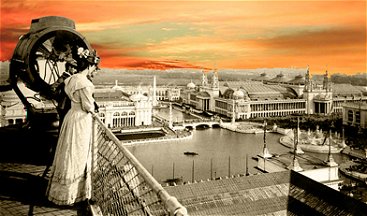
1893 Columbian Exposition At Chicago
Men Like Gods: Tarzan Pays Homage To Heracles
July 9, 2008
Men Like Gods
Tarzan Pays Homage To Heracles
by
R.E. Prindle
First published in the online Magazine: ERBzine
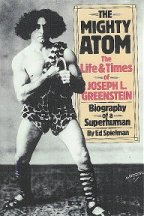
Cover of The Mighty Atom
The Golden Age of Strongmen had captured the imagination of the world between 1890 and 1910….Into the 1920s the strongman continued as a living wonder and inspiring vision that could be had for the modest price of admission
-Ed Spielman: The Mighty Atom:
The Life And Times Of Joseph L. Greenstein
When I was a child and youth in the 1940s and ’50s the legendary strongmen of the turn of the twentieth century were, if no longer living, living legends. At least one, Bernarr Madfadden, the father of American bodybuilding, was still going strong.
The most legendary of the strongmen was Frederick Mueller who was known professionally as the Great Sandow.
In his heyday Sandow was so strong that he was capable of ‘exploding’ or breaking the ‘Test Your Strength’ machines in the arcades of Vienna, Austria. There were so many broken machines that it was thought a vandal was destroying them but when apprehended it was discovered that Sandow was not only testing his own strength but the strength of the machines. He flippantly suggested that they be made of better materials.
On stage as Spielman relates, Sandow, who was trained as a turner, could do a back somersault over a chair with a thirty-five pound dumbbell in each hand. He could do a one arm chin-up with the grip of any of his fingers of either hand, including his thumbs.
He could…wait a minute! I’ve heard something like that before. Oh yea, I remember now. In Edgar Rice Burroughs’ Tarzan And The Lion Man he has Tarzan leap up to seize stakes pointing down from a ten foot high wall, then draw himself straight up until his torso was above the stakes, then roll over the top defeating the purpose of the stakes. Was he thinking of the Great Sandow when he wrote that?
I think he was.
Burroughs was a fan of boxing and a great admirer of the strongmen of the Golden Age, although he didn’t like the bulky physiques. He repeatedly denounces the physical build of the Strongmen in preference for Tarzan’s ‘smooth rippling muscles.’ In my day the bodybuilders were ridiculed as being ‘muscle bound.’ But the ladies panted when they said it. Tarzan is as strong or stronger than the strongmen but sleek.
Next one asks is there any place that it can be shown that Burroughs ever saw Sandow? yes, and where else? The Chicago Columbian Exposition of 1893. The Expo was a life changing experience for 17 year-old Ed Burroughs. Bill Hillman of ERBzine has written a wonderful series on the influence of the Fair on young Burroughs.
The influence of the Fair was as moving for the rest of America and the World as it was on Our Man. There apparently has never been so influential a World’s Fair as that of Chicago of 1893.
One of the best attended features of the Fair was put on by the Great Sandow. Bodybuilding had already gotten started in England. Sandow was a student of the innovative Professor Attila in London. He came to the attention of Florenz Ziegfeld while performing in New York. Ziegfeld brought him to Chicago for the Expo. Sandow was a sensation.

The Great Sandow
He created quite a stir at the fair. Not only did Burroughs see him there but so did a man named Bernarr Macfadden. At the time he was known as Bernard McFadden but he chose Bernarr because it sounded more like a lion’s roar and Macfadden because he thought it looked more distinguished in print. As a result of seeing Sandow Macfadden became the father of bodybuilding and the health movement in the United States. John Dos Passos spoofs him in Vol. III, The Big Money, of the his USA Trilogy.
Macfadden was the discoverer of isometric exercises, which his student, Charles Atlas, renamed Dynamic Tension and made a fortune.
Unless I’m mistaken Macfadden would cross ERB’s path sometime between 1908 to 1912.
Sandow made bodybuilding a rage after the Fair while Macfadden organized the sport around his magazine ‘Physical Culture’ which he began publishing in the wake of the Fair. Sandow also opened the way for a number of strongmen to build careers on their physiques.
They all passed through Chicago. How many of them ERB paid the modest price of admissio to see we can’t know, but as he always speaks of the strongmen in the plural one assumes that he saw several.
Anyone who has watched the Strongest Men In The World competition on cable TV will understand how impressive both the feats and the physiques of these men were.
In ERB’s day a man called Warren Travis Lincoln could lift a platform that held twenty-five men with his back. That was a weight of about 4200 pounds.
G.W. Rolandow could stack three decks of playing cards and tear them in two. One assumes that was before they were plastic coated.
Emil Knaucke who weighed in at five hundred pounds, a spectacle in itself, could hold a car above his head with one hand. Spielman doesn’t specify make or model.
Louis Cyr, one of the most famous strongmen, could restrain a team of horses on either side at the same time. Really spectacular stuff.

Bent Press Arthur Saxon
A man like Arthur Saxon of the Saxons was considered to be the strongest man in the world. He could do a bent press of nearly five hundred pounds. As in the photo, in the bent press a lifter raised a barbell above his head with one hand in a bent posture then raised another weight with his other hand.
Eighteen ninety to nineteen-ten were formative years for ERB. He would have from fifteen to thirty-five so that when he saw Sandow in ’93 at seventeen he was at a most impressionable age.
ERB turned 40 in 1915 and 50 in 1925.
By the twenties vitamins and food supplements had been discovered and were being developed for commercial use. Vitamins were still novel when I was kid in the late forties. Not everyone knew of their value as late as then.
The Great Sandow, Louis Cyr, and a trio of German strongmen called the Saxons were all naturally strong but by the 20s it was possible to build muscular Adonae from the scratch of a 98 lb. weakling. With vitamins, food supplements and a rigorous regimen for bodybuilding a normal body could be turned into as mammoth a specimen as Tarzan, as witness Arnold Schwarzenegger and his contemporaries who emerged from New York City gyms in the 1960s.
In point of fact you didn’t even need all that gym equipment. If you followed the body building plan of the most famous Adonis of the 40s and 50s, Charles Atlas, all you needed were your own opposed muscles.
Atlas took Macfadden’s isometric exercises and called them the more commercial sounding Dynamic Tension. By pitting one muscle against its opposite fantastic results could be achieved.
Charles Atlas, who changed his name from Angelo Siciliano, was voted the world’s most perfectly developed man in 1922 by his mentor, Macfadden and Physical Culture magazine.
Angelo, born in 1894 in Acri, Sicily came to the US in 1904, thus he would have been 18 in 1922, 18 in 1912.
Siciliano actually had been a 98 lb. weaking who had sand kicked in his face by a bully. His girl friend actually did walk away from him. Siciliano then built himself up into what I’ve always considered to be the image of Tarzan and changed his name to Charles Atlas.
I was not as successful with the Dynamic Tension plan Chuck sold me in the 50s but then I didn’t try that hard and I couldn’t afford the food supplements which are indispensable. Nevertheless it had become possible to turn out ‘Men Like Gods’ on an assembly line basis.
It is more than likely that Burroughs was very familiar with the bodybuilding or fitness program of Macfadden. That photo of him flexing his muscles on the dock at Coldwater is that of a man who has been working out. I can’t beleive that a man who was interested in magazines as Burroughs was couldn’t be familiar with Physical Culture Magazine. Not only would he have the living memory of the Great Sandow in his mind from the Expo but Bernarr Macfadden had moved his headquarters from Battle Creek to Chicago in 1908. He had a very prosperous looking facility.
During these years from 1899 when ERB was bashed in the head in Toronto to 1910 at least, he complainedof excruciating headaches that began when he got up in the morning and lasted through half the day. These would have been very enervating affecting his ability to work. In The Girl From Farris’s he has his hero Ogden Secor suffering from the same headaches going from doctor to doctor ‘tinkering with his skull’ in hopes of finding relief. The doctors could do nothing for Secor so he undertook a fitness regime which eased his situation. So must have ERB.
Once again, the picture of ERB standing with his legs apart flexing his muscles on the dock at Coldwater in 1916 shows that he was either proud of a moderate physique or he was trying to develop those ‘rippling’ muscles like Tarzan and Charles Atlas.
At fifty in 1925 ERB probably thought himself beyond the age when he could develop his physique into a semblance of his creation, Tarzan. Ten or twenty years younger and you might have seen Burroughs as another Charles Atlas or Tarzan.
There is every reason to believe that sometime between 1908 and 1912 he developed an interest in Macfadden’s program.
When he sat down to begin his Tarzan series at the end of 1911, Burroughs’ mind must have been filled with the feats of Sandow and the other strongmen. Anent this, Tarzan’s leopard skin loin cloth was borrowed from the strongmen. Leopard skin shorts were de riguer for the bodybuilding crowd.
Of course the role models for these strongmen were Samson and Heracles. The latter is better known in his Roman usage as Hercules. For the purposes of this essay I will refer to him as Heracles in hs Greek manifestation.
Especially in his original manifestation Heracles was a Sun god as the companion of the Earth Mother, Hera. When the Patriarchal system was imposed on the Matriarchy Hera was wed to Zeus while her former consort, Heracles- The Glory Of Hera- was demoted to the role of Holy Fool and the strngest man in the world.
ERB often refers to Tarzan as a Jungle God and a latter day Hercules. Burroughs had a good Greek and Latin education so one might asume that he had some familiarity with the cycle of myths devoted to the feats and tribulations of that ancient type of all strongmen, Heracles.
In fact, without stretching the point unduly, one can posit a relationship between the Pelasgian Sun God, Heracles and the Flaming God of Opar and through them to Tarzan; they can be construed as one.
Whether ERB was conscious of what he had done in conflating the three cannot be determined for sure but as he was manipulating valid historical data why shouldn’t he have been conscious of what he was doing? The Aztec ritual of tearing the heart out to offer to the sun god is implicit in scenes where Tarzan lies across the sacrificial block, pardon me, altar. The annual sacrifice of the queen’s consort is implicit once again as La raises the sacrificial knife. A blatant resemblance to Cybele and Attis.
While the subconsious is always important it is the conscious mind that organizes, plots and writes. As a writer I may have subconscious motives which may emerge but assembling and organizing my material is a conscious intellectual act. It is axiomatic that one cannot write what one does not know.
One of the great mysteries of mythological studies has been the relationship of Heracles to his namesake the former Matriarchal Earth Goddess, Hera. I noted just previously, during the matriarchy as the Sun, Heracles would have been appropriately called ‘The Glory Of Hera’ or of the Earth. The same notion can be applied to Mesopotamian and Egyptian mythology. For instance, as David Adams points out somewhere, the lion is a symbol of both the sun and the matriarchy. It is a fact that the body of the Sphinx at Memphis is older than the head. The head of the original has been replaced by that of a man. It therefore follows that the Sphinx was carved during the Matriarchy having either a lion’s or a woman’s head. After the succession of the Patriarchy the head was changed to reflect the New Order.
In the Greek Oedipus myth the Theban Sphinx was still represented as the original matriarchal symbol of a lion with a woman’s head. Woman-lion/sun/Heracles. The answer to her riddle after which she committed suicide was ‘man’ which denied the Matriarchy, hence she had to kill herself as the Patriarchy thus symbolically replaced the Matriarchy. Apply that to the Egyptian Sphinx and the change of heads.

Theban Sphinx
Now, the original Egyptian Sphinx was exactly the same as the Theban Sphinx: a woman’s head on a lion’s body. the Sphinx is positioned to be looking due East at sunrise in the Age Of Leo. Thus, perhap, the secret of the Sphinx is simply that as Mother Earth she sat waiting for her consort Heracles (or his Egypian counterpart) to appear on the horizon each morning.
The notion has simplicity to recommend it.
As we all know, Oparians were a group of Atlanteans isolated from the main body when mythical Atlantis broke apart and sank beneath the waves of the Atlantic Ocean. The worship of the Flaming God was inherited from the parent civilization by Opar.
Thus whether Burroughs knew what he was doing or not he always gets the sequence of events right.
Without getting into any discussion of if, where or when Atlantis may have existed, let me say, neverttheless, that all the evidence points to a predecessor civilization anterior to Crete, Pelasgian Greece, Egypt and Mesopotamia in much the same way Atlantis preceded Opar.
The predecessor civilization must have existed in the Mediterranean Basin during the last ice age when ocean levels, scientists tell us, were several hundred feet lower than they are today. There are evidences of quarrying several hundred feet below sea level on the flanks of the island of Malta for instance. Given this as a fact, then when the ice melted and the waters rose during the Great Flood to their present levels any society or civilization that existed in the Mediterranean Basin was forced to move to higher ground which is to say above the present sea level.
One thing is certain, if the Basin was habitable it was inhabited.
The disruption caused a long dark age from which mankind only slowly recovered. At the same time these relatively highly developed people moving into less developed savage societies had a fertilizing influence introducing more sophisticated ideas and methods such as agriculture.
Lower Egypt, one of Two Lands, was obviously settled by the displaced Libyan dynasty. After centuries of warfare the Upper Egyptians succeeded in conquering Lower Egypt uniting the Two Lands. The Third Dynasty was a Libyan Dynasty so that the warfare was translated from an external one to an internal one in which the Libyans defeated the Upper Egyptians. During the Libyan Dynasty the great pyramids were built reflecting in some way the the flooded predecessor civilization.
So Crete and Pelasgian Greece received survivors also. The Sumerians of Mesopotamia attribute their civilization to the advice of Oannes, John in English, who came from the sea.
Often ignored by classical scholars but obviously part of this great Mediterranean culture is ancient Spain. Now, Spain has one of the great traditions of the worship of Heracles as a Sun god. This tradition preceded and was uninfluenced by any Patriarchal tradition from Greece. In point of fact the Patriarchal Heracles went West to annex the Spanish traditions to the Patriarchal cause. In the process he rounded up the cattle of the Sun i.e. the Matriarachal Heracles to bring back to Greece. Throughout history, including modern Africa, lifting another man’s cattle transferred his authority to oneself. See the great cattle raid of Cooley in Irish mythology. It therefore follows that the Greek Patriarchal myths of Heracles are built on an earlier Matriarchal mythological cycle while being perverted or converted to Patriarchal needs.
Heracles was originally a sun god. He was the original of the Flaming God. I can’t say Burroughs knew this either consciously or subconsciously, however as we will see there is substantial evidence to indicate that he was consciously manipulating the material.
The city of Seville in Spain is built over a Sun Temple in which Heracles was the sun deity. This site beneath Seville can still be vistited today. Assuming that the history of the Spanish Heracles developed independently of the Greek Heracles which after all is a Greek interpretation of a Pelasgian god then it follows that the two traditions must have come from a common source. That source cannot have been other than the ante-deluvian civilization of the Mediterranean Basin.
It follows then that whatever names they were known by in this anterior civilization Hera was the Great Mother Goddess while her ‘Glory’ Heracles must be no other than the Flaming God, the Sun. What else could the ‘Glory’ of the Earth Mother be?
Thus when the Great Flood, which must be the same as that spoken of by the Sumerians who would have gotten the story from Oannes, destroyed the civilization of the Mediterranean Basin the inhabitants fled to the former highlands surrounding them taking their traditions with them. The Spanish Heracles was yet identical to the Pelasgian and Cretan models which later became variant.
When the Greeks entered Pelasgia at the beginning of the Arien Age, the Zodiac dates back to the anterior civilization, they found this remnant of the ante-deluvian civilization with immemorial religious traditions occupying the land. As the Arien Age began a great shift in the mental and social organization of man progressed in its evoltuion. The shift was from a Matriarchal consciousness to a Patriarchal consciousness. In other words, the God replaced the Goddess as the most important sex. Fecundation became more important than actual reproduction.
This meant that all the divine myths had to have all the sexual relationships reversed so that the God took precedence over the goddess. Hera could no longer be allowed to have a male god as her subordinate ‘Glory’, the roles had to be reversed. Hera would have to become the dependent of Zeus.
Homer’s Iliad is one key in the story of this reversal.
As Hera was unwillingly made subordinate to her Lord and Master, Zeus, Heracles had to be appropriated by the God. The Patriarchy then turned Heracles into a scourge of Hera and she his enemy in ridicule of the previous dispensation. Kind of a Burroughsian style sly joke.
The meaning of the name Heracles as the glory of Hera was thus lost. Heracles lost his identification with the Sun becoming a buffoon as the greatest of men; a physical giant of somewhat dim intelligence. Hera’s glory was turned into a laughing stock but still a good sort of fellow who could aspire to godhood at death.
In the Patriarchal myths Heracles destroyed various Matriarchal cult centers such as the Hydra at Lerna, the Stymphalian Swamps, the Stag of Artemis, the Nemean Lion and others. His cycle of adventures was involved in replacing the Matriarchal with the Patriarchal sarcastic ‘Glory’ of Hera.
To make a feeble Patriarchal attempt at accounting for the meaning of Heracles’ name Homer tells the following story in book XIX of the Iliad. Zeus, influenced by the goddess Folly, announced to the assembled Gods on Olympus that before the day was out a descendant of his lineage would be born to a mortal woman who would be the greatest man in the world.
Hera, who hated the infidelities of Zeus, heard his proclamation with scorn. She knew her husband but too well. She knew he referred to Alcmene who was bearing Heracles but she also knew that a son was to be born to the wife of Sthenelus who was only seven months pregnant. Sthenelus was of the lineage of Zeus.
Hera rushed off to visit Eileithyia, the goddess of childbirth, to ask her to hasten the birth of Eurytheus while delaying that of Heracles. The former having been born first became the greatest monarch of the age after the Patriarchal fashion but by Matriarchal means.
Hastening back to Alcmene Eileithyia uncrossed her legs allowing Heracles to be the younger son of Zeus born on that day. While Heracles was the bravest and strongest of men he was nevertheless compelled by Hera’s resourcefulness and prompt action to be subservient to Eurystheus. Thus the will of Zeus which could not be averted was perverted by Hera to thwart the Big Guy’s will.
Heracles was still the strongest man alive but he was subordinate to the will of Hera through Eurystheus, portrayed as one of th weakest and most cowardly men of his time hiding behind his mother’s skirts but by the grace of Hera and the matriarchy, the greatest ruler.
Zeus, appalled by his lapse of judgment threw Folly off Olympus from which she is still banned.
In that sardonic manner Homer explained the meaning of Heracles as the glory of Hera. She had used him to Ace Zeus. Heracles had been stripped of his role as the glorious Sun companion of Hera. He comes down to us as the strongest man who ever lived. In the Roman nomenclature of Hercules he became the role model of every strong man who ever lifted a dumbbell. Yet they all wore leopard skin shorts, the leopard being a symbol of the Matriarchy. You can’t fool Mother Nature.
To Burroughs who was a student of Greek mythology the great strongmen of the Golden Age must have appeared as men like gods. Their feats of strength, their marvelous physiques, were so far beyond the abilities of ordinary men that they must have seemed to be in a class by themselves far above mortal men.
In that sense Tarzan is the greatest of the strongmen, above Sandow, Arthur Saxon and even Heracles.
Heracles himself had been demoted to a mere mortal although his legend was so great that he was allowed immortality by the Patriarchy after his mortal death. Unwilling to grant him too much credit he was allowed to be the doorman of Olympus. He held this position throughout the Arien Age being replaced by St. Peter in the New Dispensation of the Piscean Age.
Burroughs, familiar with the mythic cycle of Heracles, however he understood it, plays with both identities of Heracles in the person of Tarzan at Opar. He also brings in a number of elements from H. Rider Haggard’s novel She. There can be no doubt of the influence of Haggard. Burroughs even names his heroine La which is what ‘She’ is designated as in French translations of Haggard’s novel. The palance of Opar is also based to some extent on the labyrinthine caves of She.
There are many literary influences for the creation of Tarzan not least of which are the real life H.M. Stanley and Haggard’s fictional heroes Sir Henry Curtis and Allan Quatermain. I would now like to direct attention to a third, that of the heor of She, Leo Vincey.
If one closely examines Vincey it will be discovered that he too was a Sun King whose death had been caused in an earlier incarnation by She. The cartouche which contains the name of Leo’s distant Egyptian ancestor was translated as ‘The Royal Son Of Ra’ or son of the Sun as in Egyptian mythology Ra is the sun.
Leo also translates from the Latin as Lion so we have the Son of the Sun who also is a Lion Man which is how Burroughs refers to Tarzan in ‘The Invincible’ and undoubtedly as how he always thought of his creation.
Haggard translates Vincey as the Avenger. Tarzan is the ‘Avenger’ or guard of Africa. Haggard describes Vincey as almost inhumanly beautiful while Tarzan is the most handsome man in the world not unlike Charles Atlas.
Haggard’s She is indescribably old kept forever youthful by having bathed in the fire of eternal youth. Hera was also eternally youthful and a virgin queen. She restored her youth and virginity by bathing annually in a holy spring. Hera’s bath obviously refers to the Spring rains which inundated Mother Earth just prior to vegetation springing forth in virgin birth. After the summer heat the vegetation dies down and Earthy Hera becomes barren once more to await her bath and return to virginity.
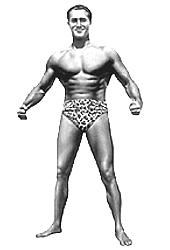
Mr. Dynamic Tension- Charles Atlas
So a connection can be made between Sun>Heracles>Vincey>Tarzan and Mother Nature>Hera>She>La.
Burroughs La was neither ancient nor immortal in the personal sense although she was the latest in an immortal line of Priestesses. She is a priestess of the Sun or Ra, The Flaming God.
Haggard’s Leo Vincey was the direct descendant of Kallikrates She’s great love of two millennia past. She, or Alyesha, to use her name, had killed Kallicrates in a rage. Kallikrate’s descendants were sworn to avenge the murder. Thus Vincey travels from England to far off Africa to locate this fabulous woman.
Kallikrates was the love of Alyesha’s very long life. When she recognizes Leo Vincey as her lost lost love she saves his life while offering him eternal youth if he will only bathe in the flames of eternal life. He hesitates to do so. To encourage him Alyesha steps once again into the flames which was a serious miscalculation. She crumbled to dust. Thus while Leo Vincey doesn’t actually avenge the death of Kallikrates she is nevertheless his victim.
Tarzan while actually born in Africa was conceived in England so he made the trip to Opar from England although he is ignorant of La. When Tarzan is captured in Opar he is laid on the altar of the Flaming God, La with the sacrifical knife raised, looks down on this Jungle God, this man like a god, and falls in love. Thus we have a replay of the She-Kallikrates situation.
Unable to take Tarzan’s life, La releases him begging him for his love. Alyesha’s full title was She-Who-Must-Be-Obeyed in the Matriarchal sense. The old conflict arises, Tarzan is more on the Patriarchal side, he has his moly in the waistband of his loin cloth, monagamous we are led to believe, happily married, so the Lion Man Sun King declines the honor of being mated to La>Hera. He asserts his Patriarchal prerogative to disobey although he always has a soft spot in his heart for La.
In a fairly masterful way ERB conflates the legend of Heracles, the fiction of H. Rider Haggard and the incredible strongmen of the Golden Age and his own little bit to write a charming and beautiful story which is fairly simple on the surface but one which becomes immensely rich with a deeper understanding of the sources.
Ernest Hemmingway once said that before one sat down to write one should have ten time the information in your possession as you put on paper else the story will seem shallow and contrived. It would seem that the sources upon which Burroughs was drawing, from the bodybuilding strongmen of his day to the legendary cycle of Heracles to the adventures of H.M. Stanley and the fiction of H. Rider Haggard might well fulfill Hemingway’s dictum.
When one searches for the sources of Burroughs one finds layer after layer of golden riches while discovering that in fact ERB did indeed create a man like a god- Tarzan The Magnificent.
Addendum
This is a quote taken from Bonzo Dog’s song Mr. Apollo. I don’t know whether the reader is familiar with the Bonzos but they were one of my favorites. Several glorious LPs. Neil Innes came from them as well as the great but tragic Viv Stanshall. Leave those drugs alone, boys.
Follow Mr. Apollo,
Everybody knows a healthy body
Makes a healthy mind.
Follow Mr. Apollo,
He’s the strongest man the world has ever seen.
If you take his courses
He’ll make you big and rough.
And you can kick the sand right back in their faces.
A few years ago I was a four stone apology-
Today, I am two separate…Gorillas.
Bonzo Dog Doo Dah Band
Long may they wave.
Exhuming Bob IX, Pensees 7: Into The Lost Land
July 6, 2008
Exhuming Bob IX, Pensees 7:
Into The Lost Land
by
R.E. Prindle
Texts:
Dylan, Bob, Chronicles Vol. I, Simon And Schuster, 2004
Prindle, R.E. Exhuming Bob, VIII The Walls Of Red Wing, idynamo,wordpress.com 2008
Thompson, Toby, Positively Main Street, U. Minnesota, 2008, reprint from 1971
http://www.hibbing.org/dylan1/story.html Life In Hibbing: Hibbing Chamber Of Commerce
http://www.interferenza.com/bcs/interw/85-dec.htm Bob Dylan Is Not Like A Rolling Stone Interview, Spin Magazine, Volume One, Number Eight, December 1985
http://www.interferenza.com/bcs/interw/play78.htm Playboy Interview: Bob Dylan 1978
http://www.interferenza.com/bcs/interw/66-jan.htm Playboy Interview: Bob Dylan February 1966
1940
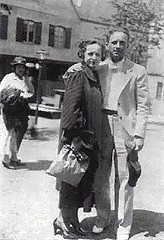
Abe And Beattie
In attempting to put together a reasonable facsimile of Bob’s life in Hibbing and Minneapolis, Minnesota and New York City as he mythologized it in his chapter of Chronicles, The Lost Land, I have come to the following tentative conclusions.
Bob was born in Duluth, Minnesota on 5/24/41. In 1943 he was taken to Hibbing where he lived from then until graduation from high school in the Spring of 1959.
Within the concept of normal Bob had a fairly advantaged childhood. His parents were indulgent buying him anything he wanted while providing adequate pocket cash. Bob’s family was one of the more important in town both within the Jewish community and the town at large. In what appears to have been a tight small town social scene Bob either excluded himself or was excluded from the dominant social groups within which he had a right to be included.
Perhaps Bob’s conception of the Hibbing period could be best interpreted from his favorite movie, Rebel Without A Cause, starring James Dean. Bob is said to have seen the movie several times. This was unusual as few people ever saw a movie more than once. He would have been a very impressionable fifteen at the time. Most of us didn’t have the money while quite frankly few movies, if any, were worth watching twice including Rebel Without A Cause. I was seventeen when I saw it and while I was in awe I wasn’t submerged. Of course Bob’s relatives owned the theatres so he got in for free.
As he set up a Dean shrine in his basement which greatly offended Father Abe we may be justified in assuming that Dean was a controlling influence in his life from the time he saw the movie. It is of interest that Abe was to remove the Dean shrine from the basement after Bob left replacing it with a shrine to his own son Bob Dylan ne Zimmerman.
Abe Zimmerman (1911-1968) worked for Standard Oil in Duluth when Bob was born. According to the C of C he lost his job in 1943 moving to Hibbing where his wife’s family, the Stones, could help the young couple. Why Standard Oil should lay Abe off in the middle of the war during a manpower shortage seems to pose a question. As can be seen from the photograph of Abe and Beattie above borrowed from the Flickr photostream of <drineevar> he was a well set up handsome man. He appears to be exceptionally self-possessed, sound in the eyes. Beattie appears to be a haughty high fashion queen which would accord with later facts.
Abram Zimmerman, for such was his name. Usually called Abraham, the name on his tombstone is Abram, and his two brothers Maurice and Paul bought the Micka Electric Company in 1943 changing the name to Zimmerman Appliance. In 1968 Paul Zimmerman told Thompson that they had been in business for twenty-five years which would mean 1943 although the date seems odd.
According to the C of C Abe came down with polio in 1946 requiring a lengthy convalescence. The C of C says that the Zimmermans bought Micka’s after his convalescence but if Paul Zimmerman is accurate it would have to have been 1943. There would be no record of what Abe did for a living then from 1943 to 1946. As Bob says both his uncles served in the Army it would seem that they bought Micka’s going into the Army shortly thereafter leaving Abe to tend the business.
Maurice and Paul became President and Vice-President of the corporation while Abe siginficantly assumed the controlling post of Secretary-Treasurer. Managed the money, paid the bills.
During the fifties at least Abe spent a fair amount of money on both Bob and Beattie. Angel Marolt whose family bought the Zimmerman residence after Abe’s death was trying to tell him of Beattie’s several fur coats, diamonds and Cadillac but Thompson says he wasn’t paying attention.
Thompson quotes Echo Helstrom as saying that the Zimmermans had stores in both Hibbing and Duluth. Having a customer base of approx. 250,000 makes more sense when one considers the amounts of Abe’s expenditures and the fact that the profits had to be split three ways.
The C of C describes Abe as a ‘big man’ in town partial to those big thick long cigars.

The Dylan Home
The couple had enough money on arrival to buy the large nine room house that Bob grew up in so Abe must have been well paid at Standard Oil before he was laid off. Both he and Beattie are well dressed in the picture while Beattie is actually overdressed.
Bob was entrolled at Alice School for his kindergarten year in 1946 at five years of age. The status of Alice School is unclear. Perhaps it was closed the following year or consolidated with the Hibbing High complex as Bob was transferred. Hibbing High housed kindergarten through twelve as well as the Jr. College. Thompson describes it as a huge and rambling building.
So from first grade to graduation Bob was with the same group of students. I sure wouldn’t have wanted to move into town in tenth grade and try to break into that one. While he wouldn’t have known them all well he must have known the entire student population on sight. This presents the problem then of why Bob, who was the son of the Big Man in town, wasn’t included in the top social cliques. Those cliques undoubtedly formed early persisting through graduation. If Bob was in one he was either forced out early or found it uncongenial to remain for whatever reason. Perhaps he thought his Jewishness excluded him. So if something happened we don’t know what it was and won’t; unless Bob tells it’s going to be difficult to trace.
Growing up in a small town anyone with any ambition looks around and sees very limited opportunities. Working for his father wasn’t a viable option. Not everyone wants to be a doctor or lawyer either. Nuclear Science is OK but a lot of those guys are out of a job now too. My next door neighbor when I was a kid for one.
Bob’s mind turned early to music and then to Rock and Roll. While Rn’R went on to conquer the world and become as respectable as such a spectacle could it was definitely considered discreditible and low class almost volunteer outlawry in the fifties. At the very least it was ‘pimple’ music. It took a certain amount of courage to say you liked Elvis Presley. Pat Boone was set up as his rival and you had better say you liked ol’ White Bucks. If you don’t think Elvis was considered a social criminal check out a couple of his movie roles like King Creole or Jailhouse Rock. What was the Colonel thinking? Clown roles, that’s all Elvis ever got.
And then Bob chose as his hero and model Little Richard. People looked at you funny if you said you
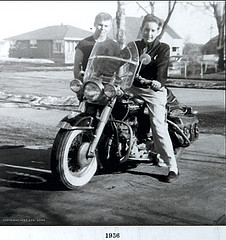
Young Bob On Harley
liked Little Richard! I mean, Bill Doggett was a respectable Negro with music you could understand, Fats Domino was as lovable as a chubby ten year old but Little Richard! They hadn’t even created the ghetto he could come out of. His band might have passed but then he opened his mouth. If there was ever a direct challenge to middle class sensibilities Tutti-Frutti was it. Not only was the song incomprehensible it was about queers. Nobody ever quoted the lyrics correctly, while I’m walking around saying ‘Tutti Frutti, I want Rudy?’ What does that mean? I hope no one overheard me. So when Bob gets up, ignoring Pat Boone entirely, and launches into some screaming vision like Rip It Up or She’s Got It or God only knows what, was the crowd taken aback? Chuckle, chuckle.
So Bob having opted for the lifestyle was forced to associate with the hoody crowd or have become a loner. Besides Colin Wilson’s book The Outsider had appeared in 1956 that began a cult of The Loner that peopled the early sixties. These guys, who were by no means rebels but deep thoughtful guys who had a line on the truth denied anyone else and that penetrated sham and hypocrisy sat alone ever ready to resolve a situation setting things right were highly romanticized fellows. There were as many Loners in those days as there were Hawkeyes a couple generations later. So Bob wouldn’t necessarily have been thought of as weird, strange but a Loner. A Loner was next door to weird and strange. Thin line if you get my meaning.
On the other hand the C of C describes the L&B Cafe as a regular jumping Bop Street right there in the heart of Hibbing, Minnesota. Bands set up and played continuously. They knew how to party in Hibbing. The C of C even says there was a radio station in town playing Bob’s kind of music thereby contradicting every other source even Bob. He says he had to go to Shreveport on the radio waves to get his kind of music. In this case I’m betting on Bob.
The C of C tells of Bob’s musical debut like this putting the best possible face on it:
Described by fellow students as polite, easy to talk with, and somewhat introspective, it was a total shock when he pushed back the piano bench and stood up to pound the first notes of a song into the auditorium, electrifying the student body. Kids jumped up, stared at each other open mouthed not knowing what the reaction would be.
Well, yes, they were electried but did they like it?

Rockin' Bobby Zimmerman
According to the C of C, looking back fondly, Bob went over real well with his fellow students. If you like this version don’t check the other sources as this is at variance with every other known account but then this is the Chamber Of Commerce speaking. Up to this point in the C of C account there is no reason for Bob to be as bitter as he is about Hibbing at all.
A note of interest is the reoccurence of Fourth Street in Hibbing, Minneapolis and New York City. Quite a coincidence, I knew there had to be some association with Fourth St. in Hibbing. So far we learn that Bob attended Jewish shule there. Whether the synagogue was also located there isn’t clear. The synagogue Bob attended is no longer anywhere at any rate. Tore it down. It was in the way. Had to go. Even though Bob’s father was the most prominent Jew in town, the President of B’nai B’rith and ADL as well as his business interests, and even though Bob had a mega Bar Mitzvah with four hundred people in attendance some say at the most prominent spot in town, the Androy Hotel, some say at the synagogue, he wished to conceal he was Jewish. This attitude may have contributed to his renouncing the Jewish fraternity house to which he pledged at UM while also hiding his religion in New York. The attitude was strange since he seemed to prefer Jewish musicians around him to the exclusion of goys.
Bob’s father Abe, was quite frankly a marvelous provider, spending very large sums of money on son Bob, wife Beattie and his second son, David. When he died in 1968 the house on 7th Ave., now Bob Dylan Ave. was sold. The owners at the time of Thompson’s visit were the Marolts. Angel Marolt who was at home when Thompson called offered to show him around. One thing he learned was that Bob had a clause in the sale’s contract that allowed him to stay in his old room in the Marolt’s house whenever he was in town. Too weird.
What quirk in Bob’s mind compelled him to live in other people’s houses? Perhaps Rebbe Maier back in 1954 impressed on Bob that Biblical scripture presribes that Jews would live in houses they never built. As an article of religion that injuction is a mind boggler. One can’t predict how anyone’s mind will interpret instruction. Bob who functions out of his subconscious very heavily must have accepted such teachings in literal ways. Rebbe Maier was a definite turning point in Bob’s life. Imagine getting out of school, going upstairs at a Rn’R cafe to sit before the only bearded man you may ever have seen, dressed completely in black with a black yarmulke perched on the back of his crown intoning things like: The Jews shall live in houses they never built and then go downstairs to boogie. Pretty spooky, don’t you think? And then as Bob says, he disappeared like a ghost. Let that roll around your brain for little while and see what you come up with.
Mrs. Marolt was trying to tell Thompson something about Mrs. Zimmerman’s multiple furs, heaps of diamonds, I’m sure all the latest fashions and her own Cadillac.
Bob was indulged to the extent of apparently more than one motorcycle, a car, lots of amplifiers and electronic gear for his bands, whatever he wanted plus free movie admissions and plenty of pocket cash. He must have had a large record collection for a kid as he spent his spare time at Crippas record store ordering the odd title. You can bet Crippas didn’t discount either, charging full bore. At the time (after 1958) stereo was 5.98 and mono was 4.98.
As the profits from a sole Hibbing store divided three ways could not have supported this sort of expenditure, having a store in Duluth could account for it. It is significant also tha Abram died in June 1968 and the store closed a few months later. Was the store a losing proposition for the last few years? Did Bob provide the difference so Abe wouldn’t be embarrassed by going banko? Then with his father gone there was no reason to support Uncles Maurice and Paul?
There really is something happening here, isn’t there?
Also as a petty expenditure for Bob (it would have been huge in my life) according to the C of C:
Almost every day Bob came in after school for his regular snack: cherry pie a la mode and coffee (or Coke.)
And then to dinner? No wonder the young Bob had all that baby fat.
If Echo bought those hot dogs for Bob and bought his story that his dad didn’t give him an allowance she was had in more ways than one.
So, Abe was nothing if not a generous father and husband. Beattie as President of Hadassah as well as a Stone must have made the Zimmermans the most powerful Jews in the syngogue while actually giving she and her husband the means to be petty dictators of the town, I saw something like this in Eugene, Oregon in the sixties and seventies, or, as the C of C says a Big Man and big people.
Bob must have a quirk in his mind to misrepresent his childhood so. He was the Fortunate Son John Fogerty only sings about.
In Thompson’s interview with Beattie he quotes her:
How can you know you have a genius in your house, when all my time is spent trying to feed him and keeping his clothes pressed.
In Bob’s story, The Lost Land, Chloe Kiel is shown ironing Bob’s shirts and at the end of the chapter she ‘slaps’ a plate of steak and fried onions in front of him just before he darts out the door to begin the next chapter, A New Morning, just as in the old days when he returned home from school for lunch and was fed by his mother he darted back to school.
Ironing his shirts and providing free steaks was a signal service for bare acquaintances like Ray and Chloe.
Chloe comes across as cold and indifferent and indeed there is a tinge of resentment and anger beneath Beattie’s statement. Motherly, of course, but there. Still, she doesn’t impress me as any Yiddishe Mama of the Mrs. Goldberg variety. Whether Bob was a good boy or not he does have an ambivalent attitude toward his parents. But then he claims that he was really raised by his grandmother, whether Stone or Zimmerman isn’t clear.
I believe the big change came over Bob with his Bar Mitzvah and I’m not talking puberty alone. According to the C of C Bob attended Jewish shule during his young years. This was done after public school hours. Then in 1953-54 when his Bar Mitzvah was approaching Father Abe sent to Brooklyn, New York to have an ultra-orthodox, almost certainly a Lubavitcher Rebbe, sent to Hibbing to indoctrinate Bob in untra-orthodox teachings. It can’t be any surprise that when Bob exhibited his Jewish reverence after his Jesus indoctrination with the Vineyard Fellowship he chose to show himslef as a Lubavitcher. Welcome home, Bob. The C of C tells it this way:
According to a 1985 Spin Magazine interview by Dave Engel, Bob said it was above the (L&B) Cafe that Rabbi Reuben Maier stayed while giving Bob Hebrew lessons in preparation for his Bar Mitzvah. The Rabbi and his wife showed up one day and stayed for a year while Bob got ready for his big event . The article quotes Bob as saying he would learn Hebrew after school or in the evening for an hour, then go downstairs and boogie at the L&B. After completing his Bar Mitzvah the Rabbi just disappeared.
In the interview Bob tells it this way:
There weren’t many Jews in Hibbing, Minnesota. Most of them I was related to. The town didn’t have a rabbi, and it was time for me to be bar mitzvahed. Suddenly a rabbi showed up under strange circumstances for only a year. He and his wife got off the bus in the middle of the winter. He showed up just in time for me to learn this stuff. He was an old man from Brooklyn who had a white beard and wore a black hat and black clothes. They put him upstairs in the cafe, which was the local hangout. It was a rock n’ roll cafe where I used to hang out, too. I used to go there everyday to learn this stuff either after school or after dinner. After studying with him an hour, or so, I’d come down and boogie. The rabbi taught me what I had to learn, and after conducting the bar mitzvah, he just disappeared. The people didn’t want him. He didn’t look like anybody’s idea of a rabbi. He was an embarrassment. All the Jews there shaved their heads and, I think, worked on Saturdays. And I never saw him again. It’s like he came and went like a ghost. Later I found out he was Orthodox. Jews separate themselves like that. Christians, too. Baptists, Assembly of God, Methodists, Calvinists. God has no respect for a person’s title. He don’t care what you call yourself.
The C of C knows the Rebbe’s name was Reuben Maier and Bob Dylan doesn’t? There were enough people in Hibbing to have a temple and shule but they didn’t have a Rabbi? The Rebbe Maier showed up in time for Bobby Zimmerman’s Bar Mitzvah but what? it was the first Bar Mitzvah in Hibbing’s Rabbiless history? No wonder four hundred people showed up. The Jews in Hibbing shaved their heads and worked on Saturday’s? I presume Bob means they didn’t wear beards but shaved their faces unlike the Lubavitcher in white beard and one of those funny round hats. I serously doubt there were three hundred or more Jews walking around Hibbing with shaved heads in 1954.
They took one look at Rebbe Reuben’s weird beard and outre attire and told him to get out of town? Now that I can believe. Beards in ’54 were a sign of great eccentricity or a psychotic desire to draw attention to oneself. But why in ’85 the mysterioso act? He just showed up to teach Bobby Zimmerman, a complete unknown with no direction home Lubavitcher tales like this: (actually this is pretty standard esoteric doctrine adapted for Jewish needs)
The messianic thing has to do with the world of mankind, like it is. This world is scheduled to go for 7,000 years. Six thousand years of this where man has his way and 1,000 years when God has his way. Just like the week. Six days work, one day rest. The last thousand years is called the Messianic Age, Messiah will rule.
Essentially what we have here is a variant of Madame Blavatsky’s Theosophy along with a little Hebrew Theology. If one looks real closely one can see the outline of Sigmund Freud’s notion of the unconscious.
According to Beattie Bob knew, oh, two hundred words of Hebrew. So much for several years of shule and a year of intensive training by Rebbe Reuben.
Whether Bob knows or admits it, it must be true that Father Abram sent for Reuben to instruct Bob in mysteries that Abe thought were essential to his vision of Jewish religion while they were not part of the services of the Hibbing congregation.
It is possible that Abram brought the Rebbe in on the approval of the congregation who rejected him. The comment by Bob of working Saturdays may be signficant here. The Jewish sabbath begins on Friday sundown and continues to Saturday sundown.
As a Lubavitcher, Rebbe Reuben could not have tolerated working during the sabbath while the congregation found it essential amidst a gentile population. Likewise beards are an integral part of the orthodox religion so that the congregation also refused to stop shaving. The only thing mysterious is why it took Reuben so long to catch on. Or maybe he had a contract for one year and the year was up. Of course Bob did need help on those two hundred words.
So Bob’s upstairs memorizing his two hundred words while the throbbing beat pounds insistently through the floor. The super patient Reuben and his wife never object. Bob shortly joins the revelers with his two hundred Hebrew words rattling round his skull, steps up to the mike and begins screaming: I’ve got a girl and her name is Echo. Hmmm. Quite an image out there in the Lost Land of Bob.
Now indoctrinated in quaint antiquarian rites Bob is bundled off to Webster, Wisconsin and Camp Herzl to steep himself in Israeli style Jewish living. Camp Herzl was conducted as Israel in America so those two hundred Hebrew words came in handy in that surrogate for summer in a kibbutz in the Holy Land.
The summer sojourns must have set Abram back a handsome fee for the times. Six to eight weeks of essentially summer boarding school does have expenses. Abe apparently was deeply religious: in Protestant circles he would have been known as a Fundamentalist nut. He and Mike Huckabee would have gotten along fine. One wonders if younger son David was given the same treatment.
So Bob from 1954 on is definitely the product of two nations. The world of the Three Hanks as the C of C puts it and this world of Adam, Moses and the Messiah. Bob was named after Sabbatai Zevi the last acknowledged Jewish messiah in the seventeenth century, his Jewish name is Sabtai.
As kids we all have a lot to reconcile, begin working out at graduation. Bob had a double load; he had two Bobs to reconcile. Personalities wander and widen in those years, Bob made a clean split. On the one hand he was the twerp Bobby Zimmerman of whom it may be said: There’s no success like failure while on the other he was struggling to be the super successful Bob Dylan in which he failed to assume the mantle so that failure is no success at all. At least he made this split off persona’s name mean something. As a note, it was not generally known Dylan was Jewish until after Blonde On Blonde.
Thus in his movie Renaldo and Clara he is not Bob Dylan. Anybody can be Bob Dylan he says, you can be Bob Dylan. Toby Thompson thought he could be and did a pretty good job of it walking a mile or so in Bob’s shoes. Sounded just like him.
As remarkable as it is that Bob realized his fantasy beyond anything he could have dreamed and became the hugely successful Bob Dylan he created an entire new set of problems whose solution eluded him. Well, you know, there’s something lost and something gained while it’s hard to know whether the gain was worth the loss. However the money has disappeared from the table.
The result then is Bob looking backward from 2004 to create a fantasy of how it was in Ray and Chloe’s place on Vestry Street in NYC. The chapter is approriately titled The Lost Land or possibly Never-Never Land might have been better. The chapter isn’t a complete fabrication but it is fiction. Something like the various incidents might have happened but not exactly the way Bob tells it. The framing story of Ray Gooch and Chloe Kiel is pure fiction however. They could not possibly have existed.
Bob tells the whole story of the Lost Land within the reference of Ray and Chloe and their fabulous apartment near Vestry below Canal near the Hudson across the street fromt he Cathedral with its bell tower. Thompson got it right.
A troubling aspect of Bob for me is his insistance on bumming other people’s apartments. This seems to be compulsive behavior.
Bob was actually voluntarily homeless from January of ’61 to October or November of the same year when he and ‘roommate’ Suze Rotolo took up digs on Fourth St. I suspect that Father Abe would have been only too happy to supply Bob with funds to live on Vestry Street if he had asked. Bob is simply untrustworthy in any of his stories. As he said of what he learned from folk music: If you told the truth, well and good; if you told the untruth, well and good also, so in Bob’s mind there are no lies, there is only the truth or untruth both having the same value and whichever is more serviceable at the moment. You can’t believe him.
A troubling aspect of Bob’s behavior is his habit of bumming couches in other people’s nests; gaining meaning, as it were, from other people’s lives. Perhaps that was the way he felt of his life in his mother and father’s house. Or perhaps as a Jewish outsider in a goyish land it was his attempt to insinuate himself in the main stream much as he appropriated Woody Guthrie’s persona. Of the houses I have traced they have all been those of goys; he didn’t choose to insinuate himself into the houses of his fellow Jews. His imaginary hosts Gooch and Kiel are obviously goys.
The Lost Land then is a mythologized version of his childhood and first few months in New York City. To my mind Ray Gooch is a combination of Dave Van Ronk, Paul Clayton, Matt Helstrom and his father. Chloe seems simply to be an idealized notion of his mother. (Study her picture for a few moments again.)
As the Gooch frame brackets the period from Bob’s encounter with Gorgeous George to the apartment with Suze Rotolo it must represent a time frame from sometime in ’58 to October ’61. In October Bob Dylan ceased sponging off others to take up his own apartment.
The only one in this time frame he knew who had a large gun collection was Matt Helstrom. The Helmstroms also had a large record collection that Bob listened to. The couch and apartment undoubtedly belonged to Van Ronk while certain exoticisms of Gooch are characteristic of Clayton. The library of Gooch may simply be the New York City Library of which the long narrow room would merely describe the stacks.
The Southern character of Gooch must represent a time after Bob studied the South in the library since there are several references to his Civil War studies. Gooch himself is a Southerner from Virginia gone North which is a symbol in itself. This can be symbolically described as Father Abe being a Jew in Gentile America.
Here then Bob creates or accentuates the more pleasant aspects of his memories in contrast to the very bitter unpleasant memories of the songs. He tells us a great deal about his dream life but little of its realities. At this point I am of the opinion that the party of Camilla ( who Bob says he gets to know quite intimately) is another fabrication of the based on a true story variety.
As Bob would say, folk music taught him that if what you said was true,well and good; if what you said was untrue well and good also. We may probably construe the Lost Land as both true and untrue while a good folk tale. Even the title has a fictive quality a la Edgar Rice Burroughs.
To round off the period back in the C of C milieu of Hibbing: Bob spent his last summer at Camp Herzl in 1957. In the summer of ’58 he was running back and forth between Hibbing and Minneapolis. At that time he would have become familiar with Highway 61.
In his Junior year of ’57-’58 he took up his relationship with Echo Helstrom. They were going steady hence were not supposed to be dating others. As he was in Minneapolis most of the summer he left Echo sitting home alone. She resented this. As the Senior year began she told Thompson, she took a revenge on Bobby returning his token in public in the hall at school. Boy, that hurts.
The feelings must have been much harder than either Bob or Echo portray them. A key problem area is did Bob spend time in Red Wing Reformatory on Highway 61 below Minneapolis and if he did what did he do to receive his sentence: I examine this more fully in Exhuming Bob VIII: The Walls Of Redwing.
He says in Chronicles that he was absent from school from some time at the beginning of April of ’59. He was back at least by the June 5th graduation. His birthday is May 24th. After that date he would have been eighteen and subject to adult sentencing. For what It’s worth he says in his song that no inmate was over seventeen. I’m suggesting that he spent a month of two at Red Wing returning in time for graduation. Certainly a Big Man in town like Abe could have arranged the graduation if he couldn’t get Bob off that time.
The question is what did Bob do? By the middle of this Senior year it appears that he had been in enough scrapes to be known as a troublesome boy; perhaps living out a Rebel Without A Cause persona. Father Abe used his influence up to that time to avoid unpleasant consequences for the lad.
I believe Bob’s song The Chimes Of Freedom tells the story of his crime. Quite simply Echo set him up. She obviously was not quite as complacent as she tells it. See Exhuming Bob VIII: Walls Of Red Wing.
Returning home from Red Wing his parents threw a graduation party for him. Bob was reluctant to attend the party, perhaps with good reason but was persuaded to do so.
This then leaves a very sketchy account of the three or four months of the summer of ’59 for which Bob provides little information. In Walls Of Red Wing I place his stint at Red Wing in August but that is probably wrong. In any event the period from April of ’59 to September of ’59 needs to be explained more fully.
Bob gives some brief details of his stay at Dinkytown but not much. A little bit of the John Pankake episode while avoiding the important details of his theft of Pankake’s records.
Thompson has some good information from Ellen Baker whose father’s folk song collection Bob used extensively.
Then to NYC and his account of The Lost Land segues into his New Morning.
Exhuming Bob IX: Pensees 6 Bob And Dave A Review
June 28, 2008
Exhuming Bob IX
Pensee 6: Bob And Dave
A Review
Dave Van Ronk: The Mayor Of Macdougal Street
by
R.E. Prindle

Dave At Work
Texts:
Dylan, Bob Chronicles Volume One Simon And Schuster 2004
Thompson, Toby Positively Main Street U. Minnesota 2008, reprint of 1971 text.
Van Ronk, Dave The Mayor Of MacDougal Street: A Memoir Da Capo Press 2006
Van Ronk’s memoir published in 2006 becomes part of the ongoing Bob Dylan debate. A part of the Greenwich Village folk scene of the early sixties Van Ronk little knew how his life would be affected, destroyed, by the arrival of Bob Dylan from out of the West in 1961.
At the time of Dylan’s arrival Van Ronk was one of the most important, if not the most important, folk singer in the Village. Thus Bob set his sights to suck out Dave’s substance and cast the empty husk aside.
On page 211 of the paperback Dylan is quoted at the beginning of Chaper 15:
I once thought the biggest I could ever hope to get was like Van Ronk. And it’s bigger than that now, ain’t it? Yeah, man, it’s bigger than that.
-Bob Dylan c. 1964
Once Dylan learned of Van Ronk on his arrival, it is doubtful that he had heard of him in Minneapolis, he made it his goal to insinuate himself into Van Ronk’s life. Dylan tells how he began his assault on page 21 of his Chronicles. The scene takes place in the Folklore Center:
One winter day a big burly guy stepped in off the street. He looked like he’d come from the Russian Embassy, shook the snow off his sleeves, took off his gloves and put them on the counter, asked to see a Gibson guitar that was hanging up on the brick wall. It was Dave Van Ronk. He was gruff, a mass of bristling hair, don’t give a damn attitude, a confident hunter. My mind went into a rush. (My italics.) There was nothing between him and me. Izzy took the guitar down and gave it to him. Dave fingered the strings and played some kind of jazzy waltz, put the guitar back on the counter. As he put the guitar down, I stepped over and put my hands on it and asked him at the same time how does someone get to work down at the gaslight, who do you have to know? It’s not like I was trying to get buddy-buddy with him, I just wanted to know.
Van Ronk looked at me curiously, was snippy and surly, asked if I did janitor work.
I told him, no, I didn’t and he could perish the thought, but could I play something for him? He said, “Sure.”
I played him “Nobody Knows You When You’re Down And Out.” Dave then said I could come down about eight or nine in the evening and play a couple songs in his set. That was how I met Dave Van Ronk.
Bob and Dave
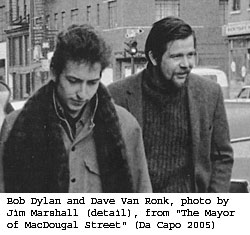
Possibly. But one learns to take Dylan’s stories with a shaker full of salt. Bob has a difficult time separating fact from fancy. The way Van Ronk tells it he was hanging around with a bunch of the boys when someone burst in and said ‘New guy, come on, you got to hear this.’ and it was Bob. So Van Ronk would have had an idea who Bob was not that he necessarily would have acknowledged him. There are some interesting points in Dylan’s narrative which I believe is Bob at his most fanciful. That he marked Van Ronk for destruction is apparent when he says he looked like he came from the Russian Embassy. Maybe. But Bob was a Jew and the Russians were the enemies of the Jews throughout the last two hundred years so Bob was casting him in the role of the enemy. Then he identifies Van Ronk as a ‘confident hunter.’ Jews usually associate hunting with goys while traditionally despising the practice so Bob is saying that the hunter didn’t know he was being hunted. And then Bob placed his hands on the guitar as he spoke to Van Ronk indicating that he was appropriating the man’s tool or emasculating him. Very significant action.
Bob says Van Ronk was snippy and surly. Well, maybe but since I think he’s making this up he is casting a character on Van Ronk to make you dislike him. Besides who wouldn’t appear surly if you placed your hands on the musician’s guitar. The exchange after that when Dave asked if Bob did janitor’s work was a particular Jewish insult that gave Bob his excuse for hurting Van Ronk.
Then like a parasite or lamphrey eel Bob latches onto Van Ronk slowly ‘stealing everything that he could steal.’
When the process was complete and Bob was way bigger than Dave could hope to be Bob then disses Van Ronk off. As Van Ronk tells it p. 217: Van Ronk:
For myself I consider it fortunate that Bobby and I reached our parting of the ways fairly early. Shortly after his third or fourth record had come out had gone diamond or whatever, he was holding court in the Kettle of Fish and he got on my case and started giving me all of this advice about how to manage my career, how to go about becoming a star. It was complete garbage, but by that point he had gotten used to everybody hanging on his every word and applauding any idea that came into his head. So I sat and listened for a while, and while I was polite and even asked him a couple of questions, but it became obvious that he was simply prodding and testing me. He was saying things like “Why don’t you give up the blues? You do that, and I”ll produce an album on you, you can make a fortune.” He wasn’t making a lick of sense, and I finally pushed back my chair and said, “Dylan, if you’re so rich, how come you ain’t smart?’ And I walked out.
So within three years Bob met and surpassed his mentor then trashed him like he trashed everyone and everything else in his life. Beware of Bob. To a very large extent MacDougal Street is the story of Bob Dylan within the folk scene of Greenwich Village although within that context Van Ronk tells a rich and rewarding story of the emergence of Folk from 1940 to c. 1970. A fabulous book with a generous dollop of belly laughs. I loved the book.
2.
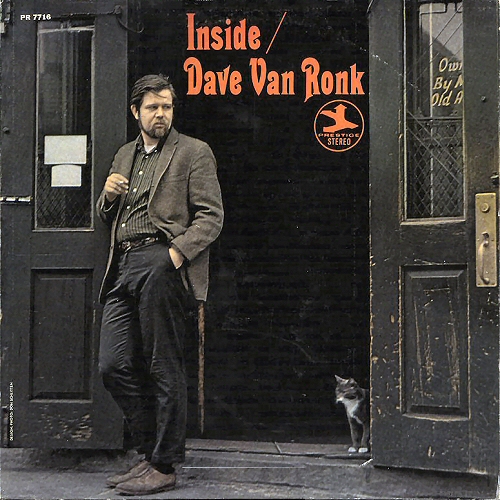
Van Ronk himself never made it. I first heard of him in 1967 and listened to the Prestige Folksinger album. There was nothing there. Van Ronk rasped out all his vocals in a monotonous fashion in that same gargling hoarse voice with nary a variation from song to song. At that age and time I found the songs uninteresting. The arrangments didn’t grab me. The music was about as exciting as the New Lost City Ramblers which is to say a stone bore.
Van Ronk may have prided himself on his musicianship and it may have been pretty good, I couldn’t care less. I know few people who listen to records for musicianship and I don’t care to listen to records with those who do. So Dave was concentrating on all the wrong things.
There were people running around saying how great he was but I was in the record business and nobody bought his records. you can foget the Hudson Dusters. Over the years his legend grew with that of the vanished Folk Scene and I guess twenty-five years or so after the fact he was able to cash in on that basis.
There is one really great song Van Ronk did though called Don’t Leave Me Here. I have it on The Folk Box, Elektra EKL 9001. That’s a really fine four record collection compiled and annotated by THE Robert Shelton. It has selections from nearly all the folkies of the Greenwich Village scene excluding Dylan. A terrific collection and a perfect representation of the scene. Hard to find though; I couldn’t find any copies on a quick search of the internet.
However the story of Dave’s learning process is vastly interesting. His history of the folk era, especially the late fifties and the people and personalities make the book a best buy. But then we get back to Dylan.
Bob not only wheedled his way onto Van Ronk’s stage but he wheedled his way into his very household appropriating Dave’s couch for his living quarters. Now comes an interesting conjecture. In Chronicles Bob says that he met a Ray Gooch and Chloe Kiel with whom he stayed for some time. Now, Bob arrived in New York in January of ’61 and he rented his apartment with Suze Rotolo in the Fall of that year becoming financially independent thereafter never going back to anyone’s couch.
So that gives him a maximum of nine months to sleep on all those peoples’s couches. He says in Chronicles that he first met Van Ronk and through Van Ronk Paul Clayton. These are two colorful characters. He then says that through Clayton he met Ray Gooch. So far, so good. But then he gives a fairly minute description of the street the Gooches lived on, the building, the apartment and significantly the church across the street.
Before w go on let us consider an incident from Van Ronk on page 4:
…Bob Dylan heard me fooling around with one of my grandmother’s favorites, “The Chimes Of Trinity,” a sentimental ballad about Trinity Church that went something like:
Tolling for the outcast, tolling for the gay,
Tolling for the (something, something), long passed away,
As we whiled away the hours, down on old Broadway,
And we listened to the chimes of Trinity.
He made me sing it for him a few times until he had the gist of it, then reworked it into the “Chimes Of Freedom.” Her version was better.
Now let’s check into a passage from Toby Thompson’s ‘Positively Main Street’ pp. 210-211:
But the larger portraits of Ray Gooch and Chloe Kiel are complex and layered with mystery. Why haven’t we seen them before? Correct me if I’m wrong, but their names appear in no biography of Bob. Could they be projectionsof his own divided psyche. Ray, the competent man of the world, the toolsmith, the gun collector, the would be warrior, and Chloe, the dreamy, slightly stoned performance oriented homebody? Bob’s not certain whether they are siblings or lovers. I’m not certain they are real. Chloe was the heroine of Longus’s second century novel Daphnis and Chloe. She was an orphan, nurtured by sheep, and is described as ‘a naive lily-white girl” who falls for the youth, Daphnis. Echo is mentioned in the story. In my case the apartment Ray and Chloe inhabit on Vestry is a boho Eden, Every hipster’s wettest dream of Manhattan digs.
The Sunday after reading Chronicles, a blustery afternoon in New York I took a subway to Franklin Street and walked north then west along Vestry, looking for the building that might have housed it. Bob describes it precisely, Federal style, facing a Roman Catholic church with a bell tower, on the same block as the Bull’s Head Tavern, below Canal Street, not far from the Hudson River. The neighborhood hasn’t changed much since the early sixties, but I could find no building that resembled it. Not the church, not the Bull’s Head Tavern. Houses disappear, but churches aren’t often torn down. I wanted to locate that apartment, only because he described it so beautifully.
So I think it safe to say the whole dozen pages or so in Chronicles is a fabrication. Bob dreamed it a few times and wrote it down as fact. A clue lies in the progression Van Ronk>Clayton>Gooch. Gooch has a made up quality to it so Gooch is probably a conflation of the personalities of Van Ronk and Clayton. And possibly the pair are also a sentimental portrait of Abe and Beattie, the mother and father. Not as they were but wouldn’t it have been loverly if they had been. Ray’s background also coincides with Bob’s studies of the pre-Civil War era in the South in the New York Library.
The church across the street reflects Trinity Cathedral in Dublin as in Dave’s song the Bells Of Trinity so that places the story after his stay with Van Ronk. Note the specified bell tower on the church. Bob’s not there and neither is most of his early reported life. I’ll say again anything he says is untrustworthy. As they say in Hollywood: Based on a true story.
The last couple chapters of MacDougal tell of the changes in the Village and performance after 1960 to 1967 when drugs took the scene down. These are relevant and important chapters as he describes how Dylan’s success caused the failure of the scene. ‘There’s no success like failure and failure is no success at all.’
Altogether I give Van Ronk’s Mayor Of MacDougal Street exceptionally high marks, worth a second reading and retention as a reference work. Positively Fourth Street by Toby Thompson has a place on your shelf also. I’ll review that after a second reading. It is well worthy of study, picking up the stray hint and fact here and there.
Chronicles of course is important to understand what Dave called the convoluted workings of Bob’s mind. Bob’s an interesting study because he has managed to fool a lot of people all the time and another pack of us for a time. I tell ya folks if I could live my life over I’d do some serious homework before I began but then even that probably wouldn’t help.
Exhuming Bob X: Lubavitcher Bob
June 25, 2008
Exhuming Bob X:
Lubavitcher Bob
by
R.E. Prindle
There’s something happening here
But you don’t know what it is,
Do you, Mr. Jones?
-Bob Dylan
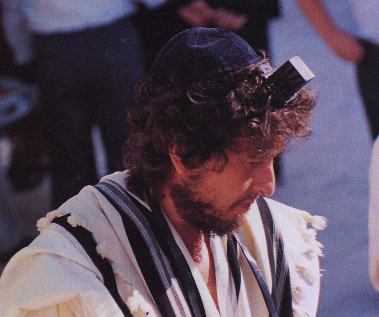
Bob En Regalia
In 1979 Bob publicly embraced Jesus as his personal savior. This was widely seen as a conversion to Christianity because Bob went to the Vineyard Fellowship of Tarzana for indoctrination into the Christian mysteries. He could hardly have learned Christianity from Jewish circles although the Jewish group of Jews For Jesus was already active. Pharasaic Jews have always despised Jews For Jesus so that may not have been a viable option for Bob.
While non-Jews may be scandalized by the concept of Jews embracing Jesus there is no reason for them to be astounded. After all Jesus was a Jew, preaching to Jews in the Jewish tradition. The early Christian movement was entirely Jewish. They were Jews of the Jews who had accepted Jesus as the Jewish Messiah. Christianity became a universal religion only after Paul reconstructed it shedding the practices most repellent to gentiles while the Hellennic or Greek religion and philosophy was grafted onto the religion which gave it substance and intellectual vigor displacing Semitic stultification.
There should be little wonder then that Jewish Christianity should resurface two thousand years later with Bob as its Messiah.
Bob was uniquely trained for the role. He grew up in a Christian community dominated by the Hillbilly music on the radio with a large and active Jewish congregation. His father thought of himself as a Jewish scholar while heading the local chapter of B’nai B’rith and ADL. His father was covertly ultra-orthodox.
In 1990 Bob wrote a letter to the editor of a publication called Sister2Sister. (Bob’s Unshakeable Monotheism, Part IV, Scott Marshall http://www.jewsweek.com/ ) in which he said:
…until the entire world believes and obeys the same God, there can be no truth or justice or peace for anyone.
What that means in the age old Jewish notion that as God’s chosen people they are destined to bring their vision of God to all the peoples of the Earth at which time they will become a nation of priests, the rulers and overseers of all others. The Supreme People placed between God and humanity as demi-gods.
The notion did not necessarily occur to Bob in 1990 but was placed in his mind at a much earlier date. It would always have been present in the synagogue. Anyone who has ever attended Jewish services will be be struck by the insistence that Jews are to rule the world and all the peoples. It is the duty of every Jew to further that work.
Whether Bob had the Messianic impulse before his Bar Mitzvah is the question. It may have been there in embryo. In 1954 as Bob was about to turn thirteen his father, Abraham, who obviously believed the proper religious education was lacking in Hibbing sent for a Lubavitcher Rebbe from Brooklyn to come to Hibbing specifically to indoctrinate Bob in the more recondite lore of the ultra-orthodox. The intensity of the instruction would be virtual hypnosis. It was at this point, I believe, that the Messianic impulse was fixed in Bob’s mind.
The indoctrination had devastating results for the young boy’s character and personality. He went off the rails becoming wild and dissolute. In searching for a means to spread the message he had received he hit on music and from there it led into folk music. Folk music had a special appeal because it was a pure expression of the dominant culture. If one subverted folk music one subverted the culture.
Thus after being initiated into folk at Dinkytown near the University of Minnesota Bob left for the Big Apple, New York City. The Folk scene of Greenwhich Village in New York was a virtual Jewish enclave or colony. A great many Jews were already doing what Bob set out to do. Disoriented by his conflicts between his Jewish and Christian education Bob nevertheless set about changing Folk music, discarding the content for Jewish themes while retaining the outer forms. The Jewish world organization realizing they had something in Bob gave him maximum publicity actually turning him into a messianic figure through television and magazines.
The stresses of intense fame to his personality and character were terrific almost destroying him. Bob retreated at the height of his fame in 1966 after having established himself with three terrifically influential record albums. His mind was now focused and somewhat cleared. Placing a large Bible in the middle of his living room for easy reference Bob and his band worked and experimented with the Folk and old timey oeuvre of the White Christian hill people. Once again retaining the forms while stripping the material of the content, he infused Jewish Biblical content which was familiar to the Christian culture into the material. The immediate result was John Wesley Harding which is a Jewish religious album in tradtional White Christian dress.
The result is quite remarkable and on that basis is an astounding work of Jewish genius. Unaware of what was being done to them White Americans could offer no defense except rejection. There were quite a few of us who walked away from Bob at that point. I can’t say that I understood what Bob had done but I felt the insult to my sensibilities.
Thus, in retrospect, Bob’s so-called Christian period became inevitable as his strategy slowly unfolded in his mind. There is no conflict with Bob’s intense Jewishness in his combined religious entities, or reclaiming the Jewish Jesus for Judaism. Nothing could be more natural.
The preemption of the goi culture for Judaism is the astonishing achievement of little Bobby Zimmerman. Long after the fact there are still few who get it.
Note: The old Jewsweek format has been discontinuted. The text is no longer available on that site.
Slum Goddess From The Lower East Side: A Review
June 20, 2008
A Review
Slum Goddess From The Lower East Side
Some Thoughts On The Autobiography Of Suze Rotolo:
A Freewheelin’ Time
by
R.E. Prindle
1.
Sandoz The Great

In 1938 Albert Hofman, a Swiss chemist working for Sandoz isolated LSD-25. In 1938 young Tim Leary was 18 years old. It was in 1943 that Albert Hofman discovered the effects of LSD. Seventeen years after that LSD burt onto the world through the agency of the now, Dr., Timothy Leary, a psychologist with Harvard University.
LSD was adopted by the Bohemian society and all its offshoots as the appearance of the new chemical Messiah: Better living through chemistry as the slogan was. Its use quickly spread through the folk music community of Greenwich Village in New York City.
Timothy Leary Is Dead

Goodbye Tuli. Died 7/12/10
In 1923 a fellow by the name of Tuli Kupferberg was born and his partner Ed Sanders came along in 1939 a year after I did. Kupferberg and Sanders were poets who became influenced by the folk scene forming a band sometime in 1964 originally called the Village Fugs, later the Village was dropped and they became simply the Fugs. In 1965 they released their first LP on Folkways. Now, cut one, side one was little number entitled Slum Goddess From The Lower East Side. Sort of OK as a song, funny, as were a lot of Fugs songs. Like Dylan they searched for social significance rather than write trite love songs. Unlike Dylan you could easily understand the meaning of the lyrics. Slum Goddess was one and then there was a song that many of us thought significant in the social sense back in those days entitled: Boobs A Lot. ‘Do you like boobs a lot? Gotta like boobs a lot.’ As I said deep and intense meaning. This was followed by a song eulogizing jock straps. ‘Do you wear your jock strap? Gotta wear your jock strap.’ So the Fugs were with it.
At some point after 1965 the Village Voice decided to run a feature depicting some East Village lovely as the Slum Goddess From The Lower East Side. Suze Rotolo had the dubious honor of being selected as the very first Slum Goddess.
To what did she owe this honor? Well, she was famous on the Lower East Side for being featured on the album cover of Bob Dylan’s second LP, The Free Wheelin’ Bob Dylan. She was at that time, 1962, I believe, Bob’s girl friend or, at least, one of them, perhaps the principle one but one can’t be sure as Bob had others as ‘part time’ girl friends.
Thus one has to go back to the summer of 1961 to discover how Suze Rotolo began her odyssey to become the very first Slum Goddess. Suze tells her story in her autobiography issued in May of 2008 called A Freewheelin’ Time. It is a bitter sweet story not lacking in charm. Bob was born in 1941 while Suze was born three years later. All the disparate elements in our story born at separate times were slowly moving to a central focal point in New York City from 1961 to 1965 or so.
Suze and Bob were of that age when freewheelin’ seemed possible while the psychological social moment was about to congeal and then vanish before it could be realized as psychological moments do. Some catch the golden ring as it come around, some don’t. Bob did, Suze didn’t.
Suze was born in Queens, over there on Long Island, as a red diaper baby. In other words in the romanticized Communist parlance her parents were Communists when she was born. She was brought up in the faith.
Bob described her as a libertine dream or some such epithet. I’m not sure Suze saw herself in the same way. I think she expected a little more of Bob than to be his sex toy. As a Communist she should have had a more freewheelin’ attitude.
Suze seems to have been brought up completely within the Red religion much as a Christian might be a Catholic, Methodist, Lutheran or as Jew in whatever stripe of Judaism it might be.
She edged into race agitation at a young age. She met Bob when she was seventeen while she had been working for CORE (Congress Of Racial Equality) for a couple years before that. She would have been fifteen or sixteen. Whether she had sexual experiences with the Africans she doesn’t tell us. In her search for a raison d’ etre for her life she found herself in Greenwich Village in the Summer of ’61 where she met the twenty year old Bob Dylan just in from the Iron Range of Minnesota. They were mutually attracted, quickly forming a sexual relationship.
Bob as everyone knows was and is Jewish. He came not only from a Jewish background but from an orthodox background. Hibbing, Minnesota, his hometown, had a Jewish population of about three hundred families with their own Jewish establishment and synagogue.
According to Beattie Zimmerman, Bob’s mother, Bob was a good boy who attended services regularly while investigating the nature of the various Christian churches. As a mother Beattie’s version of things must be interpreted through the eyes of mother love.
Father Abe was not only a practising Jew but the President of the Hibbing chapter of B’nai B’rith and its terrorist arm the Anti-Defamation League. In addition Beattie, Bob’s mother, was the President of the Women’s auxiliary, Hadassah. So Bob isn’t just Jewish but comes from a very committed Jewish background.
As the President of the Hibbing chapter, Father Abe would have attended statewide gatherings in Minneapolis, regional meetings wherever they were held and possibly if not probably national meetings in NYC and elsewhere. Now, within the international Jewish organizations heavy hitters attend various levels of meetings where they meet and learn something of the various local and regional people. Thus, it may be assumed that Abe Zimmerman as a name at least was known on the national Jewish level. Kind of the Jewish Who’s Who, you know. Bob says that he had contacts to help him when he got to New York. Those contacts would have come through Father Abe while being part of B’nai B’rith and ADL. Bob wasn’t entirely alone out there.
Bob’s Jewish name is Sabtai after the last acknowledged Jewish Messiah, Sabbatai Zevi. There have been many that filled a Messianic role since Zevi not least of which was Sigmund Freud and possibly Albert Einstein. Bob may have been encouraged to take the role for himself.
At any rate when Bob approached thirteen and Bar Mitzvah time Abe brought in a special Rabbi from Brooklyn to instruct Bob. Now this is really signficant. He was probably a Lubavitcher or ultra-orthodox Jew. When Bob publicly expressed his Judaism after his Christian stint he chose to do so as a Lubavitcher. Very likely that was no coincidence. Having received his crash course in orthodoz Judaism Father Abe next sent his son to a Zionist summer camp for ‘several ‘ weeks for each of four successive summers ending at the age of seventeen. This would have the effect of introducing him to young Jews not only of the region but from around the world while at the same time estranging him from his fellow Hibbingites giving him his strange cast of character.
Camp Herzl was named after the originator of Zionism, Theodore Herzl. the camp with a spacious hundred and twenty acres is located on a lake near Webster, Wisconsin. Herzl is not your basic summer church camp but a national and international gathering place where young Jews from around the US and the world can meet and get known to each other somewhat.
The camp is conducted exclusively for Jews along Jewish lines eliminating as many goyish influences as is possible. At least when he was seventeen Bob was playing the Wild One showing up in a mini biker cavalcade. One may assume that many national and international Jewish figures made appearances over the four years to both instruct, encourage and look over the upcoming generation.
The post-war years were very traumatic for the Jewish people. The death camps of the Nazis dominated their minds. They were psychologically devastated and unbalanced looking for Nazis under their beds before they went to sleep at night. One may safely assume that Bob and his fellow campers had to watch extermination movies over and over lest they forget.
The State of Israel was founded in 1948 while the first of Israel’s successful wars occurred in 1956. The ’56 war was a seminal event bolstering the spirits of the Jews turning them aggressive as they now believed they could fight. After ’56 they began to come out of themselves.
For whatever reasons as Bob entered high school his personality began to disintegrate. Perhaps he had to cease being Bobby Zimmerman to become what his people expected of him which was a probable religious leader who then became Bob Dylan. As always Bob would combine two cultures, Jewish and Goyish.
After an extremely rocky year in Minneapolis where Bob shed the remnants of his goody goody image of Hibbing he became the dirty unkempt Bob Dylan of his rush to fame of the Folk years.
Thus as Bob and Suze met in the Summer of ’61 they were both searching for something to be.
Part 2.
Why Do Fools Fall In Love?

Just We Two
The question now that Suze and Bob have gotten together is to sort out the various accounts of what happened. Bob says everyone has gotten it wrong. However his own account in Chronicles I is no more factual than the accounts of his biographers and commentators. Suze doesn’t provide us with much more clarity. While Bob tells it like he wanted it to have been Suze on the the one hand protects her memory of what she wants to keep as a beautiful memory while glossing over her own actions at the time to keep it so.
Bob goes through the romantic notion of constructing their bed with saw, hammer and nails. This is a charming story and I’m embarrassed to say I took him at his word. You simply can’t. Chronicles came out four years ago so Suze has had plenty of time to read it and mull over Bob’s ruminations. Thus she must be aware of Bob’s story of the bed. She says it was an old bed the landlord left from another tenant. Another beautiful tale of Bob’s down the tubes.
Suze rather unflatteringly depicts Bob as a rouster and fairly heavy drinker. She was offended that Bob, who was posing as Bob Dylan, not yet having officially changed his name, didn’t level with her and confide that Dylan was a pseudonym that looked better on a marquee while his real name was Zimmerman and that he came from Minnesota rather than being an orphan from New Mexico. Coming home one night, as Suze tells it, Bob, stumblingly drunk, dropped his ID and she discovered the truth as she picked it up. Even then she had to drag the truth out of Bob.
These problems mounted up. There was immediate hostility between Bob, Suze’s mother and her sister Carla. The mother seems to have instinctively seen through Bob, while I’m sure Carla soon learned that Bob was doing her sister wrong.
As we know from Chronicles Bob had other ‘part-time’ girl friends, pick ups and whatever. As the folk crowd was a fairly tight knit group even if Suze didn’t want to hear the obvious Carla who was employed by the Folklorist, Alan Lomax, could hardly have been unaware that Bob had a laissez faire attitude toward romancing the girls.
Indeed, Bob’s understanding of Suze was that she was his Libertine belle. As a libertine therefore he could hardly have believed fidelity was a necessary condition. I don’t know if Suze considered herself a Libertine but as a Communist both fidelity and jealousy were forbidden by the dogma so speaking consistently with the belief system neither mother, Suze nor Carla had grounds for complaint. Nevertheless both mother and Carla wished to separate Bob and Suze.
Bob records his side of the conflict in his song Ballad in Plain D. In his usual high flown language Bob says in his song:
“The tragic figure!” her sister did shout,
“Leave her alone, goddamn you, get out.”
All is gone, all is gone, admit it, take flight.
I gagged twice, doubled, tears blinding my sight.
My mind it was mangled, I ran into the night
Leaving all of love’s ashes behind me.
Within a few months he was married to Sara who he kept waiting in the wings. Subsequently he tried to keep Sara and his growing family in Woodstock and the Slum Goddess Of The Lower East Side out on the side. Suze, apparently not quite as Libertine as Bob supposed, declined the honor.
Just as Bob blithely romanticizes his early NY years in some sappy Happy Talk that belies his songs and what nearly everyone has written about him so Suze adopts a near virginal girlish pose. Her story of how she left for Italy and her true blue yearning for the perfect love of Bob who sent those charming letters purloined from old country songs is also belied by the various biographers. To hear Suze talk she never looked at a boy in Italy and certainly never dated one let alone kissed or petted. Yet by her religious Communist ideology that would have been no sin, even would have been a virtue. In fact she did have an Italian boyfriend who was apparently dropped down the memory hole at autobiography time.
When she did return the road of romance was much more rocky than she lets on. Carla who stayed home where she could watch Bob was privy to his doings which were much more libertine than anything he accused Suze of. He had to have slept with Liam Clancy’s live in somewhere in there. He’s accused of being a womanizer and you can’t be a womanizer without a lot of women. So whatever Carla knew it was somewhat more than an earful and I’m sure that between Carla and her mother Suze heard it all.
Suze out of respect for this young love which, after all, must still occupy a sacred spot in her life never expresses but the mildest resentment of Bob but letting her sister speak for her she says that ‘she (Carla) felt I was better off without the lyin’ cheatin’ manipulative bastard.’ Right on all counts I’m sure except for the last although as Bob claimed to have no parents Carla could justly so surmise.
At any rate if Suze couldn’t make up her mind her mother and Carla could.
Ballad In Plain D again:
Beneath a bare light bulb the plaster did pound
Her sister and I in a screaming battleground,
And she in between, the victim of sound,
Soon shattered the child ‘neath her shadows.
—–
The wind knocks my window, the room it is is wet.
The words to say I’m sorry, I haven’t found yet.
I think of her often and hope whoever she’s met
Will be fully aware of how precious she is.
And then Bob married Sara and ruined her life.
While Suze and Bob talked marriage there is no reason to take that seriously; he talked marriage with Echo too. I don’t think Bob had any notion of marrying aouside his faith. The mother is the culture carrier; Bob is firmly within the Jewish culture so there could have been no chance that he would have taken other than a Jewish wife. Even then he may have married only to fulfill the commandment to be fruitful and multiply. Once he had fulfilled that duty he broke the marriage apart.
3.
The Slum Goddess

I'm Leaving Town Tommorow
Suze was now a young woman of twenty or twenty-one alone adrift in New York City. While she and Bob were having their tempestuous romance the times they were a changin’.
Tim Leary, up in harvard, had embraced psychedelics. Once in love with LSD he wanted to share his love with everyone. He became the High Priest of his psychedelic religion. I can recommend both his autobiography and his volume of reminiscences: High Priest. The latter is a spectacularly well written book if tending toward tediousness.
Leary’s experiments attracted the dark angel of the Hippie years, Allen Ginsberg. Ginsberg also attached himself to Dylan tying the Beat and Hippie decades together. Vile man.
Bob had introduced Suze to Marijuana and what else I don’t know, perhaps LSD. He himself was into the pharmacopeia also undoubtedly dabbling in heroin although if he did he is still an addict or was successful in kicking the habit after his retreat from fame in ’66. That whole thing about the motorcycle accident may have been just rehab. He sure needed it.
As Bob notes the effect of LSD on the Greenwich Village folk scene was to turn people inward destroying any sense of community. Suze then was attempting to navigate this terra nova. Along with turning people inward, LSD, the drug scene, turned the scene sexually rasty in ways even the Communists couldn’t have imagined. The Pill coming along at this time certainly was as influential as LSD in changing sexual mores.
Suze, if aware of this, makes no mention of it in her auto. The Fugs released Slum Goddess in 1965 although they may possibly have been playing it around the Village for a year or two earlier. The Slum Goddess is not a savory woman.
That Suze was selected as the first Slum Goddess strikes my sensibilities as a negative compliment. Her presentation of it implies a souring experience. Shortly after her selection she chose to withdraw from Village life. She gives as the reason that her earlier relations with Bob caused upleasant curiosity and that was certainly true.
The scene turned absolutely rotten after 1968 when between drugs, profound negativity and the progressing degradation of the Hippie movement anyone with any sense of dignity was driven out.
Suze must have been one of us for she left the scene behind. There are few today who choose to remember it. As for me, life is life, there it was and there was I. I was who I was; je ne regret rien. I hope Suze doesn’t either. Bob? He just stays on the bus and doesn’t get off. Reality can be such a drag.

Forget About Yesterday
Reconstruction, Tourgee And Dixon
June 9, 2008
A Review
Reconstruction:
Albion Winegar Tourgee And Thomas Dixon Jr.
by
R.E. Prindle
The conflict between the North and South is the central conflit of United States history. Whether the Civil War was fought to preserve the Union or over slavery the African issue was the central problem of the country. The aftermath of Reconstruction was and has been devastating to US history. Mark Sullivan comments the Reconstruction period in Our Times, Vol. III. He is writing c. 1930:
Hardly to this day has any unbiassed summation been made of the destruction that the North visited upon the South. Rarely has any conqueror in history been so ruthless- by comparison, the treatment of Germany by the Allies was the rebuke of a complaisant parent to a naughty child. The North, by abolishing slavery, wiped out five billion dollars’ worth of the South’s property. That was but the beginning. Abolition of slavery was the complete destruction of the South’s economic system, land in the South was made valueless. Then the North, by conferring suffrage on the negro, set the former slave in power over his recent master, and for ten years maintained him there by arms. The very aorta of civilization in the South was more near to being completely severed than historians have commonly realized. In the University of South Carolina, a State institution authority over which rested the legislature, a corn-field negro, barefooted, illiterate, sat in the chair and drew the salary of the Professor of Greek. Over a period of forty years, including war, reconstruction (ironic word!) and the aftermath of both, the lamp of education in the South was saved from complete extinction only by the devotion and patience of half a dozen men. With the other consequences went a discouragement which accepted the physical deterioration, through disease, of large portions of the rural South, as merely one detail of a fate it was useless to resist.
The excuse of the North was that Southern Whites had enslaved the African. For some reason the New England States made Southern slavery an issue although those states, as Bible pounders, were not opposed to slavery in principle. Shortly after the Civil War certain New England citizens established themselves in the Hawaiian Islands where they began to grow staple agricultural crops. Farm labor therefore became as big a problem for them as it had been in the South. They were not averse to establishng a contract labor system which was a form of wage slavery. The New Englanders, some of them churchmen, saw the Chinese as inferior coolie laborers not unlike the African. Learning from the Reconstruction African situation in the South they were reluctant to import the Chinese as permanent residents.
Thus the contracts of the Chinese specified that the Chinese return to China after the termination of their contracts. This the Chinese saw no reason to do staying on as permanent residents. Reluctant to import more Chinese the New England planters cast about for another alternative. They settled on the Japanese. Thus a ship sailed into Tokyo Bay and the Planters forcefully abducted, kidnapped, a hundred odd Japanese from Yokohama taking them back to Hawaii where they were put to work.
So we may assume that the New Englanders were not entirely sincere in their objection to Southern slavery.
In addition during the Grant administration while Reconstruction was in progress the annexation of San Domingo or Haiti was proposed. Under the French administration of the area using African slave labor San Domingo was the richest and most productive colony in the world. It could be made so again under American administration. How they proposed to farm the land without African labor remains a mystery. It could only have been achieved by some compulsive means.
As the Africans have never worked the land of this richest of areas without compulsion one would be amused to learn the proposed solution to this pressing problem of labor.
One can only conclude that as no region of the US objected to forced labor that truly the Union was the reason for the Civil War. The reason for Reconstruction has to be explained otherwise.
The next problem is the nature of the African. Nowhere in the world without an overawing show of force were the Africans docile. The history of Africa is perpetual genocidal, tribal warfare. The Africans had the very reasonable attitude that the way to treat an enemy was to stamp them flat. Exterminate them.
The attitude is apparent everywhere in Africa today most obivious at the moment in Zimbabwe and South Africa.
In Haiti at the end of the eighteenth century the small number of French planters proved unable to control the overwhelming number of Africans, the latter rising up and defeating their owners. In this action known as the San Domingo Moment the White males were exterminated to the man while the females were given the option of sex slavery or rape and death.
One might say this was race hatred but I say no. The response was no different than any other tribal conflict in Africa; the difference in Haiti being merely that the French were White.
In the US the White Planters managed the Africans by the threat of slightly superior numbers while overawing the Africans into if not total submission something very nearly so. Thus the character the North gave the Africans in the South was at complete variance with the worldwide reality.
The North took the forced submission of the African in the South that produced a seemingly submissive inoffensive, harmless type of being the actual nature of the African. Tourgee refers to Africans as ‘poor innocents.’ Northerners believed that the lack of apparent intellectual capability was due to ill treatment and the lack of opportunity for education. So the real question is who was right about the relative capability of the African to the Caucasian? The North or the South? This problem is important and has to be dealt with.
We are told that the African was first to evolve as a Homo Sapiens from the Last Hominid Predecessor. That was c. 150,000 years ago. Had the African not been disturbed by outside peoples he would be living today as he was when he evolved so long ago. Many peoples have visited sub-Saharan Africa, that is to say, Black Africa, over the last few millennia. Phoenicians and Carthaginians visited sub-Saharan Africa both overland and on voyages around the coasts. Greek traders visited the source of the Nile, identifying the Mountains of the Moon while Romans established trade routes across the Sahara. The Arabs established contact beginning in the seventh century at least while Malays from Indonesia established themselves on Madagascar while penetrating into the continent itself making settlements about the year +1000.
All influences were absorbed by the Africans without any serious changes to their intellectual or social organization. Europeans established stronger settlements in Africa ruling Africa for a hundred years or more. They have been or are being expelled from Africa while most notably in Zimbabwe and South Africa Africans are destroying any traces of European civilization and reverting to their ancestral ways. Only a liberal could deny these obvious facts.
The African capability for civilization was fixed one hundred fifty thousand years ago. The African mind is incapable of permanently adjusting to any higher level of civilization.
The Southern Planters in daily contact with Africans had this fact impressed upon them continuously. The mind is not so elastic that it can escape its evolutionary limitations.
As an example I quote Rudyard Kipling from his American Notes of 1889:
The Americans once having made them (the Africans) citizens cannot unmake them. He says, in his newspaper, they ought to be elevated by education. He is trying this; but it is like to be a long job, because black blood is more adhesive than white, and throws back with annoying persistence. When the negro gets a religion he returns directly as a hiving bee, to the first instincts of his people. Just now a wave of religion is sweeping over some of the Southern States. Up to the present two Messiahs and a Daniel have appeared and several human sacrifices have been offered up to these incarnations. The Daniel managed to get three young men, who he insisted were Shadrach, Meshach and Abednego, to walk into a blast furnace; guaranteeing non-combustion. They did not return. I have seen nothing of this kind, but I have attended a negro church. The congregation were moved by the spirit to groans and tears, and one of them danced up the aisle to the mourners bench. The motive may have been genuine. The movements of the shaken body were those of Zanzibar stick dancers, such as you see at Aden on the coal boats; and even as I watched the people, the links that bound them to the white man snapped one by one and I saw before me- the Hubsha (the Woolly One) praying to a god he did not understand. Those neatly dressed folk on the benches, the gray-headed elder by the window, were savages- neither more nor less. What will the American do with the negro? The South will not consort with him….The North is every year less and less in need of his services. And yet he will not disappear. His friends will urge that he is as good as a white man. His enemies…it is not good to be a negro in the land of the free and the home of the brave.
Of course the Liberal will say that Kipling does not observe accurately and that HE is a ‘bigot.’ Nevertheless if one looks at locales in the United States where the African dominates such as Mississippi, Detroit, Pontiac, Flint, Saginaw, Chicago, New Orleans, what does he find? A replica of Lagos or Zimbabwe. A return to ancestral ways.
I’m not one to quote IQ scores because they only prove what is obvious to the naked eye. Genetic studies prove that as Homo Sapiens continues to evolve, the African who, as a species, is fully evolved, will only continue to fall further and further behind. This may not be his fault but it remains a fact.
To counter these facts the Liberal merely says that a hundred fifty thousand years isn’t enough time to make an accurate assessment; we must be patient.
Thus when the Civil War ended and Reconstruction began Albion Winegar Tourgee went South with his prejudices as a carpetbagger to try to place the African over the Southern White.
Tourgee was an honest man who sincerely believed that he was doing right by punishing the White while trying to impose the African on him. Tourgee moved back North after Reconstruction and took up his pen to become a successful novelist. Among his works were two novels recounting his experiences and opinions during Reconstruction. The novels are: A Fool’s Errand by One Of The Fools and Bricks Without Straw. They are both reasonably good novels although the latter is more or less a strike off of the former but for my tastes a better story and novel.
It is in A Fool’s Errand that Tourgee tackles the problem more head on. Completely disrgarding the character of the African in Africa or Haiti he takes the paternalistic Liberal approach that he is dealing with innocent little children who need his protection. This attitude is actually only a variant on the Southern. His is a good Northern Charlie compared to the bad Southern Charlie.
His anlysis of the Southern attitude is quite accurate and well thought out; his solutions are faulty. A Fool’s Errand is well worth reading to contrast the two viewpoints. His own pretensions of innocence and superiority to the Souterners is revolting. He should have known of Grant’s plans to annex Haiti that should have given him an intimation of the vulnerability of Northern pretensions. I’m sure he probably wasn’t aware of Puritan doings in Hawaii and Japan.
Slavery is detestable, I myself have no problems with that although firms like Nestle’s and Starbuck’s are accused of benefiting from slave labor in the chocolate and coffee businesses. That means that you and I enjoy the fruits of slave labor with our coffee and chocolate. Those big screen TVs we all covet so much are made by slave labor in China. Tourgee if he had thought about it would have noticed that the African franchise he was attempting to force on Southern Whites was denied Africans in his home State of Michigan and nearly universally among all parts of the Northland and West. Kipling writing a few years later than Tourgee was speaking accurately.
Tourgee was indignant at what, as he puts it, the Southern Planter had done to the African. He says quite plainly that there was no punishment too severe for the Southern White nor should it end quickly. He virtually proclaims the need to boil the Southern White in oil. This seems extreme in a world where slavery was rife most especially on the African continent. He might have put just a little of the blame on those greedy African chiefs who sold their people into bondage for filthy lucre.
He might also have noted the Israelite Solomon who when he ran short of money to finance his temple to his god gathered together numbers of His people and sold them into slavery to get on with the building of the House Of The Lord.
Tourgee’s novels went unanswered while selling well for a decade or two. But then Thomas Dixon Jr. took up the cudgels on the behalf of the South and told their version of Reconstruction in his trilogy of The Leopard’s Spots, The Clansman and The Traitor. Of course Liberals who control the seminaries of their religious system sometimes referred to as the American University System, dismiss Dixon as a stone cold bigot and ‘racist.’ One suspects without ever having read him which is of no consquence as they pay no attention to the other side of the story once their minds are made up.
As Dixon points out, those Puritan sea captains made a fortune or two out of the slave trade, the profits of which returned North to finance Puritan bigotry and possibly large bequests to Harvard University. Puritan cotton mills processed the cheap slave produced crop without worrying too much about its provenance. Dixon gives numerous examples of the hypocrisy of the New Englanders.
Slavery of any sort past or present cannot be justified but it was that very cotton that caused slavery to blossom and extend into Alabama and Mississippi. The institution then ran into the unique State of Louisiana.
Louisiana and more specifically New Orleans had a history dating back to the French Caribbean plantations, in fact, New Orleans was part of the French circle but a remote outpost in relation to the British colonies of the East Coast. As on Haiti and other French islands freed Africans were allowed full citizenship privileges including owning slaves. Thus, as the American settlers moved West after 1793 and the invention of the cotton gin becoming mere frontiersmen the closer they got to Louisiana, where the African, French and mixed races already were. Louisiana Africans, as in Haiti, were slave owners.
As W.E.B. Du Bois points out but gives no reasons for it, slavery in Louisiana where Africans were influential was of a different character than in the East. The East was as benevolent a form of slavery as is possible while in Louisiana as Du Bois himself points out the African owners preferred to work slaves to death, fhen buy replacements. This in turn created a market for slave breeders who arose in Kentucky.
The breeding of Africans for slaves was especially repellent to American sensibilities but had slavery continued public opinion would have gotten used to it as it gets used to every other perversion. It can however be no coincidence that slave breeding occurred just up river from the slave consuming States of Mississippi and Louisiana.
I mention this matter only to show that the subject of slavery is not monolithic but much more complex than normally discussed.
Both Tourgee and Dixon write about affairs in North Carolina on the East Coast. This differentiation should not go unnoticed. I suspect that a very large proportion of the illegal importation of slaves that occurred after 1800 was done through ports in Louisiana and Texas far from the central authority. If that should be true then the character of slaves fresh from Africa between, say, 1850 and 1860 would be much different than those Tourgee was familiar on the settled East Coast.
Tourgee, convinced that the Africans were gentle, innocent people, was blind to the outrages committed by both carpetbaggers and the more truculent Africans many of whom wore the Union uniform with the full backing of the Federal government which was bent on persecuting Whites.
Dixon then whose credibility the Liberals wish to destroy writing twenty years or so after Tourgee and probably in reaction to him wishes to give the Southern side of the Reconstruction story. He is much more realistic and sympathetic than Tourgee. The latter writes both his novels with nary a reference to the radical reconstruction of the insane abolitionists in Congress like Stevens and Stanton who quite literally wished to see Southern Whites exterminated ‘root and branch’ a la the San Domingo Moment and the entire South given over to the Africans. As Tourgee himself said, they believed there was no punishment too severe for the Whites.
One need not wonder how Tourgee would view the White genocide occurring in Zimbabwe and South Africa today as his current Liberal counterparts applaud lustily. In that light one shudders to think what will happen in the US if these Liberal assassins are not displaced before they seize the government in the Stalinist style and initiate the genocide of Whites they are currently advocating which one assumes will include themselves.
To understand the problem, the attitude among both Liberals and Africans from the Civil War/Reconstruction period that persist through today a reading of Tourgee, especially A Fool’s Errand, and Thomas Dixon would be some time well spent.
Finis
Our Times, Mark Sullivan And Edgar Rice Burroughs
June 6, 2008
Our Times, Mark Sullivan And Edgar Rice Burroughs
by
R.E. Prindle
Mark Sullivan doesn’t show up in ERB’s library although one wonders why not. Sullivan’s Our Times is a history of America from 1900-1925 as it might have been gleaned from newspapers. This is history as seen from the point of view of newspaper readers. Sullivan himself was a journalist. He was also almost an exact contemporary of Burroughs, born in 1874 died in 1952, so we can be can be certain that Burroughs was infuenced by all the events that Sullivan cherishes. Cherishes is the right word because Sullivan is also writing his own intellectual biography through his perception of the world he lived in. These events formed the warp and woof of his life. A life he obviously loved.
He was present at many of the events while knowing such men as Teddy Rooselt reasonably well. Others he was able to interview and failing that, as many of these participant in some really astounding events were still alive as he began writing Our Times in the twenties, he was able to get written impressions from such as Orville Wright and Thomas Edison among a great many others. Altogether the six volumes of Our Times are a unique, vastly interesting, entertaining and altogether charming record of the times. Of course Sullivan would have had a more intimate knowledge of matters than mere newspaper readers but these are the stories Burroughs saw, observed and experienced hence forming the warp and woof of his own life.
We are fortunate then to have a record that actually forms the background of ERB’s life as he might have seen it as selected and lovingly recounted by Sullivan.
Sullivan gives a good background to race relations that throws light on how Burroughs himself perceived them. At least from 1900 to 1920 the lingering effects of the Civil War and Reconstruction were quite strong heavily influencing if not dominating the thought of the times. There was a strong party that wanted to go on punishing Southeners both as rebels and as former slave owners. On the other hand there was also a strong party that wanted to reconcile the Whites of North and South healing the rift and bringing the two factions together into one nation. The former might be called the Tourgee school and the latter the Dixon school.
Sullivan was of the latter group as well as Burroughs and their hero Theodore Roosevelt. Sullivan recounts how Roosevelt worked very hard to bring the Southeners back into a respectable political condition only to blow his efforts away by inviting a Negro to lunch with him in the White House. That Negro was Booker T. Washington.
It was against this backdrop that Thomas Dixon was writing his Reconstruction novels The Leopard’s Spots, The Clansman and The Traitor. His trilogy was made was made into the movie The Birth Of A Nation in 1915. The movie was meant to be a seal on the healing process. From the inception of the United States the country was divided into two nations. The North and the South with two approaches to civilization. The Civil War began over the separation of those two civilizations while the subsequent period was devoted to uniting the two approaches into one people hence the title of the movie- The Birth Of A Nation. In other words Southern and Northern Whites combined into one people with one ideology.
The clinker in the coal pile was the African. No matter the relation between the two White peoples the problem was what to do about the African. Thus Sullivan, Burroughs and Roosevelt while wishing to unite the Northeners and Southeners had still to deal with the Africans. Obviously the introduction of the Africans into the equation as social equals was an impossibility for all concerned. They weren’t wanted.
Booker Washington’s response to the issue was not to try to socialize with the Whites but to live independent lives while trying to equal the White man’s achievement. The approach was correct but impossible for the Africans.
There was no racial animosity as such on the part of Sullivan, Burroughs and Roosevelt but there was no solution to the racial differences then as there are none now. Somewhat presciently Burroughs in his Martian trilogy had the Black First Born attack and demolish the White citadel thus conquering and eliminating them. This is along the lines of what is happening today where White males have been legally emasculated while White females are encouraged to seek Black males. Thus potentially without violence genocide would be committed on the Whites.
What was clear to all participants was that Whites and Blacks were not of equal capabilities. Whatever Sullivan and Roosevelt may have thought it is clear that Burroughs believed that Africans were not as evolutionarily developed as Whites.
From 1900 to 1920 this was the prevailing attitude in the country but then began to change as immigration changes began to disintegrate the social fabric. Circa 1900 the conflict was three way between the Liberals, the Reconcilers and the Africans being manageable to the Africans disadvantage. Just before 1920 the great racial organizations of the of the Jews – ADL and AJC-, the Africans- the NAACP-, the Italians- the Mafia- and the Whites- the second Ku Klux Klan- took shape that managed to spinter the forces along several racial lines with all except the KKK working against the Whites. Thus post-war America and post-war Burroughs developed in a different way than The Birth Of A Nation proposed.
Sullivan also lovingly chronicles the rise of popular music that began to take definite shape in the last years of the nineteenth century and the first two decades of the twentieth as Tin Pan Alley came into existence. While Emma was trained as a formal singer ERB loved the pop tunes. He even went so far as to take a portable record player on their cross country trip in 1916. Of course electricity was not needed to play records as the players were wind up. The amplification was minimal as the needle translates the grooves through a large bell or horn. ERB’s record tastes were somewhat along the lines of his interest in boxing. Emma, I am sure, would have called his tastes vulgar.
Sullivan gives great coverage of the heavy weight boxing championship of the African, Jack Johnson. Johnson’s victory was one of the most traumatic events of the first two decades for White psychology. Burroughs himself was deeply chagrined resulting in the boxing story of The Mucker. The Mucker, Billy Byrne, became in essence a literary Great White Hope.
There is no indication that I have found that Burroughs read Our Times although Only Yesterday by Frederick Lewis Allen published near the same time dealing with the Twenties in the same way as Sullivan is found in his library. So, the approach was interesting to Burroughs and in some ways he also incorporated a lot of current events into his writing. Read between the lines his is a history of his times. Nearly every story can be related to something or things happening in his society. This approach goes back to his earliest writing long before Sullivan conceived Our Times.
Certainly ERB would have known of both Sullivan and Our Times. As an inveterate magazine and newspaper reader there is probably very little that escaped ERB’s notice.
The point of this essay is to recommend Our Times as background to the events that would have had great influence on Burroughs both before he began writing and as he wrote incorporating events such as Jack Johnson or the Mexican scare of 1915 and Pancho Villa into his writing.
Not only will the volumes of Our Times provide a social and political backdrop to ERB’s development but they will be a very enjoyable read with a lot of interesting pictures and cartoons to make the pages turn especially fast.
Analysis, Critical Theory And Greil Marcus
May 29, 2008
Analysis, Critical Theory And Greil Marcus
by
R.E. Prindle
Through the moral and political rhetoric of John Winthrop, the Declaration Of Independence and the Constitution, Abraham Lincoln and Martin Luther King, America explained itself to itself as a field of promises so vast they could only be betrayed. The attempt to keep the promises- of community, liberty, jutice, and equality for all, because once let loose the genie could never be put back in the bottle- in face of the betrayal became the engine of American history and the template for our national story.
-Greil Marcus
http://.powells.com/ink/marcus.html
The problem I have with Mr. Marcus’ writing is that it is all skewed. His vision is distorted by his ideologies. Mr. Marcus purports to write about the US using terms like ‘our’ when he is in fact an Israeli citizen and places the interests of Israel above those of the United States. This situation is exacerbated by the fact that he is an adherent of the Jewish Critical Theory or Frankfurt School while being a leader of the Situationist Internation. Both organizations are subversiive of the ideals and goals of the United States seeking to supplant those goals with those of Israel or, in another word, Judaism.
Mr Marcus is not clear and honest in his intentions, seeking to mislead his readers into believing that he is objectively analyzing America rather than denouncing it in favor of the Israeli point of view. He refuses to admit that his intent is the supremacy of Israeli/Jewish interests. I find this both dishonest and offensive.
Further in his zeal to demonstrate that the United States is a failed society he refuses to take into account any social or scientific developments since, essentially, John Winthrop of the seventeenth century.
Winthrop is essentially a religious bigot who because of his historical era was necessarily devoid of any scientific knowledge. His spoutings originate in the ignorance of the Jewish Bible written some two thousand or so years before his present which he takes as the literal truth and the word of ‘God.’
While his views may be of interest to explain his times and while his views were influential in forming New England with its inherent bigotry they in no way reflect the views of Jefferson and others who were responsible for the formulations of the DOI and Constitution. There were worlds of difference between the East Anglian Puritans and Cavaliers of both the South of England and the US. Further Jefferson was a Revolutionary and Freemason learning his Freemasonry in the France of the Revolution. Whether he was a Jacobin I can’t say but he has been so accused.
While the Framers of the founding documents used the same words such as equality that we use today they undoubtedly did not undersand them as we do today. To refuse to understand and take that into account is willful obtuseness on Mr. Marcus’ part. The phrase ‘all men are created equal’ was gainsaid by their counting Negroes as only three-fifths of a man. Quite obviously they did not actually believe that all men were created equal. Whether ‘all men’ is meant to include women is also conjectural as women were denied the attributes of citizenship being considered appendages of men as per the Biblical creation myth. So clearly the Founders understanding of equality is quite different from that of, at least, Mr. Marcus. On that basis his views can’t help but be skewed.
The African in America was an insoluble problem to the society then as it is to society today. While counting Negro men as three-fifths of a human certainly sounds ridiculous yet modern evolutionary science has proven what was evident to observation then that the Africans as the first Homo Sapiens to evolve from the Last Hominid Predecessor was necessarily left behind by future evolutionary species of Homo Sapiens or sub-species if you prefer. Mr. Marcus and his fellow Liberals insist that equality of Blacks and Whites is denied solely on the basis of skin color. This is nonsense.
If Africans were equal or superior to Whites, Semites and Mongolids there could be and would be no denying the status of the African. Furthermore such superiority would be self-evident as it must. Instead of the so-called White Skin Privilege there would be Black Skin Privilege and then black skin would indicate superiority and be desirable. There isn’t and the reason why is because that while equality is a fine sounding ideal it does not exist in fact in either the macro or micro example. It cannot be made to exist by legislattion so long as differences between the five human species exist.
So, I would object to Mr. Marcus’ characterization of ideals as promises, they are two different things, that have been betrayed. There has been no betrayal. Mr. Marcus misleads us with his approach of Critical Theory. The Founding Fathers set high ideals to live up to, perhaps impossibly high ideals but ideals worth striving to realize nevertheless. The problem now has been complicated by the scientific reallization of the incompatible differences between the species so that the original meaning of equal of the DOI seems to be the correct one.
The Negro problem, bedeviling America from its origins, was the rock on which those ideals first foundered resulting in the Civil War between Whites, Reconstruction and the current New Abolitionist Movement proclaiming the need to exterminate Whites by any means necessary. So, over the hundred fifty years since the Civil War Africans and their Liberal and Israeli/Jewish handlers are in a position to realize the goals of post-war Radical Reconstruction which was the elimination of Southern Whites by Africans in a larger version of the San Domingo Moment.
As the Whites struggled to come to some resolution of the Negro Problem that has always bedeviled American history large, even huge, numbers of Southern and East European immigrants flooded the country. It is useless to use racial arguments and say that antipathy to these peoples was somehow racial when there was no difference in color which is the only thing Liberals recognize as a barrier to assimiltion.
Rather these peoples were culturally unable to understand the ideals that underlay the American attitude, disdained them and sought to replace them with their own. Thus we have a tremendous criminal underworld led by Sicilians and Israelis while the Israelis seek to subvert the ideals Mr. Marcus notes as ‘promises’ to replace them with a State resembling that of Israel in which the Israelis are paramount while all others are denied humanity much as Mr. Marcus accuses the Europeans of the US in relation to the Blacks.
One therefore has to believe that as an Israel citizen Mr. Marcus is hypocritical in his criticism of American ‘racism’ and the ‘betrayal’ of the the ideal of equality.
Unless Mr. Marcus can reconcile his ostensible beilief with actual Israeli actions I, for one, find it impossible to take him seriously. Critical Theory and the SI are antipathetic to the ideals he seems to be espousing.
I too believe that we have fallen short of the ideals expressed in the Founding Documents but for different reasons than those mentioned by Mr. Marcus. I find no betrayal of those ideals but rather the sabotage of them by competing social systems such as the Sicilian, the Israeli and the African.
Mr. Marcus may be an expert in Critical Theory but he is no analyst. Analysis is Science; Critical Theory is religion. Oil and water and the two don’t mix while Science trumps Critical Theory every time.
 I, Dynamo