Flaming Ed Burroughs After The Divorce
May 21, 2010
Flaming Ed Burroughs After The Divorce
by
R.E. Prindle
WILD THING…
…you make my heart sing!
WILD THING…
…you make everything…
gro-o-o-o-o-veh!
–Chip Taylor
Somebody once said: The devil is in the details and so he is. Too many times we fly right over signficant facts without noticing their import, how they fit into the big picture.
Such is the case with the little Tarzan Jr story that Burroughs wrote in 1937 in a limited edition of…one. One copy? Yup! It was a special order. Today the copy is located at the Chicago Museum Of Science And Industry in the Colleen Moore Fairy Castle exhibit. Who is Colleen Moore and what did she have to do with ERB? That’s what I asked. Turns out that she is not an insignificant person in the history of the twenties. No, no, she was a a somebody, at least to the extent that she earned 12,500 dollars a week in the films.

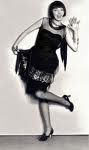
The Flaming Girl- Colleen Moore
Yes, she was an actress. She was the woman who invented the image of the twenties woman- the Flapper. The Flapper knocked Emma, an example of the Gibson Girl, out of the box just as the Gibson Girl had knocked Tennyson’s Elaine out. The Flapper knocked Emma right out of ERB’s imagination. Seems that Colleen was selected for the lead in the movie Flaming Youth. This was a big one.
The movie was based on Samuel Hopkins Adams novel of the same name written under the pseudonym of Warner Fabian. Although apparently epochal no copy of the movie has survived. Those racy scenes have disappeared forever. Miss Moore may be compared to Brooke Shields of the The Blue Lagoon of our day for impact. The tone of Flaming Youth may be learned from this quote from the novel: ‘They’re all desperadoes, these kids, all of them with any life in their veins; the girls as well as the boys; mayby more than the boys.’ Alright, man! That’s pretty good pulp style.
Miss Moore said she chose to play the part as a comedienne. She bobbed her hair, shortened her skirts and wore unbuckled galoshes that flapped as she walked, hence the term ‘flapper.’ Carefree, and careless and with the image of -easy. Flaming Youth eager for a roll and tumble. A thrill seeker at whatever cost. A role model dropped into the slot from eternity.
Perhaps Ed Burroughs sat through the 1923 movie two or three times muttering ‘yeah, yeah, that’s a what I want.’ Emma wasn’t quite that way, being a full figured woman with plenty of embonpoint, although reading inferences from pictures she may have tried a bob and weave in an effort to hold on to her man. There is a photo of Emma which caught my eye because she is so dfferent. She is leaning over the garden fence of ERB’s latest cottage, one of his umpteenth movies, with bobbed hair and a pleasantly flirtatious look on her face. ‘Hm, bobbed hair.’ I thought. ‘That’s different for Emma.’
By that time ERB had been flirting on the sly with Florence Gilbert, for a little while. I suspect Emma knew. She got her hair cut anyway.
ERB first met Florence in early 1927. Maybe he was still under the spell of Flaming Youth but something obviously clicked. A clandestine relationship was begun which would culminate in ERB divorcing Emma in 1934. He married Florence Gilbert shortly thereafter. I would have waited a bit myself. I’m not so impetuous. More of the cautious type.
The in 1937 he received a request from the Flaming Girl herself. Must have made his blood race. Maybe he and Florence should have waited. Having jumped ship once the second time gets easier. ERB, whether he knew it or not, had now gone Hollywood. He’d even checked into the Garden Of Allah, a hotel roues favored down on Hollywood Blvd., gone now, in between Emma and Florence.
If ERB kept all his correspondence as he is said to have done Danton Burroughs should have a Colleen Moore file in the archives. It would be interesting to open it to see what was up.
Miss Moore had begun building a Fairy Castle miniature doll house back in the twenties. She now asked ERB for a miniature book for her miniature library in her miniaturecastle. ERB complied, composing a suggestive little story which contains enough off color references to make one think he was trying to seduce the exemplar of Flaming Youth. Born in 1902, Miss Moore was 35 at the time, a most delectable age for a woman.
A quick review of the pictures of the book can be found on the ERBzine at www.erbzine.com/mag0/0042.html . I copy the text below.

Edgar Rice Burroughs- Author of Tarzan
Tarzan, Jr.
by
Edgar Rice Burroughs
Illustrated y J.C.B. & E.R.B.
Chapter 1
The little princess was walking in the garden when a bad thought sneaked up behind her and whispered in her ear, ‘Go into the forbidden forest.’ Hi! Lee! Hi! Lo! Oh, No! Oh, No! yodeled the little princess, my mamma said I mustn’t go into the forbidden forest and papa said she ought to know.’
‘But, but’ butted the bad thought, ‘Everything that you shouldn’t do, everything you mustn’t do, are in the forbidden forest, and they include about everything it’s fun doing. Think what a good time you could have.’
So the little princess put a nutty hamburger in a shoe box for her lunch, vaulted over the garden wall and went into the forbidden forest.
Chapter 2
The little princess had not gone far into the dark and gloomy wood when she met Histah the snake.
‘Have an apple,’ invited Histah. ‘What for?’ asked the little princess. ‘It will keep the doctor away,’ replied Histah, pulling on his long black mustache. ‘But if I eat it, I may need a doctor’ countered the little princess with her left. ‘Ah, ha! Foiled again.’ hissed Histah. ‘Not so fast,’ cried the little princess. ‘Gimme that apple,’ for the bad thought had whispered in her ear.
Chapter 3
The little princess was about to eat the apple when Tantor the elephant barged up and took it away from her. Beat it!’ he trumpeted at Histah. Then he ate the apple himself. ‘What have you in the shoe box?’ he asked.
‘A nutty hamburger,’ replied the little princess. ‘Mercy me!’ swore Tantor. ‘What’s the matter with it? – Dementia Praecox?’ No, just plain nutty,’ replied the little princess.
‘Well, you never can tell when it might develop a homicidal mania,’ said Tantor. ‘Give it to me.’ So he took the nutty hamburger and ate that too. Then he went away from there to the land of ptomaine.
Chapter 4
The little princess was very hungry; so she went deeper into the dark, damp wood looking for another snake with an apple. But she didn’t see Numa the lion stalking her. Numa, too, was very hungry; and as there are not many callories (sic) in stalks, he planned on eating the little princess. With a terriric roar he leaped for her. The little princess turned, horror stricken; when, to her amazement, she saw a bronzed giant, naked but for a G string, leap from an overhanging branch full upon the tawny back of the carnivore. It was Tarzan Jr.!
Once, twice, thrice his gleaming blade sunk deep into the side of the great cat; and as Numa sank lifeless to the mottled sward, the Lord of the Jungle placed a foot upon the carcass of his kill, raised his face to the heavens and voiced the victory cry of the bull ape.
Chapter 5
The little princess was still hungrey. ‘Let’s eat the Lion,’ she said, unless you happen to have an apple in your pocket.’
‘I haven’t a pocket,’ admitted Tarzan Jr.
‘All right then’ said the little princess, ‘Let’s skip it.’
So Tarzan Jr. uncoiled his rope and they skipped and skipped and skipped and skipped and skipped; and then they got married and lived happily for-ever after- and that is what the little princess got for disobeying her mamma and going into the forbidden forest.
End.
It’s not hard to see what the sly old ERB was angling at. the dark damp forest is, of course, the symbol for unbridled desires toward which the princess is prompted by a ‘bad thought.’ She was naughty but nice. The apple is a symbol for sexual intercourse while the snake with the apple was when Adam and Eve realized they were naked hence discovering la difference.
It will be remembered that the only exhibit at the Expo of ’93 ERB ever mentioned in his stories was the Concourse of Beauty 40 Beautiful Girls 40. On his cross country trip of ’16 one of the records athe family wore out was ‘Do What Your Mother Did.’ An early Work With Me Annie. Here the song lyrics are rendered into: My mamma siad I mustn’t go into the forbidden forest and papa said she ought to know.
Which leads to a denouement which comes as no surprise. ‘Unless you’ve got an apple in your pocket.’ The princess says obviously pointing to the bulge in Junior’s G string. Reminds you of Mae West’s quip: Is that a roll of nickels in your pocket or are you just glad to see me?
Junior was glad to see the princess so he reached under his loincloth and uncoiled his rope. Rope is a symbol for…well, he said coyly, it’s a symbol. And then the two new sweethearts did a lot skipping up and down which is to say they conjugated that verb.
I would interpret the nutty hamburger to mean ERB was sensitive about being considered a dumbkopf fantasy wirter so he wanted to display a little learning, thus he jokes his way through nutty>dementia praecox>homicidal mania. For those who insist that ERB was just a simple writer from the gut I again point out that time after time the Man shows an active interest in psychological matters. He just didn’t boast about it, that’s all. When you do you depreciate the entertainment value to nil.
The little story quite cleary is intended to convey the message: I’m ready if you’re willing. Flamin’ Ed Burroughs was ready tgo swing and he didn’t mean through the trees this time. Was marriage an issue? Well, Junior and the princess married and lived happily ever after.
Once again I say there should be some correspondence in the archives that might throw some light on this issue which is probably much more complex than it looks at first glance.
As 1937 began the titillating star of Flaming Youth who had also starred in Naughty But Nice and other woo-woo flapper epics was between marriages. Her last movie The Scarlet Letter- A for Adultery of 1934 had indeed been her last. Having no longer a career in Hollywood she had retreated to Chicago.
Her Fairy Castle which had been nearly ten years in the making was finished in 1935. At that time she took it on the road to raise money for deprived children which she did successfully. She later would write a book on investing.
The Castle was complete with its own miniature library so the request to ERB was either an afterthought or the proverbial request for a cup of sugar and he poured on rather thick.
Perhaps the marriage of Florence and ERB might have ended right there as ERB ran after the even more attractive Flaming Girl of his dreams. It would be nice if Danton found that correspondence.
Whatever Colleen Moore’s intent was or whether ERB ever consummated his burning desire may be forever obscured from our sight. In any event later in 1937 Miss Moore married a Chicago businessman thus closing the door she had left ajar. After panting up that flight of steps on his hands ERB was blasted.
As the little book was intended only for the eyes of Colleen Moore the only two things we can be sure of is that she requested the little volume which she was willing to receivew and that ERB was ready to provide a very seductive one.
In 1937 ERB had come a long way from the righteousness of 1922’s The Girl From Hollywood. Now he was Hollywood panting after them.
Tales Of Space And Time:
Love, Lust And Edgar Rice Burroughs
A Short Story
by
R.E. Prindle
The Image Of Flaming Youth- Colleen Moore
As they say in Hollywood, this is based on a true story. Only the facts have been changed to make a better story. Just as in Hollywood the tale is wholly fiction. Well, not wholly, there is one true fact included. I’ll highlight it at the appropriate time. I have used real names and places so as to cast an aura of truthfulness about a story that never happened. No matter, just as in the movies you won’t be able to tell the difference. Fact and fiction blend. It’s just like your memory.
Perhaps the time is March of 1934 when a now has been actress who had once, in the days when acting really counted in silent movies, been at the top of her craft earning 12,500 smackaroonies a week. Not small change in those pre inflationary days.
Sound and the depression had changed all that, plus advancing maturity. She was no longer in demand. After her last, The Scarlet Letter the studio head had nearly thrown her torn up contract in her face. As unpleasnt as that may be life contains such humiliating moments. Still as Hank Williams song says:
My hair is still curly,
My eyes are still blue,
Why don’t you love me
Like you used to do?
Love is like that, fleeting. Box office. Demand. Transient things like that.
Angry at the treatment and now having no future in the film capitol and the hearts of the multitude, with a stamp of her pretty little foot she turned her back on Tinseltown, if not her fans, returning to home town Chicago.
There she was fondly remembered and even lionized. She had been the original flapper girl, Colleen Moore, who had created the type for her starring role in 1923’s Flaming Youth. Twenty-one at the time her success had been exhilarating but she was a tough minded practical young woman; she hadn’t let it go to her head unduly. She she thought, she had gotten to the top at an age when others were still gazing at the distant snowy crests; she was on top and she would do what she had to do to stay there.
In creating the role of the Flapper in Flaming Youth she had created a new woman displacing the former ideal of the Gibson Girl. She had bobbed her hair, raised the hemlines of her skirts, given voice to a careless, carefree, thrill seeking easy party girl who liked to go skinny dipping. True she was following the script but she had been the archetype of a newer sleazier morality.
Quickly typecast in the new role her whole career had evolved into the naughty but nice type of girl. She was the image of the girl who would go all the way. It had been a burden to bear. She had quickly retreated into unreality. Using her new found wealth she had begun building a very expensive doll house which she called the Fairy Castle. Five hundred thousand dollars worth of Fairy Castle.
Colleen was not as carefree and careless as the image she had projected. She was a hardnosed investor who turned her own money green. The five hundred thousand dollar doll house hadn’t actually been made with her own hands but for her. She employed experts to design and construct it. Even as she was paying for it she was providing against an uncertain future. The house was modular with each room having its own separate container for easy transport. The Fairy Castle could be broken down and reassembled with ease.
And now as 1936 approached, just imagine the ’34 and ’35 flipping off the calendar and floating away across the screen, the reason became evident. No longer a star but still craving the limelight Miss Moore announced that she would take the Fairy Castle on the road to raise money for needy children. This was the Depression. There was a sure fire attention getter; she knew how to appear concerned for the young after having been responsible for corrupting flaming youth.
Over the next couple years she was very successful. The Castle would eventually raise over six hundred thousand dollars which in today’s equivalents would be several tens of millions. How much of it actually got to underprivileged kids wasn’t carefully recorded.
If she wasn’t quite as in the spotlight as in Hollywood, which place she still preferred to drab Chicago which for personal reasons she couldn’t leave, she didn’t go unnoticed.
On this occasion in mid-1936 she was gathered with the lights of Chicago for the reception of a rare book collection donated to the Newberry Library by one Mr. Frank Martin. In truth Mr. Martin would have given much more than a few old books to meet the Flaming Girl but this was unnecessary. As a reward for the books at his request he had been seated beside Colleen. He’d been a handsome rogue, you can accentuate the rogue, in his youth and now although almost seventy he still retained refreshing youthful features, full bodied but not stout, a head of glistening silver hair and no paunch, altogether a prepossessing figure of a man. Much better preserved than Edgar Rice Burroughs as he would comment to his mirror.
A dissipated life hadn’t hurt him any. It was true that Miss Moore was half his age but I think I mentioned earlier that Miss Moore was a practical woman; Frank Martin was rich, while at seventy he couldn’t live forever. After him there was room for one more.
On the other hand Colleen liked older men. She herself was Irish, knowing a great many Irish proverbs, which are the most amusing kind, she had selected as her favorite: ‘It is better to be an old man’s darling than a young man’s slave.’ Alas, in her first two marriages she had erred in this dictum much to her regret. Life, being a little forgiving in this instance, was giving her another chance.
She waited for Mr. Martin to be seated and then made her grand entrance. Never truly beautiful, what nature had denied art had supplied. She passed for beautiful in any man’s eye although the camera would have been less forgiving. As she approached Mr. Martin an electric spark worthy of a Tesla experiment flew between each as each realized their desires were to be met unless things went terribly wrong which I assure you they didn’t.
Frank raised his imposing 6’3″ frame from his chair with a grace that was warmly received by Colleen. They were nearly fast friends before their derrieres touched bottom.
‘I can’t tell you how much I admire your efforts for those poor children, Colleen. May I call you Colleen?’ This was a few years back when manners were different.
‘You may call me Darling if I can call you Frank, dear.’ She replied sweetly in her most flaming manner.
‘By all means Darling.’ Frank smiled back realizing he was in like Flynn before even Flynn discovered the way in. ‘Colleen, that’s a grand old Irish name.’
‘I am an Irish girl, but Frank, I’ve heard so much about you.’ Colleen ventured, who had, indeed, wasted no time in catching up on the gossip of the last thirty years or so. As an old roue Frank had left more than a paper trail in the memories of many. But, that’s gossip, on with the story.
‘Thank you Colleen.’ Already Martin who was also Irish had discovered a new love for the grand old name of Colleen. He put that emphasis on the pronunciation that Miss Moore blushed with pleasure. ‘We’ve certainly heard here of your wonderful success in the cinema.’ He used the word cinema to raise the cultural value of Miss Moore’s contribution to the developing world capitol of porn. then he compulusively blurted out: ‘Did you know my old friend Eddie Burroughs out there?’
‘Do you mean Edgar Rice Burroughs? No, I’ve never met him but I’ve heard his antics discussed a few times.’
Antics struck the right note with Martin.
‘What antics are you talking about?’ Martin followed up, eager for dirt.
‘Well, you know he bought the Otis estate? Apparently he bit off more than he could chew because no sooner had he bought it than he tried to turn it into a movie location for the studios. Said he wanted to be a businessman. He was raising pigs, cows, sheep, whatever, in what we thought was a madcap attempt to salvage the place. Then, of all things, he developed a golf course and something called the Caballero Country Club. I guess he thought we would all rush to join, and that after he defamed us all with that horrid book he wrote called ‘The Girl From Hollywood.’ What a time we had to get the publisher from continuing to print that. I was sure he was talking about me.
Next, this was really incomprehensible, he decided to start some Bohemian Free Love community. He sold lots and advertised for people who were like minded to him who minded their own business and lived and let live. You know what that’s a code for and this after writing his horrible Hollywood story condemning the rest of us for practically the same thing.’
‘Yes, Ed always was eccentric although he had charm for some people. Fell a little flat with me. You never could tell what he was going to do next. First he was here and then he was there and then he was back again. Wouldn’t stay home and wouldn’t stay away although we all wished he would.’
Martin’s eyes set on a scene of the distant past as his brow lowered and lower lip quivered in bitter remembrance.
Colleen had heard many of the rumors and stories concerning Burroughs. Martin and Emma Hulbert from 1896 to 1910 and beyond and especially the famous murder attempt in Toronto. It appeared the gates were open in Martin’s mind. Without trying to disturb his thought processes Colleen gently insinuated: ‘Yes, I understand you and he were rivals for the same woman.’
Martin wasn’t that far gone. He looked at her sharply but then as he had already conceived in his mind the notion that he was going to marry this woman he thought it perhaps best to get the story of Emma out in the open. Thus, wheareas he had been before truly speaking from the soul he now feigned the same expression crafting his evidence for his object.
‘The man, it hurts me to call him a man, had no use for Emma but as an adornment to his ego. He had no intention of marrying her he just wanted the comfort of knowing that she was there waiting for him, she was true blue all wool and a yard wide too. I was already thirty, hadn’t been married yet, and she, at my age then,’ he wanted to leave a path open to Colleen, ‘seemed an ideal choice. She was the perfection of the Gibson image, not like…’ Here Frank was about to make a derogatory reference to the Flapper but caught himself in time. ‘…the pale bloodless Elaine of Tennyson. Quite a wonderful girl really. You must have heard that Ed divorced Emma for a tramp half his age. Disgusting.’
Colleen was half Frank’s age but both seemed oblivious to the incongruity.
‘Yes. There was a lot of merriment over that one in Hollywood. Dearholt brought home his mistress to live with he and Flo. Of course Flo would have nothing to do with it. She already had her net around Burroughs so I don’t see why she ca…’ Here Colleen had to catch herself from seeming too liberal in sexual matters. Chicago was no LA and while the same sexual misdoings might have gone on there they were spoken of in a different way. ‘…red whether he had a mistress or not. Naturally she wouldn’t have wanted a menage a trois. But wasn’t there something about Burroughs being almost killed in a barroom fight?’
‘Oh, you mean Toronto. What a trip that was. The Colonel had business in New York so he was taking the car out of the yards for the trip anyway so I asked Burroughs if he wanted to tag along.’
‘I hadn’t heard you were that close friends at the time. I mean, Emma…did he go along with a rival?’ Of course Colleen knew the whole story but led Martin on to hear him tell it.
‘Did he? He jumped at it. ‘That’s what I mean, what was Emma to him? He didn’t even consider her feelings. And then he was disgustingly drunk from the moment he stepped in the car. Drank nonstop from the first thing in the morning to the last thing at night. We almost threw him off in Cleveland.’
Characterization is the thing. It should be clear that Martin is exaggerating for effect while the truth was Burroughs himself drank

- Edgar Rice Burroughs- Author Of Tarzan

only because everyone else was as was the order of the day. The booze was provided courtesy of the Martins and pushed on Burroughs. A careful selection of facts produces the desired effect.
‘Then by the time we got to Toronto all the sot wanted to do was to go to their version of the Levee looking for whores. Far a guy who seemed pretty well acquainted with the sleazy side of life he hadn’t learned to keep his mouth shut. He antagonized a couple degenerate brutes and before Patchin and I could make a move one of them flashed a sap that would have crushed Ed’s skull if I hadn’t grabbed the slugger’s arm deflecting the blow. Had to run him down to the hospital to get him sewed up. Bloody mess he was; served him right too.’
‘Who was Patchin?’
‘Dick Patchin. He came along too.’
‘Patchin. Patchin. The name doesn’t ring a bell.’
‘He wasn’t anybody. Just a guy I knew so I let him come along.’
Martin considerably expurgated the story. In fact Patchin was a go between who knew a number of unsavory characters, being a borderline thug himself. At Martin’s request he had hired a couple Chicago thugs to travel up to Toronto to meet the party in the Yellow Dog Saloon. There while Martin and Patchin stood one on either side of Burroughs to identify him words were exchanged followed by the assault with the spring loaded blackjack.
Martin’s intent had clearly been to murder Burroughs which the blow would have done if Burroughs himself hadn’t been able to get his arm up in time.
‘Ed wasn’t anybody then. Just a bum not much better than the guy who hit him. You should have seen the excuse for a suit he wore. No one could have figured he’d become so famous.’ Martin added in self-defense. ‘Then we came back and before I knew it he and Emma were married. Cut me out, just like that.’
‘And that was that.’ Colleen smiled. The comment made Martin realize she knew more than he was letting out as why shouldn’t she, the story had been all over Chicago for decades now.
‘I’m not saying I’m not a sore loser.’ Martin sulked. ‘I gave him hell until he fled Chicago to the wilds of Idaho where he belonged although he took her with him.’
A passion seemed to seize Martin at this time carrying him along on a flood of reminiscences.
‘And then he came back with her again. the son-of-a-bitch wouldn’t stay away. Like a bad penny he had to keep turning up. A kind of madness got me in its grip then. I couldn’t leave her alone. Damn, she was true to him. I couldn’t control myself. They never had kids you know, so I thought I still had a chance, like maybe she was waiting for me. They never had kids until after that night. She was visiting some friends and I just happened by as she was on the way to the streetcar. I offered her a ride home and she accepted.’ Here what Martin means is he got out of the car forcing her in which as Emma knew him well she allowed rather than embarrassing him by screaming for help. ‘Then, I don’t know, something took possession of me. Happens to everyone. Rather than driving her home as I intended I drove out into the country. I just wanted to talk to her. She told me to turn around but I hadn’t said what I had to say yet. Then she tarted yelling at me and she hit me. I lost control of the car. It took the ditch but fortunately we were thrown clear landing in some new plowed furrows. Neither of us was hurt. Somebody came along and I got us a ride. I got her home all right.
I guess she must have convinced Ed but right after that after eight years of marriage they had two kids in a row, I mean right after each other. That took care of her figure. After that I didn’t bother her anymore. I knew he wouldn’t do right by her though. I’m just surprised it took so long. Patchin went to see him after the divorce. The self-centered son-0f-a-bitch was blithe about the whole thing. After thirty-five years of marriage and three kids he was glad he’d done it, like she had it coming. He asked Patchin with a sneer and laugh how I was doing. He was doing OK. Hah!’
Colleen put her hand on his meaning to comfort him but coming across cynically: ‘Hollywood is full of hundreds of the same kind of story. Life is like that a whole lot, isn’t it?
With the suspicion of a tear in his eye and a deep wavering sigh Martin actually more than a little embarrassed by his outburst smiled bravely and said: ‘Well, enough about me. How about you? Where did you go to school in Chicago?
‘Oh Frank, I wasn’t born in Chicago. I was born in Port Huron, Michigan, a grim little town I was glad to get out of. Dad and Mom moved to Florida which I liked a whole lot better.’
‘But I thought you were from Chicago?’
‘My uncle Walt Howley was the editor of the Examiner who used his influence to get me a screen test with D.W. Griffith when I was fifteen. The rest is history. Over the years I’ve come to consider Chicago my second home so when I left Hollywood I came here.’
And so the evening wore on very agreeably.
Frank, who was a real candy and flowers man, proved a most charming and romantic suitor. Just right for the woman whose ideas of romance were reflected by her Fairy Castle. In the back of his mind Martin obsessed on his old rival Edgar Rice Burroughs. He had written finished on that particular book but slowly an idea formed in his mind to finish the job he had begun in Toronto.
To succeed he would have to lure Colleen into using her charms to lure Burroughs back to Chicago. Prostitute herself after the fashion of a temple priestess. People always put different names and constructions on their heart’s desires so one evening in September over a candlelit dinner Frank Martin put it to Colleen Moore like this: Honey…remember when we were kids and we used to set up a chump by having a message sent to him to meet some girl for a hot date then stood and laughed while he waited in vain?’
Uh huh, Colleen had heard of such things.
‘Ed has married this young woman who isn’t half what you are. When Patchin was in LA to talk to him he said that Ed just raved about the Colleen Moore of Flaming Youth and Naughty But Nice. I’d like to play a trick on him but I’ll need your help.’
‘What kind of help, Frankie?’
‘Well, if you were to send him a letter asking for him to make a miniature book for the miniature library of your miniature castle and make it sound like you were really interested, you know, hot for him, he might come back to Chicago to see you and then we could stand him up and have a real laugh at his expense.’
A little of the romance went flat as Colleen interpreted the request to mean that as Burroughs had once taken Martin’s girl now Martin would take Burroughs’s girl. Certainly this was part of Martin’s plan but the years had passed since those golden years at the turn of the century. With the coming of prohibition the Capone Mob ahd virtually seized the streets of Chicago staging murder and mayhem on a daily basis. The recent Century Of Progress Expo of 1933 had been practically controlled for the benefit of the Outfit. The thugs of 1893 were real amateurs compared to the professional assassins of the incipient Outfit. It mgiht cost a little bit but Martin thought a drive by shooting with typewriters might be a fitting end to his nemesis. He didn’t mention that part to Colleen though.
Unwittingly Frank had thrown a chill on their relationship. Romance had flown. In truth Colleen had had enough of Chicago. Those mobsters were not pleasant to fend off and they were attracted to the Flaming Girl like moths…naw, that’s too corny. She now longed to get back to Hollywood but wished to return as a conqueror rather than as a dog with its tail between its legs. It would never have occured to her otherwise but now as she thought about it, yes, she believed she could take Burroughs away from Florence. Martin waiting with hope and expectancy didn’t notice the change in Colleen’s voice as she said: ‘I think I see what you’re after. I think I could do that, Frank Martin, yes.’
As Martin left Colleen’s apartment he smiled to himself. ‘Nearly forty years to get that bastard back but it will be worth it.’
Colleen composed a very nice letter asking Burroughs for a little Tarzan Jr. book for her miniature library. The letter breathed romance terms like ‘long term relationship’ which were mixed in such a way to imply more than just an enduring friendship. You didn’t have to be born at the bottom of a wishing well to get your hopes up.
When Burroughs received the letter in the future Porn Capitol Of The World he was somewhat puzzled to receive a letter from Colleen Moore. ‘That’s the Flaming Girl herself.’ He thought. A faint whiff of pleasing scent was emitted as he slit the envelope open which made him raise his eyebrows. When he read what he read his eyebrows went way up. To say that he was steamed would be an understatement. The man had had a smoldering crush on the image of Flaming Youth Colleen had projected in 1923. He had seen most if not all her pictures. Separating a movie image from the real person is not always as easy as it seems espcecially as Colleen had reinforced the image in picture after picture. Naughty But Nice had all but sealed the image for Burroughs. He failed to note the romantic allusions in the letter as his sexual fantasies ran away with themselves.
He imagined himself as the legendary sixty minute man rolling and tumbling all night, night after night with the Flaming Girl. Who can blame him but that wasn’t how it was.
He should have studied the Fairy Castle a little more closely. Instead he put together a fairly salacious little volume dedicated wholly to sexual fantasies without a hint of romance. I told you this piece of fiction was based on a true story; this is the true part. If you want to see a copy of the little book, Tarzan Jr., go to www.erbzine.com/mag0/0042.html . It’s right there.
So Our Man wrote this up, he and his son John Coleman drew some fairly rasty pictures, and posted it back to Colleen.
Colleen received the little book which she perused thoughtfully. ‘Why the old buzzard is just a dirty old man.’ She thought, deeply offended. She put a mental cross through the name of Edgar Rice Burroughs and tossed the little book in the fireplace. She stood looking after the little book for a few moments then went over to retrieve it. Romance was romance but the practical Colleen overrode the romantic Colleen.
When Martin got the news that Burroughs had taken the bait he was overjoyed. ‘Verily, I shall smite my enemy hip and thigh.’ He said to himself.
He left Colleen stepping blithely. Then he bethought himself to have some nice pasta at this little Italian restaurant not too far away. He didn’t pay much attention to the gentleman who entered a the same time to also enjoy a nice pasta dinner. This gentleman was Jackie Inglese who had shown too much independence in intra-mob matters. Jackie was a marked man and this night was his night to be rubbed out.
Frank emerged from the restaurant just ahead of Jackie Inglese. He was standing there contentedly digesting his dinner with roseate thoughts about those typewriters. ‘Rat-a-tat-tat.’ He said lifting a finger in imitation of a Tommy gun.
He was so absorbed in his reveries that he didn’t hear the screech of the tires of a big touring car careening around the corner with a young Sam Giancana behind the wheel. Jackie Inglese did. Seizing Frank he pulled him in front of himself as a shield beginning the drop to the ground as a battery of Chicago typewriters poked through the open windows of the speeding auto opened up. It wasn’t the St. Valentine’s Day massacre to anyone but Frank as two slugs found their to his heart and one went through his brain. Rather amazing that three Tommy guns unleashing about a hundred rounds of ammunition could only get three into Frank but that’s the way it was. The earthly career of Frank Martin was ended. Edgar Rice Burroughs would have to go unavenged in this world. Tough luck.
Inglese with a deep sigh pushed himself up from the ground. Without even a look or a thank you to his savior, Frank Martin, he casually dusted himself off, sought a train for the Coast and stayed there until he cooled off.
Colleen read the news in the papers with a misture of disgust and relief. She made no further effort to contact Edgar Rice Burroughs who had disgusted her. Within a month she had married a local businessman named Homer Hargrave. She lived happily for a while until the old geezer topped off, she really did like mature men, then with the combined fortunes made her successful entry back into Hollywood taking up a residence on Sunset Boulevard.
As for Ed Burroughs? He didn’t go on to bigger and better things. Like Colleen’s his day was past. It’s possible he might have done something but the big WWII intervened which was probably more rewarding for him than any woman. He realized his desire to be a war correspondent. And then after the war was over disease and old age carried him away.
His dying thought though was of the fabulous Flaming Girl and what could have been. It is the kind of thought to hold on to when the lights go out.
A Review: Fred Seaman: The Last Days Of John Lennon
May 18, 2010
A Review
Fred Seaman:
The Last Days Of John Lennon
Review by R.E. Prindle
Seaman Fred: The Last Days Of John Lennon, A Personal Memoir. Citadel Press, 1991.
The Ghost Of Elvis Presley

Double Elvis- Andy Warhol
In order to understand the zeitgeist of the sixties one has to go back to the fifties. The central event of the fifties was the annunciation of Elvis Presley. The post-war world was a grey world of fear. The country and the world had emerged from the greatest of all catastrophes, the Second World War. WWII itself was fought in the shadow of the Great War of 1914-18, afterwards known as WWI.
Most of the older generation had lived through both wars which was a terrifically horrifying experience. In 1950 those who were seventy or older had memories of the Indian Wars of the late nineteenth century also. In addition perhaps the most terrifying memory of the pre-WWII generations was that of the Great Depression of the thirties. From 1945 to 1960 they lived in terror that the Depression would return. There was thus a great generational divide between them and those of us who had no memory of the Depression and only vague memories of the second world cataclysm.
The older generations were struggling to restore the normalcy of the period between the wars as they wished it might have been. Technology had made this impossible. Not only had the Atomic Bomb come into existence but almost immediately after the war the sky was filled with the most extraordinary of phenomena- the faster than the speed of sound jet plane. The pilots of this wondrous piece of technology delighted in flying low over cities breaking the sound barrier as they did and sending a sonic boom shimmering down. If you’ve never experienced a sonic boom you have yet to be there.
The miracle of the age however was television. (Some people call it the boring fifties but they obviously weren’t there.) Television made the greatest threat to civilization yet known to man possible. That threat was Elvis Presley. Elvis simple announced by his presence that the pre-war world would not be returning- ever. The younger generation would fashion the world in his image.
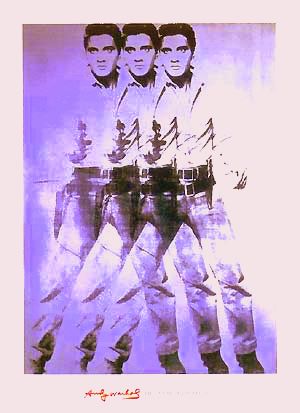
Triple Elvis- Andy Warhol
More than that Presley wasn’t an image of the upper class college youth like Pat Boone but the avatar of the downtrodden and suppressed not unlike Jesus the Christ himself. They took one look at Elvis and realized that he was the Atomic Bomb that would blow up their world. And he did.
Every move Elvis made was an insult to them. Things that had no relevance to them they took as a personal insult. One such was the innocuous anthem by the songwriters Leiber and Stoller originally written as a Negro ghetto sex anthem, Hound Dog. When Elvis sang You ain’t nothin’ but a hound dog, for some reason they projected it as a reference to themselves and they deeply resented it.
Of course every attempt to suppress Elvis deepened the generational divide. Not only did Elvis himself exist but it seemed as though every upcoming rock n’ roll singer wanted to be Elvis. Before the Presley clones of Vegas there were the Elvis imitators in every family’s living room like Gene Vincent, Ricky Nelson, Eddie Cochran and nearly the whole roster of Sun Records, plus, plus, plus….
For most of the old folks rock n’ roll itself was a mystery. They thought it was a Communist plot, might have been I don’t rule it out, but if so we were not conspirators but dupes. We just reveled in it. They almost succeeded in destroying it. Elvis got drafted, in his absence the great rock n’ rollers were driven out, discredited and in some cases killed. When Presley returned in 1960 he was different from when he went in. He had been contained.
John Lennon famously said in 1977 after Elvis died that he died the day he went into the army. While a relevant statement it was not quite true. The first stage in Elvis long immolation was when he fell under the control of his manager Col. Tom Parker, the second stage in his demise was when Parker delivered him to RCA Records, the third stage in his death was when RCA assigned Steve Sholes as his producer.
For those of us who were there the real Elvis Presley ceased to exist when he left the Sun record label. RCA was in no position to understand rock n’ roll values. It wasn’t that they willfully sabotaged Elvis it was just that they didn’t know how to rock. Their idea of rock was Neil Sedaka. Sholes himself was antipathetic to rock ‘n roll no less than his crosstown rival Mitch Miller over at Columbia Records. Both men hated the concept. This was made evident in Sholes arrangement of Gene Austin’s Are You Lonesome Tonight with its plodding guitar riff and Elvis’ imitation of the thirties crooner. Sholes failed to ruin Elvis’ career but it took Mitch Miller one LP to trash the career of the great Dion of the Belmonts.
Very few if any of the great rock records were produced by the majors. Nearly everything of value was produced by independent labels, many of them one shot efforts. Gene Vincent and his Be-Bop-A-Lula was a notable exception although his label, Capitol, soon had him singing Somewhere Over The Rainbow.
After the first run of actual imitators Elvis and rock worked their way into the subconscious of the next wave that included Lennon and the Beatles to produce an extension of rock.
Upon Presley’s return from the army his manager, Parker, removed him from recording and put Elvis into the movies almost exclusively. The movie Elvis was an extension of the personality of Tom Parker. Elvis was Elvis and his appearance was always galvanic. His charisma could be diminished but it couldn’t be destroyed. I was as disappointed by his movies as much as anyone dropping in only occasionally over the sixties to see if anything had changed. It hadn’t.
Thus as we all moved into the sixties while Presley still lived it was only as the ghost of the Sun Records innovator.
The Ghost of Elvis Presley was captured by the artist Andy Warhol in a number of renderings.
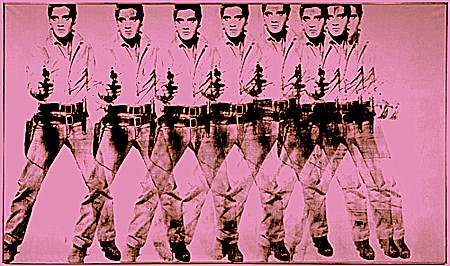
Octopresley- Andy Warhol
He presented Elvis in various single screens or multiples of two, three and up to the eight as in the image above. He ignored the musical Elvis in favor of an image taken from a Western movie. As Warhol was a homosexual he rendered Elvis as a gay cowboy. In truth Elvis had an ambiguous persona. Many people thought he was queer. Any male fan felt himself under the accusation. Elements of his persona indicate a severely emasculated personality that lend credence to at least a latent feeling of homosexuality. Elvis’ fellow students called him ‘squirrel.’ Indeed, the use of eye shadow, pants with a stripe down the leg and pink shirts in 1951-52 and ’53 would have led to open accusations of homosexuality. And yet, even though I identified with his obvious emasculation when I was only sixteen and seventeen it never occurred to me that he might have been one. I don’t think he ever was. Had he been his more than macho entourage would have had nothing to do with him. Nevertheless his portraitist Warhol perfectly captured his ambivalence and androgyny.
The number of portraits by the artist clearly betrays Warhol’s own hero worship. Perhaps his own gay cowboy movie owed some reverence to his idol. Oddly enough Warhol never designed a record cover for Presley even though he designed over fifty during a career from 1949 to 1987.
Andy had always been a pop music fan. This was very unusual for a man born in 1928. This would have made him 26 if one assumes ’54 as the birth of rock and 28 in ’56 when Presley exploded onto the scene. Anyone older than 18 in ’56 rejected rock. It is true that Warhol was dualistic, capabhle of listening to opera and rock at the same time, I mean simultaneously, so he may have had his personality split by the times. At any rate Warhol who apparently wished to excel in all the arts attempted to enter the music field by managing a band, while establishing a rock venue. In 1965 he took The Velvet Underground in as his house band while setting up a venue called The Dom. Not stopping there he also created an ambient experience, or light show, he called The Exploding Plastic Inevitable. The combination of music and light was innovative and widely imitated. Unfortunately Warhol didn’t have a secure lease and the venue got away from him. Perhaps realzing he was spreading himself too thin he never followed up letting the Velvets go their own way.
Warhol nevertheless established close bonds with other musicians. His attempted connection to Bob Dylan failed. Whether sour grapes or not he comitted this thought to his diary in July of 1985:
Watched the Live-Aid thing on TV. Bobby Zaren’s office had been calling, wanting me to go down there, but with that many big celebrities you never get any publicity. Later on that night Jack Nicholson introduced Bob Dylan and called him “transcendental.” But to me, Dylan was never really real- he was just mimicking real people and the amphetamine made it come out magic. With amphetamine he could copy words and make it all sound right. But that boy never felt a thing- (laughs) I just never bought it.
Warhol did succeed with Mick and Bianca Jagger and the Rolling Stones. While his cover for the first Velvet Underground album was considered innovative (read: weird) his cover for the Stones’ Sticky Fingers album with its functional zipper was as the term of the time went, mindblowing.
While Warhol never established contact with the Beatles, when his fellow artist Yoko Ono led her trophy husband, John Lennon, from London to New York in 1970 another firm connection to musicians and the inheritor of Elvis Presley’s mantle as the Savior was formed. Over all floated the Ghost of Elvis Presley.
Part II: John & Yoko In New York follows.

After the Topps Baseball Card Style
A Review
Woman
by
Alan Clayson
Yoko Ono And The Men Who Influenced Her
Review by R.E. Prindle
Clayson, Alan: Woman: The Incredible Life Of Yoko Ono, Chrome Dreams, 2004.

Girlish Yoko- Warhol School by Richard Bernstein
Yoko Ono involved herself with several of the most influential men in the arts during the sixties, seventies and eighties of the twentieth century. She drew her inspiration from them patterning her own efforts after them. At the same time she was one of the leading feminists of the day having her share in shaping and furthering the movement. The mantra was female liberation, equality between men and women. In fact women were equal to men in the West but only by acknowledging the biological differences between men and women. The fact is the differences are real and not social constructs as women would have us believe. The fact is women are women and men are men. So, in seeking ‘female liberation’ feminists were seeking much more than ‘equality’ however the term may be defined.
The fact is that in the Ages old war between the sexes feminists are seeking to restore the Matriarchy and destroy the Patriarchy. That is why many men favor feminism, they prefer the Matriarchy. Thus the feminists are atavistic. Yoko and her cohorts wished, in her words, to restore ‘heart’ as she viewed the Matriarchy and eliminate ‘reason’ as she viewed quite rightly the basis of Patriarchalism. Nevermind that bilogical science has invalidated the concepts of Matriarachy and Patriarchy. This is a post Matriarchy and Patriarchy world.
Circa -2000 in the West men revolted against the mind stifling Matriarchy and the vaginal swamp of the ‘heart’ seeking to establish

Smilin' Jack Cage
the authority of the infinite power of the mind of Zeus on ethereal Olympus. This is the story of Homer’s Iliad and Odyssey and the Greek myths in general recording the struggle.
The Western male was able to impose the ascendency of reason over the heart for 3000 years until the disestablishment of the old order by science about mid-nineteenth century. The center could not hold during this period of extreme change as W.B. Yeats put it as the rearrangement of the intellectual order moved into the twentieth century.
Yoko Ono sought with her feminist fellows to return to the biological innocence of 2000 BC. She herself had no talent. Filled with audacity she pitted her ‘heart’ against the reason of John Cage, Andy Warhol and John Lennon. I’m sure she had a mentor for her so-called performance art but I am as yet unaware of who he may be. Perhaps Maciunas and the Fluxus group.
Thus her first manifestation as an artist was based on the musical ideas of John Cage while her artistic efforts were at least based in the avant garde ideas of the Fluxus group. Her first assault on the NYC art world failed so in 1961 she returned in defeat to Japan. When she returned to NYC in 1964 she found an entirely different art scene. On the musical side the focus was on Bobby Dylan and the Beatles while on the artistic side Andy Warhol and his Factory had destroyed the Abstract Expressionists and the old avant garde. Dylan, the Beatles and Warhol had in fact usurped the avant garde which now had little meaning. From my point of view held at the time the avant garde had ceased to exist. Of course I didn’t understand exactly why or how.
From 1964 when Yoko returned to NYC until 1966 when she left for London I’m sure Yoko was at a loss. She developed her silly

The Bag Yoko And Tony Are In
notion of Bagism at this time even having a black bag on a stand in Max’s Kansas City that some one or ones were supposed to slide into. This seems to have been thought a lame idea at the time as it seems now.
At this time while retaining allegiance to John Cage’s musical ideas she was falling under the influence of Andy Warhol’s artistic notions. Warhol’s intent had been to destroy the idea of ‘fine art’. In this he pretty well succeeded. As Yoko expressed it you didn’t need any talent to be an artist. She seems to demonstrate this notion in her own artistic efforts. Warhol had also redefined the notion of film with his static studies. He then sought to combine his film ideas with live music, probably in competition with Bob Dylan who was also attempting to move in that direction. Warhol adopted Lou Reed and his band the Velvet Underground as the Factory house band while creating a multi-media show called the Exploding Plastic Inevitable, innovative for its time. Thus a concert at his hall, the Dom, was an ‘experience.’
While Yoko makes no mention about how this, actually, incredible development affected her there can be no doubt that she was well aware of Dylan, the Beatles and the Warhol Experience and was affected by it. Indeed, the first manifestation was the making of her Warhol style films such as Bottoms.
The second manifestation was her removal to London to seduce either Lennon or McCartney of the Beatles, thus in the manner of Warhol’s adoption of the Velvet Underground she sought to co-opt the Beatles, the premier rock group in the world. Real chutzpah and more than one upping Warhol. I think it would be nonsense to think she had any other goal in mind.
She undoubteldy learned that Paul McCartney was actively involved with John Dunbar and his Indica Gallery that opened in 1965.
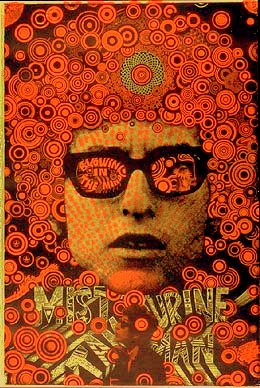
Psychedelic Dylan
Some say she first set her sights on McCartney but the more vulnerable Lennon showed up and the Spider Woman spread her web.
She was still married to her second husband, Tony Cox, but, regardless of what she says she very aggressively pursued, or attacked, Lennon. Lennon was emotionally under water unable to handle his success while drugging himself out of his mind. He was unwillingly married to his wife Cynthia. It appears that he married Cynthia out of duty when she became pregnant. He doesn’t seem to have been happy in his virtue. Yoko had no difficulty in capturing his affections.
Now, just as Warhol had adopted the Velvets and imposed his female singer, Nico, on the band Yoko sought to imp[ose herself on the Beatles through Lennon. At this time she was still musically completely in thrall to John Cage understanding nothing about Rock music. She and Lennon had made a ridiculous LP called Two Virgins in 1968. She combined her cagian screechings while using an avant garde ‘performance’ notion of the couple posing nude on the cover; full frontal on the obverse, full posterior on the reverse. As no store would carry the cover the couple reverted to Yoko’s idea of Bagism placing the cover inside a plain manila envelope or bag. While it didn’t sell the record this form of Bagism was actually a successful artistic statement. The nude cover given an outer garment so to speak.
Well, the public was prepared to forgive the Beatles anything but the other three Beatles weren’t prepared to forgive Yoko for forcing herself on them thus she broke up the most successful act of the sixties. Still, she had succeeded according to her wildest dream. Lennon and his wonderful reputation and fortune were hers. She had gone from a neglected, nondescript ‘performance’ artist to center stage, not on her own womanly talents but by attaching herself to a talented man. Yoko’s ‘heart’ was useless without the male intellect. Yoko was now the most influencial feminist in the world. She knew what to do with that.
After several ‘performance’ acts such as the ‘Bed In For Peace’ the couple left England to return to the place Yoko wished to subjugate artistically, New York City. She had raised herself to a par with Andy Warhol. She now had to meld her musical and artistic goals through Lennon and Warhol.
On the musical side she began to develop her rock n’ roll skills under the tutelage of Lennon. While not abandoning the avant garde notions of John Cage she now emasculated her husband. Always semi-delusional or perhaps completely so, she fantasized that she was not only equal to Lennon in skill and popularity but superior to him. She imagined herself more popular than Lennon. Thus one has such travesties as the LP Double Fantasy. It was only after Lennon’s death that she was forced to recognize than Lennon’s fans did not appreciate her efforts. So she failed as a musician.
She quickly tired of being Mrs. Lennon. Thus she and Lennon separated for eighteen months or so during the years 1973-75. She then realized that her financial well being and musical acceptance depended on Lennon. In 1975 she called him back resuming their relationship until his death in 1980. But, things had changed.
She began to adopt Warhol’s life style on her return to NYC. While she propagated the notion that she was some sort of business whiz Iam having difficulties discovering any such skills. It appears that with the enormous income of Lennon she emulated Warhol in
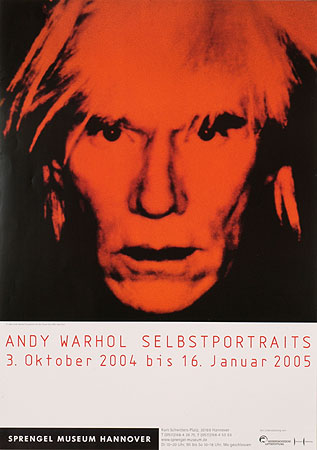
Andy the Demon
spending her way to prosperity.
She was in a position to not only match Warhol’s spending but exceeding it by many times. Through the seventies and eighties Warhol came into his own as an artist while reaping a fortune doing portraits. There appears to have been no effort on his part to invest in income producing vehicles. Rather he bought stuff. He purchased buildings in NYC and elsewhere while acquring undeveloped acreage in places like Aspen. He shopped nearly every day buying antiques from furniture to objets d’ art by the bushel almost as though he were trying to excel the incredible W.R. Hearst.
He usually didn’t even look at the stuff once he bought it merely filling rooms with his shopping bags. At his death all this junk was auctioned off for 25 million dollars, a nice appreciation in value.
Yoko followed the exact pattern buying apartments and houses as well as an extensive dairy farm with a herd of prize cows. She not only had but has five apartments in her principal dwelling, the Dakota apartment building and many other houses scattered around.
Like Warhol the Dakota apartments are stuffed with junk. Valuable, but, you know, stuff. She bought at good prices. Her extensive collection of Egyptian antiquities was mostly purchased before a steep rise in value.
Like the Rothschilds of old Yoko didn’t do all her own shopping but employed agents to search things out. Chief among these was an associate of Warhol’s, Sam Green, and an Hungarian immigrant by the name of Sam Havadtoy.

Buddies- Yoko, John, Andy
There should be no surprise then that she now has an extensive collection of Warhol’s artwork as well as his portraits of Lennon. The Warhols would have been purchased for form 25 to 50K while now being listed on her assets at tens of millions. She also has been said to have a good collection of Magrittes as well as one assumes other artists. So, much of her net worth is tied up in artwork purchased through Sam Green.
Sam Havadtoy was an antiques dealer as well as an interior designer. He appears to have been a somewhat shady character. It is very difficult to find much about him, however there is a sharp portrait available from the notorious A.J. Weberman ( http://www.acid-trip.org/lennon/ )
…(the Lennons) hired a sleazy Eastern European bisexual to renovate the pad. (Dakota) I had heard of this dude, whose name escapes me, from an asswipe named BRUCE KIRSH, who worked for him. KIRSH told me that the dude, who worked for the King of Morocco, would form a dummy renovation company, hire employees like Kirsch who were willing to work under false names, then, when it came time to pay taxes, everyone would disappear. I learned of him long before he was hired by John and Yoko, and I was taken aback when Yoko took up with him after John’s death.
I know that Weberman is not particularly well thought of by fandom but this is because of his harassment of Dylan who did, after all, misrepresent himself to the revolutionaries like Weberman. A.J. himself is an intelligent observer who was wading through it when it was deep. I do believe he knows what he’s talking about although his interpretations of Dylan’s lyrics seem absurd.
I would have to question Yoko’s judgment in taking him in. Both he and Sam Green were candidates as successors to Lennon with

Lennon by Warhol
whom she consorted in front of Lennon before he died while Yoko chose Havadtoy as his successor the day he died.
Perhaps she selected Havadtoy over Green because he was more rough trade. With Lennon while managing to reconcile revolution with peace and love with Havadtoy she discarded peace and love in favor of strong arm methods against her former employee Fred Seaman when it was totally unnecessary.
Havadtoy was living in a homosexual arrangement with his business partner when Yoko beckoned him to switch to her. Apparently an able switch hitter he was lured by the money to this much older woman. The arrangement did last for twenty years before Havadtoy removed to his native Hungary taking a nice cash settlement and several of the Warhols.
Thus, just as Warhol had his live-in homosexual arrangement so after Lennon’s death Yoko adopted the exact arrrangement. Today she apparently lives alone, a seventy-eight year old woman.
After Lennon’s death there was an accession of from 30 million to a possible 100 million dollars as their last album, Double Fantasy, sold into the millions while the rest of Lennon’s catalog and one assumes the Beatles’ catalog was reinvigorated while all things Lennon sold. This is, of course, no reflection on Yoko but the inevitable result with intellectual properties when the maker dies.
Post-Lennon, then, Yoko realized that her recording and art careers were nil. Heart without intellect is worthless. She then became the caretaker of the Lennon legacy. His recordings, of course, continued to sell, but even his artwork eclipsed that of Yoko. So she suffered the humiliation of being a mere appendage to a man. The feminine dismal swamp was eclipsed by the Olympian heights of the male intellect. As in ancient times the God had trumped the Goddess. And yet as with Hera and Zeus the Goddess gets her way. Yoko came up with the money and goods while Lennon’s spirit was wafted into the stratosphere.
As any reader of mythology knows Hera ruled the Lernean swamps of Argolis while Zeus ruled the gods on ethereal Olympus. Thus one has the symbolism of the biological difference between the male and female.
In ancient times the female had her share in magic. She knew herbs and plants, was familiar with poisons and cures as with the arch witch of the ancient world, Medea. The reputation of the female witch even as a consort of Satan persisted down through medieval and post-medieval times, indeed, even up to the dawn of the scientific enlightenment. One would have thought that magic and witchery were a thing of the past in the 1960s and yet Yoko embodied the whole female swamp mentality.
She established something called the Spirit Foundation attributing the direction to Lennon who in fact knew nothing of these matters but followed her lead. The Spirit Foundation celebrated the ancient art of the Shaman or witch doctor. Shamanism itself even preceded the Matriarchal swamps of Argolis. It was a rich repository of magical tradition. Further the Foundation was feminist in that it was dedicated to preserving the magical traditions of the women of the Pacific islands still living in such archaic societies. The wealth generated by the male intellect was appropriated by the female vagina or ‘heart.’
In her own life and that of Lennon’s Yoko was addicted to a variety of magical practices- astrology, numerology, Tarot readings, and indeed she traveled to the Caribbean to sell her soul to Satan through the offices of a female curandera. Her Tarot reader, John Green, was a priest in the shamanistic, magical, Yoruban African cult of Santeria.
Her feminism was more a magical effort to restory Matriarchal supremacy over the Patriarchy thus reversing the Patriarchal victory of three thousand years previously. Indeed, what has been called the movement for female equality is nothing more than a covert campaign to restore the Matriarchy.
Thus while Yoko o9riginatd nothing she usurped the abilities of the reason of men- Cage, Warhol, Lennon and male magicians such as John Green. Indeed the Trojan War itself was a war of men in service of women.
In her associations with men she preferrred to deal with emasculated types such as homosexuals like Cage, Warhol, Sam Green and Sam Havadtoy. Lennon claimed to have always been dependent of women for comfort and guidance while Yoko caught him at his most confused and vulnerable.
While she received direction from Cage and Warhol she was able to manipulate Lennon out of his talent somewhat as Vivian did that of Merlin of the Arthurian saga. When Vivian had usurped Merlin’s magical knowledge she buried him deep much as Lennon was put out of the way. Yoko then appropriated his wealth and residual income after his death. It was this constant inflow of cash that allowed her to propagate the notion that she was a financial genius.
Then as the female of the ‘heart’ or vaginal swamp she managed and appropriated the reason of Olympus through Cage, Warhol and Lennon. What she got from Havadtoy other than brute strength is not clear to me.
As such Yoko is Woman. In her case a seeming reversion to the archetypal Shaman of the most ancient times.
Themes And Variations
The Tarzan Novels Of Edgar Rice Burroughs
#23 Tarzan And The Madman
by
R.E. Prindle

What A Long Strange Trip It’s Been
In everyone’s life there comes a time to recapitulate. Tarzan And The Madman was that time for Edgar Rice Burroughs. The Great Saga began in 1912 and in this novel of 1940 unpublished during his lifetime the long strange trip, to quote the Grateful Dead, came to an end. The Big Bwana and his imposter got on a plane and flew out of Africa never to return.
Two more unpublished novels in his lifetime would follow but they were placed in the Pacific either in or near Indonesia. The succeeding Tarzan And The Castaways was also unpublished during his lifetime while Tarzan And The Foreign Legion could find no takers so was published by ERB, Inc. It almost seemed as though the sun had gone down on the Great Ape Man.
Of course the movie Tarzan still prospered, first with the great Johnn Weismuller and then Lex Barker. ERB even tips his hat to MGM by replicating the flight through the fog to the great tabletop of the Mutia Escarpment, an MGM invention. Thus, the last game is played out on the MGM playing field. Just as ERB and Florence left LA on a plane so Rand and the Goddess and Tarzan do Africa in this novel. In a short 157 pages ERB manages to recap the Big Fella’s entire career in print or on film.
In reading through the book this last time I suddenly realized the significance of all those doppelgangers. They signified the problem ERB was having realizing his ambition to be the man who was Tarzan. In Madman he gives up the ghost realizing his failure to become the Man-who-thought-he-was-Tarzan but wasn’t. Now typing away in exile from LA on Hawaii he throws in the towel.
As I have tried to show in my other reviews ERB read Robert Louis Stevenson’s The Strange Case Of Dr. Jekyll And Mr. Hyde probably sometime before 1890 within four years of its issue. The book must have been a sensation during his years at the Michigan Military Academy, the subject of endless discussions among the cadets. As hard as it must be for us to realize what we consider a classic was an exciting new book for ERB. No movies could be made of it because the technology hadn’t been developed as yet. Even the primitive Nickelodeons were shimmering a ways into the future. Yea, verily, the future lay before them.
The novel was significant enough to be in the first batch of talkies being produced in 1931. I’m sure ERB was transfixed as the story unfolded on the screen. The theme of psychological doubles had dominated the Tarzan oeuvre from the beginning. While it seems repetitious to a first reading of the novels the theme is actually developing as the series progresses. ERB didn’t so much fall back on a cliché but he was working out a variation on the theme of Jekyll and Hyde.
He says that he was convinced that every man had two sides to his personality, perhaps not as pronounced as that of Jekyll and Hyde but there nonetheless. He was aware of his own duality chronicling it in the pages of the Tarzan oeuvre. The duality is often prompted by a blow to Tarzan’s head. The blow certainly commemorates the hit ERB took in Toronto while perhaps the aftermath split ERB’s personality so that he became two nearly different people. Perhaps that’s the secret of his writing career as he said that he was able to disappear into the alternate reality when he wrote.
Tarzan always had two personalities from the beginning. He was both a civilized man and a beast. This undoubtedly represents ERB’s feelings about himself. Perhaps he had periods when he was something of a wild man, not unlike Tarzan on the Rue Maule in The Return Of Tarzan who became a beast and then shook himself back into a human not unlike the transformation of Jekyll and Hyde. This type of duality would characterize the Russian Quartet, the first four novels.
The Tarzan true doppelganger first appeared in Jewels of Opar where having received a blow to the head he loses his memory during which he lived as an uncivilized beast, regaining civilization with his memory, but he had not yet split into two co-existing separate identities. That would first occur in Tarzan And The Golden Lion and Tarzan And The Ant Men when the great character of Esteban Miranda served as a doppelganger. Esteban was identical to Tarzan in appearance but an arrant coward compared to Tarzan. This was a characteristic of all the doubles. Esteban represented the negative pre-success side of ERB while Tarzan the positive post-success side. Thus in these two novels ERB is beginning the attempt to become Tarzan- The-Man-Who-Thought-He-Could-Be-Tarzan.
ERB was very sensitive about his early failings in his relationship with Emma. In these two novels he offered Jane/Emma the chance to recognize him as the strong Tarzan and not the weakling Esteban doppelganger. Having overcome the failures of his past he felt he had proven himself as a man and a supreme provider demanding recognition. Given the decision to make Jane/Emma chose ERB’s former existence, Esteban, thereby sealing her fate. After her ill fated choice Jane disappears from the oeuvre except for the chance encounter in the succeeding novel Tarzan Lord Of The Jungle whereas the Golden Lion assumes a prominent role.
While the next double, Stanley Obroski, appears in Tarzan And The Lion Man a double of sorts in the form of Lord Passmore makes his appearance in Tarzan Triumphant. Another double appears in Tarzan And The Leopard Men when felled by a giant tree in a storm Tarzan blanks out assuming another persona. Also, in Tarzan And The City Of Gold Valthor serves as a double. In a strange variation ERB repeats the story of Jewels Of Opar when Tarzan rescues Jane from the Arab boma. Here, in an exact duplicate of that scene, he rescues Valthor. Thus Jane and Valthor are connected in ERB’s mind.
In Tarzan And The Lion Man Burroughs kills off his weaker persona thus assuming the role of Tarzan himself. Then in Tarzan And The Forbidden City Brian is his look-a-like although the role of double is not explored. Perhaps this is the initial realization the ERB has failed in his quest to be Tarzan.
After a decade of trials and tribulations struggling against the Communists and MGM and losing ERB sat down in exile at the beginning of 1940 to write this confession of defeat.
The man-god Tarzan himself remains the same but The-Man-Who-Thought-He-Was-Tarzan but failed confesses his defeat getting into his airplane up there on MGM’s Mutia Escarpment flying out of Africa forever. First he was expelled from Opar by the Communists and then from Africa by MGM.
Although Tarzan was in the plane with him, the Big Bwana shows up again in Africa for a moment in Tarzan And The Castaways. This novel written in a style entirely different from the rest of the oeuvre was also unpublished during Burroughs lifetime hidden away in a safe.
In this novel Tarzan is defeated by a Black chief, symbolically perhaps, captured and sold as a wild man, a feral child. Once again Tarzan has lost his memory reverting to a pure beast or feral boy. As this novel was written after King Kong and Tarzan ends up on yet another island perhaps ERB was conflating the movie with this novel. Tarzan is put aboard ship with the other animals destined for the circus and taken from the continent.
Running all through Burroughs is the ghost of Jule Verne’s Mysterious Island. Once aboard ship a storm assaults the ship which, signficantly loses its rudder. Thus like the now rudderless Burroughs the ship is adrift. In a scene reminiscent of both Verne’s novel and Robert Louis Stevenson’s Kidnapped the ship is tossed atop a reef while all aboard including a Noah’s Ark of animals find their way to shore as the Castaways.
Stevenson and Verne were two of ERB’s earliest influences thus ERB returns full circle to his origins.
In the last Tarzan novel and the last published in his lifetime, Tarzan And The Foreign Legion, at the very end the fugitives from the Japanese army approach the remains of the Mysterious Island that after the volcanic explosition of Verne is a mere spire of rock in the vast ocean. Not a refuge in the world left for Tarzan or ERB. Like Capt. Nemo a submarine surfaces to rescue Tarzan and the Legion from a watery fate.
It seems amazing that as an honorary Frenchman Tarzan was never placed in a situation with the real French Foreign Legion. Perhaps P.C. Wren had preempted the genre with his magnificent FFL trilogy which left no room for ERB’s imagination to operate.
The long odyssey had ended. ERB could not imitate his man-god but he left him to us as an avatar for the coming New Age. What a long strange trip it was and for us, will be.

Johnny Weissmuller- The Image Of Tarzan
Part II follows.
Part III: Mourning Becomes Yoko
April 3, 2010
Mourning Becomes Yoko Ono
The Passing Of John Lennon Part III
by
R.E. Prindle

Doppleganger #1
When John Lennon met Yoko Ono he knew very little of art and nothing of the New York art scene. His high school years had been spent in open and futile rebellion; the next few years had been spent only in the German underworld with no time for cultivation. From there he went into the whirl of the Beatles years so one might say he had been in cultural suspended animation for all his adult life.
Yoko Ono since 1960 had been engaged in the New York avant garde art scene. She was au courant when she left for London in 1966. Hooking up with Lennon she began to educate him according to her understanding of art. By the time the Ono-Lennons arrived in New York in the late sixties that scene was dominated by the POP art of Andy Warhol while the world both she and Lennon knew in 1960 was unrecognizable. Yoko wasted no time in ingratiating herself with Andy but not the factory. After he was shot in 1969 the old Factory disappeared and after his recovery Warhol began a new life. It is possible that she tried to establish

Doppelganger #2
contact with him between ’64 and ’66. She did know warhol’s associate, Sam Green, from her first days in the Village in 1960.
By the time of her return to NYC Yoko had achieved world wide fame by using Lennon and his fame in their charades for ‘Peace.’ Now she had the perfect entree to enter Warhol’s circle. Warhol was a sucker for celebrities, he did Lennon’s portrait, so he was flattered when Yoko asked him to introduce she and John into society. If Warhol could pester, Yoko was unstoppable. While Andy wasn’t exactly persona gratis at that time he was thick with Sam Adams Green who did have entree to society. Between the the two of them they set up a party to introduce the Ono-Lennons.
John was, of course, no Mick Jagger. While Mick adapted himself quickly to the demands of his fame and moved easily in society, John was awkward being out of the element of his self-styled working class hero. Yoko, too, was no mixer so at the party Yoko and John sat silently in a corner as though in one of Yoko’s bags watching the party goers.

Warhol Jagger 2

- Warhol Jagger
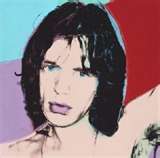
It might be apropos to point out that Jagger and Warhol were fairly close. Jagger was one of the few people attending Warhol’s funeral in Pittsburgh while Bianca was in Warhol’s entourage in the eighties. Warhol also painted a portfolio of Jagger pictures that today command healthy prices.
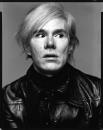
The Devil In Disguise

- Witchy Woman and Warhol

Yoko still persisted with Warhol but Andy having been disappointed once was not up for it twice. He distanced himself from the pair describing them to Sam Green as boring. An ultimate putdown.
Initially the Lennons lived in the Bohemian scene downtown. Mickey Ruskin, the owner of Max’s Kansas City, described the Bohemian scene thusly: the well-to-do Bohos, the middle and the lower class. Those associated with the Kettle of Fish and its environs of which Dylan was a member were of the lower class while the Kettle of Fish itself was owned by the Mafia. He believed Max’s was in the middle. John and Yoko first lived in New York in the West Village at 105 Bank Street next door to Yoko’s her, John Cage. They took over Joe Butler’s apartment, he formerly the drummer of Lovin’ Spoonful so Ruskin would have classed John and Yoko as haut ton beatniks.
At any rate they soon left those environs to migrate to the Upper West Side where they secured apartments in the famous, or soon to be famous, Dakota. It was then that their NYC life took its definitive form.
I have been to NYC a few times so that I know the general layout and have some feel for the place but I have by no means an intimate knowledge so essentially I’m working from maps. I know where MOMA and some few prominent art landmarks are from experience but not that many.
At any rate the Dakota is a famous landmark.. Acceptance as a tenant is by committee approval. John and Yoko were strenuously vetted but finally admitted. They took over actor Robert Ryan’s apartment #72. If you have seen the movie Rosemary’s Baby the camera pans past apartments 71 and 72. No filming was allowed inside the Dakota so while the exterior shots are authentic the interiors were shot on sets. Thus the apartment of the Satanists is a fictional 7E. The apartment next to it in which the young couple resided may have been number 72. The man of the couple who was an actor sold his wife’s body to Satan as the carrier of his child for success in the theatre which he was granted. Thus the Ono-Lennons moved into an apartment closely associated with devil worship, the occult and witchcraft.. This will become more important as Yoko associated herself with all three. In fact, Yoko through John Green would have been familiar with the Yoruban Santeria religion that she in all likelihood would have reverenced. The Spirit Foundation that she established is concerned with the preservation of just such tribal institutions.

Dakota Entrance
These are magnificent apartments that I presume Rosemary’s Baby duplicates. Huge fifty foot long living rooms as part of a ten room apartment. The Ono-Lennons would soon own both 71 and 72 lacking only the fictional 7E while having a Studio apartment as well.
Being now permanently settled Yoko having access to John’s superb income began to spend it. Of course, she virtually cleaned out department stores on her buying binges, any girl’s dream. But, she also began to buy heavily into art and antiques as investments. This brought Warhol’s friend Sam Adams Green into a close association with her. Rich society women were Sam’s forte. He has an interesting story. He was actually descended from the second president of the United States, Samuel Adams. He arrived in New york in 1960 about the same time Andy Warhol was trying to establish himself as a fine artist and Yoko the same. Warhol of course began as a commercial artist doing shoe ads but in 1960 he changed the emphasis of his career.
In the fine arts field one of the first gallery people Andy met was Sam Green of the Green Gallery. Different Green, Sam only

The Dakota
worked there and shared the name. He and Andy hit it off. By 1965 Green was associated with the art department of UPennsylvania where he staged a Warhol exhibition in the same year. From there he gravitated bck to NYC where he began a career as art consultant to rich women on both continents. They liked him. Through the socialite Cecile Rothschild he was introduced to Greta Garbo with whom he was sort of a trusted companion for 15 years.
He was very knowledgeable about art as an investment traveling between Euorpe and the US advising socialites on the most investment worthy art. He apparently derived a more than comfortable income from his efforts. He was a trusted advisor of Yoko. Some say that he and Yoko’s Tarot reader, John Green, who would enter John and Yoko’s life at about this time, combined to bilk Yoko for overpriced objects. This presumes that both men were dishonest and that Yoko was a fool. As Yoko’s investments have prospered I think we can dismiss the latter, although Yoko did take pride in being able to spend vast sums. She would have taken pleasure in overpaying.
Sam Green- Current
Rather I would say that Sam Green was a very knowledgeable expert whose task was to find art that would appreciate in value. Thus the question is did he perform that function and the answer is, yes. Yoko’s acquistions increased in value far above her purchase prices. I think it is unfair then to say that the Greens bilked her. Surely the laborer is worth his hire.

Warhol Portrait
Now, Sam Green as her agent had to buy the items he acquired for her. Being knowledgeable as to who in society wanted to sell what at distressed prices he may have made some excellent buys that he then tacked on his margin which of course meant that he sold to Yoko for ‘more than they were worth.’ But, heck, even Christie’s and Sotheby’s take twenty per cent each from the buyer and seller. That’s a forty per cent surcharge. However Sam served his function of providing investment pieces so I see no evidence of bilking.
Sam Green also formed a close, probably romantic, liaison with Yoko that persisted until after John’s death. Another art dealser she became close to was a Sam Havadtoy with whom she subsequently lived for twenty years beginning immediately the day after John’s death.
Now the men Yoko associated herself with were all effetes, that were either emasculated when she found them or who she emasculated. Strangely Lennon was the strongest of the lot. Both her first Japanese husband and Tony Cox appear to have been heterosexuals but both Sam Green and Sam Havadtoy were dependent homosexuals. With Havadtoy Yoko may have had her ideal relationship. He was thoroughly emasculated while with the fortune Yoko inherited from Lennon he was totally dependent on her. The classic toy boy a couple decades younger than herself. He, by the way, after his twenty year stint as live-in retired to Hungary with an abundant palimony but he isn’t talking.
In my reading of the situation then, a not particularly compliant John became somewhat of a liability to her, especially as he began to reassert himself with the return to the recording studio in 1980. The problem has the surface appearance of separating the man form his money and discarding the man.
Yoko began building her entourage, Sam Green, John Green, Sam Havadtoy and her various occult people with what appears to be an admiration for and some sort of connection with Andy Warhol. Sam Green and Havadtoy would be a troublesome presence in Lennon’s life during the recording of Double Fantasy while he does not appear to have been enchanted with the Warhol connection
As has been mentioned Yoko became involved in occult practices. She did practice hypnotism on Lennon and was an adept at suggestion which is the essence of hypnotism. Thus on the one hand she suggested forcefully to May Pang that she take up with Lennon while it is probable she hypnotized Lennon into taking up with May Pang. Post hypnotic suggestion would give her a command over all Lennon’s actions. Once implanted she would only have to say the word and Lennon would follow her suggestions.
How complicit John Green would have been in this isn’t exactly clear but any of Yoko’s suggestions to John could have been complemented by a reading. John Green was after all dependent on Yoko for a very generous income beyond whatever he may have scammed.
John Green is another interesting case. He was apparently successful as a Tarot reader before he met Yoko while he is reported to hae been a student of the African Yoruba religion called Santeria. The Yoruba are a tribe in Nigeria, middle river, Western side. He would have obtained much of the magic information he displayed in Cartagena, Columbia, SA from that source. The sixties themselves were the great period of the dissolution of the American mind and personality. One of the key items in the disintegration was the 1962 movie, Mondo Cane. (It’s A Dog’s World). It is difficult to assess the impact of this movie on the malleable college age mind of the times.
I saw the movie then and while it passed out of my conscious mind it struck me most forcibly and lodged in my subconscious mind. I, of course, reviewed the movie for this essay and while I at first remembered little gradually my conscious mind recovered the images so that I remember almost all. The viewing at the time was very repulsive and unsettling to my mind as it was for everyone I talked to about it and every college kid saw it. Still, consciously I missed the true import of the movie completely.
The filmmakers equated some New Guinea stone age people with modern Whites and equated them- said both states of
Mondo Cane Poster
consciousness were the same- and that there had been no advance between the primitive and modern. Then they showed Whites at their goofiest and most ridiculous. Drunks at a German Oktoberfest, aged tourists clumsily trying to do a hula. The movie was a real exercise in moral relativity. It was shortly after viewing the movie that I first remember hearing the phrase ‘Nothing is good or bad but thinking makes it so.’ I don’t want to philosophize on this but my thought was that if I think something is bad therefore it must be because I think it and I can’t be wrong.
The movie had a devastating effect on the attitude of the generation. It was a form of hypnosis with a great deal of post-hypnotic suggestion. Whether John Green saw the movie or not I can’t say but if he had it would have prepared him for accepting Yoruban Santeria. In fact these primitive forms of religion and what not flourished in the wake of Mondo Cane. At the same, as I indicated, Yoko would have been very open to Santeria. I think there is little doubt that Green and she at least discussed the religion and its African tribal origin. Especially as she established something she calls the Spirit Foundation. In the online prospectus she describes the foundation thusly:
The Spirit Foundation is…concerned with the protection and promotion of creative and cultural diversity amongst shamanic tribal communities worldwide. Part of the foundations work is the International Shamanic Network which aims at promoting the ancient creative archetypes of man and their binding ecological realtionship to the world.
Our emphasis is on education for action.
As mentioned Yoko and Lennon moved into the suites used in Rosemary’s Baby with its Satanic overtones. In the movie a young woman living with the Satanic couple either jumps or is pushed to her death not far from where Lennon was shot. In this very location Yoko took up Satanism. She decided she wanted to make a pact with the Devil to obtain her wishes. The ubiquitous Sam Green knew of a witch who could serve as an intermediary between Yoko and Satan. (Remember I am only retailing the story, I don’t believe Satan exists.)
Sam Green who had prospered as an art consultant had used some of his earnings to purchase what he called a castle in Cartagena, Colombia. He recommended his witch to Yoko who asked John Green to take her to the witch as he doubled as Tarot reader and Wizard. John Green did so and the witch duly negotiated a deal between Yoko and the Lord of Fire. When it came time to sign the pact Yoko asked Green to do it for her which he did. She was aghast when he told her he didn’t sign his name but hers. Yoko trying to cheat the devil.
We don’t know what she asked Satan for but we are compelled to believe she got it.

Santeria Illustration
As I believe she hypnotized Lennon into taking the Long Weekend I don’t know exactly why she wanted him out of the house. She certainly closely monitored his activities while he was away both in NYC and LA. During his absence Yoko didn’t have a Power of Attorney so she was somewhat constrained as John had her on a 300K budget. When he returned she quickly obtained his POA so that she had unlimited use of his money and, in fact, his identity.
Lennon is criticized for being a recluse in the years between 1975-80. He certainly wasn’t a recluse in that he withdrew from the world. He merely limited his contacts with it. It is said there was a fifteen month period when he was completely withdrawn. While he was obviously suffering from a mental malise in my opinion the withdrawal was completely justified. He had mental issues that had to be resolved. He had the money and time to work at it as he did.
He had a mother/father fixation he had to resolve. he had the feeling that he had been either a genius or a lunatic from boyhood. In a remarkable rant within the 1970 Rolling Stone interview he rants for pages because no one recognized him as a genius in his youth while he had now convinced himself that he was and had been a genius. The fact that he never did his schoolwork doesn’t seem to him that that may have a reason why people missed his genius and though him somewhat mad. What would theyhave done if they had? So he had to reconcile the issue in his mind.
He seems to have made no advance past his school years except in music. The years between leaving school and taking up with Yoko were completely wasted intellectually while the pressures of phenomenal success and wealth disoriented him completely not to mention the massive doses of drugs. At some time then he had to come down and organize his mind and life. From 1968 to let us say 1980 he was completely dependent on Yoko for his mental balance. In NYC he went where she did and did what she did. Hence the connection to Andy Warhol and Sam Green.
There are numerous pictures of Yoko, Lennon and Warhol. Yoko even patterned some of her work after Warhol’s style as in the ‘work’ below patterned after Warhol’s double Elvis. Thus she associates herself and Lennon with Presley.

Yoko Goes Warhol, Imitation of Double Elvis
As I mentioned before the social entree arranged by Warhol and Sam Green failed because of the social ineptness of the Ono-Lennons.
While we have a full record of what Lennon was doing during his ‘Lost Weekend’ we have a less full account of what Yoko was doing. She seems to have had romantic liaisons with at least three men- Sam Green, Sam Havadtoy and the guitarist David Spinozza.

Sam Havadtoy
Perhaps she wanted to see how well she could do on her own as a musician, to see if her reputation as a performance artist and, in her mind, musician, was sufficient to maintain a career on her own without John. If so, she was brutally disappointed as in her only solo performance she failed miserably. Thus she realized that as of 1974 her reputation as well as her wealth depended on Lennon.
It was during Lennon’s absence that John Green came into her life. While John Green tells a fairly smooth story in his Dakota Years one has the feeling that he is being highly selective in what he tells while he slyly ridicules the Ono-Lennons as their superior. The attitude easily leads to contempt and from contempt to abuse. Of course he would have to dissimulate both the contempt and abuse as Ono would be reading the book. As I imagine, a priest in the Santeria religion, he would have been in the company of some shady characters. I don’t know how many actual Yorubas were in NYC but I have met a couple elsewhere.
One imagines most of the hierarchy Green came into contact with was African or American Blacks. Santeria involves a deal of ritual sacrifice while money would be needed. I suspect that John Green was involved in the extortion attempt on the Ono-Lennons. This may have been Santeria related. Thus a sort of Black Hand organization was created. Rather than go for the big money that would have created a stir, the group settled for hitting up people with millions for a mere 200K each. An unpleasant tax for being rich but one more conveniently paid than to die resisting.
We have only Green’s version of the extortion and his relationship to it. He paints himself in a relatively good light. The Ono-Lennons did call in the FBI, they did give the extortionists newspaper rather than cash as the FBI advised. But then things went wrong. The FBI apparently had only one tail on the extortionist who came for the money rather than a series of back ups. The agent inexplicably lost his man. The Ono-Lennons never received another call but they had been warned that if they failed to pay Lennon would be killed whether it took one, two or more years. In December of 1980 the bill fell due. On December 8th he was shot. December 7th is Pearl Harbor Day so there may be a Japanese connection. Yoko Ono being Japanese, her numerologist and the assassin’s wife while Chapman missed the appointed day by one.
The question then hangs on Mark David Chapman the shooter. He is still alive and in prison. He was an assassin as the classic lone nut like Lee Harvey Oswald and any number of assassins who pay the law for the crime while the organizers go free. The technique has been well known to criminals for centuries. Any time a lone nut assassinates someone you may be sure that they were a patsy as Oswald announced over TV he was.
It seems likely that Chapman had been hypnotized. Witnesses said Chapman acted as though in a trance and he himself said he heard a voice in his head saying: Do it. Do it. Do it. The problem would be how he was recruited. I, of course, can say nothing for certain while what I am saying now is merely an hypothesis or inquiry. The main thing is that Chapman was supposed to be a lone nut. Ridiculous.
The most obvious recruitment method was the Santeria of which John Green was a member and to which Yoko Ono was
Mark Chapman
sympathetic. There are some oddities in the Chapman story that have to be explained not least of which are the large sums of money expended by Chapman in relation to his income. He was a married man therefore had a wife to support. Yet in 1978 he was in Japan at the same time as the Ono-Lennons beginning an around the world flight.
Perhaps Tokyo was the first stop of the trip around the world that then led to Seoul, Hong Kong, Bangkok, Delhi, Israel, Geneva, Paris, London, Dublin, Atlanta and back to Hawaii. His travel agent was a Japanese woman, Gloria Abe, who he then courted and married. She is reported to have been involved in occult circles. She may have seen so involved that, through Takahashi Yoshikawa, Yoko’s numerologist she was brought in to arrange the trip. Such an around the world trip in a Westerly direction- sundown to sunup- according to Yoshikawa’s numerology would be characteristic of Yoko Ono. She and Lennon made a round the world trip for occult reasons as did both Lennon individually and John Green at her instance. Green made his trip in 59 1/2 hours only leaving a plane once to change to another. As the financing of Chapman’s trip is unknown I would suggest Yoko Ono.
Two years after this very costly trip around the world Chapman flew from Hawaii to first Chicago, then Atlanta, then to New York where he landed a few days before the assassination. Once again, well beyond his means. It is said that he took paintings to Chicago that he sold. Where he would have gotten the paintings isn’t known but once again Yoko is the obvious source. She had an art gallery of valuable art work.
While in Atlanta he contacted a former roommate, then a Deputy Sheriff, Gene Scott, who gave him the hollow point exploding

Santeria Priestess
bullets for a handgun. One assumes such bullets couldn’t be bought over the counter. One wonders why Scott didn’t ask what Chapman intended to do with them. And if he did and Chapman told him Gene Scott is clearly an accomplice and should be questioned.
Chapman himself came from Atlanta where in his teen years he was known to ingest any and all drugs. Atlanta was also a Santeria center with several weird Black cults. Lennon’s death took place at the same time as the Atlanta child murders for which Wayne Williams was later convicted. The Santeria religion has been suspected in these obvious sacrificial murders while John Green establishes a Santeria connection to the Ono-Lennons and Yoko in particular.
Yoko was an excellent hypnotist who understood the use and power of suggestion. The Santerists as Africans would be well versed in the use of suggestion and hypnotism.
Chapman said he was possessed by the Devil while appearing to be in a hypnotic trance. All this rather amusingly is taking place at the Dakota, the scene of the Devil’s birth in Rosemary’s Baby. Indeed, the identical apartment.
After Lennon’s death there was no period of mourning or sense of loss by Yoko. All Lennon’s assets were in her control and name before his death. The so-called will of Lennon is suspicious, although the will was unnecessary becaue I doubt if Lennon thought of a will while the will appointed the art dealer Sam Green as the gaurdian of son Sean in the event the Ono-Lennons perished together. Lennon wasn’t that enamored of Sam Green.
Within a few days Sam Havadtoy was installed as Yoko’s live-in where he remained for twenty years.
While Yoko’s success as an artist and rock n’ roller wasn’t affected by Lennon’s death she now had the money to pay to have her art exhibited. Even then she found her reputation was indissolubly linked to her dead husband. She has become a caretaker for the Lennon legend parceling out old recordings while humiliatingly Lennon’s artwork is more in demand than hers.
She seems to have patterned her later career on that of Andy Warhol who as he acquired fame and fortune managed to insinutate himself into certain society circles. So has Yoko. Now, at 78, she has attained a certain status although still extremely self-centered while having an appearance of terminal aloneness.
Animus and Anima

A Review:
The Mysteries Of The Court Of London
Second Series
by
George W. M. Reynolds
Review by R.E. Prindle: Originally published on ERBzine
Now that I’ve completed reading all five thousand pages of the Mysteries Of The Court Of London let me say: What a mind blower! What an incredible work of art! What a masterful tour de force! What a powerful and amazing mind George Reynolds had to be able to develop, control and manage his major and minor themes, his hundreds of characters and myriad incidents from beginning to end. The opening and closing incidents united to form a circle like an Ouroboros biting its tail
This was a wonderful novel of Regency England, a period of which I’m fond anyway. Who could read the sporting novels of R.S. Surtees and not love the place? Thomas Love Peacock? How wonderful, not to mention Byron and Shelley, including Mary Shelley and her groundbreaking Frankenstein. Not overly concerned with being realistic Reynolds concerns himself with the two social classes of the aristocracy and the criminal element which he portrays as virtually interlinked. One of the more horrifying sequences was the manner in which the hangman, Daniel Coffin, insinuates himself into the bedroom of the aristocratic but dissolute Lady Ernestina Desalt, nee Cavendish, taking advantage of her when she passes out from fright.
Given five thousand pages and an equally large amount of talent and skill Reynolds is able to develop his characters to an astonishing degree so that they become virtual living entities. Thus while I cannot delineate the moral and physical degeneration of Coffin to the marvelous portrait that Reynolds develops nor the character of the reckless Ernestina Dysart, suffice it to say I was almost revolted at her rape by Coffin as she was when she awoke to be smirkingly so informed by Coffin.
Indeed, this is not a work for prudes. This is one long tale of one seduction, rape or forcible entry after another. Sex permeates the novel from beginning to end. While the story was written in the 1840s psychology appears to have been a topic of much interest to Reynolds and his contemporaries as they sought the wellsprings of human behavior. Perhaps this interest rubbed off on Burroughs.
Reynolds is as interested in sexual pathology as was Freud if not moreso.
Unlike France where the Libertine period I described in Part I of Someting Of Value ( http://www.somethingofvaluepti.wordpress.com ) was interrupted by the Revolution, in England with an unbroken royal tradition from Charles Charles II on Libertinism as an aristocratic prerogative evidently tailed off into the Victorian period as the attitude toward the ‘enjoyment’ of women as depicted by Reynolds was governed by Regency Libertine bucks.
In one memorable scene an obsessed aristocrat, the Marquis Of Leveson, perhaps patterned after the Marquis de Sade, literally attacks an entrapped ‘maiden’ sold to him by a procuress. Leveson had a concealed suite of rooms for just such purposes. One room was a gallery of pornographic images designed to inflame the passions of women. In the adjoining chamber Leveson had mechanical chairs which when sat on had clasps that secured one’s arms and pincers that secured the shoulders.
In this scene that was interupted by his ‘prudish’ nephew Leveson is seen tearing the clothes off a ‘maiden’ he had trapped in a mechanical chair. Her ‘glowing orbs’ were exposed. That was a scene very reminiscent of the Marqis de Sade who it is possible if not probable Reynolds read during his years in Paris, as he ran in some racy circles. Thus these two series are mildly pornographic.
The entire second series is named after its heroine Venetia Trelawney. Hers is an interesting story of the sexual proclivities of women. Reynolds is quite balanced in his notions of sex. Venetia was born and raised as Clara Stanley having lived her life cloistered in Canterbury, the cathedral city. For a reason not necessary to give here she finds it necessary to go to the metropolis. An innocent on the streets of London her funds are picked from her pocket. A kindly looking woman who, naturally, is a procuress offers her assistance taking Clara to her house of assignation with the intent to sell her to the Marquis of Leveson. Fortunately for Clara he isn’t at home so Mrs. Gale, the procuress, takes a different tack. Now, all this information is withheld from the reader until later so there are actually mysteries within mysteries. In the First Series the royal consort, Mrs. Fitzherbert, is displaced when Caroline of Brunswick arrives from Germany to be married to Prince George. Mrs Fitzherbert and another discarded favorite, Miss Bathhurst, regret their loss of influence at court developing a scheme to recover it ten years later.
This scheme is to prostitute a young woman as bait for the Regent, Prince George. It is their plan that George will fall for the woman, take her into Carlton House, his residence, where she will then through her sexual influence be able to award various favors to the relatives of Miss Bathhurst and Mrs. Fitzherbert restoring them to influence as it were. Got some realpolitik going here.
Clara, soon to be Venetia Trelawney, is a virgin who doesn’t want to appear a wanton so that in order in introduce her into Carlton House she needs a compliant husband who will not object to her being the mistress of the Regent. Not to worry. Miss Bathhurst’s nephew, Horace Sackville already insinuated as a favorite of the Prince is willing to fill the role.
Reynolds is actually probing fairly deeply into the varieties of sexual experience in a manner that should be familiar to Freudian notions of sex and the conscious and unconscious. In many ways Reynolds is more realistic, sophisticated and penetrating into the mysteries of sex than Freud.
To me the notions of such psychoanalysts as Freud and his epigone Wilhelm Reich are…well…simple minded and superficial, mere projections of their own desires not overly based in fact. Their opinion reflects the completely ingorant view of human nature held by the Liberal. Reich in his Sexual Revolution, the Liberal bible on the subject, says: ‘If one is not starving one has no impulse to steal and consequently does not need a morality which keeps him from stealing. The same basic law applies to sexuality: If one is sexually satisfied one has no impulse to rape and needs no morality against such an impulse.’
The same applies to prostitution, if a woman is well fed she has no need to sell her charms. All very plausible sounding in theory but running contrary to the facts.
Perhaps the key is the meaning of ‘if one is sexually satisfied.’ We don’t know what is meant by sexual satisfaction. That’s a wide open term. Is sexually sated the same as sexual satisfaction? Reich doesn’t feel the need to consider that aspect. Indeed, he is probably incapable of doing so. He just makes the blanket assumption, that once one is ‘sexually satisfied’ rape and prostitution will disappear from the face of the earth. Today we know for a fact this isn’t true. Millionaires who are overfed steal and plunder for more millions, or even, billions. I don’t have to mention the plundering of the savings and loan industry which was certainly not done by the starving proletariat. The well fed proletariat of the United States also steals. Crime has increased rather than decreased as people are fed better. Nearly everyone steals, fed or not. Prostitutes continue to ply their trade for fabulous sums. Poverty has nothing to do with it.
Even with the primitive psychology of the 1840s Reynolds gives the proverbial two fingers to Freud and Reich.
Reynolds understands that rape and prostitution are means to gratify sexual needs and obtain satisfaction whether mere intercourse or not. Men of wealth and position like Prince George and the Marquis of Leveson had no reason to fear the law that they were above which Reynolds makes quite clear. Depending on what sexual satisfaction means, they were not only sexually satisfied but one would think so sated they would look elsewhere for amusement. According to Reynolds Libertines of this order lived their lives seeking female sexual experience at any cost.
As already described Leveson considered rape as a tool of the trade. This may seem rather fantastic but when he is unable to gain access to Venetia Trelawney any other way he tricks her by giving her a necklace with a hundred pearls on it that he will redeem at a thousand pounds a pearl. When the last is spent Venetia will have to surrender her charms to him. He then has a criminal associate induce her husband to follow a life of dissipation and gambling. Venetia redeems most of the pearls to pay the gambling debts he incurs. thus in the end Venetia is reduced to prostitute herself to Leveson for 100,000 pounds.
As a prostitute then Venetia is paid on a colossal scale. Not only have she and her husband been made a peer and a peeress with State pensions of thousands of pounds a year also living in splendor and comfort at Prince George’s Carlton House, but she is paid millions of dollars at today’s exchange rate for a couple hours of the use of her body by a man who is above the law.
Further as Reynolds makes clear the desires of the male are visited on the female, thus the Prince and his fellows employ pimps and procuresses to deliver women to them for their use. It will be remembered that Mrs. Gale’s first intent was to sell Venetia to Leveson.
So with the human traffic of today, which is to say, women. The women are not volunteering or trying to escape poverty but are seduced into prostitution where then they are kept by force strictly for the use of men who can and will pay. Like Leveson and the Prince of Reynolds’ story it is the men who provide the demand and the women who provide the supply whether willing or not. These are conscious business decisions on the part of the pimps that have little to do with the unconscious. Money is money. Upon close examination Freud’s theories begin to break down. A buffoon like Reich is too contemptible to even consider. I pity the Liberals who dig that ass.
As I read Reynolds then I was impressed by his examination of sexual psychology. At only 32 to 34 years of age he seems to have had an especially mature understanding of male and female sexuality.
Burroughs very likely read this novel between his years of 22 to 25, a guess on my part, when the book would have had a formative effect on him. Having read the story the content would have disappeared into his subconscious where the material would have been worked and reworked to form his ideas of sexuality as conditioned by his own morality which is to say his understanding of human relations. The novel may even have had a part in the formation of his dreams. We don’t know how sexually satisfied ERB was but we do know he wasn’t a rapist.
If one analyzes ERB’s female figures from the point of view of Reynolds and the Mysteries it is quite possible to see the influence of Venetia Trelawney, as a desirable woman, of the second series in such figures as Dejah Thoris and La of Opar. Even Thuvia may be based on other female characters of Reynolds.
The examination of sexual matters runs all through the Mysteries from beginning to end. Reynolds keeps up shenanigans like those I’ve described over five thousand pages. It is impossible in a review such as this to give more than a superficial account. There are so many good stories along these sexual lines woven, many times, through hundreds of page, novels in themselves, that it is quite wonderful. Each is of a different type involving fully delineated distinct characters. The story of the Duchess of Desborough and her husband of the first series is truly amazing stuff. If you’ve got the time for a five thousand page novel, then, boy, is this it.
As a historical novel the first series is about the profligacies of Prince George and the royal family of George III and that of the Regent George and Princess Caroline in the second series. Both contain elements of the relationship of George to Caroline of Brunswick. One of Reynolds’ conclusions seems to be that unbridled sexual lust is closely related to crime which is something Freud ignores. Possessed by his sexual desires George had secretly married Mrs. Fitzherbert some few years before the arrival of Caroline in 1795. Mrs. Fitzherbert is put out of the way in favor of Caroline in a psychologically brutal way. Ten years later then in 1814 when the second series begins this leads her to the prostitution of Venetia Trelawney in the attempt to regain her ability to take care of friends and relations by putting them on the State dole.
Thus Miss Bathhurst and Mrs. Fitzherbert, two of George’s former mistresses, one an actual wife still married to her, become procuresses for his pleasures while Miss Batthurst makes a pander of her nephew. Reynolds takes real pleasure in retailing these details that smear the members of high life.
In the second series the major concern is George’s attempt to sexually discredit Caroline as a libertine. He had her put away from him. In the novel she is living a chaste life in Geneva. Thus plans are put into execution to make it appear that she is living a sexually abandoned life.
In a real life amusing reply to queries as to her sexual activities she replied that she had only had bigamous relations with one man and that man was her husband. A pointed reference to Mrs. Fitzherbert who had never been divorced from George. As you can see this is good stuff.
One could go on but let me provide only one more example of Reynolds’ genius. Among the many mysteries are the two central ones introduced in the first few pages and concluded in the last few. God, what skill.
Even here it is impossible to give enough details to give any of the real flavor of the novel. Suffice it to say that George in his pursuit of the Real Thing is discovered by a too curious onlooker when George has set up a rendezvous in a remote country inn. In attempting to escape discovery he seeks refuge in a house. The father is away but the two beauteous daughters are at home. Under the guise of Mr. Harley George seduces the elder daughter Octavia who he impregnates. As this occurs about the time of the arrival of Caroline he is forced to brutally abandon Octavia which in turn drives her insane.
In the course of things her sister Pauline nurses her back to health. Pauline marries a Lord Florimel and an Arthur Eaton takes Octavia and her daughter by George. Eaton and Octavia die so the Florimels rear the daughter named Florence who is unaware that the Regent is her father.
On this same night that George meets Octavia the Princess Sophia, George’s sister, who has become impregnated out of wedlock is on her way to deliver her baby when her carriage crashes in front of Pauline and Octavia’s house. George rushes to help but on opening the carriage door discovering his sister he flees the scene rather than be recognized by her.
The young girls fetch a doctor who delivers the baby. Unwilling to keep the baby herself Sophia implores the doctor who agrees to take the baby and bring it up. Of course we don’t learn this is the Princess Sophia until very late in the work. All of this becomes part of the mysteries of the court hence the title.
Now, a month or so later the doctor antagonizes the Monster Man mentioned in the first series by refusing to minister to his wife who dies on the doctor’s doorstep. Thinking that Sophia’s child is the doctor’s son the Monster Man steals the baby in revenge to be raised as a depraved criminal.
Two-thirds of the way through the second series, subtitled Venetia Trelawney, Sophia has a longing to see her son. She appeals to George to put the Bow Street officer, Larry Sampson, on the job of locating him. George agrees but as he conceives a desire to see his daughter by Octavia he makes it a condition that Sophia is to bring Florence to the palace so he can see her. At this time of his life he realizes what a treasure he had foregone in Octavia.
Once again these sexual misdemeanors result in horrendous crimes as indeed, given the passions of men and women, they must.
Over the course of the story George’s activities have brought him into contact with the repulsive Moriarty of his time, the executioner, Daniel Coffin. The contest between Larry Sampson and Daniel Coffin is quite reminiscent of that between Holmes and Moriarty. As it would happen Larry Sampson traces Doctor Thornton’s lost charge to the barbershop front of Coffin, his occupation when he isn’t hanging, where he has been raised along with the two children of the Monster Man. The hangman who is tormenting Lady Ernestina Dysart to destruction has an appointment ot meet her in an alcove on London Bridge. George works it out so that Coffin has the take take her child’s place so Sophia can walk by him in disguise to view him. However Ernestina has decided she has had enough. She plans to murder Coffin on this occasion. Mistaking the boy for Coffin she plunges her dagger into the boy’s breast. He recovers but an illicit sexual liaison some eleven years before results in a horrendous series of crimes resulting in the deaths of Ernestina and the Marquis of Leveson when Coffin seeking revenge for Ernestina’s attempt on his life burns Leveson’s mansion to the ground.
The boy, who recovers, is sent to Jamaica with good employment but soon resumes a criminal career returning to London where at story’s end he still is boasting of the Princess Sophia as his mother.
George’s daughter Florence in the meantime has met Valentine Malvern whose father…but we don’t want to get into that…Ernestina again…and they are engaged to be married. As a condition she sets Valentine to discover who her father is as she suspects George. Her encounter with George at the palace had unsettled her mind. Valentine dutifully discovers that George is her father which he tells her.
Reynolds wants to end his story with a truly dastardly act of George. Venetia and her husband have a change of heart retiring from the high life of the court. Venetia was the liveliest and most entertaining of women so George misses her sorely. She must have been a more slender version of Mae West. With Venetia’s leaving George’s salt has lost its savor.
He accordingly calls the procuress Mrs. Gale to find him another woman like Venetia. He wants a sweet innocent who will not give in easily. Mrs. Gale recruits a Lady Lechmere to assist her. They settle on a young lady to kidnap who is, you guessed it, George’s daughter Florence.
Once kidnapped Florence is in a quandary as to the purpose. Her fist thought is that she has been committed to an insane asylum because she had been acting moody. From a few words let drop by her abductresses she figures out that George is involved. Not guessing the actual purpose for which she has been abducted she thinks that George wishes to introduce her to court life. She prefers the retired life.
Entering the library and discovering George as she feared she screams out No, No and begins to run. George had had no premonition that the girl chosen was his daughter Florence. He misunderstands her reason for running chasing after her to explain.
The building was an old farmhouse. After the style of the old days the year’s produce had been hoisted into an attic through a door. Long in disuse the loft door had not been opened for years and years. George chases Florence through the house into the attic. Florence opens the loft door precipitating herself into the nothingness. Dancing madly backward on a sea of air she plummets to the ground killing herself. In a picturesque touch Reynolds has her fall into a bed of flowers so this flower of a girl dies amidst the blooms.
Thus as a result of his illicit sexual escapades George is the cause of his beloved daughter’s death. Sex and crime go together or so seems to be the moral of George William MacArthur Reynolds and he takes five thousand pages to tell it.
Let me mention another interesting detail. All the body snatching in the story may have had an ifluence on the character of God in Lion Man but that isn’t the detail I was going to mention. The detail I wanted to include was that when Reynolds is telling his story of Caroline in Geneva a scene takes place at a Doctor Marivelli’s who amongst a number of shady pastimes such as providing a residence for unwed mothers during their pregnancies and buying cadavers for medical research also sells body parts to research centers.
One of Marivelli’s sidelines was providing heads for study by phrenologists. Thus he has a room lined with pickled shaved heads with the areas of mental activities drawn on the shaved skulls. That got a little laugh from me. Franz Gall rides again. The detail does demonstrate Reynolds’ interest in psychology.
Thus Reynolds concludes his enormous novel with one last sexual crime of Prince George soon to be George IV. As we know the Revolution of ’48 failed in England.
One knows that Burroughs was profoundly affected by the story as what reader wouldn’t be? It will take some detailed examination to discover how the impressions expressed themselves. I have already mentioned some of the more obvious examples but as ERB consciously mused over the story while other impressions roiled away in his subconscious perhaps having a moiety in shaping his dreams as he constellated other fixations around the details of Reynold’s story the amazing tale did shape the manner in which ERB told his stories.
Finis.
A Review
The Mysteries Of The Court Of London
by
George W.M. Reynolds
Review by R.E. Prindle: First published in ERBzine
Collecting is a peculiar form of insanity.
I had it in boyhood,
Stamps, coins and postmarks.
E.R. Burroughs- Creator Of Tarzan Speaks
LA Times, Jan. 7, 1923
Stamps, coins and postmarks. Looks like the bug had a pretty firm grip on Our Man In Tarzana. As one of the afflicted I have to agree with ERB. Collecting is a form of insanity. I think it even possible to depict collecting as a disease on the same order as alcoholism, kleptomania or obesity. Definitely a personality disorder. It’s about time we had medical recognition and federal finanicial assistance. Our problem wouldn’t get any better but we’d have more money to indulge it. Why send all that money overseas when it could be better spent at home?
I don’t know if I have ever been ashamed of the affliction but I have certainly been embarrassed by it. ERB is being slightly disingenuous when he modestly says he had it in boyhood. How did he cure himself? Endless hours of analysis or did he take the twelve point program of Collector’s Anonymous. Perhaps there’s a pill of which I’m unaware. You know what I’m talking about don’t you? I know how he felt. I conquered my mania too. There are all kinds of things I no longer collect. But…my library does keep growing. I might as well confess it all; I’ve got that under control too. I no longer just buy books to be buying books; I only buy books for functional purposes now. Of course my mind has a very broad definition of functional. My most recent purchase was George W.M. Reynolds’ Mysteries Of The Court Of London. What a buy! One title but it comes in ten volumes. Another two feet of nonexistent shelf space eaten up. Did I like the book? Oh yeah! What an unexpected bonus.
The title was found in Burroughs’ library so I wasn’t too surprised that I like it. I’ve found that Burroughs has impeccable literary taste. I’m pretty broad on literary too. Of course that it is in the library is why I obtained the set myself. I really like the picture of Burroughs- the man who conquered the collecting mania- sitting at his desk in front of a massive array of compeletely filled bookshelves. One more won’t hurt as the alcoholic said. Yeah, sure, ERB used to suffer from that peculiar form of insanity. He tries to dignify his book collecting by saying he no longer reads fiction. He only read fiction as a kid. Cured himself of fiction at the same time as collecting, I suppose. Ah, the ‘sins’ of our youth.
Does he really think buying non-fiction rather than fiction means he’s not collecting? Listen to ERB in his own words trying to justify and dignify his book collecting. LA Times 1/7/23:
And then there are magazines such as the Geographic, Asia and Popular Mechanics. These three constitute an encyclopedia of liberal education for adult or child that arouses a desire for more knowledge and fosters the habit of reading.
‘Arouses a desire for more…’ I get it. Yes, ERB does collect but there’s a good reason for it as well as the real reason. He’s improving his mind. I know where that excuse is at and it beats drinking. You can bet the old boy was lugging several hundreds of pounds of magazines as he moved fifty times in fifty years or thereabouts. Geographics are heavy in more ways than one.
You see he was getting a liberal education. He was reading high tone stuff (haut ton in French) like the National Geographic (spoken of familiarly as the Geographic), Asia, (nice touch, shows breadth of interest), and Popular Mechanics (proletarian touch). The trio of magazines pretty well reflects the contents of his own novels. Well, what about fiction?
I am fond of fiction, too, although I don’t read a great deal of it.
No. However…
And I have my favorites. Mary Roberts Rhinehart and Booth Tarkington are two of them. When I read one of Mrs. Rhinehart’s stories I always wish I had been sufficiently gifted to have written it, and then when I read somethingof Tarkington’s I feel the same way about that. I have read “The Virginian” five or six times [this is within twenty years] and “The Prince And The Pauper” (N.B.) and “Little Lord Fauntleroy” as many.
Gee. That’s all literary fiction; how about the guys he really liked: Baum, London, Haggard, Doyle, Sue and Reynolds for instance. Too close to pulp, not enough dignity to mention in a Times article. The amount of fiction he read from 1920 to 1924 was fairly impressive.
My studies have compelled me to read a lot of fiction in the attempt to understand ERB and let me say this, the man had unerring taste in exciting fiction. The Mysteries Of The Court Of London is one heart pounding book. No one would ever confuse it with the National Geographic, Asia or Popular Mechanics though.
Reynolds could ramble on too. The work is composed of two series of five volumes, each series twenty-five hundred pages long. the internal evidence in Burroughs’ work is that he read it before 1910. There are at least three clear references to the First Series: the house on the Thames that Norman and De Vac lived in was based on the mid-wife’s house in Reynolds. The segment of the Mysteries concerning the Monster Man contributed a great deal to ERB’s Monster Men, while the abduction of the baby by the Monster Man lent itself to Baby Jack’s abduction in The Beasts Of Tarzan. Burroughs’ vision of London, which he never saw, is probably drawn from Reynolds although various other British authurs such as Doyle would also have been influences.
The series of novels would have been only fifty years old when Buroughs read it, so he was fairly close to the times if seven thousand miles or so from location.
I couldn’t find a Reynolds Society on the internet although the books are not that easy to find nor all that cheap. I bought the only complete set offered, otherwise it would have been impossible to assemble a complete set from the partial list offered. Reynolds must therefore be in demand by the cognoscenti.
George Reynolds was born in 1914, two years after Dickens, being 32-35 years old when he wrote this huge wook. To write such an extended novel requires a capacious and inventive mind. The novel comprises hundreds of characters and thousands of incidents each individual in its depiction. That Reynolds should have had the experience and the ability to organize it as the novel indicates at such a young age is nothing short of amazing.
Politically Reynolds was a Red. He was affiliated with a political organization known as Chartism. As the novel was written in magazine installments to coincide with the Revolution of 1848 the appearance is that Reynolds’ intent was to irritate the people into open rebellion. If so, he failed. He was opposed to the monarchy and called for its abolition. The work is a diatribe against George III and George IV. Reynolds’ hatred of the pair actually disfigures the novel. He compares George III to Caligula and Nero but fails to show in what way the monarch resembled either Roman. As Reynolds was born in 1814 while George IV died in 1830 and the events covered are in 1798 and 1814 he couldn’t have been a witness of the times.
In his lifetime Reynolds was more popular than Dickens. Perhaps the topicality of this novel precluded the success Dicken has subsequently enjoyed. The comparison would be that between Phil Ochs and Bob Dylan. While the novel was reprinted in limited editions to at least 1912 there is currently no full reprint available.
I find the novel compelling; to use the old cliche, the novel is a page turner volume after volume, thousand pages after thousand pages. The work is masterfully planned, events in the first dozen pages are worked out fifteen hundred pages or more later. Indeed the central mystery is concluded at the end of the work five thousand pages on. The detail and variety never tire. the mystery and detective elements preshadow Doyle and the entire twentieth century. Police personnel turn over on a regular basis, everything is always fresh and sparkling. Scenes and characters are vividly drawn.
Altough Burroughs drew the line at modern sex novels, Mysteries is a sex novel par excellence. The entire novel is drawn against the sexual escapades of the characters. If you like mildly smutty novels this one is for you. The influence of the novel on Burroughs may be most pronounced in this respect. Reynolds goes into detailed studie of male-female relations. Each volume of the first series is subtitled after a heroine. Thus the action depends on the harassment of worthy females by, well, lecherous unprinicpled men. The worst of the lot and the character who holds the novel together is Prince George the future Regent and King.
Reynolds’ men stop at nothing when they come across a desirable female; abduction, threats, force, in a word, rape is their stock in trade. They are aided by procuresses who run establishments, in the most respectable shipping districts that double as brothels.
While Reynolds is not as graphic in his sex scenes as writers are today his descriptions of capacious bosoms is tantalizing enough. His ladies must have had strange diets because he speaks of ‘glowing orbs.’ Quite tactile in his way. Frazetta would have had a field day illustrating Mysteries. Reynolds’ descriptions reminded me of nothing so much as Frazetta’s women. Frazetta’s own voluptuous but virtuous portrayals were based on Burroughs descriptions so I would have to think Burroughs’ imagination was fired by this endless procession of stunningly voluptuous beauties.
Then too, the frequent abductions and threatsof ‘fates worse than death’ by the villains in Burroughs’ work exhale the aroma of Mysteries.
Reyonld’s use of darkness and labyrinthine passages, locked doors and whatnot seem to be reflected in Burroughs’ work. One most appealing trait of Reynolds that ERB must have enjoyed was the former’s use of slang and thieves cant. Burroughs also delights in underwold slang and various dialects.
This immense work can be considered a very early roman a fleuve not unlike some of Dumas’ work, that Burroughs also read, or even as a prototype of Marcel Proust’s. I believe Burroughs saw it that way. Seen that way Burroughs created four roman a fleuves influenced by Reynolds’ Mysteries. Tarzan, the Mars series, Pellucidar and the Venus series.
The Russian Quartet of Tarzan may be based directly on Mysteries from the nautical scenes to London and Paris. Indeed, the Quartet may be considered a separate roman a fleuve within the Tarzan oeuvre. His portrayals of London and Paris show Reynolds’ influence.
Just as Reynolds’ volumes in this novel portray a series of adventures cut off after about five hindred pages then resumed in the next volume, Tarzan’s adventures beginning with the Jewels Of Opar display the same characteristic. After the Russian Quartet Tarzan is just one long novel or roman a fleuve.
The Venus series is just a long story broken up into five volumes. It could just as easily be bound in one volume with consecutive pagination and you wouldn’t be able to tell the difference.
The John Carter on Mars series exhibits the same traits although less clearly. Pellucidar in nearer in concept to the Venus series. So all the series show an endless series of barely connected adventures held together by a common cast of characters with the stories going nowhere. They just end. Princess of Mars is the most obvious case. Mars just runs out of air like a flat tire which might mean that Burroughs just didn’t have an ending or that he had temporarily run out of ideas and had to recharge.
While Burroughs is charged with using coincidence to excess, once again he may have just been emulating Reynolds. The latter is shameless in his use of coincidence. At one point while visiting a dangerous villain in a lawless area Reynolds’ detective, Larry Sampson, needs a disguise. A disguise store is very conveniently located just across the street. The owner is in cahoots with Sampson even though doubling as a criminal. He provides Sampson with a disguise and the story continues. Is it any wonder that two or three shipwrecks occur on the same stretch of coast on which Tarzan’s parents landed? Burroughs learned the use of improbable coincidence from a master.
So in addition to borrowing specific incidents from Reynolds Burroughs also borrowed the basic plan. Combining Mysteries Of The Court Of London and Eugene Sue’s Mysteries Of Paris one gets down to the bedrock of Burroughs’ influences. but the man’s ability to absorb influences and incorporate them into his work from the beginning indicates that the man was a real book worm reading a lot of fiction. As we know he was also an athlete the man must never have had an idle moment.
Part II follows.
Mourning Becomes Yoko: Part I
March 1, 2010
Mourning Becomes Yoko: Part I
The Passing Of John Lennon:
Part One
by
R.E. Prindle
Main Texts:
Goldman, Albert: The Lives Of John Lennon, Chicago Review Press, 1988
Green, John: Dakota Days, St. Martin’s, 1983
Norman, Philip: John Lennon, Ecco, 2008
Pang, May: Loving John
Seaman, Frederic: The Last Days Of John Lennon, 1991
Warhol, Andy: POPism: Harcourt, Brace, 1980
Numerous internet sites of the many thousands, most of which I haven’t investigated, concerning principal and minor characters of which Warholstars is most prominent.
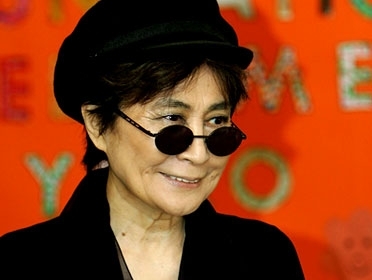
Yoko One in Lennon Cap And Glasses
There were many changes that ushered in the sixties, changes that made the sixties possible. Not least of these was the introduction of the commercial jet fleet. Gone were the much smaller, less comfortable propeller planes, slow and relatively uncomfortable with limited range. The Boeing 707s, DC 8s, mammoth in their time quickly evolved into the flying cities of the 747s and DC10s. With the big jets came the envy of the sixties, The Jet Set. Golden people off to the capitols of Europe so stunningly portrayed in Hollywood movies and travel posters. One can’t imagine the effect of travel posters today but then they created unfulfillable desires.
With ease not only were the capitols of Europe within spitting distance but also the exotic cities of the East- Tokyo.
The entertainment industry was about to spike as technology revolutionized the recording studio as well as the stage. Guitar amps as the sixties began were small, portable units. Amplifiers rapidly grew in size. Massive arrays of Marshalls rose behind the first of the heavy metal bands, Blue Cheer, like a low mountain towering above the group. Greatful Dead took the stage in front of tens of thousands of dollars of electronic equipment. Four guys could sound like Krakatoa on that fateful day.
In those far off sunny days when our world began the old world crumbled before the onsllught of bold intrepid pioneers, and behind them came the leeches and parasites.
The sixties started slowly almost imperceptibly changing until the Beatles stepped off one of those big jetliners in 1964. Seemingly innocuous, their arrival was to change the whole paradigm. Through the fifties and early sixties, before the Jet Set, was the Avant Garde, those bold experimenters moving in advance, well to the fore, of the dull plodding Middletown Babbitry and those mental habits the hip, the aware, the Avant Garde despised. There were still such things as modern art, experimental novels, cutting edge jazz. They were all swept away in ’64 when the Beatles led the British Invasion. All of a sudden the Avant Garde was turned inside out as Pop took possession of the field.
The first intimations of change took place in Art. As the 50s ended the dominant art form was Abstract Expressionism. From those ranks rose what would be known as POPart. Roy Lichtenstein with his comic book panels, Jasper Johns with his flags, Robert Rauschenberg with his messy effort and, of course, Andy Warhol and his soup cans. Interestingly they were all homosexuals. With the exception of Warhol they were all discreet, in the closet, Warhol was a man with an agenda, he wanted to legitimize himself and

Yoko, John, Andy
whatever he liked or did. He was an advocate.
One of the big changes of the sixties was the rise of the cult of the homosexual. Let Leroi Jones as a Negro spokesman rail against the cult as he might he was powerless to resist its course. Homosexuality was then illegal all over America until the great homosexual revolt at Manhattan’s Stonewall Bar in 1969 as the decade drew to a close. Homosexuals were aggressively out of the closet roaring for revenge. One item on Warhol’s agenda in fact.
Warhol began his fine art career about 1960. By 1964 when the Beatles deplaned he had completed another item on his agenda, the destruction of fine art. Thus, although few of us realized it at that time POPism was overtaking Euroamerica like a tidal wave lifting the level of the sea.
The Beatles would of course be the core, the heart of the sixties. They defined the sixties and gave the decade its form. While they were busy conquering the world a little Japanese woman who desperately wished to incarnate and represent the Avant Garde was beginning her career on the Lower East Side as a ‘performance’ artist. Zany beyond description was Yoko Ono. By 1967 she will have entrapped the leader of the free musical world and the Beatles, John Lennon. Together they will dominate what became of the Avant Garde until Lennon’s passing in 1980.
YOKO ONO
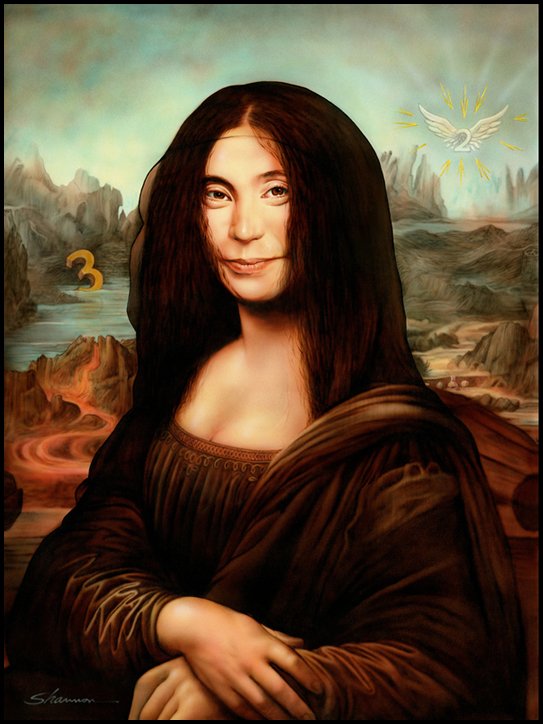
Yoko Lisa- One of many facets,
A description of Yoko to begin. A Spider Woman, a self professed witch, a psychotic obsessive-compulsive who was driven and completely organized to realize her goals. She however lacked the talent to realize those goals. As she searched for a way the seemingly unrelated success of the Beatles fortuitously occurred.
The success of the Beatles was uprecedented. Once their success had been achieved then the parasites and exploiters moved in to get whatever they could steal. While the Beatles were revered for their success one member, John Lennon, was selected to fill the almost messianic needs of the sixties.
Needless to say succes on the order of the Beatles who were after all of lower middle class origins with no preparation for dealing with success of the magnitude they achieved were completely overwhelmed while nevertheless comporting themselves creditably. Still, as Paul McCartney’s song Fool On The Hill demonstrates their heads were swimming. John Lennon even issued a musical plea in his song Help! which was a forthright request for guidance for whoever might recognize it while being able to fill his need.
As it was, this young Japanese avant garde artist, Yoko Ono, understood the plea and acted on it. John Lennon was tailor made to fulfill her own needs and ambitions.
Yoko Ono was born in Japan in 1933 as the Japanese were initiating their plan to impose the Greater East Asian Co-Prosperity Sphere on the whole of the East from India through China to Japan. In 1942 when she was ten the Japanese made their move to annex the oil reserves of Indonesia, bombing Pearl Harbor at the same time in the attempt to secure their ocean perimeter. The invasion did not come off as planned so a short three years later in 1945 the B-29s unloaded their incendiary devices over the capitol city of Tokyo where Yoko Ono’s family lived.
Now thirteen she was aware of what was happening. Moved to the country outside Tokyo Yoko Ono witnessed the massive clouds of smoke obscurring the blue sky, one presumes, for hundreds of square miles. Within a few days Hiroshima and Nagasaki had been wholly obliterated by atomic bombs. Yoko imagined the blue sky over those two cities obscured as was the sky of Tokyo. This made an indelible impression on her mind causing a psychological disturbance. She would be haunted by the memory. Thus having appropriated John Lennon in the late sixties she and he created the Plastic Ono Band whose LP was a picture of a blue sky with fluffy white clouds. After 1973 she had her office in the Dakota painted in replica of the cover. Thus she would always have a blue sky above her.
Even though the Japanese had attacked the United States first in this instance, not without provocation to my mind, thereby acquiring guilt for beginning the war there can be little doubt that Yoko blamed the West for Japan’s shame.
While Yoko experienced some discomfort after the bombing of Tokyo, as her father was a banking executive with experience in dealing with Westerners, she shortly after the war moved to the US where she lived in luxurious circumstances eventually attending Sarah Lawrence College from 1957 to 1960 but leaving without a degree.
As of 1960 Yoko Ono had experienced little of the hardships caused by the Wars in Europe and Asia. Indeed, as Philip Norman points out John Lennon’s England suffered greater hardship from 1945 to the sixties. Japan, once defeated, was given extremely benevolent treatment by the US. The paternalistic approach of the US can be seen in the picture of the tiny five foot Emperor, Hirohito, beside the relatively giant protective figure of Douglas MacArthur. Efforts began immediatly to rebuild the Japanese economy. The millions of Japanese soldiers throughout the Pacific and China were repatriated to Japan without consequences, forgiven as it were. In contrast to Europe where the carnage had been enormous there was relatively little damge to the Japanese homeland. If you watch Japanese movies of the late forties and early fifties there is only a slight indication that there has been a war. A few references are made to soldiers who never returned but the landscape is intact and undisturbed.
In Europe Germany had been flattened, German civilians slaughtered in the millions. Armies of German soldiers disappeared into the Gulag never to be seen live again. The allies exposed millions of Germans in the depth of winter while depriving them of food. The entire continent was desolated, England itself had suffered terrific bombing damage that was still being repaired into the sixties. POP star Marianne Faithfull in her biography tells of sitting aove a bomb crater in the mid-sixties. Thus any complaits of racism against the Japanese are ridiculous.
In 1957 when Yoko Ono was beginning her cushy life at Sarah Lawrence I was sailing into Tokyo Bay aboard a US Navy Destroyer Escort. We docked in Yokosuka across the strait from Yokohama. There was absolutely no evidence of there ever having been war damage to Yokosuka. Looking across the strait to the shipyards of Yokohama one was astonished at the glittering brand new derricks of the most modern design. The stuff made ours look positively medieval. Twelve years after the war Japanese shipbuilders were becoming the dominant force in that industry displacing the West under the guidance of the US which complacently ceded the industry to them.
In 1960 as Yoko Ono was beginning her career as an avant garde artist in NYC the first Japanese autos were being landed on the West Coast.
Now, Philip Norman tut tuts the English for supposedly outrageous racist comments against Yoko Ono in the late sixties as though the English had no grievances against their own racial treatment by the Japanese in WWII. In point of fact the Japanese Greater East Asian Co-Prosperity Sphere was a racist organization directed at the West. The Pacific war was a racist war if you wish to put things in those terms. There are other definitions. This isn’t the place to discuss the racial antecedents to the Co-Prosperity Sphere so I won’t but one should look into the historical background which is very complex.
The question is, did Japanese racism end with their defeat and if it didn’t how was the war carried on by other means? In 1964 Yoko Ono published a small book of haiku style statements called Grapefruit ‘which aimed to make words like the commands of musical notation’: “Steal a moon on the water with a bucket. Keep stealing until no moon is seen on the water.” Norman, John Lennon p. 475.
I have a feeling the image is not original to Yoko but is part of Japanese culture much as Bob Dylan used commonplace mid-western phrases like It’s All Over Now, Baby Blue appropriating them to himself. Of interest here is that Yoko used the verb ‘to steal.’ Her mental state then was one of taking what doesn’t belong to oneself much as in the Jewish prophecy that they will live in houses they didn’t build. While the command seems nonsensical the results will not be. The reflection of the moon on the water is beautiful but is only the image of the moon. Removing buckets of water will not destroy the reflection unless and until all the water or substance on which the image is reflected is removed. Thus the substance has been stolen while the image is disappears. At the same time, one imagines, the moon is flattered by the attempt not realizing what is being done.
Yoko Ono will apply the method to John Lennon while the Japanese applied the method to the US and the West. All those unpunished repatriated Japanese warriors lost none of the hatred of the West now reinforced by the ignominy of defeat. They could even believe that they were better warriors than the Americans being defeated by greater American resources for which there was some justification. So, in 1957 under American tutelage the Japanese had lost noe of their aggressive hatred when I and my shipmates came ashore.
Now, as Americans we were never allowed to celebrate our victory thus relieving the hardships we endured. After three years of being taught ourtrageous racial caricatures of demonic enemies we were now the day after victory forbidden to call them Japs, for instance, upon pain of disciplining. We were commanded to believe that our victury had been evil and unjustified. Shortly after the war the Hiroshima ‘maidens’ were brought over to receive free medical treatment. You won’t find anything in history books but there was a strong murmur of protest. Less than a decade after ‘The Day Of Infamy’ we were commanded to shut up or we would be shut up and we wouldn’t like it. I don’t know what the exact effect of what this was on the American psyche but their was a serious reaction.
Now going into Japan in 1957, ostensibly as conquerors, remember the Korean War had only ended in 1954, we were told that if we had any confrontations with the Japanese we would automatically be considered the aggressors, judged guilty and punished regardless of the facts. This was Tom Brokaw’s Greatest Generation speaking to its sons. So, our fathers castrated their sons for whatever idiotic reason they had. Is it any wonder we revolted against the bastards in the sixties?
The Japanese knew of the conditions imposed on us and used them to aggrandize themselves at our expense. Of course, as epigoni we were callow teenage boys rather than the fierce warriors who had driven them through the islands. As an example of what we were compelled to endure being unable to resist on pain of punishment was something like this. As might be expected the souvenir joints exploiting us were set up next to the docks. I entered a booth where I was treated insultingly by the middle aged female clerk. As I turned to leave the booth she slugged me with a shore patrol baton, which they sold, between the shoulders on the upper vertebrae. the sound was terrific but I was unhurt. Expecting me to retaliate a couple of repatriated soldiers of the Bataan Death March started moving toward me to pound me to dust while mah fellow Americans moved away from me as though poison. Heeding the advice of my Captain I walked unconcernedly away to the jeers of the former Death Marchers trying to further provoke me. This is what the Greatest Generation did to their sons. I would imagine that the lesson to the Japanese was that they had nothing to fear from Americans, young or old, while my own feeling of betrayal left me with an abiding distaste even hatred for the fathers that would turn me, a victor, over to the mercies of the defeated.
So, by flattering the Americans (the reflection of the moon on the unresisting water) the Japanese began to ladle out the American substance itself. With the simple minded Americans there to instruct them the Japanese studied American technological achievements and began to reproduce them much more cheaply because of their lower wage differential. At first the reproductions were clumsy, the first cars were laughable but they quickly honed their skills even, eventually, making improvements.
Because of their relatively quick and easy victory over Japan the American veterans in Detroit refused to take the Japanese seriously even though they were warned by quicker witted countrymen. The Japanese kept ladling the image out until today the
American auto industry is all but defunct today while Toyota has replaced GM as the dominant auto maker worldwide. I won’t say the bastards of the ‘Greatest Generation’ didn’t have it coming but I still regret it for my country’s sake.
In 1960 then Yoko Ono left Sarah Lawrence as I left the Navy to attempt a career as an artist in NYC. In 1960 John Lennon was at the very beginning of his career as, actually, an avant garde musician although he may not have realized it. It would be six years before their paths crossed in London.
In the meantime Yoko attempted to storm avant garde New York demanding instant success and considering herself so talented that she couldn’t contemplate failure. She took up with the unlistenable avant garde composers, John Cage, the premier electronic composer Robert Maxwell and people of that ilk. At one time I wanted to be avant garde so I actually listened to people like Cage, Maxwell, Pauline Oliveros, Steve Reich and people like that. If you want to you can make yourself listen to anything but I don’t want to make myself do it again. Once was more education than I needed.
So, Yoko was breaking into a very minority taste, even at the height of my enthusiasm I couldn’t make anyone sit through the stuff. At the same time Yoko was trying to appeal to the uptown crowd who cut her cold creating deep resentment in her.
Having stormed the gates and failed Yoko fled back to Japan awhere she had a psychotic reaction, nervous breakdown or depression. At any rate she was committed to a mental hospital where she was heavily sedated, massive drugging. Interestingly Norman say that before she went to London she had never used drugs. I don’t know what you would call the stuff given to her at the hospital but I’d call them drugs. Just because a dentist gave me Nembutal doesn’t mean I never had drugs although I never used them otherwise. As incredible as it may seem a fellow named Tony Cox heard stories about Yoko in New York that he found so intriguing he hopped a big jetliner and flew to Tokyo to find her. Real fairy tale stuff. Maybe he heard she came from a fabulously wealthy family.
And Tony did find Yoko stumbling through the halls of the asylum under the influence. He discovered a means to get her released then only had to deal with her Japanese husband Yoko had picked up along the way. Apparently a smooth talker Tony convinced hubby to form a menage a trois. This, of course, disintegrated the marriage 1964 finding Yoko and Tony back in New York.
Now, back in 1960-61 Yoko had been sleeping around, she had a menage a trois in Japan while subsequently not taking the marriage vows to Tony overly seriously. Yet in Norman’s biography she repeatedly tries to pass herself off as some virginal girl unable to deal with the rabid sexuality of her third husband. Clearly Yoko suffers from cognitive dissonance, meaning her version of things is always questionable if not immediately dismissable.
Yoko as a feminist wrote the song Woman Is The Nigger Of The World. In rebellion of what she saw as the status of women she became what we boys call a man eater. She emasculated the men of her life assigning them traditional female roles while she assumed the male role. Thus all three of her husbands assumed the role of house husbands, housewife being a demeaning term in her lexicon while she tried to play the role of provider through her art although unsuccessfully. Needless to say that she was a failure as a provider in all three marriages although in her last she proved an efficient money manager of the millions provided by her last house husband, John Lennon.
Cox and Yoko left NYC for London in 1966. By 1966 the decade was well along in its formation actually tipping into its demise. By 1966 the British invasion of musical groups was entering its second phase. A dozen or so groups had succeeded very well chief among them the Beatles and Rolling Stones. They had pre-empted the avant garde becoming themselves an avant garde. The chief American representative who had survived the British onslaught was Bob Dylan.
The art scene Yoko was trying to influence had been taken over lock, stock and barrelo by POPart whose leading representative was
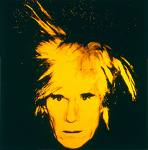
Andy In Full Are Mode
Andy Warhol who had a zoo of addicts and perverts known as the Factory. Warhol, himself a homosexual, had always been a connoisseur of pop music playing 45s constantly. He would have been aware, perhaps uniquely, of the significance of the British Invasion for POPart and the old Abstract Expressionist avant garde. By 1965 he had aligned himself with the musical scene by adopting the Velvet Underground as the Factory house band. He attempted to form connections with all the top musicians from Lennon, Mick Jagger, Dylan and on to Jim Morrison of the Doors not always successfully. Most of the musicians waere as psychotic as he was, recotgnized him for what he was and were too canny to become involved with him.
Yoko on her return from Japan, then, was dealing with a very different art scene than in her first foray. She had to at some time between ’64-’66 make contact with Warhol. As she left NYC in ’66 for London Dylan’s evaluation of her relayed through George Harrison as quoted in Norman p. 671 must refer to this period:
George by contrast, despite long marinading in soft-tongued Buddha-speak, was his most bluntly charmless. “[He] insulted [Yoko] right to her face in the Apple office,” John would remember. “Just being straightforward, that game of ‘Well, I’m going to be upfront because this is what I’ve heard, and Dylan and a few people said you’ve got a lousy name in New York and you give off bad vibes.’ That’s what George said to her and we both sat through it.”
Dylan would have been speaking of Yoko in NYC from ’64 to ’66. During the latter part of that period Dylan was in conrflict with Warhol and his Factory crowd because of Edie Sedgwick. That Yoko Ono could have come within his ken is interesting. Yoko wouldn’t have know of Warhol during her first assault on NYC but as she kowtowed to Warhol on her return after 1968 that might indicate that she might have visited the Factory, which was open to all, met and conversed with Warhol. I haven’t found a mention of her on the main Warhol site, Warholstars, as yet but there must be a connection no matter how slight. It is impossible to know what was said between them but as Yoko got into making Warhol style avant garde movies she must have at least made some notes.
Whether music in relation to the avant garde came up with Warhol’s preference for Rock n’ Roll and possibly he Beatles isn’t known although she did drag Lennon down to do obeisance to Warhol when they eturned. Then, too, she used Sam Green, Samuel Adams Green had presented the Warhol exhibition at UPennsylvania a couple years previously, as her agent for acquistion of art.
In 1980 she was thick with Sam Green leading Lennon to express discomfort because of Green’s association with the Warhol crowd. There seems to have been a rather strong conection of Yoko to Warhol. Certainly her husband of the time, Tony Cox, was well known around the Factory having stolen one of their cars and taken it to California. Cox, who had criminal tendencies, is worth a little study too. It would seem impossible that he knew nothing of the Beatles- I think Yoko Ono’s claim to have never heard of them can be dismissed too- as Cox seemed to have been always scheming he may have heard Lennon songs like Help and I’m A Loser and drawn the obvious conclusions. Lennon in the right hands could be used.
In 1966 then, Cox and Ono left for London presumably to take that art world by storm. I think it quite probable that Yoko believed she could get inside Lennon’s head to use his wealth to further her art career. Her bagism notion was well conceived by 1965 in NYC. Her displays at London’s Indica gallery seem designed to get Lennon’s attention. An apple on a stand priced at 200 pounds…how obvious can you get? The tinyYES on the ceiling. Yoko was very good at hypnotic suggestion.
How did she find her way to the Indica anyway? The gallery had just opened in 1965 and would only survive for two years, which isn’t to say Yoko’s exhibit killed it.
Her claim that she had never heard of Lennon before the show is contradicted by both John Dunbar, the owner, and Barry Miles, who wrote under the name of Miles. He says that instead of coolly walking away not overly impressed with Lennon she actually tried to force her way into his car. Certainly flooding his mailbox with cards and letters doesn’t indicate indifference. No. Yoko wanted access to Lennon’s money and she got it.
There’s no need here to recount how she forced Cynthia Lennon out. Suffice it to say that she quickly captured Lennon; by 1968 they were back in ‘her town’, NYC. For a person who was there for maybe two years in 1960-61 and two more years in ’64-’66 I think it takes a certain amount of chutzpah to call New York ‘your town.’
Once in New York she had Lennon dependent on her while with the acquisition of the Dakota Apartment in 1973 the real action began. First let us do a character review of Lennon before beginning the denouement.
I am assuming that any readers will be familiar with the main lines of Ono’s and Lennon’s biographies. If I’ve glided too quickly over certain points don’t hesitate to ask for clarification. There are literally thousands of websites dedicated to all principals and minor characters, some of them very extensive so my exploration of all these sites is ongoing.
 I, Dynamo