Edgar Rice Burroughs And The Accreted Personality
by
R.E. Prindle
Chapter 8
After The Revolution
Eddie’s story in the twenties has proven difficult to write. There was so much happening in his life that I have finally decided to make the twenties into three sections and two chapters- political and personal.
While I have covered most of the ground in other essays I will try to make this as comprehensive as possible. The political atmosphere post-Bolshevik Revolution has seldom if ever been interpreted by Ed’s biographers. In point of fact politics were forced on him will he nil he. I’m sure he didn’t know what had happened.
His political troubles derived from two sources of about equal importance. The first was the Bolshevik threat from Communism and the second was the Jewish confrontation forced on him. It is regrettable to have to bring in the Jews which often has unpleasant consequences but biography and history become impossible if one is required to blot out half of the material as unmentionable; thus I hope I will be forgiven if I record the whole story with all its blemishes. I will treat of the Reds first and the Jews second.
The quest of Joseph Stalin and the Soviets to control the literature of the West that the discussion of political and social affairs in any other than a pro-Communist context might be prevented seems to have been ignored by all historians. In fact Stalin did his best to control what was published while discrediting established writers unsympathetic to the Revolution. On the one hand the Reds either created the P.E.N organization or acted through John Galsworthy the author of the Forsyth Saga or took it over shortly thereafter.
P.E.N. is an acronym for Poets, Essayists, Novelists. The organization still exists and its current slogan is ‘Promoting Literature, Defending Freedom Of Expression.
In its history on the internet it states: PEN was one of the world’s first non-governmental organizations and amongst the first international bodies advocating for human rights.
That’s pretty much double speak for Communist writers first and foremost and their version of human rights. Human rights meant from a pro-Communist point of view. Today there is a PEN in nearly every country of the world controlling discussion.
But back then by 1930 the President of the organization was the Communist stooge H.G. Wells. He was a very active hatchet man who did his best to discipline non Communist writers.
H.G. Wells is one of the great names in world literature. His career began with a bang as his early fantasy sci-fi novels and short stories of the 1890s are among the great classics still avidly read and filmed today especially The War Of The Worlds and The Island Of Dr. Moreau.
He became a little too doctrinaire as the twentieth century’s first decade ended and then became preachy. While he remained prolific to his death in 1946 his output is pretty much an acquired taste today. For myself while his novels are often annoying they are redeemed by his talent and quite profound sagacity.
Stalin found him a little too independent, indeed, troublesome. Their philosophies parted and by Wells’ late thirties’ novel The Holy Terror he was advocating Stalin’s assassination. Naturally there was a woman involved.
His reasons were personal concerning Stalin’s treatment of him in relation to the State prostitute, Moura Budberg, assigned to him as a minder.
There were a number of State prostitutes assigned to Western writers to guard their orthodoxy. Stalin was serious. Strangely he was if not a fan of Edgar Rice Burroughs, he was a great admirer of his creation Tarzan. I don’t know that he read the books but he had the movies flown in to him, most likely the MGMs of the thirties and later Sol Lessor’s Tarzans of the forties.
It seems clear that Ed knew he was being targeted by both Wells and Stalin. I have detailed the literary feud between Wells and Burroughs in other essays but by the end of the decade and the publication of Tarzan The Invincible the battle lines were clearly drawn.
In many ways even though the denouement was certainly painful for Ed, the struggle provided him with the story lines for his truly great series of Tarzans from 1930 to 1935 that recorded the progress of the struggle.
Ed had always been anti-Socialist. He deplored the Hay Market rioters of May 4, 1886 while his father was actually invited to the hanging of the ‘Commie Martyrs.’ Young Ed clenched his fists in rage as the Reds marched Chicago’s streets beneath their red flags.
One can imagine how he sat up in alarm when the news of the Bolshevik Revolution reached his ears. Nor was the Bolshevik Revolution confined to Russia. As the Great War ended in Germany’s defeat opening its eastern borders Soviet cadres flowed West into Central and Western Europe where with more or less success they attempted to foment revolution. At the very least the Communists established themselves in Western capitols to influence politics in the various nations including the US.
While historians refuse to acknowledge it there was a Communist revolution attempted in the US from 1918 to 1921. The Communist assault in the US that includes the bombing of Wall Street and dozens of assassination attempts was foiled initially by the Attorney General A. Mitchell Palmer and subsequently forced well underground by the much maligned but surely great Warren G. Harding shortly after assuming office in 1921.
Thus the Republican Interregnum of 1921-33 frustrated the revolution forcing it into other channels such as stock market manipulations and the movies.
The revolutionary period coincided with the great turmoil in Ed’s life as he shifted his base of operations from Chicago to Los Angeles. Still he found time to write an anti-Communist tract called Under The Red Flag that not surprisingly was universally rejected. However if he had been under the Communist radar screen before the tract made him a marked man. The Communists put him on their list of reactionaries to be destroyed. Thus, as the twenties began Ed was under assault.
Ed seems to have been always well informed. His anti-Stalin Tarzan The Invincible displays a very profound understanding of the Communist situation with a positive awareness that he was on Stalin’s hit list. As incredible as that may seem it is true. Stalin’s literary agent, H.G. Wells fought a running literary battle with Ed all through the twenties and thirties in conjunction with other elements that ended with Ed’s exile from the movie capitol as the forties began.
As mentioned, Wells’ career had fallen on hard times before the War began as he pursued his social and sexual agenda. He was loved for his earlier work but his later efforts, what were essentially tracts, failed to find a mass audience. He wrote all through the War. These volumes while not popular still have a great deal of merit although running counter to my own understanding of things. His The Soul Of A Bishop is a quite penetrating examination of the subject.
Nevertheless the War destroyed all Wells’ prognostications for the progress of mankind so that he was a broken man intellectually by War’s end. The horrors of that war, the destruction of a whole male generation is indescribable. No use to attempt it. With a broken mind Wells sought refuge in a return to God that was futile. But, as a man must believe in something H.G. gave himself body and soul to the Revolution. He became a part of the Soviet sphere. While he tried to operate independently as a free man and an equal of Lenin and Stalin, that was impossible. Thus, as he always maintained his façade of independence he was subordinated to Stalin, watched over by his consort, Moura Budberg.
Always a sort of literary maverick his style changed somewhat in the twenties where as the literary hit man he began to satirize and defame the so-called reactionary politicians and writers of the day.
As a slight digression, while Wells was despairing his loss of faith he undertook to write the most successful book of his career, the fantastically best selling Outline Of History. This socialist view of history not only sold well off the bat but continued to do so at least into the fifties. The book established his financial independence putting him beyond the control of Stalin while establishing him as one of the great savants of the world along with Bertrand Russell and George Bernard Shaw both now eclipsed reputations. Wells wrote two further compendiums The Science Of Life and The Work, Wealth and Happiness Of Mankind. These enhanced his reputation but are now disregarded although an historically valuable depiction of the knowledge of the thirties. So, Ed was up against Stalin’s heavy hitter and faced him down.
As corroboration of Stalin’s interference and control of Western writers an excellent little book by Nina Berberova titled: Moura: The Dangerous Life Of The Baroness Budberg was published in 1988 translated into English in 2005. Berberova says: p. 241
Quote:
In the 30s there existed in Parisian literary circles a strange distrust of certain women of Russian origin who had married French celebrities…from the world of letters, music or theatre. It mattered little whether they were the legitimate wives of Romain Rolland, Louis Aragon, Paul Eluard, Fernand Leger, or their mistresses. One always had the feeling on making their acquaintance that they had probably been sent by Moscow to attach themselves to these celebrities, with the principal mission of keeping these men of genius under Stalin’s influence and from preventing them from expressing critical opinions about him or changing their political positions. Like Moura with Wells there was Elsa Triolet, the wives of Eluard and Leger and many others, including Princess Maria Pavlovna Kudasheva. These were energetic, intelligent women who had chose this dangerous profession fully aware of the possible consequences. Some of them used to go to Moscow and would also entertain Soviet diplomats who happened to be in Paris and were charmed….This is not the place to paint their portraits, but a few words must be said about Maria Kudeshova, who managed to get Rolland to marry her when he was sixty-eight years old (she was a little over thirty) after having gotten rid of his sister who had been living in his house in Switzerland. She surrounded Rolland with her Soviet friends and finally convinced him to take a trip to Moscow. According to Georges Duhamel there was no doubt that she was working for Moscow. Kudasheva admitted to Duhamel’s sons that she had been manipulated by the NKVD….She quickly installed herself in Rolland’s house and threatened suicide several times in order to make him marry her.
Unquote.
And then on pp. 255-56
Quote:
When Galsworthy died in 1933 Wells had become president of the international PEN club, and…Moura…was receiving guests as the lady of the house….From the early 1930s to the early 1950s Moura played a really important role within the international PEN club, successfully barring Russian émigré writers from membership. She was supported by left-wing intellectuals in England and Europe, and also by English publishers…
Unquote.
One can imagine then to what lengths the Soviets went to control what was published and what wasn’t. After the Revolution when the various Socialists, Reds and Parlor Pinks operated more openly it was quite clear that they were in control of publishing and culture in general.
Ed had always had problems with the critics; he was not a respected writer. However he was a very successful and influential writer. Before the War he had been more or less an imitation of the successful writers of the earlier generation such as Wells, Haggard and Kipling. But with the development of the genres and genre writing of which he was he most successful exemplar all the young would be genre writers turned to him as their role model. In addition under the leadership of publisher Bernarr Macfadden the pulps evolved from general fiction magazines into genre fiction magazines. Macfadden’s True Romance titles were spectacularly successful although as one might expect reviled. Nevertheless there they were in their millions of copies sold and sitting on top of the literary heap of pulp writers was Edgar Rice Burroughs. He was to be a major influence on all pulp writing of the twenties and thirties.
By that time the damage had been done and it was very difficult to destroy his career although this was successfully done through the agency of his secretary, Ralph Rothmund, by the end of WWII until the sixties revival, which was accidental, when publishers discovered that the titles whose copyrights Rothmund had let lapse were in the public domain. Grosset and Dunlap post-WWII who knew the copyrights were lapsed had been under no obligation to pay Burroughs royalties but did so out of courtesy.
The literary world had always found Ed unpalatable. He secured his publisher, McClurg’s nearly by default, who mistreated him and in one way or another cheated him of substantial amounts of royalties thus preventing the prosperity and power due his success.
His editors despised him as a writer denigrating him whenever they could. His last editor at Munsey, Bob Davis, constantly belittled Ed’s efforts. I have not yet obtained Davis’ autobiography but as the twenties dawned Davis quit his job at Munsey to try his hand at authorship. His true idol was O. Henry who he tried to imitate in two volumes of short stories, sketches and reminiscences that I have obtained and read. He was a relatively dull and trite writer, certainly no Edgar Rice Burroughs.
But Ed’s publishing troubles were just beginning. Stalin’s agents riddled the publishing business. McClurg’s and Grossett and Dunlap had been working against his interests from the beginning. The movies had circumvented the publishers swelling his income as he made his move to Los Angeles to a peak of a hundred thousand dollars. Unfortunately Hollywood was in the hands of his political enemies. That and Ed’s misunderstanding that the rules of the game had changed and the rules of the America he had grown up in no longer applied. There were topics that could only be discussed in a positive Communist manner while any other discussion was sure of instant rejection; in order to succeed you knew which road to take.
Ed’s anti-Communist tract was a definite false step in the new intellectual environment. Two major faux pas that cost him his credibility in Hollywood were his titles, The Girl From Hollywood and Marcia Of The Doorstep. The first attacked the immorality of Hollywood while the second had characters offensive to Jewish sensibilities.
Ed complained that there was an effort to suppress Girl even though sales were good while publication of Marcia was completely denied him.
Between the Communists and the Jews then movies starring Tarzan were suppressed from 1922 to 1927 thus denying Ed that important source of revenues.
On the international level his English publisher Methuen’s refused to efficiently distribute his books thus drying up English revenues. In Germany a brouhaha was created regarding attitudes toward wartime Germany found in Ed titles of that period. As the wartime propaganda on both sides was brutal I find it difficult to believe there was a grass roots objection to any wartime hysteria.
As Stalin was virtually micro managing literary concerns in Europe and America it seems more likely that the great noise was fomented by Communist interests that resulted in the withdrawal of his books along with his royalties from the German market. This also was a serious blow to Ed’s finances. His expenses were then exceeding his income forcing the serious retrenchment he depicts in 1924’s Marcia Of The Doorstep.
Curiously while his sales dropped in his major European markets they sky rocketed in the Soviet Union itself. Of course Ed derived no royalties from Soviet sales. Perhaps Stalin was having his little joke; the retort to which came in Tarzan The Invincible.
Ed’s American publishing woes continued to increase until he found it necessary to dump McClurg’s. Even though the Tarzan books were major sellers, with the Mars series less so but good, and while the onus against pulp writing had all but disappeared with major publishers releasing titles written in the pulp or popular style Ed was refused by every major publisher just as he had been in 1914.
Forced into dealing with questionable publishers he threw that in and in 1930 with his Tarzan The Invincible Ed self-published under his own imprint.
So, by the end of the decade the Communists while not yet destroying his career had interrupted his concentration while putting him into a defensive position outside normal publishing methods. In that sense Ed had his back against the wall fighting for survival. Next let’s examine his position vis-à-vis the Jews.
2.
Hollywood Boondoggle
This section concerning Ed’s relations with the Jews will be more difficult as the activities of the Jews run counter to the average citizens prejudices concerning them. Contrary to what all histories tell us the Jews were active participants in all revolutionary movements of the nineteenth and twentieth centuries while acting in their own interests at all times.
Even if this was misperceived, which it wasn’t, they were still widely perceived and, indeed, at the close of the war accused of having been responsible for the war by many very well informed people. If Ed didn’t see the situation that way he had his suspicions.
Now, when Ed left Chicago he left ahead of a letter that was forwarded to him in LA from theAmerican Jewish Committee. This letter was to have a profound effect on the Hollywood phase of his career from 1920 to 1940. They were to be twenty years of constant harassment.
In order to establish the context of this letter, questionnaire actually, let me summarize the Jewish situation vis-à-vis Europe and America as part of the 1789-2001 Revolutionary period.
As the French Revolution began the Jews everywhere in Europe were under civil disabilities. The Revolution emancipated them making them equal in citizenship with all Europeans. Of course the process was effected more rapidly in some areas than others.
At the same time the Scientific Revolution freeing the mind from religious superstitions was well under way. Science as we all know invalidates and supersedes all religious thought. This left Christianity and Judaism holding the bag with silly grins on their faces. In was necessary for them to adjust to Scientific realities in one way or another or go over to Science abandoning religion. Setting Protestantism and Catholicism aside the Western Jews, England, France and Germany, were devastated while the Eastern Jews of the Pale of Settlement were unaffected until the twentieth century when they arrived in the US. The Jewish belief system had been invalidated, so much sentimental trash.
They were unable to find a place for themselves in this new environment until a hundred years or so after the Revolution the Jews originated the argument of relativism in the attempt to defeat science and regain their status. While Science was positive that is an attempt to realize the true nature of reality and its results absolute, the Jews attempted to destroy that positiveness by introducing relativity, that is inner wishful thinking. Thus in 1900 a whole group of Jewish savants in various disciplines introduced relativity. Freud/Fliess in Psychology, Karl Marx in politics, Einstein in physics, Schoenberg in music, Franz Boas in anthropology, Anatole France in literature, Henri Bergson in evolution, across the whole field of learning. Einstein’s Theory of Relativity challenged the positiveness of Science making positive results questionable both scientifically and socially.
Politically great organizations were created to advance Jewish interests, The American Jewish Committee, The Fraternal Order of B’nai B’rith’s Anti-Defamation League. While influencing American politics heavily up to the election of Woodrow Wilson in 1913, under Wilson’s socialist presidency Jews actually entered government administration in large numbers. They were especially active during the War years. Their influence would diminish in 1921 when Warren G. Harding took office.
But as the War ended before Wilson’s socialist policies could be effected their influence was diminishing but still in 1918 the Jews devised something they called the Jewish Bill Of Rights that they wished to attach to the Constitution. That was the communication forwarded to Ed in LA in 1919.
The survey was sent to every prominent man and woman in the United States to determine their degree of ’anti-Semitism.’ If you returned the questionnaire promptly and in full accord you were considered safe, if not you were placed on the rolls as an anti-Semite. Ed did have some questions that, while he probably didn’t realize it having been reared as a free American boy with rights of free speech guaranteed by the US Bill Of Rights, marked him as an anti-Semite for being in violation of the Jewish Bill Of Rights. Already targeted by the Bolsheviks he now found himself on, or perhaps didn’t realize he was on, the list of dangerous anti-Semites marked for destruction. And he was destroyed. Generally speaking, I am unaware of any exceptions, all these people so indicated were destroyed by 1940.
Some were very powerful men such as that greatest of Americans Henry Ford. Add Warren G. Harding, William Randolph Hearst and many others with whom Ed found himself in the same boat.
Henry Ford, of course, engaged the Jews in a full fledged war. He established the first national newspaper, The Dearborn Independent, to carry the battle to them. For several years his paper published articles exposing Jewish machinations including three or four concerning his copy of The Jewish Bill Of Rights.
As the Revolution spread to US shores in 1919, 1920 and 1921 it seemed possible to the Revolutionaries that they would overthrow the US government. If Wilson had not had his stroke and been able to run for the third term he wanted, instead of Warren G. Harding’s election, they may very well have succeeded. Say, Wilson had done what his protégé FDR did do, that is serve four terms it is certain that the country would have turned Communist. Instead Harding assumed the presidency and very energetically put a stop to Communist and Jewish shenanigans. He would pay with his life two years later but he did save the Republic for twelve years.
Ed makes reference to a ship he calls the Harding in The Moon Men that must undoubtedly refer to the President. Tarzan And The Ant Men is full of political references to the Harding administration so Ed was fully aware of what was happening. Although the publication of Ed’s 1924 novel Marcia Of The Doorstep was blocked, Ed goes to the assistance of Henry Ford basing his character Marcus Sackett, that is himself, on four articles concerning Jews in show business that appeared in Ford’s Independent. Ford’s articles were later collected in a four volume set given the unfortunate title of The International Jew. By that he didn’t mean to include all Jews only those Jews affiliated to the international Jewish government.
In his Marcia novel Ed’s unsavory villain was a wily little Jew and his portrayal of Hollywood was accurately if inadvisably a portrait of the Jews who ran the movie capitol. Ed balanced the picture with wise upright Jews, one probably based on Louis Brandeis, and generous Jews but that misses the point. While the novel was never published it was apparently read by the studio heads or whoever landing Ed in hot water. Thus in his Moon Maid he depicts a lovable, highly respected and honored Jew both by Jew and Gentile but once again, that misses the point and makes up for nothing in Jewish eyes.
But, you know, once you’ve crossed the line you can’t get back over. Rather than improving his situation versus the Jews the Moon Maid probably worsened it as he had, in effect, apologized and confessed his guilt just as Henry Ford would do in 1927.
The twenties were a time of transition from the pre-war period of small holdings to consolidation in much larger units. This was no more apparent than in agriculture where the great corporate farms were taking shape along with food processors of comparable size that would form as such giant corporations as Archer-Daniels-Midlands. So Ford was right but he lost the suit. Actually there was no difference between these huge corporate farms and the collectivized farms of the USSR. It was just done differently.
Ford who initiated perhaps the greatest industrial change or forward movement the world has ever known in the assembly line and then went on to create the first worldwide company was nevertheless conservative otherwise, almost atavistic. He had hated farm work as a youth so even as he lined up a long row of Ford tractors that plowed the whole field in a matter of minutes, almost seconds, that made large farms possible he objected to the consolidation of small farms. He pointed to a Jewish firm involved in the consolidation which, of course, the Jews denied. In the ensuing law suit Ford lost and even allowed the Jews to write his apology that he signed.
The law suit came at a time when Ford through neglect in adapting to the evolution of the auto industry and economic pressure from the Jews closed down his entire operation for over a year as he met innovation with the innovation of the V8. Ed’s son was one of the first to buy one, even though Ed had always detested that poor man’s car, in support of Henry. But Ford had lost his sales lead slipping into second place behind Chevy where he stayed at least through the fifties. The entire auto industry was consolidated into the Big Three- G.M., Ford and late arriver Chrysler with a few small survivors.
The same process affected the movie industry which affected Ed’s fortunes greatly when sound was introduced in 1927-28. The expense new constantly changing equipment and technological expertise or evolution of the industry was too much for the smaller firms to bear. The consolidation had been going on before as William Fox, previously the most successful of the movie producers, was driven into bankruptcy by the New York money Jews. Fox’s firm, he himself was Jewish but resisted the consolidation, was joined to Twentieth Century to form Twentieth Century-Fox.
The most successful consolidation that would determine Ed’s fortunes was the Loewe Corporation’s Metro-Goldwyn-Mayer. These three studios as MGM were under the hegemony of Loewe’s in New York City. Loewe is German or Yiddish for lion so the MGM logo with the words Metro Goldwyn Mayer under the roaring lion represents them as the operating companies of Loewes. From 1930 to the fifties MGM was the gold standard of the industry. As children we all cheered at the Saturday movies when the lion roared because then we were guaranteed a good movie. For the rest of the logos you could never be sure.
So the Jewish machinations against Ed essentially climaxed when Ed surrendered control of his magnificent creation in 1931 as he signed his contract with Loewes, MGM and Louis B. Mayer.
There is one other major issue of the twenties to be considered as it did affect Ed although indirectly. The issue is the stock market crash of 1929. The important point here is that the Wilson administration was socialist. If the Democrats, that if the Wilsonians Cox and FDR, had won in 1920 the Wilsonian socialist program would have moved forward. Instead the Republican Warren G. Harding was elected and in his return to ‘normalcy’ he squashed the whole Wilsonian program none of which had had a chance to take effect. Harding simply suppressed the Revolution.
The Democrats then looking ahead could see no chance of regaining power save through some national disaster through which Republicans could be portrayed as inept. With the prosperity of the New Era there would be little chance for election for who knew, maybe fifty years or more. A national disaster, then, had to be created but one which the Democrats thought they could turn around in a snap.
The economist John Maynard Keynes was touting monetary stimulus as the panacea of all economic downturns. It was true that such a program had never been tried but it sounded logical and a sure fired remedy. It was only necessary to create an economic downturn such as 1873, 1893 or 1907 by, say, 1930.
The so-called stock market crash was no big thing in itself. We’ve had bigger since then without any adverse results. The stock market has always recovered and risen to new heights without a monetary stimulus.
The difference in 1929 was that margin requirements were very low at only 10%. That means that if you had a hundred dollars you could buy a thousand dollars worth of stock on margin or essentially on credit. If the stock rose you could sell and pocket the cash. If he stock dropped there would a margin call to bring your indebtedness back under 10%. If your stock doubled as stocks did at that time you could use 100.00 of the increase as collateral and buy more stock and so on but with each increase in value your margin call would be greater and as it did exceed your means. Then, of course, it all came crashing down as it did.
First a buying frenzy had to be created which was done. The momentum continued forward crazily until the plug was pulled which it was. Then stocks not only lost value but those who were betting the farm were foreclosed and tens of thousands of people became penniless. Thus one had the terrible situation of 1929.
Herbert Hoover the Republican president was then called on to solve the problem instantly. Hoover didn’t have the secret the Democrats thought they had so by the time the country was singing Happy Day Are Here Again FDR was in office. He reached into his Keynes top hat to pull out the Magic Formula and what to his surprise but that the marvelous Keynesian solution didn’t work. Well, no matter, he’d already been elected and that was miracle enough. Blame the Depression on the Republicans and get on with it. Thus Wilsonian socialism returned to Washington along with the Jews.
Back in 1928 Ed ever on the lookout for a fast buck business opportunity had invested in an airplane engine called The Apache and what he considered a sure thing, a San Fernando Valley airport. The Depression stopped both with Ed losing his entire investment. Oh well, he could still write so he formed his own publishing company and did. He turned out the best work of his career, but then, that’s for the chapter on the thirties.
In conclusion the twenties had been a political and economic disaster for Ed. He had been soundly trounced by the Judaeo-Communist forces. Worse was still to come.
Anything Less Than Real:
Warren G. Harding Rings In The New Era
by
R.E. Prindle
Dedicated to Ann Coulter who is the only other person I have heard of who realizes the importance of Warren G. Harding.
It is time to reevaluate the Harding presidency as well as perhaps the Republican Interregnum between the Socialist Wilson and FDR administrations.
Perhaps the first thing to do is to dispel the notion that the Harding Administration was extraordinarily corrupt as administrations go. If one is going to call the administration corrupt then it must be against a normal standard and not isolated as a phenomenon. While Harding inherited Wilsonian corruption after the Great War, Roosevelt created the corruption of post-WWII. The money involved in the latter dwarfed anything that preceded it by incalculable amounts.
A major source of corruption after the Great War was the disposal of stores purchased for the war. These were fairly trivial amounts by later standards. In contrast the Roosevelt administration sequestered some piddling amounts of Japanese property and mega enormous amounts of German property including huge companies and scads of patents, copyrights and trademarks. Yet one never hears of these thefts, only a couple refrigerators left on back porches by Japanese. Ask yourself why? These German properties were under the personal authority of Pres. Franklin Delano Roosevelt and the officer of the Alien Properties Custodian of David Bazelon. Bazelon was both a Jew and associated with the Super Mob and Chicago’s Outfit.
After the war Bazelon used his office to enrich both Jews and criminals by selling off the pittance of Japanese properties and, in today’s values billions and billions of German properties for a penny or so on the dollar thus stealing from the Germans and defrauding the US Government of billions.
I don’t think it is necessary to list other financial malfeasances; Bazelon alone surpassed any corruption of the Harding years including Tea Pot Dome and Elk Hills. So yes, there was the inevitable postwar corruption in the Harding Administration, but not by it, of negligible proportions compared to Roosevelt.
Having put that out of the way let us now consider the state of the nation Harding inherited from the Democratic Wilson Administration. Two new developments, unprecedented developments, had occurred that were novel for a new administration to deal with. One was the terrible advent of Prohibition and the other was the women’s vote.
In this first election in which women cast their ballots we had the first landslide victory in US history. Harding captured sixty percent of the vote and all but a hundred or so of those of the Electoral College. Apropos of that Harding has been ridiculed because his campaign manager, Harry Daugherty said that Harding looked like a president should. Well, he did.
His opponent, Cox, on the other hand, looked like a mousy dip, which isn’t to say he was one, he looked like one. He was unhandsome. The choice for women thus was between a nice, big handsome Harding who looked the part and a mousy Cox who didn’t. The election was the first landslide in US history. I leave it to you to draw your own conclusions.
The ground rules had changed whether you believed in it or not, elections could no longer recite the issues as men understood them but campaigns had to be crafted to include the very different concerns of women. In my estimation Harding clearly benefited from the female vote.
Prohibition was an entirely different challenge. Prohibition was an achievement of female politics. The campaign for it was carried out by criminal means. The most famous prohibitionist was the violent, psychotic Carrie Nation who entered people’s places of business and began laying about with an axe. She was allowed to get away with it. The promoters of prohibition were too limp brained to think the matter through to its conclusion apparently unaware that alcohol could easily be smuggled in from abroad or even, heaven forbid, manufactured illegally.
Some form of alcohol, wines and beers, had been part of civilization from its inception and gave some surcease from the cares of life. While the vast majority of drinkers were able to manage the pleasures there was naturally a percentage who abused alcohol. When distilled liquors became available the problem of abuse was compounded.
Nevertheless, wine, beer and strong spirits comprised a huge industry employing undoubtedly tens of thousands of people. In the reformers’ mind, as always, it seemed better to punish the majority to suppress the few.
It should have been obvious to these unhappy reformers trying to make everyone’s life as miserable as theirs that an entire illegal industry would rise from the ashes of the legal and that that illegal industry would necessarily have to be criminal and clandestine. What can one say about reformers?
Thus when the Volstead Act was passed an unprecedented wave of criminality swept over the country like a tsunami. We can blame Prohibition on the Wilson Administration on whose watch the bill was passed and enforced. Thus the Harding Administration was called on to deal with this enormous level of corruption generated by do gooders. Once again Prohibition far exceeded any of the usual political corruption of the twenties.
Now, the control of prohibition passed into the exclusive control of two immigrant groups, those of the Italians, actually Sicilians, and the Jews. Using the incredible profits of Prohibition Jews and Sicilians then were able to assume a dominant if not controlling position in US politics while being able to buy into legitimate businesses. As incredible as it may seem by the mid- to late thirties many people considered crime as just another way of doing business, an industry. Needless to say bootleg profits were used to corrupt politics at every level. How could the Harding Administration escape? Once again, just look at the FDR Administration with open eyes.
The US has always taken a romantic or sentimental view of immigration, still does. As if it justified immigration the Romanticists said that the immigrants were only seeking a better life, content themselves in the superiority of having created not only a better life than anywhere else but the best life. Liberals believe in their own superiority.
One imagines that the only reason to emigrate from one’s homeland at any time in history was to seek a better life. Perhaps invaders drove you from your country making it necessary to find a life, better or worse, somewhere else and at someone else’s expense. Perhaps one’s situation was so bitter that any place else was more attractive. Actually the prime motivating force was US employers seeking cheap labor. Not very romantic really.
Nevertheless unlimited immigration began after the Civil War during the seventies increasing yearly until 1914 when the Great War began cutting off all emigration. It was then that problems not seen as too significant became prominent. US immigration had been from Europe and when the continent went to war these old national loyalties caused fractures. It became apparent that the Melting Pot notion had failed and as Teddy Roosevelt said, the US was nothing more than an international boarding house. Sentiment was strong for the Central Powers, who we have all been taught to despise, but not as strong as that for the Allies, who we have all been taught to revere.
The Irish acting on the principle that the enemy of my enemy is my friend openly sided with the Central Powers against the English hence targeting US shipments to England for sabotage. The Jews whose chief enemy was the Russians refused cooperation with the Allies until Germany took Russia out of the war and then at that time and only at that time, the Jews gave the Allies full cooperation against the Germans who they then believed that they could include in the Bolshevik Revolution post war.
The Italians took a stance but issued a recall of men back from the US to fight in the war. After the war Mussolini attempted to send the Italian wounded back to the US to be medically cared for at US expense.
Of all the immigrants US nativists considered Jews and Italians as unassimilable. If nothing else, Prohibition proved that assertion as US laws meant nothing to either group. Thus it was left to the Harding Administration to deal with the long deferred problem of immigration. It would do so for the first time from a realistic perspective rather than a sentimental or romantic one.
A concomitant of immigration was that a great many of those ’seeking a better life’ had left their homelands a step or two ahead of the police as either criminals or political fugitives. They were revolutionaries seeking to overturn their own governments, Communists in a word. Their position had been strengthened by the success of the Bolshevik Revolution in Russia while the Wilson Administration was actually Socialist in sentiment and had the war lasted a year or two longer, in fact. Wilson was on the verge of establishing a third term dictatorship to do just this, not unlike what Roosevelt achieved, when he was struck down by his stroke thus aborting that plan.
The Revolution did not confine itself to Russia but was actually being attempted through 1919 and 1920 into 1921 and the Harding Administration. The country was nearly in total disorder when Harding was sworn in, March of 1921. A necessity of the first importance was to restore order, that is, put down the Revolution. Harding was equal to that task. The Chinese proverb and curse is that may you be born into interesting times. While the elements defeated by Harding have successfully maligned his memory Warren G. Harding was actually one of the greatest US presidents.
2.
No historian I have ever read regards the problems Harding had to solve or his lack of experience in doing so. Harding was the editor of the small town newspaper of Marion, Ohio, West of the Alleghenies in Middle America. Harding worked hard, applying himself intelligently, making a success of his paper.
He became friends with Harry Daugherty, an Ohio politician who propelled him first to the Senate and then in 1921 to the Presidency. Years before his election Harding began an affair with a young women by the name of Nan Britton by whom he had a child. Naturally Harding had no desire to have this publicized yet he behaved honorably always supporting Nan and his child. He was a decent and good man.
Much has been made of this affair as though this were immorality of an extreme nature. Historically affairs and illegitimate children have been common. No big deal. How can one be expected to condemn Harding when the later John F. Kennedy had mistresses in the White House when Jackie was not about. What is one to think of Kennedy when he had his secret service agents rounding up prostitutes from the street, three at a time, for his dalliance?
FDR publicly lived with his mistress in Georgia while his beauteous wife, Eleanor pined away up North. Bill Clinton kept his member limber by having his female aides give him fellatio during business hours in the Oval Office. Hillary didn’t object.
Was Harding a moral reprobate? Hardly.
Then, the historians attempt to make him an ignorant oaf. A competing presidential candidate William McAdoo described Harding’s oratorical abilities, not surprisingly, as ‘an army of pompous phrases marching across the landscape in search of an idea.’
Oh well, politicians, how much sense do you get out of one of them? As an example of supposedly meaningless blather they offer this pre-election statement of Harding:
Quote:
America’s present need is not heroics but healing;
not nostrums, but normalcy;
not revolution but restoration;
not agitation, but adjustment;
not surgery, but serenity;
not the dramatic, but the dispassionate;
not experiment, but equipoise;
not submergence in internationality, but triumphant nationalism…
Unquote.
Rather than the nonsense it is portrayed as by his detractors, the speech details the problems the country was facing and the results Harding hoped to bring about and in which he largely succeeded. I’m sure his audience would have understood, whether consciously or unconsciously, exactly the issues to which he was referring. Only absurd historians have made a jumble of it. What the list amounts to is an eight point program not too different in approach than Wilson’s fourteen points. So we have a sort of political continuity between the administrations.
Let’s consider the list:
1. Not heroics, but healing. Refers to any number of problems, the waves of industrial unrest, hysterical politics and what not, a general calming down, a reduction from hysterics to the dispassionate.
2. Not nostrums but normalcy. A nostrum is a pet scheme for bringing about some social or political reform. There were enough of those going around- Prohibition, Communism et al. The issue here was the use of the word normalcy which in 1920 was incorrect although in common usage now. Normality would have been the correct word but normalcy actually carries the correct meaning that normality misses. His use of normalcy was a cause of immense hilarity and satisfaction to his detractors.
3. Not revolution but restoration. An obvious reference to the Bolsheviks and the social unrest they were causing.
4. Not agitation but adjustment. Once again political and social agitation were rife calling for the discard of current ways for impossible utopian ideals.
5. Not surgery, but serenity. Agitators called for drastic social surgery when once again calm and reflection were called for.
6. Not dramatics, but dispassion. Calm down, lower the level of hysterical passion.
7. Not experiment, but equipoise. Prohibition was a disastrous social experiment from it conception, what was needed was balance.
8. Not submergence in internationality, but triumphant nationalism. Clear enough, the League Of Nations was unworkable, out; tariffs were in, America First. The Naval Treaty.
As Harding was elected by a landslide one has to believe that the electorate knew exactly what Harding meant and whole heartedly approved of his choices. Nor did Harding disappoint; he was very popular during his presidency only successfully denigrated after his death when he was unable to defend himself.
3.
In office only two and half years before he died in suspicious circumstances how did Harding conduct his administration? One can’t imagine today the tremendous political energy released by the Bolshevik Revolution. The world was terrified while an angry civil war ensued across the Western world financially and militarily over an exhausted Europe. The civil war lasting for several years was fought on several fronts. The war had turned from a national war to an ideological war. Reds versus Whites. In Russia the ideological war was fought on three fronts, the North of Archangel, South in the Ukraine and in Siberia East of the Urals. American troops and munitions were involved. In the end the Whites, or Czarist troops lost.
Revolutionary activities sprang up in all countries including the US. While the US was aiding the Whites, the Jews raised enormous amounts that they traitorously funneled to the Bolsheviks under the eyes of the Wilson Administration. Jacob Schiff, the Jewish Prime Minister, was called to Washington by Wilson to defend himself against charges of Bolshevism. Wilson let him off the hook. Thus as in the Viet Nam war of the 1960s and 70s Government efforts were nullified by Fifth Columnists aiding the enemy.
The Bolshevik victory in Russia gave Socialism a political base from which to operate so the Socialists and Communist cells in the US were activated lending their support to Soviet efforts. Suddenly a socialist presence was clear in labor, the churches, the arts, publishing, across the board. While official Communist membership was relatively low so that it could be denigrated as no threat it must be remembered that the successful Bolshevik Party in Russia was just a splinter of US numbers, so size is irrelevant; organization is the key.
America’s first reaction was sharp as A. Mitchell Palmer, the Attorney General of the Wilson Administration rounded up several thousands of Communists for deportation to Russia. Here the Fifth Columnists sabotaged this wise response citing peacetime US practices for this wartime attack instead of the wartime provisions Wilson had used during WWI. Palmer was compelled to release all but a couple hundred who were put aboard ‘the Soviet Ark’ and sent to Russia including Leon Trotsky who had been living in New York City and without whom the Russian Revolution might have been reversed. Trotsky was actually temporarily detained but then released for some reason.
There were substantial crackdowns on all Socialist activities including the IWW or Industrial Workers Of The World who were reduced to impotence. Their leader, Big Bill Haywood was spirited out of the country to Russia. As Harding came to office there was a virtual civil war in progress. The fact has been obscured or erased by subsequent historians who are compelled to take the Red point of view.
At the same time as this undeclared war was being fought the troops were being brought back from the land of hinky, dinky parlay voo. How ya gonna keep them down on the farm after they’ve seen Paree. Even though their lives had been totally disrupted very often destroyed for no reason now that their job was done they were thrown on the trash heap. Except by Warren G. Harding, the new president.
A not overly favorable biographer, Samuel Hopkins Adams, writing in his biography of Harding, The Tragic Years, comments favorable thusly, p. 284-5.
Quote:
The glory of heroes is soon departed. The public which welcomed with oratory, banquets, and ticker-tape our fighters, returning victorious from Europe, quickly forgot those of them most sorely in need of care. Two years after the Armistice the plight of war’s human debris was pitiable. Of these the most desperate cases were 71,000 mental patients and 38,000 tuberculosis victims. F.W. Galbraith, Jr., National Commander of the American Legion, estimated on the basis of an investigation, that there were 10,000 of the disabled in cellars, poorhouses, and insane asylums. T.W. Salmon, a disinterested and competent investigator, thus reported:
“Veterans with nervous or mental troubles were without provision for care and were quartered in institutions for the criminal insane, addicts, and vicious degenerates, without Federal supervision.”
No agency in Washington was equipped to handle a problem of this magnitude. Nor was there any special public interest in it. The war was over. “Let’s forget its’ expressed the attitude of a people sated and bored with emotion.
The President (Harding) did not feel that way about it. His humanitarianism revolted from such neglect. He acted wisely and constructively in welding the disparate, overlapping guardianships into one official entity, the United States Veterans Bureau…
Unquote.
Compare that to the neglect and humiliation of the returning veterans of Viet Nam. The so-called Red tribunes of the people, these creeps who sabotaged their brave men’s efforts on the battlefields, heaved garbage on them as they debarked from ships and planes.
Even WWI vets who had been promised a bonus or tip for the needless disruption of their lives were denied their due by the People’s Commissar Franklin Delano Roosevelt. They were compelled to storm Washington in a semi-violent attempt to compel the fulfillment of the government’s promise. The same army they had served in was turned against them. So much for FDR and the New Deal.
With the end of the war a whole host of what were actually revolutionary acts were released. Palmer of the Wilson Administration certainly treated them that way. As a result his house was bombed putting his teeth on edge. A huge bomb not unlike that used in OK City of recent memory was detonated on Wall Street. Law and order was rapidly breaking down. Mail robberies were a daily occurrence while millions of dollars of stolen Liberty bonds were being traded. Those millions today would represent a billion dollars or more. This was big money happening. Incredible amounts of money that no group of individuals could possibly spend. Where was the money going?
A very able member of the Harding cabinet, Post Master General Will Hays tackled those problems and solved them in short order. Such a man was a danger to the Lords of Misrule. What happened to Hays? In addition to all the other problems, the Guardians of Decency were alarmed, justifiably so, at the moral content of movies. Rather than accept outside censorship of the movies the moguls decided to police themselves and as their Top Cop they lured Will Hays away from his post by an offer he could have refused but found it impossible to do. The offer was for 100,000 dollars a year. That right 100K in 1922. Was that bribery or what? After only nine months in office Hays was offered the equivalent of five million dollars a year to supervise Hollywood morals. Who wouldn’t take that while being flexible enough not to lose the job?
Since the offer came from Hollywood that tells you who was behind the mail robberies and stolen bonds and lets you know what they were worth.
Harding outlawed the Communist Party briefly in 1921 getting right on that offense too but the Fifth Columnists got that overturned.
Thus within months of being in office Harding had cleaned up a large part of untoward activity while if couldn’t actually suppress Communist activity he was at least able to force them to turn their damper down while forcing them into even deeper clandestine activity.
But, as you can see he was building up a lot of enemies who wished him dead while wanting his memory exorcised.
And then Harding had to deal with the problem of immigration, also within the first months in office. The cry for the restriction of immigration, whether it came from North, East or South had been voiced at least as early as the 1840s when the potato famine drove a couple million Irish to the New Island. Really teeming masses. And then the Forty-eighters came over as a result of the failed Communist Revolution of 1848, more wretched refuse, that led ultimately to the post-war revolutionary activity.
These members were relatively small but in the 1870s Jewish immigration from the Pale of Russia began in earnest resulting in several million people who the restrictionists believed, as it turns out, rightly, were unassimilable. And then in the nineties the Sicilians added New York to the terminal end of their migratory route from Buenos Aires through Brazil and Central America. These people too were thought rightly to be unassimilable.
And then those sweet little old ladies hacked Prohibition through the Amendment process apparently believing that the law was the law and everyone would abide by it. They held that futile belief even though they had engaged in rampant lawlessness to get the Amendment approved.
Well, a void had been created and you know what nature thinks of voids. They get filled; nature abhors them or, so we are told. What people rushed in where angels, or at least, less venturesome mortals fear to tread? These two unassimilable peoples, the Jews and Sicilians.
Nobody gets credit for being right in such situations the restrictionists were right.
In most analyses of any period the activities of Jews are always suppressed; you never are allowed to see them until they want to be seen. Nobel awards time being one. While being Omni-present we are asked to believe that their only effect on society is to win Nobel prizes. In point of fact Jews, having great presence of mind, always work behind and under the scene. Thus to understand their effort on the America of the Harding Administration one has to set a background. I’m not going to go back too far settling on the transfer of the Jewish World Government from France when the Alliance Israelite Universelle was sent to the US and became the American Jewish Committee by 1906. This was the international Jewish government that Henry Ford referred to in his Dearborn Independent articles later collected and published under the misleading but accurate title: The International Jew. The articles were published during the Battle For Ford Motors largely during Harding’s tenure.
The leader or Prime Minister of the world Jewish government was a man named Jacob Schiff, himself descended from the German Forty-eighters rather than being a Russian Jew.
In the Jewish war against the Russian Czarist government Schiff played a leading part. He was personally responsible for engineering the Russian defeat during the Russo-Japanese war of 1905.
During that war the Jews of Europe and the US denied the Russians loans to conduct war properly while Jacob Schiff personally provided the Japanese with the funds without which they couldn’t have waged war.
While Schiff himself lacked enough of the ready for the war he was on the board of the Equitable Life Assurance Society. The Equitable was sitting on a hoard of 200 million, in today’s dollars, billions. Schiff illegally used this money to loan to the Japanese. The loan caused a tremendous scandal in which Schiff skillfully avoided detection shifting the blame to the other directors.
The peace treaty was chaired by Theodore Roosevelt in the US at which proceedings Schiff led a delegation of Jews who participated as a Jewish National delegation. Stacking the deck against the Russians.
Not content to punish the Russians for alleged injustices toward Jews in Russia, Schiff and ‘the international’ Jews worked to cause the US to sever diplomatic relations with Russia which result was achieved in 1913. Thus the US became dupes of the Jews.
In 1913 the Federal Reserve System was created as a private corporation owned by ten other corporations of which nine were Jewish firms from the US and Europe. The tenth was the Rockefellers. This private firm printed US currency that it loaned back to the US government at interest, thus creating a tremendous income to be used for worldwide Jewish machinations for which there was no accounting. I would call it a brilliant move but when you’re dealing with Liberal suckers it isn’t much of an achievement.
While the Jews had had no presence in Washington DC prior to the Wilson Administration, beginning in 1913 Wilson flooded his government with them much to the consternation of the English led government of the previous hundred years plus since independence. You know, it’s not like people couldn’t see what was going on.
Coincidentally as Jews were taken into government the Anti-Defamation League of B’Nai B’rith was established to counter any objections on ethnic grounds. Wilson himself was a socialist so that when the US entered the Great War a socialist takeover of the industrial system began. The railroads were immediately nationalized while the War Industries Board required all industries to submit financial details and to submit them for governmental regulations by the WIB controlled by Jews under Bernard Baruch essentially setting them up for seizure.
Of course, this provoked a violent reaction especially from Detroit and the auto industry. Ford and the Dodge Brothers objected strenuously. The Dodge Brothers used intemperate language reflecting on Baruch’s ethnic heritage that Baruch never forgave. Ford was more restrained but tarred with the Dodge’s brush. The Dodge Brothers died mysterious deaths in 1920 while their company went into limbo for years until Wall Street persuaded Walter Chrysler to take the company. An attempt was made on Ford’s life. This confrontation was also the beginning of the Battle For Ford Motors, begun in 1918 but aborted by the war ending. It was begun again on a financial front by Jewish banks trying to force a takeover.
So, the Socialist/Communist takeover of the US was very narrowly avoided. Yet the Socialist revolution had to be financed with hard cash that the Socialists didn’t have. Where was the cash to come from? From the US. The Jews had created the Federal Reserve System in 1913 very fortuitously it would seem just before the major expansion of the money supply caused by the World War. That war from the Allied side was financed entirely by the US. At war’s end the European debt to the US was enormous while it would never be repaid. It was just forgotten. Consider that when you get exercised by the current US debt. It can be forgotten too.
Yet the ten merchant banking firms who owned the Federal Reserve collected interest on every dollar of that debt. Thus the US dollars went to nine Jewish firms in both the US and Europe plus the Rockefellers.
As I have noted, as soon as the Bolsheviks seized power, Jacob Schiff rushed huge loans provided by those banks to finance the Bolshevik takeover. At the same time the devastation of the peoples of Central and Eastern Europe was total. There were still roughly five million Jews in those areas. Jewish American ‘charitable’ organizations operating under the name of the American-Jewish Joint Distribution Committee began to funnel enormous amounts of cash and supplies destined only for their co-religionists into this volatile political environment where the first people on their feet would have a commanding role. Socialism or no socialism money was the key, as always. As the aforementioned Liberty bonds in Jewish hands had been stolen that was a pile of free money that was laundered. Crime was about to be organized in a way that would provide other funds in large amounts. There was a succession of Jewish crime lords that generated the money. The first in the teens was a fellow called Monk Eastman, as his criminal methods became outdated he was sent to jail to be replaced by the notorious Arnold Rothstein who set up the modern organized crime structure but as his methods became outdated he was replaced, murdered, and Lepke Buchalter took over the role to be replaced in the forties by the major fund raiser Meyer Lansky who engineered that huge cash cow, Las Vegas and gambling. As different methods were needed he, in turn, was replaced by Sidney Korshak of the Super Mob. Thus the Jewish over world was integrated with the Jewish underworld functioning as a unit.
In celebration of these criminals the Jews recently created the National Museum Of Organized Crime in its capitol of Las Vegas, Nevada. The nationality referred to in the National Museum is that of the Jews otherwise they would have called it either the American-Jewish Museum or simply the American Museum Of Organized Crime. So you can go to Vegas and admire the criminals deeds of these stellar Jews.
Seemingly almost a gift from heaven to the criminals, Prohibition came along in 1920. This gave the financial basis for organizing crime as a ‘business’ thus opening vistas only dreamed of before the Volstead Act. Prohibition also created an insuperable problem that plagued the Republican Interregnum. Amazingly Prohibition began in a Democratic Administration and ended almost by fiat in the Democratic Administration of Franklin Delano Roosevelt twelve years later, one of the those coincidental linkages between Wilson and FDR. Upon taking office Roosevelt held up a glass of obviously bootleg beer and announced that Prohibition was over. Just like that. Was the fix in from the beginning to end or wasn’t it?
But, back to the Battle Of Ford Motors for a moment. The bankers wanted Ford Motors not only because they hated Henry Ford but because Ford Motors was a bonanza waiting to be realized almost bigger than Prohibition.
Ford valued his company at something over a billion dollars. He had completely vertically integrated his company. That means he not only made the cars but he owned the metal mines and smelted the ores, he owned huge forests he cut and processed, coal mines to fuel his furnaces and even the railroad that carried the coals from the Line to River Rouge. He had subsidiaries worldwide. By 1920 Fords could be bought actually in any country in the world. Like Sherwin-Williams boasted of their paints, Ford covered the world.
The value of the company was compacted. In the bankers’ hands the company could be broken up into its component parts increasing the stock market value to three or four billion, all free money, especially as they were trying to buy Ford at the bankruptcy rate of 10 cents on the dollar. So you see how fiercely the Battle For Ford Motors was fought. You can see why Ford fought back by running his exposes of Jewish machinations, which were true, in his Dearborn Independent. The Independent was also the first nationally distributed newspaper by the way.
Henry Ford won the battle but ultimately lost the war.
So as you can see, Harding was elected into one of, if not the, most tumultuous times in American history and acquitted himself extremely well. His efforts were also appreciated by the American public that awarded him the highest approval ratings during his term in office.
His actions also made him many enemies not least of whom were the Communists and Jews. While Jews were prominent in Washington during the Wilson years and again in the Roosevelt years they were conspicuously absent during the Republican Interregnum. The Communists too, while if not destroyed, were harassed and suppressed forcing them to adopt different tactics while frustrating their desire for an immediate conquest.
On the immigration front too, Harding’s policy of realistic restricted immigration frustrated the desires of the sentimental immigrationists. Harding passed a restrictive bill quickly in 1921 that was augmented under Coolidge’s Administration in 1924 and survived almost intact until 1965 thus giving the country much needed breathing room to attempt to assimilate those already here to attempt to turn them into one national unit. It didn’t happen.
It is not particularly well known but in 1914 the Jews had formulated a plan and organized it to transfer the entire Jewish population of the Pale of Settlement to the US utilizing the ports of New Orleans and Corpus Christi, those ports being less conspicuous than New York City and Boston.
The war, of course, aborted that plan, and just as the Jews were about to activate the plan after the war Harding slammed through a restricted immigration act based on quotas seemingly aimed directly at excluding Jews period. This was an unforgivable crime in Jewish eyes while also forcing them to change their plan of the conquest of the New Promised Land.
Harding also dealt with internationalism rejecting the League Of Nations in favor of nationalistic policies. In the first years of the new century the Japanese had sent paramilitary troops for the pre-invasion of California, thus all the Japanese immigrants were men without women. The Californians who had already forced passage of the Chinese Exclusion Act of 1882 objected vehemently to the Japanese invasion. Rather than offend the Japanese by protecting his own country the Teddy Roosevelt Administration came to a ‘gentlemen’s agreement’ whereby the Japanese would no longer send ‘working men’ but only doctors and lawyers. I think Teddy called his administration the Square Deal. He must have known what he was talking about; that solution was certainly square.
After the war then with no military invasion imminent these men demanded women. Thus began the strange phenomenon of the Japanese Picture Brides. The men and women exchanged pictures making their selection on that basis and then the women were sent to California for marriage. Many interesting situations arose from that.
Still there was a great deal of hostility between the US and Japan. The hostility was actually caused one sidedly by the US. Very embarrassing situation. It began in 1853 when Admiral Matthew Perry ‘opened’ Japan at the mouths of his cannon. What’ll it be he sneered from the poop deck: Yes or no.
The relationship was exacerbated in the 1870s when anti-slavery Yankee planters landed in Yokohama and forcibly abducted a hundred or so Japanese to labor on their old plantations in Hawaii. I can see how the Yankees got so exercised by Southern slavery in the US. So, while I have to side with the US the Japanese have always had a legitimate grievance that could only be satisfied by war. I mean, come on, they had to regain their manhood after having been emasculated in 1853.
Nevertheless in 1908 TR said we would have to fight those fellows within thirty years and he only missed by a few years.
Thus in 1922 the Washington Naval Treaty was negotiated as, we suppose, an example of triumphant nationalism as opposed to the internationalism of the League of Nations. The Naval Treaty limited the size of naval fleets inadvertently favoring the Japanese. But the belligerence remained at a high level that left the then territory of Hawaii vulnerable. Naval fuel was shifting from coal to oil so while coaling stations had been established there were no oil storage facilities on Oahu the site of the Pearl Harbor Naval Station.
This was a dangerous situation. It was difficult to get Congress to act so some enterprising American oil men, Doheny and Sinclair, set about to remedy the situation on their own. Now, too oil fields, Tea Pot Dome in Wyoming and Elk Hills near Bakersfield, had been set aside as Naval Preserves. The storage facilities in Hawaii would be naval, so there is a connection.
Doheny and Sinclair set about to build the oil storage on their own and to fill the tanks they negotiated to use the naval preserves Teapot Dome and Elk Hills for oil supplies. This deal was used as an excuse to create a huge scandal, although after Harding’s death. Nevertheless the storage facilities were built and filled with oil so that when the Japanese attack on Pearl Harbor duly came the US was duly prepared.
Two and a half years into his presidency Harding began a tour of the West Coast during which he suddenly died. Some said poison some said heart attack but they got him into the ground so quickly there was no autopsy. Anytime the rules are broken its cause for suspicion. Some said his wife killed him but I have a hard time believing that.
Of course we have no way of knowing whether he was assassinated or not but there were many who may have wished his dead. Harding had sidetracked the Revolution, derailing it, while forcing the Bolsheviks further underground. His immigration act had thwarted Jewish plans to bring over five million fellow Jews. So actually Harding was ‘responsible’ for the death of all those Jews in the holocaust although I don’t think he’s ever been officially accused.
Neither the Jews nor the Communists have earned a reputation for being forgiving so both groups certainly had a motive. But, the problem is incapable of solution so let it drop.
Harding was only in office for two and a half years but what a two and a half years, hey? What a bunch of insoluble problems dealt with and well. He defused the Revolution, ended unrestricted immigration, tried to limit naval armaments and battled old Demon Rum. I suppose if he had had the chutzpah of FDR he would have said simply that Prohibition was nonsense and refused to implement the law. Would he had.
The profits of Prohibition went to establish Organized Crime. And from booze the criminals went on to gambling breaking down US legal resistance by using States Rights to legalize gambling in Nevada. From Nevada it has spread to every State in the Union. Carrie Nation is ultimately responsible for creating Organized Crime and hence the corruption of the Nation. That’s what happens when you put the girls in charge. And the little girl didn’t even have the vote. No, but she had the Power Of Positive Thinking. Just get it done.
My point is that Warren G. Harding rather than being the worst president of the United States was perhaps one of the greatest. It was just that he offended some vindictive people and they had the power of the press…and radio…and the movies…and…
The Protocols of Zion were so Nineteenth Century. Post-war America was the New Era of the Twentieth Century.
Who Is Spanish Tony Sanchez?
February 27, 2013
- Tony Sanchez
Who Is Spanish Tony Sanchez?
A Review Of Up And Down With The Rolling Stones
by
R.E. Prindle

Tony Sanchez
Published In 1979 Spanish Tony Sanchez’ memoir is now thirty-four years old. Tony tanked it in the year 2000. Had he lived he might be surprised but gratified at the success his book is enjoying. According to reviews the book as been very well received by book buyers although there are dissident views by others finding the book unbelievable.
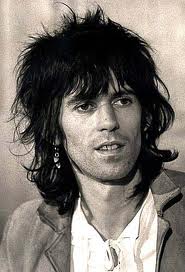
Keith Richards- Face Of The Stones
Part of the problem is that the book was co-written by a former journalist named John Blake who appears to detest Jagger, Richards and the whole scene they created. As a journalist he was privy to all the gossip about Jagger and Richards and so chips in with opinions of his own while also citing newspaper reports. Although written as a continuous narrative, with careful reading you can separate Blake from Sanchez.
After his journalistic career blew up Blake went on to publishing at which he has been successful. His collaboration with Sanchez was fruitful. The book is a great read anyway you look at it. The question is not what Sanchez tells us but what he doesn’t tell us.
Tony says that he was under he protection of a gang boss by the name of Albert Dimes who ran the West End apparently sharing Soho with the notorious Kray twins, Reggie and Ronnie and their brother Charlie. Sanchez then can be classed as a hoodlum. As Charlie Kray says his gang ran a bodyguard company it seems probable that Tony was employed by Keith in that function.

Brian Jones
One of his chief functions for the Stones was as a drug supplier. Opening the book he says apropos of Brian Jones:
I’m not a pusher, but as a boy I’d worked in Soho, first as a night club bouncer, then as a croupier, so I know exactly where to go for anything from a lid of grass to a Thompson submachine gun. Consequently people in the rock world had come to me as a reluctant go-between in their flirtations with the London underworld.
That short paragraph says an awful lot. We know, according to Tony, that he was sufficiently well known in gangland to come under the protection of Albert Dimes, a gangster dating back to the early fifties. Tony says that he worked as a bouncer in gambling joints and that would require the attitude and the temper to use violence whether necessary or not.
And then he says he was a croupier. He later tells us that the games were rigged so that he was knowingly bilking his customers, a form of theft. He then tells us that he could get anything from a bag of grass to submachines guns. This would mean that he was very knowledgeable in criminal matters.
He repeatedly professes that he didn’t sell drugs for profit but apparently had access to commercial amounts. At the same time he is married with two children, dresses like a dandy and hangs out in pricey bars. At no time does he appear to be gainfully employed until for some reason Keith Richards puts him on the payroll at 16,000 pounds a year. Well in excess of the pay for a working stiff. Plus, as Tony never seems to visit the wife and kids, room and board. Kind of a dream deal, you might say. What’s up? We’ll have to guess because Tony and John kept it quiet.
So, how did Tony get so close to Keith? Well, this is fairly interesting stuff. The stuff Swinging London was made of. The story’s real beginning is on page 39 when Tony meets Groovy Bob Fraser who was his entrance to the rock world. Tony tells it like this:
Into this world of intrigue, sudden violence, and bitter feuds dropped Robert Fraser. We met as I sipped a solitary espresso at the Bar Italian in Soho’s Frith Street. It was afternoon and I was killing time before going to work at the club.
Robert sat next to me, and we fell into conversation. Robert mentioned that he had gone to college in Spain…I speak Spanish as fluently as I speak English. This excited Robert and he jumped at the chance to talk to me in his very erudite Spanish…
From there a friendship developed around Tony’s ability to score drugs. Fraser was a gambler who had lost 20K pounds to the Kray Twins and couldn’t pay. He asked and Tony offered to deal with the Krays. Tony approached Dimes who wasn’t willing to jeopardize his wicket for an impecunious gambler. Tony decided to approach the Krays on his own. Bold move. Now, two versions exist; the improbable one of the book and another version in what purports to be a chapter of the book deleted by the publishers that might be more accurate.
The story involves criminal attempts to take over the music business. Sanchez was in a criminal occupation within the underworld while he confesses to wanting to be a criminal. p. 37:
As a teenager my great passions were rock music and big-time villainy- roughly in that order. I had a cousin who had gone way, way off the rails and who had become deeply immersed in organized crime. While my parents complained about the shame he was bringing to our family, I could only look at his big car and beautiful women and pray to God he would show me how it was done.
So, his cousin got Tony a job as a croupier and Tony began to meet big time crooks like Albert Dimes.
Rock and Roll bands at that time played in clubs and clubs are almost universally under the control of the underworld. Thus band members of the Beatles and Rolling Stones are in much closer contact with the underworld than one might assume while that is very carefully obscured by their biographers.
The Beatles played for months in the red light district of Hamburg one of the toughest criminal areas in the world. They witnessed much crime and mayhem. They were no angels. Albert Grossman in his biography gives examples while Andrew Oldham in his latest effort, Stone Free, tells of the time John and Paul dressed as priests and while so posing anointed communicants with their own piss, for which Oldham says they were arrested. At any rate they were under the protection of the crime lord of all Europe. The Krays of England would have been old hat to them.
Tony’s relationship with Keith then is suspicious.
The Kray Twins, who were England’s most prominent villains, as the English say, had taken over a prominent West End gambling spot called Esmeralda’s Barn. Beatles’ manager Brian Epstein gambled here, losing heavily so that the enormous amounts of money the Beatles were generating came to the attention of the Krays. They also knew that Epstein was gay. As they had made the previous owner of the Barn the irrefusable offer they believed they could do the same with Epstein. This aspect of the story is detailed in Colin Fry’s book, The Krays: A Violent Business so the account is not dependent on the missing chapter.
The Krays arranged a meeting with Epstein in a homosexual bar. That it was a homosexual bar indicates nothing to me as gay bars aren’t in the habit of hanging signs out saying: Gay Bar. I have been in several gay venues without knowing where I was until I was being served. The question is, would one go back?
Epstein patiently explained that managing bands was not as easy and effortless as it looked. The Krays then consulted the alleged godfather of British crime Arthur Thompson of Glasgow who as Epstein pointed out indicated to the Krays that managing the Beatles would require sustained effort and concentration to which criminals are not accustomed. Fry says the Krays thought it over, deciding to blackmail Epstein instead which they did collecting a sum every month for years.
Now to the Antiphoney’s missing chapter. Tony says, if the chapter is authentic, that Robert Fraser owed the Krays 20K in unpaid gambling debts. Tony says in Up And Down he tried to arrange a deal in which Fraser paid 30% or less thus freeing him and making him grateful to Tony.
According to the missing chapter the Krays showed him a sheaf of bounced checks and suggested that perhaps Fraser could clear the debt by delivering the Beatles into their hands, apparently not having given up their desire for the Beatles. When Tony told Fraser the idea he says Fraser embraced it setting about to woo the group. Fraser was fairly tight with McCartney to whom he sold a lot of artwork but not so much with Lennon.
In order then to co-opt Lennon, this sounds like a stretcher, he enlisted the aid of Yoko Ono who had arrived from NYC. As an avant-garde personality cum artist she would have looked Fraser up on her arrival so it is at least probable that she knew him. Yoko according to this account had been hanging around Paul who was the Beatle she wanted. Whatever the intent she did besiege John relentlessly until she got her entry and then she seduced him baffling his mind with all that avant garde BS and heroin.
If Fraser had his agenda Yoko had her own. Having conquered John she used his fame to pull off the Performance Art project of the century when he and she staged the Bed-In For Peace.
While all this was going on the Guiness heir Tara Browne entered this scene when he and his friend, , opened a night club called Sybilla’s. George Harrison of the Beatles was a significant investor. You can’t operate a club without dealing with some Mob. Perhaps the Krays saw Sybilla’s as a chance to co-opt the Beatles. Although the story is not yet clear I imagine that the Krays put pressure on Kevin MacDonald and Browne to sell their interest thus giving them direct access to Harrison as a partner. The two apparently refused so MacDonald was thrown off a roof to his death which left Tara Browne to deal with.
Bearing in mind that Paul had been under the protection of the European crime lord and one doesn’t receive favors without returning them, for that or some other reason Paul was probably compelled to lure Browne to his death. It is said, perhaps conjectured, that on that night Paul challenged Tara to a high speed auto race through London. The object being to draw Tara to a certain intersection where he could be caused to crash his car, a little flimsy Lotus. The crash ruse succeeded and Browne was killed although his supposed passenger, Suzy Poitier survived in a demolished car without a scratch sans seat belt or air bag. Doesn’t seem likely.
Browne’s death left Harrison as the sole surviving investor. I have no information as to his reaction but the club was closed and Harrison went his way. Harrison and Browne had been enough of an attraction to make Sybilla’s a hot spot with the In Crowd. That kind of lightning can strike many times.
Subsequently then, Tony, so he says, conceived the notion of opening his own club that he called Vesuvio. As he seemed to be very tight with the Stones and the Beatles he was able to feature them as attractions for his grand opening that was attended by them and the Rock establishment including Eric Clapton who was also a habitué at the Krays’ gambling club, The Barn. According to Tony the club was a stellar success but then he discovered he wasn’t the type to enjoy sustained business activity so his partner, the one who fronted the money took over management putting him on a stipend. Sanchez doesn’t say who his partner was but it surely must have been either Albert Dimes, or…the Krays.
Whatever, but Fraser was still not delivering and the Krays were getting pushy. Here comes a real leap of belief. Fraser could deliver neither the Beatles nor the money owed so, says Tony, he conceived the notion of going to prison to escape the Krays. An odd choice as the Krays had as many men on the inside as on the outside. But if you’ve snorted, puffed dropped and shot enough stuff I’m sure anything can seem like a reasonable plan.
Thus Tony says in the deleted chapter it was he, Fraser, who tipped the News Of The World to the Redlands bust which sent him to prison for six months. During that time the Krays murdered Jack McVitie, for which crime they were finally nailed. They went in as Fraser came out thus freeing him of the threat although Tony says prison was a life changing experience for Bob who became a less groovy Bob.
Alright. That makes a good story, doesn’t it?
2.
Nor was the above the only contact of the Krays with show biz and Rock
It may be time to give a little perspective to the arch-criminals, The Krays, for those who may be unfamiliar with them, at least in the US, the English underworld reformed after WWII, a whole new cast of characters emerged formed by the wartime experience. The Kray twins were born in 1933 while their brother Charlie was a few years older. Ronnie and Reggie, the twins, began to emerge after 1954 becoming powers as the sixties began.
Perhaps their main racket was Protection of which providing bodyguards was a sub-division.
As the sixties progressed and their fame grew the Sicilian Mafia of the US began to take notice of them. The Mafia had always had a stable of singers, actors and performers they controlled for their nightclubs, such as Frank Sinatra, Dean Martin, Judy Garland et al. They suggested the Krays do the same.
In that manner the Krays provided bodyguards for visiting Mafia acts in England. When gambling became legal in England during the early sixties the US Mafia opened casinos installing such as the ex-actor George Raft as front men. The Krays were flattered by the attention showered on them by Raft.
Thus the Krays moved in on the Beatles, the Stones, the Kinks and others. While the Beatles Brian Epstein was paying large monthly there was probably a connection to group members also. If McCartney was used to lure Tara Browne to his death, and maybe it was only intended as a scare and a few bruises, then there was mob influence at the personal level.
As I have implied if not stated, Spanish Tony was foisted on Keith as a bodyguard and minder.
The Krays also made a move to co-opt the Kinks but that deal is said to have fallen through. Ronnie Kray as part of the deal wanted to date Kink drummer, Mick Avery. Very flattering to Mick, I’m sure.
Later, when the Sicilian US Mafia wanted to launder money they offered the Krays 2,000,000 dollars to set up a label. The Krays went about it signing a few acts including Billy J. Kramer and the Dakotas. Kramer was spared further indignities when the money was withdrawn and the deal fell through.
And then in Prison after 1968 Reggie Kray decided he wanted to be a songwriter so his songs were foisted on groups who were required to record them.
Much has been made of the homosexual Communist MP Tom Driberg trying to lure Mick into politics. In point of fact Driberg was well connected with Ronnie Kray and part of ring that borrowed boys from an orphanage for their sexual deviance.
This then is quite involved and while Mick was probably not lured into this pervert scene with the Krays it would seem that there was some attempt to draw him in thus co-opting him into the underworld. The scene and Redlands situation needs a little in depth investigation to clear up details of what might have been going on behind the scene of the Bust.
3.
And then there was Tony’s ongoing relationship with Marianne Faithfull. No one associated with the Stones has anything positive to say about Tony. But, listen to Marianne, autobiography, p. 162:
Quote
…(Tony) was a dreadful person. You only had to see him eat to know how loathsome he was. He was a lowlife, a small-time spiv, but a weakling at the same time. He was as enchained as anyone else, completely hung up on his particular sickness.
Unquote
And yet,
Quote
…I was getting deeper and deeper into drugs…I was also getting involved in a long affair with Tony Sanchez, dealer by appointment to the Stones. I can’t believe I did that! I didn’t get enough pocket money fom Mick and I didn’t have any money of my own, so how else would I have been able to get my own drugs?
Unquote.
There’s a problem. And then:
Quote.
It’s odd to realize that the person you’re sleeping with is there only because you’re Mick Jagger’s girl friend. Or were.
Unquote.
This was as Marianne moved into her lost years during the seventies. During this period she makes it sound as though she were sitting on her wall over the bomb site beyond the ken of the world. It makes a good story and it drew me in. But, she says she never resorted to prostitution. Well, maybe.
While in France with Keith Tony met a woman named Madeleine D’Arcy for whom he fell hard, ditching the wife and kids. Love of his life, he said. She returned to England with Tony where Marianne apparently fell for her as hard as Tony. Sanchez came home one day to find Madeleine and Marianne getting it on. He blamed Marianne.
As all three were heroin addicts with pretty good habits; one wonders where Tony got the money if he wasn’t dealing. He was not closely associated with Keith after Keith fled the Riviera a step or to ahead of the cops so Tony may then have been off the payroll.
He would have had to be hustling something.
Madeleine was hooking. Marianne pp.225-26:
Quote:
I hadn’t heard from Madeleine for several days. Her phone was off the hook and I suspected the worst. I had a feeling she’d OD’d, and I might have to smash down her door, so when I went over to the flat in Maida Vale I took with me as muscle a burly Maltese drug dealer and a lowlife friend…Eventually the boys broke down the door and in the bedroom we found Madeleine lying fully clothed in a long gown on the bed. She was obviously dead and looked bruised and bloody…By the time of her death, she had gone back to turning tricks at Brighton for fifteen pounds a night.
Unquote.
The Maltese gangs in London were known both for drug dealing and running prostitution. That Marianne contacted a Maltese and ‘a lowlife friend’ might point to prostitution. I saw a clip on the internet in which the photographer was hidden in a sort of alcove shooting through an opening. Marianne walked in front of the camera obviously dressed as a hooker but very classy in her mini skirt and jacket. She spotted the camera, looked alarmed, and quickly ducked around a corner looking back to ascertain what was going on.
There are numerous pictures of her during her lost years so that when the record producers went looking for her she wouldn’t have been as hard to find as she says.
And then, this: p.221:
Quote.
I was constantly reminded during these years of my parasitic status in the pop world. I remember once going out dancing to a club and Rod Stewart came home with me. He thought I was just one of those girls that sort of floated around pop stars and tried to put the whole thing across like that… (Pop stars) are looking for their particular type, a girly sort of woman with pretty underwear and frocks and the whole female fantasy….I laughed and threw him out.
Unquote.
Sort of a hard Marianne. The other side of the Faerie Queen.
In 1976 Tony was cut loose by Jagger and Richards for good. I presume he passed out of Marianne’s life at that time. In any event she met her second husband, Ben Brierly, in 1976 and began a different, if not a new, life.
4.
Tony’s primary job after securing drugs was to look after Keith. Keith needed some serious looking after. As Keith says Tony’s facts are straight then the only disagreement would be that Tony mentioned things Keith preferred not be mentioned. Indeed, when a London newspaper was going to publish an excerpt concerning Marianne she got an injunction to prevent it.
If the incidents are true as Keith attests then the evidence is that Keith was, at the very least, off the rails, carefree and reckless. He seemed to be conducting a vendetta against society attempting to see how many rules and laws he could break with impunity not unlike the Droogs of A Clockwork Orange.
Unable to pass the driver’s license test Keith had someone else take the test for him. Although, test or no test, practice should have made perfect. Keith was a slow learner cracking up car after car. As he was usually carrying, he grabbed the dope then ran off leaving Tony to deal with the police. Rather annoying from Tony’s point of view who must have been on the police radar himself.
I’m sure that Tony considered himself more than a minder or drug procurer, thinking of himself as more of a member of the group, especially as he was a friend of Robert Fraser’s before linking up with Keith.
The Redlands drug bust is far from cleared up. There is no certainty as to who alerted the News Of The World paper that drugs would be at the party and where the party was. The drug dealer Schneiderman may have been the one. His presence is certainly suspicious. I am going to suggest another possibility, admittedly a conjecture, that Tony himself might be the culprit. Sanchez ran a lot of risks for Jagger and Keith while being included in most things. Then, he wasn’t invited to the Redlands party at which he knew the regulars well. To be excluded is often considered an insult for hangers on for which vengeance is due. It is possible, then, that to wipe the perceived insult Tony himself alerted the News Of The World. It would certainly have avenged a number of indignities he had suffered at the hands of Keith.
It might have been Fraser who alerted the News as the missing chapter asserts, it might have been Schneiderman or, perhaps, it was Tony himself.
At any rate it appears that Tony was tolerated by Keith but not really welcome. As he was linked to London’s underworld it is possible if not probable that there was some link between it and Keith and Mick. When the Krays were sent up for thirty years in 1968, probably freeing Mick and Keith from their influence Tony’s days were probably numbered.
He was still useful in France but when Keith overplayed his hand finding it necessary to leave France and unable to return to England, he became a man without a country of sorts, the connection with Tony was broken, it being only necessary to sever the relationship.
Tony tells it in the brief epilogue to his book:
Quote:
I had been running from death too long, knew that I could not live this life much longer. But I wasn’t ready to draw completely away. Keith still called me occasionally asking me to get drugs for him, and usually I would cooperate. It had become my way of life. It was on August 21, 1976, that the Stones were playing an outdoor concert at Knebworth House in Hertfordshire, and Keith and Mick asked me to bring some cocaine to the dressing room for them. I was given the wrong type pass, however, and in the midst of a wrangle with a security man I suddenly realized it was all over. I turned on my heel, walked away and the next day reserved a room at Bowden House for a cure.
Unquote.
And so Tony was eased out. I have found nothing that mentions his last twenty-five years. However he died in the year 2000 short after Charlie, Ronnie and Reggie Kray had all passed away. It may have been coincidence or as some suggest…
Who Is Groovy Bob Fraser?
February 1, 2013
Who Is Groovy Bob Fraser?
by
R.E. Prindle
While writing my biographies of Mick Jagger and Marianne Faithfull it has become apparent that some persons seemingly peripheral are more central to the story than one may at first have thought. One of these is the art dealer, Robert Fraser or Groovy Bob as he was known.
However, behind the scenes underlying all the action are the two Kray Twins, Ronnie and Reggie. As with underworld figures in the US little is going to happen in which their presence is completely absent. Ronnie and Reggie were two Jewish homosexuals. They thus had as much protection as Jews can provide for their own. On the homosexual front the Krays were procurers of young boys for members of the above ground establishment, men prominent not only in government but in the music business.
At the same time the brothers owned, or possibly fronted, prominent gambling establishments, thus people like Fraser and Beatles’ manager Brian Epstein who gambled heavily losing large sums came under their influence or control. Robert Fraser and the Krays thus became intimately connected.
Now, what about Robert Fraser? Fraser is the link between many participants in the 60’s drama. He befriended Richards, Jagger and Faithfull. He was close to Paul McCartney of the Beatles, who is somewhat of a mysterious figure in the drama, as well as being familiar with their manager Brian Epstein among many others of the rock musicians. And then he was linked with artist/film maker, David Cammell as well as arch Satanist, Kenneth Anger, and the main American link to these people, Andy Warhol. He brought Tony Sanchez to the Stones as well as the rock community while Sanchez was his link to the Kray brothers. Fraser’s friend Chris Gibbs is a shadowy eminence grise of this situation. So far, I’ve gotten little other than he was and is an antiques dealer who helped establish the Bohemian tastes a la Oscar Wilde of the rockers.
Fraser himself came from a moneyed family who financed his ventures. He was a public school boy, Eton. He served in the African Rifles in Uganda. There, as a homosexual he says he buggered a young Idi Amin. I have no doubts. Returning from the African happy hunting grounds he promptly left for the even happier hunting grounds of New York City, the sybaritic capitol of the world. There he soaked up the art scene where he learned the ins and outs of being a gallery director. He was in New York during the seminal years from 1960-62 just as the pop art scene was taking off. There he met Andy Warhol who would be the outstanding pop artist. As they were both homosexuals and revolutionaries they bonded.
Fraser, Warhol, Epstein, Gibbs, the Kray Twins and most of the cast were all homosexuals. Jagger was at least ambiguous so sexual lines blurred and those who may not have been homosexual by nature may have found it convenient to act like one. Certainly after Stonewall in 1969 the music scene became predominantly gay.
There are pictures and videos of Fraser on the internet so that we can gauge his appearance and manner. His manner was very engaging and while fey, not exceptionally so. He wasn’t camp, at least not in public.
What exactly his role in the scene was is less than clear. While apparently an excellent pop art gallerist his role among rock musicians while prominent is not clear. He frequently had large parties in his apartment attended by the cream of the rock community. Of course he sold them art work but perhaps through his drug connection Tony Sanchez he also dealt on the side to augment his income. Drugs were always prominent at his parties. Paul McCartney bought many artworks from Fraser which all appreciated significantly although Fraser is accused of overcharging. But then, why not, a collector always thinks he’s being overcharged as he buys one of a kind items.
Perhaps also Fraser was indoctrinating the musicians in tolerance for gays and other political matters. Perhaps he was seeking homosexual alliances from among these yobbos. Certainly after Stonewall it seemed that everyone in rock was fruity. It was then that Rock and Roll began to lose its appeal. When the homosexuality became so obvious rock declined in interest to non-gays leading it further into a gay audience that augmented by the evolution into all-gay Disco. YMCA and all that, and then the end.
Whatever his political intent the goals were subverted by personal defects. Of course drugs will reduce your effectiveness by a little more than somewhat, but gambling and its resultant debts were much more deleterious of personal autonomy. While gambling has never been mentioned in connection with the rockers one wonders whether McCartney and others didn’t become involved.
Now, the record business in both the US and Britain was in the hands of homosexual Jews. The British groups, especially the Beatles and the Stones were god’s gift to his Chosen People. Between the Beatles and the Stones probably a billion dollars was generated in just four or five years including ongoing royalties and residuals. The entire billion was siphoned off by the Jews in both the US and Britain with only tip money going to the musicians.
Brian Epstein was the chief beneficiary. It was perhaps through his gambling debts, described as enormous, that the extent of the cash being generated by the Beatles came to the attention of the Kray brothers. Epstein apparently lost and owed a fortune to them. The only way he had to pay his debts was the Beatles which with his contract expiring in 1967 he was afraid he would be dismissed leaving him without that extraordinary income.
The Krays conceived the idea of taking over the Beatles from Epstein. At this time Robert Fraser had gambling debts with the Krays for which he had no available resources. The Krays put the squeeze on him. Fraser didn’t know what to do but he did know a man about the scene named Tony Sanchez, the Spaniard in the works, who did. Sanchez was nicknamed Spanish Tony. He would soon figure in as Keith Richards’ factotum and bodyguard. Spanish Tony is an interesting character meriting much more serious attention. As a connection between the underworld and the above world one would like to know more about his associates both under and above. He certainly used his underworld persona to threaten Marianne Faithfull into bed.
At any rate Sanchez told Fraser that he had underworld connections and might be able to resolve Fraser’s problem for him. As usual with Fraser he only fed Sanchez half-truths and when Tony contacted the Krays he got the other side of the story. Bear in mind that the Krays were crazy. They were pimping boys from the orphanage to social figures of the status of former Prime Minister Edward Heath. I mean, the moral state of the British upper class was beyond questionable. I would like to hear what the boys who were so used have to say now that they are men. Where are those memoirs anyway?
The Krays showed Sanchez a pile of Fraser’s bounced checks they had received which made Tony reconsider his position. Whatever bargaining chips he may have had were nullified. However the Krays had a proposition. Conversant with all the gambling characters they thought that Fraser might have some influence on Epstein so that if Fraser could arrange the transfer of the Beatles to themselves they would forgive Fraser’s debt. Who wouldn’t?
Negotiations and time dragged on and 1967 appeared at the top of the calendar with nothing accomplished, no debts settled. 1967. A big year in our story. That was the year that Brian Epstein supposedly committed suicide, the year his contract with the Beatles expired. We know for certain he left this sportin’ life. And 1967 was the year of the Redlands bust in which Fraser went to prison.
Sanchez gives conflicting stories of what took place. In his published memoir Up And Down With The Rolling Stones of 1979 he says the Krays amiably reduced the amount owed by Fraser and Groovy Bob gave them a good check for it. Problem solved. Tony says in his memoir.
Improbable as that seems, a missing chapter of Tony’s book has surfaced. Apparently many of his revelations were deemed too controversial and deleted. In this missing chapter Tony says that Fraser, unable to deliver the Beatles, set up the drug bust at Redlands in order to go to jail where for some strange reason he thought that he would be beyond the reach of the Krays.
In any event he didn’t seem to resent going to prison. Shortly after he was released from prison the Krays were arrested in May of 1968 while being sentenced to life on 3/5/69.
Presumably Robert Fraser escaped payment of the debt, however with the stigma of a jailbird his career as a gallery operator drew to a close after his release. He ended his life as a casualty of AIDs in 1986.
In his prime one wonders what he was doing. He seems to have been closely connected to Warhol and his crew. Andy himself seems to have been the center of what appears to be a political conspiracy. On their trip to Paris they made a Bee line to visit Fraser. So there is probably a strong political bent to Fraser’s activities.
Much more research is needed on Groovy Bob as well as his underworld connection Spanish Tony Sanchez.
Chap. 7: Marianne Faithfull: Faerie Queene Of The Sixties
January 27, 2013
Marianne Faithfull: The Faerie Queene Of The Sixties
by
R.E. Prindle
Chapter 7
We skipped a light fandango
Turned Cartwheels across the floor
I was feeling kind of seasick
But the crowd called out for more
The room was humming harder
As the ceiling flew away
And so it was that later
As the Miller told his tale
She said there is no reason
And the truth is plain to see
That her face at first just ghostly
Turned a white shade of pale.
–Procol Harum

Marianne A Few Years Back
Now in 1968 both Mick and Marianne’s life were rolling by while both were teetering on the edge. Shortly after Godard’s filming of Sympathy For The Devil in June Mick was signed by Donald Cammell for the lead role in his film Performance. The invitation to star didn’t come from nowhere. There are many links from Mick and his friends to Cammell. Cammell was already known to the Stones having met them in 1965 at the time of the Paris Olympia shows. He was naturally first attracted to Brian Jones but then found some kind of love for Mick. Over the subsequent years he formed many projects that he offered to Mick. As Mick’s asking price was a million or more the projects did not pan out.
Not only did Cammell know the Stones but his live in the Parisian model Deborah Dixon had had a menage a trois with Anita Pallenberg. She had moved on to Brian Jones, passing on to Keith with whom she was living when the movie was shot. She had also viewed and/or worked on the script with Cammell a year previously so she knew that she was playing opposite Mick in advance. She then, was well aware of what the movie entailed.
In addition Cammell knew Robert Fraser and Chris Gibbs while being involved with the American
Donald Cammell
Satanist Kenneth Anger. Anger was himself a disciple of the arch Satanist of the Golden Dawn, Aleister Crowley. Cammel’s father had known Crowley reasonably well while Cammell himself had at least seen Crowley live. His father even wrote a biography of Crowley, so let’s just say that the sex magic of Crowley and his Golden Dawn played a prominent role during the filming.
Mick would have brought his knowledge of The Master And Margarita to the proceedings. He may have persuaded Cammell to read the book or perhaps as a Satanist Cammell had already read it.
Marianne who had become pregnant perhaps in January or February was sent to Ireland during the filming so as to be out of the way for the sex stuff where she became distraught. She was giving herself and was being given a psychological beating that was disappointing all her expectations leading her into a deep depression. This was furthered along when she had a miscarriage at eight months losing the child. I would imagine the miscarriage was the result of the stresses Mick had placed on her by sending her away along with his sexual misconduct. It may have been her own subconscious rejection of Mick that caused her to subconsciously refuse to have his baby.
Thus as 1968 drew to a close as the Stones recorded their Satanic Majesties Request album Marianne was trying to recover from her miscarriage and put her life in order. She probably ought to have left Mick at the time but as she tacitly admits in an interview video on You Tube the reason that she went with Mick was because her own royalties were dropping and she had gotten used to the money. Mick was a source untapped. I think that this is an underlying cause of her anguish. Nineteen sixty-nine would be a traumatic year for all concerned.
2.
What To Do About Brian?
Marianne was a sentimental girl who formed sincere attachments to the people of her world. Thus Brian was not just someone on the scene but one might say a part of Marianne’s life. She cared for him. As we all know Brian Jones was the actual founder of the Rolling Stones. He named them and gave them their original musical direction. He held them together during the early stages. Naturally he considered himself their leader. He was actually a much more charismatic figure than Mick. While Mick was wiggling around all eyes were on Brian. There was just something about him.
This aroused Mick’s jealousy who once stated that the lead singer was supposed to be the center of attention. Mick also had the most powerful personality so that while he may not have been the leader he made himself the director. And then he and Keith shifted the direction of the music. While never a fan of the Stones I found myself reviewing the albums when I began writing of the group. My original opinion was only confirmed.
It became immediately apparent that Oldham’s first recordings done necessarily on the cheap were not good recordings, four track on primitive and worn equipment. While Brian and the Stones thought they were doing a good job imitating American Negro rhythm and blues it’s actually not even close. Mick makes a terrible imitation of a Negro blues shouter while its painfully obvious that the music doesn’t come close to the original. It’s so far off that it might as well be an original genre while being very close to a garage band.
Perhaps Mick who thought it impossible for an English band to pass themselves off as authentic was right to change the direction of the band to Negro influenced Rock and Roll. Brian was probably too close to his aspirations to know how far from the mark they were.
The original tunes are somewhat better but the inspiration for those soon ran dray so that by the 1966 and ‘67 albums Aftermath and Between The Buttons the band was quickly approaching the rocks. The West Coast fans were disappointed by both albums and, quite frankly, they’re not listenable today. As the albums veered toward English music hall Brian was quite right in thinking that they had abandoned his original intent. The 1968 Their Satanic Majesties Request, intended to be psychedelic in imitation of the Beatles Sgt. Pepper’s wandered off to a musical somewhere although one can sense the transition from the Old Stones to the New Stones of Beggar’s Banquet.
The cover of Satanic Majesties must have really sickened Brian as it had the boys dressed up in some sort of magician’s getup. A long way from Negro rhythm and blues.
Mick by Andy
Mick’s conception of the band judging from the current situation was always himself, Keith and Charlie. Bill Wyman, the bass player, being several years older was always an awkward fit. Mick marginalized him as much as he could until Wyman finally gave up terminating his role in 1993. So, was Brian forced out? Of course.
Andrew Oldham who promoted the Stones to a prominence far beyond their then abilities was the first that Mick pushed away in 1967. As a parting present Oldham turned them over to the American Jewish pirate, Allen Klein. As Oldham owned the masters to the Stones catalog he sold it lock stock and barrel to Klein who then legitimately owned them much to Mick’s chagrin.
As Brian was being marginalized by Mick, losing control of the band and its direction his behavior became erratic while he also sunk in the haze of drug addiction. It became obvious to the casual viewer of him on stage that his days must be numbered. On the Ed Sullivan show in the US he could barely stand on his feet but everyone was watching him placed back in the shadows by Mick.
Mick and Keith continued their petty harassments until Brian became a shambles of himself. After the Redlands bust the police turned their attention to Brian who hadn’t the emotional resources to bear the burden. It then in June of 1969 that Mick and Keith advised him that he was no longer in the band.
Brian either drowned in his swimming pool on the night of 7 July or was drowned. There is controversy over his death that may never be conclusively resolved.
Marianne, who by 1969 was not in a healthy sate of mind, was herself sinking into drug addiction, actually becoming a heroin addict, watched these proceedings. She was shocked by Brian’s death. And this came on top of her other woes. But life goes on. It is always painful when death removes a loved one from the building but painful or not the sun does not stand still in the sky nor do the bills stop coming in. Life goes on without missing a beat and you better had too.
So, Mick had movie offers coming in. Both he and Marianne as reigning pop couple were signed to do a movie in Australia. Ned Kelley an Australian bandit. In the 1840s when plays and books began celebrating former outlaws, highwaymen and crooks they were called Newgates after the equally famed Newgate Calendar of criminal trials. This would be a sort of Newgate movie.
Less than a week after Brian’s death Marianne and Mick arrived in Australia to begin their commitment; after all they had signed well before Brian’s death. Psychologically however all of Marianne’s misgivings were adding up to a heavy burden. While the reasonable approach may be that life goes on not everyone is so reasonable and I suspect Marianne was one of these. Perhaps, too, she realized that she and Mick were becoming estranged. Mick’s history was beginning to become apparent; his abominable treatment of women, Chrissie Shrimpton, of Oldham, of Brian; perhaps she began to wonder if she were next. While Mick may have had justifiable reasons for Oldham and Jones they may not have been that apparent to Marianne.
Certainly Brian was on her mind when the place touched down in Sydney. Exhausted by the long flight she and Mick checked into their hotel. Mick promptly flopped down on the bed to doze off. Marianne troubled in mind picked up a bottle of Tuinals and perhaps in a hypnoid state of grief and confusion dropped a hundred forty of them. Wow! That must have taken five or ten minutes. Shows determination. Who would do that if they weren’t serious about suicide.
For whatever reason Mick woke up and probably groggy himself scoped the situation. He rushed Marianne to the hospital for medical attention. But Marianne had overloaded her brain, she lay in a coma for six days.
The last thing on her mind before she suspended animation or slowed her synapses to a crawl was Brian. Since she was still alive although unconscious synapses must have continued; she must have continued to work on her problems, the anguish that had caused her attempt at self-destruction. Thus, when she came to Brian was still on her mind. I quote from her auto-biography Marianne Faithfull, pp.175-79:
By the time we got to the hotel in Sydney I’d forgotten not only where I was but who I was. I looked in the mirror. What I saw was a very thin, frightened face. I’d cut my hair, I was anorexic, and my skin looked cadaverous. I saw someone literally falling apart. Someone with blond hair and looking very scared. In my drug induced stupor I dimly recognized the ravaged face of Brian Jones staring back at me. I was Brian, and I was dead.
…At that moment Brian was my twin. I identified with him because he had been a public sacrifice; it was a role I understood.
Quite logically, I thought I was Brian.
It was all very rational in the way these things are when you’re unhinged. I reasoned that since I was Brian and since Brian was dead…(ellipsis in original) I had to take the rest of the pills so I could be dead too.
…The Tuinals were taking forever to kick in, I looked down and saw things on the street that shouldn’t have been there…And then I saw Brian Jones. At that moment I went into a coma that lasted six days.
Brian Jones
When I first spotted Brian he was far below at street level, but greatly enlarged…Various parts of him- his face, his hands- expanded and extended toward me as he spoke, and then he rose straight up as from a shaft of air until he was directly opposite the window of our room.
…He beckoned to me the way spirits traditionally beckon to mortals in the movies. I passed through the plate glass and found myself outside. But instead of standing suspended above the street, I was now in an unstable landscape that pulsed and shifted as we spoke. I had I assumed gone over to the other side.
The grandeur and enormity of the place had the phantasmagoric mood of illustrations by Edmund Dulac or Durer engravings of Hell. As we were walking along, I realized that Brian had no more idea of where we were going than I did. Obviously he had woke up dead, not known where he was and decided to call for me!
It was the nicest chat I ever had with him, actually. He told me how he had woken up and put out his hand for his bottle of Valium, and about the panic that seized when there was nothing there. He said he had been lonely and confused and had brought me to him because he needed to talk to someone he knew.
We strolled blithely along as the quivering earth crumbled away on either side of us, and he told me about the miniature coronation set with Beefeaters and the coach and horses. He said he like books about railway bridges, guides to switching boxes, George McDonald’s fairy stories and Fox’s Book of Martyrs.
…Afterward he became weepy like the Mock Turtle in Alice In Wonderland and said he was sorry to have put me to all this trouble. He didn’t seem to know he was dead. I’m sure this happens frequently…They don’t know where they are. Hence ghosts.
…’Brian, Dear, isn’t this lovely, I said, trying…to distract him from grisly realities. But my sudden descent to small talk must have tipped him off that something was wrong. I was speaking to him in the patronizing way people talk to mad people, children and small dogs. Nevertheless, he plunged ahead in typical Brian fashion.
“Death is the next great adventure.” he said portentously. This something I used to go around saying myself, so I nodded wisely.
“Oh, yes, I quite agree,” I said fervently, as if we were speaking of a new religion. Or a new drug.
…”Welcome to death!” he said brightly.
…”Oh, is that where we are?” I asked.
…We came to the edge of the Dulac landscape. It dropped off abruptly and completely. There was a very obvious point where you chose to go over the edge or not. Brian said, “Coming?” and slipped off the cliff. I drew back. I heard a chorus of voices calling to me, but I wasn’t ready just yet.
Getting back took a long time. I was stranded in a desert town. The color had been drained from everything. The houses were empty. I was in Albania! Wandering down long deserted streets with names like the Avenue of the 17th October. Looking pretty incongruous, people I knew floated by (their feet didn’t quite touch the ground.) I called out, but they hurried past as if they hadn’t seen me.
I was lost in an airport. People came up to me and asked me the sort of questions you ask a child stranded at a railway station. “Are you lost, dear?” “Do you know your name?” And I would answer, “I’m waiting for Mick to come and get me.”
This was obviously the crisis of Marianne’s life. She associates her life with the desolation despair of Brian’s. She must have had the fate of Chrissie Shrimpton in mind, who Mick had crushed so completely. Mick had treated Chrissie and Brian in much the same way. Certainly Marianne could see the same fate for herself on the horizon. So now in an attempt to escape she slips into a Tuinal coma. She doesn’t explain what medical procedures were used to sustain her but she maintained mental activity throughout the coma.
Essentially the first half of her coma is a near death experience and a pretty interesting one. Wonderful, wonderful story; I could have stood another dozen pages. I’m sure she could call it up if she wanted to. I’ve had a couple near death experiences myself. They really leave indelible memories as this has done for Marian. It is possible to relive at any time you choose. I can run both concurrently through my mind.
Marianne’s problem at this time has been building since 1964 when the the life she living came into conflict with her youthful ideals obtained in the convent school. In those years she was much influenced by the chivalric literature of King Arthur, especially the quest for the Holy Grail.
Now, only the pure of mind and body, I. e. virginal, can ever hope to experience the Holy Grail. It takes only one sexual encounter. Even the great Lancelot who was tricked into a sexual act by Elaine forfeited the Grail even though he was innocent of intent. In chivalric terms Marianne was way beyond any hope of redemption. She must have known that. Thus the earth heaved beneath her feet and crumbled away beside her.
Having left Brian at the brink her way back was through a desolate wasteland of colorless desert. Thus, all hope had been lost. Her awakening must have been bleak, as her life would soon become.
She doesn’t mention the Arthurian fairy tales by name but she does recreate a dream landscape from the fairy tale illustrations of Edmund Dulac. (coincidentally Edmund Of The Lake). It is possible that she also confates Dulac with Arthur Rackham, another famous illustrators of fairy tales and also King Arthur.
Marianne also references other of her formative reading bringing in Alice In Wonderland, quintessential for the druggies of the sixties, plus George McDonald’s fairy stories and significantly, Fox’s Booke Of Martyrs. Very good browsing by the way as is Butler’s Lives of the Saints which is terrific.
I wondered if Brian liked books about railway bridges and the surprising guides to switching boxes? There can’t be too many of the latter so ‘switching’ may have a different reference point. It may mean switching horses in mid stream as Marianne said to Mick when she opened her eyes: Wild horses couldn’t drag me away.
The landscape ‘pulsed and shifted’ which may refer to her emotional instability. The Allman Brothers had a great line in one of their songs; See that clock up upon the wall? Rushing tides could make it fall. So possibly she could feel the ground moving out from beneath her feet.
‘He said he had been lonely and confused and brought me to him because he needed someone to talk to someone he knew! Sounds like Marianne is reversing the situation as it was only possible that she brought Brian to her reinforcing the similarity of their situations vis-à-vis Mick.
Then some more chit chat and Brian passes into the Great Beyond while Marianne stands on the brink at road’s end. Great story. I know where that’s at. In one of my experiences my heart stopped and I was standing in a huge empty concrete bunker type thing wondering what to do next. I dead no problem with being dead but I had no instructions what to do next. ‘Oh, well..’ I thought and turned to my right to start hoofing it when my heart started up and I was back in bed.
Obviously for Marianne her medical crisis passed and she was to return to consciousness. But then getting back took a long time. The first part of her fantasy then my have lasted a day or possibly two while reconstructing her nervous system took a little longer leaving room for mistakes that she feels might have occurred. She has obviously began to come to in her post-singing career with its overwhelming challenges that she wasn’t able to successfully deal with. The Avenue of the 17th October sounds as though it may be the Bolshevik October Revolution, if so she got the date wrong, it was the 25th not the 17th. She is obviously returning in a depression. I can dig that, too.
Marianne’s own brief interpretation of her experience is on p.178:
In anguished relationships like the one I had with Mick; it’s much easier and more satisfactory for all concerned if the one playing my role dies, after which I could turn into a sainted mythical figure- like Brian- and no longer be a threat to anyone and- more importantly- no longer be a bother to anyone.
They martyred Marianne…thus Fox’s Book Of Martyrs.
Marianne knew she had come to a turning point in her life or, rather, a dead end. She could no longer rely on Mick, he was a weak reed, a failure as the man he posed to be. At this time she chose to renew her acquaintance with her father at his sex shop who she says was a man Mick could never hope to be. Thus, goodbye Mick. She had been financially dependent on him and having known money liked it. Why not? But she was in no position to make money or at least sufficient money. Royalties of a diminished sort would keep coming in. There was seldom a year that went by that something wasn’t released in her name although she wasn’t recording. As she says Oldham had a re-release of her greatest hits edged in black on the streets before she recovered.
But she would have to record again, perform again for any real money. It was not possible to return again as the Virgin Queen of yesterday. As she was part of the myth making period she would always be the Faerie Queene of the sixties, she was secure in that position, but with four tarnished wings. She sank into a deeper depression finally ending up sitting on her wall above the bomb pit, thinking what to do next.
Her resurrection, such as it was, will be the topic of Chapter 8.
Edgar Rice Burroughs Wrestles With Time
September 29, 2012
Edgar Rice Burroughs Wrestles With Time
by
R.E. Prindle

When The Student Is Ready The Teacher Will Appear
There are two major themes in Burroughs that present significant difficulties. One is his preoccupation with slavery. Slavery pervades the corpus. I haven’t begun to guess at Burroughs notions on slavery. The second theme is the wrestle Burroughs has with the concept of Time. Time is a major preoccupation of scientific thinkers.
My ideas on Burroughs’ ideas on Time were jelled by the following quote from Understanding Media by Marshall McLuhan that I came across while rereading the book recently:
“As a piece of technology, the clock is a machine that produces uniform seconds, minutes and hours, on an assembly-line pattern. Processed in this uniform way, time is separated from the rhythms of human
Marshall McLuhan
experience. The mechanical clock, in short, helps to create the image of a numerically quantified and mechanical universe. It was in the world of the medieval monasteries, with their need for a rule and for synchronized order to guide communal life, that the clock started on its modern developments. Time measured not by the uniqueness of private experience, but by abstract uniform units gradually pervading all sense of life, much as does the technology of writing and printing. Not only work, but also eating and sleeping, came to accommodate themselves to the clock rather than to organic needs. As the pattern of arbitrary and uniform measurement of time extended itself across society, even clothing began to undergo annual alteration in a way convenient for industry. At that point, of course, mechanical measurement of time as a principle of applied knowledge joined forces with printing and assembly line as means of uniform fragmentation of processes.”
While Burroughs never states his position as succinctly, McLuhan might have abstracted the above quote from Burroughs’ novels.
The Pellucidar series is centered on the problem of Time while Burroughs persistently dwells on the problem throughout the corpus. Mars, or Barsoom, itself is a contrast between the orbits of Earth and Mars with their two different durations of time, the year of Mars being nearly double that of Earth. The lost cities of Africa are a contrast of time periods as they all exist within the present while products of a distant past, most notably the lost city of Opar that dates back to Atlantis nearly unchanged.
Tied to the concept of Time are Burroughs’ notions on evolution. The most notable novel in that line being The Land That Time Forgot. Time forgot! Time didn’t so much forget as encapsulate a series of time periods that exist side by side.
Usually Burroughs’ ruminations are thoroughly disguised as ‘entertainment.’ If you are merely entertaining yourself by reading Burroughs you probably won’t consciously recognize the underlying examinations but you probably will be affected subconsciously. A hypnotic suggestion so to speak. After all, the stories themselves are fairly slight and yet the attention of readers from teenagers to college professors over a century now are riveted by the author.
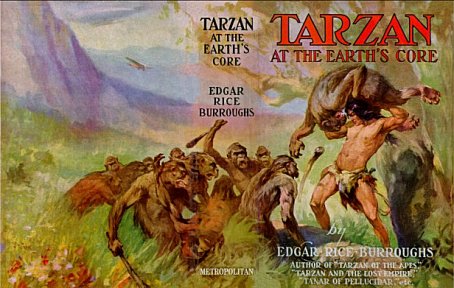
Man At Work
I don’t intend to be exhaustive in this essay but I would like to concentrate on two novelistic examinations by Burroughs. The largest examination and most obvious is that of Tarzan At The Earth’s Core and its successor Tarzan The Invincible. The other more hidden example is Bridge And The Oskaloosa Kid also known by its published title: The Oakdale Affair. I will begin with the latter.
I’ve written on Bridge And The Kid a couple of times, one major essay being on the ezine ERBzine, Only The Strong Survive. There is a great deal going on in this wonderful story that isn’t so obvious. I didn’t have that good a handle on the story although Lord know I tried.
I was mystified by the course taken by Bridge, the Kid, the Bear, the Gypsy Girl and Hetty Penning from the Squibb Farm to the destination warehouse. There is probably a great deal of symbolism I’m still not getting but as it appears to me now that Burroughs is contrasting more than two different kinds of time.
For instance, the journey between the two points takes a day and a night to complete by which I do not mean to say merely twenty-four hours of mechanical time but an experiential day and night. In other words, according to McLuhan, Time measured by the uniqueness of personal experience in contrast to time measured by abstract uniform units.
Both the origin of the journey and its end are based on experiential time where the sun, not the clock, governs actions. As darkness falls the journey is bisected by the passage through the town. Here experiential time is contrasted by mechanical time. That mechanical time is precisely measured according to the precepts of the efficiency expert Frederick Taylor. Indeed, within a year or so Burroughs would pen a book on the same theme entitled The Efficiency Expert.
In this book, Willie Case, a little farm boy who Gail Prim posing as a hobo had bummed from, came to town. The story involves several criminal acts and a major detective so Willie, an amateur detective, is hot to solve the crimes. Willie comes to town which is run by the clock. Willie has a dollar to spend. ERB accounts for each and every penny as it is spent. In a very humorous scene Willie goes into a restaurant at dinner time by the clock. In a Frederick Taylor and Henry Ford efficient assembly line manner Willie arranges his dinner plates so that he makes the minimum number of moves in a most timely manner, shoveling the food into his mouth in minimum time. Very efficient if ridiculous dining.
He then goes to the movies. Movies are run on a strict time schedule by the clock, so various aspects of rigid mechanical time have been represented. As Willie leaves the theatre he spots the hobo troupe weaving through town on experiential time. No straight lines. Here the two modes of time intersect. Very cleverly done on ERB’s part. The troupe then weave on to their destination while Willie makes a bee line to a phone booth to call the cops.
While one is not conscious of the two modes of time that ERB represents yet subconsciously a deepened interest is added to the story. While mystified by the action I would never have guessed the significance of the Time comparisons if I hadn’t read the McLuhan passage that put things into perspective.
About this time ERB wrote two other investigations of Time: The Efficiency Expert and The Land That Time Forgot.
I think his two most explicit investigations were Tarzan At The Earth’s Core and its successor Tarzan The Invincible.
Burroughs through Tarzan seems to reject Civilization carefully noting what Freud would call its Discontents. He seems to prefer experiential time to mechanical time. In Invincible he says:
Time is the essence of many things to civilized man. He fumes and frets, and reduces his mental and physical efficiency if he is not accomplishing something concrete during the passage of every minute of that medium which seems to him like a flowing river, the waters of which are utterly wasted if they are not utilized as they pass by.
Here Burroughs correctly identifies Time as a medium rather than a Fourth Dimension. In other words mechanical time is a social construct of man for his convenience but has no independent existence.
His Pellucidar series creates a model to investigate the nature of Time. Pellucidar is a model of a reversed Time and Space system. The earth is essentially turned outside in replicating the exterior in a closed rather than open universe. He posits a sun suspended in the interior that is perpetually shining. While the outer Earth rotates on its axis only half the surface is in light facing the sun, while the other half is in darkness facing away. Thus the appearance of change which is time is obvious. In Pellucidar as the Earth turns no portion of the inner world is in darkness, although the perpetual shadow from the interior moon must have described a circular path.
As there is no mechanical time there is no night and day, the beings of Pellucidar have no notion of the passing of mechanical time living in a perpetual NOW. Indeed there is no passing of Time; Time as a Dimension does not exist. Time is not necessary for existence; a person or thing is merely invested with a certain amount of energy. When that energy is expended the person or thing ceases to exist.
Thus, for example, when one winds a top it is invested with a certain amount of energy. At peak energy it rotates rapidly gradually slowing down into a wobble and when its energy is expended it falls over and attains perpetual rest. No time is involved although using man made mechanical tools the duration can be measured.
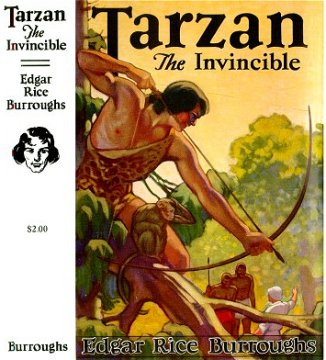
Tarzan The Invincible
So, also in the universe at large. It is quite clear that Burroughs has Einstein in mind. In Invincible he says:
‘…but though Time and space go on forever, whether in curves or straight lines…’
One can’t mention curved space without being familiar with Einstein. He is thus offering an alternative to Einstein’s notion of the fabric of Time and Space. There can be no fabric of Time and Space as Time has no objective existence. It is a construct to serve the needs of man. The sun, for instance, came into existence with a definite amount of potential energy. Barring accidents, that energy will be expended at a certain rate just like the top and when that energy is fully expended the sun will follow whatever course the cessation of suns follow. There is no Time involved, hence no Time-Space conitnuum and no fabric of Time and Space.
McLuhan says essentially the same thing.
So, Tarzan At The Earth’s Core is a demonstration of the fallacy of Einstein’s notion.
Moving on to Tarzan The Invincible Burroughs then has Tarzan dealing with the notion of terrestrial time, the world turned rightside out. As McLuhan notes, the notion of a time to eat arose with clocks; Tarzan dispenses with the notion of a time to eat eating only when he is hungry. There are no clocks in Tarzan’s Africa. As Burroughs says an individual has all the time in the world:
Of all the vast resources that Nature had placed at their disposal, she had been most profligate with Time, since she had awarded to each all that he could use during his lifetime, no matter how extravagant of it he might be. So great was the supply of it that it could not be wasted, since there is always more even up to the moment of death, after which it ceased, with all things, to be essential to the individual. Tantor and Tarzan were therefore wasting no time as they communed together in silent meditation.
One has all the time one needs until the day one dies then one no longer has need of time. In other words, the organism’s energy has been expended and the husk falls to earth.
So Tarzan is active when necessary, such as hunting for food or fighting and lazes around when activity is unnecessary. Perfectly balanced and happy according to Burroughs. OK for the jungle, I suppose, but I’ve got things to do such as writing stuff like this, but then that is only how I dispose of the energy left in my organism during the time remaining. With other media such as electric lights, I am not bound by the diurnal cycle being freed from that experiential limitation. One only has to sleep when one is tired. Time means nothing to me either. With stores open around the clock I can even buy groceries when the mood hits me. Other items can be purchased on the internet at any time of day. So, technology has freed us from many of the restraints of what civilization is pleased to call time.
Thus when reading Burroughs one should always bear in mind what time means to him and how various notions of time relate to the story. Obviously in Invincible while Tarzan is attempting to live on experiential time the Revolutionaries are living by Clock and calendar. Thus the story is also a tale of the clock or two time systems.
I know there are reasons I like Burroughs other than interesting stories; complexities like the nature of Time are one of the extras if one can only discover and realize them. Now, I really have to work on the nature of slavery in the corpus.

Edgar Rice Burroughs Taking A Snapshot Of Time
Part IV: Mick Jagger, The Rolling Stones And The Yobbo Revolution
September 22, 2012
Part IV
Mick Jagger, The Rolling Stones And The Yobbo Revolution
Mick, Kenneth Anger And Satan
by
R.E. Prindle

R.E. Prindle
1.
A Musical Digression
While this part deals with the rise of the occult it will require a digression or two to flesh out the argument to provide credibility.
Mark Sullivan, the author of the fabulous turn of the twentieth century study, Our Times, quotes Plato as observing that when a people’s music changes it signifies a great change of consciousness; the only question is, for what duration.
As Sullivan notes, the incoming waves of immigration to the US during the nineteenth century each brought its musical consciousness with it which was grafted onto American consciousness; thus the German, Polish, Italian and Irish musics etc. all had their influence. Sullivan was somewhat puzzled because with the huge Jewish influx he couldn’t find a commensurate Jewish music.
Sullivan failed to note that while the Jews had no national music of their own they were past adepts at mimicking the music of other nationalities; hence a large percentage of US music of other nationalities, Irish, Polish and German songs were actually written by Jews in the appropriate idiom. Jack Yellin for instant within ten years of his arrival was writing quintessential Southern songs such as ‘Are You From Dixie.’ A very high percentage of what is considered quintessential Americana has been penned by Jews thus infusing Jewish culture into and replacing American culture with their own.
While immigration was held to a minimum from 1914 to 1965 there was a huge internal migration of Negroes from the South to the North and West. The Jews served the same function with Negro music as they had with the external migrants. They wrote the songs for Negroes to sing. This was especially evident during the fifties and sixties of the twentieth century when the terms Negro and Jew became synonymous.
In the fifties when I was a boy Rock and Roll made its entry into musical history. From an elders’ point of view Rock and Roll was a corruption of our musical tastes that extended into our morality. This was as Plato and Sullivan predicted. The intense tough and decisive battles for supremacy in American culture were being fought between Communists and Americanists- Collectivism vs. Individualism. The decisive battle was the failure of Joe McCarthy. When McCarthy went down the war was lost although a long rear guard action delayed the Communist triumph that actually only took place in 2008 with the election of the Negro Barack Obama.
Dr. Strangelove by Peter Sellers. Must see movie.
Thus the fifties was a long intense struggle that was fought out in the movies, phonograph records, publishing and radio with an increasing boot from television. While we knew we were fighting the Communists for survival the means of the warfare were noticed but by a few and they were demonized by the Communist controlled media as cranks. Most frequently the accusations were made by wild eyed hysterical sounding Fundamentalist ministers. As the majority couldn’t see the accusations that Fluoride and Rock and Roll were Communist plots the accusers were laughed off. I could never understand how something I loved, Rock and Roll, was a Communist plot.
I did note the accusation was uttered with such complete sincerity however that it troubled my mind over the decades as to how these ministers could make such an accusation. I suppose the first seeds of comprehension were planted by the Peter Sellers’ movie ’Dr. Strangelove or How I Learned To Love The Bomb And Stop Worrying.’ The movie while hilariously funny was so skewed toward the Communist cause that it gave me pause. I vaguely comprehended that I was being manipulated.
Shifting The Mores
Now, after something like sixty years of thought and study, including Plato and Sullivan, I have I believe the explanation.
The Mores of the US have probably always been relatively fluid. Almost from the beginning the mores of East Anglia clashed with those of Wessex and then came the Scots, the Rhineland Germans (known as the Pennsylvania Dutch), the Anglo-Scots of the Border Country, the Midland English Quakers and a smattering of others along with the strong Negro element.
After Independence the Negro population burgeoned when the invention of the cotton gin created the cotton culture of the South. This population would create the tension that led to the Civil War and from that conflict the tension that would lead to the post-WWII Negro revolt.
The Irish invasion of the 1840-60 period brought the great clash of mores between the Celts and Anglos that reached its head in the 1960 election of the Celt, John F. Kennedy.
Along with the Irish came the 48ers of that failed European revolutionary phase that would create the collective-individualist conflict in mores that has resulted in the Communist triumph of Barack Obama of today.
Then in the 1870s began the invasion of the Southern and Eastern Europeans that created a conflict in mores between themselves and the Irish, Anglo and Northern European element. As noted things settled down into a contest of moral wills until 1965 when the gates were thrown open to the entire world as though the fraction of the world’s surface designated the US could house all humanity. Thus any possible hope of a unity of mores was completely shattered. Any center that might have existed was destroyed.
Now, as unpleasant as the facts may be to some intelligences, the control of the creation of a unified set of mores was seized by the Jewish immigrants in the aftermath of WWI.
To merely select a highlight of the process, in 1938 the Stalinist-Jewish agent, Congressman Samuel Dickstein. with the complicity of FDR created the House Un-American Activities Committee to root out anti-Semites and Fascist/Nationalists thus shifting control of mores to the Judaeo-Communists. The move was only partially successful initially as it had to face an intense post-war reaction ultimately conducted by the near great Joseph McCarthy.
As ever the mores of the majority were attacked at the weak joints in their armor. The key point was the long festering Aryan-Negro conflict. In realistic terms it was a conflict that could have only two results, the physical subjugation or extermination of the Whites by the Blacks or vice versa or the amalgamation of the two species.
Like it or not, the Jews and Negroes are calling for the extermination of Whites. The problem in post-war 1946 was how a small minority of Jews and Negroes representing perhaps 14% of the population could eliminate the 86% who were fully armed and dangerous.
The first step would be to knock the majority off its moral center. Without a moral focal point the majority would flounder. The route taken was nothing new. Ever since post WWI when the newly formed Anti-Defamation and NAACP Leagues were formed the majority had been cast as bigots. This caused a polarization among its Liberal and Conservative elements and Immigrants and Natives. By 1950 there was a 50-50 split between descendents of pre-1800 and those who came after. These splits were exacerbated by propaganda. Outside those divisions were the Negroes.
So, then how to fracture and fragment the majority White population even further.
Until 1954 the music that you heard on the radio was all Western, not cowboy but derived from the White or Aryan

The Great Joe McCarthy
population. And there wasn’t much of that music broadcast. Radio was controlled by the networks and they only slotted a couple hours a day of fairly wishy-washy stuff. Then about 1954 when television, commercially introduced after 1946, displaced radio as the source of home entertainment, radio floundered and only saved itself by going to all music that soon developed into Top 40 and teen dominance of the radio airwaves. That was my age cohort.
That was a time when the designation race music meant the stuff that only Negroes listened to. The designation Country and Western replaced the term Hillbilly at this time. Some considered Hillbilly a race music with a degree of accuracy if with malice. Hillbilly was despised by all but a minority not much larger than the Negroes of which I was one.
Strangely at about the same time efforts were made to bring both musics into the mainstream. Actually they would combine with folk to form Rock and Roll- Rhythm and Blues and Rockabilly. Hard to tell which was the harder sell.
The Vile Erskine Caldwell
H.L. Mencken in the teens and twenties had excoriated the hill people, from which I derive on my father’s side, while the vile Erskine Caldwell vilified and completely defamed Southern Whites in his two hateful and extremely popular novels Tobacco Road and God’s Little Acre. The two novels remained a tremendous influence through the fifties as well as the pervert Al Capp’s cartoon strip L’il Abner. Thus a large part of the majority population was more receptive to Negro music than Hillbilly.
Naturally the agents in the forcing of Negro music on the Aryans were the Jews. The actual recordings of real Negroes were pretty raw and unmusical. Though stuff to digest. Of course there had always been Negroes catering to White audiences such as Duke Ellington, Louis Armstrong, Billie Holliday, the Ink Spots and Mills Brothers of the earlier generation and the great Platters, Fats Domino and Johnny Mathis of the next generation but the real Negro music was unmistakable.
Thus Jewish songwriters such as Leiber-Stoller, Doc Pomus, Mort Shuman and others adopted Negro personas and wrote most of the Rhythm and Blues performed by Negroes. It was this Negro music geared to Aryans by Jewish song writers with a foot in each camp that made the inroads leading up to Berry Gordy’s Motown Sound where you had a new generation of Negroes packaged exclusively for
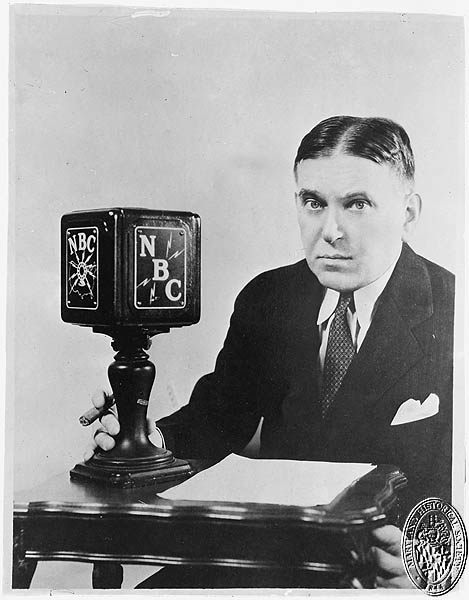
H.L. Mencken
Aryans singing songs largely written by Negroes and, of course, from there it melded into the more racial Soul Music of the sixties.
So, in 1954 Rock and Roll began to develop. First was Bill Haley, the former leader of a Country band who picked up on some Negro/Jewish shouts like Shake, Rattle And Roll and moved them over to the White side of the tracks. And then came acceptable cuddly Negroes like Fats Domino and the respectable Bill Doggett with his great Honky Tonk Pts. I & II. I don’t know how Little Richard squeezed between Fats and The Platters but he did. Of course he wasn’t even of this planet and there was no discrimination toward extra-terrestrials.
Acts like James Brown And His Famous Flames were rejected out of hand. There were no crossover possibilities there. The greatest hit he ever made was his beloved televised funeral. That was something else.
The Chess artists that the Brits idolized made absolutely no impression at all with the exception of Chuck Berry. After Maybelline Chuck had tough sledding although he has fared reasonable well in the aftermath. Memphis, Tennessee, a true classic.

The One And Only
The Commies Were Everywhere
The Law Of Unintended Consequences
When the Fundamentalist ministers objected to Rock and Roll as a Communist plot I’m sure they were ignorant of the actual evolution of Rock so I am not clear on what their antennae were picking up. They may have been watching something that isn’t so obvious now.
The world of Folk Music was clearly Communist run with a very strong Jewish influence. While other people knew of the Red influence in the arch Commie group The Weavers, it was not at all obvious to kids like myself. The Weavers’ great hit On Top Of Old Smoky betrayed nothing that could be considered Communist. However the idea of Folk Music which I have always interpreted as Appalachian style music, essentially real oldtime hillbilly, was slowly expanded into a political notion of poor people’s music, the music of the ‘oppressed.’ Now, let me tell you, I come from this social group but have never considered myself ‘oppressed.’ That attitude comes from some very well situated people who have never been at the bottom. Seeger and his Almanac singers brought Depression songs into the mix so that ‘real’ people went around saying things like ‘I knowed it wan’t no good.’ Poor people with the folkies were always illiterates who ‘knowed’ things.
Seeger and the Weavers had a hit with the Israeli song Tzena, Tzena, Tzena that was a sprightly song but hardly folk. Apparently not realizing the song was a success because of its tune not its Jewishness the Weavers followed that song with some propaganda called The Song Of The Sabra, some kind of Israeli kibbutz song.

The Weavers w/ Pete Seeger
At that time the TV Hit Parade show was big and practically the only source of hit songs so Seeger got his song on as an extra because no one bought the record. It may have been the first Israel as the fifty-first state attempt. If so the reaction was completely negative. Shortly after, Seeger and The Weavers were investigated as Reds and disappeared.
Seeger became an anti-commercial purist but a major guru of the heavily Communist and Jewish New York folk scene of the late fifties and early sixties from whence the young Bob Dylan became a stellar performer. So, between the Negro race music and the Aryan Hillbilly race music along with the Folk music that became a part of the meld, Rock and Roll was sort of the unintended consequence of the effort to force Negro music on Aryans and the Red influence of Folk.
When Fred Hallerman of the Weavers became a consultant for the Kingston Trio in the late fifties revival of the Weaver ethic, the Kingstons did follow a Communist musical agenda that most folkies adopted. Once again, you had to have a score card to know the players and follow the game.
In England beginning around 1960 a funny thing happened on the way to the recording studio that the Judaeo-Communists could not have anticipated. The second generation of rockers worshipped Negroes and Negro American music especially the urban electric bluesmen of the fifties that White Americans had already rejected. It is true that the small coterie of American White Negroes were fanatical about Negro artists like Muddy Waters, John Lee Hooker, Chuck Berry, Bo Diddley and a few others but the mass market would have nothing to do with them either in the fifties or after thirty years of ballyhoo. The fanaticism was not contagious. Indeed a really nice picker like Mississippi John Hurt is unknown. You can count the number of records sold by the Blues hero Robert Johnson on one hand.
Yet the English rockers born from 1940 to 1944 literally worshipped these Negro guys, listening to their records until they had them note for note, even attempting to be Negro, chasing Negro women. Of course the music had to be adapted to the mass taste to succeed and in the adaptation a new, or at least different, style of music was created. As strange as it may seem both the Communist Jagger and Richards of the Rolling Stones had an attraction to American Country and Western while being reared on the Englishman, Scots actually, Lonnie Donegan’s big beat folk rock.
What came out of the Stones then was a strange Negro-Country and Western sound performed by White Negroes.
Thus Negro slave music despondent and defeated was successfully laid as the basis for the Folkways of a generation or two of Whites. Musically the revolutionary program was on course as the sixties dawned developing rapidly. The Fundamentalist ministers as it turns out were right about Rock and Roll being a Communist plot or turning into one.
Organizing The Future

Procol Harum 1967
She wandered through the garden fence
And said I’ve brought at great expense
A potion guaranteed to bring
Relief from all your suffering.
And though I said: You don’t exist
She grasped me firmly by the wrist
And threw me down upon my back
And strapped me to her torture rack
And without further argument
I found my mind was all so bent
Upon a course so devious
It only made my torment worse.
–Procol Harum
The Communist strategy was to break up prevailing mores and replace them with its own. Thus the so-called concept of Critical Theory, which was Jewish, was used. Critical Theory is mostly taking a superior moral attitude as though one knew best and then carping at the existing society as though only fools had devised it and they could do better if they only had the chance. This attitude applies to all established standards and customs.
Key to our argument here is the assault on artistic standards. The Semitic religions of Judaism and Moslemism reject the representation of living life forms especially that the human relying on abstract designs instead. Thus Aryan representational art is anathema to them. More or less as the twentieth century began, coeval with the rise of Freudian psychology, the assault on representational art began.
In the US the assault began with the New York Armory show of 1913. The most sensational work of this seminal deconstructive exhibit was the Marcel DuChamp picture of The Nude Descending A Staircase, he, himself was a Communist agent. The process continued led by Jewish artists who formed a blobs and dabs ethic leading into Abstract Expressionism and finally completed by the anti-art of Andy Warhol in the early sixties.

Andy Warhol-Yoko Ono Practicing The Black Arts
In 1959 thirty-two short years after the American hero Charles Lindbergh flew his single engine prop airplane across the Atlantic over a period of days a four engine Jet 707 lifted from the runway of Idlewilde airport in New York City to cross the Atlantic non-stop to London in a few hours. This inaugurated the Jet Era while creating a new phenomenon, the Jet Set. Logistics had been made incomparably quicker and easier. Revolution could be co-ordinated as never before.
One imagines that David Bailey watching this first flight recognized its momentousness. I like to think his breath was taken away by this miracle of science and that he rushed down to get a ticket for the return flight to New York. Who was David Bailey? He was a young fashion photographer for British Vogue. Antonioni’s film Blow Up was based on his career in what would be known as Swinging London in a few years. Dave in his early twenties would catch the wave at its inception and ride the wave all the way up and all the way down. As I write he’s still out there.
As a result of the 707 Fashion itself was made identical on both sides of the Atlantic. New York and London became one huge metropolis for lucky Jet Setters. While Dave Bailey was in New York either this time or another time he met fellow revolutionary Andy Warhol. Andy was a fashion illustrator of shoes during the fifties so it is not improbable that someone at American Vogue called Andy to Dave’s attention. Or, perhaps as Dave was a switch hitter he wandered into the Serendipity where Andy was a fixture and formed an acquaintance there.
In any event in 1963 Dave Bailey took Mick Jagger on a 707 jet flight to New York. Mick, as we all know, was a revolutionary who at that time was attending the Communist London School of Economics while singing with the nascent Rolling Stones. Dave took Mick to call on Andy and the three became fast friends, mates as Dave would say. Mick revered Andy. Andy himself playing the fey fool for security became a very important figure in revolutionary circles until his death in 1987. Andy himself revered Marcel DuChamp while considering himself DuChamp’s disciple.

David Bailey and Jean Shrimpton today. First she’s yours and then she’s his.
Just as Yoko Ono realized the potential of the Happenings for bending society to her will so did Andy. Having put the finishing touches to art, pop art would be followed by graffiti artists like Keith Haring and Basquiat, Andy turned to film. His atelier known as The Factory became a very long Happening from ‘64 to’67 when Andy was turned out of his quarters. After a hiatus of a decade the torch was picked up by the nightclub Studio 54 which in many ways was a continuation of The Factory as a social scene. Andy was no less a fixture at Studio 54 than he had been at his own Factory.
The Union of Jagger and Warhol was fortuitous as with Andy’s blessing the Stones became practically the Village house band. The Village was a stronghold for the Stones. Perhaps inspired by the success of the Stones as well as Bob Dylan Andy made a foray into music when he adopted the Velvet Underground as the Factory house band launching their very short career and the much longer one of Lou Reed.
The stage on which the ‘60s revolutionaries played out their gig was gradually falling into place as the unintended consequence of the foisting of Negro music on White youth by the Jews. As it turns out it was a Communist plot.
The Communist strategy was to break up prevailing mores and replace them with its own. This is an age old technique. No surprises here but to the uninformed. To mention only one example common to all religions, when a new religion is seeking to replace an old religion the simplest thing is to build new shrines on old sites. Thus a Christian church replaces a pagan shrine, then a Moslem mosque replaces the Christian church. The ‘Holy’ site remains the same but faith replaces faith.
Thus, the Communists made their assault on popular culture. Several very potent technologies had been developed by the ‘Capitalists’ that would never have come into existence under Communism, movies, TV, radio, records and print as well as the art world. They have used them all effectively. In authoritarian societies such as the USSR content could be strictly controlled and any deviants punished unlike the West with a long habit of freedom of expression. As the sixties progressed any attempt to control such things as pornography, nudity and actual sexual perversity were removed. By the end of the decade the cherished Holy Grail of the revolutionaries of being able to say ‘fuck’ in movies or on TV had been realized. The Warhol movies of Paul Morrissey, Blood For Dracula and Flesh For Frankenstein, carried the portrayal of Sado-Masochism to lengths that would have delighted De Sade and Sacher-Masoch themselves.
In an extreme pornographic Happening in 1971 Mick Jagger before an audience of millions would have a huge inflatable penis unroll from the back of the stage, which he mounted. If there was any community objection it was hooted down in the name of freedom of expression. Truly a cultural revolution of some sort had been achieved by a small minority.
Sussing Out The Ghouls

Groovy Bob Fraser- Good book.
The key to the psychology of the twentieth and twenty-first centuries is Sigmund Freud and where he fits into the culture. Unfortunately he was not on the side of the angels. In the struggle between Reason and Un-reason Freud was the champion of un-reason, the Lord of Misrule. He aligned himself with ancient traditions, none of them Jewish as when they were formed there were no Jews, at the dawn of human history.
Freud discussed these ancient attitudes, in one guise or another, in his 1930 complaint Civilization And Its Discontents. To mention merely one strain, that of sex. While we cannot hope to recreate the mind of early man let us assume that early man took a cop from the nearest available woman where he found her. Rape was not yet a concept so for our purpose here, like Freud we’ll assume that forced sex was common and men, at least, suffered from no sexual repression. This is the very core of Freudian psychology.
Thus in the good old days a man in the mood who came across a woman drawing water at the spring simply grabbed the woman copped and strolled away without so much as a thank you. Nine months late the woman said a god appeared to her and the baby was his. Easy. But as populations evolved civilized new rules were introduced and men, at least, began to suffer the horrors of repressing their sexual appetites. This was very nearly original sin in Freud’s mind. Restrictions were placed on uninhibited copulation. However the memories of the good old days lived on and men subjected to the new discipline complained of their loss of rights.
At that point society thought something had to be done to satisfy these reactionaries. One possible solution was sacred prostitution. Thus young girls were taken down to the temple precincts and couldn’t leave until they offered themselves to the first taker.
In other instances girls stayed until they earned their dowries. In any event the illusion was created that any man could have any woman when he wanted her- if he had a shekel. If not then back to laboring in the vineyards of the Lord until he earned one.
Presumably this system worked reasonably well until the mores of the Matriarchy were replaced by the mores of the Patriarchy and women became private property with the woman secluded out sight of leering male eyes. This system had its problems, one being that some guys were so greedy for women that they collected hundreds in what they called a harem and said that these women were exclusively theirs. A neat turnaround of temple prostitution. Well, all systems have inherent flaws.
Middle Easterners then carried it so far that to prevent impertinent glances from passing fellow men they clothed their women cap-a-pie and then put a screen in front of their faces. Wow! That’s thorough.
As odd as it may seem those memories persisted for thousands of years perpetuated by cults and secret societies. In reaction to Catholic discipline societies such as the Free Spirits, the Anabaptists and such rebelled against the church in an attempt to re-establish that golden age of yore when it was supposed that men, at least, were unrepressed and could do as they pleased with any woman. As Rabelais phrased it: Do what thou wilt shall be the whole of the Law. Law and Civilization go together so to get rid of one you have to get rid of the other. Freud wasn’t dumb.
Then the Enlightenment evolved and the Free Spirits morphed into the Libertines and the Libertines morphed into the Bohemians and Organized Crime and, et voila! Here we are. Today! Or at least New York City today. We’re getting closer to Andy and Mick’s paradise.
And then we have the problem of good and evil or, in other words, God and Satan. A lively division was carried on in ancient times that gradually evolved into Christian Orthodoxy and Gnostic heterodoxy. These went through additions and subtractions, mutation and changes until there gradually emerged a clarification of the Godly Church and the Satanic occult. The Church was able to successfully manage Satanism until the Enlightenment when with their power broken Satanism, Bohemianism and Organized Crime were able to surface and operate in the open.
Many were the advocates and cults. The central figure of Satanism was the Frenchman Eliphas Levy (French not Jewish, Levy was an assumed name). Levy organized modern Satanism. The novels of J.K. Huysmans give a good insight into this period as well as being good reading. Important to the US was the Golden Dawn of Aleister Crowley who managed to leave England and live and die in Los Angeles. His publishing house still survives in the desert town of Barstow.
Thus Satanism grew in significance into the twentieth century when it aligned itself with Warhol and popular music. When opportunity presents itself, snatch it.
Today, many self-styled adepts and magi have made their appearance over the decades usually with some sort of sex therapy that involves total indulgence or submersion in sexual congress. Thus the link between Satanism and Freudianism is strengthened. Freud himself has an appearance of a magus. He was steeped in the Jewish occult, Frankism, the Zohar, Kaballah and so forth. His answer to mental health was also unlimited sexual intercourse. He believed that the more ejaculations per day the better a man would be. Thus, once again, we have New York City of toady in which women are expected to indulge men in the most casual of sexual encounters. It will be remembered that the Jewish psycho-analysts fleeing the Third Reich mainly settled in New York thus once again strengthening the Freudian connection.
Thus the anger of ancient sexual reactionaries has been made the ‘sexual liberation’ of today. Sexual revolution? What sexual revolution? Just a return to the most primitive sexual indulgence.
As Freud was himself a homosexual it is no accident that he quietly promoted homosexuality or, at least, the end of sexual repression leading to…what appeared to be sexual liberation in his imagination.
Now, Mick Jagger first appeared in New York in 1963 with David Bailey as his cicerone just when all this fustian was about to ignite. A later fellow revolutionary future associate, Bob Fraser was working in New York, learning his craft, at the time so it is possible the Dave and Mick met him at that time. We don’t know as yet what all Bailey introduced Mick to. Kenneth Anger, the homosexual filmmaker and self styled magus and Black Magician from California was very influential not only in New York but in London as well. He would associate himself with the leading revolutionists such as Warhol, Jagger, Bailey, Lennon-Ono and the English art dealer Robert Fraser. Fraser spent the first few years of the sixties in New York learning the art trade while he mingled with Warhol and the NY pop artists. He was then to introduce their work to London.
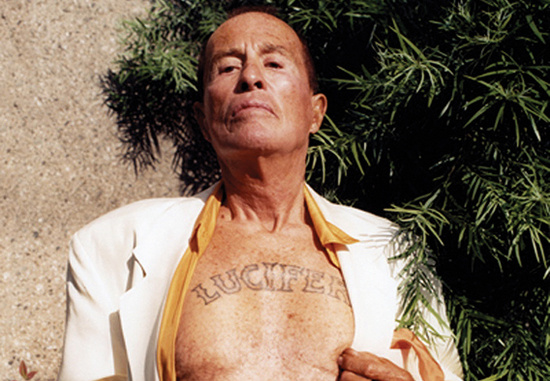
Kenneth Anglemeyer aka Kenneth Anger
Kenneth Anger made ‘experimental’ films such as the influential ‘Scorpio Rising’ the movie had a great influence on Andy when he turned to films in 1963. Scorpio Rising is a homosexual film about a gay primping to go out catting on his motorcycle in some Brando ‘Wild Ones’ setting. It is a silent film except for the girl group soundtrack of a dozen or so songs.
Anger would then insinuate himself into Jagger’s entourage as he tried to bring Jagger into his Satanic circle. Mick was supposed to write the sound track for an Anger film but didn’t produce causing Anger in revenge to claim the soundtrack was by Jagger then using some horrid static as a soundtrack. Anger would also con Jagger’s then girl friend, Marianne Faithfull, into appearing in what he considered his magnum opus Lucifer Rising. That movie was pretty much a waste which considering Anger’s other efforts is saying a great deal.
Nevertheless Anger influenced Jagger bringing Mick into the orbit of Satanic religion at least through the sixties. Satanic tropes also began to be marketed to the general public in the mid-sixties with dozens of Satanic movies released over the next decade. In much more than a symbolic way the birth of Satan, Lucifer rising, was for the modern age portrayed in the 1968 movie Rosemary’s Baby directed by the Jewish Roman Polansky based on the 1967 novel of the same name by the Jewish Ira Levin.
The movie purported to be filmed in New York’s legendary Dakota Apartment building, now condos. The movie would

The Magus- Aleister Crowley
make the Dakota a Mecca for Satanists in the upcoming years. John Lennon and Yoko Ono would acquire three apartments in the Dakota in the seventies including two on the seventh floor on which Rosemary’s Baby took place.
Ono herself was a devotee of the Black Arts (black doesn’t mean Negro in this context nor in the term Black Magic) so that her move into the apartment building may have had deep meaning to her.
The previous year, 1967, the Stones had released their record Their Satanic Majesties Request in which Mick introduces himself as Satan. The disc was released on the eighth of December just before the birth of the baby Jesus. This might have been coincidental or it might have been a Jewish joke. At any rate the heavily Fundamentalist US audience of ‘kids’ took it literally thus identifying the ‘bad boy’ Stones as Satanists. The record also set a tone for the next few years.
According to sources such as Marianne Faithfull Mick was not seriously into Satanism. She says that he was influenced by the Russian novel The Master And Margarita. That novel itself has a Wag The Dog quality. Wag The Dog was a 1997 movie in which a fake war has been reported by a compliant media for political reasons. However man proposes and God disposes. The scenario has to be regulary adapted to changing circumstances that often fail to occur as planned. A key point is when a song was faked, made to sound old, then inserted into the Congressional Library to be ‘discovered.’ The Master And Margarita has that quality.
Supposedly written by one Bulgakov, nearly a legend in his time but forgotten today, for whom a romantic biography has been concocted, he was too cautious to publish in his lifetime as he was already in disfavor with Stalin. The manuscript was placed in a drawer where it lay undiscovered until 1966. At that time it was discovered and not only rushed through the presses but this would be classic was considered such a phenomenal find that it was also rushed through a translation that was also published in 1966.
For some extraordinary reason a copy of this amusing but hardly earth shaking novel in which Satan comes to Moscow was also rushed to the hands of the singer in a rock and roll band, Mick Jagger. Mick not only received a copy but immediately sat down and read it. Thunderstruck, apparently, he, one supposes, in a blind daze dashed off the lyrics in time to include the then composed music into the new album: Their Satanic Majesties Request. The novel ain’t that good.
While Marianne may be correct the sequence of events seems contrived.
However his movie Performance of 1968 goes a long way in reinforcing the impression that he was somewhat into Satanism. So, within several months the Stones released their record, Jagger released his movie and Rosemary’s Baby appeared. These were dark years and growing darker and when ‘Satan’ appeared at Altamont the result was a foregone conclusion. It didn’t help subsequently when Mick mounted his giant inflated penis.
Nineteen sixty-eight and nine were tumultuous years in the record business as the industry moved from an entertainment backwater into a major billion dollar player. It was then that Mick and his fellow Stones realized that although their group was earning tens of millions of dollars very little of that money was coming their way. It could hardly escape them that while their ‘managers’ Eric Easton and Andrew Oldham showed evidence of big money they were still living hand to mouth. They sacked Oldham and Easton only to be tossed into the mouth of Leviathan, Allen Klein, by the departing Oldham.
Klein himself would manage to snag several major British groups including the two biggest, the Stones and the Beatles, any ogre’s dream. One imagines that he and his heirs have made hundreds of millions if not billions as a result of their thefts albeit conducted through legal methods.
It was not too long after the departure of Oldham and Easton that Jagger realized the monstrous trap that was Klein that Oldham had led the Stones into.
Actually the relationship of the goyish artists and their Jewish managers and record corporation execs is an interesting sociological and psychological study. I, of course, follow Freudian group theory from a Critical Theory perspective hence cannot be accused of anti-Semitism as Freud approached psychology from a scientific rather than a religious perspective himself being an atheist or so he said.
In Jewish thought they believe themselves to be Chosen of God hence occupying a position halfway between the godhead and humanity. As such they consider themselves as owners of the goyim or, in other words, human cattle. As the very Jewish Bob Dylan was to sing- Give me some milk or go home. Thus the Jewish personnel in the record industry consider the artists as something to be milked.
As with any cattle there are certain maintenance expenses that are unavoidable. It isn’t all profit. Thus of the billions milked from the British artists alone it is doubtful that the artists were allowed a penny on the dollar in compensation if that. The ‘milk’ obtained from the most fabulously successful act, the Beatles, is almost unbelievable. Both the Stones and the Beatles only amassed fortunes after they had freed themselves from their Jewish owners. Which is to say they buy their way out trailing mega dollars.
When Jagger realized the enormity of the criminality of Allen Klein he was desperate to escape his clutches. Interestingly he turned to, Prince Rupert Loewenstein, to free his group from the clutches of Klein.
When Klein took over the Stones from Oldham they were successful but not the icons they were fast becoming as the seventies neared. After freeing themselves from Klein the Stones went on to actually earn billions. Their concerts alone grossed over a billion dollars from 1971 to the present with another supposedly on the horizon that could possibly take in a quarter billion or more.
Now, it is nearly impossible for an artist to manage money period but money in the billions can only be managed by a competent financial staff. Rupert serves that function. I do note that when Jerry Hall was divorcing Mick she thought it prudent to check with Rupert to see if her money was still there. Apparently she was aware of the financial shenanigans of money managers. Historically they can’t be trusted. One never knows whether the money is there until one asks for the check.
However whether Klein or Loewenstein, the management, the control, virtually the possession of those billions is in the hands of others.
One can only imagine the fear, the panic, that gripped Mick’s mind when he realized that all his and the Stones efforts of ten years had changed hands without any compensation. One can only imagine the horror with which he received the news that he and his fellows were penniless. One probably cannot imagine Mick’s reaction as Allen Klein told him- tough shit, so sue me.
Sue him the Stones did but operators like Klein know how to stonewall court orders while using accounting methods to conceal tens or even hundreds of millions of dollars. The Stones sued for a mere seventeen million dollars while settling for bankruptcy returns of ten cents on the dollar. A little joke of Klein’s as he laughed merrily on the way to the bank. How much the Stones got of the settlement and how much their lawyers took has yet to be revealed.
He was fortunate to obtain the services of Rupert Loewenstein who bore the honorific title Prince. Rupert extricated the Stones from Klein while being associated with the City banking establishment of London and already managing the money of a couple dozen of the mega rich seems to have been a fortunate choice. Letting himself out to pasture in 2007, Rupert will release an account of his experiences with the Stones in a March 2013 memoir ‘A Prince Among Stones.’ Sounds promising but we’ll see. Place an advance order now and wait.

Andrew Loog Oldham
When Klein took over the Stones from Oldham they were very successful but not the icons they were becoming. After freeing themselves from Klein the Stones went on to actually earn billions. Never forget their are expenses, including Rupert. I don’t know what Rupert’s fees were, perhaps he’ll tell but I imagine the Stones have made him wealthier than he had been before.
Now, artists are artists who must pay attention to their art rather than their finances so a manager like Rupert is an essential. How trustworthy he actually was remains to be seen although no complaints from the Stones as yet.
Certainly Mick must have entered an extreme darkness of mind as he passed through the years from ‘67 to ‘71. Psychologically he had been emasculated by Easton, Oldham and Klein. One way to interpret his riding the inflatable penis could be as an attempt to regain the illusion of his manhood. One could also interpret his extreme effeminacy of this period as a result of his emasculation. Psychologically Klein had stolen his manhood along with his money. Not that Mick wasn’t always on the ambiguous side.
Mick’s association with Satanism then may have been prompted by his realization of just how evil life could be. Indeed in Manichean terms the flesh and world belong to Satan while God, the higher powers, deal in spirituality which is the rejection of Satan and his works I.e. money. Depending on what Mick was reading other than The Master And Margarita his mind may have been led to the conclusion that he was Rosemary’s Baby, that he was the Prince of Darkness. Certainly he seems to have realized the ambitions of Their Satanic Majesties Request and become a man of wealth and taste. Interestingly he seems able to move from the exquisite to clownish with the maximum of ease.

Prince Rupert Loewenstein
A Review: Larry Hosford’s New Release, Mometarily Yours
August 21, 2012
A Review:
Momentarily Yours
Larry Hosford’s New Release
By
R.E. Prindle

Here’s Larry
Larry Hosford has been singing and playing for the last fifty years giving him longevity to match that of the Rolling Stones and while he has a tremendous reputation on the Central Coast of California he’s not as well known outside his home territory. I hope to introduce him to a wider audience such as he deserves.
Larry was a war baby born in ‘43 in what was then the lettuce capitol of the United States- Salinas, California. Those unfamiliar with Larry’s extensive body of work will probably be unfamiliar with the Central Coast of California. The CC is a fairly extraordinary area not only of California but the world. Let me give my impression of the CC in the sixties when I was there as well as of Larry.
Salinas is the seat of Monterey County home to the fabled Monterey Rock Festival of ‘67 that Larry may have attended. Monterey lies due West of the better known central valley city of Fresno but on the West side of the very arid Coast Range of mountains. Wild, wild mountains. Today Salinas is a city of 150,000. Back in ‘60 when Larry began his career it was much smaller. The city lies athwart fabled Highway 101 with California Highway 1 a few more miles to the West.
You want to stay off Highway 1 unless you have time on your hands, a lot of patience and a full tank of gas. 1 is perhaps the dreariest and most isolated highway I have ever driven. I have absolutely no desire to drive it again. Forget The Graduate.
A few more miles down the road from Salinas is the town of Carmel that Clint Eastwood put on the map when he went political and became its mayor. Hi Clint.
In those days, 1964, I had a job with a mortgage banking firm for whom I covered the entire Northern half of California from Fresno/Salinas to the Oregon border. While the majority of the mortgages were in my home base of the San Francisco Bay Area I made the trip to what I called Monterey once a quarter.
At the time I lived in Larkspur in Marin County so it was a three hour drive, maybe four, down through San Jose and the town the Hell’s Angels trashed, Hollister, into Monterey. I was listening to Country at the time so my radio was tuned to an SF jock whose moniker was Black Jack Wayne. He was an odd duck Country announcer I could never get to used to but he was what was.
In addition to DJing Black Jack aspired to be a country singer. He had his own label which ensured that he was recorded, and a number of singles all of which, apparently, can be heard on the internet. Black Jack wasn’t deterred by a lack of success. At the time, just after the Beatles had landed, Larry would at one time be signed to George Harrison’s Dark Horse Records, Black Jack was pushing a young Buck Owens who he styled the Bouncing Beatle from Bakersfield.
After the Okie invasion of the thirties Bakersfield/Fresno became the West Coast center for hillbilly music. Nashville in the East, Bakersfield in the West. The area produced the great Ferlin Husky, Tommy Collins, Merle and Buck as well as the wonderful Rosie Maddox and her brothers. Rosie and Cal backed Black Jack up on a couple of his efforts- to no avail.

Black Jack Wayne
Black Jack and his brother Chuck used to have a Country place down in Niles, one of the five burgs that later formed Fremont, called The Garden Of Allah. Perhaps Larry played there. Rough place, good place to leave a few teeth in the parking lot.
Black Jack was a big hero down in Niles. I saw him leading the parade for the annual Essanay Days back in ‘59. Niles Canyon was the location they made the Bronco Billy western movies back in the silent era. Bronco’s company was Essanay.
So with Black Jack on the radio I planed down 101 at 85 per to Monterey. It was always fascinating country. Real wild west, just like Bronco Billy’s movies. You could imagine yourself coming up behind John Wayne’s Stagecoach trundling down the highway. It was a two laner at the time, probably four today, and almost empty on a week day. I was almost all alone out there. Sometimes my mind would plane along at 85 plus.
The mountains were just stunning. Following the Salinas River upstream on an exploratory venture the road stood a hundred feet or more above the stream, head watered down by the mission of San Luis Obispo. As it was Spring the river was flowing nicely above ground. Later in the year the river becomes what is called an intermittent stream, even if you can’t see the water it’s still flowing underground.

Salinas River
I got out to admire the scene when looking down I saw a man coming out of his house carrying a shot gun which he proceeded to point at me. The range wasn’t very good for a shot gun but the attitude was telling so I sauntered back to my car and returned to the valley. Discretion being the better part etc.
How very hostile I thought to myself.
Given my job the scene down in the valley was hardly less hostile, in fact, one might say threatening- bodily harm and all that sort of thing. With the imagined sound of a shot gun blast resonating in my ears I took these All American types more seriously.
I was walking a little lighter in my loafers but not for the reason you might imagine. Still, I found time to wander down to where the river braided through the sands. A beautiful sight that was. I hope Larry enjoyed it as he passed his childhood hours down on the South Coast among the refugees from civilization.
Things weren’t much better down in Clint’s future bailiwick. I was driving a white ‘63 Chevy that was a famous car among the deadbeats of the territory. I seemed to be recognized everywhere; when they saw the car coming the alert was sounded. Someone must have phoned down there to tell them I was on the way. While they wanted to beat me up in Salinas and even Monterey, another tough town, all the Carmelites, being more affluent, wanted to do was call the cops on me. A strange solution I thought when all they had to do was send the mortgage payment in. But I was in high learning mode; it was sort of like Poe’s story of Tarr and Fether in which the inmates had taken control of the asylum. Their’s was a different line of logic.
Larry was in good literary company in the area though. Henry Miller, the famous pornographer, lived around there; Jack Kerouac spent some time around the area bounding down the hillsides to the sea, even Joan Baez had a place there where she was entertaining her brother-in-law Richard Farina and Bob Dylan, even at that very time. Farina went off the road on his bike there ending his sojourn in the basement of life.
Oh yeah, and a few years back John Steinbeck had made his fame in the area. Pulling weeds out there in the lettuce patch he undoubtedly looked at all that lettuce, thought of the lettuce the lettuce growers were making from all that lettuce and wondered how he could turn that lettuce into lettuce for himself. Then as the unforgiving sun beat down on head he had a flash of inspiration, or perhaps sunstroke, and wrote East Of Eden about all that lettuce. When he wrote it up he had a best seller that did make him a lot of lettuce. Later East Of Eden became a very successful movie starring James Dean that kept the lettuce flowing in.

Those Old Lettuce Fields Back Home
Larry, of course wasn’t too interested in working the lettuce fields so he became a musician. That was somewhen about 1960 when he was seventeen. He didn’t have to study the situation and agonize over it; he just picked up his guitar and began to yodel. A great folk music scene was going on in Monterey as well as the rest of the country. It was a folk singing time folks, Harry Belafonte, Chad Mitchell Trio, Lonnie Donegan, Bud and Travis and let’s not forget the immortal Kingstons among a folk singing host. New Christy Minstrels, Jesus, let me tell ya’, all lustily singing This Land Is My Land, This Land Is Your Land. God bless that old folky Woody Guthrie, hey?
The Kingston Trio. Boy, there was a blow that would getcha. Who that was there wasn’t knocked silly by the great Kingston Trio In Concert disc? No wonder Larry wanted to try his hand at folk singing. Steinbeck’s Cannery Row had given up canning fish as that bank was overdrawn. Now it was trying to be a tourist attraction offering folk music. Very dismal looking place. Lotta heavy overcast on the coast at Monterey, most days the sun didn’t even come out. You have to cross that first ridge of hills to find the sunshine.

Kingston Trio
Folk music wasn’t that rewarding for Larry so passing through musical phases he found himself where he belonged, deep in Country music. That was where I first came across him in my own record store owner incarnation. The yo-yos at Shelter signed him and released his very fine record titled Larry Hosford aka Lorenzo. His mother must have called him that. Great songs- Long Line To Chicago, Everything’s Broken Down, memorable stuff. Never could figure out why a good lookin’ guy like Larry didn’t put his picture on the cover, a sine qua non for a first record. Everyone wants to know what the artist looks like. How else can you tell how good they are?
I tried hard to sell the record but with minimal success. And then in the hurry and rush of daily affairs I lost track of Larry until just this July when Adam Zerbe of Carmel’s 4th Avenue Records asked me to write review of Larry’s new record. I don’t know why me but, there you have it, Adam did. That’s it. Gosh, you know, when a guy’s first record tanks, as a record buyer you think the artist went back to house painting or something, like Arthur Brown did. But, no, fifty years later here’s Larry still strumming’ and singin’ with a new release. I couldn’t hardly believe he was still alive let alone myself. It’s not that the years aren’t stacking up. Both of us have a huge pile, I’m five ahead of Larry. I’ll give ‘em to him if he wants them.
Adam sent me a copy of the new release and I was surprised to find that Larry sounded as good as ever, maybe better. The years had added a mellow richness to his voice and a couple hard bounces after the first kick have given him a certain understanding of the true nature of life. I was, am, impressed.
It’s like the whole history of country music has been assimilated by Larry’s mind. It is like listening to everything that was ever good about Country rolled up into sixteen little pills. Pretty extraordinary.
I would have liked a little more of the Maddox Brothers and Rose in evidence but Larry leans more heavily to Texas music
Rosie Maddox
and especially the Western Swing of the great Bob Wills and Texas Cowboys. You can hear a lot of Ernest Tubb and some of them other good old boys too. Larry’s voice encompasses them all while having its own distinct Country twang. A great country voice. If he keeps it up for another few years he’ll be the real Voice of America. I like the record, or CD. Used to be records but time moves on and you have to keep your canoe midstream to keep up. I’m tryin’ but I sure like the sound of Larry’s new record, er, CD. Buy a copy and make yourself feel good.
Mick Jagger, The Rolling Stones And The Yobbo Revolution
Part III
By
R.E. Prindle
Mick And Keith Come Face To Face With Nemesis
Keith Richards- Face Of The Stones
The sixties were very critical years for the various revolutions that made up The Revolution. Yet their activities were very disguised to prevent detection. At no time could they admit who they were or what they were doing. For Instance the takeover of the university system of the US that began at UC Berkeley in 1964 was disguised as some sort of ‘student protest’ over some supposed lack of or suppression of free speech, hence its name, The Free Speech Movement. While it appeared spontaneous it must have been a planned maneuver. I was at Cal State Hayward a couple of miles down the road. We had library privileges at UC that had one of the spectacular libraries of the world that I used so I was on campus when this noise was going down. It was quite professional, extremely well organized and no student revolt per se. The leaders were well instructed in the psychology of crowds. Something the ordinary person would never recognize. From UC it spread throughout the US intensifying in the years 1968-72.

Chairman Mao Ze Dong
Nineteen sixty-eight, of course, kicked off the worldwide Cultural Revolution orchestrated by Chairman Mao’s China. It was all organized from China. The Paris fiasco, everything even into remote corners such as the University of Oregon in Eugene was run from China. By 1968 I was a grad student at UOregon and in the poster and record business. Some crazed Chinese styled Communists from out on the rural route opened this Communist book store right next to my store. Needless to say police surveillance increased drastically as I was already under suspicion for selling posters and rock and roll music, literally the devil’s music in fundamentalist Eugene. As the whole world knew anyone in the record business was also dealing drugs whether they were or not and I wasn’t. And then the nutty SDS Jews from New York City flooded into town in their hip denims and abetted the Maoists. This increased the fun.
Wait a minute now, there’s more. Eldridge Cleaver and the loony revolutionaries in the Bay Area were conducting open
Eldridge Cleaver
warfare, guns and bombs you know, with the Feds and local police that naturally enough led to the arrest of such Negro revolutionists. But then, quite naturally, Eldridge escaped from maximum custody or something just like it and disappeared. No one knew where he was and they really wanted to. He didn’t surface for a few weeks so in the interim where did they look for him?
I hesitate to say this because I know you’re not going to believe it. They asked me if I had him hidden in my four hundred square foot record store. You see the logical progression, revolution= rock and roll= dope, Marxist store next door- where else is Eldridge going to hide, right? The store was an open square with a two by four enclosure for a toilet in the right corner. I pointed out to the cop that he was already looking at the entire store and he could see that there was no Eldridge Cleaver. But he wanted to check the 2×4 enclosure. I knew better than to laugh but I could barely contain myself. The cop opened the door to find himself staring into a toilet bowl. Eldridge cabled from Algeria shortly after.
I certainly was not aware of revolutionary activity per se or else I couldn’t take their stuff seriously but looking back things remained on red alert until at least ‘72. For the election of the second Nixon term, which I now see as serious potential danger, I saw them move several truckloads of Army troops out beyond Spencer’s Butte. One might say Mick Jagger and John Lennon, and I say this modestly in a local way, myself, had them worried.
I’ve always respected the intelligence agencies but placing me in the same category with Mick and John makes me have some doubts. I had no revolutionary or drug connections. It wasn’t that they couldn’t find them, as they thought, they didn’t exist.
There you have it, ‘68 was the crucial year. The authorities in both Europe and America were aware that something was going down. They were not taken by surprise. The Stones were.
They might have asked why are they busting us in ‘67 when they had plenty of cause for at least three years. Undoubtedly in an attempt to defuse the ‘68 show as much as possible. The direct action of the revolution failed so whatever counter revolutionary action the authorities took voided that while the revolutionaries themselves misgauged their popular support by a little more than somewhat. There were only a few fanatics backing them. The ‘kids’ were just not that dissatisfied. We were getting plenty of satisfaction.
According to Tony Sanchez/John Blake in their Up And Down With The Rolling Stones Mick fumed thusly after the ‘67 bust, p. 62:
I see a great deal of danger in the air. Teenagers are not screaming over pop music anymore, they’re screaming for much
Tony Sanchez
deeper reasons. Pop music is just the superficial issue….When I’m on that stage I sense that the teenagers are trying to communicate with me, like by telepathy, a message of some urgency. Not about me or our music, but about the world and the way they live. I interpret it as their demonstration against society and its sick attitude. Teenagers the world over are weary of being pushed around by half-assed politicians who attempt to dominate their way of thinking and set a code for their living…..This is a protest against the system. And I see a lot of trouble coming in the dawn.
I don’t know about Mick’s mental telecommunications but the message he was getting was maybe being scrambled by some alien force. Apart from some experts at crowd control and excitation there wasn’t that much interest in fighting in the streets.
Mick remained pugnacious personally, according to Sanchez/Blake:
They think they can break us, man, but no way. We’ll take everything that they can throw at us, and we’ll still win. We’re in a position to tell the kids about all the shit that’s going down, and that’s just what we’re going to do.
Mick was smoking some powerful stuff while taking the teaching of the London School Of Economics a little too seriously. He should have said ‘some kids’, by no means all the kids were concerned with the Stones while as the events in Chicago during the worldwide insurrection of ‘68 showed that concentrating on sex and drugs was not conducive to direct political action. ‘The kids’ made a poor showing. Besides which teenagers were only a part of the rock audience; most of us were at least over twenty.
Nor in ‘72 in Miami after much hoopla and the expenditure of large sums of John and Yoko’s money was there much of an insurrection. Keith in his auto of 2010 speaking of 1985 and 1972 had this to say about that on page one no less.
Every copper wanted to bust us by any means available, to get promoted and potentially rid America of these little fairy Englishmen. It was 1975, a time of brutality and confrontation. Open season on the Stones had been declared on our last tour [that of the inflatable penis], the tour of ‘72, known as the STP. The Department had noted riots (true), civil disobedience (also true), illicit sex, (whatever that is) and violence across the United States. All the fault of us, mere minstrels. We had been inciting youth to rebellion, we were corrupting America, and they ruled never to let us travel in the United States again. It had become, in the time of Nixon, a serious political matter. He had personally deployed his dogs and dirty tricks against John Lennon, who he thought might cost him an election. We…they told our lawyer officially, where the most dangerous rock-and-roll band in the world.
Richard Nixon
Kind of tells it like it was. I was in the record business, considered an arch liberal, and I thought the Stones were attempting to corrupt the US if not succeeding. I mean, you have only to look at the original picture inside their Black And Blue album to confirm that. The Stones, Lennon-Ono, Dylan, the outlaw groups like the Baader-Meinhoff gang, the Weathermen, the Red Brigades and their ilk saw the world through some drug induced mental haze in which the finest, most just, most democratic and widest opportunity society the world had ever seen and will see was just the opposite of repressive and undemocratic.
I mean, I had been pushed down hard in life, I come from the orphanage, and I still made a major success in the record business and that was against the wishes, not of the system, but the people, the shitheads, I had to deal with. Good god, you have to bully the bullies, elude their repression. It will never be any other way.
Whence came such a bizarre interpretation of reality. As the German politician in the movie, The Baader Meinhoff Complex thought, the insurrectionists were motivated by a myth. The Robin Hood Complex.
Yes, by a sense of materialistic frustration which they justified by the myth of Robin Hood. The problem was the same as the Negro insurrectionists in Watts. The range and quality of material goods increased on a daily basis continually out of reach. Yobbos like the Stones with no discernible abilities other than to write trite lines of lyrics and play hashed over music taken from nearly musically illiterate street corner Negro bands were realizing their material fantasies. What did they do in their rebellion in Watts? Break into stores and steal Tvs and stuff. Mere economic frustration. The Beatles were buying Rollers then desecrating them with psychedelic mockery. Richards himself driving without a legitimate license bought Rollers and smashed them up with glee laughing as he skipped away to avoid arrest. Keith was living the Yobbos dream. Baader-Meinhoff tried to replicate the dream by stealing Mercedes to go joy riding through the night. Same thing the Negroes were doing. That was what the revolution was about. To revel in cash money as the Stones, Beatles and other rockers did they robbed banks to ease their frustration. A leading hatred of the revolutionists was Consumerism. In other words there were more goods than they could come up with money to buy.
Then, as that would garner no sympathy from hardworking people who looked on the cynosure of their eye- the Mercedes and Rolls Royces being destroyed- with horror the gang claimed to be expropriating the expropriators a la Robin Hood and many another criminal but they bought no Thanksgiving dinner for the starving a la Pretty Boy Floyd.
Did the Stones believe the authorities so stupid that they didn’t know what was going on? Apparently so. Didn’t the Stones realize that they were merely taking advantage of the system the claimed to despise? Apparently not. The intelligence agencies infiltrated even the one man organizations of a nincompoop without a chance of success. I was invited to join one by agents in which the ‘mastermind’ was the only non-agency member. What are you supposed to think?
Who was this cocaine supplier to Keith, Freddie Sessler, if not a government agent? I’ll go into him later. Ask yourself, who can obtain unlimited quantities of sealed Merck cocaine containers if not government agents. Some believe that during the sixties the availability of LSD was provided by the CIA/FBI. There was so much LSD coming out of UC/Berkeley and Stanford programs that the whole Bay Area could have been supplied. Who was Owsley? Ask yourself.
The Agencies were funding programs by importing Indo-Chinese heroin also plentiful at that time. What was the result of plentiful Acid, Cocaine and Heroin? Incompetent malcontents. Work it over in your mind. Think about it. Electro-shock therapy? There’s a good one; scrambles your brain forever. Then add Acid and Heroin. Whoo-ee baby.
Anyway, the authorities knew what the Stones, Warhol, Lennon-Ono and the revolutionary crowd were up to. If the West had been the Soviet Union the whole lot would have been shivering the winter through out in the gulag instead of making millions riding giant inflated penises. Hello Mick, are you listening?

Andy Warhol
But, back to 1967 and the Redlands bust.
It is difficult to know exactly when Oldham and the Stones appeared on the authorities radar. A reasonable assumption would be perhaps sometime in late ‘64 or early ‘65. On the other hand Mick associated himself with David Bailey who probably was politically active since the late fifties who then drew Mick into a revolutionary circle including Andy Warhol in New York. Perhaps some sort of notice was taken at that time but probably of a cursory sort.
Why the Stones would have gotten a shot on the Ed Sullivan show isn’t all that clear to me; they had no reputation in the States at all. Or, for that matter why the Beatles got a shot. Nor why Dave Clark and all the early Invasion groups were hooplaed and accepted so readily as the next big thing by the Sullivan show. Obviously something was going on behind the scenes that we aren’t aware of.

Ed Sullivan
At any rate the Stones got their shot making a not overly favorable impression; definitely inferior to the Beatles although, as we were informed, top competitors of the Beatles over in England. Well, bully. Somebody must have figured out a money angle and it wasn’t in records. In ‘64 a top selling record was 250,000 copies or a million dollars retail. That was the definition of a million seller. And there weren’t a lot of those.
Even drugs were not yet that prominent although the use of grass had been spreading since the fifties. An elite clique in my high school in Michigan was covertly smoking it in 1956 imitating the kids in Scarsdale New York who were apparently leading the curve.
Pharmaceuticals and psychedelics were in use while I was in the Navy ‘56-’59 but not that widespread. Then in the ‘60s psychedelics came into fairly widespread use. I had no idea that amphetamines were practically universal in NY during the early and mid-sixties. LSD became a phenomenon early in the sixties with Leary given the most attention at his post at Harvard becoming the spokesman for turning on, tuning in and dropping out. One way streets were becoming ubiquitous at the time too. That phrase may have sounded the alarm for the authorities as multitudes actually did drop out becoming rather a useless burden on society. I can tell you, Haight-Ashbury wasn’t all that cool.
That ought to have been about ‘65-’66 when the revolution itself was gathering steam.
Mick, of course, was a political revolutionary committed to the cause while his lyrics are a negative portrayal of society if not a put down. Richards was soured on society at age 13 or so when his voice changed. He had been a boy soprano at his school where he and two others were so excellent that they won many prizes. In the process they were excused from certain classes. Then their voices changed and naturally enough they were given their walking papers.
At this point their award winning efforts were thrown back in their faces as they were demoted in grade to make up the classes from which they had been excused. The trio might have tutored to bring them up to speed but Keith felt that had been discarded like so much refuse. Society made itself an enemy who as time would prove would be able to wreak his vengeance with effect.
Keith accepted adoption by the revolutionaries as one being shown the inner sanctum of the Red Brigades of Italy and other revolutionary groups. So he and Mick were more or less of one mind.
Actually by even playing rock music in the fifties and sixties would be to know that he was infuriating the teacher class that had wronged him. Rock was the devil’s music. The notion that rock was part of the Communist conspiracy to corrupt youth was fairly widely believed, speaking of the US. Folk Music was held to be subversive and there is a fair amount of truth in both assertions.
Certainly the Reds didn’t invent Rock but they quickly took advantage of it to inculcate their doctrines.
After the assault on youth in the late fifties when even Dion of the Belmonts was toned down by Mitch Miller and Columbia, the ‘sweet Jewish rock ‘n’ roll of Carole King and Bob Crewe’ and the promotion of a series of bland ballad singers rock seemed to have been contained by the reaction. In Britain the pop scene had been managed so that only bright, pretty faces and perky personas were universal.
The Stones in a very rebellious revolutionary manner broke that mold. On their entry to the United States they struck people as somehow dirty, compared to the Beatles I suppose. They were actually more repulsive, although that might have been Oldham’s hype, although not so much so as The Animals who absolutely horrified the old guard so that it seemed like the scruffy and scruffier were seizing the youth. And of course even on their first Sullivan appearance you could easily see that Brian Jones was under the influence of something. So the Stones may have come under suspicion by the authorities sometime in 1964.
Before 1965 pot and drugs were still somewhat clandestine among youth but by 1965 and after especially with the surfacing of Haight-Ashbury at least pot and LSD were endemic. In very early ‘64 I used to know a guy who kept a bowl of LSD tabs on his living room table. Of course that was Berkeley. In those days acid was considered a sacrament or some kind of transcendental experience. While not that common the experienced walked around like they had been transformed from ordinary mortals into demi-gods. They wouldn’t talk to anyone who hadn’t dropped. It was quite a sight to see although I never indulged myself.
There was one golden moment of, oh, perhaps a half a second in 1966 when the essence of the ‘60s came and went. It was short and quick and even if you got it it was gone before you could grasp it, little golden shimmers filtered through your fingers and that was that. Sic transit gloria and away we went to Altamont. But I anticipate myself.
You’ve heard of the Generation Gap and that was real. Nineteen thirty-eight when I was born was the year of the lowest number of recorded births in some time. We weren’t as rare as hens teeth but even the war babies out numbered us and when they were born half the male population was overseas, so you figure it. Somebody was having a good time. Then in 1946, of course, when the men who survived began to return the population really began to boom, hence baby boomers. So, there was this gap between a huge youth and an older population. The old folks didn’t like us and, well, the relationship was difficult, kind of like between Martians and Earthmen.
The Stones had that jungle beat the old folks couldn’t tolerate. Shucks, the Stones hadn’t even heard real Negro music. All they knew was Motown and that Chicago shit blues music that no one in the US would even listen to. I owned a record store beginning in ‘67 and, let me tell ya, you couldn’t even give that stuff away and that includes Robert Johnson. Oh sure, some stumblebum blues aficionado would shuffle in to ask for Lightning Hopkins, Little Walter or something like that but when you stocked it they would only fondle it say something like I like knowing it’s here. To hell with those guys.
This was a university town and these fanatics would actually bring Lightning Hopkins, for instance, to town for a concert before twenty people in somebody’s living room. Those guys couldn’t play guitar and they couldn’t sing. Leadbelly! Spare me. Memorized Carl Sandburg’s American Song Bag. I never could figure it out.
Shoot! The Stones missed out on the real thing. They should have been in Oakland in ‘60 to ‘66 where I was. Boy, we had the real thing. The most godawful stuff you’d ever want to hear came blasting out of KDIA. White disc jockeys though. The Stones could have learned a lot.
The jungle beat might have garnered them some real attention.

Louis Malle
But then, under Andrew’s urging the Stones began to write and compose their own songs. These were often cruel sexual songs expressing the desire to oppress and hurt women or else mocking the older generation. Very strange, unsettling stuff at the time. Now everyone has been unsettled, can’t move them now. As Jagger and Richards, who wrote the songs, found their way in songwriting, the songs became ever more revolutionary while they meshed with a slew of revolutionary movies released during the mid-sixties on. These were often coded plans of action that an agitator provided with the key could decode for other revolutionaries and direct action. Such a key movie that was very influential for the Baader-Meinhoff gang and among German revolutionaries in general was Louis Malle’s Viva Maria. While on the surface a nonsensical even stupid movie when one has the key the movie becomes coherent indeed. Part of the Matriarchal Revolution for starters, but watch it.
Jean Luc Godard, another Nouvelle Vaguer also filmed the very propagandistic film One + One (reissued as Sympathy For The Devil) built around the Stones song of the same title. There was also a slew of satanic movies such Roman
Jean-Luc Godard
Polansky’s Rosemary’s Baby that aimed at undermining Christian Beliefs. I Am Curious: Yellow that aimed at destroying female chastity. But more of that in the appropriate place.
So, by ‘67 the time of the bust the Stones were building up a dangerous reputation. Always remember that all of these outfits were infiltrated by espionage agents. And those guys were the ones bringing in the dope so how couldn’t the authorities know what drugs the Stones were using and in what quantities. Nice calling card, isn’t it: an unopened ounce of Merck cocaine?
At any rate they decided in 1967 to rein the Stones in a little bit. Shoot the old warning shot across the bow. Also remember that as much as the authorities wanted to suppress the Stones there were just as many Communists or revolutionaries in just as high places to thwart their efforts and actually place the Stones above the law. Their credo: To revolutionaries all things are permitted. Now, you figure it out.
In point of fact the older generation just couldn’t understand the youthful attitude. Everything was going along swimmingly as far as they were concerned. The war recovery was proceeding nicely while the economy seemed stabilized, no return of the Depression. That’s what really scared them and now the little creeps benefiting from this wanted to destroy it. Go figure. That high point of Western Civilization has been subverted today.
As far as the bust at Redlands the authorities were just giving the Stones a good razzing, a taste of what could happen if they were serious. In all likelihood they probably had no intention of making Jagger and Richards serve their sentences. Robert Fraser, the art dealer, arrested with them, was a different situation. He was a member of the establishment having held high military responsibility in Kenya possibly during the Mau Mau insurrection. Therefore he had no excuse whatsoever.
The Stones are quite right that it was a setup. The supposed dope dealer, the American Jew Schneiderman was quite obviously a CIA plant, hence his unlimited supply of pharmaceutical Acid.
Rees-Mogg’s editorial ‘Who Breaks A Butterfly On The Wheel’ was obviously an inside joke as well as well as an insult to the effeminate Jagger. One doesn’t take butterflies seriously hence they were calling Mick a little twit. Why bother with someone so inconsequential? Mick and Keith don’t seem to have understood this. Indeed, Mick, according to Tony Sanchez blubbered:
They think they can break us, man but no way. We’ll take everything they can throw at us, and we’ll still win. We’re in a position to tell the kids about all the shit that’s going down, and that’s just what we are going to do.
Well, bravo, Mick. But you might have been speaking from jail, a rather poor pulpit, had they chosen to put you there while you were not speaking for ‘the kids’ just the yobbos who weren’t going to do anything.
Then according to Sanchez/Blake Mick launches into a clairvoyant séance:
I see a great of danger in the air. Teenagers are not screaming over pop music anymore. We’re only serving as a means of giving them an outlet. Pop music is just a superficial issue…When I’m on that stage I sense that the teenagers are trying to communicate to me, like by telepathy, a message of some urgency. Not about me or our music but about the world and the way they live. I interpret it as their demonstration against society and its sick attitude…This is a protest against the system. And I see a lot of trouble coming in the dawn.
So did the authorities and they were taking measures if not to avert it at least to minimize it. I fail to see how the Paris imbroglio of 1968 took anyone by surprise. I mean, there was no organization not infiltrated by the intelligence agencies. The Chinese Cultural Revolution of which Paris and the rest was part, was directed from Beijing so the West’s intelligence agencies had to be well informed. But as the enemy was their own children they had to be sparing in the use of force. Even Chicago that would have been a great excuse to eliminate the proven troublemakers wasn’t used. Instead we ended up with the farce of the Chicago Eight trial.
They should have just dumped on them. No one was going to riot; those creeps didn’t have that much sympathy.
And then just to show Mick how little they thought of him they sent a helicopter to bring him to them for a little mocking chat. A helicopter: give me a break. Keith does have this to say about that in his autobiography Life of 2010:
The same day we were released the strangest TV discussion ever took place between Mick- flown in by helicopter to some English lawn- and representatives of the ruling establishment. They were like figures from Alice, chessmen: a bishop, a Jesuit, an attorney general and Rees-Mogg. They’d been sent out as a scouting party, waving a white flag, to discuss whether the new youth culture was a threat to the established order. Trying to bridge the unbridgeable gap between the generations. They were earnest and awkward, and it was ludicrous. Their questions amounted to: what do you want?….They were trying to make peace with us, like Chamberlin. Little bit of paper…Yet you know they’re carrying weight, they can bring down some heavy duty shit, so there was this underlying aggressiveness. In a way they were begging Mick for answers. I thought Mick came off pretty well. He didn’t attempt to answer them; he just said, you’re living in the past.
They flew Mick in a helicopter. It was a mocking importance and it came off that way. I saw the bit at the time and came to some different conclusions than Keith. Mick staggered out of the chopper and had to walk across a broad expanse of lawn as though a suppliant to the haughty waiting establishment, sort of like going to see the school principal. They awaited on the patio of a huge house. It was the back door and Mick wasn’t even invited into the kitchen: he was treated like a servant or better yet, a beggar. Butterfly indeed.
They were condescending enough to make your bones ache, Rees-Mogg, one of the establishment, included. They asked the spokesperson of the generation: What do the kids want? Mick flopped. He just stuttered. Keith may have thought he came off well but at my end of the tube I burst out laughing. As far as I was concerned Mick humiliated himself, but then, it was planned that way. All the power was on their side; Mick could really only stand like some penitent school boy and that’s pretty much what he did. Mick wasn’t and couldn’t have been prepared. The deck was stacked against him. But then he, in his turn, shouldn’t have blustered in the aftermath. I wonder if he had to walk home as the heli lifted off without him. That would have been the usual part of the trick; to leave the victim stranded.
In their own way the establishment succeeded in that they knocked the Jagger-Richards writing team off center. Or possibly the duo had exhausted their first momentum, much as Dylan had done and had to regroup as Dylan did. Keith acknowledged that they were dry after the bust. As he says the duo was able to find a new center that was just as successful, perhaps moreso, than the first.
The revolutions were still on and about to reach their first climax.

William Rees-Mogg 1967: An interesting article about the case:http://www.nickelinthemachine.com/2008/09/brixton-prison-and-mick-jagger/
Next: Leading to Altamont
Mick Jagger, The Rolling Stones And The Revolt Of The Yobbos
Part II
by
R.E. Prindle
Warhol Jagger
Mick, Dave And Andy
If you had looked you wouldn’t have seen it but Sigmund Freud, or at least, his ghost was quietly at work transforming the psychology of Western Man. The old chivalric ideals of the Arthurian sagas was rapidly being replaced by the Jewish hopes and fears of Sigmund Freud and the Jewish people.
The Aryan ideal was based on an intense consciousness and objectivity while the Jewish understanding was unconscious and subjective. Aryans followed a concept of honor, Jews followed a concept of chutzpah. The transformation was understood if not clearly seen by the science fiction writers of the fifties. Stories subsequently made into movies such as The Blob, Invasion Of The Body Snatchers, book title: The Body Snatchers, and I Am Legend told the tale of the subversion of the conscious as people were portrayed as the living dead or zombies.

Warhol Jagger
With the way prepared then the next step was the free expression of subconscious desires undeterred by reflection and the subversion of men and women in sex. Freud proclaimed that the more frequently men ejaculated the better a person they would be, at the same time preaching the dangers of repressing those psychological ‘needs’ or desires to the exclusion of all others.
The Libertine element or Bohemians of society seized the opportunity while those yet imbued with Chivalric or Christian ideals held out while those ideals were slowly eroded replaced by Jewish ideals. Of course the Pill and drugs came along to push Freudian ideals into fast forward, a bunch of Charlie Chaplins rushing to the future.

Warhol Jagger
At the same time movies and TV began to glorify the expression of an undefined rage against Western ideals and justifications of its impression appeared regularly in ever more sadistic and uncontrolled expressions. Movies glorifying drug use and homosexuality appeared regularly. This enabled homosexuals, sadists and what have you to recognize and find each other thus being able to organize in associations. The Homosexual, Sexual and Yobbo, or Undermen, revolutions were thus able to more forward much more rapidly. One was able to discuss these aberrations as normal conversation, mere expressions of the varieties of sexual experience. Then in 1962 Anthony Burgess published the Yobbo bible, A Clockwork Orange, which in 1971 was made into the most despicable of movies.
The Yobbo bible apparently found a ready audience awaiting it. In New York, the Prince, even the King, of the Yobbos, Andy Warhol, teamed up with the London fashion photographer David Bailey to buy the screen rights from Burgess at bargain basement rates. They obviously saw the book’s potential for forwarding the revolutions on the screen for the corruption of Western youth. Bailey who must have been one the earliest jet setters having met Andy on an earlier occasion perhaps after Andy had introduced his soup cans unless Andy had been recognized as a leader of the revolutions before he had gained fame as an artist.
Warhol and Bailey were quick off the block obtaining the rights in either late ‘62 or early ‘63. Certainly a prescient move. As Andy was just beginning his switch from art to film while having no experience in film making Bailey’s collaboration seems as though it were a leap of faith. Perhaps if they met in ‘62 or even earlier he and Andy jabbered about the potential of movies while riding a white horse name Obetrol.
David Bailey who had risen rapidly in the late fifties at British Vogue is credited with being one of the originators of
Warhol Jagger
Swinging London. What a knockout combination that was, had us all slavering at the mouth wishing we were part of it. Bailey even had his career commemorated in Antonioni’s film, Blow Up of 1966. A sensational film in its day though I find it difficult to see the significance today although still good mood and photography.
David had met Mick sometime in 1963 through his girl friend model Jean Shrimpton. Mick was dating Jean’s sister Chrissie who introduced him to Jean. Jean had no trouble spotting the Stones potential introducing David to Mick with the giddy news that he and the Stones were going to be bigger than the Beatles. Slightly enthusiastic; the Stones were going to be big but not bigger. Nothing really approaches the impact of the Beatles. The dead Lennon is either a god or nearly one while none of the Stones will reach that status.
David and Mick bonded immediately becoming in David’s word, mates. David was five years older than Mick and already successful so that must have enhanced his appeal to Mick. As David looked at Mick and saw the Stones play he apparently said to himself; These are the yobbos I need for my movie, droogs if I ever saw them. He and Mick boarded a big 707 jetliner, one assumes, in mid to late ’63 to be introduced to co-owner of the movie rights of the intellectual property as the star of the semi-porn flick, at least as it would be filmed in 1971.

David Bailey- Fashion Photographer
This was a fateful connection for Mick and the Stones. Now, Mick had been attending the London School of Economics, LSE, during ‘62 and ‘63 only leaving university in late ‘63 when he believed the Stones were going to make it. It is hard to believe that he would give up school for the ephemeral success of England- two good years and out, replaced by the next pretty face. Perhaps Bailey and Warhol were already planning the exploitation of the record industry as a propaganda tool. Certainly Bailey was conscious of the trans-Atlantic connection between British and American Vogue. For guys on the qui vive it wouldn’t be much of a leap to imagine trans-Atlantic musicians, after all, the Englishman (Scot, I know) Lonnie Donnegan had already had a few hits, including a monster, The Rock Island Line, in America. If, in their discussion Mick could have seen the potential, leaving university would be a bet on a bigger and more glorious future.
Some think Bailey and Warhol would have made the movie but ALO placed the price of the Stone’s too high. As Oldham was as keen on Clockwork Orange as anyone that doesn’t necessarily ring true. There must have been other reasons.
Nor was Mick studying bookkeeping at LSE as often represented. The school was established by the Fabian socialist Webbs c. 1900 and was a Communist training ground. Mick did have a scholarship which means he must have been vetted as good future material. Although LSE does have an accounting department Mick was enrolled in political science with the intention of being a Communist politician. So, Mick, David and Andy were to follow a revolutionary agenda pushing the envelope in sex and unruliness. The emerging drug scene promoted both aspects and added a new one.
Shortly after Mick returned home the Beatles burst upon the scene from the Ed Sullivan show in February of ‘64. This was the avant garde of the British Invasion opening up fabulous new vistas for the yobbos of small insular England. For whatever reason the Beatles were an immediate sensation. I’ve got a very good ear but I couldn’t hear it then and I still can’t. The Stones, not really that big a deal yet, followed shortly after gaining full national exposure on Sullivan’s show. Young America was watching. Regardless of the opinion of Stones’ fans they didn’t cut it. There didn’t seem to be much there other than the hype. Mick couldn’t sing while having a very weird appearance. All eyes were on the magnetism of Brian Jones, looking right past Mick. You can see him noticing where the attention was going and looking over at Brian as though to say: But I’m the singer and should be the center of attention. Perhaps Brian’s fate was sealed at that moment. Certainly if he had been brought up front, as all four Beatles had been, there might have been more interest.
No matter, the first tour may have been a bummer but the conquest was still quick enough. The Stones were after all British. Gold, at the moment.
In any event Warhol and Jagger became fast friends. A friendship that was to endure to Andy’s death in 1987. By the time the Stones had gotten settled in Andy had been shot in 1968 actually killing him but the doctors brought him back.
The early endorsement of Warhol had cemented the relationship of the Stones with the yobbos of Bohemia. In ‘63-64 Warhol was only just getting the Factory, the clubhouse of homosexual drug addicted Yobbos, going but that gang would have spread the word effectively in Manhattan club land.
I’m sure Mick’s sexual ambiguity, bi-sexuality, or whatever you wanted to call it kept the enormous homosexual population of Greenwich Village Bohemia in his corner. After Andy’s recovery in 1969-70 the relationship between the two men developed.

Andy Warhol
To quote the website
http://www.montauklife.com/history/hist-main2.htm :
Mick Jagger was painted [by Warhol] while he was at the height of fame. Andy and Jagger first met in 1963. Warhol spent a lot of time with Jagger and his wife, Bianca, but claimed he was the closest to their daughter Jade, whom Andy remembers teaching to paint. Over the years the artistically inclined Jagger kept tabs on the musically inclined Warhol. Mick was such an admirer, that in 1972 when the Stones formed their own record company, they tapped Andy to design their logo.
Montauk is the easternmost town at the end of Long Island. Andy and Paul Morrisey had bought a twenty acre compound there that they rented out. In 1975 they would rent it to the Stones for 5K a month while they were making Black and Blue.
In the meantime the Stones expanded their list of celebrity acquaintances on their 1972 Exile On Main Street tour. Needless to say these celebrities were all related to Warhol and the Bohemian scene. This included meeting the Warholite photographer Peter Beard who directed the Stones to Montauk. The linked Montauk site is worth reading.

Clockwork Orange Poster
All right. A Clockwork Orange was released in 1971 with devastating results. Just previously in 1969 the Homosexual Revolution had succeeded in escaping the restraints of New York City laws with the Stonewall Riots leading to the golden age of homosexuality before AIDS hit. The Stonewall Inn was on Christopher Street in the Village, the very heart of the Homosexual Revolution and Warhol’s empire. This led to an increase in the corruption of society. Following on the heels of the Riots perhaps encouraged by them the effects of A Clockwork Orange were much greater than The Blackboard Jungle and Rebel Without A Cause of the mid-fifties.
There were serious consequences not least of which was a sado-masochistic tone to the Stones as exhibited in their Black And Blue release of 1975. It is hard to believe that this record didn’t reflect Andy’s sado-masochistic influence. The inside cover depicting a bound woman being brutalized, the title Black and Blue seeming to indicate the bruises she was getting from the beating caused a major uproar, especially amongst Lesbian groups, resulting in the photo’s being withdrawn to be replaced by a group shot. Warhol and Mick were in sync.
In addition to providing the Stones’ logo Andy also designed three record covers for them which advanced the homosexual sadistic agenda. The first was the blatantly homo Sticky Fingers. The title was interpreted to mean the result of beating off while the cover has the famous zippered jeans with the working zipper.
The second cover was Love You Live with its double entendre of cannibalism. The third, Emotional Tattoo, a bootleg, featured Mick on the cover of 1983.
In 1975 showing Andy’s great admiration or love or Mick he made a portfolio of large 42 x29 inch prints reproduced in this article.

During this whole period of the seventies Mick’s wife Bianca was the reigning queen of the Warhol/Halston entourage. While Mick promoted satanic sex riding an enormous inflated penis on the stage he was somewhat more puritan with his wife off stage. He found Bianca’s sexual behavior in the Warhol entourage so humiliating that he was forced to divorce her. One can say that he was patient with her past the endurance of most guys.
But Andy and Mick remained good friends. In 1987 when Andy took the one way barge trip to a new life Mick was the only celebrity friend who took the time to attend Andy’s funeral in Pittsburgh. Thus ended probably one of the most significant friendships of our time.
By the time Andy died they and one presumes, David Bailey, had been more successful in achieving their goals than they might have hoped. Of course Sigmund Freud gave them more than a leg up.
Next: Nemesis Catches Up With The Stones.
 I, Dynamo