A Review: John Pearson’s The Profession Of Violence
July 2, 2017
A Review: John Pearson’s
The Profession Of Violence
by
R.E. Prindle

John Pearson
Pearson, John: The Profession of Violence, The inside story of the twin brothers who ruled the London underworld. 1973, The Saturday Review Press.
Let us say the inspiration for this essay is John Pearson’s 1973 book. My struggle is trying to put the post war period together especially the contribution of England that so influenced the course of the Sixties in the US after 1964. I think I can use Pearson’s The Profession of Violence as a base.
The criminal Kray Twins are the subject of Pearson’s biography during the period 1956 to 1968. No one in England, except for recent immigrants, will have to ask who the Krays were while the vast majority of Americans and Canadians as well as Mexicans will draw a blank.
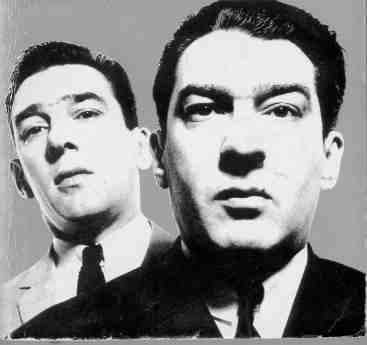
David Bailey’s Portrait of Ronnie (front) and Reggie Kray
Quite simply the Krays- Ronnie and Reggie- were the most fearsome villains in England of the period. The English refer to their mobsters as villains and truly there was no English Mafia, just a collection of villains under the hegemony of the Krays. Their notoriety was such that at the height of Swinging London the fashion photographer David Bailey issued a portfolio of photos of England’s scene makers which included the villains Ronnie and Reggie Kray. David Bailey, who is the subject of Fellini’s movie Blow Up was more influential than one might suppose. The Krays were, as Bailey recognized, in many ways the epitome of Swinging England; they were mixed into many things. Their career coincided with the birth of the Sixties and ended in 1968 when they were returned to prison for life thus ending their spectacular career.
David Bailey was criticized for including mere villains in his portfolio, but in fact the Krays made themselves members of the scene as surely as Bailey, the Beatles, the Rolling Stones, Mary Quant, Twiggy and the rest. The Krays were on their way to acquiring control of the whole record business when the law brought them down.
Really, then, the Krays are part of the generation that spent their youthful years during the Second World War under very harsh living conditions from the War’s end through the Fifties and still into, at least, the early part of the Sixties.
It is difficult to accurately recreate the effect of the destructive war years on post-war Europe and England. France and England were mad to involve themselves in Hitler’s crusade against the Soviet Union except as enablers. The crimes against humanity, the offences against sanity are indescribable. The agony of Russia, horrible conditions of a Germany actually bombed flat and the genocide against them that followed, Northern France shredded by the march of armies more devastating than a sky filled with locusts, swatches of England bombed flat while the cream of their manhood left over from WWI was destroyed by WWII leaving nations with inferior human resources while hordes of women were condemned to live their lives without men.
And the youth, what desperation they faced growing up, what stunted bodies caused by the lack of nutrition, of nearly a full decade on short rations. Strict rationing while a Black Market flourished creating whole new social classes of semi-criminal spivs and wide boys. And to add insult to injury a compulsive National Service of two years just as they were coming were coming into manhood. Not a draft of the less fortunate men as in the US but the whole male population.
When National Service ended in 1960 that whole generation born in from 1938 to 1945 were released from the indignities suffered all their lives. Is it any wonder that the early Sixties in England were characterized as the Swinging Sixties as exuberance burst out all over the place. Release, release, release.
Even in the depths of their desperation a light crossed the ocean from the US in the character of Elvis Presley. Hope in human form. Just as Elvis gave hope to the same age cohort in the US the light of Elvis showed the way for English youth. Music was the path for poor boys to follow to prosperity. Naturally the results weren’t even but neither was the talent.
Those that succeeded had parties where the Groaning Board was truly groaning with all the really good delicacies the earth provided. Strangely the table was just for show. To take vengeance on the deprivation of those early years that generation turned up their noses at all that food, refused to eat it, and it went into the garbage. How many other neuroses and psychoses of those years have had their sources gone unrecognized.
So, the Krays coming into early manhood rose from their difficult conditions, not to mention their origins. They were from the notorious East End, Bethnal Green, a desperate area since Victorian times. It was one of the most heavily bombed areas of London. Ronnie Kray was a certified lunatic, as psychotic as they come. While twin Brother Reggie lived out his life in prison, Ronnie was in an asylum such as Colney Hatch.
Colney Hatch was a legendary asylum of the Victorian era. Its name was legendary in my youth. It was always pronounced Coney Hatch so while in England in 1976 I found myself driving on a street in London where upon looking right I saw a sign saying Colney Hatch. There it was, the legendary insane asylum. Colney, not Coney. Ronnie wasn’t there he was somewhere else.
Thus Ronnie was nuts, his brain probably affected by a serious fever in his childhood, while he exerted a compelling influence over his twin dragging him into infamy as it is told. The old generation of villains was on the way out by the mid-fifties, the Krays barging into the void to establish their hegemony.
Just as the cadre of 1942-43 wanted to indulge themselves so did the returning soldiers and those that stayed behind. There was also a fluttering between socialism and Adam Smith economics, sometimes referred to as Capitalism, the name that is more a Communist smear that disguises its true nature. And the rebuilding of thousands of London’s leveled areas.
It was a time. Not the very worst of times, but not the best either. It was depressing whatever the time was. Is it a coincidence that British youth embraced the US Negro blues as their musical expression? I don’t think so.
As David Bailey, the fashion photographer, recognized, the Krays were not mere villains. They emerged from the underworld into the Twilight World between the Under and Overworld just Over world players like Lord Boothby descended into the Twilight world with the Krays. Caught up into the Twilight World was the whole music industry. It is bonding of these three worlds, the Under, Over and Twilight worlds that this essay is really about.
As might be expected this volatile mix was bound to explode and explode it did in 1963 in what was called the Profumo Affair. If anything the Affair exposed the sexual underside of London society. But not completely . There was a homosexual underside involving the three worlds and ones of which the Krays or at least Ronnie was central. And this homosexual underside extended almost universally into the music business.
A little more background. Gambling had been illegal in England until that magic year of 1960. In that magic year England legalized gambling. This Act alone probably did more to create the Twilight World than any other. Now clubs were established that brought the Under and Over Worlds together, shoulder to shoulder. Now Ronnie and Reggie felt themselves to be elevated, rubbing shoulders with the Old Nobility, the Upper Crust, the cream of London society.
Lots of people gambled and gambled stupidly. Prominent for this essay are gamblers like Brian Epstein, the manager of the Beatles and the premier art dealer of the period, Groovy Bob Fraser. And binding the whole thing together like a taut rubber band, drugs. Heroin, cocaine, pot and the whole pharmacopeia. Uppers and downers. Society had found the perfect brew to corrupt it completely. Sex, drugs and gambling. A soul destroying combination. A descent into hell. And was this a coincidence? What should appear at the same time but a nascent Satanism to give definition to the emerging Weltanschauung.
Criminals always go where the money is, one place the money seemed to be was in the music and recording industry. Rock and roll, the Beatles, the Rolling Stones, Donovan. For younger readers the music world was a different place than today. It was much smaller with minimal presence on TV and no videos. Hits were not instantaneous world wide but took weeks to get started in a key market like New York or LA and cross country. London was a separate market just emerging on the larger global stage. Much of the English repertoire originated in the US and was then recorded by British artists.
After the Beatles hit in the US in 1964 Swinging London furnished the world with its premier rock groups, those already mentioned, The Yardbirds, the Animals, the Dave Clark Five, on the list grows. Many of these groups were clustered around single managers thus if you co-opted a manager a gaggle of groups came with him.
I wasn’t in the record business in the first surge of English rock but I was by the second from 1967 on. I owned significant record stores in Eugene and Portland Oregon. Not world centers but its not what you do but how you do it. I did it. It’s not what you see but how you see it. I saw it. I never left the Overworld and I never entered the Twilight World but I was positioned to see over the dividers. I had to deal with Twilight Worlders and brushed against Underworlders.
John Pearson who only provides a base for the essay doesn’t touch on many activities of the Krays. I’m not sure he wanted to deal with the Krays but as the saying goes, they made an offer…. At any rate Pearson soon realized that he was in deep dangerous waters. He was learning things he didn’t want to know. The Krays took him on in 1967 as the first Sixties were in transition to the second Sixties. In 1968 the Krays would be behind bars for good. The Krays are said to have been calling the shots from prison still while Over/Twilight world characters such as the homosexuals Tom Driberg and Lord Boothby were still around and were not less dangerous than the Krays in their own way. Pearson trimmed his wick accordingly. Little is said of Boothby and nothing about the homosexual Twilight World. That would be coming out later.
Homosexuality and Rock and Roll. Did you ever see Mick Jagger prance or mount his forty foot inflatable penis on stage in front of tens of thousands people? There’s story here.
2.
So, now, we’re going to have to take an excursion. It is rather difficult to locate an entry point here but I’m going to select a much overlooked player by the name of Spanish Tony Sanchez. Tony may not be an unfamiliar name to most, perhaps, while those that know the name may not know the man bearing it or are perhaps hostile because of Tony’s realistic if unflattering books about the Stones: Up And Down With The Rolling Stones and I Was Keith Richard’s Drug Dealer. The latter is a variation of the former adding material but not a different book. Tony also had a relationship with the chanteuse Marianne Faithfull. Altogether he is a unifying factor in the story.
Tony as a teenager was fascinated by the Underworld, so he decided to become a villain. Naturally he took an entry level job at one of the clubs as a protégé of Albert Dimes, a villain from the old guard. While sitting around a bar before work one day he struck up a conversation with the rising art dealer, Robert Fraser. Known as Groovy Bob Fraser, he was more well known than Tony while also being an influential player. Fraser apprenticed in the art world in the NYC of Andy Warhol. For those not familiar with Warhol, and believe me, there are many, he was the foremost Pop artist of the Sixties and the most renowned of that group. Fraser then joined the Pop movement introducing Pop art to England upon his return in 1962.
As he and Tony talked at the bar, conversation turned, as they did at that time, to drugs. Seeing an opening Tony related that he had access to drugs, heroin being Fraser’s drug of choice, and could supply as much as was needed. There is no friendship so fast as that between a dealer and his addict. Tony and Bob became fast friends.
Groovy Bob Fraser ran a sort of musical salon. His art dealings were an entrée into the rock scene. He began to provide artworks to Paul McCartney of the Beatles. Having established that connection while being able to supply drugs, at a profit of course, to his circle of rockers his circle of rockers grew. When Mick Jagger of the Rolling Stones was drawn into his circle he tried to sell him art works too. While Mick was wary of investing in art he and the Stones as a group were just coming on so Mick really didn’t have the money, but he did have money for drugs. One doesn’t put off buying drugs just because the funds are low. Groovy Bob had ins with the rock community.
He was not only an addict, but a homosexual and not only that but a gambler; three of the most potent human failures.
Now, in 1960 England legalized gambling. The Krays were attracted to gambling as easy money. Through a questionable chain of circumstances, they were criminals, an early period ramshackle gambling club called Esmeralda’s Barn found a way into the Krays’ hands. If you see pictures of Esmeralda’s Barn it is less than appealing compared even to the Vegas of the time or London clubs as they became. As shabby as it was it was the no. 1 club.
Of course, Groovy Bob could be found trying to find his groove at the tables. I don’t know why they call it gambling because it is a sure bet that you lose. Insuperable odds are against you. Oh, sure the odds are that a player can have a hot streak and win but it is a certainty that if you begin with a certain amount it must diminish to nothing.
With Bob’s luck he ran in negative numbers hoping to make two negatives a positive as by some miracle they do on paper. Bob wrote paper backed by nothing. As was inevitable in those circumstances the Krays were holding a lot of Bob’s worthless paper. Now the circle enlarges. Spanish Tony believing himself to be a villain of some worth offered to intercede for friend Bob with the notorious villains Ronnie and Reggie Kray. Here’s why Pearson titles his book The Profession of Violence. Ronnie was famous for the stunt of forcing a sword crosswise into the mouth of a man called David Litvinoff giving him a permanent rictus sardonicus. They dangled men out windows of tall buildings by their ankles, unpredictable fellows, or predictable, depending on how you looked at it.
Tony entered this lion’s den, still an apprentice villain, and came out smiling believing he had worked out a deal. The deal involved making a percentage of the checks good but that involved having money so the ever wily Groovy bob continued to be evasive. No, no, don’t get up for a potty run this is just getting good.
Pearson probably had good reasons for leaving this sort of stuff out of the book. On the one hand he may not have known about it and on the other he may not have thought it important. While as with the subject of Lord Boothby that we’ll leave for later, he may have thought it expedient to maintain a discreet silence.
One of the Krays many ‘business’ ventures was the protection racket that was working out pretty well for them. They had a deal with the US Mafia that when Mob artists such as Judy Garland or Johnny Ray were visiting England the Kays provided protection for them. The American mob had their claws into a large stable of entertainers. They suggested that maybe the Krays might find that lucrative in England. The Krays did think it would be lucrative and acting on somewhat less than the spur of the moment went about trying to take over the rock and roll scene.
The Krays could not operate above ground as they had felony convictions and so were unable to obtain licenses; however, older brother Charlie Kray who had a clean record could. So they kept Charlie clean and recruited an old Bethnal Green chum Laurie O’ Leary to run clubs. They made their move. As part of their move they conceived the notion of taking over the Beatles from Brian Epstein.
This may sound far fetched at first, but consider: Epstein had all three knocks against him. He was a homosexual, a druggie, and a gambler who played Esmeralda’s Barn. He was fair game. The Krays had been advised by wiser heads than theirs to forget attempting he Beatles. There were numerous good reasons why it was ill advised but, knock, knock, knock, the Krays had all three against themselves too.
So, disregarding all the negatives the Krays went ahead. First they called in Spanish Tony because they knew that Groovy Bob had an in with McCartney and that meant the Beatles. They made a deal through Tony that Fraser’s debts would be forgiven if he could reel the Beatles in.
One objection that had been raised to them by the wisest criminal head in the British Isles was that above ground businesses were much more difficult businesses to run than knock ‘em on the head criminal businesses. The devil was in the details.
Having Charlie and Laurie O’ Leary above ground Ronnie and Reggie thought they had that angle covered.
I think Groovy Bob was trying the delicate job of bringing the Beatles in but deciding the proper course of action was interpreted as procrastination by the Krays so they decided on more direct action. They called Brian Epstein for a sit down to discuss transferring title to them.
Well, you know, things that seem so simple when you don’t have all the facts can get pretty complicated. The truth of the matter is that Brian ‘Knock Three Times’ Epstein had bitten off more than he could chew.
It seems certain that neither Epstein or even anyone in the English record industry could have imagined that the Beatles would ever become the worldwide phenomenon that they did. Heck, they were the first of the kind. The Beatles opened the door but I doubt any group since has captured the hearts and minds of all but a few the way they did. Their Sgt. Peppers album issued in the summer of 1967 became a core strut in the psyche of more than one generation that summer. I would rate it as the most influential pop icon of all time. Today they are even celebrating the fiftieth year since its release with all kinds of hoopla.
It is doubtful that Epstein even imagined success on an English scale of any magnitude. In all likelihood he had a crush on John Lennon as Brian was a homosexual. All the aspiring musicians wanted to have a record released, a record…the Holy Grail and not that hard to obtain. Having met Lennon and learned that that was John’s grail Epstein signed the unheard of group from the English backwater town of Liverpool and then went to London to see if he could get a 45 rpm pressed. Albums weren’t that big at that time.
Now, consider, the Beatles had no reputation outside Liverpool. Was it wishful thinking, invincible hope, that Epstein actually thought he was going to get a record label to sign this bunch of boisterous unknowns to a contract? It just isn’t that easy. But Brian who ran the NEMS record store in Liverpool was a big account so maybe that opened the door. You know, it’s not that big a deal to humor an account, do it, and then he’ll go away.
One imagines that Brian’s thinking was that John gets his record as a present and then Brian would proposition him. There are reports that Brian was successful in this wish. One can imagine his and the label’s eyes popping wide when the Beatles hit and big in England. Recreating the push in the US seemed more than difficult, English groups and rockers had had no future in the US . They just didn’t have it. Tommy Steele, a big thing before the Beatles in England didn’t even make a sound when he flopped in the US.
When the Beatles were going to try the US it was a forgone conclusion that there was no hope that they would succeed. Indeed, before their arrival in the US an album full of songs on Veejay, a nondescript label, was completely ignored. The EMI subsidiary in the US, Capitol Records, had refused the album. Nineteen sixty-four was apparently their destiny and the result was like tornadoes and a hurricane converging. They owned the airwaves with the same songs that had been rejected on Veejay.
Epstein has been derided for not being adept enough to take full advantage of the situation. Caught in the perfect storm in his little canoe, what could he do? He had no experience outside Liverpool, a mere babe in the woods not only in London but the whole world. How could he navigate without a compass? Who was there that could guide him? No one in the world was any more prepared than he.
The result was a tragi-comedy. As fate would have it not only were the Beatles the performers of the century but Lennon and McCartney were the songwriters of the century. They turned out songs by the ream. Epstein signed a bunch of non-descript performers, supplied them with Lennon & McCartney songs and they all had hits. Epstein seemed like a genius but he was only a lucky bum.
And what did it get him? He was sitting across from the two biggest villains in England, murderers, demanding he give them the Beatles.
Well, they didn’t know what Epstein knew. He had gambled away his own money as well as a large chunk of the Beatles. His control would expire in a few months and he feared the Beatles wouldn’t resign at which point he would be in ruins. Brian Epstein did not have an ace in the hole.
The Krays, their blood up, couldn’t understand that NO was a one syllable word. They called Brian in for another tete a tete. We don’t know what was said. What we do know is that Brian drove straight home, locked himself in his room and was found dead the next morning. Whatever was said in the face to face it prevented Brian from imagining a tomorrow.
-3-
How to get the context right? In the course of their careers the Krays in a limited manner were integrated into the Twilight World between the Underworld and the Overworld. The Profumo Affair, mentioned before was only a tip of the iceberg. The whole iceberg might be represented by the rise of Satanism which by the early Sixties was slowly surfacing. The basis of the Satanism was the former leader of the cult The Golden Dawn, Aleister Crowley. Crowley died in 1947. His cult grew.
His cult was based on sex magic which aligned him with Freud and Freud’s acolyte the sex magician, Wilhelm Reich. Thus during the Fifties and into Sixties this threesome exerted a powerful influence on sexual mores. Thus, from about the year 1900 Crowley’s ideas and practices, joined by those of Freud and Reich, were slowly filtering into English society corroding the Godly morality into the Satanic. The manipulation is represented in many ways. A transition point from the Godly religion to the Satanic religion happened in 1966. In that year Time magazine in the US published an issue with the cover asking the question, Is God Dead? The answer of course was Yes. This caused a short uproar from the Christians which was probably suppressed. Unnoticed for what it was was a novel titled Rosemary’s Baby published in the same year followed by a movie version in the next year in which Rosemary gave birth to the Son of Satan, little Andy. Thus, the symbolic transfer from the Godly to the Satanic was effected. It is no coincidence that the Manson Affair took place in 1969 in Los Angeles.
It may be a coincidence but the Sgt. Pepper’s LP of the Beatles was released in 1967 with its cover that amazed the world. The cover has been a topic of conversation ever since, now fifty years later. Now the instigator for the design of the cover was Groovy Bob Fraser who was at time under pressure from the Krays to deliver the Beatles to them.
The hard work was done by two other artists, Peter Blake and Jill Haworth with possible input from McCartney. The cover is open to interpretation and been interpreted in different ways, none very satisfactory. I have little knowledge of a correct reading of the cover and offer this as a mere possibility, maybe unconscious on the part or the artists but this interpretation fits the social conditions of the times as well.
The official explanation is that it is an allegory for the Beatles’ transition from the Mop Tops to a serious R&R band. This is certainly valid. The cover shows the Beatles as dead and buried along with their ghosts looking on standing to the left of their reincarnation as Sgt. Pepper’s Lonely Hearts Club Band.
Still, as there is also a transition from the Godly to the Satanic the scene might also be read as the death of God, as the Beatles are in somber colors and the birth of Satan in the gaudy colors and bizarre outfits of Sgt. Pepper’s. Remember the album was released in 1967 after the Time cover, the book Rosemary’s Baby and more or less simultaneously with Roman Polansky’s movie version.
Filling the rest of the cover is a gallery of 70 historical figures. While these are supposed to represent the Beatles’ close influences actually only 20 some were recommended by the Beatles while one of Lennon’s choices, Adolf Hitler, was rejected. That means that the rest of the pictures were chosen by Groovy Bob and the artists Peter Blake and Jill Haworth, with possible input by others. If one examines the carefully they make the major influences of the English mind of the generation with generous overlap to the US.
At the left top of the cover, overlooking the assemblage, is the dominating face of Aleister Crowley. So, an immediate connection with Satanism is made. Running through the photos and their portrayals a rather dark influence on the mind of the generation is indicated.
This is perhaps to be expected given the youthful experiences of the generation. It comes clearer why the English musicians chose the Negro blues as their means of expressing their psyches. Their psyches were borne down by the sorrows of the Forties and Fifties. Remember the generation only began expressing itself at the end of the Fifties and the beginning of the Sixties. Both the Fifties and the Sixties are sacred decades.
While the Beatles began as chirpers they rapidly turned dark and brooding. And that in such a manner that Charles Manson is said by some to be their disciple. Emerging just behind them were the Rolling Stones, a truly dark and nasty group that openly embraced Satanism. They also passed through Groovy Bob’s Academy of Darkness. Here they especially came into contact with avatars of darkness.
As noted Bob Fraser spent the first couple of years in NYC learning his trade. He met another avatar of darkness there, Andy Warhol. Into the group came the founder of the US Church of Satan, Anton La Vey from San Francisco. Also inducted into Satanism in a serious way was the Angel of the Hipsters, Marianne Faithfull. She would be a sort of guide for her paramour Mick Jagger of the Rolling Stones.
Let us leave the Fraser crowd for a while and return to the Krays who would become involved with the Fraser set. While the Twilight World of the hipster underground was becoming enmeshed in the toils of Satanism, the ideology also influenced the Overworld. The Profumo Affair expressed the Overground political cadre mixed with the Twilight World, the Underworld and the Homosexual underground as epitomized by Lord Boothby.
The Homosexual underground was especially nasty while intimately involved with the Underworld of the Krays. The homosexual influence in England during the Sixties is astounding. This group, that included the politician Tom Driberg who was influential with Mick Jagger was especially enamored with young boys and men, thus guilty of innumerable charges of statutory rape. One of their sources for boys came through Ronnie Kray who had access to boys from orphanages. The boys were checked out used and returned, something like a lending library. On at least one occasion a boy was murdered, dismembered, stuffed into a suitcase and left by the side of the road. There was an attempt to expose Boothby but he was able to publicly defy and chastise the newspaper that tried.
The matter came to a head when Ronnie Kray lost his. By 1966-67 the Krays were riding high, open celebrities, seeming invulnerable to the law. But then, in a fit of exuberance Ronnie thought himself superior to Boothby, threatening him and knocking him about. Unrestrained violence was verboten in Boothby’s homosexual underground. So, in beating Boothby Ronnie signed the Kray’s arrest warrant. The good reason for arresting the Krays was the murder of a villain, Jack McVie, and the means for putting the Twins away for life. The real reason, I maintain, is that when Ronnie used violence on Boothby, the latter realizing his danger turned the police loose on the gangsters to do their job. As his procurer, Boothby may have been protecting Ronnie.
The Kray reign of terror, then, effectively came to an end in 1968 when they received life sentences. In the meantime they had begun their takeover attempt of the music industry. I am going to concentrate on only one thread, that of Robert Fraser along with Spanish Tony Sanchez.
Groovy Bob through Warhol was into Satanism. He brought Kenneth Anger of LA over. Anger was an all around weirdo and bore L-U-C-I-F-E-R tattooed in big letters on his chest. He fancied he was the Great Satan. As a Satanist he was associated with Anton LaVey of SF. Also a homosexual he made a series of short films that allowed him to bill himself as an underground filmmaker. His films aren’t much but people who like that sort of thing think they’re great.
Through Fraser Anger became familiar with Marianne Faithfull and hence Mick Jagger. Marianne especially became involved in Satanism on the one hand through the Satanic Process Church Of The Final Judgment and on the other being familiar with Satanic literature including ETA Hoffman’s The Devil’s Elixir and Bulgakov’s The Master And Margarita. She apparently really internalized the books.
It should be noted that when the Stones are mentioned here it really means the two principals Jagger and the guitarist Keith Richards. The other three Stones are not involved in the first two’s escapades. Of them, Keith became a total junkie with substantial needs. There to fill those needs was Fraser’s heroin dealer Spanish Tony. The Stones (read: Jagger and Richards) gave him the nickname simply because he was Spanish.
Tony then became Keith’s main supplier and almost a member of the inner circle very closely connected. As mentioned one of the titles of his books was I Was Keith Richards’ Drug Dealer. Now, Keith put Tony on salary at 250 pounds a week or 18,000 pounds a year, an astonishingly high salary for the times. Keith was not known for being that generous. There must have been a reason. Unable to get their hooks into the Beatles I’m speculating that they forced Tony on Keith’s payroll and were taking a substantial cut of Tony’s pay as a way to get a hook into the Stones or at least part of the take. At any rate Tony became for all purposes a sixth stone while appropriating Mick’s castoff Marianne for his own.
At one time Tony set up a club with gang money provided either by Albert Dimes or the Krays called the Vesuvius. As many key music figures attended the opening it may be assumed that whoever was behind Tony thought that it would become a real money maker. It didn’t pan out. Tony didn’t know how to manage it.
Eventually Tony’s presence wore thin while with the Kray’s in prison control became a little looser. Conditions between Keith and Tony became strained and more distant. Keith was living in Switzerland while Tony was in England. Keith still needed his dope so he would have Tony fly to Switzerland with a supply. Tony wasn’t a fool so he was appropriately suspicious of a set up. He didn’t carry himself, he employed a mule for that.
He also feared for his life thinking, probably with good reason that Keith would have him killed. Indeed, Ronnie died before Reggie and Reggie Kray died in 2000. Tony immediately faked his death and disappeared. So far no record of Tony’s death exists. Keith, of course, is going along as merrily as ever. Although, Anita Pallenberg’s recent demise was taken hard by Keith. Our condolences.
-4-
It should be noted that nothing of this is reported by Pearson as he may not have been aware of portions of it while much of it occurred after 1973 when his book was published. When he says that he was learning things he didn’t want to know perhaps the Boothby and Satanist aspects are what he is talking about or perhaps he knew little or nothing about either. At present there is a fair amount of information about the homosexual network that revolved around Boothby while, so far as my researches have taken me there is not much about Robert Fraser and his Satanist influence on the scene. I have seen nothing relating Satanism to the Sgt. Pepper’s cover although there is evidence that McCartney knew something about the Satanist scene as he should have from association with Fraser.
It is important to know that there are degrees of familiarity. For instance, by the late Sixties, Satanism was in the air. I, for instance, heard references but I found it incredible that anyone could believe in the existence of Satan at that late date. I thought it was like an interest in the Rosicrucians or some such. I know people who evidently were familiar with the Satanist Anton LaVey but I had never heard of him to that point while if I had I had no interest and if I had I wouldn’t have had the time or inclination to search further.
Yet, looking back, Satanism was quite strong. As far as I was concerned the strong connection of Jimmy Page, the guitarist for Led Zeppelin was merely rumor. As I was to learn, not so. The Eagles’ Hotel California song refers to La Vey but it made no connection with me although many were in awe of it. When I began to study the Beatles, Stones and British rock scene the Satanism became more real.
While one may think that it was only rock and roll the fact of the matter is that the rock groups and personnel were educating a generation or two and teaching them Satanic ways while disparaging God. Drugs, sex, Satanism, revolutions and rock n’ roll, a neat package. Massive stadium filled concerts. Hypnotic rhythms, the madness of crowds, suggestive lyrics, wild hysteria in the stands, a perfect storm for implanting post hypnotic directions. The Rolling Stones were probably the leaders. The apex of the whole thing, from the English side, occurred in 1966-67. That was really the end or the beginning of the end of Swinging London. As the Stones sang: It’s all over now.
Two key events were the Redlands bust that sent Jagger and Richards to jail, albeit for a very brief time while Groovy Bob Fraser was caught in the snare and did some real time. He never recovered on his release in 1968 so as the lynch pin of that particular musical moment, things fell apart and English R&R entered a new and particularly potent phase that might be called The Sixties Part 2.
In the US where the Fifties style of R&R had been blown away by the British Invasion a recovery began in ’66-’67 that restored some balance while leaving Swinging England behind. The Hippie phase began that triumphed on both sides of the Atlantic.
To return to London. Satanism had taken hold and a man named Donald Cammell decided to make a movie portraying the seedy side of London and R&R and did a bang up job of it. He chose as his lead actor Mick Jagger and some of the Stones entourage. Marianne Faithfull was slated to play the female lead but she contracted pregnancy and was replaced by Keith’s girlfriend, Anita Pallenberg.
Donald Cammell was a lost soul. His father had been an intimate of the arch Satanist Aleister Crowley and had written a biography of him. Donald Cammell had known Crowley. One might say he was raised on Satanism. At one time a successful portrait painter, he had grown weary of the discipline seeking another side of life out there on the wild side in the degenerate world of Bohemianism.
From painting he edged into movie making. He was something of an auteur playing out his subconscious on the screen and not all so subconscious. He was at the time married to Debra Dixon, a model of some taste. Not much has been written about her, but she seems like a subject of some interest but perhaps few sales.
Cammell’s movie unites the most significant trends of the Sixties. If you have the requisite background knowledge it makes for a better movie. The Sixties had seen a Negro invasion of England mostly from the islands of the West Indies. As was expected there was resentment and resistance to this invasion that was overruled by this what? evangelical religious notion of the brotherhood of man and White guilt for having conquered the world? Who are these devious people who have infiltrated the power centers of the world in such a way that they can negate the will of the majority. Who can force on the majority their Weltanschauung that defies all human nature? It seems to be their will that as the West had conquered all peoples that those peoples will now invade the West and destroy its civilization. Who are they? What are their wellsprings of power? Still, while Negroes kept on coming there was no place for them to live. No Englishman wanted to rent to them.
The problem was solved, in part, by an enterprising Jew whose English name was Peter Rachman. Rachman too had survived the war but was permanently ditso by it although according to his biographer Shirley Green (Rachman: The Slum Landlord Whose Name Became A Byword For Evil) the people who knew him well spoke well of him, but the people who knew him well were sleazy people too. He probably didn’t have much of a notion of how people perceived what he was doing.
He finagled decrepit properties which were well beyond the fixer upper stage of deterioration, well into the tear down stage, of which there appears to have been plethora in the Notting Hill area and rented them piecemeal to the Negroes. As they had little money Rachman would rent out each room of each house, perhaps to two or three tenants, he would rent the toilet as a separate residence. It was amazing how many people he could pack into a falling down house. Much of the rental money came from government subsidization.
The Negro men had no trouble finding White women to cohabit with them, then put out on the streets as prostitutes; in fact the two key women in the Profumo Affair came from this environment while pros Mandy Rice was Rachman’s mistress. The house Cammell used in the film was one of Rachman’s located on Powis Square in Notting Hill.
As a Bohemian Cammell was also interested in crime, as a Kray type criminal is a co-protagonist with the Jagger lead. The actor James Fox was required to immerse himself in the gangster life style for months under the tutelage of David Litvinoff, he who had his mouth widened by Ronnie’s sword. It was a devastating experience that sidelined him from acting for years.
Jagger plays Turner, a rock star whose career has entered the downhill slide. His living in Notting Hill was proof enough of how far downhill he had slid. So, in an amazing but degenerate, Satanic, way Cammell ties the whole period together. The images are accurate portrayals of the ideals of the class on both sides of the Atlantic. While the movie was filmed in 1967, production problems delayed its release until 1970, then heavily edited, even expurgated, by which time its impact was lost.
The second key event was the Redlands bust that took place at Keith’s Redlands house in Sussex. The reporting of this event usually reflects amazement that the police would arrest drug users. Drugs were illegal. Everyone in the US who used marijuana lived in fear of being arrested. The sentences were draconian. Paranoia was one of the most used words of the decade. People got incredibly long sentences for possessing one joint. Murderers were released during the Sixties after serving perhaps only three years put a pot smoker could disappear for decades.
Anyone as high profile as the Rolling Stones who were synonymous with heroin and drug use in general, rather exaggerated or not, ought to have been aware that they were under surveillance. There are murky circumstances surrounding their bust but then there may be murky circumstances surrounding any bust. A couple of people are sitting smoking on a rock in the middle of a forest when a policeman strolls up? Well, right.
In the case of the Stones’ bust they were in Keith’s isolated house making no disturbance when a couple dozen cops burst in. Yes, somebody must have notified the police. It is not my intention to go into the details of the bust as they are well described in several books. In fact, Simon Wells wrote a 300 pager about it: Butterfly On A Wheel, The Great Rolling Stones Drug Bust. A good demystifying account can be found in Simon Spence’s history of Andrew Oldham’s Immediate Records label in the chapter It’s All Over Now.
What is important for this essay is Mick Jagger’s reaction to the bust.
-5-
The difficulty here is not what happened but the underlying psychology. The world as it existed before WWII had disappeared by war’s end. The generations that spanned WWI and II enduring the extreme economic uncertainties of the thirties had left their mark on those generations. The Generation from 1938 to 1945 that became aware in the fifties knew nothing of what their fathers and mothers experienced while they reacted to the world that existed to their senses, thus there was no gradual transition through generations. The interconnectedness had been cut off cleanly and sharply as the post-war world began.
The old forms, especially musical forms died away while the post-war musical forms gradually shaped into the music of rock and roll. That musuc was alien to the war and pre-war generations, which had stopped evolving under the stresses of memories of the Depression and WWII. Thus, there were not only the normal generational differences but youth was virtually a different species, indeed, the name teenagers first came into use at this time. The older generations did not want to share power with a generation they couldn’t understand and actually despised so the up and coming young were shunned by the older generations who couldn’t understand what the younger generation ‘wanted.’
This was made clear to us when Jagger fresh from jail after the bust was summoned to a meeting, delivered by helicopter, with the people who were basically persecuting him and demanded that Jagger tell them, the older generation, exactly and specifically what his generation wanted so they could give it and understand what was going on so the conflict could be ended. Of course, Jagger was no spokesman for the generation, he was just a singer in a rock and roll band. I’m sure he hadn’t a clue about what was puzzling them while he obviously had no answers.
My understanding of it was that the generation didn’t want anything out of the ordinary, we just wanted to live our lives in the manner we chose. There wasn’t anything to understand.
The world as presented to the generation was just different than the pre-war and war that the older generations were trying to replicate in this different world. While they had their Depression of which we knew nothing, we were growing up in the shadow of Hiroshima. The A-bomb and instant annihilation was an ever present threat. So they mocked Jagger for not being the spokesman of the generation and derogatively dismissed him. While he arrived stylishly on a helicopter they now showed him the back door to exit and find his own way home. It really was enough to piss Jagger off especially as he had just gotten out of jail.
Now, Jagger and the generation had become aware about 1954-55, after a childhood of desperation and deprivation. Having endured that they were faced with their eighteenth and nineteenth years in the enforced servitude of the armed forces, putting their lives on the line. That was a bleak way to begin life. Who needed it?
Perhaps the more sensitive turned inward into the world of music, sex and drugs and, more importantly, revolution. When, in the movie The Wild Ones, the actor Marlon Brando was asked what he was revolting against, he replied, Whaddya got? While that line got a laugh it was probably the truest answer Brando’s character could give. We wanted a way out but we couldn’t find the door.
When the National Service ended in 1960 the generation was freed from an odious obligation. Jagger and Richards were freed from that servitude. They joined the band that Brian Jones was forming. It appears that Jagger was the only member who was political and he was Communist/Socialist. He attended the London School of Economics, the LSE, a Communist college while the band was developing in 1963. There is an anomaly in Jagger’s behavior at this time that needs explaining.
David Bailey, the Vogue fashion photographer, was also a revolutionist, I’m not aware of his politics otherwise, or, at least a spectacular hell raiser. In 1962 Anthony Burgess published his novel, A Clockwork Orange. The book was made into the movie of the same name in 1971. The book sold well but the movie was a real game changer. It is perhaps the most Satanic movie ever made and if not most, right up there in the top tier. The 1971 movie, directed by Stanley Kubrick was pure evil.
I have read the book but I found it dull and sentimental. It may be said, I didn’t get it. The wild boys did, David Bailey did. He, in conjunction with Jagger bought the movie rights from Burgess. Further, Bailey had a plan to make a movie. He went to New York, perhaps to shop the book around and raise money but ended up selling the rights to the artist Andy Warhol, hell raiser deluxe. Andy was just getting into making his special vision of movies.
Bailey took Jagger along. Where Jagger got the money to buy in isn’t clear. And why Bailey chose Jagger to join in is mysterious too. It is true that at the time Bailey was dating the model Jean Shrimpton and Jagger was dating her sister Chrissie but Bailey was very successful and worldly while Jagger was a college student and a fledgling unknown singer in an amateurish rock and roll band. One wonders what Bailey saw in Jagger that turned out to be justified. Perhaps there is something involved in the London School of Economics that we don’t know about.
At any rate, unless Jagger had funds that we don’t know about, Bailey paid Jagger’s way to NYC for whatever reasons we don’t know about where the duo sold the rights to A Clockwork Orange to Andy Warhol. All three, Bailey, Jagger and Warhol become fairly close the rest of their lives until Andy died for real in 1987.
Warhol did make a movie said to be based on the book but you couldn’t tell it by watching the movie. The rights eventually ended up in Kubrick’s hands who made the commercial film. Bailey and Jagger returned to England. At any rate Jagger had connected solidly with Warhol and that would payoff when the Stones arrived in the US in 1964.
Upon Jagger’s return to England, the career of the Rolling Stones began. The first period was from 1963 to 1966 at which time according to Keith he and Mick and run out steam, completely exhausted. A short three years before neither Jagger nor Richards had written a song; by 1966 after a spectacular series of hits they had written themselves out, not unlike Dylan whose first phase also ended in ’66. Thus, as the First Sixties ended the Beatles, Stones and Dylan, the three most important artists of the First Sixties and, indeed, perpetually from then on, were in disarray. All three had to reinvent themselves just as the establishment of Satanism took place. What a coincidence, hey?
Still, for Jagger and Richards ’66 and ’67 would be transformative years, the transformation made urgent their arrest for possession of drugs. By 1966 the Stones as a group and Jagger and Richards specifically were thought to be heavily into drugs. They may or may not have been but if so it as mainly LSD. LSD was only made illegal in 1966 so that in 1967 it was kind of edgy in my opinion to prosecute for it as any hippie used pre-1967 may not have known it had been made illegal.
The drug charges were extremely flimsy. Jagger, for instance, was convicted on the basis of having four tabs of prescription amphetamines. Amphetamines also had been legal over the counter until 1964 when retail sales were stopped but prescriptions were still legal so Jagger’s defense was still valid. Perhaps that is what so enraged him, the charge was not only trumped up but invalid.
Richard’s charge also was very questionable. He was charged with keeping a house for pot smoking. Absurd on the face of it, although he and his friends did smoke marijuana. But, there is justification for both to believe that they were singled out as high profile examples.
The effect on Jagger’s psyche was devastating. Depending on how serious his Satanic investigations were before his arrest he definitely turned Satanic after. Marianne Faithfull herself was deeply into Satanism bringing such texts as Hoffman’s The Devil’s Elixir and Bulgakov’s The Master And Margarita to his attention. The devil’s brew began working on his mind. The first manifestation was the disc Their Satanic Majesties Request in which Jagger sings in the title song: Let me introduce myself… and the introduction was to Satan. At that point, then, Jagger was beginning to assume his role as the Great Satan. He opposed himself to God on the one hand and to the British government on the other as British passports began with Her Britannic Majesty…Requests….
As this mood or fantasy was developing Donald Cammell the movie maker showed up to offer Jagger his role in Cammell’s movie Performance which began filming in July of 1968. This film role was to have an even more devastating role on Jagger’s psyche as it defined his character. Marianne who was close to Jagger at that time said that he began as one person and came out another and never left the role again.
Indeed, the notion of being Satan fermented in his mind probably accentuated by the Satanist Kenneth Anger with whom Jagger collaborated in Anger’s film projects into 1972. Having finished filming Performance Jagger concluded he too could make a film expressing his own anger. That film was made at the end of ’68 titled Rock And Roll Circus. British intelligence was nicknamed The Circus so once again Jagger voiced his resentment of the government.
The film is an alright Rock and Roll film while as a first effort is not all that bad. As with all Rock and Roll films music is front and center. The invited audience are all dressed in yellow and orange Munchkin outfits for some reason, colorful enough. The message of the film is saved for last as the band plays Sympathy For The Devil. During a long instrumental Jagger gets down on his knees and grovels about with what, I suppose, is meant to be a Satanic leer; then he slowly pulls off his shirt, standing up to reveal a tattoo, or inking I hope, on his chest spelling out L-U-C-I-F-E-R identical to the tattoo on Kenneth Anger’s chest. Thus, one is led to believe, the metamorphosis is complete and Jagger has become Satan. One toke over the line.
Then in 1969 Jagger collaborated with Anger in his short film, Invocation To My Demon Brother. The movie represents a Black Mass in which Jagger is credited with a part, or appearance, but I couldn’t pick him out. He did however perform what purports to be a sound track on the synthesizer, one atonal riff repeated throughout the eleven minute film.
Then, to cap the period, on December 6th, 1969 came the Altamont disaster for Jagger and the Stones. The concert was ill conceived and poorly executed. The choice of location was abominable. The Altamont Pass from the Bay Area into California’s Great Valley in December is cold and very windy, strong breezes. The so-called race track they performed on was just a big barren field, a kind of natural bowl. The track had last served as a Demolition Derby so a few old wrecked hulks were strewn across it. A very unpleasant place to sit for a few hours waiting for a concert. Put anybody in a bad mood.
This was not 1965 when some fresh faced kids were trying out marijuana it was now almost 1970 and the audience was battle hardened have been blowing their minds out for at least five years and they looked it; a fairly depressing scene. Of course the Hell’s Angel Motorcycle Club was providing security. These guys were some of the most objectionable people in the Bay Area. But don’t say I said it.
So, in this scene from a frigid hell Mick Jagger in the heights of his Satanic glory, dressed as God only knows what, pranced on stage and launched into Sympathy For The Devil. The scene should have scripted by Charles Manson. There was a killing? What else would you expect?
True, there had been changes of sites each spiraling downward but then events reach their natural levels, don’t they? The Sixties had hit rock bottom and then they were no more. Where was there to go from there?
Fresh troops were arriving. Leading the Satanic corps was Jimmy Page and Led Zeppelin. Mick and the Stones who were having management problems with the equally Satanic Allen Klein changed over to the more gentlemanly Prince (no kidding) Rupert Loewenstein who reorganized the group’s concert methods and put them on the road with stadium concerts to make money as Klein had confiscated their intellectual properties to all the pre-1970 material.
Continuing with Clockwork Orange themes Mick put on some of the raunchiest shows ever seen, not only stretching the envelope but making a new much larger one. Corruption of youth was Mick’s business. But that’s another story; this one ends here.
A Review: Rich Cohen’s Tough Jews
May 21, 2017
A Review
Tough Jews by Rich Cohen
By
R.E. Prindle
We’re trying to get America by the wallet.
Abe ‘Kid Twist’ Reles
Cohen, Rich: Tough Jews, Fathers, Sons and Gangster Dreams, Vintage, 1999.
 Rich Cohen
Our author, Rich Cohen seems to be oppressed by the vision of Jews marching obediently to the death camps in war torn Europe. He is ashamed that Jews didn’t organize and resist the Nazis. Actually those that could did. The Warsaw Ghetto being the most famous example. Of course having no infra structure to support them that resistance, while commendable, was futile. This reaction within Nazi lines was not the same as that by Jews beyond those lines. US Jews campaigned mightily with the full assistance of President Roosevelt to get our men to fight their war for them and succeeded. Jews fought in the Russian army where there was a supporting infra structure. It is also true that the political Commissars attached to the Russian army were nearly all Jews. Their role as political Commissars in the conducting of the war was equal to or maybe even superior to that of the military generals. The Germans have incredible horror stories of the barbarities perpetrated by the Commissars that are equal in horror to anything that occurred in the death camps.
But few people are aware of the Jewish influence in the battle units. Rich Cohen apparently being one of them or he wouldn’t lament ‘weak’ Jews while trying to find heroes amongst a group of barbaric Jewish criminals who operated on about the same level of brutality as the Soviet Jewish Commissars.
Nor does Rich seem to be aware of the attitudes of Jewish-Russian criminals flooding into NYC just before and during the writing of his book. So, this review will roam about a bit in putting Tough Jews into perspective.
In his own way Rich Cohen has written a valuable piece of immigrant Americana. Brooklyn although a Jewish colony was and is a part of NYC and the US. The borough currently functions as the Jewish capital of the US and rivals the whole State of Israel itself. Because his father grew up in Brooklyn and was part of the Jewish underworld Rich is now a very privileged fellow. As Tough Jews was written when Rich was a mere thirty years old, currently turning fifty it is nicely turned out. His father left Brooklyn moving to the equally important underworld of Chicagoland, Illinois. From there Rich attended Tulane University of New Orleans then finding his way to the Big Bagel, NYC.
 Arnold Rothstein
He had no trouble finding literary jobs with prestigious magazines such as the New Yorker and Vanity Fair, indeed, I am guessing, with the aid of his father’s connections.
His father grew up in Brooklyn with the future TV journalist Larry King so it is hardly surprising that Rich did a stint with the Larry King TV show.
On reading Rich’s book one is haunted by the feeling that, while ostensibly about a group of criminals hardly worth the eulogies Rich heaps on them, there is a deeper more pervading and significant interest. Indeed that interest would subsequently appear in his book, Israel Is Real: An Obsessive Quest To Understand the Jewish Nation and Its History. Obsessive and Nation are key words.
Indeed, Tough Jews might be considered a Volume I of that obsession. That obsession will color my review as I will range wider than a bunch of Neanderthal criminals and I mean no insult to the Neanderthals.
Tough Jews itself is a handsomely written book although one twinges at so many cuteisms that mar the writing, descents into purple prose, but picky complaints aside the book reads smoothly, smartly and coherently at a high level of interest, perhaps lagging a bit around the Abe ‘Kid Twist’ Reles denouement. But that complaint might also be a touch of envy.
Yet, he admires these creeps, these primitives, these brutal beastie boys. And what redeems them? They are Jews. Like himself, like Brooklyn. He excuses them because he confuses their unredeemable savagery with strength. Tough Jews. As he points out these are little fellows in the 5’ 0” to 5’ 2” range, as young men no more than 120 pounds. Any six footer could brush them aside. So what made them formidable? They were ready to not only kill, but mutilate, at the drop of a hat. And they did, often for silly reasons. It was wise to step back from them.
Of course, Rich believes the reason is that they are poor immigrant lads, immigrant Jews who have been brushed aside denied their place in the sun by bigotry. He believes that they couldn’t go to University because all the best schools had quotas, which is not quite true. Hence he believes this criminality lasted only one generation and then the Tribe went straight. Forget the Russian Jews of the 1990s who came in criminal and have nearly completed the task the early Jewish mob undertook. As Abe Reles is quoted as saying his mob wanted to get America by the wallet; in other words by controlling the money, control the society.
Things were not being done haphazardly. They were planned. And they were only a part of the plan. At this point of his life Rich may not have been able to piece things together but he does know the criminals he is describing. And they were tough Jews and as such role models for himself and apparently the Russian Jews who came later. Those Russian Jews had their own legends of how the Jews did things in New York in those early years. Called new Robber Barons by the New York press they apparently believed that they were emulating the industrialists who built the railroads, creating an astonishing steel industry and the oil business. But to mention thugs in the same breath as Ford or Carnegie is an unforgiveable sacrilege. Ford and Carnegie built things and created it, adding to stock. Criminals steal it and diminish wealth.
There are different ways of being tough and there was a small army of tougher Jews in finance, in the universities, in politics. Rich essentially picks up his story with the ascent of the arch criminal and master mind Arnold Rothstein. He was the criminal who masterminded the fixing of the 1919 World Series.
 Lepke Buchalter
Nineteen eighteen through nineteen twenty-seven, these were the crucial years of the takeover of Western Civilization. The really critical period was eighteen, nineteen and twenty when the West realized that the ‘Russian’ Revolution was a Jewish affair and that as the anonymous author of the celebrated book The Cause Of World Unrest put it Jews and the cause were synonymous.
In that asymmetrical war following the destruction of European manhood in the shooting war the Jews, united Jews of the world, fought to avoid defeat while at the same time establishing themselves as the dominant guiding role in Western Civilization. They had won primacy in Russia by the 1917 Soviet revolution. It would take them a few more years to consolidate their role in Europe.
Complete success was denied them by the resistance of Italy’s Fascism and Germany’s tremendous Volkist identity. Thus, in Germany it was Jewish nationalism vs. German nationalism. A virtual Civil War in which the only solution was the expulsion or extermination of the other. There is nothing surprising or unnatural in the so-called holocaust. It was inevitable just as the continuing asymmetrical war on Europeans by the Jewish survivors was only to be expected and prepared for.
The economic engine that made Jewish success possible was the plundered wealth of the Rothschilds in Europe and the equally plundered wealth of the US obtained by crime and misappropriation.
Nineteen-twenty provided the setting and the criminal streets of NYC the set. With the advent of the prohibition ‘experiment’ the wealth of the US was laid at the mob’s door. The wallet of the US that Abe Reles was talking about was deftly lifted by Jewish hands.
The engine driver for the early years was Arnold Rothstein, an especial hero of Rich’s, whose usefulness for the cause was gone by 1928 when he was taken out and replaced by Lepke Buchalter who was succeeded by Meyer Lansky after Buchalter was convicted and executed in 1942. Lansky was instrumental in the funding of the State of Israel using money collected by criminal means.
So, all these underworld figures were working hand in glove with the aboveworld figures. The international Jewish government required an enormous amount of money to function and most of these vast sums were obtained by exploiting the gentiles. The Jewish mob was not stealing to live; those enormous sums of money were being funneled into the Jewish World State. As well, Jewish charitable collections were put to political purposes.
 Abe Reles
The aboveworld politicians were also out to get America by the wallet. In one of the most wonderful feats of history the Jews pushed through the Federal Reserve Act by which they secured control of US currency receiving interest on every dollar in circulation. What a bonanza. And it was a private corporation owned by nine Jewish banks of Europe and one of the US. The single non-Jewish owner was the Rockefeller combine. And it was a corporation independent of legislative and executive control. Hey, hey, hubba, hubba.
Going into WWI the Jews were advantageously placed monetarily in Western Civilization. The war consolidated their gains and even expanded their influence, without mentioning the elimination of the Czars, thus making the Union of Soviet Socialist Republics a Jewish country.
These astounding successes stirred up a reaction among the farseeing gentiles resulting in publications such as the celebrated The Cause Of World Unrest. This in turn brought out the Jewish Damage Control units that fought back by silencing each and every critic while destroying them economically and socially. The terrorist Anti-Defamation League was very effective at this.
Another of the aboveground threats, this one entirely criminal thus blurring the line between aboveworld and underworld methods was the theft of millions of dollars worth of Liberty Bonds directly from the New York Stock Exchange. The bonds would continue to surface in all kinds of places during the twenties. Not surprisingly Arnold Rothstein had an ample supply.
Of key importance here was the election of the rump of the old political post-Civil War establishment, the three Republican presidents, Harding, Coolidge and Hoover. These three were the last hurrah of the old American establishment. When Franklin Roosevelt succeeded Hoover in 1933 the new Jewish immigration dispensation began.
The years of Woodrow Wilson marked the first penetration of the US government by the Jews. Wilson as well as his Jews were socialists and with the end of the war they established a limited socialist government. They were prepared to go further had Cox and Roosevelt been elected in 1920. Harding’s victory derailed their plans for twelve years and the Jews disappeared from Washington for the interim.
Thus, while Jewish criminals infiltrated further at street level the economic situation in the US government was temporarily out of reach. However, even then the government had no control over the currency. To avoid ‘partisan’ interference the Federal Reserve had been placed beyond the political control of both the executive and legislative branches of government. The Act could have been challenged by the Supreme Court but with Brandeis on it that was not probable and in fact the question didn’t even arise.
Thus, at this critical juncture of the Stock Market crash of ’29 Hoover had had no way to monitor the Fed. The Fed was free to engineer the crash.
All of this did not pass unnoticed by alert Americans; however to point out Jewish machinations was to automatically label oneself an ‘anti-Semite’ and place oneself outside the pale of society. Not that there were not brave men and women. Chief of these citizens was the industrialist, perhaps the greatest American of the twentieth century or ever, Henry Ford.
Jewish historians, of course, portray Ford as an unredeemable bigot who woke one day and declared to himself: I am going to be the world’s #1 anti-Semite. The historians can find no other reason for Ford taking up a very expensive campaign to solve what he and a great many others considered to be the world’s #1 problem. As Ford is central to the American side of the equation, it might be profitable to examine Jewish antecedents.
Without going back to the transition from the Age of Taurus to the Age of Aries when the Jews split off from the universal Astrological religion to create their own, let us look at the immediate cause of Jewish unrest. At about the turn of the nineteenth century expansionist Russia annexed what became the Pale of Settlement that included a major part of Poland. The area had been the refuge of the Jews; it contained the vast majority of Jews in the world.
 Meyer Lansky
Under the Poles who had administered this territory the Jews had been a semi-autonomous people to whom Polish commercial affairs had been granted. Autonomy, political equality as a separate people with the host country had always been the Jewish goal. They wanted to be a nation within a nation. Remember the Jews always aspire to autonomy with themselves as the senior party. The Russians denied the Jews autonomy wanting to reduce them to subjects of the Czars. They insisted that the Jews and all the subject peoples become Russian.
By so doing, from the Jewish point of view, the Russians had declared war to the finish on the Jews. From 1800 on the Jews were at war with Russia, or, as the they put it, the Czars. At the time, 1800, the US was not a significant entity but within a couple short decades it would be.
The Jews of Western Europe were emancipated at almost the same time as Eastern European Jewry came under the dominion of the Russians. At the same time the Rothschilds had become the richest family in England and Europe with many other Jews becoming also very wealthy so that there was an economic, if not political equality, if not supremacy for the Jews. The kings and princes, the European nobility, stood between emancipation and Jewish supremacy so that European institutions had to be destroyed. Hence the nineteenth century was a century of revolution and destruction.
By 1870, following the US Civil War it became apparent to the discerning that the US was the country of the future. Thus, about that year their situation becoming intolerable in Russia the great migration equaling that of the exodus from Egypt began. Thus, the Jews in full revolutionary mode boarded the great steamships that parted the Atlantic to the US as the Red Sea had been to Israel and the transfer of the Jewish population began. The Jews did not come as peaceful immigrants but as revolutionaries seeking autonomy or as Abe Reles poetically put it, to get America by the wallet.
They did not come as individuals but as an invasion organized in Europe by wealthy Jews. This was an expensive operation. The way had been prepared for the Eastern Jews by the Western Jewish 48ers, those who fled Europe to escape the consequences of their failed revolution of 1848.
Circumstances had favored the Jews as they arrived just as the great technological revolution of the nineteenth century was gaining momentum. The sewing machine was beginning to revolutionize the needle trades. Thus, the 48ers appropriated the industry for the East European Jews almost guaranteeing employment for them as soon as they landed in NYC. The end of homespun and rise of readymade occurred fortuitously and the rag industry became Jewish. This was not inconsequential but a major coup.
Things became possible that had never been possible before. The great continent spanning railroads had come into existence within a decade of the Civil War. Standard Oil began its rise. It was the Gilded Age, money was there for the picking up for those on the qui vive.
There was a difference between the US and Europe that leveled the playing field between Jews and Aryans. The US had never experienced a Feudal Age; there was no landed aristocracy. It had been born straight into the Age of Money. Whereas in Europe land had been the basis of status and wealth in Europe, in the US land was a nearly disposable commodity, you used it until it was exhausted then moved on. Money was what determined status and money alone. Being a millionaire was the height of success. For the Jews money had always been the symbol of success. In Europe it was necessary for money to displace land to be the signifier so that in that struggle Europeans lost out to the Jews as money displaced land and title.
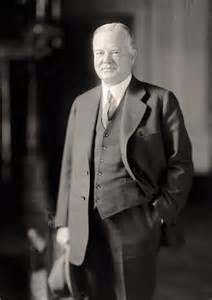 President Herbert Hoover
In the US money was the object. The question then would be how to outmaneuver the Americans to be the dominant money power. As Europe was insecure and as US Jews became as rich or richer than European Jews the World Jewish Government was shifted to the US at about the year 1900. The great Jewish institutions such as the American Jewish Committee, still existing today, took form. A whole generation of very active Jewish politicians most of whom the ordinary American has never heard of came to the fore. One, Bernard Baruch, would be a major power in US politics through the Eisenhower administration.
It would be tedious to list them at this point when the names mean nothing to you but they will appear. Key to the formation of Ford’s opinion of the Jewish problem was the Wall Street financier, Bernard Baruch. Prewar he made his fortune as ‘the bear of Wall Street.’ When the American entry into WWI became imminent, as Baruch tells it, Woodrow Wilson begged him to enter public service. Baruch did, becoming the Czar of American industry as the administrator of the War Industries Board. It was this point that being the Czar of something became an American cliché, The Czar of Baseball, the Czar of Wall Street, etc. The term has fallen into disuse now.
At the same time Wilson opened the doors of Washington to the Jews who up to that time had been treated more warily. But, as the WIB administrator Bernard Baruch was put in charge of the entire industrial apparatus of the US, all industrialists were subordinated to his authority. He was the actual Czar, autocrat, of Industry. They were accountable to Bernard Baruch and he took advantage of the situation to further his own interests and those of the Jews.
Wilson instituted an unnecessary rigid socialist government in the US during the war. Many old socialist shibboleths were imposed under cover of what was an unnecessary involvement in the European war, such as the nationalization of the railroads which were returned to their owners after the war over strong protest.
The rules Baruch imposed on industry were but little short of nationalization. You may be sure that Ford and other industrialists objected strenuously. But, Woodrow Wilson had made Baruch, not unlike the Federal Reserve, independent of any other authority with full dictatorial powers to enforce his, Baruch’s, will. Baruch did not have to clear his actions with Wilson or anybody else, he had full license. As he said, he was the most powerful man in America and possibly the world save Wilson and his actions were taken independently of Wilson.
Ford and the Dodge Brothers in Detroit strenuously resisted Baruch’s directives, the Dodges especially becoming intemperate, using racial slurs. Baruch did not forget. Fortunately, the war ended before Baruch had time to implement his full program, much to his regret.
Academic historians will gloss over Baruch’s actions as their careers depend on pleasing the Jews but the WIB was a major influence on Ford’s post-war attitudes toward the Jewish problem.

Rich Cohen, writing at thirty, doesn’t seem to be aware of how influential the Jews were as Prohibition began but in both the aboveworld and the underworld Jews were well able to forward their plans.
Prohibition itself provided oceans of money for crime. While the Sicilians are most often associated with bootleg liquor the Jews were immense beneficiaries. Rothstein himself set up the trans-Atlantic route in which his agents made purchases in the British Isles which were then delivered offshore to speed boats that took the liquor ashore. Cuba was a major entrepot but then Canada was showered with gold from liquor sales. The Jewish Purple Gang of Detroit ferried liquor across the Detroit River with no problems. The Jewish Mayfield Road Gang of Cleveland brought shiploads across Lake Erie with little interference. The greatest Jewish beneficiaries of all may have been the Jewish Bronfman family of Canada who were suppling both the Purple Gang and the Mayfield Road Gang. The Bronfmans emerged from Prohibition immensely wealthy and with their established European connections were major post-Prohibition distributors of legal booze.
Rothstein during his brief reign as crime lord also organized the distribution of heroin just before he was shot so that money poured into the underworld’s coffers.
But, to return to the aboveground rollers. Ford read The Cause Of World Unrest and that set him to thinking, and then he read The Protocols Of The Learned Elders Of Zion and that put him in action. It is difficult today to realize the impact of Ford from say 1912 to 1932 both domestically and globally. The Sherwin-Williams paint company used to have a logo of paint pail pouring out over the globe with a slogan reading Sherwin-Williams Paints Cover The World.
Well, so did Ford. By 1920 there were few places in the world that you couldn’t buy a Ford. I have no proof of it but I believe that the Daddy Warbucks character of the comic strip Little Orphan Annie was based partially at least on Ford. Ford’s Service Department was part of an intelligence force not unlike the FBI or CIA or the Anti-Defamation League so it would be unreasonable to think that Ford was not very well aware of what was going on.
His enemies have portrayed him as a rube ignoramus but quite the opposite was true. So, when Ford took up the battle in 1920 he was a very formidable foe to the Jews and the struggle was epic. The main weapon of the Jews, of course, was defamation and the protestation of purity and innocence and Ford over the coming two decades or so was so intensely defamed that even today he is reputationless.
The Damage Controllers of the Jews then first took up the task of discrediting and suppressing the two books they found the most damaging: The Cause Of World Unrest and The Protocols Of Zion.
The Cause was released in the US in 1920 by the prestigious firm G.P. Putnam’s Sons. The book was causing an uproar in England so the notion was to censor it, that is prevent its publication in the US. Distribution was very limited from Putnams who also recalled it. Other efforts were made to publish but they were defeated so The Cause Of World Unrest was defeated by those who call themselves the champions of free speech.
The Jews were never successful in completely suppressing the Protocols of Zion. Numerous versions of the Protocols are still available today although their worth has been superseded by movies and TV which are much better propaganda tools. The Cause of World unrest has been reissued by the Cornell University Press.
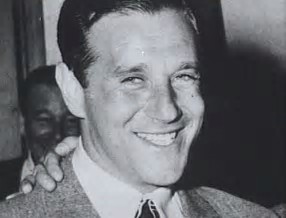 Bugsy Siegel
Ford believed that exposure would solve the Jewish problem so he bought a newspaper called the Dearborn Independent. Dearborn, Michigan was the location of his first major plant. Today the city is a Moslem center. He thus created what was perhaps the first attempt at a national newspaper as the paper was distributed throughout the US and actually abroad.
It was not necessarily a propaganda sheet. Ford was in many ways a social reformer. He objected to nearly everything in what later generations called the Jazz Age. One of those things were scandalous newspapers devoted to crime, sex, and carnage. Indeed, although this is not well known Ford ran one of the three largest movie studios in the US. His films were, of course, devoid of sensationalism, devoted to educational topics. We were still shown some in ’48 and’49 in class.
The Dearborn Independent was a sedate, wholesome weekly that featured an expose of Jewish activities in the US on a weekly basis for a couple years. The articles were then collected into four small books titled The International Jew. The articles infuriated the Jews and evoked an hysterical reaction from the aboveworld Jewish government but there was no handhold for a major lawsuit.
The international Jewish government was composed of people you likely have never heard of but were hugely influential in US politics. Louis Brandeis and his understudy Felix Frankfurter, Brandeis a Surpreme Court justice and Frankfurter a future one, Jacob Schiff, Louis Marshall, president of the AJC, Samuel Untermyer, Rabbi Wise among others and, of course, the ubiquitous Bernard Baruch, all wailing behind the scenes. William Fox, the Fox of Twentieth Century-Fox. The whole Hollywood establishment. All of them were arrayed against Ford. It was worse than today’s war on President Trump. Their chief weapon was the anti-Semite slur and Ford was labeled the Anti-Semite in Chief.
The goal of the Jewish establishment was to disable any critics as anti-Semites. A key goal was to make so-called anti-Semitism a legally sanctioned crime, a punishable offence as it is today in France. They achieved this goal in the Communist Soviet Union at the time so such a law in the US would be an extension of the one of the USSR thereby assuring such such a law would become universal.
The anti-Ford campaign would climax in 1927 in the Sapiro-Ford trial in which the goal was to make criticism of Jews a legal offence. Thus Louis Marshall, the president of the American Jewish committee sat in his New York cubby hole like a spider tracking a fly- the fly being Ford.
As I said above, in 1918 the Dodge Brothers- Dodge Motors- used language offensive to Bernard Baruch in the contest of wills over WIB directives. Baruch never forgave them and two years later the brothers died under mysterious circumstances. As mentioned, the Purple Gang was in Detroit, so an attempt was also made on Ford’s life when his car was forced off the road, very nearly pushed into River Rouge. The defamation had already taken effect so that Ford was treated as semi-deranged while it has been generally accepted that he staged the accident himself, while no explanation has ever been offered why he would have done so.
 Franklin Delano Roosevelt
Still, the articles continued and still the Jewish establishment was outraged. But, the US Constitution guaranteed free speech while Ford’s articles were firmly grounded in fact. They were exposes not defamations. Ford himself did not write the articles, that task was delegated to his editor William Cameron for whom Ford amassed a colossal library on Jewish subjects. His agents in the Service Department were busy investigating in the field. Ford did not do things by halves.
However, while criticizing the Jews was not illegal, the Jews had made it the extremity of gauche in gentile circles so that Ford found himself increasingly ostracized but not estranged. Believe me, he had friends in high places. A letter purportedly from President Harding is extant deploring Ford’s exposes and asking him to desist. Perhaps a forgery. At any rate about 1923 Ford agreed to publish no more articles, but the collected articles remained available in The International Jew series. The extant articles were probably as much or more than the public could absorb.
But, then, in 1924 it came to the attention of Ford that a man named Aaron Sapiro was attempting to organize farm co-ops in a manner Ford considered injurious to the farmers as they were in fact. Once again Ford sent investigators into the field to get a clear idea of what was going on. He once again began publishing his findings in the Dearborn Independent. This may or may not have been a setup but it seems clear that the proceedings were directed by Louis Marshall and gang in New York City. Samuel Untermyer.
The evidence implicated Bernard Baruch, Albert Laker and Eugene Meyer as well as Sapiro. Sapiro whose fortunes were on the decline may have instituted proceedings in the hope of a large settlement but as he turned the trial into a crusade to end ‘defamation’ of the Jews it became a move to make criticism of Jews illegal and punishable as it was in the Soviet Union.
The trial was something of a farce that ended in a mistrial when it was learned that Sapiro tried to influence a juror, jury tampering. Whether a new trial would be adjourned or not, Ford, in the midst of a critical model change, decided to call it off, made a settlement and walked away.
It is interesting that within the next year he traveled to New York City to call on Louis Marshall in his cubby hole. According to Marshall (see Letters of) they sat and looked at each other then parted. Marshall died soon after.
With the settlement of the Sapiro case the damage control in the US was complete although in Europe Adolf Hitler was on the rise and in a few years would be elected Chancellor of Germany setting off a huge reaction among the Jews of the US.
-2-
The Jewish government or establishment whatever you want to call it failed in the attempt to establish a semi-legal principle that criticizing the Jews was a punishable offense; however they did effective damage control and by defaming Ford silenced any further criticism of themselves. Henceforth any such criticism war strictly verboten.
 Mr. District Attorney, Thomas E. Dewey
Ford was not their only target; scholarly writers like Madison Grant and his volume: The Passing Of The Great Race as well as several volumes of the Harvard historian Lothrop Stoddard detailing an accurate account of current affairs and their logical consequences. By the early forties such writers had been so thoroughly defamed that they lost all credibility. Indeed, the Jews placed them on their index of forbidden books.
The Jews were also moving forward on several fronts. Their further goals were made feasible by the assumption of the presidency of Franklin Delano Roosevelt in 1933. As Herbert Hoover, who preceded Roosevelt may be said to represent the last of the post-Civil War ‘American’ presidents, so Roosevelt inaugurated the era of the immigrant presidents. FDR was a strange case. There was none with a more American heritage than he. He went back to the old Dutch knickerbockers, the first settlers of Manhattan. The fellows with the beads. Yet there is no president more representative of immigrant America than he. There has never been a president more tender to the Jews and their Communism than he. This tenderness also embraced by his wife Eleanor.
This tenderness began to show when they were quite young. The fact is that when the Jr. League of society women was formed to work the Settlement House scene of New York City after the turn of the century Eleanor participated and she dragged her soon to be husband, Franklin, along with her. The impetus for the Jr. League was railroad magnate E. R. Harriman’s nineteen-year- old daughter. Harriman was associated with the aboveground Jacob Schiff and the Kuhn-Loeb crowd. Kuhn-Loeb was the Jewish investment banking firm on a par with J.P. Morgan. Why these young society women chose to go to the Lower East Side to cater to raw immigrant Jewish women with no ‘upbringing’ or manners is a bit of a mystery. However a lifelong bond between the Roosevelt’s and the Jews was created. Indeed, it may be said that the Jews took the couple under their wing.
It was an irrational bond in which the Roosevelts seem compelled to accede to Jewish wishes. I’m going to go out on a limb here and speculate that the Roosevelts were hypnotized on the Lower East Side and implanted with post-hypnotic suggestions. Manchurian Candidates as it were. I imagine I hear you guffawing but the idea may be more reasonable than you think.
Bear in mind that these Eastern European Jews all came from the Pale of the Settlement. The assembly point for the trek to the transports in Hamburg, Germany was in a town called Brody on the Austrian border. As the assembly and departure point Brody assumed an interesting character. The trek to Hamburg passed near Vienna. Vienna was a hotbed of Jewish aspirations, a Jewish culture center. Vienna was also the home of the famed psychologist Sigmund Freud and the most active branch of the International Order of B’nai B’rith. Freud was a lifelong member of BB from 1895 to his death. He often lectured at the meetings on what must have been psycho-analytic matters including hypnosis. Freud was a supreme authority on hypnosis. Freud hated Europeans and European culture and wanted to see them all dead.
Key people on the trek made a layover in Vienna where along with Freud a number of organizers, all prominent well-to-do men lived. Vienna may have been the most important Jewish center of Europe. How improbable is it that they were given instructions on how to go about furthering objectives in the US? No stretch at all. One must also remember that key American Jews took long vacations in Europe every year. One imagines that Vienna was a favorite destination so coordinating plans would have been convenient.
Freud quite likely indoctrinated key people in hypnotism who spread it further so that many on the East Side would have been knowledgeable. What better method to gain the loyalty of the upper crust of society than through these philantropizing young girls of the new Jr. League?
So, Franklin Delano Roosevelt just drifted into politics with some pretty hazy political notions. It just so happened that a little way down the road from Hyde Park a family of Jews named Morgenthau lived. The Morgenthaus were very active Jewish nationalists. Morgenthau Sr. at one time served as ambassador to Constantinople, now Istanbul. Constantinople was a key destiny post and for many years a Jewish prerogative of US diplomats.
Henry Morgenthau Jr. attached himself to Roosevelt like a limpet. Whether he was a guest at Hyde Park or not he made himself a guest anytime there was activity there. In time, when FDR became president, Henry Morgenthau Jr. more or less made himself FDR’s Secretary of the Treasury. He constantly tried to expand his role in that position. He was in command of the money. The Treasury was filled with many Soviet spies.
There was also a very strange relationship between the Jews, Governor Al Smith of New York State and Roosevelt. Smith who was governor of New York for the critical period of 1918 to 1928 with a two year hiatus from 1920-22, was managed by the Jews also. His principal monitor was a woman named Belle Moskowitz. FDR was being groomed to be Al Smith’s successor as governor. When he was elected Eleanor advised him to be wary of Moskowitz. When he was struck down by polio this caused a certain amount of panic as Smith was set to run for president in 1928.
Louis Howe FDR’s political manager and Eleanor Roosevelt kept FDR in the game while he was flat on his back. As 1928 loomed it was necessary for FDR to succeed him. Roosevelt who was desperately trying to regain the use of his legs at his spa in Warm Springs was unwilling to abandon his quest but Smith put the screws to him. FDR ran and won by a narrow margin. Smith embraced a forlorn hope of displacing the Republican Herbert Hoover during the greatest boom the US had ever seen. Naturally Smith was wiped.
Smith was discarded and replaced by Roosevelt as the great Democratic hope. Easily winning reelection as governor FDR prepared for his presidential run. His replacement as governor would this time not be a gentile stooge but an actual Jew, Herbert Lehman.
Had Hoover been able to maintain prosperity there is no chance Roosevelt could have been elected in 1932. It was therefore necessary to arrange an economic disaster to give Roosevelt his chance. The disaster had been in the works for a couple years and the plan was sprung six months into Hoover’s presidency. The event was the great stock market crash of 1929. The Democrats spent the next three and a half years trying to prevent a recovery. The crash has been discussed endlessly with many different arguments but the end result was as desired. FDR succeeded Hoover.
This was not an ordinary succession but a sea change in the direction of the country. The old order of the Gilded Age and individualism had drawn to a close; the new Jewish Age of collectivism began as Hoover had predicted it would. In the Old Order the government had served the people; in the new dispensation the people would serve the government. Thus, the Jewish order in which the Jewish people served the synagogue was transposed onto the American system.
Accordingly Jews flowed back into Washington DC. The groundwork had been prepared by Supreme Court justice Louis Brandeis and his Harvard law professor acolyte, Felix Frankfurter. Since the ‘teens Frankfurter had been indoctrinating a generation of law students into Judeo-Communists; they now infiltrated every branch of government as Roosevelt created new jobs to accommodate them. This invasion of government was not unnoticed as his disciples were known as Frankfurter’s Happy Hot Dogs.
Roosevelt also allowed Communists of every stripe and then denied their politics. The first year was a busy year as among many other things the administration turned on the institutions, the ideas, the politics and the mores of the Old Guard hoping to stomp them into the ground, eliminate them completely. The notion wasn’t too different from that of the revolutionist, Victor Hugo, who wanted to exterminate the old believers because they could never be converted, or what was going on in the Soviet Union where old style Russians were being murdered wholesale, starved to death or sent to the gulags.
The revolution of ’17 was being completed in one way or another around the globe. In the East the Japanese were alarmed trying to set up a defensive perimeter in Northern China and Manchuria. The Soviets hurried to annex Outer Mongolia so the border between the Communists and the Japanese was roughly that of Outer Mongolia and Manchuria, or, Manchukuo as the Japanese styled it. While the US government was Red leaning, the American people were anti-Communist. The Japanese confused the two thinking they and the US were a united front against the Soviets. They learned too late.
Taxing became a major weapon in the Jewish assault on the Western peoples. In Europe, so long as land was the measure of wealth and status then the value of the land had to be destroyed. The great holdings had to be eliminated. Confiscatory taxation was a weapon of mass destruction on the economic front as starvation was the weapon of choice on the social front. It would take a generation or two but the old nobility, land rich but cash poor would have to sell out taking their useless titles with them.
In the US where money had always been the medium determining wealth and status it would only be necessary to destroy incomes and estates. Once again confiscatory taxation was the weapon of choice. Just as the object in Europe was to destroy the old aristocracy replacing it with themselves so the object in the US was to destroy the Old Money of the Gilded Age.
A campaign was directed at inherited wealth which was characterized as evil. The great Gilded Age fortunes had to be destroyed. That meant that in addition to confiscatory income taxes of up to ninety percent so the inheritance tax was raised to 90 percent shattering this value and impoverishing the inheritors. To add insult to injury a capital gains tax was placed on holdings commensurate with other confiscatory taxes.
One has no pity for the fortunate but while land was not the issue those with money had expansive life styles that could longer be maintained, could no longer be afforded, but with everyone in reduced circumstances there was no longer any market for the properties and what with property taxes they became less than valueless. Million dollar mansions became worthless destroying that wealth.
To take only one example, a bete noir of the Jews, William Randolph Hearst, ostensibly worth millions, was instantly placed in bankruptcy. He narrowly evaded it but only under the most humiliating circumstances.
A leading Jewish advocate of this holocaust, the writer Gustavus Myers, was advocating the prevention of large fortunes being accumulated in one’s own life time. In other words, after a cutoff point of X dollars one presumes the individual is prevented from working. That would have a very salutary effect on initiative. Myers crowed that with FDR in office they had their man to realize this insane hope. Fortunately FDR either didn’t go all the way or the Jewish purposes crossed with the rise of the beginning of the WWII, the matter was set aside and forgotten after the war, although confiscatory taxes continued for some time until the injustice was abated. The war intervened and the gentile wallet was saved for a decade or two. It is clear that the aboveground and underground were working together.
Through the thirties then Jewish moles were busy in the underworld, the aboveworld and the netherworld of politics. FDR brought Prohibition to an end upon his entry into office in 1933. This caused a certain disturbance in the underworld when their chief occupation as bootleggers was brought to an end. New vistas opened up however. The sale of addictive drugs grew by leaps and bounds while in the 1960s drug usage entered the mainstream of middle class America. The grip on America’s wallet grew stronger.
While J. Edgar Hoover and his FBI may not have recognized organized crime those more immediately affected recognized the monster when they saw it. That would be New York City. A rising DA by the name of Thomas Dewey seized the snake by the tail. Beginning in the mid-thirties Dewey began the effort to bring the mob to book. He succeeded admirably even getting the mobster-in-chief, Lepke Buchalter arrested.
As well as his extortion racket to milk NYC businesses of the tens of millions, Buchalter had begun a lucrative business of his own called Murder, Inc. Assassination was his business. The business model could be traced back to the Jewish Old Man Of The Mountain of Crusader Times. He is not be confused with the Ismaili cult of assassins led by Hassan-i-Sabah in Iran. He was separate but in the same business.
Murder Inc. was responsible for hundreds of assassinations having a whole stable of killers. Buchalter was first arrested by the Feds, Hoover had been prompted to deal with him, probably because the Mob gave him up to reduce the heat, but the City of New York wanted him to be relaxed to them to be tried on murder charges. They had a bear of a time getting him out of Federal hands.
In one of those hard to explain Roosevelt moments, FDR refused to release Lepke to a certain death sentence. When his hand was forced and New York tried Lepke and sentenced him to the chair there was an incredibly obstinate attempt to prevent his execution. This definitely would have had to come from the Jews who seeking to protect one of their own, wholesale murderer or not. So, we don’t just have a bunch of neighborhood lovable thugs here, we have the head of Murder, Inc. and his people are trying to prevent his execution! Rich Cohen can amaze.
The Jews obviously put tremendous pressure on FDR to prevent Lepke’s release from Federal custody but in this tug of war to bring Lepke to justice apparently Dewey’s men were stronger but even then their determination to put Lepke down over what must have been tremendous pressure from Brooklyn is truly astonishing. The Jews don’t often lose. They even finally got Pollard out.
However, the pressure applied by Dewey on the Mob scattered them from NYC fearing they might be next. Meyer Lansky fled South to Miami and crossed the water to Cuba to thoroughly corrupt that country. He made Havana the gambling Mecca. Gambling seemed to be the new Prohibition but the habit had been prevented by law and few seemed to be complaining about it. However, Lansky’s partner, Bugsy Siegel, chose as his place of exile Los Angeles. LA was close to Las Vegas. Gambling in Nevada was legal but the desert seemed to provide an unattractive environment,
Siegel, though, looked at it and saw opportunity. Naturally a barren desert, Las Vegas would soon be on the shores of Lake Mead, created by Hoover Dam (named Boulder Dam during the Roosevelt years, FDR hated Hoover and did all but blacklist him.) Water, the missing ingredient.
Bugsy Siegel set about creating the gambling oasis of Las Vegas. A new bonanza appeared in Nevada but reserved for the Mob. Prohibition was gone but the Mafia had landed on its feet. The Jews found another way to get America by the wallet. And this time they wouldn’t be ashamed of it. In the twenty-first century they opened the The National Museum of Crime to celebrate their greatest criminals. The National in the title didn’t refer to the United States.
This does imply intent and volition, a pre-conceived plan. Let us compare these nineteenth century immigrants to a Jewish immigration of the late twentieth century.
This group of so-called immigrants also came from Russia and they had learned their criminal skills in Russia. They all had Israeli passports, actually being Israeli citizens while claiming dual Russian citizenship. Whether they added US citizenship isn’t clear as they always had to be on the qui vive to evade the law by hopping back to Israel from which they couldn’t be extradited. In fact, these people were a global criminal network. They were not only busy gutting the US economy- getting America by the wallet- but they and their confederates had stolen the public assets of Russia during its privatization scandal. They were a problem throughout all Europe at the same time. Masters of banking schemes and human trafficking, a synonym for prostitution.
As usual the filmmakers are the people to go to to get an idea of their activities. Somehow the movies always get the details first and right.
Rich doesn’t get around to examining this latest Jewish migration in Tough Jews nor even in his Israel Is Real. The latest immigration from Russia seems to be a grab and smash involving the whole world, grab the really big wallet. The banking system that grew up to launder the huge amount of criminally gained cash is a story in itself. Not here and now though.
Tough Jews is a good read from more than one point of view. It has something to say about the Jewish colonization of Brooklyn, the Jewish role in crime, the US during the first fifty years of the twentieth century and the organization of a national crime syndicate. I don’t think Rich’s Jews are shown so much as tough though, just murderous and amoral.
Why they would build a museum to celebrate these guys is beyond me.
Global Warming As A Natural Process
April 21, 2017
Some Thoughts Concerning The Astrological Summer
Or:
Global Warming As A Natural Process
by
R.E. Prindle
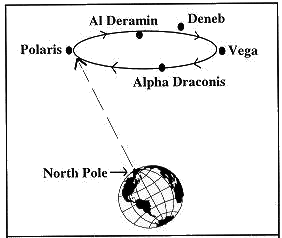
Since we seem to need something to be hysterical about Algore has fixated us on Global Warming for the last decade or so. In fact, Algore seems to have started a religious crusade. It is heretical not to accept his version of reality. Just exactly what can be done about warming isn’t clear; oh, that’s right, electric cars.
Unfortunately, nothing can be done about global warming as it is a totally natural phenomenon that will continue for at least two thousand years. Our mathematicians should be able to calibrate exactly how many degrees the process will take.
Early astronomy then going by the name of Astrology had the problem worked out. If they had known what the problem was they could have provided us with the solution.
The problem is with the Great Year and it can’t be corrected; it can only be endured. Looking at the first diagram above you will notice a tipped over globe. That tip is known as the Plane of the Ecliptic. It amounts to 23 ½ or 24 degrees and produces a wobble in the orbit of the globe. Each wobble takes about 25K years to complete.
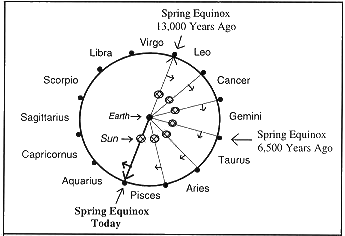
As with the terrestrial year of months the Great Year was divided into 12 units called Ages. So the Zodiac is one monstrously huge timepiece. As the globe wobbles seasons, as above so below, are created. There are Astrological winters, or ice ages, as we call them, and summers, or Global Warming, as Algore calls them.
If you look at diagram one you will notice that the ice age occurred when the pole star was Vega. So Vega is the winter marker while Polaris is the Summer marker.
At Vega the Northern Hemisphere was angled as far away from the sun as it can get; hence North America toward the pole was covered with a humongous ice sheet which over roughly twelve thousand years became thousands of feet thick. Instead of rising the ocean levels dropped exposing millions of square miles of new land.
Then, as the Astrological year progressed Spring arrived during the Ages of Virgo and Leo and ‘global warming’ began. The ice cap collapsed sending out huge flood waves that raised ocean levels to nearly what they are today. All settlements and/or cities located on the ocean’s marge were inundated under hundreds of feet of water. Oops, there went Atlantis.
Since the Mediterranean was occupied the residents fled the Great Flood for higher ground on all sides of the Mediterranean. The priestly class, obviously, headed for the Nile Delta probably settling at its apex near Memphis as it was called. It was there they built their memorial to what was- the three great pyramids setting these astrological clocks at the Age of Leo soon after the disaster occurred. All the astronomical sights are set for that Age. We are now five Ages past Leo in the midst of the Astrological summer. Spring has been passed.
The Age of Aquarius will likely be the equivalent of the terrestrial month of August; hence Aquarius should be an age of continuing warming leading to the Age of Capricorn cooling and hence to a new ice age or winter when Vega once again becomes the pole star.
Thus, as is happening now, for the next two thousand years at least the Northwest Passage will open and remain open; a couple thousand feet of ice or more will melt from Greenland. If as with the North Amrican ice sheet the ice of Greenland collapses then the water level of the oceans might rise a number of feet within a year.
Electric cars will not change the Astrological reality. We are talking science here, if you didn’t recognize it. The Great Year and its consequences are real. Live, love, laugh and be happy, don’t be hysterical. If you don’t want to move to higher ground now, I live at a thousand feet above sea level well prepared to withstand the Astrological judgment day, then be prepared to be flooded out, if you live long enough.
Just some thoughts.
Diagrams borrowed from: http://www.revealer.com/review.htm
A Review: Atlantida by Pierre Benoit
April 1, 2017
La Maison de la Derniere Cartouche
A Contribution To The ERB
Library Project
A Review: Atlantida
By Pierre Benoit
Review by R.E. Prindle
Pierre Benoit’s excellent novel Atlantida: The Queen Of Atlantis was first published in 1919. Written in French it was translated in 1920 so it is possible that Burroughs read it. There is a possible reference to the book in Tarzan the Invincible, I’ll get to that later. Benoit himself was accused of ‘plagiarizing’ H. Rider Haggard but he defended himself by saying he neither read nor spoke English while Haggard was not translated into French as of 1919.
It matters little as Benoit, Haggard and Burroughs all knew their Greek mythical heritage and all seem to be addressing the male-female conflict from the same intellectual approach derived from that mythology. And they all placed their stories in Africa, a burning question of the day.
The heroine of Benoit’s novel, Antinea, is an irresistible woman along the lines of Haggards She and Homer’s Circe, and Burroughs’ La. All three women rule over lost lands. Antinea lures Aryan men to her to her palace carved from a mountain of the Ahaggar range.
The Ahaggar range, Ahagger is Taureg, the Arabic is Hoggar, is located almost in the middle of the Sahara at what is now the Southern extremity of Algeria. Its highest peak is nearly 10,000 feet in elevation, the whole massif of a half million square kilometers being at the same elavation as Denver, a mile high. Boiling summers and freezing winters and fair moisture.
Antinea having lured the men entrances them and when they no longer amuse her she embalms them alive in a unique metal called Orichalch. Thus, they are preserved forever as they were in life. An advance on all other methods. The question is why does she do this?
The answer is explained by Benoit’s character Mesge:
“Now you know,” he repeated. “You know, but you do not understand.”
Then, very slowly, he said:
“You are as they have been the prisoners of Antinea. And vengeance is due Antinea.”
“Vengeance?” said Morhange…For what, I beg to ask? What have the lieutenant and I done to Atlantis? How have we incurred her hatred?”
It is an old quarrel, a very old quarrel.” The Professor replied gravely. “A quarrel which long antedates you, M. Morhange.”
“Explain yourself, I beg of you, Professor.”
“You are a Man. She is a Woman…the whole matter lies there.”
“Really, sir, I do not see…we do not see.”
“You are going to understand. Have you really forgotten to what an extent the beautiful queens of antiquity had just cause to complain of strangers whom fortune brought to their borders? The poet, Victor Hugo, pictured their detestable acts well enough in his colonial poem called la Fille d’ Otaiti. Wherever we look we see similar examples of fraud and ingratitude. These gentlemen made free use of the beauty and the riches of the lady. Then, one fine morning, they disappeared. She was indeed lucky if her lover, having observed the position carefully did not return with ships and troops of occupation….Think of the cavalier fashion in which Ulysses treated Calypso, Diomedes Callirrhoe. What should I say of Theseus and Ariadne? Jason treated Medea with inconceivable lightness…”
And so on. Thus on page 114 of 229 Benoit explains the nature of his story. Bear in mind that of Circe and Ulysses in which Circe enslaves all the men who approach her and turns them into swine by lust while Ulysses with a pocket full of mole to defend himself resists her charms, maintains his manhood, rescues his sailors and sails away. So, while there are great similarities between Benoit’s, Haggard’s and Burrough’s stories they could easily derive from the same sources; variations on a theme. Of course, Burrough’s La is derived from Haggard’s She. But La is closer to Antinea in method than She. La’s job in Opar is to sacrifice men on the bloody altar. La is also from Atlantis. And all three share the glorious tradition of being too beautiful to resist.
Benoit himself the son of a French diplomat grew up in Tunisia and Algeria where he became acquainted with the desert and its legends. Thus, his story is an authentic addition to the great stories of the African explorers and the fictions of Haggard, Burroughs, Edgar Wallace, Mrs. Hull, P.C. Wren and others.
Benoit charmingly writes his story as current history rather than fiction without any framing story. He includes the Emperor Louis Napoleon and others as well as showing himself familiar with the latest Parisian designers and bon ton retail establishments. He mentions a painting titled La Maison Des Derniers Cartouches which can be found on internet and with which I have headed the review. Translated it means The House of the Last Bullet. I’m sure all his Parisian references are real but they have slipped through the crack of time had have not found a place on the internet.
In this case there is a Captain Avis who is believed to have murdered his fellow, Capt. Morhange and hence is in bad odor. This is the mystery that holds the story together. We learn later how Morhange died. Avit is transferred to a desert post, indeed demanded the transfer, managed by Lieutenant Ferrieres who is about to embark on a mission passing the Ahaggar massif.

Ahaggar Plateau
At the post Saint Avis tells Ferrieres of his strange adventure in the Ahaggar Mountains with Capt. Morhange during which Morhange perishes. The African scenery is different than any of the authors mentioned and the setting is quite spectacular.
Morhange and Avit are caught in a freak storm on the slopes of the Ahaggar, and apparently these are not uncommon on the massif, where they rescued a Taureg from drowning who happens to be the procurer of European men for Antinea. The two soldiers are procured and delivered to the Atlantian Queen.
Somewhat very similar to scenes from Haggard’s She they are conducted to a great room or hall where fifty some embalmed former lovers stand in niches. The truth descends on our sexual warriors.
Morhange who, being the more handsome and impressive of the two, finds favor with the Queen of Atlantis also, not unlike Ulysses and Circe, is proof to her blandishments and beauty. What he had is his pocket isn’t mentioned. His refusal eventually enrages Antinea. Without going into details, Antinea hypnotizes Avit into taking her large silver hammer with which she bangs her gong and giving Morhange such a good bash it cracks the man’s skull to pieces. Thus she solves her problem of being rejected by Morhange.
A digression here. Benoit here shows off is knowledge. Amazingly I was able to get it. In Paris at the time there was a theatre called The Grand Guignol. It was a place of horrors, a sadists delight, at which all kinds of gruesome murders, mutilations and disfigurations were enacted. Apparently the scenes were so realistic that the faint hearted actually fainted and a doctor was kept on the premises to deal with these frequent occurrences. Now, a guignol is something like a puppets booth. Benoit has Avit climb into a guignol in Antinea’s boudoir where he watches the horror of Morhange being dismissed after which Antinea calls his down, hypnotizes him, hands him the silver hammer, directs him to Morhange’s room and watches as Avit cracks his friend’s skull. The horror, the horror. So Benoit demonstrates he is au courant with Paris’ entertainments.
Avit then turns to thoughts of escape. Here Benoit displays a certain genius in moving his story along.
Antinea had a slave girl named Tanit Zerga who became enamored of Avit and also wishes to escape to return to her people. She organizes the escape attempt. As it turns out she is a princess also, of the Trarzan Moors on the North side of the Senegal River. Bear in mind that everything mentioned in the story is real except the story itself. The Trarzan Moors exist to this day and of course the Senegal is one of the great rivers of Africa. The history is within the realm of fact. Only the story and its leading characters are fiction. Benoit does not spare the reader his knowledge. The man has been around.
The pair are assisted by the procurer rescued by Avit in the storm. He is quite willing to help because he tells Avit he will be back, no one who has ever known Antinea can escape her charms. All the victims in the hall had died of love.
Here’s a Burroughs connection indicating he may have read the book. Tanit Zerga resembles Nao, the fourteen year old girl who rescues Wayne Colt in Tarzan the Invincible only to be discarded coldly as were the heroines mentioned. It would be pushing it too far to claim Burroughs did read the book but he often got his scenes and incidents from other authors so I’m about three fourths convinced.
At any rate Tanit Zerga dies in the desert carrying on Benoit’s theme of women making sacrifices for ungrateful men.
The story then returns to the Foreign Legion camp of Ferrieres as he and Saint Avit are to make a trip across the desert passing the Ahaggar massif. As prophesied, to know Antinea is to love her forever, and her lovers all died from love, so he intends to return to the Ahaggar’s and his certain death. Whether Ferrieres will accompany him is left open.
The book was a slow starter but one is gradually swept along almost as a participant as the storm increases. A very exciting conclusion. Benoit’s is a very worthy book for Bibliophiles. If it wasn’t in Burroughs’ library it must have been through neglect or loss. Highly recommended.
Pierre Benoit 1932
Part II: Only A Hobo/Big Rock Candy Mountain
March 14, 2017

Official Edgar Rice Burroughs Tribute and Weekly Webzine Site
Since 1996 ~ Over 10,000 Web Pages in Archive
Presents
Volume 1330
Only A Hobo /   Edgar Rice Burroughs |
The Big Rock Candy Mountain On The Road To Salvation |
Part 1b
Continued from Part 1a: ERBzine 1329
by
R. E. Prindle
In The Outlaw of Torn of 1911 Burroughs reached and exorcised his central childhood fixation freeing his subconscious and integrating his personality but he was still conflicted on his Animus and Anima. The trilogy and coda would address the problem of reconciling his Anima leaving the rectification of his Animus till later.The internal evidence of the corpus indicates that his tormentor, who I will refer to as John the Bully, was an Irish boy, possibly himself an immigrant manifesting the national hatred of the Anglos on young Burroughs; or of the first generation of Irish immigrants who received his parents’ prejudices undiluted. Accordingly, the protagonist of the Mucker is the Irish hoodlum, Billy Byrne, although nowhere in the trilogy does Burroughs mention Irish or Anglo, you have to follow the names.
In the first volume Burroughs identifies his Animus completely with Byrne. Perhaps the name signifies that he got “burned.” He will not separate out an alter ego for himself until “Out There Somewhere,” when he creates the Happy Hobo, Bridge.
While Burroughs has exorcised the fixation caused by John the Bully, John still occupies the dominant position on his Animus while being the substance of his Anima. Having identified with his oppressor he has adopted the oppressor’s characteristics subconsciously, while his conscious mind unsuccessfully tries to follow in the footsteps of the respectable recessive Animus figure of his father, the hero.
In Burroughsian symbolism which is repeated almost without variation several times in the corpus he visualizes his former life as a yacht cruising on calm seas, then there is a sudden squall in which no ship can live, a simile borrowed from Longfellow’s “Wreck of the Hesperus.” The yacht sinks. The hero is then separated from his true destiny with the intended respectable folk by Fate, being cast in with the thugs, criminals and ne’erdo-wells of the character of John the Bully but he retains his own integrity through it all.
Thus we have the picture of the charming, honest respectable Bridge as a volunteer hobo living his life among society’s rejects.
In The Mucker Byrne is yacht wrecked on a jungle island somewhere in the Pacific along with an Anima figure, the Anglo Barabara Harding. In Burroughsian symbolism the “island” represents the psychologically circumscribed prison of his mind into which John the Bully cast him. The Anima figures which are always Anglo represent the identity of the former clothing of his Anima, probably his mother.
The question here is whether Byrne and Harding will fall in love. The answer is no.
In a series of hostile encounters Byrne is wounded by the natives. Recuperating by a pool along a mountain stream Barbara nurses Byrne to health. Thus in Freudian terms Burroughs identifies with his oppressor while tending to his welfare.
Nevertheless Burroughs’ hatred of his oppressor precludes the possibility of a union between Byrne and Harding. On the return to civilization or, rather, New York, the disparity in their cultural levels appear stark so Harding dismisses Byrne. He, realizing the justness of the decision, goes his own way back to the demi-monde.
Burroughs has subtly removed John the Bully from his Anima so that now he has a female figure still clothed by Fate but now in men’s clothes rather than women’s clothes. He has at least reversed the situation which makes life more comfortable for him but still irritating.
For three years he is stalemated although he wrestles with the problem in twelve more books before he picks up the thread again in the thirteenth, Out There Somewhere. Funny how numbers like ten, twelve and thirteen crop up like that, isn’t it?
In this book Burroughs slips out from under the dominance of John the Bully but does not rectify his Animus; his hero aspect does gain equality with the clown aspect but not the upper hand.
Byrne returns to Chicago to face trial for his murder charge. Wrongfully convicted, he escapes to flee Out There Somewhere where Bridge/Burroughs awaits him. On the road to Anywhere he blunders into the camp of the Happy Hobo. Bridge is boiling his beans while yodeling the verses to Knibbs’ poem: “Out There Somewhere.”
Let’s take a moment to analyze the name, Bridge.
On one level Bridge means just that. The character is meant to bridge the transition from Byrne the Oppressor to Burroughs’ successor identity. A bridge is also the preferred place for hoboes to construct their jungles. In connection with this, the name commemorates one of Burroughs’ heroes the hobo writer Jack London. Bridge is not the protagonist’s real name but was assumed when, because of his use of long words, a fellow hobo had called him Unabridged which was then shortened to Bridge. As the leading authority on Burroughs, George T. McWhorter, points out, Bridge gives his name as L. Bridge, which McWhorter says means London Bridge, meant as a joke. As hoboes gather by bridges, naming Bridge “London Bridge” after Jack London is even funnier. You may not want to take the time to dissect a name like this but if you want to puzzle things out Burroughs will always reward you.
When Byrne haps on Bridge it is possible to see the personality of Burroughs melding into the character of Bridge. When Burroughs read the first two verses of the Knibbs poem in which the hardened hobo listens in on the College Guy, ERB must have seen both aspects of his Animus melding them attractively into one which he then separated from his dominant aspect of Byrne to escape his servitude to John the Bully. Bridge is obviously an Anglo who is joined to the Irish Byrne. Thus the two aspects of Burroughs’ own Animus, one cultured, one rude. Burroughs accepted the fact that he had a “dual” personality.
While in the process of separating his identity from that of the Irish John the Bully he still feels obligated to help him no less than Barbara Harding did. Thus, even though Bridge notices the cuff marks on Byrne’s wrists he sagely suspends judgment until he knows the man better.
Burroughs has some first hand knowledge of these Knights of the Road. In 1904-05 he had held the job of a railroad bull in Salt Lake City. He had had plenty of opportunity to talk with many of them while observing the jungles first hand. One may assume this scene is a fairly accurate representation.
While he and Byrne are getting acquainted they are jumped by a couple of vicious criminal ‘boes who they repel. After Byrne tells his story, which Bridge accepts, he allies himself with the fugitive in his flight from the police. Once again we have identity and service with the oppressor.
A good book at the time, this novel is now a charming period piece of the long ago and far away variety. One mourns for a lost heritage.
In a delightfully written sequence of episodes Burroughs leads Byrne and Bridge down to El Paso a step or so ahead of the Chicago coppers who seem to rival the FBI in jurisdiction. Tracked to El Paso by those dogged Chicago police the two ‘boes slip over the border into Ciudad Juarez then out into Chihuahua province.
Who should turn up in Chihuahua but Barbara Harding. She and Bridge have a mild flirtation but in the end in an act of generosity, ever helpful to his oppressor, Burroughs gives her in an improbable union to Byrne. The Mucker, Byrne, passes out of the story.
All through the novel Bridge has been quoting the stanzas of “Out There Somewhere” while emphasizing the couplet:
And you, my sweet Penelope, out there somewhere you wait for me,
With buds of roses in your hair and kisses on your mouth.Penelope was the wife of Odysseus, the prototype of all wanderers. She had waited patiently for twenty years for her husband to return from the Trojan War. Twenty years is a symbolic figure throughout Burroughs’ writing connected with the reconcilement of his Anima.
Out There Somewhere closes with this passage:
It was a month later, spring was filling the southland with new, sweet life. The joy of living was reflected in the song of birds and the opening of buds. Beside a slow moving stream a man squatted before a tiny fire. (Why tiny?) A battered tin can, half filled with water, stood close to the burning embers. Upon a sharpened stick a man roasted a bit of meat, as he watched it curling at the edge as a flame licked it he spoke aloud though there was none to hear:
Just for a con I’d like to know (yes he crossed over long ago;
And he was right, believe me ‘bo!) if somewhere in the South
Down where the clouds lie on the sea, he found his sweet Penelope
With buds of roses in her hair and kisses on her mouth?Which is what they will be singing about me one of these days he murmured.Look at all those sexual images: Spring, buds, tiny fire, battered can half filled with water next to the burning embers, sharpened stick, bit of meat, flame licked. Clearly Burroughs is seeking salvation for his Anima.
Note the “battered can half filled with water.” Burroughs’ Animus being the battered can while the can is half filled and not half empty. Water is a symbol of the female. The promise is that the can will soon be filled to overflowing with the feminine waters of salvation when Bridge finds his Penelope.
Spring is, of course, the time of nature’s resurrection.
He might as well have said Easter and called himself the Christ.
Burroughs appears to be pointing the direction for the working out of his psychosis. He indicates a fairly well developed vision of a system of psychology. One which differs from the existing ideas of 1910 and much in advance of them. He already had his vision in 1911 when he began writing so his vision must have been brought to fruition sometime between 1900 and 1910 in America which excludes Freudian influence. Translations of Freud’s work only began to reach America in 1912.
He mentions 1903 or ’04 as fruitful by saying something occurred twenty years after his fixation which was in 1883 or ’84. Both of William James’ major works had been published by then. More importantly, a book titled Human Personality and Its Survival After Death by FWH Myers which deals with the concept of the unconscious had appeared in 1903. One can’t be certain that Burroughs obtained the book by 1904 but it is possible.
He would have been aware of Myers because H.G. Wells mentions him in his When The Sleeper Wakes of 1899. Whether Burroughs would admit that he had read the stunning fantasias of “Mr. Wells” or not, it seems clear that Wells was an important influence. Wells had the tendency to name significant works and writers which were either influential on the period or had influenced him. Burroughs exhibits the same trait. Wells had a good eye for the significant and important. Actually the careers of Wells and Burroughs are intertwined. I have written of that elsewhere.
FWH Myers, who was both a scientist and occultist, was deeply interested in the “unconscious.” He had a well developed concept of the notion long before Freud. Burroughs offers amazingly graphic descriptions of the unconscious in several different places of the corpus: I especially recommend The Chessmen of Mars.
If one takes the time to penetrate the “fictionalizing” of Burroughs one will find that he is a psychologist of note although without the systematization of Freud. But then method and system are about all Freud has to offer; for the rest he is blowing smoke.
Interestingly I worked out a nearly identical vision of the mind as Burroughs which makes it relatively easy for me to see what he is doing. It is also true that I was an avid reader of the Tarzan books as a child so I may have subconsciously picked up the rudiments of Burroughs’ thought merely unconsciously integrating them into my own thinking later in life. Our two notions are so close that I must have been influenced by him although my own central childhood fixation was a mere variation on his so that perhaps our minds were driven in the same direction by circumstance.
Burroughs was terrorized into his fixation while mine was induced in a hypnoid state. While Burroughs was able to resolve his issues as did I, release was only partial for him or he had not prepared suitable personas for transition. Thus when he shucked John the Bully he was left with an unclothed Animus. Having no reasonable persona to step into he tried to assume the persona of his creation Tarzan, which led to disaster.
In my case I realized that if I exorcised the fixation being only vaguely aware of the Anima and Animus at the time that having exorcised the fixation, I would need an adequate role model to make the transition. Hence I developed a successful alternate Animus figure which I was able to assume when I understood and rectified my Animus. My main Anima figure appears to have been strong and adequate. It supported me all my life.
My Animus had been assassinated when I was seven. Burroughs interest in assassins obviously stems from the same cause.
At any rate, by the end of Out There Somewhere, Burroughs has separated an alternate identity in Bridge from John the Bully or Billy Byrne while at least having reclaimed the female identity of his Anima while being able to discard an interim Anima figure, Barbara Harding, as a gift to his oppressor. In other words, John the Bully could have what he stole which was no longer of any use to Burroughs.
His Anima is now female but still clothed in male garb.
This is made evident in the last volume of the trilogy, “The Oakdale Affair.” This book was originally titled Bridge and the Oskaloosa Kid. As both this title and Out There Somewhere are more descriptive of intent I will refer to the book as “Bridge” or “Bridge and the Kid.”
As the ending of Out There Somewhere indicated Bridge was hot on the trail of his Penelope “where the mist meets the sea somewhere in the South.” Burroughs actually tried to act this fantasy out. It may be a coincidence, but nine months, the duration of pregnancy, after finishing Out There Somewhere Burroughs gave birth to Bridge and the Oskaloosa Kid in which he finds his Penelope.

Fixated as he had been so that he associated himself with the criminal or hobo class, Burroughs would have felt himself unworthy of the aristocratic Barbara Harding. In “Bridge” he moves down the social scale to associate himself with the small town banker’s daughter, Abigail Prim. An abigail is a personal handmaiden so Burroughs makes his Anima a prim personal hand maiden. That she may not be the One is indicated by the fact that she is only nineteen, one year short of the magic twenty.As the story opens, Gail, dressed in men’s clothing, the same as Burroughs’ Anima, is robbing her own safe in her parents’ home. once again a version of his encounter with John the Bully. Pocketing this treasure which symbolizes the female treasure that a woman brings a man she hits the road as a hobo. She immediately falls in with a band of criminal IWW hoboes who have initiated a crime wave in placid Oakdale.
They intend to kill and rob her just as the hoodlum John the Bully killed Burroughs’ Anima robbing him of the treasure of the female, or his X chromosome. Like Burroughs she runs away, with the Wobblies in hot pursuit.


Illustration from the first publication of The Oakdale Affair in Blue Book magazine.
Jane Ralston Burroughs and James Pierce in costumed pose for
the John Coleman Burroughs dust jacket illustration for The Oakdale Affair.
Who should she meet at the proverbial fork in the road but the Happy Hobo, Bridge. Bridge is immediately attracted to this strange boy who he doesn’t realize is a girl. He decides to protect and help him although he doesn’t understand why he is so attracted to this apparent boy. Still quoting snatches of Knibbs and Service they flee up the opposite fork, just as Burroughs’ life had been diverted, to a deserted farm house to escape the gathering squall.The image of the house is very interesting. A house is a symbol of the self. After his encounter with John the Bully, Burroughs’ house or self would have been vacated and haunted. So Bridge and Gail, Burroughs’ Animus and Anima, enter the deserted house to escape the storm which begins to break upon them.
The house is reputed to be haunted, in other words, the rejuvenated Burroughs/Bridge and his reborn Anima enter into his pre-John the Bully domicile.
While they are congratulating themselves for having escaped the storm, a high-powered motor car roars up the road. They watch as a female form is flung out the window, while a man simultaneously fires a shot after her. Fearing she is dead they gather her up, bringing her into the haunted farm house.
The woman represents Burroughs earlier Anima, who was assassinated by John the Bully but who now returns as psychological baggage to haunt him.
Right after this woman come the two IWW criminals in search of Gail and her loot.
They hear a chain clanking in the basement: the past in the subconscious. Bridge would face the danger but, solicitous of this strange boy who is terrified, all five retreat into a room on the second floor where they stay the night. Thus we have the house representing Burroughs’ self, his new Animus and Anima, his old Anima, and the two criminals perhaps representing his Byrne Animus and the male Anima given him by John the Bully.
Toward morning the storm lets up, the two villains are driven off by Bridge, who then begins to make the acquaintance of his new Anima, who rustles grub while Bridge rustles rhyme.
In a very charming book rather reminiscent of Booth Tarkington, they pass through many adventures, but are never separated, contrary to Burroughs’ usual approach, until at last Fate puts their backs against the wall. About to experience the pleasures of the “hempen noose” both are rescued.
Bridge had discovered that the Oskaloosa Kid was actually a girl. We now discover that Bridge is not a true hobo but a Virginia gentleman who had opted for a life on the road. Gail dons her female raiment completing the transition in Burroughs’ Anima from a man in women’s clothing to a woman in women’s clothing. Bridge is reunited with the respectable folk.
Still Gail Prim was not a satisfactory Anima for Burroughs. He still felt unworthy of such a princess. She was a Banker’s daughter while he still felt like no more than a cleaned up bum. Completed in June of 1917 it would take Burroughs until 1924 to make another attempt when he wrote the unpublished Coda to the trilogy, Marcia of the Doorstep.
Marcia was left on the doorstep of an inept New York actor named Marcus Aurelius Sackett. Marcus Aurelius was the stoic emperor of Rome. Stoicism is how one bears the slings and arrows of an unkind and unjust fate. One just grits one’s teeth and hangs on which is how Burroughs lived his life. The foundling’s name, Marcia Aurelia, represents ERB’s desperation.
Moving down the social scale he has rejected Barbara Harding, a socialite as an Anima figure as well as Gail Prim, a handmaiden, to try with a little orphan girl who he hopes will be sufficiently beneath his station to be grateful to him for selecting her.
Burroughs is having a terrible time trying to come to terms with his Anima. He’s got the proper conception but he lacks the execution. He first gives Marcia such terrible antecedents that he himself blanches at them, altering the antecedents to make her socially acceptable to himself.
True to psychological reality Marcia was conceived in Chicago as were Burroughs’ ideas but born in New York where his stories first saw the light of day.
We are first led to believe that her mother conceived her illegitimately by a married man. This is apparently too much for Burroughs as he later tells us that the man was married when he impregnated Marcia’s mother, but he either got a quick Chicago divorce to marry the woman before Marcia was born or else he married her bigamously.
Having given birth to Marcia her mother leaves her on the Sackett doorstep appearing the next day to seek a room with the Sacketts. Thus mother and daughter grow up together but Marcia never learns that the woman is her true mother.
The mother represents Burroughs ‘ pre-John the Bully Anima while Marcia is his search for a replacement. As his Anima was not strong enough to resist John the Bully he feels free to represent her as a woman of loose morals if not worse.
The novel is a duplicate of the Mucker with a different denouement. After introduction Marcia is inducted into the friendship of a society woman who convinces a 16-year-old Marcia to go on a Pacific yachting cruise.
Aboard the yacht is the dashing alter-Animus John Chase III. A fine military type, Jack Chase III substitutes for Billy Byrne. Thus Burroughs’ Animus or Ego has separated from the thug Billy Byrne into Bridge the Anglo-Virginian gentleman into the genteel, if not aristocratic, Jack Chase III. Byrne-Bridge-Chase- one, two, three- Jack Chase III. The John represents the positive side of John the Bully while the Chase represents the chase for the rectification of his Animus into an Anglo model.
Once again we have the yacht peacefully sailing the ocean of life. The yacht representing young Burroughs’ comfortable life in the bosom of his family. Then there is a sudden squall in which no ship can live. The yacht representing his early life sinks.
While in this story both Marcia and Chase III were destined to take the lifeboat with the respectable people, Fate intervenes and their lots are cast with the disreputable element. As in The Mucker, Fate casts them ashore on an island. As with Byrne and Barbara Harding, Marcia and Chase III are thrown together after being separated from the others.
They follow a stream up a mountain side toward the ridge. While Barbara tended the wounded Byrne while rejecting his advances, Chase III protects and aids Marcia reversing the roles. In the midst of a blinding rainstorm as Chase III hauls Marcia up the slope he realizes he loves this little orphan girl. Disregarding the pelting rain he either strains or crushes her to him, I forget which. The only way Burroughs ego aspects can hold a woman is to either crush or strain her to them. Well, some girls like it rough.
Overjoyed at finding their mutual love the aristocratic and the orphan girl top the crest. There is nothing but light and sunshine on the other side; the grass is truly greener on the other side of the mountain. Not only that but the respectable people from the wreck were landed on that sunny shore. Chase III and Marcia reverse the situation of the Mucker and Barbara by being reunited with the respectable people.
Burroughs cannot yet see himself as this privileged aristocratic although by now ERB was wealthy, inhabiting the ranch that would become his city of Tarzana. Chase loses touch with Marcia on the way back to the States. Unable to bear the loss he degrades himself to Burroughs’ emotional level by drinking and gambling. When he has undergone the appropriate degradation he and Marcia are married. She has also attained the age of twenty.
Burroughs still had trouble reconciling his Anima. His further efforts do not concern us here but he is still troubled by the masculine interjection on his Anima. In a later story he will team up with a mannish woman who is his slave. John the Bully did a real number on him.
Official Edgar Rice Burroughs Tribute and Weekly Webzine Site
Since 1996 ~ Over 10,000 Web Pages in Archive
Presents
Volume 1329
| Only A Hobo / Edgar Rice Burroughs |
The Big Rock Candy Mountain On The Road To Salvation |
by
R. E. Prindle
Prologue
I wanted the gold, and I sought it;
I scrabbled and mucked like a slave.
Was it famine or scurvy – I fought it;
I hurled my youth into a grave.
I wanted the gold, and I got it —
Came out with a fortune last fall —
Yet somehow life’s not what I thought it,
And somehow the gold isn’t all.
Robert W. Service — The Spell of the Yukon
Edgar Rice Burroughs lived through what I would consider the most exciting and romantic time in the history of the world. The old world was fading; the modern world was emerging. On every level the most exciting and dramatic changes were scintillating. Darwin, Freud and Einstein in Science; Wells, Kipling, Doyle, Haggard in literature; The steamship and railroad the automobile and airplane revolutionized travel. The telegraph, the telephone, the movies. All the far places of the world including the Arctic and Antarctic were brought within the pale of Western Civilization for all to see.But, that’s not all.
Man not only discovered and revealed the world but he discovered and revealed himself. Freud, Jung and James in the science of the mind. In physical culture astonishing strongmen like the Great Sandow and Louis Cyr amazed the world with feats of strength. Bernarr McFadden made a cult of physical culture. Through his discovery of Dynamic Tension the great Charles Atlas was declared the most perfectly developed man in 1922. He really was, too.
There was also another class of men come into their time for a fleeting moment less respectable than these who Robert Service dubbed the Legion of the Lost. He also called them The Men That Don’t Fit In:
The Men That Don’t Fit In
Robert W. Service
|
|
 There’s a race of men that don’t fit in,
 And each forgets, as he strips and runs
These were the men who chase the pot of gold at the end of the rainbow. Gold for them is the symbol of salvation. The philosopher’s stone of redemption. If only they can make that lucky strike then, my god, well, their lives will shine.They look with rue upon “the sturdy, quiet, plodding ones” who they know will win in life’s race but they hope to turn reality on its ear without that kind of effort. To be consistent, persistent, to earn their gold is beyond them; they have been disappointed or injured in their early life so that they feel that the world owes them a living. They refuse to work toward a goal; even if they made it big they could find no satisfaction in that manner; they want it handed to them in the form of a golden lucky strike.
While they hope to make that strike they invent the legend of the Big Rock Candy Mountain with its pie in the sky and lemonade fountains so many you can’t count ’em, free for the taking.
|
We want what we want and we want it now without work! I know where that’s at and so did Edgar Rice Burroughs. He found his Lucky Strike in Tarzan.When John the Bully fixated Burroughs on the road to Somewhere, Brown School, he sent him out on the road to Anywhere, the great wasteland of the soul. Burroughs felt akin to these wandering men as is evidenced throughout his work. The hobo poet H. H. Knibbs’ “Out There Somewhere” formed a credo for Burroughs’ life; it meshed with his psychic malaise. This is most apparent in his great Mucker Trilogy and Coda.
So from 1849 through the great gold strikes beginning in California progressing through South Africa, Australia and the Klondike this breed of men were sent scurrying around the world chasing salvation in the form of a pot of gold. This was their era which neither they nor the World will ever see its like again.
Stereoview of the prospectors at Chilkoot Pass
The marvelous photo of the long seemingly endless line of prospectors climbing Chilkoot Pass through the snow drifts on the way to the gold fields of the Klondike, which Charlie Chaplin parodied in his movie The Gold Rush, tells it all. Who but insane dreamers would suffer such hardship for what all of them must have realized was an unobtainable goal. I mean, you know, get a job. Still, many of them did find some gold and a few came out with a fortune.By 1910 it was all gone. Burroughs’ brothers and himself pursued the pot of gold on the big Snake River in Idaho with slight success. Although unable to find a gold mine Burroughs was able to capitalize on the weird scenes in his own gold mind, to appropriate a phrase from Jim Morrison and the Doors.
Snake River Gold MiningAs one of the Legion of the Lost he had reached the end of his tether, an abject failure, in 1911. But then he dug deep in his own personal gold mind far up on the slopes of the Big Rock Candy Mountain to come up with nugget after nugget; the kind of wealth of which most men only dream. But as Service noted “somehow the gold wasn’t all.”
His malaise was in his tortured soul and not his empty pocket. His whole literary corpus was the attempt to resolve the malaise in his psyche created by John the Bully in 1883 or ’84 when he sent ERB out on the road to Anywhere along which road he made and spent a fortune “as he stripped and ran with a brilliant fitful pace” but, “each fresh move was just a fresh mistake.”
The middle portion of the Mucker Trilogy is built around Henry Herbert Knibbs’ poem “Out There Somewhere” which was also the original and more appropriate name of the novel. The poem concerns the search for self in the Wasteland on the Road to Anywhere or Out There Somewhere:


|
Robert W. Service, who was a bank clerk in the Klondike, studied these men. He was one of the “steady, quiet plodding ones.” He provided Burroughs the counterpoint to Knibbs with the longing to get away to Anywhere in his poem “The Tramps”:
|
PART 1
“…I had no intention of resigning myself to the dictates of an unkind and unjust Fate without a struggle. Furthermore, in the idiom of a famous American game, I had an ace in the hole.”
Burroughs — The Swords of MarsBurroughs’ Mucker Trilogy is written on several levels or keys just like Homer and Dante or the Arthurian cycle from which Burroughs undoubtedly learned the method. For the literal meaning I refer you to his books; in this section I will deal with Burroughs’ personal psychological key; in the later sections I will describe the historical and social keys of the novels.The Mucker Trilogy without Coda is, I believe, one of the great neglected gems of American literature. It is too late for it to find its rightful place but not too late to be discovered and appreciated by the discerning reader.
The Mucker — a mucker was a Chicago term of the time used to describe a ne’er-do-well, a street person, a type of minor thug — first of the trilogy was the tenth book of the Burroughs corpus which numbers some seventy odd, written from August to October in Burroughs’ incredibly prolific year of 1913. As Burroughs explained in his 1930 novel, Tarzan The Invincible, he didn’t mind “pirating” a political or religious idea so long as there was “a definite impression of fictionalizing.” By that he meant disguising the true facts to the point where they were unrecognizable to the reader seeking only entertainment. He succeeds admirably well in all keys in this trilogy.
From his first novel written in 1911 to his last written in 1943 Burroughs is trying to work out his psychological dilemma. This central childhood fixation was given him on a street corner on the way to Brown School in Chicago in 1883 or ’84 when he was eight or nine. The experience was both harrowing and terrifying, conditioning his mind for the rest of his life.
The incident was that which an “unkind and unjust Fate” with a capital F imposed upon him. Since you and I weren’t there we may laugh and say it was a trivial incident but since I’ve walked many a mile in the same shoes I can tell you what’s trivial to others is devastatingly fixating to one’s own mind.
Burroughs was born in 1875. The Irish potato famine was very recent history in 1875. While the Irish had begun their immigration early in the century, by the ’40s and ’50s the invasion had become massive. The Irish population of New York or Chicago equaled that of Dublin.
In Chicago large numbers of Irish were crowded into the great slum of West Side Chicago. The stunning squalor of this huge slum belied the promise of this land of opportunity. The squalor was so breathtaking so other worldly, there was nothing like it anywhere else in this world, that Burroughs and many another author speak of the West Side with hushed awe.
The Irish came over with their antagonism to the English at fever point. Extending their antagonism to Americans of English descent, in cities and towns throughout America, Irish and English boys fought pitched battles every day.
In the early days before the Irish were able to control political graft the economic contrast between “Micks” and Anglos was very pronounced. Young Burroughs came from a very well-to-do family while his Irish antagonist was a young Irish hoodlum or mucker from the slums of the West Side.
Burroughs was eight or nine at the time while his antagonist was a much bigger young tough of twelve. On his way to prestigious Brown school one day this young tough blocked Burroughs way thoroughly intimidating and terrifying him. I leave it to your imagination to recreate the incident. Young Burroughs apparently broke and ran which left him a feeling of shame and cowardice for the rest of his life.
The incident had a three-fold effect on his psychology which absolutely controlled him until he was thirty-six, then haunted him with varying degrees of intensity the rest of his life.
He was fixated in his subconscious, which fixation controlled his conscious mind. At the same time the bully assumed the prominent position on his Animus or Ego, with the result of a castration complex in the Freudian sense which will be explained in the appropriate place. Perhaps more important and troubling was that the bully assumed the role of Burroughs’ female Anima which he experienced as a male Fate in women’s clothing. This realization found expression in his 1911 novel The Outlaw of Torn. The Mucker Trilogy and Coda would be devoted to resolving this dilemma.
In Freud’s “Splitting of the Ego in the Process of Defence,” I paraphrase Ernest Jones from Vol. III of his biography, Freud maintained it was an error to regard the Ego as a unitary synthesis; (boy, this guy could really heave it around, synthesis of what?) he said that there were ways in which in early childhood, a splitting could take place in regard to the attitude toward reality.
I do not agree with Freud’s conception of the Animus or Ego. The Ego or Animus is an anatomical fact. The “splitting” of it is a psychological detail. The Animus is the spermatic side of the spinal cord which passes out of the brain stem to form the free end of the left lobe of the brain while its lower end is attached to the right gonad. Quite literally the penis is the man. As an anatomical fact it cannot be damaged by traumatic events. What traumatic events do is alter the organization of the clothing of the free end of the Animus.
Prior to this incident there was no place on ERB’s Animus for this bully. One assumes that the Animus was confidently clothed by the single reassuring image of young Burroughs’ father. The incident created a place on the Animus or clothed the Animus with the image of the bully alongside that of the father which conflicted with the previous dominant image of the father.
This is what Freud means, or should have meant, by “the splitting” of the Ego.
Thus Burroughs was now conflicted with the identity of the clown on the one hand and the hero on the other, with the clown uppermost. The defeated Ego expresses its humiliation in the image of the clown. On the subconscious level Burroughs had been presented with a Challenge for which he had no adequate Response so he suppressed the trauma into his subconscious where he “forgot” it. Encysted in the subconscious it controlled his image of himself. Having failed in this crucial Challenge his Response was to assume the role of the perpetual failure.
He was now by an “unkind and unjust Fate” condemned to failure unless by struggling he could use his “ace in the hole” to free himself. His ace was a version of psychology which he apparently developed himself.
His problem in life now was to exorcise his fixation and remove the traumatized figure of John the Bully from his Animus while seeking an appropriate female figure for his Anima.
Burroughs has a very well developed vision of psychology which appears to have been formed completely independently of either Freud or Jung. His psychological notions were complete when he began writing, which was before Freud had been translated into English. I have been unable to trace the origins of Burroughs’ ideas of psychology, as yet. He seemed to be aware of the notion of the Animus and the Anima since he describes it so well. He could have obtained an idea of it by a study of Greek Mythology with which he was well acquainted and from which I developed my own ideas which match those of Burroughs so well.
As Freud says, when such a trauma as Burroughs’ occurs the victim identifies with the oppressor, admiring him and being solicitous of his welfare. Burroughs identifies this thug who fixated him only by the name of John. If he remembered his last name he doesn’t reveal it. From that point on Burroughs wanted to grow up to be just as tough as this guy John. He was so fixated that John became his favorite name. He said that he even considered legally changing his name to John. His novels are liberally sprinkled with Johns, both heroes and villains, reflecting his love-hate relationship. His major alter egos are John Carter of Mars and John Clayton otherwise known as Tarzan.


A Review: Lion Feuchtwanger: Jud Suss, Book And Movie
November 14, 2016
A Review: Lion Feuchtwanger, Jud Suss-book, Jew Suss-movie And The German Movies Jud Suss And The Rothschilds In The Context Of The Times.
by
R.E. Prindle
This is a review of the novel Jew Suss by Lion Feuchtwanger. The review will place Feuctwanger’s novel in the context of the times it was written, that is the twenties and thirties of the twentieth century with a view of the author’s intent.
While the novel is of great importance to the period in question perhaps the name Lion Feuchtwanger is unfamiliar to most. As an historian, prior to reading Jud Suss I had seen the name mentioned frequently but I knew nothing further of him. Feuchtwanger while not logorrhaeic wrote a corpus. Most of it is historical concerning the greatness of the Jews. He wrote a trilogy- 1500 pages- around the character of Josephus and the Jewish-Roman war of the first and second centuries AD.
Perhaps it was the times and the Jewish propaganda machine that credits Feuchtwanger with the mantle of the greatest historical novelist. He isn’t close to that or even a contender, he makes laborious reading at best. As his reputation has disappeared that speaks for itself. Nevertheless, Jud Suss was a best seller both in Germany and abroad. My copy from the English reprint publisher Hutchinson bills itself as of the 158th thousand. One wonders.
The book was published in Germany in 1925. It tells in a sort of fantasia of the career of Joseph Suss Oppenheimer who was the court Jew to the Duke Karl Alexander of Wurttemberg, the companion State of Bavaria in the South of Germany. I am sure that few people today know anything of Suss Oppenheimer if they have even heard of him. He is little known outside Germany while I have found no study of Suss in English.
The book revived an interest in Germany so that it was notorious from 1925 to the German defeat in 1945.
Suss Oppenheimer was the man who reorganized Jewry in the eighteenth century giving them a sense of direction in the evolution of modern Europe. The contrast between the emerging Jew of Suss and the traditional Jew as represented by a Rabbi Landauer is one of themes Feuchtwanger develops. This theme applies to the contemporary Germany of the period.
I don’t want this essay to be too disjointed but as the past is ever present in the present, for a proper understanding one has to meld the present with the past. Feuchtwanger is well versed in Jewish history and lore. He knows and understands the Jewish program. In Jewish thinking the Jews are always distinct from and superior to the host people. Thus, the Jew Suss Oppenheimer although essentially an employee of the Duke of Wurttemberg, Karl Alexander, he considers himself equal to and indeed preeminent over his employer.
At the end of the story when Suss has put the State into turmoil and the Duke lay dying Suss whispers into his ear, we could have been friends but you felt yourself preeminent when I was superior to you in every way. Together what we may have accomplished with myself representing the aristocracy of money and you as the aristocrat of the soil.
Here Feuchtwanger gives away the Jewish conspiracy. By commandeering the banking system they became not only equal to but superior to the landed nobility. Who has money controls destiny.
Suss was the organizer of modern Jewry, he paved the way for the Rothschilds, ne Bauer, to be the near absolute lords of money beginning only a few year after Suss’ hanging. Of course the Rothschild rise was made possible by the theft of the fortune of the Landgrave of Hesse Cassel during Napoleonic times.
As is common knowledge Nathan Rothschild was sent to England to exploit the textile manufacturing industry. According to the current historian Niall Ferguson in his history of the Rothschilds using Rothschild archives, Nathan had a struggle to stay solvent resorting to a variety of devious practices including smuggling. Then the Landgrave entrusted either his fortune or a large part of it to Mayer Rothschild the patriarch of the family who sent substantial sums to Nathan making him a banker and richest stock broker in the City. From there within a very few years the Rothschilds became the lords of money gaining patents of nobility wherever they lived thus realizing Suss’ dream. The Jews had become equal or superior to the European nobility.
In the interim between Suss’ and Feuchtwanger’s time the Jews had taken control of European and American currency through the Central banks, the Federal Reserve System in the United States. Thus, as I interpret it in the sly conclusion of the Jew Suss Feuchtwanger is celebrating what in 1926 looked like the triumph of the Jews over Germany and Euroamerica. Essentially the Stateless Jews were the State from Russia across Europe to the United States. Money had displaced both European nobility and statehood while Europe was in turmoil soon to be virtually destroyed by warfare.
Once again at the risk of confusing the issue it is necessary to go back in time again. This time to 1666 in Europe. As always the Jews were welcome nowhere by host countries. In eleventh century Mesopotamia the Jews had been expelled. The bulk of them migrated to Spain. Then in the thirteenth century they were expelled from England, in the fourteenth century from France and in the fifteenth from Spain. The Spanish migration had been to Africa, the Turkish Empire in the Middle East and increasingly into the Eastern European area that was to be called the Pale of Settlement. They had been banned from the Muscovite land much earlier. The German States now expelling them, letting them back in, banning again, etc.
In the seventeenth century in the extended Polish empire in the Ukraine where they made themselves pests the Ukrainians rebelled against the Poles and their Jewish allies causing mass destructions. The Jews fled in numbers into Germany and Holland carrying their medieval vision of religion with them. This was just prior to the career of Suss and the establishment of Court Jews. Thus the German lands were in turmoil as the Jews struggled to establish themselves.
Becoming increasingly exasperated while blaming their woes on anti-Semitism rather than their own actions a Messiah arose in the seventeenth century Turkic states by the name of Sabbatai Zevi. As the Jewish messiah is preeminently a military redeemer a great buzz of excitement was aroused amongst worldwide Jewry. (The US does not yet figure in world politics). Especially in Europe where the Jews were struggling to find a place.
History knows the Jews as violent brutal revolutionists, a people that nurses grievances and never forgets them. Thus remembering the Amalekites, in the second century the Jews of Alexandria and Rhodes on a signal turned on their unsuspecting neighbors murdering about 250 K in each location committing horrid atrocities. This set off a bloody reprisal in which Rome terminated the Jewish State.
Now in the seventeenth century just as European events were setting the Jews in turmoil Zevi’s messiahship was rising to a climax in 1666, that year was determined as the year of the redemption. Thus as in Rhodes and Alexandria the Jews prepared to turn on their European neighbors murdering them wholesale, a genocide in hopes. This is history and one suspects the history has survived into our times as well as Germany and Europe of the twenties and thirties.
The signal was to have been Zevi declaring the millennium in an audience with the Sultan in Turkey. Instead of declaring himself the Messiah Zevi converted to Moslemism. The revolution fizzled much to the dismay of the Jews. Remember this occurred from say, 1660 to 1680. Suss enjoyed his heyday in the four years from 1730-34 in the eighteenth century. That is a mere fifty years from Zevi’s apostasy. There must have living people who remembered those tumultuous times as Suss grew up. Although Feuchtwanger doesn’t mention it, perhaps even his characters Isaac Landauer and the Rabbi Gabriel.
Nor were those intervening five decades years of repose for the Jews. The disappointment caused a movement toward a whole reorganization of Judaism. On the Western edge of the Pale the Jewish visionary the BaalShemTov created the Hasidic sect that challenged Rabbinic Judaism while a disciple of Zevi, Jacob Frank, created the freak sect of Frankists or Sabbatians whose belief system taught that the Millennium would never come until the Jews had indulged all their evil impulses thus clearing their psyches of nothing but good impulses thus preparing them to receive their redemption.
At the same time the Elders put their heads together to come up with a plan in which the people themselves would be their own messiah renouncing individual messiahs. So that the above was the Jewish background in which Suss arose and flourished. Feuchtwanger was aware of it as there are descriptive references to it.
So, now, Feuchtwanger wrote his story in 1921-2 and published it in 1925. Things in the Jewish world had progressed. As Feuchtwanger describes it in his novel Suss, Landauer and the Rabbi Gabriel have been working to get together the Jewish network from the four corners of Europe. Suss represented the future of an open display of Jewish financial power while Landauer represent the traditional sub rosa power of money. Rabbi Gabriel was a strange one. He was a Jew who migrated to Holland where his prime identity lay but for his networking purposes he went in disguise as Ahasuerus, the Wandering Jew. He actively claimed to be several hundred years old and the actual Jew who insulted Jesus. The disguise amused the gentiles gaining their tolerance as he moved from place to place organizing.
At Suss’ death in 1734 it was only about fifty years to the proclamation of Jewish emancipation by the French Revolution. It was in 1806 that Napoleon overran Hesse-Cassell that the Landgrave made the Bauer/Rothschilds by entrusting his wealth to them. From then to the 1897 Jewish Zionist convention in Vienna was only another ninety years. It was then but sixteen years to 1913.
According to the American Rabbi Abba Hillel Silver the Elders had determined that the years 1913-28 were to be the years of the redemption as the Jewish Revolution at which time the Jews would kill their European neighbors and unlike 115 and 1666 succeed. Six years after the Vienna Zionist convention the first Russian Revolution was attempted but failed. Out of the convention and the first Revolution came the document known as The Protocols Of The Elders Of Zion that outlined the Revolution that would succeed in Russia in 1917.
As a result of the European War of 1914-18 Europe was totally devastated and in turmoil. The war that had engulfed Europe from Russian to England had destroyed the flower of European manhood. The aftermath in Central and Eastern Europe consumed even more. Once in power in Russia as Dostoyevsky predicted the Jews began killing the Russians. Of course historians speak of Russian activities against the Jews while ignoring Jewish crimes.
When the news of Jewish atrocities reached Western Europe they became alarmed. The Manchester Morning Post published a book, The World’s Problem that sounded the alarm. The Jews were prepared. It took relatively small effort to discredit the Protocols while having their opponents discredited as anti-Semites.
However, even though the German Communist Revolution failed Jews had thoroughly infiltrated the government while controlling German and international banking and the press while obtaining a significant number of university posts. The Weimar Republic is remembered by Jews as almost realizing the hopes of Joseph Suss Oppenheimer and it is that that Lion Feuchtwanger is celebrating in his novel.
Feuchtwanger, in the Jewish manner, took himself very very seriously. He believed he was a great, perhaps the greatest novelist, while being at the same time a seer or prophet. In an interview of 1930 he asserted positively that things were under control and there would be no revolution in Germany. Of course, in 1933 he learned differently. Just as the Wurttembergers had turned on Suss so in 1933 the Germans turned on the Jewish people. In a way then, Feuchtwanger was a prophet.
In the novel as well as in history Suss assumed the role of the dark, even black, eminence of the Duke Karl Alexander. All his counsels were evil while given on the basis of three for him and one for the Duke. Like Colonel Parker and Elvis the great lion’s share of the money earned by Elvis went into the Colonel’s pocket and the remainder into Elvis’. So with Suss. When Wurttembergers remonstrated with him Suss haughtily informed them they couldn’t hang him higher than the gallows. As it turned out they could. They had a special seldom used gallows thirty feet higher than the usual gallows. Plus Suss was shut into an iron cage in which his body was exposed to the elements for years. He had ably earned that level of hatred by his actions.
So Feuchtwanger pointed the way to the anger of Germany in which having no other recourse the Germans set about systematically exterminating them. A gallows high indeed. But, remember, the years 1913-28 were the years of redemption. Just as the Jews in the immediate years following 1918 slaughtered millions in Russia and Hungary and would have in Germany had the revolution succeeded so the Germans were in peril as a people and it had nothing to do with any holocaust. In 1940 a Jew from Newark, New Jersey, Theodore Kaufmann published a book called Germany Must Die. In it he proposed to castrate all German males, thus Germans would disappear within a generation. Genocide in another word. This notion of castration reappeared in FDR’s talk as it became evident that the Germans would be defeated. The Jews then were no less guilty in intent than the Germans.
Having no territories or armies the Jewish offensive had to be asymmetrical, that is psychological warfare. They had the gifted Sigmund Freud to guide them. Sigmund Freud’s role in guiding the destiny of the Jewish Revolution is suppressed but as my studies advance he assumes a much more central role.
As part of the asymmetrical warfare propaganda, of course, took first place. Psycho-analysis itself was controlled by the Jews, almost a closed club although it had to represent itself as a universal science. A science is universal so that Judaism already active in all countries from the Soviet Union to the Americas enjoying the advantage of the Trojan Horse of Communism also thrust themselves into science as a Trojan Horse perverting scientific disciplines into subjective Jewish propaganda.
Already in control of the print media in the Pan-Judaic superstate of Europe and America either by direct ownership or psychological control through the charge of anti-Semitism it only remained to gain control of emerging technologies such as movies and radio. This was easily accomplished, the theater and movies certainly began as Jewish monopolies which, at least in the US, all radio networks were in their control from the beginning.
Thus by the twenties the Jews were in a position to direct the social and intellectual mores of society. One no longer hears mores discussed as they once were even though mores control society even more than laws. For instance there was no law against criticizing Jews, one can’t be punished for criticizing Jews in Court while Jews have established as a more that criticism of Jews is an unforgivable social faux pas so that any individual will be ostracized by his own people, blacklisted, deprived of employment having his entire future ruined. A penalty no Court could inflict. People have lost careers amounting to tens or even hundreds of millions of dollars by the single accusation, that is accusation, no proof or trial required, and with no recourse to law. Simple mechanics, street sweepers, had been rendered unemployable for life.
Using this immunity from criticism the Jews began an attack on the mores of the people of Pan-Judea. They began defaming the heroes of the various cultures defaming them into ridiculous caricatures. In the US the character of Thomas Jefferson, for instance, has been demolished, Washington also. Having gotten the wedge in the whole of the American past has been reduced to one huge crime for which living White people are held wholly responsible and must be punished.
At the same time the media elevated insignificant Jews to positions of not only importance but extreme virtue. It matters not that they were important out of all proportion in the slave trade or as slave owners. They were Jews and all their crimes could be justified.
Thus when Feuchtwanger’s Jud Suss appeared in 1925 alert Germans immediately recognized its import, its attack on Germans and German mores.
While I am not familiar with the whole body of European Jewish writing it was also at this time that Emil Ludwig began writing derogatory biographies of Bismarck and Napoleon that drew the ire of European readers. Feuchtwanger himself continued his sarcastic derogatory style in his next novel of 1930, Success, that ridiculed and mocked the society of his native Munich in much the same manner as Jud Suss. He displayed a contempt for European mores much as his contemporary Sigmund Freud was doing in his psychological treatises. In films, the two Dr. Mabuse movies of Fritz Lang are worth noting. I am unfamiliar with US and French efforts but in the US Gustavus Myers was turning out a long series of books denigrating American mores and customs from finance to the Supreme Court finally ending his career in 1942 with his History Of Bigotry In The United States.
So from the Soviet Union West to the Americas the asymmetrical war on the West was being very successfully waged. The back of Western confidence and self-respect was broken. In the great German book burning in which Jewish texts were destroyed Feuchtwanger’s earned prominence.
The war accelerated when the Nazis Party gained power in 1933. Perhaps in support of that event Feuchtwanger began the movie script for Jud Suss that was released in that year in England under the title Jew Suss and in the US under the title Power. Closely adhering to the book the movie was a vicious propaganda piece.
A number of propaganda movies celebrating Judaism in the lead up to the attempted Jewish seizure of power were such films as Erlich’s Magic Bullet, The Rothschilds, The Story Of Emile Zola and several B level anti-Nazi movies of the late thirties and early forties. The chief irritant to the Nazis after Jud Suss was the US production of The Rothschilds. While nearly everything noted here is currently available American The Rothschilds is not. The movie apparently covered the Napoleonic period involving the Rothschild shipment of gold through France to aid Wellington in the Peninsular War.
When the Germans got around to answering these two propaganda films in the early forties with their own propaganda versions they were demeaned as, naturally, anti-Semitic. The directors of the German Rothschild film covering the same events of the Jewish version was vilified after the war and the vilification continues to today. The vilification of Veit Harlan, the director of this brilliant film, is carried to extremes although perhaps a tribute to his skill.
The Napoleonic episode is apparently still sensitive to the Rothschild family since the massive biography by Niall Ferguson only reaches to 1905 then pussy foots around the incident. After pages of verbiage Ferguson refuses to come to any definite conclusion and he was given access to the family records and papers.
As these two films are key to Jewish the war I will attempt to deal with them in extenso.
The Jewish versions appeared first. The Jew Suss was released simultaneously in England under that title and in the US titled Power. The Rothschilds was released in the US under that name in 1934; whether it was distributed in England I don’t know but suspect so. It must be remembered that the Jews declared war on Germany in 1933 so that these two films have to be seen as acts of war, part of an extensive ongoing campaign. For instance in 1937 the Dreyfus Affair in France of the 1890s was revived in the US film The Life Of Emile Zola. Zola was a French novelist who championed the cause of Dreyfus. Alfred Dreyfus was a Jew serving as a French military officer. He was tried and found guilty of spying. He was certainly guilty although probably not for spying for the Germans. Like Johnathan Pollard in the US he was turning documents over to his fellow Jews. He spent a number of years on Devil’s Island until with the help of Zola his conviction was overturned. The affair was a serious issue that convulsed France and apparently still does as Roman Polanski is scheduled to direct another film sometime soon. Apparently along with slavery we should all feel guilty of the indignity that Dreyfus suffered even though he was guilty.
For the Germans the two most galling films were Jud Suss and the Rothschilds. They answered the former in 1940 and the latter in 1943. As films both are superior to the Jewish versions although my opinion will be objected to as anti-Semitic, but facts are facts. The English-American Jew Suss was written by Feuchtwanger thus closely following the outline of his book. The German film presents the story from the perspective of the Germans who were afflicted with Suss’ policies.
Both films follow the general outlines of Suss’ actions and policies. There is no real conflict between the two versions. In both, as well as in fact, the Duke Karl Alexander gave Suss what seems to be in our terms a Power of Attorney giving him the full authority of the Duke to do as he pleased. His will was the Duke’s will. Seems rather extraordinary that a ruler would give such a thing but there you have it. It is an inexplicable action of the Duke. One can even imagine it as his essential abdication. Certainly the Power Of Attorney gave him the right to depose the Duke.
In any case the Money Power as represented by Suss was placed in a superior position over the temporal power of the Duke.
After the Duke’s death this presented a legal problem for the Wurttembergers because in fact Suss was acting in the Duke’s name. Thus Suss was absolved of all responsibility. Unlike Feuchtwanger’s two versions, book and movie, in the German version the Wurttembergers were driven into open rebellion. In the German version there is no indication that the Duke was murdered by Suss but the Duke had some strange degeneration losing his will. He surrendered his own will to Suss while the Duke’s wife and his advisors all seem to have been accomplices of Suss. Perhaps he was a master hypnotist or else how explain it. At the end of the German version the Duke is a drunk who when confronted by the rebels flies into a rage and has a stroke or heart attack. Goes apoplectic as they used to say.
With his death Suss’ Power of Attorney loses its validity. He is arrested and tried. As stated, legally he was acting as the will of the Duke having no personal responsibility. It is interesting to note though that German soldiers under orders, therefore having no will of their own, were held responsible by the Jews for following orders in the camps. The law is the law until it isn’t.
The German problem then is that they are bound by the rule of law and cannot violate it so as they ponder it appears that Suss must go free.
However there is a law on the books making it illegal for a Jews to have intercourse with a German girl. While in the book and Feuchtwanger’s movie Suss had mingled with many German women including the Duke’s wife in the German version he violates the daughter of the Privy Counselor the girl then drowning herself. The law is the law and the penalty is death. The Privy Counselor gets his due back (law is not vengeance) by exacting the prescribed death penalty.
In Feuchtwanger’s versions Suss’ daughter committed suicide to escape the attentions of the Duke. Thus the Germans neatly reverse the situation.
Now, the German version released in 1940 was roundly condemned by the Jews as ragingly anti-Semitic; this is strange as neither the Jewish or German versions contest the facts of Suss’ activities. The Jews happily admit Suss’ crimes.
Both movies were released before there was a hint of a holocaust so one is at a loss to explain the Jewish sensitivity, especially so as in the US in 1940 the book The Germans Must Die by Theodore Kaufmann called for the genocide of Germans. The Germans were thoroughly outraged by the book and its positive reception in the US causing Goebbels to exclaim that the Germans would see who died first. Perhaps the seeds of the holocaust were planted in German minds at that time.
Jud Suss then, was the reply to the English/American production of Jew Suss. That left the equally galling movie from the German viewpoint of The Rothschilds to answer; this was done in 1943 when the Germans replied in kind dealing with the transport of gold to Wellington in Spain during the Peninsular War against Napoleon. The event has been kept shrouded in mystery so the Jewish guilt must be enormous.
As noted the American film to which the Germans were responding is being kept off the market as of 10/12/16 so the only conclusion is that even by Jewish standards the incident is indefensible. We will have to infer from the German film.
As there may be readers who are not familiar with the historical account it may be appropriate to give that briefly.
When Suss had organized the Jews into a functioning unit, the ‘united’ Jews continued to develop along with the emerging new money based economy of Europe. Excluded from the old land based wealth the Jews were uniquely positioned to seize the money based economy.
As is shown in the German Rothschild film the peasantry and even the nobility had little familiarity with numbers and were easily bamboozled by fast talking Jews who had been usurers for centuries. This is demonstrated in both the Jewish and German versions.
The French Revolution occurred forty-nine years after Suss’ death freeing the Jews from medieval restrictions; this was called the emancipation. The Europeans expected the Jews to abandon their parochial ways and become one people with the Europeans.
As Feuchtwanger said the Jews expected to become a sovereign entity as the Lords of Cash.
There were hurdles before them but they were swept aside when Napoleon in 1806 annexed the German principality of Hesse-Cassell. The Landgrave of Hesse-Cassell had amassed the largest fortune in Europe by renting out his male subjects as soldiers to other States. In the book Suss’ advises Duke Karl to hire soldiers to suppress the Duke’s subjects. These most likely would have come from Hesse-Cassell.
The Landgrave then used the receipts to loan money to the other States and people amassing mortgages all over Europe. Napoleon wanted the money; to avoid his getting it the Landgrave enlisted the aid of his Court Jew, Mayer Rothschild ne Bauer who secreted the fortune. Some believe the Landgrave entrusted the whole of his fortune to Rothschild. Niall Ferguson in his history is ambiguous waltzing around the issue.
In the German movie the Landgrave entrusts Rothschild with 650K in negotiable bills. Changing the issues from the Landgrave to the English Jew Montifiore Mayer sent them to his son Nathan who was stationed in England.
A few years earlier Mayer had sent his ‘five arrows’ of legend to various capitals: Nathan to England, James to Paris and the three others to Berlin, Vienna and Naples.
Nathan began in the textile business in Manchester which apparently was too hard for him so he resorted to the criminal means of smuggling and other subterfuges. The smuggling experience would stand him in good stead. Nathan had also positioned himself in the City. The London district known as the City is equivalent to Wall Street in the US.
When Napoleon invaded Spain the English countered by sending Wellington and an army to Spain to counter the invasion. Operating from England the provisioning of the army was difficult. To fund Wellington it was necessary to send gold. The sea route was considered too precarious so an overland route was deemed necessary. Overland meant passing through Napoleon’s citadel of France.
England was short of gold but a shipment arrived from India that was sold at auction. The English financiers were a sort of cartel so they expected to obtain the gold. However with the 650K in paper securities from his father (according to the German film) Nathan was in a position to outbid the cartel which he did.
He then had the only gold available to send to Wellington. He agreed to do this for a handsome fee. Napoleon who was retreating from Russia was defeated and sent to Elbe. From there he would soon return to France assemble an army and meet Wellington at Waterloo.
This was a second opportunity for the Rothschilds that far surpassed the gold purchase and its transport to Spain. This stunt would be worth in excess of ten million pounds making the Rothschilds the wealthiest family in Europe while setting the stage for the nineteenth and twentieth centuries.
The price of government securities in England would depend on the results of Waterloo. A loss, stocks down, a win stocks up. A window of opportunity would exist between the time of the outcome and the time the news reached England. No phones, no telegraph, no internet. Nathan Rothschild saw his chance to cheat the people of England and he took it. He had his agents at Waterloo to record the outcome, some say he used passenger pigeons, some say not. In any event his agents got the news of Napoleon’s defeat to him first. Nathan created a panic by circulating the story that Wellington had been defeated. Then when prices were at their lowest, apparently fire sale prices, he bought as much as he could. When the news of victory arrived it was too late for the cartel. Nathan had become the richest man in England.
Perhaps that is why as of 11/5/16 the US version of the Rothschilds is unavailable. The facts coincide with the German version too closely. In any event if the US version is released you may be sure it will be heavily edited, quite unlike the original.
Of course the cry is that the German versions of both movies are anti-Semitic rather than historical. At least in the case of the Rothschilds the facts are incontrovertible. The smuggling of the gold through France was actually known by the French authorities at the time. The police under the direction of Fouche were not fools. Fouche himself is credited as being brilliant. Nor are German historians fools. They are more than competent. Before the two world wars German universities were considered tops in the world. German scholars stood out as the most brilliant stars in the firmament. German music and literature was unsurpassed.
Beginning with the Weimar Republic and Jewish dominance standards slipped while German hatred in the West led by the Jews libeled everything Germans did. The point being there is no reason to doubt the scholarship on which the German Rothschild film is based. The Germans are speaking from intimate knowledge of the Jews as indeed the controversy from Suss to 1950 indicates. You need only to read Jewish-German literature to see the contempt with which Jews treat the Germans. But if you control the propaganda as the Jews do, black may be made white and vice versa.
Hitler in his Mein Kampf clearly delineates the problem. As he wrote, that if he and the Volkists failed their heads would roll in the sand. This prediction was proven in the years following the defeat. The war did not end with the allied victory but continued to rage one sidedly over the prostrate Germany for at least five years.
During 1943 the year the German Rothschild was released the extermination of the Jews was reaching maximum efficiency. Now, we must take the Jewish threat to exterminate the Germans through castration seriously. Had FDR not died in ’45 before hostilities ceased it is quite possible he might have ordered such an action. He was surrounded by Jewish advisors who certainly would have encouraged him most notably his Secretary of the Treasury, Henry Morgenthau Jr., who had already usurped significant Executive powers not unlike Suss himself from the Duke.
To put the matter into perspective then, the German extermination of the Jews may be seen as a preemptive strike. The Jews have always favored preemptive strikes. So while in 1943 the Germans had the upper hand a short time later the Jews would gain the upper hand over a completely bombed over destroyed Germany flattened by tens of thousands of bomb raids.
Fortunately there were saner heads in Washington who were aghast at the lunacy of what was now the Morgenthau plan, Kaufmann having been forgotten. Thus, when Truman replaced FDR Morgenthau found he could no longer give orders to him as he could FDR. When Morgenthau haughtily told Truman the he would do what Morgenthau said or Morgenthau would quit Truman merely held his hand out to accept the resignation. At that point a great deal of the Jewish influence prominent under FDR evaporated.
But the Jewish influence had been cultivated since 1933 and was so embedded that its actions persisted. As is not too well known Bernard Baruch, an arch-Jewish villain in this period, had cultivated his acquaintance with Eisenhower from the days of the Bonus March in 1934. Eisenhower revered Baruch saying he had sat at his feet for twenty-six years while considering him the wisest man he knew. The influence was so incredibly effective that Eisenhower initially ordered the extermination of the surrendered German troops. During the winter of 1946 one of the coldest on record he left entire German armies in the open with no cover and the scantiest of rations. He ordered that any German civilian who tried to pass food through the fence be shot dead.
The allies also perpetrated enormous crimes against the German people. The French and Americans turned hordes of African troops and American Negroes loose to rape German women at will, not unlike Mama Merkel and the Moslems today. The French took tens of thousands of German troops as slave labor and worked them to death.
Perhaps you say the Germans did the same but even if they did were we, the children of light, that kind of people? Well, yes we were although it was never reported in the papers. I grew up believing Americans were sainted people who went into battle with a holy fervor bearing the banner of a righteous Lord before us. I grew up believing no American soldier would commit an act of injustice or cruelty. I was lied to.
The truth has taken decades to reach me. I should have known better because as great or greater crimes have been committed on American soil by Americans. I was raised to believe that Sherman’s March from Atlanta to the Sea was a great military feat. The actions of General Sheridan in the Shenandoah Valley or the evacuation of half a dozen counties around Kansas City were never mentioned but all three were horrendous crimes. General Grant’s demand for an unconditional surrender was just that, a turning over of American minds and bodies to do with as the North liked; hence the horrors of Reconstruction. The Southern Whites were essentially reduced to slavery. We are that kind of people.
Thus when Roosevelt demanded unconditional surrender from the Germans it was his intent to murder the entire nation if he chose; we are that kind of people.
Despite Obama’s assurances to the contrary he himself has declared opposition to his rule to come from Domestic Terrorists, his acolyte, Hillary Clinton has disparaged dissidents as a Basket of Deplorables, really having no right to exist. Sorry, Barry, we are that kind of people. Opposition to them is irredeemably bad. The Jew, Noel Ignatiev, and various Negro leaders have demanded the extermination of the White race; therefore setting the staging in place for the extermination of half of the White population. We are that kind of people. We’ve done it before.
The slaughter of Germans by the allies and Soviets in the East, US, Brits and French in the West was incredible, far exceeding any German war crimes. The post-war assault was led by the Jews. While a small percentage of the allied peoples, the so-called war crimes trials were staffed disproportionately with Jews. Even though the Jews first declared war against the Germans, and even though the Jews first called for the extermination of the Germans backed by the full power of the Soviet Union and the US, France and England, as in WWI the Germans were declared the aggressor nation.
Even though the Jews were murdering their so-called British allies throughout the Middle East at the exact same time the war crimes trials were held, even though the Jews in the US sent out teams of man-hunters to track down innocent men and women they deemed anti-Semites in an extra-legal manner the Jews called themselves the victims.
Even though the Jews were punishing Germans they set their man-hunters to punish the US for the ‘crime against humanity’ of not demanding a cessation of hostilities until the entire Jewish population of Europe had been removed from the hostilities to the safety of the US. Their determination to exterminate Whites today is based on this perceived injustice.
As unremitting as ever the Jews deeply resented the German version of the Jud Suss movie. The key Germans were tried and found guilty, some committed suicide, some were hanged outright, somewhat reminiscently of Suss, while some were subjected to cruel and unusual punishments. The children of the German leaders were treated like animals deprived of all humanity, they were not allowed education or the right to live their lives.
Over the decades Jewish man-hunters tracked down totally insignificant German soldiers to be imprisoned or killed by judicial murders. The man-hunters violated all international law and the rights of countries such as Argentina professing themselves to be a holy people above human laws.
Veit Harlan, the director of the superb film Jud Suss was deprived of work and hounded from pillar to post. He had committed no crime for which he could be tried or convicted. The movie Jud Suss was a historical film based on real incidents, in its general outline it differed in no substantial way from the Jews’ own version. History is history and cannot be denied. The Jewish version lauded Suss as a great Jewish hero; the German version condemned him as a great criminal. There was no anti-Semitism so -called.
The Jews merely consider it a crime to criticize them in any way. It is time for the dead past to bury its dead. It is time for the Jews to leave their so-called grievances behind. There are no innocents. The Jews are their own problem. They merit no special handling.
Opening A Case For The Reexamination
Of The History Of The Twenties And Thirties
by
R.E. Prindle
No period of US history, or world history for that matter, is more misunderstood than the nineteen twenties and thirties. Some reevaluation is beginning to appear but much remains to be done.
In the following two essays I attempt a more accurate understanding of the squabble between the Jews and Henry Ford. You may be shocked, yes, shocked to find that Ford was not in the wrong nor was he an anti-Semitic demon. This is really interesting stuff.
https://idynamo.wordpress.com/2013/09/12/henry-ford-and-the-international-jewish-conspiracy/
http://reuprindle.blogspot.com/2013/11/henry-ford-and-aaron-sapiro-case.htm
https://contemporarynotes.wordpress.com/2013/11/02/part-ii-henry-ford-and-the-aaron-sapiro-case/
https://idynamo.wordpress.com/2013/11/24/part-iii-henry-ford-and-the-aaron-sapiro-case/
https://contemporarynotes.wordpress.com/2014/01/18/part-iv-henry-ford-and-the-aaron-sapiro-case
https://idynamo.wordpress.com/2014/02/03/part-v-henry-ford-and-the-aaron-sapiro-case/
https://idynamo.wordpress.com/2014/02/19/part-vi-henry-ford-and-the-aaron-sapiro-case/
https://idynamo.wordpress.com/2014/07/22/part-viii-henry-ford-and-the-aaron-sapiro-case/
Vol. I, Clip 4: The Vampyres Of New York
January 19, 2016
Vol. I
A Novel
The Vampyres Of New York
Clip 4
by
R.E. Prindle
Now, Gentlemen, to make myself intelligible I should clear up two things: one is the ages old conflict between the Aryans and the Semites that continues into the present, and second, the meaning of vampirism.
I find it necessary to set the stage for the first argument by a rather lengthy quote from the father of history, Herodotus. I use the Landmark Edition:
Quote:
Herodotus of Hallicarnassus here presents his research so that human events do not fade with time. May the great and wonderful deeds- some brought forth by the Hellenes, others by the barbarians- not go unsung; as well as the causes that led them to make war on each other.
Persian authorities of the past claim that the Phoenicians were responsible for the dispute. This is because, after they had come to and settled the land which they still inhabit from what is now called the Erythraean Sea, they at once undertook long sea voyages and brought back cargo from Egypt, Assyria, and elsewhere, but more importantly came to Argos.
At this time in the land we now call Hellas, Argos surpassed other places in all things, and when the Phoenicians reached Argos they set out their cargo for sale. On the fifth or sixth day after their arrival, when they had sold almost everything, many women came down to the sea, in particular, the king’s daughter. Her name, according to what the Hellenes also say, was Io daughter of Inarchos. The women were standing by the stern of the ship intent upon their purchases when the Phoenicians, inciting each other, rushed upon them. The greater part made their escape, but some were seized and carried off. Io herself was among the captives. The Phoencians put the women on board their vessel and set sail for Egypt.
This is how Io came to Egypt according to the Persians (thought the Hellenes disagree), and this was the beginning of grievances.
Unquote.
Then much later Jason abducted Medea followed by the Trojan abduction of Helen and so over the millennia the war between the East and West has continued as it does today. Egypt was not part of Asia but of the West.
Alexander followed by the Romans conquered Asia and so it remained until the Semitic Arabs annexed North Africa, Spain and most of the Middle East, that is Asia.
The Jewish diaspora began in far distant time taking definite shape in Roman times when using the diaspora the Jews attempted to subvert and conquer the Roman Empire. When that attempt broke into open war in the first and second centuries AD the Jews were crushed but the Roman Empire had been undermined by the Jewish War.
The Jews as a hostile alien element in Europe lived what was considered a parasitic life on the Europeans but in our term might be described as vampiric.
So, now, what is meant by vampiric. I’m sure we all agree that true or blood sucking vampires do not exist nor have they ever existed. As George Sylvester Viereck, the early nineteenth century American writer, put it in his novelette, The House Of The Vampire: Our gods are ourselves raised to the highest power. So our gods and demons are merely projection of our desires. By their deeds shall you know them.
God the highest on one hand and Satan his diametrical opposite but both are the products of our imaginations. Who you going to follow, your best or your basest desires?
The human mind personates those desires and expresses them. Previous to the emergence of the creator god, that in itself says something about human desires, the Earth was enchanted, filled with imaginary beings that personated nearly everything. As it was thought that nature abhorred a vacuum the very air was filled with spirits, nixies, pixies, elves, elementals abounded without limit and this was very satisfying to the human intellect. Then as Europeans evolved and reason took over from superstition all these imaginary beings could no longer be justified and vanished.
But, as nature abhors a vacuum, humanity missed its imaginary beings so they were bodied forth in another way. The very person this literary group was named after was present at the death of the old world and the birth of the new. That is essentially the context of his stories.
Even as Hoffman was straddling the two periods a band of the younger generation was summering in Switzerland, Byron, Mary and Percy Shelley and Polidori. Is it an amazing coincidence that the party bodied out two of the great myths of the modern world, that is Frankenstein and the Vampyre as its author John Polidori styled it. Thus the new scientific world was given its key myths while the Vampyre gave a presence to a psychological type. These two would later by joined by the great myths of Jekyll and Hyde, The Phantom Of The Opera, and Tarzan Of The Apes. The whole space opera epic as well as Flying Saucers and many other myths that while imaginary filled the mythological needs after the downfall of Napoleon.
No myth has been more fully explored than that of the Vampyre. Dracula, the actual bloodsucker who appeared in Bram Stoker’s 1897 novel of the same name is the most famous although the psychic Vampyre is best portrayed in George Sylvester Viereck’s House Of The Vampire and is the type of Vampyre I’m concerned with in this essay.
Perhaps the best example of this type of Vampyre is in the history of the Jews in Spain. Tax farming was the old style of collecting revenues. In this guise the kings, in this case in Spain, would lease out tax collecting. He would commit the tax farmers to return X amount of revenue and anything they could collect above that was theirs. This amounted to a license to steal.
Thus as the Spaniards forged their way from the French border to the Mediterranean against the Moors there was a constant need of revenues. Spanish citizens found it difficult to collect being one with the taxpayers so the Jews stepped forth and said that they could collect with no trouble as they were a different race.
And so a system of exploiting the Spanish that lasted for hundreds of years began. Every year at Harvest time the Jewish tax farmers descended on the Spanish farmers collecting not only the king’s quota but whatever they could extract leaving the Spanish near destitute.
As the farmers were now broke the Jews leant their own money to them against the next year’s crops thus insuring that the wealth of Spain should flow into their pockets, or purses as it was then.
This system was a great grievance to the Spaniards who would endure it as long as they could before attempting a revolt. Such revolts were styled anti-Semitism.
Now, as the Jews were properly resented they had to create fortified positions in which to remain unmolested. These were actual forts into which they retreated at night for their own safety. In later centuries these forts would be styled ghettoes in which Spaniards forced them to live.
When Spaniards assaulted these forts these assaults were naturally styled social disturbances. The Jews called on their employer the king to defend them. Spanish troops were then called out to disperse the Spanish ‘anti-Semites.’
This obnoxious system was ended by Ferdinand and Isabella in 1492 when the last Moorish enclave was expelled from Spain at which time the Jews (and Moors) were given the choice of being expelled or abandoning their Jewish identity and religion and ‘become’ Spaniards. Idle dream that.
As the Spanish method was characteristic of Jews everywhere they were nowhere welcome being expelled not only from Spain but from all other places.
It is impossible to act in their manner without being noticed and characterized. Before the rise of the Vampyre myth the Jews were called parasites as their wealth depended on exploiting others but after Emancipation by the French Revolution they were increasingly compared to Vampyres and the myth of the Vampyre become the dominant myth of Western civilization and that is how I will use the myth. It is real on the psychological level but not on the physical.
So, does that answer my use of the Vampyre figure?
Baron Cammell: I’m not familiar with your interpretation of the Jews in Spain. Do you have any authority for that?
Me: Ben-Zion Netanyahu tells the story in his History Of The Jews In Spain along with many other details.
Max Savings: Is Ben-Zion Netanyahu any relation to Bibi?
Me: Yes. He is Bibi’s father or was, he died about five years ago. Old man though, survived innumerable wars and death camps. Long winded book.
- If that’s it now that we have those two points cleared up let us advance.
As this is actually a brief history of the conflict between Jews and Europeans it is necessary to give some account of the period between the Spanish expulsion and the emancipation of the French Revolution. Contrary to current opinion that all people are one we are not all one. We do not all think alike, believe alike or act from the same motives seeking the same results nor is it likely we will in any conceivable future. Freud, who we will become very familiar with further along, posits the existence of group psychology. Group psychology posits that groups are at least subject to some motivation different from other groups. It is absolutely clear that Jews and Europeans have not and do not share the same motivations.
Nobody shares Jewish motivations hence they have been expelled from every society within whom they have settled. Hence they were expelled from England in 1290, France in 1307, various German States over the centuries and Russia. These expulsions completely exasperated the Jews instilling a deep and abiding hatred of Europeans to the point they wished to exterminate them. Remember the Amalekites.
The Catholic Church with whom the Jews were in competition kept them in check until the French Revolution and Emancipation. With Emancipation the woes of Europe began in earnest.
As an allegory of the situation the twentieth century US writer Charles Beaumont wrote a story entitled The Howling Man that was later used as an episode for The Twilight Zone. The story describes a monastery of monks that has captured Satan and imprisoned him. It is their duty to make sure he doesn’t escape to plague the world; hence they allow no one in the monastery. However a traveler having lost the way begs the monks to put him up for the night. There is a time for Christian charity and time for none. This was one of the latter times.
Over the night Satan howls and howls bringing the traveler to his prison door. Persuaded by Satan that he is being justly imprisoned the ignorant traveler releases him and Satan is once again loose on the world.
This is symbolic of the situation between the Jews, the Church and the Revolution. Within a little over a hundred years after Emancipation the European Holocaust of 1914-1950 began and European civilization was damaged beyond recovery.
While at the time of the Spanish expulsion society was considered static by the sixteenth and seventeenth centuries it became dynamic. That is the European mind evolved and from that evolution a scientific understanding of the world at last arrived.
Contrary to what everyone has been told the Jewish mind remained static. Over the centuries the majority of Jews occupied that stretch of land from Baltic to the Black Seas between Eastern Poland and Russia. That land became known as the Pale of Settlement. Its culture created by the Jews is the true face of Judaism. It was based on the Talmud and its commentaries hence it was essentially superstition unaffected by Western science.
In the West the English expulsion was rescinded during the time of Cromwell while the European emancipation began in France and spread East from there over the nineteenth century.
When Napoleon attacked Germany in 1806 the Landgrave of Hesse-Cassell gave the Jews an incomprehensible break when he entrusted his fortune to them rather than be looted by Napoleon. This was an immense fortune. The Landgrave had been renting out his male subjects as mercenaries, hence the Hessians of the American revolution.
He had converted these revenues into loans and mortgages on vast numbers of properties throughout Europe. The Landgrave entrusted this incredible fortune to the court jeweler Meyer Rothschild. Rothschild had five sons among which he distributed this fortune sending Nathan to England, James to France and the others to Berlin, Vienna and Naples. Situations were not so propitious for the others or they were not as capable but James and Nathan were able financiers who became preeminent in their countries while making the Rothschilds the richest family in the world. We no longer hear of the Landgrave of Hesse.
Remarkably within just a few years the Rothschilds had an organization that could manipulate the affairs of Europe. This would imply a preexisting organization. During the Peninsular War in Spain Wellington might have been defeated by Napoleon’s armies for the lack of money to carry on. Nathan whose immense fortune was then unaccounted for volunteered to loan the English government the gold and deliver it to Wellington in Spain.
This was done by smuggling the gold into France and transporting and delivering it overland to Wellington in Spain under the nose, as they say, of Napoleon.
No mean feat. How did they do it? Obviously in possession of the Landgrave’s wealth they were able to use a preexisting covert Jewish network.
Thus also after the Battle of Waterloo when the outcome was unknown in England Jewish couriers got the news of victory to Rothschild quicker than the authorities got it allowing him to speculate on securities and augment his fortune considerably. Thus the Jews became an autonomous, or nearly so, nation within the various European States.
With the rise of the Jews came the rise of the myth of the Vampyre. As noted Polidori’s story appeared in 1816. It was not long before vampire stories began to flood the market. Aiding the Vampyre idea was the discovery of hypnotism by the Viennese doctor or proto-scientist Anton Mesmer. Once that cat was let out of the bag the way was clear for the means to control whole societies and even civilizations. This fact has been insufficiently realized but it has been the main tool of Vampyres.
Once in the money led by the Rothschilds the Jews were able to control almost all the commodities while becoming important in railroading both in Europe and North America. They sent a very effective agent named August Belmont (assumed name) to manage their affairs in the US.
With emancipation and the vast wealth created by emerging technologies and the rise of modern financial institutions of course, what Jews call anti-Semitism arose in reaction to what Europeans called blood-sucking. Thus the Jews were perceived as sucking away the very vitality of Europe and Europeans.
It was necessary for the Jews to conceal what their intentions were which were, indeed, the destruction of Europe and ‘Christianity’ their term, or Europeans in ours. The hatred generated over the centuries only increased in virulence as, indeed, the Jews sank allegorical fangs into the neck of Europe.
As I said, the Jews were divided between the East and the West. Those of England, France and Germany were bowled over by the rise of Science. Scientific thinking invalidated all Jewish claims to supremacy over Christianity. Religion became irrelevant. It no longer served Jewish interests.
Long had Jews considered their vision of God, that is, themselves magnified to the highest power, as supreme while denigrating Europeans as Christians whose religion was grafted onto the main root of Judaism, following Ben Zion Netanyahu’s explication of the two peoples. Now, in one fell swoop those claims were negated to nothing while European Science stood incontrovertibly towering over Talmudic superstition. Yes, the Talmud, the rock of Judaism, was reduced to no more than possibly amusing nonsense.
The Eastern Jews sunk into barbaric forms of antiquated Jewish fictions was nearly oblivious to the rise of Science in the West and would remain so until those Jews in their millions emigrated to the United States.
As the Western Jews thrashed around trying to devise a religious answer to Science whole thousands abandoned the faith of their fathers for the rational West. The West made giant strides in the understanding of the world. What were the Jews to do? If Science couldn’t be overmatched, and it couldn’t, then it would have to be subordinated first to a level with ‘Jewish knowledge’, that is the Talmud, and then below. How was that to be done?
Here we have a first glimmer of the theory of relativity.
All systems would become relatively equal in value. Nothing would be better or worse, just different. It would be proposed that Jewish knowledge was equal to European knowledge; they would both stand on pedestals of equal height. Thus the Talmud was disguised as ‘Jewish knowledge.’ A mighty task to realize but the Jews have been equal to the task. How did they achieve it against seemingly impossible odds?
Baron Cammell: I’ve never heard anything like this. Do you have anything to substantiate your views?
Me: Baron! I thought this was a group brought together for discussion of lesser known issues, backstories. That’s what I am providing.
Here I had to suppress any reference to Cammell’s ridiculous co-called unified field of knowledge. I almost gagged when he’d mentioned it but in the spirit of fellowship I passed over it.
Baron: Well, yes, but all this conspiracy twaddle about the Jews! Come, come, haven’t these people suffered enough?
Lessing: The fellowship, Baron, the fellowship. Moderate your discussion.
Me: Thank you Lessing. Baron, do you deny that the Jews function as an autonomous people or, at least, a self-interested group?
Baron: I think that diversity is a key virtue of the American system. That’s the kind of people we are.
Me: That, in itself implies a distinct identity within a plurality, does it not?
Baron: Perhaps so, but…
Me: Then so. In the Freudian sense they are a cohesive group and can be examined as such and that is what I’m doing. On the other hand I’m dealing with what Freud would perhaps call meta-psychology. The creation of mental archetypes or myths, if you will, so how the human mind deals with ill understood or unpleasant ideas or those realities that can only be discussed allegorically and hence in mythological figures such as Vampyres. At this point in history that is the Mauve Nineties. This period, as you are aware I’m sure, was a very critical period in European history not least because it was a period of intense reaction to the disenchantment of society by Science as well as the rising threat of Semitism.
Baron: That’s what I mean! Is it necessary to consider the Jews a threat.
Me: Necessary or not, the Jews were considered a threat. Need I remind you that the intensely nationalistic creed of Zionism conquered the minds of the East Jews at this time. The Englishman George Du Maurier wrote his magnificent allegory of Trilby exposing it at this precise time.
The reaction to Science was also intense. All kinds of fantastic notions were relaeased. The esoteric ferment was expressed in the rise of the cult of the Golden Dawn that was taken over by the notorious Aleister Crowley that continues as a significant influence in Satanic thought to this day.
The Englishman George Du Maurier wrote his magnificent allegory Trilby at this precise time creating the menacing figure of Svengali who is still today nearly a household name. He is secondary perhaps to Dracula but on the same level. Indeed Svengali was a type of psychic Vampyre who is portrayed as Jewish and representing the Jewish people.
I don’t know how many of the fellowship have read Trilby but it is quite a landmark in literature.
Max Savings: I read your review of the book on your website and found it quite interesting. Lessing has also, haven’t you Lessing?
Me: Thank you for your reading. I feel compelled to go on. I don’t think Baron has and probably not Marc. Has anybody read Du Maurier or Trilby? No? Hmm.
Du Maurier wrote three books all in the nineties. Trilby is the most famous but his superb Peter Ibbotson is almost as well known as Trilby while his last The Martian may be unknown to most although I have more reads of my review of it than I imagined I would.
As you probably know the artist Whistler was caricatured by Du Maurier in Trilby who knew him during their Bohemian days in Paris. Whistler forced the excision of the caricature from the book version so most copies lack that literary portrayal however WH Allen issued a complete edition in 1983 including the excised parts under the title Svengali. I might add that the back cover blurb describes the book as ‘one of the great myths of fiction so, Baron, I am not alone in crediting these ideas to mythology.
Now, Du Maurier is clearly in reaction to the feared takeover of European civilization by the Jews. Remember the Dreyfus brouhaha was raging in France at the time and the result of the Dreyfus incident was the breakdown of French resistance to Semitism. Once again the rise of the Zionism that produced as its textbook The Protocols Of The Learned Elders Of Zion was written at or near 1900.
Trilby, or Svengali, then expresses a deep anxiety.
Du Maurier himself is a very interesting person. The end of the century was a period of the Neo-Romantics or a re-enchantment of Europe of which Du Maurier was central. He was a man who loved his life, every scrap of it. He was born in Paris in 1834, dying in 1896. Thus he became aware in France at the tail end of the Romantic period but its literature would have been and was a powerful influence on his intellectual development. Crucial to his development was his French and English experience that appears in all three of his books. He was destined by his father to be a chemist who set him up in business in London. At his father’s death he threw over chemistry returning to France to study art and living the Bohemian life as depicted by Henri Murger in his memoir of that golden age of Parisian Bohemia.
He eventually returned to England where he became an illustrator ultimately finding a place at Punch Magazine where he would become celebrated. He in turn celebrated the social milieu around him. The times where a high point, perhaps the high point, in English culture and Du Maurier loved it, as why not. In retrospect it looks like a wonderful period. He seemed to know how magical the period was and he gloried in being part of it. Sort of like our Sixties actually.
As the old guard at Punch shuffled off George was passed over for the editorship he thought he deserved and so he bid adieu to the magazine. While always comfortable, enjoying a genteel Bohemian existence. He was not rich but that would change in the last few years of his life when he found terrific success as a novelist, Trilby being the key to his financial success.
When he took up his pen he romanticized not only his own life but the whole history of his times from the Romantic period to the New Romantics of which he was a leading example. If the Enlightenment disenchanted Europe Du Maurier worked hard to reenchant it. He was in sync with the New Romantics.
Trilby was a rewrite of two Romantic novels. The first was the charming novelette by the French Romantic Charles Nodier also named Trilby and the second the Bohemian novel of Henri Murger. I find Nodier’s Trilby OK but it obviously entranced Du Maurier. In Nodier’s version Trilby is a Scot fairy just past the edge of belief in the Little People. He nevertheless appears to the heroine, a girl named Jeannie.
Jeannie mistakenly talks about Trilby who only she can see so that the more enlightened post-Romantics are alarmed. She is subjected to ‘re-education’ in the process losing her zest for life.
Du Maurier in emulation of Nodier takes the same story transposing it into post-Romantic terms. He transposes the sexes making Trilby female and Jeannie male. Thus the heroine Trilby O’Farrell is a sort of free spirit in the Bohemia of Paris. She is really sort of transvestite frequently appearing in men’s clothes while the hero ‘Little Billie’ is a fairly effeminate sort although with no taint of Homosexuality. He is the same character as William Makepeace Thackeray’s poem Little Billie. Du Maurier took him whole. Billie is pretty close with his two roommates while falling in love with Trilby.
As George’s story opens Billie and his two friends are a sort of Three Musketeers with Trilby being a sort of D’Artagnon. This is sort of relevant in explaining Du Maurier: He loved his memories and couldn’t believe that such wonderful memories disappeared after death. In a wonderful way he incorporates literary tribute memories in his work. He even mentions works by name that had a major influence on him.
Into this mix comes the arch villain the evil Jew, Svengali. He might be based on Lady of The Three Musketeers. DuMaurier doesn’t go into a lot of detail concerning Svengali’s background but he was an Eastern Jew, a wandering Jewish type known as a Schnorrer, that is an impoverished ne’er do well not too dissimilar from the American hobo of the period. You didn’t really want to see him coming. Svengali has all the arrogance of the Schnorrer. Even though penniless he arrogates the attitude of the Prince to himself. Chutzpah on a stick.
He himself is an accomplished musician familiar with qualities that could make a great vocalist. Prying Trilby’s jaws apart he examines Trilby’s oral cavity making the determination that the configuration of the cavity was the needful for a great vocalist. Unfortunately Trilby can’t find notes or melodies although she does render Sweet Alice, Ben Bolt for the amusement of the boys. Svengali is not to be deterred as we will learn.
Trilby and Little Billie hit it off so that he proposed marriage to her. However Trilby is an artist’s model and models were notoriously sexually lax even being thought of as a prototype of prostitute. Billie is of a higher social status so when his mother visits she is horrified at the prospect of the union drawing Billie back to England scotching the marriage. This might be compared to Jeannie’s reeducation in Nodier’s version.
Trilby suffers tribulations, just as Jeannie did, finally ending up on Svengali’s doorstep. He takes her in because of her marvelous oral cavity.
The pair disappear into the wilds of the East. Svengali is not only a great musician but an unscrupulous first rate hypnotist. Hypnotism was a hot topic at the end of the century. Du Maurier and a friend actually practiced the art on girls back in the 1850s.
There is no hope of teaching Trilby to sing in her natural state but Svengali discovers that he can, as it were, project his musical knowledge into Trilby while she is in a hypnotic state. Hypnotized she made Jenny Lind sound like an amateur. The only problem was that she could only sing when Svengali was making direct eye contact with her. Apparently George is indicating the supposed Mesmeric magnetic fluid of the hypnotist flowing to the hypnotized.
Having organized his repertoire Svengali creates a magnificent career for himself and Trilby taking Europe by storm. Thus we have an allegory of the Jewish exploitation of Europe while Svengali functions as a psychic Vampyre. While not drawing blood he usurps Trilby’s life force as we will see when she is in her death throes.
Svengali arrives in London for shows where Billie and his friends will see her. Svengali hates Billie with more than passion. Conducting Trilby he glances up to see Billie thus breaking eye contact while dying from an apoplectic fit. Trilby’s career is ended.
Svengali dead, Trilby who had been under total hypnosis for years can no long survive on her own. Thus while Little Billie sought to fill Svengali’s shoes he fails miserably; Trilby’s dying words are Svengali, Svengali, Svengali.
In this unassuming but amazing novel Du Maurier demonstrates Europe’s relationship with the Jews since Emancipation. He demonstrates perfectly psychic vampirism whereas others used terms to describe the Jews as bloodsuckers or parasites.
It is significant that DuMaurier uses the metaphor of hypnosis. Even as Trilby was taking the world by storm, it is described as the first modern bestseller, the ultimate Jewish Vampyre, the Great Satan himself was finding his future career in Vienna, Sigmund Freud. Freud was the West’s real Svengali.
After Anton Mesmer unleashed Mesmerism, also known as Animal Magnetism (meaning humans as magnets as opposed to iron) certain disciples improved on the principles while developing them into a system. As a new phenomenon Mesmerism was rejected by the academy. Hypnotism became a stage attraction used to amuse an audience. But then one of the first great psychiatrists, a Frenchman by the name of Jean Martin Charcot who presided at the Salpetriere women’s asylum in Paris associated hypnotism with hysteria in women and began using it thus legitimizing it.
About the time Du Maurier was putting Trilby in order Freud was visiting Charcot in France. Freud had begun as a research biologist. He was consumed by the ambition to be a great man; he soon learned there was no future for him in biology or medicine so he thrashed around to find a field more open to manipulation. He teamed up with a physician who dabbled in psychology, hysteria in female patients, Joseph Breuer from whom he saw the possibilities in the field that was in a nascent state thus being open to seizure. He made his pact with Satan.
Satan was of course a pre-enlightenment mythical figure like God and actually, the Vampyre. Unlike the God principle that sought the best in mankind Satanism indulged the worst passions. As Freud was as consumed with hatred of the European as his fellow Jews he set out to exalt the Jews and demean and destroy Europeans.
Freud made few if any original contributions purloining from Charcot and Charcot’s great student Pierre Janet among others. Guilty of what amounts to theft or psychic vampirism Freud then had to destroy Janet’s et al. reputation and bring them down and bury them which he did. He, for instance talks about his discovery of the unconscious. In a masterful way he hypnotized the world into believing that he had discovered the unconscious whereas Mesmer had exposed the concept and others had worked to develop it over the nineteenth century. Freud merely developed a pernicious version of the unconscious and managed to impose that version on the world.
Now, the Jews had been busy seeking to undermine Science in an effort to lower the value to that of the Talmud- what Barbara Spectre calls Jewish knowledge- to make Jewish phantasies equal to Aryan thought. Darwin’s concept of Evolution had been the intellectual Atom Bomb of the nineteenth century. Few ideas have been so stoutly resisted as that of Evolution. An Earth millions, even billions of years old, completely discredited the supposed creation of the universe less than six thousand years ago by the Jews. If science was right then the Jews were fantastics living a lie or at least fictional view of history. It is easy to understand their need to overturn Science.
Quite simply Jewish views were exploded. A tedious Jew by the name of Henri Bergson sought to inject creationism into Darwin’s biology. While this effort has never been an unqualified success it has strengthened the religious argument thus undermining science.
While Einstien’s reputation has been pumped up into amazing proportions his physics seem to have come from the back of his neck. Nevertheless he has confused the discipline while as a sainted Jew few wish to challenge his ‘thought experiments’. You all know that one about the elevator in space.
So Franz Boaz attacked the discipline of Anthropology injecting religion into it. To attack this notion could discredit one as an anti-Semite while losing your credibility and job. Blacklisted, as it were. And the keystone of the Jewish attack on Aryan Science has been Freud’s theories of psycho-analysis.
Freud was said to have abandoned the use of hypnosis very early by the year of 1900 presumably because he was an inept hypnotist. This is really throwing dust in our eyes. Freud abandoned the hocus-pocus of hypnotism because he found it wasn’t needed. He understood more perfectly the role of suggestion in influencing behavior. Thus it was possible to hypnotize whole crowds, even peoples, by suggestion, then indoctrination and finally conditioning. By 1915 he had his system worked out and from that date on was busy putting it into effect.
Part of his success was effected through the disorientation of Europeans through constant innovation and change. So-called common sense had been proven ridiculous by the overturning of not only long held beliefs but seemingly incontrovertible beliefs. The very notion of the Eternal God of Jewish legend had been proven false for those with eyes to see. Nothing challenged the notion of the Eternal God more than the theory of Evolution. Old beliefs die stubbornly and none more stubbornly than that of God the Father and Creator. Not surprisingly the search for proof of life after death, the most cherished of all beliefs, became of central importance. Those who could tolerate the absence of God also refuse to give up the belief in eternal life after death. Du Maurier was representative in supposing that his works proved life after death. With his ‘proofs’ he was content to die and disappear into the sun. That’s how The Martian ends.
Doubts about God gave impetus to other suppressed religious beliefs such as the occult science and Satanism. When God ‘died’ in our Sixties the son of Satan was born in the movie Rosemary’s Baby. It is not coincidental that Satanism after having been suppressed for millennia began its rise toward its current status of primary belief of today. Nor is it coincidence that Freud and his Jews would be primary propagators.
Equally unsettling to the psyche and as I believe as the importance of Evolution was the Wright brothers discovery of how to keep a heavier than air plane afloat in the ether. The achievement overturned all beliefs making anything believable. If men could fly than nothing was impossible or maybe even improbable.
And for the Jews their discovery of a New World in the nineteenth century was fortuitous indeed. Apart from a few Portuguese Jews in the seventeenth century the vanguard of the Jewish invasion arrived in the wake of the failed revolution of 1848. This contingent rapidly established itself quickly acclimating and taking advantage of all the fabulous technological achievements of nineteenth century Aryans while being aided by European Jewish fortunes.
Prior to the nineteenth century people’s clothes were hand made. Aided by the sewing machine and the development of cities a whole new industry of the needle trades developed. When Eastern Jewish immigration began in the 1870s the needle trades were appropriated by the Jews while large numbers of Eastern Jews were directed to this industry.
Thus the Eastern Jews found a relatively easy access to American life. There was no resistance to speak of in the United States while to the enterprising person opportunity to acquire wealth was nearly unbounded.
As most of the Jews chose to remain in New York City, then the commercial capital of the US, and as Jews comprised twenty-five to thirty percent of its population and therefore of the labor pool obviously Jewish infiltration of the cultural life of the US was immediate and pervasive.
New York City then became the Jewish capital of the US and, indeed, the world. New York City became a competitor of Washington DC as a governing body. The US was a safe haven from which Jews could direct the subjugation of Europe. Jewish hatred of the Russian Czars that led directly to WWI was managed from the US. Jewish machinations caused the diplomatic break with Russia. The idea was apparently to draw Germany into a war with Russia in an effort to destroy the Czar. Thus was achieved by the assassination of the Austrian Grand Duke at Sarajevo.
Research indicates that the assassination was planned and directed from the Grand Masonic Lodge in Paris which means the Jews.
Perhaps the War in the West was not in the planning but an inevitable result once the war began. In any event the Jewish hatred of Europeans resulted in the Great European Holocaust or what some call the Second Thirty Years War.
Continuation in Clip 5 continues.
Outsiders Like Trump And Carson
October 28, 2015
Outsiders Like Trump And Carson
by
R.E. Prindle
One expects the struggle between the Establishment and the political interlopers Trump and Carson to be continually evolving as the Es attempt to destroy Trump and Carson.
A dodge that seems to be gaining currency is to depict the interlopers as political and social outsiders. Naturally this will involve the age old concept of divide and destroy. Pit the one against the other.
One fears, fear is a big issue in this election as ‘outsiders’ are said to be devoured by fear and loathing while the insiders are healthy, strapping lads and lassies although uniformly on the fey side, hey Leslie?
The ‘insiders’ should tread lightly as they are a distinct minority compared to we ‘outsiders’. Insiders care nothing for those not inside their clique and none of us are close to being insiders. None us get thirty-five million dollar bonuses while the economy is circling the drain. None of us get tens of millions in salaries in addition while millions of outsiders go unemployed. Who do the Insiders think they are kidding?
Why should we vote for their candidate so we can be fleeced some more. And we are being fleeced. Trump has the courage to say so. Never forget, his life is now on the line. If he doesn’t succeed he is a dead man.
Actually the Insiders are condemning themselves as being more outside the voters than the Outsiders they condemn. We the people are all outsiders compared to the miniscule group of selfish Insiders. None of us are inside. None of the Insiders are our friends.
Why vote to be enslaved by Insiders for their profit when we have a perfectly good Outsider in Trump?
 I, Dynamo