The Sixties: A Comic Book Heaven
February 17, 2013
The Sixties: A Comic Book Heaven
by
R.E. Prindle

Look Out Sixties, Here I Come
Of course, everyone is, and always has been, slightly mad. Still, repressing the unreasonable side of his nature man in the Western world has, since the eighteenth century, built a civilization based on scientific reason and classic Aristotelian logic- the heritage of the Enlightenment. And the result, especially in this country [US] during the past fifty years [article dated 1970], has been a rational society that has made one technological break through after another, from the invention of the pop-up toaster to the ability to land men on the moon. Here, until recently, two plus two had inevitably equaled four, not five, as Eastern mystics suggest, and no one other than J.D. Salinger had been able to imagine the sound of one hand clapping.
–Thomas Meehan- Horizon Magazine, Spring 1970.
Comic books were first sold in 1933-34. Thus the first two comic book generations coincide with those too young to serve in WWII while many of the first generation was obliged to serve in the Korean war while the second generation missed both.
How deeply the mind of the first generation of comic book readers was formed is problematical. Comic books didn’t take their classic form until 1938 when the character of Superman was formed. The number of comic characters proliferated during WWII but as these, i.e. Capt. America, were war specific they fell out of favor after WWII.
The first generation of potential comic book readers, those born from 1933-34 formed the substratum for the sixties when they created rock and roll and the base for 60s pop culture during the 50s. That was Presley, Sanford Clark, Cash, Vincent, Nelson et al.
Following the war those born in 1937-38 and subsequently through about 1943-44 had their minds formed by comic books although not all to the same degree. A significant percentage of them were forbidden to read comics by their parents, perhaps wisely. There were some who indulged themselves indiscriminately. I was one of those. I read them all, avidly. The question is how were we affected?
There was a terrific reaction against comic books. Angry parents fought to have them banned. In perhaps the only, certainly of a very few, successful efforts of censorship, comics were banned in 1954. The survivor, of course, was Mad Magazine published by the worst offender, William C. Gaines. All of the comic book readers plus many of those formerly excluded shifted to Mad thus further polluting our brains. While I never gave up reading the comic books till their banning I did abandon Mad for political reasons after a year or so.
Now, with the exception of Capt. Marvel, and that may only be partial, the comics were exclusively of Jewish origins. Thus we in the US, Britain was excluded, were shown the Jewish point of view without our knowing.
One of the key themes was the all male group of do-gooders. These were some of my favorites. The tops, perhaps, was the very influential Blackhawks comics. The Blackhawks were a group of five ex-WWII pilots who each owned his P-38 fighter and flew around the world, Third World mainly, if I remember correctly, righting wrongs they recognized more quickly and efficiently, that is vigilante style, than organized government could or would. I remember the Blackhawks as terrific, I loved them. The fellowship of the pilots, each with a different character, each loyal to the others was something that I and I suppose every reader wished to emulate, especially the notion of a bonded group of five like minded guys.
Another was called the Daredevil. He had a red and blue set of body tights upper right and lower left red and vice versa for the blue. Weird but that’s the way he was. Daredevil was a surrogate father figure to five orphan boys, same character makeup as the Blackhawks, who righted wrongs in their neighborhood and lived in the same clubhouse. The later musical group The Monkees was probably based on them. The Monkees were short one, being four, which lessened their impact. If they’d had that fifth member I would have been an avid fan although older by then.

The Blackhawks- Vigilante Justice At Its Best
Thus in 1954 the origins of Top 40 began on radio. Twenty four hours round the clock seven days a week full time music. An innovation created by the arrival of television. The first generation of rockers were solo artists. Some came attached with a band such as Bill Haley And The Comets or Gene Vincent And The Blue Caps who were proto-Blackhawk type groups but mainly they were solo artists with a band not a group. Presley, Sanford Clark and that curious mixture of both, Ricky Nelson.
The societal maturation process was continuing and then in the mid-sixties the Charlatans came down from the hills of Virginia City dressed in movie style cowboy outfits to home base San Francisco and the first group of costumed crusaders a la the Blackhawks burst forth in full flower.
2.
In Britain the situation was somewhat different although coeval with the US. While the US escaped devastation in WWII the South of England was bombarded mercilessly destroying millions of buildings. A good representation of the situation may be found in John Boorman’s I suppose accurate, I wasn’t there, movie, The Hope And The Glory. As Boorman, who was there, portrays it, acres and acres of rubble stretched in every direction. The kids who scavenged and roamed the area are portrayed as little savages. An interesting education for the age cohort that came of age in the fifties.
Those born in the early forties, the core of the second generation of rockers, themselves played in this same although shrinking devastation. But rations were short in hard hit Britain, restrictions were not lifted until 1954. How their psychology was impaired isn’t so clear, although in the mid-sixties a wild party time called Swinging London appeared. Gay abandon one might say.
The group situation there may have been the result of the generation’s discovery of American slave music- Rhythm And Blues. R&B as a new entry to the British music scene met with resistance so that the devotees were possibly forced to form small groups who recognized each other, many wanting to play the music so they naturally formed groups, two guitars, drums, bass and a singer.
At any rate the British invasion of the US consisted of these four and five man groups coinciding with the comic book groups of the US.
3.
Other formative influences other than comics and radio were films and TV. Those all involved a specific point of view repeated ad nauseum or lessons from a know-it-all crusader cum super hero.
Of course we all grew up with Hopalong Cassidy and Gene Autry among others during the forties but with the fifties came the fantastic science fiction movies. One of the most important was The Day The Earth Stood Still with its famous characters Klaatu and Gort. The premise was preposterous but no one got it. Klaatu is an alien landing a saucer in the US. He is here to vet Earthlings to see if the they are ready to enter the intergalactic community in which peace reigns. Alas, Earthlings, you and me, are hopelessly primitively addicted to violence. Klaatu boards his saucer with a sign of benediction delivering a long sermon about shaping up and saying he’ll be back if we ever sort things out. Alright.
Movie after movie repeated the same message until today people actually believe that extra-terrestrials are all peaceful and Earth is the only rogue planet in the universe. Ask anyone. Flying Saucers were portrayed as hovering out there where the communications satellites would soon be. There they carefully studied mankind for any sign of the diminution of violence. Boy, I bet they think they’ve been wasting their time. Imagine circling Earth for seventy years waiting for indications of peacefulness. Obviously they’ve been sadly disappointed while being joined by the Negro Mother Wheel that appeared some time in the seventies to keep them company Hello, Earth calling Mother Wheel.
These movies established the idea that the whole universe except for Earth is highly developed and pacific along with the idea that Earthlings are worthless, hence most people accepted as fact we were being watched by superior beings and found wanting. We were inferior.
The movies established the notion that there were millions of inhabited worlds out there inhabited by superior beings who could travel billions of light years and get to home base in time for dinner. ‘Honey, I’m home.’
Now, at the same time, pulp magazines existed. Monthly editions of Amazing Stories, Astounding Tales and others poured out endless reams of the most astonishing stuff imaginable. Thus, all three, comics, pulps and movies, sci-fi and movies were rushing through our minds, forming expectations. Of course, the number of us who read sci-fi, almost as despised by parents as the comics, was small, but then as TV developed, Rod Serling’s Twilight Zone and Star Trek came along both of which mined the sci-fi stories of the fifties while spreading the notions throughout the entire population. This reduced the intellectual discrimination of the people whose minds were prepared to accept anything.
4.

The Bunny Himself
These years of the fifties were very crowded with the most exciting new developments. TV was perhaps at the top of the list. Bear in mind that cable didn’t exist. There weren’t even three channels in most places including a major market like the San Francisco Bay Area. People didn’t think TV would be profitable. The channels didn’t even broadcast until noon and shut down at ten o’clock prime time. There was no 24/7 TV.
There wasn’t even enough original programming to fill a ten hour day so they ran old movies and almost anything anyone could think up. Arthur Godfrey’s show ran for hours every day.
One of those odd things they chose to fill time was a character called Crusader Rabbit. I don’t know how well remembered the Rabbit is today but he had a profound effect in forming the minds of the 60s generation. Crusader Rabbit was a distant relative of the Blackhawks. While they flew around the world able to determine who were the good guys and who the bad, Crusader Rabbit was a self-righteous little bastard of a vigilante squad who instilled certain little minds with his self-righteousness and made them think they should impose their vision of reality on the world by mounting ‘crusades.’ Hawkeye of the later TV series Mash combined Crusader Rabbit with the Blackhawks.
Now, all this was happening in a short six years from 1950 to 1956. In many ways this was a major intellectual/psychological revolution preceding those revolutions of the sixties.
Equally, if not more important, was what was happening in the classrooms of our schools.
5.
If an astonishing variety of educations was going on outside the classrooms what was going on inside was no less astonishing. I don’t know if everyone saw it the way I did but I had a tough time assimilating what I heard. Of course American superiority and the inferiority of Europeans was standard staple. At the same time we were warned to be humble as bearers of these great gifts and to share them with our inferiors who after all couldn’t help it that they weren’t born Americans. True enough I suppose.
And, because of the success of our own American revolution, barring any negative thoughts caused by the French and Bolshevik revolutions, we were taught, indeed, indoctrinated and conditioned to believe that revolution per se was good, indeed, a blessing. Ignoring whatever may have been going on in the world we were taught to revere the South American George Washington, Simon Bolivar, who flitted from country to country on the whole continent until he came to end of it in Venezuela tossing the Spanish aside like so much chaff. Viva Bolivar, hey? Well, Viva Zapata next.
Well, I came from the orphanage and I had a different idea of right and wrong. Heroes were much scarcer for me than for the kids from normal homes.
By the time we got to high school, 1953-56, teachers were preaching revolution, revolution, revolution full bore. Revolution was everywhere. Minute changes in processed breakfast cereals were described as revolutions. Crusader Rabbit was a revo. Who wasn’t?
The reverence for revolution continued in college too. Another four years of revo, rah, rah, rah followed in college which ended for my class in 1960. Portentous year, what? That was the year our limp President, John F. Kennedy created the Peace Corps. We were eager to share our wonderful achievement so recent college graduates with absolutely no knowledge of the world and inadequate educations sallied forth to tell the world how to do it right. OK? How’s that for arrogance?
Now, there were plenty of revolutions in progress in 1960 and all those graduates from say, 1954 to 1959, were primed for revo. Lived for it, breathed it. They didn’t even have to be recruited; they went searching for it. Give us revolution, they screamed.
These were years of the magnificent march of progress too. Years of change and hope, revolutions one might say, in all areas of endeavor. The people born from 1938 to 1945 leaped in with both feet and arms flailing. The sixties belonged to us, it was a world that we would make ourselves.
The next age cohort born from ‘46-’53 would be instrumental in forming the seventies, the eighties going to the next age cohort. Of course these cohorts created nothing merely extending the ethic of the 60s’ cohort. The interesting thing is that there was a fairly complete break between us and The Greatest Generation as our fathers have been styled.
Those revolutionary minded teachers of ours were mostly born c. 1890 so they were at the tail end of the post-Civil War corps, lived through two world wars and the Great Depression. Our fathers born somewhere around 1918 caught the Depression and WWII while witnessing the Korean War. We younger ones, in the US, avoided that while TV, Top 40 and other assorted wonders made us rather distinct, nothing alike in outlook. Our fathers didn’t really like, couldn’t trust us, and certainly were not going to accord us the dignity of adulthood and the authority that goes with it. So we grew distant from them not really thinking an awful lot of them or giving them our trust. Fuck, they couldn’t even deal with the Mafia.
Politically they kept control during the sixties while culturally and socially we managed affairs. As it was a new beginning of sorts the succeeding age cohorts respected us and what may be called our achievements, sex, drugs and rock and roll, but still maintaining that sense of breakfast cereal revo.
To make the break even sharper, in 1960 the real old guard headed by Eisenhower checked out and an Irish upstart son of a bootlegger, Jack Kennedy, leader of the Celtish Camelot and a guy who could twist the night away even with a bad back, attempted to lead the way.
His best wasn’t very good and he caught a piece of flying lead allowing that pale Texan reincarnation of FDR to see how badly he could muff it. He did a good job of muffing it too.
So, there we were on the brink of 1960 raring to show the world what we could do. Really revo the whole machine? We’ll see.
6.

Charlie Whitman
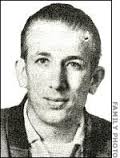
Richard Speck
The psychological background of the sixties as exhibited by the second rock generation from 1938 to 1945 is a major manifestation of an effort begun back in the WWII days. It is the realization of the theologico-metaphysical notion of what Sigmund Freud dubbed the Unconscious. As the quote opening this essay indicates the sixties was the undoing of the several hundred year effort to realize the conscious. We thought we’d seen enough of the unconscious to last much more than a millennium. As the effort was begun before the awareness of the nature of the Un or subconscious the effort was achieved as Mr. Meehan states by the repression of sub-conscious motives not their elimination.
Freud quickly discerned this and he understood the function of dreams that he called the ‘royal road to the unconscious.’ Thus the motto he appended to his volume The Interpretation Of Dreams published appropriately in 1900 is ‘Flectare si nequeo, Superos, Acheronta movebo.” which translated means ‘If I cannot deflect the will of heaven I shall move hell.’
Freud interpreting the conscious mind as heaven chose to deemphasize consciousness in favor of his vision of the unconscious that he interpreted as Hell. Thus, you will find almost nothing in Freudian psychology referring to the conscious mind while he enthrones his Unconscious as the moderator of the human mind. He actually believed that the Unconscious was an agency separate from the body. In theological terms it had a supernatural existence. Thus, he has negated consciousness, or Science, in favor of Religion. As he has rejected God or Heaven then it follows that he embraced Satan and Hell.
As the sixties progressed the generation abandoned consciousness embracing unconsciousness. Time Magazine proclaimed in 1966 ‘God Is Dead’ while Satanism came alive, indeed according to Ira Levin in his novel, Rosemary’s Baby, Satan’s son, Andy, was born in 1966 just as God died. Levin continued his story in 1999’s Son Of Rosemary. Interesting.
It is no coincidence that Freud was both a druggie and a homosexual. Now, the royal road to free the mind of consciousness or Heaven is an obsession with sex and the free indulgence of drugs especially Freud’s favorite, cocaine backed with a pounding jungle beat. Eh voila- the sixties.
Sex, drugs and the hypnotic jungle beat of Rock and Roll. The sex was facilitated by the introduction of the birth control pill and anti-biotics; the amusing Shel Silverstein sang of Penicillin Penny who always had VD. If the girls took the pill both they and their boys were freed from the fear of pregnancies while the ga-ga types had no fear of Venereal disease because the cure was quick and easy by a regimen of anti-biotic pills. Almost paradise here and now and on Earth. For less than a buck you could get a nice big piece of pie too.
Freud had achieved his goal; he had overturned Aryan society.
Freud essentially by fraud allowed us to indulge forbidden appetites and responsibility from forbidden acts, for after all as the conscious mind had no authority and the will of the unconscious was unresistible we had no responsibility for our acts- If it felt good, we did it, as the mantra was. Hence by 1966 we had Richard Speck killing all those nurses in Chicago and Charlie Whitman up his clock tower at UT blowing away his fellow students. Guns aren’t the problem; Freud is the problem.
Hell, Dick and Charlie just wanted to be free. Indeed, freedom in the freest of all societies became a problem to the generation.
Sally Banks in her Greenwich Village 1963, Chapter 5, appropriately titled, Dreaming Freedom, explains her views on what being free actually meant to her and a very large part of the age cohort. She is writing from New York City.
In 1963 freedom was a vital political issue charged with artistic consequences for both the mainstream and avant-garde. Part of the avant-garde’s utopian vision was that liberty could be found within community. But, in fact, the very concept of freedom sets autonomy and the notion of individualism in conflict with the bondedness of community. For social life is a potent source of restraint [suppression of freedom], yet, paradoxically, total freedom would mean the humanly unrealizable (and unbearable) state of complete isolation. Thus there is a deep ambivalence in Western culture toward freedom and social life. The dream of community, itself, may be incompatible with the dream of freedom, a contradiction the avant-garde sought to discover.
The Sixties artists constructed an art that re-imagined daily life in terms of achieving both liberation and community. If such a situation proved illusory, in 1963 it seemed necessary- and it still seemed possible given the booming economic infrastructure- to find a model that would make these imaginings concrete.
Yes, people wanted total freedom- that is a disconnect from the reality of having to deal with unpleasant facts- free from all restraints including gravity and mostly free from themselves. The drugs seemed to serve as those releases. Under the influence people could imagine themselves as someone else who ‘really had their shit together‘, miracle men and women able to leap tall buildings in a single bound, move mountains with the wave of a hand, fly through the air like a host of angels but they inevitably came back down where if they were anywhere near a mirror they could watch their bodies disintegrate.
Freedom from reality has its price.
So, the sixties that began with such ‘High Hopes’ to realize ‘The Impossible Dream’ of Camelot began to crash in 1966 just as like a flash of lightning in the sky the realization of those dreams seemed to dawn. As Lewis Carroll said, be careful that your Snark is not a boojum, for you see….
7.
The Truth Is No Defense
The sixties, then, was when the impasse between the Scientific Method came into its latter day conflict with the Theologico-Metaphysical mindset. The T-M system is merely a mental state that not only does not require objective validation but positively rejects it in favor of subjectiveness; what Freud called inner wishful thinking.
While the sciences of sociology and anthropology and biology produced irrefutable, by logical methods, results that ran counter to the inner wishful T-M thinking, as there were no means to refute the scientific results the T-M people merely denied them and forced scientists to suppress their accurate but uncongenial truths.
To ensure that the truths were suppressed and remained suppressed the T-M partisans passed laws making it criminal to express these truths. These laws called ‘hate’ laws were then applied to any who spoke these truths. As the truths were undeniable T-M partisans corrupted the law, common sense, and, one might say, the will of God to declare in a court of law by the judges that ‘the truth is not a defense.’
The truth is not a defense! Think about it. Such a rule of law is the triumph of absolute criminality and ignorance. And this happened during the watch of an age cohort that claimed to love freedom and revolution. Well, it was a revolution, one that enslaves the mind.
Now, in a position to punish those who disagreed with them the beneficiaries of the T-M mentality were able to enshrine their will as the law of the land. As the law was no longer concerned with the judgment of facts as evidence but the religious beliefs of the T-Ms the US at that point turned into a theocracy. The religious left became an established religion running counter to the old dispensation of the Constitution in favor of something not yet codified and something not approved by the former electorate that now became passive and an ineffective annoyance to the new slave masters.
8.
The ruling social ethos in the US when the sixties dawned was the theory of the Melting Pot formulated by the Jewish writer Israel Zangwill c. 1900. According to that theory that had nearly the effect of a law all the disparate social elements forming the population of the US would fuse into one people of uniform American belief.
In 1960 or thereabouts the new theory of multi-culturalism was introduced which stated that each culture should have an autonomous existence. This was the dream, wishful thinking, of the wannabe Jewish Autonomous people. Nothing new, it was their age old dream. Thus the body politic of the US as a matter of principle was fractured into many warring cultures.
While the Melting Pot had always been a fantasy having no real existence in fact multi-culturalism was alive and real and exacerbated in 1965 when the immigration act was reformed allowing unlimited immigration to all the peoples of the world. And if they didn’t come willingly members of the T-M mentality went into the actual jungles of Africa, dragged the natives out, put them on a plane, free fare, and flew them to the US.
What can one say to such zaniness.
The whole notion of freedom advocated by the age cohort was thus negated. Dozens of laws were passed giving these ‘immigrants’ precedence over the rights of the native population, depriving the natives of equal rights. This is a true story. Incredible but true.
9.
And lastly, for this essay we come to the complete overturn of reason in favor of a comic book utopia and the installation of an age of inner wishful thinking caused by the introduction of drugs as a mass phenomenon.
Drugs in the sixties were nothing new. Drugs begin to show up in literature during the nineteenth century Romantic period. Thomas de Quincey’s Confessions Of An English Opium Eater is the first famous confession or novel on the topic. Opium was much used in Victorian England as an ingredient in Laudanum which was given to infants to make them stop crying.
Opium was further reduced to morphine and then heroin. Freud is famous as the promoter of the joys of cocaine, synthesized from the coca plant. As chemistry developed, synthetic chemical drugs such as amphetamine began making their appearance at the end of the century.
Drug labs were busy and soon creating drugs that attacked any area of the brain. LSD was discovered in 1938 and popularized after 1943. Drugs like Miltown and other tranquilizers began filling women’s purses after 1950. Pot and hash had been simmering below the Hot 100 for some time but moved up the charts after 1960. So the whole pharmacopeia was available as the decade began. New formulas would be discovered in the following decades as drugs became part of the entertainment industry.
Drugs of course suppress the conscious mind exposing the raw wiring of the user. They also lower resistance to hypnotic influence. Hypnosis is merely a heightened sensitivity to suggestion. A drugged out population can be swayed by propaganda as no other, which is merely suggestion by another name, in any direction. They can be swayed but you mist control the means to do so. The mass media was the means, namely TV, Movies and records, and it was in the control of Jews with their special agenda.
Thus Movies, TV and Records propagandized a pro Jewish revolution agenda along with its subordinate Negro revolution agenda.
It is strange how all trends worked to favor the Negro/Jewish agenda. Of course, Jews had been instrumental in breaking down Aryan resistance to Negro music. Jewish DJs such as Alan Freed and Cousin Brucie along with Jewish song writers such as the hugely influential Leiber and Stoller and Goffin-King led the assault.
The songs they wrote were performed by Negro artists. While the Jewish song writers were not so familiar with Aryan culture as is supposed it was enough to bridge the Aryan-Negro gap making the Negro performances potable while paving the way for Barry Gordy’s Motown label.
As of 1960 there was virtually no one who listened to or was familiar with Negro Blues. The Blues was

Robert Johnson
brought forward by the British Invasion who apparently listened to that crap. I am always astonished by White Blues artists citing Robert Johnson as a source. There was nothing available by Robert Johnson until 1960 when CBS released its first collection that virtually no one bought. The second collection was released in ‘62 with the same result.
I first heard of Robert Johnson in 1968 when I owned a record store. Many people talked about the Blues but when I started a first rate Blues section the records remained untouched and unsold. I doubt that I ever had a Robert Johnson sale.
I was in a university town and when such Blues artists as Lightning Hopkins were brought to town the ‘séances’ were held in someone’s living room with maybe fifteen people attending, ten of which were girls worshipping blackness. Nevertheless White Blues was popularized by the British, spreading to American performers.
I should point out that White performers of the forties and early fifties such as the Singing Cowboy Gene Autry sang many Blues based songs. Autry’s song The Yellow Rose Of Texas is of course about a Negro woman, high yellow.
By decades end the cohort’s fascination with exaggerated notions of freedom and revolution had turned into drug addiction and violence. By the late sixties looney tunes like Bomber Billy Ayers and his female side kick Bernardine Dohrn with their Weatherman organization and the Jewish Defense League and its offshoot the Jewish Defense Organization were killing and bombing at will and furthermore they would get away with it. ‘Free as a bird and guilty as Hell.’ as Bomber Billy Ayers would put it.
So by the end of decade ending with the Caped Crusader, Mick Jagger, at Altamont a comic book vision of reality had triumphed over the real thing. Who can forget Mick Jagger mounted on a giant inflatable cock on stage before sixty thousand people. Now, there was a comic book fantasy. Two and two added up to any number you wanted.
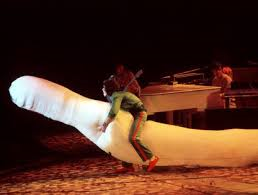
Ride ’em High Mick
Four Crucial Years
In The Life Of Edgar Rice Burroughs
Part 3 of 4
by
R.E. Prindle
There was a tremendous rush of events at this time which would shape the future of not only ERB but of the Burroughs Boys.
The signficance of the first of these would have passed unrecognized by any of the Burroughs. This was the election of Frank Steunenberg as the govener of Idaho in 1896. Steunenberg brought the Burroughs Boys into an association with his name when he appointed them representatives at a mining conference. The boys were thus connected with the anti-Western Federation Of Miners forces.
In 1899 in Coeur D’ Alene up near the Canadian border a terrific showdown occurred between the mineowners and the WFM. This is an exciting story. For details see the autobiography of Big Bill Haywood, ‘Big Bill’s Book’, Clarence Darrow’s autobiography and Charlie Siringo’s autobiography, ‘A Cowboy Detective’. Very rewarding books, especially Charlie Siringo’s.
Steunenberg called in the Army to crush the union thereby incurring their hatred. On December 30, 1905 as returned home from Office he opened his mailbox and disappeared into thin air from the bomb blast.
There is yet no conclusive proof that the Burroughs Boys found it expedient to vacate Idaho for fear of the WFM but at any rate they chose to leave.
ERB formed a distaste for Big Bill and for the IWW which Bill headed after leaving the WFM as a result of the bombing. ERB never gives up lambasting the IWW. The character of the Sky Pilot in the ‘The Oakdale Affair’ is undoubtedly based on Haywood.
The second of these events was the really stupendous story of the discovery of gold in the Klondike in July 1897. By the beginning of 1898 a hundred thousand or so prospectors including Jack London set off the fabled Big Rock Candy Mountain in the Yukon. This last of the great gold rushes probably fired the imaginations of the Boys who were having a very difficult time of making their cattle ranch go. They would shortly abandon ranching, building a mammoth dredging raft to sift the bottom of the Snake River for any spare flakes and nuggets.
What effect this had on the mind of ERB is difficult to assess although the Tarzan novels are filled with episodes of found gold and diamonds. Most notably Tarzan uses the gold of Opar as his personal bank. He perhaps found his brother’s seach for gold curious. He didn’t seem to catch the fever at the time.
On top of these two items the Maine was sunk in Havana harbor on February 15, 1898. The legendary newspaper publisher William Randolph Hearst had been beating the drums for war and now got it. The sinking of the Maine may have been the spur that caused ERB to petition Capt. Smith for an appointment. The Spanish American War agitated his military ambitions as he tried to get that elusive officer’s appointment.
As he left home again in 1898 ERB was 22 soon to be 23. Time was passing. He was no longer a boy but having been coddled as a youngest son and brother he was having difficulty making the transition to a responsible young man. Not unusual, but true. He was in that difficult learning period of 21-25 when great demands are made on one’s developing maturity. Somehow when one turns twenty-five one had better have learned enough to make it from there. How well I remember crossing that bar from youth to maturity. What a kick in the pants it was. Don’t know how I made it or, perhaps, if I have.
Unfortunately for ERB any maturity he was to experience was well in the future. Perhaps he never really made the transition. He had no money of his own. He would have had to ask his dad for fare and traveling money. He was used to being supported, just asking for the money he needed. We will now come on several examples.
Young ERB was one light headed son-of-a-gun. His route took him through Denver. There he met an Army buddy from Fort Grant who had been a member of his Might Have Seen Better Days Club.
This was apparently a joyous reunion as the two got roaring drunk, hired a brass band then marching behind it paraded through the streets of Denver. Always seemingly conversant with the seamy side of town he and his friend blew whatever money they had remaining in a gambling dive. Now broke, he blithely wired his brothers in Idaho asking for more money to continue his journey. As he already had his ticket this fifty dollars represented the equivalent of an easy five hundred today, perhaps a thousand. It was pocket money to him.
What effect this stunt had on his family’s evaluation of him is open to conjecture. ERB was no longer a kid; he ought to have been showing some sober responsibility. I’m sure the story reached Chicago where possibly the Hulberts heard of it thanking their lucky stars the ne’er do well had checked out of their daughter’s life leaving the way clear for Frank Martin. Wishful thinking.
I don’t think ERB gave it another thought, probably laughingly telling his brothers about it while I am sure they looked at him with puzzled astonishment.
As Porges notes they had little use for him on the ranch or could not afford to pay him wages, which is to say give him money which they had not factored into their expenses.
Events were now crowding fast on ERB. On April 19th, 1898 Congress authorized the war on Spain. Burroughs once again appealed to Colonel Rogers as his best bet to get him a commission. Rogers fobbed him off, nothing coming of his appeal. Hearing of Teddy Roosevelt’s formation of the Rough Riders Burroughs sent an appeal to him which was once again a rejection. The military was and would remain a mirage.
Had he been accepted either his father or his brothers would have had to provide transportation and incidental money. I’m sure one of them may have done it but there would have been no guarantee that ERB wouldn’t gamble it away en route, cabling for more.
The Boys were not flush, as Porges relates. They had borrowed a thousand dollars from their father, use your multiplier for today’s equivalent, on which they were unable to make the principal payment, instead sending their dad the interest only which was a fairly steep 8%. Technically since they couldn’t meet the obligation they were bankrupt. Nevertheless brother Harry, who seemed to be a much softer touch than brother George, bought ERB a stationery story in Pocatello. Porges doesn’t give any financial details but perhaps it was at this point that ERB gave Harry his note for three hundred dollars. It is quite probable that this money also came from George T. who wished to remain anonymous. Harry may just have forwarded the note to Chicago. The loan was never repaid; George T. presented the canceled note as a Christmas present a decade later.
ERB was to keep the store for six months. Those six months were probably very important to him intellectually. He later said he wasn’t cut out to be a retailer but he did keep the store for six months selling it back to the former owner at that time. If the owner bought it back for the three hundred then ERB kept the money never retiring the note.
The evidence indicates that Burroughs gave the business his best shot. He seems to have advertised well while developing contacts to the point that he could offer to obtain any book or magazine from the U.S., Canada or England. Although he advertised statewide, how much demand there may have been for any magazines other than the most common ones is questionable.
Once again, details of this period are tantalizingly lacking. Porges says that ERB made at least one trip to Salt Lake City in this period. One would like to know why. What need was there for him to incur the expense of such a trip. As impractical as he was he probably spent one or two hundred dollars out of the till which would better have gone to developing the business.
One would like to know what he read at this time. It would be of interest to know how many different titles of magazines he actually stocked. What books other than Capt. King’s he sold. He appears to have studied Darwin’s Descent Of Man at this time although the volume he used was twenty years old. It still may have been bought new for the store, I suppose. On the fly leaf he drew a picture of an ape labeled Grandpa which shows he was giving it some thought.
Darwin was being much discussed as ERB obviously incorporated later thought into his drawing.
One would like to know was the store making money? At any rate when the former owner returned to Pocatello at the beginning of 1899 ERB was only too happy to sell it back to him. What did he do with the money? I’m sure he could have found a poker game somewhere in Pocatello.
2.
When he returned the store to the former owner he became superfluous to his brothers who couldn’t afford to pay him as a ranch hand. He now had no real place in Idaho. He began to think of returning to Chicago. Though he may have exasperated family and friends with his erratic behavior, behind his nonsense his mind was busily at work absorbing the tremendous range of influences occurring on a daily basis.
Important among these was the West’s relationship to the world. While the Spanish American war was intended to free Cuba, an unintended consequence was the acquisition of the Philippine Islands as a colony or ‘possession.’ Other countries had colonies, the US had possessions.
Rudyard Kipling who had toured the US in 1889 beginning in San Francisco moving East had formed some very definite impressions of the country and its inhabitants. In February of ’99 in connection with the Philippines he published his very famous poem The White Man’s Burden. The US had been traditionally anti-imperialist, except moving West, condemning England most severely but now faced with Philippine intransigence the country was involved in a brutal war of suppression. Perhaps reacting to taunts of colonialism against the English Kipling wrote what can be viewed as a mocking poem.
Anachronistic when published on the eve of the twentieth century, it was reflective perhaps of an earlier intellectual climate. Burroughs reaction was immediate reflecting a deep, if not long, he was only 23, reflection on the problem. The Pocatello paper printed his response shortly after the original appeared. This was apparently written in white hot heat.
As the response is a synopsis of his later views I will reproduce both poems for comparison with comments. If mocking, Kipling still presents a bright or positive side of the European invasion of Africa and the East.
The White Man’s Burden:
The United States And
The Philippine Islands, 1898
by
Rudyard Kiping
Take up the white man’s burden-
Send forth the best ye breed-
Go bind your sons to exile
To serve your captives’ need;
To wait in heavy harness,
On fluttered folk and wild-
Your new-caught, sullen peoples,
Half devil and half-child.
2.
Take up the white man’s burden-
In patience to abide,
To veil the threat of terror
And check the show of pride;
By open speech and simple,
An hundred times made plain,
To seek another’s profit,
And work another’s gain.
3.
Take up the white man’s burden-
The savage wars of peace-
Fill full the mouth of famine
And bid the sickness cease;
And when your goal is nearest
The end for others sought,
Watch sloth and heathen Folly
Bring all your hopes to nought.
4.
Take up the white man’s burden-
No tawdry rule of kings,
But toil of serf and sweeper-
The tale of common things.
The ports ye shall not enter,
The roads ye shall not treat,
Go make them with your living,
And mark them with your dead.
5.
Take up the white man’s burden-
And reap his old reward:
The blame of those ye better,
The hate of those ye guard-
The cry of hosts ye humour
(Ah, slowly!) toward the light-
“Why brought ye us from bondage,
Our beloved Egyptian night?”
6.
Take up the white man’s burden-
Ye dare not stoop to less-
Nor call too loud on Freedom
To cloak your weariness;
By all ye cry or whisper,
By all ye leave or do,
The silent, sullen peoples
Shall weigh your Gods and you.
7.
Take up the white man’s bureden-
Have done with childish days-
The highly proffered laurel,
The easy, ungrudged praise,
Comes now, to search your manhood
Through all the thankless years,
Cold-edged with dear-bought wisdom,
The judgment of your peers!
Originally published in
The New York Sun, February 5, 1899
The Black Man’s Burden
A Parody
The dark side presented by
Edgar Rice Burroughs
1
Take up the white man’s burden,
The yoke ye sought to spurn;
And spurn your fathers’ customs;
Your fathers’ temples burn.
O learn to love and honor
The white God’s favored sons.
Forget the white-haired fathers
Fast lashed to mouths of guns.
2.
Take up the white man’s burden,
Your own was not enough;
He’ll burden you with taxes;
But though the road be rough,
“To him who waits, “remember”
The white man’s culture bring you
The white man’s God, and rum.
3.
Take up the white man’s burden’
“Tis called “protecorate,”
And lift your voice in thanks to
The God ye well might hate.
Forget your exiled brothers;
Forget your boundless lands;
In acres that they gave for
The bood upon your hands.
4.
Take up the white man’s burden;
Poor simple folk and free;
Abandon nature’s freedom,
Embrace his “Liberty;”
The goddess of the white man
Who makes you free in name;
But in her heart your color
Will brand you “slave” the same.
5.
Take up the white man’s burden,
And learn by what you’ve lost
That white men called as counsel
Means black man pays the cost.
Your right to fertile acres
Their priests will teach you well
Have gained your fathers only
A desert place in hell.
6.
Take up the white man’s burden;
Take it because you must;
Burden of making money;
Burden of greed and lust;
Burdens of points strategic,
Burdens of harbors deep,
Burden of greatest burdens;
Burden, these burdens to keep.
7.
Take up the white man’s burden;
His papers take, and read;
‘Tis all for your salvation;
The white man knows not greed.
For you he’s spending millions-
To him, more than his God-
To make you learned and happy,
Enlightened, cultured, broad.
8.
Take up the white man’s burden
While he make laws for you,
That show your fathers taught you
The things you should not do.
Cast off your foolish feathers,
Your necklace, beads and paint;
Buy raiment for your mother,
Lest fairer sisters faint.
9.
Take up the white man’s burden;
Go learn to wear his clothes;
You may look like the devil;
But nobody cares who knows.
Peruse a work of Darwin-
Thank gods that you’re alive-
And learn this lesson clearly-
The fittest alone survive.
See the Pocatello Tribune clipping
from ERB’s scrapbook at ERBzine 0291
Burroughs response to Kipling may also explain why he refused to join a Pocatello volunteer regiment destined for the Philippines and the assumption of the White Man’s burden. Burroughs is accused of an excess of pride in refusing to join the regiment because he would have to serve under a man he didn’t like, a good enough reason for me, by the way. One doesn’t know the details but possibly his fellow volunteers refused to make him an officer. His local reputation may have been such that his fellows had no confidence in him.
Also pertinent I believe is the fact that while the war in Cuba was to free the Cubans from Spanish tyranny, the war in the Philippines was to crush the freedom of the Filipinos. As Burroughs’ answer to Kipling clearly demonstrates he was opposed to the imposition of Western values on native peoples. The Tarzan novels should be read in the light of this answer.
While Kipling’s poem has been much derided by the moribund Liberal establishment with no attempt at placing it within a historical context it nevertheless does express certain truths. Whether misguided or not, unlike all previous conquests, the White Man with his superior scientific consciousness did try to uplift the peoples they conquered rather than merely exploiting them on their own established historical model.
The poem is an interesting example of evolution in progress before the reaction against the West began. Darwinian evolution, you know, does not only apply to the past and other species, it also applies to the present and humankind. Kipling himself does not appear to have absorbed the new scientific learning. He was eleven years older than Burroughs, but his parodist was thoroughly imbued with evolutionary ideas having, apparently, just read The Descent Of Man. The final quatrain:
Peruse a work of Darwin’s
Thank gods that you’re alive-
And learn the reason clearly-
The fittest alone survive.
indicates this.
While biographer Taliferro believs that Burroughs got no further in the Descent Of Man than drawing a picture on the title page the quatrain would indicate a much deeper familiarity. ‘A work of Darwin’s’, Darwin wrote several books, points to a wider reading of the evolutionary scientist than just the Descent.
So at some time before reaching the age of 25 ERB had obviously been immersing himself in evolutionary reading and speculation. He may have been flighty but he was industrious and intelligent.
The advice to the subject races is peculiar while being ambiguous. On the one hand he advises them to take up Western learning, which as they haven’t makes them unfit, while on the other hand he implies that they have not been exterminated because they are the fittest.
The bright side of the Western subjugation of the peoples is clearly and accurately presented by Kipling who had much more experience in the wide world than Burroughs. On the other hand one tends to underestimate Burroughs whose brief experience in Apacheria is still analogous to Kipling’s in India.
On an evolutionary basis the West’s conquest of the world represented a radical departure from the historical model. Prior to and outside the West the world’s conquerors had been mere freebooters who plundered and destroyed while contributing nothing to their subject peoples who were most frequently intellectually superior to the invaders.
Thus Attila was merely an incubus on Western civilization whose potential was wholly destructive. His reputation cannot be rehabilitated. Genghis Khan and his successors inhibited the development of superior civilizations dragging the subject peoples back toward more primitive conditions. The crimes the Golden Horde committed against the Russians are atrocious. But that is why the Liberals love them better than the West.
As Kipling states, athe West conferred solid benefits on the subject peoples. It imposed superior organization, scientific methods and standards although today, after several hundreds of years resistance, through the superior methods of the West certain areas are profiting. Not many though.
In the terms most people relate to, famine has all but disappeared- this through no efforts of their own- through Western medicine billions lead more comfortable lives, certain diseases have disappeared while most others can be treated- through no efforts of their own- these benefits have been a gift, a boon from the West.
The prevalence of fevers gave sub-Saharan Africa the name of the White Man’s Grave but in fact no people could prosper in the African climate. Even the native Blacks, who one would assume, should have acclimated themselves over their hundred fifty thousand year existence seldom lived past forty. They were incapable of creating medicine before the White Man arrived and they are incapable of even manufacturing the White Man’s medicine today.
So that, while Kipling’s poem is denigrated today as an example of ‘racism’ by the Red-Liberal ideology, apart from the insufferable condescension it is an accurate description of the altruistic role played by the West in civilizing the world.
Reacting to the poems apparent insufferableness as much as anything Burroughs counters it by listing the negatives which are as real as the positives but with no material value. Once again the negatives are inconsequential compared to the brutality of the Mongol conquests in the West. One has only to glance over the wars of Tamerlane to arrive at some sort of balance, one hopes.
Burroughs is ostensibly taking the side of the subject peoples but in reality he identifies with the defeated accepting their defeat at the hands of the West as analogous to his defeat at the hands of John the Bully.
This view would relieve the lines:
Thank gods that you’re alive
And learn the reason clearly-
The fittest alone survive.
of some of their ambiguity because what he is saying is that he has survived comparable conditions- he still lives as he has his characters say repeatedly. Therefore he is one of the fittest if not superior to his conqueror.
Thus beneath the foolery and compulsive failure caused by his 1884-85 confrontation the true Edgar Rice Burroughs is struggling toward Bethlehem and rebirth. It may in fact be no coincidence that the initials of both John Carter and John Clayton are JC.
In the Spring of ’99 he can only put together this parody of another man’s work where it touches his fixations most directly.
For the present, after the roundup our wandering boy pulled up stakes yet again to return to Chicago. Who bore the expense isn’t clear.
Continue on the Part IV and conclusion
Conversations With Robin Page 3
August 20, 2009
< Wep>
Conversations With Robin, Page 3
Conversations between R.E. Prindle And Robin Mark
Well, well, well. Robert Goulet. I should have known that filthy bastard would be mixed up in there somewhere. What amazes me is that Guralnik could write two fat volumes on Elvis and never mention the Mob once. I think we can begin to integrate Elvis’ Mob conflicts pretty clearly now, although research will have to establish the connections for sure.
For starters, entertainment is a Mob industry both records and movies; that includes both Jews and Sicilians. If you haven’t read Gus Russo’s Supermob yet, do so. The Sidney Korshak role at MCA is crucial.
Anent shooting out TVs remember that Sinatra had a plane he called Superwop or something to that effect so it is clear he bore a grudge against the Anglo world. The plane was a small ‘Lear’ if I remember correctly. Elvis went out and bought a 707. Big plane, big penis; little plane little penis. Not exactly true in Frank’s case, but you get the point. So at least Goulet and Sinatra. I can understand why Dean Martin tried to distance himself from those creeps.
Parker must have had the business dealings with the Outfit. As he ran into gambling problems the only commodity he had to barter was Presley. Thus he would have had to ‘sell’ Presley to keep both his legs under him. Elvis’ rapid deterioration could have been because of his realization that he was ‘caught in a trap. I can’t get out.’ Devastating awareness. One could only retreat into booze and/or drugs.
Now, Leiber said that he and Stoller at one time worked for the Mafia. This wouldn’t be unusual nor should it be held against them because if you’re in entertainment you’re involved, like it or not. The question is when were they involved, for how long, and for what purpose.
We all know Fabian was a Mob creation. Why not others? If you haven’t seen and studied The Girl Can’t Help It, do so. The movie is an alegory of the record business. Everything you see in the movie is the Outfit in action. In the fifties every Juke Box in America was stocked by the Outfit. You didn’t get your record stocked unless you were Mobbed up somewhere along the line. Someone recently told me that the girls on the Dick Clark Show were prostitutes and Bandstand was used to showcase them for Johns. Don’t know that it’s true but I wouldn’t be surprised.
Leiber and Stoller could have been co-opted to write songs for, say, The Coasters. A Black act with interchangeable personnel. Kind of an early Back Street Boys. I don’t know but I’d like to hear Leiber talk about it. Might prove enlightening.
So, let us assume that the Colonel was drawn into the Mob scene from the beginning of Presley’s movie career. That might explain some of his stupid decisions and those dumb movies. Perhaps Parker didn’t have a free hand but was ‘wise’ enough to figure out that something is better than nothing.
Then after Vegas Presley was increasingly drawn into orbit until he learned the horrifying truth. Guralnik seems to have his head up his ass as far as I’m concerned.
As Presley learned the truth looking forward to forty more years of slavery he found drugs more comfortable than reality. Possible, it would make things make sense.
A Review: Beau Sabreur by P.C. Wren
August 1, 2009
Note: I mistakenly placed the review of Beau Geste on another of my blogs: reprindle.wordpress.com. The review may be found there.
A Contribution To The
Erbzine Library Project
The Beau Ideal Trilogy Of
P.C. Wren
Beau Geste~Beau Sabreur~Beau Ideal
Part III
Review Of Beau Sabreur
by
R.E. Prindle
Part I: Introduction
Part II: A Review Of Beau Geste
Part III: A Review Of Beau Sabreur
Part IV: A Review Of Beau Ideal
Bibliographial Entry: Welland, James: ‘The Merchandise Was Human’, Horizon Magazine, Vol. VII, No. 1, Winter 1965. PP. 111-117
Beau Sabreur shifts from the classic literary style of the mid-nineteenth century to the vernacular of pulp or, perhaps, Wold Newton era. The pulp writers seem to have all read each other and Wren has certainly done his share of reading.
This novel begins at a pre-Zinderneuf time when Charles De Beaujolais was a mere cadet entering the service. If Beau Geste began in c. 1888 Beau Sabreur is set back at the beginning to perhaps 1875. De Beaujolais’ circumstances quite parallel those of the hero of Joseph Conrad’s Heart Of Darkness. Conrad has maintained a very respectable readership down to the present even though stoutly anti-Communist and a colonial writer. Both Communists and Africans are working hard to bury his reputation. It’s amazing how guys like Conrad manage to hang on, but that may not be for long as Western influence in society declines.
So it is that De Beaujolais is a sort of lounger applying himself to nothing in particular when his uncle recruits him for the French secret service as an agent to be attached to the African Spahis, an army corps. His uncle says that he will severely try him and should he fail in any particular he will be immediately dismissed. This essentially means that if De Beaujolais lets a woman come between him and his duty it is all over for him. So we are forewarned that there will a choice between love and duty.
The book was written after 1917 so Wren introduces a subversive Communist or anarchist character. In this book he assumes the name of Becque at the beginning. In Beau Geste he went by Rastignac and late in the novel he will be recognized as Rastignac although he appears to be going by another name. Wren has a good idea of the type describing him thusly under the name Becque:
He was clearly a monomaniac whose whole mental content was hate- hate of France; hate of all who had what he had not; hate of control, discipline and government; hate of whatsoever and whomever did not meet his approval. I put him down as one of those sane lunatics, afflicted with a destructive complex; a diseased egoist, and a treacherous, dangerous mad dog. Also a very clever man indeed, an eloquent, plausible and forceful personality…The perfect agent-provacteur, in fact.
Thus Becque in his various incarnations is always subversive, whether of army morale or working the Moslems up against the French. This will be a major theme of the novel. the same theme will appear in Tarzan The Invincible developed for his own needs.
Having been recruited by his uncle, De Beaujolais is sent to a sort of boot camp to learn the hard way. His ordeal is very convincingly described by Wren. It seems authentic enough to make one believe that Wren himself actually experienced such an indoctrination but there is no record that he did. He is just a consummate artist.
While learning to be a soldier Becque attempts to recruit him as a Communist agent. This leads to a sword fight in which De Beajuolais injures Becque but does not kill him.
Having completed his boot camp De Beaujolais takes his station with the secret service and the Spahis in Africa. Spahis are not FFL but a different corps.
When the French conquered Algeria in 1830 they disrupted a thousand year old social system. The North African Moslems had an insatiable need for slaves. Not only did they raid European shores to abduct Whites but an immense system for deliviering Negro slaves had been in existence since the Moslem conquest. This system had been run by the Tuaregs. This people was descended from Whites dating back to at least the Phoenician conquest of North Africa. Their alphabet probably precedes that of the Phoenicians. Undoubtedly they were the descendants of the former inhabitants of Mediterranean Valley known as Libyans in Egypt flushed out by the melting of the ice age.
What they did before the arrival of the Moslems isn’t known but with the African conquest of the Moslems they became the middle men between Africans of the Sahel and the Moslems of the North. Every year for a thousand years the Tuaregs had collected convoys of Negroes from the South driving them North across the Sahara. This was necessarily done with great loss of life as the Tuaregs were not that tender toward the Negroes.
With the advent of the Atlantic Slave Trade in the sixteenth century the Tuaregs also captured Negroes and drove them to St. Louis in Senegal for sale and transshipment to the Americas. According to James Welland the depredations on the Blacks was so great that the area around Lake Tchad had been cleared of inhabitants. This age old life style was disrupted in 1830 by the French. By that time Europeans had discontinued the slave trade so that the French disrupted the trans-Sahara trade causing a disruption in the Tuareg economy from which there was no recovery. Welland explains:
In short, the official abolition of the slave trade, the desert tribes, the desert itself for that matter began to play a diminished part in human affairs, and the Tuareg, who had been the only link for two and a half thousand years between Central Africa and the Mediterranean- in other words, between the Negro and the White world- began to pass from the stage of history. They were left unemployed and purposeless, with the result that they turned to intertribal war and oasis raiding to keep some semblance of their nationhood. Then again, as the supply of black labor dried up, the palmeries were increasingly neglected and often, as the consequence of a razzia, comepletely destroyed. The size and number of oases decreased, sand filled the wells and cisterns- many of which had been maintained since Roman times- and the age old trails became more hazardous and finally were hardly used at all.
In the secret service in Africa De Beaujolais becomes involved in the maelstrom of change, racial conflict and bad memories which were now exacerbated by the arrival of the non-Moslem, or Christian, French. The novel beomes then a sort of proto-thriller. De Beaujolais is on a mission to a town called Zaguig when he is caught up in a Moslem revolt. In Zaguig he meets the touring Mary and Otis Vanbrugh. Otis, you will remember returns from Beau Geste.
Mary is the love interest in the story and she will conflict De Beaujolais between his love for her and his duty as imposed by his uncle. Frankie Laine or Tex Ritter and songwriters Dimitri Tiomkin and Ned Washington (I tried to work Trad. in there somewhere but couldn’t do it) expressed the balance well in the song High Noon:
Oh to be torn ‘betwixt’ love and duty
Supposin’ I lose my fair haired beauty…
De Beaujolais relates the story of another agent who chose his beauty over duty and was drummed out of the service ultimately being killed. De Beaujolais has a premonition. Wren cleverly resolves the choice so that De Beaujolais gets his beauty while fulfilling his duty.
At the same time Otis Vanbrugh meets the apparent Arab dancing girl, who yet retains European features, who will figure largely in the sequel.
As the revolt erupts these conflicts emerge. As is usual in thrillers things are not what they seem. Raoul D’Auray De Redon, a close friend of De Beaujolais’ remains behind disguised as an Arab to confuse their attack on a small French garrison destined to be wiped out. De Beaujolais has important dispatches which must be delivered. Thus duty makes him appear to be an ingrate and coward humiliating him before Mary. His job is to locate the latest Arab Mahdi and suborn him the the French side.
De Beaujolais thinks little of Otis Vanbrugh and we are meant to accept his opinion. His true story will appear in the sequel.
Mary was one of those women who flirt by taunting or ridiculing her guy. In her case when De Beaujolais was within hearing she mockingly whistled a tune De Beaujolais couldn’t quite place but was called Abdullah Bulbul Amir. This was a very popular song and poem of the time that can be found at http://wiki.answers.com/Q/lyrics_of_bhulbhuliya. A couple of verses of its 19 will suffice to give its tenor but the poem is one you should be familiar with.
The sons of the Prophet are hardy and bold,
And quite unaccustomed to fear,
But the most reckless of life or of limb
Was Abdullah Bulbul Amir.
When they wanted a man to encourage the van
Or harass a foe from the rear,
Storm fort or redoubt, they had only to shout
For Abdullah Bulbul Amir.
Apparently the poem was so well known that Wren felt no need to name it and he doesn’t.
The time to leave Zaguig comes, so taking his entourage of faithful soldiers, Mary and her maid Maud, he sets out into the desert toward Oran.
Soon Tuareg or Arab raiders pick his party up and they are forced to fight a pitched battle although from an advantageous position. Here De Beaujolais has to make a very difficult choice between between loyalty to his men and his duty to get his dispatches through. Getting his men into position he is compelled to abandon them to their fate and push on.
This puts a strain on his relationship with Mary who cannot understand the concept of duty or necessity- the necessity to get the dispatches through. After a long flight the party falls into the hands of a desert tribe. But this is a strange desert tribe. Rather than the usual unorganized tactics these fellows seem to have the scientific training of the French. Another mystery.
As luck would have it De Beaujolais and the women were captured by the Mahdi’s troops. By way of explanation the Moslem Mahdi is equivalent to the Jewish Messiah but not the Christian Messiah. There’s only one Christ but Jewish Messiahs and Moslem Mahdis pop up everywhere.
So now, going back to the ending of Beau Geste, the two Americans Hank and Buddy were out there somewhere trodding the burning sands. Hank was discovered and rescued on the point of death by a kind hearted Sheik while Buddy was captured by hard hearted Tuaregs being saved from death when Hank Sheik’s tribe defeated his captors. Buddy was out there somewhere for a long time because Hank had been rescued years before.
Having been rescued at the point of death Hank was aware of the necessity to pass as a Moslem so he pretends to be dumb until he has learned the language so well he can pass. He then cleverly becomes the tribe’s sheik. The tribe is then threatened by a razzia of Tuaregs. As this takes place in the North Tuaregs no longer having Negroes to convoy have taken to raiding the oases. Normally the tribe would have run and hid leaving their goods and a few token members as slaves for the Tuaregs. Hank has a better idea and using his superior scientific French training the tribe rather than waiting to be attacked unexpectedly attack the Tuareg camp handily defeating them. Buddy is thus rescued. Coincidences are dime dozen out on the burning sands.
Teaching Buddy the language while he too plays dumb, Buddy becomes Hank’s vizier. With Buddy as military commander the tribe is trained in scientific methods in earnest. They then begin to organize the tribes into a confederation thus earning Hank the title of Mahdi in French eyes. De Beaujolais was thus on a mission to co-opt the new Mahdi.
As luck, or coincidence, would have, at the same time De Beaujolais and the girls arrive so does Becque/Rastignac. Becque is now employed one supposes by the Soviet Union to arouse the Moslems to a jihad. He comes bearing gifts not realizing that Hank and Buddy are his old Legion comrades. He doesn’t recognize them but Hank recognizes him. Becque and De Beaujolais have that old unsettled score to settle. De Beaujolais now settles his hash removing that source of irritation.
I’ve pointed out before that Burroughs very likely drew inspiration for his series of political Tarzan novels from 1930 to 1933 after reading this trilogy from 1924 to 1928. The Sahara had fascinated him long before he read Wren. David Innes of Pelucidar even surfaces in the Sahara returning from the Inner World. The great desert and the Sahel is not quite as we Westerners have imagined it. The thousand year long history of amazing suffering boggles the imagination. A thousand years of thousand mile treks from South to North, untold millions of Africans were trekked across the burning sands with equally untold millions falling along the way. This is not all. This is a horror story. Welland again, p. 116:
Even after the slave trade had been suppressed, the old life of the desert survived for a while for one simple reason…the absence of salt in the Sudan. Nearly all the salt in Central Africa had always come from the north across the Sahara on the backs of camels, donkeys, horses and men. The salt mines in the middle of the most terrible wastelands of the desert- at Taghaza, at Taodeni, and at Bilma- had always been worked all the year round by Negro slaves, who died within a few years of their arrival at the mines and were immediately replaced by new workers. The salt they mined was worth its weight in gold in Timbuktu, and its transport across the desert was a considerable enterprise of unbelievable size, involving the assembling of as many as 40,000 camels to make the quick dash from Bilma to Kano.
Think of it. For a thousand years Negroes were dropped down a funnel in a steady stream to live the most miserable of lives for a very few years. Over a millennium! Think of it. I should think those Negroes who travelled the Middle Passage in the Atlantic Slave Trade ending up in the paradise of the Caribbean and the Americas should bless their deliverers from that African hell.
Africans should bless the French for delivering them from total servitude and degradation. When one digs for facts beneath the surfice, the things one finds.
Thus without giving any historical background Wren is telling the story of how Europe saved the Africans from themselves. Indeed, Hank and Buddy singlehandely rearrange North Africa on livable lines. The two, in the story, break the power of the Tuaregs while establishing an African paradise in a hundred square mile oasis. Their people are delivered into prospeirty by a million franc subsidy from France that Hank and Buddy use for the betterment of their people rather than sequestering it in a numbered Swiss bank account. A new day for Africa indeed courtesy of Western enlightenment.
Thus De Beaujolais accomplishes his mission to align the new Mahdi, Hank, with France while winning his fair heared beauty and pleasing his uncle.
Hank marries Maud the maid leaving Buddy hanging out but not for long. We still have the last of the trilogy, Beau Ideal to go. Let’s go.
Exhuming Bob 21: Will The Real Bob Dylan…?
July 27, 2009
Exhuming Bob 21:
Will The Real Bob Dylan…?
http://contemporarynotes.wordpress.com/2009/04/05/greil-marcus-bob-dylan-bill-ayers-barry-obama/

Dylan
Our friend Bob Dylan has given the impression that he knew nothing of Barry Obama, The Great Black Hope, until the summer of 2008 with just a few months left in the campaign when he gave the candidate his endorsement. Surely this isn’t so. Surely he not only knew of the Hope but knew him personally probably before 9/11/01.
In my essay Bill Ayers, Greil Marcus, Bob Dylan and Barry Obama on my Contemporary Notes blog, linked above, I posit that all four knew each other and of 9/11 before it happened. Impossible, huh? Stranger things have happened.
I hadn’t thought about it much after writing my piece but then a few days ago- 7/22/09- I came across a post by one Lark, The Times Are A Changing (Again): Bob Dylan On Obama. Lark quotes Dylan on Obama in the London Times. Let’s review it:
Dylan begins: “Well you know right now America is in a state of upheaval.”
True enough. Many sorts of upheaval. What sort of upheaval does Dylan refer to:

Bomber Billy Ayers
Poverty is demoralizing.
Can’t argue with that. Is he talking about coal miners, fruit pickers, the unemployed, or what?
You can’t expect people to have the virtue of purity when they’re poor.
More problematic here. Purity isn’t a virtue it’s a state or condition. Has nothing to do with poverty. Well, Dylan’s a poet, one of the enigmatic kind, so I presume he may mean honest by pure. But which people, is he talking about Blacks?
Well, I come from a long line of poor people and so far as I know we were the kind described as ‘poor but honest.’ In other words we didn’t steal or cheat. I’m not sure how scrupulous we were about lieing. Seems to be a much more common fault. I’ve been around the block a few times now and I’ve come to the conclusion that crime has nothing to do with poverty. Rich or poor a thief steals and is well able to justify his thefts. Need I point out the 50 billion dollar thief Bernie Madoff? Or about the raft of Rabbis just arrested in New Jersey for some very serious financial crimes. And then I read about this reasonably well off one guy who stole some records because he thought he could use them better than the rightful owner. So it may be common to think you have to be poor to be ‘impure’ or dishonest but mistaken nevertheless.
Bob makes himself a little more clear:
But we’ve got this guy out there now who is redefining the nature of politics from the ground up…Barack Obama.
Naive but sincere. Spoken like a true cheerleader. ‘This guy out there’ sounds like affection if not familiarity to me. So now, when and how did Dylan become aware of the Hope? As I conjecture it Greil Marcus is the key to the riddle. I’m guessing, but my guess is that Marcus’ curiosity led him to introduce himself or be introduced to Bill Ayers, the ole Mad Weatherman Bomber, probably in Chicago. Ayers and Marcus being of the school of Whiteness is a plague on the Earth probably quickly came into accord. And then the Hope was probably on the way under the sponsorship of Ayers so Marcus and the Hope were introduced when certain anti-American and anti-White plans were discussed probably among them a projected attack on America. Certainly one remembers that Ayers had already made several bomb attacks on America so why not the Big One…the Really Big One…the World Trade Center.

Greil Marcus
Dylan and Marcus are pretty close. Dylan is either a Lubavitcher or close to them. Lubavitchers hate Whites, especially of the Christian sort. That partially excludes me by the way, White but not of the Christian persuasion.
As it appears that Dylan was much more familiar with the Hope than he let on and his album Love And Theft seems to reflect a pre-knowledge of 9/11 coupled with Marcus’ Rolling Stone article as detailed in the link to my essay above, there is every reason to believe, or think, or fear that Dylan, Marcus, Ayers and Obama were privy to 9/11 well before it happened. Possibly if not probably in on the planning stages.
Dylan goes on: He’s redefining what a politician is, so we’ll have to see how things play out.
If the Hope is redefining what a politician is then the definition is toward that of an African chief. An African chief owned every bit of his territory personally. He owned every inhabitant as his slave to dispose of as he wished. He was free to do with all as he chose with or without their consent.
That seems to be how the Hope is playing things out. True, the Hope is somewhat hobbled by the remains of the old political system but with his Liberal allies he has so far met with no insuperable resistance. To oppose his plans is to be vile. So far the fear of being considered vile has prevailed.
Then Dylan: Am I hopeful? Yes. I’m hopeful that things might change. Some things are going to have to.
Well things have changed. Many of us believe the way things are changing is in a direction more destructive than beneficial. In short the Hope is already a complete failure. We’d all be pleased to have a detailed opinion from Dylan on whether his hopes have been realized.
Dylan then closes with a platitude: You should always take the best from the past, leave the worst back there and go forward into the future.

Yep. Sure enough. I suppose the argument would break down over the issue of what’s best or worst and which has been left behind. There’s no doubt we’re headed into the future. Some kind of future at least.
A Review: Pt. I P.C. Wren The Beau Geste Trilogy
June 23, 2009
A Contribution To The Erbzine Library Project
The Beau Ideal Trilogy Of
P.C. Wren
Beau Geste, Beau Sabreur, Beau Ideal

Review by R.E. Prindle
Part I: Introduction
Part II: Review of Beau Geste
Part III: Review Of Beau Sabreur
Part IV: Review Of Beau Ideal

P.C. Wren
For hundreds of years after the expulsion of the Moors from Spain the Moslems raided the European c0asts of the Mediterranean abducting men, women and children as slaves while also preying on shipping. The newly formed United States sought unsuccessfully to suppress this Moslem piracy. ‘Millions for defense but not one penny for tribute.’ If you remember that one from school.
Finally in 1830 France invaded, conquered and occupied what is now known as Algeria ending the Barbary Pirates.
An army corps was formed and named the Legion Etrangere in French, French Foreign Legion in English to pacify Algeria. Over the next hundred years the Legion was used for peaceful penetration into the Sahara and Sahel to form the French West African Empire.
In an astonishing turn around the Moslem power evaporated while the French easily became the masters of the bulge of Africa. The military superiority was to last until post-WWII when exhausted by two world wars accompanied by a moral collapse as the best and brightest died on the battlefields leaving nothing but singers and dancers to live off the fat of the land. The French were militarily capable but morally bankrupt. The Moslems reasserted themselves in the fifties forcing the French out of Algeria while beginning the invasion of France by peaceful penetration. A neat reversal of fortunes. Thus the conquest of Europe interrupted by the Spanish expulsion began again.
Immediately after the French invasion of Algeria the deserts of Africa beame a playground of Europeans. The lure of the desert held a strange appeal for them. Perahaps devoid of romance in their homelands the desert with its now no longer dangerous but exotic inhabitants replaced the fairies and elves displaced by the scientific revolution. The Euroamerican romance with ‘noble savages’ and ‘inferior races’ may very well be caused by the void created by the scientific revolution. Euroamericans hoped to find or create those emotional or psychological needs lost in the advance of civilization. This may explain to some extent the White worship of people of color whose ‘natural’ uninhibited behavior they profess to admire and imitate. Witness the tatooing and body piercing in imitation of the Africans who themselves appear to have to given it up.
The French having conquered Algeria had to establish an army corps dedicated to perpetual warfare. That unit was the Legion Etrangere or French Foreign Legion. The duty in the Sahara amid an enemy population was so execrable that only men without hope, that is criminals and outcasts with no other options need have applied.
In 1831 then, a year after the conquest and annexation of Algeria as an actual Department of France the French Foreign Legion was created by Louis Philippe the new Bourgeois King of France.
The Legend of the Legion apparently grew very quickly. the first legion novel is thought to be that of the English writer Ouida. She published her novel Under Two Flags in the 1860s. It was a great success ultimately being made into a movie. Alongside the Legion novels were a number of novels that dealt with the desert in a very romantic way.
The genre of novel could only have developed after the French conquest of Algeria after 1830 and a little later with the pacification of the Moslems. If not pacification at least intimidation. Astonishingly the centuries intervening between Roman Africa and the conquest of Algeria vanished from the consciousness of Europeans. In only a hundred years (well, a hundred twenty-five years) a brief interlude, Europeans were in turn expelled from North Africa with their tremendous superiority shattered and in ruins. That brief century now appears like a fairy story without real substance. A hundred years of struggle and dieing ant then- poof! But the stories were great.
Fans of Jules Verne have a very good story- The Barsac Mission- that undoubteldy was an influence of P.C. Wren. The work has only been translated recently issued in two volumes as Into The Niger Bend and The City Of The Sahara by Americor. Some consider the novel science fiction.
The publishers are escapist types who have retreated to Mattituck N.Y. at the most extreme end of Long Island. Unfortunately, as with many of Verne’s books the Barsac has been bowlderized to reflect current Liberal tastes. The translator I.O. Evans coyly expresses it this way: I have also taken the liberty, found necessary by most of Verne’s other translators, of abbreviating or omitting a few passage of minor interest. (cough, cough)
Another wonderful Sahara novel written at the same time as the Barsac is Robert Hichens’ The Garden Of Allah. Hichens was an influence on Burroughs. The novel was very well known at least through my youth. I knew people with whom Hichens’ reputation was very great although I imagine there are few who would recognize his name today.
And then ERB himself devoted a number of pages to the romance of the desert. In The Return Of Tarzan it will be remembered that Tarzan was despatched to Algeria as a French secret agent just along the lines of Wren’s De Beaujolais. The Lad And The Lion is of course a complete Sahara novel that appears to have had an influence on Wren. Korak the Killer of The Son Of Tarzan operated on the margins of the desert while the Sahara plays a frequent part in a lot of the Tarzan novels.
There is no question that E.M. Hull’s The Sheik was a major influence on Wren as he actually parodies Mrs. Hull’s novel virutally by name.
With Wren the myth of the Sahara and the Legion comes into full bloom.
If one has read only Beau Geste one has read an amazingly good story but to understand Wren’s intent it is necessary to read Beau Geste, Beau Sabreur and Beau Ideal in sequence. By the time Wren wrote, the handwriting was on the wall. The Western will had already been sapped. The beau ideals that had inspired Western men since the days of the Arthurian epics was fading from the Western consciousness being replaced by the effete homosexual ‘ideals’ of today. The strength and confidence that allowed Western man to subjugate the world was becoming just a memory. Wren in his way is either commemorating the ideals or seeking to reverse the decline.
The three novels are concerned with the fortunes of two families, one English, the other American. Wren has a wonderful feel for the difference between the English and the American characters, not to mention the French. His command of American dialect and hobo slang is virtually alone worth reading the trilogy.
The first volume, Beau Geste based on Wilkie Collins The Moonstone (a so-so read) concerns the early history of the Geste brothers, Beau, Digby and John and the story of Fort Zinderneuf away out there almost beyond a hobo’s imagination.
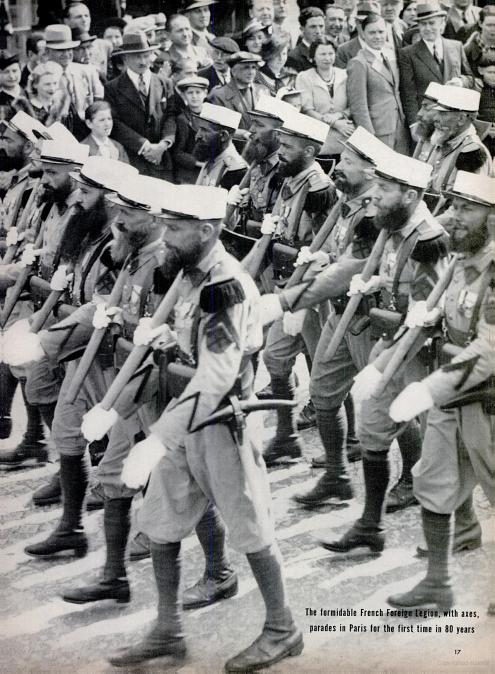
FFL 1939: Life Magazine
.
The novel does introduce the two American hoboes, Hank and Buddy, serving in the Legion. Wren kills off Michael and Digby Geste in this first novel putting the load on John.
In the second novel of the trilogy, Beau Sabreur (The good sword or swordsman) John returns to Africa to try to locate Hank and Buddy who were lost in the drifting sands after saving his life.
In this manner Wren introduces the American family of which Hank is a member. Hank and his friend Buddy were the two men lost in the desert that John Geste is seeking. Both men lying in the desert near death in different locations were rescued by the Bedouins. As luck would have it Hank managed to work his way up to Sheik acquiring Buddy as his vizier. They introduce superior Western discipline and tactics into their tribe giving them dominance in the desert. Hank then comes to the attention of the French as the new Mahdi. De Beaujolais is sent to coopt the new Mahdi. Through a series of adventures De Beaujolais meets and falls in love with Hank’s sister Mary who is traveling with her other brother Otis Vanbrugh. They as well as Hank are fleeing from a brutish father.
At stories end the whole cast Henri De Beaujolais who had wed Mary, Otis, Hank, Buddy, John Geste and his wife Isobel, who plays a large part, are back at the ranch in Texas facing the old brute of a father down while trying to free Hank’s other sister from thralldom to the old brute so she can marry Buddy and begin a life of her own. Hold on, now, Wren must have been studying Burroughs because he’s got a number of twists up his sleeve, or perhaps, tricks.
While Otis was in Algeria an Arab dancing girl had fallen in love with him who was apparently the queen of the desert. Otis tried to escape her but in exchange for help in recovering John from the penal battalion of the FFL he promised to marry her. Aw shucks, that’s right, you guessed it. Nakhla was in reality his sister. The old brute had fathered her on another dancing girl when he was out making deals in the desert. So we have Nakhla, the same name as the heroine of Burroughs’ The Lad And The Lion, pretty much following the plot line of The Girl From Farris’s. So maybe Wren should also be included in the Farmerian Wold Newton Universe.
So that is the broad overview of the story line that holds the three volumes together. Before I go on to the individula reviews there is one other problem I wrestle with that I would like to to discuss and that is the
Western fascination with primitive life styles.
For a convenient starting point we’ll use H. Rider Haggard, no, cancel that. I’ll go back a little further to the French Wold Newton. I’m reading the Paul Feval Black Coats series and they have some earlier antecedents. Balzac, Dumas, Eugene Sue and Feval all deal with organized crime groups. A Dumas title that I haven’t been able to get is titled The Mohicans Of Paris while Feval makes several reference to crime organizations adopting a sort of ‘red indian’ mentality. What Dumas called Mohicans evolved into the Apaches of late nineteenth century Paris. Anyone who watched TV in the fifties is familiar with French Apache dancing.
Thus while the French were becoming fascinated with the North American Indians and their primitive mentality Haggard was celebrating the primitive African mentality. And then along comes Ouida, Verne, Hichens, Burroughs, Hull and Wren celebrating the ‘free and wild’ life of the desert.
As of the beginning of the nineteenth century, if not before, the Euroamericans evolved into the Scientific Consciousness leaving the rest of the world behind in the mythopoeic or Religious Consciousness. However the transition from one consciousness to the other is not a clean break. Haggard, for instance, never really made the transition while Burroughs did. That may be why Burroughs reads as modern if a trifle old fashioned while Haggard is purely of an anterior psychology- good but just a little stodgy.
Thus, as the White Man spread over the globe, the, what I shall I call it, White Man’s Burden, White Man’s novel appeared. A whole genre of either stated or implied White superiority appeared of which Haggard and Burroughs are the most promient. From these writers the genre went on to the Sheena, Queen Of The Jungle stuff to imitative White Jungle god stories. Conrad sang the colonial era in lyric tones. Kipling told of the Raj of India while inventing the White Man’s Burden which was very real.
Ouida is usually credited with the first FFL novel, Under Two Flags, while Burroughs contributed The Return of Tarzan in which Tarzan goes to Algeria as a French secret agent although not as FFL.
In 1924 P.C. Wren wrought the glamor of the French Foreign Legion with the first novel of his trilogy, Beau Geste, followed by Beau Sabreur and Beau Ideal. These novels are also scientific demonstrating the superiority of Euroamerican intelligence over the mythopoeic mentality of the desert tribes. Merely by introducing European military discipline into the tribe Hank and Buddy enable the tribe to defeat all others and dominate the desert. This while Abd El Krim and the Riff dominated Western news instilling admiration for the primitive desert tribes over Western Civilization. I had a tearcher in high school who would get sexually aroused just talking about El Krim.
Thus while the transition from mythopoeic and scientific thinking was not complete if even half evolved the West was presented with various mythopoeic cultures that drew them back from the transition to the Scientific Consciousness. At present, then, the West has a split personality in which they admire the Negro and Arab mentality so much that they denigrate their own scientific side. It doesn’t seem likely that Euroamericans in sufficient numbers will make the transition to Scientific Consciousness quickly enough to preserve Western civilization hence the present bizarre worship of primitive races in North America and Europe. On the other hand the rest of the world seeks to imitate the West in matters that they cannot understand or sustain on their own. If the West is in trouble imagine the actual psychological state of things in China and India.
Now it is time to move on the first of the reviews- Beau Geste.
A Review
Thuvia, Maid Of Mars
by
Edgar Rice Burroughs.
Part III-C

Review by R.E. Prindle
Edgar Rice Burroughs
Civilization And Its Malcontents
Let us say that for the fifty years or so before the 1920s there was a growing sense of societal malaise. This malaise was reflected most notably in the creation of Edgar Rice Burroughs’ psychological projection, Tarzan Of The Apes. One has to account for the immediate acceptation by society of such an absurdity. Tarzan, in fact, completely rejected civilization for the life of the romantic ‘unrestrained freedom’ of the jungle. The noble savage in fact.
Thus in a metaphor Burroughs reflected the malaise of his time so brilliantly that his creation was accepted as virtually a real person. Writers like Grant and Stoddard put the same theme into more scholarly terms. As noted, contrary to Richard Slotkin’s idea, Grant had little or no influence on Burroughs while the slightly later Lothrop Stoddard whose three relevant works appeared only from 1920 to 1922 could have had no influence on Burroughs’ formative years. It seems probable that Burroughs did read Stoddard and was influenced by his work but only after his ideas were fully formed. Even then The Revolt Against Civilization appeared after Burroughs had examined some of the same problems in his rejected manuscript, Under The Red Flag of 1919.
The problem of the malcontents and their war on civilization was examined by a number of writers during the twenties and thirties so why Slotkin singled out Burroughs, Grant and Stoddard isn’t as clear as it might be. Postwar German cinema was intensely concerned with the matter as why should it not? Germany was under asault by what Stoddard called the Underman. Nor need Slotkin think Stoddard was alone. I’m sure there were dozens of forgotten books prophesying the end of the world by one means or another including the Undermen of Communism.

The Underman, or the Communist, was not even a term unique to Stoddard. Gustave Le Bon, the French scholar on whose work Sigmund Freud based his study Group Psychology And The Analysis Of The Ego wrote prolifically on the psychological foundations of the Underman. Freud based his book on Le Bon’s 1895 study The Psychology Of Crowds. Unless I’m mistaken he based his 1930 study Civilization And Its Discontents on Le Bon’s 1921 book The World In Revolt: A Psychological Study Of Our Times.
On the cinematic side the problem was examined in the great silent films The Cabinet Of Dr. Caligari and Fritz Lang’s 1922 film Dr. Mabuse, The Gambler. Lang would follow that ten years later with the sound film The Testament Of Dr. Mabuse.
Even though Buroughs’ Under The Red Flag was rejected in 1919 he persisted, rewriting and extending the text into the 1926 story, The Moon Maid. This story reflects a possible reading of The Revolt Against Civilization but such a reading was much more evident in 1934’s Tarzan And The Lion Man.
The development of the problem was evident to all these writers which it seems to have escaped Slotkin who attributes the recognition of societal evolution to mere ‘racism’ in the writers. One thinks that perhaps Slotkin is too involved in his own agenda.
Rider Haggard enunciated the problem quite clearly in his 1888 novel Allan Quatermain in which Quatermain grouses about the ‘strict limits’ of civilization compared to the ‘natural’ life of the African Zulus. It might almost seem that the idea of Tarzan arose in Burroughs’ mind from that observation. In fact science was undermining all the comforting beliefs that mankind had been settled in for a hundred thousand years. During that long period characterized by the mental mode of what is called mythopoeic thinking man’s mind devoid of true knowledge projected a vision of reality that resulted in the notion of God. Thus reasoning from insufficient knowledge man’s mind came up with an erroneous result. You can’t get out of a mind what isn’t in it; all education is suggestion.
As Freud was to say, man’s settled view of reality received its three great shocks when Galileo disproved the geocentric notion of the universe, Darwin disproved the uniqueness of man’s position in the animal kingdom and he, Freud, displaced the conscious mind with his vision of the unconscious mind. Once again Le Bon was there ahead of him.
Thus as the nineteenth century opened and progressed the bases of mankind’s notions of reality were shattered leaving him emotionally and intellectually bereft of foundations of belief. Adrift without an anchor.
As if that were not bad enough the great cataclysm that ushered in the modern era, The French Revolution, was based on the the absolute notion that not only were all men created equal but remained equal in all aspects of their existence. The advance of civilization would toss this certainty into the trash can of history also.
As civilization placed greater and greater demands on the intelligence and self-discipline of men and women the incontestable gap between those less intelligent and those more intelligent became more and more obvious. Thus as the century progressed the notion of the Overman and the Underman began to become clear.
At the same time the first tentative efforts at measuring the intellectual potential of the individual began to become possible. Of course the basic inequality of men and women in its physical aspect had always been apparent. Some men were naturally stronger and better muscled than others. But, even that was changing. The science of physical culture was making it possible for the 98 lb. weakling to develop himself into a man mountain. Thus artifically developed srongmen like the Great Sandow ushered in the golden age of the strong man topped off by Charles Atlas who guaranteed he could turn you into a man mountain if you followed his program.
There was the promise that you could dethrone that bully and kick sand back in his face. On the other side Francis Galton was originating the first primitive tests to measure intelligence potential. Burroughs would have seen both proponents during his miraculous summer of 1893 at the Chicago Columbian Exposition. I mean to say that both facts entered his mind where they could be digested and emerge later. Nothing can come out of your mind that didn’t go in it.
And then after the turn of the century Binet devised he first actual IQ test. Thus, just as Sandow and Atlas could measure the size of muscles, the psychologists became able to measure the intelligence potential. Those with high IQs were set up; those with low IQs were cooked. The upshot was that all men were not created equal nor could they ever attain intellectual equality.
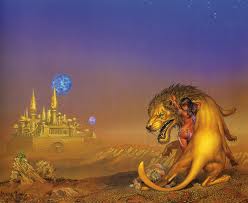
To a very large extent what became the Communist Party recognized the inequality while demanding equality against reason. Recognizing subconsciously, perhaps, that men could never be intellectual equals rather than try the futile task of raising the less fortunate they sought to destroy education which brings out the inequality but doesn’t create it. No matter what happens there are always going to be the more intelligent just as there will always be the physically stronger. As Le Bon points out, if you needed to hear it, nature don’t know from equality.
Thus the Communist Party devised the well sounding slogan- From each according to his ability; to each according to his need. Good plan for the needy, slavery for the able. The needy were organized beginning their struggle to achieve superiority by collective action. This was accomplished in Russia in 1917. The battle was joined.
Just as individuals are created with different capabilities so are peoples and races. Some can achieve and some can’t. Slotkin who must be a Communist thus takes offence at what he perceives to be, and is, an attitude of White Supremacy in Burroughs, Grant and Stoddard. While I am aware there are those who will disagree with White superiority it is nevertheless not an attitude but an evolutionary fact. That is the reason Communists have Darwin under attack. While Darwin doesn’t say it, it is the inevitable result of his studies. Just as it was necessary for the Undermen to destroy education in the hopes of creating intellectual equality so it became necessary to destroy White achievement of the last five hundred years. The whites must be demonized and made to feel evil and inferior morally. That is the import of Slotkin’s Gunfighter Nation.
At that level all three writers are guilty. As has been stated in Canadian courts- Truth is not a defense. So there’s nothing to discuss. Might is right and whoever has the might will prevail.
It is a fact that all three writers were anti-Communists so it may be assumed that whatever Communists believe, they didn’t. And why should they? Might may be right but it can still be nonsense. Communism is a flawed ideology based on a false premiss. It always fails wherever it is introduced. Failure is not evidence of a bad plan in Communist eyes. One just continues to shovel sand against the tide and pray. So succeed or fail they always think they can succeed by the same flawed ideology. The fault for failure lies elsewhere.
In that sense Burroughs was wasting his time assailing this religion of failure with his Under The Red Flag and its successor The Moon Maid. The only people who would applaud his effort would be we non-Communists but he could never convince anyone with Communist leanings. Of course that wasn’t well understood at the time.

If Burroughs were accused of not believing in equality that would be true. Not only are John Carter and Tarzan superior to any contemporaries on two worlds but Burroughs has a whole hierarchy of value. John Carter is the Warlord of Mars ruling from the top city of Mars, Helium. The races of Mars pretty much reflect those of Earth and their relative stations. The main exception is the ruling Red race. As Whites do and have existed on Mars in Burroughs stories while at one time being the dominant race perhaps the Red race is some sort of amalgam of the various Eropean immigrants of the United States. I believe the Green Men represent the American Indian. Both roam the great plains while being essentially savages.
Tarzan though always spoken of as being White is described as a bronze giant. Bronze is a fairly dark metal so that Tarzan and the Red men of Mars may be more or less identical in color.
Tarzan is the man-god so there are none superior or even equal to him. Below him come the English who are the cream of mankind. Perhaps slightly below the English are the French and then the rest of the Whites. Tarzan himself is psychologically an animal having been raised by the Apes. Not your ordinary gorilla or Chimp but a species intermediate between Gorilla and the Negro. Slotkin hasn’t read enough Burroughs to make an intelligent comment but the undeniable attitude of Burroughs is enough for Slotkin to condemn him as an unregenerate bigot. The reader may believe as he likes. I have stated my opinion eslewhere and that is enough. Whether any of these opinions of Burroughs influenced American soldiers at My Lai is open to question. The burden of proof is on Slotkin and he hasn’t provided it.
Along with the Undermen however, speaking through Tarzan, Burroughs is heartily discontented with civilization.
The spectacle of Chicago of the 1890s as a dirty unpleasant place haunts Burroughs. In contrast to the great White City of the Columbian Expo was what was afterwards known as the Black City of everyday Chicago. The contrast was so strong and so offensive to the Undermen that within a year of the Expo’s closing the entire White City was burned to the ground with the exception of one building. Hence perhaps the decayed crimson and gold ruins of Opar and the crimson and gold twin cities of Helium. One wonders what effect the sight of the ruin of the White City had on Burroughs when he revisited the site sometime after his miraculous summer of ’93. The mind creates nothing from nothing so there must have been models of the great cities of ERB’s imagination.
There are points at which Burroughs and Communism have quite similar views. It will be remembered that Burroughs only reluctantly married and throughout his life expressed discontent with the institution. To some extent or other ERB must have been an advocate of free love. Communists would have heartily approved of ERB’s women who went nude except for certain ‘adornments.’ Communists of course want women to be accesible to any man who wants them at any time while they have always advocated bare breasts.
In many ways when the Communists appropriated Tarzan for the MGM movies it took but slight changes to make Tarzan conform to their ideals. The MGM Tarzan and Jane were not married. While Burroughs’ Tarzan was a highly educated on-again off-again sophisticate the MGM Tarzan was a stupid illiterate oaf and one who rejected the attributes of civilization high up there in the Cloud Cuckoo Land of the Mutia Plateau.
On the essentials though Burroughs rejected the demands of the Underman as The Moon Maid clearly shows. There was very little in Stoddard’s The Revolt Against Civilization that Burroughs would have disagreed with. At the same time there was probably very little he didn’t already believe although he had never codified his information as Stoddard had. Slotkin’s contention that Burroughs was influenced by either Grant or Stoddard is surely wrong. ERB had already taken hs positions before either men had begun to write.
Each writer was, in his own way, an advocate of White Supremacy. It now become clear that White Supremacy has nothing to do with a fringe element in Liberal ideology. All Whites are White Supremacists in that ideology unless they reject ‘White skin privilege’ whatever that is. Ayers and Dorhn explain in their recent Race Course In White Supremacy. Interestingly constructed title. Nor as Slotkin would have it is the attitude based on mere racial pride and bigotry but on a solid record of achievement unattained by any other people. The quesiton is not was it right for some people to rule or be supreme because in the nature of things some people will rule and be supreme but which of the peoples are most qualified to be supreme.
All people have had equal opportunity so that one can only conclude that the race has gone to the most qualified participant. In the contest the Whites unified the other peoples against them as must inevitably be the consequence of being the top people. As they say, getting there is the easy part; staying there is the hard part.
Slotkin merely represents the envious losers, the Undermen. who clutch at any firebrand to burn the White House down. Who is most to be admired and emulated? Builders or destroyers?
Finis of Thuvia, Maid Of Mars Review
Post 3: A Review: The Chessmen Of Mars by Edgar Rice Burroughs
January 21, 2009
Post 3
Edgar Rice Burroughs On Mars
A Review:
The Chessmen Of Mars
by
R.E. Prindle
Nobody Gets Out Of Bantoom Alive!
Tara descends in the land of Bantoom ruled by the Kaldanes. I think the Kaldanes can be traced to Baum’s Emerald City Of Oz. In that title Baum writes of a queen who when she wished to change her hair style selected one from a number of heads, removed the head she’s wearing and places a new head on her shoulders.
Unlike the queen the heads of the Kaldanes and the bodies of the Rykors are separate entities.
The Kaldanes exist independently of the Rykors but mount their shoulders to use them essentially as slaves. When their purpose is satisfied they abandon the Rykors or bodies that then, without directing intelligence, just lie or flop around like the proverbial chicken.
The picture ERB presents of them through the first vision of them by Tara is fairly repulsive. It would by itself explain why the Post and the other slicks rejected the story.
Either I’m reading things into the story or ERB is making some very subtle examinations of certain problems troubling society. The three issues I have noted concern labor, sex and evolution.
To take the first.
In the world there are many forms of disagreeable labor that people would rather not do. Much of the industrial labor is hot, dirty and heavy with a lot of unpleasant bending and stooping. Still the job has to get done.
In England once the so-called Industrial Revolution ethos first took place a very large percentage of the work force was essentially bestialized to work the mines and factories, especially the women and children. This is an unightly and unpleasant situation.
In the US and colonial areas African slaves were imported to do the stoop labor. It should be noted as Michael Hoffman points out in his studies that White slavery preceded that of Black slavery. Even at the time of the American Revolution Hoffman found many White slaves still existing the US. A White man was sold to a Negro in Chicago in the 1840s for tweny-five cents.. Africans only gradually replaced the Whites. Thus just preceding Eli Whitney’s invention of the cotton gin after which African slavery exploded there were White slaves in the US.
Slavery is inseparable from Burroughs’ works. He can’t imagine a society without slaves. Chessmen opens explaining the relationship between Tara and her personal slave girl.
Slavery was abandoned in the US at about the same time serfdom was abolished in Europe. The Russian serfs which you can read as slaves were liberated only as the US’ own civil war was being fought. While industrial slavery is too distant in the past for us to imagine it slavery was a very recent phenomenon to Burroughs. He read. He must have been aware of Russia in which the vast majority of the population were slaves as serfs, hence Russia was up to 1861 a vast slaveocracy no different than the US South.
The question then was how to get the hard work done without slaves. The industrial system of the time merely left the population nominally free while paying very low wages making the bulk of the population actual wage slaves.
The hard labor was definitely nothing anyone who could avoid it wanted to do so the industrialists imported vast numbers of laborers at a liguistic disadvantage who then had no choice but to become wage slaves. Burroughs, very sensitive to social issues then, may have thought he was only reflecting the existing situation in his stories. After all this is the period of the horrors of the sweat shops.
This problem preoccupied society so that in 1931 a mere ten years after Chessmen Aldous Huxley wrote Brave New World that presents a different solution than ERB’s. Huxley presents a world of test tube babies in which certain poisons are placed in tubes to create chemically altered humans. The least intelligent of these were the Gammas who were given the least desirable jobs on that basis that they wouldn’t have the brains to complain.
Burroughs solution is somewhat different. The Rykors are essentially slaves; as Greek mythology put it the Rykors were mere bellies with arms and legs, lacking any intelligence whatever they were unable to complain and being deaf, dumb and blind couldn’t revolt.
The slave driver was the Kaldane on their shoulder who directed the Rykor in the unpleasant tasks without consequences to himself. When the Kaldanes came back from the fields at night they abandoned their Rykors and went about their business of thinking, fresh and without fatigue.
Thus ERB has very cleverly solved the problem of stoop labor- the labor the Kaldanes wouldn’t do.
2.
ERB also gives himself room to toy with the idea of sex. He models Bantoom after a beehive which was a common device at the time. He changes the sexual primacy by making Luud a kingbee rather than a queen bee. All the Kaldanes have been hatched from eggs laid by King Bee Luud so Luud is truly the ‘father of his country.’ The jokes are there. Whether ERB was a sly old dog or whether he just wrote this stuff with no humor prepense is up to the reader to decide. Either he was intending humor or else he was naturally one of the funniest men alive.
It seems that all Kaldanes were male while the Rykors were either male or female. Thus any Kaldane could choose to be a man or woman for the day. This may possibly refer back to Greek mythology where Teiresias was the only person who had been both a man and a woman. He was then called on to say who got more sexual pleasure men or women. He thought women definitely. Any Kaldane could have answered as well.
ERB plays with the idea briefly but doesn’t take it too far. As far as the slicks were probably concerned he had so many strikes against him they didn’t even want to look at him. Given their attitude it even seems remarkable that the pulps paid good money for the story. This is really pretty strange stuff and it keeps getting stranger. ERB just skirts the accusation of a deranged mind in this story. Times have changed, of course.
3.
Then there is the matter of the evolution of intelligence. This is a perennial topic in science fiction. At the presentt time the ultimate intellect is usually portrayed a as giant head on a spindly unathletic body incapable of much but feeding itself.
At the time it was thought that the mind and body were two separate things. In the fifties when I grew up wrestling with the idea Burroughs’ key Martian novels were available from G&D but I never read them. I was scandalized that Burroughs would write anything but Tarzan novels. It didn’t seem right to me that he would write anything else.
So, Burroughs tackles the mind/body relationship by completely separating brain and body. These brains were anaerobic, they could exist without oxygen. This was by design because when the oxygen plant will have failed and Mars changed from a dying planet to a dead one the Kaldanes were going to retire deep into the mars and live out their existence thinking. Bye bye Rykors.
ERB explains this quite succinctly. Evolution on Mars:
You do not understand…It is too big for you to grasp, but I will try to explain it. Barssom, the moons, the sun, the stars were created for a single purpose. From the beginning of time Nature has labored arduously toward the consummation of this purpose. At the very beginning things existed with life, but no brain. Gradually rudimentary nervous systems and miniscule brains evolved. Evolution proceeded. The brains became larger and more powerful. In us you see the highest development; but there are those of us who believe that there is yet another step- that some time in the far future our race shall develop into the super thing- just brain. The incubus of legs and chelae and vital organs will be removed. The future Kaldane will be nothing but a great brain. Deaf, dumb and blind it will be sealed in a great, wonderful, beautiful brain with nothing to distract it from eternal thought.
Right. I saw the movie. It was called Hitler’s Brain and it was a great one. Burroughs always seems to have figured out the entire B movie and sci-fi catalog. If I didn’t know better, and I don’t, I’d think his writings have been cribbed for the movies from his day to this. Burroughs is surely one of the most influential intellects from his time to the present. He is a baffling phenomenon, no one wants to give him credit but theyuse his ideas constantly.
The passage quoted is a fair synopsis of the course of evolution while dealing with a debating topic of his day and ours.
It’s quite clear ERB put everything he had into this effort.
4.
Having landed in a Bantoom that might be compared to Baum’s Land of the Munchkins, although a rather disquieting comparison. Baum is actually a very strange writer. the Shaggy Man Of Oz left me very uneasy. I remember as a child a woman lamenting the book because she thought it would make it easy for weird old men to lure little girls away. The book was weird as was The Emeral City Of Oz. Burroughs takes weirdness a stride or two beyond those books. There’s always this uneasy quasi-pornographic feel behind his stories.
Tara is baffled by the overseer Kaldanes and slave Rykors working in the field. She waits until nightfall to go in search of food coming very close to the hive. Burroughs will develop this image shortly in Tarzan And The Ant Men. Night falls and the Banths come out. Tara can’t understand why these Martian lions are so plentiful in the valley. Shortly she will learn the reason is that the Kaldanes throw the dead and worn out Rykors into the fields for the Banths. It’s just gruesome little details like this that probably got ERB his reputation for being too far on the edge. Doesn’t bother us though, does it?
Now, a Banth steals up on Tara but God is on her side, she’s got a head start for the ubiquitous tree. Here we have two ambivalent images in Burroughs. Tree and lions are symbols of both safety or danger.
On the one hand Burroughs finds comfort and safety in trees, most conspicuously in the Tarzan stories. There all Africa with the exception of some lands deep in the Sahara is covered by one giant forest with conviently low branches unlike the picture we see of Baobobs and whatever. Tarzan is at home in the trees moving faster and with more ease than you and I trudging along on the ground.
If there’s danger in the lower terrace Tarzan moves up to the middle terrace or even the upper terraces where the little monkeys play. If he has a quarrel with Jane he has favorite trees in which to spend the night. He is sometimes treed as he was in Tarzan At The Earth’s Core. Here Tara is treed in a close replica to the treeing of Schneider in Tarzan The Untamed.
In that story Tarzan took Schneider to an enclosed natural bowl with a creek trickling into a cave. In the center was lone tree and a hungry lion. Tarzan viciously placed Schneider in the tree. It was up to Schneider to evade the cat when thirsty finding his way back up the tree in a game of cat and mouse.
Burroughs replicates the scene here. Tara drinks from the stream then being chased up the tree by the Banth who keeps watch till morning before stalking away.
So here the tree is both safety and a trap. Perhaps as ERB’s financial troubles developed he felt like Schneider so he replicated the situation with Tara as himself.
Martian rosy fingered Dawn appears. In trying to get back to her flier Tara is captured by the Kaldanes. The episode of her capture is well done as she discovers the secret of the Kaldanes and Rykors. Her captor is a Kaldane named Ghek who is to become a principal actor in the story.
Tara’s descent into the hive gives Burroughs time to philosophize and ruminate before Tara is taken up to her near brush with a fate worse than death at the hands of the Rykor of Luud.
At the beginning of Chapter VI ERB ruminates on the rough treatment given him by the literary mavens:
What the creature had told her gave Tara of Helium food for thought. She had been taught that every created thing fulfilled some useful purpose and she tried conscientiously to discover just what was the rightful place of the kaldanes in the universal scheme of things. She knew it must have its place but what that place was it was beyond her to conceive. She had to give it up. They recalled to her mind a little group of people in Helium who had foresworn the pleasures of life in the pursuit of knowledge. They were rather patronizing in their relations with those whom they thought not so intellectual. They considered themselves quite superior. She smiled at the recollections of a remark her father had once made concerning them, to the effect that if one of them ever dropped his egotism and broke it it would take a week to fumigate Helium.
It appears that ERB is smarting from the rejection of the literary types even though he longed for their approval. ERB himself chose not to parade his knowledge as literary types are wont to do, not that I would ever do that myself, while ERB can claim to be well read while profound enough in his writing and observations.
Eugenics, for instance, was under attack from its origins although widely accepted at this time. There is something offensive about it to the human spirit while the notion would certainly be socially abused if given free rein. ERB cleverly skirts the issue here while affirming the benefical results that could be achieved. Following the above quote he notes the superb physical condition of the Rykors and says that they had been bred to perfection. In other words they are the product of eugenics the same as thoroughbred horses or pedigreed cats and dogs. Being bodies without minds, in other words not complete humans, anyone who caught it probably took no offense. The closer you get the better ERB looks.
In the descent into the hive Tara idly hums an air which completely charms Ghek who asks what the noise is that Tara is making. She then sings for him which overwhelms Ghek’s senses thereby definitely preserving her life. Impervious to female beauty Ghek is transported by music. Universal language you know.
This will figure into the story soon. Tara is expected to fatten up to make a good meal for the Kaldanes who fatten up certain Rykors to make a good lunch. Thus ERB interjects the ever present theme of cannibalism. Away from the air and sunshine Tara is pining away so she pleads to be allowed to go outside. Luud grants this. Tara tries to escape, is caught and taken to Luud to meet her fate which encounter follows shortly.
Gahan in his pursuit of Tara had fallen from his flier into the arms of the storm. This is interesting. Always heroic he was trying to rescue a companion who was caught in mooring lines flapping beneath the flier. In the effort the wind catches a line with a heavy buckle at the end giving Gahan/Burroughs the obligatory bash between the eyes. He loses his hold but rather than plunging directly to mars the wind catches him like a leaf carrying him along with it. Then after a series of ups and downs gently deposits him on the crimson sward.
Impossible you say? No, it is not. ERB refers to a story he had read somewhere at sometime in which a baby caught up by tornado had been carried miles from its home and deposited gently on the ground unhurt where it was found. These things all sound preposterous; they have happened.
In a clever handling of time differentials while Tara was going through her travails that lasted weeks Gahan at almost the same time Tara landed in Bantoom picked himself up from the sward hundreds of miles away and began walking in the direction he hoped was toward Gathol. Thus weeks later he arrives in Bantoom at the precise moment to observe Tara’s escape attempt. Not bad.
Not only that but having decided to rescue the Red Woman he didn’t then recognize he discovers the flier, kills a Banth or two and drifts, no propeller, directly over the wall of Luud encountering Ghek who fretting for his life agrees to take him to Tara on condition that he can leave with them. No problem.
As they are making this deal Tara is struggling to preserve her…oh…integrity. Luud has set his headless but magnificently built Rykor on her while always a voyeur, he watches.
Luud has a powerful mind. He has not hypnotized Tara but is able to control his brainless Rykor while not being attached. This means that by remote control he is able to connect to the spinal nerve ending of the Rykor. Good stunt.
Gahan and Ghek enter just as the Rykor is poised for the downward thrust. ERB comes close here.
Gahan is warned to avoid eye contact but fails to do so becoming hypnotized. Hypnosis is a significant theme in Burroughs’ work. In this case he seems to be influenced by George Du Maurier’s novel Trilby with its great character Svengali. In that story the heroine has no musical talent but Svengali is able to hypnotize her into becoming a second Jenny Lind. The key point is that while Trilby is singing Svengali must make eye contact from his theatre box. When contact was broken Trilby immediately began croaking not knowing a note from a hat box.
ERB does a reverse variation here. It become apparent that Gahan is entranced by Luud and all is lost. But in holding Gahan Luud had to relax his hold on his Rykor who went limp (no pun intended) releasing Tara. The quick minded Tara knowing the hold her singing had on Ghek immediately bursts into full throated song trilling out that wonderful old Martian standard- The Song Of Love.
Thus ERB reverses the Trilby/Svengali scenario. Tara’s singing dissolves Luud’s hold on Gahan and it’s all over for Luud.
An exciting chase scene and battle and the three comaradoes are drifting off to meet another fate in another freak city. This one is called Manator.
The Bantoom story thus becomes a preliminary tale to the main story.
Edgar Rice Burroughs Wrestles With Time
September 23, 2008
Edgar Rice Burroughs Wrestles With Time
by
R.E. Prindle
When the student is ready the teacher will appear.
Gnostic Wisdom
There are two major themes in Burroughs that present significant difficulties. One is his preoccupation with slavery. Slavery pervades the corpus. I haven’t begun to guess at Burroughs’ notions on slavery. The second is the wrestle Burroughs has with the concept of Time. Time is a major preoccupation of scientific thinkers.
My ideas on Burroughs ideas on Time were jelled by the following quote from ‘Understanding Media’ by Marshall McLuhan that I came across while rereading the book recently:
As a piece of technology, the clock is a machine that produces uniform seconds, minutes, and hours on an assembly-line pattern. Processed in this uniform way, time is separated from the rhythms of human experience. The mechanical clock, in short, helps to create the image of a numerically quantified and mechanical universe. It was in the world of the medieval monasteries, with their need for a rule and for synchronized order to guide communal life, that the clock started on its modern developments. Time measured not by the uniqueness of private experience but by abstract uniform units gradually pervades all sense life, much as does the technology of writing and printing. Not only work, but also eating and sleeping, came to accommodate themselves to the clock rather than to organic needs. As the pattern of arbitrary and uniform measurement of time extended itself across society, even clothing began to undergo annual alteration in a way convenient for industry. At that point, of course, mechanical measurement of time as a principle of applied knowledge joined forces with printing and asembly line as means of uniform fragmentation of processes.
While Burroughs never states his position succinctly McLuhan might have abstracted the above quote from Burroughs’ novels.
The Pellucidar series is centered on the problem of Time while Burroughs persistently dwells on the problem throughout the corpus. Mars itself is a contrast between the orbits of Earth and Mars with its two different durations of time. The lost cities of Africa are a contrast in time periods as they all exist within the present while products of a distant past, most notably the lost city of Opar that dates back to Atlantis nearly unchanged.
Tied to the concept of Time are Burroughs’ notions on evolution. The most notable novel in that line being The Land That Time Forgot. Time forgot. Time didn’t so much forget it as encapsulate a series of time periods that exist side by side.
Usually Burroughs’ ruminations are thoroughly disguised as ‘entertainment.’ If you are merely entertaining yourself by reading Burroughs you probably won’t consciously recognize the underlying examinations but you probably will be affected subconsciously. A hypnotic suggestion so to speak. After all, the stories themselves are fairly slight and yet the attention of readers from teenagers to college professors over a century now are riveted by the author.
I don’t intend to be exhaustive in this essay but I would like to concentrate on two novelistic examinations by Burroughs. The largest examination and most obvious is that of ‘Tarzan At The Earth’s Core’ and its successor ‘Tarzan The Invincible.’ The other hidden example is ‘Bridge And The Oskaloosa Kid’ also known by its published title: ‘The Oakdale Affair.’ I will begin with the latter.
I’ve written on ‘Bridge And The Oskaloosa Kid’ a couple times, one major essay being on the ezine, ERBzine, Only The Strong Survive. http://erbzine.com/mag14/1483.html . There is a great deal going on in this wonderful story that isn’t so obvious. I didn’t have that good a handle on the story although Lord knows I tried hard enough.
I was mystified by the course taken by Bridge, the Kid, the Bear, the Gypsy Girl and Hetty Penning from the Squibb Farm to the destination warehouse. There is probably a great deal of symbolism I’m still not getting but as it appears to me now Burroughs is contrasting two different kinds of time.
The journey takes a day and a night to complete by which I do not mean to say twenty-four hours of mechanical time but a physical day and night of experiential time. In other words according to McLuhan Time measured by the uniqueness of personal experience on one hand and time measured by abstract uniform units on the other.
Both the origin of the journey and its end are based on experiential time where the sun not the clock governs the actions. As darkness falls the journey through time is bisected by the passage through a town. Here experiential time is contrasted to mechanical time. That mechanical time is precisely measured according to the precepts of the efficiency expert Frederick Taylor. Indeed, within a year or so Burroughs would pen a book on the same theme entitled ‘The Efficiency Expert.’
In this book, Willie Case, a little farm boy who Gail Prim posing as a hobo had bummed from him came to town. The story involves several criminal acts and a major detective so Willie is hot to solve the case. Willie comes to town which is run by the clock. Willie has a dollar to spend. ERB accounts for each and every penny as it is spent. In a very humorous scene Willie goes into a restaurent at dinner time by the clock. In a Frederick Taylor efficient manner Willie arranges his dinner plates so that he makes the minimum moves in a most timely manner shoveling the food into his mouth in minimum time. Very efficient if ridiculous dining.
He then goes to the movies. Movies are run on a time schedule by the clock, so various aspects of rigid mechanical time are represented. As Willie leaves the theatre he spots the hobo troupe weaving through town on experiential time. No straight lines. Here the two modes of time intersect. Very cleverly done on ERB’s part. The troupe then weaves on to their destination while Willie calls the cops on a pay phone.
While one is not conscious of the two modes of time that ERB represents yet subconsciously a deepening interest is added to the story. While mystified by the action I would never have guessed the significance of the time comparisons if I hadn’t read the McLuhan passage that put things into perspective.
Also at this time ERB wrote two other investigations of Time: ‘The Efficiency Expert’ and ‘The Land That Time Forgot.’
I think his two most explicit investigations were ‘Tarzan At The Earth’s Core’ and its successor ‘Tarzan The Invincible.’
Burroughs through Tarzan seems to reject civilization. He seems to prefer experiential time to mechanical time. In Invincible he says:
Time is the essence of many things to civilized man. He fumes and frets, and reduces his mental and physical efficiency if he is not accomplishing something concrete during the passage of every minute of that medium which seems to him like a flowing river, the waters of which are utterly wasted if they are not utilized as they pass by.
His Pellucidar series creates a model to investigate the nature of Time. Pellucidar is a model of a reversed Time and Space system. The earth is essentially turned outside in replicating the exterior in a closed universe. He posits a sun suspended in the interior that is perpetually shining. While the outer earth rotates on its axis only half the surface is in light facing the sun while the other half is in darkness facing away. Thus the appearance of change which is time is obvious. In Pellucidar as the earth turns no portion of the inner world is in darkness although the perpetual shadow from the interior moon must have described a circular path.
As there is no experiential time, there is no night and day, the beings of Pellucidar have no notion of the passing of Time indeed there is no passing of Time; Time as a reality does not exist. Time is not necessary for existence; a person or thing is merely invested with a certain amount of energy. When that energy is expended the person or thing ceases to exist.
Thus, for example, when one winds a top it is invested with a certain amount of energy. At peak energy it rotates rapidly gradually slowing down into a wobble and when its energy is expended it falls over and attains perpetual rest. No time is involved although using man made mechanical means the duration of the spin can be measured.
So, in the universe at large. It is quite clear that Burroughs has Einstein in mind. In Invincible he says:
…but though Time and space go on forever, whether in curves or straight lines…
One can’t mention curved space without being familiar with Einstein. He is thus offering an alternative to Einstein’s notion of the fabric of Time and Space. There can be no fabric of time and space as time has no objective existence. It is a contruct to serve the needs of man. The sun, for instance, came into existence with a certain amount of potential energy. Barring accidents, that energy will be expended at a certain rate just like the top and when that energy is fully expended the sun will follow whatever course the death of suns follow. There is no time involved, hence no time-space continuum and no fabric of time and space.
McLuhan says essentially the same thing.
So, ‘Tarzan At The Earth’s Core’ is a demonstration of the fallacy of Einstein’s notion.
Moving on to ‘Tarzan The Invicible’ Burroughs then has Tarzan dealing with the notion of terrestrial time. As McLuhan notes, the notion of a time to eat arose with clocks; Tarzan dispenses with the notion of a time to eat eating only when he is hungry. There are no clocks in Tarzan’s Africa. As Burroughs says an individual has all the time in the world.
Of all the vast resources that Nature had placed at their disposal, she had been most profligate with Time, since she had awarded to each all that he coud use during his lifetime, no matter how extravagant of it he might be. So great was the supply of it that it could not be wasted, since there is always more, even up to the moment of death, after which it ceased, with all things, to be essential to the individual. Tantor and Tarzan were therefore wasting no time as they communed together in silent meditation.
One has all the time one needs until the day one dies then one no longer has need of time. In other words, the organism’s energy has been expended and the husk falls to earth.
So Tarzan is active when necessary, such as hunting for food or fighting and lazes around when activity is unnecessary. Perfectly balanced and happy according to Burroughs. OK for the jungle, I suppose, but I’ve got things to do such as writing stuff like this but then that is only how I dispose of the energy left in my organism during the time remaining. With other media such as electric lights I am not bound by the diurnial cycle being freed from that experiential limitation. One only has to sleep when one is tired. Time means nothing to me either. With stores open around the clock I can even buy groceries when the mood hits me. Other items can be purchased on the internet at any time of day. So, technology has freed us from many of the restraints of what civilization is pleased to call time.
So, when reading Burroughs one should always bear in mind what time means to him and how various notions of time relate to the story. Obviously in Invincible while Tarzan is attempting to live on experiential time the Revolutionaries are living by the clock and calendar. Thus the story is also the tale of the clock or two time systems.
I knew there are reasons I like Burroughs other than interesting stories; complexities like the nature of time are one of the extras if one can only discover and realize them. Now, I really have to work on the nature of slavery in the Corpus.
A Review: Bound Away: Virginia And The Westward Movement
August 29, 2008
A Review
Bound Away:
Virginia And The Westward Movement
by
David Hackett Fischer and James C. Kelly
Review by R.E. Prindle
Texts:
Grant, Madison, Conquest Of A Continent, Liberty Bell Publications, 2004, reprint 1933 original.
Fischer, David Hackett and Kelly, James C., Bound Away: Virginia And The Westward Movement, U. Virginia Press, 2000
The Middle Aged Scholar
For the student of settlement patterns in the US David Hackett Fischer is indispensable. Of the many books he’s written his 1992 Albion’s Seed is absolutely necessary. In that book he involves himself in the settlement patterns of all four strains from Great Britain. In this volume he interests himself only in the colony of Virginia. He considers immigration into Virginia, migration within Virginia and emigration from Virginia.
As Madison Grant points out in his work Virginia was the mother of States. Fischer points out the whys and hows. His work might be considered and extension of Grant’s.
The founding of Virginia was much more different and tumultuous than our school books relate. The Indians came close to expelling the Virginia colonists while the English had a very difficult time adapting to the climate. The death rate was worse than on the slave ships.
Black slavery was slow to develop in Virginia as the Aristocracy preferred White slaves, politely known as

Maturity Approaches
indentured servants. It was only when the White supply dried up that the Aristocracy turned to Africans. More than in the States of the Deep South slavery defeated the Commonwealth.
Where Whites had a difficult time surviving in the rich soils of the Tidal area Africans prospered soon significantly outnumbering the Whites.
The characteristic Virginia polity of an upper cast White Aristocracy, a small middle class, and the White and Black impoverished proletariats came into existence under Governor Berkeley in 1650 being perpetuated until the Civil War.
Between the strong White caste system and slavery the White proletariat was driven to escape by emigration. Virginia gradually became depopulated over the two hundred years before the Civil War. At that time East and West Virginia were one. A look at the map, of which the book has several, will show Virginia abutting both Kentucky and Ohio. Thus the Western exodus to those two States formed the character of one and shaped the character of the other. From Kentucky and Ohio the Virginians carried through southern Indiana and Illinois while populating several counties in Missouri that were known as Little Dixie.
With the opening of Alabama and Mississippi many Virginians chose to take their slaves and migrate in that direction.
The net effect of the migrations was that Virginia lost several representatives in Congress while losing intellectual vitality. The issue of slavery caused groups like the Quakers to leave the State and it became correspondingly hazardous to one’s health to criticize slavery.
Of course after th Civil War the descendants of the Virginians continued West into California and Oregon. Thus Virginian customs and styles found their way across country.

The Scholar At Play
After the War national immigration began in earnest with Southern and Eastern Europeans forming the bulk of it. Grant laments the diminishing of the Nordic cultural influence while Fischer wisely makes no comment even ignoring the issue concerning himself only with the movement of Virginians.
Even then there is an honesty in his work that makes one wonder how he survives in the anti-truth Liberal university system. I suppose it’s a matter of not what you say but how you say it. Knowing what to leave in and what to leave out.
At any rate for those interested in US settlement patterns I heartily recommend Madison Grant’s Conquest Of A Continent and both David Hackett Fischer’s Albions’ Seed and Outward Bound. If one then overlaps something like Carl Wittke’s We Who Built America that gives some idea of how post-1871 immigration patterns shaped twentieth century America one has a pretty fair idea of how the US developed up to the 1965 revision of the Immigration Act. After that revision a whole new pattern develops.
 I, Dynamo