Exhuming Bob 13, Fit 4: Bob As Messiah
October 14, 2008
Exhuming Bob 13
Fit 4:
Bob As Messiah
by
R.E. Prindle
The most difficult thing on earth is to believe in something that is palpably untrue. “We must respect the other fellow’s religion but only in the sense and to the extent that we do his theory that his wife is beautiful and his children smart.”
– H.L. Mencken
I become my own enemy the moment that I preach.
– Bob Dylan

Religion is palpably untrue whether it be Christianity, Judaism or Moslemism. The fundamentalist religious attitude is the enemy of reason and hence the mental development of mankind. Such an attitude no longer has any place in society. Nevertheless its influence lingers on like some spectre from the crypt of human consciousness.
Part and parcel of religious fundamentalism is the notion of an external redeemer or messiah. As the Piscean Age began society fixed itself on the notion that since individuals could not alter their behavior a redeemer or messiah would arise who would redeem their errant behavior. While the notion was endemic in the ancient world at this change from the Arien to Piscean ages it found its purest expression among the Jews.
While the Jews did not fix on any one exemplar as the Messiah the Western world did. Thus Jesus became the sole exemplar of a Messiah for them as they expectantly awaited his second coming.
Christianity is at its bottom an offshoot of Judaism as is the later Arab edition of the Semitic religious group, Moslemism. Both Judaism and Moslemism have a rather fluid notion of messianism. Anyone may declare himself a messiah in Judaism as in Moslemism. In Moslemism the messiah goes by the name of the Mahdi or Expected One.
Over the centuries innumerable messiahs and mahdis have appeared, failed and disappeared while the Christian world of the West patiently awaited the return of its Jesus. It’s been a long wait and it probably won’t end too soon.
The appeal of messianism is very strong for the individual. I would imagine that every boy with a Christian or Jewish upbringing has wondered whether he might be the embodiment of Jesus as the second coming or the Messiah to redeem the people. As always Jewish claimants proliferate. If he is not disabused of the notion by adolescence he could probably be found wandering around the insane asylum with the many other imitations of Christ.
In the Eastern world such is not the case. While weak personalities go under strong personalities may very well impress their fantasy on society although invariably with disastrous results. Bob’s Jewish namesake, Sabbatai Zevi, was one of these who flourished in the seventeenth century. Sigmund Freud was one in the last century.
Naturally in the conflict between imagined anointment and actual realities a dual personality must come into existence, thus we have, for instance, Bobby Zimmerman and his alter ego Bob Dylan. Beginning in the nineteenth century when science began to challenge societal religious fantasies dual personalities became more common or, at least, became more prominent in literature.
Literature is full of dual personalities from the Dupin and the narrator of Poe through the Scarlet Pimpernel, Sherlock Holmes and Moriarty, Dr. Jekyll and Mr. Hyde and a much longer list. One of the more amazing examples is Bobby Zimmerman/Bob Dylan the little Jewish kid and the quasi-Cowboy pop star. Throughout his career Bob has wavered between the two, now one, now the other. In the late seventies and early eighties he appeared to embrace Christianity for a few years and then abruptly returned to that of the Orthodox Lubavitcher Jew. Just recently he passed through a Cowboy phase and now, as per this recent picture he has re-emerged as a Hebrew prophet complete with peyos and a vaguely demented look like some ancient Ezekiel or Jeremiah. (go to touchingtheelephant.wordpress.com Bob Dylan Marchin’ To The City)
Disquisitions such as this will disturb the equanimity of religious fundamentalists.
Will Bob now regale us with Jeremiads as he preached to us in 1980? To find that answer one must go back to the now ancient past in the little Minnesota town of Hibbing up on the Iron Range.
Bob’s memories of the North Country are as dualistic as his personality. He speaks of bittler cold winters, so cold that one slept in multiple layers of clothes and summers so swelteringly hot and humid as to be in the Great Dismal Swamp.
And then he was Jewish in what has been characterized as a predominantly Catholic town. A small Jewish island in a sea of foreign culture. In those postwar days when his Jews lived in trembling fear of an impossible American Nazi holocaust. Jews hid their origins and culture as much as possible denying their religion and seeking to blend in as seamlessly as chameleons. Thus it was as young Bobby Zimmerman entered high school. Then in 1956 as he approached the massive front doors of his high school the Jews of the eight year old State of Israel fought a lightning war with the surrounding Arabs. Instead of being driven into the sea sas the Arabs propesied they themselves were humiliated and driven back. How now? The Jews became assertive in their identity emerging to challenge the dominant culture for supremacy. They ceased to be humble, hence, the sixties.
Already masters of Hibbing’s retail district one imagines they began to flex their muscles without fear of gas chambers. Foremost among them, the President of the local chapter of B’nai B’rith and the ADL, was little Bobby Zimmerman’s own father, Abram. Abram took to smoking huge black cigars, a sure sign of aggressive manhood.
Years later when Bob Dylan had immured Bobby Zimmerman behind walls like in Poe’s Cask of Amontillado, Bob Dylan would return to Hibbing and combine the two images of his childhood of the two Zimmermans as he sat on a motorcycle on a corner smoking an immense black cigar. What vision of vengeance was this? As one of his cowboy heroes, Hank Snow, sang: I’ve got a troubled mind.
Bob’s father Abram viewed himself as something of a Jewish scholar. He had a bent toward the Orthodox even toward the Lubavitcher. In 1954 as his son’s Bar Mitzvah approached he sent for a Lubavitcher Rabbi to instruct his son in the puerilities of the Lubavitcher approach to Judaism. The Rabbi, one Reuben Maier, was undoubtedly brought to Hibbing on a one year trial contract. When the year was up and the congregation had rejected him he left.
In telling of his Bar Mitzvah indoctrination Bob dramtizes Rabbi Maier’s arrival as a mystery with himself as the messianic center of the mystery. As he tells it one day a Greyhound bus ground to a stop at the Hibbing terminal; the Rabbi stepped off and said: Where’s Bobby Zimmerman, I’m here to indoctrinate him into the Lubavitcher mysteries. I exaggerate for effect of course but true to the spirit. Then having taught Bobby what he was supposed to learn he reboarded the bus and disappeared down Highway 61 as mysteriously as he arrived. It could have seemed that way to a thirteen year old. The key point is that Bobby learned what the Rabbi had to teach. As Bob said he taught him what he had to know.
If the accounts are correct Bobby Zimmerman’s was the first Bar Mitzvah in town for several years and it was huge. Four hundred or more people were in attendance. One assumes that the loot collected was beyond the avarice of the average thirteen year old. Bob boasted of the Bar Mitzvah for years.
But of more importance for us is what information Rabbi Reuben imparted to Bob. I have pointed out in Fit 2 that Rabbi Maier was associated with Rabbi Schneerson in Brooklyn, New York. Schneerson had strong notions of the superiority of the Jew to all other peoples while having a strong notion of the messianic nature of Judaism in bringing the word of the Jewish god to the peoples. This is absolutely undeniable and calling someone who tells the truth to you an anti-Semite will not change the truth. Such an accusation only makes the accuser look an ignoramus.
It would seem to follow then that Rabbi Maier could teach his young disciple nothing other than the prevailing Lubavitcher doctrines of Rabbi Schneerson.
Indeed in later life Bob Dylan would write the symbolical song Quinn The Eskimo while after his Christian stint say words to the effect: ‘You know what? Things are going to fall apart and all peoples are going to run to the Jews to save them. But, guess what, the Jews won’t be able to do it because they haven’t lived according to the Law.’ Sounds just like the Protocols, doesn’t it, Sean?
Now, where do you suppose Bob would pick up an idea like that?
Enduring heavy Jewish indoctrination during his high school years Bob was also conflicted by his immersion in the dominant culture thus contributing to his dual personality. Thus we have Cowboy Bob who listened to endless hours of Country and Western and we have Rabbi Bob using his pulpit to preach Jewish tenets, whether in Christian form or not, to what passed for his faithful.
Starting from a low base Bob was actually to gather a following of millions as of this date. Many if not most of them see him as either a Christian savior or a Jewish messiah.
Young Bobby Zimmerman left Hibbing in a state of Mixed Up Confusion that it would take him decades to order as much as he ever has.
I hope I haven’t unduly offended anyone but the fanatics to this point. They will always scream anti-Semite at anyone who challenges their cherished fantasies. They are religious fundamentalists and are to be scorned by any intelligent people. Disrgard them. Laugh at them. If the reader will find the story anti-Semitic then all I can say is that he or she find the truth anti-Semitic.
Owls- they whinny down the night;
Bats go zigzag by.
Ambushed in shadow beyond sight
The outlaws lie.
Old gods, tamed to silence, there
In the wet woods they lurk,
Greedy of human stuff to snare
in nets of murk.
Look up, else your eye will drown
In a moving sea of black;
Between the tree-tops, upside down,
Goes the sky-track.
Look up, else your feet will stray
Into that ambuscade
Where spider-like they trap their prey
With webs of shade.
For though creeds whirl away in dust,
Faith dies and men forget,
These aged gods of power and lust
Cling to life yet-
Old gods almost dead, malign,
Starving for unpaid dues;
Incense and fire, salt, blood and wine
And a drumming muse,
Banished to woods and a sickly moon,
Shrunk to mere bogey things,
Who spoke with thunder once at noon
To prostrate kings:
With thunder from an open sky
To warrior, virgin, priest,
Bowing in fear with a dazzled eye
Toward the dreaded East-
Proud gods, humbled, sunk so low,
Living with ghosts, and ghouls,
And ghosts of ghosts, and last year’s snow
And Dead Toadstools.
Outlaws by Robert Graves.
Fit 5 follows in another post.
Bob
Exhuming Bob 13, Fit 3: Bob As Messiah
October 13, 2008
Exhuming Bob 13
Fit 3;
Bob As Messiah
by
R.E. Prindle
What was really an innocent exploration of Bob’s religious development is being given a sinsiter cast by various elements with an apparent axe to grind.
The latest to join the fray is something called Mick Hartley: Politics and Culture. It goes on this way:
As David T. at Harry’s Place publicises a forthcoming conference at Goldsmith’s, University of London, on Jews and anti-semitism, it’s interesting to note the odd places where you find anti-semitism cropping up nowadays. Expecting Rain as anyone who follows Bob Dylan’s career will know, is a website which provides daily links to all things Bob: concert and record reviews, articles, whatever. There is, of course, no presumption that every article they link to is something they agree with or aprove of, but, as RightWingBob notes, it was nevertheless extremely odd to see them linking last Thursday to this piece, “Exhuming Bob X: Lubavitcher Bob.”
One would have to obsessed with anti-Semitism to find it in my scholarly essay. Coded in the above quote is the notion that Andersen’s site, an aggregator, Expecting Rain, and my site, I, Dynamo, colluded to publish this ‘anti-Semitic’ essay on the first day of the Jewish New Year, or Yom Kippur in Jewish parlance. This notion was put forward by Sean Curwyn and his alter ego Dov Kerner on his RightWingBob site. This is what is known as a paranoid delusion in psycho-analytical circles.
Curwyn and Kerner note that my essay was written in June and they think cleverly withheld until Yom Kipper when apparently as they believe as some sort of insult to the Jews Expecting Rain and I, Dynamo in collusion published it. Karl Andersen who runs his site and I mine don’t even know each other and have never communicated about anything except contributions and that in the most perfunctory manner.
While it is true that I wrote the essay in June it was only in October that I suggested the link to Expecting Rain. I only became familiar with the aggregator a couple months ago after I wrote the essay. Since then I have been a regular contributor to the site.
So, this October I decided to suggest the link to ER as I thought it a very thoughtful essay on Bob’s religious attitude. As Monday through Thursday have the heaviest traffic on ER I waited until Monday afternoon to submit the link. As it happened Monday was a heavy newsday for ER which listed 30 links therefore excluding mine as a late submission. ER carried it over using it on Tuesday which was a slow newsday.
I doubt very seriously whether Karl Andersen was aware of when Yom Kippur was and I sure as heck didn’t know so if the essay was published on Yom Kippur there was no conspiracy to do so. But as conspiracy theorists have no trouble making non-existent connections Messers Kerner, Curwyn and Hartley see the ugly head of anti-Semitism looming above the horizon like Fantomas over Paris.
My compassion and pity goes out to them. I hope they get well soon. It is too bad Mr. Hartley who read psychology at Oxford (in England not Mississippi) became disillusioned with the discipline; all three need it badly. Should they enter an analyst’s office the term they should employ in seeking help is…paranoid delusion.
Fit 4 will follow in another posting.
Exhuming Bob 13, Fits 1 & 2: Bob As Messiah
October 12, 2008
Exhuming Bob
Fits 1 & 2:
Bob As Messiah
by
R.E. Prindle
The scientist who yields anything to theology, however slight, is yielding to ignorance and false pretenses; and as certainly as if he granted that a horse-hair put into a bottle of water will turn into a snake.
– H.L. Mencken
I had planned to write further on Bob’s religious development after ‘Lubatitcher Bob’ at some time but the row caused by Sean Curnyn of Right Wing Bob has focused my mind wondrously.
Before getting to Bob per se I will have to discuss the flap caused by Curnyn who is something of a sidewinder. Basically this is a contest between religious superstition and scientific investigation. Facts conflict with belief and in the resolution one or the other has to give. Since superstition cannot stand up to fact religion has to be the loser whatever name it goes by. No matter how many violent names you call the scientist the facts remain the same.
Curnyns vitriol can be found in full at his site: http://rightwingbob.com.
I quote relevant parts below:
I didn’t happen to notice it yesterday (no date but probably 10/10/08) but it was brought to my attention in an email last night by reader Dovid (Dovid not David) Kerner, who tells me that he sent the following to the webmaster of ‘Expecting Rain’, Karl Erik Andersen.
Regarding your printing the link to Exhuming Bob X: Lubavitcher Bob.
I love your website but this one shouldn’t have been printed- it’s really written with an violent anti-Jewish slant. Here’s the reply I left on the site.
<<Is it true that as you say there is “a Jewish world organization” which realized they had something in Bob Dylan and gave him maximum publicity?
And are the Jews taught, as you write, that they “are to rule the world and the peoples?” Or does the biblical term “chosen people” mean that Jews are to set an example for the rest of humanity? (I just finished a whole day in synagogue (Yom Kipper) and I don’t recall praying for Jews to rule the world.)
Your claims sound vaguely familiar- The Protocols ring a bell here.
Shalom and Happy New Year.
Dovid >>
I think you (expectingrain) should put an apology/warning to your readers regarding the matter.
Otherwise, thank you and keep up the great work.
As of this time of writing, the gjy who posted the orignal article hasn’t published Dovid’s comment (which really doesn’t suprise and the guy deserves to be ignored) and Karl Erik has not either taken down the link to the anti-semitic article, nor added any note about it. This disappoints.
Well and good. But this Dovid Kerner fellow, if there is one and he isn’t Sean Curnyn, lied about making a response on my site, I, Dynamo. He didn’t do it, hence no reply.
Sean Curnyn did leave a cryptic comment on my site that said nothing. I decided to check into his site. Lo and behold I found the above denunciation. When I checked Curnyn’s site for a response box I found to my dismay that there wasn’t one. Curnyn is apparently so insecure that he doesn’t welcome comments. Might be critical of him, I suppose. However, I did find an email address tucked away in an obscure place with a warning that he might publish emails. I had no choice but to ignore the warning and send him an email.
My first follows:
Dear Sir or Madam:
I received your cryptic message to my posting, Lubavitcher Bob, and have permitted it as I do all postings. You say that your reader Dovid Kerner left a comment on the LB posting. Maybe he thought he did but yours is the first notice I’ve received.
My suggestion is that you leave a response on the LB posting so that it can be responded to and that the readers may be informed of the dialogue rather than this sort of sneak email attack you’re undertaken.
I will say at this time that you apparently know nothing of either religion or Judaism or you wouldn’t make the silly comments you’ve posted on your website Right Wing Bob.
If it is any help to you I have sat through many hours of synagogue and am quite familiar with the content of the sermons.
The purpose of my essay that expecting rain courageously, apparently, published, is an attempt to get to the bottom of Bob’s career and what it means. If you disagree with me and wish to start a dialogue respond in the comments to my posting. If you don’t post I will have no choice but to think you are a coward and obscurantist. Your reader Dovid Kerner is welcome to join in if he has the courage. So far he has misrepresented to you and you have misrepresented to your readers that I have refused to reply to him.
I demand an apology and retraction which I know your kind never gives.
Thank you for time and attention.
R.E. Prindle
As you can see I openly challenged Both Kerner and Curnyn to respond and that I would reply.
Naturally neither did. I received no apology or retraction. I sent a second email:
Dear Sir or Madam:
I have just rechecked your site and find no apology or retraction and you have left the false posting on your site.
I’m tapping my foot, Sir or Madam. My patience is wearing thin. Get on it.
R.E. Prindle
Still no response. I sent a 3rd email:
Dear Sir or Madam:
You have now had several hours to apologize, issue a retraction and remove the slanderous post from your site. As you apparently refuse to right your wrong that you have committed against me I have no choice but to believe that you and Dovid Kernen are in collusion to defame me.
Your characterization of Lubavitcher Bob as ‘a piece of screwball Jew-hating screed’ is offensive and unintellectual in the extreme. Such filth is apparently characteristic of you and your site. As usual with those of your ilk you refuse to answer to the content of my essay and resort to ad hominem defamation.
Your kind disgust me.
I now feel free to write a rebuttal and expose you for the anti-social left-wing bigot that you are.
You are a disgrace to the internet.
R.E. Prindle
As of this date (10/12/08) I have received no reply from either party. I don’t expect to. That is the background. I will now attempt to refute Kerner and Cronyn’s defamations.
Fit 2.
The boys from Right Wing Bob seem to have been expecially offended by my notion of an International, world, or global Jewish organization. I am absolutely astonished that they think, or pretend to, that one doesn’t exist. All religions have a central authority.
Let us consider the Moslems first. Mecca is the world center of Moslemism to which all Moslems are expected to make a pilgrimage to look at the meteorite at least once in their life. While unity is not conspicuous in developed religions, yet the Arabs of the Arabian peninsula generally have charge of the Moslem religion. The Saudi Princes are directing the worldwide proselytization efforts of the religion.
Now as to Christianity in its two forms with which we are most familiar, Roman Catholicism and Protestantism. I am not well informed on the conditions or intent of the Greek or Russian Orthodox churches.
Roman Catholicism like Moslemism is a global organization exercising some sort of authority over the faithful in all its dominions from its global administration center in the Vatican near Rome. Like the Moslems its goal is to convert all people of whatever relgious stripe to its faith.
The Protestants while splintered have their various administrative headquarters from whch they seek to proselytize the world.
The parent organization for Moslemism and Christianity is Judaism. Together these three religions form the Semitic group of religions.
If the former two didn’t borrow their organizational ideas from Judaism that would be odd indeed. Failing that one would think that Judaism would conform to its offspring and organize internationally along the same lines. if fact, they always have. Why Messers Kerner and Curnyn are offended by the notion and wish to deny the obvious baffles me. That they should respond to the innocuous suggestion by defaming me as an anti-Semite does not speak well for either their breeding or intelligence.
Judaism’s two sister religions are intent on proselytizing the world. Once completed the Moslem Arabs would be the directors of the theocratic state as a superior people. Christianity’s Roman Catholic priesthood would enjoy the favored position if it achieved its goal. Under Judaism the reward for having brought mankind to thier vision of God would also, as a nation of priests, be to administer the affairs of mankind. What could be more obvious? That is the meaning of the phrase, a nation of priests. That is what it means to be ‘the Chosen People.’ What else could it mean?
Moslems and Christians wish to proselytize while Jews don’t. I hope Messers Kerner and Curnyn won’t disagree with that and won’t call me all the terrible names they can imagine because I point out this obvious fact. Therefore the Jews have to establish their priestly dominion by other means. They must persuade in some form or manner the peoples to accept their leadership or dominance. this has always been the thrust of Messianic Jewish politics.
In 1972 Naomi Cohen published a history of The American Jewish Committee entitled; Not Free To Desist: The American Jewish Committee 1906-66. The meaning of the title is that Jews are Not Free To Desist from the task of achieving the goal of establishing the priesthood over the peoples. No one individual is expected to complete the task in their lifetime but none are free to desist from moving it along.
Messers Kerner and Curnyn can deny this if they wish but to do so is to be merely perverse.
Now, to be the Chosen of God must necessarily imply that the Chosen are better people than the rest and are therefore entitled to rule. Indeed, Even Kerner admits this when he says: ‘Or does the biblical term ‘chosen people’ mean that Jews are to set an example for the rest of mankind?’ To set an example is to be better so Dov defeats his criticism of me.
The Rabbi who instructed Bob was undoubtedly a Lubavitcher from Brooklyn. The leader of the Lubavitchers was a man named Rabbi Schneerson. We are informed that Rabbi Schneerson in addition to being a great religious Rabbinical scholar also had scientific degrees from secular universities. Back in the forties of the last century genetics seemed to have been his forte because he asserted with great confidence that Jews had a special gene that made them more intelligent than any other people in the world. Undoubtedly that was how they intended to set an example for the rest of humanity. Thus Jews were singled out not only by God as the Chosen of Heaven but by evolution right down here on earth.
So, while I appreciate that Curnyn may believe my essay ‘a piect of screwball Jew-hating screed’ I have to say that Sean Curnyn is an ignoramus of the first water without either the background or education to understand what I am saying. Indeed, as the Bobber says: ‘don’t criticize what you can’t understand.’ Kerner and Curnyn should heed the Bob’s advice.
But as to Bob and Rabbi Reuben Maier who as a Lubavitcher was educated by Rabbi Schneerson.
Fits 3 & 4 follow in another posting.
A Review: Martin Scorsese’s No Direction Home
September 20, 2008
Greil Marcus, Bob Dylan And Martin Scorsese
A Review of the Movie
No Direction Home by Martin Scorsese
by
R.E. Prindle
Texts:
Scorsese, Martin: No Direction Home- A Film
Marcus, Greil: http://www.powells.com/essays/marcus.html
I’m not the only one that shakes his head over the rants of Greil Marcus. The perspective he’s coming from deserves some attention. Greil Marcus in the disciple, probably the successor. of the decadent leader of the Situationist International, Guy Debord.
The SI is a crank organization. Like Hitler they place a lot of emphasis on architecture. Architecture seems to go with the totalitarian personality. Unlike Hitler whose goal was a Roman grandiosity to match his Thousand Year Reich, we can’t be sure what SI architecture would be like other than ‘human to make people happy.’ In other words Debord found fault with architecture that the majority were happy with but displeased him. He seemed to think that he could create some stunning new architecture that might please someone other than himself. We all know how hard a feat that is.
But he ranted and raved actually being influential in the moronic disturbances in France in 1968. Whatever beauty he proposed we’re still waiting to see. Greil Marcus still thinks the ability of the SI to transform God, life and beauty is within his grasp. He runs around America at the public expense trying to drum up the Revolution. Bob Dylan seems to be the centerpiece of his plans. Greil’s reaction to Martin Scorcese’s Dylan movie might then be a little more understandable.
As film biographies go, and they don’t go very well on average, I thought Scorsese’s effort made the most of not too much. After all there is really very little earth shattering in the career of Bob Dylan. Greil thinks Bob brought in something new; at best Bob just brought in something a little different no matter how startling it seemed from the perspective of the times. From the perspective of this time one wonders what the fuss was all about. Nevertheless Scorcese maintained a nice tension of interest. But not for Greil.
Martin Scorsese’s Dylan documentary- a shape-shifting assemblage of 1950s and 1960s film footage, still photos, strange music, and interviews with Dylan and compatriots conducted over the past years by Dylan’s manager, Jeff Rosen- never holds still, it allows, say, the Irish folksinger Liam Clancy, telling stories of Dylan in Greenwich Village, to contradict Dylan telling his own stories about the same thing; the film contradicts itself. There is nothing definitive here; within the film there is not a single version of a single song that runs from beginning to end.
So now we’re essentially back to Guy Debord’s SI architecture argument. Whatever has been created is no good and must be replaced by Debord’s ideas which unfortunately for us we cannot evaluate because Debord gave no examples. It doesn’t really matter, of course, because if he did their ‘definitive’ beauty and utility would not be, perhaps, so apparent to the rest of us as it was to him.
So, as Debord’s successor Marcus implies that Scorsese has made a movie as ugly as the architecture that Debord and presumably Marcus despises. The implication is the Greil would have done much better.
You can imagine Rosen driving up to Scorsese’s door with a truck and dumping thousands of pounds of books, interview tapes, film reels, loose photographs, a complete collection of Dylan albums along with a few hundred or a few thousand bootlegs, and then leaving, trusting that a fan who also knows how to make a movie to make you watch…could wave his hands and just like that a movie would emerge…
Well, why not? I’m not aware of Scorsese’s process but a very fine movie of its type does emerge. With unerring insight Scorsese seeks out key influences, the most important artists in Dylan’s life, introduces them to the viewer, very likely for the first time, and brings some coherence into the Dylan story. It’s only a movie though, no substitute for study.
I do not consider it a fault that Scorsese presents all the high points covered by the four main biographies. His purpose seems to be to cover the years from Dylan’s high school beginnings to Bob’s nervous breakdown in 1966 which he does. Although already a long film it is never boring while to cover more ground it would be necessary to condense and eliminate to add anything beyond 1966 making the film unintelligible- something like Greil’s own prose. Of course, the Situationist International that believes in magic might be able to snap its fingers and make it happen, although I think their blank screen notion might be easier to conceive than something with content. Besides I don’t believe in magic.
Greil apparently doesn’t believe in differences of opinion or else he feels that loyalty to his ideal requires everyone to ask what Bob said and confirm it. Marcusian version of freedom of speech.
As it is I thought Scorcese very skillfully selected song snippets to bring out the very best of artists like Hank Williams, John Jacob Niles, Makem and the Clancys and others. His interviews with Dave Van Ronk, Liam Clancy, John Cohen and Suze Rotolo were apt and to the point presenting each as attractively as possible.
I mean Bob left some bad vibes behind that were not accentuated, nay, even glossed over.
The key point of the movie was the actual monologue or dialogue carried on with a very careworn looking Dylan. Time has treated him fairly viciously. Bob revealed himself as much as a modest man could. There was very little braggadocio while Bob explained himself in a very natural droll manner. He was much more charming than first person reports of him would lead you to believe.
Of course, Greil is fixated on what he considers the revolutionary break with the Folk Tradition with Bob as the Promethean figure bringing electricity to ‘weird old America.’
Greil apparently believes we viewer have been hoodwinked by Scorsese of malevolent intent as a result.
So you enter the movie with your ideas suspended and your prejudices disarmed, thrown back- eager to be moved- as in moved from one place to another- as you were. You’ve been set up; you’re ready for anything. You’ll buy whatever the movie is selling.
But by the end- when the film has taken the viewer from Dylan’s childhood to those halcyon days in the spring of 1966, then cutting the story off, cold, with just a little card to indicate that the story went on, Bob Dylan continued to do various things, but it’s not the movie’s problem so good night- you don’t know how it got to “Like A Rolling Stone” starting up on stage one more time.
By this point Marcus has divorced himself from reality and vanished into the pure rhetoric of his armed prejudices. He’s no longer talking about the content of Scorsese’s movie. Greil is contrasting the movie he thinks he would have made, Debordian architecture, with the movie or architecture that actually exists. An inability to perceive reality that is quite mad in its own way.
It’s what the Jews call building a fence around Torah. A mad attempt to prevent reality from disturbing the lovely inner version of not only the way they think things could be but shoud be. Once again as with Debordian architecture or Marcus’ movie not a vision likely to be shared by many others. One’s private dreams never would be.
Greil even disagrees with Scorsese’s title in a rather vehement way:
…despite that title, “No Direction Home,” from Dylan’s greatest hit, “Like A Rolling Stone”- already used as a title for Robert Shelton’s 1986 Dylan biography- such a cliche, isolated like that, so “On The Road”, so “it’s the journey, not the destination,” so corny.
LOL. I suppose so, but it didn’t bother me nor affect my enjoyment of the movie. The running interview with Dylan unifies the movie while giving us an open window to Bob’s motivations and the working of his mind. While no song was finished Scorcese has great taste and selected the most moving passages from the songs he showed displaying the remarkable vocal talents of the singers. I was astonished at the mad approach of John Jacob Niles with its odd setting of his auditors standing over him as he sang. I melted before Tommy Makem’s rendition of the Butcher Boy. (Don’t know the real title.) while the Clancys were superb. I’d heard all these artists on record before but the recordings lost all the dynamics of the performances. Even the old Red Pete Seeger really put his song across live. The New Lost City Ramblers unfortunately were as stiff as their recordings.
By this time I suppose most people reading this have seen Scorsese’s movie but for those Dylan fans who haven’t the movie is highly recommended.
As for Greil I can only cite the words of the old Children’s game: Greil Marcus, Greil Marcus, come out, come out, from wherever you are.
A Review: Conquest Of A Continent by Madison Grant
August 4, 2008
A Review
Conquest Of A Continent
by
Madison Grant
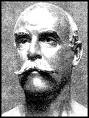
Madison Grant
Review by R.E. Prindle
Texts:
Grant, Madison, Conquest Of A Continent, Liberty Bell Publications, 2004. Reprint of 1933 Edition
Fischer, David Hackett, Albion’s Seed: Four British Folkways In America, Oxford, 1991
Higham, John, Strangers In The Land: Patterns Of American Nativism 1860-1925 Rutgers U. Press 1955
Myers, Gustavus, History Of Bigotry In The United States, Random House, 1943
Wittke, Carl, We Who Built America: The Saga Of The Immigrant, Case Western Reserve, 1939
In the immediacy of the moment one frequently overlooks or forgets the history leading up to the moment. One might think for instance that the current flap over Diversity and Multi-Culturalism is a recent occurrence. While the two terms are of recent provenance the argument under different names goes back much farther while the protagonists are essentially the same.
The story of immigration into America is almost always told from the point of view of the immigrant. Few books tell the tale from the Nativist point of view and they are universally and viciously derided as a tale told by bigoted idiots. While charity is demanded from the Nativists none is to be expected from the immigrationists.
Thus we get volumes like Strangers In The Land by John Higham and Carl Wittke’s We Who Built America that distort the issue in favor of immigrants while deprecating the Natives.
Qustavus Myers’ History Of Bigotry In The United States on the other hand appears to be a willful misunderstanding of the nature of the relative status between immigrant and native resulting in a slanderous approach like that of the contemporary Greil Marcus.
Conquest Of A Continent has been placed on the Jewish Index Of Anti-Semitic Books. Based on that I expected a detailed derogatory examination of the Jews from their entry into America perhaps being the conquerors referred to. The President of the American Jewish Committee sent a letter to every Jewish publisher in the United States demanding that they refrain from either reviewing the book or noticing it at all. Dynamic silence was to prevail.
After reading Conquest I can only conclude that the AJC was hyper sensitive to a degree. Since his 1916 Passing Of The Great Race Mr. Grant had learned that ‘You Don’t Mess With Rohan’ to quote Adam Sandler. Grant all but ignores the Jews in his volume. No, his offense, according to the AJC was even more egregious, he uses the world Nordic and dares to imply that they are ‘the Great Race’ rather than the AJC’s own Semites.
The other volumes mentioned and, indeed, all writing in this genre which is pretty extensive, defers to the Jews as ‘the Great Race’ probably genetically superior to all others.
So Madison Grant is interested in telling the story of how the Nordic race conquered the continent. This approach can only be considered as a sin by non-Nordics. Grant then tells the story of how the US and Canada were occupied by peoples other than the native Indians.
He begins early referring to twelfth century attempts to settle by Scandinavians. In the 1100s the firece native Indians were able to exterminate the invaders and may well have been able to exterminate the Puritan settlers but for the fact that a small pox epidemic shortly before the Puritan arrival had reduced the native population by as much as half while weakening them concomitantly. Such is the luck of the draw.
Grant thus traces immingration back to its origins colony by colony and then State by State as the Nordics moved Westward.
David Fischer in his excellent Albion’s Seed retraces the same ground fifty years after Grant with much addional detail concerning the places of origin and their activities once in the US.
Grant’s approach is in some ways superior to that of Fischer since as an unabashed Nordic advocate he is interested in detailing the exact racial content of the occupation of the various states and provinces. If you aren’t aware of the progress of settlement and by whom there are numerous surprises. My own notions were certainly vaguer before I read Grant.
I was surprised at the seeming numerical superiority of Southern migrants in the Westward movement. It seems that Whites did not like to live in the South where they were compelled to compete with slave labor while being despised by both the plantation owners and their slaves. Thus there was a constant stream of the best and brightest of the South moving into the North and West. As Grant notes, Virginia was the mother of States.
Then too some of Grant’s population statistics are of interest also. At the 1790 census before the invention of the cotton gin in 1793 there were less than a million Africans in the United States. Seventy years later as the Civil War began the number had increased to four and a half million. Thus natural increase was out of the question. It follows then that between 1800 and 1860 more Africans were brought to the US than there were before 1800. As a result the slave trade fluorished more than ever.
Prior to 1800 Alabama and Mississippi had no settlers so that in 1860 these two States were still rough frontier States still in a state of organization.
There is much good background here as to how the US came under settlement. The continent was accupied in its entirely when the truly major immigration from Eastern and Southern Europe began to accelerate in the 1870s and 1880s changing the basic Nordic institutions of the country. The change in Grant’s eyes was much for the worse.
Carl Wittke’s We Who Built America published in 1939 was undoubtedly in response to Grant’s Conquest Of A Continet. Wittke, was published by Case Western Reserve University. Grant explains the meaning of The Western Reserve which has always puzzled me. The Western Reserve was three million acres set aside as a concession to the State of Connecticut for giving up other territorial rights.
Wittke made a great impression with his his volume, his opinions being taken as overriding fact. I remember my sixth grade teacher in Michigan lauding the book to the skies. I finally read it a couple years ago. Not so much.
As is usual with books and writers of this type Wittke overstates his case and underproves his facts. A contribution to the dialogue at best.
Grant’s book should prove useful to any unbiased reader. If his attitude of Nordic superiority offends you, ignore it. His history as history is sound. For those of you reared on Myer’s History of Bigory attitude you will probably be surprised to find that there is another point of view. Bigotry is not a matter solely of American destestation of immigrants as the program of Diversity and Multi-Culturalism indicates, bigotry is a red herring and not the issue. The issue is who will be Top Race. The contestants for the Top Spot have turned out to be the Africans, Semites (both Jews and Arab Moslems) Hispanics, Chinese and Euro-Americans. (Grant’s Nordics) As you can see race has replaced nationalism.
The contest is real and ongoing. Peace is merely another form of war. The prize will go to who wants it the most. If you don’t see the contest in these terms I suggest you remove your rose colored glasses.
Exhuming Bob IX, Pensees 7: Into The Lost Land
July 6, 2008
Exhuming Bob IX, Pensees 7:
Into The Lost Land
by
R.E. Prindle
Texts:
Dylan, Bob, Chronicles Vol. I, Simon And Schuster, 2004
Prindle, R.E. Exhuming Bob, VIII The Walls Of Red Wing, idynamo,wordpress.com 2008
Thompson, Toby, Positively Main Street, U. Minnesota, 2008, reprint from 1971
http://www.hibbing.org/dylan1/story.html Life In Hibbing: Hibbing Chamber Of Commerce
http://www.interferenza.com/bcs/interw/85-dec.htm Bob Dylan Is Not Like A Rolling Stone Interview, Spin Magazine, Volume One, Number Eight, December 1985
http://www.interferenza.com/bcs/interw/play78.htm Playboy Interview: Bob Dylan 1978
http://www.interferenza.com/bcs/interw/66-jan.htm Playboy Interview: Bob Dylan February 1966
1940
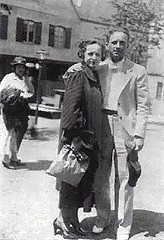
Abe And Beattie
In attempting to put together a reasonable facsimile of Bob’s life in Hibbing and Minneapolis, Minnesota and New York City as he mythologized it in his chapter of Chronicles, The Lost Land, I have come to the following tentative conclusions.
Bob was born in Duluth, Minnesota on 5/24/41. In 1943 he was taken to Hibbing where he lived from then until graduation from high school in the Spring of 1959.
Within the concept of normal Bob had a fairly advantaged childhood. His parents were indulgent buying him anything he wanted while providing adequate pocket cash. Bob’s family was one of the more important in town both within the Jewish community and the town at large. In what appears to have been a tight small town social scene Bob either excluded himself or was excluded from the dominant social groups within which he had a right to be included.
Perhaps Bob’s conception of the Hibbing period could be best interpreted from his favorite movie, Rebel Without A Cause, starring James Dean. Bob is said to have seen the movie several times. This was unusual as few people ever saw a movie more than once. He would have been a very impressionable fifteen at the time. Most of us didn’t have the money while quite frankly few movies, if any, were worth watching twice including Rebel Without A Cause. I was seventeen when I saw it and while I was in awe I wasn’t submerged. Of course Bob’s relatives owned the theatres so he got in for free.
As he set up a Dean shrine in his basement which greatly offended Father Abe we may be justified in assuming that Dean was a controlling influence in his life from the time he saw the movie. It is of interest that Abe was to remove the Dean shrine from the basement after Bob left replacing it with a shrine to his own son Bob Dylan ne Zimmerman.
Abe Zimmerman (1911-1968) worked for Standard Oil in Duluth when Bob was born. According to the C of C he lost his job in 1943 moving to Hibbing where his wife’s family, the Stones, could help the young couple. Why Standard Oil should lay Abe off in the middle of the war during a manpower shortage seems to pose a question. As can be seen from the photograph of Abe and Beattie above borrowed from the Flickr photostream of <drineevar> he was a well set up handsome man. He appears to be exceptionally self-possessed, sound in the eyes. Beattie appears to be a haughty high fashion queen which would accord with later facts.
Abram Zimmerman, for such was his name. Usually called Abraham, the name on his tombstone is Abram, and his two brothers Maurice and Paul bought the Micka Electric Company in 1943 changing the name to Zimmerman Appliance. In 1968 Paul Zimmerman told Thompson that they had been in business for twenty-five years which would mean 1943 although the date seems odd.
According to the C of C Abe came down with polio in 1946 requiring a lengthy convalescence. The C of C says that the Zimmermans bought Micka’s after his convalescence but if Paul Zimmerman is accurate it would have to have been 1943. There would be no record of what Abe did for a living then from 1943 to 1946. As Bob says both his uncles served in the Army it would seem that they bought Micka’s going into the Army shortly thereafter leaving Abe to tend the business.
Maurice and Paul became President and Vice-President of the corporation while Abe siginficantly assumed the controlling post of Secretary-Treasurer. Managed the money, paid the bills.
During the fifties at least Abe spent a fair amount of money on both Bob and Beattie. Angel Marolt whose family bought the Zimmerman residence after Abe’s death was trying to tell him of Beattie’s several fur coats, diamonds and Cadillac but Thompson says he wasn’t paying attention.
Thompson quotes Echo Helstrom as saying that the Zimmermans had stores in both Hibbing and Duluth. Having a customer base of approx. 250,000 makes more sense when one considers the amounts of Abe’s expenditures and the fact that the profits had to be split three ways.
The C of C describes Abe as a ‘big man’ in town partial to those big thick long cigars.

The Dylan Home
The couple had enough money on arrival to buy the large nine room house that Bob grew up in so Abe must have been well paid at Standard Oil before he was laid off. Both he and Beattie are well dressed in the picture while Beattie is actually overdressed.
Bob was entrolled at Alice School for his kindergarten year in 1946 at five years of age. The status of Alice School is unclear. Perhaps it was closed the following year or consolidated with the Hibbing High complex as Bob was transferred. Hibbing High housed kindergarten through twelve as well as the Jr. College. Thompson describes it as a huge and rambling building.
So from first grade to graduation Bob was with the same group of students. I sure wouldn’t have wanted to move into town in tenth grade and try to break into that one. While he wouldn’t have known them all well he must have known the entire student population on sight. This presents the problem then of why Bob, who was the son of the Big Man in town, wasn’t included in the top social cliques. Those cliques undoubtedly formed early persisting through graduation. If Bob was in one he was either forced out early or found it uncongenial to remain for whatever reason. Perhaps he thought his Jewishness excluded him. So if something happened we don’t know what it was and won’t; unless Bob tells it’s going to be difficult to trace.
Growing up in a small town anyone with any ambition looks around and sees very limited opportunities. Working for his father wasn’t a viable option. Not everyone wants to be a doctor or lawyer either. Nuclear Science is OK but a lot of those guys are out of a job now too. My next door neighbor when I was a kid for one.
Bob’s mind turned early to music and then to Rock and Roll. While Rn’R went on to conquer the world and become as respectable as such a spectacle could it was definitely considered discreditible and low class almost volunteer outlawry in the fifties. At the very least it was ‘pimple’ music. It took a certain amount of courage to say you liked Elvis Presley. Pat Boone was set up as his rival and you had better say you liked ol’ White Bucks. If you don’t think Elvis was considered a social criminal check out a couple of his movie roles like King Creole or Jailhouse Rock. What was the Colonel thinking? Clown roles, that’s all Elvis ever got.
And then Bob chose as his hero and model Little Richard. People looked at you funny if you said you
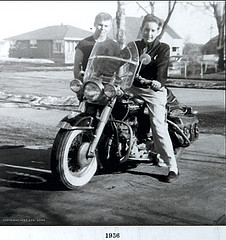
Young Bob On Harley
liked Little Richard! I mean, Bill Doggett was a respectable Negro with music you could understand, Fats Domino was as lovable as a chubby ten year old but Little Richard! They hadn’t even created the ghetto he could come out of. His band might have passed but then he opened his mouth. If there was ever a direct challenge to middle class sensibilities Tutti-Frutti was it. Not only was the song incomprehensible it was about queers. Nobody ever quoted the lyrics correctly, while I’m walking around saying ‘Tutti Frutti, I want Rudy?’ What does that mean? I hope no one overheard me. So when Bob gets up, ignoring Pat Boone entirely, and launches into some screaming vision like Rip It Up or She’s Got It or God only knows what, was the crowd taken aback? Chuckle, chuckle.
So Bob having opted for the lifestyle was forced to associate with the hoody crowd or have become a loner. Besides Colin Wilson’s book The Outsider had appeared in 1956 that began a cult of The Loner that peopled the early sixties. These guys, who were by no means rebels but deep thoughtful guys who had a line on the truth denied anyone else and that penetrated sham and hypocrisy sat alone ever ready to resolve a situation setting things right were highly romanticized fellows. There were as many Loners in those days as there were Hawkeyes a couple generations later. So Bob wouldn’t necessarily have been thought of as weird, strange but a Loner. A Loner was next door to weird and strange. Thin line if you get my meaning.
On the other hand the C of C describes the L&B Cafe as a regular jumping Bop Street right there in the heart of Hibbing, Minnesota. Bands set up and played continuously. They knew how to party in Hibbing. The C of C even says there was a radio station in town playing Bob’s kind of music thereby contradicting every other source even Bob. He says he had to go to Shreveport on the radio waves to get his kind of music. In this case I’m betting on Bob.
The C of C tells of Bob’s musical debut like this putting the best possible face on it:
Described by fellow students as polite, easy to talk with, and somewhat introspective, it was a total shock when he pushed back the piano bench and stood up to pound the first notes of a song into the auditorium, electrifying the student body. Kids jumped up, stared at each other open mouthed not knowing what the reaction would be.
Well, yes, they were electried but did they like it?

Rockin' Bobby Zimmerman
According to the C of C, looking back fondly, Bob went over real well with his fellow students. If you like this version don’t check the other sources as this is at variance with every other known account but then this is the Chamber Of Commerce speaking. Up to this point in the C of C account there is no reason for Bob to be as bitter as he is about Hibbing at all.
A note of interest is the reoccurence of Fourth Street in Hibbing, Minneapolis and New York City. Quite a coincidence, I knew there had to be some association with Fourth St. in Hibbing. So far we learn that Bob attended Jewish shule there. Whether the synagogue was also located there isn’t clear. The synagogue Bob attended is no longer anywhere at any rate. Tore it down. It was in the way. Had to go. Even though Bob’s father was the most prominent Jew in town, the President of B’nai B’rith and ADL as well as his business interests, and even though Bob had a mega Bar Mitzvah with four hundred people in attendance some say at the most prominent spot in town, the Androy Hotel, some say at the synagogue, he wished to conceal he was Jewish. This attitude may have contributed to his renouncing the Jewish fraternity house to which he pledged at UM while also hiding his religion in New York. The attitude was strange since he seemed to prefer Jewish musicians around him to the exclusion of goys.
Bob’s father Abe, was quite frankly a marvelous provider, spending very large sums of money on son Bob, wife Beattie and his second son, David. When he died in 1968 the house on 7th Ave., now Bob Dylan Ave. was sold. The owners at the time of Thompson’s visit were the Marolts. Angel Marolt who was at home when Thompson called offered to show him around. One thing he learned was that Bob had a clause in the sale’s contract that allowed him to stay in his old room in the Marolt’s house whenever he was in town. Too weird.
What quirk in Bob’s mind compelled him to live in other people’s houses? Perhaps Rebbe Maier back in 1954 impressed on Bob that Biblical scripture presribes that Jews would live in houses they never built. As an article of religion that injuction is a mind boggler. One can’t predict how anyone’s mind will interpret instruction. Bob who functions out of his subconscious very heavily must have accepted such teachings in literal ways. Rebbe Maier was a definite turning point in Bob’s life. Imagine getting out of school, going upstairs at a Rn’R cafe to sit before the only bearded man you may ever have seen, dressed completely in black with a black yarmulke perched on the back of his crown intoning things like: The Jews shall live in houses they never built and then go downstairs to boogie. Pretty spooky, don’t you think? And then as Bob says, he disappeared like a ghost. Let that roll around your brain for little while and see what you come up with.
Mrs. Marolt was trying to tell Thompson something about Mrs. Zimmerman’s multiple furs, heaps of diamonds, I’m sure all the latest fashions and her own Cadillac.
Bob was indulged to the extent of apparently more than one motorcycle, a car, lots of amplifiers and electronic gear for his bands, whatever he wanted plus free movie admissions and plenty of pocket cash. He must have had a large record collection for a kid as he spent his spare time at Crippas record store ordering the odd title. You can bet Crippas didn’t discount either, charging full bore. At the time (after 1958) stereo was 5.98 and mono was 4.98.
As the profits from a sole Hibbing store divided three ways could not have supported this sort of expenditure, having a store in Duluth could account for it. It is significant also tha Abram died in June 1968 and the store closed a few months later. Was the store a losing proposition for the last few years? Did Bob provide the difference so Abe wouldn’t be embarrassed by going banko? Then with his father gone there was no reason to support Uncles Maurice and Paul?
There really is something happening here, isn’t there?
Also as a petty expenditure for Bob (it would have been huge in my life) according to the C of C:
Almost every day Bob came in after school for his regular snack: cherry pie a la mode and coffee (or Coke.)
And then to dinner? No wonder the young Bob had all that baby fat.
If Echo bought those hot dogs for Bob and bought his story that his dad didn’t give him an allowance she was had in more ways than one.
So, Abe was nothing if not a generous father and husband. Beattie as President of Hadassah as well as a Stone must have made the Zimmermans the most powerful Jews in the syngogue while actually giving she and her husband the means to be petty dictators of the town, I saw something like this in Eugene, Oregon in the sixties and seventies, or, as the C of C says a Big Man and big people.
Bob must have a quirk in his mind to misrepresent his childhood so. He was the Fortunate Son John Fogerty only sings about.
In Thompson’s interview with Beattie he quotes her:
How can you know you have a genius in your house, when all my time is spent trying to feed him and keeping his clothes pressed.
In Bob’s story, The Lost Land, Chloe Kiel is shown ironing Bob’s shirts and at the end of the chapter she ‘slaps’ a plate of steak and fried onions in front of him just before he darts out the door to begin the next chapter, A New Morning, just as in the old days when he returned home from school for lunch and was fed by his mother he darted back to school.
Ironing his shirts and providing free steaks was a signal service for bare acquaintances like Ray and Chloe.
Chloe comes across as cold and indifferent and indeed there is a tinge of resentment and anger beneath Beattie’s statement. Motherly, of course, but there. Still, she doesn’t impress me as any Yiddishe Mama of the Mrs. Goldberg variety. Whether Bob was a good boy or not he does have an ambivalent attitude toward his parents. But then he claims that he was really raised by his grandmother, whether Stone or Zimmerman isn’t clear.
I believe the big change came over Bob with his Bar Mitzvah and I’m not talking puberty alone. According to the C of C Bob attended Jewish shule during his young years. This was done after public school hours. Then in 1953-54 when his Bar Mitzvah was approaching Father Abe sent to Brooklyn, New York to have an ultra-orthodox, almost certainly a Lubavitcher Rebbe, sent to Hibbing to indoctrinate Bob in untra-orthodox teachings. It can’t be any surprise that when Bob exhibited his Jewish reverence after his Jesus indoctrination with the Vineyard Fellowship he chose to show himslef as a Lubavitcher. Welcome home, Bob. The C of C tells it this way:
According to a 1985 Spin Magazine interview by Dave Engel, Bob said it was above the (L&B) Cafe that Rabbi Reuben Maier stayed while giving Bob Hebrew lessons in preparation for his Bar Mitzvah. The Rabbi and his wife showed up one day and stayed for a year while Bob got ready for his big event . The article quotes Bob as saying he would learn Hebrew after school or in the evening for an hour, then go downstairs and boogie at the L&B. After completing his Bar Mitzvah the Rabbi just disappeared.
In the interview Bob tells it this way:
There weren’t many Jews in Hibbing, Minnesota. Most of them I was related to. The town didn’t have a rabbi, and it was time for me to be bar mitzvahed. Suddenly a rabbi showed up under strange circumstances for only a year. He and his wife got off the bus in the middle of the winter. He showed up just in time for me to learn this stuff. He was an old man from Brooklyn who had a white beard and wore a black hat and black clothes. They put him upstairs in the cafe, which was the local hangout. It was a rock n’ roll cafe where I used to hang out, too. I used to go there everyday to learn this stuff either after school or after dinner. After studying with him an hour, or so, I’d come down and boogie. The rabbi taught me what I had to learn, and after conducting the bar mitzvah, he just disappeared. The people didn’t want him. He didn’t look like anybody’s idea of a rabbi. He was an embarrassment. All the Jews there shaved their heads and, I think, worked on Saturdays. And I never saw him again. It’s like he came and went like a ghost. Later I found out he was Orthodox. Jews separate themselves like that. Christians, too. Baptists, Assembly of God, Methodists, Calvinists. God has no respect for a person’s title. He don’t care what you call yourself.
The C of C knows the Rebbe’s name was Reuben Maier and Bob Dylan doesn’t? There were enough people in Hibbing to have a temple and shule but they didn’t have a Rabbi? The Rebbe Maier showed up in time for Bobby Zimmerman’s Bar Mitzvah but what? it was the first Bar Mitzvah in Hibbing’s Rabbiless history? No wonder four hundred people showed up. The Jews in Hibbing shaved their heads and worked on Saturday’s? I presume Bob means they didn’t wear beards but shaved their faces unlike the Lubavitcher in white beard and one of those funny round hats. I serously doubt there were three hundred or more Jews walking around Hibbing with shaved heads in 1954.
They took one look at Rebbe Reuben’s weird beard and outre attire and told him to get out of town? Now that I can believe. Beards in ’54 were a sign of great eccentricity or a psychotic desire to draw attention to oneself. But why in ’85 the mysterioso act? He just showed up to teach Bobby Zimmerman, a complete unknown with no direction home Lubavitcher tales like this: (actually this is pretty standard esoteric doctrine adapted for Jewish needs)
The messianic thing has to do with the world of mankind, like it is. This world is scheduled to go for 7,000 years. Six thousand years of this where man has his way and 1,000 years when God has his way. Just like the week. Six days work, one day rest. The last thousand years is called the Messianic Age, Messiah will rule.
Essentially what we have here is a variant of Madame Blavatsky’s Theosophy along with a little Hebrew Theology. If one looks real closely one can see the outline of Sigmund Freud’s notion of the unconscious.
According to Beattie Bob knew, oh, two hundred words of Hebrew. So much for several years of shule and a year of intensive training by Rebbe Reuben.
Whether Bob knows or admits it, it must be true that Father Abram sent for Reuben to instruct Bob in mysteries that Abe thought were essential to his vision of Jewish religion while they were not part of the services of the Hibbing congregation.
It is possible that Abram brought the Rebbe in on the approval of the congregation who rejected him. The comment by Bob of working Saturdays may be signficant here. The Jewish sabbath begins on Friday sundown and continues to Saturday sundown.
As a Lubavitcher, Rebbe Reuben could not have tolerated working during the sabbath while the congregation found it essential amidst a gentile population. Likewise beards are an integral part of the orthodox religion so that the congregation also refused to stop shaving. The only thing mysterious is why it took Reuben so long to catch on. Or maybe he had a contract for one year and the year was up. Of course Bob did need help on those two hundred words.
So Bob’s upstairs memorizing his two hundred words while the throbbing beat pounds insistently through the floor. The super patient Reuben and his wife never object. Bob shortly joins the revelers with his two hundred Hebrew words rattling round his skull, steps up to the mike and begins screaming: I’ve got a girl and her name is Echo. Hmmm. Quite an image out there in the Lost Land of Bob.
Now indoctrinated in quaint antiquarian rites Bob is bundled off to Webster, Wisconsin and Camp Herzl to steep himself in Israeli style Jewish living. Camp Herzl was conducted as Israel in America so those two hundred Hebrew words came in handy in that surrogate for summer in a kibbutz in the Holy Land.
The summer sojourns must have set Abram back a handsome fee for the times. Six to eight weeks of essentially summer boarding school does have expenses. Abe apparently was deeply religious: in Protestant circles he would have been known as a Fundamentalist nut. He and Mike Huckabee would have gotten along fine. One wonders if younger son David was given the same treatment.
So Bob from 1954 on is definitely the product of two nations. The world of the Three Hanks as the C of C puts it and this world of Adam, Moses and the Messiah. Bob was named after Sabbatai Zevi the last acknowledged Jewish messiah in the seventeenth century, his Jewish name is Sabtai.
As kids we all have a lot to reconcile, begin working out at graduation. Bob had a double load; he had two Bobs to reconcile. Personalities wander and widen in those years, Bob made a clean split. On the one hand he was the twerp Bobby Zimmerman of whom it may be said: There’s no success like failure while on the other he was struggling to be the super successful Bob Dylan in which he failed to assume the mantle so that failure is no success at all. At least he made this split off persona’s name mean something. As a note, it was not generally known Dylan was Jewish until after Blonde On Blonde.
Thus in his movie Renaldo and Clara he is not Bob Dylan. Anybody can be Bob Dylan he says, you can be Bob Dylan. Toby Thompson thought he could be and did a pretty good job of it walking a mile or so in Bob’s shoes. Sounded just like him.
As remarkable as it is that Bob realized his fantasy beyond anything he could have dreamed and became the hugely successful Bob Dylan he created an entire new set of problems whose solution eluded him. Well, you know, there’s something lost and something gained while it’s hard to know whether the gain was worth the loss. However the money has disappeared from the table.
The result then is Bob looking backward from 2004 to create a fantasy of how it was in Ray and Chloe’s place on Vestry Street in NYC. The chapter is approriately titled The Lost Land or possibly Never-Never Land might have been better. The chapter isn’t a complete fabrication but it is fiction. Something like the various incidents might have happened but not exactly the way Bob tells it. The framing story of Ray Gooch and Chloe Kiel is pure fiction however. They could not possibly have existed.
Bob tells the whole story of the Lost Land within the reference of Ray and Chloe and their fabulous apartment near Vestry below Canal near the Hudson across the street fromt he Cathedral with its bell tower. Thompson got it right.
A troubling aspect of Bob for me is his insistance on bumming other people’s apartments. This seems to be compulsive behavior.
Bob was actually voluntarily homeless from January of ’61 to October or November of the same year when he and ‘roommate’ Suze Rotolo took up digs on Fourth St. I suspect that Father Abe would have been only too happy to supply Bob with funds to live on Vestry Street if he had asked. Bob is simply untrustworthy in any of his stories. As he said of what he learned from folk music: If you told the truth, well and good; if you told the untruth, well and good also, so in Bob’s mind there are no lies, there is only the truth or untruth both having the same value and whichever is more serviceable at the moment. You can’t believe him.
A troubling aspect of Bob’s behavior is his habit of bumming couches in other people’s nests; gaining meaning, as it were, from other people’s lives. Perhaps that was the way he felt of his life in his mother and father’s house. Or perhaps as a Jewish outsider in a goyish land it was his attempt to insinuate himself in the main stream much as he appropriated Woody Guthrie’s persona. Of the houses I have traced they have all been those of goys; he didn’t choose to insinuate himself into the houses of his fellow Jews. His imaginary hosts Gooch and Kiel are obviously goys.
The Lost Land then is a mythologized version of his childhood and first few months in New York City. To my mind Ray Gooch is a combination of Dave Van Ronk, Paul Clayton, Matt Helstrom and his father. Chloe seems simply to be an idealized notion of his mother. (Study her picture for a few moments again.)
As the Gooch frame brackets the period from Bob’s encounter with Gorgeous George to the apartment with Suze Rotolo it must represent a time frame from sometime in ’58 to October ’61. In October Bob Dylan ceased sponging off others to take up his own apartment.
The only one in this time frame he knew who had a large gun collection was Matt Helstrom. The Helmstroms also had a large record collection that Bob listened to. The couch and apartment undoubtedly belonged to Van Ronk while certain exoticisms of Gooch are characteristic of Clayton. The library of Gooch may simply be the New York City Library of which the long narrow room would merely describe the stacks.
The Southern character of Gooch must represent a time after Bob studied the South in the library since there are several references to his Civil War studies. Gooch himself is a Southerner from Virginia gone North which is a symbol in itself. This can be symbolically described as Father Abe being a Jew in Gentile America.
Here then Bob creates or accentuates the more pleasant aspects of his memories in contrast to the very bitter unpleasant memories of the songs. He tells us a great deal about his dream life but little of its realities. At this point I am of the opinion that the party of Camilla ( who Bob says he gets to know quite intimately) is another fabrication of the based on a true story variety.
As Bob would say, folk music taught him that if what you said was true,well and good; if what you said was untrue well and good also. We may probably construe the Lost Land as both true and untrue while a good folk tale. Even the title has a fictive quality a la Edgar Rice Burroughs.
To round off the period back in the C of C milieu of Hibbing: Bob spent his last summer at Camp Herzl in 1957. In the summer of ’58 he was running back and forth between Hibbing and Minneapolis. At that time he would have become familiar with Highway 61.
In his Junior year of ’57-’58 he took up his relationship with Echo Helstrom. They were going steady hence were not supposed to be dating others. As he was in Minneapolis most of the summer he left Echo sitting home alone. She resented this. As the Senior year began she told Thompson, she took a revenge on Bobby returning his token in public in the hall at school. Boy, that hurts.
The feelings must have been much harder than either Bob or Echo portray them. A key problem area is did Bob spend time in Red Wing Reformatory on Highway 61 below Minneapolis and if he did what did he do to receive his sentence: I examine this more fully in Exhuming Bob VIII: The Walls Of Redwing.
He says in Chronicles that he was absent from school from some time at the beginning of April of ’59. He was back at least by the June 5th graduation. His birthday is May 24th. After that date he would have been eighteen and subject to adult sentencing. For what It’s worth he says in his song that no inmate was over seventeen. I’m suggesting that he spent a month of two at Red Wing returning in time for graduation. Certainly a Big Man in town like Abe could have arranged the graduation if he couldn’t get Bob off that time.
The question is what did Bob do? By the middle of this Senior year it appears that he had been in enough scrapes to be known as a troublesome boy; perhaps living out a Rebel Without A Cause persona. Father Abe used his influence up to that time to avoid unpleasant consequences for the lad.
I believe Bob’s song The Chimes Of Freedom tells the story of his crime. Quite simply Echo set him up. She obviously was not quite as complacent as she tells it. See Exhuming Bob VIII: Walls Of Red Wing.
Returning home from Red Wing his parents threw a graduation party for him. Bob was reluctant to attend the party, perhaps with good reason but was persuaded to do so.
This then leaves a very sketchy account of the three or four months of the summer of ’59 for which Bob provides little information. In Walls Of Red Wing I place his stint at Red Wing in August but that is probably wrong. In any event the period from April of ’59 to September of ’59 needs to be explained more fully.
Bob gives some brief details of his stay at Dinkytown but not much. A little bit of the John Pankake episode while avoiding the important details of his theft of Pankake’s records.
Thompson has some good information from Ellen Baker whose father’s folk song collection Bob used extensively.
Then to NYC and his account of The Lost Land segues into his New Morning.
Exhuming Bob X: Lubavitcher Bob
June 25, 2008
Exhuming Bob X:
Lubavitcher Bob
by
R.E. Prindle
There’s something happening here
But you don’t know what it is,
Do you, Mr. Jones?
-Bob Dylan

Bob En Regalia
In 1979 Bob publicly embraced Jesus as his personal savior. This was widely seen as a conversion to Christianity because Bob went to the Vineyard Fellowship of Tarzana for indoctrination into the Christian mysteries. He could hardly have learned Christianity from Jewish circles although the Jewish group of Jews For Jesus was already active. Pharasaic Jews have always despised Jews For Jesus so that may not have been a viable option for Bob.
While non-Jews may be scandalized by the concept of Jews embracing Jesus there is no reason for them to be astounded. After all Jesus was a Jew, preaching to Jews in the Jewish tradition. The early Christian movement was entirely Jewish. They were Jews of the Jews who had accepted Jesus as the Jewish Messiah. Christianity became a universal religion only after Paul reconstructed it shedding the practices most repellent to gentiles while the Hellennic or Greek religion and philosophy was grafted onto the religion which gave it substance and intellectual vigor displacing Semitic stultification.
There should be little wonder then that Jewish Christianity should resurface two thousand years later with Bob as its Messiah.
Bob was uniquely trained for the role. He grew up in a Christian community dominated by the Hillbilly music on the radio with a large and active Jewish congregation. His father thought of himself as a Jewish scholar while heading the local chapter of B’nai B’rith and ADL. His father was covertly ultra-orthodox.
In 1990 Bob wrote a letter to the editor of a publication called Sister2Sister. (Bob’s Unshakeable Monotheism, Part IV, Scott Marshall http://www.jewsweek.com/ ) in which he said:
…until the entire world believes and obeys the same God, there can be no truth or justice or peace for anyone.
What that means in the age old Jewish notion that as God’s chosen people they are destined to bring their vision of God to all the peoples of the Earth at which time they will become a nation of priests, the rulers and overseers of all others. The Supreme People placed between God and humanity as demi-gods.
The notion did not necessarily occur to Bob in 1990 but was placed in his mind at a much earlier date. It would always have been present in the synagogue. Anyone who has ever attended Jewish services will be be struck by the insistence that Jews are to rule the world and all the peoples. It is the duty of every Jew to further that work.
Whether Bob had the Messianic impulse before his Bar Mitzvah is the question. It may have been there in embryo. In 1954 as Bob was about to turn thirteen his father, Abraham, who obviously believed the proper religious education was lacking in Hibbing sent for a Lubavitcher Rebbe from Brooklyn to come to Hibbing specifically to indoctrinate Bob in the more recondite lore of the ultra-orthodox. The intensity of the instruction would be virtual hypnosis. It was at this point, I believe, that the Messianic impulse was fixed in Bob’s mind.
The indoctrination had devastating results for the young boy’s character and personality. He went off the rails becoming wild and dissolute. In searching for a means to spread the message he had received he hit on music and from there it led into folk music. Folk music had a special appeal because it was a pure expression of the dominant culture. If one subverted folk music one subverted the culture.
Thus after being initiated into folk at Dinkytown near the University of Minnesota Bob left for the Big Apple, New York City. The Folk scene of Greenwhich Village in New York was a virtual Jewish enclave or colony. A great many Jews were already doing what Bob set out to do. Disoriented by his conflicts between his Jewish and Christian education Bob nevertheless set about changing Folk music, discarding the content for Jewish themes while retaining the outer forms. The Jewish world organization realizing they had something in Bob gave him maximum publicity actually turning him into a messianic figure through television and magazines.
The stresses of intense fame to his personality and character were terrific almost destroying him. Bob retreated at the height of his fame in 1966 after having established himself with three terrifically influential record albums. His mind was now focused and somewhat cleared. Placing a large Bible in the middle of his living room for easy reference Bob and his band worked and experimented with the Folk and old timey oeuvre of the White Christian hill people. Once again retaining the forms while stripping the material of the content, he infused Jewish Biblical content which was familiar to the Christian culture into the material. The immediate result was John Wesley Harding which is a Jewish religious album in tradtional White Christian dress.
The result is quite remarkable and on that basis is an astounding work of Jewish genius. Unaware of what was being done to them White Americans could offer no defense except rejection. There were quite a few of us who walked away from Bob at that point. I can’t say that I understood what Bob had done but I felt the insult to my sensibilities.
Thus, in retrospect, Bob’s so-called Christian period became inevitable as his strategy slowly unfolded in his mind. There is no conflict with Bob’s intense Jewishness in his combined religious entities, or reclaiming the Jewish Jesus for Judaism. Nothing could be more natural.
The preemption of the goi culture for Judaism is the astonishing achievement of little Bobby Zimmerman. Long after the fact there are still few who get it.
Note: The old Jewsweek format has been discontinuted. The text is no longer available on that site.
Conversations With Robin
June 19, 2008
Conversations With Robin
Robin Mark and R.E. Prindle
Conversations continued from Post: Lipstick Traces Part IX: Greil Marcus
OK, OK, OK. I’m getting it, took a while. STONE. Everybody must get stoned. What’s your mother’s maiden name, Bob? Stone. Right. Dylan might be tongue tied. I certainly was. Still am to a certain extent. But, I think one place to start is the religious conflict he had to endure.
His father, Abe, was a fundamentalist religious weirdo. Just because one is Jewish doesn’t mean you can’t be as religiously weird as Mike Huckabee. For Christ’s sake, Bob believes the Bible is literally the word of God. Somebody recorded his rants between songs and published them. Don’t have the book as yet but I’ve read a couple of exerpts. I already know all that crap. Spent much youthful time among the Nazarenes and other weird outfits. They had me for a while but I threw them off. The taste still lingers though. Bob apparently hasn’t. God, how can anyone believe that crap.
Beattie in Thompson’s book say Bob sampled the various churches as well as attending Jewish sabbath. Yes, I can believe that. So he’s got a father who’s king of B’nai B’rith and ADL and a controlling mother who’s quieen of Hadassah. As if this isn’t enough when he turns thirteen his old man straps him to the torture rack, pries his eyelids open with toothpicks and bombards the poor little bastard with Lubavitcher bullroar.
And then…and then, they send him off to be preached Zionist poppycock for a month or two every summer for four years. I can’t tell you how much I hated church camp. I mean, I can, but maybe later.
Apart from the religious issue then we have the personalities of Abe and Beattie. I got a vaguely uncomfortable mother feeling about Beattie from Thompson’s Main Street. I wouldn’t say I didn’t like her but I probably would have been very respectful and kept my distance if she had been the mother of my best friend.
So then, how does Bob tell her and Abe how he feels? Can’t just speak right up to his parents, who can? Consider the successive titles: Bringing It All Back Home and Highway 61 Revisited. Like all artists Bob can combine several different influences into one song or even one line. Highway 61 is nowhere near Hibbing which is situated North of Duluth so if Highway 61 figures in anywhere it’s down at Redwing or perhaps the run back and forth to Minneapolis.
It is mere coincidence that Highway 61 continues to the Mississippi Delta. Has nothing to do with Bob’s thoughts. He can’t express himself plainly so he has a couple accusatory poses photographed looking straight at Abe and Beattie and goes into rants like ‘God said to Abraham…’
All that’s possible.
I’ve been reading on Bob’s religious odyssey in Restless Pilgrim: The Spiritual Journey Of Bob Dylan by Scott M. Marshall and Marcia Ford and also Marshall’s solo piece from the web on Jewsweek. Very enlightening stuff. Sounes and Heylin could have blended it into their biographies and given some sense to his later years.
The guy actually believes the Bible stuff literally. When he says: God said to Abraham… he means it. He thinks it actually happened. I spent a lot of time with those people in my yout’. Been there, done that. No thank you.
I am getting clearer on why I thought the Middle Period was so entrancing though. Still don’t forgive myself but I was there so I suppose I had to go through it.
Analysis, Critical Theory And Greil Marcus
May 29, 2008
Analysis, Critical Theory And Greil Marcus
by
R.E. Prindle
Through the moral and political rhetoric of John Winthrop, the Declaration Of Independence and the Constitution, Abraham Lincoln and Martin Luther King, America explained itself to itself as a field of promises so vast they could only be betrayed. The attempt to keep the promises- of community, liberty, jutice, and equality for all, because once let loose the genie could never be put back in the bottle- in face of the betrayal became the engine of American history and the template for our national story.
-Greil Marcus
http://.powells.com/ink/marcus.html
The problem I have with Mr. Marcus’ writing is that it is all skewed. His vision is distorted by his ideologies. Mr. Marcus purports to write about the US using terms like ‘our’ when he is in fact an Israeli citizen and places the interests of Israel above those of the United States. This situation is exacerbated by the fact that he is an adherent of the Jewish Critical Theory or Frankfurt School while being a leader of the Situationist Internation. Both organizations are subversiive of the ideals and goals of the United States seeking to supplant those goals with those of Israel or, in another word, Judaism.
Mr Marcus is not clear and honest in his intentions, seeking to mislead his readers into believing that he is objectively analyzing America rather than denouncing it in favor of the Israeli point of view. He refuses to admit that his intent is the supremacy of Israeli/Jewish interests. I find this both dishonest and offensive.
Further in his zeal to demonstrate that the United States is a failed society he refuses to take into account any social or scientific developments since, essentially, John Winthrop of the seventeenth century.
Winthrop is essentially a religious bigot who because of his historical era was necessarily devoid of any scientific knowledge. His spoutings originate in the ignorance of the Jewish Bible written some two thousand or so years before his present which he takes as the literal truth and the word of ‘God.’
While his views may be of interest to explain his times and while his views were influential in forming New England with its inherent bigotry they in no way reflect the views of Jefferson and others who were responsible for the formulations of the DOI and Constitution. There were worlds of difference between the East Anglian Puritans and Cavaliers of both the South of England and the US. Further Jefferson was a Revolutionary and Freemason learning his Freemasonry in the France of the Revolution. Whether he was a Jacobin I can’t say but he has been so accused.
While the Framers of the founding documents used the same words such as equality that we use today they undoubtedly did not undersand them as we do today. To refuse to understand and take that into account is willful obtuseness on Mr. Marcus’ part. The phrase ‘all men are created equal’ was gainsaid by their counting Negroes as only three-fifths of a man. Quite obviously they did not actually believe that all men were created equal. Whether ‘all men’ is meant to include women is also conjectural as women were denied the attributes of citizenship being considered appendages of men as per the Biblical creation myth. So clearly the Founders understanding of equality is quite different from that of, at least, Mr. Marcus. On that basis his views can’t help but be skewed.
The African in America was an insoluble problem to the society then as it is to society today. While counting Negro men as three-fifths of a human certainly sounds ridiculous yet modern evolutionary science has proven what was evident to observation then that the Africans as the first Homo Sapiens to evolve from the Last Hominid Predecessor was necessarily left behind by future evolutionary species of Homo Sapiens or sub-species if you prefer. Mr. Marcus and his fellow Liberals insist that equality of Blacks and Whites is denied solely on the basis of skin color. This is nonsense.
If Africans were equal or superior to Whites, Semites and Mongolids there could be and would be no denying the status of the African. Furthermore such superiority would be self-evident as it must. Instead of the so-called White Skin Privilege there would be Black Skin Privilege and then black skin would indicate superiority and be desirable. There isn’t and the reason why is because that while equality is a fine sounding ideal it does not exist in fact in either the macro or micro example. It cannot be made to exist by legislattion so long as differences between the five human species exist.
So, I would object to Mr. Marcus’ characterization of ideals as promises, they are two different things, that have been betrayed. There has been no betrayal. Mr. Marcus misleads us with his approach of Critical Theory. The Founding Fathers set high ideals to live up to, perhaps impossibly high ideals but ideals worth striving to realize nevertheless. The problem now has been complicated by the scientific reallization of the incompatible differences between the species so that the original meaning of equal of the DOI seems to be the correct one.
The Negro problem, bedeviling America from its origins, was the rock on which those ideals first foundered resulting in the Civil War between Whites, Reconstruction and the current New Abolitionist Movement proclaiming the need to exterminate Whites by any means necessary. So, over the hundred fifty years since the Civil War Africans and their Liberal and Israeli/Jewish handlers are in a position to realize the goals of post-war Radical Reconstruction which was the elimination of Southern Whites by Africans in a larger version of the San Domingo Moment.
As the Whites struggled to come to some resolution of the Negro Problem that has always bedeviled American history large, even huge, numbers of Southern and East European immigrants flooded the country. It is useless to use racial arguments and say that antipathy to these peoples was somehow racial when there was no difference in color which is the only thing Liberals recognize as a barrier to assimiltion.
Rather these peoples were culturally unable to understand the ideals that underlay the American attitude, disdained them and sought to replace them with their own. Thus we have a tremendous criminal underworld led by Sicilians and Israelis while the Israelis seek to subvert the ideals Mr. Marcus notes as ‘promises’ to replace them with a State resembling that of Israel in which the Israelis are paramount while all others are denied humanity much as Mr. Marcus accuses the Europeans of the US in relation to the Blacks.
One therefore has to believe that as an Israel citizen Mr. Marcus is hypocritical in his criticism of American ‘racism’ and the ‘betrayal’ of the the ideal of equality.
Unless Mr. Marcus can reconcile his ostensible beilief with actual Israeli actions I, for one, find it impossible to take him seriously. Critical Theory and the SI are antipathetic to the ideals he seems to be espousing.
I too believe that we have fallen short of the ideals expressed in the Founding Documents but for different reasons than those mentioned by Mr. Marcus. I find no betrayal of those ideals but rather the sabotage of them by competing social systems such as the Sicilian, the Israeli and the African.
Mr. Marcus may be an expert in Critical Theory but he is no analyst. Analysis is Science; Critical Theory is religion. Oil and water and the two don’t mix while Science trumps Critical Theory every time.
Exhuming Bob IX: Chronicles I: Pensees 5
May 12, 2008
Exhuming Bob IX
Chronicles I
Pensee 5
by
R.E. Prindle

Younger Pete Seeger
Larry Sloman has an interesting interview with Mike Bloomfield in his On The Road With Bob Dylan of 1978. It takes up twelve pages- 286-297- of the 2002 Revised Edition.
Mike Bloomfield was, or course, the White Southside Chicago Blues guitarist who rose to fame as the lead guitarist of the Paul Butterfield Blues Band. Butterfield’s LP East-West was one of the seminal records of the sixties. If you’re hip and don’t know the record, you should take care of that as soon as possible.
The interview is interesting in a number of ways. Bloomfield who was a Jew ‘hanging out with ‘the niggers’ on the Southside as he puts it, has a rather surprising attitude toward Blacks and opinions on Dylan.
Born in ’43 Bloomfield was two years younger than Dylan thus his mind was more malleable to the propaganda of the fifties as he turned fifteen only in ’58, graduating, if he did, in ’61. The tremendous persecution indoctrination and conditioning of the mid to late fifties in the Jewish community would likely have influenced his mental state more profoundly than Dylan’s.
The Jewish community has always been affected by the Negro mental situation. A low down Jew in his own community was frequently designated a ‘nigger’ often carrying the nickname of Nig or Big Nig. Sloman, also a Jew, repeatedly refers to himself as the ‘nigger’ of the tour while designating Ronee Blaklee as his female nigger counterpart.
While not having enough information to diagnose Bloomfield’s mental state nevertheless since he abjured the White world for the Black world of the Blues it would seem that he interpreted the intense Jewish indoctrination as meaning that since the world hated the Jews only because they were Jews that the Jews were no better than the ‘niggers’ and that he should go live with them. The psychological conditioning young Jews went through in the fifties was just horrid in the effects on their psyches. Really crazy stuff.
So, while feeling no better than the Blacks Bloomfield at the same time recognized his separateness, difference and apparent inferiority.
This was certainly different than the image being projected to the equally impressionable youth of America who through musicians like Bloomfield reverenced the Negro. In fact Bloomfield was a perfect catalogue of prejudices if one looks at it that way. Another way of looking at it is that having had close contact with the various cultures he had a clear idea of their characteristics as compared to the Jews and Whites.
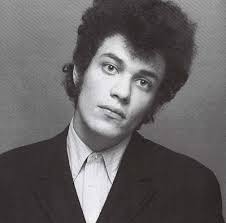
Mike Bloomfield
Still, at Newport he was scandalized by Peter Seeger’s behavior. Quite clearly Bloomfield was not your typical White Liberal. p. 291-292:
To play with anyone at a folk festival, I would have plugged my guitar into Pete Seeger’s tuchus, really man, and put a fuzz tone on his peter. You know what fucking Pete Seeger was doing? He brought a whole bunch of schwartzes from a chain gain to beat on a log and sing schwartze songs, chain gang songs, and he was doing that, can you believe this guy? Here’s a white guy, got money, married to a Japanese woman, beating on a log with schwartzes singing ‘All I hate about lining track, whack, this old chain gang gwine break my back, actually saying ‘gwine’, whack and Seeger’s doing this and he’s pissed off at us for bringing electric guitars to the fucking folk festival! He brings murderers from a schwartze prison to beat on a log! Oh, I couldn’t believer how fucking crazy it was!
Schwartze italicized in the original, of course, is Yiddish for nigger. The above is terrific scene painting that represents about how probably 90% of America at the time would have perceived the scene. Seeger was a Liberal Commie Red American living this incredible fantasy life in which he was the star of his own movie in which there were no consequences while the plot is perpetually arranged to suit his convenience.
This was the beginning of the period when White Americans believed themselves in control of the destinies of the people of the world. Kennedy had just created the Peace Corps under whose auspices raw youths with no worldly experience were sent out into the world to supposedly tell forty and fifty year old men and women that they were doing everything wrong and these mere kids were going to tell them how to do it right. I can’t tell you how the concept boggled my mind. Seeger married to a Japanese while calling these Negros cons to Newport to play chain gang songs is actually treating these people as though they were his toys. The arrogance of this Liberal so-called peace-loving, people-loving creep is amazing.
As Bloomfield says, Seeger came unglued over the violation of his fantasy when electricity was introduced into his rural pre-Civil War fantasy while idolizing Negro murderers that he had had released from prison for the weekend. Imagine, for his convenience without any regard for the feelings of the prisoners he had done that. Then he has them perform a scenario where they are beating on a hollow log as caricatures of themselves of a century earlier singing railroad songs that hadn’t had any relevance for at least fifty years.
Obviously Bloomfield while he had some fantasy that he was a psychological nigger who was at home on the Southside still longed to be Uptown with the White folks. Hence he is so scandalized that Seeger, a man with money, in other words, while Seeger didn’t have to play with schwartzes was actually, and here Mike’s incredulity is palpable, singing Negro dialect like ‘gwine’ and going whack.
I mean, in Seeger’s incredible movie life he’s got a Japanese wife and everything, bank account. If he tires of that fantasy he dumps her and marries a – whatever, whoever the film running through the sprockets of his mind fancies. I mean, the guy’s got a long lead between second and third out on the grass and nobody’s even running him down. Bloomfield is completely flabbergasted.
And then Dylan is toying with him and he does know that. Dylan comes to Chicago right after the first album, Bloomfield grabs his guitar, just like in Crossroads, intending to cut Dylan down which he can do with ease and cutting is done everyday in Chicago so it is legit. Dylan must have blanched with fear knowing Mike could do it. Now, remember this is an intra-Jewish thing. Rather than risk embarrassment Bob abases himself and charms Mike into believing they are friends. Deceived, Mike lets Bob off.

Dylan At Peak
Now safely back in New York Dylan calls Bloomfield to ask him if he wants to play on Highway 61, the most vengeful record ever recorded. Bloomfield accepts showing up in the enemy’s camp at Woodstock. Now Dylan insults Bloomfield and strips him of his dangerous skills. Bob says: ‘I don’t want you to play any of that B.B. King shit, none of that fucking blues I want you to play something else.’ so we fooled around and finally played something he liked, it was very weird…’
So Bob makes himself superior by taking away Bloomfield’s identity (I had to change their faces and give them all brand new names) but he takes the trouble to actually teach Bloomfield the songs because he is going to need him.
I have to give Bob credit for being an improvisational genius. At the Highway 61 session he and Mike are the only guys who know what they’re doing while the other musicians are keying to them. The result in my estimation is sensational. As a musician Bloomfield didn’t think much of it but as a listener without those kinds of professional prejudices the result is astonishing. To be sure the sound is not as tight as a Johnny Rivers record but that is its genius.
Bob assumes that Bloomfield knows he is now Bob’s shadow or guitar player. When Mike goes with Butterfield Bob feels rejected. When Bob’s feelings are hurt Bob gets revenge. A number of years later Bob asks Mike to play on Blood On The Tracks This time he doesn’t need Mike so harking back to their first encounter in Chicago he roars through the songs in one tuning so fast Bloomfield can’t keep up. Bob has cut Bloomfield as Mike had meant to cut him. Bob walks out, king of the Crossroads. Bob has ‘proved’ himself the better musician. End of that story. Bloomfield ODed a few years later.
At one point Sloman asks Mike ‘What was he like?’ pp. 286-287:
“There was this frozen guy there,” Bloomfield says. “It was very disconcerting. It leads you to think, if I hadn’t spent some time in the last ten or eleven years with Bob that were extremely pleasant, where I got the hippie intuition that this was a very, very special and, in some ways, an extremely warm and perceptive human being, I would now say that this dude is a stone prick.’
Bloomfield then describes Dylan in conjunction with Neuwirth and Albert Grossman holding themselves aloof from others while indulging in savage put downs of anyone and everyone. Bob in fact was a stone prick. The question is why?
After this introduction to the problem , in Pensee 6 I will return to the root of the problem built around Bob’s reverence for Mike Seeger.
 I, Dynamo