A Review: Ed Sanders: An Informal History Of The Countercultures In The Lower East Side
October 31, 2013
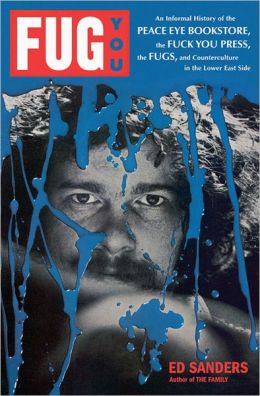
Got His Pitchur On The Cover Of Life Magazine
A Review: Ed Sanders:
An Informal History Of The Counterculture
In The Lower East Side
By
R. E. Prindle

Ed Sanders- Chief Fug
Sanders, Ed: Fug You, An Informal History Of The Peace Eye Bookstore, the Fuck You Press, The Fugs, And Counterculture In The Lower East Side, 2011, The Da Capo Press, 424 pages.
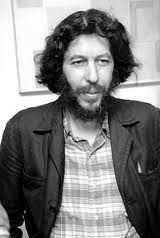
Tuli Kupferberg
Ed Sanders? How few out of a hundred have even heard of him? Yet, Ed had an effect on the society of the Sixties not inferior to Andy Warhol. Perhaps a few more have heard of his recording group The Fugs. Originally the Village Fugs, and aptly named.
While never much of a success out of the East Side Bohemia of NYC Ed nevertheless merits attention. Ed was born in 1939 making him a graduate of the high school class of ‘57. I was class of ‘56 making Ed one year younger than me. But, what a difference a year makes. Let us do a little demographic study.
The swing years between Greil Marcus’ ‘old weird America’ and the new even ‘weirder America’ were the years of 1955, 1956 and 1957 with ‘56, my year, being the transition year between old and new. The key events of the turn was the effect of television and the destruction of network radio that resulted in teen oriented all music Top Forty radio. The class of ‘55 was the last year of ‘old weird’ America while ‘56 was maybe 70-30 the old and new with the old part the largest. Fifty-seven began the ‘new’ weirder America. Thus while Ed and I are only a year apart we still come from two different social outlooks as do all who followed after.
Demographics are important. By 1955 older teachers were fifty-five or sixty years old so they were born in say, 1890-95 to 1910. Not quite frontier but in the transition from horse and buggy to automobiles and airplanes. They were born into an America of the introduction of new technological wonders that actually went well beyond their imaginations. I mean, the fantasy of men flying came true. They saw Victoriana die and the modern world born. I mean, they saw biplanes turn into jet planes. They lived through two world wars witnessing the incredible changes succeeding those two wars. They were teens or in their twenties during the New Era of the Twenties. They were in their thirties in the Depression and Dust Bowl of the thirties. After enduring WWII they were hit by the Korean War and the struggles between the Communists and Honest people that ended in the defeat of their champion Joseph McCarthy. The three years in question were lived at the beginning of the on-going Negro revolution following the Brown vs. The Board Of Education decision that led to the unimaginable fact of Army troops invading Little Rock to cancel the rights of the majority in favor of a minority. Full lives to say the least.

Sanders, Kupferberg, Weaver- The Core Fugs
They had some strongly held opinions about life and America they passed on to us or attempted to do so. It was a clumsy attempt. The chaos of the Sixties and subsequent decades stemmed from that teaching. Most of them were rooted in pre-1920 attitudes as was to be expected. No matter how hip we are to the NOW our outlook is always conditioned on the past, near or far.
Teddy Roosevelt’s politics seem to have been the basis of their outlook. The twin themes of freedom and revolution were uppermost in their minds. Freedom was always ill defined if defined at all while revolution was held up to us as the highest ideal especially the American Revolution which was sort of the apex of history although Simon Bolivar who rode throughout Spanish South America bringing revolution to every colony on his way was a very close second. Of course the success of the countries he established failed to measure up that of the US. The French and Bolshevic Revolutions were never mentioned and were disregarded as they didn’t fit the fantasy. As these teachers were in place post-war through the fifties whole cadres of students were indoctrinated in this nonsense.
Basking in the fairly incredible triumph of the US in a two front war against very formidable enemies the teachers fairly glowed with the glory. Perhaps influenced by that achievement they made the incredible statement that each and every one of us could be whatever we wanted to be. That idea perhaps astonished us more than any other. It was obvious that some were smarter than others, all were of different physical stature, some had social disadvantages that meant denial by those that had them. Some had already made decisions that closed off vast areas of achievement and there was room for only so many at the top. Still, I suppose, that if we had the proper attitude there was a modicum of truth in the statement. Really, if you don’t try you don’t get anywhere. However rooted in a past now thirty or more years distant all the teachers were not dealing with current realities. The were not living in the NOW enough as we were in the Sixties.
There was a basic insecurity with Americans, even though we were taught to believe we were the greatest. A silly novel by Eugene Burdick of 1958, The Ugly American, turned that idea on its head. The idea of the novel was that in their foreign relations Americans were clumsy and inept compared to the smooth Communists of Russia, we antagonized the Third World despite sending wads of money and tons of food for free. I do suppose it’s true that you can’t buy love and Burdick seemed to revel at the thought.
As a result of Burdick’s novel Americans high and low embraced the notion that he or she was an Ugly American thus becoming inferior in their minds to every other people of the world. Just as the American South condemned a portion of their people to be White Trash, so Americans became the White Trash of the world. It was something to witness. Forty years or so on some nitwit rocker sang: ‘I’ll be your Ugly American if you’ll be my Asian Rose.’ Is that a deal or not? Blows your mind, doesn’t it? Blew mine.
I’m sure that most of us in the fifties had never heard of the CIA and if we had the initials conveyed little meaning. By the early sixties after the incident of the Bay Of Pigs not to mention the Kennedy assassination we had all heard of it but with little comprehension. Ed Sanders as well as the whole Left would fixate on the CIA as the epitome of evil. Of course they were either Communists or Communist sympatizers, Ed claimed to be a socialist, and hence were trying to divert attention away from the KGB and Communist activities. The James Bond movies beginning to appear in 1962 were metaphors of the cold war between the ‘Free World’ and the captive nations.
With some variation of this indoctrination under his belt Ed graduated HS, spent a couple semesters at UMissouri-KC then headed East to attend NYU. He say his intent was to become a rocket scientist but once in NYC he gravitated down to the Village which gradually enchanted him so that he abandoned solid propellants and took up ancient Greek, Latin and Egyptian because his mother told him the classical languages were the accoutrements of a gentleman. Perhaps so but there was no danger of a Village Fug ever being mistaken for a gentleman. Ed never was.
Once settled in the Village Ed involved himself with Village politics as he sought a place for himself under that black sun as a poet. The late fifties and early sixties were a time of the Beatnik poet. Coffee houses sprang up where the ‘poets’ could read to an eager audience, mostly of other would be poets. I was in the Bay Area of San Francisco at the time and while I wouldn’t call myself an habitué of North Beach I did attend a couple readings in 1964 where Ferlinghetti and a couple others read. Apparently it was the Coffee and Confusion Coffee House as I see from the web, but I don’t remember the name of the place. By 1964 things were pretty commercial and, at least, in SF the house was packed with employed weekend wannabe Beats.
Ed himself writes a humorous piece about a poetry reading in his Tales Of Beatnik Glory. While fiction the tales accurately portray the life. I have never been a big poetry fan and my expectations were not disappointed. Ed is an accurate barometer of his time and life on the Set.
On his quote page at the beginning of the book he quotes Maxim Gorky who said: ‘I was typing with all my might to make myself “a potent social force.” That pretty much sums up Ed’s career in ‘Beatnik heaven’ on the Lower East Side. His approach as he puts it was ‘A Total Assault On The Culture.’
Which culture isn’t exactly clear. Ed was a Catholic boy and he acquired and exhibited all the neuroses that the Catholic confession induces especially the rebellion against sexual repression, hence he turns to the pornography peculiar to Catholics. While there are some maybe many who were or are in full sympathy with Ed’s sexual neuroses I find them repellant while at the same time liking Ed.
Ed gives no indication that he himself indulged in licentiousness preferring the role of voyeur. He was a heavy drinker while going on dope binges. While sympathetic to homosexuality he says he passed on a night with his great hero Allen Ginsberg while he married young to his wife of fifty years now, Miriam. He had a couple kids and approximated a normal sexual life.
He did become a voyeur par excellence. In the enthusiasm of the time he became an underground film maker (read pornographer) with his hand held Bolex camera. He took up filming at the same time as Andy Warhol. He and Andy became acquaintances.
At the time that Andy began to create his Factory populated by an assortment of criminal amphetamine heads Ed did the same. During the late fifties and early sixties New York City was awash in amphetamines at all levels of society. One Dr. Max Jacobson otherwise known as Dr. Feelgood was busy administering massive doses of his amphetamine and vitamin cocktails, himself freely using it nearly on 24/7 basis. At one point he is said to have gone sleepless for thirty straight days.
While amphetamine used on that scale is destruction Max said and people believed that the vitamins destroyed the destructive qualities of the drug. Maybe so but within a few years there were burned out cases walking all over NYC.
Ed had his own reasons. I make an extensive quote interspersed with commentary. As Ed says the hips called the Village ‘the Set’ as in movie set. As would develop during the decade the notion that one was a mere performer in your own movie became prevalent if not endemic. Anyone’s life was a role. One could do anything without the loss of self-respect. The notion was that when your movie role was over you could revert to your former condition. People went to prison without any idea they were affecting their psychology and subsequent social position. I watched slack jawed.
In this passage Ed seems to see himself as a sociologist, pp. 54-55:
Another of my projects I called Amphetamine Head…Since 1959 I had been studying a group of artists and bohemians known around the Lower East Side as “A-heads,” amphetamine heads.
In those days people were called ‘heads’ as in he was a good head. A-heads means full time amphetamine freaks, vitamins or no vitamins.
They shot up amphetamine and often stayed up on A for days. Warhol said that he never slept more than two hours a day for years. There were plentiful supplies of amphetamines, sold fairly cheaply, in powder form on the set.
Amphetamine was legal at the time.
That fall I began filming Amphetamine Head. I decided to focus on the A-head artists, mainly painters, but there were some poets and jazz musicians as well who could be put under the banner of A. Anyone who lived on the Lower East Side and spent much time mixing with the street culture encountered A-heads. They roamed the streets, bistros, and pads compulsively shooting, or gobbling unearthly amounts of amphetamine, methidrine, dysoxin, bennies, cocaine, procaine- all of this burning for the flash that would to FLASH! It was almost neo-Platonic, as beneath the galactic FLASH! Were subsumed the dime flashes all urging toward FLASH!
Everybody from Washington Square to Tompkins Square called the street “the set”- “I’ve been looking for you all over the set, man. Where’s my amphetamine?” With a generation of folks readily present who viewed their lives as taking place on a set, there was no need to hunt afar for actors and actresses. What a cast of characters roamed the Village streets of 1963!
So there we have a set of fully blown minds. People who were out of it, insane for all practical purposes, Ginsberg’s ‘best minds of his generation,” running from fix to fix. These were us who back in ‘56 were billed as the hope and future or America with a capital A- no pun intended.
I’d heard rumors about a doctor [Max Jacobson- Dr. Feelgood] giving President Kennedy shots. Uppers. It turned out…that the rumors had a basis in truth. So there was plenty of gossip at the time that the President used amphetamines and that his doctors [actually only Max] injected him every morning. There were further speculations that the generals who met in the Pentagon war room every day planning atomic snuffs were a bit A-bombed themselves.
Possibly true. When I was in the Navy in ‘58-’59 bennies were commonly used while the Marine Camp Pendleton was awash with everything heard and unheard of.
I was fascinated with an amph-artist named Jim Kolb…I had observed the violence of the amphetamine heads and the raw power grabs that occurred in their glassy eyed universe after a few months of sleeping just twice a week.
One can compare this to Dylan’s Desolation Row in which he portrays Dr. Filth, that is Andy Warhol, and says:
Now at midnight all the agents
And the superhuman crew
Come out and round up everyone
That knows more than they do
Then they bring them to the Factory
Where the heart attack machine
Is strapped across their shoulders…
It was true that Warhol’s A-heads who were strung out on A would emerge from the Factory at midnight and predate on the streets. Dylan who was strung out on A himself would encounter them on the streets where there were undoubtedly stand offs between them and Dylan’s own crew.
While at the time we were attributing all kinds of fantastic interpretations to Dylan’s lyrics they can all be explained by what was going on in the Village. As the years progressed the clubs would become more vicious and violent until the apex of club land Studio 54 opened in 1977 giving the diamond glitz to that movie set of violence.
It was also commonly accepted on the set that the Germans had invented amphetamines and that the Nazis had shot up amphetamine during campaigns in WWII inspiring tales on the Lower East Side of futuristic battles involving fierce-breathing amphetamine humanoids, babbling shrilly like rewinding tapes, in frays of total blood.
It is true that a German did first synthesize A but at the end of the nineteenth century. A was further developed by a Japanese in 1919. In the early thirties Dr. Feelgood, Max Jacobson a Jewish German put together amphetamine and newly discovered vitamins to make his potent cocktail that he brought to the US in1936. Actually all combatants in WWII hopped up their troops on A, most notably the US and British pilots flying long bombing raids over Germany,
The heads also seemed proud that A-use destroyed brain cells. One of the A-heads might shout, “I lose trillions of cells every day, man, grooo-vy!”
Amphetamine altered sex. Some under A’s spell waxed unable in eros or sublimated their desire beneath a frenzy of endless conversation or art projects. Others with strong natural urges experienced this: that the erogenous areas became extended under A to include every inch of bodily skin. Men could not easily come, and women loved it forever. The image of amphetamine driven Paolos and Francescas writing for hours on a tattered mattress was humorous but true.
The Village has been described as the independent Republic of Bohemia. Certainly within the boundaries of the Set a certain hot house atmosphere prevailed. Ed is representative of that ethos of film makers, artists, musicians and hangers on. Ed was quite famous on the Set developing an opinion of himself quite at variance to what his influence was off the Set.
Ed’s attitude toward the A-heads while couched in sociological terms was also somewhat sadistic and perverted. He observed that may of the A-heads became compulsive drawers covering their apartment walls with drawings. Combining the art with his prurient sexual needs Ed conceived the idea of buying four ounces of A for about thirty dollars, renting an apartment then allowing A-heads to shoot up freely on the condition that he be allowed to film them at lovemaking and other activities. Through this approach at what must be considered pornography Ed amassed a couple thousand reels.
Unfortunately they were confiscated by the authorities during a raid and never returned. Maybe the CIA studied them in their search for a mind control drug.
Time flows along while Ed’s brain was hyper active. The idea of being a poet was paramount at the time. People who thought that they were poets were everywhere. Of course, that meant denying that anyone else was a poet. Heck I even flirted with the notion but realized that I much preferred prose. Ed developed a fair reputation as a poet. He can be seen reciting on videos on the internet. I would say he was a cut above the ordinary however I have little use for poetry.
Combining his interests in sex and poetry Ed decided to start a poetry magazine. For whatever reason he may have had he decided to name the magazine Fuck You- A Magazine Of The Arts. Had Ed consulted those with a little market savvy he might have reconsidered. While Fuck You is certainly an attention getter it makes buying it without a brown paper sack or even displaying it in your home a chancy affair. In fact, Ed gave most of them away. A non-Bohemian could go down to Soho for a laugh.
Ed was industrious and applied himself. He canvassed the big NYC poetic names and compiled an impressive list of contributors beginning with the arch freak, best mind of his generation, Allen Ginsberg. So, if you’re into poetry especially the sex obsessed Boho kind you would probably like Fuck You. Ed should have started a second magazine titled Fuck You Two.
Rapidly moving into retail Ed found a space in the center of things and opened his Peace Eye book store modeled on City Lights in San Francisco that Ed had not yet seen. I was familiar with City Lights and personally I wouldn’t have modeled anything on it. I can’t believe they actually sold enough to pay the rent. Who the hell buys poetry?
Ed aggressively promoted his sexual agenda in his Assault On the Culture drawing unwonted attention to himself from the authorities. Time was moving along. The hand on the dial was pointing to 1964. That year was the year of the World’s Fair. As should be obvious the social life on the Set had become fairly raucous and actually offensive to those not on the Set. Mayor Wagner determined it was time to tone things down on the Set lest tourists be offended. On the other hand maybe they would have come downtown to sample the outrageousness.
The hounds were on Ed’s trail. He experienced some difficulty as his ‘secret location on the Lower East Side’ was raided, the authorities illegally removing Ed’s precious porn flicks and anything else suspicious looking, naturally that included everything in their eyes. No receipts, no returns. Well! Who wouldn’t be offended? There was little Ed could do about it except try to stay out of jail. That became a struggle. After harassing the bejesus out of him the authorities declined to press charges. All those dirty movies were probably prize enough.
For Ed though his Total Assault On The Culture was going swimmingly. The great so-called Free Speech Movement began its course in 1964 on the campus of UC Berkeley in California. This was the turning point of the US group of revolutions. Trained from childhood to believe in revolution, any revolution, was good, Ed and several age cohorts enthusiastically applauded all revolution.
As part of the revolution a thing so small as a possible minute change in a detergent was described as a revolutionary new product. The idea of revolution as a positive thing was everywhere. It filled people’s minds. After the revolution, so to speak, occurring in the sixties commercial products shifted from revolutionary to ‘new and improved.’ The revolution was over; no new ones were to be entertained. Today detergents are just detergents, no need even for anything new and improved.
Ed’s description of his own revolutionary program was ‘a total assault on the culture.’ The Negro revolution well in progress of which Ed was part was a total assault on the culture; the Jewish revolution to which Ed was sympathetic was brought into focus by the so-called Free Speech Movement of which it was the leading edge. The sexual revolution encompassed both the Homosexual revo and women’s lib both of which fit into Ed’s total assault and he backed the Yobbo revo.
None of these revolutions could have taken place as they did without the US constitutionally guaranteed freedom of speech, assembly etc.. Indeed Ed ingenuously celebrates that freedom, without which all other freedoms are meaningless, explaining that he was making unlimited use of it.
That he and the Negroes, Jews and others were able to do so was because all Americans believed in freedom of speech. Sharing that belief was to cause me all sorts of problems. Even though the concept was being stretched to the breaking point, that is turned against itself, the mantra at the time was ‘ I may disagree with what you say but I’ll fight to the death for your right to say it! You don’t hear that mantra anymore; now you hear ‘Words can kill’ or hurtful things should be censored as they are so offensive. We are post-revolutions.
Ed himself began to become bitter when it slowly dawned on the government that indeed a violent assault on the government was taking place. At that point security agencies such as the FBI and CIA began serious surveillance. After all at the same time all these revolutions were taking place domestically we were becoming totally committed to the war against Communist Viet Nam. Ed claims to have been a socialist so that the backed that subversion too.
Since he vocally proclaimed his position in Fuck You Magazine, the name itself was intended to enrage, it can easily be understood why the authorities placed him on their list of desperadoes. It just seemed like fun at the time but it was more serious than we thought.
Obviously freedom of speech was no more threatened in 1964 than it ever had been, perhaps less. The lines between the various thems and us had just been drawn. The revolutionaries meant to deny freedom speech to the other, or bury it, as in these latter days has been nearly done.
Indeed in 1960 when I was attending Oakland (Calif.) City College anti-free speech limitations were in use by Liberals. We were forbidden to even mention let alone discuss what have become ‘protected’ minorities today. Crimes were committed in the name of what is now called diversity. In one class I had the misfortune to be sitting next to a Negro. A test paper came back on which I got a C while I noticed the Negro got a B. Then I noticed my score was a 78 while the Negroe’s was a 64. I objected saying I didn’t care if he got a B or not no matter what his score but since I had a higher score I should have an A or at the very least a B.
In full arrogance the teacher said he had only so many Bs to give out and since I had been the recipient of White Skin Privilege it was the Negroes turn and I would have to pay the debt. So obviously the revolution was prepared to lie, cheat and steal to succeed no matter who or how many get hurt.
Ed may have bought into that revolution and freedom crap as taught in schools but I obviously would have to be a counterrevolutionary.
So while Ed, absent from the scene, applauded the Berkeley Free Speech Movement I was on the spot viewing things somewhat differently. As I said the Free Speech Movement was part of the Jewish Revolution. There was no denial of free speech at UC before 1964 but by 1966 when the dust had settled the Jews were in control of the university and free speech was definitely curtailed.
As I entered the campus at Sather Gate in the summer of ‘66 a Jewish commissar sat at a table just inside the gate where we were to be vetted as to our politics which meant were we philo-semitic or not. Obviously one was not welcome if it was determined that one was ‘reactionary.’
Whatever Ed believed he was doing it was neither revolutionary in a positive sense nor was it furthering freedom of speech.
Into The Music

An Early Incarnation
Busying himself with his poetry, at which he was very successful as poetry goes, and running his Peace Eye bookstore, Ed conceived the idea of forming a musical group and why not? Musical groups were the generation’s mode of expression. This one he would give the most offensive name he could think of, The Fugs. The Fugs! Everyone in the world knew that fug was a euphemism for fuck. The ’comedian’ Redd Foxx had a punch line that went ’if you can’t fugg your can sugg it.’ So Ed calls his group the Village Fucks. Alright. So we know where that’s at. Nevertheless this low level pornography would get him national exposure. It even got his picture on the cover of Life Magazine in 1967 as part of the world wide cultural revolution. The Total Assault was working. He came to my attention out on the West Coast.
Ed thought of forming the Fugs interestingly enough at the same time that Andy Warhol had the idea and adopted the Velvet Underground as his house band. Both were influenced by Albert Grossman’s success in promoting Peter Paul And Mary and Bob Dylan. PP&M were already a big success in 1964 making barrels of money so why not go for the golden ring?
From 1964 to ’67 Ed and his Fugs scored a major success within the Set. After a fashion the Fugs became a sort of cabaret or burlesque act somewhat after the fashion of the theatre in the French movie The Children of Paradise. That movie served as the East Village model. The Great Boogie Woogie Dylan himself would imitate it in his film ’Masked And Anonymous’. A slight redundancy as to be masked is to make oneself anonymous. Bob was a poet.
As a sort of off Broadway act at the Players Theatre on the heart of Bleecker Street the Fugs may have appeared to be giving Dylan and the whole folk scene a run for their money. Café Society that was finding its way to Warhol’s Factory midtown also called on the Fugs at their theatre dropping back stage to pay their regards. Heady stuff, and I’m not being sarcastic.
At the same time Ed was negotiating with major labels Atlantic and Reprise. He was already on the local label ESP but that was run by a less than astute businessman. Terrific catalog of records though, perhaps the most interesting label in existence on many levels. The two major labels were soon to be subsumed under the Warner Bros umbrella. Atlantic fearing that Ed’s content might block its chance to be acquired by Warner’s dropped the group but they were picked up by Reprise. Reprise was owned by Frank Sinatra. When label Pres. Mo Ostin presented the deal for Sinatra’s approval Frank remarked sarcastically “I guess you know what you’re doing.” Frank hopped on the wave of the future as he rode the rock surf board into shore. Mo didn’t know that much as the Fugs were much less than a stellar act for them.
As 1967 ended then Ed and his band seemed poised for the major break through. However the year 1967 was unfortunate in being followed by the year 1968; the year of the Big Change. Ed’s total assault on the culture would be a success but he would be left behind.
It was a long way from 1960 when the decade began to 1968 just a year before the whole decade crashed at Altamont. The Snark the 60s pursued was a boojum you see.
Nineteen sixty eight was the year China stepped center stage with its and the world’s Cultural Revolution. Didn’t seem terrifying on this side of the Pacific but it sure was in retrospect. Ed might have thought that his Total Assault On The Culture was a success but he seems to have missed the year’s impact. The ethos that had carried he and his Fugs from ’62 to ’68 was exhausted. The year would see the shootings of Andy Warhol, M.L. King and Bobby Kennedy. Only Warhol would survive and that only through the miracle of modern medicine. Andy was actually brought back from the dead living on borrowed time for another twenty years.
The death of Bobby Kennedy killed Ed’s spirit while the course of events had grown far beyond his ability to deal with.
The Fugs had done well in the hothouse atmosphere of the Lower East Side but Ed was to find that that success couldn’t be exported from Bohemia. Even if the group succeeded in playing a venue they were frequently advised that it would be dangerous for them to try again.
Perhaps this was nowhere more obvious than when the Fugs were booked into the college town of Eugene, Oregon on May 4th of 1968. That was the day the revos went over the top in Paris. Nineteen sixty-eight was the year Mao kicked off the worldwide Cultural Revolution. The Chinese even financed the revolution in the small college town of Eugene, the home of the UofO. The Hippie invasion that Ed also represented had erupted, in the Eugenians’ eyes leaving then on a sharp knife edge of anxiety when the Maoists arrived. Wait, we’re not finished yet. In addition to those irritants there was the invasion of the SDSers, Students For A Democratic Society led by New York City Jews in denims who hit town like a small tsunami adding to the disruption.
As if the phony Free Speech Movement hadn’t been enough, the arrival of the phony Students for a Democratic Society added insult to injury. We all, at least myself, believed we had freedom of speech in a democratic society but then along came these freaks redefining terms. Got away with it too.
Eugene’s home grown hippie ’cancer’ that wouldn’t go away was a record store by the name of Chrystalship. You are free to guess who owned it. That’s right, me. I am not now ever was a revolutionary or even a Liberal, discontented but no revo, card holding or not. I just wanted to get to Paris in some style. As it was the town fathers determined that I was behind everything. I almost had my own personal FBI agent. I was followed, my mail was opened, phone tapped and had my shipments illegally searched with no attempt to conceal what they were doing and no recourse. Some democracy.
Even they couldn’t stop the Cultural Revolution or keep the SDSers out of town but they sure as hell weren’t going to let some pornographic group with the name of Fugs, short for Fucks, play in town. Mao was one thing, Ed Sanders was another.
On May 2nd the door was slammed shut in Eugene, the venue denied. Acting quickly the promoters found a spot twenty miles out of town in the still smaller village of Creswell. A phone call scuttled that plan. At that we ticket holders thought the jig was up but, not so. A secret location on the east side of town was found that was so secret I’m sure that half the ticket holders couldn’t find it and gave up.
Ed’s memory is fairly clear on this. I’m comparing his notes with mine to reconstruct the scene as accurately as possible. About ten miles to the South of Eugene, maybe a few miles further, was a new motel, fairly glitzy for Eugene, maybe built by drug money, named The Lemon Tree. Obviously the owners were Peter Paul and Mary fans because there were no lemon trees in Oregon. Ed remembers playing at the motel but I respectfully disagree with him. He stayed there but he didn’t play there.
I honestly can’t say where the place he played was except that it was out in the country turn right here turn left there and when you got there you couldn’t be sure that was it plus there was only a fifty-fifty chance you could find your way back to the highway in the dark. Once arrived you drove over a cow pasture out to this largish barn and parked in the high grass.
There were no lights in the barn except for a couple spots jury rigged over the stage, if there was a stage, hard to see in the dark. For some reason there were actual bleachers three or four tiers high arranged against the back wall. All fifteen attendees strung out on the benches in the dark. We could barely see each other. I held on tight to my wife so that we didn’t separated and have to stumble around trying to find each other. ’Hello, over there, over here.’
Way across the barn on the opposite wall was this stage faintly illuminated on which the band would and did stand. Thus, unless we made some noise the Fugs had no way of knowing that they were not playing to an empty barn. We were forbidden to get any closer, nor did we know whose hands we were in. Could have been plain clothes cops for all we knew.
So, away over there the Fugs stepped up to the microphone. They were a mangy looking group, voluntary poverty was in evidence. As a child were asked to pray for the poor heathen Chinese before dinner but we should have been praying for our poor heathen selves. The Chinese are doing OK. But Ed and the boys could sing joyfully in their rags. At the time we thought they were trying to be as far out as possible. They weren’t doing a bad job. Tuli Kupferberg, the absolute weirdest of the lot, Tuli had mastered weird, and remember we in the audience had nothing to brag about, was playing an eight foot long staff. It had six or seven clatter devices on it so he could keep a semblance of a beat. He lifted it up and slammed it into the ground to some effect. Beyond that I can’t even remember if they played Ah, Sunflower Weary Of Time or Boobs A Lot, Slum Goddess Of The Lower East Side which is what I came for. I may have been the only one of the Eugene Fifteen who had ever heard the Fugs on record. I sure as hell hadn’t been able to sell any.
When the concert ended we tripped and stumbled out of the barn, hopped in our cars and hoped the hell we could find our way back to I5. The concert was the high point of my concert going career. It was what one calls an adventure. I have relived it over in my imagination many times over the years. An evergreen if there ever was one. Ed recalled it in his pages with good reason. It was a turning point in his career.
Ed tells it this way, page 312:
We flew up to Portland, Oregon, May 3 after our fun in LA for a gig there and the next day drove to Eugene, the very day protesting students were occupying the streets of Paris. We played a club called the Lemon Tree next to a beaver pond. Before the performance I walked out to the water’s edge, where I experienced a great transmission of peace. I had to go back in my mind to the lakes of my Missouri youth or Elvis Presley’s rendition of “Peace In The Valley”, which helped me through the grief from my mother’s death in ‘57, to find much consolation as I had during those moments. The beaver pond by the Lemon Tree was the best time for me in ‘68.
That wasn’t a beaver pond Ed. That was an artificial pond the owners dug to glitz up their motel. It was situated between the motel and I5. There hadn’t been a beaver in those parts since John Jacob Astor founded Astoria at the mouth of the Columbia. If there had been it would have been killed as a nuisance. Beaver’s chew down saplings Of course saplings spring up all by themselves by the millions but we don’t want no beaver felling even one.
My memory could be wavering but I think that on the way out from the barn I saw Ed after the concert squatting beside the pond. I’m sure he must have been crushed by that bizarre performance to a seemingly empty barn. It had to have been hard after four years of very hard work. It appears that he did have an epiphany of some kind. If he had known he was going to be playing to fifteen people he couldn’t see in a dilapidated barn I’m sure he would have thought of retiring and he did then. As his mind was made up to end the Fugs at the beginning of ‘69 I suspect that that dismal concert set his mind on the track.
Well, Ed, I really enjoyed the show.
It Is Impossible To See Where You Are
When You’re There
While Ed was living his life time was passing and circumstances were changing. When Ed began the Fugs in 1964 what he was doing was fitted to the time and was possible. By the end of 1968 when he determined to end the group he was still acting on his 1964 impulse while by 1969 he would have had to adjust to new conditions. Led Zeppelin, the Moody Blues and a host of other bands were more contemporary than the Fugs. The Fugs were old hat.
Even Ed’s solo album, Sander’s Truck Stop, of ‘69 was a stale joke. I thought it was OK myself and I liked his second effort Beer Cans On The Moon but they also were out of time. Ed and his Fugs were part and parcel of the Sixties. A very few if any of the Sixties groups made it into the seventies and those that did reinvented themselves. The Jefferson Airplane became the Starship. Other split off and went solo. Donovan just evaporated although he was as talented in the seventies as before.
The Rolling Stones adapted despite themselves. When their manager, Andrew Loog Oldham sold them out to Allen Klein it may have been their saving. With Klein in control of their outdated sixties output the Stones were forced to change. Jagger found a financial manager in Rupert Loewenstein who turned them into a prosperous stage act, sort of performance art, cabaret or burlesque, along the lines of Yoko On or Andy Warhol or even the Fugs. Jagger certainly saw the Fugs on Bleecker and may have picked up an idea or two. They were able to successfully adapt their musical style to the seventies.
As a Sixties group Ed and the Fugs were finished. You can never go home again; when they left the East Side to assault the culture of the entire United States their East Side base was destroyed.
Out in the real world what were record stores supposed to do with a band called the Fugs and a record titled It Crawled Into My Hand Honest? Ed was a vaudeville act, soft porn, how could a store recommend stuff like that to the underage person who formed a large part of the business? Who wanted to bring the law down on themselves. Couldn’t be done. Hell, The Rolling Stones nearly got me clubbed down with their sado-masochistic cover for their record Black And Blue, as in welts and bruises. It got ugly in the seventies, post Stonewall.
Ed closed up shop and returned to civilian life. Civilian life had changed a great deal too. A lot social errors were accruing. The generation hadn’t done such a great job. The influx of Puerto Ricans and Negroes into the Bronx combined with the efflorescence of hard drugs, heroin, was turning the Bronx into a hell hole or worse; even an abandoned hell hole as the turmoil drove peaceable citizens out. And then they burned it down. Ed even left to move to the Lower East Side. Even there things were turning violent. The streets were no longer safe. Near Ed’s apartment a well known Hippie couple around the Set were murdered in a basement, the girl after being raped repeatedly. The perp was a Negro living upstairs from them. He felt obligated to commit the crime because of his religion which was described as the Yoruba religion.
Probably not one in a thousand knew who the Yorubas were and that they migrated from Nigeria in Africa and that their so-called Yoruba religion was actually a form of Voodoo called Santeria. Santeria was popular with Negroes and some Whites along the entire Eastern Seaboard yet few knew of it then and few do today.
Ed had moved from the Bronx to the Lower East Side and from there to the West Village where he was greeted with another double murder outside his front door. Where next? Where any reasonable person would go. Ed moved to the country and painted his mailbox blue, up in Woodstock, the feudal estate of Bob Dylan’s manager Albert Grossman. And then the Tate-La Bianca murders occurred out West in LA. Ed decided to investigate Charlie Manson and his Family. Write a book.
Actually the murder of the Hippie couple by the Voodoo killer on Ed’s former block was as horrific as the Tate-La Bianca killings but no one had ever heard of the dead Hippies on the Set and if they had they wouldn’t have cared.
So Ed went West where he stayed a couple years pretty thoroughly investigating Charlie’s shenanigans. He did a good job of it too. Of course he had to pull his punches somewhat to avoid lawsuits but he apparently lowered his guard at the wrong time. Some Satanist group called the Process Church Of The Final Judgment, these were apocalyptic times, not wishing the truth of their organization to surface threatened legal action on the publisher. They gutted Ed’s book. It was probably a publicity stunt as the Process made no objection to the English edition.
At this point in Ed’s memoir he folded his tent and quietly slipped away remarking only that all his Fugs tapes and artefacts lay neglected in boxes for the next fifteen years until the Hippie romantic revival began.
Ed had created a legacy of sorts, intellectual properties, that he could exploit after 1985. So he was restored to some significance in the aftermath.
Ed does not let grass grow under his feet however. When he wearied of running a rock group he returned to his scholarly roots as so many of us did when the Sixties vanished into thin air. He did have a solid education in the Classics. Since then he has written extensively although with the same level of popularity as the Fugs.
However no matter how audacious a nine volume history of the United States in verse- in verse!- may be, epic poetry of that kind has a very low threshhold of sales. I’m sorry Ed, I’d like to but I’m just not going to do it, I’m not going to read American history in verse, especially not a socialist interpretation.
Social Redemption And The Fugs
So forty years on Ed tells all. I’ve read the book twice now while I’ll read it at least a third time. Many of the nuances pass over one’s head the first and even the second time. Ed has a direct style as though one on one and as an document explaining a part of the Sixties the book is essential. Presented in a chronological form probably patterned after Andy Warhol’s Popism: The Warhol Sixties Ed avoids any intellectual pretensions laying things out as they were street level. Deceptively simple as they say. Well worth picking up if you have a love affair with the Sixties going, or are a student of the times. An essential document as I said.
But what were the results of Ed’s ‘total assault on the culture?’ Of course Ed was only part of the assault which was endemic to the time. Everyone had been reared on the notion of romanticized revolution and unrestricted freedom. Warhol was a key figure on the Lower East Side, although midtown and uptown himself, as was Jonas Mekas of the underground cinematheque. The filmmakers impact would have been nil without Mekas. I can only tolerate underground stuff because I’m a dedicated scholar. Kenneth Anger may have been the best of the lot and that is not saying much. Still, there are believers and so much of the corpus is stored at MOMA.
Drugs have turned into a way of life a la Brave New World although others than Ed were responsible for that. Today it’s not do you use drugs but which drugs do you use. Ed’s fixation on sex has developed as he would have liked. There are few mainstream Hollywood films produced today without an obligatory fuck scene within the first ten minutes, full frontal nudity female and male with fellatio and cunnilingus scattered here and there. Homosexual and Lesbian movies are readily available for the interested and show on TV. On that level Ed’s assault was a total success.
Plus there are forty or fifty thousand reported female rapes a year. Gangs of youths roam the streets practicing their game of knockout king; that is sucker punching pedestrians seriously injuring many and killing not a few. Huge riots take place at fair grounds where wild youths exercise their freedom by assaulting fair goers. The police make little effort to curtail their activities. So some people are exercising their total freedom at the cost of others.
We have a socialist redistributor of wealth, also a Negro, as our president so all that marching down South Ed participated in paid off handsomely.
In addition his oppressed Negroes are now in control of some pretty impressive real estate where they are so oppressive that White people run screaming for the suburbs Detroit, Chicago, Memphis, Montgomery, Atlanta, Philly, half of New Jersey and beginning November 5, 2013 New York City are Negro towns as well as many many more not to exclude the capitol of the Confederacy itself, Richmond, Virginia. So, Ed gets an A+ for his efforts there.
And of course homosexuality is a ‘protected’ activity in which they have obtained the right to teach pederasty to kindergartners in public schools. Also any girl a virgin past fourteen or sixteen at the latest is considered a freak who had better get promiscuous or else.
Over all, I would say Ed’s total assault on the culture has been a roaring success. There are some though, myself included, who consider Ed’s success a crime against humanity. Illiteracy is on the rise, diseases once though eradicated are returning with a vengeance. Bedbugs, once thought eradicated have returned with a thump infesting half the country with solid prospects of infesting the rest.
Well, nobody’s perfect. I’m sure Ed sits back, Guiness in hand, smiling to himself and thinking job well done. Well, handsome is as handsome does as my old high school teacher used to say.
And then that other guy said: If you can’t fugg it, sugg it.
Chap. VIII: Marianne Faithfull: The Faerie Queene Of The Sixties
October 4, 2013
Marianne Faithfull:
The Faerie Queene Of The Sixties
by
R.E. Prindle
Chapter VIII
Changes
Would anybody like to try the changes I’m going through?
–Donovan.
In Her Glory
Life at best is difficult. Change after difficult change presents itself. Of necessity life is lived on the fly. One must always deal with fixtures and forces one cannot comprehend on first confrontation. In a way then we can hardly be responsible for the decisions we make unless we have enough experience to interpret that with which we are confronted correctly. At any point a controlling psychological fixation through misinterpretation may cause to act against our best interests. All further experience then will be interpreted through and disturbed by one or more fixations in our subconscious of which we probably are not aware.
Sexually Marianne was probably confused by the sexual scenes she observed at her father’s Braziers Institute contrasted with her subsequent teaching of abstinence at St. Joseph’s Convent School. The confusions conflicted her sexual attitudes in later life, attitudes she was unaware of and never resolved.
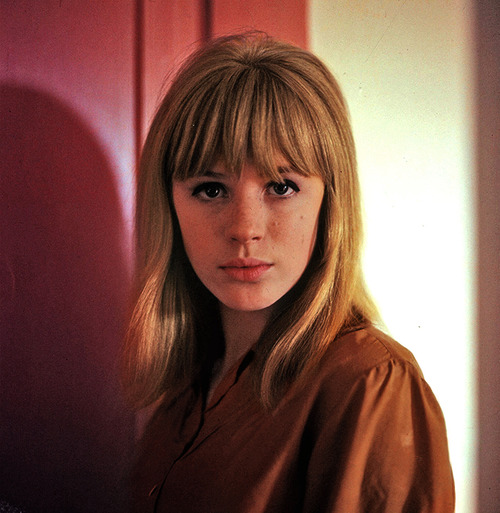
Young Marianne
Once she left her father’s governance passing into that of her mother’s she lived not in poverty but in relative hardship; luxuries if experienced at all were few and far between yet she did received an upper class education and outlook at St. Joseph’s.
Her mother was apparently strongly Bohemian having been involved with the stage pre-WWII. She encouraged Marianne in the Bohemian direction which Marianne found congenial, sought and never abandoned. The girl was interested in the stage while becoming a Joan Baez style folk singer after leaving convent school in Reading at seventeen.
While not beautiful in any classic sense she was yet attractive with a great figure making her a desirable sexual object. The sixties was the decade of wide open sex making all women mere sexual objects. Her first reaction was to seek a stable married life choosing John Dunbar as an appropriate husband. Dunbar was Bohemian in outlook while apparently headed for an academic career.
At this point fate intervened. At a party with Dunbar she met the record producer Andrew Loog Oldham who perceived her persona as a marketable commodity in the pop music world. As an added bonus Marianne could actually sing, having performed as a folk singer.
She was still an impressionable girl of just seventeen just after the Pill had been introduced with little ability to successfully traverse the changes she would be called upon to go through. These would be formidable and rapid calling for huge energy reserves on a day to day basis. Not an enviable situation.
While most musicians go through a relatively long learning process and struggle to succeed Marianne struck gold the first time out without even trying. Her first minimal three minute effort, if it was an effort, established her as the pop princess or queen of the generation. Her innocent convent school persona was perfect in a vulgar world. But it was a persona at odds with the one Marianne would seek and embrace- she became the devil with a blue dress on.
While the music or, really, record business seems very attractive from a distance it is literally vile from the inside. Everything connected with it is dishonest, the record companies, musicians, lackeys, the whole number. Nobody remains unstained.
It is truly a man’s world, even a gay man’s world, in which the men have no respect for womankind. Women are expected to merely service the sexual desires of the male performers. They have no use beyond that. Thus one has the phenomenally debauched groupie scene that amazed the world during the sixties. After that there was no longer anything amazing.
Having witnessed sex acts at Braziers of numerous descriptions the pop music world satisfied this side of Marianne’s psyche. At the same time a desire for a chaste life pushed her in the direction of marriage with Dunbar which desire she consummated, however Dunbar proved to be not the ideal choice.
While Marianne thought she would be leading a sedate intellectual academic life with him as a professor he turned out to be as much or more a Bohemian as she was. Quite frankly he failed her.
Having acquired a wife he did not act responsibly toward her. He was blindsided by her recording success and perhaps belittled by her financial success. In effect he was supported by his wife which is always a difficult situation. The changes he faced were in themselves formidable and he didn’t have the character to meet them. Still, a man doesn’t fill his house with dopers and heroin addicts. Marianne can hardly be faulted for resenting it after getting up in the morning to find a house full of conked out junkies in rooms littered with used needles. The transition from Braziers to St. Joseph’s to high degeneration must have been changes hard to adapt to. Sent her head spinning.

Marianne Searching
The change from the straitened circumstances of her childhood and youth still actually in progress to one of affluence in which she could indulge her wildest fancies in buying clothes and more clothes. Her lack of maturity hurt her badly. In this case her hero William Blake’s notion that the road of excess leads to wisdom was not quite true, it led to penury.
Not clearly seen by many at the time the pop world split into two streams, the British pop stream of the fifties soon to be extinct and the Rock world of pop princes and princesses of the future. The Beatles straddled both worlds while curiously Marianne may have been the first to emerge as a star of the Rock world soon to be followed by the Rolling Stones.
As such even though having only one hit single to her name she was on a par with the Beatles and the Stones while being superior to the lesser groups following in the train of the Beatles and Stones. Thus in the salon formed around the pop art dealer Robert Fraser she held a place of primacy that she never realized. Her tragedy was that she was too young and inexperienced to grasp her opportunity making a series of inept decisions while being seen only as so much poontang by the Rockers and of transitory fame by a series of inept managers.
Thus, unable to find someone capable of carefully building her career she did become transitory, or her career going into hiatus, she did lose her place while gravitating to the dominance of Mick Jagger and the Rolling Stones. Gradually her royalties diminished so that she was financially dependent on Jagger while still married to John Dunbar. Deep in a milieu of drug users she found their allure irresistible.
However conscious she was that she had been and still was to some extent a celebrity she thought to regain that identity. Feeling unable to compete with Jagger as a recording star she chose to follow her mother’s wishes and take up acting. In her enthusiasm to and need to show Jagger that she was somebody too, that she was his equal, as a performing artist she aroused Jagger’s interest in also being a movie star. He, being a more marketable commodity soon gave evidence of eclipsing her as an actor rather than staying in recording as she assumed he would.
Her own space having been preempted she developed an affinity for Brian Jones of the Stones who was essentially in her situation in his relation to the group. He too was being forced out thereby losing his identity.
When Brian died she then in sympathy decided to follow him overdosing with pills that would have killed her had not Jagger been alert enough to rush her to the hospital. As much as anything her suicide attempt was meant to get away from Jagger’s dominance. That move now being thwarted she had no choice but to walk out which she did in 1970. Thus began the rest of her life.
II

Marianne The Wild Thing
The Rock and Art scene was a drug scene. Bob Fraser’s salon centered around Rock musicians was also a drug center. Fraser introduced members of his salon to all drugs including heroin. Marianne had a favored position in Fraser’s salon early learning of heroin to which Fraser himself was addicted. By the time she walked out on Jagger in 1970 she had been addicted for some time. Heroin was to remain her central fixation throughout her life.
Jagger disapproved of her addiction so she was forced to conceal it from him. When her royalties decreased she no longer had her own money becoming dependent on Jagger. Not wishing to plead for large sums of money from Jagger in order to obtain her heroin she prostituted herself to Keith Richard’s factotum Spanish Tony Sanchez.
Sanchez was an aspiring criminal who came to Richards through Groovy Bob Fraser. Sanchez had met Fraser in a bar after which the friendship blossomed. Fraser had contracted gambling debts to the notorious Kray Brothers, the criminal kingpins of London. The Krays were threatening Fraser with grievous bodily harm if they didn’t get their money. According to Sanchez in his autos Up And Down With The Rollings Stones and I was Keith Richard’s Drug Dealer he volunteered to negotiate the debt with the Krays which he did.
At that time, following their US Mafia model, the Krays were attempting to lift the Beatles from Brian Epstein who also had large gambling debts to them so there is no reason to disbelieve Sanchez. Following the episode with Fraser Sanchez was employed by Richards as drug/procurer-factotum at the fabulous salary of two hundred fifty pounds a week. This leads me to believe that the Krays were using Sanchez to infiltrate the Stones possibly with the intent of taking them over.
Sanchez was always resented by Richards and the Stones but he managed to stick with them until the mid seventies when Richards was able to shake him. In his vanity Sanchez considered himself an essential member of the Stones’ entourage, if not an actual member of the Stones.
Marianne’s misfortune was that everyone wanted to sleep with her, a further misfortune was that she obliged. Thus she and Tony had a sexual liaison for several years. This raises the question then whether Tony was also pimping for her. Certainly as his criminal associates knew he was sleeping with her they would want to also. Not being a fool Tony may have named a price and received it. Whether he or she could have successfully resisted is open to question. The US Mafia certainly used their female artists to gratify their desires.
In the mid sixties additionally, once again, through Fraser Marianne had become part of the Satanic crowd. Through Fraser she was introduced to the arch US Satanist, Kenneth Anger. Through them she was introduced to the writing of Great Satanist of the twentieth century, Aleister Crowley and also the writing of the nineteenth century French arch Satanist, Eliphas Levi, not Jewish despite the name. And then the modern Satanist classic the Russian Bulgakov’s The Master And Margarita published in 1968.
Also in this period she became involved with the Satanist Process Church Of The Final Judgment. Marianne downplays her involvement with Satanism but it was much more serious than she is willing to admit.
Playing against this background Marianne renewed an acquaintance with the Irishman Lord Patrick Rossmore. He was 43 to her 24. I merely mention this, it makes me no never mind what the ages are so long as the couple is comfortable with each other. In this case they weren’t comfortable. The two, in a sort of a farce became engaged but never married parting as they met in a friendly sort of way within several months.
While Mick was aggressively dominating, Marianne seems to have chosen Lord Rossmore because shy and retiring as he was she could dominate him. According to Hodkinson the couple rarely saw each other, he being in Ireland while Marianne remained in London closer to her dope supply.
True to her interpretation of William S. Burroughs degenerate novel, Naked Lunch, she led a totally debased and degraded life as a street junkie or, at least, her version of it. Remember it was her movie of Marianne and she was pretending to be a sociologist. She cultivated the friendship of total degenerates such as the artists Francis Bacon and Lucien Freud. She also became friends with the total junkie, writer Alexander Trocchi. Also at this time becoming fast friends with another lowlife, Henrietta Moraes who she says was a close friend until she died. Marianne was able to sink to lower levels than any of these people and gloried in it.
It was during this period of 1970-71 that she says she sat on the wall in Soho staring into the bomb crater. In his first biography Hodkinson scoffed at this. According to him this wall was a waiting station lined with junkies alert for their supply.
By 1971 the Stones had become tax exiles in the South of France so that Spanish Tony was with Keith no longer able to supply Marianne with her drugs, thus, we suppose, the wall. As Marianne had no regular income during this period, although adequate royalty checks still arrived irregularly, there does arise the question of how she paid for her dope. As a junkie Marianne had no qualms about running up tabs she couldn’t pay and apparently didn’t. At one point she boasts she left New York owing several dealers 20K each while flippantly adding she had no intention of ever paying. Whether she succeeded or not is not known.
Marianne vehemently denies that she resorted to prostitution although there is a fair amount of circumstantial evidence she did. A careful reading of her second auto, Memories, Dreams And Reflections, gives some hints. At one point she retorts to an admirer that she is not a two-bit prostitute, that it would take 200 pounds to be with her. Perhaps a joke but the price sounds right, her retort has the ring of authenticity.
In the same auto she claims first hand acquaintance with all the working girls of the area. There is only one way such first hand knowledge could be obtained. There is or was a video on the internet in which a camera had been placed within a building between two half open doors. Marianne dressed in some pretty snappy expensive looking working girl gear walks in front of the camera, notices it, shows alarm, then quickly turns a corner then flattening herself against the wall to peer back at the camera. It seems evident that she was going to or returning from a job.
She seems to have worked from 1970-71 through at least 1974 through her association with Madeleine D’Arcy. In 1971- during the recording of Exile On Main Street when Tony Sanchez accompanied Keith to the South of France Tony met Madeleine with whom he fell deeply in love and had a relationship with her in France.
Upon returning to England he apparently resumed some sort of relationship with Marianne as well as Madeleine. Marianne in her turn began a lesbian relationship with Madeleine, perhaps to spite Tony, who she despised personally, or so she says. Tony was angry at the relationship.
It then appears that Marianne and Madeleine functioned as high price prostitutes or perhaps call girls between ‘72 to ‘74. In ‘74 Madeleine as Marianne recalls had gone back to turning fifteen pound tricks in Brighton. ’Going back’ implies that formerly she received higher payouts, perhaps 200+ as Marianne received.
As she hadn’t heard from Madeleine for a little while she called at her apartment. When no one answered she called a couple bravos to break down the door. One was a Maltese pimp and drug dealer. At that time in London the Maltese are said to have controlled crime in the West End. That Marianne could call on them to supply help implies a certain degree of familiarity with the underworld. The other person’s identity Marianne doesn’t indicate so there is the possibility it could have been Tony. When no one answered the door the two men broke it down.
Entering the apartment Madeleine was found dead on her bed. She had apparently been beaten to death although not molested as she was artfully laid out in a beautiful full gown. Thus whoever killed her loved her. This points to Tony although the crime was never solved.
So, if Marianne says she never turned to prostitution perhaps not, but there is sufficient evidence to indicate she did. The whole period from 1970-1974 is very hazy in her memoirs.
While she was supposedly incognito on the streets of Soho, as if Marianne could ever be incognito, lost to view of the music world, Michael Leander, who had been her producer suddenly got the idea to make an LP with her so he beat the bushes, scoured the walls so to speak, like any good detective, tracking her down in Soho supposedly sitting on her wall staring into the bomb pit. He induced her back into the studio where they recorded the LP Rich Kid Blues, a return to Marianne’s folk roots.
For some reason the record was shelved not being released until decades later. After this she took up with Oliver Musker who she was associated with for the two years from ’72 to ’74.
III
The Myth Of Marianne

Down And Out In Soho
For all her emotional problems Marianne was a bright girl. She read. Among her readings were those of the psychologist C.G. Jung. Among Jung’s ideas was that of the personal myth. By that he means everyone must have a personal myth to survive, to make sense of what one is doing or what is happening to you. This was more or less the same notion of Andy Warhol’s that if you don’t like the way your life is going pretend it’s a movie. That’s a sort of displacement so what’s happening is just a script that was written for you. Your own personal myth. Lots of people were living in their own movie.
It seems probable, in observing Marianne’s life, that she came across Jung’s observation and set about creating her myth. For proper understanding I quote Jung: p. 197 of the Red Book as quoted in the introduction by Sonu Shamdesani:
I was driven to ask myself in all seriousness: “what is the myth you are living?” I found no answer to the question and had to admit that I was not living with a myth, but rather in an uncertain cloud of theoretical possibilities which I was beginning to regard with increasing distrust…
So in the most natural way, I took on myself to know “my” myth– so I told myself– how could I, when treating my patients, make due allowance for the personal factor, for my personal equation, which is yet so necessary for a knowledge of the other person, if I was unconscious of it.”
During the period of 1970 ‘72 Marianne had fallen on the hardest times, the lack of a model for her life. It seems obvious that the wall bit is perhaps a metaphor for her mental state while sunk into her heroin addiction which perhaps had led to other unsavory activities.
If she really thought she was incognito amongst the street people and shopkeepers who she tells us were wonderful to her, what would have been just another junkie earning money by any means necessary, she is either misremembering or was oblivious to the truth. Marianne was a nationally recognized figure on TV and records who had won the hearts of the people. If anything, one can only think that they wondered how she could have fallen so low but in a manner they still revered the image she had been. On the other hand she says guys drove by and yelled ‘you dirty slag’ out the window. Marianne was in denial.
Without a myth of herself that was all she could do. I don’t know when after her fall from grace in 1967 she had read Jung to conceive of creating her myth but the period after 1970 has certainly been mythologized. Remember she titled her second auto Memories Dream And Reflections which just happens to be the title of Jung’s own auto without the And.
As it was necessary for Marianne to form a new persona after the Redlands bust it appears that the persona began taking shape during this period of extreme depression from ‘70 to ‘72. When she met Musker and perhaps even Leander recorded Rich Kid Blues with her, she began to form the myth and regain an identity and perhaps sanity.
Musker led to Ben Brierly which was a key recovery period and then later she grabbed hold of the supreme works of despair and depression, the works of Brecht and Weil. God, that’s hurting.
All her associates in the mid seventies were Creatures From The Black Lagoon. Black Lagoon was one of the great psychological sci-fi parodies of the fifties. Freud’s vision of the unconscious dominated the period so in Lagoon some ‘scientists’, always portrayed as evil themselves, discover a black lagoon in the Brazilian jungles. The circular pool, of course, represents Freud’s vision of the unconscious in which demons and monsters lurk so the Creature, stirred up by the scientists, perhaps it may be read as psycho-analysts, emerges in all his horror dripping with weeds from the black lagoon. Coulda been me I thought as I sat watching.
So, Burroughs, Gysin, Ginsburg, Corso, Bacon, Lucien Freud,, Moraes, all the people a reasonable person would run from. No matter how attractive they may appear on the printed page they were much less so in person. I’ve met a few of them and, shall we say, I knew I would never fit in.
Marianne did fit in. She was beginning to reconcile her Braziers Park sexual education with her high Catholic teaching. Andy Warhol said if your life is not going as you like it, pretend it’s a movie. Marianne was in the unique position where she could live her myth in movies, on the stage and on phonograph records as well as in real life. In her mind she could make it work but real life upsets things once in a while. Plus Marianne in her reading read William Blake whose line ‘the road of excess leads to the palace of wisdom’ was the mantra of the whole junkie crowd as well as Marianne’s. Who would be seduced by bull shit like that? Beaudelaire, Rambeau and the French Symbolists also provided such like justification for the path she was on. Thus Marianne was able to justify her myth by such philosophy.
Marianne could thus justify sexual excesses, perhaps even prostitution, as drinking the cup to the dregs on the path to wisdom. At the same time she was able to split her personality in a Braziers/St. Joseph’ contrast so that she could remain ‘pure’ while sympathizing with the plight of all those unfortunate prostitutes she knew so well. That actually was a sort of Rich Kid Blues so Leander was perhaps more prescient than Marianne thought.
Marianne who had many acting offers during these years and at least one serious role with Roman Polanski all of which she blew ostensibly because of her heroin addiction but also possibly because as she felt so degraded she didn’t think she deserved success because of Redlands. At any rate she was the darling of the counter culture and remains so down and out or not.
Oliver Musker an old Etonian met her through Christopher Gibbs who paled with Bob Fraser at a party in 1972 so she wasn’t so incognito that she wasn’t attending parties. Still her addiction was obvious enough that Musker wanted to save her. Therefore he took control and put her in rehab. But what’s rehab to an addict? Perhaps a time out. Of course Marianne says Musker saved her life. Well, romance, romance, romance.
Musker was an apparent stable interlude in Marianne’s self-destructive course. He kept her on a more or less even keel for these two years. No less destitute than she had ever been Marianne accepted a role filmed in India titled Ghost Story. Not quite the hardship Marianne attests, indeed, very glamorous to anyone in her fan base and elsewhere.
She and Musker traveled to India and from there to Hong Kong. So she was leading a life many could envy. Not too much is available about Musker but he apparently found India congenial as a business opportunity. He currently runs a furniture factory out of Delhi.
But he was an overbearing, dominant sort enforcing his will with violence. He knocked out Marianne’s upper two front teeth. When he tried to manage Marianne’s career he became too much for her and they parted company. Or, perhaps, Musker was just a crutch to get her over a very rough patch. By 1974 perhaps she thought she no longer needed him.
And then as part of the road of excess leading to the palace of wisdom Musker was a type of male and as part of her identity she was to experiment with different types. That would lead to her future second husband Ben Brierly. The music scene about to transit the very destructive Punk era so, perhaps Marianne saw it as chance to revive her recording career.
As I see it Marianne went into shock after Redlands. The shame of the Mars bar bit was too much for her psyche to handle. The court’s denial of the chance to defend herself and possibly explain was an egregious insult that she could find no way to handle. This kind of shock takes time to digest and find some way to regain one’s composure. Thus Marianne’s life from that point to her suicide attempt in 1969 can be explained in that context.
Her rejection of Mick can largely be explained as the aftermath of Redlands.
Marianne had been used as sex object once she entered the record industry. It was a role she didn’t reject apparently being a hot mama. But as one matures one finds ways to use as well as be used. Thus after 1969 Marianne turned predator using her sexual desirability to turn predator herself.
She stayed with Lord Rossmore after leaving Mick while she used Musker to regain some balance although kicking heroin is just a mirage junkies pursue. One grows weary of their stories of becoming ‘clean.’ At best after Musker she discovered her limits although she really tested them.
While I don’t think it’s true, Marianne felt that Mick was a superior musician to herself. Marianne let the notion destroy her self-confidence. Jagger is no singer, has no voice, is a mediocre lyricist, can’t dance but is a great showman with a burning desire to corrupt society.
Marianne’s problem was that she couldn’t find the proper agent or musical guide. Issuing four albums in 1965 was a crass error for which she was apparently responsible. She took no time to enter the spirit of the songs while many of the backing arrangements are revolting. Nevertheless she was Marianne.
Having felt herself overshadowed by Mick she now picked the poor shlub Ben to musically dominate and overshadow in revenge on Mick. As she left Musker she was emerging from the horrible reaction to Redlands while finding a musical persona to allow her to go on living the pop life she had learned to appreciate.
In keeping with her newly found myth combined with the Blake/Symbolist fantasy of plumbing the depths in search of the pearl of great price she embraced Brierly’s punk life style living in squalor in desperate squats. During this period she was forming the persona that would emerge with her 1979 release of Broken English. That record reestablished her musical credentials while providing her with a substantial cash windfall. She might as well have worked for nothing as she took a 90K check and promptly blew it on clothes and drugs. In some ways Marianne was a real slow learner.
She was able to disburse her cash faster than Edie Sedgwick threw away her 80K inheritance. Edie had no hopes for another windfall although Marianne did.
Broken English was a boundary line between the middle Marianne and what came after.

Marianne Soldiers On, A Real Trooper
Chapter IX will follow but I have other projects first.
Looking For A Miracle: The Sixties And Its Religion
August 3, 2013
Looking For A Miracle
The Sixties And Its Religion
by
R.E. Prindle

Sigmund Freud
The deliberate pursuit of whatever type of sex is considered deviant by one’s own culture is part of the program of spiritual seekers as far removed from each other in time and space as Tantric Hindu, California Satanists, Daoist sorcerers, Siberian shamans, and paunchy English “witches”, with their scourges and “sky-clad” retreats in the New Forest. To break tabu is a necessary stage in vama marg tantric ceremonies, for instance, in which dietary and sexual tabus are deliberately broken one after another. It is recognized by these technologists of the spirit that deviation from socially accepted mores is a powerful tool for awakening the sleeping powers within us, provided that this deviation takes place within the occult engines they have designed.
Peter Levenda- Sinister Forces, Book III, pp. 211-12
The key to the Sixties is Sigmund Freud. The Sixties was when Freud’s schemes came to fruition. He turned Aryan civilization on its head.
As unpleasant as it may be to recognize Freud was Jewish and his activities were based on his Jewishness and the age old prophecies that govern Jewish activities. Freud’s father came from the Galicia that was a stronghold of Hasidic magical Judaism. Freud himself was a student of the magical Zohar and Kabbalah.
Along with them he acquired the Jewish hatred of the Other, specifically Europeans or Aryans. He identified his psyche with the Semite Hannibal who attacked Rome- Freud’s symbol for Europe. In actuality Hannibal defeated Rome in the field. The Romans retreated within their walls refusing to come out and fight. Unable to sustain his army Hannibal was forced to vacate Italy. Thus, although he had won all the battles he couldn’t win the war. This was a real dilemma Freud had to solve and he did.
Freud began his career as a biologic researcher looking for eel gonads. Seeing no route to universal fame from that research he became interested in psychology. Here was some room to move.
Freud was born in 1856 in the midst of the great unfolding of the Aryan mind. He became associated with a fellow Jewish doctor, Joseph Breuer, who had become involved in researches into hysteria. This led Freud to the center of research in hysteria at the Salpetriere hospital run by Jean-Martin Charcot in Paris when Freud was about thirty years old. He could only afford Paris for a few months but they were eye opening months. He learned the nature of hypnotism and its control element- suggestion. This would be the stratum on which he built psychoanalysis.
Following Charcot Freud’s first book is an analysis of hysteria. The book caused no stir. Turning to associate Breuer and his proto-psychoanalysis Freud studied the nature of dreams. He characterized dreams as the ‘royal road to the unconscious.’ Following Sherlock’s advice Freud carefully studied the literature on dreams which was fairly extensive. His dream book flopped failing to make Freud a household word.
While issuing a steady stream of articles he contributed his greatest work in the form of The Psychopathology of Everyday Life in 1901. In 1905 he contributed the useful Jokes And Their Relation to the Unconscious and another significant work that gave a clear indication of Freud’s direction Three Essays On The Theory Of Sexuality. This small volume finally created the fire storm he had been trying for. At the time the book was considered close to or actual pornography. At any rate it attacked prevailing European or Aryan morality breaking all sexual tabus.
While one may argue that Freud’s was a scholarly approach there is undeniable smut to it. Freud in general reveled in smuttiness. He always leaves you with a slightly sickened feeling. There was controversy then as well as now as to his intent.
D.H. Lawrence who was no stranger to sexual theory and controversy denounced Freud in The Plumed Serpent for wishing to destroy prevailing European morality let alone reforming it. In this opinion he was correct. Both Sexual Theory and his Theory of the Unconscious and mass hypnosis would be his primary weapons.
Freud, contrary to popular opinion was not the originator or the discoverer of the unconscious nor even an early investigator. The unconscious had been a hot topic in European thought ever since Anton Mesmer arrived in Paris in mid-eighteenth century. There were many different ideas concerning the nature of the unconscious but by 1915 Freud had swept them off the board so that by the end of The Great War his perverted version stood alone. The question was how to use this tool he designed to destroy the conscious mind and manipulate the unconscious to attain his and Jewish ends.
In the nineteenth century the only mass media that could be used to manipulate public opinion, the unconscious, was the newspaper, but the newspaper requires consciousness making access to the unconscious difficult. It was only in the twentieth century that the great media capable of manipulating the unconscious directed arrived. Perhaps the most important of these was modern advertising that arose alongside the movies to be followed by radio, talkies and television. Color photo magazines are not to be overlooked either. Photographic images go directly into the unconscious.
Of these media the most overlooked is the power of advertising to quickly change mores, for it was mores that Freud had to alter or modify, the way of looking at and thinking about things.
Freud had a nephew in the US by the name of Edward Bernays. Bernays being Freud’s wife’s maiden name. Eddie Bernays became a publicist with George Creel and the Committee on Public Information during WWI turning to publicity as a vocation after the war. Thus he became a premier advertising consultant. His influence today is greatly overlooked.
The CPI was a tremendous propaganda, indoctrination and conditioning machine. The Wilson administration bludgeoned the American public into its party line. Bernay’s would use those techniques to change the mores of the American people post-war following Freud’s ideas. First he visited his Uncle Sigmund in Vienna where they had long summer walks and quiet talks. What was said isn’t known but can be inferred from Bernay’s subsequent career.
According to Wikipedia quoting his daughter Anne Bernays felt that the public’s democratic judgment was ‘not to be relied upon,’ and he feared that [the American public] could very easily vote for the wrong man or want the wrong thing, so that they had ‘to be guided from above.’
Of course, who is to judge who is the wrong man and on what basis as well as the wrong or right thing. Who is the infallible ‘above’ who is going to force his candidate on the erring people?
In other words, Bernays wanted a dictatorship of virtue. Unable to disturb the political system in one fell swoop it would to be don incrementally. Using techniques imbibed from his uncle’s political agenda Bernays did just that experimenting first through the commercial field.
Old fashioned advertising in print, as radio and TV hadn’t come into existence as yet, consisted of long prose pleas trying to persuade the conscious mind. When color printing came into common use an attractive image coupled with product ID and snappy slogan, or propaganda, would prove to be more effective. Thus to promote Lucky Strike cigarettes there was an incredibly attractive slender woman smoking a Lucky with the slogan ‘Reach for a Lucky instead of a sweet.’ The ad then carried a number of subliminal messages as well as the plea.
When Bernays began his work the Aryan female ideal was the Arthurian conception portrayed most notably in the Pre-Raphaelite paintings. Virginal and desirable as a wife. Freud’s sexual goal was to invert that image to turn Aryan women into sluts. Smoking in women was considered sluttish at the time just as cosmetics were symbolic of the prostitute or painted woman. Good girls didn’t wear lipstick. Bernays through his advertising techniques was to change all this.
Meanwhile back in Vienna, Freud was developing techniques to change the mind. As always an avid student of literature Freud latched onto a small book by the Frenchman Gustav Le Bon titled: The Crowd: A Study of the Popular Mind. Freud incorporated Le Bon’s studies into his own Group Psychology and the Analysis of the Ego. By ego he meant group ego not the individual ego.
The analysis of Le Bon meshed with the advertising propagandistic ideas of his nephew. Freud then combined their work with his understanding of sexuality, drugs and his version of the unconscious to undermine Aryan civilization. Remember he was successful in imposing his vision of the unconscious as the only version of the unconscious on the entire psychological and psychiatric discipline, hence society as a whole.
Aiding the effort was the triumph of Adolf Hitler in 1933 in Germany. Hitler’s anti-Jewish stance drove the whole horde of Freud’s disciples out of Europe to the United States. While Freud knew what he knew the other members of his psychoanalytic order didn’t. I don’t mean to be unkind to Freud’s personal lumpenproletariat but they just didn’t grasp what he was talking about. Nevertheless they were accepted at face value becoming not only influential but directors of US culture during the fifties and sixties after which their prestige began to wane.
Most of them settled in the two culture capitols of the US, NYC and LA so that the media took their lead from them. While few, if any, understood Freud his vision of the unconscious as a discrete entity extraneous to the mind and actually the body while controlling one’s actions to the exclusion of the conscious mind was readily accepted and adopted as was his notion of repression in a completely distorted form.
The reality of Freud’s vision of the unconscious was quickly picked up by sci-fi writers who turned out a stream of such novels as Jack Schaefer’s I Am Legend, Jack Finney’s Invasion Of The Body Snatchers and Heinlein’s The Puppet Masters. Not that we consciously understood at the time.
The State of Israel had come into existence in 1948 setting the Middle East ablaze in a series of wars. The 1956 war was a turning point for the Jews. They had been shamed by their non-resistance to the death camps so the ‘56 war allowed them to assert their manhood and become fierce warriors driving US tanks and jet fighters. The war also had intellectual consequences.
Aryan Europe and America had astounded the world by its astonishing scientific discoveries and intellectual development unshared by the rest of the world including the Jews. Emboldened by their military success they set out to reassert their pre-scientific religious dominance they felt they had enjoyed throughout history until the nineteenth century. Indeed a Jewish woman named Barbara Spectre has established the Paideia Foundation in Europe to claim a parity between what she calls Jewish Knowledge and Aryan Knowledge. She specifically says that the future will not be like the nineteenth century when science wrested the crown from the Jews.
This is apparently not the first such crisis of the Jewish mind. A site called Jewniverse published a short piece credited to Daniel M. Bronstein on 7/19/13. I reproduce it here in full:
Quote:
Talmudic lore offers many episodes of rabbinic sages intellectually defeating the luminaries of the Hellenistic world. Far less common are instances of rabbis dismembering their pagan nemeses. So 2nd-century Rabbi Joshua Ben Hananiah really stands apart.
Acting on Roman Emperor Hadrian’s dare to abduct Athens’ top philosophers, Ben Hananiah traveled all the way to the celebrated city-state and coerced a local into revealing the secret location of the philosophical academy.
Upon reaching the heavily defended abode, the esteemed rabbi tricked the academy’s elders into killing the guards.
In a match of wits, Ben Hananiah demonstrated his intellectual superiority while exposing the vapidity of Greek wisdom. After kidnapping 60 of Athen’s best, he brought the scholars before Hadrian, who placed their fate in the sage’s hands.
Using what can only be called magic, Ben Hananiah caused the philosophers’ shoulders to be violently wrenched from their bodies. All of them were killed. Other sages, like Hillel the Elder, have been praised for almost superhuman patience. But Ben Hananiah’s actions present another view of the sages: as people who were extraordinary, but flawed.
Unquote.
Of course Plato’s academy had neither a secret location nor was it heavily guarded but it makes a good story that flatters Jewish sensibilities, apparently of a highly bloodthirsty order. Thank god he didn’t pull Moses, trick and send ten plagues on the poor nitwit, stupid Platonic academicians. How Barbara Spectre is going to replicate Rabbi Hananiah remains to be seen. Let’s hope she doesn’t operate in the same realm of fantasy as the good rabbi.
Just as Moses through Yahweh destroyed Pharaoh, as Rabbi Hananiah demolished the hated Platonic Academy so Freud had calculated the destruction of nineteenth century Aryan science.
Nineteen-sixty was the critical year. Western American society reached its apex in that year, but the demands of the scientific attitude exceeded the ability of the body politic to rise to it. The people slipped back to a pre-scientific mentality. Whether we saw it or not the crash of Western society that resulted in the Manson murders and the Rolling Stones at Altamont began in 1960. Actually the much celebrated Woodstock concert of ‘69 was evidence of the intellectual retreat also, a premonition of Altamont.
By 1960 TV had reached a certain level of maturity. During the fifties when programming was developing most locales had only one or two networks while there was some concern TV wouldn’t make it commercially. By 1960 the three networks and independent system was in place. The sitcom and drama setup was well organized. Hollywood had learned the Freudian formula of using the medium for indoctrination and conditioning.
The fifties had been the great creative period for science fiction both in literature and movies. This whole body of outstanding material was now mined by TV. Rod Serling’s Twilight Zone successfully invaded the minds of millions while the gold standard was probably Gene Roddenberry’s Star Trek. Both producers were Jewish.
It is impossible now to recount the propaganda, indoctrination and conditioning of the many, many series and thousands of episodes representing tens of thousands of hours of viewing that made war on established beliefs gradually weaning the multitudes from old mores to new. Mostly the old mores with different content much as new religions build their religious edifices on the old religion’s sites.
The new religion was Saturnic or in another word, Satanic and the hallmark of Satanism is violence. Few people now remember the TV series, Bus Stop, but that show was a direct assault on established beliefs and attitudes toward violence. Incredible gratuitous mindless violence for the time far surpassed today when sadistic pornographic violence with nudity or nakedness perhaps a better word, thrown in.
One of the Twilight Zone episodes was a depiction of Charles Beaumont’s short story The Howling Man, the script also written by him, in which Monks somewhere in Ruritania had captured Satan and had him safely locked in a cell where he howled incessantly all night long. A passing traveler asks for a night’s lodging. Against their own strict rules forbidding it the Monks weakened and allowed him in carefully explaining to him to pay no attention to the howling man in the cell. No good deed shall go unpunished. The traveler naturally listens to the Howling Man’s pleas releasing him. Satan laughing maniacally shouts Fool and rushes out the door.
Beaumont had divined the situation and put it into symbolic story form. In the TV episode the sorry Fool spends his life searching for Satan to put him back in his cell.
It is prescient that Beaumont wrote the story in 1959. By 1966 Ira Levin would develop the theme further when he wrote Rosemary’s Baby about the birth of the son of Satan who replaced Jesus that was made into a very influential movie a year later by that evil presence Roman Polanski. We’ll get to that.
As is well known Sigmund Freud was a cokehead, a drug addict. He well knew the deleterious effect of drugs on the mind and morality. Dreams may be the royal road to the unconscious but drugs are the destroyer of morality. The Unconscious corrupted by drugs is the end of all law and order.
As Freud, the old cokehead, said there are no coincidences so it follows that the drug explosion of the Sixties is the effect of a premeditated cause. After all, Arnold Rothstein, a Jew, did organize the drug distribution network of the US in the 1920s. It can also be no coincidence then that Dr. Feelgood, Max Jacobson, latched onto amphetamines as the great corrupter of society. Jacobson also claims to have conferred with Freud in Vienna. Getting underway in the US in post-war NYC in the forties, by 1960 Max was dispensing amphetamines by the gallon. Imitators sprang up who poured their own gallons of amphetamine into the veins of New Yorkers. This is fact, now it should come as no surprise then that by 1966 NYC was overrun by criminal behavior, that seemed to explode in that year. Or shall we say lack of morality caused by drugs. In essence New Yorkers could no longer tell right from wrong. Satanism ruled. It should be needless to add that Dr. Feelgood was a Jew. There were many factors causing the erosion of morality in the Sixties not all pertaining to religious developments that are our interest here.
The rise of science caused the intellectual disenfranchisement of all religions but more particularly within the Aryan ranks in which science developed, hence Aryan’s became disenchanted with Christianity while Jews and Moslems reinforced their belief systems against science.
Aided and abetted by Einstein’s Theory of Relativity the notion of moral equivalence took hold. This was, one might say, cemented by the movie Mondo Cane of 1962. While moral equivalence should have applied to all religions or moral systems it was turned exclusively against Aryan belief systems. Movies and advertising reflected the animus against Christianity, Aryans and what Negroes called White Supremacy, that is, White rule and knowledge- science or in Negro terms, Acting White.
With all systems supposedly equal or morally equivalent while consciousness, that is objectivity was suppressed in favor of complete subjectivity or the Unconscious was endorsed, it became an easy matter to inject voodoo, witch craft and Satanism into Aryan belief systems. Now, the transition to a satanic sensitivity was fully supported by movies and advertising as well as print media. In 1966 the cover of Time Magazine proclaimed the message ‘God IS Dead’ in black. To the informed that was not a revelation as old gods do die while history is littered with the remains of old gods as epitomized by Shelley’s Ode to Ozymandias. To the religious Time’s announcement was a huge blasphemy but then, the jury was still out concerning on which side the Luce’s were.
As if in celebration of the Luce’s announcement the Jew Ira Levin published his novel Rosemary’s Baby that concerns the birth of the Son of Satan although definitely by maculate means. The novel was a commercial success bringing the little Satan Roman Polanski on the scene who turned the novel into his equally successful movie in the year of revolution, 1968.
The impact of Polanski’s movie was quite extraordinary. Certainly in the aftermath of the movie Satanism had been, one might say, popularized. Of course Levin and Polanski didn’t create modern Satanism but they contributed to its manifestation. The voo doo Saturnian cult had taken root on the East Coast being prominent in NYC. Santeria as well all the Negro voodoo cults in the New World, of course, derived from Yoruba practices in Nigeria. The Yoruba people combined aspects of Christianity with their own Yoruba beliefs themselves derived from Greco-Roman religious practices to create a very hybrid religion based completely in magic which through slavery passed into the New World.
Scientology, created by Ron Hubbard, one of those called UFO religions, in the forties somehow gets mixed up in this. Certain disaffected members established their own church in England in ‘63 called the Process Church of the Final Judgment. This outfit tried to combine Satan, Lucifer and Jesus into one religion. No science involved here. Charles Manson at the end of the decade would be influenced by both Scientology and the Process.
The idea was that Jesus said, Love your enemy. Satan was the enemy of Jesus so Jesus was compelled to love Satan. So the two along with Lucifer combined to share humanity so that virtue and evil were morally equal bringing in relativism, so right and wrong are irrelevant because what one calls right another calls wrong and vice versa. So the law was that ‘it’s all good.’ Do what thou wilt shall be the whole of the law. Everything is permitted. A recipe for disaster no doubt. A state of social confusion had been created, almost a state of sustained hysteria.
After 1966 LSD became significant reifying whatever beliefs one had into stone. The fact is that nothing can be gotten out of a mind other than what is in it. Education is everything. To really expand one’s consciousness one has to develop it. With drugs learning stops, especially with LSD. If anything one only reifies one’s existing opinions. One may think one is talking to God but notice that God isn’t saying anything back. You’re only having a dialogue with yourself. You don’t need LSD to do that.
A biker by the name of John Griggs dropped a tab, saw God, changed his ways and began his own religion based on LSD called The Brotherhood of Eternal Love. Begun in the LA coastal town of Laguna Beach the cult, or more aptly perhaps, commercial enterprise expanded up and down California and into Oregon where it was especially prominent in Josephine County of Southern Oregon. It is said the BEL dominated or controlled the marijuana, hash and LSD supply of the West Coast but rather strangely none of the authors concerning themselves with the Process Church or Manson’s Family have heard of it. These authors seem to think that the Process had a monopoly on that drug trade although dealing with biker groups. Perhaps the role of the biker BEL wasn’t apparent to them. All three ‘religious’ groups mentioned above were seriously involved in drugs and hence lead a Freudian unconscious life.
The Process Church founded by Robert and Maryanne DeGrimston in London in 1963 as an offshoot of Scientology soon moved to the sinister sounding site of Xtul on the Yucatan Peninsula of Mexico. There its Satanic, Luciferian and Jesusite form took shape. As one can see, under the influence of Freudian psychology and the rejection of the conscious mind science had been discarded while consciousness has regressed some thousand years more or in some cases less. Magic and superstition have once again taken center stage. Behind the magic cults lay the teaching of one Aleister Crowley of the Golden Dawn and the infamous OTO (Ordo Templi Orientis) with its emphasis on sex magic(k). The K Crowley added to distinguish his magick from stage magic. May not look like much of a distinction but it is significant.
So, in 1967 we have Charles Manson being released from prison just as the Hippie thing with its legions of underage runaway girls took shape in the Haight-Ashbury district of the city of San Francisco. The Haight was a hustler’s paradise and Manson was the man to mine that particular mountain.
More than anything the Hippie phenomenon was a symptom of the rejection of science, or objectivity and the conscious mind in favor of superstition, subjectivity and the unconscious mind of Freud. In connection with Freud it should be remembered that the motto of his 1900 book The Interpretation Of Dreams in his Latin quotation from Dante’s Inferno was Flectere si nequeo Superos, Acheronta movebo which translated means: If I cannot move heaven, I will stir up the underworld.
Freud had failed at the conscious level of science, which he attributed to anti-Semitism, so when he became aware of the unconscious through Breuer and Charcot he had found his underworld. But that hell was part and parcel of his upbringing as Judaism is pure subjectivity hence rampant egoism capable only of creating a hell on Earth- hence Hollywood.
The Unconscious in Freud’s vision was the source of Satanic magic. Hence it can be little wondered that at the very least per the Process Church the world was shared by Jesus and Satan with the Jesusites compelled to love their enemies and presumably turn the other cheek which is to say that Satan Rules. In his own way the great Satanist Aleister Crowley had won the battle sharing the triumph with Freud.
By the way, the Process Trinity mirrors Greek mythology in which Zeus is the god of Heaven, Poseidon the God of the waters and Hades the god of the underworld. Earth was the common property of all three. So the Process reflects old age beliefs.
Because of the horrific nature of his Satanic practices all the attention has been focused on Charles Manson who identified himself as both Jesus and Satan. Half or better of the biker groups derived their identity from Satan- Hell’s Angels, Straight Satans, Satan’s Disciples, etc.
In point of fact Manson was not doing anything his betters , i.e. Roman Polanski et al., weren’t. The whole of Hollywood film was involved in Satanic practices. Nor were Satanic practices new to the LA basin. All of this cult stuff, snuffings and all was common knowledge in the fifties when I was there in the Navy. I have no doubt it dated back through the forties and thirties. Read Raymond Chandler and let your imagination go. Watch the movies closely.
Manson said the reasons for the Tate-La Bianca killings were not what was thought but that he was no snitch. It also means likely that these unknown forces were doing their best to help him once arrested as evidence disappeared, police bungled the process so that Manson and the Family might have beaten the rap except for the persistence of Bugliosi.
Manson appears to have been associated with the Polanski clique involving a large selection of A-list Hollywood. They were involved in drug related Sado-masochistic practices and filmed themselves doing them. Not surprisingly Manson was doing the same with his group. Perhaps under the influence of hallucinogenics the significance of a filmic trail didn’t seem so important. In any event the police confiscated hours of Sado-masochistic films from the Polanski residence. Not unusually these have disappeared although they were offered for sale by the police.
In addition there were huge dope deals on the table that if Polanski wasn’t involved in he was well aware of. His close friend Frykowski, a Pole from Red Poland, was involved in a scheme to distribute the amphetamine MDA and that would have been through the Polanski residence. Shortly before the murders a dealer accused of burning them in a dope deal was brought to the residence where in the course of a large party he was strung up and tortured.
A few days later when Polanski was out of town Manson instructed his devotees to strike. The result was horrific. While it is said that the dope dealer Frykowski was the actual target it was the horrific death of Polanski’s pregnant wife, Sharon Tate, that garnered the headlines.
We have an interesting thing happening here that seems to have gone unnoticed. It was a transition of consciousness that affected every member of society though few actively participated. As an example to illustrate what was happening from 1967 through 1969 I quote from an online publication by an anonymous author concerning the transition from the Weimar Republic to the Nazi Government of Germany. ( hppt://thespawnofthesphinx.com ) chap.17, p. 4:
Quote:
In his book, “In The Garden Of The Beast”, Erik Larson relates first hand accounts of what it was like to be an outsider (in particular the American Ambassador and his daughter) observing Hitler’s rise from Chancellor to tyrant in 1933. It was during that year that Germany became absolutely transformed. “It was like watching a dear friend go insane.” as one outside observer put it. After the great transition and assimilation, German’s collective mind was “coordinated.”
Larson quoted:
“Beneath the surface, however, Germany had undergone a rapid and sweeping revolution that reached deep into the fabric of daily life. It had occurred quietly and largely out of easy view. At the core was a government campaign called Gleichshaltung- meaning ‘Coordination’- to bring citizens, government ministries, universities, and cultural and social institutions in line with National Socialist beliefs and attitudes.
‘Coordination’ occurred with astonishing speed, even in sectors of life not directly targeted by specific laws, as Germans willingly placed themselves under the sway of Nazi rule, a phenomenon that became known as Selbstgleichschaltung, or ‘self-coordination.’ Change came to Germany so quickly and across such a wide front that German citizens who left the country for business or travel returned to find everything around them altered, as if they were characters in a horror movie who come back to find that people who once were their friends, clients, patients, and customers have become different in ways hard to discern. Gerda Laufer, a socialist wrote that she felt ‘deeply shaken that people whom one regarded as friends, who were known for a long time, from one hour to the next transformed themselves.”
Unquote, unquote.
The same thing happened in the US in the fifties as Jack Finney recorded in his Body Snatchers, is happening again here at the end of the sixties and is happening now as Obama/Hitler transforms the Aryan mind. We now have a call for a ‘meaningful dialogue’ on race which means ‘accept our views or be punished.’ There is no dialogue just an order from headquarters.
On a longer wave than Germany one entered the fun house in 1960 and through a bizarre series of dioramas one exited into an entirely different world in 1970. On the shorter wave the rapid transition took place from 1968’s Rosemary’s Baby to the Rolling Stones fiasco at Altamont in December 1969 which had been scheduled for December 7, the anniversary of Pearl Harbor, but was delayed by a day to December 8th.
As Dylan sang, there was something happening here but few if any knew what it was. There was no way for anyone to gain sufficient facts to interpret the whole but those with certain roles observing specific parts knew what to do.
Thus the public had no idea what Manson was doing before or after the Tate-La Bianca killings. The killings themselves obscured everything. Manson based his attitudes on Robert Heinlein’s novel of 1961 Stranger In A Strange Land. Stranger was one of the formative novels of the 60s fitting right in with the psychedelic revolution even though Heinlein had a forties-fifties mentality while adding numerous terms to the vocabulary such as ‘grokking’ and ‘water brother’.
One can imagine Manson reading it in his cell. Then when he was released actually being a stranger in the very strange land of Haight-Ashbury. At the same time he realized it was a parallel universe designed with him in mind. He combined aspects of the two lead characters, the human Valentine Michael Smith raised on Mars and his terrestrial guru Jubal Harshaw. Jubal means father of all, a role Manson assumed. He also named his son Valentine Michael. Smith transformed terrestrial culture as so in his way did Manson.
While on Mars Smith learned the Martian method of mind and body control which Manson adopted and extended to his disciples. After the killings Manson began living out some desert fantasy in Death Valley. It was there he really overstepped the bounds bringing the Park Department down on his head which then led to his charge of the murders, but it’s the desert adventure that interests us here. While the vast majority was unaware of the Death Valley escapade detailed in Ed Sanders, The Family, (make sure you read the first edition) Mansonites saw and learned. In the desert Manson nearly created his own country living by his own laws. Unfortunately his prison mentality kept him from grasping his full opportunity . He was too much the outlaw.
While I didn’t realize it at the time his influence spread up the coast to Eugene, Oregon where I was living at the time. Those were rough and rowdy times. There were many crimes, frequently using shotguns. An especially outlaw area was called Fall Creek. At one time a truck with a light rack pulled up before a camp site turning the light rack on the campers from the road. They stood like deer staring into the lights. The occupants turned rifles on the campers man, woman and children and mowed them down.
As far as I know the police chose not to apprehend them. It would have been easy. A brown pick up with a light rack in a small town? I knew the truck while finding a brown pick up with a light rack should have been easy. Couldn’t have been more than one in the county.
I was lured out to the area once with my wife by a couple posing as friends. All of a sudden at eleven o’clock at night they shooed us out of their house. As one neared the highway a narrow stone bridge crossed Fall Creek, almost a ditch at that point. As we approached a guy came up from under the bridge, stood in the middle of the roadway waving his arms. I wasn’t going to stop and there was room to drive around him. No sooner had I crossed the bridge than another guy came up from under it bearing an automatic with what looked like a silencer on it. Both began calling me names. So, I at least, would have been murdered on the spot.
As a footnote Diane Downs of the famous murder case in the same area said she was stopped by a guy waving his arms in the middle of the road. She was disbelieved subsequently spending her life in prison. I know she was stopped and I believe her story. What the DA’s problem with her was I don’t know but she was sure railroaded.
The revolutionaries flooded into the hills above Fall Creek building concrete bunkers a la Manson that they stocked with food and weapons in preparation for the Day. Strange robberies and shootings happened fairly frequently. There were Manson cultists around for several years. They may still be there, or here, actually, but I no longer have reason to be in contact with them.
Of course, Manson combined Heinlein with the various Satanic cults, the writer of the Spawn Of The Sphinx calls them UFO cults, to create his unique mixture.
Manson has taken the rap for what was going on but as I have indicated Polanski and a large part of Hollywood were as deeply connected to Satanism as he was. Remember actually billions of tablets of prescription amphetamines and barbiturates were being sold annually in addition to the hundreds of millions of hits of illegal LSD, marijuana and God only knows what. Frykowski was negotiating to become a large distributor of the amphetamine MDA.
Drugs were not solely a Hippie phenomenon; drugs were endemic.
Polanski, who can possibly be seen as a successful Manson, continued his nefarious career being arrested in 1977 on charges of child porn or statutory rape. While it is said that the girl’s mother rented her out for the purpose the charge was still statutory rape. Remember Manson said that the Tate-La Bianca victims were into kiddie porn. Polanski believing he would be sentenced to hard time, possibly even being in the same prison as Manson, who knows, took it on the lam. Today he is a fugitive from justice living in Europe where he has powerful protection. Still makes movies though.
The Manson trial was docked in December being very much in the news at the time of Altamont, as was the Zodiac killer, so there was a certain atmosphere surrounding the concert.
The last half of ‘69 was in some ways the apex of Aryan consciousness while at the same time its nadir. Even as powerful rockets were propelling a manned vehicle to land on the moon carrying an astronaut to leave a footprint three inches deep in the lunar dust the unconscious was burying the conscious mind on Earth. A giant step forward for mankind on the moon while a two thousand year regression on Earth.
Almost simultaneously as the lunar module blasted down on the moon a half million of what used to be the hope for America’s future gathered in a muddy field in New York to show a level of culture not seen since the Anabaptists four hundred years ago.
While my generation celebrates Woodstock as the high point of Sixties culture I can see it only as an embarrassment. Not wishing to go into detail I will only mention one thing. Columbia Records released an album call Beautiful People, an ironic insult to the Woodstock Nation as Hippies called themselves in mockery of the Jetset beautiful people. But, if you look at the album cover closely, in the upper lower quadrant you will see some guy standing up haveing sexual intercourse with a sheep. Beastiality as well as NAMBLA maybe endorsed by some but damned if I’ll join in.
I know I’d never be forgiven for saying so but I consider Woodstock to be the penultimate nadir of the Sixties. The nadir was, of course, Altamont, Satan’s triumph.
While the Rolling Stones, under whose auspices the event occurred refused to take responsibility for it, the Stones were as responsible as Levin, Polanski, the Process Church and Manson for the rise of Satanism.
The Manson trial was about to commence. Manson to a large extent incorporated Rock into his philosophy although basing his notions more on the Beatles Double Album than the Stones. Also bear in mind that Heinlein’s Stranger In A Strange Land was his bedrock. One could only hope that he had been captivated by the bible of evildoers, The Catcher In The Rye.
The character of society changed greatly after 1968 almost like Nazi Germany. Sixty-eight was the year of Mao’s Cultural Revolution, the horrors of which in China are still unlearnt in Europe and the US. The Cultural Revolution was global. Sixty-eight was the year of Mao’s Little Red Book and his red and gold portrait pins. Sixty-eight was the year SDS exploded and the formation of the idiot Bomber Billy Ayers’ Weathermen organization as well as the Jewish Defense League, its offshoot The Jewish Defense Organization and the criminal activities of Rabbi Meyer Kahane. Over the period of a couple years there were thousands of bombings in US cities. So many that very few were ever publicized.
While the Tate-La Bianca killings dominated the headlines organizations like the Brotherhood of Eternal Love, the Black Panthers and numerous cults such as The Process Church were stirring up the folk. One was practically dizzy. In action at the same time as Manson the Zodiac killingts of the Bay Area where Altamont would be held were going on. There was just way way too much for people to absorb or begin to understand. As most people were busy trying to live their lives all this crazy activity had remarkably little effect. It was just ‘news.’
Apropos of Altamont the Stones were relatively heavily involved in Sastanic matters, that, if I am right came to a head at Altamont.
Marianne Faithfull and Jagger had been familiar with Satanism before the Redlands bust. Anita Pallenberg, formerly with Brian Jones and then Keith Richards, was deep into Satanism. At one time she had Brian and herself dress in Nazi uniforms. The Nazis were a fascination of the Process Church so rather than being an innocent lark she may have been showing the Church she was in a position to influence the Stones. Indeed, they were in awe of her.
Through the art dealer and man about Hippiedom, Robert Fraser, Marianne and Jagger had met the arch American free lance Satanist Kenneth Anger, with whom they were deeply involved, and who was associated with the arech US Satanist, Anton La Vey. La Vey would play Satan in Polanski’s Rosemary’s Baby. That would imply that Polanski was involved in Satanism leading back to the Tate-La Bianca killings.
Post Redlands, Mick was thrown into a frenzy of hatred of society probably having thought he was a notch or two above the law immune to arrest. Indeed he thought the enforcement of the law against him was a violation of his ‘freedom.’ Marianne had been a bit of an innocent, too naïve for her own good. Mick now enraged turned to Satanism posing as Satan himself in his song Sympathy For The Devil of 1968. He allowed the Stones to be featured in Jean Luc Godard’s bizarre revolutionary movie titled One+One subsequently changed to the title of Jagger’s song. Marianne would let herself be exploited in a couple of French films while becoming involved with the Process Church itself while starring in a Satanic film of Anger’s.
It is said now that Satanism was a minor flirtation on their parts but the indications are that the involvement was much deeper and more serious, especially on the part of Marianne that was reflected in her persona and activities in the first two years of her parting with Jagger.
It was perhaps the Process that alerted Marianne to the publication of a Soviet Satanic novel The Master And Margarita published in early 1968. The novel has since attained a high cult status in the US and GB while becoming an industry in the former USSR. A number of films of the novel have been produced in Europe. A much overrated literary effort, in my opinion but a key Satanic document.
Marianne pressed Jagger to read the novel as he was about to begin production of Donald Cammel’s movie Performance, also a Satanic film, shot in the summer of ‘68, that revolutionary year. The movie would not be released until 1971 so has no effect on the period.
Whether or not Jagger or Marianne took their Satanism as more than a hallucinogenic lark the effect of their Satanism on their fan base was intense. Jagger was viewed as the Great Satan or, at least, a wannabe.
So the aura surrounding Altamont was imbued with Satanism. Haight-Ashbury was Satanic. Satanic was.
The Altamont was an almost perfect Satanic location. The Altamont is a pass over the hills surrounding the East side of the San Francisco Bay, the East Bay. To the North of the pass lies Contra Costa County; to the East is Stockton, Sacramento, Modesto, and the Central Valley. To the South are barren hillsides, desert for miles all the way to San Jose and beyond.
The pass is only a thousand feet but very windy while when the pacific fog comes in at night cold and dewy. Today, they’ve covered the area with wind turbines, must be more spooky than ever at night.
When I was in the Navy in the late fifties I used to hitchhike back and forth from San Diego and Oakland every weekend. I would have a friend drop me off at the thousand foot level to begin the return trip. Gloomy place but a quick place to pick up perhaps a very decent ride. The demolition derby grounds were off on the right side going down, maybe at 900 feet. Real desert.
So, through a series of misadventures, given only a couple days to set up this site straight out of hell, cold enough to freeze a witch’s tit the Stones held a free concert. There was no parking, cars strung out along the side of Highway 40 for miles.
Everything was jerry built. The stage was so low and surrounded by so many Hell’s Angels that few could even see the stage in the dark. The sound was terrible. Out into the darkness stretched a couple hundred thousand drugged shivering people. I mean it gets cold and damp there any time of the year and this was December.
So, picture the symbolism. The chief Droog, the Great Satan himself is going to take the stage surrounded by Hell’s Angels and begin shouting out ‘Let me introduce myself…’ OK. Hello, Satan.
Well, now. Jagger and the Stones had been positioned as the bad boys of rock n’ roll by their first manager, Andrew Loog Oldham back in ‘64. Their reputation kept getting worse and now they have improved this rep to being the house band of Hell, Satan’s own rock n’ rollers. Huzzah! ‘I’m a man of wealth and taste…’
There’s a Negro in a green suit who has pushed himself stage side, right behind the not so straight Satans, the Hell’s Angels. I mean, these guys had a worse reputation in the Bay Area than Satan himself. They used to have their club house just down the street from me. We will never know the Negro’s motives but he does have something on his mind and he has a pistol in his pocket. Are we looking for trouble, do you think? He’s apparently been waiting for the moment Jagger opens his mouth to introduce himself. Jagger begins belting it out and at that moment Meredith Hunter, for that is the Negro’s name, whips out his pistol. Waving it in the air he begins a charge through the Hell’s Angels for the stage. There’s a few Angels between himself and Mick who cut short Meredith’s pilgrim’s progress.
No one can say for certain that he didn’t want to put a bullet between the Great Satan’s eyes but I am positive his intent was not to take out six Hell’s Angels and then run like hell. I’m not a gambling man but I would wager on that.
The Angels were cranked out on drugs, pot, LSD, crank or something while getting high on being tapped for the very important function of furnishing security for The Greatest Rock And Roll Band On The Entire Planet and, perhaps.- the Universe.
Wham! Bang! Oh God! Meredith today rests for all eternity on the Altamont or for however long it takes Time to wear down those hills to sea level. If not Meredith, then his shade.
As Jagger made a dash for the helicopter somewhat reminiscent of the last evacuees from Saigon he was heard to mutter, ‘Something weird always happens when we play that song. Could have a clue, Mick. A Clockwork Orange wasn’t released for another couple years but that was the popular impression of you up on the screen, Mick. Bad boy, bad boy, the bad boy of rock n’ roll.
Nor did Jagger abandon the persona after that disastrous experience. He developed his ambi-sexual persona further appearing on stage as a sadistic agitator lashing the stage with his studded belt. The Chief Droog.
Thus by the end of the sixties the suppression of the conscious rational mind had been accomplished in favor of the vision of the unconscious as a satanic separate being whose external control of the individual was irresistible. Sex and drugs were used to place a generation beyond redemption.
In support of sex and drugs, TV and movies pounded out the message that rage and violence were the proper responses to one’s inability to realize one’s fantasies.
While some may pooh pooh the advancing Satanism of the Sixties and on to the present time TV and movies did advance the agenda into the present. As incredible as it would have been to a person of the fifties when the mention of leg for lower limb was still frowned upon, copulation, not simulated even, but actual, is shown commonly on TV and in movies. Murder as an occupation or even pastime has openly been promoted on TV shows such as Dexter that celebrates a serial killer and portrays him sympathetically, even as a hero to emulate.
In the series Breaking Bad a mild mannered high school chemistry teacher gets into manufacturing meth and slowly turn into a Death Dealer not unlike Stevenson’s Dr. Jekyll and Mr. Hyde.
The Dexter TV series is a very special case as it seem to have been designed around the philosophy of the Process Church and that of Manson.
Dexter develops around the career of serial killer, a Death Dealer in the Process term. It is nothing less than a series of snuff films recording many, many ritual killings. The ritual theme is highly developed. The ritualistic aspects are quite startling while many of the settings are quite Satanic.
The question of incest is raised as Dexter and his sister are quite close and as the series develops they become romantically in love. Then Dexter involves Deb, the sister, in his ritual killings. This cause a moral conflict in her character against her love for her brother. After an attempt to resolve the conflict by an attempted suicide and killing of Dexter by driving the car they are riding in off the road into a lake. She is rescued by a convenient observer then goes back to save her brother.
Both are under the care of a female psychologist who his fully aware of Dexter’s career because she analyzed Dexter’s father who had trained his son but then committed suicide when Dexter’s avidity for the kill disappointed him. The series is really astonishing. The psychologist is then converted into an accomplice of Dexter.
In a touching scene reminiscent of the Egyptian statue of Isis beholding her son as the father stands behind her throne, one watches as the sister/wife psychologically accepts the role of serial killer, justifying it in her mind, very well acted, now Dexter’s full accomplice. The psychologists nods her assent as Deb wonderingly says: The family that kills together stays together.
Thus the whole philosophy for which Manson has spent his life in prison is legitimized for public emulation. Charles Manson told his Family: You can’t kill kill. And there on your television screen in an incredible reversal of morality in the short space of 60 years from 1960 to the present you have the rejection of God for Satan. If in the Sixties only 2% of the population according to Scientology could be cold blooded killers the entire population of the United States, potentially, has been indoctrinated and conditioned to kill. It only remains for Dexter, his sister and their psychologist to become cannibals.
Thus, through the efforts of Time Magazine, Ira Levin, Roman Polanski, The Process Church and numerous other Satanic cults aided by the Sado-masochists of Hollywood Satanism has slowly displaced Godliness. Satan has murdered Jesus. The unconscious of Freud has displaced the conscious mind of the Aryan past.
The road to chaos has been paved. Can the momentum be stopped?
Searching For Tara Browne
April 23, 2013
Searching For Tara Browne:
The Testimony Of Laurie O’ Leary
by
R.E. Prindle
Tara Browne
O’ Leary, Laurie: Ronnie Kray: A Man Among Men, 2001, Headline Book Publishing
A key event in British rock and roll history was the death of Tara Browne on 12/18/66 in a car crash. The death was memorialized by the Beatles in their song A Day In The Life on the Sgt. Pepper’s album. This coincided with the Paul Is Dead rumor. It has been suggested, not very plausibly, that Paul McCartney died in the Browne crash and that after a little face lifting surgery Browne took his place in the band and subsequent career.
It has been said that on the night of the crash Paul challenged Tara to a race through the London streets that resulted in the crash. Rather thin story. Paul is supposed to have fled the scene of the accident. There is no doubt that there was an accident, and a spectacular one, and that presumably Browne died. I don’t think there can be much doubt that Tara Browne was the one who died but the accident does raise questions.
Browne along with the Beatles’ George Harrison was involved with the night club Sibylla’s that opened its doors on 6/26/66, six months previous to Tara’s demise. The club that attracted the cream of the rock world was extremely successful. The club was managed by Laurie O’ Leary. O’ Leary was already connected to the notorious Kray Twins having formerly managed aspects of the Krays’ West End gambling joint Esmeralda’s Barn. After Sibylla’s was closed O’Leary would move on to the very important Speakeasy Club.
In his 2001 biography of Ronnie Kray, Laurie gives the most extended account of
Sibylla’s that I have come across. While it may not solve any problems concerning Browne’s death, in its account the book does put Sibylla’s into perspective.
Laurie O’ Leary grew up in the East End not too far from the Krays. He was friends with them from early childhood maintaining a close relationship with them all through the years until Ronnie Kray’s death in the Broadmoor Mental Hospital (insane asylum, loony bin) in 1995.
While a ‘business’ associate he claims never to have been a member of the Krays’ criminal outfit, The Firm. O’ Leary was careful never to have become involved in overt criminal activities, although there was criminal involvement, instead becoming involved in the music business from the promotion and management side. It is not impossible that he participated in the negotiations of the Krays with Brian Epstein to take over the Beatles. As one writing of sensitive matters it isn’t so much what O’ Leary says as what he doesn’t tell us; so while we learn a great deal O’ Leary carefully conceals leads to the whole story.
The Krays, for whose who are unfamiliar with them, were twin brothers, Ronnie and Reggie, who were acknowledged as the kingpins of the British underworld during the 1960s. Their older brother, Charlie Kray, while not part of their Firm, participated in schemes and benefited from the relationship. Charlie Kray too, not surprisingly, got into show business management.
Originally from the East End the Krays made an entrance into the West End of London when by dubious means they acquired a Kensington gambling joint called Esmeralda’s Barn. This was a building of three floors of which the top floor was occupied by the gambling joint while the first floor was made into a private club and the basement was what in the US would be called a bar. O’ Leary managed the lower two floors. The Kray’s were reluctant to pay their taxes thus an un-understanding Inland Revenue closed their doors. Enter Sibylla’s.
O’ Leary says of this stage of his career: p.168
By this time I was managing the society club Sibylla’s for an elite group of directors that included Beatle George Harrison, Sir William Piggot-Brown, the top amateur jockey, and the evergreen disc jockey Alan (Fluff) Freeman.
The club attracted a high profile clientele, which was cleverly orchestrated by one of its directors Terry Howard who worked in advertising.
O’ Leary does not mention two other participants in the directorship Tara Browne and Kevin McDonald. These two are the only ones who figure in the commentary from the rock and roll side. Through O’ Leary, connected to both the Firm and the Charlie Kray Agency he contracted the talent for the club. We are beginning to see a closer connection between the rock scene and the Kray led underworld.
Now, you couldn’t run a club without ‘protection’ and the protection would have to have been provided by the Krays’ Firm as well as the talent by the Charlie Kray Agency and Kray associate O’ Leary.
Ronnie and Reggie Kray
Further, the location was on a Firm controlled street, flanked by gang controlled clubs. A question then would be, who selected the site and why? O’ Leary describes the location: pp 108-109
Sibylla’s was a small restaurant discotheque situated in Mayfair’s Vine Street, a narrow, winding cobbled road suitable only for the width of one vehicle….
Entering from Regent Street, Vine Street already had three established night clubs. Al Burnet’s Stork Rooms was the most famous. Directly next door was the less famous but well-run Hirondelle. Both were used by the Twins. At the same time, a few doors along, was Bill Bentley’s Oyster Bar, which was frequented by many a celebrity….
On the other side from Bentley’s was a rather infamous clip joint called Pipistrello’s…
Just why the directors of Sibylla’s had chosen this site for their exclusive club was actually beyond belief. The other clubs were frequently used by London’s gangsters. This kind of passing trade would have been difficult to eliminate.
So, the high flying music trade was placed cheek by jowl with the London underworld. The whole directorship must have been high on drugs while feeling immune to any threat from the Kray gang. As I stated the club would have had to have been paying protection. Tara Browne already worked for and or was associated with a car dealership and the dealerships were all ‘protected’ by the Kray gang.
A month or so previous to Browne’s accident his friend and business associate Kevin McDonald fell to his death from a high building. Kevin was either carelessly walking the ledge, high enough to think he could fly, purposely jumped or was thrown to his death by unknown parties.
Concerning McDonald’s death O’ Leary says: p. 171
Sadly after about three weeks, news drifted through that Kevin McDonald had died. I was told to keep quiet about the tragedy, and that the news would finish off Sibylla’s. Nobody ever explained to me just what had happened to Kevin, of whom I had grown very fond. It appeared that he had leapt off a roof in, I think, Chelsea or Fulham while under the influence of something or other.
O’ Leary doesn’t indicate who told him to keep quiet or who failed to tell him what happened but I think the influence is clear that it was the Krays. Laurie doesn’t even mention Tara Browne’s death.
Perhaps, or probably, McDonald objected to some demands from the Krays while feeling beyond any threats because of the popularity of the Beatles through Harrison so that he ignored his danger. I suspect the situation was the same with Tara Browne who probably had a cognitive disconnect because of his social status.
Another jump would have been highly suspicious so an auto accident was determined. Possibly it was meant to only scare Tara but resulted in his death. If McCartney was used to lure Browne into a race through the streets then it is possible to create a scenario resulting in the Paul Is Dead rumor but, at this point it would be pure speculation.
At any rate O’ Leary’s account makes clear the Krays’, both twins and Charlie, underworld connection to Sibylla’s, McDonald and Browne. It opens an avenue to further speculation.
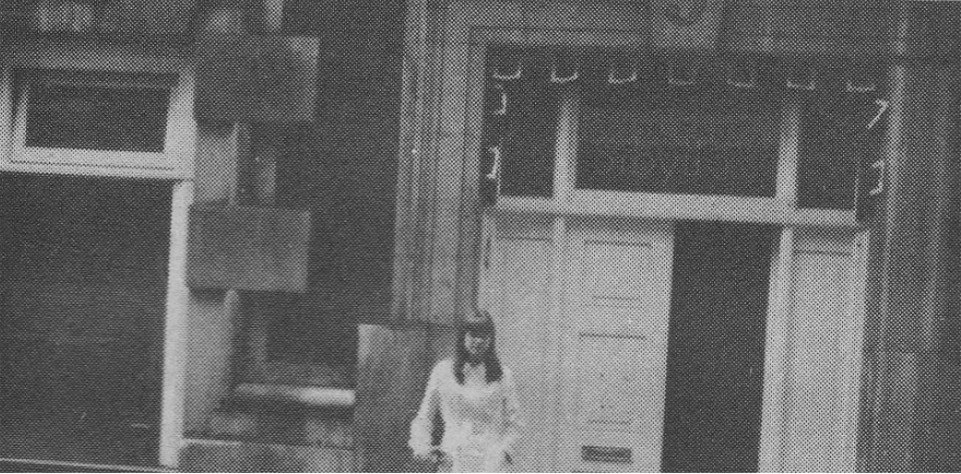
Sibylla’s Entrance from Sara’s blog, Sara in picture.
A Review: A Prince Among Stones by Rupert Loewenstein
March 14, 2013
A Review: A Prince Among Stones by Rupert Loewenstein
by
Review by R.E. Prindle
Loewenstein, Prince Rupert: A Prince Among Stones: That Business With The Rolling Stones And Other Adventures, 2013, Bloomsbury
Some will rob you with a six gun,
Others use a fountain pen.
-Pretty Boy Floyd, The Outlaw
Now comes the very welcome autobiography of the Rolling Stones eminence gris, financial expert, Rupert Loewenstein, a moments surcease from the excesses of Spanish Tony Sanchez, Marianne Faithfull and Keith. A respite from biographers Christopher Anderson, Philip Norman, A.E. Hotchner and the other sexually obsessed writers. A pause in the hothouse atmosphere of Mick’s groovy sexual liaisons, temporary and otherwise. Rupert keeps his dick in his pants.
When in 1968 the Stones realized that the inexperience of their youthful years was cracking down to destroy their dreams, their hopes had been concealed and buried in truckloads of contracts and documents they couldn’t read and would never understand. Enter Rupert the investment banker from The Square Mile, well mannered and ‘with it’ in ways Rockers could ever understand much less emulate. But Mick tried.
Entangled by the youthful inexperience of their first manager seconded by his partner Eric Easton and outright robbed by fountain pen wielding Allen B. Klein, Mick Jagger turned to Rupert Loewenstein as a thirsting man in the Sahara desert. As despised rock and rollers Jagger was turned down by the lawyers and accountants he pleaded with to salvage the Stones situation.
Christopher Gibbs, friend of Bob Fraser, approached Rupert as an old Etonian and asked his help. Rupert considered and accepted.
After reading internet reviews of Rupert’s book the general consensus seems to be a general rejection. The fact that Rupert took the first sixty pages to explain his origins and give some background offended the majority of reviewers who expected him to begin with glowing accounts of Mick and Keith. As Rupert’s technique was to place himself in his environment, so markedly different from the rest of us, most reviewers interpreted his method as mere name dropping.
I enjoyed the pages and thought Rupert’s technique quite skillful. As his explication narrowed down to his first encounter with Mick as he stepped over his prone drugged out form at a party I became aware of who Rupert was and how he arrived at the crossroads of his life.
At that point he was an owner of the small merchant banking firm of Leopold Joseph & Sons, both Leopold and his sons having departed the firm. Here he had a comfortable, respectable life with, as future developments would show, an opportunity for substantial wealth. An enviable situation actually.
But Rupert, apparently, craved excitement, so for reasons that escape me he took on the task of rescuing the Stones. Did I say crazy? Closer to what I meant but had too much discretion to say. At the time Rupert accepted the mission the Stones were penniless all their money controlled by Klein; they had no means to pay Rupert anything including his expenses. As incredible as it may seem Rupert worked for not only nothing but at his own expense including many trips to New York and back for three long years until he could squeeze some money out of Allen Klein. I mean, what luck for the Stones, my jaw just dropped.
The Stones had thousands and thousands of documents and papers Rupert had to familiarize himself with and this is all boring, very intricate stuff. It took Rupert a couple years alone of study before he felt competent to confront the thug Klein; and then, eighteen years of legal squabbles ensued as Klein fought to hold his ill gotten gains.
In the meantime, as Rupert learned the complexities of the music business and touring he had to find ways to make the ongoing projects profitable. He succeeded in making the perennial money loser, touring, into a cash cow.
Rupert is always understated but his efforts for the Stones in a very corrupt business were astonishing. From being penniless Jagger now has several hundreds of millions of dollars.
While discussing these financial affairs Rupert is more than discreet. One has an idea of what he did for the Stones but nothing in the way of useful details. This was Rupert’s life that so far as I’m concerned he is certainly within his rights to discuss, even revealing, some more pertinent details in his dealings with Klein.
Mick, who can explain Mick, had the effrontery to chide Rupert for, in his eyes, revealing the Stones’ finances. Revealing the Stones’ finances! Who is Mick kidding? The Stones are an untraded public company. They have imposed themselves on their public, us, and what they do is our business. Our dollars have made them very wealthy men. We’re entitled to financial reports. Does Mick have any idea of what havoc he has caused to society and we members of the public, this member, by his reprehensible shenanigans?
Personally I think it astonishing that Rupert would have associated himself with a guy who would get up on forty foot inflatable dick in front of sixty thousand people a time and shout ‘Yahoo!’ What kind of guy would do that?
In many ways that was only the beginning of Stones’ offensiveness in the seventies. One has to understand the homosexual situation of the sixties and seventies in which Mick played a leading role. Hidden at the bottom of developments was the 1962 novel by Anthony Burgess, A Clockwork Orange. The story involves a near societal mutation of thug violence. The film rights were immediately snapped up by a combine of David Bailey, Andrew Oldham and Andy Warhol.
The original plan was to star Mick as the protagonist Alex. The movie did not come together until 1971 but then under different owners although Warhol did make an earlier version. The book’s type of violence was part and parcel of Warhol’s Factory whose members apparently took the book’s protagonists, the Droods, as their model. That combined with their homosexuality.
Mick was close to both David Bailey, the fashion photographer who describes Mick and his mate, and Warhol. As the book was a sort of revolutionary text the movie was even more so. For those prone to violence the movie serves as a primer. Yobbos in action.
Andy Warhol was also working toward the homosexual revolution that succeeded in 1969 in the Christopher Street rebellion at the Stonewall Inn in New York City. Between the book and the Stonewall the lid was off unconscious violence and homosexuality. Alex of Clockwork Orange was portrayed as an androgynous character not unlike Mick.
Thus the 1970s songs and tours took on a violent homosexual character leaning heavily toward psychotic sado-masochism. Always pushing the envelope Mick over did it with his 1976 release Black And Blue. Black And Blue was a very sick record. Of course it was only part of a very sick period fueled by the homosexual revolution. Appearing in 1976, it was after a series of albums by the sado-masochistic Negro band The Ohio Players. The OP had released a series of objectionable record covers that caused no adverse reaction as they were Negroes. Their LPs Pleasure, Pain and Angel had covers more excessive than Black And Blue. Women were dominatrices, hung from chains, the Pleasure cover shows a woman stabbing a man in the spine during intercourse. This all passed without comment but Mick apparently didn’t realize that Negroes have a ticket to ride but White Boys don’t.
Unlike The Ohio Players the Stones didn’t have the rocks to put their picture of female torture and overt sado-masochism on the outside of the cover concealing it instead within the gate fold. Perhaps Mick was realizing his Clockwork Orange fantasy identity.
To add insult to injury the Stones compelled their label to erect a gigantic Billboard of the centerfold across from the Hyatt House on Sunset Boulevard in LA. The outrage was instantaneous. The outrage was so intense that Mick and the Stones were compelled to back down. The billboard was taken down while the photo was removed from the inner cover replaced by a photo of the band.
One can only imagine the effect the incident had on Rupert and his fellow merchant bankers back in London. The repercussions at all levels were horrendous.
In fact Mick owes me for that one. At that time I was in the record business in Portland, Oregon, running a large six thousand square foot store. I had a huge presence on TV and radio through advertisements thus making me an ideal target for protests. Oddly devotees of porn like Lesbians decided to target my store. A committee in combat boots stormed into my store handing me an ultimatum to not only remove Black And Blue from my racks but a long list of record covers they thought demeaned women. Interestingly The Ohio Players several covers or any records by Negro groups for that matter were not on the list. No White person was going to criticize any Negro for anything. They had immunity. The Stones however where White, objectionable and fair game. As was I.
The Lesbos put their heads together to come up with a media event that they could exploit for maximum publicity. Andy always said that any publicity was good publicity but I beg to disagree with him. They conceived the notion that if they came into my store and slashed the covers of their two hundred objections that would make the paper, TV and radio. They were complicit with my employees. As the store was open till ten they chose a late hour to do their slashing. Well done, but beyond my notice until one of the Lesbos in my employ pointed the albums out to me several days later.
Of course, as I had no idea who did it, similar incidents were always happening, I pulled the damaged covers to be sent back to the manufacturers hoping that it wouldn’t happen again. There was no reason for me to complain to the police because as a record dealer I was outside the protection of the law, the police would have laughed at me. As the evil deed had received no response the Lesbos published their manifesto in their paper. Naturally enough I didn’t read lesbian publications so no response from me.
The gay crowd had their agents in the police department and the Daily Oregonian, the local rag. Unfortunately for the Lesbos as I didn’t advertise in the Oregonian it was forbidden to either mention myself or my store hence that venue was closed. Oddly enough the Lesbos used to police to try to stir me.
Now, I was in the record business. It was universally believed that every record store was dealing drugs. There were TV shows depicting it. Therefore it was believed that I was one of the biggest drug masterminds in the world. I was actually followed by police agents in London on vacation. As it happened I was there when they made a major marijuana bust so I was given attention as it was apparently thought I was there to supervise the operation. It was an interesting time. I hope I don’t have to tell you what a fantastically absurd suspicion this was. I mean, you know, it was believed that all you had to do was ask for a certain record and the clerk would slap a lid of grass on the counter for you. I mean, with a counter full of weed nothing would have been easier than a bust. But logic….
The cops had been irritants for some time so when I got a phone call saying that they wanted to help me, I say, What kind of setup is this? The sergeant or whatever begins insultingly saying that ordinarily the police didn’t care what my kind of people did to each other but this slashing of record covers was one toke over the line. Wow. It was exceptionable wasn’t it? What other things hadn’t they investigated that’s what I wanted to know but got no answer.
Quite honestly I’d dismissed the incident, didn’t remember it and thanks, but no thanks. The Lesbos were back to square one, no media event. Time passed as they revolved the situation in their drug addled minds.
Now, not only was the newspaper riddled with gays, as was my store by the way, but so was the no. 1 TV station in town on which I was a very heavy advertiser, both its radio and TV outlets. Homos and Lesbos ran the place. Time has now flown as Time will and we’re into 1977. More objectionable covers have appeared especially Ronnie Montrose’s first with the abstract painting that resembled perhaps a woman’s crotch but given the homosexual dominance of the industry by 1978 it could have been a man’s rear; the record was called Jump On It if I remember correctly. All the sexual double entendres used for decades, remember the tune Baby, Let Me Bang Your Box? Piano was meant, box being musical slang for piano as well as…(blush) you know. The Naughty Lady Of Shady Lane, for instance who was only three years old. You just have a dirty mind, that’s all.
I was known for touting the artistic merits of the covers so getting together with their sisters at K… it was determined to do a short news feature in which I was to be induced to speak out and then they would go for the Montrose cover and get me for porno. I had no objection to their filming in my store but not having been born yesterday I wasn’t going to be drawn into the trap. I refused to speak on camera so that blew the second attempt for a media event. On to take three.
What else? The Lesbos would stage a demonstration outside the store, placards and all. However they once again made some gross miscalculations. They did get the top DJ in town also at K… and also a homosexual to announce that the demonstration would take place at noon at my store. I heard it on the radio on my way to work and was grossly offended. But, you know, too bad wasn’t it?
It was true that because of my massive radio and TV presence through advertising, and I mean massive, I was the ideal target. However many if not most people considered the demonstration as a publicity stunt which I failed to grasp at the time so didn’t turn it to my advantage and ignored it. As it would have been free advertising none of the radio and TV stations would cover the demonstration and the Oregonian certainly ignored it.
Frustrated that no media attended their media event the Lesbos decided to invade my store. A screaming horde of combat booted demons rushed in climbing on record racks, waving their signs, and with them came all the thieves and shop lifters within range of the excitement. Oddly enough many shoppers considering the ruckus a stunt went calmly about their shopping.
It took the helpful police an hour to get there and two hours to restore order. Obviously no arrests were made by the ‘helpful’ police. As Dylan sang: The cops don’t need you and, man, they expect the same. I have no idea how much money the Lesbos cost me, but they owe along with Mick. Once they realized there would be no media event their interest subsided. By that time half of 1977 was shot.
The next time Mick says that songs don’t incite a revolution smile knowingly.
Whatever was happening to me passed unnoticed as I was out on the edge of nowhere. Except for this account of the story the incident has been unrecorded. I hope the Lesbos feel rewarded. But for Rupert his world was changed dramatically on February 27th of that same year, 1977. Keith was busted for intent to distribute heroin in Toronto. The bust was as close to absolute disaster as the Stones ever came. It must also have sent a shiver down Rupert’s spine as he realized how fragile a business the Stones were.
Rupert passes over this stuff casually with a little light hearted banter but the seriousness of this ‘media event’ causes him to issue a nearly audible sigh of resignation. Rupert had spent months lining up bids from every major label for when the recording contract with Atlantic expired.
Mick gave Rupert a call to tell him the disastrous news. You can almost feel the heartbreak as Rupert resigns himself to call each and every label to ask if the bust affected their offers. It did. All signed off but…Atlantic. Ertegun stayed in but Rupert’s bargaining power went into the vein, so to speak. The Stones were only worth what Ertegun would offer. Millions down the tube. Rupert doesn’t tell us what percentage he was working on but we can assume that Keith’s bust cost him plenty.
You don’t read the story that way in Keith’s auto; he may not even still have figured it out.
That was a very serious consequence for Rupert to which I am sure Keith has given no thought ever to the possible collateral damages caused by his actions. In his drugged out haze Keith was not even aware that Rupert could no longer justify his involvement with a bunch of yobbos like the Stones. In the first place anyone associated with Rock was socially unacceptable. I as a record store owner was persona non grata in my social arena. If Rupert had held on to his social status to this point I’m sure he found that certain invitations were no longer forthcoming. Indeed, his fellows at Leopold Joseph made him choose between them and the Stones. Rupert was forced to sell out.
One feels a sort of sinking feeling in his writing as he acknowledges that Keith had sabotaged the chances of both him and the Stones. One can only hope he came out with a couple hundred million otherwise he was woefully under compensated. Rock was a world he could never have understood.
Rupert saw the Stones as a business venture without any regard of the Stones’ relationship to the expectations of their fans. Thus when he negotiated more than substantial sums for the use of Stones’ songs in advertising that was a very good business decision but a potentially disastrous situation with the fan base who saw such financial arrangements as a complete betrayal of their anti-commercialism. Rupert was frustrated that the Stones had a hard time seeing it his way.
Besides he didn’t know who the Stones were or, seemingly so. The Stones were always a minority appeal band. When Andrew Oldham cast them as the ultimate yobbo band he was limiting their appeal to a certain segment of society. In the contemporary world where modern communications allow mind sets to come into contact and maintain communications not only locally but globally mind sets were able to blast their presence into a million or millions through communications. Thus though a small percentage of the overall global population even a perversion such as sado-masochism could appear in millions, seemingly a large connected body. Effects such as this is what Warhol was doing and through associates such as Jagger and David Bailey acting globally.
While the Stones may have sold a couple two or three million globally of their records, while substantial economically, it was not that significant culturally. Beyond the yobbo mentality the Stones had little appeal. The Black And Blue album did not expand their audience but constricted it.
Of course Mick moved the band beyond mere rock and roll by making the Stones the Ringling Bros., Barnum and Bailey circus of rock. The show was the thing. Rupert himself usually refers to Mick as a great showman. Faint praise indeed. But, once again even though the shows generated hundreds of millions it was to an already sympathetic or curious audience. Preaching to the converted so to speak.
I think that Rupert was originally blinded by the light of the Stones publicity not realizing that he wasn’t representing a universal phenomenon but a mere yobbo fragment of the population. The money was there however. I hope he valued his services accordingly.
The last half of the book meanders with very little useful information save that Rupert negotiated with unnamed buyers to sell the Stones lock, stock and barrel much as Halston sold his name, soul and product to a major corporation.
What Rupert’s motivation was except for a huge bundle of cash isn’t clear. Perhaps in some devious way he was seeking to avenge Keith’s betrayal and cause the Stone’s the pain they caused him. In any event the idea was too novel for Keith and Mick or they were two wary so the deal didn’t go down.
Perhaps there was big money in it for Rupert so that when he lost the opportunity he lost interest in the Stones. It was shortly after the deal folded that he retired severing his relationship with the group whose fortunes he had guided quite successfully for forty years.
Rupert never satisfactorily explained why he decided to abandon his respectable merchant banking career to take up a gypsy existence with the Stones. You may be sure that if I had the choice between owning a record store or being a merchant banker I would definitely have gone into banking. Anything really. You can always buy records.
The Sixties: A Comic Book Heaven
February 17, 2013
The Sixties: A Comic Book Heaven
by
R.E. Prindle

Look Out Sixties, Here I Come
Of course, everyone is, and always has been, slightly mad. Still, repressing the unreasonable side of his nature man in the Western world has, since the eighteenth century, built a civilization based on scientific reason and classic Aristotelian logic- the heritage of the Enlightenment. And the result, especially in this country [US] during the past fifty years [article dated 1970], has been a rational society that has made one technological break through after another, from the invention of the pop-up toaster to the ability to land men on the moon. Here, until recently, two plus two had inevitably equaled four, not five, as Eastern mystics suggest, and no one other than J.D. Salinger had been able to imagine the sound of one hand clapping.
–Thomas Meehan- Horizon Magazine, Spring 1970.
Comic books were first sold in 1933-34. Thus the first two comic book generations coincide with those too young to serve in WWII while many of the first generation was obliged to serve in the Korean war while the second generation missed both.
How deeply the mind of the first generation of comic book readers was formed is problematical. Comic books didn’t take their classic form until 1938 when the character of Superman was formed. The number of comic characters proliferated during WWII but as these, i.e. Capt. America, were war specific they fell out of favor after WWII.
The first generation of potential comic book readers, those born from 1933-34 formed the substratum for the sixties when they created rock and roll and the base for 60s pop culture during the 50s. That was Presley, Sanford Clark, Cash, Vincent, Nelson et al.
Following the war those born in 1937-38 and subsequently through about 1943-44 had their minds formed by comic books although not all to the same degree. A significant percentage of them were forbidden to read comics by their parents, perhaps wisely. There were some who indulged themselves indiscriminately. I was one of those. I read them all, avidly. The question is how were we affected?
There was a terrific reaction against comic books. Angry parents fought to have them banned. In perhaps the only, certainly of a very few, successful efforts of censorship, comics were banned in 1954. The survivor, of course, was Mad Magazine published by the worst offender, William C. Gaines. All of the comic book readers plus many of those formerly excluded shifted to Mad thus further polluting our brains. While I never gave up reading the comic books till their banning I did abandon Mad for political reasons after a year or so.
Now, with the exception of Capt. Marvel, and that may only be partial, the comics were exclusively of Jewish origins. Thus we in the US, Britain was excluded, were shown the Jewish point of view without our knowing.
One of the key themes was the all male group of do-gooders. These were some of my favorites. The tops, perhaps, was the very influential Blackhawks comics. The Blackhawks were a group of five ex-WWII pilots who each owned his P-38 fighter and flew around the world, Third World mainly, if I remember correctly, righting wrongs they recognized more quickly and efficiently, that is vigilante style, than organized government could or would. I remember the Blackhawks as terrific, I loved them. The fellowship of the pilots, each with a different character, each loyal to the others was something that I and I suppose every reader wished to emulate, especially the notion of a bonded group of five like minded guys.
Another was called the Daredevil. He had a red and blue set of body tights upper right and lower left red and vice versa for the blue. Weird but that’s the way he was. Daredevil was a surrogate father figure to five orphan boys, same character makeup as the Blackhawks, who righted wrongs in their neighborhood and lived in the same clubhouse. The later musical group The Monkees was probably based on them. The Monkees were short one, being four, which lessened their impact. If they’d had that fifth member I would have been an avid fan although older by then.

The Blackhawks- Vigilante Justice At Its Best
Thus in 1954 the origins of Top 40 began on radio. Twenty four hours round the clock seven days a week full time music. An innovation created by the arrival of television. The first generation of rockers were solo artists. Some came attached with a band such as Bill Haley And The Comets or Gene Vincent And The Blue Caps who were proto-Blackhawk type groups but mainly they were solo artists with a band not a group. Presley, Sanford Clark and that curious mixture of both, Ricky Nelson.
The societal maturation process was continuing and then in the mid-sixties the Charlatans came down from the hills of Virginia City dressed in movie style cowboy outfits to home base San Francisco and the first group of costumed crusaders a la the Blackhawks burst forth in full flower.
2.
In Britain the situation was somewhat different although coeval with the US. While the US escaped devastation in WWII the South of England was bombarded mercilessly destroying millions of buildings. A good representation of the situation may be found in John Boorman’s I suppose accurate, I wasn’t there, movie, The Hope And The Glory. As Boorman, who was there, portrays it, acres and acres of rubble stretched in every direction. The kids who scavenged and roamed the area are portrayed as little savages. An interesting education for the age cohort that came of age in the fifties.
Those born in the early forties, the core of the second generation of rockers, themselves played in this same although shrinking devastation. But rations were short in hard hit Britain, restrictions were not lifted until 1954. How their psychology was impaired isn’t so clear, although in the mid-sixties a wild party time called Swinging London appeared. Gay abandon one might say.
The group situation there may have been the result of the generation’s discovery of American slave music- Rhythm And Blues. R&B as a new entry to the British music scene met with resistance so that the devotees were possibly forced to form small groups who recognized each other, many wanting to play the music so they naturally formed groups, two guitars, drums, bass and a singer.
At any rate the British invasion of the US consisted of these four and five man groups coinciding with the comic book groups of the US.
3.
Other formative influences other than comics and radio were films and TV. Those all involved a specific point of view repeated ad nauseum or lessons from a know-it-all crusader cum super hero.
Of course we all grew up with Hopalong Cassidy and Gene Autry among others during the forties but with the fifties came the fantastic science fiction movies. One of the most important was The Day The Earth Stood Still with its famous characters Klaatu and Gort. The premise was preposterous but no one got it. Klaatu is an alien landing a saucer in the US. He is here to vet Earthlings to see if the they are ready to enter the intergalactic community in which peace reigns. Alas, Earthlings, you and me, are hopelessly primitively addicted to violence. Klaatu boards his saucer with a sign of benediction delivering a long sermon about shaping up and saying he’ll be back if we ever sort things out. Alright.
Movie after movie repeated the same message until today people actually believe that extra-terrestrials are all peaceful and Earth is the only rogue planet in the universe. Ask anyone. Flying Saucers were portrayed as hovering out there where the communications satellites would soon be. There they carefully studied mankind for any sign of the diminution of violence. Boy, I bet they think they’ve been wasting their time. Imagine circling Earth for seventy years waiting for indications of peacefulness. Obviously they’ve been sadly disappointed while being joined by the Negro Mother Wheel that appeared some time in the seventies to keep them company Hello, Earth calling Mother Wheel.
These movies established the idea that the whole universe except for Earth is highly developed and pacific along with the idea that Earthlings are worthless, hence most people accepted as fact we were being watched by superior beings and found wanting. We were inferior.
The movies established the notion that there were millions of inhabited worlds out there inhabited by superior beings who could travel billions of light years and get to home base in time for dinner. ‘Honey, I’m home.’
Now, at the same time, pulp magazines existed. Monthly editions of Amazing Stories, Astounding Tales and others poured out endless reams of the most astonishing stuff imaginable. Thus, all three, comics, pulps and movies, sci-fi and movies were rushing through our minds, forming expectations. Of course, the number of us who read sci-fi, almost as despised by parents as the comics, was small, but then as TV developed, Rod Serling’s Twilight Zone and Star Trek came along both of which mined the sci-fi stories of the fifties while spreading the notions throughout the entire population. This reduced the intellectual discrimination of the people whose minds were prepared to accept anything.
4.

The Bunny Himself
These years of the fifties were very crowded with the most exciting new developments. TV was perhaps at the top of the list. Bear in mind that cable didn’t exist. There weren’t even three channels in most places including a major market like the San Francisco Bay Area. People didn’t think TV would be profitable. The channels didn’t even broadcast until noon and shut down at ten o’clock prime time. There was no 24/7 TV.
There wasn’t even enough original programming to fill a ten hour day so they ran old movies and almost anything anyone could think up. Arthur Godfrey’s show ran for hours every day.
One of those odd things they chose to fill time was a character called Crusader Rabbit. I don’t know how well remembered the Rabbit is today but he had a profound effect in forming the minds of the 60s generation. Crusader Rabbit was a distant relative of the Blackhawks. While they flew around the world able to determine who were the good guys and who the bad, Crusader Rabbit was a self-righteous little bastard of a vigilante squad who instilled certain little minds with his self-righteousness and made them think they should impose their vision of reality on the world by mounting ‘crusades.’ Hawkeye of the later TV series Mash combined Crusader Rabbit with the Blackhawks.
Now, all this was happening in a short six years from 1950 to 1956. In many ways this was a major intellectual/psychological revolution preceding those revolutions of the sixties.
Equally, if not more important, was what was happening in the classrooms of our schools.
5.
If an astonishing variety of educations was going on outside the classrooms what was going on inside was no less astonishing. I don’t know if everyone saw it the way I did but I had a tough time assimilating what I heard. Of course American superiority and the inferiority of Europeans was standard staple. At the same time we were warned to be humble as bearers of these great gifts and to share them with our inferiors who after all couldn’t help it that they weren’t born Americans. True enough I suppose.
And, because of the success of our own American revolution, barring any negative thoughts caused by the French and Bolshevik revolutions, we were taught, indeed, indoctrinated and conditioned to believe that revolution per se was good, indeed, a blessing. Ignoring whatever may have been going on in the world we were taught to revere the South American George Washington, Simon Bolivar, who flitted from country to country on the whole continent until he came to end of it in Venezuela tossing the Spanish aside like so much chaff. Viva Bolivar, hey? Well, Viva Zapata next.
Well, I came from the orphanage and I had a different idea of right and wrong. Heroes were much scarcer for me than for the kids from normal homes.
By the time we got to high school, 1953-56, teachers were preaching revolution, revolution, revolution full bore. Revolution was everywhere. Minute changes in processed breakfast cereals were described as revolutions. Crusader Rabbit was a revo. Who wasn’t?
The reverence for revolution continued in college too. Another four years of revo, rah, rah, rah followed in college which ended for my class in 1960. Portentous year, what? That was the year our limp President, John F. Kennedy created the Peace Corps. We were eager to share our wonderful achievement so recent college graduates with absolutely no knowledge of the world and inadequate educations sallied forth to tell the world how to do it right. OK? How’s that for arrogance?
Now, there were plenty of revolutions in progress in 1960 and all those graduates from say, 1954 to 1959, were primed for revo. Lived for it, breathed it. They didn’t even have to be recruited; they went searching for it. Give us revolution, they screamed.
These were years of the magnificent march of progress too. Years of change and hope, revolutions one might say, in all areas of endeavor. The people born from 1938 to 1945 leaped in with both feet and arms flailing. The sixties belonged to us, it was a world that we would make ourselves.
The next age cohort born from ‘46-’53 would be instrumental in forming the seventies, the eighties going to the next age cohort. Of course these cohorts created nothing merely extending the ethic of the 60s’ cohort. The interesting thing is that there was a fairly complete break between us and The Greatest Generation as our fathers have been styled.
Those revolutionary minded teachers of ours were mostly born c. 1890 so they were at the tail end of the post-Civil War corps, lived through two world wars and the Great Depression. Our fathers born somewhere around 1918 caught the Depression and WWII while witnessing the Korean War. We younger ones, in the US, avoided that while TV, Top 40 and other assorted wonders made us rather distinct, nothing alike in outlook. Our fathers didn’t really like, couldn’t trust us, and certainly were not going to accord us the dignity of adulthood and the authority that goes with it. So we grew distant from them not really thinking an awful lot of them or giving them our trust. Fuck, they couldn’t even deal with the Mafia.
Politically they kept control during the sixties while culturally and socially we managed affairs. As it was a new beginning of sorts the succeeding age cohorts respected us and what may be called our achievements, sex, drugs and rock and roll, but still maintaining that sense of breakfast cereal revo.
To make the break even sharper, in 1960 the real old guard headed by Eisenhower checked out and an Irish upstart son of a bootlegger, Jack Kennedy, leader of the Celtish Camelot and a guy who could twist the night away even with a bad back, attempted to lead the way.
His best wasn’t very good and he caught a piece of flying lead allowing that pale Texan reincarnation of FDR to see how badly he could muff it. He did a good job of muffing it too.
So, there we were on the brink of 1960 raring to show the world what we could do. Really revo the whole machine? We’ll see.
6.

Charlie Whitman
Richard Speck
The psychological background of the sixties as exhibited by the second rock generation from 1938 to 1945 is a major manifestation of an effort begun back in the WWII days. It is the realization of the theologico-metaphysical notion of what Sigmund Freud dubbed the Unconscious. As the quote opening this essay indicates the sixties was the undoing of the several hundred year effort to realize the conscious. We thought we’d seen enough of the unconscious to last much more than a millennium. As the effort was begun before the awareness of the nature of the Un or subconscious the effort was achieved as Mr. Meehan states by the repression of sub-conscious motives not their elimination.
Freud quickly discerned this and he understood the function of dreams that he called the ‘royal road to the unconscious.’ Thus the motto he appended to his volume The Interpretation Of Dreams published appropriately in 1900 is ‘Flectare si nequeo, Superos, Acheronta movebo.” which translated means ‘If I cannot deflect the will of heaven I shall move hell.’
Freud interpreting the conscious mind as heaven chose to deemphasize consciousness in favor of his vision of the unconscious that he interpreted as Hell. Thus, you will find almost nothing in Freudian psychology referring to the conscious mind while he enthrones his Unconscious as the moderator of the human mind. He actually believed that the Unconscious was an agency separate from the body. In theological terms it had a supernatural existence. Thus, he has negated consciousness, or Science, in favor of Religion. As he has rejected God or Heaven then it follows that he embraced Satan and Hell.
As the sixties progressed the generation abandoned consciousness embracing unconsciousness. Time Magazine proclaimed in 1966 ‘God Is Dead’ while Satanism came alive, indeed according to Ira Levin in his novel, Rosemary’s Baby, Satan’s son, Andy, was born in 1966 just as God died. Levin continued his story in 1999’s Son Of Rosemary. Interesting.
It is no coincidence that Freud was both a druggie and a homosexual. Now, the royal road to free the mind of consciousness or Heaven is an obsession with sex and the free indulgence of drugs especially Freud’s favorite, cocaine backed with a pounding jungle beat. Eh voila- the sixties.
Sex, drugs and the hypnotic jungle beat of Rock and Roll. The sex was facilitated by the introduction of the birth control pill and anti-biotics; the amusing Shel Silverstein sang of Penicillin Penny who always had VD. If the girls took the pill both they and their boys were freed from the fear of pregnancies while the ga-ga types had no fear of Venereal disease because the cure was quick and easy by a regimen of anti-biotic pills. Almost paradise here and now and on Earth. For less than a buck you could get a nice big piece of pie too.
Freud had achieved his goal; he had overturned Aryan society.
Freud essentially by fraud allowed us to indulge forbidden appetites and responsibility from forbidden acts, for after all as the conscious mind had no authority and the will of the unconscious was unresistible we had no responsibility for our acts- If it felt good, we did it, as the mantra was. Hence by 1966 we had Richard Speck killing all those nurses in Chicago and Charlie Whitman up his clock tower at UT blowing away his fellow students. Guns aren’t the problem; Freud is the problem.
Hell, Dick and Charlie just wanted to be free. Indeed, freedom in the freest of all societies became a problem to the generation.
Sally Banks in her Greenwich Village 1963, Chapter 5, appropriately titled, Dreaming Freedom, explains her views on what being free actually meant to her and a very large part of the age cohort. She is writing from New York City.
In 1963 freedom was a vital political issue charged with artistic consequences for both the mainstream and avant-garde. Part of the avant-garde’s utopian vision was that liberty could be found within community. But, in fact, the very concept of freedom sets autonomy and the notion of individualism in conflict with the bondedness of community. For social life is a potent source of restraint [suppression of freedom], yet, paradoxically, total freedom would mean the humanly unrealizable (and unbearable) state of complete isolation. Thus there is a deep ambivalence in Western culture toward freedom and social life. The dream of community, itself, may be incompatible with the dream of freedom, a contradiction the avant-garde sought to discover.
The Sixties artists constructed an art that re-imagined daily life in terms of achieving both liberation and community. If such a situation proved illusory, in 1963 it seemed necessary- and it still seemed possible given the booming economic infrastructure- to find a model that would make these imaginings concrete.
Yes, people wanted total freedom- that is a disconnect from the reality of having to deal with unpleasant facts- free from all restraints including gravity and mostly free from themselves. The drugs seemed to serve as those releases. Under the influence people could imagine themselves as someone else who ‘really had their shit together‘, miracle men and women able to leap tall buildings in a single bound, move mountains with the wave of a hand, fly through the air like a host of angels but they inevitably came back down where if they were anywhere near a mirror they could watch their bodies disintegrate.
Freedom from reality has its price.
So, the sixties that began with such ‘High Hopes’ to realize ‘The Impossible Dream’ of Camelot began to crash in 1966 just as like a flash of lightning in the sky the realization of those dreams seemed to dawn. As Lewis Carroll said, be careful that your Snark is not a boojum, for you see….
7.
The Truth Is No Defense
The sixties, then, was when the impasse between the Scientific Method came into its latter day conflict with the Theologico-Metaphysical mindset. The T-M system is merely a mental state that not only does not require objective validation but positively rejects it in favor of subjectiveness; what Freud called inner wishful thinking.
While the sciences of sociology and anthropology and biology produced irrefutable, by logical methods, results that ran counter to the inner wishful T-M thinking, as there were no means to refute the scientific results the T-M people merely denied them and forced scientists to suppress their accurate but uncongenial truths.
To ensure that the truths were suppressed and remained suppressed the T-M partisans passed laws making it criminal to express these truths. These laws called ‘hate’ laws were then applied to any who spoke these truths. As the truths were undeniable T-M partisans corrupted the law, common sense, and, one might say, the will of God to declare in a court of law by the judges that ‘the truth is not a defense.’
The truth is not a defense! Think about it. Such a rule of law is the triumph of absolute criminality and ignorance. And this happened during the watch of an age cohort that claimed to love freedom and revolution. Well, it was a revolution, one that enslaves the mind.
Now, in a position to punish those who disagreed with them the beneficiaries of the T-M mentality were able to enshrine their will as the law of the land. As the law was no longer concerned with the judgment of facts as evidence but the religious beliefs of the T-Ms the US at that point turned into a theocracy. The religious left became an established religion running counter to the old dispensation of the Constitution in favor of something not yet codified and something not approved by the former electorate that now became passive and an ineffective annoyance to the new slave masters.
8.
The ruling social ethos in the US when the sixties dawned was the theory of the Melting Pot formulated by the Jewish writer Israel Zangwill c. 1900. According to that theory that had nearly the effect of a law all the disparate social elements forming the population of the US would fuse into one people of uniform American belief.
In 1960 or thereabouts the new theory of multi-culturalism was introduced which stated that each culture should have an autonomous existence. This was the dream, wishful thinking, of the wannabe Jewish Autonomous people. Nothing new, it was their age old dream. Thus the body politic of the US as a matter of principle was fractured into many warring cultures.
While the Melting Pot had always been a fantasy having no real existence in fact multi-culturalism was alive and real and exacerbated in 1965 when the immigration act was reformed allowing unlimited immigration to all the peoples of the world. And if they didn’t come willingly members of the T-M mentality went into the actual jungles of Africa, dragged the natives out, put them on a plane, free fare, and flew them to the US.
What can one say to such zaniness.
The whole notion of freedom advocated by the age cohort was thus negated. Dozens of laws were passed giving these ‘immigrants’ precedence over the rights of the native population, depriving the natives of equal rights. This is a true story. Incredible but true.
9.
And lastly, for this essay we come to the complete overturn of reason in favor of a comic book utopia and the installation of an age of inner wishful thinking caused by the introduction of drugs as a mass phenomenon.
Drugs in the sixties were nothing new. Drugs begin to show up in literature during the nineteenth century Romantic period. Thomas de Quincey’s Confessions Of An English Opium Eater is the first famous confession or novel on the topic. Opium was much used in Victorian England as an ingredient in Laudanum which was given to infants to make them stop crying.
Opium was further reduced to morphine and then heroin. Freud is famous as the promoter of the joys of cocaine, synthesized from the coca plant. As chemistry developed, synthetic chemical drugs such as amphetamine began making their appearance at the end of the century.
Drug labs were busy and soon creating drugs that attacked any area of the brain. LSD was discovered in 1938 and popularized after 1943. Drugs like Miltown and other tranquilizers began filling women’s purses after 1950. Pot and hash had been simmering below the Hot 100 for some time but moved up the charts after 1960. So the whole pharmacopeia was available as the decade began. New formulas would be discovered in the following decades as drugs became part of the entertainment industry.
Drugs of course suppress the conscious mind exposing the raw wiring of the user. They also lower resistance to hypnotic influence. Hypnosis is merely a heightened sensitivity to suggestion. A drugged out population can be swayed by propaganda as no other, which is merely suggestion by another name, in any direction. They can be swayed but you mist control the means to do so. The mass media was the means, namely TV, Movies and records, and it was in the control of Jews with their special agenda.
Thus Movies, TV and Records propagandized a pro Jewish revolution agenda along with its subordinate Negro revolution agenda.
It is strange how all trends worked to favor the Negro/Jewish agenda. Of course, Jews had been instrumental in breaking down Aryan resistance to Negro music. Jewish DJs such as Alan Freed and Cousin Brucie along with Jewish song writers such as the hugely influential Leiber and Stoller and Goffin-King led the assault.
The songs they wrote were performed by Negro artists. While the Jewish song writers were not so familiar with Aryan culture as is supposed it was enough to bridge the Aryan-Negro gap making the Negro performances potable while paving the way for Barry Gordy’s Motown label.
As of 1960 there was virtually no one who listened to or was familiar with Negro Blues. The Blues was

Robert Johnson
brought forward by the British Invasion who apparently listened to that crap. I am always astonished by White Blues artists citing Robert Johnson as a source. There was nothing available by Robert Johnson until 1960 when CBS released its first collection that virtually no one bought. The second collection was released in ‘62 with the same result.
I first heard of Robert Johnson in 1968 when I owned a record store. Many people talked about the Blues but when I started a first rate Blues section the records remained untouched and unsold. I doubt that I ever had a Robert Johnson sale.
I was in a university town and when such Blues artists as Lightning Hopkins were brought to town the ‘séances’ were held in someone’s living room with maybe fifteen people attending, ten of which were girls worshipping blackness. Nevertheless White Blues was popularized by the British, spreading to American performers.
I should point out that White performers of the forties and early fifties such as the Singing Cowboy Gene Autry sang many Blues based songs. Autry’s song The Yellow Rose Of Texas is of course about a Negro woman, high yellow.
By decades end the cohort’s fascination with exaggerated notions of freedom and revolution had turned into drug addiction and violence. By the late sixties looney tunes like Bomber Billy Ayers and his female side kick Bernardine Dohrn with their Weatherman organization and the Jewish Defense League and its offshoot the Jewish Defense Organization were killing and bombing at will and furthermore they would get away with it. ‘Free as a bird and guilty as Hell.’ as Bomber Billy Ayers would put it.
So by the end of decade ending with the Caped Crusader, Mick Jagger, at Altamont a comic book vision of reality had triumphed over the real thing. Who can forget Mick Jagger mounted on a giant inflatable cock on stage before sixty thousand people. Now, there was a comic book fantasy. Two and two added up to any number you wanted.
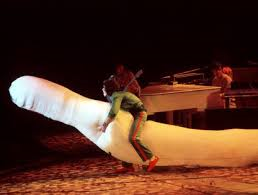
Ride ’em High Mick
Who Is Groovy Bob Fraser?
February 1, 2013
Who Is Groovy Bob Fraser?
by
R.E. Prindle
While writing my biographies of Mick Jagger and Marianne Faithfull it has become apparent that some persons seemingly peripheral are more central to the story than one may at first have thought. One of these is the art dealer, Robert Fraser or Groovy Bob as he was known.
However, behind the scenes underlying all the action are the two Kray Twins, Ronnie and Reggie. As with underworld figures in the US little is going to happen in which their presence is completely absent. Ronnie and Reggie were two Jewish homosexuals. They thus had as much protection as Jews can provide for their own. On the homosexual front the Krays were procurers of young boys for members of the above ground establishment, men prominent not only in government but in the music business.
At the same time the brothers owned, or possibly fronted, prominent gambling establishments, thus people like Fraser and Beatles’ manager Brian Epstein who gambled heavily losing large sums came under their influence or control. Robert Fraser and the Krays thus became intimately connected.
Now, what about Robert Fraser? Fraser is the link between many participants in the 60’s drama. He befriended Richards, Jagger and Faithfull. He was close to Paul McCartney of the Beatles, who is somewhat of a mysterious figure in the drama, as well as being familiar with their manager Brian Epstein among many others of the rock musicians. And then he was linked with artist/film maker, David Cammell as well as arch Satanist, Kenneth Anger, and the main American link to these people, Andy Warhol. He brought Tony Sanchez to the Stones as well as the rock community while Sanchez was his link to the Kray brothers. Fraser’s friend Chris Gibbs is a shadowy eminence grise of this situation. So far, I’ve gotten little other than he was and is an antiques dealer who helped establish the Bohemian tastes a la Oscar Wilde of the rockers.
Fraser himself came from a moneyed family who financed his ventures. He was a public school boy, Eton. He served in the African Rifles in Uganda. There, as a homosexual he says he buggered a young Idi Amin. I have no doubts. Returning from the African happy hunting grounds he promptly left for the even happier hunting grounds of New York City, the sybaritic capitol of the world. There he soaked up the art scene where he learned the ins and outs of being a gallery director. He was in New York during the seminal years from 1960-62 just as the pop art scene was taking off. There he met Andy Warhol who would be the outstanding pop artist. As they were both homosexuals and revolutionaries they bonded.
Fraser, Warhol, Epstein, Gibbs, the Kray Twins and most of the cast were all homosexuals. Jagger was at least ambiguous so sexual lines blurred and those who may not have been homosexual by nature may have found it convenient to act like one. Certainly after Stonewall in 1969 the music scene became predominantly gay.
There are pictures and videos of Fraser on the internet so that we can gauge his appearance and manner. His manner was very engaging and while fey, not exceptionally so. He wasn’t camp, at least not in public.
What exactly his role in the scene was is less than clear. While apparently an excellent pop art gallerist his role among rock musicians while prominent is not clear. He frequently had large parties in his apartment attended by the cream of the rock community. Of course he sold them art work but perhaps through his drug connection Tony Sanchez he also dealt on the side to augment his income. Drugs were always prominent at his parties. Paul McCartney bought many artworks from Fraser which all appreciated significantly although Fraser is accused of overcharging. But then, why not, a collector always thinks he’s being overcharged as he buys one of a kind items.
Perhaps also Fraser was indoctrinating the musicians in tolerance for gays and other political matters. Perhaps he was seeking homosexual alliances from among these yobbos. Certainly after Stonewall it seemed that everyone in rock was fruity. It was then that Rock and Roll began to lose its appeal. When the homosexuality became so obvious rock declined in interest to non-gays leading it further into a gay audience that augmented by the evolution into all-gay Disco. YMCA and all that, and then the end.
Whatever his political intent the goals were subverted by personal defects. Of course drugs will reduce your effectiveness by a little more than somewhat, but gambling and its resultant debts were much more deleterious of personal autonomy. While gambling has never been mentioned in connection with the rockers one wonders whether McCartney and others didn’t become involved.
Now, the record business in both the US and Britain was in the hands of homosexual Jews. The British groups, especially the Beatles and the Stones were god’s gift to his Chosen People. Between the Beatles and the Stones probably a billion dollars was generated in just four or five years including ongoing royalties and residuals. The entire billion was siphoned off by the Jews in both the US and Britain with only tip money going to the musicians.
Brian Epstein was the chief beneficiary. It was perhaps through his gambling debts, described as enormous, that the extent of the cash being generated by the Beatles came to the attention of the Kray brothers. Epstein apparently lost and owed a fortune to them. The only way he had to pay his debts was the Beatles which with his contract expiring in 1967 he was afraid he would be dismissed leaving him without that extraordinary income.
The Krays conceived the idea of taking over the Beatles from Epstein. At this time Robert Fraser had gambling debts with the Krays for which he had no available resources. The Krays put the squeeze on him. Fraser didn’t know what to do but he did know a man about the scene named Tony Sanchez, the Spaniard in the works, who did. Sanchez was nicknamed Spanish Tony. He would soon figure in as Keith Richards’ factotum and bodyguard. Spanish Tony is an interesting character meriting much more serious attention. As a connection between the underworld and the above world one would like to know more about his associates both under and above. He certainly used his underworld persona to threaten Marianne Faithfull into bed.
At any rate Sanchez told Fraser that he had underworld connections and might be able to resolve Fraser’s problem for him. As usual with Fraser he only fed Sanchez half-truths and when Tony contacted the Krays he got the other side of the story. Bear in mind that the Krays were crazy. They were pimping boys from the orphanage to social figures of the status of former Prime Minister Edward Heath. I mean, the moral state of the British upper class was beyond questionable. I would like to hear what the boys who were so used have to say now that they are men. Where are those memoirs anyway?
The Krays showed Sanchez a pile of Fraser’s bounced checks they had received which made Tony reconsider his position. Whatever bargaining chips he may have had were nullified. However the Krays had a proposition. Conversant with all the gambling characters they thought that Fraser might have some influence on Epstein so that if Fraser could arrange the transfer of the Beatles to themselves they would forgive Fraser’s debt. Who wouldn’t?
Negotiations and time dragged on and 1967 appeared at the top of the calendar with nothing accomplished, no debts settled. 1967. A big year in our story. That was the year that Brian Epstein supposedly committed suicide, the year his contract with the Beatles expired. We know for certain he left this sportin’ life. And 1967 was the year of the Redlands bust in which Fraser went to prison.
Sanchez gives conflicting stories of what took place. In his published memoir Up And Down With The Rolling Stones of 1979 he says the Krays amiably reduced the amount owed by Fraser and Groovy Bob gave them a good check for it. Problem solved. Tony says in his memoir.
Improbable as that seems, a missing chapter of Tony’s book has surfaced. Apparently many of his revelations were deemed too controversial and deleted. In this missing chapter Tony says that Fraser, unable to deliver the Beatles, set up the drug bust at Redlands in order to go to jail where for some strange reason he thought that he would be beyond the reach of the Krays.
In any event he didn’t seem to resent going to prison. Shortly after he was released from prison the Krays were arrested in May of 1968 while being sentenced to life on 3/5/69.
Presumably Robert Fraser escaped payment of the debt, however with the stigma of a jailbird his career as a gallery operator drew to a close after his release. He ended his life as a casualty of AIDs in 1986.
In his prime one wonders what he was doing. He seems to have been closely connected to Warhol and his crew. Andy himself seems to have been the center of what appears to be a political conspiracy. On their trip to Paris they made a Bee line to visit Fraser. So there is probably a strong political bent to Fraser’s activities.
Much more research is needed on Groovy Bob as well as his underworld connection Spanish Tony Sanchez.
Chap. 7: Marianne Faithfull: Faerie Queene Of The Sixties
January 27, 2013
Marianne Faithfull: The Faerie Queene Of The Sixties
by
R.E. Prindle
Chapter 7
We skipped a light fandango
Turned Cartwheels across the floor
I was feeling kind of seasick
But the crowd called out for more
The room was humming harder
As the ceiling flew away
And so it was that later
As the Miller told his tale
She said there is no reason
And the truth is plain to see
That her face at first just ghostly
Turned a white shade of pale.
–Procol Harum

Marianne A Few Years Back
Now in 1968 both Mick and Marianne’s life were rolling by while both were teetering on the edge. Shortly after Godard’s filming of Sympathy For The Devil in June Mick was signed by Donald Cammell for the lead role in his film Performance. The invitation to star didn’t come from nowhere. There are many links from Mick and his friends to Cammell. Cammell was already known to the Stones having met them in 1965 at the time of the Paris Olympia shows. He was naturally first attracted to Brian Jones but then found some kind of love for Mick. Over the subsequent years he formed many projects that he offered to Mick. As Mick’s asking price was a million or more the projects did not pan out.
Not only did Cammell know the Stones but his live in the Parisian model Deborah Dixon had had a menage a trois with Anita Pallenberg. She had moved on to Brian Jones, passing on to Keith with whom she was living when the movie was shot. She had also viewed and/or worked on the script with Cammell a year previously so she knew that she was playing opposite Mick in advance. She then, was well aware of what the movie entailed.
In addition Cammell knew Robert Fraser and Chris Gibbs while being involved with the American
Donald Cammell
Satanist Kenneth Anger. Anger was himself a disciple of the arch Satanist of the Golden Dawn, Aleister Crowley. Cammel’s father had known Crowley reasonably well while Cammell himself had at least seen Crowley live. His father even wrote a biography of Crowley, so let’s just say that the sex magic of Crowley and his Golden Dawn played a prominent role during the filming.
Mick would have brought his knowledge of The Master And Margarita to the proceedings. He may have persuaded Cammell to read the book or perhaps as a Satanist Cammell had already read it.
Marianne who had become pregnant perhaps in January or February was sent to Ireland during the filming so as to be out of the way for the sex stuff where she became distraught. She was giving herself and was being given a psychological beating that was disappointing all her expectations leading her into a deep depression. This was furthered along when she had a miscarriage at eight months losing the child. I would imagine the miscarriage was the result of the stresses Mick had placed on her by sending her away along with his sexual misconduct. It may have been her own subconscious rejection of Mick that caused her to subconsciously refuse to have his baby.
Thus as 1968 drew to a close as the Stones recorded their Satanic Majesties Request album Marianne was trying to recover from her miscarriage and put her life in order. She probably ought to have left Mick at the time but as she tacitly admits in an interview video on You Tube the reason that she went with Mick was because her own royalties were dropping and she had gotten used to the money. Mick was a source untapped. I think that this is an underlying cause of her anguish. Nineteen sixty-nine would be a traumatic year for all concerned.
2.
What To Do About Brian?
Marianne was a sentimental girl who formed sincere attachments to the people of her world. Thus Brian was not just someone on the scene but one might say a part of Marianne’s life. She cared for him. As we all know Brian Jones was the actual founder of the Rolling Stones. He named them and gave them their original musical direction. He held them together during the early stages. Naturally he considered himself their leader. He was actually a much more charismatic figure than Mick. While Mick was wiggling around all eyes were on Brian. There was just something about him.
This aroused Mick’s jealousy who once stated that the lead singer was supposed to be the center of attention. Mick also had the most powerful personality so that while he may not have been the leader he made himself the director. And then he and Keith shifted the direction of the music. While never a fan of the Stones I found myself reviewing the albums when I began writing of the group. My original opinion was only confirmed.
It became immediately apparent that Oldham’s first recordings done necessarily on the cheap were not good recordings, four track on primitive and worn equipment. While Brian and the Stones thought they were doing a good job imitating American Negro rhythm and blues it’s actually not even close. Mick makes a terrible imitation of a Negro blues shouter while its painfully obvious that the music doesn’t come close to the original. It’s so far off that it might as well be an original genre while being very close to a garage band.
Perhaps Mick who thought it impossible for an English band to pass themselves off as authentic was right to change the direction of the band to Negro influenced Rock and Roll. Brian was probably too close to his aspirations to know how far from the mark they were.
The original tunes are somewhat better but the inspiration for those soon ran dray so that by the 1966 and ‘67 albums Aftermath and Between The Buttons the band was quickly approaching the rocks. The West Coast fans were disappointed by both albums and, quite frankly, they’re not listenable today. As the albums veered toward English music hall Brian was quite right in thinking that they had abandoned his original intent. The 1968 Their Satanic Majesties Request, intended to be psychedelic in imitation of the Beatles Sgt. Pepper’s wandered off to a musical somewhere although one can sense the transition from the Old Stones to the New Stones of Beggar’s Banquet.
The cover of Satanic Majesties must have really sickened Brian as it had the boys dressed up in some sort of magician’s getup. A long way from Negro rhythm and blues.
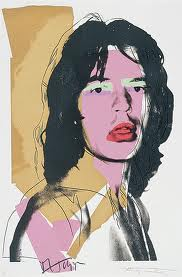
Mick by Andy
Mick’s conception of the band judging from the current situation was always himself, Keith and Charlie. Bill Wyman, the bass player, being several years older was always an awkward fit. Mick marginalized him as much as he could until Wyman finally gave up terminating his role in 1993. So, was Brian forced out? Of course.
Andrew Oldham who promoted the Stones to a prominence far beyond their then abilities was the first that Mick pushed away in 1967. As a parting present Oldham turned them over to the American Jewish pirate, Allen Klein. As Oldham owned the masters to the Stones catalog he sold it lock stock and barrel to Klein who then legitimately owned them much to Mick’s chagrin.
As Brian was being marginalized by Mick, losing control of the band and its direction his behavior became erratic while he also sunk in the haze of drug addiction. It became obvious to the casual viewer of him on stage that his days must be numbered. On the Ed Sullivan show in the US he could barely stand on his feet but everyone was watching him placed back in the shadows by Mick.
Mick and Keith continued their petty harassments until Brian became a shambles of himself. After the Redlands bust the police turned their attention to Brian who hadn’t the emotional resources to bear the burden. It then in June of 1969 that Mick and Keith advised him that he was no longer in the band.
Brian either drowned in his swimming pool on the night of 7 July or was drowned. There is controversy over his death that may never be conclusively resolved.
Marianne, who by 1969 was not in a healthy sate of mind, was herself sinking into drug addiction, actually becoming a heroin addict, watched these proceedings. She was shocked by Brian’s death. And this came on top of her other woes. But life goes on. It is always painful when death removes a loved one from the building but painful or not the sun does not stand still in the sky nor do the bills stop coming in. Life goes on without missing a beat and you better had too.
So, Mick had movie offers coming in. Both he and Marianne as reigning pop couple were signed to do a movie in Australia. Ned Kelley an Australian bandit. In the 1840s when plays and books began celebrating former outlaws, highwaymen and crooks they were called Newgates after the equally famed Newgate Calendar of criminal trials. This would be a sort of Newgate movie.
Less than a week after Brian’s death Marianne and Mick arrived in Australia to begin their commitment; after all they had signed well before Brian’s death. Psychologically however all of Marianne’s misgivings were adding up to a heavy burden. While the reasonable approach may be that life goes on not everyone is so reasonable and I suspect Marianne was one of these. Perhaps, too, she realized that she and Mick were becoming estranged. Mick’s history was beginning to become apparent; his abominable treatment of women, Chrissie Shrimpton, of Oldham, of Brian; perhaps she began to wonder if she were next. While Mick may have had justifiable reasons for Oldham and Jones they may not have been that apparent to Marianne.
Certainly Brian was on her mind when the place touched down in Sydney. Exhausted by the long flight she and Mick checked into their hotel. Mick promptly flopped down on the bed to doze off. Marianne troubled in mind picked up a bottle of Tuinals and perhaps in a hypnoid state of grief and confusion dropped a hundred forty of them. Wow! That must have taken five or ten minutes. Shows determination. Who would do that if they weren’t serious about suicide.
For whatever reason Mick woke up and probably groggy himself scoped the situation. He rushed Marianne to the hospital for medical attention. But Marianne had overloaded her brain, she lay in a coma for six days.
The last thing on her mind before she suspended animation or slowed her synapses to a crawl was Brian. Since she was still alive although unconscious synapses must have continued; she must have continued to work on her problems, the anguish that had caused her attempt at self-destruction. Thus, when she came to Brian was still on her mind. I quote from her auto-biography Marianne Faithfull, pp.175-79:
By the time we got to the hotel in Sydney I’d forgotten not only where I was but who I was. I looked in the mirror. What I saw was a very thin, frightened face. I’d cut my hair, I was anorexic, and my skin looked cadaverous. I saw someone literally falling apart. Someone with blond hair and looking very scared. In my drug induced stupor I dimly recognized the ravaged face of Brian Jones staring back at me. I was Brian, and I was dead.
…At that moment Brian was my twin. I identified with him because he had been a public sacrifice; it was a role I understood.
Quite logically, I thought I was Brian.
It was all very rational in the way these things are when you’re unhinged. I reasoned that since I was Brian and since Brian was dead…(ellipsis in original) I had to take the rest of the pills so I could be dead too.
…The Tuinals were taking forever to kick in, I looked down and saw things on the street that shouldn’t have been there…And then I saw Brian Jones. At that moment I went into a coma that lasted six days.

Brian Jones
When I first spotted Brian he was far below at street level, but greatly enlarged…Various parts of him- his face, his hands- expanded and extended toward me as he spoke, and then he rose straight up as from a shaft of air until he was directly opposite the window of our room.
…He beckoned to me the way spirits traditionally beckon to mortals in the movies. I passed through the plate glass and found myself outside. But instead of standing suspended above the street, I was now in an unstable landscape that pulsed and shifted as we spoke. I had I assumed gone over to the other side.
The grandeur and enormity of the place had the phantasmagoric mood of illustrations by Edmund Dulac or Durer engravings of Hell. As we were walking along, I realized that Brian had no more idea of where we were going than I did. Obviously he had woke up dead, not known where he was and decided to call for me!
It was the nicest chat I ever had with him, actually. He told me how he had woken up and put out his hand for his bottle of Valium, and about the panic that seized when there was nothing there. He said he had been lonely and confused and had brought me to him because he needed to talk to someone he knew.
We strolled blithely along as the quivering earth crumbled away on either side of us, and he told me about the miniature coronation set with Beefeaters and the coach and horses. He said he like books about railway bridges, guides to switching boxes, George McDonald’s fairy stories and Fox’s Book of Martyrs.
…Afterward he became weepy like the Mock Turtle in Alice In Wonderland and said he was sorry to have put me to all this trouble. He didn’t seem to know he was dead. I’m sure this happens frequently…They don’t know where they are. Hence ghosts.
…’Brian, Dear, isn’t this lovely, I said, trying…to distract him from grisly realities. But my sudden descent to small talk must have tipped him off that something was wrong. I was speaking to him in the patronizing way people talk to mad people, children and small dogs. Nevertheless, he plunged ahead in typical Brian fashion.
“Death is the next great adventure.” he said portentously. This something I used to go around saying myself, so I nodded wisely.
“Oh, yes, I quite agree,” I said fervently, as if we were speaking of a new religion. Or a new drug.
…”Welcome to death!” he said brightly.
…”Oh, is that where we are?” I asked.
…We came to the edge of the Dulac landscape. It dropped off abruptly and completely. There was a very obvious point where you chose to go over the edge or not. Brian said, “Coming?” and slipped off the cliff. I drew back. I heard a chorus of voices calling to me, but I wasn’t ready just yet.
Getting back took a long time. I was stranded in a desert town. The color had been drained from everything. The houses were empty. I was in Albania! Wandering down long deserted streets with names like the Avenue of the 17th October. Looking pretty incongruous, people I knew floated by (their feet didn’t quite touch the ground.) I called out, but they hurried past as if they hadn’t seen me.
I was lost in an airport. People came up to me and asked me the sort of questions you ask a child stranded at a railway station. “Are you lost, dear?” “Do you know your name?” And I would answer, “I’m waiting for Mick to come and get me.”
This was obviously the crisis of Marianne’s life. She associates her life with the desolation despair of Brian’s. She must have had the fate of Chrissie Shrimpton in mind, who Mick had crushed so completely. Mick had treated Chrissie and Brian in much the same way. Certainly Marianne could see the same fate for herself on the horizon. So now in an attempt to escape she slips into a Tuinal coma. She doesn’t explain what medical procedures were used to sustain her but she maintained mental activity throughout the coma.
Essentially the first half of her coma is a near death experience and a pretty interesting one. Wonderful, wonderful story; I could have stood another dozen pages. I’m sure she could call it up if she wanted to. I’ve had a couple near death experiences myself. They really leave indelible memories as this has done for Marian. It is possible to relive at any time you choose. I can run both concurrently through my mind.
Marianne’s problem at this time has been building since 1964 when the the life she living came into conflict with her youthful ideals obtained in the convent school. In those years she was much influenced by the chivalric literature of King Arthur, especially the quest for the Holy Grail.
Now, only the pure of mind and body, I. e. virginal, can ever hope to experience the Holy Grail. It takes only one sexual encounter. Even the great Lancelot who was tricked into a sexual act by Elaine forfeited the Grail even though he was innocent of intent. In chivalric terms Marianne was way beyond any hope of redemption. She must have known that. Thus the earth heaved beneath her feet and crumbled away beside her.
Having left Brian at the brink her way back was through a desolate wasteland of colorless desert. Thus, all hope had been lost. Her awakening must have been bleak, as her life would soon become.
She doesn’t mention the Arthurian fairy tales by name but she does recreate a dream landscape from the fairy tale illustrations of Edmund Dulac. (coincidentally Edmund Of The Lake). It is possible that she also confates Dulac with Arthur Rackham, another famous illustrators of fairy tales and also King Arthur.
Marianne also references other of her formative reading bringing in Alice In Wonderland, quintessential for the druggies of the sixties, plus George McDonald’s fairy stories and significantly, Fox’s Booke Of Martyrs. Very good browsing by the way as is Butler’s Lives of the Saints which is terrific.
I wondered if Brian liked books about railway bridges and the surprising guides to switching boxes? There can’t be too many of the latter so ‘switching’ may have a different reference point. It may mean switching horses in mid stream as Marianne said to Mick when she opened her eyes: Wild horses couldn’t drag me away.
The landscape ‘pulsed and shifted’ which may refer to her emotional instability. The Allman Brothers had a great line in one of their songs; See that clock up upon the wall? Rushing tides could make it fall. So possibly she could feel the ground moving out from beneath her feet.
‘He said he had been lonely and confused and brought me to him because he needed someone to talk to someone he knew! Sounds like Marianne is reversing the situation as it was only possible that she brought Brian to her reinforcing the similarity of their situations vis-à-vis Mick.
Then some more chit chat and Brian passes into the Great Beyond while Marianne stands on the brink at road’s end. Great story. I know where that’s at. In one of my experiences my heart stopped and I was standing in a huge empty concrete bunker type thing wondering what to do next. I dead no problem with being dead but I had no instructions what to do next. ‘Oh, well..’ I thought and turned to my right to start hoofing it when my heart started up and I was back in bed.
Obviously for Marianne her medical crisis passed and she was to return to consciousness. But then getting back took a long time. The first part of her fantasy then my have lasted a day or possibly two while reconstructing her nervous system took a little longer leaving room for mistakes that she feels might have occurred. She has obviously began to come to in her post-singing career with its overwhelming challenges that she wasn’t able to successfully deal with. The Avenue of the 17th October sounds as though it may be the Bolshevik October Revolution, if so she got the date wrong, it was the 25th not the 17th. She is obviously returning in a depression. I can dig that, too.
Marianne’s own brief interpretation of her experience is on p.178:
In anguished relationships like the one I had with Mick; it’s much easier and more satisfactory for all concerned if the one playing my role dies, after which I could turn into a sainted mythical figure- like Brian- and no longer be a threat to anyone and- more importantly- no longer be a bother to anyone.
They martyred Marianne…thus Fox’s Book Of Martyrs.
Marianne knew she had come to a turning point in her life or, rather, a dead end. She could no longer rely on Mick, he was a weak reed, a failure as the man he posed to be. At this time she chose to renew her acquaintance with her father at his sex shop who she says was a man Mick could never hope to be. Thus, goodbye Mick. She had been financially dependent on him and having known money liked it. Why not? But she was in no position to make money or at least sufficient money. Royalties of a diminished sort would keep coming in. There was seldom a year that went by that something wasn’t released in her name although she wasn’t recording. As she says Oldham had a re-release of her greatest hits edged in black on the streets before she recovered.
But she would have to record again, perform again for any real money. It was not possible to return again as the Virgin Queen of yesterday. As she was part of the myth making period she would always be the Faerie Queene of the sixties, she was secure in that position, but with four tarnished wings. She sank into a deeper depression finally ending up sitting on her wall above the bomb pit, thinking what to do next.
Her resurrection, such as it was, will be the topic of Chapter 8.
Chap. 6: Marianne Faithfull, Faerie Queene Of The Sixties
January 1, 2013
Chap. 6, Marianne Faithfull: Faerie Queene Of The Sixties
by
R.E. Prindle
Chapter 6
Orders From Headquarters
This chapter will center around the Global Communist Cultural Revolution phase kicked off in 1968 while being managed by Mao Tse Tung who replaced the Russians as managing director.
The purpose of the CR was to destroy the Bourgeois past replacing it with itself. Hence Ira Levin who wrote Rosemary’s Baby in which Satan’s child is named Andy posited 1966 as the Year One much as the failed new dating of the French Revolution of 1789. ‘89 was the Year One of that Revolutionary calendar. Perhaps in preparation for the CR in 1965 in the US new immigration reform was pushed through Congress that opened the gates of the US to the world, especially Africa, Mexico and the East. By 1968 West and East Asians were flooding into the country. As seems obvious now this was with the intent to subvert and destroy the Aryan hold on the US.
In his song Bob Dylan would sing: In the museums infinity goes up on trial, in an opening blast on destroying past culture as displayed in museums. In China Mao was less timorous as huge gangs of the Red Guards coursed through museums smashing irreplaceable cultural artefacts. They even invaded peoples homes ransacking the houses destroying anything of value. Culture bearers such as college professors or any educated persons were rounded up and sent out to reeducation camps to work at manual labor; tens of millions were murdered outright. Regular people were called before neighborhood re-education cells to confess their bourgeois faults and pledge to Communists faults.
Outside of China local agents were recruited from Communist ranks; college campuses suddenly sprouted Chinese Communist stores selling Mao’s Little Red Book and those pretty little pins sporting a

Chairman Mao Ze Dong
gold Mao against a red enameled background. Nice work and cheap too. Any campus that hadn’t been disrupted by ‘Free Speech Movements’ now came under attack by the Cultural Revolution. The end result would be Kent State.
As no one knew what was going on the Cultural Revolutionists seized the institutions beginning to establish the tone, the matrix with which opinions would be considered. This was established in subtle ways that few noticed and even they hadn’t a clue as to who or why. The Revolutionists had seized the cultural venues of movies, TV, newspapers, magazines and music, or, recordings. One of the key units in recorded music was the Rolling Stones. Mick was a Communist, at least since his London School of Economics days.
Even before the Redlands Bust he had been bleating that victory was his side’s because ‘they had the kids’ in the palm of their hands. The bust had been a cold douche that rankled Mick to his core. The revolutionists were of the mind set that they were going to fight and win and never lose. Thus the mild reprimand of the bust struck Mick as foul play, an unforgivable insult and injury.
Many people in the US were brought up short when their outrages were tried and sentences passed. I know people who went to prison for their outrageous criminal acts. They were considered martyrs. They couldn’t comprehend what they had done wrong anyway. Of course, by their own revolutionary lights what they had done was right; unfortunately the law, the authorities and the people, who Nixon called the Silent Majority were not of the same mind.
Mick found this out to his chagrin although he vowed revenge. Like Sigmund Freud and many another if he couldn’t move the higher powers he would enlist the aid of the lower. Thus after escaping his prison sentence the Stones metamorphosed into Satanic sorcerers for the cover of their Dec. 1968 album, Their Satanic Majesties Request.
Mick After A Lifetime Walking Down The Long And Winding Road
The title itself was a play on the Queen’s request on British passports for the visited countries to allow the visitor to pass. Thus in the Freudian sense Mick elevated himself to a competing royal status with the crown as their Satanic enemy. One presumes that being a Stones’ fan was the entre into Satanic circles.
Mick was not new to Satanic ideas. He ran with Bob Fraser and Chris Gibbs while having at least met the US Satanist Kenneth Anger who was associated with the West Coast big daddy of Satanists, Anton La Vey. In addition he was probably already known to Donald Cammell who would star Mick in his film Performance and Marianne in his Lucifer Rising.
In June of ‘68 Mick would be recording his song Sympathy For The Devil in studio while being filmed by Jean Luc Godard for his revolutionary film One+One, retitled Sympathy For The Devil. Sympathy was inspired by Satanic Russian novel titled: The Master And Margarita. The novel had been given to him to read by Marianne.
The Master And Margarita
For the promoters of The Master And Margarita the novel is an astounding mind blower. Maybe if you’re Russian and haven’t been exposed to the stunning variety of truly astonishing unending mind blowing fiction and movies of the US. The cultural scene in Russia was primitive compared to the unbroken line of development in the West where very few limitations, none actually, were placed on expression. Bulgakov has his Satanic girls running around without clothes as though that were something not routine in the West. I mean, beginning in the sixties there was a pornographic explosion. Movies were made that would have made the Marquis de Sade blush. That poor guy was egregiously defamed according to current standards. De Sade’s puerile novels were thrown into the shade. By 1972 a movie like Deep Throat was being shown in legitimate theaters to the general public. How’s that for a cultural revolution?
Before the wars we had Edgar Rice Burroughs whose female characters on both Earth and Mars ran around robust except for a few ornaments. Woo woo Bulkagov.
My god, we had the Shadow and Doc Savage and then in the thirties comic books were invented. Superman was born the same year I was in 1938 but he grew up faster and already had a job by 1948 while I was sitting in the orphanage as a kid. Superman, Batman, Capt. America came in a flood of characters that was unceasing. There were marvels presented every month that exceeded anything Bulgakov can come up with. And then…and then…William C. Gaines at EC Comics (Educational Comics, and what an education it was) came out with Tales From The Crypt with its copycats. You want to talk about mind blowing!!! There I was a ten year old kid permeated with terrific pornographic images, sadistic violence and mayhem that even I said, reading on, they shouldn’t let ten year old kids see this. I don’t know what kind of brain damage they did but I feel OK. But they did and I read every single story. Now that was mind expanding.
Of course the parents of America did catch up with Gaines forcing him to withdraw the comics. Then as if to thumb his nose at the United Parents of America he created the aptly named Mad Magazine. Boy oh boy, those were the days. Never see those again.
And then the science fiction through the fifties. My god. There was school and there was school and the best school was the sci-fi. Arthur Clarke’s Childhood’s End, John Wyndham’s Midwich Cuckoos and its two movies The Village Of The Damned and the sequel Children Of The Damned. I mean, Jack Schaefer and William Tenn. Try to top those two. The movie Dr. Strangelove Or How I Learned To Stop Worrying And Love The Bomb. Christ! And for God’s sake the stunning James Bond movies. I could go on an on. The clearly Satanic Bus Stop TV series. Jesus Christ! All the scripts could have been written by Charlie Starkweather. All that and more. Much, much more before 1967 when M&M was published. Since then, I mean, have you seen the TV shows Dexter or Breaking Bad? Hell on wheels, guys, hell on wheels. All men to their battle stations. It’s not that M&M isn’t decent sci-fi/fantasy/horror, but that’s all it is. Doesn’t even compare with Bram Stoker’s Dracula. But, then, maybe I’m over educated. Still, I think of myself as an average All American Boy.
Hey, have you seen A Giant Crab Come Forth? I have. Have you seen a single octopus tentacle demolish the city of San Francisco? I have. Have you seen the eggplant that ate Chicago…I could go on.
I don’t know how deeply or extensively the Russian author Mikhail Bugakov’s novel has penetrated the Western mind. It was certainly unknown in the sixties except to the initiated. Definitely not a best seller. I can’t remember ever hearing of it until the turn of the century when references to it as a literary marvel began popping up in my reading. In 2010 the book was published as a selection of the Folio Society of which I have been a long time member and so I acquired a copy. I have read it twice and while I recognize its purpose I am unimpressed with it as a novel.
Essentially a manual of social deconstruction the book is being heavily promoted in Communist circles. In Russia the book has been turned into a TV series, at least a couple movies and several stage plays for Western consumption.
In addition to the book I have acquired a three disc set of Vladimir Bercko’s film version and the TV series. The blurb on the back cover gives some idea of what the book means to its promoters:
Quote:
…An imagined world where one’s consciousness actually perceives and experiences sorcery. The Master And Margarita by Mikhail Bulgakov, the novel on which this film is based, is a rare, mind-expanding pleasure, a journey whenever one takes and reads. The book is about the great, burning, perennial areas of the human predicament, story of the Christ, seen by Matthew, Judas and Pilate; the tale of Faust’s pact with the devil; the confrontation between individual genius and the demands of an ideologically driven State; the meaning of entertainment in society; and the love of man and woman. Bulgakov is an early precursor of the literary genre of magic realism exemplified by the South American writers Jorge Luis Borges and Gabriel Garcia Marquez.
Unquote.
The above seems somewhat overblown to me; about the only thing I would agree to unequivocally is that it is of the sci-fi/fantasy/horror genre. Its actual purpose is as a manual for disrupting society, of cultural upending; in other words, of furthering the Cultural Revolution.
After the novel was finished , in a long post-climax, this passage is inserted into the novel.
Quote:
…the two blackguards marched down the asphalt path under the lindens straight to the veranda of the unsuspecting restaurant.
A pale and bored citizeness in white socks and a white beret with a nib sat on a Viennese chair at the corner entrance to the veranda, where amid the greenery of the trellis an opening for the entrance had been made. In front of her on simple kitchen table lay a fat book of the ledger variety, in which the citizeness for unknown reasons wrote down all those who entered the restaurant. It was precisely this citizeness who stopped Koroviev and Behemoth.
‘Your identification cards?’ She was gazing in amazement at Koroviev’s pince nez, and also at Behemoth’s primus and Behemoth’s torn elbow.
‘A thousand pardons, but what identification cards?’ asked Koroviev in surprise.
‘You’re writers?’ The citizeness asked in her turn.
‘Unquestionably,’ Koroviev answered with dignity.
‘My sweetie…’ Koroviev began tenderly.
‘I’m no sweetie,’ interrupted the citizeness.
‘More’s the pity,’ Koroviev said disappointedly and went on: ‘Well, so, if you don’t want to be a sweetie, which would be quite pleasant, you don’t have to be. So, then, to convince yourself that Dostoevsky was a writer, do you have to ask for his identification card? Just take any five pages from any one of novels and you’ll be convinced, without any identification card that you’re dealing with a writer? And I don’t think he even had an identification card, what do you think?’
‘…You’re not Dostoevsky,’ said the citizeness who was getting muddled by Koroviev.
‘Well, who knows, who knows,’ he replied.
‘Dostoevsky’s dead.’ Said the citizeness…
‘I protest!’ Behemoth exclaimed hotly. ‘Dostoevsky is immortal!’
‘Your identification cards, citizens,’ said the citizeness.
Unquote.
This passage served as a blueprint for obstructionists. Passing into common use by the late seventies Village Fucks of this variety harassed innocent clerks to distraction. As an instruction manual how then did the book fit into the continuum of the proto-Cultural Revolution from the end of WWI to the present, for there is a question of authorship found here.
The passage concerning Koroviev and Behemoth might well have been written by the Dadaists of the Café Voltaire in Zurich. Their efforts were meant to disorient European culture, knock it off center. Themselves Jewish they were followed by the establishment of the Jewish Critical Theory school in Germany. Critical Theory meant that European customs, ideas and politics were to be denigrated whether virtues or vices as though by superior beings viewing from above and apart. This led to the debunking school of the twenties in the US by which all American heroes were attacked turning their virtues into vices and vices as evidence of ghastly criminality. Eventually the Critical Theorists would leave Germany migrating to the US en masse along with the entire Freudian psycho-analytic establishment. How this must have cheered Hitler.
One then begins to see the similarities between The Master And Margarita and this Jewish continuum. The protagonist of the novel was Satan going by the name of Woland (Woe to the Land) who was a master hypnotist dealing in counterfeiting.
Woland is almost a duplicate of Fritz Lang’s Dr. Mabuse who was also a counterfeiter and a master hypnotist. He also was out to destroy European society. Lang’s first effort was the silent flick Dr. Mabuse: The Gambler of 1922 which it is possible Bulgakov might seen but the events of the Russian Civil War make that improbable. There is no chance that Bulgakov could have seen Lang’s talkie sequel of 1933 The Testament Of Dr. Mabuse in which Dr. Mabuse having been placed in an insane asylum in 1922 has hypnotized his analyst, Dr. Baum, through his writing, into carrying out his subversive schemes. While Bulgakov couldn’t have been influenced by Lang the similarities are so close one may posit a central organization directing the publication of books and movies of this sort. This becomes more evident when one looks for similarities in the US.
In the US a coordinating agency had been founded in 1906 called the American Jewish Committee, the AJC, under the direction of Jacob Schiff and Louis Marshall. Those are two names that don’t mean much outside of Jewish circles but they should. Louis Marshall’s collected correspondence is very interesting.
Now, the Great War of 1914-18 devastated Europe to be following by the greater devastation of WWII from approximately 1938 to 1945. At the same time in the Far East Japan opened hostilities that engulfed and unsettled that area beginning in the 1930s also through 1945. Hostilities continued in China through 1950 between the Communists and the Nationalists aided and abetted by massive shipments of US arms which even though granted to the Nationalists passed directly into Communist hands and then the Korean conflict began that ran through 1953.
In contrast the US and North America were not directly affected by these wars allowing permitting a unique uninterrupted culture to develop.
This period also coincided with astonishing technological advances that only the US was able to take full advantage. Thus radio became a reality beginning in the twenties although it didn’t become commercially effective until the early thirties. Perhaps even more significant was the introduction of sound to movies. The talkies made movies the most effective propaganda tool available until the emergence of television in the fifties.
As is probably not all that well known TV was commercially feasible in the late thirties but WWII postponed its introduction into homes until after the war.
Significantly the first successful talkie was the Jewish themed The Jazz Singer starring Al Jolson. Following that would be the series of films featuring the Marx Bros. Their movies would mesh with the Dada attack in art and the emerging Critical Theory school riding over a bed of Freudian psychology. All were direct attacks on Aryan Culture. As Joseph Goebbels told Fritz Lang when he denied a license to show The Testament Of Dr. Mabuse: No government could withstand propaganda if its kind. The truth of Goebbels statement was proven in 2008 with the US election of the Communist Barack Obama. After decades of the most vitriolic criticism and denunciation of US politics and society by the Left, all of a sudden such criticism was denied the opposition who were described as Domestic Terrorists and denied access to the media with the exception of the internet.
So, from 1930 to 1954 the Marx Bros. systematically mocked and vilified as many social institutions and Aryan mores as they could. In Germany before the wars this was called the Kultur kampf or culture wars, an early version of the Cultural Revolution. And of course the same program was carried on in films in general. Naturally it was all denied but now looking at those same films through the new spectacles provided post 9/11 it all seems clear and apparent. One sees with new eyes. Thus there are great similarities between the techniques of the Marx Bros. and The Master And Margarita.

What I consider the greatest of the Marx Bros. movies, although the Marx Bros. didn’t appear in it, was the movie of the Year One, 1966, A Funny Think Happened On The Way To The Forum starring the very Jewish Zero Mostel. The movie was the ultimate instruction manual for the demolition of society that The Master And Margarita follows very closely. Forum appeared in 1966 in the US while M&M was discovered in Russia the very same year #1. A succession of similarly themed movies followed of which the most significant perhaps was the movie Cabaret.
The question of the provenance of The Master And Margarita remains. Its similarities to the cultural trend of the previous decades is too strong to be coincidental. It is possible that in old religious terms the book could be called a pious fraud, something along the lines of The Protocols of Zion.
The provenance is certainly somewhat suspect. According to the legend that is impossible to adequately check, the novel was labored over for ten years by Bulgakov at which time he realized that Stalin would take the novel as a personal affront insuring that it would never be published while he would end up in the infamous Lubyanka Prison where in all likelihood he would receive a bullet to the base of his skull. No, better to put it in a drawer and forget about it until a better day should a better day ever come.
So who was Mikhail Bulgakov? He was apparently a novelist and a playwright. As improbable as it may seem, during the Russian civil war between the Communist Reds and the Royalist Whites after the Great War ended he was on the side of the Whites. In Revolutionary terminology white referred to the white cockade of the French royalists and not the color or their skin. Nevertheless according to legend he was a favorite of Stalin who actually favored this enemy of the State. Wouldn’t let his stuff be published but still thought him a fine fellow worth preserving. Bulgakov survived all the purges so common to the era.
Time passes, WWII, the rape of the German women, the Atom Bomb, the Korean War, the death of Stalin in 1953 while the precious manuscript sits quietly yellowing in its drawer. I might add that five hundred hand written pages fills a good sized drawer.
Beria and Khruschev follow Stalin followed in turn by Leonid Brezhnev and then this astonishing twist of fate happened. From the Orlando Figes Folio introduction:
Quote:
After Bulgakov’s death in 1940, the manuscript was hidden in a drawer by Elena Sergeevna until 1966, when, by one of the most ironic twists in Russian literary history, unknown until recently, it was prepared for publication by Konstantin Simonov, one of Stalin’s henchmen in the Writers’ Union who had taken part in the persecution of many writers before the Khruschev thaw. In 1956 Simonov had been made the chairman of the commission in charge of Bulgakov’s literary estate by the writer’s widow, who was an old acquaintance of Simonov’s mother, Alexandra Ivanisheva. (nee Princess Obolenskaya). Simonov then gave the manuscript ..to his ex-wife Evgenia Laskina, who was the working at Moskva (Magazine)…
Unquote.
To make a long story short, Moskva was a failing magazine and as there was great doubt in Simonov’s mind as to whether it would pass the censorship of now premier Leonid Brezhnev’s stringent rule he, I guess, decided to let his ex-wife take the fall if it didn’t pass. Better her than him and a subtle revenge indeed. But, why even take the chance against apparently insuperable odds.
Well, golly, the book did get past some very stupid or traitorous censors and the rest, as they say, is history, although the time line is very tight.
Moskva published Part One in its November 1967 issue doubling its subscriber list Moscow was so bowled over, and Part Two in January 1968. Now, Marianne received a copy of the translation of the American Grove Press imprint, read it, got it to Mick who by the June recording sessions for Sympathy For The Devil had read and digested it. Not much time in there for the Russian publication, translation into English and publication and distribution by the Grove Press, shipment to England and acquisition by Marianne. I mean, what was the big rush for something that might not sell? Therefore I believe something else must have been uppermost in certain minds. As I said earlier this book reeks of a fraud or forgery. Its happened before. The Donation Of Constantine as an egregious example.
The 1997 Hollywood movie Wag The Dog demonstrated exactly how it is done. In Wag The Dog the President of the US asks a Hollywood producer to stage a phony war to shore up his flagging popularity. The producer does this but as Shakespeare wrote: What a tangled web we weave when first we deceive. As the variables unfold in unforeseen manner the producer’s ingenuity is strained but equal to the task. He creates a war hero who while on the way to the ceremony dies. Consequently he manufacturers a sentimental story about Schumacher, the dead would be hero, who they dub Old Shoe.
The producer contacts a couple songwriters, explains his needs and they come up with an old timey 20s-30s type country cum folk ditty. The performance is doctored to sound like a scratchy old 78RPM.
Now, here’s the key point. It is arranged to place a copy of this forgery in the appropriate thirties archive location in The Library Of Congress. Miracle of miracles the forgery is ‘discovered’ becoming a hit generating a worshipful attitude for ‘Old Shoe.’ Old Shoe is buried in Arlington Cemetery, full military honors and mission accomplished.
There you have it- that was a forgery no different than, say, The Donation of Constantine or The Protocols of Zion.
The question then is why did The Master And Margarita surface in Year One in 1966 in time for the Cultural Revolution already begun actually but not announced by Mao until 1968, Year Three.
Quite simply it was necessary to place an instruction manual into the hands of certain key people and agitators. The passage I quoted at the beginning of this chapter is an example of a lesson. Mick received his copy through Marianne and understood. How then did this unknown Russian novel immediately find its way into Marianne’s hands upon publication of the English translation of Grove Press?
I mean, how did the Jewish translator, Mirra Ginsburg, receive a copy immediately after the Russian book publication. I imagine she didn’t. The window of opportunity between January 1968 and end of May 1968 is too narrow. She must have been involved either immediately after the Moskva publication of Part One or possibly even before. Therefore that indicates a plan by somebody.
We know for a fact that the novel as published was not as written by Bulgakov. We are told that several hands altered the text including various censors. A full sixty pages were deleted in Mirra Ginsburg’s translation to be restored thirty years later…to reflect what?
There is plenty of reason then to believe the book was a put up job or, indeed, intended as a disguised instruction manual for easier distribution to interested parties…like Mick.
Mick when he received his copy immediately began to write or conceive the lyrics for Sympathy For The Devil. Satan the key figure in the novel is a master magician and hypnotist. He hypnotizes virtually the entire city of Moscow. As a refresher on continuity lets remember that Dr. Sigmund Freud was a master hypnotist seeking the destruction of European civilization and so was Lang’s Dr. Mabuse who was based on Freud.
We know that Bulgakov couldn’t have been aware of Lang’s Mabuse and I doubt that Bulgakov was much of a Freudian so that leaves forgery as the most probable explanation. As a point of fact the AJC, American Jewish Committee, has employed a stable of writers in the US since at least the thirties to churn out plausibly academic diatribes condemning those they consider anti-Semites. The AJC was global in scope having been active in European politics from its beginning so it would be easy enough to concoct The Master And Margarita either in toto or possibly a revision and claim to have discovered it in a drawer in 1966 The Year One by one Simon-ov in much the same manner that the fictional ‘Old Shoe’ was discovered in the Library Of Congress.
 Jean Luc Godard
In an interview Mick said that the Master and Margarita influenced the writing of Sympathy For The Devil. In the furtherance of the Cultural Revolution Jean Luc Godard of the French Nouvelle Vague school of film makers made his revolutionary movie One+One, reissued as Sympathy For The Devil filming the Stones recording the song. So the Stones are placed in the heart of The Cultural Revolution.
Mick was fully aware of hypnosis as, actually, were a very great many of the rockers, so that he and Keith set the piece to a Samba rhythm. As Mick said in the interview the Samba is a very hypnotic rhythm. Thus, by creating a hypnotic mode everyone would receive the lyrics as suggestion. The suggestion being that the devil is a good fellow and one should have sympathy for him discarding one’s prejudices. There was actually a strong effort to rehabilitate Satan in the years following Year One. It will be remembered that both Mick and Marianne were tight with the Satanist Kenneth Anger who had a huge LUCIFER tattooed across his chest. Marianne would later perform in Anger’s Lucifer Rising while Mick performed a soundtrack for another of Anger’s offerings.
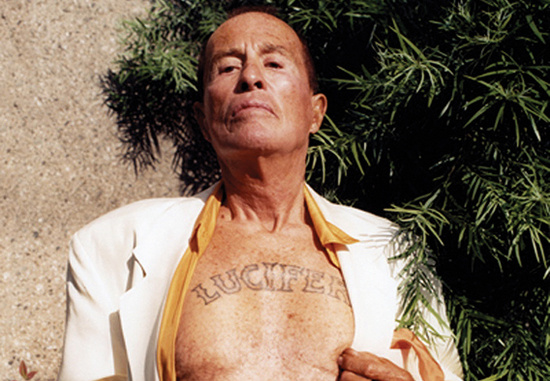
Kenneth Anglemeyer aka Kenneth Anger
Mick beginning shortly after Year Three would turn his act into performance art of a highly suggestive nature accompanied by an intentional hypnotic beat with stun gun volume, flashing lights and the stimulated hysteria of the crowd reaction. A proper atmosphere for hypnotic suggestion.
Mick’s vengeance for the drug bust then was to play the Pied Piper to lead the ‘kids’ to their destruction.
Marianne would be a casualty of his mania as she sank into the deepest of depression.

Chapter 7 follows.
Chaps. I & II Marianne Faithfull, The Faerie Queene Of The Sixties
November 15, 2012
Marianne Faithfull, The Faerie Queene Of The Sixties
Chapters I and II
by
R.E. Prindle

She’s one of those girls
Who come with the Spring
One look in her eyes
Makes you forget everything.
Younger Girl- John Sebastian
The sixties came walking in slowly, hands in pockets shuffling along barely recognized going down the road. Few recognized that it was a period of god formation. All the icons of later years came from those days. John Lennon, Jim Morrison, Jimi Hendrix, Mick Jagger. The comptetion for goddesses was less crowded, Janis Joplin carried too much baggage, Grace Slick had her shortcomings and the rest were wannabes- except for Marianne Faithfull. She floated through, became entangled with his Satanic majesty, Mick Jagger, crashed and disappeared from sight to reemerge damaged but triumphant. When she resurfaced it was in another guise bearing little resemblance to the Faerie Queene of he sixties.
Perhaps only in retrospect does she appear as the angel of the sixties. Only looking back does she stand head and shoulders above the women of the decade. In her day she aspired to be Guenivere to Mick Jagger’s Lancelot. High expectations doomed to disappointment. Buth then the high, even ridiculous, expectations of the sixties couldn’t hope to be more than failed and fail they did.
The sixties were born in the despair of the World War II, the Korean War and the Atom Bomb. The decade was shaped by the children born from 1934-38 to 1945 most heavily represented by the years of ‘42 and ‘43. The years had their effect on those nborn in the United States but devastated those of England who formed the backbone of the sixties in both the US and England. Stunted by ill nutrition the English boys and girls entered childhood in a world of deprivation, millions of bomb craters, square miles of devastation, limited amounts of food that were rationed until they reached their teens. Nutrition triumphed over genes leaving perhaps a majority stunted almost to the height of midgets. Then in the mid-fifties they came off rations as the country rebuilt and a degree of prosperity returned. Thus the favored members of a generation with low or no expectations burst into an energized prosperity, as the flower of the sixties grew and blown in a trice.
Marianne herself was born in 1946, a baby boomer, in one of those ill-starred marriages of the post-war world. Thousands of young English girls married American servicemen and left the lad of their birth forever. Perhaps more wisely than they knew as the hundred of thousands of English men who never returned live would have left them spinsters all their lives. As it was Marianne’s father, Glynn Faithfull met her mother in occupied Austria returning with her to England where Marianne was born. As might be expected of a marriage made under Third Man circumstances the marriage proved ill matched each partner going their own way. Thus by 1953 when Marianne was seven and rationing was lifted she divided her time between her two parents.
One ponders the effect this had on the psychological development of the girl. Her father was one of those strange utopianists who believed the Holy Grail of personal redemption could be found in fucking so he founded some Jim Jones type of sex retreat where all the inmates were encouraged to copulated indiscriminately and freely.
One doesn’t know Glynn Faithfull’s background. There may have been a couple reasons for this faith in fucking. A significant underground current was Aleister Crowley and his faith in sex magic. Crowley and his disciples with figure in
Aleister Crowley
Marianne’s life in the sixties. His influence would continue to grow during the forties, fifties and sixties. Perhaps more significant was the sex therapy of the one of the centuries most eminent madmen, Sigmund Freud. While generally unaccredited for his sexual influence, his sex theories combined with his bizarre vision of the unconscious did terrific damage to the world’s psyche, especially during the fifties and sixties when his notion dominated psychology.
As a young girl Marianne was encouraged to observe the inmates copulate. They apparently did so in front of open windows in a series of rooms fronted by a ledge or sort of long balcony. As a young girl her father encouraged Marianne to use this ledge to view the couples at play. In the innocence of youth she little knew what to make of this although what effect the flickering memories played in her development she either does not say or doesn’t know.
Her mother removed her from this environment placing her in a Catholic convent school until she was sixteen. The transition from open sex practices to a chastity minded Catholic education must have provided an unusual contrast in the growing memory bank of her mind. At least Marrianne was out of harm’s way for a few years.
Marrianne’s mother, Mrs. Faithfull, was an Austrian. She had witnessed the years of the Anschluss and the Nazi administration of the war years. Necessarily as the Soviet troops moved in she suffered the horrors of the rape of the German women by the Communist troops. This event made the Rape of the Sabine women look like a pleasure romp. History records that when things had settled that there were long lines of pregnant German women before the hospitals waiting their turn for an abortion of a hateful pregnancy.
It was in this environment that Eva met her future husband Glynn Faithfull. It was possibly love among the ruins in which Marianne was conceived. Born out of the ashes so to speak. ;Marianne’s mother Eva was of the Sacher Masoc line; he who gave masochism its name and wrote the Venus In Furs that Lou Reed purloined for the title of his song. Hard core rock and rollers have been in awe of Marianne’s ancestry as though she had a hand in masochism’s naming. Sins of one’s distant relatives and all that.
When Marianne escaped or was released from the nunnery she was ill prepared to deal with life on the streets, but then aren’t we all. So as the sixties dawned this attractive girl with no prospects began to wend her way through life. The Catholics gave her some vocal training of some sort, perhaps Gregorian chant, so Marianne took up folk singing. Rather than the subdued tones of A Years Go By she was more of the bellowing Joan Baez variety. Thus when Andrew Oldham asked John Dunbar if she could sing and John answered yes he was stating a fact.
In John Dunbar Marianne fell into one of the hippest young crowds London had to offer. Dunbar himself was of a Bohemian mentality and he associated with the future historian of the musical and artistic scene of the sixties, Barry Miles. Miles has never gotten the recognition he deserves. To begin with he co-founded the very avant garde Indica Art Gallery with Dunbar. The Indica lasted only a couple seasons but those were two memorable seasons.
The two entrepreneurs were discovered by Paul McCartney who, I don’t know if active is the right word, took at least an active inte3rest in the gallery which led to John Lennon’s eureka moment with the scourge of rock and roll, Yoko Ono.
In the course of time this led to Dunbar’s being invited to the famous party in which Andrew Oldham is said to have gallantly remarked: Who’s the broad with the big tits? Or words very close to that.
It was at that point that Oldham asked the musical question: Can she sing? To which Dunbar unwisely responded yes. Marianne, given that she was already a folksinger, sagely pretended to be at sea so that Oldham was afforded the pleasure of coaching her along. Whether he made it inside the Magic Circle or not he had to come up with a song for Marianne to record. More at sea over this matter the legend has it that Andrew locked Mick and Keith of the Rolling Stones into a closet, toilet or kitchen and said he wouldn’t let them out until they wrote him a song. Thus Marianne indirectly is responsible for the Richards-Jagger song writing team with its ill fated effect on popular culture.
With Marianne Oldham struck gold the first time out. The song Richards-Jagger wrote was a languid ditty titles As Tears Go By sung in a lisping fainting manner by the newly nominated Faerie Queene. Songs are pretty much ephemeral to the time but within the ephemera of the time both Marianne and As Tears Go By were a very major hit. In her way Marianne and her song was the sunrise 1964 was waiting for.

Gracie
II
…I trusted you and did my best
To make you happy.
Is this what I get for loving you?
Spector, King, Goffin
Marianne was some kind of folksinger cum chanteuse. She had a high virginal voice. She came from a Catholic convent school that signified purity to the English public. In her early interviews she appears shy, modest, and if I may say, virginal. The very antithesis of the increasing vulgarity of the times. They set Marianne on a pedestal.
In the early sixties rock and roll had not yet driven every other rorm of music off the field as it would by 1970. From 1960 to 1964-65 folk music was the dominant musical form although not of the New York purist variety; more along the commercial lines of Harry Belafonte, the Brothers Four, the Kingston Trio and Randy Sparks’ New Christy Minstrels. Peter Paul and Mary were at their peak not year claiming to ‘love your rock and roll music’ until 1968. In 1966 the Christies spin off The Association was a big hit.
Apart from sappy team acts he Beatles sparked the rock and roll revival although their wasn’t too much difference between them and the sappy teen acts. I never did understand what the public revered in them. Listening to the early Stones recently reminded me why I didn’t like them the first time around either; they sound quite a bit like a bad garage band. Jagger isn’t much better a singer than Dylan, he couldn’t have been much worse. But fate is fate and a hit is a hit. Can’t argue with it.
Marianne then entered the lists with a number nine hit in the UK and a number twenty-two in the US. Her second song Blowin’ In The Wind, didn’t chart while her third, Come And Stay With Me was number four UK and twenty-six US.
She released four LPs in 1965 which is at an exploitative rate. No one at the time realized that the next wave of pop acts would be extremely long lived. No one thought that the Beatles, even though they broke up, would go on dominating popular music for fifty years. No one would have believed that the Stone would be projected a tour fifty years on. No one could have believed that Marianne would still have a career fifty years on. So they were trying to gut the goose that laid the golden eggs as soon as they could. How could anyone at the time have believed that Jagger would become a pop god and Marianne a goddess? Icons for a generation. Unthinkable.
The first two UK albums charted at twelve and fifteen while in he US Marianne Faithful charted at twelve. Her US sales then were somewhere between seventy-five and a hundred thousand copies. She didn’t make the charts with a new title until 1974s Broken English weakly settling on the US charts at eighty-two.
Prior to 1964 most British bands had little presence outside their native England. With the arrival of the Boeing 707 in 1959 the US became readily accessible while the vista for global band was opened. First through the breach, of course, were the Beatles, soon to be followed by Bob Dylan and The Stone and even Donovan. Most people don’t understand how big Donovan was in the sixties; almost an equal to the Beatles and Stones. Thus the era of global popularity was inaugurated changing the face of popular music and group economics. Oddly enough the field was limited to English and American bands for a very long time.
An astute manager with his eye on the future might easily have turned Marianne into a global attraction. However Marianne after jettisoning Andrew Loog Oldham after her first two single signed with some small minded English putzes who were both incompetents and only interested in exploiting her. Somewhat like Edie Sedgwick in New York it was all there waiting to be picked up but no one saw it.
It does seem that they saw the image ready for use but ignored it. Where was that eagle eyed Allen Klein I wonder. Marianne herself was into Queen Quenivere, King Arthur, the Holy Grail and the faerie aspects of the epic. The record people got it. For instance the liner notes on the back of the US Faithfull Forever US release quote from Keats’ La Belle Dame San Merci:
I met a lady in the meads
Full beautiful- a fairy’s child.
Her hair was long, her foot was light
And her eyes were wild.
I made a garland for her head
And bracelets too, and fragrance zone
She looked at me as she did love
And made sweet moan.
I set her on my pacing steed
And nothing else saw all day long
For sidelong she would bend and sing
A fairy’s song.
She found me roots of relish sweet
And honey wild and manna dew
As sure in language strange she said
“I love thee true.”
So there it was. Everything was in place but the management wasn’t there.
It really couldn’t be seen in 1964 that this was the year of myth making in popular culture, actually ‘64, to ‘66. Marianne had all the elements to make her as big and long lasting as, say, Bob Dylan. She already was a myth.
Perhaps Mick Jagger of the Rolling Stones surveying the horizon saw this. Ever envious he may have said to himself ‘This woman is a threat to my supremacy; I must destroy her.’ I can’t say but he did sidle up to her, pour some wine down between her breasts and with that introduction proceed to seduce her whispering ‘Come stay with me.’ A couple years later he threw the remains aside.
And Marianne plunged into a deep depression.
 I, Dynamo