Thuvia, Maid Of Mars by Edgar Rice Burroughs: A Review
March 14, 2009
Edgar Rice Burroughs On Mars
A Review
Thuvia, Maid Of Mars
by
Edgar Rice Burroughs
Part I
Review by R.E. Prindle
This very interesting sdtory was written shortly after ERB returned to Chicago from his first San Diego excursion. It was placed between the Girl From Fariss’s, the last story written in San Diego and The Cave Man.
The material deals almost exclusively with suggestion and hypnosis. Although hypnosis is a recurring theme in Burroughs one is startled by his concentration on the subject and his seemingly informed ideas of it, especially the role of suggestion.
One wonders why his interest surfaced at this time and where ERB learned or developed this information. He was just back from San Diego and I’m going to suggest he picked it up from his hero, L. Frank Baum. As Baum was such a significant influence on Edgar Rice Burroughs perhaps it may be worthwhile to attempt an assessment on Baum’s role in literature and history. There can be no question but that the OZ series of Baum took a central place in the American psyche and a place in the European psyche. Baum’s books have been in demand since 1900 when he began writing them to the present. Baum put Kansas on the map. The Wizard, Dorothy and Toto are household names. Baum’s play from the Wizard was a box office success while MGM’s movie is certainly in the top ten of influential movies, perhaps even in a tie for first with Gone With The Wind. Even American Negroes made their own Black version called The Wiz. The list goes on.
I’m going to suggest that Fritz Lang, the movie Director, was highly influenced by Baum as reflected in his important film, The Testament Of Dr. Mabuse. I wouldn’t be surprised if Lang was also very familiar with Burroughs.
Baum himself was a committed Theosophist. Introduced to the religion by his mother-in-law Baum picked up his card in 1893. By 1913 when he met Burroughs he had been a practicing member for twenty years. When he left Chicago he first went to Coronado across the Bay from San Diego. Katherine Tingley had established her Theosophical organization on Point Loma near that city. Baum must have been an important member of that congregation. Perhaps he had a falling out with Tingley but he did remove himself to Hollywood in 1910. In Hollywood he undoubtedly connected with the Pasadena Theosophical Society that at present is the mother organization.
As a Theosophist Baum would have had to have been familiar with the works of Madame Helena Blavatsky. Her great works are Isis Unveiled and The Secrect Doctrine. Theosophy of course is on a par with the Semitic religions of Judaism and Christianity. While Madame B is often referred to as nonsense she is in fact very learned in the ancient religious doctrines of the human mind that went to form all Middle Eastern religious expressions. Hence while Madame B’s works are metaphysical in nature they are no less relevant to the development of the human intellect than say, St. Augustine or others of the metaphysical ilk.
Madame B had some strong opinions on hypnotism. Hypnotism had come to the fore of Euroamerican consciousness in the years preceding the French Revolution through the efforts of Dr. Franz Mesmer. Though discredited as as a charlatan he was dealing with the real thing as subsequent history shows. He originally called hypnotism Animal Magnetism. That was changed to Mesmerism and then to Hypnotism. As far as possible influences on Burroughs it will be remembered that Edgar Allan Poe wrote Mesmeric Revelation in 1844 and The Facts In The Case Of M. Valdemar in 1845. There are clear indications that ERB was familiar with the Valdemar story.
Now, the essence of hypnotism is the suggestion. Suggestion is perhaps the most important intellectual or psychological phenomenon. Suggestion isperhaps the basis of intellect, intelligence and psychology. C.G. Jung in his investigations of symbols was dealing with the nature of universal suggestion from nature. Freud early learned to separate suggestion from the hypnotic trance. Artfully used suggestion obviates the need for trancelike states. Thus people don’t understand that and how they are hypnotized by movies and TV.
The art of successful literature is merely to suggest scenes and situations and have the reader visualize them in his own mind. Once accepted the suggestion becomes part of the intellect of the reader. He may be able to reject it later but that is a separate volitional act. The great writers realize this. Freud understood perfectly, while Baum developed the art of the concrete image to a remarkable degree. His works are a series of remarkable images. If Freud had had Baum’s skill, and he wasn’t far short, he would have been even more effective than he has been.
The prescient Fritz Lang picked up on Freud, Baum and hypnotism in his remarkable Dr. Mabuse series of movies. The first story, Dr. Mabuse The Gambler of 1922, concerns a Freudlike megalomaniac named Dr. Mabuse. Freud’s activities during the Great War and after would be known to the cognoscenti. It would be foolish to think that Adolf Hitler and other Volkish leaders wouldn’t have been aware of what Freud was up to. Mabuse is into all kinds of criminal activities to undermine society and the State, as was Freud. He is also a master hypnotist as was Freud. In a scene reminiscent of the scene in Thuvia where Jav says ‘You want to see them? Then, look.’ The scene of ancient bustling Lothar then appears to Carthoris and Thuvia’s wondering hypnotized eyes. As well as mine, certainly. I had no trouble seeing what Burroughs wanted me to see. So Dr. Mabuse in his role of stage hypnotizer, the man wore many hats, makes a parade appear before the wondering eyes of his audience. It can be done. I saw a man make Diamond Head disappear before the whole world on TV. Pretty amazing.
At the end of the movie Mabuse is captured and conveniently tucked away in an insane asylum. He goes catatonic until 1930 or so when Lang made the sequel The Testament Of Dr. Mabuse. The Dr. emerging from his catatonic state makes signs that he wants pen and paper which the head of the asylum, one Dr. Baum, provides.
Mabuse then turns out page after endless page of instructions to destroy civilization not unlike what Herr Dr. Freud was doing from his study in Vienna. The writing had an hypnotic effect on Dr. Baum who executes the plans of the cell bound Dr. Mabuse.
The use of the name Baum could be a coincidence but Dr. Baum like the Wizard Of Oz is an unseen superior. He issues orders but is otherwise an unknown to those he directs. In issuing his orders we are led to believe that he sits behind a curtain unseen while giving his directions. Then, just as Dorothy did, the hero dares to pull back the curtain and he finds…a phonograph player. Unlike Dorothy who finds a tubby timid little imposter, there is no one there. Surely this is a parody of Dorothy’s famous scene which makes the name Dr. Baum less of a coincidence.
So it would seem that L. Frank Baum’s influence extended to Germany and an originator of film noir. Not so unlike as Baum’s stories are much darker than they might appear at first reading. At any rate his literary images make long remembered illusions of reality not unlike that of Dr. Baum while being of a suggestive hypnotic nature. I can still visualize Dorothy pulling the curtain back exposing the mild mannered Big Brother sixty years after. I can remember the image I formed.
So, my suggestion is that L. Frank Baum was the direct inspiration for Thuvia of Mars. As noted ERB was probably familiar with Poe’s stories of hypnotism while I am certain that he had read George Du Maurier’s Trilby concerning the hypnotist Svengali and probably also Du Maurier’s other two novels, Peter Ibbetson, and The Martian both related to unusual psychological states. Len Carter believes that ERB read William Morris who also uses some hypnotic themes in his fantasy novels. Lew Sweetser, ERB’s mentor in Idaho via Yale, might also have given him some information on hypnotism while ERB was still a boy. Plus I’m sure hypnotism was a hot topic of popular discussions.
ERB’s emphasis on suggestion as the operative means of hypnotism points to some more direct instruction. Most think that ERB first met Baum in 1916 which means the two formed a fast friendship immediately. I think it more likely that they met in 1913 renewing the acquanitance in 1916. Whether Baum had read any of Burroughs’ stories in 1913 which seems would be paying pretty close atention to literary trends in pulp magazines he may have heard of Tarzan. Probably aware of this ERB may have brought along a magazine or two to show Baum. If Baum then read the proffered stories he certainly would have seen his influence in the Mars stories if ERB didn’t actually point them out to him hoping for the Zeusian nod of approval from the master.
Probably flattered Baum would have encouraed the relationship. Assuming that to be true the two men having similar interests would certainly engage in conversations on Theosophy, hypnotism, writing techniques and whatever.
Certainly Burroughs writing style which while always colorful was a little heavy on the narrative side seems to open up to a more allusive suggestive style blossoming significantly in 1915’s Tarzan And The Jewels of Opar.
I can’t find a more immediate source for ERB’s sudden interest in hypnotism. But, on to the story.
Part III: Zane Grey, Edgar Rice Burroughs And The Anima And Animus
February 4, 2009
The ERB Library Project
Zane Grey, Edgar Rice Burroughs And The Animus And Anima
Part III
The Rainbow Trail
Bad Blood In The Valley Of Hidden Women
by
R.E. Prindle, Dr. Anton Polarion And Dugald Warbaby
Texts:
Burroughs, Edgar Rice: Corpus 1911-1940
Grey, Zane: The Riders Of The Purple Sage, 1912
Grey, Zane: The Rainbow Trail, 1915
Grey, Zane: The Mysterious Rider, 1921
Prindle, R.E.: Freudian Psycology Updated To Modern Physics, ERBzine, 2004
Prindle, R.E.: Something Of Value Books I, II, III, Erbzine, 2005.
The protagonist of this continuation of Riders Of The Purple Sage is named John Shefford. The appeal of this book and Mysterious Stranger to ERB is evident since John Bellounds and John Shefford are both Johns which was ERB’s favorite male name for both heroes and villains. Shefford is the hero here while Bellounds was a villain.
Symbolical of the religious problems of the period Shefford had been pushed into the ministry, some undefined sect, by his parents. But he had his doubts. These doubts found expression in his sermons to his flock. This may have been just after the Civil War to keep time periods straight. Not sharing his doubts the faithful threw him out of their church. So on the religious level Shefford is searching for a belief system. His old one had been ruined by Science. So we have the science-religion dichotomy here.
Shefford’s congregation was in Beaumont, Illinois which is where Venters and Bess of Purple Sage took Night and Black Star and their bag of gold. They had told their story to Shefford who found Bess strange and wonderful deciding that where she came from there must be others and that he was going there to get him one. In my youth, they called it Kansas City but this is not the case here.
When they told him the story of Fay Larkin he decided to go in search of her himself and locate this duplicate of Bess known as Fay Larkin. We should note that a fay is a fairie, so Fay Larkin is in essence a fairy princess. Thus Shefford is not only looking for redemption for his Animus but he seeks to reconcile his Anima. This is not much different from the Hungarian myth where the Anima was imprisoned in bridge footing, here the Anima is imprisoned in Surprise Valley just over the Arizona line in Utah. Get this, at the foot of the Rainbow Bridge. How elemental can you get.
With the blessing of Venters and the unmasked Rider, Bess, Shefford sets out for the desert in search of redemption. So, we have the religious dilemma of the period caused by Darwin and other scientific advances as the foundation of the story coupled with the Anima-Animus problem of the male.
The book was published in magazine form as The Desert Crucible. For the meaning of this metaphor for Grey check out his 1910 novel The Heritage Of The Desert. For Grey the desert tries a man’s soul either making or breaking him. The hero of Heritage, John Hare, was a ‘lunger’, that is tubercular, who was healed both physically and mentally in the desert crucible. In Shefford’s case he tapped his breast and said: ‘I’m sick here.’ meaning his heart or soul. I haven’t read a lot of Grey but of what I have read he never deviates much from his basic story; it’s all pretty much the same told from different perspectives. Shefford will have his heart or ‘soul’ healed just as Hare had his lung healed while finding himself as a man ‘way out there.’ Out There Somewhere as Knibbs and Burroughs would say.
Pretty much the same notion as Burroughs who believed a return to nature was the solution of the urban problem. Neither writer was unique in this respect but symptomatic of the times.
Whereas the desert was lush in Purple Sage under the dominion of the Great Mother, now under the control of the Patriarchal Mormon men viewed through the heartsick eyes of John Shefford the desert is dry as a bone, the water and the Great Mother are gone, all is barren and bleak.
Even the old landmarks have disappeared. No one has ever heard of Deception Pass although they think it may have been what is now known as the Sagi. Amber Spring has dried up. The town of Cottonwoods razed, only a few walls standing, while nobody reallys wants to discuss it. Verboten. No one has ever heard of Surprise Valley, which after all was sealed off from the world. But the name Fay Larkin does ring a bell. Hope in the wilderness.
Purple Sage took place in 1871, this is twelve years later, hence 1883. The United States Government, interfering in both religious and sexual matters, declared polygamy illegal in 1882 in response to this Mormon threat. In the background then is the US tribunal trying to root out the Mormon vice of polygamy. Time is moving right along on the last frontier.
In Grey and Burroughs’ real time, this book was published in 1915, the problem would have been a different Semitic intrusion, the Jews, who were manipulating US policy, certainly vis-a-vis Czarist Russia, for their own ends. Both writers would have been aware of Jewish political activities as well as the Great War that broke out in 1914. The Mormon-US confrontation may very well be also an examination of the Jewish-Gentile situation which was felt more keenly by contemporaries than the history books wish to tell as well as concern for the Big One in Europe.
The consequences of the situation described by Grey in Purple Sage would have been a serious one for the Mormon government. Clearly the situation had been allowed to get out of hand by Bishop Dyer and Elder Tull. Direct action should never have allowed to develop; it should have been kept more covert as any well managed operation should be. My god, the number of Mormons and others who died should have been a scandal. Wars have reported fewer deaths. The fact that Cottonwoods was destroyed, Amber Spring stopped up, and whatever indicates it was the Mormons who were trying to wipe the past from the history books. No need to talk about this one. One may compare this incident to Egyptian history. When the female Pharaoh Hatshepsut died her name was chiseled off every monument in the land. The idea that you can change the past by chiseling it out of the history books is current as well today.
The Mormons did not forget Lassiter and Jane walled up in Surprise Valley but there was no entry to get at them. Grey, a better writer than astute geologist, hastens erosion in the valley. More erosion occurred in these twelve years than in the previous two or three thousand. There were constant landslides and then the really Big One occurred when the canyon wall opposite the cliff dwellings gave way allowing for an entrance but still too formidable for an escape.
A watching Piute, Navajos are Grey’s noble savages, the Piutes his ignoble savages, Twain excoriated them too, informs the Mormons who invade the Valley seizing Lassiter and Jane. Lassiter had, of course, left his empty guns outside the Valley eleven years before and was unarmed or, in other words, emasculated.
The Mormons were going to string the Hammer up from his own sour apple tree when they decide to spare him if he and Jane will give them Fay Larkin for a fate worse than death, that is being given to a Mormon as one of his multiple wives and educated to the faith. It’s not clear why they asked as Jane and Uncle Jim had no power to refuse. At any rate, they considered it a square deal. The Mormons took the girl, apparently leaving Uncle Jim with his hands tied and the hempen noose still around his neck. Rather ludicrous vision when you think that he was attired in a fairly loose fitting garment made of jackrabbit hides.
Thus as the story begins Lassiter and Jane are alone in Surprise Valley, Fay Larkin is being educated to be the youngest wife of a Mormon Elder but as yet untouched, the US Government is pursuing the Mormons to prevent polygamy and John Shefford is in search of god and himself slogging knee deep through sand dunes in search of an obliterated past.
Do you believe in magic? You’re going to have to.
Because of US pressure the Mormons have gotten very devious. They have moved their extra wives across the Utah border into Arizona in a village of hidden women called Fredonia which means Free Women, are you laughing yet, apparently in the sexual sense. An oxymoron if there ever was one as these women were definitely not free. I find it difficult to follow Grey’s thinking here.
The Mormons forbid men to visit here while they themselves make periodic visits to their wives and children. That these are quality time visits is evidenced by the large numbers of children and no resident men. Hmm, freaky, Fredonia huh?
Of course supplies have to be brought in by men but these are men the Mormons ‘trust.’ Shefford links up with the trader Willets who is one of the trusted ones who vouches for the stranger Shefford so that he is allowed into the Valley Of Hidden Women.
Grey is incredible, in Purple Sage there was only one woman in Surprise Valley, now in Fredonia there is a whole village of delectable females. Willets encourages Shefford to mingle with them, get to know them, make them like him, but don’t touch.
On his way to the ladies Shefford has to pass through the crucible of the desert. It’s hard work but, boy, your muscles feel good, the air is great too. On the way Shefford is befriended by the Navajo, Nas Ta Bega, the navvy actually making him his brother. Say Nas Ta Bega rapidly three or four times and it almost comes out Nasty Beggar. Coincidence. This is the beginning of Shefford’s new religion.
For the Navajos religion was material, they worshipped the sun, the rocks, the winds, anything they see or feel. The natural rock formation, Rainbow Bridge, is their greatest terrestrial god, none daring approach it.
Shefford meets Mary his first day in Fredonia. We all know Mary is Fay Larkin and really so does Shefford but he has to make her say it. As she is his Anima figure they naturally love each other at first sight but as she is the affianced of Elder Waggoner he has to get her away from him.
This is not 1871, there is no longer any wild gunslinging. The law is here. In fact a court of inquiry is taking place in Stonebridge just across the border in Utah. Interesting how closely Grey follows ancient legends of which he probably had no knowledge. The Mormon wives are immured in a hidden valley on the other side of the border from Stonebridge not unlike the Anima figure entombed in the bridge foundation on the other side of the river in Hungarian myth.
The US judge has no luck in making the women admit to being other wives, in fact, to Grey’s horror, they allow themselves to be thought of as prostitutes rather than admit to polygamy. Apparently the US was unable to prove one case of polygamy anywhere in Utah. Them Mormons was close lipped.
Shefford still has to get Fay Larkin away from her prospective Mormon husband. As with all of Grey’s protagonists Shefford procrastinates and vacillates. Fay Larkin invites him into her house, obviously on a sexual pretext which he is slow to pick up. While he is allowing for the information to seep into his brain bootsteps are heard on the porch. It is not the milkman. Fay wants Shefford to kill Waggoner but Shefford has strong moral principles against killing for any reason. As Fay looks imporingly to him for protection her husband is opening the door. Shefford dives through an open window running as fast as his legs will carry him.
Grey seems to consider this natural as Shefford has an aversion to killing; strangely, Fay Larkin does not seem to resent his hasty departure leaving her to the mercy of her husband whose intent is to impose a fate worse than death on her.
In fact, Shefford’s will seems to be paralyzed from here to the end of the story not unlike the paralysis Jane inflicted on Lassiter. Something about those Withersteen women. Fay has after all been renamed Mary after the Mother Mary. Everyone else does things for Shefford as he wanders about in a daze; he seems to be able to do nothing for himself.
Fay’s husband is found dead on her doorstep the next morning. She thinks Shefford did it and is pleased; he thinks she did it and is horrified. Actually the Navajo, Nas Ta Bega, Shefford’s Bi Nai, or blood brother, did it for him. Is Grey thinking about the contemporary Jews? Bi Nai is awfully close to the B’nai of B’nai B’rith. B’nai means brother or brotherhood. B’nai B’rith means Brothers of the Ceremony. I can’t say for certain but it is the little details that give you away.
Nas Ta Bega has been doing the legwork for Shefford all along. He actually discovered that Mary was Fay larkin for certain. Whereas no one had ever heard of Surprise Valley Nas Ta Bega had found it. Shefford is too paralyzed to kill Waggoner so n=Nas Ta Bega does it for him. While Shefford himself could never shed blood and he was horrified that Fay Larkin might have done it he is relieved that Nas Ta Bega did it accepting the gift without any qualms. Grey is a strange one.
There is some resemblance here to Daddy Warbucks of Orphan Annie fame where Warbucks himself kills no one but his confederates the Indian Punjab and indeterminate Asp eliminate people by the dozen for him. Thus Warbucks’ hands are always clean but the job gets done anyway. Here Shefford remains innocent of the murder shuffling the guilt off to Nas Ta Bega his blood brother.
The bunch heads to Surprise Valley to get Lassiter and Jane out. It requires pegs and ropes to get into the valley but there they find a very relaxed, one might even say, comatose, Uncle Jim who says ‘Shore’ to everything, for shore. Very amiable guy for a man with the blood of dozens of Mormons on his hands.
He and Jane are released and now begins a very complicated escape plan down the Colorado River then through the rapids to safety on the Arizona side. The Mormons at this stage of history thought that Utah extended to the North Rim of the Grand Canyon although the US authorities thought differently.
The story effectively ends with the release of Lassiter and Jane from Surprise Valley. Shore, it does. But Grey throws an extra forty pages in the ending mainly to give a description of a boat ride down the rapids of the Colorado which he has apparently taken. Lassiter and Jane are reunited with Venters and Bess, Night and Black Star back in Beaumont, Illinois. Shefford finds his Anima, redeems his soul, finds a true religion and lives happily ever after.
2.
G.M. Farley, the editor of Zane Grey Collector, in his charming appreciation of Zane Grey for the ERBzine says that Grey wrote no fantasy, but these two novels, Purple Sage and Rainbow, are just that, pure fantasy. Lassiter, Venters and Shefford are archetypes. Surprise Valley nor anything like it ever existed nor did the Valley Of The Hidden Women. Both these books are pure fantasy. If appreciated properly these two books should stand as the cornerstones of Grey’s literary legacy. Much better than his ordinary cornpone Westerns. When it come to Westerns I will take those of Burroughs over Grey every day.
Burroughs is absolutely learned compared to Grey. The former’s insatiable curiosity is very evident in his writing while Grey gives the impression of having read nothing. Of course if you’re writing several months out of the year and out to sea for the rest perhaps there isn’t much time for reading. The contrast between land and water in Grey’s fiction was lived out in his real life. Psychoogically land represents the hard, dry Animus while water is representative of the creative Anima. As Roger Miller said, he had too much water for his land which is to say that he was subject to wild flights of fantasy but unable to govern his life. He also said quite correctly, Squares, that is people with a lot of land, make the world go ’round. Thus the Mormon squares controlled the situation while ‘hipsters’ Jane and Lassiter ended up buried in the canyon.
Thus Grey’s concentration on the desert as compared to farmland or the forest is signficant. The opening scenes of Rainbow when Shefford slogs through the sand drifts to arrive at a bitter waterhole is significant of his inner barrenness; a nonfunctioning Anima. Contrast the bitter water with the sweet water Amber Spring of Purple Sage. When Shefford is united with his Anima figure, Fay Larkin, they travel through harsh desert to leave finally on a raging torrent washed over with water until they are nearly drowned to land on a hospitable South shore of the Colorado in Arizona not Utah.
Likewise Grey lived his life between the desert and the sea. On the sea angling for the big fish a la Jonah or perhaps the fish of wisdom of Sumerian Oannes.
Certainly the epic is a search for both wisdom and redemption. Having been disowned by his church Shefford has been set adrift without any new guidelines or directions home.
As Shefford explains to Fay Larkin:
“So when the church disowned me…I conceived the idea of wandering into the wilds of Utah to save Fay Larkin from that canon prison. It grew to be the best and strongest desire of my life. I think if I could save her that it would save me. (Right.) I never loved any girl. I can’t say that I love Fay Larkin. How could I when I’ve never seen her- when she is only a dream girl? But I believe if she were to become a reality- a flesh and blood girl- that I would love her.”
So that Shefford hopes to find redemption in Fay Larkin. He might indeed love her- if she were a flesh and blood girl as well as his Anima ideal- but the Anima ideal can never become a real flesh and blood girl. Real women are different.
Shefford’s situation seems to be that of the Hungarian myth with the Anima trapped in a sealed in valley rather than the buttress of a bridge. As it doesn’t appear that Grey read or studied much, this understanding must have been a realization of his own situation which he was able to objectify on paper.
In many ways this then is exactly what Burroughs was searching for as most of his novels are Anima/Animus novels although ERB did not have such a clear grasp while being much more involved with the psychoses of the subconscious.
And then there were the other two themes: the search for the realization of manhood, or the escape from emasculation , and finding a new religious identity.
As noted, Grey thought the desert brought out manhood. His trip West with Buffalo Jones a few years before Purple Sage must have been a real eye opening experience. The Grand Canyon with its contrast between desert and water must have really inspired the author.
Thus Shefford, before he finds his Anima first learns to be a man ‘way out there.’ The test of manhood involves the carrying of a large stone that proved Navajo manhood.
A few passages:
“Joe placed a big hand on the stone and tried to move it. According to Shefford’s eye measurements the stone was nearly oval (egg shaped), perhaps three feet high, but a little over two in width. (Big egg) Joe threw off his sombrero, took a deep breath and, bending over, clasped the stone in his arms. He was an exceedingly heavy and powerful man, and it was plain to Shefford that he meant to lift the stone if that were possible. Joe’s broad shoulders strained, flattened; his arms bulged, his joints cracked, his neck corded, and his face turned black. By gigantic effort he lifted the stone and moved it about six inches. Then as he relaxed his hold he fell, and when he sat up his face was wet with sweat.
Lucky he lived through that.
“Try it,” (Joe Lake) said to Shefford, with his lazy smile. “See if you can heave it.”
Shefford was strong, and there had been a time when he took pride in his strength. Something in Joe’s supreme effort and in the gloom of the Indian’s eyes (Nas Ta Bega) made Shefford curious about this stone. He bent over and grasped it as Joe had done. He braced himself and lifted with all his power, until a red blur obscured his sight and shooting stars seemed to explode in his head. But he could not even stir the stone.
“Shefford, maybe you’ll be able to lift it some day,” observed Joe. Then he pointed to the stone and addressed Nas Ta Bega.
The Indian shook his head and spoke for moment.
“This is the Isende Aha of the Navajos.” explained Joe. “The young braves are always trying to carry this stone. As soon as one of them can carry it he is a man. He who carries it farthest is the biggest man. And just so soon as any Indian can no longer lift it he is old. Nas Ta Bega says the stone has been carried two miles in his lifetime. His own father carried it the length of six steps.”
So, manhood consists of lifting a stone, carrying that weight. It would seem to me that pale-faced education would have less to do with being built like Louis Cyr or Man Mountain Dean. I, myself, don’t feel any less a man because I can’t lift a 350 lb. rock.
Talking about fantasy: If the stone were moved two miles in Nas Ta Bega’s lifetime while his mighty father movied it six toddling steps, if only ten percent of the Navajos were big enough to move the stone then the Navajos should have been as populous as the sands of the desert.
As as a Patriarchal Mormon Joe Lake could lift the stone, as a Matriarchal Gentile Shefford couldn’t and it was impossible for the completely emasculated Indian, Nas Ta Bega, what we have here is a lesson in masculinity.
For myself, I’ve carried that weight for decades but I wouldn’t waste my time and kill myself by trying to lift some rock.
The search for manhood and faith went on but we’re getting closer if no less ridiculous. Another quote, Shefford to Fay Larkin:
“Listen,” his voice was a little husky, but behind it there seemed a tide of resistless utterance. “Loss of faith and name did not send me into this wilderness. But I had love- love for that lost girl, Fay Larkin. I dreamed about her till I loved her. I dreamed that I would find her- my treasure- at the foot of a rainbow. Dreams!…When you told me she ws dead I accepted that. There was truth in your voice, I respected your reticence. But something died in me then. I lost myself, the best of me, the good that might have uplifted me. I went away, down upon the barren desert (Oh Dan, can you see that great green tree where the water’s running free…) and there I grew into another and a harder man. Yet strange to say, I never forgot her (Water) though my dreams were done. (Clear) As I suffered and changed I loved her, the thought of her- (Water) more and more. Now I have come back to these walled valleys- to the smell of pinon, to the flowers in the nooks, to the wind on the heights, to the silence and loneliness and beauty.”
“And here the dreams came back and she is with me always. Her spirit is all that keeps me kind and good, as you say I am. But I suffer and I long for her live. If I loved her dead, how could I love her living! Always I torture myself with the vain dream that- that she might not be dead. I have never been anything but a dreamer. And here I go about my work by day and lie awake at night with that lost girl in my mind. I love her. Does that seems strange to you? But it would not if you understood. Think. I have lost faith, hope. I set myself a great work- to find Fay Larkin. And by the fire and iron and the blood that I felt it would cost me to save her some faith must come to me again…My work is undone- I’ve never saved her. But listen, how strange it is to feel- now- as I let myself go- that just the loving her and the living here in the wilderness that holds her somewhere have brought me hope again. Some faith must come, too. It was through her that I met the Indian, Nas Ta Bega. He has saved my life- taught me much. What would I have ever learned of the naked and vast earth, of the sublimity of the the vast uplands, of the storm and night and sun, if I had not followed the gleam she inspired? In my hunt for a lost girl perhaps I wandered into a place where I shall find a God and my salvation. Do you marvel that I love Fay Larkin- that she is not dead to me? Do you marvel that I love her, when I know, were she alive, chained in a canon, or bound, or lost in any way my destiny would lead me to her, and she should be saved?’
Wow! You get old Zane wound up and he’s hard to stop. This guy must have been a terror with the girls. Dazzled ’em. Stars in their eyes. Remember from eight to seventeen Fay was locked up in Surprise Valley where with the passing years Jane and Uncle Jim spoke less and less as they slowly became as clams. Now as an eighteen year old girl with absolutely no human intercourse and Jane and Jim weren’t speaking she has been undergoing a heavy course of indoctrination in Mormonism while being isolated in her cabin. Could she understand this torrent of words from Shefford? Think about it. She’s a nature girl from the Stone Age moving into the nineteenth century in the twinkling of an eye.
It seems pretty clear to us, astute in varying degrees, that Shefford is going to find salvation in Fay but how about religion. Once again, bear in mind that Grey has displaced the contemporary situation in 1915 back to 1883. In that way he doesn’t have to deal with all those troubling immigrants while the major religious war between the Semites and Gentiles can be discussed under cover of the conflict between the Mormons and the Gentiles. Polygamy might be compared to the Semitic concept of the Chosen People. End either one and the source of conflict would disappear.
Just as Jane and Lassiter have reverted to the Stone Age so Grey goes to his noble savages, the Navajos, to find Shefford’s religious solution:
The Navajo, dark, stately, inscrutable, faced the sun- his god. This was the Great Spirit, the desert was his mother, but the sun was his life. To the keeper of the winds and rains, to the master of light, to the maker of fire, to the giver of life the Navajo sent up his prayer:
Of all the good things of the earth let me always have plenty.
Of all the beautiful things of the earth let me always have plenty.
Peacefully let my horses go and peacefully let my sheep go.
God of the Heavens, help me to talk straight.
Goddess of the Earth, my Mother, let me walk straight.
Now all is well, now all is well, now all is well, now all is well.
Hope and faith were his.
Hope and faith may be the essence of religion. As I say, I doubt if Grey read much but he has certainly captured the essence of mythology. The bit about the sun as keeper of the wind and rains is astute. As Grey said, the Navajo religion was materialistic. Pantheistic too, perhaps. There is nothing spiritual here just a prayer for plenty of what makes life enjoyable for the Navajo combined with the essence of morality which is to talk and walk straight. Quite admirable really. I can imagine the ERB was very nearly in awe as he read it. Of course, by 1915 ERB had already smashed the old religious system on Barsoom supplanting it with his own vision of the man-god but I’m sure he concurred with Grey.
Then Grey sums up the turbulent Colorado:
“Life was eternal. Man’s immortality lay in himself. Love of a woman was hope- happiness. Brotherhood- that mystic ‘Bi Nai” of the Navajo- that was religion.
Yes, as they passed under the Rainbow Bridge at the foot of the rainbow it all become clear. What happened later when reality hit I don’t know.
Grey’s formula reads well: Life in the general sense, in whatever form, will last for a long time but hardly eternally. ‘Man’s immortality lay in himself’ is difficult to parse. Not exactly sure what that means. ‘Love of a woman was hope- happiness.’ Possibly, if he’s talking about a reconciliation of the X and y chromosomes into a unified whole but for an old philanderer like Grey he should amend his statement to love of any or many women, a quick one in other words. And the mystic and grand “Bi Nai.’ Yep. That was religion.
I imagine ERB was goggle eyed when he finished this one and lovingly patted it back on the shelf.
The good things of this world had come the way of Grey and Burroughs in abundance. Grey was able to ‘get back to the land’ six months of the year while testing his manhood like Ahab landing the big fish on the seas the other part of the year. I used to love those travelogues on Saturdays when they showed those heroes trolling the seas for swordfish off Florida proving that had to be a real man to land those big fellas.
Then they would show the little woman standing proudly by her catch towering over her. They fished ’em out by the time I was in a position to prove my manhood. I’ll have to take up skydiving or bungee jumping; to heck with climbing Everest.
Burroughs also got back to the land in a big way. Some of the letters in Brother Men, the collection of his and Herb Weston’s letters are quite delightful as ERB exults about planting every known species of vegetable while raising most of the better known food animals in great quantities. Just that he couldn’t figure out how to make a profit at it. All expense the way he went about it. That wasn’t according to plan.
In their own way both Grey and Burroughs retreated from the social realities of their day both in their fiction and in their lives. Depending on how one defines fantasy both men retreated into fantasy rather than deal with an uncomfortable reality. At the same time both tried to come up with solutions to the pressing social and relgious problems of their times in fiction.
Of the two I much prefer Burroughs because of his wider ranging intellectual interests as well as his highly developed sense of humor. There isn’t one grain of humor in Grey; the man is deadly serious all the time; he must have played shortstop in baseball.
Times change. I find nothing enduring in Grey save the Purple Sage/Rainbow diptych and that because of his amazing portrayal of the Anima/Animus problem.
Burroughs has a certain quality to what he does. Herb Weston in Brother Men seemed put off by ERB’s Mastermind Of Mars. the novel first appeared in Amazing Stories; Weston thought the story was truly amazing. So do I. I can’t explain exactly why I think Mastermind is an enduring story because on one level it isn’t a very good book; yet on another, while Ras Thavas is a great character there is something being said which still escapes me but seems important.
As Grey and Burroughs are representative of the period 1890-1910 just let me say that I really love this period of history in the United States. I like most of the writers and Burroughs and Grey are two of my favorites. They probably read each other but their intellects were so disparate that I doubt if they could have gotten along if they had met.
Fortunately this is a moot point as they didn’t.
Happy trails to you hoping that if you look you can find Surprise Valley and The Valley Of The Hidden Women. Just don’t take your guns to town, Son, leave the Bad Blood at home.
Zane Grey, Edgar Rice Burroughs And The Anima And Animus
February 1, 2009
Zane Grey, Edgar Rice Burroughs And The Anima And Animus
by
R. E. Prindle And Dr. Anton Polarion and Dugald Warbaby
Bad Blood In The Valley Of The Hidden Women:
Thoughts On Riders Of The Purple Sage And The Rainbow Trail
Texts:
Burroughs, Edgar Rice: Corpus 1911-1940
Grey, Zane: The Riders Of The Purple Sage 1912
Grey, Zane: The Rainbow Trail, 1915
Grey, Zane: The Mysterious Rider, 1921
Prindle, R.E. Freudian Psychology Updated To Modern Physics, ERBzine 2004.
Prindle, R.E. Something Of Value Books I, II, III. Erbzine 2005

Zane Grey
Intro.
Anton and I had never read Zane Grey before reviewing the library of Edgar Rice Burroughs as published on ERBzine by Mr. Hillman. Nor probably would we have but for the Bill Hillman series of articles comparing Zane Grey and Edgar Rice Burroughs. Anton and I dismissed any such connection as being relevant but then Prindle read The Rainbow Trail and said we should check it out. Prindle is a close friend of ours; a little on the independent side but alright.
Grey refers to The Rainbow Trail as a continuation of The Riders Of The Purple Sage so Anton, he’s a psychologist became intrigued by the manner in which Grey treated aspects of the Anima and Animus. We both then read Riders in which we discovered a full blown theory of the Anima and Animus.
It should be noted here that Grey had passages excised by his editors that they thought dealt too explicitly with the sexual aspects of the Anima and Animus while reducing the commerical viability of the story. The unexpurgated version of the story was published under the title The Desert Crucible in 2003. I have the Leisure Historical Fiction edition in mass market paperback.
Grey’s ideas were presented in a very pure manner with complete and intact symbolism so there could be no mistaking that Grey was presenting a well thought out theory. Anton became very excited as he said Grey’s theory certainly rivaled the ideas of Freud and Jung and must have been developed independently of their thought much as Burrughs’ ideas of psychology were.
Although Riders Of The Purple Sage wasn’t among the books listed by Hillman as being in the Library we have to assume that Burroughs read it along with a number of other Grey titles although he must have found Rainbow Trail and The Mysterious Rider the tales of Grey he found most significant for his needs. We will assume that this is so. To understand The Rainbow Trail originally titled The Desert Crucible which was in ERB’s library it is necessary to also review Riders Of The Purple Sage.
1.
Grey in this book examines the nature of the Animus and the Anima of the male as well as the relationship between the living male and female. The micro study of the Anima and Animus is placed in the macro study of Mormon society and law of 1871 versus Gentile society and law. This is also a study of the nature of religion.
The Gentiles- I follow Grey’s thought here- Mormons refer to themselves as the Chosen People and ‘others’ as Gentiles- are all of a stricken Anima which paralyzes their Animus while the Mormons have a strong Animus but disturbed by a stricken relation with the Anima which they completely repress not unlike the Jews and Moslems.
Thus Mormons have a strong affinity with the Semitic religious systems from which they derive their religion in part. Anton, the psychologist, avers that the problem of the Animus and Anima has been known for at least five or six thousand years. Anton is close to Prindle who is a historian, so much of the historical part comes to Anton through him although Anton is well versed in the history of human consciousness.

Edward Borein: Six Riders Of The Purple Sage
Historically the struggle of the male to come to terms with the X chromosome and the y chromosome or Animus is central to history and psychology. During the Matriarchal Age, which is to say a sub- or unconscious age, the X chromosome or Anima ruled the mind of man. As consciousness evolved and the conscious mind emerged from the subconscious the nature of the y chromosome or Animus became apparent. The Patriarchal Consciousness evolved.
To reconcile or not to reconcile?
The Egyptians developed their own theories but here we are not concerned with HS II and IIIs and the Semites. Suffice it to say that the Semites borrowed from the Egyptians while adding very little of their own. If one reads the story of Psyche and Eros in Apuleius’ The Golden Ass one will have a good general introduction to the HS II and III point of view as expressed in Grey’s Gentile characters such as Lassiter and Venters. As said the Mormons reflect the Semitic view on women.
The Semites on the other hand, exaggerted the importance of the Animus in favor of suppressing or subordinating the Anima which has been passed on to the HS IIs and IIIs through the adoption of aspects of the Semitic religions. In a Hungarian myth of the Christian Era the Anima is portrayed as being entombed in the support of a bridge. Thus imprisoned on one side of the river or brain it is denied its rightful function.
The Semitic attitude is reflected in the way the two peoples treat their living females who stand as a symbol and only a symbol of the X chromosome of the male. In both existing Semitic relgions, the Judaic and the Mohammedan, the females are treated as property no different than cattle. Some of these attitudes have been temporarily weakened through contact with the HS II and IIIs. They haven’t gone away or changed.
The Semitic attitude infiltrated the HS II and III consciousness through their religion which was amalgameted into the HS-Semitic hybrid called Christianity.
Then in 1930 in the Unied States a man named Joseph Smith created a religion called Mormonism based on the extreme Patriarchal notions of the Semites. As Grey puts it the religion was based on the notion of ruling women. Smith devised rules by which women were completely subordinated to the Animus much as in the Hungarian myth while the men were required to take multiples wives. Smith himself racked up 30 plus.
According to Grey the women were not happy with the arrangement but in the thrall of religious belief they thought it their god assigned role.
As polygamy is not part of HS II and III culture Smith and the Mormons came into conflict with constituted society in Smith’s home base of Fayette, New York being driven out. They encountered the same opposition in their new homes which led finally to Nauvoo, Illinois. Smith, who apparently overplayed his hand was murdered in 1844. In 1847 Brigham Young led the new Chosen People from Nauvoo to the Promised Land on the shores of the Great Salt Lake. By 1871 when Riders takes place they must have multiplied exponentially because they occupy all of Utah and parts of adjacent states. This prologue of the diptych is placed before the passage of the 1882 law of the United States outlawing polygamy. The denouement of the novel will take place as the US attempts to stamp out the practice.
The action of Riders-Trail takes place on the border of Utah and Arizona and parts of adjacent states with the Grand Canyon of the Colorado as a backdrop.

Edward Borein: Riders On The Mesa
As with the other Semitic religions the Mormon Bishops and Elders with untempered Animi have made their will the law. Thus, according to Grey, the Churchmen have become criminals willing to commit any crime to achieve their personal desires which they equate with the will of God.
As Riders opens a Mormon woman, Jane Withersteen, against all the rules of Mormon society is living as an independent woman in Cottonwoods on the Utah-Arizona border, Gentile Law on one side, Mormon law on the other. She does this in defiance of Bishop Dyer (die-er?) who has ordered her to marry and end her independent status. She has her own duchy among the Mormons owning her own town, the water, aparently several counties, a magnificent bunch of horses (emblematic of the Anima) and six thousand head of cattle divided into two herds, the red and the white. (emblematic of the male and female.)
Her independence is a standing affront to the Mormon Elders and Bishops. Having been ordered to marry Elder Tull as one of his many wives she has no wish to submit to the Bishop’s will. Read- Will of God.
These men are not to be balked. The woman Withersteen has no actual rights under Semitic law. As these men have a crazed Animus untempered by the acknowledgement of the female principle or Anima which they deny they have lost all sense of justice, or rather, they equate justice with their desires which they believe are supported by divine law. They are going to use every concealed criminal means to break Jane Witherspoon down. As their will is law they can’t see the difference between subjective criminal methods and objective legal ones.
Jane is already having trouble hiring Mormon riders, riders are the same as cowboys in Grey’s lexicon, to manage her herds so she has resorted to hiring Gentiles.
The Mormons must be seen as a species of Semite and in the Semitic manner they punish Gentiles, or unbelievers as the Moslems would put it, destroying any attempts at their prosperity. If you read the first few lines of the Koran you will find it plainly stated that unbelievers must be punished. Hence all the Gentiles are kept uneducated and impoverished. Jane’s ramrod, is a young Gentile named Bern Venters. Venters at one time had been a prosperous cattle rancher but the Mormons had emasculated him by lifting his cattle. Venters was rescued by Jane from complete impoverishment by offering him a job.
The Elders hate her for this. They have warned Jane to get rid of him and her other Gentile employees but as a sort of Great Mother figure, an active female principle opposed to their male principle, she has refused. She is sort of a Matriarchal throwback among these Patriarchs. As the story opens Elder Tull has dragged Venters out of Jane’s house where Tull gives Venters the choice of hightailing it out of the Territory, Utah being a territory from 1850 to 1895 when it became a State, or being whipped to an inch of his life. Now, Tull means this, they are going to whip Venters nearly to death for being a Gentile in Mormonland.
Having already been emasculated by the lifting of his cattle which, in reality, he couldn’t prevent, Venters now chooses to take the whipping rather than emasculate himself further by hightailing it. Difficult choice.

Rainbow Bridge
Tull is about to have him stripped when the Hammer Of The Mormons, Lassiter, appears out of the purple sage riding a blind horse- you heard right- a blind horse. This guy is Bad Blood personified. Boy, they’ve heard about him but how. Black hat, black leather chaps, two massive black handled pistols worn very low, apparently at his ankles, his reputation as a Mormon Killer is well established. Tull gets the cold shivers just looking at him on his blind horse. The blind horse probably indicates that at this point Lassiter is oblivious to female charms, the horse being a symbol of the female and he’s riding a blind pony.
Lassiter makes a few mild mannered inquiries then orders the Mormons to let Venters go. We’re talking Animus to Animus here, cojones to cojones, whoever backs down is emasculated in relation to the other, and Lassiter’s twin pistols make him the master Animus. The Mormons have to eat dirt or die. The Mormons powerful as a collective cannot be so man to man. Tull gives a hint of throwing an iron on Lassiter but the latter goes into his famous gunslinger’s crouch so he grab one of those guns around his ankles, intimidating the dickens out of the Mormons who retire leaving this field to him while muttering threats that he’d better watch his back.
As we said, all the Gentiles are stricken in there relationship between their Animas and Animi. Between Riders and Rainbow they will be healed.
Grey handles the symbolism starkly and masterfully. Jane Withersteen is a masterful Matriarch. Her independence and relationship to the Gentile men has left the impression that she is sexually loose. It isn’t clear to the reader whether she is nor not. She is more the Great Mother rather than the Siren.
Her role seems to be the womanly one of tempering the raging Animus of the male. While she has no effect whatsoever on the Mormon men she is successful in emasculating the stricken Gentiles. She had persuaded Venters to abandon his six gun which made it possible for Elder Tull to seize him while it was only Lassiter’s two black handled six pistols that freed him.
In a rather sexually explicit scene Jane would stand in front of Lassiter to seize a gun in each hand in an attempt to dissuade him from carrying them thus emasculating him. This at a time when Mormons were trying to gun him down. Her role seems to be one of civilizing society although her method seems backward.
Lassiter is a wronged individual seeking his personal justice in a vengeful way. He has shot up several Mormon towns being now known as a Mormon slayer or, in other words, the equivalent of an anti-Semite.
The reason for his anti-Semitism is that a Mormon kidnapped his sister, Millie Erne, holding her captive until she consented to become one of his wives. Hint, hint. Her remains are buried on Jane Withersteen’s property.
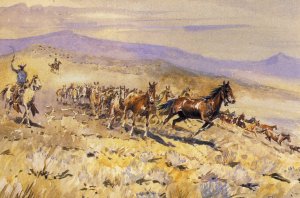
Edward Borein: Lassiter on his blind horse?
Lassiter’s horse was blinded when men held it down then placed a white hot iron alongside the eyes searing them. The horse as a female mother symbol represents Lassiter’s striken relationship with his Anima.
If one reads this novel in a literal sense then many of its incidents are improbable if not ridiculous. What notorious gunslinger would ride a blind horse? Grey has been criticized for wooden characters which is womewhat unjust. These are archetypal characters who are fully developed and can’t change. As allegories there is no need to change. This is mythology.
The Mormons lift Jane’s red herd. This may represent her female Animus as in iconography the male is usually represented as red while the female is white. They next try to stampede her white herd by devious means which they believe are undetectable such as flashing a white sheet from a distance. As a Chosen People they even have to convince themselves that what happens was not caused by them but was the will of God.
Lassiter notes this taking Jane with him to show her. As they watch the cattle begin to stampede. Three thousand on the hoof they stream down the valley. Lassiter on his blind horse races full speed down the slope, obviously no blind horse could do this, out on the flat to single handedly mill the cows. As the lead cows enter the center of spiral Lassiter disappears in the dust. He emerges sans horse to appear before Jane: ‘My horse got kilt.’ he announces. Jane’s response is ‘Lassiter, will you be my rider?’ Pretty clear sexually I think. Not exactly changing horses in midstream but obviusly the transition from a blind horse to a sighted jane is an improvement in Lassiter’s relationship with his Anima. ‘You bet I will Jane.’ Lassiter promptly and positively responds.
Whether you want to consider this stuff ‘high literature’ or not read properly it is not much different from the Iliad or Odyssey.
As a mother figure Jane is a keeper of horses, a symbol of the mother and female. The blinding of Lassiter’s horse was the equivalent of separating him from the mother figure. Jane not only has a full stable of horses but she has the prized horses Night, Black Star and Wrangler. As Grey makes clear these are the devil’s own mounts. In the big chase scene Grey has Wrangler close to breathing flames as he compares the horse to the devil.
The Mormons steal Jane blind while she refuses to allow Lassiter to defend either himself or her. Seems to be the Great American Dilemma even today.
Remember this is a war between Gentiles and Semites qua Mormons. The Gentiles hands are stayed while the Semites are allowed to run wild. Maybe Grey is making a social comment. Also remember that Jane is a Mormon so that while she is powerless to control her own aging maniac men the only men she can influence are the Gentiles whom she emasculates. As soon as the emasculated Venters gets away from her while pursuing the rustlers he immediately begins to revert to full manhood.
The Mormons set both Mormon men and women to steal from her. They take her bags of gold, this woman is prodigal, rich, her deeds and anything of value. They steal her six thousand cows. They want to kill Lassiter, dozens of Mormons lurk in the cottonwood groves (female places) but something stays their hands; they can’t shoot him either from behind or in front.
The only thing Jane worries about is her horses. Black Star and Night. It is possible that in this instance Jane represents the moon goddess. Finally the Mormons steal these symbols of her power. The independent woman is now completely violated. She has a man who could shoot down all the Mormons in Utah but she won’t let him use his guns.
So why should we care?
2.
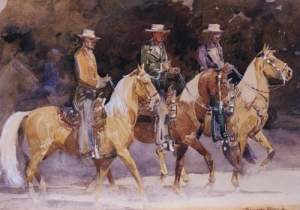
Edward Borein: The Three Caballeros
The myth switches to an alternate plot. Young Bern Venters goes in search of the rustler gang. Once again, Jane attempts to emasculate her men by pleading with Venters not to go, to stay beside her. Why anyone would want to hang around such a loser woman isn’t clear.
Venters goes in search of the rustler gang which is led by a man named Oldring. Old Ring. I’m sure the name has significant meaning but I can’t place it. The wind soughing through the caves is known as Old Ring’s Knell. Even though Oldring’s gang consists of a couple dozen men who have punched a herd of three thousand red cows they have somehow left no trail. Over all the years they have been rustling and pillaging there is no one who has been able to find this robber’s roost.
Venters has traced them to the foot of a waterfall where he loses track. While he is mulling this over a group of desperadoes return from pillaging plodding up the stream. Lo and behold they ride right through the waterfall into yet another hidden valley. Big enough to hold three thousand head of cattle. The West was a big country.
Venters rides off to relate this discovery to Jane and Lassiter when he encounters a despearado with the famous Masked Rider, reputed to have shot down dozens of men. He is dressed from head to toe in black wearing a black mask. This Rider is credited with shooting down any Mormons Lassiter overlooked.
Venters takes out his ‘long gun.’ You know how riders despise the long gun or rifle preferring six shooters, and by dint of long practice he shoots the lead rustler dead and wounds the Masked Rider. While examining the Masked One’s wound he unbuttons the shirt to discover the ‘beautiful swell of a female breast.’ Boy, howdy. You got it, the Masked Rider is a woman, a mannish girl. The image of Venter’s Anima.
Stranded in the desert while trying to nurse this girl back to health Venters chases a rabbit up a slope where he notices ancient steps cut in the rock. Following these he comes into ‘Surprise Valley.’ Formerly the home of cliff dwellers the place is a vitual paradise, green and verdant. No one would ever discover him and the Rider there. Carrying the slight figure of the Rider up hill and down for maybe ten miles or so Venters secretes themselves in the Valley which abounds in game and delightsome frolics.
About this time I recognized some teen fantasies of my own. Shooting and wounding a woman while having to tend her wounds in a secluded place where she has to be eternally grateful when healed was just too obvious. In my case, just after the onset of puberty, I think, when the Anima would be making itself known, I came up with the daydream of having this woman I could keep in a milk bottle until I wanted her. When I let her out of the bottle she became full sized and did whatever I wanted then she willingly went back into the bottle until the next time I wanted her.
As a thirteen year old before the advent of universal pornography I didn’t know what I wanted the woman for but I knew it would be fun. Grey here creates his version of the same fantasy. The Rider, who turns out to be Bess, apparently has a past. I say apparently because nearly everyone in this story has an apparent history which turns out to be false. As a member of the gang she was thought to have been, um…the piece…of Oldring. He kept her in a cabin up on a ledge in his valley behind the waterfall. He was gone a lot so we’re not clear that he ever laid a hand on her but Venters believes she is not ‘pure’ which in his great love for her he is willing to over look but it rankles him.
If you want to know the wonders of Surprise Valley read the book yourself. Comes a time when Venters has to go into Cottonwoods for supplies. There he realizes that he and Bess can’t stay hidden away forever. He has enough money for supplies obviously but not enough to flee from Mormonland.
They don’t call it Surprise Valley for nothing. When he returns Bess hauls out a big bag of gold to give to him. This must be the treasure that the female brings the male. The whole several mile length of the river which runs through this valley is lined with pebbles of gold which Bess has collected. Shades of Opar, huh? In her girlish gratitude she wants Bern to have the lot.
‘Gosh,’ says Bern. ‘Now I don’t have to get a job.’ (He didn’t put it quite that way.) ‘We can leave this valley and go far away from Mormonland.’

Edward Borein: Four Navajos Crossing The Desert
Far away from Mormonland, by the way, is either Quincy or Beaumont (beautiful mountain) Illinois. Not too far from Nauvoo which was the Mormon stronghold jumping off place for the long march to the Great Salt Lake into the fantastic scenery Grey either describes or imagines. Certinly the West of Grey’s imagination is as fantastic as anything Burroughs created on Barsoom.
Even though Grey refers to the desert this is certainly the lushest desert anyone has ever seen. The purple sage is the equal to Burroughs red moss of Mars.
Grey wrote an essay about what the desert meant to him. His desert with its plentiful water complements his vision of the Anima and Animus. The desert may answer to Grey’s subconscious which appears to be missing in his analysis of Anima and Animus, so that perhaps the desert stand for the subconscious.
His desert reminds me of a dream I used to have with some frequency. In my dream I was walking across this immense barren desert spotted at invervals with small oases in which I wasn’t allowed to remain. Off in the distance I could see this great brain shaped mountain. On approaching the mountain I found a small stream of water leading down into the mountain. As I descended I noticed that the stream ran through a bed of solid salt which rendered the water bitter.
Descending further the water disappeared beneath a steel chute. Unable to turn back while unwilling to go further I was nevertheless pushed into the chute where dropping into a steel lined entry I was pushed into a steel walled laundry room as the steel door slammed behind me. There was plenty of water but no way out. There was a ventilation shaft along the ceiling of the back wall. I conceived a plan of drinking to repletion then urinating into the ventilation shaft creating such a smell that they would want to find the source.
My plan worked. Three maintenance men opened the door and I dashed out so fast they didn’t know I had been there. Still in a steel lined area I saw a bank of elevators which would take me back to ground level. A door opened but the elevator was filled with classmates from my high school who pushed me back refusing to allow me to enter.
I don’t know how but I gat back to the surface where once again I approached the back side of the mountain which I ascended this time rather than descended. Now, the mountain was deep in a frozen snow but starting from the low grade at the back I had no trouble climbing, walking on top of the snow. The sun was shining brightly but all was frozen white. When I reached the top I found I was standing above the brow of the face of a great idol carved in the snow. Thousands of feet below terified and intimidated people were kneeling in the desert worshipping the great snow face. From where I stood I couldn’t see the face but I conceived the notion of destroying the snow god to free the people. Leaping into the air I came down on the god’s forehead creating an avalanche. The great face slid away as I descended thousands of feet on a cushion of snow to alight unharmed.
As I hoped, the destruction of the god freed the minds of the people from the domination of their morose god. The melting snow created numerous streams watering the desert among which the people danced and sang as the desert bloomed, while I looked on admiringly.
I don’t know enough about Grey’s background to say how unhappy his childhood had been but since his plot of Riders/Rainbow roughly follows my dream I suspect what the desert meant to him was the barrenness of his early life. The appeal of the novels to Burroughs must have been of the same order.
When Venters leaves the Valley Grey begins to lose control of his story. The clarity and focus of the first half becomes jumbled. He finally just crams the ending through as Burroughs so frequently does.
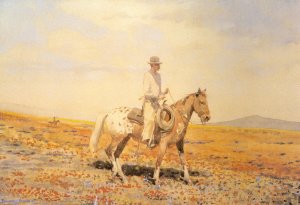
Edward Borein: The Apaloosa
Venters, riding Wrangler, crosses trails with the men who stole Night and Black Star from Jane. A sort of running joke throughout the novel is whether Wrangler is faster than the two blacks. Wrangler proves his mettle in this chase overtaking the two even though they were ridden by the best rider on the range, Jerry Card. Card is sort of a puzzle, at least for me. His horsemanship was so great that racing at full tilt leading one horse he could keep both horses side by side at full pace; in addition he could hop back and forth from horse to horse. Whether Grey was making a joke or not, I can’t really tell, he describes Card’s appearance as froglike. Hop-frog of Poe? Card is a little misshapen runty man. Whatever Grey had in mind for him he forgot to develop.
Card abandons the horses as the race ends disappearing into the purple sage. Wrangler gets away from Venters to be captured by Card. In a rather spectacular scene Card is trying to guide the horse by biting it on the nose. He is actually being dragged with his teeth in Wrangler’s nose. I’m no horseman but I’d really have to have the fine points of this maneuver explained to me.
Unable to hit the small fragile Card with a rifle shot as rider and horse rode alongside an escarpment rather than let Card get away, Venters shot the horse who leaped off the edge in what Grey describes as a fitting end for the greatest horse and greatest rider of the purple sage. I can’t follow his reasoning here but he must be trying to say something.
Venters rides the remaining two horses down the main street of Cottonwoods with apparently no more reason than to enrage Bishop Dyer and Elder Tull and announce in stentorian tones that Jerry Card is dead. Reminds me of the myth in which it is announced that the great God Pan is dead.
Venters packs some saddlebags with provisions then, in what seems a comic touch, since Jane’s wonderful stable of horses is now empty, mounts a burro to return to Surprise Valley. Riding one and leading a string of burros he looks behind him to see if he being followed by men on horses I presume he would have hopped off the burro and started running. The burro appears to represent severe emasculation.
Another essential subplot has been the arrival of a small child still annoyingly gushing babytalk- muvver for mother and oo for you- by the name of Fay Larkin. Fay is going to be the heroine of the sequel. She was the daughter of a Gentile woman who died. The woman asked Jane, who was ever kind to the despised Gentiles, to take the child which Jane did. She now ‘cannot live without the child.’
Having stolen everything else of the woman in the name of God, the Mormons now steal Fay.
This is too much for Lassiter who coldly disregards Jane’s imploring to disregard this insult and injury too, even though a moment before she ‘couldn’t live without the child.’ While it seems that Mormon men emascualte their women, Mormon women in turn emasculate their men. Maybe that’s what the story is about: the conflict between the sexes. Lassiter disregards her, strapping on not only his big blacks but an extra brace that he hides beneath his coat. The extra brace doesn’t figure into the story so it isn’t clear why two gun Lassiter became four gun Lassiter.
Lassiter shoots the Mormons up pretty good killing Bishop Dyer. Elder Tull is out of town at the moment. Lassiter and Jane know they have to get a move on so, packing enough to stagger any ten horses , including bags of gold, they skedaddle riding Night and Black Star.
Somewhere in here Grey must have become stymied in his story not having the progression to Rainbow Trail figured out. Something like the odd ending of Burroughs’ Princess Of Mars. Venters still thinks Bess was Oldring’s girl hence something only his great love for her can make him overlook. Loading up their burros they leave Surprise Valley. Out in the purple sage who should appear much as he had at the beginning of the story but Lassiter, this time with Jane.
It now comes out that Venters thinks Oldring is Bess’ father. Jane lets out the fact that he had then killed his future wife’s dad. Bess is revolted at the thought, calling off the wedding. Lassiter to the rescue. He produces a locket with a picture of his sister Millie Erne and her husband Frank. Lassiter explains that Millie was pregnant by Frank when Millie was kidnapped and that Frank Erne is her real father. The obstacle that had appeared between Venters and Bess now disappears as he hadn’t killed her father, just the guy who reared her. At the same time Bess is no longer the daughter of a low rustler but of a respectable man.
But wait, there’s more. Grey can produce as many twists as Edgar Rice Burroughs. It was the literary fashion of the day.
Not only is Bess the daughter of Millie Erne but the Mormon kidnapper of Millie had been no ther than Jane Withersteen’s father. The ever-forgiving Lassiter, now Uncle Jim to Bess, mutters something like ‘Aw shucks, Jane, I don’t pay thet no nevermind.’ and sister Millie is forgotten. nearly two decades of bad blood goes up in smoke with a shrug.
Venters and Bess head off for the safety and security of civilization in Beaumont, Illinois, while Lassiter and Jane depart for the security of Surprise Valley. Two problems remain for the next ten pages or so, Fay Larkin and Elder Tull.
Just like Tarzan, Lassiter can apparently smell a white girl because there is no other way that he could have located her. She was being held by some Mormons in a side canyon. Setting Jane to one side, Lassiter enters the canyon from which after firing every cartridge in his four guns and belts- Grey didn’t actually make it clear that he was still wearing the extra set up under his coat but he didn’t say he took them off either- of’ four guns Lassiter kills all the varmints, emerging from the canyon with little Fay in his arms and ‘five holes in his carcase.’
As they glory over little Fay, who was problem number one, problem nuber two, Elder Tull and his band of Mormon riders appear on the horizon. Leaping on their burros, did I mention Jane and Uncle Jim swapped Night and Black Star with Venters and Bess for their burros?- the Hammer Of The Mormons and Jane jog off with the Mormons in hot pursuit on horses, but tired ones.
One would think that even tired horses would have the advantage over burros but it is a very tight race. You see why Grey’s stuff translated to the movies so well. Getting all safe within Surprise Valley on the other side of balancing rock (did Grey borrow this detail from the She of Rider Haggard?) Uncle Jim lacks the nerve to roll that stone because Jane has pretty completely emasculated him. ‘Roll that stone’ Jane commands restoring Lassiter’s will. He does just as Elder Tull ad his Mormon band reach the cleft. The stone falls eliminating Tull and his Mormons while sealing off Surprise Valley ‘forever’ with Uncle Jim, Jane and Little Fay Larkin inside. Of course they are well provided because Venters has stocked the Valley with burros, fruit tree stock and plenty of grain seed. At the same time he had eliminated coyotes and other beasts of prey so that jackrabbits, quail and other small food animals have mutiplied exponentially. It’s going to be a long twelve years in the valley so the bunch has to be well provided. Without his gun though Lassiter is going to have to catch those jackrabits with his hands. During their long stay Lassiter and Jane apparently have no sexual relations as there were no additional children when the valley was reentered by the Mormons. Jane must truly have been a mother figure.
On this incomplete note Grey ends his novel.
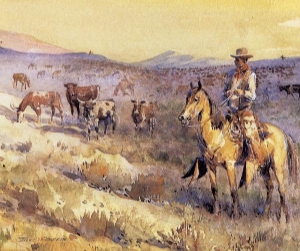
Edward Borein: Grazing Cattle
3.
Indeed, from the Enlightenment to the present has ben a period of intense religion formation, especially the nineteenth and twentieth centuries.
Utopian and Scientific Socialism may both be considered forms of religion, especially the latter in its Semito-Marxist form.
Mormonism itself, which has no basis in science, orginated from the brain of Joseph Smith in 1830. Madame B’s Theosophy, Mary Baker Eddy’s Christian Science, Ron Hubbard’s Scientology and the Urantia religion all have a basis in science as do most religions formed after Darwin. With the emergence of science none of the old religions were satisfactory. Hence it should come as no surprise that writers like Grey and Burroughs were intensely concerned with the problem.
As I have mentioned in Something Of Value no adequate myth for the scientific age developed, leaving men and women whose faith in the Semitic gods was undermined with a stricken religious consciousness such as in the case of John Shefford, the protagonist of Rainbow Trail, and probably both Grey and Burroughs.
So the search for meaning was endemic in this period not being confined to Burroughs and Grey who were merely symptomatic.
Another attitude that both authors share is a yearning for the wide open spaces of their youth that, while we may look back in envy, were rapidly disappearing before their eyes. Somehow this yearning was also connected to a feeling for the prehistoric past, perhaps as a Golden Age.
Both men were charmed by the notionof cliffdwellers. It would seem that Americans of the period were also absolutely charmed and enamored with the Anasazi of the American Southwest. Burroughs was very nearly obsessed with cliffdwellers. Novel after novel is replete with cliffdwellings whether in Pellucidar, various terrestrial locations or even on Mars.
The inhabitants of the skyscrapers of Chicago were nicknamed cliffdwellers; a replica of Southwest cliffdwellings was built for the Columbian Expo of 1893 that apparently made a great impression on 17-year 0ld ERB. The premier literary club of Chicago was known as the Cliff Dwellers which was on the 8th floor and roof of Orchestra Hall. I think Burroughs had a yearning to be a member of this club.
Thus there were many cliffdweller influences on ERB’s life , whether he had ever seen the Anasazi dwellings before 1920 is doubtful, it would be interesting to know if Grey had before 1910.
At any rate cliffdwellers had carved out homes in Surprise Valley in some distant prehistoric time. Thus both Venters and Bess and Uncle Jim Lassiter and Jane were actual cliffdwellers utilizing the old dwellings. Lassiter, Jane and Fay Larkin would be cliffdwellers for twelve years. This must have had a very romantic appeal for Grey’s contemporary readers.
During that period they dressed in skins living as close to a stone age existence as was possible. So one may compare the Surprise Valley of Lassiter and Jane with the cliffdwellers of Burroughs’ Cave Girl.
As all these themes were in the air of the period it is not necessary for either of these two authors to be influenced by each other to this point but it is probable that both were influenced by the stone age stories of Jack London and H.G. Wells among others.
I doubt Burroughs was influenced during this period by Grey although he did have a copy of Rainbow Trail in his library, one of only two Grey titles. We can’t be sure when he bought Trail. Grey’s stories complement Burroughsian attitudes but only after this formative preriod around 1912. ERB’s Western and Indian novels probably owe something to Grey but they were written after 1920.
Riders Of The Purple Sage sets the scene for its denouement which is The Rainbow Trail. Riders was a wonderful romantic vision of the West which answered the needs of the period when for the first time the percentage of Americans living in cities surpassed that of those living on farms. Indeed, very like these authors, modern cliffdwellers had a heartsick longing for the Paradise they had lost. For decades it would be a crazy dream of city dwellers to buy a farm and ‘get back to the land.’ The movie ‘Easy Rider’ was a good laugh in that respect.
Both Burroughs’ and Grey’s novels addressed that need.
Burroughs’ interest in Rainbow Trail would stem from religious aspects and the perfect union of the Anima and Animus when John Shefford and Fay Larkin unite. It might be noted that a fay is a fairie. Cliffdwelling and the purity of Grey’s noble savages, the Navajos, would have been compelling for ERB.
Before continuing on to The Rainbow Trail let us take a brief interlude to examine some aspects that would have interested ERB from the other Grey title in his library- The Mysterious Rider.
Bob Dylan: Dark As A Dungeon Way Down In A Mind
January 15, 2009
Bob Dylan:
Dark As Dungeon Way Down In A Mind
by
R.E. Prindle
We’re on a bad motorcycle with the devil in the seat
Going ninety miles an hour down a dead end street.
Hank Snow

Dylan Feinstein Photo
My correspondent replied to my post Bob Dylan The Reactionary. An excerpt:
Poetry is a funny thing: it bypasses the cerebral when it is best IMHO…Poetry is nonsense, making the nonsense of mortality a bit more bearable for a moment in time.
I suppose that’s a valid reflection. There has been some debate as to whether song lyrics are poetry. In a lyric’s effort to condense experience into the fewest possible words my own thinking is that they are of the essence of poetry whether or not one considers them ‘true poetry.’
I certainly carry innumerable song lyrics around in my head while very little ‘true poetry’ has had the same effect on me. A great many of the lyrics are Country and Western and what passed for Folk. I find references in Dylan of the same importance of favorites that I have.
I recently ran Hank Snow’s Ninety Miles An Hour Down A Dead End Street on Rhapsody and was surprised to discover that Dylan had actually recorded a heavily edited version as a religious gospel dirge. Don’t get the connection but if Dylan says so…
The part of the lyric that has always struck me the most forcefully is the line: We’re on a bad motorcycle with the devil in the seat going ninety miles an hour down a dead end street. I apply the line to all kinds of situations including the present political quagmire. Dylan seems to emphasize the illicit love affair. Doesn’t really matter, the point is that that little piece of ephemera had a profound influence on us. Dylan resurrected the song fifty years on while I use the image that appealed to me in my writing frequently. Poetry? Well, I think maybe.
There are a couple of other country classics that live in my mind by Merle Travis: Dark As A Dungeon Way Down In A Mine and Nine Pound Hammer. I always imagined those were folk songs dating back to the 1880s or something but Travis wrote as late as 1947. The relevant quotes for me:
It’s dark as a dungeon way down in a mine
Where the wind never blows, and the sun never shines,
Where the dangers are double and the pleasures are few.
Merle Travis- Sixteen Tons
———————–
Roll on buddy, don’t you roll so slow,
Tell me, how can I roll when the wheels won’t go.
This nine pound hammer is a little too heavy
For my size, boys, for my size.
The first quote is from Dungeon, the latter from Nine Pound Hammer.
For myself I always gave the lyrics a psychological twist saying ‘mind’ for mine. Roll on buddy referred to my habitual procrastination, psychological blockage preventing action. Had problems. Solved ’em. Are these songs poetry? They are in my mind. I make all kinds of things out of them even the innocuous line:
It’s a long way to Harlan,
It’s a long way to Hazard,
Just to get a little brew. boys,
Just to get a little brew.
I’m not thinking of booze either as in ‘My Buckets Got A Hole In It.’ Can’t buy no beer.
I’m sure Dylan cherishes both those songs. They’re the classics that people in the know know. They don’t call us cognoscenti for nothing. Roll on buddy…
As a last example before I get to the gist of this thing is the song ‘Grand Coulee Dam written by Woody Guthrie a man I really despise- damn it. But talent will out and while I have my prejudices I’m no bigot. For me this lyric is as poetic as you can get.
Well, the world holds seven wonders that the travelers always tell,
Some gardens and some towers, I guess you know them well,
But now the greatest wonder is in Uncle Sam’s fair land,
It’s the great Columbia River and the big Grand Coulee Dam.
She heads up the Canadian Rockies where the rippling waters glide,
Comes a-roaring down the canyon to meet the salty tide,
Of the wide Pacific Ocean where the sun sets in the West
And the big Grand Coulee country in the land I love the best.
Uncle Sam took up the challenge in the year of thirty-three,
For the farmer and the factory hand and for all of you and me,
He said, “Roll along, Columbia, you can ramble to the sea,
But river, while you’re rambling, you can do some work for me.”
Now in Washington and Oregon you can hear the factories hum,
Making chrome and making manganese and bright aluminum,
And there roars the Flying Fortress now to fight for Uncle Sam,
Spawned upon the King Columbia past the Big Grand Coulee Dam.
In the misty crystal glitter of that wild and windward spray,
Men have fought the pounding waters and met a watery grave,
Well she tore their boats to splinters but she gave men dreams to dream
Of the day the Coulee Dam would cross that wild and wasted stream.
Nice stuff from my point of view. Doesn’t get any better than that. The song gave me dreams to dream. If you want to hear the best rendition ever by Lonnie Donegan click this:
http://www.youtube.com/watch?v=0Jc2efqj5Js
My verdict is that good lyrics are good poetry while bad poetry doesn’t necessarily make a good lyric.
2.
Now as to the lyrics to Highwater by Dylan that my correspondent referred me to that I discussed in the post: Bob Dylan The Reactionary.
As the lyric touched my correspondent’s psychology I tackled the lyric from a different angle as the way I was interpreting it may not have reflected his. For all I know this doesn’t either but I think it’s interesting.
The lyric in question:
Well, George Lewis told the Englishman, the Italian and the Jew
You can’t open up your mind, boys, to
every conceivable point of view
They got Charles Darwin trapped out on Highway 5
Judge says to the high sheriff, I want him dead or alive
Either one, I don’t care
Highwater everywhere.
The format Dylan uses here is that of the genre of old jokes that begins something like this: A Protestant, a Catholic and a Jew… then moves on to the punchline. Dylan’s presentation can be interpreted as flip so he is probably thinking of the verse as a joke.
As I said in my previous post George Lewis represents a Black, the Englishman as Science or Darwin, the Italian Catholicism or Christianity and the Jew Judaism. Four different conceivable views that can’t be held simultaneously no matter how open you think your mind is.
These are four crucial irreconcilable conflicts in Dylan’s mind while they probably represent the major psychological dilemma of most White or Jewish people.
The problem is especially acute for Dylan who was indoctrinated into Jewish Lubavitcher beliefs for his Bar Mitzvah while having
Hank Snow- It Don't Get No Better
been brought up from infancy on Hillbilly music, Country if you prefer, which is quintessential Christian music whether sung in church or honky-tonk. Those good old boys live with their religion even when they’re robbing banks so even with0ut going to church Dylan has a strong Christian background. He did sing a sexual anthem like Ninety Miles An Hour as a hymn. Ponder that for a minute.
So Dylan has had to reconcile his dual religious beliefs seeming to have come down on the side of his Lubavitcher Judaism which is no surprise. He then has to do something about his religious vs. scientific or evolutionary beliefs. Darwin doesn’t go with Judaism. He centers the problem on Darwin as Science. Here he has made the decision to imprison or kill Evolutionary beliefs. Dead or Alive, either way, Judge says, he don’t care. Having eliminated Science and Christianity we have Judasim and the Blacks on the racial issue. Dylan has subordinated himself to the Blacks on the racial issue and is willing to take the inferior position. While he believes he has resolved these for him difficult problems they still trouble him or he wouldn’t be talking about them. Strange.
Why did my correspondent associate me with the verse? He says: Just thought of you and the line(s) for some reason. My correspondent seems to be wrestling with Dylan’s problem himself. As I have written on all four topics fairly extensively and I know the correspondent has read lots of my stuff I suppose the lines suggested me. The song isn’t good poetry and not even good lyrics but if it succeeded at least on my correspondent’s level one would have to concede that lyrics are poetry. The better the lyric the better the poetry. And now for a little circular logic: The better the poetry the better the lyric.
Bob Dylan The Reactionary
January 14, 2009
Bob Dylan The Reactionary
by
R.E. Prindle
As I say I haven’t listened to anything by Dylan since ’66. Not exactly true, I have listened to and watched a couple of newer items on You Tube or wherever but I hope I won’t be judged too harshly on account of a chance listening like that.
What I mean to say is a correspondent sent me a quote from a song called Highwater- for Charlie Patton.
I’m more clear now on why I haven’t listened to later Dylan because I didn’t think the song was very good. The Poet Laureate of Rock can surely do better than that. The song was from an album called Love and Theft. I’m not sure which half of the equation this song represents.
As the quote has religious overtones perhaps my correspondent was reacting to the recent examination of Dylan’s religious attitudes in the movie by Joel or perhaps to some religious essays on Dylan I’ve written like for instance, Lubavitcher Bob. Beyond that I don’t know what he could have meant.
From the lyrics it looks like Dylan takes himself quite seriously as a man in black. I thought the lyrics were pretty nonsensical as represented by these three lines:
Well, the cuckoo is a pretty bird, she warbles as she flies
I’m preachin’ the word of G-d, I’m puttin’ out your eyes
I asked Fat Nancy for somethin’ t’ eat
Well, I’m not going to struggle too hard to unravel the deep inner meaning of those lines, let Charlie do it, but I am taking Dylan literally on the middle one. As a man in black he is preachin’ some word anyway- G-d, the D-vil or somewhere in between. Not always easy t’ tell.
But back t’ the quote my correspondent sent that does have probable religious overtones. Since it’s expressed so cryptically of course, it’s all deniable:
Well, George Lewis told the Englishman, the Italian and the Jew
You can’t open your mind, boys,
to every conceivable point of view.
They got Charles Darwin trapped out there on Highway 5
Judge says to the high sheriff, I want him dead or alive.
Either way, I don’t care.
Highwater everywhere.
In this song of unlimited non-sequiturs this verse can almost be read to make sense.
In the next verse which may make it related, or perhaps not, Dylan says he’s a preacherman so we’ll assume Dylan is speaking Biblically. He is a Bible scholar you know as well as a Lubavitcher. Dylan always blazes new trails, don’t he?
OK. I don’t know who George Lewis is supposed to be. There’s a couple Black musicians by that name so let’s assume a Black man is ‘tellin’ the Englishman, Italian and Jew what’s what. Nobody can believe three things at one time so the wise thing would be to bet on the Jew if you want to win, win, win. That last is a parody on a line or two from the old folk song Stewball for those who didn’t recognize it. I almost didn’t.
We will assume that Darwin and Evolution are meant by the Englishman, the Pope and Catholicism by the Italian while the Jew needs no explanation. Might be Dylan, I don’t know. Two, Pope and Jew, are religious while Darwin is Scientific and his science demolishes religion. “The King takes the Queen every time’ to quote a new folk song by Larry Hosford. So the Pope and Jew are out to get Darwin in order to preserve their folly. Thus they have Darwin trapped out on Highway 5. Why 5? Why not 61? Dylan must have been cruising the highway from LA to Seattle at the time looked out the window of the bus saw a sign saying I5 so he said ‘That rhymes’ and put it in.
Dylan trapped on Highway 5 is filler so to the Judge i.e. Biblical authority tells the high sheriff- high sheriff sounds real wild west, don’t it, I knowed you’d think so- he wants Evolution/Darwin brought in dead or alive. OK. So as Dylan believes that the Bible is literally true and the veritable word of G-d proceeding from his own lips then it follows that Dylan is anti-Evolution and Darwin. Must be or we’ve got ourselves a contradiction here. Dylan is thus first cousin to William Jennings Bryan who persecuted Scopes way down there in Tennessee where they make that sippin’ whiskey. Hence Dylan is a reactionary rejecting the truth, as Woody Allen would say, for G-d.
Well, brav-, but a big raspberry for B-b if that is what he meant. Who can say? It’s poetry. Of sorts. A bigger raspberry for my c-rresp-ndent who should learn to say what he means without pinching his heroe’s words.
Highwater everywhere. He’s a drowning man.
Exhuming Bob XVII: Bob Dylan, A Napoleon In Rags
December 1, 2008
Exhuming Bob XVII
A Napoleon In Rags
by
R.E. Prindle
Hoffman, Michael, Judaism Discovered, 2008
Jay Michaelson: http://www.nextbook.org/cultural/feature.html?id=1725
Cornyn, Sean: http://www.rightwingbob.com/weblog/archives/1850
Hartley, Mick: http://www.mickhartley.typepad.com/blog/2008/10/dylans-true-message.html
Prindle, R.E. https://idynamo.wordpress.com/2008/06/25/exhuming-b0b-x-lubavitcher-bob/
How does the ‘Napoleon in rags’, Bob Dylan, conceive himself in his role as a reformer of Judaism because that is what Messianic Judaism is. What does this believer in the Bible as the literal word of God see as his mission? One should note that as Dylan places the Bible above the Talmud he is a Rabbinical Judaic outlaw as Michaelson says. Did Dylan really just wake up one morning and say: ‘Oh L-ordy, I have crashed. I need the crutch of Jesus’ as Michaelson, Cornyn and Hartley suggest or was there an ulterior motive? Perhaps a conceptual idea if not a well thought out program.
Jay Michaelson, claiming to be a ‘secular’ Jew takes exception to ‘Messianic’ Judaism. What exactly is Messianic Judaism? The notion may take many readers by surprise; those who are only familiar with mainstream Judaism and Christianity. Most non-Jews don’t realize that Judaism has as many sects as Christianity.
For instance Dylan’s stance smacks of Karaitism. the Karaites are a Jewish sect that denies the authority of the oral law or Talmud and hence the Rabbis. They are outlawed as a cult. Messianic Jews accepting Jesus as the Jewish Messiah and hence the New Dispensation are and always have been by definition Outlaws, being outside THE LAW.
The Rabbi David M. Hargis of The Messianic Bureau International is quoted by Michael Hoffman in his Judaism Discovered p. 844:
“Messianic Judaism” is a means for subverting Christianity by incorporated reverence for the rabbis who are heirs to the religion and customs of the ancient Pharisees as recorded in the Talmud. The claim of Messianic Judaism is that historic Christianity is “pagan” and imbued with “gentile culture” needlessly alienating and offending Judaics who might otherwise convert to Jesus Christ. Their “solution” is to fashion a supposedly pagan-free form of Judaism that allegedly believes in Jesus. ‘We believe it would be the best and is ultiamtely necessary for all Jewish people to know their Messiah Yeshua, but we do not believe that God has called any Jewish person to become Gentile or Western Christian in custom. Rather, we believe it would be best and is ultimately necessary for Christianity to remove its pagan influences and return to the roots of Judaism, that is, to return to the way of Yeshua as He walked by example and set forth in His entire Word….However this does not mean that Modern Rabbinical Judaism does not have truth within it.”- Rabbi David M. Hargis & Messianic Bureau International, “Basics of Messianic Judaism.” www.messianic.com/articles/basics.htm (as of Feb. 25, 2008; it may be altered after that date.)
So it would appear that Messianic Jews want a return to pre-Pauline Jesusism deleting all non-Jewish influences in Christianity. These would include Platonic influences, the Dionysian Kyrios Christos, the Persian influences, Gnostic influences and the Egyptian influence that made Mary the Mother of God as patterned after Isis. In other words the Messianic Jewish Jesus would be one that Christians would scarcely recognize.
As can be seen by the title of Rabbi Hargis’ organization that it is an international one; indeed, Dylan’s outfit Jews For Jesus is international in scope. You can call that a conspiracy if you like as Cronyn and Hartley do.
It would be fair to assume that Mitch Glaser’s and Al Kasha’s organization, Jews For Jesus, also an international organization, is affiliated to, or at least is associated with the Messianic Bueau International in some way or other as like minded organizations. We know for certain that Dylan was and is associated with Jews For Jesus. A purpose of Messianic Judaism is to strip Western, that is to say “pagan” influences from the figure of Jesus returning him to the status of ‘pure’ Semite.
That is to say that the Greek cult of Kyrios Christos is to be abstracted so that Jesus is no longer The Christ. So the purpose of Messianic Judaism is to take back Jesus from the Christians while reuniting Messianic and Rabbinical Judaism. The messianics are willing to concede that there is some ‘truth’ in Rabbinical Judaism.
Dylan was not merely preaching Messianic Judaism to Jews but whiffing it past Christians also. It is true that he thinned out his audience rather quickly having apparently misjudged the religiosity of his following. As a Jew of Orthodox sensibiities Dylan, in his mission as Messiah, or King of the Jews as Michaelson styles him, would have to learn something of Christian beliefs and sensibilities. It would seem likely then that he approached Dwyer of the Vineyard Fellowship to pick his brains. The question then was Dylan exploited by the Christians as Michaelson believes or was Dylan exploiting the Christians?
A question then arises as to whether Dylan wasn’t ‘speaking falsely now’ when he said ‘he never wanted to be the voice of his generation, and he certainly never asked to be ‘King of the Jews’ or a vessel for our hopes and dreams.’ Can we believe the denial of this self-styled ‘Napoleon in rags?’ If Napoleon wasn’t a ‘leader’ who demanded following who has ever been? How mistaken could his contemporaries have been in taking this ‘Napoleon in rags’ as their spokesman. Can Dylan have changed direction in 1979 when he wanted to become a great Messianic spokesman leading his people to some Promised Land? What else could have been his intent in becoming a Jim Jones style religious preacher? ‘There’s something happening here and you don’t know what is, do you Mr. Jones?’
Dylan definitely confuses Michaelson who opines ‘his latest incarnation, as a mustachioed journeyman musician, is made of equal parts of authenticity and con’ and ‘Dylan, who always seems to be in on the con when he’s not perpetrating one himself.’ Indeed. Dylan does project a duplicitous character; speaks out of both sides of his mouth at once. Or once again as Michaelson understands it: ‘…like him, I think I can understand the appeal of authentic religious experience in the context of superficiality and doublespeak.’ Uh huh!
Thus Dylan’s double edged mission was and is to strip ‘Christians’ of their ‘pagan’ sensibilities- i.e. Western culture- while converting Rabbinical Jews to Messianism or Jesus. So, whether Cornyn and Hartley believe it or not, yes, there is a ‘Great Bob Dylan Conspiracy.’
It is embarrassing that at this late date in the evolution of human consciousness that Bob Dylan believes the Bible to be the literal word of God. Consciousness has evolved to that level that the sham of the Religious Consciousness should be apparent to all. Both Science and Communism have been proclaiming the falsity of the religion and extreme Jewish nationalism that Dylan affects for a hundred years or more.
I certainly have to reject the Religious Consciousness. As such I feel defrauded by Dylan’s early career and my attachment to it. Dylan willfully misrepresented himself, doublespeak, and cheated me as well as all his fans who thought he was enlightened. I was misled.
Sorry Bob, but you’re a fraud.
Exhuming Bob XVI: Bob Dylan’s Dream..Or Nightmare?
November 27, 2008
Exhuming Bob XVI
Bob Dylan’s Dream or…Nightmare?
by
R.E. Prindle
I’ll let you be in my dream if you’ll let me be in yours.
-Bob Dylan

http://www.nextbook.org/cultural/print.html?id=1725
When Dylan wrote those words, was he sincere or was it just part of the con? I was recently asked not ot contribute anymore to expectingrain.com by person or persons unknown. The webmaster refuses to identify he or them to me. Too ashamed to let their names by known, I guess. Or chicken. I know I’d rather not be known as a rasty, nasty censor.
I was ejected for voicing pretty much the same sentiments as Jay Michaelson does in the above referenced review of Joel Gilbert’s The Jesus Years. Maybe the difference between Jay and me is that I don’t think Dylan is such a mysterious elusive guy. Anybody with a little Freud under his belt has got Dylan pinned.
He suffers from a fairly severe depression while being very emasculated. He is so emasculated he can’t even fix on an identity for himself. His natal Bobby Zimmerman failed him so he apparently attempted to become Elston Gunn which he wasn’t able to sustain so he then became Bob Dylan which also became too much of a burden to him so he threw that identity up for grabs saying anybody can be Bob Dylan who wants it, then he became Masked and Anonymous eschewing any identity whatever. An empty suit.
If that isn’t clear to you then there is no reason for you to tackle Freud or psychology now.
So, what was the conflict? Duh. Could it have been that between his Jewish upbringing and his Christian milieu? Gosh, I don’t know, do you? Is there anything in his subsequent history that would suggest such a conflict? Let me think. I think there is, therefore I am.
Is there a conflict in the minds of Dylan’s disciples. Well, now there we’re on firm gound. Just listen to Jay:
There’s a telling moment in Joel Gilbert’s new (?) documentary Inside Bob Dylan’s Jesus Years: an interviewee says that when Dylan became a born again Christian, he went, in two short years, from being an American Jewish hero to the “greatest apostate of the twentieth century”… But worse, because Dylan embodied a specific kind of liberal American Jewish hope that someone would speak truth to power, and that the world would listen. These were very Jewish dreams, and Dylan fulfilled them for awhile.
Damn, then it wasn’t anything I said as the messenger. I guess it was just not being Jewish that I shouldn’t have attempted to deliver the message. Right message, wrong face. Gee, I guess I can’t be in Dylan’s dream because I’m not Jewish. Whatever happened to One World, One Dream? Everybody being brothers? The Global Village? They didn’t think there wouldn’t be variations on the theme I hope. Well, no matter Dylan and his People can still be in my dream. I’m inclusive.
But Jay and his People themselves apparently feel excluded from Dylan’s dream also. Jay says:
Dylan never wanted to be the voice of his generation, and he certainly never asked to be King of the Jews or vessel for our hopes and dreams. (My italics.)
Wow! King of the Jews, Jesus Christ. I may have thought it but I didn’t have the cojones (My italics), Jay does and actually says it. Jesus, I’d be running for my life let alone being kicked off expectingrain.com.
Jay and his People just can’t seem to get it. Dylan never became a Christian, he became a Jew For Jesus. Jay even has the answer before him but his religious bigotry won’t let him see it: “Why did Dylan…record two religious albums proclaiming the word of G-d?” There you have it Jay. Dylan was conflating Jesus and God into one and then substituting G-d for Jes-s. Jesus is Christian, God is Jewish. Duh. For Christ’s sake, c’mon Jay.
Well enough of that. I’m sure you can’t stop laughing. Jay is supposed to be reviewing Gilbert’s documentary. Michaelson; is not either well read on his subject of Dylan or well researched. Maybe he smoked enough dope that he thinks he automatically knows everything about Dylan. I’ve seen it happen.
As far as the film goes, it may not be a particularly good movie but then it is a documentary and has to judged differently. As documentaries go I found it more than satisfactory. The clip art was an unusual special effect but I actually found some of them humorous. I wouldn’t have done it that way myself but Gilbert can do as he pleases and did.
Gilbert doesn’t mysteriously look like Dylan as Jay says. There is no mystery involved. Gilbert is trying to clone himself as Dylan; does a good job. He has a good understanding of his subject, after all he’s trying to be Dylan. His selection of subjects provided enough penetrating information that I have to think they were well chosen. Perhaps they were all that Gilbert could get, in which case the film maker drew them out well. Rob Stoner was the key. He was intelligent, understanding, and well informed- he knew what he was talking about. Kasha and Glaser gave you all the information you needed to understand the Christian-Jews For Jesus scam. Come on Jay, open your eyes.
Weberman has been saying that Dylan was a heroin addict since Christ was a baby. At least from 1964. It may have been true, I don’t know, but it didn’t have anything to do with Dylan’s crash. If Jay knew anything about his subject he would realize that the divorce was the key. Dylan had finally, after a life time of trying, become so defiled that he had to turn to God/Jesus to lead him back. I hope he found the way. Freud again.
For Michaelson who can’t separate his Jewishness from Dylan the problem is a paramount betrayal because ‘We’re (Jews) scarred and traumatized by two thousand years of Christian hegemony… So, there you have it, the cat’s out of the bag, couldn’t have said it better myself. Jay and his People thought Dylan was the Messiach who was going to establish a Jewish hegemony over ‘Christians,’ ‘speak the truth to power.’
I’m not so sure Dylan won’t still try but that has little to do with the documentary. The con and exploitation was not that of Dwyer on Dylan but Dylan over the Vineyard Fellowship. Dylan was using them to try to reach his fellow Jews in his faith of Jews For Jesus. As we are never tired of being told: Jes-s was a J-w. Case closed. Forget hegemony.
In summation Gilbert, in my estimation, did an excellent job for what he set out to do. I was properly instructed and…I got it. But, I was still kicked out of Dylan’s dream. He conned me too. What a nightmare!
Sigmund Freud And His Vision Of The Unconscious
November 22, 2008
Sigmund Freud And His Vision Of The Unconcious
Redefining A False Vision
by
R.E. Prindle
Texts:
Bakan, David, Sigmund Freud And The Jewish Mystical Tradition, Orig. Issued 1965, Dover edition of 2004
Movie: The Testament Of Dr. Mabuse, 1932, Fritz Lang, auteur.
https://idynamo.wordpress.com/2007/10/01/something-of-value-i-2/

Sometime after I wrote the first part of Something Of Value (see above for link) I read David Bakan’s Freud And The Jewish Mystical Tradition. Bakan’s book confirmed my findings while developing Freud’s relationship to his culture’s mystical tradition based on Bakan’s understanding of the Zohar and the Jewish Kabbalah, which I haven’t read or studied; nor do I intend to unless I exhaust my other pursuits which doesn’t seem likely. You never know though.
However a point to consider is how Jewish is the Jewish mystical tradition, that is, what are its antecedents? Are they rooted in Judaism or elsewhere? Bakan seems to believe that the Jewish Kabbalah is derived entirely from Jewish sources independent of the general milieu. I don’t believe this to be true. The Jewish mystical tradition like all others is based on the very ancient Egyptian traditions as is a great deal of ancient Jewish culture. Bakan believes that the Kabbalah arose in the first century AD. This is probably true.
The Hermetic tradition which is equivalent to a European Cabala took form as such in Alexandria during the Ptolemaic period when Greek and Egyptian ideas interreacted. Hemeticism evolved from much earlier doctrines centered around the Egyptian god Thoth. The Zohar and Cabbalah then is Hermetic material adapted for Jewish needs. The whole can be traced back to Alexandria. It will be remembered that there was a large colony of Jews in Alexandria from long before the first century AD.
The Zohar is a mystical book, which is attributed to the first and second century Rabbi, Simeon Bar Yohai, and it was rewritten, edited and whatever in twelfth century Spain in the sixteenth century. Its influence then was transmitted to the seventeenth century Jewish messiah, Sabbatai, Zevi.
According to Mr. Bakan Freud was familiar with the Zohar and Kabbalah. I couldn’t go so far as to claim so myself but Mr. Bakan can quote chapter and verse. While Freud claimed to be scientific Mr. Bakan relates almost all of Freud’s psychology to the Kabbalah showing Freud’s dependence on Sabbatianism and Frankism as I indicated in Something Of Value Part I.
Thus while seeming to be working from a scientific point of view Freud is actually blending a bit of scientific method acquired from European sources, as there is no science in Jewish culture, with his Jewish religious material to subvert the European moral order. While Freud himself was at war with European civilization, the international Jewish organizations of which he was a member extended his field of influence to the United States and Canada. Thus while Freud speaks specifically of Europe he can be taken to mean Euroamerica.
2.
A further background for his psychology, Freud’s central childhood fixation, appears to be the incident in which a European knocked his father’s hat into the gutter which his father meekly, or wisely, depending on your point of view, accepted without a demur. Because of this story Freud wished to avenge himself on all Europeans.
Probably at this point Freud assumed the Moses complex that stayed with him to the end of his life. He, Freud, would lead his people to triumph over the Europeans as Moses had led the People out of Egypt while Pharaoh and his army were drowned in the Red Sea.
However, oddly enough, as he claimed to be wholly Jewish, Freud was conflicted in his attitude toward Europeans. As a child he had a Roman Catholic nurse who introduced him to Christianity by taking him to church. Most probably she also tried to wean him from Judaism. This experience had a great effect on young Freud. In the following anecdote, as with most fixations, he seemed to have lost the exact memory of the situation. From Bakan:
…that my ‘primary originator; (of neuroses) was an ugly, elderly, but clever woman who told me a great deal about God and hell, and gave me a high opinion of my own capacities.
On October 15, 1897 he quotes his mother speaking about the old nurse who took care of him when he was very young:
“Of course,” she said, “an elderly woman, very shrewd indeed. She was always taking you to church. When you came home you used to preach and tell us about how God conducted his affairs.”
His memory had become confused while it does not appear that he ever exorcised his fixation, for fixation it was. He apparently loved this nurse at the time rather than hating her. When she was later accused and convicted of stealing from the Freuds she was dishonored and actually sent to jail. Freud was heartbroken while changing his opinion of her. But, he had had contact with Christian Europeans which left a lasting impression on him that he could not consciously recognize or acknowledge. If I am correct, this impression resurfaced when he came into contact with C.G. Jung who he adopted as a surrogate for this nurse transferring his love and hatred of her to Jung.
Just as he loved this nurse there were apparently strong homosexual overtones in his relationship with Jung. As Freud would have known, the compulsion toward repitition would have been a component in his relationship with Jung through his nurse although he apparently did not recognize this. So much for his self-analysis. He found reasons to break off with Jung or drive him away while bitterly claiming to be betrayed by Jung just as his nurse had been accused and convicted of theft thus betraying the love of the child Freud. Thus once again his contact with a Christian European was brief ending in sorrow for himself.
A third situation occured late in life when he wrote Moses And Monotheism. Rather startlingly he claimed that Moses was not Jewish but was an ethnic Egyptian. This means Freud, who had a Mosaic fixation, split his personality between his Christian longings and his professed Jewish identity. Another result would be that monotheism was not a Jewish invention but actually a goyish invention so that all the evil arising from monotheism was not the fault of the Jews but the goys. A neat job of transference. Thus Freud’s notion of Moses may have been a sort of dream reversal of facts.
Whatever the results of Freud’s self-analysis back before the turn of the century, it is quite clear that he was unable to resolve his fixations nor, one believes, was he aware of their influence on him. He never integrated his personality remaining under the influence of his subconscious fixations. No wonder he ignored the conscious mind.
3.
Like most people Freud had to find his way from adolescence to adulthood and his true ambitions by a  circuitous route.
The editor’s note to 1927’s The Future Of An Illusion says this:
In the ‘Postscript’ which Freud added in 1935 to his Autobiographical Study he remarked that a ‘signficant change’ had come about in his writings during the previous decade. “My interest,” he explained, “after making a long detour through the natural sciences, medicine, and psychotherapy, returned to the cultural problems which fascinated me long before, when I was a youth scarcely old enough for thinking.”
He undoubtedly refers to his experiences in church with his Christian nurse contrasted with the ‘Christian’ who knocked his father’s hat into the gutter. As Freud is very duplicitous in his use of language one should try to be very sensitive to the personal meanings behind the general meaning of his words. Thus I believe his use of the term ‘cultural problems’ can usually be understood as his inner conflict between his Christianity and Judaism.
As Bakan points out, that while Freud rejected Rabbinical religious Judaism he was deeply immersed in the Jewish mystical tradition of the Zohar and Kabbalah. Thus one can discount his claim to be an ‘atheistic’ Jew. Or else atheism has a more specific meaning for him.
I would place the change of emphasis in his writing or, at least the beginning of the change, in 1915. My guess would be that Freud was unaware of the coming Jewish Revolution until he joined B’nai B’rith in 1895. That knowledge would have shaped the direction of his researches. Whatever science was involved would have been subordinated toward achieving the Revolution. At the same time that he was working out the nature of psychoananlysis as Bakan indicates he must also have been studying the Zohar and Kabbalah. I haven’t read or studied either so I have to rely on Bakan’s analysis of their influence. Bakan traces strong mystical influences running side by side with what passed for science in Freud’s mind. As Freud persistently says he’s going to ignore the facts if favor of projections one must assume that there is more mysticism than science in Freud’s construction of psychoanalysis- as he says ‘his creation.’
Bakan points out that Freud transited from the role of physician to that of ‘healer.’ That is analogous to the hands on approach of Christian Fundamentalism. Freud then for all practical purposes abandoned medicine for healing. Then, sometime between 1913, the year of the beginning of the Jewish revolution, and 1915 he abandoned psychoanalytical research for his ‘cultural’ studies.’ In other words, he began to apply his psychological studies to the manipulation of cultures through his developing ideas on Group Psychology.
Just as Freud learned that there were screen memories that transformed more painful memories into something more acceptable to salve those injured feelings so Freud learned that he could develop ‘screen’ language to serve up unpalatable meanings in palatable ways. Thus what he says has a reasonable meaning to the uninitiated but has a totally different meaning to the initiated- those with the key. In many ways it is the same as a criminal argot. Those who understand the argot can discuss topics openly without the uninitiated understanding, while only those with the key can twig it. Ya dig?
The key incident that fixed his mind on ‘cultural interests’ was his father’s story of the guy who knocked his hat into the gutter. Freud then, in attempting to diguise his hatred for ‘Christianity’ while secretly admiring it because of his nurse who gave him an inflated opinion of his importance, and his desire to avenge his father and hence all Jews through his Moses fixation, developed his program. Thus he acted in his own mind altruistically and need feel no guilt.
Freud was very seriusly conflicted, also suffering from depression according to Bakan. Hence his purpose was to knock the whole of European Christianity into a cocked hat in the gutter, which is to say the actual persons of Europe. Compare Freud to Rebbe Schneerson in America.
Thus, the use of terms like ‘Culture’ and ‘Civilization’ should always be placed in the context of Jews and Europeans. In this manner he avoids the appearance of bigotry and hatred while sounding ‘scientific.’
Now, this obsession and extreme form of vengeance for something that, after all, didn’t happen to him nor did he witness it, might certainly be considered a neurosis, probably a psychosis and possibly a degree of insanity. In reading Bakan there is a hint that he believes Freud had a disordered mind. Indeed, Fritz Lang’s movie The Testament Of Dr. Mabuse should be held steadily in mind when reading of Freud’s later career. Lang must have had Freud in mind when he filmed the movie.
Lang also had a hand in the making of The Cabinet Of Dr. Caligari from which film he was dismissed. Lang’s departure from Caligari changed the ending of that movie to the conventional note of the victim, or whistle blower, being declared insane. Lang reversed this by making the perpetrator Caligari/Mabuse insane as in real life with Freud. Further the disciple of Mabuse, the head of the asylum, Dr. Baum was also declared insane. Although the problem appeared to be solved the threat of the conspiracy continuing from Mubuse’s cell, now occupied by Dr. Baum who has assumed Dr. Mabuse’s identity, looms like a spectre over the denouement.
While Freud was never incarcerated as he sould have been, he was imprisoned in his mind no less than Drs. Mabuse and Baum or the character in Gradiva which held such fascination for Freud. It is interesting that Freud had a plaster cast of the relief of Gradiva’s heel on which the story of Gradiva was based that the displayed prominently in his office. The story obviously had greater significance for him than his ‘objective’ analysis of the story would lead one to suspect.
Thus from 1915 to 1935 like Dr. Mabuse he sat imprisoned in his projection of reality churning out page after page, volume after volume of criminal plans for the subversion of civilization which is to say of Euroamerican civilization but not Jewish culture. He makes a definite point of that illusion of whose future he is discussing applies only to Europe and Christianity rather than religion in general which would include his own Judaism. At this point he is not aware of the burgeoning Wahabi Moslemism so that his message is that Jewish beliefs are real while Christian beliefs and Scientific reality are illusory. One has to penetrate the screen language and convert it into the proper psychological intent.
As David Bakan points out Freud lived his whole life in a sort of Jewish ghetto having very little contact with Europeans.
His choice of Jung as the potential heir to his ‘creation’ may have had as much to do with a desperate attempt to reestablish a connection similar to that of his childhood Christian nurse. Thus his overtures to Jung while under extreme stress were driven from his unconscious while he himself was unaware of his true motivations. This would have been an expression of a repetition compulsion. Thus as his nurse disappeared from his life under discreditable circumstances he replicated the situation with Jung. His attempt to convert Moses (hence himself) into an Egyptian may have been a last attempt to replicate and resolve this early contact with Christianity. His view of European civilization then was filtered wholly through a Jewish projection of possibilities. He really had no intimate knowledge of European mores.
From 1915 on, then, his writings were obsessed with hatred for Euroamerica and a desire to wreak vengeance on them by destroying the basis of their civilization. His ideas for the subversion of European civilization were carried to America by the international B’nai B’rith organization to be adopted and employed there. In addition Revolutionary plans executed in Europe in 1917 were financed and organized by the world Jewish government in the US. While functioning according to local conditions the Revolution was conducted on an international scale. Act locally, think globally. Hence Jewish revolutionaries left the US for Russia after 1918 to aid in the consolidation going on there. This is really an incredible repressed story in the Freudian cultural manner. Very Freudian that such phenomenal criminal activity that were best left invisible was repressed into humanity’s unconscious.
At this point I think it mght be well to examine Freud’s vision of the unconscious in more detail. While there can be little doubt that there is a subconscious function to the human mind usually referrred to as the unconscious after Freud that had been an accepted fact amongst scientific researchers for a hundred years Freud has been given the credit for discovering it. The exact nature had not been determined before Freud nor does Freud determine it. His view is merely a projection of his own conscious and subconscious needs.
4.
In David Bakan’s view Freud made a compact with ‘Satan.’
Certainly not in the literal sense but in the figurative sense that Freud would do anything, abandon any  moral precepts, to achieve fame. Bakan points out the supercription to Freud’s Interpretation Of Dreams a quote from Virgil: Flectere si nesqueo, superos, Acheronta movebo. Translated as: If the gods above are no use to me, than I’ll move all hell. Freud further blurred the line between good and evil or amalgamated the two from the influence of Sabbatai Zevi and Jacob Frank who cast off all morality. Since Freud has been successful in altering both Euroamerican and Jewish morality toward these immoral or amoral beliefs by false ‘Satanic’ criminal doctrines it is imperatvie to debunk his personal projection of the ‘unconscious.’
As he ‘made a pact’ with powers below- the unconscious- against the powers above- the conscious- he invested his projection of the unconscious with the attributes of ‘Satan’ or evil. This view of the subconscious is a self-serving fiction not based on any science.
He sets up the unconscious as an autonomous entity with the main function of blighting the conscious. He give the powers of hell supremacy over the powers of heaven. The notion is mere fantasy; it cannot be. There is no possibility that the function of the subconscious doesn’t have a positive function in and of itself and in relation to the conscious. If you actually think abut it for a moment you wil realize this must be true; every part of the body works to the benefit of the whole; there can be no exception for the subconscious.
Now, nature is not flawless. The order that the religious seem to find is not there. Nature functions in a much more imperfect or haphazard way. It takes only one peek through the Hubble to see that.
However the relationship between the conscious and subconscious is delicate and easily disrupted especially in the early years of the organism when it has no experience with which to evaluate the events occurring to it. The Ego and Anima are not part of the subconscious and possibly not of the conscious but functions through the conscious and subconscious minds.
The conscious mind perceives phenomena and acts on them but the terrific inflow of impressions is more than it can deal with so the day’s input is received into the subconscious for further reference. Thus a major function of dreams in the sleeping state is to review and process, organize the information into a coherent whole for future reference. The subconscious then is able to compare incoming information with experience for the appropriate response. When the conscious and subconscious minds are attuned, that is to say, the personality is integrated, the system works properly, otherwise the response is distorted by one’s fixations. This is very easy to see in Freud.
However, especially in youth when experience is scant, the mind may be challenged with some devastating new experience for which there are no reference points. If an appropriate response is made there is no problem. If an inappropriate response is made against which future experience may be in variance, the earlier response which has become fixated will over rule the current response and substitute the fixated inappropriate response. Thus the current response will constellate around these earlier fixations which gives one bizarre symbolic dreams and inappropriate responses.
The inappropriate response will usually result from an insult to the Ego or, in other words, one’s sexual identity. In turn the response to this insult will be expressed in a sexual affect.
The purpose of psychoanalysis, which is real science, although Freud didn’t see that, is to locate and exorcize them allowing the conscious and subconscious aspects of the mind to function properly as a unit. Dreams are actually important because they are an analysis of life’s experience providing responses. None of this, of course takes in intelligence, discipline and other functions of mind and character that Freud dismisses as irrelevant.
Now, in the cultural war between Judaism and Euroamerica, or as the Jews express it, Christianity, Freud infused the Jewish subconscious with a disregard for morality al la Jacob Frank in relation to Sabbatai Zevi. Any evil was excused so long as it seemed to advance the cultural war. While this infusion may not have reached down through the ranks of Jewry- which is to say they behaved in a certain way but didn’t know why- the ideas were thoroughly planted in the minds of what Henry Ford would call the International Jew.
The cold war between Jews and Europeans became a shooting war in the wake of the Great War. Men, money and munitions flowed in a wide steady stream from the United States to Russia. Coordinators established themselves in strategic locations. If one reads restricted, censored literature the impression is made that horrible anti-Semites harassed and hated innocent unresisting Jews. Jews may have been killed but they were not innocent or unresisting. To the contrary freed from guilt, or supposedly so, by Freudian/Sabbatian/Frankist precepts, abattoirs were established throughout Russia where unsuspecting Russians were led in one door and flowed out the other in liquid form. This is not the place to dwell on gruesome details. The literature exists but the collective Jewish mind has repressed the deeds into the collective unconscious. In other words, history has been denied and censored so that the crimes can’t be known. Actually Whittaker Chambers, the Red spy, translated a number of these books concerning the Hungarian atrocities of Bela Kun and Tibor Szmuelly, but those are impossible to come by. All this slaughter was made possible and justified by the doctrines of Freud.
In relation to the 1919 atrocities of the Jews in Hungary and the response which expelled them from power it should be noted that Israeli troops were recently introduced into Hungary to reestablish the tyranny of Kun and Szmuelly. Don’t ever think that historical memories are short. Remember the Amalikites.
Freud sat confortably in Vienna looking on as the carnage occurred. If, as believed, the tenor of his writing changed in 1925 that was probably due to the death of Lenin in 1924. By 1925 it was apparent that the Jewish Revolution in Russia was on shaky grounds as Stalin began his rise to power so that Freud may have renewed his cultural attack or, on the other hand, as 1928 was the terminal projected year of the Jewish Revolution Freud may have been celebrating the death of European Civlilation when he published The Future Of An Illusion. By the illusion he meant European Christianity and he meant European civilization was finished. The Rome of the Popes should have fallen.
In Illusion and Civilization And Its Discontents Freud makes us believe that the malcontents of civilization are synonymous with civilization rather than being a minority that always exists during great revolutionary changes. Freud whose Judaism was challenged by the Scientific Revolution as much as Christianity or Moslemism must have been aware of the reactionary ‘instinct’ as he himself was in reaction to both European Christianity and the Scientific Revolution.
David Bakan closes his volume with these words:
…under the ruse of “playing the devil” (Freud) served Sabbatian interests. In this respect, however, just as Freud may be regarded as having infused Kabbalah into science, so may he be regarded as having incorporated science into Kabbalah. Sabbatian-wise, by closing the gap between Jewish culture and Western Enlightenment he acts as the Messiah not only for Jewish culture but for Western culture as well.
Note that Western Enlightenment is reduced to Western culture putting it on a par with Jewish culture which is a tacit admission that there is no science in Jewish culture and none is wanted in Western ‘culture’. Language as a screen.
Bakan’s is a hefty statement. Under the guise of the Devil Freud becomes the Messiah not only for Jews but for Euroamericans. Truly in this scenario good comes from evil in the Jewish mind, assuming that the Messiah is good. In case you missed it, Freud according to Bakan was the Second Coming. Narrowing the gap between the two cultures means the imposition of Jewish culture as the Chosen or Abelite people over Western or Cainite culture. Thus the age old goal of reversing the Cain and Abel story so that Cain is obligated to give preference to Abel is accomplished.
By infusing Kabbalah into science, science has been subjugated to the unscientific Jewish culture so that the Catholic/Jewish situation of Medieval Europe has been restored. The Enlightenment that invalidated Judaism, Christianity and Moslemism has been obliterated, hence the revival of religion happening today. Thus in Bakan’s eyes and according to Freud’s intent Judaism has deconstructed Euroamerican society so the reconstruction according to Jewish cultural mores can commence.
The result has been accomplished by the destruction of the Scientific Consciousness as there is little of science in Freud’s cultural writings. He just says what he believes and wants you to believe and asserts it as a fact. As always there were some Westerners who resented the encroachment of the strict limits imposed by science. Rider Haggard in his Allan Quatermain made that as clear as possible. The topic is the dominant theme of Edgar Rice Burrough’s Tarzan novels. Henry Ford and his mass production methods was a symbol of that rebellion against the strict limits set by the clock. Some denounced it as Taylorism; but with each passing decade the West became more acclimated to the change as the reactionary mood became acclimated to the new reality.
Freud invents ‘instincts’ and their ‘renunciation’ to give sense to his arguments; the renunciation of instincts’ almost sounds scientific but it isn’t. there are no instincts nor does Freud even attempt to demonstrate their existence. Like the rest or Freud’s psychology the notion is just something Freud made up. As always he notes only the negative societal destructive effects. He says nothing of the ‘instinct’ to be around people which would conflict with his instinct against civilization- the last is a vague enough term the way he uses it. But as Fritz Lang points out the hypnotic spell cast by Mabuse negates criticism so that the head psychologist of the asylum, the objective scientist himself, Dr. Baum, suspends critical judgment falling under the spell of Mabuse to the point of becoming a disciple just as Lang himself did. Indeed, as the West has. Hitler was a blessing in disguise for the Jewish Revolution. The guilt caused by Hitler completely disarmed the West allowing the reconstruction of Western mores to proceed at a faster pace than would have been possible otherwise. Indeed, the Nazi Era drove the entire psychotic Jewish Revolution to the shores of the United States beginning in the early thirties. Thus the deconstruction of Edgar Rice Burroughs’ America was assured.
To return to 1919.

Exhuming Bob 15: Dylan’s Jesus Years Re-examined
November 20, 2008
Exhuming Bob 15:
Dylan’s Jesus Years Reexamined
by
R.E. Prindle
https://idynamo.wordpress.com/2008/11/17/exhuming-bob-14-the-law-and-bob-dylan/
https://idynamo.wordpress.com/2008/10/19/exhuming-bob-13-fit-5-bob-as-messiah/
http://www.forward.com/articles/14574
Stephen Hazan Arnoff has broached an interesting possiblity in his Jewish Forward article cited above. He implies that Dylan is a ‘messianic’ Jew in conspiracy with Mitch Glaser and Al Kasha of Jews For Jesus to promote Jesusism as a sect within the Jewish faith. I think there is some evidence to support this contention.
First let us review the nature of Jesus and relationship to the Judaic faith at the transition from the Arien to the Piscean Age. So far as I know there are no authentic third party references to the Jesus hubbub in Israel. Whatever happened in Israel regarding Jesus was beneath the notice of the outside world. Thus the only accounts we have of the historical Jesus are the accounts of the various gospels. These while hagiographic appear to be eyewitness accounts.
Jesus opposed himself to the Pharasaic establishment. Because of this the Sanhedrin had the Romans arrest and execute him. Yes, I know the Jewish version imposed on the world denies this fact as reported by the eyewitnesses but as the story becomes meaningless outside the context I’m going to stick to the ‘official’ story.
With Jesus removed from the scene the Jesus sect within Judaism flourished nevertheless. The Pharasaic establishment persecuted the Jesusites onto death. Often referred to as Jewish Christians this is a misnomer. The Jesusites didn’t become Christians until after Paul combined Jesusism with the Greek Kyrios Christos cult and the ‘savior’ became Jesus the Christ combining Greek and Jewish influences. That is, he was the Messiah, the Mahdi, the Awaited One.
Jesus the Christ then expanded out of Judaism and the very last in Judaism became the first in the world. The Jews because of the Jewish heretic, Jesus, then made Christians their enemies both within and without the faith. One might compare Jesus to Judaism as Luther to Catholicism.
The Jesus sect has always existed within Judaism. Then sometime in the seventies of the last century Mitch Glaser and Al Kasha formed the sect Jews For Jesus and began to proselytize. Initially Glaser was in San Francisco and Kasha was in LA where Dylan ran into him.
2,
Now, the question of Dylan’s interest in Jesus arises. Dylan, I believe, has the emotional problem where he must be in rebellion against whatever. Whatya got? As Marlon Brando intoned. Also the movie Rebel Without A Cause was Dylan’s favorite. Thus, while he was indoctrinated by Rebbe Reuben Meier, a Lubavitcher, which is to say Ultra-Orthodox and reared by a father and mother of the same persuasion he was in rebellion against those authorities. There can be no question that Dylan was reared as a Jew of the Jews and accepted the role. When Jews For Jesus came into existence Dylan may have found the vehicle for his rebellion against his Orthodox upbringing. Nothing could be more rebellious to the Orthodox Lubavitchers than turning to the arch Jewish heritic, Jesus of Nazareth. Forget this Christian stuff; Dylan was never a sincere Christian. As a Jew of the Jews there was no way he could have been.
Now, it appears that he took up with Al Kasha in LA before he turned up at the Vineyard Fellowship. Dylan was very close to Kasha not only living in his house, old habits are hard to break, but he was given a key to it. He composed many of his religious songs on Kasha’s piano. There is no flirtation with Christianity here.
There must therefore be an ulterior motive in his exploitation of the Vineyard Fellowship.
Let’s follow the sequence of events.
3.
Having written and recorded Slow Train Coming Dylan the decided to introduce his new persona and songs in the city of San Francisco. Why SF? Los Angeles has the largest concentration of Jews in any one city in the world. Why not there? Perhaps because SF also with a very large Jewish population was the Rock mecca of the world.
Now, an interesting thing happens. Dylan already has a close association with Jews For Jesus. Having been a house guest of Kasha while udoubtedly becoming a convert to Jews For Jesus it seems improbable that Mitch Glaser hadn’t also spent some time with Dylan at Kasha’s place in LA. What could be more natural?
Well, gosh, now we go through a charade where Jews For jesus ask if they could proselytize outside the Warwick burlesque house where Dylan was playing. No answer. Then someone ostensibly from Dylan’s organization calls and says Dylan’s amenable. Well, Glaser’s no fool, he and the other Js for J get their heads together and determine to ask for passes as proof. If those are at the window they’ll know Dylan is sincere.
What’s going on here? Obviously this had been planned for months. Dylan is a Jew For Jesus, he knew Glaser pretty well. So why the mysterioso act? Possibly because Dylan wanted to dupe the real Christians, however many of these might have attended his shows, while allowing the Js for J intruders access to any obvious Jews attending for proselytization purposes. Dylan had a very large following amongst the Jews so a very large proportion of the audience would be Jews. Sort of making it easy for them to crack that hard nut.
As Arnoff says of the Js for J:
(The Jews For Jesus were) almost universally regarded by non-messianic Jews as being beyond the margins of organized Jewish life.
Hence they are outside the Law of the Talmud. Thus we have the meaning of Arnoff’s title: Jesus, Bob: To Live Outside The Law You Must Be Honest. Dylan was now both outside the Law and dishonest in Arnoff’s mind at least. A marked man.
However, confusion here, not long after:
Dylan submitted fully to the Law that provides a singular answer to plow through the doubt, paradox, hurt and unbelief…
What more do you need? By that Arnoff means that Dylan submitted to a course in re-indoctrination from Orthodix Lubavitcher Rebbes. If you believe that there’s a bridge that isn’t too far called Brooklyn with your name on it: Fool. Arnoff should think this through twice. It’s not alright.
The Beatles were bigger than Jesus and Bob Dylan undoubtedly thinks he’s bigger than Judaism. At least as a Messiah in the Jesus mold.
4.
So, Joel Gilbert went to a lot of trouble and expense to produce his four hour movie: Rolling Thunder And The Gospel Years. Note: Gospel Years rather than Christian years. In the hopes of spreading his message and failing that, getting his money back Gilbert has separated The Gospel Years from Rolling Thunder and renamed it Inside Bob Dylan’s Jesus years: Busy Being Born…Again! Still no mention of Christianity.
Arnoff is nearly beside himself that anyone would promote such a film. Of course as Dylan said in his song Motorcycle Nightmare: If it hadn’t been for freedom of speech I would have wound up in the swamp. Thank G-d for small favors hey? I don’t know why it isn’t proper to spell God out since he doesn’t exist but that’s the way these people do it, so me too. But hang on tight. Arnoff:
Gilbert’s mere desire may have been to find an audience for his work, but placement of the event by Glaser’s group, as well as messianic Congregation (Jews For jesus) Sha’ar Adonai at The Society For Ethical Culture- founded as a nonsectarian movement by the humanist Jew Felix Adler- added an element of irony to the insult of a messianic soft sell throughout.
Imagine a nonsectarian humanist Jews of you will. A contradiction in terms if I’ve ever seen one. Mr. Arnoff somehow sees himself as nonsectarian while being aghast at the idea of outlaw messianic Jews being allowed to use this ‘nonsectarian’ facility. As he says the insult of a messianic soft sell. Freedom of speech. Right.
So, what about it? Was Dylan brought back within the Law as Mr. Arnoff says or is he still a messianic Jewish outlaw?
Well…he may look like Robert Ford
But he feels just like Jesse James.
Addendum: As a sort of addendum Dylan’s words at the election night bash at U. Minnesota should be looked at more closely.
Now, I was born in 1941. That was the year they bombed Pearl Harbor. I’ve been living in a world of darkness ever since. But it looks like things are going to change now.
What can that mean? The first two sentences set the scene for the last two.
‘I’ve been living in darkness ever since (I was born in 1941.) Does that mean that Dylan thinks Pearl Harbor made the world dark for everyone or does it just mean that Dylan has been denied the light personally ever since the day he was born?
Such a state of things would seem impossible. Born on 5/24/41, Pearl Harbor was bombed on 12/7/41. So Dylan wouldn’t have been aware of that until say 1946 or 1947-48. So, the bombing of Pearl Harbor is related to the bombing or darkening of Dylan’s psyche. He believes himself mentally affected since birth.
‘But it looks like things are going to change now.’ Alright. The change or lifting of his personal darkness is related to Barry Obama. Dylan’s too realistic to believe any politician is going to change anything, so what does he have to look forward to to brighten his outlook?
In his vanity he considers himself a ‘great’ poet. Indeed Christopher Ricks compares him to Shakespeare and Milton. Dylan introduces himself at his concerts as ‘The Poet-Laureate of Rock And Roll. (Snicker, snicker.)
In Chronicles Vol. I in his discussion of the Poet Laureate of the United States he seems to show some interest in succeeding Archibald McLeish in that role.
The idea had already occurred to me that it might happen but I read on the web recently a suggestion that Barry make Dylan the Poet Laureate of the United States. It would cheapen the title but perhaps the deal was a Poet Laureateship for an Endorsement. Cheap enough for Barry while the appointment would apparently lift Dylan’s inspissated gloom.
Ain’t life too strange for words?
Exhuming Bob 14: The LAW And Bob Dylan
November 17, 2008
Exhuming Bob 14:
The LAW And Bob Dylan
by
R.E. Prindle
https://idynamo.wordpress.com/2008/10/14/exhuming-bob-13-fit-4-bob-as-messiah/
http://www.forward.com/articles/14574
Stephen Hazan Arnoff wrote the aove referenced Forward article titled: Jesus, Bob: To Live Outside The LAW You Must Be Honest: Dylan’s Born Again Years Documented.
Mr. Arnoff is very difficult to follow. Kern writing in the comments to Mr. Arnoff’s article puts it succinctly: Mr. Arnoff you have written a lot of words, but after reading them all, I have no idea what you are saying.
I think part of the problem is cross cultural references. By living outside the LAW Mr. Arnoff means Talmudic Law and not the legal code of the United States of America. Mr. Arnoff is what I suppose he would call a ‘secular’ Jew reviewing ‘messianic’ Jews in the Jewish Forward, a ‘secular’ Jewish web magazine.
I have no idea what Kern is but as a goy I have to read standard English words and try to put them into trans-cultural contexts. If I make a mistake or two I hope I may be forgiven.
I perceive the title To Live Outside The Law You Must Be Honest to mean that Dylan is living his life outside the Jewish Law rather than an outlaw to the US legal code. This is a construction of Dylan’s line I hadn’t made but it may very well be accurate. Depending on whether the line from ‘Absolutely Sweet Marie’, read, possibly, Mary, is addressed to his fellow Jews explaining a seeming dalliance with goyish ways or in some sort of general ‘poetic’ license referring to the US legal code or societal mores, Arnoff’s understanding of the line may be correct. As we are coming to realize Dylan’s religious conflicts appear to dominate his work. After all anyone who believes the Bible is the actual word of God is living a religious delusion. After he had established himself by 1966 his mother proudly informed us that Dylan had an open bible on a stand in his living room, of all places to which he hopped up regularly to check for references. There is a C&W connection here in the song, If Jesus Came To Your House. The rhetorical question was would he find a Bible open on the table or a Playboy Magazine. Dylan could answer affirmitively: The Bible. That’s what his mother proudly announced.
While Mr. Arnoff proudly says that Dylan was busy trashing goy, what he calls Christian, culture he fails to note that Dylan was no less disrepectful of traditional Jewish ways. But that brings us to what Mr. Arnoff’s ostensible intent is, that is, to review Joel Gilbert’s film: The Gospel Years.
As I understand it, Mr. Gilbert, who is Jewish trying to be a Dylan clone, made a four hour film entitled Rolling Thunder And The Gospel Years from which he abstracted the final two hours and has reissued it in the two hour version. Acting on that information I obtained the four hour DVD while I haven’t seen the two hour film, if it is different. I’m assuming that it is identical to the four hour version.
As I am not a Jew my sensibilities are different than Mr. Arnoff’s who is ensconced within the Jewish faith, culture, nation or by whatever name it is going by this week. Mr. Arnoff, ignoring Dylan’s early upbringing, see my above referenced essay Fit 4, Bob As Messiah, and psychology assumes that Dylan abandoned Judaism and turned to Christianity because:
…deep pain drives deep “witnessing” in the realm of born again Christian acolytes; that the tumult of drugs, social and political burnout and the failures of the sexual revolution left many people broken in ways that the Jesus movement- rooted in heady Southern California, where Dylan and many other counterculture heroes lived at the time- exploited to attract vulnerable souls.
One assumes that Mr. Arnoff is characterizing Dylan as a ‘vulnerable soul’ rather than a conscious human being. The question in my mind is who was exploiting whom. My notions of Christianity and Judaism and their relationship to each other is obviously culturally opposed to that of Mr. Arnoff. I believe Dylan was much more calculating, or to put it another way, had an agenda, then might appear at first glance. His vision of Christianity and Judaism was also much different than that of the ‘secular’ Mr. Arnoff.
Life is more complex, as are psychologies, than any of us can possibly express but we must try. Gilbert’s full video, Rolling Thunder And The Gospel Years, seems to be such a serious attempt.
Dylan’s life may be characterized as a downward spiral from, say, 1959 when he left home to his encounter with Jesus in 1979 when as Mr. Arnoff suggests, he hit bottom but for different reasons than Mr. Arnoff suggests. Mr. Arnoff seem oblivious to the fact that Dylan was indoctrinated by a Lubavitcher Rebbe for his Bar Mitzvah.
Gilbert picks up Dylan’s life from 1975 to 1981 the last few years before the singer bumped against the lower depths, and examines it closely. Viewed from one perspective Dylan led a disgusting life from 1955 to 1979 as he groped to ind his way out of his self-confessed confusion. A large part of his confusion was the conflict between his Jewish and Christian milieux.
The few years between the abandonment of the first phase of his career when ‘He Threw It All Away’ and the resumption of his profligate ways with 1975’s Rolling Thunder Review after he had given birth to his brood in fulfillment of the Jewish Law to be fruitful and multiply was his only attempt to quiet his confusion. Those few years were also years in which he studied the Bible evidently trying to reconcile his Orthodox Jewish upbringing with his surrounding Christian milieu.
After this relatively quiet period, having fulfilled the Biblical injunction to be fruitful and multiply, Dylan savaged his marriage so brutally that his wife had no choice but to leave him. Incredibly in view of his behavior this astonished him so much that it caused him to reevaluate his conduct somewhat and thus ‘deep pain’ drove him into the realm of born again Christian acolytes.’
On one level this may be true. However it must be borne in mind that at one time, or perhaps many times, his father told him that a son could become so defiled that his parents would reject him but that God could lead him back to virtue again. This notion seems to have dominated his life from that point on so that when he hit the bottom of the divorce fulfilling his father’s prophecy he began to seek God to bring him ‘home.’ A little analysis might have been more fruitful but Dylan is a ‘true believer.’ Thus on another level it is not improbable that Dylan attempted to resolve his confusion by an attempted amalgamation of Christianity and Judaism into one faith. One faith=no more confusion. Not by converting the one to the other but gently leading them to one confession. Of course, since this would obliterate the distinction between Jews and Christians the idea is as much anathema to the Jews as actual conversion to Christianity. At that point then Dylan contravened Judaic LAW and become an outlaw to Judaism.
Thus it appears that Mr. Arnoff accuses Dylan of both living outside the LAW and being dishonest. This seems to be his complaint. That combined with the review of the film being conducted by the ‘messianic’ Jews For Jesus. The mere mention of the word Jesus throws the ‘secular’ Mr. Arnoff into a frenzy. He excuses Gilbert on the grounds that he is merely trying for exposure for his film but can’t conceal his distaste for Mitch Glaser and Al Kashi of Jews For Jesus.
Mr. Arnoff doesn’t seem to understand what Dylan is doing so that he is conflicted between Dylan’s ‘jewish’ work and his Jesus period. Note I do not use the term ‘Christian.’ That is because I don’t think Dylan ever embraced Christianity but approached Jesus as a Jewish persona from a standpoint similar to Jews For Jesus; Dylan was essentially blowing smoke into the eyes of Christians. Mr. Anrnoff complains:
Most of the time, Dylan embodies a multi-layered approach to his subject- with wordplay, rich cultural allusions, insinuations, irony and clusters of unexplained questions. In his writing and perforning, Dylan grasps at defining themes with ferocity and dynamism that allow renowned critics like Milton scholar Christopher Ricks (who dedicated some 500 pages to Dylan in his 2004 book “Dylan’s Vision Of Sin”) to compare his canon without reservation to that of Shakespeare and Milton. With few exceptions including the aforementioned songs, the Christian (Jesus) period of Dylan’s work remains unconvincingly simplistic, overly literal, humorless and blunt.
Well maybe so. I’ve never listened to it having no interest in what I consider an unlistenable singer after Blonde On Blonde. Whatever happened the muse walked away from Dylan after 1966 and never spoke his again. While as Mr. Arnoff approvingly notes of the Jewish Dylan, Christopher Ricks compares Dylan favorably to Shakespeare and Milton, I can only say that Mr. Ricks is bereft of his senses.
Dylan wrote some nice songs, most of them on Another Side, but that’s just about as far as you can take it. Always highly derivative, after 1966 borrowing became so explicit as to narrowly skirt plagiarism. Indeed not a few of his contemporary folk singers openly accuse him of plagiarism. I’m a little more lenient; hell, they’re only popular songs, not even good Country and Western.
 I, Dynamo