A Review: 1921’s The Sheik by E.M. Hull
October 12, 2007
A Contribution To The Edgar Rice Burroughs
Library Project.
A Review
The Sheik
by
E.M. Hull
by R.E. Prindle
The Novel
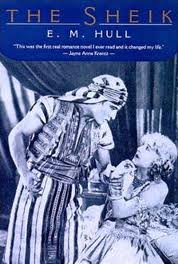
The Sheik by E.M. Hull is found in ERB’s library. The novel published at the beginning of 1921 was a runaway bestseller going through thirty-0ne printings by October. My copy is of the thirty-first printing. How many more it may have gone through I am not aware.
The book was quickly made into the movie of the same name starring Rudolph Valentino and released on November 20th of the same year. Thus the impact would have been redoubled on ERB reading the book and seeing the movie.
Having troubles in his relations with Emma, he was somewhat bedeviled by what she wanted as Freud was by what women wanted. The Sheik presented one woman’s solution to the problem of what women want. The Englishwoman E.M. Hull examined the problem in some detail. Her solution would find expression in ERB’s Tarzan And The Ant Men of 1923 in the story of the Alalus women.
2.
While Mrs. Hull’s novel is invariably reviewed as a soft core porn novel it is actually quite a serious attempt to explore what women want. Not a potboiler, the story is well thought out and carefully constructed.
The story falls into the category of the desert nomad thriller.
The scene is somewhere between Biskra and Oran in Algeria. Biskra is the southernmost point on the railroad from the coast to the Sahara in the East of Algeria. It is an oasis area and was a winter resort for Europeans. This area was also the scene of Robert Hitchen’s The Garden Of Allah and the Sahara scenes from Edgar Rice Burroughs’ The Return Of Tarzan.

The Author
As with Hitchens’ the desert serves as a symbol for self-realization and redemption. The story was written as the career of the rebel Abd El Krim was reaching its apex in the Rif. Krim’s story was terrifically romantic for women of the era. I had a high school history teacher in the fifties who was still capable of gushing about Krim thinking him the most manly and desirable of men.
As with Hitchens the story revolves around a man and a woman. The woman an Englishwoman and the man a Krim like sheik of the desert.
3.
The woman is appropriately named Diana. Diana was the virgin huntress of Greek mythology who spurned all relations with men thus putting her in enmity with Aphrodite. She is somehow related to the Lady Of The Lake of ancient Lacedaemon which name means Lady Of The Lake and in a line of progression to the Northern European archetype of the second half of the Piscean Age. This is a rather strange female archetype to represent the Northern European psyche. She is a cold unloving symbol that may have something to do with the European character.
Whether Mrs. Hull knew these things or not she represents them perfectly in her story. This is quite extraordinary.
Thus her Diana was raised by her brother as a boy. She is represented throughout the story as an ambiguous girl-boy, nearly a hermaphrodite. She is herself a skilled huntress who has no use for men. As the story opens she has yet to be kissed. Mrs. Hull skillfully represents the respect that Northern European men have for their women which in itself may be conditioned by the Diana image. They are easily put off. When one man asks Diana for a kiss he accepts his rejection with equanimity asking only if they can at least be pals.
The Sheik as the wild man of the desert knowing no law but his will offers quite a contrast. By the time of Mrs. Hull’s novel ERB had already explored the same literary territory in the Return Of Tarzan and The Lad And The Lion as well as The Cave Girl. I would hesitate to say Mrs. Hull had read Burroughs but the Sheik is portrayed as a Tarzan like superman in a decidedly pulp manner.
The Sheik does not observe any civilized niceties. At one point Mrs. Hull refers to his civilization being less than skin deep. As the Sheik, Ahmed, says, if he wants something he takes it. Having seen Diana in the marketplace of Biskra he sets out to kidnap and rape her. There are no other words for it and Mrs. Hull does not mince them.
His plan worked out so that he buys off Diana’s desert guide to deliver her to him on the first night out of Biskra. Prior to that he surreptitiously serenaded her on the night before even entering her room in the dark while she is there to replace the bullets in her pistol with blanks to prevent her from shooting him in the desert which she did attempt to do.
4.
Now, Mrs. Hull is presenting an allegory so the novel is filled with symbols. The key symbol is the horse. The horse is, of course, a symbol of the female associated with the Greek god Poseidon. In ancient times the symbol of the bull was associated with the missing y chromosome of the female being replaced in Patriarchal times with the horse. Thus the Patriarchal goddess Athene is sometimes represented as horse headed.
When the guide brings Diana a horse to ride it is a magnificent creature much better than she might have expected from a commercial enterprise. The horse has actually been provided by Ahmed the Sheik so as Diana leaves Biskra she is already mounted on the Sheik’s horse- a powerful sexual symbol. The horse is trained to respond to signals from The Sheik.
The story is filled with horses and horse races between she and the Sheik. In one race the Sheik gives her a minute to stop or he will shoot her horse dead which he does. He then places Diana in front of him on his horse (these horses are all magnificent and beyond magnificent) at which point she realizes that she is not only in love with the Sheik but has been for some time.
Previous to this time she had noted in the camp
…but it was the horses that struck Diana principally. They were everywhere, some tethered, some wandering loose, some excercising in the hands of grooms.
So everywhere is the symbol of the female. At this stage Diana has been sexually subordinated to the Sheik but she is intellectually resisting. The Sheik puts on a demonstration of how useless her resistance is as he fully intends to break her.
A man eater is brought out who has killed a man earlier that morning. The horse obviously represents Diana. Some two or three men attempt to break the horse but they all fail. Then the Sheik mounts. The result is a thoroughly exhausted and beaten horse. She stops fighting with her legs splayed while the Sheik jumps off. Then the horse rolls over left with no will of its own.
This is exactly Diana’s situation. Earlier she had boasted to her brother: I will do what I choose, and I will never obey any will but my own.
That is now proven an empty boast as the Diana riding in front of the Sheik chooses to obey the Sheik’s will.
Perhaps Mrs. Hull has prophesied the submission of England’s will of today to the desert Sheiks. As of now the Moslems have all but assumed religious control of England. Thus England as Diana has submitted its sexuality to the sons of the Sheiks.
However Diana’s Sheik still has to prove himself as the dominant male of his society to retain her allegiance. One hesitates to say that she perversely tests him nevertheless having been cautioned to take care on her desert rides she insists on going too far afield. Naturally she and her seven man escort are ambushed by the fat swarthy greasy rival sheik’s men. Six of the seven escorts die joyously defending their sheik’s property. The seventh, the sheik’s European manservant gets the classic bullet crease alongside the head. Diana disappears into the fat greasy sheik’s tent. This guy is everything an Arab sheik should have been in contemporary European eyes. Fat, greasy, swarthy, unbelievably smelly, uncouth to the nth degree. There’s no doubt there’s the fate worse than death for the boyish, sylphlike, slender, lithe Diana. Yes, it seems pretty certain, unless…
Here comes the Sheik with a small but loyal and dedicated band of followers eager to die for their leader. Just as the greasy, swarthy sheik has got it out and ready in crashes Ahmed in the nick of time. Rather than shooting the bastard and getting it over with he wants to dispatch El Greaso by hand. As we all know strangling a a struggling strong man takes a little time. Enough time for El Greaso’s vile Ebon followers to burst into the tent. Right behind them come Ahmed’s men. Shades of Tarzan! Ahmed takes a severe blow to the head and a couple long blades in the back.
Will he live? After muttering a couple pages similar to the last words of Dutch Schultz the matter is in the hands of Allah and the European surgeon. As much as I like having god on my side, in certain situations a good surgeon is even better.
Nevertheless if Ahmed lives he has proven himself to be the right man for Diana. Interestingly the virgin huntress has submitted to the law of Aphrodite. The European archetype has accepted the dominance of the Moslem Arab.
Well, almost. In the first place the tribe of Ahmed is very interesting according to his French friend who arrived in time for the big battle. It seems that Ahmed’s tribe is different from the rest of the desert greasers. It is inferred that his tribe is one of the legendary White tribes supposed to be living in the Sahara. Undoubtedly a surviving remnant of Atlantis that moved South when the Mediterranean flooded.
Why, in addition, it turns out that Ahmed isn’t even an Arab. It seems that he’s actually English. Well, an English Spanish blend. His English father when in his cups did some unspeakable thing to Ahmed’s mother when she was pregnant with him and she was found by Ahmed Sr. Ahmed Jr.’s adopted father wandering dazed and confused beneath the broiling desert sun.
Taken in she dropped Ahmed Jr. and died. The baby was raised as the successor to Ahmed Sr. But he developed an uncontrollable hatred for England, its people and all things English. That’s why he captured and raped Diana over and over. But it’s OK, they both realize they love each other now.
The lesson seems to be that that’s what woman wants: a man who can earn her repect by dominating and controlling her while at the same time being the dominant male in his society, being able to provide all her wants and desires while being able to defend her from the El Greasos of the world. So all the necessary elements come together here and we have a marriage if not made in heaven perfect for terrestrial travails.
If nothing else ERB learned where he had failed Emma in the beginning but who now wondered in his own role of sheik where the rewards from Emma were.
I’m going to speculate that ERB read the story in 1921. He might have enjoyed Valentino in the movie but I think it improbable that the silent film came near capturing the nuances of the novel. I’m sure the signficance of Diana as female European archetype didn’t come through on celluloid.
Was it even in Mrs. Hull’s mind one may perhaps ask. Is it possible I’m projecting my beliefs on Mrs. Hull’s story? It is possible but consider this passage in The Sheik:
He was so young, so strong, so made to live. He had so much to live for. He was essential to his people. They needed him. If she could only die for him. In the days when the world was young the gods were kind, they listened to the prayers of hapless lovers and accepted the life they were offered in the place of the beloved whose life was claimed. If God would but listen to her now.
So we know that Mrs. Hull was read in Greek mythology. It would seem inevitable that she was familiar with the stories of King Arthur to some degree. Certainly she knew the story of Merlin and Vivian. She was a writer. Knowing little about Mrs. Hull it is impossible for me to know for certain exactly what she read or understood. And yet, there it is in the pages of her novel if one has eyes to see. The Sheik is as much a work of mythology as is that of Burroughs’ Tarzan. It is possible that neither was conscious of what they were saying but the information taken into their minds was transformed subconsciously, at least, into the form in which it issued forth from their pens. It works that way for writers. I am often astonished at the subliminal message of what I write. Did I intend it? Must have. There it is. Still, I do put myself into a mild trance when I’m writing so that I concentrate on words rather than ideas. So the words are more conscious while the content is more subliminal. We know ERB wrote from a trancelike state and Mrs. Hull’s story has that quality. I think we have enough evidence to know that she had read the mythological material so that whether she had consciously formulated her ideas they come out in her writing. In short, I don’t think I’m projecting much if anything. Tra la.
There is no doubt that The Sheik made a big impression on ERB. The question is how did he understand it. His first reaction appeared in 1923’s Tarzan And The Ant Men in the weird parody of the Alalus people in which he reverses the male-female roles with the women being stronger and dominant. As Ahmed figures the women brutally dominate the men. Using them for sexual pleasure then discarding them. ERB’s story seems to be tongue in cheek but without a reference point the ridiculous story is hard to follow. With E.M. Hull’s The Sheik I believe we have the reference point.
It seems clear that Mrs. Hull was influenced by Robert Hitchens’ The Garden Of Allah. What is not clear is whether she was influenced by Edgar Rice Burroughs and if so by what novels. The Sheik follows a pulp format. So, if Mrs. Hull read the pulps on a regular basis there is no reason to believe that she was not familiar with some of his work as Burroughs certainly by 1920 when she probably began the novel was already the premier pulp writer.
If that was the case it seems likely that she might have read The Return Of Tarzan and The Lad And The Lion, perhaps The Cave Girl. If she read Lad then she reversed the roles of the chief male and female characters making the Woman English and the man Arab.
I haven’t read the magazine version of The Lad And The Lion so I am not sure of the specific changes ERB made between the 1913 version and the 1938 rewrite for book publication. The rewrite shows clear evidence of influence from The Sheik unless of course Mrs. Hull was reflecting the influence of the Lad on herself. In any event the two books reflect an influence from one to the other.
So, as with Trader Horn and Burroughs it is possible that Hull was influenced by Burroughs and with both of these authors Burroughs reading of them was reflected in his subsequent writing.
Our list of reciprocal influences is growing when one adds that of H.G. Wells. What once seemed simple grows more complex.
Postscript: I have since learned that Mrs. Hull was a student of mythology.
A Mother’s Eyes
April 27, 2007
A Mother’s Eyes
by
R.E. Prindle
Part I: The Remarkable Case Of Aldous Huxley’s Eyes 30 pages
Part II: The Baby Marie: 10 pages
Part III: Cow Eyed Hera And Edgar Allan Poe: 21 pages
Part IV: The Hand That Rocks The Cradle: 9 pages
Part I
The Remarkable Case Of Aldous Huxley’s Eyes
This essay will deal with certain unconscious relationships between the Indo-European male and the Mother Archetype. This essay is retricted to the Indo-European sub-species because the author is not convinced that all Homo Sapiens sub-species are identical in intellectual makeup nor are they subjected to the same cultural influences which would produce a uniform effect across all sub-species of mankind. What Jung calls the Collective Unconscious of Man does not use the same symbolism in every period of time, every place and with all sub-species. While the Horse will be a central focus of the Indo-European after minus 2000, for instance, prior to its introduction to the Middle East the beast could not have figured in the Collective Unconscious of either the Indo-Europeans or Semitic Mesopotamians. Thus the Black, Semitic and Mongolid sub-species may be subject to the same relationship with the Mother Archetype but may express the same issue in different symbolism.
page 1.
The female of the Indo-European or other sub-species is structurally different from the male hence subject to different responses to the same issue in different symbolism. I will touch on that briefly in Part IV.
Further, one ought not to confuse the role of female with the role of mother. The female is a different person until she becomes a mother. Once a mother her response to the role will depend on female societal desires which will control her attitude to motherhood. The intelligence and intellectuality of the female person is in conflict with the Structural Psychology of the Mother. Not all females are intellectually adapted to become mothers although most do become mothers.
The topic will be approached from the point of view of Depth Psychology based more on the approach of Carl G. Jung than that of Sigmund Freud. Freud’s approach was based on the personal psychology of the upper brain while Jung approached the subject more from a Special angle hence his notion of the Collective Unconscious with a universal heritable symbolism regardless of education or sub-species.
Because he was dealing with a more homogeneous population unlike the heterogeneous population of the United States he was able to believe that all people are subjected to identical influences even though he had the obvious sub-special differences of the Jewish Semitics before him.
page 2.
There can of course be no such thing as a collective mind hence no Collective Unconscious. Neither can this Collective Unconscious be inherited. There can only be a shared sub-special understanding of phenomena. This shared understanding will express itself in certain common symbols induced by a universal field of education depending on one’s level of consciousness.
Specifically I wish to examine the relationship between the mother and the eyes of the Indo-European male as well as the mother’s identification with the Horse by the male. All three are intimately related.
The difference between Jung’s Collective Unconscious and the individual unconscious or, rather, sub-conscious, is that Jung without having actually differentiated the two was referring to Structural Psychology by his notion of the Collective Unconscious.
Before the human organism can be subject to personal psychology there must first be an organism. The construction of that organism will then determine its psychological potential.
Thus while all the higher vertebrates share the same Structural Psychology the addition of the upper brain separates man from the beasts while causing a conflict between the Structural Psychology and Personal or Intellectual Pyschology.
While a human entity appears to be an organic whole it is actually a construction of component parts. The nature of those parts determine the psychological potential of the completed construction.
page 3.
Not enough attention has been paid to how a human is constructed or the signficance of that construction. The basic organism seems to be taken for granted.
The human is a combination of two different components which are then integrated. On the one hand there is the passive ovum which is provided by the female of the species; on the other hand is the active sperm provided by the male. Passivity and activity are important and should not be passed over lightly. The ovum provides one half of the structural elements as well as all the mitochondrial DNA. These are significant facts and not merely incidental.
The ovum is always female or an X chromosome. Thus the male always has this female X chromosome component which Jung and Freud using the imperfect data of their time referred to as a man’s ‘feminine side.’ Jung called it the Anima in the male, the corresponding role in the female the Animus.
The presence of an X chromosome in the male in no way affects his sexual identity as a male. It is not a cause of homosexuality or effeminacy. Using the imperfect data of his time Jung acted on the notion that sexuality was caused by a ‘preponderance’ of male or female genes. This would of course distort his vision of sexuality creating non-existent possibilities.
An unfertilized ovum is, of course, of no value. The male provides the fertilizing element in the form of the sperm. The sperm contains the other half of the structure which when joined with the ovum completes the structure.
page 4.
The sperm can be either X or y. There must be a difference in nature between the ovate and spermatic X chromosomes. If X the completed structure is a female. But the spermatic X contributes the gene pool of the mother of the male which is part of the Anima so that the female has two female components. Without the X chromosome the male could not provide X sperm.
It must also be true that the spermatic side of the female provides a set of genes received from the father while the ovate side provides a set of genes from the mother, so that not all of the female’s ovum are the same.
In the case of either an X or y sperm the ovate or female mitochondrial DNA is always and solely the source of mitochondrial DNA in the resulting construction whether male or female. The Spermatic mitochondrial DNA is always expelled from the united ovum.
Thus the Mother Archetype establishes itself in a much more intimate connection with the male than the Father Archetype. This is a physiological fact with real consequences and not a matter for sexual pride.
When the ovate and spermatic parts combine the ovate X chromosome assumes the left side of the structure while the spermatic X or y forms the right.
Many organs which can function independently are therefore duplicated such as kidneys, lungs, gonads or ovaries. Those which can only function as a unit are formed of two separate lobes which are seamed such as the heart, liver, penis or clitoris.
Now, this may be controversial but the gonads or ovaries, the spinal cords and brain from an integrated unit like the power train of the automobile. All three are parts of consciousness.
page 5.
The ends of the spinal cords, it follows that one each must be provided by the ovum and sperm, anchored in the gonads or ovaries intertwine up the spine until they cross over at the brain stem so that the passive ovate left side of the body becomes the passive right side of the brain while the active spermatic right side of the body crosses over to become the active left side of the brain.
The two cords, spermatic and ovate anchored in the gonads or ovaries pass up the spine to emerge from the brain stem as ‘loose wires.’ To give them a name we will use Jung’s terminology but assert that male and female have both an Animus and Anima rather than as Jung has it, the male an Anima and the female an Animus.
Now, as man evolved he began with what is referred to as the serpent’s brain or the brain stem followed by mid- brain, parietal lobes, upper brain and pre-frontal lobe.
Thus structurally to the point of the brain stem all vertebrates function more or less identically. By which I mean to say that to that point the psychology of say, sub-species five of the lion is identical to man. If this isn’t true than evolution is bunk.
Of necessity the optical nerves are associated with this very primitive organ of the brain stem. This fact must have some relation to the association of the Mother with the eyes.
Such a psychological association must operate independently of personal psychology as Structural Psychology or, as Jung would have it, the Collective Unconscious.
page 6.
There are then tree levels of consciousness: the autonomic system, the brain stem and the upper brain.
In fact the as the brain stem is not intellectual as in personal psychology, it may function independently of the upper brain and require a different technique for therapy.
At any rate the symbolism Jung discusses is related to Structural Psychology and not the neuroses and psychoses of personal psychology.
When the male Indo-European experiences rejection or abandonment by the mother this rejection may be evidenced by eye problems associated with a horse symbolism.
Having laid the frame for my discussion I wish to begin with the case of Aldous Huxley, his relationship to his mother and his celebrated eye problems. Aldous Huxley is, of course, the important literary figure who wrote ‘Brave New World’, ‘Eyeless In Gaza’, ‘Point Counter Point’ and other intriguing and important novels.
All his adult life from the age of sixteen on Huxley endured terrible problems with his eyes. He was frequently able to improve his vision remarkably only to suffer setbacks. He first suffered maternal rejection when his mother opened a girl’s school relegating Huxley to an inferior status in both his and her eyes to her female students. This alone had a permanent effect on his character and his adult relationship with women. Then, when Huxley was fourteen his mother died abandoning him completely as it were.
page 7.
No matter how natural or unavoidable death may be, those affected are under no obligation to react rationally. While on a conscious or even sub-conscious level Huxley seemed to handle his mother’s death well he was devastated on the structural level. First rejected and then abandoned by his mother, Huxley, at the age of sixteen was attacked in his eyes. Actually the reaction could have been predicted although how and when would have had to await manifestation.
Huxley developed an inflammation of the cornea called Keratitis Punctata. Thus his reaction to his mother’s rejection and abandonment was of the most serious sort. In the days before modern medicine he would have successfully blinded himself in both eyes. Given the medicine of the day he might have been cured with minimal or no loss of vision. As it was he was misdiagnosed allowing the disease to take almost full course. By the time he was treated he had lost his vision in his right or ovate eye while being as good as blind in his left or spermatic eye.
The nature of Keratitis Punctata is such that it damages or scars the surface of the cornea while the internal functions of the eye remain intact. The effect of the scar tissue allowed his vision to fluctuate.
I think that if a survey were taken it would be found that the right or ovate eye is always affected the worst. This would strengthen my contention that certain eye problems are due to relationships with the mother or ovate side.
It may be argued that Keratitis Punctata is a physical problem and not subject to psycho-somatic influence. It is my contention that Huxley’s psyche in search of a satisfactory ailment subconsciously sought the affliction out.
page 8.
Over the years Huxley was able by an act of will to improve his vision dramatically but he always suffered relapses as his structural need for the infirmity overcame his conscious will. While had he been diagnosed and treated promptly he would not have lost his vision still his Structural need was such that he would have had a continuing series of eye problems over his lifetime.
Medical science poses problems to psychotic needs by being able to overcome psych-somatic reactions; the sub-conscious must search for new ways to gratify its need for affliction.
I too suffered abandonment by my mother beginning when I was five and ending when I was ten when she remarried. I was first put into two foster homes and then placed in an orphanage. The orphanage was critical. While I had very acute vision until I was forty a variety of eye problems have plagued me since.
While all the problems were quite natural therefore seeming to be of a strictly physical nature yet I had been plagued by fears of going blind since I was ten when my mother remarried. I therefore left myself open to attack in the appropriate time and place. Finally at sixty-four I had a cataract operation on my right or ovate eye followed by one on the left. I realized the psycho-somaic source of the problem while I was reading Sybille Bedford’s biography of Aldous Huxley.
page 9.
Prompted by the reading I had a dream of a horse. This is the only horse dream I can remember ever having.
The horse clearly represented my mother staring at me with large guilty eyes not unlike the description of the Greek goddess Hera who was styled ‘cow-eyed.’
Sometime in the near past, two or more years ago, I had seen a TV show about a horse trainer who I can remember only by the name of the Horse Whisperer. He had developed a new technique of gentling a horse rather than breaking it. In my dream I was using his technique to gentle a mare. She seemed to want to be affectionate to me but I kept pushing her away or she shied away in my attempt to gentle her.
By that time I had already developed my ideas of Structural Psychology. I had also integrated my personality clearing all fixations from my subconscious. As I expressed it then, all the way down to my brain stem. Now I realized I was dealing with the brain stem itself having spoken more truly than I knew.
While I had made progress in rectifying my Animus I cannot say for certain that the process was complete. In all probability I have reconciled my Anima and Animus. I have never had trouble with my Anima although my Animus was seriously blunted as a child affecting my ability to express my manhood.
However, contrary to Depth Pschology, having recognized and spoken this apparent fixation caused by my mother’s abandonment the fixation did not respond by immediately being exorcised as had my fixations of the upper brain. Thus the problem of Structural traumas obviously requires a different technique for treatment.
page 10.
The appearance of a horse figure in my dream was startling to me. I have never liked horses. All my life I have had an irrational hatred of them even to the point of verbally abusing them at sight.
Aldous Huxley, characteristically of the trauma, expressed his own reaction through horse imagery. Huxley wrote his first novel ‘Crome Yellow’ in 1921 followed by ‘Antic Hay’ in 1923 and ‘Those Barren Leaves’ in 1925. Those three novels lead up to 1928’s ‘Point Counter Point’ in which his problem with his mother finds expression in varied symbolism. In this last novel Huxley portrays himself in the character of Philip Quarles. He has a wife, Elinor, as a mother substitute and a son called signficantly, Little Phil, in other words a doppelganger.
In the novel Quarles has a limp rather than bad eyes. Huxley, through Quarles, expresses his mother’s abandonment and his attack of Kertitis Punctata this way:
Quote:
‘…Philip…was remembering that immense black horse kicking, plunging, TEETH bared and ears laid back; and how it suddenly leaped forward, dragging the carter along with it: and the rumble of the wheels; and ‘Aie!’ his own screams; and how he shrank back against the steep bank, how he tried to climb, slipped, fell; and the appalling rush and trampling of the giant; and ‘Aie, aie!’ the huge shape between him and the sun, the great hoofs and suddenly an annihilating pain.’
page 11.
Note expecially the teeth which will appear more prominently in Part III.
This very vivid picture is done so well that one might actually believe such an event really occurred. It didn’t. Here Huxley transforms his mother into a huge black horse. The steep bank I interpret as the brain stem which appeared in my own imagery as a deep dry well. There was a huge shape between Huxley/Quarles and the sun which must represent both the loss of his mother, when the sun went out of his life, and the onset of Kerititis Punctata.
In the novel Quarles had his leg crushed by the cart but in this version it is not clear where he received the injury while it was definitely caused by the huge black horse. There was only the annihilating pain. One assumes that the pain was the loss of Huxley’s mother.
Huxley gives his hurt a full scale treatment here. Quarles and his wife live in a mews in London. A mews is a converted stable. Horses had formerly been kept there. Now the ‘huge machines’ or cars of a hundred horse power or more are kept there. The arch at the end of the mews through which the horses were led stands as a constant reminder to Huxley/Quarles of his tragedy.
Not content to retell his own pain, Huxley then goes on to punish his mother in his imagination as he feels she punished him by dying. Remember a man in Huxley’s situation uses a woman as a surrogate to avenge himself on his mother who is beyond retaliation. In ‘Point Counter Point’ Quarles’ mother is still alive. It is she who has care of Little Phil when he is stricken with meningitis so the guilt remains with her.
page 13.
On the eve of the meningitis attack Elinor Quarles, Little Phil’s mother, was about to commence a dalliance with another man. Quarles’ mother’s telegram reached Elinor in time to prevent her beginning the affair. Elinor believes that Little Phil’s meningitis was caused by her intended infidelity and suffers accordingly.
Elinor’s intended infidelity corresponds with Huxley’s mother’s betrayal of her love for him by relegating him to a secondary role while she lavished attention on her girl students.
Huxley’s descriptions of Little Phil’s suffering are quite gruesome.
Quote:
‘…she found the child already awake. One eyeball was wide open and the eye, all pupil, was looking straight up at the ceiling; the other was half shut in a permanent wink that imparted to the thin and shrunken little face an expression of ghastly facetiousness.
‘He can’t open it,’ the nurse explained. ‘It’s paralyzed.”
Unquote.
Thus the crux of Point Counter Point is the punishment of Elinor Quarles qua Huxley’s mother for the crime of rejecting him in favor of her female students and later dying. Huxley quite rightly associates eye disease with his mother through his wifely surrogate and the symbol of the giant black horse with giant hooves and teeth bared rearing in the brain stem. He obviously had no clear idea of what this imagery meant to him personally. No doors of perception were opened for him there.
page 13.
While this horse imagery is clear in ‘Point Counter Point’ Bedford also quotes Huxley as noting emphatically the remarkable deeds of horses in Homer’s Iliad. I think the horse symbol is replaced in a man’s active life by his relationship with women.
I now intend to devote a few pages to the relationship of mothers and women to horses and eyes in Greek mythology leading back to the present time.
My two lines of argument will concentrate on the nature of the God of Waters, Poseidon and the relationship of that greatest of all mama’s boys, Achilles, with his mother, the sea nymph, Thetis.
I follow the Jungian concept of attempting to penetrate the symbolism by this narrative of action.
In the divine dispensation of spoils in Greek mythology the preeminent god, Zeus, was awarded the sky, Poseidon preeminence in the oceans and rivers, Hades possession of the underworld. Obviously Hades got skunked which made him a sour sort of guy.
The surface of Mother Earth was common to all three.
The significant fact here is that the three gods are male while the Earth named Ge, Gaia or Demeter was female. Thus you have three men with equal claims to the same woman, Mother Earth.
In ancient Greek sourcs as well as in Biblical story Man realized that there was a time before consciousness. Thus the story of the creation of the universe is less a story of creation than one of the crystallization of consciousness.
page 14.
In the creation myth all objective reality is confused; all is seen as one. In other words, there was only an animal consciousness. Then a divine wind blows across the plane of consciousness separating the upper and lower spheres; the conscious and subconscious. Thus the upper sphere of consciousness became heaven and was allotted to the mind of infinite power, Zeus. The subconscious was given to the Father of Waters, Poseidon while the underworld of the brain stem went to Hades. The plane of consciousness was shared by mankind and the gods. This is as it should be.
Poseidon’s dominion is the seas, oceans and rivers. The waters of oblivion are associated with the subconscious and irrational which is to say the female or matriarchal consciousness. The subconscious and irrational are therefore equated with the matriarchal order. Thus Poseidon, who must actually predate Zeus as a carryover from the Matriarchal consciousness has relations with a number of domineering women who are very hard on men.
The question of why Poseidon is also closely related to horses is very difficult to answer, especially as Poseidon was early on the scene while horses arrived later. I offer only a working hypothesis.
It has been suggested that the rollers of the sea are reminiscent of horses’ heads. It has also been suggested that rivers as they dash down mountain slopes and race to the sea are quite similar to the flight of the horse. There may be truth in both suggestions as when the horse arrived it had to be associated with some god; in association with Poseidon that may possibly explain how horses came to be associated with the Mother Archetype. Their association with the Mother can only have begun after the Indo-Europeans brought horses to the Aegean world which was after the year minus 2000.
page 15.
Of the mean flesh eating mares or mothers with whom Poseidon is associated it is only necessary to give two examples. The most important of the two by far is the Medusa and her Gorgon sisters, the other is the enchantress, Circe.
The Medusa is a very important study. She apparently dates back to an early period of the Matriarchate. While in the Patriarchic myth of Perseus and the Gorgon she is a hideous evil witch whose mere glance can turn a man to stone there is evidence to point to a time before the rise of the Patriarchate when she was a belle ideal; a tower of strength. Shields with the Medusa head continued to be used in classical times as a magical charm to repel the enemy. The snakes which form her hair were once a symbol of her authority rather than hideous emblems of hatred. She was then one of Poseidon’s wives or , more probably, he was her consort.
When the Patriarchate displaced the Matriarchate Perseus was chosen to destroy the Medusa or, in other words, the symbol of the Matriarchate. This he did by decapitation. Decapitation or the separation of the head from the body is a powerful symbol in itself which should have destroyed the Medusa’s power to lithicize men with her EYES. Even in death, which is to say after the power of the Matriarchate was broken, the mere sight of her now dead eyes continued to turn men to stone.
page 16.
The myth of Perseus is a keystone story that tells of the birth of the new order of the Patriarchate. When the old order of the Matriachate was beheaded a remarkable thing happened; two beings that correspond to the male Anima and Animus emerged from her neck or, shall we say, brain stem.
The Animus of the liberated Patriarchate was represented by the Golden Knight named Chrysaor. As the Animus he had no concrete identity. He represented the mind of infinite power and rationality possessed by Zeus and shared by men but not by women. He consequently fades from view.
The Anima that sprang from Medusa’s severed brain stem was the great winged horse or mare, Pegasus. The great mare allowed man’s imagination to soar as though godlike, above the earth’s plane that was the dominion of the Matriarchate.
Further having now passed through the dawn of consciousness as represented by the creation myth the male had now reached the level of consciousness where he could begin to attack and destroy his subconscious demons. Thus Perseus finds the maiden Andromeda chained to a rock awaiting destruction by the monster of the sea depths of the subconscious.
Soaring above the Leviathan on his Anima, Pegasus, in the conscious sphere, Perseus is able to destroy the monster of the subconscious and liberate Andromeda, or the female, from destruction by the subconscious. In his arms, under his protection Andromeda, or the female, was freed from animalism. She too was released to find her full potential under men’s guidance and protection.
page 17.
As decapitation wasn’t totally effective there was more than one way to handle the attempted suppression of the Matriarchate. It has been truly said that you can kill men but you can’t kill ideas. Perhaps because of the Iliad with its gathering of the tribes at Troy one thinks of Greek mythology as an indissoluble whole. This is not the case. There are many strands and traditions to Greek mythology.
It is highly probable that when the Greeks invaded the Peninsula that their route bypassed Athens which was shielded from above by the Boeotian Semites. Thus the Greeks were shunted West where they fell on the Pelopponesus bypassing Attica.
While the Athenians avoided military invasion they were yet unable to resist the Patriarchal tide.
The myth of Perseus and the Gorgon which belongs to the Argive or Pelopponesian cycle gives only one view of the suppression of the Matriarchate. That was how it happened West of Attica. In Athens itself the transition from the Matriarchate to the Patriarchate was more evolutionary. This would be the result of being bypassed by the Greek invasion.
Perseus on his way back to Argos from Palestine gave the Medusa’s head to Athene who then wore it as an emblem on her bosom. This would be another way of saying that Perseus influenced the Athenians to convert to Patriarchalism.
page 18.
I would suggest that, even though the Iliad lists a contingent of Athenian ships present at Troy, there were no Athenians there. As the Greek heroes for the most part are from the Pelopponese or other Greek locations and the quarrel is between them and Troy while none of the Greek heroes was Athenian. I would suggest that the Athenian contingent is an interpolation. Agamemnon and the Argives as invaders would have had no influence over non-Greek Athens such as they had over Odysseus in Ithaca.
The Athenians always claimed to be an autocthonous people, that is that they sprang from the soil or, in other words, were there before the Greek invasion. Of necessity that would mean that they were not Greek per se.
Their early heroes are half snake, half human, which I understand to mean that on the one hand as snakes emerge from the soil the Athenians were autocthonous; on the other hand that they were half Matriarchal and half Patriarchal. In other words, there was an evolutionary transition. This idea is borne out by subsequent Athenian mythology.
If this is true then it must follow that the gods of Athens had formerly been Medusa and Poseidon- the Queen and her consort.
Imagine Perseus handing the head of Medusa to Athene. Athene must have neutralized the power of Medusa because as of the handing of the head to Athene it was still capable of turning men to stone at a glance. As Athene’s emblem displayed on her breast where all men must see it, it could no longer do so.
As the Athenians told the story of the suppression of the Matriarchate, Zeus swallowed a matriarchal goddess known as Metis. This is a normal method of disposing of one’s enemies. As the Africans down to the present day say when they intend to destroy an enemy- We will eat you up.
page 19.
When you eat someone up you obtain their qualities. Metis was the goddess of Wisdom. Whether she was one of the Gorgons I don’t believe is recorded but I suspect so. Perseus and the more primitive Argives believed that destruction was simply a matter of cutting off a head, the Gordian knot approach. The Athenians thought differently.
Having eaten up the Matriarchy Zeus found that it gave him a serious case of indigestion. His eyes were bigger than his stomach. The Matriarchy would not stay suppressed.
As it was necessary that some other expedient be employed the Matriarchy was allowed to exist but only as subordinate to the Patriarchy. While not abolished, the Patriarchy attempted to reform it in an acceptable way. The attempt was made to replace the uncontrollable Matriarchal figures as represented by Ares and Aphrodite with a more rational goddess embracing both.
Thus the indigestion of Zeus gave him a headache. In other words, he had to give the problem some serious thought. He had an idea, as why wouldn’t the mind of infinite power have an idea. He transformed the old wild undisciplined Matriarchal god and goddess into the superbly rational and controlled Athene. Her idea formed in the Patriarchal brain then sprang fully formed and armed from Zeus’ forehead. Actually she didn’t spring but was chiseled out by Hermes and Hephaestus who are both gods of resource.
Thus when Perseus handed the head of Medusa to Athene he was passing the torch for the application of Patriarchy in Athens. The destruction of Poseidon’s consort in Athens left that god without a female counterpart and that’s the way he stays throughout the Patriarchate. Athene was a chaste virgin who would have nothing to do with men. As a goddess with a technological sideline she came into conflict with the Matriarchal technological god Hephaestus. He attempted to rape her or in other words reimpose an aspect of the matriarchy on her which she successfully resisted. Instead he spurted on her leg in a pre-mature ejaculation which she, as the goddess of weaving, wiped off with a piece of wool.
page 20.
Unable to seduce Athene and reestablish his supremacy in Athens on his part, Poseidon then had a contest with Athene to see who should be the tutelary deity of Athens. In other words, should Athens be Patriarchally or Matriarchally inclined. Should it be named Athens or Poseidonia?
Poseidon peformed the seemingly impossible task of making water spring from the rocky high crown of the Acropolis. Athene countered by making an olive tree grow on Rocky Top.
The Athenians opted for the olive tree but it was not a clean cut victory for the modified Patriarchy. The Athenians ever after nurtured several snakes on the Acropolis along with both the olive tree and Poseidon’s spring. Thus the Matriarchal past was not forgotten.
Further Athene retained some attributes of the Matriarchy. She was sometimes theriomorphically represented with a horse’s head while her attribute of the owl is represented in statuary and she is referred to as owl eyed, undoubtedly a reference to the wise Metis. A snake was also shown coiled on the ground in the shelter of Athene’s shield as she leaned on it.
page 21.
In point of fact all Greek heroes were symbolically horse headed by virtue of the horse hair crests on their helmets. They were always under the protection of the Mother Archetype while sharing in the qualities of her symbol the horse.
The wearing of lion and leopard skins is also an aspect of theriomorphism. Obviously one hopes to share in the prowess of the lion or leopard by wearing its skin. Thus Heracles armored himself in the skin of the Nemean Lion which, in itself, was a symbol of the Matriarchy.
I hope this exposition established the nature of the relationship between the Mother, horse, eyes and the brain stem to the Son in ancient Greek thought. These are not irrelevant details of myths but important symbols when understood in the Jungian sense. The Ancients were not just amusing themselves with strange tales. The message for the initiate is different for that of the hoi polloi.
The myth of Circe explains what happened under the Matriarchate when men allowed themselves to be dominated by their carnal desires. It is only when one controls one’s sexual needs that one escapes domination by the female to dominate the female. In that way one rises from the level of the beast to that of a man. Nor is this ‘repression’ in the Freudian sense.
Before attacking the issue of Achilles and Thetis let me point out the significance of Oedipus. Oedipus was abandoned as an infant by his mother Queen Jocasta of Thebes. On his way to Thebes as a young man he was jostled out of the road by a chariot and a team of horses. Enraged he killed the driver who he later learned was his father. By killing this man, who was king of Thebes, he made the widowed queen his wife. He then learned that she was his mother. Horrified at the thought of having married his mother he gouged his EYES out using the clasp of a woman’s dress. Thus one has son, mother’s abandonment, horses and eyes.
Achilles, on the contrary, had an excellent relationship with his mother, too good. He remained tied to her apron strings all his short life.
His mother, Thetis, is one of the more interesting mythological characters. Zeus had it mind to make Thetis his own but backed away when he learned that she would bear a son who would be greater than his father. No god would then touch her so she was married to the mortal, Peleus, to whom she bore Achilles.
Thetis and Peleus lived apart. As she was a Nereid or sea nymph, closely related to Poseidon or the subconscious, she lived at the bottom of the sea whence she always made sure that Achilles had a superior team of horses, fabulous armor and an incredible shield. Thus while Achilles was a formidable warrior his success depended as much on his doting mother as it did his own prowess.
It was fated that Achilles could have a short life if sought glory on the field of battle or a long life as sort of an effeminate mama’s boy. You see, the relationship to the mother. This was his and his mother’s dilemma in the Iliad.
To protect her boy as long as she could Thetis had him reared among the girls in the girl’s quarters in girl’s clothes. He was so good at female impersonation that when the Greeks sought him out to serve in the war it was impossible to identify this giant amongst men among the girls.
Think about this.
page 23.
Still it was reputed that he was a mighty warrior who was destined to defeat the Trojans. He should have had such a physique that he stood out head and shoulders above the girls.
When the Trojan War began his mother desperately wanted to keep him out of harm’s way among the girls. Odysseus, surnamed the Wily, smoked him out by raising an alarm. While the girls ran screaming Achilles true to his heroic nature seized his arms to meet the threat thus betraying his identity. Abandoning his transvestism Achilles is conscripted into Agamemnon’s Folly.
Quite frankly the Greeks have been coerced into a war for the sole benefit of the Brothers Atrides. What did Achilles care if Paris abducted Menelaus’ wife. She went with him willingly anyway. Menelaus behaved like a fool in leaving the guest Paris in his house with Helen while he left on a business trip. Would you do that? I wouldn’t.
Nevertheless Agamemnon was the sole representative of Zeus on Earth; he ruled by divine right. Zeus had given him the nod to assure victory. In point of fact he couldn’t lose. One wonders what would have happened if he had refused to help himself. How would Zeus have affected victory as the gods help only those who help themselves?
Homer in his brilliance depicts a very detailed picture of this society. Agamemnon is especially suited to command although he is not the greatest of the heroes nor a totally admirable man. In fact, his pettiness injures Achilles to the point where the latter must make a retort.
page 24.
Achilles’ first thought is to take arms against the slings and arrows of outrageous Agamemnon but Athene counsels him to suffer that particular sea of troubles in his mind. Achilles heeds her advice and goes into a pout befitting this greatest of mama’s boys. He self-centeredly withdraws himself and his troops from the war.
This act is very serious as he is the greatest of all Greek warriors while it is a known fact that the Greek’s can’t win without him. Now, Achilles has some serious mental problems. After his alter ego, Patroclus, is killed Achilles opines:
…O Zeus and Athena and Apollo
If only death would take every Trojan
And all the Achaeans except for us two,
So we alone might win that Sacred City…
That’s a prayer he hopes will be anwered. In his anger and spite he even wants his own side to be defeated and destroyed so long as he and his friend alone find salvation in that Sacred City. The City Of God?
After being robbed of his prize by Agamemnon he goes to the seashore to summon his mom from the deeps. Arising from the sea of the subconscious she comes to him. The result of this interview between a doting mother and a spoiled rotten son defies all concepts of morality both in Achilles’ request and his mother’s response.
page 25.
Achilles asks his mother to intervene for him with Zeus to cause the slaughter of the Greeks until they are fighting the Trojans among their ships in the camp. There is nothing that Thetis won’t do for her boy no matter how criminal. She is willing that the Greeks be destroyed if that is what her son wants. Thetis and Ma Barker would have gotten along just fine.
Not only did Zeus have a soft spot for Thetis but in a past time when the gods rebelled and had overpowered Zeus in an attempt to depose him Thetis had come to his rescue. Zeus owed her one.
Zeus and the gods are away in Ethiopia for twelve days but she promises her son to visit him him as soon as he returns. On his return she implored Zeus by grasping his knees with her left arm, Homer is explicit, thereby immobilizing him with her feminine side, with her right hand she grasps his chin arresting his attention. She implores him to smite the Greeks unto death to appease her son’s sense of affront.
Understand the enormity of Achilles’ request to his mother. She does not reprove him in the least instead she rushes off to Zeus for his complicity which Zeus in his profundity of mind grants.
Nor is this an easy thing to fit into his schedule. He has already given the nod to Agamemnon which must be fulfulled while he can refuse nothing to his Grecophile daughter Athene and also while he is being badgered by his wife Hera to favor the Greeks.
In the face of all these conflicting demands even though he has given the nod of victory to Agamemnon and once his nod has been given his decision cannot be altered he agrees to at least hurt the Greeks for the benefit of Thetis’ son with no possible reward for himself from Thetis as her sexual favors would cost him Olympus. Now you know what a mind of infinite power is capable of.
page 26.
Zeus then unleashes Hector and his Trojans until they breach the Greek walls firing a number of ships.
Still unrelenting, Achilles refuses to help but does allow his faggot, Patroclus, to don his armor frightening the Trojans into thinking Achilles has entered the fray. Patroclus exceeds his authority being killed by Hector who appropriates the splendid armor of Achilles as well as those great horses.
Now horseless, armorless, shieldless and friendless, in other words completely defenseless and emasculated, Achilles runs once again to mom. Mama is always there for her boy. Now, for those of us whose moms have not always been there for us this is a cause of deep envy and anguish. She promises to have the technological god, Hephaestus, make him a new shield and armor to be ready the NEXT DAY. Even Hephaestus is not too busy for this paragon of mothers; he sets aside all else and gets down to it. You see what a good relationship between mother and son is worth.
Aldous Huxley thought about such matters deeply. He never consciously associated his mother with his eyes although his attachment was such that he said that if you wanted to know how polite educated people of his mother’s time spoke his speech was a living example. In other words he thought that he emulated his mother down to her speech patterns. In essence he had become his mother.
page 27.
He had been unable to penetrate his ‘unconscious’ but he had studied the subject carefully. Sybille Bedford quotes his thoughts on the unconscious in which Huxley says that, obviously, Freud did not invent psychology or even the ‘unconscious.’ Huxley discusses a book by one F.W.H. Myers who laid out a theory of the unconscious in a book titled ‘Human Personality’ in 1886.
Myers dealth with the Homeric concepts of the unconscious qualities of Ate and Menos. Ate was the destructive or dark side or the unconscious while Menos was the creative or positive side.
Freud appropriated the concept of the unconscious but only the dark or destructive aspect appealed to him so he went no further than that.
Obviously Huxley realized subconsciously that with his mother’s eyes he was in a constant struggle between Ate and Menos, darkness and light.
It has always troubled me as to why Hephaestus, or Menos, was married to Aphrodite, or Ate and why the goddess of love and god of technology should live at the bottom of the sea.
If you remember Aphrodite arose from the sea as a sea foam riding on the half shell. Obviously love has all the substance of foam while seeing only one half of the truth. This is a form of Ate.
She and her husband live at the bottom of the sea because they represent Ate and Menos which reside in the subconscious.
page 28.
Aphrodite as Ate is so thoughtless and self-indulgent that she causes pain to everyone in her willfulness. Hephaestus was not too pleased to be awarded Aphrodite as his wife by the council of the gods. No sooner were the two married than, while Hephaestus was off on business, Aphrodite invited her natural complementary aspect of the subconscious Ate, Ares, to bed.
Aphrodite and Ares are the two parts of destructive Ate. When they are caught by Hephaestus in union they form the ‘beast with two backs’ or, in other words, they hatched from the same egg. As unreasoning hatred and love they are Ate in its complete form or aspect of the subconscious that Freud chose to exploit with much less subtlety.
Hephaestos is Menos, the god of invention and technology, also seems to send his good ideas up from the subconscious. Ideas just seem to occur to us. Hephaestus as Menos therefore resides at the bottom of the sea where he is in close contact with the Mother Archetype in the brain stem in union with Aphrodite and Ares as Ate.
It should be remembered that the mother of Hephaestus is Hera who give birth to him parthenogenously. Hephaestus has no connection with the Father Archetype. In fact, he was thrown out of heaven by Zeus. Thus Achilles’ mother is able to obtain from him whatever she wishes at a moment’s notice.
Being in close contact with the Father of Waters, Poseidon, Thetis is able to procure the finest horses for her boy. Achilles has a team that is the envy of both Greece and Troy. It goes without saying that he has no trouble with his eyes.
page 29.
The imagery of mother, horse and eyes has persisted in the Indo-European male down to the present. Let us give two examples here with more to follow in Parts III and IV. Bear in mind that the imagery is subconscious so that it is not necessary for an author to knowingly select his imagery.
In Rudyard Kipling’s novel ‘The Light That Failed; the hero, Dick, was an orphan who was placed in a foster home with an orphan girl, Maisie. There were very close as children, one might say that she became Dick’s mother surrogate, but they became separated going about their careers apart.
They met again as adults in London where Dick has his attachment to Maisie renewed although in an irrational manner while she only reluctantly acknowledges him ultimately rejecting his attentions at which point Dick loses his sight.
Kipling doesn’t make the connection between mother’s abandonment, Maisie’s rejection and Dick’s eyes but it must be there in his subconscious.
Dick, a war correspondent, returns to a war in the Sudan as a blind newspaper correspondent. Traveling through hostile territory, just as he reaches the safety of the British camp he is shot dead off, not a horse, but a camel.
The second example is the play and movie Equus by Peter Shaffer. I saw only the movie. The plot centers around the psycho-analysis of the male figure. The story concerns a stable boy who blinds the mares under his care by slicing their eyes. Whether based on a true analysis or not Shaffer has a very confused presentation of his ideas which he probaby does not understand.
page 30.
As the protagonist is a stable boy it follows that he was drawn subconsciously to the job to be around horses indicating a weak mother relationship. That he sought a job in a stable to be around horses is a subconscious indication of his pain. We have seen what a doting mother, Thetis did for her boy Achilles and conversely what happened to Oedipus.
The mother substitute appears in a girl who seduces him in full sight of the horses. Unable to perform sexually in full sight of the horses, or Mother Archetype, he revenges himself on his mother by blinding the horses.
It is only speculation but I infer that the stable boy had been rejected, abandoned psychologically or both by his mother causing a deep abiding anger. It is forbidden to retaliate one’s rage on the mother so he vented his anger on both a young woman and the mother symbol, the horse. He disappointed the girl while putting out the horse’s eyes.
The flesh eating mares of Greek mythology is a difficult image to understand but perhaps they represent filiophagus mothers who victimize their sons knowingly or unknowingly. The opposite of Thetis.
The subsequent relationship of the rejected or abandoned son to women is important. In the stable boy’s case he was impotent with women. Dick needed to affirm his relationship to a childhood mother surrogate to avoid the consequences of abandonment. In Huxley’s case he was very fortunate in recognizing a woman who would serve him as he felt his mother should have served him and in finding a woman who realized the exact need for unconditional love of a man in her own makeup.
page 31.
One hesitates to say that Huxley created conditions by which his wife would predecease him but she did. After a marriage of nearly forty years Huxley quickly married a self-sufficient woman while apprearing to be relieved at the loss of his mother surrogate.
I hope I have made the connection between mothers, horses and eyes clearly. As the problem is not in the upper brain but the brain stem the fixation cannot be voided by the normal means of identification and expression.
In my own case in attempting to resolve the matter I have taken the approach of trying to reconcile my mother’s actions with my feelings about it but I haven’t been too successful.
Obviously the primitive brain stem presents different obstacles than the mid-, upper and pre-frontal brain.
End of Part I. Go to Part II, The Baby Marie.
 I, Dynamo