Pt. 2 Tarzan And The Madman By Edgar Rice Burroughs
May 26, 2010
A Review
Themes And Variations
The Tarzan Novels Of Edgar Rice Burroughs #23
Tarzan And The Madman
Part II
by
R.E. Prindle
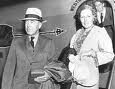
ERB And Florence Bid Goodby To LA
Tarzan novels seem more complex after repeated readings and just sitting and thinking about them. When I first read Tarzan And The Madman I Thought it was a throwaway. In the interim between that first reading and the present I’ve spent a fair amount of time in the Tarzan oeuvre and the Burroughs corpus while having written several hundred pages. One would think it would get easier but it doesn’t.
This novel was written by Burroughs in exile in Hawaii. He’d been run out of LA a couple years previously. Once the possessor of a magnificent collection of cars and planes and a vast estate becoming of the creator of Tarzan he was now living on 250.00 a month in the island paradise. He had returned to his poverty days at Sears, Roebuck in Chicago. Life’s like that.
On one level then Madman can be interpreted as a record of his feud with MGM and subsequent exile. Just look at the disdain on his and Florence’s faces as they board the plane for the last outpost of America. Tells a story in itself.
The MGM feud began with the release of Trader Horn. The book Trader Horn itself can be traced back to the Cave Girl. The movie of Trader Horn led to MGM’s first sound Tarzan. Thus Rand, the false Tarzan of the novel, can be seen as the Weissmuller portrayal of Tarzan in the MGM films. ERB was greatly offended by MGM’s notion of Tarzan hence this novel’s hero Rand is The-Man-Who-Thought-He-Was-Tarzan, a false god made to seem insignficant by the real literary Tarzan.
One should note that the real Tarzan is an intruder in the make believe Tarzanic world of MGM. The Mutia Escarpment on which the action takes place first came into existence in Trader Horn then was perpetuated through five MGM Tarzan films. The sixth MGM movie took place in New York City, of course. That one hadn’t been released as yet.
The opening sequence is even a parody of MGM’s Tarzan, The Ape Man in which an old coot shows up in Africa with his beauteous daughter who is then abducted by Tarzan who doesn’t know any better. There’s a certain amount of humor then when the real Tarzan of Mad Man wants to know who’s been abducting women in his name besmirching his reputation.
The false Tarzan who we may as well designate as Rand to make things easier, after a false start abducts the White woman, Sandra Pickerall, of the Scots Ale fortune taking her to the Mutia Escarpment. The ascent to the Escarpment is nearly identical to the ascent in both Trader Horn and Tarzan, The Ape Man. Burroughs adds his usual lion hoopla having a menagerie of them at the base of the Escarpment who are fed human flesh.
Once on the Escarpment Burroughs fleshes out his story with the usual Lost Civilization theme. In this instance the civilization is derived from Medieval Portuguese invaders of Moslem lands who were defeated in battle retreating to the Escarpment where they built their castle and established their life while becoming a milk chocolate hue. At one point Burroughs says they were part of a seventh century contingent, again Crusaders and yet again having been there four hundred years. So take your pick.
Rand has been there believing himself Tarzan for two years. He, of course, is suffering from amnesia caused when he was parachuting into the castle having been slammed against a wall causing his trauma. He and friend Bolton-Chilton were flying into Africa when in a replication of the MGM movies they entered a clowd bank to find themselves face to face with a mountain wall. In the ascent the plane malfunctioned so having cleared the Escarpment the men were compelled to bail out. Bolton-Chilton was captured by the Moslem/Galla rivals of the men of the Portuguese city of Alemtejo and enslaved. So, is this novel all roads lead to Alemtejo.
Since Rand descended from the sky Christoforo Da Gama, the king of Alemtejo, takes him for a god. I will deal with the religious aspect in the next section. If Rand is a god then Da Gama insists that Rand must have a goddess sending him forth to find one. Hence Rand abducts a number of Black women who prove unsatisfactory to Da Gama who insists on a White Goddess leading Rand to abduct the only possible candidate, Sandra thus besmirching Tarzan’s hitherto unsullied reputation.
After a series of adventures Tarzan arrives before the gates of Alemtejo. Both he and Rand are of the same general build and resemble each other enough to cause confusion but on closer examination their faces were not alike. As it chances when Tarzan arrives Rand and Sandra have absented themselves in the pursuit of freedom.
Interestingly Tarzan’s entrance into Alemtejo parodies the arrival of the Greek hero, Theseus into Athens. As Burroughs thought he invented the name Numa for lion, not realizing he had retrieved from memory the name of the Roman king, in all likelihood he didn’t realize that he was basing the entry of Tarzan on the entry of Theseus.
In the Greek myth Theseus dressed as a woman, don’t ask me, the scene is reminsicent of the Gilgamesh epic of Sumer in which a temple prostitute entices the wild man Enkidu into joining civilization who tears her garment in half giving half to the man, anyway as a transvestite, Theseus draws the jeers of observing workmen. To put them in their place Theseus picks up a bull and throws it over his shoulder. Like I say, I’m working on it but without the semblance of a clue.
Tarzan by replicating the feat wins the admiration of the Alemtejo general who proclaims Tarzan the true god, they overthrow the old order, march on the Moslem Gallas using new tactics devised by the new god and overthrow the Moslems.
The victory scatters all the protagonists who then have to come together.
As with the MGM movies there is a huge gold mine involved. In the movies there is a great seam of gold with huge nuggets lying on the surface so that all you have to do is pick them up. So in Mad Man the two villains Crump and Minsky in company with Rand discover the mine.
Here Burroughs depicts the worthlessness of gold in the manner in which he disparaged the Father of Diamonds in Tarzan And The Forbidden City. Overcome by their greed the starving and dehydrated Crump and Minsky gather more gold than they can carry killing themselves in the process.
Tarzan, Rand, Sandra and Bolton-Chilton as surviving Europeans come together. Sandra convinces Tarzan, who had vowed to kill Rand on sight, that he is merely deluded having lost his memory. Bolton-Chilton turns out to be the buddy who having parachuted from the same plane as Rand had been enslaved by the Gallas.
It turns out that Rand was so entranced by the story of Tarzan that he bet Bolton-Chilton he could live as Tarzan in the wilds of Africa for a month. He was on the way to do so when the two had to bail.
In their seach for the easy way down from the Escarpment the foursome come across Rand’s plane that had landed and coasted to a stop rather than crashing. Rand pumps up the the tires, fixes the carburetor and all four of them fly away. Thus Burroughs rewrites the MGM movie in a more plausible and entertaining way retrieving Tarzan from MGM in a sense.
As in real life Burroughs was exiled from LA so Rand, Sandra and Tarzan are exiled from Africa. Tarzan’s African adventures cease. Just as the Communists had driven Tarzan from Opar so now MGM drives Tarzan from Africa. The next adventure would take place on a mysterious island in the Indian Ocean while the last Tarzan adventure takes place in Indonesia during WWII. A sad ending for the Big Bwana.
Of course the Africa of Livingstone and Stanley on which the Tarzan series was based was also a thing of the past. The Tarzan stories couldn’t have continued to have been wirtten without becoming retrospective. Even the Lesser Tarzan films that succeeded MGM became exotic fantasies rather than African adventure. It was the end of an era.
Beginning in 1932 with the first MGM talkie the Big Ape man began to slip away from ERB’s control. Mad Man records the sad fact that the pale MGM imitation of the ape man had supplanted the real thing. It must have been a bitter moment for ERB writing in Hawaii.
We don’t know why he didn’t publish Mad Man. He placed the story in his safe where it remained until the early sixties when it was discovered and published. It seems likely that as of this date but few have even read it. Of those who have, most probably discuss it as a tired rehash of the themes of doppelganger, amnesia and perhaps the last of terrestrial lost civilizations.
I found it the culmination of those themes. ERB’s long examination of the nature of psychological doubles was drawn to a satisfying conclusion as the false Tarzan awoke from a long sleep to realization. Perhaps the same was true of Burroughs as he viewed his lost hero in the lost land of LA from his place of exile in Hawaii just beforfe the bombs from those airplanes began to fall.
Next an examination of the religious aspects of this amazing novel.
Themes And Variations
The Tarzan Novels Of Edgar Rice Burroughs
#23 Tarzan And The Madman
by
R.E. Prindle

What A Long Strange Trip It’s Been
In everyone’s life there comes a time to recapitulate. Tarzan And The Madman was that time for Edgar Rice Burroughs. The Great Saga began in 1912 and in this novel of 1940 unpublished during his lifetime the long strange trip, to quote the Grateful Dead, came to an end. The Big Bwana and his imposter got on a plane and flew out of Africa never to return.
Two more unpublished novels in his lifetime would follow but they were placed in the Pacific either in or near Indonesia. The succeeding Tarzan And The Castaways was also unpublished during his lifetime while Tarzan And The Foreign Legion could find no takers so was published by ERB, Inc. It almost seemed as though the sun had gone down on the Great Ape Man.
Of course the movie Tarzan still prospered, first with the great Johnn Weismuller and then Lex Barker. ERB even tips his hat to MGM by replicating the flight through the fog to the great tabletop of the Mutia Escarpment, an MGM invention. Thus, the last game is played out on the MGM playing field. Just as ERB and Florence left LA on a plane so Rand and the Goddess and Tarzan do Africa in this novel. In a short 157 pages ERB manages to recap the Big Fella’s entire career in print or on film.
In reading through the book this last time I suddenly realized the significance of all those doppelgangers. They signified the problem ERB was having realizing his ambition to be the man who was Tarzan. In Madman he gives up the ghost realizing his failure to become the Man-who-thought-he-was-Tarzan but wasn’t. Now typing away in exile from LA on Hawaii he throws in the towel.
As I have tried to show in my other reviews ERB read Robert Louis Stevenson’s The Strange Case Of Dr. Jekyll And Mr. Hyde probably sometime before 1890 within four years of its issue. The book must have been a sensation during his years at the Michigan Military Academy, the subject of endless discussions among the cadets. As hard as it must be for us to realize what we consider a classic was an exciting new book for ERB. No movies could be made of it because the technology hadn’t been developed as yet. Even the primitive Nickelodeons were shimmering a ways into the future. Yea, verily, the future lay before them.
The novel was significant enough to be in the first batch of talkies being produced in 1931. I’m sure ERB was transfixed as the story unfolded on the screen. The theme of psychological doubles had dominated the Tarzan oeuvre from the beginning. While it seems repetitious to a first reading of the novels the theme is actually developing as the series progresses. ERB didn’t so much fall back on a cliché but he was working out a variation on the theme of Jekyll and Hyde.
He says that he was convinced that every man had two sides to his personality, perhaps not as pronounced as that of Jekyll and Hyde but there nonetheless. He was aware of his own duality chronicling it in the pages of the Tarzan oeuvre. The duality is often prompted by a blow to Tarzan’s head. The blow certainly commemorates the hit ERB took in Toronto while perhaps the aftermath split ERB’s personality so that he became two nearly different people. Perhaps that’s the secret of his writing career as he said that he was able to disappear into the alternate reality when he wrote.
Tarzan always had two personalities from the beginning. He was both a civilized man and a beast. This undoubtedly represents ERB’s feelings about himself. Perhaps he had periods when he was something of a wild man, not unlike Tarzan on the Rue Maule in The Return Of Tarzan who became a beast and then shook himself back into a human not unlike the transformation of Jekyll and Hyde. This type of duality would characterize the Russian Quartet, the first four novels.
The Tarzan true doppelganger first appeared in Jewels of Opar where having received a blow to the head he loses his memory during which he lived as an uncivilized beast, regaining civilization with his memory, but he had not yet split into two co-existing separate identities. That would first occur in Tarzan And The Golden Lion and Tarzan And The Ant Men when the great character of Esteban Miranda served as a doppelganger. Esteban was identical to Tarzan in appearance but an arrant coward compared to Tarzan. This was a characteristic of all the doubles. Esteban represented the negative pre-success side of ERB while Tarzan the positive post-success side. Thus in these two novels ERB is beginning the attempt to become Tarzan- The-Man-Who-Thought-He-Could-Be-Tarzan.
ERB was very sensitive about his early failings in his relationship with Emma. In these two novels he offered Jane/Emma the chance to recognize him as the strong Tarzan and not the weakling Esteban doppelganger. Having overcome the failures of his past he felt he had proven himself as a man and a supreme provider demanding recognition. Given the decision to make Jane/Emma chose ERB’s former existence, Esteban, thereby sealing her fate. After her ill fated choice Jane disappears from the oeuvre except for the chance encounter in the succeeding novel Tarzan Lord Of The Jungle whereas the Golden Lion assumes a prominent role.
While the next double, Stanley Obroski, appears in Tarzan And The Lion Man a double of sorts in the form of Lord Passmore makes his appearance in Tarzan Triumphant. Another double appears in Tarzan And The Leopard Men when felled by a giant tree in a storm Tarzan blanks out assuming another persona. Also, in Tarzan And The City Of Gold Valthor serves as a double. In a strange variation ERB repeats the story of Jewels Of Opar when Tarzan rescues Jane from the Arab boma. Here, in an exact duplicate of that scene, he rescues Valthor. Thus Jane and Valthor are connected in ERB’s mind.
In Tarzan And The Lion Man Burroughs kills off his weaker persona thus assuming the role of Tarzan himself. Then in Tarzan And The Forbidden City Brian is his look-a-like although the role of double is not explored. Perhaps this is the initial realization the ERB has failed in his quest to be Tarzan.
After a decade of trials and tribulations struggling against the Communists and MGM and losing ERB sat down in exile at the beginning of 1940 to write this confession of defeat.
The man-god Tarzan himself remains the same but The-Man-Who-Thought-He-Was-Tarzan but failed confesses his defeat getting into his airplane up there on MGM’s Mutia Escarpment flying out of Africa forever. First he was expelled from Opar by the Communists and then from Africa by MGM.
Although Tarzan was in the plane with him, the Big Bwana shows up again in Africa for a moment in Tarzan And The Castaways. This novel written in a style entirely different from the rest of the oeuvre was also unpublished during Burroughs lifetime hidden away in a safe.
In this novel Tarzan is defeated by a Black chief, symbolically perhaps, captured and sold as a wild man, a feral child. Once again Tarzan has lost his memory reverting to a pure beast or feral boy. As this novel was written after King Kong and Tarzan ends up on yet another island perhaps ERB was conflating the movie with this novel. Tarzan is put aboard ship with the other animals destined for the circus and taken from the continent.
Running all through Burroughs is the ghost of Jule Verne’s Mysterious Island. Once aboard ship a storm assaults the ship which, signficantly loses its rudder. Thus like the now rudderless Burroughs the ship is adrift. In a scene reminiscent of both Verne’s novel and Robert Louis Stevenson’s Kidnapped the ship is tossed atop a reef while all aboard including a Noah’s Ark of animals find their way to shore as the Castaways.
Stevenson and Verne were two of ERB’s earliest influences thus ERB returns full circle to his origins.
In the last Tarzan novel and the last published in his lifetime, Tarzan And The Foreign Legion, at the very end the fugitives from the Japanese army approach the remains of the Mysterious Island that after the volcanic explosition of Verne is a mere spire of rock in the vast ocean. Not a refuge in the world left for Tarzan or ERB. Like Capt. Nemo a submarine surfaces to rescue Tarzan and the Legion from a watery fate.
It seems amazing that as an honorary Frenchman Tarzan was never placed in a situation with the real French Foreign Legion. Perhaps P.C. Wren had preempted the genre with his magnificent FFL trilogy which left no room for ERB’s imagination to operate.
The long odyssey had ended. ERB could not imitate his man-god but he left him to us as an avatar for the coming New Age. What a long strange trip it was and for us, will be.

Johnny Weissmuller- The Image Of Tarzan
Part II follows.
A Review: Tarzan And The Jewels Of Opar by Edgar Rice Burroughs
August 19, 2009
Themes And Variations
The Tarzan Novels Of Edgar Rice Burroughs
#5: Tarzan And The Jewels Of Opar
by
R.E. Prindle
Part 1:
On The Road To Opar
I have put off reviewing this Tarzan several times. I like it but I find it difficult. This may have been the first Tarzan book I read, probably in 1950. While I have always liked Tarzan And The Ant Men and Tarzan The Terrible Opar was always my favorite.
Of course in 1950 one’s choice was limited to eight or ten, not including the first, so I read the later novels only recently. Tarzan And The Lion Man is my current favorite. Opar was written in 1915 about a year after the commencement of The Great War, the occupation of Haiti and war scares with Mexico. This was also after ERB’s first spurt that ran from 1911-1914. The latter year emptied the pent up reservoir containing the residue of his early reading and experiences. That period may be described as ERB’s ‘amateur period.’ The latter part of 1914 began what may be described as his professional life as a writer. The spontaneous automatic period was over; he had to think out his stories. That meant he had to do some new reading. Opar coincided with his completion of reading Gibbon’s Decline And Fall Of The Roman Empire. What effect that may have had on Opar I’m not sure.
At the foundation of ERB’s approach to his stories are the three titles of Twain’s Prince And The Pauper, Burnett’s Little Lord Fauntleroy and Wister’s The Virginian. After 1914 he would refer to Jack London and write a series based on the style of Booth Tarkington. While he continued to produce during the twenties, the period was also one of intense reading that produced the magnificent stories of the early thirties. That need not concern us here.
While his favorite three books were the rock on which he built his church, the Oz stories of Baum contribute to the superstructure as they do so prominently in Tarzan And The Jewels Of Opar. The second chapter is even titled: On The Road To Opar. ERB only left out the yellow brick and changed the Emerald City to Opar. It is clearly indicated that Opar is based on the Emerald City.
Rather than being emerald Opar is red and gold. La, the high priestess of Opar can be considered a combination of Baum’s Ozma and Rider Haggard’s She.
The Baum connection is strengthened by the fact that, as I believe but can only conjecture at this point, Burroughs visited Baum at his Hollywood home during ERB’s residence in Southern California in 1913. One guesses but it is probable that ERB got some pointers from Baum on how to keep the Tarzan series going as Baum was producing volume after volume of Oz stories. In point of fact Baum had run out of ideas in 1910 attempting to close off the series. He was compelled to restart the series in 1913 at the insistence of his fans.
Burroughs had effectively closed the Tarzan series with The Son Of Tarzan. Son is a favorite of a lot of people but for me it’s pretty much a rehash of the first three stories; I call the four The Russian Quartet after the villains of the series. Tarzan was already old in Beasts Of Tarzan but by Son he had to come out of retirement. There was no future then, so the Big Bwana had to be reborn. The old Tarzan ended with Son; the new Tarzan began with Jewels Of Opar. A fine new beginning it was.
The Ballantine edition of 1963 prefaces the story with a quote titled: ‘In Quest Of A Lost Identity’, that might easily be changed to ‘A Search For A New Identity’, for in fact, Burroughs old identity had been lost when he gained success and riches. ERB wanted to go forward not back:
Tarzan staggered to his feet and groped his way about among the underground ways of Opar. What was he? Where was he? His head ached, but otherwise he felt no ill effects from the blow that had felled him. He did not recall the accident, nor aught of what had led up to it.
At last he found the doorway leading inward beneath the city and temple. Nothing spurred his hurt memory to a recollection of past familiarity with his surroundings. He blundered on through the darkness as though he were traversing an open plain under a noonday sun.
Suddenly he reached the brink of a well, stepped outward into space, lunged forward, and shot downward into the inky depths below. Still clutching his spear, he struck the water and sank beneath its surface…
Tarzan loses his memory at great stress points in Burroughs’ life. They take place at Opar in underground caverns surr9unded by a wealth of gold. One might think then that they are related to Burroughs’ financial success and through La to his sex life.
One must bear in mind that ERB came into the beginnings of his success just as he was edging into the mid-life crisis. Given a reasonable amount of money in 1913 he reacted in a nouveau riche manner. Remembering back to 1899 and his private railcar trip to NYC and back he tried to relive it with Emma. His trip with Frank Martin troubled his memory. He recalled it 1914 when he took the job on the railroad in Salt Lake City. In 1913 he packed the family aboard with all his belongings and rode out to Los Angeles and San Diego. He may very well have rented a whole Pullman car for himself and family that would be equivalent to a private car but we don’t know for sure at this time. We only know that he was fixated on a private car and that he rode first class.
We can be sure that he was realizing all his dreams as fast as he could earn the money to pay for them or perhaps before he had the money.
He was moving through uncharted territory thus ‘he blundered on through the darkness as though he were traversing an open plain under a noonday sun.’
ERB has his eyes wide open but the unfamiliar demands being placed on him were equivalent to darkness: he couldn’t be sure whether he was making the right decisions. ‘What was he? Where was he.’ This is a dilemma of the newly successful. And then by late 1914, early 1915 he realized that he was in over his head.
Suddenly he reached the brink of a well, stepped outward into space, lunged forward, and shot downward into the inky depths below. Still clutching his spear, he struck the water and sank beneath the surface…
What? Of course. McClurg’s released the first Tarzan as a book in 1914 treating the release in what seems a peculiar way. The contract had been signed, apparently perpetual and unbreakable, ERB, Inc. only bought it out in the fifties, so he must have realized that he had been had. He committed the same error in 1931 when he signed his contract with MGM so he didn’t learn much over the years.
His contract would certainly have been a contributing factor but there may have been other sources that put him in over his head. It is significant that Tarzan didn’t drop his spear; he was still capable fo defending himself.
Now, one would have to believe that Burroughs was at least famous in Chicago. By 1917-18 Tarzan was a household word recognized it seems by everyone. It would be odd indeed if sexual temptations weren’t placed before him. Literary groupies surrounded authors then as groupies did musicians in the ’60s.
La herself is a repressed sexual image while the novel abounds in sexual images. Perhaps signficantly when the rutting elephants charge the priests of Opar Tarzan takes refuge in a tree high above the ruckus. Even then the rutting elephants try to uproot his tree to bring the Big Bwana to earth but do not succeed. One may infer that while temptation was strong ERB remained faithful to Emma.
However by 1918’s Tarzan The Untamed, note the title, Jane is killed while Tarzan’s eye immediately wanders forming a near dalliance with another woman. It was also at this period that ERB walked out on Emma. As told in Tarzan The Terrible, note the title, and Tarzan And The Golden Lion Tarzan and Emma were separated through those two novels and Tarzan The Untamed.
So, Jewels of Opar may be describing the dark side of success when the master tempter attacks you at your most vulnerable plus Burroughs was in full blown mid-life crisis by 1914-15.
The forces of change were shaking him like a terrier shaking a rat. His situation was terrible and wonderful at the same time. So, with Tarzan And The Jewels Of Opar he launched himself on his career as a professional writer.
Part 2.
The novels of Burroughs previous to Opar had flowed from his experience and early reading. The reading had provided the framework that ERB fleshed out with his interests, ideas and experience in essentially an allegorical form. David Adams quite justly points out that Burroughs relies quite heavily on a fairy tale format although it took me a long time to recognize it. ERB’s wonderlands are lands of enchantment as much as that of Mallory’s and Pyles Arthurian England. That is certainly clear in this book.
Now Burroughs has to actually invent and construct a story from scratch. Once again he relies on his reading. The first chapter titled The Belgian And The Arab encapsulates his reading and perhaps watercooler discussions of the Belgian administration of the Congo with the depredations of the Arab slaver Tippu Tib as gleaned from Stanley’s two tremendous adventures, Through The Dark Continent and In Darkest Africa.
In the first Stanley encountered Tib on the upper Congo, Lualaba he calls it, when Tib was just beginning to extract the Congo tribes for slaves. A few years later Stanley encountered Tib on his way across the Congo from the West to East. By that time Tib was halfway across the Congo basin toward the West depopulating it on his way. In this story Achmet Zek is based on Tippu Tib while Albert Werper, the Belgian, meets him well into the Congo moving up river as in Stanley’s In Darkest Africa.
Werper, as a Belgian, epitomizes King Leopold of Belgium’s administration of the Congo. For a few decades the entire Congo Free State as it was then known was his personal possession Tippu Tib or no. As such he had to make it pay and make it pay he did. Rubber was the engine of that prosperity. As the tree was not yet cultivated as Firestone would in Malaya, the Africans were required to collect balls of rubber from the wild. Not naturally inclined to collect rubber some harsh disciplinary measures were required to give them incentive. One method if they failed to bring in their quota was to cut off their right hand. Seemingly counter-productive it was nevertheless effective although there were a lot of Africans walking around with only a left hand. In Leopold’s defense the method was suggested by Africans themselves.
Leopold made money but incurred the hatred of Africans while giving himself an atrocious reputation in Europe and America. The Belgians removed the Free State from his administration after which it became known as the Belgian Congo. Thus Burroughs unites two men of evil reputation in the Belgian Albert Werper and the Arab Achmet Zek. They naturally conspire evil.
ERB also leans on Joseph Conrad’s Heart Of Darkness for his opening episode. Heart Of Darkness was Conrad’s most famous work and it may be said his reputation has been founded on it. A sensation when published it is or was still widely read today.
The opening scene takes place at the Stanley Pool where the Congo begins its descent from the plateau. Perhaps the post was the nascent Stanleyville. Werper commits his crime then flees into the jungle where he is captured by the Arab Achmet Zek/Tippu Tib.
The Belgian and the Arab are two of a kind forming a natural partnership with Zek being the senior partner. Zek may have been able to carry on his depredations without hindrance except for the Great White Lord of the jungle, Tarzan. Thus Burroughs rectifies the situation in his imagination. Prior to Werper Zek had no way to reach the Big Bwana but with the European Werper he has an entree.
Jane, of course, will be captured to be taken to the North to Algiers or Tunis to be sold into a Moslem harem. That would have been a nifty trick from the Congo to the Mediterranean. The walk alone might have taken a year or more.
So, as the chapter ends the plan is to kill Tarzan giving Zek a free hand and capture Jane.
Part 3.
Chapter two ‘On The Road To Opar’ introduces what will be a recurrent theme in Tarzan’s life- insolvency. In this case the Big Fella has made a bad investment, not unlike Burroughs’ habit, and been wiped out. Being now impoverished he has to recruit a new fortune by taking several hundred pounds of gold from the vaults of Opar.
Tarzan justifies himself:
…the chances are that they inhabitants of Opar will never know that I have been there again and despoiled them of another portion of the treasure, the very existence of which they are as ignorant of as they would be of its value.
Thus, the Zen question, are you stealing from someone if you take what they don’t know they have or its value somewhere else? I would be interested in ERBs justification of what seems to be a felony. After all Tarzan isn’t going to show up with a brassband and waving banners; he’s going to sneak in and out hopefully unnoticed. It’s too late to ask now.
The raid on Opar may have reflected ERB’s financial condition after 1913-14’s stay in San Diego. He had to write another Tarzan novel to recoup his finances.
As Tarzan is about to leave, Zek and Werper have concocted their plan. Werper is to gain admittance to the household under guise of being a lost great white hunter and prepare the way for Zek. Werper posing as the Frenchman Frecoult overhears Tarzan and Jane discussing Opar quickly realizing there is more at stake here than killing Tarzan and selling a White woman into a Sheik’s harem in the North.
He warns Zek while following Tarzan on the road to Opar.
Chapter 3 is titled The Call Of The Jungle. As On The Road To Opar reflects Baum’s Oz stories so the Call Of The Jungle resonates rather well with Jack London’s Call Of The Wild. the jungle that Tarzan inhabits is a wonderful place, no bugs, no mosquitoes. In Africa the land of fevers that would still be unknown if Europeans had not invaded the continent Tarzan never has one. We know that ERB read Stanley. That explorer speaks of no romance of the jungle. For him it was a dark dank horrible place he couldn’t get out of fast enough. He not only suffered terrible fevers but so did everyone else. Yet in Burroughs’ imagination the jungle becomes a paradise.
Perhaps that might reflect thte lost paradise of America conquered by industrialism and cities. Perhaps in its way it represents the White City of the Columbian Exposition as opposed to the Black City of industrial Chicago. Idaho vs. Chicago; something of that order.
Now hungry Tarzan kills a deer with his favored bare hands method plunging Dad’s knife deep into its heart. Dad’s knife and plunging it into the heart of its victim. There’s an image. ERB had a terrible relationship with his father. Perhaps he visualized the relationship as his father killing him with heartaches. Haven’t actually worked out the meaning yet. Interrupted by a lion he retreats to a tree with a haunch between his strong white teeth. Another sexual image. Now, here we have another psychological problem. Tarzan is a very unforgiving guy, petty even. Having been disturbed in his dinner which surely must have been a frequent occurrence in the jungle, he is not going to let the lion eat his kill in peace. Up in his convenient tree he finds another tree nearby bearing hard fruit. Not the soft mushy kind but hard. He bombards the lion until it leaves the kill.
The lion slinks off after his own game, a lone African witch doctor. Tarzan doesn’t care if the lion kills the African but just as his dinner was disrupted he wants to punish the lion by depriving him of his. So just as the lion mauls the African Tarzan jumps on the lion’s back and kills him merely for interrupting the Big Guy’s dinner. You know, that’s capital punishment for a very minor offence. This is a little excessive to my mind.
What does it say about ERB’s own state of mind? Was he also unforgiving and draconian in his revenges? ERB himself mostly stood in his relationships as the African to the lion. There is a certain irony in the symbol of MGM being Leo The Lion. In his last major confrontation with MGM, Leo mauled ERB pretty badly. There was no room left for revenge in that struggle.
The mauled witch doctor had appeared in Tarzan Of The Apes. He recognized Tarzan but was unrecognized by the latter.
In his youth he would slain the witch-doctor without the slightest compuncition, but civilization had had its softening effect on him even as it does upon the natives and races which it touches though it had not gone far enough with Tarzan to render him either cowardly or effeminate.
From this we may infer that ERB believed Europeans and Americans to have become effeminate and cowardly. Perhaps so.
The witch doctor reminds him of Mbonga’s village of the old days when they made Tarzan the god Munango-Keewati and now he makes a prophecy:
…I shall reward you. I am a great witch-doctor. Listen to me, white man! I see bad days ahead of you…A god greater than you wil rise up and strike you down. Turn back, Munango-Keewati! Turn back before it is too late. Danger lurks ahead of you and danger lurks behind; but greater is the danger before. I see…
And then characteristically he croaks. Werper was behind and Opar ahead. But what was danger to the Big Bwana; danger was his life. Of course ERB could have been talking about himself as well. Certainly by this time ERB must have realized that success and fame was going to be no bed of roses. He needed more money to continue his new life style. Could he get it now that his first spurt was finished. He had been warned by his editor Metcalf that most pulp writers had success for a couple years but then exhausted their sources. He must have feared that he was already there.
A new period of anxiety loomed before him, probably debt behind. As Tarzan is about to lose his memory, stress may have been addling ERB’s brain. Nevertheless impelled by necessity- onward.
Part II in another post.
A Review
Thuvia, Maid Of Mars
by
Edgar Rice Burroughs.
Part III-C

Review by R.E. Prindle
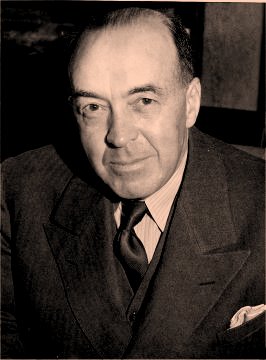
Edgar Rice Burroughs
Civilization And Its Malcontents
Let us say that for the fifty years or so before the 1920s there was a growing sense of societal malaise. This malaise was reflected most notably in the creation of Edgar Rice Burroughs’ psychological projection, Tarzan Of The Apes. One has to account for the immediate acceptation by society of such an absurdity. Tarzan, in fact, completely rejected civilization for the life of the romantic ‘unrestrained freedom’ of the jungle. The noble savage in fact.
Thus in a metaphor Burroughs reflected the malaise of his time so brilliantly that his creation was accepted as virtually a real person. Writers like Grant and Stoddard put the same theme into more scholarly terms. As noted, contrary to Richard Slotkin’s idea, Grant had little or no influence on Burroughs while the slightly later Lothrop Stoddard whose three relevant works appeared only from 1920 to 1922 could have had no influence on Burroughs’ formative years. It seems probable that Burroughs did read Stoddard and was influenced by his work but only after his ideas were fully formed. Even then The Revolt Against Civilization appeared after Burroughs had examined some of the same problems in his rejected manuscript, Under The Red Flag of 1919.
The problem of the malcontents and their war on civilization was examined by a number of writers during the twenties and thirties so why Slotkin singled out Burroughs, Grant and Stoddard isn’t as clear as it might be. Postwar German cinema was intensely concerned with the matter as why should it not? Germany was under asault by what Stoddard called the Underman. Nor need Slotkin think Stoddard was alone. I’m sure there were dozens of forgotten books prophesying the end of the world by one means or another including the Undermen of Communism.

The Underman, or the Communist, was not even a term unique to Stoddard. Gustave Le Bon, the French scholar on whose work Sigmund Freud based his study Group Psychology And The Analysis Of The Ego wrote prolifically on the psychological foundations of the Underman. Freud based his book on Le Bon’s 1895 study The Psychology Of Crowds. Unless I’m mistaken he based his 1930 study Civilization And Its Discontents on Le Bon’s 1921 book The World In Revolt: A Psychological Study Of Our Times.
On the cinematic side the problem was examined in the great silent films The Cabinet Of Dr. Caligari and Fritz Lang’s 1922 film Dr. Mabuse, The Gambler. Lang would follow that ten years later with the sound film The Testament Of Dr. Mabuse.
Even though Buroughs’ Under The Red Flag was rejected in 1919 he persisted, rewriting and extending the text into the 1926 story, The Moon Maid. This story reflects a possible reading of The Revolt Against Civilization but such a reading was much more evident in 1934’s Tarzan And The Lion Man.
The development of the problem was evident to all these writers which it seems to have escaped Slotkin who attributes the recognition of societal evolution to mere ‘racism’ in the writers. One thinks that perhaps Slotkin is too involved in his own agenda.
Rider Haggard enunciated the problem quite clearly in his 1888 novel Allan Quatermain in which Quatermain grouses about the ‘strict limits’ of civilization compared to the ‘natural’ life of the African Zulus. It might almost seem that the idea of Tarzan arose in Burroughs’ mind from that observation. In fact science was undermining all the comforting beliefs that mankind had been settled in for a hundred thousand years. During that long period characterized by the mental mode of what is called mythopoeic thinking man’s mind devoid of true knowledge projected a vision of reality that resulted in the notion of God. Thus reasoning from insufficient knowledge man’s mind came up with an erroneous result. You can’t get out of a mind what isn’t in it; all education is suggestion.
As Freud was to say, man’s settled view of reality received its three great shocks when Galileo disproved the geocentric notion of the universe, Darwin disproved the uniqueness of man’s position in the animal kingdom and he, Freud, displaced the conscious mind with his vision of the unconscious mind. Once again Le Bon was there ahead of him.
Thus as the nineteenth century opened and progressed the bases of mankind’s notions of reality were shattered leaving him emotionally and intellectually bereft of foundations of belief. Adrift without an anchor.
As if that were not bad enough the great cataclysm that ushered in the modern era, The French Revolution, was based on the the absolute notion that not only were all men created equal but remained equal in all aspects of their existence. The advance of civilization would toss this certainty into the trash can of history also.
As civilization placed greater and greater demands on the intelligence and self-discipline of men and women the incontestable gap between those less intelligent and those more intelligent became more and more obvious. Thus as the century progressed the notion of the Overman and the Underman began to become clear.
At the same time the first tentative efforts at measuring the intellectual potential of the individual began to become possible. Of course the basic inequality of men and women in its physical aspect had always been apparent. Some men were naturally stronger and better muscled than others. But, even that was changing. The science of physical culture was making it possible for the 98 lb. weakling to develop himself into a man mountain. Thus artifically developed srongmen like the Great Sandow ushered in the golden age of the strong man topped off by Charles Atlas who guaranteed he could turn you into a man mountain if you followed his program.
There was the promise that you could dethrone that bully and kick sand back in his face. On the other side Francis Galton was originating the first primitive tests to measure intelligence potential. Burroughs would have seen both proponents during his miraculous summer of 1893 at the Chicago Columbian Exposition. I mean to say that both facts entered his mind where they could be digested and emerge later. Nothing can come out of your mind that didn’t go in it.
And then after the turn of the century Binet devised he first actual IQ test. Thus, just as Sandow and Atlas could measure the size of muscles, the psychologists became able to measure the intelligence potential. Those with high IQs were set up; those with low IQs were cooked. The upshot was that all men were not created equal nor could they ever attain intellectual equality.
To a very large extent what became the Communist Party recognized the inequality while demanding equality against reason. Recognizing subconsciously, perhaps, that men could never be intellectual equals rather than try the futile task of raising the less fortunate they sought to destroy education which brings out the inequality but doesn’t create it. No matter what happens there are always going to be the more intelligent just as there will always be the physically stronger. As Le Bon points out, if you needed to hear it, nature don’t know from equality.
Thus the Communist Party devised the well sounding slogan- From each according to his ability; to each according to his need. Good plan for the needy, slavery for the able. The needy were organized beginning their struggle to achieve superiority by collective action. This was accomplished in Russia in 1917. The battle was joined.
Just as individuals are created with different capabilities so are peoples and races. Some can achieve and some can’t. Slotkin who must be a Communist thus takes offence at what he perceives to be, and is, an attitude of White Supremacy in Burroughs, Grant and Stoddard. While I am aware there are those who will disagree with White superiority it is nevertheless not an attitude but an evolutionary fact. That is the reason Communists have Darwin under attack. While Darwin doesn’t say it, it is the inevitable result of his studies. Just as it was necessary for the Undermen to destroy education in the hopes of creating intellectual equality so it became necessary to destroy White achievement of the last five hundred years. The whites must be demonized and made to feel evil and inferior morally. That is the import of Slotkin’s Gunfighter Nation.
At that level all three writers are guilty. As has been stated in Canadian courts- Truth is not a defense. So there’s nothing to discuss. Might is right and whoever has the might will prevail.
It is a fact that all three writers were anti-Communists so it may be assumed that whatever Communists believe, they didn’t. And why should they? Might may be right but it can still be nonsense. Communism is a flawed ideology based on a false premiss. It always fails wherever it is introduced. Failure is not evidence of a bad plan in Communist eyes. One just continues to shovel sand against the tide and pray. So succeed or fail they always think they can succeed by the same flawed ideology. The fault for failure lies elsewhere.
In that sense Burroughs was wasting his time assailing this religion of failure with his Under The Red Flag and its successor The Moon Maid. The only people who would applaud his effort would be we non-Communists but he could never convince anyone with Communist leanings. Of course that wasn’t well understood at the time.

If Burroughs were accused of not believing in equality that would be true. Not only are John Carter and Tarzan superior to any contemporaries on two worlds but Burroughs has a whole hierarchy of value. John Carter is the Warlord of Mars ruling from the top city of Mars, Helium. The races of Mars pretty much reflect those of Earth and their relative stations. The main exception is the ruling Red race. As Whites do and have existed on Mars in Burroughs stories while at one time being the dominant race perhaps the Red race is some sort of amalgam of the various Eropean immigrants of the United States. I believe the Green Men represent the American Indian. Both roam the great plains while being essentially savages.
Tarzan though always spoken of as being White is described as a bronze giant. Bronze is a fairly dark metal so that Tarzan and the Red men of Mars may be more or less identical in color.
Tarzan is the man-god so there are none superior or even equal to him. Below him come the English who are the cream of mankind. Perhaps slightly below the English are the French and then the rest of the Whites. Tarzan himself is psychologically an animal having been raised by the Apes. Not your ordinary gorilla or Chimp but a species intermediate between Gorilla and the Negro. Slotkin hasn’t read enough Burroughs to make an intelligent comment but the undeniable attitude of Burroughs is enough for Slotkin to condemn him as an unregenerate bigot. The reader may believe as he likes. I have stated my opinion eslewhere and that is enough. Whether any of these opinions of Burroughs influenced American soldiers at My Lai is open to question. The burden of proof is on Slotkin and he hasn’t provided it.
Along with the Undermen however, speaking through Tarzan, Burroughs is heartily discontented with civilization.
The spectacle of Chicago of the 1890s as a dirty unpleasant place haunts Burroughs. In contrast to the great White City of the Columbian Expo was what was afterwards known as the Black City of everyday Chicago. The contrast was so strong and so offensive to the Undermen that within a year of the Expo’s closing the entire White City was burned to the ground with the exception of one building. Hence perhaps the decayed crimson and gold ruins of Opar and the crimson and gold twin cities of Helium. One wonders what effect the sight of the ruin of the White City had on Burroughs when he revisited the site sometime after his miraculous summer of ’93. The mind creates nothing from nothing so there must have been models of the great cities of ERB’s imagination.
There are points at which Burroughs and Communism have quite similar views. It will be remembered that Burroughs only reluctantly married and throughout his life expressed discontent with the institution. To some extent or other ERB must have been an advocate of free love. Communists would have heartily approved of ERB’s women who went nude except for certain ‘adornments.’ Communists of course want women to be accesible to any man who wants them at any time while they have always advocated bare breasts.
In many ways when the Communists appropriated Tarzan for the MGM movies it took but slight changes to make Tarzan conform to their ideals. The MGM Tarzan and Jane were not married. While Burroughs’ Tarzan was a highly educated on-again off-again sophisticate the MGM Tarzan was a stupid illiterate oaf and one who rejected the attributes of civilization high up there in the Cloud Cuckoo Land of the Mutia Plateau.
On the essentials though Burroughs rejected the demands of the Underman as The Moon Maid clearly shows. There was very little in Stoddard’s The Revolt Against Civilization that Burroughs would have disagreed with. At the same time there was probably very little he didn’t already believe although he had never codified his information as Stoddard had. Slotkin’s contention that Burroughs was influenced by either Grant or Stoddard is surely wrong. ERB had already taken hs positions before either men had begun to write.
Each writer was, in his own way, an advocate of White Supremacy. It now become clear that White Supremacy has nothing to do with a fringe element in Liberal ideology. All Whites are White Supremacists in that ideology unless they reject ‘White skin privilege’ whatever that is. Ayers and Dorhn explain in their recent Race Course In White Supremacy. Interestingly constructed title. Nor as Slotkin would have it is the attitude based on mere racial pride and bigotry but on a solid record of achievement unattained by any other people. The quesiton is not was it right for some people to rule or be supreme because in the nature of things some people will rule and be supreme but which of the peoples are most qualified to be supreme.
All people have had equal opportunity so that one can only conclude that the race has gone to the most qualified participant. In the contest the Whites unified the other peoples against them as must inevitably be the consequence of being the top people. As they say, getting there is the easy part; staying there is the hard part.
Slotkin merely represents the envious losers, the Undermen. who clutch at any firebrand to burn the White House down. Who is most to be admired and emulated? Builders or destroyers?
Finis of Thuvia, Maid Of Mars Review
The High Brow And The Low Brow
The Mucker And Marcia Of The Doorstep
Part VI
Living On Tulsa Time
by
R.E. Prindle, Dugald Warbaby and Dr. Anton Polarion
Livin’ on Tulsa Time.
Livin’ on Tulsa Time.
Gonna set my watch back to it,
‘Cause you know that I’ve been through it,
Livin’ on Tulsa Time.
– Danny Flowers
During the ’60s a lot of energy was put into the notion that one live in the HERE and NOW or someone else’s impression of the NOW. There used to be a big San Francisco poster with nothing but a black background with the giant word IS in white. NOW IS NOW.
They didn’t know how much they were asking. It is impossible to actually live in the NOW; No one can do it. Rather the past is a drag on NOW preventing a full involvement with the present. The period of time it takes to digest the previous NOW and update to an approximate notion of the current NOW is excruciatingly slow. The sharper the break between the past and present the more traumatic the reaction.
In the song Living On Tulsa Time the singer, no matter what time zone he is in sets his watch to Central Tulsa time.
I know where that one is at. One of my shattering breaks with the past was when I went active in the Navy in ’56. Sent from Eastern Standard to Pacific Standard I kept my watch set to Eastern Standard time nearly the whole three years of my enlistment. I only switched to PST in 1959 when I accepted the fact that I would never return East; that California was my new home.
Brought into contact with a new NOW I was still not ready for the present. I continued to dress as we did in ’56 well into the sixties. Got hard to find some new duds. I only ceased dressing that way when I became a Hippie in ’66 and adopted fantastic Hippie garb. I was an urban spaceman:
I’m the Urban Spaceman
I’ve got speed,
I’ve got everything I need.
I don’t feel pleasure,
I don’t feel pain,
If you were to knock me down
I’d just get up again.
I wake up every morning with a smile upon my face.
My natural exuberance spills out all over the place.
-Neil Innes
I was really NOW there for just a little while but I wasn’t alone. As Bob Dylan said, everytime I looked back the past was just behind. When the Hippie era ended I reverted to a modified 1956 style. The past came back again. All those screaming about living in the NOW in ’67-’69 are still back there claiming they’re still living in the NOW but time has passed them by. I didn’t wait around, baby, I slid out into limbo and I’m doing fine now, thank-you.
Thus when ERB began writing in 1911 he was not so much concerned with his NOW as he was in vindicating his past from 1896 to 1905. His reality in those early novels from 1911 to 1915 continue to reflect his earlier travails. Thus in the group of novels embraced by The Girl From Faris’s he is trying to vindicate his past to his present and hopefully to his future.
After nineteen-fifteen he was released from his past to a large extent and began to concentrate on adjusting to the NOW of his altered circumstances. Change is NOW and ERB was going though a lot of ch-ch-changes. His nerves were jangling as he was jerked from time frame to time frame but he didn’t enter the Promised Land of NOW. Oh Lord, he might have prayed, if he could have seen the future- Deliver me from NOW.
Ten years after and a world of different NOWs the Mucker far in a distant past that had disappeared behind a cloud where he couldn’t see he tackled almost the identical theme in a different world, a fast moving world, a world where NOW was so strange it was unrecognizable from day to day. The political situation he had grown up with was no longer recognizable; it had been replaced by a new reality. He was almost living by two different clocks in some strange Einsteinian time zone where the guide posts had been removed and renamed and everything was relative to another reality that couldn’t be recognized by any clock ticking.
Living on Tulsa time in another time zone. There I was in ERB’s sunny Southland with my watch running three hours ahead of everyone else’s. It didn’t matter. I was on the water where time stands still for everyone. The crisis came in ’58 when I stepped back on land to journey through the time zones back to Eastern Standard Time. I was all alone out there, you know, cut off from a past I was soon to learn couldn’t be retrieved. Wolfe was right, you can never go home again. The only secure place, as dangerous and that was, was my ship. My terminal place was also a realtively secure harbor but I was stuck in the middle for six days between the time zones in which I had no place and no identity except the tenuous one of my leave papers. A queer cop threw them into the wind and let those blow away in Illinois. After that I was naked to the universe. I’ve hated cops ever since.
I wouldn’t recommend hitchhiking to anyone. My life was on the line for twenty-five hundred miles and six days. Twenty-five hundred miles and six days on the road without food or sleep. I’d add without drink but in a gas station in Gary I downed six seven ounce bottles of Coca-Cola in a row. Created a minor sensation.
After surviving a lunatic who picked me up on the western edge of the Mojave who wanted to kill me because he was convinced I had two hundred dollars on me, which by a strange coincidence I had, I was picked up Mountain Standard in the Panhandle of Texas by a couple homosexuals who wanted a different treasure I possessed and dropped off Central Time in Tulsa. My watch was only one ahour ahead by then. I was getting close to some kind of NOW or was I? No. Time is much more relative than that. I was soon to be living a strange combination of NOW and THEN.
Tulsa was a tough town. I don’t need to see Tulsa again. I wasn’t about to start living on Tulsa Time. I was an hour ahead which couldn’t have been better. I had to walk through Tulsa, hungry and thirsty. I spied a place across this great expanse of grass between it and the freeway. As I approached the place began to glitter. Fancy, but I could see a coffee shop at the top of a long flight of stairs to the left. I didn’t want to spend money so I thought I’d just get a glass of water.
Oh Dan, can you see
That great green tree
Where the water’s running free
Just waiting there for you and me.
Water…cool…clear…water.
But between me and the water was this big cowboy in high heeled boots, a tuxedo and ten gallon hat. Fancy goings on as I noticed ladies entering to the right in ball gowns escorted by tuxedos. I came prepared or thought I did. I was in my dress blues and my Uncle Sam told me I should never be ashamed of my uniform, it could pass for a tuxedo anywhere. Anywhere but Tulsa. That cowboy had never discussed the issue with my Uncle Sam.
I was bold but the problem was he had the advantage being on the landing at the top of the stairs and I had to climb the stairs to get past him. He had his fist doubled and these high heeled boots with those silver plates on the toes. That was a mean looking business proposition. I had a lot further to fall than he did. Get my uniform messed up and things. Then where would I be out of time and place? Whew! Why does one have to face tough choices?
I’m getting a drink of water, I said, trying to combine thoughness with masculine geniality a al the cowboy ethic.
Not here you ain’t. He said, making a move to kick me down the stairs.
Hey buddy, this is a tuxedo I’m wearing. I faltered.
His reply was not one of which my Uncle Sam would approve.
I left Tulsa still thirsty not liking cowboys any better than I liked cops. NOW has its perils.
A day or so later I was still in Central Time. Tulsa was a tough place and the rest of Oklahoma was no California. I was heading North now which kept me in the same time zone. Then I made the mistake of crossing the Mississippi into East St. Louis. After just a couple minutes I really liked Tulsa. Wished I was back there.
I don’t know what evil forces made me want to hitchhike across country, damn Jack Kerouac, but I was within a hair’s breadth of being sliced and diced on the streets of East St. Louis. Whould have tossed me in the river as so much driftwood. Three Black guys with switchblades in their hands kept inching toward me while I kept inching closer to the middle of the highway.
That morning some guy got in his car for a pleasant drive to Louisville. He decided ot go through East St. Louis for some mysterious but critical reason. He arrived in East St. Louis just as these three knives were deciding to make their move. This guy sized up the situation from a couple blocks away, slammed on his brakes throwing open the passenger door at the same time shouting ‘Get In’ for God’s sake get in, NOW.’ Novel experience for a hitchiker. I wasn’t sure I wanted to rush because if I made a break for it those three knives might move faster than i could. I hopped in casually casting a smiling glance over my shoulder. The driver peeled out of there nearly separating a hand from the wrist on the door handle. I was saved from that particular NOW and END but I was on the road to Louisville which was still a far cry from Eastern Standard which was the time zone I so ardently desired.
It took me another day or so as I had a lot of North to make up but I did get into Eastern Standard. Now my watch matched the time zone but there was a mismatch between the present and the past. Rather there were two different presents and pasts going on at the same time. Mine and theirs. I don’t think Einstein is right but well, maybe, time wasn’t that relative but the uses they and I were making of past and present sure were.
That’s where memory comes in which makes time and space so relative. I had been absent for two years and what I had been experiencing was much different than what they had been experiencing. They had actually been living on Eastern Standard Time while I was just pretending. I knew I was out of time. For me time had been rapidly changing but for them time had more or less stood still or, rather traveled in a straight line. To me they were still living in the past. Oh, they had aged a couple years but their trajectory was different and slower. Relatively they had stood still while I had rocketed away.
It was as though I had been a gamma cloud burped from some collapsed star in some galaxy a billion light years away. As is known once set in motion an object will travel in a straight line at the same speed unless some other agent interferes with it. It was as though I had been careening through space ripping apart the fabric of time and space or disregarding it completely as though it wasn’t there; at any rate completely unaffected by this fabric which apparently has no tensile strength, there was no gravity of any force that deflected my course in a curve while if space is curved I was traveling so fast I careened right off the curved track.
Who knows how many black holes i passed over without being drawn into the vortex; who knows how many puny suns I swept across without having one atom deflected by the puny gravitational pull of the strongest sun; who knows how many planets I depopulated. One billion light years and running, my speed and trajectory were the same as when I was emitted from that distant star.
Now, as though by some miracle here I was back where I began but in two different time zones at one time. Theirs and mine. Obvious I must have passed through a worm hole or fallen into a memory hole. We stared at each other blankly each unable to comprehend the other. They thought I have become weird,or perhaps weirder, because they had stood still while I had been careening through time and space in timezones they would never know.
I smiled and got on a bus, enough of the adventures of hitchhiking. One the way back to Standard Pacific Time I abandoned Eastern Standard adjusting my watch as I passed through Central Standard and Mountain Standard. I was not exactly living in the NOW but I was in the correct time zone.
Minor but vital adjustment.
So, when ERB caught up with himself in 1914-15 he was no longer living on Tulsa time. He was trying to adjust his watch to his current time zone.
But as he was careening through space and time, space and time was moving at an even more frantic pace so it was difficult for him to get his bearings.
Science was changing his world at a rate faster than the mind could follow. Events in the far off Detroit that he had known and loved as a young fellow were going to affect his life just a few years hence. In 1914 Henry Ford had shocked the industrial, moral and social world by ‘unilaterally’ doubling the wage for unskilled labor.
This was a violation of ‘natural law’ which is to say religious sensibilities. At the time a natural law of labor was believed and incorporated into religion. The law was that if only one man can do a job he can command his price. Skilled labor can demand more than unskilled labor but when anyone can do the job as in unskilled labor they will have to take what is offered. Thus Ford pitted science against serious religious beliefs.
At about this time a Judge in a labor dispute asked the strikers if they didn’t know they were going against God’s will on earth.
This was at the time when the Liberal Coalition was forming and there were strangers in the land, to use John Higham’s expression, who believed they truly represented God’s Will. There is no greater enemy to God’s Will on earth than Science and the Scientific Consciousness. If you recall the so-called Christian Scientists reject scientific medical cures preferring to depend on the Will of God. Apparently it has never occurred to them that a case of a ruptured appendix means God’s Will is death while a simple operation means life.
Nevertheless Ford upset the natural or religious order of things and had to be stopped. Ford himself believed he had discovered a universal law in mass production so that he was actually a prophet of his own new religion. Believing himself in the possession of the truth he acted accordingly seeking to apply his method to each and every problem. Thus when the Great War began it was deemed possible to negotiate with the participants on a personal level to get them to cease hostilities. Ford believed he could do it. The Strangers In The Land who were living on Babylon Time saw their opportunity to pit their religion against Ford’s science and they took it. The Man of Science was in their pocket. They convinced Ford to take a horde of well meaning but naive people to Germany for a confab with the Kaiser. Ford fell for it. This was the famous Peace Ship episode that shredded Ford’s reputation two short years after he had made it.
Ford always maintained that after the ship was at sea the Strangers revealed themselves telling him that only they could change the course of the war. They began it and only they could end it. When he returned home he found the Strangers in charge of the War Industries Board and they and the Wilson Administration were telling him how to run his business. Babylon Time had met the Twentieth Century and found it could make the clock run.
Ford with his universal panacea was not the kind of man to take this sort of thing lying down. Ford Motor Co. had as much cash laying around as Bill Gates and Microsoft does today. Ford put his money to use. These are complex times so I am going to edit out all information that doesn’t pertain to my moral.
Ford believed in his method. By applying it properly he saw no reason he couldn’t solve the age old problem of the Jews here and now. He thought reason would work, poor man, so he bought himself a library of Jewish studies, put his man Bill Cameron on the job to study the library and publish the results in his newspaper, the Dearborn Independent, that he bought to disseminate his reasonable solution to the problem. He made the Dearborn Independent a national newspaper, perhaps the first of its kind. He even had a distribution system handy. He made all his Ford dealers distribute the papers, even out in Hollywood, California.
The Independent made such a noise that the papers couldn’t be given the silent treatment.
The independent appealed to a very large number of people although Liberal historians have given the impression that the paper went unread. The paper didn’t go unread. Out in Hollywood a man named Edgar Rice Burroughs apparently read the paper assiduously. As, why not, even if you don’t agree with the premise of a movie like The Passion Of The Christ that doesn’t mean you don’t go to see it. I used to read The Christian Science Monitor and I’ve never been a Christian Scientist. I used to read the Daily Worker and I’ve never been a Communist. A lot of people did go see the Passion making it one of the most lucrative films in history and lots of people read the Dearborn Independent, even devoured it.
Each week the paper issued a new article exposing the true nature of the ‘Jewish Problem.’ The articles were well researched, reasonable and accurate, but as they criticized a religion, no religion will stand any criticism if they can help it, they were necessarily labeled heretical, infidelic, bigoted, anti-Semitist. In this case you can check anti-Semitist. From this particular religion’s point of view they were anti-Semitic but from a reasonable scientific viewpoint they weren’t and aren’t.
The Jewish reaction was strong and violent. As a member of the Liberal Coalition they called in their allies who branded Ford an anti-Semite and ostracized him. Then Ford was out there all alone. A major campaign of vilification and defamation was conducted against him. All the hypnopaedic media were called into play against Ford. William Fox, the Fox part of the later Twentieth Century-Fox, used his Movietone News shorts to portray every Ford that was in an accident as at fault and unsafe. Now that’s defamation with a capital D. By 1925 it was clear that Ford could use some allies.
Enter Edgar Rice Burroughs and Marcia Of The Doorstep.
As we know Marcia was never published so ERB’s aid was hypothetical. A reasonable question is what evidence do I have for ERB’s intent. I offer Marcia Of The Doorstep as my evidence and certain articles from the Dearborn Independent. As I’ve said before ERB in Marcia exhibits a seemingly involved knowledge of the theatre. I have been puzzled as to where he got it.
I think I may have his source. The original Ford articles were issued weekly beginning in 1920-21 later being collected into a series of four volumes entitled ‘The International Jew’. What I am dealing with here is literature and history. I have no concern in the nature of the Ford articles. My only interest is what Ford and Burroughs understood and how they expressed it. Leave it at that. (It wasn’t left at that. As of 10/27/08 this essay has been censored by being left out my catalog of essays and not mentioned under any of the tags; Old habits are hard to break, I guess.)
Like Burroughs believed, or as Burroughs understood Ford there are two types of Jews. The ordinary Jew who goes about his business and the international Jews who is causing all the mischief. Thus the title International Jew excludes the mass of ordinary Jews and refers only the the International trouble makers. For Burroughs there was the ‘type’ of Max Heimer corresponding the the International Jews and the type of Judge Berlanger representing the ordinary of ‘Good Jew.’
In Volume II of the Interntional Jew there is a series of four atrticles on the American Theatre.
The books themselves have long since been stolen from the libraries and destroyed in an informal kind of censorship but due to the wonders of modern technology they’re available on the internet. The relevant theatre chapters can be fund at the URLs below:
http://www.jrbooksonline.com/Intl_Jew_full_version/ij28.htm
http://jrbooksonline.com/Intl_Jew_full_version/ij29.htm
http://jrbooksonline.com/Intl_Jew_full_version/ij31.htm
http://jrbooksonline.com/Intl_Jew_full_version/ij32.htm
The first is entitled Jewish Control of the American Theatre of 1/121; the second: The Rise of the First Theatrical jewish Trust of 1/8/21; the third: Jewish Aspect of the Movie Problem; and the fourth Jewish Supremacy In The Motion Picture World of 2/19/21. I believe all the necessary theatrical information is contained in these four atircles. All were written in 1921 giving ERB plenty of time to involve himself by 1924.
As you may remember ERB was sent a copy of the Jewish Bill Of Rights in 1919 and it was demanded that he endorse them. Thus there are an additional three articles from Vol. II that may be applicable. They are found at:
http://jrbooksonline.com/Intl_Jew_full_version/ij34.htm
http://jrbooksonline.com/Intl_Jew_full_version/ij35.htm
http://jrbooksonline.com/Intl_Jew_full_version/ij36.htm
While the last three do not reflect on Marcia to a great degree they will provide a better backgrund to ERB’s thinking on the issues as he must have studied them carefully.
—————–
It is very probable that ERB coded information into the novel to let Ford know this one was for him. For instance Clara Sackett was probably named after Clara Ford. Could be coincidental but the engineer of the Lady X was named Sorenson while Ford’s Chief Engineer was Charles Sorenson. Given ERB’s obvious connection to the Dearborn independent which Ford would easily have recognized, if he would ever have read the book, I think the references are conclusive.
While on this topic I would also like to point out that when the ban on Tarzan movies was broken in 1926 it was done by the arch ‘anti-Semite’ Joseph Kennedy who owned FBO Studios at the time. FBO was a little later bought by David Sarnoff of RCA who formed RKO. Radio-Keith-Orpheum thus editing Kennedy and FBO out of the picture. Punishment?
Also if you want a lively account of these proceedings check out Upton Sinclair’s self-published Upton Sinclair Presents William Fox. Sinclair’s is a nice first person I Was There type thing plus when William Fox was driven out of the movies, this is really exciting stuff, he went to Sinclair with his story. so Sinclair not only lives through this from a distance but is told part of the story first hand. I just love this stuff.
I am not particularly concerned here with whether the Dearborn Independent articles are true and accurate, although I am sure they are, but my concern is that Burroughs read them, believed them and acted on them. Bearing in mind his contact with the AJC he had no reason to disbelieve the articles.
In the first article ‘Jewish Control Of The American Theatre’, after an introduction that relates Jewish activities in Russia to Jewish activities in the United States a general statement on the theatre is made:
The Theatre has long been a part of the Jewish program for guidance of the public taste (hypnopaedic media) and influencing the public mind…it is the instant ally night by night, week by week of any idea which the ‘power behind the scenes’ wishes to put forth. It is not by accident that in Russia, where they now have scarcely anything else, they still have the Theater, especially revived, stimulated and supported by Jewish-Bolshevists because they believe in the Theater just as they believe in the Press; it is one of the two great means of molding popular opinion.
Cameron should have mentioned movies and song publishing and he would have had the major elements of hypnopaedic conditioning so brilliantly illustrated by Aldous Huxley in his Brave New World.
As we all know Burroughs was opposed to the Bolsheviks; he undoubtedly believed as did any knowledgeable observer that the Bolsheviks were predominantly Jewish. We may believe that he endorses the premises of these article.
Further down (a shortcoming of the internet is that there are no page numbers) the article says:
Down to 1885 the American Theater was in the hands of Gentiles. From 1885 dates the first invasion of Jewish influences. It meant the parting of the ways, and the future historian of the American stage will describe that year with the word “Ichabod.”
Second paragraph below:
About the time that Jewish control appeared, Sheridan, Sothern, McCollough, Madame Junuschek, Mary Anderson, Frank Mayo, John T. Raymond began to pass off the stage.
———————
All that remained after the Hebrew hand fell across the stage were a few artists who had recieved their training under the Gentile school- Julia Marlowe, Tyrone Power, R.D. McLean and a little later Richard Mansfield, Robert Martell. Two of this group remain, and along with Maude Adams they constitute the last flashingsof an era that has gone- an era that apparently leaves no great exemplars to perpetuate it.
There you have the premise of ERB in Marcia and enough history to flesh out the fiction. The old school was gone. ERB then names several players as here. The last surviving exemplar of this tradition is Mark Sackett. But even for Mark there are no plays worthy to perform in. As a member of Abe Finkel’s troupe he condescends to perform in problem plays and the new sex comedy.
The article continues:
“Shakespeare spells ruin”: was the utterance of the Jewish manager. “High brow stuff” is also a Jewish expression. These two sayings, one appealing to the managerial end, the other to the public end of the Theater have formed the epitaph of the classic era.
So there you have the complete story of Mark Sackett.
He was the last of the breed, a fine old Gentile actor of the old school of pre-1885. Corrupted by the Jewish influence on the theatre he accepts demeaning roles.
When he comes in to money he tells Max Heimer that he is going to perform Shakespeare. Max takes the position that ‘Shakespeare spells ruin’ arguing for a Ziegfeld Follies type show, a problem play or a sex comedy which he feels is a surer hope of success than the ‘high brow’ stuff. Straight from the Dearborn Independent.
‘…the rage is for extravaganze and burlesque.’
Now,
In this manner was laid the foundation of the latter day Theatrical Trust. The booking firm was that of Klaw and Erlanger, the former a young Jew from Kentucky who had studied law, but drifted into theatrical life as an agent; the latter a young Jew from Cleveland with little education but with experience as an advance agent.
Thus Abe Finkel is probablly the Klaw of Klaw and Erlanger. It may be coincidence but Judge B-erlanger is Erlanger prefaced with a B. thus those two would reprsent Klaw and Erlanger. Another version would be Finkel and Heimer in Hollywood also patterned after the Potash and Perlmutter movies of Samuel Goldwyn.
The trust was resisted just as Mark Sackett resisted.
(From The Rise Of The Theatrical Trust)
The opposition offered by the artists was prolonged and dignified, Francis Wilson, Nat C. Goodman, James A. Herne, James O’Neill, (Eugene O’ Neill’s father) Richard Mansfield, Mrs. Fiske and James K. Hackett stood out for a time…
Mark Sackett held out then in defiance of theatrical wisdom forming a Shakespearean company. This might be seen as a form of the Little Theatre movement which Cameron says developed in reaction to the first Theatrical Trust.
So the basis for the New York and theatrical end of Sackett’s career may be said to have been inspired by the two theatrical articles of Cameron in the Dearborn Independent. ERB probably read them in newspaper form shortly after publication in 1921. Because of the AJC approach to him as well as heightened anxiety over the immigrant question caused by loyalty concerns in the wake of the War Burroughs was especially receptive to Ford’s concerns.
If the germ of the story was conceived in 1921 the concern over Ford’s struggle was becoming difficult by 1924 may have inspired Burroughs to come to his literary aid. Thus we have this story of Marcia which when examined more closely is very involved in post-war Revolutionary and Jewish problems.
While the novel was universally rejected for publication this was undoubtedly because of ADL censors closely watching the publishing industry.
One can’t be certain but it is possible that Burroughs would have been finished in Hollywood but for Kennedy’s FBO Studios breaking the blacklist on Burroughs in 1926. Jewish movies of Tarzan began again in 1927. After 1932s MGM film which in itself may have been a parody to discredit the Big Bwana, the property became so lucrative especially in a Depression Era climate, that movies continued to be made saving Burroughs from complete ruin.
The war on Ford continued. Henry Ford is an interesting figure who, like Burroughs, would continue to be a Judaeo-Communist target into the thirties and forties, to the end of his life and beyond.
Ford zipped into the NOW in the years around 1914 when his Model T transformed America. But then he slipped back into Tulsa Time. The Model T was so successful for him that he failed to keep up with developments in the industry. The Model T remained essentially the same until 1925 when a better Chevrolet overtook the Ford as the best seller.
Ford then did an extraordinary thing that baffled conventional minds. He shut down production for over a year as he designed the new Model A. For this model he revolutionized the industry by designing the V8. The Model A was an instant success reviving Ford’s fortunes but the present and the future were now so commingled, things were changing so fast that the NOW was gone before you sat down to dinner. Constant model changes were now necessary. The world that Ford had created had gotten away from him.
He realized that he had lost his battle with the Jewish establishment. He capitulated in 1927 when Louis Marshall of the Jewish government demanded an ‘apology’ to call off hostilities. Ford told him to write one out and he would sign it. Marshall wrote an abject apology which Ford signed without edits or reading. Marshall then had the ‘apology’ published, bound and sent to every library free of charge. The apology is easier to find than the Dearborn independent articles.
The fracas came to a humiliating end for Ford and the Scientific Consciousness. ERB’s reaction isn’t known, however on December 10, 1929 (ERB Bio Timeline 1920-29) in a letter to his son Hulbert he made these observation on Religion and Science:
A man can be highly religious, he can believe in God and in an omnipotent creator and still square his belief with advanced scientific discoveries, but he cannot have absolute faith in the teachings and belief of any church, of which I have knowledge, and also believe in the accepted scientific theories of the origin of the earth, of animal and vegetable life upon it, or the age of the human race…(Religious) enthusiasms and sincerity never ring true to me and I think there has been no great change in this all down the ages, insofar as fundamentals are concerned. There is just as much intolerance and hyprocrisy as there ever was, and if any church were able to obtain political power today I believe you would see all the tyranny and inustice and oppression which has marked the political ascendency of the church at all times.
You can’t be any more clear sighted than that. Here ERB has clearly and succinctly stated the religious problem of the twentieth century and beyond. His is an objective analysis of facts; religion is a subjective projection of desires and wishes. As he notes science and religion cannot be reconciled. As he goes on to note in the conflict between the objective and subjective, the conscious and unconscious, the tyranny of the unconscious is an unavoidable fact. The question of which religion he fears would impose all the tyranny, injustice and oppression was clearly the Liberal Coalition and more especially the Jewish element of its multi-cultural diversity.
We now come back to Richard Slotkin and his charges against Burroughs as the ‘mastermind’ of My Lai. that an objection was lodged against Burroughs because he was interested in Eugenics can be discarded. People of all political persuasions were interested in Eugenics. If any abuses of Eugenics were made, Burroughs didn’t make them. Besides, it’s a matter of how you interpret Eugenics. The half man, half beast of Stalin is obviously an objectionable use.
On the score of whether Burroughs was an anti-Semitist, which is what Slotkin really means, from a subjective religious point of view that may be so but it is not a question for the religious to decide; they are not competent to do so. Sigmund Freud himself said that religion is a neurosis. (That means a departure from mental health.) If he is to be respected as a scientific genius why shouldn’t we respect his opinion? If religion is a neurosis then it should be treated as a mental disease.
On a Scienfitic basis then is it possible to call Burroughs an anti-Semitist? Clearly not. The man was a clear minded rational human being of great achievement and should be honored as such.
Should his scientific opinions differ from those of a religious bent it is they who must take a back seat not Burroughs.
Slotkin is clearly wrong in his interpretation of Burroughs. Slotkin represents the unconscious rather than the conscious.
For the foregoing reasons then I think that Marcia Of The Doorstep and 1924 was the pivot of ERB’s career. After 1924 it was no longer possible for him to live on Tulsa Time. He came under attack from the Liberal Coalition which was as formidable for him as it was for Henry Ford.
His novels after Marcia reflect this attack. Those novels are perhaps his greatest. Certainly one of the high points where he meets his enemies head on is Tarzan The Invincible that he was forced to publish under his own imprint. The title says it all.
I may be sentimental but I like Marcia Of The Doorstep. I only wish he had had the patience to flesh out the ending.
ERB wrote well in any time zone there was from Babylon Time to Tulsa Time to the NOW.
You know that I’ve been through it
But I just can’t go back to it.
There is no living on Tulsa Time.
NOW is the time.
End of Review
The High Brow And The Low Brow
The Mucker And Marcia Of The Doorstep
Part V
Marcia Explicated
by
R.E. Prindle
The contrast between The Mucker and Marcia Of The Doorstep can be seen as a response to two different challenges united by Burroughs’ personal psychological development.
He took the whole of 1924 to write this story so it may have been a real struggle. Unlike his other novels he doesn’t record a beginning and ending date in Porges so we have no accurate idea of how long it took him. It is possible that he had taken so much time, felt the need for money so intensely, that he rushed the ending through to try to sell the story. One the other hand he usually scamps his endings.
An indication that Emma may have been an influence in the planning and organization of the story is that it concerns matters that were very familiar to her. Just as she was a voice student as a girl, so Marcia. As Emma had to give up the studies so does Marcia.
The milieu of the stage would have been more familiar to Emma, although having gotten involved with the movies ERB might also have familiarized himself with the stage somewhat. I would have to opt for more involvement from Emma though. (For further thoughts on this read Part VI)
Unlike the other novels which feel as though they were written from the top of the head, Marcia has indications of more careful plotting. If that is true I don’t think ERB would have been capable of it so that would argue for more involvement by Emma once again. This is also a fairly complex plot that differs from ERB’s usual style.
Unless I’m mistaken the novel, even though unpublished, landed him in hot water with the AJC and ADL. I’m sure the reason would have been a mystery to ERB. If you’ve read Part II, Section II what I have to say will be clear, if you haven’t read the Parts I recommend it.
According to the Religious Consciousness there is no freedom of speech concerning the specific religion. The Religion will control who is speaking, what is said and how expression is to be allowed. ERB was not a member of the Jewish religion and as he was speaking unacceptably he was perforce an anti-Semite as the religion he was discussing was Judaism. Had he been discussing Liberalism he would have been pathologized as a crazy bigot. As Judaism was part of the diversity composing the Coaliton, Liberals would have considered him a bigot anyway. Bigot is the Liberal equivalent of anti-Semite.
The character in question is the shyster Jewish lawyer, Max Heimer. Max is an expecially well drawn character from the viewpoint of the Scientific Consciousness, which is to say, Max is accurately drawn. Whether from life or not is not yet known.
Max is the protagonist of the story. That anything happens at all is because of him. He is not an admirable character but on the other hand he is neither truly malicious or evil. The only thing that matters to Max, and would especially offend the sensibilities of the AJC and ADL, is the bucks. Max would probably stoop to outright thieving but he is a blackmailer, a swindler and a cheat. While what he does is criminal it is done in such a way as to escape detection. Even if you know he’s guilty the chances are you could never get a conviction.
But, he’s not really a bad guy at heart and by his lights he’s darn near a philathropist.
Max is always on the qui vive. One has the impression that he never lets an opportunity pass. Thus, one night he came across a drunken gentleman on the street, John Hancock Chase II. Chase II for some reason was totally incapacitated. Heimer took him home sensing an opportunity.
Max had been living with a woman, out of wedlock, named Mame Myerz. Although Mame wasn’t at home Max conceived the notion to tell the married Chase II that he had had sexual relations with Mame which he did nine months later when he showed up to tell Chase II he was a proud papa. Max would keep this a secret for a fee. Unable to sustain the blackmail Chase II shoots himself ruining a perfectly good source of income for Max. This is no skin off Max’s nose as he blithely goes about his and other people’s business for the next sixteen years.
That fine old gentleman, John Hancock Chase I bears the loss of his son stoically.
As it happened Della Maxwell bore her child and left it on the Sackett’s doorstep on 4/10/06.
If Max is finely drawn, no less can be said about Marcus Aurelius Sackett and his wife Clara, the long suffering wife of the air headed Mark, who is especially finely depicted. Just a few deft strokes but she is always in the background worrying over her man. Either I’m projecting from knowledge or ERB is able to portray a large loving woman who accepts the foibles of her husband, tolerating him and perhaps even loving him for them.
Both she and Mark are overjoyed at the child left on their step. They are no less overjoyed when Della shows up next day to move in with them. Della Maxwell is a well chosen name. Max-bad, Max-well.
Mark Sackett is ably portrayed as an actor of the old school who while he fumes at the modern trash of the stage is nevertheless the kind of trooper who doesn’t leave his fellows in the lurch. At this time in New York City he is working for Abe Finkel. Abe is obviously another Jew modeled on the producers Klaw and Erlanger. This is at the time of the development of movies from 1905 to 1914 or so.
In 1919 ERB moved to Hollywood where he would have been privy to all the stories of the origins of the studio owners who with few exception were Jewish. Most were from New York while Carl Laemmle was from Chicago via Wisconsin. They all had risen from mundane occupations to real wealth. Samuel Goldwyn had been a glove salesman. Harry Cohn had been a street car conductor, Louis Mayer had had a string of jobs worthy of ERB himself so it will be historically accurate for both Max and Abe to turn up in Hollywood as studio owners.
ERB was very good at weaving real life stories into his writing. There are probably real life models for many of these characters and their stories may be based on true stories as they say in Hollywood. For instance, Marcia’s first boyfriend Dick Steele goes to Hollywood as a stunt pilot where he meets his death, some mgiht say committed suicide, in a spectacular airplane stunt. As it turns out ERB didn’t make this story up from scratch but merely, fictionalized an actual event that occurred on a movie lot in 1920. William K. Klingaman tells the story ERB used in his popular history ‘1919’ of 1987.
Lieutenant Ormer Locklear moved to Hollywood in February 1920, where he originated many of the airplane stunts used in the movies. (He was the first aviator charged with reckless driving in the air, when he looped the loop over a public park in Los Angeles in April.) In the summer of 1920 he was working on a film called, “The Skywayman”; the last stunt was supposed to be a shot of a pilot plunging to his death with the plane in flames. Just before he ascended to film the sequence on the evening of August 3, Locklear turned to friends and said: ‘I have a hunch that I should not fly tonight.’ Spectators on the ground watched and marveled at the stuntman’s skill. Then they suddenly saw the plane only two hundred feet from the ground, struggling to right itself. It crashed in flames. Locklear died instantly, the farewell letter to his mother that he always carried with when he flew was found undamaged.
As ERB had no experience with the theatre and as his stage stuff seems fairly authentic and knowledgeable he may have borrowed stories like the Locklear tale and adapted them for his uses or else Emma had a fund of stories which she supplied for the novel. At an rate these first 125 pages are full of charming detail about the theatre.
Now safe in LA ERB even takes a loving poke at hometown Chicago. Della Maxwell explaining her breaking of an engagement in Chicago says on p. 30:
“I couldn’t stand (Chicago) any longer, Uncle Mark…It’s a hick town, filled with coal dust, wind and tank town talent. And slow, say, if I’d smoked a cigarette on the street I’d a been pinched for sure.”
Max Heimer keeps the story moving along when he visits the Sackett household as the legal representative of some unpaid actors. While there he notices the sixteen year old Marcia. Learning that she is sixteen his mind clicks back to 1906 when his and Mame’s plan fizzled when Chase II committed suicide. Ever on the qui vive he learns that Marcia was left on the Sackett’s doorstep on 4/10/06 which conincidence he can put to use.
Ever shameless and brazen, they call it chutzpah, he contacts Chase I to advise him that he has found Chase II’s illegitimate daughter. He’s picked the wrong man because the Senator, that fine old example of early American manhood, refuses to have anything to do with him however he has his Jew, that fine old examplar of the race, Judge Isaac ‘Ike’ Berlanger contact Heimer for him. If his son’s daughter is out there the fine old gentleman feels obligated to take care of her.
Probably already in deep for selecting a chosen person for a villain ERB begins here to really compound his error in the confrontation between ‘Ike’ Berlanger and the wily Max Heimer. Woodrow Wilson during his first administration appointed the first Jew to be a justice of the Supreme Court. This was Louis D. Brandeis of Louisville, Kentucky. Just as the Liberal Coalition propaganda machine remorselessly pilloried its victims so it equally exalted its favorites. Brandeis has been depected as a wise old saint for so long no one questions it. FDR in his administration referred to Brandeis as our ‘Isaiah’ whatever that might mean.
ERB doesn’t usually go far to find his models so I’m suggesting that Louis D. Brandeis was the model for Judge Berlanger. Alright. ERB probably thinks he’s going to get away with portraying ‘a Jew of the type; of Heimer by presenting a ‘fair and balanced’ picture of a ‘Jew of the type’ of Brandeis/Berlanger. Doesn’t work that way as Charles Dickens, who was accused of being an anti-Semite, found to his dismay when he balanced a Jew of probity against the villainous Jew, Fagin, of Oliver Twist.
One should always bear in mind that the very worst of a Chosen People is better than the best of the rest. Thus all heroes must be from the Chosen while the villains must be from the rest. So it is that all the villains currently have Anglo-Saxon/Teutonic names while all the heroes are of the Liberal Coalition.
Thus ERB was very ill advised to meddle in these proto-Politically Correct matters. Even though the entertainment industry of the twenties had been thoroughly Judaized he should have made Heimer an Anglo-Teuton while he was on track by making Berlanger an element of the Coalition.
The exchange between Berlanger and Heimer very likely sealed ERB’s fate for the next several years while he confessed his error in his portrait of the wise old Jew in The Moon Maid in attempt to do his penance. I can’t recall any more references to Jews in the corpus after this period. If you know of any, let me know.
The result of the conference between the two Chosen ones is that Senator Chase I is to settle twenty thousand on the Sacketts while providing Marcia with an income of a thousand a month.
Here ERB goes into some interesting ruminations on the effect of coming into money when you’ve never had any. Probably by 1924 he was wishing he had his finances to do over although he does say of Mark Sackett that he would never learn the value of money.
The intention of Heimer was to receive the twenty thousand from Chase, keep fifteen for himself and give five to the Sacketts. Berlanger is ahead of him giving the twenty directly to the Sacketts. Don’t rule out Max yet though; he’s one canny Scot.
Watching Mark come into money provides some amusing moments and an insight of how it had been with ERB. Mark goes out and buys a car which allows ERB to work in his accident with the taxi in Chicago. Charming passage though.
The old ham Sackett decides to use the money to bring back the glories of the stage; he wants to organize a touring Shakespearean company. There is some really nice wordplay as he attempts to inform Max of his plans. Max on the gui vive. He had not been denied that twenty thousand he had only been forestalled. He appoints himself the tour’s business manager so not only will he embezzle the tour’s profits but the original capital. But I get ahead of myself.
Bear in mind that all along Della Maxwell is aware of what a shyster Max is as she knows for a fact that Chase II wasn’t close to being the father of Marcia and she is also absolutely certain that Mame Myerz isn’t the mother. She keeps trying to warn Mark of what a shyster Max is without giving herself away to Mark.
As far as Max and the Sacketts go in the first 125 pages of the book, that covers it. The first third is of very nice quality, notwithstanding the ‘Politically Incorrect’ aspects. If ERB could have sustained this level of concentration throughout the book he would have had a truly excellent story.
Marcia is the other story line which has to be followed. When this precocious girl comes into her money, and twelve thousand dollars a year was nothing to sneeze at in 1922, her life changes also. Prior to the advent of her wealth she had been virtually betrothed to young Dick Steele. Marcia is troublesome as a character becasue ERB portrays her with such incredible maturity for a young girl. She’s barely legal, completely inexperienced but handles herself so well.
Dick with quick prescience realizes that this is the end of the line for his hopes but he’s going to hang on as best he can. He immediately quits school and gets a job in an airplane plant to make lots of money fast because he knows he’s going to need it. This employment leads to his job as a stunt pilot.
Marcia had been taking voice lessons for some time where she had met a wealthy young socialite named Patsy Kellar. When Patsy learns that Marcia is worth twelve thousand a year she invites her to join her circle. Marcia snaps into place like a memory stick in a digital camera. Personally I think ERB is pushing his luck here. The only thing that makes Marcia’s ability to fit in plausible is that she comes from a family of actors who may have aped the manners of the well-to-do. Indeed, ERB has speeches coming out of Sackett’s mouth that prove his ability to use the King’s English just in case anyone thought ERB was an illiterate, fantasy writer. ERB shows ’em how to in this one.
The Ashtons to whose circle Patsy belongs are about to take a cruise into the South Seas in their yacht, the Lady X. They think this sixteen year old flower of youth would be a delightful addition to their party. Which, in fact, she turns out to be.
Patsy takes her on a buying trip for clothes during which Marcia finds out how little a thousand dollars is. This also allows ERB to build some female interest a la Zane Grey to appeal to the lady readers of the Saturday Evening Post. So, the crew splits for Hawaii via San Francisco.
Now, when Chase II chose to exit rather than face the music he had a little son, Chase III. J.H. Chase III is now a twenty some odd Lieutenant in the US Navy and is stationed in- ready? Hawaii. Does he know Patsy Kellar and the Ashtons? Darn right. Old buddies. Welcome aboard. Chase III could have used his leave to go back to NYC to visit Grandpa but he opts for those soft South Sea breezes instead. Who can fault him except Grandpa and Grandpa doesn’t. Alright. So now he’s on board the Lady X with Marcia. All sixteen lovely years of her. Now begins the action of the middle part of the book.
ERB begins to fall back into his old ways although he has two stories to keep going. In the story of the Sacketts everyone considers Mark’s dream of bringing quality theatre to the heartland of America the height of foolishness but, I’ll be darned, the Heartland flocks to Mark’s performances to lap up the Bard. A little touch of culture really finishes off the man, you know. The tour is a huge success playing to SRO houses everywhere. The fly in the ointment is Max. The guy just can’t keep his hands off the money. He embezzles everything except for pocket cash of 300.00 for the Sacketts.
Stranded in San Francisco again, Max got the loot while the Sacketts got the hotel bill. The question is where did ERB get the story?
I had the haunting feeling the story was familiar. ERB didn’t have any theatre experience, nor did Emma, so he must have gotten the story, or combination of stories, really, from somewhere.
By 1924 he had been in LA for four years so he’d plenty of time to pick up theatre lore. The story of the tour sounds very close to the tour that brought Charlie Chaplin West. Chaplin wasn’t doing Shakespeare on that tour, that tour may have been another one ERB heard of. As I recall the Chaplin tour went bust in Salt Lake City also with Chaplin hoofing it to Hollywood.
In Salt Lake Max tells Mark that the jig is up, the show has gone bust, financially that is. Mark is incredulous as he has been playing to sold out houses but Max tells him there is no money and that is a fact difficult to argue about. Mark accepts the fact and, indeed, even if he knew Max had embezzled the money whatever records Max kept he said he had sent back to New York while as Mark was broke he couldn’t afford to sue anyway.
Now, let’s look to see if we can relate this to ERB’s life. ERB had had his best year ever after the move to LA in 1921 in which he earned approximately one hundred thousand dollars which might equate to the twenty thousand Mark received. While Mark lost his money in this improbable Shakespeare tour, or rather it was embezzled, ERB lost his on his pig farm. Who knows what was going on there? ERB had his income from 1919, 1921 and 1922 which must have amounted to from 200,000 to 250,000. Multiply that by fifty or so for inflation and that is a tremedous expenditure. It seems improbable that anyone could spend that much on a pig farm. Perhaps ERB thought someone had embezzled from him. Probably could use some investigation if for no other reason than to clear it up.
OK. Why Salt Lake City? If ERB is following Chaplin’s story then Salt Lake City would logically follow. However Salt Lake is one of ERB’s critical geographical locations. His interest in the Mormons hasn’t been properly examined although Dale Broadhurst made a stab in that direction. ERB made a special visit to Salt Lake in 1898 just after he purchased his stationery store. That was his first visit. Then in 1904 he and Emma resided there for several months during a very crucial period in his life, even a terrifying, desperate, excoriating one.
One that had him at his wit’s end shaking in his boots. While it is difficult to accurately pinpoint when his attitude toward Emma turned sour the several months in Salt Lake as a railroad shack may have been it.
Thus the tour breaking up in Salt Lake City may represent the beginning of the breaking up his marriage in 1904. The city certainly held a lot of memories for him.
Mark and Clara are left high and dry in SF. While Clara is out Mark turns on the gas and sticks his head in the oven. I’ve read that exact story before too but I can’t remember where. Or, perhaps, it is standard theatre fare.
From the Land of Fogs Mark and Clara wend their way down the coast to the Land of Smogs, the mecca of all actors. Mark is still too proud to work in the movies…but, we’ll leave the Sacketts in Hollywood while we follow out the story line of Marcia. This one is pure Burroughs.
While ERB has written Emma and himself into the story as Mark and Clara Sackett, Chase III and Marcia also represent his Anima and Animus. This central section is essentially a retelling of The Mucker ten years after. ERB no longer feels like the low brow scuzzy Billy Byrne, who was nevertheless ‘all man’, but is attempting the high brow Chase III. ERB has changed back from the Pauper to the Prince. His Anima presents a different problem. He didn’t feel up to Barbara Harding so he married her off to Byrne in Out There Somewhere. In Bridge And The Kid he scaled down from a New York socialite to the daughter of a big man in a small town. Gail Prim was apparently too much for the beat up hommy he was so now he scales down even further to a girl who is an orphan left on a doorstep to be brought up by strangers. Thus the role of Harding and Byrne are reversed. The Animus, Chase III, now has social standing while the Anima, Marcia does not. However everybody loves her and she is acceptable wherever she goes. There is some competition for her between the foppish socialite Banks Von Spiddle, the humorous name is a giveaway, and the military officer Chase III while the latter wins as might be expected given ERB’s prejudices. This very likely reflects the competition between ERB and Frank Martin that ERB won and is a recurring theme in his writing from his unpublished first story, Minidoka, and this one.
Just as there was a shipwreck in The Mucker so there is one here. Here ERB produces a new variation in that there are two life boats in one of which the best people were to go while in the other the muckers. In the turmoil of the storm and sinking Chase III and Marcia are separated from the first boat ending up with the muckers including the terrible Bledgo who obviously represents John the Bully as the storm represents the encounter on the street corner.
After the usual interval of several days adrift on the sea the crew spots the inevitable desert island. Going ashore the better people separate themselves from the worst of the muckers forming two parties which sends Bledgo searching for Chase III and Marcia. As the Animus represents the spermatic side of the body while the Anima represents the ovate Bledgo is really searching for the two aspects of Burroughs’ personality- the one he wishes to kill and the other to rape.
As the rest of Chase’s party realize that Bledgo only wants Chase III and Marcia they urge the pair to flee which they do. Bledgo doesn’t give up the search but pursues the pair up the mountain. There is a fight during which Chase III brings the butt of his revolver down on the forehead of Bledgo, reminiscent of ERB’s bashing in Toronto. The pair then continue their flight up the mountain.
In this sequence Burroughs takes vengeance on John the Bully by defending himself and his Anima as he felt he should have on the streetcorner while retaliating the horrific blow to the head he received in Toronto on his ancient enemy.
Thus as Chase III and Marcia continue up the mountain in a torrential downpour ERB’s Anima and Animus are reunited. He is a whole person again.
Reaching the top of the ridge they discover the best people singing, playing on the beach on the sunny side of the mountain. Thus ERB rejoins the people he was supposed to be among but was separated from by his encounter with John. How well this squares with real life is uncertain. It may just be wishful thinking especially as ERB is teetering on the edge of bankruptcy.
Incest and cannibalism are two recurring themes in ERB. The latter was a concern on the boat, the former now rears its ugly head. Chase III and Marcia reach the Philippines where they are to be married the next day however Marcia opens the mail waiting for her which includes a letter from Judge Berlanger. The letter advises her that Jack Chase is her half brother. Horrified and chagrined Marcia steals away in the night to take ship for San Francisco. SF and disaster again. It always happens that way for ERB in Baghdad By The Bay. Wonder why.
Aboard ship an entertainment is organized for which Marcia agrees to sing and act in a skit. She’s emaciated but that can’t mask her loveliness. Also aboard is a famous Hollywood producter. Needless to say Marcia is ‘discovered.’ A movie contract awaits her in Hollywood.
As I pointed out earlier there was a hiatus in the production of movies from Burroughs’ books from about the time he wrote Girl From Hollywood until 1927. Part was probably due to ERB’s writing on Jews in this novel but part was also due to his very negative portrayal of Hollywood in ‘Girl’. Thus just as he portrays a venerable Jew in The Moon Maid to atone for his portrayal of Heimer et al., here in this novel he lauds Hollywood as the home of the most wonderful people in the world. He reverses his portrayal of the director Wilson Crumb in the character of the kindly upright director Otto Appel, who also sounds Jewish.
ERB has now told two thirds of his story and is at page 295 of 351. He’s got a lot of story to go that he crams into the remaining fifty of so pages. Honestly, he needs at least two hundred to flesh out his story properly. Perhaps he had been at work on the story for most of 1924 during which he had generated no new income and wished to get the story off to the Saturday Evening P{ost for that fifty thousand dollar paycheck plus book rights. The amazing thing is that ERB doesn’t seem to have received advances from his publishers at any time. Also at this time things were getting strained between McClurg’s and himself. It won’t be too long before he breaks with them. We need more information on this aspect of his career.
So, Jack and Marcia are separated again while Jack has no idea where she may be. In the interval between their leaving and returning the world as they knew it had broken apart. No one was where they had been except Grandpa. Chase III runs into Pilkins, one of the sailors in SF. Pilkins had taken the same ship back with Marcia so he advises Chase III that she has gone to LA to be in the movies where Chase III follows.
I can’t think of a positive reference to SF in ERB’s writing. Either he just didn’t like the city or something happened there. If so, it would be good to know what.
At this time we have a whole crew in LA: The Sacketts, Marcia, Dick Steele, Banks Von Spiddle, Chase III, Max Heimer and Abe Finkel with Ike Berlanger to follow. This may be the alternative version of how the West was won.
I wish ERB had put more effort into this ending. Fleshed out this would be a pretty good story of the exodus of the entertainment industry from New York to Hollywood. This would be good first hand history of Hollywood at least, of which ERB was actually a fairly significant figure. I get kind of excited trying to piece together how it may have been.
ERB at one time had been allowed on the lots so we may assume that his production scenes were authentic as well as his depiction of Poverty Row. the latter was real where the more impoverished companies had their quarters. Mack Sennet had his quarters on Poverty Row. Sennet’s autobiography is well worth reading. Poverty Row is where F&H Studios set up business. Yes, after embezzling that thirty thousand dollars from Mark Sackett Max Heimer ran into his old acquaintance Abe Finkel. The two combined to form F&H. They are the one’s who give Dick Steele his start as a stunt pilot.
Max is about town where he runs into Mark Sackett frequently. Max is not a bad guy, in the same circumstances many another who had injured a man would hate him contriving to injure him further. Not Max. Once he’s got the money he’s a congenial fellow. He presses small loans on Mark who after all is only receiving his own again. Max, who undoubtedly has developed some pull, gives Mark leads to jobs that if Mark had taken them would probably have led to decent prosperity if not more. As Mark is too proud to accept movie roles he doesn’t follow up but Max does his best by him.
As I pointed out in Part III, Sam Goldwyn had revived the Potash and Permutter stories of Montague Glass filming the Broadway play in 1923 which was a great success. In 1924 he filmed In Hollywood With Potash and Perlmutter that was an equal success while probably charming ERB so much that he based the F&H Studios of Finkel and Heimer on the movie.
Here ERB compounded his error of the first part of the book by making the two Jews humorous and despicable. The inference is that because of their cheapness they were responsible for Dick Steele’s death.
Remember Mame Myerz? No sooner does Max make a few dollars than he takes up with a gorgeous starlet. Mame gets wind of this back in the Big Apple where she goes berserk. She immediately tramps into Judge Berlanger’s office attempting to sell him the true story of Marcia. The old Judge doesn’t give in that easy so Mame spills the beans that she isn’t Marcia’s mother and she wasn’t anywhere near Chase II.
Thus the way is cleared for Marcia and Chase III to marry; no danger of incest. Max hears of this putting the screws to Mame to retract her statement which she does. Now there’s enough doubt in Marcia’s mind that the marriage is off once again.
In Max’s last scene, I kinda hated to see the little guy go, Judge Berlanger, also now in LA confronts Max with the theft of Mark’s money. Chutzpah deserts the wily little attorney. Unable to brave it out with Berlanger Max accepts defeat turning his assets over to Mark. He was forbidden LA and New York in which places he hasn’t been seen to this day. By stories end I kind of liked Max Heimer although it would be best to go the other way if you saw him coming.
Marcia was lost track of after the Philippines. She has lost track of everyone else. She becomes a star but as she had taken another name no one knows where she is. They don’t go to her movies, apparently. Mark and Clara’s fortunes continue to decline becasue of his bullheadedness until finally their landlady turns them out into the street. This was probably how ERB and Emma felt when they had to leave Tarzana after only four years.
ERB’s situation must have created a lot of gossip. After all a famous author comes to town buys a huge estate, c;mon 540 acres? and within two years is in financial difficulties and after four a virtual bankrupt forced from the estate. Tongues must have wagged. I’d sure like to know what they were saying. Just exactly how ERB’s Hollywood contemporaries thought of him.
In the meantime, completely destitute, Mark accepts movie work. He is sitting on a lounge on the set when the star, Marian Sands, walks on the set. She sees Mark who recognizes her as Marcia and the family is reunited again.
Chase III arrives in LA in search of Marcia. He apparently never goes to the movies so he doesn’t make a connection between Marian Sands and Marcia Sackett. He enters a career of dissipation turning to drink and gambling. Too proud to contact granddad he runs through his money.
He has some amusing encounters with oilmen which probably reflect ERB’s own as he floundered around trying to find ways to make money fast. There’s a lot to be done here in researching ERB’s business doings in LA. Later in the decade he will get involved in the Apache airplane engine and airport development so it seems unlikely that he wasn’t trying to be a business success in the early and mid-twenties. Dearholt showed up a couple years later with movie schemes that ERB bought into so what was he doing in the business sense?
Chase III who has been hanging around the studios looking for Marcia rather than studying theatre marquees gets into the movies finally locating his loved one. Some direct borrowing from Merton Of The Movies here. Moving very rapidly and sketchily ERB throws in a couple suicide attempts as the couple get together. Resemblance between Edith Wharton and Scot Fitzgerald here.
Together again there is still no hope of marriage because of possible incest, even though Marcia will never love another or marry.
OK. Della Maxwell. Remember her? She’s back in Chicago in the hospital dying a slow death. Well, you know, she is Marcia’s mother. On her death bed, I mean, the pen falls from her fingers as she signs the letter to Marcia, she makes a clean breast of it telling the story, sending the bigamist marriage license, birth certificate, everything so there will be no doubt that Marcia is semi-legit and not related to Chase III.
We’re almost there do you think? Not by a long shot and there’s only ten pages left. The mail train with Della’s package is held up somewhere in Arizona. The bandits disappearing over the border with the swag that contains Della’s letter and little metal box.
Wow? What next? OK, ERB’s got a twist or two still hidden up his sleeve. Banks Von Spiddle- yes, he’s out there, too- has a ranch down in Mexico that the Revolutionaries of 1914 failed to expropriate. A guy with a name like Banks Von Spiddle ought to get lucky once in a while I should think.
He and his vaqueros go out coyote hunting. They have a good day, getting a full bag. The last coyote tries to hole up in a small cave where Von Spiddle blasts the life out of him. While he’s drawing the coyote from the cave he notices a decayed leather mail pouch kind of thing. What do you suppose that might have been? Yeh, right. Della’s letter and little metal box intact. Von Spiddle can be small or he can be big. He chooses to be big giving the info to Chase III and Marcia so they can be married and live happily for however long marriages last in Hollywood.
Thus ERB manages to compress a marathon into a hundred yard dash in the last fifty pages.
Over all a good enough story. Neither Collier’s, Saturday Evening Post nor anyone else wanted it so ERB lost a year with no income, or income from new work anyway. If he was living on edge at the beginning of the year he was still on the edge at the end. Whew!
How did he get out of that financial bind?
Part VI and End is the next post.
A Review: Tarzan And The City Of Gold Part 2
August 18, 2008
A Review
Themes And Variations
The Tarzan Novels Of Edgar Rice Burroughs
#16 Tarzan And The City Of Gold
Part 2
by
R. E. Prindle
The City Of Gold itself, which is a white and gold city, evokes the image of the red and gold ruin of Opar and the Forbidden City of the same title, as well as The White City of the Columbian Exposition. As Burroughs was writing construction was going on for Chicago’s second great exposition on the fortieth anniversary of the first. Chicago, incorporated in 1833, was about to present its Century Of Progress expo of 1933-34. So Burroughs would have had his mind redirected to the scenes of his childhood.
What I am going to suggest may seem far fetched to many but having gained some idea of the way Burroughs’ mind worked I think the suggestion plausible. Emmett Dedmon tells the following story about the Great Sandow at the ’93 Expo. If anyone doesn’t know Sandow by now he was the first great bodybuilder who also performed at the Expo. As Florenz Zeigfeld was representing Sandow there is a no reason to think of the story as other than a publicity stunt, but I leave the judgment to you. (Emmett Dedmon, Fabulous Chicago, 1953, NY, p. 235)
Amy Leslie, the drama critic for the News, described Sandow as a fascinating mixture of brute force and poetic sentimentality. On a walk through the Wooded Island…Sandow snipped a tiny cup from a stock of snapdragon. “now, when we were little in Germany,” Sandow told the astonished Miss Leslie, “we took these blossoms and pressed them so, and if the flower mouth opened, why that was a sign they were calling us home.” As Amy reported it, “he touched the tinted bud and its rosy lips parted in a perfumed smile.” Just as Sandow finished his sentence, a Columbian guard shouted that he had violated the rule against picking flowers. To emphasize the reprimand the guard seized Sandow by the elbow and attempted to push him away. At this effrontery Sandow lifted the surprised guard off the ground and held him at arm’s length, examining him as though he were a curious discovery. Miss Leslie, more conscious of the dignity of the law, persuaded Sandow to put the guard down, which the strong man did with an ouburst of German expletives and an explanation (in English) to Miss Leslie that he did not think much of humans as guards. “I prefer nice well-bred dogs,” he said.
This made a great story that made the rounds of the fair. The question is did 17 year old Burroughs hear it and did it make an impression on him? Strangely enough we can definitely answer that question in the affirmative. Nearly twenty years later Burroughs borrowed the incident for his first Tarzan novel. Not only that but he has Tarzan play the part of Sandow. So, Sandow, Tarzan; Tarzan, Phobeg.
At the end of Tarzan Of The Apes Burroughs replicates the Sandow scene on the Wooded Island when he terrorizes Robert Canler holding him at arms length with one hand. Thus in this novel Tarzan not only holds Sandow/Phobeg at arm’s length but raises him above his head throwing him into the stands. Burroughs usually has his characters going their models one better as Tarzan does here.
As Sandow was strolling through the Wooded Island with Miss Leslie so Tarzan strolls through town with Gemnon. Instead of picking a flower Tarzan notices a lion eating a human while no one takes any notice. Cosmopolitan Tarzan inquires for an explanation. Gemnon calmly explains the quaint custom just as Sandow so pleasantly explained his snapdragon story. Dragons, lions, all the same thing. Burroughs does a neat parody and makes his joke but the original was such a great story he can’t let it go.
Indeed, Tarzan’s habit of picking men up and tossing them around can probably be traced back to this one arm trick of Sandow’s. Like I said, you’ll probably think it’s a stretcher but I think it both plausible and probable. Can’t be absolutely proven of course, but we can and have proven that the incident left an indelible imprint of ERB’s memory.
That said and moving along to 1920-24 there is also a flavor of H.G. Wells’ utopian novel Men Like Gods to be found here. Once again Burroughs turns Wells’ utopia around a bit but the tour of Cathne with Gemnon seems to be a paraody of a similar tour in Men Like Gods. ERB was still in the thick of his literary duel with Wells at the time.
The plot involving Nemone is slightly more complex and better worked out than is usual for ERB. Tomos, Erot, M’Duze and Nemone reflect other influences. The plot has the feel of French overtones. Of course we know that ERB read Eugene Sue’s The Mysteries Of Paris, Dumas’ Three Musketeers and The Count Of Monte Criisto, while the prisoner behind the golden door points in the direction of The Man In The Iron Mask. We also know that ERB had read Victoy Hugo’s Les Miserables.
All these may have provided some inspiration. However more directly influential I believe are two other books found in ERB’s library as listed on ERBzine. ( www.erbzine.com ) They are Rafael Sabatini’s Scaramouche and Stanley J. Weyman’s Under The Red Robe. Never heard of Stan Weyman? Me neither but, believe it or not, there is a Stanley J. Weyman Society on the internet that you may join if so inclined.
Both books were hugely influential in Hollywood, each being filmed several times with at least one version getting very good reviews. Let’s start with Sabatini. While Weyman, one would believe is all but forgotten, Sabatini enjoyed an excellent reputation down to at least my graduation from high school. Probably not so much lately although my copy of Scaramouche is the Common Reader edition published in 1999 so there must be fans out there.
Sabatini was Burroughs exact contemporary- 1875-1950. Like Burroughs he had to defend himself against charges of plagiarism. His stuff all reads like you’ve read it somewhere before, so in Scaramouche he presents an extended defense of himself.
Nevertheless he writes in a simple direct style that is ‘easy to uderstand’ but cleverly presented. Sabatini was obviously one of the first to understand that stories written like movie scenarios had a better chance of selling to the movies.
Like Burroughs he has his point of view which is admirably presented. Also like Burroughs he was intellectually unsympathetic to Communism. His reaction was less emotional that ERB. Although Scaramouche is about the opening years of the French Revolution Sabatini gives it only a slanting attention as he concentrates on people who are caught up in the flood much against their wishes. In that sense there is very little politics in the novel. The participants are merely caught up in the political events.
Scaramouche is a country lawyer unsympathetic to revolutionary ideology but he becomes a revolutionary fugitive when his Red friend is murdered by a reactionary nobleman. The story is well developed and an exciting one with a lot of swordplay. In fact Scarmouche become the fastest swordsman of France. You can see what drew ERB’s attention to the novel.
Of more importance for ERB and an undeveloped subplot of City Of Gold is one that involves Scaramouche’s ancestry. Bearing in mind that ERB became a voluntary orphan when he was sent to the MMA I think Burroughs found the mystery of Scaramouche’s ancestry compelling. Scaramouch is named after the clown of the Italian Comedia Del Arte which also nests neatly with the clown aspect of ERB’s psychology.
It is thought that Scaramouche was the illigetimate son of a village nobleman. The fact that the boy was well looked after by this man seemed proof. In fact, as we learn later in the book Scaramouche is the bastard son of his foster father’s sister, the noblewoman, Madame de Plougastel. She bore Scaramouche illegimately then trusted him to her brother. Thus on one side Scaramouche was of noble birth. An orphan or pretended orphan’s dream. His father remains a mystery for the moment.
Scaramouche’s friend had been murdered by the nobeman Le Tour d’Azyr. Scaramouche had sworn an eternal enmity to him. At a crucial moment in the story Scaramouche learns that this same La Tour d’Azyr is his father. I should have seen it coming from a long way off but I didn’t. It is possible that ERB was surprised too. Sabatini handles it well. Thus Scaramouche the illegitimate child is a nobleman by birth on both sides but the Revolution invalidates this advantage.
It would have been normal for Burroughs to have concocted a fantasy in which his parents now dead to him were not his real parents but some mysterious others. In fact he did concoct two fantasies: the one of John Carter who has been alive forever but can remember no parents and Tarzan whose parents were killed with the result that he was raised by ape foster parents. Not exactly noble people in the ordinary sense but his deceased parents were. One imagines the impact this really good story had on him although he first read it in the early twenties.
In any event he attempts to weave in a subplot providing mysterious parentage for Nemone and her brother Alextar. The subplot isn’t very well developed. On the one hand we are asked to suspect that Nemone was the child of the old king and a Black M’duze who in her youth was tall and beautiful while on the other hand it is insinuated that Nemone is the child of Tomos and M’duze. The latter through her machinations has placed Nemone on the throne and imprisoned Alextar. So Burroughs throws in some misceganation which has always been the most excing literary topic of America, then as now.
Not convincingly done by ERB he had nevertheless carried the story of Scaramouche around in his head for a decade waiting for the opportunity to employ it.
Another book in ERB’s library which is influential here is Stanley J. Weyman’s Under The Red Robe. Like Scaramouche this story was very well thought of in Hollywood being filmed more than once. It seems a fact that ERB saw the 1923 silent film. He was so impressed that he went out and bought the 1923 Grosset and Dunlap Photoplay Edition. I obtained an identical copy so as to to have read the same text and viewed the same plates.
I think I’ll have to include a few of Burroughs’ experiences at the MMA to bring this all together. It would seem that Sabatini considered himself a psychological orphan also. The man was born in Italy to an Italian father and an English mother. As they were traveling actors, not unlike what Scaramouche becomes at one point in his story, they sent young Rafael back to England to live with relatives. As Sabatini’s stories often concern orphans it follows that his reaction to being put away from his parents was that he considered himself an orphan.
Burroughs was also put away by his father. Three times. He was sent to Idaho, Massachusetts and Michigan. Thus he too was put away by his parents. As his reaction was to play the clown developing an off beat sense of humor we know that he reacted negatively to all this shuffling about. His exile to the Michigan Military Academy was the straw that broke the camel’s back. He rebelled, running away. The incident is treated rather uncomprehendingly by Porges in his biography which of course is my authority.
From ERB’s point of view the MMA was an elite reformatory school where bad rich boys were offloaded by their parents. Thus the boy was declassed and slgihtly criminalized in his own mind. As he treated his own sons and the Gilbert boy the same way it is easy to see how seriously he was affected by the experience. ERB was cast adrift with no direction home which happened so many times to characters in his stories, most notably in the original short version of The Lad And The Lion. ERBzine should publish the magazine version of this novel
Having run away from the MMA he was promptly escorted back by his father becoming in his own mind an orphan as in Tarzan’s case and a motherless child as in John Carter’s. Like the race horse Stewball of musical fame, Carter just blew down in a storm. Another standard orphan’s solution to being forced outside society.
Stanley J. Weyman’s (1855-1929) novel also meshes with this persona. As a result of his mistreatment Burroughs developed a very negative self-conception. He became, in fact, a ne’er-do-well. Much to his father’s satisfaction I might add. This self-conception would explain his eccentric behavior from the time he left the MMA in 1896 through 1903 if not for the rest of his life. The man was conflicted. On the one hand he knew he was very capable and on the other he felt worthless so he sought failure.
A fact easily glided over is his quarterbacking and captaincy of the MMA football team. One’s team members don’t elect one captain unless they have confidence in you. One also cannot be quarterback without their confidence while quarterbacking requires organizational and executive abilities. In fact the Burroughs led team defeated all comers in their class and while yet high schoolers they played the varsity teams of Michigan and Notre Dame. The Burroughs led MMA fought the U of M to a tie.
As a result he was offered a football scholarship to the University. He might well have become a football hero having an entirely different kind of life. ERB inexplicably declined the U of M offer. He offered some lame excuse that both his brothers had attended Yale and it was Yale or nothing for him. Possible but hardly probable. Most likely he felt comforatable leading the juvenile delinquents of MMA while he didn’t feel respectable enought to lead the Wolverines.
Leaving for the Army as an enlisted man instead he and a few other ne’er-do-wells formed a group calling themselves The Might Have Seen Better Days Club. You don’t have to be a Freudian to figure that one out. So I think his history in these years can be explained by his negative orphan self-image.
There is one very crucial event, the shame of which never left him, that figures into the Nemone story. That was when in Idaho he gambled away his and Emma’s last forty dollars. Certainly this was a turning point in his life.
In Weyman’s Under The Red Robe the hero is a ne’er-do-well who has exhausted all his chances but one. Named de Berrault the story opens when he is accused of using marked cards in a French game of the early seventeenth century. “Marked Cards!’ are the opening words of Weyman’s novel.
Indeed it would seem certain that Burroughs felt he had been cheated of his forty dollars. In my experience of card games I’m certain he was. De Berrault insists he didn’t use marked cards but that he used the mirror behind the player. Perhaps Burroughs said to himself when reading this: Yeah. that must have been it. At any rate thirty years later the incident was green in his mind and Why Not?
While The City Of Gold is crtical of Nemone/Emma ERB could never forget that he had done Emma wrong in gambling away those forty dollars. Perhaps as much as anything his shame required a separation. Perhaps he thought Emma was too good for a ne’er-do-well like himself.
And then there is this very interesting passage in Under The Red Robe p. 208:
I stood a moment speechless and disordered; stunned by her words, by my thoughts- so I have seen a man stand when he has lost all, his last at the table. Then I turned to her, and for an instant I thought that my tale was told already. I thought she had pierced my disguise, for her face was aghast, stricken with sudden fear. Then I saw that she was not looking at me but beyond me, and I turned quickly and saw a servant hurrying from the house to us.
Just as I admired ERB’s version of this device of looking past the intermediate person so he admired Weyman’s.
The line ‘I stood there speechless and disordered, stunned by her words, by my thoughts- when I have seen a man stand when he has lost his all, his last, at the table…’ must have resonated with ERB from the time he had experienced the same emotion in 1903 as Emma waited for him upstairs.
It becomes seen how ERB wove his various influences into his writing. At this point I would like to bring up another very long novel that formed a backdrop to ERB’s writing in general. the novel is the ten volume, five thousand page work of George W.M. Reynolds entitledThe Mysteries Of London or alternatively, The Mysteries Of The Court Of London. Modeled after The Mysteries Of Paris Reynolds lacks the lunacy of Eugene Sue but maintains a fantastic level of excitement all the way through. ‘The Master Of Adventure’ may very well have learned his own mastery from the pages of Reynolds.
The further one gets into ERB library the more clear things become but to really understand the man I highly recommend the reading of the Mysteries of Paris and London.
Another almost irrelevant theme ERB takes up in this novel is the theme of the Grand Hunt or the Man Hunt. The idea is no way original to ERB; he seems to be in reaction to it, repelled by it. I can’t pretend to trace the story back to its origins but the theme has been used repeatedly in movies and on television. The story is attributed to Richard Edward Connell who is credited with writing the original short story in 1924 for which he received the O. Henry Prize for that year, entitled The Most Dangerous Game. Perhaps the story was original to him but it doesn’t seem likely.
The story was made into a movie starring Joel McCrea in 1932. Whether this movie was released early enough in the year to influence City Of Gold I don’t know, or, perhaps Burroughs saw an advance screening. At any rate ERB gives the idea an extended treatment and prominent place in his novel, actually using it twice.
If Connell did indeed orginate the story in 1924 which seems unlikely than Buroughs treatment comes as close to plagiarism or, perhaps, appropriation as any story could. That he is in raction to the story condemning its implications is obvious.
In his version Tarzan defeats the aims of the hunters by carrying their intended victim to safety while adding the filup that he too was an intended victim. At the very least the Man Hunt is one of the least disguised influences in the corpus. Extraordinary in that no ruckus was raised by his appropriation of the story. Either ERB was not taken seriously or he led a charmed life.
b.
Should I stay, Or Should I Go?
The crux of the story is Tarzan’s relationship with Nemone or, in other words, ERb’s relationship with Emma. If the oeuvre is a guide ERB had already decided to throw his lot with Florence. That seems clear from Tarzan And The Leopard Men. City Of Gold then is mere procrastination. One imagines that Florence was pestering him to break the news to Emma. He would only muster the courage to do this at the end of 1933. For now he seems torn and indecisive.
The appearance is that Tarzan and Nemone would have gotten together but for two things. The first was M’duze who seemed to exert some sort of hypnotic control over Nemone and the other was her pet lion, Belthar.
M’duze was determined to maintain control over Nemone while Tarzan just left a bad taste in Belthar’s mouth. It were well that Tarzan kept his distance.
In point of fact Tarzan was a prisoner on parole. He could easily have escaped or walked away but for two things: one was his fascination with Nemone and the other was that he was bound by oath to Gemnon to not escape. In those days people had a sense of honor.
ERB had constructed an interesting psychological situation in the female image of Nemone. ERB has been really successful in portraying the Xy male construction of the Anima and Animus throughout the corpus but this is his first attempt as far as I know of constructing the XX of the female.
This is always the qustion of whether he knew what he was doing. This is a difficult question to answer but the enidence in the writing seems to imply he did. The situation seems too perfect to be accidental. As I’ve noted elsewhere when the chromosomal division took place and sexual identities came into existence of the four possibilities, XXX and y, the male received an X and the y with the y making him male. You can’t be male without the y, you can’t be female with it. Boys are boys and girls are girls. Now, this is not an ‘oh wow, isn’t that interesting’ type of fact; the fact has consequences.
For instance the whole burden of child bearing became the female’s portion. I am not interested in all the different possibilites of how young are fertilized, incubated and born, yes, there are myriad possibilities but none of them apply to human beings but this one. The method for human beings is impregnation in the womb, a nine month incubation period and then birth followed by a very long period of helpless development outside the womb.
These simple facts determined the post partum relationship of the role of the male and the female. When paternity was unknown the result was close knit communities held together by the offspring. It was a question of interdependence whether Freud thought so or not.
Physiologically the male required the female for sexual release while the female was attracted by the y chromosome of the male, the penis envy for which Freud was castigated for uttering. He wasn’t always right but he was right on this.
While the female is XX chromosomally still one X is received from the mother which is of the passive ovum; the other X is received from the father’s mother through him in the form of an active X sperm. The two Xes while both X are not identical. If both were passive the female would be virtually immobile.
Thus ERB posits the ovate X as M’duze who dominates Nemone’s Anima, which would be correct, while the male lion Belthar provides the activity of the X of the Animus. Whether Burroughs thought this out or not, it works out. Could be accidental, I suppose.
Lacking the y chromosome which she formerly enjoyed during the sexless period the female has an uncontrollable longing for the male or penis. Thus Nemone and her desire for Tarzan. Now, this is classic, no matter how indifferent or rude Tarzan is to her Nemone continues to have an intense longing, or love, for the Big Guy.
This may or may not reflect Emma’s attitude toward Burroughs but Tarzan’s attitude toward Nemone certainly reflects Burroughs attitude toward Emma. In point of fact, Emma’s fidelity is nothing short of marvelous.
Also in Weyman’s Under The Red Robe which is an influence on City a subplot concerns the relations between a Mademoiselle de Cocheforet and the protagonist, de Berrault. The lady distrusts the gentleman, as well she might as Cardinal Richelieu has suborned de Berrault to surreptitiously arrest her brother as a Huguenot. De Berrault conceals his intentions but is found out when he arrests Mademoiselle’s brother. Construing the arrest as a betrayal of her trust, which it wasn’t de Berrault forfeits the lady’s trust.
Thus the novel combines the fateful card game with the forfeiture of Emma’s trust. Having lost her trust ERB was never able to gain it back even though Emma continued with him loving, one supposes, the man despite his faults. Quite possibly the situation between Tarzan and Nemone portrays the actual relationship between ERB and Emma in which as they were about to unite the past comes between them.
Thus in Tarzan and Nemone’s first encounter Tarzan has fallen under Nemone’s spell being about to succumb when M’duze, or Nemone’s Anima, appears as though from the past, taps the floor with her staff breaking the spell while ordering Nemone from the room. Belthar, Nemone’s Animus, rears up on his chains roaring and clawing the air at Tarzan.
Thus both the Anima as represented by M’duze and the Animus as represented by Belthar interfere in Nemone’s attempt to realize her desire for Tarzan.
The scene is repeated in reverse later in the novel as Nemone is about to succumb to Tarzan’s spell M’duze appears once again to disrupt the relationship. Thus as in real life neither Burroughs nor Emma could get past that fatal card game.
In the end then Tarzan presumes on Nemone’s desire too much. She turns on him in the fury we all saw coming making him the object of the Grand Hunt. One sees the influence of The Most Dangerous Game in ERB’s mind. He is given a head start and then Belthar is released to pursue him. Thus he is about to be destroyed by Nemone’s Animus. ERB probably felt this way about Emma in real life.
We have never seen the resourceful ape-man so defenceless and helpless before but now without his father’s knife to murder virtually defenseless lions Tarzan calmly awaits death after a game attempt to outrun Belthar. He should have played dead; we all know that story by now.
Not to worry. All during the novel a mysterious lion has been tracking the Big Bwana appearing at intervals in the story. Perhaps some people were mystified as to who this lion was but not this writer, no sirree, Bob. I knew it was Jad-Bal-Ja all along. I was just surprised the Golden Lion hadn’t brought Nkima with him.
Now just as Belthar rears to cut the Big Guy down to size Jad-Bal-Ja flashes past Tarzan to destroy Nemone’s lion. As ERB says, Jad-Bal-Ja won because he was bigger. Does that mean that ERB’s ego was bigger than Emma’s?
The oeuvre needs a complete analysis of Tarzan and his relationship to animals for on one hand he is a beast. The lion situation is complicated by the fact that originally there were to have been both lions and tigers in the series. That would have changed the complexion of the stories.
However after the magazine publication of Tarzan Of The Apes the readers created an uproar about the fact that there were no tigers in geographical Africa so Burroughs was forced to change tigers to lions for book publication. I am unaware whether changes were made to the newspaper serialization of the story.
The appearance is that Burroughs intended tigers to be villainous while lions were intended to be noble, as witness Jad-Bal-Ja. In that situation most, if not all, the lions Tarzan killed would have been tigers. Thus while as David Adams points out Tarzan kills a lion to put a seal on a sexual situation the very likely killing would have been a tiger.
So the psychological aspect of the story gets skewed. Just as Burroughs has insisted that Tarzan killed deer while there are no deer in Africa so his readers forced him to change Bara the deer to Bara the antelope by Tarzan The invincible.
The climax of the story returns us again to the problem of lions in Burroughs. As David Adams points our Tarzan kills a lion to put a seal on a sexual situation. In this instance Tarzan is helpless but Jad-Bal-Ja his Anima substitute comes to his rescue which is the same as Tarzan killing Belthar. Thus the killing of Belthar seals off Tarzan’s relationship to Nemone and ERB’s to Emma.
I’m sure David Adams would take exception with me but I see Jad-Bal-Ja as an Anima figure of Tarzan/Burroughs while I see Belthar as the Anumus figure of Emma/Nemone. I know both lions are males but the lion male or female is associatied with the goddess or Anima in Greek mythology. A case can be made that the six gods and six goddesses are generalized archetypes of the character types.
Now, Jad-Bal-Ja came into the oeuvre at a critical time in the lives of ERB and Emma and at a critical juncture. It is known that ERB walked out on Emma several times in the course of their marriage. These instances are not well documented at this time. It would appear that a very serious conflict in the marriage began at the time of Tarzan The Untamed through the period leading up to the writing of Tarzan And The Golden Lion.
As Golden Lion opens Tarzan, Jane and Jack are returning from Pal-Ul-Don from whence Tarzan has retrieved Jane.
As I read the story there seems to be a certain coolness and distance between Tarzan and Jane on Tarzan’s part. At this point the lion cub who will become Jad-Bal-Ja makes his appearance standing in the middle of the trail. David’s sexual seal of the killed lion would be the cub’s mother who was accidentally killed by a Native who stumbled on the lioness and cub. As a defense mechanism against Emme/Jane Tarzan/Burroughs adopts the cub as an Anima surrogate.
In an email to me of 1/23/07 David makes these comments:
Through the first nine Tarzan novels the hero gradually establishes the lion symbol as his own until in Tarzan And The Golden Lion he is completely aligned with his source of power in the merging of lion symbol and self/Jad-Bal-Ja. Even though Jad is described as a glorified dog, this is only his personal devotion to the ape-man being explained in easy terms. Tarzan himself always respects Jad, saying “A lion is always a lion.” he is far from the domesticated ones in Cathne in purpose and spirit.
My thinking is that David is right in that the lion symbol and self are united but not within the ego but separately as the Anima and Animus. So what we have is Anima/Jad-Bal-Ja and Animus/Tarzan. Tarzan is sort of doubly armed with two masculine sides with Jad-Bal-Ja being associated with the goddess and partaking in some way of her femininity.
There wouldn’t be too much of a conflict between the female Anima and the Male Anima figure as ERB’s Anima was subsumed by the male fencing master Jules de Vac of The Outlaw Of Torn. De Vac killed ERB/Norman’s Anima figure Maud and then assuming female attire lived with Norman in the attic of a house over the Thames for a fairly long period of time thus becoming a substitute Anima.
Thus the anomaly of a male lion Anima is easily explained. As a symbol of the goddess Jad-Bal-Ja is, as it were, clothed in female attire as was De Vac. Further Jad-Bal-Ja is always indifferent to Jane/Emma. Jane has no real relationship with the Golden Lion.
David once again:
The mad queen of Cathne, Nemone, is an example of negative Anima, a feminine power corrupt and dangerous. Her lion Belthar is the dark shadow opposite of Tarzan and Jad who are symbols of power and light and sun. Her lion is treated as a dark god and is linked to Nemone’s own dark soul. When Jad kills Belthar, Nemone kills herself because the source of her power is gone. It is an archetypal case of light overcoming darkness. The masculine power of light overcoming a dark feminine anima.
In the general sense I have no problem with David’s analysis although I would argue that Belthar is Nemone’s Animus. Nemone is playing the part of Circe in the myth of Odysseus while that story is the triumph of the male ego in freeing itself from matriarchal sexual thralldom. This whole series of novels is related to the Odyssey. So that, in that sense Tarzan is imprisoned by the charms of Nemone/Circe. He is being emasculated, deprived of his will, by the feminine will by one might say, the maneater, Nemone.
In fact Nemone as ruler of Cathne has emasculated the leonine male power. As David Adams sagely observes:
In Cathne lions are employed as domesticated animals for the purpose of pulling chariots, hunting and racing. This is a reduction of the power of the lion symbol to the mundane, even to the point of being ridiculous. It is a degradation and humiliaton of ERB’s ultimate symbol of power and virility.
Yes, and that would be in keeping with the story of Circe who turned Odysseus’ crew into swine and would have Odysseus except that he had a pocketful of Moly, a charm to set Circe at naught. Likewise the queen of the City of Gold of the Legends Of Charlemagne who enchanted the paladins of that king, except for one who then freed the others.
So, Nemone had Tarzan at her mercy except for the strange situation of the lion of ERB’s Anima defeating the lion of Nemone’s Animus.
Once this was done the charm of Nemone/Circe/Queen of the City of Gold was destroyed with the City of Gold being restored to male supremacy and Alextar restored to his rightful throne. Things were then returned to their rightful order as in the domains of Circe and the Queen. We are led to believe that a Utopian age begins. This may be a slap at Wells and his Men Like Gods.
Conclusion
This review completes this very important series of five novels. Obviously I consider the key novels to be Tarzan The Invincible, Tarzan And The Leopard Men and Tarzan And The Lion Man. These novels are more directly concerned with ERB’s political and religious opinions. A trilogy concerning ERB’s sexual problems could be made up of Tarzan Triumphant, Leopard Men and City Of Gold bracketed by Invincible and Lion Man but Triumphant and City Of Gold appear to me to be more minor key than the other three.
Nevertheless these five novels usually treated as the least significant of the series are the most crucial to the understanding of Burroughs while being very good stories in themselves.
Excluding Tarzan And The Foreign Legion that is outside Burroughs’ psychological development, although a good story, ERB published only another three Tarzan novels in his lifetime and they were all decidedly inferior to that which preceded them, still good stories, but ERB’s concentration had been broken. Tarzan’s Quest is the best of the last three but just as Lion Man ends with Burroughs’ dreams going up in flames so does Quest. Perhaps eccentric best describes Tarzan And The Forbidden City. The title says it all. He was never to find salvation; the doors of the Sacred City remained closed to him. Tarzan The Magnificent while having exciting episodes just doesn’t come together.
Magnificent less Foreign Legion concluded the oeuvre until Castaways and Madman were discovered twenty years later. However Burroughs himself chose not to publish those books so they must be an addendum to the series. The two posthumous novels complete ERB’s psychological development being important in that respect for the student.
Further his psychological development was brought to a head during the writing of these five novels. In this tremendous struggle between ERB, the Communists and the Jews ERB was routed by the time he wrote Tarzan And The Lion Man. He didn’t think his tactics and strategy through to the end.
Thus ERB’s whole life was a prelude to the Gotterdamerung that ended as Tarzan fled the City of God.
ERB’s whole life is a magnificent adventure that in itself would make a tremendous movie with the right and unfettered treatment. It could the grandest of grand opera worhty of Mozart. I’d like to see it; even better i’d like to write it.
A Review: Tarzan And The City Of Gold Pt. 1
August 16, 2008
A Review
Themes And Variations
The Tarzan Novels Of Edgar Rice Burroughs #16
Tarzan And The City Of Gold
by
R.E. Prindle
Tall, magnificently proportioned, muscled more like Apollo than Hercules,
Garbed only in a narrow G-string of lion skin
With a lion’s tail depending before and behind,
He presented a splendid figure of primitive manhood
That suggested more, perhaps, the demigod
Of the forest than it did man.
E.R. Burroughs
This novel follows Tarzan And The Leopard Men in the sequence in which the novels were written. Ballantine lists it as number sixteen while placing Leopard Men in eighteen in the sequence in which they were published. In order to understand Burroughs’ psychological development however Leopard Men should be read before City Of Gold.
The amazing use of symbolism in Leopard Men is continued in City Of Gold. I am convinced that at this

The Swami
time Burroughs was investigating the Indian religion of Vedantism. Swami Prabhavananda had established a temple in Hollywood at the beginning of the decade which quickly took hold. The symbolism would be employed by the Vedantists while Burroughs’ interest in symbolism itself was piqued. Shortly after this novel ERB purchased a 1932 volume entitled The Scientific Dream Book And Dictionary Of Dream Symbols by one Johnathan B. Westerfield. Thus ERB was investigating the psychological origin of his dreams. The man was trying hard.
It is clear that this sequence of novels is heavily influenced by Homer, especially by his Odyssey. Homeric motifs run all through these five novels while as Doctor Hermes and David Adams have pointed out Burroughs uses the Athenian monetary unit, the drachma, as the currency of Cathne.
A third probable source would be from the Legends Of Charlemagne volume of Bulfinch’s Mythology. In the last Bulfinch tells of a City Of Gold in which an enchantress keeps the paladins of Charlemagne captive. That story seems to be based on Homer’s story of Circe and Odysseus, or Ulysses in the Roman telling, so Burroughs combines both stories in his own enchantress, Nemone, of his City Of Gold. One may take the City Of Gold to be the Sacred City of the Iliad.
The rival kingdoms of Cathne and Athne- my spell check just pointed out to me that Athne respelled is Athen which is very close to Athene or Athens- have Greek sounding names reinforcing the Homeric connection.
While the sexual symbolism of Leopard Men is dark and brooding placed in a swamp not unlike the Lernean Swamp of Greek mythology in which Heracles fought the furious female Hydra, The City Of Gold is much brighter and airier, more intellectual than the darker urges of the subconscious.
Having now read many of the Tarzan novels four-five and even six times I am astonished at how well they maintain their freshness from reading to reading. Rather than weary me, each reading is a fresh experience that opens a whole new vista of possibilities. The more I seem to understand of what I’m reading the more signficance the words have as the story seems to rise from the page to form concrete living images, as it were.
In this novel expecially I am impressed by the pacing, the effort put into preparing the scenes and the masterly execution in which each word assumes its independent value almost as though ERB had put as much care into word selection as, say, the poet Tennyson. Of course we all know ERB read Tennyson as well as other verse and poetry while also being familiar with song lyrics. Thus while writing prose he is able to maintain a poetic intensity.
The opening scene is an excellent example of his skill. Tarzan is out hunting when he is spotted by some shiftas. He’s in Ethiopia at the end of the rainy season. We aren’t told why he is there but he has commanded Nkima and Jad-Bal-Ja to stay home. As a corollary, just before he leaves Emma two years later he will take a solo vacation to the mountains of Arizona. The spatial arrangement conveyed in this scene is that of Tarzan between the shiftas and the prey he is hunting. While he is silently stalking the prey the shiftas are more noisily stalking him. The movement of the shiftas which can be seen by the prey but not by Tarzan who has his back to them is caught by the prey who looks past Tarzan to the shiftas. Tarzan noticing the prey looking beyond him also looks back to spot the shiftas stalking him.
The spatial concepts involved are astonishing while three views of time are also evident. I only picked up on this aspect with my fifth reading. My interest was thus piqued and heightened so that the novel took on an entirely new aspect. The scene as written is so well paced and spaced that it made a vignette I’m sure I shall never forget, while I now long to duplicate such a scene in my own writing.
The patient lulling slow pace of Tarzan’s hunt was now broken. As Tarzan’s quarry fled, the action between Tarzan and the shiftas became fast, furious and frenzied, while the sexual symbolism bursts into one’s consciousness.
As the shiftas bear down upon him Tarzan realizes that he cannot escape by running. If he could have he would have because as Burrughs never tires of noting there is no disgrace in running from a force majeure. Instead Tarzan shot arrows among the the shiftas. Than as a shifta bore down on him lance leveled:
There could be no retreat for Tarzan; there could be no sidestepping to avoid the thrust, for a step to either side would have carried him in front of one of the other horsemen. He had but a slender hope for survival, and that hope forlorn though it appeared, he seized upon with the celerity, strength and agility that make Tarzan Tarzan. Slipping his bow string about his neck after his final shot, he struck up the point of the menacing weapon of his antagonist, and grasping the man’s arm swung himself to the horse’s back behind the rider.
Abilities like that make Tarzan Tarzan and I’m sure such a feat could be done in reality as in the imagination although possibly not if Tarzan had had the bunchy muscles of the professional strongman. Smooth ones flowing beneath the skin like molten metal are undoubtedly a prerequisite.
Dispatching the shifta Tarzan is now symbolically seated on a horse. The horse directly plunges into a river to swim to the other side. In mid-stream the horse and rider are attacked by a crocodile that Tarzan kills or disables. Emerging from the river Tarzan gallops into a forest where he abandons the horse for the security of the trees.
There in a short passage we have a wealth of symbolism that tells in a few paragraphs what ERB could have developed in many chapter if told in straight prose.
The horse is a symbol of the female. Thus Tarzan as Animus is symbolically united with his Anima. the horse plunges into the river which is also a female symbol representing the waters of the unconscious. Still mounted Tarzan is in the conscious sphere above water while the horse is submerged in the subconscious. The crocodile also a female symbol representing the greedy, devouring, emasculating aspect of the female attacks. The horse turns upstream in an attempt to flee the croc. Tarzan strings his bow firing an arrow, as a masculine symbol, into the crocodile’s mouth disabling it thus escaping the disabling aspect of the feminine while with strange violence sending the arrow down the throat. One has to think about these things.
The horse scrambles up on the opposite bank signifying a change in life, then gallaps into the forst of the subconscious where one goes in search of oneself. The forest here is the same as all those underground mazes in Burrough’s corpus.
Once in the forest Tarzan abandons the horse, or Anima for the security of the trees where he is above it all. Apparently there is a deep cleavage between his Animus and Anima. Now begins a very strange encounter. Burroughs apparently felt he left something of himself on the other side of the river so he goes back for it.
Coming upon the camp of the shiftas he notices that they have a bound captive. As this appears to be what he returned for one can only speculate that the bound captive is an aspect of himself. Perhaps the captive represents his marriage to Emma in which he is in the bonds of matrimony wishing to escape them. Tarzan takes action. At this point Burroughs offers this rather remarkable passage describing the Ape-Man. p. 15:
It was difficult for Tarzan to think of himself as a man, and his psychology was more often that of the wild beast than the human, nor was he particularly proud of his species. While he appreciated the intellectual superiority of man over other creatures, he harbored contempt for him because he had wasted the greater part of his inheritance. To Tarzan, as to many other created things, contentment is the highest ultimate goal of achievement, health and culture the principal avenues along which man may approach this goal. With scorn the ape-man viewed the overwhelming majority of mankind which was wanting in one essential or the other, when not wanting in both. He saw the greed, the selfishness, the cowardice, and the cruelty of man; and, in view of man’s vaunted mentality, he knew that these characteristics placed man upon a lower spiritual scale than the beasts, while barring him eternally from the goal of contentment.
In the above quote ERB outlines the central problem of mankind. In the evolution of mankind from beast to homo sapiens the much vaunted mentality of HS has failed to make the transition from the pure mentality of the beast to that of, essentially, the god. In orther words his origins are dragging him back as he tries to make the leap to the next stage of evolution and development.
While having a godlike intelligence rather than using it to elevate himself above primal desires as the direction of the nineteenth century was going, in the early twentieth century Freud undercut the drive to perfection dragging mankind back down to primal desires. This is Freud’s great crime for which he should be burned in his effigy of Satan once a year in a great world wide holiday. Thus as Man uses his intelligence to get at the root of things, and I think we’re very close to understanding all, Man’s primal desires lapsing back into the ‘unconscious’ of Freud, and make no mistake the current conception of the unconscious is of Freuds’ personal devising, devise even more fiendish ways of evil as that knowledge increases. Thus rather than aspiring toward a spiritual contentment Man chooses to give in to desires that lower him beneath the hyena.
Thus Tarzan, who has attained spiritual contentment, and become godlike, looks with scorn and contempt on the humanity of his fellows preferring to think of himself as a ‘spiritually pure’ beast.
While this attitude is a theme throughout the oeuvre and the corpus as a whole perhaps this rant was sharpened by the developing difficulties at MGM. Shortly after this was written Tarzan, The Ape Man hit the screens scrambling ERB’s vision of Tarzan forever. The screen Tarzan has no intellect. In the movie Tarzan’s Desert Adventure Boy even has to read Jane’s letter to him.
On his way to the shifta camp the ever present Numa is between him and the desperadoes. Taking to the trees of the forest to pass over Numa he spots a strangely garbed man in the shifta camp. Still smarting because he lost his quarry and operating on the primitive logic that since the shiftas had deprived him of dinner it would only be right to deprive them of something they wanted, he decides to free the captive.
He was about to fail in his attempt when the ever present Numa saves his skin by attacking the shifta camp. In the confusion Tarzan and the prisoner escape. The man turns out to be an Athnean named Valthor. Having escaped they must put up for the night. Sheeta the panther is abroad. As David Adams is wont to point out, for Burrough Sheeta is a sexual symbol, so the next scene has strong homoerotic overtones.
The question is who does Valthor represent. He is curiously vague in personality. As Burroughs was obsessed with the Jekyll and Hyde notion at this time I suspect that Valthor is an aspect of Burroughs’ own personality with some sort of relation to Tarzan as Jekyll to Hyde. Valthor’s life is saved as Sheeta leaps for him so that one feels he may be related in some way to Stanley Obroski, another alter ego of Tarzan, who will actually die in the succeeding novel, Tarzan And The Lion Man.
In this novel, in putting up for the night, Tarzan with his superior junglecraft, finds a tree where two horizontal branches fork. He cuts some smaller limbs to form a pallet for himself for the night. He had eaten but he is unconcerned whether the able bodied Valthor has eaten or not. Tarzan does not hunt for other men. If he hadn’t already eaten he would have made a kill and shared the abundance.
Valthor lies down on the ground. Sheeta is watching silently. So silently even Tarzan does not hear him breathe, until readying himself to springs, he quietly brushed a leaf or two. Tarzan hears for his ears are not as yours or mine. As Sheeta launches himself on Valthor Tarzan shouts a warning while rolling from the pallet to descend on Sheeta’s back.
Now, this scene replicates a similar scene in Beasts Of Tarzan when Tarzan leaps on Sheeta’s back in midair as she was about to leap on the ape, Akut. I hadn’t thought of homoerotic overtones between Akut and Tarzan but they may be there. It may be signficant that Akut later became the mentor of young Jack Clayton otherwise known as Korak The Killer.
In the instance of Akut, the ape became sort of a vassal of Tarzan, while in this story Tarzan and Valthor become fast friends although the relationship is one of superior to inferior- Batman to Robin. After killing Sheeta, Tarzan takes a more motherly attitude toward Valthor, making a bed for him in the tree because he knew Numa was prowling the forest. That undoubtedly he knew that before was he leaving Valthor for Numa?
They awoke in the morning. p. 26:
Nearby, the other man sat up and looked about him. His eyes met Tarzan’s and he smiled and nodded. For the first time the ape-man had an opportunity to examine his new acquaintance by daylight. The man had removed his single garment for the night, covering himself with leaves and branches. Now as he arose, his only garment was a G-string and Tarzan saw six feet of well muscled, well proportioned body topped by a head that seemed to bespeak breeding and intelligence. The wild beast in Tarzan looked into the brown eyes of the stranger and was staisfied that here was one who might be trusted.
Not exactly a description of love at first sight but a definite tinge of homoeroticism. Brown eyes. In fact Tarzan and Valthor become fast friends. Quickly learning each other’s language by the point and name system, or at least, Tarzan learning Valthor’s language, they are soon chatting away amiably.
Valthor comes from the mountains but after they wander around for a week he admits he is lost. Tarzan gets the general direction then setting out in a bee line. Their goal is the huge extinct volcano, Xarator, which they soon locate. Just as Leopard Men was cast in the erotic swamps of the feminine as Old Timer lusted and panted after Kali Bwana so The City Of Gold is located in a valley high in the mountains where heaven and earth meet and the cold incisive intellect works best. Tarzan is not going to lust; like brave Ulysses he is going to resist the sexual blandishments of his Circe, Nemone.
Both City Of Gold and Tarzan Triumphant take place near or in volcanos so the volcano must link the two stories. The extent of emotion involved in this one is indicated by the atmospheric conditions as the two men enter the valley. Compare this scene with that of Tarzan The Invincible when Tarzan and La leave Opar. the symbolism is ferocious.
The scene is set in the mountains of Ethiopa. The rainy season is about to end but the last and most furious storm of the season bursts on the two. It seems certain here that Valthor is another aspect of Burroughs’ Animus in the Jekyll-Hyde sense. In this case the two are not so widely divergent as Jekyll and Hyde but are closer in aspects . Tarzan is still definitely superior and Valthor inferior.
Athne and Cathne are twin cities in the valley but they have to pass through Cathne- The City Of Gold which is to say perfection- to get to Athne. Athneans are Elephant men while Cathneans are Lion Men. As the two begin to cross the valley the great storm breaks. The storm no doubt symbolizes that storm feared by Burroughs of actually separating himself from Emma, certainly one of the most difficult thing he would ever have to do.
The separation must have been terrific internal trauma so that ERB kept putting it off rather than face it. One imagines that as in a situation like this Florence was continually asking him when he was going to tell Emma. It would be another two years before he could force himself to make the break. It is significant that just before he left he took a leave of absence from Emma returning to Arizona where, as here, he stayed in the mountains, the White Mountains of the Apaches. Thus his time in the Army must have had more significance for him than we credit. He must have thought, as miserable as he appeared to be, that those were the happiest days of his life.
In Cathne the rains came down. This was the mother of all storms. Between the thunder, lightning and literal sheets of rain the two were severed from all reality. They were walking ankle deep along the road. Once again they have to cross a stream. ERB has seen such a stream in Arizona, so this whole situation seems to be recalled by his Army days. Actually the nine months he spent in Arizona was a fairly rainy period of fourteen inches. In February 1897, I believe, four and half inches fell probably in one stormy period. ERB records a stream that became a raging torrent in his last Western novel. To some extent then he was writing from experience but already thinking of the good old days before he married.
As hard as it was raining in Cathne the river should have been unfordable but art has its demands.
Valthor knowing the ford begins to lead Tarzan across. He gets too far ahead. Tarzan in his uncertainty misses a step being swept away by the flood. He is now in the possession of the waters of the feminine, that is, his female problems, just barely able to get his breath. He is swept from side to side by the violent action of the waters, tumbled head over heels, but he keeps his mental presence. There is a great waterfall ahead of him which threatens certain death. The symbolism should be clear. In a last ditch effort Tarzan catches a rock hauling himself from the water, if I am correct, on the same side of the river, in other words, Emma. He doesn’t cross which is symbolically important. Refer that back to the earlier crossing in which he actually crosses but then returns.
Gathering his senses about him he sees some lights, going to investgate. He unwittingly stumbles into Nemone’s garden. Out of the frying pan, into the fire so to speak.
Brave Ulysses has found his Circe.
B1
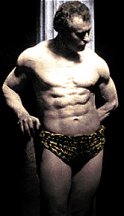 The scent of the big cats fills this book. Already Sheeta and Numa have had nearly equal billing with Tarzan and Valthor; now lions are given prominence. Now Tarzan emerges from the flood, which symbolizes a major life change, into the land of lions and lion worship. the ownership of lions is a mark of distinction in Cathne, Cahtnean chariots are even drawn by lions which brings to mind the chariots of goddesses like Cybele, Harmonia and Cadmus. Nemone will promise to reward Tarzan with three hundred lions, apparently an incredible number making him the top Lion Man. Remember the next novel Tarzan And The Lion Man will continue the theme.
Continuing an old theme from Tarzan And The Golden Lion a lion is even the god of Cathne. The symbol of Nemone’s Animus is a great black maned male lion named Belthar. The novel will devolve into a battle between Nemone’s lion, Belthar, and Tarzan’s lion, Jad-Bal-Ja. Also continuing an old device employed in Tarzan And The Jewels Of Opar by the jewels and in Tarzan And The Ant Men by Tarzan’s locket this story is unified by the image of a great lion drawing ever nearer to Tarzan. So amid all these lions is the true Lion Man, Tarzan’s personal lion. His own guardian animal.
It does seem clear that ERB associates the big cats with sexuality.
ERB is building this story very carefully with great attention to spacing and pacing. Captured by the
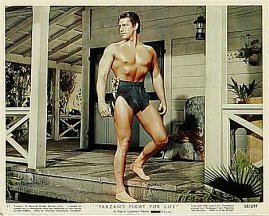
Gordon Scott As Tarzan
Cathneans ERB takes care to ingratiate the Big Bwana with the troops. He has Tarzan and the Cathnean soldiers enter into a spirit of camaraderie as he introduces them to and instructs them in the use of the bow. Nemone is instroduced but seems to take little notice of the Big Guy condemning him to fight in the arena.
Taken to a prison cell he and we are introduced at some length and in some detail to a character named Phobeg. Phobeg is billed as the strongest man in Cathne.
ERB devotes an amazing amount of space to his confrontation between Phobeg and Tarzan. His development of such a minor character is unusual. I think what we have here is a confrontation between Tarzan and the actual man who inspired Burroughs to create Tarzan, the man who was the physical basis of the Lion Man. Phobeg can be no other than the first important body builder in the world- The Great Sandow. Just as in Tarzan The Magnificent Burroughs takes care to indicate that Tarzan has now replaced H.M. Stanley as the symbol of Africa, so here he puts down ‘the strongest man in the world’ in favor of his hero.
 Sandow (1867-1925) had died a few years earlier. While other muscle men had replaced Sandow, most notably Charles Atlas, Burroughs was still obsessed by the man he had seen at the Columbian Expo of 1893. It would seem certain that ERB occasionally picked up a copy of Physical Culture Magazine to keep up on the latest builds. He couldn’t have missed the memorial copy devoted to Sandow, the greatest and still the greatest of the body builders. The award given to Mr. Olympia is called the Sandow.
While bowled over by the strongman, and strongmen, ERB was always offended by the bunchy muscles created by body building. he repeatedly makes allusions to strongmen throughout the corpus while Tarzan himself is both the antithesis and the perfection of the strongman. That is why Tarzan has smooth muscles flowing like molten metal beneath his skin while in this case Phobeg as a Sandow surrogate has the knotted muscles of the body builder.
If Burroughs found Sandow’s build offensive he would have gone apoplectic at the most recent champions who seems to have developed musculature as far as it can go. Unlike builders like Charles Atlas, Gordon Scott or Arnold Schwarzenegger who aspired to the Apolline figure, Ronnie Coleman and his successor Jay Cutler have opted for muscle upon muscle until there is nothing but muscle with no attention to a human shape. As an example check out Jay Cutler the current Mr. Olympia and holder of the Sandow at www.emusclemag.com. This guy is only 5’9″ but bulks up at 320 lbs., paring down to 275 for performance. And that is literally all muscle. One look at Cutler and ERB would have been foaming at the mouth
Just as Sandow was billed as the strongest man in the world, so Phobeg is billed as the strongest man in
Jay Cutler In Full Pump
Cathne. ERB makes him a braggart in relation to Tarzan but if he was the strongest man in Cathne he had little reason to respect Tarzan’s physique which was more like ‘Apollo than Hercules.’ Tarzan’s strength though greater than Phobeg’s was disguised.
At they are to fight each other to the death in the arena this allows Burroughs to introduce another of his interests which may be related, that of professional wrestling. Burroughs had Tarzan jokingly suggest that they stage the fight much as professional wrestlers. Burroughs who still attended the matches was disgusted becasue the matches were pure entertainment, something he should have applauded. Then as now the professional wrestling matches were staged. Professional wrestling then as now has more to do with entertainment than sport. Either you can get caught up in the fun and drama or you can’t. ERB obviously did although as he still thought of the shows as wrestling he felt put upon.
After several pages of Phobeg’s bragging and Tarzan’s false humility the ‘really big shoo’ begins. Tarzan and Phobeg are the last act on the program and they would have been a difficult act to follow.
ERB must have loved this part as the lenghty description of the gambling taking place is many times more detailed that he usually is. Whether the gambling aspect went on at the wrestling matches he attended or not, I don’t know. The odds naturally are for Phobeg, whose Cathnean reputation is immense and accurate as concerns the past. Everyone expects the inveterate gambler Nemone to bet on the sure thing as was her custom. They hedged their bets when they could at fantastic odds. Nemone then surprised them by betting on Tarzan. Nearly bankrupted the whole coterie of Lion Men.
Tarzan wins of course but refusing to kill Phobeg he instead does his trademark thing lifting Phobeg above his head and tossing him into the stands at Nemone’s feet. Now that is one hard act to follow.
Having now won his liberty, a lion man named Gemnon is assigned custodian of Tarzan taking him under his wing. Up to this point there seems to be no reference to contemporary affairs except for Sandow and wrestling. At this point ERB displays a numerous and surprising set of literary references.
Go To Tarzan And The City Of Gold part two.
Part 9 Tarzan And The Lion Man: A Review
May 24, 2008
A Review
Themes And Variations
The Tarzan Novels Of Edgar Rice Burroughs
#18 Tarzan And The Lion Man
No. 9 of 10 parts
by
R.E. Prindle
First published on the ezine, ERBzine
Conclusions And Prospectus
A careful reading of the output of the ’30s reveals a developing antagonism, war if you will, between the Communists, the Jews and ERB. The attempt to shut down non-Communist writers appears to have been extended to ERB, forcing him into self-publishing in 1930 with Tarzan The Invincible being the first title. this was followed by its sequel Tarzan Triumphant.
The two titles would seem to indicate he met that challenge successfully.
Then in a seemingly unrelated event MGM released the movie version of Trader Horn in 1931. Trader Horn seems to have led MGM to sign Burroughs on for his Tarzan character shortly after the movie’s release. MGM would then go on to film six Tarzan features over a ten or eleven year period from 1932 to 1942. All the movies were profitable yet after the release of Tarzan’s New York Adventure MGM sold a stellar property to the Sol Lesser Company even allowing Johnny Weissmuller and Sheffield to go with the sale. O’ Sullivan chose to abandon the series.
The entire MGM series used Trader Horn footage transferring it to the Tarzan series as Tarzan’s home base. Over the years they incorporated scenes relying on Tarzan And The Leopard Men and Tarzan And The Lion Man. It would appear they sudied the series closely. Compare this description of Lady Barbara Collis’s flight in Tarzan Triumphant with the scene used twice in MGM movies of the plane approaching the Escarpment. Triumphant, p. 10:
…and when there loomed suddenly close to the tip of her left wing a granite escarpment that was lost immediately above and below her in the all eveloping vapor…
There can be little doubt that the intent was to defame the character of Tarzan with the release of Tarzan, The Ape Man, first of the series. Ten years later in Tarzan’s New York Adventure he is still the ignorant lout he was as the feral boy of the first film after having been the ‘mate’ of the seemingly well bred, well read, intelligent Jane played by Maureen O’ Sullivan. After ‘finding’ a son in 1939, three years later, ‘Boy’, as he was generically named, speaks intelligently and is able to write a note telling his mother he will be gone for a day. At the same time Tarzan is still going around speaking pidgin English like ‘Tarzan kill’ or ‘Me Tarzan, you Jane.’ There’s a guy who isn’t even listening to Jane talk to him. I personally find this amazing. The question then is why didn’t MGM develop the character in a more intelligent manner.
Also, the question arises as to why the character wasn’t made a profit center for MGM as Charlie Chan was for Twentieth Century Fox. As Burroughs notes in ‘Writer’s Markets And Methods’ in 1938 in reference to the Chan movies, the public was hungry for the serialization of popular characters during the thirties. There were nearly fifty Charlie Chan films made, some years at a clip of four. The astonishingly strong and continuing appeal of Tarzan would certainly have justified the attept to produce two or more a year. Certainly an annual film. After assuming the license from MGM beginning in 1943 Lesser released a film a year in a very profitable manner. So, as he found plenty of ideas the argument that MGM exhausted the story potential of the character doesn’t hold up. Something else was going on.
That something else was the role of Burroughs as an anti-Communist and in Jewish eyes, an anti-Semite.
It is important to have an idea of the Jewish role in history as they are invariably in antagonism to the citizens of their host country. One need look no further for an explanation than the Old Testament story of Cain and Abel. The story encapsulates the Jewish attitude toward the other peoples of the world.
The story involves God or in other words, a higher authority, Abel who becomes the the higher authority’s favorite and Cain who is rejected by the higher authority. Abel presents his offering to God or the higher authority and Cain his. Abel’s offering is an exploitation of the natural increase of the flocks. In other words cattle do all the labor while Abel harvests them. Cain labors in the fields offering the produce of his labor which is rejected as unworthy.
Once the higher authority chooses the offering of Abel he makes him his favorite. Abel then lords it over Cain who quite naturally resents this. Cain then invites Abel into the field where he kills him. Eh voila! The origins of Semitism and anti-Semitism. The problem of anti-Semitism is solved.
Now, the Jews will compulsively repeat the story of Cain and Abel after the Freudian manner endlessly over the millennia as the story is encoded in their brains.
Now for the application. In 1995, BenZion Netanyahu published his mammoth volume titled, The Origins Of The Inquisition In Fifteenth Century Spain. BenZion is the father of Benyimin the former Prime Minister of Israel. Mr. Netanyahu’s large sized, eleven hundred pages, book investagates the problem in excruciating and verbose detail. Mr. Netanyahu chats on interminably in an attempt to deny the obvious. It’s as though he believes that if he talks long enough the truth will go away.
Mr. Netanyahu notes that in every instance over the last twenty-five hundred years the Jews have at first been warmly received by the host nation only to have this affection turn to such a hatred over a period of time that the Jews are either killed or thrown out. He examines the problem in fifteenth century Spain. His conclusion is that the cattle, or anti-Semites as he styles them, are at fault while his Jews are as blameless as Abel. Thus he avoids answering the question of why this is the invariable result of Jewish cohabitation in a society.
For Jewish historians there are two versions of Jewish history. One is the annals of the Jews and the other is the history of anti-Semites. This is how the Jews organize their story. Any thing critical of Judaism automatically falls into the category of the History of anti-Semitism. One of the most persistent objections to Judaism over the last twenty-five hundred years is that the Jews see the non-Jews or Cainites as cattle meant to contribute to Jewish welfare. Even though the idea is clearly contained in the story of Cain and Abel the Jews have always considered the charge what they call an anti-Semitic slur. However Mr. Netanyahu describes the system perfectly in his overlong essay. This isn’t history. This is one long whine.
Skipping a repetitious millennium or two let us skip along with Mr. Netanyahu to fifteenth century Spain.
Our author erroneously established the origins of anti-Semitism in the Hellenic and Roman periods of the Middle East. He chose to completely ignore the blueprint of Semitism and anit-Semitism as presented in the story of Cain and Abel in Genesis, the first book of the Bible. For him he has the inexplicable paradox of every people warmly receiving the Jews into their midst while after a period of time universally and brutally rejecting them. He appears to be genuinely so obtuse as to be unable to understand this.
The history of the Jews in Spain goes back at least to the Roman transportation to Spain after the destruction of Jerusalem in 70AD.
While the usual tradition of the Jewish historian, Heinrich Graetz and others, is to portray the Spain before the expulsion as an idyllic sojourn in ‘The Land Of The Three Religions,’ Mr. Netanyahu presents a picture of cultural conflict under the Visigothic kings down to the expulsion.
Of course the Moslems occupied Spain from c. 700AD until they were completely expelled in +1492. The Reconquest began almost immediately, while by c. +1100 when Mr. Netanyahu reaches the beginning of his central story was successful over most of Spain. Following the scenario of Cain and Abel the Jews were able to insinuate themselves into the role of middlemen between the kings of the various kingdoms, or higher authorities, and the indigenous Spaniards, or cattle who Mr. Netanyahu disparages as Christians as though the conflict were of a religious nature rather than a cultural one. Spain was a multi-cultural society that functioned as all multi-cultural societies must until one culture establishes itself as the Top Dog.
We have the classic situation of the Abelites farming their Cainites as a human herd of cattle. The cattle produce the wealth, the middlemen reap the harvest. Thus the kings appointed the Jews tax collectors and tax farmers.
There is no more vicious or unopular job than that of tax collector. Even today when governmental functions are institutionalized and no longer personal the resistance is still strong. The Jews had the advantage of segregating themselves as a distinct culture so that they escaped the opprobrium they would have felt if they had been native tax farmers living amongst their brethren.
In the nature of tax farming per se there is no reason to believe that the Jews were any more honest or gentle than any other tax farmers. Exploiting their human cattle as tax farmers the Jews then dug deeper by acting as loan sharks after having expropriated the wealth of the Spaniards as taxes. Interest or usury as it was called was forbidden the faithful by the Catholic Church so miraculously, almost, the loan sharks had the field to themselves, not ever a shard of competition. And they took advantage of it. So for roughly two or three hundred years the Jews exploited their human kine unmercifully. Mr. Netanyahu acknowledges this although with a different characterization.
As Abel exploited his position as favorite of God with Cain who, becoming exasperated, killed Abel so in 1391 driven past their endurance the Spanish cattle rose up, as Mr. Netanyahu puts it, to virtually exterminate the Jewish population. As exaggeration no doubt. Mr. Netanyahu virtually equates the uprising with the Stalin-Hitler period in Central and Eastern Europe.
In the interests of brevity we will now skip another four hundred years or so to the post-Revolutionary period of 1913 to the present. The story was the same in every society the Jews infiltrated; one of expulsion or slaughter during this intervening period. There is no aberration in history over the period from 1913 to 1945; it is all a continuation of the Abel and Cain story; Semitism and its inevitable reaction. Underline the word inevitable. The United States will not be immune to this reaction.
From 1300 to the French Revolution Jews had been expelled from every Western European country while being placed under civil disabilities in Central and Eastern Europe. The French Revolution reestablished opportunities for them. They quickly reestablished their role as middlemen.
By the time of the Revolution State functions had been depersonalized and institutionalized. The law of fiat by the king had been replaced by the ‘Rule of Law.’ Thus, while individual rulers who remained goyim were still important, they functioned under the higher authority of the ‘Law.’ The term Majesty indicates the concept of The Law had replaced the Royal authority.
Thus to regain their position of middlemen Jews had to subvert the Law. This has been all but completely accomplished in our own time. In the interim between 1913 and 1953, actually, the Jews fully exasperated their Central and Eastern European host States, thus during the Stalin-Hitler period from 1928 to 1953 Nazis and Communists took the psychological solution of inviting Abel out into the field and killing him. Both Stalin and Hitler began to systematically exterminate the Jews. This should surprise no one familiar with the Cain and Abel story and history.
Stalin was assassinated on the eve of the execution of the order to round up Eastern European Jews for transportation to the gulags in the far North. Not only a virtual but an actual death sentence. Thus the Jews in Europe would have been all but destroyed.
I hope this is suffiecient background for us to now return to the story of Burroughs, Tarzan, MGM and the Judaeo-Communists of Hollywood.
it is an accepted fact today that the various national CPs were all 50 to 60% Jewish. Insofar as Jewish Cultural ends coincided with Communist goals, which were not entirely synonymous, all Jews may be said to be Communist sympathizers. After the establishment of Israel in 1948 a rift occurred between the two cultural factions that resulted in a rejection of the Jews by the Communists.
We know that ERB became suspect as an anti-Semite after 1919 and I suspect a confirmed one in AJC/ADL eyes, at least by 1924’s Marcia Of The Doorstep, reinforced by Tarzan Triumphant a few years later. :Little is known of ERB’s attitude toward the Jews before 1919. He must have been aware of the Jewish presence in Chicago.
Gus Russo in his volume Supermob describes their arrival in Chicago in this manner. p. 4:
This community…was centered around the intersection of Halsted and Maxwell Streets, where the population was 90% Jewish. Over the next twenty years (after 1871) an estimated fifty-five thousand Eastern European Jewish immigrants crowded into this tiny locus. So dense had this ghetto become that one social scientist determined that if the rest of the city were similarly clotted, Chicago would boast, instead of two million residents, over thirty-two million people, half the population of the entire country.
We know that ERB was familiar with the area because Billy Byrne, the Mucker, came from the area, so ERB must have observed the Jewish community in this habitat. With further arrivals that brought the Jewish population of Chicago to 350,000 the area of Lawndale was colonized.
Hollywood in the thirties was rapidly changing. (When wasn’t Los Angeles rapidly changing?) Beginning in the thirties a remendous influx of revolutionary and conspiratorial Jews arrived from Germany, especially after 1933. At the same time the Outfit began to annex California as its own crime colony. As part of this organized crime influx came the generation of Jews from Lawndale in Chicago as the so-called financial wizards of the Chicago Outfit. Thus the whole charater of LA Burroughs knew from the teens and twenties changed much for the worse. It will be remembered that ERB was a neighbor of the Sicilian mobster Johnny Roselli in the late thirties while gangsters became prominent in his work beginning with Danny ‘Gunner’ Patrick of Tarzan Triumphant and the assassins of The Swords Of Mars.
As far as I know ERB was too discreet to discuss his opinions of Jews other than what can be gleaned fromt the novels. It does seem clear that he knows who he was dealing with.
We know he was an anti-Communist which was enough to have him shut down as an author, while it is probable that the Jews considered him an anti-Semite which is another reason for him to be brought into line. The means of doing this was to control him economically while subverting his character of Tarzan. It was a fairly easy matter to break him financially, but the strength of the appeal of Tarzan was such and the means applied so covert, that when MGM gave up after Tarzan’s New York Adventure the ape man had been too strong for them.
So, when the string of six MGM Tarzans began in 1932 the intent was to diminish Tarzan to a laughing stock, but the character was too much for them while the movies became extremely profitable. Even then the Studio abandoned the lucrative series in 1942. This is inexplicable unless something is going on behind the scenes.
For the next essay I am going to concentrate on the last of the MGM movies, Tarzan’s New York Adventure primarily because it seems to be directly related to the situation around Tarzan And The Lion Man. It is highly improbable that Lion Man was not read by those involved with this project at MGM. They must therefore have reacted to it. The novel very likely has concealed messages that escape us but which they would have picked up. The movies also have concealed messages which were directed at Burroughs. If I am right Tarzan’s New York Adventure is a lecture tha was directed at the old Lion Man, Edgar Rice Burroughs.
Go to part 10 of 10 Tarzan’s Excellent New York Adventure
 I, Dynamo