Pt.I: H.G.Wells, Sigmund Freud, Edgar Rice Burroughs And The Development Of Contemporary Sexual Attitudes
August 14, 2010
H. G. Wells, Sigmund Freud, Edgar Rice Burroughs
And The Development Of Contemporary Sexual Attitudes
by
R.E. Prindle
Part I
Certainly it is to be hoped that (the) naturalistic school of writing will never take firm root in England, for it is an accursed thing. It is impossible to help wondering if its followers ever reflect on the mischief that they must do, and, reflecting do not shrink from the responsiblility to look at the matter from one point of view only, Society has made a rule for the benefit of the whole community, individuals must keep their passions within certain fixed limits, and our system is so arranged that any transgression of this rule produces mischief of one sort or another, if not actual ruin, to the transgressor. Especially is this so is she be a woman. Now, as it is, human nature is continually fretting against these artificial bounds, and especially among young people it requires considerable fortitude and self-restraint to keep the feet from wandering. We all know too, how much this sort of indulgence depends upon the imagination, and we all know how easy it is for a powerful writer to excite it in that direction. Indeed, there could be nothing more easy to a writer of any strength or vision, especially if he spoke with an air of evil knowledge and intimate authority. There are probably several men in England at this moment who, if they turned their talents to this end, could equal, if not outdo, Zola himself, with results that would shortly show themselves among the population. Sexual passion is the most powerful lever with which to stir the mind of man, for it lies at the root of all things human; and it is impossible to over-estimate the damage that could be worked by a single English or American writer of genius, if he grasped it with a will.
–H. Rider Haggard
Appendix to the Broadview
Edition Of She

Edgar Rice Burroughs
For a long time now I’ve put off writing about Edgar Rice Burroughs in relation to H.G. Wells. Wells has been difficult to get a handle on, a point of entry. But the Woodrow Nichols’ article on nudity in Burroughs on ERBzine pointed in the direction of changing sexual attitudes in the twentieth century. Coupled with reading the above quote of Rider Haggard I realized that Wells and Burroughs were two of those powerful writers capable of unleashing those sexual passions. They, coupled with Sigmund Freud, did change sexual attitudes in the twentieth century.
That is not to say they were alone but of all of the hundreds of writers between then and now all their books remain in print continuing their work.
The sexual problem is central to civilization while it has been handled differently in the development of civilization. For some time it seemed that the Patriarchal model would be permanent. J.J. Bachofen, the great Swiss mythologist of the mid-nineteenth century, was the first to challenge the Patriarchal model. In his studies of mythologies he perceived that behind the Patriarchy first came a Matriarchy while at the beginning was a Hetaeric period. All three had different sexual approaches while all three attitudes have survived into the current age competing for dominance.
In the first Hetaeric stage of development Bachofen believed men used women, and woman, indiscriminately whether with force of persuasion when the sexual urge hit him. A good picturalization of this can be found in the movie, In Quest Of Fire. As there was no knowledge of how offspring were conceived the women of the horde merely accepted the inevitable bumper crop of children.
Being a sexual object puts an unbearable burden on the female of the species no matter how natural. Since most females began bearing at twelve or thirteen with the onset of puberty they were worn out at twenty with few probably surviving to thirty. Indeed, a huge percentage must have died in child birth from twelve to twenty. One imagines a surplus of males in the horde not unlike affairs in the nineteenth century when men frequently went through two or three wives or more as the women died young in childbirth.

J.J. Bachofen- One Of The Greats
While conception or paternity wasn’t recognized there was no mistaking motherhood. By some process of refinement the sexual mores of hordes evolved into Matriarchy which acknowledged female parentage while giving women some sort of sexual control, preference if you will. The change from the Hetaeric to the Matriarchal inevitably left behind a reactionary or conservative group who saw no reason for change or giving up their sexual prerogatives. Thus conflicts between the two attitudes, perhaps warfare.
The Matriarchy was still thriving when history began to be recorded. Thus Homer’s Iliad and Odyssey concern the Patriarchal revolution against the Matriarchy amongst the Europeans. By now paternity had been discovered by which the male discovered that he impregnated the female which he now considered the most important part of the process and one which involved the exclusive use of the female as he had no wish to care for another man’s children. Hence Patriarchalism- the primacy of the father- evolved putting the three systems into conflict and competition. This is a main theme of Greek mythology.
Concessions had to be made to the Hetaerists who were irate at the loss of their prerogatives. Hence temple prostitution undoubtedly evolved in which all the young females were kept in a temple compound until they had sex with any man who demanded it. Civilization being civilization, of course, there was a fee, hence protitution. Upon completion of the duty the female was released.
The Patriarchal revolt was a long slow drawn out process with many setbacks and compromises such as the above. Indeed, the Patriarchal god, Apollo, wrested Delphi from the Matriarchy but in the Matriarchal reaction he was forced to share the shrine with the effiminate Matriarchal hybrid god, Dionysus who, himself was destined to replace Zeus as the avatar of the Piscean Age. He assumed both male and female characteristics in the attempt to arrange the sexual conflict. That’s why the Jewish prophet Jesus of Nazareth, who substituted for him in yet another compromise is so effiminate. With the admixture of the Semitic influence in European religion with its uncompromising Patriarchalism the evolving Catholic Church was all but able to extinguish the Matriarchal Dionysian influence as well as the Hetaeric. Chastity, celibacy and monogamy became not only dominant but exclusive.
Just as the Matriarchy, while suppressed, has never disappeared or admitted defeat so also the Hetaerists have survived assuming different disguises while waging continued war with the Patriarchy and the Scientific view which is say Western Science and the Roman Catholic Church.
Reviled by the Church and persecuted sometimes to death the various sects fought back often posing as Catholics to become priests, even occasionally a Pope, and bore from within. Thus arose the Free Spirit sect which demanded the right of access to any woman at any time in any place. Thus John Sinclair in 1960s and 70s demanding the right to ‘fuck in the streets.’ An irrational request by any other standard. The Free Spirits delighted in debauching nuns when they had sufficient numbers to seize a place.
The spirit surfaced among the Anabaptists, for instance, who were not only suppressed but destroyed root and branch. With the Enlightenment when the Hetaerists surfaced as the Libertines we hear of them forwarding the French Revolution while their ideals were absorbed by the nascent Communist political movement. The Libertines per se seem to have transmogrifed into La Vie Boheme after the Napoleonic Empire, Bohemianism reaching down to our time.
La Vie Boheme as depicted by the French novelist Henri Murger evolved in the early nineteenth century along with their more overtly criminal cousins, the Mohicans of Paris as the novelist Alexandre Dumas styled them and known as Apaches by the end of the century. In the US fifties the Apaches were represented on TV with a mystifyingly violent effect as Apache dancers from France. I suppose the Apache style was transmogrified into the New York Bohemian style also. So this quasi-criminal Bohemian Apache style pervaded Euroamerican civilization through the nineteenth century and in diluted form into the twentieth and present day. The Fall 2010 Nordstrom catalog for instance celebrates the New York Haut Boheme.
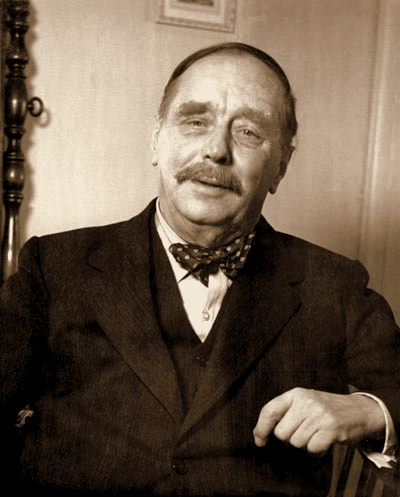
H.G. Wells
I was trying to relate this latter day form of Behemianism to Burroughs in my three part series on Presley, Lennon and Yoko Ono that Bill Hillman courageously published in ERBzine but over some very strenuous objections. I presume I lost the Bibliophiles on that issue.
That Burroughs was fascinated by the Bohemian style while actually furthering the Hetaeric sexual program is fairly obvious. He said that he wrote his first unpublished work, Minidoka, in Ragtime speech, that is to say the Bohemian mode. In other words ERB considered himself plenty hep, at least a closet Bohemian. Some may find that disturbing but, it is so. In ’60s NYC terminology ERB would hve been of the Haut Boheme. Along with those sympathies went a set of Hetaeric sexual mores that Burroughs advocated.
I have already examined the Bohemian influence of George Du Maurier on Burroughs with his novels Peter Ibbetson, Trilby and The Martian. Du Maurier was also of the Haut Boheme. A photograph of ERB behind the camera in Idaho in 1899 shows ERB dressed in full artistic Boho mode. He had just emerged from a short stay at the Chicago Art Institute where he would have immersed himself in Boho mores as artists then and now were virtually all Boho, at least in outlook. Writers too.
It seems quite extraordinary that Libertinism was discouraged and contained between the end of the eighteenth and beginning of the nineteenth century. Perhaps the answer can be found in the transition from aristocratic society to bourgeois society. Perhaps the Bourgeois requiring a different sexual morality than the aristocracy succeeded in imposing their version of sexual mores by sheer numbers.
Libertinism did regain prominence amongst the wealthy Haut Boheme of NYC thence spreading throughout society as a Bohemian sensibility began to displace the Bourgeois.
A book I have reviewed on ERBzine, found in ERB’s library which he read, GWM Reynolds’ The Mysteries Of The Court Of London scrupulously records the libertine activities in a fictional form of Prince George, later King George IV, whose career of seduction ended only in the 1820s. Certainly Reynolds’ depiction of the libertine actiities of George and his circle out Zolaed Zola by more than somewhat.
The whole libertine attitude was nowhere more prominently displayed than in NYC’s Haut Boheme nightclub, Studio 54. So the suppression of the libertine spirit during and since the reign of Queen Victoria was short. Perhaps Haggard’s novel She echoes the memories of the Libertinage of the eighteenth century Hellfire Club in some obscure way.
Haggard had no reason to put on airs because as I pointed out in my review of his King Solomon’s Mines that novel is smutty from top to bottom while ‘She’ has some very salacious passages. As Horace stands watching the scene of She and the dead body of Kallicrates for instance one is more than excited. She had murdered her former lover Kallicrates for running off with another woman. Immediately remorseful she kept the body preserved in perfect condition for two thousand years. She could even psychically animate the body so that it stood although still insensate. The necrotic effect is hypnotizing, making the reader a voyeuristic accomplice of Horace. As he and we watch the bodice of She’s dress slips to her waist exposing her magnificent charms according to your imagination. As we watch she then raises her arms above her head lifting and pointing the golden orbs. She does this not once but twice so it is clear Haggard was exciting and taunting his readers. If one imagines Ursula Andress who played She in one of the movies the effect is exhilarating indeed.

Ursula Andres As She
Haggard aside, as he says there were writers in England and America who were champing at the bit to alter the course of sexual history. Chief among these was H.G. Wells in England and our own Edgar Rice Burroughs. Both would make significant contributions to the ‘change’ but the most effective writer of them all was the secret sexual pervert, the undisputed master of them all, Sigmund Freud. But to go first to H.G. Wells and take things in order.
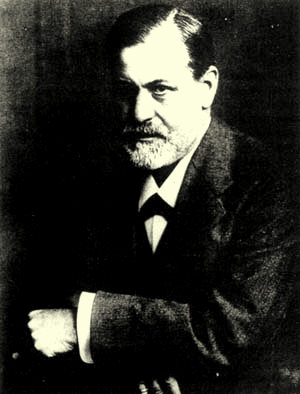
The Mad Herr Doktor Professor

The Last Sane Man Left Alive
A Review
Themes And Variations
The Tarzan Novels Of Edgar Rice Burroughs
#14 Tarzan The Invincible
Part VI of X
by
R.E. Prindle
Inside The Gates Of Opar

Edgar Rice Burroughs
Life is just too short for some folks,
For other folks it just drags on.
Some folks like the taste of smokey whiskey
Others think that tea’s too strong.
Me, I’m the kind of guy who likes to ride the middle
I don’t like this bouncing back and forth.
Me, I want to live with my feet in Dixie
And my head in the cool blue North.
–Jesse Winchester: Nothing But A Breeze
And now we come to the heart of Edgar Rice Burroughs. One reason he is literarily disdained is that the story is not the story. Porges, p.524:
As the story progresses the perceived theme of a worldwide conspiracy is abruptly abandoned. Burroughs in his contempt for the communists refuses to allow them to be sincere even in their Marxist goals.
This is not true. Porges has misconceived the story. To quote the sixties Jewish revolutionary Mark Rudd: The issue is not the issue. By that Rudd meant that the Jews had created a diversion to mask the true issue which was the establishment of the Jewish culture as top culture or dictator in this multi-cultural world.
Burroughs intent is exactly the same as regards Tarzan. True, Burroughs has contempt for Communism but that is merely a frame story and a side issue. The true issue is that Tarzan’s authority as guardian of Africa is being challenged on the spot. The duel is between himself and Sveri mano a mano. He discredits the collectivity through the individuals. Thus at novel’s end Tarzan sits in state as Guardian or Emperor disposing the fates, godlike, of the remaining conspiritors. Magnanimously he allow Paul Ivitch (Paulevitch) to be escorted out of Africa rather than be thrown on his own resources that would have resulted in his certain death.
The issue within the issue, as always, is Burroughs attempt to resolve his psychological difficulties. Thus one has the Colt-Drinov combination, possibly reprsenting ERB and Emma, an episode within Opar of Nao who may represent Florence releasing him from the prison of his marriage to Emma, and Colt-La, the Anima and Animus problem. Tarzan and Colt change partners so that La nurses Colt and Tarzan nurses Zora. But to that in the next section.
While one expects a pure shoot out with the Communists, Tarzan is not going to defeat them by direct action but by a terrorist campaign of which Tarzan is the jungle master.
To compound the problem Burroughs confuses realism with dreamwork. This is not a realistic novel but a dream fantasy. It was said that Burroughs wrote out his dreams which has a basis in fact. The scenarios may have originated in his sleeping dreams but then he modifies them in day dream style while consciously molding the story for political and commercial purposes. A writer does need readers.
To give a basis for comparison for the dreamwork I’m going to play Freud here and offer up a dream of my own; it is similar to Burroughs’ in many way. Since integrating my personality I don’t have wonderful dreams like this anymore. As Jung correctly surmised when one integrates the conscious and sub-conscious minds memory destroys the symbolic basis of your dreams. I can analyze the common place dreams I have now even as I dream them. Something is lost, something is gained, but it might be of lesser value. I think I like the mysterious flavor of the smokey whiskey even though the water I have to drink now is better for me.
In my dream I began on the edge of a vast desert dotted with a few oases while far off in the distance twenty years away, rather than miles, away in the the distance a great white shining mountain arose. The distances were so vast they were measured not in miles but years. Indeed, the years of my life. I had to traverse the vast desert reaches between the oases. Each oasis merely refreshed me for the next perilous journey. Having traversed the years I came to the great white shining mountain. One might compare it to the tor containing the treasure vaults of Opar out on its desert. These are symbols common to multitudes.
I then came to the white shining mountain which might compare to the city of Opar. Censorship prevented me from climbing the mountain at that time. In other words in the control of my subconscious, consciousness was denied me. I approached the mountain from the back where I noticed a trickle of water leading into and down the mountain. I tried to drink the water but as it ran through a pure salt bed it was too salty. Unlike Burroughs who was in the pits of darkness I was always bathed in a clear light which came from nowhere.
I followed the little stream down the subterranean path into the mountain. Thus I had all land and no water, a barren psychological situation. Following the cave down I came to a series of gates made entirely of steel. I hesitated to go forward but there was no going back. I was impelled into one of the gates which turned into a chute that spilled me out onto a steel floor where unseen hands seized me pushing me into a steel room as the steel door slammed shut. Like Tarzan beneath Opar I was a prisoner with no seeming way out.
As I looked around I realized that this was a laundry room. All steel, of course. While I had no food I now had sinks full of water. My situation had been reversed from all land to all water, from the pure masculine to almost pure feminine. Where before I was barren now I was spilling over with wisdom. I knew I had to get out of there reasonably soon or I would starve to death. There was impenetrable steel all around. But I had plenty of water. Too much water. Looking around I spotted ventilation ducts along the ceiling. I conceived the notion that I could drink lots of water then urinate in the ducts which would create a foul odor that would be distributed throughout the rooms above. They would search for the source of the odor thus opening the door of my prison.
The ducts were difficult to reach but I was able to urinate in them. As I expected voices came down the duct asking ‘What is that smell?’. The door to my prison opened inward so I stood to the side that opened waiting. Sure enough a couple maintenance men flung the door open bursting into the room. I slipped out the door behind them unnoticed.
I now descended still further until I came to a bank of elevators. One door was open for which I made a rush. The elevator was packed with boys I knew from high school. With doubled fists they pushed me back refusing to allow me in the elevator with them. Mocking me as the doors closed I was left alone way down there.
There was a flight of stairs but censorship prevented my using them. I waited in vain for another elevator. As with dreams I next found myself at the back of the mountain but the path into the mountain had disappeared so I now had to climb The Great White Shining Mountain.
If, like Burroughs, I were writing a story I would provide a plausible story line for my escape but I’m not. I’m merely transcribing a dream.
The reason the mountain shone was because it was covered by snow several hundreds of feet, possibly thousands, thick. As previously the water in the stream was too salty to drink now it was frozen. The sun shone brightly, not only brightly, but brilliantly, as I began my climb. I had left the subconscious for the conscious as I strove for the light. The climb was long from the back of the brain to the forebrain but not tiring. Apart from the barrenness of the snow I was enjoying myself. Would it be too offensive a pun if I said I enjoyed being high? After a long climb I came to a precipice past which I could go no further. Nor could I go back.
As I studied my position I looked down this sheer precipice to the desert thousands of feet below. There was snow all the way to the desert floor. Down there, way down there, I could see the tiny ant-like people in the barren sands doing obeisance to the moutain which they apparently treated as a god.
Looking down the sheer face of snow I could dimly perceive the outlines of a great face carved in the snow. This god, then, retained all the water behind his visage that could make the desert bloom. Just as I had used water to escape the prison of my subconscious I conceived the notion that I could release the water and make the desert bloom freeing the people from their bondage.
Now, this was hard snow. I had no trouble walking the surface without breaking through while if the snow didn’t give way as I jumped on it to destroy the snow god I would plummet several feet into the desert. Neverthless I leaped up landing on my bottom. The snow gave way as I rode the avalanche several thousand feet down the mountain side to land on the desert floor while I destroyed the god who had been impounding the water.
Many streams now flowed out from the mountain. The desert bloomed turning green and bursting with flowers. Now that we have a comparison let us examine Burroughs’ great dream of Opar.
Opar first found expression way back at the end of 1912 and the beginning of 1913. Appearing at the end of The Return Of Tarzan the story was included in Burroughs’ fourth published story and fifth written story, the Outlaw Of Torn had been written but not published yet.
As with Invincible the story of The Return was not the story. The story was what Burroughs hung the details of what appeared to be the story on. Hence Return was rejected by Metcalf Burroughs’ first editor at Munsey’s who undoubtedly couldn’t understand it. This is the novel in which Tarzan makes his first raid on the fabulous treasure vaults of Opar. Burroughs will continue his wonder stories of Opar through three more books. Each return occurs at a crucial point in his life.
That Opar is a dream location is proven by the topography of the location. It is not too dissimilar to any dream. The jungle grows right up to the base of towering mountains behind which Opar is hidden. On the other side of these it is a dry dusty desert exemplifying Burroughs’ life as the twenty year desert in my dream did mine. Entry into the valley in this story is through a narrow defile apparently several thousands of feet high above which the peaks of the surrounding mountain range tower several thousand feet more. This entry also closely resembles that of Haggard in King Solomon’s Mines. Haggard is never far from Burroughs’ mind as he writes his stuff.
Working your way down into the dreamscape is considerably more easy than climbing it. And then off in the distance rose the shining red and gold domes and turrets of Opar. A dream city if there ever was one. One is reminded of the two great literary and psychological influences on Burroughs, H. Rider Haggard and L. Frank Baum. Of Haggard’s work beyond King Solomon’s Mines I have Heart Of The World and People Of The Mist most readily called to mind. It might be appropriate to mention that Freud also read some Haggard. He specifically mentions Heart Of The World and She but I suspect he probably read others as well. Opar might be a ruined version of Baum’s Emerald City of Oz. Opar is red and gold while from a distance its ruination is not obvious. Mine was a shining white mountain. Burroughs probably tinkered with his to make a good story better.
Now, the fabled Thebes of Greek mythology had seven gates. Cities Of The Sun had up to a hundred. Opar doesn’t have any. The entrance is a narrow cleft in the wall on which on entering this narrow 20″ gap for which Tarzan had to turn his massively broad shoulders sideways and then immediatley climb a flight of ancient stairs. This appears to be a reverse birth story in which Tarzan is reentering the womb, an impossible feat, but then, Tarzan goes where even devils fear to tread. Try some of the books of the psychologist Stanislav Grof. There’s definitely a sexual image that requires a little thought to understand. Hmm. No gates but a narrow cleft too narrow for the shoulders and a flight of steps leading back into the what, womb? Whose cleft? ERB mother’s, Emma’s, possibly Florence’s by this time, or that of his Anima figure? Well, the last is waiting for him inside the domed inner chamber of this sacred city who is aptly named La, which is French for She. ‘She’ was Ayesha the heroine of Haggard’s novel She. I’m sure Burroughs is not writing consciously here.
At this point Tarzan is accompanied by fifty of his brave and faithful but superstitious Waziri. In fact, in this story as Tarzan goes through his incarnation of a Black savage he is Chief Waziri, eponymous head of the Waziri. P. 42:
As the ape man and his companions stood gazing in varying degrees of wonderment at this ancient city in the midst of savage Africa, several of them became aware of movement within the structure at which they were looking. There was nothing tangible that the eye could grasp- only an uncanny suggestion of life where it seemed that there should be no life, for living things seemed out of place in this weird, dead city of the long dead past.
Dead city of the long dead past. That’s what dreams are all about, one’s own long dead past. Thus the ridge separating the lush live jungle from this dry, dusty plain eight years wide was Burroughs own dead past. I suggest the mountain range, perhaps sixteen thousand feet high, represented ERB’s confrontation with John the Bully when he was eight or nine. On the jungle side was his early life as a Little Prince while on the dry dusty side was his blighted, blasted life after John. Opar represents his ruined mind inhabited by the suggestion of life and the Queen of his dreams the beautiful High Priestess of the Flaming God, the woman of indescribable beauty, La of Opar.
La is obviously a combination of Haggard’s She and L. Frank Baum’s Ozma Of Oz.
Tarzan is seized by the Frightful Men, bound and gagged and left lying in a courtyard at high noon. The rays of the Flaming God bear down on him. Whether this is merely part of an ancient Oparian religious rite or whether Tarzan becomes the chosen Son of theSun a god among men, isn’t clear to the reader. The Oparians have their own ideas.
Burroughs describes this rite in a really masterful way. The maddened murderous Oparian who disturbs the ceremony just before Tarzan is to be sacrificed is nicely handled. Believe me, I feel like I am there. As La looks down on Tarzan’s form on the altar she recognizes the One, the Son of the Sun, the One for which she is destined. Once again, Haggard’s She.
Freed in the melee caused by the crazed Oparian Tarzan is taken down to the Chamber of the Dead by La where she hides him. As she said nobody would look for him in the Chamber of the Dead. This Chamber answers very well to the laundry room of my dream. Tarzan/Burroughs is in a stone dungeon with walls fifteen feet thick, fourteen in Invincible, in total darkness while I was in a steel room with no exit but bright light. These locations answer to the rigid confines of one’s owned damaged psyche. There is no way out but there is, there has to be. While palpating this stony prison at the back of the cell Tarzan discerns a flow of air coming through. This scene is a replication of one in Haggard’s King Solomon’s Mines while becoming a B movie staple. The big Bwana discovers some loose stones. He is able to dislodge these creating an exit through the fifteen foot depth of stones of the fortress wall. Somehow Burroughs has worked his psyche to give himself a chance. Once beyond the foundation walls, free of the Chamber of the Dead (I once dreamed I was looking for my soul in the House of the Distraught) but act among the living, Tarzan feels his way down this long dark corridor. One can’t be certain of ERB’s age when he achieved this escape. As it takes place just before Tarzan marries Jane the time might have been 1898-99. Perhaps when he was in the stationery business in Idaho. Perhaps something he read acted as a lever. Apart from Darwin’s Origin Of Species I would venture to say he read Eugene Sue’s Mysteries Of Paris a copy of which is in his library while traces of it are here in his earliest work.
Sue’s rare mentality permeates every page of this first visit while Sue’s extraordinary consciousness is everywhere apparent throughout ERB’s entire corpus. Burroughs himself is absolutely incredible in the manner he associates with numerous other writer’s intellects, seemingly simultaneously within a given passage or even sentence. Myself, Adams, Hillman, Broadhurst, Burger and others have written extensively on these influences. Hillman even goes so far as to virtually twin Burroughs with some of his major literary influences. Burroughs does make all these writers his virtual doubles.
I have stressed Sue’s influence in several earlier essays. I can only urge you to read Sue’s Mysteries Of Paris- a big three-volume work and too short at that- which Burroughs in his own reading found a life changing experience. Possibly he did read it in 1898-99. I found it a life changing experience; I’ve never been able to free myself of its influence, while it appears that Burroughs couldn’t either. A lot of the late nineteenth century writers make reference to Eugene Sue. H.G. Wells based the beginning of an early novel on Sue. The remnant remains only as a short story.
Sue wrote from outside the bounds of sanity. Privately I consider him insane but so brilliantly rational as to transcend the very meaning of insanity. He’s a dangerous writer. His last work was confiscated by the French authorities. It undoubtedly had such a private personal sense of morality that I am sure it would have undone society much as the pornography from Hollywood has undone ours. DeSade and Restif De La Bretonne, who in some ways Sue resembles, were mere unbalanced pornographers who disturb only the disturbed. Sue’s vision of morality is coldly clear, it forms the basis of Tarzan’s but is always on the side of reason and virtue. This fact makes it no less dangerous to a weak mind or that of the obsessive-compulsive Liberal. Still, only the strong survive. I heartily recommend you take your chance.
Tarzan freed from the prison of the psyche, was he insane? was I? or were we merely trapped by a device of other’s making? I can’t say but ERB’s sanity after he escaped was conditioned by that of Eugene Sue. I, of course, rise above all influences.
Progressing down the corridor Tarzan comes to the First Censor. He finds a gap in the floor into which he might have fallen had he not been careful. He would have fallen into the unknown but he would have been alright. He would have fallen into water which in his condition would have been life-giving water rather than dangerous or perhaps he might have drowned in the waters of the subcoscious or Oblivion.
In high school I had a teacher who used to chalk a half dozen slogans on the black board, one each morning. The only one I remember is ‘when you reach the end of your rope tie a knot and hang on.’ I did this for a couple decades then one day I let go. The joke was on me. There was nowhere to fall. I was only a fraction of an inch from a solid surface. However Tarzan culdn’t have known this since he didn’t fall in, this time. He would three years later.
By chance he looked up where he saw some light entering to discover he was at the edge of a well. Yes, you see, the water of life. He dimly descried the other side fifteen feet away which was child’s play for him to leap. Thus he passed the First Censor. Mine was at the elevators which I apparently merely disregarded.
Continuing on for some time in total darkness, so far that he believes himself outside the walls of Opar he enters the treasure vaults. These vaults are filled with what appears to be forty pound barbells of solid gold. Now, this gold is old. So old that no Oparian knows that it is there nor do any old legends even mention it. This is an intriguing part. The gold was mined millennia in the past after the sinking of Atlantis. This raises the question of what did Burroughs know of Atlantis and did he believe in it? I can’t answer the sources of the former but I’m betting on Ignatius Donnelly as one of them. As to the latter I believe he did. He mentions Atlantis in Invincible with a confidence and familiarity that convinces me that over the eighteen years since Return he has read and thought enough to convince himself of the reality of the lost continent. He appears to accept a mid-Atlantic location.
The gold represents the income he’s receiving for his stories. The stories spring from his dead past. That the vaults are outside Opar indicates he freed his mind from its prison or that the money comes from outside the prison, i.e. his publishers. That the gold is Atlantean indicates that his stories are based on his own ancient experience. In other words he is mining his past already completed as ingots or accomplished facts.
What experience then catalyzed his ability to write? I believe that from 1908-10 when he read L. Frank Baum’s Ozma of Oz, Dorothy And The Wizard Of Oz and The Emerald City Of Oz he found a means to express himself. These books bypassed his last censor allowing him to write Minidoka. That book was not suitable for publication but it freed his genius so that he immediately followed it with A Princess Of Mars.
Now, outside the gates of the Emerald City/Opar in the midst of the equivalent of Baum’s Great Sandy Desert he found the handle on his own destiny.
Tarzan locates the fifty faithful but superstitious Waziri loading them up with two forty pound ingots each and points them toward the coast.
At the same time Fifty Frightful Men from Opar who are tracking him discover Jane instead. Dreamy enough for you? Given a choice between Tarzan and Jane I’d take Jane and so did the Fifty Frightful Men.
So now Jane’s on the altar under the sacrifical knife of La. Skipping the irrelevant details La discovers Jane is Tarzan’s beloved. Interesting confrontation between Tarzan/Burroughs real life woman and his Anima. La is shattered as Tarzan rejects her for Jane.
This is a key point in the oeuvre. This is what makes the novels so repulsive to the literary mind. The story is not the story; the issue is not the issue. Opar is the story within the story that will be told in four short parts over eighteen years. So we have part one here without any indication the story will be continued. A segment of the story is just plopped down into The Return Of Tarzan, sort of irrelevantly.
Weird style actually. I’m not even sure it works, but it nevertheless must be effective else why would the stuff still be in print a century on. You’re on your own, Jack, I can’t even attempt to solve that one. Not today anyway.
The next novel examining this psychological is the 5th novel of the oeuvre, Tarzan And The Jewels Of Opar of 1915.
At this point Tarzan, a profligate if there ever was one, has run through the two tons of gold the fifty faithful Waziri brought out and is broke. Two tons of gold in three years. Think about it. He needs to make another run on Opar.
The character of the series changes with Jewels Of Opar from the character of the Russian Quartet, the first four novels. They not only have an Oz influence but they become Ozlike. Burroughs apparently drew on The Beasts Of Tarzan as the foundation for what is essentially a new series.
After writing five Oz stories, in the sixth, The Emerald City Of Oz, Baum attempted to abandon the series. He closed the series off with the news that there will be no more communication from the fairy kingdom. Because Oz has been invaded three times now, what with the advent of airplanes that will be able to spot Oz from the air Ozma is making the kingdom invisible. Is it coincidence that Opar disappears from the oeuvre after the third invasion?
Baum’s Emerald City Of Oz appeared in 1910. It was the last of the stories to be datelined Coronado in his prefaces. When he was forced to begin writing Oz stories again in 1913 they were datelined Ozcot in Hollywood. In 1910 Hollywood was just a pleasant Los Angeles suburb. The movies didn’t begin to make Hollywood the center of the world porn industry until 1914.
Whether Burroughs knew that Baum left Coronado in 1911 isn’t known but I find it signficant that when he went to California in 1913 his first choice of residence was Coronado where he perhaps thought he would be close to Baum who afer all had a close connection with Chicago. Baum wasn’t in Coronado so Burroughs moved across the bay to San Diego.
The question then is: did Burroughs make a pilgrimage to Ozcot to see Baum in 1913? I have to believe he did. Tarzan was one heck of an entree such that Baum could hardly refuse to see ERB. How long or how often the men met then is conjectural but I think it was long enough for Baum to give Burroughs some tips on fantasy writing. Already an ardent admirer of the Oz books Burroughs would have had no trouble accepting advice from this master.
Thus when Burroughs returned to LA and Ozcot in 1916 it is certain that they met while they were probably already familiar with each other. In 1919, when Burroughs moved to LA permanently, Baum was on his deathbed so there was no chance to renew the acquaintance. I also believe that Baum’s Ozcot influenced Burroughs in naming his own estate Tarzana.
In any event Tarzan returns to Opar in 1915. Except for the first visit when Tarzan following the directions of the old Waziri, chief of the Waziri, visited Opar to take the gold, in the rest of the visits he is battling interlopers who wish to steal the gold from him. It might pay to look at the nature of the intrusions and the intruders.
In 1911-12 Burroughs had for the first time in his life come into more money than he could spend, only for a brief moment of course. Thus Tarzan removes the gold more on a whim not really knowing what to do with it. One might think this a strange attitude for one who had tasted the night life of Paris; but a foolish conisistency is the bugbear of small minds as one of those venerated old timers once said. I don’t wish to be thought of as small minded so we’ll let the observation pass.
By 1915 having lost his two tons of gold in some bad investments Tarzan has better learned the value of money or, at least, the absence of it. And so, perhaps, has Edgar Rice Burroughs. One can see the ghost of old George T. shaking his head muttering: ‘When will that boy ever learn?” Well, George, it would take more time than allotted to him.
After 1912 Burroughs had created something of value. That value could be stolen or at least exploited. In 1914 McClurg’s offered him a publishing contract. Nicely crafted it gve all the advantages to McClurg’s and none to Burroughs. Burroughs undoubtedly did not understand the legal implications of what he signed. I can’t explain this but McClurg’s made no effort to merchandise a sure fire hit. They didn’t even publish the full fifteen thousand copies called for in the contract. They released the book to reprint publisher A.L. Burt after p;rinting only ten thousand copies themselves. Explain it how you will but there was a guaranteed huge absolutely visible market waiting for book publication. Syndication in newspapers had guaranteed the book’s success. So why did McClurg’s willfully refuse to take advantage of such a deal?
Burroughs probably had stars in his eyes at the prospect of 10-15% royalties on hundreds of thousands if not millions of books. Instead he got comparatively nothing. The royalties from Burt were miniscule and to be shared 50/50 with McClurg’s. You can imagine Burroughs’ disappointment as a golden future became brass before his eyes.
Back to Opar. Tarzan entered the vaults before his faithful Waziri who were warriors and would act as bearers for no other man. Alone Tarzan made six trips from the vaults to the top of the tor bringing up forty-eight forty-pound ingots. That’s 320 lbs. per carry for a total of 1920 lbs or nearly a ton. According to Freud, and I believe him, all numbers are significant, although I don’t have enough information to delve completely into the meaning of these numbers. The Waziri then brought up fifty-two ingots. some two of the fifty got stuck with carrying two ingots or two went back for one more. That made slightly over a standard of 2000 lbs.
Tarzan’s forty-eight ingots are roughly half of the total that undoubtedly represents the fifty-fifty split with McClurg’s. At the time Ogden McClurg, the son of the father who built the company, Alexander McClurg, was the nominal head of the company. The firm was actually owned by the employees since about 1902, which Burroughs probably didn’t know. The man he dealt with, Joseph Bray, was probably the real head of the company. Actually Ogden was away from the company for long stretches on adventures in Central America and WWI so that he would have been unfamiliar with the day-to-day workings of the company. Burroughs, however, formed a grudge against Ogden McClurg. I suspect that the Belgian villain Albert Werper is based partly on Ogden McClurg while also being an alter ego of Burroughs. So, a story behind the story is how Ogden McClurg stole ERB’s royalties.
At the same time Tarzan spurns La for a second time so the Anima-Animus story of Tarzan, Jane and La continues. La has Tarzan within her power but in the life and death situation love triumphs over her hurt so she spares the The Big Guy. Not without consequences. The Fifty Frightful Men, or what’s left of them after the maddened Tantor tramples a few, led by Cadj, who now makes his appearance, feel betrayed repudiating La. Thus is begun the conspiracy to replace La which will be the focal point of the next two visits. You know, love or hate, I don’t know which is to be feared the most.
In the next visit in Tarzan And The Golden Lion Tarzan has gone through his second two tons of gold. That is four tons of gold in roughly ten years plus the Jewels of Opar that our spendthrift hero has managed to go through. Four tons of gold! That’s 128,000 ounces of gold. At today’s price of over a thousand dollars an ouce it works out to 128 billion dollars and change. My friends, that is prodigality. Good thing there was more where that came from, hey?
Of course a lot of the loss came from loans to the British Empire to float the Great War. But like certain other borrowings, to which Burroughs may be making an allusion, the Empire had no intention of repaying.
Once again this sort of excess had brought Tarzan to the edge of bankruptcy not unlike ERB in 1922. Just as creditors were besieging ERB for money so some private individuals led by a former employee, Flora Hawkes, attempt to extract the gold from Opar. Tarzan first fails, then recovers not only the gold but the bag of diamonds. The significance of the jewels is explained in the Tarzan and Esteban Miranda story contained in Tarzan And The Ant Men. That story is a duplicate Jewels Of Opar with different details. The history of the Jewels Of Opar also duplicates the history of Tarzan’s locket in Ant Men. If you’ve found something good don’t hesitate to use it more than once.
Fifteen years after the visit in Jewels Of Opar and eight years after the Golden Lion/Ant Men the scene returns to Opar, where once again others are to make a run on Tarzan’s private bank at Opar. Apparently Tarzan has them baffled from the start as, although they know there are treasure vaults at Opar, they have no idea where they are. It appears the Communists have read the earlier books, but not with close attention, nor did they bring their copies along with them to bone up during all those idle moments in camp. Playing cards is alright after reading, but time better spent before. You can see why these dodos failed.
Burroughs had read his Oz stories. One can’t be sure whether he ever reread the stories or whether he was working from twenty year old memories. There are similarities here with the Emerald City Of Oz of 1910. In that book Baum attempts to end the series. He says that it will be the last communication from Oz. It too involves an invasion of Oz by the Nome King and his horrid allies. In Baum’s story Ozma refused to defend her Communist State, predating Russia by seven years, but arranges it so that the invaders who are tunneling beneath the Great Sandy Desert emerge in front of the fountain of the Waters of Oblivion. The fountain has apparently been spiked with LSD as the drinkers get lost in a world of their own returning through the tunnel without a fight. Perhaps the first military use of drugs in history. An excellent fairy tale, hey?
Burroughs’ Communists make two attempts to enter Opar. Circling the city unable to find any gates to Burroughs dreamworld they do find the narrow cleft in the wall. Spooky sounds and happenings disconcert the Blacks and Arabs of this multi-cultural coalition so that any concerted action is frustrated. Although the Russians and the Mexican, Romero, enter, only Romero has the courage to penetrate beyond the courtyard. The Russians are arrant cowards who flee at the sound of the first Oparian shriek.
Returning to base camp they find that Wayne Colt, having tramped the breadth of Africa, has joined the group.
A second attempt is made. The superstitious Arabs refuse to return being also disgusted by Zveri’s lack of leadership and cowardice. Taking the six Communists and the Blacks Zveri returns to Opar for a second attempt. While absent from the base camp the coalition begins to come apart as the Arabs desert the cause, looting and burning the camp while taking the two White women with them. La has joined Zora but more on that in the next section.
The second expedition fares no better than the first for the same reasons. On this attempt both Wayne Colt and Romero enter the sanctuary where they are engaged in a serious battle with the Frightful Men. Colt is felled by a thrown bludgeon that knocks him down but doesn’t crush his skull. Romero retreats, Colt is dropped unconscious before the high priestess, now Oah and Dooth. Cadj was destroyed by Jad-Bal-Ja in Golden Lion so Dooth has taken his place.
If La is the good mother aspect of the male psyche, Oah is the bad or wicked mother. Still beautiful but not quite as much so as La.
She orders Colt taken to a dungeon to await the full moon or some other propitious moment to sacrifice him.
Oah’s plans will be foiled because among those present is a nubile young maiden named Nao who falls head over heels for Wayne at first sight. Burroughs describes Nao as having entered the first bloom of womanhood. To me that represents a fourteen-year old girl. Indeed, Nao is fresh as a flower.
One remembers Uhha who accompanied Esteban Mirands in Ant Men was specifically mentioned as being fourteen. So the ages fourteen, nineteen and twenty have special female connotations in Burroughs’ stories. As Freud rightly says people should only be held responsible for their actions and not their thoughts. Certainly there is no mention of Miranda having relations with Uhha while Nao had to be content with watching Colt disappear into the night after she released him from prison, murdering a man, be it noted, to do it. All that Priestess sacrificial training with knives comes in handy.
It will be remembered that ERB is said to have begun proposing to Emma when she was in the first bloom of womanhood at fourteen. So it is probable that the memory is associated with Uhha and Nao.
Colt as Burroughs alter ego thus allows Burroughs to visit Opar and have his fling with Nao as Colt while Tarzan has his with La. there’s a sort of joining of the two aspects of Burroughs’ Animus much as there was with Esteban Miranda and Tarzan in Golden Lion/Ant Men as well as Werper and Tarzan in Jewels Of Opar.
Tarzan himself returns to Opar before the first expedition of the Communists.
It has been eight years and four novels since Tarzan visited the fabled red and gold city of Burroughs’ dreams. Tarzan has a number of misconceptions of his relationship with the Oparians. The high priest Cadj who had become a problem in Jewels Of Opar was killed by Jad-Bal-Ja in Golden Lion. La had been replaced on her throne with the Bolgani of the Valley of Diamonds as her body guard and the Gomangani, who had no thin veneer of civilization at all, as her slaves, I guess. Tarzan then sees himself as an Oparian benefactor, not unlike the US in today’s Iraq, who will be received as a friend. Our hero shows himself a poor psychologist.
With a light springing step he turns sideways to enter the cleft, bounds up the stairs to enter the inner sanctum where the howling Frightful Men bash him over the head yet again. Tarzan could have been tagged Skull Of Steel to survive all these bashings with very heavy clubs and grazing by full metal jacket bullets. I tell you, man, I’d reather read of adventures like this than live them.
Coming to, Tarzan is surprised to find Oah as High Priestess with Dooth as her High Priest.
‘Where is La?’ Tarzan asks.
‘Dead.’ Replies Oah. ‘Throw him in the dungeon.’
Back to the pits of Opar for the Big Bwana where one imagines his sensitive nostrils will be grossly offended.
Once again Tarzan escapes his prison. Seeking a way out he is spotted by some hairy bandy-legged men. Fleeing down an endless corridor flanked by doors he chooses one and enters. Whew! What an aroma assails his sensitive nostrils. He is face to face with a half starved lion. The Big Guy hears the hairy men rushing down the corridor just as the lion springs. The door opens inward, unlike most prisons but apparently commonly in dreamscapes, so Tarzan opens it and steps behind it. As the lion springs past him he slams the door which was not too swift a move as the bar falls locking him in. He has the comfort of hearing the lion tearing up the Frightful Men but the stench of the lion’s den for once is so powerful it disguises the aroma of a White woman at the back of the cell. Surprise! La isn’t dead she’s been palling around with this lion for a while. Fortunately as in Ant Men there is a door between her inner cell and that of the lion that she can open. They built prisons differently back then.
So, the Animus and Anima are reunited but in prison once again. As in all dream sequnces there is a way out.
There’s a lot of shuffling about; this one is fairly complicated. In order to bring food to La at the back of the cell it is necessary to first feed the lion. There is a corridor across the front of the cell. a barred gate separates it from the lion’s den while La’s cell with its unlocked door is at the back. The corridor leads to a little chamber that is open from above. The lion’s food is thrown down after the gate has been lifted and closed somehow. While the lion is feeding in this corridor the attendant picks his way among the lion piles and puddles to take the food back to La. The chow must be tasteless in this overpowering stench.
Tarzan investigates then raising the gate for La when she advises him that the Oparians are coming back with the lion. This is very fast work by the Oparians so you can see the stuff is dreamwork. Tarzan raises La into the opening following her.
They follow the winding staircase until they enter a chamber that is the highest point in Opar. Thus they have ascended from the subconscious to the conscious. Here La once again confesses her love for the Beast of Beasts. The Big Guy is still not interested.
As they are plotting a way to get down from the tower they hear someone ascending a ladder. As the fellow pops his head above floor level Tarzan seizes the guy by the neck. My first reaction was to think that this was the Old Stowaway from Tarzan And The Golden Lion who would now be sixty-eight. Apparently not although Burroughs makes him sound different from one of the Frightful Men.
The old boy assures Tarzan and La that he is faithful as he as wellas most of the Oparians pine for the return of La. Plans are made for La to return to her throne. The Old Boy was a master of deceit however. Oah, Dooth and the Frightful Men who are still very angry with La and Tarzan are waiting for the pair when they enter from behind the curtain. A little Wizard of Oz touch. Humor, I think.
Tarzan might well have voiced the words of Marty Robbins in El Paso:
Many thoughts ran through my mind
As I stood there.
I had but one chance
And that was to run.
And run the Big Bwana did in a scene that was almost as comical as when he ran from the Alalus women in Tarzan And The Ant Men.
Breaking through the ring of Frightful Men Tarzan tosses the slower La over a shoulder and rapidly puts one of his clean limbs before the other. The bandy little legs of the Frightful Men are no match for the Big Bwana. Shouting epithets like: Good riddance of bad rubbish and Don’t come back again if you know what’s good for you. they snarlingly turned back to the City of Red and Gold.
Far across the dusty plain Tarzan and La climbed the ridge separating Opar from the outside world. First outside the gates of Opar in 1915s Jewels Of Opar chasing after Tarzan, once again in Tarzan And The Golden Lion to rescue Tarzan, La now makes her longest and most hazardous stay in the great wide world.
Part Seven follows.
Four Crucial Years
In The Life Of Edgar Rice Burroughs, Pt. I
by
R.E. Prindle
Every artist writes his own autobiography.
Even Shakespeare’s works contain a life of himself for those who know how to read it.
–Havelock Ellis as quoted by Robert W. Fenton

The Great One
Eighteen ninety-six found Edgar Rice Burroughs confronting the first great crisis of his adult life. The weight of his childhood experiences pressed on his mind as he turned twenty. His subconscious mind was directing his actions while his conscious intelligence futilely struggled against it. He had no plans; nor could he form any. He was in a state of emotional turmoil. He obviously did not think out his moves nor weigh the effects of his actions on others. He was to burn many bridges as he flayed about like the proverbial bull in the china shop trying to find his way out.
Having graduated from the Michigan Military Academy he had been serving in the capacity of instructor for the previous year. All his heroes were military men. He fancied a military career as an Army officer even though he had failed the West Point exam the year before. Still, he was in a fine position to realize his objective. Men who could help him were nearby friends. Captain, soon to be General, Charles King, who had befriended him as a cadet, and the Commandant of the MMA, Colonel Rogers. All he had to do was to be patient and those men of some influence would surely have obtained an appointment for him.
They had given a mere boy a position of great trust and responsibility in making him an instructor. They were military men who judged others in the military manner. Then in the Spring of 1896 Burroughs did one of the most inexplicable things in a career of the inexplicable; he abandoned his post. Without notice to those career officers who were depending on him he resigned his post and on May 13th of 1896 he joined the Army as an enlisted man, a common soldier, a grunt. Within days he was on his way to his asignment.
As he was to say of so many of his later fictional heroes: ‘for me to think is to act.’ He oughtn’t have been so precipitate. He should have thought twice. He shouldn’t have had to think about it at all.
If he seriously wanted a military career as an officer he should have known that it is virtually impossible for an enlisted man to rise through the ranks. Even in the rare cases when this occurs, the enlisted man is always an odd duck between the officer caste and the enlisted men.
In this case he had not only forteited caste but as far as Rogers and King were concerned he had deserted, the worst crime that a military man can commit. Both men wrote him off at that time. Strangely he never understood that his precipitate act would be held against him by those he disappointed.
Apparently joining in a fit of despair- for me to think is to act- as the date of the 13th would indicate he requested the worst duty the Army had ensuring his desire to fail. On one level it is almost as though he did have his next move worked out. Not normally too receptive to the desires or needs of its grunts in this case the Army was only too glad to accommodate him. Burroughs was sent into Apacheria to a place called Fort Grant in what was then the territory of Arizona. Neither Arizona nor New Mexico became States until after the turn of the century so Burroughs had actually ‘lit out for the territories’ as Huck Finn would have put it. There was still some Apache resistance going on, thus ERB was a part of the Wild West.
According to Philip R. Burger, writing in the Winter 1999 issue of the Burroughs Bulletin, the standard term of enlistment at the time was three years but, as there would be no reason to join the Army except to make it a career, the reasonable assumption for those left behind in Chicago without a word of goodbye would have been that Burroughs was out of their lives. He was a dead man.
For those of you who have never joined the services, once you leave you’re out of the lives of those left behind. Your traditions have been broken. Even when you come back for leave you are only tolerated as a visitor who will leave, the sooner the better, so you don’t disrupt their lives any longer than necessary.
Burroughs didn’t even have traditions in Chicago except with a few people. From the sixth grade on he had a record of broken attendance at a number of schools, from the girl’s school to Harvard School and then back East, to Idaho and on to the MMA. He would have known but few people well, intimate with none except the lovely Emma Hulbert.
He could have seen her but rarely over the last years which included high school. He really had no ties in Chicago. His relationshlip to Emma dated back to Brown grade school. At sometime before he began his peripatetic education he began to propose to her. As he was gone from Chicago all this time it is very difficult to believe that Emma sat home pining. She must have been dating other boys, however, at the same time she must have been waiting for Burroughs since, at 24, when she married him she was only a couple years from spinsterhood. She must have been giving her parents some cause for alarm.
Thus when Burroughs appeared to walk out of her life in 1896 without a word about his intentions one wonders what her response was. Certainly it was about this time that Frank Martin began to pay his court. We will learn more of Frank Martin a little later.
For Burroughs, like so many of us once we were inducted, ERB speedily learned his mistake. For the men who don’t fit in ‘each fresh move is a fresh mistake.’ He regretted his decision immediately. For him to think was to act, so from his arrival at Fort Grant he began a petition for discharge.
As he had been under twenty-one when he joined, he had had to ask his father for his consent. He now asked him to use his influence to get him out.
Perhaps we do not have enough information on why he now so desperately wanted out. In later life this short ten month period of his life would be fraught with great significance in his mind. Just before he divorced his lovely wife Emma in 1933 ERB took a solo vacation to return to this scene of his young manhood. That would indicate that Emma and Fort Grant were linked in his mind.
Two of his Martian novels are associated with the Fort Grant experience. In his first novel, A Princess Of Mars, John Carter serves in the Army in Arizona, is discharged, then returns as a prospector. Under attack by Apaches he seeks refuge in a mountain cave in which he leaves his body while his astral projection goes to Mars. Viewed from one point that’s as neat a description of going insane as I’ve ever come across.
During his 1933 visit to Arizona, Carter returns to visit a trembling fearful Burroughs in his mountain cabin. One gets the impression that Burroughs felt like a whipped dog.
The Apaches made a terrific impression on the young man. So much so that he could see himself joining them as a Brave as is evidenced by his two Apache novels, The War Chief and Apache Devil. Then too his two cowboy novels are placed in Arizona rather than in Idaho where one would expect them.
In his Return Of Tarzan the trip to the Sahara is an obvious reference to Apacheria. The French government sends Tarzan into the desert rather than the US government sending ERB to Arizona. In the deseart Tarzan develops a strong liking for the Arabs, much as ERB did for the Apaches. Tarzan considered becoming a Son Of The Desert just as ERB thought he might become Apache.
A large part of ERB’s fascination for the military life was based on his respect for Capt. Charles King under whom he had served briefly at the MMA. King was, I would imagine, a boy’s dream of a dashing Calvalry Officer. In this wildly romantic period of the Indian Wars, not to mention the proximity of the Civil War, a man who had served at the same time and the same place General Custer must have been held in some awe. King had also served with and knew Buffalo Bill, a nonpareil hero of the time and one ERB may have met at the 1893 Columbian Expo.
Burroughs names two of his characters after Custer.
On top of all this King was a successful writer of military novels. He wote an excellent analysis of Custer’s defeat, which is available on ERBzine, as well as a first hand account of the resultant campaign to quell the uprising, Campaigning With Crook. the latter is a superb recreation of a time and place we’ll never see again. In just a few words King is able to recreate a Deadwood, South Dakota for which the movies have filmed endless miles of photographs with less result. His single reference to barbaric cowboys wearing their guns on their hips says more than dozens of Hollywood films. ERB was also able to capture some of this feeling in his two excellent Western novels as well as his two Apache novels.
King was prolific writing nearly seventy books in his long career. I have read only a few, which I find of only of journeyman quality. King has an emascualted precious style which is reflected in his photographs. Burroughs enthusiastically said he wrote the best Army novels ever, which may be true, I haven’t come across any other novels of Army life. among his many novels of Army life are three that deal with the Pullman strike when the Seventh was stationed at Fort Sheridan. One, An Apache Princess written in 1903 might possibly have been an influence on A Princess Of Mars.
At any rate King glorifies the officer’s life. He fooled a young green ERB. In any event ERB failed to notice the haughty distinctions King drew between the relative status of the officers and the enlisted men. King had all the prejudices of the officer class seeing the enlisted man as a subhuman species. Knowing this, as Burroughs should have, I am baffled by his enlisting.
Perhaps as at the MMA he thought that one entered as a buck private working up to officer rapidly as he had at the MMA. If so he must have had a very rude awakening. It couldn’t have taken him long to realize that advancing through the ranks was rare while at the same time a long process for such an impatient lad as he.
While he was cleaning those stalls he must have had plenty of time to think out his dilemma. As he thought back over his past actions it must have occurred to him that perhaps he erred in walking out on Colonel Rogers the previous May. Accordingly on December 2 of 1896 he sent a letter back to Rogers of which the reply is extant. We don’t know what ERB said but I imagine he was feeling Rogers out to see if he couldn’t get him an officer’s appointment. Rogers reply was, of course, polite but cool and distant firmly placing Burroughs as oneof the rest of Rogers’ students. Yuh. ERB should have thought twice about abandoning his post.
The many, many references to this period of his life point to a great regret later in life that he had left it. He associated this regret with Emma. Perhaps the visit of the officer, John Carter, to him in his lonely cabin in the White Mountains of Arizona represents his lost career as an Army officer but was one of the reasons for his wanting to get back to Chicago that he hadn’t dealt with his relationship with Emma? Did he now learn that in his absence someone else was playing his old love song to Emma? Someone who Papa Alvin Hulbert much preferred to ERB?
It would be interesting to know what Emma thought when her beau just up and removed himself to Arizona. Perhaps perplexed but still hopeful she sent him her picture on his birthday in September. Remember me, perhaps?
Unhappy with his life at ‘the worst post in the Army’, how one’s attitude changes when one’s dreams are realized, he petitioned his father to use his influence to return him to civilian life.
Surprisingly his father was easily able to do this. By March of 1897 ERB had his discharge papers in his hand. He was a free man again. How many tens of thousands of us would have appreciated such an easy resolution to the problem.
2.
Our Man still didn’t have a plan. What we he going to do with his life? Apparently Colonel Rogers’ reply to his letter didn’t apprise him of the facts of life. Nor did he seem to realize that once you reject the military the Army has no use for you. At the time, the US Army was very small, perhaps seventy-five thousand men. The officer corps was about ten per cent or seventy-five hundred men. This is virtually a club. The officers would have known each other personally, by name or by reputation. The same was more or less true of the enlisted men.
Thus Porges records a letter ERB received in 1936 from one W.L. Burroughs of Charlotte, N.C. who probes:
This morning an old army sergeant whom I soldiered with back in the nineties dropped in my office and our conversation started at Fort Sheridan, ILl. when the 7th US Cavalry and the 15th U.W. Infantry left that post for Arizona and New Mexico. He asked me if I remembered Edgar Rice Burroughs of Troop ‘B’ Seventh Cavalry, said he was discharged during the summer of 1896 at Fort Grant, Arizona account of a ‘Tobacca heart’…will be delighted to know for certain that we soldiered with so distinguished a person back in the nineties.
Whether true or not these men remembered ERB as a malingerer who obtained a fraudulent discharge. I interpet ‘Tobacco heart’ to be a feigned ailment which would make ‘so distinguished a person’ a sarcastic and insulting remark. If W.L. Burroughs is correct then ERB got himself out by reasonable discreditable means rather than through the efforts of his father. Thus forty years on an Army reputation followed ERB.
Burroughs replied cooly a few days later ‘…seldom have been in touch with any of the men I soldiered with since I left Fort Grant.’ ERB didn’t say ‘AND GOODBYE.’ but I think that is implied.
So having committed blunder after blunder it would have been wise for Our Man to reevaluate his position. Strangely he didn’t do this, hoping against hope, as I imagine to pull that particualr rabbit out of the hat over the next few years. Good luck, Edgar Rice Burroughs.
3.
For now he could only think of returning to Chicago. As we know the Burroughs Boys were ranching up in Idaho. ERB always wanted to prove that he was a businessman. Why, I don’t know. The fact of the matter seems to be that the Burroughs family was particularly inept at business. Papa George T. had been burned out of his distillery while his battery business was steadily running down, due for extermination about a decade later.
The Boys would turn to dredging for gold after failing at ranching. Perhaps one of the reasons they failed at ranching was just this operation coming up. They had bought a Mexican herd, apparently sight unseen. They were then in Nogales to receive and transship the herd to KC. I suspect they lost their shirt. In less than two years they would be gold dredging.
The world is full of sharpers. Out West so many salted gold mines were sold to greenhorns that it doesn’t bear telling. Frank Harris, the British magazine editor in his autobiography has a great story about how he and his outfit lifted a Mexican herd driving it back across the Rio Grande. I have no doubt that some Mexican sharpers took advantage of the Burroughs Boys. They would later buy a salted gold claim.
The herd ERB put on board the train he describes as no bigger than jackrabbits while probably being less well fed. The death rate of the cows on the trip back to KC was horrendous, while the survivors became starved and dehydrated. I don’t think the Burroughs Boys did well on that transaction. You gotta watch your back or, hopefully, see ’em coming.
4.
Edgar Rice Burroughs came home. Perhaps he had now reached childhood’s end. At twenty-one perhaps he now realized that he had a life to lead. Perhaps. If so, it was slow dawning. But then ERB’s was not an ordinary mind, a normal bean as he would have put it. No, his was a slow ripening melon. But then, why should everyone develop at the same pace? If up to this point I seem to have been overly critical of Our Young Man it’s because there has been much to be critical of; just as there will be more, but he hasn’t done anything really reprehensible. Your record may not be much better; mine certainly wasn’t. He’s a good sort of guy; just a little on the goofy side. Slow to learn. He doesn’t seem to catch on.
However he’s watching. He’s observing. He’s ingesting and there out of sight he’s digesting all the information coming in. Plus, he will give it a brilliant interpretation when he egests it.
These four years would be of great use to him in his writing career. Always a subtle psychologist ERB was also a skillful employer of the Freudian concepts of condensation, displacement and sublimation and this before he could have read Freud. An attentive reading of any of his novels always reveals layers of hidden meaning. Simply put Edgar Rice Burroughs is the most poetic of novelists.
His poetic tastes weren’t always elevated. He did have a copy or two of Eddie Guest in his library. Edgar A. Guest. Perhaps forgotten today Guest was a people’s poet. In the 1950s when I spread out the Detroit Free Press on the floor one of the first things I read was the daily poem of Edgar Guest. Of course, I thought he had written each one the night before. I marveled at his facility. Nice homey thoughts though.
Burroughs tastes ran to the likes of Rudyard Kipling, H.H. Knibbs, Robert W. Service and others of the jingly-jangly people’s school. Although he did know enough about a high brow like Robert Browning to consider him a bore. Rightly from my point of view. He liked Tennyson, who was considered a high brow, also I suspect Walter Scott, Shelley and Byron. He frequently hints at Longfellow’s ‘Wreck Of The Hesperus’ while he probably had to read Hiawatha in school
He knows all the popular stuff of the day like ‘Over The Hill To The Poor House’ too while he had probably read that anthem of doomed labor, Edward Markham’s Man With The Hoe, too. If that one didn’t gag him he’s not the man I think he was.
Song lyrics were big with him too. On his cross country auto tour he mentions three records by name that his family wore out- of course a battery operated portable played in a field with the plows they called styluses (well, cultured people called them styluses or styli, us near illiterates called them needles) in those days they might have worn out a record in two or three plays. One song was ‘Are You From Dixie?’, another was ‘Do What Your Mother Did; and the last ‘Hello- Hawaii, How Are Ya?’ I guess he liked songs that asked questions. I’ll examine the lurics a little farther on down the road but when we’re considering the literary influences don’t forget the poetry. After all ERB wrote a whole book around the lyrics of H.H. Knibbs ‘Out There Somewhere.’
Just before he returned to Chicago one of the great newspaper literary lights and poets of Chicago Eugene Field had died- 1895. Burroughs had a collection of Field’s writings in his library while Field, when alive, hung out at the McClurg’s book store. Perhaps there were sentimental reasons for Burroughs pursuing McClurg’s so ardently as well as practical ones.
Another Chicago writer among ERB’s collection of books who was reaching an apex at this time was George Ade. While these Chicago stalwarts are mostly forgotten now they were considered immortal at the time. Ade especially is a very clever writer with a real skill at turning a phrase. His ‘Fables In Slang’ would have knocked ERB flat. ERB’s own interest in the colloquial, which is very pronounced, may have been influenced by Ade’s style.
Another columnist of the period, Peter Finley Dunne, with his Irish dialect stuff written around his character Mr. Dooley doesn’t seem to have made much of an impression on ERB.
Thus while involved in his attempts to correct his mistake of enlisting he was very attentive and observant of the life going on around him in whatever milieu.
As I mentioned earlier, when you leave for the military your friends edit you out of their lives. Returning is not so easy. Even when I returned on leave, actually almost ten months after I left, people demanded almost belligerently, ‘What are you doing here? I thought you joined the Navy.’ After explaining I was on leave, nearly asking permission to hang around for a couple weeks, I was grudgingly given permission but let it be known that if I wasn’t gone I would have some explaining to do.
ERB has left a record of his reception by his friends in Chicago. He had sixteen years to let it run around his mind before he wrote it down. It came out in Return Of Tarzan which, I imagine might be read as the Return Of Edgar Rice Burroughs. Actually as Havelock Ellis hints in the opening quote, both Tarzan Of The Apes and The Return Of Tarzan can be read as autobiographical sketches from birth to the marriage with Emma in 1900.
Burroughs describes his reception in Chapter 23 of the The Return. The jungle is a Burroughsian symbol for society as in ‘It’s a jungle out there.’ Tarzan in the jungle can be read as ERB in Chicago. Tarzan is resting in the crotch of a great limb of a jungle giant when he hears a troop of apes approaching the clearing beneath the tree. The tree is a symbol of security or getting out of or above the tumult. Trees probably correspond to his imagination.
Tarzan recognized the troop as his old band of which he is still nominally king. Having been gone for two years he rightly thinks the dull brutes will have trouble remembering him:
‘From the talk which he overheard he learned that they had come to choose a new king- their late chief (the successor of Terkoz?) had fallen a hundred feet beneath a broken limb to an untimely end.
Tarzan walked to the end of an overhanging limb in plain view of them. The quick eyes of a female (Emma?) caught sight ofhim first. With a barking guttural she called the attention of the others. Several fhuge bulls stood erect to get a better view of the intruder. With bared fangs and bristling necks they advanced slowly toward him, with deep ominous growls.
‘Karnath, I am Tarzan Of The Apes,’ said the ape-man in the nernacular of the tribe. ‘You remember me. Together we teased Numa when we were still little apes, throwing sticks and nuts at him form the saftey of high branches.’
‘And Magor,’ continued Tarzan, addressing another, ‘do you not recall your former king- he who slew the mighty Kerchak? Look at me! Am I not the same Tarzan- mighty hunter- invincible fighter- that you knew for many seasons?’
The apes all crowded orward now, but more in curiosity than threatening. They muttered among themselves for a few moments.
‘What do you want among us now?’ Asked Karnath.
‘Only peace.’ answered the ape-man.
Again the apes conferred. At leangth Karnath spoke again.
‘Come in peace, then, Tarzan Of The Apes.’ He said.
So Tarzan and ERB returned to the fold. However there were two young bulls who were not ready to receive Tarzan back. We will find that two young men resented Burroughs’ return. The resentment of the principal young man would nearly cost Burroughs his life while forcing him to commit to a marriage against his will.
Thus Burroughs was received back into Chicago.
5.
He would spend about ten months before he uprooted himself once again to make his second visit to his brothers in Idaho. I should think that this period in Chicago was perhaps the most idyllic of his life. He found gainful employment with his father at the Battery Company. However at fifteen dollars a week it was much less than his allowance had been at the MMA. However he was living and eating at home so one imagines it was all pocket cash which afforded a certain limited affluence. He could afford to take Emma out.
Emma appears to have preferred him but he was no favorite of Papa Alvin and the Mrs. If Frank Martin had begun to pay his court he was much the preferred suitor. The son of Col. A.N. Martin who was a millionaire railroad man he was to be much preferred to a penniless Ed Burroughs whose father had apostacized to William Jennings Bryan in the election of 1896. No, Martin should be given the inside track. Burroughs was forbidden the house in an attempt to disrupt his relationship with Emma.
The Hulberts looked askance at Burroughs patchy history. He was less than promising. While his father had gotten him released from his enlistment, people are wont to say there’s more to that story than meets the eye. Plenty of room for rumor, if you know what I mean. ERB probably had to explain a lot.
So while he could date Emma he couldn’t go hang around all evening every evening as lovers are wont to do.
So what did ERB do with his spare time. He obviously read. H.Rider Haggard was popping them out two or three a year at the time which is clear from the evidence ERB read. Jules Verne was alive and producing although much of his production remained untranslated.
There weren’t any movies or television, however there was the Levee, Chicago’s Sin City. In later novels ERB would show what appears to be first hand rather detailed knowledge of this area of brothels, saloons and gambling joints. Burroughs was certainly no stranger to drinking and gambling, whether he frequented brothels may not be known but, if you’re in the area….
In a city of a million six there were only about forty thousand library cards issued but it is probable that one of them was in the wallet of our investigator of curious and unusual phenomena. He sure knew a lot of odd details. One of the big intellectual questions is whether or not he knew of Theosophy. A volume of William Q. Judge, a leading Theosophist who died in 1896, is to be found among Burroughs’ books. His first story Minidoka 937th Earl of One Mile which is concerned with this period while unpublished until just recently makes mention in the descent to Nevaeh of the Seven Worlds which is a reference to either Theosophy, Dante or both.
Again, hanging around a library one might come across volumes of Dante and Theosophy. Shoot, Tarzan spent his afternoons in the Paris library becoming discouraged by the surfeit of knowledge to be covered.
And all around him floods of changes were rolling over him. The world was moving with breathtaking rapidity. If a guy wasn’t half crazy already trying to keep up would get him the rest of the way. Actually these four years were the intellectual bottom, in the musical sense, of the rest of Burroughs; life. perhaps sensory overload occured culminating with his bashing in Toronto and subsequent marriage to Emma so that he was no longer open to new experiences afater his marriage. Everything after 1900 was interpreted in the light of this experience. the interpretations were inventive enough.
His situation might be compared to that of Zeus and Metis of Greek mythology. Ordinarily when the Patriarchy took over a Matriarchal cult the event was comemorated in a myth of sexual union.
In the case of Metis, a Goddess of wisdom, she went down into the belly of the monster like a plate of oysters perhaps meaning the Patriarchy had attempted to stamp the Metis cult flat or eat it up as the Zulus would say. If so Zeus and the boys had bitten off more than they could chew or digest, as it were.
Metis lived on in his belly giving him unwanted advice until I would imagine the Patriarchy came up with a compromise solution. Thus Metis gave birth to Athene who was born fully formed from the forehead of Zeus, which is to say that the cult of Metis was transformed into the cult of Athene. Athene retained all the attributres of the goddess of Matriarchy but ‘she was all for the Patriarchy.’
So now with Burroughs; he ingested all this experience which he gave a ‘definite impression of fictionalizing’ to appear full blown from his forehead +- twenty years later.
Porges reproduces a political cartoon of Young Burroughs on page 68 of the First Edition in which Uncle Sam and John Bull are watching a scene. One or the other says: ‘How would you like to be a Russian?’
In the cartoon Russian soldiers are shooting and bayonetting obvious Jews while the Jews are bombing the Russians. The villains of the first four Tarzan novels, ‘The Russian Quartet; are two Russians Nikolas Rokoff and Paulevitch. Thus, if the cartoon was drawn in this period, twenty years later the Russians show up as villains.
Now, among all the ‘minor’ events like the depression after 1893, the Pullman Strike, Coxey’s Army, Altgeld’s pardoning of the Haymarket bombers, the Sino-Japanese war and such like trivia was the infamous Dreyfus Affair in France.
This minor event involving a Judaeo-French spy was magnified into an international cause celebre by accusations of anti-Semitism. Alfred Dreyfus was a Jewish French army officer who was accused of spying for the Germans or of selling information to them. Originally convicted and sent to Devil’s Island, a few year later after key evidence was tainted or disappeared and key witnesses had died or been discredited the case was reopened and after a terrific media blitz resulting in Zola’s article with the famous title: J’ Accuse, Dreyfus was acquitted.
The man convicted in his place, strangely enough, was probably also Jewish, one Walsin Esterhazy. Supposedly of Hungarian descent, at the instance of the chief Rabbi of Paris he was given financial assistance by the Rothschild family. It would be very unusual in that case if he weren’t Jewish.
Burroughs must have followed the Affair Dreyfus closely as it unfolded during the lat nineties. In 1913’s Return Of Tarzan he chose to fictionalize Esterhazy’s end of the Affair in the character of Gernois. Burroughs must have studied the Affair because Esterhazy actually served in North Africa where he came in contact with German agents. Of course, Gernois is compromised by our old friend Nilolas Rokoff, the Russian agent. Thus ERB combines his dislike of the Russians as eveidenced by his cartoon with sympathy for Dreyfus.
In real life Esterhazy led a dissipated life which, it is said, led him to be a spy. In ‘Return’ Gernois is led into syping because Rokoff, the hyper-arch villain had something on him.
In a sort of editorial comment on Dreyfus ERB has Rokoff tell Gernois: ‘If you are not agreeable I shall send a note to your commandant tonight that will end in the degradation Dreyfus suffered– the only difference being that he did not deserve it.’
Thus ERB comes down firmly on the side of Dreyfus.
For those who will misread racial and ethnic attitudes I believe ERB’s attitude in the Jewish-Russian conflict and the Dreyfus Affair should exonerate him, if the need exists, of any charges of anti-Semitism. Especially in the light of his portrayal of the worthy Jewish gentleman in ‘The Moon Maid’ trilogy. It would seem that all of ERB’s later attitudes remain consistent with these brought to fruition between 1896 and 1900.
Continue on to Part II
A Review: Part IV, She by H. Rider Haggard
December 4, 2009
A Contribution To The
ERBzine Library Project
A Review Of
SHE
by
H. Rider Haggard
Review by R.E. Prindle
Part IV and end:
Herself Portrayed

Model of She
The idea of a twenty-two hundred year old woman patiently waiting for the reincarnation of a man she had murdered in that far off time is in itself an extraordinary concept. As an imaginative flight of fancy very likely Rider Haggard can be seen as its originator. Burroughs would borrow the notion twenty-seven years later in his The Eternal Lover when he reverses the sexes and has a cave man asleep for millennia wake to find his reincarnated woman. Since then variations on the theme have become quite common.
She, or Ayesha, was a powerful image of a woman. C.G. Jung saw her as the personification of his Anima theory. Haggard drew on many personal and historical details to create her. Ayesha was titled She-Who-Must-Be-Obeyed. As a child Haggard had a doll to which he gave that name. The doll must have represented his mother. If he invested characteristics of his mother into Ayesha then she must have been both warm and loving and cold and imperious. Over all one gets the impression that she was not particularly loving. Thus, Ayesha, while appearing to be in love with Leo/Kallicrates is nevertheless imperious, demanding and self-centered. In her only real display of afftection she kisses Leo on the forehead, as Haggard says, like a mother. As Haggard says of Meriamun in The World’s Desire, her love was not so much for her lover but an expression of her own vanity.
Haggard represents her as a living corpse in white funereal garments, completely shrouded. She has a strange accoutrement in the serpent belt with two heads facing each other. This is close to the caduceus. Perhaps Haggard had no idea of what the symbol meant in 1886 but by 1890 he had come up with an explanation. In The World’s Desire of that year Queen Meriamun of Egypt keeps something she calls the Ancient Evil in a box. The Evil is a small blob. When she warms it in her bosom it grows. World’s Desire pp. 144-45:
Thrice she breathed upon it, thrice she whispered, “Awake! Awake! Awake!”
And the first breath she breathed the Thing stirred and sparkled. The second time that she breathed it undid its shining folds and reared its head to her. The third time that she breathed it slid from her bosom to the floor, then coiled itself about her feet and grew as grows a magician’s magic tree.
Greater it grew and greater yet, and as it grew it shone like a torch in a tomb, and wound itself about the body of Meriamun, wrapping her in its fiery folds till it reached her middle. Then it reared its head on high, and from its eyes there flowed a light like the light of a flame, and lo! its face was the face of a fair woman- it was the face of Meriamun!
Now face looked on face, and eyes glared on eyes. Still as a white statue of the Gods stood Meriamun the Queen, and all about her form and in and out of her dark hair twined the flaming snake.
At length the Evil spoke- spoke with a human voice, with the voice of Meriamun, but in the dead speech of a dead people!
“Tell me my name,” it said.
“Sin is thy name,” answered Meriamun the Queen.
“Tell me whence I came.” it said again.
“From the evil within me.” answered Meriamun.
“Tell me where I go.”
“Where I go there thou goest, for I have war and thee in my breast and thou art twined about my heart.”
This quote gives an idea of what the snake belt worn by Ayesha signifies.
Of signficance while Meriamun is dealing in magic Ayesha denies all connection with the art saying she utilizes nature. She doesn’t use the word science but nature; nature would include psychology. She therefore draws on natural processes discovered but not scientific processes exposed. Thus when she kills her rival Ustane she does it by utilizing electro-magnetism, somehow using her own electro-magnetism to negate Ustane’s thus extinguishing her life force. We have then an example of tele-kinesis- action at a distance. As I’ve noted in other essays tele-kinesis was amongst an array of mental powers thought to reside in the unconscious being investigated by the Society For Psychical Research. Thus Haggard, probably through Lang, is up on the latest psychic developments.
Ursula Andress As She
The ability to kill by telekinesis places a moral burden on Ayesha. If one agrees that the use of such a power may be necessary the question arises of when it may be misused. It would seem that the killing of a sexual rival was an inappropriate use, so the warring good and evil heads of her snake belt refers to the moral dilemma Ayesha faces.
Her belt seems somewhat different than that of Queen Meriamun of The World’s Desire. The latter having accepted the aid of the Ancient Evil was committed to evil being unable to remove the belt. There seems to be an element of volition remaining to Ayesha. She is not ‘possessed.’ Of course Ayesha began her life some thousand years after Meriamun so perhaps psychology was somewhat further evolved at that time or evolved with her over her two thousand year life span.
Indeed, a topic of discussion Haggard introduces shouldn’t be dimissed lightly. That topic is the age old discussion of whether good can come from evil and evil from good. This is indeed a dilemma as bad results can arise from good intentions and vice versa. There is a serious side here.
Ayesha is pure irresistable beauty. Once she shows her face no man can resist her. She glories in this power. In The World’s Desire of four years hence Haggard will separate good and evil making Meriamun represent evil while Helen, the world’s desire, is all good.
Holly is an interesting character who may be a back hand slap at the concept of evolution. Holly also makes this the story of a beauty and a beast. Holly is described as having a low forehead with a hairline growing out of his eyebrows, further his beard and his hairline meet. He is said to have a hugely broad chest and shoulders with extra long arms, perhaps down to his knees although this is not stated. What we have in Holly then is the Wolf Man combined with King Kong. Monstrous indeed.
In contrast Leo Vincey is a Greek god, a sort of Apollo. As Ayesha is irresistable to men Leo seems likewise to be irresistable to women. Indeed, he was married to Ustane within minutes of arriving in Kor. He appears to have sincerely liked Ustane even though on sighting Ayesha’s face he too loved her. Ustane was a rival for a portion of Leo’s affections so Ayesha cut off her electrical supply.
Of several truly dramatic scenes in this spectacularly well constructed story a very dramatic one is when Leo confronts his twenty-two hundred year old incarnation 0f Kallicrates. Haggard doesn’t dwell on Leo’s understanding of this strange phenomenon although from the potsherd and his father’s letter he must have been convinced of the truth. Strangely he doesn’t ask Ayesha for an account of this earlier life, nor how it was that she came to Egypt from Yemen to interfere in his romance with Amenartas.
Haggard and Lang were aware of the early history of Yemen from whence Ayesha as a pure Semite came. She was pre-Christian, although not pre-Jewish, of some ancient Arabic religious beliefs. How she got to Egypt is never disclosed or how she came into conflict with the Egyptian princess Amenartas for Kallicrate’s affections.
Ayesha, by the way the name translates as Life, merely confronts Leo as the neo-Kallicrates without any preparation. A year or so to get to know her and become accustomed to her face might have been nice. Although, Leo was married within minutes of arrival in Kor and was apparently satisfied with his wife. He was a pretty adaptable guy.
At any rate Ayesha rushes him into immortality and while tomorrow may be a long, long time, eternity is even longer. One might want to consider a moment about a relationship of that duration. Nor does she adequately prepare Leo’s mind for the ordeal of fire that she wants him to go through to become immortal. Twenty-two hundred years of waiting had done little to improve her patience.
Haggard has put everything he has into this story. He was granted clear vision only once in his life and he took advantage of it. In later years he was frequently asked why he didn’t write another story as good as She. His reply was that such a story may only come once in a man’s lifetime. The concentration and focus probably will never return again. While Allan Quatermain, his third successive attempt to create a lost civilization was on the weak side I would argue that his last, Treasure of the Lake, comes close to She.
So, the four of them set out for the place of the fire of life. Masterful effects. High in the mountains there is a gigantic balancing rock, a huge mushroom type cap balanced on a spire. It would seems that Zane Grey was also greatly affected by She as Riders Of The Purple Sage hews very close to She. A narrow ledge of rock extends out opposite with a gap of fifteen feet. To cross this gap with high winds howling through, a plank carried by the ever patient Job has to be lowered across the gap. No mean task I’m sure, with only one chance of getting it right. Once in place, thousands of feet above the gorge each has to walk from side to side; plus they have only a few minutes for all four to get over during a single beam of light from the setting sun.
Fortunately all four make it crossing the balancing rock to descend into a cave leading to the bowels of the mountain. There an eternal flame that ensures the life of the planet rumbles by every so often. Twenty-two hundred years before Ayesha had bathed in this fire which following esoteric doctrines had burned away her gross, earthly, moral impurities making her essentially, pure spirit.
A famous incident of the process is recounted of the goddess Demeter in her travels after the abduction of her daughter Persephone by Hades. Coming to Eleusis Demeter in her form of an old crone was taken in by King Celeus and his wife Metaneira. As a reward for her kind treatment Demeter set about to make their infant son Demophon immortal. Thus each night she held him over the hearth fire to burn away his mortal impurities. Surprised one night by a startled mother, Metaneira, the process was disrupted so that Demophon retained mortal impurities and failed to attain to godhood.
In this sense then the fire that maintained the life of the Earth traveled a route through this mountain at the center of the Earth. It appeared something like Old Faithful at Yellowstone periodically. When it swept by, if one stood in the flame it burned away one’s mortal impurities leaving one, it is to be assumed, wholly Spiritual. All the materiality was gone.
Spirituality and materiality are still being discussed today. Some talk of Spirit as though it exists while the materialists aver that all so-called spirituality is a seeming effect of materiality. I am of the latter school of thought. Oneself is all there is, there is nothing more. The effect of spirituality is nothing more than a mirage created by intellect and consciousness which is entirely material. It is all reduced to psychology which is a description of material existence.
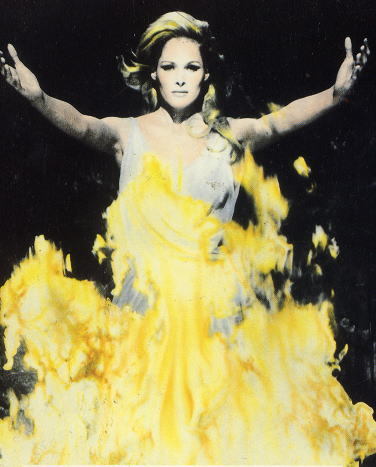
Come To Me
In Haggard’s story it is clear that Ayesha having lost her materiality to the flames is purely spiritual. This is going to cause her problems as she steps into the flames the second time.
The flame passes by while Leo dithers. Impatient for Leo to assume immortality Ayesha strips, as the flames will flame the material garments about her but not her body. As the flame comes around again Ayesha eagerly stands in its way. However having been once purified it is good for eternity. The second time is disastrous. Perhaps spiritually dessicated by the double dose Ayesha begins to wither devasted even in her death throes by her loss of beauty. Love in vain.
Job is so horrified he dies of fright leaving Leo and Holly alone.
The story for all intents is over but Haggard takes a dozen pages or so to get his heroes out of the caves and back to civilization.
Ayesha’s existence wasn’t extinguished. Her dying words were that She would return. Room left for the sequel which not surprisingly was called The Return Of She appeared in 1906.
Haggard hit the groove sharp as a knife in this incredibly well devised and executed story. One will find evidences of it strewn all through Burroughs’ corpus. Not least in his own character of La of Opar. La itself translates from the French as She, of course, so Burroughs even appropriates the name.
La is as ardent for Tarzan as She was for Leo/Kallicrates. Tarzan himself remains cold and indifferent to La throughout all four Opar stories finally abandoning her in Tarzan The Invincible.
She by Haggard is well worth three or four reads to set the story in mind and savor the wonderful and unearthly details
The End.
End of Review
A Review: Pt. III She by H. Rider Haggard
November 25, 2009
A Contribution To The
ERBzine ERB Library Project
She
by
H. Rider Haggard
Review by R.E. Prindle
Part III
The Gruesome, The Morbid AndThe Hideous
Rider Haggard was criticized severely by certain of his contemporaries for employing so many gruesome, morbid and hideous details. Indeed, ‘ She’ seems to be a study in the hideous, the gruesome and the morbid. If one concentrates on those aspects of the story one might actually question Haggard’s mental health.
Haggard himself calls attention to this morbidity. In King Solomon’s Mines he pointed out his humor with references to the Ingoldsby Legends; in She he makes a pointed reference to a Mark Tapley. I had no idea who Mark Tapley might be but thought I’d consult that most magnificent of encyclopedias, the internet. No problem. Mark Tapley was a character from Charles Dickens’ Martin Chuzzlewit. No matter how adverse the circumstances were Tapley was always cheerful and ebullient. Haggard must have thought him ridiculous. Thus he is devising a series of incidents that would bring even Mark Tapley down. Hmm. Interesting experiment.
It would seem then that Haggard was suffering from a fairly deep depression. In that sense She is sort of a horror story not too different in intent than, say, Bram Stoker’s Dracula. Indeed, at one point Ayesha explains that she rules by terror. That being the most effective way to control brutes like the Amahagger.
Certainly the storm at sea prior to entering Kor was an example of terror on the part of nature, a portent of things to come. Not least of these was the hot potting and projected cannibalism of the surviving member of the ship’s crew, Mohammed. ‘She’ had only required the safety of the Whites; as Mohammed was apparently a negrified Arab the Amahagger excluded him from the ban on Whites. An interesting example of White Skin privilege.
Their custom of killing their victims was to heat a pot red hot and turn it over on the victim’s head. There’s a gruesome and hideous enough example. You can see where Burroughs picked up his fascination for the gruesome and hideous.
The Caves of Kor are actually a city of the dead. Kor was an active civilization before Egypt existed in the fifth or sixth millennium BC. As embalming was a known practice when the Dynasties began c. 3400 the practice must have developed long before. Quite possibly it was practiced by the peoples of the Basin before the Mediterranean was flooded. In The World’s Desire Haggard mentions that the ancient Egyptians possessed writings in a precedent language. If so, how far back things like embalming go might be prodigious.
Egyptian embalming was primitive compared to that of the Korians. While Egyptian mummies became desicated the Korian process was such that the body was preserved forever in an apparent state of health. Thus bodies perhaps ten thousand years old or older had the appearance of freshness.
Now, this is positively creepy. Holly’s Amahagger attendent Bilalli while discussing Korian embalming told Holly that while he was a young man a particularly beautiful female corpse occupied the very slab on which Holly slept. Bilalli used to enter the cell and sit looking admiringly on the beautiful corpse by the hour. One day his mother caught him at it. The embalming fluid used was extremely flammable. Bilalli’s mother stood the body up and lit it. Like a huge torch the body burned down to the feet. The feet were still as good as new. Bilalli wrapped them and stored them beneath Holly’s slab. Groping around beneath the slab he brought out those ten thousand year old feet, still fresh, except for some charring at the ankles.
Haggard doesn’t stop there but goes on to emphasize the beauty of one particular foot. One wonders if perhaps George Du Maurier read She becoming entranced by the foot image thus reproducing the image in his novel Trilby when Little Billee draws Trilby’s beautiful foot on th wall. It is a thing Du Maurier would do as he inserted his literary baggage as profusely as Burroughs.
What effect this image had on Haggard’s contemporary readers may be guessed from the complaints about his gruesomeness.
In fact Haggard projects a depressed brooding evil permeating the Caves of Kor very well. This may have been caused by his and Lang’s theories of the Matriarchy. Human sacrifice was an integral part of the Matriarchal world. The sacrifices were invariably of men because women had greater economic value. When men were no longer sacrificed bulls, rams, the males of the species were substituted, the female still having greater economic value. Thus the story of Isaac and the Ram. That would be a great advance in civilization. About that time Isis ceased being the Egyptian symbol of the firmament being replaced by the female cow as the symbol of economics. Something like the kings of England sitting on the woolsack.
Depending on Haggard’s and Lang’s theories of the Matriarchy then Haggard may have been portraying a consciousness that has ceased to exist. There is always an element of misogyny in Haggard’s stories that is no longer tolerated. Then men were men and women were women instead of the attempted strange unisexuality of today. Thus the tens of miles of swamp between the Amahagger quarters and the citadel of Kor indicate the extent and quality of the Matriarchy. Swamps are the symbol of the female and the Matriarchy or, in other words, this very primitive superstitious consciousness.
The Korian swamp was haunted by mephitic vapors, evil smelling and oppressive. The ground they walked on was of uncertain solidity; it might look firm but this was only illusory as one could break through the crust. Often the litter bearers were walking through evil smelling muck up to their knees.
At one point an accident occurs and Bilalli’s litter with him in it is dumped into the slimy water. He would have drowned if Holly hadn’t leaped into the rank female waters to save him. They emerge looking something like the creature from the Black Lagoon.
It will be remembered that Holly was something of a misogynist. One may be stretching a point but even though rejecting women and marriage Holly managed to inherit a son from a man who was also a womanless widower. Haggard makes a strong contrasting point when he says that Leo was not averse to female company. The manservant, Job, is absolutely terrified of the female.
After traversing this desolate swamp of the female for days they arrive at the citadel or temple of Kor. Now, the citadel of Kor was built on an ancient lake bed that had been drained ten thousand years before. In that sense Ayesha is the same as Nimue or the Lady Of The Lake of King Arthur. Nemue lived at the bottom of a lake where she raised Lanclot who consequently was called Lancelot of the Lake.
Compare this also with Haggard’s postumously published Treasure of the Lake in which the Anima figure lives on an island in the middle of a lake in the middle of a volcanic crater. The lake of Kor was also in the middle of a crater.
When the Korian civilization was extinguished it wasn’t by invasion or other external reasons but by a monster plague something like the fourteenth century european Black Death that wiped out nearly everyone. At the resulting rate of death it wasn’t possible to embalm everyone so that tens of thousands of bodies were dumped into a huge subterranean pit.
In conducting Holly and Leo on a guided tour of Kor which was one gigantic necropolis, talk about depressing, Ayesha brings them to this pit. I quote:
Accordingly I followed (She) to a side passage opening out of the main cave, then down a great number of steps, and along an underground shaft that cannot have been less than sixty feet beneath the surface of the rock, and was ventilated by curious borings that ran upward, I do not know where. Suddenly this passage ended, and Ayesha halted, bidding the mutes return, and, as she prophesied, I saw a scene such as I was not likely to behold again. We were standing in an enormous pit, or rather on the brink of it, for it went down deeper- I do not know how much- than the level on which we stood, and was edged in with a low wall of rock. So far as I could judge, this was about the size of the space beneath the dome of St. Paul’s in London, and when the lamps were held up I saw that it was nothing but one vast charnel-house, being literally fullof thousands of human skeletons, which lay piled up in an enormous gleaming pyramid, formed by the slipping down of the bodies at the apex as others were dropped in from above. Anything more appalling than this mass of human remains of a departed race I cannot imagine, and what made it even more dreadful was that in this dry air a considerable number of bodies had become dessicated with the skin still on them, and now, fixed in every conceivable position, stared at us out of a mountain of white bones, grotesquely horrible caricatures of humanity. In my astonishment I uttered an ejaculation, and the echoes of my voice, ringing in that vaulted space, disturbed a skull which hd been accurately balanced for many thousands of years near the apex of the pile. Down it came with a run, bounding along merrily towards us, and of course bringing an avalanche of other bones after it, till at last the whole pit rattled with their movement, even as though the skeletons were rising up to greet us.
Talk about a holocaust! Imagine standing in that dimly lit space far beneath ground, in the grave itself so to speak,and viewing that. Holly was overcome and perhap Mark Tapley himself would have lost a little of his cheeriness. If that didn’t do it the ball Ayesha threw would have.
Before I move on to that though let’s take a penultimate example that might actually unsettle Mark Tapley. This is truly unsettling with truly macabre and voyeuristic soft porn details that are quite remarkable. Let me say that it is only with the fourth reading that the horrific nature of these details really began to sink in. I hope to really make this clear in the next section in which I intend to do an in depth analysis of Ayesha.
In his cell at the citadel of Kor Holly notices a cleft in the wall he hadn’t noticed before. This cleft is going to lead him to Ayesha’s sleeping room. This is not unlike King Solomon’s Mines in which upon entering the symbolic vagina they were led to the womb or treasure box. As I say Holly entered this cleft, let your imagination dwell on that, and followed a dark, dank, narrow corridor until he perceived a light.
He is looking into Ayesha’s sleeping room where in a certain deshabille, very erotic, she is addressing a covered form on a bier next to hers. This is the embalmed body of Kallicrates who she murdered twenty-two hundred years before. So she has been sleeping with this corpse for twenty-two centuries. Now, dwell on that for moment, let the horror of it sink in.
She addresses the corpse in a fairly demented way. Twenty-two hundred years of this would drive anybody nuts. Finally to the dismay of Holly she animates the body by telekinetic powers actually causing it to stand zombie like so she can kiss and caress it. A lot of necrophilia in this novel. Haggard must have been half dotty when he wrote this. Of course Kallicrates is a double of Leo so Holly has all he can do to keep from crying out. Causing the dead man to lay himself down Ayesha covers him and blows out the light.
Holly has to find his way back in the dark reminding one of innumerable passages in Burroughs where his characters have to find their way in the dark. Holly gets only so far and collapses in the tunnel. Waking he sees a light coming in from his cell allowing him to find his way back.
And then Ayesha throws her ball. If you’ve read carefully and really ingested these macabre, gruesome, and as Burroughs’ would say, hideous details they’re beginning to oppress your mind, perhaps even a mind like Mark Tapley’s.
Now Haggard trundles out the frosting. To illuminate her ball Ayesha brings out piles of ten thousand year old corpses placing them around the perimeter as human torches. Laying out a large bonfire the corpses are stacked alternately like so much cordwood and replaced as they were consumed. Remember these are as fresh looking as you or I. The Roman emperor Nero actually used live humans in the same manner. Haggard notes this in the text which I thought weakened the effect.
Ayesha seems to be aware of the effect, indeed, intended it and appears to relish the reaction.
These are the high points of these horrfic details. Minor ones are constant so that the cumulative effect leading up to the terrific images of the demise of Ayesha, temporary though it might be, is overwhelming. But about She, Ayesha, in the next part.
A Review: Part II She By H. Rider Haggard
November 20, 2009
A Contribution To The
ERBzine ERB Library Project
She
by
H. Rider Haggard
Review by R.E. Prindle
From London To The The Caves Of Kor
She is dedicated to Andrew Lang:
I Inscribe This History To
ANDREW LANG
In Token Of Personal Regard
And Of
My Sincere Admiration For His Learning
And His Works
One may well ask then who is this Andrew Lang and what is his learning? In point of fact Haggard not only dedicated She to Lang but wrote three books in collaboration with him. Andrew Lang, 1884-1912, was a Scottish scholar specializing in folklore, mythology and religion so you can see where Haggard came by much of his esoteric knowledge. In addition Lang was one of the founding members of the Society For Psychic Research and a past-President. Lang wrote dozens of books over his lifetime. He even wrote a parody of She in 1887 called He. Today he is remembered only for his collections of fairy tales. Twelve volumes in all each titled after a color such as The Crimson, or Blue or Pink or Gray Fairy Book. The volumes are undergoing a fair revival now with a collector’s edition published by Easton Press and several nicely bound volumes by the Folio Society.
The nineteenth century was the one in which advanced knowledge of the past was rapidly extending European knowledge greatly. The Rosetta Stone deciphering Egyptian hieroglyphics had been achieved as recently as the 1830s. Nineveh and the Assyrian ruins had been unearthed. Schlieman had discovered the locations of Troy and Mycenae.
The exoteric side was covered by the academics while the esoteric side was covered by independent scholars like Madame Blavatsky and probably Andrew Lang. There was a clean split between the academic Patriarchal view of ancient history and the emerging Matriarchal view that had just been developed by the Swiss mythologist, J.J. Bachofen. Bachofen organized ancient history into Hetaeric, Matriarchal and Patriarchal periods. He himself was a member of the successor Scientific period.
The academics totally rejected the notion of a Matriarchal period. This, of course, led to a complete inability to understand Homer, both Iliad and Odyssey. The Iliad especially is a description of the war by the Patriarchy to destroy Matriarchy.
Lang seems to have understood the Matriarchal phase of ancient history. He must have passed this knowledge on to Haggard. Ayesha, as She, rules a Matriarchal society. While the ideas represented in She must have seemed bizarre or merely an amusing reversal of the Patriarchal world at the time, today it all reads comprehensibly. It rings true if not exact.
C.G. Jung, the psychologist, who developed such notions as the male Anima and the Shadow was very immpressed by what he saw as the male Anima in She. Madame Blavatsky lauded the book for its esoteric content. But then, Haggard was firing on all eight cylinders when he wrote it, it is difficult to conceive of a more perfect fantasy/adventure novel. Indeed Haggard subtitles the novel: The History Of An Adventure.
Haggard was an excellent Egyptian scholar. He not only visualized Egypt convincingly in his Egyptian novels but his Egyptian ideas pervade the African novels. Many of them involve Egyptian influences and even peoples filtering down into East and Central Africa. The Ivory Child is a case in point as is She.
The set up to the trip out is brilliant incorporating details that become cliches in B movies.
Leo Vincey’s father before he died gave a metal box to Leo’s guadian, Horace Holly, that wasn’t to be opened until Leo was twenty-five. This box is now opened. It contained a letter to Leo, a potsherd (a piece of a broken jar) covered with ‘uncial’ Greek lettering, a miniature and a scarab containing Egyptian hieroglyphics that read ‘Royal Son of the Sun.’
Thus Haggard captured most if not all of the elements that went into the intellectual aura fostered by B moves primarily in the first years of the talkies through the thirties. That entailed things like the Curse of the Pharaohs, movies like The Mummy melding into Wolf Man, Dracula, Frankenstein and African juju spells. Things against which Europeans had no defense because the ancient magic was stronger than modern science, or so we were led to believe. I can’t speak for others but it took me a while to shake this oppressive spirit. This was pretty strong stuff for my ten to twelve year old brain. Not to mention being bombarded by The Creature From The Black Lagoon, The Thing and The Day The Earth Stood Still. We wuz tried in the fire and come through good.
The gist of it is that Leo’s ancestor Kallicrates lived in the time of the last Pharaoh Nectanebo as one of the royal family. Spookier still Nectanebo was said to have fled Egypt before the conquering hordes, going to Macedon where he secretly impregnated Olympia, Philip’s wife, who then gave birth to Alexander which made him the rightful heir to the Pharaohship instroducing Greeks as rulers into his city of Alexandria.
At any rate Kallicrates girl friend, Ayesha, killed him in a jealous rage. The family nursing vengeance for all these two thousand years it is Vincey’s mission if he chooses to accept it, to follow the ancient map to the Caves of Kor and kill Ayesha or, She-Who-Must-Be-Obeyed who has been nursing regrets over killing Kallicrates two thousand years previously. Listen to me, I’m tellin’ ya it’s all here.
So Vincey, Holly and their man Job set out to find this place in Africa even more remote, if possible, than King Solomon’s Mines. And a heck of a lot more hostile too.
The trip out is some of Haggard’s finest writing. They are to be looking for a rock formation on the coast in the shape of a gorilla’s head. Sailing the coast they miraculously spot this head just as a terrific squall sends their felucca, dhow or other exotic ship from foreign climes to the b ottom.
But, even though the ship sinks they beat the reaper because they brought a boat containing unsinkable water tight compartments. As the storm subsides the three survivors along with an Arab float into the mouth of the appropriate stream as though it were all foreordained. What follows is some excellent writing with details I don’t need to recount.
Suffice it to say they are dragging their boat along an ancient canal when they are accosted by men from Kor. Ordinarily these guys would have speared them and moved on, no strangers needed in Kor. Using her magic She had learned of Leo’s coming a week previously thus ordering their lives spared while they were to be brought to her. Uh huh.
The detailing is terrific, this book is tight and well organized. It moves right along. The land is under the thumb of She-Who-Must-Be-Obeyed. This is a tight Matriarchy as we now recognize not just some strange place where a woman is in charge.
While the three are entering the Caves of Kor, Leo Vincey, being the cynosure of all female eyes, a knockout named Ustane steps up and kisses him. Not averse to a public display of affection Leo lays one on her back. New to the area and not aware of the customs of the place Leo had just accepted Ustane as his woman. In town for a few minutes and already married. That’s the way things happen in this particular Matriarchy. Ustane is now in conflict with Ayesha, She-Who-Must-Be-Obeyed.
The stage is now set for the main drama when Ayesha recognizes Leo as her long lost Kallicrates come back from all those reincarnations at last.
The exoteric Catholic Church is thus thrust aside in favor of all the heretical doctrines of the esoteric which have been bubbling under the Hot 100 for two thousand years. These unfamiliar esoteric doctrines would become the mainstay and staple of science fiction/fantasy for the next one hundred years.
Just as an example of how Burroughs probably learned esoterica, I became familiar with estoeric themes myself from reading 1950s science fiction and fantasy- Amazing Stories, William Tenn, Robert Heinlein, Ray Bradbury and all that sort of stuff without realizing what I was taking in, thus Burroughs surrounded by the Society for Psychical Research, Camille Flammarion, George Du Maurier and Stevenson et al. naturally learned the esoteric language. No mystery, he was speaking in tongues before he knew it.
Leo is awaiting the summons from Ayesha which will be covered in Part III.
Part I A Review: She By H. Rider Haggard
November 17, 2009
A Contribution To The
ERBzine ERB Library Project
SHE
by
H. Rider Haggard
Review by R.E. Prindle
Part I
The Framing Device

From eighteen eighty-five to two thousand nine is one hundred twenty-five years. The span records many changes. In 1885 there were no movies, no radio or TV. Movies came in c. 1900 beginning to change the literary paradigm. The movies produced a definite class structure in literature. With the introduction of sound in 1927-28 two classes of film developed. A movies and B movies. A movies employed A or literary fiction such as War And Peace, Oliver Twist and such while the developing fields of genre fiction were reduced to an inferior B status.
Time has erased the meaning of the terms A and B pictures. I suppose that if a younger person was told that he was watching a B movie he wouldn’t know what was meant. Even if a devoted movie buff, the mere classification would have no experiential significance. You had to have been there.
In the development of the film industry it was thought that studios had to have their own theatre chains. Thus MGM movies wouold be shown only at Loewe’s first run theatres and so on.
In those glory days of the movies first run theatres were gorgeous temples, often named The Temple, the Roxy in NYC has the most spectacular reputation. The goal of the studios was to produce 52 A movies a year to supply the ‘exhibition’ chain a new first run A film a week. Only MGM was to reach this goal.
Once having been exhibited for its week or period A movies were released to rerun theatres usually outside the chains where they were shown at reduced prices. As an added incentive a second feature was shown and this was a B movie.
We lucky kids who inhabited Saturday matinees every week year around usually got two B movies and selected short subjects which included previews, a serial, a cartoon, a newsreel, and some sort of film usually a travelogue on deep sea fishing or water skiing matter. These comprised an alternate reality in addition to real life and dreams. Nor did we feel shorted by B movies. To our young minds these movies were fraught with the most profound thoughts imaginable. Hopalong Cassidy and Tarzan were the favorites of most kids- Gene Autry, Roy Rogers a distant second to Gene. Unbeknownst to us of course the literary granddaddy of the B movie was H. Rider Haggard and She.
Not that Haggard movies were shown with any regularity but he managed to anticipate all the elements of B movies to perfection. Many if not most of the key elements of B moviedom were pinched from Haggard. What Haggard didn’t provide was tossed in by his disciple Edgar Rice Burroughs.
Burroughs borrowed his use of the framing device from Haggard probably with the frame of She as his model. The framing device of Tarzan Of The Apes shows emulation of that of She. It’s a good one.
Most writers of these tall yarns wanted the reader to believe he was reading a true story, in other words, an invitation to suspend disbelief- that is, everything fits in so he divised a framing story as persuasion.
The first paragraph of She’s preface is perfection of its kind:
In giving to the world the record of what, considered as an adventure only, is I suppose one of the most wonderful and mysterious experiences ever undergone by mortal man, I feel it incumbent on me to explain my exact connection with it. So I will say at once that I am not the narrator but only the editor of this extraordinary history, and then go on to tell how it found its way into my hands.
If one compares that to the first paragraph of Tarzan Of The Apes the similarities become immediately apparent. Both authors claim no authorship. In both cases the story, or history, was given to them by a second party. Thus Haggard the author as editor can speak in the first person while making editorial comments.
The hint is made that Allan Quatermain is the actual editor. The editor was visiting Cambridge University one day some twenty years previously when he noticed two interesting people. His friend knowing them offered to introduce him.
“All right,” answered my friend, “nothing easier. I know Vincey; I’ll introduce you,” and he did, and for some minutes we stood chatting- about the Zulu people, I think I had just returned from the Cape at that time.
So the canny reader hopefully having read King Solomon’s Mines can infer that the unnamed editor is, in fact, Allan Quatermain as a garrulous amiable gentleman.
Twenty some odd years after that casual and very brief meeting, as improbable as it may seem, one of the two men, Vincey’s guardian, Horace Holly sends the Editor the text for She.
Holly says: ‘You will be surprised considering the slight nature of our acquaintance to get a letter from me.’ I should say so. What a great memory.
Holly goes on:
I have recently read with much interest a book of yours describing a Central African adventure. I take it this book is partly true, and partly an effort of the imagination. However this may be, it has given me an idea. It happens, how you will see in the accompanying manuscript (which together with the scarab, the ‘Royal Son of the Sun), and the original sherd, I am sending you by hand) that my ward, or rather my adopted son Leo Vincey, and myself have recently passed through a real African adventure, of a nature and much more marvellous than the one which you describe, that to tell the truth I am almost ashamed to submit it to you but you should believe my tale.
So Holly sees through Quatermain’s preposterous story as only half true while Holly’s equally preposterous story is the whole truth, the real thing. Well, if you’ve accepted the premiss there’s no way to go but further in so, all one can say to Holly is that his story is going to have to go some to exceed Quatermain’s.
Generously Holly offers any profits from publication as a reward while underwriting any possible loss. That was real Haggard accepting that bundle on Quatermain’s part.
Rounding out the baloney the editor says:
Of the history itself the reader must judge. I give it to him, with the exception of a very few alterations, made with the object of concealing the identity of the actors from the general public, exactly as it has come to me.
As a reader my judgement is that it is an excellent whopper but I don’t believe a word- or do I?
The frame continues:
With slight [five pages] preface, which circumstances make necessary, I introduce the world to Ayesha and the Caves of Kor.
Ready when you are, C.B.
An excellent, convincing framing device. The Editor must be Allan Quatermain yet the name of the editor is concealed from us as well as the identities of the actors. Where we are going is mystery piled on mystery, the strange and wonderful lie before us, we in complete safety.
So with Burroughs framing device of Tarzan Of The Apes. While not copied word for word certainly idea for idea. The influence of Haggard is apparent but not paramount. Burroughs’ mind was a maelstrom into which innumerable influences (a slight exaggeration) are drawn to the depths of his subconscious and emerge melded into something so close and yet so different than his many, many sources.
Having roped the reader in like a carnival barker luring the victim into his peep show Haggard begins to lay out his nearly perfect story of the type.
Part B follows.
A Review: King Solomon’s Mines By H. Rider Haggard
November 13, 2009
A Contribution To The
ERBzine ERB Library Project
King Solomon’s Mines
by
H. Rider Haggard
Review by R.E. Prindle
Three volumes made Rider Haggard’s reputation then and maintain it today. Classics of the B genre. The first of these is the subject of this review, King Solomon’s Mines. The other two are She and Allan Quatermain. The novels were written between 1885 and 1888. These were very interesting years in the exploration of Africa. Speke had identified the source of the White Nile twenty some years earlier. Robert Livingstone had been found and sensationally recounted by the great Henry Morton Stanley.
Subsequently Stanley had navigated the course of the Nile from the plateau down to the sea, a stunning accomplishment. His rescue of the Emin Pasha in 1886 was on everyone’s lips. The white spaces on the maps were rapidly disappearing. In the midst of this excitement Rider Haggard’s great African trilogy made a propitious appearance. No better timeing could have been devised. And the novels were sensational, plausible too, at that time. Who knew what additional wonders Africa concealed. There was room in that gigantic continent for a lot of lost cities and civilizations. Haggard and his disciple, Edgar Rice Burroughs rapidly populated Africa with a host of them.
Haggard would continue to write exciting African tales until the day he died in 1925 after a lifetime of putting out two or three novels a year. They usually followed the same format, a long trip out taking up at least half the novel, the intense situation on arrival and a return home. The same format Edgar Rice Burroughs would use. The novels were packed with esoteric lore and authentic African details.
It is said that Haggard wrote the Mines on a bet after being told he couldn’t write the equal of Stevenson’s Treasure Island. He did do that but Mines is written tongue in cheek with a lot of jokes. Haggard makes this clear when Quatermain says that his two literary mainstays are the Bible and the Ingoldsby Legends. The Legends written in the 1830s and 1840s are a collection of humorous parodies of Folklore themes and poems by Richard Harris Barham writing anonymously as Thomas Ingoldsby of Tappingham Manor. The book was very popular with, it seems, all the the authors till the turn of the century at least. One finds it mentioned frequently. Taking the hint I read a copy. Thus, Haggard is protecting his rear in case of failure by saying his story is just a put on or joke.
King Solomon’s Mines is told in the first person by the old knockabout hunter, Allan Quatermain. He has a bumbling self-effacing manner not unlike Inspector Columbo of the TV series. You don’t think he can do it but he’s spot on every time.
As was common with this sort of adventure story the point is to make the reader think the story is true. Burroughs probably picked up his habit of framing from Haggard. Many of the details of Mines are true to Haggard’s own life while his study of the Zulus and other tribes accurately portray their customs. Haggard is very sympathetic to African customs and mentality actually seeming to envy them. He genuinely can see little difference between Black and White while adopting a fairly critical attitude towards Whites and a sympathetic one toward Blacks. Very modern. Indeed, in this novel the White heroes join a Zulu Impi or regiment and fight with the Zulus as White Zulus. Naturally they comport themselves heroically, Curtis excelling the Blacks at their own game.
As the novel begins Haggard sets up the story. The Englishmen, Curtis and Good, are out in search of a lost brother. The meeting with Quatermain on shipboard is fortuitous leading to his subsequent employment as their guide. Haggard describes a boat journey from Capetown to Durban that is obviously authentic; Haggard himself has taken the same trip. Thus unlike Burroughs’ imaginary Africa this is authentic, the Real Thing. On the journey Quatermain meets Sir henry Curtis and his friend John Good, who need a guide to take them in search of Curtis’ lost brother.
The search will take them to a hidden Zulu enclave behind a burning desert and a towering mountain range. The trip out is filled with interesting authentic details but no need to dwell on them here.
Crossing the burning sands not known to have been successfully navigated before, they are confronted by the towering twin peaks of Sheba’s Breasts topped with four thousand foot nipples. Who can’t see the humor there. Pretty racy for what are thought of as stodgy old Victorian times. Bear in mind the Ingoldsby Legends while reading the story as probably most of Haggard’s readers would have been familiar with them. They are of this sort of tongue in cheek humor. The ancient map they are following indicated the route to follow.
Behind the Breasts lies Kukuanaland. Undoubtledly Kuku should be read coo-coo. The Kukuanas are the Zulu tribe in possession of King Solomon’s Mines. Kukuanaland is somewhere near the ruins of Zimbabwe, although Haggard doesn’t allude directly to the site. I’m sure everyone has heard of the ruins of Zimbabwe. The old Zimbabwe I mean.
There has always been a dispute as to who built Zimbabwe. Africans claim it was built by Africans while the thought in Haggard’s time was that Zimbabwe was built by Phoenicians hence a few mentions of them. The notion was that these were the ruins through the Queen of Sheba of King Solomon, hence the title King Solomon’s Mines. Zimbabwe is either in or next to lands of the Shona people. The Shona arrived in the area from the North possibly from 300 to 800 AD. There is no record of stone work among the Shona before or after. The structures of Zimbabwe are of shale like stone merely piled on top of each other being very thick and very high. Instead of piled up stones it is customary to say the construction is without mortar as though that is a great skill. Without mortar = piled up stones, doesn’t it?
It seems unlikely the Shona would have built them while it is also a remote possibility that the Phoenicians did. It is true however that Greeks traded on these shores but they didn’t build them. A more probable builder is the Malagasy people. I don’t think the Malagasy arrival is commonly known yet, it wasn’t to me until a few years ago. The Malgasies made the long sea journey from Indonesia to arrive in Madagascar and East Africa sometime between 500 and 1000 AD. As they would have been invaders into a recently and sparsely settled territory any groups landing on the continent would have been automatically at war with the Shona thus needing a fort for protection. Being much more technologically advanced than the Africans they would likely be familiar with stonework.
As it is said that Zimbabwe was a mining and trading community, as the Malagasy were seafarers it is likely they would be the more obvious candidate otherwise one has to explain where the traders of what is described as an extensive trade come from as the the Africans couldn’t possibly have gone to the buyers or known what to trade. Interestingly the Malagasies introduced the banana and an improved yam to Africa thus they had to land on African shores.
Zimbabwe had only been discovered by Europeans a few years before Haggard arrived in Durban. Very likely he was eager to see the ruins and did as he does have at least three stories in which Zimbabwe figures. Here he combines Zimbabwe, King Solomon and the Phoenicians.
As the party approaches Kukuanaland they are faced by a huge mountain range towering perhaps 15,000 to 18,000 feet into the sky. Facing them are two huge mountains named Queen Sheba’s Breasts, the Grand Tetons of Africa.
Here I have to mention a blogger (feministbookworm.wordpress.com) who pointed out the female arrangement of Kukuanaland. This escaped me in my previous readings but is of some interest. Haggard in a cryptic way has written a fairly pornographic story, especially for Victorian times. I’m sure most people didn’t get it even though Haggard provides a fairly obvious map although turned upside down. This is along the coy lines of various pop songs such as ‘Baby, let me bang your box.’ After shouting out this line several times allowing the average guy to think a woman is being propositioned the singer reveals he’s actually referring to a piano- box in musician’s slang equals piano. Box = a woman’s pudenda in sexual slang.
If one looks at Haggard’s map Sheba’s Breast’s are to the South while there is a triangle of mountains to the North. The triangle of three mountains forms a female Delta or box. In the middle between the Breasts and Delta is the Kukuana capitol called Loo. Loo is British slang for toilet or ‘shitter’ so we some scatology going on here.
This gets better. I jump ahead to the ending. The Englishmen are promised diamonds from King Solomon’s Mines. The mines are located within the Delta or pudenda. British slang of times for the female pudenda was Treasure Box. Thus the Englishmen are going to descend through the vagina into the womb of the mines where the diamonds are stored in actual treasure boxes. Humor, remember. Bear in mind that in Burroughs diamonds are of the female, actually Anima, treasure. Same here. This is going to get better.
Apart from Mother Earth, represented by Sheba’s pudenda, there are only two women in the story which Haggard smirkingly points out: One is a Bantu beauty who becomes attached to Good, the other is an old hag named Gagool. The latter forms the model for Burroughs’ old Black crone in Gods of Mars and Nemone’s guardian in Tarzan And The City Of Gold.
Both accompany the three White men to King Solomon’s mines. At whatever age Burroughs first read this the impressions stuck. This stuff was current literature to him while Classics to us. One must imagine the excitement with which these novels were read. Readers of Opar Tarzan novels (Return, Jewels, Golden Lion and Invincible) will immediately recognize the setup although there are differences.
Always one to employ horror effects Haggard is at his best in this early novel. The group descended as it were through the vagina into the depths of the womb. Along the way are giant stalactites. (Penises?) Then they enter a chamber in which the dead kings of Kukuana are preserved. Rather than Egyptian mummification they are set beneath a drip being turned into stalactites or, in other words, big pricks. Seems to me like an obvious joke. A huge figure of death presides over the immortal enclave.
Proceeding further they come upon a door set in the wall blocking the way. The door is a huge slab several feet thick operated by a hidden mechanism that lifts the slab vertically into the ceiling. Gagool with a hidden movement releases the door which slowly and efficiently retracts into the ceiling. The party can now enter the treasure room or womb. The door stands for men’s sexual desire for the female. As with the hymen without equal desire on the part of the woman entrance is barred but with woman’s compliance the way opens easily.
Inside the room or womb are the treasure chests containing unlimited value in diamonds.
After taunting the men Gagool makes a break for the door having released the lever that closes it. She is held back by Foulata who worshipped Good. Stabbed by Gagool she falls to the ground but has successfully delayed Gagool. In attempting to roll under the descending slab the tardy witch is crushed flatter than a piece of paper. The men are now trapped in the womb but they have a candle for light. Quatermain stuffs his pockets with stones while filling a basket Foulata brought.
Here’s the classic B movie part: While waiting for death they notice that the air remains fresh. Good discovers a trap door in a corner. Opening this they descend as it were into the bowels of this elogated represention of a woman who might represent Mother Earth or the Great Mother thus forming a collective Anima for the three White men. Anticipating She a little. A bizarre Anima for Haggard also. OK, I’ve got a weird sense of humor. I’ve always known it but that doesn’t make it less funny. No longer having a light they are forced to feel their way through the tunnels. The tunnels eerily represent the intestines. Haggard is getting really scatological here as you know what emerges from intestines.
As they pick their way along Good falls into a stream that greatly resembles the urethra. Fortunately Quatermain has some matches. One is used to locate Good clinging to a rock in midstream, possibly meant as a kidney stone as a joke. Hauled ashore they backtrack and resume their way. Curtis spots a dim light toward which they move. The opening narrows down to the point that the men have to squeeze through tumbling out into the diamond shaft like so many turds. Haggard must have been gleeful at what he was getting away with.
Climbing out of the pit they discover they have returned to the entrance. Thus vagina and rectum are only a short distance apart. Anatomically correct as it were. Haggard had a fine sense of humor.
While adapting the topography for his own needs one can easily see how Burroughs replicates Haggards’ design in Opar. Burroughs designed a long straight corridor but broken by a fifteen foot or so gap. In Jewels of Opar Tarzan falls through the gap dropping into a pool of water or river much as in Mines. Proceeding further he enters he jewel room of Opar filling his pouch as he had neither pockets or basket.
Opar itself replicates the Treasure House of Kukuanaland. The gold vaults represent the head of the female figure or perhaps only one of Sheba’s breasts. Proceeding down the corridor, or Great Road of Kukuanaland one comes to the sacrificial chamber situated much as the city of Loo. Proceeding from the chamber one comes to the exit. This is described by Burroughs as a narrow crack or cleft in the wall to pass through which Tarzan had to turn his shoulders sideways. So, Opar and Kukuanaland are built according to the same scheme.
Obviously the memory popped into Burroughs’ mind in The Return Of Tarzan, developed in Jewels of Opar and Golden Lion and came to perfection in Tarzan The Invincible. It would seem clear that ERB understood the sexual structure of King Solomon’s Mines.
If we go back to the other end of Kukuanaland we have the two towering mountains known as Queen Sheba’s Breasts. In order to prevent anyone taking a low level route between the Breasts there is a perpendicular barrier running between the breasts rising several thousand feet. Odd geological formation. Rising 4000 feeet above the breasts themselves are the nipples. That should be enough to make anyone laugh.
A recurrent theme in the stories is a juxtaposition of ice with summer weather, often associated with a woman as here. Perhaps Haggard had a cold, cold mother.
While the party is both starving and thirsting they find neither game nor water until Umbopo discovers some melon patches providing food and water until they reach the snow line. Soon they come to the nipple rising sheer from the breast. At the base of the nipple is a cave. This cave may possibly have been appropriated as the entrance to Opar’s gold vaults in Burroughs. In the cave is the frozen body of Da Silvestre who made the map they have been following. The bushman servant freezes to death during the night so they set him over by Da Silvestre. There’s a joke here but I don’t get.
Continuing down Sheba’s left breast they reach below the snow line. The boys spot an antelope way off there, long shot, but Quatermain makes it, cleanly knocking out a vertebrae in the neck. While cleaning up in an adjacent stream and eating they are surprised by a band of Kukuana and taken.
Umbopo who signed on back in Durban always had this mysterious royal air about him and now we’re going to find out why. For those contemporaries who insist that no book should violate their enlightened prejudices whether the book be as old as Homer or not they may feel uncomfortable reading this book. By and large Haggard shares the attitudes toward race, gender and whatever of his times rather than Liberal notions of today. Can be painful for certain types.
Nevertheless Haggard has a deep admiration for the Zulu tribes and a kind of understanding one toward the lesser Bushman and Hottentots. The Zulus are uniformly tall and well built while Quatermain and Good are smaller and more comical in appearance. Only Sir Henry Curtis is of the same stature, slightly larger, as the Zulus. He seems to stand in for what is otherwise a race of inferior stature.
There is a great fifty foot wide road that runs from the barrier of Sheba’s Breasts to Sheba’s Delta. The road is over a hundred miles long with Loo in the center.
The city of Loo is modeled after the encampment of the Zulu chief, Chaka. The details Haggard describes are undoubtedly accurate. Chaka flourished 1830-40 while the last of his line, Cetywayo, ruled during Haggard’s tenure in Africa. His fictional king is called Twala. We now discover that Twala is Umbopo’s brother. The latter was rightful heir but Gagool who is represented as being hundreds of years old favored Twala expelling Umbopo and his mother which is why he was in Durban. His identity is assured because of an Uroboros that encircles his waist. This snake appears to be a birth mark rather than a tatoo.
After accepting a rifle from Curtis as a gift Twala sends three chain mail shirts of medieval manufacture which proves that Zimbabwe was formerly occupied by another race, I suppose.
We have a civil war brewing here as Umbopa asserts his rights. Before the war develops Twala holds a ceremony I find really interesting, the smelling out of witches. The regiments were assembled. In this case Gagool runs up and down the ranks smelling out the witches. Anyone she indicates is removed from the ranks and immediately killed. This was an actual Zulu custom. Haggard portrays them more than once in what is his pretty decent historyof the Zulus in the novels.
Interestingly under the African president of the United States we have the same situation occurring. Obama denounces those in opposition to him essentially as witches. While currently we are put under surveillance the time may shortly arrive when we are merely arrested and despatched. Thus the innate African soul reasserts itself hundreds of years out of Africa. Of course, Obama was born in Kenya but he didn’t live there.
After the smelling out the regiments align themselves according to their allegiance. The three White men suit up on the side of the pretender, Umbopo. In his admiration of the Impi battle plan Haggard has the Whites disdain to use firearms preferring to show Whites returned to primitive savagery. Of course he normalizes the British and Zulu societies so that any difference is perceived but not real.
If you want to how this attitude was digested by the British public rent a copy of the movie If c. 1965. A British public school story that viewed better the first time around for me but still of interest. I might rent it again, though.
It is at this point of the story that the ‘White giant’ Sir Henry Curtis took his place in the Zulu ranks to show White supremacy that is when the actual basis of Tarzan took place in Burroughs’ mind.
The three Whites are the only ones wearing chain mail so that they come through bruised but alive. Without the chain mail, of course, all three would have been killed many times over. Perhaps the chain mail is symbolic of the science of the Maxim.
My feeling is that Haggard was so enamored of primitive Zulu warfare as organized by Chaka that he thrilled himself by placing the three in their ranks. Haggard had his peculiarities. As I say, he seemed to reject science.
Umbopo’s troops triumph over greater odds while King Twala is captured. Sentenced to die he demands the right to hand to hand combat selecting Curtis as his adversary.
Thus a duel ensues providing two or three pages of excitement in which a very hard battle is fought. Curtis decapitates Twala proving I suppose that on their own turf, evenly matched, the White Man is the greater.
Morally, however, Haggard gives the nod to Umbopo and the Zulus. Umbopo apparently feels a bond has been vilolated between the trio and himself. He offers them wifes, land and honors if they choose to stay in Kukuanaland. They instead choose to gather diamonds from Sheba’s treasure box. Umbopo is disgusted that White men care about nothing but money. Haggard sheepishly agrees with Umbopo but the trio nevertheless collect their diamonds and scoot, setting themselves up splendidly in England where money matters. Regardless of Haggard’s moral it is clear that the Kukuanas have no use for money in their primitive society while being broke in London is a sort of hell.
One wonders whether when Umbopo sent Gagool with them he knew that he was sending them to their deaths. Their return was after all rather miraculous. Leaving Kukuanaland the three arrive safely and rich in England.
Postscript.
Burroughs read not only King Solomon’s Mines, She and Allan Quatermain but probably the whole corpus. What he read before 1911 was obviously the most influential on him through the twenties. So an an investigator, Haggard’s novels before 1911 are the one to familiarize oneself with first. The very late Treasure Of The Lake however did influence Tarzan Triumphant.
Sir Henry Curtis was a key element in the formation of the idea of Tarzan and a role model. I suspect that Treasure Island by Stevenson provided he means to get the Claytons to Africa. Evolution provided the background of Kala and Tarzan’s life with the apes.
Whether Good or Quatermain had any influence on the character of Paul D’Arnot or not I’m not sure. He may have evolved from Dupin of Poe’s Murders In The Rue Morgue forming a double for Tarzan not unlike the narrator and Dupin of Murders.
I have explained the probable relationship of Opar to Sheba’s treasure box. That seems pretty secure to me.
Haggard developed the story line of the preamble and journey to the scene of action, a flurry of action in the crisis and the return home. Burroughs seems to follow this format although he can introduce picaresque elements.
The landscape and terrain of Burroughs is quite similar to Haggard’s. Over the years as Haggard read Burroughs’ novels there are Burroughsian elements that creep into Haggard’s work. Treasure Of The Lake bears a number of similarities to Burroughs especially the elephant dum dum. That also owes a great deal to Kipling and Mowgli. A stunning scene in Haggard. I would really start with Treasure Of The lake and then begin with King Solomon’s Mines, She and Allan Quatermain.
La, of course, is derived from the next novel, She.
Edgar Rice Burroughs Meets H. Rider Haggard
October 25, 2009
A Contribution To The
ERBzine Library Project
Edgar Rice Burroughs Meets Rider Haggard
by
R.E. Prindle
Among the very many important influences on Edgar Rice Burroughs, contending for the top spot was the English novelist of Africa, Henry Rider Haggard, frequently named as just Rider Haggard.
Haggard was born on June 22, 1856 in Norfolkshire. He died on May 14, 1925. When Burroughs was born in 1875 his future idol was beginning his stay in South Africa of seven years duration. It was there that Haggard learned the history of the Zulu chiefs from Chaka to Cetywayo that figures so prominently in his African novels.
In Africa at twenty, he was back in England at 27. Even though Science was surging through England and Europe curiously Haggard was untouched by it all his life. There is not even an acknowledgement that he had ever heard of Evolution in his novels. Nor was he religious in the Christian sense. Instead he became well versed in the esoteric tradition leaning even toward a pagan pre-Christian sensibility. Perhaps very close to African animism.
One supposes that on his return to England he might have immersed himself in Madame Blavatsky’s Isis Unveiled published in 1877. He certainly seems to be a theosophical adept in his first two African novels, King Solomon’s Mines and She but he must have been pursuing his esoteric studies in Africa to have known so much. If so, he is certainly knowledgeable of Zulu and African lore having a deep sympathy for it. Indeed, he frequently comes across as half African intellectually.
Once he began writing he apparently never put down his pen. I am unclear as to how many novels he wrote. For convenience sake I have used the fantasticfiction.com bibliography which lists 50, but as I have sixty so there are obviously some missing. In addition Haggard wrote a dozen non-fiction titles.
While writing dozens of African novels Haggard also wrote a dozen or so esoteric novels placed throughout the eastern Mediterranean, Mexico and Nicaragua. These are all terrifically impressive displays of esoteric understanding, breathtaking as a whole. Usually disparaged by those without an esoteric background and education these volumes are almost essential reading for anyone so inclined. For those who would deny ERB’s esoteric training and background I refer them to Haggard’s novels.
The key to understanding Haggard’s thinking and works are a batch of novels exploring the relationship of the Anima and Animus. Haggard’s quest in which he failed was to find union with his Anima.
His fictional seeker and alter ego was Allan Quatermain. Thus the first of his esoteric novels is King Solomon’s Mines, in which he introduces Quatermain establishes his Ego or Animus. With his next novel, She, he introduces his Anima figure Ayesha otherwise known as She-Who-Must-Be-Obeyed. Early Sheena, Queen Of The Jungle.
She was much acclaimed as the epitome of the Theosophical doctrine by Madame Blavatsky while C.G. Jung asserted that She was a perfect representation of the Anima figure. Haggard followed She (1886) with Ayesha, The Return Of She (1905) and the final volume of the trilogy, Wisdom’s Daughter: The Life And Love Story Of She-Who-Must-Be-Obeyed (1923). Terrific stuff, well worth a couple reads each. She, of course, became the model for Burroughs’ La of Opar.
Haggard died in 1925 so it can be seen that he was obsessed by his quest for union with his Anima. Two additional volumes deal with his problem. The trilogy does not include Allan Quatermain so Haggard had to write his alter-ego into Ayesha’s story. This was begun in She And Allen of 1920. You can see that he closer he got to his death the problem became more urgent. The end of the story was told in his postumously published Treasure Of The Lake (1926).
Treasure is the most hauntingly beautiful title Haggard wrote. Just astonishing. In the novel Quatermain is ‘called’ to travel to a hidden land. He has no idea why but fate is visibly arranging things so that he must obey. Terrific stuff. The Treasure Of The Lake is none other than Allan’s Anima although no longer called Ayesha. She lives on an island in the middle of a lake in an extinct volcano, She being the Treasure. Heartbreakingly she is not for Allan. He is only to get a glimpse of the grail while a character is rescued by Allan who bears a striking resemblance to Leo Vincey, the hero of She who is winner of the Treasure. The Treasure is reserved for him. Thus Allan and Haggard journey back from the mountain’s top having seen the promised land but not allowed to enter. By the time the first readers, which included Edgar Rice Burroughs, turned the pages H. Rider Haggard had crossed the bar, his bark being far out on the sea.
Burroughs was impressed. His 1931 novel, Tarzan Triumphant, is a direct imitation in certain episodes. Largely on that basis I have to speculate that Burroughs read the entire Haggard corpus at least once.
The Anima novels of Haggard then are:
1. King Solomon’s Mines
2. She
3. Ayesha, The Return Of She
4.Wisdom’s Daughter: The Life And Love Story Of She-Who-Must-Be-Obeyed
5. She And Allan
6. The Treasure Of The Lake
The writing of the titles span Haggard’s writing career.
His first esoteric novels which I heartily recommend are Cleopatra, The World’s Desire (top notch), The Pearl Maiden, Montezuma’s Daughter, Heart Of The World, Morning Star and Queen Sheba’s Ring.
What most people think of and when anyone thinks of Haggard is his character Allan Quatermain. The makes and remakes of Quatermain and She movies are numerous. You could entertain yourself for many an hour.
Fourteen novels were published during Haggard’s lifetime, the best known being King Soloman’s Mines and Allan Quatermain. Many people have no idea he wrote anything else. She, of the first African trilogy, doesn’t include Quatermain.
Both of the first Quatermains were highly influential on Burroughs. Tarzan was fashioned to some extent on the character Sir Henry Curtis, the original white giant. While most people look for the origins of Tarzan in the Romulus and Remus myth of Rome that is only a small part of it that reflects Burroughs’ understanding of ancient mythology. The models for Tarzan are more diverse including not only Curtis but The Great Sandow who Burroughs saw and possibly met at the great Columbian Exposition of 1893. The list of titles in the Quatermain series: (N.B. It is Quatermain not Quartermain.)
1. King Solomon’s Mines
2. Allan Quatermain
3. Allan’s Wife
4, Maiwa’s Revenge
5. Marie
6. Child Of The Storm
7. The Holy Flower
8. Finished
9. The Ivory Child
10. The Ancient Allan
11. She And Allan
12. Heu-Heu or The Monster
13. Treasure Of The Lake
14. Allan And The Ice Gods
As I look over the list I find that they were all pretty good. The trilogy of Marie, Child Of The Storm and Finished, concerning Chaka’s wars is excellent. The Holy Flower and The Ivory Child are also outstanding. The Ivory Child introduces the notion of the Elephant’s Graveyard that captivated Hollywood while taking a central place in MGM’s Tarzan series of movies.
Other noteworthy African titles are Nada, The Lily, The People Of The Mist and Benita.
In addition to the Esoteric and African novels Haggard wrote various contemporary and historical novels. All of them are high quality but mainly for the Haggard enthusiast. Burroughs may have been influenced to write the diverse range of his stories by Haggard’s example.
In the current print on demand (POD) publishing situation nearly the entire catalog is available. The Wildside Press publishes attractive editons of forty-some titles. Kessinger Publishing publishes most of what Wildside doesn’t and most of what they do but in relatively unattractive editions. You can search other POD publishers and probably come up with what you want.
Haggard is wonderful stuff. You can choose at random and come up with something that truly entertains you.
A Review: Tarzan And The Jewels Of Opar by Edgar Rice Burroughs
August 19, 2009
Themes And Variations
The Tarzan Novels Of Edgar Rice Burroughs
#5: Tarzan And The Jewels Of Opar
by
R.E. Prindle
Part 1:
On The Road To Opar
I have put off reviewing this Tarzan several times. I like it but I find it difficult. This may have been the first Tarzan book I read, probably in 1950. While I have always liked Tarzan And The Ant Men and Tarzan The Terrible Opar was always my favorite.
Of course in 1950 one’s choice was limited to eight or ten, not including the first, so I read the later novels only recently. Tarzan And The Lion Man is my current favorite. Opar was written in 1915 about a year after the commencement of The Great War, the occupation of Haiti and war scares with Mexico. This was also after ERB’s first spurt that ran from 1911-1914. The latter year emptied the pent up reservoir containing the residue of his early reading and experiences. That period may be described as ERB’s ‘amateur period.’ The latter part of 1914 began what may be described as his professional life as a writer. The spontaneous automatic period was over; he had to think out his stories. That meant he had to do some new reading. Opar coincided with his completion of reading Gibbon’s Decline And Fall Of The Roman Empire. What effect that may have had on Opar I’m not sure.
At the foundation of ERB’s approach to his stories are the three titles of Twain’s Prince And The Pauper, Burnett’s Little Lord Fauntleroy and Wister’s The Virginian. After 1914 he would refer to Jack London and write a series based on the style of Booth Tarkington. While he continued to produce during the twenties, the period was also one of intense reading that produced the magnificent stories of the early thirties. That need not concern us here.
While his favorite three books were the rock on which he built his church, the Oz stories of Baum contribute to the superstructure as they do so prominently in Tarzan And The Jewels Of Opar. The second chapter is even titled: On The Road To Opar. ERB only left out the yellow brick and changed the Emerald City to Opar. It is clearly indicated that Opar is based on the Emerald City.
Rather than being emerald Opar is red and gold. La, the high priestess of Opar can be considered a combination of Baum’s Ozma and Rider Haggard’s She.
The Baum connection is strengthened by the fact that, as I believe but can only conjecture at this point, Burroughs visited Baum at his Hollywood home during ERB’s residence in Southern California in 1913. One guesses but it is probable that ERB got some pointers from Baum on how to keep the Tarzan series going as Baum was producing volume after volume of Oz stories. In point of fact Baum had run out of ideas in 1910 attempting to close off the series. He was compelled to restart the series in 1913 at the insistence of his fans.
Burroughs had effectively closed the Tarzan series with The Son Of Tarzan. Son is a favorite of a lot of people but for me it’s pretty much a rehash of the first three stories; I call the four The Russian Quartet after the villains of the series. Tarzan was already old in Beasts Of Tarzan but by Son he had to come out of retirement. There was no future then, so the Big Bwana had to be reborn. The old Tarzan ended with Son; the new Tarzan began with Jewels Of Opar. A fine new beginning it was.
The Ballantine edition of 1963 prefaces the story with a quote titled: ‘In Quest Of A Lost Identity’, that might easily be changed to ‘A Search For A New Identity’, for in fact, Burroughs old identity had been lost when he gained success and riches. ERB wanted to go forward not back:
Tarzan staggered to his feet and groped his way about among the underground ways of Opar. What was he? Where was he? His head ached, but otherwise he felt no ill effects from the blow that had felled him. He did not recall the accident, nor aught of what had led up to it.
At last he found the doorway leading inward beneath the city and temple. Nothing spurred his hurt memory to a recollection of past familiarity with his surroundings. He blundered on through the darkness as though he were traversing an open plain under a noonday sun.
Suddenly he reached the brink of a well, stepped outward into space, lunged forward, and shot downward into the inky depths below. Still clutching his spear, he struck the water and sank beneath its surface…
Tarzan loses his memory at great stress points in Burroughs’ life. They take place at Opar in underground caverns surr9unded by a wealth of gold. One might think then that they are related to Burroughs’ financial success and through La to his sex life.
One must bear in mind that ERB came into the beginnings of his success just as he was edging into the mid-life crisis. Given a reasonable amount of money in 1913 he reacted in a nouveau riche manner. Remembering back to 1899 and his private railcar trip to NYC and back he tried to relive it with Emma. His trip with Frank Martin troubled his memory. He recalled it 1914 when he took the job on the railroad in Salt Lake City. In 1913 he packed the family aboard with all his belongings and rode out to Los Angeles and San Diego. He may very well have rented a whole Pullman car for himself and family that would be equivalent to a private car but we don’t know for sure at this time. We only know that he was fixated on a private car and that he rode first class.
We can be sure that he was realizing all his dreams as fast as he could earn the money to pay for them or perhaps before he had the money.
He was moving through uncharted territory thus ‘he blundered on through the darkness as though he were traversing an open plain under a noonday sun.’
ERB has his eyes wide open but the unfamiliar demands being placed on him were equivalent to darkness: he couldn’t be sure whether he was making the right decisions. ‘What was he? Where was he.’ This is a dilemma of the newly successful. And then by late 1914, early 1915 he realized that he was in over his head.
Suddenly he reached the brink of a well, stepped outward into space, lunged forward, and shot downward into the inky depths below. Still clutching his spear, he struck the water and sank beneath the surface…
What? Of course. McClurg’s released the first Tarzan as a book in 1914 treating the release in what seems a peculiar way. The contract had been signed, apparently perpetual and unbreakable, ERB, Inc. only bought it out in the fifties, so he must have realized that he had been had. He committed the same error in 1931 when he signed his contract with MGM so he didn’t learn much over the years.
His contract would certainly have been a contributing factor but there may have been other sources that put him in over his head. It is significant that Tarzan didn’t drop his spear; he was still capable fo defending himself.
Now, one would have to believe that Burroughs was at least famous in Chicago. By 1917-18 Tarzan was a household word recognized it seems by everyone. It would be odd indeed if sexual temptations weren’t placed before him. Literary groupies surrounded authors then as groupies did musicians in the ’60s.
La herself is a repressed sexual image while the novel abounds in sexual images. Perhaps signficantly when the rutting elephants charge the priests of Opar Tarzan takes refuge in a tree high above the ruckus. Even then the rutting elephants try to uproot his tree to bring the Big Bwana to earth but do not succeed. One may infer that while temptation was strong ERB remained faithful to Emma.
However by 1918’s Tarzan The Untamed, note the title, Jane is killed while Tarzan’s eye immediately wanders forming a near dalliance with another woman. It was also at this period that ERB walked out on Emma. As told in Tarzan The Terrible, note the title, and Tarzan And The Golden Lion Tarzan and Emma were separated through those two novels and Tarzan The Untamed.
So, Jewels of Opar may be describing the dark side of success when the master tempter attacks you at your most vulnerable plus Burroughs was in full blown mid-life crisis by 1914-15.
The forces of change were shaking him like a terrier shaking a rat. His situation was terrible and wonderful at the same time. So, with Tarzan And The Jewels Of Opar he launched himself on his career as a professional writer.
Part 2.
The novels of Burroughs previous to Opar had flowed from his experience and early reading. The reading had provided the framework that ERB fleshed out with his interests, ideas and experience in essentially an allegorical form. David Adams quite justly points out that Burroughs relies quite heavily on a fairy tale format although it took me a long time to recognize it. ERB’s wonderlands are lands of enchantment as much as that of Mallory’s and Pyles Arthurian England. That is certainly clear in this book.
Now Burroughs has to actually invent and construct a story from scratch. Once again he relies on his reading. The first chapter titled The Belgian And The Arab encapsulates his reading and perhaps watercooler discussions of the Belgian administration of the Congo with the depredations of the Arab slaver Tippu Tib as gleaned from Stanley’s two tremendous adventures, Through The Dark Continent and In Darkest Africa.
In the first Stanley encountered Tib on the upper Congo, Lualaba he calls it, when Tib was just beginning to extract the Congo tribes for slaves. A few years later Stanley encountered Tib on his way across the Congo from the West to East. By that time Tib was halfway across the Congo basin toward the West depopulating it on his way. In this story Achmet Zek is based on Tippu Tib while Albert Werper, the Belgian, meets him well into the Congo moving up river as in Stanley’s In Darkest Africa.
Werper, as a Belgian, epitomizes King Leopold of Belgium’s administration of the Congo. For a few decades the entire Congo Free State as it was then known was his personal possession Tippu Tib or no. As such he had to make it pay and make it pay he did. Rubber was the engine of that prosperity. As the tree was not yet cultivated as Firestone would in Malaya, the Africans were required to collect balls of rubber from the wild. Not naturally inclined to collect rubber some harsh disciplinary measures were required to give them incentive. One method if they failed to bring in their quota was to cut off their right hand. Seemingly counter-productive it was nevertheless effective although there were a lot of Africans walking around with only a left hand. In Leopold’s defense the method was suggested by Africans themselves.
Leopold made money but incurred the hatred of Africans while giving himself an atrocious reputation in Europe and America. The Belgians removed the Free State from his administration after which it became known as the Belgian Congo. Thus Burroughs unites two men of evil reputation in the Belgian Albert Werper and the Arab Achmet Zek. They naturally conspire evil.
ERB also leans on Joseph Conrad’s Heart Of Darkness for his opening episode. Heart Of Darkness was Conrad’s most famous work and it may be said his reputation has been founded on it. A sensation when published it is or was still widely read today.
The opening scene takes place at the Stanley Pool where the Congo begins its descent from the plateau. Perhaps the post was the nascent Stanleyville. Werper commits his crime then flees into the jungle where he is captured by the Arab Achmet Zek/Tippu Tib.
The Belgian and the Arab are two of a kind forming a natural partnership with Zek being the senior partner. Zek may have been able to carry on his depredations without hindrance except for the Great White Lord of the jungle, Tarzan. Thus Burroughs rectifies the situation in his imagination. Prior to Werper Zek had no way to reach the Big Bwana but with the European Werper he has an entree.
Jane, of course, will be captured to be taken to the North to Algiers or Tunis to be sold into a Moslem harem. That would have been a nifty trick from the Congo to the Mediterranean. The walk alone might have taken a year or more.
So, as the chapter ends the plan is to kill Tarzan giving Zek a free hand and capture Jane.
Part 3.
Chapter two ‘On The Road To Opar’ introduces what will be a recurrent theme in Tarzan’s life- insolvency. In this case the Big Fella has made a bad investment, not unlike Burroughs’ habit, and been wiped out. Being now impoverished he has to recruit a new fortune by taking several hundred pounds of gold from the vaults of Opar.
Tarzan justifies himself:
…the chances are that they inhabitants of Opar will never know that I have been there again and despoiled them of another portion of the treasure, the very existence of which they are as ignorant of as they would be of its value.
Thus, the Zen question, are you stealing from someone if you take what they don’t know they have or its value somewhere else? I would be interested in ERBs justification of what seems to be a felony. After all Tarzan isn’t going to show up with a brassband and waving banners; he’s going to sneak in and out hopefully unnoticed. It’s too late to ask now.
The raid on Opar may have reflected ERB’s financial condition after 1913-14’s stay in San Diego. He had to write another Tarzan novel to recoup his finances.
As Tarzan is about to leave, Zek and Werper have concocted their plan. Werper is to gain admittance to the household under guise of being a lost great white hunter and prepare the way for Zek. Werper posing as the Frenchman Frecoult overhears Tarzan and Jane discussing Opar quickly realizing there is more at stake here than killing Tarzan and selling a White woman into a Sheik’s harem in the North.
He warns Zek while following Tarzan on the road to Opar.
Chapter 3 is titled The Call Of The Jungle. As On The Road To Opar reflects Baum’s Oz stories so the Call Of The Jungle resonates rather well with Jack London’s Call Of The Wild. the jungle that Tarzan inhabits is a wonderful place, no bugs, no mosquitoes. In Africa the land of fevers that would still be unknown if Europeans had not invaded the continent Tarzan never has one. We know that ERB read Stanley. That explorer speaks of no romance of the jungle. For him it was a dark dank horrible place he couldn’t get out of fast enough. He not only suffered terrible fevers but so did everyone else. Yet in Burroughs’ imagination the jungle becomes a paradise.
Perhaps that might reflect thte lost paradise of America conquered by industrialism and cities. Perhaps in its way it represents the White City of the Columbian Exposition as opposed to the Black City of industrial Chicago. Idaho vs. Chicago; something of that order.
Now hungry Tarzan kills a deer with his favored bare hands method plunging Dad’s knife deep into its heart. Dad’s knife and plunging it into the heart of its victim. There’s an image. ERB had a terrible relationship with his father. Perhaps he visualized the relationship as his father killing him with heartaches. Haven’t actually worked out the meaning yet. Interrupted by a lion he retreats to a tree with a haunch between his strong white teeth. Another sexual image. Now, here we have another psychological problem. Tarzan is a very unforgiving guy, petty even. Having been disturbed in his dinner which surely must have been a frequent occurrence in the jungle, he is not going to let the lion eat his kill in peace. Up in his convenient tree he finds another tree nearby bearing hard fruit. Not the soft mushy kind but hard. He bombards the lion until it leaves the kill.
The lion slinks off after his own game, a lone African witch doctor. Tarzan doesn’t care if the lion kills the African but just as his dinner was disrupted he wants to punish the lion by depriving him of his. So just as the lion mauls the African Tarzan jumps on the lion’s back and kills him merely for interrupting the Big Guy’s dinner. You know, that’s capital punishment for a very minor offence. This is a little excessive to my mind.
What does it say about ERB’s own state of mind? Was he also unforgiving and draconian in his revenges? ERB himself mostly stood in his relationships as the African to the lion. There is a certain irony in the symbol of MGM being Leo The Lion. In his last major confrontation with MGM, Leo mauled ERB pretty badly. There was no room left for revenge in that struggle.
The mauled witch doctor had appeared in Tarzan Of The Apes. He recognized Tarzan but was unrecognized by the latter.
In his youth he would slain the witch-doctor without the slightest compuncition, but civilization had had its softening effect on him even as it does upon the natives and races which it touches though it had not gone far enough with Tarzan to render him either cowardly or effeminate.
From this we may infer that ERB believed Europeans and Americans to have become effeminate and cowardly. Perhaps so.
The witch doctor reminds him of Mbonga’s village of the old days when they made Tarzan the god Munango-Keewati and now he makes a prophecy:
…I shall reward you. I am a great witch-doctor. Listen to me, white man! I see bad days ahead of you…A god greater than you wil rise up and strike you down. Turn back, Munango-Keewati! Turn back before it is too late. Danger lurks ahead of you and danger lurks behind; but greater is the danger before. I see…
And then characteristically he croaks. Werper was behind and Opar ahead. But what was danger to the Big Bwana; danger was his life. Of course ERB could have been talking about himself as well. Certainly by this time ERB must have realized that success and fame was going to be no bed of roses. He needed more money to continue his new life style. Could he get it now that his first spurt was finished. He had been warned by his editor Metcalf that most pulp writers had success for a couple years but then exhausted their sources. He must have feared that he was already there.
A new period of anxiety loomed before him, probably debt behind. As Tarzan is about to lose his memory, stress may have been addling ERB’s brain. Nevertheless impelled by necessity- onward.
Part II in another post.
 I, Dynamo