Pt.I: H.G.Wells, Sigmund Freud, Edgar Rice Burroughs And The Development Of Contemporary Sexual Attitudes
August 14, 2010
H. G. Wells, Sigmund Freud, Edgar Rice Burroughs
And The Development Of Contemporary Sexual Attitudes
by
R.E. Prindle
Part I
Certainly it is to be hoped that (the) naturalistic school of writing will never take firm root in England, for it is an accursed thing. It is impossible to help wondering if its followers ever reflect on the mischief that they must do, and, reflecting do not shrink from the responsiblility to look at the matter from one point of view only, Society has made a rule for the benefit of the whole community, individuals must keep their passions within certain fixed limits, and our system is so arranged that any transgression of this rule produces mischief of one sort or another, if not actual ruin, to the transgressor. Especially is this so is she be a woman. Now, as it is, human nature is continually fretting against these artificial bounds, and especially among young people it requires considerable fortitude and self-restraint to keep the feet from wandering. We all know too, how much this sort of indulgence depends upon the imagination, and we all know how easy it is for a powerful writer to excite it in that direction. Indeed, there could be nothing more easy to a writer of any strength or vision, especially if he spoke with an air of evil knowledge and intimate authority. There are probably several men in England at this moment who, if they turned their talents to this end, could equal, if not outdo, Zola himself, with results that would shortly show themselves among the population. Sexual passion is the most powerful lever with which to stir the mind of man, for it lies at the root of all things human; and it is impossible to over-estimate the damage that could be worked by a single English or American writer of genius, if he grasped it with a will.
–H. Rider Haggard
Appendix to the Broadview
Edition Of She

Edgar Rice Burroughs
For a long time now I’ve put off writing about Edgar Rice Burroughs in relation to H.G. Wells. Wells has been difficult to get a handle on, a point of entry. But the Woodrow Nichols’ article on nudity in Burroughs on ERBzine pointed in the direction of changing sexual attitudes in the twentieth century. Coupled with reading the above quote of Rider Haggard I realized that Wells and Burroughs were two of those powerful writers capable of unleashing those sexual passions. They, coupled with Sigmund Freud, did change sexual attitudes in the twentieth century.
That is not to say they were alone but of all of the hundreds of writers between then and now all their books remain in print continuing their work.
The sexual problem is central to civilization while it has been handled differently in the development of civilization. For some time it seemed that the Patriarchal model would be permanent. J.J. Bachofen, the great Swiss mythologist of the mid-nineteenth century, was the first to challenge the Patriarchal model. In his studies of mythologies he perceived that behind the Patriarchy first came a Matriarchy while at the beginning was a Hetaeric period. All three had different sexual approaches while all three attitudes have survived into the current age competing for dominance.
In the first Hetaeric stage of development Bachofen believed men used women, and woman, indiscriminately whether with force of persuasion when the sexual urge hit him. A good picturalization of this can be found in the movie, In Quest Of Fire. As there was no knowledge of how offspring were conceived the women of the horde merely accepted the inevitable bumper crop of children.
Being a sexual object puts an unbearable burden on the female of the species no matter how natural. Since most females began bearing at twelve or thirteen with the onset of puberty they were worn out at twenty with few probably surviving to thirty. Indeed, a huge percentage must have died in child birth from twelve to twenty. One imagines a surplus of males in the horde not unlike affairs in the nineteenth century when men frequently went through two or three wives or more as the women died young in childbirth.

J.J. Bachofen- One Of The Greats
While conception or paternity wasn’t recognized there was no mistaking motherhood. By some process of refinement the sexual mores of hordes evolved into Matriarchy which acknowledged female parentage while giving women some sort of sexual control, preference if you will. The change from the Hetaeric to the Matriarchal inevitably left behind a reactionary or conservative group who saw no reason for change or giving up their sexual prerogatives. Thus conflicts between the two attitudes, perhaps warfare.
The Matriarchy was still thriving when history began to be recorded. Thus Homer’s Iliad and Odyssey concern the Patriarchal revolution against the Matriarchy amongst the Europeans. By now paternity had been discovered by which the male discovered that he impregnated the female which he now considered the most important part of the process and one which involved the exclusive use of the female as he had no wish to care for another man’s children. Hence Patriarchalism- the primacy of the father- evolved putting the three systems into conflict and competition. This is a main theme of Greek mythology.
Concessions had to be made to the Hetaerists who were irate at the loss of their prerogatives. Hence temple prostitution undoubtedly evolved in which all the young females were kept in a temple compound until they had sex with any man who demanded it. Civilization being civilization, of course, there was a fee, hence protitution. Upon completion of the duty the female was released.
The Patriarchal revolt was a long slow drawn out process with many setbacks and compromises such as the above. Indeed, the Patriarchal god, Apollo, wrested Delphi from the Matriarchy but in the Matriarchal reaction he was forced to share the shrine with the effiminate Matriarchal hybrid god, Dionysus who, himself was destined to replace Zeus as the avatar of the Piscean Age. He assumed both male and female characteristics in the attempt to arrange the sexual conflict. That’s why the Jewish prophet Jesus of Nazareth, who substituted for him in yet another compromise is so effiminate. With the admixture of the Semitic influence in European religion with its uncompromising Patriarchalism the evolving Catholic Church was all but able to extinguish the Matriarchal Dionysian influence as well as the Hetaeric. Chastity, celibacy and monogamy became not only dominant but exclusive.
Just as the Matriarchy, while suppressed, has never disappeared or admitted defeat so also the Hetaerists have survived assuming different disguises while waging continued war with the Patriarchy and the Scientific view which is say Western Science and the Roman Catholic Church.
Reviled by the Church and persecuted sometimes to death the various sects fought back often posing as Catholics to become priests, even occasionally a Pope, and bore from within. Thus arose the Free Spirit sect which demanded the right of access to any woman at any time in any place. Thus John Sinclair in 1960s and 70s demanding the right to ‘fuck in the streets.’ An irrational request by any other standard. The Free Spirits delighted in debauching nuns when they had sufficient numbers to seize a place.
The spirit surfaced among the Anabaptists, for instance, who were not only suppressed but destroyed root and branch. With the Enlightenment when the Hetaerists surfaced as the Libertines we hear of them forwarding the French Revolution while their ideals were absorbed by the nascent Communist political movement. The Libertines per se seem to have transmogrifed into La Vie Boheme after the Napoleonic Empire, Bohemianism reaching down to our time.
La Vie Boheme as depicted by the French novelist Henri Murger evolved in the early nineteenth century along with their more overtly criminal cousins, the Mohicans of Paris as the novelist Alexandre Dumas styled them and known as Apaches by the end of the century. In the US fifties the Apaches were represented on TV with a mystifyingly violent effect as Apache dancers from France. I suppose the Apache style was transmogrified into the New York Bohemian style also. So this quasi-criminal Bohemian Apache style pervaded Euroamerican civilization through the nineteenth century and in diluted form into the twentieth and present day. The Fall 2010 Nordstrom catalog for instance celebrates the New York Haut Boheme.
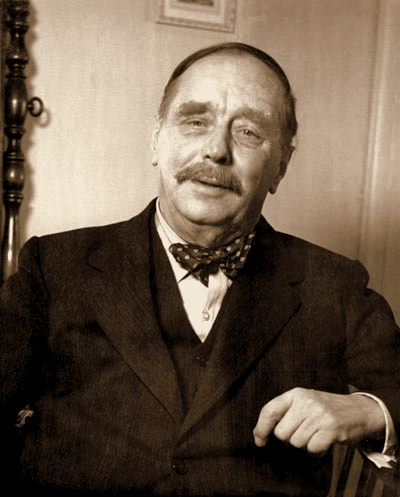
H.G. Wells
I was trying to relate this latter day form of Behemianism to Burroughs in my three part series on Presley, Lennon and Yoko Ono that Bill Hillman courageously published in ERBzine but over some very strenuous objections. I presume I lost the Bibliophiles on that issue.
That Burroughs was fascinated by the Bohemian style while actually furthering the Hetaeric sexual program is fairly obvious. He said that he wrote his first unpublished work, Minidoka, in Ragtime speech, that is to say the Bohemian mode. In other words ERB considered himself plenty hep, at least a closet Bohemian. Some may find that disturbing but, it is so. In ’60s NYC terminology ERB would hve been of the Haut Boheme. Along with those sympathies went a set of Hetaeric sexual mores that Burroughs advocated.
I have already examined the Bohemian influence of George Du Maurier on Burroughs with his novels Peter Ibbetson, Trilby and The Martian. Du Maurier was also of the Haut Boheme. A photograph of ERB behind the camera in Idaho in 1899 shows ERB dressed in full artistic Boho mode. He had just emerged from a short stay at the Chicago Art Institute where he would have immersed himself in Boho mores as artists then and now were virtually all Boho, at least in outlook. Writers too.
It seems quite extraordinary that Libertinism was discouraged and contained between the end of the eighteenth and beginning of the nineteenth century. Perhaps the answer can be found in the transition from aristocratic society to bourgeois society. Perhaps the Bourgeois requiring a different sexual morality than the aristocracy succeeded in imposing their version of sexual mores by sheer numbers.
Libertinism did regain prominence amongst the wealthy Haut Boheme of NYC thence spreading throughout society as a Bohemian sensibility began to displace the Bourgeois.
A book I have reviewed on ERBzine, found in ERB’s library which he read, GWM Reynolds’ The Mysteries Of The Court Of London scrupulously records the libertine activities in a fictional form of Prince George, later King George IV, whose career of seduction ended only in the 1820s. Certainly Reynolds’ depiction of the libertine actiities of George and his circle out Zolaed Zola by more than somewhat.
The whole libertine attitude was nowhere more prominently displayed than in NYC’s Haut Boheme nightclub, Studio 54. So the suppression of the libertine spirit during and since the reign of Queen Victoria was short. Perhaps Haggard’s novel She echoes the memories of the Libertinage of the eighteenth century Hellfire Club in some obscure way.
Haggard had no reason to put on airs because as I pointed out in my review of his King Solomon’s Mines that novel is smutty from top to bottom while ‘She’ has some very salacious passages. As Horace stands watching the scene of She and the dead body of Kallicrates for instance one is more than excited. She had murdered her former lover Kallicrates for running off with another woman. Immediately remorseful she kept the body preserved in perfect condition for two thousand years. She could even psychically animate the body so that it stood although still insensate. The necrotic effect is hypnotizing, making the reader a voyeuristic accomplice of Horace. As he and we watch the bodice of She’s dress slips to her waist exposing her magnificent charms according to your imagination. As we watch she then raises her arms above her head lifting and pointing the golden orbs. She does this not once but twice so it is clear Haggard was exciting and taunting his readers. If one imagines Ursula Andress who played She in one of the movies the effect is exhilarating indeed.

Ursula Andres As She
Haggard aside, as he says there were writers in England and America who were champing at the bit to alter the course of sexual history. Chief among these was H.G. Wells in England and our own Edgar Rice Burroughs. Both would make significant contributions to the ‘change’ but the most effective writer of them all was the secret sexual pervert, the undisputed master of them all, Sigmund Freud. But to go first to H.G. Wells and take things in order.
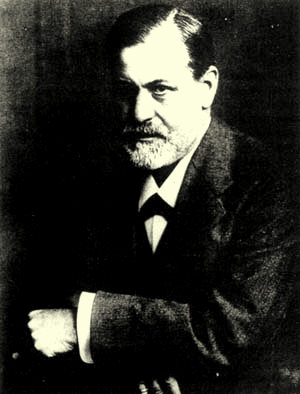
The Mad Herr Doktor Professor

The Last Sane Man Left Alive
Pt. 2 Tarzan And The Madman By Edgar Rice Burroughs
May 26, 2010
A Review
Themes And Variations
The Tarzan Novels Of Edgar Rice Burroughs #23
Tarzan And The Madman
Part II
by
R.E. Prindle
ERB And Florence Bid Goodby To LA
Tarzan novels seem more complex after repeated readings and just sitting and thinking about them. When I first read Tarzan And The Madman I Thought it was a throwaway. In the interim between that first reading and the present I’ve spent a fair amount of time in the Tarzan oeuvre and the Burroughs corpus while having written several hundred pages. One would think it would get easier but it doesn’t.
This novel was written by Burroughs in exile in Hawaii. He’d been run out of LA a couple years previously. Once the possessor of a magnificent collection of cars and planes and a vast estate becoming of the creator of Tarzan he was now living on 250.00 a month in the island paradise. He had returned to his poverty days at Sears, Roebuck in Chicago. Life’s like that.
On one level then Madman can be interpreted as a record of his feud with MGM and subsequent exile. Just look at the disdain on his and Florence’s faces as they board the plane for the last outpost of America. Tells a story in itself.
The MGM feud began with the release of Trader Horn. The book Trader Horn itself can be traced back to the Cave Girl. The movie of Trader Horn led to MGM’s first sound Tarzan. Thus Rand, the false Tarzan of the novel, can be seen as the Weissmuller portrayal of Tarzan in the MGM films. ERB was greatly offended by MGM’s notion of Tarzan hence this novel’s hero Rand is The-Man-Who-Thought-He-Was-Tarzan, a false god made to seem insignficant by the real literary Tarzan.
One should note that the real Tarzan is an intruder in the make believe Tarzanic world of MGM. The Mutia Escarpment on which the action takes place first came into existence in Trader Horn then was perpetuated through five MGM Tarzan films. The sixth MGM movie took place in New York City, of course. That one hadn’t been released as yet.
The opening sequence is even a parody of MGM’s Tarzan, The Ape Man in which an old coot shows up in Africa with his beauteous daughter who is then abducted by Tarzan who doesn’t know any better. There’s a certain amount of humor then when the real Tarzan of Mad Man wants to know who’s been abducting women in his name besmirching his reputation.
The false Tarzan who we may as well designate as Rand to make things easier, after a false start abducts the White woman, Sandra Pickerall, of the Scots Ale fortune taking her to the Mutia Escarpment. The ascent to the Escarpment is nearly identical to the ascent in both Trader Horn and Tarzan, The Ape Man. Burroughs adds his usual lion hoopla having a menagerie of them at the base of the Escarpment who are fed human flesh.
Once on the Escarpment Burroughs fleshes out his story with the usual Lost Civilization theme. In this instance the civilization is derived from Medieval Portuguese invaders of Moslem lands who were defeated in battle retreating to the Escarpment where they built their castle and established their life while becoming a milk chocolate hue. At one point Burroughs says they were part of a seventh century contingent, again Crusaders and yet again having been there four hundred years. So take your pick.
Rand has been there believing himself Tarzan for two years. He, of course, is suffering from amnesia caused when he was parachuting into the castle having been slammed against a wall causing his trauma. He and friend Bolton-Chilton were flying into Africa when in a replication of the MGM movies they entered a clowd bank to find themselves face to face with a mountain wall. In the ascent the plane malfunctioned so having cleared the Escarpment the men were compelled to bail out. Bolton-Chilton was captured by the Moslem/Galla rivals of the men of the Portuguese city of Alemtejo and enslaved. So, is this novel all roads lead to Alemtejo.
Since Rand descended from the sky Christoforo Da Gama, the king of Alemtejo, takes him for a god. I will deal with the religious aspect in the next section. If Rand is a god then Da Gama insists that Rand must have a goddess sending him forth to find one. Hence Rand abducts a number of Black women who prove unsatisfactory to Da Gama who insists on a White Goddess leading Rand to abduct the only possible candidate, Sandra thus besmirching Tarzan’s hitherto unsullied reputation.
After a series of adventures Tarzan arrives before the gates of Alemtejo. Both he and Rand are of the same general build and resemble each other enough to cause confusion but on closer examination their faces were not alike. As it chances when Tarzan arrives Rand and Sandra have absented themselves in the pursuit of freedom.
Interestingly Tarzan’s entrance into Alemtejo parodies the arrival of the Greek hero, Theseus into Athens. As Burroughs thought he invented the name Numa for lion, not realizing he had retrieved from memory the name of the Roman king, in all likelihood he didn’t realize that he was basing the entry of Tarzan on the entry of Theseus.
In the Greek myth Theseus dressed as a woman, don’t ask me, the scene is reminsicent of the Gilgamesh epic of Sumer in which a temple prostitute entices the wild man Enkidu into joining civilization who tears her garment in half giving half to the man, anyway as a transvestite, Theseus draws the jeers of observing workmen. To put them in their place Theseus picks up a bull and throws it over his shoulder. Like I say, I’m working on it but without the semblance of a clue.
Tarzan by replicating the feat wins the admiration of the Alemtejo general who proclaims Tarzan the true god, they overthrow the old order, march on the Moslem Gallas using new tactics devised by the new god and overthrow the Moslems.
The victory scatters all the protagonists who then have to come together.
As with the MGM movies there is a huge gold mine involved. In the movies there is a great seam of gold with huge nuggets lying on the surface so that all you have to do is pick them up. So in Mad Man the two villains Crump and Minsky in company with Rand discover the mine.
Here Burroughs depicts the worthlessness of gold in the manner in which he disparaged the Father of Diamonds in Tarzan And The Forbidden City. Overcome by their greed the starving and dehydrated Crump and Minsky gather more gold than they can carry killing themselves in the process.
Tarzan, Rand, Sandra and Bolton-Chilton as surviving Europeans come together. Sandra convinces Tarzan, who had vowed to kill Rand on sight, that he is merely deluded having lost his memory. Bolton-Chilton turns out to be the buddy who having parachuted from the same plane as Rand had been enslaved by the Gallas.
It turns out that Rand was so entranced by the story of Tarzan that he bet Bolton-Chilton he could live as Tarzan in the wilds of Africa for a month. He was on the way to do so when the two had to bail.
In their seach for the easy way down from the Escarpment the foursome come across Rand’s plane that had landed and coasted to a stop rather than crashing. Rand pumps up the the tires, fixes the carburetor and all four of them fly away. Thus Burroughs rewrites the MGM movie in a more plausible and entertaining way retrieving Tarzan from MGM in a sense.
As in real life Burroughs was exiled from LA so Rand, Sandra and Tarzan are exiled from Africa. Tarzan’s African adventures cease. Just as the Communists had driven Tarzan from Opar so now MGM drives Tarzan from Africa. The next adventure would take place on a mysterious island in the Indian Ocean while the last Tarzan adventure takes place in Indonesia during WWII. A sad ending for the Big Bwana.
Of course the Africa of Livingstone and Stanley on which the Tarzan series was based was also a thing of the past. The Tarzan stories couldn’t have continued to have been wirtten without becoming retrospective. Even the Lesser Tarzan films that succeeded MGM became exotic fantasies rather than African adventure. It was the end of an era.
Beginning in 1932 with the first MGM talkie the Big Ape man began to slip away from ERB’s control. Mad Man records the sad fact that the pale MGM imitation of the ape man had supplanted the real thing. It must have been a bitter moment for ERB writing in Hawaii.
We don’t know why he didn’t publish Mad Man. He placed the story in his safe where it remained until the early sixties when it was discovered and published. It seems likely that as of this date but few have even read it. Of those who have, most probably discuss it as a tired rehash of the themes of doppelganger, amnesia and perhaps the last of terrestrial lost civilizations.
I found it the culmination of those themes. ERB’s long examination of the nature of psychological doubles was drawn to a satisfying conclusion as the false Tarzan awoke from a long sleep to realization. Perhaps the same was true of Burroughs as he viewed his lost hero in the lost land of LA from his place of exile in Hawaii just beforfe the bombs from those airplanes began to fall.
Next an examination of the religious aspects of this amazing novel.
Four Crucial Years
In The Life Of Edgar Rice Burroughs, Pt. I
by
R.E. Prindle
Every artist writes his own autobiography.
Even Shakespeare’s works contain a life of himself for those who know how to read it.
–Havelock Ellis as quoted by Robert W. Fenton

The Great One
Eighteen ninety-six found Edgar Rice Burroughs confronting the first great crisis of his adult life. The weight of his childhood experiences pressed on his mind as he turned twenty. His subconscious mind was directing his actions while his conscious intelligence futilely struggled against it. He had no plans; nor could he form any. He was in a state of emotional turmoil. He obviously did not think out his moves nor weigh the effects of his actions on others. He was to burn many bridges as he flayed about like the proverbial bull in the china shop trying to find his way out.
Having graduated from the Michigan Military Academy he had been serving in the capacity of instructor for the previous year. All his heroes were military men. He fancied a military career as an Army officer even though he had failed the West Point exam the year before. Still, he was in a fine position to realize his objective. Men who could help him were nearby friends. Captain, soon to be General, Charles King, who had befriended him as a cadet, and the Commandant of the MMA, Colonel Rogers. All he had to do was to be patient and those men of some influence would surely have obtained an appointment for him.
They had given a mere boy a position of great trust and responsibility in making him an instructor. They were military men who judged others in the military manner. Then in the Spring of 1896 Burroughs did one of the most inexplicable things in a career of the inexplicable; he abandoned his post. Without notice to those career officers who were depending on him he resigned his post and on May 13th of 1896 he joined the Army as an enlisted man, a common soldier, a grunt. Within days he was on his way to his asignment.
As he was to say of so many of his later fictional heroes: ‘for me to think is to act.’ He oughtn’t have been so precipitate. He should have thought twice. He shouldn’t have had to think about it at all.
If he seriously wanted a military career as an officer he should have known that it is virtually impossible for an enlisted man to rise through the ranks. Even in the rare cases when this occurs, the enlisted man is always an odd duck between the officer caste and the enlisted men.
In this case he had not only forteited caste but as far as Rogers and King were concerned he had deserted, the worst crime that a military man can commit. Both men wrote him off at that time. Strangely he never understood that his precipitate act would be held against him by those he disappointed.
Apparently joining in a fit of despair- for me to think is to act- as the date of the 13th would indicate he requested the worst duty the Army had ensuring his desire to fail. On one level it is almost as though he did have his next move worked out. Not normally too receptive to the desires or needs of its grunts in this case the Army was only too glad to accommodate him. Burroughs was sent into Apacheria to a place called Fort Grant in what was then the territory of Arizona. Neither Arizona nor New Mexico became States until after the turn of the century so Burroughs had actually ‘lit out for the territories’ as Huck Finn would have put it. There was still some Apache resistance going on, thus ERB was a part of the Wild West.
According to Philip R. Burger, writing in the Winter 1999 issue of the Burroughs Bulletin, the standard term of enlistment at the time was three years but, as there would be no reason to join the Army except to make it a career, the reasonable assumption for those left behind in Chicago without a word of goodbye would have been that Burroughs was out of their lives. He was a dead man.
For those of you who have never joined the services, once you leave you’re out of the lives of those left behind. Your traditions have been broken. Even when you come back for leave you are only tolerated as a visitor who will leave, the sooner the better, so you don’t disrupt their lives any longer than necessary.
Burroughs didn’t even have traditions in Chicago except with a few people. From the sixth grade on he had a record of broken attendance at a number of schools, from the girl’s school to Harvard School and then back East, to Idaho and on to the MMA. He would have known but few people well, intimate with none except the lovely Emma Hulbert.
He could have seen her but rarely over the last years which included high school. He really had no ties in Chicago. His relationshlip to Emma dated back to Brown grade school. At sometime before he began his peripatetic education he began to propose to her. As he was gone from Chicago all this time it is very difficult to believe that Emma sat home pining. She must have been dating other boys, however, at the same time she must have been waiting for Burroughs since, at 24, when she married him she was only a couple years from spinsterhood. She must have been giving her parents some cause for alarm.
Thus when Burroughs appeared to walk out of her life in 1896 without a word about his intentions one wonders what her response was. Certainly it was about this time that Frank Martin began to pay his court. We will learn more of Frank Martin a little later.
For Burroughs, like so many of us once we were inducted, ERB speedily learned his mistake. For the men who don’t fit in ‘each fresh move is a fresh mistake.’ He regretted his decision immediately. For him to think was to act, so from his arrival at Fort Grant he began a petition for discharge.
As he had been under twenty-one when he joined, he had had to ask his father for his consent. He now asked him to use his influence to get him out.
Perhaps we do not have enough information on why he now so desperately wanted out. In later life this short ten month period of his life would be fraught with great significance in his mind. Just before he divorced his lovely wife Emma in 1933 ERB took a solo vacation to return to this scene of his young manhood. That would indicate that Emma and Fort Grant were linked in his mind.
Two of his Martian novels are associated with the Fort Grant experience. In his first novel, A Princess Of Mars, John Carter serves in the Army in Arizona, is discharged, then returns as a prospector. Under attack by Apaches he seeks refuge in a mountain cave in which he leaves his body while his astral projection goes to Mars. Viewed from one point that’s as neat a description of going insane as I’ve ever come across.
During his 1933 visit to Arizona, Carter returns to visit a trembling fearful Burroughs in his mountain cabin. One gets the impression that Burroughs felt like a whipped dog.
The Apaches made a terrific impression on the young man. So much so that he could see himself joining them as a Brave as is evidenced by his two Apache novels, The War Chief and Apache Devil. Then too his two cowboy novels are placed in Arizona rather than in Idaho where one would expect them.
In his Return Of Tarzan the trip to the Sahara is an obvious reference to Apacheria. The French government sends Tarzan into the desert rather than the US government sending ERB to Arizona. In the deseart Tarzan develops a strong liking for the Arabs, much as ERB did for the Apaches. Tarzan considered becoming a Son Of The Desert just as ERB thought he might become Apache.
A large part of ERB’s fascination for the military life was based on his respect for Capt. Charles King under whom he had served briefly at the MMA. King was, I would imagine, a boy’s dream of a dashing Calvalry Officer. In this wildly romantic period of the Indian Wars, not to mention the proximity of the Civil War, a man who had served at the same time and the same place General Custer must have been held in some awe. King had also served with and knew Buffalo Bill, a nonpareil hero of the time and one ERB may have met at the 1893 Columbian Expo.
Burroughs names two of his characters after Custer.
On top of all this King was a successful writer of military novels. He wote an excellent analysis of Custer’s defeat, which is available on ERBzine, as well as a first hand account of the resultant campaign to quell the uprising, Campaigning With Crook. the latter is a superb recreation of a time and place we’ll never see again. In just a few words King is able to recreate a Deadwood, South Dakota for which the movies have filmed endless miles of photographs with less result. His single reference to barbaric cowboys wearing their guns on their hips says more than dozens of Hollywood films. ERB was also able to capture some of this feeling in his two excellent Western novels as well as his two Apache novels.
King was prolific writing nearly seventy books in his long career. I have read only a few, which I find of only of journeyman quality. King has an emascualted precious style which is reflected in his photographs. Burroughs enthusiastically said he wrote the best Army novels ever, which may be true, I haven’t come across any other novels of Army life. among his many novels of Army life are three that deal with the Pullman strike when the Seventh was stationed at Fort Sheridan. One, An Apache Princess written in 1903 might possibly have been an influence on A Princess Of Mars.
At any rate King glorifies the officer’s life. He fooled a young green ERB. In any event ERB failed to notice the haughty distinctions King drew between the relative status of the officers and the enlisted men. King had all the prejudices of the officer class seeing the enlisted man as a subhuman species. Knowing this, as Burroughs should have, I am baffled by his enlisting.
Perhaps as at the MMA he thought that one entered as a buck private working up to officer rapidly as he had at the MMA. If so he must have had a very rude awakening. It couldn’t have taken him long to realize that advancing through the ranks was rare while at the same time a long process for such an impatient lad as he.
While he was cleaning those stalls he must have had plenty of time to think out his dilemma. As he thought back over his past actions it must have occurred to him that perhaps he erred in walking out on Colonel Rogers the previous May. Accordingly on December 2 of 1896 he sent a letter back to Rogers of which the reply is extant. We don’t know what ERB said but I imagine he was feeling Rogers out to see if he couldn’t get him an officer’s appointment. Rogers reply was, of course, polite but cool and distant firmly placing Burroughs as oneof the rest of Rogers’ students. Yuh. ERB should have thought twice about abandoning his post.
The many, many references to this period of his life point to a great regret later in life that he had left it. He associated this regret with Emma. Perhaps the visit of the officer, John Carter, to him in his lonely cabin in the White Mountains of Arizona represents his lost career as an Army officer but was one of the reasons for his wanting to get back to Chicago that he hadn’t dealt with his relationship with Emma? Did he now learn that in his absence someone else was playing his old love song to Emma? Someone who Papa Alvin Hulbert much preferred to ERB?
It would be interesting to know what Emma thought when her beau just up and removed himself to Arizona. Perhaps perplexed but still hopeful she sent him her picture on his birthday in September. Remember me, perhaps?
Unhappy with his life at ‘the worst post in the Army’, how one’s attitude changes when one’s dreams are realized, he petitioned his father to use his influence to return him to civilian life.
Surprisingly his father was easily able to do this. By March of 1897 ERB had his discharge papers in his hand. He was a free man again. How many tens of thousands of us would have appreciated such an easy resolution to the problem.
2.
Our Man still didn’t have a plan. What we he going to do with his life? Apparently Colonel Rogers’ reply to his letter didn’t apprise him of the facts of life. Nor did he seem to realize that once you reject the military the Army has no use for you. At the time, the US Army was very small, perhaps seventy-five thousand men. The officer corps was about ten per cent or seventy-five hundred men. This is virtually a club. The officers would have known each other personally, by name or by reputation. The same was more or less true of the enlisted men.
Thus Porges records a letter ERB received in 1936 from one W.L. Burroughs of Charlotte, N.C. who probes:
This morning an old army sergeant whom I soldiered with back in the nineties dropped in my office and our conversation started at Fort Sheridan, ILl. when the 7th US Cavalry and the 15th U.W. Infantry left that post for Arizona and New Mexico. He asked me if I remembered Edgar Rice Burroughs of Troop ‘B’ Seventh Cavalry, said he was discharged during the summer of 1896 at Fort Grant, Arizona account of a ‘Tobacca heart’…will be delighted to know for certain that we soldiered with so distinguished a person back in the nineties.
Whether true or not these men remembered ERB as a malingerer who obtained a fraudulent discharge. I interpet ‘Tobacco heart’ to be a feigned ailment which would make ‘so distinguished a person’ a sarcastic and insulting remark. If W.L. Burroughs is correct then ERB got himself out by reasonable discreditable means rather than through the efforts of his father. Thus forty years on an Army reputation followed ERB.
Burroughs replied cooly a few days later ‘…seldom have been in touch with any of the men I soldiered with since I left Fort Grant.’ ERB didn’t say ‘AND GOODBYE.’ but I think that is implied.
So having committed blunder after blunder it would have been wise for Our Man to reevaluate his position. Strangely he didn’t do this, hoping against hope, as I imagine to pull that particualr rabbit out of the hat over the next few years. Good luck, Edgar Rice Burroughs.
3.
For now he could only think of returning to Chicago. As we know the Burroughs Boys were ranching up in Idaho. ERB always wanted to prove that he was a businessman. Why, I don’t know. The fact of the matter seems to be that the Burroughs family was particularly inept at business. Papa George T. had been burned out of his distillery while his battery business was steadily running down, due for extermination about a decade later.
The Boys would turn to dredging for gold after failing at ranching. Perhaps one of the reasons they failed at ranching was just this operation coming up. They had bought a Mexican herd, apparently sight unseen. They were then in Nogales to receive and transship the herd to KC. I suspect they lost their shirt. In less than two years they would be gold dredging.
The world is full of sharpers. Out West so many salted gold mines were sold to greenhorns that it doesn’t bear telling. Frank Harris, the British magazine editor in his autobiography has a great story about how he and his outfit lifted a Mexican herd driving it back across the Rio Grande. I have no doubt that some Mexican sharpers took advantage of the Burroughs Boys. They would later buy a salted gold claim.
The herd ERB put on board the train he describes as no bigger than jackrabbits while probably being less well fed. The death rate of the cows on the trip back to KC was horrendous, while the survivors became starved and dehydrated. I don’t think the Burroughs Boys did well on that transaction. You gotta watch your back or, hopefully, see ’em coming.
4.
Edgar Rice Burroughs came home. Perhaps he had now reached childhood’s end. At twenty-one perhaps he now realized that he had a life to lead. Perhaps. If so, it was slow dawning. But then ERB’s was not an ordinary mind, a normal bean as he would have put it. No, his was a slow ripening melon. But then, why should everyone develop at the same pace? If up to this point I seem to have been overly critical of Our Young Man it’s because there has been much to be critical of; just as there will be more, but he hasn’t done anything really reprehensible. Your record may not be much better; mine certainly wasn’t. He’s a good sort of guy; just a little on the goofy side. Slow to learn. He doesn’t seem to catch on.
However he’s watching. He’s observing. He’s ingesting and there out of sight he’s digesting all the information coming in. Plus, he will give it a brilliant interpretation when he egests it.
These four years would be of great use to him in his writing career. Always a subtle psychologist ERB was also a skillful employer of the Freudian concepts of condensation, displacement and sublimation and this before he could have read Freud. An attentive reading of any of his novels always reveals layers of hidden meaning. Simply put Edgar Rice Burroughs is the most poetic of novelists.
His poetic tastes weren’t always elevated. He did have a copy or two of Eddie Guest in his library. Edgar A. Guest. Perhaps forgotten today Guest was a people’s poet. In the 1950s when I spread out the Detroit Free Press on the floor one of the first things I read was the daily poem of Edgar Guest. Of course, I thought he had written each one the night before. I marveled at his facility. Nice homey thoughts though.
Burroughs tastes ran to the likes of Rudyard Kipling, H.H. Knibbs, Robert W. Service and others of the jingly-jangly people’s school. Although he did know enough about a high brow like Robert Browning to consider him a bore. Rightly from my point of view. He liked Tennyson, who was considered a high brow, also I suspect Walter Scott, Shelley and Byron. He frequently hints at Longfellow’s ‘Wreck Of The Hesperus’ while he probably had to read Hiawatha in school
He knows all the popular stuff of the day like ‘Over The Hill To The Poor House’ too while he had probably read that anthem of doomed labor, Edward Markham’s Man With The Hoe, too. If that one didn’t gag him he’s not the man I think he was.
Song lyrics were big with him too. On his cross country auto tour he mentions three records by name that his family wore out- of course a battery operated portable played in a field with the plows they called styluses (well, cultured people called them styluses or styli, us near illiterates called them needles) in those days they might have worn out a record in two or three plays. One song was ‘Are You From Dixie?’, another was ‘Do What Your Mother Did; and the last ‘Hello- Hawaii, How Are Ya?’ I guess he liked songs that asked questions. I’ll examine the lurics a little farther on down the road but when we’re considering the literary influences don’t forget the poetry. After all ERB wrote a whole book around the lyrics of H.H. Knibbs ‘Out There Somewhere.’
Just before he returned to Chicago one of the great newspaper literary lights and poets of Chicago Eugene Field had died- 1895. Burroughs had a collection of Field’s writings in his library while Field, when alive, hung out at the McClurg’s book store. Perhaps there were sentimental reasons for Burroughs pursuing McClurg’s so ardently as well as practical ones.
Another Chicago writer among ERB’s collection of books who was reaching an apex at this time was George Ade. While these Chicago stalwarts are mostly forgotten now they were considered immortal at the time. Ade especially is a very clever writer with a real skill at turning a phrase. His ‘Fables In Slang’ would have knocked ERB flat. ERB’s own interest in the colloquial, which is very pronounced, may have been influenced by Ade’s style.
Another columnist of the period, Peter Finley Dunne, with his Irish dialect stuff written around his character Mr. Dooley doesn’t seem to have made much of an impression on ERB.
Thus while involved in his attempts to correct his mistake of enlisting he was very attentive and observant of the life going on around him in whatever milieu.
As I mentioned earlier, when you leave for the military your friends edit you out of their lives. Returning is not so easy. Even when I returned on leave, actually almost ten months after I left, people demanded almost belligerently, ‘What are you doing here? I thought you joined the Navy.’ After explaining I was on leave, nearly asking permission to hang around for a couple weeks, I was grudgingly given permission but let it be known that if I wasn’t gone I would have some explaining to do.
ERB has left a record of his reception by his friends in Chicago. He had sixteen years to let it run around his mind before he wrote it down. It came out in Return Of Tarzan which, I imagine might be read as the Return Of Edgar Rice Burroughs. Actually as Havelock Ellis hints in the opening quote, both Tarzan Of The Apes and The Return Of Tarzan can be read as autobiographical sketches from birth to the marriage with Emma in 1900.
Burroughs describes his reception in Chapter 23 of the The Return. The jungle is a Burroughsian symbol for society as in ‘It’s a jungle out there.’ Tarzan in the jungle can be read as ERB in Chicago. Tarzan is resting in the crotch of a great limb of a jungle giant when he hears a troop of apes approaching the clearing beneath the tree. The tree is a symbol of security or getting out of or above the tumult. Trees probably correspond to his imagination.
Tarzan recognized the troop as his old band of which he is still nominally king. Having been gone for two years he rightly thinks the dull brutes will have trouble remembering him:
‘From the talk which he overheard he learned that they had come to choose a new king- their late chief (the successor of Terkoz?) had fallen a hundred feet beneath a broken limb to an untimely end.
Tarzan walked to the end of an overhanging limb in plain view of them. The quick eyes of a female (Emma?) caught sight ofhim first. With a barking guttural she called the attention of the others. Several fhuge bulls stood erect to get a better view of the intruder. With bared fangs and bristling necks they advanced slowly toward him, with deep ominous growls.
‘Karnath, I am Tarzan Of The Apes,’ said the ape-man in the nernacular of the tribe. ‘You remember me. Together we teased Numa when we were still little apes, throwing sticks and nuts at him form the saftey of high branches.’
‘And Magor,’ continued Tarzan, addressing another, ‘do you not recall your former king- he who slew the mighty Kerchak? Look at me! Am I not the same Tarzan- mighty hunter- invincible fighter- that you knew for many seasons?’
The apes all crowded orward now, but more in curiosity than threatening. They muttered among themselves for a few moments.
‘What do you want among us now?’ Asked Karnath.
‘Only peace.’ answered the ape-man.
Again the apes conferred. At leangth Karnath spoke again.
‘Come in peace, then, Tarzan Of The Apes.’ He said.
So Tarzan and ERB returned to the fold. However there were two young bulls who were not ready to receive Tarzan back. We will find that two young men resented Burroughs’ return. The resentment of the principal young man would nearly cost Burroughs his life while forcing him to commit to a marriage against his will.
Thus Burroughs was received back into Chicago.
5.
He would spend about ten months before he uprooted himself once again to make his second visit to his brothers in Idaho. I should think that this period in Chicago was perhaps the most idyllic of his life. He found gainful employment with his father at the Battery Company. However at fifteen dollars a week it was much less than his allowance had been at the MMA. However he was living and eating at home so one imagines it was all pocket cash which afforded a certain limited affluence. He could afford to take Emma out.
Emma appears to have preferred him but he was no favorite of Papa Alvin and the Mrs. If Frank Martin had begun to pay his court he was much the preferred suitor. The son of Col. A.N. Martin who was a millionaire railroad man he was to be much preferred to a penniless Ed Burroughs whose father had apostacized to William Jennings Bryan in the election of 1896. No, Martin should be given the inside track. Burroughs was forbidden the house in an attempt to disrupt his relationship with Emma.
The Hulberts looked askance at Burroughs patchy history. He was less than promising. While his father had gotten him released from his enlistment, people are wont to say there’s more to that story than meets the eye. Plenty of room for rumor, if you know what I mean. ERB probably had to explain a lot.
So while he could date Emma he couldn’t go hang around all evening every evening as lovers are wont to do.
So what did ERB do with his spare time. He obviously read. H.Rider Haggard was popping them out two or three a year at the time which is clear from the evidence ERB read. Jules Verne was alive and producing although much of his production remained untranslated.
There weren’t any movies or television, however there was the Levee, Chicago’s Sin City. In later novels ERB would show what appears to be first hand rather detailed knowledge of this area of brothels, saloons and gambling joints. Burroughs was certainly no stranger to drinking and gambling, whether he frequented brothels may not be known but, if you’re in the area….
In a city of a million six there were only about forty thousand library cards issued but it is probable that one of them was in the wallet of our investigator of curious and unusual phenomena. He sure knew a lot of odd details. One of the big intellectual questions is whether or not he knew of Theosophy. A volume of William Q. Judge, a leading Theosophist who died in 1896, is to be found among Burroughs’ books. His first story Minidoka 937th Earl of One Mile which is concerned with this period while unpublished until just recently makes mention in the descent to Nevaeh of the Seven Worlds which is a reference to either Theosophy, Dante or both.
Again, hanging around a library one might come across volumes of Dante and Theosophy. Shoot, Tarzan spent his afternoons in the Paris library becoming discouraged by the surfeit of knowledge to be covered.
And all around him floods of changes were rolling over him. The world was moving with breathtaking rapidity. If a guy wasn’t half crazy already trying to keep up would get him the rest of the way. Actually these four years were the intellectual bottom, in the musical sense, of the rest of Burroughs; life. perhaps sensory overload occured culminating with his bashing in Toronto and subsequent marriage to Emma so that he was no longer open to new experiences afater his marriage. Everything after 1900 was interpreted in the light of this experience. the interpretations were inventive enough.
His situation might be compared to that of Zeus and Metis of Greek mythology. Ordinarily when the Patriarchy took over a Matriarchal cult the event was comemorated in a myth of sexual union.
In the case of Metis, a Goddess of wisdom, she went down into the belly of the monster like a plate of oysters perhaps meaning the Patriarchy had attempted to stamp the Metis cult flat or eat it up as the Zulus would say. If so Zeus and the boys had bitten off more than they could chew or digest, as it were.
Metis lived on in his belly giving him unwanted advice until I would imagine the Patriarchy came up with a compromise solution. Thus Metis gave birth to Athene who was born fully formed from the forehead of Zeus, which is to say that the cult of Metis was transformed into the cult of Athene. Athene retained all the attributres of the goddess of Matriarchy but ‘she was all for the Patriarchy.’
So now with Burroughs; he ingested all this experience which he gave a ‘definite impression of fictionalizing’ to appear full blown from his forehead +- twenty years later.
Porges reproduces a political cartoon of Young Burroughs on page 68 of the First Edition in which Uncle Sam and John Bull are watching a scene. One or the other says: ‘How would you like to be a Russian?’
In the cartoon Russian soldiers are shooting and bayonetting obvious Jews while the Jews are bombing the Russians. The villains of the first four Tarzan novels, ‘The Russian Quartet; are two Russians Nikolas Rokoff and Paulevitch. Thus, if the cartoon was drawn in this period, twenty years later the Russians show up as villains.
Now, among all the ‘minor’ events like the depression after 1893, the Pullman Strike, Coxey’s Army, Altgeld’s pardoning of the Haymarket bombers, the Sino-Japanese war and such like trivia was the infamous Dreyfus Affair in France.
This minor event involving a Judaeo-French spy was magnified into an international cause celebre by accusations of anti-Semitism. Alfred Dreyfus was a Jewish French army officer who was accused of spying for the Germans or of selling information to them. Originally convicted and sent to Devil’s Island, a few year later after key evidence was tainted or disappeared and key witnesses had died or been discredited the case was reopened and after a terrific media blitz resulting in Zola’s article with the famous title: J’ Accuse, Dreyfus was acquitted.
The man convicted in his place, strangely enough, was probably also Jewish, one Walsin Esterhazy. Supposedly of Hungarian descent, at the instance of the chief Rabbi of Paris he was given financial assistance by the Rothschild family. It would be very unusual in that case if he weren’t Jewish.
Burroughs must have followed the Affair Dreyfus closely as it unfolded during the lat nineties. In 1913’s Return Of Tarzan he chose to fictionalize Esterhazy’s end of the Affair in the character of Gernois. Burroughs must have studied the Affair because Esterhazy actually served in North Africa where he came in contact with German agents. Of course, Gernois is compromised by our old friend Nilolas Rokoff, the Russian agent. Thus ERB combines his dislike of the Russians as eveidenced by his cartoon with sympathy for Dreyfus.
In real life Esterhazy led a dissipated life which, it is said, led him to be a spy. In ‘Return’ Gernois is led into syping because Rokoff, the hyper-arch villain had something on him.
In a sort of editorial comment on Dreyfus ERB has Rokoff tell Gernois: ‘If you are not agreeable I shall send a note to your commandant tonight that will end in the degradation Dreyfus suffered– the only difference being that he did not deserve it.’
Thus ERB comes down firmly on the side of Dreyfus.
For those who will misread racial and ethnic attitudes I believe ERB’s attitude in the Jewish-Russian conflict and the Dreyfus Affair should exonerate him, if the need exists, of any charges of anti-Semitism. Especially in the light of his portrayal of the worthy Jewish gentleman in ‘The Moon Maid’ trilogy. It would seem that all of ERB’s later attitudes remain consistent with these brought to fruition between 1896 and 1900.
Continue on to Part II
A Review
Woman
by
Alan Clayson
Yoko Ono And The Men Who Influenced Her
Review by R.E. Prindle
Clayson, Alan: Woman: The Incredible Life Of Yoko Ono, Chrome Dreams, 2004.

Girlish Yoko- Warhol School by Richard Bernstein
Yoko Ono involved herself with several of the most influential men in the arts during the sixties, seventies and eighties of the twentieth century. She drew her inspiration from them patterning her own efforts after them. At the same time she was one of the leading feminists of the day having her share in shaping and furthering the movement. The mantra was female liberation, equality between men and women. In fact women were equal to men in the West but only by acknowledging the biological differences between men and women. The fact is the differences are real and not social constructs as women would have us believe. The fact is women are women and men are men. So, in seeking ‘female liberation’ feminists were seeking much more than ‘equality’ however the term may be defined.
The fact is that in the Ages old war between the sexes feminists are seeking to restore the Matriarchy and destroy the Patriarchy. That is why many men favor feminism, they prefer the Matriarchy. Thus the feminists are atavistic. Yoko and her cohorts wished, in her words, to restore ‘heart’ as she viewed the Matriarchy and eliminate ‘reason’ as she viewed quite rightly the basis of Patriarchalism. Nevermind that bilogical science has invalidated the concepts of Matriarachy and Patriarchy. This is a post Matriarchy and Patriarchy world.
Circa -2000 in the West men revolted against the mind stifling Matriarchy and the vaginal swamp of the ‘heart’ seeking to establish

Smilin' Jack Cage
the authority of the infinite power of the mind of Zeus on ethereal Olympus. This is the story of Homer’s Iliad and Odyssey and the Greek myths in general recording the struggle.
The Western male was able to impose the ascendency of reason over the heart for 3000 years until the disestablishment of the old order by science about mid-nineteenth century. The center could not hold during this period of extreme change as W.B. Yeats put it as the rearrangement of the intellectual order moved into the twentieth century.
Yoko Ono sought with her feminist fellows to return to the biological innocence of 2000 BC. She herself had no talent. Filled with audacity she pitted her ‘heart’ against the reason of John Cage, Andy Warhol and John Lennon. I’m sure she had a mentor for her so-called performance art but I am as yet unaware of who he may be. Perhaps Maciunas and the Fluxus group.
Thus her first manifestation as an artist was based on the musical ideas of John Cage while her artistic efforts were at least based in the avant garde ideas of the Fluxus group. Her first assault on the NYC art world failed so in 1961 she returned in defeat to Japan. When she returned to NYC in 1964 she found an entirely different art scene. On the musical side the focus was on Bobby Dylan and the Beatles while on the artistic side Andy Warhol and his Factory had destroyed the Abstract Expressionists and the old avant garde. Dylan, the Beatles and Warhol had in fact usurped the avant garde which now had little meaning. From my point of view held at the time the avant garde had ceased to exist. Of course I didn’t understand exactly why or how.
From 1964 when Yoko returned to NYC until 1966 when she left for London I’m sure Yoko was at a loss. She developed her silly

The Bag Yoko And Tony Are In
notion of Bagism at this time even having a black bag on a stand in Max’s Kansas City that some one or ones were supposed to slide into. This seems to have been thought a lame idea at the time as it seems now.
At this time while retaining allegiance to John Cage’s musical ideas she was falling under the influence of Andy Warhol’s artistic notions. Warhol’s intent had been to destroy the idea of ‘fine art’. In this he pretty well succeeded. As Yoko expressed it you didn’t need any talent to be an artist. She seems to demonstrate this notion in her own artistic efforts. Warhol had also redefined the notion of film with his static studies. He then sought to combine his film ideas with live music, probably in competition with Bob Dylan who was also attempting to move in that direction. Warhol adopted Lou Reed and his band the Velvet Underground as the Factory house band while creating a multi-media show called the Exploding Plastic Inevitable, innovative for its time. Thus a concert at his hall, the Dom, was an ‘experience.’
While Yoko makes no mention about how this, actually, incredible development affected her there can be no doubt that she was well aware of Dylan, the Beatles and the Warhol Experience and was affected by it. Indeed, the first manifestation was the making of her Warhol style films such as Bottoms.
The second manifestation was her removal to London to seduce either Lennon or McCartney of the Beatles, thus in the manner of Warhol’s adoption of the Velvet Underground she sought to co-opt the Beatles, the premier rock group in the world. Real chutzpah and more than one upping Warhol. I think it would be nonsense to think she had any other goal in mind.
She undoubteldy learned that Paul McCartney was actively involved with John Dunbar and his Indica Gallery that opened in 1965.
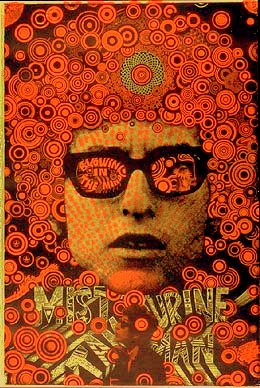
Psychedelic Dylan
Some say she first set her sights on McCartney but the more vulnerable Lennon showed up and the Spider Woman spread her web.
She was still married to her second husband, Tony Cox, but, regardless of what she says she very aggressively pursued, or attacked, Lennon. Lennon was emotionally under water unable to handle his success while drugging himself out of his mind. He was unwillingly married to his wife Cynthia. It appears that he married Cynthia out of duty when she became pregnant. He doesn’t seem to have been happy in his virtue. Yoko had no difficulty in capturing his affections.
Now, just as Warhol had adopted the Velvets and imposed his female singer, Nico, on the band Yoko sought to imp[ose herself on the Beatles through Lennon. At this time she was still musically completely in thrall to John Cage understanding nothing about Rock music. She and Lennon had made a ridiculous LP called Two Virgins in 1968. She combined her cagian screechings while using an avant garde ‘performance’ notion of the couple posing nude on the cover; full frontal on the obverse, full posterior on the reverse. As no store would carry the cover the couple reverted to Yoko’s idea of Bagism placing the cover inside a plain manila envelope or bag. While it didn’t sell the record this form of Bagism was actually a successful artistic statement. The nude cover given an outer garment so to speak.
Well, the public was prepared to forgive the Beatles anything but the other three Beatles weren’t prepared to forgive Yoko for forcing herself on them thus she broke up the most successful act of the sixties. Still, she had succeeded according to her wildest dream. Lennon and his wonderful reputation and fortune were hers. She had gone from a neglected, nondescript ‘performance’ artist to center stage, not on her own womanly talents but by attaching herself to a talented man. Yoko’s ‘heart’ was useless without the male intellect. Yoko was now the most influencial feminist in the world. She knew what to do with that.
After several ‘performance’ acts such as the ‘Bed In For Peace’ the couple left England to return to the place Yoko wished to subjugate artistically, New York City. She had raised herself to a par with Andy Warhol. She now had to meld her musical and artistic goals through Lennon and Warhol.
On the musical side she began to develop her rock n’ roll skills under the tutelage of Lennon. While not abandoning the avant garde notions of John Cage she now emasculated her husband. Always semi-delusional or perhaps completely so, she fantasized that she was not only equal to Lennon in skill and popularity but superior to him. She imagined herself more popular than Lennon. Thus one has such travesties as the LP Double Fantasy. It was only after Lennon’s death that she was forced to recognize than Lennon’s fans did not appreciate her efforts. So she failed as a musician.
She quickly tired of being Mrs. Lennon. Thus she and Lennon separated for eighteen months or so during the years 1973-75. She then realized that her financial well being and musical acceptance depended on Lennon. In 1975 she called him back resuming their relationship until his death in 1980. But, things had changed.
She began to adopt Warhol’s life style on her return to NYC. While she propagated the notion that she was some sort of business whiz Iam having difficulties discovering any such skills. It appears that with the enormous income of Lennon she emulated Warhol in

Andy the Demon
spending her way to prosperity.
She was in a position to not only match Warhol’s spending but exceeding it by many times. Through the seventies and eighties Warhol came into his own as an artist while reaping a fortune doing portraits. There appears to have been no effort on his part to invest in income producing vehicles. Rather he bought stuff. He purchased buildings in NYC and elsewhere while acquring undeveloped acreage in places like Aspen. He shopped nearly every day buying antiques from furniture to objets d’ art by the bushel almost as though he were trying to excel the incredible W.R. Hearst.
He usually didn’t even look at the stuff once he bought it merely filling rooms with his shopping bags. At his death all this junk was auctioned off for 25 million dollars, a nice appreciation in value.
Yoko followed the exact pattern buying apartments and houses as well as an extensive dairy farm with a herd of prize cows. She not only had but has five apartments in her principal dwelling, the Dakota apartment building and many other houses scattered around.
Like Warhol the Dakota apartments are stuffed with junk. Valuable, but, you know, stuff. She bought at good prices. Her extensive collection of Egyptian antiquities was mostly purchased before a steep rise in value.
Like the Rothschilds of old Yoko didn’t do all her own shopping but employed agents to search things out. Chief among these was an associate of Warhol’s, Sam Green, and an Hungarian immigrant by the name of Sam Havadtoy.

Buddies- Yoko, John, Andy
There should be no surprise then that she now has an extensive collection of Warhol’s artwork as well as his portraits of Lennon. The Warhols would have been purchased for form 25 to 50K while now being listed on her assets at tens of millions. She also has been said to have a good collection of Magrittes as well as one assumes other artists. So, much of her net worth is tied up in artwork purchased through Sam Green.
Sam Havadtoy was an antiques dealer as well as an interior designer. He appears to have been a somewhat shady character. It is very difficult to find much about him, however there is a sharp portrait available from the notorious A.J. Weberman ( http://www.acid-trip.org/lennon/ )
…(the Lennons) hired a sleazy Eastern European bisexual to renovate the pad. (Dakota) I had heard of this dude, whose name escapes me, from an asswipe named BRUCE KIRSH, who worked for him. KIRSH told me that the dude, who worked for the King of Morocco, would form a dummy renovation company, hire employees like Kirsch who were willing to work under false names, then, when it came time to pay taxes, everyone would disappear. I learned of him long before he was hired by John and Yoko, and I was taken aback when Yoko took up with him after John’s death.
I know that Weberman is not particularly well thought of by fandom but this is because of his harassment of Dylan who did, after all, misrepresent himself to the revolutionaries like Weberman. A.J. himself is an intelligent observer who was wading through it when it was deep. I do believe he knows what he’s talking about although his interpretations of Dylan’s lyrics seem absurd.
I would have to question Yoko’s judgment in taking him in. Both he and Sam Green were candidates as successors to Lennon with

Lennon by Warhol
whom she consorted in front of Lennon before he died while Yoko chose Havadtoy as his successor the day he died.
Perhaps she selected Havadtoy over Green because he was more rough trade. With Lennon while managing to reconcile revolution with peace and love with Havadtoy she discarded peace and love in favor of strong arm methods against her former employee Fred Seaman when it was totally unnecessary.
Havadtoy was living in a homosexual arrangement with his business partner when Yoko beckoned him to switch to her. Apparently an able switch hitter he was lured by the money to this much older woman. The arrangement did last for twenty years before Havadtoy removed to his native Hungary taking a nice cash settlement and several of the Warhols.
Thus, just as Warhol had his live-in homosexual arrangement so after Lennon’s death Yoko adopted the exact arrrangement. Today she apparently lives alone, a seventy-eight year old woman.
After Lennon’s death there was an accession of from 30 million to a possible 100 million dollars as their last album, Double Fantasy, sold into the millions while the rest of Lennon’s catalog and one assumes the Beatles’ catalog was reinvigorated while all things Lennon sold. This is, of course, no reflection on Yoko but the inevitable result with intellectual properties when the maker dies.
Post-Lennon, then, Yoko realized that her recording and art careers were nil. Heart without intellect is worthless. She then became the caretaker of the Lennon legacy. His recordings, of course, continued to sell, but even his artwork eclipsed that of Yoko. So she suffered the humiliation of being a mere appendage to a man. The feminine dismal swamp was eclipsed by the Olympian heights of the male intellect. As in ancient times the God had trumped the Goddess. And yet as with Hera and Zeus the Goddess gets her way. Yoko came up with the money and goods while Lennon’s spirit was wafted into the stratosphere.
As any reader of mythology knows Hera ruled the Lernean swamps of Argolis while Zeus ruled the gods on ethereal Olympus. Thus one has the symbolism of the biological difference between the male and female.
In ancient times the female had her share in magic. She knew herbs and plants, was familiar with poisons and cures as with the arch witch of the ancient world, Medea. The reputation of the female witch even as a consort of Satan persisted down through medieval and post-medieval times, indeed, even up to the dawn of the scientific enlightenment. One would have thought that magic and witchery were a thing of the past in the 1960s and yet Yoko embodied the whole female swamp mentality.
She established something called the Spirit Foundation attributing the direction to Lennon who in fact knew nothing of these matters but followed her lead. The Spirit Foundation celebrated the ancient art of the Shaman or witch doctor. Shamanism itself even preceded the Matriarchal swamps of Argolis. It was a rich repository of magical tradition. Further the Foundation was feminist in that it was dedicated to preserving the magical traditions of the women of the Pacific islands still living in such archaic societies. The wealth generated by the male intellect was appropriated by the female vagina or ‘heart.’
In her own life and that of Lennon’s Yoko was addicted to a variety of magical practices- astrology, numerology, Tarot readings, and indeed she traveled to the Caribbean to sell her soul to Satan through the offices of a female curandera. Her Tarot reader, John Green, was a priest in the shamanistic, magical, Yoruban African cult of Santeria.
Her feminism was more a magical effort to restory Matriarchal supremacy over the Patriarchy thus reversing the Patriarchal victory of three thousand years previously. Indeed, what has been called the movement for female equality is nothing more than a covert campaign to restore the Matriarchy.
Thus while Yoko o9riginatd nothing she usurped the abilities of the reason of men- Cage, Warhol, Lennon and male magicians such as John Green. Indeed the Trojan War itself was a war of men in service of women.
In her associations with men she preferrred to deal with emasculated types such as homosexuals like Cage, Warhol, Sam Green and Sam Havadtoy. Lennon claimed to have always been dependent of women for comfort and guidance while Yoko caught him at his most confused and vulnerable.
While she received direction from Cage and Warhol she was able to manipulate Lennon out of his talent somewhat as Vivian did that of Merlin of the Arthurian saga. When Vivian had usurped Merlin’s magical knowledge she buried him deep much as Lennon was put out of the way. Yoko then appropriated his wealth and residual income after his death. It was this constant inflow of cash that allowed her to propagate the notion that she was a financial genius.
Then as the female of the ‘heart’ or vaginal swamp she managed and appropriated the reason of Olympus through Cage, Warhol and Lennon. What she got from Havadtoy other than brute strength is not clear to me.
As such Yoko is Woman. In her case a seeming reversion to the archetypal Shaman of the most ancient times.
Mourning Becomes Yoko: Part II
March 13, 2010
Mourning Becomes Yoko
Part II:
The Passing Of John Lennon
by
R.E. Prindle
About John
This magic moment
So different and so new
Was like any other
Until there was you.
–Pomus-Shuman

The King
To understand the sixties one has to go back in time to the foundation of Astrology. In Time beyond Ancient, Astrology and Astronomy were one. The very old gods and the sky were one. It was only when science, a more clear understanding of ‘creation’, if you will, removed the sky from the gods’ purview that Astronomy and Astrology separated. Astrology in those days had meaning that is not apparent today when the sky is just part of our natural surroundings.
The Zodiac was divided into twelve periods of roughly 2000 years each which formed the Great Year. The periods were called Ages with each Age having its own avatars. The avatars of the current Piscean Age have been Jesus the Christ for the first thousand years, and for the succeeding thousand years Artemis or Diana in northern Europe and Mother Mary to the south. Sometime within a few hundred years near the end of an Age a new avatar begins to form.
The first intimation of the dawning of the Age of Aquarius that I am aware of occurred at the beginning of the twentieth century. While not the first, the chief proponent seems to have been Edgar Rice Burroughs and his creation, Tarzan The Ape Man. Not one to

The Prophet- Edgar Rice Burroughs
be dogmatic Burroughs left his intent open only to, dare I use the word again, the initiated.
Tarzan is timeless, he represents the past, being associated with the Atlanteans and the range of evolution, the present and, as the exemplar of the perfect man, the future. While rejecting organized religion Burroughs also rejected the Piscean avatar, Jesus The Christ in favor of the coming man-god. Thus the coming man-god must be a projection of the Aquarian avatar. Tarzan, a magnificent specimen is both physically and mentally the perfect man and hence representative of the future Aquarian man-god. Do not confuse the movie Tarzan with the literary creation of Edgar Rice Burroughs.
The longing then for a new messiah had been developing for half a century, at least, when circumstances came together for the appearance of a new avatar pointing toward the Age of Aquarius. This manifestation appeared on the stage of Ed Sullivan, in of all places, New York City. It was the Tupelo Mississippi Flash himself, Elvis Presley. In that brief magic moment on Sullivan’s stage he revealed himself and was recognized by his people.
Interestingly the appearance on 10/9 coincided with the birthday of John Lennon.
In that moment Presley’s future was cast. Whether the old order recognized who he was they knew how he was perceived and made every effort to slander, denigrate and destroy him short of actual murder. All to no avail. They might have been able to kill him, murder him, but he was inviolable to any defamation. It made no difference that they ridiculed him in a couple dozen fatuous films, he was the man-god. People endured his humiliations with bowed heads and resentful miens.
From him succeeding generations have taken their guidance. The first awe struck generation took the stage in direct emulation of him. While many had better songs (Gene Vincen’ts Be-Bop-A-Lula) none of the generation were anointed thereby developing a devoted following in the magnitude of Presley.
Elvis was not the last word but the first in what will be a procession. While the American Pharisees persecuted and scattered the faithful a new, younger generation was growing up in Elvis’ shadow. Their epiphany, that Magic Moment, would take place on the same Ed Sullivan stage in that same strange city of destiny, NYC, nine years later.
The gestation of this second manifestation of the godhead would take place in Liverpool, England. Inspired by Elvis Presley four young men of the second manifestation would be filtered through the persona of a young Scottish musician named Lonnie Donegan
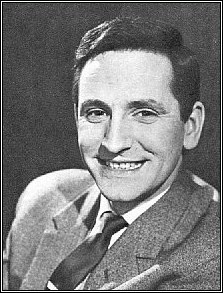
The Geat Lonnie Donegan
.
When the settlers from the British Isles settled America they brought their musical traditions with them, most prominently to the Southern tier of States. Thus both the White and Black musical traditions of America stem from essentially the Celtic peoples. In the mid-fifties Donegan brought this music in the form of American Folk back to England in a form he named Skiffle Music. It swept England and its youth up being combined with Presley. Donegan added a ferocious beat to the music that evolved into the form termed the Big Beat. Thus the British musicians were schooled in American music as it had evolved from their own.
Now, the Magic Moment requires the man who has been prepared for the moment. If all goes right he is equal to his destiny, if not the moment fails.
While Presley was the man, the second avatar would be four men seemingly acting as one. The four men seemed to represent four archetypal personalities as in the four faces of the godhead. Those of us who didn’t ‘get’ them, of which I was one, were mystified by their apotheosis.
Just as Elvis had his unique preparation so did this fabulous foursome. Raised as four ordinary kids from varying levels of poverty and varying psychological backgrounds they were united by the music of Presley and Donegan.
They began a grueling and astonishing apprenticeship in the red light district of Hamburg, Germany. Unable to speak German they were thus compelled to rely on each other for companionship which created a unique bond. They were required to be on stage for up to twelve hours at a stretch for weeks at a time thus honing their musical skills apparently to perfection.

The Beatles
Thus the four aspects of humanity, one might say, were placed in a unique situation creating a unique combination of personalities seemingly as one. In those circumstances they were forced to be able to communicate instantly with their audience night after night. Valuable training.
Returning to Liverpool with their abilities seemingly uniquely developed they were adrift with no direction home and no other future than earning their livelihoods as best they might. But then, as by a miracle, a man appeared with no managerial experience who said he could take them to the top. Amazingly he got them launched. Even more astonishing they were assigned to perhaps the only record producer in the world who could bring out their unique talents. Thus this Fab Foursome took their home British Isles by storm succeeding as no other had succeeded before them but their Magic Moment, that lunge for the Golden Ring had not yet arrived.
The Magic Moment was awaiting them in NYC. A big jetliner brought the foursome to America’s shores in January of 1964 to appear on the Ed Sullivan show where they were to stand in Elvis’ footsteps so to speak. The difference in presentation between the two is interesting. With Elvis, he and his backing duo were standing in front of the drawn curtains on the edge of the stage, no set, his two band members were huddled behind him while the guitar player is turned sideways not even facing the audience. Presley is directly in front of them cavorting on a minuscule part of the stage. Mort Sahl would do his standup routine a few years later in the same manner with a newspaper as a prop.
In contrast the Beatles were given an open stage with decor behind them while the group was spaced dramatically and attractively. A very positive image which from long experience they knew how to take advantage of . But the appearance on the Sullivan stage merely confirmed their Magic Moment placing it indelibly in the American psyche.
The actual Magic Moment occurred when the Beatles announced themselves on the tarmac. Gods descending from the skies. For

John Lennon
whatever reason there were thousands of screaming girls awaiting them and a battery of newsmen and photographers. Some say the girls were bussed in, it isn’t unlikely that the astute promotion men of Capitol had a hand in the arrangements, but on the receiving end of the tube it looked genuine. Mystifying but genuine.
Posed a bunch of questions by the news cameras all four Beatles fielded them with aplomb, the cheekiest and most confident acting was John Lennon himself. All four personalities established themselves at that time as one- the Beatles. In that little flash of time the role of the Beatles was established for all time.
While each individual Beatle was adored for the face of mankind he presented each had only an identity as an aspect of the Beatles. When they split they became merely humans rising or falling based solely on the musical merits. Of the four, Lennon adopted the messianic mantle, was accorded it, and took it when he left. In one sense the Magic Moment had been his.
There would be argument about when the Beatles began to break up over the years but the when was coincidental with their annunciation. John Lennon was the weak link in the chain. Having now won what he had been struggling for for so long John Lennon discovered he wasn’t worthy. Incredibly he wrote, and the Beatles recorded his song, ‘I’m A Loser.’ He was a loser, not the winner he appeared. Now conflicted he tried to both accept and reject the role of ‘messiah.’ He was well on his way to losing the role two short years later in 1966.
The course of his career was affected by two people, Bob Dylan in 1964 and Yoko Ono in 1966. Historical ifs are difficult. It seems impossible that Bob Dylan’s career would have been possible without the overwhelming success of the Beatles. Dylan lacked commercial appeal then as he does now. He appealed to a minority audience- as opposed to the majority audience of the Beatles. Dylan lacked universal appeal then as he does now.
While the Beatles were one as a group they were two as the songwriting team of Lennon-McCartney. Since 1962 they had been turning out a steady stream of million sellers both for their own use and that of others. They were catchy tunes in the Tin Pan Alley manner that could be sung and whistled but very introspective at the same time. Dylan on the other hand wrote tortured introspective lyrics that resisted anything close to whistling or a Mitch Miller singalong.
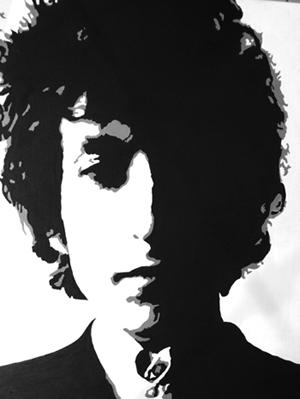
Bob Dylan
Dylan considered his stuff amazingly thoughtful and profound. He apparently put himself in the same class as Elliot and Pound. He fooled most of his audience for a long time too. The Beatles for whatever reason became the top news story of the day; for months they either were, or seemed to be, on the news every night. Seriously, one had to ask: What’s Going On?
Just as mysteriously Dylan began getting the same treatment. Now, the Beatles were selling unprecedented millions of records on both sides of the Atlantic, at one time occupying the top five spots of the Top 10. Dylan was doing diddly squat with his tortured lyrics. He wasn’t selling records in any quantities while having essentially a cult following. Now, mysteriously he began to be given the same treatment as the Beatles. Time Magazine sent a reporter to interview him on camera. Dylan imitated the Beatles by giving smart ass answers. The Time reporter took his jibes seriously. Sitting out in front of the tube my eyebrows shot up. What is this? The rest of the world went wild in their applause of the Beatle’s and Dylan’s cheekiness. God, they were giving the finger to the Greatest Generation. The latter may have crushed Elvis but these boys were getting their own back.
Maybe Dylan got the attention because he was the only American act available, to balance the relative status of Britain and the US. Perhaps in the emerging racial politics of the time he was offered as Jewish competition to the great goy champions of Elvis and the Beatles. He entered the Beatles’ life in August of ’64 when the Jewish journalist Al Aronowitz took it upon himself to introduce him to the four-in-one. The meeting was more momentous for the Beatles than Dylan.
The story goes that Dylan introduced the boys to marijuana at that meeting. More importantly he lectured Lennon-McCartney on songwriting. Dylan told them in effect that they should stop writing hit songs and write the pretentious crap he did. Now, consider, the Beatles were incredibly successful at what they wrote, Dylan couldn’t do what they did and what he did do couldn’t compete in the marketplace with the Beatles. I mean, they should have been lecturing him, but they didn’t while accepting his viewpoint at the same time. They listened to the little twerp and fell under his infuence to begin trying to imitate him.
The imitation was not very good but as the current avatar of the messiah the Beatles were industructible, as the leader, for whatever reason, John Lennon was accorded the role of messianic leader, a role that he took quite seriously.
While the Beatles had always used various pill forms of speed or amphetamines after Dylan’s introduction to pot they quickly expanded their repertoire to include Acid or LSD. The other three seem not to have been so conflicted in their personalities not becoming as drug dependent as Lennon. He claims perhaps with exaggeration, perhaps not, to have taken LSD thousands of times in the next few years. Under the influence of LSD his personality already distressed by the transition from failure to success disintegrated completely. As he says, he lost his ego totally.
If so, adrift, he was open to a strongly directed personality to manage his. This personality appeared in 1966 in the person of Yoko Ono. She quickly commandeered his personality displacing his British wife, Cynthia. It would be two years before Lennon divorced Cynthia but he left her a year earlier.
Since signing with Brian Epstein as their manager the Beatles had had an ideal artists arrangement. Trusting him they left the business details to him which allowed them full time to devote to their creative efforts. If they needed money they asked for it while all business details such as negotiations, titles and even check writing were handled by Epstein so that the Beatles had no worldly business experience. In 1967 Epstein died.
With Brian gone the Beatles were left rudderless with no one they could trust to manage their corporate and personal finances. Forming Apple as their business alter ego they attempted to manage their affairs themselves resulting in a business regime of such dissolute ineptitude that it has been referred to as The Longest Weekend.
Having attached herself to Lennon, Yoko Ono now tried to insinuate herself into the group as the ego of John Lennon. Thus the group would have been comprised of McCartney, Harrison, Starr and Lennon-Ono. A clear impossibility, the Beatles would be dissolved. As the avatar of the sixties the era had no choice but to disappear along with them.
This was now the late sixties. The world as it had been , the world that gave birth to the Beatles c. 1960 had all but disappeared. Blown away in the wind, so to speak. Just as the sixties called for the Beatles as the messiah of the period so it called forth its anti-messiah of satanism. In 1966 Time Magazine’s cover story was Is God Dead? A title that offended Bob Dylan who petulantly asked: How would you like to be talked about like that? Right.
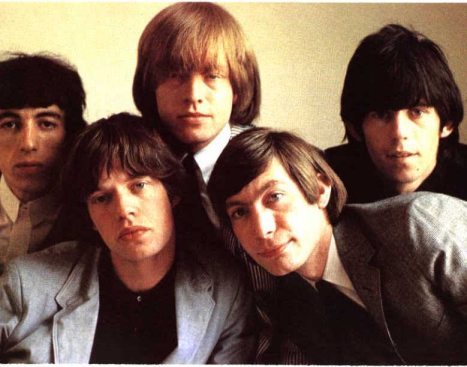
Stones With Brian
In 1966 Roman Polansky began filming a movie titled Rosemary’s Baby that actually portrayed the birth of Satan’s child. The story took place in the future home of the Onos- The Dakota Apartments. And then the Rolling Stones released their rather bizarre record, Their Satanic Majesty’s Request with its famous song Sympathy For The Devil. Right about then the Broadway musical Hair was staged that celebrated the Dawning Of The Age Of Aquarius. Synchronicity? Not a bit.
As the messiahs had abdicated it remained for the anti-messiahs the Rolling Stones to place the epitaph on the period which they did in 1969 at Altamont.
However John Lennon as the messianic figurehead was rescued by Yoko Ono. As an unsuccessful performance artist now with Lennon’s audience and financial clout to realize her wildest fantasies she, using Lennon, organized some of the most outrageous extravaganzas that catapulted she and Lennon onto the world stage playing messianic figures. The Bed-In was the most jaw dropping stunt since flag p0le sitting.

John And Yoko
Part III will consist of the career of the Ono-Lennon’s to John Lennon’s death in 1980 and perhaps a little beyond. There’s some really interesting stuff involving John Green and a possible associate, Sam Green. The latter is an interesting story.
A Review: Part IV, She by H. Rider Haggard
December 4, 2009
A Contribution To The
ERBzine Library Project
A Review Of
SHE
by
H. Rider Haggard
Review by R.E. Prindle
Part IV and end:
Herself Portrayed

Model of She
The idea of a twenty-two hundred year old woman patiently waiting for the reincarnation of a man she had murdered in that far off time is in itself an extraordinary concept. As an imaginative flight of fancy very likely Rider Haggard can be seen as its originator. Burroughs would borrow the notion twenty-seven years later in his The Eternal Lover when he reverses the sexes and has a cave man asleep for millennia wake to find his reincarnated woman. Since then variations on the theme have become quite common.
She, or Ayesha, was a powerful image of a woman. C.G. Jung saw her as the personification of his Anima theory. Haggard drew on many personal and historical details to create her. Ayesha was titled She-Who-Must-Be-Obeyed. As a child Haggard had a doll to which he gave that name. The doll must have represented his mother. If he invested characteristics of his mother into Ayesha then she must have been both warm and loving and cold and imperious. Over all one gets the impression that she was not particularly loving. Thus, Ayesha, while appearing to be in love with Leo/Kallicrates is nevertheless imperious, demanding and self-centered. In her only real display of afftection she kisses Leo on the forehead, as Haggard says, like a mother. As Haggard says of Meriamun in The World’s Desire, her love was not so much for her lover but an expression of her own vanity.
Haggard represents her as a living corpse in white funereal garments, completely shrouded. She has a strange accoutrement in the serpent belt with two heads facing each other. This is close to the caduceus. Perhaps Haggard had no idea of what the symbol meant in 1886 but by 1890 he had come up with an explanation. In The World’s Desire of that year Queen Meriamun of Egypt keeps something she calls the Ancient Evil in a box. The Evil is a small blob. When she warms it in her bosom it grows. World’s Desire pp. 144-45:
Thrice she breathed upon it, thrice she whispered, “Awake! Awake! Awake!”
And the first breath she breathed the Thing stirred and sparkled. The second time that she breathed it undid its shining folds and reared its head to her. The third time that she breathed it slid from her bosom to the floor, then coiled itself about her feet and grew as grows a magician’s magic tree.
Greater it grew and greater yet, and as it grew it shone like a torch in a tomb, and wound itself about the body of Meriamun, wrapping her in its fiery folds till it reached her middle. Then it reared its head on high, and from its eyes there flowed a light like the light of a flame, and lo! its face was the face of a fair woman- it was the face of Meriamun!
Now face looked on face, and eyes glared on eyes. Still as a white statue of the Gods stood Meriamun the Queen, and all about her form and in and out of her dark hair twined the flaming snake.
At length the Evil spoke- spoke with a human voice, with the voice of Meriamun, but in the dead speech of a dead people!
“Tell me my name,” it said.
“Sin is thy name,” answered Meriamun the Queen.
“Tell me whence I came.” it said again.
“From the evil within me.” answered Meriamun.
“Tell me where I go.”
“Where I go there thou goest, for I have war and thee in my breast and thou art twined about my heart.”
This quote gives an idea of what the snake belt worn by Ayesha signifies.
Of signficance while Meriamun is dealing in magic Ayesha denies all connection with the art saying she utilizes nature. She doesn’t use the word science but nature; nature would include psychology. She therefore draws on natural processes discovered but not scientific processes exposed. Thus when she kills her rival Ustane she does it by utilizing electro-magnetism, somehow using her own electro-magnetism to negate Ustane’s thus extinguishing her life force. We have then an example of tele-kinesis- action at a distance. As I’ve noted in other essays tele-kinesis was amongst an array of mental powers thought to reside in the unconscious being investigated by the Society For Psychical Research. Thus Haggard, probably through Lang, is up on the latest psychic developments.
Ursula Andress As She
The ability to kill by telekinesis places a moral burden on Ayesha. If one agrees that the use of such a power may be necessary the question arises of when it may be misused. It would seem that the killing of a sexual rival was an inappropriate use, so the warring good and evil heads of her snake belt refers to the moral dilemma Ayesha faces.
Her belt seems somewhat different than that of Queen Meriamun of The World’s Desire. The latter having accepted the aid of the Ancient Evil was committed to evil being unable to remove the belt. There seems to be an element of volition remaining to Ayesha. She is not ‘possessed.’ Of course Ayesha began her life some thousand years after Meriamun so perhaps psychology was somewhat further evolved at that time or evolved with her over her two thousand year life span.
Indeed, a topic of discussion Haggard introduces shouldn’t be dimissed lightly. That topic is the age old discussion of whether good can come from evil and evil from good. This is indeed a dilemma as bad results can arise from good intentions and vice versa. There is a serious side here.
Ayesha is pure irresistable beauty. Once she shows her face no man can resist her. She glories in this power. In The World’s Desire of four years hence Haggard will separate good and evil making Meriamun represent evil while Helen, the world’s desire, is all good.
Holly is an interesting character who may be a back hand slap at the concept of evolution. Holly also makes this the story of a beauty and a beast. Holly is described as having a low forehead with a hairline growing out of his eyebrows, further his beard and his hairline meet. He is said to have a hugely broad chest and shoulders with extra long arms, perhaps down to his knees although this is not stated. What we have in Holly then is the Wolf Man combined with King Kong. Monstrous indeed.
In contrast Leo Vincey is a Greek god, a sort of Apollo. As Ayesha is irresistable to men Leo seems likewise to be irresistable to women. Indeed, he was married to Ustane within minutes of arriving in Kor. He appears to have sincerely liked Ustane even though on sighting Ayesha’s face he too loved her. Ustane was a rival for a portion of Leo’s affections so Ayesha cut off her electrical supply.
Of several truly dramatic scenes in this spectacularly well constructed story a very dramatic one is when Leo confronts his twenty-two hundred year old incarnation 0f Kallicrates. Haggard doesn’t dwell on Leo’s understanding of this strange phenomenon although from the potsherd and his father’s letter he must have been convinced of the truth. Strangely he doesn’t ask Ayesha for an account of this earlier life, nor how it was that she came to Egypt from Yemen to interfere in his romance with Amenartas.
Haggard and Lang were aware of the early history of Yemen from whence Ayesha as a pure Semite came. She was pre-Christian, although not pre-Jewish, of some ancient Arabic religious beliefs. How she got to Egypt is never disclosed or how she came into conflict with the Egyptian princess Amenartas for Kallicrate’s affections.
Ayesha, by the way the name translates as Life, merely confronts Leo as the neo-Kallicrates without any preparation. A year or so to get to know her and become accustomed to her face might have been nice. Although, Leo was married within minutes of arrival in Kor and was apparently satisfied with his wife. He was a pretty adaptable guy.
At any rate Ayesha rushes him into immortality and while tomorrow may be a long, long time, eternity is even longer. One might want to consider a moment about a relationship of that duration. Nor does she adequately prepare Leo’s mind for the ordeal of fire that she wants him to go through to become immortal. Twenty-two hundred years of waiting had done little to improve her patience.
Haggard has put everything he has into this story. He was granted clear vision only once in his life and he took advantage of it. In later years he was frequently asked why he didn’t write another story as good as She. His reply was that such a story may only come once in a man’s lifetime. The concentration and focus probably will never return again. While Allan Quatermain, his third successive attempt to create a lost civilization was on the weak side I would argue that his last, Treasure of the Lake, comes close to She.
So, the four of them set out for the place of the fire of life. Masterful effects. High in the mountains there is a gigantic balancing rock, a huge mushroom type cap balanced on a spire. It would seems that Zane Grey was also greatly affected by She as Riders Of The Purple Sage hews very close to She. A narrow ledge of rock extends out opposite with a gap of fifteen feet. To cross this gap with high winds howling through, a plank carried by the ever patient Job has to be lowered across the gap. No mean task I’m sure, with only one chance of getting it right. Once in place, thousands of feet above the gorge each has to walk from side to side; plus they have only a few minutes for all four to get over during a single beam of light from the setting sun.
Fortunately all four make it crossing the balancing rock to descend into a cave leading to the bowels of the mountain. There an eternal flame that ensures the life of the planet rumbles by every so often. Twenty-two hundred years before Ayesha had bathed in this fire which following esoteric doctrines had burned away her gross, earthly, moral impurities making her essentially, pure spirit.
A famous incident of the process is recounted of the goddess Demeter in her travels after the abduction of her daughter Persephone by Hades. Coming to Eleusis Demeter in her form of an old crone was taken in by King Celeus and his wife Metaneira. As a reward for her kind treatment Demeter set about to make their infant son Demophon immortal. Thus each night she held him over the hearth fire to burn away his mortal impurities. Surprised one night by a startled mother, Metaneira, the process was disrupted so that Demophon retained mortal impurities and failed to attain to godhood.
In this sense then the fire that maintained the life of the Earth traveled a route through this mountain at the center of the Earth. It appeared something like Old Faithful at Yellowstone periodically. When it swept by, if one stood in the flame it burned away one’s mortal impurities leaving one, it is to be assumed, wholly Spiritual. All the materiality was gone.
Spirituality and materiality are still being discussed today. Some talk of Spirit as though it exists while the materialists aver that all so-called spirituality is a seeming effect of materiality. I am of the latter school of thought. Oneself is all there is, there is nothing more. The effect of spirituality is nothing more than a mirage created by intellect and consciousness which is entirely material. It is all reduced to psychology which is a description of material existence.
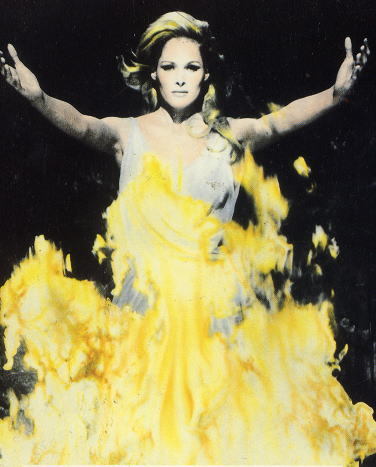
Come To Me
In Haggard’s story it is clear that Ayesha having lost her materiality to the flames is purely spiritual. This is going to cause her problems as she steps into the flames the second time.
The flame passes by while Leo dithers. Impatient for Leo to assume immortality Ayesha strips, as the flames will flame the material garments about her but not her body. As the flame comes around again Ayesha eagerly stands in its way. However having been once purified it is good for eternity. The second time is disastrous. Perhaps spiritually dessicated by the double dose Ayesha begins to wither devasted even in her death throes by her loss of beauty. Love in vain.
Job is so horrified he dies of fright leaving Leo and Holly alone.
The story for all intents is over but Haggard takes a dozen pages or so to get his heroes out of the caves and back to civilization.
Ayesha’s existence wasn’t extinguished. Her dying words were that She would return. Room left for the sequel which not surprisingly was called The Return Of She appeared in 1906.
Haggard hit the groove sharp as a knife in this incredibly well devised and executed story. One will find evidences of it strewn all through Burroughs’ corpus. Not least in his own character of La of Opar. La itself translates from the French as She, of course, so Burroughs even appropriates the name.
La is as ardent for Tarzan as She was for Leo/Kallicrates. Tarzan himself remains cold and indifferent to La throughout all four Opar stories finally abandoning her in Tarzan The Invincible.
She by Haggard is well worth three or four reads to set the story in mind and savor the wonderful and unearthly details
The End.
End of Review
A Review: Part II She By H. Rider Haggard
November 20, 2009
A Contribution To The
ERBzine ERB Library Project
She
by
H. Rider Haggard
Review by R.E. Prindle
From London To The The Caves Of Kor
She is dedicated to Andrew Lang:
I Inscribe This History To
ANDREW LANG
In Token Of Personal Regard
And Of
My Sincere Admiration For His Learning
And His Works
One may well ask then who is this Andrew Lang and what is his learning? In point of fact Haggard not only dedicated She to Lang but wrote three books in collaboration with him. Andrew Lang, 1884-1912, was a Scottish scholar specializing in folklore, mythology and religion so you can see where Haggard came by much of his esoteric knowledge. In addition Lang was one of the founding members of the Society For Psychic Research and a past-President. Lang wrote dozens of books over his lifetime. He even wrote a parody of She in 1887 called He. Today he is remembered only for his collections of fairy tales. Twelve volumes in all each titled after a color such as The Crimson, or Blue or Pink or Gray Fairy Book. The volumes are undergoing a fair revival now with a collector’s edition published by Easton Press and several nicely bound volumes by the Folio Society.
The nineteenth century was the one in which advanced knowledge of the past was rapidly extending European knowledge greatly. The Rosetta Stone deciphering Egyptian hieroglyphics had been achieved as recently as the 1830s. Nineveh and the Assyrian ruins had been unearthed. Schlieman had discovered the locations of Troy and Mycenae.
The exoteric side was covered by the academics while the esoteric side was covered by independent scholars like Madame Blavatsky and probably Andrew Lang. There was a clean split between the academic Patriarchal view of ancient history and the emerging Matriarchal view that had just been developed by the Swiss mythologist, J.J. Bachofen. Bachofen organized ancient history into Hetaeric, Matriarchal and Patriarchal periods. He himself was a member of the successor Scientific period.
The academics totally rejected the notion of a Matriarchal period. This, of course, led to a complete inability to understand Homer, both Iliad and Odyssey. The Iliad especially is a description of the war by the Patriarchy to destroy Matriarchy.
Lang seems to have understood the Matriarchal phase of ancient history. He must have passed this knowledge on to Haggard. Ayesha, as She, rules a Matriarchal society. While the ideas represented in She must have seemed bizarre or merely an amusing reversal of the Patriarchal world at the time, today it all reads comprehensibly. It rings true if not exact.
C.G. Jung, the psychologist, who developed such notions as the male Anima and the Shadow was very immpressed by what he saw as the male Anima in She. Madame Blavatsky lauded the book for its esoteric content. But then, Haggard was firing on all eight cylinders when he wrote it, it is difficult to conceive of a more perfect fantasy/adventure novel. Indeed Haggard subtitles the novel: The History Of An Adventure.
Haggard was an excellent Egyptian scholar. He not only visualized Egypt convincingly in his Egyptian novels but his Egyptian ideas pervade the African novels. Many of them involve Egyptian influences and even peoples filtering down into East and Central Africa. The Ivory Child is a case in point as is She.
The set up to the trip out is brilliant incorporating details that become cliches in B movies.
Leo Vincey’s father before he died gave a metal box to Leo’s guadian, Horace Holly, that wasn’t to be opened until Leo was twenty-five. This box is now opened. It contained a letter to Leo, a potsherd (a piece of a broken jar) covered with ‘uncial’ Greek lettering, a miniature and a scarab containing Egyptian hieroglyphics that read ‘Royal Son of the Sun.’
Thus Haggard captured most if not all of the elements that went into the intellectual aura fostered by B moves primarily in the first years of the talkies through the thirties. That entailed things like the Curse of the Pharaohs, movies like The Mummy melding into Wolf Man, Dracula, Frankenstein and African juju spells. Things against which Europeans had no defense because the ancient magic was stronger than modern science, or so we were led to believe. I can’t speak for others but it took me a while to shake this oppressive spirit. This was pretty strong stuff for my ten to twelve year old brain. Not to mention being bombarded by The Creature From The Black Lagoon, The Thing and The Day The Earth Stood Still. We wuz tried in the fire and come through good.
The gist of it is that Leo’s ancestor Kallicrates lived in the time of the last Pharaoh Nectanebo as one of the royal family. Spookier still Nectanebo was said to have fled Egypt before the conquering hordes, going to Macedon where he secretly impregnated Olympia, Philip’s wife, who then gave birth to Alexander which made him the rightful heir to the Pharaohship instroducing Greeks as rulers into his city of Alexandria.
At any rate Kallicrates girl friend, Ayesha, killed him in a jealous rage. The family nursing vengeance for all these two thousand years it is Vincey’s mission if he chooses to accept it, to follow the ancient map to the Caves of Kor and kill Ayesha or, She-Who-Must-Be-Obeyed who has been nursing regrets over killing Kallicrates two thousand years previously. Listen to me, I’m tellin’ ya it’s all here.
So Vincey, Holly and their man Job set out to find this place in Africa even more remote, if possible, than King Solomon’s Mines. And a heck of a lot more hostile too.
The trip out is some of Haggard’s finest writing. They are to be looking for a rock formation on the coast in the shape of a gorilla’s head. Sailing the coast they miraculously spot this head just as a terrific squall sends their felucca, dhow or other exotic ship from foreign climes to the b ottom.
But, even though the ship sinks they beat the reaper because they brought a boat containing unsinkable water tight compartments. As the storm subsides the three survivors along with an Arab float into the mouth of the appropriate stream as though it were all foreordained. What follows is some excellent writing with details I don’t need to recount.
Suffice it to say they are dragging their boat along an ancient canal when they are accosted by men from Kor. Ordinarily these guys would have speared them and moved on, no strangers needed in Kor. Using her magic She had learned of Leo’s coming a week previously thus ordering their lives spared while they were to be brought to her. Uh huh.
The detailing is terrific, this book is tight and well organized. It moves right along. The land is under the thumb of She-Who-Must-Be-Obeyed. This is a tight Matriarchy as we now recognize not just some strange place where a woman is in charge.
While the three are entering the Caves of Kor, Leo Vincey, being the cynosure of all female eyes, a knockout named Ustane steps up and kisses him. Not averse to a public display of affection Leo lays one on her back. New to the area and not aware of the customs of the place Leo had just accepted Ustane as his woman. In town for a few minutes and already married. That’s the way things happen in this particular Matriarchy. Ustane is now in conflict with Ayesha, She-Who-Must-Be-Obeyed.
The stage is now set for the main drama when Ayesha recognizes Leo as her long lost Kallicrates come back from all those reincarnations at last.
The exoteric Catholic Church is thus thrust aside in favor of all the heretical doctrines of the esoteric which have been bubbling under the Hot 100 for two thousand years. These unfamiliar esoteric doctrines would become the mainstay and staple of science fiction/fantasy for the next one hundred years.
Just as an example of how Burroughs probably learned esoterica, I became familiar with estoeric themes myself from reading 1950s science fiction and fantasy- Amazing Stories, William Tenn, Robert Heinlein, Ray Bradbury and all that sort of stuff without realizing what I was taking in, thus Burroughs surrounded by the Society for Psychical Research, Camille Flammarion, George Du Maurier and Stevenson et al. naturally learned the esoteric language. No mystery, he was speaking in tongues before he knew it.
Leo is awaiting the summons from Ayesha which will be covered in Part III.
Edgar Rice Burroughs On Mars
A Review
Thuvia, Maid Of Mars
Part II
by
R.E. Prindle
Apparently at this time in his life ERB’s mind was focused on hypnotism. The raison d’ etre of the novel seems to be his explanation of hypnotism and some of its effects. He certainly makes a fascinating story of the phenomenon. In fact the whole story concerns hypnotism with a few embellishments to get Carthoris and Thuvia to Lothar and once he’d exhausted the possibilities of his hypnotic theme he ended the story and even then he ends on a wild hypnotic note.
Thuvia was his fourth Mars novel and his first without John Carter. The hero is Carthoris the son of John Carter and Dejah Thoris. ERB’s father, George T. had died about a year previous to the writing. This novel was written shortly after The Lad And The Lion. As it includes a scene of psychological rebirth it may be a declaration of independence from his father, severing the relationship more denfinitely than did Lad.
On entering the land of the Lotharians Carthoris passes through a cave quite similar to the birth canal. There are Banths, Martian lions, before and one huge one behind him. Those before seem to vanish while the one large Banth remained behind him; that would be the memory of his father and the past. Carthoris placed himself in a posture of defense in the dark but the charging Banth passed to his side missing him much as a ghost from the past might do. Thus ERB seems to dispense with the Old Looney aboard ship in The Lad And The Lion who did represent ERB’s dad.
Thuvia had been kidnapped by a disappointed suitor who had her taken to Aanthor, one of the innumerable dead cities lining the shores of the vanished seas. There she was captured by the Green Men who fled through the cave to Lothar. There Carthoris and Thuvia are delivered to the scene of the action by ERB.
Carthoris then finds Thuvia in the possession of the Green Men who are waging a gigantic battle against the Phantom Bowmen of Lothar, themselves aided by large prides of both phantom and real Banths.
Piles of Green Men killed by little arrows lie about amongst legions of Bowmen who have been cut down, and still they stream through the city gates. Carthoris who has gotten to the side of Thuvia and she marvel at the carnage. They turn to watch the defeated Green Men flee. When they look back they are astonished to see that the dead Bowmen have all disappeared while the dead Green Men no longer have phantom arrows sticking in them. The pair are at a loss for an explanation. The Banths however were real and were now gorging themselves on the remains of the Greenies.
As a nice touch ERB has Thuvia essentially hypnotize the Banths. Rather than fear them as Carthoris does she merely makes a low melodic warbling sound that so charms the Banths that they come fawning before her.
This may seem improbable or even impossible and yet I have seen it done but with house cats. What can be done with one size cat I’m sure can be done with all sizes. The effect was quite astonishing with the woman I saw do it but the result was exactly as ERB describes it. Apparently he’d seen it done too. ERB thus establishes the ability of Thuvia that will be even more important soon.
Thus they gain access to the city of Lothar by passing through the Banths with safety. As a nice touch ERB gives Lothar an exotic round gate that rolls back into a slot. Perhaps he had seen a house with such a door somewhere. Once inside they meet the Lotharian Jav who begins to unfold the story while unfolding the hypnotic power of the mind.
If ERB had read H. Rider Haggard’s Cleopatra that deals quite extensively with hypnotism in a scenario somewhat similar to this one Haggard may have been another source for Thuvia. Quite possibly ERB had ingested and digested his earlier reading so that he wasn’t aware of how close he was to the originals. After all, anyone who could learn of Numa, the Roman King, from his Jr. High studies and think he had invented the name Numa for the king of beasts twenty years later, which he says is what happened, probably could think he was inventing his details himself.
Many strange phenomena appear to the pair on their way to the palace of the despot who was named Tario. They see marching files of Bowmen who appear and disappear. But the Bowmen are not real they are a projection of the mind of Tario who has hypnotized the pair into seeing what isn’t there.
While it is clear that ERB is quite familiar with Homer’s Odyssey it isn’t quite so clear what he knows of Homer’s Iliad or Greek mythology in general. One hesitates to give him too much knowledge and yet elements from the Iliad and Greek mythology seem to materialize before one’s eyes like the Phantom Bowmen of Lothar.
One can’t know whether ERB read the Iliad more than once and whether that once was in the seventh or eighth grade. How much he understood of an early reading like that would be questionable. I first read the Iliad in the seventh grade but got nothing but impressions of the action from it. The gods, goddesses and humans were very confusing. Lot of boy and girl stuff that was well beyond my experience. I have read the book seven times in various translations since. It was only in the fifth, sixth and seventh readings that I began to develop what I would consider any real understanding of Homer’s message.
One of the things I understand is that the Iliad is a story about the power of mind and its limitations. Zeus, of course had the mind of ultimate power that gave him the advantage over mortals and the other gods. Tario in Thuvia has the most powerful mind in Lothar which keeps him in authority over the few permanent emanations in Lothar. But, these are all figments of his or someone’s imagination.
It seems that long generations before the women had all died out leaving only the men who over a period of time would also have died out but they survived by being able to imagine themselves. Here we have a possible reference to Poe’s The Facts In The Case Of M. Valdemar. In that story Valdemar was a dying man who was first hypnotized and then expired. Being under hypnosis while alive he could not actually die as he was hypnotized alive. This is somewhat the condition of the Lotharians.
Taking hypnosis a step further ERB posits that there are phantom ‘realists’ who believe they can wish themselves into a permanent corporeal existence of which Jav is one. Opposed to them are the phantom ‘etherealists’ represented by Tario who believe they must remain imaginary.
Getting back to Greek mythology in which we do know that ERB was read the ‘realists’ believe that they have to eat so they conjure up ‘ephemeral fruits’ on which to gorge themselves.
Ephemeral fruits make their appearance in the myth of Typhon and Zeus. So there is a possibility that Jav and Tario is a version of that myth. Hera in her squabbles for supremacy with Zeus conjures up the monster Typhon to take on Zeus. Typhon makes mincemeat of Zeus removing his sinews and bones and placing them in a leather bag in a cave in Caria. Sad plight for the Big Fella with the all powerful mind and no sinews. Worse yet, as a god he is immortal so there he and his all powerful mind are in his sack perhaps for all eternity.
While Apollo and Hermes come to the Big Guy’s aid by putting the dry bones back together and reattaching the sinews the nymphs feed Typhon ‘ephemeral fruit’ that looks like the real thing but lacks nourishment. Thus when Zeus is reassembled and ready for action he faces an enfeebled Typhon who this time he easily defeats. Great story when you think about it. So there you have two stories reflected that ERB may or may not have read but having read them probably didn’t consciously remember them as he was writing. I can’t guarantee ERB read those stories but I can state with assurance that ERB just didn’t make this stuff up. He never does; it all has been suggested from someplace. It is not impossible that he heard similar stuff from Baum and the Theosophists in California. ERB does have a retentive memory that provides him with a lot of material.
Thuvia and its successor Martian novel- The Chessmen Of Mars- are an examination of mind and matter. The later Mastermind of Mars and the Synthetic Men Of Mars are examinations of the application of mind to matter. In the Chessmen the mind and body were separate entities. It will be remembered that the Kaldanes were also skilled hypnotists.
Here ERB is interested in a projected reality, in itself a form on insanity in an unbalanced mind. PP 66-67, Ace paperback:
Jav speaking: “(The Banths) that remained about the field were real. Those we loosed as scavengers to devour the bodies of the dead Torquasians. This thing is demanded by the realists among us. I am a realist. Tario is an etherealist.
“The etherealists maintain there is no such thing as matter- that all is mind. They say that none of us exists, except in the imagination of his fellows, other than as an intangible, invisible mentality.
“According to Tario, it is but necessary that we all unite in imagining that there are no dead Torquasians beneath our walls, and there will be none, nor any need for the fierce scavenging banths.”
‘You, then do not hold to Tario’s beliefs?” asked Carthoris.
“In part only,” replied the Lotharian. “I believe, in fact I know, that there are some truly ethereal creatures. Tario is one, I am convinced. He has no existence except in the imaginations of his people.
“Of course, it is the contention of all us realists that all etherealists are but figments of the imagination. They contend that no food is necessary nor do they eat, but anyone of the most rudimentary intelligence must realize that food is a necessity to creatures having actual existence.”
“Yes,” agreed Carthoris, “not having eaten today I can readily agree with you.”
“Ah, pardon me,” exclaimed Jav. “Pray be seated and satisfy your hunger,” and with a wave of his hand he indicated a beautifully laden table that had not been there an instant before he spoke….”It is well,” continued Jav, “that you did not fall into the hands of an etherealist, then indeed, you would have gone hungry.”
An interesting passage laden with humor and a joke or two. On the one hand this is a takeoff on Bishop Berkeley and those who believe that nothing is real but only a figment of our imaginations. They do believe that when you close your eyes the world ceases to exist. I could never follow the argument, and on the other hand the ideas can be construed as a variation on the Theosophical belief that the gods were first ethereal becoming more materialistic as existence descended to man who is most material. Thus Tario is visible air, as it were, as an ethereality while Jav is condensed into, as he believes, permanent air/matter while Carthoris and Thuria are solid matter as humans.
The food Jav produces is ephemeral food. It looks real but having no real substance has no nourishment. As he smirkingly says: It is well that you did not fall into the hands of an etherealist. Then, indeed, you would have gone hungry.” A funny joke. But Jav has hypnotized the pair into seeing the food even though Carthoris is not so hypnotized as to not realize it is not real food. He eats it anyway.
Once in this land where nothing is real but the Banths, one wonders that we don’t have a situation that was replicated later in the movie The Manchurian Candidate. In that movie the hypnotized soldiers imagine they are at a ladies social and actually see American women where Korean people are.
Perhaps Carthoris and Thuvia are standing in an empty field talking to themselves. Perhaps the Lotharians exist only in their own imaginations but have conjured Carthoris and Thuvia out of thin air. Pretty spacy stuff.
As Carthoris is hypnotized he is easily persuaded to do things he wouldn’t ordinarily do such as letting Thuvia be led away alone to Tario. He does and Thuvia meets Tario alone mystyfied that Carthoris would let her out of his sight. Seeing Thuvia the etherealist’s phantom cojones are aroused and he makes an all out assault on Thuvia. As he doesn’t exist, of course, the assault can only have force in Thuvia’s imagination. Just as those little arrows the Torquasians believed were real killed them one wonders what effect a phantom penetration would have on Thuvia. Would she have a little phantom child after a phantom pregnancy?
We’ll never know because she pulls out her thin blade stabbing Tario to his phantom heart. He falls apparently dead seemingly oozing out his lifeblood. But, as we know he is an etherealist hence only a figure of someone’s imagination we know he must be feigning death with phantom blood.
Hearing Thuvia’s screams Carthoris races to the rescue followed by Jav. Jav, who should have known better, is overjoyed confessing his desire to replace Tario. It was almost like a plan. Tario leaps up explaining he always thought Jav did and now he is going to execute him.
Here ERB evades the issue taking a cheap but effective way out. These two guys are actually magicians and should be made to match powers in efforts to do the other in. ERB isn’t up to it so he has Jav cave just awaiting his fate that he could always evade with his hypnotic powers. Now, we’ve all been advised not to trust our senses so whether any of this happened is open to question. Nevertheless a hole opens in the floor, the floor dishes so that all falls into the memory hole. The three are ostensibly history.
They are precipitated into the chamber of the Lotharian god. One might expect this god to be pure essence but instead he is pure matter. As so often is the case a Burroughsian god turns out to be a lion or the Martian Banth. Why Jav should be concerned isn’t clear as he has no real substance and can’t be eaten while with his hypnotic powers he could make the Banth believe it was a mouse.
Carthoris draws his sword but this one’s a piece of cake for Thuvia. Using her own particular hypnotic talents she charms the Banthian god and all four walk out through the Banth’s quarters as chums.
At this point Jav calls into existence old Lothar for us all to see.
Outside the gates of Lothar Jav conceives a desire for Thuvia. Using considerable hypnotic talent he persuades Carthoris that he and Thuvia are heading for the woods. Carthoris walks off alone convinced he is leading Thuvia by the hand. He is soon disillusioned. Returning he finds the realist Jav really mauled by the Banth and dying. Thuvia and the Banth have headed back to Aanthor. Carthoris has no choice but to follow.
B.
Now, what’s been going in addition to this hypnosis stuff is ERB’s ongoing attempt to reconcile his Anima and Animus. He has followed the usual Pyche and Eros storyline of Apuleius’ Golden Ass of Greek mythology. The Anima and Animus get together, circumstances separate them, then during the rest of the novel they try to get together amid difficulties, finally succeeding.
In Lad And The Lion ERB introduced the lion as his totem. Even though a male lion it is associated with his female Anima. At the risk of repeating myself, just in case anybody has been reading this stuff for the last four or five years the cause and evolution of his dilemma progress thusly:
In 1883 or 1884 ERB was terroized on a street corner by a young thug he identifies only as John. Possibly Emma was with him and kept walking abandoning him to his fate. Thus it was suggested to his subconscious that his Anima had abandoned him. John being the terrorist filled the vacancy. Thus ERB had the seemingly impossible anomaly of a male representing his female Anima.
We know this was the result because ERB writes incessantly about it. In the Outlaw of Torn the king’s fencing master, De Vac lures young Prince Norman/Burroughs outside the gate. Norman’s nurse Maud representing his Anima noticing too late rushes to the scene to be struck down dead by De Vac. Thus ERB’s Anima is murdered. How does ERB handle this? In his dream image ERB has De Vac take Norman to London where they live in the attic of a house over the Thames River. The house is a symbol for self, the attic being the mind. Water is a symbol of the female. The house extending out over the water but separated from it indicated the separation from the Anima. To compensate for the impossible situation of a male on the Anima, De Vac improbably dresses as a woman for the three years they live together in their attic. At the end of the novel Norman/Burroughs kills De Vac.
In the succeeding novel The Mucker he associates himself with the Irish thug Billy Byrne. Byrne being paired up with the socialite Barbara Harding is also an impossible match. It would seem probable that ERB’s father and John were two of the components clothing ERB’s Animus. Thus ERB has this very strong feeling about having a dual personality that he talks about constantly.
In Lad And The Lion we have the improbable situation of a powerless ship, representing the self, drifting up and down the Atlantic endlessly, manned by the deaf and dumb Old Looney, the Lad, and a Lion in a cage on deck. That the Old Looney who represents ERB’s father was deaf and dumb probably indicates he wouldn’t listen to ERB and had nothing to say that the Lad/ERB wanted to hear. So, the Lad was brutally abused the whole of his childhood. That’s how ERB saw the Bad Father. It would seem that John Carter represents the Good Father as ERB would have liked him to have been.
With De Vac and John dead the Lion begins to take his place as the male aspect of ERB’s Anima which has now been reoccupied by a female reprsentative. The male lion becomes a permanent aspect of the Anima in 1922s Tarzan And The Golden Lion as Jad-Bal-Ja. In Lad he and the Lion go ashore after the death of the Old Looney, or, in other words, his father, where the lion is loosely associated with the Arab princess Nakhla. Lad was written a short two months before Thuvia.
Now Thuvia wows Carthoris/ERB by charming the raging Banths/lions of the battlefield and the Lotharian God. Thuvia and the god become as one as she walks by his side her fingers twisted in his mane. So the traditional goddess of the male Anima is united with a male god to form ERB’s Anima. The female Anima who moved closer to reassuming her place in Lad now definitely becomes part of ERB’s psyche.
They pass through the tunnel before Carthoris. As ERB exits the tunnel he encounters his doppelganger Kar Komak. This is great stuff actually. Komak is literally a new man. He was the first successful materialization of an hypnotic imaginary man of the Lotharians. That’s likely enough, isn’t it?
He comes running through the scarlet furze, naked, to greet Carthoris. Well, picture that. Nakedness is something else appearing regularly in ERB”s works most notably in Tarzan And The City Of Gold. (See my review.)
The duo then continue on to Aanthor where as they arrive they are met by Torquasians who upset the plans of the men of Dusar who had come back to pick up Thuvia. We know that Carthoris for sure represents ERB because he takes a sword swipe to the forehead that lays him out. Thus the novel has the obligatory bash to the head recalling ERB’s adventure in Toronto.
When the sleeper wakes he finds the dead carcass of Thuvia’s lion lying half across his body. Probably his left half that derives from the ovum. Must have been uncomfortable to say the least. Thus the male half of his Anima is now dead and the female half in possession of the Dusarians. ERB gets her back and as in Psyche and Eros the Anima and Animus we may assume are permanently reunited.
Not quite but that will take us too far afield to discuss it this moment. I deal with the future development of the problem in my reviews of Out There Somewhere (The Return Of The Mucker), Bridge And The Oskaloosa Kid (The Oakdale Affair) and Marcia Of The Doorstep.
A Part 3 will follow that attempts to deal with the bigotry charges against Burroughs. If there is such a thing as guilt concerning the issue, ERB is not guilty, of course.
Post II: The Chessmen Of Mars by Edgar Rice Burroughs
January 13, 2009
A Review
Edgar Rice Burroughs On Mars
The Chessmen Of Mars
Post II
Part I
The Dance Of Barsoom
See Post I for Intro.
The twenties were a difficult financial period for ERB, indeed, as was the rest of his life to be. The substantial sums he had made in Chicago were spent before he left. ERB had saved nothing. He arrived in LA with no other resources than his current income. That income was very substantial by any measure but unequal to ERB’s massive spending capabilities so that at the time he wrote Chessmen he was already strapped for cash and headed for deep debt.
Always envious of the fabulous sums paid Zane Grey by the slick magazines ERB wanted to sell this story for ten thousand dollars to one of the big slicks. There were no takers so that the story went to the pulps for thirty-five hundred. Adding insult to injury he was told that the stories were too preposterous to be considered.
Part of ERB’s literary problem was that genre categories were not yet well developed. H.G. Wells’ early sci-fi efforts were labeled Fantasias, a term that could be understood by the literary arbiters, while still considered what we would call today, literary fiction. Even George Du Maurier’s trilogy of essentially science fiction novels- Peter Ibbetson, Trilby and The Martian have never been considered anything but literary fiction. They are three terrific stories of psychological dissociation while it would seem certain that Burroughs read them and was probably influenced by them. I can heartily recommend them. Very choice.
So the genres were taking shape at the period but had not yet evolved as they would during the thirties, forties and fifties until today fantasy, horror and sci-fi dominate the fiction best seller lists. If Chessmen was thought preposterous in 1920 one wonders what his critics would have thought of such movies as The Exterminator or The Predator. God, those people were so awkward and unevolved. Well, it’s the price you pay for being an innovator. Remember what the Pope told Galileo.
So, ERB was stuck in the pulps. Perhaps smarting from this rejection ERB would try to break out of his pulp rate with several realistic novels. the first was The Girl From Hollywood, a very decent attempt at a literary novel, that ERB’s long time publisher refused to publish. Following in the burro tracks of Zane Grey ERB wrote a couple of Westerns only one of which he could get published at the time. I read a lot of Westerns in the fifties while a kid. I thought ERB’s efforts were as good as what I read then. They’re all potboilers, even the so-called classics.
He even attempted a couple of Indian epics that I found so-so but I know other people who liked them a lot. Not so critical as myself, I guess. Oh, right, he couldn’t get Marcia Of The Doorstep published either. So he was type cast as a sci-fi/fantasy writer. At least he knew he could do that very well.
Zane Grey wrote some pretty strange Westerns. He himself was quite a womanizer and his novels pander quite successfully to the distaff side. He knew women well. Probably that was why he was paid those great prices by the Saturday Evening Post et al. Oh heck, ERB was just too outre for the Post.
In Chessmen ERB gives feminine appeal his best shot. I would imagine he was trying to reach the ladies when he describes Tara’s fabulous bath. Either that or he was trying to titillate us boys. Worked with me. But let’s assume he was trying to broaden his appeal as the title was offered to the slicks.
Chessmen was based on his three favorite novels as are all his books- The Viginian, Prince And The Pauper and Little Lord Fauntleroy.
Thus Tara teases Papa John as her ‘Virginian.’ We are then introduced to Gahan of far Gathol. ERB presents him first in his princely guise as, indeed, he is a prince of Gathol. ERB chooses to present him as a fop dressed all in diamonds and platinum. Tara forms an ill impression of him as she thinks no real fighting man would dress in such a fashion. Shortly Gahan will exchange his dress duds for the plain leather gear of the Martian mercenary thus changing from prince to pauper. Of course he will resume his role of Prince by novel’s end.
Fauntleroy was born to the manor in England but spent his youth learning what it meant to be a real American boy before reassuming his English title. Ah, American dreaming.
Recalling his battle for Emma’s favors with Frank Martin Tara has been betrothed since at least young girlhood to Djor Kantos whose father is friends with the family. So like ERB Gahan has to overcome this parental resistance. Speaking of Frank Martin Chessmen is the only novel I can recall in which the hero doesn’t get bashed on the head two or three times.
At the ball being given Djor Kantos fails to claim Tara in time for the first dance so that Gahan leads Tara in the Dance Of Barsoom. Some sort of Grand March. ERB explains that before Barsoomian youths can attend balls they have to first have learned three formal dances- The Dance Of Barsoom, that of their country and that of their city. After that they can take up stuff like the Martian equivalents of the Grizzly Bear, Bunny Hug, Charleston and Black Bottom. Kids being kids on Barsoom the same as on Jasoom.
While the concept is quite charming one wonders of the source. Burroughs himself was no slouch concerning the hit parade.
I think we can trace the rigamarole back to the patron saint of old timey music, Henry Ford.
Amongst all his many other enterprises Henry was revolted by the music and dances of the Jazz Age as the twenties are sometimes known. Even though his very own flivver is billed as being responsible for some new objectionable habits and traditions Henry clung stubbornly to the old. Thus in full revolt against the Jazz Age Henry was promoting the dances and music of his youthof around, oh say, 1880 or so.
Ford had begun his publication of the Dearborn Independent in 1920 making him a newspaper man also. It seems clear from internal references in Marcia Of The Doorstep that ERB was following developments in the Independent. He would then certainly have learned of the evils of the new music and the virtues of the old.
Just as Henry Ford was trying to rivive the old dances on Jasoom, on conservative, behind the times Barsoom Jazz has never even been given a chance. The Dance Of Barsoom is just as fresh and lovely as the first time it was danced millennia before. Martian kids didn’t mess with tradition so much so Gahan led Tara in that lovely old relic of Mars- The Dance Of Barsoom.
Pledging his love during the dance Gahan was sternly rebuffed by Tara.
The preliminaries finished the story begins in earnest.
The following day Tara is fascinated by a cloudy stormy sky which is such a rare occurrence on Mars that she had never seen one before. As I mentioned in the intro ERB borrows the next sequence from Baum whose Dorothy was wafted to Oz on a tornado. Tara ascends into this tornado like storm where her flier is caught by the winds and she is driven before them. When she lands she had been driven like Dorothy to Oz to a far land that has been all but forgotten if it had ever been thought of.
The hero and heroine of Chessmen are Tara of Helium and Gahan of far Gathol, or rather, they are the Anima and Animus of ERB. ERB always writes Anima and Animus novels. As dreamers will he may have recognized the X chromosome or Anima in the green pastures of his sleep or, it is quite possible that as a Latin scholar at Chicago’s Harvard School he was required to read the myth of Psyche and Eros from Apuleius’ The Golden Ass. I only mention a couple of possibilities. He may or may not have been familiar with Psyche and Eros but he was certainly familiar with the fairy tales derived from it such as Cinderella and Sleeping Beauty.
While Apuleius is given credit for the story his version is certainly only a redaction of the tale or philosophical speculation dating much further back in history. The Ancients were well familiar with the concept of both the male and female versions of the Anima and Animus. In popular mythology the male chromosome is represented by the Goddess as X chromosome and the Bull as the y. The female is represented by the two snakes as in the pictorial representations of Crete. It will also be remembered that the Greeks imported Cretan priests to manage the Apollonian shrine at Delphi.
The myth is that the two aspects were once united then driven apart wandering the world in search of each other. Duly at long last they do find each other are reconciled and allowed by the Goddess of Love to reunite. Thus the stories of Cinderella and Sleeping Beauty evolved from Psyche and Eros and who knows how many other stories besides those of Burroughs.
The question is was Burroughs only following a plot line, a pattern he had absorbed or was he consciously aware of what he was doing? Had he thought the problem out? Just as Tarzan and Jane were apparently mismatched in Burroughs’ dreamscapes so were ERB and Emma in real life. In Tarzan And The Golden Lion Tarzan and Jane had no sooner returned home from Pal-ul-don than Tarzan fled to his Anima in far off dreamland Opar leaving Jane/Emma to more or less shift for herself in a very dangerous world. Misfortune usually hit her too.
In ERB’s dream couple of John Carter and Dejah Thoris the Anima and Animus seem to be united although we see little of Dejah Thoris in the series and not at all in this novel. Even their son who may represent ERB is not present at all. Even with Carter and Dejah Thoris the classic separation and reuniting form a major part of the Martian Trilogy.
In this dream tale with Tara and Gahan ERB follows the classic formula- separation, the long pursuit and final reconciliation. He appears to know what he is talking about but since he never discussed his ideas on the subject we can only infer that he did or doubt or deny that he did. The psychological motifs he expresses throughout Chessmen leads me to believe he did.
What are dreams and what is a dream story? Freud originated the rational approach to dream interpretation. ERB gave some thought to the problem. Once can’t be sure he had read Freud’s Interpretations Of Dreams although in his short story Tarzan’s First Nightmare ERB used elements contained in Freud’s theory to explain the causes of Tarzan’s nightmare. At the very least we can say that dreams and nightmares from which ERB suffered all his life were of great interest to him. In the thirties he would buy at least one book on scientific dream interpretation.
What is the basis of dreams? It can only be experiences combined with memory. That’s it. Think about it. You don’t have to look any further. Nothing mysterious about them. The basic problem can be expressed in the question of what is the unconscious or subconscious. Is it some ultra mysterious process of the mind that can’t be penetrated, understood or accurately located? Is it as Freud believed an organ independent of the body and mind yet which somehow controls the actions of the individual from outside him? Or, once again, is it merely a combination of experience and memory, a faculty for interpeting the experiences of the day?
Freud touched on a key concept when he realized that the mind, which never rests, processes the incidents of the previous day in the sleeping and dreaming state. Burroughs also takes this approach in Tarzan’s nightmare whether he picked it up from Freud, Sweetser or realized it himself.
In point of fact experience happens to us so rapidly and from so many angles at the same time that it is impossible for the conscious mind to process it all as it is happening. Can’t be done. So, it follows that the subconscious or back up mind retains, as it were, photographs of the day’s activities that it reviews in sleep for either discarding, repression or action. How many times have you awakened with possible solutions to problems facing you?
The problem with the subconscious mind is that analysis of situations is affected by fixations, more expecially by the central childhood fixation. Childhood is that perilous time of life when the inexperienced mind is subject to being presented with challenges for which it has no programmed or immediately adequate response. Defeated in analysis the challenge is encrypted and encysted in the subconscious where it interprets all similar challenges through the lens of the defeated challenge and response. Thus all those strange compulsive behaviors we have.
As it chances we know Burroughs’ central childhood fixation. That was when he was eight or nine and he was challenged on a street corner on the way to school by a twelve year old Irish bully. Terrified ERB broke and ran apparently thereafter branded as a coward. Thus the central theme of his work is fight or flight and the state of cowardice. He examines the matter endlessly throughout the entire body of his work. These elements are all especially prominent in Chessmen.
We know that ERB was stressed to the breaking point as he wrote in 1921. Whenever he was stressed his personality fragmented, splitting at least once. In Chessmen the Kaldanes are two separate entities, the physical Rykors and the mental Kaldanes. Tara and Gahan, the ritual Burroughs’ surrogates are driven apart by the terrific storm.
This is a dream story abounding in dream images. One can provide an analysis of the storm scene based on the incidents occurring in ERB’s life at the time.
The image presented to us is of this very rare Martian storm of very high winds as in a tornado. Tara although warned against it takes her flier up. Perhaps ERB was warned against buying Tarzana, I would certainly think that Emma was at the least apprehensive. Tara navigates well beneath the clouds but wants to be in a cloud where she has never been before, i.e. Burroughs buys Tarzana. Here she is buffeted about so to escape she rises above the cloud or storm where the winds abate. But she has to get back down so she must reenter the storm. She is then taken by the winds tumbled head over heels by their extreme violence arriving half dead in the land of the Kaldanes.
Now, how does this represnet ERB’s actual situation in dream images.
ERB left Chicago under one presumes, sunny skies. His original intent was to buy twenty acres to raise hogs. Instead he bought over five hundred acres. He then began a massive building and improvement program with what appears to have been a substantial payroll and a not very well thought out plan. He overspent his income so that by 1921 his bills must have been greater than his income forcing him to borrow. He found he had neither the skills nor the talent bo be a ‘Gentleman Farmer’ so that he was forced to auction off most of his tools, implements and livestock in an effort to raise money and cut expenses. Also at this time his sources of income came under attack as the movies refused to film his intellectual properties while his royalties also came under attack.
In what I consider a purely defensive move he was forced to incorporate himself assigning all his income, copyrights and what not to the corporation in an effort to secure the means of his livelihood by putting his income beyond the reach of his creditors. In what I consider a questionable move he subsequently transferred a portion of Tarzana to the corporation. So, shortly after this storm broke on his head he became merely an employee of his corporation.
At the time he wrote Chessmen then he was caught in the turbulence of this storm he had created. Unable to get back down as with Tara he tried to rise above it in some way but was forced back into the problem where he was being blown along head over heels no longer in control of his affairs.
In the relative calm of 1924 he wrote Marcia Of The Doorstep that chronicles and looks back at this period.
Tara’s flight then is ERB’s day to day situation presented in dream images.
The rest of the book deals with past and present in a series of dream images to which we proceed.
Edgar Rice Burroughs On Mars
November 16, 2008
Edgar Rice Burroughs On Mars
by
R.E. Prindle
ERB scholars have long noted that the entire corpus of novels reads almost as one long book. I believe this is because ERB records his life in his novels. If one reads the novels in the sequence in which they were written and if one understands the symbolism used by Burroughs against a background of what’s happening in his life ERB actually records his mental state of the moment.
In this essay I am going to concentrate on a role of John Carter in the Mars series and that of Ulysses Paxton in the Mastermind Of Mars.
In real life before ERB began writing he was powerless on earth. I would call him an abject failure but even though he appeared one he was only on the verge of being one and if his attempt at a writing career in 1911 had failed he would have been plunged into the abyss.
As he was a failure or at least an unfulfilled seeker in 1911 he makes John Carter into a mold he admired, that of a Virginian and a soldier who was seeking his post-Civil War fortune in the deserts of the Southwest. Carter, whose initials are JC, actually finds his gold mine but attacked by Indians he escapes death by transporting himself to Mars.
Mars has a lesser gravity than Earth so on Mars he has superhuman powers. Thus unable to realize any of his ambitions on Earth ERB transports himself in his imagination to Mars as the Superman, John Carter.
Amazingly the idea struck a responsive chord in his soon to be Editor at Munsey’s, Metcalf, who bought the story. It doesn’t matter for how much, the point is it validated ERB’s lofty opinion of his destiny. Fortified by this response he brought himself down to Earth in the fantastic form of Tarzan Of The Apes in an imaginary Africa. Here was the gold mine he as John Carter was seeking. There was no one, no Indians, to drive him off so he was off to the races.
The first rush carried him through the line into 1920 when he left Chicago behind and fled to Los Angeles.
In LA his careless financial habits soon led him into hot water virtually bankrupting him but definitely stripping him of his assets. By 1926 when he wrote The Mastermind Of Mars he was virtually financially prostrate.
The hero of Mastermind is Ulysses Paxton. Ulysses can stand for the Greek wanderer and seeker Odysseus or for the great warrior, Ulysses S. Grant. So what we have is a duplicate of John Carter.
ERB is on record as saying that he thought that every man was two persons not unlike Dr. Jekyll And Mr. Hyde, some more divided , some less. Under stress the two personas like Jekyll and Hyde became distinct.
Now, in 1911 ERB was an unrealized genius but in 1926 he was a failed genius. In other words he had had his legs cut from beneath him. He might as well have been dead. Therefore Ulysses Paxton while serving in the Great War has a shell explode beside him. When he comes to he realizes his legs have been blown away. While he lies dying he looks up to Mars as John Carter had fifteen years before. When he next comes to his legs are restored and he is standing in a garden on Mars.
Thus in real life ERB imagines himself figuratively in Paxton’s situation returning in his imagination to the Red Planet in the hope of making lightning strike twice.
He hadn’t written a Tarzan novel since Ant Men four years previously. He was black listed by the movie colony that refused to make any Tarzan movies even though they would have been lucrative. He was under attack nationally and internationally by the Reds who were doing everything possible to destroy his sales and reputation. ERB truly had his back to the wall or figuritively had had his legs cut off.
Fortune would once again favor him when FBO Studios broke the blacklist against him. After a couple fumbling attempts at Tarzan novels he would hit a magnificent stride through the Tarzan novels from 1929 to 1936.
The Mastermind Of Mars was his attempt to recover his career. His style while revered by his fans was old hat by 1926 so he could no longer take the world by storm as he had in 1911.
Mastermind is a complex novel of which I haven’t completely broken the code but let us concentrate on two aspects. The first is ERB’s troubled state of mind over his marriage. Thus he invents the story of Xaxa and Valla Dia as he fights to deal with his sexual problem. The second is the religious problem caused by his confrontation with the Jews beginning in 1919 and continuing not only through 1924’s Marcia Of The Doorstep, and 1926 but to the end of his career.
In 1926 ERB had not yet met Florence Dearholt although he was probably already familiar with her husband Ashton and through that acquaintance he may already have seen her, and perhaps, also on the screen as she was an actress. He did meet her in March of ’27 when Dearholt approached him on a movie deal and was either immediately smitten or had the opinion of her he already had confirmed.
In Mastermind ERB expresses the thought that he has a wife to whom he owes everything but who he hates. This strong emotion would be realized at his own Emma’s death.
In this novel Emma is represented by the brain of the horrid Xaxa. Ras Thavas, the demon mastermind of Mars and physician nonpareil, has transplanted the brain of Xaxa into the beautiful body of Valla Dia and vice versa. Dia is Latin for goddess. I don’t know what Valla means.
The body of Xaxa containing the brain of Valla Dia is held in suspended animation by Ras Thavas. Bringing the body to life Paxton is smitten by the beauty of Valla Dia’s brain. Knowing that her body is of incomparable beauty he conceives the notion of restoring her brain to her body and taking her to wife. Valla Dia may also be seen a version of Helen of Troy.
I interpret this to mean that ERB’s Anima ideal was the beautiful Valla Dia, perhaps as he had once viewed Emma. But to his mind Emma had developed an ugly mind that animated the body of his Anima ideal. the beautiful mind he sought was thus in an ugly body while an ugly mind was in a beautiful body. ERB’s dilemma was to shuck Emma and find a beautiful mind in a beautiful body. When he met Florence in 1927 he thought he had found his Anima ideal of a beautiful mind in a beautiful body. His problem then was how to rid himself of Emma.
On that level then ERB is struggling with his sexual problem. In this book his struggle would take the form of an astonishing number of dual and split personalities. This is quite a study in that sense and an indication of ERB’s extreme stress. Perhaps Mastermind is a worthy successor to Stevenson’s Dr. Jekyll And Mr. Hyde.
The second and less resolvable problem is the religious issue. At this moment in time the Jews of Hollywood have got ERB boxed. Indeed, they have cut off his legs. The logjam was about to be broken by FBO Studios which would free ERB up until the late thirties when he was forced into exile in Hawaii. For now though he has to deal with this very difficult problem. He has by now learned that freedom of speech ends where Judaism begins. If I am right he was denied publication of Marcia Of The Doorstep because of the manner in which he discussed his dilemma.
In Mastermind while the religious issue assumes primary importance ERB puts it into an ecumenical form denouncing all religion. Does he refer to his Jewish situation in any cloudy form? I think he does.
The god in this story is a huge several story high idol named Tur to which all must bow down. The name Tur is an odd name for a god, at least in my mind. I have said before you cannot talk about that which isn’t in your mind. If you haven’t studied religions there is nothing you can say about them. As ERB has a great deal to say it is obvious that he knows something about religion and religions. Theology isn’t the issue here, that is a separate matter.
Given ERBs method, when he learned he had a problem with Judaism I’m sure he went out and learned something about it. It isn’t necessary that he had a profound knowledge; it is only necessary that he learned some things. We can’t be sure what. The word Tur is signficant in Jewish historiography. His use of Tur may be a coincidence but there you have it- Tur is Tur any way you turn it, frontwards or backwards, Tur is Tur.
The word Tur appears in Judaic lore in this manner:
…Rabbi Jacob (Yaakov) ben Asher (1270-1343) the “Baal ha-Turim” compiled the Arba Turim, first printed in 1458. “Tur” is used as shorthand for both the title of the whole work and for Rabbi Asher himself since it is customary in Judaism to call a compiler by the name of his compilation. The Tur is the predecessor of Rabbi Joseph Karo’s Schulchan Aruch. The four part structure of the Tur and its division into chapters (simanim) were adopted by Karo in the later code, Shulchan Aruch. Each of the four divisions of the work is a Tur, so a particular passage is cited a Tur…
p. 127 Hoffman, Michael, Judaism Discovered, 2008
While one can’t be certain ERB learned the above fact it isn’t particularly recondite and might have been easily learned. At the least the use of Tur for the god is a remarkable coincidence.
Making Tur an idol to which all must bow would have been an egregious offence to the Jews and one which any knowledgeable Jew, who might have read the book, always a precondition, would have picked up on it whether Burroughs intended it or not. Paranoia strikes deep.
The idol itself could possibly be modeled on the Alexandrine Egypto-Greek god, Sarapis. Burroughs would have known of this from the Bible if not from his readings in the classics. We know he reread Plutarch’s Lives at least twice with one of those times just previous to writing Mastermind. If he read the Lives twice he undoubtedly read other classics so there is no reason to believe that he didn’t have knowledge in these matters.
The manner of Paxton’s posing as Tur and bamboozling the bamboozlers is a mockery of religion in general although given the context of the word Tur the application of the mockery might have been taken more personally.
Forced to use the most discreet measures to avoid accusations of anti-Semitism ERB may have thought he was undetectably clever while he is certainly having a good laugh. Paxton congratulates himself and gives himself a couple pats on the back at the success of his ruse.
The end result, of course, is that he frees the people from the bondage to the false religion of Tur.
I’m not quite clear on the nature of Ras Thavas who is named after the Ethiopian Prince Ras Tafari who became the Emperor Haile Selassie and the namesake of the Jamaican Rastafarians.
The book is a worthy of the attempted second birth of ERB’s faltering career. The characters are magnificent and finely drawn. Ras Thavas is surely one of the great characters of pulp fiction. Mastermind paired with The Synthetic Men Of Mars makes for one of the greatest diptyches of science fiction.
 I, Dynamo