Part 7, Tarzan And The Lion Man: A Review
May 20, 2008
A Review
Themes And Variations
The Tarzan Novels Of Edgar Rice Burroughs
#18, Tarzan And The Lion Man
Part 7 of 10 Parts
by
R.E. Prindle
First published on the ezine, ERBzine

The Storyteller
The City Of God
7 a.
The first to the Falls, Rhonda was then spotted from the plateau by some of the Apes of God.

The Reviewer
Now begins the story within the story. A long short story or novelette that is as fine as anything in Fantasy or Science Fiction. This story is the eighteen caret ruby in the diadem of the Tarzan series. That this story should have gone unrecognized for over seventy years is incredible.
Not only is it objectively stunning but the subjective richness is beyond measure. Just as some background on the number of influences on the story let us begin with two, both of which are interconnected in ERB’s mind.
The novel by Mary Shelley, Frankenstein, had a profound effect on ERB’s mind. He apparently read it early which is to say before 1900. The possibility of creating life had interested him from the beginning of his corpus while references to it are interspersed throughout. One of the greatest of his creations, the great physician and scientist Dr. Ras Thavas, will succeed in creating life five years hence in The Synthetic Men Of Mars but will botch the job terribly.
In this story Burroughs’ character, God, doesn’t create life but he manipulates genes to create a whole new species. Mary Shelley wrote Frankenstein in 1818 and in 1931 Universal made the definitive movie. That was two years before Burroughs wrote Lion Man so it is reasonable to assume the movie had an effect on him.
IMDb provides a quote from the movie that may have inspired ERB; I don’t think there is any doubt that he saw this seminal horror film.
Henry Frankenstein: Look! It’s moving. It’s alive. It’s alive….It’s alive, it’s moving, etc.
Victory Moritz: Henry- in the name of god!
Henry Frankenstein: Oh, in the name of God! Now I know what it feels like to be God!
Frankenstein's Monster

The 1931 Frankenstein is stil an overwhelming experience to watch over seventy years later. For the audiences of 1931 it must have been overpowering. The fabulous castle of Dr. Frankenstein was surely an inspiration for the castle of Burroughs’ God. What Burroughs did with the inspiration is as astonishing as both the Shelley original and the movie.
In the news also at the time for over a period of a decade or more was the spectacular career of John R. ‘Goat Glands’ Brinkley. This is an astonishing story. I rely mainly on two accounts: Vishwas Gatitonde’s excellent article “Magic Men’ in BB New Series #59 and the account in Wlofman Jack’s autobiography. Wolfman Jack’s autobiography slipped by unnoticed but is one of the great autobiographies of the second half of the twentieth century, probably the twentieth century and possibly of all time.
Also see on the internet:
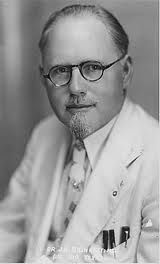
Dr. John R. Brinkley- A Story You Should Know
Grift, Goats and Gonads by Scott McLemee
Kansas State Historical Papers- John R. Brinkley
Border Radio Quackery by Gene Fowler and Bill Crawford
The Goat Gland Doctor by Joe Schwarcz, PH.D
The medical practices of God involve gland transplants along with genetic implanting or splicing. Over the years based on a foundation of Frankenstein ERB had built up a magnificent fantastical scientific edifice of life creation based on Evolution.
There can be no doubt that he read and thought about the subject a great deal. He was very well informed on evolutionary matters. He was a well educated, thoughtful, intelligent man contrary to nearly every opinion about him. His ideas as presented in Lion Man are probably as far as he could take them based on the knowledge of his time. The discovery of DNA was only a little over a decade away, actually made a few years before he died. One wonders what he would have made of it. Even then ERB’s notion of ‘germ cells’ with their indestructability contains the essence of DNA so ERB was on the right track in his thinking. I’m going to handle this out of order as the ideas explain what follows better.
ERB was familiar with the use of cannibalism to ingest certain qualities of slain warriors. Thus it was thought that to eat the brains of especially intelligent people transmitted that intelligence to oneself. To eat the flesh of a brave man made oneself also brave, etc.
From there to cellular therapy is a short step. Even though there was probably no one who believed in the physical benefits of human cannibalism this side of Africa when it came to animals parts intelligent men threw common sense out the window.
Cellular Therapy arose at the end of the nineteenth century. Joe Schwarcz explains:
Charles-Edouard Brown-Sequard, a noted French physiologist, had shocked the medical community by injecting himself with the crushed testicles of young dogs and gunea pigs. Afterwards he claimed that he had regained the physical stamina and intellectual vigor of his youth. Many men availed themselves of ‘La Methode Sequardienne’, but once the placebo effect was filtered out little remained. In Vienna physiologist Eugen Steinach proposed that youthful vitality could be restored by increasing levels of testosterone. the easiet way to do this, Steinach said, was through vasectomy. Sperm production wasted testosterone, and if the channel leading from the testes to the ejaculatory duct were tied off, then blood levels of testosterone would rise. Brinkley may also have heard of the work of Serge Vorenoff, a French doctor who was stirring u a storm of controversy with his experimental gland transplants. Vorenof had been a physician in the court of the King of Egypt, and there he had spent a great deal of time treating the court eunuchs, who suffered from a variety of illnesses. He hyposthesized that maintaining active genital glands was the secret of health. As proof, he cited his experiments with an aging ram into which he transplanted the testicles of young lamb. the ram’s wool got thicker, and his sexual vigor returned. Voreneff then went on to transplant bits of monkey testes into aging men; he claimed success, although he could offer no scientific validation of his claim. In America the stage was set for the meteoric rise of J.R. Brinkley.
Brinkley began to transplant goat glands into the testicles of his patients. As he began his career in the early 1920s radio made its appearance as a commercial entity. On the qui vive Brinkley realized its potential to increase his business and spread his gospel. He bought the first radio station in Kansas in 1923, his practice was in Melford, His call leters were KFKB- Kansas First-Kansas Best- as bold a claim as his medical ones. He was actually a fine broadcaster transmitting Country Music, weather, farm reports and other items of interest as well as infomercials for his medical practice. This notoriety brought the AMA and government down on him. By 1930 he had had both his medical and broadcasting licenses revoked.
Now, here’s where the man showed his innovative brilliance. This really got him attention. Nothing daunted he moved down to fabled Del Rio, Texas, Brinkley created the fable, across the Rio Grande from Villa Acuna. His radio station in Kansas was small, a mere 1000 watts, although probably non-directional.
In Mexico without US regulations he was able to build a boombox of 75,000 to 100,000 non-directional watts. This was later incresed, if this is believable, to 500,000 watts and tahen to1,000,000 watts according to Fowler and Crawford who really should know.

Clap For The Wolfman
Alright. When I grew up in Michigan in the 1950s I could clearly pick up the successor Del Rio station after dark when its power was only 250,000 watts. Wolfman Jack who worked the station tells an amusing story of his arrival. Driving through the desert to the transmitter he noted that all the cars parked there had left their headlights on. This mystified him but then he learned that the wattage was so powerful that headlights glowed in consequence. The air crackled around him. At a half million and a million watts people must have levitated.
So, Dr. Brinkley was much in the news all these years so that ERB as Gaitonde suggests couldn’t have missed him. While in our time there is no reason to mention La Methode Sequardienne yet with Brinkley being reviled it is quite possible ERB came across a discussion of cellular therapy in his reading which did mention these earlier experiments.
ERB has God, a formerly handsome Englishman, create a hybrid hominid between a gorilla and a human. God himself has regressed being a hybrid human/gorilla. p. 133:
“What is this strange purpose we are to serve?” asked Rhonda.
“It is purely scientific; but it is a long story and I shall have to start at the beginning,” explained God.
In the beginning. God appears to have been a medical student back in England with a strong interest in biology. p. 134:
“I had always been intrigued by Lamarck’s investigations and later by Darwin’s. They were on the right track, but they did not go far enough; then shortly after my graduation, I was traveling in Austria when I met a priest at Brunn who was working along lines similar to mine. His name was Mendel. We exchanged ideas. He was the only man in the world who could appreciate me, but he couldn’t go all the way with me. I got some help from him; but doubtless, he got more from me; though I never heard anything more about him before I left England.”
ERB gives us a fair amount of information here. He is familiar with the Frenchman Lamarck of the eighteenth century who centered on heridity. A red flag goes up on Darwin because if God left England in 1859 he would have known nothing of Darwin who published that year. In any event while Darwin’s Origin Of Species sheds light on the mechanics of the variations among a species I can’t find any evidence of how species themselves evolve. ERB is also familiar with the genetics of the monk, not priest, Gregor Mendel, who published in 1866 sending a copy to Darwin which the latter dismissed as irrelevant. However, Burroughs through God seems to have taken Darwin less seriously than Mendel.
He imples that Mendel was on the right track with his peas but that following the same line of reasoning God went well beyond him which indeed he did. Mendel was disregarded in 1866, his revival beginning in the year 1900. So Burroughs in 1930 is keeping up his reading.
Burroughs then goes on to explain God’s theory of heredity. His theory is not all that bad. It shows Burroughs obviously doing some reading and thinking on the subject. p. 134:
“In 1857 I felt that I had practically solved the myster of heredity, and in that year I published a monograph on the subject. I will explain the essence of my discoveries in as simple language as possible, so that you may understand the purpose you are to serve.
“Briefly, there are two types of cells we inherit from our parents- body cells and germ cells. these cells are composed of chromosomes containing genes- a separate gene for each mental and physical characteristic. The body cells, dividing and multiplying, changing, growing, determine the sort of individual we are to be; the germ cells remaining practically unchanged from our conception, determine what characteristics our progeny will inherit, through us, from our progentors and from us.
“I determined that heredity could be controlled through the transference of these genes from one individual to another. I learned that these genes never die; they are abosolutely indestructible- the basis of life on earth, the promise of immortality through all eternity.
It appears that ERB’s main concern is heredity and indeed genealogy was important to him. While his information is a clumsy account compared to what has been learned since then, given the times ERB was quite advanced. He doesn’t have the handle on DNA which is a decade or so in the future, Watson and Crick published in 1947, but in the germ cells he’s on the track of the right idea. The notion of the body cells is, of course, superfluous.
But now God runs up against a brick wall when he publishes his theory in 1857. Remember Mendel’s discoveries were still eight years in the future while so far ahead of their time that they will be disregarded for thirty-four years.
I don’t know what horror films have been released by this time, Dracula and Frankenstein for sure, but here the plot seems very familiar, possible Burke and Hareish. Unable to proceed in a legal manner because of society’s obtuseness God turns to criminal means, but quite novel crime.
As he has detemined that germ cells are immortal he raids the tombs of Westminster Abbey extracting germ cells from Henry VIII and his court and entourage. Thus he has a little time capsule when he is discovered and flees England to avoid blackmail. He decides to conduct his experiments on gorillas in Africa. He finds the greatest concetration of gorillas in Africa, and hence on earth, in the valleyof diamonds. In something like seventy years he converts pure gorillas into a hybrid of gorillas and humans capable of speech and human cognition. They build his magnificent City of God for him which must have been quite new when Tarzan arrived.
As they are bred from the genes of medieval Englishmen the effects of Lamarckian heredity are evident as they speak a medieval form of English and replicate the City called London after its medieval progenitor. Following Burroughs’ earlier thought in Opar the gorillas accept only beings born in gorilla form with human attributes. Sports and mutations are expelled. the other are, of course, the result of Mendelian genetics that are beings with odd combination of genes.
God was born in 1833, the same year as Burroughs’ father, thus in 1933 he is one hundred one years old. Some forty years back or so as he realized he was aging so he decided to splice in the body cells of young gorillas in a form of cellular therapy to rejuvenate himself. This worked well in preserving his youth but unfortunately the more gorilla body cells he spliced in the more gorilla-like he became, so that when Tarzan and Rhonda meet him he is a grotesque hybrid, more intellignet than the gorilla hybrids, but reverting rapidly to pure gorilla. Serious problem.
God is very pleased to capture two such fine looking human specimens as Tarzan and Rhonda because by splicing in their body cells he will be able to resume his human shape in some style.
So Burroughs has been developing his ideas in a creditable scientific way. While it’s true his actual science is speculative he is employing some fairly sound reasoning on the matter that may not have been too dissimilar from the tack taken by Stalin’s scientists, while creating a human-ape hybrid has apparently been a timeless fascination. It is said that our own scientists have succeeded in actually creating a chimp-human hybrid but that the specimens have been destroyed. I haven’t any confirmed proof that such has been done but rumors are around.
Having given a reasonable scientific explanation of the gorilla hybrids and God’s purpose for Tarzan and Rhonda, Burroughs with his usual ghoulish delight introduces his favorite topic of cannibalism. He informs the two that after satisfying his need for body cells he intends to eat them thus imbibing their characteristics. He also says that he will extract several glands from Rhonda for some special purpose.
I’m not exactly clear on what cannibalism meant to ERB. It seems he associates it with his father who was particulary hard on Burroughs in his youth which ERB may have interpreted as being eaten alive by his father. As we have God, cannibalism and his father associated here his father may be the reason for the recurring reference to cannibalism is his work.
The female glands recur again in Tarzan’s Quest where the Kavuru chief Kavandavanda requires female glands for his immortality pills and Vishwas Gaitonde finds the subject mentioned again in Tarzan The Magnificent.
So when Rhonda arrives at the Falls and is spotted from above by the seeming gorillas, she is actually spotted by a clone of the real fifteenth century Lord Buckingham in his gorilla guise.
Now begins a series of astonishments, jokes and twists such as are found in few novels. As I mentioned, today much of this is old hat, but in 1933 this was startling fresh and new. At this point we are unaware of the hybrid nature of the gorillas. The following passage then was not only startling to Rhonda but to us. p. 94:
(Rhonda) felt very small and alone and tired. With a sigh she sat down on a rounded boulder and leaned against another piled behind it. All her remaining strength seemed to have gone from her. She closed her eyes wearily, and two tears rolled down her cheeks. Perhaps she dozed, but she was startled into wakefulness by a voice speaking near her. At first she thought she was dreaming and did not open her eyes.
“She is alone,” the voice said. “We will take her to God- he will be pleased.”
it was an English voice, or at least the accent was English, but the tones were gruff and deep and guttural. The strange words convinced her she was dreaming. She opened her eyes, and shrank back with a little scream of terror. Standing close to her were two gorillas, or such she thought them to be until one of them opened his mouth and spoke.
“Come with us,” it said; “we are going to take you to God;” then it reached out a mighty, hairy hand and seized her.
There’s a shocking opener to the twilight zone between R2 and R3 as ERB prepares the curiosity of the reader for what is perhaps the most amazing story he ever told.
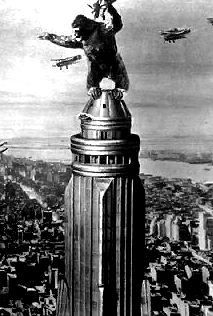
King Kong
Rhonda, physically and emotionally exhausted by the terrific events of the past few days, slips into a trance in the middle of Africa only to be brought out of it by voices speaking Enalish saying they are taking her to God. What can that possibly mean? When she opens her eyes she sees two gorillas are doing the speaking.
That’s something else, isn’t it? Had they been on the screen could they have competed with King Kong that was released in that year of 1933? Out of King Kong came 1949’s Mighty Joe Young while the public’s fascination with gorillas continued until Planet Of The Apes which, if it doesn’t owe anything to Burroughs’ story, develops the theme ad absurdam. Kong, Young and Planet Of The Apes, Stalin’s experiments all owe their origins to the Tarzan oeuvre.
Burroughs raises the theme to heights that have never been surpassed. Combining the human gorillas with the City of God was incomparable genius.
With the background clear let’s take a leap into the future.
The City Of God
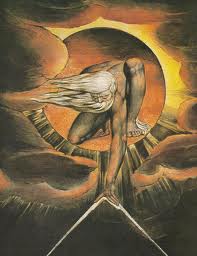
God At Work
7 b.
The whole thing seemed like a hideous and grotesque nightmare,
yet it was so real that she couldn’t know whether or not
she was dreaming.
Lion Man p. 95
In taking the ‘germ cells’ of individuals from the time of Henry VIII, as the cells were cloned with those of the gorillas the hybrids cloned the environment they knew. While clones have no mermory of a previous existence, in the popular imagination they do. Thus in the paranoid classic movie The Boys From Brazil of 1978 the number of clones of Adolf Hitler all exhibited the supposed conditioned responses of the original which they could not have experienced themselves.
At the same time ERB cleverly replicates the political situation between God, Church and Henry VIII. When Rhonda was captured, two gorillas named the Dukes of Buckingham and Suffolk quarrel over whether she is to be taken to Henry VIII or God. As we still have no idea of what is going on we are as mystified as Rhonda.
And then as Rhonda tries to order her bobbled brain she realized she could communicate with these improbably English speaking apes. p. 96:
Now she had an instant in which to think clearly, and with it came the realization that she had the means of communicating with her captors.
‘Who are you?” she damanded. “And why have you made me a prisoner?”
‘The two turned suddenly upon her. She thought their faces denoted surprise.
“She speaks English!” exclained one of them.
There’s a neat turnabout similar to when Tarzan addresses Buckingham in Mangani and the gorilla answers him in English. The gorilla exclaims, “She speaks English.”
Then follows an explanation of God, Henry VIII and Cranmer that only succeeds in confusing Rhonda further as she seems to be in some costume play in which for some inexplicable reason actors clad as gorillas are acting out a play about Henry VIII. She pinches herself to no avail. She is awake. This isn’t theatre, although Hamlet soon would be played in Nazi uniforms which is just about as ridiculous.
The gorillas take her to Henry VIII where we will leave her until she is joined by Tarzan.
While Rhonda escaped theArabs Naomi had been recaptured. In company with the Arabs she is brought to the canyon that leads to an easy ascent of the plateau according to the map. As the ascent becomes steep they leave the horses with Eyad going ahead on foot. Awaiting them at the crest is Stalin’s dream corps. Throughout the oeuvre one is always amazed at the disregard for their own well being the apes exhibit. They charge in story after story with complete disregard for their own well being. Always a signficant portion are left on the field of battle but the survivors never complain while Tarzan complacently accepts their sacrifice as his due.
So here, barehanded against the Arab firearms the gorillas launch a wave attack reminiscent of the Chinese in Korea that doesn’t stop until all the Arabs are dead. No regard at all for casualities. No wonder Stalin thought Burroughs was on to something. While the apes perform as they have always performed in Tarzan stories the difference here is that these are not mere apes but hybrids with human intelligence. If Burroughs was aware of Stalin’s experiments was he laughing at the Great Commissar? Is this battle a reference to Stalin? One can’t be positive of course but I am sure that the character of God-the formerly handsome Englishman- is partially based on H.G. Wells who was associated with Stalin.
Naomi was with the Arabs. She is captured by Buckingham who asks her how she got away from God; she is identical to Rhonda so Buckingham naturally confused her for the latter. The Apes sense of smell was not as developed as Tarzan’s. I’m sure the Big Bwana would have smelled the difference immediately.
ERB is now dealing with his sexual problems. Of the three women involved with the City of God- Naomi, Rhonda and Balza, it is necessary to sort out which woman represents what to ERB. As Naomi is weak and vacillating she obviously represents Emma. Rhonda who is strong and self-willed seems to represent ERB’s Anima ideal or in other words, La of Opar. La disappears from the oeuvre after Tarzan The Invincible of 1930 but as Tarzan and Rhonda in God’s prison replicate Tarzan and La in the Lion’s den of Invincible it seems probable that ERB has transported La from the fantasy world of Opar to the mere imaginary world of the movies. This leaves Balza- The Golden Girl- who probably represents Florence, but we will deal with her in the appropriate place.
ERB has now gotten the two women, the Arabs and Tarzan to the Falls. Orman, West and the safari are assembling at the base of the Falls so, having dissolved his story after the Bansuto attack ERB has now reintegrated it.
After a series of adventures during which Buckingham kills Suffolk, Tarzan appears to rescue Naomi killing Buckingham. At this point in Burroughs’ psychology he assumes the identity of his ordinary self and that of Tarzan into one being. As the movie people have never seen Tarzan they assume that he is Stanley Obroski his identical twin. Tarzan does not correct anyone but allows them to believe he is Stanley.
As I perceive it then ERB has now deluded himself into believing that he is Tarzan. Those who know him still perceive him as Ed Burroughs. He has no choice but to let them believe that because if he attempted to impose his delusion on them he might have been committed. Thus for a period of about five to six years from 1934 to 1939-40 Burroughs perceives himself as Tarzan but capitulates in Tarzan And The Madman giving up his illusion of being the Big Bwana. In Lion Man he describes Tarzan as a madman so the two novels are linked by the concept of madness.
After writing Madman Burroughs left California for Hawaii where he forced Florence away from him. WWII came along which saved him from himself. After the war he went back to LA to die. It is interesting that he didn’t choose to live in Tarzana but bought a house in Encino that backed against the Promised Land. thus like Moses, with whom there was a connection made in Tarzan Of The Apes, ERB was destined to view the Promised Land but not enter it.
In Lion Man he is flush with the hope of being able to live out his fantasy. He is now a few months from abandoning Emma so symbolically he returns Naomi to the safari at the Falls from whence she disappears from the story.
Only Rhonda and Balza will figure in the rest of the story. Emma is no more although Jane will appear again in Quest probably as Emma’s replacement Florence. In Magnificent Florence is mentioned only anonymously as Tarzan’s ‘wife.’ ERB is definitely struggling.
Having delivered Naomi to the safari Tarzan then reascends the plateau in search of Rhonda and the City of God.
The City Of God
7 c.
Every one of us, I believe, is possessed of two characters.
Often time they are so much alike that the duality is not noticeable,
but again there is a divergence so great
That we have the phenomenon of a Dr. Jekyll and Mr. Hyde
in a single individual.
E.R. Burroughs- The Swords Of Mars
Tarzan And the Lion Man was followed at the end of 1933 by the Mars story The Swords Of Mars which features the return of John Carter. ERB had taken a vacation from Emma returning to the scene of his own early adventures- Arizona. Not coincidentally in the White Mountain of Apache country. ERB’s motivations are sometimes obscure. He was in the Army in Arizona in 1896-97 which was before he married Emma. So he took his leave of absence from Emma to a place before he married her. Setting the clock back, so to speak, somewhat reminiscent of The Eternal Lover.
Just as Tarzan and Stanley met in Lion Man so while about to go to sleep, O.B.- The Other Burroughs- hears the door open, the clank of a man in war gear walking across the floor; terrified like an adolescent in a bad dream, O.B. is relieved and pleased when John Carter, back from Mars, greets him. A real Jekyll and Hyde situation. Thus as with Tarzan and Stanley the two Martian aspects of Buroughs are reunited but not melded. John Carter then tells O.B. a bedtime story as though Burroughs were a child again. I’m not that familiar with the Mars stories but there must be a connection to Lion Man and the MGM situation. This must be true because this is the novel in which the opening letters of each chapter spell- TO FLORENCE WITH ALL MY LOVE, ED. One assumes then that although the decision to leave Emma was difficult to make, ERB made the final decision in the Arizona mountains.
So now a few months earlier Tarzan/Stanley makes the journey to the City of God where he will be reunited with his Anima ideal, Rhonda -La of Opar- in prison. Thus his whole person both Anima and Animus are locked up by MGM.
Rhonda had been taken to Henry VIII by Buckingham and Suffolk. The city was called London, the country England and the river The Thames. As ERB jokingly smirks- The English always take a little bit of England with them wherever they go. Pretty funny, actually.
Here the events of Henry’s reign are being reenacted. As the apes are clones of Henry and his court who replicate their times one wonders whether each succeeding generation will be stuck in this one period of history reenacting it over and over until the end of time. Once again I am reminded of The Eternal Lover. ERB seems to be obsessed by the idea of time.
Rhonda was first placed with the wives of Henry, a week later being moved to a cell in God’s castle where Tarzan found her when he too was captured.
For now he was moving through the night until he came up against the ten foot high wall surrounding the City of London and within it the City of God. Here we have the historical confrontation between the spiritual and temporal powers. At the least the story is a very humorous parody of the religious situation of Henry VIII. Once again ERB ridicules religion and this is done so cleverly and with such genius.
But there are many levels of meaning. Earlier I mentioned that the capture of Tarzan may have been meant to replicate ERB;’s capture by MGM. In that sense then the City of God might represent MGM which boasted that it had more stars then Heaven. So there is probably a joke there too.
On the other hand, God is described as a formerly handsome Englishman. The only candidate for that role I can come up with is ERB’s bete noir, H.G. Wells. I think that I have adequately documented the literary feud between Wells and Burroughs. Wells began well with his scientific romances. While not as fresh and stunning as they were at the time of issue they still hold up well today. Even though ERB denied having ever read Wells I think that claim can be dismissed out of hand. ERB, then, would have been as impressed with Wells’ early romances as anyone else. Then when Wells began his campaign of defamation and ridicule which is most clearly represented in his Mr. Blettsworthy On Rampole Island he fell from favor in Burroughs’ eyes, hence the grotesquely deformed ‘formerly handsome Englishman.’
As much as I like Wells he does pontificate. Like all Liberals he has a difficult time distinguishing his opinion from truth, right and wrong, or reality. While he does sometimes make a hit in his prophesying he is mostly wrong. Backing the Worker’s Paradise of Stalin’s USSR was certainly wrong and more than enough to discredit him in the staunch anti-Communist Burroughs’ eyes.
Wells probably shook Burroughs’ faith in the glory of England which had been a keystone of his secular faith fromt he beginning. Thus, combining MGM, Stalin and the USSR and Wells, Burroughs packages all the troublemakers of this perilous time for him into one big box with a bigger bow on top.
As his story could have no effect on his situation let us hope it was at least cathartic for him. When Tarzan ends up in the cage with Rhonda that about epitomizes Burroughs’ situation vis-a-vis MGM, Stalin and Wells. There are so many coincidences here that the brain revolves like a turret. Was it wholly coincidental that Wells showed up in Hollywood at the end of ’35 to visit fellow Red Charlie Chaplin just as Burroughs was completely boxed in because of his Guatemalan adventure?
Isn’t it amazing that Burroughs met his fate in Guatemala, the scene of the adventures of his early hero General Christmas and also the scene of some of the adventures of Ogden McClurg who was killed shortly after this return from the area in 1926? It may be truly coincidental but the further one digs very often the more dirt one turns up.
Burroughs may have felt confident he could write his way out of this box just as he was able to escape by self-publishing in 1930; perhaps he thought he could escape this time by making his own movies. If so, a little analysis would have shown him that the rules had drastically changed. Especially as he had signed the rights to represent his character Tarzan away.
Coincidental with the release of the MGM Tarzan movies which preempted the nature of Tarzan from literature came the decline in Burroughs’ own literary powers. Whereas in 1930 he was able to respond to the challenge with a series of top novels, after Lion Man there is a preciptious decline in the the quality of is work. While the later novels have their charms for Burroughs’ admirers they do lack commercial appeal.
By 1935 also Burroughs had antagonized radio which had become the major source of his income so that that medium was closed to him during his lifetime. With publication revenues declining and the comics by Burroughs’ own admission producing a pittance, ERB had only one major source of income left and that was the moves. MGM had him over a barrel.
MGM might have produced a whole series of Tarzan films along the lines of the Charlie Chan movies as Burroughs reuefully remarked but they chose instead to issue only four movies between 1932 and 1939. Obviously the makret would have borne more. The limited release schedule kept EBB on a short financial tether.
It is said that events cast their shadow before them so that it is possible, if not probable, that Burroughs foresaw the shape of things to come even as he wrote Lion Man.
In 1930 when the Reds invaded his dream land of Opar ERB abandoned that fantasy. The fabled city ceased to exist in his imagination while disappearing from the oeuvre. Now in Lion Man it appears that the enemy had captured the castle while building a ten foot wall around it with Tarzan/Burroughs on the outside. Thus Burroughs’ dream of separating himself from the world by a tne foot wall has been inverted in his imagination. He wasn’t keeping the world out; the world was keeping him out.
In the novel succeeding Lion Man, The Swords Of Mars, when the mad inventor Fal Sivas quails at taking hsi invented spaceship to the Martian moon Thuria the following exchange takes place between he and John Carter:
“But you built this ship to go to Thuria,: Carter cried. “You told me so yourself.”
“It was a dream,” he mumbled; “I am always dreaming, for in dreams nothing bad an happen to me.”
Fal Sivas can be taken as an alter ego of Burroughs. The Sivas probably refers to the Hindu god Shiva or Siva with whom Burroughs had become a devotee or developed a fascination for. Thus while his heroes Tarzan and John Carter are men of action Sivas/Burroughs or any other combination is not.
So in Lion Man Burroughs is desperately trying to become the man of action rather than the dreamer. The problem now is that ERB himself is past the point of no return. He has been walled out from the City of God.
In dreams however Tarzan enters the Heavenly City by a fantastic feat of strength that recalls Burroughs’ 1890-1920 infatuation with the Strong Men such as the Great Sandow.
The wall which Tarzan fancies was built to keep out lions i.e. the Lion Man has sharpened stakes pointing downward. p. 124:
…he leaped for the stakes. His hands closed upon two of them; then he drew himself up slowly until his hips were on a level with his hands, his arms straight at his sides. Leaning forward, he let his body drop slowly forward until it rested on the stakes and the top of the wall.
That seems to be an impossible feat of strength except in dreams, but then by this point Tarzan thinks he is dreaming. This might as well be an MGM movie lot such Burroughs spent five weeks on. Here the dream faces a sort of reality. As though pasing through a movie set as ERB must have done during those five weeks Tarzan comes to the steps leading to the Heaven of God. this Stariway to Heaven, Jacob’s Ladder.
As if to accent the relationship to MGM he passes the Apes of God who are dancing and partying. The scene will be replicated at the foot of the Falls when the movie company duplicates this scene thus strengthening the connection with MGM.
Tarzan begins the long climb up the Stairway to Heaven. The fire flares illuminating him on the steps but the apes below don’t notice- high above on a parapet of Heaven, God does. Note the resemblance to the move castle of Frankenstein. A man of action God quickly prepares a trap.
In real life the trap was probably the promise of the contract and money. ERB blames the movies for being duplicitous, which is definitely true, still, he had had a dozen or more years to work out the conditions prevailing on his own. After all, by 1932 he had proven product to sell. The public had even given a profit to some pretty crummy movies so that had he taken the time, acted on his own conditions, rather than just signing for a few quick bucks he might have retained a position of some control, made himself an equal partner. So, while MGM did betray him he might have been able to manage the situation.
Tarzan enters the castle to be confronted by six doors of which only #3 is open. Depending on how you count them there were six to eight major studios, thus the six doors may represent the Studios of which only MGM was willing to deal with him. Remember he had been blacklisted since 1922, the blacklist having been broken in 1928 by Joseph Kennedy.
Tarzan descends the stairs as heedlessly as Burroughs signed the contract and like Burroughs he finds himself trapped. The nose of noses sniffs the air and detects the delicate scent of a White woman. He has found she whom he sought, Rhonda.
7 d.
The Confrontation With God
Now Tarzan is reunited with his Anima ideal in the person of Rhonda formerly La of Opar. That Rhonda can be associated with La is because this scene is a replication or double of Tarzan and La in the lion’s den of Invincible. There La and Tarzan were imprisoned in a cell beneath Opar. They escaped the cell in a duplication of their escape from this prison. In Invicible there was a runway within which the lion fed. A shaft led upward to a room in a tower. There the old man who betrayed them discovered them.
In this case a breeze passing over the floor indicates an air shaft to Tarzan. This is probably borrowed from Rider Haggard’s King Solomon’s Mines although it will soon if not already be a staple of the movie genre. Tarzan locates the shaft in the ceiling in a corner of the cell. He and Rhonda ascend it to the opening in front of which God is talking to some gorillas. Thus the scene virtually duplicates Invincible. La and Rhonda must be associated in ERB’s mind.
As an aside Burrughs uses a variation of this scenario in The Swords Of Mars when John Carter is imprisoned. There are beams some twenty feet ot so above the floor to which Carter leaps. He takes a position above the door dropping on his keeper when he enters.
At this point in the story Tarzan and Stanley Obroski may be considered to be reunited as one persona. Rhonda, who has never seen Tarzan, addressed the person in Stanley’s guise as Stanley. ERB has a little fun as he has Tarzan play along.
As he says in Swords, he is convinced that every man has a dual Animus, that is two different aspects, sometimes nearly identical but sometimes as different as Dr. Jekyll and Mr. Hyde. Thus at this point his mind is impressed with Shelley’s Frankenstein and Stevenson’s Dr. Jekyll And Mr. Hyde. He had read both novels before 1900 while both stories were released as movies in 1931. So the stories are very fresh in his mind.
Tarzan/Obroski may be considered of the Jekyll/Hyde variety. There is little doubt that Burroughs saw the pair and himself that way. Thus Carter and Fall Sivas in Swords may also be seen as two sides (Jekyll/Hyde) of the same persona. Tarzan does not try to convince Rhonda that he is not Stanley, but in the Jekyll side of the persona he astounds here with Hydelike feats compelling her to reevaluate him.
There are undoubtedly snippets of other horror movies here that ERB has seen also but I can’t remember the titles or dates. There was one about two Scottish body snatchers Burke and Hare which I think I can detect here and another about a mad doctor who operated on the brains of abducted victims that shows up here and in Swords that was called the Black Sleept or somesuch. The latter would have had a castle along these lines as well as Frankenstein. Of course, which of that ilk of movie didn’t? Burroughs is combining an astounding number of influences here both literary and cinematic but both combined.
Thus, having availed himself of ‘such a God given opportunity’ to find Rhonda he is imprisoned with her. The joke was ERB’s. You know, God left the doors open- God given opportunity. I chuckled softly to myself as I read.
After an exchange of repartee between Stanley/Tarzan and Rhonda God makes his appearance. Not exactly what one would expect God to look like. In fact it is almost amazing that the fundamentalist Christians didn’t create an uproar. After all according to the Old Testament man was created in God’s image. There’s a laugh. Here’s the image. p. 128:
It had the face of a man, but its skin was black like that of a gorilla. Its grinning lips revealed the heavy fangs of an anthropoid. Scant black hair covered those portions of its body that an open shirt and a loin cloth revealed. The skin of the body, arms, and legs was black with large patches of white. The bare feet were the feet of a man; the hands were black and hairy and wrinkled, with long, curved claws; the eyes were the sunken eyes of an old man- a very old man.
The Scopes Monkey Trial had only been about seven years before. So here Burroughs is making sport of God with a sort of reverse evolution. God is a cross between a man and a gorilla. Yet ERB led such a charmed life that his mockery or parody of God created no comment. If he wanted to start a ruckus to promote his book sales he failed miserably.
God might have been half ape but he had a whole hearted sense of;humor. Overhearing Tarzan say that he had come for Rhonda his opening comments are mock injury. p. 128:
“So you are acquainted?” He said. “How interesting! And you came to get her, did you? I thought that you had come to call on me. Of course it is not quite the proper thing for a stranger to come by night without an invitation- and by stealth.
“It was just by the merest chance that I learned of your coming. I have Henry to thank for that. Had he not been staging a dance I should not have known, and thus I should have been denied the pleasure of receiving you, as I have.
“You see, I was looking down from my castle into the courtyard of Henry’s palace when his bonfire flared up and lighted the Holy Stairs- and there you were!
Burroughs is justly criticized for the occasional bit of wooden dialogue but I find the confrontation with God very well written. The constantly mocking tone of God is carried off very well. Tarzan’s indignation is very well executed. The influence of Shelley, Stevenson and the various movies is seamlessly blended into a very tightly executed scene.
All this is done in a very few pages while it is a remarkable bit of writing.
God hints at his motives for their use for him. p. 129:
“…I shall keep you for a while for the pleasure of conversing with rational human beings.
“I have not seen any for a long time, a long, long time. Of course I hate them nonentheless, but I must admit that I shall find pleasure in this companionship for a short time. You are both very good looking too. That will make it all the more pleasant, just as it increases your value for the purpose which I intend you- the final purpose, you understand. I am particularly pleased that the girl is so beautiful. I always did have a fondness for blonds. Were I not already engaged along some other lines of research, and were it possible, I should like nothing better than to conduct a scientific investigation to determine the biologial or psychological explanation of the profound attraction the blond female has for the male of all races.”
Burroughs doesn’t tell us how blonde Rhonda and Naomi are, whether they are platinum blondes like Kali Bwana or merely blondes. Of course today ERB would be censored for his handling of the sexual and racial preferences for blondes but it is a recurrent theme in his writing and one worth studying.
Having piqued our curiosity as to his purpose for the couple God leaves to check up on Henry. p. 130:
“Come back here!” (Tarzan) commanded. “Either let us out of this hole or tell us why you are holding us- what you intend doing with us.”
The creature wheeled suddenly, its expression transformed by a hideous snarl. “You dare issue orders to me!” It screamed.
“And why not?” demanded the ape-man. “Who are you?”
The creature took a step nearer the bars and tapped its hairy chest with a thorny talon. “I am God.” it cried.
There you go. The cat’s out of the bag.
The scene is dramatically successful while the reader is now left to guess the model for God. We are told that he was a formerly handsome Englishman now deformed as a hybrid ape-human. The city is London, the territory is England and the river is the Thames. A reasonable place to look would be among the English. Who among the English is bedeviling ERB? H.G. Wells is the only one I can think of. Regardless of whether Wells considered himself a Communist or not he is sailing his craft so close to the wind that it is impossible to distniguish between the two. At the very least Wells is throughly subversive. If anything he resents not being in Stalin’s place. So Burroughs must consider him Communist.
To my mind then, Burroughs is mocking Wells much as Wells mocked Burroughs in ‘Blettsworthy.’ God has delusions of grandeur and so does the highly pontificating Wells. My vote for the model is Wells.
One also notes that in the last of the MGM Tarzan movies, 1942’s Tarzan’s New York Adventure, Tarzan is captured by the circus roustabouts and thrown into a mobile cage. The camera then pans around to front which identifies the cage as a lion cage. One thus has the joke of the Lion Man in a lion’s cage. A final thumbing of the nose at Burroughs exiled in Hawaii. MGM then dropped what had been a very lucrative series. Strange behavior indeed.
God then returns to give his history as detailed earlier in the essay. While for some reason everyone, fans and detractors alike, wants to think of Burroughs as a semi-literate boob who is coincidentally a ‘master of adventure’ yet both in content and exposition, God presents his story in a masterly way. In 1930 there may have been few of his readers who had ever heard of Mendel and possibly Lamarck, although one hopes all had heard of Darwin. So it is possible that a reader might have been puzzled by the inclusion of Darwin while dismissing Larmarck and Mendel as fictitious. Of course if you’re reading strictly for fast-paced adventure you may not notice the details even though they are far from concealed.
God also clears up the mystery of the map. Surprisingly the map is not a stage prop but authentic. In fact, God made it about seventy years previously. It seems that he had been in love with a women back in England but she preferred wealth to being the wife of an impoverished scientist.
This may be a coincidence but that is the premise of the plot of H.G. Wells’ In The Days Of The Comet. Perhaps it was a message to Wells in case he hasn’t gotten it yet. But then God discovered the immense number of diamonds in the valley so he wrote the girl promising her riches beyond imagination. He had employed a native runner to take the letter to the coast to mail it but since he had never had a reply he wondered if it had ever been received. Now it came back to him. A simple but inventive twist.
When God leaves this time Tarzan sets to work to escape. Following the draft across the floor he finds the air shaft. Just as in Invincible he sends La up first now he sends Rhonda up first. As in the earlier story they are trapped at the top.
Looking through the entrance to the shaft they spy God and some gorillas in front of it. Their escape is spoiled. Now begins the Gotterdamerung.
The City of God
7 e.
The Gotterdamerung
Burroughs now has both aspects of his Animus with his Anima trapped in the tower unable to go foward or backward. God and his gorillas stand in anticipation before the opening. Burroughs has been stalemated. At this point one aspect of God must be MGM and its contract.
ERB has spun out his fantasy in a plausible way to this point, but now he has to find a way to resolve his dilemma. As he is daydreaming and this is a mad dream, as Fal Sivas says in Swords, in dreams nothing bad can happen to you. In this bind something bad can happen to ERB. He can lose his grip on reality. In that way he becomes mad or insane which is what the story is about.
In speaking of Henry God might also be speaking of ERB. p. 143:
“You all forget,” (God) cried, “that it was I who created you; it is I who can destroy you. First I shall make Henry mad, and then I shall crush him. That is the kind of gods humans like- it is the only kind they can understand. Because they are jealous and cruel and vindictive they have to have a jealous, cruel and vindictive god.”
There’s a lot information in that quote. It refers to the ancient Greek saying: Those who the gods would destroy they first make mad. So we have an excellent joke here. The incredible mind of Burroughs can conceive humor in the midst of the blackest despair.
He is talking of the Yahweh of the Old Testament while he quite soundly understands that god is a psychological projection of the mind of his creator. In a masterly grasp of Freudian group psychology, whether he knew it or not, he realized tha the people have created a god in their own image and not vice versa. Trapped in the tower this is a real agonized cry of despair before losing his grip on reality.
I don’t mean to say that ERB went stark raving mad but he edged into a fantasy world at least once removed from the fantasy he had been living since 1912. For the period of his marriage to Florence he can only be described as spaced out. Bear in mind that it’s going to get worse as he gets trapped into his movie production experience.
The Masenas in The Swords Of Mars make the threatening moves on John Carter who keeps backing away. Only too late he realized he had maneuvered himself where they wanted him. The Masenas were cat-men, i.e. lions who had two mouths. In a sly way Burroughs is caricaturing the Jews of MGM and their mascot Leo the Lion. The upper mouth which is sort of pursy and purring to seduce one, is above a lower mouth that is all teeth and no lips to rend one. So he is saying that he is dealing with two-faced people. While the upper mouth is assuring, the lower rending mouth is ever ready to destroy you.
Tarzan realizes that he has no choices left but to stay put or rush God and the gorillas. Alone he would have had a chance of success but with Rhonda in tow he is lost. This is an interesting reflection on the relationship of the Animus to the Anima. I’m at a bit of a loss to explain this.
God had sent for Rhonda to be told that she was not in the cell. Knowing that Tarzan was in the air shaft it followed that Rhonda was too as neither could have escaped the cell otherwise. He orders smudge pots to be lighted to smoke them out. Thus Burroughs acknowledges that his own situation is untenable while he has no solution. The only one left is the Samson like effort of pulling the temple down on his own head destroying both himself and his enemies.
God’s plan backfires as he sets his own castle afire. Unable to stand the smoke any longer Tarzan rushes out to be felled by a blow from one of the apes. At this precise point ERB goes mad or loses his mental balance. I don’t believe there is a Tarzan novel in which the Big Bwana isn’t knocked on the head at least once. In this case when he gets up he won’t have lost his memory but he will be a different man, another round of emasculation.
Once again he is separated from his Anima. Rhonda is spirited off to Henry. God and Tarzan are trapped on the patio as the castle becomes engulfed in flames.
This chapter is appropriately titled ‘The Holocaust.’ In its way everything that ERB had hoped and dreamed goes up in flames with God’s castle. Heaven is reduced to ashes.
Tarzan has his trusty rope so he can escape over the parapet to the roof of a lower level. God begs him to save him which Tarzan reluctantly does.
Tarzan, one has difficulty in styling him the Big Bwana in this emasculated state, reverses the actual situation between Burroughs and MGM by placing the rope around God’s neck putting him on a short tether. Henry is now in full revolt. Tarzan agrees to help God in exchange for his help in recovering Rhonda and letting them leave. Perhaps Burroughs was asking MGM for a release from his contract. Let by Tarzan the forces of God defeat Henry.
I’m not clear who Henry represents or if he is meant to represent a real individual. Aware of his defeat Henry abandons his wives for the blonde White woman, Rhonda. He has a secret subterranean escape route. Thus Burroughs, who through Tarzan stormed the gates of Heaven, the heights of consciousness, has first returned to earth and now slips back into the subconscious. In all probability then, his attempt to integrate his personality had failed while coming so close.
Henry had followed his tunnel to emerge into the valley of diamonds and mutants. Here he encounters a lion. Throwing Rhonda down he runs from the lion which we all know is the exact wrong thing to do. Rhonda then escapes.
Tarzan emerges from the tunnel just as the lion is rending Henry. So Henry perishes. Tarzan sets off into the valley of diamonds in pursuit of Rhonda or, in another word, his Anima.
The City Of God
7 f.
The Golden Girl
While one is astonished that there was no uproar because of ERB’s treatment of God, Heaven and the gorillas, one is even more astonished that at no time since 1912 was ERB ever under attack for his views on evolution. The oeuvre is a veritable compendium on the various possible results of evolution yet no one ever said a word nor has to this day.
In LIon Man which treats of evolution in perhaps his most daring way yet, his effort is met with stony silence. God, in his creation of the hybrid gorillas according to the logic of Gregor Mendel, had a large number of sports and variations. The ‘normal’ hybrid apes refused to accept these either killing them or driving them from their society.
God laments that the tendency to exclusivity, or like to like, was such a strong characteristic of the new species that he could do nothing to break the hybrid’s attitude. This must be a wry comment on those who wished to break down racial and special barriers.
Apart from the role of White women in racial politics, which ERB through God has already commented on, there is not, nor will there ever be, inclusivity of different races on the pshysiological level nor even on the intellectual level of religion.
Thus the theme of separation in this spurious London, England was a variation on Opar where normal males were killed producing the ape-like male Oparians, while only the beautiful females were preserved. In this case the rejected hybrids, who bear some resemblance to the Hormads created by Ras Thavas, have taken up residence across the Thames. Among them, as one might suppose, Mendelian genetics predicts, were two human looking specimens. The male who was perfectly human in form had a gorilla mind; the female although rumored to have a gorilla mind in fact was a perfect human in mind while also possessing a normal human form.
She is the mate of the human looking male as kind mates with kind. Tarzan, having recovered Rhonda, finds Balza, which means Golden Girl, being abused by her mate. He rescues her but the trio is set upon by the whole tribe of mutants.
Balza explains to Tarzan that having defeated her former mate Tarzan has claimed her for his own. She is his, will-he or nil he. She then becomes hostile to the Anima figure of Rhonda.
So now we have a difficult psychological situation. Burroughs, who believes that every man is of a dual personality, has first united the two Lion Men and has now killed off one half of the duality leaving Tarzan as a single psychological unit. Not integrated but half a man so to speak. This is in violation of his stated belief which he has clarified no further. At the same time Balza seems to be driving his old Anima figure of La/Rhonda away, replacing her. Thus this Wild Thing becomes both Burroughs’ Anima ideal and human woman. We have single with single, or half with half. Now we have a single Animus, the Lion Man, Tarzan and Wild Thing as his Anima and woman. This is quite a combination. That would certainly explain the nature of the next several years of ERB’s life when he seems to run completely off the rails.
He expresses this in his work of the thirties in different ways. The Venus series is born out of this conflict in the second half of 1932 subsequent to the release of the movie Tarzan, The Ape Man. John Carter does reappear at the end of 1933 in The Swords Of Mars but Burroughs in the Venus series creates a much lesser man than either Carter or Tarzan; Napier is a pale shadow reflecting Burroughs neo-emasculated state.
In the first venus volume Napier heads for Mars in his rocket ship. Mars or the Greek Ares is the manly planet. But now suffering from his further emasculation Burroughs no longer feels capable of competing with men on Mars. Thus Napier has miscalculated the influence of the Moon, or female influence, which bends his trajectory sending him to the female planet Venus instead. In terms of classical mythology with which Burroughs was very familiar the Moon represents the feminine principle, while Venus, the Roman form of the Greek Aphrodite, represents the force of Love. Thus in symbolical terms ERB/Napier is diverted from the Manly principle of Mars by the female principle of the Moon and sent to the planet representing domination by the feminine principle of Love. Napier is not a warrior.
In Lion Man, written a few months after The Pirates Of Venus Tarzan follows his female Anima principle, Rhonda, into the valley of diamonds, where he is attached to The Golden Girl, Balza. In Burroughs’ terminology diamonds represent the realization of his sexual hopes. So Rhonda in this instance can be taken to represent Napier’s moon who leads him to Balza, the planet Venus or Florence. Burroughs is now severely handicapped in his conflict with MGM. In this chapter of Lion Man when he catches up with Rhonda comes across Balza being beaten by her man, the sport with the human appearance and gorilla brain. Balza had been misrepresented earlier, actually having a human brain. She now attaches herself to the emasculated Tarzan.
In their flight from the mutants- Tarzan running away again- they discover a pit full of diamonds. Presaging Tarzan And The Forbidden City in which the father of diamonds is a piece of coal, the huge pile of diamonds has lost any value to him. Thus Burroughs senses in 1933 that love is going to be a serious disappointment.
As a matter of fact in his psychological malaise Balza/Florence seems to have lost any value to him. He leads the women to the foot of the Falls where they rejoin the movie company who are living riotously. Their dance is a double of the Dum Dum like dance of the gorillas. Not a favorable comparison, perhaps indicating that man has not advanced much from the apes. Leaving Balza to become a movie star Tarzan returns to the jungle to find Stanley dead, thus the dead Stanley is rather unaccountably accepted by the movie company who return to LA. The whole story becomes a sort of mirage which, while we know it did happen, never happened.
ERB as a writer has now completed Ring 2. He completes his Ring construction by returning to the site of Ring Left 1, Hollywood as Ring Right 1. As Holtsmark notes he has followed the classical mode of Homer. He has not only done that but written his most perfect example. I find Lion Man masterly on all levels, in fact, ERB’s Magnum Opus.
A year after the movie company returned to the US Tarzan himself undertakes a visit to the film colony of Hollywood.
Go To Part 8, More Stars Than There Are In Heaven
Addendum To Springtime For Edgar Rice Burroughs
November 16, 2007
Addendum To Springtime For Edgar Rice Burroughs
An Analysis Of Chap. I, Tarzan The Untamed
By
R.E. Prindle
I hope I will be excused for submitting an analysis of only the first Chapter of Tarzan The Untamed. It seems to be very significant while justice couldn’t be done to its remarkable content within a full book review.
Tarzan The Untamed is unusual in that it took ERB a little over a year to write. A very long time for him. The book is also one of the longest Tarzan volumes.
The book was begun three months before Armistice Day on November 11, 1918. This was a tremendously busy period for Burroughs as in January of 1919 he severed his lifelong ties with Chicago forever, moving to Los Angeles. The evidence of the first chapter undoubtedly written by him in August of ‘18 is that this was an especially traumatic period of life for him.
He said he walked out on Emma several times during their marriage. The external evidence of Tarzan The Untamed, Tarzan The Terrible and Tarzan And The Golden Lion is that this period was one of them. At the very least this was a very stormy period for him in his marriage.
The Chapter in question can be divided into three episodes: The killing of Jane and Tarzans discovery of the deed, his reversion to a ‘great white ape’, and the confrontation with the panther. As David Adams has pointed out, whenever a leopard or panther is involved Burroughs is dealing with his sexual problems.
Writing in 1918-19 Burroughs antedates the story to the Fall of 1914 just after the Great War began. He seems to have been particularly aroused by the War. Much to the amazement of his publisher he wanted to become a war correspondent. He was unable to find a place. His writing during this period is replete with references to the War.
It seems possible to relate the death of Jane in the Fall of 1914 to Emma and the Mad King which was written between 9/26 and 11/2 in the Fall of 1914 when the Great War was in progress as reflected in ERB’s story. In the earlier story, ‘Barney Custer of Beatrice’, Barney had performed great services for the Princess Emma, done everything he could do to win her love and trust but she remained distant and distrustful. As the Princess Emma’s attitude refects that of Emma Burroughs this refusal to trust him must have infuriated ERB who at the time must have felt that he done everything a woman could expect of a man. He, in the character of Waldo in 1913’s Cave Girl Part I, actually tells Nadara, who had the same attitude as Princess Emma, that.
ERB’s and Emma’s relationship must have been strained over the intervening four years perhaps reaching a crisis at this time as ERB appears to have walked out at some time in this period although with the turmoil of moving and resettling it is difficult to tell when.
At any rate the brutal murder of Jane burned beyond all recognition except significantly her jewelry indicates the depth of ERB’s emotions. The jewelry may be especially significant in that ERB lamented that in his impoverished days he had to pawn Emma’s jewelry. That time or those times may have been especially bitter for him.
While it is true that he was persuaded to change the story bringing Jane back to life there seems little possibility for the reader to believe anything but that Jane was actually killed. The implication then is that Emma was dead to ERB. He had always regretted marrying Emma, or marrying at all, even going to the extent of saying that Tarzan should never have married which is to say himself. One wonders why, if he felt so strongly he didn’t seek a divorce at this time.
That is how ERB resolves that sexual problem of his wife. ERB then inserts a long paragraph explaining that now that Jane is dead Tarzan reverts to his original identity of the ‘great White ape’ or pure beast. It is explained that he never felt comfortable in his thin veneer of civilization. He assumed it merely because it pleased Jane and now that she is dead he no longer has any use for the guise. Hence as he stalks through the jungle in pursuit of the Germans he does so as a stalking beast no different than a lion or tiger. But more intelligent. He may revert to the beast but he doesn’t abandon the intellectual trappings of the veneer of civilization. Still got Daddy’s knife at his side.
Then in the last third of the chapter having resolved his heterosexual problem he turns to another serious aspect of his sexuality, that of his feeling of emasculation. That aroused homosexual feelings in him that he stoutly rejected.
ERB gave voice to this part of his psychology in Bridge And The Oskaloosa Kid, or otherwise, The Oakdale Affair of 1917, the previous year. Whether there are indications of homosexual feeling between Bridge and Billy Byrne in ‘Out There Somewhere’ is not clear to me at this time. I would have to read it again with that object in mind but they are probably there. As there are abundant indications of the sexual malaise in his subsequent writings it would seem clear that having solved one sexual problem by having others kill it he then turned to the emasculation problem that he had to deal with by himself alone, killing it.
In all other instances where the leopard or panther symbol appears women are involved except in one instance involving the male ape, Akut, in Beasts of Tarzan. There are definite homosexual overtones in that episode. As Tarzan confronts the male panther in this instance alone the beast must refer to Burroughs own sexual ambivalence. Especially as in this instance ERB combines the Panther motif with the terrific storm and extreme darkness.
The theme of storm and leopard is most dramatically portrayed in Tarzan And The Leopard Men of 1931 that opens with leopard men slashing victims, is followed by a terrific storm and succeeds to the confrontation between Old Timer/ERB and Kali Bwana/Florence.
Tarzan the Invincible of 1930 has the terrific storm as Tarzan and La come close to sexual consummation.
So, in this story almost separate from the rest of the novel, the story opens with the brutal murder of Jane followed by Tarzan’s confrontation with Sheeta in the terrific storm.
In this story we learn that Tarzan has some favorite trees. I can’t think of another instance in the oeuvre where Tarzan returns to a tree. In every other instance he merely selects a new tree for the night. In this instance having discovered the murdered Jane he goes to a tree he has often used. I don’t know what that means sexually. Perhaps if he had walked out on her before this he had some place he favored until reconciled.
Goro plays a prominent role. Unlike Greek mythology with which ERB was familiar where the moon is feminine in Burroughs mind the moon is masculine.
Thus it is night with the moon shining although a storm is building. Tarzan climbs the giant bole of the tree to find Sheeta sleeping on his mat in the crotch of the great limb. Thus the emasculation lurking in Burroughs’ subconscious haunts his nighttime bed. At this point the storm begins to break with gale force winds. Clouds obscure the moon and it gets dark, very dark, as dark, one might say as the tomb. It is a peculiarity of Burroughs’ heroes that they can see or find their way in the dark where you or I couldn’t. This is a very potent subconscious symbol. I’m not yet clear on Burroughs’ use of the symbol of darkness.
The Panther in this instance is a male as Burroughs refers to it as ‘he’. Thus in the night in his bed Tarzan comes upon a male sexual symbol. A quote:
Quote:
It was very dark now, darker even than it had ever been before, (see, we’re getting very serious) for almost the entire sky was overcast by thick black clouds.
Presently the man-beast paused, his sensitive nostrils dilating as he sniffed the air about him. Then with the swiftness and agility of a cat, he leaped far outward upon a swaying branch, sprang upward through the darkness, caught another, swung himself upon it and then to one still higher. What could so suddenly have transformed this matter-of-fact ascent (matter-of-fact ascent? What does that mean?) of the giant bole to the swift and wary action of his detour among the branches? You or I could have seen nothing- not even the little platform that an instant before had been just above him and which now was immediately below- but as he swung above it we should have heard an ominous growl; and then as the moon was momentarily uncovered , we should have seen both the platform dimly, and a dark mass that lay stretched upon it- A dark mass that presently, as our eyes became accustomed to the lesser darkness, would take the form of Sheeta, the panther.
Unquote.
As this is obviously a dream or subconscious sequence we don’t have to take into account improbabilities such as the moon breaking through the thick black clouds so conveniently.
Security for Tarzan is always being above things so that once his sensitive nostrils pick out Sheeta on his platform by a series of amazing acrobatics among the waving boughs in the rising gale Tarzan finds a secure place on a branch above the platform. He is now in a position to manage Sheeta. Tarzan always deals with Sheeta by descending upon him or leaping on his back.
In ‘Beasts’ he saves Akut by falling on Sheeta’s back as Sheeta descends from a tree on Akut. At the end of Leopard Men he does a standing leap onto Sheeta’s back. In this instance in a driving rain storm amidst lightening and thunder, on a whipping branch in a gale he does a somersault over Sheeta’s snout onto his back. These are acrobatics I would like to witness.
Now, in 1913’s Cave girl Part I Waldo killed the panther when it fell onto his upright spear. Spear equals penis as symbol. That pelt was given to Nadara after Waldo had worn it himself for some time. If the pelt is associated with both a homo and hetero sexuality homo in the sense of emasculation then there is a real sexual ambivalence indicated. In the case of Cave Girl Waldo assumed the masculinity of the Panther thus augmenting his own to its former state then having regained his masculinity he was able to invest Nadara with his love.
Jane is dead here so that it appears that Tarzan/Burroughs, still troubled by ambivalence as is also evidenced in 1917’s Bridge And The Kid where the Kid is a woman dressed as a man very ambivalently. In that story Bridge/Burroughs is very relieved to discover this boy he has fallen in love with is really a girl. Using his spear, a symbol of the penis, to goad Sheeta to an attack Tarzan retreats in gale force winds to the extremity of a large limb followed by the cat. Had the limb broken one assumes that ERB may have succumbed to his emasculation or latent homosexuality as he plunged back to earth. On earth he has to deal with realities. This is reminiscent of Heracles. Tarzan is a jungle Heracles. Having gotten Sheeta far out on the limb where his footing is insecure, it is at this point in the violence of the storm and wind that he somersaults onto Sheeta’s back.
Sheeta then loses his balance falling from the safety of the trees to earth with Tarzan on his back. Landing splay footed he is smashed to the ground by Tarzan’s weight. Unable to rise in time he is stabbed to death by Tarzan using his father’s knife.
Thus it would appear that so long as Tarzan is in the trees or his imagination he doesn’t really have to deal with earthly problems. But, once on the earth he has to deal with problems directly. As he has killed Sheeta on the earth one is to assume that he believes he has solved the problem of his sexual ambivalence. However the storm rages for a full twenty-four hours with whatever meaning that may have.
Thus in this traumatic day and night Tarzan/ERB’s heterosexual relationship is ended while we are led to believe he slays his emasculated homosexual ambivalence.
Having killed Sheeta Tarzan gathers an armful of fronds that in no way hinder his climbing the giant bole of the tree.
Quote:
Laying a few of the fronds upon the poles he lay down and covered himself against the rain with the others and despite the wailing of the wind and the crashing of thunder, immediately fell asleep.
Unquote.
Good thing the gale didn’t blow the fronds that covered him away. But this is a dream sequence, why would they?
Remember that these scenes of the killing of Jane and ERB’s dealing with his senseof emasculation are occurring in the Fall of 1914 at the time he was in fact writing the sequel to The Mad King, Barney Custer.
In that case Maenck was killing Barney’s alter ego Leopold while Emma/Emma stood round indecisively pondering whether to accept Barney/ERB in his new role as King. In other words ERB’s old loser self was dead while he was permanently assuming his new role as the successful ERB. In Untamed Jane/Emma is killed while Tarzan/ERB slays another troublesome alter ego or sexual problem.
In point of fact Emma Burroughs was quite right to insist that Jane not be killed. Had ERB let the death stand there would have been a gross inconsistency in the oeuvre as he already had Jane playing a prominent role in Jewels of Opar in 1915. Such a glaring inconsistency might have seriously compromised the on going story, actually a roman-a-fleuve, perhaps endangering its continuing success.
The Untamed in the title undoubtedly refers to ERB who is proclaiming his independence from Emma and the bonds of marriage. This theme too was explored in 1913’s Cave Girl which was concerned with the issue of marriage and free love.
Waldo in that story insisted upon waiting to consummate the love between he and Nadara until a minister was handy while she was puzzled as to why there was a need to wait when they were obviously meant for each other.
Untamed begun in Chicago would be finished in Los Angeles under very different circumstances than Burroughs’ life in the Windy City. As the story finished he would be the proud possessor of his own empire- Tarzana.
Burroughs just keeps getting more and more complex.
Pt. 5 Springtime For Edgar Rice Burroughs
August 10, 2007
Springtime For Edgar Rice Burroughs
Part 5
by
R.E. Prindle
In this year of excitement for Burroughs as his success becomes established and he tries to work out his psycho-sexual conflicts it is interesting to follow the development of both.
Three of his stories expecially concerned with his sexual conflicts were followed by sequels relating to their development. The first The Cave Girl finished in March as a sort of sequel was followed by the Mad King of October-November and then in November-December of 1913 by The Eternal Lover. After a fashion these novels may be considered a trilogy.
Writing approximately a year later – 16 months for Cave Girl, a year for Mad King and eight months for The Eternal Lover- the three sequels rapidly followed each other. The Cave Man was writtin in July-August of 1914, Sweetheart Primeval (The Eternal Lover) in August-September and Barney Custer of Beatrice (The Mad King) from September to November. The diptyches were then published as single volumes. They have been disconcertedly packaged as single stories when they should be considered as different stories with different approaches to the same problem. Unless I am mistaken with the sequel to the Mad King Emma is written out of the story.
Following Cave Girl in early 1913 Burroughs wrote The Monster Men in April-May that probably has little to do with his psycho-sexual problems but relates to his long admiration of Frankenstein and probably the more recent H.G. Wells’ novel The Island Of Dr. Moreau. There will be a number of related stories along this line if not sequels.
The Warlord of Mars followed in June and July. John Carter probably relateing to Burroughs’ emasculation concerns thus having little or nothing to do with Emma. August to October’s The Mucker is a very important book, the first of what I consider a quartet exploring Burroughs psycho-sexual needs. In The Mucker a low brow hoodlum from Chicago is thrown together with a New York society girl. The novel brings together the theme of yachts, shipwrecks, cannibalism and the stranding on a South Seas island.
In this case the low brow realizes that he won’t make it in a high brow world so he renounces his claim on the society woman.
The first sequel to the Mucker gestated for three years until 1916’s Out There Somewhere (The Return Of The Mucker). In this novel Burroughs splits his personality into Bily Byrne- the Mucker- and the gentleman hobo, Bridge. Thus by 1916 it apears that Burroughs sees himself as more polished than his Mucker creation. Bridge is a voluntary exile from a wealthy Virginia family so that he unites The Prince And The Pauper in his identity while reversing the order of Little Lord Fauntleroy. It will be noticed however that Bridge combines all three of Burroughs’ most favorite books.
In the denouement Burroughs gives the society girl to the Mucker while Bridge goes off in search of the ideal ‘mate’ who is Out There Somewhere.
The second sequel, Bridge And The Oskaloosa Kid (The Oakdale Affair), of 1917 continues the story of Bridge in, really, a very good story, in which at the end Bridge is revealed as not a bum, assuming his true identity as a Virginia gentleman. The Pauper become the Prince, Fauntlroy comes into his own.
The last of the quartet is 1924’s Marcia Of The Doorstep in which in a wholly fictitious way Burroughs’ Anima and Animus are united in the characters of Chase III and Marcia. This novel appears to conclude this particular exploration that has lasted for eleven years.
The Mucker was followed by October-November’s The Mad King. The Mucker was written in both Chicago and San Diego while the Mad King was written wholly in San Diego.
The Mad King returns to the theme of the Cave Girl of ERB’s relationship to Emma. He even names the lead female Emma. It seems possible that the uprooting from Chicago with all their possessions had an unsettling effect on Emma so that ERB’s difficulties with her probably become more pronounced. Certainly her discomfort is understandable but the Mad King may have determined her fate.
The title The Mad King is probably significant in this context. Once again Burroughs creates doppelgangers so that both characters are split from his own personality. Once again we have The Prince And The Pauper theme of an interchange of roles. At this stage ERB may have felt like a king but realized he was acting in a mad way.
The Mad King is followed immediately in November-December actually a matter of only twenty days by The Eternal Lover- Nu Of The Niocene. The two stories must be closely related in Burroughs’ mind. Indeed the sequel to Nu Of The Niocene, Sweetheart Primeval includes several characters from The Mad King. So one would have to ask how does Barney Custer’s sister Victoria relate to Emma.
I intend to devote a few pages to the The Eternal Lover which I consider perhaps the most imaginative and interesting of Burroughs’ stories. The inspiration for the story can be related to two of Burroughs significant influences, Rider Haggard and Rudyard Kipling. Among others of Haggard’s work She stands out most prominently while Kpling’s very interesting ‘The Finest Story In The World’ bears directly on the theme of reincarnation and close encounters in time.
From further reading that I am doing all the time it is also becoming apparent that Burroughs is part of a very large intellectual and literary background activity. In reading a volume: H.G. Wells’ Literary Criticism I came across this entry: (p. 62, note 2.)
Quote: At the end of (Grant) Allen’s novel, Frida Monteith, now a Liberated Woman, hoping that suicide will enable her to join her lover in the twenty-fifth century, ‘walked on by herself…across the open moor and purple heath, towards black despair and the trout-ponds of Broughton.’
Unquote.
I don’t suggest that ERB read Grant Allen’s novel but as ERB himself said ‘plots are in the air.’ So that ERB is working within an intellectual milieu. His notion of time travel in 1913 is not unreminiscent of Mark Twain’s posthumous 1916 novel Operator 44. While I would not suggest that Twain received any inspiration from Burroughs certainly conceptions of time and time travel were ‘in the air.’ I merely suggest that there is a milieu from which all are drawing inspiration. Burroughs also seems to have in mind H.G. Wells’ When The Sleeper Wakes although he claimed virtually to have never heard of ‘Mr. Wells.’ In Wells’ story his hero had fallen asleep awaking several centuries in the future to find his investments had accrued making him the richest man in the world, the object of a religious cult and an impediment to its continuation.
In The Eternal Lover Nu has been asleep for a hundred thousand years. Burroughs’ title for Chap. III is ‘Nu The Sleeper Awakes.’ No chance of a coincidence. Instead of monetary rewards Nu will find that which makes life worthwhile- the perfect mate he had left behind in the Niocene. Burroughs make an unbelievably subtle comment on Wells. Wells did read Burroughs but whether he caught this is open to conjecture at this time.
In fact, Burroughs setting up Nu’s return to consciousness and his relationship to Victoria, Barney’s sister, is extremely well handled by ERB. I doubt if there is anything in genre literature that surpasses it.
Victoria and Barney have just passed the rock structure within which Nu lies sleeping. The Once And Future King motif is also suggested here as well as possibly Vivien’s enchantment of Merlin.
Speaking of her sensations she says to Barney: p. 14
Quote:
“Barney, there is something about these hills back there that fills me with the strongest sensation of terror imaginable. Today I passed an outcropping of volcanic rock that gave evidence of a frightful convulsion of nature is some bygone age. At sight of it I commenced to tremble from head to foot, a cold perspiration breaking out all over me. But that part is not so strange- you know I have always been subject to these same silly attacks of unreasoning terror at the sight of any evidence of the mighty forces that have wrought changes in the earth’s crust, or the slightest tremor of an earthquake; but today the feeling of unalterable loss which overwhelmed me was almost unbearable- it is though one whom I loved above all others had been taken from me.’
“And yet,” she continued, “through all my inexplicable sorrow there shone a ray of brilliant hope as remarkable as the deeper and depressing emotion which still stirred me.”
Unquote.
That sets the premonition of what is coming as discreetly as anything I’ve read. The psychology of Victoria’s emotions is as succinctly and accurately expressed as possible. It is very difficult to imagine the scene bettered by any writer. Haggard and Kipling who may have recognized their own work as a source of inspiration must have shook their heads in awe.
Barney is sympathetic: p. 16
Quote:
“Oh, Barney.” she cried, “You are such a dear never to have laughed at my silly dreams. I’m sure I should go quite mad did I not have you in whom to confide; but lately I have hesitated to speak of it even to you- he has been coming so often! Every night since we first hunted in the vicinity of the hills I have walked hand in hand with him beneath a great equatorial moon beside a restless sea, and more clearly than ever in the past have I seen his form and features. He is very handsome, Barney, and very tall and strong, and clean limbed- I wish that I might meet such a man in real life. I know it is ridiculous, but I can never love any of the pusillanimous weaklings who are forever falling in love with me- not after having walked hand in hand with such as he and read the love in his clear eyes. And yet, Barney, I am afraid of him. Is it not odd?”
Unquote:
So in a few pages Burroughs has created a mystery of instense interest that will be explained in the next few pages to stunning effect, certainly in 1913 if not today. Since 1913 the topic has been explared in a number of ways not least of which was the very interesting movie Somewhere In Time.
Victoria is afraid of earthquakes. As might be expected a major quake hits. The rock facing of the cave in which Nu has been sleeping for the last hundred thousand years sheers away releasing the gas and allowing fresh air to awaken the sleeper, much as in H.G. Wells excellent story.
Burroughs’ treatment of Nu’s experiencing the new world is exceedingly well done. Through a series of well wrought adventures Nu and Victoria/Nat-Ul are reunited then split asunder again as the Arabs capture Victoria carrying her to the well known fate worse than death in the hands of a Northern Sheik.
Barney and his crew find Nu taking him back to Tarzan’s house. Here Burroughs tells a story before Nu leaves to recover Natu-Ul that seems strange.
The story is told by an unnamed narrator who happens to be a guest of Lord Greystoke at the time.
As the whole scenario is taking place in the mind of Edgar Rice Burroughs we may be forgiven for assuming that the anonymous I is he.
ERB has a strange attitude toward his creation Tarzan here, almost demeaning. When Nu escapes with the wolf hound Greystoke just off handedly asserts that Nu had killed the missing dog. When this proves wrong ERB allows the others to verbally abuse their host. Rather strange, I thought.
It appears that this story that follows Mad King I can be construed as a continuation of that story as when Barney shows up at John Clayton’s ranch, the man formerly known as Tarzan, he is fresh from Lutha and there to forget. As he lost Emma in Lutha one assumes that she is what he’s trying to forget.
An American named Curtiss shows up. Victoria says:
Quote:
“Mr. Curtiss!…and Lieutenant Butzow! Where in the world did you come from?”
“The world left us,” replied the officer, smiling, “and we have followed her to the wilds of Equatorial Africa.”
Unquote.
A charming compliment to Victoria. Indeed, Curtiss is there to propose to her. Curtiss begins very charming then slowly turns vicious. Reminds one of Robert Canler or perhaps Frank Martin in real life. At one point Victoria was about to consent to marry Curtiss (Frank Martin?) but then demurred.
But then she made contact with her dream lover, Nu. the interchange of time sequences is extrememly well handled as Burroughs manages the hundred thousand year gap betwen Nu and Victoria in inventive and satisfying ways. Once again he has mingled prehistory and the present in what is definitely his most virtuoso performance. His depiction of Victoria/Nat-Ul’s blending of dream states and waking states is handled flawlessly and convincingly.
As Curtiss realizes that Nu is his competitor for Victoria/Nat-Ul he derides Nu calling him a ‘white nigger.’ I found the use of the term strange within the context.
When Nu had recovered Victoria from the Arabs Curtiss comes upon the two in the jungle unawares. He is about to shoot Nu in the back (Martin’s arranged bashing of ERB in Toronto?) when the wolf hound who has been protecting Nu and Natu-Ul leaps on him ripping out his throat and chest.
Burroughs seems to gloat over this gruesome death so that one must ask who Curtiss could represent in Burroughs’ real life.
That means, who are Nu and Nat-Ul?
Once again we have to go back to the period 1896-1900 and the subsequent years. It seems likely that Curtiss must represent Frank Martin who courted Emma during those crucial four years in ERB’s life. In ERB/Nu’s absence Curtiss/Martin courted Emma/Victoria/Nat-ul. We may assume that Emma was about to say yes to Martin/Curtiss’ proposal when Burroughs/Nu returned from the Niocene/Idaho thus foiling Curtiss/Martin’s hopes.
Now, when Nu rescued Victoria/Nat-Ul from the lion Curtiss shot him in the dark creasing his skull. This is a theme seldom or never absent from any of Burroughs’ books, therefore it follows that as Martin was responsible for Burroughs’ bashing in Toronto that Martin/Curtiss are the same.
Curtiss becomes abusive of Nu after he recovers from the effects of the near miss revealing his ‘true’ or mean side. So Martin may have, or probably did, become abusive of ERB upon their return from Toronto. It is not to be believed that he just disappeared from the couple’s life without some demonstration of anger. As we know that Martin paid close attention to Burroughs and Emma from 1900 to at least the divorce when he sent his friend Butzow/Patchin to LA to talk to Burroughs it is very likely that he interfered in their marriage through the whole Chicago period. This would explain the gruesomeness of Curtiss/Martins’ killing and ERB’s seeming to revel in it. So the whole Narrator, Barney Custer, Lord Greystoke and Curtiss story is somehow related. The missing piece of the puzzle is Burroughs’ seeming hostility to Tarzan/Greystoke. I haven’t got that yet.
Having rescued Victoria/Nat-Ul from the Arab abductor in one of the most satisfying fight sequences in the corpus Nu tries to claim Nat-ul as his own. He is still confused as to how Victoria can be of two minds as both Victoria and Nat-ul. Before we consider Burroughs’ masterful handling of the fictional situation let us consider the relation of the sequence to Burroughs’ and Emma’s real life situation. This story was written in San Diego not Chicago.
The prehisoric aspect of the story may represent the early days of their marriage before ERB lost Emma’s trust in Idaho. Thus Victoria/Emma remembers the old days but she isn’t necessarily willing as yet to replace her trust in ERB. Nu/ERB having now the two tusks of Oo the saber toothed tiger on him as proof of his devotion, possibly once again representing his John Carter and Tarzan successes, insists that Victoria/Emma return to the past with him. i.e. the early days of the marriage. In other words Burroughs wants to start all over again. The name Nu- New- may mean that ERB thinks himself a new man but the same old guy he used to be.
My hair is still curly,
My eyes are still blue,
Why don’t you love me
Like you used to do.
Hank Williams
As this half of the story ends somewhat in a quandary regarding the relationship, Victoria nevertheless agrees to return to the past with Nu.
As ERB tells the story in the novel he creates a most extraordinary scene.
Quote.
“You do not love me Nat-Ul?” He asked. “Have the strangers turned you against me? What one of them could have fetched you the head of Oo, the man hunter? See!” He tapped the two great tusks that hung from his loin cloth. “Nu slew the mightest of beasts for his Nat-ul- the head is buried in the cave of Oo- yet now I come to take you as my mate I see fear in your eyes and something else which never was there before. What is it Natu-ul- have the strangers stolen your love from Nu?
The man spoke in a tongue so ancient that in all the world there lived no man who spoke or knew a word of it, yet to Victoria Custer it was as intelligible as her own English, nor did it seem strange to her that she answered Nu in his own language.
“My heart tells me that I am yours, Nu,” she said, “but my judgement and training warn me against the step that my heart prompts. I love you; but I could not be happy to wander, half naked through the jungle for the balance of my life, and if I go with you now, even for a day, I may never return to my people. Nor would you be happy in the life that I lead- it would stifle and kill you. I think I see now something of the miracle that has overwhelmed us. To you it has been but a few days since you left your Nat-ul to hunt down the ferocious Oo; but in reality countless ages have rolled by. By some strange freak of fate you have remained unchanged during all these ages until now you step forth from your long sleep an unspoiled cave man of the stone age into the midst of the twentieth century, while I doubtless, have been born and reborn a thousand times, merging form one incarnation to another until in this we are again united. Had you, too, died and been born again during all these weary years no gap of ages would intervene between us now and we should meet again upon a common footing as do other souls, and mate and we to be born again to a new mating and new life with its inevitable death- you have refused to die and now that we meet again at least a hundred thousand years lie between us- an unbridgeable gulf across which I may not return and over which you may not come other than by the same route I have followed- through death and new life thereafter.”
Unquote.
Wow! I don’t know that that can be topped in fantasy or other fiction. And there are people who say that Burroughs has no occult background. The passage fairly drips of Haggard and Kipling. Novels and stories that he’d read perhaps twenty years or more before had been working away in his mind to surface in this magnificent speech and wonderful story.
The unbridgeable gulf clearly refers to Haggard’s Allan Quatermain. The influence of the story of She is unmistakeable while Kipling’s The Finest Story In The World is clear. yet Burroughs has built an entirely new edifice that rises magnificently above the old foundations.
Haggard and Kipling read the story too, I’m sure with their mouths hanging open. It inspired them four years later to collaborate on Haggard’s own Love Eternal. While inspired by his masters Burroughs also inspired them. It’s a pity they didn’t all three sit down to smoke a cigar and have a brandy together.
That this story has gone unrecognized seems incredible. With this half of the story ERB capped his incredible year of 1913.
The tone of the corpus changes after Nu of the Niocene.
—–
As he worked his stories were being published elsewhere. It would not be before mid 1914 that Tarzan Of The Apes would see book form but perhaps more importantly his work was recognized and serialized in the newspapers. We have to thank Bibliophile Robert R. Barrett for collating the newspaper publications that George McWhorter published in the Winter 2005 NS #61 of the BB. My information is gratis Mr. Barrett’s collation.
The New York Evening World kicked off Burroughs career when it serialized Tarzan Of The Apes beginning in January of 1913. The paper also published many subsequent novels. Following the Evening World Tarzan Of The Apes was published by the Los Angeles Record, Chicago Record, the Bowman ND Citizen.
The Return Of Tarzan was syndicated by the Scripp’s Howard papers and The Cave Girl by the NY Evening World. After 1913-14 the number of papers publishing Tarzan Of The Apes increased greatly so by the time the book was published in June of 1914 Tarzan was much more widely disseminated than the mere publication in the All Story Magazine would warrant.
Burroughs’ book publishing history is difficult to understand. the reports of untold millions of copies cannot be substantiated. Indeed it appears that in 1914 fewer than fifteen thousand copies were sold. There is no record that his publishers, McClurg’s even printed the full fifteen thousand copes of the contract. When they leased the reprint rights to A.L.Burt in 1915 there had been no record of sales success. Indeed Burt would only take the title if McClurg’s would indemnify them for the first twenty thousand copies if unsold.
The cheap edition did well well but Burt reported less than seven hundred thousand copies ehen they turned the rights over to Grossett & Dunlap. So Burroughs while having a success never realized the substantial royalties on which he had been counting and would have bought him his yacht.
The springtime of ERB was nearly over. By the time he wrote the sequels to The Mad King, Cave Girl and The Eternal Lover in 1914 he was already entering Summer.
Let us now examine the year 1914.
End Of Part V
A Mother’s Eyes
Part III
Cow Eyed Hera And Edgar Allan Poe
by
R.E. Prindle
Stories under consideration:
Metzengerstein 1832
Berenice March 1835
Morella April 1835
Ligeia 1838
Fall Of The House Of Usher 1839
William Wilson 1840
Eleonora 1842
…Men have called me mad; but the question is not yet settled, whether madness is not the loftiest intelligence- whether much that is glorious- whether all that is profound- does not spring from disease of thought- from MOODS of mind exalted at the expense of the general intellect…In their visions they obtain glimpses of eternity, and thrill…to find that they have been on the verge of the great secret.
-Eleonora 1842
page 1.
Sonnet- To My Mother
Because I feel that, in the heavens above,
The angels, whispering to one another,
Can find, among their burning terms of love,
None so devotional as that of ‘Mother’,
Therefore by that dear name I long have called you,
You who are more than mother unto me,
And fill my heart of hearts, where Death installed you,
In setting my Virginia’s spirit free.
For mother- my own mother, who died early,
Was but the mother of myself, but you
Are mother to the one I loved so dearly,
And thus are dearer than the mother I knew
By that infinity with which my wife
Was dearer to my soul than its soul-life.
-1849
page 2.
As we study Poe keep in mind Dali’s picture: The Temptation Of St. Anthony. Keep those symbols in the forefront of your mind.
Edgar Allan Poe is a classic study on the effect of abandonment by the mother on the psyche, specifically affecting the brain stem as part of Structural Psychology. Poe exhibits the classic symptoms of the eyes, the horse and the female substitute for the Mother as well as adding several other twists due to his extremely analytical mind.
As the opening quote from his story Eleonora indicates Poe understood that he was quite mad. Although he was able to describe quite clearly in symbolical language the source of his madness his intelligence was unable to sift below the psychological barriers which would have cleared his mind of his madness.
In five really remarkable stories with extreme clarity he delineates his problem. They are the first story he wrote, Metzengerstein of 1832, Berenice of March 1835, Morella of April 1835, Ligeia of 1838 and Eleonora of 1842.
The Fall Of The House Of Usher and William Wilson demonstrate his inability to deal with the problem adequately. Under stress his personality begins to disintegrate.
Poe lived a short life of forty years from 1809 to 1849. His first story, Metzengerstein, was written when he was only twenty-three. It would have been interesting if he had lived long enough to consolidate his stories into at least one full length novel, other than Arthur Gordon Pym.
His own mother died in 1811 when he was only two. Thus the connection between his and his mother’s eyes was disrupted very early. He was then adopted by a Mrs. John Allan for whom he had the greatest respect and love. Mrs. Allan died February 28, 1829 when Poe was twenty years old. The horror of the death of this second mother festered in his mind for three years until his feelings began to find expression for him in 1832 with Metzengerstein.
page 3.
The woman he refers to in his rather confused poem- Sonnet- To My Mother- was the mother of his wife Virginia, a Mrs. Clemm. This poem was written shortly before his own death two years after the death of his wife Virginia in 1847. As the poem says, Mrs. Clemm, his mother-in-law filled ‘his heart of hearts’ where Death had placed her when her daughter Virginia died.
Clearly Poe was having mother figure after mother figure taken from him by death. His response apart from his literary outpourings was to drug and drink himself to death in 1849 two years after Virginia’s demise.
The Mother Archetype is truly a very powerful figure. In giving the figure prime importance Sigmund Freud was absolutely correct. What does that Mother figure mean to a man?
In ancient Greece the Great Mother goddess was ofter referred to by Homer as ‘Cow-eyed’ Hera. This image has been difficult for subsequent generations to understand. Many current translators of the Iliad drop ‘cow eyed’ in favor of euphemisms they can understand. If we would understand Homer this is a very serious mistake. Hera as the Great Mother is associated with the cow for good reason.
Whether she was ‘cow-eyed’ before she caught Zeus philandering with Io is unclear. Caught in the act Zeus attempted evasion by turning Io into a cow. Hera retaliated by having Io tormented by a vicious gad-fly. The gad-fly drove Io in the form of a cow from Greece to India to Egypt. In Egypt Io was transformed back into human shape as the goddess Isis. Formerly the Egyptians had depicted Earth and Sky, or the sources of plenty, in the form of a woman arching over with her feet on one horizon and her fingers on the other. After Io was introduced to Egypt the image of the woman was replaced by that of the cow.
page 4.
In nearly every country Io visited the cow has been considered a sacred animal. Whether in India, Egypt or the cattle raising tribes of Africa the cow was never killed. This miraculous animal was so beneficial live that its life became sacred. The cow was not only wealth but a symbol of wealth. One imagines that the first coin might have been called the ‘cow.’
Cattle lifting or rustling has been a way of life since perhaps the time of Io if she represents when the cow was domesticated. To lift a man’s cattle was to strip him of all social significance while making the lifter significant in his place.
Thus in Greek Mythology and history men and gods are stripped of significance by the lifting of their cattle. When the god Hermes was born his first act was to lift the cattle of Apollo thus assimilating himself with that god. Apollo tracked Hermes down but was so pleased with the little trickster that they established an accord, became blood brothers so to speak. Both sides of the coin.
In the Odyssey the Cattle Of The Sun were inviolable. Odysseus incurred the wrath of the Sun when his men after having been warned not to, killed a single cow. As the Sun sees all from his heavenly abode retaliation was quick and sure. Obviously that was a reason the Sun’s cattle were inviolable.
page 5.
The story of the lifting of Geryon’s cattle by Heracles is also significant. In former times before the advent of the Patriarchy Heracles as Hera’s consort had been the Sun God. When the Patriarchy replaced the Matriarchy Hera was assigned to Zeus while Heracles was demoted to a human and made an enemy of Hera.
Now, prior to the end of the Ice Age before the Mediterranean Basin was flooded, Hera and Heracles, by whatever names they were then known, must have been the chief gods of the pre-flood peoples of the Mediterranean. Thus two cults of Heracles grew up as the Western Mediterranean became separated from the Eastern Mediterrean in the post-flood Basin. One cult in the East in Greece and the Levant and another in the West of Spain.
The two cults must have come in conflict as the Greeks colonised Sicily, Sardinia, Corsica, Marseilles and the northern Spanish Coast around Barcelona. It became necessary for the Spanish cult to be suppressed or co-opted in favor of the Greeks. Thus, in myth the Greek Heracles is sent West to lift the cattle of the Spanish Heracles or Geryon. Relieved of his cattle the Spanish Heracles became a non-entity while all the glory accrued to the Greek Heracles.
Such was the poltical and social significance of cows.
page 6.
The economic importance of cattle was equally great which, of course, led to their social importance. Cows produced offspring. Fifty percent bulls and fifty percent cows. So one’s social importance increased every Spring if you could hold onto your cattle. The bulls being superfluous in large numbers, there being no reason to waste valuable feed on them, were used as sacrifices in the ancient Mediterranean. The gods were given the bones and fat while the flesh was consumed by the human votaries of the holocaust. Thus cows, without killing them, provided an abundance of meat. They also provided milk and its various by-products including butter and cheese. The African tribes bled their cattle to acquire nourishment from the blood so it is not unlikely that the Greeks and others did the same. The Africans never did figure out butter and cheese.
The cow being female was naturally related to the Mother Archetype. Hence we have ‘cow-eyed’ Hera. The mother is to her son, like a cow to mankind, a source of superabundance or should be. She sacrifices her own happiness, or should, to supply all his needs, she feeds him from her own body. She psychologically nourishes him with the love pouring from her eyes. It seems to be a fact that the longer a son nurses from his mother the better his chances for success in life are. Sons who nurse for two years or more are assured of the best chances.
Thus to be abandoned by your mother, death being a form of abandonment, is the greatest tragedy that can befall a son.
In Poe’s case he was abandoned by his mothers, once at two and once at twenty and by his wife-mother surrogate at forty-seven. The unconscious strain was simply too much for him so he drank and drugged himself to death succeeding in 1849 at the age of forty.
Fortunately he recorded all the classic symptoms plus some in his series of magnificent short stories. They are or should be a treasure trove for the analyst.
page 7.
As noted above, when his adoptive mother died in 1829 his reaction was intense. Poe began his inquiry into his anguish in a raging examination of the effect on his Ego or Animus in Metzengerstein. The story culminates in the destruction of Metzengerstein’s house or castle by fire. Fire is a purifying agent. The house is a psychological symbol for the self just as a room in the house is a symbol for the mind. As his house was being consumed the smoke gathered above to form the shape of– a horse. Thus as with Aldous Huxley and my other examples the mother is related in the male to the horse and more especially the eyes. It is not improbable that if Hera had come into existence after the introduction of the horse into Greece that she would have been known as horse-eyed Hera. As it was Athene who may have been a Patriarchal attempt at superseding Hera was depicted on occasion theriomorphically with a horse’s head and hence horse’s eyes.
I can’t say for certain, as I am not a clinical psychologist, but I am reasonably sure this symbolism is not true for the female although the female retains a need for the masculinity expressed by the strength, force and grace of the male horse. This need was transferred from the bull. As women their symbolism is probably relative to the cow as in ‘cow-eyed’ Hera.
Indeed, many men derogatively refer to women as cows. To do so may refer to a hatred of women and mothers in these men. The significance of all this symbolism has been ignored far too long.
Poe knew he was distaught or mad. Madness may indeed be a road to intelligence or self-discovery. Duller intelligences are usually quite satisfied, seeing no reason to question or investigate. Another madman, the poet and singer Roger Miller, put it as that he had too much water for his land. In other words his intelligence was bubbling out all over the place drowning his land or stability. When land and water are in balance in Miller’s scheme one has normality. When land is more prevalent than water one has a desert and a pretty nasty fellow. According to Miller too much water made one hep while a balance of land and water made one square. His moral was that squares made the world go round.
page 8.
He was certainly correct. Stolidity leads to solidity. Society needs a solid basis to exist as a beneficial organism. The mad, bad or sad in the proper proportions either leaven society or destroy it as at present when the Bohemian and Libertine influence is so dominant. The influence of all three has to be controlled or monitored or their intrinsic evil destroys any equitable basis for society.
But to return to an analysis of Poe’s stories.
Oppressed by his psyche the dam began to burst shortly after the death of Poe’s adoptive mother. First his own mother died when he was two and then his adoptive mother when he was twenty. The effect on his psyche must have been unbearable to cause such a violent irruption as Metzengerstein when he was twenty-three.
The story of Metzengerstein centers around what appears to be a flesh eating horse. There is only a brief significant mention of the horse’s teeth as the horse pictured on a tapestry in the attic or mind turned to look at M. with a baleful eye.
The same horse is then given to him by his grooms who capture it fleeing from the burning stables of M.’s rival Berlifitzing. They claim the horse is M.’s even though it was seen coming out of the burning stables and is branded with this rival’s initials W.V.B. in a rather unusual place for a horse, the forehead. No missing that brand, sort of reminds you of a wedding ring.
page 9.
Now, the horse with eyes and teeth is part of the Structural Psychology located in the brain stem. This one represents his dead adoptive mother. Poe had become estranged from his adoptive father, John Allan after receiving marked benefits from him as a child. The cause of the disruption is attributed to drinking and gambling but the literary evidence of Metzengerstein would indicate an intense sexual rivalry.
B. is the older man as was Allan. M. had just come of age following a course of action not too different from Poe’s. The horse, representing Poe’s adoptive mother, has B.’s brand on her. Or in other words the horse represents Mrs. Allan, B.’s wife. Disregarding all the evidence to the contrary M. is given the horse as belonging to him. Seems fairly clear on the surface of it.
She is a difficult flesh eating horse of firery temperament which only M. can ride. As Mrs. Allan was no relationship to Poe there can be no question of incest so that he could ‘ride’ or have sex with Mrs. Allan without incestuous guilt. In fact M. frequently rides off on her into the forest at night. Night is the usual time for love making while the forest is a symbol for the lost soul who cannot find his way.
The tapestry on which the horse is pictured is located in a very large room at the top of M.’s castle or house. Psychologically the house represents the self. The room represents one’s mind. The tapestry functions as memory.
page 10.
Having left on a night ride of some duration into the forest, as M.’s servants are anxiously awaiting his return M.’s house or castle myteriously bursts into flame. This must represent the death of Mrs. Allan or Poe’s being caught by Mr. Allan in flagrante dilecto. The horse returns at a mad gallop out of control bearing a screaming M. to rush straight into the burning house, up the stairs to the upper chamber and one assumes onto the tapestry. Then in a supernatural manner the violence of the flames subsides while the rising smoke forms the image of– a horse.
Forgive me for saying so if you are a Poe fan but the story qua story is stupid. Only as an allegory of Poe’s relationship to the Allans does it make sense, specifically the relationship of the Mother Archetype with the Son.
Metzengerstein was merely the first bursting of the dam; the next four stories on our list named for women develop the horror of Poe’s fixation on the Mother Figure. Let me say here that I do not believe that Poe’s adoption of the name of Allan refers in any way to John Allan; it is rather in memory and tribute to Mrs. Allan. The death of Mrs. Allan seared Poe’s mind. The trauma was so intense that his mind did become rather disordered.
Those teeth, those teeth which got such a brief mention in Metzengerstein form the focal point of his next story dealing with his horrible fixation. As with Huxley those teeth could bite you.
page 11.
Berenice is the story of the teeth of the flesh eating mare. In the story, in an abortive attempt to exorcise the demon of Mrs. Allan, Poe abandons the omniscient observer of M. for the first person. Berenice and Morella are now written in the first person. They are attempts to violently dispose of the horrifying losses of his Mother Figure. Always an astute psychologist Poe now creates an image of monomania. He knows he is quite distraught, men have called mad. The mania is centered around the teeth so briefly mentioned in Metzengerstein. All Poe can think about now is those teeth.
As noted in Huxley, the Mother Figure is always exempt from retribution so that one’s obsession is transferred to another woman usually a beloved but not necessarily.
Most of the violent so-called crimes against women by men can be traced directly to the man’s relationship with his mother. In other words, crimes are not against women per se but against mother surrogates. One has to look behind the symbolic victim to the source of the discomfort. The hand that rocks the cradle is at fault.
Ted Bundy, all the various stranglers and mutilators, Richard Speck, they are all retaliating the crimes of their mothers against them on other women. Bundy is an exceptionally interesting case when viewed from this perspective. His symbolism is quite astonishing.
page 12.
Extreme violence is only an extreme response to what the perpetrator considers an extreme crime against himself. One may assume that the way a man treats his wife or lovers is a reflection on the way he interprets his mother treated him.
The drive and push since the turn of the nineteenth century for the destruction of the family by Reds, Communists and Fellow Travelers can have only the most dire consequences. One can hardly consider the Reds well intentioned in their obtuseness. One might begin by examining their relationships to their mothers. In disrupting the eye to eye relationship of the infant with his mother they are in essence condemning the world to a reign of terror, and against women, unparelleled since the beginning of time.
On the score of rejection and abandonment one can only shudder at what the results of these idiotic infant day care centers the Reds favor will be.
A woman’s preoccupation with sex condemns her offspring.
One has to assume from Poe’s writing that he found his relationship with his adoptive mother of the most troubling nature. Whether he actually had sexual relations with her or only fantasized them the result is the same.
As I say, in attempting to exorcise or control her memory he concentrated on the man eating quality of her teeth. In the story Berenice the narrator becomes quite conscious of what he is doing.
In a fugue state he attacks the living Berenice restraining her in some way while he pulls every tooth from her screaming terror stricken head and then buries her alive keeping the teeth as souvenirs. When he is discovered coated in mud after having buried her he is horrified at this evidence that proves his guilt of which he is unaware.
page 13.
This, shall we say, is psychotic behavior.
Poe may have fantasized the whole incident but one wonders if somewhere he had not actually committed such a crime burying the woman’s body where it wouldn’t be retrieved. One has visions of Ted Bundy.
Imagine if Ted Bundy had written a series of ‘imaginative’ stories centered around his murders or if Richard Speck had written a novel about the murder of those nurses. Could the descriptions of the killings have been more realistic or chilling than Berenice?
Then turning quickly from the writing of Berenice Poe promptly followed with his story of yet another woman, Morella. Probably emotionally drained from the excessive violence of Berenice Poe is more subdued in Morella as he struggles to bring his agony under control. In Morella he is attached to a woman who he does not kill by burying alive. Instead Morella sickens and dies from neglect as the first person narrator subtly spurns her. Thus if he couldn’t defang and bury his mother alive from which she would only return to haunt him perhaps he could just sort of forget her. Really?
Morella is determined that he will not rid himself of her so easily. On her deathbed she gives birth to a daughter who is in reality herself. The narrator cannot help loving and devoting himself to this child although he never gives her a name. Still, necessity compels him when she is fourteen to have her baptized. Asked for the name compulsion makes him whisper the name ‘Morella.’ The child answers, ‘I am here’ and expires. Upon taking the child to the tomb to be buried beside its mother he finds the tomb empty. He just can’t pull those teeth.
page 14.
It was some three years after Berenice and Morella in 1838 that he returns to the theme in Ligeia. Here he tries to marry once again. The dominant theme of Ligeia is her eyes. A subordinate theme is her teeth. Once again after expatiating on Ligeia’s eyes for some two or three pages Ligeia sickens and dies but she warns that she will not go quietly into the beyond but that she intends to will herself back into life. Ye gods. Poe’s mother fixation does torment him. Why don’t you read Poes’ Sonnet- To My Mother again.
The first person narrator remarries but his memories of Ligeia remain so prominent that he disgusts his new wife. She in turn sickens and dies, in fact, she is murdered by Ligeia from beyond the grave in a supernatural manner. By some process of metempsychosis Ligeia as a mature woman gains possession of the corpse. The narrator is able to recognize the revivified body as Ligeia from her eyes and teeth. Definitely brain stem stuff.
Now, up to this point Poe is dealing with this intense stress in his own persona. This is an intolerable situation that cannot go on. Thus his ego or Animus splits in two as he creates a doppelganger who can deal more directly with the problem while he watches. In other words he remains himself as the narrator while creating a Ted Bundy like double.
page 15.
In 1839 he wrote ‘The Fall Of The House Of Usher’
While being more comfortable for himself, Poe’s personality enters a critical stage. The narrator visits the doppelganger, Roderick Usher, and his sister in their castle which is quite reminiscent of the castle of Metzengerstein.
During his stay Usher’s sister sickens and is thought to be dead. She is sealed in a coffin. The narrator helps Usher carry the coffin to a cell at the bottom of the castle. At this point Poe has passed the responsibility from himself to his doppelganger a la Bundy or Speck. Unlike Berenice in which the narrator personally tore out Bernice’s teeth while burying her alive the crime is now performed, albeit unintentionally, by a split off personality. Poe in essence watches deeds performed by someone else relieving him of guilt although in this instance he participates in carrying the coffin to the cell.
Significantly the cell is directly beneath his own chamber in the castle, from which cell he hears mysterious sounds as though the sister were stirring in her coffin. The two rooms answer to the brain and brainstem so that he is still unable to escape the specter of the Mother Figure.
Eventually the sister frees herself going to the same room in which Usher and the narrator are chatting. They are naturally together as dopplegangers must be. Usher throws open the door to discover his sister covered in blood. To his and the narrator’s horror they discover that they have buried her alive. She collapses on Usher and they both fall down dead.
page 16.
There is a correspondence here with Poe’s poem The Raven in which he hears a tapping on the door. Opening the door he finds no one there. The tapping transfers to his window. When the narrator opens the window the Raven enters to sit on a bust of Athene above his chamber door. Athene in one guise is the goddess of wisdom, her bird is the owl, so the Raven, an omen of death, replaces wisdom as the symbol of Athene. When the narrator leaves through that door he passes to the Land Of No Return.
As the narrator leaves the house or Usher, once again representing himself, great rents appear in the stone walls. The house collapses just as the castle of Metzengerstein burned to the ground. Perhaps Poe thinks he has solved his problem by dissociation but he is still not dealing directly with it. By killing off his doppelganger, Usher, and his sister he still has only an ineffective solution.
However he has now moved from intense first hand suffering to a suffering once removed in the creation of a doppelganger. He may believe that in killing the doppelganger as well as the Mother Figure he has disposed of his problem but once again he is deceived.
In William Wilson that directly followed Usher in 1840 the doppelganger has truly become an alternate persona. To punish himself for his inability to resolve the Mother Figure dilemma the double goes around defeating Wilson in all his criminal schemes. In the story the narrator leads a life of crime while the doppelganger functions as his conscience.
In a rather silly ending Wilson confronts himself in a duel realizing that it is he himself who is hurting himself. Thus he kills not only his doppelganger but himself. On the streets of Baltimore.
page 17.
This theme was examined well in the movie: Who Is Harry Kellerman And Why Is He Saying Those Terrible Things About Me. Certainly Poe in his own life, this man of talent, is botching his own career. This of course begs the question would he have had the talent if he hadn’t been mad? If he had been one of Roger Miller’s squares who make the world go round no more notice would have been taken of him than any other square, whose name is Legion.
From Wilson, Poe moves to the last of his woman stories, Eleonora of 1842, only seven years from his death.
In this story his demon seems to be laid to rest as Eleonora finally gives her consent for the narrator to marry. One imagines that Poe’s union with Virginia receives the blessing of the Mother Figure. The question is why would she? What ulterior motive does Poe have? This brings us back to Poe’s Sonnet- To My Mother. Looked at closely this poem is evidence of a seriously deranged mind. This is not a poem to Poe’s mother or even Mrs. Allan.
‘My mother- my own mother’, he says, ‘who died early, was but the mother of myself; but you (Mrs. Clemm) are mother to the one I loved so dearly, and thus are dearer than the mother I knew…’ He mentions his own mother who died early while one presumes that Mrs. Allan was the mother he knew. Both previous mothers are now dismissed in favor of his mother-in-law because of what must have been a mother surrogate in his beloved Virginia.
page 18.
Now, what Virginia has in common with Morella and Ligeia is that she is sickly and dies while his beloved mother-in-law, who is more than a mother to him, whatever that might mean, is healthy and lives. Even then she is Poe’s ‘heart of hearts’ where DEATH installed her in setting Virginia’s SPIRIT free. No real murder in Poe’s mind. He rationalizes Virginia’s murder as that her soul was set free.
Can one find any similarities with Morella and Ligeia?
The appearance is that he married Virginia to obtain a mother. This may have been the only way he could assuage the pain in his brainstem caused by the loss of the mother he didn’t know and the mother he knew.
Now, Poe’s personality split back in 1839 or, at least, Usher was the first record of it. One imagines that Virginia was superfluous and possibly an impediment to enjoying his relationship with this latter day mother who Poe says is dearer than the mother he knew by that infinity with which ‘my wife was dearer to my soul than its own soul-life.’ Was his real mother his soul-life? If so that is quite some distance between the mother he knew, Mrs. Allan, Virginia, Mrs. Clemm and his own mother or soul-life. Certainly his deeply proclaimed affection for Mrs. Clemm was of very recent origin. Why this intense depth of affection so quickly? Thus when Eleonora released him to be married the conclusion is that Virginia replaced his real mother in his brainstem. She became a surrogate mother who had to die so he could resume a relationship with a true mother figure. Very possibly a sexual one or an attempted sexual one.
Once again, it is absolutely forbidden for a man to avenge himself on his mother’s person. Impossible in this case since Poe’s own mother died when he was two and the mother he knew when he was twenty. Nevertheless Hera’s great cow-eyes have seared his soul. His mother’s eyes appear again in the face of Ligeia and hence Virginia.
page 19.
A person may not be able to recall infantile impressions or memories clearly but they survive in Structural Psychology or what Jung called the ‘collective unconscious.’ As the infant mind has no way to put the experience into words or clear images the adult transforms them into metaphors which control his life but against which he has no defence as he cannot ‘remember’ in the sense of recalling them.
Poe could not punish his mother but he could select a mother surrogate and punish her while transferring his affections to the mother of she who was dearer to his soul than its own soul-life. All of Poe’s fictional heroines sickened and died except Berenice who the narrator actually mutilated and buried alive.
Poe himself had created a persona which would never murder a wife but he had also created a double who would and did inadvertantly in the character of Roderick Usher. Certainly Poe’s doppelganger was capable of doing what he could voyeuristically observe but still feel free of participation and, hence, guilt.
Which brings to mind the ‘Mystery Of Marie Roget’. Just as Ted Bundy rigidly created an amiable trustworthy everyday persona to live his life and a doppelganger who avenged himself on his mother by killing girl substitutes it is possible, I don’t say that it is so, that Poe himself killed Mary Rogers and possibly some others.
page 20.
It may have been a display of his genius in demonstrating that Mary Rogers was killed by a single person rather than a gang but on the other hand he created a doppelganger of Mary Rogers in the character of Marie Roget to demonstrate his reasoning. Perhaps he was so clever because he had actually committed the murder. It is not impossible that Poe split off a doppelganger of Mary Rogers in Marie Roget who was killed by Poe’s own doppelganger while Poe killed Mary Rogers.
That was a pretty neat trick for a deranged mind. He not only demonstrated a murder, he did it but no one caught on. Compare the idea behind the Purloined Letter.
There can be little question that Poe suffered severely in his Structural Psychology which was reflected in his personal psychology.
Here we may raise the question of what effect the balance of Menos and Ate has on a man’s actions. There must obviously be degrees of imbalance. For people like Huxley, Poe, Freud, Jung, Polarion and myself there is the creative outlet of Menos. Those like Ted Bundy and Richard Speck have insufficient Menos but are all Ate. Without a creative outlet they may be condemned to commit murders to express their anguish at their treatment by their mothers.
In Huxley’s case he was, on the Menos side, able to express himself in novels thus relieving the pressure while on the Ate side he appears to have become his mother while marrying a woman who would willingly compensate him for his mother’s neglect.
I hesitate to review my own behavior in that respect.
Poe who was much more deeply troubled seems to have had correspondingly greater gifts on the Menos side than Huxley while on the Ate side the pressure appears to have been so intense that he may have resorted to murder of unrelated women while he may surely have caused the death of Virginia by a combination of neglect on the one hand as evidenced by the examples of Morella and Ligeia or even willful poisoning as in the case of Ligeia and the narrator’s wife. The negative actions would have been caused by his doppelganger while Poe himself looked on.
page 21.
Jung and Freud, who while not abandoned by their mothers had troubled relationships with them, applied the Menos to make significant contributions to the understanding of psychology while their expression of Ate was either minor or extremely well hidden in Jung’s case and not exposed in Freud’s case.
I hope that Polarion and I are making our contribution to psychological understanding while on the Ate side we merely express indifference to externals.
All of us probably are or were introverts.
The solution of the problem is completely out of the hands of men. The solution, if there can be one, rests with The Hand That Rocks The Cradle.
End of Cow-Eyed Hera And Edgar Allan Poe. Go to Part IV, The Hand That Rocks The Cradle
Part II A Mother’s Eyes, The Baby Marie
April 30, 2007
A Mother’s Eyes
Part II
The Baby Marie.
by
Dr. Anton Polarion
Well, yes. What is this Baby Marie you ask. I’m going to tell you even though it’s a story I’m sure you won’t be able to understand. It is perhaps the most real story ever told but it’s reality will probably be too transparent for meager intellects. I almost said, like yours, but I didn’t because I want to retain your sympathy at least to the end of the story; after that you’re on your own and I don’t care.
You think that’s just a little bit too truculent do you? Well, maybe it is but I have my reasons which I am not going to divulge to people like you. Not least is the way I was treated as a child. Not only by strangers like you but by my own mother. I had enough problems with those others all my life. They gave me psychological complexes that it took me a long time to resolve. But then the unkindest cut of all was my mother.
page 1.
You say, oh pshaw, everyone has those kinds of problems. I’ll grant you that but you’ve got them in spades and haven’t resolved a single one. I’ve got a clean slate having resolved them all. Stick that in your pipe and smoke it. Well, so maybe everyone does have those sorts of problems, what’s that got to do with me? Let everyone else live their own life; I’ve got me to worry about. Besides if this generalized public you talk about is any kind of example look at the world these mutants have made. I’d laugh if I weren’t terrified.
I’ll take my own problems any day. Besides all my problems, psychological that is, have been solved since the Baby Marie came to live with me. Since then I’ve known only peace. Before the Baby Marie I only had problems with my mother’s memory and my eyes.
Yes, that old fraud Freud was right about one thing. The mother is the most important influence in a man’s life. Yes, I know, I should have said person’s but here’s a fact for you to digest, I’m a man not a woman. Let the little girls work out their own problems with their mothers. All that politically correct crap doesn’t have anything to do with my own mind so leave me alone and let me get on with my story as happened to me. I’m not going to acknowledge any more interruptions.
Speaking of fraud Freud this story doesn’t have much to do with him. All he ever did was take eggs out of other bird’s nests and sit on them himself like he was the one who laid them. If you know your sources you can write the whole substance of Depth Psychology without having to mention his name. It was all there, all the Fraud did was gather it into his own nest. He didn’t even do a good job of that. His notion of the mind is just a big joke.
page 2.
Well, no matter, you have to start somewhere and Freud did at least succeed in imprinting his ridiculous notions on the mind of more than one generation. He got the ball rolling now we have to get it moving in the right direction.
No, you’re wrong. I’m not writing this from inside an insane asylum. I’m saner than you are or ever will be or even could be. If you must know I write from the lap of comfort with a beautiful sylvan view out of my window. No Landor’s cottage but then that nineteenth century quality of perfection is lost for the next thousand years.
I’d say I’ve got a tall cool one in my hand but since the Baby Marie came to live with me I’ve had no desire to drink. In fact, if I do she’ll leave. I don’t want that.
So, my mother. She rejected and abandoned me when I was five. This is where Freud comes in. Freud didn’t understand how the mind works. More specifically he didn’t know how it was organized. Not his fault really; there wasn’t that much information available at the time. He was only a pioneer. Still, he shouldn’t have let on that he knew more than he did.
Let’s skip this nonsense. Suffice it to say that the brain is divided into right and left lobes and a conscious and subconscious mind. When the brain is presented with a Challenge which it cannot successfully handle the failure becomes a fixation in the subconscious. For every mental fixation there is a physical affect. The mind automatically converts its mental failure into a physical consequence. You see, that’s where the talking cure comes in. When you identify, recognize and express the fixation it and its’ physical affect are exorcised.
Real simple, not as easy as it looks for the central childhood fixation, but simple. The talking cure is one of those eggs Freud plucked from another’s nest; in this case his benefactor and friend, Breuer. Oh well, Breuer didn’t know what to do with it anyway. He could never have hatched that egg if he’d sat on it till he was a hundred or as old as Methuselah or possibly the hills.
Now, you see, these other people gave me a number of Challenges my mind couldn’t resolve and a whole bunch of fixations with detestable physical affects. As the affects all emanate from the mind you may include mental afflictions also.
OK. So I found my fixations and exorcised them. Straightened myself out in body and mind. Got rid of my constipation, post-nasal drip, everything. There were dozens. I felt great afterwards. But after a while you forget how great it is and concentrate on other problems. The amazing thing is after you get rid of the major ones the least significant fixations demand attention thereby assuming a significance they never had. They’re easy to understand and get rid of though. After exorcising the central childhood fixation all the other stuff is an anthill compared to the mountain of the central childhood fixation.
page 3.
So, now I think I’m home free but then I discover I’ve got another problem. My mother. But she isn’t anywhere in my conscious or sub-conscious mind. So where is she?
Aha!
I found her way down deep below both the levels of consciousness and subconsciousness. The brain stem. There’s one Freud missed. An obvious one, too. The Brainstem. The first brain in the evolutionary scheme of things. First you have the brain stem then the midbrain and finally the pre-frontal lobe evolves. So then Man can sneer as he looks down on the other vertebrates who have a lot more sense that he does.
Now all we have to do is rise to our scientific knowledge and get rid of that miserable attitude of the bible. There is no longer any reason to enshrine that immature consciousness with its primitive monotheism.
Here’s an obvious thing you probably never thought of before. Since the brain stem came first the sensory organs are associated with it. That’s right. The optic nerves are associated with the brain stem. When you get that REM, Rapid Eye Movement, when you’re dreaming? That comes from the brain stem.
What’s as old as the brain stem? Yo’ mama.
That’s right. Freud was right on that one. That’s a main reason why your mother is the most important influence in your life. Your mother’s eyes. Never thought of that one, huh? Well, plenty of song writers have. As an infant your mother’s eyes drilling into your own as you looked up from your breast feeding established that connection to the brain stem and your own eyes.
page 4.
So here’s what I found out. That connection between your mother’s eyes and your own is paramount. When your mother rejects or abandons you that connection between your mother’s eyes and your own is broken. That fires a lightening bolt right through your brain stem down below the subconscious part of the mind. At some time in your life you’re going to have trouble with your eyes.
The circumstances of the break will dictate the nature of your problem. If a scientific survey were conducted some sort of general rules could be drawn up. Heck, someone could catalog fixations and their affects. They will be the same with everyone. Nobody’s that unique. The exact form may vary but the affect will be same. We’re closer to mental health than most people think. It’s just that you people prefer to be crazy.
My mother remarried and reclaimed me when I was ten so I didn’t have any real trouble with my eyes until I was after forty. I’m younger than that now but that needs no explanation. I’ll die soon anyway.
I had to have these operations on my eyes a few years ago. I thought I would have to go blind. While I was waiting I read Sybille Bedford’s biography of Aldous Huxley. He was rejected and abandoned by his mother also, she died when he was fourteen. Then his eye problems started when he was sixteen. I realized immediately that my eye problems were connected to my mother too.
page 5.
My problem was that I knew my subconscious had been cleared out long before so that my problem with my mother couldn’t be in my subconscious.
The answer was revealed as answers of that type are, in one’s dreams.
I dreamt that I went down to the deepest spot known to man and there I knelt before a well. The well was dry; there was no water in it. It might be romantic to say I filled it with my tears but that’s not what happened. You know, science fails when you refuse to observe its tenets. That’s one of the big things wrong with world now, you want override obvious truths for emotional reasons. Think about it.
Since I had identified the ‘fixation’ and expressed it, by all the rules of Depth Psychology it should have disappeared, but it didn’t. The brain stem is different than the upper brain. Returning to the surface by the way I came I woke up.
Now I did have a dilemma. I thought I had the solution to my problem but I didn’t know how to apply it.
For a couple months I could only worry about it. Which is to say that by applying auto-suggestion I hoped to have my mind show me the answer. Naturally, it did.
The Baby Marie came to me. The Baby Marie is real but she’s just not flesh and blood. She came to me as all balms do, in dreams. I almost didn’t recognize her. It was close. I might have lost her with terrible consequences for myself.
I was at a party, in my dream, strange enough in itself as I never go to parties, wouldn’t know how to act at one; didn’t know how to act at this one. Fact is for some reason I never get invited. Who’d want to go anyway? There was much hilarity and boisterousness, two qualities I lack. I began to wonder why I went. Then a man, who while he may have been an alter ego, I still don’t know, asked me to come into the other room where they were delivering a Baby Marie for me.
I’d never heard of Baby Maries so I was really annoyed; so annoyed that I could hardly relate to the situation.
This dream is related to another dream I had once and is actually a fulfillment but why interrupt this story. If you want I can send you the other one, just ask. Well, they brought in this big barrel or keg. The barrel came apart in the middle so the upper part was slid aside. I have never seen a stranger sight. The barrel was half filled with the clearest water you ever saw. Sight for the blind you might say. I couldn’t believe my eyes. Floating, not so much in, but under the water was the head of a little infant with these large loving eyes that met mine.
I can tell you I was nonplused. ‘What’s this?’ I asked truculently enough. ‘It’s for you. We got this Baby Marie for you.’ Said my alter ego in his Hawaiian shirt. ‘It’s a Baby Marie.’
I was disgusted. The idea, putting a baby in a barrel of water and shipping it from god knows where. The poor thing would drown, should have already drowned. I almost missed my connection over past grievances and meaningless technicalities. Then I realized that if the Baby Marie was still alive she must be floating in living water. That must be why she hadn’t drowned. I knew the value of living water if I didn’t understand the importance of a Baby Marie.
page 6.
More for the sake of the living water than the Baby Marie I accepted the gift. The water and the Baby Marie were then poured into the dry well in my brain stem down below where the sea monsters go. The eyes of the Baby Marie which were so loving replaced those of my mother who had rejected me. The connection was restored.
Unable to reach the problem through conscious Depth Psychology my mind had nevertheless found a way to resolve the dilemma. Or, perhaps problems of the brain stem function independently of the methods of Depth Psychology.
That’s how the Baby Marie came to live me completely changing my life. That’s why I don’t and won’t drink alcohol again.
The details of the dream are not clear to me but perhaps this crowd of people at the party are the people who laid my central childhood fixation on me and are offering me compensation for their crime. I certainly can’t be sure.
I suppose it right to speculate some on who or what the Baby Marie might be. Since she is a construction of my own mind that may not be as hard as it may seem.
Obviously with the Baby Marie I am born again. In fact, I had been reading Jung and I was struck by his analysis of the bapismal font and the idea of the infant being born again in that holy or living water.
I had also read of a dream of Bob Hunter’s, the song writer for the Grateful Dead, you know. He had a recurrent dream that terrified him for days after. In his dream he went down to the lowest place in the world where he stood before a black muddy river. I had no trouble recognizing this river as a symbol for his relationship with his mother. I also knew that it would take more than a box of rain to unsully those waters, but if he knew how to use the box of rain it would be a good start especially if the rain was living water. You see, he had the problem and the solution in his mind all along.
page 7.
Last and perhaps most important is a song that had been playing in my memory for over fifty years. It was a song about a man trying to reach a person over the phone known only as Marie.
He knows neither her phone number nor her address. He pleads desperately with the operator to help him get in touch with his Marie. The operator cannot help him even though the man explains quite explicitly that Marie lives only half a mile from the Mississippi Bridge in Memphis, Tennessee. As it turned out Marie was merely an infant.
I had fixated on Marie, the Mississippi Bridge, the Mississippi River and Memphis, Tennessee all my life without realizing why. Why I should have done so is not clear to me. How I might have associated my unrealized problem with an inexplicable answer is a mystery of the mind, yet both problem and answer were ever present in my mind just as they were in Bob Hunter’s.
It took several decades to cross that bridge over the river but at last I have gotten in touch with my Marie.
This is a true story. You may believe it or not as you choose, but if you heed it you will find it a major contribution to the understanding of human psychology as well as your own.
That’s all I have to say. I bid you goodnight. Don’t call me, I’ll call you. Don’t wait up.
Afterword.
Dr. Polarion can be cantankerous at times. Don’t let his attitude in this relation fool you. He’s actually a nice guy, not as cranky as he allowed himself to sound. He’s a pretty deep psychologist, kind of look through and behind his narration. I mean, you know, he’s got literary ambitions. Wants to be another Freud. Get the Nobel prize for literature.
As a more gradual transition to Part III let me lead you through the art gallery of the mind to the Salvador Dali Room. Over on this wall here, look at this picture called ‘The Temptation Of Saint Anthony.’ This was done in 1946. I’m not sure of Dali’s sources. For all I know he may have been reading Poe.
Look down here in the corner at the naked Saint Anthony recoiling on the ground from the horse figure, holding out his cross to exorcise the demon. See that skull of death on the ground between his legs. Look at the rearing mare or the Mother Archetype, you can tell it’s a mare, look back between the legs, look at those horse shoes all askew on those enormous front feet. See those teeth showing between the parted lips, look on these baleful eyes. What could be more clear?
Then see, coming behind the Mare are the pack elephants of memory on their precarious spindly legs. Memory is like that but the bulk of the elephants is such that you know the memories must be important. The first bears a female figure on the pedestal. The Mother Archetype. See her holding up her breasts like some antique figure of Mother Earth promising all and delivering nothing. Give her a baby, that ‘s all she wants.
Behind her comes a symbol I can’t really understand. Perhaps a triangular cenotaph. I don’t know what Dali means.
Finally comes the elephant bearing the house or symbol of the self. Now, let us turn to Part III, ‘Cow Eyed Hera And Edgar Allan Poe.’
Freud
March 16, 2007
Freud And His Unconscious
Redefining A Fallible Idea
by
R.E. Prindle
Sometime after I wrote the first part of Something Of Value (see erbzine.com) I read David Bakan’s Freud And The Jewish Mystical Tradition. Bakan’s book confirmed my findings while developing Freud’s relationship to his culture’s mystical tradition based on Bakan’s understanding of the Zohar and the Jewish Kabbalah that I haven’t read or studied, nor do I intend to unless I exhaust other pursuits which doesn’t seem likely. You never know though.
However a point to consider is how Jewish is the Jewish mystical tradition, that is, what are its roots? Are they rooted in Judaism or elsewhere? Bakan seems to believe that the Jewish Kabbalah is derived entirely from Jewish sources independent of the general milieu. I don’t believe this to be true. The Jewish mystical tradition like all others is based on the very ancient Egyptian. Bakan believes that the Kabbalah arose in the first century AD. This is probably true.
The Hermetic tradition which is equivalent to a European Kabbalah took form as such in Alexandria during the Ptolemaic period when Greek and Egyptian ideas interreacted. Hermiticism evolved from much earlier doctrines centered around the Egyptian god Thoth. The Zohar and Kabbalah then is Hermetic material adapted for Jewish needs. The whole can be traced back to Alexandria.
The Zohar, or primary mystical book, which is attributed to the first and second century Rabbi, Simeon Ben Yohai, was rewritten, edited and whatever in twelfth century Spain by Moses de Leon reaching the Middle East after the expulsion of the Jews from Spain in the sixteenth century. Its influence then was transmitted to the seventeenth century messiah, Sabbatai Zevi.
According to Mr. Bakan Freud was familiar with the Zohar and Kabbalah. I couldn’t go so far as to claim so myself but Mr. Bakan can quote chapter and verse. While Freud claimed to be scientific Mr. Bakan relates almost all of Freud’s psychology to the Kabbalah showing Freud’s dependence on Sabbatianism and Frankism as I indicated in Something Of Value Part I.
page 1
Thus while seeming to be working from a scientific point of view Freud is actually blending a bit of scientific approach acquired from European sources, as there is no science in Jewish culture, with his Jewish religious material to subvert the European moral order. While Freud himself was at war with European civilization the international Jewish organizations extended his field of operations to the United States and Canada. Thus while Freud speaks specifically of Europe he can be taken to mean Euroamerica.
2.
A further background for his psychology, Freud’s central childhood fixation, appears to be the incident in which a European knocked his father’s hat into the gutter which his father meekly, or wisely, depending on your point of view, accepted without a demur. Because of this story Freud wished to avenge himself on Europeans.
Probably at this point Freud assumed the Moses complex that stayed with him to the end of his life. He, Freud, would lead his people to triumph over the Europeans as Moses had led the People out of Egypt while Pharaoh and his army were drowned in the Red Sea.
However, oddly enough, as he claimed to be wholly Jewish, Freud was conflicted in his attitude toward Europeans. As a child he had a Roman Catholic nurse who introduced him to Christianity by taking him to church. Most probably she also tried to wean him from Judaism. This experience had a great effect on young Freud. In the following anecdote, as with most fixations, he seemed to have lost the exact memory of the situation. From Bakan:
Quote:
…that my ‘primary originator’ [of neuroses] was an ugly, elderly, but clever woman who told me a great deal about God and hell, and gave me a high opinion of my own capacities.
On October 15, 1897, he quotes his mother about the old nurse who took care of him when he was very young.
“Of course,” she said “an elderly woman, very shrewd indeed. She was always taking you to church. When you came home you used to preach, and tell us about how God conducted his affairs.
Unquote.
His memory had become confused while it does not appear that he ever exorcised his fixation, for fixation this is. He apparently loved this nurse at the time rather than hated her. When she was later accused and convicted of stealing from the Freuds being dishonored and actually sent to jail, Freud was heartbroken while changing his opinion of her. But, he had had contact with Christian Europeans which left a lasting impression on him that he could not consciously recognize or acknowledge. If I am correct, this impression resurfaced when he came into contact with C.G. Jung who he adopted as a surrogate for this nurse transferring his love and hatred for her to Jung.
page 2.
Just as he loved this nurse there were apparently strong homosexual overtones in his relationship toward Jung. As Freud would have known, the compulsion toward repitition would have been a component in his relationship with Jung as with his nurse although he apparently did not recognize this. So much for his self-analysis. He found reasons to break off with Jung or drive him away while bitterly claiming to be betrayed by Jung just as his nurse had been accused and convicted of theft thus betraying the child Freud. Thus once again his contact with a Christian European was brief ending in sorrow for himself.
A third situation occurred late in life when he wrote Moses And Monotheism. Rather startlingly he claimed that Moses was not Jewish but was an ethnic Egyptian. This means Freud, who had a Mosaic fixation, split his personality between his Christian longings and his professed Jewish identity. Another result would be that monotheism was not a Jewish invention but actually a goyish invention so that all the evil arising from monotheism was not the fault of the Jews but the goys. They had no one to blame but themselves. Thus Freud’s notion of Moses may have been a sort of dream reversal of the facts.
Whatever the results of Freud’s self-analysis back before the turn of the century it is quite clear that he was unable to resolve his fixations nor, one believes, was he aware of their influence on him. He never integrated his personality remaining under the influence of his subconscious fixations. No wonder he ignored the conscious mind.
3.
Like most people Freud had to find his way from adolescence to adulthood and his true ambitions by a circuitous route.
This editor’s note to 1927’s The Future Of An Illusion says this:
Quote:
In the ‘Postscript’ which Freud added in 1935 to his Autobiographical Study he remarked that a ‘significant change’ had come about in his writings during the previous decade. “My interest,” he explained, “after making a long detour through the natural sciences, medicine, and psychotherapy, returned to the cultural problems which fascinated me long before, when I was a youth scarcely old enough for thinking.
Unquote.
page 3.
He undoubtedly refers to his experiences in church with his Christian nurse contrasted with the ‘Christian’ who knocked his father’s hat into the gutter. As Freud is very duplicitous in his use of language one should try to be very sensitive to the meanings behind the obvious meanings of his words. Thus I believe his use of the term ‘cultural problems’ can usually be understood as his inner conflict between his Christianity and Judaism.
As Bakan points out, that while Freud rejected Rabbinical religious Judaism he was deeply immersed in the Jewish mystical tradition of the Zohar and Kabbalah. Thus one can discount his claim to be an ‘atheistic’ Jew. Or atheism has a more specific meaning for him.
I would place the change of emphasis in his writing or, at least the beginning of the change, in 1915. My guess would be that Freud was unaware of the Jewish Revolution until he joined B’nai B’rith in 1895. That knowledge would have shaped the direction of his researches. Whatever science was involved would have been subordinated toward achieving the Revolution. At the same time that he was working out the nature of psychoanalysis as Bakan indicates he must also have been studying the Zohar and Kabbalah. I haven’t read or studied either so I have to rely on Bakan’s analysis of their influence. Bakan traces strong mystical influences running side by side with what passed for science in Freud’s mind. As Freud persistently says he’s going to ignore facts in favor of projections one must assume that there is more mysticism than science in Freud’s construction of psychoanalysis- as he says ‘his creation.’
Bakan points out that Freud transited from the role of physician to that of ‘healer.’ That is analogous to the hands on approach of Christian Fundamentalism. Freud then for all practical purposes abandoned medicine for healing. Then, sometime between 1913 and 1915 he abandoned psychoanalytical research for his ‘cultural’ studies. In other words, he began to apply his psychological studies to the manipulation of cultures through his developing ideas on Group Pschology.
page 4.
Just as Freud learned that there were screen memories that transformed more painful memories into something more acceptable to salve those injured feelings so Freud learned that he could develop ‘screen’ language to serve up unpalatable meanings in palatable ways. Thus what he says has a reasonable meaning to the uninitiated but has a totally different meaning to the initiated- those with the key. In many ways it is the same as a criminal argot. Those who understand the argot can discuss topics openly while only those with the key can twig it. Ya dig?
The key incident that fixed his mind on ‘cultural interests’ was his father’s story of the guy who knocked his hat into the gutter. Freud then, in attempting to disguise his hatred for ‘Christianity’, while secretly admiring it because of his nurse, and his desire to avenge his father and hence, all Jews, through his Moses fixation developed his program. Thus he acting in his own mind altruistically and need feel no guilt.
Freud was very seriously conflicted, also suffering from depression according to Bakan. Hence his purpose was to knock the whole of European Christianity into the gutter, which is to say the actual persons of Europe.
Thus the use of terms like ‘Culture’ and ‘Civilization’ should always be placed in the context of Jews and Europeans. In this manner he avoids the appearance of bigotry and hatred while sounding ‘scientific.’
Now, this obsession and extreme form of vengeance for something that, after all, didn’t happen to him nor did he witness it, might certainly be considered a neurosis, probably a psychosis and possibly a degree of insanity. In reading Bakan there is a hint that he believes Freud had a disordered mind. Indeed, Lang’s Testament Of Dr. Mabuse should be held steadily in mind when reading of Freud’s later career. Lang must have had Freud in mind when he filmed Mabuse.
page 5.
Lang,s departure from the denouement of the Cabinet Of Dr. Caligari ended on the conventional note of the victim, or whistle blower, being declared insane. Lang reversed this by making the perpetrator, Caligari/Mabuse insane as in real life with Freud. Further the disciple of Mabuse, the head of the asylum, Dr. Baum was also declared insane. Although the problem appears to be solved the threat of the conspiracy continuing from the cell now occupied by Dr. Baum looms like a spectre over the ending.
While Freud was never incarcerated as he should have been, he was imprisoned in his mind no less than Drs. Mabuse and Baum or the character in Gradiva. It is interesting that Freud had a plaster cast of the relief on which the story of Gradiva was based that he displayed prominently in his office. The story obviously had greater significance for him than his ‘objective’ analysis of the story would lead one to suspect.
Thus from 1915 to 1935 like Dr. Mabuse he sat imprisoned in his projection of reality churning out page after page, volume after volume of criminal plans for the subversion of civilization which is to say of Euroamerican civilization but not Jewish culture. He makes a definite point of that illusion of whose future he is discussing applies only to Europe and Christianity rather than religion in general which would include his own Judaism. At this point he is not aware of the burgeoning Wahabi Moslemism so that his message is that Jewish beliefs are real while Christian beliefs and Scientific reality are illusory. One has to penetrate the screen language and convert it into the proper psychological intent.
As David Bakan points out Freud lived his whole life in a sort of Jewish ghetto having very little contact with Europeans.
His choice of Jung as the potential heir to his ‘creation’ may have had as much to do with a desperate attempt to reestablish a connection similar to that of his childhood Christian nurse. Thus his overtures to Jung while under extreme stress were driven from his unconscious while he himself was unaware of his true motivations. This would have been an expression of a repetition compulsion. Thus as his nurse disappeared from his life under discreditable circumstances he replicated the situation in Jung. His attempt to convert Moses (hence himself) into an Egyptian may have been a last attempt to replicate and resolve this early contact with Christianity. His view of European civilization then was filtered wholly through a Jewish projection of possibilities. He really had no intimate knowledge of European mores.
page 6.
From 1915 on, then, his writings were obsessed with hatred for Euroamericans and a desire to wreak vengeance on them by destroying the basis of their civilization. His ideas for the subversion of European civilization were carried to America by the international B’nai B’rith organization to be adopted and employed there. In addition Revolutionary plans executed in Europe in 1917 were financed and organized by the world Jewish government in the US. While functioning according to local conditions the Revolution was conducted an an international scale. Act locally, think globally. Hence Jewish revolutionaries left the US for Russia after 1918 to aid in the consolidation going on there. This is really an incredible if repressed story in the Freudian cultural manner. Very Freudian that such phenomenal criminal activity that were best left invisible was repressed into humanity’s unconscious.
At this point I think it might be well to examine Freud’s vision of the unconscious in more detail. While there can be little doubt that there is a subconscious function to the human mind usually referred to as the unconscious after Freud that had been an accepted fact amongst scientific researchers for a hundred years. The exact nature had not been determined nor does Freud determine it. His view is merely a projection of his own conscious and subconscious needs.
In David Bakan’s view Freud had made ‘a compact with Satan.’
page 7.
Certainly not in the literal sense but in the figurative sense that Freud would do anything, abandon any moral precepts, to achieve fame. Bakan points out the superscription to Freud’s ‘Interpretation Of Dreams’ quote from Virgil: Flectere si nesqueo superos, Acheronta movebo. Translated as: If the gods above are no use to me, then I’ll move all hell. Freud further blurred the line between good and evil or amalgamated the two from the influence of Sabbatai Zevi and Jacob Frank who cast off all morality. Since Freud has been successful in altering both Euroamerican and Jewish morality toward these immoral or amoral beliefs by false ‘Satinic’ criminal doctrines it is imperative to debunk his personal projection of the subconscious.
As he ‘made a pact’ with powers below- the unconscious- against the powers above- the conscious- he invested his projection of the unconscious with the attributes of ‘Satan’ or evil. This view of the subconscious is a self-serving fiction not based on any science.
He sets up the unconscious as an autonomous entity with the main function of blighting the conscious. He give the powers of hell supremacy over the powers of heaven. This notion is mere fantasy; it cannot be. There is no possibility that the function of the subonscious doesn’t have a positive function in and of itself and in relation to the conscious. If you actually think about it for a moment you will realize this must be true; every part of the body works to the benefit of the whole; there can be no exception for the subconscious.
Now, Nature is not flawless. The order that the religious seem to find is not there. Nature functions in a much more haphazard way. It takes only one peek through the Hubble to see that.
However the relationship between the conscious and subconscious is delicate and easily disrupted especially in the early years of the organism when it has no experience with which to evaluate the events occurring to it. The Ego and Anima are not part of the subconscious and possibly not of the conscious but function through the conscious and unconscious minds.
page 8.
The conscious mind perceives phenomena and acts on them but the terrific inflow of impressions is more than it can deal with so the day’s input is received into the subconscious for further reference. Thus a major function of dreams in the sleeping state is to review and process, organize the information into a coherent whole for future reference. The subconscious then is able to compare incoming information with experience for response. When the conscious and subconscious minds are attuned, that is to say the personality is integrated, the system works properly, otherwise the response is distorted by one’s fixations. This is very easy to see in Freud.
However, especially in youth when experience is scant, the mind may be challenged with some devastating new experience for which there are no reference points. If an appropriate response is made there is no problem. If an inappropriate response is made against which future experience is in variance, the earlier resp0nse which has become fixated will over rule an attempt at an appropriate response and substitute the fixated inappropriate response. Thus the current response will constellate around these earlier fixations which gives one bizarre symbolic dreams and inappropriate responses.
The inappropriate response will usally result from an insult to the Ego or, in other words, the Sexual Identity. In turn the response to this insult will be expressed in a sexual affect.
The purpose of psychoanalysis, which is real science, although Freud didn’t see that, is to locate and exorcize them allowing the conscious and subconscious aspects of the mind to function properly as a unit. Dreams are actually important because they are an analysis of life’s experence providing responses. None of this, of course takes in intelligence, discipline and other functions of mind and character that Freud dismisses as irrelevant.
page 9.
Now, in the cultural war between Judaism and Euroamerica, or as Jews express it, Christianity, Freud infused the Jewish subconscious with a disregard for morality a la Jacob Frank in relation to Sabbatai Zevi. Any evil was excused so long as it seemed to advance the cultural war. While this infusion may not have reached down throught the ranks of Jewry- which is to say they behaved in a certain way but didn’t know why- the ideas were thoroughly planted in the minds of what Henry Ford would call the international Jew.
The cold war between Jews and Europeans became a shooting war in the wake of the Great War. Men, money and munitions flowed in a wide steady stream from the United States to Russia. Coordinators established themselves in strategic locations. If one reads restricted, censored literature the impression is made that horrible anti-Semites harassed and hated innocent unresisting Jews. Jews may have been killed but they were not innocent and unresisting. To the contrary freed from guilt, or supposedly so, by Freudian/Sabbatian/Frankist precepts, abattoirs were established throughout Russia where unsuspecting Russians were led in one door and flowed out the other in liquid form. This is not the place to dwell on gruesome details. The literature exists but the collective Jewish mind has repressed the deeds into the collective unconscious. In other words, history has been denied and censored so that the crimes can’t be known. Actually Whittaker Chambers, the Red spy, translated a number of these books concerning the Hungarian atrocities of Bela Kun and Tibor Szmuelly, but those are impossible to come by. All this slaughter was made possible and justified by the doctrines of Freud.
In relation to the 1919 atrocities of the Jews in Hungary and the response which expelled them from power it should be noted that Israeli troops were recently introduced into Hungary to reestablish the tyranny of Kun and Szmuelly. Don’t ever think the historical memories are short.
Freud sat comfortably in Vienna looking on as the carnage occurred. If, as believed, the tenor of his writing changed in 1925 that was probably due to the death of Lenin in 1924. By 1925 it was apparent that the Jewish Revolution was on shaky grounds as Stalin began his rise to power so that Freud may have renewed his cultural attack or, on the other hand, as 1928 was the terminal projected year of the Jewish Revolution Freud may have been celebrating the death of European Civilization when he published The Future Of An Illusion. By the illusion he meant European Christianity and he meant European civilization was finished. The Rome of the Popes would have fallen.
page 10.
In Illusion and Civilization And Its Discontents Freud makes us believe that the malcontents of civilization are synonymous with civilization rather than being a minority that always exists during great revolutionary changes. Freud whose Judaism was challenged by the Scientific Revolution as much as Christianity or Moslemism must have been aware of the reactionary ‘instinct’ as he himself was in reaction to both European Christianity and the Scientific Revolution.
David Bakan closes his volume with these words:
Quote:
…under the ruse of “playing the devil” (Freud) served Sabbatian interests. In this respect, however, just as Freud may be regarded as having infused Kabbalah into science, so may he be regarded as having incorporated science into Kabbalah. Sabbatian-wise, by closing the gap between Jewish culture and Western Enlightenment he acts as the Messiah nor only for Jewish culture but for Western culture as well.
Unquote.
Note that Western Enlightenment is reduced to Western culture putting it on a par with Jewish culture which is a tacit admission that there is no science in Jewish culture and none is wanted in Western culture. Language as a screen.
Bakan’s is a hefty statement. Under the guise of the Devil Freud becomes the Messiah not only for Jews but for Euroamericans. Truly in this scenario good comes from evil, assuming that the Messiah is good. In case you missed it, Freud according to Bakan was the Second Coming. Narrowing the gap between the two cultures means the imposition of Jewish culture as the Chosen or Abelite people over Western or Cainite culture. Thus the age old goal of reversing the Cain and Abel story so that Cain is obligated to give preference to Abel is accomplished.
page 11.
By infusing Kabbalah into science, science has been subjugated to the unscientific Jewish culture so that the Catholic/Jewish situation of Medieval Europe has been restored. The Enlightenment that invalidated Judaism, Christianity and Moslemism has been obliterated, hence the revival of religion happening today. Thus in Bakan’s eyes and according to Freud’s intent Judaism has deconstructed Euroamerican society so the reconstruction according to Jewish cultural mores can commence.
The result has been accomplished by the destruction of the Scientific Consciousness as there is little of science in Freud’s cultural writings. He just says what he believes and wants you to believe and asserts it as fact. As always there were some Westerners who resented the encroachment of the strict limits of science. Rider Haggard in his Allan Quatermain made that as clear as possible. The topic is the dominant theme of Edgar Rice Burroughs’ Tarzan novels. Henry Ford and his mass production methods was a symbol of that rebellion against the strict limits set by the clock. Some denounced it as Taylorism; but with each passing decade the West became more acclimated to the change as the reactionary mood became acclimated to the new reality.
Freud invents ‘instincts’ and their ‘renunciation’ to give sense to his arguments; the ‘renunciation of instincts’ almost sounds scientific but it isn’t. There are no instincts nor does Freud even attempt to demonstrate their existence. Like the rest of Freud’s psychology the notion is just something Freud made up. As always he notes only the negative societal destructive effects. He says nothing of the ‘instinct’ to be around people which would conflict with his instinct against civilization- the last is a vague enough term the way he uses it. But, as Lang points out the hypnotic spell cast by Mabuse negates criticism so that the head psychologist, the objective scientist himself, Baum, suspends critical judgment falling under the spell to the point of becoming a disciple just as Lang himself did. Indeed, as the West has. Hitler was a blessing in disguise for the Jewish Revolution. The guilt caused by Hitler completely disarmed the West allowing the Reconstruction of Western mores to proceed at a faster pace than would have been possible without Hitler. Indeed, the Nazi Era drove the entire pyschotic Jewish Revolution to the shores of the United States beginning in the early thirties. Thus the deconstruction of Edgar Rice Burroughs’ America was assured.
To return to 1919.
 I, Dynamo