Somewhere Over The Rainbow
Zenda, Graustark, Lutha, Barsoom, Jasoom
And Other Parallel Universes
Not Found On Any Map
An Analysis Of Edgar Rice Burrough’s Novel
The Mad King
by
R.E. Prindle

Somewhere my love
There will be songs to sing.
Even though snow now enshrouds
Our hope of Spring.
Somewhere there’s a hill
That blossoms in gold and green,
And there are the dreams
Of all this world can mean.
We’ll meet there someday,
Somewhen,
As Spring springs for you and me.
–Maurice Jarre
Adapted by R.E. Prindle

Forever Blowing Bubbles- Maxfield Parrish
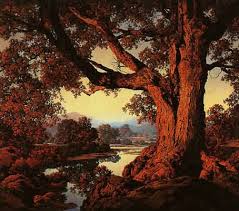
Unchained melodies sweep over the rainbow telling dreams that somewhere must come true. Floating lightly as soap bubbles they pass through air castles caught in an ecstasy captured so achingly by the artist Maxfield Parrish into his visions of gardens of delight. Where can these gardens of delight exist? What parallel universe? What phantom vision of contentment? What utopias straddle the dividing line between this universe and that where all our dreams come true? Not in real countries but as the fairy tales tell, East of the Sun and West of the Moon. Only in Ruritarian paradises where lives of high adventure can be lived without fear and we always win and never lose. We recover from devastating wounds and smashing blows to the head to walk whole again within minutes. Where? The Zenda of Anthony Hope, the Graustark of Gearge Barr McCutcheon, The Barsoom and Jasoom of Edgar Rice Burroughs as well as the Lutha of his novel The Mad King.

Maxfield Parrish
As the youngest of the aforementioned writers Burroughs learned much about the creation of utopias and parallel universes. Graustark was in ERB’s library but the Prisoner of Zenda was not. Graustark made an indelible impression on the young Burroughs that did not fade during his lifetime. Just before the advent of the second world war in his lifetime, faced with frustrated hopes for a better world, ERB wrote his friend Bert Weston lamenting the passing of Graustark.
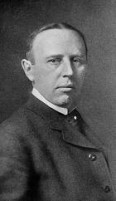
George Barr McCutcheon
ERB had over a dozen novels of McCutcheon in his library but, by my reckoning, only two Graustarks. McCutcheon wrote several, his locale being as important to his career as the imaginary Africa of Tarzan was to Burroughs. The two books were the first of the series published in 1901, Graustark- The Story Of A Love Behind A Throne and A Prince Of Graustark. The latter was published in 1914 too late to be an influence on Burroughs’ Lutha of The Mad King written at the end of 1913.
If he read others of the series between 1901 and 1913 we have no sure record. In what year ERB read the original isn’t known but I suspect sometime between 1905 when he returned to Chicago from Idaho and say 1910 before he began to write. Graustark and Zenda made quite an impression on him but while those who believe that ERB cribbed his sources too closely find evidence of plagiarism I can find only an inspiration or influence.
By the time Burroughs wrote The Mad King the Ruritanian romance had already become a genre. The very nature of genre writing is to explore the possibilities of the genre which requires the writer to have read at least the major texts as well as current efforts. The author then tries to write as original a story within the limits of the genre as possible; failing that a good derivative story will do. Writers like Philip Jose Farmer carry it one step farther by making the characters of genre an intellectual reality parallel with physical reality and then write about the fictional characters as though they were historical figures. Of course, that was a later development in genre writing.
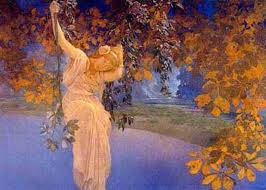
Life Could Be A Dream, Sweetheart
Graustark develops the genre created by Zenda. Just as Haggard, Burroughs and others filled Africa with lost cities, the concept of Ruritanias where everything went right in face of apparent misfortunes began to change the face of mythical Europe. And why not? Scientific discoveries were changing the shape of the intellect, psychological discoveries were changing ideas of the mind. Something’s gained and something’s lost. It’s that lost something that people want to find again. If it doesn’t exist in reality then it can easily be made to exist in the imagination.
You see the little additional leap taken by the Farmers of literature. Do you imagine that in the face of major shifts of populations into Europe and America that the HSII & III minorities won’t retreat into dreams of a golden age when their culture reigned supreme? You’re unrealistic if you believe it isn’t true. It is precisely this era from c. 1820 to 1920 which will be seen as the current version of the Golden Age just as McCutcheon’s and Burroughs’ generation looked to a some what earlier age when things were as they should be.

Moonstruck
In that letter to his friend Bert Weston about 1940 looking back to their youths Burroughs lamented that the possibility of Graustark was a thing of the past. In his youth Graustark was East of the Sun and West of the Moon but in his later years Burroughs could no longer even imagine it. It was easy to assimilate Graustark to Maxfield Parrish’s painting of a dreamland resembling these paradises of the imagination. From there it is equally easy to include L. Frank Baum’s Oz series as yet another such paradise. These wonderful fantasies revolve around in your mind enhanced by living colors and magnificent sound systems where unchained melodies fill your conscious and subconscious minds. Indeed the MGM movie of The Wizard Of Oz filmed about the time Burroughs was lamenting the passing of Graustark may have been the tombstone of his era.
Where did it start? Very difficult to put a precise date on this sort of thing but is it a coincidence that saving Anthony Hope all these artists were influenced by the Great White City of 1893’s Columbian Exposition of Chicago? I have heard it said that the Emerald City of Baum’s imagination was a virtual replica of the White City in green. Bill Hillman’s series of articles on the Expo in the ERBzine capture some, a great deal, of the glamour but I fear Bill held himself in too much.
The Fair inspired a massive five volume eulogy by Hubert Howe Bancroft, a major historical writer of the day, in which he described the Fair in detail exhibit by exhibit, it was so mind blowing. What dreams of perfection did this marvel on the very edge of civilization in Chicago unleash? The Wizard Of Oz and Graustark were issued one after the other in 1900-01. Both books as well as the Expo had a tremendous effect on Edgar Rice Burroughs entering the first years of his maturity. Baum’s influence is most notably seen in Burroughs’ Minidoka- unpublished in his lifetime. Graustark, most notably in The Mad King, but echoes of both can be detected throughout the corpus. There is no doubt that Zenda, Graustark and Lutha are related but the resemblance stops at the family level.
If Zenda can be said to be the original of the Ruritarian genre, Graustark and Lutha are not mere imitations. Both later novels can be described as inspired by but not totally derivative of. There is only the slightest resemblance to Zenda in Graustark. Subtitled The Story Of A Love Behind A Throne McCutcheon tackles the theme of the superiority of American customs and institutions over those of what both McCutcheon and Burroughs considered decadent Europe.
At the time American heiresses were actively seeking titled Englishmen to marry. Winston Churchill was the result of one of one such union. McCutcheon reverses the roles by making a young American man pursue a Princess of Graustark. (Note the title of Burroughs’ first novel, A Princess Of Mars.) For any seeking a Golden Age of HSII & III Americanism I can heartily recommend both Graustark and McCutcheon.

A Sky Ablaze
Like two other Burroughs’ favorites, Booth Tarkington and George Ade, McCutcheon was from Indiana, moving to Chicago in 1901. Just in passing it might be noted that another Chicago centered writer, Theodore Dreiser was also a Hoosier. The hero of Graustark, Grenfall Lorry, immediately puts one in mind of the old Arrow collar and shirt ads. Richard Harding Davis personified probably the ideal American male in appearance. One can contrast that ideal with the swarthy, unshaven, sweaty, slovenly type now being offered the public as something to aspire to. Grenfall has an upper economic class tone, not so plebeian as Joe, Jack or Jim.
Throughout the novel he is quick witted impetuous even reckless but because of his audacity, soon to be styled chutzpah, always successful while his European counterparts are vile, slow and cautious and almost certainly would fail but for Grenfall. The answers just seem to come to him from out of the air. It is marvelous. Compare him to Tarzan and John Carter. Slowly his ways win out in the mind of the Princess. I almost said corrupted her mind for her moral ideals were slowly eroded as integrity became less important than gratifying her desires. But then, that too is American, isn’t it? A deal’s a deal only if you’ve got the money to back it up in court in which case a contract is a contract but then again maybe not, depends on the ‘integrity’ of the court.
Graustark itself is a fanciful place in which brash young Americans are deferred to and dreams do come true if one only persists. Can’t give up. Plenty of castles and monasteries hanging on cliffs, thick with donjons and the like. Parrishian bubbles floating in the air, quite charming dream sequences, the feeling that Maxfield Parrish captures so well. Reproductions of Parrish’s work were beginning to proliferate. Howard Pyle was an influence on Burroughs’ illustrator J. Allen St. John as Maxfield Parrish also seemed to be.
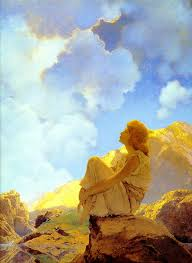
Dreaming A Little Dream
While it easy to see the influence of Graustark on Burroughs there is very little resemblance in the two stories to each other. Burroughs retains the love story behind the throne theme in a barely recognizable form. While McCutcheon’s Grenfall Lorry is of the American aristocracy of wealth living in Washington, D.C., Burroughs Barney Custer is a gritty hick from Beatrice, Nebraska, pop, 30 or so.
The Mad King was written in two parts separated by nearly a year in real time and an eon in psychological time. The Great War began between the writing of the two halves so that while the Lutha of the first half more closely resembles Zenda and Graustark the second half jumps ahead a century into a new era in time with motor cars and heavy artillery. The first half may have been written to placate ERB’s wife Emma. By the end of 1913 she may have bitten her nails to the quick while she berated ERB every day for his spendthrift habits. While ERB wrote an ode to Poverty in the spirit of Edwin Hawkin’s song WAR, (spit) Who Needs It?, if you remember the…ah…tune, Emma with three children to feed had endured the period of poverty with different feelings.
Now, in 1913, with the money pouring in ERB with breathtaking confidence for the future was spending it before he had it or even written books to get it. To Emma it must have seemed a replay of Idaho when ERB gambled away their last forty dollars. It may have been clear to ERB that he was over the top where the money would never cease coming in, which indeed, turned out to the be case, but to many others including Emma he seemed to be the same old joker who would be back on street soon. Emma yearned for some security, money in the bank, that ERB was loath to provide.
His is an interesting case. No sooner did he begin to have a good year in 1913 than he packed up family and kids and used car and headed for the sunshine of San Diego in the most expensive first class manner. This expenditure wasn’t based on savings but in the hope of a future income. ‘13 was an anno mirabilis for ERB during which even traveling and vacationing he was able not only to write but to sell a fabulous number of words. This has been told often but it is so extraordinary, I , who have never received a penny from my writing have difficulty letting it sink in.
ERB would later boast, while Emma undoubtedly stood by shuddering, that he literally had to wait for checks from his writing to pay his expenses from day to day. He obviously had an urge to live with one foot over the precipice. You can understand why Emma was on edge. Thus in late 1913, while they were anxiously watching the mailbox for a check, I’m sure, ERB sat down to write the first half of this novel, that I believe was meant to placate Emma and let her know that the bozo she thought she married was a bozo no more. Not totally reformed, perhaps, but reformed.
When Herb Weston wrote at the time of the divorce that no other woman would have put up with ERB’s eccentricities this must have been an example of what he was talking about. Zenda involved a lot of lookalikes as does Mad King so people assume that Burroughs copied Hope. Maybe, but I don’t think it’s necessarily so. Burroughs with his split personality didn’t have to copy anybody, he was two different people. Burroughs didn’t even disguise that he was talking about he and Emma. He calls the Ruritarian princess Emma. He introduces his friends Bert and Margaret Weston as characters, Bert and Margaret of Beatrice Nebraska where they really lived.
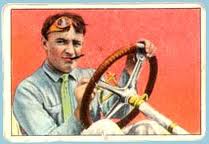
Barney Oldfield Behind The Wheel
He calls himself Barney Custer. Custer after the failed general of the Little Big Horn and Barney after the famous race car driver, Barney ‘Mile-a-Minute’ Oldfield. B. Custer gets his rig up to 90 per beating old ‘Mile-a-Minute’ by half again. In 1913 that would still be going some.
Burroughs can be quite unintentionally comic. ERB must have known he goofed back in Idaho with the card trick but now that he had found the handle he’d become a new man, a real man, a whole man, a made man, that augured for a bountiful future for Emma so she could now stop treating him like a clown and revert to her pre-card game opinion of him. But it wasn’t that easy; he’d been a goof for too long.
In the succeeding novel Nu Of The Niocene, when Emma had apparently rejected his offer, Barney Custer shows up at Tarzan’s ranch in Kenya but without Emma, escorting his sister Victoria instead. ERB would give Emma a last chance to take the new him over the old one in Tarzan And The Ant Men when she had a choice between his goofy lookalike Esteban Miranda and the real Tarzan, himself. Emma chose Esteban Miranda thereby sealing her fate.
The choice of the title Mad King is significant. The blow to the head ERB received in Toronto had affected his reasoning so that to others he appeared goofy or mad. His mental state was accentuated by an acute feeling of failure. His father not only told him he was a loser but apparently told everyone else too. ERB’s friend Bert Weston who knew both George T. and ERB says that he often defended ERB to his father.
George T. told Weston that ERB was ‘no good.’ Weston defended ERB to George T. by insisting ERB was plenty good but that the goodness hadn’t come out yet. I didn’t have a father, my mother divorced while I was an infant, so I don’t have this sort of father problem, but I imagine when your father continually tells you you’re a loser it must have some effect on your attitude. So when your father detests you, you get cracked on the head and then you lose your wife’s confidence because of the resultant stupidity is it any wonder that when you find not only success but big success and you find not only money but big money you go off your head a bit?
But then, even that looks goofy. But she stuck with him; she stood by her man. ERB even celebrated his dead father’s birthday every year of his life which is beyond me. Thus one aspect of The Mad King is Barney Custer, the able, confident American. Burroughs continues McCutcheon’s theme of the superiority of the American although both author’s belief in hare brained schemes seems astonishing in this day and age.
Idylls Of The King
The other aspect is Leopold the cowardly, ungrateful king of Lutha. Both writers use terms like ‘king’ in a contemptuous manner. Kings are hereditary while any self-made American man is a true and better king in his own right while he can someday be President of the United States if he chooses, or so he believes. Even a hick like Barney.
Emma as ‘Emma’ is confronted with a choice between these two lookalikes. She quickly prefers the self-confident able American Barney Custer, or in other words, the new ERB, but tradition binds her to the despicable King of Lutha. By which ERB means to say, I imagine, that she can forget the old him and accept the successful money making author Edgar Rice Burroughs to whom money is as nothing.
Written in late 1914 Burroughs had had another astonishingly successful year. Two in a row, get that, Emma. She didn’t. If the couple had only ERB’s income from book royalties that were not in sight in 1913 and early 1914 to look forward to for income, I think Emma’s fears might have been at least partially justified. ERB didn’t ever really make that much money from his royalties. Good money but not that good. He could never buy the yacht that other authors had.
ERB might have but Emma probably didn’t see the potential of the movies. Probably neither realized at the time the value of the intellectual property Burroughs had created in Tarzan. Had Emma been aware she might have reevaluated her husband. Probably not though. Mad King breaks off with Barney Custer leaving Lutha to return to Beatrice with his relationship with the Princess unresolved.
We are told that Emma read these stories before they were submitted. If so then she could hardly have missed the import of the failure. She either missed the message or disregarded it. The second half of the novel was written largely in October of 1914 nearly a year later. The World ERB and his fellows had grown up in had now all but disappeared in the smoke of the guns of August. The second half of the novel is dominated by the opening months of the Great War. ERB concentrated on the southern Austrian-Serbian front siding with the Serbs in the battleground Lutha has now become.
The novel is taken up with the intrigues of Leopold and Peter of Blentz with the Austrians to turn the country over to them. Barney and Emma and her father are attempting to keep Lutha on the Serbian side while maintaining Lutha’s independence. ERB gives the Serbians some much needed advice on how to conduct the war. He must have been studying the conflict carefully. As Barney and the King are indistinguishable doubles, they were indeed two aspect of ERB’s own personality, Emma was always in a great deal of confusion as to which double she was dealing with, always hoping it was Barney.
Indeed, the Mad King Leopold is killed leaving Barney the last standing. At this point it would seem that ERB is telling his Emma: See. The old me you thought was a goof is dead; this is the real me and I want your love and respect. Perhaps true but it take more than a simple assertion to change a woman’s mind. You have to have patience and wait. Emma Burroughs must not have changed hers quickly enough because in the next story, Nu Of The Niocene, Barney Custer is traveling without Emma, going to Africa with his sister Victoria instead.
One imagines that ERB’s personal Lutha, Graustark or Zenda disappeared in smoke as had the nineteenth century. His hope and dream of entering that magic land somewhere over the rainbow in a land of perpetual Spring would have to be sought with someone other than Emma. In a very few years he would meet that other hope of another and better world in Hollywoodland which should have been a warning to him as he would learn the hard way that the answer always lies within, as difficult as that may be to recognize. The Rainbow Trail begins on your own two feet.
If birds fly over the rainbow,
Why then, oh why, can’t I?

Edgar Rice Burroughs On Mars
A Review
Thuvia, Maid Of Mars
Part II
by
R.E. Prindle
Apparently at this time in his life ERB’s mind was focused on hypnotism. The raison d’ etre of the novel seems to be his explanation of hypnotism and some of its effects. He certainly makes a fascinating story of the phenomenon. In fact the whole story concerns hypnotism with a few embellishments to get Carthoris and Thuvia to Lothar and once he’d exhausted the possibilities of his hypnotic theme he ended the story and even then he ends on a wild hypnotic note.
Thuvia was his fourth Mars novel and his first without John Carter. The hero is Carthoris the son of John Carter and Dejah Thoris. ERB’s father, George T. had died about a year previous to the writing. This novel was written shortly after The Lad And The Lion. As it includes a scene of psychological rebirth it may be a declaration of independence from his father, severing the relationship more denfinitely than did Lad.
On entering the land of the Lotharians Carthoris passes through a cave quite similar to the birth canal. There are Banths, Martian lions, before and one huge one behind him. Those before seem to vanish while the one large Banth remained behind him; that would be the memory of his father and the past. Carthoris placed himself in a posture of defense in the dark but the charging Banth passed to his side missing him much as a ghost from the past might do. Thus ERB seems to dispense with the Old Looney aboard ship in The Lad And The Lion who did represent ERB’s dad.
Thuvia had been kidnapped by a disappointed suitor who had her taken to Aanthor, one of the innumerable dead cities lining the shores of the vanished seas. There she was captured by the Green Men who fled through the cave to Lothar. There Carthoris and Thuvia are delivered to the scene of the action by ERB.
Carthoris then finds Thuvia in the possession of the Green Men who are waging a gigantic battle against the Phantom Bowmen of Lothar, themselves aided by large prides of both phantom and real Banths.
Piles of Green Men killed by little arrows lie about amongst legions of Bowmen who have been cut down, and still they stream through the city gates. Carthoris who has gotten to the side of Thuvia and she marvel at the carnage. They turn to watch the defeated Green Men flee. When they look back they are astonished to see that the dead Bowmen have all disappeared while the dead Green Men no longer have phantom arrows sticking in them. The pair are at a loss for an explanation. The Banths however were real and were now gorging themselves on the remains of the Greenies.
As a nice touch ERB has Thuvia essentially hypnotize the Banths. Rather than fear them as Carthoris does she merely makes a low melodic warbling sound that so charms the Banths that they come fawning before her.
This may seem improbable or even impossible and yet I have seen it done but with house cats. What can be done with one size cat I’m sure can be done with all sizes. The effect was quite astonishing with the woman I saw do it but the result was exactly as ERB describes it. Apparently he’d seen it done too. ERB thus establishes the ability of Thuvia that will be even more important soon.
Thus they gain access to the city of Lothar by passing through the Banths with safety. As a nice touch ERB gives Lothar an exotic round gate that rolls back into a slot. Perhaps he had seen a house with such a door somewhere. Once inside they meet the Lotharian Jav who begins to unfold the story while unfolding the hypnotic power of the mind.
If ERB had read H. Rider Haggard’s Cleopatra that deals quite extensively with hypnotism in a scenario somewhat similar to this one Haggard may have been another source for Thuvia. Quite possibly ERB had ingested and digested his earlier reading so that he wasn’t aware of how close he was to the originals. After all, anyone who could learn of Numa, the Roman King, from his Jr. High studies and think he had invented the name Numa for the king of beasts twenty years later, which he says is what happened, probably could think he was inventing his details himself.
Many strange phenomena appear to the pair on their way to the palace of the despot who was named Tario. They see marching files of Bowmen who appear and disappear. But the Bowmen are not real they are a projection of the mind of Tario who has hypnotized the pair into seeing what isn’t there.
While it is clear that ERB is quite familiar with Homer’s Odyssey it isn’t quite so clear what he knows of Homer’s Iliad or Greek mythology in general. One hesitates to give him too much knowledge and yet elements from the Iliad and Greek mythology seem to materialize before one’s eyes like the Phantom Bowmen of Lothar.
One can’t know whether ERB read the Iliad more than once and whether that once was in the seventh or eighth grade. How much he understood of an early reading like that would be questionable. I first read the Iliad in the seventh grade but got nothing but impressions of the action from it. The gods, goddesses and humans were very confusing. Lot of boy and girl stuff that was well beyond my experience. I have read the book seven times in various translations since. It was only in the fifth, sixth and seventh readings that I began to develop what I would consider any real understanding of Homer’s message.
One of the things I understand is that the Iliad is a story about the power of mind and its limitations. Zeus, of course had the mind of ultimate power that gave him the advantage over mortals and the other gods. Tario in Thuvia has the most powerful mind in Lothar which keeps him in authority over the few permanent emanations in Lothar. But, these are all figments of his or someone’s imagination.
It seems that long generations before the women had all died out leaving only the men who over a period of time would also have died out but they survived by being able to imagine themselves. Here we have a possible reference to Poe’s The Facts In The Case Of M. Valdemar. In that story Valdemar was a dying man who was first hypnotized and then expired. Being under hypnosis while alive he could not actually die as he was hypnotized alive. This is somewhat the condition of the Lotharians.
Taking hypnosis a step further ERB posits that there are phantom ‘realists’ who believe they can wish themselves into a permanent corporeal existence of which Jav is one. Opposed to them are the phantom ‘etherealists’ represented by Tario who believe they must remain imaginary.
Getting back to Greek mythology in which we do know that ERB was read the ‘realists’ believe that they have to eat so they conjure up ‘ephemeral fruits’ on which to gorge themselves.
Ephemeral fruits make their appearance in the myth of Typhon and Zeus. So there is a possibility that Jav and Tario is a version of that myth. Hera in her squabbles for supremacy with Zeus conjures up the monster Typhon to take on Zeus. Typhon makes mincemeat of Zeus removing his sinews and bones and placing them in a leather bag in a cave in Caria. Sad plight for the Big Fella with the all powerful mind and no sinews. Worse yet, as a god he is immortal so there he and his all powerful mind are in his sack perhaps for all eternity.
While Apollo and Hermes come to the Big Guy’s aid by putting the dry bones back together and reattaching the sinews the nymphs feed Typhon ‘ephemeral fruit’ that looks like the real thing but lacks nourishment. Thus when Zeus is reassembled and ready for action he faces an enfeebled Typhon who this time he easily defeats. Great story when you think about it. So there you have two stories reflected that ERB may or may not have read but having read them probably didn’t consciously remember them as he was writing. I can’t guarantee ERB read those stories but I can state with assurance that ERB just didn’t make this stuff up. He never does; it all has been suggested from someplace. It is not impossible that he heard similar stuff from Baum and the Theosophists in California. ERB does have a retentive memory that provides him with a lot of material.
Thuvia and its successor Martian novel- The Chessmen Of Mars- are an examination of mind and matter. The later Mastermind of Mars and the Synthetic Men Of Mars are examinations of the application of mind to matter. In the Chessmen the mind and body were separate entities. It will be remembered that the Kaldanes were also skilled hypnotists.
Here ERB is interested in a projected reality, in itself a form on insanity in an unbalanced mind. PP 66-67, Ace paperback:
Jav speaking: “(The Banths) that remained about the field were real. Those we loosed as scavengers to devour the bodies of the dead Torquasians. This thing is demanded by the realists among us. I am a realist. Tario is an etherealist.
“The etherealists maintain there is no such thing as matter- that all is mind. They say that none of us exists, except in the imagination of his fellows, other than as an intangible, invisible mentality.
“According to Tario, it is but necessary that we all unite in imagining that there are no dead Torquasians beneath our walls, and there will be none, nor any need for the fierce scavenging banths.”
‘You, then do not hold to Tario’s beliefs?” asked Carthoris.
“In part only,” replied the Lotharian. “I believe, in fact I know, that there are some truly ethereal creatures. Tario is one, I am convinced. He has no existence except in the imaginations of his people.
“Of course, it is the contention of all us realists that all etherealists are but figments of the imagination. They contend that no food is necessary nor do they eat, but anyone of the most rudimentary intelligence must realize that food is a necessity to creatures having actual existence.”
“Yes,” agreed Carthoris, “not having eaten today I can readily agree with you.”
“Ah, pardon me,” exclaimed Jav. “Pray be seated and satisfy your hunger,” and with a wave of his hand he indicated a beautifully laden table that had not been there an instant before he spoke….”It is well,” continued Jav, “that you did not fall into the hands of an etherealist, then indeed, you would have gone hungry.”
An interesting passage laden with humor and a joke or two. On the one hand this is a takeoff on Bishop Berkeley and those who believe that nothing is real but only a figment of our imaginations. They do believe that when you close your eyes the world ceases to exist. I could never follow the argument, and on the other hand the ideas can be construed as a variation on the Theosophical belief that the gods were first ethereal becoming more materialistic as existence descended to man who is most material. Thus Tario is visible air, as it were, as an ethereality while Jav is condensed into, as he believes, permanent air/matter while Carthoris and Thuria are solid matter as humans.
The food Jav produces is ephemeral food. It looks real but having no real substance has no nourishment. As he smirkingly says: It is well that you did not fall into the hands of an etherealist. Then, indeed, you would have gone hungry.” A funny joke. But Jav has hypnotized the pair into seeing the food even though Carthoris is not so hypnotized as to not realize it is not real food. He eats it anyway.
Once in this land where nothing is real but the Banths, one wonders that we don’t have a situation that was replicated later in the movie The Manchurian Candidate. In that movie the hypnotized soldiers imagine they are at a ladies social and actually see American women where Korean people are.
Perhaps Carthoris and Thuvia are standing in an empty field talking to themselves. Perhaps the Lotharians exist only in their own imaginations but have conjured Carthoris and Thuvia out of thin air. Pretty spacy stuff.
As Carthoris is hypnotized he is easily persuaded to do things he wouldn’t ordinarily do such as letting Thuvia be led away alone to Tario. He does and Thuvia meets Tario alone mystyfied that Carthoris would let her out of his sight. Seeing Thuvia the etherealist’s phantom cojones are aroused and he makes an all out assault on Thuvia. As he doesn’t exist, of course, the assault can only have force in Thuvia’s imagination. Just as those little arrows the Torquasians believed were real killed them one wonders what effect a phantom penetration would have on Thuvia. Would she have a little phantom child after a phantom pregnancy?
We’ll never know because she pulls out her thin blade stabbing Tario to his phantom heart. He falls apparently dead seemingly oozing out his lifeblood. But, as we know he is an etherealist hence only a figure of someone’s imagination we know he must be feigning death with phantom blood.
Hearing Thuvia’s screams Carthoris races to the rescue followed by Jav. Jav, who should have known better, is overjoyed confessing his desire to replace Tario. It was almost like a plan. Tario leaps up explaining he always thought Jav did and now he is going to execute him.
Here ERB evades the issue taking a cheap but effective way out. These two guys are actually magicians and should be made to match powers in efforts to do the other in. ERB isn’t up to it so he has Jav cave just awaiting his fate that he could always evade with his hypnotic powers. Now, we’ve all been advised not to trust our senses so whether any of this happened is open to question. Nevertheless a hole opens in the floor, the floor dishes so that all falls into the memory hole. The three are ostensibly history.
They are precipitated into the chamber of the Lotharian god. One might expect this god to be pure essence but instead he is pure matter. As so often is the case a Burroughsian god turns out to be a lion or the Martian Banth. Why Jav should be concerned isn’t clear as he has no real substance and can’t be eaten while with his hypnotic powers he could make the Banth believe it was a mouse.
Carthoris draws his sword but this one’s a piece of cake for Thuvia. Using her own particular hypnotic talents she charms the Banthian god and all four walk out through the Banth’s quarters as chums.
At this point Jav calls into existence old Lothar for us all to see.
Outside the gates of Lothar Jav conceives a desire for Thuvia. Using considerable hypnotic talent he persuades Carthoris that he and Thuvia are heading for the woods. Carthoris walks off alone convinced he is leading Thuvia by the hand. He is soon disillusioned. Returning he finds the realist Jav really mauled by the Banth and dying. Thuvia and the Banth have headed back to Aanthor. Carthoris has no choice but to follow.
B.
Now, what’s been going in addition to this hypnosis stuff is ERB’s ongoing attempt to reconcile his Anima and Animus. He has followed the usual Pyche and Eros storyline of Apuleius’ Golden Ass of Greek mythology. The Anima and Animus get together, circumstances separate them, then during the rest of the novel they try to get together amid difficulties, finally succeeding.
In Lad And The Lion ERB introduced the lion as his totem. Even though a male lion it is associated with his female Anima. At the risk of repeating myself, just in case anybody has been reading this stuff for the last four or five years the cause and evolution of his dilemma progress thusly:
In 1883 or 1884 ERB was terroized on a street corner by a young thug he identifies only as John. Possibly Emma was with him and kept walking abandoning him to his fate. Thus it was suggested to his subconscious that his Anima had abandoned him. John being the terrorist filled the vacancy. Thus ERB had the seemingly impossible anomaly of a male representing his female Anima.
We know this was the result because ERB writes incessantly about it. In the Outlaw of Torn the king’s fencing master, De Vac lures young Prince Norman/Burroughs outside the gate. Norman’s nurse Maud representing his Anima noticing too late rushes to the scene to be struck down dead by De Vac. Thus ERB’s Anima is murdered. How does ERB handle this? In his dream image ERB has De Vac take Norman to London where they live in the attic of a house over the Thames River. The house is a symbol for self, the attic being the mind. Water is a symbol of the female. The house extending out over the water but separated from it indicated the separation from the Anima. To compensate for the impossible situation of a male on the Anima, De Vac improbably dresses as a woman for the three years they live together in their attic. At the end of the novel Norman/Burroughs kills De Vac.
In the succeeding novel The Mucker he associates himself with the Irish thug Billy Byrne. Byrne being paired up with the socialite Barbara Harding is also an impossible match. It would seem probable that ERB’s father and John were two of the components clothing ERB’s Animus. Thus ERB has this very strong feeling about having a dual personality that he talks about constantly.
In Lad And The Lion we have the improbable situation of a powerless ship, representing the self, drifting up and down the Atlantic endlessly, manned by the deaf and dumb Old Looney, the Lad, and a Lion in a cage on deck. That the Old Looney who represents ERB’s father was deaf and dumb probably indicates he wouldn’t listen to ERB and had nothing to say that the Lad/ERB wanted to hear. So, the Lad was brutally abused the whole of his childhood. That’s how ERB saw the Bad Father. It would seem that John Carter represents the Good Father as ERB would have liked him to have been.
With De Vac and John dead the Lion begins to take his place as the male aspect of ERB’s Anima which has now been reoccupied by a female reprsentative. The male lion becomes a permanent aspect of the Anima in 1922s Tarzan And The Golden Lion as Jad-Bal-Ja. In Lad he and the Lion go ashore after the death of the Old Looney, or, in other words, his father, where the lion is loosely associated with the Arab princess Nakhla. Lad was written a short two months before Thuvia.
Now Thuvia wows Carthoris/ERB by charming the raging Banths/lions of the battlefield and the Lotharian God. Thuvia and the god become as one as she walks by his side her fingers twisted in his mane. So the traditional goddess of the male Anima is united with a male god to form ERB’s Anima. The female Anima who moved closer to reassuming her place in Lad now definitely becomes part of ERB’s psyche.
They pass through the tunnel before Carthoris. As ERB exits the tunnel he encounters his doppelganger Kar Komak. This is great stuff actually. Komak is literally a new man. He was the first successful materialization of an hypnotic imaginary man of the Lotharians. That’s likely enough, isn’t it?
He comes running through the scarlet furze, naked, to greet Carthoris. Well, picture that. Nakedness is something else appearing regularly in ERB”s works most notably in Tarzan And The City Of Gold. (See my review.)
The duo then continue on to Aanthor where as they arrive they are met by Torquasians who upset the plans of the men of Dusar who had come back to pick up Thuvia. We know that Carthoris for sure represents ERB because he takes a sword swipe to the forehead that lays him out. Thus the novel has the obligatory bash to the head recalling ERB’s adventure in Toronto.
When the sleeper wakes he finds the dead carcass of Thuvia’s lion lying half across his body. Probably his left half that derives from the ovum. Must have been uncomfortable to say the least. Thus the male half of his Anima is now dead and the female half in possession of the Dusarians. ERB gets her back and as in Psyche and Eros the Anima and Animus we may assume are permanently reunited.
Not quite but that will take us too far afield to discuss it this moment. I deal with the future development of the problem in my reviews of Out There Somewhere (The Return Of The Mucker), Bridge And The Oskaloosa Kid (The Oakdale Affair) and Marcia Of The Doorstep.
A Part 3 will follow that attempts to deal with the bigotry charges against Burroughs. If there is such a thing as guilt concerning the issue, ERB is not guilty, of course.
 I, Dynamo