Exhuming Bob XXVI
Bob And Edie
(Sooner Or Later All Of Us Must Know)
by
R.E. Prindle

On the New York Bohemian scene 1965 and 1966 were the pivotal years. Near the beginning of 1965 Edie Sedgwick came down from Boston to become the catalyst in the struggle for dominance of the Bohemian scene between Andy Warhol and Bob Dylan.
Both men began their rise almost simultaneously in 1960-61. Both camps were drug fueled primarily by amphetamines.
While Edie, who as I perceive it was a psychotic nothing chick, entered Warhol’s world about March of ’65 it seems probable that Dylan was eyeing her from earlier in the year through the offices of his advance man, Bobby Neuwirth. While the early period is poorly documented as the battle for the soul of Edie Sedgwick reached fever heat in the summer of ’65 when Dylan recorded his diatribes Like A Rolling Stone and Positively Fourth Street concerning Edie and Andy the origins must reach further back into the first half of the year. It is interesting that in Dylan’s song Desolation Row he cast Edie in the role of Hamlet’s Ophelia.
Thus the key to understanding Dylan’s albums Highway 61 Revisited and Blonde On Blonde is primarily Edie Sedgwick. I haven’t analyzed the data thoroughly but the meaning of One Of Us Must Know (Sooner Or Later) became transparent while studying Warhol. One of my favorite Dylan’s songs its meaning has always troubled me.

In November of ’65 Dylan married Sara Lownds while still carrying on an affair with Edie, among others. Warhol told Edie that Dylan was married shortly thereafter. Edie was as a pawn in their game torn between leaving with Dylan and staying with Warhol. In their effort to steal Edie away Dylan and his manager Albert Grossman were promising her stardom and money in both recording and movies.
Finally in a December 6th meeting with Edie, Warhol and Dylan Edie was forced to choose between the one or the other. Dylan commemorated this scene in his song One Of Us Must Know (Sooner Or Later). The ‘poem’ of this ‘great poet’ is in three stanzas and reads like a letter to Edie when you have the key. The first four lines are a mocking apology for using Edie as a pawn:
I didn’t mean to treat you so bad
You shouldn’t take it so personal
I didn’t mean to make you so sad
You just happened to be there, that’s all.
So Dylan admits he was using Edie who just happened to be Warhol’s chick, nothing personal, Dylan was after Warhol. But he didn’t mean to hurt her ‘so bad’ or make her ‘so sad’. Hey, it just happened. The second and fourth lines are so insulting, callous and sadistic as to pass the bounds of good judgment to write. They shouldn’t have been written and if written they shouldn’t have been shouted to the world to hear. It must have been obvious to Dylan that both Edie and Warhol would know he was talking about them. The Ballad Of Plain D was just mean but this is almost too hateful to bear. Ah well, the love and peace crowd.
The fifth line:
When I saw you say “goodbye” to your friend and smile…
The scene is The Kettle Of Fish and the friend is Andy Warhol.
I thought it was understood
That you’d be comin’ back in a little while
I didn’t know that you were sayin’ “goodbye” for good.
This is an outright lie else why put goodbye in parentheses. Dylan’s attempt to disavow his and Grossman’s promises making it seem like a trivial boy-girl thing is too coarse. This whole verse is definitely meant to hurt while both Edie and Warhol will understand the full import.

Ever Weird
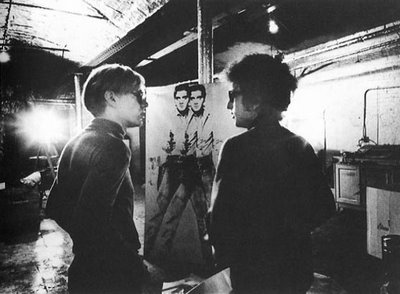
Andy, Elvis, Bob
And then the chorus which will be used three times for maximum pain:
But sooner or later, one of us must know
You just did what you were supposed to do
Sooner or later one of us must know
That I really did try to get close to you.
The key line here is that ‘I really did try to get close to you.’ At The Kettle Of Fish Edie murmured to Dylan that no matter how hard she tried she couldn’t get close to him. ‘Who?’ asked Dylan. ‘Andy.’ Edie replied. Dylan apparently took that as a rebuff although he was already married to Sara and would soon spawn a host of children on her.
I quote the second verse in its entirety:
I couldn’t see what you could show me
Your scarf had kept your mouth well hid
I couldn’t see how you could know me
But you said you knew me and I believed you did.
When you whispered in my ear
And asked me if I was leavin’ with you or her
I didn’t realize just what I did hear
I didn’t realize how young you were.
Apparently Edie didn’t realize that she was just a rainy day woman. While it’s a matter of interpretation I assume that Edie confronted Dylan with the fact of his marriage to Sara and naively asked if he were going to dump Sara for herself. Dylan was incredulous, astonished by her request, he thought she was more sophisticated than that, after all, a rainy day woman….
Rainy Day Woman is a very mocking put down of women as the lead off song and theme setter of the album titled Blonde On Blonde. Perhaps the title might be interpreted as Woman On or After Woman with Rainy Day Women establishing the theme. The song limits the range of women to two- numbers 12 and 35. Why 12, why 35? Who are they? One has to be Edie. If one does a little number manipulation a la Freud, in sequence the numbers add up to 11 which in turn adds up to 2. Two women. Seven come eleven? Three and eight, twelve and thirty-five added separately- three for male, eight for female. Twelve subtracted from thirty-five is twenty-three, Edie’s age. Just guessing.
As Sara is the only other identifiable woman in the lyrics the two women must be Edie and Sara. Let me venture the guess that all women are rainy day women for Dylan. Thus once Sara had borne his offspring fullfilling a religious obligation Dylan took seriously he drove her away oblivious to the pain and suffering he was causing or perhaps he was continuing to punish mother surrogates.
Dylan was drugged and crazed while he was writing this so this is a reflection of deep subconscious drives.

Andy And Edie As Beautiful People
The final lyric begins:
I couldn’t see when it started snowin’
Your voice was all I heard
Snowin’ either refers to a snow job by Edie so he was blinded by light hearing only her words or drugs of some sort, either amphetamines or cocaine.
I couldn’t see where you were goin’
But you said you knew an’ I took your word.
Once again Dylan shifts the full responsibility from himself and Grossman to Edie. He implies that she was leading him on rather than vice versa. This when it was clear to everyone that he and Grossman were promising her the moon in the attempt to pry her loose from Warhol.
And then you told me later, as I apologized
That you were just kiddin’ me, you weren’t really from the farm
An’ I told you as you clawed out my eyes
That I never really meant t’ do you any harm
Well, Dylan’s intents were pure, he says, but the results were deplorable; Edie was done harm by Dylan’s actions and the harm was deep and lasting, well beyond any hypocritical apologies. If the lines are to be believed Edie’s reaction was quite violent. As she was a total amphetamine addict her reaction would be quite plausible.
And then Dylan mockingly closes with his ‘whadaya goin’ to do about it line’- I really did try to get close to you.
As this period clears up for me I suspect that the whole of Blonde On Blonde is concerned with this Edie, Andy/Dylan duel. Blonde On Blonde itself then may refer to the silver hair of both Edie and Andy.
It should be clear that Dylan’s motorcycle fall was no accident. In Exhuming Bob 23b: Bob, Andy and Edie I hypothesize that Dylan’s bike was rigged by the Factory crowd. Dylan survived with minimal damage. For his own sins Warhol was shot a couple years later but he survived that one too. Edie died a physical wreck in 1971.

Dead Ophelia- Consider Ciao Manhattan with Edie shot in a swimming pool/
What goes around comes around as they used to say.

R.E. Prindle
Exhuming Bob 24: Bob And Expecting Rain
February 11, 2010
Exhuming Bob 24: Bob And Expecting Rain
by
R.E. Prindle
…or else they’re expecting rain.
My recent essay Exhuming Bob 23a: Bob, Andy, Edie And Like A Rolling Stone posted on the Expecting Rain site drew a few comments. As I’ve been excluded from the site I was very surprised to find the site published the essay. I’m not going to sign up for the discussion board so I’ll respond in this way. If it gets posted, fine.
I consider Exhuming Bob 23a a pretty good piece of scholarship so I’m pleased to have elicited a response that wasn’t all that negative.
The chief criticism came from CL Floyd so I’ll concentrate on his. Some of Floyd’s objections I consider worth answereing but some I find curious.
Floyd began his criticism: this is an incredible piece of reductionism… Yeah? What’s the problem? One has to begin somewhere. Dylan has said that he had this 20 pages of ”vomit’ tentatively titled Like A Rolling Stone. Right on. So he’s got twenty pages of inchoate kvetching that Edie Sedgwick catalyzed into several verses that while it applied directly to her as a symbol, what it symbolized was ‘this pain in here’ that centered around Dylan’s childhood. Thus as Warren Peace perceived, even though the central kvetch precedes Sedgwick the context centers directly on her person.
Floyd relates the whole to the title: ‘I especially enjoyed the in depth analysis of where the use of the phrase “rolling stone” came from.’ Muddy Waters had nothing to do with it. I doubt if Dylan had even heard of Waters’ song before he came to NYC if he did then.
The meaning of the phrase ‘a rolling stone gathers no moss’ is obvious while its use must go back very, very far. Apparently Dylan thinks being a rolling stone is a curse too hard to bear. His own understanding of the term goes back to Hank Williams’ not Muddy Waters’ song ‘Lost Highway.’
I’m just a rolling stone
All alone and lost
For a life of sin
I have paid the cost…
I’m just a rolling stone
On the lost highway.
I don’t mean to be rude but there were millions of us who related to Williams’ lyric in exactly the same way as Dylan.
But Floyd seems especially offended by the twist given to the meaning by my correspondent, Robin Mark. She has thought about the problem for some time. She realized that Stone was his mother’s maiden name so that there was a double entendre in Beattie Stone and a rolling (Bob) stone. Now, Mr. Floyd (or Miss, perhaps, CL is indeterminate) is apparently unaware that one can only be considered Jewish through the female side. If your father is Jewish and your mother isn’t then you are not a Jew, thus Jewishness is matrilineal not patrilineal even though your Jewish name may be Moishe Ben Avram- that is Moses the son of Abram. So, Dylan can claim the Stone name also. I thought it was a clever application and a neat double entendre.
Now, a major concern of my writing is to place Dylan within a context of his place and time. Shelton, Heylin, Sounes and others have done an excellent job of organizing the details of Dylan’s career to the exclusion of the other participants such as, for instance, Albert Grossman.
As Peter Yarrow says, without Grossman there would be no PPM and no Dylan. I have always been mystified as to who Grossman’s connections were that allowed him to finance the organization of PPM and get them a WB contract without a single performance.
I broached this subject in my essay, Exhuming Bob XVII My Son The Corporation. Since then I have learned that Grossman was aligned with Mo Ostin of WB and that the financing came from that quarter. That the group was immediately successful must have been gratifying. With the success of PPM the promotiuon of Dylan became possible. https://idynamo.wordpress.com/2008/12/10/exhuming-bob-xviii-bob-dylan-my-son-the-corporation/
That’s a start.
Mr. Floyd finds it coincidental that the key participants are Jewish. He apparently does not recognize a Jewish cultural and political influence directed to the realization of Jewish ends. If he’s complicit, so be it, but as an historian I have an obligation to note motivations from whatever quarter they come from. You don’t need a weatherman to tell which way the wind blows. I have no sacred cows and that is as it should be.
And finally, I believe that I have uncovered or illuminated, take your choice, a signficant and important sub-text of Dylan’s history. I dig the term ‘NY gossip’ that Mr. Floyd uses to discredit the facts. In point fact, David Bourdon who was there gives an almost gang like division of NYC. As he saw it Dylan was ‘pope’ of Downtown, Warhol ‘pope’ of mid-town and something vague uptown.
After BOnB in mid ’66 Dylan hadn’t abandoned Manhattan. The motorcycle accident with concussion and three cracked vertebrae changed his plans. After he had healed he in fact moved back to MacDougal St. to begin having his garbage searched by Weberman. By then the sixties were essentially over. Warhol was shot in ’69 changing the direction of his career, while Altamont put the period to the whole sixties fantasy. Shortly Dylan would be releasing an album called New Morning. Optimistic.
So, I certainly appreciate the kind attention of those who commented. If Matchlighter’s ‘mouth popped’ from 23a I hope he finds 23b just as entertaining. It has been posted.
Thank you and you’re invited one and all.https://idynamo.wordpress.com/2010/01/27/exhuming-bob-23b-of-a-b-bob-andy-edie-and-like-a-rolling-stone/
Conversations With Robin Page 4
January 28, 2010
Conversations With Robin Page 4.
Conversations between R. E. Prindle and Robin Mark
Concerning certain musical questions.
Robin:
Sorry to be so remiss but I was really involved with writingt Exhuming Bob 23 a and b: Bob, Andy, Edie and Like A Rolling Stone. I got them up a couple days ago and then I was really exhausted.
I think they’re really good work, real Sherlock Holmes stuff. The feud between Dylan and Warhol with Edie Sedgwick as their pawn is very important althougth Dylan has been very effective in shuffling it under the carpet.
I’ve always been amazed that no one came after Dylan because of the savage badgering he and Neuwirth put people through during what was apparently his Acid phase. Anent that I’ve always been suspicious of the back wheel of his bike locking up, obvious sabotage to me. Of course the reuslt would be flying over the handle bars that did happen. A probable result of that would be damage to the head neck and/or back with a very good chance of being paralyzed from the neck down much as Christopher Reeve did from his horse jumping accident which was also contrived.
Who would take that exact means to attempt to paralyze Dylan, I don’t think murder was intended. Warhol is my first choice. In addition to other humiliations Dylan publically insulted him in both Stone and Street using motorcycle imagery. Of course, it is now clear that chrome horse refers to a motorcycle so the line reads: You used to ride on a bike behind your diplomat…. Warhol had a bike and was Edie’s ‘diplomat’ so stripped of an obscure term the meaning is clear- Edie and Andy.
In Street Dylan sings: You know you’d like to see me paralyzed…so the bike accident is prefigured in the imagery of the two songs that have references to Warhol. If and when you read Part b of Bob And Andy the inference that Warhol’s crew were the perpetrators will become more evident.
That was hard work pulling all those details together but rewarding. Still, I’m going to have to take a week or so to recover. Research goes on of course. I think next I’ll tackle Exhuming Bob 24: Bob, Jack and Allen. I’ll start working on the ton of the period some.
Part of Elvis’ problem was that the ton shifted so dramatically after he was drafted. He began his career in the post-war ton of the late forties and early fifties actually causing the shift or, at least, abetting it. Then he was removed from the flow for two crucial years. when he came back the Kingston Trio had already shifted the ton toward the Folk genre that made Dylan possible but made Elvis an anachronism. While I don’t believe Elvis was part of any Illuminati type thing earlier or later it is quite possible that some such sort of conspiracy found him a useful tool. Of course, Parker, who was in the country illegally, could easily be manipulated to betray his and ‘his boy’s’ interests.
By the time of the return from the military Presley’s career was obviously being directed by Hollywood. So, who was getting what from mismanaging Elvis’ career?
Just thoughts.
Exhuming Bob 23b of a & b: Bob, Andy, Edie And Like A Rolling Stone
January 27, 2010
Exhuming Bob 23b
Of a & b.
Bob, Andy, Edie
And Like A Rolling Stone
by
R.E. Prindle
The System Of Doctor Tarr And Professor Fether
All the fags and dykes they boogien’ together
Leather freaks dressed in all kinds of leather
The greatest of the sadists and the masochists too
Screamin’ please hit me and I’ll hit you.
The FBI dancin’ with the junkies
All the straights are swingin with the funkies
Cross the floor and up the wall
Freakin’ at the Freakers ball,
y’all
Freakin’ at the Freakers ball.
–Shel Silverstein
Oh no! Must be the season of the witch.
–Donovan

Don't Look Back, Something Might Be Gaining On Ya
It may be true that the answer was blowin’ in the wind but, if so, as Donovan said: You might as well try to catch the wind and nobody did. Nobody even had a clue as the inmates poured out their cells and seized the asylum. Even then it wasn’t so easy to tell the nuts from the Docs.
His parents brought a seventeen year old to the asylum to be cured of homosexual tendencies. The psychiatrists had an astonishing method for a cure. Strapping the kid to the torture rack they fixed a couple of electrodes to his body and sent some serious voltage coursing the through his existence rearranging a few brain cells on the way. As his body arched when the juice hit him one is reminded of the prisoner on death row when the steel cap was lowered on his shaved skull. As maximum voltage coursed through his body he too convulsed but when the skull cap was removed the temperature of his blood in his brain was 212 degrees. They’d boiled him to death.
The kids temperature didn’t rise that high but they still managed to scramble his brain. His memory was so blotted he got lost trying to walk around his own block. The cure was worse than the disease. The cure was in fact, no cure as he remained a homosexual. And they call that medicine.
As soon as the kids eyes uncrossed he picked up a guitar and began to wail. Then he formed a band and began to formulate what he would call Metal Machine Music. He hooked up with Doctor Filth who ran an asylum called The Factory that he filled with mental cases. Unlike the psychiatrists Dr. Filth intended to create mental cases.
The kid picked up a whip, donned his leathers and began to boogie. Those leather freaks. Uncomfortable in their own skins they wear the flayed skins of cows, a feminine skin not their own. A guitar and a spike all anyone needed. Jamming his spike in his arm the kid flew from the asylum Factory out to the Cuckoo’s Nest in Keseyland.
Now known as the Velvet Underground, the kid, going by the personal of Lou Reed landed in a disused bowling alley where he and his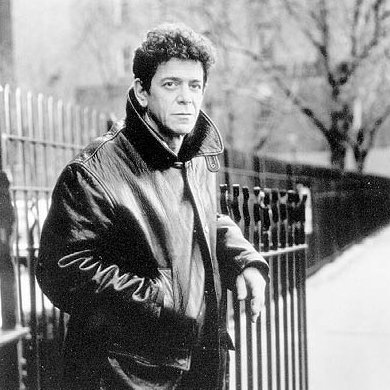 three bandmates gave a concert. there were perhaps a hundred fifty people in the audience of which a hundred had been let in free by one of the promoters. Imagine a promoter opening the back door for free.
The audience in the bleachers stepped up to the ceiling where the top row required them to stoop to seat themselves edged into their seats. Keep your eye on the right top corner, that’s where the action will be. This was the first concert the promoters had done. The band stood on the floor two thirds of the way down the alleys. The spotlight was on their right directed across the group rather than down on them. I thought it was an interesting effect. The Cuckoo’s Nest had never seen anyhthing like this. A girl drummer had what appeared to be a single snare drum with a mallet underslung so it hammered the bottom of the snare while she banged away at the top with the sticks. Not exactly a beat more like a steady unvarying rumble, an effect almost as interesting as the lights. The two guitars and the bass of the leather clad crew began to hammer out the sound which was just like what became Metal Machine Music although more articulated. Not exactly as continuous am MMM but close.
Then the singer began to chant something about heroin. This wasn’t The Factory this was the Cuckoo’s Nest. A disquieting murmur underscored the machine music. Then some local agitators had a guy stand up to shout out incitements to a riot. The light guy got uneasy. The Velvets twitched, a note of panic came into Reed’s voice. Without so much as a change of tone he incorporated ‘Turn off the light’ into the lyric as the crowd began to think of rushing the Velvets and they gave every indication of bolting.
Turn off the lights, hell. I knew who the agitators must be so I swung the light from the Velvets across the crowd to the right corner where I picked up the agitators. I left the spot on them steadily. Their anonymity stripped from them the crowd recognized them and quieted down. The Velvets hadn’t missed a beat but they did get a little wobbly.
I quickly picked out the ‘mastermind’ , who was who I thought he was and his stooge who had been loaded up with something. With the spot on him he thought he was the star continuing to orate as Reed intoned on while the band chugged along like an assembly line gone berserk.
The ‘mastermind’ now ordered me to turn the light off him. The noise was too loud for him to hear me laughing. At last he got his stooge to sit down and the light swung back to the Velvet Underground and they continued their chaunt to the glories of heroin as though nothing had happened. Nothing had, just a variation on the show down on Desolation Row. They left the Cuckoo’s Nest finding their way back to the Factory and Dr. Filth.
Back home in The Factory the fags and dikes were cracking their whips, blowing their whistles and banging their gongs while the necrophiliacs were looking for dead ones.
As we left them in part a, Dr. Filth had been castigated by the Man Of The Hour over the air for all to hear if not recognize in his musical rants, Like A Rolling Stone and Positively 4th Street.
I’m not prepared to say it’s so but others have suggested that a few lines in Desolation Row refer to the Factory and Andy Warhol. As Desolation Row was recorded on August 4th a few days after Stone and Street it is quite possible ill feeling lingered and found expression in Dylan’s lines.
The lyrics are purposely written in obscure language meant to imitate poetry and mystify. Without a key one can speculate all day ending up where you began. Dylan does give us a clue as to his imagery in Chronicles where he says Pound and Elliot were fighting it out in the Captains’s tower. The Captain’s Tower refers to Dylan’s brain and the discussion of the two poets.
There is a very large discussion of this stuff on the internet if anyone wants to go through it. Anyway the lines thought to refer to Warhol are these.
Dr. Filth, he keeps his world
Locked inside his leather cup
But all his sexless patients
They’re trying to blow it up.
Now, his nurse, some local loser,
She’s in charge of the cyanide hole
She also keeps the cards that read
“Have mercy on his soul.”
They all play on the pennywhistle
You can hear them blow
If you hang your head out far enough
From Desolation Row.
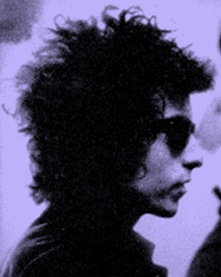
Contemporary Bob
I think most commonly people take Dr. Filth to refer to Freud. Multiple meanings are possible while the cast of characters in Row appear to be well known historical figures or characters from literature. At the same time, as Warhol points out, the songs of this period are personal protests so the figures can stand in for people Dylan knows. He changed their faces and gave them brand new names.
On the other hand Dr. Filth could refer to Warhol whose reputation was suffering by mid-’65. The society people had begun to avoid the Factory leaving Andy only the derelicts.
As I said I can’t find anything totally convincing to pin Dr. Filth on Warhol but the next verse isn’t applicable to Freud and the verse after depending on how you interpet pennywhistle and blow might apply to the Factoryites.
And then there are these lines:
Now, at midnight all the agents
And the supernatural crew
Come out and round up everyone
That knows more than they do.
Then they take them to the Factory…
Like I say, it’s up to you. What is clear is that there was serious competition between Dylan and Warhol and that Sedgwick was a bone of contention.
As the late fall and summer progressed then, Dylan worked hard to draw Edie from Warhol. This made Andy very, very jealous and he turned from Edie spurning her from him ‘with his foot.’ There is a possibility that in some weird homosexual way Warhol loved Edie. According to the movie Factory Girl Warhol took her home to meet his mom. It might mean that that was an actual declaration of love and that he considered her his girl.
By this time Edie was broke having gone thorugh her inheritance whnile even having her stipend from her parents suspended because of her association with Warhol and the Factory crowd. ‘In her prime when she dressed so fine’ she refused to use taxis having a white limo waiting at the curb for her use. Now that she could no longer afford one Dylan rented a black one for her use. Thus when she rode around town in Dylan’s limo she would be known as Dylan’s kept woman. This would also have been a direct insult to Warhol who was penniless in comparison being unable even to pay Sedgwick for her roles in his films or even, her rent. Thus as the Dylan figure in Factory Girl tells her: You’re just one of Warhol’s props.
Now, Dylan in his first English tour had Donn Pennebaker do a film verite that would be released in 1967 as Dont Look Back. Dylan and his entourage who all had parts in the film just like the Factory crew did in Warhol’s would have been talking up the film thus actually becoming direct competitiors of Warhol. As an enticement to Edie Albert Grossman threatened to become her manager while promises were made to her that she would be Dylan’s co-star in a planned movie and even be paid for her services. Remember she was stone broke at this time being desperately in need af an adequate income. Rather than being Dylan’s girl friend she was passed to his gofer, stooge, right hand man, Bobby Neuwirth who became her possessor while she was living at the Chelsea.
That November of ’65 Dylan married Sara Lowndes. According to Bob Spitz in his biography Dylan met Lowndes in 1963 installing her in Grossman’s apartment where he ‘lived’ with her which I suppose means visited her from time to time as among his other duties he was living with Suze Rotolo and heavy with Joan Baez.
Dylan attempted to keep his marriage secret, it was publicly revealed in April of ’66 but Warhol got word of it in December spitefully revealing the news to Edie. The news was devastating to Edie who was nurturing her fantasies of being Dylan’s woman and future co-star. Apparently at that time she was told that any movie role was in some very distant future. At any rate with her relationship with Andy broken Dylan no longer had any use for her. She was just a pawn in his game.
Perhaps in competition or emulation of Dylan’s recording career Warhol decided he wanted to manage a band thus recruiting the

Nico, Andy And The Velvets
Velvet Underground. To assist the Velvets he picked up on Nico who had just arrived from Europe. As fate would have it Dylan had already had a fling with her during his 1962 visit to England when he worte I’ll Keep It With Mine for her. Warhol now insisted she front the Velvet Underground, thus the Velvets first LP with Nico and the famous Banana cover.
Apparently forgetting Edie Dylan renewed his acquaintance with Nico showing up with songs to give her. Lou Reed of the Velvets is a great admirer of Dylan but I don’t believe any of his songs made it to the record. In any event Nico was gone by the time of the second Velvets LP. Possibly as part of the Dylan-Warhol feud.
Dylan wasn’t finished with Edie yet nor was Warhol finished with Dylan.
In the Spring of ’66 Dylan recorded his ultimate record Blonde On Blonde. the songs of personal protest as Warhol pointed out revolved around this period. There are two songs that are pointedly about Edie Sedgwick- Leopard Skin Pill Box Hat and Just Like A Woman while other references seem to be scattered about. The two songs were unnecessarily cruel.
In the Spring of ’66 Warhol began a film titled The Bob Dylan Story. This was a derogatory depiction of the Folk Singer that Warhol thought better of releasing. Giving Dylan’s reaction to Factory Girl, Warhol’s pockets weren’t deep enough to take Dylan on who by ’67 when the film first could have been released Dylan was worth millions while warhol was still essentially penniless.
Anent the Bob Dylan Story I quote from the web site http://www.warholstars.org/ :
Sterling Morrison speaking:
“Dylan was always around, giving Nico songs. there was one film Andy [Warhol] made with Paul Caruso called The Bob Dylan Story. I don’t think Andy has ever shown it. It was hysterical. they got Marlowe Dupont to play Al Grossman. Paul Caruso not only looks like Bob Dylan but as a super caricature he makes even Hendrix look pale by comparison. This was around 1966 when the film was made and his hair was way out here. When he was walking down the street you had to step out of his way. On the eve of filming, Paul had a change of heart and got his hair cut off- close to his head and he must have removed about a foot so everyone was upset about that. then Dylan had his accident and that’s why the film was never shown.”
Although sterling Morrison suggested that the Bob Dylan film was never shown because of Dylan’s motorcycle accident, the accident occured at the end of July 1966 and Susan Pile was filmed for the movie in October 1966.
Susan Pile speaking:
“Andy filmed The Bob Dylan Story, starring Paul Caruso…Ingrid Superstar and I were folkrock groupies who rushed in (to the studio), attacked his body and taped him to the motorcycle… Paul Morrisey suggested all of Paul Caruso’s lines be from songs, but Andy, knowing it was a good idea (this is a direct relay from Paul Morrissey) vetoes….My one line (which I wasn’t supposed to say; I was to remain mutely sinister) was: “You’re just like P.F. Sloane and all the rest- you want to become famous so you can get rid of those pimples.” (accompanied by quick slaps to P. Caruso’s acne-remnanted cheeks)…
The psychology is clear but noteworthy is the taping of Dylan to his ‘Chrome horse.’ When Dylan had his bike accident the rear wheel locked throwing him over the handle bars. Thus taping him to the bike would prevent that. Now, the animosity between the two was real and deep. It may have seemed to Dylan that he had trumped Warhol. While Warhol may have passively taken the humiliation it is also quite likely he would have retaliated. The wheel locking would seem to indicate someone tampering with the bike. Either Warhol had the bike tampered with and was gloating over Dylan here in his movie or else it is a cruel joke. Whether Warhol was responsible for the bike accident or not he was certainly gleeful about it as evidenced here. If the bike was tampered with then someone wanted to see him paralyzed.
Thus matters stood at the end of ’66. In 1971 Edie Sedgwick in circumstance of total degradation, shamefully abandoned by her parents and both Dylan and Warhol who both disclaimed any responsiblity died.
In closing I quote Andy Warhol from his Philosophy Of Andy Warhol From A To B:
Handy Andy
“(Edie) drifted away from us after she started seeing a singer-musician who can only be described as the Definitive Pop Star- possibly of all time- who was then first gaining recognition on both sides of the Atlantic as the thinking man’s Elvis Presley. I missed having her around, but I told myself that it was probably a good thing that he was taking care of her now, because maybe he knew how to do it better than we had.

Snide, very snide.
There’s gonna be a Freaker’s Ball, tonight at the Freaker’s Hall
Ya know you’re invited one and all.
Exhuming Bob 23a: Bob, Andy, Edie And Like A Rolling Stone
January 22, 2010
Exhuming Bob 23a of a and b
Bob, Andy, Edie And Like A Rolling Stone
by
R.E. Prindle
If Tomorrow Wasn't Such A Long Time
As concerns the oeuvre of Bob Dylan through 1966 Andy Warhol astutely remarked that the first phase that established Dylan’s reputation was social protest while the latter half was personal protest. Warhol should have known. That’s what the Jews call kvetching and American’s whining. It was from this latter period that a pure kvetches like Positively Fourth Street and Like A Rolling Stone would be written.
There is absolutely nothing prophetic or profound in songs of this type by Dylan. They are simply complaints. In this early phase the finger pointing was directed at society; in the later at people. John Lennon, who was heavily influenced by Dylan analyzed his method, said the notion is to seem to say more than you are saying. So Dylan disguises his kvetches in obscure language while the subject remains simple.
Thus the subject of Like A Rolling Sone is Dylan’s relationship with the woman, Edie Sedgwick. Edie is a sore point with Dylan because

Andy Warhol
he has been blamed for her death in 1971 some six years later. Doesn’t seem likely but he’s sensitive to the accusation. So sensitive that he obscures whatever relationship he had. When questioned he doesn’t deny it saying instead that he couldn’t remember one. Well, Dylan’s always had a ready hand with the ladies so it is quite possible he’s forgotten a few of them.
But I think Edie would have been one of the Big Four and he remembers her quite well. Dylan then had four women on the string at one time. The first was Suze Rotolo, a long time girl friend and live in dating back to his arrival in NYC in 1961; the second was Joan Baez who he met a little later. The third was Sara Lownds who he was keeping at the Chelsea Hotel; the fourth was Edie Sedgwick, of whom he wrote at least three songs.
Of course there were many other women married and unmarried that he ‘comforted.’ One or more of these might have been ongoing relationships. Dylan married Sara Lownds in November of ’65 without mentioning the fact to any of his other women. His relationship with Suze Rotolo blew up in 1964 when Suze’s sister Carla and her mother grew tired of Dylan’s abuse of the relationship ordering him away. Dylan maintained a relationship with Suze even asking her to be his mistress after he married. He records the dispute with Carla in Ballad In Plain D when he heard Carla scream out the famous imprecation: Leave my sister alone. Goddamn you, get out. In his usual way Dylan makes himself the aggrieved party as though there were four Bob Dylan’s in town and he had nothing to do with the other three.
He must have known something of the other three because the Dylan of Bob and Sara offered Suze a role out on the side. Hep. Hep.
To Edie Sedgwick: I’ve read several versions about Dylan and Edie. In one both Dylan and Bobby Neuwirth knew Edie in Boston where she attended Radcliffe and whose eccentric behavior had already made her notorious. Both Dylan and Neuwirth were in Boston at

Edie Sedgwick
times so that is possible. It was in Boston Dylan met the folksinger Eric Von Schmidt who he admired greatly. Some say he met Edie only in December of ’65. Whether he first met Edie in December of ’65 or renewed the acquaintance it seems clear that Edie became involved with Dylan personally or with the Dylan organization.
Remember that Dylan arrived in NYC in 1961 with nothing, no money, no reputation. he was a hick from the sticks. It might have been deadly to admit that he was just another kid from Podunksville come to the big city, so, to give himself glamour and mystery he invented a preposterous past, claiming to have been an orphan, the babe in the bullrushes, just like Sargon or Moses, Romulus or Remus out in the woods feeding off a wolf. Undoubtedly a very wise move. He gained credibility and he was to a large extent granted his glamour and mystery.
Four years later he was a pinnacle in the NYC underground. As ’65 was ending he seems to have been in competition with Andy Warhol for the top spot. Warhol had been a successful commercial artist in the fifties. Beginning in 1960 almost as the same time as Dylan he made his move into fine art being one of the innovators in the move to Pop Art. Unlike Dylan’s career in Folk Warhol had had a diffiucult time breaking into the fine art world. Having succeeded he remained an outsider running an atelier he called The Factory populated by bums, drug addicts and losers. Like Dylan everything he touched he wanted to destroy. He wanted to destroy the concept of fine art and largely he did it. By 1965 he fancied himself a filmmaker. One of his stars was Edie Sedgwick.
Dylan himself takes credit for destroying Tin Pan Alley because they had no place for him. While he didn’t destroy folk music he transformed it along with others. Of course by 1964 folk artists had about exhausted the genre. The same songs were being sung while the artists had stylized the genre to boredom. Who wanted to go see trios in loden green Robin Hood outfits? If anything Dylan escaped a dying scene.
Dylan and Warhol were nearly identical while both were vying to be King of the Underground. Perhaps Edie Sedgwick became merely a pawn in their game. She became the prize that would determine the winner. That contest raged between December ’65 through February ’66.
The competition between the two- Dylan and Warhol- went back further. Perhaps Dylan’s screen test with Warhol in the summer of ’65

The fabled Silver Elvis
crystalized the conflict. Dylan went down to the Factory, Warhol’s atelier for the screen test claiming a copy of Warhol’s silk screen, the Silver Elvis, as his price. Warhol is reported to have been outraged by the appropriation.
While both men tried to maintain their cool the underlying hostility was apparent. On Warhol’s part he said that he heard that Dylan was using the painting as a dart board so maybe he, Warhol, should be worried. While Dylan may have been doing so he showed his contempt for Warhol by trading the Silver Elvis with his manager Albert Grossman for a sofa.
Now, as Warhol correctly said, after Another Side, Dylan edged into personal protest. That means that the songs of the personal trilogy- Home, ’61 and Blonde, were written about specific events or people. Both of Dylan’s two most irate kvetches were written back to back. One should compare them to Ballad In Plain D for intent. First was Like A Rolling Stone directed at Edie and then Positively Fourth Street directed at Warhol. Both obviously written around the Factory. Stone evinces a sexual scream of perhaps the rejected lover addressed to a woman while Street is a sneering putdown of a man.
It may be true that Stone began as a twenty page vomit of pain as Dylan says but the catalyst to distill the actual song from the kvetch was Sedgwick.
To take the second song, Positively Fourth Street, first. The sixth verse terminates with the line, what HE don’t know to begin with, so the song is directed at a single man, a he. This is not a generalized he, a philosphical rant but a putdown of one specific guy.
The first verse states the HE wasn’t around when Dylan could have used him, the second verse states the HE is merely an opportunist, the third verse addresses a kvetch by HIM that Dylan disappointed HIM, the fourth verse claims a loss of faith in Dylan that Dylan scoffs at, the fifth verse acknowledges that HE defames Dylan behind his back, the sixth verse derides him as a poseur who ‘tried to hide what he didn’t know to begin with’, the seventh verse accuses HIM of insincerity, while the eigth verse say that HE wishes Dylan ill luck.
Coming to the ninth verse we have this telling line: No, I do not feel that good when I see the heartbreaks you embrace. Warhol filled the Factory with drug addicts, losers and nutty street people of all kinds so that it actually sickens one to read about them much less see or mingle with them. Then Dylan adds, Perhaps if I were a master thief I’d rob them. Well, Dylan was a master thief and he did steal the only superstar Warhol had who was Edie Sedgwich so perhaps the struggle for her body and soul began that summer of ’65.
Next Dylan adds the verse:
And I know you’re dissatisfied
With your position and your place
Don’t you understand
It’s not my problem.
OK, that describes Warhol to a T and warns him not to use Dylan as a stepping stone. The last two verses describe how Dylan is revolted by Warhol
So, rather than being some allegorical complaint the song is a description of Dylan’s kvetch against Warhol. If one bears that in mind the song reads like a letter rather than an allegory.
Having solved that problem let us turn to Like A Rolling Stone. this song too reads like a letter if you bear in mind Deylan’s relationship to Warhol and Edie.
By mid-sixty-five Dylan had become a success. At this stage in his career Dylan’s success consisted of his publishing royalties brought about by the efforts of his manager, Albert Grossman. Grossman’s first effort was to create and establish his folk group, Peter Paul And Mary. As this was astonishingly quick and easy one believes that Grossman was well connected. As PPM were on Warner Bros. run by Jews his connections most probably originated in Chicago where he had established The Gate Of Horn as the premier folk club.
Once PPM was a big hit Grossman had them record Dylan’s songs which then allowed him to place Dylan’s songs elsewhere. Thus Dylan was known outside NYC as a songwriter while not so much as a performer. But he was a songwriting sensation thereby receiving substantial royalties making him the richest and most powerful folkie. The future promised to be even more golden once he got into touring.
Now his mind disoriented by success and even further disoriented by his massive intake of drugs Dylan and Grossman needed to flex their muscles lording it over the scene.
Dylan apparently wished to have a sexual relationship with Edie Sedgwick who was being billed and the next Marilyn or America’s ‘It’ girl because of her role in Warhol’s trashy films. She too was another drug abuser and unstable personality. Whether she and Dylan did get together is unclear. Edie is dead, of course, and can say nothing while Dylan neither denies or affirms. He says that he can’t remember having relations with Edie and you’d think he’d remember if he had, wouldn’t he? Given the drugs, who knows, but saying you can’t remember such a desired object as America’s new ‘It’ girl is the same as saying yhou didn’t, while saying you would remember if you had is expressing regret or resentment.
I will write on the assumption that at least by the time of writing he hadn’t and Like A Rolling Stone is a frustrated rant of rejection not too different than Ballad In Plain D. For the time Dylan ony vents his anger at both Sedgwick and Warhol while he begins plotting his revenge against both.
Edie had come from a wealthy California family but a difficult home environment. She was pampered, having a Mercedes to drive around campus in Cambridge so she went to the finest school and now would have to learn to live out on the NYC streets as the song says. She also had an 80,000 dollar inheritance in 1964, the equivalent of 300 to 500 K today that she went through in a few months leaving her only a stipend from her parents although living in her grandmother’s penthouse’ in NYC.
The first verse of Stone then describes Edie perfectly. There is nothing allegorical about it. No abstruse meaning, this is pure kvetch. It should be read only as a spiteful rant against Edie.
Once upon a time you dressed so fine
You threw the bums a dime in your prime, didn’t you.
Edie had spent a large part of her fortune on clothes, as Dylan asserts, dishing out the change to the bums as she went along.
People’d call, say, “Beware doll, you’re bound to fall”
You thought they were all kiddin’ you.
Born to wealth she couldn’t conceive not having money.
You used to laugh about
Everybody that was hangin’ out.
Like, for instance, Bob Dylan.
Now you don’t talk so loud
Now you don’t seem so proud,
About having to scrounge for your next meal,
Self explanatory, then comes the chorus:
How does it feel,
How does it feel,
To be without a home,
Like a complete unknown.
Like a Rolling Stone.
Here Dylan, the rejected lover, compares Edie’s fall to his own situation when he arrived in NYC. Like a Rolling Stone seems to be an inept comparison but my corespondent, Robin Mark, (see Conversations With Robin on I, Dynamo) points out that Stone was Dylan’s mother’s name. Robin, also Jewish, points out that descent is matriarchal in Judaism so that Dylan would consider himself more a Stone than a Zimmerman. Given his psychology then Bob Stone is a footloose rolling stone without a home. That makes the term make more sense than ‘a rolling stone gathers no moss.’ The latter meaning has no application to the song.
The second verse continues the description of Edie:
You’ve gone to the finest school (singular in the lyric) all right, Miss Lonely
But you know you only used to get juiced in it.
The school was Harvard’s Ratcliffe and Dylan implies that that doesn’t make her any better than himself who didn’t attend any university as she only partied and never studied.
And nobody has taught you how to live on the street
And now you find you’re gonna have to get used to it.
The second line especially indicates that this is an immediate situation Dylan is referring to : you FIND you’re gonna have to get used to it. Edie is now out of her familiar environment no longer protected by her money into Dylan’s, who said he once hustled Times Square, where she had better make some rapid adjustments, beginning now.
You said you’d never compromise
With the mystgery tramp, but now you realize
He’s not selling any alibis
Mystery Tramp is Dylan’s romantic term for himself- Rolling Stone= Tramp- and he’s turning a deaf ear to any excuses she’s offering.
As you stare into the vacuum of his eyes
And ask HIM do you want to make a deal?
The roles are now reversed, Dylan has a lot of money coming in the future while Edie is all but broke. Vacuum is the blank, unresponsive stare Dylan gives while listening to her try to make a deal.
Princess on the steeple and all the pretty people
They’re drinkin’, thinkin’ that they got it made
Exhangin’ all kinds of precious gifts and things
But you’d better lift your diamond ring, you’d better pawn it, babe
Here Edie is thought of as a princess among the Harvard types that Warhol noted drifting down from Cambridge to make the scene, the ‘Beautiful’ privileged class that Dylan has been excluded from both by his social background and lack of college education. It’s a party he can’t join. Worse still, they’ve been laughing every time they see him. Now the party is over, if Edie needs money she can pawn her jewelry.
You used to be so amused
At Napoleon in rags and the language he used
Go to him now, he calls you, you can’t refuse.
This implies Dylan knew Edie before Warhol as she apparently used to tell him how Warhol’s language amused her. Napoleon in rags is Warhol who like Dylan has been trying to undermine the social order thus he has delusion of grandeur, of being a Napoleon. As Warhol and Dylan are twins in intent Dylan is also inadvertantly describing himself.
When you’ve got nothin’ you’ve got nothin’ to lose
You’re invisible now, you’ve got no secrets to conceal
Now that Edie has been reduced to street level, anything goes because from where Dylan was when he hit NYC it was all up from hustling Times Square. Being invisible means as the invisible man in the Ralph Ellison novel sense. One walks by negroes without acknowledging their existance hence they are invisible. Now broke, that is Edies case since she is now insignificant per Dylan she has nothing anyone wants to hear as per Ellison’s Invisible Man, hence no secrets to conceal.
So as of mid-summer Dylan has vented his frustrations on Warhol in Positively Fourth Street i.e. the bottom, and Edie in Like A Rolling Stone. More remarkably he has vented, blasted his privacy all over America on a thousand radio stations as well as in Europe and the world. The two songs are as searing as Ballad In Plain D although the subjects of his rants are not so obvious. For him to now say that he want’s to protect his privacy is preposterous.
The story does not end here. In Dylan’s war for the top spot of the NYC underground scene, the avant garde, he has to establish himself there for all to see and acknowledge. In a shameful display of callous disregard for the well being of Edie she will be the object of a tug-of-war between Dylan and Warhol. She will be the symbol of supremacy in the underground. That struggle will be the topic of Exhuming Bob 23b which follows.
 I, Dynamo