Pt. I: Edgar Rice Burroughs And The Accreted Personality
March 6, 2012
Edgar Rice Burroughs
And
The Accreted Personality
Part I
by
R.E. Prindle

Dr. Pinel Unchaining The Inmates
The post-French Revolution period begins the rapid development of the Aryan mind. The Enlightenment laid the foundation of that development. Shortly after mid-nineteenth century the French astronomer, Camille Flammarion, was able to announce that Astronomy and Psychology would be the key disciplines of the future. The break with the religious consciousness of the past ten thousand years or so would be fraught with immense dangers, dangers which we are still combating.
The social ideology of the present asserts that all people are of the same stage of mental development. This is, of course, absolute nonsense. There are still hundreds of millions if not a billion or two who still maintain a stone age view of the world. Nor are all of them in other parts of the world, a vast number are here in the Americas and Europe. In addition there are billions still enmeshed in a religious consciousness while only perhaps a hundred million or two have actually evolved into the scientific consciousness. Hence we have the terrifically repressive attempted subversion of science by the Semitic religions.
So, it should be clear at first glance that not all people are equally developed or endowed nor are all cultures of the same value.
The French scientist and neo-romantic novelist Camille Flammarion noted mid-nineteenth century that the two most important intellectual disciplines for the future would be Astronomy and Psychology. I think that has proven true.
A major discovery of the century was the notion of the split or multiple personality. A term currently in use is Dissociation. Neither is accurate. I advance the term Accretive Personality. That is one’s personality is made up of many personality variations as a result of growth and experience. In periods of stress it is quite easy to escape oppressive reality by slipping into what is essentially an alternate reality or a parallel personality, if you will.
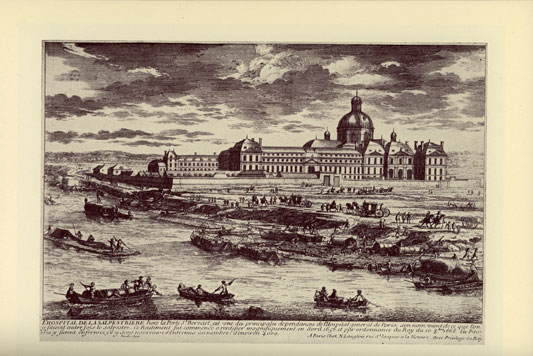
The Salpetriere
This was not a new phenomenon, merely the shock of recognition. In Greek mythology, for instance, when the stress of the mid life crisis hit, the hero went through a period of madness, that is to say he adopted a parallel personality until he was able to reorganize his mental attitude to new realities.
In Europe, under the stress of an insane quasi-Semitic religion in which Satan took a prominent role, it was common for the stressed to become ‘possessed’ by demons or, in other words, to split the personality. That is the person showed a parallel personality. The transition point to the beginning of secular understanding came when Dr. Anton Mesmer matched his secular method of exorcism against the ecclesiastical method of exorcism and won. So one might say that modern psychology derived from the problem of the dual personality- the Jekyll and Hyde effect. However dual or multiple personality was not recognized as such until announced in Jean-Martin Charcot’s clinic at the Salpetriere hospital in Paris in the mid-eighties.
Charcot studied hysterics. Hysterics are dealing with a lot of stress, hence escape through an alternate personality would be an easy choice. Charcot and the Salpetriere aren’t exactly household words so let’s take a moment to explain the situation in which modern psychology was born.
It is also necessary to bear in mind changes in scale. What is good for one stage of growth is not good for another. As the scale of things progresses from tiny to small to medium to large to huge to gigantic new forms have to be adopted to suit the new circumstances. These transition points are difficult to adjust to but once adjusted to are considered so normal that those who resisted the old change are equally resistant to adapt to the next level. Of course the young of each scale is born into it and has no adaptation to make although they will at the next change of scale.
Thus the French Revolution and the Napoleonic Era masked to a very large degree a major change of scale so that after Waterloo a seemingly complete break with the past had taken place. It was a new world in the morning. So in the years leading up to the Great War another change of scale had taken place that masked the new world that popped into place in the twenties. I picked up the concept from that astute observer, H.G. Wells, who noted the emerging change in scale at the turn of the century. That great ship, the Titanic, that went down in ‘12 may be considered as representative of that change.
Thus with the change of consciousness that actually took place in 1795 the new consciousness became clear after Waterloo. Gone was the religious notion of ‘possession by evil spirits’ to be replaced soon by the concept of multiple personality. Thus whereas in the past the insane had been treated as raving beasts, chained to walls and whatever a Dr. Pinel at Paris’ Salpetriere began a more humane treatment with an attempt to understand the causes of insanity. The approach was parodied amusingly by Edgar Allen Poe in his story The System of Dr. Tarr and Professor Fether in which the inmates revolted and took over the asylum.
The Salpetriere was a large compound of several acres with thousands of residents, mainly women from whom the subjects who became the hysterics that the great Dr. Jean-Martin Charcot began to study as a neurologist, as the early psychiatrists were known. The field of Psychology is divided in two. On the one side psychiatrists who must be MDs and who believe mental ailments are biologically derived and hence to be treated medically with drugs or, one shudders to think of it, operations like pre-frontal lobotomy or electric or insulin shock ‘therapy.’ Psychologists, who are PhDs with little or no medical training treat neuroses and psychoses as malfunctions of reason caused by experiential traumas.
Charcot as an MD originally sought biological causes for the hysteria he studied although he was coming around to a psychological viewpoint just before he died in 1893. Thus from being chained before Dr. Pinel released them these women, hysterics, while being confined to the Salpetriere were given freedom of movement within the hospital with its flowers and walkways making for a much more pleasant environment for them and one unobtainable to them on the outside.
Now, the great Dr. Anton Mesmer introduced hypnotism to Europe as a discipline in the years just before the Revolution. Naturally something so new and seemingly revelatory did not find immediate acceptance, indeed, it was treated as nonsense. Nevertheless people of learning, doctors, persisted in experimenting with it. Thus, when Charcot came to be the director of the Salpetriere, to the dismay of his profession he introduced the practice in his treatment of his hysterics and thus legitimized its use. Hypnosis, too, was new and little understood.
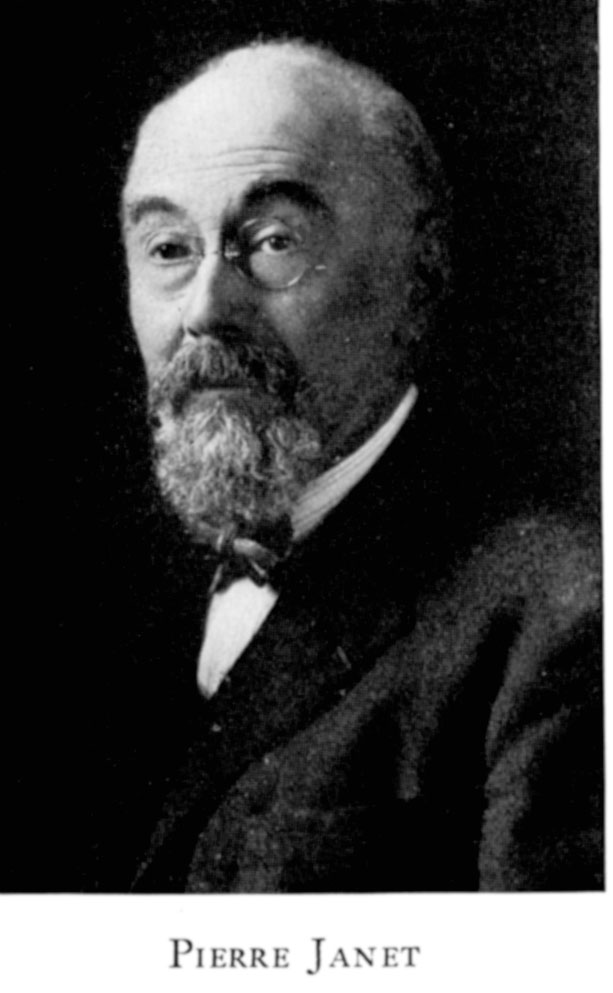
Pierre Janet
The essence of hypnosis is suggestion and Charcot did not understand suggestion. The rival hypnosis school led by Auguste Liebeault and Hippolyte Bernstein at Nancy to the East of Paris was aware of the effect of suggestion but not necessarily the nature of what it was. Actually suggestion is whatever enters the mind and is accepted. If one wakes to a beautiful sunny morning it is suggested to oneself that the day will be a good day. Acting on that suggestion, post-hypnotic one might say, one will try to make the day a great one to hang onto that feeling. The mind is naturally open to suggestion as it must be; in an active mind one can discriminate to some extent as to what suggestions will be accepted and which rejected. Under hypnosis in which the mind has been put into a passive state the ability to discriminate and reject has been greatly reduced so that a hypnotist can plant a suggestion that then becomes what Charcot’s associate, Pierre Janet, called an idee fixe, or in other words, a fixation that will remain in your mind until executed. This notion may be imparted by a human agent, books, movies, radio or any medium that is capable of influencing the mind. One must be aware of this. It isn’t necessary to have a hypnotist standing in front of you saying ‘look into my eyes.’
As I say, Charcot was convinced that hysteria was biological, that is to say caused by a lesion to the brain, so that while he hypnotized his female subjects at the Salpetriere he wasn’t aware of the nature of suggestion.

Marie Corelli
Now, the eighteen seventies and eighties were terrifically exciting at all levels. They did things differently then. As has been said: The past is another country; they do things differently there. The past is never to be judged by current standards although the latter are useful for comparison. Thus when Lister suggested that antiseptics ought to be used in the operating room his suggestion was stoutly resisted although true and nearly universally accepted today. On the other hand Evolution although true is more stoutly resisted today in a religious reaction than it was in the last quarter of the nineteenth century so don’t feel all that superior.
While Charcot was arguing with himself as to whether hysteria was biological or mental, in the mid-eighties two of his associates easily grasped that hysteria was a mental problem. These two were Sigmund Freud and Pierre Janet.
Freud at that time, 1886, was making the transition to psychology from medicine. He was an MD. Charcot was not alone in dealing with mental matters. The understanding of dreams for instance was developing rapidly. When Freud published his Interpretation Of Dreams in 1900 he cited dozens of competent researchers dating as far back as the 1860s. In 1886 alone two novels dealing with the subconscious and split personality were published, Robert Louis Stevenson’s Dr. Jekyll And Mr. Hyde and Marie Corelli’s Wormwood. Corelli cites Charcot as an influence so she very likely had attended his semi-public presentations of hysterics under hypnosis at his hospital.

Sigmund Freud
Going back further, Freud, a German Jew, was undoubtedly familiar with the psychological work of the German romantics. At any rate he spent about four months at the Salpetriere studying Charcot’s work and methods. It is likely that the foundation of his psychoanalysis was laid there. While Charcot was struggling to determine whether hysteria was biological or mental, Freud, himself a neurologist, was able to perceive that, as he later put it, hysterics were suffering from reminiscences. In other words they fixated on past experiences which dominated their minds and behavior.
Pierre Janet, Charcot’s student and associate, came to the same conclusion probably at the same time. He expressed the problem more accurately when he determined that hysterics suffered from one or more idee fixes, that is a fixed idea or, in other words, a fixation centered around a specific past event or events.
Indeed, all the women at the Salpetriere had been battered and brutalized by life with no means of self-assertion or resistance. Unable to express their own will they retreated into ineffective hysterics finally ending up as semi-insane in Charcot’s hospital.
Now, split or multiple personality. No one, especially these women, have the personality they are born with. Over the course of our lives circumstances require us to respond in different ways, sometimes a personality is overwhelmed with a consequent personality adaptation or change and in extreme cases, insanity.
All very well, but what happens to the original and/or various personalities that were submerged. It is impossible for them to vanish from the mind so they must live on submerged by a more powerful personality impulse. Depending on the individual then, everybody must have at least one alternate personality. Stevenson and Corelli were demonstrating this in their novels.
The good Dr. Jekyll had had a wild streak in his youth that he forcefully repressed to become the totally respectable man of medicine. But, he longed for his rough and rowdy days so in Stevenson’s story he invents a potion, I’m sure whisky would have been just as effective, that allows him to free his original personality. In the course of his experiment the earlier personality suppresses the later one assuming control of Jekyll’s mind. Much the same thing happens in Corelli’s novel. Thus we have personality accretion.
Charcot’s hysterics, because of the side show atmosphere the Good Doctor created, became world famous, a sort of show people. Charcot even took them on the road for demonstrations and, heaven forbid, loaned them to other doctors for experimentation.
It was during one such loan in 1888 that Jules Janet, Pierre’s brother, made a startling discovery. He was experimenting on Blanche Wittman, the Queen of Hysterics, when having hypnotized her into what Charcot called the first state, instead of progressing to the second state, he decided to put her into a deeper trance. At that point Blanche was able to dissociate her personality from her normal state to what I assume was her original personality. She turned into a happy effervescent bubbly girl. In other words she had stripped every accreted personality adjustment to return to the period before society violated her womanhood.
One might ask where this personality came from? It is not necessary to assume either the supernatural or the paranormal. The personality did not come from outside her but was merely an early personality that had been submerged and denied existence by repeated abuse. If Jules Janet had pressed on he might have found three, four or more variations of Blanche Wittman. Indeed, when Charcot died in 1893 Blanche ceased having hysterical attacks and became quite normal assuming yet another personality although it was not recognized as such. She then took responsible employment at the hospital until she died under tragic circumstances.
Thus during one’s life one assumes many variations as one’s personal circumstances dictate. And one expresses them in many different ways. As an example of personality accretion I am going to use the history of the American fantasy and science fiction writer, Edgar Rice Burroughs. He has especial value as his biography is well developed and he has talked voluminously about his mental states through his large body of fiction which is all autobiographical in nature.
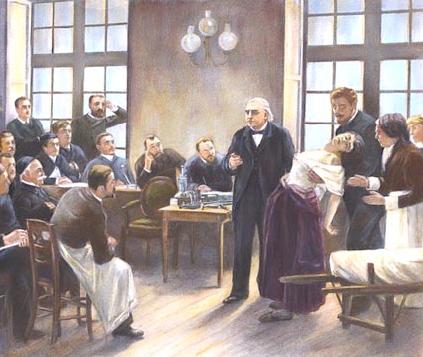
Dr. Jean Martin Charcot Demonstrating Hypnosis And Hysteria
Part II follows.
A Review: Pt. III, The Prague Cemetery By Umberto Eco
December 5, 2011
A Review
THE PRAGUE CEMETERY
by
Umberto Eco
Part III
Review by
R.E. Prindle
Eco, Umberto: The Prague Cemetery, 2010, Houghton Mifflin

Umberto Eco
1.
The French Revolution was perhaps the most horrific event in the history of the world. More pernicious still in the shadow it cast into our times. Our societies were born in blood; we became instantly conditioned in the most incredible, inconceivable way to crime and political murder; worse by far than the so-called holocaust, itself an echo of the Revolution. No was safe, psychopaths and morons controlled the fates of the sane and intelligent. Truly the inmates were in control of the asylum just as Edgar Allan Poe represented in his story The System Of Doctor Tarr And Professor Feather. There are no words to accurately describe the crimes of ‘93.
The most amazing thing is that amid the chaos the Enlightenment proceeded apace. The period remained one of incredible scientific advances. Beneath the horrors of the Revolution and the Napoleonic years the Romantic reaction to the Enlightenment produced astonishing literature and writers many of which will figure in the late nineteenth century history during the Romantic revival.
Interestingly one of the early manifestations of the modern Liberal mentality appeared in Henry Thomas Buckle’s History Of Civilization In England of 1860. In discussing the career of Edmund Burke, after a eulogy on Burke’s subtle command of English politics in which the most fulsome praise was heaped on the writer came the time for Burke’s evaluation of the French Revolution and the Great Year of ‘93.
Burke correctly perceived that the Revolution was a religious transit from one ideology to another and that the Revolution was the opening salvo of a new religious war- Socialism being the new religion, or Liberalism in another form. Burke deplored the violence and criminality in the strongest terms. Up to that point in history, Buckle (a very famous historian of his time) who had been writing a very measured and subtle history of the intellectual development of Western Europe and England vituperatively denounced Burke as becoming unbalanced and indeed, insane. This was over a mere difference of opinion. The denunciation was not unlike that of today’s Obama and his denunciation of the Republicans. Yes, he has characterized them as insane.
One then asks what was Buckle’s relationship to Communism? How well did he reflect Liberal opinion? Burke’s reaction occurred in ‘93 and ‘94.
2.
Beneath The Limn
The nineteenth century was one of great psychological advances. As such they were unsettling creating great psychic stresses. Eco gives his character Simone Simonini a split dual personality. He also mentions Anton Mesmer and Jean-Martin Charcot. While many if not most people believe Sigmund Freud discovered or invented the Unconscious the concept was well developed in the nineteenth century before Freud. Freud merely consolidated earlier investigations and gave his own peculiar Jewish twist to the concept.
The beginning of the recognition of an unconscious was articulated by the much misunderstood, but surely great man, Dr.

Franz Anton Mesmer
Anton Mesmer in the pre-Revolution days of the eighteenth century. Mesmer’s shortcoming was that he was more of a mystic than a scientist. The French academy called him to account on scientific grounds and he either couldn’t or wouldn’t comply, hence being discredited as a charlatan. He was an honest man discovering a new scientist; more a pioneer than a charlatan.
Nevertheless as Mesmerism or as later renamed, Hypnotism, was a real phenomenon so even though discountenanced by official academics, research continued until it became clear that hypnotism was a condition of the mind or unconscious and not a quality of the operator or hypnotist as Mesmer mistakenly believed.
A few words on the nature of hypnotism and suggestion. Suggestion is the active component and the mind the passive of hypnotism. Essentially the mind is a slate on which the suggestion is imprinted.
What is a suggestion? Everything is a suggestion but suggestions of different qualities. For instance one wakes to a sunny day and the suggestion is one of anticipated pleasure, an overcast day one of a deflated spirit. The mind at birth is a blank slate with nothing on it so that education begins and education itself is suggestion but positive beneficent suggestion although education can be perverted for special ends. You might say the post-hypnotic consequences of education which teaches the mind to analyze other suggestions permanently survives the input. It is imprinted.
And then there is indoctrination in which a specific point of view is forced upon you to condition your mind in a permanent post-hypnotic state whether the information is good or bad. The current indoctrination in racism is a case in point. To confirm the suggestion of indoctrination one uses conditioning to confirm the imprinting. Thus one is bombarded constantly with racist images.
You may not think of the above as examples of hypnotism but they are. One may or can refuse a suggestion and indeed many people are uneducable because they resist the process of learning either because they won’t or can’t learn. The above are examples of open hypnotism or suggestion. There are involuntary acceptances of suggestion resulting in fixation that cause neuroses or psychoses, what the great French psychologist, Pierre Janet called the idee fixe. In other words a permanent post-hypnotic suggestion.
One means to achieve a fixation then is through terror. In a state of terror the mind is stripped of all defenses so that the suggestion is implanted with no resistance. An example comes to mind from the life of Edgar Rice Burroughs the creator of the Tarzan series. One day as an eight year old on the way to school he was confronted by a much larger twelve year old who began badgering him. The young Burroughs in a state of terror took to his heels. Among other things for his flight fixed in his mind that he was a coward. That affected his life thereafter. The theme appears in each and all of his scores of books. So Burroughs received a fixation, a suggestion, an idee fixe in Janet’s terms.
Freud presents many examples of various ways in which fixations occur. The point is that they are all hypnotic suggestions containing post-hypnotic commands. Once accepted they have to be discovered but once recognized the affects disappear. But every affect arises from a fixated suggestion. One was hypnotized.
What Freud did was to discover the true nature of suggestion and hypnotism so that it was not necessary to put a person in a trance to access his unconscious. In the process Freud learned how to hypnotize an entire audience and then with movies and recorded songs a whole population. But that was in the future.
For a good history of the nineteenth century pre-Freudian discovery of the unconscious the best introduction is Henri F. Ellenberger: The Discovery Of The Unconscious.

Fun And Games With Charcot At The Salpetriere
3.
Books And Bookmen
Ilan Stevens begins his remarkably obtuse review of The Prague Cemetery as follows:
http://forward.com/articles/146732/?p=all :
There’s no hiding it. Umberto Eco is a lousy novelist. Try as one may, it is difficult to make sense of his new novel, “The Prague Cemetery”. As is often the case with him, the plot is built on a mystery of sorts, on this occasion the quest to discover the true author of “The Protocols of the Elders of Zion”, an anti-Semitic pamphlet that remains one of the world’s biggest hoaxes and whose true author remains unknown. Oddly, Eco is less interested in solving the puzzle than in incensing his readers. The protagonist’s anti-Semitic rampages running through hundreds of pages, appears to be a parody. But the joke is impossible to decode. Worse, it isn’t funny!
Ilan should realize that he is not speaking for the entire reading public but only for himself. Eco is as funny as Lenny Bruce or Mort Sahl, or, perhaps Ilan has never listened to St. Lenny’s diatribes himself. I would recommend the one about the Vegas comic at the Palladium Theatre of London.
In the first case Eco is plowing his furrow down a row that has already been disced, perhaps several times and in the second the Protocols take a subordinate place in the story. Perhaps Ilan is letting his Judaic heritage distort his sense of reality. Freud had a few things to say about group psychology. I recommend them to Ilan. In the third place without a fair background knowledge of the sources the novel might indeed be difficult if not impossible to follow. It requires some knowledge of nineteenth century books and bookmen.
Eco is a European, relatively unaffected by American attitudes and I suspect Jewish history although with someone of Eco’s erudition, that far exceeds Ilan’s, one must step cautiously, especially knowing what Eco does in his furrows.
The flowering of European and English literature began about mid-eighteenth century when the number of books published increased dramatically. After Napoleon organized the Revolution along rational lines beginning in 1799 one might say the modern era of literature began. Most significantly for our story was the emergence of the great Walter Scott in England. Scott originated the historical novel and as such became the template of the great French authors Balzac, Dumas and Sue. Dumas, the son of one of Napoleon’s generals was born in 1802; Sue, the son of Napoleon’s surgeon general was born in 1804. Both thus were old enough to have personal memories of the Napoleonic period and certainly of his defeat on the field of Waterloo. The events of the Revolution, tales of ‘93, must have been the stories of their childhood and early years. They lived through most of the Romantic reaction to the Enlightenment.
At the same time they were present at the revolutionary shocks of 1830 and 1848 while taking part in political events of the time. Indeed, in Eco’s story she shows Dumas as a gun runner in Garibaldi’s attempted establishment of a unified Italy.
Garibaldi’s activities which had nothing to do with Jews or Protocols takes up a substantial part of Eco’s story. I found it one of the more intriguing parts of the novel. Certainly Eco’s portrayal of Simonini’s activities as a spy were well drawn establishing him as ‘flesh and blood’ character. While I thought Prague could have been better developed Simonini was perfection.
Rather than the book running on for hundreds of pages as Ilan thinks, I thought it much too short. Further, four hundred pages in the largish typeface is not a long book. I had rather seen Eco emulate his heroes Dumas and Sue and turn out a whopper of one or two thousand pages. If I have any complaint it is that Eco didn’t really pull out the stopper and throw himself into it. He does give us a trifle on the Commune of Paris ‘71 but that alone could have taken two or three hundred pages. Arnold Bennett in his Old Wife’s Tale give a little more. I mean, the nineteenth century is great stuff especially for a historical imagination like Eco’s; there’s plenty of material for romancing.
Since Eco put some effort into developing a psychological profile for his hero, Simonini, he might have dealt with the development of psychology from Mesmer to 1897 his cutting off point. He could have invented, well, there was no need to invent, he could included some of the stage magicians and hypnotists sort of after the fashion of the movie, Children Of Paradise. Too long a novel? Oh, no Eco shouldn’t have reined himself in. Probably too afraid of the Jews and their anti-Semitism. There was no reason to include Freud who at that time was unknown.
Eco did mention Mesmer and could certainly have cast an uncle of Simonini as a stage hypnotist then allowing him to

George Du Maurier
develop a history of hypnotism down to Jean-Martin Charcot at the Salpetriere in the sixties, seventies and eighties. It was Charcot who legitimized hypnotism.
Eco could also have taken time to give mini biographies of the actual historical figures most of whom are today known only by name if that. After all this is well over two hundred years after the Revolution of 1789. That is an immense stretch of well documented history impossible for someone not dedicated to studying the period to know. If education is in trouble it is merely because the period and its contribution to knowledge has not been organized in a comprehensible manner. Nor given the current political and religious situation is it likely to be. History itself is both anti-Semitic and racist, you know.
Amazingly enough the amateurs of the internet are making a better attempt to orgainize the period than the academic ‘pros’. The various Wold Newton Universe’s on the internet which mesh into Eco’s approach have done a great deal to evolve a time line progression. Since Eco is a European writer the work of Jean-Marc and Randy (wife) Lofficier with their site of the French Wold Newton Universe have made a great advance in organizing French literature into a continuation not too different in intent than the Arthurian epic.
They began much as Eco does here with the Carbonari based on the novels of Paul Feval who chronicles the rise of organized crime in France which is another theme Eco could have included in an expanded novel. Rocambole, Arsene Lupin and Fantomas, (characters larger than the creators) form part of the French WNU and Eco’s memories as he recorded them in the Mysterious Flame Of Queen Loana, but that opportunity was missed.
I’m also not sure why Eco passed over Madame Blavatsky, Theosophy and the whole Spiritist Movement that turns toward the idea of the Protocols since their religious view was quite in opposition to Judaism.
Another line of investigation although not quite so obvious as others was the rise of the Vampire novel which I believe is directly related to Jewish emancipation.
Prior to the Revolution and Jewish Emancipation the Jews had been tightly controlled being confined to the Pale of Settlement running the breadth of Europe between Eastern Poland and Western Russia. With emancipation Jews could function freely without restriction as citizens of their respective hosts. How Jewish activities are characterized depends on your nationality. Jews of course depict themselves as both ardent Jews and loyal citizens of the host country while each country universally depicts them as self-interested traitors. But to say so left an individual open to censure as an anti-Semite. That is the same charge that Ilan in his review brings against Eco. To disagree with the Jews is to be an anti-Semite. Thus in order to express one’s true opinion one must resort to subterfuge. One has to speak of one thing to refer to another. One of the major criticism of the Jews over the centuries in all societies is that Jews are parasites. Of course, the Vampire is the ultimate parasite. Thus in creating stories of Vampires, the bloodsuckers are meant to represent Jews.
This is made nowhere more explicit than in George Du Maurier’s 1894 novel, Trilby. Eco has his character in Prague named Dr. Du Maurier who is obviously based on the novelist George. As it seems appropriate I will digress here to consider Du Maurier’s novel, Trilby. Du Maurier still has a significant following as my three reviews of his novels have found a good readership, especially the first, Peter Ibbetson.
Trilby is a complex and very interesting novel. Du Maurier was a prominent neo-Romanticist and Bohemian. A base of his story is an earlier 1822 novelette by the French Romanticist Charles Nodier from whose title, Trilby, Du Maurier took his own.
Nodier’s story concerned a Scots girl named Jeannie and an elf or fairy named Trilby. We are led to believe that Trilby actually exists but was apparent only to Jeannie so that the churchmen or rationalists believing her deluded insist that she renounce her elfin friend; therein lies the tragedy.
In Du Maurier’s story he reverses the sexes making Trilby a young woman while giving Jeannie’s identity to a young artist named Little Billee who, himself, is based on a Thackeray poem of the same name. Du Maurier is more obsessed with memory than even Umberto Eco. Du Maurier convinced of the reality of an after life devised it so that he could take his little bags of memory with him for, what is the purpose of memories is they are to be lost at death, he said?
The novel Trilby is, of course, famous for Du Maurier’s creation of the hypnotist, Svengali, very close to a mythical figure himself. One hears reference to Svengali constantly. Svengali was what was then known as a Beteljew, sort of a bum or hobo, in Hebrew a Schnorrer. He is not appreciated by Billee and his friends but he was always a forced presence in their entourage. According to the prejudice of Jews then and now he was a good musician. Thus in hanging around the digs of Little Billee and his Bohemian artist friends he meets Trilby who is a grisette. A grisette in Parisian is what we would call ‘a good lovin’ woman.’ Trilby posed nude for the artists but she was never of easy virtue being quite an exception in Bohemian artists’ circles. The point is made that she cannot sing, unable to carry a tune or hit a note with a tennis racquet . However Svengali notices that she has a one in a million oral cavity, hence she should be able to sing much better than Jenny Lind, a sensation at the time.
As the story falls out the English artists break up as age takes it toll while after a series of adventures Trilby having no other place to go shows up on Svengali’s doorstep who seizes his chance. He removes to Eastern Europe where being an expert hypnotist he entrances Trilby, much as a vampire, and keeps her in a perpetual trance as he wants so much to use that spectacular oral cavity and make Trilby sing as no other. To do that he has to project his musical sensibilities into her and sing through her himself. Thus she is only able to sing while hypnotized and with Svengali directly in front of her making eye contact.
After a while the two master the act and Svengali begins to build her career in which he is successful. As she is perpetually hypnotized Trilby has no memory of those years. One imagines Du Maurier might consider the loss of memories the most tragic of all.
Back in Paris on holiday after a period of years the now mature Billee and his two friends are astonished to discover that their Trilby is the singing sensation that they have been hearing about while Svengali to their eyes has an ambiguous relationship with her. He claims that he is her husband but this is, of course, bushwa as he has another wife. While driving by in their carriage Svengali spots the three on the sidewalk. His hatred and rage at the three welling up he orders Trilby to cut them dead which she does.
Unable to get tickets to the sold out performances the three go back to London. Trilby is scheduled for a London tour. Billee and his friends have a box seat. About half way through the performance Svengali looks up and notices them. His hatred is so strong he breaks eye contact with Trilby who at once stops singing and while glaring at the three his blood pressure rising Svengali has an apoplectic fit and dies. Trilby is unable to continue the show on her own. However Svengali having kept her hypnotized for years vampire like has sapped her vital energy and Trilby withers and dies.
Thus as though a vampire Svengali has drained his victim of life’s blood exploiting her for his own profit. Du Maurier makes it quite clear that the story is an allegory of the Jews and Europeans. Thus unable to criticize the Jews directly unless he be labelled an anti-Semite Du Maurier makes a species of Vampire of them. In the process probably a much better novel than he might have otherwise. The novel really is a masterpiece.
It is perhaps no coincidence that Bram Stoker’s novel, Dracula, was issued at this time. While the nineteenth century began to explore the Aryan racial subconscious in tentative manner pursuing vampires, werewolves, Frankensteins, perpetual wanderers of one type or another, split personalities it was not until later in the century after a few decades of serious study that some clear results were achieved. The most notable example in which a clear separation of the conscious and unconscious was achieved was in Robert Louis Stevenson’s Dr. Jekyll And Mr. Hyde. There may be an unconscious referral on Eco’s part as he may have combined Du Maurier and Dr. Jekyll in his imagination. During the same years the Society For Psychical Research was formed of which the significant researches of F.W.H. Myers in the unconscious were important contributions. The work of the Frenchman Pierre Janet, student of Charcot’s is not to be despised either. Freud’s twentieth century vehement denial of any use of Janet’s ideas is proof positive of his influence.
In the realm of dreams also significant work had been done by Aryans before Freud synthesized their work in his study of 1899-1900, The Interpretation Of Dreams. While verging toward mysticism Du Maurier’s notion of Dreaming True and Stevenson’s notion of Directed Dreaming are significant variations on Freud’s theory. Not that I mean to totally disparage Freud’s contribution but he essentially serves in the Jewish role of the middleman between the producer and the consumer.
So, as a slight criticism of Eco, as Freud was still of the future as Prague ends, he might have better constructed Simonini from existing psychological elements. There was no need to create ‘Froide’. Nor was it necessary to interject the Protocols and Dreyfus into the story so prominently.
It appears that Eco used the body of books or sources that all of us familiar with this line of research have used. If fact so many people have been plowing this furrow that nearly every book suppressed by the Jewish Index of Forbidden Books has found its way into print with the exception of Drumont of the Libre Parole and Goedsche himself. One can with some confidence then speak in this area.
Eco slights his Jewish studies. He makes an offhand comment about the Father Thomas murder in Syria but without prior
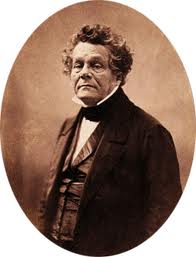
Mastermind- Adolphe Cremieux
knowledge of that crime, if the uninformed reader noticed the reference he must have been puzzled. While the author of the Protocols has never been determined, internal evidence indicates the work was probably cobbled together c. 1885. It may have been based on Maurice Joly’s Dialogues Between Machiavelli and Montesquiou In Hell or the Dialogues may have been written after the Protocols became infamous to provide a source, thus we may have a hoax based on a hoax.
Of course, over the decades the story keeps changing, but in one version Napoleon III confiscated all the copies at the printers but one copy got away. The book showed up much later after the Russian Revolution when a fleeing White officer miraculously sold the only existing copy to a Jewish second hand book dealer in Constantinople. Ever see the movie, Wag The Dog? You should. Not only did this astute book dealer buy a wreck of a book without a cover or title page but while idly reading through it he recognized it as the source of the Protocols, as the proverbial light went off in head he knew he had a copy of the Dialogues in his sweaty little hands. Quickly notifying the Alliance Israelite Universelle he sent the copy along and- eh voila!- the problem with the source was solved, proven. But the question is, who was this Maurice Joly and what did he know of Machiavelli and Monstesquiou? Who the hell was Montesquiou? That Joly was Jewish goes without saying but to my mind there is a question as to whether he wrote the Dialogues. I mean, you know, we’re dealing with mis-, dis- and re-directed matters here. Try reading Edgar Wallace’s Four Just Men to learn some real head fakes.
Eco doesn’t go into the Jewish history very deeply although all accounts of the origin of the Protocols I’ve read have been

Maurice Joly
written by Jewish hands and therefore are thoroughly questionable. He does make a passing reference to someone he call Cremiu. This may or may not be a reference to a very important Jewish figure named Adolphe Cremieux. His career spanned the years before the 1830 revolution which coincided with the French acquisition of Algeria of that year. Cremieux drafted and penned the law making Jewish residents of Algeria French citizens thus catapulting them over their Moslem masters corrupting the French conquest.
Cremieux was politically prominent in the sixties taking part in the formation of the Alliance Israelite Universelle which was created as an international organization to coordinate Jewish European activities, thus was formed a Jewish national government. At the turn of the century it would be sent to the US becoming the American Jewish Committee as the US was deemed more cordial and pertinent to Jewish affairs. Indeed, it was from New York that President Jacob Schiff engineered the 1905 defeat of Russia by Japan for which the Japanese duly honored him.
But in the 1860s when European Jewish affairs were being organized Cremieux was undoubtedly behind the writing of the Dialogues which were very likely written by committee and merely issued under Joly’s name. The Dialogues Between Machiavelli and Montesquiou is a sophisticated piece of writing. I suppose most people have heard of Machiavelli and probably many of those have read his book; however I doubt if many have ever heard of Montesquiou and fewer by far have read him. His Spirit Of The Laws is one of those key texts recently made available. In Conspiracy circles it had been thought of as evil but it is nothing of the kind. It is a very valuable intellectual contribution which ought to be studied by Conservatives.
As the title implies Montesquiou historically examines what laws were meant to effect- their spirit. Thus as with today’s ‘anti-hate’ laws, what is their spirit? What is their intended effect? On the surface the laws are absurd as they imply that the protected parties are above ‘hate’ while the unprotected parties are directing their innate unreasoning hatred toward them. The ‘anti-hate’ laws are American so one must ask who they are meant to protect and who they are meant to punish. The protected parties are what Americans call ‘minorities’; what the Canadians laughably call ‘visible minorities’ which by the way would exclude Jews and homosexuals who are invisible. The promoters of these laws are obviously Jewish.
The laws then create franchised and disenfranchised classes. That is exactly the way the protected classes understand the laws. They have been legally granted ‘minority skin’ privileges.
So, now as the Jews understand the spirit of the laws in these days it is not unreasonable to believe that they understood their spirit in those days. They had and have a very specialized understanding.
Just as today the AJC/ADL have a college turning out books of the same nature as the Dialogues, see the books of fictional author ‘John Roy Carlson’, it is not unreasonable to suppose that Cremieux and the Alliance Israelite did the same in those days. The racial mind always works according to certain static principles. Thus, I have no doubt myself, that the college turned out the book merely duping the Jew Maurice Joly to put his name on it. In any event we are told that Louis Napoleon had the whole press run confiscated at the printers; however the handwritten original may have escaped that surfaced around 1885 when the Protocols were written. The text would have to have been supplied by the Alliance in that instance. From my reading of both documents there is only the most tenuous connection between them while the ideas contained in the Protocols could have been written and probably were without any reference to the Dialogues at all. I see no logical connection between the two.
Now, if the Protocols were a forgery drawn up by the Russian Ohkrana who could not possibly have had a copy of the Dialogues in 1885 and they wouldn’t have needed it in any event why would they wait to 1905 to broadcast the news? Why not before the 1905 revolution in an attempt to stave it off? So, you see, things just really add up; the bottom line is just a bit fuzzy.
While the Jews attack Eco on the improbable grounds that his novel is going to stir up ancient hatreds, at the same time they leap at Eco’s suggestion that the German writer of the period, Herman Goedsche’s scene in the Jewish Cemetery is based on Cagliostro’s confrontation with the Freemasons in the pages of Dumas’ novel Joseph Balsamo. Balsamo was Cagliostro’s real name while the latter is his magician’s name.
There is no need for a relationship between the two while at the same time both are fictional situations. I’ve never understood why the Jews chose to make an issue of this scene. Biarritz, Goedsche’s novel was just that, a story. For a story to be read it has to be as close to reality as possible while exaggerating it for effect. While it is improbable that any such meeting would take place in a graveyard it is certainly probable that such a meeting took place at AIU headquarters in Paris. How else will you coordinate efforts and Jewish efforts were coordinated.
Just ask yourself, what is the purpose of an undeniable organization named the Alliance Israelite Universelle? Doesn’t the name say it all? And then in 1900 when the Pale Of Settlement is being emptied out as the Jews are being transferred to the US with every intent of transferring all the Jews to the US which was only aborted by the outbreak of The Great War, why was the Alliance transferred from France to the US to become the American Jewish Committee? I mean, you know, I don’t mind being called an anti-Semite but I certain do object to being called stupid.
In fact, the Jews were one of the nations of Europe, functioning fully as a nation although without a homeland, ‘rootless cosmopolitans’ they were called and what else would they be called given their situation? Think about this stuff, don’t allow your thinking to be directed by Jews. When the going gets tough the Jews pack up and get moving. That’s what rootless means. The Germans, the French et al., they have roots, when the going gets tough they have nowhere to go, they have to tough it out.
Thus the mere existence of institutions presupposes organization and goals. Goedsche was just a writer, he doesn’t have to be taken anymore seriously than that. Does he have a good story or not? In fact, his novel is one of the works on the Jewish Index still waiting translation. I’m ready to buy.
Eco could have gone into more detail on the Protocols. They excite only the Jews. They only claim to prove the obvious. Check out the goals of today’s Jewish Paideia Society of Sweden organized by the US Jew Barbara Spectre which is pursuing the same end. Good name, Spectre.
That leaves the old chestnut, the Dreyfus Affair to be examined. Why Eco threw this into a book called The Prague Cemetery is beyond me but there it is.
Dreyfus was certainly guilty of spying, not necessarily for the Germans as he was charged, but spying. Leaping ahead a hundred years and shifting to the New Promised Land, the US, let us consider the case of the notorious Israeli spy, Jonathon Pollard whose thefts were so serious that he is still withering away in prison. While his fellow Jews haven’t been able to force a new trial, they’re now asking for parole if not pardon. After all they say Pollard wasn’t spying for an enemy but for the US’ best friend, Israel, with which we should have been sharing our information like a good friend anyway.
Now, move Pollard back a hundred years, shift him to France and change his name to Dreyfus. Eh, voila! Dreyfus was sending his purloined info to the Alliance Israelite Universelle headquarters. How else can the Jews by so well informed?
As Eco informs us, the real German spy was named Esterhazy. What he neglects to tell us is the Esterhazy was a Hungarian Jew. So, if there was a spy dealing with the Germans, he was Jewish, as well as another Jewish spy providing his fellow Jews with information.
Now, it is said that Dreyfus was framed and wasn’t guilty. The big bad nasty Aryans convicted him falsely out of mere pique and he was later proved innocent. Over the years from his conviction to his second trial key evidence disappeared while key witnesses had died and money had changed hands. Therefore Dreyfus was released for lack of evidence not proven innocent besides which the Jews had gotten themselves into a hissy fit while alarming France and dividing the country along Dreyfusard and anti-Dreyfusard lines. What other political choice did the authorities have?
Consider nearly every other European conviction of Jews along similar lines most notably the murder of children or the so-called ‘blood libel.’ According to the Jews each incident, and these occurred over centuries, was trumped up for bigoted reasons. Thus, the culprit is first convicted on what appears to be good evidence to a court of law. A few years go by, evidence disappears, witnesses die, money changes hands and then the case is reopened and the verdict is reversed.
Then it is said that the charge of child murder by Jews is absurd, there is nothing in the Jewish culture to indicate that they were even capable of such crimes. But, consider the Last Supper. All Jews agree that Jesus was Jewish although there are some Aryan diehards who insist he wasn’t and want to claim the creep. Nevertheless at the Last Supper the Jewish Jesus holds up the wafer and says this is my body; he holds up his wine and says this is my blood. Not only do we have the blood libel but we have cannibalism in a Jewish setting completely among Jews. According to the doctrine of transubstantiation a modern communicant is literally eating the flesh of Jesus and drinking his blood. Now, if one mixes wine with the wafer one has the deed for which the Jews were accused. A child among both Semites and Aryans is an unpolluted innocent, of course.
The Bible has very strong injunctions enjoining Jews to abjure eating or drinking blood because according to their belief that is where life or the soul resides. So, on the one hand the Jewish ceremony of eating the child’s blood in the wafer mocks the Catholic ritual while eating the life of Christians by proxy of a pure innocent child. I don’t say the Jews actually did this, although they were convicted of the crime, however to say the charges are absurd on the face of it contradicts both facts and reason. I could provide more examples but one is as good as a hundred.

Jonathon Pollard
As in Jonathon Pollard’s case, as they can’t get the conviction overturned or set aside then humanity demands that he be released.
In Prague Eco exonerates the Jews on the count of the Protocols and also the Dreyfus Affair. According to Ilan this is not enough, he is still activating ancient hatreds. Whose ancient hatreds Ilan doesn’t say. One always suspects the charge is that of crying Wolf. There is no reason not suspect ulterior motives. At the very least Eco is playing into their hands.
As I said before, these two historical events are so old hat that no one except interested parties are concerned or even know of the incidents; at this late date there is no one who remembers them personally, they have passed into the historical or racial memories.
So Eco’s work is merely an exercise in historical memory combined with the Jewish racial memory. We should always try to unravel the mysteries of the folk so that having an accurate historical memory from both sides we can demand in unison- Never Again! Not likely to happen but a good thought.
I had meant to conclude the review with this part but as it got more involved than I thought I will have to add a Part IV.
 I, Dynamo