Four Crucial Years
In The Life Of Edgar Rice Burroughs
Part II
by
R.E. Prindle
…presumptuous attempts to conquer the outer world of appearances by the inner world of wishful thinking.
–S. Freud, Letter To Arnold Zweig 5/8/32.
Quoted by Schur: Freud: Living and Dying
Now back in Chicago he had to consider what direction his life was to take. At least secure working for his Dad, ERB made a tentative move in the direction of an artistic career. During the summer he enrolled in the Chicago Art Institute.
Chicago is billed as America’s Second City but in many ways it is or was, America’s First, certainly West of the Appalachians. The city was much more important to the Southern States than New York City, while its importance to the West is shown by the fact that the Outfit- the Chicago Mafia- considers the whole West as its province. The Outfit ruled everything west of the Appalachians by the end of the fifties
At the time in question when Chicago’s population was a mill six the population of the country was about 75 million so Chicago represented over 2% of the total. West of the towers rising from the mud there was virtually no one and those that existed were rubes and hicks or living on the reservation. During Burroughs entire youth this most modern of American capitals stood a beacon of civilization, such as it was, on what was then known as the great American desert.
Burroughs was to approach this metropolis from the West several times so is it any wonder that when John Carter emerged from the deserts of the Green Men- read Indians- the towers of Helium rose from nowhere much like Chicago. The twin of Chicago was probably New York City in ERB’s mind.
As the capital of the Empire, Helium, like Chicago, reflected the racial and ethnic makeup of Mars.
Chicago was polyglot and the mix was troubling. Bruce Grant who wrote the history of the Union Club of Chicago entitled characteristically ‘Fight For A City’ in 1955 characterized the situation during Burroughs’ time in this manner, page 96:
The thousands of laborers and adventurers who were attracted to Chicago during the rebuilding era following the fire of 1871 were for the most part uneducated newcomers. Ignorant of the underlying spirit of American institutions. Chicago was the Western distributing point for a vast European immigration. With the good came the bad, and borne along with the stream were the scum and dregs of countries where despotism had made paupers and tyranny had bred conspirators. From Russia came the Nihilists, described by one newspaper as ‘the gift of centuries of Slavic slavery and cruelty.’ From the German states came the Socialists, the offspring of military exactions and autocratic government. And from Europe generally, including Great Britain and Ireland, Chicago drained the feverish spirit of human resentment against laws and life; of property and of conduct which it had no hand in making or enforcing.
This was the environment Burroughs was growing up in. I suppose he was getting his Russian and Jewish information from the newspapers. Therefore it was heavily slanted in favor of the Jews. But as he walked around Chicago he must have thought himself a Stranger In A Strange Land. I do today. No more than 10% of Chicago’s population could be considered native. The city had a larger Irish population than Dublin, was the most populous German city in the world, The Polish population could compete with Warsaw and on down the line.
The Socialists paraded shouting and screaming Revolution under the Red banner which may have made sense in Germany but made no sense to the native born. Anarchists unfurled the Black Flag with their preposterous social conceptions.
The remarkable thing about America is the extent that the Anglos went to accommodate the immigrants. Of course there were movements such as the APA- American Protective Association- and later the Ku Klux Klan, but these were scorned and ineffective in any event, regardless of how seriously some paranoid immigrant writers like Gustavus Myers might take them.
Then as now Liberals controlled the country. More typical of the reaction was this querulous little poem gleaned from the pages of ‘Chicago’s Public Wits: a Chapter In The American Comic Spirit,’ Edited by Kenny J. Williams and Bernard Duffy. LSU Press, 1983:
I Wish I Was A Foreigner
by
An American
I wish I was a foreigner, I really, really do.
A right down foreign foreigner; pure foreigner through and through;
Because I find Americans, with all of native worth,
Don’t stand one half the chances here with men of foreign birth.
It seems to be unpopular for us to hold a place,
For we are made to give it up to men of foreign race.
The question of necessity and fitness to possess
Must never be considered- who cares for our distress.
Perhaps it is not wicked to be of foreign birth,
Or to mutter a mild protest when an alien wants the earth;
But the latest importation is sure to strike a job,
And be the sooner qualified to strike and lead a mob.
A Dutchman (German) or an Irishman, a Frenchman or a Turk
Comes here to be a voter, and is always given work;
A native born American is here, and here he must stay;
So it matters little how he lives, he cannot get away.
The Spaniard and Bohemian, the Russian and the Pole,
Are looking toward America with longings in the soul,
Because the politicians will receive them with open arms,
And the goddess of our freedom bid them welcome to her charms.
But the law abiding Chinaman from the Celestial shore,
Because he has no franchise, is driven from our shore;
Americans and Chinamen are not in much demand,
The one remains neglected while the other is barred the land.
So I wish I was a Dutchman, or some other foreign cuss
I’d lord it over the natives- who don’t dare to make a fuss,
But my blushes tell the story, I am native to the soil’
So the aliens hold the places- visitors must never toil.
With the real American response as above, the retiring Bill Moyer doesn’t have to worry much about ‘the thunder on the Right’ caused by a few radio announcers. The real threat to them is that the Liberal ideology will be shown to be false and ridiculous not that the ‘danger from the Right’ is pernicious.
One believes that if Burroughs were alive today Rush Limbaugh and Bill O’Reilly would find him an ardent supporter. One wouldn’t want to be called ‘an unapologetic Conservative.’ The Liberal oppression is that strong.
The resignation is fairly bitter in the above poem. The Chinese, the only nationality ever excluded, had been denied entry in 1882, which was shortly before the above poem was written; thus the writer laments that ‘Americans and Chinamen are not in much demand’ comparing natives with the excluded Chinese.
By the nineties the Irish had seized control of many municipal administrations, including Chicago’s, so that they were in control of political patronage. The boodle as it was known. All the sinecures, city and county, were theirs to distribute to friends and cronies. The Irish effectively controlled Chicago. As the poem indicates this privilege was obtained by the vote and votes were obtained by corruption thus the Irish and the Democrats, then as today, were the party of corruption. All Irish city administrations were corrupt.
The failure of the potato, of course, sent the Irish fleeing Ireland for more emerald pastures, but the Scottish emigration to the US and Canada caused by the Highland Clearances is virtually unknown. There were two clearances, one in the eighteenth century which sent the Highlanders to the colonies or US and second , 1800-1860 which populated Canada.
After the Union when the Scottish Lairds no longer had need of armed retainers they simply cleared the natives off the land in about as brutal a manner as the Americans cleared the Indians to make room for sheep. All these people who had lived in the highlands for centuries discovered they were mere squatters on land which legally belonged to the Laird. Past services were forgotten; they were literally thrown off the land. How do you like that? Matches any hardluck story you’ve ever heard, doesn’t it?
The Lairds then invoked the law to kick their former retainers not only off the land but out of the country. Dig that, and take heed for the future. Sheriffs burned down their houses around their ears. There was then no place for them in their homeland. They were ordered to emigrate. What was that Walter Scott said:
Breathes there a man
With Soul so dead,
Who to himself hath not said,
This is my home,
My native land…
Well, with a mere change of place you can that about Canada, too. That’s how the Scots came to the US and Canada.
The Irish supremacy in the US lasted until the thirties when the massive immigration of the nineties through 1914 wrested power from them. Fiorello LaGuardia, the Jewish-Italian politician, replaced Jimmy Walker in New york ending the long Celtic rule of that city. James T. O’Farrell in his Studs Lonigan trilogy has the Irish lamenting that the Slavs are swamping the Irish causing them to lose control of the boodle. The Irish of Chicago must have rallied because Mayor Daley put the Irish back on top but because of the huge Negro influx into Chicago the Irish have to share power with the Blacks.
If one makes an analogy of the present with the past it won’t be long before Mexicans and Moslems are directing the affairs of municipalities and States. A vote is a vote.
Be that as it may, in 1897 I believe ERB would have been in sympathy with the author of I Wish I Was A Foreigner. The Irish certainly figure largely in both his personal and political images of the time. David Adams writing in the ERBzine has come up with several possible origins for the name of the Mahars of Pellucidar. I think the most obvious is that the Mahars are intended to be a parody of the Irish administration of Chicago. Mahar is an Irish name.
Earlier in the century the city of Chicago which was built on slightly different gradients so that sidewalks had a lot of up and down stairs had been literally jacked up to one level making the sidewalks even. Entire huge buildings and city blocks were raised several feet above ground to make a level city. The resulting cavity produced an underground city which the indigent occupied.
This might suggest the image of the occupants as slimy reptiles into an imaginative mind. Putting the images together one comes up with an Irish administration of slimy reptiles. I haven’t figured out why they’re deaf and female yet unless ERB was unhappy with Emma who may have been deaf to his entreaties. For the present I’ll leave that one up to you.
2.
I shall permit myself to send you a small book which is sure to be unknown to you. Group Psychoogy And The Analysis Of The Ego, published in 1921. Not that I consider this work to be particularly successful, but it shows a way from the analysis of the individual to an understanding of society.
— S. Freud to Romain Rolland.
Quoted by Max Schur: Freud Living And Dying
Working at the Battery Company, starting from the ground up, his father must still have allowed ERB flexible hours because Our Man found time to attend classes at the Chicago Art Institute. He was not a very cooperative student, refusing to accept any discipline. According to Porges he only wanted to draw horses and that without acquiring the fundamentals of drawing. As he couldn’t find anyone willing to drop some hints on the fine points of equine deliniation he lost interest dropping out of school
I for one would be very much interested in learning exaclty how he passed his time during this halcyon period. If he and Emma went to the theatre as Porges suggests I would like to know what shows or lecture they attended. Lecturers were a much more important adjunct to entertainment than they are today. Robert Ingersoll had a huge reputation and of course Mark Twain. There was also the Chautauqua Circuit.
In the much discussed issue of Theosophy in Burroughs’ life it is quite possible that he attended a lecture or series of lectures either in their own building or some other place. There undoubtedly would have been reviews of lecture in the papers. Chicago had at least a dozen, in which the tenets or beliefs would be discussed. In the crowd in which Burroughs associated I’m sure the fairly amazing doctrines would be discussed.
When the US government places its 30 million pages of newspapers on the internet by 2006 dating back to the earlyh nineteenth century we will be able to examine this pertinent period in detail.
At the theatre he and Emma would most likely have seen an actor by the name of John McCulloch who was a fixture of the Chicago stage. This would have struck ERB as quite a coincidence as his mother had a John McCulloch as an ancestor. If I am right in my surmise John the Bully was surnamed McCulloch.
Nor would this be such a far fetched coincidence. There must have been a couple dozen John McCullochs in Chicago at the time, probably hundreds in the United States. As I write, my phone book lists a half dozen John McCullochs in this area.
If Emma introduced ERB to the theatre at this time, there seem to be no reference3s to the theatre earlier, it held an attraction for him he never lost. The old actor in Marcia Of The Doorstep is probably based on John McCulloch while ERB wrote his play You Lucky Girl at about the same time for his daughter Joan.
Then at the beginning of the thirties ERB wrote his novelette Pirate Blood using the pseudonym John T. McCulloch which united the McCulloch references in his life. It is said that ERB capitalized too much in his writing on improbable coincidences which on the one hand may be true but on the other, life is just like that, isn’t it?
A near contermporary of ERB, Vachel Lindsay, who was born in 1879 in Springfield, Illinois, catalogs the influences to which he and his generation were subject. It might not hurt to look through the poem here to try to capture some of the essence of what it meant to be young during this period. The piece is entitled: John L. Sullivan, The Strong Boy Of Boston.
The poem may be especially relevant to Burroughs as it centers on boxing which was a special interest of his. During the period from 1892 to 1897 Burroughs’ idol, Gentleman Jim Corbett, was the heavyweight champion. Corbett had defeated the incredible hulk, John L. Sullivan, in 1892 by landing one on the solar plexus making that piece of anatomy a topic of conversation down to when I was a kid. In 1897 Bob Fitzsimmons took the title from Corbett.
In the poem, Lindsay lists the many influences on his young life centered around 1889. Pervading and overriding all is the ominous figure of Sullivan and the Irish. Both Lindsay and Burroughs were Anglos. The refrain ‘East side, West side’ refers to the Irish domination of New York City while the capitalized LONDON BRIDGE IS FALLING DOWN of the last stanza implies that the Irish were conquering the Anglos.
When I was nine years old in 1889,
I sent my love a lacy valentine.
Suffering boys were dressed like Fauntleroys,
While Puck and Judge in quiet humor vied.
The Gibson Girl came shining like a bride
To spoil Tennyson’s Elaine.
Louisa Alcott was my gentle guide….
Then…
I heard a battle trumpet sound.
Nigh New Orleans
Upon an emerald plain
John L. Sullivan
The strong boy
of Boston
Fought seventy-five red round with Jake Kilrain.
In simple sheltered 1889
Nick Carter I would piously deride.
Over the Elsie books I moped and sighed.
St. Nicholas magazine was all my pride;
While coarser boys on cellar doors would slide.
The grownups bought refinement by the pound.
Rogers groups had not been told to hide.
E.P. Roe had just begun to wane.
Howells was rising, surely to attain!
The nation for a jamboree was gowned.
The hundreth year of roaring freedom crowned.
The British Lion ran and hid from Blaine
The razzle-dazzle hip-hoorah from Maine.
The mocking bird was singing in the lane….
Yet…
“East side, west side, all around the town the tots sang: ‘Ring a rosie-
‘London Bridge is falling down.’
And…
John L. Sullivan
The strong boy
Of Boston
Broke every single rib of Jake Kilrain.
In dear provincial 1889
Barnum’s bears and tigers could astound
Ingersoll was called a most vile hound,
And named with Satan, Judas, Thomas Paine!
Phillips Brooks for heresy was fried.
Boston Brahmins patronized Mark Twain.
The baseball rules were changed. That was a gain!
Pop Anson was our darling pet and pride.
Native sons in Irish votes were drowned.
Tammany once more escaped it chain.
Once more each raw slaoon was raising Cain.
The mocking bird was singing in the lane….
Yet…
“East side, west side, all around the town
The tots sang: ‘Ring a rosie’
‘London Bridge is falling down.'”
And…
John L. Sullivan
The strong boy
Of Boston
Finished the ring career of Jake Kilrain.
In mystic, ancient 1889
Wilson with pure learning was allied.
Roosevelt gave forth a chriping sound.
Stanley found old Emin and and his train.
Stout explorers sought the pole in vain.
To dream of flying proved a man insane.
The newly rich were bathing in champagne.
Van Bibber Davis, at a single bound
Displayed himself and a simpering glory found.
John J. Ingalls, like a lonely crane
Swore and swore and stalked the Kansas plain.
The Cronin murder was the ages’ stain.
Johnstown was flooded, and the whole world cried.
We heard of Louvain and Lorraine,
Of a million heroes for their freedom slain.
Of Armageddon and the world’s birth-pain,
The League of nations, the new world allied,
With Wilson crucified, then justified.
We thought the world would loaf and sprawl and mosey,
The gods of Yap and Swat were sweetly dozy,
We thought the far off gods of Chow had died.
The mocking bird was singing in the lane….
Yet…
“East side, west side, all around the town
the tots sang: ‘Ring a rosie’
‘LONDON BRIDGE IS FALLING DOWN.'”
And…
John L. Sullivan knocked out Jake Kilrain.
So many of the references which had an influence on Vachel Lindsay have lost their relevance but there are two which are important for our story. One is that: The Gibson Girl came shining like a bride to spoil the cult of Tennyson’s Elaine. Elaine came from Tennyson’s Arthurian poem ‘Idylls Of The King.’ She was sort of pale and wan. The Gibson Girl was created by the illustrator, Charles Gibson. The latter girl was a robust saucy temptation of the All American Girl. Emma made the choice between the two the Gibson Girl her role model which is why I find her so entrancing. In that sense Emma was forward looking heading into the twentieth century. The Gibson Girl may be said to epitomize the woman of the myth of the twentieth century. From the Gibson Girl the ideal progressed to the Vargas pinup girl of the heyday of Esquire Magazine and from there she degenerated to the sex fantasies of Hugh Hefner and on down to Larry Flynt’s Hustler. The story could have had a happy ending but didn’t. It’s gotten worse. I don’t want to go into that.
The second key point is the general regretful tone concerning the Irish. Just as in the poem I Wish I Was A Foreigner where the American complains …’the foreigner comes here to be a voter,’ so Lindsay notes ‘Native sons in Irish votes were drowned.’ This is serious. This was a major problem with the ‘democracy’ when its intended fairness was turned against itself. In a homogeneous society votes are used to determine an issue regarding the welfare of the whole people. In a heterogeneous society votes are used to advance the interests of one segment against the others. Thus the whole democratic process is subverted.
Thus while the Anglos were concerned with regulating the country and immigration for the benefit of all, the Irish put themselves forward as the benefactors of the immigrants against the Anglos taking moral shortcuts which undermined the integrity of the State. Immigrants then were brought in on the Irish side condemning the Anglos who were their true benefactors.
Hence the baffling undercurrent of condemnation and complaint that runs thorugh American historical writing.
Vachel Lindsay would also run afoul of the Diversity with his poem of the Congo which the Left portrayed as anti-Negro while it merely was an expression of Lindsay’s understanding of the culture of the Negro Group within the Diversity. The Negro deserves to have his own psychology and he does. We should value and honor that.
Such censoring of opinion will have its consequences. Burroughs himself was and is charged with racism merely for having prescient views. The man was a deep thinker. Viewing the world around him at this time he came to a remarkably accurate conclusion. I can’t tell what his thought processes were but analyzing history he came to this conclusion.
In his prophetic futuristic novel ‘Beyond Thirty’ of 1915, just after the Great War began, he has a post-war Europe ruled, as I thought improbably by Black Africans. In light of recent events this now seems not so improbable.
Life is not what we would have it: The world is not run on any principles we can cheerfully accept. The twentieth century was one of unprecedented disasters in their scope. Shiva and Kali rule whether we will or not. The twenty-first century will be even more destructive. Now, beginning in the fifteenth century Europe, in essence, began the invasion of the world. Scientifically far in advance of the rest of the world its success was dazzling. However, somewhere in these years, we are considering, perhaps specifically 1893, the Euroamericans, the West, lost its will to dominate. This lack of will was presciently picked up by a number of writers including Burroughs.
The way of the world is that one either conquers or one is conquered. Having begun to impose its will on the world there was no turning back for the West. However it has attempted to do so. The result is that instead of invading and conquering the West is now being invaded and conquered.
Any Freudian analysis of the ego of the various peoples or, Groups, will provide a record of their mental processes, objectives and desires, not mention, capabilities. The myth of the twentieth century was destroyed on 9/11/01 when the Moslems destroyed the religious symbol of the World Trade Center.
The West at the height of their confidence moved peoples about the world to satisfy their needs. East Indians were taken to all corners of the world while Chinese were moved into areas in the Pacific where their skills were in advance of the native populations. During the two wars Africans were recruited to fight from Europe to the Far East. A great deal of the consequences have been suppressed. Having set the peoples of the world in motion, the West withdrew from its conquests, the conquered peoples began to assert their Group egos realizing that it was either conquer or be destroyed. Then they began their invasions.
The Japanese attempt to expel the West from Asia was successful although costly for themselves. Nevertheless by the 50s the West had been expelled from Asia while the enclave in Hong Kong was allowed to live out the terms of their lease.
By the early sixtes the Africans had expelled the West except in South Africa. that fearful drama is not yet finished.
Africans had been dispersed throughout the Americas during gthe 16th through 19th centuries. Beginning recently they have begun to invade Europe from the North African ports especially from Libya.
At the same time the world’s population has grown so large that there are areas that can no longer support their populations. Whether by design or natural increase the Semitic States were so productive that they began exporting people throughout th world beginning in the seventies while their populations at home continue to grow.
As the Moslems invaded the world in this second Eruption From The Desert this narrow, bigoted, antiquated religious faith came into conflict with Western Scientific knowledge.
To accept scientific knowledge would destroy the Moslem faith in much the same way that the Christian and Jewish faiths in the West have been affected. There can be no compromise between the two; this is an either-or situation.
While Moslem proselytizing has never ceased since the seventh century there was now a renewed burst of activity combined with an all out assault on the West, well conducted within Moslem military limitations.
On 9/11/01 they were successful in destroying the symbol of scientific achievement, the World Trade Center in New York City. They aimed directly at the strength of the West- its economic system.
It is a mistake to think that anything can be achieved by fair minded discussion or concessions, otherwise known as appeasement. Appeasement didn’t work out so well in the thirties when another determined ideology asserted its will. This is a war to the knife; only one side will be left standing.
More remarkable still, having disturbed the Africans in their nest, the Africans are on the move having begun an invsion of Euorpe which is already over populated there being no room for vast numbers of either Africans or Moslems, unless…. Religious and racial intolerance began to take a vicious turn in the twentieth centgury when racial clashes began almost simultaneoulsy in Europe and Asia.
Since then genocidal wars of either a racial or religious nature have proliferated. The Moslems have opened a guerilla war on the world. In areas where resources are insufficient to support an Arab or Semitic population against other races the Semites or Arabs are conducting genocidal wars as in the Sudan where they are wiping out the Negroes or driving them beyond the borders.
As Moslems and Negroes flood into Europe this must result in a terrific struggle for survival of the Europeans, probably breaking out within the next ten or twenty years.
The resultant war must be genocidal in nature. If the European struggle is successful it must result in the death of alien populations or their being driven out of Europe the same as the long struggle to drive the Moslems out of Spain. Or the Europeans will be annihilated.
This is an unpleasant but inevitable prospect.
If the Europeans fail as I am sure they will then Burroughs remarkable prophecy of a Black Europe in ‘Beyond Thirty’ is almost certain to become a reality. Life does not give you any easy choices. Here in America you’re not even supposed to talk about this problem in a realistic manner so there is no hope of avoiding destruction.
ERB’s head must have been aswirl with all these thoughts that society forbade him to express directly.
Probably wrestling with all these macro thoughts he had the really important micro thoughts to deal with. Really, what to do with Emma who he wanted but didn’t want to marry, while still not losing her to Frank Martin.
In February of ’98 he once again for some reason decided to seek an officer’s appointment. He wrote to a former commandant at the MMA, Capt. Fred A. Smith, seeking his assistance. Smith, of course, replied that there was nothing he could do. ERB still didn’t understand the consequences of abandoning his post in 1896.
Shortly thereafter ERB pulled up stakes to return to Idaho abruptly abandoning Emma again. Why he should have done so is not clear although perhaps there is a clue in the Return Of Tarzan. Remember that dream displacement and disfiguration are in operation so that one cannot expect a literal representation of the incident. One has to demythologize it.l In the Return W.C. Clayton, Tarzan’s rival for Jane, and Jane have been stranded in the jungle.
Tarzan has chanced upon their camp. As he watched an aged, toothless lion was about to spring on a cringing W.E. Clayton as Jane watches. Tarzan transfixes the lion with his spear. He then sees Clayton get up to embrace and kiss Jane. Mistaking the import of the embrace and kiss, Tarzan turns sorowfully back to disappear into the jungle.
Burroughs himself may have seen Frank Martin kissing Emma. Perhaps he thought that a pauper like himself had lost out to a prince like Martin. Thinking himself cut out might have been the reason for his departure to Idaho much as Tarzan melted back into the jungle.. With no more thought for his Dad at the Battery Company than he had for Col. Rogers at the MMA ERB just up and left. Poor old Emma must have been wondering what she had done. Couldn’t have been anything she said.
Continue to Part III.
Four Crucial Years
In The Life Of Edgar Rice Burroughs, Pt. I
by
R.E. Prindle
Every artist writes his own autobiography.
Even Shakespeare’s works contain a life of himself for those who know how to read it.
–Havelock Ellis as quoted by Robert W. Fenton

The Great One
Eighteen ninety-six found Edgar Rice Burroughs confronting the first great crisis of his adult life. The weight of his childhood experiences pressed on his mind as he turned twenty. His subconscious mind was directing his actions while his conscious intelligence futilely struggled against it. He had no plans; nor could he form any. He was in a state of emotional turmoil. He obviously did not think out his moves nor weigh the effects of his actions on others. He was to burn many bridges as he flayed about like the proverbial bull in the china shop trying to find his way out.
Having graduated from the Michigan Military Academy he had been serving in the capacity of instructor for the previous year. All his heroes were military men. He fancied a military career as an Army officer even though he had failed the West Point exam the year before. Still, he was in a fine position to realize his objective. Men who could help him were nearby friends. Captain, soon to be General, Charles King, who had befriended him as a cadet, and the Commandant of the MMA, Colonel Rogers. All he had to do was to be patient and those men of some influence would surely have obtained an appointment for him.
They had given a mere boy a position of great trust and responsibility in making him an instructor. They were military men who judged others in the military manner. Then in the Spring of 1896 Burroughs did one of the most inexplicable things in a career of the inexplicable; he abandoned his post. Without notice to those career officers who were depending on him he resigned his post and on May 13th of 1896 he joined the Army as an enlisted man, a common soldier, a grunt. Within days he was on his way to his asignment.
As he was to say of so many of his later fictional heroes: ‘for me to think is to act.’ He oughtn’t have been so precipitate. He should have thought twice. He shouldn’t have had to think about it at all.
If he seriously wanted a military career as an officer he should have known that it is virtually impossible for an enlisted man to rise through the ranks. Even in the rare cases when this occurs, the enlisted man is always an odd duck between the officer caste and the enlisted men.
In this case he had not only forteited caste but as far as Rogers and King were concerned he had deserted, the worst crime that a military man can commit. Both men wrote him off at that time. Strangely he never understood that his precipitate act would be held against him by those he disappointed.
Apparently joining in a fit of despair- for me to think is to act- as the date of the 13th would indicate he requested the worst duty the Army had ensuring his desire to fail. On one level it is almost as though he did have his next move worked out. Not normally too receptive to the desires or needs of its grunts in this case the Army was only too glad to accommodate him. Burroughs was sent into Apacheria to a place called Fort Grant in what was then the territory of Arizona. Neither Arizona nor New Mexico became States until after the turn of the century so Burroughs had actually ‘lit out for the territories’ as Huck Finn would have put it. There was still some Apache resistance going on, thus ERB was a part of the Wild West.
According to Philip R. Burger, writing in the Winter 1999 issue of the Burroughs Bulletin, the standard term of enlistment at the time was three years but, as there would be no reason to join the Army except to make it a career, the reasonable assumption for those left behind in Chicago without a word of goodbye would have been that Burroughs was out of their lives. He was a dead man.
For those of you who have never joined the services, once you leave you’re out of the lives of those left behind. Your traditions have been broken. Even when you come back for leave you are only tolerated as a visitor who will leave, the sooner the better, so you don’t disrupt their lives any longer than necessary.
Burroughs didn’t even have traditions in Chicago except with a few people. From the sixth grade on he had a record of broken attendance at a number of schools, from the girl’s school to Harvard School and then back East, to Idaho and on to the MMA. He would have known but few people well, intimate with none except the lovely Emma Hulbert.
He could have seen her but rarely over the last years which included high school. He really had no ties in Chicago. His relationshlip to Emma dated back to Brown grade school. At sometime before he began his peripatetic education he began to propose to her. As he was gone from Chicago all this time it is very difficult to believe that Emma sat home pining. She must have been dating other boys, however, at the same time she must have been waiting for Burroughs since, at 24, when she married him she was only a couple years from spinsterhood. She must have been giving her parents some cause for alarm.
Thus when Burroughs appeared to walk out of her life in 1896 without a word about his intentions one wonders what her response was. Certainly it was about this time that Frank Martin began to pay his court. We will learn more of Frank Martin a little later.
For Burroughs, like so many of us once we were inducted, ERB speedily learned his mistake. For the men who don’t fit in ‘each fresh move is a fresh mistake.’ He regretted his decision immediately. For him to think was to act, so from his arrival at Fort Grant he began a petition for discharge.
As he had been under twenty-one when he joined, he had had to ask his father for his consent. He now asked him to use his influence to get him out.
Perhaps we do not have enough information on why he now so desperately wanted out. In later life this short ten month period of his life would be fraught with great significance in his mind. Just before he divorced his lovely wife Emma in 1933 ERB took a solo vacation to return to this scene of his young manhood. That would indicate that Emma and Fort Grant were linked in his mind.
Two of his Martian novels are associated with the Fort Grant experience. In his first novel, A Princess Of Mars, John Carter serves in the Army in Arizona, is discharged, then returns as a prospector. Under attack by Apaches he seeks refuge in a mountain cave in which he leaves his body while his astral projection goes to Mars. Viewed from one point that’s as neat a description of going insane as I’ve ever come across.
During his 1933 visit to Arizona, Carter returns to visit a trembling fearful Burroughs in his mountain cabin. One gets the impression that Burroughs felt like a whipped dog.
The Apaches made a terrific impression on the young man. So much so that he could see himself joining them as a Brave as is evidenced by his two Apache novels, The War Chief and Apache Devil. Then too his two cowboy novels are placed in Arizona rather than in Idaho where one would expect them.
In his Return Of Tarzan the trip to the Sahara is an obvious reference to Apacheria. The French government sends Tarzan into the desert rather than the US government sending ERB to Arizona. In the deseart Tarzan develops a strong liking for the Arabs, much as ERB did for the Apaches. Tarzan considered becoming a Son Of The Desert just as ERB thought he might become Apache.
A large part of ERB’s fascination for the military life was based on his respect for Capt. Charles King under whom he had served briefly at the MMA. King was, I would imagine, a boy’s dream of a dashing Calvalry Officer. In this wildly romantic period of the Indian Wars, not to mention the proximity of the Civil War, a man who had served at the same time and the same place General Custer must have been held in some awe. King had also served with and knew Buffalo Bill, a nonpareil hero of the time and one ERB may have met at the 1893 Columbian Expo.
Burroughs names two of his characters after Custer.
On top of all this King was a successful writer of military novels. He wote an excellent analysis of Custer’s defeat, which is available on ERBzine, as well as a first hand account of the resultant campaign to quell the uprising, Campaigning With Crook. the latter is a superb recreation of a time and place we’ll never see again. In just a few words King is able to recreate a Deadwood, South Dakota for which the movies have filmed endless miles of photographs with less result. His single reference to barbaric cowboys wearing their guns on their hips says more than dozens of Hollywood films. ERB was also able to capture some of this feeling in his two excellent Western novels as well as his two Apache novels.
King was prolific writing nearly seventy books in his long career. I have read only a few, which I find of only of journeyman quality. King has an emascualted precious style which is reflected in his photographs. Burroughs enthusiastically said he wrote the best Army novels ever, which may be true, I haven’t come across any other novels of Army life. among his many novels of Army life are three that deal with the Pullman strike when the Seventh was stationed at Fort Sheridan. One, An Apache Princess written in 1903 might possibly have been an influence on A Princess Of Mars.
At any rate King glorifies the officer’s life. He fooled a young green ERB. In any event ERB failed to notice the haughty distinctions King drew between the relative status of the officers and the enlisted men. King had all the prejudices of the officer class seeing the enlisted man as a subhuman species. Knowing this, as Burroughs should have, I am baffled by his enlisting.
Perhaps as at the MMA he thought that one entered as a buck private working up to officer rapidly as he had at the MMA. If so he must have had a very rude awakening. It couldn’t have taken him long to realize that advancing through the ranks was rare while at the same time a long process for such an impatient lad as he.
While he was cleaning those stalls he must have had plenty of time to think out his dilemma. As he thought back over his past actions it must have occurred to him that perhaps he erred in walking out on Colonel Rogers the previous May. Accordingly on December 2 of 1896 he sent a letter back to Rogers of which the reply is extant. We don’t know what ERB said but I imagine he was feeling Rogers out to see if he couldn’t get him an officer’s appointment. Rogers reply was, of course, polite but cool and distant firmly placing Burroughs as oneof the rest of Rogers’ students. Yuh. ERB should have thought twice about abandoning his post.
The many, many references to this period of his life point to a great regret later in life that he had left it. He associated this regret with Emma. Perhaps the visit of the officer, John Carter, to him in his lonely cabin in the White Mountains of Arizona represents his lost career as an Army officer but was one of the reasons for his wanting to get back to Chicago that he hadn’t dealt with his relationship with Emma? Did he now learn that in his absence someone else was playing his old love song to Emma? Someone who Papa Alvin Hulbert much preferred to ERB?
It would be interesting to know what Emma thought when her beau just up and removed himself to Arizona. Perhaps perplexed but still hopeful she sent him her picture on his birthday in September. Remember me, perhaps?
Unhappy with his life at ‘the worst post in the Army’, how one’s attitude changes when one’s dreams are realized, he petitioned his father to use his influence to return him to civilian life.
Surprisingly his father was easily able to do this. By March of 1897 ERB had his discharge papers in his hand. He was a free man again. How many tens of thousands of us would have appreciated such an easy resolution to the problem.
2.
Our Man still didn’t have a plan. What we he going to do with his life? Apparently Colonel Rogers’ reply to his letter didn’t apprise him of the facts of life. Nor did he seem to realize that once you reject the military the Army has no use for you. At the time, the US Army was very small, perhaps seventy-five thousand men. The officer corps was about ten per cent or seventy-five hundred men. This is virtually a club. The officers would have known each other personally, by name or by reputation. The same was more or less true of the enlisted men.
Thus Porges records a letter ERB received in 1936 from one W.L. Burroughs of Charlotte, N.C. who probes:
This morning an old army sergeant whom I soldiered with back in the nineties dropped in my office and our conversation started at Fort Sheridan, ILl. when the 7th US Cavalry and the 15th U.W. Infantry left that post for Arizona and New Mexico. He asked me if I remembered Edgar Rice Burroughs of Troop ‘B’ Seventh Cavalry, said he was discharged during the summer of 1896 at Fort Grant, Arizona account of a ‘Tobacca heart’…will be delighted to know for certain that we soldiered with so distinguished a person back in the nineties.
Whether true or not these men remembered ERB as a malingerer who obtained a fraudulent discharge. I interpet ‘Tobacco heart’ to be a feigned ailment which would make ‘so distinguished a person’ a sarcastic and insulting remark. If W.L. Burroughs is correct then ERB got himself out by reasonable discreditable means rather than through the efforts of his father. Thus forty years on an Army reputation followed ERB.
Burroughs replied cooly a few days later ‘…seldom have been in touch with any of the men I soldiered with since I left Fort Grant.’ ERB didn’t say ‘AND GOODBYE.’ but I think that is implied.
So having committed blunder after blunder it would have been wise for Our Man to reevaluate his position. Strangely he didn’t do this, hoping against hope, as I imagine to pull that particualr rabbit out of the hat over the next few years. Good luck, Edgar Rice Burroughs.
3.
For now he could only think of returning to Chicago. As we know the Burroughs Boys were ranching up in Idaho. ERB always wanted to prove that he was a businessman. Why, I don’t know. The fact of the matter seems to be that the Burroughs family was particularly inept at business. Papa George T. had been burned out of his distillery while his battery business was steadily running down, due for extermination about a decade later.
The Boys would turn to dredging for gold after failing at ranching. Perhaps one of the reasons they failed at ranching was just this operation coming up. They had bought a Mexican herd, apparently sight unseen. They were then in Nogales to receive and transship the herd to KC. I suspect they lost their shirt. In less than two years they would be gold dredging.
The world is full of sharpers. Out West so many salted gold mines were sold to greenhorns that it doesn’t bear telling. Frank Harris, the British magazine editor in his autobiography has a great story about how he and his outfit lifted a Mexican herd driving it back across the Rio Grande. I have no doubt that some Mexican sharpers took advantage of the Burroughs Boys. They would later buy a salted gold claim.
The herd ERB put on board the train he describes as no bigger than jackrabbits while probably being less well fed. The death rate of the cows on the trip back to KC was horrendous, while the survivors became starved and dehydrated. I don’t think the Burroughs Boys did well on that transaction. You gotta watch your back or, hopefully, see ’em coming.
4.
Edgar Rice Burroughs came home. Perhaps he had now reached childhood’s end. At twenty-one perhaps he now realized that he had a life to lead. Perhaps. If so, it was slow dawning. But then ERB’s was not an ordinary mind, a normal bean as he would have put it. No, his was a slow ripening melon. But then, why should everyone develop at the same pace? If up to this point I seem to have been overly critical of Our Young Man it’s because there has been much to be critical of; just as there will be more, but he hasn’t done anything really reprehensible. Your record may not be much better; mine certainly wasn’t. He’s a good sort of guy; just a little on the goofy side. Slow to learn. He doesn’t seem to catch on.
However he’s watching. He’s observing. He’s ingesting and there out of sight he’s digesting all the information coming in. Plus, he will give it a brilliant interpretation when he egests it.
These four years would be of great use to him in his writing career. Always a subtle psychologist ERB was also a skillful employer of the Freudian concepts of condensation, displacement and sublimation and this before he could have read Freud. An attentive reading of any of his novels always reveals layers of hidden meaning. Simply put Edgar Rice Burroughs is the most poetic of novelists.
His poetic tastes weren’t always elevated. He did have a copy or two of Eddie Guest in his library. Edgar A. Guest. Perhaps forgotten today Guest was a people’s poet. In the 1950s when I spread out the Detroit Free Press on the floor one of the first things I read was the daily poem of Edgar Guest. Of course, I thought he had written each one the night before. I marveled at his facility. Nice homey thoughts though.
Burroughs tastes ran to the likes of Rudyard Kipling, H.H. Knibbs, Robert W. Service and others of the jingly-jangly people’s school. Although he did know enough about a high brow like Robert Browning to consider him a bore. Rightly from my point of view. He liked Tennyson, who was considered a high brow, also I suspect Walter Scott, Shelley and Byron. He frequently hints at Longfellow’s ‘Wreck Of The Hesperus’ while he probably had to read Hiawatha in school
He knows all the popular stuff of the day like ‘Over The Hill To The Poor House’ too while he had probably read that anthem of doomed labor, Edward Markham’s Man With The Hoe, too. If that one didn’t gag him he’s not the man I think he was.
Song lyrics were big with him too. On his cross country auto tour he mentions three records by name that his family wore out- of course a battery operated portable played in a field with the plows they called styluses (well, cultured people called them styluses or styli, us near illiterates called them needles) in those days they might have worn out a record in two or three plays. One song was ‘Are You From Dixie?’, another was ‘Do What Your Mother Did; and the last ‘Hello- Hawaii, How Are Ya?’ I guess he liked songs that asked questions. I’ll examine the lurics a little farther on down the road but when we’re considering the literary influences don’t forget the poetry. After all ERB wrote a whole book around the lyrics of H.H. Knibbs ‘Out There Somewhere.’
Just before he returned to Chicago one of the great newspaper literary lights and poets of Chicago Eugene Field had died- 1895. Burroughs had a collection of Field’s writings in his library while Field, when alive, hung out at the McClurg’s book store. Perhaps there were sentimental reasons for Burroughs pursuing McClurg’s so ardently as well as practical ones.
Another Chicago writer among ERB’s collection of books who was reaching an apex at this time was George Ade. While these Chicago stalwarts are mostly forgotten now they were considered immortal at the time. Ade especially is a very clever writer with a real skill at turning a phrase. His ‘Fables In Slang’ would have knocked ERB flat. ERB’s own interest in the colloquial, which is very pronounced, may have been influenced by Ade’s style.
Another columnist of the period, Peter Finley Dunne, with his Irish dialect stuff written around his character Mr. Dooley doesn’t seem to have made much of an impression on ERB.
Thus while involved in his attempts to correct his mistake of enlisting he was very attentive and observant of the life going on around him in whatever milieu.
As I mentioned earlier, when you leave for the military your friends edit you out of their lives. Returning is not so easy. Even when I returned on leave, actually almost ten months after I left, people demanded almost belligerently, ‘What are you doing here? I thought you joined the Navy.’ After explaining I was on leave, nearly asking permission to hang around for a couple weeks, I was grudgingly given permission but let it be known that if I wasn’t gone I would have some explaining to do.
ERB has left a record of his reception by his friends in Chicago. He had sixteen years to let it run around his mind before he wrote it down. It came out in Return Of Tarzan which, I imagine might be read as the Return Of Edgar Rice Burroughs. Actually as Havelock Ellis hints in the opening quote, both Tarzan Of The Apes and The Return Of Tarzan can be read as autobiographical sketches from birth to the marriage with Emma in 1900.
Burroughs describes his reception in Chapter 23 of the The Return. The jungle is a Burroughsian symbol for society as in ‘It’s a jungle out there.’ Tarzan in the jungle can be read as ERB in Chicago. Tarzan is resting in the crotch of a great limb of a jungle giant when he hears a troop of apes approaching the clearing beneath the tree. The tree is a symbol of security or getting out of or above the tumult. Trees probably correspond to his imagination.
Tarzan recognized the troop as his old band of which he is still nominally king. Having been gone for two years he rightly thinks the dull brutes will have trouble remembering him:
‘From the talk which he overheard he learned that they had come to choose a new king- their late chief (the successor of Terkoz?) had fallen a hundred feet beneath a broken limb to an untimely end.
Tarzan walked to the end of an overhanging limb in plain view of them. The quick eyes of a female (Emma?) caught sight ofhim first. With a barking guttural she called the attention of the others. Several fhuge bulls stood erect to get a better view of the intruder. With bared fangs and bristling necks they advanced slowly toward him, with deep ominous growls.
‘Karnath, I am Tarzan Of The Apes,’ said the ape-man in the nernacular of the tribe. ‘You remember me. Together we teased Numa when we were still little apes, throwing sticks and nuts at him form the saftey of high branches.’
‘And Magor,’ continued Tarzan, addressing another, ‘do you not recall your former king- he who slew the mighty Kerchak? Look at me! Am I not the same Tarzan- mighty hunter- invincible fighter- that you knew for many seasons?’
The apes all crowded orward now, but more in curiosity than threatening. They muttered among themselves for a few moments.
‘What do you want among us now?’ Asked Karnath.
‘Only peace.’ answered the ape-man.
Again the apes conferred. At leangth Karnath spoke again.
‘Come in peace, then, Tarzan Of The Apes.’ He said.
So Tarzan and ERB returned to the fold. However there were two young bulls who were not ready to receive Tarzan back. We will find that two young men resented Burroughs’ return. The resentment of the principal young man would nearly cost Burroughs his life while forcing him to commit to a marriage against his will.
Thus Burroughs was received back into Chicago.
5.
He would spend about ten months before he uprooted himself once again to make his second visit to his brothers in Idaho. I should think that this period in Chicago was perhaps the most idyllic of his life. He found gainful employment with his father at the Battery Company. However at fifteen dollars a week it was much less than his allowance had been at the MMA. However he was living and eating at home so one imagines it was all pocket cash which afforded a certain limited affluence. He could afford to take Emma out.
Emma appears to have preferred him but he was no favorite of Papa Alvin and the Mrs. If Frank Martin had begun to pay his court he was much the preferred suitor. The son of Col. A.N. Martin who was a millionaire railroad man he was to be much preferred to a penniless Ed Burroughs whose father had apostacized to William Jennings Bryan in the election of 1896. No, Martin should be given the inside track. Burroughs was forbidden the house in an attempt to disrupt his relationship with Emma.
The Hulberts looked askance at Burroughs patchy history. He was less than promising. While his father had gotten him released from his enlistment, people are wont to say there’s more to that story than meets the eye. Plenty of room for rumor, if you know what I mean. ERB probably had to explain a lot.
So while he could date Emma he couldn’t go hang around all evening every evening as lovers are wont to do.
So what did ERB do with his spare time. He obviously read. H.Rider Haggard was popping them out two or three a year at the time which is clear from the evidence ERB read. Jules Verne was alive and producing although much of his production remained untranslated.
There weren’t any movies or television, however there was the Levee, Chicago’s Sin City. In later novels ERB would show what appears to be first hand rather detailed knowledge of this area of brothels, saloons and gambling joints. Burroughs was certainly no stranger to drinking and gambling, whether he frequented brothels may not be known but, if you’re in the area….
In a city of a million six there were only about forty thousand library cards issued but it is probable that one of them was in the wallet of our investigator of curious and unusual phenomena. He sure knew a lot of odd details. One of the big intellectual questions is whether or not he knew of Theosophy. A volume of William Q. Judge, a leading Theosophist who died in 1896, is to be found among Burroughs’ books. His first story Minidoka 937th Earl of One Mile which is concerned with this period while unpublished until just recently makes mention in the descent to Nevaeh of the Seven Worlds which is a reference to either Theosophy, Dante or both.
Again, hanging around a library one might come across volumes of Dante and Theosophy. Shoot, Tarzan spent his afternoons in the Paris library becoming discouraged by the surfeit of knowledge to be covered.
And all around him floods of changes were rolling over him. The world was moving with breathtaking rapidity. If a guy wasn’t half crazy already trying to keep up would get him the rest of the way. Actually these four years were the intellectual bottom, in the musical sense, of the rest of Burroughs; life. perhaps sensory overload occured culminating with his bashing in Toronto and subsequent marriage to Emma so that he was no longer open to new experiences afater his marriage. Everything after 1900 was interpreted in the light of this experience. the interpretations were inventive enough.
His situation might be compared to that of Zeus and Metis of Greek mythology. Ordinarily when the Patriarchy took over a Matriarchal cult the event was comemorated in a myth of sexual union.
In the case of Metis, a Goddess of wisdom, she went down into the belly of the monster like a plate of oysters perhaps meaning the Patriarchy had attempted to stamp the Metis cult flat or eat it up as the Zulus would say. If so Zeus and the boys had bitten off more than they could chew or digest, as it were.
Metis lived on in his belly giving him unwanted advice until I would imagine the Patriarchy came up with a compromise solution. Thus Metis gave birth to Athene who was born fully formed from the forehead of Zeus, which is to say that the cult of Metis was transformed into the cult of Athene. Athene retained all the attributres of the goddess of Matriarchy but ‘she was all for the Patriarchy.’
So now with Burroughs; he ingested all this experience which he gave a ‘definite impression of fictionalizing’ to appear full blown from his forehead +- twenty years later.
Porges reproduces a political cartoon of Young Burroughs on page 68 of the First Edition in which Uncle Sam and John Bull are watching a scene. One or the other says: ‘How would you like to be a Russian?’
In the cartoon Russian soldiers are shooting and bayonetting obvious Jews while the Jews are bombing the Russians. The villains of the first four Tarzan novels, ‘The Russian Quartet; are two Russians Nikolas Rokoff and Paulevitch. Thus, if the cartoon was drawn in this period, twenty years later the Russians show up as villains.
Now, among all the ‘minor’ events like the depression after 1893, the Pullman Strike, Coxey’s Army, Altgeld’s pardoning of the Haymarket bombers, the Sino-Japanese war and such like trivia was the infamous Dreyfus Affair in France.
This minor event involving a Judaeo-French spy was magnified into an international cause celebre by accusations of anti-Semitism. Alfred Dreyfus was a Jewish French army officer who was accused of spying for the Germans or of selling information to them. Originally convicted and sent to Devil’s Island, a few year later after key evidence was tainted or disappeared and key witnesses had died or been discredited the case was reopened and after a terrific media blitz resulting in Zola’s article with the famous title: J’ Accuse, Dreyfus was acquitted.
The man convicted in his place, strangely enough, was probably also Jewish, one Walsin Esterhazy. Supposedly of Hungarian descent, at the instance of the chief Rabbi of Paris he was given financial assistance by the Rothschild family. It would be very unusual in that case if he weren’t Jewish.
Burroughs must have followed the Affair Dreyfus closely as it unfolded during the lat nineties. In 1913’s Return Of Tarzan he chose to fictionalize Esterhazy’s end of the Affair in the character of Gernois. Burroughs must have studied the Affair because Esterhazy actually served in North Africa where he came in contact with German agents. Of course, Gernois is compromised by our old friend Nilolas Rokoff, the Russian agent. Thus ERB combines his dislike of the Russians as eveidenced by his cartoon with sympathy for Dreyfus.
In real life Esterhazy led a dissipated life which, it is said, led him to be a spy. In ‘Return’ Gernois is led into syping because Rokoff, the hyper-arch villain had something on him.
In a sort of editorial comment on Dreyfus ERB has Rokoff tell Gernois: ‘If you are not agreeable I shall send a note to your commandant tonight that will end in the degradation Dreyfus suffered– the only difference being that he did not deserve it.’
Thus ERB comes down firmly on the side of Dreyfus.
For those who will misread racial and ethnic attitudes I believe ERB’s attitude in the Jewish-Russian conflict and the Dreyfus Affair should exonerate him, if the need exists, of any charges of anti-Semitism. Especially in the light of his portrayal of the worthy Jewish gentleman in ‘The Moon Maid’ trilogy. It would seem that all of ERB’s later attitudes remain consistent with these brought to fruition between 1896 and 1900.
Continue on to Part II
Flaming Ed Burroughs After The Divorce
May 21, 2010
Flaming Ed Burroughs After The Divorce
by
R.E. Prindle
WILD THING…
…you make my heart sing!
WILD THING…
…you make everything…
gro-o-o-o-o-veh!
–Chip Taylor
Somebody once said: The devil is in the details and so he is. Too many times we fly right over signficant facts without noticing their import, how they fit into the big picture.
Such is the case with the little Tarzan Jr story that Burroughs wrote in 1937 in a limited edition of…one. One copy? Yup! It was a special order. Today the copy is located at the Chicago Museum Of Science And Industry in the Colleen Moore Fairy Castle exhibit. Who is Colleen Moore and what did she have to do with ERB? That’s what I asked. Turns out that she is not an insignificant person in the history of the twenties. No, no, she was a a somebody, at least to the extent that she earned 12,500 dollars a week in the films.

The Flaming Girl- Colleen Moore
Yes, she was an actress. She was the woman who invented the image of the twenties woman- the Flapper. The Flapper knocked Emma, an example of the Gibson Girl, out of the box just as the Gibson Girl had knocked Tennyson’s Elaine out. The Flapper knocked Emma right out of ERB’s imagination. Seems that Colleen was selected for the lead in the movie Flaming Youth. This was a big one.
The movie was based on Samuel Hopkins Adams novel of the same name written under the pseudonym of Warner Fabian. Although apparently epochal no copy of the movie has survived. Those racy scenes have disappeared forever. Miss Moore may be compared to Brooke Shields of the The Blue Lagoon of our day for impact. The tone of Flaming Youth may be learned from this quote from the novel: ‘They’re all desperadoes, these kids, all of them with any life in their veins; the girls as well as the boys; mayby more than the boys.’ Alright, man! That’s pretty good pulp style.
Miss Moore said she chose to play the part as a comedienne. She bobbed her hair, shortened her skirts and wore unbuckled galoshes that flapped as she walked, hence the term ‘flapper.’ Carefree, and careless and with the image of -easy. Flaming Youth eager for a roll and tumble. A thrill seeker at whatever cost. A role model dropped into the slot from eternity.
Perhaps Ed Burroughs sat through the 1923 movie two or three times muttering ‘yeah, yeah, that’s a what I want.’ Emma wasn’t quite that way, being a full figured woman with plenty of embonpoint, although reading inferences from pictures she may have tried a bob and weave in an effort to hold on to her man. There is a photo of Emma which caught my eye because she is so dfferent. She is leaning over the garden fence of ERB’s latest cottage, one of his umpteenth movies, with bobbed hair and a pleasantly flirtatious look on her face. ‘Hm, bobbed hair.’ I thought. ‘That’s different for Emma.’
By that time ERB had been flirting on the sly with Florence Gilbert, for a little while. I suspect Emma knew. She got her hair cut anyway.
ERB first met Florence in early 1927. Maybe he was still under the spell of Flaming Youth but something obviously clicked. A clandestine relationship was begun which would culminate in ERB divorcing Emma in 1934. He married Florence Gilbert shortly thereafter. I would have waited a bit myself. I’m not so impetuous. More of the cautious type.
The in 1937 he received a request from the Flaming Girl herself. Must have made his blood race. Maybe he and Florence should have waited. Having jumped ship once the second time gets easier. ERB, whether he knew it or not, had now gone Hollywood. He’d even checked into the Garden Of Allah, a hotel roues favored down on Hollywood Blvd., gone now, in between Emma and Florence.
If ERB kept all his correspondence as he is said to have done Danton Burroughs should have a Colleen Moore file in the archives. It would be interesting to open it to see what was up.
Miss Moore had begun building a Fairy Castle miniature doll house back in the twenties. She now asked ERB for a miniature book for her miniature library in her miniaturecastle. ERB complied, composing a suggestive little story which contains enough off color references to make one think he was trying to seduce the exemplar of Flaming Youth. Born in 1902, Miss Moore was 35 at the time, a most delectable age for a woman.
A quick review of the pictures of the book can be found on the ERBzine at www.erbzine.com/mag0/0042.html . I copy the text below.

Edgar Rice Burroughs- Author of Tarzan
Tarzan, Jr.
by
Edgar Rice Burroughs
Illustrated y J.C.B. & E.R.B.
Chapter 1
The little princess was walking in the garden when a bad thought sneaked up behind her and whispered in her ear, ‘Go into the forbidden forest.’ Hi! Lee! Hi! Lo! Oh, No! Oh, No! yodeled the little princess, my mamma said I mustn’t go into the forbidden forest and papa said she ought to know.’
‘But, but’ butted the bad thought, ‘Everything that you shouldn’t do, everything you mustn’t do, are in the forbidden forest, and they include about everything it’s fun doing. Think what a good time you could have.’
So the little princess put a nutty hamburger in a shoe box for her lunch, vaulted over the garden wall and went into the forbidden forest.
Chapter 2
The little princess had not gone far into the dark and gloomy wood when she met Histah the snake.
‘Have an apple,’ invited Histah. ‘What for?’ asked the little princess. ‘It will keep the doctor away,’ replied Histah, pulling on his long black mustache. ‘But if I eat it, I may need a doctor’ countered the little princess with her left. ‘Ah, ha! Foiled again.’ hissed Histah. ‘Not so fast,’ cried the little princess. ‘Gimme that apple,’ for the bad thought had whispered in her ear.
Chapter 3
The little princess was about to eat the apple when Tantor the elephant barged up and took it away from her. Beat it!’ he trumpeted at Histah. Then he ate the apple himself. ‘What have you in the shoe box?’ he asked.
‘A nutty hamburger,’ replied the little princess. ‘Mercy me!’ swore Tantor. ‘What’s the matter with it? – Dementia Praecox?’ No, just plain nutty,’ replied the little princess.
‘Well, you never can tell when it might develop a homicidal mania,’ said Tantor. ‘Give it to me.’ So he took the nutty hamburger and ate that too. Then he went away from there to the land of ptomaine.
Chapter 4
The little princess was very hungry; so she went deeper into the dark, damp wood looking for another snake with an apple. But she didn’t see Numa the lion stalking her. Numa, too, was very hungry; and as there are not many callories (sic) in stalks, he planned on eating the little princess. With a terriric roar he leaped for her. The little princess turned, horror stricken; when, to her amazement, she saw a bronzed giant, naked but for a G string, leap from an overhanging branch full upon the tawny back of the carnivore. It was Tarzan Jr.!
Once, twice, thrice his gleaming blade sunk deep into the side of the great cat; and as Numa sank lifeless to the mottled sward, the Lord of the Jungle placed a foot upon the carcass of his kill, raised his face to the heavens and voiced the victory cry of the bull ape.
Chapter 5
The little princess was still hungrey. ‘Let’s eat the Lion,’ she said, unless you happen to have an apple in your pocket.’
‘I haven’t a pocket,’ admitted Tarzan Jr.
‘All right then’ said the little princess, ‘Let’s skip it.’
So Tarzan Jr. uncoiled his rope and they skipped and skipped and skipped and skipped and skipped; and then they got married and lived happily for-ever after- and that is what the little princess got for disobeying her mamma and going into the forbidden forest.
End.
It’s not hard to see what the sly old ERB was angling at. the dark damp forest is, of course, the symbol for unbridled desires toward which the princess is prompted by a ‘bad thought.’ She was naughty but nice. The apple is a symbol for sexual intercourse while the snake with the apple was when Adam and Eve realized they were naked hence discovering la difference.
It will be remembered that the only exhibit at the Expo of ’93 ERB ever mentioned in his stories was the Concourse of Beauty 40 Beautiful Girls 40. On his cross country trip of ’16 one of the records athe family wore out was ‘Do What Your Mother Did.’ An early Work With Me Annie. Here the song lyrics are rendered into: My mamma siad I mustn’t go into the forbidden forest and papa said she ought to know.
Which leads to a denouement which comes as no surprise. ‘Unless you’ve got an apple in your pocket.’ The princess says obviously pointing to the bulge in Junior’s G string. Reminds you of Mae West’s quip: Is that a roll of nickels in your pocket or are you just glad to see me?
Junior was glad to see the princess so he reached under his loincloth and uncoiled his rope. Rope is a symbol for…well, he said coyly, it’s a symbol. And then the two new sweethearts did a lot skipping up and down which is to say they conjugated that verb.
I would interpret the nutty hamburger to mean ERB was sensitive about being considered a dumbkopf fantasy wirter so he wanted to display a little learning, thus he jokes his way through nutty>dementia praecox>homicidal mania. For those who insist that ERB was just a simple writer from the gut I again point out that time after time the Man shows an active interest in psychological matters. He just didn’t boast about it, that’s all. When you do you depreciate the entertainment value to nil.
The little story quite cleary is intended to convey the message: I’m ready if you’re willing. Flamin’ Ed Burroughs was ready tgo swing and he didn’t mean through the trees this time. Was marriage an issue? Well, Junior and the princess married and lived happily ever after.
Once again I say there should be some correspondence in the archives that might throw some light on this issue which is probably much more complex than it looks at first glance.
As 1937 began the titillating star of Flaming Youth who had also starred in Naughty But Nice and other woo-woo flapper epics was between marriages. Her last movie The Scarlet Letter- A for Adultery of 1934 had indeed been her last. Having no longer a career in Hollywood she had retreated to Chicago.
Her Fairy Castle which had been nearly ten years in the making was finished in 1935. At that time she took it on the road to raise money for deprived children which she did successfully. She later would write a book on investing.
The Castle was complete with its own miniature library so the request to ERB was either an afterthought or the proverbial request for a cup of sugar and he poured on rather thick.
Perhaps the marriage of Florence and ERB might have ended right there as ERB ran after the even more attractive Flaming Girl of his dreams. It would be nice if Danton found that correspondence.
Whatever Colleen Moore’s intent was or whether ERB ever consummated his burning desire may be forever obscured from our sight. In any event later in 1937 Miss Moore married a Chicago businessman thus closing the door she had left ajar. After panting up that flight of steps on his hands ERB was blasted.
As the little book was intended only for the eyes of Colleen Moore the only two things we can be sure of is that she requested the little volume which she was willing to receivew and that ERB was ready to provide a very seductive one.
In 1937 ERB had come a long way from the righteousness of 1922’s The Girl From Hollywood. Now he was Hollywood panting after them.
Themes And Variations
The Tarzan Novels Of Edgar Rice Burroughs
#23 Tarzan And The Madman
by
R.E. Prindle

What A Long Strange Trip It’s Been
In everyone’s life there comes a time to recapitulate. Tarzan And The Madman was that time for Edgar Rice Burroughs. The Great Saga began in 1912 and in this novel of 1940 unpublished during his lifetime the long strange trip, to quote the Grateful Dead, came to an end. The Big Bwana and his imposter got on a plane and flew out of Africa never to return.
Two more unpublished novels in his lifetime would follow but they were placed in the Pacific either in or near Indonesia. The succeeding Tarzan And The Castaways was also unpublished during his lifetime while Tarzan And The Foreign Legion could find no takers so was published by ERB, Inc. It almost seemed as though the sun had gone down on the Great Ape Man.
Of course the movie Tarzan still prospered, first with the great Johnn Weismuller and then Lex Barker. ERB even tips his hat to MGM by replicating the flight through the fog to the great tabletop of the Mutia Escarpment, an MGM invention. Thus, the last game is played out on the MGM playing field. Just as ERB and Florence left LA on a plane so Rand and the Goddess and Tarzan do Africa in this novel. In a short 157 pages ERB manages to recap the Big Fella’s entire career in print or on film.
In reading through the book this last time I suddenly realized the significance of all those doppelgangers. They signified the problem ERB was having realizing his ambition to be the man who was Tarzan. In Madman he gives up the ghost realizing his failure to become the Man-who-thought-he-was-Tarzan but wasn’t. Now typing away in exile from LA on Hawaii he throws in the towel.
As I have tried to show in my other reviews ERB read Robert Louis Stevenson’s The Strange Case Of Dr. Jekyll And Mr. Hyde probably sometime before 1890 within four years of its issue. The book must have been a sensation during his years at the Michigan Military Academy, the subject of endless discussions among the cadets. As hard as it must be for us to realize what we consider a classic was an exciting new book for ERB. No movies could be made of it because the technology hadn’t been developed as yet. Even the primitive Nickelodeons were shimmering a ways into the future. Yea, verily, the future lay before them.
The novel was significant enough to be in the first batch of talkies being produced in 1931. I’m sure ERB was transfixed as the story unfolded on the screen. The theme of psychological doubles had dominated the Tarzan oeuvre from the beginning. While it seems repetitious to a first reading of the novels the theme is actually developing as the series progresses. ERB didn’t so much fall back on a cliché but he was working out a variation on the theme of Jekyll and Hyde.
He says that he was convinced that every man had two sides to his personality, perhaps not as pronounced as that of Jekyll and Hyde but there nonetheless. He was aware of his own duality chronicling it in the pages of the Tarzan oeuvre. The duality is often prompted by a blow to Tarzan’s head. The blow certainly commemorates the hit ERB took in Toronto while perhaps the aftermath split ERB’s personality so that he became two nearly different people. Perhaps that’s the secret of his writing career as he said that he was able to disappear into the alternate reality when he wrote.
Tarzan always had two personalities from the beginning. He was both a civilized man and a beast. This undoubtedly represents ERB’s feelings about himself. Perhaps he had periods when he was something of a wild man, not unlike Tarzan on the Rue Maule in The Return Of Tarzan who became a beast and then shook himself back into a human not unlike the transformation of Jekyll and Hyde. This type of duality would characterize the Russian Quartet, the first four novels.
The Tarzan true doppelganger first appeared in Jewels of Opar where having received a blow to the head he loses his memory during which he lived as an uncivilized beast, regaining civilization with his memory, but he had not yet split into two co-existing separate identities. That would first occur in Tarzan And The Golden Lion and Tarzan And The Ant Men when the great character of Esteban Miranda served as a doppelganger. Esteban was identical to Tarzan in appearance but an arrant coward compared to Tarzan. This was a characteristic of all the doubles. Esteban represented the negative pre-success side of ERB while Tarzan the positive post-success side. Thus in these two novels ERB is beginning the attempt to become Tarzan- The-Man-Who-Thought-He-Could-Be-Tarzan.
ERB was very sensitive about his early failings in his relationship with Emma. In these two novels he offered Jane/Emma the chance to recognize him as the strong Tarzan and not the weakling Esteban doppelganger. Having overcome the failures of his past he felt he had proven himself as a man and a supreme provider demanding recognition. Given the decision to make Jane/Emma chose ERB’s former existence, Esteban, thereby sealing her fate. After her ill fated choice Jane disappears from the oeuvre except for the chance encounter in the succeeding novel Tarzan Lord Of The Jungle whereas the Golden Lion assumes a prominent role.
While the next double, Stanley Obroski, appears in Tarzan And The Lion Man a double of sorts in the form of Lord Passmore makes his appearance in Tarzan Triumphant. Another double appears in Tarzan And The Leopard Men when felled by a giant tree in a storm Tarzan blanks out assuming another persona. Also, in Tarzan And The City Of Gold Valthor serves as a double. In a strange variation ERB repeats the story of Jewels Of Opar when Tarzan rescues Jane from the Arab boma. Here, in an exact duplicate of that scene, he rescues Valthor. Thus Jane and Valthor are connected in ERB’s mind.
In Tarzan And The Lion Man Burroughs kills off his weaker persona thus assuming the role of Tarzan himself. Then in Tarzan And The Forbidden City Brian is his look-a-like although the role of double is not explored. Perhaps this is the initial realization the ERB has failed in his quest to be Tarzan.
After a decade of trials and tribulations struggling against the Communists and MGM and losing ERB sat down in exile at the beginning of 1940 to write this confession of defeat.
The man-god Tarzan himself remains the same but The-Man-Who-Thought-He-Was-Tarzan but failed confesses his defeat getting into his airplane up there on MGM’s Mutia Escarpment flying out of Africa forever. First he was expelled from Opar by the Communists and then from Africa by MGM.
Although Tarzan was in the plane with him, the Big Bwana shows up again in Africa for a moment in Tarzan And The Castaways. This novel written in a style entirely different from the rest of the oeuvre was also unpublished during Burroughs lifetime hidden away in a safe.
In this novel Tarzan is defeated by a Black chief, symbolically perhaps, captured and sold as a wild man, a feral child. Once again Tarzan has lost his memory reverting to a pure beast or feral boy. As this novel was written after King Kong and Tarzan ends up on yet another island perhaps ERB was conflating the movie with this novel. Tarzan is put aboard ship with the other animals destined for the circus and taken from the continent.
Running all through Burroughs is the ghost of Jule Verne’s Mysterious Island. Once aboard ship a storm assaults the ship which, signficantly loses its rudder. Thus like the now rudderless Burroughs the ship is adrift. In a scene reminiscent of both Verne’s novel and Robert Louis Stevenson’s Kidnapped the ship is tossed atop a reef while all aboard including a Noah’s Ark of animals find their way to shore as the Castaways.
Stevenson and Verne were two of ERB’s earliest influences thus ERB returns full circle to his origins.
In the last Tarzan novel and the last published in his lifetime, Tarzan And The Foreign Legion, at the very end the fugitives from the Japanese army approach the remains of the Mysterious Island that after the volcanic explosition of Verne is a mere spire of rock in the vast ocean. Not a refuge in the world left for Tarzan or ERB. Like Capt. Nemo a submarine surfaces to rescue Tarzan and the Legion from a watery fate.
It seems amazing that as an honorary Frenchman Tarzan was never placed in a situation with the real French Foreign Legion. Perhaps P.C. Wren had preempted the genre with his magnificent FFL trilogy which left no room for ERB’s imagination to operate.
The long odyssey had ended. ERB could not imitate his man-god but he left him to us as an avatar for the coming New Age. What a long strange trip it was and for us, will be.

Johnny Weissmuller- The Image Of Tarzan
Part II follows.
A Review
The Mysteries Of The Court Of London
by
George W.M. Reynolds
Review by R.E. Prindle: First published in ERBzine
Collecting is a peculiar form of insanity.
I had it in boyhood,
Stamps, coins and postmarks.
E.R. Burroughs- Creator Of Tarzan Speaks
LA Times, Jan. 7, 1923
Stamps, coins and postmarks. Looks like the bug had a pretty firm grip on Our Man In Tarzana. As one of the afflicted I have to agree with ERB. Collecting is a form of insanity. I think it even possible to depict collecting as a disease on the same order as alcoholism, kleptomania or obesity. Definitely a personality disorder. It’s about time we had medical recognition and federal finanicial assistance. Our problem wouldn’t get any better but we’d have more money to indulge it. Why send all that money overseas when it could be better spent at home?
I don’t know if I have ever been ashamed of the affliction but I have certainly been embarrassed by it. ERB is being slightly disingenuous when he modestly says he had it in boyhood. How did he cure himself? Endless hours of analysis or did he take the twelve point program of Collector’s Anonymous. Perhaps there’s a pill of which I’m unaware. You know what I’m talking about don’t you? I know how he felt. I conquered my mania too. There are all kinds of things I no longer collect. But…my library does keep growing. I might as well confess it all; I’ve got that under control too. I no longer just buy books to be buying books; I only buy books for functional purposes now. Of course my mind has a very broad definition of functional. My most recent purchase was George W.M. Reynolds’ Mysteries Of The Court Of London. What a buy! One title but it comes in ten volumes. Another two feet of nonexistent shelf space eaten up. Did I like the book? Oh yeah! What an unexpected bonus.
The title was found in Burroughs’ library so I wasn’t too surprised that I like it. I’ve found that Burroughs has impeccable literary taste. I’m pretty broad on literary too. Of course that it is in the library is why I obtained the set myself. I really like the picture of Burroughs- the man who conquered the collecting mania- sitting at his desk in front of a massive array of compeletely filled bookshelves. One more won’t hurt as the alcoholic said. Yeah, sure, ERB used to suffer from that peculiar form of insanity. He tries to dignify his book collecting by saying he no longer reads fiction. He only read fiction as a kid. Cured himself of fiction at the same time as collecting, I suppose. Ah, the ‘sins’ of our youth.
Does he really think buying non-fiction rather than fiction means he’s not collecting? Listen to ERB in his own words trying to justify and dignify his book collecting. LA Times 1/7/23:
And then there are magazines such as the Geographic, Asia and Popular Mechanics. These three constitute an encyclopedia of liberal education for adult or child that arouses a desire for more knowledge and fosters the habit of reading.
‘Arouses a desire for more…’ I get it. Yes, ERB does collect but there’s a good reason for it as well as the real reason. He’s improving his mind. I know where that excuse is at and it beats drinking. You can bet the old boy was lugging several hundreds of pounds of magazines as he moved fifty times in fifty years or thereabouts. Geographics are heavy in more ways than one.
You see he was getting a liberal education. He was reading high tone stuff (haut ton in French) like the National Geographic (spoken of familiarly as the Geographic), Asia, (nice touch, shows breadth of interest), and Popular Mechanics (proletarian touch). The trio of magazines pretty well reflects the contents of his own novels. Well, what about fiction?
I am fond of fiction, too, although I don’t read a great deal of it.
No. However…
And I have my favorites. Mary Roberts Rhinehart and Booth Tarkington are two of them. When I read one of Mrs. Rhinehart’s stories I always wish I had been sufficiently gifted to have written it, and then when I read somethingof Tarkington’s I feel the same way about that. I have read “The Virginian” five or six times [this is within twenty years] and “The Prince And The Pauper” (N.B.) and “Little Lord Fauntleroy” as many.
Gee. That’s all literary fiction; how about the guys he really liked: Baum, London, Haggard, Doyle, Sue and Reynolds for instance. Too close to pulp, not enough dignity to mention in a Times article. The amount of fiction he read from 1920 to 1924 was fairly impressive.
My studies have compelled me to read a lot of fiction in the attempt to understand ERB and let me say this, the man had unerring taste in exciting fiction. The Mysteries Of The Court Of London is one heart pounding book. No one would ever confuse it with the National Geographic, Asia or Popular Mechanics though.
Reynolds could ramble on too. The work is composed of two series of five volumes, each series twenty-five hundred pages long. the internal evidence in Burroughs’ work is that he read it before 1910. There are at least three clear references to the First Series: the house on the Thames that Norman and De Vac lived in was based on the mid-wife’s house in Reynolds. The segment of the Mysteries concerning the Monster Man contributed a great deal to ERB’s Monster Men, while the abduction of the baby by the Monster Man lent itself to Baby Jack’s abduction in The Beasts Of Tarzan. Burroughs’ vision of London, which he never saw, is probably drawn from Reynolds although various other British authurs such as Doyle would also have been influences.
The series of novels would have been only fifty years old when Buroughs read it, so he was fairly close to the times if seven thousand miles or so from location.
I couldn’t find a Reynolds Society on the internet although the books are not that easy to find nor all that cheap. I bought the only complete set offered, otherwise it would have been impossible to assemble a complete set from the partial list offered. Reynolds must therefore be in demand by the cognoscenti.
George Reynolds was born in 1914, two years after Dickens, being 32-35 years old when he wrote this huge wook. To write such an extended novel requires a capacious and inventive mind. The novel comprises hundreds of characters and thousands of incidents each individual in its depiction. That Reynolds should have had the experience and the ability to organize it as the novel indicates at such a young age is nothing short of amazing.
Politically Reynolds was a Red. He was affiliated with a political organization known as Chartism. As the novel was written in magazine installments to coincide with the Revolution of 1848 the appearance is that Reynolds’ intent was to irritate the people into open rebellion. If so, he failed. He was opposed to the monarchy and called for its abolition. The work is a diatribe against George III and George IV. Reynolds’ hatred of the pair actually disfigures the novel. He compares George III to Caligula and Nero but fails to show in what way the monarch resembled either Roman. As Reynolds was born in 1814 while George IV died in 1830 and the events covered are in 1798 and 1814 he couldn’t have been a witness of the times.
In his lifetime Reynolds was more popular than Dickens. Perhaps the topicality of this novel precluded the success Dicken has subsequently enjoyed. The comparison would be that between Phil Ochs and Bob Dylan. While the novel was reprinted in limited editions to at least 1912 there is currently no full reprint available.
I find the novel compelling; to use the old cliche, the novel is a page turner volume after volume, thousand pages after thousand pages. The work is masterfully planned, events in the first dozen pages are worked out fifteen hundred pages or more later. Indeed the central mystery is concluded at the end of the work five thousand pages on. The detail and variety never tire. the mystery and detective elements preshadow Doyle and the entire twentieth century. Police personnel turn over on a regular basis, everything is always fresh and sparkling. Scenes and characters are vividly drawn.
Altough Burroughs drew the line at modern sex novels, Mysteries is a sex novel par excellence. The entire novel is drawn against the sexual escapades of the characters. If you like mildly smutty novels this one is for you. The influence of the novel on Burroughs may be most pronounced in this respect. Reynolds goes into detailed studie of male-female relations. Each volume of the first series is subtitled after a heroine. Thus the action depends on the harassment of worthy females by, well, lecherous unprinicpled men. The worst of the lot and the character who holds the novel together is Prince George the future Regent and King.
Reynolds’ men stop at nothing when they come across a desirable female; abduction, threats, force, in a word, rape is their stock in trade. They are aided by procuresses who run establishments, in the most respectable shipping districts that double as brothels.
While Reynolds is not as graphic in his sex scenes as writers are today his descriptions of capacious bosoms is tantalizing enough. His ladies must have had strange diets because he speaks of ‘glowing orbs.’ Quite tactile in his way. Frazetta would have had a field day illustrating Mysteries. Reynolds’ descriptions reminded me of nothing so much as Frazetta’s women. Frazetta’s own voluptuous but virtuous portrayals were based on Burroughs descriptions so I would have to think Burroughs’ imagination was fired by this endless procession of stunningly voluptuous beauties.
Then too, the frequent abductions and threatsof ‘fates worse than death’ by the villains in Burroughs’ work exhale the aroma of Mysteries.
Reyonld’s use of darkness and labyrinthine passages, locked doors and whatnot seem to be reflected in Burroughs’ work. One most appealing trait of Reynolds that ERB must have enjoyed was the former’s use of slang and thieves cant. Burroughs also delights in underwold slang and various dialects.
This immense work can be considered a very early roman a fleuve not unlike some of Dumas’ work, that Burroughs also read, or even as a prototype of Marcel Proust’s. I believe Burroughs saw it that way. Seen that way Burroughs created four roman a fleuves influenced by Reynolds’ Mysteries. Tarzan, the Mars series, Pellucidar and the Venus series.
The Russian Quartet of Tarzan may be based directly on Mysteries from the nautical scenes to London and Paris. Indeed, the Quartet may be considered a separate roman a fleuve within the Tarzan oeuvre. His portrayals of London and Paris show Reynolds’ influence.
Just as Reynolds’ volumes in this novel portray a series of adventures cut off after about five hindred pages then resumed in the next volume, Tarzan’s adventures beginning with the Jewels Of Opar display the same characteristic. After the Russian Quartet Tarzan is just one long novel or roman a fleuve.
The Venus series is just a long story broken up into five volumes. It could just as easily be bound in one volume with consecutive pagination and you wouldn’t be able to tell the difference.
The John Carter on Mars series exhibits the same traits although less clearly. Pellucidar in nearer in concept to the Venus series. So all the series show an endless series of barely connected adventures held together by a common cast of characters with the stories going nowhere. They just end. Princess of Mars is the most obvious case. Mars just runs out of air like a flat tire which might mean that Burroughs just didn’t have an ending or that he had temporarily run out of ideas and had to recharge.
While Burroughs is charged with using coincidence to excess, once again he may have just been emulating Reynolds. The latter is shameless in his use of coincidence. At one point while visiting a dangerous villain in a lawless area Reynolds’ detective, Larry Sampson, needs a disguise. A disguise store is very conveniently located just across the street. The owner is in cahoots with Sampson even though doubling as a criminal. He provides Sampson with a disguise and the story continues. Is it any wonder that two or three shipwrecks occur on the same stretch of coast on which Tarzan’s parents landed? Burroughs learned the use of improbable coincidence from a master.
So in addition to borrowing specific incidents from Reynolds Burroughs also borrowed the basic plan. Combining Mysteries Of The Court Of London and Eugene Sue’s Mysteries Of Paris one gets down to the bedrock of Burroughs’ influences. but the man’s ability to absorb influences and incorporate them into his work from the beginning indicates that the man was a real book worm reading a lot of fiction. As we know he was also an athlete the man must never have had an idle moment.
Part II follows.
Edgar Rice Burroughs Shakes Hands With Edgar Wallace
December 19, 2009
A Contribution To
The ERBzine Library Project
Edgar Rice Burroughs Shakes Hands With Edgar Wallace
by
R.E. Prindle
Credit to Wikipedia and Fantastic Fiction.
Quite by accident I came across a probable source for Burroughs in an English writer by the name of Edgar Wallace. Wallace as Burroughs was born in 1875. He was a prolific writer of 175 novels numerous plays and incidental writings. Astonishly he was responsible for the creation of King Kong working up the first script although dying in 1932 before the project came to fruition.
The movies were kind to him; over 160 films based on his novels have been produced.
Burroughs was well aware of Wallace having four of his more obscure titles in his library: Great Stories Of Real Life, Island Life, A King By Night, and Mexican Sierras.
More to the point for Bibliophiles was a series of African novels gathered under the title: Mr. Commissioner Sanders. The first of these, Sanders Of The River, appeared as Burroughs wrote his first novel, A Princess Of Mars, in 1911. The second, The People Of The River, in 1912, The River Of Stars in 1913 and Bosambo Of The River in 1914. The later stories needn’t detain us here as the influence was largely expended in Burroughs novel of 1914, The Beasts Of Tarzan although the influence might have resurfaced in 1929’s Tarzan And The Lost Empire. Wallace also has monkey characters called N’Kima that was probably remembered in the twenties when Burroughs created his own N’Kima.
Wallace was a very good writer. Very concise and intense. The Sanders stories are despised today for depicting an accurate portrayal of the times rather than a sentimental version of what might have been consistent with today’s prejudices. Our own time would prefer something along the lines of Dr. Dolittle Of The River. Amusingly Burroughs’ Beasts of Tarzan could be seen as a parody of Dr. Dolittle.
Unlike Burroughs Wallace was in Africa but seemingly not long enough to have experienced all the adventures he portrays. The series aren’t novels so much as collections of short stories except for River Of Stars which is a longer story than a novelette but short for a full fledged novel. Nice story though.
The first two collections, Sanders Of The River and People Of The River seem to be the main influences of Beasts Of Tarzan. Sanders used a gunboat with a couple Maxims to make his presence tolerated or, even, welcome. Thus he cruised up and down an unnamed river in an unnamed part of Africa but looking very near to Nigeria in order to keep order amongst the troublesome tribes under his jurisdiction.
Burroughs makes a farce of Beasts Of Tarzan having The Big Guy cruise up and down the river in his canoe apparently somewhere in Gabon with his motley crew of beasts. Perhaps reminscent of Kipling.
Burroughs abandoned river stories after Beasts.
There was an incident in Sanders Of The River in which Roman centurions appear and disappear mysteriously. The idea may have recurred to Burroughs for use in Lost Empire.
Altogether I can highly recommend Wallace for some effective story telling. The more PC might wish to avoid the stories. I wouldn’t hesitate to pick up any title that came to hand. In fact I bought a couple omnibus editions giving me about ten percent of the corpus. Wallace’s reputation was made early however in 1905’s Four Just Men. You might want to look that up first.
A Review: Part IV, She by H. Rider Haggard
December 4, 2009
A Contribution To The
ERBzine Library Project
A Review Of
SHE
by
H. Rider Haggard
Review by R.E. Prindle
Part IV and end:
Herself Portrayed

Model of She
The idea of a twenty-two hundred year old woman patiently waiting for the reincarnation of a man she had murdered in that far off time is in itself an extraordinary concept. As an imaginative flight of fancy very likely Rider Haggard can be seen as its originator. Burroughs would borrow the notion twenty-seven years later in his The Eternal Lover when he reverses the sexes and has a cave man asleep for millennia wake to find his reincarnated woman. Since then variations on the theme have become quite common.
She, or Ayesha, was a powerful image of a woman. C.G. Jung saw her as the personification of his Anima theory. Haggard drew on many personal and historical details to create her. Ayesha was titled She-Who-Must-Be-Obeyed. As a child Haggard had a doll to which he gave that name. The doll must have represented his mother. If he invested characteristics of his mother into Ayesha then she must have been both warm and loving and cold and imperious. Over all one gets the impression that she was not particularly loving. Thus, Ayesha, while appearing to be in love with Leo/Kallicrates is nevertheless imperious, demanding and self-centered. In her only real display of afftection she kisses Leo on the forehead, as Haggard says, like a mother. As Haggard says of Meriamun in The World’s Desire, her love was not so much for her lover but an expression of her own vanity.
Haggard represents her as a living corpse in white funereal garments, completely shrouded. She has a strange accoutrement in the serpent belt with two heads facing each other. This is close to the caduceus. Perhaps Haggard had no idea of what the symbol meant in 1886 but by 1890 he had come up with an explanation. In The World’s Desire of that year Queen Meriamun of Egypt keeps something she calls the Ancient Evil in a box. The Evil is a small blob. When she warms it in her bosom it grows. World’s Desire pp. 144-45:
Thrice she breathed upon it, thrice she whispered, “Awake! Awake! Awake!”
And the first breath she breathed the Thing stirred and sparkled. The second time that she breathed it undid its shining folds and reared its head to her. The third time that she breathed it slid from her bosom to the floor, then coiled itself about her feet and grew as grows a magician’s magic tree.
Greater it grew and greater yet, and as it grew it shone like a torch in a tomb, and wound itself about the body of Meriamun, wrapping her in its fiery folds till it reached her middle. Then it reared its head on high, and from its eyes there flowed a light like the light of a flame, and lo! its face was the face of a fair woman- it was the face of Meriamun!
Now face looked on face, and eyes glared on eyes. Still as a white statue of the Gods stood Meriamun the Queen, and all about her form and in and out of her dark hair twined the flaming snake.
At length the Evil spoke- spoke with a human voice, with the voice of Meriamun, but in the dead speech of a dead people!
“Tell me my name,” it said.
“Sin is thy name,” answered Meriamun the Queen.
“Tell me whence I came.” it said again.
“From the evil within me.” answered Meriamun.
“Tell me where I go.”
“Where I go there thou goest, for I have war and thee in my breast and thou art twined about my heart.”
This quote gives an idea of what the snake belt worn by Ayesha signifies.
Of signficance while Meriamun is dealing in magic Ayesha denies all connection with the art saying she utilizes nature. She doesn’t use the word science but nature; nature would include psychology. She therefore draws on natural processes discovered but not scientific processes exposed. Thus when she kills her rival Ustane she does it by utilizing electro-magnetism, somehow using her own electro-magnetism to negate Ustane’s thus extinguishing her life force. We have then an example of tele-kinesis- action at a distance. As I’ve noted in other essays tele-kinesis was amongst an array of mental powers thought to reside in the unconscious being investigated by the Society For Psychical Research. Thus Haggard, probably through Lang, is up on the latest psychic developments.
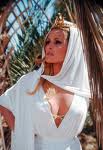
Ursula Andress As She
The ability to kill by telekinesis places a moral burden on Ayesha. If one agrees that the use of such a power may be necessary the question arises of when it may be misused. It would seem that the killing of a sexual rival was an inappropriate use, so the warring good and evil heads of her snake belt refers to the moral dilemma Ayesha faces.
Her belt seems somewhat different than that of Queen Meriamun of The World’s Desire. The latter having accepted the aid of the Ancient Evil was committed to evil being unable to remove the belt. There seems to be an element of volition remaining to Ayesha. She is not ‘possessed.’ Of course Ayesha began her life some thousand years after Meriamun so perhaps psychology was somewhat further evolved at that time or evolved with her over her two thousand year life span.
Indeed, a topic of discussion Haggard introduces shouldn’t be dimissed lightly. That topic is the age old discussion of whether good can come from evil and evil from good. This is indeed a dilemma as bad results can arise from good intentions and vice versa. There is a serious side here.
Ayesha is pure irresistable beauty. Once she shows her face no man can resist her. She glories in this power. In The World’s Desire of four years hence Haggard will separate good and evil making Meriamun represent evil while Helen, the world’s desire, is all good.
Holly is an interesting character who may be a back hand slap at the concept of evolution. Holly also makes this the story of a beauty and a beast. Holly is described as having a low forehead with a hairline growing out of his eyebrows, further his beard and his hairline meet. He is said to have a hugely broad chest and shoulders with extra long arms, perhaps down to his knees although this is not stated. What we have in Holly then is the Wolf Man combined with King Kong. Monstrous indeed.
In contrast Leo Vincey is a Greek god, a sort of Apollo. As Ayesha is irresistable to men Leo seems likewise to be irresistable to women. Indeed, he was married to Ustane within minutes of arriving in Kor. He appears to have sincerely liked Ustane even though on sighting Ayesha’s face he too loved her. Ustane was a rival for a portion of Leo’s affections so Ayesha cut off her electrical supply.
Of several truly dramatic scenes in this spectacularly well constructed story a very dramatic one is when Leo confronts his twenty-two hundred year old incarnation 0f Kallicrates. Haggard doesn’t dwell on Leo’s understanding of this strange phenomenon although from the potsherd and his father’s letter he must have been convinced of the truth. Strangely he doesn’t ask Ayesha for an account of this earlier life, nor how it was that she came to Egypt from Yemen to interfere in his romance with Amenartas.
Haggard and Lang were aware of the early history of Yemen from whence Ayesha as a pure Semite came. She was pre-Christian, although not pre-Jewish, of some ancient Arabic religious beliefs. How she got to Egypt is never disclosed or how she came into conflict with the Egyptian princess Amenartas for Kallicrate’s affections.
Ayesha, by the way the name translates as Life, merely confronts Leo as the neo-Kallicrates without any preparation. A year or so to get to know her and become accustomed to her face might have been nice. Although, Leo was married within minutes of arrival in Kor and was apparently satisfied with his wife. He was a pretty adaptable guy.
At any rate Ayesha rushes him into immortality and while tomorrow may be a long, long time, eternity is even longer. One might want to consider a moment about a relationship of that duration. Nor does she adequately prepare Leo’s mind for the ordeal of fire that she wants him to go through to become immortal. Twenty-two hundred years of waiting had done little to improve her patience.
Haggard has put everything he has into this story. He was granted clear vision only once in his life and he took advantage of it. In later years he was frequently asked why he didn’t write another story as good as She. His reply was that such a story may only come once in a man’s lifetime. The concentration and focus probably will never return again. While Allan Quatermain, his third successive attempt to create a lost civilization was on the weak side I would argue that his last, Treasure of the Lake, comes close to She.
So, the four of them set out for the place of the fire of life. Masterful effects. High in the mountains there is a gigantic balancing rock, a huge mushroom type cap balanced on a spire. It would seems that Zane Grey was also greatly affected by She as Riders Of The Purple Sage hews very close to She. A narrow ledge of rock extends out opposite with a gap of fifteen feet. To cross this gap with high winds howling through, a plank carried by the ever patient Job has to be lowered across the gap. No mean task I’m sure, with only one chance of getting it right. Once in place, thousands of feet above the gorge each has to walk from side to side; plus they have only a few minutes for all four to get over during a single beam of light from the setting sun.
Fortunately all four make it crossing the balancing rock to descend into a cave leading to the bowels of the mountain. There an eternal flame that ensures the life of the planet rumbles by every so often. Twenty-two hundred years before Ayesha had bathed in this fire which following esoteric doctrines had burned away her gross, earthly, moral impurities making her essentially, pure spirit.
A famous incident of the process is recounted of the goddess Demeter in her travels after the abduction of her daughter Persephone by Hades. Coming to Eleusis Demeter in her form of an old crone was taken in by King Celeus and his wife Metaneira. As a reward for her kind treatment Demeter set about to make their infant son Demophon immortal. Thus each night she held him over the hearth fire to burn away his mortal impurities. Surprised one night by a startled mother, Metaneira, the process was disrupted so that Demophon retained mortal impurities and failed to attain to godhood.
In this sense then the fire that maintained the life of the Earth traveled a route through this mountain at the center of the Earth. It appeared something like Old Faithful at Yellowstone periodically. When it swept by, if one stood in the flame it burned away one’s mortal impurities leaving one, it is to be assumed, wholly Spiritual. All the materiality was gone.
Spirituality and materiality are still being discussed today. Some talk of Spirit as though it exists while the materialists aver that all so-called spirituality is a seeming effect of materiality. I am of the latter school of thought. Oneself is all there is, there is nothing more. The effect of spirituality is nothing more than a mirage created by intellect and consciousness which is entirely material. It is all reduced to psychology which is a description of material existence.
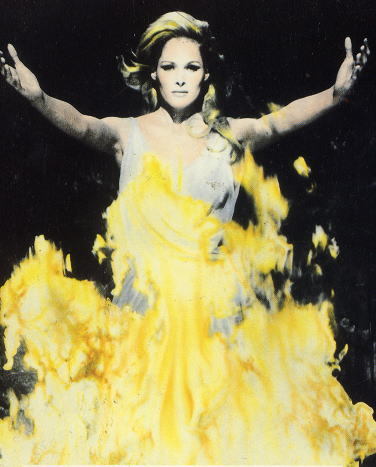
Come To Me
In Haggard’s story it is clear that Ayesha having lost her materiality to the flames is purely spiritual. This is going to cause her problems as she steps into the flames the second time.
The flame passes by while Leo dithers. Impatient for Leo to assume immortality Ayesha strips, as the flames will flame the material garments about her but not her body. As the flame comes around again Ayesha eagerly stands in its way. However having been once purified it is good for eternity. The second time is disastrous. Perhaps spiritually dessicated by the double dose Ayesha begins to wither devasted even in her death throes by her loss of beauty. Love in vain.
Job is so horrified he dies of fright leaving Leo and Holly alone.
The story for all intents is over but Haggard takes a dozen pages or so to get his heroes out of the caves and back to civilization.
Ayesha’s existence wasn’t extinguished. Her dying words were that She would return. Room left for the sequel which not surprisingly was called The Return Of She appeared in 1906.
Haggard hit the groove sharp as a knife in this incredibly well devised and executed story. One will find evidences of it strewn all through Burroughs’ corpus. Not least in his own character of La of Opar. La itself translates from the French as She, of course, so Burroughs even appropriates the name.
La is as ardent for Tarzan as She was for Leo/Kallicrates. Tarzan himself remains cold and indifferent to La throughout all four Opar stories finally abandoning her in Tarzan The Invincible.
She by Haggard is well worth three or four reads to set the story in mind and savor the wonderful and unearthly details
The End.
End of Review
A Review: Pt. III She by H. Rider Haggard
November 25, 2009
A Contribution To The
ERBzine ERB Library Project
She
by
H. Rider Haggard
Review by R.E. Prindle
Part III
The Gruesome, The Morbid AndThe Hideous
Rider Haggard was criticized severely by certain of his contemporaries for employing so many gruesome, morbid and hideous details. Indeed, ‘ She’ seems to be a study in the hideous, the gruesome and the morbid. If one concentrates on those aspects of the story one might actually question Haggard’s mental health.
Haggard himself calls attention to this morbidity. In King Solomon’s Mines he pointed out his humor with references to the Ingoldsby Legends; in She he makes a pointed reference to a Mark Tapley. I had no idea who Mark Tapley might be but thought I’d consult that most magnificent of encyclopedias, the internet. No problem. Mark Tapley was a character from Charles Dickens’ Martin Chuzzlewit. No matter how adverse the circumstances were Tapley was always cheerful and ebullient. Haggard must have thought him ridiculous. Thus he is devising a series of incidents that would bring even Mark Tapley down. Hmm. Interesting experiment.
It would seem then that Haggard was suffering from a fairly deep depression. In that sense She is sort of a horror story not too different in intent than, say, Bram Stoker’s Dracula. Indeed, at one point Ayesha explains that she rules by terror. That being the most effective way to control brutes like the Amahagger.
Certainly the storm at sea prior to entering Kor was an example of terror on the part of nature, a portent of things to come. Not least of these was the hot potting and projected cannibalism of the surviving member of the ship’s crew, Mohammed. ‘She’ had only required the safety of the Whites; as Mohammed was apparently a negrified Arab the Amahagger excluded him from the ban on Whites. An interesting example of White Skin privilege.
Their custom of killing their victims was to heat a pot red hot and turn it over on the victim’s head. There’s a gruesome and hideous enough example. You can see where Burroughs picked up his fascination for the gruesome and hideous.
The Caves of Kor are actually a city of the dead. Kor was an active civilization before Egypt existed in the fifth or sixth millennium BC. As embalming was a known practice when the Dynasties began c. 3400 the practice must have developed long before. Quite possibly it was practiced by the peoples of the Basin before the Mediterranean was flooded. In The World’s Desire Haggard mentions that the ancient Egyptians possessed writings in a precedent language. If so, how far back things like embalming go might be prodigious.
Egyptian embalming was primitive compared to that of the Korians. While Egyptian mummies became desicated the Korian process was such that the body was preserved forever in an apparent state of health. Thus bodies perhaps ten thousand years old or older had the appearance of freshness.
Now, this is positively creepy. Holly’s Amahagger attendent Bilalli while discussing Korian embalming told Holly that while he was a young man a particularly beautiful female corpse occupied the very slab on which Holly slept. Bilalli used to enter the cell and sit looking admiringly on the beautiful corpse by the hour. One day his mother caught him at it. The embalming fluid used was extremely flammable. Bilalli’s mother stood the body up and lit it. Like a huge torch the body burned down to the feet. The feet were still as good as new. Bilalli wrapped them and stored them beneath Holly’s slab. Groping around beneath the slab he brought out those ten thousand year old feet, still fresh, except for some charring at the ankles.
Haggard doesn’t stop there but goes on to emphasize the beauty of one particular foot. One wonders if perhaps George Du Maurier read She becoming entranced by the foot image thus reproducing the image in his novel Trilby when Little Billee draws Trilby’s beautiful foot on th wall. It is a thing Du Maurier would do as he inserted his literary baggage as profusely as Burroughs.
What effect this image had on Haggard’s contemporary readers may be guessed from the complaints about his gruesomeness.
In fact Haggard projects a depressed brooding evil permeating the Caves of Kor very well. This may have been caused by his and Lang’s theories of the Matriarchy. Human sacrifice was an integral part of the Matriarchal world. The sacrifices were invariably of men because women had greater economic value. When men were no longer sacrificed bulls, rams, the males of the species were substituted, the female still having greater economic value. Thus the story of Isaac and the Ram. That would be a great advance in civilization. About that time Isis ceased being the Egyptian symbol of the firmament being replaced by the female cow as the symbol of economics. Something like the kings of England sitting on the woolsack.
Depending on Haggard’s and Lang’s theories of the Matriarchy then Haggard may have been portraying a consciousness that has ceased to exist. There is always an element of misogyny in Haggard’s stories that is no longer tolerated. Then men were men and women were women instead of the attempted strange unisexuality of today. Thus the tens of miles of swamp between the Amahagger quarters and the citadel of Kor indicate the extent and quality of the Matriarchy. Swamps are the symbol of the female and the Matriarchy or, in other words, this very primitive superstitious consciousness.
The Korian swamp was haunted by mephitic vapors, evil smelling and oppressive. The ground they walked on was of uncertain solidity; it might look firm but this was only illusory as one could break through the crust. Often the litter bearers were walking through evil smelling muck up to their knees.
At one point an accident occurs and Bilalli’s litter with him in it is dumped into the slimy water. He would have drowned if Holly hadn’t leaped into the rank female waters to save him. They emerge looking something like the creature from the Black Lagoon.
It will be remembered that Holly was something of a misogynist. One may be stretching a point but even though rejecting women and marriage Holly managed to inherit a son from a man who was also a womanless widower. Haggard makes a strong contrasting point when he says that Leo was not averse to female company. The manservant, Job, is absolutely terrified of the female.
After traversing this desolate swamp of the female for days they arrive at the citadel or temple of Kor. Now, the citadel of Kor was built on an ancient lake bed that had been drained ten thousand years before. In that sense Ayesha is the same as Nimue or the Lady Of The Lake of King Arthur. Nemue lived at the bottom of a lake where she raised Lanclot who consequently was called Lancelot of the Lake.
Compare this also with Haggard’s postumously published Treasure of the Lake in which the Anima figure lives on an island in the middle of a lake in the middle of a volcanic crater. The lake of Kor was also in the middle of a crater.
When the Korian civilization was extinguished it wasn’t by invasion or other external reasons but by a monster plague something like the fourteenth century european Black Death that wiped out nearly everyone. At the resulting rate of death it wasn’t possible to embalm everyone so that tens of thousands of bodies were dumped into a huge subterranean pit.
In conducting Holly and Leo on a guided tour of Kor which was one gigantic necropolis, talk about depressing, Ayesha brings them to this pit. I quote:
Accordingly I followed (She) to a side passage opening out of the main cave, then down a great number of steps, and along an underground shaft that cannot have been less than sixty feet beneath the surface of the rock, and was ventilated by curious borings that ran upward, I do not know where. Suddenly this passage ended, and Ayesha halted, bidding the mutes return, and, as she prophesied, I saw a scene such as I was not likely to behold again. We were standing in an enormous pit, or rather on the brink of it, for it went down deeper- I do not know how much- than the level on which we stood, and was edged in with a low wall of rock. So far as I could judge, this was about the size of the space beneath the dome of St. Paul’s in London, and when the lamps were held up I saw that it was nothing but one vast charnel-house, being literally fullof thousands of human skeletons, which lay piled up in an enormous gleaming pyramid, formed by the slipping down of the bodies at the apex as others were dropped in from above. Anything more appalling than this mass of human remains of a departed race I cannot imagine, and what made it even more dreadful was that in this dry air a considerable number of bodies had become dessicated with the skin still on them, and now, fixed in every conceivable position, stared at us out of a mountain of white bones, grotesquely horrible caricatures of humanity. In my astonishment I uttered an ejaculation, and the echoes of my voice, ringing in that vaulted space, disturbed a skull which hd been accurately balanced for many thousands of years near the apex of the pile. Down it came with a run, bounding along merrily towards us, and of course bringing an avalanche of other bones after it, till at last the whole pit rattled with their movement, even as though the skeletons were rising up to greet us.
Talk about a holocaust! Imagine standing in that dimly lit space far beneath ground, in the grave itself so to speak,and viewing that. Holly was overcome and perhap Mark Tapley himself would have lost a little of his cheeriness. If that didn’t do it the ball Ayesha threw would have.
Before I move on to that though let’s take a penultimate example that might actually unsettle Mark Tapley. This is truly unsettling with truly macabre and voyeuristic soft porn details that are quite remarkable. Let me say that it is only with the fourth reading that the horrific nature of these details really began to sink in. I hope to really make this clear in the next section in which I intend to do an in depth analysis of Ayesha.
In his cell at the citadel of Kor Holly notices a cleft in the wall he hadn’t noticed before. This cleft is going to lead him to Ayesha’s sleeping room. This is not unlike King Solomon’s Mines in which upon entering the symbolic vagina they were led to the womb or treasure box. As I say Holly entered this cleft, let your imagination dwell on that, and followed a dark, dank, narrow corridor until he perceived a light.
He is looking into Ayesha’s sleeping room where in a certain deshabille, very erotic, she is addressing a covered form on a bier next to hers. This is the embalmed body of Kallicrates who she murdered twenty-two hundred years before. So she has been sleeping with this corpse for twenty-two centuries. Now, dwell on that for moment, let the horror of it sink in.
She addresses the corpse in a fairly demented way. Twenty-two hundred years of this would drive anybody nuts. Finally to the dismay of Holly she animates the body by telekinetic powers actually causing it to stand zombie like so she can kiss and caress it. A lot of necrophilia in this novel. Haggard must have been half dotty when he wrote this. Of course Kallicrates is a double of Leo so Holly has all he can do to keep from crying out. Causing the dead man to lay himself down Ayesha covers him and blows out the light.
Holly has to find his way back in the dark reminding one of innumerable passages in Burroughs where his characters have to find their way in the dark. Holly gets only so far and collapses in the tunnel. Waking he sees a light coming in from his cell allowing him to find his way back.
And then Ayesha throws her ball. If you’ve read carefully and really ingested these macabre, gruesome, and as Burroughs’ would say, hideous details they’re beginning to oppress your mind, perhaps even a mind like Mark Tapley’s.
Now Haggard trundles out the frosting. To illuminate her ball Ayesha brings out piles of ten thousand year old corpses placing them around the perimeter as human torches. Laying out a large bonfire the corpses are stacked alternately like so much cordwood and replaced as they were consumed. Remember these are as fresh looking as you or I. The Roman emperor Nero actually used live humans in the same manner. Haggard notes this in the text which I thought weakened the effect.
Ayesha seems to be aware of the effect, indeed, intended it and appears to relish the reaction.
These are the high points of these horrfic details. Minor ones are constant so that the cumulative effect leading up to the terrific images of the demise of Ayesha, temporary though it might be, is overwhelming. But about She, Ayesha, in the next part.
A Review: Part II She By H. Rider Haggard
November 20, 2009
A Contribution To The
ERBzine ERB Library Project
She
by
H. Rider Haggard
Review by R.E. Prindle
From London To The The Caves Of Kor
She is dedicated to Andrew Lang:
I Inscribe This History To
ANDREW LANG
In Token Of Personal Regard
And Of
My Sincere Admiration For His Learning
And His Works
One may well ask then who is this Andrew Lang and what is his learning? In point of fact Haggard not only dedicated She to Lang but wrote three books in collaboration with him. Andrew Lang, 1884-1912, was a Scottish scholar specializing in folklore, mythology and religion so you can see where Haggard came by much of his esoteric knowledge. In addition Lang was one of the founding members of the Society For Psychic Research and a past-President. Lang wrote dozens of books over his lifetime. He even wrote a parody of She in 1887 called He. Today he is remembered only for his collections of fairy tales. Twelve volumes in all each titled after a color such as The Crimson, or Blue or Pink or Gray Fairy Book. The volumes are undergoing a fair revival now with a collector’s edition published by Easton Press and several nicely bound volumes by the Folio Society.
The nineteenth century was the one in which advanced knowledge of the past was rapidly extending European knowledge greatly. The Rosetta Stone deciphering Egyptian hieroglyphics had been achieved as recently as the 1830s. Nineveh and the Assyrian ruins had been unearthed. Schlieman had discovered the locations of Troy and Mycenae.
The exoteric side was covered by the academics while the esoteric side was covered by independent scholars like Madame Blavatsky and probably Andrew Lang. There was a clean split between the academic Patriarchal view of ancient history and the emerging Matriarchal view that had just been developed by the Swiss mythologist, J.J. Bachofen. Bachofen organized ancient history into Hetaeric, Matriarchal and Patriarchal periods. He himself was a member of the successor Scientific period.
The academics totally rejected the notion of a Matriarchal period. This, of course, led to a complete inability to understand Homer, both Iliad and Odyssey. The Iliad especially is a description of the war by the Patriarchy to destroy Matriarchy.
Lang seems to have understood the Matriarchal phase of ancient history. He must have passed this knowledge on to Haggard. Ayesha, as She, rules a Matriarchal society. While the ideas represented in She must have seemed bizarre or merely an amusing reversal of the Patriarchal world at the time, today it all reads comprehensibly. It rings true if not exact.
C.G. Jung, the psychologist, who developed such notions as the male Anima and the Shadow was very immpressed by what he saw as the male Anima in She. Madame Blavatsky lauded the book for its esoteric content. But then, Haggard was firing on all eight cylinders when he wrote it, it is difficult to conceive of a more perfect fantasy/adventure novel. Indeed Haggard subtitles the novel: The History Of An Adventure.
Haggard was an excellent Egyptian scholar. He not only visualized Egypt convincingly in his Egyptian novels but his Egyptian ideas pervade the African novels. Many of them involve Egyptian influences and even peoples filtering down into East and Central Africa. The Ivory Child is a case in point as is She.
The set up to the trip out is brilliant incorporating details that become cliches in B movies.
Leo Vincey’s father before he died gave a metal box to Leo’s guadian, Horace Holly, that wasn’t to be opened until Leo was twenty-five. This box is now opened. It contained a letter to Leo, a potsherd (a piece of a broken jar) covered with ‘uncial’ Greek lettering, a miniature and a scarab containing Egyptian hieroglyphics that read ‘Royal Son of the Sun.’
Thus Haggard captured most if not all of the elements that went into the intellectual aura fostered by B moves primarily in the first years of the talkies through the thirties. That entailed things like the Curse of the Pharaohs, movies like The Mummy melding into Wolf Man, Dracula, Frankenstein and African juju spells. Things against which Europeans had no defense because the ancient magic was stronger than modern science, or so we were led to believe. I can’t speak for others but it took me a while to shake this oppressive spirit. This was pretty strong stuff for my ten to twelve year old brain. Not to mention being bombarded by The Creature From The Black Lagoon, The Thing and The Day The Earth Stood Still. We wuz tried in the fire and come through good.
The gist of it is that Leo’s ancestor Kallicrates lived in the time of the last Pharaoh Nectanebo as one of the royal family. Spookier still Nectanebo was said to have fled Egypt before the conquering hordes, going to Macedon where he secretly impregnated Olympia, Philip’s wife, who then gave birth to Alexander which made him the rightful heir to the Pharaohship instroducing Greeks as rulers into his city of Alexandria.
At any rate Kallicrates girl friend, Ayesha, killed him in a jealous rage. The family nursing vengeance for all these two thousand years it is Vincey’s mission if he chooses to accept it, to follow the ancient map to the Caves of Kor and kill Ayesha or, She-Who-Must-Be-Obeyed who has been nursing regrets over killing Kallicrates two thousand years previously. Listen to me, I’m tellin’ ya it’s all here.
So Vincey, Holly and their man Job set out to find this place in Africa even more remote, if possible, than King Solomon’s Mines. And a heck of a lot more hostile too.
The trip out is some of Haggard’s finest writing. They are to be looking for a rock formation on the coast in the shape of a gorilla’s head. Sailing the coast they miraculously spot this head just as a terrific squall sends their felucca, dhow or other exotic ship from foreign climes to the b ottom.
But, even though the ship sinks they beat the reaper because they brought a boat containing unsinkable water tight compartments. As the storm subsides the three survivors along with an Arab float into the mouth of the appropriate stream as though it were all foreordained. What follows is some excellent writing with details I don’t need to recount.
Suffice it to say they are dragging their boat along an ancient canal when they are accosted by men from Kor. Ordinarily these guys would have speared them and moved on, no strangers needed in Kor. Using her magic She had learned of Leo’s coming a week previously thus ordering their lives spared while they were to be brought to her. Uh huh.
The detailing is terrific, this book is tight and well organized. It moves right along. The land is under the thumb of She-Who-Must-Be-Obeyed. This is a tight Matriarchy as we now recognize not just some strange place where a woman is in charge.
While the three are entering the Caves of Kor, Leo Vincey, being the cynosure of all female eyes, a knockout named Ustane steps up and kisses him. Not averse to a public display of affection Leo lays one on her back. New to the area and not aware of the customs of the place Leo had just accepted Ustane as his woman. In town for a few minutes and already married. That’s the way things happen in this particular Matriarchy. Ustane is now in conflict with Ayesha, She-Who-Must-Be-Obeyed.
The stage is now set for the main drama when Ayesha recognizes Leo as her long lost Kallicrates come back from all those reincarnations at last.
The exoteric Catholic Church is thus thrust aside in favor of all the heretical doctrines of the esoteric which have been bubbling under the Hot 100 for two thousand years. These unfamiliar esoteric doctrines would become the mainstay and staple of science fiction/fantasy for the next one hundred years.
Just as an example of how Burroughs probably learned esoterica, I became familiar with estoeric themes myself from reading 1950s science fiction and fantasy- Amazing Stories, William Tenn, Robert Heinlein, Ray Bradbury and all that sort of stuff without realizing what I was taking in, thus Burroughs surrounded by the Society for Psychical Research, Camille Flammarion, George Du Maurier and Stevenson et al. naturally learned the esoteric language. No mystery, he was speaking in tongues before he knew it.
Leo is awaiting the summons from Ayesha which will be covered in Part III.
Part I A Review: She By H. Rider Haggard
November 17, 2009
A Contribution To The
ERBzine ERB Library Project
SHE
by
H. Rider Haggard
Review by R.E. Prindle
Part I
The Framing Device

From eighteen eighty-five to two thousand nine is one hundred twenty-five years. The span records many changes. In 1885 there were no movies, no radio or TV. Movies came in c. 1900 beginning to change the literary paradigm. The movies produced a definite class structure in literature. With the introduction of sound in 1927-28 two classes of film developed. A movies and B movies. A movies employed A or literary fiction such as War And Peace, Oliver Twist and such while the developing fields of genre fiction were reduced to an inferior B status.
Time has erased the meaning of the terms A and B pictures. I suppose that if a younger person was told that he was watching a B movie he wouldn’t know what was meant. Even if a devoted movie buff, the mere classification would have no experiential significance. You had to have been there.
In the development of the film industry it was thought that studios had to have their own theatre chains. Thus MGM movies wouold be shown only at Loewe’s first run theatres and so on.
In those glory days of the movies first run theatres were gorgeous temples, often named The Temple, the Roxy in NYC has the most spectacular reputation. The goal of the studios was to produce 52 A movies a year to supply the ‘exhibition’ chain a new first run A film a week. Only MGM was to reach this goal.
Once having been exhibited for its week or period A movies were released to rerun theatres usually outside the chains where they were shown at reduced prices. As an added incentive a second feature was shown and this was a B movie.
We lucky kids who inhabited Saturday matinees every week year around usually got two B movies and selected short subjects which included previews, a serial, a cartoon, a newsreel, and some sort of film usually a travelogue on deep sea fishing or water skiing matter. These comprised an alternate reality in addition to real life and dreams. Nor did we feel shorted by B movies. To our young minds these movies were fraught with the most profound thoughts imaginable. Hopalong Cassidy and Tarzan were the favorites of most kids- Gene Autry, Roy Rogers a distant second to Gene. Unbeknownst to us of course the literary granddaddy of the B movie was H. Rider Haggard and She.
Not that Haggard movies were shown with any regularity but he managed to anticipate all the elements of B movies to perfection. Many if not most of the key elements of B moviedom were pinched from Haggard. What Haggard didn’t provide was tossed in by his disciple Edgar Rice Burroughs.
Burroughs borrowed his use of the framing device from Haggard probably with the frame of She as his model. The framing device of Tarzan Of The Apes shows emulation of that of She. It’s a good one.
Most writers of these tall yarns wanted the reader to believe he was reading a true story, in other words, an invitation to suspend disbelief- that is, everything fits in so he divised a framing story as persuasion.
The first paragraph of She’s preface is perfection of its kind:
In giving to the world the record of what, considered as an adventure only, is I suppose one of the most wonderful and mysterious experiences ever undergone by mortal man, I feel it incumbent on me to explain my exact connection with it. So I will say at once that I am not the narrator but only the editor of this extraordinary history, and then go on to tell how it found its way into my hands.
If one compares that to the first paragraph of Tarzan Of The Apes the similarities become immediately apparent. Both authors claim no authorship. In both cases the story, or history, was given to them by a second party. Thus Haggard the author as editor can speak in the first person while making editorial comments.
The hint is made that Allan Quatermain is the actual editor. The editor was visiting Cambridge University one day some twenty years previously when he noticed two interesting people. His friend knowing them offered to introduce him.
“All right,” answered my friend, “nothing easier. I know Vincey; I’ll introduce you,” and he did, and for some minutes we stood chatting- about the Zulu people, I think I had just returned from the Cape at that time.
So the canny reader hopefully having read King Solomon’s Mines can infer that the unnamed editor is, in fact, Allan Quatermain as a garrulous amiable gentleman.
Twenty some odd years after that casual and very brief meeting, as improbable as it may seem, one of the two men, Vincey’s guardian, Horace Holly sends the Editor the text for She.
Holly says: ‘You will be surprised considering the slight nature of our acquaintance to get a letter from me.’ I should say so. What a great memory.
Holly goes on:
I have recently read with much interest a book of yours describing a Central African adventure. I take it this book is partly true, and partly an effort of the imagination. However this may be, it has given me an idea. It happens, how you will see in the accompanying manuscript (which together with the scarab, the ‘Royal Son of the Sun), and the original sherd, I am sending you by hand) that my ward, or rather my adopted son Leo Vincey, and myself have recently passed through a real African adventure, of a nature and much more marvellous than the one which you describe, that to tell the truth I am almost ashamed to submit it to you but you should believe my tale.
So Holly sees through Quatermain’s preposterous story as only half true while Holly’s equally preposterous story is the whole truth, the real thing. Well, if you’ve accepted the premiss there’s no way to go but further in so, all one can say to Holly is that his story is going to have to go some to exceed Quatermain’s.
Generously Holly offers any profits from publication as a reward while underwriting any possible loss. That was real Haggard accepting that bundle on Quatermain’s part.
Rounding out the baloney the editor says:
Of the history itself the reader must judge. I give it to him, with the exception of a very few alterations, made with the object of concealing the identity of the actors from the general public, exactly as it has come to me.
As a reader my judgement is that it is an excellent whopper but I don’t believe a word- or do I?
The frame continues:
With slight [five pages] preface, which circumstances make necessary, I introduce the world to Ayesha and the Caves of Kor.
Ready when you are, C.B.
An excellent, convincing framing device. The Editor must be Allan Quatermain yet the name of the editor is concealed from us as well as the identities of the actors. Where we are going is mystery piled on mystery, the strange and wonderful lie before us, we in complete safety.
So with Burroughs framing device of Tarzan Of The Apes. While not copied word for word certainly idea for idea. The influence of Haggard is apparent but not paramount. Burroughs’ mind was a maelstrom into which innumerable influences (a slight exaggeration) are drawn to the depths of his subconscious and emerge melded into something so close and yet so different than his many, many sources.
Having roped the reader in like a carnival barker luring the victim into his peep show Haggard begins to lay out his nearly perfect story of the type.
Part B follows.
 I, Dynamo