Edgar Rice Burroughs And The Ben-Day Dots
December 21, 2014
Edgar Rice Burroughs And The Ben-Day Dots
by
R.E. Prindle
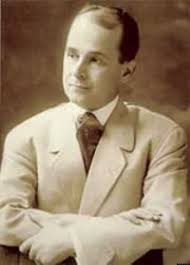
Winsor McCay
Over the years I have come to wonder why Tarzan was such an immediate success. The premiss on the face of it is absurd. While fascinating it requires such a huge suspension of disbelief as to be staggering. Perhaps that is why such a significant percentage of his contemporary readers were revolted by ERB’s work. He had to put up with a tremendous amount of abuse although his acceptance was greater than his rejection. Something had to prepare the way for that acceptance nevertheless.

Little Nemo
The discovery of the unconscious that became prominent in the second half of the nineteenth century certainly opened the way for the strange and bizarre. It is not a coincidence that spiritualism and the paranormal became prominent at that time. Along with those came the rise of science fiction and fantasy. Tarzan is fantasy fiction while the Mars series of Burroughs is fantasy sci-fi.
Monsters like Dracula and Jekyll and Hyde established themselves in the popular imagination. Anthony Hope’s Prisoner of Zenda and the Graustark knock off by George Barr McCutcheon entranced ERB to the point of distraction. Jules Verne, of course, and the Oz stories of L. Frank Baum. When it came to the Mars stories ERB was merely the best exemplar of what by 1911 was an established genre.

Little Nemo
The public mind was being softened to accept not only the incredible but the impossible.
Printing improvements made both half tone and color illustration less costly and easier to produce. Is it any wonder that ERB’s period is one of astonishing illustrators. Remember that ERB tried to be a cartoonist himself before he took up writing. His goal was judging from his drawings to be a political cartoonist.
Thus one can only presume he followed book illustrators avidly. Arthur Rackham was knocking them dead while Denslow’s and John R. Neill’s Oz illustrations must have wowed the envious Burroughs. N.C. Wyeth must have blown his mind.
More importantly than the book illustrators though were the emergent four color Sunday Funnies of the newspapers in 1895. They were so exotic and strange even in my childhood but at the time they must have seemed incredible. Of course I had no idea what made them seem exotic. In fact, I had never heard of Ben-Day dots until the fabulous personality posters of the Sixties exploited them.
According to Wikipedia on the subject:
The Ben-Day printing process, named after illustrator and printer Benjamin Henry Day, Jr., is a technique dating from 1879. Depending on the effect, color and optical illusion needed, small colored dots are closely spaced, widely spaced or overlapping. Magenta dots, for example, are widely spaced to create pink. Pulp comic books of the 1950s and 1960s used Ben-Day dots in the four process colors (cyan, magenta, yellow and black) to inexpensively create shading and secondary colors such as green, purple, orange and flesh tones.
The Sunday Funnies thus must have had an astonishing effect on contemporary minds. As the comics Bill Hillman has reproduced on his site, ERBzine, indicate ERB was an avid follower of the genre. His earth borer used by David Innes in the Pellucidar series was most likely cadged from a comic strip.
Seeking relief from those long weary job hunting days of the first decade ERB sought relief by hanging around the Chicago Public Library. He was a card carrying member too. Who knows what volumes he borrowed or browsed through on the spot. The Library would have had its racks of the country’s newspapers on display including those of NYC. Thus ERB would have been familiar with the comic strips of Winsor McCay, The Dreams of the Rarebit Fiend and Little Nemo in Slumberland. Himself an avid dreamer, very familiar with nightmares, ERB must have relished McCay’s work.

Little Nemo
As it so happens McCay’s two most famous strips have a prominent place in the history of comics. In fact, just recently the Taschen Publishers issued a one volume complete collection in four color Ben-Day dots of the Little Nemo strip. At a size of 20 x 14 the strips are magnificently displayed. The accompanying 150 page text by Alexander Braun is a wonderful history of the period pointing out many developments that undoubtedly influenced ERB forming a background to his writing. Braun has a touch of genius too. Many strips of the The Dreams of the Rarebit Fiend are included in the ancillary volume, some full page.
The Rarebit Fiend strip began a little earlier than the Little Nemo strip of 1905. Thus both strips were running during 1905-09, the period of ERB’s deepest despondency. I will show how both strips are reflected in ERB’s writing.
To take the Dreams of the Rarebit Fiend first. Rarebit refers to the culinary dish Welsh Rarebit frequently referred to as Welsh Rabbit. The dish is simply melted cheese on bread although it can be a fondue. In the strip the dreamer overeats before bedtime producing a nightmare. The dreamers are all different while some of the nightmares are quite astonishing.
Burroughs’ emulation appears in Jungle Tales Of Tarzan in the story Tarzan’s first nightmare in which Tarzan overeats having the subsequent nightmare. My first reaction to the story was that Burroughs had been reading Freud’s Interpretation of Dreams. While he may have been I think McCay’s strip was a stronger or more immediate influence.
The Little Nemo in Slumberland influence appears in ERB’s first serious effort, Minidoka, put in a drawer and not published until 1998 by Dark Horse Comics.
The consensus seems to be that Burroughs wrote this short work c. 1905. The reasoning seems to be that because Burroughs wrote the story on stationery from this period that that proves it was written at that date. However ERB was an inveterate collector, read packrat, until he says he overcame the disease in the early twenties. So he says. So ERB was reluctant to throw anything away. The stationery proves nothing.
I have maintained that ERB wrote Minidoka c. 1908-09 based on internal evidence. We can now add the evidence of Winsor McCay’s Little Nemo in Slumberland strip. As the title implies this strip also revolves around dreams. It has a haunting surrealistic feel filled with strange characters and dream effects.
As I say, ERB haunted the Chicago library from 1905 to 1911 when he began writing The Princess of Mars. Thus he would have heard of the strip which was quite famous while following it at least periodically.
Minidoka reflects a Little Nemo quality. Little Nemo would then have been the catalyst that got Burroughs writing as he tried to emulate it in prose. As usual ERB combines a multitude of influences. He even states that the work is written in Ragtime Talk which meshes quite well with McCay.
Minidoka in itself can qualify as surrealistic before surrealism as does Mccay. That would not be extraordinary as the period from, say, 1880-1910 had a unified outlook not unlike the Sixties music scene when all bands played around a central motif.
As the work couldn’t have been written without McCay influence that places its probable composition date firmly in the 1908-10 range.
I heartily recommend the Taschen Little Nemo as an example of the current bookmaker’s art as well as for the astounding work of Winsor McCay. This rather astonishing video is available demonstrating McCay’s drawing expertise while showing him as the film creator of animation. He not only influenced Burroughs but Walt Disney said his own work would not have been possible without McCay.
A 1998 Japanese made movie called Little Nemo’s Adventures In Slumberland is available on Netflix. Ray Bradbury, no less, provided the story line.
https://www.youtube.com/watch?v=kcSp2ej2S00 There are numerous other videos too.
Henry Ford And Albert Lasker
December 17, 2014
Henry Ford And Albert Lasker
by
R.E. Prindle
Gunther, John: Taken At The Flood, The Story Of Albert D. Lasker, 1960, Harper, NYC
Hoover, Herbert: Memoirs Of Herbert Hoover: The Great Depression 1929-1941, 1952, MacMillan Company, NYC
Weir, Alison: Against Our Better Judgment: 2014, Self-published.
Schmidt, Sarah, The Parushim: A Secret Episode In American Zionist History, http://ifamericansknew.org/history/parushim.html
Tugwell, Rexford: The Brains Trust, 1968, The Viking Press, NYC
Woeste, Victoria Saker: Henry Ford’s War On The Jews And The Legal Battle Against Hate Speech, 2012, Stanford U. Press, Palo Alto
In 1924 Harold Gray sat down and drew the first panels of his new comic strip. A comic strip that outlived him. Yes, Little Orphan Annie made her first appearance in the newspapers. It was in 1948 that I spread the newspaper out on the floor and made my acquaintance with the little orphan girl and her dog Sandy. I myself had just gotten out of the orphanage so there was an instant bonding.
I hadn’t been reading the strip for too long before the most fascinating character of the comics ever made his appearance. Daddy Warbucks stepped on stage. Warbucks, what a name. Did he make his incredible fortune making munitions in WWI? If so, it was only implied.
Warbucks was tall and slim, supremely confident with an incongruous joyish attitude. I mean this guy killed people who got in his way as a matter of course. Imagine trying to reconcile murder with business as usual in a young boy’s mind. He had his own private army with two killer sidekicks. The sinister looking Asp and the jovial giant East Indian, Punjab. If your transgression was mild Punjab waved his cape over you and you disappeared. If you made Warbucks angry The Asp pulled out his stiletto and you heard a splash. The Asp always killed near water. Daddy knew how to manage his affairs.

The Dangerous Duo
Warbucks was fabulous. He had his own grotto where he moored his own private submarine. He had unlimited cash so he was able to maintain his own secret service. I wasn’t aware enough then but now I think that Daddy Warbucks was modeled on the great industrialist Henry Ford. Henry didn’t have a submarine, but he owned a fleet of Great Lakes ore ships, sort of his own personal navy, with a big F-O-R-D blazoned on the sides you could read a mile or more away. He even had his own personal river up which his ships delivered the ore from his own personal iron mines.
His estate was upstream a bit on the River Rouge, his river, just above the incredible turn around basin he dug so his ships could go back out on the lakes to pick up more iron ore to keep his Model Ts chugging out the other end of the most astonishing factory in the world. One time he unloaded the ore into his huge River Rouge factory and 24 hours later a brand new Model T rolled out the other end. Daddy Warbucks had nothing on Henry Ford.
While the rest of us had to settle for our little electric train sets Henry owned his own personal real life railroad, locomotives, cars and all, real smoke. Henry was pictured sitting on the coal from his own mines in his own coal car playing the harmonica as he chugged on down the line. How cool was that?
Better yet, like Daddy Warbucks, he had his own secret service, the Service Department of Ford Motors led by his own intrepid Edgar Hoover, Harry Bennett. I’m tellin ya, that guy Henry was on the spot, heck, he was the spot. During the twenties he needed a secret service what with kidnappers, bootleggers, the Jewish Purple Gang, the Italian Mafia, and numerous other free lancers going around, labor fanatics waving bombs in the air, it paid to sniff things out.
Shots flying here and there, rough times in Detroit City. All Henry wanted to do was make his cars, not battle in a war zone. And then when the Jews began to war with him he sent his force out to gather incriminating evidence of their activities against him.
Of course the Jews reviled him for defending himself with his Service Department although of course they had no room to talk being awash in paramilitary and terrorists groups themselves. They even had their own personal shadow government conspiring for a quiet takeover of the country. Henry took them a step further pointing out that they had an international government working toward a takeover of Europe and the Americas. He was right too.
2.
All US histories have excised the Jewish influence on politics and social affairs. To mention them is to be defamed as an ‘anti-Semitist.’ Jewish histories written by Jews for Jews are quite explicit. They are seldom read either by Jews or gois. Copies are sent free to libraries however they are seldom and quite often never checked out, even have the presentation slips inside. If they are read they tell a clear tale of Jewish activities.
In point of fact there was and is an international Jewish government.
In the nineteenth century the government was run from France by the Alliance Israelite Universelle. During the first years of the nineteenth century the US was disregarded as a fledgling country while the ocean transit was difficult in small sailing ships. However as the century progressed the country blossomed, large capacity steel ships replaced the wooden ones and failed revolutions like that of 1848 displaced Jews sending them to the US. With the industrial development after the Civil War it was realized that Jewry could be more effectively directed from the US with much better security. Hence beginning in the 1870s the European Jewish population began to be transferred to the US while in 1898 the Alliance Israelite Universelle was shipped from Paris to New York City transferring the Jewish world capital to the latter city. International Jewish activities began to multiply.
A big one was the International Order of B’nai B’rith in the US. It was organized in 1843 but having branches throughout Europe by 1900. The Vienna branch was a key lodge as it was joined by Sigmund Freud in 1895. He remained a lifelong member. Freud was beginning his psychological career at that time. Nineteen years later his system of psycho-analysis was the standard of the emerging discipline.
His influence on world affairs through his association with B’nai B’rith would be increasingly felt throughout the twentieth century. He was essential to forming the Jewish ideology through the death of Roosevelt in 1945.
Now, the Jews had been awaiting a messiah to redeem them for two thousand years. The last bona fide messianic candidate, Sabbatai Zevi failed them in 1666. Unwilling to place their hopes in a single individual the Elders then evolved the notion that the Redemption would come from the whole people. The years set for the Redemption or Jewish Revolution were from 1913 to 1928. As Ford understood, the events in all countries of Europe and North America were coordinated. The two key events of the plan were the assumption of the control of US currency in 1913 through the creation of the Federal Reserve and the Bolshevik Revolution in Russia of 1917. Both countries were seemingly secured although the US Redemption was about to be consummated but was aborted by FDR’s death in 1945.
The history of the Jews in the US from 1900 to 1945 then is the progression or realization of their goal. The first key event of their plan was the fortuitous election of Woodrow Wilson in 1912. Had Theodore Roosevelt not split the Republican vote by his Bull Moose third party candidature William Howard Taft would have been reelected and the Republican program perfected.
As it was the American public clearly did not want Wilson as President as his vote was half that of the combined Roosevelt-Taft total. He got in by a fluke proceeding to begin elaborating a socialist government he called the New Freedom. His administration was a virtual partnership with the Jews who assumed a position of power in his government through 1920.
One of the first acts Wilson performed in 1913 was to sign into law The Federal Reserve System. In recent years it has been publicized to an increasing extent that the Federal Reserve is not an agency of the US government; it is a private corporation wholly owned and operated by nine international Jewish banks in both the US and Europe with a Rockefeller interest being the tenth thus forming a minyan.
The US monetary affairs had previously been managed by the J. P. Morgan interests also from NYC. The Jews thus switched that responsibility from the Morgans and also beyond the control of the US president who had no authority over it or influence on it. When the Fed engineered the Crash of ’29 Herbert Hoover the president bitterly remarked that the Fed had been placed outside of governmental and presidential control specifically to prevent such debacles while guaranteeing that under the Fed they could never again happen. Woody blew it there, bless the Democrats.
In preparation for WW1 the remaining components of the Jewish government were transferred from Germany to the US.
Now, the Federal Reserve is responsible for the currency of the US so that the Fed actually issues the currency then loans it to the government, that is the citizens, for their use at interest. Thus the Jews earn interest on every dollar in circulation. As the currency standard for the world you will understand how many trillions are now out at interest. At the time the upcoming war would expand the currency in circulation exponentially thus providing huge interest to the Jews. This is a key point because Jewish activities during the redemption would require more money than the Jews could ever have raised on their own. While so-called Jewish charity did raise a few millions that was nothing compared to their financial needs. Remember the Jews were supporting dozens of committees and congresses such as the American Jewish Committee at enormous expense as well as hundreds of synagogues along with their rabbis
Organized crime provided huge sums while Prohibition was a positive godsend. All those criminals are buried in consecrated ground. Today a museum in Las Vegas has been built to enshrine the activities of Jewish criminals. No stigma attached.
Organized crime was important to the Jewish program but so were legal activities. Thus it was that in 1916 Wilson appointed Louis Brandeis to the Supreme Court of the United States. This was a break with the past as formerly the court was all Anglo. As imperfect as his appointment was, the fact that Brandeis was a Zionist was even more important. Zionism was and is in conflict with what was then the American system now almost completely eroded.
Perhaps it was not known to Wilson that Brandeis had the dual identity, or perhaps he did and was complicit. An objector to Brandeis’ appointment described him as ‘a man who had certain high ideals in his imagination, but who is actually unscrupulous in reaching them.’ What the objector was describing is what is known as a justified sinner; that is one who is ‘saved’ in Christian terms at birth and thus can be as unscrupulous as he likes to satisfy his desires without sacrificing his guaranteed redemption. The objector might as well have been describing the whole Jewish belief system, essentially the end justifies the means.
The drum roll began to establish a reputation for Brandeis as the greatest living jurist and the purest man alive. Actually Brandeis was a ringleader of both Zionism and the Jewish Revolution. Using his status as a Supreme Court justice one of the first things he did was buy a professorship at Harvard for his lieutenant Felix Frankfurter. The drum roll then began to portray Frankfurter as one of the wisest legal scholars backed by his professorship at Harvard.
Thus he and Brandeis became two secular saints of both societies.
Frankfurter then began recruiting a cadre of acolytes to further Jewish objectives. Over the next twenty years Frankfurter assembled the cadre that became important when Roosevelt brought the Jews back to DC. No sooner installed than Frankfurter filled the Dept. of Agriculture with his acolytes. Thus in one fell swoop he completed the program fostered by Aaron Sapiro that was temporarily frustrated by Henry Ford from 1924-27.
A key event in the establishment of Jewish supremacy was the trial of Leo Frank from 1913-15.
3.
The Leo Frank Affair
The Leo Frank affair is a very important event in the Jewish calendar. They never tire at bringing it up while it had long ranging repercussions.
For those unfamiliar with the story Leo Frank was a Jewish businessman living in Atlanta Georgia. While his personal life is carefully avoided he is depicted as a Jewish secular saint who never did nobody no harm. Contrarily he was described as a sexual pervert. He employed young girls to make his pencils. By young girls we are talking child labor, pre-pubescent and pubescent. So our secular saint was exploiting young children to line his pockets. The temptation of all those young girls may have been too strong for his resistance. On this occasion he called fourteen year old Mary Phagan to the factory on a Saturday when he was alone in the office, all others being absent, to pick up her paycheck. Probably the amount was 1.86 or some such ridiculously low figure as that.
None saw Mary pick up the check obviously, but she was discovered in the basement on Monday murdered. Frank tried to pin the crime on a Negro janitor. Of course there was no hard evidence as to who had committed the crime but Frank was condemned as the perpetrator.
Why call the girl back to get her paycheck on Saturday after all the others? Frank was tried in an American court of law and found guilty. Louis Marshall, president of the American Jewish Committee, considered the conviction and death sentence as an anti-Semitic act somewhat like the blood libel. Frank had been convicted solely because he was a Jew in Marshall’s eyes. Marshall then began to organize a committee to free Frank.
Marshall was the president of the AJC, the AJC was the most important Jewish organization at the time as it is now. It has always kept a low profile or semi-secret existence. My wife’s aunt who was very active in Jewish affairs and the civil rights movement had never heard of the AJC until I told her about it which I find stunningly remarkable.
Mr. Marshall was a lawyer as well as president of the AJC. In his lawyer guise he frequently accuses opponents of being ignorant of the law, yet on page 295 of his Champion of Liberty he says ‘…I am morally convinced that the young man is innocent.’ I have no idea what legal standing being morally convinced of innocence is but I rather imagine, slight.
On p. 297 he writes: It is desirable to eliminate from consideration of the case, that Frank is a Jew. The important thing to consider is, that he was a respected industrious, law-abiding citizen…’
The question is a legal one not a question of the status of Frank’s reputation. In fact there was some question as to whether Frank was a sexual pervert. Certainly his desire to be alone with Mary in his factory, a poor defenseless very young girl, might tend to confirm the opinion. I am morally convinced this was so.
Marshall sets the wheels in motion in his attempt to reverse the conviction. In his reply to the letter from Judge Irving Lehman he further goes on to write, p. 295: “Obviously it would be most unfortunate if anything were done in this case from the standpoint of the Jews. Whatever is to be done must be done as a matter of justice and any action that is to be taken should emanate from non-Jewish sources.”
So, Mr. Marshall is falsely going to act on justice rather than the fact that Frank is a Jew. He is going to conceal the fact while getting non-Jewish persons to front for him. He apparently believes that if Frank were not a Jew the murder would be let drop. On the other hand he seems to feel that Frank has been convicted solely because he is was a Jew not a rapist murderer. Apparently overlooking the dead child he believes a Christian would never have been convicted. Thus it is not a matter of justice but a question of the religion of the murderer but we’re not going to talk about that.
While recruiting a Christian front group to mislead the actual actors Marshall also recruits, one might almost say commands, a Jewish cadre of activists. Now, Marshall was convinced or said so that the Frank case was the most important case since the Dreyfus Affair in France of the 1890s. Dreyfus was a Jewish spy in the French army who was originally convicted but after a furious publicity campaign by the Jews using French front men they had the decision reversed a few years later. It was then that the important French novelist Emile Zola was recruited as a front issuing his famous J’ accuse letter. One guesses that the Dreyfus campaign was the model for the Frank case.
Of the variety of Jews recruited to act behind the front one was the advertising executive from Chicago, Albert Lasker. Today both Marshall and Lasker have been obscured by time and may for practical matters be considered forgotten. Yet both men had significant roles during this time. Lasker as a young man entering his twenties at the turn of the century took a job with a Chicago advertising firm Lord and Thomas. At the turn of the twentieth century advertising had nowhere near the importance or prominence that it has today. Lasker joined the firm just as the advertising industry was about to develop. Lord and Thomas, the founders, were men of the nineteenth century not having yet learned of the psychological learning developing under their noses. Advertising was more educative at the time and less propagandistic. Lasker would develop newer methods based on propaganda and psychology.
We are not too concerned with his work on the Frank case although its work would require a leave of absence from his agency that would continue through the Aaron Sapiro legal battle with Henry Ford. Lasker was much involved in Sapiro’s attempt at a Jewish food monopoly.
4.
The question that is never addressed by goi historians and not fully disguised by the Jewish historians is what were the Jews doing after emancipation. The two key American agencies after 1913 were the American Jewish Committee and the Order of B’nai B’rith while Freud’s psychoanalytic Order played in the background. One should not underestimate the Freudian conspiracy and its activities in Central and Eastern Europe.
Organization stepped up after the inauguration of Wilson in 1913. Brandeis and Frankfurt would be key players from Wilson through FDR. Alison Weir gives some indication of the basic Jewish attitude in her Against Our Better Judgment in her discussion of a Jewish revolutionary group called the Parushim of 1913 and on.
This was a Jewish guerilla group formed as an order with elaborate oaths. As reported by Miss Weir:
Quote:
“You are about to take a step which will bind you to a single cause for all your life. You will for one year be subject to an absolute duty whose call you will be compelled to heed at any time in any place and at any cost. And ever after until our purpose shall be accomplished you will be fellow of a brotherhood whose bond you will regard as greater than any other in your life- dearer than that of family, or school, or nation.”
Unquote.
Horace Kallen the author of the Order made Louis Brandeis, before his Supreme Court appointment, an honorary member. Brandeis’ acceptance may have been more political in nature while as an honorary member he may not have felt bound by the oath, nevertheless as a Supreme Court justice he had pledged himself to an authority higher than the ‘nation’ and actually US law. Of course he had pledged himself as a Zionist to that end. Judaism uber alles.
Whether or not Lasker had pledged himself to the Parushim, as an ardent Jew and Zionist he also would have the same attitude as Brandeis and Frankfurter. After his activities in the Leo Frank case Lasker devoted several years to Jewish activities, the Lord and Thomas interests being managed by his surrogates.
Bearing the Parushim oath in mind, in 1924 Henry Ford used his newspaper to expose the activities of Aaron Sapiro, a Jewish lawyer organizing North American agricultural cooperatives leading to the Jewish goal. According to Ford’s researchers, a competent corps of men, Sapiro was aided in devising the co-op movement by Bernard Baruch, Lasker and Eugene Meyer.
As noted Sapiro had been recruited by the co-op plans deviser, David Lubin. The first step in the plan had been the organization of the Jewish orange growers of Sacramento. Lasker had been called in to promote the sale of oranges which he successfully did, thus it seems that he would have known both Lubin and Sapiro and probably was clued to the plan thus there should be no surprise that he was subsequently involved as Ford’s articles indicated.
Bernard Baruch, the King of the Shadows, served as a commodity expert in the Wilson administration thus he would have been very useful in forming these co-ops of commodities. Working from the shadows Baruch had more power than one would believe. As an instance FDR had to take him into account because as FDR said, he owned sixty congressmen. That almost amounts to a shadow government. Of course you will never learn that from Baruch’s autobiography.
Eugene Meyer was president of the Federal Reserve which would have been very useful although gaining information on him has been difficult.
One must believe that Ford’s exposure made Sapiro’s co-op organizing difficult although his influence was in decline after David Lubin’s death in 1919. Apparently Lubin’s direction was essential. Thus Ford’s exposure was effective regardless of any results of Sapiro’s lawsuit. However the agriculture issue was not settled by Sapiro’s defeat.
As noted Brandeis was given terrific influence over American political affairs when Wilson appointed him a Supreme Court justice. Like Baruch he was a major influence in forcing Jewish affairs forward leading a double life.
Brandeis, in whose honor Brandeis University was is named, bought a Harvard professorship for his disciple Felix Frankfurter. The drum roll then began to blazon Frankfurter as well as his master as the greatest legal minds the world had ever seen. Frankfurter himself began to indoctrinate decades of students, Jew and goi alike in the goals of Parushim. Thus the oaths terms ‘on behalf of the Jews, my [own] people, and of mankind’ were inserted to include not only Jews but any of the goyim Frankfurter might seduce. Plus Frankfurter could control to a great extent who was at the top of their class and who was at the bottom.
Brandeis and Frankfurter were rewarded in 1933 when Roosevelt was inaugurated. Frankfurter immediately filled the Dept. of Agriculture with his disciples, none of whom were farmers. One of the first acts of the Roosevelt administration was the passing the Agricultural Adjustment Act- the AAA. Thus although temporarily derailed in the mid-twenties by Ford, in 1933 the Jews obtained more under Roosevelt than they could have by the laborious and patient work of Sapiro, Baruch, Lasker and Meyer.
Of course the AAA was declared unconstitutional in 1935 by the Supreme Court confirming Ford’s opinion of the plan but that was nullified in after years by its implementation step by step anyway.
It is probable that Ford never met Albert Lasker but their lives touched indirectly.
Exhuming Bob 31e: A Review of Victor Maymudes’ Another Side Of Bob Dylan
November 26, 2014
Exhuming Bob 31e
A Review Of
Victor Maymudes’
Another Side Of Bob Dylan
by
R.E. Prindle
There’s nothing left for me,
I live in memory among my souvenirs.
Some letters tied with blue,
a photograph or two,
I see a rose from you

The Late Great Ferlin Husky
Among my souvenirs.
A few more tokens rest
Within my treasure chest,
And though they do their best
To give me consolation
I count them all apart and
As the teardrops start
I find a broken heart
Among my souvenirs.
As sung by Ferlin Husky
There is now an interregnum of a decade or two where Victor goes off to New Mexico to live his life without Bob nursing his bad memories among his souvenirs.
Dylan has left a memory over the years of cruel and vicious behavior to friend and foe alike. While his victims endured his insults and injuries during the high tide of his fame some are now coming out to denounce him. Joni Mitchell, a competitor for top folk honors, has denounced Bob as a plagiarist and all around fraud. Al Aronowitz registered his complaints long ago in now unavailable books and ignored articles. Jacob Maymudes has taken this time to release his father’s list of complaints.
Victor’s life was so entwined with Bob’s that he still wished to conceal the depth of his grievances not wishing as he said to write a tell all book. More’s the pity. He did relate his worst stories to Al telling him to use them. Not necessary, Al had enough complaints of his own to fill volumes. Even then Al’s respect for Dylan’s talent was such that he too restrained himself relating only his most hurtful remembrances among his souvenirs.
The amazing thing is that Dylan couldn’t even restrain himself with his Madonna, Sad Eyed Lady Of The Lowlands, and wife Sara. One is astounded that in her own home he allowed her to come downstairs one morning to find him dandling another woman on his knee in the kitchen. Sara promptly filed for divorce astounding Bob: ‘People in my family just don’t get divorced.’ he complained uncomprehendingly.
Either that is embarrassingly naïve or perhaps in his parents troubled relationship something similar had happened and he was only acting naturally. Some sort of repetition compulsion such as happens, as Bob’s heart was broken he left a trail of broken hearts behind him. Certainly the root of his behavior can be found in his hometown of Hibbing. Apparently Bob suffered unbearable humiliations at home thus venting his anger on those around him throughout the rest of his life. During the Sixties ‘what goes around comes around’ was a common expression. It was a long winded way of saying karma, so once he was in power he made everyone look out. ‘Trouble in front, trouble behind’ as Bob Hunter wrote. Man, woman and child beware, Bob’s chugging on down the line.
Al, who hung around with Bob the longest relates a situation or two with Dylan at the Isle of Wight Festival in England shortly after Woodstock. Al was in Levon Helm’s dressing room when Dylan came in. Dylan glowered at Al snarling ‘What are you doing here? Get the fuck out of here.’
You can imagine the effect that had on Al who hadn’t yet figured out the imperial Dylan. Al stifled himself and left. Astonishingly he was able to endure such an insult as he continued his duties while remaining loyal to his idol.
Perhaps Dylan was just trying to get rid of Al who was in reality an eternal presence while I’m not sure he was invited or just stringing along. As a journalist his presence could be explained as pursuing a story. If Al didn’t take that hint Dylan gave a stronger one that Al managed to surf also.
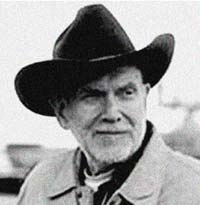
Al Aronowitz At The End
This is a rather amazing story. Al tells it well too.
It isn’t clear whether this was a setup to humiliate Al or not but if not then it was a major testing of the audience to see what they would take. The show had been going on all day a roaring success. The time of Dylan’s appearance was scheduled for about ten o’clock at night. He was to be preceded by The Band. The Band’s technical expert decided that the sound was not quite to his liking although according to Al it had been excellent all day. The technician began checking the cables, crawling around in the equipment and what not taking a very long time. Al was in Dylan’s camper so Bob ordered him to go find the reason for the delay.
Al didn’t really have official status so he had to be especially courteous. He explained to the tech that Bob was getting irritated at the delay wanting to get the show moving. The tech fobbed him off.
Bob was even more irritated when Al reported back abusing him further. After a while, the delay was getting to be quite long, Bob sent Al forth again this time to see Robbie Robertson, prod him to get his guy moving. Robertson merely turned his back on Al walking away.
Al reported back to be abused further. More time passed, Bob sent Al back to the tech. The tech told Al that The Band wasn’t going on until he was satisfied with the sound. Al returned for a torrent of abuse from Dylan. Enduring the abuse must have been a deep humiliation. It was probably meant to send Al packing but Al hung in there. Eventually the show got on the road; Bob made his appearance.
Over the years many people have noticed Dylan’s seeming contempt for his audience so it may be that he was combining an opportunity to see how much Al could take while testing his audience.
Of especial significance here is Bob’s use of the phrase ‘Get the fuck out of here.’ He would also use this phrase in dismissing Victor’s daughter from his coffee house. Victor of course could not allow Bob to talk to his daughter using such language putting forth a mild protest although the incident precipitated his final break with Dylan.
It seems pretty clear that in his career Dylan was acting out his resentment of the way he had been treated back home in Hibbing. It is not improbable that someone had used the same phrase to him back in Hibbing so that Bob reacted in his life by setting up situations in which he could shift his burden onto someone else.
Dylan could be emotionally quite violent in venting his anger and making it public too. The really hate filled rant Ballad In Plain D directed at Carla Rotolo and her mother is really quite astonishing. He would vent his rage over incidents more than once on record over quite trivial things although they may have represented more serious disturbances in his psyche. Most notable of course is his hate filled rant against Edie Sedgwick in Like A Rolling Stone.
Bobby Newirth had taken Edie Sedgwick to meet Dylan in late ’64. Dylan was taken with her even though he was in the midst of several affairs including Suze Rotolo and his future wife Sara. Edie and he had a meeting the next month in January of ’65 where some sort of understanding was apparently reached. Bob then left on tour including England where he tried to establish a relationship with Marianne Faithfull, returning in May of that year.
In the interim Edie met Andy Warhol. Edie was living on an inheritance that she was quickly consuming thus she was seeking some way to earn money. Teaming up with Warhol seemed promising so her magic summer of ’65 was about to begin.
Dylan returned to find his own plans for Edie disrupted. They had it out at a party in June during which Edie explained her financial situation to Dylan.
In a towering rage at his seeming rejection Dylan sat down venting his emotions in what turned out to be Like A Rolling Stone. While none of us record buyers had a clue of what the song was really about, we devised all kinds of fantastic explanations that make us look ridiculous now. The hate anthem was merely about Dylan’s situation vis-à-vis Edie and Andy. Thus the lines:
You used to ride on the chrome horse
With your diplomat
Who carried on his shoulder a Siamese cat
Ain’t it hard when you discover that
He really wasn’t where it was at.
After he took from you
Everything he could steal.
In the context of Bob, Edie and Andy then Dylan is excoriating Edie who may or may not have gotten the reference. Bob’s technique was to make a sort of dream displacement from the fact to the image. Thus he makes Andy Edie’s diplomat while Andy did have a Siamese cat. The term chrome horse is merely a motorcylist’s term for his bike although it seems like a tough image to crack for those of us who took it symbolically.
Edie had opted for a relationship with Andy but that was not working out well as Andy, while using her in his movies, was not providing her with income. Hence he really wasn’t where it was at, money being the issue whether with Bob or Andy.
In his effort to woo Edie from Andy to get his revenge Dylan and Grossman would promise to put Edie in a movie with Dylan. Perhaps that was the crux of the meeting in June.
Edie who was of old stock New York society, the Sedgwicks were socially important, had introduced Andy into a society to which he could never have been admitted on his own. Thus while he benefited Edie’s reputation was destroyed by her association with him hence she was out on the street where she couldn’t function. Andy had taken everything from her that he could steal and then dropped her.
Of course, the same would have been true with Dylan who was not exactly a society icon and never would be. Having lured her away from Warhol Dylan then dumped her while writing another vicious song about her, One Of Us Must Know (Sooner Or Later).
This viciousness was part and parcel of Dylan’s personality. Somewhat miraculously he writes that he has a clear conscience down among his souvenirs. I truly hope he has but I don’t see how.
Victor left Dylan’s employ mid-1966 going off to live his own life until he rejoined Dylan a few years down the road.
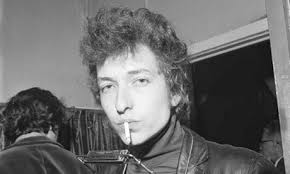
Johnny Cool
We will examine those years in Exhuming Bob 31f.
Exhuming Bob 31d: A Review Of Victor Maymudes’ Another Side Of Bob Dylan
November 16, 2014
Exhuming Bob 31d
A Review Of Victor Maymudes’
Another Side Of Bob Dylan
by
R.E. Prindle

I’ve got a tangled mind,
I’ve got a broken heart,
I got a gal somewhere,
I guess she thinks I’m dead.
I’d go back home if
I could clear my head.
Cryin’, cryin’, all of the time,
I’ve got a broken heart,
I’ve got a tangled mind.
-As sung by Hank Snow
In Exhuming Bob 31c I said I was waiting for a copy of Al Aronowitz’s book Bob Dylan And The Beatles. It arrived and I read it. Like Victor’s book it is a first hand account of Dylan. Strangely, or perhaps not so strangely, Al like Victor wanted to be Bob. Dylan epitomized their hopes and vision of themselves. Couldn’t be improved on.
However not being Bob the next best thing was to be as close to being his shadow as possible. Amazingly, or perhaps not so amazingly, both men were glorifying Dylan at the same time during those magic years of the Sixties Bob. Al once asked Bob why he wanted to perform. Bob replied simply: I want to be exalted.
There may be a key to Dylan. He wants you and I, the country, the whole world to make him feel exalted and he achieved that goal in spades. In that context one can only imagine how crushed Bob’s feelings must have been when he was booed and booed and booed when he went electric in 1965. No exaltation there.
As a side note Murray The K in his book says that one reason Dylan was booed, especially at Forest Hills was because he was switching to rock and roll which the folkies considered pimple music. Murray who MC’d part of the show was also booed but because he was considered a bubble gum disc jockey. So Dylan was perceived as switching from serious folk to teeny bopper rock n’ roll.
It must have been a period of profound fear that perhaps he would be rejected and never be exalted again. It must have been quite similar to when he did his Little Richard act during assembly to an uncomprehending student body and faculty back in Hibbing. The principal wanted to pull his plug that day just as Alan Lomax would want to take an axe to the cables in ’65.
Bob persevered, overcame resistance, or elected a new body of fans, and then crashed in ’66 from the strain. He laboriously and falteringly rebuilt his career after ’66. And this is important, he would make his audience exalt him no matter what he did. I saw his October ’14 Portland show and he had taken electricity to a new level of voltage. I would have said he took electricity out of Arkansas but I don’t know how many have heard or remember Black Oak Arkansas’ When Electricity Came to Arkansas. Dylan remembered it because his sound was close to lifted from that performance; spectacular for the early seventies.
Dylan’s show was fabulous; perhaps the finest rock show I’ve ever seen. The band was the thing. Dylan’s performance truly being peripheral. He no longer sings per se but gargles along in tune with the band; if you catch his drift not bad at all. As a composer and conductor is where he excels.
Bob however has been in pain all his life. He acquired a tangled mind, tangled up in blue. Never a fashion plate, for the show he came out in some godawful gauche and need I say outre version of a Southern planter’s suit while he acted as though we of the audience were slaves on his plantation down in Dixie. As is well known Bob studied the Southern plantation systems in the New York City public library while he was waiting for stardom to strike him. Apparently he learned his lessons well. So, I’m from Dixie too. I got it.
Although from a distance he looks pretty frail he stood at the mike and in front of a wall of sound that Phil Spector would have envied lectured us on how he wasn’t as stupid as us living humdrum lives, the very idea of which he had renounced from the first time he heard Accentuate The Positive on the radio before he could walk.
Something happened along the way as Bob hasn’t accentuated the positive since he was five.
Perhaps Victor and Al had also been slapped down hard along the way becoming those of the ‘abused, misused, strung out one’s or worse’ Bob materializes in his song The Chimes Of Freedom. Back in the old days he says that was the audience he was reaching for and that’s the audience he got. It was that appeal that brought the ones who felt abused and misused into his sphere. Either I outgrew the feeling or Bob left the hall in ’66 for another show. He forgot about us after that.
Victor and Al, as I say, obviously knew the feeling, bonding to Dylan like a Siamese twin.
Al, by the way, corroborates everything Victor said. He really did say into a tape recorder rather than write in text. So in Chapter five Victor relates how he and Bob turned on the world. Victor must have been sidelined after the August ’65 meeting with the Beatles because the period from August ’65 through the ’66 motor bike accident he merely summarizes his relationship few details. No mention of Andy Warhol, Edie Sedgwick or even Bobby Neuwirth. Nothing about the ’66 tour on which he was the road manager.
In point of fact after picking up Neuwirth in SF Bobby replaced Victor as Bob’s sidekick and confidant. It was the arrival of Neuwirth that completed the fearsome putdown act of him, Dylan and Grossman.
While Neuwirth is a hazy figure in the biographies, Al Aronowitz gives the fullest profile of Neuwirth that I have read. According to Al Neuwirth was an excellent performer and prolific songwriter. Dylan had first met him in Boston where he sang in the folk clubs around Harvard. Unfortunately Bobby was a psychopath which prevented him from ever recording successfully or having a career. Al says that there were efforts to get him on record. Twice he recorded material but snuck into the studios and destroyed the tapes. The record for David Geffen that he did complete is quite a story among Al’s great stories. After running up studio costs of nearly 200,000 dollars he delivered product that Geffen said would sell only six copies. He appears to have been a prophet. If the record was actually ever released try to find a copy now. Perhaps a key to Neuwirth’s psyche is the song of Don Gibson he recorded for Geffen , A Legend In My Time. Key lyrics,
If tears and regrets
Were gold statuettes
I’d be a legend in my own time.
In his way then his relationship to Dylan was the same as Victor’s and Al’s. Neuwirth could see or sense that Dylan would get the gold statuettes, be a legend in his own time, tears and regrets Bobby’s lot. Dylan had the ego and the drive. Neuwirth had the fear of success (there’s no success like failure and failure’s no success at all, perhaps that line of Dylan’s was written with Neuwirth in mind) or perhaps as accurately, fear of failure. Probably also he realized he would never equal or surpass Dylan. Paralyzed his will. While Bob could and would realize his dream of success Neuwirth could never have been able to measure up to that. Like Victor and Al then Neuwirth lived his fantasy through Bob.
There was no place for Neuwirth in Bob’s life after the ’66 accident so he drifted off doing other people. According to Al he drifted around attaching himself to people with money. Al admired him greatly, considering him much hipper than Dylan. His account, his thumbnail of Bobby, is really worth reading. Al has been neglected as a source by the biographers but both his own career and account are significant Not a lot of copies of his book around though, mine came with Al’s autograph although made out Michael Gross whoever he may be.
So, during this crucial year in Bob’s life Victor seems to have been marginalized but he still makes himself central to Bob’s life showing him how to be cool.
Victor says, p. 115:
Bob and I searched for an identity in the clothes that we bought; granted, it was only after Bob started to have an income that we really dove into fashion. He and I would go shopping at thrift stores together, searching for new identities when the one we were using started to get picked up by those around us. This cat-and-mouse game pushed us to wear increasingly outre clothes. We would try on every odd ball outfit we could find, trying to stay one step ahead of our social group. On tours around the country, we would seek out the salvage clothing stores and pick out the wild stuff. I found polka-dot shirts with Bob, and I made that a big deal. Polka-dots would become our contribution to the fashion of the sixties I look back on it now and I think it’s pretty funny how ridiculous we looked and how everyone around us took us so seriously. Bob and I shared this together, but I didn’t have the spotlight on me the whole time as he did.
Note he heavy use of I, we, us. Sounds like they were joined at the hip with Victor in control guiding Dylan on the path to higher achievement. Al wanted to be Bob and in his way so did Victor but they chose different paths. Probably because Victor was six years older he assumed what is really a patronizing attitude. Must have irritated Bob.
In this year covering mid ’65 to ’66 then Dylan had three intense buddy associates to deal with, Victor Al and Bobby, all three of varying types of servility. Of the three Aronowitz would last the longest while Victory and Bobby were followed by Robbie Robertson, who, by the way was born Jaime Robert Klegerman. He was the son of a Jewish father and a Mohawk mother, an interesting combination.
Bob treated these guys quite contemptibly. Both Victor and Al have very bitter memories and both were dismissed in the rudest of manners. I don’t know the situation with Robertson but I imagine he and Bob aren’t talking either.
And then Victor may have been perceived by Albert Grossman as a troublemaker. Anent that, Victor on p. 127:
I called Albert the “brain” based on the fact that he looked like a potato and the only muscle he used was his brain. For me, he was a very powerful person. I respected him like my big brother. But we had our issues because I would tell Bob the truth, about anything. Even if it was just my hunch someone was trying to manipulate him I would make sure Bob was aware of what was going on. Albert felt threatened by my transparency, and my criticism of his management.
Albert was an asshole who bent over for quarters when dollars were flying by
And then Victor says he clued Dylan to how Grossman was appropriating revenues from song rights. Little wonder that Grossman felt threatened or any surprise he fired Victor after the accident thus ending that relationship for several years.
If we are to believe Victor about this first phase of Dylan’s career he was the guiding light for Dylan. Thus he makes it sound as though he nearly was the author of Dylan’s success. He wouldn’t have been Bob without Victor by his telling.
Nevertheless Bob always came out on top and Victor, Al and Bobby and Grossman were left in the dust. Bob began his career with a tangled mind, beginning his second phase in the same mental state.

Victor and Bob
Exhuming Bob 31e follows.
Exhuming Bob 31c
A Review
Victor Maymudes’
Another Side Of Bob Dylan
by
R.E. Prindle
It becomes clear at this point in Victor’s memoir, Chaps. 4 & 5, that he has such great admiration for the ‘genius’ of Dylan that he begins to meld his personality into Dylan’s person and persona. Being six years older and considering himself more worldly wise thus a guide to the younger more naïve Dylan he feels actually superior to Bob, or at least compensate for his felt inferiority. He thus becomes protective and paternalistic. Dylan must have found the attitude annoying.
In Chapter 4 that concerns Dylan’s 8/22/64 meeting with the Beatles in New York City, he actually does displace Dylan assuming his role.
This meeting is perhaps the most famous incident in rock and roll history. This ‘summit’ meeting arranged by the journalist Al Aronowitz of whom more below is when Dylan is said to have introduced the Beatles to marijuana. The below is Victor’s gloss on the story.
Victor’s relationship with Dylan has almost supernatural aspects. While he realizes that Bob has the gift and he doesn’t his admiration and perhaps envy is so great that as time goes by he seems to be melding his persona into Bob’s almost to the extent that he becomes an incubus attempting to inhabit Bob’s mind and body almost like an internal double.
Aronowitz arranged the meeting between Dylan and the Beatles but his account is truncated on the website. The Blacklisted Journalist offers only a teaser of the story referring you to his book Bob Dylan And The Beatles, now out of print. A used copy is costing me 75.00 and it had better be worth it. I will probably rewrite this section when I receive it; but for now Victor’s version and, really, this is Victor’s story.
This is a great moment for Victor and he does it justice in the telling. He borrowed Bob’s muse to write it. You should probably read Victor’s account for the full flavor. It will suffice here to show how Victor elbowed Bob out of the story.
His account begins with their arrival at the Delmonico Hotel where there is an immense crowd blocking the entire street and gathered beneath the windows of the Beatles’ suite. If you were checking in as a guest at that time it would have been one of the major events of your life, if the police had allowed you through to check in. The roar as Victor describes it begins as persistent white noise like the ocean surf as Dylan’s group approaches mounting in volume to a tremendous roar at the hotel door.
On the Beatles’ floor, which is sealed off, the glitterati being more privileged than the hoi polloi replicate the scene below as they crowd the hallway. PP&M, the Kingstons, everybody is there, everybody. Probably Truman Capote and Andy Warhol. It staggers the mind that four unknown musicians could create such an uproar. One imagines the glow of importance on Victor’s brow as he surpasses all the glitterati to enter the Beatle’s suite with Bob and Al. One of the chosen.
Introductions finished, the pot comes out. This is the first time the Beatles were to get high on pot although with a knowing wink Victor explains that they have smoked some inferior stuff before with little TCP content.
Bob undertakes to roll a joint but bungles the job. Now here’s were Victor takes over Bob’s role. He reaches over and takes the papers and weed from Bob’s hands. I would have fired him on the spot. Victor then rolls perfect numbers for all concerned. Bob takes a couple swigs from a bottle and then passes out on the floor. From that point on in Victor’s account he is the show; he has become Bob or Bob has become him. The Beatles are suitably impressed becoming Victor’s great friends.
For a brief moment Victor and Bob were one in Victor’s mind.
His account is a fully detailed extended account well worth reading. I will compare it later with that of Aronowitz.
Aronowitz himself was a journalist, the music and entertainment reviewer with the New York Post. He seems to have had Victor’s need to become those he reviewed. He had a long and illustrious career breaking Billie Holliday among others in music and the movies as he says. When the Beatles landed, recognizing the next big thing he moved in on rock and roll. Being able to deliver Dylan to the Beatles was his big coup hopefully establishing him with the two biggest pop acts ever.
After the Beatles-Dylan encounter however his career went into decline. As he says on the Blacklisted Journalist neither Bob nor Victor would talk to him anymore. It seems as though the whole rock world rejected him. Perhaps he appeared to be an opportunist from another era or generation and wasn’t wanted. And then he did something to cause him to be blacklisted as a journalist.
2.
Victor and Bob
Chapter 5 concerns Bob, Victor, Paul Clayton and Pete Karman’s cross country tour from New York, down through the South and out to San Francisco.
Victor gives a very nice sketch of Paul Clayton one of the premier folk musicians and musicologists of the period. I will highlight the visit to Carl Sandburg here as Victor gives the fullest and best account that I have read.
Carl Sandburg was of course the Chicago poet- Chicago, Hog butcher to the world, tool maker, stacker of wheat, player with railroads…city of big shoulders, etc. etc. as well as the author of the Pulitzer Prize winning biography of Abraham Lincoln. Also he was the compiler of the American Song Book, published in 1927, a collection of songs roughly from the turn of the twentieth century that contains nearly the whole of the sixties’ repertoire- Midnight Special, Stack-o-lee, alternate versions of St. James Infirmary, Nearly everything that has been attributed to Huddie ‘Leadbelly’ Ledbetter. I think most people think Ledbetter wrote The Midnight Special. I did until acquiring a copy of the Son Book at an estate sale. Apparently he must have had an early copy of the Song Book.
Bob says that he wanted to talk to Carl about the collection.
Victor gives the fullest and best account of the encounter. Bearing in mind that this gang of four burst upon the Sandburg’s unannounced they sprang on the Sandburgs’ like a summer squall. Mrs. Sandburg who was sitting on her porch greeted them graciously going in to get her husband. Remember this is 1964 and this rag tag bunch with wild hair, manners disordered by drugs, sort of exploded from the car onto the lawn. Perhaps Mrs. Sandburg was terrified.
Sandburg himself being an old trooper from the hog butchering capitol of the world rose to meet the challenge. According to Victor Sandburg spent an hour with them. In this scene Victor hung back while the bumptious Pete Karman shouldered Bob aside trying to monopolize Sandburg.
Sandburg, pushing ninety, tired, excused himself and returned to his nap or whatever, perhaps practicing banjo licks.
Victor’s account clarified this situation that has always puzzled me. Sounds about right.
Victor gives a good account of Bob in New Orleans and the trip West through Colorado to San Francisco.
Altogether two very worthwhile chapters. Good enough for general reading in my opinion.
Exhuming Bob 3d follows.
Exhuming Bob 31b
A Review
Victor Maymudes’ Another Side Of Bob Dylan
by
R.E. Prindle
A Stranger Came Walking…
This book is actually written by Victor’ son Jacob Maymudes, since Victor died a couple decades ago. The tapes Victor recorded appear to be heavily edited while Jacob is defending his father against Dylan. In such a situation the temptation to rewrite as well as editing might be too strong to resist. It would have been better to have used the full transcripts as spoken.
Jacob has really written a biography of his family focusing on his dad’s relationship with Dylan. It is a bittersweet tale while Jacob has written a very readable and pleasant little volume. He captures well the personal tragedy of his father.
Victor and Bob
In this part of the review I will concentrate on Tapes 2 and 3 of Victor’s aural memoir.
After leaving Bob in 1962, almost ’63, Victor took up residence in Yelapa, Mexico a village of 300 at the time with a half dozen Hippies lounging about. Today, let us say, it has been discovered. Yelapa is in Jalisco State of which Guadalajara is the capital and Puerta Vallarta the main tourist destination. Yelapa is on the southern end of the 7th largest beach in the world. Undeveloped when Victor stayed there it is well developed now. Victor doesn’t explain how he knew of this, what he considers, a terrestrial paradise, but he stays there until…
One day just before sun down, I was laying on the beach with Tom Law, one of my great friends, who would later became the road manager for Peter, Paul and Mary. But at that moment He was sitting up watching the Mexico sunset while I lay with my feet in the warm glow of the sand. A stranger came walking down the beach toward us. There was nobody else in sight….The Stranger stopped in front of us and asked, “You guys know this guy, Victor Maimondez?” mispronouncing my last name.
Tom, who was always cautious and protective of me, squinted up, “Yeah, maybe. What do you want him for?”
The stranger said, “I have a message for him. From someone named Bob Dylan in New York City. He wants Victor to come back. They’re going on tour.”
Like something out of the Twilight Zone isn’t it? If it happened, it happened. Who am I to say differently.
Victor returns triumphantly as Dylan’s tour manager. Grossman grant’s Victor the magnificent salary of 65.00 a week. Victor was ecstatic. Heck, even I was making twice that in 1964 although I’m sure I wasn’t having as good a time.
Tape 3, Chapter 3 is a very long chapter of thirty four pages covering approximately eight months in 1964. These boys were certainly living an action packed life as the events covered may be the central part of Bob’s 1960-66 career.
Victor arrives back in LA on November 22, 1963 just in time for the Kennedy assassination. Victor is an authentic voice of the period. His thoughts are representative of about half the people at the time While time has sanctified Kennedy’s memory at the time about half the people were relieved to be rid of him. I was in that half.
Victor’s voice however is phrased in the spirit of the times. It brings the period back in high relief.
In February Dylan, Paul Clayton, Pete Karman and Victor took the well reported cross country auto tour from NYC to SF with Victor doing most of the driving. Today they probably would have used an SUV but theirs was a more modestly sized station wagon.
While Victor adds a few new details his relation places the story in more human terms than other accounts. He and Dylan were outraged at the Kentucky miners’ plight and the civil rights situation in Dixie so they decide on a drive through for a look see.
The key points are Dylan’s visit to Carl Sandburg in Asheville and the visit to New Orleans and the drive from Denver to SF.

Bob At The time. Note Subdued Hair Style
Victor’s account of the Sandburg visit makes more sense than other accounts I have read. Rather than a cranky reception for this unannounced visit as often reported the boys were met cordially by Mrs. Sandburg who went to get her husband. Sandburg himself was in his late eighties and apparently frail, tiring easily. According to Victor he spent about an hour with the boys then tiring returned to the house.
According to Victor Paul Clayton smoothed over the situation while Pete Karman boorishly tried to brush Dylan aside to monopolize the interview.
Carl Sandburg
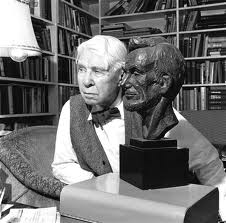
Carl and Friend
For those who for one reason or another are vague as to who Carl Sandburg was his date are 1/6/1878-7/22/67. He gained fame for what is called his poetry, not only fame but he bagged two Pulitzer Prizes and his biography of Abraham Lincoln netted him another.
He was a Civil Rights activist gaining an award from the NAACP. Dylan’s interest stemmed from is 1927 collection called The American Song Bag. The volume was very successful and extremely influential. Pete Seeger was said to swear by it and if I am not mistaken Huddie Leadbelly Ledbettor memorized a great deal of it.
I managed to pick up a copy at an estate sale for a couple bucks. it is a fairly amazing collection of what might be called folk songs. Lots of tunes from the turn of the century and some earlier stuff. Midnight Special, Frankie and Johnny, the backbone of the Sixties repertoire. Words and music, nice collection.
Bob said he wanted to talk to Carl about it. Pete Karman got in the way.
Victor gives a nice tribute and portrait of Paul Clayton who he admired as a great folk figure although time has now passed him by.
The next stop was New Orleans which holds no interest for me although the stories are well told while being well known.
The inner dynamics of the car with Karman being the trouble are well known. Apparently Suze Rotolo included him, probably as a chaperone to make sure Bob didn’t stray too far. Strange attitude for a Communist girl. When they reached SF Karman was given a plane ticket and sent back to NYC. Karman was replaced by Bobby Neuwirth who would himself replace victor as Dylan’s confidant. Neuwirth fit in where Karman didn’t. But then as a friend of Suze’s who forced him on the trip perhaps his quality of mind was more equal to hers.
After returning , in May of ’64 Dylan left for England with Victor in tow. This was the English trip that formed the material for the film Don’t Look Back. Unless the tape is edited too heavily by Jacob one would gain the impression that it is just Bob and Victor on this trip. There is no mention of Grossman or Baez, the movie or even the famous scene at the Savoy, no Lennon, no Beatles, no nothing but Bob and Victor. One gains the impression that Victor is in love with Bob, practically man and wife.
After England he and Dylan make Bob’s trip to Greece. There are some interesting details here. According to Victor Dylan wrote the whole of Another Side Of bob Dylan in Greece recording it without practice on returning to New York.
There is no mention of Nico here for whom Dylan wrote I’ll Keep It With Mine at this time. Victor excludes anything except what he and Bob were doing while Victor is guiding Bob and showing him the world.
They then return to NYC
Exhuming Bob 32: Didn’t We Ramble Though, A Review Of The Bob Dylan Show, Portland Performance 10/21/14
October 22, 2014
Exhuming Bob 32
Didn’t We Ramble Though
A Review Of The Bob Dylan Show, Portland Performance 10/21/14
by
R.E. Prindle
The steel is moanin’, the guitars are speakin’,
The piano plays a jelly roll.
The man on the drums is far from dumb,
The bassman he plays from his soul.
The tables are quakin’, and your nerves are shakin’
But you keep on beggin’ for more.
You’re havin’ your fun you lucky son of a gun
On that Honky Tonk hardwood floor.
Sung by the late great Johnny Horton
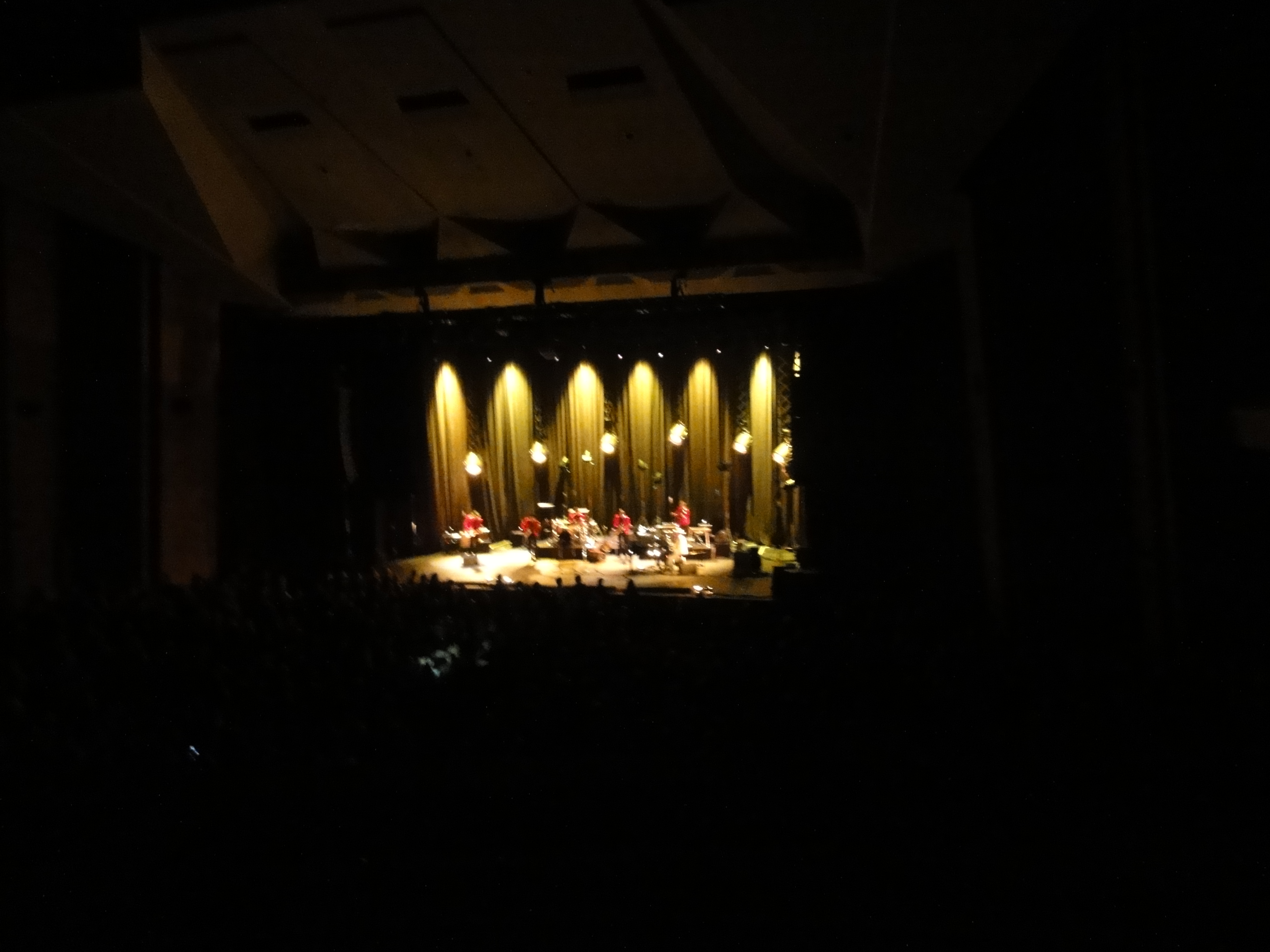
The Bob Dylan show dropped into town last night. And what a show it was. My first Dylan show, from reading all these reviews depicting the shows as atrocious my expectations were very low.
I can’t imagine what these critics are thinking. The Show was absolutely sensational. Dylan is one of the great Rock and Roll showmen. Beats anyone else I’ve ever seen.
I hope I can hit a stride here commensurate with the show and my muse doesn’t let me down. The venue, the Keller Auditorium, is a twenty-five hundred capacity house and it was filled. The stage is relatively big about sixty wide and fifty high. Bob and his musicians used the whole space like they had been performing there for a year. The lighting while minimal was dramatic, effective and beautiful putting one in a good mood. An aura was provided that brought one into the Secret Garden.
The electronic gear seemed to be artfully scattered haphazardly across the whole stage. The musicians wore red blazers while Bob came out in a white planter’s outfit, uniting the Templars with the old plantation down South. Jeb Stuart rides again.
The musicians appeared to be encamped among the gear with the lead and rhythm guitarists to the audience’s left. The drum stand was middle as is proper flanked by the bass player and finally a steel guitar player cum banjoist on the right end. Bob’s keyboard was forward and on a level with the steel. It was all very minimalist and effective. They filled the stage while being placed in perspective by the high fifty foot frame keeping everything human size. Dylan must have been studying performance art under Yoko.
It is a mistake to go to the concert to hear Dylan sing. He apparently learned to vocalize by singing along to Lou Reed’s Metal Machine Music. At first I thought it was a cabover with two cylinders not hitting coming up a mountain grade hauling a hundred thousand K in triple bottoms. Then I saw that it was Bob. The music is the thing; as a composer and conductor lies Bob’s genius.
The band was incredibly disciplined, everyone knew his role, fit tightly with the others and played their instruments without exhibitionism. The harmonics and spacing was incredible.
The drummer carried the band on his back. He was so sensational that like the Hindu elephant he could carry the world on his back. I mean, he had time in his hands, the money in his pocket and could walk the dog on a long leash. I haven’t seen anyone like that since Michael Shrieve. The guy was terrific, he couldn’t only play he looked good doing it. The bass player standing next to the kit kept the beat rolling forward. Bob understands the rhythm section. No amateurishness near.
While relatively unobtrusive the steel player was carrying a lot of the weight.
Now, the band doesn’t play any songs; what Bob has written is some sort of symphonic suite in several movements. The lead and rhythm play a succession of chord progressions loud; there is no melody as such. The music has a strong forward flow that sweeps along like the Mississippi in flood before it was channeled and diked.
The band set the crowd off from the first chord; it was all daylight from there. Like nearly everyone else I flipped to the ozone, shouting and howling, lost in the noise. Amazingly the audience responded differently to different chord progressions; sections would shoot from seats with a roar that competed with the amplification. It was like a huge sea of deep rollers rising and falling.
A wonderful crowd, best I’ve ever seen. Everyone looked good and went way into the show. There was no one not having the time of their life. Dylan was flattered and showed it, trying a little harder to deliver the goods.
His singing was irrelevant. Why he is charged with plagiarism is beyond me. I won’t say you couldn’t understand a word because I was able to snag a few while even getting a phrase or two- Tangled Up In Blue but he shouted that out in his normal voice.
If he was singing from his catalogue it was hardly noticeable although I did get the faint impression that one of them was She Belongs To Me. Either that or Love – Zero = No Limits, or something else, might have been The Star Spangled Banner. Didn’t matter, Bob had to do something to justify his being there. He had the band so tight they could have performed without him.
The band was the cake. The progressions were so powerful it was like Godzilla walking in rhythm. There were two sets and the first one was a power walk. Just unbelievable. If all Bob’s shows are like this one I can’t imagine what critics are belittling. Forget the singing, it’s some kind of frosting to add a little variety. So is Bob’s posturing. He struts around a little like the Lord of the Manse directing the slaves striking what I suppose are meant to be power poses.
The end of the first set leaves you exhausted but energized and hoarse. During the intermission most people didn’t leave their seats but in their high excitement there was a huge billowing roar rising up. I was in the first row, first balcony. It was a kindly roar, mellow even. Dylan’s fans are OK. No weirdos there regardless of Kinney’s book, The Dylanologists: Adventures In The Land Of Bob.
I was there with my wife and our friends Mark and Jenna, two old fans. On my left I sat next to a couple from Medicine Hat, Alberta who had driven down for the show. He was a wheat farmer with 600 acres. Using three John Deere combines he harvests all 600 acres in one day. Gives him a lot of leisure I suppose.
The second set was a little more frivolous lowering the energy level considerably. But, before you went to sleep he pepped it up a little ending on a power note.
I had heard that he doesn’t do encores but after a steady drum roll of applause for about ten minutes he and the band came back for not a one piece encore, but two, ending the show with a medium power progression while Bob mumbled the words to Blowing In The Wind apparently a very personal lyric. Ah, Hibbing.
By this time I had a firm grip on the situation paying attention to the band, but it is Bob’s band and I imagine that he has composed the music. As a composer he is no mean hand. I hesitate to say it but the music is at least as good as Beethoven although falling short of Mozart.
I don’t know how long the piece was but they must have given us five to ten minutes with the crowd and myself going wild. The woman four seats to my left had virtually taken leave of her senses screaming doing a wild gyration of a dance. Really spectacular.
OK, I confess it. I did some involuntary things myself. The band was really showing off their discipline and expertise. Now this is really spectacular, they were powering along then cut off simultaneously leaving a half beat silence before resuming at the same pace and volume. They did this three times in succession.
I sensed it coming on, now I’m not bragging because I wasn’t conscious of what I was doing, but in that brief half beat space was total silence. I shouted out a perfect rock and roll ‘hey’. I did it the second time slipping that hey into that narrow opening. Perfect timing on both our parts. I think the band was surprised by the first one then sort of amazed at the second one. Then consciousness came slipping back and I missed the third opening. It was still terrific.
As the encore drew to an end the cell phones came out and whole rows held them up to snap pictures. Endless tiny images shown back to up above. Bob came center stage to pose for the cameras while the band lined up behind him.
The band was terrific. Dylan was terrific, the whole show was breathtaking and invigorating. If you are being swayed by all the negative reviews, disregard them. Dylan’s show is a can’t miss situation. Carpe Diem! Good things don’t last forever.

Exhuming Bob 31a
A Review
Another Side Of Bob Dylan
by
Victor Maymudes
Review by
R.E. Prindle

It Ain’t Dark Yet
31a will concern itself with Chapter 1 only. Victor Maymudes while closely connected with Dylan has always been written of as a shadowy slightly malevolent character. My impression has been that he was an enforcer of some sort for Dylan.
In this his own memoir he is a friend, advisor and confidante. Maymudes, born in 1935, was six years older than Dylan who he met in 1961. Maymudes was already in a career in show business. In 1955 near the heart of the Beatnik era he had opened a folk club coffee house on the Sunset Strip in Los Angeles called The Unicorn. He was subsequently advised by Jack Elliot who he was managing at that time to go to New York to take in a new performer who turned out to be Bob Dylan.
Elliot explained that Dylan was copying his act but doing it better. Ramblin’ Jack himself introduced Victor to Bob giving the latter a run down on Victor’s achievements. According to Victor he and the twenty year old Dylan hit it off immediately. They began to pal around.
Maymudes gives a slightly different view of this period than has yet been around. The first chapter covers the period from the Spring of ’61 to Dylan’s Carnegie Hall performance in the Fall of ’61.
According to Maymudes shortly after meeting Dylan they went on a long drive and walks around the perimeter of New York City.
To quote Victor:
Bob mentioned going to Juvenile Hall and how he quickly realized there was a social structure inside and either you are going to get along or you really shouldn’t be there.
Hopefully this should settle the issue of whether Dylan was incarcerated in Red Wing Reformatory of Minnesota. While the paper trail has always indicated he did yet his term has been denied by all. In what amounts to a self-admission this should settle the issue.
There is also a piece on the internet by someone who had been in Red Wing at an earlier time but said he knew someone who was in Red Wing at the same time as Bob. Dylan says according to Victor that in order to get along you had to go along. I take that as a reflection after the fact, while Bob probably held himself aloof from the other boys as his possible fellow prisoner as above said he did. No one has believed the article but there may be something to it.
At any rate it seems clear that Bob did serve a sentence which was very unpleasant for him as why wouldn’t it be. The stay had a devastating effect on his personality, as why not? Bob’s song The Walls Of Red Wing thus seems to be a personal reminiscence.
Some of Bob’s stories such as touring with a carnival while false as told seem to be based on actual facts while being definitely embroidered. In the same paragraph Victor says: He talked about going with the carnival when they came to town. I would take that to mean that perhaps he volunteered to help in setting up the carnival as an extra hand as was common. There were temporary jobs when the circus came to town. You could drive stakes for instance and maybe get a free ticket.
2.
It also seems clear that Bob’s family life was far from harmonious. The Zimmerman’s seemed to have covered up a lot. Maymudes, same paragraph, p.4:
He told me deeply personal stuff like his dad leaving town and how he would have to stay at his dad’s mother in Minneapolis, how she would tell him his mother was a whore, sleeping around with other men. It was the kind of thing that probably wasn’t true about his mother, but his grandmother was sticking up for his father and trying to use her power to distance Bob from his own mother. Terrible thing to do to a child.
Bob’s grandmother may have been telling tales about Bob’s mother but I think not. My impression at looking at her picture was that she was a goodtime girl. She certainly kept Abe broke buying her furs, jewels and Cadillacs.
In Dylan’s portrayal of his putative father and his mother in his movie Masked And Anonymous his alter ego Jack Fate’s father is portrayed on his death bed while his mother with a red dress on appears to be gallivanting about.
I find it hard to believe Dylan’s grandmother would say those things about his mother if she didn’t mean them. It is also the first time I’ve heard that Dylan’s mother and father separated from time to time. As such behavior is common knowledge in a small town like Hibbing Dylan’s life may have been made miserable partly from that cause. He certainly has no love lost for that period in his life.
3.
One major question everyone asks is why Robert Shelton wrote such a glowing review about a performance of Bob’s and why John Hammond gave a nondescript Bob a recording contract. Maymudes may shed some light on that. He says on p. 46:
Over the next week Bob and I ended up hanging out non-stop. We were together all the time. We would depart and arrange to meet the following day. Eventually we even exchanged numbers. We had extensive conversations about everything. During the day we would go see Fellini’s movies and stop by the happening clubs and cafes like the Bitter End. We would stay up till dawn each morning. I would introduce him to everyone I knew, like Richard Alderson, the guy you hear announcing bands at Woodstock. We went to Dave Von Ronk’s house and played our guitars. John Hammond Sr. had a house on lower MacDougal St. and we would go there too.
All this has to fit into a time frame of about six months but the interesting thing here is that Victor and Bob visited John Hammond Sr. apparently several times before Shelton’s New York Times article of 9/29/61 and Dylan signing a Columbia Records Contract with Hammond on 9/30/61. Did Hammond really have time to read the article and say to himself, I’ve got to find this boy and sign him by the next day? Astonishing on the face of it. It would seem to have been a plan.
No other writer, no biographer places Dylan at Hammond Sr.’s house before 9/30/61. But according to Maymudes, and why should he lie although he might misremember, Hammond and Dylan were familiar with each other as early as the summer of ’61. Hammond must have heard Dylan play and sing before Shelton’s article. Thus his behavior in the studio where he had Bob just play and sing into the microphone while he read the newspaper is more understandable.
While every other folk label in NYC had rejected Bob evidently Hammond saw and heard something they didn’t. It would seem highly improbable he could sign Bob’s nearly indiscernible talent on his own hook. It may be then that he conspired with Shelton who he surely would have known to write an extremely favorable review to be published in the premier newspaper in the country and then sign Dylan on the strength of that. As it was his prescience was not immediately justified as the record bombed.
At any rate the above scenario would make the article and signing plausible.
On the other hand Hammond may just have had the golden ears with which he is attributed. In that context my brother-in-law played me all four of Dylan’s first LPs in 1964 that I found excruciatingly painful to listen to. I thought Dylan was going nowhere but my brother-in-law said, you watch, this guy is going to be big. That goes to prove whatever Bob had could be heard but only apparently by the elect.
4.
The Winter and Spring of 1961-62 Victor was touring with his act Wavy Gravy who he managed. He then returned to New York where Dylan was now living with Suze Rotolo. They continued their friendship.
Dylan had returned to Minnesota that Winter and had just returned as Victor hit town. Bob was now looking for management. He discussed this with Victor, pp. 51-52
During our walks on this second trip to New York, Bob and I talked about the future. He asked me about Manny Greenhill and Albert Grossman; he was wondering who he should sign with. Manny Greenhill was managing Joan Baez and her commercial success was increasing every day. At the same time Dave Von Ronk’s wife was managing Bob, but he was ready for the next step. Flat out he asked me which one he should sign with. I asked him how traditional he wanted to be and how far he wanted to reach. Those questions appealed to him and he expressed he wanted to go the distance, more commercial than Greenhill was doing. His day-to-day routine didn’t point to someone who wanted to go mainstream; he was more folky and traditional at this point. But he knew what he wanted and where he wanted to go from the start. So I said Albert was the logical choice. He was much more aggressive and much more commercial. Bob signed with Grossman a few days later.
——-
Bob’s ability to bend and refashion words was like magic; he was the one that could break into the mainstream while still playing socially conscientious music. Bob believed in himself and so did I, and that’s why Albert entering the picture made sense. Albert had commercial connections and wouldn’t ask Bob to change his tune to fit in. With Albert’s help Bob could force his style in front of the broader public and ultimately make everyone else fit into what he was doing.
That’s a pretty good insider’s synopsis. Grossman who would soon launch Peter Paul and Mary on the back of Dylan’s songs certainly had recording connections although Warner Bros. at the time was fairly low down the list of successful, maybe unsuccessful, record companies. Anyway Bob was already signed to CBS, the actual premier recording company at the time.
Victor goes on to give an interesting thumbnail of Albert Grossman that is immediate and accurate.
Always handy with the advice Victor tells Albert how to go about handling Bob while at his own expense he was setting up Dylan’s first Carnegie Hall appearance, not the main stage but a side stage.
Victor says Albert took the concert away from him while it is usually attributed to Izzy Young. In the event nobody came and the show was a total financial loss. Victor had a falling out with Albert deciding for ‘spiritual’ reasons to depart for Yelapa Mexico. Apparently Victor had been inhaling too much from The Teaching Of Don Juan.
His last words to Bob at this time were that if he ever needed him to say to whoever he was standing next to, Get Victor, and he would come.
It was the Sixties you know.
That is the end of the revelations of Tape 1. A remarkable and interesting account. We do know that Victor and Bob were friends so barring any embroidery or misremembering the account should be accurate. If so, all biographies are now askew. The period has to be reexamined and reevaluated to include Victor’s account.
A Review: Chumps Playing Stud, Part 4, One World by Wendell Willkie
October 15, 2014
Chumps Playing Stud
A Review
Wendell Willkie’s
One World
Part 4
by
R.E. Prindle

Would You Buy A Used Car From This Guy?
It’s a lie, it’s a lie,
I say that it’s a scam
For I have been to Derby, Sir
And I’ve seen the Derby ram.
–English Folk Song
This town is full of guys
Who think they’re mighty wise
Just because they know a thing or two.
You can see them everyday
Strolling up and down old Broadway
Telling of the wonders they can do.
There’s con men and theirs boosters
Card sharks and crap shooters
They congregate around the Metropole.
They wear fancy ties and collars
But where do they get their dollars?
They all say they’ve got an
Ace in the hole.
Perico and Schaebel
Who are you going to believe? Me, or your lyin’ eyes?
–Chico Marx, a man who should know.

Happy Time
No period in American history has been more misrepresented than the period from 1920 to 1945- the Crash and death of Franklin Roosevelt. They say history is written by the victors and since the period has been written by Jewish legend makers it would seem that the Jews were victors under the aegis of their stooge, Franklin Delano Roosevelt.
As in any legend, and this one might be called the Legend of Hoover and Roosevelt, there must be a hero and a villain. Herbert Hoover is the scapegoat, Roosevelt is the hero and champion of the Jews.
The question is how did Roosevelt become the champion of the Jews? It happened before the presidency or even Roosevelt’s governorship of New York. After Al Smith the former champion of the Jews failed in 1928 Roosevelt was pushed forward.

We Had A Grand Time
I am tempted to say that Roosevelt was a Manchurian candidate programmed very early. When he and wife Eleanor worked the Jewish settlement house scene in the first decade of the century they both came under the spell of the Jews. At the time the daughters of the wealthiest men in New York, in fact the daughters of the Morganites among others descended on the Lower East Side slums to minister to the ‘poor’ Jews.
The Jews at the time just arrived from Russia were in full revolutionary mode. When a group arrived on the Fourth of July they mistook the festivities as a welcome for them. So, you can imagine the effect of these daughters of plutocrats coming to the East Side to ‘welcome’ them had on them. When Knickerbockers like FDR showed up what better to do than convert them to the cause. Perhaps it was thought to hypnotize FDR, plant a few post-hypnotic suggestions and groom him for political uses much as Al Smith was being handled.
While hypnotism may seem farfetched for those not familiar with the era remember that Sigmund Freud was a master of hypnotism, nevermind the story that he gave it up. He perfected it and abandoned the crude early method. Freud had joined the International Order of B’nai B’rith in Vienna in 1895 remaining a lifelong member. You might compare the B’nai B’rith with the Learned Elders of Zion and solve that mystery.
He met with them at least once a week. He says that the members shared his views. He and they desired the destruction of Europeans and European culture, hence his complaints about contemporary European morality. He also shared his views with his American nephew the publicist and propagandist Edward Bernays. Bernays became a master of suggestion. Suggestion, of course, is the basis of hypnosis. While I can’t say for sure that FDR was hypnotized I can find no other basis for his slavish devotion to Jewish interests. That includes his entry into the European war to further Jewish goals.
It is also true that after FDR’s death the Jewish influence in the US government diminished to near zero while the Red hunting began in earnest reversing Rooseveltian policy.
During FDR’s terms in office the integration of international Jewish activities coincide remarkably, more especially in the use of food as a weapon of mass destruction. I have already examined the issue in several articles including the three part Henry Ford And The Jews, other Ford articles and The Secret History Of The Jews In The Twentieth Century. Henry Ford gave some indication of Jewish plans in his articles in the Dearborn Independent exposing Aaron Sapiro. Sapiro’s plan or something like it would begin to be implemented in Roosevelt’s New Deal.
I have also explained Jewish hatred of Herbert Hoover in the mentioned essays. He was hated not only for his past effort to rescue Europeans afflicted with starvation but because he was prescient enough to divine Jewish collectivism in the Roosevelt administration but wise enough not to mention the fact by name having learned from the experience of his friend Henry Ford.
Having been frustrated by Harding’s election in 1920 ending their salad days under Wilson one can only imagine the Jews’ elation as they rushed back into DC under the aegis of the Wilson continuator, Roosevelt. Possibly part of their hatred for Hoover was as a scapegoat for their twelve year hiatus from DC. But now they were back and they were in charge.

Back Again
Hoover had foreseen their collectivist effect and tried to forewarn but his warning had fallen on deaf ears. Very likely Hoover’s understanding of the situation was far in advance of the public’s as he was much better informed. He had been part of the battle against the Bolshevics, avatars of collectivism, since 1921 under Harding. Coolidge had established the FBI in 1924 under the leadership of J. Edgar Hoover. Hoover had augmented it in 1930. The FBI was primarily established to fight Communism. The ideology remained central to Edgar Hoover’s approach to the end of his days. It was probably his fixation on fighting Communism that made him so much disliked by FDR.
Herbert Hoover was also much better informed than the public of the interference in American governmental affairs by the Comintern.
As he feared, the Communist influence flared into near open existence under FDR when one of his first acts as president was to recognize the Soviet Union. The Ware ring was established as early as 1934 when ominously a Communist takeover of the Department of Agriculture was achieved under Henry Wallace.
As a revolution in government had taken place, as you can imagine the reaction was ferocious and immediate especially when viewed through the lens of the legislation of FDR’s first hundred days. Most of that was declared unconstitutional by the Supreme Court as early as 1935 gutting to a large extent FDR’s New Deal.

We’re Here To Get This New Deal Thing On The Road
Gustavus Myers always refers to the Gilded Age as Capitalists. I’ve always had trouble understanding what Capitalist meant to Socialists. Certainly men like the Vanderbilts, Gould and Fisk who were just guys off the street no different in their origins from unskilled laborers had no ideology whatever except to get a pile and hold on to it. The Gilded Age was just a one shot affair that would never happen again. It created fabulous opportunities for those who were awake and there and either knew or stumbled upon how to seize the day. Carpe diem. Some call it luck.
The Gilded Age itself was a period of rapid discoveries making wonderful things possible. What are you going to see? The light or the dark? In 1830 George Stephenson in England invented the railroad. By the 1850s the East Coast of the US was covered with Short Lines. About 1850 the Canadian Abraham Gesner discovered how to make kerosene from bituminous coal while in 1851 Samuel Kier discovered how to distil it from oil.
The Civil War masked these phenomenal changes so that they appeared as if by magic after the war. The railroad long lines were already platted during the war while the Union Pacific was actually finished before the 1860s were out.
With Kier’s discovery the useless oil seepages of Western Pennsylvania became useful. The result was the giant corporation Standard Oil. The railroads had created unheard of fortunes. Vanderbilt was renowned for having amassed two hundred million. Before the war this would have been impossible. The Standard Oil fortunes of which there were many were great but Rockefeller’s held the high ground. To small minds like that of Gustavus Myers magnitudes of wealth of this order seemed criminal in themselves. He was absolutely enraged that anyone should have so much. His knee jerk reaction was to advocate simply confiscating the fortunes, in effect stealing them, as was done to the Russian aristocrats following the revolution. That was some indication of his own morality.
Minds as small as his or even smaller rushed to pass legislation to do so and break up the great combinations at the same time. The very size of Standard Oil made the poor wretches tremble. So-called anti-trust laws were passed. It was here that the US made a wrong turn. Size would be essential in the coming global economy that none of these mental midgets apprehended.
As I say, Myers, Roosevelt, the Jews were reactionaries looking to the past rather than the future. How strange that history should record them as progressives. The past had been eclipsed by the railroads. The future that they indicated was a brave new world of unlimited opportunity, uncharted and unvisualized except perhaps by men like Rockefeller. Small business was for local purposes and farther in the future global purposes large combinations were necessary. Have you noticed that China has eclipsed the US?
The US sacrificed its future the day Standard Oil was broken up. Had that not happened today Standard Oil would be a mega corporation giving the US precedence in the worldwide contest for supremacy. Without vision a nation must perish. The US shrunk on that fateful day. The torch has now passed to China. The Middle Kingdom has assumed its ancient stature.
The minds in FDR’s DC were shrunken pitiful things. They punished the doers while rewarding the losers. The reaction of the doers was intense. The American Liberty League was formed by prominent industrialists and other business interests that fought hard throughout Roosevelt’s first term but then slacked off. Foremost among the loudest of the objectors was the radio priest, the Catholic Father Coughlin. Working out of Detroit he built up a multi-million person audience. As a Catholic he was well aware of Communist assaults on religion in the Soviet Union. He had every incentive to denounce the Communist infiltrated Roosevelt administration nor did he mince words in denouncing the Jewish influence. Branded then with the Jewish ace in the hole of anti-Semite his days were numbered. He broadcast over the Jewish owned CBS network that censored his show on the grounds of anti-Semitism.
It was inevitable that the Jewish presence in FDR’s government would be noted. He himself was referred to as Rosenfeld. While the truth was obvious subsequent Jewish historians or legend makers have misrepresented the true state of affairs dismissing all opposition as unjustified and anti-Semitic.
Nor was the administration defenseless. FDR himself used the radio as effectively as Father Coughlin in his weekly Fireside Chats. Wife Eleanor had her daily syndicated newspaper column to puff things. Numerous radio commentators such as Raymond Gram Swing denounced the objectors as Fascist and Nazis while numerous columnists such as Walter Winchell gave the administration full support. A lot of propagandist support was necessary to keep the public baffled.
Walter Winchell And All The Ships At Sea
In point of fact Roosevelt did nothing to alleviate the Depression. There were as many unemployed in 1940 as when he took office in 1933. Billions were being spent on programs making people dependent on the government. Collectivization was going swimmingly.
His primary concern was to discredit the capable and buy the vote of the incapable. Millions were on relief, hence dependent of Roosevelt himself in their eyes for their very survival, the very bread they ate. Food as a weapon following the Jewish agenda. The management of the Russian population by food was now an accomplished fact. While millions were starving to death or near starvation, long queues of bread seekers stood in the cold to get their daily allotment- if they received their allotment daily.
The US depression was prolonged eight excruciating years until the Jews and Roosevelt involved the US in two wars at one time that upset and ultimately destroyed their plan, albeit in the short term it seemed to be working. Remember the Amalekites, the Jews never give up.
On the other hand the Administration and the Jews crucified anyone who opposed them. To take only two, Herbert Hoover and Henry Ford. Amongst other offences to Jewish sensibilities both men had interfered with Jewish starvation programs. Hoover by feeding the starving European millions and Ford by exposing Jewish hopes to seize food monopolies in the US.
In Hoover’s case a tremendous campaign of vilification and defamation was carried on…and on…and on. His glorious early career was viciously nullified, buried, nearly erased from history while his attempts to solve the depression that was actually engineered by the Jews were belittled and held as naught. The depression was described as the Hoover depression while encampments of unemployed were described as Hoovervilles. The defamation was actually criminal but it would have been worse than futile to make a court case of it. Hoover had to grin and bear it for twelve long years until FDR’s death. Even then the period of rehabilitation that began after the war has been less than complete. The history books back in the hands of his enemies print the legend rather than the truth.
In the case of Ford not only was he vilified and defamed but serious attempts were made to destroy River Rouge while the internal corruption of his work force destabilized his business while efforts to control it gave him a harsh reputation. During the war serious efforts were being devised to confiscate the whole of Ford Motors. Nationalizing it that is. This has been covered up or misrepresented.
Twice, once in 1932 and again in 1936 a Communist column descended on Ford’s River Rouge plant. Had they gotten inside it was their intention to smash Ford’s machines and burn the place to the ground. The Reds were applauded while Ford’s defense of his property was deemed criminal. Such was the Roosevelt Administration.
Failing in direct assaults the Communists infiltrated the work force stirring up unrest, sabotaging the process and equipment while stealing whatever they could carry. Ford Motors lost millions in thefts. In defense Ford employed informers to identify the trouble makers. This effort was decried as a spy system on ‘honest’ workers. It was a spy system on the thieves and agitators.
Then in 1935 the Wagner Act benefitting unions and crippling management was passed. As Ford said he was already meeting or exceeding union benefits. It didn’t matter. While the Wagner Act wasn’t a law that employers had to have a union the administration meant it that way and interpreted it that way. Ford, the fairest employer the world had ever seen was reviled while absolute hatred was stirred up against him.
Had a union been installed at Ford he would have had no control of the work force at all. In the early sixties I worked on the line for Fisher Body. Theft and sabotage were rampant. In an attempt to hold down thefts employees were checked leaving their shifts, bags and lunch boxes had to be opened. Complaints were lodged at the union by would be thieves, invasion of privacy was alleged. The union sprang into action to eliminate security measures. The company ceased checking and parts and tools simply walked out the door. Was the union complicit? I always thought so.
Ford, in a fit of fatuousness in his early years, took to hiring ex-cons to give them another chance. Laudatory on the face of it, all it did was give the cons the opportunity to recruit from and corrupt otherwise honest employees.
Fisher Body followed the same program. There was a large colony of cons at the end of the line just ahead of me. They used to sit and plan jobs for the weekend, recruiting from the work force. Fortunately I wasn’t considered reliable enough or I might have been conned into a criminal career. Others were.
One wonders in reading these Jewish histories whether they are dishonest or hopelessly naïve; I’m guessing dishonest. Thus Ford’s life during the thirties was made miserable by the Jews. The power Roosevelt granted them was enormous.
Apart from bedeviling opponents like Hoover and Ford, dissidents were pursued and denounced, the constitution be damned. Honest researchers like Mrs. Elizabeth Dilling, of whom you may never have heard, were reviled in execrable terms beneath the dignity of honorable critics to use.
Mrs. Dilling compiled two large volumes proving the Communist affiliations in the Roosevelt Administration. Her first volume was the Red Network and the companion volume was the Roosevelt Red Record And Its Background. Both volumes are soundly researched and well documented. No charges were ever answered, she was merely reviled as a crank. This was the way it went in the thirties under Roosevelt.
As the thirties drew to a close the Jewish triumph seemed certain but it was necessary for Roosevelt to seek a third term to consolidate the successes. By this time the Jews were entering a full delusional state of mind.
In converting their residence in the United States into a battle between good and evil the Jews had converted themselves from immigrants to founders. As founders they saw themselves as true Americans while the actual founders, the Anglo-Saxons, had become Nazis and Fascists bent on converting this Jewish democratic paradise into an authoritarian State subject to Hitler. So they had reversed roles assuming a mantle of perfect virtue.
Wendell Willkie
They thus developed a game plan to overcome what they saw as the Nazis in their midst. This would become even more developed post-war. Of course the transition from the free republic to a satrapy of Stalin had unleashed all kinds of wild intellects with more perfect plans of reconstruction that in their minds were far more perfect than anything the Jews could come up with. The Technocrats had it all worked out while Huey Long with his Share The Wealth program out Roosevelted Roosevelt. Upton Sinclair popped up in California with his EPIC program- End Poverty In California. It was a sensationally active nutcake period.
The Jews concentrated their fire on people like William Dudley Pelley, the American Fuehrer. Pelly was an actual Fascist although his numbers were so insignificant he made the Communists look like the Democratic Party. With such insignificant numbers of course he could never have been a threat but the Jews blew his significance out of all proportion. One look at the guy and you knew he wasn’t going anywhere. The spark of greatness was missing.
Spectacular leaders like Napoleon, Hitler, Stalin, Mussolini or even Franco weren’t just lucky even if the times were right for them, they had the genius, the spark, the inner substance to succeed. Pelley wasn’t even on the sidelines of their field.
Apart from Pelley the Jews had to invent their demons. Fake it in other words. One of their absurd creations was someone calling himself James True, the scourge of the Jews or something like that. He advertised in the papers. Had an actual office with a desk, advertised that he had invented a ‘kike killer’. Sounded fearsome.
Interviewed by the press his kike killer turned out to be an ordinary black jack, he himself being null and void. So much for the terrible anti-Semitic presence in America.
A threat of a different kind appeared in 1940 with the Phony War in Europe. Roosevelt, the Jews and the English had been beating the drums of war in Europe more insistently. Roosevelt was taking preparedness seriously. He was building a war machine furiously while inaugurating the first peacetime conscription ever. Moved the three mile limit out to Iceland. Had the good ship Rueben James sunk. Sent a couple hundred sailors down to have lunch with Davy Jones in his locker. Stretched neutrality almost as far as it would go. He could have tried harder.
These preparations for war alarmed the non-interventionists that the Administration labeled Isolationists. Always give your opponents a defamatory name. Thus, the administration good guys were known as Internationalists and the bad guys Isolationists. The Neutral Party perhaps a more accurate title, the Isolationists correctly advised letting the European combatants fight it out while the US waited on the side to pick up the pieces.
Herbert Hoover who had toured Europe in 1938 to get as accurate a picture as possible had come to the same conclusion while many influential politicians advised him that the US should stay out as it had no understanding of European problems.
Maybe American politicians didn’t have the knowledge but the Jews who were driving Roosevelt toward war did have an understanding being present in every European country and in the US and Canada. They were the true Internationalists one might say. By 1940 nearly the entire Jewish intelligencia of Europe had migrated out of harm’s way to the US where they became very influential. The Jews were truculence personified. In early 1941 Theodore N. Kaufman a Jew from Newark published a book titled Germany Must Perish.
He was calling for the extermination of the entire German people. That’s about eighty million souls as compared to six million Jews. He wanted Germany partitioned out of existence, erased from the map. His book was reviewed by the Nazis where the question became would the Jews exterminate Germans or Germans exterminate Jews.
It looked like the latter as the war progressed but after the defeat of Germany the boot shifted to the Jewish foot. Under the leadership of the Jewish Secretary of the Treasury Henry Morgenthau Jr. it began to look like with Roosevelt’s consent the Jews would exterminate the Germans. Then Roosevelt died. Truman dumped Morgenthau possibly saving the Germans from extinction although it was fairly close.
But back to 1940. Roosevelt was safely in for another four years although already ravaged and ready for death. Where’s the Grim Reaper when you need him? He was a shoo-in in ’44 although he died a few weeks into his fourth term. Had he been strong enough there is little doubt that he would have been a five termer.
The Neutral Party now alarmed at the prospect of war stopped dallying around and formed an actual opposition Party called America First. Hoover had been terrible at propaganda, the Liberty League had never been to propaganda school and the Firsters had learned little from watching propaganda experts like Roosevelt and the Jews. They were supreme slogan masters. The name America First unfortunately had a jingoist ring that was definitely negative propaganda. Nevertheless they had the American people behind them. Polls, for what they were worth, showed Americans overwhelming against entering the European war. What were the Jews? 4%? Ninety-six percent of Americans were against the war.
But so many important events turn on trifles.
The war in Europe was in its third year when the American hero Charles Lindbergh made a speech in Des Moines Iowa in September of 1941. In it he identified the three prime movers for intervention as England, Roosevelt and the Jews. He then gave evidence for why each wanted war. This was and is a perfectly reasonable speech, available on the internet if you want to read it. However Roosevelt denounced him as un-American and the Jews cursed him as an anti-Semite. Their old ace in the hole. Lindbergh’s reputation was destroyed overnight. The America First Committee was discredited with all members running for cover.
The denunciation wasn’t enough to get us into the European war but three months on in December the Japanese bombed Pearl Harbor, Hitler declared war on the US and war was on. Who would believe such an impossible turn of events. Where were everyone’s brains. Looking back it was total insanity on all the participants parts.
Entering the war was a mistake for both Roosevelt and the Jews.
Hoover, Lindbergh, Ford and others wisely advised standing clear of the conflict which could never have touched our shores so as to be the ‘peace makers’ after the war. Though wise from their point of view if war hadn’t been entered the struggle to determine the future of America would still have been needed to wage. The imposition of Jewish mores would most likely have succeeded and become established.
The Roosevelt and Jewish propaganda machine was far superior to the Neutral Party. The America First party had been destroyed by three words in a speech so that opposition to Administration propaganda backed by the moral position of Roosevelt himself would have been invulnerable.
The Jews ardently wanted to put dissidents into concentration camps just as they wanted to exterminate the Germans. Unable to do so they tried jailing them after hostilities began but failed in that. However in order for Roosevelt to fight the war he had to take the Morganites, the Wall Street Crowd, the ‘Capitalists’ or his enemies into the government. As the Jews had gone first for the Department of Agriculture the Morganites entrenched themselves in the State Department where their influence was great. They were thus placed on a par at least with the Communists and Jews neutralizing their influence to some extent.
Nevertheless the Jewish drive for dominance that had reached critical mass in 1940 continued and acclimated. The plan evident at the time was outlined by the current Jewish novelist Philip Roth in his 2004 The Plot Against America. Roth, born in 1933, would have been aware enough during the war to get a sense of what was going on. Interestingly he was from Newark as was the genocidist Kaufman. Either remembering or researching the period he recreates the claustrophobic Jewish atmosphere of the time. He makes clear the notion the Jews were the true American democracy while nativists under the leadership of Charles Lindbergh who Roth portrays as a full-fledged Nazi, were authoritarians out to betray America. Hannah Arendt after the war would develop this absurd notion that others were authoritarians but not Jews. In his novel Roth has Lindbergh elected president as a satrap of Hitler.
As we have seen a series of books portraying the Morganites and Republicans as criminals from 1865 on were published during the thirties. Myers’ book The Ending Of Hereditary American Fortunes celebrates the expropriatory taxes imposed by Roosevelt, at the insistence of the Jews.
By 1939 Myers was approached by the filthy rich Guggenheim Foundation to write a propaganda diatribe titled The History Of Bigotry In The United States issued in the critical year of 1943. Myers portrays Anglo-Saxon Americans as deep dyed bigots from the inception of the country to 1943. He especially denounces the people Jews were trying to incarcerate, either in concentration camps or prisons.
The volume was given a full-fledged sales push by Bennett Cerf at his prestigious Random House imprint. One may be sure that a few tens of thousands paid for by Guggenheims were sent free of charge to every library in America as well as prominent opinion makers. All sale figures of this time are distorted by the distribution of free copies. Even Herbert Hoover bought thousands of his books to distribute. Those distributions are counted as sales.
The History Of Bigotry was only one volume in a flood of propagandistic books, pamphlets, and magazine articles streaming from the printing presses when there was supposedly a shortage of paper. While aimed at the contemporary markets planners at the obscenely rich Guggenheim, the American Jewish Committee and Anti-Defamation League with an eye to the future planned a whole series of books beyond the war and even to today. The propaganda has been unceasing.
A good example is the title Undercover also published in 1943 under the name of John Roy Carlson. There was no John Roy Carlson, the name was assumed by the writers at the AJC to publish their defamations. It purpose like The History Of Bigotry was to defame pre-war dissidents of Rooseveltian subterfuges. Somewhen about 1938, perhaps at the time the Guggenheim contacted Myers the Jews were in the process or had set up a Mossad type organization to track down and investigate anyone they deemed an ‘anti-Semite.’ They began to or had been keeping files on ‘anti-Semites.’ Today they have a data base of over three million Americans they consider dangerous anti-Semites. Anti-Semitism, that is their ace in the hole.
When Henry Ford established his Service Department of agents to detect and defend himself against threats from Communists and their allies the Jews defamed him for it. Never mind that the Anti-Defamation League was doing the same for them. What was reprehensible for Ford was laudable for Jews.
So the AJC and ADL had thrown out a network of, well, spies to gather incriminating evidence against, oh, I don’t know, glances, sneers, laughing at jokes that to them indicated murderous intentions. One of the agents, Arthur Derounian, to whom they give credit for the authorship of the book Undercover, slithered ‘under disguise’ through Ford’s River Rouge plant searching out the Nazi conspiracies Jews thought were going on there. Derounian had to report he could find nothing. I’m sure he overlooked the Communist saboteurs but then Arthur was only following orders like his German double Eichmann.
In fact, through four hundred plus pages the agents came up with absolutely nothing. I don’t know whether they checked under the beds or not though.
At any rate Ford was a beaten man. When informed that the government might expropriate his plant he lethargically said: Let ‘em. See if they can run it any better than I can.
So, while Ford was able to face them down in the twenties through the thirties and into the forties they attacked his factories, defamed him unmercifully, sabotaged his production, passed one sided laws essentially making him a slave to the unions and finally attempted to steal his business. Remember the Amalekites. Truly, it’s not over until the fat lady sings and the fat lady will be Jewish.
With Roosevelt behind them the Jews had taken over the country in all but name.
Their tragic error was in insisting that the US enter the war. As noted this brought the Morganites, the Wall Streeters back into the government. With Roosevelt’s death they were able to negate the Jewish influence while under Hoover’s insistence their collectivism was mitigated if not exorcised.
The Eightieth Congress in 1946 under Truman repudiated as much of the Roosevelt legislation as possible including revoking 79,000, that’s right, 79K of Roosevelt’s laws, executive orders and directives while mitigating the terrible one sidedness of Wagner’s labor act of 1935.
As for Roosevelt, that very sick old man, whose main goal was the creation of the United Nations, he succeeded. Once again the Jews; who Ford actually defeated in the Sapiro trial, found a way to include the Lubin-Sapiro plan in the Agricultural program of the US and the UN thus reversing the Ford decision.
Willkie had been a mere tool of Roosevelt. After throwing the 1940 election to Roosevelt, the President then used the ex-candidate by sending him on a useless trip around the world in 1943, once again, just before election time. Returning, Willkie, or his ghost writers, wrote his propaganda piece forwarding the UN theme for Roosevelt. Willkie’s One World either sold well or so many copies were given away that it appeared so.
Willkie had the audacity to seek the ’44 Republican nomination that was only an absurd hope. Totally repudiated he sickened and died a few months later.
The Jews, turned away and crushed by the news of Hitler’s extermination camps, became fearful believing that the ‘Nazi satrap’ Charles Lindbergh was about to exterminate them became quiet for a decade although they did play their old ace in the hole in ’46 and ’47 when the movie Gentlemen’s Agreement was released.
The arch goi Gregory Peck played a goi pretending to be Jewish to discover the discriminatory horrors Jews were supposedly subjected to.
Their recovery and aggression resumed from there as they renewed the assault on the culture during the last half of the century.
Now their name would be mud
Like an old chump playing stud
If the lost that old ace in the hole.
In memory of the Amalekites.
 I, Dynamo