A Review: Tarzan And The City Of Gold Pt. 1
August 16, 2008
A Review
Themes And Variations
The Tarzan Novels Of Edgar Rice Burroughs #16
Tarzan And The City Of Gold
by
R.E. Prindle
Tall, magnificently proportioned, muscled more like Apollo than Hercules,
Garbed only in a narrow G-string of lion skin
With a lion’s tail depending before and behind,
He presented a splendid figure of primitive manhood
That suggested more, perhaps, the demigod
Of the forest than it did man.
E.R. Burroughs
This novel follows Tarzan And The Leopard Men in the sequence in which the novels were written. Ballantine lists it as number sixteen while placing Leopard Men in eighteen in the sequence in which they were published. In order to understand Burroughs’ psychological development however Leopard Men should be read before City Of Gold.
The amazing use of symbolism in Leopard Men is continued in City Of Gold. I am convinced that at this

The Swami
time Burroughs was investigating the Indian religion of Vedantism. Swami Prabhavananda had established a temple in Hollywood at the beginning of the decade which quickly took hold. The symbolism would be employed by the Vedantists while Burroughs’ interest in symbolism itself was piqued. Shortly after this novel ERB purchased a 1932 volume entitled The Scientific Dream Book And Dictionary Of Dream Symbols by one Johnathan B. Westerfield. Thus ERB was investigating the psychological origin of his dreams. The man was trying hard.
It is clear that this sequence of novels is heavily influenced by Homer, especially by his Odyssey. Homeric motifs run all through these five novels while as Doctor Hermes and David Adams have pointed out Burroughs uses the Athenian monetary unit, the drachma, as the currency of Cathne.
A third probable source would be from the Legends Of Charlemagne volume of Bulfinch’s Mythology. In the last Bulfinch tells of a City Of Gold in which an enchantress keeps the paladins of Charlemagne captive. That story seems to be based on Homer’s story of Circe and Odysseus, or Ulysses in the Roman telling, so Burroughs combines both stories in his own enchantress, Nemone, of his City Of Gold. One may take the City Of Gold to be the Sacred City of the Iliad.
The rival kingdoms of Cathne and Athne- my spell check just pointed out to me that Athne respelled is Athen which is very close to Athene or Athens- have Greek sounding names reinforcing the Homeric connection.
While the sexual symbolism of Leopard Men is dark and brooding placed in a swamp not unlike the Lernean Swamp of Greek mythology in which Heracles fought the furious female Hydra, The City Of Gold is much brighter and airier, more intellectual than the darker urges of the subconscious.
Having now read many of the Tarzan novels four-five and even six times I am astonished at how well they maintain their freshness from reading to reading. Rather than weary me, each reading is a fresh experience that opens a whole new vista of possibilities. The more I seem to understand of what I’m reading the more signficance the words have as the story seems to rise from the page to form concrete living images, as it were.
In this novel expecially I am impressed by the pacing, the effort put into preparing the scenes and the masterly execution in which each word assumes its independent value almost as though ERB had put as much care into word selection as, say, the poet Tennyson. Of course we all know ERB read Tennyson as well as other verse and poetry while also being familiar with song lyrics. Thus while writing prose he is able to maintain a poetic intensity.
The opening scene is an excellent example of his skill. Tarzan is out hunting when he is spotted by some shiftas. He’s in Ethiopia at the end of the rainy season. We aren’t told why he is there but he has commanded Nkima and Jad-Bal-Ja to stay home. As a corollary, just before he leaves Emma two years later he will take a solo vacation to the mountains of Arizona. The spatial arrangement conveyed in this scene is that of Tarzan between the shiftas and the prey he is hunting. While he is silently stalking the prey the shiftas are more noisily stalking him. The movement of the shiftas which can be seen by the prey but not by Tarzan who has his back to them is caught by the prey who looks past Tarzan to the shiftas. Tarzan noticing the prey looking beyond him also looks back to spot the shiftas stalking him.
The spatial concepts involved are astonishing while three views of time are also evident. I only picked up on this aspect with my fifth reading. My interest was thus piqued and heightened so that the novel took on an entirely new aspect. The scene as written is so well paced and spaced that it made a vignette I’m sure I shall never forget, while I now long to duplicate such a scene in my own writing.
The patient lulling slow pace of Tarzan’s hunt was now broken. As Tarzan’s quarry fled, the action between Tarzan and the shiftas became fast, furious and frenzied, while the sexual symbolism bursts into one’s consciousness.
As the shiftas bear down upon him Tarzan realizes that he cannot escape by running. If he could have he would have because as Burrughs never tires of noting there is no disgrace in running from a force majeure. Instead Tarzan shot arrows among the the shiftas. Than as a shifta bore down on him lance leveled:
There could be no retreat for Tarzan; there could be no sidestepping to avoid the thrust, for a step to either side would have carried him in front of one of the other horsemen. He had but a slender hope for survival, and that hope forlorn though it appeared, he seized upon with the celerity, strength and agility that make Tarzan Tarzan. Slipping his bow string about his neck after his final shot, he struck up the point of the menacing weapon of his antagonist, and grasping the man’s arm swung himself to the horse’s back behind the rider.
Abilities like that make Tarzan Tarzan and I’m sure such a feat could be done in reality as in the imagination although possibly not if Tarzan had had the bunchy muscles of the professional strongman. Smooth ones flowing beneath the skin like molten metal are undoubtedly a prerequisite.
Dispatching the shifta Tarzan is now symbolically seated on a horse. The horse directly plunges into a river to swim to the other side. In mid-stream the horse and rider are attacked by a crocodile that Tarzan kills or disables. Emerging from the river Tarzan gallops into a forest where he abandons the horse for the security of the trees.
There in a short passage we have a wealth of symbolism that tells in a few paragraphs what ERB could have developed in many chapter if told in straight prose.
The horse is a symbol of the female. Thus Tarzan as Animus is symbolically united with his Anima. the horse plunges into the river which is also a female symbol representing the waters of the unconscious. Still mounted Tarzan is in the conscious sphere above water while the horse is submerged in the subconscious. The crocodile also a female symbol representing the greedy, devouring, emasculating aspect of the female attacks. The horse turns upstream in an attempt to flee the croc. Tarzan strings his bow firing an arrow, as a masculine symbol, into the crocodile’s mouth disabling it thus escaping the disabling aspect of the feminine while with strange violence sending the arrow down the throat. One has to think about these things.
The horse scrambles up on the opposite bank signifying a change in life, then gallaps into the forst of the subconscious where one goes in search of oneself. The forest here is the same as all those underground mazes in Burrough’s corpus.
Once in the forest Tarzan abandons the horse, or Anima for the security of the trees where he is above it all. Apparently there is a deep cleavage between his Animus and Anima. Now begins a very strange encounter. Burroughs apparently felt he left something of himself on the other side of the river so he goes back for it.
Coming upon the camp of the shiftas he notices that they have a bound captive. As this appears to be what he returned for one can only speculate that the bound captive is an aspect of himself. Perhaps the captive represents his marriage to Emma in which he is in the bonds of matrimony wishing to escape them. Tarzan takes action. At this point Burroughs offers this rather remarkable passage describing the Ape-Man. p. 15:
It was difficult for Tarzan to think of himself as a man, and his psychology was more often that of the wild beast than the human, nor was he particularly proud of his species. While he appreciated the intellectual superiority of man over other creatures, he harbored contempt for him because he had wasted the greater part of his inheritance. To Tarzan, as to many other created things, contentment is the highest ultimate goal of achievement, health and culture the principal avenues along which man may approach this goal. With scorn the ape-man viewed the overwhelming majority of mankind which was wanting in one essential or the other, when not wanting in both. He saw the greed, the selfishness, the cowardice, and the cruelty of man; and, in view of man’s vaunted mentality, he knew that these characteristics placed man upon a lower spiritual scale than the beasts, while barring him eternally from the goal of contentment.
In the above quote ERB outlines the central problem of mankind. In the evolution of mankind from beast to homo sapiens the much vaunted mentality of HS has failed to make the transition from the pure mentality of the beast to that of, essentially, the god. In orther words his origins are dragging him back as he tries to make the leap to the next stage of evolution and development.
While having a godlike intelligence rather than using it to elevate himself above primal desires as the direction of the nineteenth century was going, in the early twentieth century Freud undercut the drive to perfection dragging mankind back down to primal desires. This is Freud’s great crime for which he should be burned in his effigy of Satan once a year in a great world wide holiday. Thus as Man uses his intelligence to get at the root of things, and I think we’re very close to understanding all, Man’s primal desires lapsing back into the ‘unconscious’ of Freud, and make no mistake the current conception of the unconscious is of Freuds’ personal devising, devise even more fiendish ways of evil as that knowledge increases. Thus rather than aspiring toward a spiritual contentment Man chooses to give in to desires that lower him beneath the hyena.
Thus Tarzan, who has attained spiritual contentment, and become godlike, looks with scorn and contempt on the humanity of his fellows preferring to think of himself as a ‘spiritually pure’ beast.
While this attitude is a theme throughout the oeuvre and the corpus as a whole perhaps this rant was sharpened by the developing difficulties at MGM. Shortly after this was written Tarzan, The Ape Man hit the screens scrambling ERB’s vision of Tarzan forever. The screen Tarzan has no intellect. In the movie Tarzan’s Desert Adventure Boy even has to read Jane’s letter to him.
On his way to the shifta camp the ever present Numa is between him and the desperadoes. Taking to the trees of the forest to pass over Numa he spots a strangely garbed man in the shifta camp. Still smarting because he lost his quarry and operating on the primitive logic that since the shiftas had deprived him of dinner it would only be right to deprive them of something they wanted, he decides to free the captive.
He was about to fail in his attempt when the ever present Numa saves his skin by attacking the shifta camp. In the confusion Tarzan and the prisoner escape. The man turns out to be an Athnean named Valthor. Having escaped they must put up for the night. Sheeta the panther is abroad. As David Adams is wont to point out, for Burrough Sheeta is a sexual symbol, so the next scene has strong homoerotic overtones.
The question is who does Valthor represent. He is curiously vague in personality. As Burroughs was obsessed with the Jekyll and Hyde notion at this time I suspect that Valthor is an aspect of Burroughs’ own personality with some sort of relation to Tarzan as Jekyll to Hyde. Valthor’s life is saved as Sheeta leaps for him so that one feels he may be related in some way to Stanley Obroski, another alter ego of Tarzan, who will actually die in the succeeding novel, Tarzan And The Lion Man.
In this novel, in putting up for the night, Tarzan with his superior junglecraft, finds a tree where two horizontal branches fork. He cuts some smaller limbs to form a pallet for himself for the night. He had eaten but he is unconcerned whether the able bodied Valthor has eaten or not. Tarzan does not hunt for other men. If he hadn’t already eaten he would have made a kill and shared the abundance.
Valthor lies down on the ground. Sheeta is watching silently. So silently even Tarzan does not hear him breathe, until readying himself to springs, he quietly brushed a leaf or two. Tarzan hears for his ears are not as yours or mine. As Sheeta launches himself on Valthor Tarzan shouts a warning while rolling from the pallet to descend on Sheeta’s back.
Now, this scene replicates a similar scene in Beasts Of Tarzan when Tarzan leaps on Sheeta’s back in midair as she was about to leap on the ape, Akut. I hadn’t thought of homoerotic overtones between Akut and Tarzan but they may be there. It may be signficant that Akut later became the mentor of young Jack Clayton otherwise known as Korak The Killer.
In the instance of Akut, the ape became sort of a vassal of Tarzan, while in this story Tarzan and Valthor become fast friends although the relationship is one of superior to inferior- Batman to Robin. After killing Sheeta, Tarzan takes a more motherly attitude toward Valthor, making a bed for him in the tree because he knew Numa was prowling the forest. That undoubtedly he knew that before was he leaving Valthor for Numa?
They awoke in the morning. p. 26:
Nearby, the other man sat up and looked about him. His eyes met Tarzan’s and he smiled and nodded. For the first time the ape-man had an opportunity to examine his new acquaintance by daylight. The man had removed his single garment for the night, covering himself with leaves and branches. Now as he arose, his only garment was a G-string and Tarzan saw six feet of well muscled, well proportioned body topped by a head that seemed to bespeak breeding and intelligence. The wild beast in Tarzan looked into the brown eyes of the stranger and was staisfied that here was one who might be trusted.
Not exactly a description of love at first sight but a definite tinge of homoeroticism. Brown eyes. In fact Tarzan and Valthor become fast friends. Quickly learning each other’s language by the point and name system, or at least, Tarzan learning Valthor’s language, they are soon chatting away amiably.
Valthor comes from the mountains but after they wander around for a week he admits he is lost. Tarzan gets the general direction then setting out in a bee line. Their goal is the huge extinct volcano, Xarator, which they soon locate. Just as Leopard Men was cast in the erotic swamps of the feminine as Old Timer lusted and panted after Kali Bwana so The City Of Gold is located in a valley high in the mountains where heaven and earth meet and the cold incisive intellect works best. Tarzan is not going to lust; like brave Ulysses he is going to resist the sexual blandishments of his Circe, Nemone.
Both City Of Gold and Tarzan Triumphant take place near or in volcanos so the volcano must link the two stories. The extent of emotion involved in this one is indicated by the atmospheric conditions as the two men enter the valley. Compare this scene with that of Tarzan The Invincible when Tarzan and La leave Opar. the symbolism is ferocious.
The scene is set in the mountains of Ethiopa. The rainy season is about to end but the last and most furious storm of the season bursts on the two. It seems certain here that Valthor is another aspect of Burroughs’ Animus in the Jekyll-Hyde sense. In this case the two are not so widely divergent as Jekyll and Hyde but are closer in aspects . Tarzan is still definitely superior and Valthor inferior.
Athne and Cathne are twin cities in the valley but they have to pass through Cathne- The City Of Gold which is to say perfection- to get to Athne. Athneans are Elephant men while Cathneans are Lion Men. As the two begin to cross the valley the great storm breaks. The storm no doubt symbolizes that storm feared by Burroughs of actually separating himself from Emma, certainly one of the most difficult thing he would ever have to do.
The separation must have been terrific internal trauma so that ERB kept putting it off rather than face it. One imagines that as in a situation like this Florence was continually asking him when he was going to tell Emma. It would be another two years before he could force himself to make the break. It is significant that just before he left he took a leave of absence from Emma returning to Arizona where, as here, he stayed in the mountains, the White Mountains of the Apaches. Thus his time in the Army must have had more significance for him than we credit. He must have thought, as miserable as he appeared to be, that those were the happiest days of his life.
In Cathne the rains came down. This was the mother of all storms. Between the thunder, lightning and literal sheets of rain the two were severed from all reality. They were walking ankle deep along the road. Once again they have to cross a stream. ERB has seen such a stream in Arizona, so this whole situation seems to be recalled by his Army days. Actually the nine months he spent in Arizona was a fairly rainy period of fourteen inches. In February 1897, I believe, four and half inches fell probably in one stormy period. ERB records a stream that became a raging torrent in his last Western novel. To some extent then he was writing from experience but already thinking of the good old days before he married.
As hard as it was raining in Cathne the river should have been unfordable but art has its demands.
Valthor knowing the ford begins to lead Tarzan across. He gets too far ahead. Tarzan in his uncertainty misses a step being swept away by the flood. He is now in the possession of the waters of the feminine, that is, his female problems, just barely able to get his breath. He is swept from side to side by the violent action of the waters, tumbled head over heels, but he keeps his mental presence. There is a great waterfall ahead of him which threatens certain death. The symbolism should be clear. In a last ditch effort Tarzan catches a rock hauling himself from the water, if I am correct, on the same side of the river, in other words, Emma. He doesn’t cross which is symbolically important. Refer that back to the earlier crossing in which he actually crosses but then returns.
Gathering his senses about him he sees some lights, going to investgate. He unwittingly stumbles into Nemone’s garden. Out of the frying pan, into the fire so to speak.
Brave Ulysses has found his Circe.
B1
 The scent of the big cats fills this book. Already Sheeta and Numa have had nearly equal billing with Tarzan and Valthor; now lions are given prominence. Now Tarzan emerges from the flood, which symbolizes a major life change, into the land of lions and lion worship. the ownership of lions is a mark of distinction in Cathne, Cahtnean chariots are even drawn by lions which brings to mind the chariots of goddesses like Cybele, Harmonia and Cadmus. Nemone will promise to reward Tarzan with three hundred lions, apparently an incredible number making him the top Lion Man. Remember the next novel Tarzan And The Lion Man will continue the theme.
Continuing an old theme from Tarzan And The Golden Lion a lion is even the god of Cathne. The symbol of Nemone’s Animus is a great black maned male lion named Belthar. The novel will devolve into a battle between Nemone’s lion, Belthar, and Tarzan’s lion, Jad-Bal-Ja. Also continuing an old device employed in Tarzan And The Jewels Of Opar by the jewels and in Tarzan And The Ant Men by Tarzan’s locket this story is unified by the image of a great lion drawing ever nearer to Tarzan. So amid all these lions is the true Lion Man, Tarzan’s personal lion. His own guardian animal.
It does seem clear that ERB associates the big cats with sexuality.
ERB is building this story very carefully with great attention to spacing and pacing. Captured by the
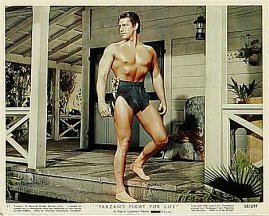
Gordon Scott As Tarzan
Cathneans ERB takes care to ingratiate the Big Bwana with the troops. He has Tarzan and the Cathnean soldiers enter into a spirit of camaraderie as he introduces them to and instructs them in the use of the bow. Nemone is instroduced but seems to take little notice of the Big Guy condemning him to fight in the arena.
Taken to a prison cell he and we are introduced at some length and in some detail to a character named Phobeg. Phobeg is billed as the strongest man in Cathne.
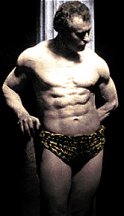
ERB devotes an amazing amount of space to his confrontation between Phobeg and Tarzan. His development of such a minor character is unusual. I think what we have here is a confrontation between Tarzan and the actual man who inspired Burroughs to create Tarzan, the man who was the physical basis of the Lion Man. Phobeg can be no other than the first important body builder in the world- The Great Sandow. Just as in Tarzan The Magnificent Burroughs takes care to indicate that Tarzan has now replaced H.M. Stanley as the symbol of Africa, so here he puts down ‘the strongest man in the world’ in favor of his hero.
 Sandow (1867-1925) had died a few years earlier. While other muscle men had replaced Sandow, most notably Charles Atlas, Burroughs was still obsessed by the man he had seen at the Columbian Expo of 1893. It would seem certain that ERB occasionally picked up a copy of Physical Culture Magazine to keep up on the latest builds. He couldn’t have missed the memorial copy devoted to Sandow, the greatest and still the greatest of the body builders. The award given to Mr. Olympia is called the Sandow.
While bowled over by the strongman, and strongmen, ERB was always offended by the bunchy muscles created by body building. he repeatedly makes allusions to strongmen throughout the corpus while Tarzan himself is both the antithesis and the perfection of the strongman. That is why Tarzan has smooth muscles flowing like molten metal beneath his skin while in this case Phobeg as a Sandow surrogate has the knotted muscles of the body builder.
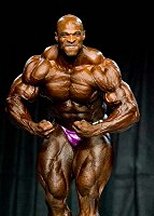
If Burroughs found Sandow’s build offensive he would have gone apoplectic at the most recent champions who seems to have developed musculature as far as it can go. Unlike builders like Charles Atlas, Gordon Scott or Arnold Schwarzenegger who aspired to the Apolline figure, Ronnie Coleman and his successor Jay Cutler have opted for muscle upon muscle until there is nothing but muscle with no attention to a human shape. As an example check out Jay Cutler the current Mr. Olympia and holder of the Sandow at www.emusclemag.com. This guy is only 5’9″ but bulks up at 320 lbs., paring down to 275 for performance. And that is literally all muscle. One look at Cutler and ERB would have been foaming at the mouth
Just as Sandow was billed as the strongest man in the world, so Phobeg is billed as the strongest man in
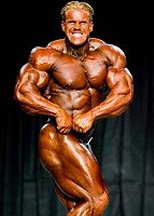
Jay Cutler In Full Pump
Cathne. ERB makes him a braggart in relation to Tarzan but if he was the strongest man in Cathne he had little reason to respect Tarzan’s physique which was more like ‘Apollo than Hercules.’ Tarzan’s strength though greater than Phobeg’s was disguised.
At they are to fight each other to the death in the arena this allows Burroughs to introduce another of his interests which may be related, that of professional wrestling. Burroughs had Tarzan jokingly suggest that they stage the fight much as professional wrestlers. Burroughs who still attended the matches was disgusted becasue the matches were pure entertainment, something he should have applauded. Then as now the professional wrestling matches were staged. Professional wrestling then as now has more to do with entertainment than sport. Either you can get caught up in the fun and drama or you can’t. ERB obviously did although as he still thought of the shows as wrestling he felt put upon.
After several pages of Phobeg’s bragging and Tarzan’s false humility the ‘really big shoo’ begins. Tarzan and Phobeg are the last act on the program and they would have been a difficult act to follow.
ERB must have loved this part as the lenghty description of the gambling taking place is many times more detailed that he usually is. Whether the gambling aspect went on at the wrestling matches he attended or not, I don’t know. The odds naturally are for Phobeg, whose Cathnean reputation is immense and accurate as concerns the past. Everyone expects the inveterate gambler Nemone to bet on the sure thing as was her custom. They hedged their bets when they could at fantastic odds. Nemone then surprised them by betting on Tarzan. Nearly bankrupted the whole coterie of Lion Men.
Tarzan wins of course but refusing to kill Phobeg he instead does his trademark thing lifting Phobeg above his head and tossing him into the stands at Nemone’s feet. Now that is one hard act to follow.
Having now won his liberty, a lion man named Gemnon is assigned custodian of Tarzan taking him under his wing. Up to this point there seems to be no reference to contemporary affairs except for Sandow and wrestling. At this point ERB displays a numerous and surprising set of literary references.
Go To Tarzan And The City Of Gold part two.
Exhuming Bob 12: Bob And The Middle Class
August 9, 2008
Exhuming Bob 12:
Bob And The Middle Class
by
R.E. Prindle
I was rewatching Martin Scorcese’s No Direction Home today. I was struck by the various reporters’ insistent demand to know what Bob was trying to say in his music. Bob seemed genuinely mystified at the time being apparently no more enlightened at the time of Scorcese’s interview.
I offer a suggestion, no more. Bob, says in the interview that he had slipped through the net meant to keep he and his ‘type’ out and now it was too late to do anything about it. I know what he meant. He and his style, viewpoint, were antithetical to everything acceptable in culture. The later TV creation of the Monkees that imitated, and in its way mocked, the Bohemian Dylan style was the acceptable pop mode of ‘protest’ songs.
Whether Dylan realized it or not he, in his songs, said everything the middle class did and thought was wrong, and further that they were all ‘assholes.’ Something happening here but you don’t know what it is, do you? I’m smart and you’re dumb. Whether he meant it that way or not, that was what they heard. That is what I heard but I didn’t disagree with him I wanted to be in the chorus and sing along. I knew exactly what Bob meant even if I couldn’t articulate it any better than he could.
Bob, in his arty way put things in such terms that so disguised what they believed was his real intent, they did understand, that he left them no convenient handle to denounce him. So what they wanted Bob to say when they asked ‘What do you songs mean?’ was ‘Well, all my songs mean I know better than you all do and besides you’re all assholes.’
At that point they would no longer have to take him seriously and could denounce him. ‘Oh, so YOU think YOU know more than the rest of us, do YOU? Well, there’s something happening here and YOU don’t what it is do YOU, Mr. Dylan? Well, let us tell YOU Buster…etc. etc.’
When people say that something new was introduced into pop music it wasn’t necessarily the ‘poetry’ or oddball language but his reviling of how the conventional mind works.
Bob said he slipped through. He could never have passed vetting for pop stardom by Tin Pan Alley so he managed to slip through anyway and destroy those who would never have given him a chance.
From his cornucopia sprang the ‘singer-songwriter’ genre that completely bypassed Tin Pan Alley. From his condemnation of the middle class sprang the rancorous Punk music of the seventies. From his denunciation of ‘a world gone wrong’ sprang the Negro rap music.
Call it a revolution if you want but it was just an underclass by some sort of heat convection bubbling to the surface. The sounds were commercially viable meaning that they made money for the labels. CBS could happily sell the ‘revolution’ on one hand, Johnny Mathis on the other and classical music strapped to its back.
I hope this makes sense to you.
A Review: In Your Wildest Dreams by Kimi Foos
August 5, 2008
A Review
In Your Wildest Dreams
by
Kimi Foos
Review by R.E. Prindle
Foos, Kimi, In Your Wildest Dreams, iUniverse, Inc. 2008 14.95
This lovely memoir by Kim Foos is characterized by rare charm and grace. A virtual love letter to her husband of 35 years Rick. From beginning to end one feels how lucky Rick is to be cherished so.
Kim Foos as a young girl of twelve fixed her sights on a much older (in teenage years) Rick determining then and there to make him hers. Kim lovingly chronicles Rick’s doings as a child and young man as though from a watchful distance. The anectdotes are wondrously told. Rick and Kim grew up near Wheaton, Illinois in what seems like a heavenly less populated time spent fishing, weirding out and investigating old subterranean missile sites. Sort of like my old childhood but strikingly different. I didn’t have that much fun. We didn’t have any fantastic abandoned missile sites near us. More detail could have been lavished there by the historically minded Kimi.
The innocence and sprigtliness of Rick’s springtime was rudely blasted apart as he heard a knock on the door and the low chuckle of Uncle Sam saying: Here I am. Yes. And the viet Nam war was raging in far off Asia. Like any good lad who knows his duty Rick chose the Army over Canada. Might not have been the wisest choice in retrospect. Turned his life inside out in one devastating moment when the hell he was standing on in Viet Nam moved skyward. Yes. It was thoroughly mined, a trap, an ambush. Dazed and blonkered Rick came back down to survive and stagger back to help his fellows, ears ringing and staggering nearly aimlessly. He needed as much help as anyone else.
Strangely he was not sent home but remained to serve out his term. And now Kim Foos’ story take a dark turn.
If there were enemies on the Eastern Front they had allies on the Home Front. Inept in Viet Nam our Commanders were cowardly at home. They allowed the traitorous domestic Red allies of the Communist Viet Namese to taunt and revile those who had courageously fought the battle of Justice and right. The returning soldiers who had faced a dogged and vicious enemy were told to keep their heads low on their home turf. This to appease a bunch of criminal, traitorous Red agitators who might just as easily have been shot. I don’t know who to revile more the Command or the scurvy Reds.
The shame of America that Rick experienced was to go much deeper. Returned home, reunited and united with a supportive wife in Kim now old enough to marry Rick, just barely, he took a job as auto repairman. According to Kim he was a born mechanic. When a customer learned that Rick was a returned Vietnamese vet he said he would take his custom elsewhere unless Rick was fired. Didn’t want him working on his car. to the shame of America, to the shame I share on behalf of American ingrates the garage owner fired Rick.
What does it mean to be an American? Don’t ask. It’s only an idea anyway.
Shortly thereafter Kim and Rick removed to the wastes of the Upper Peninsula of Michigan. The story continues there, the review ends here.
I close as I opened: this is a memoir of rare grace and charm. A testament to the love in a young girl’s heart. You won’t be wasting your 14.95.
A Review: Conquest Of A Continent by Madison Grant
August 4, 2008
A Review
Conquest Of A Continent
by
Madison Grant
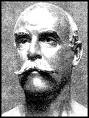
Madison Grant
Review by R.E. Prindle
Texts:
Grant, Madison, Conquest Of A Continent, Liberty Bell Publications, 2004. Reprint of 1933 Edition
Fischer, David Hackett, Albion’s Seed: Four British Folkways In America, Oxford, 1991
Higham, John, Strangers In The Land: Patterns Of American Nativism 1860-1925 Rutgers U. Press 1955
Myers, Gustavus, History Of Bigotry In The United States, Random House, 1943
Wittke, Carl, We Who Built America: The Saga Of The Immigrant, Case Western Reserve, 1939
In the immediacy of the moment one frequently overlooks or forgets the history leading up to the moment. One might think for instance that the current flap over Diversity and Multi-Culturalism is a recent occurrence. While the two terms are of recent provenance the argument under different names goes back much farther while the protagonists are essentially the same.
The story of immigration into America is almost always told from the point of view of the immigrant. Few books tell the tale from the Nativist point of view and they are universally and viciously derided as a tale told by bigoted idiots. While charity is demanded from the Nativists none is to be expected from the immigrationists.
Thus we get volumes like Strangers In The Land by John Higham and Carl Wittke’s We Who Built America that distort the issue in favor of immigrants while deprecating the Natives.
Qustavus Myers’ History Of Bigotry In The United States on the other hand appears to be a willful misunderstanding of the nature of the relative status between immigrant and native resulting in a slanderous approach like that of the contemporary Greil Marcus.
Conquest Of A Continent has been placed on the Jewish Index Of Anti-Semitic Books. Based on that I expected a detailed derogatory examination of the Jews from their entry into America perhaps being the conquerors referred to. The President of the American Jewish Committee sent a letter to every Jewish publisher in the United States demanding that they refrain from either reviewing the book or noticing it at all. Dynamic silence was to prevail.
After reading Conquest I can only conclude that the AJC was hyper sensitive to a degree. Since his 1916 Passing Of The Great Race Mr. Grant had learned that ‘You Don’t Mess With Rohan’ to quote Adam Sandler. Grant all but ignores the Jews in his volume. No, his offense, according to the AJC was even more egregious, he uses the world Nordic and dares to imply that they are ‘the Great Race’ rather than the AJC’s own Semites.
The other volumes mentioned and, indeed, all writing in this genre which is pretty extensive, defers to the Jews as ‘the Great Race’ probably genetically superior to all others.
So Madison Grant is interested in telling the story of how the Nordic race conquered the continent. This approach can only be considered as a sin by non-Nordics. Grant then tells the story of how the US and Canada were occupied by peoples other than the native Indians.
He begins early referring to twelfth century attempts to settle by Scandinavians. In the 1100s the firece native Indians were able to exterminate the invaders and may well have been able to exterminate the Puritan settlers but for the fact that a small pox epidemic shortly before the Puritan arrival had reduced the native population by as much as half while weakening them concomitantly. Such is the luck of the draw.
Grant thus traces immingration back to its origins colony by colony and then State by State as the Nordics moved Westward.
David Fischer in his excellent Albion’s Seed retraces the same ground fifty years after Grant with much addional detail concerning the places of origin and their activities once in the US.
Grant’s approach is in some ways superior to that of Fischer since as an unabashed Nordic advocate he is interested in detailing the exact racial content of the occupation of the various states and provinces. If you aren’t aware of the progress of settlement and by whom there are numerous surprises. My own notions were certainly vaguer before I read Grant.
I was surprised at the seeming numerical superiority of Southern migrants in the Westward movement. It seems that Whites did not like to live in the South where they were compelled to compete with slave labor while being despised by both the plantation owners and their slaves. Thus there was a constant stream of the best and brightest of the South moving into the North and West. As Grant notes, Virginia was the mother of States.
Then too some of Grant’s population statistics are of interest also. At the 1790 census before the invention of the cotton gin in 1793 there were less than a million Africans in the United States. Seventy years later as the Civil War began the number had increased to four and a half million. Thus natural increase was out of the question. It follows then that between 1800 and 1860 more Africans were brought to the US than there were before 1800. As a result the slave trade fluorished more than ever.
Prior to 1800 Alabama and Mississippi had no settlers so that in 1860 these two States were still rough frontier States still in a state of organization.
There is much good background here as to how the US came under settlement. The continent was accupied in its entirely when the truly major immigration from Eastern and Southern Europe began to accelerate in the 1870s and 1880s changing the basic Nordic institutions of the country. The change in Grant’s eyes was much for the worse.
Carl Wittke’s We Who Built America published in 1939 was undoubtedly in response to Grant’s Conquest Of A Continet. Wittke, was published by Case Western Reserve University. Grant explains the meaning of The Western Reserve which has always puzzled me. The Western Reserve was three million acres set aside as a concession to the State of Connecticut for giving up other territorial rights.
Wittke made a great impression with his his volume, his opinions being taken as overriding fact. I remember my sixth grade teacher in Michigan lauding the book to the skies. I finally read it a couple years ago. Not so much.
As is usual with books and writers of this type Wittke overstates his case and underproves his facts. A contribution to the dialogue at best.
Grant’s book should prove useful to any unbiased reader. If his attitude of Nordic superiority offends you, ignore it. His history as history is sound. For those of you reared on Myer’s History of Bigory attitude you will probably be surprised to find that there is another point of view. Bigotry is not a matter solely of American destestation of immigrants as the program of Diversity and Multi-Culturalism indicates, bigotry is a red herring and not the issue. The issue is who will be Top Race. The contestants for the Top Spot have turned out to be the Africans, Semites (both Jews and Arab Moslems) Hispanics, Chinese and Euro-Americans. (Grant’s Nordics) As you can see race has replaced nationalism.
The contest is real and ongoing. Peace is merely another form of war. The prize will go to who wants it the most. If you don’t see the contest in these terms I suggest you remove your rose colored glasses.
Exhuming Bob 11:
Bob Dylan And Toby Thompson
A Review
Positively Main Street
Text:
Thompson, Toby: Positively Main Street, U Minnesota Press, 2008 reprint of the 1971 edition.

Forty Miles Of Bad Road Later
Toby Thompson’s self identification with Bob Dylan is an interesting situation. In a way he predated the Elvis impersonators; blazing a new trail. That he recorded his infatuation on the spot and got it into print is even more fascinating.
I suppose people have always identified with important people as the insane asylums full of Napoleon Bonapartes indicate, but when the movies came into existence things changed. Movie actors were designed to appeal to certain character traits making identification with the actors more accessible. That the actors came from social strata much like one’s own with no apparent effort or skills made identification easier. (See the novel Merton Of The Movies by Harry Leon Wilson) When sound was matched to image one could act like and even talk like these heroes.
Older people being formed already were more immune than younger people so that the John Wayne imitators, Bogarts, Jimmie Stewarts or what have you began to surface in numbers beginning in the fifties. Still there was a psychological distance between the people on the screen and oneself while a direct imitation brought ridicule on oneself.
Then in the mid-fifties Presley burst on the scene. Here was a guy who drove truck, we were told, one day and was a major recording star the next. Then, as immediately as it seemed to all of us, more to some of us than others, he parlayed that into becoming a movie star. That was just about every teenagers dream. Now that was something we all could do and a great many of the most venturesome did get at least to the level of recording stars but they all wanted the movies.
Presley was the first who created a legion of impersonators. The movies formed a cadre of amateur impersonators but Presley spawned a full frontal impersonation for a profit; People who became Elvis Presley as a surrogate for themselves. This began fairly early in the Presley career too.
Then as the sixties hit young people were conditioned by phonograph records. Records were the way the generation communicated with each other; They took the place of movies and literature. One could still write books or rarely, like Presley, make it into the movies but anyone with enough ambition, little training during the sixties and none in the seventies, could make a record.
This was no more evident than in the case of Bob Dylan. Quite frankly my own first impression was that here is a talentless guy putting out records. If Dylan could do it, if I wanted to, I could. It then became easy to identify with Dylan. Plus he was a nobody, had never even been to college.
After I and many others had written his early records off he surfaced in a way to seize your attention, however his appeal was limited to a certain psychology. But, now, in the twentieth century via records and radio if there were only a million of any certain type those million could make an artist very, very successful, viz. Janis Joplin.
When Big Brother And The Holding Company with Janis Joplin released its first CBS disc the record went to the top of the charts on the strength of a small minority of the public. The vast, and I mean vast, majority of the public had never heard of the band or Joplin. I was in the record business at that time and was astounded that a relatively few hippies made a group and singer unkown to 9 1/2 out of ten, at the minimum, could send a record to the top. Hippies were not known to take care of their possessions. They trashed that record in a week or two playing it perhaps a hundred times or more then coming back to buy another one after another. Each one of those sales contributed to the accumulation of a million so the entire course of American music was swayed by the success of a record purchased by a very small percentage of the population, and the lunatic fringe at that.
So with Dylan. Dylan provoked a violent split in society. Just as Pat Boone was opposed to Elvis as a role model so Simon and Garfunkle were opposed to Bob Dylan. In 1966-67 the S & G faction was much larger than Dylan’s. Bob got more TV attention however. His cult was as the misunderstood, oppressed genius, the Outsider who was shucking the world. You can see where his fan base came from. So, all of us who were in that category became devoted, almost obsessed, advocates of Bob Dylan. I was one, I’m merely analyzing not being superior. I never went as far as Toby Thompson in my obsession but then I didn’t think of what he did either and I was six years older. I already had a life of my own, such as it was.
The younger people took to the pop stars with ease. We had Jim Morrisons, various Beatles and Stones or whatever as well as Dylans walking around campus, people completely immersed in the various identies. I don’t even have to p[oint out the Deadheads and they were truly legion.
So Thompson’s notion of reliving Bob’s youth in his own person while extreme was not completely imcomprehensible. Still psychotic but borderline as he never completely lost contact with reality. Really interesting because unlike Freud’s Schreiber he was able to write a book about it even as it happened.
Thompson was born in 1944 being three years younger than Bob thus being able to look up to him as a role model. Being three years older than Bob I always looked down on him as a younger sibling who was somehow outshining me. The identification was there nonetheless.
Through 1966 Bob befogged us all. Blonde On Blonde was such a towering effort both musically and lyrically that it was incomprehensible. No one could understand it. Some of it you couldn’t even listen to but you were convinced it was a work of genius. The people who called it mere noise weren’t entirely wrong either. Philistines nonetheless.
I knew that Bob had peaked along those musical lines and there would have to be a model change. But then the word came out that Bob was dead, close to it or paralyzed from the eyes down. He disappeared from the stage for a while but as he wasn’t dead or paralyzed we all stood with out faces turned to Woodstock waiting for news from the East. We all, being those of like psychology.
Then Bob dressed like Billy the Kid or some other Western desperado released John Wesley Harding. the psychology was changed. What had drawn us in for ’64 to ’66 was the muse using Bob Dylan as an instrument and he now had been discarded. I dropped him as did many others.
A year later Toby Thompson conceived the idea of searching out Dylan’s roots in Minnesota. He didn’t go as a mere reporter though. He went as a Bob Dylan impersonator. There was Toby Thompson standing in Bob Dylan’s shoes.
The Thompson that emerges from his telling is a very disturbed young man of twenty-four. His intake of alcohol and marijuana was prodigious. Of course, he’s telling a story, but I can’t recall one day that he wasn’t stone drunk. He keeps a pint in his glove compartment. He gets so drunk he stands on his head in the middle of a dance floor and can’t remember it the next day. The guy must have smelled like a brewery all the time. I’m sure the fumes coming from him when he interviewed Dylan’s mother in the daytime gave her a very negative opinion of him. Robert Shelton, Dylan’s biographer, future biographer at this time, had been out to Minnesota the year before. He was a professional Journalistic persona older than Dylan’s friends. Thompson was three years younger and appears to have been accepted on a personal rather than professional basis. After all he had no journalistic history, he was only going to write.
On that basis he formed an intimate relationship with Dylan’s high school sweetheart, Echo Helstrom. I’m going to concentrate on that aspect of the book for this review. Bear in mind that she is three years older than Thompson.
Thompson’s visit to Hibbing must have had the locals’ heads spinning. Thompson, in his book, doesn’t seem to be aware of the impression he was creating. From his description it seems that he appeared among them as a Bob Dylan impersonator. Bobby Zimmerman left Hibbing ten years earlier, became Bob Dylan, and now ten years later this guy shows up impersonating him. Doing a good job of it too.
One can only imagine what Hibbingites thought.
The idea of this guy pictured below going forth to conquer the world of popular music appears to be absurd. We all have known kids who wanted to do the same. We may even be one of those kids but the odd
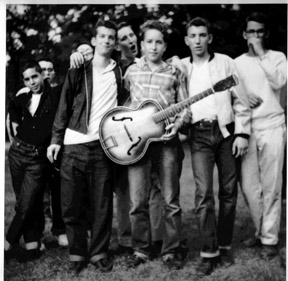
Look Out Little Richard
of succeeding were about a million and a half to one. How could anyone even suspect that Bobby Zimmerman, the kid above, from the virtually uninhabited North Country would be the ONE. Everyone in town must have been laughing up their sleeve, like the guy on the right above, when Bobby Zimmerman sallied forth to ‘join Little Richard’ and conquer the world.
Now, this guy Thompson using his own name came posing as a journalist but impersonating Bob shows up. Thompson seems surprised at the reaction of Maurice and Paul Zimmerman, Bob’s uncles, but can you imagine being interviewed by a guy talking and acting like your nephew Bob. It’s kind of crazy. Imagine what Beattie Zimmerman, Bob’s mother, thought sitting across from Toby doing Bob. Maybe that’s what Bob meant when he said ‘This guy Toby Thompson has got some things to learn.’
Nobody knew what was going on there, did they?
When Bob and John Bucklen and Echo Helstrom were kids, like many another group of Musketeers, they swore that if one of them made it he or she would help the others along. Well, Bob made it but he forgot John and Echo. No big deal. Teenage vows even spoken in earnest have no meaning after the fact but the promise lives on in the innocent hearts of those who aren’t pulled through by the successful one. There is a sense of betrayal. Added to that there was romantic ill will on Echo’s part because of Bob’s eleventh and twelfth grade betrayal.
Bob is making it big while Echo just has a job. A young woman trying to make her way has a tougher row to hoe than a guy. But, if she knows how to work it she does have a story that’s worth at least a couple three or four years worth of wages. She doesn’t know how to market it though. Robert Shelton came out to Minneapolis a year before Thompson and paid her a hundred dollars for an interview. She held the hundred up to Toby as hint but he wasn’t thinking that way. She was only going to get screwed by Toby, literally.
If Toby hadn’t been in an alcholic haze he might have realized that the story Positively Main Street was only subsidiary to Absolutely Sweet Echo. The money was with Echo.

Echo When She Knew Bob
As they’re driving up Highway 61 Echo pulls out a hundred dollar bill and says ‘See what Robert Shelton gave me for an interview.’ The light still didn’t go off in Thompson’s head. He reached into the glove compartment for his pint.
I am astonished at the amount of alcohol Thompson consumed on these trips. If he isn’t novelizing the guy was in a virtual stupor the whole time. When he and Echo arrive in Hibbing they go to a bar where Toby becomes blotto on beer, no less. He has no memory of the moment but Echo tells him that he stood on his head in the middle of the dance floor as coins and keys showered out of his pockets.
Echo must have been one tolerant girl or else she was hoping for something to happen. Perhaps a large part of the charm of Positively Main Street is the stunning unconciousness of Thompson. The guy was twenty-four years old at the time, not a kid- exactly. He had been telling Echo he was going to write a book. When he gets the first trip written up he sends her sixty pages. Echo writes back: ‘Sixty pages isn’t enough for a book is it?’ She has reasons to be disappointed. Heck, Toby is using her to attempt to make his fortune and he hasn’t even promised to cut Echo in for a dime. Think about this. The self centered naivete shines through with startling clarity. For that reason it is one of the most interesting books in the the Dylan canon.

Echo When She Knew Toby
Now, in these sixty pages Toby has misunderstood what Echo told him about the time Bob called her on the phone and played Bobby Freeman’s Do You Want To Dance claiming to be singing the song.
In his sixty pages he projects a better story where Bob shows up on Echo’s front porch playing guitar and sings Do You Want To Dance then strutting all through the house singing and playing somewhat like Elvis in the dime store in King Creole.
Echo points out this error. Toby liked his version so much he left it in the way he first wrote it. Then when Echo introduces this Bob Dylan impersonator into his parents home Toby whips out his quitar and reenacts his version of the incident strutting around the house as he plays and sings. The guy was absolutely out of his mind in his alcohol haze. He must have smelled like a brewery the whole time.
One is astonished that he was so well tolerated. Of course maybe everyone was thinking: ‘This is amazing, but it won’t last long’ and let it pass. Waved his car goodbe as he sped away.
One wonders what Echo’s emotional rection to the Bob Dylan impersonator was. Toby must have reactivated dormant affections for Bobby Zimmerman as he came on to her strongly in Bob’s persona. Echo had ten year old memories of Bob and now here he was, his double, coming onto her again. Frightening actually.
Toby left again and never returned. In the book he seems oblivious to the havoc he created in Echo’s life. In the interview at the end of Main Street given many years later he doesn’t seem to be any more aware. In fact he seems to be still posing as Dylan’s double. He mentions that he still contacts Echo, who has moved to LA, occasionally as does Bob but Bob seems to have better success in finding her.
Hurt and mystified that Thompson had no more use for her she wrote a poem for him that she mailed to him in far off Washington D.C.
Hey! Toby!
Where can you be?
Somebody told me
That you went back to
Washing Machine D.C.
How can that be?
You came to town in your Volkswagen
And I’ll tell you we sure had fun!
And now you’re gone!
You played for me on your old guitar,
Took me for a ride in your little car,
Drove me near and drove me far,
We looked at the moon,
And stared at the stars,
You stood on your head in my hometown bar…
How could it be you’ve gone so far?
Hey Toby? Where are you?
– Echo Helstrom
Toby hadn’t gone anywhere. Like Bob he’d just never been there. His fantasy like Bob’s didn’t include anyone else, they were just bit players in his own movie. Toby was no longer thinking of Echo. He was married to the bottle. He was touring bars across the country to get material for his next book. Echo could just consider herself as one of those bars. Once Toby had visited it there was no reason to return.
The tragedy for Echo was that she was betrayed once by Bob in 1958 and then again by a Bob impersonator in 1968. Perhaps a wound was created in her heart that could never heal. One wonders what her later history was after she left Minneapolis and drifted West.
I wonder where you are tonight.
I wonder if you are alright.
I wonder if you think of me
In my lonely misery.
There stands the glass,
Fill it up to the brim,
Till it flows o’er the rim,
It’s my first one today.
-Webb Pierce.
Here’s to old memories. Bottoms up.
Exhuming Bob Chronicles IX Pensees 8: New Morning
July 23, 2008
Exhuming Bob:
Chronicles IX, Pensees 8:
New Morning
by
R.E. Prindle
The chapter New Morning opens with an interesting comparison. Bob had just returned to Woodstock after his father’s funeral in the summer of 1968. The association of New Morning with the death of his father in itself presents an interesting psychological mental state. A letter was waiting for him from who he considers one of the three great American poets, Archibald MacLeish. MacLeish was just coming off his Broadway triumph J.B. In the letter he asks Bob and Sara to call on him in his Connecticut home to discuss a musical collaboration on his new play. A jewish father dies; a goy ‘father’ appears.
As Bob explains, Father Abram is somewhat dull, thinking that an artist must be a painter. The notion seems to be that Bob is slightly ashamed of his father for not understanding the distinction between pictures and the artistic soul. Thus contrasting with dull Abram is the brilliant intellectual poet-artist, Archibald MacLeish. Bob is quickly on intimate terms referring to the Poet Laureate of America as Archie.
If you’ve never read Poe’s last story Landor’s Cottage you might like to compare that description to Bob’s of MacLeish’s home. While we never meet Poe’s Landor Bob does introduce us to Archie. Coming from small town Hibbing Bob seems to be overwhelmed by the splendor of MacLeish’s dwelling place. Sure sounded good to me. So as Bob left Abram at the rosy fingered Dawn of his New Morning, MacLeish presents himself as the sun rising above the horizon. But it’s a Black Sun. MacLeish does not walk on the sunny side of the street. He’s dark, as anyone who writes a play commentary on the Book of Job must necessarily be.
His new play is called Scratch. One presumes after Old Scratch, The Devil. Bob quotes some lines of Archie’s character Scratch, p.124:
I know there is evil in the world- essential evil, not the opposite of good or the defective of good but something to which good itself is an irrelevance- a fantasy. No one can live as long as I have, hear what I have heard and not know that. I know too- more precisely- I am ready to believe that there may be something in the world-someone, if you prefer- that purposes evil, that intends it…powerful nations suddenly, without occasion, without apparent cause…decay. Their children turn against them, their families disintegrate.
The strength of the insight is too strong for Bob at that precise psychological moment but Archie has given him a hint of a reality that Bob will realize all too soon. Perhaps in reference to Abe and Archie Bob meets Frank Sinatra Jr. at the Rainbow Room. Frank, Jr. nursing one of the same travails as Bob asks him after discussing Frank Sr.: What do you do when that father turns out to be a son-of-a-bitch.
Well, yes, you’ve got an identity problem, don’t you? Bob has always had an identity problem. What started out bad has taken a turn for the worse. He wanted to be Bob Dylan but now being Bob Dylan has turned out to be a son-of-a-bitch, a burden Bob…well, just plain Bob, cant’ bear. He’s learning about this inherent evil of life Archie is talking about.
If you’ve never experienced what Bob is telling you it will be hard to understand. I’ve suffered through a mild dose of them blues, enough to give me understanding, but nothing compared to Bob. He wakes up and someone is standing in his bedroom watching he and Sara sleep. That gives you a start. But if Bob thought he had identity problems what kind of problems does some poor fish have who literally wants to get inside your skin have. Walk a mile in your shoes like Toby. Everybody want something from you that you don’t have to give. And I mean something. You by your success have emasculated them, Bob’s success. So they in turn want your dick and balls. They want ot carry them around in their pocket to give them what they lack. ‘Hey, you know what I’ve got in my pocket, look, Bob Dylan’s dick and balls.’
You want to know what emasculation is? Bob tells you. The Sheriff of Woodstock tells him that if someone is scrambling over his roof and falls off Dylan will be legally responsible. That does something to your mind. The Sheriff tells Bob that if any of these crazies attack him and he defends himself he’ll be the guy going to jail. That one sends a few synapses seeking new routes through the brain. That one did happen to me. Might as well have left the planet, the Sheriff just took your dick and balls.
Bob is now learning first hand of the evil in Archie’s world. Damn that’s rough.
Even then Bob couldn’t make his lyrics dark enough for Archie although, now this is funny, Bob did use them in his album New Morning. What does that say about a new morning?
Bob just couldn’t get used to being Bob Dylan. Being Bob was OK but being Bob Dylan was tough. They were everywhere. You couldn’t even run much less hide.
As Bob tells us he was riding down the highway with Robbie Robertson when Robbie asked him: ‘Where are you going to take it now?’ ‘Take what?’ Bob asks in return. ‘Pop music.’ Robbie naively replies.
Bob is flabbergasted but who can blame Robbie? For the last six years Bob had been calling the shots, getting booed and selling records, renovating and reinvigorating folk music, taking folk music electric, electrifying rock. Why shouldn’t Robbie think something mega revolutationary was brewing in Bob’s brain? Being Bob was easy, being Bob Dylan was damn near impossible. Those three fathers, Abe, Archie and Frank Sr. Bob was learning something about the inherent evil of living.
His new mentor, Archie, thinking perhaps that Bob was Bob Dylan pushes him to sharpen and darken the lyrics to the songs he’s written for Archie. Bob just like after Blonde On Blonde has taken it as far as it can go. He opts out on Archie. Two fathers down but there’s still that Big Guy In The Sky but that Bob will seek a little farther down the road.
New Morning was a good chapter. I could empathize. Current events are giving me a new slant on the inherent evil in the world too. Heads up.
Picturing Greil Marcus
July 20, 2008
Picturing Greil Marcus
by
R.E. Prindle
What polluted wretches would the next glance show…
Greil Marcus
…using the novel technique of occupying one building, and then, when the police arrived, filing out, only to seize another building, and then another, and another- Berkeley radicals called on their fellows to “Do a Columbia”; not for any reason, not in the face of any injustice or insult, but for the lack of anything better to do.
Greil Marcus
Greil looks down his nose at us.
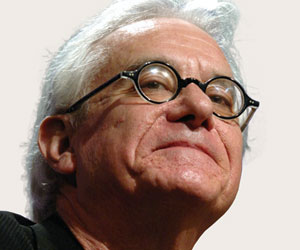
Greil Marcus is among us like some IT that came from outer space or conversely like some Creature From The Black Lagoon arising all dripping and encrusted with slime, like some Blob. And what does he want from us?
The fellow can’t genuinely be that unhappy. He was raised by a multi-millionaire San Francisco attorney by the name of Gerald Marcus. There are some conflicts in Gerald Marcus’ history. He made big money form ‘good’ causes thereby attaining a certain smugness as a defender of the downtrodden. Mr. Marcus made his millions representing various farm unions thereby combining greed with ‘benevolence.’
Using his magnificent income he provided young Greil with what now must be a multi-million dollar home next to Atherton on the Peninsula, one of the most prestigious locations in California if not top of the list. Upon graduation from high school Greil had a ready made admittance to UC- Berkeley thanks to his father’s prominence in the Boalt Law School of that insitution.
Thus at the age of twenty-one or twenty-two young Greil stepped out into the world armed cap-a-pie to begin the battle of life. No deprivation there; who could ask for more? Indeed, many of us would have settled for less and thought we were doing well.
Indeed, Amerikka, as Greil has spelled it, showed the fairest of faces to our young hero. He didn’t even have to get a paying job; he could continue to play supported, one assumes, by his step-daddy’s millions. Greil went across the big Bay Bridge to San Francisco and took a play job at Rolling Stone Magazine that started up about the time he graduated. It wasn’t a job that paid a living wage but then Greil had time. He bummed around Rock journalism for several years building a reputation that the over the years blossomed into what it is now.

The Old Warrior As The Shadows Deepen
The feast of Amerikka had been spread before him; young Greil had grabbed a plate, knife and fork, and dug in. Young Greil sat down with a plate heaped with good things before him and began a bitch with every bite. What he found wasn’t good. To young Greil the feast was a product of corruption. He, like his step-father, could accommodate himself to it though as the pay was good. Greil got himself a fine house in a prime location in Berkeley above the university that many would kill for. I’m not saying that Greil didn’t. He didn’t stop bitching though. Indeed, ‘what polluted wretches would his next glance show…’
Everywhere he looked his glance fell on pollution, on wretches in the horror of the ‘air conditioned nightmare’ as Henry Miller expressed it. The air conditioned nightmare! Let that concept roll around your mind for a while. Ninety-five degrees in the shade, 100% humidity outside and you’re living in an air conditioned nightmare. Interesting. Where I grew up when the heat and humidity hit one ran for the movie theatres with ‘refrigerated air.’ It was refrigerated too. Go in like melted butter and come out a solid brick. I didn’t hear anyone complaining about a ‘nightmare’ though. But then what is is how you perceive it. And how did Greil perceive it?
He sought out all the more horrid representations of the most horrid and perverse literature and movies he could find and called it ‘normal.’ He concentrates on this Twin Peaks of David Lynch and its spin off movie Fire Walk With Me. He even dwells on a novel based on the movie by Lynch’s daughter as though it were serious literature; as though the perversion of the movie and book was the accepted norm. As though the depression of Lynch was rational vision.
Indeed, a very deep psychological depression seems to characaterize Greil’s writing. As Dylan put it, he tries to get you into the hole he’s in. There is certainly no climbing out of the hole Greil is in. The more he writes the deeper the hole gets. Worse still he seems to have no reason for his depression. He ‘Does the Columbia’ on us not because of any injustice we’ve done him or any insult we’ve offered him but ‘for a lack of anything better to do.’ The man is not to be taken seriously.
Oh, he does have a deep psychological grievance but it doesn’t have anything to do with us. It seems that his mother only knew his father a couple days or weeks before his father shipped out during the war and died in that great holocaust. Greil never knew his father thus causing him to wonder what might have been and throwing him into a deep funk.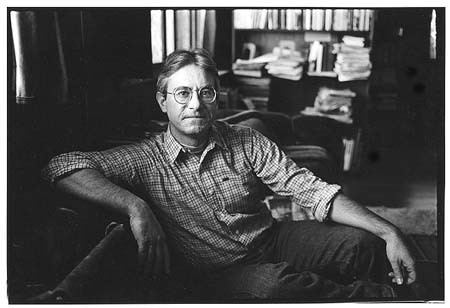
Over the decades this sense of anomie preyed on his mind. Gradually he developed a hatred of the Amerikka that had ‘murdered’ his father so senselessly. He conceived the notion that that the Captain of his father’s ship was an incompetent who had purposely been placed over his father to cause his death. He developed the notion of the heroism of his father based on nothing but his wishes. And then one day he learned that a television production about his father’s squadron had been made depicting the manner in which his father’s ship sank. Terrible storm, huge typhoon. Under wartime conditions when the ship was improperly ballasted for such a monster the top heavy ship rolled. The whole fleet suffered terribly. In those days they didn’t have satellite weather reports that gave advance warning of what was coming. Weather was weather in those days. Look out. Keep your head down.
So misconstruing the whole situation against the Beast Greil bore a grudge against Amerikka. I don’t know if that’s the whole reason for his grudge but that form its basis.
I suppose it’s terrible to lose your biologic father at sea. I lost mine when three when he and my mother divorced. I haven’t ever really regretted it though. People are different but it didn’t bother me. It would have bothered me even less if someone like Gerald Marcus came along and married my mom. I might even have considered that a blessing. I got a real clinker for a step-father. I’ve got a reason for depression. Could easily have done without him. Should have stayed an orphan.
But rather than try to dig his way out of his hole, Greil dug in deeper. He wrote weird stuff like Weird Old America, left out the double K so as not to limit the size of his readership. I can’t tell you what Greil was thinking. He freehandedly insulted a whole group of people who had little reason to regret their pasts. I mean, Grandpappy lived in those Kentucky hills where Dock Boggs lived. That’s my ancestry Greil’s talking about. And Greil says we were all…well, I don’t know exactly what we all were in his mind but it isn’t good. I mean, compared to what? What is Greil comparing us to in which the comparison is so unfavorable? Himself? I look around me and I don’t see any people or thing much better. I’ve been around too. This Lynch guy and his portrait of ‘smalltown’ Amerikka isn’t all that familiar to me. I grew up in that environment. Sure there were nasty things going on but that’s just the way people are. Small and nasty most of the time. But they had and have their ideals too. Those people created a town that was a lot nice than the Twin Peaks Lynch portrays.
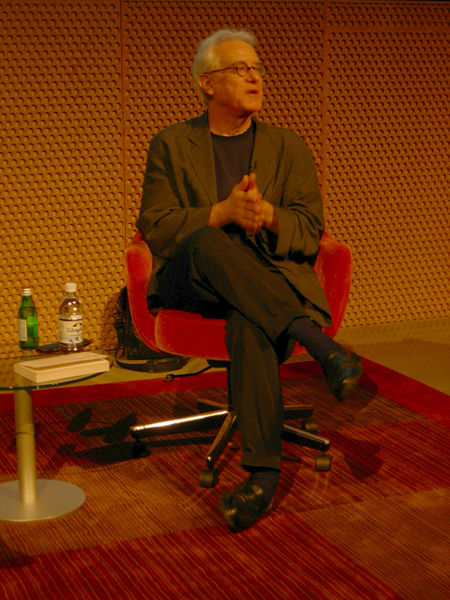
Let me see.
Of course, I haven’t seen what Lynch portrayed because I never saw the show that apparently wasn’t all that popular because it didn’t get that far. Greil himself says that movie was so horrible that everyone ignored it but him. He makes it sound so terrible that I have no reason to check it out.
But Greil revels in that corruption. Rolls around in it, enjoys it. He almost shouts for joy that a major slut is elected home coming queen. He loves it that her father is doing her and then kills her. That’s how I read it anyway. So, maybe Greil should do something about his depression.
I mean, Freud lived and died a hundred years ago; his legacy lives on practiced by a legion of psycho-analysts. Why not check one out. Why not step back and look a the life he’s leading. Running around making people feel bad with his book of murder ballads.
We all know that stuff goes on. There are unbalanced men and women out there who do terrible things. But there are a lot more who are better balanced and don’t do those things. There are lots of people who work hard to make the world a better place, to make their immediate vicinity a better environment. There are people who create beautiful gardens and wonderful parks. There is pleasure and joy in this life. It’s a struggle to get it but it’s worth struggling for. Greil should open his eyes and keep some kind of perspective on pollution and cleanliness.
I can’t imagine someone getting up and delivering the commencement address that Greil delivered at UC in 2006. He opens with a positive reference to a perverted Mafia figure who goes to some kind of pervert heaven in New Hampshire, wakes up in the moring to find that the whole world has gone pervert. Greil calls this the American Dream. They talk perversion over breakfast. As Greil wants us to believe, they are free and this is the freedom that Amerikka is supposed to represent before the Weird Old Americans got in the way.
I don’t know, Greil, get a life and then get some help. Life doesn’t have to be as weird as all that.
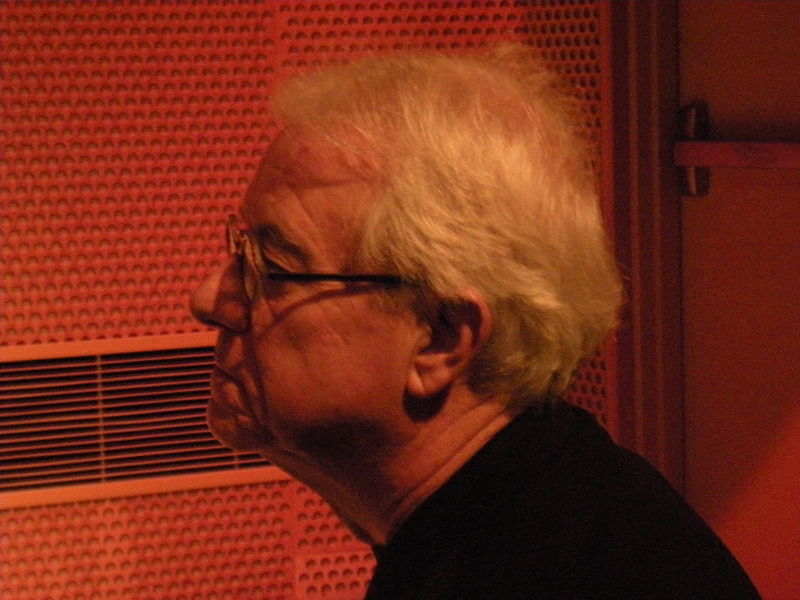
The Profile
Ragtime Talking Eddie Burroughs
July 18, 2008
Ragtime Talking Eddie Burroughs:
Another Look At Minidoka
by
R.E. Prindle

While I was wandering through the pages of Minidoka one day looking for some firm dating device I came across what may very well be a key to explaining the method of reading the story. When I first read the story I tried to read it straight which was a very unsatisfying experience. The story seemed to be a clumsy first effort. While a first effort, perhaps, the story is far from clumsy, indeed it is a well crafted and polished tale.
The story isn’t written in plain English; it seems that our very hep ERB is ‘talking ragtime.’ First the proof and then an attempt to understand the concept of talking ragtime.
On page 22 there is an exchange between Minidoka and the Hoobody:
“Now, don’t be frightened,” said the Hoobody. “I’m really very fond of young people, expecially hash browned. But candidly, I have come to you as a friend, sent by the Little Horned Toad whom we all obey. You are in terrible danger and if you don’t do just what I tell you, your name is Alkalai dust.”
“I’m in the hand of my friends,: replied Minidoka. “But I glean that you are talking rag-time,” he added to himself.
The Hoobody’s speech can then be understood as an example of ragtime talking. One can’t write what one doesn’t know so it is clear that ERB knows what ragtime talking is and knows it well enough to confidently reproduce it. Hence ERB is a hep dude. I’m not talking ragtime either. It would seem that as in latter days ERB would have had an affinity to the Hipsters, the Beats, Beatniks and the Hippies. He was cool.
Now, what might talking ragtime be.
Talking ragtime woud be based on the principles of ragtime music but independent of it. Ragging a tune led to ragging the language.
While ragtime is a distinct musical genre of original pieces any song can be converted into ragtime by changing the time values of melody notes. This is known as ragging the piece. (Wikipedia) Thus ragtime talking distorts ordinary English into strange or outre phrasing and notions. The Hoobody says he is fond of young people, especially hash browned. The surprise effect of young people and an edible dish is clever or amusing if not outright funny. Thus the language is being ‘ragged.’
As ERB follows the technique throughout the book the story must be a ragtime story. While my first thought was that ERB put the story aside because it’s quality wasn’t publishable I am now of the opinion that while within a ragtime genre the quality is fine perhaps there were no publications that accepted ragtime stories. I may be wrong.
That ERB may have been deep into the technique is evident from the transformation of Bodine into a Coyote. I am not clear on the connection between the Coyote and ragtime talking and lyrics but the Coyote plays a central role. Thus Bodine is a Coyote throughout most of the story.
Ragtime music first surfaced as a genre at that place of all firsts the Chicago Columbian Exposition of 1893. Thus from the age of seventeen on ERB would at least have known of Ragtime music. The music was definitely popular from c. 1900-1918. When Ragtime talking became a hipster dialect isn’t clear.
In the story ERB has Smith driving a ‘horseless carriage.’ An anomaly of sorts as by the terms of the story it should have been a cowless carriage as ERB reverses nearly every conventional usage throughout the story. The automobile wouldn’t have been that common in the first few years of the century while by 1907-08 when I believe the story was written, it would have been. The electric car that Burroughs drove at the Expo wouldn’t have been called a ‘horseless carriage.’
I can find no reference to ragtime talking on the internet so that if the method developed in the early years of the century until it was common amongst hipsters that would have to have been by 1907-08. There would have been no way for ERB to learn the concept while he was in backward Idaho in 1903 and 04. So that in my opinion the story written in ’07-’08 and possibly later.
The story is definitely not a children’s story. The story is meant for adults. The use of the term ‘threw a couple Delsartes’ would very likely be incomprehensible to children. The Delsarte method was a series of sterotypical emotional responses designed for stage actors. I append a page in demonstration borrowed from the incomparable Our Times by the great Mark Sullivan.
 Lyrics: Since Birdie Commenced Her Delsarte:
Her right hand goes this way, her left one goes that,
And she flings them high into the air,
To show her improvement she give the “wave” movement
And impersonates Hate and Despair…
There’s lots of sleep-walking, also dumb talking,
Since Birdie’s commenced her Delsarte.
So, if one reads Minidoka as an example of ragged English not unlike Fractured Fairy Tales or a couple of verses from Phil Harris; That’s What I Like About The South it makes perfect sense:
 Won’t you come with me to Alabammy
Let’s go see my dear old Mammy
She’s fryin’ eggs and boiling hammy
That’s what I like about the South.
Well it’s way down where the cane grows tall
Down where they say “Y’all
Walk on in with that Southern Drawl
‘Cause that’s what I like about the South.
Did I tell you ’bout the place called Doo Wah Diddy?
It ain’t a town and it ain’t a city
It’s just awful small, but awful pretty
That’s Do Wah Diddy.
Rag, Mama, rag.
So Mindoka is ERB in a light hearted effort to amuse while demonstrating his coolness. Can’t get much hipper. Viewed from that perspective we have an accomplished effort on a level with the best of his work.
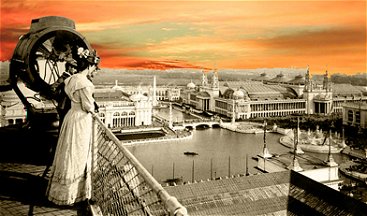
1893 Columbian Exposition At Chicago
Men Like Gods: Tarzan Pays Homage To Heracles
July 9, 2008
Men Like Gods
Tarzan Pays Homage To Heracles
by
R.E. Prindle
First published in the online Magazine: ERBzine
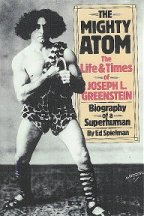
Cover of The Mighty Atom
The Golden Age of Strongmen had captured the imagination of the world between 1890 and 1910….Into the 1920s the strongman continued as a living wonder and inspiring vision that could be had for the modest price of admission
-Ed Spielman: The Mighty Atom:
The Life And Times Of Joseph L. Greenstein
When I was a child and youth in the 1940s and ’50s the legendary strongmen of the turn of the twentieth century were, if no longer living, living legends. At least one, Bernarr Madfadden, the father of American bodybuilding, was still going strong.
The most legendary of the strongmen was Frederick Mueller who was known professionally as the Great Sandow.
In his heyday Sandow was so strong that he was capable of ‘exploding’ or breaking the ‘Test Your Strength’ machines in the arcades of Vienna, Austria. There were so many broken machines that it was thought a vandal was destroying them but when apprehended it was discovered that Sandow was not only testing his own strength but the strength of the machines. He flippantly suggested that they be made of better materials.
On stage as Spielman relates, Sandow, who was trained as a turner, could do a back somersault over a chair with a thirty-five pound dumbbell in each hand. He could do a one arm chin-up with the grip of any of his fingers of either hand, including his thumbs.
He could…wait a minute! I’ve heard something like that before. Oh yea, I remember now. In Edgar Rice Burroughs’ Tarzan And The Lion Man he has Tarzan leap up to seize stakes pointing down from a ten foot high wall, then draw himself straight up until his torso was above the stakes, then roll over the top defeating the purpose of the stakes. Was he thinking of the Great Sandow when he wrote that?
I think he was.
Burroughs was a fan of boxing and a great admirer of the strongmen of the Golden Age, although he didn’t like the bulky physiques. He repeatedly denounces the physical build of the Strongmen in preference for Tarzan’s ‘smooth rippling muscles.’ In my day the bodybuilders were ridiculed as being ‘muscle bound.’ But the ladies panted when they said it. Tarzan is as strong or stronger than the strongmen but sleek.
Next one asks is there any place that it can be shown that Burroughs ever saw Sandow? yes, and where else? The Chicago Columbian Exposition of 1893. The Expo was a life changing experience for 17 year-old Ed Burroughs. Bill Hillman of ERBzine has written a wonderful series on the influence of the Fair on young Burroughs.
The influence of the Fair was as moving for the rest of America and the World as it was on Our Man. There apparently has never been so influential a World’s Fair as that of Chicago of 1893.
One of the best attended features of the Fair was put on by the Great Sandow. Bodybuilding had already gotten started in England. Sandow was a student of the innovative Professor Attila in London. He came to the attention of Florenz Ziegfeld while performing in New York. Ziegfeld brought him to Chicago for the Expo. Sandow was a sensation.

The Great Sandow
He created quite a stir at the fair. Not only did Burroughs see him there but so did a man named Bernarr Macfadden. At the time he was known as Bernard McFadden but he chose Bernarr because it sounded more like a lion’s roar and Macfadden because he thought it looked more distinguished in print. As a result of seeing Sandow Macfadden became the father of bodybuilding and the health movement in the United States. John Dos Passos spoofs him in Vol. III, The Big Money, of the his USA Trilogy.
Macfadden was the discoverer of isometric exercises, which his student, Charles Atlas, renamed Dynamic Tension and made a fortune.
Unless I’m mistaken Macfadden would cross ERB’s path sometime between 1908 to 1912.
Sandow made bodybuilding a rage after the Fair while Macfadden organized the sport around his magazine ‘Physical Culture’ which he began publishing in the wake of the Fair. Sandow also opened the way for a number of strongmen to build careers on their physiques.
They all passed through Chicago. How many of them ERB paid the modest price of admissio to see we can’t know, but as he always speaks of the strongmen in the plural one assumes that he saw several.
Anyone who has watched the Strongest Men In The World competition on cable TV will understand how impressive both the feats and the physiques of these men were.
In ERB’s day a man called Warren Travis Lincoln could lift a platform that held twenty-five men with his back. That was a weight of about 4200 pounds.
G.W. Rolandow could stack three decks of playing cards and tear them in two. One assumes that was before they were plastic coated.
Emil Knaucke who weighed in at five hundred pounds, a spectacle in itself, could hold a car above his head with one hand. Spielman doesn’t specify make or model.
Louis Cyr, one of the most famous strongmen, could restrain a team of horses on either side at the same time. Really spectacular stuff.

Bent Press Arthur Saxon
A man like Arthur Saxon of the Saxons was considered to be the strongest man in the world. He could do a bent press of nearly five hundred pounds. As in the photo, in the bent press a lifter raised a barbell above his head with one hand in a bent posture then raised another weight with his other hand.
Eighteen ninety to nineteen-ten were formative years for ERB. He would have from fifteen to thirty-five so that when he saw Sandow in ’93 at seventeen he was at a most impressionable age.
ERB turned 40 in 1915 and 50 in 1925.
By the twenties vitamins and food supplements had been discovered and were being developed for commercial use. Vitamins were still novel when I was kid in the late forties. Not everyone knew of their value as late as then.
The Great Sandow, Louis Cyr, and a trio of German strongmen called the Saxons were all naturally strong but by the 20s it was possible to build muscular Adonae from the scratch of a 98 lb. weakling. With vitamins, food supplements and a rigorous regimen for bodybuilding a normal body could be turned into as mammoth a specimen as Tarzan, as witness Arnold Schwarzenegger and his contemporaries who emerged from New York City gyms in the 1960s.
In point of fact you didn’t even need all that gym equipment. If you followed the body building plan of the most famous Adonis of the 40s and 50s, Charles Atlas, all you needed were your own opposed muscles.
Atlas took Macfadden’s isometric exercises and called them the more commercial sounding Dynamic Tension. By pitting one muscle against its opposite fantastic results could be achieved.
Charles Atlas, who changed his name from Angelo Siciliano, was voted the world’s most perfectly developed man in 1922 by his mentor, Macfadden and Physical Culture magazine.
Angelo, born in 1894 in Acri, Sicily came to the US in 1904, thus he would have been 18 in 1922, 18 in 1912.
Siciliano actually had been a 98 lb. weaking who had sand kicked in his face by a bully. His girl friend actually did walk away from him. Siciliano then built himself up into what I’ve always considered to be the image of Tarzan and changed his name to Charles Atlas.
I was not as successful with the Dynamic Tension plan Chuck sold me in the 50s but then I didn’t try that hard and I couldn’t afford the food supplements which are indispensable. Nevertheless it had become possible to turn out ‘Men Like Gods’ on an assembly line basis.
It is more than likely that Burroughs was very familiar with the bodybuilding or fitness program of Macfadden. That photo of him flexing his muscles on the dock at Coldwater is that of a man who has been working out. I can’t beleive that a man who was interested in magazines as Burroughs was couldn’t be familiar with Physical Culture Magazine. Not only would he have the living memory of the Great Sandow in his mind from the Expo but Bernarr Macfadden had moved his headquarters from Battle Creek to Chicago in 1908. He had a very prosperous looking facility.
During these years from 1899 when ERB was bashed in the head in Toronto to 1910 at least, he complainedof excruciating headaches that began when he got up in the morning and lasted through half the day. These would have been very enervating affecting his ability to work. In The Girl From Farris’s he has his hero Ogden Secor suffering from the same headaches going from doctor to doctor ‘tinkering with his skull’ in hopes of finding relief. The doctors could do nothing for Secor so he undertook a fitness regime which eased his situation. So must have ERB.
Once again, the picture of ERB standing with his legs apart flexing his muscles on the dock at Coldwater in 1916 shows that he was either proud of a moderate physique or he was trying to develop those ‘rippling’ muscles like Tarzan and Charles Atlas.
At fifty in 1925 ERB probably thought himself beyond the age when he could develop his physique into a semblance of his creation, Tarzan. Ten or twenty years younger and you might have seen Burroughs as another Charles Atlas or Tarzan.
There is every reason to believe that sometime between 1908 and 1912 he developed an interest in Macfadden’s program.
When he sat down to begin his Tarzan series at the end of 1911, Burroughs’ mind must have been filled with the feats of Sandow and the other strongmen. Anent this, Tarzan’s leopard skin loin cloth was borrowed from the strongmen. Leopard skin shorts were de riguer for the bodybuilding crowd.
Of course the role models for these strongmen were Samson and Heracles. The latter is better known in his Roman usage as Hercules. For the purposes of this essay I will refer to him as Heracles in hs Greek manifestation.
Especially in his original manifestation Heracles was a Sun god as the companion of the Earth Mother, Hera. When the Patriarchal system was imposed on the Matriarchy Hera was wed to Zeus while her former consort, Heracles- The Glory Of Hera- was demoted to the role of Holy Fool and the strngest man in the world.
ERB often refers to Tarzan as a Jungle God and a latter day Hercules. Burroughs had a good Greek and Latin education so one might asume that he had some familiarity with the cycle of myths devoted to the feats and tribulations of that ancient type of all strongmen, Heracles.
In fact, without stretching the point unduly, one can posit a relationship between the Pelasgian Sun God, Heracles and the Flaming God of Opar and through them to Tarzan; they can be construed as one.
Whether ERB was conscious of what he had done in conflating the three cannot be determined for sure but as he was manipulating valid historical data why shouldn’t he have been conscious of what he was doing? The Aztec ritual of tearing the heart out to offer to the sun god is implicit in scenes where Tarzan lies across the sacrificial block, pardon me, altar. The annual sacrifice of the queen’s consort is implicit once again as La raises the sacrificial knife. A blatant resemblance to Cybele and Attis.
While the subconsious is always important it is the conscious mind that organizes, plots and writes. As a writer I may have subconscious motives which may emerge but assembling and organizing my material is a conscious intellectual act. It is axiomatic that one cannot write what one does not know.
One of the great mysteries of mythological studies has been the relationship of Heracles to his namesake the former Matriarchal Earth Goddess, Hera. I noted just previously, during the matriarchy as the Sun, Heracles would have been appropriately called ‘The Glory Of Hera’ or of the Earth. The same notion can be applied to Mesopotamian and Egyptian mythology. For instance, as David Adams points out somewhere, the lion is a symbol of both the sun and the matriarchy. It is a fact that the body of the Sphinx at Memphis is older than the head. The head of the original has been replaced by that of a man. It therefore follows that the Sphinx was carved during the Matriarchy having either a lion’s or a woman’s head. After the succession of the Patriarchy the head was changed to reflect the New Order.
In the Greek Oedipus myth the Theban Sphinx was still represented as the original matriarchal symbol of a lion with a woman’s head. Woman-lion/sun/Heracles. The answer to her riddle after which she committed suicide was ‘man’ which denied the Matriarchy, hence she had to kill herself as the Patriarchy thus symbolically replaced the Matriarchy. Apply that to the Egyptian Sphinx and the change of heads.

Theban Sphinx
Now, the original Egyptian Sphinx was exactly the same as the Theban Sphinx: a woman’s head on a lion’s body. the Sphinx is positioned to be looking due East at sunrise in the Age Of Leo. Thus, perhap, the secret of the Sphinx is simply that as Mother Earth she sat waiting for her consort Heracles (or his Egypian counterpart) to appear on the horizon each morning.
The notion has simplicity to recommend it.
As we all know, Oparians were a group of Atlanteans isolated from the main body when mythical Atlantis broke apart and sank beneath the waves of the Atlantic Ocean. The worship of the Flaming God was inherited from the parent civilization by Opar.
Thus whether Burroughs knew what he was doing or not he always gets the sequence of events right.
Without getting into any discussion of if, where or when Atlantis may have existed, let me say, neverttheless, that all the evidence points to a predecessor civilization anterior to Crete, Pelasgian Greece, Egypt and Mesopotamia in much the same way Atlantis preceded Opar.
The predecessor civilization must have existed in the Mediterranean Basin during the last ice age when ocean levels, scientists tell us, were several hundred feet lower than they are today. There are evidences of quarrying several hundred feet below sea level on the flanks of the island of Malta for instance. Given this as a fact, then when the ice melted and the waters rose during the Great Flood to their present levels any society or civilization that existed in the Mediterranean Basin was forced to move to higher ground which is to say above the present sea level.
One thing is certain, if the Basin was habitable it was inhabited.
The disruption caused a long dark age from which mankind only slowly recovered. At the same time these relatively highly developed people moving into less developed savage societies had a fertilizing influence introducing more sophisticated ideas and methods such as agriculture.
Lower Egypt, one of Two Lands, was obviously settled by the displaced Libyan dynasty. After centuries of warfare the Upper Egyptians succeeded in conquering Lower Egypt uniting the Two Lands. The Third Dynasty was a Libyan Dynasty so that the warfare was translated from an external one to an internal one in which the Libyans defeated the Upper Egyptians. During the Libyan Dynasty the great pyramids were built reflecting in some way the the flooded predecessor civilization.
So Crete and Pelasgian Greece received survivors also. The Sumerians of Mesopotamia attribute their civilization to the advice of Oannes, John in English, who came from the sea.
Often ignored by classical scholars but obviously part of this great Mediterranean culture is ancient Spain. Now, Spain has one of the great traditions of the worship of Heracles as a Sun god. This tradition preceded and was uninfluenced by any Patriarchal tradition from Greece. In point of fact the Patriarchal Heracles went West to annex the Spanish traditions to the Patriarchal cause. In the process he rounded up the cattle of the Sun i.e. the Matriarachal Heracles to bring back to Greece. Throughout history, including modern Africa, lifting another man’s cattle transferred his authority to oneself. See the great cattle raid of Cooley in Irish mythology. It therefore follows that the Greek Patriarchal myths of Heracles are built on an earlier Matriarchal mythological cycle while being perverted or converted to Patriarchal needs.
Heracles was originally a sun god. He was the original of the Flaming God. I can’t say Burroughs knew this either consciously or subconsciously, however as we will see there is substantial evidence to indicate that he was consciously manipulating the material.
The city of Seville in Spain is built over a Sun Temple in which Heracles was the sun deity. This site beneath Seville can still be vistited today. Assuming that the history of the Spanish Heracles developed independently of the Greek Heracles which after all is a Greek interpretation of a Pelasgian god then it follows that the two traditions must have come from a common source. That source cannot have been other than the ante-deluvian civilization of the Mediterranean Basin.
It follows then that whatever names they were known by in this anterior civilization Hera was the Great Mother Goddess while her ‘Glory’ Heracles must be no other than the Flaming God, the Sun. What else could the ‘Glory’ of the Earth Mother be?
Thus when the Great Flood, which must be the same as that spoken of by the Sumerians who would have gotten the story from Oannes, destroyed the civilization of the Mediterranean Basin the inhabitants fled to the former highlands surrounding them taking their traditions with them. The Spanish Heracles was yet identical to the Pelasgian and Cretan models which later became variant.
When the Greeks entered Pelasgia at the beginning of the Arien Age, the Zodiac dates back to the anterior civilization, they found this remnant of the ante-deluvian civilization with immemorial religious traditions occupying the land. As the Arien Age began a great shift in the mental and social organization of man progressed in its evoltuion. The shift was from a Matriarchal consciousness to a Patriarchal consciousness. In other words, the God replaced the Goddess as the most important sex. Fecundation became more important than actual reproduction.
This meant that all the divine myths had to have all the sexual relationships reversed so that the God took precedence over the goddess. Hera could no longer be allowed to have a male god as her subordinate ‘Glory’, the roles had to be reversed. Hera would have to become the dependent of Zeus.
Homer’s Iliad is one key in the story of this reversal.
As Hera was unwillingly made subordinate to her Lord and Master, Zeus, Heracles had to be appropriated by the God. The Patriarchy then turned Heracles into a scourge of Hera and she his enemy in ridicule of the previous dispensation. Kind of a Burroughsian style sly joke.
The meaning of the name Heracles as the glory of Hera was thus lost. Heracles lost his identification with the Sun becoming a buffoon as the greatest of men; a physical giant of somewhat dim intelligence. Hera’s glory was turned into a laughing stock but still a good sort of fellow who could aspire to godhood at death.
In the Patriarchal myths Heracles destroyed various Matriarchal cult centers such as the Hydra at Lerna, the Stymphalian Swamps, the Stag of Artemis, the Nemean Lion and others. His cycle of adventures was involved in replacing the Matriarchal with the Patriarchal sarcastic ‘Glory’ of Hera.
To make a feeble Patriarchal attempt at accounting for the meaning of Heracles’ name Homer tells the following story in book XIX of the Iliad. Zeus, influenced by the goddess Folly, announced to the assembled Gods on Olympus that before the day was out a descendant of his lineage would be born to a mortal woman who would be the greatest man in the world.
Hera, who hated the infidelities of Zeus, heard his proclamation with scorn. She knew her husband but too well. She knew he referred to Alcmene who was bearing Heracles but she also knew that a son was to be born to the wife of Sthenelus who was only seven months pregnant. Sthenelus was of the lineage of Zeus.
Hera rushed off to visit Eileithyia, the goddess of childbirth, to ask her to hasten the birth of Eurytheus while delaying that of Heracles. The former having been born first became the greatest monarch of the age after the Patriarchal fashion but by Matriarchal means.
Hastening back to Alcmene Eileithyia uncrossed her legs allowing Heracles to be the younger son of Zeus born on that day. While Heracles was the bravest and strongest of men he was nevertheless compelled by Hera’s resourcefulness and prompt action to be subservient to Eurystheus. Thus the will of Zeus which could not be averted was perverted by Hera to thwart the Big Guy’s will.
Heracles was still the strongest man alive but he was subordinate to the will of Hera through Eurystheus, portrayed as one of th weakest and most cowardly men of his time hiding behind his mother’s skirts but by the grace of Hera and the matriarchy, the greatest ruler.
Zeus, appalled by his lapse of judgment threw Folly off Olympus from which she is still banned.
In that sardonic manner Homer explained the meaning of Heracles as the glory of Hera. She had used him to Ace Zeus. Heracles had been stripped of his role as the glorious Sun companion of Hera. He comes down to us as the strongest man who ever lived. In the Roman nomenclature of Hercules he became the role model of every strong man who ever lifted a dumbbell. Yet they all wore leopard skin shorts, the leopard being a symbol of the Matriarchy. You can’t fool Mother Nature.
To Burroughs who was a student of Greek mythology the great strongmen of the Golden Age must have appeared as men like gods. Their feats of strength, their marvelous physiques, were so far beyond the abilities of ordinary men that they must have seemed to be in a class by themselves far above mortal men.
In that sense Tarzan is the greatest of the strongmen, above Sandow, Arthur Saxon and even Heracles.
Heracles himself had been demoted to a mere mortal although his legend was so great that he was allowed immortality by the Patriarchy after his mortal death. Unwilling to grant him too much credit he was allowed to be the doorman of Olympus. He held this position throughout the Arien Age being replaced by St. Peter in the New Dispensation of the Piscean Age.
Burroughs, familiar with the mythic cycle of Heracles, however he understood it, plays with both identities of Heracles in the person of Tarzan at Opar. He also brings in a number of elements from H. Rider Haggard’s novel She. There can be no doubt of the influence of Haggard. Burroughs even names his heroine La which is what ‘She’ is designated as in French translations of Haggard’s novel. The palance of Opar is also based to some extent on the labyrinthine caves of She.
There are many literary influences for the creation of Tarzan not least of which are the real life H.M. Stanley and Haggard’s fictional heroes Sir Henry Curtis and Allan Quatermain. I would now like to direct attention to a third, that of the heor of She, Leo Vincey.
If one closely examines Vincey it will be discovered that he too was a Sun King whose death had been caused in an earlier incarnation by She. The cartouche which contains the name of Leo’s distant Egyptian ancestor was translated as ‘The Royal Son Of Ra’ or son of the Sun as in Egyptian mythology Ra is the sun.
Leo also translates from the Latin as Lion so we have the Son of the Sun who also is a Lion Man which is how Burroughs refers to Tarzan in ‘The Invincible’ and undoubtedly as how he always thought of his creation.
Haggard translates Vincey as the Avenger. Tarzan is the ‘Avenger’ or guard of Africa. Haggard describes Vincey as almost inhumanly beautiful while Tarzan is the most handsome man in the world not unlike Charles Atlas.
Haggard’s She is indescribably old kept forever youthful by having bathed in the fire of eternal youth. Hera was also eternally youthful and a virgin queen. She restored her youth and virginity by bathing annually in a holy spring. Hera’s bath obviously refers to the Spring rains which inundated Mother Earth just prior to vegetation springing forth in virgin birth. After the summer heat the vegetation dies down and Earthy Hera becomes barren once more to await her bath and return to virginity.
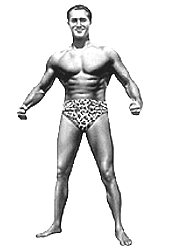
Mr. Dynamic Tension- Charles Atlas
So a connection can be made between Sun>Heracles>Vincey>Tarzan and Mother Nature>Hera>She>La.
Burroughs La was neither ancient nor immortal in the personal sense although she was the latest in an immortal line of Priestesses. She is a priestess of the Sun or Ra, The Flaming God.
Haggard’s Leo Vincey was the direct descendant of Kallikrates She’s great love of two millennia past. She, or Alyesha, to use her name, had killed Kallicrates in a rage. Kallikrate’s descendants were sworn to avenge the murder. Thus Vincey travels from England to far off Africa to locate this fabulous woman.
Kallikrates was the love of Alyesha’s very long life. When she recognizes Leo Vincey as her lost lost love she saves his life while offering him eternal youth if he will only bathe in the flames of eternal life. He hesitates to do so. To encourage him Alyesha steps once again into the flames which was a serious miscalculation. She crumbled to dust. Thus while Leo Vincey doesn’t actually avenge the death of Kallikrates she is nevertheless his victim.
Tarzan while actually born in Africa was conceived in England so he made the trip to Opar from England although he is ignorant of La. When Tarzan is captured in Opar he is laid on the altar of the Flaming God, La with the sacrifical knife raised, looks down on this Jungle God, this man like a god, and falls in love. Thus we have a replay of the She-Kallikrates situation.
Unable to take Tarzan’s life, La releases him begging him for his love. Alyesha’s full title was She-Who-Must-Be-Obeyed in the Matriarchal sense. The old conflict arises, Tarzan is more on the Patriarchal side, he has his moly in the waistband of his loin cloth, monagamous we are led to believe, happily married, so the Lion Man Sun King declines the honor of being mated to La>Hera. He asserts his Patriarchal prerogative to disobey although he always has a soft spot in his heart for La.
In a fairly masterful way ERB conflates the legend of Heracles, the fiction of H. Rider Haggard and the incredible strongmen of the Golden Age and his own little bit to write a charming and beautiful story which is fairly simple on the surface but one which becomes immensely rich with a deeper understanding of the sources.
Ernest Hemmingway once said that before one sat down to write one should have ten time the information in your possession as you put on paper else the story will seem shallow and contrived. It would seem that the sources upon which Burroughs was drawing, from the bodybuilding strongmen of his day to the legendary cycle of Heracles to the adventures of H.M. Stanley and the fiction of H. Rider Haggard might well fulfill Hemingway’s dictum.
When one searches for the sources of Burroughs one finds layer after layer of golden riches while discovering that in fact ERB did indeed create a man like a god- Tarzan The Magnificent.
Addendum
This is a quote taken from Bonzo Dog’s song Mr. Apollo. I don’t know whether the reader is familiar with the Bonzos but they were one of my favorites. Several glorious LPs. Neil Innes came from them as well as the great but tragic Viv Stanshall. Leave those drugs alone, boys.
Follow Mr. Apollo,
Everybody knows a healthy body
Makes a healthy mind.
Follow Mr. Apollo,
He’s the strongest man the world has ever seen.
If you take his courses
He’ll make you big and rough.
And you can kick the sand right back in their faces.
A few years ago I was a four stone apology-
Today, I am two separate…Gorillas.
Bonzo Dog Doo Dah Band
Long may they wave.
Exhuming Bob IX, Pensees 7: Into The Lost Land
July 6, 2008
Exhuming Bob IX, Pensees 7:
Into The Lost Land
by
R.E. Prindle
Texts:
Dylan, Bob, Chronicles Vol. I, Simon And Schuster, 2004
Prindle, R.E. Exhuming Bob, VIII The Walls Of Red Wing, idynamo,wordpress.com 2008
Thompson, Toby, Positively Main Street, U. Minnesota, 2008, reprint from 1971
http://www.hibbing.org/dylan1/story.html Life In Hibbing: Hibbing Chamber Of Commerce
http://www.interferenza.com/bcs/interw/85-dec.htm Bob Dylan Is Not Like A Rolling Stone Interview, Spin Magazine, Volume One, Number Eight, December 1985
http://www.interferenza.com/bcs/interw/play78.htm Playboy Interview: Bob Dylan 1978
http://www.interferenza.com/bcs/interw/66-jan.htm Playboy Interview: Bob Dylan February 1966
1940
Abe And Beattie
In attempting to put together a reasonable facsimile of Bob’s life in Hibbing and Minneapolis, Minnesota and New York City as he mythologized it in his chapter of Chronicles, The Lost Land, I have come to the following tentative conclusions.
Bob was born in Duluth, Minnesota on 5/24/41. In 1943 he was taken to Hibbing where he lived from then until graduation from high school in the Spring of 1959.
Within the concept of normal Bob had a fairly advantaged childhood. His parents were indulgent buying him anything he wanted while providing adequate pocket cash. Bob’s family was one of the more important in town both within the Jewish community and the town at large. In what appears to have been a tight small town social scene Bob either excluded himself or was excluded from the dominant social groups within which he had a right to be included.
Perhaps Bob’s conception of the Hibbing period could be best interpreted from his favorite movie, Rebel Without A Cause, starring James Dean. Bob is said to have seen the movie several times. This was unusual as few people ever saw a movie more than once. He would have been a very impressionable fifteen at the time. Most of us didn’t have the money while quite frankly few movies, if any, were worth watching twice including Rebel Without A Cause. I was seventeen when I saw it and while I was in awe I wasn’t submerged. Of course Bob’s relatives owned the theatres so he got in for free.
As he set up a Dean shrine in his basement which greatly offended Father Abe we may be justified in assuming that Dean was a controlling influence in his life from the time he saw the movie. It is of interest that Abe was to remove the Dean shrine from the basement after Bob left replacing it with a shrine to his own son Bob Dylan ne Zimmerman.
Abe Zimmerman (1911-1968) worked for Standard Oil in Duluth when Bob was born. According to the C of C he lost his job in 1943 moving to Hibbing where his wife’s family, the Stones, could help the young couple. Why Standard Oil should lay Abe off in the middle of the war during a manpower shortage seems to pose a question. As can be seen from the photograph of Abe and Beattie above borrowed from the Flickr photostream of <drineevar> he was a well set up handsome man. He appears to be exceptionally self-possessed, sound in the eyes. Beattie appears to be a haughty high fashion queen which would accord with later facts.
Abram Zimmerman, for such was his name. Usually called Abraham, the name on his tombstone is Abram, and his two brothers Maurice and Paul bought the Micka Electric Company in 1943 changing the name to Zimmerman Appliance. In 1968 Paul Zimmerman told Thompson that they had been in business for twenty-five years which would mean 1943 although the date seems odd.
According to the C of C Abe came down with polio in 1946 requiring a lengthy convalescence. The C of C says that the Zimmermans bought Micka’s after his convalescence but if Paul Zimmerman is accurate it would have to have been 1943. There would be no record of what Abe did for a living then from 1943 to 1946. As Bob says both his uncles served in the Army it would seem that they bought Micka’s going into the Army shortly thereafter leaving Abe to tend the business.
Maurice and Paul became President and Vice-President of the corporation while Abe siginficantly assumed the controlling post of Secretary-Treasurer. Managed the money, paid the bills.
During the fifties at least Abe spent a fair amount of money on both Bob and Beattie. Angel Marolt whose family bought the Zimmerman residence after Abe’s death was trying to tell him of Beattie’s several fur coats, diamonds and Cadillac but Thompson says he wasn’t paying attention.
Thompson quotes Echo Helstrom as saying that the Zimmermans had stores in both Hibbing and Duluth. Having a customer base of approx. 250,000 makes more sense when one considers the amounts of Abe’s expenditures and the fact that the profits had to be split three ways.
The C of C describes Abe as a ‘big man’ in town partial to those big thick long cigars.

The Dylan Home
The couple had enough money on arrival to buy the large nine room house that Bob grew up in so Abe must have been well paid at Standard Oil before he was laid off. Both he and Beattie are well dressed in the picture while Beattie is actually overdressed.
Bob was entrolled at Alice School for his kindergarten year in 1946 at five years of age. The status of Alice School is unclear. Perhaps it was closed the following year or consolidated with the Hibbing High complex as Bob was transferred. Hibbing High housed kindergarten through twelve as well as the Jr. College. Thompson describes it as a huge and rambling building.
So from first grade to graduation Bob was with the same group of students. I sure wouldn’t have wanted to move into town in tenth grade and try to break into that one. While he wouldn’t have known them all well he must have known the entire student population on sight. This presents the problem then of why Bob, who was the son of the Big Man in town, wasn’t included in the top social cliques. Those cliques undoubtedly formed early persisting through graduation. If Bob was in one he was either forced out early or found it uncongenial to remain for whatever reason. Perhaps he thought his Jewishness excluded him. So if something happened we don’t know what it was and won’t; unless Bob tells it’s going to be difficult to trace.
Growing up in a small town anyone with any ambition looks around and sees very limited opportunities. Working for his father wasn’t a viable option. Not everyone wants to be a doctor or lawyer either. Nuclear Science is OK but a lot of those guys are out of a job now too. My next door neighbor when I was a kid for one.
Bob’s mind turned early to music and then to Rock and Roll. While Rn’R went on to conquer the world and become as respectable as such a spectacle could it was definitely considered discreditible and low class almost volunteer outlawry in the fifties. At the very least it was ‘pimple’ music. It took a certain amount of courage to say you liked Elvis Presley. Pat Boone was set up as his rival and you had better say you liked ol’ White Bucks. If you don’t think Elvis was considered a social criminal check out a couple of his movie roles like King Creole or Jailhouse Rock. What was the Colonel thinking? Clown roles, that’s all Elvis ever got.
And then Bob chose as his hero and model Little Richard. People looked at you funny if you said you
Young Bob On Harley
liked Little Richard! I mean, Bill Doggett was a respectable Negro with music you could understand, Fats Domino was as lovable as a chubby ten year old but Little Richard! They hadn’t even created the ghetto he could come out of. His band might have passed but then he opened his mouth. If there was ever a direct challenge to middle class sensibilities Tutti-Frutti was it. Not only was the song incomprehensible it was about queers. Nobody ever quoted the lyrics correctly, while I’m walking around saying ‘Tutti Frutti, I want Rudy?’ What does that mean? I hope no one overheard me. So when Bob gets up, ignoring Pat Boone entirely, and launches into some screaming vision like Rip It Up or She’s Got It or God only knows what, was the crowd taken aback? Chuckle, chuckle.
So Bob having opted for the lifestyle was forced to associate with the hoody crowd or have become a loner. Besides Colin Wilson’s book The Outsider had appeared in 1956 that began a cult of The Loner that peopled the early sixties. These guys, who were by no means rebels but deep thoughtful guys who had a line on the truth denied anyone else and that penetrated sham and hypocrisy sat alone ever ready to resolve a situation setting things right were highly romanticized fellows. There were as many Loners in those days as there were Hawkeyes a couple generations later. So Bob wouldn’t necessarily have been thought of as weird, strange but a Loner. A Loner was next door to weird and strange. Thin line if you get my meaning.
On the other hand the C of C describes the L&B Cafe as a regular jumping Bop Street right there in the heart of Hibbing, Minnesota. Bands set up and played continuously. They knew how to party in Hibbing. The C of C even says there was a radio station in town playing Bob’s kind of music thereby contradicting every other source even Bob. He says he had to go to Shreveport on the radio waves to get his kind of music. In this case I’m betting on Bob.
The C of C tells of Bob’s musical debut like this putting the best possible face on it:
Described by fellow students as polite, easy to talk with, and somewhat introspective, it was a total shock when he pushed back the piano bench and stood up to pound the first notes of a song into the auditorium, electrifying the student body. Kids jumped up, stared at each other open mouthed not knowing what the reaction would be.
Well, yes, they were electried but did they like it?

Rockin' Bobby Zimmerman
According to the C of C, looking back fondly, Bob went over real well with his fellow students. If you like this version don’t check the other sources as this is at variance with every other known account but then this is the Chamber Of Commerce speaking. Up to this point in the C of C account there is no reason for Bob to be as bitter as he is about Hibbing at all.
A note of interest is the reoccurence of Fourth Street in Hibbing, Minneapolis and New York City. Quite a coincidence, I knew there had to be some association with Fourth St. in Hibbing. So far we learn that Bob attended Jewish shule there. Whether the synagogue was also located there isn’t clear. The synagogue Bob attended is no longer anywhere at any rate. Tore it down. It was in the way. Had to go. Even though Bob’s father was the most prominent Jew in town, the President of B’nai B’rith and ADL as well as his business interests, and even though Bob had a mega Bar Mitzvah with four hundred people in attendance some say at the most prominent spot in town, the Androy Hotel, some say at the synagogue, he wished to conceal he was Jewish. This attitude may have contributed to his renouncing the Jewish fraternity house to which he pledged at UM while also hiding his religion in New York. The attitude was strange since he seemed to prefer Jewish musicians around him to the exclusion of goys.
Bob’s father Abe, was quite frankly a marvelous provider, spending very large sums of money on son Bob, wife Beattie and his second son, David. When he died in 1968 the house on 7th Ave., now Bob Dylan Ave. was sold. The owners at the time of Thompson’s visit were the Marolts. Angel Marolt who was at home when Thompson called offered to show him around. One thing he learned was that Bob had a clause in the sale’s contract that allowed him to stay in his old room in the Marolt’s house whenever he was in town. Too weird.
What quirk in Bob’s mind compelled him to live in other people’s houses? Perhaps Rebbe Maier back in 1954 impressed on Bob that Biblical scripture presribes that Jews would live in houses they never built. As an article of religion that injuction is a mind boggler. One can’t predict how anyone’s mind will interpret instruction. Bob who functions out of his subconscious very heavily must have accepted such teachings in literal ways. Rebbe Maier was a definite turning point in Bob’s life. Imagine getting out of school, going upstairs at a Rn’R cafe to sit before the only bearded man you may ever have seen, dressed completely in black with a black yarmulke perched on the back of his crown intoning things like: The Jews shall live in houses they never built and then go downstairs to boogie. Pretty spooky, don’t you think? And then as Bob says, he disappeared like a ghost. Let that roll around your brain for little while and see what you come up with.
Mrs. Marolt was trying to tell Thompson something about Mrs. Zimmerman’s multiple furs, heaps of diamonds, I’m sure all the latest fashions and her own Cadillac.
Bob was indulged to the extent of apparently more than one motorcycle, a car, lots of amplifiers and electronic gear for his bands, whatever he wanted plus free movie admissions and plenty of pocket cash. He must have had a large record collection for a kid as he spent his spare time at Crippas record store ordering the odd title. You can bet Crippas didn’t discount either, charging full bore. At the time (after 1958) stereo was 5.98 and mono was 4.98.
As the profits from a sole Hibbing store divided three ways could not have supported this sort of expenditure, having a store in Duluth could account for it. It is significant also tha Abram died in June 1968 and the store closed a few months later. Was the store a losing proposition for the last few years? Did Bob provide the difference so Abe wouldn’t be embarrassed by going banko? Then with his father gone there was no reason to support Uncles Maurice and Paul?
There really is something happening here, isn’t there?
Also as a petty expenditure for Bob (it would have been huge in my life) according to the C of C:
Almost every day Bob came in after school for his regular snack: cherry pie a la mode and coffee (or Coke.)
And then to dinner? No wonder the young Bob had all that baby fat.
If Echo bought those hot dogs for Bob and bought his story that his dad didn’t give him an allowance she was had in more ways than one.
So, Abe was nothing if not a generous father and husband. Beattie as President of Hadassah as well as a Stone must have made the Zimmermans the most powerful Jews in the syngogue while actually giving she and her husband the means to be petty dictators of the town, I saw something like this in Eugene, Oregon in the sixties and seventies, or, as the C of C says a Big Man and big people.
Bob must have a quirk in his mind to misrepresent his childhood so. He was the Fortunate Son John Fogerty only sings about.
In Thompson’s interview with Beattie he quotes her:
How can you know you have a genius in your house, when all my time is spent trying to feed him and keeping his clothes pressed.
In Bob’s story, The Lost Land, Chloe Kiel is shown ironing Bob’s shirts and at the end of the chapter she ‘slaps’ a plate of steak and fried onions in front of him just before he darts out the door to begin the next chapter, A New Morning, just as in the old days when he returned home from school for lunch and was fed by his mother he darted back to school.
Ironing his shirts and providing free steaks was a signal service for bare acquaintances like Ray and Chloe.
Chloe comes across as cold and indifferent and indeed there is a tinge of resentment and anger beneath Beattie’s statement. Motherly, of course, but there. Still, she doesn’t impress me as any Yiddishe Mama of the Mrs. Goldberg variety. Whether Bob was a good boy or not he does have an ambivalent attitude toward his parents. But then he claims that he was really raised by his grandmother, whether Stone or Zimmerman isn’t clear.
I believe the big change came over Bob with his Bar Mitzvah and I’m not talking puberty alone. According to the C of C Bob attended Jewish shule during his young years. This was done after public school hours. Then in 1953-54 when his Bar Mitzvah was approaching Father Abe sent to Brooklyn, New York to have an ultra-orthodox, almost certainly a Lubavitcher Rebbe, sent to Hibbing to indoctrinate Bob in untra-orthodox teachings. It can’t be any surprise that when Bob exhibited his Jewish reverence after his Jesus indoctrination with the Vineyard Fellowship he chose to show himslef as a Lubavitcher. Welcome home, Bob. The C of C tells it this way:
According to a 1985 Spin Magazine interview by Dave Engel, Bob said it was above the (L&B) Cafe that Rabbi Reuben Maier stayed while giving Bob Hebrew lessons in preparation for his Bar Mitzvah. The Rabbi and his wife showed up one day and stayed for a year while Bob got ready for his big event . The article quotes Bob as saying he would learn Hebrew after school or in the evening for an hour, then go downstairs and boogie at the L&B. After completing his Bar Mitzvah the Rabbi just disappeared.
In the interview Bob tells it this way:
There weren’t many Jews in Hibbing, Minnesota. Most of them I was related to. The town didn’t have a rabbi, and it was time for me to be bar mitzvahed. Suddenly a rabbi showed up under strange circumstances for only a year. He and his wife got off the bus in the middle of the winter. He showed up just in time for me to learn this stuff. He was an old man from Brooklyn who had a white beard and wore a black hat and black clothes. They put him upstairs in the cafe, which was the local hangout. It was a rock n’ roll cafe where I used to hang out, too. I used to go there everyday to learn this stuff either after school or after dinner. After studying with him an hour, or so, I’d come down and boogie. The rabbi taught me what I had to learn, and after conducting the bar mitzvah, he just disappeared. The people didn’t want him. He didn’t look like anybody’s idea of a rabbi. He was an embarrassment. All the Jews there shaved their heads and, I think, worked on Saturdays. And I never saw him again. It’s like he came and went like a ghost. Later I found out he was Orthodox. Jews separate themselves like that. Christians, too. Baptists, Assembly of God, Methodists, Calvinists. God has no respect for a person’s title. He don’t care what you call yourself.
The C of C knows the Rebbe’s name was Reuben Maier and Bob Dylan doesn’t? There were enough people in Hibbing to have a temple and shule but they didn’t have a Rabbi? The Rebbe Maier showed up in time for Bobby Zimmerman’s Bar Mitzvah but what? it was the first Bar Mitzvah in Hibbing’s Rabbiless history? No wonder four hundred people showed up. The Jews in Hibbing shaved their heads and worked on Saturday’s? I presume Bob means they didn’t wear beards but shaved their faces unlike the Lubavitcher in white beard and one of those funny round hats. I serously doubt there were three hundred or more Jews walking around Hibbing with shaved heads in 1954.
They took one look at Rebbe Reuben’s weird beard and outre attire and told him to get out of town? Now that I can believe. Beards in ’54 were a sign of great eccentricity or a psychotic desire to draw attention to oneself. But why in ’85 the mysterioso act? He just showed up to teach Bobby Zimmerman, a complete unknown with no direction home Lubavitcher tales like this: (actually this is pretty standard esoteric doctrine adapted for Jewish needs)
The messianic thing has to do with the world of mankind, like it is. This world is scheduled to go for 7,000 years. Six thousand years of this where man has his way and 1,000 years when God has his way. Just like the week. Six days work, one day rest. The last thousand years is called the Messianic Age, Messiah will rule.
Essentially what we have here is a variant of Madame Blavatsky’s Theosophy along with a little Hebrew Theology. If one looks real closely one can see the outline of Sigmund Freud’s notion of the unconscious.
According to Beattie Bob knew, oh, two hundred words of Hebrew. So much for several years of shule and a year of intensive training by Rebbe Reuben.
Whether Bob knows or admits it, it must be true that Father Abram sent for Reuben to instruct Bob in mysteries that Abe thought were essential to his vision of Jewish religion while they were not part of the services of the Hibbing congregation.
It is possible that Abram brought the Rebbe in on the approval of the congregation who rejected him. The comment by Bob of working Saturdays may be signficant here. The Jewish sabbath begins on Friday sundown and continues to Saturday sundown.
As a Lubavitcher, Rebbe Reuben could not have tolerated working during the sabbath while the congregation found it essential amidst a gentile population. Likewise beards are an integral part of the orthodox religion so that the congregation also refused to stop shaving. The only thing mysterious is why it took Reuben so long to catch on. Or maybe he had a contract for one year and the year was up. Of course Bob did need help on those two hundred words.
So Bob’s upstairs memorizing his two hundred words while the throbbing beat pounds insistently through the floor. The super patient Reuben and his wife never object. Bob shortly joins the revelers with his two hundred Hebrew words rattling round his skull, steps up to the mike and begins screaming: I’ve got a girl and her name is Echo. Hmmm. Quite an image out there in the Lost Land of Bob.
Now indoctrinated in quaint antiquarian rites Bob is bundled off to Webster, Wisconsin and Camp Herzl to steep himself in Israeli style Jewish living. Camp Herzl was conducted as Israel in America so those two hundred Hebrew words came in handy in that surrogate for summer in a kibbutz in the Holy Land.
The summer sojourns must have set Abram back a handsome fee for the times. Six to eight weeks of essentially summer boarding school does have expenses. Abe apparently was deeply religious: in Protestant circles he would have been known as a Fundamentalist nut. He and Mike Huckabee would have gotten along fine. One wonders if younger son David was given the same treatment.
So Bob from 1954 on is definitely the product of two nations. The world of the Three Hanks as the C of C puts it and this world of Adam, Moses and the Messiah. Bob was named after Sabbatai Zevi the last acknowledged Jewish messiah in the seventeenth century, his Jewish name is Sabtai.
As kids we all have a lot to reconcile, begin working out at graduation. Bob had a double load; he had two Bobs to reconcile. Personalities wander and widen in those years, Bob made a clean split. On the one hand he was the twerp Bobby Zimmerman of whom it may be said: There’s no success like failure while on the other he was struggling to be the super successful Bob Dylan in which he failed to assume the mantle so that failure is no success at all. At least he made this split off persona’s name mean something. As a note, it was not generally known Dylan was Jewish until after Blonde On Blonde.
Thus in his movie Renaldo and Clara he is not Bob Dylan. Anybody can be Bob Dylan he says, you can be Bob Dylan. Toby Thompson thought he could be and did a pretty good job of it walking a mile or so in Bob’s shoes. Sounded just like him.
As remarkable as it is that Bob realized his fantasy beyond anything he could have dreamed and became the hugely successful Bob Dylan he created an entire new set of problems whose solution eluded him. Well, you know, there’s something lost and something gained while it’s hard to know whether the gain was worth the loss. However the money has disappeared from the table.
The result then is Bob looking backward from 2004 to create a fantasy of how it was in Ray and Chloe’s place on Vestry Street in NYC. The chapter is approriately titled The Lost Land or possibly Never-Never Land might have been better. The chapter isn’t a complete fabrication but it is fiction. Something like the various incidents might have happened but not exactly the way Bob tells it. The framing story of Ray Gooch and Chloe Kiel is pure fiction however. They could not possibly have existed.
Bob tells the whole story of the Lost Land within the reference of Ray and Chloe and their fabulous apartment near Vestry below Canal near the Hudson across the street fromt he Cathedral with its bell tower. Thompson got it right.
A troubling aspect of Bob for me is his insistance on bumming other people’s apartments. This seems to be compulsive behavior.
Bob was actually voluntarily homeless from January of ’61 to October or November of the same year when he and ‘roommate’ Suze Rotolo took up digs on Fourth St. I suspect that Father Abe would have been only too happy to supply Bob with funds to live on Vestry Street if he had asked. Bob is simply untrustworthy in any of his stories. As he said of what he learned from folk music: If you told the truth, well and good; if you told the untruth, well and good also, so in Bob’s mind there are no lies, there is only the truth or untruth both having the same value and whichever is more serviceable at the moment. You can’t believe him.
A troubling aspect of Bob’s behavior is his habit of bumming couches in other people’s nests; gaining meaning, as it were, from other people’s lives. Perhaps that was the way he felt of his life in his mother and father’s house. Or perhaps as a Jewish outsider in a goyish land it was his attempt to insinuate himself in the main stream much as he appropriated Woody Guthrie’s persona. Of the houses I have traced they have all been those of goys; he didn’t choose to insinuate himself into the houses of his fellow Jews. His imaginary hosts Gooch and Kiel are obviously goys.
The Lost Land then is a mythologized version of his childhood and first few months in New York City. To my mind Ray Gooch is a combination of Dave Van Ronk, Paul Clayton, Matt Helstrom and his father. Chloe seems simply to be an idealized notion of his mother. (Study her picture for a few moments again.)
As the Gooch frame brackets the period from Bob’s encounter with Gorgeous George to the apartment with Suze Rotolo it must represent a time frame from sometime in ’58 to October ’61. In October Bob Dylan ceased sponging off others to take up his own apartment.
The only one in this time frame he knew who had a large gun collection was Matt Helstrom. The Helmstroms also had a large record collection that Bob listened to. The couch and apartment undoubtedly belonged to Van Ronk while certain exoticisms of Gooch are characteristic of Clayton. The library of Gooch may simply be the New York City Library of which the long narrow room would merely describe the stacks.
The Southern character of Gooch must represent a time after Bob studied the South in the library since there are several references to his Civil War studies. Gooch himself is a Southerner from Virginia gone North which is a symbol in itself. This can be symbolically described as Father Abe being a Jew in Gentile America.
Here then Bob creates or accentuates the more pleasant aspects of his memories in contrast to the very bitter unpleasant memories of the songs. He tells us a great deal about his dream life but little of its realities. At this point I am of the opinion that the party of Camilla ( who Bob says he gets to know quite intimately) is another fabrication of the based on a true story variety.
As Bob would say, folk music taught him that if what you said was true,well and good; if what you said was untrue well and good also. We may probably construe the Lost Land as both true and untrue while a good folk tale. Even the title has a fictive quality a la Edgar Rice Burroughs.
To round off the period back in the C of C milieu of Hibbing: Bob spent his last summer at Camp Herzl in 1957. In the summer of ’58 he was running back and forth between Hibbing and Minneapolis. At that time he would have become familiar with Highway 61.
In his Junior year of ’57-’58 he took up his relationship with Echo Helstrom. They were going steady hence were not supposed to be dating others. As he was in Minneapolis most of the summer he left Echo sitting home alone. She resented this. As the Senior year began she told Thompson, she took a revenge on Bobby returning his token in public in the hall at school. Boy, that hurts.
The feelings must have been much harder than either Bob or Echo portray them. A key problem area is did Bob spend time in Red Wing Reformatory on Highway 61 below Minneapolis and if he did what did he do to receive his sentence: I examine this more fully in Exhuming Bob VIII: The Walls Of Redwing.
He says in Chronicles that he was absent from school from some time at the beginning of April of ’59. He was back at least by the June 5th graduation. His birthday is May 24th. After that date he would have been eighteen and subject to adult sentencing. For what It’s worth he says in his song that no inmate was over seventeen. I’m suggesting that he spent a month of two at Red Wing returning in time for graduation. Certainly a Big Man in town like Abe could have arranged the graduation if he couldn’t get Bob off that time.
The question is what did Bob do? By the middle of this Senior year it appears that he had been in enough scrapes to be known as a troublesome boy; perhaps living out a Rebel Without A Cause persona. Father Abe used his influence up to that time to avoid unpleasant consequences for the lad.
I believe Bob’s song The Chimes Of Freedom tells the story of his crime. Quite simply Echo set him up. She obviously was not quite as complacent as she tells it. See Exhuming Bob VIII: Walls Of Red Wing.
Returning home from Red Wing his parents threw a graduation party for him. Bob was reluctant to attend the party, perhaps with good reason but was persuaded to do so.
This then leaves a very sketchy account of the three or four months of the summer of ’59 for which Bob provides little information. In Walls Of Red Wing I place his stint at Red Wing in August but that is probably wrong. In any event the period from April of ’59 to September of ’59 needs to be explained more fully.
Bob gives some brief details of his stay at Dinkytown but not much. A little bit of the John Pankake episode while avoiding the important details of his theft of Pankake’s records.
Thompson has some good information from Ellen Baker whose father’s folk song collection Bob used extensively.
Then to NYC and his account of The Lost Land segues into his New Morning.
 I, Dynamo