Part II: Only The Strong Survive
April 3, 2012
Only The Strong Survive
Part II
An Examination Of Bridge And The Oskaloosa Kid
As Created By Edgar Rice Burroughs
(Alternate Title: The Oakdale Affair)
by
R.E. Prindle
Part II
Into The Mysteries
(Some capitalization appears in the text that has no significance. For some reason it just showed up. I didn’t do it)

Young Burroughs With His Camera Eye
Burroughs does a good job in the Holmesian sense in this book enclosing mysteries within mysteries. The central mystery is who is committing the crime wave in Oakdale. Having learned from his mentor, Conan Doyle, Burroughs skillfully withholds details to enhance the suspense then disclosing them to reveal the mysteries. The organization of the scheme of crimes gradually unfolds to show that the real Oskaloosa Kid is one of the perpetrators. So we have a clever doubling of a sweet girl posing as the vicious criminal The Oskaloosa Kid. This is obviously a transfer of his Anima identity from the male De Vac/Oskaloosa Kid to the resumption of a female identity for his Anima through the fake Oskaloosa Kid/Gail Prim.
The girl who was seen with the criminals could have been Gail since she had disappeared without a trace never having arrived at her destination. Gail was not the girl seen with Reginald Paynter, who was robbed and murdered, and the crooks. That person was Hettie Penning who was ejected from the car speeding past the abandoned Squibbs place by the real Oskaloosa Kid. Thus symbolically De Vac/Oskaloosa Kid returns his Anima to Bridge/Burroughs.
As indicated Hettie Pening represents the dead early Anima of Burroughs who has here been resurrected. As in all cases of Burroughs representation of his failed Anima she appears to be a ‘bad’ girl but in reality is merely misunderstood. He compensates for himself.
Bridge himself is a mystery man and double. He is a hobo but with great manners and an excellent education. He is definitely a member of the Might Have Seen Better Days Club. The real club was organized by Burroughs when he served as an enlisted man in the Army in 1896.
In this case Bridge is in actuality the son of a wealthy Virginia aristocrat who has left home because he prefers a life on the road. In the framing story of a Princess of Mars Burroughs portrays himself in his own name as a Virginian. In reality Burroughs was declassed at eight or nine by John the Bully and by his father’s subsequent shuffling of him from school to school finally sending him to a bad boy school that Burroughs describes as little more than a reformatory for rich kids.
If one looks at his career he was on the move quite a bit. During his marriage he seldom lived in one house for more than a year or two then moved on.
Just as Bridge will assume his proper identity at the end of the novel so through his writing Burroughs has abandoned the shame of his hard scrabble years from 1905-13. In a sense he is assuming his proper identity with this novel.
Bridge and the Kid joining together at the fork in the road, one is reminded of Yogi Berra’s quip: When you come to a fork in the road, take it, in this case the less traveled dirt road.
I read word for word frequently dwelling on the scenes created. Burroughs is a very visual writer. Standing at the fork in a driving Midwest summer lightning, thunder and deluge storm they can hear the pursuing hoboes shouting down the road. Ahead of them is a dark unknown and a house haunted by the victims of a sextuple murder.
Indeed, Burroughs describes almost a descent into hell, or at least, the hell of the subconscious.
Over a low hill they followed the muddy road and down into a dark and gloom ravine. In a little open space to the right of the road a flash of lightning, followed one imagines by either the crash of deep loud rumbling of the thunder of perhaps if over head the sonic boom of the air splitting and closing, revealed the outline of a building a hundred yards (that’s three hundred feet, a very large front yard) from the rickety and decaying fence which bordered the Squibb farm and separated it from the road.
There are those who say Burroughs doesn’t write well but in a short paragraph he has economically drawn a verbal picture which is quite astonishing in its detail. The house is a hundred yards from the road. In the rain and muck that might be a walk or two or three minutes or more.
A clump of trees surrounded the house, their shade adding to the utter blackness of the night.
That’s what one calls inspissating gloom. One might well ask how any shade can add to utter blackness but one gets the idea. There is some intense writing thoroughly reminiscent of Poe but nothing like him.
The two had reached the verandah when Bridge, turning, saw a brilliant light glaring through the night above the crest of the hill they had just topped in their descent into the ravine, or, to be more explicit, the small valley, where stood the crumbling house of the Squibbs. The purr of a rapidly moving motor car rose above the rain, the light rose, fell, swerved to the right and left.
“Someone must be in a hurry.” commented Bridge.
There isn’t any better writing than that. Another writer can say it differently but he can’t say it better. Just imagine the movie Frankenstein or Wolf Man when you’re reading it. Burroughs did as well in less than the time it takes to show it.
A body is thrown from the speeding car a shot following after it. Bridge goes to pick up the body.
Thus the mystery and horror and terror of the dark and stormy night has been building. Bridge carrying the body which may or may not be alive asks the Kid to open the door.
Behind him came Bridge as the youth entered the dark interior. A half dozen steps he took when his foot struck against a soft yielding mass. Stumbling he tried to regain his equilibrium only to drop fully upon the thing beneath him. One open palm extended to ease his fall, it fell upon the uplifted features of a cold and clammy face.
Yipes! What more do you need? Cold and dripping, half crazed from fear, overwhelmed by the thought he might be a murderer the Kid’s hand falls on cold and clammy dead flesh. Bridge is standing there with maybe another dead person in his arms. The Kid is also aware that the murderous hoboes are hot on his trail.
If that doesn’t get you then somehow I think you can’t be got.
Not yet finished Burroughs builds up the tension. Striking a match from the specially lined water proof pocket of Bridge’s coat they find a dead man wearing golden earrings. Obviously a gypsy but while staring in unsimulated horror they hear from the base of the stairs of a dark dank cellar the clank of a slowly drawn chain as a heavy weight makes the stairs creak.
This is too much for the nerves of the Kid. Burroughs brilliantly contrasts the terror of the unknown in the basement with the fear of the dark at the top of the stairs. You know where that’s at, I’m sure, I sure do. In a flash the Kid chooses the unknown at the top of the stairs to the horror in the cellar.
What do you want?
The hoboes are still slipping and sliding down the descent into the ravine of the subconscious. Horror in front, terror behind. There is absolutely no place to hide. Nightmare City, don’t you think? How could anyone do it better? What do you mean he can’t write? Put the scenes in a movie and everyone in the theatre would be covering their eyes. Itd\ would be that Beast With Five Fingers all over again. Maybe worse. Never saw that one? Check it out. Peter Lorre. Terrifying. Of course I was a kid.
The clanking of the chain recreates an incident in Burroughs’ own life when he had a job collecting for an ice company. He called on a house and while he was waiting he heard the clanking of a chain coming slowly up the driveway. Waiting with a fair amount of trepidation he saw a huge dog dragging the chain appear. ERB backing slowly away forgot about the delinquent bill.
In this case the chain is attached to Beppo the dancing bear but Bridge and the Kid won’t know that until the next day.
They retreat into an upstairs bedroom. Here what Burroughs describes in capital letters as THE THING and IT pursues them. I remember two movies one called The Thing and the other It.
Just when the thing retreats the murderous gang of hoboes enters the house. Wow! Out of the frying pan and into the fire in this night of terrors as the lightning continues to flash and the thunder crash.
Discovering the dead man and as the bear begins moving again four of the hoboes flee while two who were on the staircase being trapped in the house flee into the same bedroom as Bridge, the Kid and the girl, Hettie. Shortly thereafter a woman’s scream pierces the lightning and the thunder then silences as the storm settles into a steady drizzle.
The rest of the night is one tense affair between the murderous hoboes and the Bridge and the girls. Not a moment to catch your breath.
In the morning when they go downstairs the mystery increases when they find the dead man gone and nothing in the cellar. If they’d had Tarzan along he would have not only been able to smell the bear but to tell whether if was black or brown.
After a brief confrontation Dopey Charlie and the General are driven off. Bridge’s relationship with the Kid is then deepened. Even though all the Kid’s reactions are repulsive to the manhood of Bridge he feels his attraction to the seeming boy growing stronger.
Not since he had followed the open road with Byrne, had Bridge met one with whom he might care to “pal” before.
This brings up an interesting hint of latent homosexuality. My fellow writer, David Adams has objected that in my analysis of Emasculation as applied to ERB is that he should have been a homosexual but wasn’t.
There are degrees of emasculation and there are various degrees of psychotic reaction to it. I don’t say and I don’t believe that ERB was a homosexual but there was a degree of ambiguity introduced into his personality by his emasculation. I have touched on this in my ‘Emasculation, Hermaphroditism and Excretion.’
Here we have another example of it as Bridge is experiencing some homoerotic emotion which is very confusing to him as he has never wanted a ‘pal’ before. In hobo lingo I believe a ‘pal’ has a homosexual connotation.
If Burroughs took his ‘inside’ information on hoboes from Jack London’s The Road then Bridge is the sort of hobo London describes as the ‘profesh’, the hobo highest in the hierarchy of hobodom. London always thought of himself as a quick learner, so one doesn’t have to award his statement too much credibility but Burroughs apparently took him at face value.
As London describes the ‘profesh’ he has been on the road so long he knows all the ropes. Unlike the unkempt bums he realizes the importance of a good front and always dresses neatly. But he is hardened and capable of committing any crime.
While Bridge is obviously intended to be a ‘profesh’ he is neither criminal nor does he dress to put up a good front.
Another category of hobo London lists is the ‘road kid.’ These are young people just starting on the life of the road. The ‘profesh’ would often take one of more of these road kids under his wing as his fag, as the British would say, or in Americanese, a ‘pal.’ In other words a homosexual relationship. Thus this displays ERB’s sexual ambiguity which David couldn’t locate in my psychological analysis of ERB’s emasculation. In this case the ambiguity will be resolved and explained when we learn that the Kid is the beautiful young woman, Abigail Prim, and both Bridge and Burroughs heave a sigh of relief.
Nevertheless ERB is discussing homosexuality in an open and natural way that couldn’t be missed by the knowing and which may be unique for its time. But then, remember that one of ERB’s hats in this story is that of the Alienist, so that in these pages we are deep into the psychological abstractions and Doyle’s mystery stories as influences.
Now comes the time for breakfast. Someone has to ‘rustle’ grub. We have already learned in ‘Out There Somewhere’ that Bridge doesn’t rustle food, he rustles rhyme. Nothing has changed. The Kid goes out to get breakfast and when she comes back with the goods, true to form Bridge bursts forth with several snatches from H.H. Knibbs which surprisingly the demure Miss Prim recognizes. What has she been reading?
How might this apply to Burroughs’ own life. Let’s look at it. Burroughs was enamored of How to books but in his heart he must have considered them a fraud. Willie Case will soon pick up his copy of How To Be A Detective which he finds completely inapplicable to his circumstances. He also has the good sense to throw the book away reverting to his native intelligence which may be a subtle comment on How To books by Burroughs.
ERB always considered himself of the executive class. After his humiliating experience trying to sell door to door he never attempted it again. Instead as a master salesman he preferred to write how to sales manuals for others to use as they went door to door selling his line of pencil sharpeners or whatever while he sat in the office waiting for orders. Hence in his own life he was the ‘rustler of poetry’ or manuals while others rustled grub in the door to door humiliation of the actual selling. Here the Kid will do the door to door gig. ERB always makes me smile.
In this case in what may be a joke the Kid just buys the goods from the homeowner reversing the roles.
There are those who insist Burroughs can’t write but I find his stuff wonderfully condensed getting more mileage out of each word than anyone else I’ve ever read. Just see how he describes breakfast.
Shortly after, the water coming to a boil, Bridge lowered three eggs into it, glanced at his watch (an affluent hobo) greased one of the new cleaned stove lids with a piece of bacon rind and laid out as many strips of bacon as the lid would accommodate. Instantly the room was filled with the delicious odor of frying bacon.
“M-m-m-m!” gloated the Oskaloosa Kid. “I wish I had bo- asked for more. My! But I never smelled anything so good in all my life. Are you going to boil only three eggs? I could eat a dozen”
“The can’ll only hold three at a time,” explained Bridge. “we’ll have some boiling while we are eating these.” He borrowed the knife from the girl, who was slicing and buttering bread with it, and turned the bacon swiftly and deftly with the point, then he glanced at his watch. “Three minutes are up.” He announced and, with a couple small flat sticks saved for the purpose from the kindling wood, withdrew the eggs one at a time from the can.
“But we have no cups!” exclaimed the Oskaloosa Kid, in sudden despair.
Bridge laughed. “Knock an end off your egg and the shell will answer in place of a cup. Got a knife?”
The Kid didn’t. Bridge eyed him quizzically. “You must have done most of your burgling near home,” he commented.
The description of the breakfast between the time Bridge looked at his watch and when the three minutes were up was delightfully done. I could smell the bacon myself while I especially like the detail of swiftly and deftly turning the bacon with the knife point. The knife seemed to have disappeared between the bacon and knocking the end off the egg.
Nice details aren’t they? You’d almost think Burroughs had actually done things like this for years. There’s enough blank spots in his life that he may have had more experiences of this sort than we know about. Take for instance the three days in Michigan between the writing of Out There Somewhere and Bridge And The Oskaloosa Kid. He says it took him twelve hours by train on four different lines to return to Coldwater from Alma. It is not impossible that he was hoboing back for the experience. He knew that he was going to write Bridge And The Kid next; might he not have been picking up local color?
Likewise in Bridge And The Kid he mentions the road from Berdoo to Barstow with seeming familiarity. Had he met Knibbs and the two embarked on a few days road trip as the expert Knibbs showed him some of the ropes?
I don’t know but there is something happening in his life which has not been explained.
Perhaps also the hoboism which appears in 1915-17 in his work when by all rights his success should have permitted him entry into more exalted social circles symbolized a rejection by so-called polite society. If so, why? Certainly the serialization of Tarzan Of The Apes in the Chicago paper must have raised eyebrows when people said something like: Is that the same Edgar Rice Burroughs who’s been tramping around town for the last several years?
After all people live in a town where a reputation is attached to them whether earned or not. In reviewing the jobs Burroughs had after he left Sears, Roebuck there is a certain unsavory character to them. Indeed, one employer, a patent medicine purveyor was shut down by the authorities while ERB then formed a partnership with this disgraced person. Where was Burroughs when the authorities showed up to shut the business down? I make no moral judgments. I’m of the Pretty Boy Floyd school of morality: Some will rob you with a six gun, some use a fountain pen. Emasculation is the name of the game.
It is certainly true that many, perhaps most, of the patent medicines of the time were based on alcohol and drugs therefore either addictive or harmful to the health. Samuel Hopkins Adams was commissioned by Norman Hapgood of Collier’s magazine to write a series of articles exposing the patent medicine business in 1906.
http://www.mtn.org/quack/ephemera/oct7.htm . A consequence of the articles may very well have been the shutting down of Dr. Stace. I think it remarkable that Burroughs didn’t distance himself from Stace at that time.
Even as Adams was presenting his research on patent medicines Upton Sinclair was exposing the hazards of the Chicago meat packing industry whose products were no less hazardous to the public health than patent medicines. Sinclair’s book, The Jungle, as well as perhaps Adams’ articles resulted in the Pure Food And Drug Act of 1906.
The products of meatpackers were so bad the British wouldn’t even feed them to their Tommies. That’s pretty bad.
So, if the Staces of the world were criminal and ought to be put out of business then by logic so should have the Armours and Swifts but what in our day would be multi-billion dollar industries don’t get shut down for the minor offence of damaging the health of millions.
One can’t be sure of Burroughs’ reasoning but his writing indicates that he was keenly aware of the hypocrisy of legalities. Perhaps for that reason he stuck by Dr. Stace.
However Stace was put out of business and the Armours and Swifts weren’t. While I applaud ERB’s steadfastness I deplore his lack of judgment for surely his reputation was tarred with the same brush as Dr. Stace.
When society figures may have asked who this Edgar Rice Burroughs was they were given, perhaps, a rundown on Dr. Stace and patent medicines as well as other employments that seem a little murky to us at present. I’m sure the ERB was seen as socially unacceptable. Thus Bridge who has lived among the hoboes has never partaken of their crimes so there is no reason for society to reject him especially as he is the son of a millionaire.
In any event ERB left Chicago for the Coast returning in 1917 then leaving for good at the beginning of 1919. Life ain’t easy. Ask me.
As Bridge, the Kid and the putative Abigail Prim were finishing breakfast the great detective Burton pulls up in front of the Squibbs place. Burton is obviously a combination of Sherlock Holmes and Allan Pinkerton. We have been advised of the Holmes connection in the opening paragraphs of this book. ERB describes Burton thusly:
Quote:
Burton made no reply. He was not a man to jump to conclusions. His success was largely due to the fact that he assumed nothing; but merely ran down each clew quickly yet painstakingly until he had a foundation of fact upon which to operate. His theory was that the simplest way is always the best way. And so he never befogged the main issue with any elaborate system of deductive reasoning based on guesswork. Burton never guessed. He assumed that it was his business to know; nor was he on any case long before he did know. He was employed now to find Abigail Prim. Each of the several crimes committed the previous night might or might not prove a clew to her whereabouts; but each must be run down in the process of elimination before Burton could feel safe in abandoning it.
That’s a pretty good understanding of Doyle’s presentation of Holmes. ERB did learn Holmes’ dictum that it was necessary to read all the literature on the subject to understand the mentality of one’s subjects. Burton did demonstrate some acumen in his arrest of Dopey Charlie and the General. He deployed an agent fifty yards below and fifty yards above to converge on the two criminals while he approached from the front. Either Burroughs had been doing some reading of his own or he picked up some experience or information from elsewhere.
Another keen point was when Burton went back to where the hoboes had been hiding to dig up the evidence they had concealed that would lead to their conviction for the Baggs murder.
It’s little details like these that always make me wonder where Burroughs picked up this stuff. He does it all so naturally but one can’t write what one doesn’t know. He must have been a curious man, good memory.
So Burroughs has a a pretty good understanding of the methods of Sherlock Holmes. It must be remembered that ERB was reading these stories as they first appeared not as we do as part of literature. Holmes, O.Henry, Jack London, E.W. Hornung, these were all fresh new and extremely stimulating with a great many references and inferences which are undoubtedly lost on us. Even in Bridge And The Kid ERB’s reference to the Kid’s bringing home the bacon is a direct reference to a quip the mother of the ex-heavyweight champion of the world Jack Johnson made just after he won the championship from Jim Jeffries: He said he’d bring home the bacon and he’s done it. I don’t doubt if many caught it then but I’m sure the phrase has become such a commonplace today that only a very few catch the reference and share the laugh.
Doyle’s stories such as A Study In Scarlet dealing with the Mormons and The Valley Of Fear dealing with the Molly Maguires would have had much more thrilling immediacy for ERB than they do for us. Also Burroughs has caught the essence of Holmes which was not so much the stories as the method of Holmes.
I have read the canon four times and while I could not reconstruct any of the stories without difficulty, if at all, maxims like- When you eliminate the impossible whatever remains no matter how improbable must be the truth. – have lodged in my mind since I was fourteen guiding my intellect to much advantage. So also the dictum to read all the literature. Not easy or even possible, but the more one has read the or read again the more things just fall in place without any real effort. You have to be able to remember, remembrance being the basis of all mind, of course. Holmes has been like a god to me.
If you wish to learn a source of Burroughs’ stories then all you have to do is apply the above methods; it will all become clear.
Burton moves the story forward as his appearance causes Bridge who isn’t sure what the status of the Kid and the putative Gail Prim is, elects to avoid the great detective even though they are friends.
The trio slip out the back into the woods following a track leading to ‘Anywhere’. Burroughs in a masterful telling catches the feel of a Spring day on a recently wetted trail littered with the leaves of yesteryear. Ou sont les neiges d’antan?
They come upon a clearing where a gypsy woman is burying a body. By this time Bridge has solved the mysteries of the previous evening.
The girls make noises upon hearing the clank of a chain in a hovel causing the gypsy woman to look around. Rather than spotting the trio she spots Willie Case hiding in the bushes who she drags out.
The gypsy woman, Giova, is as good a character as Bridge, the Kid, Burton and the hoboes, but my favorite of the story is Willie Case, the fourteen year old detective. While to my mind ERB presents Willie as a thoroughly admirable character, he nevertheless vents a suppressed mean streak not only on Willie but on the whole Case family.
ERB doesn’t let his mean streak show very often, it lurks in the background, but he lets it loose in this book. He must have been under personal stress.
He describes Willie as having no forehead and no chin, imbecilic traits, literally beginning with the eyebrows and ending with the lips. A freak of nature, a real grotesque. That means that Willie was a real ‘low brow’ as Emma accused ERB of being, even a no brow. Is it a coincidence that Emma called ERB a low brow or that the literati thought ERB wrote ‘low brow’ literature?
In point of fact Willie strikes me as an intelligent boy. He analyzes the situation always being in the right place at the right moment. Burton himself pays him a high but sneering compliment then cheats him out of the promised reward of a hundred dollars but in the manner McClurg’s published his books Burroughs was cheated out of a large part of his reward.
I don’t say that’s the case but if so it fits the facts.
In any event ERB treats the Case family meanly; they might almost be prototypes of Ma and Pa Kettle of the Egg and I or the meanly portrayed characters of Erskine Caldwell’s Tobacco Road. Jeb Case behaves very reprehensively at the lynching although once again he merely reported the facts that the Kid gave Willie. The Kid did tell Willie that he had burgled a house and killed a man. So, perhaps ERB created some characters that he could kick around as he felt himself being kicked.
And then we have the gypsy woman, Giova. She and her father are not only pariahs in general society as gypsies but because of her father they even have been cast out by the gypsies. Her father was a thief from both general and gypsy society. The former may have been laudable in gypsy terms but the latter wasn’t. They make, or made their living by thieving and cadging coins with Beppo, their dancing bear. Beppo of the evil eye.
Burroughs presents Giova as being sexually attractive with lips that were made for kissing, in echo of the refrain from Out There Somewhere. Here we may have a first inference that Emma was in trouble; the kind of trouble that would have ERB leaving her for another woman a decade or so hence. There are numerous rumblings indicating the trend not least of which was ERB’s fascination with Samuel Hopkin Adams’ novel, Flaming Youth of a few years hence and the subsequent movie starring Colleen Moore.
Bridge is now on the run with three women and a bear and he hasn’t done anything wrong to get into such hot water. One woman his emergent Anima, one, his rejected Anima, and the last a longing for a woman whose lips were made for kissing. Wow! This is all taking place in a ravine that opens into a small valley too.
All this has been accomplished in a compact one hundred pages. One third of the book is left for the denouement that Burroughs scamps as he usually does.
Giova decks them all out as gypsies which must have been an amusing sight to the Paysonites as this troop of madcaps complete with dancing bear in tow troop inconspicuously through town. Surprised they didn’t call out the national guard just for that.
As the story draws to a close ERB contributes a wonderful vignette of low brow Willie dining out at a ‘high brow’ restaurant called the Elite in Payson. The idea of Willie being conspicuous in a burg like Payson which we big city people would refer to as a hick town good only for laughs is amusing in itself. You know, it all depends on one’s perspective:
Willie Case had been taken to Payson to testify before the coroner’s jury investigating the death of Giova’s father, and with the dollar which the Osklaloosa Kid had given him in the morning burning in his pocket had proceeded to indulge in an orgy of dissipation the moment that he had been freed from the inquest. Ice cream, red pop, peanuts, candy, and soda water may have diminished his appetite but not his pride, and self-satisfaction as he sat down and by night for the first time in a public eatery place Willie was now a man of the world, a bon vivant, as he ordered ham and eggs from the pretty waitress of The Elite Restaurant on Broadway; but at heart he was not happy for never before had he realized what a great proportion of his anatomy was made up of hands and feet. As he glanced fearfully at the former, silhouetted against the white of the table cloth, he flushed scarlet, assured as he was that the waitress who had just turned away toward the kitchen with his order was convulsed with laughter and that every other eye in the establishment was glued upon him. To assume an air of nonchalance and thereby impress and disarm his critics Willie reached for a toothpick in the little glass holder near the center of the table and upset the sugar bowl. Immediately Willie snatched back the offending hand and glared ferociously at the ceiling. He could feel the roots of his hair being consumed in the heat of his skin. A quick side glance that required all his will power to consummate showed him that no one appeared to have noticed his faux pas and Willie was again slowly returning to normal when the proprietor of the restaurant came up from behind and asked him to remove his hat.
Never had Willie Case spent so frightful a half hour as that within the brilliant interior of the Elite Restaurant. Twenty-three minutes of this eternity was consumed in waiting for his order to be served and seven minutes in disposing of the meal and paying his check. Willie’s method of eating was in itself a sermon on efficiency- there was no waste motion- no waste of time. He placed his mouth within two inches of his plate after cutting his ham and eggs into pieces of a size that would permit each mouthful to enter without wedging; then he mixed his mashed potatoes in with the result and working his knife and fork alternatively with bewildering rapidity shot a continuous stream of food into his gaping maw.
In addition to the meat and potatoes there was one vegetable side dish on the empty plate, seized a spoon in lieu or a knife and fork and – presto! The side dish was empty. Where upon the prune dish was set in the empty side-dish- four deft motions and there were no prunes in the dish. The entire feat had been accomplished in 6:34 ½ , setting a new world’s record for red headed farm boys with one splay foot.
In the remaining twenty-five and one half seconds Willie walked what seemed to him a mile from his seat to the cashier’s desk and at the last instant bumped into a waitress with a trayful of dishes. Clutched tightly in Willie’s hand was thirty-five cents and his check with a like amount written upon it. Amid the crash of crockery which followed the collision Willie slammed check and money upon the cashier’s desk and fled. Nor did he pause until in the reassuring seclusion of a dark side street. There Willie sank upon the curb alternately cold with fear and hot with shame, weak and panting, and into his heart entered the iron of class hatred, searing it to the core.
The above passage has many charms. First, it is an excellent piece of nostalgia now, although at the time it represented the actuality, thus, as a period piece it is an accurate picture of the times. And then it is excellent comedy as well as a a parody as I will attempt to show.
One has to wonder if ERB really thought the Elite was a pretty fine restaurant. If so, one wonders where he took Emma and kids for a night out. Not too many gourmet Chicago restaurants served breakfast for dinner. Ham and eggs with mashed potatoes? Reminds me of the Galt House Hotel in Louisville where a ‘starch’ is served as a side dish. What exactly was this side-dish Willie wolfed- stewed tomatoes? The dessert prunes- dessert prunes?- was a nice touch too. Dessert for breakfast? Another nice quality touch at the Elite was the cup of toothpicks. Of course, those were the days cuspidors were de riguer so what do I know, maybe the Palmer House had a cup of toothpicks on the table too. I know they had cuspidors.
It does seem clear that little Willie was far down the social scale of little rural Payson. They had electric street lights, though. I’m not even from New York City but I would find the Elite, how shall I say, quaint and charming? Of course, New York City is not what it used to be either. Can’t fool me in either case; I’ve dined out in Hannibal. Good prices. Bountiful. Plenty of side dishes something that I’d never seen before.
I’m sure I’ve been in Willie’s shoes, or would have been if he’d chosen to wear them, too, so I have a great deal of sympathy for the lad. A man with a dollar has the right to spend where and as he chooses. Damn social hypocrisy!
In addition to the charm and light comedy ERB interjects a little parody of Taylorism and mass production into the mix.
For those not familiar with Frederick W. Taylor and his methods I quote from
http://instruct1.cit.cornell.edu/courses/dead453-653/ideabook1/thompson-jones/Taylorism.htm :
Taylor wrote “The Principles of Scientific Management in 1911. These principles became known as Taylorism. Some of the principles of Taylorism include (Management for Productivity, John R. Schermerhorn, Jr. (1991)):
Develop a ‘science’ for every job, including rules of motion, standardized work implements, and proper working conditions.
Carefully select workers with the right abilities for the job.
Carefully train these workers to do the job, and give them proper incentives to cooperate with the job science.
Support these workers by planning their work and by smoothing the way as they go about their jobs.
Taylorism which led to maximum efficiency also give the lie to the unconscious of Sigmund Freud, or at least puts it into perspective. If the twentieth century has been the history of the devil of Freud’s unconscious it has also been the century of the triumph of the god of conscious intelligence. The question only remains which will triumph.
One of the recurring themes in ERB’s writing of the period is efficiency. Indeed, a couple years hence he will write a book entitled The Efficiency Expert.
It was the age of efficient mass production which required standardized motions and produced terrific results where applied as at Henry Ford’s marvelously efficient factories. Ford brought the task to the worker in well lighted clean factory spaces at a level which required no time consuming, fatiguing and unnecessary lifting or bending. Plus Henry Ford blew the industrial world away by doubling the going wage for unskilled labor. He changed the course of economic history singlehanded. He achieved more than the Communists or IWW could have accomplished in a million years earning their undying enmity. He may in one fell swoop have defeated the Reds. They sure thought so.
But, go back and review how Willie organizes his repast for consumption. Taylor-like he eliminated all non-essential motions then with maximum assembly line speed-up he gets production into one continuous stream.
A comic effect to be sure but there is even more comedy in the parody of the assembly line and Taylorism. I’m sure ERB intended it just that way.
Willie may be a joke but there is a certain flavor to be obtained by filling a continuum of food, mouth and time. Such an opportunity for enjoyment may present itself once in ten years or so. Willie saw his opportunity and seized it which he does throughout the story. Willie is OK with me.
I have eaten that way but I now reserve the method for ice cream and highly recommend it. My last opportunity, they present themselves but rarely and can’t be forced, was several years ago when I was insultingly offered a half melted Cherries Jubilee. The dish was of a perfect consistency for assembly line consumption. I saw my chance and like Willie, I took it. I kind of distributed cherries and ice cream chunks in the creamy stew, got mouth in the right position and cleaned the bowl in sixty seconds flat, reared back gripping the bridge of my nose, honked a couple times as the freeze seized my brain and then took a few minutes for consciousness to return. One of the great natural highs in this drug infested time. I tell ya‘, fellas, they was all lookin’ at me but I am much beyond the iron of class hatred. If they can’t take a joke…well, you know the finish. So I think Willie Case did the right thing.
Clumsy waitress to get in his way anyway. Fourteen hours on the job was no excuse.
Willie didn’t feel guilt for too long though, for what ERB calls a faux pas, it put him in the right place at the right time to see Giova and her dancing bear fresh from Beppo’s own slops. How could ERB be so cruel to a dumb animal- the bear, not Willie-, one that was going to save the heroine’s life- both the bear and Willie.
After having had dinner and refreshments Willie still had 20 cents left from a dollar of which he spent 10 cents for a detective movie and had ten cents left over for a long distance phone call to Burton in Oakdale after he spotted Giova and her dancing bear when he came out of the movie theatre.
He followed Giova to Bridge and the girls, fixed their location then called Burton. Not only did Willie spot the fugitives but so did the four leftover bums. Dopey Charlie and the General were impounded for the Baggs murder while we will learn that the real Oskaloosa Kid and the putative Gail Prim remain as well perhaps as the true identity of L. Bridge.
Burroughs is full of interesting details. The hoboes are gathered in an abandoned electrical generating plant which had formerly served Payson but had been discontinued for a larger plant servicing Payson from a hundred miles away. We don’t know when that might have happened but electrical generation and distribution was relatively new. The consolidation into larger generating units was even newer. Samuel Insull, whose electrical empire collapsed about1938 had begun organizing distribution in 1912 when he formed the Mid-West Utilities in Chicago absorbing all the smaller companies such as this one in Payson obviously.
I find details like this the exiting part of reading Burroughs.
The murderous hoboes set out to rob and kill Bridge and the Kid while Sky Pilot and Dirty Eddie elect themselves to return the putative Gail Prim who we will learn is actually Hettie Penning, thus doubling ERB’s Anima figure and connecting the latter to the former.
One is put in mind of the Hettie of H.G. Wells’ novel In The Days Of The Comet. Both Hetties exhibit the same traits. While it may seem a slender connection, still, ERB has so many references to other authors and their works that the connection is not improbable. For obvious reasons ERB always insisted he had never read H.G. Wells. Wells? Wells, who?, but how could he not have?
Bridge and the girls would have met their end except that Willie Case’s call brought Burton on the run who arrives in time to save their lives. Unfortunately Beppo of the evil eye meets his end after having done Burton’s job for him much as Willie always did.
In between the girls, the ‘boes, Bridge and the coppers Burton has a full load so he drops Bridge and Kid at the Payson jail. Willie Case had not only solved the case for the ingrate Burton but saved the life of Gail Prim posing as the Oskaloosa Kid. In a heart wrenching scene little Willie seeking his just reward is cruelly rejected and cheated by the Great Detective. I don’t know, maybe I read too closely and get too involved. Or, just maybe, ERB is a great writer.
It’s all over but the shouting and along comes the mob howling from Oakdale for the blood of Bridge and the Kid. I tell ya, boys, it wuz close. Burton arrived in time but not before Bridge with a well aimed blow broke Jeb Case’s jaw. What did those Cases ever do to ERB I wonder?
In the end Hettie Penning is identified, clearing up that mystery. Burton is able to tell Bridge’s dad who has spent $20,000 looking for him that he is found. It may even have cost less for Stanley to find Livingston. Of course there was a lousy rail system in the Congo in Livingston’s time. Bridge is united with Gail obviously prepared to renounce the roving life. Thus the promise of Out There Somewhere is redeemed. Bridge has found his woman.
Thus on paper, at least, Burroughs is reunited with his Animus in gorgeous female attire. No more men in women’s clothes or women in men’s clothes.
2.
Bridge And The Kid is a very short book, only 152 pages in my Charter paperback edition of 1979 (Septimius Favonius BB #24. Charter didn’t see fit to include a date.) Although first issued in book form so late as 1937, it was reprinted in 1938 and 1940 so there must have been some early readers however when reprinted in 1974 there could have been few who remembered it.
My fellow writer, David Adams wrote a short review in the same issue #24 of the Burroughs Bulletin, October 1995, in which he also recognized the importance of this book to the corpus:
It may come as a surprise that anyone could possibly think of calling the novelette, THE OAKDALE AFFAIR, a major work of such a prolific writer as Edgar Rice Burroughs, but I found it to be such an animal…
I am unaware that any other than Mr. Adams and myself have reviewed the book. To sum up:
There seems to be an obvious connection to Jack London in the Bridge Trilogy (I prefer Bridge to Mucker because the latter draws reproving stares and no one today knows what a mucker is. It sounds slightly obscene.)
Mr. Adams, who is more of an authority on Jack London than myself, I’ve only begun to read London as a result of Bill Hillman’s series of articles in ERBzine, which posits a strong connection between Burroughs and London, and not the other way around, feels the novels have a great deal to do with London. The connection seems to be there but I have only begun to read London’s relevant or major works.
What ERB’s attitude towards London may have been which seems ambiguous isn’t clear. Burroughs never wrote about London and never mentions him explicitly. There are many points of disagreement between the two politically and socially. Burroughs does seem to have liked London and his work although what he read or when he read it isn’t clear. There are no London titles in his library.
The second major influence in the novel is the problem of hoboism connected with the IWW and labor unrest.
In the background Burroughs is working out his Anima/Animus problem.
The whole is framed in the form of a rather magnificent detective story patterned after Arthur Conan Doyle’s Sherlock Holmes stories with a dash, perhaps a soupcon, of E.W. Hornung thrown in.
Attention should be paid to the psychological aspects.
Many of ERB’s favorite themes such as the efficiency expert are also thrown in. Nifty historical details like Samuel Insull’s electrical empire are added to the mix as well as Taylorism.
If anything ERB was too efficient, too economical in his use of words. The Book could easily have been fleshed out another sixty or hundred pages with no loss in the marvelous immediacy of the telling. If anything the story is too condensed. I found myself pausing over each description to recreate a mental image of the depiction. I was willing to do so and the personal reward was great. How much ERB was the creator of my vision of the story and how much my own as collaborator isn’t clear to me. Perhaps ERB just outlined the story ‘suggesting’ the scenario, expecting the reader to ‘customize’ the story as he reads along. This may be the first ‘inter-active’ novel. If so, Burroughs may be an even more innovative and greater writer than he is commonly thought to be.
Pt. II Edgar Rice Burroughs And The Accreted Personality
March 14, 2012
Part II
Edgar Rice Burroughs And The Accreted Personality
by
R.E. Prindle

Time may fly but life seems long. Long enough for circumstances to alter your personality more than once. Consider for instance the National Guardsman secure in job, wife and family who is jerked out of his ideal existence to take a tour of duty in Iran or Afghanistan, foreign wars which betray the promises of his enlistment which were to defend his home state. Do you think a personality change didn’t occur when he received his notice? If he was kept in for several tours of duty over a period of years so that his former existence doesn’t appear to him as a dream that took place in a parallel universe? And if he comes home without an arm or a leg or, perhaps, both, that he doesn’t suffer from reminiscences or have a dual or multiple personality. You can bet he does. Nor does your life have to be as hard as the National Guardsman for your own personality to acquire personality accretions over your lifetime, all of which are stored in your mind and may be reassumed at any time.
As I said in the first part, these various existential states don’t disappear, they become part of your reminiscences whether suppressed or remembered and as possible fixations or idees fixe they influence your daily actions.
So now, let’s turn to the life of Edgar Rice Burroughs to illustrate the idea of the accreted personality. Psychology is simple if you don’t make it complex by mystifying it. I hope I can make Burroughs’ story clear without unnecessarily complicating it. I will try to use Occam’s Razor judiciously.
Edgar Rice Burroughs, who would become very famous as a fiction writer, entered this world of pain of pleasure on September 7, 1875 in Chicago, Illinois. He was parented by George T. and Mary Burroughs, he of Anglo-Irish ancestry and she of Pennsylvania Dutch, that is say, German. Eddie always considered himself pure English at a time when being English meant something, a much depreciated coin these days.
George T. was an upright man who had been an officer on the Union side in the Civil War a scant ten years previously. George Custer had not yet gone down at the Little Big Horn nor was Sitting Bull yet starring in Buffalo Bill’s Wild West. George T. had two other sons, George and Harry, who were born just after the Civil War.
George T. was a whisky distiller while at this time the Whisky Trust was coming into existence. George T. was an independent sort who needed the Trust less than they wanted him. I don’t say the Trust was responsible but George T. was burned out. Chicago loved a good fire.
The relationship between Ed and his parents was not a warm one. His father made his life difficult, seemingly on purpose, while his mother seems to have been rather cold. Burroughs seldom mentions her nor were any of his characters named Mary, or George for that matter.
Nevertheless, born into a world of creature comforts with high expectations in a fine house on Chicago’s West Side with two Irish maids Ed began life in a happy state of mind walking down the street singing Zippity Do Dah or the equivalent. He stayed that way for about eight years until his first personality changing event occurred.
Eddie attended Brown School in his neighborhood. I haven’t been able to find out much about Brown but the schools stands out as special in Ed’s mind. The school had several prominent graduates one of which was the showman, Flo Ziegfeld. As Ziegfeld was Jewish it is quite possible the school was close to Maxwell St. Maxwell St. would figure prominently in Ed’s later novel, The Mucker.
One day when Ed was eight he found a big twelve year old Irish kid by the name of John belligerently blocking his way. It isn’t known whether he was walking with future wife Emma Hulbert or not but I suspect he was. At any rate John threatened to beat him up. Thoroughly terrorized Ed took to his heels and as he did so several suggestions entered his terrorized mind. To be in terror is to enter a hypnoid state in which all ones psychic defenses are lowered or discarded. Suggestions are easily fixated in your mind. Thus at the age of eight Ed’s original personality was submerged, he assumed his central childhood fixation. Not only was he emasculated on his Animus but, perhaps because he shamed himself in front of Emma, he transferred his Anima to John; he then set up John as his ideal of manhood wishing to be just like him.
The result was that John became his favorite name. In his future novels he named a disproportionate number of characters both good and bad John. His two key characters were both named John- John Clayton, aka Tarzan Of The Apes and John Carter of Mars. Both have the initials JC referring to Jesus Christ, one supposes. Thus on the masculine side their names commemorate John the Bully while on the feminine side Jesus Christ. Ed also wore a book under the assume name of John McCullough.
As Ed was shamed by running, defenses against cowardice are liberally sprinkled throughout his works with justifications for the advance to the rear maneuver, or running.
Particularly troubling to him was the occupation of his Anima by a male. Probably not very usual but given the limited range of responses available to humans, probably not that uncommon. But this result of the fixation was particularly troubling to him appearing in a succession of his initial output of the ‘teens.
The clearest exposition of the results of this fixation was reproduced in the pages of Ed’s second novel, The Outlaw Of Torn. The hero of the novel is a boy of Ed’s age on the street corner, who is the king of England’s son c. 1400 AD. The King has a quarrel with his fencing instructor, De Vac, who then avenges himself by kidnapping the son, Norman.
The scene is that Norman is playing in the garden under the watchful eye of his nurse/Anima when De Vac appears outside the garden gate- I. e. Ed’s mind- luring Norman to him. Norman has passed the gate when his nurse who had been chatting with another woman notices. She rushed through the gate where De Vac struck her dead. Thus his Anima was outside Ed’s mind when she was destroyed.
Now, this is the replication of a dream story. The meaning is that Norman/Ed was safe inside when De Vac/John caught him, as it were, with his pants down, killing and assuming the role of his Anima. The nurse represents his Anima or right brain which was then disabled.
So, as an eight year old boy Eddie has an emasculated Animus, left brain, and destroyed or shattered Anima, right brain. This has to be dealt with in some way so he can carry on and survive.
What Burroughs does then is create a myth to repair the damage as well as he can. De Vac now on the run with his prize who he must conceal takes Norman to a three story house in the slums of London built on stilts out over the water of the River Thames. The two live in this attic/mind for three or four years. During this entire period De Vac is dressed as an old woman. So, here we have the emasculated Animus combined with the dead Anima with the waters of the feminine flowing beneath the house, I.e. Burroughs’ self.
The two live this way for three or four years, Norman never leaving the attic. At the end of this period De Vac dons men’s clothes and takes Norman to a ruined castle in the Shires. The remarkable thing about this castle is that on one side, the right side, the roof has completely fallen in, can’t be used.
The interpretation is that Ed so identified himself with John that he had to put his own life on hold until he turned twelve, the same age John had been. At that point he recovered or began to recover some control of his Animus while his Anima remained destroyed.
De Vac then began to train Norman in the manly arts to be a killing machine to attain physical vengeance for De Vac on the King.
One can’t be sure of what effect the encounter had on his personality but the next year after the confrontation his father took him from Brown transferring him to an all girl’s school. George T.’s reason for this was that there was a fever going around and he wanted to protect Ed from it. How one would be safe from a communicable disease in a girl’s school isn’t clear so perhaps Ed’s father had another reason.
In Ed’s psychological state it is not unlikely that he went into a fairly serious depression while emasculated and crippled he may have become very effeminate. The placement in the girl’s school may have been one of disgust and to teach the boy a lesson to act like a man.
The humiliation on top of the emasculation was difficult for Ed to bear. He pleaded and pleaded to be transferred from the girl’s school. His pleas were heard although his father didn’t send him back to Brown but a couple miles across town to Chicago’s Harvard Latin School where Ed stayed through what would have been his Junior High years. During this period, the date isn’t clear, Ed fell off his bicycle banging his head against the curb; it isn’t known whether it was the right or left side. This left him dizzy and walking round in circles for three or four days, then the obvious effects disappeared. George T. then jerked him out the Latin School and sent him West to his brothers’ cattle ranch in Idaho. He doesn’t seem to have attended any school for the year he was in Idaho. However he learned to be a cowboy and had a great time.
Even without school the period was not without intellectual stimulation. George and Harry Burroughs were graduates of the Sheffield Scientific School attached to Yale University but not yet integrated with it, along with their partner Lew Sweetser. Sweetser was a fairly remarkable guy deeply interested in psychology when the subject was just beginning to assume its modern form.
William James had just published his two volumes on Psychology but I haven’t been able to discover who Sweetser’s teachers may have been at Yale. Departments of Psychology were rare at American Universities in the 1880s. However, as Sweetser apparently studied whatever psychology was available it seems certain that he would have been at least aware of Charcot’s experiments at the Salpetriere that were world famous. It is also clear that he was familiar with the idea of the sub- or unconscious. However much Ed may have retained, as he himself was relatively well informed on psychological matters when he began writing the foundations of his knowledge were probably formed at Sweetser’s knee.
Having left Ed in the wilderness for a year, George T. then moved him to the East Coast to Massachusetts’ Phillips Academy. Ed was now being moved around almost with the frequency of a military brat with its devastating personality consequences. Having consorted with a rough bunch of fellows for a year, Ed was now in an elite school without a great deal of preparation.
He was in Idaho at the end of Wyoming’s Johnson County War when the big ranchers squeezed out the small ranchers. Many of the small ranch soldiers whose shootings were classified as murders had fled to Idaho where Ed knew one or two; from the company of murderers, or killers at any rate, he was now in with a bunch of elitist schoolboys.
When his brothers had attended Yale their father had refused them an allowance that would have allowed them to associate with their richer school fellows as equals. If he continued the practice with Ed at Phillips then an extra burden was placed on the kid that would help explain his behavior. At any rate he assumed the posture of clown to gain acceptance while neglecting his studies. Naturally he was requested to leave.
Certainly he could have expected to return home and attend school in Chicago but this was not his father’s plan. His father enrolled him at the Michigan Military Academy outside Detroit billed as The Paris Of The West which is most laughable. This was the second great psychological trauma in his life adding another major accretion to his personality. Ed rebelled at being sent away again.
This was not merely rejection but also a condemnation of him by his father. As Ed saw the situation, with a great deal of accuracy, the Military Academy was just a holding pen for juvenile delinquents whose parents didn’t know how to handle them so they put them away in what was essentially an asylum or reform school where they could get some ‘discipline.’
Ed was horrified at these suggestions about himself coming from his own father. He rebelled at the rejection and its implications. He left the academy to return home or as his biographer Porges puts it, he ran away. George T. wasn’t going to put up with that. He collared Ed and dragged him back to Detroit, told him to stay put or…who can say or what? At any rate crushed and rejected Ed had no choice but to obey, but his mother and father died for him that day, slain by their own hand. Thus when Ed’s literary alter ego Tarzan came into existence in 1912 his parents had been slain by murderous apes and Tarzan was an orphan as Ed imagined himself.

General Charles King, Soldier and Author
Ed stayed at the Academy into 1896 when he was between twenty and twenty-one. He took the Commandant of the Academy, Charles King, as his surrogate father and mother. Because King was a captain in the Army, later a general, Ed decided he wanted to be an Army officer too. It is also noteworthy that King was a successful author of novels which Ed may have wanted to emulate when he too chose to become an author. One of King’s first novels was An Apache Princess while Ed’s first commercial effort was titled A Princess Of Mars.
Ed attempted in vain to win an appointment to West Point but failed. Then in 1896 while serving as an instructor at the Michigan Military Academy Ed foolishly abandoned his post choosing to join the Army as an enlisted man before the school term ended.
By now twenty years old his past with its many personality accretions had formed him. His original personality had been destroyed to be replaced by that caused by John. The accretions accumulated as he was shifted from school to school and West to East to MidWest leaving him dazed and confused while the final accretion of that youthful period was the devastating rejection by his parents all of which left him depressed and fatalistic. The high expectations of his childhood had been completely eliminated. The bright young boy had been transformed into a gloomy young man. But no former personality had disappeared; they all lived on in his unconscious where circumstances could revive any or all at the appropriate moment.
But, one is still alive and one must toddle on. Ed was not lazy or adverse to work. His intellectual interests were vast. He was a great wide ranging reader.
In the next part then, let’s turn to his personality forming accretions from reading and his general intellectual , social and political milieu.
Pt. I: Edgar Rice Burroughs And The Accreted Personality
March 6, 2012
Edgar Rice Burroughs
And
The Accreted Personality
Part I
by
R.E. Prindle

Dr. Pinel Unchaining The Inmates
The post-French Revolution period begins the rapid development of the Aryan mind. The Enlightenment laid the foundation of that development. Shortly after mid-nineteenth century the French astronomer, Camille Flammarion, was able to announce that Astronomy and Psychology would be the key disciplines of the future. The break with the religious consciousness of the past ten thousand years or so would be fraught with immense dangers, dangers which we are still combating.
The social ideology of the present asserts that all people are of the same stage of mental development. This is, of course, absolute nonsense. There are still hundreds of millions if not a billion or two who still maintain a stone age view of the world. Nor are all of them in other parts of the world, a vast number are here in the Americas and Europe. In addition there are billions still enmeshed in a religious consciousness while only perhaps a hundred million or two have actually evolved into the scientific consciousness. Hence we have the terrifically repressive attempted subversion of science by the Semitic religions.
So, it should be clear at first glance that not all people are equally developed or endowed nor are all cultures of the same value.
The French scientist and neo-romantic novelist Camille Flammarion noted mid-nineteenth century that the two most important intellectual disciplines for the future would be Astronomy and Psychology. I think that has proven true.
A major discovery of the century was the notion of the split or multiple personality. A term currently in use is Dissociation. Neither is accurate. I advance the term Accretive Personality. That is one’s personality is made up of many personality variations as a result of growth and experience. In periods of stress it is quite easy to escape oppressive reality by slipping into what is essentially an alternate reality or a parallel personality, if you will.
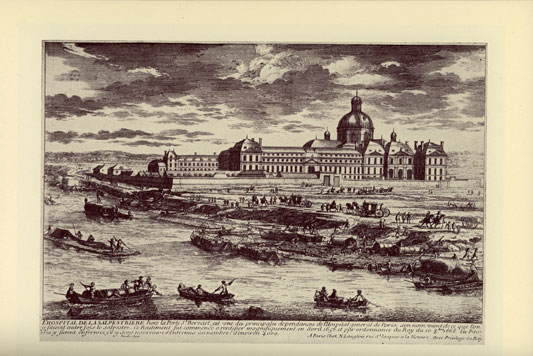
The Salpetriere
This was not a new phenomenon, merely the shock of recognition. In Greek mythology, for instance, when the stress of the mid life crisis hit, the hero went through a period of madness, that is to say he adopted a parallel personality until he was able to reorganize his mental attitude to new realities.
In Europe, under the stress of an insane quasi-Semitic religion in which Satan took a prominent role, it was common for the stressed to become ‘possessed’ by demons or, in other words, to split the personality. That is the person showed a parallel personality. The transition point to the beginning of secular understanding came when Dr. Anton Mesmer matched his secular method of exorcism against the ecclesiastical method of exorcism and won. So one might say that modern psychology derived from the problem of the dual personality- the Jekyll and Hyde effect. However dual or multiple personality was not recognized as such until announced in Jean-Martin Charcot’s clinic at the Salpetriere hospital in Paris in the mid-eighties.
Charcot studied hysterics. Hysterics are dealing with a lot of stress, hence escape through an alternate personality would be an easy choice. Charcot and the Salpetriere aren’t exactly household words so let’s take a moment to explain the situation in which modern psychology was born.
It is also necessary to bear in mind changes in scale. What is good for one stage of growth is not good for another. As the scale of things progresses from tiny to small to medium to large to huge to gigantic new forms have to be adopted to suit the new circumstances. These transition points are difficult to adjust to but once adjusted to are considered so normal that those who resisted the old change are equally resistant to adapt to the next level. Of course the young of each scale is born into it and has no adaptation to make although they will at the next change of scale.
Thus the French Revolution and the Napoleonic Era masked to a very large degree a major change of scale so that after Waterloo a seemingly complete break with the past had taken place. It was a new world in the morning. So in the years leading up to the Great War another change of scale had taken place that masked the new world that popped into place in the twenties. I picked up the concept from that astute observer, H.G. Wells, who noted the emerging change in scale at the turn of the century. That great ship, the Titanic, that went down in ‘12 may be considered as representative of that change.
Thus with the change of consciousness that actually took place in 1795 the new consciousness became clear after Waterloo. Gone was the religious notion of ‘possession by evil spirits’ to be replaced soon by the concept of multiple personality. Thus whereas in the past the insane had been treated as raving beasts, chained to walls and whatever a Dr. Pinel at Paris’ Salpetriere began a more humane treatment with an attempt to understand the causes of insanity. The approach was parodied amusingly by Edgar Allen Poe in his story The System of Dr. Tarr and Professor Fether in which the inmates revolted and took over the asylum.
The Salpetriere was a large compound of several acres with thousands of residents, mainly women from whom the subjects who became the hysterics that the great Dr. Jean-Martin Charcot began to study as a neurologist, as the early psychiatrists were known. The field of Psychology is divided in two. On the one side psychiatrists who must be MDs and who believe mental ailments are biologically derived and hence to be treated medically with drugs or, one shudders to think of it, operations like pre-frontal lobotomy or electric or insulin shock ‘therapy.’ Psychologists, who are PhDs with little or no medical training treat neuroses and psychoses as malfunctions of reason caused by experiential traumas.
Charcot as an MD originally sought biological causes for the hysteria he studied although he was coming around to a psychological viewpoint just before he died in 1893. Thus from being chained before Dr. Pinel released them these women, hysterics, while being confined to the Salpetriere were given freedom of movement within the hospital with its flowers and walkways making for a much more pleasant environment for them and one unobtainable to them on the outside.
Now, the great Dr. Anton Mesmer introduced hypnotism to Europe as a discipline in the years just before the Revolution. Naturally something so new and seemingly revelatory did not find immediate acceptance, indeed, it was treated as nonsense. Nevertheless people of learning, doctors, persisted in experimenting with it. Thus, when Charcot came to be the director of the Salpetriere, to the dismay of his profession he introduced the practice in his treatment of his hysterics and thus legitimized its use. Hypnosis, too, was new and little understood.
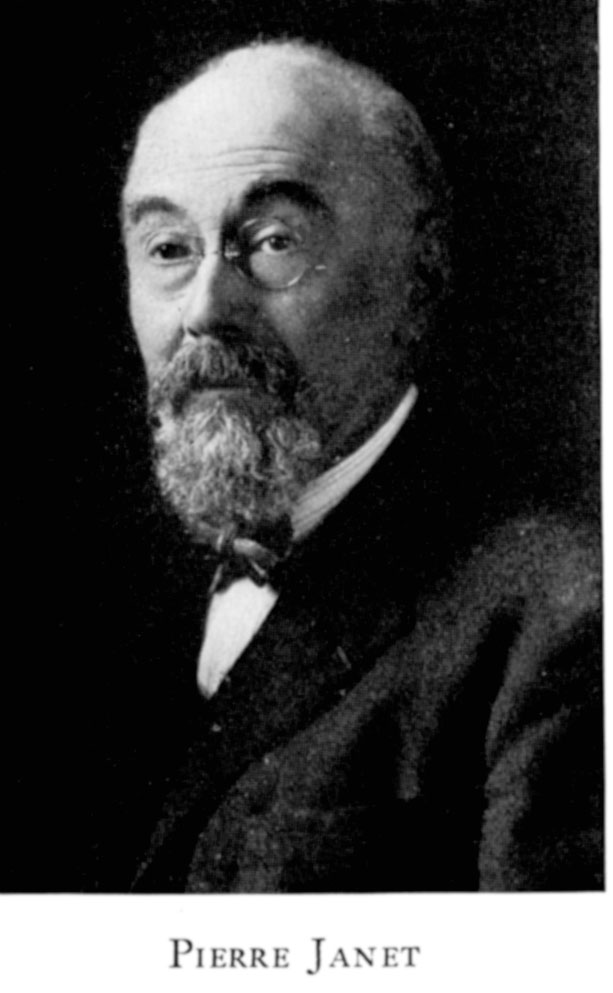
Pierre Janet
The essence of hypnosis is suggestion and Charcot did not understand suggestion. The rival hypnosis school led by Auguste Liebeault and Hippolyte Bernstein at Nancy to the East of Paris was aware of the effect of suggestion but not necessarily the nature of what it was. Actually suggestion is whatever enters the mind and is accepted. If one wakes to a beautiful sunny morning it is suggested to oneself that the day will be a good day. Acting on that suggestion, post-hypnotic one might say, one will try to make the day a great one to hang onto that feeling. The mind is naturally open to suggestion as it must be; in an active mind one can discriminate to some extent as to what suggestions will be accepted and which rejected. Under hypnosis in which the mind has been put into a passive state the ability to discriminate and reject has been greatly reduced so that a hypnotist can plant a suggestion that then becomes what Charcot’s associate, Pierre Janet, called an idee fixe, or in other words, a fixation that will remain in your mind until executed. This notion may be imparted by a human agent, books, movies, radio or any medium that is capable of influencing the mind. One must be aware of this. It isn’t necessary to have a hypnotist standing in front of you saying ‘look into my eyes.’
As I say, Charcot was convinced that hysteria was biological, that is to say caused by a lesion to the brain, so that while he hypnotized his female subjects at the Salpetriere he wasn’t aware of the nature of suggestion.

Marie Corelli
Now, the eighteen seventies and eighties were terrifically exciting at all levels. They did things differently then. As has been said: The past is another country; they do things differently there. The past is never to be judged by current standards although the latter are useful for comparison. Thus when Lister suggested that antiseptics ought to be used in the operating room his suggestion was stoutly resisted although true and nearly universally accepted today. On the other hand Evolution although true is more stoutly resisted today in a religious reaction than it was in the last quarter of the nineteenth century so don’t feel all that superior.
While Charcot was arguing with himself as to whether hysteria was biological or mental, in the mid-eighties two of his associates easily grasped that hysteria was a mental problem. These two were Sigmund Freud and Pierre Janet.
Freud at that time, 1886, was making the transition to psychology from medicine. He was an MD. Charcot was not alone in dealing with mental matters. The understanding of dreams for instance was developing rapidly. When Freud published his Interpretation Of Dreams in 1900 he cited dozens of competent researchers dating as far back as the 1860s. In 1886 alone two novels dealing with the subconscious and split personality were published, Robert Louis Stevenson’s Dr. Jekyll And Mr. Hyde and Marie Corelli’s Wormwood. Corelli cites Charcot as an influence so she very likely had attended his semi-public presentations of hysterics under hypnosis at his hospital.

Sigmund Freud
Going back further, Freud, a German Jew, was undoubtedly familiar with the psychological work of the German romantics. At any rate he spent about four months at the Salpetriere studying Charcot’s work and methods. It is likely that the foundation of his psychoanalysis was laid there. While Charcot was struggling to determine whether hysteria was biological or mental, Freud, himself a neurologist, was able to perceive that, as he later put it, hysterics were suffering from reminiscences. In other words they fixated on past experiences which dominated their minds and behavior.
Pierre Janet, Charcot’s student and associate, came to the same conclusion probably at the same time. He expressed the problem more accurately when he determined that hysterics suffered from one or more idee fixes, that is a fixed idea or, in other words, a fixation centered around a specific past event or events.
Indeed, all the women at the Salpetriere had been battered and brutalized by life with no means of self-assertion or resistance. Unable to express their own will they retreated into ineffective hysterics finally ending up as semi-insane in Charcot’s hospital.
Now, split or multiple personality. No one, especially these women, have the personality they are born with. Over the course of our lives circumstances require us to respond in different ways, sometimes a personality is overwhelmed with a consequent personality adaptation or change and in extreme cases, insanity.
All very well, but what happens to the original and/or various personalities that were submerged. It is impossible for them to vanish from the mind so they must live on submerged by a more powerful personality impulse. Depending on the individual then, everybody must have at least one alternate personality. Stevenson and Corelli were demonstrating this in their novels.
The good Dr. Jekyll had had a wild streak in his youth that he forcefully repressed to become the totally respectable man of medicine. But, he longed for his rough and rowdy days so in Stevenson’s story he invents a potion, I’m sure whisky would have been just as effective, that allows him to free his original personality. In the course of his experiment the earlier personality suppresses the later one assuming control of Jekyll’s mind. Much the same thing happens in Corelli’s novel. Thus we have personality accretion.
Charcot’s hysterics, because of the side show atmosphere the Good Doctor created, became world famous, a sort of show people. Charcot even took them on the road for demonstrations and, heaven forbid, loaned them to other doctors for experimentation.
It was during one such loan in 1888 that Jules Janet, Pierre’s brother, made a startling discovery. He was experimenting on Blanche Wittman, the Queen of Hysterics, when having hypnotized her into what Charcot called the first state, instead of progressing to the second state, he decided to put her into a deeper trance. At that point Blanche was able to dissociate her personality from her normal state to what I assume was her original personality. She turned into a happy effervescent bubbly girl. In other words she had stripped every accreted personality adjustment to return to the period before society violated her womanhood.
One might ask where this personality came from? It is not necessary to assume either the supernatural or the paranormal. The personality did not come from outside her but was merely an early personality that had been submerged and denied existence by repeated abuse. If Jules Janet had pressed on he might have found three, four or more variations of Blanche Wittman. Indeed, when Charcot died in 1893 Blanche ceased having hysterical attacks and became quite normal assuming yet another personality although it was not recognized as such. She then took responsible employment at the hospital until she died under tragic circumstances.
Thus during one’s life one assumes many variations as one’s personal circumstances dictate. And one expresses them in many different ways. As an example of personality accretion I am going to use the history of the American fantasy and science fiction writer, Edgar Rice Burroughs. He has especial value as his biography is well developed and he has talked voluminously about his mental states through his large body of fiction which is all autobiographical in nature.
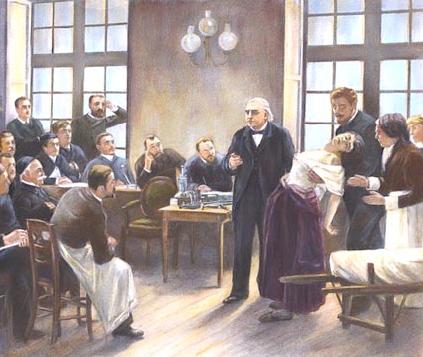
Dr. Jean Martin Charcot Demonstrating Hypnosis And Hysteria
Part II follows.
Pt. I: Edgar Rice Burroughs Rides The Rocket, A Short Life
January 3, 2012
Part I
Edgar Rice Burroughs Rides The Rocket
A Short Life
by
R.E. Prindle

ERB: What, Me Worry?
Eddie was a ramblin’ gambling’ man. He was born in a pair of ramblin’ shoes and he always took the most desperate chances. When he succeeded he was spectacular but when he failed…oh, well.
Perhaps the biggest gamble he ever took was being born but then, as Eddie always said: to me to conceive is to act. Things started out well as he began his life as a little prince but would soon turn sour when he was eight and lost a confrontation with a twelve year old bully on a street corner on the way to school. That was a life changer; he’d gone from prince to pauper and worse was yet to come. But, hey, it’s all education, isn’t it now?
The next year he began a foot race with the plague which he would ultimately lose. But as with being born he was initially successful. In an effort to escape the epidemic he was transferred to an all girls school. Apparently this was a polite plague selecting only boys. So like young Achilles Eddie took his place among the young ladies.
Still pursued, as one imagines, he was put for safety in a Latin School, one imagines as a place the fever would never look for him and if it found him would never enter the abode of such objectionable learning. Still, a young man of means he owned both a pony and a bicycle. The pony he rode back and forth to school leaving it tethered outside while he soaked up the classical knowledge. The bicycle he rode for fun but tipped over banging his head against a curb. This left him dizzy for days perhaps contributing to his later character which was formed by a similar incident.
While secure at the Harvard Latin School of Chicago for a couple years, the plague was not to be baffled forever. Eddie took to his heels running as fast as he could way out across the Western Plains to Idaho to become a Jr. cowboy. No box tops necessary.

If this picture is any indication he was quite a dude. Look at those chaps! The rowels of those spurs were so big they dragged on the ground announcing his approach from some distance. It was not all bravado however as he did have quite a way with the horses. Eddie was quite happy on the ranch and he might have become a Sr. cowboy but fate put some itchin’ powder in Eddie’s ramblin’ shoes and he resumed his ramblin’ ways. Doing an intellectual about face he and his guitar showed up at a Harvard prep school called the Phillips Academy. It was soon discovered that he didn’t know how to play guitar and hadn’t even learned any good cowboy songs such as The Streets Of Laredo, The Chisholm Trail and other titles of that ilk. Didn’t even know how to sing, either.
This disappointed the faculty, as well as his low grades, so that they couldn’t bear Eddie’s presence. Thus he was told to put his ramblin’ shoes back on and git along.
As you can tell, by this time Eddie was accumulating a fair amount of educational experience though not of the academic sort. Still of tender years and still outdistancing the plague Eddie had to find another educational emporium to fill out his youthful years. His father, actually the agent of all this agitation, for some reason thinking him a delinquent, did what all fathers of delinquent kids do, he enrolled the lad in a military academy. Supposed to make you learn to stand up straight or something like that. Yep. If the plague showed up there they’d most likely make him stand at attention until he got tired of it.
After all this ramblin’ Eddie was becoming quite a character. In addition to performing some typical goofy stunts Ed was a star rider on the Equestrian team as well captaining the football team as a quarterback. Just to put in some good words for Eddie here and raise him in your estimation, Ed led the Michigan Military Academy Tigers, or whatever they were called, to a draw against the mighty University Of Michigan Wolverines. Always an odd sobriquet I thought and in a competition between a tiger and wolverine which would you bet on.
Now, this nearly miraculous feat did not go unnoticed. He so impressed the Wolverine coach that Ed was offered a full football ride at Ann Arbor. Well, you might say, that was really wonderful. Yes, it could have been. But the imp of the perverse was down in those ramblin’ shoes as well as the itching powder as Eddie turned the coach down. If the offer had come from Yale that would have been different, but UM? Eddie had his heart set on Yale, which his brothers had attended, and it was Yale or nothing. Yale was uninterested.
That was a positive life changing experience that Eddie missed but fate was cramming the next few years with a bunch more, some of them very memorable. Plus the plague was waiting for him just around the corner. That was going to be a stunner.
First up was one of those glorious once in a lifetime experiences that only succeeds if you’re at the right age. Eddie was and he had one glorious summer in the year of ‘93. The Chicago Columbian Exposition. The promoters couldn’t get it together to open in ‘92 which would have been that actual 400th anniversary year of the intrepid navigator’s voyage but the promoters were ready in ‘93. Eddie was seventeen and spent the summer of his life at the Expo grounds.
I’m going to have to try to set the Expo up for you because in its own way it was the highpoint of Western Civilization before and since. Western confidence just began to sort of evaporate after the fair was over.
II.
Eddie In Wonderland

Built In A Matter Of Months
The nineteenth century was quite something. It was the century of magnificent discoveries and achievement. Society chooses to diminish those wonderful scientists by derogatorily calling them Dead White Men while sneeringly dismissing them. Pardon me, if I’m sentimental but those were the guys that made the present possible and I can’t admire them too much. They’ll always be my revered ancestors to me and not Dead White Men. Down with negativity.
Technology and Science just exploded as scientific research opened new and very broad vistas to human view that never would have been opened without them. The machinery was incredible. The accumulated wonders were first put on display at London’s Crystal Palace Exhibition of 1851. Six million people wandered through. It was breathtaking as the world of tomorrow went on display.

Water Gate From Lake Michigan
The Centennial Exposition of 1876 in Philadelphia followed as an international competition began to form. Next came the 1889 fair in Paris for which the Eiffel Tower was created to form the triumphal arch through people entered the fair. Boy, there was an eye opener. Over a thousand feet tall, 300 steps up to the first level and 300 more up to the second. Tough act to follow but out there on the very edge of civilization existed the city to do it. Chicago. Chicago itself was considered exhibition enough. The Iron Chancellor, Bismarck himself, said that his only regret was dying without ever having seen that Chicago.
By 1893 the conditions for a perfect fair had formed. Steam safely delivered hordes from across the seas and steam brought them to Chicago in long lines of Pullman cars pulled by a mighty eight wheeler. The conditions were perfect and Chicago had the men of vision to realize the perfect fair- and how! And there were men to commemorate it as it deserved. H.H. Bancroft published a large size five volume set displaying its wonders in detail

The setting on Lake Michigan was spectacular; a one of a kind creation, never since replicated or even close to it. The Century Of Progress of 1933 was but a pale imitation. If you’ve read The Devil In The White City you know a fuller description than I’m going to give here. The White City, as the fair grounds were called, was a fairy land, life as it could be. It contrasted with the Black City, life as it was, of everyday Chicago. Industrialism was a recent phenomenon in the nineteenth century so that in the giddiness of creation such things as environmental concerns and labor relations had been neglected or at least not seen in their true importance. Everyday Chicago was a grim place; Eddie often makes unflattering remarks about his home town throughout his novels. It was smelly, smoky and dirty with huge slums not to mention institutionalized crime. They’ve shut down the stockyards but the criminal mentality remains.
The White City in contrast was a city as it could be and should. L. Frank Baum would later use it as the model for his Emerald City. As there was great labor unrest in Chicago at the time the labor force was critical. Those who signed on were quarantined to the site while work was in progress so as not to be corrupted by the labor dissidents. They threw up some of the most massive buildings in existence, practically overnight. They created pleasure gardens and a whole pleasure island. They had the midway of midways, in fact the term Midway was originated at the Expo. In competition with Paris’s Eiffel Tower the worlds’ first monster Ferris Wheel was brought into existence. While in the US the Wheel was turned into a carnival ride now many European capitols display huge four hundred foot Ferris Wheels next to their Houses of Parliament. No US city does; even the original Ferris Wheel was dismantled and has disappeared into some junkyard, perhaps having been converted into the steel beams of a skyscraper.

Japanese Pavilion
The Expo not only featured the technological and scientific triumphs of that fabulous nineteenth century but all the intellectual advances; Francis Galton the English psychologist displayed his achievements; Frederick Jackson Turner announced his seminal work on the disappearance of the frontier; The Congress of World Religions set up its tent over in the Black City to discuss how religion was to meet the challenge of science.
One of the first of the body builders, The Great Sandow, performed his strength stunts and flexed his muscles giving Eddie the germ for his seminal literary creation a few years hence.
Imitation Zuni Cliff Dwellings were created, a whole Dahomian village was thrown up, staffed with real Dahomians brought over for the fair. Eddie was influenced by these but he really enjoyed the peep show- forty beautiful women, count ‘em, forty, on display for your delectation.
Dozens of huge buildings from nearly every State and country, art works created an instant museum to rival the great museums of the world. Just outside the gates, too late to be included within, the fabulous Buffalo Bill’s Wild West. History portrayed while it was still in making out on the Western Plains. As incredible as it may seem among the performers was no less than Sitting Bull himself, the engineer of Custer’s defeat at his Last Stand. Amazing. It’s all show biz, folks.
The White City shot up out of the beach sands and chiggers, existed for a few months and then it was gone, burned to the grounds by the labor malcontents of the Black City. Fire is the devil’s best friend. Before it was gone Eddie and his fellows from the Michigan Military Academy marched into that Sacred City like so many Greeks at Troy, in pomp and circumstance. The troops of the MMA strutted in while the band played on. It filled Eddie’s heart with pride. Five years later, slightly inebriated, he and a friend would hire a band parading along behind it through the street of downtown Denver. Let’s just say the fair entrance was one of those thrills.
The summer of ‘93 was one for Eddie to remember. In a few years automobiles would begin to fill the streets of the Black City. In the White City of ‘93 Eddie beat them to the punch driving fair patrons around in his dad’s electric Morrison. The Morrison wasn’t much in the way of self propelled vehicles, being little more than a buckboard with benches on it, but, there was no horse in front of it and Ed was behind the wheel.
There was so much at the fair that a casual weekend visit was merely the smallest of sips, a week was a swallow, two weeks perhaps a draught. Nobody could take it in, nobody, but Ed that is. He had the full three months of that glorious summer to walk the walks, cross the bridges, stroll the romantic Wooded Island to the fabulous Japanese pavilion, gape and take it all in. You’ve got to remember that in those days before movies, TV, videos and color photography bound in convenient volumes no one, or at least very few, had ever seen such things. The fair was the prototype for all the Disney Lands and Worlds now dotting the planet.
What Ed might have missed he may have spotted in a newspaper account, rushing back to the grounds to take it in. Not everyone would know how to use what he saw and experienced, Ed did. Even if it was impossible for him to understand what he saw at the time, Eddie tucked it into the back of his mind from which it emerged in dribbles into his fiction over the thirty years of his writing career.
How lucky he was to pass the Summer of ‘93 in this wonderland. Truly a life changing experience. Not the only one coming up, Eddie had a lot more awaiting him in what he described as a boring life.
III.
Life Begins To Get Serious
First up was graduation from the MMA and the year he spent as a Geology instructor there. Then at the end of the year a depression seized Ed, probably caused by his failure to get an appointment to West Point. He joined the Army anyway leaving the MMA in the lurch while asking for the worst post in the Army’s jurisdiction. He got it. He was very lucky the Army wasn’t the French Foreign Legion or they might have assigned him to a post that made hell look a luxury resort, with no way out. The Army was more considerate, they sent him to Fort Grant in Arizona which was a few degrees cooler than hell although the accommodations were not much better.
The bad news was that Ed was in the Army finding this particular life changing experience, decidedly unpleasant; the good news was that Eddie really liked the desert and the Apaches. Zane Grey beat him to the punch writing about it but Eddie read Zane’s books assiduously. Both Arizona and Southern Utah, the border was disputed at that time, formed an irresistible attraction to him and he and Emma in their later years of marriage returned to it often. Even as Eddie was sadly contemplating divorcing this woman who had stuck with him through thick and thin, he retreated to the White Mountains Apache Reservation to ponder his situation. A deep respect for the Apaches was another consequence of his abbreviated tour of duty. Abbreviated because Ed developed what the Old Timers called a ‘tobacco heart’ and Ed had his dad use his influence to get him out. When the going got tough Eddie always took off running. He remembered that street corner in Chicago.
Well there he was, nearly twenty-five years old with no directions home although he did find his way back to Chicago, a story in itself, which I’m not going to tell here, but fragments of it can be found in The Return Of The Mucker. Ed knew how to use every scrap of his experience to advantage. For a couple years Ed hopped back and forth between Chicago and Idaho where his brothers were still running the ranch where Eddie earned those gigantic spurs.
It was on one of these trips he and an old Army buddy, a member of the Might Have Seen Better Days Club of that brief Army period, hired the band in Denver. It was also in Denver that Ed showed his gambling proclivities losing the money to cover the stretch from Denver to Idaho. As the baby brother, Big Brother Harry covered his act but Ed had set a dangerous precedent.
Part of the reason for Ed’s motation at this particular stage of his life was the maturing of his relationship with future wife Emma. As girls often do, she matured faster than Eddie and hearing her biological clock ticking was ready for the altar. Time was no longer on her side. Whether she could have ever rustled Ed out of bachelorhood is a topic for some rumination if she wasn’t at the same time being courted also by a rich handsome young fellow by the name of Frank Martin. Irish; always a red flag for Eddie who had some Irish blood of his own but considered himself a full blooded English type.
Rich and Irish. Franks’ dad was a big railroad magnate. Had his own private car to hitch at the back of the train. Well, to make a long story short Frank correctly discerned Ed’s intentions of wanting to remain a bachelor yet keep Emma on his string. Ed would go away but he wouldn’t stay away. Frank sat down and thought for a while, perhaps between breakfast and lunch, and thought he had devised a way to keep Eddie away…permanently.
It was a good plan and should have worked but it didn’t. Frank had his dad hook up the private car to a New York City bound train and then invited Ed along for the ride. Our Blithe Spirit got on the train without a qualm. One should never trust the other guy in matters concerning love or money. There are some guys who take the old saying everything’s fair in love and war quite seriously. Ed was to be given the coup de grace in Toronto on the way back. The boys went to the Toronto equivalent of Chicago’s Levee for a night’s entertainment. A couple thugs approached Ed flashing a black jack of sufficient weight and criminal dexterity to kill him but the coup and the grace separated. Ed was down and bloody but he survived. He promptly went back to Chicago and married Emma to keep her out of Frank’s hands. Now it was Frankie’s turn to cry.
We know he was a sore loser and if he didn’t stalk Ed he didn’t let him out of his sight either. Thirty-four years later when Ed and Emma parted Frank’s man Patchin was sent to LA to gloat over the divorce. Even when Eddie died, Frank had preceded him, Patchin sent a mocking letter to Ed’s son.
What I’m leading up to here is not even conjecture but just a bit of imagination, but since I know more than I’m telling, a possibility. As I pointed out for the last twenty years Ed had been dodging the plague; in 1901 he turned a corner and there he was face to face Mr. Typhoid Fever. Fever shook his hand and that was it. Eddie was down and almost out. It was a terrible bout but Ed did survive or else I might be writing about Zane Grey, a decidedly stuffy creature in whom I have no interest.
It was only a little over a year since Frank had been aced out of Emma. Definitely not long enough to cool off his hot Irish temper. A man who will attempt murder once will hold a long grudge and we know that Martin never stopped thinking of Emma and Ed. It may sound far fetched and may be it is, but as Ed caught the Typhus a year or so after snagging Emma I wouldn’t be surprised to learn that Frank Martin passed a stolen bacillus on to Ed in some way. Certainly he couldn’t have him assaulted again, an accident might have been difficult, so perhaps he introduced the disease into Ed’s food in some way. Just a suspicion.
Eddie didn’t bounce back to his feet but while he convalescing a very important book to him was issued which he devoured as it appealed to his romantic soul. He would read Owen Wister’s Virginian six or seven times by 1920. If one looks at in this way Ed made several attempts to escape Chicago until he finally succeeded in 1919. If one looks at it like that, as I say, Ed fled with Emma in 1903, 1913, 1916 and 1919.
I always look for a chain of events, the reason why. Wister’s The Virginian has a terrific reputation although it is one of those classics that leaves me cold. Wister was one of Teddy Roosevelt’s buddies. The book he wrote smells like a Gent roughing it in the wilds. Perhaps the appeal to Ed. On the one hand the novel deals with the Johnson County Range War in Wyoming of which Eddie was peripherally associated when he was an Idaho cowboy in ‘91. Several of the rebels who had killed men fled Wyoming while one or two went into hiding in Idaho. Ed apparently knew one of these desperadoes so The Virginian would have had a personal interest for him.
The love story of the book concerns a rough hewn poorly educated cowboy and a school teacher much above him who he woos and wins. They then wed while for their cowboy honeymoon the hero takes his new wife out into the picturesque mountains of Wyoming.
IV.
Buttons And Bows.
A Western ranch is just a branch
Of Nowhere Junction to me.
Give me that city
Where the living’s pretty
And the girls wear finery.
Ray Evans, Buttons and Bows
From Paleface of 1948 starring Bob Hope.
I haven’t read a study on Ed that gave any attention to understanding Emma or her history and yet she was a key figure in his success while after Ed divorced her his production declined in both quantity and quality. It would seem then that whatever drove him as a writer was connected to Emma
There were striking differences between Ed and Emma. Whereas Ed was shifted not only from school to school but from Illinois to Idaho to Massachusetts and finally to Michigan, Emma continued on at Brown School to graduation giving her a much more stable outlook on life. After graduation she studied voice in Chicago becoming familiar with the higher culture while Ed was much more familiar with the lower reaches of culture. Emma would often chide Ed for his lack of culture as he preferred boxing to opera and in later life would become a devotee of professional wrestling with all its vulgar connotations.
The Hulberts, Emma’s family, considered themselves as high class people and, indeed they were. Thus when Frank Martin came calling Emma’s father, Alvin was overjoyed finding Frank a perfect match for his daughter. Alvin quite frankly despised Eddie considering him a ne’er do well and young failure. There was certainly enough evidence to support his point of view. Before the marriage, in order to encourage Frank’s attentions to his daughter, Ed was forbidden the house. And yet Emma had her heart set on Ed and would have him. Apparently her affection never wavered although her opinion of her husband varied. As it would turn out Alvin’s view of the marriage was much more correct than Emma’s. She should have listened to her papa.
As a young girl and woman the Hulberts treated Emma to the best of everything. While her heart was set on Ed, it is obvious that she dated during all those years when Ed was not in Chicago. It is important to remember that Ed was from Chicago but his youth was spent elsewhere so that he was only faintly culturally of Chicago.
Emma was a clotheshorse. As the pictures show she was used to finery. Those are not only a lot of clothes she’s wearing but fairly expensive clothes. Clothes that Ed definitely could not provide her during the first decade or so of their marriage. When he did come into his money it was his pride that Emma could buy any clothes she wanted and he was happy to have her do so.
So, Ed, his head spinning from the Toronto bashing, and woozy from his fever attack, never particularly stable anyway, conceived the notion of taking Emma to the foothills of Idaho to reenact Wister’s novel. In 1903 then, Ed packed Emma and all their belongings to catch a train to Idaho riding baggage with Emma and their dog.
We have no record as yet of what Emma may have thought of this or whether she protested vehemently being overruled by Ed’s unreasoning passion. Of course between bashing, fever and excruciating headaches anyone might be excused erratic but innocent behavior.
Emma Riding Baggage Dressed Chicago Style
Perhaps she objected using an analogous argument to Ray Evans’
My bones denounce the buckboard bounce
And the cactus hurts my toes
Let’s stay here where gals keep usin’
Those silks and satins and linen that shows
And I’m all yours in buttons and bows.
If she did use such an argument she was still in the baggage car with Ed and the dog.
I’m sure the trip was wildly romantic to Ed. His dad’s battery factory was on Madison, the hobo main stem so that I’m sure Ed had discussed the hobo life with them. His 1915 novel The Return Of The Mucker would celebrate the hobo life style as well as its successor The Oakdale Affair. So there they were, he, Emma and the dog in the baggage car like three hoboes.
Look at the picture of Emma in her finery standing in the boxcar. The look on her face echoes the lyric:
Don’t bury me in this prairie
Take me where the cement grows
Let’s go back to where I’ll keep on wearin’
Those frills and flowers and buttons and bows
Rings and things and buttons and bows.
I wonder if that was what was going through her mind.
Those long skirts didn’t work well out in the brambles, Emma didn’t have any other clothes, probably wouldn’t have worn pants if available, nor was Emma entranced with the one room balloon shack Ed threw up so their stay way out there was romantic to only one of them and of short duration.

Ed And Emma Dressed To Kill In The Wilds Of Idaho
Now comes an event painful to relate. Emma in her finery is way out there feeling miserable while Ed having removed wife and possessions to the romantic wilderness has only forty dollars in his pocket with no way to earn more. He was a rambler, he was a gambler.
Ed’s brother Harry was off in Parma so he and Emma went down to the station to catch a train to visit Harry. They had to put up for the night in what passed for a hotel room above the saloon. To this point in her life Emma had never even thought of roughing it and now she was learning all about it. To compound matters Eddie kissed her goodbye just like in Frankie and Johnny and went downstairs to find a poker game. His head must really have been hurting. They could have written the song Stagger Lee about him.
Well, he started with forty dollars thinking to inflate his stake to sixty or maybe eighty dollars but fate decreed that he come away with empty pockets. The possible reward wasn’t worth the risk. He had to have been playing with sharpies who took his cash and commiserated with his hard luck.
Let me illustrate how slick it can be. I was nineteen on the California Zephyr and two would be sharpers were trying entice me into a game of poker. They were really obvious and I wasn’t biting, I’d already dealt with sharpers aboard ship and come away cleaned. But, the railroad had an employee on board who must have been an amateur magician, he knew his cards. Dressed like a hick, walking and talking like one, he bustled up with his own deck of cards, invited me to stay, probably would have given me the best hands I’d ever seen because he meant me well, but I wasn’t really interested. Anyway he cleaned those two guys out in ten minutes and bustled off the way he came. They sat there stunned.
Now, I wasn’t present at the game Ed was in but I’d be totally amazed if those boys didn’t have a good laugh and dinner at Ed’s expense. Bad luck, good luck, Ed now stood at the bottom of the stairs swallowing hard, trying to figure out just how he was going to explain their dilemma to Emma. To be short about it, this was another one of those life changing experiences for Ed. No, sir, Ed didn’t have an explanation that Emma would accept. I mean, she could have married a millionaire and here she was in a wretched so-called hotel room a thousand miles from nowhere without a dime. Think about it. What was going through her mind?
Their relationship changed right there. It was a change that Ed would never be able to overcome; I’m sure it was the primary cause for the divorce thirty years later as Emma could never forget while Ed could never get over his shame. But, Ed hung in there for now. He recorded much of this period in his novel The Girl From Ferriss’s While a romanticized view of the years between 1900 and 1922 can be found in Marcia Of The Doorstep when Ed was again in hot water for overextending himself financially in LA.
I’m sure the railroads had a bitter taste for Ed after Frank Martin and Toronto. The memory of that private car shone in Ed’s mind like a diamond, but for now he took a job on the Oregon Shortline as a yard policeman in Salt Lake City. That is until Emma rebelled at taking in boarders ordering Ed to take her back to Chicago:
Let’s move back to that big town
Where they love a gal by the cut o’ her clothes
And I’ll stand out in buttons and bows.
Ed had a garage sale or whatever they called them back then actually selling Emma’s ornately carved marriage bed for a pittance. I’m sure that left a little scar too. Then, perhaps because Emma ragged him about riding baggage he bought a couple first class tickets back to the Black City which now appeared blacker than ever, I’m sure.
Ed was now a lost boy with responsibilities. The next seven years must have been a period of the blackest despair for him. He just couldn’t get his act together. He wandered from job to job. He landed a job at Sears, Roebuck that was a good job paying three thousand dollars a year. Not bad money in those days when unskilled labor worked six twelve hour days for from five hundred to seven-fifty a year. Ed’s prospects were good. He probably could have moved up into the five to ten thousand class in a few years. He showed up at his front door saying: Honey, I quit. Emma’s reaction wasn’t recorded but I’m sure it was voluble.
And then, of course, there were the pencil sharpeners. Ed never did sell one but he did sit down and write half of A Princess Of Mars. Who would have believed it? Munsey’s Magazine to who he had submitted it asked for the other half and gave him four hundred dollars to boot. Whether Ed and Emma sensed it or not they were on their way aboard the rocket, ready to ride.
We all hope for the success of our wildest dreams but few if any of us are prepared to manage the consequences of that success. It’s not as easy as it might seem. It’s sort of like the town bum spending a dollar for a lottery ticket and getting fifty million in return. If the bum thought he knew money before he is now introduced to the real thing.
For Ed who in his conception was born a prince, made a pauper, spending decades in disappointed expectations, now realized his destiny again. Upbraided by Emma for being a poor provider he was now in a position to provide her every desire, after taking care of his first, of course. The past weighed heavy on Eddie. The difficulties of his courtship and the shame of that gambling night in Idaho had to be rectified, reversed.
It couldn’t be, of course. One’s failures can only be recognized, accepted and lived with. But in a frenzy Ed thought that by repeating the private car incident and the disastrous trip to Idaho he could wash away the stains. Thus, having established a market for his goods, most especially with the creation of his ‘meal ticket’ Tarzan, Ed did an incredible thing. Remember he still had no money in the bank, betting entirely on the come.
As with Idaho he packed up all his goods including his useless second hand car, wife and by now three kids, bought five first class tickets to San Diego and made another attempt at fleeing Chicago. First class wasn’t the same as a private car but it was pretty close so Ed hopefully erased the shame of Frank Martin’s trip to New York City and back.
Once in San Diego, which stay lasted nine months, or long enough to be born again as the New Ed, he must have lived a princely existence going through most of the ten thousand he earned that year while returning to Chicago as broke as he had been when he and Emma boarded the train in Salt Lake City. So, he tried to eliminate his shame.
Once back in the Black City, having sold his production while in San Diego, he wrote some more, sold some more and made a seamless transition from the old Ed to the reincarnated Ed.
I would imagine that part of the plan was to get Tarzan published as a book and with that money establish himself as a man of means in his old home town. Move on up to the Gold Coast.
That would seem to be a very reasonable plan from our point of view but it was not that easy. Perhaps Tarzan, which is pure fantasy of the extravagant kind went well beyond publisher’ literary expectations. No one would touch it then, even though from our perspective the story was pure gold as, indeed, it turned out to be although not for Ed. Perhaps the novel appeared to the literary taste of Ed’s day as comic books did to literary lights in the forties and fifties of the last century, something to be burned and banned, hence Ed’s success was of the bastard sort.
He finally did get his novel published in book form in 1914 but he was stripped of most of the financial benefits as it went almost directly to reprint publishers; thus his royalties were more than halved and mere pittances of what they might have been. Still, by the time royalties began to come in Ed had created a backlog of Tarzan novels so that with current production one a year would be published for about ten years.
As the profit motive didn’t seem to be activating his publisher, the Chicago firm of McClurg’s, Ed was reduced to pleading with them to print at least twenty to thirty thousand copies before a novel was sent to the reprint house. It seems incomprehensible that McClurg’s wouldn’t do so on their own but they obstinately refused to make money for themselves and hence for Ed.
Well, the records, as I’ve been told, have been destroyed so what’s to be said. Once again I suspect outside interference. McClurg’s was an Irish house; Frank Martin was Irish. McClurg’s a was semi-public company open to investors one assumes; Frank Martin had money to invest. Until a better explanation is provided I have to believe something along those lines was happening.
But, if Eddie could have lived long enough the wonders he would have seen. At one hundred he would have been a very rich man. Those successful intellectual properties just keep gaining in value. Better than stamp collecting.
While Ed appears to have been stymied at the publishing end, that enterprise was old hat, the new wonder of the authorial imagination was movies. The Big Money, to quote John Dos Passos, Thus to some extent the movies made up for what Ed was being cheated out of in publishing. The first film production of Tarzan was the industries first million grosser. Thus when Ed successfully fled Chicago in 1919 his income was ten times what it had been in 1913. If his work was disparaged, as the say goes, he laughed all the way to the bank. Ed left Chicago with his pockets jingling.
Next: Part II: If Pigs Had Wings
Edgar Rice Burroughs Rides The Rocket: A Short Life
Eddie was a ramblin’ gambling’ man. He was born in a pair of ramblin’ shoes and he always took the most desperate chances. When he succeeded he was spectacular but when he failed…oh, well.
Perhaps the biggest gamble he ever took was being born but then, as Eddie always said: to me to conceive is to act. Things started out well as he began his life as a little prince but would soon turn sour when he was eight and lost a confrontation with a twelve year old bully on a street corner on the way to school. That was a life changer; he’d gone from prince to pauper and worse was yet to come. But, hey, it’s all education, isn’t it now?
The next year he began a foot race with the plague which he would ultimately lose. But as with being born he was initially successful. In an effort to escape the epidemic he was transferred to an all girls school. Apparently this was a polite plague selecting only boys. So like young Achilles Eddie took his place among the young ladies.
Still pursued, as one imagines, he was put for safety in a Latin School, one imagines as a place the fever would never look for him and if it found him would never enter the abode of such objectionable learning. Still, a young man of means he owned both a pony and a bicycle. The pony he rode back and forth to school leaving it tethered outside while he soaked up the classical knowledge. The bicycle he rode for fun but tipped over banging his head against a curb. This left him dizzy for days perhaps contributing to his later character which was formed by a similar incident.
While secure at the Harvard Latin School of Chicago for a couple years, the plague was not to be baffled forever. Eddie took to his heels running as fast as he could way out across the Western Plains to Idaho to become a Jr. cowboy. No box tops necessary.
If this picture is any indication he was quite a dude. Look at those chaps! The rowels of those spurs were so big they dragged on the ground announcing his approach from some distance. It was not all bravado however as he did have quite a way with the horses. Eddie was quite happy on the ranch and he might have become a Sr. cowboy but fate put some itchin’ powder in Eddie’s ramblin’ shoes and he resumed his ramblin’ ways. Doing an intellectual about face he and his guitar showed up at a Harvard prep school called the Phillips Academy. It was soon discovered that he didn’t know how to play guitar and hadn’t even learned any good cowboy songs such as The Streets Of Laredo, The Chisholm Trail and other titles of that ilk. Didn’t even know how to sing, either.
This disappointed the faculty, as well as his low grades, so that they couldn’t bear Eddie’s presence. Thus he was told to put his ramblin’ shoes back on and git along.
As you can tell, by this time Eddie was accumulating a fair amount of educational experience though not of the academic sort. Still of tender years and still outdistancing the plague Eddie had to find another educational emporium to fill out his youthful years. His father, actually the agent of all this agitation, for some reason thinking him a delinquent, did what all fathers of delinquent kids do, he enrolled the lad in a military academy. Supposed to make you learn to stand up straight or something like that. Yep. If the plague showed up there they’d most likely make him stand at attention until he got tired of it.
After all this ramblin’ Eddie was becoming quite a character. In addition to performing some typical goofy stunts Ed was a star rider on the Equestrian team as well captaining the football team as a quarterback. Just to put in some good words for Eddie here and raise him in your estimation, Ed led the Michigan Military Academy Tigers, or whatever they were called, to a draw against the mighty University Of Michigan Wolverines. Always an odd sobriquet I thought and in a competition between a tiger and wolverine which would you bet on.
Now, this nearly miraculous feat did not go unnoticed. He so impressed the Wolverine coach that Ed was offered a full football ride at Ann Arbor. Well, you might say, that was really wonderful. Yes, it could have been. But the imp of the perverse was down in those ramblin’ shoes as well as the itching powder as Eddie turned the coach down. If the offer had come from Yale that would have been different, but UM? Eddie had his heart set on Yale, which his brothers had attended, and it was Yale or nothing. Yale was uninterested.
That was a positive life changing experience that Eddie missed but fate was cramming the next few years with a bunch more, some of them very memorable. Plus the plague was waiting for him just around the corner. That was going to be a stunner.
First up was one of those glorious once in a lifetime experiences that only succeeds if you’re at the right age. Eddie was and he had one glorious summer in the year of ‘93. The Chicago Columbian Exposition. The promoters couldn’t get it together to open in ‘92 which would have been that actual 400th anniversary year of the intrepid navigator’s voyage but the promoters were ready in ‘93. Eddie was seventeen and spent the summer of his life at the Expo grounds.
I’m going to have to try to set the Expo up for you because in its own way it was the highpoint of Western Civilization before and since. Western confidence just began to sort of evaporate after the fair was over.
II.
Eddie In Wonderland
The nineteenth century was quite something. It was the century of magnificent discoveries and achievement. Society chooses to diminish those wonderful scientists by derogatorily calling them Dead White Men while sneeringly dismissing them. Pardon me, if I’m sentimental but those were the guys that made the present possible and I can’t admire them too much. They’ll always be my revered ancestors to me and not Dead White Men. Down with negativity.
Technology and Science just exploded as scientific research opened new and very broad vistas to human view that never would have been opened without them. The machinery was incredible. The accumulated wonders were first put on display at London’s Crystal Palace Exhibition of 1851. Six million people wandered through. It was breathtaking as the world of tomorrow went on display.
The Centennial Exposition of 1876 in Philadelphia followed as an international competition began to form. Next came the 1889 fair in Paris for which the Eiffel Tower was created to form the triumphal arch through people entered the fair. Boy, there was an eye opener. Over a thousand feet tall, 300 steps up to the first level and 300 more up to the second. Tough act to follow but out there on the very edge of civilization existed the city to do it. Chicago. Chicago itself was considered exhibition enough. The Iron Chancellor, Bismarck himself, said that his only regret was dying without ever having seen that Chicago.
By 1893 the conditions for a perfect fair had formed. Steam safely delivered hordes from across the seas and steam brought them to Chicago in long lines of Pullman cars pulled by a mighty eight wheeler. The conditions were perfect and Chicago had the men of vision to realize the perfect fair- and how! And there were men to commemorate it as it deserved. H.H. Bancroft published a large size five volume set displaying its wonders in detail
The setting on Lake Michigan was spectacular; a one of a kind creation, never since replicated or even close to it. The Century Of Progress of 1933 was but a pale imitation. If you’ve read The Devil In The White City you know a fuller description than I’m going to give here. The White City, as the fair grounds were called, was a fairy land, life as it could be. It contrasted with the Black City, life as it was, of everyday Chicago. Industrialism was a recent phenomenon in the nineteenth century so that in the giddiness of creation such things as environmental concerns and labor relations had been neglected or at least not seen in their true importance. Everyday Chicago was a grim place; Eddie often makes unflattering remarks about his home town throughout his novels. It was smelly, smoky and dirty with huge slums not to mention institutionalized crime. They’ve shut down the stockyards but the criminal mentality remains.
The White City in contrast was a city as it could be and should. L. Frank Baum would later use it as the model for his Emerald City. As there was great labor unrest in Chicago at the time the labor force was critical. Those who signed on were quarantined to the site while work was in progress so as not to be corrupted by the labor dissidents. They threw up some of the most massive buildings in existence, practically overnight. They created pleasure gardens and a whole pleasure island. They had the midway of midways, in fact the term Midway was originated at the Expo. In competition with Paris’s Eiffel Tower the worlds’ first monster Ferris Wheel was brought into existence. While in the US the Wheel was turned into a carnival ride now many European capitols display huge four hundred foot Ferris Wheels next to their Houses of Parliament. No US city does; even the original Ferris Wheel was dismantled and has disappeared into some junkyard, perhaps having been converted into the steel beams of a skyscraper.
The Expo not only featured the technological and scientific triumphs of that fabulous nineteenth century but all the intellectual advances; Francis Galton the English psychologist displayed his achievements; Frederick Jackson Turner announced his seminal work on the disappearance of the frontier; The Congress of World Religions set up its tent over in the Black City to discuss how religion was to meet the challenge of science.
One of the first of the body builders, The Great Sandow, performed his strength stunts and flexed his muscles giving Eddie the germ for his seminal literary creation a few years hence.
Imitation Zuni Cliff Dwellings were created, a whole Dahomian village was thrown up, staffed with real Dahomians brought over for the fair. Eddie was influenced by these but he really enjoyed the peep show- forty beautiful women, count ‘em, forty, on display for your delectation.
Dozens of huge buildings from nearly every State and country, art works created an instant museum to rival the great museums of the world. Just outside the gates, too late to be included within, the fabulous Buffalo Bill’s Wild West. History portrayed while it was still in making out on the Western Plains. As incredible as it may seem among the performers was no less than Sitting Bull himself, the engineer of Custer’s defeat at his Last Stand. Amazing. It’s all show biz, folks.
The White City shot up out of the beach sands and chiggers, existed for a few months and then it was gone, burned to the grounds by the labor malcontents of the Black City. Fire is the devil’s best friend. Before it was gone Eddie and his fellows from the Michigan Military Academy marched into that Sacred City like so many Greeks at Troy, in pomp and circumstance. The troops of the MMA strutted in while the band played on. It filled Eddie’s heart with pride. Five years later, slightly inebriated, he and a friend would hire a band parading along behind it through the street of downtown Denver. Let’s just say the fair entrance was one of those thrills.
The summer of ‘93 was one for Eddie to remember. In a few years automobiles would begin to fill the streets of the Black City. In the White City of ‘93 Eddie beat them to the punch driving fair patrons around in his dad’s electric Morrison. The Morrison wasn’t much in the way of self propelled vehicles, being little more than a buckboard with benches on it, but, there was no horse in front of it and Ed was behind the wheel.
There was so much at the fair that a casual weekend visit was merely the smallest of sips, a week was a swallow, two weeks perhaps a draught. Nobody could take it in, nobody, but Ed that is. He had the full three months of that glorious summer to walk the walks, cross the bridges, stroll the romantic Wooded Island to the fabulous Japanese pavilion, gape and take it all in. You’ve got to remember that in those days before movies, TV, videos and color photography bound in convenient volumes no one, or at least very few, had ever seen such things. The fair was the prototype for all the Disney Lands and Worlds now dotting the planet.
What Ed might have missed he may have spotted in a newspaper account, rushing back to the grounds to take it in. Not everyone would know how to use what he saw and experienced, Ed did. Even if it was impossible for him to understand what he saw at the time, Eddie tucked it into the back of his mind from which it emerged in dribbles into his fiction over the thirty years of his writing career.
How lucky he was to pass the Summer of ‘93 in this wonderland. Truly a life changing experience. Not the only one coming up, Eddie had a lot more awaiting him in what he described as a boring life.
3.
Life Begins To Get Serious
First up was graduation from the MMA and the year he spent as a Geology instructor there. Then at the end of the year a depression seized Ed, probably caused by his failure to get an appointment to West Point. He joined the Army anyway leaving the MMA in the lurch while asking for the worst post in the Army’s jurisdiction. He got it. He was very lucky the Army wasn’t the French Foreign Legion or they might have assigned him to a post that made hell look a luxury resort, with no way out. The Army was more considerate, they sent him to Fort Grant in Arizona which was a few degrees cooler than hell although the accommodations were not much better.
The bad news was that Ed was in the Army finding this particular life changing experience, decidedly unpleasant; the good news was that Eddie really liked the desert and the Apaches. Zane Grey beat him to the punch writing about it but Eddie read Zane’s books assiduously. Both Arizona and Southern Utah, the border was disputed at that time, formed an irresistible attraction to him and he and Emma in their later years of marriage returned to it often. Even as Eddie was sadly contemplating divorcing this woman who had stuck with him through thick and thin, he retreated to the White Mountains Apache Reservation to ponder his situation. A deep respect for the Apaches was another consequence of his abbreviated tour of duty. Abbreviated because Ed developed what the Old Timers called a ‘tobacco heart’ and Ed had his dad use his influence to get him out. When the going got tough Eddie always took off running. He remembered that street corner in Chicago.
Well there he was, nearly twenty-five years old with no directions home although he did find his way back to Chicago, a story in itself, which I’m not going to tell here, but fragments of it can be found in The Return Of The Mucker. Ed knew how to use every scrap of his experience to advantage. For a couple years Ed hopped back and forth between Chicago and Idaho where his brothers were still running the ranch where Eddie earned those gigantic spurs.
It was on one of these trips he and an old Army buddy, a member of the Might Have Seen Better Days Club of that brief Army period, hired the band in Denver. It was also in Denver that Ed showed his gambling proclivities losing the money to cover the stretch from Denver to Idaho. As the baby brother, Big Brother Harry covered his act but Ed had set a dangerous precedent.
Part of the reason for Ed’s motation at this particular stage of his life was the maturing of his relationship with future wife Emma. As girls often do, she matured faster than Eddie and hearing her biological clock ticking was ready for the altar. Time was no longer on her side. Whether she could have ever rustled Ed out of bachelorhood is a topic for some rumination if she wasn’t at the same time being courted also by a rich handsome young fellow by the name of Frank Martin. Irish; always a red flag for Eddie who had some Irish blood of his own but considered himself a full blooded English type.
Rich and Irish. Franks’ dad was a big railroad magnate. Had his own private car to hitch at the back of the train. Well, to make a long story short Frank correctly discerned Ed’s intentions of wanting to remain a bachelor yet keep Emma on his string. Ed would go away but he wouldn’t stay away. Frank sat down and thought for a while, perhaps between breakfast and lunch, and thought he had devised a way to keep Eddie away…permanently.
It was a good plan and should have worked but it didn’t. Frank had his dad hook up the private car to a New York City bound train and then invited Ed along for the ride. Our Blithe Spirit got on the train without a qualm. One should never trust the other guy in matters concerning love or money. There are some guys who take the old saying everything’s fair in love and war quite seriously. Ed was to be given the coup de grace in Toronto on the way back. The boys went to the Toronto equivalent of Chicago’s Levee for a night’s entertainment. A couple thugs approached Ed flashing a black jack of sufficient weight and criminal dexterity to kill him but the coup and the grace separated. Ed was down and bloody but he survived. He promptly went back to Chicago and married Emma to keep her out of Frank’s hands. Now it was Frankie’s turn to cry.
We know he was a sore loser and if he didn’t stalk Ed he didn’t let him out of his sight either. Thirty-four years later when Ed and Emma parted Frank’s man Patchin was sent to LA to gloat over the divorce. Even when Eddie died, Frank had preceded him, Patchin sent a mocking letter to Ed’s son.
What I’m leading up to here is not even conjecture but just a bit of imagination, but since I know more than I’m telling, a possibility. As I pointed out for the last twenty years Ed had been dodging the plague; in 1901 he turned a corner and there he was face to face Mr. Typhoid Fever. Fever shook his hand and that was it. Eddie was down and almost out. It was a terrible bout but Ed did survive or else I might be writing about Zane Grey, a decidedly stuffy creature in whom I have no interest.
It was only a little over a year since Frank had been aced out of Emma. Definitely not long enough to cool off his hot Irish temper. A man who will attempt murder once will hold a long grudge and we know that Martin never stopped thinking of Emma and Ed. It may sound far fetched and may be it is, but as Ed caught the Typhus a year or so after snagging Emma I wouldn’t be surprised to learn that Frank Martin passed a stolen bacillus on to Ed in some way. Certainly he couldn’t have him assaulted again, an accident might have been difficult, so perhaps he introduced the disease into Ed’s food in some way. Just a suspicion.
Eddie didn’t bounce back to his feet but while he convalescing a very important book to him was issued which he devoured as it appealed to his romantic soul. He would read Owen Wister’s Virginian six or seven times by 1920. If one looks at in this way Ed made several attempts to escape Chicago until he finally succeeded in 1919. If one looks at it like that, as I say, Ed fled with Emma in 1903, 1913, 1916 and 1919.
I always look for a chain of events, the reason why. Wister’s The Virginian has a terrific reputation although it is one of those classics that leaves me cold. Wister was one of Teddy Roosevelt’s buddies. The book he wrote smells like a Gent roughing it in the wilds. Perhaps the appeal to Ed. On the one hand the novel deals with the Johnson County Range War in Wyoming of which Eddie was peripherally associated when he was an Idaho cowboy in ‘91. Several of the rebels who had killed men fled Wyoming while one or two went into hiding in Idaho. Ed apparently knew one of these desperadoes so The Virginian would have had a personal interest for him.
The love story of the book concerns a rough hewn poorly educated cowboy and a school teacher much above him who he woos and wins. They then wed while for their cowboy honeymoon the hero takes his new wife out into the picturesque mountains of Wyoming.
IV.
Buttons And Bows.
A Western ranch is just a branch
Of Nowhere Junction to me.
Give me that city
Where the living’s pretty
And the girls wear finery.
Ray Evans, Buttons and Bows
From Paleface of 1948 starring Bob Hope.
I haven’t read a study on Ed that gave any attention to understanding Emma or her history and yet she was a key figure in his success while after Ed divorced her his production declined in both quantity and quality. It would seem then that whatever drove him as a writer was connected to Emma
There were striking differences between Ed and Emma. Whereas Ed was shifted not only from school to school but from Illinois to Idaho to Massachusetts and finally to Michigan, Emma continued on at Brown School to graduation giving her a much more stable outlook on life. After graduation she studied voice in Chicago becoming familiar with the higher culture while Ed was much more familiar with the lower reaches of culture. Emma would often chide Ed for his lack of culture as he preferred boxing to opera and in later life would become a devotee of professional wrestling with all its vulgar connotations.
The Hulberts, Emma’s family, considered themselves as high class people and, indeed they were. Thus when Frank Martin came calling Emma’s father, Alvin was overjoyed finding Frank a perfect match for his daughter. Alvin quite frankly despised Eddie considering him a ne’er do well and young failure. There was certainly enough evidence to support his point of view. Before the marriage, in order to encourage Frank’s attentions to his daughter, Ed was forbidden the house. And yet Emma had her heart set on Ed and would have him. Apparently her affection never wavered although her opinion of her husband varied. As it would turn out Alvin’s view of the marriage was much more correct than Emma’s. She should have listened to her papa.
As a young girl and woman the Hulberts treated Emma to the best of everything. While her heart was set on Ed, it is obvious that she dated during all those years when Ed was not in Chicago. It is important to remember that Ed was from Chicago but his youth was spent elsewhere so that he was only faintly culturally of Chicago.
Emma was a clotheshorse. As the pictures show she was used to finery. Those are not only a lot of clothes she’s wearing but fairly expensive clothes. Clothes that Ed definitely could not provide her during the first decade or so of their marriage. When he did come into his money it was his pride that Emma could buy any clothes she wanted and he was happy to have her do so.
So, Ed, his head spinning from the Toronto bashing, and woozy from his fever attack, never particularly stable anyway, conceived the notion of taking Emma to the foothills of Idaho to reenact Wister’s novel. In 1903 then, Ed packed Emma and all their belongings to catch a train to Idaho riding baggage with Emma and their dog.
We have no record as yet of what Emma may have thought of this or whether she protested vehemently being overruled by Ed’s unreasoning passion. Of course between bashing, fever and excruciating headaches anyone might be excused erratic but innocent behavior.
Perhaps she objected using an analogous argument to Ray Evans’
My bones denounce the buckboard bounce
And the cactus hurts my toes
Let’s stay here where gals keep usin’
Those silks and satins and linen that shows
And I’m all yours in buttons and bows.
If she did use such an argument she was still in the baggage car with Ed and the dog.
I’m sure the trip was wildly romantic to Ed. His dad’s battery factory was on Madison, the hobo main stem so that I’m sure Ed had discussed the hobo life with them. His 1915 novel The Return Of The Mucker would celebrate the hobo life style as well as its successor The Oakdale Affair. So there they were, he, Emma and the dog in the baggage car like three hoboes.
Look at the picture of Emma in her finery standing in the boxcar. The look on her face echoes the lyric:
Don’t bury me in this prairie
Take me where the cement grows
Let’s go back to where I’ll keep on wearin’
Those frills and flowers and buttons and bows
Rings and things and buttons and bows.
I wonder if that was what was going through her mind.
Those long skirts didn’t work well out in the brambles, Emma didn’t have any other clothes, probably wouldn’t have worn pants if available, nor was Emma entranced with the one room balloon shack Ed threw up so their stay way out there was romantic to only one of them and of short duration.
Now comes an event painful to relate. Emma in her finery is way out there feeling miserable while Ed having removed wife and possessions to the romantic wilderness has only forty dollars in his pocket with no way to earn more. He was a rambler, he was a gambler.
Ed’s brother Harry was off in Parma so he and Emma went down to the station to catch a train to visit Harry. They had to put up for the night in what passed for a hotel room above the saloon. To this point in her life Emma had never even thought of roughing it and now she was learning all about it. To compound matters Eddie kissed her goodbye just like in Frankie and Johnny and went downstairs to find a poker game. His head must really have been hurting. They could have written the song Stagger Lee about him.
Well, he started with forty dollars thinking to inflate his stake to sixty or maybe eighty dollars but fate decreed that he come away with empty pockets. The possible reward wasn’t worth the risk. He had to have been playing with sharpies who took his cash and commiserated with his hard luck.
Let me illustrate how slick it can be. I was nineteen on the California Zephyr and two would be sharpers were trying entice me into a game of poker. They were really obvious and I wasn’t biting, I’d already dealt with sharpers aboard ship and come away cleaned. But, the railroad had an employee on board who must have been an amateur magician, he knew his cards. Dressed like a hick, walking and talking like one, he bustled up with his own deck of cards, invited me to stay, probably would have given me the best hands I’d ever seen because he meant me well, but I wasn’t really interested. Anyway he cleaned those two guys out in ten minutes and bustled off the way he came. They sat there stunned.
Now, I wasn’t present at the game Ed was in but I’d be totally amazed if those boys didn’t have a good laugh and dinner at Ed’s expense. Bad luck, good luck, Ed now stood at the bottom of the stairs swallowing hard, trying to figure out just how he was going to explain their dilemma to Emma. To be short about it, this was another one of those life changing experiences for Ed. No, sir, Ed didn’t have an explanation that Emma would accept. I mean, she could have married a millionaire and here she was in a wretched so-called hotel room a thousand miles from nowhere without a dime. Think about it. What was going through her mind?
Their relationship changed right there. It was a change that Ed would never be able to overcome; I’m sure it was the primary cause for the divorce thirty years later as Emma could never forget while Ed could never get over his shame. But, Ed hung in there for now. He recorded much of this period in his novel The Girl From Ferriss’s While a romanticized view of the years between 1900 and 1922 can be found in Marcia Of The Doorstep when Ed was again in hot water for overextending himself financially in LA.
I’m sure the railroads had a bitter taste for Ed after Frank Martin and Toronto. The memory of that private car shone in Ed’s mind like a diamond, but for now he took a job on the Oregon Shortline as a yard policeman in Salt Lake City. That is until Emma rebelled at taking in boarders ordering Ed to take her back to Chicago:
Let’s move back to that big town
Where they love a gal by the cut o’ her clothes
And I’ll stand out in buttons and bows.
Ed had a garage sale or whatever they called them back then actually selling Emma’s ornately carved marriage bed for a pittance. I’m sure that left a little scar too. Then, perhaps because Emma ragged him about riding baggage he bought a couple first class tickets back to the Black City which now appeared blacker than ever, I’m sure.
Ed was now a lost boy with responsibilities. The next seven years must have been a period of the blackest despair for him. He just couldn’t get his act together. He wandered from job to job. He landed a job at Sears, Roebuck that was a good job paying three thousand dollars a year. Not bad money in those days when unskilled labor worked six twelve hour days for from five hundred to seven-fifty a year. Ed’s prospects were good. He probably could have moved up into the five to ten thousand class in a few years. He showed up at his front door saying: Honey, I quit. Emma’s reaction wasn’t recorded but I’m sure it was voluble.
And then, of course, there were the pencil sharpeners. Ed never did sell one but he did sit down and write half of A Princess Of Mars. Who would have believed it? Munsey’s Magazine to who he had submitted it asked for the other half and gave him four hundred dollars to boot. Whether Ed and Emma sensed it or not they were on their way aboard the rocket, ready to ride.
We all hope for the success of our wildest dreams but few if any of us are prepared to manage the consequences of that success. It’s not as easy as it might seem. It’s sort of like the town bum spending a dollar for a lottery ticket and getting fifty million in return. If the bum thought he knew money before he is now introduced to the real thing.
For Ed who in his conception was born a prince, made a pauper, spending decades in disappointed expectations, now realized his destiny again. Upbraided by Emma for being a poor provider he was now in a position to provide her every desire, after taking care of his first, of course. The past weighed heavy on Eddie. The difficulties of his courtship and the shame of that gambling night in Idaho had to be rectified, reversed.
It couldn’t be, of course. One’s failures can only be recognized, accepted and lived with. But in a frenzy Ed thought that by repeating the private car incident and the disastrous trip to Idaho he could wash away the stains. Thus, having established a market for his goods, most especially with the creation of his ‘meal ticket’ Tarzan, Ed did an incredible thing. Remember he still had no money in the bank, betting entirely on the come.
As with Idaho he packed up all his goods including his useless second hand car, wife and by now three kids, bought five first class tickets to San Diego and made another attempt at fleeing Chicago. First class wasn’t the same as a private car but it was pretty close so Ed hopefully erased the shame of Frank Martin’s trip to New York City and back.
Once in San Diego, which stay lasted nine months, or long enough to be born again as the New Ed, he must have lived a princely existence going through most of the ten thousand he earned that year while returning to Chicago as broke as he had been when he and Emma boarded the train in Salt Lake City. So, he tried to eliminate his shame.
Once back in the Black City, having sold his production while in San Diego, he wrote some more, sold some more and made a seamless transition from the old Ed to the reincarnated Ed.
I would imagine that part of the plan was to get Tarzan published as a book and with that money establish himself as a man of means in his old home town. Move on up to the Gold Coast.
That would seem to be a very reasonable plan from our point of view but it was not that easy. Perhaps Tarzan, which is pure fantasy of the extravagant kind went well beyond publisher’ literary expectations. No one would touch it then, even though from our perspective the story was pure gold as, indeed, it turned out to be although not for Ed. Perhaps the novel appeared to the literary taste of Ed’s day as comic books did to literary lights in the forties and fifties of the last century, something to be burned and banned, hence Ed’s success was of the bastard sort.
He finally did get his novel published in book form in 1914 but he was stripped of most of the financial benefits as it went almost directly to reprint publishers; thus his royalties were more than halved and mere pittances of what they might have been. Still, by the time royalties began to come in Ed had created a backlog of Tarzan novels so that with current production one a year would be published for about ten years.
As the profit motive didn’t seem to be activating his publisher, the Chicago firm of McClurg’s, Ed was reduced to pleading with them to print at least twenty to thirty thousand copies before a novel was sent to the reprint house. It seems incomprehensible that McClurg’s wouldn’t do so on their own but they obstinately refused to make money for themselves and hence for Ed.
Well, the records, as I’ve been told, have been destroyed so what’s to be said. Once again I suspect outside interference. McClurg’s was an Irish house; Frank Martin was Irish. McClurg’s a was semi-public company open to investors one assumes; Frank Martin had money to invest. Until a better explanation is provided I have to believe something along those lines was happening.
But, if Eddie could have lived long enough the wonders he would have seen. At one hundred he would have been a very rich man. Those successful intellectual properties just keep gaining in value. Better than stamp collecting.
While Ed appears to have been stymied at the publishing end, that enterprise was old hat, the new wonder of the authorial imagination was movies. The Big Money, to quote John Dos Passos, Thus to some extent the movies made up for what Ed was being cheated out of in publishing. The first film production of Tarzan was the industries first million grosser. Thus when Ed successfully fled Chicago in 1919 his income was ten times what it had been in 1913. If his work was disparaged, as the say goes, he laughed all the way to the bank. Ed left Chicago with his pockets jingling.
Next: Part II: If Pigs Had Wings
A Review: Isidor Sadger Recollects Freud: Emasculating Freudian Theory
December 16, 2011
A Review
ISIDOR SADGER RECOLLECTS FREUD
Emasculating Freudian Theory
By
R.E. Prindle
…Jung had been infected with Aryan blood from his family.
Deep in his heart,
he was anything from a philosemite.
Now, however, he encountered Judaism
in its most highly gifted embodiment
Of Jewish knowledge shining in front of him.
Was it any wonder that he began by being blinded
With the feeling that never before had he stood before
The countenance of a greater genius?
But his lineage was not to be denied.
One day he sat down and carried out scholarly studies for months
Which resulted in his finding his way back
Through the Mithraic cult to primitive Christianity.
In practical terms
This may be seen that as a Christian prophet,
He fully stripped the libido of its sexual character
And reduced it to merely spiritual energy.
This was, so to speak, the decontamination
Of the poisonous Freudian teachings
Through Christianization and total cleansing.
But since the master could not easily go along
With the desexualization of his teaching,
Which went to the foundation of his theories,
He saw with a heavy heart
That he needed to cut the cord between him and the clinic. (Bergholzi)
Isidor Sadger, Recollecting Freud pp. 71-72

Sigmund Freud: Smoke Rings
Sadger, Isidor: Recollecting Freud, 1930, first published 2005, UWisconsin
It is very difficult to know where to start in analyzing the above quote from Isidor Sadger. First it might be pertinent to identify Isidor Sadger. He had a history with Freud from 1895 into the 1930s. He attended with two others Freud’s first psychoanalytic lecture. He was a founding member of Freud’s Vienna Psychoanalytic Society. In 1930 he published this little volume of biographical notes on his relationship with Freud.
Freud’s circle did not take kindly to the publication of these memoirs doing everything they could to suppress them. In this they were successful. The book was never distributed and only rumored to be in print until this publication in 2005 by Alan Dundes and UWisconsin. Even acquiring a copy of the book by Dundes was nearly impossible. He relates pp. xlii-xliii:
Recollecting Freud
When I looked up Sadger on my computer data base, I found not only the article (Sadger had written) in question but the title of a book: Sigmund Freud: Personliche Erwinnerunger. As I was not familiar with that work, I decided to send for it via interlibrary loan….In due course, the latter arrived but the effort to procure a copy of the former proved unsuccessful. I was informed that there was no known copy in the United States available for borrowing. Since I knew the book had been published in Vienna, I asked if we could try to locate a copy in Europe and the obliging staff in interlibrary loan agreed to do so. A few weeks later, I learned that there was no known copy in any European library available for borrowing.
I was told, however, that there was one, just one, copy listed that might be utilized and that copy was located in the library of Keio University in Japan. Again, inter library loan made a request on my behalf and this time with some partial success….I next asked interlibrary loan to request a photocopy of the entire book…The Keio University Mata Media Center informed (me) that it was unable to comply with my request….
…One of my anthropology doctoral students…was returning to Japan. I asked him to do me a favor and get me a photocopy…
Which he did and almost by a miracle the text was recovered to be published for human consumption some seventy-five years on. As Freud claimed to be a scientist one is amazed that supposed scientists would go so far as to deny publication of Sadger’s memoirs. But, so it was.
In tackling the quote from Sadger let me approach it from the point of view of ‘Jewish knowledge shining in front of him.’
One must ask the question of what is Jewish knowledge and how is it special to their culture? This is important not only from past implications but also in light of today’s Barbara Spectre and her Paideia organization whose intent is to place ‘Jewish knowledge’ on a par with Aryan knowledge or what Sadger calls Christian knowledge.
While Freud may have been a Jew working in the scientific field of psychology and psychiatry and while he may have made some important discoveries in the field that had been developed by Aryans his own contributions arose from that body of accumulated Aryan learning. Since Dr. Anton Mesmer in the mid-eighteenth century until Freud’s Interpretation of Dreams Aryans had been slowly accumulating the knowledge on which Freud built his theories. That knowledge had no racial identity per se nor did that which Freud added to it. As Freud claimed that he was a scientist then his contributions were scientific, not Jewish, and the common property of mankind. He may have been Jewish but the scientific field he was contributing to had no ethnic identity but Science, which is to say, none at all.
Sadger himself is taking a bigoted view in attempting to sequester Freud’s theories to the Jews. In fact, as Sadger indicates Freud did not want his theories to be studied and furthered by anyone else. When C.G. Jung, who Freud tried to make his disciple attempted to examine Freud’s concept of the libido and came to perhaps a more correct understanding of the concept, which after all was scientifically unproven, Freud broke off his relationship with him and the Bergholzli Clinic of Switzerland. He, in fact, severed any Aryan connections. He became interested only in Jewish contributions which then became Jewish knowledge in Sadger’s mind.
Sadger who had been Freud’s earliest disciple deeply coveted the role of being Freud’s pet or ‘favorite son.’ Freud for whom ambivalence was central to his character, even though he hated Aryans as a homosexual he was attracted to the ‘great blond beast’; hence, while carefully concealing his motive he selected Jung who had the requisite scientific qualification to be not his ‘son’ but a necessarily platonic lover. Sadger could never qualify.
Now, what was Jung’s sin that brought about his rejection by Freud:
One day (Jung) sat down and carried out scholarly studies for months which resulted in his finding his way back through the Mithraic cult to primeval Christianity…this may be seen as a Christian prophet, he fully stripped the libido of its sexual character and reduced it to merely spiritual energy.
Unquote.
So, having committed to Freud although ‘infected with Aryan blood from his family’ that he would abandon certain anti-Semitic understandings that he had. In what seems an obvious betrayal of his pledge to Sadger Jung ‘carried out scholarly studies for months; which resulted in his coming up with a different perception of the libido that downplayed the rutty sexual projection of Freud’s Jewish psyche for what Sadger terms Christian spirituality. To Sadger’s mind Jung had betrayed his pseudo-Judaism pledge to return to Christianity.
This raises several problems. Is anti-Semitism a mere prejudice or is it based on observations of how Semitism functions and its rejection on that basis? In other words, based on observed actions Semitism is rejected and not on prejudicial grounds but for accurate scientific reasons.
Further, in dogmatically insisting on his own interpretation of his creation, the libido, Freud was definitely unscientific. At the same time his topography of the mind was completely off base. In point of fact the libido is neither sexual nor spiritual, it doesn’t exist. While Freud had a good working hypothesis his ideas were merely that based on the scientific, not Jewish, knowledge of his time. Freud became dogmatic at a time when he knew, or should have known, what he didn’t know. There was a lot of physiology to be yet discovered that would uncover the biology of life.
This biology would be clarified in 1947 when Crick and Watson discovered the genetic code of DNA.
Freud in his rutty, close to pornographic, interest in sex, by which he meant sexual intercourse made the absurd statement that the more frequently a man ejaculated the better person he would be. Is it any wonder that Jung was turned away from Freud in disgust? While Freud may have thought he was severing ties with the Bergholzli; the reverse would seem to be true.
With the discovery of DNA the biology became clear making it possible to elucidate the psychological basis of sex based on that biology.
Freud frequently had the right idea but he seldom thought the application through being infected with his own need for greatness by creating a science of his very own and his Judaism to whose Weltanschauung he was totally committed as Sadger indicates.
To take the psychology first: Freud correctly differentiates between the individuals inner wishful thinking and his confrontation with outer reality. Or, in other words, religious superstition versus a scientific understanding of objective reality.
Thus, when the child is expelled from the womb he comes into contact with the outer world. Whatever conception of reality he had in the womb bears no relationship to the reality of the world beyond the womb. In the Freudian sense then the child’s mind is all Id with at best a nascent Ego. As Freud’s desideratum is Ego shall displace Id the child has some serious adjusting to do.
This adjustment is called experience and education. In the absence of education the child would grow up to be ignorant savage with an improper understanding of reality causing him to give all the wrong reasons for the phenomena he encounters. This being mankind’s original condition over the millennia this ignorance was replaced by religious speculation based solely on inner wishful thinking. Nor was not adequately understood. As people might, for instance, decide that they are the chosen people of their god, make that god a universal deity and then weave their notions of external reality around that projection. That was the condition of Freud and his Jewish people.
The conflict for Freud and his Jews became acute when the Aryans with a different Weltanschauung sought to understand external reality on its own terms and adjusted their inner world of wishful thinking to reflect as much as possible objective reality. When Freud mentions the science of Kepler and Darwin as being shocks to the human mind, he meant Jewish mind which was now faced with the irreconcilable fact that their Arien Age Weltanschauung being based on false data was obsolete. While Freud considered the organization of the mind the third great shock it was one that could be manipulated for his own ends, unlike Astronomy and Biology, and perverted to serve those ends. Hence his dogmatic and ridiculous view of the unconscious and sex.
Now let us look at the nature of the human sexual function. DNA with its double helix, one strand from each contributor, each remaining separate but combining information through bridges, visibly demonstrates how the entity is constructed. The spermatic strand contributed by the male forms the stronger, more active, and slightly larger right side of the body and left side of the brain; the ovate strand contributed by the female forms the weaker, more passive, slightly smaller left side of the body and right side of the brain.
This means that the Xy chromosome of the male carries a male version and a female version, thus there is a female component to the male. This was picked up the psychoanalysts as bi-sexuality in the carnal sense. This is not true. A man is not by nature available for sex by either sex. Hormones reaffirm the sexual identity.
As should be easy to see all activity is controlled by the brain. Information is communicated up and down the spinal cords which emanate from the brain. One cord for each chromosome. Thus, there is a nerve connection from each side of the brain to the commensurate testicle or ovary. Sperm is manufactured according to the dictates of the autonomic system. After one reaches puberty the seminal fluid builds up. Without any other release the fluid will discharge automatically whether one wills it or not; these are usually termed nocturnal emissions. These alone are all that is necessary to relieve the over supply.
As the only biological function of sex is reproduction the male is always ready to penetrate the female. In a normal psychological function a comfort level can be maintained by one or two ejaculations a day or even less. That Freud could make the absurd statement that the more ejaculations a day the better the person means that as a homosexual he had a psychic need or that the was merely trying to pervert Aryan society.
Now, the spinal cords run down the length of the body from the brain to the testicles where they terminate, making the brain and testicles a unit. Nerves run from the spine to the various organs. There we have the basis for psychosomatic reactions. While the cords are grounded at the testicles I believe they have more free play at the brain level. The bi-sexuality the psychoanalysts noted is caused by the Xy and XX chromosome combinations. Both Freud and Jung given the biology of their day had differently accounts for the apparent bi-sexuality thus they called the spermatic brain ending the Ego while Jung claimed that the male had an Anima and the female an Animus. In actuality both males and females have an Anima and an Animus or, in Freudian terms, a Libido and Ego.
Freud also discovered the concept of Emasculation. When the Ego or Animus, male or female, is given an affront or insult to which it cannot properly respond this creates a reaction or hypnotic suggestion that forms a fixation. This fixation will have a psychic or physical or both affect. Fixations are of different intensities and qualities; the most severe is the central childhood fixation, also with psychosomatic affects an example of which each fixation creates.
In the case of the homosexual the affront is give by the male who thus creates a severe psychosomatic reaction which is what homosexuality is. In the attempt to negate the reaction the homosexual then seeks to visit his fixations on other males while being compelled to seek multiple ejaculations many times a day which he equates with masculinity.
Thus a normal male can be satisfied with a normal schedule of ejaculation or relieving the pressure of the sperm build up, while a fixated person is compelled to more frequent ejaculation. Thus Freud completely misunderstood sex erring on the side of homosexual emasculation. Thus he was transferring his sexual neurosis or psychosis to Aryan society. Probably in vengeance as he undoubtedly believed his own emasculation was caused by Aryans.
So, Freud’s whole conception of sex is skewed and should be rejected, replaced by a more accurate and balanced interpretation. Jung had good reason to reject the libido or sexual theory of Freud that Sadger and the Psychoanalytic Society was required to embrace because Freud, their master, had spoken. Freud must, or should have known, the limits of the biological knowledge of his time while understanding that great advances would come that might invalidate or require adjustments to his theory. Therefore his attempt to dogmatize his first thoughts was unscientific to the extreme.
Contrary to Sadger’s orthodoxy Jung was quite right to pursue the libido theory further. In desexualizing it, in Sadger’s term, Jung was on the right track as Freud’s interpretation was absurd on the face of it. While Jung was certainly ‘infected’ with a Christian based view, as a scientist he was trying to give a scientific basis to sex rather than ‘Christianizing’ it as Sadger thought. But then, Sadger was definitely intellectually limited by his Judaism.
In using such terms Sadger gives away the intense Jewish separation of Jewish and Aryan Kulturs. There can be no specific Aryan or Jewish knowledge; there can only be one knowledge and that is Scientific truth. If you can’t stand the heat get out of the kitchen.
While Freud built his theories on Aryan scientific psychological investigations he then infused the knowledge with Jewish superstition and goals which bent the science of psychology back toward a religious application which Freud undoubtedly hoped would negate the Astronomical and Biological shocks to the foundations of Judaism or Semitism.
Not only had Freud and his followers buried the reputation of the great French psychologist, Pierre Janet, from whom they borrowed or stole so much but in their successful attempt to freeze psychoanalytic investigation into the Freudian framework they brutally slandered Jung while discrediting his own scientific work. It was not until the sixties of the twentieth century that Jung began to be understood and credited for his contributions which were certainly equal to and mainly independent of Freud.
Thus we have the persistence of Alan Dundes pursuit of Sadger’s little volume to thank for casting a few rays of light on this thorny problem of psychoanalysis.
A Review: Pt. III, The Prague Cemetery By Umberto Eco
December 5, 2011
A Review
THE PRAGUE CEMETERY
by
Umberto Eco
Part III
Review by
R.E. Prindle
Eco, Umberto: The Prague Cemetery, 2010, Houghton Mifflin

Umberto Eco
1.
The French Revolution was perhaps the most horrific event in the history of the world. More pernicious still in the shadow it cast into our times. Our societies were born in blood; we became instantly conditioned in the most incredible, inconceivable way to crime and political murder; worse by far than the so-called holocaust, itself an echo of the Revolution. No was safe, psychopaths and morons controlled the fates of the sane and intelligent. Truly the inmates were in control of the asylum just as Edgar Allan Poe represented in his story The System Of Doctor Tarr And Professor Feather. There are no words to accurately describe the crimes of ‘93.
The most amazing thing is that amid the chaos the Enlightenment proceeded apace. The period remained one of incredible scientific advances. Beneath the horrors of the Revolution and the Napoleonic years the Romantic reaction to the Enlightenment produced astonishing literature and writers many of which will figure in the late nineteenth century history during the Romantic revival.
Interestingly one of the early manifestations of the modern Liberal mentality appeared in Henry Thomas Buckle’s History Of Civilization In England of 1860. In discussing the career of Edmund Burke, after a eulogy on Burke’s subtle command of English politics in which the most fulsome praise was heaped on the writer came the time for Burke’s evaluation of the French Revolution and the Great Year of ‘93.
Burke correctly perceived that the Revolution was a religious transit from one ideology to another and that the Revolution was the opening salvo of a new religious war- Socialism being the new religion, or Liberalism in another form. Burke deplored the violence and criminality in the strongest terms. Up to that point in history, Buckle (a very famous historian of his time) who had been writing a very measured and subtle history of the intellectual development of Western Europe and England vituperatively denounced Burke as becoming unbalanced and indeed, insane. This was over a mere difference of opinion. The denunciation was not unlike that of today’s Obama and his denunciation of the Republicans. Yes, he has characterized them as insane.
One then asks what was Buckle’s relationship to Communism? How well did he reflect Liberal opinion? Burke’s reaction occurred in ‘93 and ‘94.
2.
Beneath The Limn
The nineteenth century was one of great psychological advances. As such they were unsettling creating great psychic stresses. Eco gives his character Simone Simonini a split dual personality. He also mentions Anton Mesmer and Jean-Martin Charcot. While many if not most people believe Sigmund Freud discovered or invented the Unconscious the concept was well developed in the nineteenth century before Freud. Freud merely consolidated earlier investigations and gave his own peculiar Jewish twist to the concept.
The beginning of the recognition of an unconscious was articulated by the much misunderstood, but surely great man, Dr.

Franz Anton Mesmer
Anton Mesmer in the pre-Revolution days of the eighteenth century. Mesmer’s shortcoming was that he was more of a mystic than a scientist. The French academy called him to account on scientific grounds and he either couldn’t or wouldn’t comply, hence being discredited as a charlatan. He was an honest man discovering a new scientist; more a pioneer than a charlatan.
Nevertheless as Mesmerism or as later renamed, Hypnotism, was a real phenomenon so even though discountenanced by official academics, research continued until it became clear that hypnotism was a condition of the mind or unconscious and not a quality of the operator or hypnotist as Mesmer mistakenly believed.
A few words on the nature of hypnotism and suggestion. Suggestion is the active component and the mind the passive of hypnotism. Essentially the mind is a slate on which the suggestion is imprinted.
What is a suggestion? Everything is a suggestion but suggestions of different qualities. For instance one wakes to a sunny day and the suggestion is one of anticipated pleasure, an overcast day one of a deflated spirit. The mind at birth is a blank slate with nothing on it so that education begins and education itself is suggestion but positive beneficent suggestion although education can be perverted for special ends. You might say the post-hypnotic consequences of education which teaches the mind to analyze other suggestions permanently survives the input. It is imprinted.
And then there is indoctrination in which a specific point of view is forced upon you to condition your mind in a permanent post-hypnotic state whether the information is good or bad. The current indoctrination in racism is a case in point. To confirm the suggestion of indoctrination one uses conditioning to confirm the imprinting. Thus one is bombarded constantly with racist images.
You may not think of the above as examples of hypnotism but they are. One may or can refuse a suggestion and indeed many people are uneducable because they resist the process of learning either because they won’t or can’t learn. The above are examples of open hypnotism or suggestion. There are involuntary acceptances of suggestion resulting in fixation that cause neuroses or psychoses, what the great French psychologist, Pierre Janet called the idee fixe. In other words a permanent post-hypnotic suggestion.
One means to achieve a fixation then is through terror. In a state of terror the mind is stripped of all defenses so that the suggestion is implanted with no resistance. An example comes to mind from the life of Edgar Rice Burroughs the creator of the Tarzan series. One day as an eight year old on the way to school he was confronted by a much larger twelve year old who began badgering him. The young Burroughs in a state of terror took to his heels. Among other things for his flight fixed in his mind that he was a coward. That affected his life thereafter. The theme appears in each and all of his scores of books. So Burroughs received a fixation, a suggestion, an idee fixe in Janet’s terms.
Freud presents many examples of various ways in which fixations occur. The point is that they are all hypnotic suggestions containing post-hypnotic commands. Once accepted they have to be discovered but once recognized the affects disappear. But every affect arises from a fixated suggestion. One was hypnotized.
What Freud did was to discover the true nature of suggestion and hypnotism so that it was not necessary to put a person in a trance to access his unconscious. In the process Freud learned how to hypnotize an entire audience and then with movies and recorded songs a whole population. But that was in the future.
For a good history of the nineteenth century pre-Freudian discovery of the unconscious the best introduction is Henri F. Ellenberger: The Discovery Of The Unconscious.

Fun And Games With Charcot At The Salpetriere
3.
Books And Bookmen
Ilan Stevens begins his remarkably obtuse review of The Prague Cemetery as follows:
http://forward.com/articles/146732/?p=all :
There’s no hiding it. Umberto Eco is a lousy novelist. Try as one may, it is difficult to make sense of his new novel, “The Prague Cemetery”. As is often the case with him, the plot is built on a mystery of sorts, on this occasion the quest to discover the true author of “The Protocols of the Elders of Zion”, an anti-Semitic pamphlet that remains one of the world’s biggest hoaxes and whose true author remains unknown. Oddly, Eco is less interested in solving the puzzle than in incensing his readers. The protagonist’s anti-Semitic rampages running through hundreds of pages, appears to be a parody. But the joke is impossible to decode. Worse, it isn’t funny!
Ilan should realize that he is not speaking for the entire reading public but only for himself. Eco is as funny as Lenny Bruce or Mort Sahl, or, perhaps Ilan has never listened to St. Lenny’s diatribes himself. I would recommend the one about the Vegas comic at the Palladium Theatre of London.
In the first case Eco is plowing his furrow down a row that has already been disced, perhaps several times and in the second the Protocols take a subordinate place in the story. Perhaps Ilan is letting his Judaic heritage distort his sense of reality. Freud had a few things to say about group psychology. I recommend them to Ilan. In the third place without a fair background knowledge of the sources the novel might indeed be difficult if not impossible to follow. It requires some knowledge of nineteenth century books and bookmen.
Eco is a European, relatively unaffected by American attitudes and I suspect Jewish history although with someone of Eco’s erudition, that far exceeds Ilan’s, one must step cautiously, especially knowing what Eco does in his furrows.
The flowering of European and English literature began about mid-eighteenth century when the number of books published increased dramatically. After Napoleon organized the Revolution along rational lines beginning in 1799 one might say the modern era of literature began. Most significantly for our story was the emergence of the great Walter Scott in England. Scott originated the historical novel and as such became the template of the great French authors Balzac, Dumas and Sue. Dumas, the son of one of Napoleon’s generals was born in 1802; Sue, the son of Napoleon’s surgeon general was born in 1804. Both thus were old enough to have personal memories of the Napoleonic period and certainly of his defeat on the field of Waterloo. The events of the Revolution, tales of ‘93, must have been the stories of their childhood and early years. They lived through most of the Romantic reaction to the Enlightenment.
At the same time they were present at the revolutionary shocks of 1830 and 1848 while taking part in political events of the time. Indeed, in Eco’s story she shows Dumas as a gun runner in Garibaldi’s attempted establishment of a unified Italy.
Garibaldi’s activities which had nothing to do with Jews or Protocols takes up a substantial part of Eco’s story. I found it one of the more intriguing parts of the novel. Certainly Eco’s portrayal of Simonini’s activities as a spy were well drawn establishing him as ‘flesh and blood’ character. While I thought Prague could have been better developed Simonini was perfection.
Rather than the book running on for hundreds of pages as Ilan thinks, I thought it much too short. Further, four hundred pages in the largish typeface is not a long book. I had rather seen Eco emulate his heroes Dumas and Sue and turn out a whopper of one or two thousand pages. If I have any complaint it is that Eco didn’t really pull out the stopper and throw himself into it. He does give us a trifle on the Commune of Paris ‘71 but that alone could have taken two or three hundred pages. Arnold Bennett in his Old Wife’s Tale give a little more. I mean, the nineteenth century is great stuff especially for a historical imagination like Eco’s; there’s plenty of material for romancing.
Since Eco put some effort into developing a psychological profile for his hero, Simonini, he might have dealt with the development of psychology from Mesmer to 1897 his cutting off point. He could have invented, well, there was no need to invent, he could included some of the stage magicians and hypnotists sort of after the fashion of the movie, Children Of Paradise. Too long a novel? Oh, no Eco shouldn’t have reined himself in. Probably too afraid of the Jews and their anti-Semitism. There was no reason to include Freud who at that time was unknown.
Eco did mention Mesmer and could certainly have cast an uncle of Simonini as a stage hypnotist then allowing him to

George Du Maurier
develop a history of hypnotism down to Jean-Martin Charcot at the Salpetriere in the sixties, seventies and eighties. It was Charcot who legitimized hypnotism.
Eco could also have taken time to give mini biographies of the actual historical figures most of whom are today known only by name if that. After all this is well over two hundred years after the Revolution of 1789. That is an immense stretch of well documented history impossible for someone not dedicated to studying the period to know. If education is in trouble it is merely because the period and its contribution to knowledge has not been organized in a comprehensible manner. Nor given the current political and religious situation is it likely to be. History itself is both anti-Semitic and racist, you know.
Amazingly enough the amateurs of the internet are making a better attempt to orgainize the period than the academic ‘pros’. The various Wold Newton Universe’s on the internet which mesh into Eco’s approach have done a great deal to evolve a time line progression. Since Eco is a European writer the work of Jean-Marc and Randy (wife) Lofficier with their site of the French Wold Newton Universe have made a great advance in organizing French literature into a continuation not too different in intent than the Arthurian epic.
They began much as Eco does here with the Carbonari based on the novels of Paul Feval who chronicles the rise of organized crime in France which is another theme Eco could have included in an expanded novel. Rocambole, Arsene Lupin and Fantomas, (characters larger than the creators) form part of the French WNU and Eco’s memories as he recorded them in the Mysterious Flame Of Queen Loana, but that opportunity was missed.
I’m also not sure why Eco passed over Madame Blavatsky, Theosophy and the whole Spiritist Movement that turns toward the idea of the Protocols since their religious view was quite in opposition to Judaism.
Another line of investigation although not quite so obvious as others was the rise of the Vampire novel which I believe is directly related to Jewish emancipation.
Prior to the Revolution and Jewish Emancipation the Jews had been tightly controlled being confined to the Pale of Settlement running the breadth of Europe between Eastern Poland and Western Russia. With emancipation Jews could function freely without restriction as citizens of their respective hosts. How Jewish activities are characterized depends on your nationality. Jews of course depict themselves as both ardent Jews and loyal citizens of the host country while each country universally depicts them as self-interested traitors. But to say so left an individual open to censure as an anti-Semite. That is the same charge that Ilan in his review brings against Eco. To disagree with the Jews is to be an anti-Semite. Thus in order to express one’s true opinion one must resort to subterfuge. One has to speak of one thing to refer to another. One of the major criticism of the Jews over the centuries in all societies is that Jews are parasites. Of course, the Vampire is the ultimate parasite. Thus in creating stories of Vampires, the bloodsuckers are meant to represent Jews.
This is made nowhere more explicit than in George Du Maurier’s 1894 novel, Trilby. Eco has his character in Prague named Dr. Du Maurier who is obviously based on the novelist George. As it seems appropriate I will digress here to consider Du Maurier’s novel, Trilby. Du Maurier still has a significant following as my three reviews of his novels have found a good readership, especially the first, Peter Ibbetson.
Trilby is a complex and very interesting novel. Du Maurier was a prominent neo-Romanticist and Bohemian. A base of his story is an earlier 1822 novelette by the French Romanticist Charles Nodier from whose title, Trilby, Du Maurier took his own.
Nodier’s story concerned a Scots girl named Jeannie and an elf or fairy named Trilby. We are led to believe that Trilby actually exists but was apparent only to Jeannie so that the churchmen or rationalists believing her deluded insist that she renounce her elfin friend; therein lies the tragedy.
In Du Maurier’s story he reverses the sexes making Trilby a young woman while giving Jeannie’s identity to a young artist named Little Billee who, himself, is based on a Thackeray poem of the same name. Du Maurier is more obsessed with memory than even Umberto Eco. Du Maurier convinced of the reality of an after life devised it so that he could take his little bags of memory with him for, what is the purpose of memories is they are to be lost at death, he said?
The novel Trilby is, of course, famous for Du Maurier’s creation of the hypnotist, Svengali, very close to a mythical figure himself. One hears reference to Svengali constantly. Svengali was what was then known as a Beteljew, sort of a bum or hobo, in Hebrew a Schnorrer. He is not appreciated by Billee and his friends but he was always a forced presence in their entourage. According to the prejudice of Jews then and now he was a good musician. Thus in hanging around the digs of Little Billee and his Bohemian artist friends he meets Trilby who is a grisette. A grisette in Parisian is what we would call ‘a good lovin’ woman.’ Trilby posed nude for the artists but she was never of easy virtue being quite an exception in Bohemian artists’ circles. The point is made that she cannot sing, unable to carry a tune or hit a note with a tennis racquet . However Svengali notices that she has a one in a million oral cavity, hence she should be able to sing much better than Jenny Lind, a sensation at the time.
As the story falls out the English artists break up as age takes it toll while after a series of adventures Trilby having no other place to go shows up on Svengali’s doorstep who seizes his chance. He removes to Eastern Europe where being an expert hypnotist he entrances Trilby, much as a vampire, and keeps her in a perpetual trance as he wants so much to use that spectacular oral cavity and make Trilby sing as no other. To do that he has to project his musical sensibilities into her and sing through her himself. Thus she is only able to sing while hypnotized and with Svengali directly in front of her making eye contact.
After a while the two master the act and Svengali begins to build her career in which he is successful. As she is perpetually hypnotized Trilby has no memory of those years. One imagines Du Maurier might consider the loss of memories the most tragic of all.
Back in Paris on holiday after a period of years the now mature Billee and his two friends are astonished to discover that their Trilby is the singing sensation that they have been hearing about while Svengali to their eyes has an ambiguous relationship with her. He claims that he is her husband but this is, of course, bushwa as he has another wife. While driving by in their carriage Svengali spots the three on the sidewalk. His hatred and rage at the three welling up he orders Trilby to cut them dead which she does.
Unable to get tickets to the sold out performances the three go back to London. Trilby is scheduled for a London tour. Billee and his friends have a box seat. About half way through the performance Svengali looks up and notices them. His hatred is so strong he breaks eye contact with Trilby who at once stops singing and while glaring at the three his blood pressure rising Svengali has an apoplectic fit and dies. Trilby is unable to continue the show on her own. However Svengali having kept her hypnotized for years vampire like has sapped her vital energy and Trilby withers and dies.
Thus as though a vampire Svengali has drained his victim of life’s blood exploiting her for his own profit. Du Maurier makes it quite clear that the story is an allegory of the Jews and Europeans. Thus unable to criticize the Jews directly unless he be labelled an anti-Semite Du Maurier makes a species of Vampire of them. In the process probably a much better novel than he might have otherwise. The novel really is a masterpiece.
It is perhaps no coincidence that Bram Stoker’s novel, Dracula, was issued at this time. While the nineteenth century began to explore the Aryan racial subconscious in tentative manner pursuing vampires, werewolves, Frankensteins, perpetual wanderers of one type or another, split personalities it was not until later in the century after a few decades of serious study that some clear results were achieved. The most notable example in which a clear separation of the conscious and unconscious was achieved was in Robert Louis Stevenson’s Dr. Jekyll And Mr. Hyde. There may be an unconscious referral on Eco’s part as he may have combined Du Maurier and Dr. Jekyll in his imagination. During the same years the Society For Psychical Research was formed of which the significant researches of F.W.H. Myers in the unconscious were important contributions. The work of the Frenchman Pierre Janet, student of Charcot’s is not to be despised either. Freud’s twentieth century vehement denial of any use of Janet’s ideas is proof positive of his influence.
In the realm of dreams also significant work had been done by Aryans before Freud synthesized their work in his study of 1899-1900, The Interpretation Of Dreams. While verging toward mysticism Du Maurier’s notion of Dreaming True and Stevenson’s notion of Directed Dreaming are significant variations on Freud’s theory. Not that I mean to totally disparage Freud’s contribution but he essentially serves in the Jewish role of the middleman between the producer and the consumer.
So, as a slight criticism of Eco, as Freud was still of the future as Prague ends, he might have better constructed Simonini from existing psychological elements. There was no need to create ‘Froide’. Nor was it necessary to interject the Protocols and Dreyfus into the story so prominently.
It appears that Eco used the body of books or sources that all of us familiar with this line of research have used. If fact so many people have been plowing this furrow that nearly every book suppressed by the Jewish Index of Forbidden Books has found its way into print with the exception of Drumont of the Libre Parole and Goedsche himself. One can with some confidence then speak in this area.
Eco slights his Jewish studies. He makes an offhand comment about the Father Thomas murder in Syria but without prior
Mastermind- Adolphe Cremieux
knowledge of that crime, if the uninformed reader noticed the reference he must have been puzzled. While the author of the Protocols has never been determined, internal evidence indicates the work was probably cobbled together c. 1885. It may have been based on Maurice Joly’s Dialogues Between Machiavelli and Montesquiou In Hell or the Dialogues may have been written after the Protocols became infamous to provide a source, thus we may have a hoax based on a hoax.
Of course, over the decades the story keeps changing, but in one version Napoleon III confiscated all the copies at the printers but one copy got away. The book showed up much later after the Russian Revolution when a fleeing White officer miraculously sold the only existing copy to a Jewish second hand book dealer in Constantinople. Ever see the movie, Wag The Dog? You should. Not only did this astute book dealer buy a wreck of a book without a cover or title page but while idly reading through it he recognized it as the source of the Protocols, as the proverbial light went off in head he knew he had a copy of the Dialogues in his sweaty little hands. Quickly notifying the Alliance Israelite Universelle he sent the copy along and- eh voila!- the problem with the source was solved, proven. But the question is, who was this Maurice Joly and what did he know of Machiavelli and Monstesquiou? Who the hell was Montesquiou? That Joly was Jewish goes without saying but to my mind there is a question as to whether he wrote the Dialogues. I mean, you know, we’re dealing with mis-, dis- and re-directed matters here. Try reading Edgar Wallace’s Four Just Men to learn some real head fakes.
Eco doesn’t go into the Jewish history very deeply although all accounts of the origin of the Protocols I’ve read have been

Maurice Joly
written by Jewish hands and therefore are thoroughly questionable. He does make a passing reference to someone he call Cremiu. This may or may not be a reference to a very important Jewish figure named Adolphe Cremieux. His career spanned the years before the 1830 revolution which coincided with the French acquisition of Algeria of that year. Cremieux drafted and penned the law making Jewish residents of Algeria French citizens thus catapulting them over their Moslem masters corrupting the French conquest.
Cremieux was politically prominent in the sixties taking part in the formation of the Alliance Israelite Universelle which was created as an international organization to coordinate Jewish European activities, thus was formed a Jewish national government. At the turn of the century it would be sent to the US becoming the American Jewish Committee as the US was deemed more cordial and pertinent to Jewish affairs. Indeed, it was from New York that President Jacob Schiff engineered the 1905 defeat of Russia by Japan for which the Japanese duly honored him.
But in the 1860s when European Jewish affairs were being organized Cremieux was undoubtedly behind the writing of the Dialogues which were very likely written by committee and merely issued under Joly’s name. The Dialogues Between Machiavelli and Montesquiou is a sophisticated piece of writing. I suppose most people have heard of Machiavelli and probably many of those have read his book; however I doubt if many have ever heard of Montesquiou and fewer by far have read him. His Spirit Of The Laws is one of those key texts recently made available. In Conspiracy circles it had been thought of as evil but it is nothing of the kind. It is a very valuable intellectual contribution which ought to be studied by Conservatives.
As the title implies Montesquiou historically examines what laws were meant to effect- their spirit. Thus as with today’s ‘anti-hate’ laws, what is their spirit? What is their intended effect? On the surface the laws are absurd as they imply that the protected parties are above ‘hate’ while the unprotected parties are directing their innate unreasoning hatred toward them. The ‘anti-hate’ laws are American so one must ask who they are meant to protect and who they are meant to punish. The protected parties are what Americans call ‘minorities’; what the Canadians laughably call ‘visible minorities’ which by the way would exclude Jews and homosexuals who are invisible. The promoters of these laws are obviously Jewish.
The laws then create franchised and disenfranchised classes. That is exactly the way the protected classes understand the laws. They have been legally granted ‘minority skin’ privileges.
So, now as the Jews understand the spirit of the laws in these days it is not unreasonable to believe that they understood their spirit in those days. They had and have a very specialized understanding.
Just as today the AJC/ADL have a college turning out books of the same nature as the Dialogues, see the books of fictional author ‘John Roy Carlson’, it is not unreasonable to suppose that Cremieux and the Alliance Israelite did the same in those days. The racial mind always works according to certain static principles. Thus, I have no doubt myself, that the college turned out the book merely duping the Jew Maurice Joly to put his name on it. In any event we are told that Louis Napoleon had the whole press run confiscated at the printers; however the handwritten original may have escaped that surfaced around 1885 when the Protocols were written. The text would have to have been supplied by the Alliance in that instance. From my reading of both documents there is only the most tenuous connection between them while the ideas contained in the Protocols could have been written and probably were without any reference to the Dialogues at all. I see no logical connection between the two.
Now, if the Protocols were a forgery drawn up by the Russian Ohkrana who could not possibly have had a copy of the Dialogues in 1885 and they wouldn’t have needed it in any event why would they wait to 1905 to broadcast the news? Why not before the 1905 revolution in an attempt to stave it off? So, you see, things just really add up; the bottom line is just a bit fuzzy.
While the Jews attack Eco on the improbable grounds that his novel is going to stir up ancient hatreds, at the same time they leap at Eco’s suggestion that the German writer of the period, Herman Goedsche’s scene in the Jewish Cemetery is based on Cagliostro’s confrontation with the Freemasons in the pages of Dumas’ novel Joseph Balsamo. Balsamo was Cagliostro’s real name while the latter is his magician’s name.
There is no need for a relationship between the two while at the same time both are fictional situations. I’ve never understood why the Jews chose to make an issue of this scene. Biarritz, Goedsche’s novel was just that, a story. For a story to be read it has to be as close to reality as possible while exaggerating it for effect. While it is improbable that any such meeting would take place in a graveyard it is certainly probable that such a meeting took place at AIU headquarters in Paris. How else will you coordinate efforts and Jewish efforts were coordinated.
Just ask yourself, what is the purpose of an undeniable organization named the Alliance Israelite Universelle? Doesn’t the name say it all? And then in 1900 when the Pale Of Settlement is being emptied out as the Jews are being transferred to the US with every intent of transferring all the Jews to the US which was only aborted by the outbreak of The Great War, why was the Alliance transferred from France to the US to become the American Jewish Committee? I mean, you know, I don’t mind being called an anti-Semite but I certain do object to being called stupid.
In fact, the Jews were one of the nations of Europe, functioning fully as a nation although without a homeland, ‘rootless cosmopolitans’ they were called and what else would they be called given their situation? Think about this stuff, don’t allow your thinking to be directed by Jews. When the going gets tough the Jews pack up and get moving. That’s what rootless means. The Germans, the French et al., they have roots, when the going gets tough they have nowhere to go, they have to tough it out.
Thus the mere existence of institutions presupposes organization and goals. Goedsche was just a writer, he doesn’t have to be taken anymore seriously than that. Does he have a good story or not? In fact, his novel is one of the works on the Jewish Index still waiting translation. I’m ready to buy.
Eco could have gone into more detail on the Protocols. They excite only the Jews. They only claim to prove the obvious. Check out the goals of today’s Jewish Paideia Society of Sweden organized by the US Jew Barbara Spectre which is pursuing the same end. Good name, Spectre.
That leaves the old chestnut, the Dreyfus Affair to be examined. Why Eco threw this into a book called The Prague Cemetery is beyond me but there it is.
Dreyfus was certainly guilty of spying, not necessarily for the Germans as he was charged, but spying. Leaping ahead a hundred years and shifting to the New Promised Land, the US, let us consider the case of the notorious Israeli spy, Jonathon Pollard whose thefts were so serious that he is still withering away in prison. While his fellow Jews haven’t been able to force a new trial, they’re now asking for parole if not pardon. After all they say Pollard wasn’t spying for an enemy but for the US’ best friend, Israel, with which we should have been sharing our information like a good friend anyway.
Now, move Pollard back a hundred years, shift him to France and change his name to Dreyfus. Eh, voila! Dreyfus was sending his purloined info to the Alliance Israelite Universelle headquarters. How else can the Jews by so well informed?
As Eco informs us, the real German spy was named Esterhazy. What he neglects to tell us is the Esterhazy was a Hungarian Jew. So, if there was a spy dealing with the Germans, he was Jewish, as well as another Jewish spy providing his fellow Jews with information.
Now, it is said that Dreyfus was framed and wasn’t guilty. The big bad nasty Aryans convicted him falsely out of mere pique and he was later proved innocent. Over the years from his conviction to his second trial key evidence disappeared while key witnesses had died and money had changed hands. Therefore Dreyfus was released for lack of evidence not proven innocent besides which the Jews had gotten themselves into a hissy fit while alarming France and dividing the country along Dreyfusard and anti-Dreyfusard lines. What other political choice did the authorities have?
Consider nearly every other European conviction of Jews along similar lines most notably the murder of children or the so-called ‘blood libel.’ According to the Jews each incident, and these occurred over centuries, was trumped up for bigoted reasons. Thus, the culprit is first convicted on what appears to be good evidence to a court of law. A few years go by, evidence disappears, witnesses die, money changes hands and then the case is reopened and the verdict is reversed.
Then it is said that the charge of child murder by Jews is absurd, there is nothing in the Jewish culture to indicate that they were even capable of such crimes. But, consider the Last Supper. All Jews agree that Jesus was Jewish although there are some Aryan diehards who insist he wasn’t and want to claim the creep. Nevertheless at the Last Supper the Jewish Jesus holds up the wafer and says this is my body; he holds up his wine and says this is my blood. Not only do we have the blood libel but we have cannibalism in a Jewish setting completely among Jews. According to the doctrine of transubstantiation a modern communicant is literally eating the flesh of Jesus and drinking his blood. Now, if one mixes wine with the wafer one has the deed for which the Jews were accused. A child among both Semites and Aryans is an unpolluted innocent, of course.
The Bible has very strong injunctions enjoining Jews to abjure eating or drinking blood because according to their belief that is where life or the soul resides. So, on the one hand the Jewish ceremony of eating the child’s blood in the wafer mocks the Catholic ritual while eating the life of Christians by proxy of a pure innocent child. I don’t say the Jews actually did this, although they were convicted of the crime, however to say the charges are absurd on the face of it contradicts both facts and reason. I could provide more examples but one is as good as a hundred.

Jonathon Pollard
As in Jonathon Pollard’s case, as they can’t get the conviction overturned or set aside then humanity demands that he be released.
In Prague Eco exonerates the Jews on the count of the Protocols and also the Dreyfus Affair. According to Ilan this is not enough, he is still activating ancient hatreds. Whose ancient hatreds Ilan doesn’t say. One always suspects the charge is that of crying Wolf. There is no reason not suspect ulterior motives. At the very least Eco is playing into their hands.
As I said before, these two historical events are so old hat that no one except interested parties are concerned or even know of the incidents; at this late date there is no one who remembers them personally, they have passed into the historical or racial memories.
So Eco’s work is merely an exercise in historical memory combined with the Jewish racial memory. We should always try to unravel the mysteries of the folk so that having an accurate historical memory from both sides we can demand in unison- Never Again! Not likely to happen but a good thought.
I had meant to conclude the review with this part but as it got more involved than I thought I will have to add a Part IV.
A Review: Pt. II, The Prague Cemetery By Umberto Eco
November 26, 2011
A Review
The Prague Cemetery
Part II
by
Umberto Eco
Review by:
R.E. Prindle

Umberto Eco
Part II
Tracing The Racial Memory
For what is history but the attempt to remember or reconstruct the racial past and therefore one’s own pre-history. For as the ancients said: The unexamined life is not worth living. Where better to begin than with the origins of life.
The key fact of existence on earth is that the planet is a huge dynamo generating an electro-magnetic field. In other words the core of the planet is moving at a different rate of speed than the outer layers. There could be no life without this fact. The movement of the core also generates a combination of the elements hydrogen and oxygen we humans call water which is extruded to the surface creating the oceans.
Isaac Asimov describes the human body as big sack of water where H2O comprises very nearly the whole body. So, in contradiction to the ignorant Semitic model ‘dirt’ has no part in the composition of the body.
It is said that the early atmosphere was 100% hydrogen. Thus the extrusion of water and its evaporation must have freed oxygen atoms. As air is 21% oxygen, that fixes the origin of life at the time when oxygen displaced hydrogen in the atmosphere to the extent of 21% at which level it remains today. That also means that if the percentage varied by very much life as now constituted could not survive.
All matter can be deconstructed into its constituent chemical atoms, primarily four gases. While hydrogen and oxygen are the bases of life forms, a dozen or so other trace elements are used in the amounts that were in the sea when life began. All were therefore dissolved in water. It therefore follows by a chain of those atoms proto-life was formed. As life is activated by electricity it follows that electricity was imparted from the electro-magnetic field, the sun or possibly activated by an electrical charge from lightning in conjunction with the electro-magnetic field.
Thus life, a single cell, was formed in the ocean waters which as everyone knows is salty. Hence human are salty. From then in some mysterious process not yet discovered the single cell evolved into all the myriad forms of life that have been and are. At some point ocean forms evolved into land forms which became increasingly complex until one has the human form the most evolved and complex of all. Just because the process can’t be described in full as yet doesn’t mean that Evolution isn’t a reality.

The Thought Original World Island
The World Island, Pangaea, is said to have to have begun breaking up 250 million years ago. The planet is said to be about four billion years old so in all probability the land mass was not the same for that entire time period. Pangaea was an intermediate period. As the planet is essentially a top spinning freely in space all the rules of physics pertaining to tops apply.
If you have a water filled top with solid bits in it when you spin the top the solid bits will be drawn to the upper hemisphere. This is what happened to the land mass of the earth. The rotational stresses were such that the surface cracked into large plates that began drifting North. Hence today the land mass forms a circle around the North Pole. Above Russia and Siberia long transverse islands have pulled away from the main mass to gravitate further toward the Pole.

The Disintegration Of Pangaea
Africa occupies the central position of Pangaea so that as the continents moved they were essentially split off from Africa. Asia moved up and curved around the Pole. The Atlantic Rift separated North and South America moving them to the North and West. India split off moving East and North to collide with Asia forcing the great transverse mountain range of the Himalayas up. And of course Indonesia and Australia trailed out across the ocean to their current stations. Antarctica was drawn South to form that Pole.
As the parcels separated whatever life there was must have traveled on their respective parcels. Thus, even though it may be said the life began in Africa the various life forms must have evolved separately on their land masses.

Full Displacement
There have been several mass extinctions not least of all that which occurred at the end of the last ice age when, for instance, many life forms including horses, mastodons, saber tooth tigers and possibly humans disappeared from the Americas. Huge death rate. The remains of least tens of thousands of mammoths were killed and in Siberia and the American North frozen quickly enough and permanently enough to preserve their flesh which was still edible, although gamey, when the bodies were unearthed in recent times.
As this disaster occurred as recently as probably ten thousand years ago it must have left a memory trace in the traditions of humans
We are told that Homo Sapiens came into existence about 150- 200 thousand years ago in Africa. This may possibly or probably be true but it cannot be stated positively. What can be known is that the earliest remains of Homo Sapiens have been found in Africa. At any rate at the beginning of the Age Of Leo dawned, Ages are how the ancients kept track of immense reaches of time, every part of the Earth bore some human population. These populations were in different evolutionary states. The least evolved human species was in Africa. The East of Asia was populated by Mongols who are evidently a sterile branch of the human species. Europe had a population but not a large one of Neanderthals and various human races while the population flooded out of the previously exposed Mediterranean Basin gathered around the shores of the sea, most notably at the effluence of the Nile.
Now, the ancestors of the Folk of which Eugene Sue speaks were centered somewhere in Central Asia probably around the Aral Sea. This was the great hive from which the Aryans were to spread across the World.
There are many, many legends of these distant times such as Atlantis, the land of Mu and Shambala., the last of which was located in Central Asia. These legends must have some basis in fact; the imagination of man is incapable of creating anything out of whole cloth; whatever man believes must have been suggested to it by actual circumstances.
While little is known of the actual origins of the Aryans that can be ascertained as fact is that beginning around the year 2000 BC the Aryans began to move out of their hive lands. We know that they moved West into the Middle East and South into India. There is no reason not to believe that bands or hordes didn’t also move East into China.
The first migrations into India and the West did so with a fully developed religious system or world view, a Weltanschauung. This means that the system and view were well developed in the Hivelands before the Aryans began their migrations. Thus the similarities between the Hindu religion and the Homeric religion were probably deviations from the old time Hive religion adapted to their specific new conditions.
It is possible that there was cross fertilization between India and Greece but since the entire North from Greece to Northern Europe to Iran/Persia and India were invaded and dominated by the Aryans I think it is just as likely that the core beliefs were common to all the Aryans shifting forms to adapt to religions established in the occupied areas.
Thus while I can offer no proof, I think it probable that Shambala did exist and that it was the Aryan home citadel. In legend Shambala was on an island in the middle of a lake in what is now the Gobi Desert. At the end of the ice age both the Caspian and Aral seas were much more extensive than they are while the Gobi may have been wet also. It seems more probable that a temple city may have been on an island of either of those two more expansive seas. Still the legend is the legend. Increasing desiccation would in any event have forced population dislocations in Central Asia. In any event about the year –2000 the Aryans began to move. However they were located, whether strung out from the Himalayas to the Caspian or whatever, one branch crossed the Hindu Kush down into India. Wherever the Aryans went they wrote these huge long Weltanschauungs, at least after writing reached them which they don’t seem to have had on their own.
Because the Indian books were written in Sanskrit and because Sanskrit was determined to be the most ancient Aryan language words common to the Aryan languages were said to be derived from Sanskrit. This needn’t be the case. I think it more likely that since all Aryans derive from the same stock the language was their common inheritance from the Hivelands. Thus while there may have been contacts between Greek and Indian the similarity more likely reflects the common religious heritage of both peoples. Thus, the Indian Aryans wrote their huge corpus while at about the same time the Greeks were composing their own version of the national epic in Greece and Troy.
Over the centuries the various hordes descended into Persia and Anatolia while when the Scyths appeared in Southern Russia they were then nomadic rather than settlers. Assuming that the Aryans of the Shambala period were sedentary it follows then that climatic conditions forced the Folk into a different economic niche. That the Scyths were of the same Aryan stock as the Greeks is evident from their metal working.

Scythic Goldsmithing
After the Scyths we have the Celtic migrations many of whom ended up at the End of the World in Ireland. Along the way they caused havoc in Anatolia where they were known as the Galatians, harassed the Greeks, gave the Romans the willies from their settlements on the Po and finally became the Gauls of what would become France then came the German tribes who would establish themselves in Northern Europe.
When the Aryans migrated into more populous areas they lost their identity. Probably mere hordes, those who reached China were completely absorbed just as later Jewish migrants to China being few in relation the Chinese were also absorbed. Depending on the size of the Indian contingent they were able to shape the mores of the India with its huge Black population but were absorbed racially. The caste system came into existence as a result of the Aryan’s desperate attempt to maintain racial purity.
Even in the Middle East the Aryan influence has been diluted and all but extinguished. The Aryans of Iran are now adherents to the alien Semitic religion of the Arabs.
Over several centuries the Aryan tribes were able to conquer the Romans but in the process destroyed the Roman Civilization bringing about the long social reorganization of society known as the Dark or Middle Ages. It is here in the German or Frankish conquest of France that Eugene Sue must begin his novel of The Mysteries Of The Folk.
It’s a pity the novel has never been translated into English because Sue must cover the whole of European history including the period of the Crusades. The Indian and Greek epics had long been written when the now European Aryans began the third great national epic, the story of Chivalry of King Arthur and his Knights of the Round Table. This is one huge story. The Vulgate-Lancelot alone runs to several thousand pages with numerous very long branches.
Now, the roots of the Arthurian epic still date back to the Homeric epic while receiving input from myths and legends from the Aryan Hivelands. There is then continuity from the very beginning, so to speak.
The Arthurian epic is a curious European recreation of the Indian books and the Homeric cycle with a Semitic add layer of course. In addition to curious crises at the intra changeover of the Piscean Age. We are not talking of the personal astrology of the newspapers here. Astrology was once a serious part of astronomy. We are talking of the great Astrological religious system that began development eons ago. If you wish to believe Sumerian mythology or sources it has vague memories of tens of thousands of years previously. I have no reason to question the veracity of these Sumerian sages. An age, of course, is one twelfth segment of the Great Year of 25 thousand something years. Thus after the cycle of twelve ages Pisces will once again return. The symbol of Pisces is of two connected fish swimming in opposite directions, perhaps indicating Dionysian androgyny. Thus halfway through the age the archetype of the age changed from the male domination of Jesus to the female archetype of Mary in Southern Europe and Diana in Northern Europe. This actually happened.
In the South Mariolatry emerged while in the North Diana replaced Merlin in Pagan circles. According to the legend Vivian (Diana, Artemis) The Lady Of The Lake, charmed Merlin into revealing all his magic to her. Once she obtained it she threw a hex on Merlin entombing him either under a rock or in a tree. Thus Diana replaced Merlin as the pagan archetype of the Piscean Age. Artemis in Greek, Diana in Latin and Vivian with the Norse, the Virgin Huntress, Mistress Of the Animals and The Lady Of The Lake who abhorred the company of men, became Northern Europe’s ruling archetype or Anima while the Virgin Mother became that of the South.
Having eliminated Merlin, Vivian then kidnapped Lancelot as a boy (because she was the Virgin Huntress and couldn’t bear her own son) taking him to her enchanted palace beneath the lake where as the Alpha female she taught him to be a preeminent knight or the Alpha male in Arthur’s court. Arthur was a creature of Merlin but lost the use of the latter’s magic when he was entombed. Thus Arthur was unprotected against Vivian’s purloined magic.
As Lancelot was Vivian’s or Diana’s creature there had to be conflict between the two halves of the Piscean Age. That was naturally caused by a woman, Arthur’s flirtatious wife, Guinevere. As a result the golden age of the Round Table came to an end.
The Arthurians were acquainted with some Homeric traditions that I have not found in the mythological sources. Thus the Arthurian cycle was a continuation in the mold of the Homeric cycle. Vivian or Artemis in Greek, was traced back to the Greek Peloponnese or Lacedaemon. Lacedaemon means the Demon or Lady Of The Lake. So Diana, in Roman Myth or The Lady as she appears in Dumas’ Three Musketeers. But, I can’t find any extant record of the myth.
Arthur and his characteristics can be traced back into the Caspian and Aral Hivelands of the Aryans so that the three traditions come together in the Arthurian cycle of Europe. The cycle also combines Gallic legends of Britain bringing in that great Aryan race.
This is the rich stew then that Eugene Sue had to work with in his mysteries of the Folk. My ancestors and yours. The Arthurian cycle was active from c. 1060 to 1300. Malory is a late compilation. When the Crusades ended and the Templars were suppressed the period ended. Thus the second half of the millennium began.
We will skip the intervening history until the great European upheaval of the Enlightenment and French Revolution.

Eugene Sue
2.
The Jews In Europe
As Eco’s story is centered around the Jews concerning the Protocols of Zion and the Dreyfus case it will be necessary to say a few words concerning their history to set the stage.
I hope I have demonstrated the persistence of the racial memory in my brief tracing of the movements of the Aryans. Their motif is the scientific explanation of nature which they have pursued with varying success in all their movement from the Hivelands to India and Great Britain and from there to North America and Australia and New Zealand. The scientific goal has never been lost sight of.
There is no other people on Earth with a stronger racial memory and an inflexible but criminal will than the Jews while at the same time, like the Aryans, they have recorded their goals in print. They too persist doggedly in the attempt to realize their plan.
Briefly the place and time the tribe came into existence can be pinpointed if their writings are accurate. That place was Ur of the Chaldees and the time was the transition from the Age of Taurus to the Age of Aries c. 2000 BC. Their pedigree goes back no further than that. They are an artificial Semitic creation; they have no roots in antiquity.
Challenging the authority of the Chaldean astronomers the Jews were expelled from Ur for their impertinence. Thus they were born of disappointed expectations; their future was cast; they were doomed to disappointed expectations.
However they knew how to push their luck to the limit; call it chutzpah.
Skipping over two thousand years of conflict we find the Jews established throughout the Roman Empire challenging the Romans for supremacy. Defiant of Roman authority even in the capitol Rome, the Jews taxed their fellows sending the gold to Jerusalem which they established as their capitol contra Rome. Hence the famous Rome-Jerusalem dichotomy. While their prophet Jesus counseled them to cede temporal authority to Rome- render unto to Caesar that which is his and unto God his own- open rebellion began which was crushed, the people killed or dispersed, Jerusalem leveled with Jews being forbidden to set foot in the city again. An early version of the final solution.
Briefly, we next find the Jews in Spain. Here the Roman Catholic Church has established itself and for superstitious reasons granted the Jews an invaluable monopoly, that of loaning money at interest. A one of a kind gift. Wheedling their way into another monopoly, that of being royal tax farmers, they did indeed farm their Spanish cattle, not unlike the Greek and Italian situation today. This was an intolerable situation that took a long time to culminate but in 1492 the Jews were expelled from Spain. This was a crushing blow for them.
Due to the Spanish expulsion and various other expulsions Jews migrated into the sparsely inhabited area of Eastern Poland which then included Byelorussia and the Ukraine, later to be called the Pale Of The Settlement.
Then, the worst catastrophe ever hit the tribe. The Northern Europeans began to assert their birthright of free inquiry while at the same time rejecting the Judaeo-Christian incubus. It was called the Enlightenment. Aryan scientific thought asserted itself against the Semitic stultification throwing the Semitic religions- Christianity, Judaism and Moslemism- into an atavistic status of a prior and lower intellectual state.
The Enlightenment would quickly result in the French Revolution which was to change the course of both Jewish and Aryan history. With the Revolution came the emancipation of the Jews. They were placed on an ‘equal’ footing with the Europeans. Emancipation was more quickly achieved in France while in Central Europe it moved in stages reaching fulfillment after the 1848 revolution.
It was then that Europeans became aware that equality was a one way street; it was not what the Jews were after. In the reaction about 1875 the German Wilhelm Mars invented the term anti-Semitism and the stage was set for the Protocols of Zion and the Dreyfus Affair.
In the wake of the Revolution Eco’s heroes Eugene Sue and Alexander Dumas were born whose novels filled Eco’s imagination and memories with their fantastic works.
We’ll move in that direction in Part III.
A Review: Part I, The Prague Cemetery By Umberto Eco
November 20, 2011
A Review
THE PRAGUE CEMETERY
By
Umbert Eco
Review by R.E. Prindle
Eco, Umberto: The Prague Cemetery, A Novel, 2010, Houghton Mifflin, NYC
Part I: Prologue
Little Bags Of Memory

Umberto Eco As Atlas
In this novel Eco attacks the dark subconscious mind of nineteenth century Europe. It was the moment when Europeans discovered the difference between their conscious and subconscious minds. As a historical novel Eco mines his fifty thousand volume private library to construct his story. His sources range from Dumas and Eugene Sue at one end to George Du Maurier and J.K. Huysmans at the other. At this point in history, other than Dumas I presume the other authors are virtually unread if not unknown. Fortunately I have read most of Eco’s sources with my more modest five thousand volume library.
Eco seems to have a very fond spot in his heart for George Du Maurier and I found his treatment of the author most interesting.. Du Maurier was a long time contributor to the English humor magazine, Punch in both text and artworks through the heart of the nineteenth century. The illustrations Eco uses in his novel are very reminiscent in style to those of Du Maurier. Indeed, Du Maurier is very seductive both artistically and literarily. When he was turned down for the editorship of Punch he was crushed, turning away to write and illustrate his subtly fantastic three novels Peter Ibbetson, Trilby and The Martian, the last finished just before his death in 1896.
Like Eco Du Maurier lugged a lifetime of memories, literary and personal through his novels. I’m still working my way through his sources, or favorites at least. Du Maurier was a Bohemian artist in Paris at about the same time as Henri Murger who wrote his fabulous description of Bohemian life, The Bohemians Of The Latin Quarter that was turned into Puccini’s opera, La Boheme. DuMaurier found Murger’s description of Bohemian life repellent to his own sensibilities so he romanticized the nearly same story into the lovely fairy tale of his own version, Trilby. Trilby was a sensation of its time and remains a classic.
Eco has read and thoughtfully considered Du Maurier and while Du Maurier tended to romanticize painful or repellant memories into order to create a fairy tale existence for himself all that sunshine seems to cover a bitter undergrowth. Eco who astutely perceives this was led to parody him in Eco’s own fabulous first chapter of Prague that is a hilarious stand up comedy routine worthy of the mordant, sick humor of Lenny Bruce. Eco then makes his character Dr. Du Maurier the chief of an insane asylum parodying Du Maurier’s Peter Ibbetson while reversing the roles of Ibbetson and the Duchess of Towers in the character of Diana Vaughan. Very nice bit of inside humor on the part of Eco.
While I make it a rule to not recommend books, a rule I often violate, if you’re reading this I presume you’re simpatico. I heartily recommend any of these sources of Eco if you haven’t already read them.
Obviously Du Maurier’s novels holds a special place in Eco’s heart and a well merited place both in his and mine. However, Eco gives precedence to two of the greatest French novelists of the nineteenth century, Alexander Dumas and Eugene Sue. As it happens I revere both authors as much as Eco. Dumas’ most famous titles are still widely read while Sue’s much less so or, perhaps, not at all.
Eco mentions Dumas’ The Three Musketeers and The Count Of Monte Cristo and the French Revolution novels centered around the magician Cagliostro or by his other name, Joseph Balsamo. I first read The Three Musketeers as a youth while I have reread it again along with first time readings of Monte Cristo and the Cagliostro series within the last ten years.
What Eco is doing in the Prague Cemetery is writing his version of a Dumas novel. While a good novel Prague falls far short of Dumas. What Eco lacked that Dumas had was a collaborator of the quality of Auguste Maquet who researched and worked up the material in outline so that Dumas could concentrate on composing the dramatic touches of the story. This allowed Dumas a much wider scope and deeper detail that brought out the fabulous myth of Three Musketeers or the huge scope and depth of Monte Cristo and the Revolution novels.
I’ve read reviews of Prague where Cagliostro is apparently thought of as a Dumas creation. Oh no, Dumas could write historical novels to place alongside his role model, the great Walter Scott, or as a model here for Eco. While novels, Dumas’ Revolution stories are accurate as history. Cagliostro was a real person. Such a collaborator as Maquet might have given Eco room to expand his horizon and widen the scope of his novel to include for instance the rise of psychology and the discovery of the European unconscious while introducing some of the stage hypnotists and magicians such Robert Houdin, the model for the subsequent Houdini who used his name.
Eco’s novel is OK but he could have made it much better. The Simonini dual personality touch is a surface probe of the unconscious that had real potential perhaps bringing in the Society for Psychic Research but I think the execution of Simonini was weak and not properly developed. Still the character was a nice stab at Dumas’ and more especially the unbelievably fantastic Eugene Sue. What a madman. One could think him insane but I choose to believe he was touched by the divine afflatus. Sue, if mad, had the madness of the gods. If Dumas was more than human, Sue far exceeded Dumas. I have never read anything that comes near Sue’s The Wandering Jew or The Mysteries Of Paris, especially the latter which probes the outer limits of sanity.
The unfortunately named Wandering Jew will drive off most American readers who have been conditioned to avoid anything concerning Jews lest they be considered anti-Semitic. Although as Eco points out the hidden hand of the Jesuit priest Rodin that haunts the novel from beginning to end is one of the most terrifying apparitions in all literature and Sue was the master of terrifying images.
Both he and Dumas were obsessed shall we say by the historical memory. Eco himself is obsessed by memory as am I. I have that in common with these writers. I have explored my personal memories in several novels I have post the internet and most of my essays here on I, Dynamo are concerned with ordering the historical memory. Eco sought to recapture the memories of his youth in his previous novel The Mysterious Flame Of Queen Loana. Both Eco’s and my own efforts are much after the fashion of George Du Maurier. I would recommend Du Maurier highly except that it takes some dedication to understand the luxuriant beauty of his work; his three novels have to be read several times to acquire his intense longing to never lose his memories, taking them with into the Great Beyond. But, if you are of a like mind and feel up to it, have at it.
So, Dumas proposed to novelize the whole of French history, the racial memory and had a magnificent go at it. The guy is really spectacular. Eco mentions also the last novel of Eugene Sue, The Mysteres Du Peuple which is has yet to be translated; as Eco says he labored through the French. Apparently Sue took the task he set for himself quite seriously as Eco says the story is quite complex and I imagine very long. Mysteries Of Paris itself is three volumes or about fifteen hundred pages.
The title translates as I see it, The Mysteries Of The Folk. As Eco says Sue begins his story with the Frankish invasions of the fourth to sixth centuries, then tells his story along two family lines one Frankish, one Gallic. This would be a prodigious feat of historical and racial memory, an explosion of Sue’s past educational imprinting in both society and school. This would be especially important to him as both he and Dumas were of the first post-Revolution generation of which they very likely heard many first hand reminiscences growing up while reading reams of memoirs. As the Revolution was primarily racial in character, Gauls versus Franks, this would give added poignancy to Sue’s search to retrieve the history of the two races.
So, what Eco seems to be doing in the Prague Cemetery is carrying the personal, racial and historical European memory forward from the work of Dumas and Sue. How well I think he did it will be in the concluding part of the review. First we have to take a huge memory detour in order to bring the historical and racial memories from the beginning back up to Dumas, Sue, and Eco and late nineteenth century history. When I say huge detour, let us begin our magical memory tour at the beginning, Pangaea.
Part II will follow.
A Review: Pt. V: Tarzan And The Leopard Men by Edgar Rice Burroughs
November 8, 2011
A Review
Themes And Variations
The Tarzan Novels Of Edgar Rice Burroughs
#16 TARZAN AND THE LEOPARD MEN
by
R.E. Prindle
Part V
How The Story Is Told
Obscure but persistent workers in these decades of disaster
Pieced together the puzzle bit by bit.
There is a scale of fantastic disproportion
Between the scale of the labourers and the immense consequences
They released.
The psychology of association,
group psychology,
Was a side of social biology that had been disregarded
Almost entirely before the time of which we are writing.
People still had only the vaguest ideas
of the social structure in and by which they lived.
They accepted the most arbitrary and simple explanations
Of their accumulated set of relationships
And they were oblivious even to fundamental changes in that set.
Wild hopes, delusions and catastrophes
Ensued inevitably.
–H.G. Wells, The Shape Of Things To Come, pp. 245-46

Possibly The Real Thing
This is actually an interesting story. If you search for references they are there aplenty. I’ve already referred to some but another that might be overlooked is the apparent reference to Edward Bulyer-Lytton’s famous opening sentence to his 1830 novel Paul Clifford. The original goes:
It was a dark and story night, the rain fell in torrents- except at occasional intervals, when it was checked by a violent gust of wind which swept up the streets (for this is in London our scene lies), rattling along the housetops and fiercely agitating the scanty flames of the lamps that struggled against the darkness.
There is even an annual contest to see who can write the most successful parody. The line has such a reputation that many writers seek to write a variation on it to open one of their own stories. ERB has successfully replicated the feel as this story opens on a dark and stormy night.
The lurid horror of the story is set in this opening scene in which the headman of Kali Bwana’s safari attempts to rape her. She shoots him but only wounds him in the arm. Her safari then deserts her leaving her alone in the middle of the Ituri Rain Forest where even on a bright sunny day the gloom is never lifted. Now, that was a dark and stormy night.
She is discovered by Old Timer who himself takes it into his mind to rape her. He is prevented from shaming himself by the abduction of Kali Bwana by the Leopard Men in his abscence. The story of Kali Bwana and Old Timer is set in motion then as he sets out to rescue her from the deplorable fate of being Leopard Goddess to the Leopard God.
The complementary story of Tarzan And The Leopard Men is set in motion by A. The murder of an African swain, Nyamwegi by the Leopard Men during the story. B. The felling of Tarzan by a blown down tree with subsequent amnesia and C. his rescue by Nyamwegi’s friend Orando and his assuming the identity of Orando’s guardian angel or muzimo.
We are first introduced to Old Timer as he sits around the campfire with his partner, The Kid. They are ivory poachers, very disreputable. They split up to search for elephant in two different areas which leads to Old Timer’s discovery of Kali Bwana.
The protagonists of the story are the Leopard Men. They are an African clandestine religious cult who terrorize all the tribes over a large but unspecified area although they originated in a far away place, probably the Calabar Coast as in real life. They have been active as far away as among Tarzan’s Kenyan Waziri which has drawn his attention to them. He doesn’t want that kind of trouble on his estate.
The Leopard Men were a real phenomenon although not too much is known about them. Burroughs was apparently working from newspaper or magazine articles about them, National Geographic maybe. If he had a book or two they don’t appear in his library. To accentuate their horrific nature ERB makes them not only murderous but cannibalistic. They probably were both.
Cannibalism is a theme which recurs throughout ERB’s corpus not just in his African novels. Whether he leaned on the ntion for horrific effect or whether it has some deeper psychological meaning for him I have yet to determine. The fate of the Donner Party with its alleged cannibalism has always been discussed in hushed tones in California so he may have picked up the theme from that although the theme was prominent in earlier novels like The Mucker and Marcia Of The Doorstep. Burroughs has a way of working it in.
It becomes necessary for the Old Timer to rescue Kali Bwana from the Leopard Men. The Utengans wish to destroy them while Tarzan’s goal for coming to the Utengan country in the first place was to seach out their ‘fabled village and temple.’ As ERB explains coincidence allowed Tarzan not only to discover them but to destroy them.
Old Timer in his attempt to rescue Kali Bwana is led to the town of Gato Mgungu who is the political leader of the Leopard Men. Old Timer who has traded with Mgungu never knew his connection with the Leopard Cult. Whereas before he was welcomed now he is made captive to become the feast at the Leopard cult orgy. Then to the temple where he discovers Kali Bwana decked out in the regalia of the Leopard cult presiding at the festivities.
Burroughs introduces some wonderful details such as that the high priest is a ventriloquist who has deluded the Leopard Men into believing that the Leopard God actually speaks in their dialect. Tarzan, watching from the rafters, on behlaf of the Utengans although he has neither heard or seen ventriloquism before applies his mighty intellect, this guy learned to read an unknown language from a picture book, to the problem of divining the secret. Of course Tarzan had been to Paris and was familiar with London music halls so ERB may be laying it on a little thick here. Tarzan was surely sophisticated enough to know of ventriloquism. In his defense, however, he was suffering from amnesia so that while he did know of ventriloquism he had to work it out anew. I do detect a slight inconsistency here nonetheless.
Let us retrace out steps to recover Tarzan’s story after he was released by Oranda the Utengan. Tarzan has absolutely no recollection of who he is or where. Thus when Orando suggests to him that he is his muzimo Tarzan readily accepts the role. His companion, Nkima the monkey, who has not lost his memory can’t understand why Tarzan doesn’t accept the information when he tells Tarzan that Tarzan is Tarzan and Nkima is Nkima and not the spirit of Nyamwegi. Tarzan is unconvinced and even Burroughs refers to Tarzan only as Muzimo until he regains his memory.
Muzimo and Orando then set out on the trail of the Leopard Men to avenge Nyamwegi. Four Leopard Men were involved. Muzimo and Oranda kill three while the fourth escapes.
The next task is lunch. For this Tarzan, who only kills for food, never for sport, dispatches an Okapi described as bigger than a cow. The two hunters cut off a couple pounds for lunch and leave the rest for roving scavengers.
The Okapi would have been unknown to most of Burroughs’ readers. The beast was a native only to the Ituri. Its existence was only confirmed in 1900, so definitely an exotic touch to the story for its time.
The next task is to organize an army to attack the Leopard Men. The Leopard Men were much feared so this was not only difficult but nearly impossible. Only a hundred men showed up for the summons including the secret Leopard Man, Lupingu. Orando also has to counter the influence of the witch-doctor, Sobito, another secret Leopard Man. Even though Sobito’s influence is enormous Muzimo is able to counter it with his own seeming supernatural influence.
Sobito and Lupingu have a conference from which Lupingu is sent to betray Orando’s force to the Leopard Men. While Orando attends to the details of marshalling his force Muzimo acts as the intelligence wing reconnoitering Gato Mgungu’s village. Gazing down from the large lower branch of the ubiquitous tree Tarzan detects Lupingu betraying the force. The Leopard Men arrange a 300 man force within minutes attacking the Utengans while meeting Muzimo on their return.
The Utengan force had been decimated which is to say one in ten had been killed which is what decimated means. As someone interested in military matters one wonders if this is an inside joke of ERB’s.
Reconnoitering further Tarzan attends the installation ceremony of Kali Bwana. He is surprised to find the two white people there, Old Timer was there as a prisoner, but as a Utengan Muzimo, in fact as in name, has no racial interest in Whites.
He returns to Orando to tell him that the Leopard Men will be returning completely hungover so a perfect opportunity has presented itself. Orando takes advantage of the opportunity completely routing the returning Leopard Men while exterminating the men, women and children of Mgungu’s village and appropriating their left over beer. To the victor belongs the spoils.
In the battle Muzimo is knocked unconscious who when he comes to is Tarzan once again. Muzimo disappears from the story. Tarzan informs the awestruck Utengans that he is really the legendary Tarzan of the Apes whose exploits are the stuff of the campfire tales of the Utengans. Yes, friends, even in the depths of the Ituri Rain Forest the legend of Tarzan is a huthold word. The goddess Kali must have been running a close second.
Apparently when amnesia strikes one forgets one’s life prior to the attack but when one regains one’s memory one can remember the amnesicac details because Tarzan now remembers the two White people at the Leopard temple deciding to check up on them because of some faint racial affinity.
In the meantime without the aid of Tarzan Kali Bwana and Old Timer manage to escape with the bumbling aid of the African chief, Bobolo.
They manage to appropriate a gigantic dugout that Old Timer is able to manipulate on his own. Leaving the mysterious and silent river of death they enter the main river, one presumes the Aruwimi. While they are thus engaged the Leopard Men between them and downstream at their village are defeated and the survivors flee back to the temple. Old Timer perceives the first batch of canoes, steering his lumbering craft into the shadows of the bank where he is perceived. Rather than waiting to see if any others are following he immediately heads to center stream where he encounters Bobolo’s contingent. Old Timer is captured while Bobolo captures the glowing white Kali Bwana. Raising a warning cry he is able to detach himself from the little flotilla carrying Kali Bwana back to his own village to be his White wife.
Old Timer is taken back to the Leopard temple to serve the noble function of lunch. All this is convincingly well described by Burroughs with his usual economy. All this takes fewer pages than one might imagine.
Tarzan returning as Tarzan to the Leopard temple sends all the canoes save one downstream. He reenters the temple in the nick of time to save Old Timer who he sends downstream in the single canoe. Apparently all those canoes he released didn’t form a log jam on that narrow nearly stagnant slow moving mysterious and silent river of death.
As Old Timer poles his pirogue laboriously downstream Tarzan demands the Leopard Men give him Sobito who he had recognized behind his mask as a hostage. He then leaves carrying Sobito through the otherwise trackless and impenetrable swamp and jungle. The Leopard Men find all their canoes missing seeing only rows of crocodile eyes facing them. They have no way to escape the temple and…they are all cannibals, if you know what I mean.
So now Tarzan has destroyed this whole Leopard Man contingent. He leaves Sobito with Orando. Sobito contrives to escape himself heading downstream to his old friend Bobolo. So the whole crew is moving toward an assemblage at Bobolo’s village.
Now, when Bobolo showed up with this White wife his Black wives objected especially the Mduze like older wife. Bobolo is compelled to remove Kali Bwana. Rather than giving her up he transfers her to the Betetes, a tribe of Pygmies, for safekeeping intending to visit her on the sly. He promises to send food in recompense for her keep to the hapless Pygmies. Before he can the escaped Sobito shows up placing himself under Bobolo’s protection.
Old Timer who has been treed for several hours notices the canoe of Sobito coming along just behind him while from his tree he hears some native women discussing the fate of Kali Bwana. From them he learns Kali Bwana has been transferred to the Pygmy village. He sets out to the rscue. If you notice, through this whole story there has been nary a lion. Tarzan hasn’t killed his usual half dozen nor has Jad-Bal-Ja made an appearance. Instead Nikima has spent the book complaining about the overwhelming aroma of Sheeta.
Burroughs during his long career has made several errors of fact concerning the fauna of Africa. One of them is placing lions in the jungle. Lions are savanna dwellers. In Invincible Burroughs acknowledged there were no deer in Africa by changing Bara the deer to Bara the antelope. In this volume the antelope is known as Wappi. As there are no lions in the jungle Tarzan finds a savanna in the middle of the Ituri full of lions. While there are no lions in the jungle there are also no savannas in the Ituri but one assumes it will take his critics some time to discover the fact. You always have to be one step ahead.
Apparently Burroughs cannot write a book without a lion kill or two by Tarzan so he gratuitously throws in Chapter XVII: Charging Lions. This is a completely unnecessary episode that adds nothing to the story. It is interesting nonetheless.
Tarzan is hungry. Game is scarce. He reaches a savanna in the forest. The grass is tall, over his head. he spots a herd of herbivores off in the distance. Tarzan has eaten carnivores in the past when necessity dictated it but he much prefers herbivores.
Leaving the cowardly Nkima in a tree quaking because of the smell of Sheeta that pervades the forest Tarzan starts out over the savanna. He hasn’t gone too far when the aroma of lions assails his sensitive nostrils. But, he can smell that they have just fed so he is not worried. Well fed lions never charge. However worse than being unfed he has stumbled upon a mating pair which did escape his sensitive nostrils. Bad news, because a lion disturbed in copulation will always charge. Information like this has prevented me from making reservations for the Serengeti. Now the story actually gets not only improbable but a little bit on the looney side.

Disturbed In This State A Lion Will Always Charge- E.R. Burroughs
Apparently ERB is psychologically compelled to include this episode that adds nothing to the story while being difficult to understand. Tarzan and the lions which include the copulating pair and another four or five males are in tall grass so they can’t see each other. Only the grass waves indicating the seven lions. Tarzan has carefully kept a tree within fifty feet which with his lightning speed he can reach before any lion. However Tarzan is irked at having to run. He doesn’t mind a dignified advance to the rear but he resents having to make a headlong flight. Thus as the great male head appears through the grass the Big Bwana decides to kill him. His giant muscles rolling like molten steel beneath his bronzed skin he launches his heavy war spear at the charging lion. Muscles, weight and charge add up to a skewered lion.
Tarzan hasn’t counted on the female who is right behind her lover so he has to make his undignified pell mell flight anyway.
The female is plenty sore. She won’t go away. Just hangs around, waiting. The other male lions sit in a semi-circle first looking up at Tarzan, over the at the female and then at each other. A very peculiar and incongruous image.
The reluctance to flee and the brutal killing of the male are easy to understand. The male obviously represents John the Bully on the Chicago street corner. Burroughs was ashamed of having run so he stands his ground killing the image of John.
What of the enraged female and other males? Don’t know. Possibly the female represents his failed Anima. The strange image of his Anima and John the Bully copulating is very difficult. The four male lions looking on might easily be imagined as four boys watching ERB’s humiliation on the street corner. As Caz Casadesus points out Tarzan in the tree pelting the lions may represent the story of Kit Carson treed by a bear. The story must have tickled Burroughs so much he often places Tarzan in a tree tormenting the beasts below. Caz is probably correct in making Kit Carson a hero figure to ERB as Carson Napier of Venus is obviously named after him
I will get into this next section but as David Adams points out much of these stories are reported as viewed from above. We may have the reason explained here as John symbolically ran ERB up a tree causing dissociation or a splitting of the personality.
About noon of the next day the female gets tired of waiting, moving off. Tarzan retrieves his spear, which in itself was a great feat of strength withdrawing it from the carcass of the lion, returning to Nkima.
After this strange, irrelevant episode Tarzan is heading for Bobolo’s village because Old Timer had said Bobolo took Kali Bwana there when he passed near, not too near, Betete’s village. In Van Dyke’s Horning Into Africa he mentions that the Pygmies he dealt with had an overwhelming stench. Tarzan is downwind so this stench is wafted by Usha the wind right to him. Amidst this stench he detects a more delicate aroma that reminds him of something. Oh yes, a White Woman. Not bad work even for so sensitive a nose as his. Could there be two White women in the same patch of the Ituri Rain Forest? Not likely. Tarzan will peek in.
Now, Kali Bwana’s situation is getting desperate. No supplies have arrived from Bobolo and these cannibals are pretty darn hungry. You get the idea. Both Tarzan and Old Timer arrive at this particular spot in the Ituri at the same time. Fortunately the Leopard Men had overlooked a jackknife in Old Timer’s pocket so he is able to cut through the hinges of the gate in the nick of time. His daring attempt of rescue is about to fail when a shower of arrows from ye olde overhanging bough cinches his opportunity. Chucking the naked Kali Bwana over one shoulder he hightails out the gate as he hears a crash behind him.
As Tarzan turned to leave the branch he was standing on sheared from the bole. Stunned by the fall, like Lilliputians the Pygmies bound him and tossed him in a hut. ERB uses a device he has fine tuned several times, most recently the previous year in Invincible.
Burroughs always establishes these things. On his way to Bobolo’s Tarzan chanced to run into some great apes he knew who had only recently moved into the Ituri. Zutho and Gayat were old acquaintances for the wide roaming ape man.
Nkima is waiting in a tree trembling in fear of Sheeta. The fear of the feminine is very pronounced in our little monkey. Nevertheless Tarzan gets him to direct Zutho and his fellow tribesmen to the village for his relief. These apes are seven and eight foot giants so when they scramble over the wall the Pygmies move back. Tossing Tarzan over a shoulder they scramble away. An entertaining page or two.
The diabolical Betetes had not only bound the Big Guy with thongs but they had also used copper wire. Nkima could chew through the thongs but neither he nor the apes could manipulate the copper wire.
Tarzan tells Goyat to go find him a Gomangani to unwind the wire.
Back again to Kali Bwana and Old Timer.
Having been gotten safely into the jungle Kali Bwana is surprised that her new abductor is Old Timer. As she wearily says she is getting used to being abducted. As the two tramp through the jungle Old Timer gains his redemption while Kali Bwana falls in love with him. They are busy building a shelter when who shows up but Gayat. His instructions are for a Gomangani but his primitive brain figures a Tarmangani will do just as well. Not only do all the humans in this comedy want the delectable White Woman but Old Timer figures the apes do too. ‘Run, Kali,’ he exlaims, ‘he wants you.’ Old Timer was wrong there as he discovered as Gayat tucks him under his arm.
Old Timer releases Tarzan who hurries back to Kali Bwana. Not only do the humans and apes want Kali but so does a Leopard who now crouches for the leap. Employing a new variation on an old theme as the Leopard leaps Tarzan launches landing on his back in each’s mid leap. Work the geometry out on that one. Although unarmed the Mighty One wrenches the Leopard’s head breaking his neck. Boy, would I have liked to have been there to see that one while sneaking a peek at the voluptuous Kali Bwana at the same time. She doesn’t faze Tarzan though.
OK. We’re almost there. Only a few paragraphs to go but with Burroughs a few paragraphs are always a near lifetime. Tarzan is leading his party through the forest with his unerring nose as a compass when they come upon an army detachment searching for them. The native contingent is led by a couple White French officers. The French are invariably good in Burroughs for some strange reason. With them is the Kid, Jerry Jerome. Old Timer feels out in the cold until Jerry explains that Kali is his sister. ‘Your sister,’ ejaculates the incredulous Old Timer. Why not? Coincidence is coincidence but if Burroughs strains anything in the oeuvre it is coincidence.
Well, you know, it only take another couple paragraphs but everything ends happily. Tarzan takes Sobito back to his just deserts, Bobolo and the remaining Leopard Men are arrested and Old Timer is not only redeemed but gets the girl. What a story, hey? Almost too incredible to believe. Well, it is too incredible to believe. This issue is not the issue though and it’s the other issue that is believable.

Ready, Set...
Next the sixth and last part.
A Review
Themes And Variations
The Tarzan Novels Of Edgar Rice Burroughs
#16 TARZAN AND THE LEOPARD MEN
by
R.E. Prindle

Edgar Rice Burroughs
Part III
This Silent River Of Mystery And Death
In our hour of darkness,
In our hour of need…
–Trad.
A.
Leopard Men is an exceptionally dark novel. There is nothing about it that isn’t horrific, a sort of Gotterdamerung. There are probably more people killed in this novel than any other of Burroughs’. The threat of rape hangs heavy in the air. Old Timer/Burroughs is going through more major changes trying to burst his chrysalis.
Through it all runs the thread of religion; and not just one religion but three religious systems. There is the animistic religion of the Africans; a Semitic style religion of the Leopard Men and an esoteric interpretation concealed in a gorgeous wealth of symbolism. I will consider the last in Part B.
ERB’s life was reaching a crisis, he had the MGM contract to worry about, his ongoing war with the Reds and now his sexual crisis that had been roiling beneath the surface for nearly fifty years and was about to bubble over. Hence the novel is filled with murky, rasty sexual symbolism welling up from the subconscious disguised as religion.
For supposedly being an escapist writer without either serious purpose or intellectual content when one parses out any of his stories one is amazed that such serious purpose can be successfully disguised as escapist. ERB shares this ability with Homer of the Iliad. Since no one seems to have penetrated beyhond the surface glitter from one hundred years ago to this day I hope I will be pardoned for making the attempt.
ERB’s style of plotting is so diffuse that it is very difficult to grasp the focal point which unites the various strands of his story. In some incredible way he has half a dozen stories running concurrently each with a different point and different conclusion. One has to follow the bouncing ball. In Jewels Of Opar the uniting theme is the story of what happens to the Jewels. In Ant Men one has to follow the trajectory of Tarzan’s locket. In this one the key is Kali Bwana. ERB seems to favor this linking approach.
Leopard Men has two main stories, that of Old Timer and Kali Bwana with its subplots as well as the story of Tarzan And The Leopard Men. As the story opens Tarzan is in Leopard Men territory far from home. One wonders what Tarzan is doing in this country? Naturally Burroughs presents his information on a need to know basis. We apparently don’t need to know until p. 108 when after Tarzan regains his memory from yet another crushing blow to the skull we are told:
During the long day Tarzan’s mind was occupied with many thoughts. He had recalled now why he had come into this country, and he marveled at the coincidence of later events that guided his footsteps along the very paths he had intended on trodding before accident had robbed him of the memory of his purpose. He knew now that depredations by Leopard Men from a far country had caused him to set forth upon a lonely reconnaissance with only the thought of locating their more or less fabled stronghold and temple. That he should be successful in both finding these and reducing one of them was gratifying in the extreme, and he felt thankful now for the accident that had been responsible for those results.
Thus as Tarzan regains his memory he discovers that he had destroyed the stronghold of the Leopard Men. In rescuing Old Timer and Kali Bwana he will also destroy their temple. A good day’s work.
With this story of his quest and triumph we have a second examination of religion, a continuation of the exploration begun in Tarzan Triumphant in the first half of 1931. The reference to the accident that led to these results may be a reference to the incident in Toronto in 1899. He and Emma both believed it resulted in his writing career. Perhaps the signing of the contract with MGM in April may also be inferred to as an ‘accident.’ Much research into his relations with MGM and these critical five or six years of his career is necessary. Certainly by late July and August as he was writing this story the realization of the meaning of the contract he had signed was seeping in. By 1933’s Tarzan And The Lion Man he was fully aware. Subsequent to that discovery he formed an ill advised alliance with his new wife’s ex, Ashton Dearholt, to film the ‘real’ Tarzan. That in its place. For now his troubles were not on the laps of the gods but on the desks of Irving Thalberg and Louis B. Mayer.
If negotiations began on April 4 and were completed and signed on April 15 that means that neither ERB nor Rothmund read the contract very thoughtfully. They certainly didn’t take it to an attorney. As in Lion Man ERB complains of the duplicity of men; he was finding out what the terms of the contract meant. Perhaps in Leopard Men he was getting glimmers of the shape of things to come.
As in Triumphant the two Midian peoples obviously represent Jews and non-Jews, us meaning the Jews and them meaning the rest of the world as per Rabbi Schneerson’s division of mankind into two different species, us and them. I will treat the Utengans as us and the Leopard Men as them which is what ERB intended. The connection of the Leopard Men to the Jews can be established by two references connecting them to Hollywood:
Gato Mgungu had never had the advantages of civilization. (He had never been to Hollywood.)
And on p. 66:
Perhaps his reasons might be obvious to a Hollywood publicity agent.
I’m sure you moved out of the way so ERB’s sarcasm didn’t splash on you.
His letting his contempt for Hollywood which he had suppressed since 1922’s Girl From Hollywood show now and his associating it with Thalberg, Mayer and MGM is evidence of his frustration.
When Van Dyke returned from Africa he brought his gun bearer Riano and the actor who played Renchoro, Mutia, with him for the finishing scenes. It seems likely that ERB would have sought an introduction to these two ‘real’ Africans. One can only imagine what these two bush Negroes who had never conceived a world larger than their own Jungle thought of the twentieth century in the bizarre world of Tinseltown. How did these minds that had probably never seen a wheel prior to Van Dyke’s expedition react to what must have seemed to them a parallel universe straight out of Wells. Place yourself in their position and your head will spin. One wonders, even, having lived naked all their lives, how they reacted to dressing every morning and wearing Western style clothes all day. Did Tarzan’s experience in the shower in Tarzan Goes To New York have anything to do with these two noble savages introduction to civilization? Possibly the reference to Gato Mgungu’s never having been to Hollywood may refer to ERB’s observation of Riano and Mutia.
There is some wonderful stuff going on here. If Hollywood wasn’t centered on pornography and its concomitant degraded sadistic violence with a little imagination they might be able to put together a good movie or two from this material. Do I digress? Ah, then I digress. But back to the story.
As with ‘them’ elsewhere the Utengans are good men going about their business while the ‘us’ or Leopard Men are a destructive force in society. ERB has displaced the two religious systems to Africa where he presents two rather derogatory versions of Africans. He is uncharacteristically derogatory of the Blacks. Perhaps his concentration on so portraying the Africans was the result of his rage at the Scottsboro Boys. On p. 92 he says of the orgy of the Leopard Men:
He saw that religious and alcoholic drunkenness were rapidly robbing them of what few brains and little self-control Nature had vouchsafed them, and he trembled to think of what excesses they might commit when they passed beyond even the restraint of their leaders; nor did the fact that the chiefs, the priests, and the priestesses were becoming as drunk as their followers tend but to aggravate his fears.
ERB in his evolutionary mode had always considered the African to be less evolved but this is subjective observation and not an objective one. The bold statement ‘what few brains and little self-control’ may have been his personal opinion but doesn’t look well in print. I can’t imagine how it got beyond the Ballantine censors. I think it probable that his anger over the Scottsboro affair caused him to lose his customary discretion. In doing so he would be giving fuel to his detractors which it is never wise to do. When it is said that this is his worst novel I believe it is because of passages like this.
One wonders why the delay in the book issuance until 1936 and why then. Among other reasons one may have been that by 1936 the Communist campaign to embarrass the United States over the alleged injustice to the Boys was reaching a peak. Perhaps one intention of ERB was to show by the African example that Negroes were by nature of feeble intelligence and little self-control. If so, risky business for ERB. However throughout the novel a series of Black men is slathering at the mouth to rape Kali Bwana, recalling the train incident of the Scottsboro Boys.
ERB also introduces the concept of religious drunkenness which can exist quite independently of alcohol. Indeed there are many who can maintain a perpetual religious high. The bizarre statements of Rabbis Schneerson and Ginsburg can be attributed to religious drunkenness. In their religious enthusiasm they have certainly set aside reason. So once again a greater depth of thought is revealed than is usually attributed to Burroughs. Just two words- religious drunkenness- reveal a fair amount of thought and study.
During the great storm the Leopard Men catalyze the story by the ritual killing of a Utengan named Nyamwegi. While the storm is raging Tarzan who has taken refuge beside the bole of a great tree has it blown down with one of its great lower branches landing on his head. One admires the tensile strength of the Big Bwana’s skull. Apparently a big eighteen wheeler laden with thirty tons could roll over his head, the only possible result being a temporary loss of memory. Burroughs is going through another period of great stress so Tarzan does wake up in a world he doesn’t recognize.
A Utengan passing by notices the Big Bwana pinned to the ground on his back by the tree, not on his head, thank goodness, but somewhere over his body. No broken bones, luck is still with the Big Guy. As he had his bow and quiver slung over his back as he was pinned one has to think he’s in a fair amount of discomfort. Orando, the Utengan, is about to eliminate Tarzan from the story, which would have left a gap, when he has the suspicion that this might be his Muzimo. Orando had just been praying to his Muzimo to aid him in his hunting, perhaps Muzimo is the hunter after whom this chapter is named, and lo, he now appears. ERB goes to some lengths to demonstrate the superstitious nature of African religion. He really seems to be making an effort to belittle the African in this novel. Orando’s suspicion is confirmed a few moments later when by a series of coincidences Tarzan seems to answer when Orando calls him Muzimo. As Tarzan has no memory of another identity he assumes the role of Orando’s Muzimo. This is really quite well done.
A Muzimo is a sort of guardian angel, a spirit of an ancestor who looks after you. Tarzan really fills the role performing natural- for him- feats that Orando believes are supernatural. Tarzan, or Muzimo, directs the entire successful attack on the Leopard Men’s stronghold.
Tarzan’s role of Muzimo is a story within the story within the story which based on Trader Horn. If one keeps diving we might even find another story within the story. The story of Tarzan as Muzimo is quite independent of the story of Old Timer, the Kid and Kali Bwana. As we will learn when his role of Muzimo ends, Tarzan’s reason for coming to Utenga was to search out the Leopard Men. The fact that Old Timer, Kali Bwana and the Kid are there is mere coincidence. Their stories only become meshed at the Leopard Men’s temple which inadvertantly brings all together. Even then, after regaining his memory, as Burroughs explains, they are of little interest to Tarzan. The connection is only racial which is very weak. Really the devil is in the details; a whole lot of devils.
ERB has established the conflict between the superstition based animistic religion of the majority culture and the horrific satanic religion of his minority culture. He may be ‘fictionizing’ here the real life situation between the Western dominant culture of Christiantity, which he would still believe superstitious, and its recessive Jewish sub-culture. I’m not clear how closely he intends the comparison. At first sight Orando’s mistaking Tarzan for his Muzimo or guardian angel seems ridiculous yet even at this moment seventy percent of Americans believe in guardian angels. The figure would probably have been a few percentage points higher at that time.
Also, the Scopes Monkley Trial in Dayton, Tennessee was as recent as 1925-26, so the conflict between science and superstition in the US was by no means a settled matter. The analogy between African and American culture may be sardonic.
Just as the Utengans probably represent the Christian culture of the West so the Leopard Men may represent the minority Jewish Culture. Just as the Leopard Men had adherents functioning secretly within the majority culture directing affairs so did the Jewish Culture in the West. Just as the Leopard men had organizatonal representatives distributred amongst all the tribes across Africa functioning toward a common goal so Jewish Culture was represented in every culture of the Western world. Just as the witch doctor Sobito manipulated the affairs of the Utengans from within for the benefit of the Leopard Men so the Jewish Culture through the ADL/AJC manipulated Western Culture for its own benefit.
In the twenties and thirties the International Jewish Conspiracy phase of Jewish manipulation was the prevailing fear. The struggle to deny the Protocols Of The Elders Of Zion had not yet been effected although well along.
It seems clear to me that Burroughs always has ulterior motives in his novels. He is not simply telling a story for entertainment. Burroughs must have been puzzled by the attitude of the majority culture. While Science was daily discrediting the supernatural yet the majority of the majority clung to, not so much outmoded religious beliefs, as a religious cast of mind. The belief in Christianity was being steadily eroded as based on superstition yet rather than abandoning religion Americans frantically tried to incorporate science into religion. Thus one has the strong religious quality of Liberalism that encourages the defamation of Christianity yet pursues a religious agenda based on wishful thinking.
It is very strange, more than passing strange, that while Westerners reject Christianity they have reverence for Judaism and Moslemism. While Christianity represents an anterior stage in the psychological development of mankind, the former two are even more primitive, magical and superstitious. One has to laugh out loud at Rabbi Schneerson’s attempt to incorporate genetics into his religious system while the Moslem clerics are unfathomable by both Scientific and Liberal ideas and notions. Yet Liberals attack Christianity while endorsing Judaism and Moslemism.
Burroughs pits his alter-ego Tarzan and the majority against the minority religion launching an all out attack. Tarzan, whose memory is gone, accepts his role as Orando’s Muzimo. Curiously Burroughs describes Tarzan’s tan as so deep that he is the same skin color as Orando yet retains his status as ‘White.’ Possibly Orando was better able to accept Tarzan as his Muzimo because of the skin color. Tarzan becomes Muzimo being in fact Orando’s guardian angel until he regains his memory at which point he becomes again his own man pursuing his own interests. While he is Orando’s Muzimo he is a spectacular guardian angel directing Orando’s quarrel with the Leopard Men to a successful conclusion which as we are told his original intention was the suppression of the Leopard Men.
Tarzan foils the Leopard Men’s advantage in Utenga by exposing the witch doctor Sobito as a Leopard Man as well as the spy Lupingu. He is instrument in the deaths of both. His task is made easier because Orando believes implicitly in whatever his Muzimo says. Thus, while there is a natural explanation for what happens the results appear as genuinely supernatural to Orando and his tribesmen.
This is all handled very cleverly by Burroughs as he lets the reader see what is happening as he also shows Orando’s superstitious interpretation. It’s actually pretty funny.
By following Tarzan/ Muzimo’s advice the Utengans catch the Leopard Men coming back from a ritual orgy while hung over and either kill or scatter them, men, women and children. There was no one left alive in their village. Thus the majority expel their troublesome minority or sub-culture from their midst, perhaps as ERB wished the majority culture of the United States might do with its troublesome minority culture. He may have used Africa as a metaphor for the United States. In any event Leopard Men seems to be a continuation of Triumphant on the religious level while being perhaps the most detailed examination of religion that ERB ever did. But you can see why his Liberal detractors would call this his worst novel.
At the time of writing Leopard Men the most recently issued story was Tarzan The Invincible. Tarzan Triumphant had been written and probably submitted to Blue Book but it wouldn’t be published until 1932-33 while the book edition was published in 1932 so there couldn’t as yet have been a reaction to his portrayal of the two Midian cultures and Abraham son of Abraham and his followers of Paul.
Perhaps ERB found his religious portrayal of Triumphant too clumsy so he refined it in Leopard Men.
B.
The Goddess Kali
Riders On The Storm
If you don’t enter as an initiate you won’t get the story. The symbolism in this story is so strong and complete that it should be a standard psychological textbook. Burroughs writes as though he had just come from a course in esoteric symbolism. He continues this throughout the story too. I don’t know if I can do this justice but I will try.
Burroughs has entered the defining crisis of his life, thus the novel is full of symbols of life, death, sex and regeneration. ERB feels that he is being born again, the butterfly emerging from the cocoon. The very name Kali Bwana is the primary symbol. Kali is the Hindu symbol of life, death and regeneration. Her image is as dark as this story. This story, as it were, emerges from the very bowels of the pit, the viscera of frustrated desires and hopes of their fulfillment. Very frightening actually. I can see how on one level so many people would consider it ERB’s worst. It isn’t easily understandable.. The story deals with primal needs and desires that would drive a man insane. Indeed, Kali Bwana considers Old Timer insane. He himself says that maybe he is crazy. He makes psychotic statements and is on the verge of criminal sexual behavior throughout the book until the very end when he is reformed. This is an extremely violent but regenerative story. Sort of like Walt Disney on steroids.
Kali Bwana is the joy of man’s desiring. A platinum blonde, her beauty apparently disintegrates all men’s self control as she inspires dreams of rape rather than courting. Old Timer himself has rape in mind all through the book. No man or animal in the story every thinks of honoring her femininity; their only thoughts are to violate her beauty to gratify their illicit lustful desires or, perhaps, to cannibalize her beauty and make it their own possession. This is serious stuff.
As Kali she is the mate of Shiva. while Shiva is usually depicted as a handsome young man serenely playing the flute while all goes to hell around him Burroughs represents him as the Leopard god of the cannibalistic, criminal animist or nature cult. Thus, Kali Bwana is captured by the Leopard Men to serve as high priestess to their Leopard god thus forming an Anima and Animus. Burroughs does an excellent job of presenting both the barbaric splendor and degradation of the cult or religion.
The story is set by the book’s opening, one of attempted rape and violence set amidst a terrific storm in a sort of swamp like atmosphere. One feels this is not an ordinary storm but one fraught with significance and meaning. It is a life changing storm.
The Penguin Dictionary of Symbols which I use here for reference is readily available. It discusses storms on p. 941:
The storm is a symbol of a theophany, the manifestation of the awesome and mighty power of God. While it may herald a revelation, it can also be a manifestation of divine anger and sometimes of punishment.
Creative activity is also unleashed in a storm. In a cosmic upheaval beyond the power of words, life itself was born.
And then Burroughs refers to the storm as a hurricane. The Penguin dictionary says this of that, p. 533:
Hurricanes are almost Dionysiac orgies of cosmic energy. They symbolize the ending of one period of time and the beginning of another as tireless Earth repairs the damage.
So now we have the figure of the eternal female, the symbol of birth, death and regeneration coupled with storm and hurricane symbols also denoting major epochal changes. The impact is increased by the whole being expressed in a half dozen pages, very compressed.
It should be noted that Florence Gilbert represents Kali Bwana and Old Timer is obviously ERB. the changes are happening to him. Florence/Kali is both repelled and passive. Perhaps because of the ripening romance between his wife and ERB Ashton Dearholt had taken her on a motor tour removing her from the scene probably hoping separation would end the affir. According to the ERBzine 30s Bio Timeline the Dearholts returned to LA in May just as ERB was completing Triumphant and before he began Leopard Men. If he had been fighting his feelings for Florence her return was obviously more than he could deal with hence this terrific storm and the overwhelming number of female symbols in the novel.
At the same time as the rape attempt the Leopard Men corner Nyamwegi, a Utgengan returning from a date with his girl friend. Amidst the multiple bolts of lightning which illuminate the entire sky and tremendous crashes of thunder the Leopard Men gruesomely and bloodily murder the boy removing body parts.
ERB accentuates the ferocity of the storm and hurricane by saying that the lightning bolts were numerous and continuous, filling the entire sky. The Penguin dictionary, p. 606:
Lightning symbolizes the spark of life and powers of fertilization. It is fire from Heaven, vastly powerful and terrifyingly swift, which may be either life giving or death dealing.
And on p. 607:
As the weapon of Zeus, forged in FIRE (symbol of the intellect) by the Cyclops, lightning is the symbol of intentive and spiritual enlightenment or the sudden flash of inspiration. However, while it enlightens and stirs the spirit, lightning strikes down the drive of unsatisfied and uncontrolled desire…
So after this storm all will be changed; there will be a new Heaven and a new Earth. Kali Bwana has averted personal disaster while Nyamwegi has met his end. Nearby in another part of the forest Tarzan and Nkima crouch beside a forest giant to wait out the storm. Here the hurricane topples the tree uprooting it. Tarzan tosses Nkima out of the way but is himself struck by a branch, one assumes one of the big ones of the lower terrace. Once again the Big Fella is given a case of amnesia so that he is not aware of his racial affinity to the Whites aligning himself with the Blacks.
In another part of the forest, not too far away, Old Timer and the Kid are discussing their fortunes apparently unaware of this massive storm. As Old Timer sets out on the trail of ivory on the morrow he hears a shot which leads him to Kali Bwana. All the elements of the New Day are in place.
The action takes place not only in the forest but in the Ituri Rain Forest, the forest of forests. In Western symolism the forest is where the lost man wanders in search of his redemption. One has to find one’s way out of the forest for personal redemption. Thus Old Timer and Kali lose their way wandering around in the forest hopelessly lost. At one point Old Timer can’t see the constellations to navigate at night. At another the forest is so dark he can’t see the sun to navigate by it. Both he and Kali have to be rescued by Tarzan after he regains his memory.
As David Adams has pointed out Sheeta the panther is always associated with the Anima or female. Usually Sheeta is described as a panther but in this novel Sheeta is the Leopard. The smell of Sheeta is overwhelming throughout this novel. In this case I think we may be sure that Sheeta represents the fear of the feminine. Tarzan and Nkima are inseparable in this novel. Throughout the entire novel Nkima complains about the small of Sheeta who wishes to devour him, in other words, to emasculate him. So Burroughs is afraid of what is happening to him in regards of Florence. When Tarzan recovers consciousness after the battle with the Leopard Men the first thing he does is call Nkima. The little monkey in his place on Tarzan’s shoulder reminds one of the Egypian Ka or double. Tarzan the fearless and Nkima the fearful. Burroughs as a child confronted by John the Bully.
As an aspect of Tarzan’s- and Burroughs’- character Nkima probably represents his more chicken livered side. There is no record of Tarzan ever having fear, he doesn’t even know the meaning of the word, but Burroughs did hence Nkima who knows nothing but fear. Neither Tarzan nor Burroughs have ever been what one would call ladies men hence if not fear of the feminine at least an apprehension of it. As Burroughs is now reaching a major crisis of his life having now to choose either Emma or Florence it is not to be wondered that the forest reeks of Sheeta. Indeed, the Leopard Men themselves are symbols of the feminine and they intend to sacrifice Old Timer. Thus one has the leopard as Leopard god and Kali Bwana as his Leopard goddess.
The tremendous rainfall, itself a symbol of regeneration and fertility from the male sky god would create a steaming swamplike atmosphere as it fell on Mother Earth while the temple of the Leopard God itself was in a crocodile infested swamp.
First the Crocodile as symbol, Penguin p. 244:
The crocodile which carries the Earth on its back, is a divinity of darkness and the Moon, whose greed is like that of the NIGHT which each evening devours the Sun. From civilization to civilization and from age to age the crododile exhibits a high proportion of the countless links in that basic symbolic chain which belongs to the controlling forces of death and rebirth. The crocodile may be a formidable figure, but this is because like all expression of the power of fate, what he displays is inevitable- darkness falling so that daylight may return, death striking so that life may be reborn.
In other words, you can’t make an omelet without breaking a few eggs. Poor Emma. Obviously for ERB he is killing his past so that his future may be born.
The temple is in the center of a swamp so deep withing the forest that the sun never shines on it. The swamp is the quintessential female symbol. It is in the Lernean swamp where Heracles has to battle with the Hydra. Hydra=the water of the feminine and the irrational. Each time Heracles cuts off one of the seven heads another grows in its place until he cauterizes each severance with fire, that is the power of the male intellect.
Thus, one has crocodiles, leopards, water, swamp, the river and Stygian darkness. if you can’t rise above the fear of the feminine, you will be swamped, drowned in her waters. The only entrance and exit is this slow moving river is obscured by the forest. This river of mystery and death, this impenentrable forest. The River is the last of the great symbols we will consider, Penguin p. 808:
The symbolism of rivers and running water is simultaneously that of the ‘universal potentiality’ and that of the ‘fluidity of forms’ (Schuan) of fertility, death and revewal. The stream is that of life and death. It may be regarded as flowing down to the sea; as a current against which one swims; or as something to be crossed from one bank to another. Flowing into the sea it is the the gathering of the waters, the return to an undifferentiated state, attaining Nirvana. Swimming against the stream is clearly returning to the divine source, the First Cause. Crossing the river is overcoming an obstacle, separating two realms or conditions, the phenomenal world and the unconditioned state, the world of the senses and the state of non-attachment.
Then this from Burroughs, p. 191:
The sun was sinking behind the western forest, its light playing on the surging current of the great river that rolled past the village of Bobolo. A man and a woman stood looking out across the water that was plunging westward in its long journey to the sea down to the trading posts and the towns and the ships, which are the frail links that connect the dark forest with civilization.
If one looks at this novel from an esoteric symbolic point of view the symbols tell their own story.
As Old Timer says Kali means Woman. At the beginning we have Woman and the Shaggy Man.
I haven’t given the symbolism of the Shaggy Man yet so using the Penguin Dictionary of Symbols again under the heading Rags and Tatters, p. 782:
(Rags And Tatters) are the symbol of anxiety and lesions of the psyche as well as that material poverty which, in folktale, is sometimes adopted as a disguise by princes, princesses and wizards. It denotes simultaneously poverty and anxiety or cloaks inner riches under an appearance of wretchedness, thus displaying the superiority of the inner over the outer self.
Thus Kali- the Woman- the symbol of death, birth and regeneration, and The Shaggy Man or the Frog Prince, the Hero in disguise, waiting to be regenerated by the kiss of the ultimate Woman. A classic fairy tale, actually, with a tip of the hat to David Adams for insisting on the fairy tale connection.
The Man, the Woman, the Storm with a tremendous display of Lightning, Thunder, Wind and Rain completely transforming both the physical and psychic landscapes bringing the Man and the Woman together.
The Woman is then captured by the repressed sexual desire of the Leopard Men who wish to install her as their Goddess. The Woman or Kali is stripped Naked and then adorned with various attributes of the Leopard Cult.
As in various myths, fairytale and folklore stories the Man and the Woman (the Anima and Animus) have been separated by Fate and must fight through all obstacles to be reunited.
Kali (Woman) is led through the teeming, steaming forest with a rope around her neck to the big river down which she is canoed to a smaller stream, ‘the silent river of mystery and death’ in the darkest, swampiest, most crocodile infested part of the darkest of dark forests.
Abandoning all other concerns the Shaggy Man pursues Kali to the village of the Leopard Men where he is taken prisoner, then taken down the silent river (the Styx?) to be sacrificed. By a miracle the two escape only to be separated again while the Shaggy Man is taken back to the temple of the Leopard Men. Kali, Woman, is captured by a Black chief to serve his sexual needs. Rape again. White=Light, Black= Darkness. Thus the ever present threat of rape seems to be about to be fulfilled. But no, the elder wife of the Black chief objects to the White Woman. Out of the pot and into the fire. The Woman is left with Pygmies who are even more vile than the Blacks.
But now a Deus ex-machina, Tarzan, has released the Shaggy Man. Hot in pursuit he follows Woman to the Pygmy camp. He madly attempts rescue which is successful once again because of the Deus ex machina.
It’s not over yet folks. ERB can make any 192 page story go on for a near eternity. Together again Kali and the Shaggy Man are once more torn assunder when the Deus ex machina sends an ape who captures the Shaggy Man. Makes you breathless, doesn’t it? Deus once again reunites the Woman and Shaggy Man. Now, if you will notice the Shaggy Man forces a kiss on Woman. His act of violence shames him so that he finds redemption in his remorse. Thus the kiss of Woman has returned the Frog Prince to his rightful form.
As the story ends the two are about to leave the dark forest for the light of civilization down river.
Thus one has the classic myths- Psyche and Eros, Perseus and Andromeda and many others, numerous fairy tales -Cinderella, one which ERB has used before, and much folklore. It is done very well, too, if you’re following the bouncing ball.
It is noteworthy that the work of another great author is misunderstood too. I refer to the ancient poet Homer. While Homer’s reputation is very great no one understands the Iliad. The adventures of the Gods and Goddesses are beyond the comprehension of classical scholars. Thus they prefer the Odyssey which is written in a more comprehensible if pedestrian style. If I remember correctly the Five Foot Shelf excludes the Iliad while containing the Odyssey. While both are attributed to Homer they must have been written by two different mind sets. The psychology of each is too different to have been written by one mind. Besides the Iliad concerns the middle part of the Siege of Troy while the Odyssey skips all the way to the story of only one of the Returns.
There are similarities in the way Burroughs and Homer tell their stories but to avoid argument Homer is incomparably the greater.
Nevertheless Burroughs has masterfully used a set of symbols to supply a very rich subtext to this story and he has done it intentionally. He does know whereof he speaks. I don’t think there is any doubt that he has studied Esoterica. Probably the topic was of life long interest both in the old kook capitol Chicago and the new kook capitol of Los Angeles. (Kookie, Kookie, lend me your comb.)
There was a lot of esoterica going on in LA. The Golden Dawn of Aleister Crowley was out in the desert at Barstow, Manly Hall was advising the movies on estoteric matters, the Vedantists were established and the Theosophists had a terrific college in LA.
Anybody who thinks ERB wasn’t interested in such things doesn’t know how to spell Edgar Rice Burroughs.
While ERB wouldn’t touch a religious theme unless ‘highly fictionized’ he managed to highly fictionize all manner of religion in this great novel of his mature period. He was working at break neck pace too.
Love this stuff.
On to Part IV which will deal with the cast of characters. Inevitably there’s a certain amount of repitition but I try to cast the stuff in different highlights, crosslights and aspects. This stuff deserves a thorough examination.
 I, Dynamo