Four Crucial Years
In The Life Of Edgar Rice Burroughs
Part IV of IV
by
R.E. Prindle
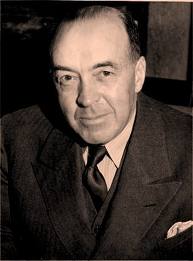
Edgar Rice Burroughs
“HE’S BACK!”
By this time ERB would have been viewed as a real upsetter. Since 1890, except for a summer vacation or so, ERB had only been in Chicago from late Spring ’97 to Spring of ’98. Then he had gone away for a year and now he was back spoiling some other people’s plans.
Even after having deserted Emma Hulbert twice, the first time without notice for sure, and probably the second also, she was still waiting for him. Amazing! Ten full years when when the biological clock was ticking loudest she was still there. If that’s not true love I don’t know what is.
It must be that ERB took it for granted that she would always be waiting for him because he was still willing to leave her at the drop of a hat, if he could only get that coveted officer’s appointment.
As ERB walked down his street you could almost hear Alvin Hulbert say ‘Drat! that young man is not going to set foot in this house.’
Papa George T., quietly holding that three hundred dollar note, welcomed him back restoring his old job to him.
The following account is based on two letters, one from R.H. Patchin dated 3/21/1950 and the reply from Jack Burroughs dated 4/4/50. I learned of the letters which were quoted in part by Burroughs scholar Robert Barrett in the Fall 2003 issue of the BB. Danton Burroughs of ERB, Inc. subsequently was gracious enough to provide me with full copies as he had Mr. Barrett.
As of the time of the letter Mr. Patchin was from 68 to 70-75 years old. My guess is that Frank Martin couldn’t have been younger than Emma so was probably at least 25 to 30 years old in 1899. It is not impossible that he was older but as his exemplars in ‘W.C. Clayton and Terkoz in Tarzan Of The Apes and The Return Of Tarzan are approximately the same age as Tarzan Martin was most likely 25-27.
As Emma would be 23 at the beginning of 1899 which would be close to spinsterhood one may believe there was some anxiety on Papa Alvin’s part to get her safely married. Martin was about the most advantageous marriage possible. At, say 27, he was looking at one of the last unmarried women of his age cohort. If he failed with Emma he would have to find a much younger woman than himself or take a woman who had already been married. He has some reason to repent this man he could not have known well who not seeming to care that much for Emma yet stood between himself and her.
Patchin says a lot in his letter to Jack Burroughs. He mentions the three times his and ERB’s paths crossed. They were all unfortunate for Burroughs. In the first ERB got his head bashed in; in the second Patchin showed up just after ERB divorced Emma which divorce was national news; the third was the condolence letter at ERB’s death. Talk about an ill omened bird.
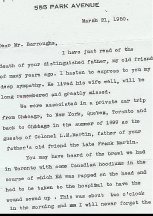

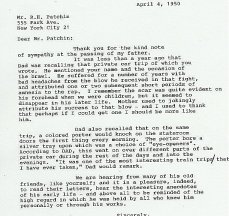
Jack Burroughs’ Reply
Sometime between ERB’s divorce and 1950 Frank Martin became a statistic. He didn’t survive his nemesis. I am guessing of course but Patchin’s meeting with ERB after his divorce must have been arranged by Martin. He may even have been watching from a distance. One wonders if he ever married.
I only mention the following as a point of interest. By the time John Dos Passos wrote the third volumeof his USA trilogy, The Big Money, Burroughs was already a major literary figure. As he didn’t seem to court publicity he can’t be said to have been a celebrity. In The Big Money Dos Passos cameos a number of interesting people among them Bernarr Macfadden.
It should be clear to everyone that nothing can be done in secret. Whatever passed between Martin, ERB and Emma must have been a source of gossip among Chicagoans. Somewhere along the way Dos Passos may have heard the gossip. In The Big Money he includes a story about a woman named Evaline Hutchins. A segment of the story bears some resemblance to the situation between the three under consideration. In the episode the Martin-like character takes the Emma character driving. He cracks up the car leaving the woman with some explaining to do to her husband.
I don’t say it’s so but suppose that in 1907-08 Martin, still seething at his rejection, in some way got Emma to go out driving with him with the above result throwing Burroughs into a panic. It was in 1908 that Joan was born to be followed immediately by Hulbert. Is it possible that after eight childless years Burroughs suddenly began a family as a defensive move against Martin? I can’t say but it is a hint I would dearly love to follow up.
At the time Patchin wrote the letter in 1950, judging from his stationery, he was down on his luck. His sloppy typing can’t be accounted for by age alone, or perhaps a lifetime of hard living had left him a wreck. My conjecture is that he had been drinking when he wrote the letter.
You will notice that the staionery bears only a street address- 555 Park Avenue- and no indication in the body of the letter as to what city. Burroughs’ reply provides the location. New York City. Patchin must have been clever enough to provide a return address on the envelope. The street address is printed rather than engraved so it is less expensive stationery. With no other address details provided it is obviously not Patchin’s personal stationery. The paper must have come from a mailing address. The stationery was probably available to anyone. 555 Park Avenue is a lower East Side address so Patchin was totally down on his luck. Probably drunk as he wrote.
He makes a glaring Freudian slip in the first paragraph when he says of ERB, ‘He lived his wife well. Wife for life! Hence the letter is as much about Emma as ERB. Emma meant nothing to Patchin so he must be speaking for Frank Martin. He then immediately relates the anecdote concerning ERB’s bashing in Toronto; thus Emma and the bashing are related. The one caused the other.
What follows now is extrapolated from Patchin’s virtual confession and Jack Burroughs’ reply. Burroughs hints that he knows more of the story than he is letting out. He and ERB had discussed this matter shortly before ERB passed over, he says. Obviously among the last things on ERB’s mind.
Martin viewed Burroughs’ return from Idaho with apprehension. Emma’s delight at Burroughs’ reappearance disconcerted Martin’s plans which he and Alvin probably thought were progressing well. Martin perhaps in talking with Patchin, if they were equals and friends, which I doubt, may have said, ‘How am I going to get rid of this guy?’ ‘Let’s think about it.’ Said Patchin. ‘What kind of accident could he have?’
Indeed, that’s how people get rid of someone they don’t like, the victim has an ‘accident.’ Murder is for amateurs. With murder the Law has to be paid, with accidents it doesn’t. No investigation. Perhaps he steps on a banana peel; gets run over by a car going the wrong way down a one way street, pushed in front of a trolley car. The next question would have been, where, how, when?
Better that it should be out of town rather than in town.
How to get Burroughs out of town? Now we’re talking old hat. You find a desirable reason for going somewhere, say New York City, then you make arrangements.
In Frank Martin’s case he had a perfect situation. Frank’s father, Col. L.N. Martin, was a multi-millionaire railroad man who had his own private rail car. In July of ’99 the Col. was going to NYC so Martin, extended an invitation to Burroughs to travel by private car to New York City. What a deal, huh?
Burroughs should have been surprised at the offer since the two weren’t that close friends while they were rivals for Emma’s favor. There should have been enough there to give one pause. Still, what a tempting offer.
The trip appears to have lasted at least three to four weeks, returning to Chcago at the beginning of August. Clearly ERB and Martin were not in the same economic league. Our Man was receiving fifteen dollars a week. Martin could spend that much for lunch every day of the week and take Emma to the theatre every night without a single concern for expense. There was no way ERB could have kept up so that the Martins had to have paid his way. Didn’t ERB wonder why they would do that for a comparative stranger?
There was no questioning expenses from the Martin point of view. They owned a luxurious private railroad car. It cost more than Burroughs made in a week to connect it to a train. Jack Coleman Burroughs recalls: ‘Dad also recalled on the same trip, a colored porter would knock on the stateroom doors the first thing every morning. The porter bore a silver tray upon which was a choice of ‘eye openers’. According to Dad, this went on over different parts of the private car during the rest of the days and into the evenings.’
Thus ERB was accepting lavish hospitality he couldn’t hope to reciprocate. This is a fairly humiliating situation. You cannot feel like an equal nor will you actually be treated as one. One the other hand he was kept tipsy, to say the least, for the whole trip.
When they got to New York ERB does not appear to have lived on the car. Once again with the Army fever on him he wrote to Col. Rogers who was then in Washington D.C. in the hopes of gaining an officer’s appointment. The return address Rogers was given was 11 17th in NYC. That is the lower East Side somewhere in the vicinity of the Bowery. Patchin was writing from somewhere in the same vicinity. Of course, the address could possibly have been a box of the railroad; the information is incomplete. At the same time the Martin party was staying on the posh Riverside Drive. There’s a degree of separation there.
ERB’s letter was sent on the 15th while Rogers very quick reply came back on the 22nd in the negative. He didn’t have to give his reply much thought. Now, ERB was ready to abandon Emma again. Marrying her must have been a low priority in his mind.
If Martin had been thinking, rather than preparing an ‘accident’ for ERB he would have gotten his father, ‘the Colonel’ who must have had some influence, to secure Burroughs an appointment and have him shipped to the Philippines. That would have made ERB eternally grateful while getting him out of Martin’s hair. Frank missed a chance.
Sometime after the 22nd the return trip to Chicago began. As is usual in attempts of this kind the hit was delayed until the last minute. In this case the assassination was to take place in Canada to which, if anything went wrong, Martin would have to be extradited as they would cross the river into the United States from Toronto the next morning.
More rounds of drinks were served as the train moved from NYC to Montreal and thence to Toronto. Probably a fairly lengthy trip as they might have had to switch trains a couple times while wating in the yards.
Neither Patchin nor Jack Burroughs gives a date for Toronto. As this took place in 1899 there were no motorized taxis. As Patchin says the railcar was parked in the Grand Trunk yards. These ‘three gentlemen songsters out on a spree’ would have had to walk into town or hire a carriage, probably the latter as Martin had the money.
At this point someone would have had to have previously hired the thugs to bash Burroughs. As I figure it the logistics were Patchin’s job. I don’t see him so much a friend of Martin’s as an accomplice or stooge. In his letter he does not claim to be a friend of Martin, he does not say ‘our’ old friend but claims to have been a friend of ERB while ERB was a friend of Martin. Stange circumlocution when he could have just said ‘our friend.’
Although Patchin describes the thugs as ‘Canadian hoodlums’ I wouldn’t be surprised if they had been brought from Chicago contracted by Patchin there. It would have been easier and surer.
If you study Patchin’s letter you will see that other than the slip of ‘He loved his wife well’ there are no other typos in the first paragraph. As he gets into his story in the second paragraph he begins to have difficulties. By the third paragraph when guilt seizes him he can’t even spell his last word or keep the words on the same line. He begins emergency with two Es, can’t spell the critical word ‘hospital’, crossing it out. Serious stuff.
Where did they go in Tornonto on that memorable evening. Probably to the red light and gambling district. Toronto’s answer to Chicago’s Levee. Where else could you arrange a fight with such hoodlums so easily. Patchin doesn’t say whether the fight took place indoors or outdoors, just that Burroughs took a smack to the head. Since the scalp was opened he was coshed with a sap or pipe.
Burroughs says that he didn’t lose consciousness but he must have been knocked flat on his back. He must have had time to get his arm up to partially block the blow or he would most likely have been killed by it. As I see it, then, this was an assassination attempt. Martin meant to permanently get Burroughs out of the way. Put him in a place from where he couldn’t come back.
As I see it Martin and Patchin faked the brawl. Patchin doesn’t say that he and Martin had a hard time of it. No. Just Burroughs got hit. Only Burroughs got hurt which is suspicious. After the first blow which could have been interpreted to be in the heat of anger which would still have been manslaughter, to have continued to belabor Burroughs would have been a clear case of murder which would have had to have been thoroughly investigated. The Law would have to be paid. Thus the opportunity was lost when the first blow failed. Martin and Patchin didn’t even report the incident to the police. The ‘Canadian hoodlums’ could still have legged it across the border though. It is not impossible that they weren’t Canadian but Chicago hoodlums contracted for the job before the private car left the Big Windy. Why not? Perfect job.
So at two in the morning when asked where he was staying by the hospital doctor ERB replied in our private car down in the Grand Trunk Station. Not Martin’s car but our car. He quickly got used to the luxury of a private car. Never forgot it either.
As he was able to walk he was released the party returned to the yards returning to Chicago the next morning.
2.
One may ask is there any evidence to show that Burroughs after he had thought about it for a while ever came to the conclusion that Martin and Patchin had meant him harm? I think there is. In The Return Of Tarzan Burroughs puts these words into the mouth of Jane perhaps thereby admonishing more sternly who might, not unreasonably, be expected to be reading these books. He obviously would get more out of them than we might.
Jane says ‘…this terrible jungle. It renders even the manifestations of friendship terrifying.’
A manifestation of friendship was the invitation to NYC from Martin. This indeed had been terrifying. So that for the parties concerned if they read between the lines they had every reason to believe that Burroughs understood everything.
One of the consequences of the attempt on Burroughs’ life was that he rushed back home to propose to Emma. Within five months they were wed thus taking her away from Martin. Emma had had a choice between a prince and a pauper and by some miracle had chosen the pauper. Really a very romantic story worth of a movie on its own. Grand Opera the way I see it. Andrew Lloyd Weber should look into this one.
There were other serious consequences. Of the blow, Jack Buroughs says: “He suffered for a number of years with bad headaches from the blow he received in that fight, and attributed one or two short periods of amnesia to that rap. (Amnesia is a recurrent theme in the Tarzan oeuvre.) I remember the scar was quite evident on his forehead when we were children (Jack Burroughs was born in 1913 so the scar must still have been visible in 1920 although it doesn’t show up in photographs.) but it seemed to disappear in his later life. Mother used to jokingly attribute his success to that blow.”
Emma would be in a position to know.
So Burroughs suffered lasting injury from that blow– one doesn’t have periods of amnesia unless there is internal pressure on the brain. There is evidence that he suffered from such pressure. Perhaps brain damage is too strong a phrase in this case but here is a clinical description that seems to fit the case. Per Brodal: The Central Nervous System: Structure and Function (3rd. Edition, page 433):
A peculiar form or amnesia occurs together with confabulation; that is the patient invents stories (without knowing that they are not real). Most of the patients have a lesion involving the substantia inominata, the medial hypothalamus, and the orbito frontal cortex (usually caused by a ruptured aneurism in the anterior cerebral artery). The often bizarre stories can usually be traced back to real events, although they consist of various, unrelated fragments from memory. It seems the patient is unable to suppress irrelevant associations, and cannot chack them against reality.
That is pretty close to ERB’s situation although he doesn’t appear to have lost his connection to reality although his stories as fantastic as they come always relate to his own memories. The Corpus seems to form one gigantic web of psychological unity as Richard A. Lupoff has pointed out.
One could think that after such a fearsome blow he would have been kept at the hospital for observation for at least a day or two but as he appeared to have no more than an open wound the doctor sewed him up and sent him on his way. As Patchin says the doctor came down to the yards the next morning to check up on the private car story which may have seemed incredible to him causing him to the think the patient deluded perhaps being more hurt than he looked as, indeed, he was.
There seems to be no reason to doubt that the blow ruptured the anterior cerebral artery. Thus internal bleeding over the next couple days would have created a clot which would have put pressure on the prefrontal lobe causing cobwebs, headaches and obviously a faulty memory with periods of amnesia.
There must be a medical reason for all these.
The symptoms should have begun showing up within a week or so, so that the several months of faintness ERB experienced began then. It was in this mental condition that he proposed to Emma.
Disappointed by the quick rejection of Col. Rogers while at least intuitively understanding that he had been set up in Toronto, ERB quickly went to work to capture Emma from Martin. I see little reason to believe that he had intended to marry her any time soon before he went o NYC, if at all. Back in Chicago in August he proposed and he and Emma were married by the end of January. In terms of years he was twenty-five and she twenty-four but in reality ERB was only four months older than Emma.
The sudden wedding must have been disconcerting to the Hulberts. I’m sure they envisioned a magnficent society wedding for their daughter. There was now no time to plan one so they must have been bitterly disappointed.
ERB now had to face a reality he hadn’t planned for. His rough and rowdy days were over.
3.
While solidly based on documentation the foregoing is at present somewhat conjectural but let us see if we can find some discussion by ERB of these events in his writing. There are four titles that go over these events in slightly different ways. Certainly ERB had to ask himself what had happened. He gave it a lot of thought. Beginning in 1909 his answers came pouring forth. Minidoka 937th Earl Of One Mile, Series M which was unpublished in his lifetime was the first of these efforts followed by Tarzan Of The Apes, The Return Of Tarzan and The Girl From Farris’s. As ‘The Girl’ is concerned with the early married years rather than this period I will forego discussion of that title although it should be read in sequence with Minidoka.
Minidoka, which actually began ERB’s writing career is directly concerned with this struggle between himself, Alvin Hulbert and Frank Martin. In the story the evil Brady represents Alvin Hulbert with the genuine thoroughbred godling, Rhi, representing Frank Martin.
The wars and battles represent Hulbert’s attempts to keep ERB away from Emma which ultimately fail. However the story may explain a curious situation in which ERB and Emma took up residence in the Hulbert home after marriage. Not a situation most newlyweds would want, but one that the Brady or Hulbert insisted on.
Alvin Hulbert had thought little of ERB for several years. The Army episode and the Denver marching band stunt did little to improve his opinion of Our Man. How the New York trip was represented to him by Martin would be interesting to know. Probably Martin who had every incentive to slander Burroughs said he was drunk all the way to New York and back, drank continually, started the day with liquor. He may have said that they were in the red light district of Toronto at ERB’s insistence. In other words, he probably made the most of the situation.
Undoubteldly terrified at his daughter’s willfulness in marrying this ne’er-do-well Hulbert made it a condition of his consent that the couple live in his house where he could keep a close eye on ERB. I’m sure he was ready to have the marriage annulled at a moment’s notice.
In Minidoka Rhi by a very devious trick puts Minidoka/Burroughs in a situation where he is meant to be killed, a situation not unlike Toronto- then rushes to the heroine Bodine/Emma to inform her that Minidoka is dead proposing marriage to himself instead. It could have really happened that way.
As in real life Emma/ Bodine remains steadfast and true to Burroughs/Minidoka, all wool and a yard wide as Burroughs puts it.
Thus Minidoka mirrors the real life events in a fantastic manner as Per Brodal would suggest.
Minidoka was never published so the same material was available for a retelling. This was done in the first two Tarzan novels. Tarzan Of The Apes tells the story of Burroughs life up to 1896 with some interpolations from the later period. The Return Of Tarzan covers the four years from 1896 to his marriage with Emma in 1900.
Always bear in mind that Burroughs has to tell his story with commercial ends in mind.
The blow to the skull made an indelible impression on ERB as well it might. In Tarzan Of The Apes, Tarzan takes three serious beatings, one with a gorilla from another tribe, perhaps representing John the Bully, and with Kerchak and Terkoz of his own tribe. In all of them Tarzan is beaten about the head and shoulders. Terkoz/Martin rips his scalp open from above the left eye over to his right ear. Clearly an exaggeration of the true wound but that must have been how it felt.
Kerchak delivers a blow to the head that would have killed him had he not deflected its force with his raised arm.
Then when Tarzan and Jane are in the jungle Terkoz abducts Jane causing Tarzan to rescue her killing Terkoz in the process. Thus in Program A Tarzan kills his adversary.
Running concurrently in Program B Tarzan is a penniless jungle ape-man up against W.C. Clayton who is a genuine thoroughbred godling as was Rhi in Minidoka. Tarzan feels he doesn’t have a chance against Clayton so he magnanimously resigns Jane to him at the end of Tarzan Of The Apes. There must have been a sequel in mind because, as in reality Burroughs won Emma, Tarzan must win Jane.
The end of Tarzan Of The Apes may correspond to Burroughs joining the Army in 1896 while finding Clayton embracing Jane in the jungle may correspond to his second Idaho trip in 1898.
So that between 1896 and 1898 it may have appeared to him that he had lost out to Frank Martin. In ‘Return’ Tarzan retreats to Opar which is his fantasy world with the beautiful but unobtainable anima figure, La. At this early date she and Emma/Jane are fighting it out in his mind for his allegiance. He would rather have La, that is remain unmarried, but his rivalry with Martin is pushing him toward Emma.
Tarzan is captured by the Oparians destined for sacrifice to the Flaming God of which La is High Priestess. Burroughs reverses the situation and instead of squelching his imaginary La she is about to sacrifice him. Burroughs can’t renounce his Anima fantasy so rather than kill him which would end both Burroughs’ wish persona of Tarzan and his relationship with La, she releases him. Tarzan/Burroughs then triumphs over W.C. Clayton winning Jane/Emma. Jane/Emma leaves Opar never to return. La remains in Opar until Tarzan The Invincible when Burroughs is about to leave Emma and take up with his Anima figure, Florence Gilbert. La then comes out of Opar in the same way Burroughs leaves Emma for Florence. Opar disappears from the oeuvre, never being mentioned again.
Then as ‘Return’ ends Burroughs and Emma are married mirroring his fantasy where Tarzan and Jane are married. While not literal as Burroughs is writing for publication and must construct an interesting and, at least, nominally plausible story he confabulates events from his life into a fantastic and improbable tale.
The history of his slugging which closes this period was mysteriously obscured by his youngest son John Coleman Burroughs. These two letters were only discovered by Danton Burroughs, John Coleman’s son, recently. They were unknown to biographers Fenton, Porges and Taliaferro. For decades it was believed that Burroughs had been coshed in Idaho by a policeman as an innocent bystander in a saloon brawl.
In an interview with Porges Jack Burroughs told this latter story in 1970. Porges then dutifully reported the Idaho story in his biography. the question is why would Jack invent the latter story to replace the true one with which he was aware. As he himself replied to Patchin having previously discussed the event with his father I don’t see how he could have forgotten it. Nor was there any need for him to even tell Porges the Idaho invention.
Perhaps Jack knew details buried away in the archives wishing to lay down a false trail to disarm the curiosity of Porges.
In 1899 ERB had had the direction of his life changed by a rap on the head. He now had to face a life filled with heavy responsiblities which he had been able to avoid to this point.
We see a new Edgar Rice Burroughs emerge from his early married years.
Four Crucial Years
In The Life Of Edgar Rice Burroughs, Pt. I
by
R.E. Prindle
Every artist writes his own autobiography.
Even Shakespeare’s works contain a life of himself for those who know how to read it.
–Havelock Ellis as quoted by Robert W. Fenton

The Great One
Eighteen ninety-six found Edgar Rice Burroughs confronting the first great crisis of his adult life. The weight of his childhood experiences pressed on his mind as he turned twenty. His subconscious mind was directing his actions while his conscious intelligence futilely struggled against it. He had no plans; nor could he form any. He was in a state of emotional turmoil. He obviously did not think out his moves nor weigh the effects of his actions on others. He was to burn many bridges as he flayed about like the proverbial bull in the china shop trying to find his way out.
Having graduated from the Michigan Military Academy he had been serving in the capacity of instructor for the previous year. All his heroes were military men. He fancied a military career as an Army officer even though he had failed the West Point exam the year before. Still, he was in a fine position to realize his objective. Men who could help him were nearby friends. Captain, soon to be General, Charles King, who had befriended him as a cadet, and the Commandant of the MMA, Colonel Rogers. All he had to do was to be patient and those men of some influence would surely have obtained an appointment for him.
They had given a mere boy a position of great trust and responsibility in making him an instructor. They were military men who judged others in the military manner. Then in the Spring of 1896 Burroughs did one of the most inexplicable things in a career of the inexplicable; he abandoned his post. Without notice to those career officers who were depending on him he resigned his post and on May 13th of 1896 he joined the Army as an enlisted man, a common soldier, a grunt. Within days he was on his way to his asignment.
As he was to say of so many of his later fictional heroes: ‘for me to think is to act.’ He oughtn’t have been so precipitate. He should have thought twice. He shouldn’t have had to think about it at all.
If he seriously wanted a military career as an officer he should have known that it is virtually impossible for an enlisted man to rise through the ranks. Even in the rare cases when this occurs, the enlisted man is always an odd duck between the officer caste and the enlisted men.
In this case he had not only forteited caste but as far as Rogers and King were concerned he had deserted, the worst crime that a military man can commit. Both men wrote him off at that time. Strangely he never understood that his precipitate act would be held against him by those he disappointed.
Apparently joining in a fit of despair- for me to think is to act- as the date of the 13th would indicate he requested the worst duty the Army had ensuring his desire to fail. On one level it is almost as though he did have his next move worked out. Not normally too receptive to the desires or needs of its grunts in this case the Army was only too glad to accommodate him. Burroughs was sent into Apacheria to a place called Fort Grant in what was then the territory of Arizona. Neither Arizona nor New Mexico became States until after the turn of the century so Burroughs had actually ‘lit out for the territories’ as Huck Finn would have put it. There was still some Apache resistance going on, thus ERB was a part of the Wild West.
According to Philip R. Burger, writing in the Winter 1999 issue of the Burroughs Bulletin, the standard term of enlistment at the time was three years but, as there would be no reason to join the Army except to make it a career, the reasonable assumption for those left behind in Chicago without a word of goodbye would have been that Burroughs was out of their lives. He was a dead man.
For those of you who have never joined the services, once you leave you’re out of the lives of those left behind. Your traditions have been broken. Even when you come back for leave you are only tolerated as a visitor who will leave, the sooner the better, so you don’t disrupt their lives any longer than necessary.
Burroughs didn’t even have traditions in Chicago except with a few people. From the sixth grade on he had a record of broken attendance at a number of schools, from the girl’s school to Harvard School and then back East, to Idaho and on to the MMA. He would have known but few people well, intimate with none except the lovely Emma Hulbert.
He could have seen her but rarely over the last years which included high school. He really had no ties in Chicago. His relationshlip to Emma dated back to Brown grade school. At sometime before he began his peripatetic education he began to propose to her. As he was gone from Chicago all this time it is very difficult to believe that Emma sat home pining. She must have been dating other boys, however, at the same time she must have been waiting for Burroughs since, at 24, when she married him she was only a couple years from spinsterhood. She must have been giving her parents some cause for alarm.
Thus when Burroughs appeared to walk out of her life in 1896 without a word about his intentions one wonders what her response was. Certainly it was about this time that Frank Martin began to pay his court. We will learn more of Frank Martin a little later.
For Burroughs, like so many of us once we were inducted, ERB speedily learned his mistake. For the men who don’t fit in ‘each fresh move is a fresh mistake.’ He regretted his decision immediately. For him to think was to act, so from his arrival at Fort Grant he began a petition for discharge.
As he had been under twenty-one when he joined, he had had to ask his father for his consent. He now asked him to use his influence to get him out.
Perhaps we do not have enough information on why he now so desperately wanted out. In later life this short ten month period of his life would be fraught with great significance in his mind. Just before he divorced his lovely wife Emma in 1933 ERB took a solo vacation to return to this scene of his young manhood. That would indicate that Emma and Fort Grant were linked in his mind.
Two of his Martian novels are associated with the Fort Grant experience. In his first novel, A Princess Of Mars, John Carter serves in the Army in Arizona, is discharged, then returns as a prospector. Under attack by Apaches he seeks refuge in a mountain cave in which he leaves his body while his astral projection goes to Mars. Viewed from one point that’s as neat a description of going insane as I’ve ever come across.
During his 1933 visit to Arizona, Carter returns to visit a trembling fearful Burroughs in his mountain cabin. One gets the impression that Burroughs felt like a whipped dog.
The Apaches made a terrific impression on the young man. So much so that he could see himself joining them as a Brave as is evidenced by his two Apache novels, The War Chief and Apache Devil. Then too his two cowboy novels are placed in Arizona rather than in Idaho where one would expect them.
In his Return Of Tarzan the trip to the Sahara is an obvious reference to Apacheria. The French government sends Tarzan into the desert rather than the US government sending ERB to Arizona. In the deseart Tarzan develops a strong liking for the Arabs, much as ERB did for the Apaches. Tarzan considered becoming a Son Of The Desert just as ERB thought he might become Apache.
A large part of ERB’s fascination for the military life was based on his respect for Capt. Charles King under whom he had served briefly at the MMA. King was, I would imagine, a boy’s dream of a dashing Calvalry Officer. In this wildly romantic period of the Indian Wars, not to mention the proximity of the Civil War, a man who had served at the same time and the same place General Custer must have been held in some awe. King had also served with and knew Buffalo Bill, a nonpareil hero of the time and one ERB may have met at the 1893 Columbian Expo.
Burroughs names two of his characters after Custer.
On top of all this King was a successful writer of military novels. He wote an excellent analysis of Custer’s defeat, which is available on ERBzine, as well as a first hand account of the resultant campaign to quell the uprising, Campaigning With Crook. the latter is a superb recreation of a time and place we’ll never see again. In just a few words King is able to recreate a Deadwood, South Dakota for which the movies have filmed endless miles of photographs with less result. His single reference to barbaric cowboys wearing their guns on their hips says more than dozens of Hollywood films. ERB was also able to capture some of this feeling in his two excellent Western novels as well as his two Apache novels.
King was prolific writing nearly seventy books in his long career. I have read only a few, which I find of only of journeyman quality. King has an emascualted precious style which is reflected in his photographs. Burroughs enthusiastically said he wrote the best Army novels ever, which may be true, I haven’t come across any other novels of Army life. among his many novels of Army life are three that deal with the Pullman strike when the Seventh was stationed at Fort Sheridan. One, An Apache Princess written in 1903 might possibly have been an influence on A Princess Of Mars.
At any rate King glorifies the officer’s life. He fooled a young green ERB. In any event ERB failed to notice the haughty distinctions King drew between the relative status of the officers and the enlisted men. King had all the prejudices of the officer class seeing the enlisted man as a subhuman species. Knowing this, as Burroughs should have, I am baffled by his enlisting.
Perhaps as at the MMA he thought that one entered as a buck private working up to officer rapidly as he had at the MMA. If so he must have had a very rude awakening. It couldn’t have taken him long to realize that advancing through the ranks was rare while at the same time a long process for such an impatient lad as he.
While he was cleaning those stalls he must have had plenty of time to think out his dilemma. As he thought back over his past actions it must have occurred to him that perhaps he erred in walking out on Colonel Rogers the previous May. Accordingly on December 2 of 1896 he sent a letter back to Rogers of which the reply is extant. We don’t know what ERB said but I imagine he was feeling Rogers out to see if he couldn’t get him an officer’s appointment. Rogers reply was, of course, polite but cool and distant firmly placing Burroughs as oneof the rest of Rogers’ students. Yuh. ERB should have thought twice about abandoning his post.
The many, many references to this period of his life point to a great regret later in life that he had left it. He associated this regret with Emma. Perhaps the visit of the officer, John Carter, to him in his lonely cabin in the White Mountains of Arizona represents his lost career as an Army officer but was one of the reasons for his wanting to get back to Chicago that he hadn’t dealt with his relationship with Emma? Did he now learn that in his absence someone else was playing his old love song to Emma? Someone who Papa Alvin Hulbert much preferred to ERB?
It would be interesting to know what Emma thought when her beau just up and removed himself to Arizona. Perhaps perplexed but still hopeful she sent him her picture on his birthday in September. Remember me, perhaps?
Unhappy with his life at ‘the worst post in the Army’, how one’s attitude changes when one’s dreams are realized, he petitioned his father to use his influence to return him to civilian life.
Surprisingly his father was easily able to do this. By March of 1897 ERB had his discharge papers in his hand. He was a free man again. How many tens of thousands of us would have appreciated such an easy resolution to the problem.
2.
Our Man still didn’t have a plan. What we he going to do with his life? Apparently Colonel Rogers’ reply to his letter didn’t apprise him of the facts of life. Nor did he seem to realize that once you reject the military the Army has no use for you. At the time, the US Army was very small, perhaps seventy-five thousand men. The officer corps was about ten per cent or seventy-five hundred men. This is virtually a club. The officers would have known each other personally, by name or by reputation. The same was more or less true of the enlisted men.
Thus Porges records a letter ERB received in 1936 from one W.L. Burroughs of Charlotte, N.C. who probes:
This morning an old army sergeant whom I soldiered with back in the nineties dropped in my office and our conversation started at Fort Sheridan, ILl. when the 7th US Cavalry and the 15th U.W. Infantry left that post for Arizona and New Mexico. He asked me if I remembered Edgar Rice Burroughs of Troop ‘B’ Seventh Cavalry, said he was discharged during the summer of 1896 at Fort Grant, Arizona account of a ‘Tobacca heart’…will be delighted to know for certain that we soldiered with so distinguished a person back in the nineties.
Whether true or not these men remembered ERB as a malingerer who obtained a fraudulent discharge. I interpet ‘Tobacco heart’ to be a feigned ailment which would make ‘so distinguished a person’ a sarcastic and insulting remark. If W.L. Burroughs is correct then ERB got himself out by reasonable discreditable means rather than through the efforts of his father. Thus forty years on an Army reputation followed ERB.
Burroughs replied cooly a few days later ‘…seldom have been in touch with any of the men I soldiered with since I left Fort Grant.’ ERB didn’t say ‘AND GOODBYE.’ but I think that is implied.
So having committed blunder after blunder it would have been wise for Our Man to reevaluate his position. Strangely he didn’t do this, hoping against hope, as I imagine to pull that particualr rabbit out of the hat over the next few years. Good luck, Edgar Rice Burroughs.
3.
For now he could only think of returning to Chicago. As we know the Burroughs Boys were ranching up in Idaho. ERB always wanted to prove that he was a businessman. Why, I don’t know. The fact of the matter seems to be that the Burroughs family was particularly inept at business. Papa George T. had been burned out of his distillery while his battery business was steadily running down, due for extermination about a decade later.
The Boys would turn to dredging for gold after failing at ranching. Perhaps one of the reasons they failed at ranching was just this operation coming up. They had bought a Mexican herd, apparently sight unseen. They were then in Nogales to receive and transship the herd to KC. I suspect they lost their shirt. In less than two years they would be gold dredging.
The world is full of sharpers. Out West so many salted gold mines were sold to greenhorns that it doesn’t bear telling. Frank Harris, the British magazine editor in his autobiography has a great story about how he and his outfit lifted a Mexican herd driving it back across the Rio Grande. I have no doubt that some Mexican sharpers took advantage of the Burroughs Boys. They would later buy a salted gold claim.
The herd ERB put on board the train he describes as no bigger than jackrabbits while probably being less well fed. The death rate of the cows on the trip back to KC was horrendous, while the survivors became starved and dehydrated. I don’t think the Burroughs Boys did well on that transaction. You gotta watch your back or, hopefully, see ’em coming.
4.
Edgar Rice Burroughs came home. Perhaps he had now reached childhood’s end. At twenty-one perhaps he now realized that he had a life to lead. Perhaps. If so, it was slow dawning. But then ERB’s was not an ordinary mind, a normal bean as he would have put it. No, his was a slow ripening melon. But then, why should everyone develop at the same pace? If up to this point I seem to have been overly critical of Our Young Man it’s because there has been much to be critical of; just as there will be more, but he hasn’t done anything really reprehensible. Your record may not be much better; mine certainly wasn’t. He’s a good sort of guy; just a little on the goofy side. Slow to learn. He doesn’t seem to catch on.
However he’s watching. He’s observing. He’s ingesting and there out of sight he’s digesting all the information coming in. Plus, he will give it a brilliant interpretation when he egests it.
These four years would be of great use to him in his writing career. Always a subtle psychologist ERB was also a skillful employer of the Freudian concepts of condensation, displacement and sublimation and this before he could have read Freud. An attentive reading of any of his novels always reveals layers of hidden meaning. Simply put Edgar Rice Burroughs is the most poetic of novelists.
His poetic tastes weren’t always elevated. He did have a copy or two of Eddie Guest in his library. Edgar A. Guest. Perhaps forgotten today Guest was a people’s poet. In the 1950s when I spread out the Detroit Free Press on the floor one of the first things I read was the daily poem of Edgar Guest. Of course, I thought he had written each one the night before. I marveled at his facility. Nice homey thoughts though.
Burroughs tastes ran to the likes of Rudyard Kipling, H.H. Knibbs, Robert W. Service and others of the jingly-jangly people’s school. Although he did know enough about a high brow like Robert Browning to consider him a bore. Rightly from my point of view. He liked Tennyson, who was considered a high brow, also I suspect Walter Scott, Shelley and Byron. He frequently hints at Longfellow’s ‘Wreck Of The Hesperus’ while he probably had to read Hiawatha in school
He knows all the popular stuff of the day like ‘Over The Hill To The Poor House’ too while he had probably read that anthem of doomed labor, Edward Markham’s Man With The Hoe, too. If that one didn’t gag him he’s not the man I think he was.
Song lyrics were big with him too. On his cross country auto tour he mentions three records by name that his family wore out- of course a battery operated portable played in a field with the plows they called styluses (well, cultured people called them styluses or styli, us near illiterates called them needles) in those days they might have worn out a record in two or three plays. One song was ‘Are You From Dixie?’, another was ‘Do What Your Mother Did; and the last ‘Hello- Hawaii, How Are Ya?’ I guess he liked songs that asked questions. I’ll examine the lurics a little farther on down the road but when we’re considering the literary influences don’t forget the poetry. After all ERB wrote a whole book around the lyrics of H.H. Knibbs ‘Out There Somewhere.’
Just before he returned to Chicago one of the great newspaper literary lights and poets of Chicago Eugene Field had died- 1895. Burroughs had a collection of Field’s writings in his library while Field, when alive, hung out at the McClurg’s book store. Perhaps there were sentimental reasons for Burroughs pursuing McClurg’s so ardently as well as practical ones.
Another Chicago writer among ERB’s collection of books who was reaching an apex at this time was George Ade. While these Chicago stalwarts are mostly forgotten now they were considered immortal at the time. Ade especially is a very clever writer with a real skill at turning a phrase. His ‘Fables In Slang’ would have knocked ERB flat. ERB’s own interest in the colloquial, which is very pronounced, may have been influenced by Ade’s style.
Another columnist of the period, Peter Finley Dunne, with his Irish dialect stuff written around his character Mr. Dooley doesn’t seem to have made much of an impression on ERB.
Thus while involved in his attempts to correct his mistake of enlisting he was very attentive and observant of the life going on around him in whatever milieu.
As I mentioned earlier, when you leave for the military your friends edit you out of their lives. Returning is not so easy. Even when I returned on leave, actually almost ten months after I left, people demanded almost belligerently, ‘What are you doing here? I thought you joined the Navy.’ After explaining I was on leave, nearly asking permission to hang around for a couple weeks, I was grudgingly given permission but let it be known that if I wasn’t gone I would have some explaining to do.
ERB has left a record of his reception by his friends in Chicago. He had sixteen years to let it run around his mind before he wrote it down. It came out in Return Of Tarzan which, I imagine might be read as the Return Of Edgar Rice Burroughs. Actually as Havelock Ellis hints in the opening quote, both Tarzan Of The Apes and The Return Of Tarzan can be read as autobiographical sketches from birth to the marriage with Emma in 1900.
Burroughs describes his reception in Chapter 23 of the The Return. The jungle is a Burroughsian symbol for society as in ‘It’s a jungle out there.’ Tarzan in the jungle can be read as ERB in Chicago. Tarzan is resting in the crotch of a great limb of a jungle giant when he hears a troop of apes approaching the clearing beneath the tree. The tree is a symbol of security or getting out of or above the tumult. Trees probably correspond to his imagination.
Tarzan recognized the troop as his old band of which he is still nominally king. Having been gone for two years he rightly thinks the dull brutes will have trouble remembering him:
‘From the talk which he overheard he learned that they had come to choose a new king- their late chief (the successor of Terkoz?) had fallen a hundred feet beneath a broken limb to an untimely end.
Tarzan walked to the end of an overhanging limb in plain view of them. The quick eyes of a female (Emma?) caught sight ofhim first. With a barking guttural she called the attention of the others. Several fhuge bulls stood erect to get a better view of the intruder. With bared fangs and bristling necks they advanced slowly toward him, with deep ominous growls.
‘Karnath, I am Tarzan Of The Apes,’ said the ape-man in the nernacular of the tribe. ‘You remember me. Together we teased Numa when we were still little apes, throwing sticks and nuts at him form the saftey of high branches.’
‘And Magor,’ continued Tarzan, addressing another, ‘do you not recall your former king- he who slew the mighty Kerchak? Look at me! Am I not the same Tarzan- mighty hunter- invincible fighter- that you knew for many seasons?’
The apes all crowded orward now, but more in curiosity than threatening. They muttered among themselves for a few moments.
‘What do you want among us now?’ Asked Karnath.
‘Only peace.’ answered the ape-man.
Again the apes conferred. At leangth Karnath spoke again.
‘Come in peace, then, Tarzan Of The Apes.’ He said.
So Tarzan and ERB returned to the fold. However there were two young bulls who were not ready to receive Tarzan back. We will find that two young men resented Burroughs’ return. The resentment of the principal young man would nearly cost Burroughs his life while forcing him to commit to a marriage against his will.
Thus Burroughs was received back into Chicago.
5.
He would spend about ten months before he uprooted himself once again to make his second visit to his brothers in Idaho. I should think that this period in Chicago was perhaps the most idyllic of his life. He found gainful employment with his father at the Battery Company. However at fifteen dollars a week it was much less than his allowance had been at the MMA. However he was living and eating at home so one imagines it was all pocket cash which afforded a certain limited affluence. He could afford to take Emma out.
Emma appears to have preferred him but he was no favorite of Papa Alvin and the Mrs. If Frank Martin had begun to pay his court he was much the preferred suitor. The son of Col. A.N. Martin who was a millionaire railroad man he was to be much preferred to a penniless Ed Burroughs whose father had apostacized to William Jennings Bryan in the election of 1896. No, Martin should be given the inside track. Burroughs was forbidden the house in an attempt to disrupt his relationship with Emma.
The Hulberts looked askance at Burroughs patchy history. He was less than promising. While his father had gotten him released from his enlistment, people are wont to say there’s more to that story than meets the eye. Plenty of room for rumor, if you know what I mean. ERB probably had to explain a lot.
So while he could date Emma he couldn’t go hang around all evening every evening as lovers are wont to do.
So what did ERB do with his spare time. He obviously read. H.Rider Haggard was popping them out two or three a year at the time which is clear from the evidence ERB read. Jules Verne was alive and producing although much of his production remained untranslated.
There weren’t any movies or television, however there was the Levee, Chicago’s Sin City. In later novels ERB would show what appears to be first hand rather detailed knowledge of this area of brothels, saloons and gambling joints. Burroughs was certainly no stranger to drinking and gambling, whether he frequented brothels may not be known but, if you’re in the area….
In a city of a million six there were only about forty thousand library cards issued but it is probable that one of them was in the wallet of our investigator of curious and unusual phenomena. He sure knew a lot of odd details. One of the big intellectual questions is whether or not he knew of Theosophy. A volume of William Q. Judge, a leading Theosophist who died in 1896, is to be found among Burroughs’ books. His first story Minidoka 937th Earl of One Mile which is concerned with this period while unpublished until just recently makes mention in the descent to Nevaeh of the Seven Worlds which is a reference to either Theosophy, Dante or both.
Again, hanging around a library one might come across volumes of Dante and Theosophy. Shoot, Tarzan spent his afternoons in the Paris library becoming discouraged by the surfeit of knowledge to be covered.
And all around him floods of changes were rolling over him. The world was moving with breathtaking rapidity. If a guy wasn’t half crazy already trying to keep up would get him the rest of the way. Actually these four years were the intellectual bottom, in the musical sense, of the rest of Burroughs; life. perhaps sensory overload occured culminating with his bashing in Toronto and subsequent marriage to Emma so that he was no longer open to new experiences afater his marriage. Everything after 1900 was interpreted in the light of this experience. the interpretations were inventive enough.
His situation might be compared to that of Zeus and Metis of Greek mythology. Ordinarily when the Patriarchy took over a Matriarchal cult the event was comemorated in a myth of sexual union.
In the case of Metis, a Goddess of wisdom, she went down into the belly of the monster like a plate of oysters perhaps meaning the Patriarchy had attempted to stamp the Metis cult flat or eat it up as the Zulus would say. If so Zeus and the boys had bitten off more than they could chew or digest, as it were.
Metis lived on in his belly giving him unwanted advice until I would imagine the Patriarchy came up with a compromise solution. Thus Metis gave birth to Athene who was born fully formed from the forehead of Zeus, which is to say that the cult of Metis was transformed into the cult of Athene. Athene retained all the attributres of the goddess of Matriarchy but ‘she was all for the Patriarchy.’
So now with Burroughs; he ingested all this experience which he gave a ‘definite impression of fictionalizing’ to appear full blown from his forehead +- twenty years later.
Porges reproduces a political cartoon of Young Burroughs on page 68 of the First Edition in which Uncle Sam and John Bull are watching a scene. One or the other says: ‘How would you like to be a Russian?’
In the cartoon Russian soldiers are shooting and bayonetting obvious Jews while the Jews are bombing the Russians. The villains of the first four Tarzan novels, ‘The Russian Quartet; are two Russians Nikolas Rokoff and Paulevitch. Thus, if the cartoon was drawn in this period, twenty years later the Russians show up as villains.
Now, among all the ‘minor’ events like the depression after 1893, the Pullman Strike, Coxey’s Army, Altgeld’s pardoning of the Haymarket bombers, the Sino-Japanese war and such like trivia was the infamous Dreyfus Affair in France.
This minor event involving a Judaeo-French spy was magnified into an international cause celebre by accusations of anti-Semitism. Alfred Dreyfus was a Jewish French army officer who was accused of spying for the Germans or of selling information to them. Originally convicted and sent to Devil’s Island, a few year later after key evidence was tainted or disappeared and key witnesses had died or been discredited the case was reopened and after a terrific media blitz resulting in Zola’s article with the famous title: J’ Accuse, Dreyfus was acquitted.
The man convicted in his place, strangely enough, was probably also Jewish, one Walsin Esterhazy. Supposedly of Hungarian descent, at the instance of the chief Rabbi of Paris he was given financial assistance by the Rothschild family. It would be very unusual in that case if he weren’t Jewish.
Burroughs must have followed the Affair Dreyfus closely as it unfolded during the lat nineties. In 1913’s Return Of Tarzan he chose to fictionalize Esterhazy’s end of the Affair in the character of Gernois. Burroughs must have studied the Affair because Esterhazy actually served in North Africa where he came in contact with German agents. Of course, Gernois is compromised by our old friend Nilolas Rokoff, the Russian agent. Thus ERB combines his dislike of the Russians as eveidenced by his cartoon with sympathy for Dreyfus.
In real life Esterhazy led a dissipated life which, it is said, led him to be a spy. In ‘Return’ Gernois is led into syping because Rokoff, the hyper-arch villain had something on him.
In a sort of editorial comment on Dreyfus ERB has Rokoff tell Gernois: ‘If you are not agreeable I shall send a note to your commandant tonight that will end in the degradation Dreyfus suffered– the only difference being that he did not deserve it.’
Thus ERB comes down firmly on the side of Dreyfus.
For those who will misread racial and ethnic attitudes I believe ERB’s attitude in the Jewish-Russian conflict and the Dreyfus Affair should exonerate him, if the need exists, of any charges of anti-Semitism. Especially in the light of his portrayal of the worthy Jewish gentleman in ‘The Moon Maid’ trilogy. It would seem that all of ERB’s later attitudes remain consistent with these brought to fruition between 1896 and 1900.
Continue on to Part II
A Review
Woman
by
Alan Clayson
Yoko Ono And The Men Who Influenced Her
Review by R.E. Prindle
Clayson, Alan: Woman: The Incredible Life Of Yoko Ono, Chrome Dreams, 2004.

Girlish Yoko- Warhol School by Richard Bernstein
Yoko Ono involved herself with several of the most influential men in the arts during the sixties, seventies and eighties of the twentieth century. She drew her inspiration from them patterning her own efforts after them. At the same time she was one of the leading feminists of the day having her share in shaping and furthering the movement. The mantra was female liberation, equality between men and women. In fact women were equal to men in the West but only by acknowledging the biological differences between men and women. The fact is the differences are real and not social constructs as women would have us believe. The fact is women are women and men are men. So, in seeking ‘female liberation’ feminists were seeking much more than ‘equality’ however the term may be defined.
The fact is that in the Ages old war between the sexes feminists are seeking to restore the Matriarchy and destroy the Patriarchy. That is why many men favor feminism, they prefer the Matriarchy. Thus the feminists are atavistic. Yoko and her cohorts wished, in her words, to restore ‘heart’ as she viewed the Matriarchy and eliminate ‘reason’ as she viewed quite rightly the basis of Patriarchalism. Nevermind that bilogical science has invalidated the concepts of Matriarachy and Patriarchy. This is a post Matriarchy and Patriarchy world.
Circa -2000 in the West men revolted against the mind stifling Matriarchy and the vaginal swamp of the ‘heart’ seeking to establish

Smilin' Jack Cage
the authority of the infinite power of the mind of Zeus on ethereal Olympus. This is the story of Homer’s Iliad and Odyssey and the Greek myths in general recording the struggle.
The Western male was able to impose the ascendency of reason over the heart for 3000 years until the disestablishment of the old order by science about mid-nineteenth century. The center could not hold during this period of extreme change as W.B. Yeats put it as the rearrangement of the intellectual order moved into the twentieth century.
Yoko Ono sought with her feminist fellows to return to the biological innocence of 2000 BC. She herself had no talent. Filled with audacity she pitted her ‘heart’ against the reason of John Cage, Andy Warhol and John Lennon. I’m sure she had a mentor for her so-called performance art but I am as yet unaware of who he may be. Perhaps Maciunas and the Fluxus group.
Thus her first manifestation as an artist was based on the musical ideas of John Cage while her artistic efforts were at least based in the avant garde ideas of the Fluxus group. Her first assault on the NYC art world failed so in 1961 she returned in defeat to Japan. When she returned to NYC in 1964 she found an entirely different art scene. On the musical side the focus was on Bobby Dylan and the Beatles while on the artistic side Andy Warhol and his Factory had destroyed the Abstract Expressionists and the old avant garde. Dylan, the Beatles and Warhol had in fact usurped the avant garde which now had little meaning. From my point of view held at the time the avant garde had ceased to exist. Of course I didn’t understand exactly why or how.
From 1964 when Yoko returned to NYC until 1966 when she left for London I’m sure Yoko was at a loss. She developed her silly

The Bag Yoko And Tony Are In
notion of Bagism at this time even having a black bag on a stand in Max’s Kansas City that some one or ones were supposed to slide into. This seems to have been thought a lame idea at the time as it seems now.
At this time while retaining allegiance to John Cage’s musical ideas she was falling under the influence of Andy Warhol’s artistic notions. Warhol’s intent had been to destroy the idea of ‘fine art’. In this he pretty well succeeded. As Yoko expressed it you didn’t need any talent to be an artist. She seems to demonstrate this notion in her own artistic efforts. Warhol had also redefined the notion of film with his static studies. He then sought to combine his film ideas with live music, probably in competition with Bob Dylan who was also attempting to move in that direction. Warhol adopted Lou Reed and his band the Velvet Underground as the Factory house band while creating a multi-media show called the Exploding Plastic Inevitable, innovative for its time. Thus a concert at his hall, the Dom, was an ‘experience.’
While Yoko makes no mention about how this, actually, incredible development affected her there can be no doubt that she was well aware of Dylan, the Beatles and the Warhol Experience and was affected by it. Indeed, the first manifestation was the making of her Warhol style films such as Bottoms.
The second manifestation was her removal to London to seduce either Lennon or McCartney of the Beatles, thus in the manner of Warhol’s adoption of the Velvet Underground she sought to co-opt the Beatles, the premier rock group in the world. Real chutzpah and more than one upping Warhol. I think it would be nonsense to think she had any other goal in mind.
She undoubteldy learned that Paul McCartney was actively involved with John Dunbar and his Indica Gallery that opened in 1965.
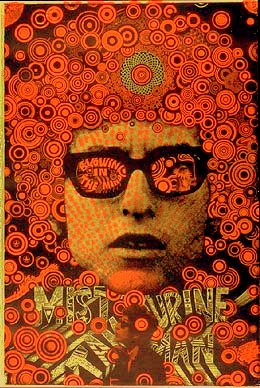
Psychedelic Dylan
Some say she first set her sights on McCartney but the more vulnerable Lennon showed up and the Spider Woman spread her web.
She was still married to her second husband, Tony Cox, but, regardless of what she says she very aggressively pursued, or attacked, Lennon. Lennon was emotionally under water unable to handle his success while drugging himself out of his mind. He was unwillingly married to his wife Cynthia. It appears that he married Cynthia out of duty when she became pregnant. He doesn’t seem to have been happy in his virtue. Yoko had no difficulty in capturing his affections.
Now, just as Warhol had adopted the Velvets and imposed his female singer, Nico, on the band Yoko sought to imp[ose herself on the Beatles through Lennon. At this time she was still musically completely in thrall to John Cage understanding nothing about Rock music. She and Lennon had made a ridiculous LP called Two Virgins in 1968. She combined her cagian screechings while using an avant garde ‘performance’ notion of the couple posing nude on the cover; full frontal on the obverse, full posterior on the reverse. As no store would carry the cover the couple reverted to Yoko’s idea of Bagism placing the cover inside a plain manila envelope or bag. While it didn’t sell the record this form of Bagism was actually a successful artistic statement. The nude cover given an outer garment so to speak.
Well, the public was prepared to forgive the Beatles anything but the other three Beatles weren’t prepared to forgive Yoko for forcing herself on them thus she broke up the most successful act of the sixties. Still, she had succeeded according to her wildest dream. Lennon and his wonderful reputation and fortune were hers. She had gone from a neglected, nondescript ‘performance’ artist to center stage, not on her own womanly talents but by attaching herself to a talented man. Yoko’s ‘heart’ was useless without the male intellect. Yoko was now the most influencial feminist in the world. She knew what to do with that.
After several ‘performance’ acts such as the ‘Bed In For Peace’ the couple left England to return to the place Yoko wished to subjugate artistically, New York City. She had raised herself to a par with Andy Warhol. She now had to meld her musical and artistic goals through Lennon and Warhol.
On the musical side she began to develop her rock n’ roll skills under the tutelage of Lennon. While not abandoning the avant garde notions of John Cage she now emasculated her husband. Always semi-delusional or perhaps completely so, she fantasized that she was not only equal to Lennon in skill and popularity but superior to him. She imagined herself more popular than Lennon. Thus one has such travesties as the LP Double Fantasy. It was only after Lennon’s death that she was forced to recognize than Lennon’s fans did not appreciate her efforts. So she failed as a musician.
She quickly tired of being Mrs. Lennon. Thus she and Lennon separated for eighteen months or so during the years 1973-75. She then realized that her financial well being and musical acceptance depended on Lennon. In 1975 she called him back resuming their relationship until his death in 1980. But, things had changed.
She began to adopt Warhol’s life style on her return to NYC. While she propagated the notion that she was some sort of business whiz Iam having difficulties discovering any such skills. It appears that with the enormous income of Lennon she emulated Warhol in
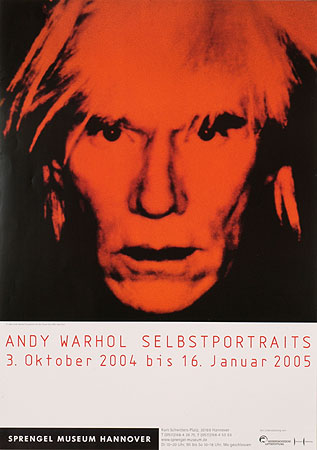
Andy the Demon
spending her way to prosperity.
She was in a position to not only match Warhol’s spending but exceeding it by many times. Through the seventies and eighties Warhol came into his own as an artist while reaping a fortune doing portraits. There appears to have been no effort on his part to invest in income producing vehicles. Rather he bought stuff. He purchased buildings in NYC and elsewhere while acquring undeveloped acreage in places like Aspen. He shopped nearly every day buying antiques from furniture to objets d’ art by the bushel almost as though he were trying to excel the incredible W.R. Hearst.
He usually didn’t even look at the stuff once he bought it merely filling rooms with his shopping bags. At his death all this junk was auctioned off for 25 million dollars, a nice appreciation in value.
Yoko followed the exact pattern buying apartments and houses as well as an extensive dairy farm with a herd of prize cows. She not only had but has five apartments in her principal dwelling, the Dakota apartment building and many other houses scattered around.
Like Warhol the Dakota apartments are stuffed with junk. Valuable, but, you know, stuff. She bought at good prices. Her extensive collection of Egyptian antiquities was mostly purchased before a steep rise in value.
Like the Rothschilds of old Yoko didn’t do all her own shopping but employed agents to search things out. Chief among these was an associate of Warhol’s, Sam Green, and an Hungarian immigrant by the name of Sam Havadtoy.

Buddies- Yoko, John, Andy
There should be no surprise then that she now has an extensive collection of Warhol’s artwork as well as his portraits of Lennon. The Warhols would have been purchased for form 25 to 50K while now being listed on her assets at tens of millions. She also has been said to have a good collection of Magrittes as well as one assumes other artists. So, much of her net worth is tied up in artwork purchased through Sam Green.
Sam Havadtoy was an antiques dealer as well as an interior designer. He appears to have been a somewhat shady character. It is very difficult to find much about him, however there is a sharp portrait available from the notorious A.J. Weberman ( http://www.acid-trip.org/lennon/ )
…(the Lennons) hired a sleazy Eastern European bisexual to renovate the pad. (Dakota) I had heard of this dude, whose name escapes me, from an asswipe named BRUCE KIRSH, who worked for him. KIRSH told me that the dude, who worked for the King of Morocco, would form a dummy renovation company, hire employees like Kirsch who were willing to work under false names, then, when it came time to pay taxes, everyone would disappear. I learned of him long before he was hired by John and Yoko, and I was taken aback when Yoko took up with him after John’s death.
I know that Weberman is not particularly well thought of by fandom but this is because of his harassment of Dylan who did, after all, misrepresent himself to the revolutionaries like Weberman. A.J. himself is an intelligent observer who was wading through it when it was deep. I do believe he knows what he’s talking about although his interpretations of Dylan’s lyrics seem absurd.
I would have to question Yoko’s judgment in taking him in. Both he and Sam Green were candidates as successors to Lennon with

Lennon by Warhol
whom she consorted in front of Lennon before he died while Yoko chose Havadtoy as his successor the day he died.
Perhaps she selected Havadtoy over Green because he was more rough trade. With Lennon while managing to reconcile revolution with peace and love with Havadtoy she discarded peace and love in favor of strong arm methods against her former employee Fred Seaman when it was totally unnecessary.
Havadtoy was living in a homosexual arrangement with his business partner when Yoko beckoned him to switch to her. Apparently an able switch hitter he was lured by the money to this much older woman. The arrangement did last for twenty years before Havadtoy removed to his native Hungary taking a nice cash settlement and several of the Warhols.
Thus, just as Warhol had his live-in homosexual arrangement so after Lennon’s death Yoko adopted the exact arrrangement. Today she apparently lives alone, a seventy-eight year old woman.
After Lennon’s death there was an accession of from 30 million to a possible 100 million dollars as their last album, Double Fantasy, sold into the millions while the rest of Lennon’s catalog and one assumes the Beatles’ catalog was reinvigorated while all things Lennon sold. This is, of course, no reflection on Yoko but the inevitable result with intellectual properties when the maker dies.
Post-Lennon, then, Yoko realized that her recording and art careers were nil. Heart without intellect is worthless. She then became the caretaker of the Lennon legacy. His recordings, of course, continued to sell, but even his artwork eclipsed that of Yoko. So she suffered the humiliation of being a mere appendage to a man. The feminine dismal swamp was eclipsed by the Olympian heights of the male intellect. As in ancient times the God had trumped the Goddess. And yet as with Hera and Zeus the Goddess gets her way. Yoko came up with the money and goods while Lennon’s spirit was wafted into the stratosphere.
As any reader of mythology knows Hera ruled the Lernean swamps of Argolis while Zeus ruled the gods on ethereal Olympus. Thus one has the symbolism of the biological difference between the male and female.
In ancient times the female had her share in magic. She knew herbs and plants, was familiar with poisons and cures as with the arch witch of the ancient world, Medea. The reputation of the female witch even as a consort of Satan persisted down through medieval and post-medieval times, indeed, even up to the dawn of the scientific enlightenment. One would have thought that magic and witchery were a thing of the past in the 1960s and yet Yoko embodied the whole female swamp mentality.
She established something called the Spirit Foundation attributing the direction to Lennon who in fact knew nothing of these matters but followed her lead. The Spirit Foundation celebrated the ancient art of the Shaman or witch doctor. Shamanism itself even preceded the Matriarchal swamps of Argolis. It was a rich repository of magical tradition. Further the Foundation was feminist in that it was dedicated to preserving the magical traditions of the women of the Pacific islands still living in such archaic societies. The wealth generated by the male intellect was appropriated by the female vagina or ‘heart.’
In her own life and that of Lennon’s Yoko was addicted to a variety of magical practices- astrology, numerology, Tarot readings, and indeed she traveled to the Caribbean to sell her soul to Satan through the offices of a female curandera. Her Tarot reader, John Green, was a priest in the shamanistic, magical, Yoruban African cult of Santeria.
Her feminism was more a magical effort to restory Matriarchal supremacy over the Patriarchy thus reversing the Patriarchal victory of three thousand years previously. Indeed, what has been called the movement for female equality is nothing more than a covert campaign to restore the Matriarchy.
Thus while Yoko o9riginatd nothing she usurped the abilities of the reason of men- Cage, Warhol, Lennon and male magicians such as John Green. Indeed the Trojan War itself was a war of men in service of women.
In her associations with men she preferrred to deal with emasculated types such as homosexuals like Cage, Warhol, Sam Green and Sam Havadtoy. Lennon claimed to have always been dependent of women for comfort and guidance while Yoko caught him at his most confused and vulnerable.
While she received direction from Cage and Warhol she was able to manipulate Lennon out of his talent somewhat as Vivian did that of Merlin of the Arthurian saga. When Vivian had usurped Merlin’s magical knowledge she buried him deep much as Lennon was put out of the way. Yoko then appropriated his wealth and residual income after his death. It was this constant inflow of cash that allowed her to propagate the notion that she was a financial genius.
Then as the female of the ‘heart’ or vaginal swamp she managed and appropriated the reason of Olympus through Cage, Warhol and Lennon. What she got from Havadtoy other than brute strength is not clear to me.
As such Yoko is Woman. In her case a seeming reversion to the archetypal Shaman of the most ancient times.
A Review:
Dakota Days
The True Story Of John Lennon’s Final Years
by
John Green
Review by R.E. Prindle
Green, John: Dakota Days- The True Story Of John Lennon’s Final Years, St. Martin’s Press, 1983

John and Yoko looking pretty palmy.
The book should perhaps be subtitled: A True Story. John Green has crafted very nice portraits here of Yoko Ono and John Lennon, especially that of Yoko. She was very superstitious being dedicated to the occult from witchcraft to Japanese numerology to Tarot readings. It was the last that brought Green within her ken. She not only wanted a reading of the Tarot cards but she kept Green hopping day and night giving her readings on whatever little problem that pressed her mind. So for six years Green made a very good living reading for John and Yoko while developing a profound familiarity with their characters; in other words, he knows whereof he speaks.
Neither he nor the Japanese numerologist who he mever met were the only occultists Yoko was consulting but Green seems to have been unaware of the others. He is very careful and doesn’t overstep the bounds of what he knows first hand. There was a great deal that Green wasn’t privy to making this A rather than The true story.
While I know that many people know what the Tarot is I will give an explanation for those who don’t. While I don’t participate in Tarot myself I do have a deck of cards on hand to study for historical reasons.
The Tarot is a deck of 78 cards of some psychological subtlety. It arose as a means to preserve the Egyptian religion when after the various invasions of the first millennium BC the matrix of the religion was shattered. The Tarot was devised as a means of perpetuating the religion. The various spreads of cards provide means of interpreting responses to a problem.
Over the centuries many different decks have evolved representing various time periods. I have the Egyptian deck. It would be
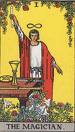
Tarot Card From Deck
interesting to know which deck Green used. He fails to tell us.
To be able to read well one must have an implicit understanding of each of the cards as well as being a subtle enough psychologist to apply the meanings to he or she for whom you read. Green apparently had both qualifications. Thus over thousands of readings over the six years he became very familiar with the characters and personalities of his subjects John and Yoko. Still, they seem to have been very successful in letting him know only what they wanted him to know.
As he apparently didn’t take notes, limiting in itself, he relies on his memory and familiarity with the Ono’s mental processes to reconstruct a continuum of the six years. While one may question the veracity of his method he seems to capture the mental and vocal traits of both John and Yoko. I have no trouble accepting the portraits while as the details can be corroborated elsewhere I see no reason to question Green’s general accuracy. Otherwise there is no one who doesn’t make mistakes in fact or interpretation.
His two portraits while revealing conflict with other accounts such as that of May Pang or Fred Seaman the obvious reason is that

May Pang
the Onos are only letting him see what they want him to see. For instance, in their 1980 interview the Onos state that Yoko had brought the estate up to 150 million dollars yet Green has Yoko spending so fast that they are always on the brink of insolvency. At times expenditures seem to exceed cash on hand.
Green believes himself to be their only investment advisor but that isn’t the case. Just as Yoko had her Japanese numerologist who Green didn’t come into contact with and other occult advisors she must have had other financial advisors.
The picture Green paints of Yoko is far from pretty while he never openly denigrates her yet as he creates his layers of detail she not only becomes but goes beyond eccentric. Her dependence on the occult is such that when someone advised her of a ‘genuine’ witch in Colombia she dragged Green along on the trip to South America to visit the woman. Always lavish in her expenditures, she gave one medium a blank check for her to fill out, she gave this woman 60,000 dollars for her ministrations. When Green protested that the woman had meant pesetas rather than dollars Yoko was unfazed.
Thus while Yoko denied any dependence on John she only was able to realize her vision of herself through the former Beatle’s wealth and influence.

Yoko in one of her many guises.
This was no more evident than in Yoko’s competition with her mother. For two successive summers John and Yoko visited Japan. According to Yoko the intent was to establish some rapport so that her son Sean wouldn’t be cut out of the family fortune that was considerable. The trips were conducted on such an extravagant scale that according to Green the Onos were cash poor as a result. Nevertheless Yoko went on spending so either they had funds of which Green knew nothing or they got money from somewhere.
The fact that they always seemed to have enough cash to do anything from spending a few millions on dairy farms and cows to Japanese vacations that it seems strange that when they received an extortion attempt for 200,000 dollars Yoko said they had no money. The extortion attempt seems to have been a protection racket- pay and live or go the police and die. As the extortioners told Yoko that if she went to the cops they would only protect her for a while. When they left whether a year or two later the extortioners would strike.
The Onos refused to comply calling in the FBI. The FBI advised them to substitute newspaper for money and they would arrest the pickup man. Strangely the pick up man was able to elude the FBI. And then two years or so later Lennon was hit by exploding bullets and killed on his doorstep. While one cannot say the two events are connected yet the assassination followed the extortionists plans. Chapman did make a stop to speak to an unidentified party before he pulled the trigger. But nothing is clear.
Yoko first contacted Green during Lennon’s ‘Lost Weekend.’ While Lennon believed, and it seems clear, that Yoko had informants watching John while he was in LA, Green has her denying this saying that it was his card readings that kept her informed of John’s doings. In all likelihood she checked her spies’ information against his readings.
From ’75 to ’80 Lennon was in a severe depression being unable or unwilling to function in a normal way. Of course there was no reason for him to act ‘normal’ as he was able to deal with his funk in his own way. Who is there to say that ‘normal’ was better? As he told Green his muse had left him leaving him unable to write. As he said, call it writer’s block or whatever, he couldn’t work. Enough reason for depression in an artist.
Then in 1980 when he came out of it being again able to write, Yoko in her desperate attempt to be his equal insisted on being part of the new record she called Double Fantasy. John adamantly refused to let her perform on his own tracks while she didn’t want her tracks all on one side for fear that no one would listen to side B, so they alternated tracks.
Thus, even though Yoko insisted that she was the most talented artistically and musically of the two she was forced to hitch her wagon to John’s star.

Yoko in one of her variety of men's hats and double fantasy glasses.
2.
I found Green’s treatment of Lennon to be more sympathetic than his treatment of Yoko. The inevitable conclusion one comes to about Yoko is that at best she was a pathetic human being while at worst an obsessive-compulsive and a dangerous one at that.
The portrait he depicted of John is that of a man with a completely disintegrated personality entering the mid-life crisis. During this five year period he begins a process of reintegration. Actually his course is that of the mythological hero who experiences his ‘madness’ at this period of the mid-life crisis.
During this period Lennon is essentially egoless. Part of Timothy Leary’s LSD mantra was that one should abandon the ego. Of course to abandon the ego leaves one defenseless and a prey to sharpers who use their ego only too well, nevertheless Lennon bought in and abandoned his ego, or so he says. As he abdicated his identity to the use of Yoko Ono this was obviously the case.
So, he allowed himself to be manipulated by Yoko spending long periods of months over years ruminating naked in his bed, totally exposed as it were protected only by the good will of Yoko. Then, for whatever ulterior motive, Yoko sent John on a solo trip around the world. This was her mistake.
While in Macau, China Lennon had an epiphany in his hotel room. This is a fairly common one but self-revelatory. One might name it the peeling of the onion. In Lennon’s case he obviously felt that he had multiple personalities acquired through various traumatic events in his life.
As he described it to Green he was in his hotel room when he succeeded in peeling a layer of the onion, a personality, off which appeared as real and visible to him as shirt or a suit of clothes. He draped the personality over a chair then began to peel off layer after layer hanging them about the room or draping them over the furniture. When he awoke the next morning he could see them just where he put them. He then conceived the notion of leaving them there as he ran away from their influence.
This is a beautiful little fantasy. But then he turned the corner and there was oneof his selves waiting for him. Visualize the Rock And Roll cover and I think you begin to have it. He then realized he couldn’t escape in that fashion so he went back to his hotel and said ‘C’mon’ to his personalities and continued on his journey. However having identified his ‘problems’ by name, as it were, the seeds for resolving those problems had been sown.
He then returned to the Dakota and while he confined himself to his room rather than merely sinking into depression he began working through those layers of fixations or depression gradually recovering his muse and removing his writer’s block enabling him to compose again.
It would seem that Yoko preferred John psychologically incapacitated so that she could either control him or make herself believe that she was the more talented. Green notes that as John improved Yoko seemed to deteriorate. He quotes her as saying that she had heard some of John’s new songs and they were not very good while hers were.
Dissociated from reality as she was then she couldn’t let John record an LP of songs that might be a hit while anything she recorded on her own would be relegated to the garbage. She even refused to record one side all John and one side all her for fear that no one would listen to her side so she demanded they alternate tracks. I presume that is one reason the LP is entitled Double Fantasy.
While Yoko actually believed in the Tarot and her Japanese numerology, witchcraft and whatever John intelligently disregarded the occult aspects while he might have seen the utility of the Egyptian religous aspects to reveal character and motivation. In fact the innumerable readings of the Tarot might have led up to the revelatory epiphany in China and hence the lifting of his depression.
If that were the case then there would have been little difference between the Egyptian system of Tarot and psychoanalysis. But, as I say, I have no idea of which deck Green was using although the principle remains the same.
3.
After having been on 24/7 call for six years as the Onos moved into what seems to have been a new phase Green lost his usefulness to Yoko sitting by a phone that never rang.
Green had succeeded too well. As he has John explain to him when Yoko first employed him she set him seven tasks. He had successfully completed all seven being now redundant. While John promised to look out for him, of course events eliminated any such possibility.
Regardless of whether the Ono Lennons were the subject of Green’s book I found the whole concept interesting. I like the way Green told his story, his tone and his outlook. His telling made me take an interest in himself. Unfortunately his name being so common makes it too difficult to search out anything of his subsequent career other than he moved to Washington DC.
Perhaps he could write a sequel to Dakota Days from another angle and with more detail. Pressing issues might not be so pressing now. I’d be interested.

Happy Trails To You.
A Review: John By Cynthia Lennon
January 14, 2010
A Review
John
by
Cynthia Lennon
One Giant Step For Somebody
Review by R.E. Prindle
Lennon, Cythia: John, Three Rivers Press, 2005
Remember what the door knob said…
–Grace Slick
We built this city on Rock and Roll.
–Jefferson Starship
If you want to be a girl of mine
You’d better bring it with you when you come,
–Trad.
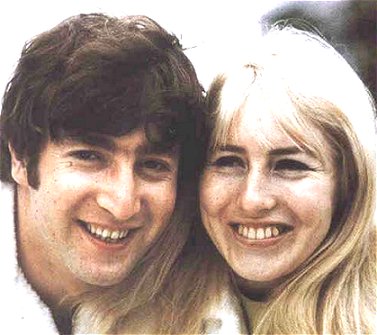
John and Cynthia- Sometime In Liverpool
Cynthia Lennon’s autobiography of her life with John Lennon opens the door to a number of possibilities of which I’ll explore one, at least, here.
Let’s begin with Lonnie Donegan’s 1955 hit The Rock Island Line. Lonnie was the originator of his own genre- Skiffle Music. Skiffle was all the rage in the British world from England to Australia to New Zealand while passing very lightly over the States except for the fortunate few of which I was one. Rock Island Line was a major hit in the US though.
Lonnie, may he rest in peace, was also the originator of the Big Beat. Of course Lennon and most of the young English rockers studied at Lonnie’s feet. The first band Lennon formed, the Quarrymen, was a Skiffle band. That was back in the fifties before the second stage of the big change kicked off. The first stage began about 1950 with Johnny Ray and his song Cry.
Eisenhower had the world pretty well organized in 1960 before John Kennedy stole the baton from the intended successor, Richard Nixon. With the accession of Kennedy the American personality or identity, such as it was, began to disintegrate- I mean in the psychological sense.
The Celts tried to establish Kennedy as the second coming of King Arthur and his Camelot. Not the smartest thing they could have done; a couple bullets fired in Dallas on November 22, 1963 put a period to that dream. By the then the sixties were fairly launched about to begin in earnest in January of 1964 when Lennon’s next group, the Beatles, hit.
The Beatles began as a Big Beat band rooted in the fifties. Seized by the avant garde they were made the avatar of the sixties. In their own way they launched the sixties although the makins’ were already out of the can. Kennedy was shot almost in December and in January the Fab Four washed his memory out on the Ed Sullivan Show. The Kennedy assassination was so then, then. The Beatles were NOW. IS in capital letters.
While the Beatles were revamping fifties music they edged into the future with modified Prince Valiant haircuts and collarless suit jackets. They were then NEW emerging into a brave new world.
Almost at the beginning of 1960 the art world was shaken by the emergence of Pop Art. Jasper Johns, Claes Oldenburg, Robert Indiana, Roy Lichtenstein, Robert Rauschenberg and especially Andy Warhol with his Campbell’s Soup Can set the sixties on its ear. On

Premier example of Pop Art
the film scene the James Bond series with its new sensibility began. Bond also was a revelation portending changes with unintended consequences.
Pop Art would figure signficantly in Cynthia Lennon’s life in a few years when one of its more laughable practitioners, Yoko Ono, would step into her life and filch her husband from her. In fact Pop Art would be inextricably linked with the record industry. All the pop motifs would find their way onto record covers with increasing frequency. Tiny Alice would have a cover that opened like a match book. Talking Head’s colored disc would even become a happening designed by Rauschenberg himself. The burgeoning poster business would find its way into record sleeves. Astonishing packages never seen before in the record business although perhaps anticipated by the experimental ESP label of NYC. Some interesting stuff. Perhaps Milton Glaser’s poster of Bob Dylan could run for the distinction of the most popular poster design of the whole era. It was innovation itself at the time although not quite so fresh today.
Now, all this was happening so fast and from so many directions that it was impossible to get it all or even keep up on what you did get; after all people had lives to live.
In the San Francisco Bay Area where I was during the sixties the Scene was especially heavy. I wasn’t in the thick of things but a little off to the side. Thus while the UC Berkeley Free Speech Brouhaha took center stage in the East Bay, Ken Kesey, the Merry Pranksters and the Acid Tests were simmering on the Peninsula, but actually invading the middle class especially at Stanford and UC Berkeley. The San Fransciso Mime Troupe was very important in the early stages while Bill Graham was commercializing the Trips Festival with his Fillmore shows and Chet Helms was organizing the Avalon Ballroom out at the beach. The posters for the ballrooms which epitomized the psychedelic was the first inkling I had that something ‘new’ was happening. I don’t know how quick on the uptake I was but the first inkling of New York Pop I had was 1966-67 when I opened a poster store soon to be a record store.
LA, always commercial, would nevertheless provide the great Ron Cobb political cartoons for the LA Free Press one of the best of the Hippie papers soon to degenerate into porn as did the Berkeley Barb and all the rest. R. Crumb in San Francisco became the king of Hippie porn which characterized the movement from then on. The scene was then set for George and Pattie Harrison’s famous descent on the Haight-Ashbury that disappointed them so.
This brief sketch only contains a few of the highlights of the period. It was into this world that John and Cynthia Lennon stepped unprepared. Both Cynthia and John came from a background of very low expectations. Cynthia’s dreams were very modest while per her John’s dreaming was no bigger than reaching the tops of the pops in England.
Indeed the much touted German clubs showed no promise of a future whatever. Essentially playing in brothels in Hamburg one wonders what the ‘lads’ were thinking of the whole process. The wonder is that they paid enough attention to hone their skills. One of those making lemonade from lemons situations.
Only the greatest good luck showed them to success and fortune. They would have labored in the vineyard for a while and then drifted off into jobs but for the fact that an entrepreneurial romantic by the name of Brian Epstein saw them as the vehicle to realize his own dreams. He had the direction and energy to galvanize their careers. Still they were rejected by all the labels until a producer, George Martin, apparently heard what the rest of the world would hear and agreed to record them. It was then that the unbelievable happened elevating the Beatles into the most successful pop group ever. It was success far beyond their imaginations. With that success came challenges that neither John nor Cynthia could meet. The fact that they failed is no reflection on either one; they came from very low expectations and having fallen down the rabbit hole they were slightly unprepared. ‘One side makes you larger, the other side makes you smaller.’
To this time in their lives neither had even eaten at anything other than the English equivalent of McDonald’s, fish and chips or whatever. Now in one great step they were introduced into the haut ton by their manager Brian Epstein. Cynthia leads us to believe that Epstein gave special attention to John over the other ‘lads.’ As Epstein was a homosexual and as other sources, Peter Brown, Goldman actually state that Epstein seduced Lennon he obviously had a crush on John seeking to mold him in his own image. Indeed, John may have been his incentive for taking the Beatles on. Lust at first sight.
John had an attractive flip attitude that left the impression that he was much better educated than he was. Actually he left Art School, already a step down from the top, flunked out or whatever preferring to devote himself to his guitar chords. Most of the rockers were in the same situation. It’s amazing that their fans looked to them for salvation. This was tragic, because the generation invested all their hopes and dreams in these muscians attributing universal knowledge and genius to them, each and everyone. While they all did changes on certain political and social themes there was an appearance of ‘deep’ knowledge. Being anti-pollution was a badge of authority. Grace Slick of the Jefferson Airplane made the mistake if, one hopes, jesting that one should never trust anyone over thirty; this while she, John and others were about twenty-nine.
The phrase stuck. Those under thirty trusted these youthful, perhaps well-meaning rock stars. Being somewhat older at the time I could only see some very ordinary boys and girls who were just youthful wiseacres as we all were in that phase of our journey through life. Give me a break.
The most revered of all were the three Beatles John, Paul and George with Ringo thought of more as the court jester. John seemed to take his role most seriously as the guru of the generation, especially after he abandoned Cynthia for, spare me, the psychotic Yoko Ono.
Her abandonment by John for Yoko Ono is of course the most traumatic incident in her story. One can only commiserate with Cynthia. Then one has to search for reasons why; there was certainly no physical attraction there. Lennon did release a solo album called Mind Games so perhaps the best place to look is the mental. Lennon’s success must have placed great stresses of various kinds on him. The transition from a fair degree of poverty to one of a very large income to great wealth under the management of Yoko Ono would be psychologically unsettling in itself. Cynthia was unable to transit from poverty to wealth always remaining a lower middle class haus frau while John appears to have lacked the social climbing instincts of, say, Mick Jagger.
Musicians in general are held in very low esteem by the social elite so without unbounded desire and chutzpah, an ability to endure slights of the most painful kind it is highly unlikely that a musician would ever find acceptance in society. The aristocrats, Marrianne Faithfull describes as associating with Jagger appear to me to be more of the Black Sheep variety. So, Lennon may have been experiencing some frustration at that level.
At the same time there are numerous flatterers who are adept at putting ideas of omnipotence into your head not only intimating but saying that you are godlike. Even though one rejects the notion on the conscious level still a feeling of super powers creeps into your subliminal mind. One feels invulnerable, that one can do what’s never been done, that one can do drugs with impunity. There was never a time when the availability of drugs was ever greater or more socially acceptable.
At the time rumors abounded which have since turned into facts. During the Kennedy administration there was one Dr. Feelgood operating in New York to whom the social elite went for their drugs. His name was Dr. Max Jacobson and he was your friendly amphetamine pusher. His speed cocktails were extraordinary and they lasted for days. It’s comforting to know that President John F. Kennedy was amphetamine fueled while he was making those difficult international decisions- like Cuba. Nothing like having an A-man on the job. He wasn’t alone, VP Lyndon Johnson, followed in his footsteps into the office of Dr. Feelgood. He would have found his place at the end of the line of the NYC elite.
One person who took the good doctor’s prescription said that he went blind for three days staying high for several. Max was the economic type, dirty needles too.
At the same time Dr. Timothy Leary was sending everyone from prison inmates to Beat poet Allen Ginsberg tripping into inner space with his free handed distribution of LSD. Kennedy was involved in that too.
Prior to their arrival for the Sullivan show we are led to believe that the Mop Tops had only used pep pills in Hamburg to fuel their twelve hour sets. We are told that Bob Dylan was the one who turned them on to La Cucuracha, the most mild of the intoxicants. From there the boys graduated to LSD through spiked drinks or food.
Just as Harrison’s wife, Patti, records a spiked introduction to LSD so does Cynthia Lennon. Cynthia quite properly was revolted by drugs having no use for them. John was quite the opposite. He embraced LSD apparently ingesting regularly for long periods of time. As he would describe it, thousands of trips. At that point in my estimation the marriage was over. There is nothing for which Cynthia has to reproach herself except for her small divorce settlement. Nothing disintegrates the personality like drugs.

The Ghost In The Machine- Albert Hofmann
The drug influence was followed by a change in their music patterned after Dylan. When I first heard the Rubber Soul album I found it extremely noisy and unpleasant. This album was probably influenced by the Band’s playing behind Dylan on the ’65-’66 tour or perhaps the Bringing It All Back Home and Highway ’61 albums. It seems p;robable to me that the song Norwegian Wood commemorated Dylan’s turning them on to marijuana. The girl obviously represents Dylan.
Succeeding albums would aim for a ‘heavier’ feel with more social significance. As Lennon said in his ’80 Playboy interview, I Am The Walrus was written in imitation of Dylan.
The cover of Rubber Soul was traditional uninfluenced by pop art trends. The succeeding cover in the US, the famous ‘Butcher’ cover would be widely interpreted in the US as a comment on the Viet Nam War. It may have been meant as a pun- prime cuts of both meat and record tracks, but I don’t know. Whether there was a Pop Art influence isn’t clear.
The cover for the following Revolver by Klaus Voorman seems to indicate an awareness of Pop. For a band that was thought to be on the cutting edge of everything there are only two covers very avant garde with neither being very satisfying to me.

Acid Art- Victor Vasarely
Sgt. Peppers Lonely Hearts Club Band that follows Revolver is a complete Pop Art package. A bizarre and macabre conception it does succeed. The grave in the foreground with the floral Beatles is chilling, perhaps a presage of the break up of the band. As Dylan said: If you’re not busy being born you’re busy dying.’ The Beatles are pictured in dead black and white looking down mournfully on their grave while the newly born Sgt. Peppers Lonely Hearts Club Band stand front and center in vibrant living color. Obviously the one has risen from the other.
Behind the band are row on row of ‘ancestors’ or, as was commonly assumed, influences. In fact members of the band contributed only a few of the names while the rest were contributed by others. Dylan is certainly among the pictures. The album comes complete with a childhood toy, a sheet of cut outs, making a complete Pop Art package. They could have had a designed inner sleeve but they overlooked that. Peter Blake, the main designer, is known as a Pop Artist.
The musical content follows the downer social significance motif with aural pyrotechnics such as had not been heard on record before. The release, as everyone is aware, was a complete smash, but it went beyond smash into realms not achieved until Michael Jackson’s Thriller. Thriller failed to excite as did Sgt. Peppers. That summer of ’67 was literally a surround of Sgt. Peppers. It was almost the only record anyone played. The Beatles easily trumped Dylan’s Blonde On Blonde of the summer of ’66.
The rest of the Beatles’ covers are pedestrian. The White LP probably influenced by One was trite at the time.
Cynthia seems to lack all understanding of what tremendous pressures the very unstable Lennon was subjected to , how his mind was being affected by adulation from the fans and respect from the world at large. Kid me, being named one of the three most influential men in the world wouldn’t have inflated the head of a Liverpool loser? My god, the Beatles even sung ‘I’m a loser.’ I couldn’t believe anyhone would sing such a song much less the Beatles who were clearly winners. How does one endure thinking of oneself as a loser on one hand and one of the most influential men in the world on the other?
At the same time that Lennon was enlarged Cynthia shrunk into the Liverpool realities of her youth. The couple had a mansion but unfamiliar with so much space Cynthia preferred to live in one small room! Clearly she was not equal to the demands of her situation.
The situation became critical when Lennon began mass consumption of drugs, including heroin, which Cynthia correctly declined to do while at the same time the poisonous Yoko Ono injected herself into Lennon’s life. There was no hope for Cynthia. Yoko Ono was a walking disaster looking for a place to happen- and then there was John.

Yoko Ono- Single Fantasy
Quite frankly Yoko Ono’s ‘career’ was going nowhere. Born in 1933 she was 33 in 1966 when she began her assault on John who was 25.
The sexual dynamic is that Lennon seemed to prefer older women than himself having a masochistic submission impulse. Cynthia herself was a year older. She too apparently sought security in younger men. Her second husband was two years younger and her third six. She seemed to lack the dominating impulse to make such marriages work. Ono had it in spades.
While John was by this time psychotic, Ono had been so from childhood, in addition she seems to suffer from extreme cognitive dissonance. Ono got the rock critic Robert Palmer to shill for her in her 1992 release, Onobox. In the essay Palmer states:
It is quite likely that having John Lennon fall in love with her was the worst thing that could have happened to Yoko Ono’s career as an artist.
Notice the lack of mention of falling in love with Lennon. This was written, I almost said, dictated to Palmer, in 1992 twelve years after Lennon’s death. No serious critic could have written that line so one must assume that it was dictated by Ono herself. The line shows how far she has distanced herself from reality.
Ono was in fact, a poor little rich girl. As a woman she felt inferior to the male writing such pieces as ‘Woman Is The Nigger Of The World.’ Once again cognitive dissonance. Yoko Ono was never in the position of being ‘a nigger in the world.’ It is true that her father advised her against attempting composing believing that women didn’t make good composers. How wrong was he, hey? Ono milked every man she was ever with before actually going into the dairy business herself. Secondly, having chosen to enter the Western world as an Asian she places her artistic neglect on the twin facts that he is a woman and an Asian. It never occurs to her that her art is unpleasing.
As an artist, whether woman or not, Asian or not, she had nothing to offer the art loving peoples of the world. In this increasingly globalized world of the sixties being Asian meant nothing while being a woman held no one with talent back. Indeed, male artists were increasingly being suppressed in favor of women in all the arts. If all girl rock bands isn’t an oxymoron I don’t know what is.
By her own admission she thought she was an influential person in the New York City art world of the early sixties after an apprenticeship of one year even gaining ‘an international reputation.’ As she told May Pang: I was famous before I met John. So, one asks how does one reconcile her imagined great success with the feeling of being held back as an Asian and woman?
She rented a loft for fifty dollars a month which she coyly implies that as a starving artist the money was not easy to find. Well, Daddy was only a phone call away, she should have reached out and touched him. You can be sure he wasn’t going to let his little girl starve. By comparison I was paying 125.00 a month for an apartment in the Bay Area. I think we can dismiss the impoverished struggling artist scenario as so much more cognitive dissonance.
Ono spread herself pretty thin apparently attempting to cover all aspects of the avant garde. She’s keen on belonging to the avant garde. In music she patterned herself after John Cage and that weird contemporary ‘classical music’ approach with perhaps more than a nod to the early electronic composers such as Robert Maxwell who she mentions. She began her career in 1969 between the end of the Absract Expression mode and the beginningof the Pop movement so she was too late for the one and too early for the other. She and Lennon would try to rectify this in 1971 by doing obeisance to the Pop guru, Andy Warhol.
In 1961 she threw a party and was devastated that a snow storm discouraged the uptown crowd she had invited from coming. At least she said there was a snow storm. This may be another instance of cognitive dissonance. As she was an actual nobody she had no reason to expect society people to attend, snow storm or no snow storm. Nevertheless she was devastated, leaving town for Japan shortly thereafter. One may question where she obtained the fare for that flight when she had difficulty of meeting a fifty dollar rent bill.
In Japan she acquired her first husband simultaneously being committed to an insane asylum. As difficult as it may be to believe, her soon to be second husband, Tony Cox, heard these marvelous things about Ono in NYC deciding to fly to Japan to look her up. He found her thoroughly doped staggering around the halls of the asylum. He succeeded in getting her released then he, Ono and her first husband formed a menage a trois. The first husband wisely was the first to leave so Cox claimed the prize and the couple returned to NYC in 1964 so she is having an eventful four years. Shortly after their arrival they pulled up stakes and headed further East to London. Of the move Ono says:
I thought (the) avant garde world in New York was still very exciting but that it was starting to become an institution in itself, and there were rules and regulations in an invisible way, and I just wanted to get out of it. I never considered myself a member of any group. I was just doing my own thing.
That is just another way of saying that the art scene was a cliquish group in its terminal stages that was difficult or impossible to break into so unable to do so Ono was ‘just doing her own thing.’ It might be noted however that the NYC art scene was or was in becoming a nearly totally homosexual affair. At any rate we have evidence of sour grapes- I never considered myself a member of any group. And the result of rejection- I was just doing my own thing.
After her rejection she ‘composed’ a musical piece called Wall Piece For Orchestra in which she knelt on a stage and repeatedly banged her heard on the floor. Today that would be called ‘acting out.’
Off to new worlds to conquer in London and at the Indica Gallery of John Dunbar, the resident ‘head’ art gallery. Now, at this point she ‘ruined her career’ by pursuing John Lennon until he caught her. I imagine that she had been shrewdly observing his career and undoubtedly came to the psychological conclusion that he was a dependent personality who could be easily manipulated by the older maternal type with the right touch. That John Lennon could be made dependent on this woman eight years his senior is proof positive. Indeed, John even referred to her as Mother.
Cynthia for whom the role was impossible correctly assessed the situation noting the influence of Lennon’s Aunt Mimi who brought him up. Ono courted Lennon, interfering directly in his marriage. Ono was quite willing to drug herself along with Lennon so that both were heroin addicts. Ono thus established a sado-masochistic control over Lennon that Cynthia had no chance of breaking.
Rather than ruining Ono’s career the ‘third most influential man’ in the world gave her a stage on which to perform that she could never have found on her own. She now considered herself a collaborator with the Beatles. The injection of the Cage and Maxwell garbage combined with Lennon’s erratic behavior produced the nonsense of Revolution #9 on the White Album.
Lennon on drugs and under the influenceof Ono, who had her motives, according to Dire Corrector’s blog quoting the biographer of Paul McCartney, Many Years From Now, says:
The meditation had essentially precipitated a nervous breakdnown which was not helped by John’s tremendous drug intake. On May 18, 1966 he summoned a meeting of the Beatles at Apple and announced to them that he was Jesus Christ…the night after he told the other Beatles that he was the Savior, he finally called Yoko Ono and told her to come over.
Quite obviously Lennon was either teetering on the brink or had fallen over the edge. If he hadn’t broken with Cynthia by this time it is quite clear that apart from a certain inappropriateness of being wed to the Savior she was quite innocent of causing the break in any manner and should have a clear conscience.
Lennon’s state of mind would explain the insensitive manner in which he broke with Cynthia and its aftermath. The man must not have been in his right mind. While easing Cynthia out was relatively easy, from Ono’s end Tony Cox to whom she was still married was not such a simple matter. One wonders why he would fight so hard to keep a women who was so psychotic. Perhaps it was their daughter who he later took into hiding to keep her away from Ono. Justly so, it seems.
At any rate by ’69 Ono and Lennon were free to marry. Definitely by this point Lennon had all but surrendered his identity to Ono. She was now in possession of the reputation of one of the three most influential men in the world. Blending her identity with his she was about to become hermaphroditic. Perhaps Lennon was overawed by her avant garde credentials, such as they were, as well as whatever passed for her musical sensibilities.
She became Yoko Ono Lennon while he legally changed his name to John Ono Lennon so they both became Ono Lennons. After a number of happenings which one must believe were entirely Ono’s conceptions, such as the ‘bed in’ in Holland and the organization of the Plastic Ono Band, the pair settled in New York in an apartment building known as the Dakota. The Dakota was a connection to Ono’s past fulfilling an old desire to surpass those uptown types who she felt had slighted her.
In that connection also the cover of the Plastic Ono Band is a fulfillment of an old desire of Ono’s. While a child she witnessed the fire bombing of Tokyo in the US attempt to bring an end to the war. The blue sky was obliterated by the billowing clouds of smoke. While she didn’t witness Hiroshima yet she imagined the same sky as that over Tokyo. She then developed a blue sky obsession. If you notice the cover of the Plastic Ono Band is just a blue sky. One assumes then that Ono’s plans were coming together.
The NYC art world of 1960-’61 had shifted totally, the Abstract Expressionists she had tried to piggyback on were gone having been replaced by Pop Art of which Andy Warhol was the reigning doyen. If the Abstract Expressionists had been exclusive Warhol was nothing if not inclusive. He worshipped celebrities and Lennon was the number one celebrity. Himself a groupie and maximum social climber he welcomed an association with the Onos. For Yoko Ono the association with the leaderof the NYC art scene was her dream come true. Nothing but blue skies from now on.
In the accompanying picture you will notice that Warhol is seated in between a standing Yoko Ono with one hand on her right tit while his hand is on a drugged out looking John Ono with his hand on Warhol’s crotch. The symbolism is quite clear. The standing Yoko
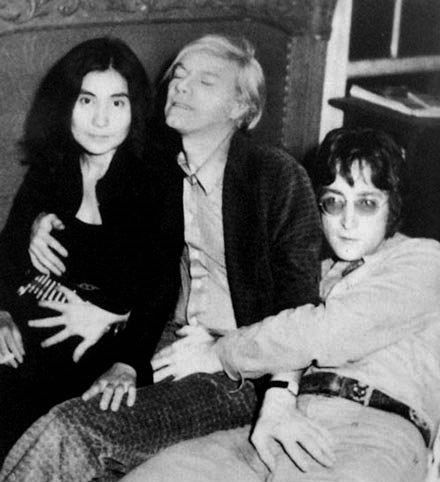
The transfer of power.
is the master of two emasculated males who happen to be two of the most influential men in the world. She ain’t no nigger no more, Maggie’s Farm is a thing of the past, yes, men are now niggers in relation to herself. Warhol as an artist takes precedence over the disposable oafish John Ono. Yoko is tallest and standing, Warhol is second tallest and sitting while the now disposable John is lowest, lying on his back. The future is clear. Study John’s face; study all three faces.
The sexually besotted John Ono has surrendered his entire identity even as a musician allowing Yoko Ono to usurp his place by putting out those horrid hideous LP musical montrosities. Robert Palmer aside, with song titles reminiscent of her head bashing days: What A Bastard The World Is, I Felt Like Smashing My Face In A Glass Window, Woman Of Salem (Witches), Coffin Car, Hell In Paradise and Walking On Thin Ice. Clearly this woman had an unsettled, disturbed mind.
Having usuped Lennon’s role and identity he became expendable. Her problem now was to transfer his past and his wealth to herself thereby becoming Yoko-John Ono, Double Fantasy. Two fantasies melding into her one personality.
John Ono’s finances were, of course, in complete disorder. As Yoko was soon to show billions of dollars were disappearing down a sink hole. She rapidly organized his finances turning his money green. Within short order the Onos were worth a hundred million or so which she would swell to a billion or more after John’s death.
I imagine it was fairly easy to have John Ono give her a power of attorney, indeed he forked over his identity allowing her to function in his stead as himself. An awesome abdication. A POA would negate the need for a will, and indeed having made herself not only co-owner of John’s assets as well as his identity Yoko Ono would merely acquire full ownership leaving no assets to be willed. Indeed, she could have turned him out penniless at any time. When Cynthia was clamoring for a reading of the will she was wasting her breath; if a will existed, unlikely in itself, there would have been no assets to bequeath.
Yoko Ono having now incorporated John Ono’s reputation and identity into her own had also incorporated the assets and with the assets the legacy of all copyrights held by John Lennon as the double fantasy melded into one fantasy. The only obstacle to Yoko’s apotheosis into man-woman was John himself as he was alive. However John was only thirty-five. To wait thirty-five years or more with a man she didn’t love or even like would be unbearable. Some hard thinking was in order.
She manipulated the poor dolt into thinking he was a boorish oaf who needed to go off to get himself together. Rather than just sending him off she chose an employee, May Pang, an Asian like herself, to be John’s consort while away.
In reading May Pang’s book, Loving John, it becomes clear that Yoko Ono was a master hypnotist. She knew how to make suggestions and have people act on them. Acccording to Pang she fixed an hypnotic glare on one, assuming an authoritative posture while intoning her suggestion. She had the reputation of always getting her way.
Of course her version of what happened is different than Pang’s. Yoko having suggested she go off with John, the act was soon consummated. Pang insists she and John were in love, yet a year and a half later when Yoko called John back he came running.
Thus, from 1975 to Double Fantasy in 1980 Yoko and John Ono were out of public life living as a double fantasy of Howard Hughes. Then in 1980 Mark Chapman became the man who shot John Lennon. There have been speculations that Chapman was hypnotized when he committed his deed. Conspiracy theories therefore have sprung up.
One must ask who the death of John Lennon benefited. Two possible people. Yoko One on one hand and possibly Chapman on the other. On the one hand Yoko Ono achieved the psychotic desire to escape being the ‘nigger of the world’ by becoming John Ono Lennon while physically remaining the sweet little girl she had been before the fire bombing of Tokyo. She was unable to manage the memory of that transformative experience. In her mind, then, she became the prominent artist-musician of the world.
I don’t believe the government had anything to do with the assassination.
As we know Yoko Ono was a master hypnotist; the question is how did she find Mark Chapman and how did she hypnotize him?
Earlier in the day Chapman had approached Lennon for an autograph. He can be seen worshipfully smiling beside his hero in the picture. There appears to be no indication he meant to harm Lennon. He might easily have shot him point blank at the time, yet when he came back in the afternoon with a voice in his head insistently saying: Do it. Do it. Do it. he gunned his hero down.
At the time Yoko Ono had dropped a few steps behind John. In similar murder attempts, people step away from the intended victim so as not to be caught in the line of fire. This may have been the case with Yoko.
Certainly Yoko is opposed to Chapman’s release from prison even though he has fulfilled the twenty year requirement of twenty to life. I doubt if he is a threat to society however he may be a threat to Yoko Ono if he were to remember or reveal the details leading up to his shooting of John Ono Lennon.
Of course, I don’t know why Chapman shot but I do know that Yoko Ono Lennon was the sole beneficiary. She left Cynthia holding the bag while she realized her double fantasy.

Double Fantasy- Yoko Looking Over John's Granny Glasses
Exhuming Bob 22: Prophet, Mystic, Poet?
December 17, 2009
Exhuming Bob 22:
Prophet, Mystic, Poet?
by
R.E. Prindle
http://www.forward.com/articles/120548/
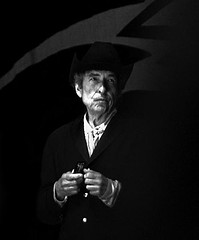
Looking for a direction hom.
Back in the early sixties a film appeared under the title: The Man Who Shot Liberty Valence. It was a Jewish fable clothed in Western Americana not unlike Bob Dylan’s lyrics.
The story line is about how to deconstruct one legend and reconstruct it to suit one’s purposes. The gist is that once a falsehood is enshrined as legendary truth it is impossible to debunk it. This film and notion was obviously for goyish consumption. As we know from experience a whole culture with a long history can be ‘debunked’ with minimal trouble if you control the media. Thus in fifty short years Americans have gone from being the most benevolent and generous people on Earth to the most destructive self-centered Nazi types. Furthermore Americans were conditioned to believe it about themselves. ‘Why do they hate us?’
The secret was contained in The Man Who Shot Liberty Valence. One of the primary agents of that change was the prophet, mystic ans seer, the very Jewish Bob Dylan. I left off poet because at best Dylan is merely an effective lyricist.
A San Francisco Bay Area fellow, Seth Rogovoy, has written an essay on Dylan with the above title without the question mark. Stephen Hazan Arnoff who is the executive directory of New York’s 14th St. YMHA has written a review of Rogovoy which he subtitles ‘Jerimiah, Nostradamus and Allen Ginsberg all Rolled Up Into One.’ High praise indeed, if unwarranted. Just as Mr. Arnoff inflates Dylan’s significance he grossly inflates that of the pornographic so-called poet, Allen Ginsberg. Perhaps it is time to use techniques learned from ‘Liberty Valence to debunk the reputation of Dylan.
Dylan is no prophet, he is merely topical using enigmatic phrasing to give the appearance of depth. There is little actual difference between the topical material of Dylan and Phil Ochs. Mr. Arnoff improbably writes:
(Dylan’s) prophetic persona is particularly resonant in his first few albums where songs like “Blowin’ In The Wind” and “The Times They Are a-Changin'” sets the gold standard for prophecy in popular music.
Prophecy in popular music? What’s that? Actually neither song is prophetic. ‘Blowin” actually refers to the past of Dylan’s youth in Hibbing although topically it has usually been extended to represent the then current civil rights activities in the South. ‘Times’ is merely a cocky know-it-all sneer at politicians who aren’t aware that the kids are alright, on the move, have a voracious apetite to eat them up. Both songs have borrowed tunes (no crime or even sin in my estimation) and, if Rogovoy is correct lyrics cribbed from the Bible.
As Mr. Arnoff notes, Rogovoy chooses a single critical lens- Judaism- for understanding Dylan and his work. No fault in an essay, pointing out the Jewish influence in Dylan’s work. Actually Mr. Rogovoy is no innovator or pathfinder, the same material has been adequately covered by numerous investigators including myself in a series of essays.
But Mr. Arnoff also notes there are other avenues to approach the songs that Mr. Arnoff believes are equally valid: Greil Marcus explains him as a mystic raconteur of the secret history of the United States, coded thorugh traditional music while Christopher Ricks describes a master interpreter of classical Western literature and thought.’ (cough, cough)
While Greil Marcus is another good Jewish boy I hardly think he is a responsible authority on anything. He takes roughly the same approach as Mr. A.J. Weberman while the latter is vastly more entertaining. I have to combine Mr. Marcus and Mr. Ricks. While I certainly respect Dylan’s intelligence and acumen I would have to question both the breadth and depth of his education.
Dylan attended high school in Hibbing, Minnesota which is a far cry from any of the leading cultural centers of either the Western or Eastern worlds. I grew up in a slightly larger town up North than Dylan although probably not much different than Hibbing intellectually. I keenly felt the lack of intellectual opportunites when I went out into the large world.
There is a question as to whether Dylan graduated from high school while he never attended college. Immediately immersing himself in folk music he left Minnesota for NYC. There he found people with libraries of which he availed himself while boarding with them. This was a very brief period during which he could only have picked up names and impressions such as he employed in his song Desolation Row. His girl friend Suze Rotolo introduced him to more culture than he could have imagined from 1961 to 1965. This could not have been much.
During that time Dylan spent a lot of time writing songs, drinking and drugging and touring. Not a lot of opportunity to become a ‘master interpreter of classical Western literature and thought.’ I have no idea what Mr. Arnoff means by ‘classical.’ I doubt seriously if Dylan is any authority on, say, the pre-Socratics. If Mr. Ricks believes as Mr. Arnoff represents him I would have to question Professor Ricks’ qualifications for his post. There’s something wrong there.
Now, as to Mr. Marcus and his mystic raconteur of the secret history of the US. What secret history? Dylan says he studied the ante-bellum South from newspaper accounts in the archives of the NYC library. This would have been over a couple of months only. As near as I can tell he did so with an enquiring and open mind and is fully capable of making cogent observations. This however is scarcely a secret history while being only one brief period and region.
What Dylan has done is immerse himself in the songs of the US. He says that when he visited Carl Sandburg it was with the itent to discuss Sandburg’s ‘American Song Bag.’ One certainly has to respect Dylan’s song knowledge and his excellent taste. This knowledge however is well beyond Mr. Marcus’ ability to understand. He, as far as I have been able to ascertain had nil knowledge of songs and music until he joined Rolling Stone Magazine in the late sixties.
Up in Hicksville Dylan immersed himself in every kind of music, without discrimination. He was fully conversant with Hillbilly as his native music. The Carter Family was a living entity to him and not an academic study. All those now obscure names were living legends to him and not mere footnotes at the bottom of a page. Thus while Dylan’s Jewish influences are prominent, uppermost and dominant he nevertheless has a foot in both cultures. His American culture is musical however, and what sounds like ‘a secret history’ to Mr. Marcus is merely the hillbilly interpretation of ‘revenuers’ ‘white lightning’ and such. I do not see Dylan as a ‘classically’ educated man.
Mr. Arnoff displays his Jewish bigotry when he says: Messianic Judaism (or Jews for Jesus) is the weakest form of interpretation for Dylan. So far as I know no one interprets Dylan’s work through the lens of Messianic Judaism. However it is equally apparent that Dylan was interested enough to study the topic carefully. That says more for Dylan’s open mindedness than Mr. Arnoff’s narrow minded bigotry. One must be ‘open minded’ n’est-ce pas?
As Mr. Arnoff notes, Dylan always said he was ‘a song and dance man’ and I think that says as much as need be said. Anyone who has been able to entertain a significant audience nearly fifty years now has to have a serious talent. One should bear in mind though that Dylan appeals to a relatively small and well-defined audience he himself defines as ‘the abused, misused, confused, strung out ones and worse.’ This is his core constituency to which he ‘kvetches.’ Apparently English isn’t good enough for Mr. Arnoff.
Dylan’s greatest song is Positively Fourth Street which is maximum kvetching. I considered myself abused and misused when I first heard the song. The lyrics had me slavering like one of Pavlov’s dogs when he heard the dinner bell ring. But, like Pavlov’s dog there wasn’t really anything on the plate. Once I passed through that phase of my psychology I lost interest in Dylan.
While Dylan has managed to retain, recruit and entertain his audience he is far from the man who shot Liberty Valence or Jeremiah, Nostrodamus and Allen Ginsberg all rolled up into one. I’m afraid that’s one legend that will be debunked before it’s formed.
Kvetcher or not I still can’t listen to him.
A Review: Part IV, She by H. Rider Haggard
December 4, 2009
A Contribution To The
ERBzine Library Project
A Review Of
SHE
by
H. Rider Haggard
Review by R.E. Prindle
Part IV and end:
Herself Portrayed

Model of She
The idea of a twenty-two hundred year old woman patiently waiting for the reincarnation of a man she had murdered in that far off time is in itself an extraordinary concept. As an imaginative flight of fancy very likely Rider Haggard can be seen as its originator. Burroughs would borrow the notion twenty-seven years later in his The Eternal Lover when he reverses the sexes and has a cave man asleep for millennia wake to find his reincarnated woman. Since then variations on the theme have become quite common.
She, or Ayesha, was a powerful image of a woman. C.G. Jung saw her as the personification of his Anima theory. Haggard drew on many personal and historical details to create her. Ayesha was titled She-Who-Must-Be-Obeyed. As a child Haggard had a doll to which he gave that name. The doll must have represented his mother. If he invested characteristics of his mother into Ayesha then she must have been both warm and loving and cold and imperious. Over all one gets the impression that she was not particularly loving. Thus, Ayesha, while appearing to be in love with Leo/Kallicrates is nevertheless imperious, demanding and self-centered. In her only real display of afftection she kisses Leo on the forehead, as Haggard says, like a mother. As Haggard says of Meriamun in The World’s Desire, her love was not so much for her lover but an expression of her own vanity.
Haggard represents her as a living corpse in white funereal garments, completely shrouded. She has a strange accoutrement in the serpent belt with two heads facing each other. This is close to the caduceus. Perhaps Haggard had no idea of what the symbol meant in 1886 but by 1890 he had come up with an explanation. In The World’s Desire of that year Queen Meriamun of Egypt keeps something she calls the Ancient Evil in a box. The Evil is a small blob. When she warms it in her bosom it grows. World’s Desire pp. 144-45:
Thrice she breathed upon it, thrice she whispered, “Awake! Awake! Awake!”
And the first breath she breathed the Thing stirred and sparkled. The second time that she breathed it undid its shining folds and reared its head to her. The third time that she breathed it slid from her bosom to the floor, then coiled itself about her feet and grew as grows a magician’s magic tree.
Greater it grew and greater yet, and as it grew it shone like a torch in a tomb, and wound itself about the body of Meriamun, wrapping her in its fiery folds till it reached her middle. Then it reared its head on high, and from its eyes there flowed a light like the light of a flame, and lo! its face was the face of a fair woman- it was the face of Meriamun!
Now face looked on face, and eyes glared on eyes. Still as a white statue of the Gods stood Meriamun the Queen, and all about her form and in and out of her dark hair twined the flaming snake.
At length the Evil spoke- spoke with a human voice, with the voice of Meriamun, but in the dead speech of a dead people!
“Tell me my name,” it said.
“Sin is thy name,” answered Meriamun the Queen.
“Tell me whence I came.” it said again.
“From the evil within me.” answered Meriamun.
“Tell me where I go.”
“Where I go there thou goest, for I have war and thee in my breast and thou art twined about my heart.”
This quote gives an idea of what the snake belt worn by Ayesha signifies.
Of signficance while Meriamun is dealing in magic Ayesha denies all connection with the art saying she utilizes nature. She doesn’t use the word science but nature; nature would include psychology. She therefore draws on natural processes discovered but not scientific processes exposed. Thus when she kills her rival Ustane she does it by utilizing electro-magnetism, somehow using her own electro-magnetism to negate Ustane’s thus extinguishing her life force. We have then an example of tele-kinesis- action at a distance. As I’ve noted in other essays tele-kinesis was amongst an array of mental powers thought to reside in the unconscious being investigated by the Society For Psychical Research. Thus Haggard, probably through Lang, is up on the latest psychic developments.
Ursula Andress As She
The ability to kill by telekinesis places a moral burden on Ayesha. If one agrees that the use of such a power may be necessary the question arises of when it may be misused. It would seem that the killing of a sexual rival was an inappropriate use, so the warring good and evil heads of her snake belt refers to the moral dilemma Ayesha faces.
Her belt seems somewhat different than that of Queen Meriamun of The World’s Desire. The latter having accepted the aid of the Ancient Evil was committed to evil being unable to remove the belt. There seems to be an element of volition remaining to Ayesha. She is not ‘possessed.’ Of course Ayesha began her life some thousand years after Meriamun so perhaps psychology was somewhat further evolved at that time or evolved with her over her two thousand year life span.
Indeed, a topic of discussion Haggard introduces shouldn’t be dimissed lightly. That topic is the age old discussion of whether good can come from evil and evil from good. This is indeed a dilemma as bad results can arise from good intentions and vice versa. There is a serious side here.
Ayesha is pure irresistable beauty. Once she shows her face no man can resist her. She glories in this power. In The World’s Desire of four years hence Haggard will separate good and evil making Meriamun represent evil while Helen, the world’s desire, is all good.
Holly is an interesting character who may be a back hand slap at the concept of evolution. Holly also makes this the story of a beauty and a beast. Holly is described as having a low forehead with a hairline growing out of his eyebrows, further his beard and his hairline meet. He is said to have a hugely broad chest and shoulders with extra long arms, perhaps down to his knees although this is not stated. What we have in Holly then is the Wolf Man combined with King Kong. Monstrous indeed.
In contrast Leo Vincey is a Greek god, a sort of Apollo. As Ayesha is irresistable to men Leo seems likewise to be irresistable to women. Indeed, he was married to Ustane within minutes of arriving in Kor. He appears to have sincerely liked Ustane even though on sighting Ayesha’s face he too loved her. Ustane was a rival for a portion of Leo’s affections so Ayesha cut off her electrical supply.
Of several truly dramatic scenes in this spectacularly well constructed story a very dramatic one is when Leo confronts his twenty-two hundred year old incarnation 0f Kallicrates. Haggard doesn’t dwell on Leo’s understanding of this strange phenomenon although from the potsherd and his father’s letter he must have been convinced of the truth. Strangely he doesn’t ask Ayesha for an account of this earlier life, nor how it was that she came to Egypt from Yemen to interfere in his romance with Amenartas.
Haggard and Lang were aware of the early history of Yemen from whence Ayesha as a pure Semite came. She was pre-Christian, although not pre-Jewish, of some ancient Arabic religious beliefs. How she got to Egypt is never disclosed or how she came into conflict with the Egyptian princess Amenartas for Kallicrate’s affections.
Ayesha, by the way the name translates as Life, merely confronts Leo as the neo-Kallicrates without any preparation. A year or so to get to know her and become accustomed to her face might have been nice. Although, Leo was married within minutes of arrival in Kor and was apparently satisfied with his wife. He was a pretty adaptable guy.
At any rate Ayesha rushes him into immortality and while tomorrow may be a long, long time, eternity is even longer. One might want to consider a moment about a relationship of that duration. Nor does she adequately prepare Leo’s mind for the ordeal of fire that she wants him to go through to become immortal. Twenty-two hundred years of waiting had done little to improve her patience.
Haggard has put everything he has into this story. He was granted clear vision only once in his life and he took advantage of it. In later years he was frequently asked why he didn’t write another story as good as She. His reply was that such a story may only come once in a man’s lifetime. The concentration and focus probably will never return again. While Allan Quatermain, his third successive attempt to create a lost civilization was on the weak side I would argue that his last, Treasure of the Lake, comes close to She.
So, the four of them set out for the place of the fire of life. Masterful effects. High in the mountains there is a gigantic balancing rock, a huge mushroom type cap balanced on a spire. It would seems that Zane Grey was also greatly affected by She as Riders Of The Purple Sage hews very close to She. A narrow ledge of rock extends out opposite with a gap of fifteen feet. To cross this gap with high winds howling through, a plank carried by the ever patient Job has to be lowered across the gap. No mean task I’m sure, with only one chance of getting it right. Once in place, thousands of feet above the gorge each has to walk from side to side; plus they have only a few minutes for all four to get over during a single beam of light from the setting sun.
Fortunately all four make it crossing the balancing rock to descend into a cave leading to the bowels of the mountain. There an eternal flame that ensures the life of the planet rumbles by every so often. Twenty-two hundred years before Ayesha had bathed in this fire which following esoteric doctrines had burned away her gross, earthly, moral impurities making her essentially, pure spirit.
A famous incident of the process is recounted of the goddess Demeter in her travels after the abduction of her daughter Persephone by Hades. Coming to Eleusis Demeter in her form of an old crone was taken in by King Celeus and his wife Metaneira. As a reward for her kind treatment Demeter set about to make their infant son Demophon immortal. Thus each night she held him over the hearth fire to burn away his mortal impurities. Surprised one night by a startled mother, Metaneira, the process was disrupted so that Demophon retained mortal impurities and failed to attain to godhood.
In this sense then the fire that maintained the life of the Earth traveled a route through this mountain at the center of the Earth. It appeared something like Old Faithful at Yellowstone periodically. When it swept by, if one stood in the flame it burned away one’s mortal impurities leaving one, it is to be assumed, wholly Spiritual. All the materiality was gone.
Spirituality and materiality are still being discussed today. Some talk of Spirit as though it exists while the materialists aver that all so-called spirituality is a seeming effect of materiality. I am of the latter school of thought. Oneself is all there is, there is nothing more. The effect of spirituality is nothing more than a mirage created by intellect and consciousness which is entirely material. It is all reduced to psychology which is a description of material existence.
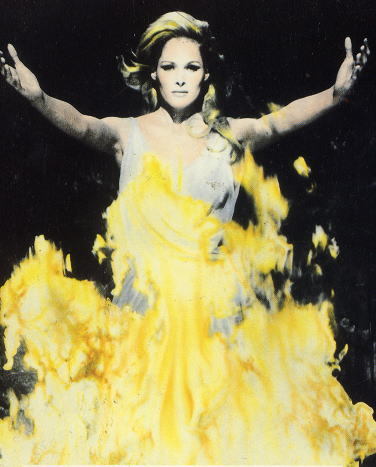
Come To Me
In Haggard’s story it is clear that Ayesha having lost her materiality to the flames is purely spiritual. This is going to cause her problems as she steps into the flames the second time.
The flame passes by while Leo dithers. Impatient for Leo to assume immortality Ayesha strips, as the flames will flame the material garments about her but not her body. As the flame comes around again Ayesha eagerly stands in its way. However having been once purified it is good for eternity. The second time is disastrous. Perhaps spiritually dessicated by the double dose Ayesha begins to wither devasted even in her death throes by her loss of beauty. Love in vain.
Job is so horrified he dies of fright leaving Leo and Holly alone.
The story for all intents is over but Haggard takes a dozen pages or so to get his heroes out of the caves and back to civilization.
Ayesha’s existence wasn’t extinguished. Her dying words were that She would return. Room left for the sequel which not surprisingly was called The Return Of She appeared in 1906.
Haggard hit the groove sharp as a knife in this incredibly well devised and executed story. One will find evidences of it strewn all through Burroughs’ corpus. Not least in his own character of La of Opar. La itself translates from the French as She, of course, so Burroughs even appropriates the name.
La is as ardent for Tarzan as She was for Leo/Kallicrates. Tarzan himself remains cold and indifferent to La throughout all four Opar stories finally abandoning her in Tarzan The Invincible.
She by Haggard is well worth three or four reads to set the story in mind and savor the wonderful and unearthly details
The End.
End of Review
A Review: Part II She By H. Rider Haggard
November 20, 2009
A Contribution To The
ERBzine ERB Library Project
She
by
H. Rider Haggard
Review by R.E. Prindle
From London To The The Caves Of Kor
She is dedicated to Andrew Lang:
I Inscribe This History To
ANDREW LANG
In Token Of Personal Regard
And Of
My Sincere Admiration For His Learning
And His Works
One may well ask then who is this Andrew Lang and what is his learning? In point of fact Haggard not only dedicated She to Lang but wrote three books in collaboration with him. Andrew Lang, 1884-1912, was a Scottish scholar specializing in folklore, mythology and religion so you can see where Haggard came by much of his esoteric knowledge. In addition Lang was one of the founding members of the Society For Psychic Research and a past-President. Lang wrote dozens of books over his lifetime. He even wrote a parody of She in 1887 called He. Today he is remembered only for his collections of fairy tales. Twelve volumes in all each titled after a color such as The Crimson, or Blue or Pink or Gray Fairy Book. The volumes are undergoing a fair revival now with a collector’s edition published by Easton Press and several nicely bound volumes by the Folio Society.
The nineteenth century was the one in which advanced knowledge of the past was rapidly extending European knowledge greatly. The Rosetta Stone deciphering Egyptian hieroglyphics had been achieved as recently as the 1830s. Nineveh and the Assyrian ruins had been unearthed. Schlieman had discovered the locations of Troy and Mycenae.
The exoteric side was covered by the academics while the esoteric side was covered by independent scholars like Madame Blavatsky and probably Andrew Lang. There was a clean split between the academic Patriarchal view of ancient history and the emerging Matriarchal view that had just been developed by the Swiss mythologist, J.J. Bachofen. Bachofen organized ancient history into Hetaeric, Matriarchal and Patriarchal periods. He himself was a member of the successor Scientific period.
The academics totally rejected the notion of a Matriarchal period. This, of course, led to a complete inability to understand Homer, both Iliad and Odyssey. The Iliad especially is a description of the war by the Patriarchy to destroy Matriarchy.
Lang seems to have understood the Matriarchal phase of ancient history. He must have passed this knowledge on to Haggard. Ayesha, as She, rules a Matriarchal society. While the ideas represented in She must have seemed bizarre or merely an amusing reversal of the Patriarchal world at the time, today it all reads comprehensibly. It rings true if not exact.
C.G. Jung, the psychologist, who developed such notions as the male Anima and the Shadow was very immpressed by what he saw as the male Anima in She. Madame Blavatsky lauded the book for its esoteric content. But then, Haggard was firing on all eight cylinders when he wrote it, it is difficult to conceive of a more perfect fantasy/adventure novel. Indeed Haggard subtitles the novel: The History Of An Adventure.
Haggard was an excellent Egyptian scholar. He not only visualized Egypt convincingly in his Egyptian novels but his Egyptian ideas pervade the African novels. Many of them involve Egyptian influences and even peoples filtering down into East and Central Africa. The Ivory Child is a case in point as is She.
The set up to the trip out is brilliant incorporating details that become cliches in B movies.
Leo Vincey’s father before he died gave a metal box to Leo’s guadian, Horace Holly, that wasn’t to be opened until Leo was twenty-five. This box is now opened. It contained a letter to Leo, a potsherd (a piece of a broken jar) covered with ‘uncial’ Greek lettering, a miniature and a scarab containing Egyptian hieroglyphics that read ‘Royal Son of the Sun.’
Thus Haggard captured most if not all of the elements that went into the intellectual aura fostered by B moves primarily in the first years of the talkies through the thirties. That entailed things like the Curse of the Pharaohs, movies like The Mummy melding into Wolf Man, Dracula, Frankenstein and African juju spells. Things against which Europeans had no defense because the ancient magic was stronger than modern science, or so we were led to believe. I can’t speak for others but it took me a while to shake this oppressive spirit. This was pretty strong stuff for my ten to twelve year old brain. Not to mention being bombarded by The Creature From The Black Lagoon, The Thing and The Day The Earth Stood Still. We wuz tried in the fire and come through good.
The gist of it is that Leo’s ancestor Kallicrates lived in the time of the last Pharaoh Nectanebo as one of the royal family. Spookier still Nectanebo was said to have fled Egypt before the conquering hordes, going to Macedon where he secretly impregnated Olympia, Philip’s wife, who then gave birth to Alexander which made him the rightful heir to the Pharaohship instroducing Greeks as rulers into his city of Alexandria.
At any rate Kallicrates girl friend, Ayesha, killed him in a jealous rage. The family nursing vengeance for all these two thousand years it is Vincey’s mission if he chooses to accept it, to follow the ancient map to the Caves of Kor and kill Ayesha or, She-Who-Must-Be-Obeyed who has been nursing regrets over killing Kallicrates two thousand years previously. Listen to me, I’m tellin’ ya it’s all here.
So Vincey, Holly and their man Job set out to find this place in Africa even more remote, if possible, than King Solomon’s Mines. And a heck of a lot more hostile too.
The trip out is some of Haggard’s finest writing. They are to be looking for a rock formation on the coast in the shape of a gorilla’s head. Sailing the coast they miraculously spot this head just as a terrific squall sends their felucca, dhow or other exotic ship from foreign climes to the b ottom.
But, even though the ship sinks they beat the reaper because they brought a boat containing unsinkable water tight compartments. As the storm subsides the three survivors along with an Arab float into the mouth of the appropriate stream as though it were all foreordained. What follows is some excellent writing with details I don’t need to recount.
Suffice it to say they are dragging their boat along an ancient canal when they are accosted by men from Kor. Ordinarily these guys would have speared them and moved on, no strangers needed in Kor. Using her magic She had learned of Leo’s coming a week previously thus ordering their lives spared while they were to be brought to her. Uh huh.
The detailing is terrific, this book is tight and well organized. It moves right along. The land is under the thumb of She-Who-Must-Be-Obeyed. This is a tight Matriarchy as we now recognize not just some strange place where a woman is in charge.
While the three are entering the Caves of Kor, Leo Vincey, being the cynosure of all female eyes, a knockout named Ustane steps up and kisses him. Not averse to a public display of affection Leo lays one on her back. New to the area and not aware of the customs of the place Leo had just accepted Ustane as his woman. In town for a few minutes and already married. That’s the way things happen in this particular Matriarchy. Ustane is now in conflict with Ayesha, She-Who-Must-Be-Obeyed.
The stage is now set for the main drama when Ayesha recognizes Leo as her long lost Kallicrates come back from all those reincarnations at last.
The exoteric Catholic Church is thus thrust aside in favor of all the heretical doctrines of the esoteric which have been bubbling under the Hot 100 for two thousand years. These unfamiliar esoteric doctrines would become the mainstay and staple of science fiction/fantasy for the next one hundred years.
Just as an example of how Burroughs probably learned esoterica, I became familiar with estoeric themes myself from reading 1950s science fiction and fantasy- Amazing Stories, William Tenn, Robert Heinlein, Ray Bradbury and all that sort of stuff without realizing what I was taking in, thus Burroughs surrounded by the Society for Psychical Research, Camille Flammarion, George Du Maurier and Stevenson et al. naturally learned the esoteric language. No mystery, he was speaking in tongues before he knew it.
Leo is awaiting the summons from Ayesha which will be covered in Part III.
Themes And Variations
The Tarzan Novels Of Edgar Rice Burroughs
#5 Tarzan And The Jewels Of Opar
Part V
by
R.E. Prindle
Texts:
Du Maurier, George: Peter Ibbetson
Dudgeon, Piers: Captivated: J.M. Barrie, The Du Mauriers & The Dark Side Of Neverland, 2008, Chatto And Windus
Hesse, Herman: The Bead Game
Neumann, Erich: The Origins and History Of Consciousness, 1951, Princeton/Bollingen
Vrettos, Athena: “Little Bags Of Remembrance: Du Maurier’s Peter Ibbetson And Victorian Theories Of Ancestral Memories” Erudit Magazine Fall 2009.
While it is today commonly believed that Sigmund Freud invented or discovered the Unconscious this is not true. As so happens a great cataclysm, The Great War of 1914-18, bent civilization in a different direction dissociating it from its recent past.
Studies in the earlier spirit of the unconscious continued to be carried on by C.G. Jung and his school but Freud successfully suppressed their influence until quite recently actually. Through the fifties of the last century Freud’s mistaken and harmful, one might say criminal, notion of the unconscious held the field. Thus there is quite a difference in the tone of Edgar Rice Burroughs writing before and after the 1917 Bolshevik Revolution.
There are those who argue that Burroughs was some kind of idiot savant who somehow knew how to write exciting stories. In fact he was a well and widely read man of varied interests who kept up on intellectual and scientific matters. He was what might be called an autodidact with none of the academic gloss. He was very interested in psychological matters from hypnotism to dream theory.
The scientific investigation of the unconscious may probably be dated to the appearance of Anton Mesmer and his interest in hypnotism also variously known as Mesmerism and Animal Magnetism. The full fledged investigation of the unconscious began with hypnotism. Slowly at first but by the last quarter of the nineteenth century in full flower with varied colors. Science per se was a recent development also flowering along with the discovery of the unconscious.
While Charles Darwin had brought the concept of evolution to scientific recognition in 1859 the key discipline of genetics to make sense of evolution was a missing component. It is true that Gregor Mendel discovered the concept of genetics shortly after Darwin’s Origin Of Species was issued but Mendel’s studies made no impression at the time. His theories were rediscovered in 1900 but they were probably not widely diffused until after the Great War. Burroughs knew of the earlier Lamarck, Darwin and Mendel by 1933 when he wrote Tarzan And The Lion Man. His character of ‘God’ is the result of genetic mutation.
Lacking the more complete knowledge of certain processes that we have today these late nineteenth century speculators seem ludicrous and wide of the mark but one has to remember that comprehension was transitting the religious mind of the previous centuries to a scientific one, a science that wasn’t accepted by everyone then and still isn’t today. The Society For Psychical Research sounds humorous today but without the advantage of genetics, especially DNA such speculations made more sense except to the most hard nosed scientists and skeptics. The future poet laureate John Masefield was there. Looking back from the perspective of 1947 he is quoted by Piers Dudgeon, p. 102:
Men were seeking to discover what limitations there were to personal intellect; how far it could travel from its home personal brain; how deeply it could influence other minds at a distance from it or near it; what limits, if any, there might be to an intense mental sympathy. This enquiry occupied many doctors and scientists in various ways. It stirred George Du Maurier…to speculations which deeply delighted his generation.
Whether believer or skeptic Burroughs himself must have been delighted by these speculations as they stirred his own imagination deeply until after the pall of the Revolution and Freud’s triumph.
Burroughs was subjected to dreams and nightmares all his life. Often waking from bad dreams. He said that his stories were derived from his dreams but there are many Bibliophiles who scoff at this notion. The notion of ‘directed dreaming’ has disappeared from popular consideration but then it was a serious topic. Freud’s own dream book was issued at about this time. I have already reviewed George Du Maurier’s Peter Ibbetson on my blog, I, Dynamo and on ERBzine with Du Maurier’s notions of ‘Dreaming True’. It seems highly probable that Burroughs read Ibbetson and Du Maurier’s other two novels so that from sometime in the nineties he would have been familiar with dream notions from that source.
Auto-suggestion is concerned here and just as support that Burroughs was familiar with the concept let me quote from a recent collection of ERB’s letters with Metcalf as posted on ERBzine. This letter is dated December 12, 1912.
If they liked Tarzan, they will expect to like this story and this very self-suggestion will come to add to their interest in it.
Athena Vrettos whose article is noted above provides some interesting information from Robert Louis Stevenson who developed a system of ‘directed dreaming’ i.e. auto-suggestion. We know that Burroughs was highly influenced by Stevenson’s Dr. Jekyll And Mr. Hyde while he probably read other novels of Stevenson. How could he have missed Treasure Island? Whether he read any of Stevenson’s essays is open to guess but in an 1888 essay A Chapter On Dreams Stevenson explained his method. To Quote Vrettos:
Rather than experiencing dreams at random, fragmented images and events, Stevenson claims he has learned how to shape them into coherent, interconnected narratives, “to dream in sequences and thus to lead a double life- one of the day, one of the night- one that he had every reason to believe was the true one, another that he had no means of proving false.” Stevenson describes how he gains increasing control of his dream life by focusing his memory through autosuggestion, he sets his unconscious imagination to work assisting him in his profession of writer by creating “better tales than he could fashion for himself.” Becoming an enthusiastic audience to his own “nocturnal dreams”, Stevenson describes how he subsequently develops those dreams and memories into the basis for many of his published stories, most notably his 1886 Dr. Jekyll And Mr. Hyde.
Now, directed dreaming and Dreaming True sound quite similar. One wonder if there was a connection between Stevenson and Du Maurier. It turns out that there was as well as with nearly the entire group of English investigators. Let us turn to Piers Dudgeon again, p. 102:
Shortly after they met, the novelist Walter Besant invited [Du Maurier] to join a club he was setting up, to be named ‘The Rabelais’ after the author of Gargantua and Pantagruel. Its name raised expectations of bawdiness, obscenity and reckless living, (which were not in fact delivered) as was noted at the time. Henry Ashbee, a successful city businessman with a passion for pornography, and reputed to be Robert Louis Stevenson’s model for the two sides of his creation, Dr. Jekyll And Mr. Hyde, denounced its members as ‘very slow and un-Rabelaisian’, and there is a story that Thomas Hardy, a member for a time, objected to the attendance of Henry James on account of his lack of virility.
Virility was not the issue however. The members of the Rabelais were interested in other worlds. Charles Leland was an expert on fairy lore and voodoo. Robert Louis Stevenson was the author of The Strange Case Of Dr. Jekyll And Mr. Hyde (1886) which epitomized the club’s psychological/occult speculations. Arthur Conan Doyle, who became a member of the British Society For Psychical Research, was a dedicated spiritualist from 1916. Henry James was probably more at home than Hardy, for both his private secretary Theodora Besanquet, and brother William, the philosopher, were members of the Psychical Society.
In many ways the Rabelais was a celebration that [Du Maurier’s] time had come. Parapsychological phenomena and the occult were becoming valid subjects for rigorous study. There was a strong feeling that the whole psychic scene would at any moment be authenticated by scientific explanation.
Du Maurier was obviously well informed of various psychical ideas when he wrote Ibbetson. In addition he had been practicing hypnosis since his art student days in the Paris of the late 1850s.
So this was the literary environment that Burroughs was growing up in. As Bill Hillman and myself have attempted to point out, ERB’s mental and physical horizons were considerably broadened by the Columbian Expo of 1893. Everything from the strong man, The Great Sandow, to Francis Galton’s psychological investigations were on display. The cutting edge of nineteenth century thought and technology was there for the interested. Burroughs was there for every day of the Fair. He had time to imbibe all and in detail. The Expo shaped his future life. That he was intensely interested in the intellectual and literary environment is evidenced by the fact that when he owned his stationery story in Idaho in 1898 he advertised that he could obtain any magazine or book from both England and America. You may be sure that he took full advantage of the opportunity for himself. As this stuff was all the rage there can be no chance that he wasn’t familiar with it all if he didn’t actually immerse himself in it. Remember his response to Kipling’s The White Man’s Burden was instantaneous. Thus you have this strange outpost of civilization in Pocatello, Idaho where any book or magazine could be obtained. Of course, few but Burroughs took advantage of this fabulous opportunity. It should also be noted that he sold the pulp magazines so that his interest in pulp literature went further back than 1910.
In addition ERB was enamored of the authors to the point of hero worship much as musical groups of the 1960s were idolized so he would have thirsted for any gossip he could find. It isn’t impossible that he knew of this Rabelais Club. At any rate his ties to psychology and the occult become more prominent the more one studies.
It seems to me that longing as he did to be part of this literary scene, that if one reads his output to 1920 with these influences in mind, the psychological and occult content of, say, the Mars series, becomes more obvious. He is later than these nineteenth century lights so influences not operating on them appear in his own work making it more modern.
At least through 1917 the unconscious was thought of as a source of creativity rather than the source of evil impulses. If one could access one’s unconscious incalculable treasures could be brought up. Thus gold or treasure is always depicted in Burroughs’ novels as buried. The gold represents his stories, or source of wealth, brought up form his unconscious. The main vaults at Opar are thus figured as a sort of brain rising above ground level. One scales the precipice to enter the brain cavity high up in the forehead or frontal lobe. One then removes the ‘odd shaped ingots’ to cash them in. Below the vaults are two levels leading back to Opar that apparently represent the unconscious. Oddly enough these passageways are configured along the line of Abbot’s scientific romance, Flatland.
In Tarzan And The Jewels Of Opar the gold is taken to the Estate and buried replicating the vaults. Once outside Opar and in circulation, so to speak, the ingots are accessible to anyone hence the duel of Zek and Mourak for them. The first gold we hear of in the Tarzan series is brought ashore and buried by the mutineers. This also sounds vaguely like Stevenson’s Treasure Island. The watching Tarzan then digs the gold up and reburies it elsewhere. In The Bandit Of Hell’s Bend the gold is stolen and buried beneath the floorboards of the Chicago Saloon. Thus gold in the entire corpus is always from or in a buried location. These are never natural veins of gold but the refined ingots.
Not only thought of as a source of treasure during this period the unconscious was thought to have incredible powers such as telekinesis, telepathy and telecommunication. One scoffs at these more or less supernatural powers brought down from ‘God’ and installed in the human mind. As they have been discredited scientifically Western man has discarded them.
On the other hand Western Man deludes himself into accepting the oriental Freud’s no less absurd assertion that the unconscious exists independently of the human body somewhat like the Egyptian notion of the ka and is inherently evil while controlling the conscious mind of the individual. This notion is purely a religious concept of Judaism identifying the unconscious as no less than the wrathful, destructive tribal deity of the old testament Yahweh. Further this strange Judaic concept of Freud was allowed to supersede all other visions of the unconscious while preventing further investigation until the writing of C.G. Jung were given some credence beginning in the sixties of the last century.
In point of fact there is no such unconscious. The supernatural powers given to the unconscious by both Europeans and Freud are preposterous on the face of it. For a broader survey of this subject see my Freud And His Vision Of The Unconscious on my blogsite, I, Dynamo.
This so-called unconscious is merely the result of being born with more or less a blank mind that needs to be programmed. The programming being called experience and education. The maturation and learning process are such that there is plenty of room for error. All learning is equivalent to hypnosis, the information being suggestion which is accepted and furthers the development of the individual. Learning the multiplication tables for instance is merely fixing them in your mind or, in other words, memorizing them. All learning is merely suggestion thus it is necessary that it be constructive or education and not indoctrination or conditioning although both are in effect. Inevitably some input will not be beneficial or it may be misunderstood. Thus through negative suggestion, that is bad or terrifying suggestions, fixations will result. A fixation is impressed as an obsession that controls one’s behavior against one’s conscious will, in the Freudian sense. The fixation seems to be placed deep in the mind, hence depth psychology. Thus when ERB was terrified and humiliated by John the Bully certain suggestions occurred to him about himself that became fixations or obsessions. These obsessions directed the content of his work.
To eliminate the fixations is imperative. This is what so-called depth psychology is all about. The subconscious, then, is now ‘seprarated’ from the conscious, in other words the personality or ego is disintegrated. The goal is to integrate the personality and restore control. Once, and if that is done the fixations disappear and the mind become unified, integrated or whole; the negative conception of the unconscious is gone and one is left with a functioning conscious and subconscious. The subconscious in sleep or dreams then reviews all the day’s events to inform the conscious of what it missed and organize it so that it can be acted on. No longer distorted by fixations, or obsessions, the individual can act in his own interests according to his abilities. The sense of living a dream life and a real life disappears.
That’s why experience and education are so important. What goes into the mind is all that can come out.
But, the investigation of the unconscious was blocked by Freudian theory and diverted from its true course to benefit the individual in order to benefit Freud’s special interests.
So, after the War ERB forgot or abandoned the wonderful notions of the unconscious and was forced to deal with and defend himself against Freudian concepts. The charactger of his writing begins to change in the twenties to meet the new challenges of aggressive Judaeo-Communism until by the thirties his work is entirely directed to this defense as I have shown in my reviews of his novels from 1928 to 1934.
Tarzan And The Jewels Of Opar then reflects this wonderful vision of the subconscious as portrayed by George Du Maurier and Robert Louis Stevenson
Then the grimmer reality sets in.
End Of Review.
 I, Dynamo