Exhuming Bob Chronicles IX Pensees 8: New Morning
July 23, 2008
Exhuming Bob:
Chronicles IX, Pensees 8:
New Morning
by
R.E. Prindle
The chapter New Morning opens with an interesting comparison. Bob had just returned to Woodstock after his father’s funeral in the summer of 1968. The association of New Morning with the death of his father in itself presents an interesting psychological mental state. A letter was waiting for him from who he considers one of the three great American poets, Archibald MacLeish. MacLeish was just coming off his Broadway triumph J.B. In the letter he asks Bob and Sara to call on him in his Connecticut home to discuss a musical collaboration on his new play. A jewish father dies; a goy ‘father’ appears.
As Bob explains, Father Abram is somewhat dull, thinking that an artist must be a painter. The notion seems to be that Bob is slightly ashamed of his father for not understanding the distinction between pictures and the artistic soul. Thus contrasting with dull Abram is the brilliant intellectual poet-artist, Archibald MacLeish. Bob is quickly on intimate terms referring to the Poet Laureate of America as Archie.
If you’ve never read Poe’s last story Landor’s Cottage you might like to compare that description to Bob’s of MacLeish’s home. While we never meet Poe’s Landor Bob does introduce us to Archie. Coming from small town Hibbing Bob seems to be overwhelmed by the splendor of MacLeish’s dwelling place. Sure sounded good to me. So as Bob left Abram at the rosy fingered Dawn of his New Morning, MacLeish presents himself as the sun rising above the horizon. But it’s a Black Sun. MacLeish does not walk on the sunny side of the street. He’s dark, as anyone who writes a play commentary on the Book of Job must necessarily be.
His new play is called Scratch. One presumes after Old Scratch, The Devil. Bob quotes some lines of Archie’s character Scratch, p.124:
I know there is evil in the world- essential evil, not the opposite of good or the defective of good but something to which good itself is an irrelevance- a fantasy. No one can live as long as I have, hear what I have heard and not know that. I know too- more precisely- I am ready to believe that there may be something in the world-someone, if you prefer- that purposes evil, that intends it…powerful nations suddenly, without occasion, without apparent cause…decay. Their children turn against them, their families disintegrate.
The strength of the insight is too strong for Bob at that precise psychological moment but Archie has given him a hint of a reality that Bob will realize all too soon. Perhaps in reference to Abe and Archie Bob meets Frank Sinatra Jr. at the Rainbow Room. Frank, Jr. nursing one of the same travails as Bob asks him after discussing Frank Sr.: What do you do when that father turns out to be a son-of-a-bitch.
Well, yes, you’ve got an identity problem, don’t you? Bob has always had an identity problem. What started out bad has taken a turn for the worse. He wanted to be Bob Dylan but now being Bob Dylan has turned out to be a son-of-a-bitch, a burden Bob…well, just plain Bob, cant’ bear. He’s learning about this inherent evil of life Archie is talking about.
If you’ve never experienced what Bob is telling you it will be hard to understand. I’ve suffered through a mild dose of them blues, enough to give me understanding, but nothing compared to Bob. He wakes up and someone is standing in his bedroom watching he and Sara sleep. That gives you a start. But if Bob thought he had identity problems what kind of problems does some poor fish have who literally wants to get inside your skin have. Walk a mile in your shoes like Toby. Everybody want something from you that you don’t have to give. And I mean something. You by your success have emasculated them, Bob’s success. So they in turn want your dick and balls. They want ot carry them around in their pocket to give them what they lack. ‘Hey, you know what I’ve got in my pocket, look, Bob Dylan’s dick and balls.’
You want to know what emasculation is? Bob tells you. The Sheriff of Woodstock tells him that if someone is scrambling over his roof and falls off Dylan will be legally responsible. That does something to your mind. The Sheriff tells Bob that if any of these crazies attack him and he defends himself he’ll be the guy going to jail. That one sends a few synapses seeking new routes through the brain. That one did happen to me. Might as well have left the planet, the Sheriff just took your dick and balls.
Bob is now learning first hand of the evil in Archie’s world. Damn that’s rough.
Even then Bob couldn’t make his lyrics dark enough for Archie although, now this is funny, Bob did use them in his album New Morning. What does that say about a new morning?
Bob just couldn’t get used to being Bob Dylan. Being Bob was OK but being Bob Dylan was tough. They were everywhere. You couldn’t even run much less hide.
As Bob tells us he was riding down the highway with Robbie Robertson when Robbie asked him: ‘Where are you going to take it now?’ ‘Take what?’ Bob asks in return. ‘Pop music.’ Robbie naively replies.
Bob is flabbergasted but who can blame Robbie? For the last six years Bob had been calling the shots, getting booed and selling records, renovating and reinvigorating folk music, taking folk music electric, electrifying rock. Why shouldn’t Robbie think something mega revolutationary was brewing in Bob’s brain? Being Bob was easy, being Bob Dylan was damn near impossible. Those three fathers, Abe, Archie and Frank Sr. Bob was learning something about the inherent evil of living.
His new mentor, Archie, thinking perhaps that Bob was Bob Dylan pushes him to sharpen and darken the lyrics to the songs he’s written for Archie. Bob just like after Blonde On Blonde has taken it as far as it can go. He opts out on Archie. Two fathers down but there’s still that Big Guy In The Sky but that Bob will seek a little farther down the road.
New Morning was a good chapter. I could empathize. Current events are giving me a new slant on the inherent evil in the world too. Heads up.
Picturing Greil Marcus
July 20, 2008
Picturing Greil Marcus
by
R.E. Prindle
What polluted wretches would the next glance show…
Greil Marcus
…using the novel technique of occupying one building, and then, when the police arrived, filing out, only to seize another building, and then another, and another- Berkeley radicals called on their fellows to “Do a Columbia”; not for any reason, not in the face of any injustice or insult, but for the lack of anything better to do.
Greil Marcus
Greil looks down his nose at us.
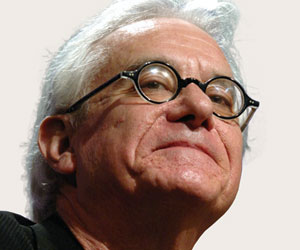
Greil Marcus is among us like some IT that came from outer space or conversely like some Creature From The Black Lagoon arising all dripping and encrusted with slime, like some Blob. And what does he want from us?
The fellow can’t genuinely be that unhappy. He was raised by a multi-millionaire San Francisco attorney by the name of Gerald Marcus. There are some conflicts in Gerald Marcus’ history. He made big money form ‘good’ causes thereby attaining a certain smugness as a defender of the downtrodden. Mr. Marcus made his millions representing various farm unions thereby combining greed with ‘benevolence.’
Using his magnificent income he provided young Greil with what now must be a multi-million dollar home next to Atherton on the Peninsula, one of the most prestigious locations in California if not top of the list. Upon graduation from high school Greil had a ready made admittance to UC- Berkeley thanks to his father’s prominence in the Boalt Law School of that insitution.
Thus at the age of twenty-one or twenty-two young Greil stepped out into the world armed cap-a-pie to begin the battle of life. No deprivation there; who could ask for more? Indeed, many of us would have settled for less and thought we were doing well.
Indeed, Amerikka, as Greil has spelled it, showed the fairest of faces to our young hero. He didn’t even have to get a paying job; he could continue to play supported, one assumes, by his step-daddy’s millions. Greil went across the big Bay Bridge to San Francisco and took a play job at Rolling Stone Magazine that started up about the time he graduated. It wasn’t a job that paid a living wage but then Greil had time. He bummed around Rock journalism for several years building a reputation that the over the years blossomed into what it is now.

The Old Warrior As The Shadows Deepen
The feast of Amerikka had been spread before him; young Greil had grabbed a plate, knife and fork, and dug in. Young Greil sat down with a plate heaped with good things before him and began a bitch with every bite. What he found wasn’t good. To young Greil the feast was a product of corruption. He, like his step-father, could accommodate himself to it though as the pay was good. Greil got himself a fine house in a prime location in Berkeley above the university that many would kill for. I’m not saying that Greil didn’t. He didn’t stop bitching though. Indeed, ‘what polluted wretches would his next glance show…’
Everywhere he looked his glance fell on pollution, on wretches in the horror of the ‘air conditioned nightmare’ as Henry Miller expressed it. The air conditioned nightmare! Let that concept roll around your mind for a while. Ninety-five degrees in the shade, 100% humidity outside and you’re living in an air conditioned nightmare. Interesting. Where I grew up when the heat and humidity hit one ran for the movie theatres with ‘refrigerated air.’ It was refrigerated too. Go in like melted butter and come out a solid brick. I didn’t hear anyone complaining about a ‘nightmare’ though. But then what is is how you perceive it. And how did Greil perceive it?
He sought out all the more horrid representations of the most horrid and perverse literature and movies he could find and called it ‘normal.’ He concentrates on this Twin Peaks of David Lynch and its spin off movie Fire Walk With Me. He even dwells on a novel based on the movie by Lynch’s daughter as though it were serious literature; as though the perversion of the movie and book was the accepted norm. As though the depression of Lynch was rational vision.
Indeed, a very deep psychological depression seems to characaterize Greil’s writing. As Dylan put it, he tries to get you into the hole he’s in. There is certainly no climbing out of the hole Greil is in. The more he writes the deeper the hole gets. Worse still he seems to have no reason for his depression. He ‘Does the Columbia’ on us not because of any injustice we’ve done him or any insult we’ve offered him but ‘for a lack of anything better to do.’ The man is not to be taken seriously.
Oh, he does have a deep psychological grievance but it doesn’t have anything to do with us. It seems that his mother only knew his father a couple days or weeks before his father shipped out during the war and died in that great holocaust. Greil never knew his father thus causing him to wonder what might have been and throwing him into a deep funk.
Over the decades this sense of anomie preyed on his mind. Gradually he developed a hatred of the Amerikka that had ‘murdered’ his father so senselessly. He conceived the notion that that the Captain of his father’s ship was an incompetent who had purposely been placed over his father to cause his death. He developed the notion of the heroism of his father based on nothing but his wishes. And then one day he learned that a television production about his father’s squadron had been made depicting the manner in which his father’s ship sank. Terrible storm, huge typhoon. Under wartime conditions when the ship was improperly ballasted for such a monster the top heavy ship rolled. The whole fleet suffered terribly. In those days they didn’t have satellite weather reports that gave advance warning of what was coming. Weather was weather in those days. Look out. Keep your head down.
So misconstruing the whole situation against the Beast Greil bore a grudge against Amerikka. I don’t know if that’s the whole reason for his grudge but that form its basis.
I suppose it’s terrible to lose your biologic father at sea. I lost mine when three when he and my mother divorced. I haven’t ever really regretted it though. People are different but it didn’t bother me. It would have bothered me even less if someone like Gerald Marcus came along and married my mom. I might even have considered that a blessing. I got a real clinker for a step-father. I’ve got a reason for depression. Could easily have done without him. Should have stayed an orphan.
But rather than try to dig his way out of his hole, Greil dug in deeper. He wrote weird stuff like Weird Old America, left out the double K so as not to limit the size of his readership. I can’t tell you what Greil was thinking. He freehandedly insulted a whole group of people who had little reason to regret their pasts. I mean, Grandpappy lived in those Kentucky hills where Dock Boggs lived. That’s my ancestry Greil’s talking about. And Greil says we were all…well, I don’t know exactly what we all were in his mind but it isn’t good. I mean, compared to what? What is Greil comparing us to in which the comparison is so unfavorable? Himself? I look around me and I don’t see any people or thing much better. I’ve been around too. This Lynch guy and his portrait of ‘smalltown’ Amerikka isn’t all that familiar to me. I grew up in that environment. Sure there were nasty things going on but that’s just the way people are. Small and nasty most of the time. But they had and have their ideals too. Those people created a town that was a lot nice than the Twin Peaks Lynch portrays.
Let me see.
Of course, I haven’t seen what Lynch portrayed because I never saw the show that apparently wasn’t all that popular because it didn’t get that far. Greil himself says that movie was so horrible that everyone ignored it but him. He makes it sound so terrible that I have no reason to check it out.
But Greil revels in that corruption. Rolls around in it, enjoys it. He almost shouts for joy that a major slut is elected home coming queen. He loves it that her father is doing her and then kills her. That’s how I read it anyway. So, maybe Greil should do something about his depression.
I mean, Freud lived and died a hundred years ago; his legacy lives on practiced by a legion of psycho-analysts. Why not check one out. Why not step back and look a the life he’s leading. Running around making people feel bad with his book of murder ballads.
We all know that stuff goes on. There are unbalanced men and women out there who do terrible things. But there are a lot more who are better balanced and don’t do those things. There are lots of people who work hard to make the world a better place, to make their immediate vicinity a better environment. There are people who create beautiful gardens and wonderful parks. There is pleasure and joy in this life. It’s a struggle to get it but it’s worth struggling for. Greil should open his eyes and keep some kind of perspective on pollution and cleanliness.
I can’t imagine someone getting up and delivering the commencement address that Greil delivered at UC in 2006. He opens with a positive reference to a perverted Mafia figure who goes to some kind of pervert heaven in New Hampshire, wakes up in the moring to find that the whole world has gone pervert. Greil calls this the American Dream. They talk perversion over breakfast. As Greil wants us to believe, they are free and this is the freedom that Amerikka is supposed to represent before the Weird Old Americans got in the way.
I don’t know, Greil, get a life and then get some help. Life doesn’t have to be as weird as all that.
The Profile
Exhuming Bob IX: Pensees 6 Bob And Dave A Review
June 28, 2008
Exhuming Bob IX
Pensee 6: Bob And Dave
A Review
Dave Van Ronk: The Mayor Of Macdougal Street
by
R.E. Prindle

Dave At Work
Texts:
Dylan, Bob Chronicles Volume One Simon And Schuster 2004
Thompson, Toby Positively Main Street U. Minnesota 2008, reprint of 1971 text.
Van Ronk, Dave The Mayor Of MacDougal Street: A Memoir Da Capo Press 2006
Van Ronk’s memoir published in 2006 becomes part of the ongoing Bob Dylan debate. A part of the Greenwich Village folk scene of the early sixties Van Ronk little knew how his life would be affected, destroyed, by the arrival of Bob Dylan from out of the West in 1961.
At the time of Dylan’s arrival Van Ronk was one of the most important, if not the most important, folk singer in the Village. Thus Bob set his sights to suck out Dave’s substance and cast the empty husk aside.
On page 211 of the paperback Dylan is quoted at the beginning of Chaper 15:
I once thought the biggest I could ever hope to get was like Van Ronk. And it’s bigger than that now, ain’t it? Yeah, man, it’s bigger than that.
-Bob Dylan c. 1964
Once Dylan learned of Van Ronk on his arrival, it is doubtful that he had heard of him in Minneapolis, he made it his goal to insinuate himself into Van Ronk’s life. Dylan tells how he began his assault on page 21 of his Chronicles. The scene takes place in the Folklore Center:
One winter day a big burly guy stepped in off the street. He looked like he’d come from the Russian Embassy, shook the snow off his sleeves, took off his gloves and put them on the counter, asked to see a Gibson guitar that was hanging up on the brick wall. It was Dave Van Ronk. He was gruff, a mass of bristling hair, don’t give a damn attitude, a confident hunter. My mind went into a rush. (My italics.) There was nothing between him and me. Izzy took the guitar down and gave it to him. Dave fingered the strings and played some kind of jazzy waltz, put the guitar back on the counter. As he put the guitar down, I stepped over and put my hands on it and asked him at the same time how does someone get to work down at the gaslight, who do you have to know? It’s not like I was trying to get buddy-buddy with him, I just wanted to know.
Van Ronk looked at me curiously, was snippy and surly, asked if I did janitor work.
I told him, no, I didn’t and he could perish the thought, but could I play something for him? He said, “Sure.”
I played him “Nobody Knows You When You’re Down And Out.” Dave then said I could come down about eight or nine in the evening and play a couple songs in his set. That was how I met Dave Van Ronk.
Bob and Dave
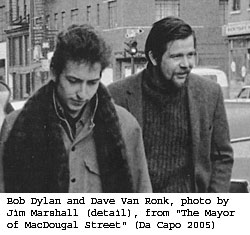
Possibly. But one learns to take Dylan’s stories with a shaker full of salt. Bob has a difficult time separating fact from fancy. The way Van Ronk tells it he was hanging around with a bunch of the boys when someone burst in and said ‘New guy, come on, you got to hear this.’ and it was Bob. So Van Ronk would have had an idea who Bob was not that he necessarily would have acknowledged him. There are some interesting points in Dylan’s narrative which I believe is Bob at his most fanciful. That he marked Van Ronk for destruction is apparent when he says he looked like he came from the Russian Embassy. Maybe. But Bob was a Jew and the Russians were the enemies of the Jews throughout the last two hundred years so Bob was casting him in the role of the enemy. Then he identifies Van Ronk as a ‘confident hunter.’ Jews usually associate hunting with goys while traditionally despising the practice so Bob is saying that the hunter didn’t know he was being hunted. And then Bob placed his hands on the guitar as he spoke to Van Ronk indicating that he was appropriating the man’s tool or emasculating him. Very significant action.
Bob says Van Ronk was snippy and surly. Well, maybe but since I think he’s making this up he is casting a character on Van Ronk to make you dislike him. Besides who wouldn’t appear surly if you placed your hands on the musician’s guitar. The exchange after that when Dave asked if Bob did janitor’s work was a particular Jewish insult that gave Bob his excuse for hurting Van Ronk.
Then like a parasite or lamphrey eel Bob latches onto Van Ronk slowly ‘stealing everything that he could steal.’
When the process was complete and Bob was way bigger than Dave could hope to be Bob then disses Van Ronk off. As Van Ronk tells it p. 217: Van Ronk:
For myself I consider it fortunate that Bobby and I reached our parting of the ways fairly early. Shortly after his third or fourth record had come out had gone diamond or whatever, he was holding court in the Kettle of Fish and he got on my case and started giving me all of this advice about how to manage my career, how to go about becoming a star. It was complete garbage, but by that point he had gotten used to everybody hanging on his every word and applauding any idea that came into his head. So I sat and listened for a while, and while I was polite and even asked him a couple of questions, but it became obvious that he was simply prodding and testing me. He was saying things like “Why don’t you give up the blues? You do that, and I”ll produce an album on you, you can make a fortune.” He wasn’t making a lick of sense, and I finally pushed back my chair and said, “Dylan, if you’re so rich, how come you ain’t smart?’ And I walked out.
So within three years Bob met and surpassed his mentor then trashed him like he trashed everyone and everything else in his life. Beware of Bob. To a very large extent MacDougal Street is the story of Bob Dylan within the folk scene of Greenwich Village although within that context Van Ronk tells a rich and rewarding story of the emergence of Folk from 1940 to c. 1970. A fabulous book with a generous dollop of belly laughs. I loved the book.
2.
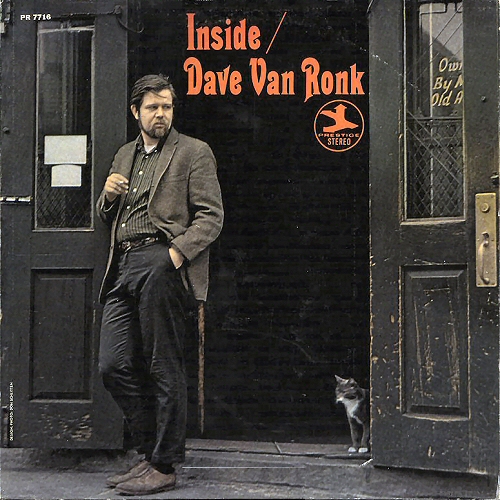
Van Ronk himself never made it. I first heard of him in 1967 and listened to the Prestige Folksinger album. There was nothing there. Van Ronk rasped out all his vocals in a monotonous fashion in that same gargling hoarse voice with nary a variation from song to song. At that age and time I found the songs uninteresting. The arrangments didn’t grab me. The music was about as exciting as the New Lost City Ramblers which is to say a stone bore.
Van Ronk may have prided himself on his musicianship and it may have been pretty good, I couldn’t care less. I know few people who listen to records for musicianship and I don’t care to listen to records with those who do. So Dave was concentrating on all the wrong things.
There were people running around saying how great he was but I was in the record business and nobody bought his records. you can foget the Hudson Dusters. Over the years his legend grew with that of the vanished Folk Scene and I guess twenty-five years or so after the fact he was able to cash in on that basis.
There is one really great song Van Ronk did though called Don’t Leave Me Here. I have it on The Folk Box, Elektra EKL 9001. That’s a really fine four record collection compiled and annotated by THE Robert Shelton. It has selections from nearly all the folkies of the Greenwich Village scene excluding Dylan. A terrific collection and a perfect representation of the scene. Hard to find though; I couldn’t find any copies on a quick search of the internet.
However the story of Dave’s learning process is vastly interesting. His history of the folk era, especially the late fifties and the people and personalities make the book a best buy. But then we get back to Dylan.
Bob not only wheedled his way onto Van Ronk’s stage but he wheedled his way into his very household appropriating Dave’s couch for his living quarters. Now comes an interesting conjecture. In Chronicles Bob says that he met a Ray Gooch and Chloe Kiel with whom he stayed for some time. Now, Bob arrived in New York in January of ’61 and he rented his apartment with Suze Rotolo in the Fall of that year becoming financially independent thereafter never going back to anyone’s couch.
So that gives him a maximum of nine months to sleep on all those peoples’s couches. He says in Chronicles that he first met Van Ronk and through Van Ronk Paul Clayton. These are two colorful characters. He then says that through Clayton he met Ray Gooch. So far, so good. But then he gives a fairly minute description of the street the Gooches lived on, the building, the apartment and significantly the church across the street.
Before w go on let us consider an incident from Van Ronk on page 4:
…Bob Dylan heard me fooling around with one of my grandmother’s favorites, “The Chimes Of Trinity,” a sentimental ballad about Trinity Church that went something like:
Tolling for the outcast, tolling for the gay,
Tolling for the (something, something), long passed away,
As we whiled away the hours, down on old Broadway,
And we listened to the chimes of Trinity.
He made me sing it for him a few times until he had the gist of it, then reworked it into the “Chimes Of Freedom.” Her version was better.
Now let’s check into a passage from Toby Thompson’s ‘Positively Main Street’ pp. 210-211:
But the larger portraits of Ray Gooch and Chloe Kiel are complex and layered with mystery. Why haven’t we seen them before? Correct me if I’m wrong, but their names appear in no biography of Bob. Could they be projectionsof his own divided psyche. Ray, the competent man of the world, the toolsmith, the gun collector, the would be warrior, and Chloe, the dreamy, slightly stoned performance oriented homebody? Bob’s not certain whether they are siblings or lovers. I’m not certain they are real. Chloe was the heroine of Longus’s second century novel Daphnis and Chloe. She was an orphan, nurtured by sheep, and is described as ‘a naive lily-white girl” who falls for the youth, Daphnis. Echo is mentioned in the story. In my case the apartment Ray and Chloe inhabit on Vestry is a boho Eden, Every hipster’s wettest dream of Manhattan digs.
The Sunday after reading Chronicles, a blustery afternoon in New York I took a subway to Franklin Street and walked north then west along Vestry, looking for the building that might have housed it. Bob describes it precisely, Federal style, facing a Roman Catholic church with a bell tower, on the same block as the Bull’s Head Tavern, below Canal Street, not far from the Hudson River. The neighborhood hasn’t changed much since the early sixties, but I could find no building that resembled it. Not the church, not the Bull’s Head Tavern. Houses disappear, but churches aren’t often torn down. I wanted to locate that apartment, only because he described it so beautifully.
So I think it safe to say the whole dozen pages or so in Chronicles is a fabrication. Bob dreamed it a few times and wrote it down as fact. A clue lies in the progression Van Ronk>Clayton>Gooch. Gooch has a made up quality to it so Gooch is probably a conflation of the personalities of Van Ronk and Clayton. And possibly the pair are also a sentimental portrait of Abe and Beattie, the mother and father. Not as they were but wouldn’t it have been loverly if they had been. Ray’s background also coincides with Bob’s studies of the pre-Civil War era in the South in the New York Library.
The church across the street reflects Trinity Cathedral in Dublin as in Dave’s song the Bells Of Trinity so that places the story after his stay with Van Ronk. Note the specified bell tower on the church. Bob’s not there and neither is most of his early reported life. I’ll say again anything he says is untrustworthy. As they say in Hollywood: Based on a true story.
The last couple chapters of MacDougal tell of the changes in the Village and performance after 1960 to 1967 when drugs took the scene down. These are relevant and important chapters as he describes how Dylan’s success caused the failure of the scene. ‘There’s no success like failure and failure is no success at all.’
Altogether I give Van Ronk’s Mayor Of MacDougal Street exceptionally high marks, worth a second reading and retention as a reference work. Positively Fourth Street by Toby Thompson has a place on your shelf also. I’ll review that after a second reading. It is well worthy of study, picking up the stray hint and fact here and there.
Chronicles of course is important to understand what Dave called the convoluted workings of Bob’s mind. Bob’s an interesting study because he has managed to fool a lot of people all the time and another pack of us for a time. I tell ya folks if I could live my life over I’d do some serious homework before I began but then even that probably wouldn’t help.
Slum Goddess From The Lower East Side: A Review
June 20, 2008
A Review
Slum Goddess From The Lower East Side
Some Thoughts On The Autobiography Of Suze Rotolo:
A Freewheelin’ Time
by
R.E. Prindle
1.
Sandoz The Great

In 1938 Albert Hofman, a Swiss chemist working for Sandoz isolated LSD-25. In 1938 young Tim Leary was 18 years old. It was in 1943 that Albert Hofman discovered the effects of LSD. Seventeen years after that LSD burt onto the world through the agency of the now, Dr., Timothy Leary, a psychologist with Harvard University.
LSD was adopted by the Bohemian society and all its offshoots as the appearance of the new chemical Messiah: Better living through chemistry as the slogan was. Its use quickly spread through the folk music community of Greenwich Village in New York City.
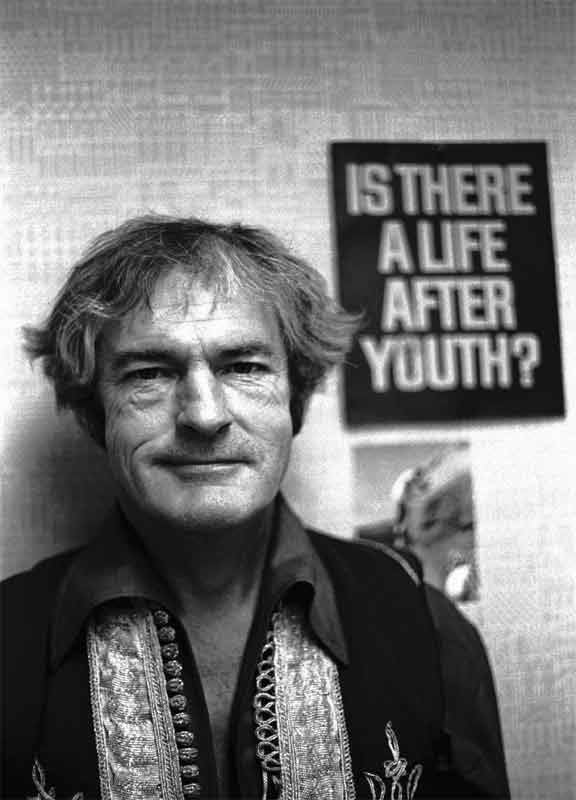
Timothy Leary Is Dead

Goodbye Tuli. Died 7/12/10
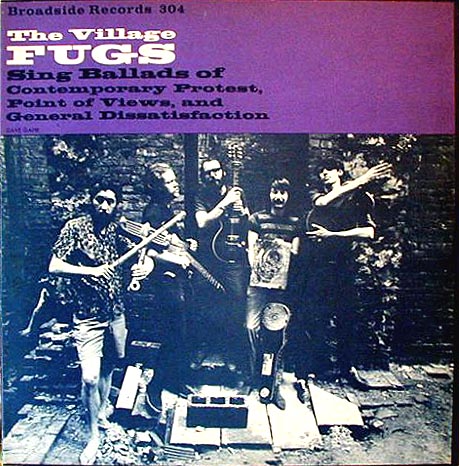
In 1923 a fellow by the name of Tuli Kupferberg was born and his partner Ed Sanders came along in 1939 a year after I did. Kupferberg and Sanders were poets who became influenced by the folk scene forming a band sometime in 1964 originally called the Village Fugs, later the Village was dropped and they became simply the Fugs. In 1965 they released their first LP on Folkways. Now, cut one, side one was little number entitled Slum Goddess From The Lower East Side. Sort of OK as a song, funny, as were a lot of Fugs songs. Like Dylan they searched for social significance rather than write trite love songs. Unlike Dylan you could easily understand the meaning of the lyrics. Slum Goddess was one and then there was a song that many of us thought significant in the social sense back in those days entitled: Boobs A Lot. ‘Do you like boobs a lot? Gotta like boobs a lot.’ As I said deep and intense meaning. This was followed by a song eulogizing jock straps. ‘Do you wear your jock strap? Gotta wear your jock strap.’ So the Fugs were with it.
At some point after 1965 the Village Voice decided to run a feature depicting some East Village lovely as the Slum Goddess From The Lower East Side. Suze Rotolo had the dubious honor of being selected as the very first Slum Goddess.
To what did she owe this honor? Well, she was famous on the Lower East Side for being featured on the album cover of Bob Dylan’s second LP, The Free Wheelin’ Bob Dylan. She was at that time, 1962, I believe, Bob’s girl friend or, at least, one of them, perhaps the principle one but one can’t be sure as Bob had others as ‘part time’ girl friends.
Thus one has to go back to the summer of 1961 to discover how Suze Rotolo began her odyssey to become the very first Slum Goddess. Suze tells her story in her autobiography issued in May of 2008 called A Freewheelin’ Time. It is a bitter sweet story not lacking in charm. Bob was born in 1941 while Suze was born three years later. All the disparate elements in our story born at separate times were slowly moving to a central focal point in New York City from 1961 to 1965 or so.
Suze and Bob were of that age when freewheelin’ seemed possible while the psychological social moment was about to congeal and then vanish before it could be realized as psychological moments do. Some catch the golden ring as it come around, some don’t. Bob did, Suze didn’t.
Suze was born in Queens, over there on Long Island, as a red diaper baby. In other words in the romanticized Communist parlance her parents were Communists when she was born. She was brought up in the faith.
Bob described her as a libertine dream or some such epithet. I’m not sure Suze saw herself in the same way. I think she expected a little more of Bob than to be his sex toy. As a Communist she should have had a more freewheelin’ attitude.
Suze seems to have been brought up completely within the Red religion much as a Christian might be a Catholic, Methodist, Lutheran or as Jew in whatever stripe of Judaism it might be.
She edged into race agitation at a young age. She met Bob when she was seventeen while she had been working for CORE (Congress Of Racial Equality) for a couple years before that. She would have been fifteen or sixteen. Whether she had sexual experiences with the Africans she doesn’t tell us. In her search for a raison d’ etre for her life she found herself in Greenwich Village in the Summer of ’61 where she met the twenty year old Bob Dylan just in from the Iron Range of Minnesota. They were mutually attracted, quickly forming a sexual relationship.
Bob as everyone knows was and is Jewish. He came not only from a Jewish background but from an orthodox background. Hibbing, Minnesota, his hometown, had a Jewish population of about three hundred families with their own Jewish establishment and synagogue.
According to Beattie Zimmerman, Bob’s mother, Bob was a good boy who attended services regularly while investigating the nature of the various Christian churches. As a mother Beattie’s version of things must be interpreted through the eyes of mother love.
Father Abe was not only a practising Jew but the President of the Hibbing chapter of B’nai B’rith and its terrorist arm the Anti-Defamation League. In addition Beattie, Bob’s mother, was the President of the Women’s auxiliary, Hadassah. So Bob isn’t just Jewish but comes from a very committed Jewish background.
As the President of the Hibbing chapter, Father Abe would have attended statewide gatherings in Minneapolis, regional meetings wherever they were held and possibly if not probably national meetings in NYC and elsewhere. Now, within the international Jewish organizations heavy hitters attend various levels of meetings where they meet and learn something of the various local and regional people. Thus, it may be assumed that Abe Zimmerman as a name at least was known on the national Jewish level. Kind of the Jewish Who’s Who, you know. Bob says that he had contacts to help him when he got to New York. Those contacts would have come through Father Abe while being part of B’nai B’rith and ADL. Bob wasn’t entirely alone out there.
Bob’s Jewish name is Sabtai after the last acknowledged Jewish Messiah, Sabbatai Zevi. There have been many that filled a Messianic role since Zevi not least of which was Sigmund Freud and possibly Albert Einstein. Bob may have been encouraged to take the role for himself.
At any rate when Bob approached thirteen and Bar Mitzvah time Abe brought in a special Rabbi from Brooklyn to instruct Bob. Now this is really signficant. He was probably a Lubavitcher or ultra-orthodox Jew. When Bob publicly expressed his Judaism after his Christian stint he chose to do so as a Lubavitcher. Very likely that was no coincidence. Having received his crash course in orthodoz Judaism Father Abe next sent his son to a Zionist summer camp for ‘several ‘ weeks for each of four successive summers ending at the age of seventeen. This would have the effect of introducing him to young Jews not only of the region but from around the world while at the same time estranging him from his fellow Hibbingites giving him his strange cast of character.
Camp Herzl was named after the originator of Zionism, Theodore Herzl. the camp with a spacious hundred and twenty acres is located on a lake near Webster, Wisconsin. Herzl is not your basic summer church camp but a national and international gathering place where young Jews from around the US and the world can meet and get known to each other somewhat.
The camp is conducted exclusively for Jews along Jewish lines eliminating as many goyish influences as is possible. At least when he was seventeen Bob was playing the Wild One showing up in a mini biker cavalcade. One may assume that many national and international Jewish figures made appearances over the four years to both instruct, encourage and look over the upcoming generation.
The post-war years were very traumatic for the Jewish people. The death camps of the Nazis dominated their minds. They were psychologically devastated and unbalanced looking for Nazis under their beds before they went to sleep at night. One may safely assume that Bob and his fellow campers had to watch extermination movies over and over lest they forget.
The State of Israel was founded in 1948 while the first of Israel’s successful wars occurred in 1956. The ’56 war was a seminal event bolstering the spirits of the Jews turning them aggressive as they now believed they could fight. After ’56 they began to come out of themselves.
For whatever reasons as Bob entered high school his personality began to disintegrate. Perhaps he had to cease being Bobby Zimmerman to become what his people expected of him which was a probable religious leader who then became Bob Dylan. As always Bob would combine two cultures, Jewish and Goyish.
After an extremely rocky year in Minneapolis where Bob shed the remnants of his goody goody image of Hibbing he became the dirty unkempt Bob Dylan of his rush to fame of the Folk years.
Thus as Bob and Suze met in the Summer of ’61 they were both searching for something to be.
Part 2.
Why Do Fools Fall In Love?

Just We Two
The question now that Suze and Bob have gotten together is to sort out the various accounts of what happened. Bob says everyone has gotten it wrong. However his own account in Chronicles I is no more factual than the accounts of his biographers and commentators. Suze doesn’t provide us with much more clarity. While Bob tells it like he wanted it to have been Suze on the the one hand protects her memory of what she wants to keep as a beautiful memory while glossing over her own actions at the time to keep it so.
Bob goes through the romantic notion of constructing their bed with saw, hammer and nails. This is a charming story and I’m embarrassed to say I took him at his word. You simply can’t. Chronicles came out four years ago so Suze has had plenty of time to read it and mull over Bob’s ruminations. Thus she must be aware of Bob’s story of the bed. She says it was an old bed the landlord left from another tenant. Another beautiful tale of Bob’s down the tubes.
Suze rather unflatteringly depicts Bob as a rouster and fairly heavy drinker. She was offended that Bob, who was posing as Bob Dylan, not yet having officially changed his name, didn’t level with her and confide that Dylan was a pseudonym that looked better on a marquee while his real name was Zimmerman and that he came from Minnesota rather than being an orphan from New Mexico. Coming home one night, as Suze tells it, Bob, stumblingly drunk, dropped his ID and she discovered the truth as she picked it up. Even then she had to drag the truth out of Bob.
These problems mounted up. There was immediate hostility between Bob, Suze’s mother and her sister Carla. The mother seems to have instinctively seen through Bob, while I’m sure Carla soon learned that Bob was doing her sister wrong.
As we know from Chronicles Bob had other ‘part-time’ girl friends, pick ups and whatever. As the folk crowd was a fairly tight knit group even if Suze didn’t want to hear the obvious Carla who was employed by the Folklorist, Alan Lomax, could hardly have been unaware that Bob had a laissez faire attitude toward romancing the girls.
Indeed, Bob’s understanding of Suze was that she was his Libertine belle. As a libertine therefore he could hardly have believed fidelity was a necessary condition. I don’t know if Suze considered herself a Libertine but as a Communist both fidelity and jealousy were forbidden by the dogma so speaking consistently with the belief system neither mother, Suze nor Carla had grounds for complaint. Nevertheless both mother and Carla wished to separate Bob and Suze.
Bob records his side of the conflict in his song Ballad in Plain D. In his usual high flown language Bob says in his song:
“The tragic figure!” her sister did shout,
“Leave her alone, goddamn you, get out.”
All is gone, all is gone, admit it, take flight.
I gagged twice, doubled, tears blinding my sight.
My mind it was mangled, I ran into the night
Leaving all of love’s ashes behind me.
Within a few months he was married to Sara who he kept waiting in the wings. Subsequently he tried to keep Sara and his growing family in Woodstock and the Slum Goddess Of The Lower East Side out on the side. Suze, apparently not quite as Libertine as Bob supposed, declined the honor.
Just as Bob blithely romanticizes his early NY years in some sappy Happy Talk that belies his songs and what nearly everyone has written about him so Suze adopts a near virginal girlish pose. Her story of how she left for Italy and her true blue yearning for the perfect love of Bob who sent those charming letters purloined from old country songs is also belied by the various biographers. To hear Suze talk she never looked at a boy in Italy and certainly never dated one let alone kissed or petted. Yet by her religious Communist ideology that would have been no sin, even would have been a virtue. In fact she did have an Italian boyfriend who was apparently dropped down the memory hole at autobiography time.
When she did return the road of romance was much more rocky than she lets on. Carla who stayed home where she could watch Bob was privy to his doings which were much more libertine than anything he accused Suze of. He had to have slept with Liam Clancy’s live in somewhere in there. He’s accused of being a womanizer and you can’t be a womanizer without a lot of women. So whatever Carla knew it was somewhat more than an earful and I’m sure that between Carla and her mother Suze heard it all.
Suze out of respect for this young love which, after all, must still occupy a sacred spot in her life never expresses but the mildest resentment of Bob but letting her sister speak for her she says that ‘she (Carla) felt I was better off without the lyin’ cheatin’ manipulative bastard.’ Right on all counts I’m sure except for the last although as Bob claimed to have no parents Carla could justly so surmise.
At any rate if Suze couldn’t make up her mind her mother and Carla could.
Ballad In Plain D again:
Beneath a bare light bulb the plaster did pound
Her sister and I in a screaming battleground,
And she in between, the victim of sound,
Soon shattered the child ‘neath her shadows.
—–
The wind knocks my window, the room it is is wet.
The words to say I’m sorry, I haven’t found yet.
I think of her often and hope whoever she’s met
Will be fully aware of how precious she is.
And then Bob married Sara and ruined her life.
While Suze and Bob talked marriage there is no reason to take that seriously; he talked marriage with Echo too. I don’t think Bob had any notion of marrying aouside his faith. The mother is the culture carrier; Bob is firmly within the Jewish culture so there could have been no chance that he would have taken other than a Jewish wife. Even then he may have married only to fulfill the commandment to be fruitful and multiply. Once he had fulfilled that duty he broke the marriage apart.
3.
The Slum Goddess

I'm Leaving Town Tommorow
Suze was now a young woman of twenty or twenty-one alone adrift in New York City. While she and Bob were having their tempestuous romance the times they were a changin’.
Tim Leary, up in harvard, had embraced psychedelics. Once in love with LSD he wanted to share his love with everyone. He became the High Priest of his psychedelic religion. I can recommend both his autobiography and his volume of reminiscences: High Priest. The latter is a spectacularly well written book if tending toward tediousness.
Leary’s experiments attracted the dark angel of the Hippie years, Allen Ginsberg. Ginsberg also attached himself to Dylan tying the Beat and Hippie decades together. Vile man.
Bob had introduced Suze to Marijuana and what else I don’t know, perhaps LSD. He himself was into the pharmacopeia also undoubtedly dabbling in heroin although if he did he is still an addict or was successful in kicking the habit after his retreat from fame in ’66. That whole thing about the motorcycle accident may have been just rehab. He sure needed it.
As Bob notes the effect of LSD on the Greenwich Village folk scene was to turn people inward destroying any sense of community. Suze then was attempting to navigate this terra nova. Along with turning people inward, LSD, the drug scene, turned the scene sexually rasty in ways even the Communists couldn’t have imagined. The Pill coming along at this time certainly was as influential as LSD in changing sexual mores.
Suze, if aware of this, makes no mention of it in her auto. The Fugs released Slum Goddess in 1965 although they may possibly have been playing it around the Village for a year or two earlier. The Slum Goddess is not a savory woman.
That Suze was selected as the first Slum Goddess strikes my sensibilities as a negative compliment. Her presentation of it implies a souring experience. Shortly after her selection she chose to withdraw from Village life. She gives as the reason that her earlier relations with Bob caused upleasant curiosity and that was certainly true.
The scene turned absolutely rotten after 1968 when between drugs, profound negativity and the progressing degradation of the Hippie movement anyone with any sense of dignity was driven out.
Suze must have been one of us for she left the scene behind. There are few today who choose to remember it. As for me, life is life, there it was and there was I. I was who I was; je ne regret rien. I hope Suze doesn’t either. Bob? He just stays on the bus and doesn’t get off. Reality can be such a drag.

Forget About Yesterday
Analysis, Critical Theory And Greil Marcus
May 29, 2008
Analysis, Critical Theory And Greil Marcus
by
R.E. Prindle
Through the moral and political rhetoric of John Winthrop, the Declaration Of Independence and the Constitution, Abraham Lincoln and Martin Luther King, America explained itself to itself as a field of promises so vast they could only be betrayed. The attempt to keep the promises- of community, liberty, jutice, and equality for all, because once let loose the genie could never be put back in the bottle- in face of the betrayal became the engine of American history and the template for our national story.
-Greil Marcus
http://.powells.com/ink/marcus.html
The problem I have with Mr. Marcus’ writing is that it is all skewed. His vision is distorted by his ideologies. Mr. Marcus purports to write about the US using terms like ‘our’ when he is in fact an Israeli citizen and places the interests of Israel above those of the United States. This situation is exacerbated by the fact that he is an adherent of the Jewish Critical Theory or Frankfurt School while being a leader of the Situationist Internation. Both organizations are subversiive of the ideals and goals of the United States seeking to supplant those goals with those of Israel or, in another word, Judaism.
Mr Marcus is not clear and honest in his intentions, seeking to mislead his readers into believing that he is objectively analyzing America rather than denouncing it in favor of the Israeli point of view. He refuses to admit that his intent is the supremacy of Israeli/Jewish interests. I find this both dishonest and offensive.
Further in his zeal to demonstrate that the United States is a failed society he refuses to take into account any social or scientific developments since, essentially, John Winthrop of the seventeenth century.
Winthrop is essentially a religious bigot who because of his historical era was necessarily devoid of any scientific knowledge. His spoutings originate in the ignorance of the Jewish Bible written some two thousand or so years before his present which he takes as the literal truth and the word of ‘God.’
While his views may be of interest to explain his times and while his views were influential in forming New England with its inherent bigotry they in no way reflect the views of Jefferson and others who were responsible for the formulations of the DOI and Constitution. There were worlds of difference between the East Anglian Puritans and Cavaliers of both the South of England and the US. Further Jefferson was a Revolutionary and Freemason learning his Freemasonry in the France of the Revolution. Whether he was a Jacobin I can’t say but he has been so accused.
While the Framers of the founding documents used the same words such as equality that we use today they undoubtedly did not undersand them as we do today. To refuse to understand and take that into account is willful obtuseness on Mr. Marcus’ part. The phrase ‘all men are created equal’ was gainsaid by their counting Negroes as only three-fifths of a man. Quite obviously they did not actually believe that all men were created equal. Whether ‘all men’ is meant to include women is also conjectural as women were denied the attributes of citizenship being considered appendages of men as per the Biblical creation myth. So clearly the Founders understanding of equality is quite different from that of, at least, Mr. Marcus. On that basis his views can’t help but be skewed.
The African in America was an insoluble problem to the society then as it is to society today. While counting Negro men as three-fifths of a human certainly sounds ridiculous yet modern evolutionary science has proven what was evident to observation then that the Africans as the first Homo Sapiens to evolve from the Last Hominid Predecessor was necessarily left behind by future evolutionary species of Homo Sapiens or sub-species if you prefer. Mr. Marcus and his fellow Liberals insist that equality of Blacks and Whites is denied solely on the basis of skin color. This is nonsense.
If Africans were equal or superior to Whites, Semites and Mongolids there could be and would be no denying the status of the African. Furthermore such superiority would be self-evident as it must. Instead of the so-called White Skin Privilege there would be Black Skin Privilege and then black skin would indicate superiority and be desirable. There isn’t and the reason why is because that while equality is a fine sounding ideal it does not exist in fact in either the macro or micro example. It cannot be made to exist by legislattion so long as differences between the five human species exist.
So, I would object to Mr. Marcus’ characterization of ideals as promises, they are two different things, that have been betrayed. There has been no betrayal. Mr. Marcus misleads us with his approach of Critical Theory. The Founding Fathers set high ideals to live up to, perhaps impossibly high ideals but ideals worth striving to realize nevertheless. The problem now has been complicated by the scientific reallization of the incompatible differences between the species so that the original meaning of equal of the DOI seems to be the correct one.
The Negro problem, bedeviling America from its origins, was the rock on which those ideals first foundered resulting in the Civil War between Whites, Reconstruction and the current New Abolitionist Movement proclaiming the need to exterminate Whites by any means necessary. So, over the hundred fifty years since the Civil War Africans and their Liberal and Israeli/Jewish handlers are in a position to realize the goals of post-war Radical Reconstruction which was the elimination of Southern Whites by Africans in a larger version of the San Domingo Moment.
As the Whites struggled to come to some resolution of the Negro Problem that has always bedeviled American history large, even huge, numbers of Southern and East European immigrants flooded the country. It is useless to use racial arguments and say that antipathy to these peoples was somehow racial when there was no difference in color which is the only thing Liberals recognize as a barrier to assimiltion.
Rather these peoples were culturally unable to understand the ideals that underlay the American attitude, disdained them and sought to replace them with their own. Thus we have a tremendous criminal underworld led by Sicilians and Israelis while the Israelis seek to subvert the ideals Mr. Marcus notes as ‘promises’ to replace them with a State resembling that of Israel in which the Israelis are paramount while all others are denied humanity much as Mr. Marcus accuses the Europeans of the US in relation to the Blacks.
One therefore has to believe that as an Israel citizen Mr. Marcus is hypocritical in his criticism of American ‘racism’ and the ‘betrayal’ of the the ideal of equality.
Unless Mr. Marcus can reconcile his ostensible beilief with actual Israeli actions I, for one, find it impossible to take him seriously. Critical Theory and the SI are antipathetic to the ideals he seems to be espousing.
I too believe that we have fallen short of the ideals expressed in the Founding Documents but for different reasons than those mentioned by Mr. Marcus. I find no betrayal of those ideals but rather the sabotage of them by competing social systems such as the Sicilian, the Israeli and the African.
Mr. Marcus may be an expert in Critical Theory but he is no analyst. Analysis is Science; Critical Theory is religion. Oil and water and the two don’t mix while Science trumps Critical Theory every time.
Exhuming Bob IX: Chronicles I: Pensees 5
May 12, 2008
Exhuming Bob IX
Chronicles I
Pensee 5
by
R.E. Prindle

Younger Pete Seeger
Larry Sloman has an interesting interview with Mike Bloomfield in his On The Road With Bob Dylan of 1978. It takes up twelve pages- 286-297- of the 2002 Revised Edition.
Mike Bloomfield was, or course, the White Southside Chicago Blues guitarist who rose to fame as the lead guitarist of the Paul Butterfield Blues Band. Butterfield’s LP East-West was one of the seminal records of the sixties. If you’re hip and don’t know the record, you should take care of that as soon as possible.
The interview is interesting in a number of ways. Bloomfield who was a Jew ‘hanging out with ‘the niggers’ on the Southside as he puts it, has a rather surprising attitude toward Blacks and opinions on Dylan.
Born in ’43 Bloomfield was two years younger than Dylan thus his mind was more malleable to the propaganda of the fifties as he turned fifteen only in ’58, graduating, if he did, in ’61. The tremendous persecution indoctrination and conditioning of the mid to late fifties in the Jewish community would likely have influenced his mental state more profoundly than Dylan’s.
The Jewish community has always been affected by the Negro mental situation. A low down Jew in his own community was frequently designated a ‘nigger’ often carrying the nickname of Nig or Big Nig. Sloman, also a Jew, repeatedly refers to himself as the ‘nigger’ of the tour while designating Ronee Blaklee as his female nigger counterpart.
While not having enough information to diagnose Bloomfield’s mental state nevertheless since he abjured the White world for the Black world of the Blues it would seem that he interpreted the intense Jewish indoctrination as meaning that since the world hated the Jews only because they were Jews that the Jews were no better than the ‘niggers’ and that he should go live with them. The psychological conditioning young Jews went through in the fifties was just horrid in the effects on their psyches. Really crazy stuff.
So, while feeling no better than the Blacks Bloomfield at the same time recognized his separateness, difference and apparent inferiority.
This was certainly different than the image being projected to the equally impressionable youth of America who through musicians like Bloomfield reverenced the Negro. In fact Bloomfield was a perfect catalogue of prejudices if one looks at it that way. Another way of looking at it is that having had close contact with the various cultures he had a clear idea of their characteristics as compared to the Jews and Whites.
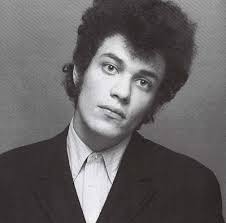
Mike Bloomfield
Still, at Newport he was scandalized by Peter Seeger’s behavior. Quite clearly Bloomfield was not your typical White Liberal. p. 291-292:
To play with anyone at a folk festival, I would have plugged my guitar into Pete Seeger’s tuchus, really man, and put a fuzz tone on his peter. You know what fucking Pete Seeger was doing? He brought a whole bunch of schwartzes from a chain gain to beat on a log and sing schwartze songs, chain gang songs, and he was doing that, can you believe this guy? Here’s a white guy, got money, married to a Japanese woman, beating on a log with schwartzes singing ‘All I hate about lining track, whack, this old chain gang gwine break my back, actually saying ‘gwine’, whack and Seeger’s doing this and he’s pissed off at us for bringing electric guitars to the fucking folk festival! He brings murderers from a schwartze prison to beat on a log! Oh, I couldn’t believer how fucking crazy it was!
Schwartze italicized in the original, of course, is Yiddish for nigger. The above is terrific scene painting that represents about how probably 90% of America at the time would have perceived the scene. Seeger was a Liberal Commie Red American living this incredible fantasy life in which he was the star of his own movie in which there were no consequences while the plot is perpetually arranged to suit his convenience.
This was the beginning of the period when White Americans believed themselves in control of the destinies of the people of the world. Kennedy had just created the Peace Corps under whose auspices raw youths with no worldly experience were sent out into the world to supposedly tell forty and fifty year old men and women that they were doing everything wrong and these mere kids were going to tell them how to do it right. I can’t tell you how the concept boggled my mind. Seeger married to a Japanese while calling these Negros cons to Newport to play chain gang songs is actually treating these people as though they were his toys. The arrogance of this Liberal so-called peace-loving, people-loving creep is amazing.
As Bloomfield says, Seeger came unglued over the violation of his fantasy when electricity was introduced into his rural pre-Civil War fantasy while idolizing Negro murderers that he had had released from prison for the weekend. Imagine, for his convenience without any regard for the feelings of the prisoners he had done that. Then he has them perform a scenario where they are beating on a hollow log as caricatures of themselves of a century earlier singing railroad songs that hadn’t had any relevance for at least fifty years.
Obviously Bloomfield while he had some fantasy that he was a psychological nigger who was at home on the Southside still longed to be Uptown with the White folks. Hence he is so scandalized that Seeger, a man with money, in other words, while Seeger didn’t have to play with schwartzes was actually, and here Mike’s incredulity is palpable, singing Negro dialect like ‘gwine’ and going whack.
I mean, in Seeger’s incredible movie life he’s got a Japanese wife and everything, bank account. If he tires of that fantasy he dumps her and marries a – whatever, whoever the film running through the sprockets of his mind fancies. I mean, the guy’s got a long lead between second and third out on the grass and nobody’s even running him down. Bloomfield is completely flabbergasted.
And then Dylan is toying with him and he does know that. Dylan comes to Chicago right after the first album, Bloomfield grabs his guitar, just like in Crossroads, intending to cut Dylan down which he can do with ease and cutting is done everyday in Chicago so it is legit. Dylan must have blanched with fear knowing Mike could do it. Now, remember this is an intra-Jewish thing. Rather than risk embarrassment Bob abases himself and charms Mike into believing they are friends. Deceived, Mike lets Bob off.

Dylan At Peak
Now safely back in New York Dylan calls Bloomfield to ask him if he wants to play on Highway 61, the most vengeful record ever recorded. Bloomfield accepts showing up in the enemy’s camp at Woodstock. Now Dylan insults Bloomfield and strips him of his dangerous skills. Bob says: ‘I don’t want you to play any of that B.B. King shit, none of that fucking blues I want you to play something else.’ so we fooled around and finally played something he liked, it was very weird…’
So Bob makes himself superior by taking away Bloomfield’s identity (I had to change their faces and give them all brand new names) but he takes the trouble to actually teach Bloomfield the songs because he is going to need him.
I have to give Bob credit for being an improvisational genius. At the Highway 61 session he and Mike are the only guys who know what they’re doing while the other musicians are keying to them. The result in my estimation is sensational. As a musician Bloomfield didn’t think much of it but as a listener without those kinds of professional prejudices the result is astonishing. To be sure the sound is not as tight as a Johnny Rivers record but that is its genius.
Bob assumes that Bloomfield knows he is now Bob’s shadow or guitar player. When Mike goes with Butterfield Bob feels rejected. When Bob’s feelings are hurt Bob gets revenge. A number of years later Bob asks Mike to play on Blood On The Tracks This time he doesn’t need Mike so harking back to their first encounter in Chicago he roars through the songs in one tuning so fast Bloomfield can’t keep up. Bob has cut Bloomfield as Mike had meant to cut him. Bob walks out, king of the Crossroads. Bob has ‘proved’ himself the better musician. End of that story. Bloomfield ODed a few years later.
At one point Sloman asks Mike ‘What was he like?’ pp. 286-287:
“There was this frozen guy there,” Bloomfield says. “It was very disconcerting. It leads you to think, if I hadn’t spent some time in the last ten or eleven years with Bob that were extremely pleasant, where I got the hippie intuition that this was a very, very special and, in some ways, an extremely warm and perceptive human being, I would now say that this dude is a stone prick.’
Bloomfield then describes Dylan in conjunction with Neuwirth and Albert Grossman holding themselves aloof from others while indulging in savage put downs of anyone and everyone. Bob in fact was a stone prick. The question is why?
After this introduction to the problem , in Pensee 6 I will return to the root of the problem built around Bob’s reverence for Mike Seeger.
Exhuming Bob IX: Chronicles I, Pensees 4
May 7, 2008
Exhuming Bob IX:
Chronicles Vol. I, Pensees 4
by
R.E. Prindle
The gist of Chronicles is how Bob became a songwriter. As an auto-biography of his life he is telling us nothing but as to his intellectual development he is telling us a lot.
I find the Lost Land chapter the most interesting in the book. Bob goes back and constructs little dioramas to illustrate the changes he was going through. The chapter is kind of a literary version of Salvador Dali’s picture, The Persistence Of Memory. What is visible has to be reconstructed and interpreted. In the interpretation lies the interest.
Bob is interested in telling us how he became Bob Dylan while wanting to give his impression of people and events. He recalls a concert by Bobby Vee who was riding the crest of his popularity while Bob was a mere nothing waiting in line. He seems to want to prove to us that Vee really did know him from back in Dakota thus verifying the fact that he did play with Vee’s band. Bob sent in his name and Bobby Vee actually came out to talk to him. The situation is reversed now, Bob is something and Vee is a has ben but Bob still has a place in his heart for him. Touching story.
And then he tells his Ricky Nelson story. Bob seemed to think more highly of Rick as singer than I did. Time has softened my attitude to Rick as well as his song ‘Garden Party’ that I have always liked. As Bob said Ricky mentions him in his song- ‘there was Bob Dylan in his Howard Hughes disguise’- or words something like that.
Rick’s song, I think, gave Bob the idea for the story he tells of Camilla Adam’s party. It is actually two parties, the one at Comill’as and another at Alan Lomax’s that Bob loosely joins together around the persona of Mike Seeger. It’s interesting. Bob introduces the party thusly: p.62
…then something immediate happens and you’re in another world, you jump into the unknown, have an instinctive understanding of it- you’re set free. You don’t need to ask questions and you always know the score. It seems like when that happens, it happens fast, like magic, but it’s really not like that. It isn’t like some dull boom goes off and the moment has arrived- your eyes don’t spring open and suddenly you’re very quick and sure about something. It’s more deliberate. Its more like you’ve been working in the the light of day and then you see one day that its getting dark early, that it doesn’t matter where you are- it won’t do any good. It’s a reflective thing. Somebody holds the mirror up, unlocks the door- something jerks it open and you’re shoved in and your head has to go into a different place. Sometimes it takes a certain somebody to make you realize it.
Mike Seeger had that effect on me.
So the rambling account of the Bob’s next few pages is going to be a story of how Mike Seeger put Bob’s head in a different place. It’s going to happen at Camilla’s ‘Garden Party’ combined with Alan Lomax’s affair. Did this party really take place or is this a dream sequence Bob builds up to explain the change he’s going through? The population of the party strikes me as improbable but then I have attended very few celebrity parties and don’t feel I can put myself forward as a judge.
Bob doesn’t tell us when these two melded parties built around Mike Seeger too place but as most of the stories in this essay take place in the winter- baby, it was cold outside- it must have been before 1963. Bob arrived in NYC in the winter of 1960. In relation to Harry Belafonte he does say: ‘I’d be making my professional recording debut with Harry, playing harmonica on one of his albums called Midnight Special. That album was recorded in ’62 so if that was still in the future as Bob makes it sound the intellectual development he’s taking about probably took place in the winter of ’61-’62. He bagan dating Suze Rotolo in the summer of ’61 so the part-time girl friend he was with, Delores Dixon, must have been the part of the time he wasn’t with Suze.
There were a lot of Folk people there but Bob says they all gave him the cold shoulder except for Pete Seeger. p. 64
I saw a lot of people here that I’d meet again not too far off, a lot of the folk community hierarchy, who were all pretty indefferent to me at the time and showed very little enthusiasm. they could tell I wasn’t from the North Carolina mountains nor was I a very comercial, cosmopolitan singer either. I just didn’t fit it.
So if not outright rejection there was probably a feeling of you don’t have to pay attention to that guy, he ain’t goin’ nowhere. So here we have the nucleus of Positively Fourth Street. p. 64
They didn’t know what to make of me. Pete Seeger did, though, and he said hello.
So, who among the multitude had the prescience to recognize the genius of Bob Dylan and said: Hello. That was enough for the moment for the boy in the sheepskin coat and motorcycle boots.
An then Bob runs through a list of attendees: Harold Leventhal the famous Folk manager, Judith Dunne a choreographer, Ken Jacobs the filmmaker, Pete Schumann a puppeteer, Moe Asch from Folkways, Theodore Bikel, Harry Jackson the artist, Cisco Houston.
A whole slew of authentic labor agitators, not those phony bigwigs who went to Pureto Rico to party hearty. Irwin Silber of Sing Out!, There were a lot of Broadway and off-Broadway actors too, a lot of musicians and singers, Erik Darling, Lee Hayes, Sonny Terry and Brownie McGhee. Mike Seeger of course but also the creme de la creme Harry Belafonte. Quite a gathering which makes me believe that Bob is romancing a little.
Bob was knocked out by Belafonte. He eulogizes over Harry. For myself I never really cared for Belafonte. Harry was from New York City. born in ’27 so he’s about eighty now. Still kicking. He went to live with his grandmother in Jamaica for four years when he was from eight to twelve then returned to New York City. Studied to be an actor but first drifted into singing, picked up a folk repertory from Huddie Ledbettor who he apparently knew. He had a hit in 1953 with Matilda and in 1954 released his LP Mark Twain of which the title song became a hit. Harry also did a number of Leadbelly tunes like the slave songs Bring A Little Water, Silvie and Jump Down, Spin Around.
The lyrics in the latter baffled me for decades. In one of those classic mishearings I heard:
Jump down, spin around
Pick a bale of cotton.
Jump down, spin around,
Pick a bale of hay.
I could never figure out the connection between cotton and hay. Then one day I realized, or read the lyrics, I forget which and learned the last line was ‘pick a bale a day.’ Ah, made more sense.
I didn’t understand what it was about Belafonte I didn’t like until a while ago when I subjected myself to another hearing of the first double Carnegie Hall record of ’59. Then I knew why. Harry treated his vocal styling from an art song point of view. He sang Folk but through a glass darkly. (Finally got that old saw in. Thank you Harry.)
He was fighting the image of the Negro as an inarticulate lout so he over compensated. He actually mocked the English of the English on the LP, his hatred flowing out. So he sounds like he’s performing in Porgy and Bess or like John Raitt in Oklahoma or Carousel. Stilted.
If one compares the records of Belafonte to those of the Scotch Folk singer Lonnie Donegan, he began his ascent at the same time, the contrast is startling. Donegan sings as a man of the people giving the songs, same songs, a meaning and value that Belafonte fails to do. Compare both men’s rendition of Bring A Little Water Silvie. Belafonte sounds like he’s singing for a soundtrack of Seven Brides For Seven Brothers or something. Lonnie Donegan sounds like he’s out there in the fields asking Sylvie to bring him a little water as he picks his daily bale of cotton.
All the difference in the world- Lonnie Donegan is the greatest who ever rode the Rock Island Line.
It bothers me that Bob doesn’t seem to know Lonnie. He wasn’t that big in the US but he was huge in Britain. You might possibly know him from the song Does The Chewing Gum Lose Its Flavor On The Bedpost Overnight.
Of course Harry made it big when he made his sentimental Journey back to Jamaica to exhume a repertoir that really struck home. Day-O (The Banana Boat Song) made it for him. Then his acting career revived. He was billed as the Negro Presence which is what Bob seems to referring to here. Every effort was made to make Harry the Black Hero, before Poitier, transcending any Whiteness. As popular as he was he never really caught on. Carmen Jones, a Black takeoff on the opera Carmen was his big movie. He not only sang like but acted like John Raitt. The movie might have done alright at the box office, I don’t know, I didn’t think much of it and I knew it was my duty to like it too.
That would have been 1954, the year of Brown vs. the Board Of Education, just at the time Eartha Kitt, also born in 1927, burst on the scene singing the fabulous C’est Si Bon. Ran us right up the wall. I always couple Belafonte and Kitt in memory. Would have been a dream marriage, like Eddie Fisher and Elizabeth Taylor.
Having written a great eulogy for this major influence in his life, Bob compares Belafonte with Gorgeous George. He then gets to the crux of this story, the life changing event. He moves immediately on to Mike Seeger.
It was getting late and me and Delores were about to leave when I suddenly spotted Mike Seeger in the room. I hadn’t noticed him before and I watched him walk from the wall to the table. When I saw him my brain became wide awake and I was instantly in a good mood. I’d seen Mike play previously with The New Lost City Ramblers at a schoolhouse on East 10th Street. He was extraordinary, gave me an eerie feeling. Mike was unprecedented. He was like a duke, the knight errant. As for being a folk musician, he was the supreme archetype. He could push a stake through Dracula’s black heart…
Bob rambles on, he’s got enthusiasm for Mike. Bob’s eulogy of Mike Seeger exceeded that of Belafonte by a factor of 10, but he doesn’t say Mike could knock anybody out with one punch, his ultimate accolade that he uses for Harry.. Bob muses:
The thought occurred to me that maybe I’d have to write my own folk songs, ones that Mike didn’t know.
And so the epiphany. Bob knew he could never come close to equaling Mike Seeger as either a folk singer or instrumentalist.. He left the field of folksinger to Mike and apparently still feeling inferior having written some well received folk style songs he escaped Mike’s shadow by adding electricity. There was no way Mike could go there. And there Bob got bigger than any hundred or thousand Mike Seegers.
Exhuming Bob IX: Chronicles I Pensees3
April 27, 2008
Exhuming Bob IX
Chronicles Vol. I
Pensees 3
by
R.E. Prindle
…I needed to get my own place, one with my own bed, stove and tables. It was about time. I guess it could have happened earlier, but I liked staying with others. It was a less of a hassle, easier, with little responsibility- places where i could freely come and go, sometimes even with a key, rooms with plenty of hardback books on shelves and stacks of phonograph records. When I wasn’t doing anything else, I’d thumb through the books and listen to records.
Not having a place of my own was beginning to affect my super-sensitive nature, so after being in town close to a year I rented a third floor walkup apartent…
Bob Dylan, Chronicles Vol. I
Yes. Bob’s super-sensitive nature needed his own bed. He and Suze Rotolo were an item soon after he met her in July of ’61. He had to give up the the comfort of other people’s books and records in other people’s digs. He needed his own privacy now.
Suze would be an important influence in his life. She came from a long line of Communist agitators. She was not only Red to the- but was working for- CORE there in New York City. Bob wasn’t writing much as yet since his major influences hadn’t come together. While Bob doesn’t mention all those old C&W records as a songwriting influence he nevertheless has always written within a Country and Western context. Guthrie, his first attested major influence rose from a C&W milieu.
From being an apparent pauper, one reason Suze’s mother didn’t like him, Bob suddenly had the affluence to rent an apartment while being able to furnish it, even buying a used TV. He and Suze moved in. Suze is putting out an autobiography this month (May, 2008) so we’ll see if we can see what Bob saw in the girl.
As a Communist lass working for CORE Suze must have talked up Civil Rights and other Reconstruction views a bit so we may probably accurately assume that she influenced Bob’s songwriting direction when he gets his songwriting attitude organized here in a paragraph or two.
Bob came from small town Mid-West Hibbing. I do know where that’s at. While he was interested in records there was no indication he was ever interested in any other cultural areas. He doesn’t seem to have evidenced any interest in the varied cultural life of New York City before he met Suze. He was no habitue of museums although he does tell us he haunted the library where he read newspapers- those from 1855 to 1865. No news like old news.
His mind had been little prepared for what Suze had to show him. Mid-West small towns can be stifling and that’s no joke.
As Bob says: I began to braoden my horizons, see a lot of what the world was like, especially the off-Broadway scene. Then he mentions Le Roi Jones’ (Amiri Baraka) and the Living Theatre play, The Brig. Bob may have seeen those plays with Suze but he didn’t see them within the time limits of his story so they could have had no influence on his songwriting development at this time. Dutchman and The Baptism of Jones that he mentions were first performed in 1964 as was the Living Theatre’s, The Brig. It is interesting that Jones’ The Bapstism is described as anti-religious when Jones turned Moslem and became Baraka shortly thereafter. Baptism must have been more anti-White.
Jack Gelber’s The Connection was made into a movie in ’62 so he could have seen the play within this time period. I couldn’t find any time period for the play but it ran for over two years. I didn’t come up with anything for the Comedia Del Arte.
The Brecht-Weil show drew a blank but as he seems to have been knocked out by the song Pirate Jenny that may have influenced his song When The Ship Comes In, while he gives it prime importance as an influence that formed his skills he must have seen that sometime in the Fall of ”61 or the Spring of ’62.
He and Suze did visit the artist hangouts she was familiar with while broadening Bob’s horizons by trips to MOMA and the Metropolitan. Bob probably saw Picasso’s Guernica at MOMA where it was on display at the time. Bob developed a real interest in painting during this period.
So, we have the book thumbings from his freeloading days, the records, Suze and her art influences and then when John Hammond signed him he gave Bob an acetate of the first Robert Johnson album, which didn’t sell for beans I might add. The first Robert Johnson LP was released in 1960 so I don’t understand why Bob was given an acetate unless it was just lying around and Hammond picked it up or else acetates were a sop to new signees who had just been contractually screwed. You think managers are bad, try record companies.
Johnson was a revelation for Bob. He saw something in the LP which only a few people ever have. I’ve listened to it a couple of times and I’m with Dave Van Ronk. So What? There’s nothing to the vocals and he’s obviously a beginner on guitar. It’s not that he’s inventive he just doesn’t know how to play.
The story Bob tells is that a teenage Johnson is hanging around some Blues heavies and they shoo him off. Johnson then meets a supposed guitar wizard nobody’s ever heard of who teaches this very receptive student mega volumes of guitar lore so that Johnson returns to the Blues heavies a year later to knock their socks off with his virtuosity. As Van Ronk says: ‘…oh that lick’s from here, this one’s from there; that song is a reworking of another and so on. Greil Marcus quotes Johnson’s lyrics extensively in his Mystery Train. Wow! I guess too much of nothing can be a good thing.
But anyway Bob learned three or four times as fast from Johnson as Johnson learned from the old coot who taught him. Bob was up and running within three months.
However Superbob the Songwriter wasn’t ready to step forth from the phone booth yet, there was something else lacking, what was it, something or other. That’s it, in French, l’ autre. Bob had discovered that he was someone else. I know where that’s at too; I’ve been called somethin’ else a couple times I can remember. So Bob was somewhere between Bob1 and Bob2. The transition from Bobby Zimmerman to Bob Dylan had to be completed. Bob picked up a copy of Arthur Rimbaud. The book fell open in his hands and the words ‘Je suis un autre’ floated up before his eyes and were sucked into his soul. Bob too realized that he had or was un autre. Now Bob was ready to rock and roll.
This is a pretty story and I like it. I like it a lot. It might even be true, I’m sure I don’t know and maybe Bob isn’t real positive. Anyway the songs began to roll out. John Hammond who had seen only a couple when he suspicioned there might be more in Bob’s head so he sent the underaged lad to be signed by Lou Levy. Songs were in the air I guess and Albert Grossman had his radio tuned to Bob’s brain and must have heard them. Like a vulture spotting a dying man from several thousand feet in the air the eagle eyed Albert, and that is not meant as an insult, descended on Bob and scooped him up. Wish I’d been there with the gift of gab, a shovelful of chutzpah. A dream of a life time and Albert split it in two to come up with Bob and Peter, Paul And Mary. The Fearsome Foursome.
Although Bob was to have difficulties with Albert in later years when Albert’s cut was growing larger than Bob’s he seemed to have been welcome at this time. Peter Yarrow says that without Albert Grossman there wouldn’t have been a Bob Dylan and this may be God’s own truth. So how much did Bob really owe Albert? But like The Colonel and Elvis a manager seems to inevitably believe the whole belongs to him. The manager’s cut just seems to get larger and larger while the artist he’s working over gets to lick the plate. But, those problems were in the future and as Bob’s songwriting skills matured Albert got him much more money than he could have gotten otherwise.
Exhuming Bob Part IX: Chronicles Vol I: Pensees 2
April 26, 2008
Exhuming Bob
Part IX
Chronicles Vol. I:
Pensees 2
by
R.E. Prindle
I rather admire Bob’s method of integrating his life into history. He makes himself part of the unfolding plan of historical development. As some very ancient fellow once said: The unexamined life is not worth living. Having posted the rather narrow parameters of his story- that of his signing by Lou Levy and his subsequent redemption of the contract- he fits in most of his intellectual development to the time of the redemption of the contract.
He does this in an interesting way. In Chaper 2, The Lost Land, an interesting title in itself, gives the feel of prehistory, he begins by describing how like some insect he burrowed into the nest of Ray Gooch and Chloe Kiel where he lived in parasitic comfort.
The path to Ray and Chloe’s door is interesting. First he met Dave Van Ronk, through Van Ronk he met Paul Clayton and through Clayton Gooch and Kiel. Bob is going to suck off Van Ronk and Clayton to a very large extent also. Bob describes his hosts as quite eccentric, one might almost say, weird. As a foreign body in the cocoon he even studies them dispassionately, clinically, one might say. As one species of another.
As with the other people he attached himself to they had a terrific record collection and what appears to be a large very eclectic library. While Bob appreciates the library one feels that he believes the selection of books as odd and weird his hosts. The library apparently formed the basis of his adult education as he thumbed the books. This is really the first step in how Bobby Zimmerman became Bob Dylan the songwriter. Remember he has only a year or so before his career is fairly launched and he no longer has any use for people like Ray and Chloe. Both appear to have been queintessential Bohemians- or Bohos in brief.
In this environment Bob provides us with this biographical sketch. P. 28
I was born in the spring (5/24) of 1941. The Second World War was alreadey raging in Europe, and America would soon be in it. The world was being blown apart and chaos was already driving its fist into the face of all new visitors. If you were born around this time or were living and alive, you could feel the old world go and the new one beginning. It was like putting the clock back to when B.C. became A.D. Everybody born around my time was a part of both. Hitler, Churchill, Mussolini, Stalin, Roosevelt- towering figures that the world would never see the likes of again, men who relied on their own resolve, for better or worse, every one of them prepared to act alone, indifferent to approval, indifferent to wealth or love, all presiding over the destiny of mankind and reducing the world to rubble. Coming from a long line of Alexanders and Julius Caesars, Ghengis Khans, Charlemagnes and Naopleons, they carved up the world like a really dainty dinner. Whether they parted their hair in the middle or wore a Viking helmet, they would not be denied and were impossible to reckon with- rude barbarians stampeding cross the earth and hammering out their own ideas of geography.
I don’t necessarily agree with the interpretation but one might ask what its intellectual background is. As bob was writing at the age of 53 of a period he didn’t remember and probably hadn’t formulated his opinions by 1959 he is projecting subsequently obtained knowledge back on his birth as falsified Persistence of Memory. I admire that. One has to have order in one’s life.
Actually if one has read more than somewhat in certain areas the intellectual foundations are more than apparent. Bob was born Jewish and for four years after his Bar Mitzvah- turning 13- he attended a Zionist summer camp for a month or month and a half in those summers.
There was a synagogue in Hibbing but it isn’t clear that Bob regularly attended services or was very observant. As an illustration of what being Jewish means let me cite an ad for the new cable channel called Shalom. This is the first all Jewish channel. In the ad or blurb a man is discussing his Jewish education. He says that they tell you that you will attend a goi school where you will learn to be an educated man. And then you will also attend this other school where you will learn what it means to be a Jew. The man says that he already knows what it means to be a Jew- You suffer. You suffer.
Thus at Camp Herzl- the Zionist Camp- Bob spent four summers learning to suffer as a Jew. Bob didn’t mention Camp Herzl in his book.
Now, Jewish teaching is that only Jews can rule a just world. Only Jews are cultured and learned, all others are like ignorant bulls in a china shop- mere barbarians. The last phrase In the quote from Bob is that the goi leaders were- rude barbarians stampeding across the earth and hammering out thier own ideas of geography. This is the exact opposite of how Jews imagine that they would be managing things.
the notion is that only Jews are capable of creating a just sane society. This notion hasn’t proven out well in post-WWI Russia, Hungary, and Central Europe or today’s Palestine but facts don’t disturb the notions of ideologues. We know that Bob is an Israeli citizen and it appears he follows the Party line. Can’t help himself, really, that was the way he was educated on the Jewish side.
Then, on pages 27 and 28 bob finds it important to mention Adolf Eichmann. Now, Bob only has 300 pages to work with here so we may assume he has selected only very key items to discuss. One could easily write 300 pages without mentioning Eichmann. I’ve written close to 3000 pages of autobiographical fiction and I don’t believe Eichmann has come up once. Nevertheless Bob writing of the time at the age of 53 has this to say:
(Ray worked) also an Omaha slaughterhouse on the kill floor. Once I asked him what it was like. “You ever heard of Auschwitz?” Sure I had, who hadn’t? It was one of the Nazi death camps in Europe and Adolf Eichmann, the chief Nazi Gestapo organizer who’d managed this, had been put on trial recently, in Jerusalem….His trial was a big deal. On the witness stand Eichmann declared he was merely following orders, but his prosecutors had no problem proving that he had carried out his mission with monstrous zeal and relish. Eichmann had been convicted and his fate was now being decided on….The State of Israel claimed the right to act as heir and executor of all who perished in the final solution. the trial reminds the whole world of what led to the formation of the Israeli State.
Spoken like a true Israeli patriot. There is no need to defend Eichamnn, the disposal of the conquered belongs to the conqueror without the legal hocus pocus of a trial. Did anyone believe that the Nuremburg Trial wouldn’t find the defendants guilty? Why the charade? There was no exonerting evidence that was going to be considered. The Israeli State was not even in existence during the Second Wrold War so by what right does the State of Israel act. None. Their own will. Be honest, they wanted to kill this guy, that’s all. They weren’t even one of the conquerors. They had nothing to do with the defeat of the Axis.
So what does the trial of Eichmann mean? The Israelis violated all international law by abducting an Argentine citizen without authority or extradition. If Eichmann was a thug the Israelis were no less so. Did they feel they had an overriding grievance? Bully for them. If they’re interested I’ll send a list of mine which I feel no less passionately.
And then the State of Israel has appointed itself to act as heir and executor of all who perished. That’s a convenient right to assign oneself. I, The Jury as Mickey Spillane said. What a convenient right. It doesn’t square with justice but then who among them are objecting. The Jews were self-righteously against capital punishment in all the other barbaric countries of the world. But…they would make an exception in Eichmann’s case. As time would show they would make a lot of exceptions. Assassination became there mode of operations.
As I say there is no need to defend Eichmann, if you want to kill him, kill him. No one will object, but to set aside all the rules, all the laws that separate civilization from barbarism seems a bit extreme. It does make one question one’s sincerity.
The trial does fit within the time frame of the novel though, so Bravo! Bob.
After that little moriaistic lesson for us all Bob brings us up to date on some of his musical influences, which were all excellent and then acquaints us with the foundation of his literary and intellectual education as provided by Ray and Chloe.
He says he did little reading as a kid. He also says he was not much of a student. One gathers then that the talk of the biographers about Bob being on the honor roll was a figment of Mother Beatttie’s imagination. She was apparently telling them of the Bob she wished Bob had been instead of the Bob that was. Primarily his own reading considted of Edgar Rice Burroughs, Luke Short and H.G. Wells.
Good influences all. Luke Short was also my favorite Western writer, him and Ernest Haycox. Of course I remember not a shred. The choice of H.G. Wells is probably represented by Seven Science Fiction Novels of H.G. Wells. His reading or Wells probably consisted of The War Of The Worlds, The Island Of Dr. Moreau and The Invisible Man. The other four didn’t get read very often but I have come to really appreciate The Food Of The Gods and In The Days Of The Comet. I’m a big Wells fancier myself having read about 90% of a very large corpus, some of it two or three times. At Bob’s age however I was only familiar with the volume Seven Science Fiction Novels Of H.G. Wells.
Edgar Rice Burroughs is my forte as my essays on I, Dynamo and ERBzine will attest. So both Bob’s and my own influences closely mesh. It is of interest to note that having read Tarzan Bob married a Black woman and installed her in Tarzana. Burroughs of course founded Tarzana naming it after Tarzan. Cute.
Bob goes on to discuss items he read in Ray’s library. Ray was a pretty interesting reader. Bob really fell through the rabbit hole when he moved in with Ray and Chloe.
I don’t feel the need to run through what he read, the reader can check it out himself if he wishes, but Ray provided Bob with a nagnificent foundation in a very short time. I am impressed that Bob found Honore de Balzac a great writer. Damn, that Bob does have an unerring nose for the best in both records and literature. Balzac is one of my favorites too although I’ve only read about twenty volumes of the immense corpus Balzac called the Human Comedy. If you want to read a really stunning story, a novelette, get The Girl With The Golden Eyes and have your life changed. Too bad Bob got confused by being forced to try to combine a liberal education with a Jewish one. I’ve got a Jewish one too, acquired late however, but I scrapped it as useless.
Exhuming Bob: IX Chronicles I: Pensees
April 25, 2008
Exhuming Bob
Part IX
Chronicles I: Pensees
by
R.E. Prindle
It has been four years since Chronicles appeared. Plenty of time to think about it. I reread it recently and may read it again while I’m writing this.
If you listen to the bitter denunciatory songs and read the various biographers of Bob’s life as it appeared from the outside one is astonished at the Happy Talk quality of the auto. We don’t even have an auto-biography here or even a memoir actually: what we have is a series of autobiographical essays that are more or less centered on the theme of how Bobby Zimmerman became Bob Dylan.
Bobby Zimmerman is telling the story but he’s not really mentioned by name. Bob was impressed by Rimbaud’s ‘Je suis an autre’ which translates I am someone else. In that sense it seems as if the ‘autre’ is talking about Bob. So the ‘autre’ is sort of an unnamed narrator. Bob carefully details the experiences that led to the transition from Bobby to Bob.
The key points are not those of either the songs or the biography. For instance no biography has mentioned Bobby Zimmerman’s close encounter with Gorgeous George. The experience seems to have centered Bobby’s life. I’m sure most people are too young to have even heard of Gorgeous George. Gorgeous flamed across the skies during the fifties.
Bob may have seen him on TV as early as 1951 when his family got their TV. Only ten at the time it would have been a major experience. According to Steve Slagle writing at:
http://.wrestlingmuseum.com/pages/bios/halloffame/georgebio.html
In a very real sense, Gorgeous George single handedly established the unproven new technology of television as a viable entertaining new medium that could reach literally millions (of) homes all across the country. Pro wrestling was TV;s fisrt real “hit” with the public- the first programs that ever drew any real numbers for the new technology, and Gorgeous George was directly responsible for all the commotion. It was a turning point for Wagner (Gorgeous George Wagner), wrestling, and the country itself. Gorgeous George was probably responsible for selling more television sets in the early days of TV than any other factor.
—–
He influenced…even Muhammed Ali, Little Richard, Liberace, and numerous other figures in both sports and entertainment.
—–
He grew his hair out so it was long, could be curled and pinned back with gold plated bobby pins, and dyed it platinum blond. He wore elegant robes, dubbed himself “The Human Orchid” and was always escorted by one of his male ring valets (Geoffrey or Thomas Ross) who would spray his corner of the ring, as well as George’s opponents, with disinfectant and perfume.
No kidding, George was something else. That spraying bit brought a vocal response from the couches of America. He didn’t necessarily make you want to be like him but what he’d done was so phenomenal you wanted to do something to get that effect. Other phenoms like Mickey Mantle, Liberace and Little Richard captured that supernatural something, that aura, that charisma without being much themselves as was the case with Gorgeous George.
So you can imagine the effect on Bobby Zimmerman when George entered the arena as Bobby was playing and virtually acknowledged the kid’s existence. I mean, you could live a lifetime and never have that happen to you. And out of a lifetime of happenings the event was so fixating Bob chose to give it a central part in his essay.
The book begins and ends with Lou Levy, a song plugger, appropriately enough. Bob had been sent to Levy by John Hammond, his record producer, to be signed and sent to Lou Levy again by Albert Grossman, his manager to be unsigned. So the story Bob tells in his novel fits into a space between his signing and unsigning. By novel’s end, did I say novel, Bob Dylan is poised to step onto the world stage, Folk Music’s version of Gorgeous George.
In between he gives the details of the formation of Bob Dylan the songwriter. But it’s all Happy Talk; nothing bad happening . In contrast to Ballad In Plain D lamenting his breakup with Suze Rotolo which is almost too bitter why, all that happened was they came to an intersection, Suze turned left and Bob kept on going. That’s all there was to it, the inevitable going of different ways. Well, OK. Maybe at this stage in his life Bob wants to do the gallant thing. So, if these are just a series of impressionistic essays no problem. I thought Barefoot In The Park was good movie too. Bob’s got an OK story. Nice novelistic touch, but if this is supposed to be a memoir or autobiography the rendering is fully inadequate. Given the songs and the versions of the biographers I can’t believe it. The tale is woefully inadequate. Bob does call these chronicles although they aren’t that either. I thought I was buying an auto-biography; I really wanted more. Where’s the beef? as the saying went.
However Suze did have an infuence on Our Man. Bob doesn’t mention the political influence apparent in the songs and dwelt on by the biographers though. Suze introuduced him to the art world, the avant garde theatre. One of what he considers his major influences, Brecht-Weil, came through her. Bob makes it sound like this was an exotic world and one to which he didn’t return when he and Suze, not so much as broke up but, went their separate ways. He gives the impression that he was an outsider looking in to Suze’s world. Nice, but not that nice. Maybe his lack of appreciation had something to do with the drawing apart.
But, hey, life was blissful. He moved in on Fred Neil at the Cafe Wha; much as he tells it in Talking New York, who was useful but Bob had eyes on the Gaslight and Dave Van Ronk. He met Van Ronk, the story is worth dwelling on, moved in on him, gained access to the Gaslight through Van Ronk and never entered the Cafe Wha’ or one assumes spoke to Fred Neil, again. Bob doesn’t look back.
Bob also moved in with Van Ronk and his wife Terri. He moved in with several people but first he made sure they had large record collections and libraries. Bob made good use of both so that he became conversant with books and authors, recording artists. Happy talk, life was good. So, one has to ask, where does Positively Fourth Street and its bitter taunting tone enter in? Not in this novel.
His apartment on Fourth Street where he lived with Suze was blissful too. It was all great, except for maybe Suze’s mother. Then John Hammond discovered him, signed him to Lou Levy. That brought the attention of Albert Grossman, exit Lou Levy, end of story.
But by then Bobby Zimmerman was the eseential Bob Dylan and the great adventure was about to begin.
I enjoyed the book. It was a good novel. I even learned some things about Bob Dylan. Bob clarified the provenance of his born again last name. Came from Dylan Thomas just like we knew all along. There was an awful lot of stuff left out and a lot just skimmed over. For instance it seems that Bob left high school in early Spring which would mean that he didn’t graduate. He talks of playing with Bobby Vee in the Summer of ’59 yet he also says that he went down to Minneapolis in early June and hung around Dinkytown and U. Minnesota for the whole Summer. So, there is some mixed up confusion from, say, April to August that is very vague.
These were medium good essays but far short of having any real auto-biographical substance. Didn’t really tell us too much of nothin’.
I will certainly buy Vol II when it comes out but I suspect it will be about 300 pages of Happy Talk about his most productive period possible edging into his ‘Middle Period’ and the Rolling Thunder Revue. Or perhaps it will mainly concentrate on his ‘protest’ years with forays elsewhere. If the volume is as superficial as this one however I’ll not only abandon the happy talk but be a little disgruntled.
 I, Dynamo