A Review: Pamela Des Barres, Let’s Spend The Night Together
November 10, 2008
A Review
Let’s Spend The Night Together
by
Pamela Des Barres
Review by R.E. Prindle
Des Barres, Pamela, Let’s Spend The Night Together, 2008 Chicago Review Press
Wild thing,
You make my heart sing.
Wild Thing,
You make everything,
groov-eh.
Chip Taylor
Gather ye rosebuds while ye may
For tomorrow brings but sorrow,
The girls that are so sweet today
Will be mothers-in-law tomorrow.
College Humor

Pamela
Pamela Des Barres having apparently exhausted what appeared to be an inexhaustible fund of rock n’ roll memories returns to the publishing fold with a whole book full of other groupies’ memories. She introduces some twenty-four supergroupies to tell their back stage secrets of rock gods.
If you’re into titillating sexual stuff you’ve just found the Dutchman’s lost gold mne. For those into this stuff Cynthia Plaster Caster is pictured fondling the immortalized member of Jimi Hendrix. At least we know that one’s true. However some of the memories recorded seem to be sort of stretchers to me. Making a good story better is OK but pure invention is something else.
I did catch one of the girls, women, mothers-in-law, almost all grandmothers, in a fabrication or, shall I say, a delusion. I don’t want to be unkind because the lady in question, Catherine James, did time in the orphanage while having one of those mothers from hell. I can sympathize, a double whammy like that can do things to you. I had a number of issues with my mother, who has now gone to her greater reward wherever that may be, while she too put me in the orphanage. So, as I say, I can sympathize.

Catherine
Well, Miss James says she quit the groupie game in 1971 at the age of nineteen while she began at age thirteen. That would have made her beginning in 1965. As she tells it those six years were eventful enough for any busload of wayward girls.
As I read my eyebrows kept going up. This was too amazing, it seemed, to be true. After reading her chapter I put the book down while my eyes were spinning around in my head. Then I began going over the details looking for that fatal flaw. As there was no way I could contradict her stories based on her revelatory details, I would have to examine dates and when I did I found that flaw. Not gentlemanly, but I do have that inquisitive mind that just won’t be satisfied. As it happened the flaw involved the ‘spokesman of his generation’ Bob Dylan.
Miss James says that she met Bob, as I gather he was the first, at thirteen. As she tells it Bob gave her some good soul saving advice about her mother; otherwise she might have been driven mad. I can dig that, too.
But there was a problem with that. Miss James lived in the LA area. She says she met Bob in California between the recording of Bob Dylan and The Free Wheelin’. That would probably have been about the time Bob was heavy with Suze Rotolo in NYC. At any rate in ’62 Miss James would have been about ten years old not thirteen.
Miss James who has extraordinary faith in the art of cosmetology believes that at thirteen she could make herself up successfully enough to fool a guy into thinking she was minimally legal. That alone seems like a mega stretcher to me. But what are cosmetics going to do for a ten year old?
Quite clearly Miss James could not have met Bob when she was thirteen in LA. She would like to have met Bob and gotten that good advice but she couldn’t have.
Making a good story better she compounds the delusion by saying that still at thirteen she made the pilgrimage to Greenwich Village to be with Bob. In an interesting dream sequence she describes arriving in NYC broke, not unlike Bob, with no place to stay. Talking to some young people in the Village she told them she was there to visit Bob. Naturally this admission was greeted with snickers. But, lo and behold, who should drive up to the street corner at that instant but Bob himself. She ran over to greet him. He rolled down the window to say he was off to a concert and drove away.
As I say I don’t wish to cause Miss James distress and I’m sure she ins’t any less truthful than any of these girls, women, mothers-in-law, but much of this stuff requires that extra grain of salt.
The opening chapter concerning the adventures of someone called Tura Satana and Elvis requires some documentation. But, why go into it. As Samuel Johnson said who but a blockhead wouldn’t write for money. I presume that Miss Pamela would like to see a nice fat royalty check. Lord knows Frank Zappa left Miss Pamela short when she was a member of the GTOs, so buy a copy if you like this stort of thing and make that ageing Wild Thing’s heart sing. She’s got it coming, believe me.
Exhuming Bob 13 Fit 5: Bob As Messiah
October 19, 2008
Exhuming Bob 13
Fit 5:
Bob As Messiah
by
R.E. Prindle
Are you that Man Of Constant Sorrow
Of whom the authors write-
Grief comes with every morrow
And wretchedness at night?
Anon.
Source of quotes: Scott Marshall, Bob Dylan’s Unshakeable Monotheism- downloaded from Jewseek.com  but no longer available. The site is no longer functioning. Roughly the same material can be found in Scott M. Marshall with Marion Ford, Restless Pilgrim: The Spiritual Journey Of Bob Dylan, Relevant Media, 2004. No longer in print new copies may still be obtained for under three dollars at Alibris.com for any who are interested.
In the dead of winter in 1961 Bob Dylan, ne Bobby Zimmerman, left Minnesota to try his chances in New York City. At this point he must have realized that his better chances lay with Folk Music than Rock n’ Roll. Indeed, upon his arrival in New York he realized that Tin Pan Alley had the recording world sewn up except for the ‘race’ musics of Country And Western and R&B, and the Alley was already fairly tight with R&B. He quickly and astutely realized that whatever he intended to do would find no home on the Great White Way.
While Bob traveled light as far as material possessions went he brought a lot of psychological and religious baggage with him. The kind of stuff you can’t leave in a locker at the bus station. As his whole career has been an unfolding of this religious impulse it would behoove us to examine it somewhat closely.
Bob received intense religious indoctrination in his youth until the time he left home in the Summer of 1959. This religious education was of an intense Orthodox Jewish kind. He recieved this from his family, both parents were deeply religious in the Orthodox mode, although the Hibbing syngogue was more often without a Rabbi of any kind than not. Perhaps of premier importance was his Bar Mitzvah indoctrination in 1954 from a Lubavitcher Orthodox Rabbi direct from Brooklyn. That combined with four years of extended stays at the Zionist summer camp, Camp Herzl in Webster, Wisconsin.
In speaking to Paul Vitello of the Kansas City Times after announcing his call to Jesus/God, Bob told him:
I believe in the Bible, literally. Everything in it, I believe, was written by the hand of God.
That is the statement of a religious fundamentalist and one without much sense or discernment. If Bob doesn’t know the the ‘hand of God’ has written nothing then he can be written off as a rational human being. Bob in the same interview went further:
Everything that’s happening in the news today is prophesied in the scriptures. It’s all in the Book of Daniel and the Book of Revelations.
For myself, I begin to run when I hear some Christian fundamentalist bring up the Book of Revelations. It has the same effect on me as anti-Semite has for the Jew.
We can assume therefore that upon his arrival in New York in 1961 Bob was a card carrying Biblical devotee. This religious baggage for the time being took a back seat to Bob’s psychological baggage but was absorbed into it. Hence the Biblical sounding ranting of Like A Rolling Stone.
At the same time as with most young people Bob was in rebellion against his upbringing. That is to say he was trying to find his own place in life while reconciling his upbringing to the emerging realities presented to him by life. As his line from his song My Back Pages would seem to indicate: I become my own enemy when I begin to preach. he realized that his religious beliefs would alienate any listeners and abort the possibility of establishing his career and reaching them later.
Indeed, the sixties, and expecially the New york fold crowd was intensely anti-religious. It was about this time that Bob read a headline on a Time Magazine cover asking the rhetorical quesiton: ‘Is God dead?’ Bob was extremely offended by it dating the decline of Western Civilization from that headline.
From 1961 to 1966 then Bob wrote mainly of his psychological problems and frustrations. His dream life, which is to say, subconscious, received a lot of attention during this period as well as later in his career.
It was precisely the speaking from his subconscious to the subconscious of his audience that drew this specific type of person to him.
Phil Ochs, a contemporary Folkie of Dylan, recognized what he was doing in stirring up deeply held resentment and thought he was brewing trouble for himself. However Dylan, while hating, did not necessarily stir up emotions that would lead to violent actions. Instead his hate was characterized by self-pity and resentment that would be satisfied by showing people how wrong people were in their judgement of him. Thus he would accentuate his God as a god of judgement. He left the actual judgemental punishment of them up to his god. Thus those of us in his audience who linked up were also characterized by self-pity and resentment but not violent.
For instance, in a 1983 interview with Martin keller he was quoted:
My so-called Jewish roots are in Egypt. They went down there with Joseph, and they came back out with Moses- you know, the guy that killed the Egyptian, married an Ethiopian girl, and brought the Law down from the mountain. The same Moses whose staff turned into a serpent. The same person who killed 3,000 Hebrews for getting down, stripping off their clothes, and dancing around a golden calf. These are my roots. (My italics.) Jacob had four wives and thirteen children, who fathered thirteen chiidren, who fathered an entire people. These are my roots, too. Gideon with a small army, defeating an army of thousands. Deborah, the prophetess; Esther the Queen, and many Canaanite women, Reuben slipping into his father’s bed when his father wasn’t home. These are my roots.
Delilah tempting Samson, killing him softly with her song. The mighty King David was an outlaw before he was king, you know. He had to hide in caves and get his meals at back doors. The wonderful King Saul had a warrant out on him- a ‘no knock’ search warrant. They wanted to cut his head off. John the Baptist could tell you more about it. [That’s a joke in this standup routine, Son.] Roots, man- we’re talking Jewish roots, you want to know more? Check up on Elijah the prophet. He could make rain. Isaiah the prophet, even Jeremiah, see if their brethren didn’t want to bust their brains for telling it right like it is. Yeah, these are my roots, I suppose.
Now, those are extremely violent, murderous roots but they form the staples of Bob’s conscious and unconscious minds. The selected examples, all from the Old Testament, are revealing in the Freudian sense. Vengeance dominates.
Nor are these ‘Jewish’ roots in any exlusive sense. These actors were Hebrews and not Jews. I know all this bullroar from Christian (Methodist) services. I was repelled at once and rejected this crap when I escaped the stultifying influence of my childhood. This crap is unworthy stuffing for human minds.
This mean spirit is felt throughout the whole of Bob’s corpus from 1961 to 1966, more especially in that most puerile of all his songs: Masters Of War.
Significantly Bob mentions nothing about Jesus or the New Testament; his roots are all Old Testament. This raises the question of whether his embracing of Jesus in 1979 was calculated or not. There is in fact little differentiation between his conception of jesus and the Jewish Yahweh. Indeed the idiot church I attended as a youth seemed to accentuate the Old Testament Yahweh over the New Testament Jesus. I have a much stronger conception of Yahwey over Jesus so one might say I share ‘Jewish roots’ as much as Bob does. I am as much a dual citizen as Bob is except more American/Ancient Hebrew rather than Israeli/American.
As of 1964 Bob Dylan wasn’t really going anywhere. True, his manager Albert Grossman was busy promoting his songs to others whose recordings then inflated Bob’s reputation but that didn’t necessarily translate into big sales for his own albums.
Then in 1964 Bob had a stroke of luck, the Beatles came to America. There had been a massive promotion along the lines- The Beatles Are Coming, The Beatles Are Coming. No one had ever heard of them but when they appeared on Ed Sullivan everyone was tuned in to see what the fuss was about. After it was over, other than the screaming girls in the audience, that, I might add, was a new phenomenon, few of us still knew what the fuss was about.
Nevertheless it seemed that from that point on the Beatles were on the news nearly every night. This was unprecedented attention for a mere ‘pimple’ music pop group which is all the Beatles were at that time.
Why the Beatles received this attention has never been clear to me. However these were four goi musicians although their manager Brian Epstein was Jewish. In the inter-cultural competition a Jewish super-star was now required. After all the first of the superstars Elvis Presley was an all-American hillbilly. Fabian the last before the Beatles was Italian. These four English kids then came up and so a Jewish kid was required to keep up the Jewish image. The only real alternative was Bob Dylan although few or any of us knew, or even suspected he was Jewish. Bob had sure worked hard to keep that a secret. Even his girlfriend Suze Rotolo was slow to find out.
Bob then was given the big media buildup also being on the news frequently, also being given the star treatment in the big national magazines. While the Beatles handled their fame with chipper aplomb Bob approached it with negative depression. But, it worked just as well. The pressure was enormous, plus Albert Grossman was pushing him too hard, working the kid to death. Literally according to Bob.
Whether there really was a motorcycle accident or Bob had a nervous breakdown from contemplating the next killer tour his manager had arranged may never be known for sure. After completing Blonde On Blonde that filled out his core oeuvre Bob went into seclusion for a period.
He put this seclusion to good use. Although his premier creative period was over, his golden age so to speak, he succeeded in a magnificent Silver Age. He and the members of his backup band, later known simply as The Band, created a huge and significant body of work. Dozens of songs, some of them really good while most of them were good. It was here that Bob perfected the technique of clothing his religious thoughts in Amerian indigenous Folk forms. This ability was exhibited on his next LP, John Wesley Harding, that was released not that long after Blonde On Blonde.
In one of this period’s songs, You Ain’t Going Nowhere, Bob had this to say: ‘Find ourself a tree with roots.’ Thus the cover of the Harding album showed Bob standing next to a tree with roots dressed in Jesse James era Western foul weather gear. Now, Bob had also sung: ‘I may look like Robert Ford, but I feel just like Jesse James.’ This guy looked like the Minnesota Northfield raid while the tree with roots reprsented his Jewish affiliation.
Now Bob was on track for his Jewish liaison and subsequent demonstration of his Jewish Lubavitcher roots. Those who follow Bob’s religious odyssey, and there have been several books written on this topic, all call attention to the close relation of Biblical topics to his lyrics from 1961 to the present. If you have the backgound and take both a broad and narrow approach to looking for them you will find that they abound. The method becomes second nature for Bob so that he may not ever be aware of many of the references himself until they’re pointed out to him; or he may be conscious of them all.
What is clear is that Bob views his career as a religious calling; that is to say a messianic mission to bring the word of God to as many people as he can. In May 1980 he told interviewer Karen Hughes:
He was disarmingly honest with Hughes about his sense of God’s call: “I guess He’s always been calling me. Of course, how would I have ever known that, that it was Jesus calling me….
So now we have the anomaly of God calling to a Jew through Jesus. While both Christians and Jews who now view Jesus as a Western and not a Jewish figure had trouble accepting the fact that a Jew could accept Jesus and remain a Jew nothing is more reasonable. That Bob, a Jew living in a Christian country, could amalgamate Judaism and Jesus wasn’t even all that odd.
Jesus himself was a Jew while the early Christians were all Jews who accepted every Jewish rite including circumcision and the dietary laws. It was only when Saint Paul separated Christianity from these Judaic laws that Christianity succeeded.
As Marshall’s interviewees point out, the New Testament is a Jewish novel in which 25 out 27 books were written by Jews. John and Revelations being the exceptions. Even as Bob embraced Jesus, the Jews for Jesus, based in San Francisco, who themselves did not convert to Christianity were active. Just as the Jews persecuted the early Jewish Christians even to death so they put the screws to Jews For Jesus and have at least destroyed their effectiveness.
Thus in 1983 the Lubavitchers re-entered Bob’s life when as they thought they attempted ot reconvert him. As Bob had never left the faith, he has said in effect, I am a Jew of the Jews, I suppose he played along until they were satisfied then went along his way as a Jewish Christian. Makes perfect sense to me, I don’t have a problem with the manner in which Bob expresses his religiosity.
I have a problem in that he expresses it at all. I find it incredible in this this day and age of scientific reallty that anyone can make the statement that the Bible is the actual word of Yahweh or any other god.
Goodness gracious, Bob, shape up before it’s too late. We’re almost down to that last grain of sand. The lights are beginning to dim. It is getting dark.
:
Exhuming Bob 13, Fit 4: Bob As Messiah
October 14, 2008
Exhuming Bob 13
Fit 4:
Bob As Messiah
by
R.E. Prindle
The most difficult thing on earth is to believe in something that is palpably untrue. “We must respect the other fellow’s religion but only in the sense and to the extent that we do his theory that his wife is beautiful and his children smart.”
– H.L. Mencken
I become my own enemy the moment that I preach.
– Bob Dylan

Religion is palpably untrue whether it be Christianity, Judaism or Moslemism. The fundamentalist religious attitude is the enemy of reason and hence the mental development of mankind. Such an attitude no longer has any place in society. Nevertheless its influence lingers on like some spectre from the crypt of human consciousness.
Part and parcel of religious fundamentalism is the notion of an external redeemer or messiah. As the Piscean Age began society fixed itself on the notion that since individuals could not alter their behavior a redeemer or messiah would arise who would redeem their errant behavior. While the notion was endemic in the ancient world at this change from the Arien to Piscean ages it found its purest expression among the Jews.
While the Jews did not fix on any one exemplar as the Messiah the Western world did. Thus Jesus became the sole exemplar of a Messiah for them as they expectantly awaited his second coming.
Christianity is at its bottom an offshoot of Judaism as is the later Arab edition of the Semitic religious group, Moslemism. Both Judaism and Moslemism have a rather fluid notion of messianism. Anyone may declare himself a messiah in Judaism as in Moslemism. In Moslemism the messiah goes by the name of the Mahdi or Expected One.
Over the centuries innumerable messiahs and mahdis have appeared, failed and disappeared while the Christian world of the West patiently awaited the return of its Jesus. It’s been a long wait and it probably won’t end too soon.
The appeal of messianism is very strong for the individual. I would imagine that every boy with a Christian or Jewish upbringing has wondered whether he might be the embodiment of Jesus as the second coming or the Messiah to redeem the people. As always Jewish claimants proliferate. If he is not disabused of the notion by adolescence he could probably be found wandering around the insane asylum with the many other imitations of Christ.
In the Eastern world such is not the case. While weak personalities go under strong personalities may very well impress their fantasy on society although invariably with disastrous results. Bob’s Jewish namesake, Sabbatai Zevi, was one of these who flourished in the seventeenth century. Sigmund Freud was one in the last century.
Naturally in the conflict between imagined anointment and actual realities a dual personality must come into existence, thus we have, for instance, Bobby Zimmerman and his alter ego Bob Dylan. Beginning in the nineteenth century when science began to challenge societal religious fantasies dual personalities became more common or, at least, became more prominent in literature.
Literature is full of dual personalities from the Dupin and the narrator of Poe through the Scarlet Pimpernel, Sherlock Holmes and Moriarty, Dr. Jekyll and Mr. Hyde and a much longer list. One of the more amazing examples is Bobby Zimmerman/Bob Dylan the little Jewish kid and the quasi-Cowboy pop star. Throughout his career Bob has wavered between the two, now one, now the other. In the late seventies and early eighties he appeared to embrace Christianity for a few years and then abruptly returned to that of the Orthodox Lubavitcher Jew. Just recently he passed through a Cowboy phase and now, as per this recent picture he has re-emerged as a Hebrew prophet complete with peyos and a vaguely demented look like some ancient Ezekiel or Jeremiah. (go to touchingtheelephant.wordpress.com Bob Dylan Marchin’ To The City)
Disquisitions such as this will disturb the equanimity of religious fundamentalists.
Will Bob now regale us with Jeremiads as he preached to us in 1980? To find that answer one must go back to the now ancient past in the little Minnesota town of Hibbing up on the Iron Range.
Bob’s memories of the North Country are as dualistic as his personality. He speaks of bittler cold winters, so cold that one slept in multiple layers of clothes and summers so swelteringly hot and humid as to be in the Great Dismal Swamp.
And then he was Jewish in what has been characterized as a predominantly Catholic town. A small Jewish island in a sea of foreign culture. In those postwar days when his Jews lived in trembling fear of an impossible American Nazi holocaust. Jews hid their origins and culture as much as possible denying their religion and seeking to blend in as seamlessly as chameleons. Thus it was as young Bobby Zimmerman entered high school. Then in 1956 as he approached the massive front doors of his high school the Jews of the eight year old State of Israel fought a lightning war with the surrounding Arabs. Instead of being driven into the sea sas the Arabs propesied they themselves were humiliated and driven back. How now? The Jews became assertive in their identity emerging to challenge the dominant culture for supremacy. They ceased to be humble, hence, the sixties.
Already masters of Hibbing’s retail district one imagines they began to flex their muscles without fear of gas chambers. Foremost among them, the President of the local chapter of B’nai B’rith and the ADL, was little Bobby Zimmerman’s own father, Abram. Abram took to smoking huge black cigars, a sure sign of aggressive manhood.
Years later when Bob Dylan had immured Bobby Zimmerman behind walls like in Poe’s Cask of Amontillado, Bob Dylan would return to Hibbing and combine the two images of his childhood of the two Zimmermans as he sat on a motorcycle on a corner smoking an immense black cigar. What vision of vengeance was this? As one of his cowboy heroes, Hank Snow, sang: I’ve got a troubled mind.
Bob’s father Abram viewed himself as something of a Jewish scholar. He had a bent toward the Orthodox even toward the Lubavitcher. In 1954 as his son’s Bar Mitzvah approached he sent for a Lubavitcher Rabbi to instruct his son in the puerilities of the Lubavitcher approach to Judaism. The Rabbi, one Reuben Maier, was undoubtedly brought to Hibbing on a one year trial contract. When the year was up and the congregation had rejected him he left.
In telling of his Bar Mitzvah indoctrination Bob dramtizes Rabbi Maier’s arrival as a mystery with himself as the messianic center of the mystery. As he tells it one day a Greyhound bus ground to a stop at the Hibbing terminal; the Rabbi stepped off and said: Where’s Bobby Zimmerman, I’m here to indoctrinate him into the Lubavitcher mysteries. I exaggerate for effect of course but true to the spirit. Then having taught Bobby what he was supposed to learn he reboarded the bus and disappeared down Highway 61 as mysteriously as he arrived. It could have seemed that way to a thirteen year old. The key point is that Bobby learned what the Rabbi had to teach. As Bob said he taught him what he had to know.
If the accounts are correct Bobby Zimmerman’s was the first Bar Mitzvah in town for several years and it was huge. Four hundred or more people were in attendance. One assumes that the loot collected was beyond the avarice of the average thirteen year old. Bob boasted of the Bar Mitzvah for years.
But of more importance for us is what information Rabbi Reuben imparted to Bob. I have pointed out in Fit 2 that Rabbi Maier was associated with Rabbi Schneerson in Brooklyn, New York. Schneerson had strong notions of the superiority of the Jew to all other peoples while having a strong notion of the messianic nature of Judaism in bringing the word of the Jewish god to the peoples. This is absolutely undeniable and calling someone who tells the truth to you an anti-Semite will not change the truth. Such an accusation only makes the accuser look an ignoramus.
It would seem to follow then that Rabbi Maier could teach his young disciple nothing other than the prevailing Lubavitcher doctrines of Rabbi Schneerson.
Indeed in later life Bob Dylan would write the symbolical song Quinn The Eskimo while after his Christian stint say words to the effect: ‘You know what? Things are going to fall apart and all peoples are going to run to the Jews to save them. But, guess what, the Jews won’t be able to do it because they haven’t lived according to the Law.’ Sounds just like the Protocols, doesn’t it, Sean?
Now, where do you suppose Bob would pick up an idea like that?
Enduring heavy Jewish indoctrination during his high school years Bob was also conflicted by his immersion in the dominant culture thus contributing to his dual personality. Thus we have Cowboy Bob who listened to endless hours of Country and Western and we have Rabbi Bob using his pulpit to preach Jewish tenets, whether in Christian form or not, to what passed for his faithful.
Starting from a low base Bob was actually to gather a following of millions as of this date. Many if not most of them see him as either a Christian savior or a Jewish messiah.
Young Bobby Zimmerman left Hibbing in a state of Mixed Up Confusion that it would take him decades to order as much as he ever has.
I hope I haven’t unduly offended anyone but the fanatics to this point. They will always scream anti-Semite at anyone who challenges their cherished fantasies. They are religious fundamentalists and are to be scorned by any intelligent people. Disrgard them. Laugh at them. If the reader will find the story anti-Semitic then all I can say is that he or she find the truth anti-Semitic.
Owls- they whinny down the night;
Bats go zigzag by.
Ambushed in shadow beyond sight
The outlaws lie.
Old gods, tamed to silence, there
In the wet woods they lurk,
Greedy of human stuff to snare
in nets of murk.
Look up, else your eye will drown
In a moving sea of black;
Between the tree-tops, upside down,
Goes the sky-track.
Look up, else your feet will stray
Into that ambuscade
Where spider-like they trap their prey
With webs of shade.
For though creeds whirl away in dust,
Faith dies and men forget,
These aged gods of power and lust
Cling to life yet-
Old gods almost dead, malign,
Starving for unpaid dues;
Incense and fire, salt, blood and wine
And a drumming muse,
Banished to woods and a sickly moon,
Shrunk to mere bogey things,
Who spoke with thunder once at noon
To prostrate kings:
With thunder from an open sky
To warrior, virgin, priest,
Bowing in fear with a dazzled eye
Toward the dreaded East-
Proud gods, humbled, sunk so low,
Living with ghosts, and ghouls,
And ghosts of ghosts, and last year’s snow
And Dead Toadstools.
Outlaws by Robert Graves.
Fit 5 follows in another post.
Bob
Exhuming Bob 13, Fit 3: Bob As Messiah
October 13, 2008
Exhuming Bob 13
Fit 3;
Bob As Messiah
by
R.E. Prindle
What was really an innocent exploration of Bob’s religious development is being given a sinsiter cast by various elements with an apparent axe to grind.
The latest to join the fray is something called Mick Hartley: Politics and Culture. It goes on this way:
As David T. at Harry’s Place publicises a forthcoming conference at Goldsmith’s, University of London, on Jews and anti-semitism, it’s interesting to note the odd places where you find anti-semitism cropping up nowadays. Expecting Rain as anyone who follows Bob Dylan’s career will know, is a website which provides daily links to all things Bob: concert and record reviews, articles, whatever. There is, of course, no presumption that every article they link to is something they agree with or aprove of, but, as RightWingBob notes, it was nevertheless extremely odd to see them linking last Thursday to this piece, “Exhuming Bob X: Lubavitcher Bob.”
One would have to obsessed with anti-Semitism to find it in my scholarly essay. Coded in the above quote is the notion that Andersen’s site, an aggregator, Expecting Rain, and my site, I, Dynamo, colluded to publish this ‘anti-Semitic’ essay on the first day of the Jewish New Year, or Yom Kippur in Jewish parlance. This notion was put forward by Sean Curwyn and his alter ego Dov Kerner on his RightWingBob site. This is what is known as a paranoid delusion in psycho-analytical circles.
Curwyn and Kerner note that my essay was written in June and they think cleverly withheld until Yom Kipper when apparently as they believe as some sort of insult to the Jews Expecting Rain and I, Dynamo in collusion published it. Karl Andersen who runs his site and I mine don’t even know each other and have never communicated about anything except contributions and that in the most perfunctory manner.
While it is true that I wrote the essay in June it was only in October that I suggested the link to Expecting Rain. I only became familiar with the aggregator a couple months ago after I wrote the essay. Since then I have been a regular contributor to the site.
So, this October I decided to suggest the link to ER as I thought it a very thoughtful essay on Bob’s religious attitude. As Monday through Thursday have the heaviest traffic on ER I waited until Monday afternoon to submit the link. As it happened Monday was a heavy newsday for ER which listed 30 links therefore excluding mine as a late submission. ER carried it over using it on Tuesday which was a slow newsday.
I doubt very seriously whether Karl Andersen was aware of when Yom Kippur was and I sure as heck didn’t know so if the essay was published on Yom Kippur there was no conspiracy to do so. But as conspiracy theorists have no trouble making non-existent connections Messers Kerner, Curwyn and Hartley see the ugly head of anti-Semitism looming above the horizon like Fantomas over Paris.
My compassion and pity goes out to them. I hope they get well soon. It is too bad Mr. Hartley who read psychology at Oxford (in England not Mississippi) became disillusioned with the discipline; all three need it badly. Should they enter an analyst’s office the term they should employ in seeking help is…paranoid delusion.
Fit 4 will follow in another posting.
Exhuming Bob 13, Fits 1 & 2: Bob As Messiah
October 12, 2008
Exhuming Bob
Fits 1 & 2:
Bob As Messiah
by
R.E. Prindle
The scientist who yields anything to theology, however slight, is yielding to ignorance and false pretenses; and as certainly as if he granted that a horse-hair put into a bottle of water will turn into a snake.
– H.L. Mencken
I had planned to write further on Bob’s religious development after ‘Lubatitcher Bob’ at some time but the row caused by Sean Curnyn of Right Wing Bob has focused my mind wondrously.
Before getting to Bob per se I will have to discuss the flap caused by Curnyn who is something of a sidewinder. Basically this is a contest between religious superstition and scientific investigation. Facts conflict with belief and in the resolution one or the other has to give. Since superstition cannot stand up to fact religion has to be the loser whatever name it goes by. No matter how many violent names you call the scientist the facts remain the same.
Curnyns vitriol can be found in full at his site: http://rightwingbob.com.
I quote relevant parts below:
I didn’t happen to notice it yesterday (no date but probably 10/10/08) but it was brought to my attention in an email last night by reader Dovid (Dovid not David) Kerner, who tells me that he sent the following to the webmaster of ‘Expecting Rain’, Karl Erik Andersen.
Regarding your printing the link to Exhuming Bob X: Lubavitcher Bob.
I love your website but this one shouldn’t have been printed- it’s really written with an violent anti-Jewish slant. Here’s the reply I left on the site.
<<Is it true that as you say there is “a Jewish world organization” which realized they had something in Bob Dylan and gave him maximum publicity?
And are the Jews taught, as you write, that they “are to rule the world and the peoples?” Or does the biblical term “chosen people” mean that Jews are to set an example for the rest of humanity? (I just finished a whole day in synagogue (Yom Kipper) and I don’t recall praying for Jews to rule the world.)
Your claims sound vaguely familiar- The Protocols ring a bell here.
Shalom and Happy New Year.
Dovid >>
I think you (expectingrain) should put an apology/warning to your readers regarding the matter.
Otherwise, thank you and keep up the great work.
As of this time of writing, the gjy who posted the orignal article hasn’t published Dovid’s comment (which really doesn’t suprise and the guy deserves to be ignored) and Karl Erik has not either taken down the link to the anti-semitic article, nor added any note about it. This disappoints.
Well and good. But this Dovid Kerner fellow, if there is one and he isn’t Sean Curnyn, lied about making a response on my site, I, Dynamo. He didn’t do it, hence no reply.
Sean Curnyn did leave a cryptic comment on my site that said nothing. I decided to check into his site. Lo and behold I found the above denunciation. When I checked Curnyn’s site for a response box I found to my dismay that there wasn’t one. Curnyn is apparently so insecure that he doesn’t welcome comments. Might be critical of him, I suppose. However, I did find an email address tucked away in an obscure place with a warning that he might publish emails. I had no choice but to ignore the warning and send him an email.
My first follows:
Dear Sir or Madam:
I received your cryptic message to my posting, Lubavitcher Bob, and have permitted it as I do all postings. You say that your reader Dovid Kerner left a comment on the LB posting. Maybe he thought he did but yours is the first notice I’ve received.
My suggestion is that you leave a response on the LB posting so that it can be responded to and that the readers may be informed of the dialogue rather than this sort of sneak email attack you’re undertaken.
I will say at this time that you apparently know nothing of either religion or Judaism or you wouldn’t make the silly comments you’ve posted on your website Right Wing Bob.
If it is any help to you I have sat through many hours of synagogue and am quite familiar with the content of the sermons.
The purpose of my essay that expecting rain courageously, apparently, published, is an attempt to get to the bottom of Bob’s career and what it means. If you disagree with me and wish to start a dialogue respond in the comments to my posting. If you don’t post I will have no choice but to think you are a coward and obscurantist. Your reader Dovid Kerner is welcome to join in if he has the courage. So far he has misrepresented to you and you have misrepresented to your readers that I have refused to reply to him.
I demand an apology and retraction which I know your kind never gives.
Thank you for time and attention.
R.E. Prindle
As you can see I openly challenged Both Kerner and Curnyn to respond and that I would reply.
Naturally neither did. I received no apology or retraction. I sent a second email:
Dear Sir or Madam:
I have just rechecked your site and find no apology or retraction and you have left the false posting on your site.
I’m tapping my foot, Sir or Madam. My patience is wearing thin. Get on it.
R.E. Prindle
Still no response. I sent a 3rd email:
Dear Sir or Madam:
You have now had several hours to apologize, issue a retraction and remove the slanderous post from your site. As you apparently refuse to right your wrong that you have committed against me I have no choice but to believe that you and Dovid Kernen are in collusion to defame me.
Your characterization of Lubavitcher Bob as ‘a piece of screwball Jew-hating screed’ is offensive and unintellectual in the extreme. Such filth is apparently characteristic of you and your site. As usual with those of your ilk you refuse to answer to the content of my essay and resort to ad hominem defamation.
Your kind disgust me.
I now feel free to write a rebuttal and expose you for the anti-social left-wing bigot that you are.
You are a disgrace to the internet.
R.E. Prindle
As of this date (10/12/08) I have received no reply from either party. I don’t expect to. That is the background. I will now attempt to refute Kerner and Cronyn’s defamations.
Fit 2.
The boys from Right Wing Bob seem to have been expecially offended by my notion of an International, world, or global Jewish organization. I am absolutely astonished that they think, or pretend to, that one doesn’t exist. All religions have a central authority.
Let us consider the Moslems first. Mecca is the world center of Moslemism to which all Moslems are expected to make a pilgrimage to look at the meteorite at least once in their life. While unity is not conspicuous in developed religions, yet the Arabs of the Arabian peninsula generally have charge of the Moslem religion. The Saudi Princes are directing the worldwide proselytization efforts of the religion.
Now as to Christianity in its two forms with which we are most familiar, Roman Catholicism and Protestantism. I am not well informed on the conditions or intent of the Greek or Russian Orthodox churches.
Roman Catholicism like Moslemism is a global organization exercising some sort of authority over the faithful in all its dominions from its global administration center in the Vatican near Rome. Like the Moslems its goal is to convert all people of whatever relgious stripe to its faith.
The Protestants while splintered have their various administrative headquarters from whch they seek to proselytize the world.
The parent organization for Moslemism and Christianity is Judaism. Together these three religions form the Semitic group of religions.
If the former two didn’t borrow their organizational ideas from Judaism that would be odd indeed. Failing that one would think that Judaism would conform to its offspring and organize internationally along the same lines. if fact, they always have. Why Messers Kerner and Curnyn are offended by the notion and wish to deny the obvious baffles me. That they should respond to the innocuous suggestion by defaming me as an anti-Semite does not speak well for either their breeding or intelligence.
Judaism’s two sister religions are intent on proselytizing the world. Once completed the Moslem Arabs would be the directors of the theocratic state as a superior people. Christianity’s Roman Catholic priesthood would enjoy the favored position if it achieved its goal. Under Judaism the reward for having brought mankind to thier vision of God would also, as a nation of priests, be to administer the affairs of mankind. What could be more obvious? That is the meaning of the phrase, a nation of priests. That is what it means to be ‘the Chosen People.’ What else could it mean?
Moslems and Christians wish to proselytize while Jews don’t. I hope Messers Kerner and Curnyn won’t disagree with that and won’t call me all the terrible names they can imagine because I point out this obvious fact. Therefore the Jews have to establish their priestly dominion by other means. They must persuade in some form or manner the peoples to accept their leadership or dominance. this has always been the thrust of Messianic Jewish politics.
In 1972 Naomi Cohen published a history of The American Jewish Committee entitled; Not Free To Desist: The American Jewish Committee 1906-66. The meaning of the title is that Jews are Not Free To Desist from the task of achieving the goal of establishing the priesthood over the peoples. No one individual is expected to complete the task in their lifetime but none are free to desist from moving it along.
Messers Kerner and Curnyn can deny this if they wish but to do so is to be merely perverse.
Now, to be the Chosen of God must necessarily imply that the Chosen are better people than the rest and are therefore entitled to rule. Indeed, Even Kerner admits this when he says: ‘Or does the biblical term ‘chosen people’ mean that Jews are to set an example for the rest of mankind?’ To set an example is to be better so Dov defeats his criticism of me.
The Rabbi who instructed Bob was undoubtedly a Lubavitcher from Brooklyn. The leader of the Lubavitchers was a man named Rabbi Schneerson. We are informed that Rabbi Schneerson in addition to being a great religious Rabbinical scholar also had scientific degrees from secular universities. Back in the forties of the last century genetics seemed to have been his forte because he asserted with great confidence that Jews had a special gene that made them more intelligent than any other people in the world. Undoubtedly that was how they intended to set an example for the rest of humanity. Thus Jews were singled out not only by God as the Chosen of Heaven but by evolution right down here on earth.
So, while I appreciate that Curnyn may believe my essay ‘a piect of screwball Jew-hating screed’ I have to say that Sean Curnyn is an ignoramus of the first water without either the background or education to understand what I am saying. Indeed, as the Bobber says: ‘don’t criticize what you can’t understand.’ Kerner and Curnyn should heed the Bob’s advice.
But as to Bob and Rabbi Reuben Maier who as a Lubavitcher was educated by Rabbi Schneerson.
Fits 3 & 4 follow in another posting.
A Review: Martin Scorsese’s No Direction Home
September 20, 2008
Greil Marcus, Bob Dylan And Martin Scorsese
A Review of the Movie
No Direction Home by Martin Scorsese
by
R.E. Prindle
Texts:
Scorsese, Martin: No Direction Home- A Film
Marcus, Greil: http://www.powells.com/essays/marcus.html
I’m not the only one that shakes his head over the rants of Greil Marcus. The perspective he’s coming from deserves some attention. Greil Marcus in the disciple, probably the successor. of the decadent leader of the Situationist International, Guy Debord.
The SI is a crank organization. Like Hitler they place a lot of emphasis on architecture. Architecture seems to go with the totalitarian personality. Unlike Hitler whose goal was a Roman grandiosity to match his Thousand Year Reich, we can’t be sure what SI architecture would be like other than ‘human to make people happy.’ In other words Debord found fault with architecture that the majority were happy with but displeased him. He seemed to think that he could create some stunning new architecture that might please someone other than himself. We all know how hard a feat that is.
But he ranted and raved actually being influential in the moronic disturbances in France in 1968. Whatever beauty he proposed we’re still waiting to see. Greil Marcus still thinks the ability of the SI to transform God, life and beauty is within his grasp. He runs around America at the public expense trying to drum up the Revolution. Bob Dylan seems to be the centerpiece of his plans. Greil’s reaction to Martin Scorcese’s Dylan movie might then be a little more understandable.
As film biographies go, and they don’t go very well on average, I thought Scorsese’s effort made the most of not too much. After all there is really very little earth shattering in the career of Bob Dylan. Greil thinks Bob brought in something new; at best Bob just brought in something a little different no matter how startling it seemed from the perspective of the times. From the perspective of this time one wonders what the fuss was all about. Nevertheless Scorcese maintained a nice tension of interest. But not for Greil.
Martin Scorsese’s Dylan documentary- a shape-shifting assemblage of 1950s and 1960s film footage, still photos, strange music, and interviews with Dylan and compatriots conducted over the past years by Dylan’s manager, Jeff Rosen- never holds still, it allows, say, the Irish folksinger Liam Clancy, telling stories of Dylan in Greenwich Village, to contradict Dylan telling his own stories about the same thing; the film contradicts itself. There is nothing definitive here; within the film there is not a single version of a single song that runs from beginning to end.
So now we’re essentially back to Guy Debord’s SI architecture argument. Whatever has been created is no good and must be replaced by Debord’s ideas which unfortunately for us we cannot evaluate because Debord gave no examples. It doesn’t really matter, of course, because if he did their ‘definitive’ beauty and utility would not be, perhaps, so apparent to the rest of us as it was to him.
So, as Debord’s successor Marcus implies that Scorsese has made a movie as ugly as the architecture that Debord and presumably Marcus despises. The implication is the Greil would have done much better.
You can imagine Rosen driving up to Scorsese’s door with a truck and dumping thousands of pounds of books, interview tapes, film reels, loose photographs, a complete collection of Dylan albums along with a few hundred or a few thousand bootlegs, and then leaving, trusting that a fan who also knows how to make a movie to make you watch…could wave his hands and just like that a movie would emerge…
Well, why not? I’m not aware of Scorsese’s process but a very fine movie of its type does emerge. With unerring insight Scorsese seeks out key influences, the most important artists in Dylan’s life, introduces them to the viewer, very likely for the first time, and brings some coherence into the Dylan story. It’s only a movie though, no substitute for study.
I do not consider it a fault that Scorsese presents all the high points covered by the four main biographies. His purpose seems to be to cover the years from Dylan’s high school beginnings to Bob’s nervous breakdown in 1966 which he does. Although already a long film it is never boring while to cover more ground it would be necessary to condense and eliminate to add anything beyond 1966 making the film unintelligible- something like Greil’s own prose. Of course, the Situationist International that believes in magic might be able to snap its fingers and make it happen, although I think their blank screen notion might be easier to conceive than something with content. Besides I don’t believe in magic.
Greil apparently doesn’t believe in differences of opinion or else he feels that loyalty to his ideal requires everyone to ask what Bob said and confirm it. Marcusian version of freedom of speech.
As it is I thought Scorcese very skillfully selected song snippets to bring out the very best of artists like Hank Williams, John Jacob Niles, Makem and the Clancys and others. His interviews with Dave Van Ronk, Liam Clancy, John Cohen and Suze Rotolo were apt and to the point presenting each as attractively as possible.
I mean Bob left some bad vibes behind that were not accentuated, nay, even glossed over.
The key point of the movie was the actual monologue or dialogue carried on with a very careworn looking Dylan. Time has treated him fairly viciously. Bob revealed himself as much as a modest man could. There was very little braggadocio while Bob explained himself in a very natural droll manner. He was much more charming than first person reports of him would lead you to believe.
Of course, Greil is fixated on what he considers the revolutionary break with the Folk Tradition with Bob as the Promethean figure bringing electricity to ‘weird old America.’
Greil apparently believes we viewer have been hoodwinked by Scorsese of malevolent intent as a result.
So you enter the movie with your ideas suspended and your prejudices disarmed, thrown back- eager to be moved- as in moved from one place to another- as you were. You’ve been set up; you’re ready for anything. You’ll buy whatever the movie is selling.
But by the end- when the film has taken the viewer from Dylan’s childhood to those halcyon days in the spring of 1966, then cutting the story off, cold, with just a little card to indicate that the story went on, Bob Dylan continued to do various things, but it’s not the movie’s problem so good night- you don’t know how it got to “Like A Rolling Stone” starting up on stage one more time.
By this point Marcus has divorced himself from reality and vanished into the pure rhetoric of his armed prejudices. He’s no longer talking about the content of Scorsese’s movie. Greil is contrasting the movie he thinks he would have made, Debordian architecture, with the movie or architecture that actually exists. An inability to perceive reality that is quite mad in its own way.
It’s what the Jews call building a fence around Torah. A mad attempt to prevent reality from disturbing the lovely inner version of not only the way they think things could be but shoud be. Once again as with Debordian architecture or Marcus’ movie not a vision likely to be shared by many others. One’s private dreams never would be.
Greil even disagrees with Scorsese’s title in a rather vehement way:
…despite that title, “No Direction Home,” from Dylan’s greatest hit, “Like A Rolling Stone”- already used as a title for Robert Shelton’s 1986 Dylan biography- such a cliche, isolated like that, so “On The Road”, so “it’s the journey, not the destination,” so corny.
LOL. I suppose so, but it didn’t bother me nor affect my enjoyment of the movie. The running interview with Dylan unifies the movie while giving us an open window to Bob’s motivations and the working of his mind. While no song was finished Scorcese has great taste and selected the most moving passages from the songs he showed displaying the remarkable vocal talents of the singers. I was astonished at the mad approach of John Jacob Niles with its odd setting of his auditors standing over him as he sang. I melted before Tommy Makem’s rendition of the Butcher Boy. (Don’t know the real title.) while the Clancys were superb. I’d heard all these artists on record before but the recordings lost all the dynamics of the performances. Even the old Red Pete Seeger really put his song across live. The New Lost City Ramblers unfortunately were as stiff as their recordings.
By this time I suppose most people reading this have seen Scorsese’s movie but for those Dylan fans who haven’t the movie is highly recommended.
As for Greil I can only cite the words of the old Children’s game: Greil Marcus, Greil Marcus, come out, come out, from wherever you are.
Exhuming Bob 12: Bob And The Middle Class
August 9, 2008
Exhuming Bob 12:
Bob And The Middle Class
by
R.E. Prindle
I was rewatching Martin Scorcese’s No Direction Home today. I was struck by the various reporters’ insistent demand to know what Bob was trying to say in his music. Bob seemed genuinely mystified at the time being apparently no more enlightened at the time of Scorcese’s interview.
I offer a suggestion, no more. Bob, says in the interview that he had slipped through the net meant to keep he and his ‘type’ out and now it was too late to do anything about it. I know what he meant. He and his style, viewpoint, were antithetical to everything acceptable in culture. The later TV creation of the Monkees that imitated, and in its way mocked, the Bohemian Dylan style was the acceptable pop mode of ‘protest’ songs.
Whether Dylan realized it or not he, in his songs, said everything the middle class did and thought was wrong, and further that they were all ‘assholes.’ Something happening here but you don’t know what it is, do you? I’m smart and you’re dumb. Whether he meant it that way or not, that was what they heard. That is what I heard but I didn’t disagree with him I wanted to be in the chorus and sing along. I knew exactly what Bob meant even if I couldn’t articulate it any better than he could.
Bob, in his arty way put things in such terms that so disguised what they believed was his real intent, they did understand, that he left them no convenient handle to denounce him. So what they wanted Bob to say when they asked ‘What do you songs mean?’ was ‘Well, all my songs mean I know better than you all do and besides you’re all assholes.’
At that point they would no longer have to take him seriously and could denounce him. ‘Oh, so YOU think YOU know more than the rest of us, do YOU? Well, there’s something happening here and YOU don’t what it is do YOU, Mr. Dylan? Well, let us tell YOU Buster…etc. etc.’
When people say that something new was introduced into pop music it wasn’t necessarily the ‘poetry’ or oddball language but his reviling of how the conventional mind works.
Bob said he slipped through. He could never have passed vetting for pop stardom by Tin Pan Alley so he managed to slip through anyway and destroy those who would never have given him a chance.
From his cornucopia sprang the ‘singer-songwriter’ genre that completely bypassed Tin Pan Alley. From his condemnation of the middle class sprang the rancorous Punk music of the seventies. From his denunciation of ‘a world gone wrong’ sprang the Negro rap music.
Call it a revolution if you want but it was just an underclass by some sort of heat convection bubbling to the surface. The sounds were commercially viable meaning that they made money for the labels. CBS could happily sell the ‘revolution’ on one hand, Johnny Mathis on the other and classical music strapped to its back.
I hope this makes sense to you.
Exhuming Bob 11:
Bob Dylan And Toby Thompson
A Review
Positively Main Street
Text:
Thompson, Toby: Positively Main Street, U Minnesota Press, 2008 reprint of the 1971 edition.

Forty Miles Of Bad Road Later
Toby Thompson’s self identification with Bob Dylan is an interesting situation. In a way he predated the Elvis impersonators; blazing a new trail. That he recorded his infatuation on the spot and got it into print is even more fascinating.
I suppose people have always identified with important people as the insane asylums full of Napoleon Bonapartes indicate, but when the movies came into existence things changed. Movie actors were designed to appeal to certain character traits making identification with the actors more accessible. That the actors came from social strata much like one’s own with no apparent effort or skills made identification easier. (See the novel Merton Of The Movies by Harry Leon Wilson) When sound was matched to image one could act like and even talk like these heroes.
Older people being formed already were more immune than younger people so that the John Wayne imitators, Bogarts, Jimmie Stewarts or what have you began to surface in numbers beginning in the fifties. Still there was a psychological distance between the people on the screen and oneself while a direct imitation brought ridicule on oneself.
Then in the mid-fifties Presley burst on the scene. Here was a guy who drove truck, we were told, one day and was a major recording star the next. Then, as immediately as it seemed to all of us, more to some of us than others, he parlayed that into becoming a movie star. That was just about every teenagers dream. Now that was something we all could do and a great many of the most venturesome did get at least to the level of recording stars but they all wanted the movies.
Presley was the first who created a legion of impersonators. The movies formed a cadre of amateur impersonators but Presley spawned a full frontal impersonation for a profit; People who became Elvis Presley as a surrogate for themselves. This began fairly early in the Presley career too.
Then as the sixties hit young people were conditioned by phonograph records. Records were the way the generation communicated with each other; They took the place of movies and literature. One could still write books or rarely, like Presley, make it into the movies but anyone with enough ambition, little training during the sixties and none in the seventies, could make a record.
This was no more evident than in the case of Bob Dylan. Quite frankly my own first impression was that here is a talentless guy putting out records. If Dylan could do it, if I wanted to, I could. It then became easy to identify with Dylan. Plus he was a nobody, had never even been to college.
After I and many others had written his early records off he surfaced in a way to seize your attention, however his appeal was limited to a certain psychology. But, now, in the twentieth century via records and radio if there were only a million of any certain type those million could make an artist very, very successful, viz. Janis Joplin.
When Big Brother And The Holding Company with Janis Joplin released its first CBS disc the record went to the top of the charts on the strength of a small minority of the public. The vast, and I mean vast, majority of the public had never heard of the band or Joplin. I was in the record business at that time and was astounded that a relatively few hippies made a group and singer unkown to 9 1/2 out of ten, at the minimum, could send a record to the top. Hippies were not known to take care of their possessions. They trashed that record in a week or two playing it perhaps a hundred times or more then coming back to buy another one after another. Each one of those sales contributed to the accumulation of a million so the entire course of American music was swayed by the success of a record purchased by a very small percentage of the population, and the lunatic fringe at that.
So with Dylan. Dylan provoked a violent split in society. Just as Pat Boone was opposed to Elvis as a role model so Simon and Garfunkle were opposed to Bob Dylan. In 1966-67 the S & G faction was much larger than Dylan’s. Bob got more TV attention however. His cult was as the misunderstood, oppressed genius, the Outsider who was shucking the world. You can see where his fan base came from. So, all of us who were in that category became devoted, almost obsessed, advocates of Bob Dylan. I was one, I’m merely analyzing not being superior. I never went as far as Toby Thompson in my obsession but then I didn’t think of what he did either and I was six years older. I already had a life of my own, such as it was.
The younger people took to the pop stars with ease. We had Jim Morrisons, various Beatles and Stones or whatever as well as Dylans walking around campus, people completely immersed in the various identies. I don’t even have to p[oint out the Deadheads and they were truly legion.
So Thompson’s notion of reliving Bob’s youth in his own person while extreme was not completely imcomprehensible. Still psychotic but borderline as he never completely lost contact with reality. Really interesting because unlike Freud’s Schreiber he was able to write a book about it even as it happened.
Thompson was born in 1944 being three years younger than Bob thus being able to look up to him as a role model. Being three years older than Bob I always looked down on him as a younger sibling who was somehow outshining me. The identification was there nonetheless.
Through 1966 Bob befogged us all. Blonde On Blonde was such a towering effort both musically and lyrically that it was incomprehensible. No one could understand it. Some of it you couldn’t even listen to but you were convinced it was a work of genius. The people who called it mere noise weren’t entirely wrong either. Philistines nonetheless.
I knew that Bob had peaked along those musical lines and there would have to be a model change. But then the word came out that Bob was dead, close to it or paralyzed from the eyes down. He disappeared from the stage for a while but as he wasn’t dead or paralyzed we all stood with out faces turned to Woodstock waiting for news from the East. We all, being those of like psychology.
Then Bob dressed like Billy the Kid or some other Western desperado released John Wesley Harding. the psychology was changed. What had drawn us in for ’64 to ’66 was the muse using Bob Dylan as an instrument and he now had been discarded. I dropped him as did many others.
A year later Toby Thompson conceived the idea of searching out Dylan’s roots in Minnesota. He didn’t go as a mere reporter though. He went as a Bob Dylan impersonator. There was Toby Thompson standing in Bob Dylan’s shoes.
The Thompson that emerges from his telling is a very disturbed young man of twenty-four. His intake of alcohol and marijuana was prodigious. Of course, he’s telling a story, but I can’t recall one day that he wasn’t stone drunk. He keeps a pint in his glove compartment. He gets so drunk he stands on his head in the middle of a dance floor and can’t remember it the next day. The guy must have smelled like a brewery all the time. I’m sure the fumes coming from him when he interviewed Dylan’s mother in the daytime gave her a very negative opinion of him. Robert Shelton, Dylan’s biographer, future biographer at this time, had been out to Minnesota the year before. He was a professional Journalistic persona older than Dylan’s friends. Thompson was three years younger and appears to have been accepted on a personal rather than professional basis. After all he had no journalistic history, he was only going to write.
On that basis he formed an intimate relationship with Dylan’s high school sweetheart, Echo Helstrom. I’m going to concentrate on that aspect of the book for this review. Bear in mind that she is three years older than Thompson.
Thompson’s visit to Hibbing must have had the locals’ heads spinning. Thompson, in his book, doesn’t seem to be aware of the impression he was creating. From his description it seems that he appeared among them as a Bob Dylan impersonator. Bobby Zimmerman left Hibbing ten years earlier, became Bob Dylan, and now ten years later this guy shows up impersonating him. Doing a good job of it too.
One can only imagine what Hibbingites thought.
The idea of this guy pictured below going forth to conquer the world of popular music appears to be absurd. We all have known kids who wanted to do the same. We may even be one of those kids but the odd
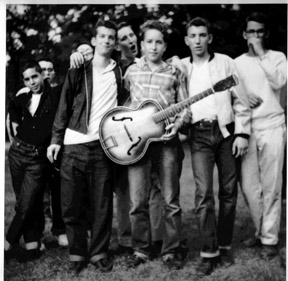
Look Out Little Richard
of succeeding were about a million and a half to one. How could anyone even suspect that Bobby Zimmerman, the kid above, from the virtually uninhabited North Country would be the ONE. Everyone in town must have been laughing up their sleeve, like the guy on the right above, when Bobby Zimmerman sallied forth to ‘join Little Richard’ and conquer the world.
Now, this guy Thompson using his own name came posing as a journalist but impersonating Bob shows up. Thompson seems surprised at the reaction of Maurice and Paul Zimmerman, Bob’s uncles, but can you imagine being interviewed by a guy talking and acting like your nephew Bob. It’s kind of crazy. Imagine what Beattie Zimmerman, Bob’s mother, thought sitting across from Toby doing Bob. Maybe that’s what Bob meant when he said ‘This guy Toby Thompson has got some things to learn.’
Nobody knew what was going on there, did they?
When Bob and John Bucklen and Echo Helstrom were kids, like many another group of Musketeers, they swore that if one of them made it he or she would help the others along. Well, Bob made it but he forgot John and Echo. No big deal. Teenage vows even spoken in earnest have no meaning after the fact but the promise lives on in the innocent hearts of those who aren’t pulled through by the successful one. There is a sense of betrayal. Added to that there was romantic ill will on Echo’s part because of Bob’s eleventh and twelfth grade betrayal.
Bob is making it big while Echo just has a job. A young woman trying to make her way has a tougher row to hoe than a guy. But, if she knows how to work it she does have a story that’s worth at least a couple three or four years worth of wages. She doesn’t know how to market it though. Robert Shelton came out to Minneapolis a year before Thompson and paid her a hundred dollars for an interview. She held the hundred up to Toby as hint but he wasn’t thinking that way. She was only going to get screwed by Toby, literally.
If Toby hadn’t been in an alcholic haze he might have realized that the story Positively Main Street was only subsidiary to Absolutely Sweet Echo. The money was with Echo.

Echo When She Knew Bob
As they’re driving up Highway 61 Echo pulls out a hundred dollar bill and says ‘See what Robert Shelton gave me for an interview.’ The light still didn’t go off in Thompson’s head. He reached into the glove compartment for his pint.
I am astonished at the amount of alcohol Thompson consumed on these trips. If he isn’t novelizing the guy was in a virtual stupor the whole time. When he and Echo arrive in Hibbing they go to a bar where Toby becomes blotto on beer, no less. He has no memory of the moment but Echo tells him that he stood on his head in the middle of the dance floor as coins and keys showered out of his pockets.
Echo must have been one tolerant girl or else she was hoping for something to happen. Perhaps a large part of the charm of Positively Main Street is the stunning unconciousness of Thompson. The guy was twenty-four years old at the time, not a kid- exactly. He had been telling Echo he was going to write a book. When he gets the first trip written up he sends her sixty pages. Echo writes back: ‘Sixty pages isn’t enough for a book is it?’ She has reasons to be disappointed. Heck, Toby is using her to attempt to make his fortune and he hasn’t even promised to cut Echo in for a dime. Think about this. The self centered naivete shines through with startling clarity. For that reason it is one of the most interesting books in the the Dylan canon.

Echo When She Knew Toby
Now, in these sixty pages Toby has misunderstood what Echo told him about the time Bob called her on the phone and played Bobby Freeman’s Do You Want To Dance claiming to be singing the song.
In his sixty pages he projects a better story where Bob shows up on Echo’s front porch playing guitar and sings Do You Want To Dance then strutting all through the house singing and playing somewhat like Elvis in the dime store in King Creole.
Echo points out this error. Toby liked his version so much he left it in the way he first wrote it. Then when Echo introduces this Bob Dylan impersonator into his parents home Toby whips out his quitar and reenacts his version of the incident strutting around the house as he plays and sings. The guy was absolutely out of his mind in his alcohol haze. He must have smelled like a brewery the whole time.
One is astonished that he was so well tolerated. Of course maybe everyone was thinking: ‘This is amazing, but it won’t last long’ and let it pass. Waved his car goodbe as he sped away.
One wonders what Echo’s emotional rection to the Bob Dylan impersonator was. Toby must have reactivated dormant affections for Bobby Zimmerman as he came on to her strongly in Bob’s persona. Echo had ten year old memories of Bob and now here he was, his double, coming onto her again. Frightening actually.
Toby left again and never returned. In the book he seems oblivious to the havoc he created in Echo’s life. In the interview at the end of Main Street given many years later he doesn’t seem to be any more aware. In fact he seems to be still posing as Dylan’s double. He mentions that he still contacts Echo, who has moved to LA, occasionally as does Bob but Bob seems to have better success in finding her.
Hurt and mystified that Thompson had no more use for her she wrote a poem for him that she mailed to him in far off Washington D.C.
Hey! Toby!
Where can you be?
Somebody told me
That you went back to
Washing Machine D.C.
How can that be?
You came to town in your Volkswagen
And I’ll tell you we sure had fun!
And now you’re gone!
You played for me on your old guitar,
Took me for a ride in your little car,
Drove me near and drove me far,
We looked at the moon,
And stared at the stars,
You stood on your head in my hometown bar…
How could it be you’ve gone so far?
Hey Toby? Where are you?
– Echo Helstrom
Toby hadn’t gone anywhere. Like Bob he’d just never been there. His fantasy like Bob’s didn’t include anyone else, they were just bit players in his own movie. Toby was no longer thinking of Echo. He was married to the bottle. He was touring bars across the country to get material for his next book. Echo could just consider herself as one of those bars. Once Toby had visited it there was no reason to return.
The tragedy for Echo was that she was betrayed once by Bob in 1958 and then again by a Bob impersonator in 1968. Perhaps a wound was created in her heart that could never heal. One wonders what her later history was after she left Minneapolis and drifted West.
I wonder where you are tonight.
I wonder if you are alright.
I wonder if you think of me
In my lonely misery.
There stands the glass,
Fill it up to the brim,
Till it flows o’er the rim,
It’s my first one today.
-Webb Pierce.
Here’s to old memories. Bottoms up.
Exhuming Bob Chronicles IX Pensees 8: New Morning
July 23, 2008
Exhuming Bob:
Chronicles IX, Pensees 8:
New Morning
by
R.E. Prindle
The chapter New Morning opens with an interesting comparison. Bob had just returned to Woodstock after his father’s funeral in the summer of 1968. The association of New Morning with the death of his father in itself presents an interesting psychological mental state. A letter was waiting for him from who he considers one of the three great American poets, Archibald MacLeish. MacLeish was just coming off his Broadway triumph J.B. In the letter he asks Bob and Sara to call on him in his Connecticut home to discuss a musical collaboration on his new play. A jewish father dies; a goy ‘father’ appears.
As Bob explains, Father Abram is somewhat dull, thinking that an artist must be a painter. The notion seems to be that Bob is slightly ashamed of his father for not understanding the distinction between pictures and the artistic soul. Thus contrasting with dull Abram is the brilliant intellectual poet-artist, Archibald MacLeish. Bob is quickly on intimate terms referring to the Poet Laureate of America as Archie.
If you’ve never read Poe’s last story Landor’s Cottage you might like to compare that description to Bob’s of MacLeish’s home. While we never meet Poe’s Landor Bob does introduce us to Archie. Coming from small town Hibbing Bob seems to be overwhelmed by the splendor of MacLeish’s dwelling place. Sure sounded good to me. So as Bob left Abram at the rosy fingered Dawn of his New Morning, MacLeish presents himself as the sun rising above the horizon. But it’s a Black Sun. MacLeish does not walk on the sunny side of the street. He’s dark, as anyone who writes a play commentary on the Book of Job must necessarily be.
His new play is called Scratch. One presumes after Old Scratch, The Devil. Bob quotes some lines of Archie’s character Scratch, p.124:
I know there is evil in the world- essential evil, not the opposite of good or the defective of good but something to which good itself is an irrelevance- a fantasy. No one can live as long as I have, hear what I have heard and not know that. I know too- more precisely- I am ready to believe that there may be something in the world-someone, if you prefer- that purposes evil, that intends it…powerful nations suddenly, without occasion, without apparent cause…decay. Their children turn against them, their families disintegrate.
The strength of the insight is too strong for Bob at that precise psychological moment but Archie has given him a hint of a reality that Bob will realize all too soon. Perhaps in reference to Abe and Archie Bob meets Frank Sinatra Jr. at the Rainbow Room. Frank, Jr. nursing one of the same travails as Bob asks him after discussing Frank Sr.: What do you do when that father turns out to be a son-of-a-bitch.
Well, yes, you’ve got an identity problem, don’t you? Bob has always had an identity problem. What started out bad has taken a turn for the worse. He wanted to be Bob Dylan but now being Bob Dylan has turned out to be a son-of-a-bitch, a burden Bob…well, just plain Bob, cant’ bear. He’s learning about this inherent evil of life Archie is talking about.
If you’ve never experienced what Bob is telling you it will be hard to understand. I’ve suffered through a mild dose of them blues, enough to give me understanding, but nothing compared to Bob. He wakes up and someone is standing in his bedroom watching he and Sara sleep. That gives you a start. But if Bob thought he had identity problems what kind of problems does some poor fish have who literally wants to get inside your skin have. Walk a mile in your shoes like Toby. Everybody want something from you that you don’t have to give. And I mean something. You by your success have emasculated them, Bob’s success. So they in turn want your dick and balls. They want ot carry them around in their pocket to give them what they lack. ‘Hey, you know what I’ve got in my pocket, look, Bob Dylan’s dick and balls.’
You want to know what emasculation is? Bob tells you. The Sheriff of Woodstock tells him that if someone is scrambling over his roof and falls off Dylan will be legally responsible. That does something to your mind. The Sheriff tells Bob that if any of these crazies attack him and he defends himself he’ll be the guy going to jail. That one sends a few synapses seeking new routes through the brain. That one did happen to me. Might as well have left the planet, the Sheriff just took your dick and balls.
Bob is now learning first hand of the evil in Archie’s world. Damn that’s rough.
Even then Bob couldn’t make his lyrics dark enough for Archie although, now this is funny, Bob did use them in his album New Morning. What does that say about a new morning?
Bob just couldn’t get used to being Bob Dylan. Being Bob was OK but being Bob Dylan was tough. They were everywhere. You couldn’t even run much less hide.
As Bob tells us he was riding down the highway with Robbie Robertson when Robbie asked him: ‘Where are you going to take it now?’ ‘Take what?’ Bob asks in return. ‘Pop music.’ Robbie naively replies.
Bob is flabbergasted but who can blame Robbie? For the last six years Bob had been calling the shots, getting booed and selling records, renovating and reinvigorating folk music, taking folk music electric, electrifying rock. Why shouldn’t Robbie think something mega revolutationary was brewing in Bob’s brain? Being Bob was easy, being Bob Dylan was damn near impossible. Those three fathers, Abe, Archie and Frank Sr. Bob was learning something about the inherent evil of living.
His new mentor, Archie, thinking perhaps that Bob was Bob Dylan pushes him to sharpen and darken the lyrics to the songs he’s written for Archie. Bob just like after Blonde On Blonde has taken it as far as it can go. He opts out on Archie. Two fathers down but there’s still that Big Guy In The Sky but that Bob will seek a little farther down the road.
New Morning was a good chapter. I could empathize. Current events are giving me a new slant on the inherent evil in the world too. Heads up.
 I, Dynamo