A Review
Thuvia, Maid Of Mars
by
Edgar Rice Burroughs.
Part III-C

Review by R.E. Prindle
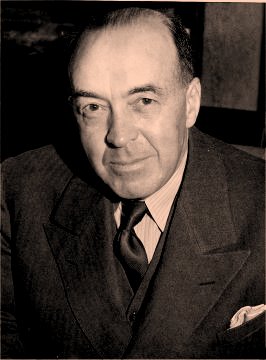
Edgar Rice Burroughs
Civilization And Its Malcontents
Let us say that for the fifty years or so before the 1920s there was a growing sense of societal malaise. This malaise was reflected most notably in the creation of Edgar Rice Burroughs’ psychological projection, Tarzan Of The Apes. One has to account for the immediate acceptation by society of such an absurdity. Tarzan, in fact, completely rejected civilization for the life of the romantic ‘unrestrained freedom’ of the jungle. The noble savage in fact.
Thus in a metaphor Burroughs reflected the malaise of his time so brilliantly that his creation was accepted as virtually a real person. Writers like Grant and Stoddard put the same theme into more scholarly terms. As noted, contrary to Richard Slotkin’s idea, Grant had little or no influence on Burroughs while the slightly later Lothrop Stoddard whose three relevant works appeared only from 1920 to 1922 could have had no influence on Burroughs’ formative years. It seems probable that Burroughs did read Stoddard and was influenced by his work but only after his ideas were fully formed. Even then The Revolt Against Civilization appeared after Burroughs had examined some of the same problems in his rejected manuscript, Under The Red Flag of 1919.
The problem of the malcontents and their war on civilization was examined by a number of writers during the twenties and thirties so why Slotkin singled out Burroughs, Grant and Stoddard isn’t as clear as it might be. Postwar German cinema was intensely concerned with the matter as why should it not? Germany was under asault by what Stoddard called the Underman. Nor need Slotkin think Stoddard was alone. I’m sure there were dozens of forgotten books prophesying the end of the world by one means or another including the Undermen of Communism.

The Underman, or the Communist, was not even a term unique to Stoddard. Gustave Le Bon, the French scholar on whose work Sigmund Freud based his study Group Psychology And The Analysis Of The Ego wrote prolifically on the psychological foundations of the Underman. Freud based his book on Le Bon’s 1895 study The Psychology Of Crowds. Unless I’m mistaken he based his 1930 study Civilization And Its Discontents on Le Bon’s 1921 book The World In Revolt: A Psychological Study Of Our Times.
On the cinematic side the problem was examined in the great silent films The Cabinet Of Dr. Caligari and Fritz Lang’s 1922 film Dr. Mabuse, The Gambler. Lang would follow that ten years later with the sound film The Testament Of Dr. Mabuse.
Even though Buroughs’ Under The Red Flag was rejected in 1919 he persisted, rewriting and extending the text into the 1926 story, The Moon Maid. This story reflects a possible reading of The Revolt Against Civilization but such a reading was much more evident in 1934’s Tarzan And The Lion Man.
The development of the problem was evident to all these writers which it seems to have escaped Slotkin who attributes the recognition of societal evolution to mere ‘racism’ in the writers. One thinks that perhaps Slotkin is too involved in his own agenda.
Rider Haggard enunciated the problem quite clearly in his 1888 novel Allan Quatermain in which Quatermain grouses about the ‘strict limits’ of civilization compared to the ‘natural’ life of the African Zulus. It might almost seem that the idea of Tarzan arose in Burroughs’ mind from that observation. In fact science was undermining all the comforting beliefs that mankind had been settled in for a hundred thousand years. During that long period characterized by the mental mode of what is called mythopoeic thinking man’s mind devoid of true knowledge projected a vision of reality that resulted in the notion of God. Thus reasoning from insufficient knowledge man’s mind came up with an erroneous result. You can’t get out of a mind what isn’t in it; all education is suggestion.
As Freud was to say, man’s settled view of reality received its three great shocks when Galileo disproved the geocentric notion of the universe, Darwin disproved the uniqueness of man’s position in the animal kingdom and he, Freud, displaced the conscious mind with his vision of the unconscious mind. Once again Le Bon was there ahead of him.
Thus as the nineteenth century opened and progressed the bases of mankind’s notions of reality were shattered leaving him emotionally and intellectually bereft of foundations of belief. Adrift without an anchor.
As if that were not bad enough the great cataclysm that ushered in the modern era, The French Revolution, was based on the the absolute notion that not only were all men created equal but remained equal in all aspects of their existence. The advance of civilization would toss this certainty into the trash can of history also.
As civilization placed greater and greater demands on the intelligence and self-discipline of men and women the incontestable gap between those less intelligent and those more intelligent became more and more obvious. Thus as the century progressed the notion of the Overman and the Underman began to become clear.
At the same time the first tentative efforts at measuring the intellectual potential of the individual began to become possible. Of course the basic inequality of men and women in its physical aspect had always been apparent. Some men were naturally stronger and better muscled than others. But, even that was changing. The science of physical culture was making it possible for the 98 lb. weakling to develop himself into a man mountain. Thus artifically developed srongmen like the Great Sandow ushered in the golden age of the strong man topped off by Charles Atlas who guaranteed he could turn you into a man mountain if you followed his program.
There was the promise that you could dethrone that bully and kick sand back in his face. On the other side Francis Galton was originating the first primitive tests to measure intelligence potential. Burroughs would have seen both proponents during his miraculous summer of 1893 at the Chicago Columbian Exposition. I mean to say that both facts entered his mind where they could be digested and emerge later. Nothing can come out of your mind that didn’t go in it.
And then after the turn of the century Binet devised he first actual IQ test. Thus, just as Sandow and Atlas could measure the size of muscles, the psychologists became able to measure the intelligence potential. Those with high IQs were set up; those with low IQs were cooked. The upshot was that all men were not created equal nor could they ever attain intellectual equality.
To a very large extent what became the Communist Party recognized the inequality while demanding equality against reason. Recognizing subconsciously, perhaps, that men could never be intellectual equals rather than try the futile task of raising the less fortunate they sought to destroy education which brings out the inequality but doesn’t create it. No matter what happens there are always going to be the more intelligent just as there will always be the physically stronger. As Le Bon points out, if you needed to hear it, nature don’t know from equality.
Thus the Communist Party devised the well sounding slogan- From each according to his ability; to each according to his need. Good plan for the needy, slavery for the able. The needy were organized beginning their struggle to achieve superiority by collective action. This was accomplished in Russia in 1917. The battle was joined.
Just as individuals are created with different capabilities so are peoples and races. Some can achieve and some can’t. Slotkin who must be a Communist thus takes offence at what he perceives to be, and is, an attitude of White Supremacy in Burroughs, Grant and Stoddard. While I am aware there are those who will disagree with White superiority it is nevertheless not an attitude but an evolutionary fact. That is the reason Communists have Darwin under attack. While Darwin doesn’t say it, it is the inevitable result of his studies. Just as it was necessary for the Undermen to destroy education in the hopes of creating intellectual equality so it became necessary to destroy White achievement of the last five hundred years. The whites must be demonized and made to feel evil and inferior morally. That is the import of Slotkin’s Gunfighter Nation.
At that level all three writers are guilty. As has been stated in Canadian courts- Truth is not a defense. So there’s nothing to discuss. Might is right and whoever has the might will prevail.
It is a fact that all three writers were anti-Communists so it may be assumed that whatever Communists believe, they didn’t. And why should they? Might may be right but it can still be nonsense. Communism is a flawed ideology based on a false premiss. It always fails wherever it is introduced. Failure is not evidence of a bad plan in Communist eyes. One just continues to shovel sand against the tide and pray. So succeed or fail they always think they can succeed by the same flawed ideology. The fault for failure lies elsewhere.
In that sense Burroughs was wasting his time assailing this religion of failure with his Under The Red Flag and its successor The Moon Maid. The only people who would applaud his effort would be we non-Communists but he could never convince anyone with Communist leanings. Of course that wasn’t well understood at the time.

If Burroughs were accused of not believing in equality that would be true. Not only are John Carter and Tarzan superior to any contemporaries on two worlds but Burroughs has a whole hierarchy of value. John Carter is the Warlord of Mars ruling from the top city of Mars, Helium. The races of Mars pretty much reflect those of Earth and their relative stations. The main exception is the ruling Red race. As Whites do and have existed on Mars in Burroughs stories while at one time being the dominant race perhaps the Red race is some sort of amalgam of the various Eropean immigrants of the United States. I believe the Green Men represent the American Indian. Both roam the great plains while being essentially savages.
Tarzan though always spoken of as being White is described as a bronze giant. Bronze is a fairly dark metal so that Tarzan and the Red men of Mars may be more or less identical in color.
Tarzan is the man-god so there are none superior or even equal to him. Below him come the English who are the cream of mankind. Perhaps slightly below the English are the French and then the rest of the Whites. Tarzan himself is psychologically an animal having been raised by the Apes. Not your ordinary gorilla or Chimp but a species intermediate between Gorilla and the Negro. Slotkin hasn’t read enough Burroughs to make an intelligent comment but the undeniable attitude of Burroughs is enough for Slotkin to condemn him as an unregenerate bigot. The reader may believe as he likes. I have stated my opinion eslewhere and that is enough. Whether any of these opinions of Burroughs influenced American soldiers at My Lai is open to question. The burden of proof is on Slotkin and he hasn’t provided it.
Along with the Undermen however, speaking through Tarzan, Burroughs is heartily discontented with civilization.
The spectacle of Chicago of the 1890s as a dirty unpleasant place haunts Burroughs. In contrast to the great White City of the Columbian Expo was what was afterwards known as the Black City of everyday Chicago. The contrast was so strong and so offensive to the Undermen that within a year of the Expo’s closing the entire White City was burned to the ground with the exception of one building. Hence perhaps the decayed crimson and gold ruins of Opar and the crimson and gold twin cities of Helium. One wonders what effect the sight of the ruin of the White City had on Burroughs when he revisited the site sometime after his miraculous summer of ’93. The mind creates nothing from nothing so there must have been models of the great cities of ERB’s imagination.
There are points at which Burroughs and Communism have quite similar views. It will be remembered that Burroughs only reluctantly married and throughout his life expressed discontent with the institution. To some extent or other ERB must have been an advocate of free love. Communists would have heartily approved of ERB’s women who went nude except for certain ‘adornments.’ Communists of course want women to be accesible to any man who wants them at any time while they have always advocated bare breasts.
In many ways when the Communists appropriated Tarzan for the MGM movies it took but slight changes to make Tarzan conform to their ideals. The MGM Tarzan and Jane were not married. While Burroughs’ Tarzan was a highly educated on-again off-again sophisticate the MGM Tarzan was a stupid illiterate oaf and one who rejected the attributes of civilization high up there in the Cloud Cuckoo Land of the Mutia Plateau.
On the essentials though Burroughs rejected the demands of the Underman as The Moon Maid clearly shows. There was very little in Stoddard’s The Revolt Against Civilization that Burroughs would have disagreed with. At the same time there was probably very little he didn’t already believe although he had never codified his information as Stoddard had. Slotkin’s contention that Burroughs was influenced by either Grant or Stoddard is surely wrong. ERB had already taken hs positions before either men had begun to write.
Each writer was, in his own way, an advocate of White Supremacy. It now become clear that White Supremacy has nothing to do with a fringe element in Liberal ideology. All Whites are White Supremacists in that ideology unless they reject ‘White skin privilege’ whatever that is. Ayers and Dorhn explain in their recent Race Course In White Supremacy. Interestingly constructed title. Nor as Slotkin would have it is the attitude based on mere racial pride and bigotry but on a solid record of achievement unattained by any other people. The quesiton is not was it right for some people to rule or be supreme because in the nature of things some people will rule and be supreme but which of the peoples are most qualified to be supreme.
All people have had equal opportunity so that one can only conclude that the race has gone to the most qualified participant. In the contest the Whites unified the other peoples against them as must inevitably be the consequence of being the top people. As they say, getting there is the easy part; staying there is the hard part.
Slotkin merely represents the envious losers, the Undermen. who clutch at any firebrand to burn the White House down. Who is most to be admired and emulated? Builders or destroyers?
Finis of Thuvia, Maid Of Mars Review
Edgar Rice Burroughs On The Move
March 6, 2009
If Pigs Had Wings
Edgar Rice Burroughs’ Three Trips West
by
R.E. Prindle

Edgar Rice Burroughs
During the years 1911 to 1919 ERB visited Southern California three times, once in 1913, again in 1916 and his final visit in 1919 when he established himself there. The question is why, what motivation did he have for those visits.
After 1911 life began to move very fast for ERB in dizzying leaps of change while all the time his mind disgorged a lifetime’s worth of stories based on his reading and experience from 1875 to 1911.
One of the most important influences of this early period was the OZ books of L. Frank Baum. The whole Mars series of Burroughs can be seen as the transportation of OZ to Mars as filtered through Burroughs’ mind. John Carter can easily be seen as the Wizard while Dejah Thoris is perhaps Ozma rather than Dorothy.
Baum while not a native Chicagoan lived in that city at least through the nineties. In 1900 he began to turn out his OZ stories that so impressed ERB. Then he moved to San Diego, California which city he left for Hollywood in 1910. At that time Hollywood was just a town on the outskirts of LA. The movies didn’t arrive until 1914 so the films had no bearing on Baum’s choice to live there or ERB’s visit. I believe that one purpose of ERB’s visit was to present himself to Baum with his own stories as an entree. There is hard evidence that at this time ERB made a trip to LA to see Baum and I believe it certain that he did.
Now, it is debated whether Burroughs ever had any interest in Theosophy. David Adams, so far as I know was the first to suggest he did. Once again we’re on thin ice in saying that he learned something of it most likely during this visit but the ice isn’t all that thin.
Baum himself had been a card carrying Theosophist since about 1883, his mother-in-law much longer. there are those who argue that the OZ stories are virtual treatises on Theosophy. They make a good case. It follows then that Burroughs must have imbibed a good deal of Theosophical talk from Baum, including discussion on Madame Blavatsky if not beginning in 1913 then at least in 1916 when we do have a record of his visiting Baum.
In San Diego in 1913 ERB first stayed in Coronado across the Bay from San Diego. Across the narrows from North Island just above Coronado is Point Loma. The Point Loma Theosophical Society under the guidance of Katherine Tingley had a spectacular campus reminiscent of the Columbian Exposition of ’93 in miniature. Tingley built the first Greek Theater in America there. I should think it impossible that ERB and Emma didn’t visit the campus at least once. With ERB’s curiosity in religion I think it probable that he spent some time there familiarizing himself with their texts in emulation of his own hero, Baum.
Also by 1913 Max Heindel’s Rosicrucian Society had been in operation for several years in Oceanside just a skip from Point Loma. I can make no claims that ERB also took Rosicrucianism in but a man of his interests may easily have done so.
Baum was one reason for Burroughs to visit San Diego in 1913 which was also his earliest opportunity.
ERB’s mental turmoil in dealing with success was exacerbated in the first quarter of the year by the death of his father. I’m sure this event had a terrific impact on ERB. His was a difficult relationship with his father. While ERB regretted his father’s death I suspect he rejoiced in it too.
According to Herb Weston, George T., the father, humiliated his son by publicly declaring that he was worthless. Thus on the one hand ERB created an ideal father figure in John Carter, but way off on Mars. He also created an evil fatgher figure in the deaf and dumb looney who tortured the Lad of Lad And The Lion. that book was written over March and April of 1914 almost exactly a year after his father’s death.
Perhaps his father’s death caused a reaction where he had to get far away from the memory of that hateful father. After writing The Lad And The Lion on the anniversary of his father’s death, as it were, he was able to return to Chicago.
Another reason for his leaving for San Diego may have been the need to rectify and reverse the disastrous trip with Emma to Idaho in 1903. In that instance they packed their furniture and all their belongings to go West. The trip to Idaho may have been in emulation of Owen Wister’s Virginian in which the Virginian and his wife lead an idyllic existence away out there. The experiement ended in disaster a year later when after serving as a railroad dick in Salt Lake City while trying to run a boarding house the couple was forced to sell their belongings at auction although returning to Chicago first class.
The failure nearly disrupted the marriage while apparently causing ERB no end of personal grief. As he did in his stories ERB believed that by reversing the results by a subsequent action he erased the actual occurrence of the first. Thus in 1913 once again the family now of five packed all their belongings including their second hand car and traveled first class to Los Angeles as the only rail service into San Diego was from LA. It should be noted here that the IWW or Wobblies invaded San Diego in 1913 so ERB was probably present at that debacle which is worth reading about.
After some months in San Diego the couple once again sold all their belongings including the second hand car before returning to Chicago. This time ERB could return in comfort knowing that he was solvent in Chicago. On his return he bought the same car, a Hudson, that his hero Baum drove.
Still, a very strange interlude.
Once back in Chicago ERB remained there in what sounds like one the finer houses of the city for two years until 1916 when he returned a second time to San Diego.
Tremendous events occurred between his arrival back in Chicago and his second departure for San Diego. Of course, the Great War broke out shortly after his return. I don’t mean to say that the war didn’t overshadow everything else but I don’t think it over shadowed everything else in ERB’s mind.
There were at least two other events of signal importance for Burroughs not including the Jack Johnson Affair. These were busy times. The first was the creation of the Panama Canal that was completed in 1913, opened in 1914. The canal overwhelmed ERB’s mind. A few years later he and Emma would voyage through the canal, the only trip outside the US with Emma of which we have knowledge.
The second was the announcement of the construction of the Lincoln Highway from NYC to San Francisco. The highway was dedicated in 1913 but would not become a reality until long after ERB decided to make the trip in 1916.
See http://lincolnhighway.jameslin.name/history/part1.html
In 1912 there were almost no good roads to speak of in the United States. Tje relatively few miles of improved roads were around towns and cities. A road was “improved” if it was graded; one was lucky to have gravel or brick. Asphalt and concrete were yet to come. Most of the 2.5 million miles of road were just dirt, bumpy and dusty in dry weather, impassible in wet weather. Worse yet, the roads didn’t really lead anywhere. They spread out aimlessly from the center of the settlement. To get from one settlement to another, it was much easier to take the train.
http://en.wikipedia.org/wiki/lincoln_highway
According to the Association’s 1916 Official Road Guide a trip from the Atlantic to the pacific on the Lincoln Highway was “something of a sporting proposition” and might take 20 to 30 days. To make it in 30 days the motorist would need to average 18 miles an hour for 6 hours per day, and driving was only done in daylight hours. the trip was thought to cost no more than $5 a day per person, including food, gas, oil, and even “five or six meals in htoels.” Car repairs would of course, increase the costs.
Since gasoline stations were still rare in manyparts of the country, motorists were urged to top off their gasoline at every opportunity, even if they had done so recently. Motorists should wade through water before driving through to verify the depth.
So ERB;s little caravan seems to have been a wise precaution. J.C. Furnas in his book Great Times says that 60 days for the trip was a more likely figure so ERB wasn’t too out of line in what seems like an overlong journey. Furnas born in 1906 probably remembers something of the hoopla first hand. He remembers the route terminating in San Diego which was where ERB ended up at any rate.
The trip was obviously a first rate adventure for which ERB was prepared but which he didn’t care to repeat. Of course his children who were free of cares enjoyed things immensely.
An object influencing ERB’s decision to make the trip was the Panama-Pacific Exhibition in San Diego in 1916. The opening of the Panama Canal benefited California directly. The route whether from the East Coast or Europe was shortened immensely. Thus both San Francisco and San Diego had exhibitions. the one in San Francisco ended in 1915 so many of those exhibits shifted to San Diego. One can’t expect the San Diego Expo to rival that of the great Columbian Expo of 1893 but I suppose it was still something. There was one exhibit that probably had a profound effect on ERB’s future. Furnas, Great Times, p. 186:
The also highly California purpose of the whole doings was candidly to promote settlement and land sales in this relatively undeveloped corner, as the most original feature was what the advertising called “moving, throbbing, real life” demonstrations. That instead of just showing the latest farm machinery in an Agricultural Hall, here was an impressively extensive model farm with the machines actuallyout there plowing, cultivating, ditching. For the other kind of farmer, here was a model five acres to show what irrigations could do to intensive cultivation-orchards of walnuts and four different fruits with all kinds of garden truck flourishing between the rows of trees and a model farm family inhabiting a model California bungalow with such fancy modern gadgets as an automatic electric pump and a vacuum cleaner.
Sounds like it might have given ERB ideas that came to fruition three years later.
We know for sure that ERB made the trip in 1916 to Hollywood to visit L. Frank Baum. Baum called his residence Ozcot after his famous wonderland. I’m sure ERB was very impressed so that it comes as little surprise that he named the estate he bought in 1919 Tarzana.
A question I would dearly like answered is did ERB make a trip to San Francisco in either 1913 or 1916? San Francisco appears in a few novels from The Mucker to Marcia Of The Doorstep always with negative connotations. It would be nice to know what if anything happened to sour ERB on Baghdad By The Bay. It will be remembered that Billy Byrne was shanghaied from San Francisco in 1913’s The Mucker when ERB was already in California.
At any rate the family returned to Chicago to spend a year or two before they made the final move to California in 1919. In 1917 the US entered the war. ERB had earlier tried to enter the fray as a war correspondent but was refused. Now he found a place in the Illinois National Guard as a Major. He stands so proudly in his uniform, an officer finally after all those years.
The war brought out an aspect of his character that may have caused him harm hastening his departure from Chicago.
ERB was acutely aware of having a split personality or, as he put it being two different people a la Jekyll and Hyde. While one finds a reflection of a deep thinking man in his novels many of his actions reveal a very gauche side to his character. I have read very few of his public pronouncements that show him in a truly positive light.
The writing of his anti-German story The Little Door which was presented with little approval from his publishers being rejected by all. The amazingly prescient Beyond Thirty was also coldly received. Even his published writing found tough sledding from time to time. It seems that both Metcalf and Bob Davis of Munsey’s had mixed feelings about him. The manner in which Davis writes to him I find fairly insulting. Of course, as time went on publishers wanted only Tarzan stories from him accepting anything else only grudgingly or even, in two notable cases rejecting the stories outright. Nor was ERB ever accepted by the Chicago literary establishment. Chicago in the teens had a vibrant literary scene to which ERB rightfully belonged yet the only literary club he was able to join was the White Paper Club that any scribbler or wannabe could join. There was something in the character of ERB that obviouslyput people off.
Porges, in discussing ERB’s wartime activities is openly ambivalent about this. Porges describes some of his actions as ‘interperate.’ Something I wish he hadn’t done at the this period that I think was inconsiderate was, as Porges says, p. 288:
In this and other articles Ed revealed how he had been influenced by the wave of public suspicion directed at German-Americans. He admitted that his methods for selling Liberty Bonds may not have been ethical: “We went out in selected groups decked out in all the panoply of war and armed with a bunch of yellow cards each of which bore the name of some suspected German sympathizer… He endorsed this as a way to “spear a Hun right here at home.” (Italics mine)
Only suspected. That’s something I wish a hero of mine hadn’t done. while no one probably said anything to him in wartime I suspect there were repercussions after the Armistice. Many people who hadn’t before probably looked at him askance. His wartime actions were too at variance with his more thoughtful writings. Of course, so far I’m about the only critic who perceives the deep reflection in his stories. Most people then probably thought his novels were pure balderdash. Still he was a best selling author whose main creation had become a household word within six years or less and has since become one of the best known literary characters in the world.
Nevertheless not too long after the Armistice ERB upped stakes making his third and final trip West. His send off by his Chicago clubmates at the White Paper Club was less than sterling to my mind. The cover of the menu showed a pig with wings flying West.
This was ostensibly in reference to his statement that he was going West to be a hog farmer. Still the phrase ‘when pigs have wings’ is usually a negative reference. I can’t escape the notion that there was an element of ‘good riddance’ in his farewell party.
Regardless of how ambiguous his position in Chicago had been he left the Chicago phase of his career behind in January of 1919. It was a new world in the morning when he arrived in LA. But strangely it soon took a Chicago turn. Tarzana awaited him
Zane Grey, Edgar Rice Burroughs And The Anima And Animus
February 1, 2009
Zane Grey, Edgar Rice Burroughs And The Anima And Animus
by
R. E. Prindle And Dr. Anton Polarion and Dugald Warbaby
Bad Blood In The Valley Of The Hidden Women:
Thoughts On Riders Of The Purple Sage And The Rainbow Trail
Texts:
Burroughs, Edgar Rice: Corpus 1911-1940
Grey, Zane: The Riders Of The Purple Sage 1912
Grey, Zane: The Rainbow Trail, 1915
Grey, Zane: The Mysterious Rider, 1921
Prindle, R.E. Freudian Psychology Updated To Modern Physics, ERBzine 2004.
Prindle, R.E. Something Of Value Books I, II, III. Erbzine 2005

Zane Grey
Intro.
Anton and I had never read Zane Grey before reviewing the library of Edgar Rice Burroughs as published on ERBzine by Mr. Hillman. Nor probably would we have but for the Bill Hillman series of articles comparing Zane Grey and Edgar Rice Burroughs. Anton and I dismissed any such connection as being relevant but then Prindle read The Rainbow Trail and said we should check it out. Prindle is a close friend of ours; a little on the independent side but alright.
Grey refers to The Rainbow Trail as a continuation of The Riders Of The Purple Sage so Anton, he’s a psychologist became intrigued by the manner in which Grey treated aspects of the Anima and Animus. We both then read Riders in which we discovered a full blown theory of the Anima and Animus.
It should be noted here that Grey had passages excised by his editors that they thought dealt too explicitly with the sexual aspects of the Anima and Animus while reducing the commerical viability of the story. The unexpurgated version of the story was published under the title The Desert Crucible in 2003. I have the Leisure Historical Fiction edition in mass market paperback.
Grey’s ideas were presented in a very pure manner with complete and intact symbolism so there could be no mistaking that Grey was presenting a well thought out theory. Anton became very excited as he said Grey’s theory certainly rivaled the ideas of Freud and Jung and must have been developed independently of their thought much as Burrughs’ ideas of psychology were.
Although Riders Of The Purple Sage wasn’t among the books listed by Hillman as being in the Library we have to assume that Burroughs read it along with a number of other Grey titles although he must have found Rainbow Trail and The Mysterious Rider the tales of Grey he found most significant for his needs. We will assume that this is so. To understand The Rainbow Trail originally titled The Desert Crucible which was in ERB’s library it is necessary to also review Riders Of The Purple Sage.
1.
Grey in this book examines the nature of the Animus and the Anima of the male as well as the relationship between the living male and female. The micro study of the Anima and Animus is placed in the macro study of Mormon society and law of 1871 versus Gentile society and law. This is also a study of the nature of religion.
The Gentiles- I follow Grey’s thought here- Mormons refer to themselves as the Chosen People and ‘others’ as Gentiles- are all of a stricken Anima which paralyzes their Animus while the Mormons have a strong Animus but disturbed by a stricken relation with the Anima which they completely repress not unlike the Jews and Moslems.
Thus Mormons have a strong affinity with the Semitic religious systems from which they derive their religion in part. Anton, the psychologist, avers that the problem of the Animus and Anima has been known for at least five or six thousand years. Anton is close to Prindle who is a historian, so much of the historical part comes to Anton through him although Anton is well versed in the history of human consciousness.

Edward Borein: Six Riders Of The Purple Sage
Historically the struggle of the male to come to terms with the X chromosome and the y chromosome or Animus is central to history and psychology. During the Matriarchal Age, which is to say a sub- or unconscious age, the X chromosome or Anima ruled the mind of man. As consciousness evolved and the conscious mind emerged from the subconscious the nature of the y chromosome or Animus became apparent. The Patriarchal Consciousness evolved.
To reconcile or not to reconcile?
The Egyptians developed their own theories but here we are not concerned with HS II and IIIs and the Semites. Suffice it to say that the Semites borrowed from the Egyptians while adding very little of their own. If one reads the story of Psyche and Eros in Apuleius’ The Golden Ass one will have a good general introduction to the HS II and III point of view as expressed in Grey’s Gentile characters such as Lassiter and Venters. As said the Mormons reflect the Semitic view on women.
The Semites on the other hand, exaggerted the importance of the Animus in favor of suppressing or subordinating the Anima which has been passed on to the HS IIs and IIIs through the adoption of aspects of the Semitic religions. In a Hungarian myth of the Christian Era the Anima is portrayed as being entombed in the support of a bridge. Thus imprisoned on one side of the river or brain it is denied its rightful function.
The Semitic attitude is reflected in the way the two peoples treat their living females who stand as a symbol and only a symbol of the X chromosome of the male. In both existing Semitic relgions, the Judaic and the Mohammedan, the females are treated as property no different than cattle. Some of these attitudes have been temporarily weakened through contact with the HS II and IIIs. They haven’t gone away or changed.
The Semitic attitude infiltrated the HS II and III consciousness through their religion which was amalgameted into the HS-Semitic hybrid called Christianity.
Then in 1930 in the Unied States a man named Joseph Smith created a religion called Mormonism based on the extreme Patriarchal notions of the Semites. As Grey puts it the religion was based on the notion of ruling women. Smith devised rules by which women were completely subordinated to the Animus much as in the Hungarian myth while the men were required to take multiples wives. Smith himself racked up 30 plus.
According to Grey the women were not happy with the arrangement but in the thrall of religious belief they thought it their god assigned role.
As polygamy is not part of HS II and III culture Smith and the Mormons came into conflict with constituted society in Smith’s home base of Fayette, New York being driven out. They encountered the same opposition in their new homes which led finally to Nauvoo, Illinois. Smith, who apparently overplayed his hand was murdered in 1844. In 1847 Brigham Young led the new Chosen People from Nauvoo to the Promised Land on the shores of the Great Salt Lake. By 1871 when Riders takes place they must have multiplied exponentially because they occupy all of Utah and parts of adjacent states. This prologue of the diptych is placed before the passage of the 1882 law of the United States outlawing polygamy. The denouement of the novel will take place as the US attempts to stamp out the practice.
The action of Riders-Trail takes place on the border of Utah and Arizona and parts of adjacent states with the Grand Canyon of the Colorado as a backdrop.

Edward Borein: Riders On The Mesa
As with the other Semitic religions the Mormon Bishops and Elders with untempered Animi have made their will the law. Thus, according to Grey, the Churchmen have become criminals willing to commit any crime to achieve their personal desires which they equate with the will of God.
As Riders opens a Mormon woman, Jane Withersteen, against all the rules of Mormon society is living as an independent woman in Cottonwoods on the Utah-Arizona border, Gentile Law on one side, Mormon law on the other. She does this in defiance of Bishop Dyer (die-er?) who has ordered her to marry and end her independent status. She has her own duchy among the Mormons owning her own town, the water, aparently several counties, a magnificent bunch of horses (emblematic of the Anima) and six thousand head of cattle divided into two herds, the red and the white. (emblematic of the male and female.)
Her independence is a standing affront to the Mormon Elders and Bishops. Having been ordered to marry Elder Tull as one of his many wives she has no wish to submit to the Bishop’s will. Read- Will of God.
These men are not to be balked. The woman Withersteen has no actual rights under Semitic law. As these men have a crazed Animus untempered by the acknowledgement of the female principle or Anima which they deny they have lost all sense of justice, or rather, they equate justice with their desires which they believe are supported by divine law. They are going to use every concealed criminal means to break Jane Witherspoon down. As their will is law they can’t see the difference between subjective criminal methods and objective legal ones.
Jane is already having trouble hiring Mormon riders, riders are the same as cowboys in Grey’s lexicon, to manage her herds so she has resorted to hiring Gentiles.
The Mormons must be seen as a species of Semite and in the Semitic manner they punish Gentiles, or unbelievers as the Moslems would put it, destroying any attempts at their prosperity. If you read the first few lines of the Koran you will find it plainly stated that unbelievers must be punished. Hence all the Gentiles are kept uneducated and impoverished. Jane’s ramrod, is a young Gentile named Bern Venters. Venters at one time had been a prosperous cattle rancher but the Mormons had emasculated him by lifting his cattle. Venters was rescued by Jane from complete impoverishment by offering him a job.
The Elders hate her for this. They have warned Jane to get rid of him and her other Gentile employees but as a sort of Great Mother figure, an active female principle opposed to their male principle, she has refused. She is sort of a Matriarchal throwback among these Patriarchs. As the story opens Elder Tull has dragged Venters out of Jane’s house where Tull gives Venters the choice of hightailing it out of the Territory, Utah being a territory from 1850 to 1895 when it became a State, or being whipped to an inch of his life. Now, Tull means this, they are going to whip Venters nearly to death for being a Gentile in Mormonland.
Having already been emasculated by the lifting of his cattle which, in reality, he couldn’t prevent, Venters now chooses to take the whipping rather than emasculate himself further by hightailing it. Difficult choice.
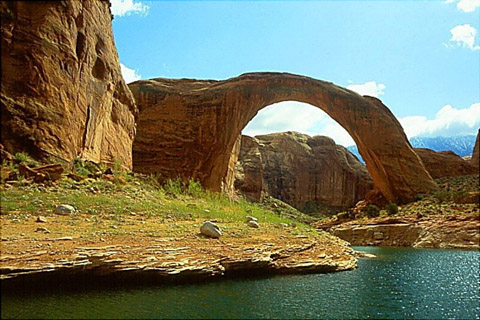
Rainbow Bridge
Tull is about to have him stripped when the Hammer Of The Mormons, Lassiter, appears out of the purple sage riding a blind horse- you heard right- a blind horse. This guy is Bad Blood personified. Boy, they’ve heard about him but how. Black hat, black leather chaps, two massive black handled pistols worn very low, apparently at his ankles, his reputation as a Mormon Killer is well established. Tull gets the cold shivers just looking at him on his blind horse. The blind horse probably indicates that at this point Lassiter is oblivious to female charms, the horse being a symbol of the female and he’s riding a blind pony.
Lassiter makes a few mild mannered inquiries then orders the Mormons to let Venters go. We’re talking Animus to Animus here, cojones to cojones, whoever backs down is emasculated in relation to the other, and Lassiter’s twin pistols make him the master Animus. The Mormons have to eat dirt or die. The Mormons powerful as a collective cannot be so man to man. Tull gives a hint of throwing an iron on Lassiter but the latter goes into his famous gunslinger’s crouch so he grab one of those guns around his ankles, intimidating the dickens out of the Mormons who retire leaving this field to him while muttering threats that he’d better watch his back.
As we said, all the Gentiles are stricken in there relationship between their Animas and Animi. Between Riders and Rainbow they will be healed.
Grey handles the symbolism starkly and masterfully. Jane Withersteen is a masterful Matriarch. Her independence and relationship to the Gentile men has left the impression that she is sexually loose. It isn’t clear to the reader whether she is nor not. She is more the Great Mother rather than the Siren.
Her role seems to be the womanly one of tempering the raging Animus of the male. While she has no effect whatsoever on the Mormon men she is successful in emasculating the stricken Gentiles. She had persuaded Venters to abandon his six gun which made it possible for Elder Tull to seize him while it was only Lassiter’s two black handled six pistols that freed him.
In a rather sexually explicit scene Jane would stand in front of Lassiter to seize a gun in each hand in an attempt to dissuade him from carrying them thus emasculating him. This at a time when Mormons were trying to gun him down. Her role seems to be one of civilizing society although her method seems backward.
Lassiter is a wronged individual seeking his personal justice in a vengeful way. He has shot up several Mormon towns being now known as a Mormon slayer or, in other words, the equivalent of an anti-Semite.
The reason for his anti-Semitism is that a Mormon kidnapped his sister, Millie Erne, holding her captive until she consented to become one of his wives. Hint, hint. Her remains are buried on Jane Withersteen’s property.
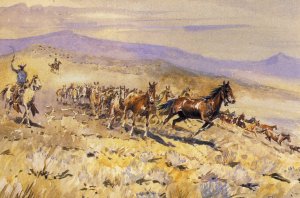
Edward Borein: Lassiter on his blind horse?
Lassiter’s horse was blinded when men held it down then placed a white hot iron alongside the eyes searing them. The horse as a female mother symbol represents Lassiter’s striken relationship with his Anima.
If one reads this novel in a literal sense then many of its incidents are improbable if not ridiculous. What notorious gunslinger would ride a blind horse? Grey has been criticized for wooden characters which is womewhat unjust. These are archetypal characters who are fully developed and can’t change. As allegories there is no need to change. This is mythology.
The Mormons lift Jane’s red herd. This may represent her female Animus as in iconography the male is usually represented as red while the female is white. They next try to stampede her white herd by devious means which they believe are undetectable such as flashing a white sheet from a distance. As a Chosen People they even have to convince themselves that what happens was not caused by them but was the will of God.
Lassiter notes this taking Jane with him to show her. As they watch the cattle begin to stampede. Three thousand on the hoof they stream down the valley. Lassiter on his blind horse races full speed down the slope, obviously no blind horse could do this, out on the flat to single handedly mill the cows. As the lead cows enter the center of spiral Lassiter disappears in the dust. He emerges sans horse to appear before Jane: ‘My horse got kilt.’ he announces. Jane’s response is ‘Lassiter, will you be my rider?’ Pretty clear sexually I think. Not exactly changing horses in midstream but obviusly the transition from a blind horse to a sighted jane is an improvement in Lassiter’s relationship with his Anima. ‘You bet I will Jane.’ Lassiter promptly and positively responds.
Whether you want to consider this stuff ‘high literature’ or not read properly it is not much different from the Iliad or Odyssey.
As a mother figure Jane is a keeper of horses, a symbol of the mother and female. The blinding of Lassiter’s horse was the equivalent of separating him from the mother figure. Jane not only has a full stable of horses but she has the prized horses Night, Black Star and Wrangler. As Grey makes clear these are the devil’s own mounts. In the big chase scene Grey has Wrangler close to breathing flames as he compares the horse to the devil.
The Mormons steal Jane blind while she refuses to allow Lassiter to defend either himself or her. Seems to be the Great American Dilemma even today.
Remember this is a war between Gentiles and Semites qua Mormons. The Gentiles hands are stayed while the Semites are allowed to run wild. Maybe Grey is making a social comment. Also remember that Jane is a Mormon so that while she is powerless to control her own aging maniac men the only men she can influence are the Gentiles whom she emasculates. As soon as the emasculated Venters gets away from her while pursuing the rustlers he immediately begins to revert to full manhood.
The Mormons set both Mormon men and women to steal from her. They take her bags of gold, this woman is prodigal, rich, her deeds and anything of value. They steal her six thousand cows. They want to kill Lassiter, dozens of Mormons lurk in the cottonwood groves (female places) but something stays their hands; they can’t shoot him either from behind or in front.
The only thing Jane worries about is her horses. Black Star and Night. It is possible that in this instance Jane represents the moon goddess. Finally the Mormons steal these symbols of her power. The independent woman is now completely violated. She has a man who could shoot down all the Mormons in Utah but she won’t let him use his guns.
So why should we care?
2.
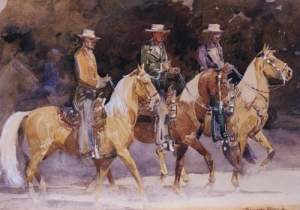
Edward Borein: The Three Caballeros
The myth switches to an alternate plot. Young Bern Venters goes in search of the rustler gang. Once again, Jane attempts to emasculate her men by pleading with Venters not to go, to stay beside her. Why anyone would want to hang around such a loser woman isn’t clear.
Venters goes in search of the rustler gang which is led by a man named Oldring. Old Ring. I’m sure the name has significant meaning but I can’t place it. The wind soughing through the caves is known as Old Ring’s Knell. Even though Oldring’s gang consists of a couple dozen men who have punched a herd of three thousand red cows they have somehow left no trail. Over all the years they have been rustling and pillaging there is no one who has been able to find this robber’s roost.
Venters has traced them to the foot of a waterfall where he loses track. While he is mulling this over a group of desperadoes return from pillaging plodding up the stream. Lo and behold they ride right through the waterfall into yet another hidden valley. Big enough to hold three thousand head of cattle. The West was a big country.
Venters rides off to relate this discovery to Jane and Lassiter when he encounters a despearado with the famous Masked Rider, reputed to have shot down dozens of men. He is dressed from head to toe in black wearing a black mask. This Rider is credited with shooting down any Mormons Lassiter overlooked.
Venters takes out his ‘long gun.’ You know how riders despise the long gun or rifle preferring six shooters, and by dint of long practice he shoots the lead rustler dead and wounds the Masked Rider. While examining the Masked One’s wound he unbuttons the shirt to discover the ‘beautiful swell of a female breast.’ Boy, howdy. You got it, the Masked Rider is a woman, a mannish girl. The image of Venter’s Anima.
Stranded in the desert while trying to nurse this girl back to health Venters chases a rabbit up a slope where he notices ancient steps cut in the rock. Following these he comes into ‘Surprise Valley.’ Formerly the home of cliff dwellers the place is a vitual paradise, green and verdant. No one would ever discover him and the Rider there. Carrying the slight figure of the Rider up hill and down for maybe ten miles or so Venters secretes themselves in the Valley which abounds in game and delightsome frolics.
About this time I recognized some teen fantasies of my own. Shooting and wounding a woman while having to tend her wounds in a secluded place where she has to be eternally grateful when healed was just too obvious. In my case, just after the onset of puberty, I think, when the Anima would be making itself known, I came up with the daydream of having this woman I could keep in a milk bottle until I wanted her. When I let her out of the bottle she became full sized and did whatever I wanted then she willingly went back into the bottle until the next time I wanted her.
As a thirteen year old before the advent of universal pornography I didn’t know what I wanted the woman for but I knew it would be fun. Grey here creates his version of the same fantasy. The Rider, who turns out to be Bess, apparently has a past. I say apparently because nearly everyone in this story has an apparent history which turns out to be false. As a member of the gang she was thought to have been, um…the piece…of Oldring. He kept her in a cabin up on a ledge in his valley behind the waterfall. He was gone a lot so we’re not clear that he ever laid a hand on her but Venters believes she is not ‘pure’ which in his great love for her he is willing to over look but it rankles him.
If you want to know the wonders of Surprise Valley read the book yourself. Comes a time when Venters has to go into Cottonwoods for supplies. There he realizes that he and Bess can’t stay hidden away forever. He has enough money for supplies obviously but not enough to flee from Mormonland.
They don’t call it Surprise Valley for nothing. When he returns Bess hauls out a big bag of gold to give to him. This must be the treasure that the female brings the male. The whole several mile length of the river which runs through this valley is lined with pebbles of gold which Bess has collected. Shades of Opar, huh? In her girlish gratitude she wants Bern to have the lot.
‘Gosh,’ says Bern. ‘Now I don’t have to get a job.’ (He didn’t put it quite that way.) ‘We can leave this valley and go far away from Mormonland.’

Edward Borein: Four Navajos Crossing The Desert
Far away from Mormonland, by the way, is either Quincy or Beaumont (beautiful mountain) Illinois. Not too far from Nauvoo which was the Mormon stronghold jumping off place for the long march to the Great Salt Lake into the fantastic scenery Grey either describes or imagines. Certinly the West of Grey’s imagination is as fantastic as anything Burroughs created on Barsoom.
Even though Grey refers to the desert this is certainly the lushest desert anyone has ever seen. The purple sage is the equal to Burroughs red moss of Mars.
Grey wrote an essay about what the desert meant to him. His desert with its plentiful water complements his vision of the Anima and Animus. The desert may answer to Grey’s subconscious which appears to be missing in his analysis of Anima and Animus, so that perhaps the desert stand for the subconscious.
His desert reminds me of a dream I used to have with some frequency. In my dream I was walking across this immense barren desert spotted at invervals with small oases in which I wasn’t allowed to remain. Off in the distance I could see this great brain shaped mountain. On approaching the mountain I found a small stream of water leading down into the mountain. As I descended I noticed that the stream ran through a bed of solid salt which rendered the water bitter.
Descending further the water disappeared beneath a steel chute. Unable to turn back while unwilling to go further I was nevertheless pushed into the chute where dropping into a steel lined entry I was pushed into a steel walled laundry room as the steel door slammed behind me. There was plenty of water but no way out. There was a ventilation shaft along the ceiling of the back wall. I conceived a plan of drinking to repletion then urinating into the ventilation shaft creating such a smell that they would want to find the source.
My plan worked. Three maintenance men opened the door and I dashed out so fast they didn’t know I had been there. Still in a steel lined area I saw a bank of elevators which would take me back to ground level. A door opened but the elevator was filled with classmates from my high school who pushed me back refusing to allow me to enter.
I don’t know how but I gat back to the surface where once again I approached the back side of the mountain which I ascended this time rather than descended. Now, the mountain was deep in a frozen snow but starting from the low grade at the back I had no trouble climbing, walking on top of the snow. The sun was shining brightly but all was frozen white. When I reached the top I found I was standing above the brow of the face of a great idol carved in the snow. Thousands of feet below terified and intimidated people were kneeling in the desert worshipping the great snow face. From where I stood I couldn’t see the face but I conceived the notion of destroying the snow god to free the people. Leaping into the air I came down on the god’s forehead creating an avalanche. The great face slid away as I descended thousands of feet on a cushion of snow to alight unharmed.
As I hoped, the destruction of the god freed the minds of the people from the domination of their morose god. The melting snow created numerous streams watering the desert among which the people danced and sang as the desert bloomed, while I looked on admiringly.
I don’t know enough about Grey’s background to say how unhappy his childhood had been but since his plot of Riders/Rainbow roughly follows my dream I suspect what the desert meant to him was the barrenness of his early life. The appeal of the novels to Burroughs must have been of the same order.
When Venters leaves the Valley Grey begins to lose control of his story. The clarity and focus of the first half becomes jumbled. He finally just crams the ending through as Burroughs so frequently does.
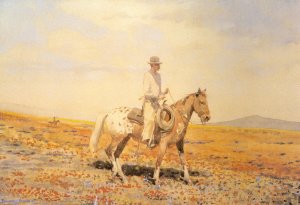
Edward Borein: The Apaloosa
Venters, riding Wrangler, crosses trails with the men who stole Night and Black Star from Jane. A sort of running joke throughout the novel is whether Wrangler is faster than the two blacks. Wrangler proves his mettle in this chase overtaking the two even though they were ridden by the best rider on the range, Jerry Card. Card is sort of a puzzle, at least for me. His horsemanship was so great that racing at full tilt leading one horse he could keep both horses side by side at full pace; in addition he could hop back and forth from horse to horse. Whether Grey was making a joke or not, I can’t really tell, he describes Card’s appearance as froglike. Hop-frog of Poe? Card is a little misshapen runty man. Whatever Grey had in mind for him he forgot to develop.
Card abandons the horses as the race ends disappearing into the purple sage. Wrangler gets away from Venters to be captured by Card. In a rather spectacular scene Card is trying to guide the horse by biting it on the nose. He is actually being dragged with his teeth in Wrangler’s nose. I’m no horseman but I’d really have to have the fine points of this maneuver explained to me.
Unable to hit the small fragile Card with a rifle shot as rider and horse rode alongside an escarpment rather than let Card get away, Venters shot the horse who leaped off the edge in what Grey describes as a fitting end for the greatest horse and greatest rider of the purple sage. I can’t follow his reasoning here but he must be trying to say something.
Venters rides the remaining two horses down the main street of Cottonwoods with apparently no more reason than to enrage Bishop Dyer and Elder Tull and announce in stentorian tones that Jerry Card is dead. Reminds me of the myth in which it is announced that the great God Pan is dead.
Venters packs some saddlebags with provisions then, in what seems a comic touch, since Jane’s wonderful stable of horses is now empty, mounts a burro to return to Surprise Valley. Riding one and leading a string of burros he looks behind him to see if he being followed by men on horses I presume he would have hopped off the burro and started running. The burro appears to represent severe emasculation.
Another essential subplot has been the arrival of a small child still annoyingly gushing babytalk- muvver for mother and oo for you- by the name of Fay Larkin. Fay is going to be the heroine of the sequel. She was the daughter of a Gentile woman who died. The woman asked Jane, who was ever kind to the despised Gentiles, to take the child which Jane did. She now ‘cannot live without the child.’
Having stolen everything else of the woman in the name of God, the Mormons now steal Fay.
This is too much for Lassiter who coldly disregards Jane’s imploring to disregard this insult and injury too, even though a moment before she ‘couldn’t live without the child.’ While it seems that Mormon men emascualte their women, Mormon women in turn emasculate their men. Maybe that’s what the story is about: the conflict between the sexes. Lassiter disregards her, strapping on not only his big blacks but an extra brace that he hides beneath his coat. The extra brace doesn’t figure into the story so it isn’t clear why two gun Lassiter became four gun Lassiter.
Lassiter shoots the Mormons up pretty good killing Bishop Dyer. Elder Tull is out of town at the moment. Lassiter and Jane know they have to get a move on so, packing enough to stagger any ten horses , including bags of gold, they skedaddle riding Night and Black Star.
Somewhere in here Grey must have become stymied in his story not having the progression to Rainbow Trail figured out. Something like the odd ending of Burroughs’ Princess Of Mars. Venters still thinks Bess was Oldring’s girl hence something only his great love for her can make him overlook. Loading up their burros they leave Surprise Valley. Out in the purple sage who should appear much as he had at the beginning of the story but Lassiter, this time with Jane.
It now comes out that Venters thinks Oldring is Bess’ father. Jane lets out the fact that he had then killed his future wife’s dad. Bess is revolted at the thought, calling off the wedding. Lassiter to the rescue. He produces a locket with a picture of his sister Millie Erne and her husband Frank. Lassiter explains that Millie was pregnant by Frank when Millie was kidnapped and that Frank Erne is her real father. The obstacle that had appeared between Venters and Bess now disappears as he hadn’t killed her father, just the guy who reared her. At the same time Bess is no longer the daughter of a low rustler but of a respectable man.
But wait, there’s more. Grey can produce as many twists as Edgar Rice Burroughs. It was the literary fashion of the day.
Not only is Bess the daughter of Millie Erne but the Mormon kidnapper of Millie had been no ther than Jane Withersteen’s father. The ever-forgiving Lassiter, now Uncle Jim to Bess, mutters something like ‘Aw shucks, Jane, I don’t pay thet no nevermind.’ and sister Millie is forgotten. nearly two decades of bad blood goes up in smoke with a shrug.
Venters and Bess head off for the safety and security of civilization in Beaumont, Illinois, while Lassiter and Jane depart for the security of Surprise Valley. Two problems remain for the next ten pages or so, Fay Larkin and Elder Tull.
Just like Tarzan, Lassiter can apparently smell a white girl because there is no other way that he could have located her. She was being held by some Mormons in a side canyon. Setting Jane to one side, Lassiter enters the canyon from which after firing every cartridge in his four guns and belts- Grey didn’t actually make it clear that he was still wearing the extra set up under his coat but he didn’t say he took them off either- of’ four guns Lassiter kills all the varmints, emerging from the canyon with little Fay in his arms and ‘five holes in his carcase.’
As they glory over little Fay, who was problem number one, problem nuber two, Elder Tull and his band of Mormon riders appear on the horizon. Leaping on their burros, did I mention Jane and Uncle Jim swapped Night and Black Star with Venters and Bess for their burros?- the Hammer Of The Mormons and Jane jog off with the Mormons in hot pursuit on horses, but tired ones.
One would think that even tired horses would have the advantage over burros but it is a very tight race. You see why Grey’s stuff translated to the movies so well. Getting all safe within Surprise Valley on the other side of balancing rock (did Grey borrow this detail from the She of Rider Haggard?) Uncle Jim lacks the nerve to roll that stone because Jane has pretty completely emasculated him. ‘Roll that stone’ Jane commands restoring Lassiter’s will. He does just as Elder Tull ad his Mormon band reach the cleft. The stone falls eliminating Tull and his Mormons while sealing off Surprise Valley ‘forever’ with Uncle Jim, Jane and Little Fay Larkin inside. Of course they are well provided because Venters has stocked the Valley with burros, fruit tree stock and plenty of grain seed. At the same time he had eliminated coyotes and other beasts of prey so that jackrabbits, quail and other small food animals have mutiplied exponentially. It’s going to be a long twelve years in the valley so the bunch has to be well provided. Without his gun though Lassiter is going to have to catch those jackrabits with his hands. During their long stay Lassiter and Jane apparently have no sexual relations as there were no additional children when the valley was reentered by the Mormons. Jane must truly have been a mother figure.
On this incomplete note Grey ends his novel.
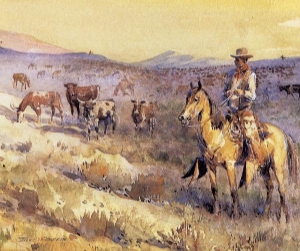
Edward Borein: Grazing Cattle
3.
Indeed, from the Enlightenment to the present has ben a period of intense religion formation, especially the nineteenth and twentieth centuries.
Utopian and Scientific Socialism may both be considered forms of religion, especially the latter in its Semito-Marxist form.
Mormonism itself, which has no basis in science, orginated from the brain of Joseph Smith in 1830. Madame B’s Theosophy, Mary Baker Eddy’s Christian Science, Ron Hubbard’s Scientology and the Urantia religion all have a basis in science as do most religions formed after Darwin. With the emergence of science none of the old religions were satisfactory. Hence it should come as no surprise that writers like Grey and Burroughs were intensely concerned with the problem.
As I have mentioned in Something Of Value no adequate myth for the scientific age developed, leaving men and women whose faith in the Semitic gods was undermined with a stricken religious consciousness such as in the case of John Shefford, the protagonist of Rainbow Trail, and probably both Grey and Burroughs.
So the search for meaning was endemic in this period not being confined to Burroughs and Grey who were merely symptomatic.
Another attitude that both authors share is a yearning for the wide open spaces of their youth that, while we may look back in envy, were rapidly disappearing before their eyes. Somehow this yearning was also connected to a feeling for the prehistoric past, perhaps as a Golden Age.
Both men were charmed by the notionof cliffdwellers. It would seem that Americans of the period were also absolutely charmed and enamored with the Anasazi of the American Southwest. Burroughs was very nearly obsessed with cliffdwellers. Novel after novel is replete with cliffdwellings whether in Pellucidar, various terrestrial locations or even on Mars.
The inhabitants of the skyscrapers of Chicago were nicknamed cliffdwellers; a replica of Southwest cliffdwellings was built for the Columbian Expo of 1893 that apparently made a great impression on 17-year 0ld ERB. The premier literary club of Chicago was known as the Cliff Dwellers which was on the 8th floor and roof of Orchestra Hall. I think Burroughs had a yearning to be a member of this club.
Thus there were many cliffdweller influences on ERB’s life , whether he had ever seen the Anasazi dwellings before 1920 is doubtful, it would be interesting to know if Grey had before 1910.
At any rate cliffdwellers had carved out homes in Surprise Valley in some distant prehistoric time. Thus both Venters and Bess and Uncle Jim Lassiter and Jane were actual cliffdwellers utilizing the old dwellings. Lassiter, Jane and Fay Larkin would be cliffdwellers for twelve years. This must have had a very romantic appeal for Grey’s contemporary readers.
During that period they dressed in skins living as close to a stone age existence as was possible. So one may compare the Surprise Valley of Lassiter and Jane with the cliffdwellers of Burroughs’ Cave Girl.
As all these themes were in the air of the period it is not necessary for either of these two authors to be influenced by each other to this point but it is probable that both were influenced by the stone age stories of Jack London and H.G. Wells among others.
I doubt Burroughs was influenced during this period by Grey although he did have a copy of Rainbow Trail in his library, one of only two Grey titles. We can’t be sure when he bought Trail. Grey’s stories complement Burroughsian attitudes but only after this formative preriod around 1912. ERB’s Western and Indian novels probably owe something to Grey but they were written after 1920.
Riders Of The Purple Sage sets the scene for its denouement which is The Rainbow Trail. Riders was a wonderful romantic vision of the West which answered the needs of the period when for the first time the percentage of Americans living in cities surpassed that of those living on farms. Indeed, very like these authors, modern cliffdwellers had a heartsick longing for the Paradise they had lost. For decades it would be a crazy dream of city dwellers to buy a farm and ‘get back to the land.’ The movie ‘Easy Rider’ was a good laugh in that respect.
Both Burroughs’ and Grey’s novels addressed that need.
Burroughs’ interest in Rainbow Trail would stem from religious aspects and the perfect union of the Anima and Animus when John Shefford and Fay Larkin unite. It might be noted that a fay is a fairie. Cliffdwelling and the purity of Grey’s noble savages, the Navajos, would have been compelling for ERB.
Before continuing on to The Rainbow Trail let us take a brief interlude to examine some aspects that would have interested ERB from the other Grey title in his library- The Mysterious Rider.
Post II: The Chessmen Of Mars by Edgar Rice Burroughs
January 13, 2009
A Review
Edgar Rice Burroughs On Mars
The Chessmen Of Mars
Post II
Part I
The Dance Of Barsoom
See Post I for Intro.
The twenties were a difficult financial period for ERB, indeed, as was the rest of his life to be. The substantial sums he had made in Chicago were spent before he left. ERB had saved nothing. He arrived in LA with no other resources than his current income. That income was very substantial by any measure but unequal to ERB’s massive spending capabilities so that at the time he wrote Chessmen he was already strapped for cash and headed for deep debt.
Always envious of the fabulous sums paid Zane Grey by the slick magazines ERB wanted to sell this story for ten thousand dollars to one of the big slicks. There were no takers so that the story went to the pulps for thirty-five hundred. Adding insult to injury he was told that the stories were too preposterous to be considered.
Part of ERB’s literary problem was that genre categories were not yet well developed. H.G. Wells’ early sci-fi efforts were labeled Fantasias, a term that could be understood by the literary arbiters, while still considered what we would call today, literary fiction. Even George Du Maurier’s trilogy of essentially science fiction novels- Peter Ibbetson, Trilby and The Martian have never been considered anything but literary fiction. They are three terrific stories of psychological dissociation while it would seem certain that Burroughs read them and was probably influenced by them. I can heartily recommend them. Very choice.
So the genres were taking shape at the period but had not yet evolved as they would during the thirties, forties and fifties until today fantasy, horror and sci-fi dominate the fiction best seller lists. If Chessmen was thought preposterous in 1920 one wonders what his critics would have thought of such movies as The Exterminator or The Predator. God, those people were so awkward and unevolved. Well, it’s the price you pay for being an innovator. Remember what the Pope told Galileo.
So, ERB was stuck in the pulps. Perhaps smarting from this rejection ERB would try to break out of his pulp rate with several realistic novels. the first was The Girl From Hollywood, a very decent attempt at a literary novel, that ERB’s long time publisher refused to publish. Following in the burro tracks of Zane Grey ERB wrote a couple of Westerns only one of which he could get published at the time. I read a lot of Westerns in the fifties while a kid. I thought ERB’s efforts were as good as what I read then. They’re all potboilers, even the so-called classics.
He even attempted a couple of Indian epics that I found so-so but I know other people who liked them a lot. Not so critical as myself, I guess. Oh, right, he couldn’t get Marcia Of The Doorstep published either. So he was type cast as a sci-fi/fantasy writer. At least he knew he could do that very well.
Zane Grey wrote some pretty strange Westerns. He himself was quite a womanizer and his novels pander quite successfully to the distaff side. He knew women well. Probably that was why he was paid those great prices by the Saturday Evening Post et al. Oh heck, ERB was just too outre for the Post.
In Chessmen ERB gives feminine appeal his best shot. I would imagine he was trying to reach the ladies when he describes Tara’s fabulous bath. Either that or he was trying to titillate us boys. Worked with me. But let’s assume he was trying to broaden his appeal as the title was offered to the slicks.
Chessmen was based on his three favorite novels as are all his books- The Viginian, Prince And The Pauper and Little Lord Fauntleroy.
Thus Tara teases Papa John as her ‘Virginian.’ We are then introduced to Gahan of far Gathol. ERB presents him first in his princely guise as, indeed, he is a prince of Gathol. ERB chooses to present him as a fop dressed all in diamonds and platinum. Tara forms an ill impression of him as she thinks no real fighting man would dress in such a fashion. Shortly Gahan will exchange his dress duds for the plain leather gear of the Martian mercenary thus changing from prince to pauper. Of course he will resume his role of Prince by novel’s end.
Fauntleroy was born to the manor in England but spent his youth learning what it meant to be a real American boy before reassuming his English title. Ah, American dreaming.
Recalling his battle for Emma’s favors with Frank Martin Tara has been betrothed since at least young girlhood to Djor Kantos whose father is friends with the family. So like ERB Gahan has to overcome this parental resistance. Speaking of Frank Martin Chessmen is the only novel I can recall in which the hero doesn’t get bashed on the head two or three times.
At the ball being given Djor Kantos fails to claim Tara in time for the first dance so that Gahan leads Tara in the Dance Of Barsoom. Some sort of Grand March. ERB explains that before Barsoomian youths can attend balls they have to first have learned three formal dances- The Dance Of Barsoom, that of their country and that of their city. After that they can take up stuff like the Martian equivalents of the Grizzly Bear, Bunny Hug, Charleston and Black Bottom. Kids being kids on Barsoom the same as on Jasoom.
While the concept is quite charming one wonders of the source. Burroughs himself was no slouch concerning the hit parade.
I think we can trace the rigamarole back to the patron saint of old timey music, Henry Ford.
Amongst all his many other enterprises Henry was revolted by the music and dances of the Jazz Age as the twenties are sometimes known. Even though his very own flivver is billed as being responsible for some new objectionable habits and traditions Henry clung stubbornly to the old. Thus in full revolt against the Jazz Age Henry was promoting the dances and music of his youthof around, oh say, 1880 or so.
Ford had begun his publication of the Dearborn Independent in 1920 making him a newspaper man also. It seems clear from internal references in Marcia Of The Doorstep that ERB was following developments in the Independent. He would then certainly have learned of the evils of the new music and the virtues of the old.
Just as Henry Ford was trying to rivive the old dances on Jasoom, on conservative, behind the times Barsoom Jazz has never even been given a chance. The Dance Of Barsoom is just as fresh and lovely as the first time it was danced millennia before. Martian kids didn’t mess with tradition so much so Gahan led Tara in that lovely old relic of Mars- The Dance Of Barsoom.
Pledging his love during the dance Gahan was sternly rebuffed by Tara.
The preliminaries finished the story begins in earnest.
The following day Tara is fascinated by a cloudy stormy sky which is such a rare occurrence on Mars that she had never seen one before. As I mentioned in the intro ERB borrows the next sequence from Baum whose Dorothy was wafted to Oz on a tornado. Tara ascends into this tornado like storm where her flier is caught by the winds and she is driven before them. When she lands she had been driven like Dorothy to Oz to a far land that has been all but forgotten if it had ever been thought of.
The hero and heroine of Chessmen are Tara of Helium and Gahan of far Gathol, or rather, they are the Anima and Animus of ERB. ERB always writes Anima and Animus novels. As dreamers will he may have recognized the X chromosome or Anima in the green pastures of his sleep or, it is quite possible that as a Latin scholar at Chicago’s Harvard School he was required to read the myth of Psyche and Eros from Apuleius’ The Golden Ass. I only mention a couple of possibilities. He may or may not have been familiar with Psyche and Eros but he was certainly familiar with the fairy tales derived from it such as Cinderella and Sleeping Beauty.
While Apuleius is given credit for the story his version is certainly only a redaction of the tale or philosophical speculation dating much further back in history. The Ancients were well familiar with the concept of both the male and female versions of the Anima and Animus. In popular mythology the male chromosome is represented by the Goddess as X chromosome and the Bull as the y. The female is represented by the two snakes as in the pictorial representations of Crete. It will also be remembered that the Greeks imported Cretan priests to manage the Apollonian shrine at Delphi.
The myth is that the two aspects were once united then driven apart wandering the world in search of each other. Duly at long last they do find each other are reconciled and allowed by the Goddess of Love to reunite. Thus the stories of Cinderella and Sleeping Beauty evolved from Psyche and Eros and who knows how many other stories besides those of Burroughs.
The question is was Burroughs only following a plot line, a pattern he had absorbed or was he consciously aware of what he was doing? Had he thought the problem out? Just as Tarzan and Jane were apparently mismatched in Burroughs’ dreamscapes so were ERB and Emma in real life. In Tarzan And The Golden Lion Tarzan and Jane had no sooner returned home from Pal-ul-don than Tarzan fled to his Anima in far off dreamland Opar leaving Jane/Emma to more or less shift for herself in a very dangerous world. Misfortune usually hit her too.
In ERB’s dream couple of John Carter and Dejah Thoris the Anima and Animus seem to be united although we see little of Dejah Thoris in the series and not at all in this novel. Even their son who may represent ERB is not present at all. Even with Carter and Dejah Thoris the classic separation and reuniting form a major part of the Martian Trilogy.
In this dream tale with Tara and Gahan ERB follows the classic formula- separation, the long pursuit and final reconciliation. He appears to know what he is talking about but since he never discussed his ideas on the subject we can only infer that he did or doubt or deny that he did. The psychological motifs he expresses throughout Chessmen leads me to believe he did.
What are dreams and what is a dream story? Freud originated the rational approach to dream interpretation. ERB gave some thought to the problem. Once can’t be sure he had read Freud’s Interpretations Of Dreams although in his short story Tarzan’s First Nightmare ERB used elements contained in Freud’s theory to explain the causes of Tarzan’s nightmare. At the very least we can say that dreams and nightmares from which ERB suffered all his life were of great interest to him. In the thirties he would buy at least one book on scientific dream interpretation.
What is the basis of dreams? It can only be experiences combined with memory. That’s it. Think about it. You don’t have to look any further. Nothing mysterious about them. The basic problem can be expressed in the question of what is the unconscious or subconscious. Is it some ultra mysterious process of the mind that can’t be penetrated, understood or accurately located? Is it as Freud believed an organ independent of the body and mind yet which somehow controls the actions of the individual from outside him? Or, once again, is it merely a combination of experience and memory, a faculty for interpeting the experiences of the day?
Freud touched on a key concept when he realized that the mind, which never rests, processes the incidents of the previous day in the sleeping and dreaming state. Burroughs also takes this approach in Tarzan’s nightmare whether he picked it up from Freud, Sweetser or realized it himself.
In point of fact experience happens to us so rapidly and from so many angles at the same time that it is impossible for the conscious mind to process it all as it is happening. Can’t be done. So, it follows that the subconscious or back up mind retains, as it were, photographs of the day’s activities that it reviews in sleep for either discarding, repression or action. How many times have you awakened with possible solutions to problems facing you?
The problem with the subconscious mind is that analysis of situations is affected by fixations, more expecially by the central childhood fixation. Childhood is that perilous time of life when the inexperienced mind is subject to being presented with challenges for which it has no programmed or immediately adequate response. Defeated in analysis the challenge is encrypted and encysted in the subconscious where it interprets all similar challenges through the lens of the defeated challenge and response. Thus all those strange compulsive behaviors we have.
As it chances we know Burroughs’ central childhood fixation. That was when he was eight or nine and he was challenged on a street corner on the way to school by a twelve year old Irish bully. Terrified ERB broke and ran apparently thereafter branded as a coward. Thus the central theme of his work is fight or flight and the state of cowardice. He examines the matter endlessly throughout the entire body of his work. These elements are all especially prominent in Chessmen.
We know that ERB was stressed to the breaking point as he wrote in 1921. Whenever he was stressed his personality fragmented, splitting at least once. In Chessmen the Kaldanes are two separate entities, the physical Rykors and the mental Kaldanes. Tara and Gahan, the ritual Burroughs’ surrogates are driven apart by the terrific storm.
This is a dream story abounding in dream images. One can provide an analysis of the storm scene based on the incidents occurring in ERB’s life at the time.
The image presented to us is of this very rare Martian storm of very high winds as in a tornado. Tara although warned against it takes her flier up. Perhaps ERB was warned against buying Tarzana, I would certainly think that Emma was at the least apprehensive. Tara navigates well beneath the clouds but wants to be in a cloud where she has never been before, i.e. Burroughs buys Tarzana. Here she is buffeted about so to escape she rises above the cloud or storm where the winds abate. But she has to get back down so she must reenter the storm. She is then taken by the winds tumbled head over heels by their extreme violence arriving half dead in the land of the Kaldanes.
Now, how does this represnet ERB’s actual situation in dream images.
ERB left Chicago under one presumes, sunny skies. His original intent was to buy twenty acres to raise hogs. Instead he bought over five hundred acres. He then began a massive building and improvement program with what appears to have been a substantial payroll and a not very well thought out plan. He overspent his income so that by 1921 his bills must have been greater than his income forcing him to borrow. He found he had neither the skills nor the talent bo be a ‘Gentleman Farmer’ so that he was forced to auction off most of his tools, implements and livestock in an effort to raise money and cut expenses. Also at this time his sources of income came under attack as the movies refused to film his intellectual properties while his royalties also came under attack.
In what I consider a purely defensive move he was forced to incorporate himself assigning all his income, copyrights and what not to the corporation in an effort to secure the means of his livelihood by putting his income beyond the reach of his creditors. In what I consider a questionable move he subsequently transferred a portion of Tarzana to the corporation. So, shortly after this storm broke on his head he became merely an employee of his corporation.
At the time he wrote Chessmen then he was caught in the turbulence of this storm he had created. Unable to get back down as with Tara he tried to rise above it in some way but was forced back into the problem where he was being blown along head over heels no longer in control of his affairs.
In the relative calm of 1924 he wrote Marcia Of The Doorstep that chronicles and looks back at this period.
Tara’s flight then is ERB’s day to day situation presented in dream images.
The rest of the book deals with past and present in a series of dream images to which we proceed.
Edgar Rice Burroughs On Mars
November 16, 2008
Edgar Rice Burroughs On Mars
by
R.E. Prindle
ERB scholars have long noted that the entire corpus of novels reads almost as one long book. I believe this is because ERB records his life in his novels. If one reads the novels in the sequence in which they were written and if one understands the symbolism used by Burroughs against a background of what’s happening in his life ERB actually records his mental state of the moment.
In this essay I am going to concentrate on a role of John Carter in the Mars series and that of Ulysses Paxton in the Mastermind Of Mars.
In real life before ERB began writing he was powerless on earth. I would call him an abject failure but even though he appeared one he was only on the verge of being one and if his attempt at a writing career in 1911 had failed he would have been plunged into the abyss.
As he was a failure or at least an unfulfilled seeker in 1911 he makes John Carter into a mold he admired, that of a Virginian and a soldier who was seeking his post-Civil War fortune in the deserts of the Southwest. Carter, whose initials are JC, actually finds his gold mine but attacked by Indians he escapes death by transporting himself to Mars.
Mars has a lesser gravity than Earth so on Mars he has superhuman powers. Thus unable to realize any of his ambitions on Earth ERB transports himself in his imagination to Mars as the Superman, John Carter.
Amazingly the idea struck a responsive chord in his soon to be Editor at Munsey’s, Metcalf, who bought the story. It doesn’t matter for how much, the point is it validated ERB’s lofty opinion of his destiny. Fortified by this response he brought himself down to Earth in the fantastic form of Tarzan Of The Apes in an imaginary Africa. Here was the gold mine he as John Carter was seeking. There was no one, no Indians, to drive him off so he was off to the races.
The first rush carried him through the line into 1920 when he left Chicago behind and fled to Los Angeles.
In LA his careless financial habits soon led him into hot water virtually bankrupting him but definitely stripping him of his assets. By 1926 when he wrote The Mastermind Of Mars he was virtually financially prostrate.
The hero of Mastermind is Ulysses Paxton. Ulysses can stand for the Greek wanderer and seeker Odysseus or for the great warrior, Ulysses S. Grant. So what we have is a duplicate of John Carter.
ERB is on record as saying that he thought that every man was two persons not unlike Dr. Jekyll And Mr. Hyde, some more divided , some less. Under stress the two personas like Jekyll and Hyde became distinct.
Now, in 1911 ERB was an unrealized genius but in 1926 he was a failed genius. In other words he had had his legs cut from beneath him. He might as well have been dead. Therefore Ulysses Paxton while serving in the Great War has a shell explode beside him. When he comes to he realizes his legs have been blown away. While he lies dying he looks up to Mars as John Carter had fifteen years before. When he next comes to his legs are restored and he is standing in a garden on Mars.
Thus in real life ERB imagines himself figuratively in Paxton’s situation returning in his imagination to the Red Planet in the hope of making lightning strike twice.
He hadn’t written a Tarzan novel since Ant Men four years previously. He was black listed by the movie colony that refused to make any Tarzan movies even though they would have been lucrative. He was under attack nationally and internationally by the Reds who were doing everything possible to destroy his sales and reputation. ERB truly had his back to the wall or figuritively had had his legs cut off.
Fortune would once again favor him when FBO Studios broke the blacklist against him. After a couple fumbling attempts at Tarzan novels he would hit a magnificent stride through the Tarzan novels from 1929 to 1936.
The Mastermind Of Mars was his attempt to recover his career. His style while revered by his fans was old hat by 1926 so he could no longer take the world by storm as he had in 1911.
Mastermind is a complex novel of which I haven’t completely broken the code but let us concentrate on two aspects. The first is ERB’s troubled state of mind over his marriage. Thus he invents the story of Xaxa and Valla Dia as he fights to deal with his sexual problem. The second is the religious problem caused by his confrontation with the Jews beginning in 1919 and continuing not only through 1924’s Marcia Of The Doorstep, and 1926 but to the end of his career.
In 1926 ERB had not yet met Florence Dearholt although he was probably already familiar with her husband Ashton and through that acquaintance he may already have seen her, and perhaps, also on the screen as she was an actress. He did meet her in March of ’27 when Dearholt approached him on a movie deal and was either immediately smitten or had the opinion of her he already had confirmed.
In Mastermind ERB expresses the thought that he has a wife to whom he owes everything but who he hates. This strong emotion would be realized at his own Emma’s death.
In this novel Emma is represented by the brain of the horrid Xaxa. Ras Thavas, the demon mastermind of Mars and physician nonpareil, has transplanted the brain of Xaxa into the beautiful body of Valla Dia and vice versa. Dia is Latin for goddess. I don’t know what Valla means.
The body of Xaxa containing the brain of Valla Dia is held in suspended animation by Ras Thavas. Bringing the body to life Paxton is smitten by the beauty of Valla Dia’s brain. Knowing that her body is of incomparable beauty he conceives the notion of restoring her brain to her body and taking her to wife. Valla Dia may also be seen a version of Helen of Troy.
I interpret this to mean that ERB’s Anima ideal was the beautiful Valla Dia, perhaps as he had once viewed Emma. But to his mind Emma had developed an ugly mind that animated the body of his Anima ideal. the beautiful mind he sought was thus in an ugly body while an ugly mind was in a beautiful body. ERB’s dilemma was to shuck Emma and find a beautiful mind in a beautiful body. When he met Florence in 1927 he thought he had found his Anima ideal of a beautiful mind in a beautiful body. His problem then was how to rid himself of Emma.
On that level then ERB is struggling with his sexual problem. In this book his struggle would take the form of an astonishing number of dual and split personalities. This is quite a study in that sense and an indication of ERB’s extreme stress. Perhaps Mastermind is a worthy successor to Stevenson’s Dr. Jekyll And Mr. Hyde.
The second and less resolvable problem is the religious issue. At this moment in time the Jews of Hollywood have got ERB boxed. Indeed, they have cut off his legs. The logjam was about to be broken by FBO Studios which would free ERB up until the late thirties when he was forced into exile in Hawaii. For now though he has to deal with this very difficult problem. He has by now learned that freedom of speech ends where Judaism begins. If I am right he was denied publication of Marcia Of The Doorstep because of the manner in which he discussed his dilemma.
In Mastermind while the religious issue assumes primary importance ERB puts it into an ecumenical form denouncing all religion. Does he refer to his Jewish situation in any cloudy form? I think he does.
The god in this story is a huge several story high idol named Tur to which all must bow down. The name Tur is an odd name for a god, at least in my mind. I have said before you cannot talk about that which isn’t in your mind. If you haven’t studied religions there is nothing you can say about them. As ERB has a great deal to say it is obvious that he knows something about religion and religions. Theology isn’t the issue here, that is a separate matter.
Given ERBs method, when he learned he had a problem with Judaism I’m sure he went out and learned something about it. It isn’t necessary that he had a profound knowledge; it is only necessary that he learned some things. We can’t be sure what. The word Tur is signficant in Jewish historiography. His use of Tur may be a coincidence but there you have it- Tur is Tur any way you turn it, frontwards or backwards, Tur is Tur.
The word Tur appears in Judaic lore in this manner:
…Rabbi Jacob (Yaakov) ben Asher (1270-1343) the “Baal ha-Turim” compiled the Arba Turim, first printed in 1458. “Tur” is used as shorthand for both the title of the whole work and for Rabbi Asher himself since it is customary in Judaism to call a compiler by the name of his compilation. The Tur is the predecessor of Rabbi Joseph Karo’s Schulchan Aruch. The four part structure of the Tur and its division into chapters (simanim) were adopted by Karo in the later code, Shulchan Aruch. Each of the four divisions of the work is a Tur, so a particular passage is cited a Tur…
p. 127 Hoffman, Michael, Judaism Discovered, 2008
While one can’t be certain ERB learned the above fact it isn’t particularly recondite and might have been easily learned. At the least the use of Tur for the god is a remarkable coincidence.
Making Tur an idol to which all must bow would have been an egregious offence to the Jews and one which any knowledgeable Jew, who might have read the book, always a precondition, would have picked up on it whether Burroughs intended it or not. Paranoia strikes deep.
The idol itself could possibly be modeled on the Alexandrine Egypto-Greek god, Sarapis. Burroughs would have known of this from the Bible if not from his readings in the classics. We know he reread Plutarch’s Lives at least twice with one of those times just previous to writing Mastermind. If he read the Lives twice he undoubtedly read other classics so there is no reason to believe that he didn’t have knowledge in these matters.
The manner of Paxton’s posing as Tur and bamboozling the bamboozlers is a mockery of religion in general although given the context of the word Tur the application of the mockery might have been taken more personally.
Forced to use the most discreet measures to avoid accusations of anti-Semitism ERB may have thought he was undetectably clever while he is certainly having a good laugh. Paxton congratulates himself and gives himself a couple pats on the back at the success of his ruse.
The end result, of course, is that he frees the people from the bondage to the false religion of Tur.
I’m not quite clear on the nature of Ras Thavas who is named after the Ethiopian Prince Ras Tafari who became the Emperor Haile Selassie and the namesake of the Jamaican Rastafarians.
The book is a worthy of the attempted second birth of ERB’s faltering career. The characters are magnificent and finely drawn. Ras Thavas is surely one of the great characters of pulp fiction. Mastermind paired with The Synthetic Men Of Mars makes for one of the greatest diptyches of science fiction.
The High Brow And The Low Brow
The Mucker And Marcia Of The Doorstep
Part V
Marcia Explicated
by
R.E. Prindle
The contrast between The Mucker and Marcia Of The Doorstep can be seen as a response to two different challenges united by Burroughs’ personal psychological development.
He took the whole of 1924 to write this story so it may have been a real struggle. Unlike his other novels he doesn’t record a beginning and ending date in Porges so we have no accurate idea of how long it took him. It is possible that he had taken so much time, felt the need for money so intensely, that he rushed the ending through to try to sell the story. One the other hand he usually scamps his endings.
An indication that Emma may have been an influence in the planning and organization of the story is that it concerns matters that were very familiar to her. Just as she was a voice student as a girl, so Marcia. As Emma had to give up the studies so does Marcia.
The milieu of the stage would have been more familiar to Emma, although having gotten involved with the movies ERB might also have familiarized himself with the stage somewhat. I would have to opt for more involvement from Emma though. (For further thoughts on this read Part VI)
Unlike the other novels which feel as though they were written from the top of the head, Marcia has indications of more careful plotting. If that is true I don’t think ERB would have been capable of it so that would argue for more involvement by Emma once again. This is also a fairly complex plot that differs from ERB’s usual style.
Unless I’m mistaken the novel, even though unpublished, landed him in hot water with the AJC and ADL. I’m sure the reason would have been a mystery to ERB. If you’ve read Part II, Section II what I have to say will be clear, if you haven’t read the Parts I recommend it.
According to the Religious Consciousness there is no freedom of speech concerning the specific religion. The Religion will control who is speaking, what is said and how expression is to be allowed. ERB was not a member of the Jewish religion and as he was speaking unacceptably he was perforce an anti-Semite as the religion he was discussing was Judaism. Had he been discussing Liberalism he would have been pathologized as a crazy bigot. As Judaism was part of the diversity composing the Coaliton, Liberals would have considered him a bigot anyway. Bigot is the Liberal equivalent of anti-Semite.
The character in question is the shyster Jewish lawyer, Max Heimer. Max is an expecially well drawn character from the viewpoint of the Scientific Consciousness, which is to say, Max is accurately drawn. Whether from life or not is not yet known.
Max is the protagonist of the story. That anything happens at all is because of him. He is not an admirable character but on the other hand he is neither truly malicious or evil. The only thing that matters to Max, and would especially offend the sensibilities of the AJC and ADL, is the bucks. Max would probably stoop to outright thieving but he is a blackmailer, a swindler and a cheat. While what he does is criminal it is done in such a way as to escape detection. Even if you know he’s guilty the chances are you could never get a conviction.
But, he’s not really a bad guy at heart and by his lights he’s darn near a philathropist.
Max is always on the qui vive. One has the impression that he never lets an opportunity pass. Thus, one night he came across a drunken gentleman on the street, John Hancock Chase II. Chase II for some reason was totally incapacitated. Heimer took him home sensing an opportunity.
Max had been living with a woman, out of wedlock, named Mame Myerz. Although Mame wasn’t at home Max conceived the notion to tell the married Chase II that he had had sexual relations with Mame which he did nine months later when he showed up to tell Chase II he was a proud papa. Max would keep this a secret for a fee. Unable to sustain the blackmail Chase II shoots himself ruining a perfectly good source of income for Max. This is no skin off Max’s nose as he blithely goes about his and other people’s business for the next sixteen years.
That fine old gentleman, John Hancock Chase I bears the loss of his son stoically.
As it happened Della Maxwell bore her child and left it on the Sackett’s doorstep on 4/10/06.
If Max is finely drawn, no less can be said about Marcus Aurelius Sackett and his wife Clara, the long suffering wife of the air headed Mark, who is especially finely depicted. Just a few deft strokes but she is always in the background worrying over her man. Either I’m projecting from knowledge or ERB is able to portray a large loving woman who accepts the foibles of her husband, tolerating him and perhaps even loving him for them.
Both she and Mark are overjoyed at the child left on their step. They are no less overjoyed when Della shows up next day to move in with them. Della Maxwell is a well chosen name. Max-bad, Max-well.
Mark Sackett is ably portrayed as an actor of the old school who while he fumes at the modern trash of the stage is nevertheless the kind of trooper who doesn’t leave his fellows in the lurch. At this time in New York City he is working for Abe Finkel. Abe is obviously another Jew modeled on the producers Klaw and Erlanger. This is at the time of the development of movies from 1905 to 1914 or so.
In 1919 ERB moved to Hollywood where he would have been privy to all the stories of the origins of the studio owners who with few exception were Jewish. Most were from New York while Carl Laemmle was from Chicago via Wisconsin. They all had risen from mundane occupations to real wealth. Samuel Goldwyn had been a glove salesman. Harry Cohn had been a street car conductor, Louis Mayer had had a string of jobs worthy of ERB himself so it will be historically accurate for both Max and Abe to turn up in Hollywood as studio owners.
ERB was very good at weaving real life stories into his writing. There are probably real life models for many of these characters and their stories may be based on true stories as they say in Hollywood. For instance, Marcia’s first boyfriend Dick Steele goes to Hollywood as a stunt pilot where he meets his death, some mgiht say committed suicide, in a spectacular airplane stunt. As it turns out ERB didn’t make this story up from scratch but merely, fictionalized an actual event that occurred on a movie lot in 1920. William K. Klingaman tells the story ERB used in his popular history ‘1919’ of 1987.
Lieutenant Ormer Locklear moved to Hollywood in February 1920, where he originated many of the airplane stunts used in the movies. (He was the first aviator charged with reckless driving in the air, when he looped the loop over a public park in Los Angeles in April.) In the summer of 1920 he was working on a film called, “The Skywayman”; the last stunt was supposed to be a shot of a pilot plunging to his death with the plane in flames. Just before he ascended to film the sequence on the evening of August 3, Locklear turned to friends and said: ‘I have a hunch that I should not fly tonight.’ Spectators on the ground watched and marveled at the stuntman’s skill. Then they suddenly saw the plane only two hundred feet from the ground, struggling to right itself. It crashed in flames. Locklear died instantly, the farewell letter to his mother that he always carried with when he flew was found undamaged.
As ERB had no experience with the theatre and as his stage stuff seems fairly authentic and knowledgeable he may have borrowed stories like the Locklear tale and adapted them for his uses or else Emma had a fund of stories which she supplied for the novel. At an rate these first 125 pages are full of charming detail about the theatre.
Now safe in LA ERB even takes a loving poke at hometown Chicago. Della Maxwell explaining her breaking of an engagement in Chicago says on p. 30:
“I couldn’t stand (Chicago) any longer, Uncle Mark…It’s a hick town, filled with coal dust, wind and tank town talent. And slow, say, if I’d smoked a cigarette on the street I’d a been pinched for sure.”
Max Heimer keeps the story moving along when he visits the Sackett household as the legal representative of some unpaid actors. While there he notices the sixteen year old Marcia. Learning that she is sixteen his mind clicks back to 1906 when his and Mame’s plan fizzled when Chase II committed suicide. Ever on the qui vive he learns that Marcia was left on the Sackett’s doorstep on 4/10/06 which conincidence he can put to use.
Ever shameless and brazen, they call it chutzpah, he contacts Chase I to advise him that he has found Chase II’s illegitimate daughter. He’s picked the wrong man because the Senator, that fine old example of early American manhood, refuses to have anything to do with him however he has his Jew, that fine old examplar of the race, Judge Isaac ‘Ike’ Berlanger contact Heimer for him. If his son’s daughter is out there the fine old gentleman feels obligated to take care of her.
Probably already in deep for selecting a chosen person for a villain ERB begins here to really compound his error in the confrontation between ‘Ike’ Berlanger and the wily Max Heimer. Woodrow Wilson during his first administration appointed the first Jew to be a justice of the Supreme Court. This was Louis D. Brandeis of Louisville, Kentucky. Just as the Liberal Coalition propaganda machine remorselessly pilloried its victims so it equally exalted its favorites. Brandeis has been depected as a wise old saint for so long no one questions it. FDR in his administration referred to Brandeis as our ‘Isaiah’ whatever that might mean.
ERB doesn’t usually go far to find his models so I’m suggesting that Louis D. Brandeis was the model for Judge Berlanger. Alright. ERB probably thinks he’s going to get away with portraying ‘a Jew of the type; of Heimer by presenting a ‘fair and balanced’ picture of a ‘Jew of the type’ of Brandeis/Berlanger. Doesn’t work that way as Charles Dickens, who was accused of being an anti-Semite, found to his dismay when he balanced a Jew of probity against the villainous Jew, Fagin, of Oliver Twist.
One should always bear in mind that the very worst of a Chosen People is better than the best of the rest. Thus all heroes must be from the Chosen while the villains must be from the rest. So it is that all the villains currently have Anglo-Saxon/Teutonic names while all the heroes are of the Liberal Coalition.
Thus ERB was very ill advised to meddle in these proto-Politically Correct matters. Even though the entertainment industry of the twenties had been thoroughly Judaized he should have made Heimer an Anglo-Teuton while he was on track by making Berlanger an element of the Coalition.
The exchange between Berlanger and Heimer very likely sealed ERB’s fate for the next several years while he confessed his error in his portrait of the wise old Jew in The Moon Maid in attempt to do his penance. I can’t recall any more references to Jews in the corpus after this period. If you know of any, let me know.
The result of the conference between the two Chosen ones is that Senator Chase I is to settle twenty thousand on the Sacketts while providing Marcia with an income of a thousand a month.
Here ERB goes into some interesting ruminations on the effect of coming into money when you’ve never had any. Probably by 1924 he was wishing he had his finances to do over although he does say of Mark Sackett that he would never learn the value of money.
The intention of Heimer was to receive the twenty thousand from Chase, keep fifteen for himself and give five to the Sacketts. Berlanger is ahead of him giving the twenty directly to the Sacketts. Don’t rule out Max yet though; he’s one canny Scot.
Watching Mark come into money provides some amusing moments and an insight of how it had been with ERB. Mark goes out and buys a car which allows ERB to work in his accident with the taxi in Chicago. Charming passage though.
The old ham Sackett decides to use the money to bring back the glories of the stage; he wants to organize a touring Shakespearean company. There is some really nice wordplay as he attempts to inform Max of his plans. Max on the gui vive. He had not been denied that twenty thousand he had only been forestalled. He appoints himself the tour’s business manager so not only will he embezzle the tour’s profits but the original capital. But I get ahead of myself.
Bear in mind that all along Della Maxwell is aware of what a shyster Max is as she knows for a fact that Chase II wasn’t close to being the father of Marcia and she is also absolutely certain that Mame Myerz isn’t the mother. She keeps trying to warn Mark of what a shyster Max is without giving herself away to Mark.
As far as Max and the Sacketts go in the first 125 pages of the book, that covers it. The first third is of very nice quality, notwithstanding the ‘Politically Incorrect’ aspects. If ERB could have sustained this level of concentration throughout the book he would have had a truly excellent story.
Marcia is the other story line which has to be followed. When this precocious girl comes into her money, and twelve thousand dollars a year was nothing to sneeze at in 1922, her life changes also. Prior to the advent of her wealth she had been virtually betrothed to young Dick Steele. Marcia is troublesome as a character becasue ERB portrays her with such incredible maturity for a young girl. She’s barely legal, completely inexperienced but handles herself so well.
Dick with quick prescience realizes that this is the end of the line for his hopes but he’s going to hang on as best he can. He immediately quits school and gets a job in an airplane plant to make lots of money fast because he knows he’s going to need it. This employment leads to his job as a stunt pilot.
Marcia had been taking voice lessons for some time where she had met a wealthy young socialite named Patsy Kellar. When Patsy learns that Marcia is worth twelve thousand a year she invites her to join her circle. Marcia snaps into place like a memory stick in a digital camera. Personally I think ERB is pushing his luck here. The only thing that makes Marcia’s ability to fit in plausible is that she comes from a family of actors who may have aped the manners of the well-to-do. Indeed, ERB has speeches coming out of Sackett’s mouth that prove his ability to use the King’s English just in case anyone thought ERB was an illiterate, fantasy writer. ERB shows ’em how to in this one.
The Ashtons to whose circle Patsy belongs are about to take a cruise into the South Seas in their yacht, the Lady X. They think this sixteen year old flower of youth would be a delightful addition to their party. Which, in fact, she turns out to be.
Patsy takes her on a buying trip for clothes during which Marcia finds out how little a thousand dollars is. This also allows ERB to build some female interest a la Zane Grey to appeal to the lady readers of the Saturday Evening Post. So, the crew splits for Hawaii via San Francisco.
Now, when Chase II chose to exit rather than face the music he had a little son, Chase III. J.H. Chase III is now a twenty some odd Lieutenant in the US Navy and is stationed in- ready? Hawaii. Does he know Patsy Kellar and the Ashtons? Darn right. Old buddies. Welcome aboard. Chase III could have used his leave to go back to NYC to visit Grandpa but he opts for those soft South Sea breezes instead. Who can fault him except Grandpa and Grandpa doesn’t. Alright. So now he’s on board the Lady X with Marcia. All sixteen lovely years of her. Now begins the action of the middle part of the book.
ERB begins to fall back into his old ways although he has two stories to keep going. In the story of the Sacketts everyone considers Mark’s dream of bringing quality theatre to the heartland of America the height of foolishness but, I’ll be darned, the Heartland flocks to Mark’s performances to lap up the Bard. A little touch of culture really finishes off the man, you know. The tour is a huge success playing to SRO houses everywhere. The fly in the ointment is Max. The guy just can’t keep his hands off the money. He embezzles everything except for pocket cash of 300.00 for the Sacketts.
Stranded in San Francisco again, Max got the loot while the Sacketts got the hotel bill. The question is where did ERB get the story?
I had the haunting feeling the story was familiar. ERB didn’t have any theatre experience, nor did Emma, so he must have gotten the story, or combination of stories, really, from somewhere.
By 1924 he had been in LA for four years so he’d plenty of time to pick up theatre lore. The story of the tour sounds very close to the tour that brought Charlie Chaplin West. Chaplin wasn’t doing Shakespeare on that tour, that tour may have been another one ERB heard of. As I recall the Chaplin tour went bust in Salt Lake City also with Chaplin hoofing it to Hollywood.
In Salt Lake Max tells Mark that the jig is up, the show has gone bust, financially that is. Mark is incredulous as he has been playing to sold out houses but Max tells him there is no money and that is a fact difficult to argue about. Mark accepts the fact and, indeed, even if he knew Max had embezzled the money whatever records Max kept he said he had sent back to New York while as Mark was broke he couldn’t afford to sue anyway.
Now, let’s look to see if we can relate this to ERB’s life. ERB had had his best year ever after the move to LA in 1921 in which he earned approximately one hundred thousand dollars which might equate to the twenty thousand Mark received. While Mark lost his money in this improbable Shakespeare tour, or rather it was embezzled, ERB lost his on his pig farm. Who knows what was going on there? ERB had his income from 1919, 1921 and 1922 which must have amounted to from 200,000 to 250,000. Multiply that by fifty or so for inflation and that is a tremedous expenditure. It seems improbable that anyone could spend that much on a pig farm. Perhaps ERB thought someone had embezzled from him. Probably could use some investigation if for no other reason than to clear it up.
OK. Why Salt Lake City? If ERB is following Chaplin’s story then Salt Lake City would logically follow. However Salt Lake is one of ERB’s critical geographical locations. His interest in the Mormons hasn’t been properly examined although Dale Broadhurst made a stab in that direction. ERB made a special visit to Salt Lake in 1898 just after he purchased his stationery store. That was his first visit. Then in 1904 he and Emma resided there for several months during a very crucial period in his life, even a terrifying, desperate, excoriating one.
One that had him at his wit’s end shaking in his boots. While it is difficult to accurately pinpoint when his attitude toward Emma turned sour the several months in Salt Lake as a railroad shack may have been it.
Thus the tour breaking up in Salt Lake City may represent the beginning of the breaking up his marriage in 1904. The city certainly held a lot of memories for him.
Mark and Clara are left high and dry in SF. While Clara is out Mark turns on the gas and sticks his head in the oven. I’ve read that exact story before too but I can’t remember where. Or, perhaps, it is standard theatre fare.
From the Land of Fogs Mark and Clara wend their way down the coast to the Land of Smogs, the mecca of all actors. Mark is still too proud to work in the movies…but, we’ll leave the Sacketts in Hollywood while we follow out the story line of Marcia. This one is pure Burroughs.
While ERB has written Emma and himself into the story as Mark and Clara Sackett, Chase III and Marcia also represent his Anima and Animus. This central section is essentially a retelling of The Mucker ten years after. ERB no longer feels like the low brow scuzzy Billy Byrne, who was nevertheless ‘all man’, but is attempting the high brow Chase III. ERB has changed back from the Pauper to the Prince. His Anima presents a different problem. He didn’t feel up to Barbara Harding so he married her off to Byrne in Out There Somewhere. In Bridge And The Kid he scaled down from a New York socialite to the daughter of a big man in a small town. Gail Prim was apparently too much for the beat up hommy he was so now he scales down even further to a girl who is an orphan left on a doorstep to be brought up by strangers. Thus the role of Harding and Byrne are reversed. The Animus, Chase III, now has social standing while the Anima, Marcia does not. However everybody loves her and she is acceptable wherever she goes. There is some competition for her between the foppish socialite Banks Von Spiddle, the humorous name is a giveaway, and the military officer Chase III while the latter wins as might be expected given ERB’s prejudices. This very likely reflects the competition between ERB and Frank Martin that ERB won and is a recurring theme in his writing from his unpublished first story, Minidoka, and this one.
Just as there was a shipwreck in The Mucker so there is one here. Here ERB produces a new variation in that there are two life boats in one of which the best people were to go while in the other the muckers. In the turmoil of the storm and sinking Chase III and Marcia are separated from the first boat ending up with the muckers including the terrible Bledgo who obviously represents John the Bully as the storm represents the encounter on the street corner.
After the usual interval of several days adrift on the sea the crew spots the inevitable desert island. Going ashore the better people separate themselves from the worst of the muckers forming two parties which sends Bledgo searching for Chase III and Marcia. As the Animus represents the spermatic side of the body while the Anima represents the ovate Bledgo is really searching for the two aspects of Burroughs’ personality- the one he wishes to kill and the other to rape.
As the rest of Chase’s party realize that Bledgo only wants Chase III and Marcia they urge the pair to flee which they do. Bledgo doesn’t give up the search but pursues the pair up the mountain. There is a fight during which Chase III brings the butt of his revolver down on the forehead of Bledgo, reminiscent of ERB’s bashing in Toronto. The pair then continue their flight up the mountain.
In this sequence Burroughs takes vengeance on John the Bully by defending himself and his Anima as he felt he should have on the streetcorner while retaliating the horrific blow to the head he received in Toronto on his ancient enemy.
Thus as Chase III and Marcia continue up the mountain in a torrential downpour ERB’s Anima and Animus are reunited. He is a whole person again.
Reaching the top of the ridge they discover the best people singing, playing on the beach on the sunny side of the mountain. Thus ERB rejoins the people he was supposed to be among but was separated from by his encounter with John. How well this squares with real life is uncertain. It may just be wishful thinking especially as ERB is teetering on the edge of bankruptcy.
Incest and cannibalism are two recurring themes in ERB. The latter was a concern on the boat, the former now rears its ugly head. Chase III and Marcia reach the Philippines where they are to be married the next day however Marcia opens the mail waiting for her which includes a letter from Judge Berlanger. The letter advises her that Jack Chase is her half brother. Horrified and chagrined Marcia steals away in the night to take ship for San Francisco. SF and disaster again. It always happens that way for ERB in Baghdad By The Bay. Wonder why.
Aboard ship an entertainment is organized for which Marcia agrees to sing and act in a skit. She’s emaciated but that can’t mask her loveliness. Also aboard is a famous Hollywood producter. Needless to say Marcia is ‘discovered.’ A movie contract awaits her in Hollywood.
As I pointed out earlier there was a hiatus in the production of movies from Burroughs’ books from about the time he wrote Girl From Hollywood until 1927. Part was probably due to ERB’s writing on Jews in this novel but part was also due to his very negative portrayal of Hollywood in ‘Girl’. Thus just as he portrays a venerable Jew in The Moon Maid to atone for his portrayal of Heimer et al., here in this novel he lauds Hollywood as the home of the most wonderful people in the world. He reverses his portrayal of the director Wilson Crumb in the character of the kindly upright director Otto Appel, who also sounds Jewish.
ERB has now told two thirds of his story and is at page 295 of 351. He’s got a lot of story to go that he crams into the remaining fifty of so pages. Honestly, he needs at least two hundred to flesh out his story properly. Perhaps he had been at work on the story for most of 1924 during which he had generated no new income and wished to get the story off to the Saturday Evening P{ost for that fifty thousand dollar paycheck plus book rights. The amazing thing is that ERB doesn’t seem to have received advances from his publishers at any time. Also at this time things were getting strained between McClurg’s and himself. It won’t be too long before he breaks with them. We need more information on this aspect of his career.
So, Jack and Marcia are separated again while Jack has no idea where she may be. In the interval between their leaving and returning the world as they knew it had broken apart. No one was where they had been except Grandpa. Chase III runs into Pilkins, one of the sailors in SF. Pilkins had taken the same ship back with Marcia so he advises Chase III that she has gone to LA to be in the movies where Chase III follows.
I can’t think of a positive reference to SF in ERB’s writing. Either he just didn’t like the city or something happened there. If so, it would be good to know what.
At this time we have a whole crew in LA: The Sacketts, Marcia, Dick Steele, Banks Von Spiddle, Chase III, Max Heimer and Abe Finkel with Ike Berlanger to follow. This may be the alternative version of how the West was won.
I wish ERB had put more effort into this ending. Fleshed out this would be a pretty good story of the exodus of the entertainment industry from New York to Hollywood. This would be good first hand history of Hollywood at least, of which ERB was actually a fairly significant figure. I get kind of excited trying to piece together how it may have been.
ERB at one time had been allowed on the lots so we may assume that his production scenes were authentic as well as his depiction of Poverty Row. the latter was real where the more impoverished companies had their quarters. Mack Sennet had his quarters on Poverty Row. Sennet’s autobiography is well worth reading. Poverty Row is where F&H Studios set up business. Yes, after embezzling that thirty thousand dollars from Mark Sackett Max Heimer ran into his old acquaintance Abe Finkel. The two combined to form F&H. They are the one’s who give Dick Steele his start as a stunt pilot.
Max is about town where he runs into Mark Sackett frequently. Max is not a bad guy, in the same circumstances many another who had injured a man would hate him contriving to injure him further. Not Max. Once he’s got the money he’s a congenial fellow. He presses small loans on Mark who after all is only receiving his own again. Max, who undoubtedly has developed some pull, gives Mark leads to jobs that if Mark had taken them would probably have led to decent prosperity if not more. As Mark is too proud to accept movie roles he doesn’t follow up but Max does his best by him.
As I pointed out in Part III, Sam Goldwyn had revived the Potash and Permutter stories of Montague Glass filming the Broadway play in 1923 which was a great success. In 1924 he filmed In Hollywood With Potash and Perlmutter that was an equal success while probably charming ERB so much that he based the F&H Studios of Finkel and Heimer on the movie.
Here ERB compounded his error of the first part of the book by making the two Jews humorous and despicable. The inference is that because of their cheapness they were responsible for Dick Steele’s death.
Remember Mame Myerz? No sooner does Max make a few dollars than he takes up with a gorgeous starlet. Mame gets wind of this back in the Big Apple where she goes berserk. She immediately tramps into Judge Berlanger’s office attempting to sell him the true story of Marcia. The old Judge doesn’t give in that easy so Mame spills the beans that she isn’t Marcia’s mother and she wasn’t anywhere near Chase II.
Thus the way is cleared for Marcia and Chase III to marry; no danger of incest. Max hears of this putting the screws to Mame to retract her statement which she does. Now there’s enough doubt in Marcia’s mind that the marriage is off once again.
In Max’s last scene, I kinda hated to see the little guy go, Judge Berlanger, also now in LA confronts Max with the theft of Mark’s money. Chutzpah deserts the wily little attorney. Unable to brave it out with Berlanger Max accepts defeat turning his assets over to Mark. He was forbidden LA and New York in which places he hasn’t been seen to this day. By stories end I kind of liked Max Heimer although it would be best to go the other way if you saw him coming.
Marcia was lost track of after the Philippines. She has lost track of everyone else. She becomes a star but as she had taken another name no one knows where she is. They don’t go to her movies, apparently. Mark and Clara’s fortunes continue to decline becasue of his bullheadedness until finally their landlady turns them out into the street. This was probably how ERB and Emma felt when they had to leave Tarzana after only four years.
ERB’s situation must have created a lot of gossip. After all a famous author comes to town buys a huge estate, c;mon 540 acres? and within two years is in financial difficulties and after four a virtual bankrupt forced from the estate. Tongues must have wagged. I’d sure like to know what they were saying. Just exactly how ERB’s Hollywood contemporaries thought of him.
In the meantime, completely destitute, Mark accepts movie work. He is sitting on a lounge on the set when the star, Marian Sands, walks on the set. She sees Mark who recognizes her as Marcia and the family is reunited again.
Chase III arrives in LA in search of Marcia. He apparently never goes to the movies so he doesn’t make a connection between Marian Sands and Marcia Sackett. He enters a career of dissipation turning to drink and gambling. Too proud to contact granddad he runs through his money.
He has some amusing encounters with oilmen which probably reflect ERB’s own as he floundered around trying to find ways to make money fast. There’s a lot to be done here in researching ERB’s business doings in LA. Later in the decade he will get involved in the Apache airplane engine and airport development so it seems unlikely that he wasn’t trying to be a business success in the early and mid-twenties. Dearholt showed up a couple years later with movie schemes that ERB bought into so what was he doing in the business sense?
Chase III who has been hanging around the studios looking for Marcia rather than studying theatre marquees gets into the movies finally locating his loved one. Some direct borrowing from Merton Of The Movies here. Moving very rapidly and sketchily ERB throws in a couple suicide attempts as the couple get together. Resemblance between Edith Wharton and Scot Fitzgerald here.
Together again there is still no hope of marriage because of possible incest, even though Marcia will never love another or marry.
OK. Della Maxwell. Remember her? She’s back in Chicago in the hospital dying a slow death. Well, you know, she is Marcia’s mother. On her death bed, I mean, the pen falls from her fingers as she signs the letter to Marcia, she makes a clean breast of it telling the story, sending the bigamist marriage license, birth certificate, everything so there will be no doubt that Marcia is semi-legit and not related to Chase III.
We’re almost there do you think? Not by a long shot and there’s only ten pages left. The mail train with Della’s package is held up somewhere in Arizona. The bandits disappearing over the border with the swag that contains Della’s letter and little metal box.
Wow? What next? OK, ERB’s got a twist or two still hidden up his sleeve. Banks Von Spiddle- yes, he’s out there, too- has a ranch down in Mexico that the Revolutionaries of 1914 failed to expropriate. A guy with a name like Banks Von Spiddle ought to get lucky once in a while I should think.
He and his vaqueros go out coyote hunting. They have a good day, getting a full bag. The last coyote tries to hole up in a small cave where Von Spiddle blasts the life out of him. While he’s drawing the coyote from the cave he notices a decayed leather mail pouch kind of thing. What do you suppose that might have been? Yeh, right. Della’s letter and little metal box intact. Von Spiddle can be small or he can be big. He chooses to be big giving the info to Chase III and Marcia so they can be married and live happily for however long marriages last in Hollywood.
Thus ERB manages to compress a marathon into a hundred yard dash in the last fifty pages.
Over all a good enough story. Neither Collier’s, Saturday Evening Post nor anyone else wanted it so ERB lost a year with no income, or income from new work anyway. If he was living on edge at the beginning of the year he was still on the edge at the end. Whew!
How did he get out of that financial bind?
Part VI and End is the next post.
A Review
The Low Brow And The High Brow
An In Depth Study Of Edgar Rice Burroughs’
The Mucker And Marcia Of The Doortstep
by
R.E. Prindle
Part II
Background Of The Second Decade- Personal
Erwin Porges’ ground breaking biography Edgar Rice Burroughs: The Man Who Invented Tarzan is the basic source for the course of ERB’s life. John Taliaferro’s Tarzan Forever is heavily indebted to Porges adding little new. Robert Fenton’s excellent The Big Swinger is a brilliant extrapolation of Burroughs’ life taken from the evidence of the Tarzan series.
Porges, the first to pore though the unorganized Tarzana archives, is limited by the inadequacies of his method and his deference for his subject. His is an ideal Burroughs rather than a flesh and blood one. Matt Cohen’s Brother Men: The Correspondene Of Edgar Rice Burroughs and Herbert T. Weston has provided much fresh material concerning ERB’s character.
Bearing in mind always that Weston’s evaluation of Burroughs in his August 1934 letter in reply to Charles Rosenberg, whoever he was, about ERB’s divorce is one man’s opinion nevertheless his statements can be corroborated by ERB’s behavior over this decade as well as throughout his life. My intent is not to diminish ERB in any way. Nothing can take away the fact that Burroughs created Tarezan, but like anyone else he was subjected to glacial pressures that distorted and metamorphosed his character.
During the Second Decade as he experienced a realization of who he was, or who he had always thought he should be, or in other words as he evolved back from a pauper to a prince, he was subjected to excruciatingly difficult changes.
A key to his character in this period is his relationship to his marriage. It seems clear that he probably would never have married, stringing Emma along until she entered spinsterhood while never marrying her. He seemingly married her to keep her away from Frank Martin. As he later said of Tarzan, the ape man should never have married.
Rosenberg in his letter to Weston (p.234, Brother Men) said that ‘…Ed says he has always wanted to get rid of Emma….’ The evidence seems to indicate this. After ERB lost Emma’s confidence in Idaho, gambling away the couple’s only financial resources, his marriage must have become extremely abhorrent to him. I’m sure that after the humiliations of Salt Lake City this marriage had ended for him in his mind. That it was his own fault changes nothing. He may simply have transferred his self-loathing to Emma.
That Emma loved and stood by Burroughs is evident. that he was unable to regain her confidence is clear from his writing. The final Tarzan novels of the decade in one of which, Tarzan The Untamed, Burroughs burns Jane into a charred mess identifiable only by her jewelry show a developing breach. Probably the jewelry was that which ERB hocked as the first decade of the century turned. Now, this is a fairly violent reaction.
ERB states that he walked out on Emma several times over the years. In Fenton’s extrapolation of Burroughs’ life from his Tarzan novels this period was undoubtedly one of those times. There seems to have been a reconciliation attempt between Tarzan and Jane between Tarzan The Untamed and Tarzan The Terrible. Then between Tarzan And The Golden Lion and Tarzan And The Ant Men ERB’s attempt to regain Emma’s confidence seems to have failed as Jane chooses the clown Tarzan- Esteban Miranda-, one of my favorite characters- over the heroic Tarzan -ERB – in Tarzan And The Ant Men.
This undoubtedly began ERB’s search for a Flapper wife which took form in the person of Florence Gilbert beginning in 1927.
b.
Weston says of ERB in his disappointment and rage over ERB’s divorce of Emma that ‘…the fact that Ed always has been unusual, erratic and perhaps queer, has been his great charm and attraction for me…’ (p.223, Brother Men) There’s a remote possibility that ‘queer’ may mean homosexual but I suppose he means ‘odd’ or imcomprehensible in his actions. The evidence for this aspect of ERB’s character is overwhelming while being well evidenced by his strange, spectacular and wonderful antics during the second decade. When Weston says of him that ‘…there is no woman on earth that would have lived with him, and put up with him, except Emma…’ there is plenty of reason to accept Weston’s opinion.
Part of ERB’s glacial overburden came from his father, George T. who died on February 13, 1913. Burroughs always professed great love for his father, celebrating his birthday every year of his life, although one wonders why.
Apparently George T. broadcast to the world that he thought ERB was ‘no good.’ His opinion could have been no secret to Burroughs. Weston who says that he always maintained cordial relations with George T., still thought him a difficult man, always dropping in to visit him on trips through Chicago said that George T. complained to him, ERB’s best friend, that his son was no good. While without disagreeing with George T. up to that point, Weston said that he thought there was plenty of good in ERB but that he just hadn’t shown it yet. Kind of a back handed compliment, reminds me of Clarence Darrow’s defense of Big Bill Haywood: Yeah, he did it, but who wouldn’t?’
Such an opinion held by one’s father is sure to have a scarring effect on one’s character. How exactly the effect of this scarring worked itself out during this decade isn’t clear to me. Perhaps Burroughs’ mid year flight to California shortly after his father’s death was ERB’s attempt to escape his father’s influence. Perhaps his 1916 flight was the same while his move to California in 1919 was the culmination of his distancing himself from his father. That is mere conjecture at this point.
Now, what appears erratic from outside follows an inner logic in the subject’s mind unifying his actions. What’s important to the subject is not what obsevers think should be important.
c.
The scholars of the Burroughs Bulletin, ERBzine and ERBList have also added much with additional niggardly releases of material by Danton Burroughs at the Tarzana archives. One of the more valuable additions to our knowledge has been Bill Hillman’s monumental compilation of the books in ERB’s library.
Let’s take a look at the library. It was important to ERB; a key to his identity. Books do furnish a mind, as has been said, so in that light in examining his library we examine the furnishing of his mind. The shelves formed an important backdrop to his office with his desk squarely in front of the shelves. ERB is seated proudly at the desk with his books behind him.
How much of the library survived and how much was lost isn’t known at this time. Hillman lists over a thousand titles. Not that many, really. The library seems to be a working library. There are no the long rows of matching sets by standard authors. The evidence is that Burroughs actually read each and every one of these books. They found their way into the pages of his books in one fictionalized form or another. Oddly authors who we know influenced him greatly like London, Wells, Haggard and Doyle are not represented.
Most of the works of these authors were released before 1911 when Burroughs was short of the ready. Unless those books were lost he never filled in his favorites of those years. That strikes me as a little odd.
It is generally assumed that he picked up his Martian information from Lowell, yet in Skelton Men Of Jupiter he says: ‘…I believed with Flammarion that Mars was habitable and inhabited; then a newer and more reputable school of scientists convinced me it was neither….’ The statement shows that Camille Flammarion’s nineteenth century book was the basis for Burroughs’ vision of Mars while Lowell was not. Further having committed himself to Flammarion’s vision he was compelled to stick to it after he had been convinced otherwise. When that understanding was obtained by him we don’t know but at sometime he realized that the early Martian stories were based on a false premiss.
Thus, his Mars became a true fiction when his restless, searching mind was compelled by judicious reasoning of new material to alter his opinion. That he could change his mind so late in life is an important fact. It means that behind his fantasy was a knowledge of solid current fact. The results of his pen came from a superior mind. It was not the maundering of an illiterate but amusing boob.
Organizing the books of his library into a coherent pattern is difficult. I haven’t and I Imagine few if any have read all his list. Based on my preliminary examination certain patterns can be found. He appeared to follow the Chicago novel by whomever, Edna Ferber’s So Big is a case in point. Seemingly unrelated titles can be grouped aorund certain Burroughs’ titles as infuences.
In 1924 when Marcia Of The Doorstep was written ERB had already formed his intention of leaving, or getting rid, of Emma. He began a fascination with Flappers that would result in his liaison with Florence.
After the move to Hollywood in 1919 a number of sex and Flapper potboilers find their way into his library. The tenor of literature changed greatly after the War showing a sexual explicitness that was not there prior to the Big Event. To be sure the graphic descriptions of the sex act current in contemporary literature was not permissible but the yearning to do so was certainly there. Language was retrained but ‘damn’ began to replace ‘d–n’ and a daring goddamn became less a rarity.
Perhaps the vanguard of the change came in 1919 when an event of great literary and cultural import took place. Bernarr Macfadden whose health and fitness regimes had very likely influenced Burroughs during the first couple decades decided to publish a magazine called “True Story.” The magazine was the forerunner of the Romance pulp genre while certainly being in the van of what would become the Romance genre of current literature.
The advance was definitely low brow, not to say vulgar, indicating the direction of subsequent societal development including the lifting of pornographic censorship. Pornography followed from “True Store” as night follows day.
The magazine coincided with the emergence of the Flapper as the feminine ideal of the twenties. In literature this was abetted by the emergence in literary fiction of F. Scott Fitzgerald. His Beautiful And Damned is a key volume in Burroughs’ library forming an essential part of Marcia. To my taste Fitzgerald is little more than a high quality pulp writer like Burroughs. I can’t see the fuss about him. He riminds me of Charles Jackson’s The Lost Weekend and vice versa. In fact, I think Jackson mined the Beautiful And Damned. Plagiarize would be too strong a word.
“True Story” caught on like a flash. By 1923 the magazine was selling 300,000 copies an issue; by 1926, 2,000,000. Low brow was on the way in. Vulgarity wouldn’t be too strong a word. Macfadden had added titles such as “True Romances” and “Dream World” to his stable. His magazine sales pushed him far ahead of the previous leader, Hearst Publications, and other publishers. Pulpdom had arrived in a big way.
Where Macfadden rushed in others were sure to follow. The sex thriller, the stories of willful and wayward women, which weren’t possible before, became a staple of the twenties in both books and movies.
ERB’s own The Girl From Hollywood published in magazine form in 1922, book form in 1923, might be considered his attempt at entering the genre. Perhaps if he had thrown in a few Flapper references and changed the appearance and character of his female leads he mgiht have created a seamless transition from the nineteenth century to the twenties. A few Flapper terms might have boomed his ales much as when Carl Perkins subsititued ‘Go, cat, go’ for go, man, go’ in his Blue Suede Shoes and made sonversts of all us fifties types.
Certainly ERB’s library shows a decided interest in the genre from 1920 to 1930. Whether the interest was purely professional, an attempt to keep up with times, or personal in the sense of his unhappiness in his marriage may be open to question. I would have to reread his production of these years with the New Woman in mind to seek a balance.
Still, during the period that led up to his affair with Forence ERB seems to have been an avid reader of Flapper and New Woman novels.
He had a number of novels by Elinor Glyn who was the model of the early sex romance. He had a copy of E.M. Hull’s The Sheik, that shortly became the movie starring Rudolph Valentine with its passionate sex scenes. A ‘Sheik’ became the male synonym for Elinor Glyn’s ‘It’ girl.
Of course, the influence of Warner Fabian’s Flaming youth of 1923, both book and movie, on ERB is quite obvious.
Just prior to this relationship with Florence he read a number of novels by Beatrice Burton with such sexy titles as The Flapper wife-The Story Of A Jazz Bride, Footloose, Her Man, Love Bound and Easy published from 1925 to 1930.
I would like to concentrate on Burton’s novels for a couple reasons; not least because of the number of her novels in ERB’s library but that when Burroughs sought publication for his low brow Tarzan in 1913-14 he was coldly rebuffed even after the success of his newspaper serializations. The disdain of the entire publishing industry was undoubtedly because Burroughs was the pioneer of a new form of literature. In its way the publication of Tarzan was the prototype on which Macfadden could base “True Story.” Not that he might not have done it anyway but the trail was already trampled down for him. In 1914 Burroughs violated all the canons of ‘polite’ or high brow literature.
A.L. Burt accepted Tarzan Of The Apes for mass market publication reluctantly and only after guarantees for indemnification against loss. Now at the time of Beatrice Burton’s low brow Romance genre novels, which were previously serialized in newspapers, Grosset and Dunlap sought out Burton’s stories publishing them in cheap editions without having been first published as full priced books much like Gold Seal in the fifties would publish paperback ‘originals’ which had never been in hard cover. Writers like Burton benefited from the pioneering efforts of Burroughs. G& D wasn’t going to be left behind again. Apparently by the mid-twenties profits were more important than cultural correctness.
As ERB had several Burton volumes in his library it might not hurt to give a thumbnail of who she was. needless to say I had never read or even heard of her before getting interested in Burroughs and his Flapper fixation. One must also believe that Elinor Glyn volumes in ERB’s library dating as early as 1902 were purchased in the twenites as I can’t believe ERB was reading this soft sort of thing as a young man. Turns out that our Man’s acumen was as usual sharp. Not that Burton’s novels are literary masterpieces but she has a following amongst those interested in the Romance genre. The novels have a crude literary vigor which are extremely focused and to the point. This is no frills story telling. The woman could pop them out at the rate or two or three a year too.
Her books are apparently sought after; fine firsts with dust jackets go for a hundred dollars or more. While that isn’t particularly high it is more than the casual reader wants to pay. Might be a good investment though. The copies I bought ran from fifteen to twenty dollars, which is high for what is usually filed in the nostalgia section. Love Bound was forty dollars. I bought the last but it was more than I wanted to pay just for research purposes.
There is little biographical information about Burton available. I have been able to piece together that she was born in 1894. No death date has been recorded as of postings to the internet so she must have been alive at the last posting which woud have made her a hundred at least.
She is also known as Beatrice Burton Morgan. She was an actress who signed a contract with David Belasco in 1909 which would have made her fifteen or sixteen. Her stage name may have been Beatrice Morgan. The New York Public Library has several contracts c. 1919 in her papers.
One conjectures that her stage and film career was going nowhere. In The Flapper Wife she disparages Ziegfeld as Ginfeld the producer of the famous follies.
Casting about for alternatives in the arts she very likely noticed the opening in sex novels created by Macfadden and the Roaring Twenties. The Flapper Wife seems to have been her first novel in 1925. The book may possibly have been in response to Warner Fabian/Samuel Hopkins Adams’ Flaming Youth.
As the motto for his book he had “those who know, don’t tell, those who tell, don’t know.’ The motto refers to the true state of mind of women. Burton seems to have taken up the challenge- knows all and tells all. Flapper Wife was an immediate popular success when taken from the newspapers by G&D. Critics don’t sign checks so while their opinion is noted it is irrelevant.
Burton apparently hit it big as the movies came afer her, Flapper Wife was made into a movie in 1925 entitled His Jazz Bride. Burton now had a place in Hollywood. Burroughs undoubtedly also saw the movie. What success Burton’s later life held awaits further research. As there is no record of her death on the internet it is safe to assume that when her copyrights were renewed in the fifties it was by herself.
There are a number of titles in the library having to do with the Flapper. The library, then gives a sense of direction to ERB’s mental changes. There are, of course, the Indian and Western volumes that prepared his way for novels in those genres. As always his off the top of his head style is backed by sound scholarship.
The uses of the various travel volumes, African and Southeast Asian titles are self-evident. I have already reviewed certain titles as they applied to Burroughs’ work; this essay involves more titles and I hope to relate other titles in the future. So the library can be a guide to Burroughs’ inner changes as he develops and matures over the years.
The amont of material available to interpret ERB’s life has expanded greatly since Porges’ groundbreaking biography. Much more work remains to be done.
The second decade is especially important for ERB’s mental changes as his first couple dozen stories were written beginnng in 1911. Moreso than most writers, and perhaps more obviously Burroughs work was autobiographical in method. As he put it in 1931’s Tarzan, The Invincible, he ‘highly fictionalized’ his details. For instance, the Great War exercised him greatly. From 1914 to the end of the War five published novels incorporate war details into the narrative: Mad King II, Beyond Thirty, Land That Time Forgot, Tarzan The Untamed, and Tarzan The Terrible as well as unpublished works like The Little Door. Yet I don’t think the extent that the War troubled him is recognized. The man was a serious political writer.
Thus between the known facts and his stories a fairly coherent life of Burroughs can be written. My essays here on the ERBzine can be arranged in chronological order to give a rough idea of what my finished biography will be like.
Burroughs was a complex man with a couple fixed ideas. One was his desire to be a successful businessman. This fixed obsession almost ruined him. He was essentially a self-obsessed artist and as such had no business skills although he squandered untold amounts of time and energy which might better have been applied to his art than in attempts to be a business success.
In many ways he was trying to justify his failure to be a business success by the time he was thirty rather than making the change to his new status as an artist.
As a successful artist he was presented with challenges that had nothing to do with his former life. These were all new challenges for which he had no experience to guide him while he was too impetuous to nsit down and thnk them out properly. Not all that many in his situation do. Between magazine sales, book publishing and the movies he really should have had a business manager as an intermdiary. Perhaps Emma might have been able to function in that capacity much as H.G. Well’s wife jane did for him. At any rate book and movie negotiations diverted time and energy from his true purpose of writing.
His attempt to single handedly run a five hundred plus acre farm and ranch while writing after leaving Chicago ended in a dismal failure. Even his later investments in an airplane engine and airport ended in a complete disaster. Thank god he didn’t get caught up in stock speculations of the twenties. As a businessman he was doomed to failure; he never became successful. It if hadn’t been for the movie adaptations of Tarzan he would have died flat broke.
Still his need was such that he apparently thought of his writing as a business even going so far as to rent office space and, at least in 1918, according to a letter to Weston, keeping hours from 9:00 to 5:30. Strikes me as strange. Damned if I would.
At the end of the decade he informed Weston that he intended to move to Los Angeles, abandon writing and, if he was serious, go into the commercial raising of swine. The incredulousness of Weston’s reply as he answered ERB’s questions on hog feed comes through the correspondence.
Think about it. Can one take such flakiness on ERB’s part seriously? Did he really think his income as a novice pig raiser would equal his success as a writer with an intellectual property like Tarzan? Weston certainly took him seriously and I think we must also. There was the element of the airhead about him.
A second major problem was his attitude toward his marriage and his relationship with Emma.
He appears to have been dissatisfied with both at the beginning and decade and ready to leave both at the end. According to the key letter of Weston ERB was an extremely difficult husbnad with whom Emma had to be patient. As Weston put it, no other woman would have put up with his antics. Unfortunately he doesn’t give details of those antics but the indications are that Emma was a long suffering wife.
ERB’s resentment of her apparently became an abiding hatred. Danton Burroughs released information about ERB’s third great romance with a woman named Dorothy Dahlberg during the war years of WWII through Robert Barrett the BB staff writer in issue #64.
After having been estranged from her husband for about a decade Emma died on 11-05-44, probably of a broken heart. ERB returned to Los Angeles from Hawaii to dispose of her effects. Arriving on 11/19/44 after visiting his daughter he met with Ralph Rothmund in Tarzana where he proceeded to get soused, apparently in celebration of Emma’s death.
To quote Barrett, p. 25, Burroughs Bulletin #64.
After Ed met with Ralph Rothmund, he opened a case of Scotch and took out a bottle after which he drove to Emma’s home in Bel-Air- where he and Jack “sampled” the Scotch a couple times.” From Bel-Air Jack drove Ed to the Oldknows, some friends also in Bel-Air, where they continued to sample the Scotch. After this visit Ed and Jack returned to Emma’s home at 10452 Bellagio Road, where Jack brought out a nearly full bottle of bourbon. Jack asked the maids to postpone dinner for 30 minutes, while they waited for Joan and Joan II. This evidently irritated the two maids as they both quit and walked out on them! Ed reported in his diary that after the two maids walked out, ‘we had a lovely dinner and a grand time.”
That sort of strikes me as dancing on the grave of Emma which indicates a deep hatred for her on the part of ERB. We are all familiar with the storyof ERB’s pouring the liquor in the swimming pool humiliating Emma in front of guests which she stood so Weston must have known what he was talking about.
There is a certain hypocrisy in Burroughs now getting blotto in celebration of Emma’s death. Between the two of them in the space of a couple hours ERB and his son, John Coleman, finished a fifth of Scotch and went ripping through a bottle of bourbon. I don’t know how rough and tough you are but that would put me under the pool table.
In this inebriated and hostile state they apparently had words with what I assume to have been Emma’s long time maids. Maids don’t walk out because you ask them to hold dinner for a few minutes. Being a maid is a job; they don’t respond that way to reasonable requests. So in his drunken state ERB must have been offensive about Emma or the maids causing their reaction.
Thus sitting totally soused in the ‘alcoholic’ Emma’s home they ‘had a lovely dinner and a grand time.’ The woman was both good to him and good for him but it isn’t incumbent on any man to see his best interests. There was a crtain dignity lacking in ERB’s behavior at this good woman’s death, not to mention the hypocrisy of getting thoroughly jazzed.
d.
The decade also witnesses the unfolding of ERB’s psyche from the repressed state of 1910 to an expanded and partially liberated state at the end of the decade when he fled Chicago. Pyschologically ERB was always a dependent personality. He let his editors both magazine and book bully him and take advantage of his good will. He also needed a strong role model which is one reason his literary role models are so obvious.
From 1911 to 1916 he seemed to lean on Jack London as his role model. The problem with London is that we can’t be sure which of his books ERB read as he had none of his books in his library. It seems certain that he read London’s early Gold Rush books. ERB’s hobo information is probably based on London’s The Road and then he may possibly have read The Abyssmal Brute which is concerned with the results of the Jack Johnson-Jim Jeffries fight and a preliminary to The Valley Of The Moon.
It is difficult to understand how Burroughs could have read much during this decade what with his writing schedule and hectic life style. Yet we know for a fact that between 1913-15 he found time to read Edward Gibbon’s massive The Decline And Fall Of The Roman Empire.
At the same time additions to his library from this decade are rather sparse, the bulk of the library seems to have been purchased from 1920 on. Still, if one assumes that he read all the books of London including 1913’s Valley Of The Moon, then it is possible that his cross=country drive of 1916 may have been partially inspired by Billy and Saxon Roberts’ walking tour of Northern California and Southern Oregon in that book as well as on ERB’s hobo fixation. Certainly London must have been his main influence along with H.H. Knibbs and Robert W. Service. He may have wished to emulate London by owning a large ranch.
I suspect he meant to call on London in Sonoma during his 1916 stay in California but London died in the fall of that year which prevented the possible meeting. With the loss of London Burroughs had to find another role model which he did in Booth Tarkington. He does have a large number of Tarkington’s novels in his library, most of which were purchased in this decade. Tarkington was also closely associated with Harry Leon Wilson who also influenced ERB with a couple two or three novels in his library, not least of which is Wison’s Hollywood novel, Merton Of The Movies. Just as a point of interest Harry Leon Wilson was also a friend of Jack London.
ERB’s writing in the last years of the decade seems to be heavily influenced by Tarkington as in Bridge And The Oskaloosa Kid, The Efficiency Expert and The Girl From Hollywood.
Burroughs was an avid reader and exceptionally well informed with a penetrating mind so that his ‘highly fictionalized’ writing which seems so casual and off hand is actually accurate beneath his fantastic use of his material. While he used speculations of Camille Flammarion and possibly Lowell on the nature of Mars he was so mentally agile that when better information appeared which made his previous speculations untenable he had no difficulty in adjusting to the new reality. Not everyone can do that.
I have already mentioned his attention to the ongoing friction between the US and Japan that appeared in the Samurai of Byrne’s Pacific island. In this connection Abner Perry of the Pellucidar series is probably named after Commodore Matthew Perry who opened Japan in 1853. After all Abner Perry does build the fleet that opened the Lural Az. Admiral Peary who reached the North Pole about this time is another possible influence. The identical pronunciation of both names would have serendipitous for Burroughs.
As no man writes in a vacuum, the political and social developments of his time had a profound influence on both himself and his writing.
The effects of unlimited and unrestricted immigration which had been decried by a small but vocal minority for some time came to fruition in the Second Decade as the Great War showed how fragile the assumed Americanization and loyalty of the immigrants was. The restriction of immigration from 1920 to 1924 must have been gratifying to Burroughs.
I have already indicated the profound reaction that Burroughs, London and White America in general had to the success of the Black Jack Johnson in the pursuit of the heavyweight crown. The clouded restoration of the crown through Jess Willard did little to alleviate the gloom. Combined with the sinking of the Ttitanic and the course of the suicidal Great War White confidence was irrevocably shaken.
Burroughs shared with London the apprehension that the old stock was losiing its place of preeminence to the immigrants. This fear woud find its place in Burroughs writing where he could from time to time make a nasty comment. His characterization of the Irish is consistently negative while his dislike of the Germans first conceived when he saw them as a young man marching through the streets of Chicago under the Red flag was intense. Their participation in the Haymarket Riot combined with the horrendous reports of German atrocities during the War reinforced his dislike almost to the point of fanaticism. While the post-war German reaction in his writing was too belated he had been given cause for misinterpretation.
Always politically conservative he was a devoted admirer of Teddy Roosevelt while equally detesting Woodrow Wilson who was President eight of the ten years of the Second Decade. When the Bolsheviks took over Russia in 1917 polarizing public opinion into the Right and Left ERB was definitely on the Right.
By the end of the decade the world he had known from 1875 to 1920 had completely disappeared buried by a world of scientific and technological advances as well and social and political changes that would have been unimaginable in his earlier life. The changes in sexual attitudes caused by among others Krafft-Ebbing, Havelock Ellis and Margaret Sanger would have been astounding.
The horse had been displaced by the auto. Planes were overhead. The movies already ruled over the stage, vaudeville and burlesque. Cities had displaced the country. The Jazz Age which was the antithesis of the manners and customs of 1875-1920 realized the new sexual mores so that the Flapper and Red Hot Mama displaced the demure Gibson Girl as the model of the New Woman.
When ERB moved from Chicago to LA in 1919 he, like Alice, virtually stepped through the looking glass into a world he never made and never imagined. A Stranger In A Strange Land not different in many ways from the Mars of his imagination.
Go to Part III- Background Of The Second Decade Social And Political
Part 9 Tarzan And The Lion Man: A Review
May 24, 2008
A Review
Themes And Variations
The Tarzan Novels Of Edgar Rice Burroughs
#18 Tarzan And The Lion Man
No. 9 of 10 parts
by
R.E. Prindle
First published on the ezine, ERBzine
Conclusions And Prospectus
A careful reading of the output of the ’30s reveals a developing antagonism, war if you will, between the Communists, the Jews and ERB. The attempt to shut down non-Communist writers appears to have been extended to ERB, forcing him into self-publishing in 1930 with Tarzan The Invincible being the first title. this was followed by its sequel Tarzan Triumphant.
The two titles would seem to indicate he met that challenge successfully.
Then in a seemingly unrelated event MGM released the movie version of Trader Horn in 1931. Trader Horn seems to have led MGM to sign Burroughs on for his Tarzan character shortly after the movie’s release. MGM would then go on to film six Tarzan features over a ten or eleven year period from 1932 to 1942. All the movies were profitable yet after the release of Tarzan’s New York Adventure MGM sold a stellar property to the Sol Lesser Company even allowing Johnny Weissmuller and Sheffield to go with the sale. O’ Sullivan chose to abandon the series.
The entire MGM series used Trader Horn footage transferring it to the Tarzan series as Tarzan’s home base. Over the years they incorporated scenes relying on Tarzan And The Leopard Men and Tarzan And The Lion Man. It would appear they sudied the series closely. Compare this description of Lady Barbara Collis’s flight in Tarzan Triumphant with the scene used twice in MGM movies of the plane approaching the Escarpment. Triumphant, p. 10:
…and when there loomed suddenly close to the tip of her left wing a granite escarpment that was lost immediately above and below her in the all eveloping vapor…
There can be little doubt that the intent was to defame the character of Tarzan with the release of Tarzan, The Ape Man, first of the series. Ten years later in Tarzan’s New York Adventure he is still the ignorant lout he was as the feral boy of the first film after having been the ‘mate’ of the seemingly well bred, well read, intelligent Jane played by Maureen O’ Sullivan. After ‘finding’ a son in 1939, three years later, ‘Boy’, as he was generically named, speaks intelligently and is able to write a note telling his mother he will be gone for a day. At the same time Tarzan is still going around speaking pidgin English like ‘Tarzan kill’ or ‘Me Tarzan, you Jane.’ There’s a guy who isn’t even listening to Jane talk to him. I personally find this amazing. The question then is why didn’t MGM develop the character in a more intelligent manner.
Also, the question arises as to why the character wasn’t made a profit center for MGM as Charlie Chan was for Twentieth Century Fox. As Burroughs notes in ‘Writer’s Markets And Methods’ in 1938 in reference to the Chan movies, the public was hungry for the serialization of popular characters during the thirties. There were nearly fifty Charlie Chan films made, some years at a clip of four. The astonishingly strong and continuing appeal of Tarzan would certainly have justified the attept to produce two or more a year. Certainly an annual film. After assuming the license from MGM beginning in 1943 Lesser released a film a year in a very profitable manner. So, as he found plenty of ideas the argument that MGM exhausted the story potential of the character doesn’t hold up. Something else was going on.
That something else was the role of Burroughs as an anti-Communist and in Jewish eyes, an anti-Semite.
It is important to have an idea of the Jewish role in history as they are invariably in antagonism to the citizens of their host country. One need look no further for an explanation than the Old Testament story of Cain and Abel. The story encapsulates the Jewish attitude toward the other peoples of the world.
The story involves God or in other words, a higher authority, Abel who becomes the the higher authority’s favorite and Cain who is rejected by the higher authority. Abel presents his offering to God or the higher authority and Cain his. Abel’s offering is an exploitation of the natural increase of the flocks. In other words cattle do all the labor while Abel harvests them. Cain labors in the fields offering the produce of his labor which is rejected as unworthy.
Once the higher authority chooses the offering of Abel he makes him his favorite. Abel then lords it over Cain who quite naturally resents this. Cain then invites Abel into the field where he kills him. Eh voila! The origins of Semitism and anti-Semitism. The problem of anti-Semitism is solved.
Now, the Jews will compulsively repeat the story of Cain and Abel after the Freudian manner endlessly over the millennia as the story is encoded in their brains.
Now for the application. In 1995, BenZion Netanyahu published his mammoth volume titled, The Origins Of The Inquisition In Fifteenth Century Spain. BenZion is the father of Benyimin the former Prime Minister of Israel. Mr. Netanyahu’s large sized, eleven hundred pages, book investagates the problem in excruciating and verbose detail. Mr. Netanyahu chats on interminably in an attempt to deny the obvious. It’s as though he believes that if he talks long enough the truth will go away.
Mr. Netanyahu notes that in every instance over the last twenty-five hundred years the Jews have at first been warmly received by the host nation only to have this affection turn to such a hatred over a period of time that the Jews are either killed or thrown out. He examines the problem in fifteenth century Spain. His conclusion is that the cattle, or anti-Semites as he styles them, are at fault while his Jews are as blameless as Abel. Thus he avoids answering the question of why this is the invariable result of Jewish cohabitation in a society.
For Jewish historians there are two versions of Jewish history. One is the annals of the Jews and the other is the history of anti-Semites. This is how the Jews organize their story. Any thing critical of Judaism automatically falls into the category of the History of anti-Semitism. One of the most persistent objections to Judaism over the last twenty-five hundred years is that the Jews see the non-Jews or Cainites as cattle meant to contribute to Jewish welfare. Even though the idea is clearly contained in the story of Cain and Abel the Jews have always considered the charge what they call an anti-Semitic slur. However Mr. Netanyahu describes the system perfectly in his overlong essay. This isn’t history. This is one long whine.
Skipping a repetitious millennium or two let us skip along with Mr. Netanyahu to fifteenth century Spain.
Our author erroneously established the origins of anti-Semitism in the Hellenic and Roman periods of the Middle East. He chose to completely ignore the blueprint of Semitism and anit-Semitism as presented in the story of Cain and Abel in Genesis, the first book of the Bible. For him he has the inexplicable paradox of every people warmly receiving the Jews into their midst while after a period of time universally and brutally rejecting them. He appears to be genuinely so obtuse as to be unable to understand this.
The history of the Jews in Spain goes back at least to the Roman transportation to Spain after the destruction of Jerusalem in 70AD.
While the usual tradition of the Jewish historian, Heinrich Graetz and others, is to portray the Spain before the expulsion as an idyllic sojourn in ‘The Land Of The Three Religions,’ Mr. Netanyahu presents a picture of cultural conflict under the Visigothic kings down to the expulsion.
Of course the Moslems occupied Spain from c. 700AD until they were completely expelled in +1492. The Reconquest began almost immediately, while by c. +1100 when Mr. Netanyahu reaches the beginning of his central story was successful over most of Spain. Following the scenario of Cain and Abel the Jews were able to insinuate themselves into the role of middlemen between the kings of the various kingdoms, or higher authorities, and the indigenous Spaniards, or cattle who Mr. Netanyahu disparages as Christians as though the conflict were of a religious nature rather than a cultural one. Spain was a multi-cultural society that functioned as all multi-cultural societies must until one culture establishes itself as the Top Dog.
We have the classic situation of the Abelites farming their Cainites as a human herd of cattle. The cattle produce the wealth, the middlemen reap the harvest. Thus the kings appointed the Jews tax collectors and tax farmers.
There is no more vicious or unopular job than that of tax collector. Even today when governmental functions are institutionalized and no longer personal the resistance is still strong. The Jews had the advantage of segregating themselves as a distinct culture so that they escaped the opprobrium they would have felt if they had been native tax farmers living amongst their brethren.
In the nature of tax farming per se there is no reason to believe that the Jews were any more honest or gentle than any other tax farmers. Exploiting their human cattle as tax farmers the Jews then dug deeper by acting as loan sharks after having expropriated the wealth of the Spaniards as taxes. Interest or usury as it was called was forbidden the faithful by the Catholic Church so miraculously, almost, the loan sharks had the field to themselves, not ever a shard of competition. And they took advantage of it. So for roughly two or three hundred years the Jews exploited their human kine unmercifully. Mr. Netanyahu acknowledges this although with a different characterization.
As Abel exploited his position as favorite of God with Cain who, becoming exasperated, killed Abel so in 1391 driven past their endurance the Spanish cattle rose up, as Mr. Netanyahu puts it, to virtually exterminate the Jewish population. As exaggeration no doubt. Mr. Netanyahu virtually equates the uprising with the Stalin-Hitler period in Central and Eastern Europe.
In the interests of brevity we will now skip another four hundred years or so to the post-Revolutionary period of 1913 to the present. The story was the same in every society the Jews infiltrated; one of expulsion or slaughter during this intervening period. There is no aberration in history over the period from 1913 to 1945; it is all a continuation of the Abel and Cain story; Semitism and its inevitable reaction. Underline the word inevitable. The United States will not be immune to this reaction.
From 1300 to the French Revolution Jews had been expelled from every Western European country while being placed under civil disabilities in Central and Eastern Europe. The French Revolution reestablished opportunities for them. They quickly reestablished their role as middlemen.
By the time of the Revolution State functions had been depersonalized and institutionalized. The law of fiat by the king had been replaced by the ‘Rule of Law.’ Thus, while individual rulers who remained goyim were still important, they functioned under the higher authority of the ‘Law.’ The term Majesty indicates the concept of The Law had replaced the Royal authority.
Thus to regain their position of middlemen Jews had to subvert the Law. This has been all but completely accomplished in our own time. In the interim between 1913 and 1953, actually, the Jews fully exasperated their Central and Eastern European host States, thus during the Stalin-Hitler period from 1928 to 1953 Nazis and Communists took the psychological solution of inviting Abel out into the field and killing him. Both Stalin and Hitler began to systematically exterminate the Jews. This should surprise no one familiar with the Cain and Abel story and history.
Stalin was assassinated on the eve of the execution of the order to round up Eastern European Jews for transportation to the gulags in the far North. Not only a virtual but an actual death sentence. Thus the Jews in Europe would have been all but destroyed.
I hope this is suffiecient background for us to now return to the story of Burroughs, Tarzan, MGM and the Judaeo-Communists of Hollywood.
it is an accepted fact today that the various national CPs were all 50 to 60% Jewish. Insofar as Jewish Cultural ends coincided with Communist goals, which were not entirely synonymous, all Jews may be said to be Communist sympathizers. After the establishment of Israel in 1948 a rift occurred between the two cultural factions that resulted in a rejection of the Jews by the Communists.
We know that ERB became suspect as an anti-Semite after 1919 and I suspect a confirmed one in AJC/ADL eyes, at least by 1924’s Marcia Of The Doorstep, reinforced by Tarzan Triumphant a few years later. :Little is known of ERB’s attitude toward the Jews before 1919. He must have been aware of the Jewish presence in Chicago.
Gus Russo in his volume Supermob describes their arrival in Chicago in this manner. p. 4:
This community…was centered around the intersection of Halsted and Maxwell Streets, where the population was 90% Jewish. Over the next twenty years (after 1871) an estimated fifty-five thousand Eastern European Jewish immigrants crowded into this tiny locus. So dense had this ghetto become that one social scientist determined that if the rest of the city were similarly clotted, Chicago would boast, instead of two million residents, over thirty-two million people, half the population of the entire country.
We know that ERB was familiar with the area because Billy Byrne, the Mucker, came from the area, so ERB must have observed the Jewish community in this habitat. With further arrivals that brought the Jewish population of Chicago to 350,000 the area of Lawndale was colonized.
Hollywood in the thirties was rapidly changing. (When wasn’t Los Angeles rapidly changing?) Beginning in the thirties a remendous influx of revolutionary and conspiratorial Jews arrived from Germany, especially after 1933. At the same time the Outfit began to annex California as its own crime colony. As part of this organized crime influx came the generation of Jews from Lawndale in Chicago as the so-called financial wizards of the Chicago Outfit. Thus the whole charater of LA Burroughs knew from the teens and twenties changed much for the worse. It will be remembered that ERB was a neighbor of the Sicilian mobster Johnny Roselli in the late thirties while gangsters became prominent in his work beginning with Danny ‘Gunner’ Patrick of Tarzan Triumphant and the assassins of The Swords Of Mars.
As far as I know ERB was too discreet to discuss his opinions of Jews other than what can be gleaned fromt the novels. It does seem clear that he knows who he was dealing with.
We know he was an anti-Communist which was enough to have him shut down as an author, while it is probable that the Jews considered him an anti-Semite which is another reason for him to be brought into line. The means of doing this was to control him economically while subverting his character of Tarzan. It was a fairly easy matter to break him financially, but the strength of the appeal of Tarzan was such and the means applied so covert, that when MGM gave up after Tarzan’s New York Adventure the ape man had been too strong for them.
So, when the string of six MGM Tarzans began in 1932 the intent was to diminish Tarzan to a laughing stock, but the character was too much for them while the movies became extremely profitable. Even then the Studio abandoned the lucrative series in 1942. This is inexplicable unless something is going on behind the scenes.
For the next essay I am going to concentrate on the last of the MGM movies, Tarzan’s New York Adventure primarily because it seems to be directly related to the situation around Tarzan And The Lion Man. It is highly improbable that Lion Man was not read by those involved with this project at MGM. They must therefore have reacted to it. The novel very likely has concealed messages that escape us but which they would have picked up. The movies also have concealed messages which were directed at Burroughs. If I am right Tarzan’s New York Adventure is a lecture tha was directed at the old Lion Man, Edgar Rice Burroughs.
Go to part 10 of 10 Tarzan’s Excellent New York Adventure
Exhuming Bob IX: Chronicles I: Pensees 5
May 12, 2008
Exhuming Bob IX
Chronicles I
Pensee 5
by
R.E. Prindle

Younger Pete Seeger
Larry Sloman has an interesting interview with Mike Bloomfield in his On The Road With Bob Dylan of 1978. It takes up twelve pages- 286-297- of the 2002 Revised Edition.
Mike Bloomfield was, or course, the White Southside Chicago Blues guitarist who rose to fame as the lead guitarist of the Paul Butterfield Blues Band. Butterfield’s LP East-West was one of the seminal records of the sixties. If you’re hip and don’t know the record, you should take care of that as soon as possible.
The interview is interesting in a number of ways. Bloomfield who was a Jew ‘hanging out with ‘the niggers’ on the Southside as he puts it, has a rather surprising attitude toward Blacks and opinions on Dylan.
Born in ’43 Bloomfield was two years younger than Dylan thus his mind was more malleable to the propaganda of the fifties as he turned fifteen only in ’58, graduating, if he did, in ’61. The tremendous persecution indoctrination and conditioning of the mid to late fifties in the Jewish community would likely have influenced his mental state more profoundly than Dylan’s.
The Jewish community has always been affected by the Negro mental situation. A low down Jew in his own community was frequently designated a ‘nigger’ often carrying the nickname of Nig or Big Nig. Sloman, also a Jew, repeatedly refers to himself as the ‘nigger’ of the tour while designating Ronee Blaklee as his female nigger counterpart.
While not having enough information to diagnose Bloomfield’s mental state nevertheless since he abjured the White world for the Black world of the Blues it would seem that he interpreted the intense Jewish indoctrination as meaning that since the world hated the Jews only because they were Jews that the Jews were no better than the ‘niggers’ and that he should go live with them. The psychological conditioning young Jews went through in the fifties was just horrid in the effects on their psyches. Really crazy stuff.
So, while feeling no better than the Blacks Bloomfield at the same time recognized his separateness, difference and apparent inferiority.
This was certainly different than the image being projected to the equally impressionable youth of America who through musicians like Bloomfield reverenced the Negro. In fact Bloomfield was a perfect catalogue of prejudices if one looks at it that way. Another way of looking at it is that having had close contact with the various cultures he had a clear idea of their characteristics as compared to the Jews and Whites.
Mike Bloomfield
Still, at Newport he was scandalized by Peter Seeger’s behavior. Quite clearly Bloomfield was not your typical White Liberal. p. 291-292:
To play with anyone at a folk festival, I would have plugged my guitar into Pete Seeger’s tuchus, really man, and put a fuzz tone on his peter. You know what fucking Pete Seeger was doing? He brought a whole bunch of schwartzes from a chain gain to beat on a log and sing schwartze songs, chain gang songs, and he was doing that, can you believe this guy? Here’s a white guy, got money, married to a Japanese woman, beating on a log with schwartzes singing ‘All I hate about lining track, whack, this old chain gang gwine break my back, actually saying ‘gwine’, whack and Seeger’s doing this and he’s pissed off at us for bringing electric guitars to the fucking folk festival! He brings murderers from a schwartze prison to beat on a log! Oh, I couldn’t believer how fucking crazy it was!
Schwartze italicized in the original, of course, is Yiddish for nigger. The above is terrific scene painting that represents about how probably 90% of America at the time would have perceived the scene. Seeger was a Liberal Commie Red American living this incredible fantasy life in which he was the star of his own movie in which there were no consequences while the plot is perpetually arranged to suit his convenience.
This was the beginning of the period when White Americans believed themselves in control of the destinies of the people of the world. Kennedy had just created the Peace Corps under whose auspices raw youths with no worldly experience were sent out into the world to supposedly tell forty and fifty year old men and women that they were doing everything wrong and these mere kids were going to tell them how to do it right. I can’t tell you how the concept boggled my mind. Seeger married to a Japanese while calling these Negros cons to Newport to play chain gang songs is actually treating these people as though they were his toys. The arrogance of this Liberal so-called peace-loving, people-loving creep is amazing.
As Bloomfield says, Seeger came unglued over the violation of his fantasy when electricity was introduced into his rural pre-Civil War fantasy while idolizing Negro murderers that he had had released from prison for the weekend. Imagine, for his convenience without any regard for the feelings of the prisoners he had done that. Then he has them perform a scenario where they are beating on a hollow log as caricatures of themselves of a century earlier singing railroad songs that hadn’t had any relevance for at least fifty years.
Obviously Bloomfield while he had some fantasy that he was a psychological nigger who was at home on the Southside still longed to be Uptown with the White folks. Hence he is so scandalized that Seeger, a man with money, in other words, while Seeger didn’t have to play with schwartzes was actually, and here Mike’s incredulity is palpable, singing Negro dialect like ‘gwine’ and going whack.
I mean, in Seeger’s incredible movie life he’s got a Japanese wife and everything, bank account. If he tires of that fantasy he dumps her and marries a – whatever, whoever the film running through the sprockets of his mind fancies. I mean, the guy’s got a long lead between second and third out on the grass and nobody’s even running him down. Bloomfield is completely flabbergasted.
And then Dylan is toying with him and he does know that. Dylan comes to Chicago right after the first album, Bloomfield grabs his guitar, just like in Crossroads, intending to cut Dylan down which he can do with ease and cutting is done everyday in Chicago so it is legit. Dylan must have blanched with fear knowing Mike could do it. Now, remember this is an intra-Jewish thing. Rather than risk embarrassment Bob abases himself and charms Mike into believing they are friends. Deceived, Mike lets Bob off.

Dylan At Peak
Now safely back in New York Dylan calls Bloomfield to ask him if he wants to play on Highway 61, the most vengeful record ever recorded. Bloomfield accepts showing up in the enemy’s camp at Woodstock. Now Dylan insults Bloomfield and strips him of his dangerous skills. Bob says: ‘I don’t want you to play any of that B.B. King shit, none of that fucking blues I want you to play something else.’ so we fooled around and finally played something he liked, it was very weird…’
So Bob makes himself superior by taking away Bloomfield’s identity (I had to change their faces and give them all brand new names) but he takes the trouble to actually teach Bloomfield the songs because he is going to need him.
I have to give Bob credit for being an improvisational genius. At the Highway 61 session he and Mike are the only guys who know what they’re doing while the other musicians are keying to them. The result in my estimation is sensational. As a musician Bloomfield didn’t think much of it but as a listener without those kinds of professional prejudices the result is astonishing. To be sure the sound is not as tight as a Johnny Rivers record but that is its genius.
Bob assumes that Bloomfield knows he is now Bob’s shadow or guitar player. When Mike goes with Butterfield Bob feels rejected. When Bob’s feelings are hurt Bob gets revenge. A number of years later Bob asks Mike to play on Blood On The Tracks This time he doesn’t need Mike so harking back to their first encounter in Chicago he roars through the songs in one tuning so fast Bloomfield can’t keep up. Bob has cut Bloomfield as Mike had meant to cut him. Bob walks out, king of the Crossroads. Bob has ‘proved’ himself the better musician. End of that story. Bloomfield ODed a few years later.
At one point Sloman asks Mike ‘What was he like?’ pp. 286-287:
“There was this frozen guy there,” Bloomfield says. “It was very disconcerting. It leads you to think, if I hadn’t spent some time in the last ten or eleven years with Bob that were extremely pleasant, where I got the hippie intuition that this was a very, very special and, in some ways, an extremely warm and perceptive human being, I would now say that this dude is a stone prick.’
Bloomfield then describes Dylan in conjunction with Neuwirth and Albert Grossman holding themselves aloof from others while indulging in savage put downs of anyone and everyone. Bob in fact was a stone prick. The question is why?
After this introduction to the problem , in Pensee 6 I will return to the root of the problem built around Bob’s reverence for Mike Seeger.
Edgar Rice Burroughs As An Outsider
November 25, 2007
Edgar Rice Burroughs As An Outsider
By
R.E. Prindle
…the great cats roamed this strange valley of the gorillas.
=Edgar Rice Burroughs
And the Great White Ape stood before the wall that surrounded London of Africa. Cats, gorillas, walls, doors, London England deep in the Heart of Darkness…he was the Lord of the Jungle, Tarzan Of The Apes.
Tarzan is alone as usual as was, one suspects, his creator Edgar Rice Burroughs. The year is 1933 both in Burroughs’ imaginary Africa and temporal Los Angeles where the writer plied his trade.
After a lifetime of trying to break into society Burroughs has Tarzan standing outside the wall of London into which he must break like a burglar or thief in the night.
Within the walls is the citadel of ERB’s desires, the great city on the hill, the castle of redemption. Now fifty-eight years old Burroughs had achieved all the material attributes of success only to have the prize dashed from his hands.
Symbolically he enters the castle of his dreams to find instead only a prison. The long climb up the stairway to heaven leads only to jail.
Nineteen thirty-three was the one hundredth anniversary of his father’s birth. The old ghoul who had imprinted him so evilly had come back from the grave to haunt him, to deny him what he had worked so hard to attain.
As in real life where MGM had stripped him of his life’s work in one deft move so now in his imagination his castle was destroyed by a raging fire storm. Symbolically he portrays his relationship with his father as an old coot who had led him around with a halter round his neck. In his great apocalyptic dream ERB reverses the roles and puts the halter about his father’s neck.
Too late ERB realized he had signed away his great creation to Metro-Goldwyn-Mayer. In a desperate attempt to reclaim him ERB formed a movie company in which for a logo he adopted the MGM symbol but replaced the roaring lion, Leo, with an image of Tarzan shouting Tar-man-gan-eeee. ERB failed to detourne the image and MGM added insult to injury by forcing ERB into exile in Hawaii. Now seventy years old our big cat was exactly where he had been in Chicago when he entered manhood- on the other side of the wall. Still outside. It wasn’t supposed to be that way as Burroughs lamented.
How did it come to pass? How could he succeed so magnificently and yet fail so egregiously? How could life treat him so bad. ERB was just born under a bad sign.
His life began propitiously. He was in effect a little prince in his family for his first seven or eight years but then things began to mysteriously unravel and the little prince became a pauper. And that was more or less how ERB explained his life to himself. The three most influential books in his life were Mark Twain’s The Prince And The Pauper, Frances Hodgson Burnett’s Little Lord Fauntleroy and Owen Wister’s The Virginian.
Burroughs apparently understood his life at least until 1930 in terms of these three books. The Prince became a Pauper then a Prince again. Little Lord Fauntleroy, a disinherited prince lived his young life as a pauper realizing his destiny as a prince at last. These two books were published in Burroughs’ childhood. One assumes he first read them as a boy.
The Virginian was published in 1902. Burroughs said that he had read all three books six or seven times by the early twenties. It is impossible to know when he read The Virginian the first time but as his life was in a turmoil during 1902-03 and ‘04 I wouldn’t think that his first reading was before ‘05 but one can’t be certain.
It would appear that ERB modeled his adult life on Lin McLean, the Virginian.
McLean was essentially a loner who went West to Wyoming much as ERB had repeatedly gone to Idaho. Wister tells the story of the famous Johnson County War through the eyes of his hero, McLean. ERB was in Idaho when the Johnson County War was in progress so Burroughs would have understood the novel with an intimacy denied the rest of us. McLean was a Tarzanic figure who wooed and won a school marm who was culturally far above him. This was perhaps not unlike ERB and Emma. Emma always referred to ERB as a lowbrow.
The most memorable episode in The Virginian is McLean’s marriage. He and his bride honeymoon in the wilds, in romantic scenery quite reminiscent of Burroughs’ dream Africa. Perhaps his taking Emma to Idaho in 1903 was an attempt to recreate this romantic honeymoon. A basis of Tarzan then can be found in Lin McLean the silent Virginian. Also ERB’s apparent vision of himself.
As Burroughs complained that ‘it wasn’t supposed to be like this’ his condition changed began to go wrong about the fifth grade. Here his father began his role as the monstrous ‘God’ of Tarzan And The Lion Man. ERB had attended Brown School up to this point. At this age his father moved him from Brown and sent the young boy to, of all places, a girl’s school. One can only imagine the young boy’s anguish at attending a girl’s school. ERB’s connections with his early schoolmates was disrupted. He had barely begun his tenure at the girl’s school when his father transferred him to a Latin school named Harvard for two and a half years. There is no indication ERB formed any abiding friendships at Harvard School.
While the kids in his neighborhood were walking to Brown everyday ERB was riding his pony alone to Harvard. Undoubtedly the students of Harvard were drawn from all over Chicago so that apart from seeing his fellows in class ERB had little else to do with them.
His father then pulled him from Harvard School sending him off to his brothers’ ranch in Idaho. At this point then he had no contact with his fellow Chicagoans while he was thrown into a delightful situation but one in which he associated with rough cowboys with little education while he attended no school himself.
Why his father was doing this is open to interpretation. Certainly he must have known what the effects would be on his son. His father’s next move was to transfer young ERB to the snobbery of the East at Phillips Academy where he essentially flunked out within a year.
One can only imagine the turmoil in the young man’s mind as he returned to a Chicago he no longer knew and more importantly where no one knew him. It doesn’t seem possible that he could have any but a few acquaintances in Chicago to whom he would still have been a near stranger. So already at sixteen young Burroughs had been placed beyond the pale of society. He was already an outsider. The most he could hope for was to be allowed to return to Brown to finish high school. There at least he had a viable connection with Emma however he would be a rough cut diamond lacking the polish and sophistication that would have appealed to Emma’s father.
Such an opportunity was not to be. At this point ERB’s father placed him in the Michigan Military Academy. ERB described the Academy as a place where parents warehoused their young juvenile delinquents. The resentment is clear in ERB’s attitude. Indeed he rebelled at this latest insult from his, by this time, inscrutable father.
The boy ran away from the MMA returning to his father’s house in Chicago. One wonders if he hopped freights to get there. One can only imagine the anguished pleading of Burroughs as he begged, perhaps on his knees, to be allowed to stay home and attend Brown. His old martinet of a father would have none of it. He packed the boy off again to the Military Academy.
Military Academy! How distasteful the very sound is. To be packed off again to a place where you knew no one and they as ERB believed, were juvenile delinquents. One can only imagine how crushed the boy’s spirit was. He became a class clown. What his fate might have been if his Commandant hadn’t been one who commanded his respect by the name of Charles King one can only guess. King who was not as well remembered by his classmates as he was by Burroughs nevertheless he bucked the boy up perhaps saving his life. At any rate Burroughs developed a dual personality as a class clown while at the same time being responsible enough to lead the football team to undreamed of heights while becoming an outstanding horseman and trick rider.
It was at the MMA that Burroughs formed the only long term friendship of which we are aware; this was a young man from Beatrice, Nebraska by the name of Herb Weston. Weston’s correspondence with Burroughs over the next forty years or so has been preserved for us by Matt Cohen in his book Brother Men.
Burroughs knew Weston only from September to May of the year before he left to join the Army. They saw each other but seldom after that apparently neither corresponding or meeting from 1896 to 1905 or so, but still the friendship flourished in later years.
In 1896 ERB joined the Army requesting the worst post they had and that was willingly given to him. So at this point ERB severed whatever and all ties that he had with anybody. He was the quintessential outsider. He was flying solo.
He apparently took a train to the end of the line wherever that may have been taking a stage coach into his post, Fort Grant, Arizona.
Whatever his fantasy of the Army was he was immediately disabused. He and four other fellows formed an informal club romantically named The Might Have Seen Better Days Club. There’s an element of self pity in the name. It deserves further comment.
The name implies a certain amount of depression. That is implied in Burroughs’ asking for the worst post in the Army. Only one fairly deeply depressed would ask for such a post. It’s the same as the fit of depression in which men used to join the French Foreign Legion.
Burroughs says he joined the Army with the intent of working his way up through the ranks to become an officer. I’m sure it didn’t take long to disabuse himself of that notion. Thus he began to petition his father to get him out of his commitment. His father had enough pull to do so.
So in 1897 he was back on the outside without a plan, presumably just as depressed. At that point in his life he was free to go anywhere, California, New York, the Bay Area, within a year the Yukon Gold Rush would be on. Heck he might even have traveled North with his future hero, Jack London. But ERB took his depression back home to Chicago.
Chicago was his home town but he knew no one there except Emma. ERB went to work for his father. Probably difficult enough but more importantly the office was located on Madison Avenue. That street was the main stem of Chicago’s huge hobo population. These were really outsiders, the men who didn’t fit in to use Robert Service’s memorable phrase.
ERB saw them everyday and must have spoken to many of them, had conversations so that he probably recognized some affinity with them. Hobos would certainly figure large in his writing from time to time.
He undoubtedly fantasized embracing the life of the road and may have on an experimental basis. He was to form a relationship with one of the foremost Hobo poets, H.H. Knibbs later in life. So the pull of the road was there.
He still had no idea what to do with his life. He had joined the Army without telling anyone including his future wife Emma Hulbert. She had sent a letter to him at Fort Grant in September of 1896. When he returned he discovered that he may have been away too long. As improbable as it may sound she was then being courted by a millionaire’s son, Frank Martin. As ERB had no real wish to be married he probably should have let Martin marry Emma.
It seems quite obvious Emma preferred the impoverished ERB to the wealth of Martin. These things obviously do happen. In the denouement thirty-five years later it would have been better for Emma if she had gone with Martin..
At this time ERB chose to return to Idaho. That didn’t work out well so he bounced back to Chicago. Now comes a very critical moment in his life. Perhaps Martin had been on the verge of success with Emma who may have been hurt and confused at the latest abandonment by the man she truly, truly loved.
When Burroughs returned heartening Emma once again Martin very obviously became exasperated at what he considered a bad penny who kept turning up at disadvantageous times.. It appears that he decided to settle ERB’s hash. Martin’s father was a railroad magnate possessing his own private rail car. Martin invited this nemesis of his to take a round trip to New York City with the return trip through Canada and Toronto.
It would appear that he set up a murder attempt to remove his rival in Toronto. On a night on the town in Toronto ERB was either lured into a fight with a couple thugs or accosted by them. The thug delivered a vicious blow to ERB’s forehead with a sap or leaded pipe that ripped his scalp open and laid ERB low.
While the injury was not obvious ERB was seriously hurt. Apparently internal bleeding formed a clot between his forebrain and skull hat had a profound effect on his personality as well as giving him excruciating headaches half the day for every day of his life at least through 1913-14.
Judging from his writing the pressure caused memory lapses during which he was unable to recall people he was familiar with. As this trait would not have been understood ERB was misinterpreted and become even more of an outsider. After his injury in Toronto ERB married Emma probably to spite Martin as he later said he regretted getting married. Nevertheless he now had a wife along with what must have seemed a very peculiar personality.
It is difficult to imagine what options ERB had open to him now that he had to abandon his rough and rowdy ways to take care of his young wife. Working for his father must have been a difficult experiences as it most often is for a son. In addition to that problem ERB came down with typhoid fever. The convalescence completely disrupted his finances. Now having excruciating headaches, a mind that just came and went and no money, no prospects, no future and little hope the man must have been plunged into the depths of despair.
Perhaps in all those Tarzan stories when Tarzan loses his memory they may reflect ERB’s actual experience at this time being periodically bereft of his memory for more or less short periods of time.
Obviously not thinking very clearly he decided to return to Idaho with his new wife and absolutely no prospects of making a living. Well, it worked for the Virginian.
Now, the Yukon Gold Rush had occurred in 1898. Out of that gold rush came a young writer by the name of Jack London. Burroughs was an inveterate reader in those days before movies, TV and radio so that his imagination was fired by London’s stories. London had also been a hobo as a boy.
On the way out to Idaho ERB had Emma riding in an open boxcar so as to comfort their dog. So in his strange way ERB was actually hoboing and doing it with his wife.
Two years later they returned once again to Chicago. Already an outsider ERB now embarked on a career that pushed him further out. Already declassed by his father’s treatment he now declassed himself further by taking an odd assortment of jobs. This period has not been inadequately covered in existing biographies. Perhaps the job that pushed him beyond the pale of social acceptability was his association with a patent medicine man by the name of Stace. Patent medicines were among the most disreputable vocations a man could have. ‘Snake oil’ pitchmen have been parodied in so many movies one has visions of their being run out of town one step ahead of the sheriff.
Burroughs association with Stace occurred just after the publication of Upton Sinclair’s The Jungle and an expose of the business by Samuel Hopkins Adams. A most unpropitious time to be in the patent medicine business. Stace was run out of business by the authorities. It was probably at this time that Burroughs picked up his experiences with grand juries and the police that he displays in The Girl From Farriss’s
Rather than dissociate himself from Stace as he should have done ERB joined with him in a successor venture named Burroughs-Stace. This could not have helped his reputation but would have implicated him as a principal in the snake oil outfit. One can only believe that it wasn’t very desirable to know Edgar Rice Burroughs.
Thus as his mind began to jell around the fiction that would make him famous his prospects were getting slim and slimmer. Perhaps he was grooming himself for the solitary profession of writer.
His experiences and reading all came together in 1911 when he wrote and sold his first effort, A Princess Of Mars. Unusually for a new writer he had more than one good story in him so that within two years he had achieved literary success being able to quit his day job to take up writing full time.
2.
By this time ERB had been outside the loop for so long, from the fifth grade on that his behavior was gauche. He didn’t know how to behave or discourse in polite society. So at this point it didn’t matter how much money he made or how famous he became he was truly a man who couldn’t fit in. Nowhere is this more obvious than in his writing.
One is astonished that between 1912 and 1918, a mere six years, Tarzan became a household word. It was that by the time the first movie was released there was virtually no one in America who hadn’t heard the name Tarzan. This is a level of success rarely attained.
And yet one is mystified as to how this came about. Certainly the penetration wasn’t achieved by a pulp magazine like All Story. The fiction magazines while popular had limited distribution. If we are to believe the sales figures Tarzan Of The Apes had substantial success but nothing like the novels of Zane Grey for instance.
His publisher, McClurg’s made no effort to capitalize on the phenomenon. Their hard cover first issue was very limited in numbers going into reprint status almost immediately. At the end of the decade ERB was reduced to urging them to print at least 40,000 copies before they turned a book over for republication. McClurg’s was loath to do so and I have seen no evidence they did. So one has the phenomenon of Tarzan being a household word with no clear evidence of how it came to be.
Today such success would make an author a celebrity yet the evidence is Burroughs was scorned in his own home town of Chicago. The city had a vibrant publishing scene in those days. There were plenty of famous authors in town with clubs and gathering places yet Burroughs apparently was welcome in none of them.
It is true that he was a pulp writer which was the lowest rung on the literary ladder. It is possibly true that he was the first truly imaginative writer in the sense of today’s sci fi, horror and fantasy genres. One may argue that Wells was first and while his stories are highly imaginative they are still extensions of reality.
Burroughs severed the connection with reality; he deals in impossibilities as if they were possible. One can’t stretch reality far enough to possibly cover Mars, Tarzan’s Africa and Pellucidar. They are clearly impossible. The Land That Time Forgot? Get out of here. So, as an originator of something new, a term I hate to use, Burroughs was a pioneer way out in front of the van. Hence he would have been incomprehensible to the average mind. In the language of the fifties he would have been a phenom. Weird, strange and that’s the way he seemed to have been treated.
In today’s terms his personality would have been vulnerable. Already an outsider the doors were politely shut in his face. Indeed, if one reads his stories they are full of closed doors that won’t open or can’t be opened. In Tarzan And The Lion Man, and this is a great scene, one of an array of doors is standing ajar while all the others are shut tight. The one open door is a trap that puts Tarzan in prison.
So we may assume that all doors were closed to him in Chicago. Whether his reputation followed him or his subject matter put people off or a combination of the two ERB was firmly kept outside. Chicago had that unwanted sign upon its heart.
There was one club that was open to Burroughs. That club was a catch all called The White Paper Club that was open to anyone who made marks on white paper. I suppose that could include anyone who intended to write that novel but had yet to put pen to paper.
Thus the man who had created a household word was forced to mingle with anyone who had soiled a piece of paper. Is it any wonder that ERB wanted to move.
Porges records ERB’s farewell dinner as though it were some sort of complimentary send off but Mr. Prindle dissents.
Among a number of unusual things ERB did that I don’t want to go into here was to circulate the story that he was going West to raise prize hogs. Now, Carl Sandburg called Chicago the Hog Butcher to the World. So one wonders what ERB was thinking. He actually did raise hogs at Tarzana but pig farming darn near broke him.
I can only guess what his fellow White Paperers thought but drawn on the menu was a picture of a pig with wings flying West. If I were ERB I might laugh with the fellows but I wouldn’t think it was a very funny joke. After all the phrase ‘when pigs have wings’ means something impossible while if I were ERB I might think that pig meant me and I might think the message was ‘good riddance and keep going.’ But, maybe I’m hypersensitive.
At any rate Burroughs went and he didn’t come back. He never seemed to miss Chicago a lot although there are many references to the city in his later work so he kept a watchful eye on the town.
So, at the age of forty-three ERB began a new life in sunny SoCal. The world had changed: without possibly understanding why there was no place in the new world for people like Edgar Rice Burroughs. Part of his problem was caused by himself. As a newcomer in town ERB took it upon himself to be morally outraged by Hollywood. Hollywood had itself outraged the morals of the nation so the town was tender and sensitive on the subject. By the time ERB published his book in 1923 Hollywood was mired in some serious scandals not least of which was the Fatty Arbuckle murder trials. ERB’s novel discussing the seedier side of Hollywood life offended some sensibilities. As a newcomer to Hollywood the novel, The Girl From Hollywood, was ill considered. While an excellent novel, in the circumstances it had been better left unwritten.
In combination with his novel the political situation of the world had changed. The World Revolution had succeeded in Russia in 1917. Everyone not in sympathy was anathema and ERB was not in sympathy. He was not loath to advertise this fact. Hence the Communists reacted: in the years 1920-24 his novels were neglected in Britain; they were under assault in Germany; his movie revenues dried up in Hollywood while one wonders if his books received the circulation their popularity demanded.
Another social issue forcing him to the outside was his response to a questionnaire forwarded to him from Chicago sent by the American Jewish Committee. The questionnaire apparently wanted to know his opinions on Jews- was he unequivocally a supporter or did he have reservations. ERB had a reservation that was reasonable but not reasonable enough for the American Jewish Committee. ERB was apparently black listed as all income from the movies ceased from 1921 to 1928. Tarzan was persona non gratis in Hollywood.
When his income dried up ERB was no longer able to support his magnificent estate of Tarzana. Thus began years of economic problems. Hollywood does not tolerate economic problems so there is no record of ERB having a social history in Tinseltown.
ERB began having problems with his publishers most likely because of his anti-Red politics. This resulted in his forming his own publishing company in 1930. So, really by 1930 ERB was virtually outside society. Like his creation Tarzan he was backing down a limb followed by a panther. Undoubtedly it was thought that he would fail as a publisher but he didn’t.
His movie fortunes had changed in 1928 when the ‘anti-Semite’ Joseph P. Kennedy, Jack Kennedy’s father, broke the black list and released a Tarzan movie.
This caused a reaction in the Jewish community that apparently sought to undermine the FBO film Tarzan And The Golden Lion that is available today and a very good silent film starring ERB’s son-in-law, James Pierce who draws a mean bow on the cover.
Two quick films were released by a Jewish film company that held the rights to two novels purchased in 1922 but never filmed. One of these is currently available Tarzan The Tiger while the other isn’t. Frank Merrill of Tarzan The Tiger isn’t a bad Tarzan either.
Apparently heads were put together for a long term solution to Burroughs. A plan was put in effect by Metro-Goldwyn-Mayer, MGM. In 1931 ERB signed a contract with them that virtually stripped him of control of his creation. Although MGM’s 1932 Tarzan Of The Apes was a hit there is good reason to believe it was a clownish attempt to finish the career of Tarzan. No one was more surprised than MGM when the movie became a box office smash. This was the first sound movie and maybe the famous Tarzan yell, that also might have been meant as a joke, put the movie over. But the career of Tarzan was effectively out of Burroughs’ hands. He fought back with a couple really good Tarzan novels. The last of that batch, Tarzan And The Lion Man, ridiculed MGM’s fabled African epic Trader Horn in revenge for MGM’s treatment of Tarzan.
That Burroughs realized he had been frozen out is evident by the scene with which I started this essay where Tarzan is standing outside the walls of London wanting in. This is some of the most masterful writing of a dream sequence imaginable. The room for interpretation is almost unlimited. For this essay I choose to see the scene as representing Burroughs/Tarzan in 1911 when he was standing out in the cold wondering how to be become a success.
Symbolically Tarzan leaps up grasping the down pointed sharpened stakes impossibly lifting himself straight up then rolling forward past the stakes. Burroughs success as a writer was about that impossible and sensational.
Once inside the symbolic London that is populated by a colony of apes who are literal descendants of Henry the Eighth and his court Tarzan skirts the partying crowd to begin a solo attempt to ‘heaven.’ So in real life as Burroughs was shunned by society Tarzan avoids it here. The apes as descendants of Henry the Eighth have been created by a renegade Englishmen known as God to the apes who created them by a process similar to DNA
God’s castle then is known as Heaven and it is that to which Tarzan ascends. As noted earlier he enters a door and is trapped in prison. There is no viable way out so that Heaven is torched going up in flames just as Burroughs career had with the loss of Tarzan. Thus everything Burroughs had worked for for twenty years went up in smoke. This is a very simple interpretation. A more complete one would take fifty or more pages.
Now in control the Judaeo-Communists set about ridding themselves of Burroughs in much the same way, perhaps, that Chicago did.
Burroughs rashly undertook to make his own Tarzan movies. He was led into this disastrous effort by Ashton Dearholt. This man was the husband of Florence Gilbert Dearholt who left Dearholt to marry Burroughs at just this time. Linking up with Dearholt was a recipe for disaster it seems to me.
Burroughs’ venture into film making was disastrous. He had antagonized the radio people so the successful and lucrative Tarzan series were off the air until after his death. His productive years as a writer were behind him so he was almost entirely dependent on MGM for his income. While MGM could have successfully made two or three Tarzan films a year profitably they chose to make a movie only every two or three years keeping Burroughs on a short financial lease.
Unable to sustain a high profile Hollywood life style ERB was forced into exile in 1940 leaving the film capitol for Hawaii.
Thus the process of placing him outside begun in the fifth grade in Chicago was completed in 1940 when he was run out of Los Angeles virtually stripped of his great creation Tarzan.
With their nemesis gone MGM tired of the game giving up the lucrative character a couple years later to Sol Lesser.
Lesser’s Tarzan movies redeemed ERB’s declining years allowing him to return to Los Angeles to quietly live out his life without worries.
I have presented here only as aspect of ERB’s life but in many ways what a life it was. One wonders if ERB was joking when he told a reporter he lived an uneventful life.
The Old Tiger capped his astonishing career in 1950 when he passed to the outside one last time. He passed through an open door that softly closed behind him allowing no return.
Edgar Rice Burroughs As An Outsider
By
R.E. Prindle
…the great cats roamed this strange valley of the gorillas.
=Edgar Rice Burroughs
And the Great White Ape stood before the wall that surrounded London of Africa. Cats, gorillas, walls, doors, London England deep in the Heart of Darkness…he was the Lord of the Jungle, Tarzan Of The Apes.
Tarzan is alone as usual as was, one suspects, his creator Edgar Rice Burroughs. The year is 1933 both in Burroughs’ imaginary Africa and temporal Los Angeles where the writer plied his trade.
After a lifetime of trying to break into society Burroughs has Tarzan standing outside the wall of London into which he must break like a burglar or thief in the night.
Within the walls is the citadel of ERB’s desires, the great city on the hill, the castle of redemption. Now fifty-eight years old Burroughs had achieved all the material attributes of success only to have the prize dashed from his hands.
Symbolically he enters the castle of his dreams to find instead only a prison. The long climb up the stairway to heaven leads only to jail.
Nineteen thirty-three was the one hundredth anniversary of his father’s birth. The old ghoul who had imprinted him so evilly had come back from the grave to haunt him, to deny him what he had worked so hard to attain.
As in real life where MGM had stripped him of his life’s work in one deft move so now in his imagination his castle was destroyed by a raging fire storm. Symbolically he portrays his relationship with his father as an old coot who had led him around with a halter round his neck. In his great apocalyptic dream ERB reverses the roles and puts the halter about his father’s neck.
Too late ERB realized he had signed away his great creation to Metro-Goldwyn-Mayer. In a desperate attempt to reclaim him ERB formed a movie company in which for a logo he adopted the MGM symbol but replaced the roaring lion, Leo, with an image of Tarzan shouting Tar-man-gan-eeee. ERB failed to detourne the image and MGM added insult to injury by forcing ERB into exile in Hawaii. Now seventy years old our big cat was exactly where he had been in Chicago when he entered manhood- on the other side of the wall. Still outside. It wasn’t supposed to be that way as Burroughs lamented.
How did it come to pass? How could he succeed so magnificently and yet fail so egregiously? How could life treat him so bad. ERB was just born under a bad sign.
His life began propitiously. He was in effect a little prince in his family for his first seven or eight years but then things began to mysteriously unravel and the little prince became a pauper. And that was more or less how ERB explained his life to himself. The three most influential books in his life were Mark Twain’s The Prince And The Pauper, Frances Hodgson Burnett’s Little Lord Fauntleroy and Owen Wister’s The Virginian.
Burroughs apparently understood his life at least until 1930 in terms of these three books. The Prince became a Pauper then a Prince again. Little Lord Fauntleroy, a disinherited prince lived his young life as a pauper realizing his destiny as a prince at last. These two books were published in Burroughs’ childhood. One assumes he first read them as a boy.
The Virginian was published in 1902. Burroughs said that he had read all three books six or seven times by the early twenties. It is impossible to know when he read The Virginian the first time but as his life was in a turmoil during 1902-03 and ‘04 I wouldn’t think that his first reading was before ‘05 but one can’t be certain.
It would appear that ERB modeled his adult life on Lin McLean, the Virginian.
McLean was essentially a loner who went West to Wyoming much as ERB had repeatedly gone to Idaho. Wister tells the story of the famous Johnson County War through the eyes of his hero, McLean. ERB was in Idaho when the Johnson County War was in progress so Burroughs would have understood the novel with an intimacy denied the rest of us. McLean was a Tarzanic figure who wooed and won a school marm who was culturally far above him. This was perhaps not unlike ERB and Emma. Emma always referred to ERB as a lowbrow.
The most memorable episode in The Virginian is McLean’s marriage. He and his bride honeymoon in the wilds, in romantic scenery quite reminiscent of Burroughs’ dream Africa. Perhaps his taking Emma to Idaho in 1903 was an attempt to recreate this romantic honeymoon. A basis of Tarzan then can be found in Lin McLean the silent Virginian. Also ERB’s apparent vision of himself.
As Burroughs complained that ‘it wasn’t supposed to be like this’ his condition changed began to go wrong about the fifth grade. Here his father began his role as the monstrous ‘God’ of Tarzan And The Lion Man. ERB had attended Brown School up to this point. At this age his father moved him from Brown and sent the young boy to, of all places, a girl’s school. One can only imagine the young boy’s anguish at attending a girl’s school. ERB’s connections with his early schoolmates was disrupted. He had barely begun his tenure at the girl’s school when his father transferred him to a Latin school named Harvard for two and a half years. There is no indication ERB formed any abiding friendships at Harvard School.
While the kids in his neighborhood were walking to Brown everyday ERB was riding his pony alone to Harvard. Undoubtedly the students of Harvard were drawn from all over Chicago so that apart from seeing his fellows in class ERB had little else to do with them.
His father then pulled him from Harvard School sending him off to his brothers’ ranch in Idaho. At this point then he had no contact with his fellow Chicagoans while he was thrown into a delightful situation but one in which he associated with rough cowboys with little education while he attended no school himself.
Why his father was doing this is open to interpretation. Certainly he must have known what the effects would be on his son. His father’s next move was to transfer young ERB to the snobbery of the East at Phillips Academy where he essentially flunked out within a year.
One can only imagine the turmoil in the young man’s mind as he returned to a Chicago he no longer knew and more importantly where no one knew him. It doesn’t seem possible that he could have any but a few acquaintances in Chicago to whom he would still have been a near stranger. So already at sixteen young Burroughs had been placed beyond the pale of society. He was already an outsider. The most he could hope for was to be allowed to return to Brown to finish high school. There at least he had a viable connection with Emma however he would be a rough cut diamond lacking the polish and sophistication that would have appealed to Emma’s father.
Such an opportunity was not to be. At this point ERB’s father placed him in the Michigan Military Academy. ERB described the Academy as a place where parents warehoused their young juvenile delinquents. The resentment is clear in ERB’s attitude. Indeed he rebelled at this latest insult from his, by this time, inscrutable father.
The boy ran away from the MMA returning to his father’s house in Chicago. One wonders if he hopped freights to get there. One can only imagine the anguished pleading of Burroughs as he begged, perhaps on his knees, to be allowed to stay home and attend Brown. His old martinet of a father would have none of it. He packed the boy off again to the Military Academy.
Military Academy! How distasteful the very sound is. To be packed off again to a place where you knew no one and they as ERB believed, were juvenile delinquents. One can only imagine how crushed the boy’s spirit was. He became a class clown. What his fate might have been if his Commandant hadn’t been one who commanded his respect by the name of Charles King one can only guess. King who was not as well remembered by his classmates as he was by Burroughs nevertheless he bucked the boy up perhaps saving his life. At any rate Burroughs developed a dual personality as a class clown while at the same time being responsible enough to lead the football team to undreamed of heights while becoming an outstanding horseman and trick rider.
It was at the MMA that Burroughs formed the only long term friendship of which we are aware; this was a young man from Beatrice, Nebraska by the name of Herb Weston. Weston’s correspondence with Burroughs over the next forty years or so has been preserved for us by Matt Cohen in his book Brother Men.
Burroughs knew Weston only from September to May of the year before he left to join the Army. They saw each other but seldom after that apparently neither corresponding or meeting from 1896 to 1905 or so, but still the friendship flourished in later years.
In 1896 ERB joined the Army requesting the worst post they had and that was willingly given to him. So at this point ERB severed whatever and all ties that he had with anybody. He was the quintessential outsider. He was flying solo.
He apparently took a train to the end of the line wherever that may have been taking a stage coach into his post, Fort Grant, Arizona.
Whatever his fantasy of the Army was he was immediately disabused. He and four other fellows formed an informal club romantically named The Might Have Seen Better Days Club. There’s an element of self pity in the name. It deserves further comment.
The name implies a certain amount of depression. That is implied in Burroughs’ asking for the worst post in the Army. Only one fairly deeply depressed would ask for such a post. It’s the same as the fit of depression in which men used to join the French Foreign Legion.
Burroughs says he joined the Army with the intent of working his way up through the ranks to become an officer. I’m sure it didn’t take long to disabuse himself of that notion. Thus he began to petition his father to get him out of his commitment. His father had enough pull to do so.
So in 1897 he was back on the outside without a plan, presumably just as depressed. At that point in his life he was free to go anywhere, California, New York, the Bay Area, within a year the Yukon Gold Rush would be on. Heck he might even have traveled North with his future hero, Jack London. But ERB took his depression back home to Chicago.
Chicago was his home town but he knew no one there except Emma. ERB went to work for his father. Probably difficult enough but more importantly the office was located on Madison Avenue. That street was the main stem of Chicago’s huge hobo population. These were really outsiders, the men who didn’t fit in to use Robert Service’s memorable phrase.
ERB saw them everyday and must have spoken to many of them, had conversations so that he probably recognized some affinity with them. Hobos would certainly figure large in his writing from time to time.
He undoubtedly fantasized embracing the life of the road and may have on an experimental basis. He was to form a relationship with one of the foremost Hobo poets, H.H. Knibbs later in life. So the pull of the road was there.
He still had no idea what to do with his life. He had joined the Army without telling anyone including his future wife Emma Hulbert. She had sent a letter to him at Fort Grant in September of 1896. When he returned he discovered that he may have been away too long. As improbable as it may sound she was then being courted by a millionaire’s son, Frank Martin. As ERB had no real wish to be married he probably should have let Martin marry Emma.
It seems quite obvious Emma preferred the impoverished ERB to the wealth of Martin. These things obviously do happen. In the denouement thirty-five years later it would have been better for Emma if she had gone with Martin..
At this time ERB chose to return to Idaho. That didn’t work out well so he bounced back to Chicago. Now comes a very critical moment in his life. Perhaps Martin had been on the verge of success with Emma who may have been hurt and confused at the latest abandonment by the man she truly, truly loved.
When Burroughs returned heartening Emma once again Martin very obviously became exasperated at what he considered a bad penny who kept turning up at disadvantageous times.. It appears that he decided to settle ERB’s hash. Martin’s father was a railroad magnate possessing his own private rail car. Martin invited this nemesis of his to take a round trip to New York City with the return trip through Canada and Toronto.
It would appear that he set up a murder attempt to remove his rival in Toronto. On a night on the town in Toronto ERB was either lured into a fight with a couple thugs or accosted by them. The thug delivered a vicious blow to ERB’s forehead with a sap or leaded pipe that ripped his scalp open and laid ERB low.
While the injury was not obvious ERB was seriously hurt. Apparently internal bleeding formed a clot between his forebrain and skull hat had a profound effect on his personality as well as giving him excruciating headaches half the day for every day of his life at least through 1913-14.
Judging from his writing the pressure caused memory lapses during which he was unable to recall people he was familiar with. As this trait would not have been understood ERB was misinterpreted and become even more of an outsider. After his injury in Toronto ERB married Emma probably to spite Martin as he later said he regretted getting married. Nevertheless he now had a wife along with what must have seemed a very peculiar personality.
It is difficult to imagine what options ERB had open to him now that he had to abandon his rough and rowdy ways to take care of his young wife. Working for his father must have been a difficult experiences as it most often is for a son. In addition to that problem ERB came down with typhoid fever. The convalescence completely disrupted his finances. Now having excruciating headaches, a mind that just came and went and no money, no prospects, no future and little hope the man must have been plunged into the depths of despair.
Perhaps in all those Tarzan stories when Tarzan loses his memory they may reflect ERB’s actual experience at this time being periodically bereft of his memory for more or less short periods of time.
Obviously not thinking very clearly he decided to return to Idaho with his new wife and absolutely no prospects of making a living. Well, it worked for the Virginian.
Now, the Yukon Gold Rush had occurred in 1898. Out of that gold rush came a young writer by the name of Jack London. Burroughs was an inveterate reader in those days before movies, TV and radio so that his imagination was fired by London’s stories. London had also been a hobo as a boy.
On the way out to Idaho ERB had Emma riding in an open boxcar so as to comfort their dog. So in his strange way ERB was actually hoboing and doing it with his wife.
Two years later they returned once again to Chicago. Already an outsider ERB now embarked on a career that pushed him further out. Already declassed by his father’s treatment he now declassed himself further by taking an odd assortment of jobs. This period has not been inadequately covered in existing biographies. Perhaps the job that pushed him beyond the pale of social acceptability was his association with a patent medicine man by the name of Stace. Patent medicines were among the most disreputable vocations a man could have. ‘Snake oil’ pitchmen have been parodied in so many movies one has visions of their being run out of town one step ahead of the sheriff.
Burroughs association with Stace occurred just after the publication of Upton Sinclair’s The Jungle and an expose of the business by Samuel Hopkins Adams. A most unpropitious time to be in the patent medicine business. Stace was run out of business by the authorities. It was probably at this time that Burroughs picked up his experiences with grand juries and the police that he displays in The Girl From Farriss’s
Rather than dissociate himself from Stace as he should have done ERB joined with him in a successor venture named Burroughs-Stace. This could not have helped his reputation but would have implicated him as a principal in the snake oil outfit. One can only believe that it wasn’t very desirable to know Edgar Rice Burroughs.
Thus as his mind began to jell around the fiction that would make him famous his prospects were getting slim and slimmer. Perhaps he was grooming himself for the solitary profession of writer.
His experiences and reading all came together in 1911 when he wrote and sold his first effort, A Princess Of Mars. Unusually for a new writer he had more than one good story in him so that within two years he had achieved literary success being able to quit his day job to take up writing full time.
2.
By this time ERB had been outside the loop for so long, from the fifth grade on that his behavior was gauche. He didn’t know how to behave or discourse in polite society. So at this point it didn’t matter how much money he made or how famous he became he was truly a man who couldn’t fit in. Nowhere is this more obvious than in his writing.
One is astonished that between 1912 and 1918, a mere six years, Tarzan became a household word. It was that by the time the first movie was released there was virtually no one in America who hadn’t heard the name Tarzan. This is a level of success rarely attained.
And yet one is mystified as to how this came about. Certainly the penetration wasn’t achieved by a pulp magazine like All Story. The fiction magazines while popular had limited distribution. If we are to believe the sales figures Tarzan Of The Apes had substantial success but nothing like the novels of Zane Grey for instance.
His publisher, McClurg’s made no effort to capitalize on the phenomenon. Their hard cover first issue was very limited in numbers going into reprint status almost immediately. At the end of the decade ERB was reduced to urging them to print at least 40,000 copies before they turned a book over for republication. McClurg’s was loath to do so and I have seen no evidence they did. So one has the phenomenon of Tarzan being a household word with no clear evidence of how it came to be.
Today such success would make an author a celebrity yet the evidence is Burroughs was scorned in his own home town of Chicago. The city had a vibrant publishing scene in those days. There were plenty of famous authors in town with clubs and gathering places yet Burroughs apparently was welcome in none of them.
It is true that he was a pulp writer which was the lowest rung on the literary ladder. It is possibly true that he was the first truly imaginative writer in the sense of today’s sci fi, horror and fantasy genres. One may argue that Wells was first and while his stories are highly imaginative they are still extensions of reality.
Burroughs severed the connection with reality; he deals in impossibilities as if they were possible. One can’t stretch reality far enough to possibly cover Mars, Tarzan’s Africa and Pellucidar. They are clearly impossible. The Land That Time Forgot? Get out of here. So, as an originator of something new, a term I hate to use, Burroughs was a pioneer way out in front of the van. Hence he would have been incomprehensible to the average mind. In the language of the fifties he would have been a phenom. Weird, strange and that’s the way he seemed to have been treated.
In today’s terms his personality would have been vulnerable. Already an outsider the doors were politely shut in his face. Indeed, if one reads his stories they are full of closed doors that won’t open or can’t be opened. In Tarzan And The Lion Man, and this is a great scene, one of an array of doors is standing ajar while all the others are shut tight. The one open door is a trap that puts Tarzan in prison.
So we may assume that all doors were closed to him in Chicago. Whether his reputation followed him or his subject matter put people off or a combination of the two ERB was firmly kept outside. Chicago had that unwanted sign upon its heart.
There was one club that was open to Burroughs. That club was a catch all called The White Paper Club that was open to anyone who made marks on white paper. I suppose that could include anyone who intended to write that novel but had yet to put pen to paper.
Thus the man who had created a household word was forced to mingle with anyone who had soiled a piece of paper. Is it any wonder that ERB wanted to move.
Porges records ERB’s farewell dinner as though it were some sort of complimentary send off but Mr. Prindle dissents.
Among a number of unusual things ERB did that I don’t want to go into here was to circulate the story that he was going West to raise prize hogs. Now, Carl Sandburg called Chicago the Hog Butcher to the World. So one wonders what ERB was thinking. He actually did raise hogs at Tarzana but pig farming darn near broke him.
I can only guess what his fellow White Paperers thought but drawn on the menu was a picture of a pig with wings flying West. If I were ERB I might laugh with the fellows but I wouldn’t think it was a very funny joke. After all the phrase ‘when pigs have wings’ means something impossible while if I were ERB I might think that pig meant me and I might think the message was ‘good riddance and keep going.’ But, maybe I’m hypersensitive.
At any rate Burroughs went and he didn’t come back. He never seemed to miss Chicago a lot although there are many references to the city in his later work so he kept a watchful eye on the town.
So, at the age of forty-three ERB began a new life in sunny SoCal. The world had changed: without possibly understanding why there was no place in the new world for people like Edgar Rice Burroughs. Part of his problem was caused by himself. As a newcomer in town ERB took it upon himself to be morally outraged by Hollywood. Hollywood had itself outraged the morals of the nation so the town was tender and sensitive on the subject. By the time ERB published his book in 1923 Hollywood was mired in some serious scandals not least of which was the Fatty Arbuckle murder trials. ERB’s novel discussing the seedier side of Hollywood life offended some sensibilities. As a newcomer to Hollywood the novel, The Girl From Hollywood, was ill considered. While an excellent novel, in the circumstances it had been better left unwritten.
In combination with his novel the political situation of the world had changed. The World Revolution had succeeded in Russia in 1917. Everyone not in sympathy was anathema and ERB was not in sympathy. He was not loath to advertise this fact. Hence the Communists reacted: in the years 1920-24 his novels were neglected in Britain; they were under assault in Germany; his movie revenues dried up in Hollywood while one wonders if his books received the circulation their popularity demanded.
Another social issue forcing him to the outside was his response to a questionnaire forwarded to him from Chicago sent by the American Jewish Committee. The questionnaire apparently wanted to know his opinions on Jews- was he unequivocally a supporter or did he have reservations. ERB had a reservation that was reasonable but not reasonable enough for the American Jewish Committee. ERB was apparently black listed as all income from the movies ceased from 1921 to 1928. Tarzan was persona non gratis in Hollywood.
When his income dried up ERB was no longer able to support his magnificent estate of Tarzana. Thus began years of economic problems. Hollywood does not tolerate economic problems so there is no record of ERB having a social history in Tinseltown.
ERB began having problems with his publishers most likely because of his anti-Red politics. This resulted in his forming his own publishing company in 1930. So, really by 1930 ERB was virtually outside society. Like his creation Tarzan he was backing down a limb followed by a panther. Undoubtedly it was thought that he would fail as a publisher but he didn’t.
His movie fortunes had changed in 1928 when the ‘anti-Semite’ Joseph P. Kennedy, Jack Kennedy’s father, broke the black list and released a Tarzan movie.
This caused a reaction in the Jewish community that apparently sought to undermine the FBO film Tarzan And The Golden Lion that is available today and a very good silent film starring ERB’s son-in-law, James Pierce who draws a mean bow on the cover.
Two quick films were released by a Jewish film company that held the rights to two novels purchased in 1922 but never filmed. One of these is currently available Tarzan The Tiger while the other isn’t. Frank Merrill of Tarzan The Tiger isn’t a bad Tarzan either.
Apparently heads were put together for a long term solution to Burroughs. A plan was put in effect by Metro-Goldwyn-Mayer, MGM. In 1931 ERB signed a contract with them that virtually stripped him of control of his creation. Although MGM’s 1932 Tarzan Of The Apes was a hit there is good reason to believe it was a clownish attempt to finish the career of Tarzan. No one was more surprised than MGM when the movie became a box office smash. This was the first sound movie and maybe the famous Tarzan yell, that also might have been meant as a joke, put the movie over. But the career of Tarzan was effectively out of Burroughs’ hands. He fought back with a couple really good Tarzan novels. The last of that batch, Tarzan And The Lion Man, ridiculed MGM’s fabled African epic Trader Horn in revenge for MGM’s treatment of Tarzan.
That Burroughs realized he had been frozen out is evident by the scene with which I started this essay where Tarzan is standing outside the walls of London wanting in. This is some of the most masterful writing of a dream sequence imaginable. The room for interpretation is almost unlimited. For this essay I choose to see the scene as representing Burroughs/Tarzan in 1911 when he was standing out in the cold wondering how to be become a success.
Symbolically Tarzan leaps up grasping the down pointed sharpened stakes impossibly lifting himself straight up then rolling forward past the stakes. Burroughs success as a writer was about that impossible and sensational.
Once inside the symbolic London that is populated by a colony of apes who are literal descendants of Henry the Eighth and his court Tarzan skirts the partying crowd to begin a solo attempt to ‘heaven.’ So in real life as Burroughs was shunned by society Tarzan avoids it here. The apes as descendants of Henry the Eighth have been created by a renegade Englishmen known as God to the apes who created them by a process similar to DNA
God’s castle then is known as Heaven and it is that to which Tarzan ascends. As noted earlier he enters a door and is trapped in prison. There is no viable way out so that Heaven is torched going up in flames just as Burroughs career had with the loss of Tarzan. Thus everything Burroughs had worked for for twenty years went up in smoke. This is a very simple interpretation. A more complete one would take fifty or more pages.
Now in control the Judaeo-Communists set about ridding themselves of Burroughs in much the same way, perhaps, that Chicago did.
Burroughs rashly undertook to make his own Tarzan movies. He was led into this disastrous effort by Ashton Dearholt. This man was the husband of Florence Gilbert Dearholt who left Dearholt to marry Burroughs at just this time. Linking up with Dearholt was a recipe for disaster it seems to me.
Burroughs’ venture into film making was disastrous. He had antagonized the radio people so the successful and lucrative Tarzan series were off the air until after his death. His productive years as a writer were behind him so he was almost entirely dependent on MGM for his income. While MGM could have successfully made two or three Tarzan films a year profitably they chose to make a movie only every two or three years keeping Burroughs on a short financial lease.
Unable to sustain a high profile Hollywood life style ERB was forced into exile in 1940 leaving the film capitol for Hawaii.
Thus the process of placing him outside begun in the fifth grade in Chicago was completed in 1940 when he was run out of Los Angeles virtually stripped of his great creation Tarzan.
With their nemesis gone MGM tired of the game giving up the lucrative character a couple years later to Sol Lesser.
Lesser’s Tarzan movies redeemed ERB’s declining years allowing him to return to Los Angeles to quietly live out his life without worries.
I have presented here only as aspect of ERB’s life but in many ways what a life it was. One wonders if ERB was joking when he told a reporter he lived an uneventful life.
The Old Tiger capped his astonishing career in 1950 when he passed to the outside one last time. He passed through an open door that softly closed behind him allowing no return.
 I, Dynamo