The Sixties And The Negro Revolution
Part II
by
R.E. Prindle
Terror Over The San Francisco Bay
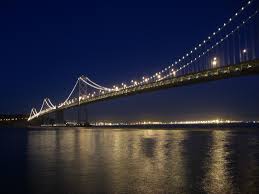
San Francisco Side Of Bay Bridge
It was back in’59 of the old century that I was discharged from the US Navy at Treasure Island in the middle of the San Francisco Bay. Thus my adult life began as the Sixties dawned. Who knew? It was a terrifying period for me.
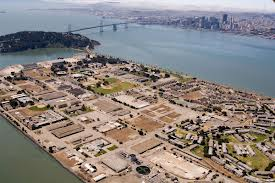
Treasure Island After The Warships Had Left
I was to take up residence in Oakland the crown jewel, so to speak, of the East Bay. In the three years I had been gone, that is in the cocoon of the Navy, the country had not so much changed as advanced very rapidly. I was more than slightly out of touch. The country was on the cusp of a gigantic leap in scale. I wasn’t.
Without myself, or as I think, anyone else realizing it, or using the term, the Negro Revolution was in full swing.
As Charles De Gaulle, the President of France, once noted: The US while being a White country acted as a colored country. Thus the US knowingly and purposely sabotaged European relationships with the colored or, as it was known, The Third World. The vast majority of the US was in favor of this course being of a sanctimonious nature feeling quite superior to the evil Europeans. I was opposed to it, I liked the way the maps were colored. But, I was very nearly in a minority of one.
Thus, however, when the Mau Mau Rebellion in Kenya erupted the US sympathized with the black Africans. When Ho Chi Minh defeated the French Foreign Legion at Dien Bien Phu a year later most Americans believed justice had been served on the evil Europeans. None of us knew at the time that those howitzers bombarding the FFL were not provided by the USSR; they were of US manufacture shipped to Hanoi from Okinawa when they were not needed for the conquest of Japan. Unknowingly the French were fighting both the Reds and the US.
Negro revolutionists in the US were turned loose in 1954 when the Supreme Court subverted American freedom by beginning compulsory integration of the races with the Brown vs. The Board Of Education of Topeka decision. The hounds of war were loosed. All hell broke loose in Alabama as the famous and mourned Bull Connor began his legendary career of opposition.
Abetting the Negro revolution in the US, in 1957 the African State of Ghana was granted its independence by the withdrawal of Great Britain and then beginning in 1960 colony after colony was made independent until the former virtual colony of Europe was a congeries of African States filled with warring tribes. I, so far as I know, alone viewed this with great sadness. The great Quest for the Source of the Nile as detailed in Alan Moorehead’s great work The White Nile also published in 1960 had ended in disaster. The nature and extent of the disaster wouldn’t be realized until the Africans began the invasion of Europe shortly thereafter.
But I was just taking the first baby steps leading to the rest of my life. Even if I had been knowledgeable of the contending forces I would have been a drop in the illimitable ocean. Still, as my own entity, I considered myself the center of the universe. I considered the planet the center of the universe, indeed, the only part of the universe that counted. What effect could the light emitted by stars from a billion years in the past, the source of which might even no longer exist, have on me or my home on Earth? None. I and it were where it was at.
So there I was a small lone figure, a stranger in the strange land of California, the Fool of the Tarot deck, taking the first step to begin my journey of a thousand miles.
Although from Michigan I had always considered San Francisco my spiritual home especially the San Francisco Bay Area and now I would become intimate with it in its entirety and even most of Northern California from Bakersfield to Redding.

Mt. Diablo
The Bay is an immense thing stretching from Sacramento and Stockton down to Santa Clara County, San Jose and what has become known as Silicon Valley. It is like a great wound separating the communities that border it North and South and East and West. In the attempt do bind it into a unit great sutures known as bridges crossed the vast waters, the Bay Bridge is eight miles long, to make the various communities into one.
Even a great tunnel beneath the waters called the BART- Bay Area Rapid Transit- would be drilled beneath the bay. A truly astonishing achievement among such astonishing achievements as the Golden Gate and San Francisco Bay Bridges.
Further to the South the equally amazing but built over shallow water is the San Mateo Bridge and below that the rather commonplace Dumbarton Bridge. To the North above the Bay Bridge is the major construction of the San Rafael Bridge and above that the Carquinez Straights bridge. In the Sixties all these bridges were readily passable without long waits or even waits.
For now the story is of Oakland. Henry J. Kaiser one of America’s great industrialists, ran his shipyards there where the so-called Liberty ships were built. Sixteen million White men were impressed into the wars of the ‘40s. They were all removed from their jobs into their uniforms. From this distance I doubt that sixteen million men were needed at one time, but they were taken leaving behind the women and Negroes. The Negroes were in the South so they were entrained to the factories of the North. This is called the Great Migration.
After the wars were over and the White men returned wanting their jobs back the Negroes kept coming North and West. However the returning Whites were now competing for the jobs with the Negroes who hadn’t been there when they left. Then in ’54 came the criminal Brown decision. The Negroes had been living the high life during the war enjoying wages that could never have imagined while the Whites were getting their asses shot off around the world.
The Negroes kept coming although there were no longer enough jobs for both veterans and themselves. During the fifties and sixties thousands per month arrived in the Bay Area transforming it into a different peoplescape, especially Oakland. There was a strict segregation.
Oakland is divided East and West by the great street of East 13th. That street runs from the Bay all the way through Oakland and the adjoining cities of San Leandro and Hayward all the way through Niles and Warm Springs, then independent towns to the Nimitz Freeway where the five towns were incorporated into a city called Fremont. Fifty miles or so.
In Oakland it was determined that the west of East 13th, West Oakland, would be abandoned to the Negroes. Now, West Oakland had a history dating back to the founding of Oakland. It was a fine neighborhood. It had been home to some families for a hundred years. This was an established area. No matter.
As the Negroes came in their in their thousands and tens of thousands the Whites were just moved out, a block or two a month. The rudely displaced Whites, I mean this was a sight to see, had to have a place to live so huge apartment buildings and great housing developments beyond the San Leandro border into Hayward and over into Contra Costa County popped up like mushrooms in Springtime. Orchards and farmland disappeared beneath concrete.
Contra Costa (Against the Coast) County just East of Alameda County and its Oakland was a barren desert irrigated into immense fruit and nut orchards. Truly a desert had been made to bloom.
These orchards were uprooted and piled along the roads as bulldozers moved in to clear the land for the houses that would populate that huge desert. Thus an undesirable social situation was created as tens of thousands Southern socially crude Negroes displaced tens of thousands of Whites who had to form new communities and associations. Everyone was unhappy and it showed. Tensions were unbearable. A great depression settled over the entire Bay Area from Sacramento to San Jose and all the Peninsula below San Francisco and the East Bay. It was fairly congenial to me as I was suffering from a childhood induced depression myself. It was pretty pathetic though.
Oakland was in turmoil. It had always been a rough town. If you want a nice portrayal of its early days check out Jack London’s Valley Of The Moon, a very nice near memoir. So anyway, you had his tremendous influx of really raw material, the rawest, displacing almost overnight the whole of West Oakland.
I’m not being critical but as people these Negroes were completely out of touch with a modern technological world and when I say out of touch I mean neither myself or any White I knew had any idea of why things were happening or even what was happening that’s how out of touch they were.
What I write is a matter of placing in context what I study compared with what I remember. Some things, like Freudian motifs, I dimly perceived then, the Mafia presence of course was or should have been obvious to everyone except J. Edgar Hoover but I couldn’t tell you the first time I heard he CIA mentioned and I had no idea what the Ford and Rockefeller Foundations were doing. The Foundations one discovers were instrumental in many social situations.
The West Side that the Negroes appropriated was a very nice area in a modest way, very desirable tree lined streets. It was not a slum when the Negroes arrived. Being a flat level naturally air conditioned apron of the Bay the displaced were indeed unhappy being translated to the desert of Contra Costa. Only the Negroes could disparage West Oakland as ‘the Flatlands.’

Huey Graduated High School And Attended OCC Without Knowing How To Read
The Negroes had no social graces or knowledge of what they called ‘the White Man’s law.’ What was to them natural behavior was condemned by the White Man’s law. By the time I began showing up in Oakland in the late fifties they were threatening 98th Street, the boundary between Oakland and San Leandro. The latter city had a Sundown law or custom, at least. Temporarily at least the Negroes couldn’t advance beyond 98th.
In the meantime the behavior that was criminal according to White Man’s law but normal to the Negro mind multiplied to the detriment of the White population exponentially plus. No exact accounting is possible but take the situation at Oakland’s Castlemont High School as an example. Castlemont was out on the cusp of the eighties and nineties. The Negro invasion was in the seventies crossing over into the eighties in ’58 when I spent my liberty time in Oakland. Castlemont was half White at the time and wholly hell for that half.
The Negroes were in beat down and rape mode all the time. The White students got no sympathy from the community, they were on their own while any fights the boys had to get involved in were always charged to them while the guilty Negroes were exonerated. The rapes of the girls were either disregarded or unreported. They just expected it.
It was absolutely essential for them to clear the school directly after the last bell. Negro boys roamed the halls looking for the tardy girl. I knew a girl from Castlemont and witnessed the situation. It was shameful, even criminal, what those parents made their children endure. I have often wondered what happened to some of them.
As for the disorder cast into the lives of the Whites who had been forcefully evicted from homes of perhaps two or three generations it was astonishing to see and also hazardous for them as they all fought for a shred of old self-esteem and standing. Many lives were destroyed, but, we all had to survive. As the chef says, you have to break a few eggs to make an omelet.
Some chose rough behavior while serial murders began in earnest probably being more common than recognized. Those were taut times in the Bay Area. You had to watch your step and it got progressively worse. About ’63 and into ’64 before I entered college full time I had a job with a mortgage banking firm, Lowell, Smith and Evers. It was there I learned every square inch of Northern California, except Contra Costa County. When I started the territory was divided equally but I eventually did all the work except for Contra Costa because my senior partner, I forget his name, call him Dale, always retained CC for himself. Perhaps the extreme depression suited his mental state. What with all the population transfers CC was a fairly rough place, everyone suspicious of the other. I learned enough about rough places myself so Dale could have CC and welcome to it.
Located in Contra Costa is Mount Diablo- Devil Mountain. Dale trained me in CC. Dale was a graduate of Stanford University over on the Peninsula. I forget his major but it had no commercial value so that upon graduation the only job he could get was selling coffee to grocery stores in Chicago. Thus he, a graduate of Stanford University, had to deal with store managers who at best were high school graduates as equals. It was more than he could bear. He couldn’t handle the differential in expectations. He quit Chicago and came back to the Bay Area.
Our job was not a quality job, it barely kept us in the white collar class. I never could understand why he accepted it. He still worked with high school graduates like myself but even though we were equals he could consider himself the senior member. This still left him very bitter. His was a desperate situation. I still had he college option.
Although declassed or perhaps because of it he lived near the UC Berkeley campus where he dropped a tab of acid every day before he left to work CC. Berkley had an LSD experimental lab so Dale was well supplied. On the first day he offered me a tab but I declined. For lunch break that day as every day of training we got a sandwich and he drove half way up Mt. Diablo to a magnificent lookout spot. Work was just leisure for Dale so these were two, three, four hour lunches where he would let his acid drenched mind rove through he stars. He delivered some magnificent raps that were thoroughly engrossing. I mention this in detail because the Zodiac killer began his depredations four years later in 1968. Zodiac also had some very cosmic thoughts centered on Mont Diablo not too different from Dale’s. I have often wondered if Dale was Zodiac.
By 1964 when Dale and I sat on Mt. Diablo I’d been taking night classes from three different Junior Colleges- Merritt Campus of OCC- Oakland Community College-, Marin Jr. College, and Chabot Jr. College in Hayward. Fall term of ’64 I quit Lowell, Smith and Evers and entered California State College at Hayward- now styled California State University East Bay- full time.
OCC was an old high school on the Oakland-Berkeley border so it had a special character, Oakland with a Berkeley flavor. Of course ’60 to ’62 when I attended was pre-hippie so there was a different psychology but the flux and change of demographics had its own special quality.
As I said, the Bay Area was in turmoil. If you had a taste for it it was quite wonderful. There was a change from the culture of the old San Francisco of the thirties through the fifties in which the DJ Don Sherwood who was on the way out had been representative and the transition into the sixties of Herb Caen and LSD, rock and roll and the Black Panthers. I began OCC at the same time Huey Newton did. Our paths did cross one time. The Neo-Abolitionist Whites had seized Oakland City College. They were ardent practitioners of Columbia University’s Eric Foner’s Unfinished Revolution. They were there to finish it so we were part of the continuation of Reconstruction. Phase two. The forces of evil were on the march.
In the course of my college career I attended the previously mentioned Jr. Colleges plus Cal State, and grad school at UC Berkeley and UOregon. While all the schools were Liberal none was involved in the Negro Revolution and Reconstruction like OCC.
In addition the Homosexual Revolution was in full bloom in the Bay Area while the faculty at OCC was heavily if not morally infected. This would involve an additional twist of fate for me. The whole Liberal Coalition was composed of justified sinners who considered themselves above the law, vigilantes in effect.
The Neo-Abolitionists who actually believed they were continuing Reconstruction against the Rebels now styled us as ‘racists’ were intent on exterminating us as they had been the Southerners. The homosexuals as a semi-secret society were at war with we heterosexuals. By 1969 and the Stonewall Riots in NYC they actually won a major battle and took possession of the field. Identifying themselves with law and virtue they felt no compunction at committing crimes they could conceal. As Voltaire advised his followers: strike but conceal your hand.
Faculty pressure was put on students to compel them to adopt Neo-Abolitionist attitudes, rigged so-called debates and really if one were vocal, expulsion. For some reason the NeoAs seemed to believe that no one had experience with homosexuals and Negroes even though Oakland’s high schools were actual rape factories and war zones. Affirmative Action was the order of the day that is, egregious crimes against Whites.
In my own instance I sat in class next to this forty some year old Negro. In passing back test papers we had taken I noticed that this Negro had gotten a B while I had received a C. But then I noticed that he had a score of 64 while I had a 76. Thinking that the homosexual teacher had made an error I pointed out the incongruity of scores and grades. The teacher sneered at me telling me that it was time for Negroes to get a few advantages to redress old grievances.
I can’t believe I was picked out to be the recipient of this ‘social justice’ so I presume the teacher was indulging himself in random acts of criminality. In the event there was no remedy for this crime so I was somewhat dazed and bewildered not able to understand what was happening. Discrimination of this kind was going on constantly.
There appeared to be agents or spies attempting to trap the unwary into making comments that could be interpreted as ‘racist’ or ‘homophobic’ although those terms were not yet in use. Once identified, as I look back, it seems clear that spies or agents tried to discredit any so identified. A homosexual trick was to inject themselves into conversations then correct the pronunciation of the victim trying to make him look ignorant.
This notion was probably patterned on the tricks of John F. Kennedy who was running for president at this time which was 1960. Anyone who noticed that Kennedy was an Irish Catholic was shouted down as a bigot yet the 1960 election was a transfer of power from the Anglo-Saxons to the Celts and from Protestants to Catholics while the Kennedys- Jack, Bobby and Teddy- passionately embraced the Negro side of the race war. Teddy in 1965 would be instrumental in changing the immigration act which would allow Africans and West Indians to immigrate to the US. Most people either discounted the Irish Catholic background of the Kennedys or were shamed into silence but Kennedy’s Celtic and Catholic background would be an element in his assassination three years later.
The Kennedys’ election triumph was a major change of direction for the country. Had Jack not been assassinated it is probable that a Jack, Bobby, Teddy succession amounting to twenty-four years of Irish Catholic rule would have guaranteed a significant if not total shift in mores not unlike the current Clinton-Bush-Obama succession. It was not for nothing that Jack’s presidency was styled Camelot after the Celtic King Arthur of Mallory’s Le Morte d’Arthur.
As if to characterize the change as a break Jack began to change the pronunciation of words. Thus mobile always pronounced as mobul became mo-bile to the approval of the press corps. In subsequent years whole dictionaries would change regularly to keep people on edge. Wholesale name changes from Peking to Beijing and Bombay to Mumbai would take place.
In seeming keeping with Jack’s linguistic gymnastics as I was talking to a couple people an aggressive homo came over. I was talking about the movie producer Elia Kazan. As in his movie America America in which he introduced himself as Eel-ya. I used that pronunciation.
The homo contradicted me. You could have seen the loss of credibility on the faces of my listeners. I countered with a request for the correct pronunciation to which the homo offered E-lie-a. I of course offered Elia’s own pronunciation from the movie that, fortunately, the others had seen so turning that charge back. The psychological warfare went on as continually as the racial warfare but unrecognized as such.
Coming from the cocoon of the Navy I wasn’t aware of the changes taking place while I was away. They occurred at work as well as at school. In 1961 I was employed by the trucking firm P.I.E.- Pacific Inter-Mountain Express- since defunct. I had worked my way up to entry office job suffering fair humiliation in the process. One had to actually beg to get one. And entry level was as a mail boy. Once there an opening occurred at the Commission Agency Desk for which I applied and my mailroom supervisor as a favor allowed me to take the job with many admonitions to watch my step.
I had been at the desk for a few months when it was announced that we would be employing a Negro, we were all White to that point. The Negro had been recruited. He had no training or experience. He was to given a grade 4 pay rate. I was a 3 while 4s were rare.
I had been working full time while attending night school. As noted when I applied I had to beg my way into a mailboy job. As a boon I had been granted the grade 3 job at the Commission Agency Desk. Let us say that I had felt the whip on my back.
Now this unprepared Negro was being given for free a grade 4 as Affirmative Action which was a term not yet heard and management knew the guy wasn’t capable of doing the work. They proposed that I take the desk next to his which was also a grade 4 and do that work as well as his for him. Thus I would be doing two grade 4 jobs, and grade 4s were fairly complex, for the pay of one. I would have done it for a grade 5 but they were too cheap. They’d rather pay a Negro for nothing than add a dime an hour to my paycheck. C’est la vie.
The guy came to work but had no interest in learning to do his job. He soon drifted up to a cluster of desks handled by several attractive young girls where he spent his days romancing them. For some unknown reason he was soon gone. Perhaps he quit unable to endure the burden of having to be anyplace let alone at a consistent 8:30 in the morning.
Unable to endure such social injustice I quit. I had no further encounters with Negroes in either jobs or other educational institutions until the early seventies.
That doesn’t mean the Negro revolution didn’t continue to develop in the Bay Area as well as the curious White attitude toward Reconstruction.
In 1966 the rapist ‘with intent to murder,’ Eldridge Cleaver was released from prison due to the efforts of several Jewish women. He had served only eight years having been incarcerated in 1958. He was very far from reformed, that is, he was still in paramilitary mode.
Cleaver, as a Negro, was a vicious person. He said he developed his raping skills on the West side of East Thirteenth then crossed over to hunt the big game, White women. While rape may be a crime by White Man’s law as the Negro thought of it assaults against White people or their property were acts of war therefor laudable and not reprehensible. Only White thickness prevents their seeing the difference in point of view. Thus all Negroes can be seen as paramilitary troops.
While Cleaver’s crimes are heinous enough the attitude spread to Whites. Since 1954 and the criminal BOE decision there had been a steady deterioration of manners and attitudes toward crime among Whites. White criminals, or revolutionaries in their term, raised the slogan of expropriating the expropriators which led to wholesale theft and crimes of violence on an ideological basis.
The adoption of Negro manners by an increasing White minority led to the corruption of the entire White generation. One learned rudeness in self-defense. I altered my behavior in order to compete beginning in 1961. This was all the result of the Board Of Education decision. A well-meaning but ignorant folly.
The Negro attitudes were aided and abetted by Freudian psychology. The White ideal until the Second Reconstruction began, for that is what it is, was the notion self-control and consciousness, the abatement of violent or what Freud would call ‘instinctive’ behavior. He called the suppression of ‘instinctive’ behavior repression.
Freud thought repression was bad for the person and his health. He called for the indulgence of the unconscious or liberating the repressed. During the fifties and sixties the unconscious was increasingly indulged, the abandonment of repression, or more accurately self-control, was embraced while self-control was abandoned. The result was disastrous resulting among other things in the Me generation.
In 1966 then Cleaver was released while at the same time, perhaps not coincidentally, Huey Newton now six years older than when I met him in 1960, formed the Black Panthers. Rather than a new idea the Panthers was a logical development of previous years. In Chicago a paramilitary outfit called The Blackstone Rangers had been formed. Their crimes they, of course, thought of as military operations. Only White Man’s law called them crimes.
In addition a series of Negro insurgencies, styled riots by Whites, in which cities were severely damaged had taken place in New York, Philadelphia, Detroit, Chicago and of course the famous Watts explosion of LA in 1965. These insurgencies would be a continuing recurrence all through the sixties especially in the major eruptions of ’67 and ’68 which virtually engulfed the country much like he Tet offensive in Viet Nam. So, Huey’s Black Panthers were just the next logical step.
Cleaver on his release was set on creating his own paramilitary group but opted to join Newton and the Panthers. Newton was not so militant although he was convicted of murdering an Oakland policeman so that a rift developed between the two men. Cleaver did lead an insurgency in West Oakland that resulted in several deaths. The failure of the insurgency led to his famous flight to Algeria. It was then my path crossed with the Negroes once again.
At the time I was attending grad school at UOregon in Eugene where I had opened a record store as the ’66 to ’78 golden age of phonograph records, vinyl, was beginning to take off. Nineteen sixty-eight to seventy-four was a period of constant unbearable turmoil that had to negatively affect the national psyche.
The Hippie emerged in 1966. By 1967 I was one too. Although the Negroes were a privileged group the Hippies weren’t. Restrained in their activities with Negroes the cops turned their fury on we Hippies. All regards for rights and laws were thrown out the window. I fully sympathize with the Negro hatred of the police.
The Black Panthers engaged in all sorts of bogus community projects that were merely extortions and shakedowns. At the same time paramilitary operations continued. The biggest was the confrontation with authorities at the Democratic Convention in Chicago. This was a major battle with the authorities involving the Panthers, the Blackstone Rangers and others.
While slightly beyond the sixties paramilitary operations increased leading through drive by shootings in San Francisco to the Zebra assaults of ’72 and ’73. The stated intent of the Zebra operations was to activate the race war but the ever tolerant Whites refused to play the Negro game preferring to call the assaults ‘crimes’ according to White Man’s law and riots rather than battles according to the law of war.
Hell, even the 9/11 paramilitaries who leveled the Twin Towers killing 3000 or so people while devastating NYC were tried as criminals. Three thousand murders and tens of billions in damages were treated as a light crime. What do you have to do? How thick can the authorities be?
Now, aiding the Negro revolutionaries were the acts of the Jews.
To back up a little bit and blend the Negro Revolution with the Jewish Revolution that was going on at the same time. In the Bay Area at UC Berkeley from 1964 to 1966 the Jews fomented the so-called Free Speech Movement. This was double speak for its opposite, the suppression of free speech, the subordination of the university to the Jews
By 1966 the Jews were in control of the university attempting to compel submission to their program. In some zany way they had convinced the mainly upper income White students that they were a privileged class without the merit of earning it. Essentially they claimed the Whites had stolen their places from equally qualified Negroes on the basis of their White skin. I and 60-70% of Whites had no illusions of benefitting from White Skin Privilege. We had worked damn hard to get where we were although it was still not anywhere from nowhere. Yet these absurd masochist upper income White students claimed to represent all White people. It was demanded of all we rest to sacrifice our wellbeing for the benefit of Negroes.
Huey Newton and his Panthers then stepped in to fill this vacuum of self-abnegation.
Now, Jewish women had done the heavy lifting to get the rapist with the intent to murder, Eldridge Cleaver, out of prison. Another very dedicated paramilitary Negro, George Jackson, was also raising hell in prison. Jewish women set to work to free him also. A hysterical female Jewish lawyer representing Jackson somehow even managed to fuck him through or around the barriers then went home and expected her husband to congratulate her.
Your brain spins when you read this stuff with the author relating his story in the same tone as: I went to the grocery store and bought a loaf of bread.
Jackson was smuggled some guns into San Quentin then in total rage tried to blast his way out of the prison. It should come as no surprise that he was killed in the shootout. Angela Davis, of the East Village, then organized the subsequent shootout in the Marin County court room that was truly an insurrectionary act.
While it was clear that Davis was as guilty as Bomber Billy Ayers of the Weather Underground she as he was able to boast ‘Guilty as hell, free as a bird.’ Quite clear that both had somebody watching over them. Someone very, very powerful. Like Ayers she was rewarded with a PhD. He to go on to become a ‘distinguished professor’ at UIllinois while she has an honored position at California’s Red campus UC at Santa Cruz. She probably attended Panther human bar-b-ques out there in the woods. Huey was given his PhD at Santa Cruz also. There are some bennies for being Black.
Negroes have continued to receive favored treatment down to the present when Liberal Whites installed their pet Negro Barack Obama in the White House.
Also outside the scope of the Sixties a man of questionable intelligence, the singer Bob Dylan, put his queer shoulder to the wheel in 1976, the US Bi-Centenary, during his Rolling Thunder tour of the home of the American Revolution, New England. Perhaps Dylan thought he was leading the second American Revolution celebrating the takeover of the country by his Jews. As if to mock the Whites he played the tour in White Face, that is white grease paint.
Hurricane Carter was a Negro boxer who had been convicted of murder once and then a second time on his appeal. Dylan wrote a song called Hurricane Carter in an attempt to generate sympathy for the murderer and free him from prison. Perhaps this was a symbolic repetition of Lincoln freeing the slaves. We’ll probably never know but the song was the focal point of the tour. It did result in the freeing of Carter.
Dylan was rewarded for his courageous defense of Carter when the Negro Obama was elected president. One of his first acts was to summon Dylan and his fellow Red Joan Baez to Washington for a command performance for himself and Michele. Bob responded with his anthem Blowin’ In The Wind. A song that every flatulent person loves.
While I wasn’t aware of it at the time or, at least, didn’t view the situation as a race war, it is clear now that the government’s, by this time of Richard Nixon, duty was to suppress the Negro paramilitaries. Bear in mind that a time we had a race war at home and a foreign war in Viet Nam.
Coming to the Viet Namese’s aid in 1968 the Red Chinese had initiated a cultural invasion and war in the US inciting a type of Civil War. Things were getting pretty hot. To defeat the Negro insurgency a program called Cointelpro was formed. While this agency affected Whites not at all, I never heard of it ‘til years maybe decades later. The Jews defamed and belittled this US effort to quash the Negro revolt as ‘un-American.’ What would they know about it?
By 1970 the Negro, Jewish and Homosexual Revolutions had succeeded. The country was in deep turmoil, nearly anarchy, at home and abroad. Check out movies like Putney Swope, Midnight Cowboy,Death Wish, Dirty Harry, Cruising and a host of others.
While I have never admired Nixon, like Warren G. Harding in 1921 in his suppression of the Communist insurrection, Nixon was able to defuse the situation and return the country to a simulacrum of what Harding called ‘normalcy.’ This was no mean feat although Nixon under the guidance of the Jew Kissinger botched the job.
In 1923 Harding died a mysterious death. While there is no hard evidence as yet that he paid that price for defeating the Red takeover can it be coincidence that Nixon was driven from office for the same offence?
Part 3 broadens and returns to New York.
A Review: Ed Sanders: An Informal History Of The Countercultures In The Lower East Side
October 31, 2013
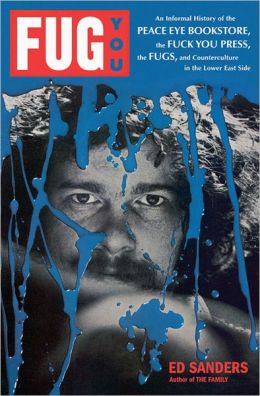
Got His Pitchur On The Cover Of Life Magazine
A Review: Ed Sanders:
An Informal History Of The Counterculture
In The Lower East Side
By
R. E. Prindle

Ed Sanders- Chief Fug
Sanders, Ed: Fug You, An Informal History Of The Peace Eye Bookstore, the Fuck You Press, The Fugs, And Counterculture In The Lower East Side, 2011, The Da Capo Press, 424 pages.
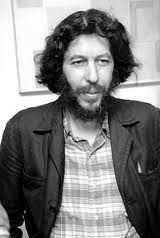
Tuli Kupferberg
Ed Sanders? How few out of a hundred have even heard of him? Yet, Ed had an effect on the society of the Sixties not inferior to Andy Warhol. Perhaps a few more have heard of his recording group The Fugs. Originally the Village Fugs, and aptly named.
While never much of a success out of the East Side Bohemia of NYC Ed nevertheless merits attention. Ed was born in 1939 making him a graduate of the high school class of ‘57. I was class of ‘56 making Ed one year younger than me. But, what a difference a year makes. Let us do a little demographic study.
The swing years between Greil Marcus’ ‘old weird America’ and the new even ‘weirder America’ were the years of 1955, 1956 and 1957 with ‘56, my year, being the transition year between old and new. The key events of the turn was the effect of television and the destruction of network radio that resulted in teen oriented all music Top Forty radio. The class of ‘55 was the last year of ‘old weird’ America while ‘56 was maybe 70-30 the old and new with the old part the largest. Fifty-seven began the ‘new’ weirder America. Thus while Ed and I are only a year apart we still come from two different social outlooks as do all who followed after.
Demographics are important. By 1955 older teachers were fifty-five or sixty years old so they were born in say, 1890-95 to 1910. Not quite frontier but in the transition from horse and buggy to automobiles and airplanes. They were born into an America of the introduction of new technological wonders that actually went well beyond their imaginations. I mean, the fantasy of men flying came true. They saw Victoriana die and the modern world born. I mean, they saw biplanes turn into jet planes. They lived through two world wars witnessing the incredible changes succeeding those two wars. They were teens or in their twenties during the New Era of the Twenties. They were in their thirties in the Depression and Dust Bowl of the thirties. After enduring WWII they were hit by the Korean War and the struggles between the Communists and Honest people that ended in the defeat of their champion Joseph McCarthy. The three years in question were lived at the beginning of the on-going Negro revolution following the Brown vs. The Board Of Education decision that led to the unimaginable fact of Army troops invading Little Rock to cancel the rights of the majority in favor of a minority. Full lives to say the least.

Sanders, Kupferberg, Weaver- The Core Fugs
They had some strongly held opinions about life and America they passed on to us or attempted to do so. It was a clumsy attempt. The chaos of the Sixties and subsequent decades stemmed from that teaching. Most of them were rooted in pre-1920 attitudes as was to be expected. No matter how hip we are to the NOW our outlook is always conditioned on the past, near or far.
Teddy Roosevelt’s politics seem to have been the basis of their outlook. The twin themes of freedom and revolution were uppermost in their minds. Freedom was always ill defined if defined at all while revolution was held up to us as the highest ideal especially the American Revolution which was sort of the apex of history although Simon Bolivar who rode throughout Spanish South America bringing revolution to every colony on his way was a very close second. Of course the success of the countries he established failed to measure up that of the US. The French and Bolshevic Revolutions were never mentioned and were disregarded as they didn’t fit the fantasy. As these teachers were in place post-war through the fifties whole cadres of students were indoctrinated in this nonsense.
Basking in the fairly incredible triumph of the US in a two front war against very formidable enemies the teachers fairly glowed with the glory. Perhaps influenced by that achievement they made the incredible statement that each and every one of us could be whatever we wanted to be. That idea perhaps astonished us more than any other. It was obvious that some were smarter than others, all were of different physical stature, some had social disadvantages that meant denial by those that had them. Some had already made decisions that closed off vast areas of achievement and there was room for only so many at the top. Still, I suppose, that if we had the proper attitude there was a modicum of truth in the statement. Really, if you don’t try you don’t get anywhere. However rooted in a past now thirty or more years distant all the teachers were not dealing with current realities. The were not living in the NOW enough as we were in the Sixties.
There was a basic insecurity with Americans, even though we were taught to believe we were the greatest. A silly novel by Eugene Burdick of 1958, The Ugly American, turned that idea on its head. The idea of the novel was that in their foreign relations Americans were clumsy and inept compared to the smooth Communists of Russia, we antagonized the Third World despite sending wads of money and tons of food for free. I do suppose it’s true that you can’t buy love and Burdick seemed to revel at the thought.
As a result of Burdick’s novel Americans high and low embraced the notion that he or she was an Ugly American thus becoming inferior in their minds to every other people of the world. Just as the American South condemned a portion of their people to be White Trash, so Americans became the White Trash of the world. It was something to witness. Forty years or so on some nitwit rocker sang: ‘I’ll be your Ugly American if you’ll be my Asian Rose.’ Is that a deal or not? Blows your mind, doesn’t it? Blew mine.
I’m sure that most of us in the fifties had never heard of the CIA and if we had the initials conveyed little meaning. By the early sixties after the incident of the Bay Of Pigs not to mention the Kennedy assassination we had all heard of it but with little comprehension. Ed Sanders as well as the whole Left would fixate on the CIA as the epitome of evil. Of course they were either Communists or Communist sympatizers, Ed claimed to be a socialist, and hence were trying to divert attention away from the KGB and Communist activities. The James Bond movies beginning to appear in 1962 were metaphors of the cold war between the ‘Free World’ and the captive nations.
With some variation of this indoctrination under his belt Ed graduated HS, spent a couple semesters at UMissouri-KC then headed East to attend NYU. He say his intent was to become a rocket scientist but once in NYC he gravitated down to the Village which gradually enchanted him so that he abandoned solid propellants and took up ancient Greek, Latin and Egyptian because his mother told him the classical languages were the accoutrements of a gentleman. Perhaps so but there was no danger of a Village Fug ever being mistaken for a gentleman. Ed never was.
Once settled in the Village Ed involved himself with Village politics as he sought a place for himself under that black sun as a poet. The late fifties and early sixties were a time of the Beatnik poet. Coffee houses sprang up where the ‘poets’ could read to an eager audience, mostly of other would be poets. I was in the Bay Area of San Francisco at the time and while I wouldn’t call myself an habitué of North Beach I did attend a couple readings in 1964 where Ferlinghetti and a couple others read. Apparently it was the Coffee and Confusion Coffee House as I see from the web, but I don’t remember the name of the place. By 1964 things were pretty commercial and, at least, in SF the house was packed with employed weekend wannabe Beats.
Ed himself writes a humorous piece about a poetry reading in his Tales Of Beatnik Glory. While fiction the tales accurately portray the life. I have never been a big poetry fan and my expectations were not disappointed. Ed is an accurate barometer of his time and life on the Set.
On his quote page at the beginning of the book he quotes Maxim Gorky who said: ‘I was typing with all my might to make myself “a potent social force.” That pretty much sums up Ed’s career in ‘Beatnik heaven’ on the Lower East Side. His approach as he puts it was ‘A Total Assault On The Culture.’
Which culture isn’t exactly clear. Ed was a Catholic boy and he acquired and exhibited all the neuroses that the Catholic confession induces especially the rebellion against sexual repression, hence he turns to the pornography peculiar to Catholics. While there are some maybe many who were or are in full sympathy with Ed’s sexual neuroses I find them repellant while at the same time liking Ed.
Ed gives no indication that he himself indulged in licentiousness preferring the role of voyeur. He was a heavy drinker while going on dope binges. While sympathetic to homosexuality he says he passed on a night with his great hero Allen Ginsberg while he married young to his wife of fifty years now, Miriam. He had a couple kids and approximated a normal sexual life.
He did become a voyeur par excellence. In the enthusiasm of the time he became an underground film maker (read pornographer) with his hand held Bolex camera. He took up filming at the same time as Andy Warhol. He and Andy became acquaintances.
At the time that Andy began to create his Factory populated by an assortment of criminal amphetamine heads Ed did the same. During the late fifties and early sixties New York City was awash in amphetamines at all levels of society. One Dr. Max Jacobson otherwise known as Dr. Feelgood was busy administering massive doses of his amphetamine and vitamin cocktails, himself freely using it nearly on 24/7 basis. At one point he is said to have gone sleepless for thirty straight days.
While amphetamine used on that scale is destruction Max said and people believed that the vitamins destroyed the destructive qualities of the drug. Maybe so but within a few years there were burned out cases walking all over NYC.
Ed had his own reasons. I make an extensive quote interspersed with commentary. As Ed says the hips called the Village ‘the Set’ as in movie set. As would develop during the decade the notion that one was a mere performer in your own movie became prevalent if not endemic. Anyone’s life was a role. One could do anything without the loss of self-respect. The notion was that when your movie role was over you could revert to your former condition. People went to prison without any idea they were affecting their psychology and subsequent social position. I watched slack jawed.
In this passage Ed seems to see himself as a sociologist, pp. 54-55:
Another of my projects I called Amphetamine Head…Since 1959 I had been studying a group of artists and bohemians known around the Lower East Side as “A-heads,” amphetamine heads.
In those days people were called ‘heads’ as in he was a good head. A-heads means full time amphetamine freaks, vitamins or no vitamins.
They shot up amphetamine and often stayed up on A for days. Warhol said that he never slept more than two hours a day for years. There were plentiful supplies of amphetamines, sold fairly cheaply, in powder form on the set.
Amphetamine was legal at the time.
That fall I began filming Amphetamine Head. I decided to focus on the A-head artists, mainly painters, but there were some poets and jazz musicians as well who could be put under the banner of A. Anyone who lived on the Lower East Side and spent much time mixing with the street culture encountered A-heads. They roamed the streets, bistros, and pads compulsively shooting, or gobbling unearthly amounts of amphetamine, methidrine, dysoxin, bennies, cocaine, procaine- all of this burning for the flash that would to FLASH! It was almost neo-Platonic, as beneath the galactic FLASH! Were subsumed the dime flashes all urging toward FLASH!
Everybody from Washington Square to Tompkins Square called the street “the set”- “I’ve been looking for you all over the set, man. Where’s my amphetamine?” With a generation of folks readily present who viewed their lives as taking place on a set, there was no need to hunt afar for actors and actresses. What a cast of characters roamed the Village streets of 1963!
So there we have a set of fully blown minds. People who were out of it, insane for all practical purposes, Ginsberg’s ‘best minds of his generation,” running from fix to fix. These were us who back in ‘56 were billed as the hope and future or America with a capital A- no pun intended.
I’d heard rumors about a doctor [Max Jacobson- Dr. Feelgood] giving President Kennedy shots. Uppers. It turned out…that the rumors had a basis in truth. So there was plenty of gossip at the time that the President used amphetamines and that his doctors [actually only Max] injected him every morning. There were further speculations that the generals who met in the Pentagon war room every day planning atomic snuffs were a bit A-bombed themselves.
Possibly true. When I was in the Navy in ‘58-’59 bennies were commonly used while the Marine Camp Pendleton was awash with everything heard and unheard of.
I was fascinated with an amph-artist named Jim Kolb…I had observed the violence of the amphetamine heads and the raw power grabs that occurred in their glassy eyed universe after a few months of sleeping just twice a week.
One can compare this to Dylan’s Desolation Row in which he portrays Dr. Filth, that is Andy Warhol, and says:
Now at midnight all the agents
And the superhuman crew
Come out and round up everyone
That knows more than they do
Then they bring them to the Factory
Where the heart attack machine
Is strapped across their shoulders…
It was true that Warhol’s A-heads who were strung out on A would emerge from the Factory at midnight and predate on the streets. Dylan who was strung out on A himself would encounter them on the streets where there were undoubtedly stand offs between them and Dylan’s own crew.
While at the time we were attributing all kinds of fantastic interpretations to Dylan’s lyrics they can all be explained by what was going on in the Village. As the years progressed the clubs would become more vicious and violent until the apex of club land Studio 54 opened in 1977 giving the diamond glitz to that movie set of violence.
It was also commonly accepted on the set that the Germans had invented amphetamines and that the Nazis had shot up amphetamine during campaigns in WWII inspiring tales on the Lower East Side of futuristic battles involving fierce-breathing amphetamine humanoids, babbling shrilly like rewinding tapes, in frays of total blood.
It is true that a German did first synthesize A but at the end of the nineteenth century. A was further developed by a Japanese in 1919. In the early thirties Dr. Feelgood, Max Jacobson a Jewish German put together amphetamine and newly discovered vitamins to make his potent cocktail that he brought to the US in1936. Actually all combatants in WWII hopped up their troops on A, most notably the US and British pilots flying long bombing raids over Germany,
The heads also seemed proud that A-use destroyed brain cells. One of the A-heads might shout, “I lose trillions of cells every day, man, grooo-vy!”
Amphetamine altered sex. Some under A’s spell waxed unable in eros or sublimated their desire beneath a frenzy of endless conversation or art projects. Others with strong natural urges experienced this: that the erogenous areas became extended under A to include every inch of bodily skin. Men could not easily come, and women loved it forever. The image of amphetamine driven Paolos and Francescas writing for hours on a tattered mattress was humorous but true.
The Village has been described as the independent Republic of Bohemia. Certainly within the boundaries of the Set a certain hot house atmosphere prevailed. Ed is representative of that ethos of film makers, artists, musicians and hangers on. Ed was quite famous on the Set developing an opinion of himself quite at variance to what his influence was off the Set.
Ed’s attitude toward the A-heads while couched in sociological terms was also somewhat sadistic and perverted. He observed that may of the A-heads became compulsive drawers covering their apartment walls with drawings. Combining the art with his prurient sexual needs Ed conceived the idea of buying four ounces of A for about thirty dollars, renting an apartment then allowing A-heads to shoot up freely on the condition that he be allowed to film them at lovemaking and other activities. Through this approach at what must be considered pornography Ed amassed a couple thousand reels.
Unfortunately they were confiscated by the authorities during a raid and never returned. Maybe the CIA studied them in their search for a mind control drug.
Time flows along while Ed’s brain was hyper active. The idea of being a poet was paramount at the time. People who thought that they were poets were everywhere. Of course, that meant denying that anyone else was a poet. Heck I even flirted with the notion but realized that I much preferred prose. Ed developed a fair reputation as a poet. He can be seen reciting on videos on the internet. I would say he was a cut above the ordinary however I have little use for poetry.
Combining his interests in sex and poetry Ed decided to start a poetry magazine. For whatever reason he may have had he decided to name the magazine Fuck You- A Magazine Of The Arts. Had Ed consulted those with a little market savvy he might have reconsidered. While Fuck You is certainly an attention getter it makes buying it without a brown paper sack or even displaying it in your home a chancy affair. In fact, Ed gave most of them away. A non-Bohemian could go down to Soho for a laugh.
Ed was industrious and applied himself. He canvassed the big NYC poetic names and compiled an impressive list of contributors beginning with the arch freak, best mind of his generation, Allen Ginsberg. So, if you’re into poetry especially the sex obsessed Boho kind you would probably like Fuck You. Ed should have started a second magazine titled Fuck You Two.
Rapidly moving into retail Ed found a space in the center of things and opened his Peace Eye book store modeled on City Lights in San Francisco that Ed had not yet seen. I was familiar with City Lights and personally I wouldn’t have modeled anything on it. I can’t believe they actually sold enough to pay the rent. Who the hell buys poetry?
Ed aggressively promoted his sexual agenda in his Assault On the Culture drawing unwonted attention to himself from the authorities. Time was moving along. The hand on the dial was pointing to 1964. That year was the year of the World’s Fair. As should be obvious the social life on the Set had become fairly raucous and actually offensive to those not on the Set. Mayor Wagner determined it was time to tone things down on the Set lest tourists be offended. On the other hand maybe they would have come downtown to sample the outrageousness.
The hounds were on Ed’s trail. He experienced some difficulty as his ‘secret location on the Lower East Side’ was raided, the authorities illegally removing Ed’s precious porn flicks and anything else suspicious looking, naturally that included everything in their eyes. No receipts, no returns. Well! Who wouldn’t be offended? There was little Ed could do about it except try to stay out of jail. That became a struggle. After harassing the bejesus out of him the authorities declined to press charges. All those dirty movies were probably prize enough.
For Ed though his Total Assault On The Culture was going swimmingly. The great so-called Free Speech Movement began its course in 1964 on the campus of UC Berkeley in California. This was the turning point of the US group of revolutions. Trained from childhood to believe in revolution, any revolution, was good, Ed and several age cohorts enthusiastically applauded all revolution.
As part of the revolution a thing so small as a possible minute change in a detergent was described as a revolutionary new product. The idea of revolution as a positive thing was everywhere. It filled people’s minds. After the revolution, so to speak, occurring in the sixties commercial products shifted from revolutionary to ‘new and improved.’ The revolution was over; no new ones were to be entertained. Today detergents are just detergents, no need even for anything new and improved.
Ed’s description of his own revolutionary program was ‘a total assault on the culture.’ The Negro revolution well in progress of which Ed was part was a total assault on the culture; the Jewish revolution to which Ed was sympathetic was brought into focus by the so-called Free Speech Movement of which it was the leading edge. The sexual revolution encompassed both the Homosexual revo and women’s lib both of which fit into Ed’s total assault and he backed the Yobbo revo.
None of these revolutions could have taken place as they did without the US constitutionally guaranteed freedom of speech, assembly etc.. Indeed Ed ingenuously celebrates that freedom, without which all other freedoms are meaningless, explaining that he was making unlimited use of it.
That he and the Negroes, Jews and others were able to do so was because all Americans believed in freedom of speech. Sharing that belief was to cause me all sorts of problems. Even though the concept was being stretched to the breaking point, that is turned against itself, the mantra at the time was ‘ I may disagree with what you say but I’ll fight to the death for your right to say it! You don’t hear that mantra anymore; now you hear ‘Words can kill’ or hurtful things should be censored as they are so offensive. We are post-revolutions.
Ed himself began to become bitter when it slowly dawned on the government that indeed a violent assault on the government was taking place. At that point security agencies such as the FBI and CIA began serious surveillance. After all at the same time all these revolutions were taking place domestically we were becoming totally committed to the war against Communist Viet Nam. Ed claims to have been a socialist so that the backed that subversion too.
Since he vocally proclaimed his position in Fuck You Magazine, the name itself was intended to enrage, it can easily be understood why the authorities placed him on their list of desperadoes. It just seemed like fun at the time but it was more serious than we thought.
Obviously freedom of speech was no more threatened in 1964 than it ever had been, perhaps less. The lines between the various thems and us had just been drawn. The revolutionaries meant to deny freedom speech to the other, or bury it, as in these latter days has been nearly done.
Indeed in 1960 when I was attending Oakland (Calif.) City College anti-free speech limitations were in use by Liberals. We were forbidden to even mention let alone discuss what have become ‘protected’ minorities today. Crimes were committed in the name of what is now called diversity. In one class I had the misfortune to be sitting next to a Negro. A test paper came back on which I got a C while I noticed the Negro got a B. Then I noticed my score was a 78 while the Negroe’s was a 64. I objected saying I didn’t care if he got a B or not no matter what his score but since I had a higher score I should have an A or at the very least a B.
In full arrogance the teacher said he had only so many Bs to give out and since I had been the recipient of White Skin Privilege it was the Negroes turn and I would have to pay the debt. So obviously the revolution was prepared to lie, cheat and steal to succeed no matter who or how many get hurt.
Ed may have bought into that revolution and freedom crap as taught in schools but I obviously would have to be a counterrevolutionary.
So while Ed, absent from the scene, applauded the Berkeley Free Speech Movement I was on the spot viewing things somewhat differently. As I said the Free Speech Movement was part of the Jewish Revolution. There was no denial of free speech at UC before 1964 but by 1966 when the dust had settled the Jews were in control of the university and free speech was definitely curtailed.
As I entered the campus at Sather Gate in the summer of ‘66 a Jewish commissar sat at a table just inside the gate where we were to be vetted as to our politics which meant were we philo-semitic or not. Obviously one was not welcome if it was determined that one was ‘reactionary.’
Whatever Ed believed he was doing it was neither revolutionary in a positive sense nor was it furthering freedom of speech.
Into The Music

An Early Incarnation
Busying himself with his poetry, at which he was very successful as poetry goes, and running his Peace Eye bookstore, Ed conceived the idea of forming a musical group and why not? Musical groups were the generation’s mode of expression. This one he would give the most offensive name he could think of, The Fugs. The Fugs! Everyone in the world knew that fug was a euphemism for fuck. The ’comedian’ Redd Foxx had a punch line that went ’if you can’t fugg your can sugg it.’ So Ed calls his group the Village Fucks. Alright. So we know where that’s at. Nevertheless this low level pornography would get him national exposure. It even got his picture on the cover of Life Magazine in 1967 as part of the world wide cultural revolution. The Total Assault was working. He came to my attention out on the West Coast.
Ed thought of forming the Fugs interestingly enough at the same time that Andy Warhol had the idea and adopted the Velvet Underground as his house band. Both were influenced by Albert Grossman’s success in promoting Peter Paul And Mary and Bob Dylan. PP&M were already a big success in 1964 making barrels of money so why not go for the golden ring?
From 1964 to ’67 Ed and his Fugs scored a major success within the Set. After a fashion the Fugs became a sort of cabaret or burlesque act somewhat after the fashion of the theatre in the French movie The Children of Paradise. That movie served as the East Village model. The Great Boogie Woogie Dylan himself would imitate it in his film ’Masked And Anonymous’. A slight redundancy as to be masked is to make oneself anonymous. Bob was a poet.
As a sort of off Broadway act at the Players Theatre on the heart of Bleecker Street the Fugs may have appeared to be giving Dylan and the whole folk scene a run for their money. Café Society that was finding its way to Warhol’s Factory midtown also called on the Fugs at their theatre dropping back stage to pay their regards. Heady stuff, and I’m not being sarcastic.
At the same time Ed was negotiating with major labels Atlantic and Reprise. He was already on the local label ESP but that was run by a less than astute businessman. Terrific catalog of records though, perhaps the most interesting label in existence on many levels. The two major labels were soon to be subsumed under the Warner Bros umbrella. Atlantic fearing that Ed’s content might block its chance to be acquired by Warner’s dropped the group but they were picked up by Reprise. Reprise was owned by Frank Sinatra. When label Pres. Mo Ostin presented the deal for Sinatra’s approval Frank remarked sarcastically “I guess you know what you’re doing.” Frank hopped on the wave of the future as he rode the rock surf board into shore. Mo didn’t know that much as the Fugs were much less than a stellar act for them.
As 1967 ended then Ed and his band seemed poised for the major break through. However the year 1967 was unfortunate in being followed by the year 1968; the year of the Big Change. Ed’s total assault on the culture would be a success but he would be left behind.
It was a long way from 1960 when the decade began to 1968 just a year before the whole decade crashed at Altamont. The Snark the 60s pursued was a boojum you see.
Nineteen sixty eight was the year China stepped center stage with its and the world’s Cultural Revolution. Didn’t seem terrifying on this side of the Pacific but it sure was in retrospect. Ed might have thought that his Total Assault On The Culture was a success but he seems to have missed the year’s impact. The ethos that had carried he and his Fugs from ’62 to ’68 was exhausted. The year would see the shootings of Andy Warhol, M.L. King and Bobby Kennedy. Only Warhol would survive and that only through the miracle of modern medicine. Andy was actually brought back from the dead living on borrowed time for another twenty years.
The death of Bobby Kennedy killed Ed’s spirit while the course of events had grown far beyond his ability to deal with.
The Fugs had done well in the hothouse atmosphere of the Lower East Side but Ed was to find that that success couldn’t be exported from Bohemia. Even if the group succeeded in playing a venue they were frequently advised that it would be dangerous for them to try again.
Perhaps this was nowhere more obvious than when the Fugs were booked into the college town of Eugene, Oregon on May 4th of 1968. That was the day the revos went over the top in Paris. Nineteen sixty-eight was the year Mao kicked off the worldwide Cultural Revolution. The Chinese even financed the revolution in the small college town of Eugene, the home of the UofO. The Hippie invasion that Ed also represented had erupted, in the Eugenians’ eyes leaving then on a sharp knife edge of anxiety when the Maoists arrived. Wait, we’re not finished yet. In addition to those irritants there was the invasion of the SDSers, Students For A Democratic Society led by New York City Jews in denims who hit town like a small tsunami adding to the disruption.
As if the phony Free Speech Movement hadn’t been enough, the arrival of the phony Students for a Democratic Society added insult to injury. We all, at least myself, believed we had freedom of speech in a democratic society but then along came these freaks redefining terms. Got away with it too.
Eugene’s home grown hippie ’cancer’ that wouldn’t go away was a record store by the name of Chrystalship. You are free to guess who owned it. That’s right, me. I am not now ever was a revolutionary or even a Liberal, discontented but no revo, card holding or not. I just wanted to get to Paris in some style. As it was the town fathers determined that I was behind everything. I almost had my own personal FBI agent. I was followed, my mail was opened, phone tapped and had my shipments illegally searched with no attempt to conceal what they were doing and no recourse. Some democracy.
Even they couldn’t stop the Cultural Revolution or keep the SDSers out of town but they sure as hell weren’t going to let some pornographic group with the name of Fugs, short for Fucks, play in town. Mao was one thing, Ed Sanders was another.
On May 2nd the door was slammed shut in Eugene, the venue denied. Acting quickly the promoters found a spot twenty miles out of town in the still smaller village of Creswell. A phone call scuttled that plan. At that we ticket holders thought the jig was up but, not so. A secret location on the east side of town was found that was so secret I’m sure that half the ticket holders couldn’t find it and gave up.
Ed’s memory is fairly clear on this. I’m comparing his notes with mine to reconstruct the scene as accurately as possible. About ten miles to the South of Eugene, maybe a few miles further, was a new motel, fairly glitzy for Eugene, maybe built by drug money, named The Lemon Tree. Obviously the owners were Peter Paul and Mary fans because there were no lemon trees in Oregon. Ed remembers playing at the motel but I respectfully disagree with him. He stayed there but he didn’t play there.
I honestly can’t say where the place he played was except that it was out in the country turn right here turn left there and when you got there you couldn’t be sure that was it plus there was only a fifty-fifty chance you could find your way back to the highway in the dark. Once arrived you drove over a cow pasture out to this largish barn and parked in the high grass.
There were no lights in the barn except for a couple spots jury rigged over the stage, if there was a stage, hard to see in the dark. For some reason there were actual bleachers three or four tiers high arranged against the back wall. All fifteen attendees strung out on the benches in the dark. We could barely see each other. I held on tight to my wife so that we didn’t separated and have to stumble around trying to find each other. ’Hello, over there, over here.’
Way across the barn on the opposite wall was this stage faintly illuminated on which the band would and did stand. Thus, unless we made some noise the Fugs had no way of knowing that they were not playing to an empty barn. We were forbidden to get any closer, nor did we know whose hands we were in. Could have been plain clothes cops for all we knew.
So, away over there the Fugs stepped up to the microphone. They were a mangy looking group, voluntary poverty was in evidence. As a child were asked to pray for the poor heathen Chinese before dinner but we should have been praying for our poor heathen selves. The Chinese are doing OK. But Ed and the boys could sing joyfully in their rags. At the time we thought they were trying to be as far out as possible. They weren’t doing a bad job. Tuli Kupferberg, the absolute weirdest of the lot, Tuli had mastered weird, and remember we in the audience had nothing to brag about, was playing an eight foot long staff. It had six or seven clatter devices on it so he could keep a semblance of a beat. He lifted it up and slammed it into the ground to some effect. Beyond that I can’t even remember if they played Ah, Sunflower Weary Of Time or Boobs A Lot, Slum Goddess Of The Lower East Side which is what I came for. I may have been the only one of the Eugene Fifteen who had ever heard the Fugs on record. I sure as hell hadn’t been able to sell any.
When the concert ended we tripped and stumbled out of the barn, hopped in our cars and hoped the hell we could find our way back to I5. The concert was the high point of my concert going career. It was what one calls an adventure. I have relived it over in my imagination many times over the years. An evergreen if there ever was one. Ed recalled it in his pages with good reason. It was a turning point in his career.
Ed tells it this way, page 312:
We flew up to Portland, Oregon, May 3 after our fun in LA for a gig there and the next day drove to Eugene, the very day protesting students were occupying the streets of Paris. We played a club called the Lemon Tree next to a beaver pond. Before the performance I walked out to the water’s edge, where I experienced a great transmission of peace. I had to go back in my mind to the lakes of my Missouri youth or Elvis Presley’s rendition of “Peace In The Valley”, which helped me through the grief from my mother’s death in ‘57, to find much consolation as I had during those moments. The beaver pond by the Lemon Tree was the best time for me in ‘68.
That wasn’t a beaver pond Ed. That was an artificial pond the owners dug to glitz up their motel. It was situated between the motel and I5. There hadn’t been a beaver in those parts since John Jacob Astor founded Astoria at the mouth of the Columbia. If there had been it would have been killed as a nuisance. Beaver’s chew down saplings Of course saplings spring up all by themselves by the millions but we don’t want no beaver felling even one.
My memory could be wavering but I think that on the way out from the barn I saw Ed after the concert squatting beside the pond. I’m sure he must have been crushed by that bizarre performance to a seemingly empty barn. It had to have been hard after four years of very hard work. It appears that he did have an epiphany of some kind. If he had known he was going to be playing to fifteen people he couldn’t see in a dilapidated barn I’m sure he would have thought of retiring and he did then. As his mind was made up to end the Fugs at the beginning of ‘69 I suspect that that dismal concert set his mind on the track.
Well, Ed, I really enjoyed the show.
It Is Impossible To See Where You Are
When You’re There
While Ed was living his life time was passing and circumstances were changing. When Ed began the Fugs in 1964 what he was doing was fitted to the time and was possible. By the end of 1968 when he determined to end the group he was still acting on his 1964 impulse while by 1969 he would have had to adjust to new conditions. Led Zeppelin, the Moody Blues and a host of other bands were more contemporary than the Fugs. The Fugs were old hat.
Even Ed’s solo album, Sander’s Truck Stop, of ‘69 was a stale joke. I thought it was OK myself and I liked his second effort Beer Cans On The Moon but they also were out of time. Ed and his Fugs were part and parcel of the Sixties. A very few if any of the Sixties groups made it into the seventies and those that did reinvented themselves. The Jefferson Airplane became the Starship. Other split off and went solo. Donovan just evaporated although he was as talented in the seventies as before.
The Rolling Stones adapted despite themselves. When their manager, Andrew Loog Oldham sold them out to Allen Klein it may have been their saving. With Klein in control of their outdated sixties output the Stones were forced to change. Jagger found a financial manager in Rupert Loewenstein who turned them into a prosperous stage act, sort of performance art, cabaret or burlesque, along the lines of Yoko On or Andy Warhol or even the Fugs. Jagger certainly saw the Fugs on Bleecker and may have picked up an idea or two. They were able to successfully adapt their musical style to the seventies.
As a Sixties group Ed and the Fugs were finished. You can never go home again; when they left the East Side to assault the culture of the entire United States their East Side base was destroyed.
Out in the real world what were record stores supposed to do with a band called the Fugs and a record titled It Crawled Into My Hand Honest? Ed was a vaudeville act, soft porn, how could a store recommend stuff like that to the underage person who formed a large part of the business? Who wanted to bring the law down on themselves. Couldn’t be done. Hell, The Rolling Stones nearly got me clubbed down with their sado-masochistic cover for their record Black And Blue, as in welts and bruises. It got ugly in the seventies, post Stonewall.
Ed closed up shop and returned to civilian life. Civilian life had changed a great deal too. A lot social errors were accruing. The generation hadn’t done such a great job. The influx of Puerto Ricans and Negroes into the Bronx combined with the efflorescence of hard drugs, heroin, was turning the Bronx into a hell hole or worse; even an abandoned hell hole as the turmoil drove peaceable citizens out. And then they burned it down. Ed even left to move to the Lower East Side. Even there things were turning violent. The streets were no longer safe. Near Ed’s apartment a well known Hippie couple around the Set were murdered in a basement, the girl after being raped repeatedly. The perp was a Negro living upstairs from them. He felt obligated to commit the crime because of his religion which was described as the Yoruba religion.
Probably not one in a thousand knew who the Yorubas were and that they migrated from Nigeria in Africa and that their so-called Yoruba religion was actually a form of Voodoo called Santeria. Santeria was popular with Negroes and some Whites along the entire Eastern Seaboard yet few knew of it then and few do today.
Ed had moved from the Bronx to the Lower East Side and from there to the West Village where he was greeted with another double murder outside his front door. Where next? Where any reasonable person would go. Ed moved to the country and painted his mailbox blue, up in Woodstock, the feudal estate of Bob Dylan’s manager Albert Grossman. And then the Tate-La Bianca murders occurred out West in LA. Ed decided to investigate Charlie Manson and his Family. Write a book.
Actually the murder of the Hippie couple by the Voodoo killer on Ed’s former block was as horrific as the Tate-La Bianca killings but no one had ever heard of the dead Hippies on the Set and if they had they wouldn’t have cared.
So Ed went West where he stayed a couple years pretty thoroughly investigating Charlie’s shenanigans. He did a good job of it too. Of course he had to pull his punches somewhat to avoid lawsuits but he apparently lowered his guard at the wrong time. Some Satanist group called the Process Church Of The Final Judgment, these were apocalyptic times, not wishing the truth of their organization to surface threatened legal action on the publisher. They gutted Ed’s book. It was probably a publicity stunt as the Process made no objection to the English edition.
At this point in Ed’s memoir he folded his tent and quietly slipped away remarking only that all his Fugs tapes and artefacts lay neglected in boxes for the next fifteen years until the Hippie romantic revival began.
Ed had created a legacy of sorts, intellectual properties, that he could exploit after 1985. So he was restored to some significance in the aftermath.
Ed does not let grass grow under his feet however. When he wearied of running a rock group he returned to his scholarly roots as so many of us did when the Sixties vanished into thin air. He did have a solid education in the Classics. Since then he has written extensively although with the same level of popularity as the Fugs.
However no matter how audacious a nine volume history of the United States in verse- in verse!- may be, epic poetry of that kind has a very low threshhold of sales. I’m sorry Ed, I’d like to but I’m just not going to do it, I’m not going to read American history in verse, especially not a socialist interpretation.
Social Redemption And The Fugs
So forty years on Ed tells all. I’ve read the book twice now while I’ll read it at least a third time. Many of the nuances pass over one’s head the first and even the second time. Ed has a direct style as though one on one and as an document explaining a part of the Sixties the book is essential. Presented in a chronological form probably patterned after Andy Warhol’s Popism: The Warhol Sixties Ed avoids any intellectual pretensions laying things out as they were street level. Deceptively simple as they say. Well worth picking up if you have a love affair with the Sixties going, or are a student of the times. An essential document as I said.
But what were the results of Ed’s ‘total assault on the culture?’ Of course Ed was only part of the assault which was endemic to the time. Everyone had been reared on the notion of romanticized revolution and unrestricted freedom. Warhol was a key figure on the Lower East Side, although midtown and uptown himself, as was Jonas Mekas of the underground cinematheque. The filmmakers impact would have been nil without Mekas. I can only tolerate underground stuff because I’m a dedicated scholar. Kenneth Anger may have been the best of the lot and that is not saying much. Still, there are believers and so much of the corpus is stored at MOMA.
Drugs have turned into a way of life a la Brave New World although others than Ed were responsible for that. Today it’s not do you use drugs but which drugs do you use. Ed’s fixation on sex has developed as he would have liked. There are few mainstream Hollywood films produced today without an obligatory fuck scene within the first ten minutes, full frontal nudity female and male with fellatio and cunnilingus scattered here and there. Homosexual and Lesbian movies are readily available for the interested and show on TV. On that level Ed’s assault was a total success.
Plus there are forty or fifty thousand reported female rapes a year. Gangs of youths roam the streets practicing their game of knockout king; that is sucker punching pedestrians seriously injuring many and killing not a few. Huge riots take place at fair grounds where wild youths exercise their freedom by assaulting fair goers. The police make little effort to curtail their activities. So some people are exercising their total freedom at the cost of others.
We have a socialist redistributor of wealth, also a Negro, as our president so all that marching down South Ed participated in paid off handsomely.
In addition his oppressed Negroes are now in control of some pretty impressive real estate where they are so oppressive that White people run screaming for the suburbs Detroit, Chicago, Memphis, Montgomery, Atlanta, Philly, half of New Jersey and beginning November 5, 2013 New York City are Negro towns as well as many many more not to exclude the capitol of the Confederacy itself, Richmond, Virginia. So, Ed gets an A+ for his efforts there.
And of course homosexuality is a ‘protected’ activity in which they have obtained the right to teach pederasty to kindergartners in public schools. Also any girl a virgin past fourteen or sixteen at the latest is considered a freak who had better get promiscuous or else.
Over all, I would say Ed’s total assault on the culture has been a roaring success. There are some though, myself included, who consider Ed’s success a crime against humanity. Illiteracy is on the rise, diseases once though eradicated are returning with a vengeance. Bedbugs, once thought eradicated have returned with a thump infesting half the country with solid prospects of infesting the rest.
Well, nobody’s perfect. I’m sure Ed sits back, Guiness in hand, smiling to himself and thinking job well done. Well, handsome is as handsome does as my old high school teacher used to say.
And then that other guy said: If you can’t fugg it, sugg it.
A Review: Einstein’s Jewish Science by Steven Gimbel
May 24, 2013
A Review: Einstein’s Jewish Science
by
Steven Gimbel
A Study In Religious Relativity
by
R.E. Prindle
Gimbel, Steven: Einstein’s Jewish Science, 2012, Johns Hopkins Press
There is absolutely only one place to start in reviewing Steven Gimbel’s Einstein’s Jewish Science and that is at the Revolution’s declaration of Jewish emancipation. The year 1789 marks the beginning of the Revolutionary era that ended on 9/11/01.
Actually we have to begin the discussion with some background on Jewish and Aryan

Steven Gimbel
or European differences. The Jewish point of view standing from behind is that Judaism is the stock, the parent tree onto which Christianity, hence Europe, was grafted. Thus Jews confuse Europeanism with Christianity calling all Europeans Christians against all the rules of logic. As Christianity was grafted onto a Jewish source then, it follows that the sap that nourishes Christianity rises through Jewish roots.
While the view from this perspective from behind pleases Jewish vanity, if one steps into the front of the object and views it through the European vantage point another entirely different prospect is presented to the eyes. This is called relativism. In the view of European science, Judaism was only one of several Mediterranean sources that was melded into Catholic Christianity. Among the most important are those coming from the Greeks Plato and Socrates. One can even argue that Judaism is Judaism because it drank from the well of Plato. Hence the water that nourishes the roots of the Judaic tree are from a European source. Further the religion of Egypt from which Judaism originated was equally important to Christianity as the Egyptian goddess Isis essentially became the Virgin Mary and hence Christ a version of the god Osiris. About the year 1000 Isis triumphed in purely Catholic regions becoming the immaculate virgin Mary thus actually displacing Christ as the principal religious archetype of Catholicism.
Manichaeism, the religion of the Persian Mani also takes a central role in Catholicism as well as the Persian god Mithras. In many ways then from the frontal view Judaism serves a subordinate but nevertheless important role in the development of what is essentially a Mediterranean not specifically Jewish religion. Judaism itself is a hodge podge of Mediterranean influences beginning with their religious birth on the transition from the Taurean to the Arien Age. Proto-Judaism was a reactionary movement of the Aryan Astral religion. So, if one takes the relative stance above the object to view it yet another picture emerges, in which Judaism is beholden to ‘Christianity.’ It’s all relative to how you look at it, isn’t it? Or is there a certain answer as science says?
The Catholic Church tolerated Judaism because of the Mediterranean connection but controlled it as tightly as possible. In 1789 the Revolutionists emancipated the Jews or in other words freed them from the discipline of the Catholic Church.
Aryan Europeans had been freeing themselves from the Catholic discipline for hundreds of years. With the triumph of the Enlightenment embodied in the French Revolution rationalism as evidenced by the scientific mind rejected the religious solutions of society, Catholic or Jewish, completely.
The light of reason completely dispelled the fogs of religion leaving the religions with no means of counter attacking, science was non-fiction, religion was fiction, or, seemingly so. Even during the savage horrors of the Revolution the scientific mind continued to evolve. The scientific ethos was in place as the Napoleonic era ended replaced by the productive Bourgeois ethos.
Along with Catholicism and Judaism the Scientific Revolution destroyed the possibility of continuing Aryan European beliefs such as the sprites and fairies. That religion died too, but their memory lived on in the Romantic Movement. Those religious beliefs had existed alongside Catholicism and Judaism. Their demise is beautifully expressed in Charles Nodier’s tale of Trilby and Jeannie. In the neo-Romantic revival that arose along with the Jewish concept of Relativism a hundred years later the English novelist, George Du Maurier revived Nodier’s legend in his book appropriately titled Trilby but in a nineteenth century European-Judaic context.
Barbara Spectre
So, as the Napoleonic Era ended Christianity, Judaism, Science and Romanticism contended for pre-eminence.
Catholicism and Romanticism which were Aryan experiences could only be eventually subsumed into Aryan, or what Jews call European, science but Judaism was a different story. The Jewish people at that time lived in Western and Eastern Europe as well as the Middle East and North Africa. The Americas were only beginning to emerge as new lands for settlement at that time.
The East, the Pale Of Settlement, was an impermeable block to science. It is doubtful that Eastern Jews even heard of science until the late nineteenth century when Western Jews attempted to modernize their Jewish brethren of the Pale.
In the West Jews were completely demoralized. Their relationship to the Church was no longer pertinent while science completely invalidated religious Judaism. It took the Jews a hundred years to come up with a counter to science and that counter would be the doctrine of relativism developed around the end of the nineteenth century amidst the Romantic revival.
Aryan romanticism had been replaced by the Positive scientific concept of August Comte who was the great systemitizer of the scientific method. While Comte, a Frenchman, has lost relevance in our times his was the basis on which scientific research developed. His work was specifically attacked by the Jewish relativists.
Following Comte in the intellectual evolution of science was an Englishman by the name of Herbert Spencer also now superseded and forgotten. Of course, Darwin, who is given credit for the concept of Evolution and has been the great bug-a-boo of the Creationists.
In fact during the nineteenth century the Aryan or European mind as evidenced by science had if not evolved far ahead, moved far ahead of all other cultures, most especially religious cultures such as Catholicism and Judaism. The essence of science is Evolution; the essence of Judaism is Creation. Thus when presented with the incontestable evidence of Evolution all three Semitic religions based on the concept of Creation found their common enemy in science and collaterally Europeans or Aryans. Science is the true enemy of Catholicism, Judaism and Moslemism. The Moslems were outside European culture hence as immune to scientific inroads as the Jews of the Pale. Christianity being European and disavowed could only stultify with its rationale gone. The Jews after a hundred year struggle came up with the notion of relativism as a riposte.
The matter of Steven Gimbel’s Einstein’s Jewish Science is the conflict between Evolution and Creationism, Positivism and Relativity. Einstein’s so called science then is merely Jewish relativism applied to physics. His so-called science must be Jewish.
2.
How Johns Hopkins, in my youth the foremost American scientific college, could even consider publishing Steve’s rant is too incredible for belief. The acceptance merely indicates how successful Jewish relativism has been against science and the scientific method.
The cover of the book itself, a very nice design, gives away the conclusion of the book. What appears to be our solar system depicts an absolute immovable sun in the form of a Star Of David thus showing Judaism as the immovable center around which all else revolves.
The nine planets, Pluto is included as a planet, orbit the Jewish sun in crazy off center orbits that overlap and collide. Thus the game is given away without the necessity of reading the book.
The question Steve asks is whether there is such a thing as Jewish science as the Nazis asserted. If there is a Jewish science then there must be a data base of Jewish knowledge. While Steve may not be aware of it, although it would be an unaccountable omission, Barbara Spectre began an organization based in and funded by Sweden called Paideia. Paidea is an Aryan Greek name for education. So the European foundations of Judaism are betrayed. So this very Jewish woman gave her organization an Aryan name. Strange, but not unusual.
The purpose of her organization is to negate what she calls nineteenth century European knowledge and in the future replace it with its counterpart, Jewish knowledge. Thus in the future Europeans won’t have the exclusive claims to knowledge that had so humiliated the Jews in the nineteenth century, that claim will have to be shared, at least, with Jewish knowledge. It is all relative of course but her organization currently in its second decade propagates the notion that there is a specific Jewish knowledge although she is cagy enough to conceal whatever passes for Jewish knowledge so that it can’t be tested and evaluated in a scientific manner..
It would seem then that the Nazis were not too far off base when they call relativism Jewish science. So that issue is probably more obfuscated than even Steve thinks.
In fact Steve begins his book with the usual Talmudic, one suspects this is what Babs Spectre calls Jewish knowledge, obfuscations. Steve asks a question that should have a simple answer, that is, do we really know who is a Jew and who isn’t? He will hammer away at this non-issue all through his book. Einstein himself self-identified as a Jew. But this is not enough for Steve. Just because Einstein knew he was a Jew doesn’t mean he was.
Steve goes on to quote Einstein, p. 4:
Quote:
Jews are a group of people unto themselves. You can see their Jewishness in their appearance and notice their Jewish heritage in their intellectual work and perceive a profound connection between their nature and the numerous interpretations they give to what they think and feel in the same way.
Unquote.
Hey, the greatest mind, the greatest intellect in all of Jewish and human history has spoken. You can see Jewish identity in their intellectual work. How wrong could the Nazis have been? One would think that the question was settled and the book finished by page 4.
Steve clearly does not understand the nature of relativity.
I quote Steve, same page 4, as he picks up his narrative:
Quote:
Perhaps stranger still is that the author of this argument that Jewish qualities might be inherent and recognizable in the intellectual work of Jews is none other than Albert Einstein himself. Einstein’s own words suggest that we must take seriously the possibility that the Nazis were in some sense correct about his theory. Maybe relativity is “Jewish Science” after all.
Unquote.
No, relativity isn’t science. It can’t be. Steve’s sub-title is: Physics at the intersection of Politics and Religion. So we’re not really talking science we’re talking politics and religion, more especially religion. Well, Steve’s got 241 pages to go so he’s got some hash slinging to do and he is capable of slinging that hash.
The essence of Judaism is creation not evolution. Something that is created is whole and entire at creation, no evolution is necessary. There is no evolving to do, thus Steve’s Jewish mind can only deal in Creative relativism but no evolution.
Einstein’s field of expertise was physics thus he is pitted against what was formerly thought of as the greatest intellect in the world, that of Isaac Newton. Therefore in order to top Newton Einstein had to be billed as the most incredible cherry sitting on top of the sundae possible. The most astonishing mind the world not only has seen but will ever see.
Now, Einstein lived some two hundred years or so after Newton. The latter worked in the earliest stage of scientific knowledge with little to go on and the determined hostility of the semi-Semitic Catholic Church. Much of science and physics originated with Newton but scientific learning evolved rapidly after him, and because of Newton. Einstein’s late nineteenth century youth coincided with the fabulous scientific evolution of the nineteenth century. Einstein was not the rival of Newton that Steve presents but a successor beginning somewhen after Newton left off.
Thus Steve, in the Jewish way of the juggler’s legerdemain compares apples to oranges, but then, it is relative, isn’t it? If Steve wants us to believe with the Nazis that Einstein’s was Jewish science then Newton’s must have been Catholic Christian science, Steve says his science was no different than Einstein’s except Catholic rather than Jewish but still religiously based. No, but actually Einstein stood to Jewish religion in his time as Newton had stood to Catholicism in his. The difference is that Newton was instrumental in freeing science from religion, he was shedding religion. Einstein was adapting religion to science so that Jewish Knowledge, that is a return to religious thinking, could reign supreme. Thus Newton’s science was evolutionary while Eintein’s relativity was regressive to atavistic Jewish religion. Einstein was attempting to negate evolution and science.
This idea is very clear in Steve’s book.
Like Barbara Spectre Steve believes that nineteenth century science marginalized the Jewish people, in other words made their BS irrelevant. And…this is true. Hence Jewish development across all fields of inquiry was that of relativity; relativity was a sort of Jewish version of Aryan neo-Romanticism. The notion was not an invention of Einstein but was part of the assault made on nineteenth century scholarship across the board. Einstein covered physics, Freud-Fliess took control of psychology, Henri Bergson presented a Creationist version of evolution while denouncing Spencer and Comte, Schoenberg brought relativism to music, Anatole France attacked literature, Franz Boas tackled Anthropology. In every possible discipline Jews countered the prevailing European scholarship with relativism while slandering the European leaders in the field.
Dada appeared in 1917 disparaging Western art with a general condemnation of European civilization. Following shortly after Critical Theory was originated as the Frankfurt School that developed methods to undermine every phase of Western Civilization. Relativism was the mode of attack. The notion was not an invention of Einstein, he merely applied it to physics. Hence Steve’s dogged comparison of him as a superior to Newton. But that’s all relative. If you can’t dazzle them with brilliance, baffle them with bull-shit. If you can’t even tell who the hell is a Jew how can you possible tell if he is a scientist? How can you tell anything? You can’t, it’s all relative. And that is the point of the Jewish Knowledge of the Talmud. The only thing you can know for sure is that Jews are the center of the solar system, Jews are always right as the cover of the book indicates and everyone else is eccentric.
So, the nineteenth century marginalized the Jews. They couldn’t compete. In fact they weren’t the center of the solar system. Galileo, Copernicus and Kepler got there before them. The consequence of the humiliation was that the Jews identified with every other group they considered marginalized by the bad old bogy White man or European. They aligned themselves with the others to defeat Europeans and European knowledge. Thus will she nil she Barbara Spectre and her Paideia organization is the keystone of the argument.
Steven chops his hash over the couple hundred pages remaining without getting anywhere. We are left uncertain as to whether not only was Einstein’s science Jewish but whether Einstein was actually Jewish. One would think that if Einstein couldn’t positively be proven to be Jewish the science would be a moot point. Of course it is always possible that one could be European and practice Jewish science as clearly stated by Barbara.
If Steve’s main text was lackluster his conclusion was a rip roaring finale. Perhaps inspired by Bob Dylan’s line from Chimes of Freedom that goes: the confused, abused, misused, strung out ones and worse (or marginalized) the very passionate Steve unlooses this tirade: p.210,
Quote:
But for those who saw the change (from Aryan to Jewish science) as a part of human progress, of cultural growth, he was part of the engine driving us (he means Jews by us) forward. His science was revolutionary, but it wasn’t just his science. Einstein the man, as much as the theory of relativity, became the symbol of the new way. He eschewed belts and socks. His hair, that iconic hair, stoked a sense of nonconformist to that which is merely social construction. Here was a great mind that rejected the trivial. Think of the quotations that one sees attributed to Einstein on bumper stickers: “Imagination is more important than knowledge.” “Great thinkers have always encountered violent opposition from mediocre minds.” What one celebrates abut Einstein is his embrace of a certain form of Enlightenment values: that humanity progresses when it thinks creatively, (read: religiously) when it stops accepting culturally enforced strictures and frees itself in the search for truth. We (whoever We may be) take Einstein to be the epitome of the open mind.
Unquote.
Well, gosharoonies, was that ever a masterpiece of overblown purple prose, a wonder of kitsch, a parody of heartfelt emotion. Indeed!!! Indeed!!!
‘His science was revolutionary, but it wasn’t just his science.’ Was his science revolutionary? Whatever he may have found of value was just science, a part of mankind’s treasure, a contribution along with all other contributions. Nothing he thought belonged to him; Einstein was just another laborer in the vineyard. European scientific discoveries were not proprietary. Research was conducted openly, open source as they say on the internet, published in a myriad of scientific journals so all qualified could participate. Nor was Einstein a new growth; he was merely standing on the shoulders of the giants who came before. He was not a competitor of Newton he was a successor employing all the discovered, not created, knowledge of the past. Einstein would never have existed except for Newton. Unfortunately Newton didn’t have to courtesy to have been Jewish, but even if he had according to Steve how could it have been known that he was really Jewish.
As proof of Einstein’s genius Steve gives us this: He eschewed belts and socks. Bravo! Clap, clap, my god what a man.
‘His hair…that hair…. What more do you need to be a genius? Look at Bob Dylan’s hair. Weird hair? Of course he’s a genius. Look at my hair, by the way. Newton didn’t have weird hair, how couldn’t Einstein be a greater genius?
‘Imagination is more important than knowledge.’ Why, of course, why hadn’t that occurred to me before. Why study physics when you can just imagine physics and it’s true. ‘Knowledge? We don’t need no steenking knowledge.’
‘We take Einstein to be the epitome of the open mind.’ Who is this ‘we’? Who is this ‘us’? Is Steve speaking for Europeans as well as Jews? Or are the we and us exclusively Jews. As Bob Dylan says: Watch those pronouns. And then the piece de resistance… p. 212
Quote:
But this love of Einstein is broader than that of the Jewish community, because the liberated cosmopolitan future he represents is not at all tied to a connection between Judaism and relativity. (Is that statement positive or relative?) Einstein was a secular Jew, but he very well could have been a religious Jew like Nobel laureate I.B Singer: He could just as well have been a Hindu like Nobel laureate Chandrasekhara Venkata Raman; he could have been an Arab (Moslem) like Nobel laureate Ahmad Zewail, he could have been a woman like Nobel laureate Marie Curie; he might have been a gay like mathematical genius Alan Turing. Einstein is Einstein because he says to every oppressed group that he could have been like you. His theory, his irreverence, his politics, and the opposition he found represent an opening up and destruction of the confining structures that limited whose voice could be heard, in what language it could be spoken, and with what accent. His place in history was pivotal moment at which the future no longer resembled the past. That future will no longer be dominated by the powers that entrenched themselves (Aryan males) over the past several centuries and Albert Einstein is a symbol that all of us can participate in the future.
Unquote.
Myopia is a new religion? Heil Babs Specter! What a presentation of inner wishful thinking and misconstrued reality. What was wrong with the editors at Johns Hopkins? What a misconstruction of the nature of science. Contrary to Babs Spectre and Steve Gimbel there was no one preventing scientific contributions from wherever or whomever. It was impossible for anyone not of the European culture from 1650 to 1900 to make contributions because they had neither the knowledge or scientific imaginations to make scientific contributions. The world has now evolved. Steve and Babs are right this is not the nineteenth century. The rest of the world in varying degrees have caught up with the idea of science given by the Aryan. They have evolved. They are no longer who they were in the nineteenth century. Look at the pictures. If they contribute now it is not because Aryans allow them to it is because they now can because they can absorb the knowledge, but the majority still can’t.
Relativity itself is not scientific but a religious distortion of science as Steve acknowledges in his sub-title.
It is interesting that no European male is included in Steve’s list of the oppressed that Einstein supposedly made equal although at least half of European males were marginalized and forbidden to participate because of class reasons. Russian serfs even if theoretically freed were more oppressed than the Jews. Jews flooded Russian and European universities while Russian serfs and European commoners had to fight to gain entrance. In all ways Jews had it easier and were treated better than the lower classes of Europeans after emancipation. Steve is not looking at things in an objective enough manner. He is blinded by his subjectivism.
Steve had better stick to philosophy because he is certainly no historian or scientific researcher. As to his book, as a ‘visiting professor’ I can give Steve only a courtesy C for effort. Subjectivity, inner wishful thinking, creativity are fine for religion but have no place in the cold hard positive reality of science.
Chaps 3,4,5: Marianne Faithfull: The Faerie Queene Of The Sixties
December 15, 2012
Marianne Faithfull: The Faerie Queene Of The Sixties
by
R.E. Prindle
Chaps. 3, 4,5
Chapter 3

Of all the performers of the Rock era Mick Jagger and Paul McCartney have been the most successful while I would give the nod of most successful to Jagger. One must admire the way he learned the ropes and then used them to strangle others as he had been strangled. Mick in his own way was the Midnight Rambler and the Street Fighting Man. Don’t think I blame him; you either rule or are ruled. But, one does have to live with the reputation one creates.
Mick began cultivating his image from the beginning. As this story concerns Mick’s relationship to Marianne I will concentrate on aspects of their sexuality. Andrew Loog Oldham made a movie of the Stones’ January 1965 Irish tour. Unfortunately he sold the rights to it along with the Stones 1963-70 master recordings to Allen Klein along with, by the way, the first Marianne Faithfull masters. Klein then became the Stones’ manager.
The movie disappeared into Klein’s archives to surface in November 2012 when the Klein estate released it to DVD. It can now be purchased as I did. The DVD features both the Abkco edit and Oldham’s original Director’s Cut.
Mainly a concert film it also features group member interviews and Richards and Jagger cutting up. While they were horsing around they appear to improvise a song with the lyric: I’d rather be with the boys than here with a stupid girl like you.
While Jagger has always cultivated an ambiguous image he has also announced a record of having had sex with four thousand or more different girls. That’s only eighty per annum over fifty years so I imagine that shows an admirable restraint. Yet, at the same time Mick has always been misogynistic while always seeking to emasculate or squash his closer women under his thumb. In fact Mick probably has a domination or emasculation complex. He may have rather been with the boys but in his competition with them he sought to emasculate or squash them too. One of the favorite forms of emasculation and domination is to take other men’s women from them.
Thus when he took Jerry Hall from Bryan Ferry he quipped he had to do it to save her from going through life as Jerry Ferry. One winces when one reads of Eric Clapton begging Mick not to take Carla Bruni from him. Mick even took one of Eric’s temps, Catherine James from him.
Mick And Chrissie

Mick And Chrissie Shrimpton
When Mick first enters the scene for Andrew Oldham he is in an alley fighting it out with Chrissie Shrimpton, the model Jean Shrimpton’s younger sister. If one reads more deeply into that situation it shows a very cruel sadistic streak in Mick, quite shameful in a celebrity of Mick’s first magnitude of brightness.
Chrissie began the relationship as a strong willed girl battered by and battering Mick. In that day before the change in sexual mores girls weren’t quite so sexually open so Chrissie didn’t want her parents to know she was shacking up with Mick. They insisted to Mick that they not. As a humiliation tactic to break the girl down he let it be known to her parents that in his eyes she was little more than a common whore and she and they should see it that way too as he was in fact shacking with her.
Gradually the monster beat her down completely destroying her self-respect then, more than publicly, he broadcast his triumph on records and over the radio with such songs as Stupid Girl and Under My Thumb which their whole circle knew referred to her. Dylan would later use the same tactic against Edie Sedgwick when he wrote Like A Rolling Stone to break her down.
Both Chrissie and her parents believed Mick and she were to marry but having crushed her beneath his thumb, as it were, with a toss of his curly locks Mick sneeringly walked away adding insult to injury. Cruel in this instance it became psychotic with repeated use.
Years after word got back to Mick that Chrissie had a bundle of his letters, and, now this is unforgivable, without a word to her he immediately set his attorneys on her threatening an expensive law suit while demanding she return his letters. Even though Chrissie had not intended to publish them, still shaking this long after Mick’s brutal treatment, Chrissie without delay forwarded her letters from Mick to him. Shameful.
Mick And Marianne

Mick And Marianne
Mick then turned his attentions to the Guinevere, the Ophelia, the Faerie Queene of pop music, our own Marianne. While I’m sure Mick was somewhat enamored with Marianne I’m also sure he had a couple ulterior motives. Marianne was married to John Dunbar at the time while living with Mick so Mick had the pleasure of emasculating and humiliating Dunbar.
At the same time I’m sure he was envious of Marianne’s fame which was probably greater than his at the time. No room in the spotlight for two. He couldn’t stand that Marianne was getting even more press than himself. Thus he undertook to destroy her career. In the process he emasculated her and humiliated her to an astounding degree.
Marianne and Mick were playing with psychologies in a very destructive manner. The events I am going to describe did incalculable damage to their psyches while altering the direction of their subsequent lives dramatically, especially Marianne’s. Of course, few people seem to realize they have a psychology or how it was formed, what expectations they devised. Those hopes and dreams were more especially dashed when they turned to drugs. That was certainly the case with Marianne.
I don’t know how seriously Marianne took her Medieval interest and reading but she was influenced by her Arthurian studies. Like the most or possibly rest of the generation she was also influenced quite heavily by Alice In Wonderland and Peter Pan, probably both books and movies.
The key for the generation in Peter Pan was his refusal to grow up or accept adulthood. It was quite fashionable at the time to pretend that you would always be young, keep in contact with your ‘inner child.’ I was a victim of the psychosis myself.
At any rate Marianne was influenced by all three. Thus, when she and Mick met she quizzed him extensively on his knowledge of King Arthur to see how much he knew as though that litmus test would seal his fate. Mick passed and Marianne moved in still married to John Dunbar. Thus her life clashed with her Catholic upbringing. At first Marianne had royalties coming in from her records enabling her to maintain a certain independence but gradually the royalty checks decreased making Marianne financially dependent on Mick.
At the same time Mick was under no obligations to Marianne and observed none. How this clashed with Marianne’s Arthurian expectations in an atmosphere of Peter Pan and Alice she doesn’t go into but there must have been a severe disappointment as Mick treated her as a mere possession.
While in California he was the object of desire for all the groupies including the doyenne Miss Pamela- Pamela Des Barres nee Miller- of Frank Zappa’s girl group the GTOs (Girls Totally Ornery or else in reference to the hottest car of the period, the GTO). Miss Pamela as well as the rest of the California groupies studied to come up with better and better more outrageous sexual thrills with which to astonish the boys in the band which easily surpassed the imaginations of the boys in the band including Mick.
Mick returned home and demanded of Marianne that she perform these tricks which astonished Marianne no less than Mick had been astonished. However she believed the tricks degrading. Marianne quite rightly refused to perform them.
But the repertoire of the boys in the band kept expanding so that the home girls were led to view new horizons. Group sex and that sort of thing became the norm.
As with all loosely knit movements or phenomena this sort of reputation brought more and more of the sado-masochistic libertine drug oriented element gradually forcing out the less inclined to sexual erotica just as bad money drives out good money. Rock and Roll became progressively more degenerate from 1964-65 on until it was disgraceful to be associated with it.
Mick and the Stones were leaders of this degeneration whether the Stones embraced sexual sado-masochism personally their public persona was based on it making them leading corruptors of youth and society in general. They did as much or more to change the sexual mores of the present than anyone. Their LP cover for Black and Blue was the apex of this very sado-masochistic misogynistic persona. The cover caused me all kinds of trouble in running my record store.
As one presents oneself so must one be.
Chapter 4
The Redlands Bust.
Many psychologically devastating events happened to Marianne in the years from 1967-70. It is very difficult from this perspective to evaluate some of them. One can’t tell how Marianne’s renunciation of her career affected her mind. After all in 1964-65 and 66 she went from just another teenager to superb success far beyond her expectations financially, while becoming the female idol of the youth of England and a phenom in the US- ultimately the Faerie Queen of rock and roll. That’s really only two short years until the Redlands bust.
In those two years she passed through several sexual transmogrifications. She went from virgin to the most outre of sexual practices. Its all very well to say that this was her decision but as Paul McCartney said of his own experience in Miles’ biography it was impossible for him to resist peer pressure, especially in the use of drugs. He was ‘forced’ to try heroin even though he was dead set against.
So peer pressure on Marianne and any young girl to be sexual ‘free spirits’ was impossible unless you were prepared to accept group rejection. The same with drugs that couldn’t be resisted so that when depression set in she ended up addicted to the greatest depression drug available- heroin. It was up to Mick to give what protection he could. Regardless of current sexual nonsense it us up to the man to guide his woman.
Now, the era began in relatively clean-cut innocence . It was never quite so white bread as it is depicted, trying to escape the sleaziness, even then, was no easy matter. Then as the decade wore on it all got worse, then it got disgusting. First pot, pills and amphetamines, then LSD that came on like a hurricane. LSD more than anything else conditioned you for cocaine that in at the end of the decade, at least on the West Coast where I was. Remember that there was no national consensus in the US
In 1964 or so when the ‘counter-culture’ hit in the Bay Area it was a very local manifestation not shared by the East Coast the Mid-West or even for that matter LA. LA was never hip in the way the Bay Area was. While the Beatles are credited with introducing long hair, when the Charlatans came down from Virginia City they had hair and they must have been growing it long before the Mop Tops showed up.
The West Coast could not tolerate New York groups. Mafia outfits like the Rascals nee Young Rascals and Vanilla Fudge made the West Coast puke. There really wasn’t any place for The Velvet Underground either. Of course the British groups that had their own sound that really couldn’t compete with that of say, The Doors, an LA group. The LA groups being more commercially oriented pretty much shoved the Bay Area groups aside, although were a couple of real successes. I don’t include freak groups like the Grateful Dead as commercial successes. Cults are cults.
But to the point, boy, LSD. Owsley Stanley kept the West supplied and how. By the time of Altamont and Stonewall the atmosphere was really foul. And then it got worse still.
About the time of the Redlands bust society and the police were losing their patience. Kesey and Leary had them terrified. The drug thing kept growing. When one says that marijuana was generational it is true only to the extent that a significant minority of the generation smoked it. The hippies were only a small and despised part of the generation but they, we, made a lot of noise and got a lot of notice. Without the radio, rock and corrupt record companies the Movement probably wouldn’t have broken the bounds of Bohemia. But, the time was ripe for the Bohemian conquest of America. That was led from New York, principally by Andy Warhol.
The records made the Bohemian life seem very glamorous. Thus the cops focused on groups where actually the greatest drug activity was located and the propaganda the strongest. As the groups began to make good and even big, very big, money they were the natural prey of the drug dealers. And don’t underestimate the role of LSD. The groups also chose to flaunt their drug use- ‘I’ve got to be free to put anything into my body and life I want to’, disdaining the law, the police and actually common decency. This was the case with the Stones and it’s the flaunting, not the use, that got them in trouble.
In 1967 they naturally were set up. Brian Jones in an interview, barroom chat actually, with News Of The World reporters boasted of his drug use. The journalists then attributed the statements to Mick, whether from ignorance or design I leave to your imagination.
When Mick read the article he was indignant. As I said, while Mick and the rockers thought they were big because of records, radio and TV they were actually socially marginal and not particularly appreciated. Musicians get no respect outside their own circle.
Rather than evaluate his situation, considering that he was doing drugs and everyone knew it thus making him an obvious target, he foolishly brought suit against the newspaper. You don’t have to be brilliant to know News Of The World wasn’t going to let that one fly. Hey! Hey! What’d I say! Mick was sleeping or day dreaming.
The police wanted to get England’s bad boys anyway. There may or may not have been collusion between the News Of The World and the police but the way the raid was conducted indicates there was.
Shortly before the bust some guy named Schneiderman drops from the sky with a brief case reportedly filled with whatever you required. Mick, Marianne and Keith and a couple others, I will mention in the next section, were having an LSD weekend at Keith’s house, the Redlands. Schneiderman insinuated himself into the party with his briefcase while probably being in the employ of the News informed them and they in turn notified the police.
For Schneiderman allegedly having a briefcase full of drugs there were remarkably few drugs in evidence at the bust. Jagger was booked only for possession of four pep pills bought legally in Italy, while Keith had no drug charges at all except for being charged with ‘knowingly’ providing a place where pot was smoked. Robert Fraser actually had heroin jacks of his own on him but Schneiderman produced nothing from his briefcase and indeed no drugs were visible in it when the police required him to open it. No drugs were seen only packaging that were assumed to contain drugs by the Bohemians. In any event he hopped the first flight to elsewhere.
While Marianne had no drugs concealed on her person her situation was the most tragic of all. The Faerie Queen would lose her official status.
When the cops came calling the crowd was of course flipped out on LSD but then that was always the danger; the cops would come calling when you’re least prepared to deal with them. Come on, this was just one of the hazards of using illegal substances. And naturally, you tend to be flippant, wise cracking and mocking. Very bad behavior in such a situation when maximum seriousness is the order of the moment. It’s not like everyone didn’t live in fear of being busted. They used to call it deep paranoia.
Marianne whose clothes had become wet from walking in the rain laid them out to dry dressing in nothing more than some sort of rug wrapped around her. Well, what is one to think of a nude woman amongst a bunch of men; what is this Dejeuner Sur L’herbe redux? Even if two thirds of them were screaming fairies as they were, how is one to know that and what to think?
It was said that Marianne let her wrap slip giving the coppers an eyeful. Of course the cops were square and the gang was hip but squares outnumber hips by a very large margin while as Roger Miller sings: Squares make the world go round. And a good thing too. Roger said that hips have too much water for their land; this was a gathering of pretty watery people. Oh, OK, my people, but folks you have to be realistic. That’s what hip means in my book.
And then someone probably at News Of The World concocted the story that Marianne had a Mars bar slipped between her legs and that Mick was grazing away at it. Preposterous, wouldn’t you think? Boy, now that was a blow that will getcha and you’ll be down for a long time too. As might be expected Marianne was devastated. Boy, that opened a lot of anfractuosities in her brain. A hit like two trains running in opposite directions at top speed on the same tracks over a two hundred foot high trestle. That’s a big crash and a long way to tumble, buddy.
It ended any hope Marianne may have had of appearing on a stage. Can you imagine stepping up to the microphone and being showered with Mars bars. Oh no, no,no, better to board a rocket ship for…oops…Mars.
Marianne and Mick may have thought they were handling it well but the bile and psycho-somatic reactions entering the sub-conscious aren’t so easily dismissed. This horror was merely added to their childhood fixations.
In the turmoil of the months succeeding this mind wrenching event fixations would only worsen. Of course the intent of the establishment was not so much to succeed in jailing them but making an example of them while hopefully destroying their careers. The bust should have been career destroying but for the generational gap. When a teacher chastises a student the other students smirk but don’t disown him. After busting Mick and Keith the establishment then went after the more fragile Brian Jones, the guy who got this whole thing rolling by shooting off his mouth. If the three could have been jailed they wouldn’t subsequently have been allowed to enter the US or so it seemed. No one could have forecast the incredible changes that were about to occur that essentially placed the Stones above the law.
Chapter 5
Enter Donald Cammell And His Movie Performance
One reads many amusing reasons for the incredible social disintegration of the sixties. One of the most preposterous to come to my attention is the notion that it was caused by lead poisoning.. There’s a hobby horse for you. While I couldn’t rule it out I think lead poisoning would be among the most obscure of reasons. No, the sixties was no more an aberration than was Hitler’s Germany; like the latter it was the result of long historical development, a part of psychological history.
If one reads a good deal with the purpose of understanding the historical background of the sixties things begin to take form. Then if one tries to make one’s intellect rise and float over the information gleaned from that reading patterns will form, a map of the past will appear. Then of course one notes nodes and axons, connections that require further reading and rereading what’s already been read so that a fair approximation of what happened can be more or less confidently stated. Much of it will be subterranean history that doesn’t make it to the history books.
Such is the psycho-sexual mind set that began to develop oh, say, about from 1890 on which a key node was from 1900 to 1920. Western understanding of the human mind developed fairly rapidly from the mid-eighteenth century rapidly gaining momentum after say 1860 and the spectacular doings at Paris’ Salpetriere mental hospital under the tutelage of the amazing Dr. Jean-Martin Charcot.
While his investigations were of a psycho-sexual nature they were not perceived as such except perhaps by a transient student by the name of Sigmund Freud. Sometime after Charcot’s studies toward the nineties people calling themselves sexologists, sex therapists and sex magicians began to appear.
Along with Freud who might be called a sex therapist two leading figures slightly earlier than he were the German Richard von Krafft-Ebing (1840-1902) and the Englishman Havelock Ellis (1859-1939). In the academic scientific or pseudo-scientific manner all three made their contributions although Freud managed to incorporate their discoveries or understandings into his system acquiring preeminence in the field.
Goerg Groddeck and Wilhelm Reich, two of Freud’s disciples also gained prominence in the sex therapist field.
On the religious or supernatural side the most prominent and influential of the sex magicians was the so-called Magus Aleister Crowley and his organization of the Golden Dawn.
With the exception of Krafft-Ebing all were out to overturn European sexual mores, designated disparagingly as Victorian. Of course there was never a time when men and women didn’t behave sexually because…well, how could they? The real goal then was to disturb prevailing sexual mores and replace them with sexual license. This essentially came to fruition in the 1960s when the influence of Freud and Crowley were at their peak. The two principal cultural nodes of the US, New York and Los Angeles, were flooded with European Jewish émigrés of the Freudian school while Aleister Crowley had established himself and his Golden Dawn in Los Angeles.
The corrosive sexual mores of Freud and Crowley were aided and abetted by the rise of the equally corrosive drug use and, of course, ‘lead poisoning.’
Our next object then is to discover who Donald Cammel might be.
Searching For Donald
Cammell is the central figure in this little drama so we will begin with him although even though the Stones biographers don’t delve into these other characters they are integral to the social scene of Mick, Marianne and Keith. It appears that Brian Jones, Bill Wyman and Charlie Watts served a peripherals to Mick primarily and Mick and Keith secondarily. Oldham tried to make himself a third but apparently was incompatible or other interests pulled him in a different direction. By ‘67 he would be out of the picture.
In Marianne’s biography she makes it sound like Cammell was a stranger to the group while actually he was well known to Bob Fraser, and Chrissie Gibbs who were at the Redlands bust and quite familiar with Mick, Keith and Marianne. They all knew each other before the movie began to be filmed.
Cammell was older than the three being contemporary with the first generations of rockers; he was born in 1934 in Scotland. He came from a well to do family immersed in the occult; his father actually knew Aleister Crowley and wrote a biography of him. One may then assume that his father was something of a sex magician as Marianne’s father was a sexologist. It was impossible to escape Freudian influences from at least 1920 through the fifties. So some reference to repression and the unconscious is inevitable.
Cammell’s father was likely familiar with Krafft-Ebing’s Psychopathia Sexualis with its emphasis on psychotic sexual practices. All the sexologists and magicians immersed themselves in bizarre sexual practices. If a reader counters that all sex is legitimate it shows how perverted he or she is. No argument from me, we know where each other stands.
As Cammell was born in ‘34, in ‘44 he would have been 10 and 20 in 1954. Thus he would have been aware of the war between the ages of 4, 5, 6, or so and 10 but perhaps in a muddled and uncomprehending manner but in ‘44 and ‘45 he would have been aware enough to partially comprehend. Certainly when the Big Baby turned Hiroshima to ashes in August of ‘45 something would have registered affecting his mind and outlook.
I was 7 in ‘45 and while I have a clear remembrance of VE Day I don’t have any recollection at all of the Bomb or if I do it had little or no significance to me. I have never had a horror of the A-bomb.
Obviously something other than lead poisoning affected the psyches of the crop of kids from ‘33-’34 to 1942-43. It may have had something to do with the total destruction of the world capped by the Bomb. What a terrific exclamation mark to the end of hostilities. What Cammell’s reaction to this destruction was isn’t clear to me while it probably wasn’t clear to himself.
After the war he experienced rationing during the whole of his teen years. He was probably less affected than others as he became prosperous in his teens on his own as a painter. He was successful as a portrait painter. From the pictures I’ve seen he was more than talented while possibly possessing genius. His mind already exhibited an extreme darkness with sexual confusion easily perceived.
Much of the following information comes from web sites such as the fabulous Another Nickel In The Machine that records the history of London, Sam Umland’s 60X50 and many others. I have not read Umland’s biography of Cammell as yet.
Cammell divorced his first wife and then married a very successful model, the American Deborah Dixon, moving to Paris where they both lived. Cammell apparently was supported by his wife.
Bored with painting, not unlike Andy Warhol, he began to take an interest in film. There is nothing like a movie to exhibit one’s sexual fantasies in real life; indeed a movie is a record of the unconscious. Cammell and Dixon were sexually compatible taking an interest in anything remotely copulatory. Cammell’s first few attempts at filmmaking were not successful or, at least, lacked box office magic.
Along with his lack of interest in painting and his attraction to the movies Cammell gravitated toward the pop world of rock and roll seeking out Jagger. Where was a sexual degenerate to turn? The bad boys of Rock, the Rolling Stones, Mick, Keith and Marianne at least. He found Mick and Marianne’s talked about sexual escapades irresistible. He was undoubtedly attracted by Mick’s dope legend also. Mick claims not to have been an excessive user of drugs, which may be true but I doubt there was anyone at the time who didn’t think he was a heroin addict and druggie par excellence.
As an artist Cammell was acquainted with Bob Fraser and that pop art crowd. Both he and Fraser were known to the infamous crime lords, the Kray Brothers. The Krays, of course, were homosexuals as were Fraser and Gibbs. Mick’s legend is that he is bi-sexual, at least, so there is no reason that he wasn’t sexually involved with the bunch in some manner.
Cammell and Fraser also knew the Satanist and sex magician, the American experimental film maker, Kenneth Anger, as did Mick and Marianne. Fraser introduced Anger to the underground film crowd.
In addition Anita Pallenberg knew Cammell from her pre-Brian Jones, Keith Richard days. She was shown the script in the south of France the year before filming began. So, unless I have seriously misread Marianne’s first auto-biography, Cammell didn’t just show up one day with a movie proposal; it was actually old home week.
Cammell did go on to make an additional three or four movies of which I have seen two, Demon Seed and Wild Side. The last movie has escaped my vigilance so far. Wild Side is a virtual remake or variation of Performance. Demon Seed that I will review in an addendum to Chapter 5 is actually a great movie handling a major sci-fi them to perfection.
Just prior to the beginning of filming in 1968 Mick impregnated Marianne. This is 1968 and if Marianne hadn’t been on the Pill she would have had a number of children now in addition to Nicholas her child by John Dunbar. The question then is why she allowed herself to get pregnant at this time. She was still married to Dunbar so one must think he must have suffered humiliation and emasculation to have another man impregnate his wife. Perhaps Mick’s emasculation genes or maybe just a drug haze.
At any rate Marianne was exiled to Ireland while filming was going on. One can only imagine the anxiety she felt separated from her lover in her condition. One doesn’t have to imagine; she suffered a miscarriage.
Point Blank
The Movie
In 1967 the English director John Boorman had filmed a movie that took
Cammell’s mind by storm. The movie was Point Blank starring Lee Marvin as the protagonist Walker. Cammell recommended that all the cast see the move and bear it in mind. It might be advantageous to review the movie here.
Point Blank was only Boorman’s second effort. Unsuccessful on release it has apparently become a cult classic. His movie is obviously a dream sequence or nightmare. Nothing is real. This indicated by the hero’s name of Walker. He has only one name, no first. No one even knows what his first name could be. The name seemed significant to me but I hadn’t a clue as to what it could mean. Well, you know, when the student is ready the teacher will appear. While writing this piece I was also reading Denis Machail’s 1941 biography of J.M. Barrie, the author of Peter Pan. There on page 190 was the explanation of Walker. Barrie had written a play titled Walker, London. That was a telegraphic address. Quote:
Two impudent jokes in one, the second even more mysterious then as it is now. For the word ‘Walker’ is still in the dictionary- “interjection (slang) expressing incredulity and suspicion of being hoaxed” but when was it last used? Not during the present century, one would say; yet before that there was a time when it was the very crystalization of Cockney humor. “Walker!” you said, to show that you could never be caught with chaff. It was the standard answer to the attempted leg pull. It was also one of those blessed with with which any comedian could bring down the house.
So now the viewer knows he is being hoaxed and can suspend belief. The plot involves Lee Marvin as Walker who takes part in a heist then is shot by his partner who runs off with Walker’s share or 93,000 and adding insult to injury Walker’s wife. The rest of the story involves Walker trying to retrieve his money forget the wife. The story is told through a series of frustrations to a paranoid Walker. So, we have a dream study of a frustrated paranoid.
The opening and closing settings are the same; the walking or exercise area inside Alcatraz prison. The joke seemingly being that one walks around and around, never getting anywhere while returning to the same place. Cry “Walker” and then start laughing like a Cockney at the joke.
Alcatraz, the Rock, is of course a small island in the middle of San Francisco Bay between the Golden Gate and the Bay Bridge. Established in 1934 it was closed in 1963, so the filming was done in a closed facility and before the Indians occupied the island claiming it as their heritage. The filming was done, then, in vacated premises.
As a dream story it concerns the psychic life of Walker. It’s all going on inside his head. The prison, castle or house represents the psychic the self so that Walker lives a bleak, barren, paranoid inner life.
A helicopter lands in the enclosure, picks up a package and leaves a bundle of money. Walker and his pal Mal (mal, French for bad) kill the messenger while robbing him. Walker is then examining an empty cell signifying his empty life when Mal with Walker’s wife looking on puts a couple bullets in him leaving him for dead while appropriating Walker’s share of the money and his wife. Thus we have some basic paranoia that, of course, might possibly be true. As his wife would say later, Walker just kind of left her cold.
Left for dead Walker somehow recovers while being compelled to take the only way off the island available to him- swim for it. Another grim joke as legend has it that no one who tried ever succeeded.
The rest of the story concerns surmounting the treachery and double crosses Walker encounters in trying to recover his money. He finds his wife, abandons her and takes up with her sister. While he seems a little obsessive-compulsive in the matter, the money in fact represents his lost identity, purpose in life or masculinity. The recovery of the money is central for his personality.
As in the Cockney joke whenever he shows up people exclaim “Walker!” If you’re in on the joke it might be funny. Angie Dickenson makes up the sex interest as Chris as there is no love interest. Just a four letter word in this movie. The three kingpins Walker must knock down are Carter, Brewster and Fairfax. Ironically Carter and Brewster are disposed of by their own team when Walker’s paranoia protects him while the others take the hit meant for him.
The actual climax takes place in Brewster’s house when Walker and Chris have spent the night together, the only consummated sex in the movie. As Walker is walking out the door Chris asks what her last name is. Walker doesn’t know and neither do we. Walker counters, seemingly weakly, does she know his first name. Either check mate or an uproarious joke to Cockneys. But as Walker in joke is a hoax or a put on then it doesn’t matter anyway. Dreams are like that, they follow a different logic than the waking mind.
The denouement returns to the opening at Alcatraz but now Walker is more canny staying out if sight. The drop is made, Brewster calls to him to come get the money. But, as when Walker was supposed to get the money from Carter, after he survived the assassination attempt, the bundle proved to be waste paper, Walker’s paranoia saves him again. A shot rings out and Brewster takes a long walk off a short pier never to return again. Now enter Fairfax who is the head man and the assassin who shot Carter and Brewster and would have shot Walker. Fairfax shouts Walker several times that in another century would have brought the house down.
Walker’s paranoia prevents him from taking what might be money in the bundle but is probably waste paper so that as the bundle of funny paper represents his ego he is left stranded in the haunted empty house of Alcatraz representing his mind for one presumes the rest of his life.
The movie was a box office failure, except for the few like Cammell but holds up well as a psychological thriller. That is what Cammell saw. So, now, he’s basing his own movie ‘Performance’ directly on Point Blank.
Performance
He gathers together essentially the ‘gang’ to make his movie. Even Deborah Dixon took part. He already knew and was friends with James Fox as was apparently Mick, cast as the criminal Chas. Cammell had known Anita Pallenberg in Paris where it is said she formed a brief menage a trois with Cammel and Deborah. Chrissie Gibbs was the set designer…Mick was an old friend, a few outsiders and Cammel had his movie.
Mick sent Marianne to Ireland for the duration. Keith who was shacking with Anita was so unhappy about Cammell’s pairing of Anita with Mick that he found it impossible to visit the set. Instead he brooded outside in his car sending Bob Fraser in to keep tabs until Cammell banned him from the set.
I can’t be sure that Cammell understood the Cockney meaning of Walker but he so admired the character that he based Mick’s role on Walker giving Mick the single name of Turner. No first name. Turner is also meant to be significant. A turner is a sort of acrobat. The word could also be used in the sense of changeling, or perhaps in the homosexual sense or turning a man gay. Turner does turn Chas. from a tough guy to a passive fairy, his sort of changeling. Turner changes the tough hoods into faggots. Probably then that is the meaning of the name. So maybe Cammell was in on the Walker joke.
As the movie is permeated by sex magic and sex as a sort of therapy the influence of Krafft-Ebing, Ellis, Freud and especially Aleister Crowley is very apparent. Kenneth Anger was around at the time while being known to all the participants thus reinforcing the Crowley connection.
All the sex therapists were concerned with aberrant sexual practices that the movie concentrates on. Cammell elaborates the sexual implications of Boorman’s Point Blank, while the decaying mansion obviously represent Cammell’s mind. In the end the sex therapy or magick doesn’t seem to work as Turner turns suicidal obsessed with a death wish.
Boorman’s crime angle comes in through Chas. In order for Fox to appear authentic Cammell actually required him to live the criminal life under the tutelage of a mobster, even to the extent of taking part in actual crimes. Of course, madness is the theme of the movie but even madness can go too far.
Chas. has offended the criminal chief, based on the Kray Bros., who has commanded a man hunt to track Chas. down. When he is located he is summoned to his execution. Turner says: Don’t leave me, take me where you’re going. Chas. says ‘You don’t want to go where I’m going.’ Turner: ‘Yes I do.’ Chas. then blows Turner’s head off, gets into the car and the car drives off, as he looks out the window we see Turners face. Thus the turning or change is complete as each becomes the other.
The version now available for purchase or rental is apparently much different from the original. While even the available version is violent and pornographic the original must have anticipated the current pornographic output of Hollywood . While I wouldn’t call Performance tame almost every movie you see today is as or more explicit. At any rate the movie has no redeeming moral value. If you want porn plain and simple, there it is.
The legend has it that the movie changed the lives of the participants. Perhaps so, but perhaps not. Michele Breton was already a lost child and stayed lost. Anita, no stranger to drugs moved into intense familiarity. James Fox, who was criminally mistreated by Cammell, gave up movies for ten years but he says he was already fed up with the seedy side of movie making so perhaps Performance just capped it. Keith? God, what can you say? Who was going to keep him from drugs? If Cammell was already inclined toward suicide he topped himself off in 1996 finally taking Keith’s advice.
But, now, Mick and Marianne. Mick was advised to play himself but Marianne wisely overruled that advice perhaps saving Mick’s sanity but still leaving him off balance. Marianne advised him to adopt some of the fey characteristics of Brian Jones’ character along with some of Keith’s tough guy stance. Not too difficult as that is the way Mick already appeared but it permanently shifted his personality in that skew. Nevertheless Mick has always remained supremely functional.
As to Marianne, how did she relate to Mick’s rejection of her by sending her to Ireland and the subsequent miscarriage of her child. That is a lot of psychological battering. I think that it is certain that as 1968 progressed she was already in a depression and sinking rapidly. While she was able to hold on for another year or so, by 1969 she would be spinning out of control as further events tested the strength of her mind.
Chaps. I & II Marianne Faithfull, The Faerie Queene Of The Sixties
November 15, 2012
Marianne Faithfull, The Faerie Queene Of The Sixties
Chapters I and II
by
R.E. Prindle

She’s one of those girls
Who come with the Spring
One look in her eyes
Makes you forget everything.
Younger Girl- John Sebastian
The sixties came walking in slowly, hands in pockets shuffling along barely recognized going down the road. Few recognized that it was a period of god formation. All the icons of later years came from those days. John Lennon, Jim Morrison, Jimi Hendrix, Mick Jagger. The comptetion for goddesses was less crowded, Janis Joplin carried too much baggage, Grace Slick had her shortcomings and the rest were wannabes- except for Marianne Faithfull. She floated through, became entangled with his Satanic majesty, Mick Jagger, crashed and disappeared from sight to reemerge damaged but triumphant. When she resurfaced it was in another guise bearing little resemblance to the Faerie Queene of he sixties.
Perhaps only in retrospect does she appear as the angel of the sixties. Only looking back does she stand head and shoulders above the women of the decade. In her day she aspired to be Guenivere to Mick Jagger’s Lancelot. High expectations doomed to disappointment. Buth then the high, even ridiculous, expectations of the sixties couldn’t hope to be more than failed and fail they did.
The sixties were born in the despair of the World War II, the Korean War and the Atom Bomb. The decade was shaped by the children born from 1934-38 to 1945 most heavily represented by the years of ‘42 and ‘43. The years had their effect on those nborn in the United States but devastated those of England who formed the backbone of the sixties in both the US and England. Stunted by ill nutrition the English boys and girls entered childhood in a world of deprivation, millions of bomb craters, square miles of devastation, limited amounts of food that were rationed until they reached their teens. Nutrition triumphed over genes leaving perhaps a majority stunted almost to the height of midgets. Then in the mid-fifties they came off rations as the country rebuilt and a degree of prosperity returned. Thus the favored members of a generation with low or no expectations burst into an energized prosperity, as the flower of the sixties grew and blown in a trice.
Marianne herself was born in 1946, a baby boomer, in one of those ill-starred marriages of the post-war world. Thousands of young English girls married American servicemen and left the lad of their birth forever. Perhaps more wisely than they knew as the hundred of thousands of English men who never returned live would have left them spinsters all their lives. As it was Marianne’s father, Glynn Faithfull met her mother in occupied Austria returning with her to England where Marianne was born. As might be expected of a marriage made under Third Man circumstances the marriage proved ill matched each partner going their own way. Thus by 1953 when Marianne was seven and rationing was lifted she divided her time between her two parents.
One ponders the effect this had on the psychological development of the girl. Her father was one of those strange utopianists who believed the Holy Grail of personal redemption could be found in fucking so he founded some Jim Jones type of sex retreat where all the inmates were encouraged to copulated indiscriminately and freely.
One doesn’t know Glynn Faithfull’s background. There may have been a couple reasons for this faith in fucking. A significant underground current was Aleister Crowley and his faith in sex magic. Crowley and his disciples with figure in
Aleister Crowley
Marianne’s life in the sixties. His influence would continue to grow during the forties, fifties and sixties. Perhaps more significant was the sex therapy of the one of the centuries most eminent madmen, Sigmund Freud. While generally unaccredited for his sexual influence, his sex theories combined with his bizarre vision of the unconscious did terrific damage to the world’s psyche, especially during the fifties and sixties when his notion dominated psychology.
As a young girl Marianne was encouraged to observe the inmates copulate. They apparently did so in front of open windows in a series of rooms fronted by a ledge or sort of long balcony. As a young girl her father encouraged Marianne to use this ledge to view the couples at play. In the innocence of youth she little knew what to make of this although what effect the flickering memories played in her development she either does not say or doesn’t know.
Her mother removed her from this environment placing her in a Catholic convent school until she was sixteen. The transition from open sex practices to a chastity minded Catholic education must have provided an unusual contrast in the growing memory bank of her mind. At least Marrianne was out of harm’s way for a few years.
Marrianne’s mother, Mrs. Faithfull, was an Austrian. She had witnessed the years of the Anschluss and the Nazi administration of the war years. Necessarily as the Soviet troops moved in she suffered the horrors of the rape of the German women by the Communist troops. This event made the Rape of the Sabine women look like a pleasure romp. History records that when things had settled that there were long lines of pregnant German women before the hospitals waiting their turn for an abortion of a hateful pregnancy.
It was in this environment that Eva met her future husband Glynn Faithfull. It was possibly love among the ruins in which Marianne was conceived. Born out of the ashes so to speak. ;Marianne’s mother Eva was of the Sacher Masoc line; he who gave masochism its name and wrote the Venus In Furs that Lou Reed purloined for the title of his song. Hard core rock and rollers have been in awe of Marianne’s ancestry as though she had a hand in masochism’s naming. Sins of one’s distant relatives and all that.
When Marianne escaped or was released from the nunnery she was ill prepared to deal with life on the streets, but then aren’t we all. So as the sixties dawned this attractive girl with no prospects began to wend her way through life. The Catholics gave her some vocal training of some sort, perhaps Gregorian chant, so Marianne took up folk singing. Rather than the subdued tones of A Years Go By she was more of the bellowing Joan Baez variety. Thus when Andrew Oldham asked John Dunbar if she could sing and John answered yes he was stating a fact.
In John Dunbar Marianne fell into one of the hippest young crowds London had to offer. Dunbar himself was of a Bohemian mentality and he associated with the future historian of the musical and artistic scene of the sixties, Barry Miles. Miles has never gotten the recognition he deserves. To begin with he co-founded the very avant garde Indica Art Gallery with Dunbar. The Indica lasted only a couple seasons but those were two memorable seasons.
The two entrepreneurs were discovered by Paul McCartney who, I don’t know if active is the right word, took at least an active inte3rest in the gallery which led to John Lennon’s eureka moment with the scourge of rock and roll, Yoko Ono.
In the course of time this led to Dunbar’s being invited to the famous party in which Andrew Oldham is said to have gallantly remarked: Who’s the broad with the big tits? Or words very close to that.
It was at that point that Oldham asked the musical question: Can she sing? To which Dunbar unwisely responded yes. Marianne, given that she was already a folksinger, sagely pretended to be at sea so that Oldham was afforded the pleasure of coaching her along. Whether he made it inside the Magic Circle or not he had to come up with a song for Marianne to record. More at sea over this matter the legend has it that Andrew locked Mick and Keith of the Rolling Stones into a closet, toilet or kitchen and said he wouldn’t let them out until they wrote him a song. Thus Marianne indirectly is responsible for the Richards-Jagger song writing team with its ill fated effect on popular culture.
With Marianne Oldham struck gold the first time out. The song Richards-Jagger wrote was a languid ditty titles As Tears Go By sung in a lisping fainting manner by the newly nominated Faerie Queene. Songs are pretty much ephemeral to the time but within the ephemera of the time both Marianne and As Tears Go By were a very major hit. In her way Marianne and her song was the sunrise 1964 was waiting for.

Gracie
II
…I trusted you and did my best
To make you happy.
Is this what I get for loving you?
Spector, King, Goffin
Marianne was some kind of folksinger cum chanteuse. She had a high virginal voice. She came from a Catholic convent school that signified purity to the English public. In her early interviews she appears shy, modest, and if I may say, virginal. The very antithesis of the increasing vulgarity of the times. They set Marianne on a pedestal.
In the early sixties rock and roll had not yet driven every other rorm of music off the field as it would by 1970. From 1960 to 1964-65 folk music was the dominant musical form although not of the New York purist variety; more along the commercial lines of Harry Belafonte, the Brothers Four, the Kingston Trio and Randy Sparks’ New Christy Minstrels. Peter Paul and Mary were at their peak not year claiming to ‘love your rock and roll music’ until 1968. In 1966 the Christies spin off The Association was a big hit.
Apart from sappy team acts he Beatles sparked the rock and roll revival although their wasn’t too much difference between them and the sappy teen acts. I never did understand what the public revered in them. Listening to the early Stones recently reminded me why I didn’t like them the first time around either; they sound quite a bit like a bad garage band. Jagger isn’t much better a singer than Dylan, he couldn’t have been much worse. But fate is fate and a hit is a hit. Can’t argue with it.
Marianne then entered the lists with a number nine hit in the UK and a number twenty-two in the US. Her second song Blowin’ In The Wind, didn’t chart while her third, Come And Stay With Me was number four UK and twenty-six US.
She released four LPs in 1965 which is at an exploitative rate. No one at the time realized that the next wave of pop acts would be extremely long lived. No one thought that the Beatles, even though they broke up, would go on dominating popular music for fifty years. No one would have believed that the Stone would be projected a tour fifty years on. No one could have believed that Marianne would still have a career fifty years on. So they were trying to gut the goose that laid the golden eggs as soon as they could. How could anyone at the time have believed that Jagger would become a pop god and Marianne a goddess? Icons for a generation. Unthinkable.
The first two UK albums charted at twelve and fifteen while in he US Marianne Faithful charted at twelve. Her US sales then were somewhere between seventy-five and a hundred thousand copies. She didn’t make the charts with a new title until 1974s Broken English weakly settling on the US charts at eighty-two.
Prior to 1964 most British bands had little presence outside their native England. With the arrival of the Boeing 707 in 1959 the US became readily accessible while the vista for global band was opened. First through the breach, of course, were the Beatles, soon to be followed by Bob Dylan and The Stone and even Donovan. Most people don’t understand how big Donovan was in the sixties; almost an equal to the Beatles and Stones. Thus the era of global popularity was inaugurated changing the face of popular music and group economics. Oddly enough the field was limited to English and American bands for a very long time.
An astute manager with his eye on the future might easily have turned Marianne into a global attraction. However Marianne after jettisoning Andrew Loog Oldham after her first two single signed with some small minded English putzes who were both incompetents and only interested in exploiting her. Somewhat like Edie Sedgwick in New York it was all there waiting to be picked up but no one saw it.
It does seem that they saw the image ready for use but ignored it. Where was that eagle eyed Allen Klein I wonder. Marianne herself was into Queen Quenivere, King Arthur, the Holy Grail and the faerie aspects of the epic. The record people got it. For instance the liner notes on the back of the US Faithfull Forever US release quote from Keats’ La Belle Dame San Merci:
I met a lady in the meads
Full beautiful- a fairy’s child.
Her hair was long, her foot was light
And her eyes were wild.
I made a garland for her head
And bracelets too, and fragrance zone
She looked at me as she did love
And made sweet moan.
I set her on my pacing steed
And nothing else saw all day long
For sidelong she would bend and sing
A fairy’s song.
She found me roots of relish sweet
And honey wild and manna dew
As sure in language strange she said
“I love thee true.”
So there it was. Everything was in place but the management wasn’t there.
It really couldn’t be seen in 1964 that this was the year of myth making in popular culture, actually ‘64, to ‘66. Marianne had all the elements to make her as big and long lasting as, say, Bob Dylan. She already was a myth.
Perhaps Mick Jagger of the Rolling Stones surveying the horizon saw this. Ever envious he may have said to himself ‘This woman is a threat to my supremacy; I must destroy her.’ I can’t say but he did sidle up to her, pour some wine down between her breasts and with that introduction proceed to seduce her whispering ‘Come stay with me.’ A couple years later he threw the remains aside.
And Marianne plunged into a deep depression.
Chapter 14 Edie Sedgwick, Maid Of Constant Sorrow
June 23, 2011
Chapter 14
Edie Sedgwick, Maid Of Constant Sorrow
by
R.E. Prindle
Edie
In the interest of keeping things in perspective and since a huge part of the readership obviously didn’t experience the sixties, I’d like, if I may, to give a little additional background to understand what happened here. I hope I don’t offend by mixing in some of my own background, not merely from vanity, but so the reader will have some understanding of both my limitations and strengths in interpreting Edie, Andy and Dylan.
Nearly everything you read about the sixties today is written by former activists, usually Jewish, or dopers of one stripe or another. Shall we say they skew the period in the direction of their beliefs. Theirs was only the point of view of small minority. In fact, they seized the leadership playing a much different game than the majority who were busy getting on with their lives.
The period now coming under discussion is 1966-’68 which changed the direction of the sixties. In mid-’66 Dylan had his motorcycle accident and was effectively removed from the scene for the duration. When he resurfaced in the seventies it was in a much diminished role. The first Bob Dylan was dead and the second was busy being born. No matter what he’s done since then, compared to his mid-sixties trilogy it has had minimal impact.
Warhol reached his apogee in this period while he was shot by Vallerie Solanas in 1968 which changed the direction of his career when like Dylan he became a corporation while business affairs were managed by other men, most notably Fred Hughes.
Edie was heartbreakingly dragged through the mud in these years until her evil genius, Chuck Wein, connected her to the movie Ciao, Manhattan which was the most degrading, humiliating experience possible. It eventually killed her. All three of our participants then suffered life threatening experiences within two or three years of each other. Edie was the only one not to survive.
Andy, Edie And Friends
The sixties were tumultuous times; it was like walking around with a perpetual thunderstorm over your head. I was on the West Coast in the San Francisco Bay area till 1966 and at grad school at UOregon in Eugene from ‘66 to ‘68 and then in the record business for the rest of the period. I got my degree from California State College At Hayward now Cal State U. East Bay in 1966. It’s a long and irrelevant story but I entered Cal State in ‘64 taking enormous credit loads of up to 24 hours a quarter. You can do things like that when you’re young and not too bright. Hayward is just South of UC Berkeley. Cal State was a new school with a very small library so we were allowed library privileges at Berkeley of which I availed myself so I was around the Free Speech Movement scene but not of it. I was a first hand observer.
Once in Eugene in the fall of ‘66 things were getting in full swing in our own cultural revolution that would be joined to that of Chairman Mao in ‘68. I was entranced by the poster art work coming out of San Francisco eventually dropping out of grad school to sell posters and then phonograph records at which I was successful. Thus I was involved in the scene on an intimate basis from 1967 on.
While other generations were characterized by their literature our, the, generation was depicted by songwriters on phonograph records, thus records were central to the scene, don’t look for it in novels. The first efflorescence occurred in the US during the mid-fifties while going into an incubation period in England from then until the early sixties when in 1964 the Beatles, Stones and Animals among others provided the transition from fifties Rock n’ Roll to sixties rock. I don’t know how true it is but for me the revolution really got underway with the breathtaking first Doors LP in ‘66. The blues bands and the next wave of British bands provided the impetus to move things into the seventies where the creative impulse ended by 1974 although inertia carried things through until sometime in ‘78. Disco doesn’t count that was the beginning of an entire new ethic based in the homosexual revolution.

Morrison, Densmore, Krieger, Manzarek
When Andy, then in his quest for money, moved into records by managing the Velvet Underground, probably in imitation of Dylan, he did so just before the music scene broke. New York bands were never that popular on the West Coast and the Velvets were no exception. Andy, however, was an innovative guy. Light shows were already news on the West Coast but Andy came up with a new multi-media formulation that blew our minds, as we used to say, while having a very lasting cultural effect.
In the Spring of ‘66 he rented a hall called the Dom in NYC. Using the Velvets as his house band and his light show he managed to overwhelm the hipsters of the Big Apple. He would have had a major success had he continued on but he was fixated on movies, wanting to do his Western put down, so the Factory crowd decamped for Tucson, Arizona, thinking to pick up the strand on their return.
While away Albert Grossman and Dylan leased the Dom from under Warhol and opened it as The Balloon Farm. Between taking Edie from Andy and then the ballroom I’m convinced that Dylan sealed his doom. I hope there aren’t too many people who think the rear wheel of his motorcycle locking was an accident. Once again, conclusive proof is lacking, but there are indications that Andy and the Factory crowd did it.

Before The Fall
By late ‘66 Andy’s brief period in the spotlight was over. His creative burst had run its course and while afloat financially, there was not any great income in sight. Paul Morrissey had come on board as a filmmaker and his vision was more commercial than Andy’s but Andy was in charge so Paul had to bide his time waiting for his opportunity. At the same time a man from Houston by the name of Fred Hughes came on board who knew how to monetize Andy’s reputation and art skills and then, Bang! Andy was writhing on the floor in pain. One of those little zig-zags fate has in store for us sometimes. The sixties were over for Andy but the change in direction made his future in the seventies and eighties.
Now, let’s go back to ‘64 and take a look at one of the defining members of the decade I’ve slighted till now, Prof. Tim Leary. I’m convinced Leary was not in his right mind or, if he was, he shouldn’t have been there. By the time Timmy latched onto psychedelics they were pretty well established. LSD, discovered in 1938 by Hoffman and brought to prominence in 1943 was almost passe when Leary was turned on. Aldous Huxley had published his Doors Of Perception in 1954 and Heaven And Hell in ‘56, that celebrated the joys of mescaline.
When I was in high school maybe ‘54 the kids of Scarsdale were notorious for using marijuana, written up in Time if I remember right. Those were rich kids and by ‘56 our elite were very covertly using it. In the Navy aboard ship from ‘57 to ‘59 Bennies and other pills were prominent while the occasional heroin addict passed through. The Marines of Camp Pendleton were heavy into everything, barbiturates, mescaline, peyote buttons, LSD, you name it. For cryin’ out loud, Hollywood had been the drug capitol of the US for decades. One only has to read Raymond Chandler. There wasn’t anything they didn’t know. Cary Grant had been an old LSD hand for years before Leary, the apostle of acid, made it to town bearing the good news in 1960. He was received with some amusement.
A very amusing story Leary tells in his autobiography is that Marilyn Monroe fell to his lot at a party. They were actually in bed together. As you may know Marilyn knew more about drugs than any pharmacologist. Probably disgusted by Timmy’s ranting about LSD she handed him a pill and said take this. Timmy did then decided to get up to go the dresser for something. ‘Are you sure you want to do that?’ Marilyn asked. Timmy was. He took about two steps and seemed to sink through the carpet until only his nose was above the rug. He lay there inert all night while Marilyn laughed softly from the bed.
From his position on the faculty of Harvard Timmy was a very visible advocate of LSD hogging headlines in Time and other mags that were the envy of Andy. Tim was to amuse us with his antics all through the sixties. Now, all this stuff was happening very fast. It was impossible almost to keep up with the headlines let alone any indepth reporting or analysis. Besides there was no internet so all news was comparatively old news, perhaps weeks after the occurrence if you heard of it at all. Also it was impossible to be where it was happening unless it was happening where you were and then you didn’t know it was happening because you were in the middle of it. I happened on the Free Speech Movement because I was in school but I missed the SF scene going on at the same time because I couldn’t be in two places at once and keep up grades in the third place at the same time. New York was out of the question, London was across a wide, deep ocean, and LA hadn’t caught on yet. Thus, I was invited to the Kesey/Dead Trips Festival but passed on it. For various reasons I only caught the end of the Fillmore/Family Dog scene and then only fleetingly.
Even Morrison and the Doors who can claim to have been in the center could only have caught their small share however central it was. Nobody got it all. How could you be in Swinging London, New York, San Francisco and LA at the same time? Couldn’t be done although there were many who tried spending their time criss crossing the country from West to East and reversed and for all I know popping into London too trying to be jetsetters but they were merely vagrants peripheral to everything.
So marijuana, acid, speed and barbiturates or downers as they were called then made up the pharmacopeia. Amphetamines were obviously big in NYC from the early sixties and must have been in the West too but my first acquaintance with that was the Speed Kills buttons. Heroin was a danger drug for the addict type only. Cocaine came along in the seventies. At the time little or none of the marijuana crop was home grown. It came from Mexico and there are smuggling and pot running stories galore. At first the dealers were amateurs, boys and girls next door, but that slowly turned into the criminal professionals.
Andy’s crew were all what he called A-heads, but you may be sure they smoked and did booze too. It must have been uproarious in the early years but by ‘66 psychotic and physical reactions were beginning to slow the troops down. It was hard to keep up that pace.
Now, Edie when she came to New York in late ‘64 was a naif. Not many of us knew much better but she was a true naif, fresh from the farm, so to speak, while having had her brains addled by electro-shock treatment at Silver Hill Sanitarium. At Radcliffe-Harvard she had hung out with homosexual men gaining the reputation as a fag hag. Alright, I suppose, as she didn’t know how to handle herself around boys anyway. She came down to New York with the group of homosexuals that Andy called the Harvard kids with some distaste. She associated herself with her evil genius, Chuck Wein, who, as a homosexual, sought her destruction.
The Factory of Andy Warhol she entered was created in Andy’s image. In reading of it, I was never there, it comes across as a hell hole from which any reasonable person would have fled at first glance. Many did. Andy hurt a lot of people being of a sado-masochistic frame of mind. Outside his circle he was universally referred to as ‘that Warhol creep’ and yet events conspired with him to realize his perverted dreams and triumph over all.
Andy considered himself ugly and descriptions of him by others are unpleasant but whatever everyone and himself saw doesn’t show up so clearly in his pictures. He may not be the handsomest fellow around but he has a cherubic, pleasant look that I don’t find unattractive. But, because of this feeling he surrounded himself with beautiful people. Fred Hughes his business manager was quite handsome. Morrissey was OK, Malanga had his moments, Edie was considered a knockout, although I can’t see it, and the other women he associated with were quite attractive.
And then, as a little immigrant boy who wasn’t acceptable to mainliners of Pittsburgh Andy was especially pleased to have society women attached to him and especially the titled or rich English girls. Edie fit in as a beauty, as Andy called her then, and as an old line New York society girl. The combination was almost too tantalizing for this lifetime homosexual. Andy said Edie was as close to love with a woman that he ever got. He even took her home to meet mom. Edie apparently missed the import of that.
Andy has been blamed for making an A-head out of Edie. Once she tasted amphetamines it is clear that there was no stopping her. In truth the Factory was no place for her and Chuck Wein who introduced her into it must have known that. Still, as Dylan sang, there’s something going on here and you don’t know what it is, do you? Most people didn’t including Dylan, and I certainly was out of my depth. It was disconcerting metaphorically to step on what was once solid ground to feel it giving beneath your feet.
Actually there were several revolutions going on which would result in massive social changes. Those of us firmly grounded could only see the so-called change as a rising tide of insanity. Aided by drugs these revolutionists became totally dissociated from reality. Drugs alone cause a withdrawal into an inner fantasy world of wishful thinking. The external world appears as something that wishful thinking can manipulate to one’s desires in some magical way. When the two got really out of sync as they inevitably must you ended up in Bellevue psychiatric wards as happened to a heavy user like Edie many times while most of Warhol’s crew checked in at least once.
Andy, who used these people for entertainment and self-aggrandizement, provided a hospitable retreat or club house where the cognitive dissociation wasn’t quite so apparent or, at least, normal. The scene must have been incoherent. A reading of Warhol’s so-called novel, ‘a’, shows that by 1966 his crew was indeed incoherent. Ostensibly a tape recording of Ondine’s conversation over twenty-four hours, whose conversation Andy found engaging, the tapes show Ondine unable to complete a sentence along with Rotten Rita and the rest of the crew including Edie.
Further the whole bunch were absolute thieves. In Edie’s decline through sixty-six they walked into her apartment and chose their favorites from her collection of fur coats along with anything else of value. In her demented state all she could say is that everyone was wearing her coats. One wonders how much internal anguish there was as she knew there was nothing she could do about it.
At the same time Andy was a leader of the Homosexual and Underman revolutions. Perhaps nobody knew what was going on but Warhol, Rotten and others were working for homosexual liberation which they achieved with the Stonewall Riot of 1969.
New York was unique in that for decades homosexuals from the South and Midwest flowed into New York each year in a great internal migration. The chief destination was the Village. Christopher Street was the main fag drag. The Stonewall Tavern was on Christopher. Why the cops would disturb the lads in their own colony is beyond me, but they did and then gave up without a fight.
Perhaps the most astounding revolution of all was that of the Undermen. Untermensch in German. While Warhol’s crew was a prime example of the Other Half rising to control the direction of society, the main impetus seems to have been the West Coast, San Francisco and Haight-Ashbury, specifically the Hippies. It was really there that the poverty look took hold, torn, faded jeans and whatever. LA never really went for it but it spread up the coast to Eugene, Portland and Seattle. The Sorority and Fraternity look went out the window with millionaire’s kids posing as the down and out.
I would imagine a naïve thing like Edie got caught up in the so-called sexual revolution too. We’re not talking Feminist Movement here but the sexual aspect of the Communist Revolution in which women are common property to be had anytime or anyplace by whoever. The Pill that came along in 1960 really facilitated the change in sexual mores. Nothing exemplified that more than the mini-skirt. So you’ve got drugs, the Pill, the Mini Skirt and the Ideology. The world was not so slowly turning upside down.
All these revolutions might have gotten not too far but they were all collected and subsumed under the directing force of the Communist Revolution under the leadership of Chairman Mao and the Chinese Party. The money really flowed in after 1968. Driving the whole thing and what made the turmoil possible was the Viet Nam War. It served the Communist cause more than the American as while taking a beating in Viet Nam the Communists subverted the United States. Strangely Viet Nam had no effect on Warhol at all. His disaster paintings ignored Viet Nam while a couple napalm drops would have made a terrific topic.
In the early days of the war it was filmed like a reality TV show with the daily haps relayed on TV to the US. The reality of napalm drops while our soldiers cheered and howled while a couple dozen Vietnamese where incinerated was too much for the entertainment starved public to take. I sure couldn’t handle it. The films were quickly removed. The reality of war is a private thing between the armies, not quite like the Super Bowl.
I don’t recall a single mention of Viet Nam in Andy’s Diaries, Philosophy From A To B or ‘a’. The war appears in none of the biographies or auto-biographies or even novels written by various denizens of the Factory. Rather strange, but then I can recall no references to it in Dylan’s songs either.
The Communist Revolution connection developed when John and Yoko arrived in NYC in 1971. The two of them were clearly involved in revolutionary activities linking various art and entertainment figures with them including, Dylan, Warhol, David Bowie and others. What exactly they were doing isn’t clear to me yet. Yoko was and is on some Feminist rag.
So, in 1966 while an apparent apex for Warhol, his world was actually coming apart while Edie’s was descending like a Stuka dive bomber.
The period from December ‘65 to Easter of ‘66 must have been traumatic for a crazed and confused A-head like Edie. She sacrificed her position with Andy, seduced by the fallacious promises of Dylan and Grossman who certainly had no plans to make a movie, and if they did, to put Edie in it.

Velvet Underground & Nico
Warhol had all the sadistic cruelty characteristic of homosexuals that he turned on to the distraught girl. Edie must have been thoroughly crushed when Dylan rejected her love while passing her on to Neuwirth. Edie was not at her wit’s end with no money, cut off by her parents who objected to this life style, while having no means to make money to support the station in life she had seemingly attained. Both Dylan and Warhol abandoned her after accepting her largesse for several months. Warhol is especially reprehensible. Dylan sure is a close second.
Her heavy dependence on amphetamines was literally eating away her brain, her body and her personality.
I really can’t believe that Edie loved Neuwirth as she claimed. I don’t think either was capable of love. Yet, she abandoned her body to him claiming she could make love for forty-eight hours straight but crashed whenever he left her. That is a sign of despair and fear. I can only imagine the horror she felt when she looked into the future and saw only a blank wall. As Dylan was to sing of her: Time will tell just who has fell and who’s been left behind.
Perhaps the cruelest trick of all was played on Edie by Dylan, Grossman and Neuwirth at the Easter Parade of 1966 when Neuwirth filmed the promised movie.
In a November issue of Life Magazine in 1965 Edie had been photographed standing on top of a toy leather rhinoceros about two feet high and three feet long, popular at the time. Whether the three of them, Grossman, Dylan and Neuwirth, put their heads together to come up with this or Dylan brainstormed it by himself, Neuwirth persuaded Edie to pull the rhino down Fifth Avenue as the parade progressed, filming as they went. Then Bobby tied the rhino to a parking meter and persuaded a passing cop to write Edie a ticket. Thus Grossman and Dylan fulfilled their obligation to put Edie in a movie while mocking her cruelly. Those guys had a reputation for cruel put downs. They live up to it here.
It was just after Easter that Warhol opened the Dom to stage his Exploding Plastic Inevitable. The reports we got of it on the West Coast made it sound absolutely astounding. If any one thing characterized the sixties I would have to say it was the Exploding Plastic Inevitable. It brought everything the era valued together. As usual with Warhol he couldn’t resist turning it into a sado-masochistic experience. The chaos must have been extraordinary. One can imagine the scene with dope peddlers trying to push their drugs on you, the lights flashing, strobing and pulsing, the howling music, the bodies bumping against each other, Malanga doing his whip dance, Edie bopping around the stage with her odd skip and step. They talk about the Velvet Underground being loud but they must mean for the times. Blue Cheer with its wall of Marshalls was just around the corner while the electronics improved almost daily until the sound passed the limits of endurance. Created a whole generation of deaf Beethovens. Musicians literally without ears.
I actually promoted the Underground once in either ‘68 ot ‘69, might have been pre-Blue Cheer. BC’s main claim to fame was that they were the first mega blasters, loudest band alive for their brief moment. Sort of a Great Divide in Rock music.
Things were still building but it wasn’t that the Velvets were that loud; they were just super strange. Reed was the original one-note man, he played it over and over fast. Sterling was there but he must have been background noise because I don’t remember much of an effect there. Whatever Cale was doing passed over my head but it must have been some kind of La Monte Young dynamo hum, all the songs were. I was most fascinated by Mo on drum. Yeah, right, drum, in the singular. She had a six inch deep tom with an under slung mallet. The mallet hammered away at the bottom skin while Mo pounded the upper skin with the sticks. In keeping with the dynamo hum she never varied the beat once but she was right on time just in case time was important. Quite an experience. You shoulda been there, and paid at the door. I wouldn’t have lost as much money.
Andy made a bundle in the month long run and then he made what would have been the mistake of his life in leaving for Arizona, or would have been if he hadn’t been shot. While he was out of it Hughes and Morrissey put together the means to put Andy over the top.
Turn On, Tune In, Drop Out
Chaper 15 follows.
Exhuming Bob XXX: Pt. 3 A Review of Masked And Anonymous
June 11, 2011
Exhuming Bob XXX
Part III
A Review Of Bob Dylan’s Movie
Masked And Anonymous
by
R.E. Prindle

A Catalog Of The Usual Suspects
I will now deal with the leading characters of Masked And Anonymous and what story line the movie has. It is clear that not many have seen this movie so I will try to relate the review of the movie to Dylan’s life as the film is clearly autobiographical.
The characters have their individual roles while being paired up in various combinations. The most obvious is that of Fate and the Promoter or Manager Uncle Sweetheart played by John Goodman. Uncle Sweetheart has a very large dose of Dylan’s real life manager Albert Grossman while being a composite of every promoter who ever existed. Uncle is also paired with Nina Veronica played by Jessica Lange as the exploited female Producer. She also does a very creditable job.
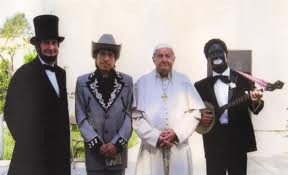
Later in the movie Bobby Cupid is introduced played by Luke Wilson. Cupid is obviously Bobby Neuwirth, Dylan’s sidekick of the early sixties, and who also shared the spotlight with him on the Rolling Thunder extravaganza. Cupid is a smart ass put down artist as Neuwirth was reputed to be. Cupid forms a pair with Uncle Sweetheart also as an antagonist which may have been the case in real life with manager Albert Grossman but one can’t be sure. At any rate Cupid merges his identity with that of Fate while acting as his enforcer.

The interest is not the movie but what Dylan reveals of himself.

2.
A Run Through The Scenes
Influences
In many ways this movie is based on all the Rock n’ Roll movies of the fifties. All of them could have been written by the same hand, at least the American ones. The English Tommy Steele’s Doomsday Rock might have slightly different being from England but probably not. Cliff Richard’s movie that I’ve seen only recently was from the American mold. Dylan ‘s movie is on a par with all except for the greatest of them, the apotheosis of Rock n’ Roll films- The Girl Can’t Help It. That movie told the whole story of Rock n’ Roll while being a perfect summary of the fifties. Can’t recommend it too highly; had more stars than the Big Dipper.
The big drawback of Dylan’s movie is that once he gets out of jail Fate can’t stop droning on about his opinions about everything. He might have thought he was on a par with Phil Marlowe but he wasn’t. Dylan’s close with Greil Marcus and he and his crowd are big on Raymond Chandler, the creator of Philip Marlowe. Chandler is great but not transcendental, and I’ve read all his stuff short stories and novels but not the letters so his mystique for Marcus, Dylan and that crowd escapes me. Marlowe narrates with comment as Dylan does here so there may be a strong Chandler influence.
Enter The Characters
Scene 1 is the fireworks. Scenes 2 through seven introduce, in order, Uncle Sweetheart, Nina Veronica, Jack Fate, Prospero, Tom Friend and Pagan Lace. The scenes establish the main characters while providing the raison d’etre for the movie, or in other words, what passes for a plot.
 Scene one is the violent opening. Scenes two and three present Uncle Sweetheart and Nina Veronica. The name Sweetheart is obviously ironic as Uncle is conniving and irresponsible. John Goodman who plays the role is a big fellow as was Albert Grossman. As the movie is autobiographical Uncle Sweetheart must refer to Grossman who came across to Dylan as doing something for him but who wound up taking more of the earnings than went to the singer and writer of the songs. Still he is a composite of every promoter than ever existed. Nina Veronica played by Jessica Lange is a smart talking long suffering legman for Uncle. Lange co-starred in a Presley movie thus establishing Dylan’s connection to Elvis without whom, as he says, he couldn’t have been doing what he is doing. I can’t really identify a specific model for her but she is blonde. Might be some connection to Edie Sedgwick and Echo Helstrom among others.
Scenes four, five and six introduce Jack Fate with an interlude with Cheech of Cheech and Chong as Prospero referring to A Midsummer Night’s Dream thus establishing Dylan’s connection to Shakespeare to whom some inexplicably compare him. Scene six brings Tom Friend into the stream.
As Uncle cannot find a ‘Star’ to perform solo at this benefit concert he is staging, he is forced to dip into the bottom of the bucket to spring Fate from prison where he is apparently doing life for being a bad singer without parole. Fate collects his guitar and moseys down to the bus stop where he finds his old friend Prospero waiting for him. Here Dylan begins his marvelous collection of clichés. ‘Where you goin’” asks Prospero. ‘That way.’ says Fate pointing to the right. ‘Oh yeah? That way’s pretty good too.’ Prospero says pointing to the left. Whew! Are you prepared? The use of Prospero for this downer film must be ironic.
Boarding the jalopy bus Fate asks the Black female bus driver: ‘This bus cross the border?’ ‘Oh no, you’re going the wrong way, mister.’ ‘Alright’ Fate replies resignedly. And this is only the beginning of the movie. Fates passes the Mexicans and chicken to find a seat at the back of the bus. I presume that this is a racial comment that it is now time for Whites to sit in back. After all as Dylan sings in his song: Them that are first shall be the last. To give credit when credit is due, Dylan with great economy lays out the direction down the midway of his view of Desolation Row that the movie will pursue. This is Dylan’s version of reality that even a hundred million dollars obviously can’t change.
The scene that introduces Friend takes place in the Editor’s office. Here we have a contrast between

Recent Dylan Persona
the archetypical, cynical, hard drinking nineteenth century newspaper editor confronted by a wise ass current edition of Dylan in hoody and dark glasses. This is an interesting contrast in historical periods. Not only do Friend and the Editor come from different periods but the Editor has a copy of the statuette of the monkey reading Darwin’s Origin Of Species on the desk. As Friend is associated with both Dylan’s early New York period and his present this might be a time to note the influence on Dylan’s mind, which he acknowledges, caused by his study of Civil War era newspapers in the New York City library during ‘61-’62. Actually he studied the social scene North and South in the years just before the war. It would be interesting to know how many different papers he read. The old black-face minstrel Oscar Vogel who appears later in the movie refers to these studies as also does probably Dylan’s inexplicable inclusion of his version of the Southern anthem, Dixie. He might have done better to have performed Cowboy Copas’ Alabam‘. One might add his version isn’t very good. Nevertheless those studies color his mind.

The Day The World Changed Eras
Dylan And The Press
Friend also raises the question of Dylan’s relationship with the press. Now, Dylan had before him the example of the Beatles and their amazing exchange with the media upon touchdown at Idlewild airport, renamed JFK, in January of ‘64. We were fairly electrified at the aplomb of the Fab Four and their cheekiness. This was in contrast to the humble pie other musicians ate before the microphones. The Beatles established a superior distance to ‘all that thing’ that struck just the right tone with the generation. In that one brief exchange they changed the direction of the history of the world. Of course, scruffs like the Rolling Stones and Animals who followed them maintained the tone creating the right antagonism between the generation and their elders. This was the beginning of the generation gap. The old timers who had survived the Depression, WWII and the Korean War had developed a definite world outlook that we with different experiences couldn’t share but the cleavage between the two generations was so sharp that conflict was inevitable. This is where it began.

The Bad Boys Of Rock
Dylan’s father in his interview with Walter Eldot of Duluth let the cat out of the bag when he said his son was a corporation and his whole persona was an act, a character that Dylan had assumed to make it. That being said then Dylan had plenty of time to assess the situation and prepare an act for the press when his turn came with good and correct examples before him. Since he couldn’t be flippant and amusing like Lennon and the others of the Fab Four he had to create an antagonism between himself and the press so we may assume his proto-Keith Richards act was a put on from the start. It seems impossible that a young man like Dylan wouldn’t have been flattered and awed by being interviewed by the international press while being broadcast on the evening news on two continents on a regular basis.

The Name Terrified The Old Folks
Nobody expected much from the unknown quality of the Beatles in ‘64 but Dylan in ‘65 was already ‘the spokesman for his generation’ whether he wishes to acknowledge it or not. His shucking and jiving and renunciation of his role did have a cooling effect. He was supposed to be supremely wise, ‘Something’s going on here but you don’t know what it is, do you?’, with answers for everything but he wasn’t and didn’t. He could say anything stupendous nor could anyone have. Knowing his incapacity he chose to pick a fight; probably the wisest thing he could have done. He didn’t answer any questions but asked more questions back than were given him. That way he didn’t have to take a position on anything.
It’s interesting that his alter ego, Friend, is full of sage and trite expressions of opinion, he spouts them non-stop a la Phil Marlowe. Friend who represents the Dylan of ‘61-’65 has Lace/Cruz as his live in. It follows then that Pagan Lace must represent Suze Rotolo.
Searching For The Vacant Couch
In his memoir Chronicles Vol I Dylan creates Ray Gooch and Chloe Kiel who he says he stayed with for some time on the West Side, sort of the Bank Street crowd. There is no possible way to fit them into the time frame nor had anyone ever heard of them before Chronicles so they must be a composite of the MacKenzies, Dave Van Ronk and various other couches he slept on. He very quickly moved in with Suze Rotolo by late ‘61 down on Fourth Street. As near as I can tell he stayed there until perhaps ‘63 when they split up. By 1963 he would have been famous and prosperous enough so that he couldn’t go back to sleeping on other people’s couches so between then and the time he showed up at the Chelsea Hotel it isn’t too clear where he lived. That was before Warhol demolished what was left of the Chelsea’s reputation when he made his movie Chelsea Girls.
Friend’s really great Beatnik pad was probably a composite of locations Dylan knew. It’s terrific. Not a lot of books in it though as Dylan describes in his memoir.
Memories Of Suze
As I noted Pagan Lace was very fearful much as Dylan always described Suze. Suze was intellectually vital in introducing Dylan to art and the theatre while Pagan Lace being Mexican is reminiscent of the Ramona of Dylan’s song To Ramona. ‘I could forever talk to you by my words would soon become a meaningless hum…’ which is essentially the relationship between Friend and Lace. Friend and Lace go in search of the Benefit Concert to track down the elusive Jack Fate.
Scene eight is the totally irrelevant interlude with the paramilitary who has no idea which side he’s on. The movie could have done without it.
Dylan insists on talking over the scenes like some Philip Marlowe but more vapid. If he wouldn’t give the reporters his opinions in his prime he makes up for it here while amply demonstrating the wisdom of having kept his mouth shut previously.
In scene 9 Fate’s father lies dying. Why he’s Mexican isn’t clear to me unless Dylan is merely eliminating as many White faces as possible. Dylan relates the particulars of Fate’s mom and dad which obviously correspond to those of himself and his parents. In another long interlude he checks into a hotel in what is supposed to be a dead pan comedy routine with the desk clerk. Another very long stretch of clichés.

Robert C. Neuwirth
In scene 10 Fate makes a phone call to his old buddy Bobby Cupid who during Fate’s incarceration has been working as a bartender. A very dissatisfying scene takes place between Cupid and a customer. Wretched acting and even more miserable writing. If Warhol was right that amphetamines made Dylan’s lyrics sparkle in the sixties, he should have fortified himself with some while writing this script. Having received his summons from Fate Cupid throws down his towel leaving the cash drawer open and liquor on display and leaves the building.
In the meantime Fate has found his way to the studio cum bar. This scene may be dated back to

A More Mature Neuwirth
Dylan’s teen fantasy that he is living out today. Contrary to what he would have people believe Dylan’s oeuvre is singularly free of Blues or Negro influence. Dylan quite frankly is a pseudo-Hillbilly. Well, maybe not that pseudo. He has been since the first day he showed up in Greenwich Village disguised as Woody Guthrie. In fact one reason it took him two months after arriving in New York to reach the Village was that he was actually scoping it out, reading the scene to develop an act as he couldn’t play straight country and succeed. Not too confident he backed up his Woody Guthrie/James Dean act with a large dollop of the lovable Charlie Chaplin for comedic relief. Still, he knew all the great Country songs and acts of the fifties. He had probably seen all the greats and lesser lights come through Hibbing. Awe inspiring. They used to have these great package shows. Where I lived I remember one show headlined by Ernest Tubb backed up by lesser lights like Johnnie and Jack and others. Both the show and the audience was a trip. I’m sure Dylan on more than one occasion was outside the stage door to watch the performers troop in. A sight to see. They weren’t gods but they’ve never been replaced. The Rocker never even came close.
The whole benefit sequence is Country and Western probably what Dylan calls traditional music. Bearing in mind the country concerts, Dylan makes a marvelous entrance as the traveling country troubadour shot from the back. Wonderful. He has the shambling bowlegged gait, guitar case in hand in the oversized cowboy suit down pat. He even manages the bowlegged stiff back stoop so you might think it was I don’t know who rambling past. He does all kinds of imitations of the Country stars he knew and loved: Hank Snow, Webb Pierce, Slim Whitman, I don’t know who all. If you know country these scenes give away Dylan’s major influences. Heck, when he hired Mike Bloomfield for Highway 61 he told him he didn’t want any of that blues crap and he made Bloomfield play out of his genre. If he could have gotten Country picking out of him he probably would have been happier.
Back In The Country Mode
Once he got out of the miasma he’d fallen into from ‘61-’66 he went straight Western with John Wesley Harding and just in case you didn’t get the message on Nashville Skyline he comes out of the country closet tipping his hat to you as if to introduce himself in his real guise. Obviously that is the real Bob Dylan. My problem with that, as my jaw dropped, was that he’s a lousy country singer and writer. Merle Travis he’s not.

Dylan In White-Face, Rolling Thunder
Now, the bar in the scene is a real old fashioned Country bar although this one is improbably populated by Negroes and Mexicans and the occasional old girl friend. The only thing the scene is missing is the chain link fencing around the band to keep the boys from catching a flying bottle with their teeth. I can tell you that those crowds were rowdy and I’m only alive to talk about it by the grace of god. In Dylan’s fantasy all those peaceable Negroes and Mexicans are so enthralled by Fate’s hillbilly music that they just keep smiling’ and boppin’ along. Heck even the Black Country singer Charlie Pride didn’t like the music that much, he only went to C&W when he realized he wasn’t going to make the major leagues as a ball player. So, during performance time here we’re in Fantasyland.
To put the scene into some kind of perspective it would appear that Dylan is combining the Rolling Thunder Revue and the We Are The World Benefit concert. The stage has a couple different backdrops here and they are quite reminiscent of the backdrops for the Rolling Thunder Revue of 1976 which in turn were based on the drop curtain of the movie, Children of Paradise.. Apparently that was a happy period of Dylan’s life.
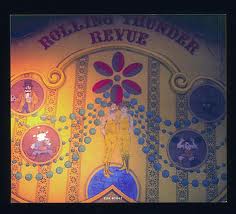
Rolling Thunder BackdropHighway 61 RevisitedRemember it’s all symbolism here and Dylan is telling his life story, not as it happened but corrected to what he would have liked to have happened. Thus he has a couple different backdrops based on the designs of the Rolling Thunder Revue. I didn’t get it all but one is revealing. There is some speculation as to whether Dylan was a Juvenile Delinquent who did time at the Minnesota Reform School at Red Wing. Red Wing is a town down on Highway 61. Highway 61 begins in Duluth at the wrong end of 61 and ends down in New Orleans in Blues country. So one should not confuse the wrong end with that end. Dylan is talking abou the Wrong End of Highway 61. It has nothing to do with the Blues. The town of Red Wing is also home to the Red Wing boot and shoe company, the last American made boots and shoes available, if they still are. Even though the very literal minded Duluth reporter, Walter Eldot, made a point of saying that Red Wing did not have walls as claimed in Dylan’s song The Wall Of Red Wing there must still be at least a chain link fence. I’ve never been to Red Wing but I’m speculating that you can see the Red Wing shoe factory through the fence at the reformatory. I may not be right on that speculation but one backdrop advertises American Made Shoes in a cartouche to the right and Retail in a cartouche to the left. If you remember the song Highway 61 Dylan makes reference enigmatically to 40,000 red, white and blue shoe strings. So there are a number of ties to Red Wing for Dylan. The Minnesota Dept. of Corrections isn’t going to tell us whether Robert Zimmerman was an inmate in 1959 but I think there’s enough evidence here to make the surmise conclusive. I’ve never seen Dylan live but if his show is anything like this movie I’m not going to spend seventy dollars to do it. His band are good musicians as far as that goes but Dylan doesn’t believe in a good bottom. He’s got a drummer but no rhythm section. He brings three guitars up front not including his own leaving his drummer flailing away, not particularly concerned with keeping time in the background. If Country drummers can’t do anything else they can at least keep time. The songs he uses here are not distinctive.. I wouldn’t pay money to see Dylan do an insipid Diamond Joe and I’d have walked out before he finished Dixie. God, playing Dixie to an audience of Negroes and Mexicans. He should have had the Stars and Bars suspended behind him to complete the insult.Mississippi On My Mind While we’re on this Southern kick we might as well include the scene between Fate and the black-face minstrel, Oscar Vogel. This appears to be a significant name. Oscar is an old English name meaning Spear of God while Vogel is German, possibly Yiddish, for bird. A singer is a sort of bird while Oscar was assassinated for speaking ‘truth to power’ or a Spear of God. Vogel would seem to refer to Dylan’s stint as a ‘freedom rider’ in the Civil Rights era of the early sixties. In point of fact people were killed during this period while it is likely that Dylan escaped an early demise by a hair’s breadth. For example in his song Motorpsycho Nightmare which take place Bates Motel style from Hitchcock’s recent 1960 movie Psycho the last line is ‘if it hadn’t been for freedom of speech I would have wound up in the swamp.’ If one considers Dylan’s outspoken career during ‘63 and ‘64 it is not inconceivable that he made many powerful enemies. Between songs like Blowin’ In The Wind, The Times They Are A’Changin’ and Masters Of War combined with the his appearance in the Washington Mall with Joan Baez and Martin Luther King it would seem certain that he at least came to the attention of then director of the FBI, J. Edgar Hoover. It is clear that Hoover would like to have discredited King who he correctly believed was either a Communist or Communist inspired. In the early years Dylan might not have counted for much but by 1964 he was becoming the ‘spokesman for his generation’ and much more influential. Hoover would have to have become concerned. Thus when that nerd Pete Seeger induced Dylan to travel to Mississippi to lend his voice to the freedom riders Hoover for one might have said to himself, ‘That boy has got to be stopped.’ In Motorpsycho Nightmare in order to outrage the Farmer Dylan shouts: I like Fidel Castro and I like his beard. The Farmer calls him a Commie as Dylan, the narrator, hit’s the ground running. In another song commentary Dylans says in his 1997 Mississippi, ‘I stayed in Mississippi one day too long.’ Sad Sack Current Dylan
In that light Fate’s confrontation with Vogel is interesting. One imagines Vogel was a pre-Civil War minstrel so that he refers back to Dylan’s Civil War studies undertaken in Dylan’s pre-Civil Rights period. Being in black-face could refer to Dylan’s Mississippi incursion with that twit Pete Seeger. Let us say then that the connection to Vogel is Mississippi.
Now, Dylan had been shooting off his mouth insulting Congressmen or whoever in songs like The Times They Are A’ Changin’, Blowin’ In The Wind and Masters Of War, callow, sophomoric songs all expressing high school essay sentiments. He was at the DC protest so the Mississippi trip and a song like Oxford Town might have been the last straw for the Feds, the tipping point.
Vogel delivers a monologue on his own murder while the doleful, long faced Dylan sits quietly listening. Vogel, played by Ed Harris in a particularly glossy black Shine, tells Fate that at one time he was a very famous minstrel but that a cause came up and as he had a podium as an entertainer he undertook to ‘speak truth to power.’ As he tells Fate it’s not what goes into your mouth that gets you in trouble it’s what comes out. Freedom of Speech didn’t save him from the swamp, so let’s say it was probably a combination of Freedom Of Speech and intervention by Albert Grossman to save his meal ticket that did it. I have read someone’s opinion that Grossman served that function for Dylan more than once.
Fate having heard the story began walking away. When he looks back Vogel is gone, proving he was merely a projection of Fate’s/Dylan’s psyche. In place of Vogel is a real Mississippi Negro with a baseball bat. The implication is- don’t come back. In this connection during 1976’s Rolling Thunder tour Dylan appeared not in black face but in white face perhaps referring back to his Mississippi blunder. Thank you Pete.
Trouble Begins For The Children Of Paradise
On Fate’s arrival at the bar Dylan begins to lose control of his movie as the story gets more complicated. His relationship with Uncle becomes tense as in real life his relationship with his manager Grossman begins to come apart. By 1970 Grossman and Dylan were in court. That tenseness is aggravated by the arrival of both Bobby Cupid and Tom Friend along with Pagan Lace. The key players in Dylan’s life are assembling. To top it the writing becomes even more execrable and the acting worse.
The best scene is the arrival of Cupid. Bobby is not a composite character but seems like a real life characterization of Dylan’s sidekick Bobby Neuwirth. Neuwirth was a fixture with Dylan in the mid-sixties when he served as sort of an enforcer. The two went their separate ways until the 1976 Rolling Thunder tour for which Neuwirth was summoned somewhat as here in Masked And Anonymous. In this scene he returns absurdly bearing Blind Lemon’s old beat up guitar, or reputedly Blind Lemon’s guitar. When Uncle asks where he got it Cupid replies in Houston from a friend of a friend of Blind Lemon’s who said he had been told the guitar had been Blind Lemon’s.
Uncle remarks that he can get a guitar just like that at any pawn shop in town. ‘Well, maybe you can,’ Cupid answers, ‘But it wouldn’t be this guitar.’ That is an unanswerable reply but lame logic. Cupid wanders off saying he is going to restring the guitar. Get it? Fate/Dylan is the new Blind Lemon.
While Cupid is diddling with the guitar Friend shows up asking for directions to Fate. Ha, ha. In the language of today Cupid serves as the Gatekeeper and won’t let Friend through. However Uncle wants the publicity and insists that Fate let himself be interviewed. This leads to the rather incongruous requisition by Friend of Fate. In this instance, as Vogel served as a sort of conscience for Fate so does Friend here. Not exactly what one expects given Dylan’s relationship with the press. Remember that Friend is wearing Dylan’s 1965 clothes while talking to the currently dressed Dylan. ‘Yonder come the vagabond in the clothes that you once wore.’ In that sense Fate or Dylan is talking to himself as though his conscience. Strange conversation.
Friend reprimands Fate for not having been at Woodstock. His absence must have bothered Dylan  more than he lets on. Then Tom runs on about Jimi Hendrix being out in the rain with his guitar in that horrible rendition of the Star Spangled Banner. On and on about Hendrix being a native son. And then even more strangely Tom brings up Frank Zappa and his eight and a half hour movie Uncle Meat. Talk about out of the blue. There is no direct reference to Dylan’s Renaldo and Clara at four and a half hours except that Zappa was able to let it all hang out which took him another four hours apparently to get it all out. I must say whatever was going on in Dylan’s mind it did escape me.
And then comes another irrelevant interlude harking back to 1963 and possibly Mississippi of the genre ‘and a little child shall lead them.’ A White woman leads her little Negro daughter up to the assembled cast and orders her daughter to sing The Times They Are A’ Changin’ for Dylan. The mother says her daughter had memorized every song Fate/Dylan had written. Not exactly a feat like memorizing the Bible but daunting nevertheless. ‘Why did you do that darlin’?’ Fate coaxes. The mean, nasty White woman interjects: ‘Because I made her do it, that’s why.’ That’s one mom from hell.
So then as this little Negro girl begins singing the Master’s song a kind of a hush fell over the world. As the little Negro girl intoned the more than Shakespearian lyrics the screen goes silent except for the little Negro girl’s voice as the cast experiences an epiphany not unlike Paul when he fell down in the dust of Israel. I tell ya folks it was angelic, there was a lump in my throat. I was eating popcorn at the time.
Of course, the girl wouldn’t have given the kid Michael Jackson the tremors, nor Donny Osmond for that matter, but she got all the words right and knew when to quit. About this time Fate decides to walk out on the benefit, he borrows Cupid’s car which he wrecks and goes to visit his faithful old Negro prostitute spouting clichés all the way. This scene is apparently reminiscent of 1968 when Dylan’s dad died before Dylan could reconcile himself with him. Here also Fate’s dad dies as Fate sits quietly on the bed beside him shedding his last tear. It wasn’t as good as Little Nell.
Junior Jive, his putative brother played by Mickey Rourke, then takes over for pop. Once braceros they are now running the country he says. Rourke was unconvincing in the role.
There Must Be Some Way Outta Here
Well, this thing has to end sometime so Fate goes back to the bar to perform the Benefit. One has the feeling that this was some sort of apology for the We Are The World benefit when Dylan and Keith Richards took the stage before the world wide audience and showed how stellars make fools of themselves. In this replay Edmund (Rourke) begins a destruction of Desolation Row and the rest of the world which erases Fate from the television screen and hopefully We Are The World from Dylan’s memory. And then comes what we have all been fervently praying for- The Grande Finale. Probably the lamest scene in a movie of lame scenes.
Edmund has unleashed Armageddon on the world simultaneously eliminating Dylan’s Save The World embarrassment and fulfilling his need for universal destruction a la Hitler down on Desolation Row where everything was broken and is now disintegrating. While all the colored people of the world are off destroying themselves Dylan’s White elite are about to self-immolate a la The Twilight Of The Gods. Ragnarok, Hiroshima a hundred fold.
All the world’s a stage as that minor poet said and this scene appropriately takes place in front of the stage but not on it. It’s a major rumble. I hope I can describe it right. Fate, the fate of fates has arrived. This is the fate that no one can escape. Now you know why Jack’s last name is Fate.
Fat old corrupt Uncle Sweetheart makes a move on Pagan Lace trying to persuade her to have a drink on him. The girl was a teetotaler. She resists Uncle’s enticing. Uncle grabs the delicate thing making a move to pour the firewater down her throat will she, nil she. We hear a dog whistle off stage and its SuperFriend to the rescue. He has apparently always wanted to kill Uncle so he grabs the erratic microphone cord proceeding to throttle Uncle.
Everything might have worked out fine from Friend’s point of view but for the fearful little Pagan Lace who drags him off thereby leading to his death. Fate shows up challenging Friend. Dylan settles accounts with the press here. I don’t know how big Jeff Bridges is but if Dylan is 5’ 10” 150 Bridges is 6’ 5” and 250. Odds do not daunt Fate. They go into a clinch with Friend’s back to the camera. I don’t know what Dylan did to Friend, perhaps twisted his balls, but Friend recoils fifteen feet clutching either his stomach or his gonads- the picture gets fuzzy. In perhaps the hokiest bit ever devised for film a thoroughly unconvincing Fate breaks the fat end off a JD bottle steps coyly up to the prone Friend and wiggles the jagged end in front of his nose, then steps back. You really have to see it to believe it.
Well, Friend is lying down but he’s still not going to take it. He pulls out a flat gun, might be a .45, might be a 9mm., I’m not an expert on firearms, and instead of shooting, leers menacingly while waving the gun around like he intends to shoot it sometime in the future. Or, perhaps Dylan and Charles were expertly building suspense because Bobby Cupid is creeping up behind bearing the murder weapon which is, you guessed it, or maybe not, Blind Lemon’s old guitar. Or, quite possibly as Uncle suggested, it was just an old guitar from a pawn shop. No matter, sneaking up behind Cupid bashes Friend with the unstrung front side. The guitar flies to pieces, it was old and flimsy, leaving Cupid holding the neck stump.
Unlike Fate and his JD bottle neck Cupid plunges the guitar neck into Friend’s throat. Death by guitar, perhaps a Movieland first. Symbolically Blind Lemon and all Negro musicians have avenged themselves for the purloined royalties. But, Bobby is now a murderer although for a good cause. Someone shouts here cum de fuzz. The ever magnanimous Fate gives his own guitar to Bobby thus replacing the broken Blind Lemon and one assumes passing the baton of musical justice on to Cupid while he shows Bobby the door and tells him to run. Cupid does one of the lamest exits ever. You can see him stop running when he thinks he’s out of camera range. So, the faithful servant’s fate is reconciled.
Meanwhile the two Black loan enforcers from the first scene show up to seal Uncle Sweetheart’s fate. They give the sage but cliché’d advice: ‘Everybody pays Sweetheart. Some pay up front some pay at the end. Come with us.’ Uncle resignedly marches off to his fate.
The cops show up. Nina Veronica steps up, points to Fate and says he did it, I saw him do it. This may possibly connect Dylan to 1958 when he and Echo were caught burglarizing in Hibbing and possibly Echo laid it on Bob. Just a guess. Well, the concerts over and it’s back to the Black Hole Of Calcutta for Fate. A woman put him in jail to begin with and a woman returns him to jail. It is Fate’s fate.
Yoicks, can this movie be finished? No. Frank Zappa made an eight and a half hour movie, this one only feels like it. Dylan’s not finished philosophizing. The camera focuses steadily on Dylan full face for four and half minutes as Dylan drones on. I’d given up, I wasn’t listening anymore. I will say this though, consider these pictures of Bob and Dave Zimmerman. If they don’t have two different fathers I’d be amazed.

How Did I Get Roped Into That Picture?
A Note On My Method
A note on my method: I do not compose at the computer. I write my essays out long hand first. I then transfer to the computer using a different site. I save and print a copy then copy and paste to WordPress so I always have backup copies in case the copy flies away from WordPress while all restore methods have been disabled.
So while disabling restore and removing the copy is an inconvenience I always have backup copies. I then enter the photos printing copies page by page so I can always reconstruct the work.
The education has been less than pleasant but I presume it has been worthwhile. Thank you.
A Note On Bob Dylan And His Privacy Lament
Dylan seems to be unaware that by offering his efforts for sale he has sacrificed his privacy. His music and songs are open for criticism whether he likes it or not. Masked And Anonymous and his other films are automatically subject to minute scrutiny and interpretation. If he doesn’t like that then he should not have taken up his pen.
Secondly: Dylan invaded the privacy of every listener by offering his efforts for public consumption. There was no escaping his songs broadcast over the radio so his listeners had their minds violated in that sense. He made a personal mental contact and if he doesn’t like the results of the message he gave out, that is just too bad.
Thirdly: He often says he never asked to be the spokesman of his generation. That shows either a lack of understanding or is an outright lie. The Times They Are A’ Changin’, Blowin’ In The Wind and Masters of War imply that he has answers of which his elders are unaware. Ballad Of A Thin Man positively states that he knows what’s happening and others don’t. Desolation Row is a Ship Of Fools put down song that claims that Dylan has a loftier and more accurate view.
His audience accepted him at his word and when the burden became too heavy for him he betrayed that audience and abandoned them. That was a criminal offence.
It is time Dylan accepts the responsibility of his actions.
Correction: based on the Rolling Thunder Revue should read ‘based on the French movie Children Of Paradise.’
Exhuming Bob XXX
A Review: Part II
Masked And Anonymous
by
R.E. Prindle
Desolation Row

Aww, Sing It , Bob
When Dylan left home in the summer of ’59 for UMinnesota he would have been at the bottom of his despondency in its raw form. His subconscious would have been in possession of his mind. He manifested this condition at UMinnesota by a burst of degraded behavior, drunkeness and an inability to study. He did know his salvation lay in his music. He then practiced hard and assiduously. He apparently realized that he wasn’t rock n’ roll material while Folk Music was the rage, at the height of its popularity, although the slough of its despond could be seen from the heights. It was petering out even as Dylan rode it to fame and fortune. As he says in the revised Shelton he always knew that Folk Music was a shuck but he could do it and use it as a springboard.
Using his friends and acquaintances in Minneapolis to educate him he learned to sing and play quickly. Still deep in the throes of depression, ruled by his subconscious, he left for New York to try his luck there. It was two months after his arrival in New York before he turned up in Greenwich Village. He has said that during those two months he was hustling in Times Square. No one knows whether to take him seriously but given his state of mind he may have attempted to degrade himself beyond redemption to satisfy his father’s prophesy. He remained a heavy drinker in New York adding drugs to his repertoire. According to Andy Warhol who should have known an A Head when he saw

A. Warhol
one Dylan was racing on amphetamines. It wouldn’t have been hard to do as nearly everyone in New York at the time was. The Village was a tough place and getting much tougher as Dylan went along.
He took up his station at a bar called the Kettle Of Fish which was a Mafia owned bar and undoubtedly tough enough. It may have been there that he and Andy Warhol first crossed paths as Andy frequented the place also. While it has not been recognized, they were actually competitors for the role of King of Bohemia. Although Warhol was much older they both began their rise at the same time coming to an apex simultaneously. A war of sorts ensued in which Dylan’s base was Downtown and Warhol’s base Midtown. Later Lennon and Ono would form an Uptown base but by that time Dylan had moved along although he continued to associate with Ono at least through the eighties. They may still meet but I haven’t come across any references.
Despondent people usually see the world as a Zoo, an insane asylum, a desert, a hole or in Dylan’s case as a state of desolation. In 1965 he wrote the song Desolation Row as he fought to free himself from his depression. He has retained this despondent state of mind from then to the present if his movie Masked And Anonymous is any indication. Thus the movie is a visualization of a tour of Desolation Row with ‘all the clowns and jugglers doing their tricks for you.’ The movie is a real side show if seen from that perspective. Indeed Dylan depicts a side show carnival act of The Man Eating Chicken which when you part the curtain shows a man eating chicken. My favorite memory of the midway was the Black Widow Spider Woman. Had a little chat with her too. At any rate Dylan hasn’t really advanced beyond 1959 when he left home.
There is nothing attractive in the movie. The lighting is usually dark and depressing. I don’t remember one scene in which the sun was out. The streets are vile, everything is a shambles or broken as he said in his song, Everything’s Broken. That means that he views himself as a broken man, beyond repair. One can see why Suze Rotolo was fearful. She had every right to be if one judges from the way Dylan treated his madonna, Sara. After psychologically abusing her for a decade she had no choice but to leave when she came down for breakfast one day and found her husband carousing with another woman. Dylan hasn’t been able to change his self-destructive behavior; if he weren’t able to make the money he does he himself would have been a bum on Desolation Row long ago.
Thus we are treated to a longish filmed tour down skid row to look into the blank despairing faces of derelicts as if they were the norm. Normal people do not exist to Dylan’s mind. The streets were dotted with burning oil drums, the streets look pockmarked and unkempt left by a society unable to care and incapable of maintaining its infrastructure. Echoes of Greil Marcus and David Lynch abound.
Dylan injects his religious fundamentalism into the story where the desk of the Editor bears a copy of the statue of the monkey reading Darwin’s Origin Of Species prominently displayed. Again, the building beside which the rundown bar cum TV studio is placed is the Masonic Hall on LA’s preeminent Whilshire Blvd, one of the great streets of the world. The Masons who once shaped the world and were the founders of the United States Of America, competitors with Judaism for rule of the world have fallen on hard times. Members have drifted away and no new ones recruited so the magnificent building stands empty. That old Masonic Lodge is vacant now with its grand ideals inscribed on its outside walls, as are Masonic Lodges across the country. Ours has been taken over by the museum.
Dylan in his Hibbing days was trained for the his Bar Mitzvah by an Orthodox Jewish Rabbi of the Lubavitcher sect brought in by his father who was powerful both among the Jews and Gentiles of Hibbing. Dylan has never lost his Lubavitcher or at least Orthodox sympathies so that the use of the Temple is a mockery of Freemasonry by Judaism in Dylan’s hands. Behold the winner, he says.
At the same time, for the duration of the movie Dylan was able to make a stink pit of the grand Wilshire Miracle Mile making it reflect his vision of reality. He was to project his psycological miasma on it to obliterate the beauty.
As I say, to him, everything is broken down. At one point he borrows his buddy , Bobby Cupid’s car which is a broken down old monster from Detroit’s golden era of the fifties and sixties. He is on the way to visit a Black prostitute. He crashes the car into a telphone pole walking away leaving it there smoking. Once again this is dark, even though night it is a duller dark than need be, a Halloween night before the demons are released from hell to reclaim the night for their annual visit.
The fallen woman, the Negro prostitute, lives in what once was a fine old mansion but now has fallen on hard times itself. What was once a grand approach is now a ruins blending in with the shadows that have no bottom. You can hear the earth groan as Dylan steps on it. The effect is so repulsive and unredeemable that one has no sympathy with the movie or Dylan and Larry Charles.
I could go on describing each degraded, broken scene but the record of that depressing aura would bring me down as well as yourself.
2.
Let us take a look at the way Dylan uses his extras who populate the movie. If you thought the locations were depressing the cast is even more desolated.
The racial composition of the movie is of interest if this is how Dylan sees reality. There are no obvious Jews in the movie. Of course one knows that Dylan is Jewish but he is disguised as a goy cowboy, an incarnation of Rambling Jack Elliott. Perhaps Dylan has patterned this stage of his life after that of Jack Elliott after whom he patterned his early career also, actually studying and imitating him to the point where people said: ‘Look Jack, he’s stealing your act.’ As Elliott had priority in the persona Dylan might almost be perceived as Jack’s doppelganger although more successful. His character is named Jack. Elliott is also a Brooklyn Jewish cowboy.
The main actors are all White except for Penelope Cruz’ Pagan Lace who appears to be Mexican while apparently being a devout Catholic is no pagan. The bit players and extras are predominantly Mexican. They all have a bracero appearance, the kind of look that used to seen as typically Mexican. On Fate’s bus ride to the City the entire bus is filled with Mexicans which means, I suppose, the place was either Mexico or LA.
The Muzak of the background seems to always be a group singing Dylan’s songs in Spanish, rather puzzling. As mentioned, Fate’s father inexplicably seems to be Mexican while Fate’s mother also looks Mexican. The Micky Rourke character, who is apparently Fate’s half brother, is Mexican. Rourke muses that his people began as servants but own the big house now while they are taking over the country.
In the barroom scenes those enraptured by Dylan’s Country and Western tunes are improbably Mexicans and Negroes. To watch them bop out the rhythm rapturously to Dylan’s version of Dixie (I wish I was in the land of cotton…) is a sight to behold- defies all reason and experience. Who ever saw an African American at a Dylan concert? One wonders what Dylan was smoking, snorting, shooting, drinking or perhaps doing a combination of all four.
The manner in which our old Civil Rights activist portrays Blacks is also astounding. They are all thugs, criminals and prostitutes without exception. Well, except for the little mulatto girl who sings The Times They Are A Changin’. However she has a mean, nasty White mother in combat boots. The mother says that her daughter has memorized all of Fate’s songs. Fate asks: ‘Why did you do that, honey?’ The mean, nasty White mother interjects: ‘Because I made her, that’s why.’ Almost made me ashamed to be White. I had to brush up on my nasty act. The little girl launches into the song while everyone listens rapturously, enthralled at truth coming from the mouth of a babe. I know she is supposed to be a scene stealer but the kid was only passable. Not only was she no threat to the reputation of the young Michael Jackson, she wasn’t even a threat to Donnie Osmond. But, this is Dylan’s movie.
The first Negroes we see are two loan enforcers who are explaining the facts of life to Uncle Meat, excuse me, Uncle Sweetheart who owes more than he can pay. The Blacks give him a good beating informing him that they’ll be back.
The next Negroes we are introduced to improbably run the TV Network, possibly CBS, which also seems to be a stretcher. Not only do the Mexicans look like they missed high school but the Black Pres. of the Network acts like he left school after the sixth grade.
The head of the Network conducts business with a loaded .45 automatic on the conference table.
I don’t know what number this is in Dylan’s list of bad dreams but one does wonder what he ate before he climbed into bed. Dylan seems to search out freaks for his Desolation Row. He has a close up after the Animal Lover scene of a guy’s face that looks like a very bad case of scabies after being run over by a truck. I don’t know whether he was made up or Dylan found him somewhere and gave him scale and all the pot he could smoke.
If this movie is Dylan’s version of reality then the congressmen and senators should gather around and lend him a helping hand. Thank god Dylan doesn’t strive for verisimilitude, the whole movie is acted like Jr. High kids playing adults while filming it in the basement. It would help if they were mixing up some medicine. Since everything is fake you don’t have to run from the theatre screaming although I’m told that many did. I’m tough, I’ve sat through ten showings of this thing but, yes, I do believe I’ve had enough.
Part III follows in the next post.
Chap. 13: Edie Sedgwick, Maid Of Constant Sorrow
April 17, 2011
Edie Sedgwick
Maid Of Constant Sorrow
by
R.E. Prindle
https://idynamo.wordpress.com/2010/12/27/exhuming-bob-xxviii-visions-of-johanna-decoded/
Chapter 13
Blonde On Blonde

Her Fogs, Her Amphetamines And Her Pearls
One can only guess at Edie’s feelings when Dylan dismissed her so brutally from the lines of One Of Us Must Know (Sooner Or Later). She must have intuited if not known that her short and glorious career as the toast of New York was going nowhere. She came to New York with a handsome inheritance that she squandered in a trice, her parents disapproved of her conduct to the the point that they cut her off from support leaving her as Dylan had sneered in Like A Rolling Stone, a poor little rich girl ‘who had never lived out on the streets but now she was going to have to get used to it.’ Screamingly in pain from amphetamines one can only imagine her bewilderment with no way to rectify the situation. Whatever golden opportunities she may have had were now gone forever. Frome here to her death in 1971 would be one long wailing ‘horrorous’ nosedive that is terrifying to relive as a writer even. My stomach quakes as I try to organize the course of events.
Chuck Wein, one of the Harvard homosexuals she had associated with and who had come to New York with her was her evil genius, some say Svengali, who had guided her to Warhol and the

The Poet
Factory and then presided over her self-destruction. Then for that brief glorious summer of ’65 she had set New York on its ear as a companion to Andy Warhol. Made her feel giddy and indestructible. Andy was apparently in love with her but as a self-centered homosexual was too flaky to work out a relationship that would give her dignity while he was unable to support her more than extravagant tastes.
Behind Warhol was Dylan competing for Edie’s favors which he won in December of ’65 and then discarded her like an old shoe. He recorded the course of his relationship with Edie in various songs from mid-1965 to the completion of Blonde On Blonde in the Spring of ’66. His own career course was changed dramatically in July of ’66 when he had his motorcycle accident.
It might be well to review the songs that comprise Blonde On Blonde now. The song list of Blonde On Blonde is as follows:
1. Rainy Day Women #12 And 35
2. Pledging My Time
3. Visions Of Johanna
4. One Of Us Must Know (Sooner Or Later)
5. I Want You
6. Stuck Inside Of Mobile With The Memphis Blues Again
7. Leopard Sking Pillbox Hat
8. Just Like A Woman
9. Most Likely You Go Your Way And I’ll Go Mine
10. Temporary Like Achilles
11. Absolutely Sweet Marie
12. Fourth Time Around
13. Obviously Five Believers
14. Sad Eyed Lady Of The Low Lands
With a knowledge of the lyrics the titles themselves read consecutively tell story while the lyrics confirm the tale. The story hinges on who the two women are. One is Dylan’s mother who blasted herson’s psyche when at about the age of twelve she told him in so many words that he had ruined her life by being born. Apparently it was more than Dylan could handle because it was then that his lifelong misogyny began. It is forbidden for a son to revenge himself on his mother so his only recourse was to take it out on another woman or women. Dylan has been a serial misogynist.
One of the women he chose to vent his spleen on was Edie Sedgwick. Thus the two rainy day women most likely are his mother and Edie. All the time Dylan was bedeviling Edie he was courting Sara Lowndes who he eventually married in November of ’65. It was a quiet wedding that didn’t became known for several months and not widely known until later than that. He married just before he succeeded in abstracting Edie from Andy’s entourage so there is no doubt that he was only toying with Edie as a surrogate for his mother.
He may actually have cherished her vulnerability from drugs, inexperience in the world and low self-esteem. She would have been as helpless as a baby, almost like shot gunning fish in a barrel. Sara was his Madonna, Edie his whore. He waits to the very end of Blonde On Blonde to mention Sara and then he wrote Sad Eyed Lady Of The Low Lands for her. Of course, this was all very mysterious for us back in ’66 because we knew nothing of what was happening in New York. None of us had even heard of Sara Lowndes until she showed up as Dylan’s wife
As blogger Jim De Rogatis says, when he sat down to listen to Blonde: What I discovered was an artist who sneered and snarled with more venom and conviction than Johnny Rotten, and

The Artist
finally it dawned on me: Dylan was a punk…
Jim wasn’t there at the creation as I was, he is a younger man. I guess my soul was so canchred at the time that I welcomed the sneering and snarling as an expression of my own trauma while today I find the venom is so grating that I can no longer listen to Dylan’s records. Besides he borrows nearly everything.
The album opens on a note of forced sardonic merriment as though in a house of ill fame and ends with the dirge dedicated to his wife, Sara. I leave the interpretation of that up to you. I can’t pretend at this date to understand the lyrics to Sad Eyed Lady. One would have to know more of her and Dylan’s courtship. Dylan thought she was supposed to be impressed that he wrote a song for her with a title that sounds like another of his caustic insults.
To take the songs in order: Rainy Day Women is a raucous, very noisy mocking song along the lines of Like A Rolling Stone with its refrain of ‘How does it feel?’ On release the song was so noisy it was nearly unlistenable, certainly objectionable and barely music. Time has conditioned our ears. The refrain here: Everyboyd must get stoned, has layers of possible meaning. While the allegory of stoned meaning pelted with rocks is present, stoned can also have a secondary meaning of smoking marijuana. I don’t think the meaning has anything to do with getting ‘stoned’ from dope. I think it’s a combination of the first meaning and what was perceived by Dylan as a devastating insult from his mother.
The refrain must refer on one hand to his mothers perceived ‘stoning’ of Dylan by her announcement to him that he had been basically unwanted. That stoning is turned around to apply to his ‘stoning’ of Edie in vengeance. He then gleefully taunts and mocks her with the refrain: Do not feel so all alone, everybody must get stoned (How does it feel?) which refers back to his earlier song about Edie, Like A Rolling Stone.
In order to make ‘poetry’ of his taunt, our incipient ‘Shakespeare’ gives several poetic references that have nothing to do with rocks or joints. For instance the line ‘They’ll stone you when you’re riding in your car’ must refer to radio DJs pitching products. Thus stoning is meant as a verbal assault. One can compare that line with the Rolling Stone’s Mick Jagger’s lyrics to his song Satisfaction:
When I’m drivin’ in my car
And that man comes on the radio
The Singer
He’s tellin’ me more and more
About some useless information
Supposed to fire my imagination
I can’t get no, Oh, no, no, no
Hey, hey, hey, that’ what I say
I can’t get no
Satisfaction
So Dylan’s use of ‘stoning’ is giving or getting unpleasant information.
Song #2, Pledging My Time merely means he is obsessed with his mother’s ‘information’ that he was unwanted which is reflected in song #3, Visions Of Johanna when he sings: These visions of Johanna have conquered my mind. Johanna being his mother. Then there is discussion about Andy and Edie. (see my essay at https://idynamo.wordpress.com/2010/12/27/exhuming-bob-xxviii-visions-of-johanna-decoded/ for a full discussion.)
Song#4 Sooner Or Later mocks Edie who he ‘really did try to get close to’ as he dismisses here as he would have like to have dismissed his mother. Song #5 is self-explanatory.
Song #6, Stuck Inside Of Mobile With The Memphis Blues Again awhile the lyrics are unclear must refer back to I Want You on one hand and forward to Leopard Skin Pill Box Hat and Just Like A Woman on the other. He’s stuck inside of Mobile, i.e. he wants his mother with the Memphis Blues, i.e. he want his vengeance on Edie is a possible interpretation. At any rate it is placed between I Want You and the two Edie songs so it must be related to all three.
Then come two really unnecessarily vicious songs that everyone agrees are about Edie- Leopard Skin Pill Box Hat and Just Like A Woman. There are no obvious reasons for Dylan to express such vehement, disfiguring hatred of the poor girl unless he’s visiting his repressed hatred of his mother on her.
Song #10 Temporary Like Achilles involves Edie and Andy and himself. I doubt if Dylan had any understanding of the Iliad, if he had even read it, so apart from Achilles short life and the seven month interruption of his relationship with Edie by Warhol an interpretation is somewhat of a hazard.
Songs 11, 12, 13, Absolutely Sweet Marie, Fourth Time Around, and Obviously 5 Believers seem to wander off topic. I have read one interpretation in which the blogger thought Obviously 5 Believers was a response to the Beatles Norwegian Wood. Or possibly they lead into song #14 Sad Eyed Lady Of The Low Lands that Dylan says he wrote about Sara Loundes. The lyrics of this ‘poem’ are incomprehensible but if I had been Sara I wouldn’t have taken the title as a compliment, especially not after being locked out of a discussion about Dylan, Edie and his mother. After all, this is a married man lashing out at Edie.
After completing the LP Dylan left for his 1966 tour of England in which there was such a violent reaction to his electric backup band. I don’t remember their being a violent reaction made on the West Coast. For myself I welcome it. I never did like that faux folk crap he did anyway. Apparently Dylan didn’t either. A new expanded edition, lots of new material. of Robert Shelton’s biography, No Direction Home, just released by Omnibus Press is available, speaking in 1965 Shelton quotes Dylan thusly: ‘There never was any change. No instrument will ever change love, death in any soul. My music is my music. Folk music was such a shuck. I never recorded a folk song.’ He did however call himself a folk singer.
So, whoever shouted Judas at the Manchester concert knew what he was talking about. I never listened to those nauseous early Dylan records anyway. Blonde On Blonde was released in June of 1966 while Dylan was thrown by his ‘chrome horse’ on 7/29/66 thus putting an end to the first phase of his career.
I don’t know what Edie thought wen she heard the record that summer but one supposes she would have recognized herself as the topic of the conversation. Warhol certainly did and he was not amused. Knew something about motorcycles too.
Both Edie and Dylan were so heavily into amphetamines that they probably were not responsible for their actions. Drugs tend to put one into an internal state in which the outside world assumes a subordinate position, almost irrelevant, to one’s interior reality. A person functions in his own mind as a sort of magician who can comman the world to his own world. A certain type of insanity I suppose. Right and wrong are merely expressions of one’s own subconscious will. As Dylan confused Edie with his mother who he subconsciously wished to punish he transferred those feelings, that resentment, that hatret onto Edie as his surrogate mother thus gaining his revenge. How much satisfaction he got isn’t known and he’s not telling.
Edie herself was so far gone into amphetamines as to be oblivious to what was happening in her life. As far as she could dissociate her life from reality she could obviously make black white and vice versa.
Having dealt with Dylan’s relationship with Edie, let us return to January of ’66 to take up again the story from there.
Chap. 14 has been posted as of 6/23/11
Tarzan Meets Einstein Somewhere In Time
April 11, 2011
Tarzan Meets Einstein Somewhere In Time
by
R.E. Prindle
Texts:
Burroughs, E.R.: Tarzan At the Earth’s Core, 1929
Burroughs, E.R.: Tarzan The Invincible, 1930
Gott, J. Richard: Time Travel In Einstein’s Universe, 2001
Wells, H.G., The Time Machine, 1895
Time travel seems strange because we are unaccustomed
to seeing time travelers. But if we saw them
everyday we might not be surprised to meet a man
who was his own mother and father.
— J. Richard Gott, Time Travel In Einstein’s Universe
When you eliminate the impossible whatever remains,
no matter how improbable,
must be the truth.
— Watson/Holmes/Doyle
All possible universes exist.
Unfortunately you are
in the wrong one.
— J. Richard Gott
Akashic Records:
Upon time and space is written, thoughts,
the deeds, the activities of an entity
in relationship to its environs,
its hereditary influence and its judgments
drawn according to the entity’s ideal.
Hence, it has often been called
The reward of God’s book of remembrance.
— Edgar Cayce, 1 February 1946

Away We Go

The Man With The Keys To The Universe
Somewhere in time, let’s say 1905, a man named Levi Dowling says, in all seriousness, that he traveled out to the belt of stars girdling Earth known as the Zodiac. There at the cusp of the departing Age of Pisces and the arriving Age of Aquarius he was met by celestial beings who allowed him to examine the Akashic Records to learn the shape of things to come in the Age of Aquarius.
Wouldn’t it have been nice if he had taken Madame Blavatsky and Albert Einstein with him? They might have taken folding chairs and a card table along and read the Tarot cards or cast the I Ching. Madame B who had already examined the Akashic Records in the mystical land of Tibet could have guided Mr. Dowling through the Records while Albert Einstein offered a useful comment from time to time on how better to order all the possible universes. By the way Mr. Gott should know that it is not necessary for all the possible universes to exist simultaneously. Some might be in the garage for repairs, so to speak. Tweaked a little.
Perhaps J. Richard could have traveled back through Time and Space to 1905 to be present out

Dick Gott And His Mom And Dad
on the cusp and serve as the trio’s Ganymede to roll their Tea behind a cloud where we can’t see as they played celestial Rummy or read each other’s Tarot using the Akashic deck.
Levi Dowling returned with gleanings he had picked up from the fabled Akashic Records which he placed in his book The Aquarian Gospel Of Jesus The Christ. Madame B had already given us the results of her study, so she would have little to add, perhaps a few corrections. Albert Einstein undoubtedly learned what he needed to know from the Records to write his own Special Theory Of Relativity which upon mature reflection he expanded to the General Theory Of Relativity. There is a certain similarity in style in the writing of all three time travelers as they rolled around heaven if only for one day.
While I have found no evidence that Edgar Rice Burroughs ever read Dowling, or indeed the Akashic Records, who, I might add has made more of an historical impression than you might thnk, even than Blavatsky, there is proof that he wrestled with the ideas of the Special and General Theories of Relativity of Einstein.
ERB Capturing The Moment
In Chapter 9 of Tarzan The Invincible Burroughs says: …but though time and space go on forever, whether in curves or straight lines, all other things must end…
You can’t refer to curved space without being aware of Einstein’s Theory Of Relativity. What Burroughs read of Einstein’s is not clear but that he was familiar with the notion of relativity is clear.
What a time it must have been in those fifty years from 1870 to 1920 when literary greats literally strode the Earth like giants: Haggard, Doyle, Wells, Freud, Kipling, Einstein, Burroughs. The most earth shaking fiction writers the world has ever seen. None were so marvelous as Freud, Einstein and Burroughs, super charged, they flashed across the skies like bolts from the mighty arm of Zeus.
Einstein is one part of a triumvirate of the ‘three greatest geniuses’ of the twentieth century by some people’s reckoning: that is Marx, Freud and Einstein. Marx was dead by the time Einstein and Freud flourished. Both of the latter men claim to have been scientists but one should note that they were both deeply inolved in religious matters of one group of the Semitic peoples. Both were promoting their religious beliefs through their ‘sciences.’ They were even so close they collaborated on a book, Why War?
Marx, Freud and Einstein are colossal frauds. These three men based their life’s work on false
Levi Dowling Back From The Cusp
premisses no less egregious than that Tarzan existed and was guardian of Africa. ERB in a mind boggling way sports with the notions of all three men in his oeuvre. One has to admire his audacity as no one has ever accused him of being a genius on the order of the three ‘greats.’
Central to Einstein’s relativity thesis is that Time is a Fourth Dimension. Just as the discussion of the Unconscious was appropriated by Freud from the literary atmosphere dating back to Edgar Allan Poe and the German Romantics, so as Richard Gott points out in his 2001 book Time Travel In Einstein’s Universe, subtitled ‘The Physical Possiblilites Of Travel Through Time,’ old Herbert George introduced the notion of Time as a Fourth Dimension in his 1895 novel, The Time Machine.
Are these things coincidences? Well, I don’t know.
Wells takes credit for having introduced the notion of Time as a Fourth Dimension but I rather imagine that the idea had been bruited about for several years before Wells gave it literary expression. Just as Freud developed a scientific notion of the Unconscious from discussions floating about, so Einstein elaborated on the existing notions of Time as a Fourth Dimension.
Model A Time Machine
It is my contention that Burroughs was absorbed in the ideas of these three men exploring their possibilities over the course of the oeuvre. At the Earth’s Core is apparently when the nettle of Time jarred ERB into a full scale examination of the problem. In Earth’s Core ERB was on the right track that Time has no independent existence but he backed off in apparent frustration for he says, once again in Chapter 9 of Invincible:
The beasts of the jungle acknowledge no master, least of all the cruel tyrant that drives civilized man throughout his headlong race from the cradle to the grave- Time, the master of countless millions of slaves. Time, the measurable unit of duration, was measureless to Tarzan and Tantor. Of all the vast resources that Nature had placed at their disposal, she had been most profligate with Time, since she had awarded to each all that he could use during his lifetime, no matter how extravagant of it he might be. So great was the supply of it that it could not be wasted, since there was always more, even up to the moment of death, after which it ceased, with all things, to be essential to the individual. Tantor and Tarzan, therefore, were wasting no time as they communed together in silent meditation; but though Time and Space go on forever, whether in curves or straight lines, all other things must end.
I’ve read a little bit here and there and I find the above a remarkably profound passage. At the last Burroughs contradicts himself for on the one hand he says ‘Time and Space go on forever,’ while on the other hand he says that ‘Time is a measure of duration.’
That latter is correct. A measure of duration implies that Time has no independent existence; it is merely a convenient way devised by the mind of man to measure duration from point A to point B. It has been said that the progress of man is the improvement in the ability to measure. A nanosecond is a vast advance in measurement over the crude second just as the ability to measure a billionth of an inch is a refinement of the measurement of the inch. However neither the second or the inch have an independent existence in reality on that account. As an alternate measure of distance there is also the centimeter which in itself can altered ad infinitum.
‘Time, the measurable aspect of duration’ is what At The Earth’s Core is all about. What ERB should have said is that Time is only the measureable aspect of duration. The implication of Earth’s Core is that time cannot exist without periodicity and the question is whether Time is merely a function of periodicity when conceived by sentient beings or does Time exist independently in and of itself. Einstein’s Theory Of Relativity hangs on that question. My own answer and the unresolved answer of ERB is that it does not.
When Burroughs says that Time and Space go on forever, he gives in to Relativity Theory on the one hand and denies it on the other. Einstein thought that both the Universe and Space were bound by limits. In saying that Space goes on forever Burroughs attacks a main thesis of the theory.
Also, if Wells expressed the notion of Time as the Fourth Dimension, as the scientist Gott acknowledges, does that give him priority over Einstein? It should. One sort of fiction has no greater claim to legitimacy than another.
What then is Burroughs’ relation to Wells and Einstein? That Burroughs read and was heavily influenced by Wells’ Time Machine seems self-evident. Not only is there a seeming reference to the Eloi and Morlocks in Jewels of Opar, but Wells also says: ‘Are you so sure we can move freely in Space? Right and left we can go, backward and forward freely enough. But how about up and down?’
It seems that Tarzan anweres that question by his use of the lower, middle and upper terraces. Burroughs merely incorporates answers posed to others’ questions but he never refers to the questions. My own opinion is that Wells’ Time Machine posed troubling questions to Burroughs which he tried to resolve over several novels.
At the beginning of Invincible he says quite starkly: ‘…it seems to me not unethical to pirate an idea occasionally…’ Admittedly the quotation is taken out of context but it is consistent with Burroughs’ practice. As it was, one might note Shakespeare, Homer, Chaucer, Milton and a host of others down through time did the same. Complete originality has only been demanded in modern times and never met.
As Time has no independent existence. I believe that ERB undestood the idea of time travel to be impossible, hence, even though he covers many different time periods from the prehistoric to the ‘modern’ post-Atlantean society of Opar, he never uses the method of time travel. Those various ages still exist fossilized in Time and Space. I have to believe that Opar is an early reflection on the notion of time travel as posed by Wells, as the Oparians reflect Eloi and Morlocks so closely. But still puzzled by what he thought about it, ERB merely placed Opar in a place similar to where the Time Machine stopped in 802701 and played with the notion of Eloi and Morlocks.
ERB does have an instance of actual time travel in The Eternal Lover in which the Lovers move back and forth in time.
As The Jewels Of Opar was written before Einstein achieved world wide notoriety, Burroughs could only critique and reflect on the notion of Time as a Fourth Dimension from Wells, and also actually Camille Flammarion who was a major influence on him. It would be a little later that the notion put into scientific language by Einstein exercized his thought processes.
Just as when Jason Gridley and the O-220 pass between two time periods when it leaves the crust for the core, the O-220 has really traveled through Time but it has never left the present. The prehistoric Core exists as a parallel world.
Whereas the crust is ruled by Time or periodicity as measured as Time, the Earth’s core exists in a perpetual high noon in which there is no periodicity to measure the passage of Time. Thus, the inhabitants have all the Time in their world for the period of their lives. Periodicity is determined by their existence rather than years, months, days, hours and minutes as Burroughs pointed out in the communion of Tarzan and Tantor quoted from Invincible above.
The life span of a Pellucidarian cannot be measured except as biological unit.
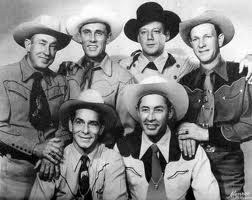
Sons Of The Pioneers: Winning The West While H.G. Made The Conquest Of Time
A charming epression of the notion is presented in the lyrics of the song Tumbling Tumbleweeds:
I know when day is done,
That a new world’s born at dawn;
But I’ll keep drifting along….
As I understand the lyrics in relation to Einstein and the Fourth Dimension of Time is that the Earth makes one complete rotation between sunups. When the sun ‘rises’ each morning the planet has not only rotated a full turn on its axis but revolved around the sun a notch of the three hundred sixty-five rotations that comprise one revolution around the sun. Thus, a new world’s born at dawn. There is no time involved at all but there is periodicity.
Each rotation is a fact in and of itself. There is no way to recover it or travel back to it. It is done. It had no existence before its occurrence and it has no existence after it. To retrieve the irretrievable is impossible. To occupy space before arriving there is equally impossible. Time is not a continuum, therefore Time travel is impossible.
As the cowboy in Tumbling Tumbleweeds says, the duration of is life is not governed by the periodicity of the earth cycle. One day is done and a new world begins the next dawn but his biological existence drifts along quite independent of another measurement.
This is what Burroughs says in At The Earth’s Core. In the eternal noon of Pellucidar men and women have no way of ageing themselves; they drift along from birth to death unconscious of birthdays. There are only two phases to life: birth and death.
As Bob Dylan put it, ‘If you’re not busy being born you’re busy dying.’ Thus the Pellucidarians go through life conscious only, if that, of the process of life. There is no need for time. Nature has given them all they need and more to live their lives.
Time, then, is an illusion created by the periodicity of the daily rotation of earth on its axis and its yearly revolution around the sun. However the Earthly year would have no meaning on the planet Uranus which takes more than a hundred earth years in its revolution around the sun. The majority of earthlings would never be more than a year old. Neither would the Earth hour have any meaning on Jupiter which consumes less than twenty-four hours in its rotation. Time is certainly no absolute but in a parody of Einstein it is relative. What indeed does Time mean from the perspective of the Sun which controls the different periodic revolutions of nine planets in its course through Space? It’s all relative until you triangulate the center and then it’s absolute.
In a joke as elegant as any that I have read, Burroughs depicts the frustration of Robert Jones, the cook aboard the O-220. ERB expects the reader to get the joke, which he stretches out over the length of the novel,even though he calls no direct attention to the fact that he is making a joke. Jones is the cook of the expedition. On the crust, our active and passive periods are determined for us by the natural periodicity of night and day. We, or most people, are active during the day and sleep at night. Our eating periods are determined by the position of the sun in the sky. At daybreak (in theory) we break our fast and have breakfast, at noon we have lunch and at day’s end we have supper or dinner (which one depends on your social class.)
At the Earth’s core the sun is at perpetual noon. One eats when hungry, one sleeps when tired. As the cook, when Jones looks outside to see what time it is, it is always lunch time. He has a clock, not even a twenty-four hour military clock, but apparently a twelve hour alarm clock, which he checks against the sun. As it is always noon outside, he can’t even tell if its AM or PM which his clock reads simply as 7:00. He can’t tell whether it is night or day, breakfast time or dinner. He doesn’t know which end is up, quite literally, as everything at the core is reversed. At every stop, he writes in his journal: ‘Arrived here at noon.’
His frustration increases because he doesn’t know which meal to serve- except…lunch. Finally in complete exasperation he throws the clock overboard, or he throws time out the window or to the winds. This really funny shaggy dog story took Burroughs the whole book to develop.
So, really, Burroughs is saying that time is dependent on periodicity or its relevance and is only a measure of that periodicity. Time has no independent existence, which is correct. Burroughs thereby disproved Einstein’s Theory Of Relativity which is dependent on a continuum of both Time and Space.
Without a continuum of Time and Space there can be no time travel. There is no time travel which is a staple of science fiction, in Burroughs’ work. There might easily have been but rather than following Herbert George’s example, which seemed impossible to him, he effectively refutes Wells and the notion of Time as a Fourth Dimension.
To retrieve the irretrievable which is that which has ceased to exist or to obtain the unobtainable which is that which has no existence is a mere conundrum created by Einstein and Wells not unlike the ancient Greek story of the Fox that nothing could catch and Laelaps, the dog that nothing could outrun
In that story, in brief, the citizens of the area in which a man called Cephalus had antagonized a god who in anger sent a Fox that could never be caught to ravage the countryside. Earlier Cephalus had acquired Laelaps, the dog which could outrun everything, from a goddess.
Keep your eye on the bouncing ball- god/goddess.
The citizens implored Cephalus to turn Laelops loose on the Fox to rid the country of the menace. Thus we have the scene of the Fox that nothing could catch being chased interminably by the dog that nothing could outrun.
The Greeks, too, were fond of conundrums such as what happens when an irresistable force meets an unmoveable object. Thus the problem posed by time travel, whether in Einstein’s universe or any other, is how to retrieve the unretrievable, which is: That which has cesed to exist, or how to otain the unobtainable which is that which has no existence.
As these problems have no resolution, the Greeks solved the problem of Laelaps and the Fox by having them both turned to stone in mid-run. And there they remain today as all conundrums must.
So until you run into a Time Traveler who is both his own mother and father, be content to live in this universe while you await transportation to any of the other ‘possible universes.’ Check the Akashic Records before you book. Unlike Tarzan who could board the O-220 to Pellucidar at the Core of the Earth where the sun was at perpetual high noon, we’ll all have to watch the sun come up in the East and set in West for all the days of our time.
In the meantime, credit ERB as a man of great common sense.

Model T Space Buggy
 I, Dynamo