A Review, Part 6: Chessmen Of Mars by Edgar Rice Burroughs
February 16, 2009
Edgar Rice Burroughs On Mars
A Review
The Chessmen Of Mars
Part 6
by
R.E. Prindle
The Golden Handcuffs
And now comes the part that readers find the most fascinating, that of the contest on The Field Of Honor. Gladiatorial contests are frequent occurrences in the novels of ERB. This one seems to combine Arthurian influences as well as Roman.
Burroughs’ tenure of a couple years at the Chicago Harvard Latin School must have made an indelible impression on him. The recurrent, one might say underlying, Homeric influence from the Odyssey of Homer would indicate that the school concentrated on that work of Homer although not on The Iliad as there seem to be few references to the latter poem. In later years ERB would complain that he had learned Latin before English cramping his English style.
Perhaps, but I don’t see anything glaringly wrong with his English style. His psychology makes him a little stiff but that’s not through a lack of understanding English. It would be nice to know the curriculum of the Latin School and what texts he did study. Late in life when he wrote I Am A Barbarian his background as evidenced by the reading list he appended was shallow while not mentioning the great classical scholars. Still Roman themes are a recurring motif in the corpus. About this time he was rereading Plutarch’s Lives that compares the lives of various Greeks and Romans so that the Lives may have been a text at school. Especially as he says that while rereading it he discovered that Numa was the name of a Roman king while he thought he had invented the name for the Lion.
Also Arthurian references pop up in Chessmen. In 1912 when his editor Metcalf of Munsey’s asked him to write a medieval story that turned out to be the Outlaw Of Torn he claimed to have little knowledge of the period. Now, the Manatorian party leaving the city after Gahan entered is more reminiscent of Arthurian stories than Roman. The city of Manator itself also has a decidedly Camelot feel. The party’s subsequent return and capture of Tara and Ghek has more of the courtly flavor than the Roman. In 1928’s Tarzan, Lord Of The Jungle ERB would create a medieval society of lost Crusaders deep in the heart of darkness. So while he claimed to know nothing of medieval themes in 1912 by this time he seems to have done some reading in the field.
In many ways Manator bears a great resemblance to Mythological, Graustarkian and Ruritanian stories that he did admire as a young man. Combining all those influences with the Oz of Baum we have Manator.
Thus in addition to Roman gladiatorial contests we also have a similarity to medieval battle melees where the favors of women were of paramount importance.
Here we have the great mock battles and actual battles to the death played out on a gigantic Jetan board. Burroughs modifies the Earthly game of Chess to create a similar Martian game of Jetan complicated by the grotesque addition of battles to the death between the live ‘pieces.’ Indeed as is explained there had been games recorded in which the only survivors were the the two female prizes and one of the Jeds. Once again mimicking Arthurian literature ERB describes sword blows that cleave the opponent through the brain pan down to the breast bone. ERB seems to delight in the most violent and gruesome details. And lots of them.
A-Kor, his cellmate, fills Gahan in on what he must do to enter the games conveniently giving the latter enough money to bribe his team, get this, while returning the remainder to his purse.
The strategy is all very probable. The number of slaves from Gathol in Manator is enormous so Gahan has no difficulty in enrolling a team of Gatholians who will be fighting for their freedom. Gahan is famiiar with Jetan as played elsewhere on Mars on a board so he has no difficulty with strategy. The main change in strategy is that when a piece captures another the pieces then draw swords and fight to the finish. Thus a piece can successfully evade capture negating strategy.
Relying on the prowess of his men and his own incomparable swordsmanship Gahan then makes a drive directly for the opposing Jed, U-Dor.
Can it be a coincidence that he who stands between himself and Tara is a man called U-Dor (door)? Considering the important roles doors play in these stories it would seem that U-Dor is one more door he must hack his way through to get to his objective.
The only other work I’ve seen where doors were so important was the old TV show, The Mod Squad. In that TV series doors of every description were constantly being slammed; not just closed but slammed. I haven’t quite figured out ERB’s obsession with doors as yet.
While Chess and one imagines Jetan are supreme games of strategy Gahan seemingly abandons the fine points and gamesmanship and makes a drive straight for U-Dor. ERB says he was a good Chess player while I have never played to perhaps the moves he describes are possible especially as any move is good or bad depending on which player is the better swordsman. Gahan is the best so he experiences no difficulty in reaching U-Dor who he cuts down.
Tara and he are seemingly reunited. But while Tara thought she killed I-Gos he was only wounded. Present at the games he denounces Gahan and Tara who flee as aforesaid to the pits. Then begins the spectacular double climax; that of Gahan/ERB’s triumph over John the Bully/O-Tar and the subsequent triumph of Gahan/ERB over Frank Martin/O-Tar.
2.
To a large extent Chessmen is an examination of ancestor worship. Certainly the Taxidermist of Mars preserved ancestors going back at least five thousand years to the reign of O-Mai. ERB explains Gahan’s and perhaps his own ideas on the significance of ancestors.
Gahan, a man of culure and high intelligence held few if any superstitions. In common with nearly all races of Barsoom he clung more or less inherently, to a certain exalted form of ancestor worship, though it was rather the memory of legends of the virtues and heroic deeds of his forefathers that he deified rather than themselves. He never expected any tangible evidence of their existence after death; he did not believe that they had the power either for good or for evil other than the effect that their example while living might have had on following generations; he did not believe therefore in the materialization of dead spirits. If there was a life hereafter he knew nothing of it, for he knew that science had demonstrated the natural phenomenon of ancient religions and superstitions.
The above is probably as close to a confession of faith as ERB is going to give. It is certainly one that I can accept for myself. The above may also be a reference to spiritual seances in which dead ancestors supposedly spoke through mediums. Harry Houdini was debunking such seances around this time much to the chargrinof ERB’s literary hero, Conan Doyle of Sherlock Holmes fame, who did believe is such ancestral contacts.
There may be a joke in that case when Gahan arose from O-Mai’s bed ululuing and putting the fear of God into O-Tar exposing him as a coward.
Having thus disposed of O-Tar/John ERB turns to debunking O-Tar/Martin.
When Gahan was playing his joke on O-Tar I-Gos stole Tara away. He delivers her to O-Tar who is so smitten that he decides that he will marry her and take his chances with this she-banth.
O-Tar immurs Tara in a tower not unlike the story of Rapunzel. Her location is pointed out to Gahan who then makes a perilous climb of the tower in order to tell her that no matter what it looks like on the morrow’s wedding date he will rescue her and she is not to commit suicide.
While talking to her through the grated window a eunuch sleeping at the foot of the bed awakes moving toward him sword in hand. Tara instead of shrinking back removes her little blade from her harness running the eunuch through the heart.
There must be significance to this scene as ERB is retelling the story of both John and Martin. If Emma was with ERB on the corner and abandoned him to his fate by walking on it would appear that ERB never forgave her while having Anima trouble ever after. Here he rectifies the situation by having Tara come to his defense acting with a both a blade and heart of steel. Thus not only has his Animus surrogate Gahan proved John/O-Tar to be the coward but Tara the Anima figure defends Gahan/ERB from a similar attack by John absolving his Anima.
We now go to the wedding. Of course, having read the book several times in my case we know the story so I will just follow it. In the book John Carter tells ERB the details after the fact.
I-Gos has allied himself with Tara and Gahan against O-Tar. Before the wedding O-Tar retires to the Hall of Ancestors to commune with the dead. I-Gos has let Gahan into the hall where he sits as though stuffed on a stuffed Thoat. When O-Tar pauses beside him Gahan falls on him striking him on the forehead with the butt of a heavy spear.
Thus we establish that at this point O-Tar has become Frank Martin. Just as Gahan/ERB proved O-Tar a coward by merely rising in O’Mai’s bed and making weird noises so now he reverses the situation in Toronto. Instead of ERB being struck on the forehead Gahan/ERB strikes O-Tar/Martin in the same place leaving him for dead.
Now, this is strange. Donning O-Tar’s Golden Mask Gahan goes foth in O-Tar’s guise to marry Tara. The Golden Mask undoubtedly refers to Martin’s money bags to which ERB undoubtedly attributes whatever success Martin had with Emma. Why Gahan/ERB wore O-Tar’s mask is fairly clear but why ERB would have isn’t. Also if O-Tar hadn’t recovered from the blow Gahan would have been married to Tara in O-Tar’s name.
Perhaps ERB in a reversal means to imply that Emma would actually have been marrying him but won by Martin’s ‘golden mask.’ By the process of reversal then ERB would have recovered and stolen Emma from Martin on the altar so to speak. Or, as he actually did.
The symbolism of the golden handcuffs then would mean that the proposed wedding of Emma and Martin would have a mere commercial transaction. Or, perhaps, he felt himself attached to Emma for financial reasons when he’d rather not be. Complications, complications.
While the two antogonists Gahan and O-Tar are staring each other down the ‘cavalry’ Gahan sent for has arrived. Carter and troops from Helium, Gathol and Manatos arrive to end the story.
O-Tar himself then falls on his sword like a true Roman thus redeeming his miserable life. Perhaps ERB is saying that that is what Martin should have done- left the couple alone rather than constantly interfering.
3.
Conclusions
If as Sigmund Freud argued dreams are based on wish fulfillment the Chessmen of Mars proves his case. In this series of dreams or nightmares ERB attempts to reverse the results of the three greatest disasters of his life.
John the Bully and Frank Martin are a matter of history. That ERB links his fiancial disaster with these two earlier disasters indicates that he knows he has crossed the line in his mistaken purchase of the Otis estate. He knows that he as no way out as he has the ‘cavalry’, John Carter and the united forces of Helium, Gathol and Manatos come to the rescue. In the final denouement of this error in 1934’s Tarzan And The Lion Man even the cavalry can’t help. Tarzan/ERB leaves the burning castle of God a defeated man.
His great dream of getting back to the land and becoming a Gentleman Farmer has crashed to the ground. His attachment to his fantasy can be traced in his letters with Herb Weston. Weston warned him as strongly as friendship would allow that it would be a mistaken approach to farming in any other way than on a factory basis with profit firmly in mind. ERB chose to ignore this sound advice probably believing that between books, magazines and movies his future was golden.
Unfortunately for himself his income crested in this very year, 1921. Undoubtedly because of his strong anti-Communist stance and his resistance to the Semitism being imposed on him his sources of income came under attack. Nineteen twenty-two was the last year he received income from movies until 1927-28. Publishing difficulties with McClurg’s and G&D increased. His long time publisher, McClurg’s, even refused outrightly to publish his opus of 1924, Marcia Of The Doorstep.
His foreign royalties once so promising slowly dried up because of political pressures. Later in the decade his troubles with McClurg’s became so intense that he was forced to abandon that long standing relationship. No other major publisher would touch him. Why, will probably never be clear. After a tentative stab with a less established publisher he turned to forming his own publishing company. This move was apparently successful enough to float him through the early part of the thirties before the spring of his inspiration began to dry up.
In a desperate attempt to save Tarzan he attempted many expedients, none successful. He incorporated himself to protect his income from creditors. He subdivided a portion of Tarzana, he attempted to sell off acreage, he tried to turn part of the estate into an exclusive golf club, he turned part into a movie lot attempted to lease that out, he invited oil geologists to find oil on his land. He invested in airplace engines and airports. Nothing came of anything. In the end the magnificent estate slipped through his hands.
A premonition of all this can be found in the The Chessmen Of Mars. Even the name of the story indicates the he is involved in a chesslike game of many moves.
Stress was now to be ERB’s other name.
A world famous figure, nominally rich, still retaining many of the trappings of wealth he had gone from prince to pauper, regained his princely stature and now slipped back to the role of a prince in exile from the Promised Land.
Nothing daunted he went on working. In the end his magnificent intellectual property, Tarzan Of The Apes, would always save him from a fate worse than death. A form of wish fulfillment in itself, I guess.
Post 5: The Chessmen Of Mars by Edgar Rice Burroughs
February 10, 2009
Edgar Rice Burroughs On Mars
A Review
The Chessmen Of Mars
Part 5
by
R.E. Prindle
The Taxidermist Of Mars Part 2
To return to the arrival of Gahan, Tara and Ghek at Manator. The three have been drifting before the wind for days as they have no propeller to move them. Tara is in dire straits badly needing water and food. Landing some disntace from Mantor Gahan decides to enter the city in search of food and water. He is espied on his approach and a trap set.
I am assuming that Manator represents LA and Burroughs is decribing his arrival there in 1919.
Porges was the ERB trailblazer while to my knowledge he is the only researcher allowed in the archives to this date. Robert Barrett seems to have had a close relationship with Danton Burroughs, ERB’s grandson, and Danton released snippets to him from time to time but there is no evidence in Barrett’s wrtings in the Burroughs Bulletin that he has spent any time in the archives.
Not even Bill Hillman who has done so much for Danton and ERB, Inc. has been allowed to work int he archives. Danton promised HIllman documentation for some time but never found the time to send it. I once talked to Danton by phone and he indicated he was withholding access for ‘effect.’ I didn’t ask what effect. He did release a valuable snippet to me though. So, to a very large extent one is forced to combine Porges’ seminal but fairly meager information with what was happening in Burroughs’ life as reflected in his novels.
One of the areas that have troubled me is the relationship of ERB’s rival with Emma, Frank Martin, both before and after their marriage.
Martin was disgusted with Burroughs who he thought, correctly I believe, didn’t actually want Emma but didn’t want anyone else to have her either. I think it probable that ERB wanted to keep Emma on the shelf indefinitely as the result of the confrontation with John the Bully.
Driven to desperate measures Martin drew ERB to New York on his father’s private rail car and attempted to have him murdered in Toronto.
That attempt failed. ERB in defiance married Emma against her family’s wishes a few months after the attack. Now, what was Frank Martin’s reaction to the wedding? Did he resign himself to the reality or did he interfere in the marriage any way he could?
We have a couple facts that indicate that at the very least he kept an eye on the couple. Hard facts. Martin’s associate or stooge was a man called R.S. Patchin. He was on the trip to New York and present at the assassination attempt in Toronto. In 1934 aftr ERB divorced Emma Patchin showed up in LA and sought ERB out for what appears to be the first time since 1899. Did he just happen to be in town at that moment or was he acting as Frank Martin’s agent?
Before we answer that let us consider Patchin’s next appearance in ERB’s history.When ERB died in 1950 Patchin sent a condolence letter to the family specifically recalling ERB’s bashing in Toronto. That is why we have a good record of the event. Sometime between 1934 and 1950 Martin died so Patchin was operating on his own. In his note he reminded the family of the Toronto incident that might be considered as even gloating perhaps.
The interest of Martin and Patchin then appears to be malevolent. If Martin and Patchin appeared at one of these unpleasant occurrences then it follows that perhaps Martin was working against ERB’s interests from 1900 at the the time of the wedding on.
Martin may have driven ERB and Emma out of Chicago in 1903. In 1907 and ’08 when ERB impregnated Emma twice in close succession that may have been a defensive move against Martin. The angry ex-suitor very likely then continued his machinations behind the scenes after ERB’s literary success finally driving ERB from Chicago for good in 1919.
Now, Chicago was a movie making center before the rise of Hollywood. Many of the important movie people in LA originated in the Windy City. It is not improbable that the son of a railroad magnate who owned his own private rail car knew some of them. As starlets were starlets then as now it is not inconceivable that Martin spent time in LA part of each year. Thus, when ERB moved to LA which Martin would have known in advance it is conceivable that he planned his revenge. The trap was laid so innocuously that as in his entry into Mantor Gahan/ERB wasn’t aware of the trap until he was completely in its meshes with little chance of escape left.
That ERB was an impetuous lad given to snap decisions must have been known to anyone who observed him as closely as Martin must have. ERB left Chicago to seek twenty acres 0n which to raise his hogs. Instead he was shown the 540 acre estate of General Otis of the LA Times. As I understand it ERB did not seek the estate but that notice of it was brought to him. There was the bait. The bait was too attractive. ERB bought the estate and was hooked. The trap was sprung.
ERB went on a spending spree of magnificent proportions without realizing what the costs were and how vulnerable his income was. Now saddled with care he had to struggle to find time to keep up his writing. Publishing became more difficult for him while his movie revenues came to a halt in 1922, the year after Chessmen. Whether you look at it like the impetuous Burroughs, who acted first and thought later, merely mad a very bad decision or whether he was lured into buying the estate he either was trapped or trapped himself. Chessmen would indicate that he believed he had been trapped.
In any event he was moving with the big boys in LA according to the big guys’ rules. That is a very difficult transition to make. The big boys play rough.
Let us see how ERB portrays Gahan’s entry into Manator. His entry is noted by a sinister unknown figure from the walls. We never hear of this figure again. He just disappears from the story. Gahan’s entry into the city is unopposed. He merely enters the unguarded gate and begins walking down a street. There the three figures dogging him split up. The figure who spotted him follows him from a distance, another runs ahead so that Gahan is caught in the jaws of the vise. The third figure parallels him keeping him in sight.
When they wish him to enter a building the man ahead creates the sound of a patrol approaching from the front. A door stands conveniently open. Gahan ducks in. This door may represent his buying the Otis estate. As the patrol draws closer Gahan retreats around a corner into a hall. someone of the patrol enters the door forcing Gahan farther along the corridor. The figure retreats closing the door behind him. Gahan now finds the door locked. He is trapped in the corridor. He must go forward. Thus ERB having bought Tarzana has no choice but to live with his mistake.
He proceeds down the hall in this charade of doors that is part and parcel of ERB’s psyche. Gahan is directed on his way by being compelled to enter the only unlocked door. Finally he approaches a bank of doors all locked except door number 3 that is standing open. Yes, this scene was repeated in 1934’s Tarzan And The Lion Man but more of that later. Gahan enters hearing the door click shut leaving him absoltuely no exit. His course has been downward. He is now in the pits of Manator.
He is now directed to a room with a table parallel with the wall. He sits down. Gas is emitted from holes in the wall sedating Gahan. He passes out. How clever, Gahan ruminates when he comes to, I have been good and roundly caught and not a hand was laid on me. We too marvel at the masterful description of Gahan’s capture. In real life ERB is saddled with an estate too large for his income and spending habits and which is slowly consuming him. Thus when he awakes from the sedation he finds a giant ulsio, the Martian Rat knawing on his arm. One assumes that if Gahan hadn’t wakened when he did he might have had his limbs consumed. Had ERB just become aware of his predicament? Was the game now on?
Nicely done, great atmosphere and from we readers’ perspective a great story. But now let’s backtrack a little before we move on. This is really quite a story.
2.
While the Jetan game is the most fascinating aspect of this novel for perhaps most people the game itself may be the game within the game, so to speak, the story within the story. The whole Manator story may be considered as a game of chess in which each episode is a move in the game. Remember in the framing story ERB had finished a game of chess with Shea. The Secretary turned in leaving ERB ruminating about his loss and blowing smoke at the head of his king- the head. As he does so John Carter walks in. He tells ERB, in the latter’s own persona, that Chess is similar to Jetan on Mars. So, smoking the head of his king very likely gave ERB the hint to construct the story along the lines of Chess. Thus the opening gambit, the first move is Gahan’s entry into the city countered by the mysterious figure who engineers his capture.
As ERB comtemplated how he had gotten into his Tarzana dilemma he may very well have compared his situation to a game of chess that must be played well if he were to extricate himself unharmed.
He has chosen to present his problem in the form of a dream. Because in dreams as he has a character in Fighting Man Of Mars say, you can’t get hurt.
In Gahan’s entry ERB creates a bizarre dream image of balconies full of people observing his progress but who seem oblivious of it. Soon we learn that I-Gos the taxidermist of Mars spends his life stuffing these dead people who populate this strange city. In dreams of course all the participants have no real life; like the dead past they have no volition.
Apparently this novel is activating dreams in me. The other night I dreamt I was walking down a boardwalk as in old Chicago with the crazy ups and downs. As I mounted a higher part of the boardwalk I was accosted by six thugs. As they were discussing what to do with me I was paralyzed with fear not unlike ERB before John the Bully. Then I said to myself: This is a dream and I can’t get hurt in a dream. So saying I grabbed the closest thug and threw him through a plate glass window. Turning quickly I grabbed a second thug and hoisted him over the railing. The remaining three, there must have been only five, were paralyzed in their turn. Then I grew bored and woke up.
So ERB in the same way is examining his dream world but tweaking it from his daytime consciousness. His real life is being interpreted through his symbolism.
That in 1921, the time he wrote this story, one knows that he was already in deep trouble is because in 1934 when he was already going through the trauma of battling MGM, the Communists, and divorcing Emma and marrying Florence he replicates his entry into Manator in his entry into London and the City Of God. The bit with the three doors, the third being open and clicking quietly shut behind him is an exact duplication of Tarzan And The Lion Man. In that novel he enters a prison where he finds his Anima ideal, Rhonda, already imprisoned. In this one he is chained beside A-Kor(rock spelled backwards). In Lion Man the strange creature is God; in this one the Taxidermist Of Mars. There is no reason not to believe ERB is going through some real stress.
When the effect of the gas dissipates, first he dispatches an ulsio, The Giant Rat Of Mars (echo of Sherlock Holmes and the Giant Rat Of Sumatra?) he notices that the table that had been parallel to the wall is now vertical to it. At the far end he notices the key to his manacles. Here he employs his classical education by recalling the story of Tantalus. In that story Tantalus was standing in water with fruit trees above him but could neither eat or drink because water and fruit receded before his grasp.
Thus the solution to ERB’s problem is frustratingly just beyond his grasp as he stretched out manacle biting into his ankle. I believe this image probably refers to his childhood fixation of John The Bully that he can’t quite consciously recall or resolve. Part of the story develops around the fixation in the form of Gahan’s contest with O-Tar the Jeddak. O-Tar represents John the Bully as well as Frank Martin.
In Gahan’s predicament then ERB represents his own psychological dilemma.
I will give another example from my own dreams. Several years ago I had this wonderful dream that I thought was so spectacular that I wrote it up as short story. Anyone interested can read it at reprindle.wordpress.com. It’s called The Hole In The Sky.
http://reprindle.wordpress.com/2008/04/04/pages-lifted-from-the-memoirs-of-far-gresham-92183/
At the time I was struggling to resolve my own central childhood fixation. I thought an image my mind employed so amazing that it was the only literary image I had ever had that I thought was completely original. We’ll see.
In this dream my fixation appeared as a giant Gordian Knot three or four feet in diameter. There’s a real fixation for you. I hadn’t been able to unravel this knot so now Alexander like I was going to cut it. I had this giant pair of scissors so huge I could lean on the handles like a crutch. I could see the problem and had the tool in my hands to resolve it but I couldn’t manipulate the huge tool. Two guys offered to help so instead of of helping me with the scissors they picked up the knot with a rod running through it.
I didn’t recognize the two but they were obviously the ones who gave me the fixation not unlike ERB and John the Bully. They stood grinning mockingly at me holding up the fixation. I struggled with scissors then asked them for help. In response they laughed and shook the knot at me. I had to give up.
Just to show how the dreaming mind works I later discovered that the image that I thought was so original was based on a scene from a 1957 movie I’d seen. So twenty or twenty-five years later I duplicated a scene from The Incredible Shrinking Man in a dream. Richard Matheson who wrote the wonderful I, Legend also wrote the equally wonderful, Shrinking Man.
In the movie the Man had shrunk down to the size where a now giant spider was attacking him. He was about to fight the spider using a needle but he had to cut the thread with a now giant pair of children’s scissors. In attempting to manipulate them he knocked the needle over the edge of the table.
So there you have it. Just tell your story; don’t worry about being original; it can’t be done. So ERB employs Greek mythology to creat his image. I can’t say he was conscious of it anymore than I was in mine but so many of his details fermented in his mind for decades before they spilled out onto the paper.
Gahan sits back down in exasperation. then he notices the doors to his prison have been left open. No matter, he can’t leave chained to the wall. He marvels at the diabolical cleverness of his captors. They intend to totally frustrate him. So ERB in real life was caught in a trap where while not in a jail he was effectively imprisoned.
As Ghek at this point becomes mere foolery in the story I’m going to ignore his doings unless tangential.
To further the story A-Kor is arrested and chained next to Gahan. He provides Gahan with the information that will allow the latter to organize his Jetan team and bring the story to its denouement. In the meantime Gahan is brought from the pits to be interviewed by O-Tar along with Tara and Ghek who have been captured. There Ghek uses his hypnotic powers to allow Gahan and Tara to escape to the pits together. ERB uses a device that seems to have been a favorite. There is a curtain over an opening behind the throne they escape through. Opar has the same arrangement through which Tarzan and La emerge in, I believe, Tarzan The Invincible.
In the pits the couple encounter I-Gos who explains his grisly business and solves the mystery of the immobile viewers lining the streets. The scene then follows in which Gahan is locked in the storeroom at the very bottom of the pits of Manator or the equivalent of the brain stem.
Separated from Tara the interlude of the Jetan game occurs in which Tara was the prize for the winners of the game. I will deal with Tara and the game in Part 6. Tara and Gahan return to the pits. It does seem a bit strange that Tara never recognized Gahan in his panthan guise. But, there you have it, anything goes in a dream story.
The couple find their way to the quarters of O-Mai an ancient Jeddak who died five thousand years previously. His quarters are believed to be haunted so that in 5000 years they are the first to enter with the possible exception of I-Gos. Now, I’m not going to say that ERB ever read Isis Unveiled by Madame H.P. Blavatsky written in 1877 but consider this passage on page 560 of Vol. I:
…Tcharaka, a Hindu physician, who is said to have lived 5,000 years B.C., in his treatise on the origin of things, called Usa…
ERB also mentions something called usa. I thought perhaps it meant United States Of America which, indeed, it may double as but the singular connection of Usa and the 5,000 year old Tcharaka is singular. ERB was friends with L. Frank Baum and as David Adams points out Baum was into the occult which is clear from his writing so that he may very well have been familiar with Madame B and encouraged ERB to read Isis unveiled which is quite a book. I merely point out the coincidence.
It is here in this dismal past of truly ancient history that ERB chooses to attempt to resolve his fixation with John the Bully. In the character of O-Tar he has conflated John and Frank Martin so that in eliminating John he hopefully eliminates Martin at the same time. It would seem that these two psychological facts exist in his mind as closely related or in another word, one. At this crucial turn in his later life the fear caused by John and the imputation of cowardice ERB endured as a child that conrolled the nature of his response to problems has to be met if he is to successfully meet the challenges of Tarzana. That Frank Martin may be operating against his interests behind the scenes, he who followed behind Gahan as he entered Manator, is evident because ERB associates his marriage to Emma in this context. The figure who followed Gahan and disappears from the story now reappears in an aspect of O-Tar. In ERB’s mind both John and Frank would be rats. Thus we have both the cowadice issue in O-Mai’s quarters that prove John is a coward and Gahan/ERB isn’t and the marriage scene where Gahan in O-Tar’s disguise steals Tara/Emma away.
Gahan and Tara explore O-Mai’s quarters that are spooky enough. A group of warriors playing cards appear as lifelike just as I-Gos arranged them. Initially taken back Gahan slowly realizes that they are the work of the Great Taxidermist of Mars.
They discover the mummy of O-Mai lying on the floor where he died with his foot caught in the bedding. This is a terrific dream image. We know it is a dream because Tara and Gahan can see in the dark. In dreams yours eyes are closed hence you are in the dark but you can see clearly with an inner light whether deaming of sunlight or the pits.
I-Gos becomes aware that they are there. He informs O-Tar who sends his troops down to get them. The incredible legends associated with the place have them terrorized. Thus when they enter spotting the four warriors weird screams fill the chamber. Panicking they flee.
Now comes the crucial test of O-Tar/John. He ridicules his warriors who then challenge him to go. There’s no backing out so off he goes. He is given the treatment by Gahan swooning away for over an hour. He of course invents a story for his delay and returning empty handed which is proven false by I-Gos. Thus he is a self-convicted coward. In the way the mind works ERB would have exonerated himself of the charge if this had been real life. As it wasn’t we can only guess how effective it was.
While Gahan was concentrating on O-Tar in O-Mai’s quarters I-Gos spirited Tara awaypresenting her to O-Tar/Martin who becomes enamored of her. She haughtily rejects him so offending him that he makes her the prize of the Jetan game to be shared by the whole winning team. Gets worse and worse.
Now comes the piece de resistance of the story; the part everyone concentrates on. That’s in Part 6.
Part III: Zane Grey, Edgar Rice Burroughs And The Anima And Animus
February 4, 2009
The ERB Library Project
Zane Grey, Edgar Rice Burroughs And The Animus And Anima
Part III
The Rainbow Trail
Bad Blood In The Valley Of Hidden Women
by
R.E. Prindle, Dr. Anton Polarion And Dugald Warbaby
Texts:
Burroughs, Edgar Rice: Corpus 1911-1940
Grey, Zane: The Riders Of The Purple Sage, 1912
Grey, Zane: The Rainbow Trail, 1915
Grey, Zane: The Mysterious Rider, 1921
Prindle, R.E.: Freudian Psycology Updated To Modern Physics, ERBzine, 2004
Prindle, R.E.: Something Of Value Books I, II, III, Erbzine, 2005.
The protagonist of this continuation of Riders Of The Purple Sage is named John Shefford. The appeal of this book and Mysterious Stranger to ERB is evident since John Bellounds and John Shefford are both Johns which was ERB’s favorite male name for both heroes and villains. Shefford is the hero here while Bellounds was a villain.
Symbolical of the religious problems of the period Shefford had been pushed into the ministry, some undefined sect, by his parents. But he had his doubts. These doubts found expression in his sermons to his flock. This may have been just after the Civil War to keep time periods straight. Not sharing his doubts the faithful threw him out of their church. So on the religious level Shefford is searching for a belief system. His old one had been ruined by Science. So we have the science-religion dichotomy here.
Shefford’s congregation was in Beaumont, Illinois which is where Venters and Bess of Purple Sage took Night and Black Star and their bag of gold. They had told their story to Shefford who found Bess strange and wonderful deciding that where she came from there must be others and that he was going there to get him one. In my youth, they called it Kansas City but this is not the case here.
When they told him the story of Fay Larkin he decided to go in search of her himself and locate this duplicate of Bess known as Fay Larkin. We should note that a fay is a fairie, so Fay Larkin is in essence a fairy princess. Thus Shefford is not only looking for redemption for his Animus but he seeks to reconcile his Anima. This is not much different from the Hungarian myth where the Anima was imprisoned in bridge footing, here the Anima is imprisoned in Surprise Valley just over the Arizona line in Utah. Get this, at the foot of the Rainbow Bridge. How elemental can you get.
With the blessing of Venters and the unmasked Rider, Bess, Shefford sets out for the desert in search of redemption. So, we have the religious dilemma of the period caused by Darwin and other scientific advances as the foundation of the story coupled with the Anima-Animus problem of the male.
The book was published in magazine form as The Desert Crucible. For the meaning of this metaphor for Grey check out his 1910 novel The Heritage Of The Desert. For Grey the desert tries a man’s soul either making or breaking him. The hero of Heritage, John Hare, was a ‘lunger’, that is tubercular, who was healed both physically and mentally in the desert crucible. In Shefford’s case he tapped his breast and said: ‘I’m sick here.’ meaning his heart or soul. I haven’t read a lot of Grey but of what I have read he never deviates much from his basic story; it’s all pretty much the same told from different perspectives. Shefford will have his heart or ‘soul’ healed just as Hare had his lung healed while finding himself as a man ‘way out there.’ Out There Somewhere as Knibbs and Burroughs would say.
Pretty much the same notion as Burroughs who believed a return to nature was the solution of the urban problem. Neither writer was unique in this respect but symptomatic of the times.
Whereas the desert was lush in Purple Sage under the dominion of the Great Mother, now under the control of the Patriarchal Mormon men viewed through the heartsick eyes of John Shefford the desert is dry as a bone, the water and the Great Mother are gone, all is barren and bleak.
Even the old landmarks have disappeared. No one has ever heard of Deception Pass although they think it may have been what is now known as the Sagi. Amber Spring has dried up. The town of Cottonwoods razed, only a few walls standing, while nobody reallys wants to discuss it. Verboten. No one has ever heard of Surprise Valley, which after all was sealed off from the world. But the name Fay Larkin does ring a bell. Hope in the wilderness.
Purple Sage took place in 1871, this is twelve years later, hence 1883. The United States Government, interfering in both religious and sexual matters, declared polygamy illegal in 1882 in response to this Mormon threat. In the background then is the US tribunal trying to root out the Mormon vice of polygamy. Time is moving right along on the last frontier.
In Grey and Burroughs’ real time, this book was published in 1915, the problem would have been a different Semitic intrusion, the Jews, who were manipulating US policy, certainly vis-a-vis Czarist Russia, for their own ends. Both writers would have been aware of Jewish political activities as well as the Great War that broke out in 1914. The Mormon-US confrontation may very well be also an examination of the Jewish-Gentile situation which was felt more keenly by contemporaries than the history books wish to tell as well as concern for the Big One in Europe.
The consequences of the situation described by Grey in Purple Sage would have been a serious one for the Mormon government. Clearly the situation had been allowed to get out of hand by Bishop Dyer and Elder Tull. Direct action should never have allowed to develop; it should have been kept more covert as any well managed operation should be. My god, the number of Mormons and others who died should have been a scandal. Wars have reported fewer deaths. The fact that Cottonwoods was destroyed, Amber Spring stopped up, and whatever indicates it was the Mormons who were trying to wipe the past from the history books. No need to talk about this one. One may compare this incident to Egyptian history. When the female Pharaoh Hatshepsut died her name was chiseled off every monument in the land. The idea that you can change the past by chiseling it out of the history books is current as well today.
The Mormons did not forget Lassiter and Jane walled up in Surprise Valley but there was no entry to get at them. Grey, a better writer than astute geologist, hastens erosion in the valley. More erosion occurred in these twelve years than in the previous two or three thousand. There were constant landslides and then the really Big One occurred when the canyon wall opposite the cliff dwellings gave way allowing for an entrance but still too formidable for an escape.
A watching Piute, Navajos are Grey’s noble savages, the Piutes his ignoble savages, Twain excoriated them too, informs the Mormons who invade the Valley seizing Lassiter and Jane. Lassiter had, of course, left his empty guns outside the Valley eleven years before and was unarmed or, in other words, emasculated.
The Mormons were going to string the Hammer up from his own sour apple tree when they decide to spare him if he and Jane will give them Fay Larkin for a fate worse than death, that is being given to a Mormon as one of his multiple wives and educated to the faith. It’s not clear why they asked as Jane and Uncle Jim had no power to refuse. At any rate, they considered it a square deal. The Mormons took the girl, apparently leaving Uncle Jim with his hands tied and the hempen noose still around his neck. Rather ludicrous vision when you think that he was attired in a fairly loose fitting garment made of jackrabbit hides.
Thus as the story begins Lassiter and Jane are alone in Surprise Valley, Fay Larkin is being educated to be the youngest wife of a Mormon Elder but as yet untouched, the US Government is pursuing the Mormons to prevent polygamy and John Shefford is in search of god and himself slogging knee deep through sand dunes in search of an obliterated past.
Do you believe in magic? You’re going to have to.
Because of US pressure the Mormons have gotten very devious. They have moved their extra wives across the Utah border into Arizona in a village of hidden women called Fredonia which means Free Women, are you laughing yet, apparently in the sexual sense. An oxymoron if there ever was one as these women were definitely not free. I find it difficult to follow Grey’s thinking here.
The Mormons forbid men to visit here while they themselves make periodic visits to their wives and children. That these are quality time visits is evidenced by the large numbers of children and no resident men. Hmm, freaky, Fredonia huh?
Of course supplies have to be brought in by men but these are men the Mormons ‘trust.’ Shefford links up with the trader Willets who is one of the trusted ones who vouches for the stranger Shefford so that he is allowed into the Valley Of Hidden Women.
Grey is incredible, in Purple Sage there was only one woman in Surprise Valley, now in Fredonia there is a whole village of delectable females. Willets encourages Shefford to mingle with them, get to know them, make them like him, but don’t touch.
On his way to the ladies Shefford has to pass through the crucible of the desert. It’s hard work but, boy, your muscles feel good, the air is great too. On the way Shefford is befriended by the Navajo, Nas Ta Bega, the navvy actually making him his brother. Say Nas Ta Bega rapidly three or four times and it almost comes out Nasty Beggar. Coincidence. This is the beginning of Shefford’s new religion.
For the Navajos religion was material, they worshipped the sun, the rocks, the winds, anything they see or feel. The natural rock formation, Rainbow Bridge, is their greatest terrestrial god, none daring approach it.
Shefford meets Mary his first day in Fredonia. We all know Mary is Fay Larkin and really so does Shefford but he has to make her say it. As she is his Anima figure they naturally love each other at first sight but as she is the affianced of Elder Waggoner he has to get her away from him.
This is not 1871, there is no longer any wild gunslinging. The law is here. In fact a court of inquiry is taking place in Stonebridge just across the border in Utah. Interesting how closely Grey follows ancient legends of which he probably had no knowledge. The Mormon wives are immured in a hidden valley on the other side of the border from Stonebridge not unlike the Anima figure entombed in the bridge foundation on the other side of the river in Hungarian myth.
The US judge has no luck in making the women admit to being other wives, in fact, to Grey’s horror, they allow themselves to be thought of as prostitutes rather than admit to polygamy. Apparently the US was unable to prove one case of polygamy anywhere in Utah. Them Mormons was close lipped.
Shefford still has to get Fay Larkin away from her prospective Mormon husband. As with all of Grey’s protagonists Shefford procrastinates and vacillates. Fay Larkin invites him into her house, obviously on a sexual pretext which he is slow to pick up. While he is allowing for the information to seep into his brain bootsteps are heard on the porch. It is not the milkman. Fay wants Shefford to kill Waggoner but Shefford has strong moral principles against killing for any reason. As Fay looks imporingly to him for protection her husband is opening the door. Shefford dives through an open window running as fast as his legs will carry him.
Grey seems to consider this natural as Shefford has an aversion to killing; strangely, Fay Larkin does not seem to resent his hasty departure leaving her to the mercy of her husband whose intent is to impose a fate worse than death on her.
In fact, Shefford’s will seems to be paralyzed from here to the end of the story not unlike the paralysis Jane inflicted on Lassiter. Something about those Withersteen women. Fay has after all been renamed Mary after the Mother Mary. Everyone else does things for Shefford as he wanders about in a daze; he seems to be able to do nothing for himself.
Fay’s husband is found dead on her doorstep the next morning. She thinks Shefford did it and is pleased; he thinks she did it and is horrified. Actually the Navajo, Nas Ta Bega, Shefford’s Bi Nai, or blood brother, did it for him. Is Grey thinking about the contemporary Jews? Bi Nai is awfully close to the B’nai of B’nai B’rith. B’nai means brother or brotherhood. B’nai B’rith means Brothers of the Ceremony. I can’t say for certain but it is the little details that give you away.
Nas Ta Bega has been doing the legwork for Shefford all along. He actually discovered that Mary was Fay larkin for certain. Whereas no one had ever heard of Surprise Valley Nas Ta Bega had found it. Shefford is too paralyzed to kill Waggoner so n=Nas Ta Bega does it for him. While Shefford himself could never shed blood and he was horrified that Fay Larkin might have done it he is relieved that Nas Ta Bega did it accepting the gift without any qualms. Grey is a strange one.
There is some resemblance here to Daddy Warbucks of Orphan Annie fame where Warbucks himself kills no one but his confederates the Indian Punjab and indeterminate Asp eliminate people by the dozen for him. Thus Warbucks’ hands are always clean but the job gets done anyway. Here Shefford remains innocent of the murder shuffling the guilt off to Nas Ta Bega his blood brother.
The bunch heads to Surprise Valley to get Lassiter and Jane out. It requires pegs and ropes to get into the valley but there they find a very relaxed, one might even say, comatose, Uncle Jim who says ‘Shore’ to everything, for shore. Very amiable guy for a man with the blood of dozens of Mormons on his hands.
He and Jane are released and now begins a very complicated escape plan down the Colorado River then through the rapids to safety on the Arizona side. The Mormons at this stage of history thought that Utah extended to the North Rim of the Grand Canyon although the US authorities thought differently.
The story effectively ends with the release of Lassiter and Jane from Surprise Valley. Shore, it does. But Grey throws an extra forty pages in the ending mainly to give a description of a boat ride down the rapids of the Colorado which he has apparently taken. Lassiter and Jane are reunited with Venters and Bess, Night and Black Star back in Beaumont, Illinois. Shefford finds his Anima, redeems his soul, finds a true religion and lives happily ever after.
2.
G.M. Farley, the editor of Zane Grey Collector, in his charming appreciation of Zane Grey for the ERBzine says that Grey wrote no fantasy, but these two novels, Purple Sage and Rainbow, are just that, pure fantasy. Lassiter, Venters and Shefford are archetypes. Surprise Valley nor anything like it ever existed nor did the Valley Of The Hidden Women. Both these books are pure fantasy. If appreciated properly these two books should stand as the cornerstones of Grey’s literary legacy. Much better than his ordinary cornpone Westerns. When it come to Westerns I will take those of Burroughs over Grey every day.
Burroughs is absolutely learned compared to Grey. The former’s insatiable curiosity is very evident in his writing while Grey gives the impression of having read nothing. Of course if you’re writing several months out of the year and out to sea for the rest perhaps there isn’t much time for reading. The contrast between land and water in Grey’s fiction was lived out in his real life. Psychoogically land represents the hard, dry Animus while water is representative of the creative Anima. As Roger Miller said, he had too much water for his land which is to say that he was subject to wild flights of fantasy but unable to govern his life. He also said quite correctly, Squares, that is people with a lot of land, make the world go ’round. Thus the Mormon squares controlled the situation while ‘hipsters’ Jane and Lassiter ended up buried in the canyon.
Thus Grey’s concentration on the desert as compared to farmland or the forest is signficant. The opening scenes of Rainbow when Shefford slogs through the sand drifts to arrive at a bitter waterhole is significant of his inner barrenness; a nonfunctioning Anima. Contrast the bitter water with the sweet water Amber Spring of Purple Sage. When Shefford is united with his Anima figure, Fay Larkin, they travel through harsh desert to leave finally on a raging torrent washed over with water until they are nearly drowned to land on a hospitable South shore of the Colorado in Arizona not Utah.
Likewise Grey lived his life between the desert and the sea. On the sea angling for the big fish a la Jonah or perhaps the fish of wisdom of Sumerian Oannes.
Certainly the epic is a search for both wisdom and redemption. Having been disowned by his church Shefford has been set adrift without any new guidelines or directions home.
As Shefford explains to Fay Larkin:
“So when the church disowned me…I conceived the idea of wandering into the wilds of Utah to save Fay Larkin from that canon prison. It grew to be the best and strongest desire of my life. I think if I could save her that it would save me. (Right.) I never loved any girl. I can’t say that I love Fay Larkin. How could I when I’ve never seen her- when she is only a dream girl? But I believe if she were to become a reality- a flesh and blood girl- that I would love her.”
So that Shefford hopes to find redemption in Fay Larkin. He might indeed love her- if she were a flesh and blood girl as well as his Anima ideal- but the Anima ideal can never become a real flesh and blood girl. Real women are different.
Shefford’s situation seems to be that of the Hungarian myth with the Anima trapped in a sealed in valley rather than the buttress of a bridge. As it doesn’t appear that Grey read or studied much, this understanding must have been a realization of his own situation which he was able to objectify on paper.
In many ways this then is exactly what Burroughs was searching for as most of his novels are Anima/Animus novels although ERB did not have such a clear grasp while being much more involved with the psychoses of the subconscious.
And then there were the other two themes: the search for the realization of manhood, or the escape from emasculation , and finding a new religious identity.
As noted, Grey thought the desert brought out manhood. His trip West with Buffalo Jones a few years before Purple Sage must have been a real eye opening experience. The Grand Canyon with its contrast between desert and water must have really inspired the author.
Thus Shefford, before he finds his Anima first learns to be a man ‘way out there.’ The test of manhood involves the carrying of a large stone that proved Navajo manhood.
A few passages:
“Joe placed a big hand on the stone and tried to move it. According to Shefford’s eye measurements the stone was nearly oval (egg shaped), perhaps three feet high, but a little over two in width. (Big egg) Joe threw off his sombrero, took a deep breath and, bending over, clasped the stone in his arms. He was an exceedingly heavy and powerful man, and it was plain to Shefford that he meant to lift the stone if that were possible. Joe’s broad shoulders strained, flattened; his arms bulged, his joints cracked, his neck corded, and his face turned black. By gigantic effort he lifted the stone and moved it about six inches. Then as he relaxed his hold he fell, and when he sat up his face was wet with sweat.
Lucky he lived through that.
“Try it,” (Joe Lake) said to Shefford, with his lazy smile. “See if you can heave it.”
Shefford was strong, and there had been a time when he took pride in his strength. Something in Joe’s supreme effort and in the gloom of the Indian’s eyes (Nas Ta Bega) made Shefford curious about this stone. He bent over and grasped it as Joe had done. He braced himself and lifted with all his power, until a red blur obscured his sight and shooting stars seemed to explode in his head. But he could not even stir the stone.
“Shefford, maybe you’ll be able to lift it some day,” observed Joe. Then he pointed to the stone and addressed Nas Ta Bega.
The Indian shook his head and spoke for moment.
“This is the Isende Aha of the Navajos.” explained Joe. “The young braves are always trying to carry this stone. As soon as one of them can carry it he is a man. He who carries it farthest is the biggest man. And just so soon as any Indian can no longer lift it he is old. Nas Ta Bega says the stone has been carried two miles in his lifetime. His own father carried it the length of six steps.”
So, manhood consists of lifting a stone, carrying that weight. It would seem to me that pale-faced education would have less to do with being built like Louis Cyr or Man Mountain Dean. I, myself, don’t feel any less a man because I can’t lift a 350 lb. rock.
Talking about fantasy: If the stone were moved two miles in Nas Ta Bega’s lifetime while his mighty father movied it six toddling steps, if only ten percent of the Navajos were big enough to move the stone then the Navajos should have been as populous as the sands of the desert.
As as a Patriarchal Mormon Joe Lake could lift the stone, as a Matriarchal Gentile Shefford couldn’t and it was impossible for the completely emasculated Indian, Nas Ta Bega, what we have here is a lesson in masculinity.
For myself, I’ve carried that weight for decades but I wouldn’t waste my time and kill myself by trying to lift some rock.
The search for manhood and faith went on but we’re getting closer if no less ridiculous. Another quote, Shefford to Fay Larkin:
“Listen,” his voice was a little husky, but behind it there seemed a tide of resistless utterance. “Loss of faith and name did not send me into this wilderness. But I had love- love for that lost girl, Fay Larkin. I dreamed about her till I loved her. I dreamed that I would find her- my treasure- at the foot of a rainbow. Dreams!…When you told me she ws dead I accepted that. There was truth in your voice, I respected your reticence. But something died in me then. I lost myself, the best of me, the good that might have uplifted me. I went away, down upon the barren desert (Oh Dan, can you see that great green tree where the water’s running free…) and there I grew into another and a harder man. Yet strange to say, I never forgot her (Water) though my dreams were done. (Clear) As I suffered and changed I loved her, the thought of her- (Water) more and more. Now I have come back to these walled valleys- to the smell of pinon, to the flowers in the nooks, to the wind on the heights, to the silence and loneliness and beauty.”
“And here the dreams came back and she is with me always. Her spirit is all that keeps me kind and good, as you say I am. But I suffer and I long for her live. If I loved her dead, how could I love her living! Always I torture myself with the vain dream that- that she might not be dead. I have never been anything but a dreamer. And here I go about my work by day and lie awake at night with that lost girl in my mind. I love her. Does that seems strange to you? But it would not if you understood. Think. I have lost faith, hope. I set myself a great work- to find Fay Larkin. And by the fire and iron and the blood that I felt it would cost me to save her some faith must come to me again…My work is undone- I’ve never saved her. But listen, how strange it is to feel- now- as I let myself go- that just the loving her and the living here in the wilderness that holds her somewhere have brought me hope again. Some faith must come, too. It was through her that I met the Indian, Nas Ta Bega. He has saved my life- taught me much. What would I have ever learned of the naked and vast earth, of the sublimity of the the vast uplands, of the storm and night and sun, if I had not followed the gleam she inspired? In my hunt for a lost girl perhaps I wandered into a place where I shall find a God and my salvation. Do you marvel that I love Fay Larkin- that she is not dead to me? Do you marvel that I love her, when I know, were she alive, chained in a canon, or bound, or lost in any way my destiny would lead me to her, and she should be saved?’
Wow! You get old Zane wound up and he’s hard to stop. This guy must have been a terror with the girls. Dazzled ’em. Stars in their eyes. Remember from eight to seventeen Fay was locked up in Surprise Valley where with the passing years Jane and Uncle Jim spoke less and less as they slowly became as clams. Now as an eighteen year old girl with absolutely no human intercourse and Jane and Jim weren’t speaking she has been undergoing a heavy course of indoctrination in Mormonism while being isolated in her cabin. Could she understand this torrent of words from Shefford? Think about it. She’s a nature girl from the Stone Age moving into the nineteenth century in the twinkling of an eye.
It seems pretty clear to us, astute in varying degrees, that Shefford is going to find salvation in Fay but how about religion. Once again, bear in mind that Grey has displaced the contemporary situation in 1915 back to 1883. In that way he doesn’t have to deal with all those troubling immigrants while the major religious war between the Semites and Gentiles can be discussed under cover of the conflict between the Mormons and the Gentiles. Polygamy might be compared to the Semitic concept of the Chosen People. End either one and the source of conflict would disappear.
Just as Jane and Lassiter have reverted to the Stone Age so Grey goes to his noble savages, the Navajos, to find Shefford’s religious solution:
The Navajo, dark, stately, inscrutable, faced the sun- his god. This was the Great Spirit, the desert was his mother, but the sun was his life. To the keeper of the winds and rains, to the master of light, to the maker of fire, to the giver of life the Navajo sent up his prayer:
Of all the good things of the earth let me always have plenty.
Of all the beautiful things of the earth let me always have plenty.
Peacefully let my horses go and peacefully let my sheep go.
God of the Heavens, help me to talk straight.
Goddess of the Earth, my Mother, let me walk straight.
Now all is well, now all is well, now all is well, now all is well.
Hope and faith were his.
Hope and faith may be the essence of religion. As I say, I doubt if Grey read much but he has certainly captured the essence of mythology. The bit about the sun as keeper of the wind and rains is astute. As Grey said, the Navajo religion was materialistic. Pantheistic too, perhaps. There is nothing spiritual here just a prayer for plenty of what makes life enjoyable for the Navajo combined with the essence of morality which is to talk and walk straight. Quite admirable really. I can imagine the ERB was very nearly in awe as he read it. Of course, by 1915 ERB had already smashed the old religious system on Barsoom supplanting it with his own vision of the man-god but I’m sure he concurred with Grey.
Then Grey sums up the turbulent Colorado:
“Life was eternal. Man’s immortality lay in himself. Love of a woman was hope- happiness. Brotherhood- that mystic ‘Bi Nai” of the Navajo- that was religion.
Yes, as they passed under the Rainbow Bridge at the foot of the rainbow it all become clear. What happened later when reality hit I don’t know.
Grey’s formula reads well: Life in the general sense, in whatever form, will last for a long time but hardly eternally. ‘Man’s immortality lay in himself’ is difficult to parse. Not exactly sure what that means. ‘Love of a woman was hope- happiness.’ Possibly, if he’s talking about a reconciliation of the X and y chromosomes into a unified whole but for an old philanderer like Grey he should amend his statement to love of any or many women, a quick one in other words. And the mystic and grand “Bi Nai.’ Yep. That was religion.
I imagine ERB was goggle eyed when he finished this one and lovingly patted it back on the shelf.
The good things of this world had come the way of Grey and Burroughs in abundance. Grey was able to ‘get back to the land’ six months of the year while testing his manhood like Ahab landing the big fish on the seas the other part of the year. I used to love those travelogues on Saturdays when they showed those heroes trolling the seas for swordfish off Florida proving that had to be a real man to land those big fellas.
Then they would show the little woman standing proudly by her catch towering over her. They fished ’em out by the time I was in a position to prove my manhood. I’ll have to take up skydiving or bungee jumping; to heck with climbing Everest.
Burroughs also got back to the land in a big way. Some of the letters in Brother Men, the collection of his and Herb Weston’s letters are quite delightful as ERB exults about planting every known species of vegetable while raising most of the better known food animals in great quantities. Just that he couldn’t figure out how to make a profit at it. All expense the way he went about it. That wasn’t according to plan.
In their own way both Grey and Burroughs retreated from the social realities of their day both in their fiction and in their lives. Depending on how one defines fantasy both men retreated into fantasy rather than deal with an uncomfortable reality. At the same time both tried to come up with solutions to the pressing social and relgious problems of their times in fiction.
Of the two I much prefer Burroughs because of his wider ranging intellectual interests as well as his highly developed sense of humor. There isn’t one grain of humor in Grey; the man is deadly serious all the time; he must have played shortstop in baseball.
Times change. I find nothing enduring in Grey save the Purple Sage/Rainbow diptych and that because of his amazing portrayal of the Anima/Animus problem.
Burroughs has a certain quality to what he does. Herb Weston in Brother Men seemed put off by ERB’s Mastermind Of Mars. the novel first appeared in Amazing Stories; Weston thought the story was truly amazing. So do I. I can’t explain exactly why I think Mastermind is an enduring story because on one level it isn’t a very good book; yet on another, while Ras Thavas is a great character there is something being said which still escapes me but seems important.
As Grey and Burroughs are representative of the period 1890-1910 just let me say that I really love this period of history in the United States. I like most of the writers and Burroughs and Grey are two of my favorites. They probably read each other but their intellects were so disparate that I doubt if they could have gotten along if they had met.
Fortunately this is a moot point as they didn’t.
Happy trails to you hoping that if you look you can find Surprise Valley and The Valley Of The Hidden Women. Just don’t take your guns to town, Son, leave the Bad Blood at home.
Part II: Zane Grey, Edgar Rice Burroughs And The Anima And Animus
February 3, 2009
The ERB Library Project
Zane Grey, Edgar Rice Burroughs And The Anima And Animus
by
R.E. Prindle, Dr. Anton Polarion And Dugald Warbaby
Texts:
Burroughs: Edgar Rice: Corpus 1911-1940
Grey, Zane: The Riders Of The Purple Sage, 1912
Grey, Zane: The Rainbow Trail 1915
Grey Zane: The Mysterious Rider, 1921
Prindle, R. E.: Freudian Psychology Updated To Modern Physics, ERBzine, 2004
Prindle, R.E.: Something Of Value Books I, II And III, ERBzine, 2006
by
R.E. Prindle, Dr. Anton Polarion And Dugald Warbaby
Part II
The Mysterious Rider
Two of the more popular musical groups of the 1980s were Culture Clash and Boy George’s Culture Club. They were from England which was being invaded by peaceful infiltration by a number of different cultures. The popular response of these groups divined that the issue was not ‘race’ or skin color but one of cultures.
In any clash of cultures the most intolerant must win- that is the culture that clings to its customs while rejecting all others. To be tolerant is to be absorbed by the intolerant culture. This was the meaning of German term Kulturkampf of the pre-Great War period.
Historical examples are too numerous to mention, suffice it to say, that the ancient Cretan culture was defeated by the Mycenean while both were supplanted by later Greek invasions. Eventually Greek culture supplanted the Cretan which was lost to history.
The English being the most tolerant people will lose their culture to a Moslem-Negro combination which will undoubtedly be absorbed by the Chinese. This is an incontestable evolutionary fact, it has nothing to do with anyone’s opinion.
While the movement of peoples may be an unavoidable fact of life it is folly for a superior more productive culture to sacrifice itself to a lesser, misguided by notions of tolerance.
Evolutionarily the problem is not the cosmetic one of skin color as most HSIIs and IIIs imagine.
Apart from the evolutionary problem of genetics the social problem of cultures is of prime importance. Not all cultures are of the same quality nor is this a matter of relativity. For instance it is generally agreed that female circumcision is an evil to be avoided but among the Africans where it is prevalent their culture stoutly defends the procedure along with polygamy. In France where large numbers of Africans are invading French culture denies the validty of both female circumcision and polygamy hence the culture clash between the two nations the society will be determined by numbers and will. Given the increasing numbers of Moslems and Africans in France among which polygamy is an established custom and given their superior will and intolerance of the HSIIs of France, it is merely a matter of time before polygamy and female circumcision become permissible thus changing French society as the French themselves adopt Semitic and African customs.
Only a small percentage of the French, English or Americans recognize the danger to their cultures. They must naturally be as intolerant of the culture of the invaders as the invaders are intolerant of theirs. As a minority among their respective peoples they are derided by the majority as bigots while the, perhaps, benign and tolerant opinion of the majority can lead only to their own elimination as history and evolution clearly shows.
America in the nineteenth century with its open and unrestricted immigration was the first country, other than Russia which was also involved with these difficulties, to come to grips with the problem of clashing cultures. The official American position was one of tolerance. Absorption of the large African population was a poser, but among the HSIIs and IIIs the cultural differences were not so great as to be an insuperable obstacle although assimilation as between the Anglos and the Irish, for instance, was painful and slow while still incomplete to this day as large numbers of Irish consider themselves Irish first and Americans second but generally Northern Europeans blended reasonably well.
Then in the 1870s just at the time that both Zane Grey and Edgar Rice Burroughs were born the focus of immigration shifted to Eastern and Southern Europe. This influx continued unabated up to 1914 when it was interrupted by the Great War. While earlier immigration might be characterized as troublesome the Eastern and Southern European immigration presented a real culture clash.
The cultural differences between Northern Europeans and Eastern and Southern Europeans are actually quite striking. Rightly or wrongly, as you may choose to see it, contemporaries of Burroughs and Grey believed that, at least, the Jews and Italians were unassimilable, which is to say, they were not prepared to abandon their customs to blend into the whole but wished to impose their customs on the whole. Indeed this has proven to be the case as witness the Jewish attempt to abolish Christmas. If you don’t object there is no problem. If you do, you have a culture clash that the most intolerant will win.
As representatives of the founding culture of the United States men like Burroughs and Grey could not but see the new immigration as a threat to their ideals which has proven to be true. Thus the American generation of Teddy Roosevelt who was born in 1858 were the heroes of the younger generation. When TR died in 1919 a vision of hope flickered out for Burroughs’ and Grey’s generation.
The poem ‘The American’ reprinted in Part IV of my Four Crucial Years published in the ERBzine will give some idea of the frustration experienced by the Burroughs/Grey generation just as they were coming of age.
Burroughs grew up in one of the most polyglot centers of the world. The Anglos in Chicago were in a distinct minority being no more than 10% of the population in 1890. Grey practiced his dentistry in New York City in which Anglos were as small a percentage of the population.
Neither man was a hateful bigot which is not to say that they couldn’t help but be affected by the diversity of languages and customs which they encountered everyday in what they considered to be their own country. It would be silly to say that they or any rational Anglo didn’t regret the situation. That the absorption of all this diversity into a semblance of homogeneity was made without undue violence must always to be the credit of the American social organization. That organizations of frustrated individuals like the American Protective Association or the KKK arose is not to be wondered at especially in the face of very aggressive and terrorist immigrant organizations such as the Mafia and the Anti-Defamation League of the B’nai B’rith which was being advised by Sigmund Freud.
Both Burroughs and Grey began writing at the very height of unrestricted immigration. There is every reason to expect the influence of immigration to be reflected in their writing for the period of the teens no matter how they sublimated it. After 1920 conditions changed which is reflected in Burroughs’ writing although I am unread in Grey after the teens.
Burroughs of course transposed his social and religious conflicts to Mars, Pellucidar and his vision of Tarzan’s Africa where they were fought on an allegorical level much in the style of Jonathon Swift.
Grey on the other hand transposed the problem to an earlier period in the American West where he avoided the problem of foreign activities concentrating on culture clashes of Mormonism, cattle and sheep ranching and matters of the like. He’s an acute observer of the Mexican-American clash also. Thus the Mormon-Gentile clash of mid-nineteenth century could be compared to the Jewish-Gentile confrontation of the teens which Grey would have been facing but would have been unable to discuss without being labeled an anti-Semite or bigot.
Both writers could also translate social problems into psychological terms as they did. Both men suffered from a fair degree of emasculation which is most notably represented in Grey’s work especially the three of his novels under consideration.
In The Mysterious Rider he examines the same Animus problems that he did in Riders Of The Purple Sage but under different conditions.
His protagonist, Hell Bent Wade of Mysterious Rider, answers to that of Lassiter In Riders. Wade possessed a violent and ungovernable tempter as a young man which led him to murder his wife and a man he mistakenly believed to be her lover. Discovering his error he brought his temper under control becoming mild mannered like Lassiter but helpful and with more character; still his youthful reputation follows him, blighting his life.
Wilson Moore may be seen as another version of Venters while the Mormon Animus is represented by the rancher, Bill Bellounds and his son Jack. His Anima figure in this story is an orphan girl named Columbine, Collie, as after the flower.
Old Bill Bellounds (Hounds Of Hell?) is a big rancher in Colorado who took Columbine ( in good conscience I can’t call her Collie, which is the name of a dog) in as a child and raised her as his own. This is a recurring motif in Grey. Now he wants her to marry his son Jack. Jack is no good. Bad man. As an Animus figure he is the wild ungoveranble aspect. He is crazed having no behavioral controls.
Columbine is placed between what she considers her duty to the man she had always known as dad and her own desire which is a love for Wilson or Wils Moore.
Moore is just the opposite of Jack Bellounds. He is gentle, sensitve, conscientious, hard working, kind, loving, just an all around great guy of the emasculated Animus sort. Grey, who has all the attributes of the emasculated man, including the middle hair part, may have thought of him as a sort of self-portrait. Grey always holds up as his model of the virtuous man the long suffering type who endures injustices to the point of being crippled or even killed before he retaliates, if he does.
In this case Wilson Moore is crippled for life by Jack Bellounds with barely even a thought of self-defense. Hell Bent Wade, the protagonist who had the ungovernable temper as a youth, a reformed Lassiter, is now feminized to the point where he is willing to serve as a male nurse.
Thus he nurses Moore back to physical health, but mutilated, while he keeps Moore’s mind straight.
He is unable to do anything with Jack Bellounds who although he wants to win the love of Columbine is incapable of reforming. His drinking and gambling lead him into a situation where he is rustling cattle from his father.
A showdown occurs between him and Hell Bent in which by giving Jack every chance he is shot by Jack while at the same time killing the latter. We are expected to admire this self-sacrifice. Thus Wils and Columbine are united. Mutilated virtue prevails.
Grey always manages an interesting tale with good detailing so the reading of the novel as OK qua story but written after the Great War it is evident that Grey is hauling up nuggets from an exhausted mine.
The appeal of the story for Burroughs seems clear as it is a virtual symbolic retelling of his courtship of Emma. Alvin Hulbert, Emma’s father favoring another suitor who was quite privileged, while denying ERB the house, the crippling struggle with the suitor in Toronto and the eventual successful denouement as Emma chose him over the other ‘owner’s son’ and the marriage.
Published in magazine form in 1919 and in book form in 1921 its appearance coincided with a low period in ERB’s life as represented in Tarzan And The Golden Lion and Tarzan And The Ant Men. This was also the period when when Warner Fabian’s ‘Flaming Youth’ appeared followed by the apparently sensational movie. The book, which is in ERB’s library and, the movie made a terrific impression on him.
As this is one of only two Grey books still in his library when it was catalogued we must assume that he felt the content was applicable to himself. Other than that I found the novel of negligible value.
Now let us turn to The Rainbow Trail which was the other Grey novel in ERB’s library. This will be a fairly signifcant book.
Zane Grey, Edgar Rice Burroughs And The Anima And Animus
February 1, 2009
Zane Grey, Edgar Rice Burroughs And The Anima And Animus
by
R. E. Prindle And Dr. Anton Polarion and Dugald Warbaby
Bad Blood In The Valley Of The Hidden Women:
Thoughts On Riders Of The Purple Sage And The Rainbow Trail
Texts:
Burroughs, Edgar Rice: Corpus 1911-1940
Grey, Zane: The Riders Of The Purple Sage 1912
Grey, Zane: The Rainbow Trail, 1915
Grey, Zane: The Mysterious Rider, 1921
Prindle, R.E. Freudian Psychology Updated To Modern Physics, ERBzine 2004.
Prindle, R.E. Something Of Value Books I, II, III. Erbzine 2005

Zane Grey
Intro.
Anton and I had never read Zane Grey before reviewing the library of Edgar Rice Burroughs as published on ERBzine by Mr. Hillman. Nor probably would we have but for the Bill Hillman series of articles comparing Zane Grey and Edgar Rice Burroughs. Anton and I dismissed any such connection as being relevant but then Prindle read The Rainbow Trail and said we should check it out. Prindle is a close friend of ours; a little on the independent side but alright.
Grey refers to The Rainbow Trail as a continuation of The Riders Of The Purple Sage so Anton, he’s a psychologist became intrigued by the manner in which Grey treated aspects of the Anima and Animus. We both then read Riders in which we discovered a full blown theory of the Anima and Animus.
It should be noted here that Grey had passages excised by his editors that they thought dealt too explicitly with the sexual aspects of the Anima and Animus while reducing the commerical viability of the story. The unexpurgated version of the story was published under the title The Desert Crucible in 2003. I have the Leisure Historical Fiction edition in mass market paperback.
Grey’s ideas were presented in a very pure manner with complete and intact symbolism so there could be no mistaking that Grey was presenting a well thought out theory. Anton became very excited as he said Grey’s theory certainly rivaled the ideas of Freud and Jung and must have been developed independently of their thought much as Burrughs’ ideas of psychology were.
Although Riders Of The Purple Sage wasn’t among the books listed by Hillman as being in the Library we have to assume that Burroughs read it along with a number of other Grey titles although he must have found Rainbow Trail and The Mysterious Rider the tales of Grey he found most significant for his needs. We will assume that this is so. To understand The Rainbow Trail originally titled The Desert Crucible which was in ERB’s library it is necessary to also review Riders Of The Purple Sage.
1.
Grey in this book examines the nature of the Animus and the Anima of the male as well as the relationship between the living male and female. The micro study of the Anima and Animus is placed in the macro study of Mormon society and law of 1871 versus Gentile society and law. This is also a study of the nature of religion.
The Gentiles- I follow Grey’s thought here- Mormons refer to themselves as the Chosen People and ‘others’ as Gentiles- are all of a stricken Anima which paralyzes their Animus while the Mormons have a strong Animus but disturbed by a stricken relation with the Anima which they completely repress not unlike the Jews and Moslems.
Thus Mormons have a strong affinity with the Semitic religious systems from which they derive their religion in part. Anton, the psychologist, avers that the problem of the Animus and Anima has been known for at least five or six thousand years. Anton is close to Prindle who is a historian, so much of the historical part comes to Anton through him although Anton is well versed in the history of human consciousness.

Edward Borein: Six Riders Of The Purple Sage
Historically the struggle of the male to come to terms with the X chromosome and the y chromosome or Animus is central to history and psychology. During the Matriarchal Age, which is to say a sub- or unconscious age, the X chromosome or Anima ruled the mind of man. As consciousness evolved and the conscious mind emerged from the subconscious the nature of the y chromosome or Animus became apparent. The Patriarchal Consciousness evolved.
To reconcile or not to reconcile?
The Egyptians developed their own theories but here we are not concerned with HS II and IIIs and the Semites. Suffice it to say that the Semites borrowed from the Egyptians while adding very little of their own. If one reads the story of Psyche and Eros in Apuleius’ The Golden Ass one will have a good general introduction to the HS II and III point of view as expressed in Grey’s Gentile characters such as Lassiter and Venters. As said the Mormons reflect the Semitic view on women.
The Semites on the other hand, exaggerted the importance of the Animus in favor of suppressing or subordinating the Anima which has been passed on to the HS IIs and IIIs through the adoption of aspects of the Semitic religions. In a Hungarian myth of the Christian Era the Anima is portrayed as being entombed in the support of a bridge. Thus imprisoned on one side of the river or brain it is denied its rightful function.
The Semitic attitude is reflected in the way the two peoples treat their living females who stand as a symbol and only a symbol of the X chromosome of the male. In both existing Semitic relgions, the Judaic and the Mohammedan, the females are treated as property no different than cattle. Some of these attitudes have been temporarily weakened through contact with the HS II and IIIs. They haven’t gone away or changed.
The Semitic attitude infiltrated the HS II and III consciousness through their religion which was amalgameted into the HS-Semitic hybrid called Christianity.
Then in 1930 in the Unied States a man named Joseph Smith created a religion called Mormonism based on the extreme Patriarchal notions of the Semites. As Grey puts it the religion was based on the notion of ruling women. Smith devised rules by which women were completely subordinated to the Animus much as in the Hungarian myth while the men were required to take multiples wives. Smith himself racked up 30 plus.
According to Grey the women were not happy with the arrangement but in the thrall of religious belief they thought it their god assigned role.
As polygamy is not part of HS II and III culture Smith and the Mormons came into conflict with constituted society in Smith’s home base of Fayette, New York being driven out. They encountered the same opposition in their new homes which led finally to Nauvoo, Illinois. Smith, who apparently overplayed his hand was murdered in 1844. In 1847 Brigham Young led the new Chosen People from Nauvoo to the Promised Land on the shores of the Great Salt Lake. By 1871 when Riders takes place they must have multiplied exponentially because they occupy all of Utah and parts of adjacent states. This prologue of the diptych is placed before the passage of the 1882 law of the United States outlawing polygamy. The denouement of the novel will take place as the US attempts to stamp out the practice.
The action of Riders-Trail takes place on the border of Utah and Arizona and parts of adjacent states with the Grand Canyon of the Colorado as a backdrop.

Edward Borein: Riders On The Mesa
As with the other Semitic religions the Mormon Bishops and Elders with untempered Animi have made their will the law. Thus, according to Grey, the Churchmen have become criminals willing to commit any crime to achieve their personal desires which they equate with the will of God.
As Riders opens a Mormon woman, Jane Withersteen, against all the rules of Mormon society is living as an independent woman in Cottonwoods on the Utah-Arizona border, Gentile Law on one side, Mormon law on the other. She does this in defiance of Bishop Dyer (die-er?) who has ordered her to marry and end her independent status. She has her own duchy among the Mormons owning her own town, the water, aparently several counties, a magnificent bunch of horses (emblematic of the Anima) and six thousand head of cattle divided into two herds, the red and the white. (emblematic of the male and female.)
Her independence is a standing affront to the Mormon Elders and Bishops. Having been ordered to marry Elder Tull as one of his many wives she has no wish to submit to the Bishop’s will. Read- Will of God.
These men are not to be balked. The woman Withersteen has no actual rights under Semitic law. As these men have a crazed Animus untempered by the acknowledgement of the female principle or Anima which they deny they have lost all sense of justice, or rather, they equate justice with their desires which they believe are supported by divine law. They are going to use every concealed criminal means to break Jane Witherspoon down. As their will is law they can’t see the difference between subjective criminal methods and objective legal ones.
Jane is already having trouble hiring Mormon riders, riders are the same as cowboys in Grey’s lexicon, to manage her herds so she has resorted to hiring Gentiles.
The Mormons must be seen as a species of Semite and in the Semitic manner they punish Gentiles, or unbelievers as the Moslems would put it, destroying any attempts at their prosperity. If you read the first few lines of the Koran you will find it plainly stated that unbelievers must be punished. Hence all the Gentiles are kept uneducated and impoverished. Jane’s ramrod, is a young Gentile named Bern Venters. Venters at one time had been a prosperous cattle rancher but the Mormons had emasculated him by lifting his cattle. Venters was rescued by Jane from complete impoverishment by offering him a job.
The Elders hate her for this. They have warned Jane to get rid of him and her other Gentile employees but as a sort of Great Mother figure, an active female principle opposed to their male principle, she has refused. She is sort of a Matriarchal throwback among these Patriarchs. As the story opens Elder Tull has dragged Venters out of Jane’s house where Tull gives Venters the choice of hightailing it out of the Territory, Utah being a territory from 1850 to 1895 when it became a State, or being whipped to an inch of his life. Now, Tull means this, they are going to whip Venters nearly to death for being a Gentile in Mormonland.
Having already been emasculated by the lifting of his cattle which, in reality, he couldn’t prevent, Venters now chooses to take the whipping rather than emasculate himself further by hightailing it. Difficult choice.
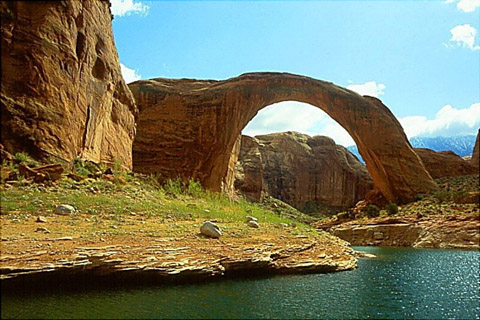
Rainbow Bridge
Tull is about to have him stripped when the Hammer Of The Mormons, Lassiter, appears out of the purple sage riding a blind horse- you heard right- a blind horse. This guy is Bad Blood personified. Boy, they’ve heard about him but how. Black hat, black leather chaps, two massive black handled pistols worn very low, apparently at his ankles, his reputation as a Mormon Killer is well established. Tull gets the cold shivers just looking at him on his blind horse. The blind horse probably indicates that at this point Lassiter is oblivious to female charms, the horse being a symbol of the female and he’s riding a blind pony.
Lassiter makes a few mild mannered inquiries then orders the Mormons to let Venters go. We’re talking Animus to Animus here, cojones to cojones, whoever backs down is emasculated in relation to the other, and Lassiter’s twin pistols make him the master Animus. The Mormons have to eat dirt or die. The Mormons powerful as a collective cannot be so man to man. Tull gives a hint of throwing an iron on Lassiter but the latter goes into his famous gunslinger’s crouch so he grab one of those guns around his ankles, intimidating the dickens out of the Mormons who retire leaving this field to him while muttering threats that he’d better watch his back.
As we said, all the Gentiles are stricken in there relationship between their Animas and Animi. Between Riders and Rainbow they will be healed.
Grey handles the symbolism starkly and masterfully. Jane Withersteen is a masterful Matriarch. Her independence and relationship to the Gentile men has left the impression that she is sexually loose. It isn’t clear to the reader whether she is nor not. She is more the Great Mother rather than the Siren.
Her role seems to be the womanly one of tempering the raging Animus of the male. While she has no effect whatsoever on the Mormon men she is successful in emasculating the stricken Gentiles. She had persuaded Venters to abandon his six gun which made it possible for Elder Tull to seize him while it was only Lassiter’s two black handled six pistols that freed him.
In a rather sexually explicit scene Jane would stand in front of Lassiter to seize a gun in each hand in an attempt to dissuade him from carrying them thus emasculating him. This at a time when Mormons were trying to gun him down. Her role seems to be one of civilizing society although her method seems backward.
Lassiter is a wronged individual seeking his personal justice in a vengeful way. He has shot up several Mormon towns being now known as a Mormon slayer or, in other words, the equivalent of an anti-Semite.
The reason for his anti-Semitism is that a Mormon kidnapped his sister, Millie Erne, holding her captive until she consented to become one of his wives. Hint, hint. Her remains are buried on Jane Withersteen’s property.
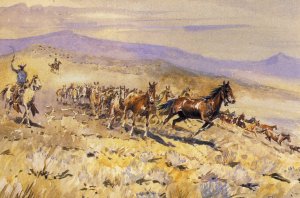
Edward Borein: Lassiter on his blind horse?
Lassiter’s horse was blinded when men held it down then placed a white hot iron alongside the eyes searing them. The horse as a female mother symbol represents Lassiter’s striken relationship with his Anima.
If one reads this novel in a literal sense then many of its incidents are improbable if not ridiculous. What notorious gunslinger would ride a blind horse? Grey has been criticized for wooden characters which is womewhat unjust. These are archetypal characters who are fully developed and can’t change. As allegories there is no need to change. This is mythology.
The Mormons lift Jane’s red herd. This may represent her female Animus as in iconography the male is usually represented as red while the female is white. They next try to stampede her white herd by devious means which they believe are undetectable such as flashing a white sheet from a distance. As a Chosen People they even have to convince themselves that what happens was not caused by them but was the will of God.
Lassiter notes this taking Jane with him to show her. As they watch the cattle begin to stampede. Three thousand on the hoof they stream down the valley. Lassiter on his blind horse races full speed down the slope, obviously no blind horse could do this, out on the flat to single handedly mill the cows. As the lead cows enter the center of spiral Lassiter disappears in the dust. He emerges sans horse to appear before Jane: ‘My horse got kilt.’ he announces. Jane’s response is ‘Lassiter, will you be my rider?’ Pretty clear sexually I think. Not exactly changing horses in midstream but obviusly the transition from a blind horse to a sighted jane is an improvement in Lassiter’s relationship with his Anima. ‘You bet I will Jane.’ Lassiter promptly and positively responds.
Whether you want to consider this stuff ‘high literature’ or not read properly it is not much different from the Iliad or Odyssey.
As a mother figure Jane is a keeper of horses, a symbol of the mother and female. The blinding of Lassiter’s horse was the equivalent of separating him from the mother figure. Jane not only has a full stable of horses but she has the prized horses Night, Black Star and Wrangler. As Grey makes clear these are the devil’s own mounts. In the big chase scene Grey has Wrangler close to breathing flames as he compares the horse to the devil.
The Mormons steal Jane blind while she refuses to allow Lassiter to defend either himself or her. Seems to be the Great American Dilemma even today.
Remember this is a war between Gentiles and Semites qua Mormons. The Gentiles hands are stayed while the Semites are allowed to run wild. Maybe Grey is making a social comment. Also remember that Jane is a Mormon so that while she is powerless to control her own aging maniac men the only men she can influence are the Gentiles whom she emasculates. As soon as the emasculated Venters gets away from her while pursuing the rustlers he immediately begins to revert to full manhood.
The Mormons set both Mormon men and women to steal from her. They take her bags of gold, this woman is prodigal, rich, her deeds and anything of value. They steal her six thousand cows. They want to kill Lassiter, dozens of Mormons lurk in the cottonwood groves (female places) but something stays their hands; they can’t shoot him either from behind or in front.
The only thing Jane worries about is her horses. Black Star and Night. It is possible that in this instance Jane represents the moon goddess. Finally the Mormons steal these symbols of her power. The independent woman is now completely violated. She has a man who could shoot down all the Mormons in Utah but she won’t let him use his guns.
So why should we care?
2.
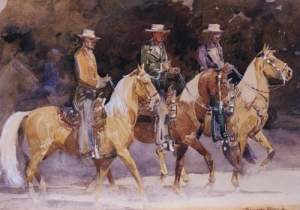
Edward Borein: The Three Caballeros
The myth switches to an alternate plot. Young Bern Venters goes in search of the rustler gang. Once again, Jane attempts to emasculate her men by pleading with Venters not to go, to stay beside her. Why anyone would want to hang around such a loser woman isn’t clear.
Venters goes in search of the rustler gang which is led by a man named Oldring. Old Ring. I’m sure the name has significant meaning but I can’t place it. The wind soughing through the caves is known as Old Ring’s Knell. Even though Oldring’s gang consists of a couple dozen men who have punched a herd of three thousand red cows they have somehow left no trail. Over all the years they have been rustling and pillaging there is no one who has been able to find this robber’s roost.
Venters has traced them to the foot of a waterfall where he loses track. While he is mulling this over a group of desperadoes return from pillaging plodding up the stream. Lo and behold they ride right through the waterfall into yet another hidden valley. Big enough to hold three thousand head of cattle. The West was a big country.
Venters rides off to relate this discovery to Jane and Lassiter when he encounters a despearado with the famous Masked Rider, reputed to have shot down dozens of men. He is dressed from head to toe in black wearing a black mask. This Rider is credited with shooting down any Mormons Lassiter overlooked.
Venters takes out his ‘long gun.’ You know how riders despise the long gun or rifle preferring six shooters, and by dint of long practice he shoots the lead rustler dead and wounds the Masked Rider. While examining the Masked One’s wound he unbuttons the shirt to discover the ‘beautiful swell of a female breast.’ Boy, howdy. You got it, the Masked Rider is a woman, a mannish girl. The image of Venter’s Anima.
Stranded in the desert while trying to nurse this girl back to health Venters chases a rabbit up a slope where he notices ancient steps cut in the rock. Following these he comes into ‘Surprise Valley.’ Formerly the home of cliff dwellers the place is a vitual paradise, green and verdant. No one would ever discover him and the Rider there. Carrying the slight figure of the Rider up hill and down for maybe ten miles or so Venters secretes themselves in the Valley which abounds in game and delightsome frolics.
About this time I recognized some teen fantasies of my own. Shooting and wounding a woman while having to tend her wounds in a secluded place where she has to be eternally grateful when healed was just too obvious. In my case, just after the onset of puberty, I think, when the Anima would be making itself known, I came up with the daydream of having this woman I could keep in a milk bottle until I wanted her. When I let her out of the bottle she became full sized and did whatever I wanted then she willingly went back into the bottle until the next time I wanted her.
As a thirteen year old before the advent of universal pornography I didn’t know what I wanted the woman for but I knew it would be fun. Grey here creates his version of the same fantasy. The Rider, who turns out to be Bess, apparently has a past. I say apparently because nearly everyone in this story has an apparent history which turns out to be false. As a member of the gang she was thought to have been, um…the piece…of Oldring. He kept her in a cabin up on a ledge in his valley behind the waterfall. He was gone a lot so we’re not clear that he ever laid a hand on her but Venters believes she is not ‘pure’ which in his great love for her he is willing to over look but it rankles him.
If you want to know the wonders of Surprise Valley read the book yourself. Comes a time when Venters has to go into Cottonwoods for supplies. There he realizes that he and Bess can’t stay hidden away forever. He has enough money for supplies obviously but not enough to flee from Mormonland.
They don’t call it Surprise Valley for nothing. When he returns Bess hauls out a big bag of gold to give to him. This must be the treasure that the female brings the male. The whole several mile length of the river which runs through this valley is lined with pebbles of gold which Bess has collected. Shades of Opar, huh? In her girlish gratitude she wants Bern to have the lot.
‘Gosh,’ says Bern. ‘Now I don’t have to get a job.’ (He didn’t put it quite that way.) ‘We can leave this valley and go far away from Mormonland.’

Edward Borein: Four Navajos Crossing The Desert
Far away from Mormonland, by the way, is either Quincy or Beaumont (beautiful mountain) Illinois. Not too far from Nauvoo which was the Mormon stronghold jumping off place for the long march to the Great Salt Lake into the fantastic scenery Grey either describes or imagines. Certinly the West of Grey’s imagination is as fantastic as anything Burroughs created on Barsoom.
Even though Grey refers to the desert this is certainly the lushest desert anyone has ever seen. The purple sage is the equal to Burroughs red moss of Mars.
Grey wrote an essay about what the desert meant to him. His desert with its plentiful water complements his vision of the Anima and Animus. The desert may answer to Grey’s subconscious which appears to be missing in his analysis of Anima and Animus, so that perhaps the desert stand for the subconscious.
His desert reminds me of a dream I used to have with some frequency. In my dream I was walking across this immense barren desert spotted at invervals with small oases in which I wasn’t allowed to remain. Off in the distance I could see this great brain shaped mountain. On approaching the mountain I found a small stream of water leading down into the mountain. As I descended I noticed that the stream ran through a bed of solid salt which rendered the water bitter.
Descending further the water disappeared beneath a steel chute. Unable to turn back while unwilling to go further I was nevertheless pushed into the chute where dropping into a steel lined entry I was pushed into a steel walled laundry room as the steel door slammed behind me. There was plenty of water but no way out. There was a ventilation shaft along the ceiling of the back wall. I conceived a plan of drinking to repletion then urinating into the ventilation shaft creating such a smell that they would want to find the source.
My plan worked. Three maintenance men opened the door and I dashed out so fast they didn’t know I had been there. Still in a steel lined area I saw a bank of elevators which would take me back to ground level. A door opened but the elevator was filled with classmates from my high school who pushed me back refusing to allow me to enter.
I don’t know how but I gat back to the surface where once again I approached the back side of the mountain which I ascended this time rather than descended. Now, the mountain was deep in a frozen snow but starting from the low grade at the back I had no trouble climbing, walking on top of the snow. The sun was shining brightly but all was frozen white. When I reached the top I found I was standing above the brow of the face of a great idol carved in the snow. Thousands of feet below terified and intimidated people were kneeling in the desert worshipping the great snow face. From where I stood I couldn’t see the face but I conceived the notion of destroying the snow god to free the people. Leaping into the air I came down on the god’s forehead creating an avalanche. The great face slid away as I descended thousands of feet on a cushion of snow to alight unharmed.
As I hoped, the destruction of the god freed the minds of the people from the domination of their morose god. The melting snow created numerous streams watering the desert among which the people danced and sang as the desert bloomed, while I looked on admiringly.
I don’t know enough about Grey’s background to say how unhappy his childhood had been but since his plot of Riders/Rainbow roughly follows my dream I suspect what the desert meant to him was the barrenness of his early life. The appeal of the novels to Burroughs must have been of the same order.
When Venters leaves the Valley Grey begins to lose control of his story. The clarity and focus of the first half becomes jumbled. He finally just crams the ending through as Burroughs so frequently does.
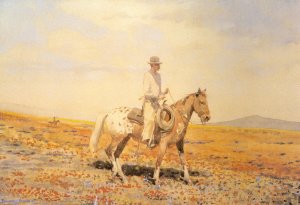
Edward Borein: The Apaloosa
Venters, riding Wrangler, crosses trails with the men who stole Night and Black Star from Jane. A sort of running joke throughout the novel is whether Wrangler is faster than the two blacks. Wrangler proves his mettle in this chase overtaking the two even though they were ridden by the best rider on the range, Jerry Card. Card is sort of a puzzle, at least for me. His horsemanship was so great that racing at full tilt leading one horse he could keep both horses side by side at full pace; in addition he could hop back and forth from horse to horse. Whether Grey was making a joke or not, I can’t really tell, he describes Card’s appearance as froglike. Hop-frog of Poe? Card is a little misshapen runty man. Whatever Grey had in mind for him he forgot to develop.
Card abandons the horses as the race ends disappearing into the purple sage. Wrangler gets away from Venters to be captured by Card. In a rather spectacular scene Card is trying to guide the horse by biting it on the nose. He is actually being dragged with his teeth in Wrangler’s nose. I’m no horseman but I’d really have to have the fine points of this maneuver explained to me.
Unable to hit the small fragile Card with a rifle shot as rider and horse rode alongside an escarpment rather than let Card get away, Venters shot the horse who leaped off the edge in what Grey describes as a fitting end for the greatest horse and greatest rider of the purple sage. I can’t follow his reasoning here but he must be trying to say something.
Venters rides the remaining two horses down the main street of Cottonwoods with apparently no more reason than to enrage Bishop Dyer and Elder Tull and announce in stentorian tones that Jerry Card is dead. Reminds me of the myth in which it is announced that the great God Pan is dead.
Venters packs some saddlebags with provisions then, in what seems a comic touch, since Jane’s wonderful stable of horses is now empty, mounts a burro to return to Surprise Valley. Riding one and leading a string of burros he looks behind him to see if he being followed by men on horses I presume he would have hopped off the burro and started running. The burro appears to represent severe emasculation.
Another essential subplot has been the arrival of a small child still annoyingly gushing babytalk- muvver for mother and oo for you- by the name of Fay Larkin. Fay is going to be the heroine of the sequel. She was the daughter of a Gentile woman who died. The woman asked Jane, who was ever kind to the despised Gentiles, to take the child which Jane did. She now ‘cannot live without the child.’
Having stolen everything else of the woman in the name of God, the Mormons now steal Fay.
This is too much for Lassiter who coldly disregards Jane’s imploring to disregard this insult and injury too, even though a moment before she ‘couldn’t live without the child.’ While it seems that Mormon men emascualte their women, Mormon women in turn emasculate their men. Maybe that’s what the story is about: the conflict between the sexes. Lassiter disregards her, strapping on not only his big blacks but an extra brace that he hides beneath his coat. The extra brace doesn’t figure into the story so it isn’t clear why two gun Lassiter became four gun Lassiter.
Lassiter shoots the Mormons up pretty good killing Bishop Dyer. Elder Tull is out of town at the moment. Lassiter and Jane know they have to get a move on so, packing enough to stagger any ten horses , including bags of gold, they skedaddle riding Night and Black Star.
Somewhere in here Grey must have become stymied in his story not having the progression to Rainbow Trail figured out. Something like the odd ending of Burroughs’ Princess Of Mars. Venters still thinks Bess was Oldring’s girl hence something only his great love for her can make him overlook. Loading up their burros they leave Surprise Valley. Out in the purple sage who should appear much as he had at the beginning of the story but Lassiter, this time with Jane.
It now comes out that Venters thinks Oldring is Bess’ father. Jane lets out the fact that he had then killed his future wife’s dad. Bess is revolted at the thought, calling off the wedding. Lassiter to the rescue. He produces a locket with a picture of his sister Millie Erne and her husband Frank. Lassiter explains that Millie was pregnant by Frank when Millie was kidnapped and that Frank Erne is her real father. The obstacle that had appeared between Venters and Bess now disappears as he hadn’t killed her father, just the guy who reared her. At the same time Bess is no longer the daughter of a low rustler but of a respectable man.
But wait, there’s more. Grey can produce as many twists as Edgar Rice Burroughs. It was the literary fashion of the day.
Not only is Bess the daughter of Millie Erne but the Mormon kidnapper of Millie had been no ther than Jane Withersteen’s father. The ever-forgiving Lassiter, now Uncle Jim to Bess, mutters something like ‘Aw shucks, Jane, I don’t pay thet no nevermind.’ and sister Millie is forgotten. nearly two decades of bad blood goes up in smoke with a shrug.
Venters and Bess head off for the safety and security of civilization in Beaumont, Illinois, while Lassiter and Jane depart for the security of Surprise Valley. Two problems remain for the next ten pages or so, Fay Larkin and Elder Tull.
Just like Tarzan, Lassiter can apparently smell a white girl because there is no other way that he could have located her. She was being held by some Mormons in a side canyon. Setting Jane to one side, Lassiter enters the canyon from which after firing every cartridge in his four guns and belts- Grey didn’t actually make it clear that he was still wearing the extra set up under his coat but he didn’t say he took them off either- of’ four guns Lassiter kills all the varmints, emerging from the canyon with little Fay in his arms and ‘five holes in his carcase.’
As they glory over little Fay, who was problem number one, problem nuber two, Elder Tull and his band of Mormon riders appear on the horizon. Leaping on their burros, did I mention Jane and Uncle Jim swapped Night and Black Star with Venters and Bess for their burros?- the Hammer Of The Mormons and Jane jog off with the Mormons in hot pursuit on horses, but tired ones.
One would think that even tired horses would have the advantage over burros but it is a very tight race. You see why Grey’s stuff translated to the movies so well. Getting all safe within Surprise Valley on the other side of balancing rock (did Grey borrow this detail from the She of Rider Haggard?) Uncle Jim lacks the nerve to roll that stone because Jane has pretty completely emasculated him. ‘Roll that stone’ Jane commands restoring Lassiter’s will. He does just as Elder Tull ad his Mormon band reach the cleft. The stone falls eliminating Tull and his Mormons while sealing off Surprise Valley ‘forever’ with Uncle Jim, Jane and Little Fay Larkin inside. Of course they are well provided because Venters has stocked the Valley with burros, fruit tree stock and plenty of grain seed. At the same time he had eliminated coyotes and other beasts of prey so that jackrabbits, quail and other small food animals have mutiplied exponentially. It’s going to be a long twelve years in the valley so the bunch has to be well provided. Without his gun though Lassiter is going to have to catch those jackrabits with his hands. During their long stay Lassiter and Jane apparently have no sexual relations as there were no additional children when the valley was reentered by the Mormons. Jane must truly have been a mother figure.
On this incomplete note Grey ends his novel.
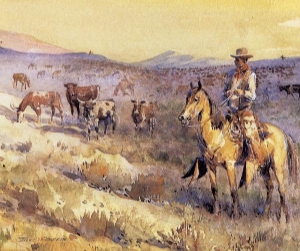
Edward Borein: Grazing Cattle
3.
Indeed, from the Enlightenment to the present has ben a period of intense religion formation, especially the nineteenth and twentieth centuries.
Utopian and Scientific Socialism may both be considered forms of religion, especially the latter in its Semito-Marxist form.
Mormonism itself, which has no basis in science, orginated from the brain of Joseph Smith in 1830. Madame B’s Theosophy, Mary Baker Eddy’s Christian Science, Ron Hubbard’s Scientology and the Urantia religion all have a basis in science as do most religions formed after Darwin. With the emergence of science none of the old religions were satisfactory. Hence it should come as no surprise that writers like Grey and Burroughs were intensely concerned with the problem.
As I have mentioned in Something Of Value no adequate myth for the scientific age developed, leaving men and women whose faith in the Semitic gods was undermined with a stricken religious consciousness such as in the case of John Shefford, the protagonist of Rainbow Trail, and probably both Grey and Burroughs.
So the search for meaning was endemic in this period not being confined to Burroughs and Grey who were merely symptomatic.
Another attitude that both authors share is a yearning for the wide open spaces of their youth that, while we may look back in envy, were rapidly disappearing before their eyes. Somehow this yearning was also connected to a feeling for the prehistoric past, perhaps as a Golden Age.
Both men were charmed by the notionof cliffdwellers. It would seem that Americans of the period were also absolutely charmed and enamored with the Anasazi of the American Southwest. Burroughs was very nearly obsessed with cliffdwellers. Novel after novel is replete with cliffdwellings whether in Pellucidar, various terrestrial locations or even on Mars.
The inhabitants of the skyscrapers of Chicago were nicknamed cliffdwellers; a replica of Southwest cliffdwellings was built for the Columbian Expo of 1893 that apparently made a great impression on 17-year 0ld ERB. The premier literary club of Chicago was known as the Cliff Dwellers which was on the 8th floor and roof of Orchestra Hall. I think Burroughs had a yearning to be a member of this club.
Thus there were many cliffdweller influences on ERB’s life , whether he had ever seen the Anasazi dwellings before 1920 is doubtful, it would be interesting to know if Grey had before 1910.
At any rate cliffdwellers had carved out homes in Surprise Valley in some distant prehistoric time. Thus both Venters and Bess and Uncle Jim Lassiter and Jane were actual cliffdwellers utilizing the old dwellings. Lassiter, Jane and Fay Larkin would be cliffdwellers for twelve years. This must have had a very romantic appeal for Grey’s contemporary readers.
During that period they dressed in skins living as close to a stone age existence as was possible. So one may compare the Surprise Valley of Lassiter and Jane with the cliffdwellers of Burroughs’ Cave Girl.
As all these themes were in the air of the period it is not necessary for either of these two authors to be influenced by each other to this point but it is probable that both were influenced by the stone age stories of Jack London and H.G. Wells among others.
I doubt Burroughs was influenced during this period by Grey although he did have a copy of Rainbow Trail in his library, one of only two Grey titles. We can’t be sure when he bought Trail. Grey’s stories complement Burroughsian attitudes but only after this formative preriod around 1912. ERB’s Western and Indian novels probably owe something to Grey but they were written after 1920.
Riders Of The Purple Sage sets the scene for its denouement which is The Rainbow Trail. Riders was a wonderful romantic vision of the West which answered the needs of the period when for the first time the percentage of Americans living in cities surpassed that of those living on farms. Indeed, very like these authors, modern cliffdwellers had a heartsick longing for the Paradise they had lost. For decades it would be a crazy dream of city dwellers to buy a farm and ‘get back to the land.’ The movie ‘Easy Rider’ was a good laugh in that respect.
Both Burroughs’ and Grey’s novels addressed that need.
Burroughs’ interest in Rainbow Trail would stem from religious aspects and the perfect union of the Anima and Animus when John Shefford and Fay Larkin unite. It might be noted that a fay is a fairie. Cliffdwelling and the purity of Grey’s noble savages, the Navajos, would have been compelling for ERB.
Before continuing on to The Rainbow Trail let us take a brief interlude to examine some aspects that would have interested ERB from the other Grey title in his library- The Mysterious Rider.
Post 4 The Chessmen Of Mars By Edgar Rice Burroughs
January 31, 2009
Edgar Rice Burroughs On Mars
A Review
The Chessmen Of Mars
Part IV
by
R.E. Prindle
The Taxidermist Of Mars
Part I
While reading through the autobiography of Ian Whitcomb (see my review) who himself was depressed I came across an explanation of the cause of depresseion that explains much of ERB and actually world history, here on Earth and up on the Mars of ERB.
Whitcomb quotes a psychologist whose name I can’t rembember who explained the cause of depression as the result of the failure of expectations to meet reality. So, let’s talk about depresseion for a little while. We’ll feel better for it.
Somewhere in the first decade of the twentieth century ERB remarked of his life: It wasn’t supposed to be this way. How was it supposed to be? Well, one of three favorite books of ERB was the Prince And The Pauper by Mark Twain. ERB read it six or seven times by the time he wrote this book. Twain was himself depressed as is apparent from any of his writings, not least being Huckleberry Finn. In a wonderful description of failed expectations Twain gave an acurate analysis in his great story Puddinhead Wilson. Wilson’s life was blasted by one bad joke. ERB read that story too which made a lasting impression.
In Prince, of course, the young Prince exchanges places with a Pauper then has a very difficult time reclaiming his place in society. ERB obviously felt that this too was his story. He was born into a life of comparative luxury being coddled by his brothers if not his parents then being displaced, probably when his father removed him from Brown School in the sixth grade setting him on an unsettled course of many schools.
A cardinal sign of his depression was when on his way to Idaho in 1898 he met an old army buddy in Denver. The pair got drunk, hired a band and marched behind it down the main street of Denver, a desperate attempt at aggrandizement. Thus figuratively the Pauper posed as the Prince. Then in the throes of poverty a few years later in a cri de coeur ERB exclaimed: It wasn’t meant to be like this.
Perhaps at that time he hit a low deciding he had better do something about it. If so, his writing career began to unfold. Here ERB was a raging success- of sorts. That is to say that he was a commercial success but a critical failure. Thus, in a manner of speaking he received the monetary rewards of his success but not the critical substance he craved.
He was a somebody yet if everyone didn’t shun him neither would they accept him at his own valuation.
Then, as if to realize his wildest fantasies he migrated to Los Angeles where he bought a fantastic estate- the dream of a lifetime. It might seem that his expectations had become reality. Not so easy. He had bit off more than he could chew. Tarzana was not only an estate but a country at least the size of San Marino. Anyone who has collected stamps will recognize that one. ERB even got it its own post office. Didn’t issue any Tarzana stamps though.
Just as through his own mismanagement he was losing the dream of Tarzana he suffered cruel critical rejection because of The Chessmen Of Mars. Thus all his expectations were crumpled by the juggernaut of reality. Enough to throw anyone into a deep hole. And so having abandoned the land of Bantoom Gahan, a Burroughs Animus substitute, Tara, an Anima surrogate and Ghek the Kaldane arrive at the gates of another lost city, that of Manator.
This novel is essentially a tale of two cities- Bantoom and Manator. Is it possible that Bantoom represents Chicago and Manator L.A.? It’s a thought.
Perhaps Ghek, the all-brain, represents the ERB who uses his brain to become a writer while the Rykor of Ghek represents ERB’s idyllic physical life on the ranch. This aspect or character as of 1921 properly belongs to Chicago where his writing career began and flowered. Arriving at Mantor or LA ERB begins another career but as yet his further writing is a thing of the future so it can’t figure into this story, hence Ghek ceases to be a leading character and becomes subsidiary comic relief, something like Nigger Jim in Twains’ Huckleberry Finn.
ERB might easily have made Ghek a much more central character in this half of the book with his ability to roam Manator at will unseen and unnoticed. After having created the network of paths leading from the pits to every room in Manator, curiously ERB fails to exploit the opportunities.
The key to the Manator story becomes I-Gos as would Ras Thavas, The Mastermind O f Mars, another mad scientist figure who would be created in 1925. Just as Ras Thavas would deal with the living, I-Gos lives among the dead. Excellent depression image. What an opportunity ERB missed by not calling the Taxidermist I-Gor. He would have captured the very essence and reality of the B movie for all time except for one letter.
I-Gos clearly designates Chessmen a novel of depression. What a terrible job. Who wouldn’t be depressed? I-Gos even works in the lowest depths of the pits of Manator. So far down that he’s lost in the structural psychology of the brain stem. The brain stem is where all those horrible fixations reside, that unconscious of Freud that directs and misdirects our conscious acts; that overwhelms our conscious will and negates our best intentions.
Now, amazingly, this is just how ERB portrays his story. It isn’t necessary for ERB to be conscious here of what he is actually portraying. One can sense a condition without consciously understanding it. One’s fixations are upper most in our minds and we talk of them constantly not being aware of what we are actually talking about.
ERB describes the results of his encounter with John the Bully on the street corner on the way to school at the moment when Gahan and Tara are standing in the the lowest protion of the pits with I-Gos surrounded by the corpses the Great Taxidermist is working on. In memory all is dead among the walking the shadows of the past.
At this point Anima and Animus, Psyche and Eros, are together. I-Gos tells Gahan that he wants him to get something from a storeroom. He lures Gahan into the room then slams the door locking Gahan away. Psychologically this means that one has been isolated from the rest of the world in one’s fixation. I-Gos then goes back to violate Tara, or the Anima, of ERB. She’s a real tigress in ERB’s dreams unlike in real life. She slips a little steel between I-Gos’ ribs. Then fleeing she is captured by the Jeddak O-Tar’s men, that’s Rat spelled backward, and carried off.
At this point Gahan/ERB is isolated, trapped and out of sight of man and god so to speak. In other words ERB was psychologically cut off from society. He could no longer interact with his fellows. So what choice is left for ERB? He must break out of his isolation.
Gahan/ERB finds a heavy axe with which to attack the door made of heavy skeel wood. Working like a berserker Gahan attacks the door. Resting frequently to recruit his strength he finally makes an opening only big enough to just squeeze through. Having done so he finds I-Gos lying on the floor as though dead with no sign of Tara. So how are we to interpret this?
Based on the evidence it would appear that in his confrontation with John the Bully something like this may have happened although in real life his Anima had abandoned him passively. ERB doesn’t relate all the details just the key one’s for his conscious mind. It can’t be proven that he was with Emma at the time but suppose he was. We know for a fact that he was confronted by a young Irish thug of twelve who terrorized him. Three years younger at nine ERB may have been transfixed by terror but Emma kept on walking leaving him to his fate. Hence he, the Animus was separated from his Anima now represented by Emma with whom he developed a love hate relationship. This would accoount for his fixation on Emma and possibly hers on him. This would also give a firm basis for his love-hate relationship that expressed itself as total hatred for her upon her death.
ERB always writes about his experiences. So taking my exposition a little out of sequence Gahan is separated from Tara for a period of time. This might represent the period from sixth grade until ERB and Emma’s marriage. So now, O-Tar near the end of the novel is enamored of Tara/Emma and proposes to force himself on her. Thus O-Tar is equivalent to Frank Martin. Gahan as in real life ERB with Emma, gets Tara/Emma away from O-Tar/Martin and marries Tara/Emma himself.
So, once again ERB tells the story of A. John the Bully and B. His struggle for Emma with Frank Martin. Thus ERB’s depression is linked with his marriage.
ERB terminates the story at this point, his winning of the girl; the reuniting of Pyche and Eros.
But back in the pits of Manator Gahan/ERB has to struggle with his depression and try to overturn his confrontation with John the Bully.
So, let us now backtrack and survey the setting of Manator as Gahan, Tara and Ghek land and Gahan enters the city. At this point the story may represent ERB’s own reception in Los Angeles.
Post 3: A Review: The Chessmen Of Mars by Edgar Rice Burroughs
January 21, 2009
Post 3
Edgar Rice Burroughs On Mars
A Review:
The Chessmen Of Mars
by
R.E. Prindle
Nobody Gets Out Of Bantoom Alive!
Tara descends in the land of Bantoom ruled by the Kaldanes. I think the Kaldanes can be traced to Baum’s Emerald City Of Oz. In that title Baum writes of a queen who when she wished to change her hair style selected one from a number of heads, removed the head she’s wearing and places a new head on her shoulders.
Unlike the queen the heads of the Kaldanes and the bodies of the Rykors are separate entities.
The Kaldanes exist independently of the Rykors but mount their shoulders to use them essentially as slaves. When their purpose is satisfied they abandon the Rykors or bodies that then, without directing intelligence, just lie or flop around like the proverbial chicken.
The picture ERB presents of them through the first vision of them by Tara is fairly repulsive. It would by itself explain why the Post and the other slicks rejected the story.
Either I’m reading things into the story or ERB is making some very subtle examinations of certain problems troubling society. The three issues I have noted concern labor, sex and evolution.
To take the first.
In the world there are many forms of disagreeable labor that people would rather not do. Much of the industrial labor is hot, dirty and heavy with a lot of unpleasant bending and stooping. Still the job has to get done.
In England once the so-called Industrial Revolution ethos first took place a very large percentage of the work force was essentially bestialized to work the mines and factories, especially the women and children. This is an unightly and unpleasant situation.
In the US and colonial areas African slaves were imported to do the stoop labor. It should be noted as Michael Hoffman points out in his studies that White slavery preceded that of Black slavery. Even at the time of the American Revolution Hoffman found many White slaves still existing the US. A White man was sold to a Negro in Chicago in the 1840s for tweny-five cents.. Africans only gradually replaced the Whites. Thus just preceding Eli Whitney’s invention of the cotton gin after which African slavery exploded there were White slaves in the US.
Slavery is inseparable from Burroughs’ works. He can’t imagine a society without slaves. Chessmen opens explaining the relationship between Tara and her personal slave girl.
Slavery was abandoned in the US at about the same time serfdom was abolished in Europe. The Russian serfs which you can read as slaves were liberated only as the US’ own civil war was being fought. While industrial slavery is too distant in the past for us to imagine it slavery was a very recent phenomenon to Burroughs. He read. He must have been aware of Russia in which the vast majority of the population were slaves as serfs, hence Russia was up to 1861 a vast slaveocracy no different than the US South.
The question then was how to get the hard work done without slaves. The industrial system of the time merely left the population nominally free while paying very low wages making the bulk of the population actual wage slaves.
The hard labor was definitely nothing anyone who could avoid it wanted to do so the industrialists imported vast numbers of laborers at a liguistic disadvantage who then had no choice but to become wage slaves. Burroughs, very sensitive to social issues then, may have thought he was only reflecting the existing situation in his stories. After all this is the period of the horrors of the sweat shops.
This problem preoccupied society so that in 1931 a mere ten years after Chessmen Aldous Huxley wrote Brave New World that presents a different solution than ERB’s. Huxley presents a world of test tube babies in which certain poisons are placed in tubes to create chemically altered humans. The least intelligent of these were the Gammas who were given the least desirable jobs on that basis that they wouldn’t have the brains to complain.
Burroughs solution is somewhat different. The Rykors are essentially slaves; as Greek mythology put it the Rykors were mere bellies with arms and legs, lacking any intelligence whatever they were unable to complain and being deaf, dumb and blind couldn’t revolt.
The slave driver was the Kaldane on their shoulder who directed the Rykor in the unpleasant tasks without consequences to himself. When the Kaldanes came back from the fields at night they abandoned their Rykors and went about their business of thinking, fresh and without fatigue.
Thus ERB has very cleverly solved the problem of stoop labor- the labor the Kaldanes wouldn’t do.
2.
ERB also gives himself room to toy with the idea of sex. He models Bantoom after a beehive which was a common device at the time. He changes the sexual primacy by making Luud a kingbee rather than a queen bee. All the Kaldanes have been hatched from eggs laid by King Bee Luud so Luud is truly the ‘father of his country.’ The jokes are there. Whether ERB was a sly old dog or whether he just wrote this stuff with no humor prepense is up to the reader to decide. Either he was intending humor or else he was naturally one of the funniest men alive.
It seems that all Kaldanes were male while the Rykors were either male or female. Thus any Kaldane could choose to be a man or woman for the day. This may possibly refer back to Greek mythology where Teiresias was the only person who had been both a man and a woman. He was then called on to say who got more sexual pleasure men or women. He thought women definitely. Any Kaldane could have answered as well.
ERB plays with the idea briefly but doesn’t take it too far. As far as the slicks were probably concerned he had so many strikes against him they didn’t even want to look at him. Given their attitude it even seems remarkable that the pulps paid good money for the story. This is really pretty strange stuff and it keeps getting stranger. ERB just skirts the accusation of a deranged mind in this story. Times have changed, of course.
3.
Then there is the matter of the evolution of intelligence. This is a perennial topic in science fiction. At the presentt time the ultimate intellect is usually portrayed a as giant head on a spindly unathletic body incapable of much but feeding itself.
At the time it was thought that the mind and body were two separate things. In the fifties when I grew up wrestling with the idea Burroughs’ key Martian novels were available from G&D but I never read them. I was scandalized that Burroughs would write anything but Tarzan novels. It didn’t seem right to me that he would write anything else.
So, Burroughs tackles the mind/body relationship by completely separating brain and body. These brains were anaerobic, they could exist without oxygen. This was by design because when the oxygen plant will have failed and Mars changed from a dying planet to a dead one the Kaldanes were going to retire deep into the mars and live out their existence thinking. Bye bye Rykors.
ERB explains this quite succinctly. Evolution on Mars:
You do not understand…It is too big for you to grasp, but I will try to explain it. Barssom, the moons, the sun, the stars were created for a single purpose. From the beginning of time Nature has labored arduously toward the consummation of this purpose. At the very beginning things existed with life, but no brain. Gradually rudimentary nervous systems and miniscule brains evolved. Evolution proceeded. The brains became larger and more powerful. In us you see the highest development; but there are those of us who believe that there is yet another step- that some time in the far future our race shall develop into the super thing- just brain. The incubus of legs and chelae and vital organs will be removed. The future Kaldane will be nothing but a great brain. Deaf, dumb and blind it will be sealed in a great, wonderful, beautiful brain with nothing to distract it from eternal thought.
Right. I saw the movie. It was called Hitler’s Brain and it was a great one. Burroughs always seems to have figured out the entire B movie and sci-fi catalog. If I didn’t know better, and I don’t, I’d think his writings have been cribbed for the movies from his day to this. Burroughs is surely one of the most influential intellects from his time to the present. He is a baffling phenomenon, no one wants to give him credit but theyuse his ideas constantly.
The passage quoted is a fair synopsis of the course of evolution while dealing with a debating topic of his day and ours.
It’s quite clear ERB put everything he had into this effort.
4.
Having landed in a Bantoom that might be compared to Baum’s Land of the Munchkins, although a rather disquieting comparison. Baum is actually a very strange writer. the Shaggy Man Of Oz left me very uneasy. I remember as a child a woman lamenting the book because she thought it would make it easy for weird old men to lure little girls away. The book was weird as was The Emeral City Of Oz. Burroughs takes weirdness a stride or two beyond those books. There’s always this uneasy quasi-pornographic feel behind his stories.
Tara is baffled by the overseer Kaldanes and slave Rykors working in the field. She waits until nightfall to go in search of food coming very close to the hive. Burroughs will develop this image shortly in Tarzan And The Ant Men. Night falls and the Banths come out. Tara can’t understand why these Martian lions are so plentiful in the valley. Shortly she will learn the reason is that the Kaldanes throw the dead and worn out Rykors into the fields for the Banths. It’s just gruesome little details like this that probably got ERB his reputation for being too far on the edge. Doesn’t bother us though, does it?
Now, a Banth steals up on Tara but God is on her side, she’s got a head start for the ubiquitous tree. Here we have two ambivalent images in Burroughs. Tree and lions are symbols of both safety or danger.
On the one hand Burroughs finds comfort and safety in trees, most conspicuously in the Tarzan stories. There all Africa with the exception of some lands deep in the Sahara is covered by one giant forest with conviently low branches unlike the picture we see of Baobobs and whatever. Tarzan is at home in the trees moving faster and with more ease than you and I trudging along on the ground.
If there’s danger in the lower terrace Tarzan moves up to the middle terrace or even the upper terraces where the little monkeys play. If he has a quarrel with Jane he has favorite trees in which to spend the night. He is sometimes treed as he was in Tarzan At The Earth’s Core. Here Tara is treed in a close replica to the treeing of Schneider in Tarzan The Untamed.
In that story Tarzan took Schneider to an enclosed natural bowl with a creek trickling into a cave. In the center was lone tree and a hungry lion. Tarzan viciously placed Schneider in the tree. It was up to Schneider to evade the cat when thirsty finding his way back up the tree in a game of cat and mouse.
Burroughs replicates the scene here. Tara drinks from the stream then being chased up the tree by the Banth who keeps watch till morning before stalking away.
So here the tree is both safety and a trap. Perhaps as ERB’s financial troubles developed he felt like Schneider so he replicated the situation with Tara as himself.
Martian rosy fingered Dawn appears. In trying to get back to her flier Tara is captured by the Kaldanes. The episode of her capture is well done as she discovers the secret of the Kaldanes and Rykors. Her captor is a Kaldane named Ghek who is to become a principal actor in the story.
Tara’s descent into the hive gives Burroughs time to philosophize and ruminate before Tara is taken up to her near brush with a fate worse than death at the hands of the Rykor of Luud.
At the beginning of Chapter VI ERB ruminates on the rough treatment given him by the literary mavens:
What the creature had told her gave Tara of Helium food for thought. She had been taught that every created thing fulfilled some useful purpose and she tried conscientiously to discover just what was the rightful place of the kaldanes in the universal scheme of things. She knew it must have its place but what that place was it was beyond her to conceive. She had to give it up. They recalled to her mind a little group of people in Helium who had foresworn the pleasures of life in the pursuit of knowledge. They were rather patronizing in their relations with those whom they thought not so intellectual. They considered themselves quite superior. She smiled at the recollections of a remark her father had once made concerning them, to the effect that if one of them ever dropped his egotism and broke it it would take a week to fumigate Helium.
It appears that ERB is smarting from the rejection of the literary types even though he longed for their approval. ERB himself chose not to parade his knowledge as literary types are wont to do, not that I would ever do that myself, while ERB can claim to be well read while profound enough in his writing and observations.
Eugenics, for instance, was under attack from its origins although widely accepted at this time. There is something offensive about it to the human spirit while the notion would certainly be socially abused if given free rein. ERB cleverly skirts the issue here while affirming the benefical results that could be achieved. Following the above quote he notes the superb physical condition of the Rykors and says that they had been bred to perfection. In other words they are the product of eugenics the same as thoroughbred horses or pedigreed cats and dogs. Being bodies without minds, in other words not complete humans, anyone who caught it probably took no offense. The closer you get the better ERB looks.
In the descent into the hive Tara idly hums an air which completely charms Ghek who asks what the noise is that Tara is making. She then sings for him which overwhelms Ghek’s senses thereby definitely preserving her life. Impervious to female beauty Ghek is transported by music. Universal language you know.
This will figure into the story soon. Tara is expected to fatten up to make a good meal for the Kaldanes who fatten up certain Rykors to make a good lunch. Thus ERB interjects the ever present theme of cannibalism. Away from the air and sunshine Tara is pining away so she pleads to be allowed to go outside. Luud grants this. Tara tries to escape, is caught and taken to Luud to meet her fate which encounter follows shortly.
Gahan in his pursuit of Tara had fallen from his flier into the arms of the storm. This is interesting. Always heroic he was trying to rescue a companion who was caught in mooring lines flapping beneath the flier. In the effort the wind catches a line with a heavy buckle at the end giving Gahan/Burroughs the obligatory bash between the eyes. He loses his hold but rather than plunging directly to mars the wind catches him like a leaf carrying him along with it. Then after a series of ups and downs gently deposits him on the crimson sward.
Impossible you say? No, it is not. ERB refers to a story he had read somewhere at sometime in which a baby caught up by tornado had been carried miles from its home and deposited gently on the ground unhurt where it was found. These things all sound preposterous; they have happened.
In a clever handling of time differentials while Tara was going through her travails that lasted weeks Gahan at almost the same time Tara landed in Bantoom picked himself up from the sward hundreds of miles away and began walking in the direction he hoped was toward Gathol. Thus weeks later he arrives in Bantoom at the precise moment to observe Tara’s escape attempt. Not bad.
Not only that but having decided to rescue the Red Woman he didn’t then recognize he discovers the flier, kills a Banth or two and drifts, no propeller, directly over the wall of Luud encountering Ghek who fretting for his life agrees to take him to Tara on condition that he can leave with them. No problem.
As they are making this deal Tara is struggling to preserve her…oh…integrity. Luud has set his headless but magnificently built Rykor on her while always a voyeur, he watches.
Luud has a powerful mind. He has not hypnotized Tara but is able to control his brainless Rykor while not being attached. This means that by remote control he is able to connect to the spinal nerve ending of the Rykor. Good stunt.
Gahan and Ghek enter just as the Rykor is poised for the downward thrust. ERB comes close here.
Gahan is warned to avoid eye contact but fails to do so becoming hypnotized. Hypnosis is a significant theme in Burroughs’ work. In this case he seems to be influenced by George Du Maurier’s novel Trilby with its great character Svengali. In that story the heroine has no musical talent but Svengali is able to hypnotize her into becoming a second Jenny Lind. The key point is that while Trilby is singing Svengali must make eye contact from his theatre box. When contact was broken Trilby immediately began croaking not knowing a note from a hat box.
ERB does a reverse variation here. It become apparent that Gahan is entranced by Luud and all is lost. But in holding Gahan Luud had to relax his hold on his Rykor who went limp (no pun intended) releasing Tara. The quick minded Tara knowing the hold her singing had on Ghek immediately bursts into full throated song trilling out that wonderful old Martian standard- The Song Of Love.
Thus ERB reverses the Trilby/Svengali scenario. Tara’s singing dissolves Luud’s hold on Gahan and it’s all over for Luud.
An exciting chase scene and battle and the three comaradoes are drifting off to meet another fate in another freak city. This one is called Manator.
The Bantoom story thus becomes a preliminary tale to the main story.
Post II: The Chessmen Of Mars by Edgar Rice Burroughs
January 13, 2009
A Review
Edgar Rice Burroughs On Mars
The Chessmen Of Mars
Post II
Part I
The Dance Of Barsoom
See Post I for Intro.
The twenties were a difficult financial period for ERB, indeed, as was the rest of his life to be. The substantial sums he had made in Chicago were spent before he left. ERB had saved nothing. He arrived in LA with no other resources than his current income. That income was very substantial by any measure but unequal to ERB’s massive spending capabilities so that at the time he wrote Chessmen he was already strapped for cash and headed for deep debt.
Always envious of the fabulous sums paid Zane Grey by the slick magazines ERB wanted to sell this story for ten thousand dollars to one of the big slicks. There were no takers so that the story went to the pulps for thirty-five hundred. Adding insult to injury he was told that the stories were too preposterous to be considered.
Part of ERB’s literary problem was that genre categories were not yet well developed. H.G. Wells’ early sci-fi efforts were labeled Fantasias, a term that could be understood by the literary arbiters, while still considered what we would call today, literary fiction. Even George Du Maurier’s trilogy of essentially science fiction novels- Peter Ibbetson, Trilby and The Martian have never been considered anything but literary fiction. They are three terrific stories of psychological dissociation while it would seem certain that Burroughs read them and was probably influenced by them. I can heartily recommend them. Very choice.
So the genres were taking shape at the period but had not yet evolved as they would during the thirties, forties and fifties until today fantasy, horror and sci-fi dominate the fiction best seller lists. If Chessmen was thought preposterous in 1920 one wonders what his critics would have thought of such movies as The Exterminator or The Predator. God, those people were so awkward and unevolved. Well, it’s the price you pay for being an innovator. Remember what the Pope told Galileo.
So, ERB was stuck in the pulps. Perhaps smarting from this rejection ERB would try to break out of his pulp rate with several realistic novels. the first was The Girl From Hollywood, a very decent attempt at a literary novel, that ERB’s long time publisher refused to publish. Following in the burro tracks of Zane Grey ERB wrote a couple of Westerns only one of which he could get published at the time. I read a lot of Westerns in the fifties while a kid. I thought ERB’s efforts were as good as what I read then. They’re all potboilers, even the so-called classics.
He even attempted a couple of Indian epics that I found so-so but I know other people who liked them a lot. Not so critical as myself, I guess. Oh, right, he couldn’t get Marcia Of The Doorstep published either. So he was type cast as a sci-fi/fantasy writer. At least he knew he could do that very well.
Zane Grey wrote some pretty strange Westerns. He himself was quite a womanizer and his novels pander quite successfully to the distaff side. He knew women well. Probably that was why he was paid those great prices by the Saturday Evening Post et al. Oh heck, ERB was just too outre for the Post.
In Chessmen ERB gives feminine appeal his best shot. I would imagine he was trying to reach the ladies when he describes Tara’s fabulous bath. Either that or he was trying to titillate us boys. Worked with me. But let’s assume he was trying to broaden his appeal as the title was offered to the slicks.
Chessmen was based on his three favorite novels as are all his books- The Viginian, Prince And The Pauper and Little Lord Fauntleroy.
Thus Tara teases Papa John as her ‘Virginian.’ We are then introduced to Gahan of far Gathol. ERB presents him first in his princely guise as, indeed, he is a prince of Gathol. ERB chooses to present him as a fop dressed all in diamonds and platinum. Tara forms an ill impression of him as she thinks no real fighting man would dress in such a fashion. Shortly Gahan will exchange his dress duds for the plain leather gear of the Martian mercenary thus changing from prince to pauper. Of course he will resume his role of Prince by novel’s end.
Fauntleroy was born to the manor in England but spent his youth learning what it meant to be a real American boy before reassuming his English title. Ah, American dreaming.
Recalling his battle for Emma’s favors with Frank Martin Tara has been betrothed since at least young girlhood to Djor Kantos whose father is friends with the family. So like ERB Gahan has to overcome this parental resistance. Speaking of Frank Martin Chessmen is the only novel I can recall in which the hero doesn’t get bashed on the head two or three times.
At the ball being given Djor Kantos fails to claim Tara in time for the first dance so that Gahan leads Tara in the Dance Of Barsoom. Some sort of Grand March. ERB explains that before Barsoomian youths can attend balls they have to first have learned three formal dances- The Dance Of Barsoom, that of their country and that of their city. After that they can take up stuff like the Martian equivalents of the Grizzly Bear, Bunny Hug, Charleston and Black Bottom. Kids being kids on Barsoom the same as on Jasoom.
While the concept is quite charming one wonders of the source. Burroughs himself was no slouch concerning the hit parade.
I think we can trace the rigamarole back to the patron saint of old timey music, Henry Ford.
Amongst all his many other enterprises Henry was revolted by the music and dances of the Jazz Age as the twenties are sometimes known. Even though his very own flivver is billed as being responsible for some new objectionable habits and traditions Henry clung stubbornly to the old. Thus in full revolt against the Jazz Age Henry was promoting the dances and music of his youthof around, oh say, 1880 or so.
Ford had begun his publication of the Dearborn Independent in 1920 making him a newspaper man also. It seems clear from internal references in Marcia Of The Doorstep that ERB was following developments in the Independent. He would then certainly have learned of the evils of the new music and the virtues of the old.
Just as Henry Ford was trying to rivive the old dances on Jasoom, on conservative, behind the times Barsoom Jazz has never even been given a chance. The Dance Of Barsoom is just as fresh and lovely as the first time it was danced millennia before. Martian kids didn’t mess with tradition so much so Gahan led Tara in that lovely old relic of Mars- The Dance Of Barsoom.
Pledging his love during the dance Gahan was sternly rebuffed by Tara.
The preliminaries finished the story begins in earnest.
The following day Tara is fascinated by a cloudy stormy sky which is such a rare occurrence on Mars that she had never seen one before. As I mentioned in the intro ERB borrows the next sequence from Baum whose Dorothy was wafted to Oz on a tornado. Tara ascends into this tornado like storm where her flier is caught by the winds and she is driven before them. When she lands she had been driven like Dorothy to Oz to a far land that has been all but forgotten if it had ever been thought of.
The hero and heroine of Chessmen are Tara of Helium and Gahan of far Gathol, or rather, they are the Anima and Animus of ERB. ERB always writes Anima and Animus novels. As dreamers will he may have recognized the X chromosome or Anima in the green pastures of his sleep or, it is quite possible that as a Latin scholar at Chicago’s Harvard School he was required to read the myth of Psyche and Eros from Apuleius’ The Golden Ass. I only mention a couple of possibilities. He may or may not have been familiar with Psyche and Eros but he was certainly familiar with the fairy tales derived from it such as Cinderella and Sleeping Beauty.
While Apuleius is given credit for the story his version is certainly only a redaction of the tale or philosophical speculation dating much further back in history. The Ancients were well familiar with the concept of both the male and female versions of the Anima and Animus. In popular mythology the male chromosome is represented by the Goddess as X chromosome and the Bull as the y. The female is represented by the two snakes as in the pictorial representations of Crete. It will also be remembered that the Greeks imported Cretan priests to manage the Apollonian shrine at Delphi.
The myth is that the two aspects were once united then driven apart wandering the world in search of each other. Duly at long last they do find each other are reconciled and allowed by the Goddess of Love to reunite. Thus the stories of Cinderella and Sleeping Beauty evolved from Psyche and Eros and who knows how many other stories besides those of Burroughs.
The question is was Burroughs only following a plot line, a pattern he had absorbed or was he consciously aware of what he was doing? Had he thought the problem out? Just as Tarzan and Jane were apparently mismatched in Burroughs’ dreamscapes so were ERB and Emma in real life. In Tarzan And The Golden Lion Tarzan and Jane had no sooner returned home from Pal-ul-don than Tarzan fled to his Anima in far off dreamland Opar leaving Jane/Emma to more or less shift for herself in a very dangerous world. Misfortune usually hit her too.
In ERB’s dream couple of John Carter and Dejah Thoris the Anima and Animus seem to be united although we see little of Dejah Thoris in the series and not at all in this novel. Even their son who may represent ERB is not present at all. Even with Carter and Dejah Thoris the classic separation and reuniting form a major part of the Martian Trilogy.
In this dream tale with Tara and Gahan ERB follows the classic formula- separation, the long pursuit and final reconciliation. He appears to know what he is talking about but since he never discussed his ideas on the subject we can only infer that he did or doubt or deny that he did. The psychological motifs he expresses throughout Chessmen leads me to believe he did.
What are dreams and what is a dream story? Freud originated the rational approach to dream interpretation. ERB gave some thought to the problem. Once can’t be sure he had read Freud’s Interpretations Of Dreams although in his short story Tarzan’s First Nightmare ERB used elements contained in Freud’s theory to explain the causes of Tarzan’s nightmare. At the very least we can say that dreams and nightmares from which ERB suffered all his life were of great interest to him. In the thirties he would buy at least one book on scientific dream interpretation.
What is the basis of dreams? It can only be experiences combined with memory. That’s it. Think about it. You don’t have to look any further. Nothing mysterious about them. The basic problem can be expressed in the question of what is the unconscious or subconscious. Is it some ultra mysterious process of the mind that can’t be penetrated, understood or accurately located? Is it as Freud believed an organ independent of the body and mind yet which somehow controls the actions of the individual from outside him? Or, once again, is it merely a combination of experience and memory, a faculty for interpeting the experiences of the day?
Freud touched on a key concept when he realized that the mind, which never rests, processes the incidents of the previous day in the sleeping and dreaming state. Burroughs also takes this approach in Tarzan’s nightmare whether he picked it up from Freud, Sweetser or realized it himself.
In point of fact experience happens to us so rapidly and from so many angles at the same time that it is impossible for the conscious mind to process it all as it is happening. Can’t be done. So, it follows that the subconscious or back up mind retains, as it were, photographs of the day’s activities that it reviews in sleep for either discarding, repression or action. How many times have you awakened with possible solutions to problems facing you?
The problem with the subconscious mind is that analysis of situations is affected by fixations, more expecially by the central childhood fixation. Childhood is that perilous time of life when the inexperienced mind is subject to being presented with challenges for which it has no programmed or immediately adequate response. Defeated in analysis the challenge is encrypted and encysted in the subconscious where it interprets all similar challenges through the lens of the defeated challenge and response. Thus all those strange compulsive behaviors we have.
As it chances we know Burroughs’ central childhood fixation. That was when he was eight or nine and he was challenged on a street corner on the way to school by a twelve year old Irish bully. Terrified ERB broke and ran apparently thereafter branded as a coward. Thus the central theme of his work is fight or flight and the state of cowardice. He examines the matter endlessly throughout the entire body of his work. These elements are all especially prominent in Chessmen.
We know that ERB was stressed to the breaking point as he wrote in 1921. Whenever he was stressed his personality fragmented, splitting at least once. In Chessmen the Kaldanes are two separate entities, the physical Rykors and the mental Kaldanes. Tara and Gahan, the ritual Burroughs’ surrogates are driven apart by the terrific storm.
This is a dream story abounding in dream images. One can provide an analysis of the storm scene based on the incidents occurring in ERB’s life at the time.
The image presented to us is of this very rare Martian storm of very high winds as in a tornado. Tara although warned against it takes her flier up. Perhaps ERB was warned against buying Tarzana, I would certainly think that Emma was at the least apprehensive. Tara navigates well beneath the clouds but wants to be in a cloud where she has never been before, i.e. Burroughs buys Tarzana. Here she is buffeted about so to escape she rises above the cloud or storm where the winds abate. But she has to get back down so she must reenter the storm. She is then taken by the winds tumbled head over heels by their extreme violence arriving half dead in the land of the Kaldanes.
Now, how does this represnet ERB’s actual situation in dream images.
ERB left Chicago under one presumes, sunny skies. His original intent was to buy twenty acres to raise hogs. Instead he bought over five hundred acres. He then began a massive building and improvement program with what appears to have been a substantial payroll and a not very well thought out plan. He overspent his income so that by 1921 his bills must have been greater than his income forcing him to borrow. He found he had neither the skills nor the talent bo be a ‘Gentleman Farmer’ so that he was forced to auction off most of his tools, implements and livestock in an effort to raise money and cut expenses. Also at this time his sources of income came under attack as the movies refused to film his intellectual properties while his royalties also came under attack.
In what I consider a purely defensive move he was forced to incorporate himself assigning all his income, copyrights and what not to the corporation in an effort to secure the means of his livelihood by putting his income beyond the reach of his creditors. In what I consider a questionable move he subsequently transferred a portion of Tarzana to the corporation. So, shortly after this storm broke on his head he became merely an employee of his corporation.
At the time he wrote Chessmen then he was caught in the turbulence of this storm he had created. Unable to get back down as with Tara he tried to rise above it in some way but was forced back into the problem where he was being blown along head over heels no longer in control of his affairs.
In the relative calm of 1924 he wrote Marcia Of The Doorstep that chronicles and looks back at this period.
Tara’s flight then is ERB’s day to day situation presented in dream images.
The rest of the book deals with past and present in a series of dream images to which we proceed.
A Review: The Chessmen Of Mars By Edgar Rice Burroughs
January 7, 2009
Edgar Rice Burroughs On Mars
A Review
The Chessman Of Mars
by
R.E. Prindle
Introduction
Porges speaks quite highly of this story and I think him right. The story is a quite complex one with many highlights and as many or more undertones. Burroughs manages to unite his past with his present while mildly projecting a future.
The story was his only effort of 1921 while falling between Tarzan The Terrible and The Girl From Hollywood the first of two books for 1922. the other being Tarzan And The Golden Lion. Thus this book falls between the recovery of Jane and their return to the Estate and Tarzan’s subsequent return to Opar. These two Tarzan novels undoubtedly reflect discord in the marriage of ERB and Emma.
It would seem that the move to California disrupted ERB’s concentration as the effort to udjust to Tarzana must have consumed his time somewhat in contradiction of his opinion in Tarzan The Invincible that man has been given all the time he can use, no more, no less. Well, there’s limits to everything, probably even infinity.
Whether Burroughs’ tremendous building efforts of the first couple years were pinching his finances at this time there does seem to be an element of panic in the story. The pictures of his new three car garage shows two Packards and a Hudson so that the unbridled spending of Marcus Sackett in Marcia Of The Doorstep of 1924 seems to be directly based on ERB’s own wastrel habits.
The Hudson is interesting as ERB may have bought his first Hudson in 1914 in emulation of his hero L. Frank Baum who he visited in Hollywood in 1913 and was friendly with again in 1916. In that connection the opening of Chessmen is a variation on The Wizard Of Oz in which Dorothy, her house and dog are transported from Kansas to Oz by a tornado. In Chessmen Tara of Helium is caught in her flier by a furious windstorm that deposits her in the all but forgotten outpost of the Kaldanes. So far out that it might in fact have been the Martian Oz.
Thus in a sense, ERB returns to the scenes of his childhood or, at least, his young manhood. This is very likely the result of stress, whether from looming financial difficulties or the responsibilities of managing his estate of Tarzana.
That he was under extreme stress is made evident by the appearance of John Carter who only appears to a stressed out Burroughs. At such times Burroughs psychologically returns to the comfort and security of Mars where he is beyond the travails of earthly existence. This in turn connects this story to the trials and tribs ERB was facing when he wrote Tarzan And The Lion Man. As I hope to show there is more than one similarity to that story.
This apprearance of Carter is interesting. Carter appears after sunset while leaving just before sunrise. ERB cannot be sure whether he was dreaming or the visit was real. ERB has said that his stories came from his dreams and this story bears all the marks of being a dream story.
ERB had the remarkable faculty of turning his problems into metaphors and symbols of his daily problems. While I don’t believe the stories were concocted in REM type dreaming I’m sure tha as he lay dozing weighing his daily problems he was able to weave them into a creditable story that he was able to elaborate when awake.
Plus, while we can’t be sure how much psychology he knew or how he understood it he had been aware of psychological concepts while still a boy. He learned much of this at the knee of Lew Sweetser on the Idaho ranch. One presumes he remembered, considered and developed his psychological ideas over the years. Sweetser, even as ERB was writing the story was giving public lectures on psychology. Chessmen is replete with psychological images not least the appearance of Carter himself.
Whether Carter was quasi real to Burroughs or not he wants us to believe that Carter was real. It is quite possible that Carter is not actually there but is merely a phantom of himself much as Helen of Troy was said to be a phantom in Rider Haggard’s The World’s Desire. Just as Carter explains his appearance to the dreaming ERB, Burroughs admits he was in a dreaming or trance state as he blew smoke at the head of his defeated king when Carter appears. That’s quite an image. His king or himself had been defeated on the chess board as perhaps in real life calling up the need for a visit from the omnipotent Carter.
And now as to your natural question as to what brought me to Earth again and this, to earthly eyes, strange habiliment. We may thank Kar Kormak, the bowman of Lothar. It was he who gave me the idea upon which I have been experimenting until at last I have achieved success. As you know I have long possessed the power to cross the void in spirit, but never before have I been able to impart to inanimate things a similar power. Now, however, you see me for the first time precisely as my Martian fellows see me- you see the very short sword that has tasted the blood of many a savage foeman; the harness with the devices of Helium and the insignia of my rank; the pistol that was presented to me by Tars Tarkdus, Jeddak of Thark.
Indeed. And I do see what Burroughs suggests, one presumes that the reader sees in his own mind’s eye, the habiliment and weapons on which John Carter, the bronze giant, speaks. We’ve been hypnotized into projecting into our own reality what isn’t there.
Yes, Carter speaks of Kar Kormak as though he really existed when we, having read the novel Thuvia, Maid Of Mars, know that the fantastic Bowmen Of Lothar were mental projections without substance who hypnotized others into seeing them and making them believe that they were real.
So what has Burroughs done here? We know that he is very familiar with the principles of hypnosis. At this very time many forms of mass hypnosis were being practised or about to be practiced. Freud was publishing his mass hypnosis lessons; Fritz Lang had or was making the first of his incredible Dr. Mabuse movies- Mabuse, The Gambler, in which mass hypnotism figures so prominently while Hitler, himself a master hypnotist, was making his bid for power.
Was Burroughs laughing up his sleeve at us as he knew we were actually visualizing in our own way what he suggested to us. I don’t know whether he was laughing but I’m sure he was confident that he had succeeded. So, having hypnotized us into believing the strange appearance of Carter who appears only in the same manner as the phantom bowmen of Lothar to Burroughs although as Carter says he has been successful in projecting the appearance of inanimate matter ERB then begins to weave his incredible story arranging the details so that all can be seen as reality to our minds having once accepted the appearance of Carter as reality who then narrates the story in his own voice.
Another interesting detail is that Carter now addresses ERB as his son. When ERB created Carter he was the man’s nephew his father being still alive. Then as he finished The Warlord Of Mars his father died thus Carter’s son dominates Thuvia, the next Martian novel. Now, while under stress, ERB’s father reappears to him to dictate this story to his son.
Carter, then, must always have been ERB’s projection of his idea of the perfect father.
Finally in this introduction I would like to note that both the city of Helium and the ruins of Opar were colored red and gold. ERB’s Hudson automobile then, a bit of memorabilia of Baum, links the Emerand Cityof Oz and the red and gold cities of Helium and Opar. Both cities are retreats under stress. As we will see a key strain of Chessmen is ERB’s fond memories of Baum and the Oz series. Indeed, Tarzana itself was a grander version of Baum’s own Ozcot while being at the same time an attempt to realize a terrestrial Opar and Helium.
Edgar Rice Burroughs On Mars
November 16, 2008
Edgar Rice Burroughs On Mars
by
R.E. Prindle
ERB scholars have long noted that the entire corpus of novels reads almost as one long book. I believe this is because ERB records his life in his novels. If one reads the novels in the sequence in which they were written and if one understands the symbolism used by Burroughs against a background of what’s happening in his life ERB actually records his mental state of the moment.
In this essay I am going to concentrate on a role of John Carter in the Mars series and that of Ulysses Paxton in the Mastermind Of Mars.
In real life before ERB began writing he was powerless on earth. I would call him an abject failure but even though he appeared one he was only on the verge of being one and if his attempt at a writing career in 1911 had failed he would have been plunged into the abyss.
As he was a failure or at least an unfulfilled seeker in 1911 he makes John Carter into a mold he admired, that of a Virginian and a soldier who was seeking his post-Civil War fortune in the deserts of the Southwest. Carter, whose initials are JC, actually finds his gold mine but attacked by Indians he escapes death by transporting himself to Mars.
Mars has a lesser gravity than Earth so on Mars he has superhuman powers. Thus unable to realize any of his ambitions on Earth ERB transports himself in his imagination to Mars as the Superman, John Carter.
Amazingly the idea struck a responsive chord in his soon to be Editor at Munsey’s, Metcalf, who bought the story. It doesn’t matter for how much, the point is it validated ERB’s lofty opinion of his destiny. Fortified by this response he brought himself down to Earth in the fantastic form of Tarzan Of The Apes in an imaginary Africa. Here was the gold mine he as John Carter was seeking. There was no one, no Indians, to drive him off so he was off to the races.
The first rush carried him through the line into 1920 when he left Chicago behind and fled to Los Angeles.
In LA his careless financial habits soon led him into hot water virtually bankrupting him but definitely stripping him of his assets. By 1926 when he wrote The Mastermind Of Mars he was virtually financially prostrate.
The hero of Mastermind is Ulysses Paxton. Ulysses can stand for the Greek wanderer and seeker Odysseus or for the great warrior, Ulysses S. Grant. So what we have is a duplicate of John Carter.
ERB is on record as saying that he thought that every man was two persons not unlike Dr. Jekyll And Mr. Hyde, some more divided , some less. Under stress the two personas like Jekyll and Hyde became distinct.
Now, in 1911 ERB was an unrealized genius but in 1926 he was a failed genius. In other words he had had his legs cut from beneath him. He might as well have been dead. Therefore Ulysses Paxton while serving in the Great War has a shell explode beside him. When he comes to he realizes his legs have been blown away. While he lies dying he looks up to Mars as John Carter had fifteen years before. When he next comes to his legs are restored and he is standing in a garden on Mars.
Thus in real life ERB imagines himself figuratively in Paxton’s situation returning in his imagination to the Red Planet in the hope of making lightning strike twice.
He hadn’t written a Tarzan novel since Ant Men four years previously. He was black listed by the movie colony that refused to make any Tarzan movies even though they would have been lucrative. He was under attack nationally and internationally by the Reds who were doing everything possible to destroy his sales and reputation. ERB truly had his back to the wall or figuritively had had his legs cut off.
Fortune would once again favor him when FBO Studios broke the blacklist against him. After a couple fumbling attempts at Tarzan novels he would hit a magnificent stride through the Tarzan novels from 1929 to 1936.
The Mastermind Of Mars was his attempt to recover his career. His style while revered by his fans was old hat by 1926 so he could no longer take the world by storm as he had in 1911.
Mastermind is a complex novel of which I haven’t completely broken the code but let us concentrate on two aspects. The first is ERB’s troubled state of mind over his marriage. Thus he invents the story of Xaxa and Valla Dia as he fights to deal with his sexual problem. The second is the religious problem caused by his confrontation with the Jews beginning in 1919 and continuing not only through 1924’s Marcia Of The Doorstep, and 1926 but to the end of his career.
In 1926 ERB had not yet met Florence Dearholt although he was probably already familiar with her husband Ashton and through that acquaintance he may already have seen her, and perhaps, also on the screen as she was an actress. He did meet her in March of ’27 when Dearholt approached him on a movie deal and was either immediately smitten or had the opinion of her he already had confirmed.
In Mastermind ERB expresses the thought that he has a wife to whom he owes everything but who he hates. This strong emotion would be realized at his own Emma’s death.
In this novel Emma is represented by the brain of the horrid Xaxa. Ras Thavas, the demon mastermind of Mars and physician nonpareil, has transplanted the brain of Xaxa into the beautiful body of Valla Dia and vice versa. Dia is Latin for goddess. I don’t know what Valla means.
The body of Xaxa containing the brain of Valla Dia is held in suspended animation by Ras Thavas. Bringing the body to life Paxton is smitten by the beauty of Valla Dia’s brain. Knowing that her body is of incomparable beauty he conceives the notion of restoring her brain to her body and taking her to wife. Valla Dia may also be seen a version of Helen of Troy.
I interpret this to mean that ERB’s Anima ideal was the beautiful Valla Dia, perhaps as he had once viewed Emma. But to his mind Emma had developed an ugly mind that animated the body of his Anima ideal. the beautiful mind he sought was thus in an ugly body while an ugly mind was in a beautiful body. ERB’s dilemma was to shuck Emma and find a beautiful mind in a beautiful body. When he met Florence in 1927 he thought he had found his Anima ideal of a beautiful mind in a beautiful body. His problem then was how to rid himself of Emma.
On that level then ERB is struggling with his sexual problem. In this book his struggle would take the form of an astonishing number of dual and split personalities. This is quite a study in that sense and an indication of ERB’s extreme stress. Perhaps Mastermind is a worthy successor to Stevenson’s Dr. Jekyll And Mr. Hyde.
The second and less resolvable problem is the religious issue. At this moment in time the Jews of Hollywood have got ERB boxed. Indeed, they have cut off his legs. The logjam was about to be broken by FBO Studios which would free ERB up until the late thirties when he was forced into exile in Hawaii. For now though he has to deal with this very difficult problem. He has by now learned that freedom of speech ends where Judaism begins. If I am right he was denied publication of Marcia Of The Doorstep because of the manner in which he discussed his dilemma.
In Mastermind while the religious issue assumes primary importance ERB puts it into an ecumenical form denouncing all religion. Does he refer to his Jewish situation in any cloudy form? I think he does.
The god in this story is a huge several story high idol named Tur to which all must bow down. The name Tur is an odd name for a god, at least in my mind. I have said before you cannot talk about that which isn’t in your mind. If you haven’t studied religions there is nothing you can say about them. As ERB has a great deal to say it is obvious that he knows something about religion and religions. Theology isn’t the issue here, that is a separate matter.
Given ERBs method, when he learned he had a problem with Judaism I’m sure he went out and learned something about it. It isn’t necessary that he had a profound knowledge; it is only necessary that he learned some things. We can’t be sure what. The word Tur is signficant in Jewish historiography. His use of Tur may be a coincidence but there you have it- Tur is Tur any way you turn it, frontwards or backwards, Tur is Tur.
The word Tur appears in Judaic lore in this manner:
…Rabbi Jacob (Yaakov) ben Asher (1270-1343) the “Baal ha-Turim” compiled the Arba Turim, first printed in 1458. “Tur” is used as shorthand for both the title of the whole work and for Rabbi Asher himself since it is customary in Judaism to call a compiler by the name of his compilation. The Tur is the predecessor of Rabbi Joseph Karo’s Schulchan Aruch. The four part structure of the Tur and its division into chapters (simanim) were adopted by Karo in the later code, Shulchan Aruch. Each of the four divisions of the work is a Tur, so a particular passage is cited a Tur…
p. 127 Hoffman, Michael, Judaism Discovered, 2008
While one can’t be certain ERB learned the above fact it isn’t particularly recondite and might have been easily learned. At the least the use of Tur for the god is a remarkable coincidence.
Making Tur an idol to which all must bow would have been an egregious offence to the Jews and one which any knowledgeable Jew, who might have read the book, always a precondition, would have picked up on it whether Burroughs intended it or not. Paranoia strikes deep.
The idol itself could possibly be modeled on the Alexandrine Egypto-Greek god, Sarapis. Burroughs would have known of this from the Bible if not from his readings in the classics. We know he reread Plutarch’s Lives at least twice with one of those times just previous to writing Mastermind. If he read the Lives twice he undoubtedly read other classics so there is no reason to believe that he didn’t have knowledge in these matters.
The manner of Paxton’s posing as Tur and bamboozling the bamboozlers is a mockery of religion in general although given the context of the word Tur the application of the mockery might have been taken more personally.
Forced to use the most discreet measures to avoid accusations of anti-Semitism ERB may have thought he was undetectably clever while he is certainly having a good laugh. Paxton congratulates himself and gives himself a couple pats on the back at the success of his ruse.
The end result, of course, is that he frees the people from the bondage to the false religion of Tur.
I’m not quite clear on the nature of Ras Thavas who is named after the Ethiopian Prince Ras Tafari who became the Emperor Haile Selassie and the namesake of the Jamaican Rastafarians.
The book is a worthy of the attempted second birth of ERB’s faltering career. The characters are magnificent and finely drawn. Ras Thavas is surely one of the great characters of pulp fiction. Mastermind paired with The Synthetic Men Of Mars makes for one of the greatest diptyches of science fiction.
 I, Dynamo