A Review
Themes And Variations
The Tarzan Novels Of Edgar Rice Burroughs
#16 TARZAN AND THE LEOPARD MEN
by
R.E. Prindle

Edgar Rice Burroughs
Part III
This Silent River Of Mystery And Death
In our hour of darkness,
In our hour of need…
–Trad.
A.
Leopard Men is an exceptionally dark novel. There is nothing about it that isn’t horrific, a sort of Gotterdamerung. There are probably more people killed in this novel than any other of Burroughs’. The threat of rape hangs heavy in the air. Old Timer/Burroughs is going through more major changes trying to burst his chrysalis.
Through it all runs the thread of religion; and not just one religion but three religious systems. There is the animistic religion of the Africans; a Semitic style religion of the Leopard Men and an esoteric interpretation concealed in a gorgeous wealth of symbolism. I will consider the last in Part B.
ERB’s life was reaching a crisis, he had the MGM contract to worry about, his ongoing war with the Reds and now his sexual crisis that had been roiling beneath the surface for nearly fifty years and was about to bubble over. Hence the novel is filled with murky, rasty sexual symbolism welling up from the subconscious disguised as religion.
For supposedly being an escapist writer without either serious purpose or intellectual content when one parses out any of his stories one is amazed that such serious purpose can be successfully disguised as escapist. ERB shares this ability with Homer of the Iliad. Since no one seems to have penetrated beyhond the surface glitter from one hundred years ago to this day I hope I will be pardoned for making the attempt.
ERB’s style of plotting is so diffuse that it is very difficult to grasp the focal point which unites the various strands of his story. In some incredible way he has half a dozen stories running concurrently each with a different point and different conclusion. One has to follow the bouncing ball. In Jewels Of Opar the uniting theme is the story of what happens to the Jewels. In Ant Men one has to follow the trajectory of Tarzan’s locket. In this one the key is Kali Bwana. ERB seems to favor this linking approach.
Leopard Men has two main stories, that of Old Timer and Kali Bwana with its subplots as well as the story of Tarzan And The Leopard Men. As the story opens Tarzan is in Leopard Men territory far from home. One wonders what Tarzan is doing in this country? Naturally Burroughs presents his information on a need to know basis. We apparently don’t need to know until p. 108 when after Tarzan regains his memory from yet another crushing blow to the skull we are told:
During the long day Tarzan’s mind was occupied with many thoughts. He had recalled now why he had come into this country, and he marveled at the coincidence of later events that guided his footsteps along the very paths he had intended on trodding before accident had robbed him of the memory of his purpose. He knew now that depredations by Leopard Men from a far country had caused him to set forth upon a lonely reconnaissance with only the thought of locating their more or less fabled stronghold and temple. That he should be successful in both finding these and reducing one of them was gratifying in the extreme, and he felt thankful now for the accident that had been responsible for those results.
Thus as Tarzan regains his memory he discovers that he had destroyed the stronghold of the Leopard Men. In rescuing Old Timer and Kali Bwana he will also destroy their temple. A good day’s work.
With this story of his quest and triumph we have a second examination of religion, a continuation of the exploration begun in Tarzan Triumphant in the first half of 1931. The reference to the accident that led to these results may be a reference to the incident in Toronto in 1899. He and Emma both believed it resulted in his writing career. Perhaps the signing of the contract with MGM in April may also be inferred to as an ‘accident.’ Much research into his relations with MGM and these critical five or six years of his career is necessary. Certainly by late July and August as he was writing this story the realization of the meaning of the contract he had signed was seeping in. By 1933’s Tarzan And The Lion Man he was fully aware. Subsequent to that discovery he formed an ill advised alliance with his new wife’s ex, Ashton Dearholt, to film the ‘real’ Tarzan. That in its place. For now his troubles were not on the laps of the gods but on the desks of Irving Thalberg and Louis B. Mayer.
If negotiations began on April 4 and were completed and signed on April 15 that means that neither ERB nor Rothmund read the contract very thoughtfully. They certainly didn’t take it to an attorney. As in Lion Man ERB complains of the duplicity of men; he was finding out what the terms of the contract meant. Perhaps in Leopard Men he was getting glimmers of the shape of things to come.
As in Triumphant the two Midian peoples obviously represent Jews and non-Jews, us meaning the Jews and them meaning the rest of the world as per Rabbi Schneerson’s division of mankind into two different species, us and them. I will treat the Utengans as us and the Leopard Men as them which is what ERB intended. The connection of the Leopard Men to the Jews can be established by two references connecting them to Hollywood:
Gato Mgungu had never had the advantages of civilization. (He had never been to Hollywood.)
And on p. 66:
Perhaps his reasons might be obvious to a Hollywood publicity agent.
I’m sure you moved out of the way so ERB’s sarcasm didn’t splash on you.
His letting his contempt for Hollywood which he had suppressed since 1922’s Girl From Hollywood show now and his associating it with Thalberg, Mayer and MGM is evidence of his frustration.
When Van Dyke returned from Africa he brought his gun bearer Riano and the actor who played Renchoro, Mutia, with him for the finishing scenes. It seems likely that ERB would have sought an introduction to these two ‘real’ Africans. One can only imagine what these two bush Negroes who had never conceived a world larger than their own Jungle thought of the twentieth century in the bizarre world of Tinseltown. How did these minds that had probably never seen a wheel prior to Van Dyke’s expedition react to what must have seemed to them a parallel universe straight out of Wells. Place yourself in their position and your head will spin. One wonders, even, having lived naked all their lives, how they reacted to dressing every morning and wearing Western style clothes all day. Did Tarzan’s experience in the shower in Tarzan Goes To New York have anything to do with these two noble savages introduction to civilization? Possibly the reference to Gato Mgungu’s never having been to Hollywood may refer to ERB’s observation of Riano and Mutia.
There is some wonderful stuff going on here. If Hollywood wasn’t centered on pornography and its concomitant degraded sadistic violence with a little imagination they might be able to put together a good movie or two from this material. Do I digress? Ah, then I digress. But back to the story.
As with ‘them’ elsewhere the Utengans are good men going about their business while the ‘us’ or Leopard Men are a destructive force in society. ERB has displaced the two religious systems to Africa where he presents two rather derogatory versions of Africans. He is uncharacteristically derogatory of the Blacks. Perhaps his concentration on so portraying the Africans was the result of his rage at the Scottsboro Boys. On p. 92 he says of the orgy of the Leopard Men:
He saw that religious and alcoholic drunkenness were rapidly robbing them of what few brains and little self-control Nature had vouchsafed them, and he trembled to think of what excesses they might commit when they passed beyond even the restraint of their leaders; nor did the fact that the chiefs, the priests, and the priestesses were becoming as drunk as their followers tend but to aggravate his fears.
ERB in his evolutionary mode had always considered the African to be less evolved but this is subjective observation and not an objective one. The bold statement ‘what few brains and little self-control’ may have been his personal opinion but doesn’t look well in print. I can’t imagine how it got beyond the Ballantine censors. I think it probable that his anger over the Scottsboro affair caused him to lose his customary discretion. In doing so he would be giving fuel to his detractors which it is never wise to do. When it is said that this is his worst novel I believe it is because of passages like this.
One wonders why the delay in the book issuance until 1936 and why then. Among other reasons one may have been that by 1936 the Communist campaign to embarrass the United States over the alleged injustice to the Boys was reaching a peak. Perhaps one intention of ERB was to show by the African example that Negroes were by nature of feeble intelligence and little self-control. If so, risky business for ERB. However throughout the novel a series of Black men is slathering at the mouth to rape Kali Bwana, recalling the train incident of the Scottsboro Boys.
ERB also introduces the concept of religious drunkenness which can exist quite independently of alcohol. Indeed there are many who can maintain a perpetual religious high. The bizarre statements of Rabbis Schneerson and Ginsburg can be attributed to religious drunkenness. In their religious enthusiasm they have certainly set aside reason. So once again a greater depth of thought is revealed than is usually attributed to Burroughs. Just two words- religious drunkenness- reveal a fair amount of thought and study.
During the great storm the Leopard Men catalyze the story by the ritual killing of a Utengan named Nyamwegi. While the storm is raging Tarzan who has taken refuge beside the bole of a great tree has it blown down with one of its great lower branches landing on his head. One admires the tensile strength of the Big Bwana’s skull. Apparently a big eighteen wheeler laden with thirty tons could roll over his head, the only possible result being a temporary loss of memory. Burroughs is going through another period of great stress so Tarzan does wake up in a world he doesn’t recognize.
A Utengan passing by notices the Big Bwana pinned to the ground on his back by the tree, not on his head, thank goodness, but somewhere over his body. No broken bones, luck is still with the Big Guy. As he had his bow and quiver slung over his back as he was pinned one has to think he’s in a fair amount of discomfort. Orando, the Utengan, is about to eliminate Tarzan from the story, which would have left a gap, when he has the suspicion that this might be his Muzimo. Orando had just been praying to his Muzimo to aid him in his hunting, perhaps Muzimo is the hunter after whom this chapter is named, and lo, he now appears. ERB goes to some lengths to demonstrate the superstitious nature of African religion. He really seems to be making an effort to belittle the African in this novel. Orando’s suspicion is confirmed a few moments later when by a series of coincidences Tarzan seems to answer when Orando calls him Muzimo. As Tarzan has no memory of another identity he assumes the role of Orando’s Muzimo. This is really quite well done.
A Muzimo is a sort of guardian angel, a spirit of an ancestor who looks after you. Tarzan really fills the role performing natural- for him- feats that Orando believes are supernatural. Tarzan, or Muzimo, directs the entire successful attack on the Leopard Men’s stronghold.
Tarzan’s role of Muzimo is a story within the story within the story which based on Trader Horn. If one keeps diving we might even find another story within the story. The story of Tarzan as Muzimo is quite independent of the story of Old Timer, the Kid and Kali Bwana. As we will learn when his role of Muzimo ends, Tarzan’s reason for coming to Utenga was to search out the Leopard Men. The fact that Old Timer, Kali Bwana and the Kid are there is mere coincidence. Their stories only become meshed at the Leopard Men’s temple which inadvertantly brings all together. Even then, after regaining his memory, as Burroughs explains, they are of little interest to Tarzan. The connection is only racial which is very weak. Really the devil is in the details; a whole lot of devils.
ERB has established the conflict between the superstition based animistic religion of the majority culture and the horrific satanic religion of his minority culture. He may be ‘fictionizing’ here the real life situation between the Western dominant culture of Christiantity, which he would still believe superstitious, and its recessive Jewish sub-culture. I’m not clear how closely he intends the comparison. At first sight Orando’s mistaking Tarzan for his Muzimo or guardian angel seems ridiculous yet even at this moment seventy percent of Americans believe in guardian angels. The figure would probably have been a few percentage points higher at that time.
Also, the Scopes Monkley Trial in Dayton, Tennessee was as recent as 1925-26, so the conflict between science and superstition in the US was by no means a settled matter. The analogy between African and American culture may be sardonic.
Just as the Utengans probably represent the Christian culture of the West so the Leopard Men may represent the minority Jewish Culture. Just as the Leopard Men had adherents functioning secretly within the majority culture directing affairs so did the Jewish Culture in the West. Just as the Leopard men had organizatonal representatives distributred amongst all the tribes across Africa functioning toward a common goal so Jewish Culture was represented in every culture of the Western world. Just as the witch doctor Sobito manipulated the affairs of the Utengans from within for the benefit of the Leopard Men so the Jewish Culture through the ADL/AJC manipulated Western Culture for its own benefit.
In the twenties and thirties the International Jewish Conspiracy phase of Jewish manipulation was the prevailing fear. The struggle to deny the Protocols Of The Elders Of Zion had not yet been effected although well along.
It seems clear to me that Burroughs always has ulterior motives in his novels. He is not simply telling a story for entertainment. Burroughs must have been puzzled by the attitude of the majority culture. While Science was daily discrediting the supernatural yet the majority of the majority clung to, not so much outmoded religious beliefs, as a religious cast of mind. The belief in Christianity was being steadily eroded as based on superstition yet rather than abandoning religion Americans frantically tried to incorporate science into religion. Thus one has the strong religious quality of Liberalism that encourages the defamation of Christianity yet pursues a religious agenda based on wishful thinking.
It is very strange, more than passing strange, that while Westerners reject Christianity they have reverence for Judaism and Moslemism. While Christianity represents an anterior stage in the psychological development of mankind, the former two are even more primitive, magical and superstitious. One has to laugh out loud at Rabbi Schneerson’s attempt to incorporate genetics into his religious system while the Moslem clerics are unfathomable by both Scientific and Liberal ideas and notions. Yet Liberals attack Christianity while endorsing Judaism and Moslemism.
Burroughs pits his alter-ego Tarzan and the majority against the minority religion launching an all out attack. Tarzan, whose memory is gone, accepts his role as Orando’s Muzimo. Curiously Burroughs describes Tarzan’s tan as so deep that he is the same skin color as Orando yet retains his status as ‘White.’ Possibly Orando was better able to accept Tarzan as his Muzimo because of the skin color. Tarzan becomes Muzimo being in fact Orando’s guardian angel until he regains his memory at which point he becomes again his own man pursuing his own interests. While he is Orando’s Muzimo he is a spectacular guardian angel directing Orando’s quarrel with the Leopard Men to a successful conclusion which as we are told his original intention was the suppression of the Leopard Men.
Tarzan foils the Leopard Men’s advantage in Utenga by exposing the witch doctor Sobito as a Leopard Man as well as the spy Lupingu. He is instrument in the deaths of both. His task is made easier because Orando believes implicitly in whatever his Muzimo says. Thus, while there is a natural explanation for what happens the results appear as genuinely supernatural to Orando and his tribesmen.
This is all handled very cleverly by Burroughs as he lets the reader see what is happening as he also shows Orando’s superstitious interpretation. It’s actually pretty funny.
By following Tarzan/ Muzimo’s advice the Utengans catch the Leopard Men coming back from a ritual orgy while hung over and either kill or scatter them, men, women and children. There was no one left alive in their village. Thus the majority expel their troublesome minority or sub-culture from their midst, perhaps as ERB wished the majority culture of the United States might do with its troublesome minority culture. He may have used Africa as a metaphor for the United States. In any event Leopard Men seems to be a continuation of Triumphant on the religious level while being perhaps the most detailed examination of religion that ERB ever did. But you can see why his Liberal detractors would call this his worst novel.
At the time of writing Leopard Men the most recently issued story was Tarzan The Invincible. Tarzan Triumphant had been written and probably submitted to Blue Book but it wouldn’t be published until 1932-33 while the book edition was published in 1932 so there couldn’t as yet have been a reaction to his portrayal of the two Midian cultures and Abraham son of Abraham and his followers of Paul.
Perhaps ERB found his religious portrayal of Triumphant too clumsy so he refined it in Leopard Men.
B.
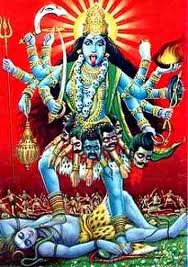
The Goddess Kali
Riders On The Storm
If you don’t enter as an initiate you won’t get the story. The symbolism in this story is so strong and complete that it should be a standard psychological textbook. Burroughs writes as though he had just come from a course in esoteric symbolism. He continues this throughout the story too. I don’t know if I can do this justice but I will try.
Burroughs has entered the defining crisis of his life, thus the novel is full of symbols of life, death, sex and regeneration. ERB feels that he is being born again, the butterfly emerging from the cocoon. The very name Kali Bwana is the primary symbol. Kali is the Hindu symbol of life, death and regeneration. Her image is as dark as this story. This story, as it were, emerges from the very bowels of the pit, the viscera of frustrated desires and hopes of their fulfillment. Very frightening actually. I can see how on one level so many people would consider it ERB’s worst. It isn’t easily understandable.. The story deals with primal needs and desires that would drive a man insane. Indeed, Kali Bwana considers Old Timer insane. He himself says that maybe he is crazy. He makes psychotic statements and is on the verge of criminal sexual behavior throughout the book until the very end when he is reformed. This is an extremely violent but regenerative story. Sort of like Walt Disney on steroids.
Kali Bwana is the joy of man’s desiring. A platinum blonde, her beauty apparently disintegrates all men’s self control as she inspires dreams of rape rather than courting. Old Timer himself has rape in mind all through the book. No man or animal in the story every thinks of honoring her femininity; their only thoughts are to violate her beauty to gratify their illicit lustful desires or, perhaps, to cannibalize her beauty and make it their own possession. This is serious stuff.
As Kali she is the mate of Shiva. while Shiva is usually depicted as a handsome young man serenely playing the flute while all goes to hell around him Burroughs represents him as the Leopard god of the cannibalistic, criminal animist or nature cult. Thus, Kali Bwana is captured by the Leopard Men to serve as high priestess to their Leopard god thus forming an Anima and Animus. Burroughs does an excellent job of presenting both the barbaric splendor and degradation of the cult or religion.
The story is set by the book’s opening, one of attempted rape and violence set amidst a terrific storm in a sort of swamp like atmosphere. One feels this is not an ordinary storm but one fraught with significance and meaning. It is a life changing storm.
The Penguin Dictionary of Symbols which I use here for reference is readily available. It discusses storms on p. 941:
The storm is a symbol of a theophany, the manifestation of the awesome and mighty power of God. While it may herald a revelation, it can also be a manifestation of divine anger and sometimes of punishment.
Creative activity is also unleashed in a storm. In a cosmic upheaval beyond the power of words, life itself was born.
And then Burroughs refers to the storm as a hurricane. The Penguin dictionary says this of that, p. 533:
Hurricanes are almost Dionysiac orgies of cosmic energy. They symbolize the ending of one period of time and the beginning of another as tireless Earth repairs the damage.
So now we have the figure of the eternal female, the symbol of birth, death and regeneration coupled with storm and hurricane symbols also denoting major epochal changes. The impact is increased by the whole being expressed in a half dozen pages, very compressed.
It should be noted that Florence Gilbert represents Kali Bwana and Old Timer is obviously ERB. the changes are happening to him. Florence/Kali is both repelled and passive. Perhaps because of the ripening romance between his wife and ERB Ashton Dearholt had taken her on a motor tour removing her from the scene probably hoping separation would end the affir. According to the ERBzine 30s Bio Timeline the Dearholts returned to LA in May just as ERB was completing Triumphant and before he began Leopard Men. If he had been fighting his feelings for Florence her return was obviously more than he could deal with hence this terrific storm and the overwhelming number of female symbols in the novel.
At the same time as the rape attempt the Leopard Men corner Nyamwegi, a Utgengan returning from a date with his girl friend. Amidst the multiple bolts of lightning which illuminate the entire sky and tremendous crashes of thunder the Leopard Men gruesomely and bloodily murder the boy removing body parts.
ERB accentuates the ferocity of the storm and hurricane by saying that the lightning bolts were numerous and continuous, filling the entire sky. The Penguin dictionary, p. 606:
Lightning symbolizes the spark of life and powers of fertilization. It is fire from Heaven, vastly powerful and terrifyingly swift, which may be either life giving or death dealing.
And on p. 607:
As the weapon of Zeus, forged in FIRE (symbol of the intellect) by the Cyclops, lightning is the symbol of intentive and spiritual enlightenment or the sudden flash of inspiration. However, while it enlightens and stirs the spirit, lightning strikes down the drive of unsatisfied and uncontrolled desire…
So after this storm all will be changed; there will be a new Heaven and a new Earth. Kali Bwana has averted personal disaster while Nyamwegi has met his end. Nearby in another part of the forest Tarzan and Nkima crouch beside a forest giant to wait out the storm. Here the hurricane topples the tree uprooting it. Tarzan tosses Nkima out of the way but is himself struck by a branch, one assumes one of the big ones of the lower terrace. Once again the Big Fella is given a case of amnesia so that he is not aware of his racial affinity to the Whites aligning himself with the Blacks.
In another part of the forest, not too far away, Old Timer and the Kid are discussing their fortunes apparently unaware of this massive storm. As Old Timer sets out on the trail of ivory on the morrow he hears a shot which leads him to Kali Bwana. All the elements of the New Day are in place.
The action takes place not only in the forest but in the Ituri Rain Forest, the forest of forests. In Western symolism the forest is where the lost man wanders in search of his redemption. One has to find one’s way out of the forest for personal redemption. Thus Old Timer and Kali lose their way wandering around in the forest hopelessly lost. At one point Old Timer can’t see the constellations to navigate at night. At another the forest is so dark he can’t see the sun to navigate by it. Both he and Kali have to be rescued by Tarzan after he regains his memory.
As David Adams has pointed out Sheeta the panther is always associated with the Anima or female. Usually Sheeta is described as a panther but in this novel Sheeta is the Leopard. The smell of Sheeta is overwhelming throughout this novel. In this case I think we may be sure that Sheeta represents the fear of the feminine. Tarzan and Nkima are inseparable in this novel. Throughout the entire novel Nkima complains about the small of Sheeta who wishes to devour him, in other words, to emasculate him. So Burroughs is afraid of what is happening to him in regards of Florence. When Tarzan recovers consciousness after the battle with the Leopard Men the first thing he does is call Nkima. The little monkey in his place on Tarzan’s shoulder reminds one of the Egypian Ka or double. Tarzan the fearless and Nkima the fearful. Burroughs as a child confronted by John the Bully.
As an aspect of Tarzan’s- and Burroughs’- character Nkima probably represents his more chicken livered side. There is no record of Tarzan ever having fear, he doesn’t even know the meaning of the word, but Burroughs did hence Nkima who knows nothing but fear. Neither Tarzan nor Burroughs have ever been what one would call ladies men hence if not fear of the feminine at least an apprehension of it. As Burroughs is now reaching a major crisis of his life having now to choose either Emma or Florence it is not to be wondered that the forest reeks of Sheeta. Indeed, the Leopard Men themselves are symbols of the feminine and they intend to sacrifice Old Timer. Thus one has the leopard as Leopard god and Kali Bwana as his Leopard goddess.
The tremendous rainfall, itself a symbol of regeneration and fertility from the male sky god would create a steaming swamplike atmosphere as it fell on Mother Earth while the temple of the Leopard God itself was in a crocodile infested swamp.
First the Crocodile as symbol, Penguin p. 244:
The crocodile which carries the Earth on its back, is a divinity of darkness and the Moon, whose greed is like that of the NIGHT which each evening devours the Sun. From civilization to civilization and from age to age the crododile exhibits a high proportion of the countless links in that basic symbolic chain which belongs to the controlling forces of death and rebirth. The crocodile may be a formidable figure, but this is because like all expression of the power of fate, what he displays is inevitable- darkness falling so that daylight may return, death striking so that life may be reborn.
In other words, you can’t make an omelet without breaking a few eggs. Poor Emma. Obviously for ERB he is killing his past so that his future may be born.
The temple is in the center of a swamp so deep withing the forest that the sun never shines on it. The swamp is the quintessential female symbol. It is in the Lernean swamp where Heracles has to battle with the Hydra. Hydra=the water of the feminine and the irrational. Each time Heracles cuts off one of the seven heads another grows in its place until he cauterizes each severance with fire, that is the power of the male intellect.
Thus, one has crocodiles, leopards, water, swamp, the river and Stygian darkness. if you can’t rise above the fear of the feminine, you will be swamped, drowned in her waters. The only entrance and exit is this slow moving river is obscured by the forest. This river of mystery and death, this impenentrable forest. The River is the last of the great symbols we will consider, Penguin p. 808:
The symbolism of rivers and running water is simultaneously that of the ‘universal potentiality’ and that of the ‘fluidity of forms’ (Schuan) of fertility, death and revewal. The stream is that of life and death. It may be regarded as flowing down to the sea; as a current against which one swims; or as something to be crossed from one bank to another. Flowing into the sea it is the the gathering of the waters, the return to an undifferentiated state, attaining Nirvana. Swimming against the stream is clearly returning to the divine source, the First Cause. Crossing the river is overcoming an obstacle, separating two realms or conditions, the phenomenal world and the unconditioned state, the world of the senses and the state of non-attachment.
Then this from Burroughs, p. 191:
The sun was sinking behind the western forest, its light playing on the surging current of the great river that rolled past the village of Bobolo. A man and a woman stood looking out across the water that was plunging westward in its long journey to the sea down to the trading posts and the towns and the ships, which are the frail links that connect the dark forest with civilization.
If one looks at this novel from an esoteric symbolic point of view the symbols tell their own story.
As Old Timer says Kali means Woman. At the beginning we have Woman and the Shaggy Man.
I haven’t given the symbolism of the Shaggy Man yet so using the Penguin Dictionary of Symbols again under the heading Rags and Tatters, p. 782:
(Rags And Tatters) are the symbol of anxiety and lesions of the psyche as well as that material poverty which, in folktale, is sometimes adopted as a disguise by princes, princesses and wizards. It denotes simultaneously poverty and anxiety or cloaks inner riches under an appearance of wretchedness, thus displaying the superiority of the inner over the outer self.
Thus Kali- the Woman- the symbol of death, birth and regeneration, and The Shaggy Man or the Frog Prince, the Hero in disguise, waiting to be regenerated by the kiss of the ultimate Woman. A classic fairy tale, actually, with a tip of the hat to David Adams for insisting on the fairy tale connection.
The Man, the Woman, the Storm with a tremendous display of Lightning, Thunder, Wind and Rain completely transforming both the physical and psychic landscapes bringing the Man and the Woman together.
The Woman is then captured by the repressed sexual desire of the Leopard Men who wish to install her as their Goddess. The Woman or Kali is stripped Naked and then adorned with various attributes of the Leopard Cult.
As in various myths, fairytale and folklore stories the Man and the Woman (the Anima and Animus) have been separated by Fate and must fight through all obstacles to be reunited.
Kali (Woman) is led through the teeming, steaming forest with a rope around her neck to the big river down which she is canoed to a smaller stream, ‘the silent river of mystery and death’ in the darkest, swampiest, most crocodile infested part of the darkest of dark forests.
Abandoning all other concerns the Shaggy Man pursues Kali to the village of the Leopard Men where he is taken prisoner, then taken down the silent river (the Styx?) to be sacrificed. By a miracle the two escape only to be separated again while the Shaggy Man is taken back to the temple of the Leopard Men. Kali, Woman, is captured by a Black chief to serve his sexual needs. Rape again. White=Light, Black= Darkness. Thus the ever present threat of rape seems to be about to be fulfilled. But no, the elder wife of the Black chief objects to the White Woman. Out of the pot and into the fire. The Woman is left with Pygmies who are even more vile than the Blacks.
But now a Deus ex-machina, Tarzan, has released the Shaggy Man. Hot in pursuit he follows Woman to the Pygmy camp. He madly attempts rescue which is successful once again because of the Deus ex machina.
It’s not over yet folks. ERB can make any 192 page story go on for a near eternity. Together again Kali and the Shaggy Man are once more torn assunder when the Deus ex machina sends an ape who captures the Shaggy Man. Makes you breathless, doesn’t it? Deus once again reunites the Woman and Shaggy Man. Now, if you will notice the Shaggy Man forces a kiss on Woman. His act of violence shames him so that he finds redemption in his remorse. Thus the kiss of Woman has returned the Frog Prince to his rightful form.
As the story ends the two are about to leave the dark forest for the light of civilization down river.
Thus one has the classic myths- Psyche and Eros, Perseus and Andromeda and many others, numerous fairy tales -Cinderella, one which ERB has used before, and much folklore. It is done very well, too, if you’re following the bouncing ball.
It is noteworthy that the work of another great author is misunderstood too. I refer to the ancient poet Homer. While Homer’s reputation is very great no one understands the Iliad. The adventures of the Gods and Goddesses are beyond the comprehension of classical scholars. Thus they prefer the Odyssey which is written in a more comprehensible if pedestrian style. If I remember correctly the Five Foot Shelf excludes the Iliad while containing the Odyssey. While both are attributed to Homer they must have been written by two different mind sets. The psychology of each is too different to have been written by one mind. Besides the Iliad concerns the middle part of the Siege of Troy while the Odyssey skips all the way to the story of only one of the Returns.
There are similarities in the way Burroughs and Homer tell their stories but to avoid argument Homer is incomparably the greater.
Nevertheless Burroughs has masterfully used a set of symbols to supply a very rich subtext to this story and he has done it intentionally. He does know whereof he speaks. I don’t think there is any doubt that he has studied Esoterica. Probably the topic was of life long interest both in the old kook capitol Chicago and the new kook capitol of Los Angeles. (Kookie, Kookie, lend me your comb.)
There was a lot of esoterica going on in LA. The Golden Dawn of Aleister Crowley was out in the desert at Barstow, Manly Hall was advising the movies on estoteric matters, the Vedantists were established and the Theosophists had a terrific college in LA.
Anybody who thinks ERB wasn’t interested in such things doesn’t know how to spell Edgar Rice Burroughs.
While ERB wouldn’t touch a religious theme unless ‘highly fictionized’ he managed to highly fictionize all manner of religion in this great novel of his mature period. He was working at break neck pace too.
Love this stuff.
On to Part IV which will deal with the cast of characters. Inevitably there’s a certain amount of repitition but I try to cast the stuff in different highlights, crosslights and aspects. This stuff deserves a thorough examination.
Part 3 Tarzan And The Lion Man: A Review
May 16, 2008
A Review
Themes And Variation
The Tarzan Novels Of Edgar Rice Burroughs
#18 Tarzan And The Lion Man
Part 3 of 10 parts
by
R.E. Prindle
First published on the ezine- ERBzine
Part 3: The Source
Unlike the rest of Burroughs’ novels you don’t have to look very far for the main source of this one. While Tarzan And The Leopard Men was heavily influenced by the MGM movie Trader Horn Lion Man is the story of the famed MGM expedition to Africa to film it.
In Chapter 1 ERB provides a fictional account of the decision to make the expedition. In the next few chapters he gives a fictional account of the safari. Excising the story within the story Burroughs’ account is reasonably accurate, allowing for a little authorial license that is.
The safare was active for seven months in 1929. The safari was a cause celebre in Hollywood as the expedition ran up what were enormous costs for the time. While they were in Africa Black Friday, the collapse of the stock market, occured plunging the nation into depression so that money became of more consequence to MGM. There was speculation that the dirctor, W.S. Van Dyke would bankrupt the company. Like Howard Hughes’ famous difficulties with Hell’s Angels of 1930 the bills kept rolling in but when the receipts were counted like Hughes’ movie there was a tidy profit left over. If nothing else the hullabaloo was mere advance publicity and cheap at the price.
MGM even liked the movie so much they did it again in 1953’s Mogambo. While I see Mogambo as a remake of Trader Horn the movie site lists its antecedents as Red Dust, 1932 and Congo Maisie of 1940. Haven’t seen either.
The 1929 expedition was incredibly audacious. On the liner notes of my VCR copy of Trader Horn MGM describes the expedition like this:
When this landmark film ws made, parts of Africa were still uncharted. The savannahs teemed with big game, the rivers with crocodiles and snakes. Few Europeans or Americans dared enter what was then called the Congo.
That was true and still is, MGM rushed in where few Europeans and Americans dared to tread. Africa was to transit from the stone age to the age of science in the blink of an eye. As Van Dyke noted, barely pacified, already the Kikiyu or Kukuas as Van Dyke called them were organizing resistance. A mere savage like Jomo Kenyatta was attending Oxford University in England. Truly astonishing that a stone age African with no familiarity with either techonology or science could be listened to attentively by the most highly educated Europeans. What could Kenyatta actually understand? Would they have given equal attention to the mutterings of an Appalachian farm boy? The mind boggles.
It had been a mere forty years since Henry Morton Stanley had covered the same ground to relieve Emin Pasha. Only Forty years earlier Stanley had been the first Euro-American to penetrate the Ituri Rain Forest Only forty years earlier Stanley could claim the discovery of the fabled Mountains Of The Moon. In the interim few Euro-Americans had been there. Gosh, even the great beast the Okapi had just been discovered in the Ituri..
Kampala and Entebbe in Uganda were now occupied by British governors. The ancient kings of Uganda and Unyoro were no more. As Van Dyke states, the Africans were held down by the few Europeans with an Iron Hand. Ah, you say, the European Iron hand. Abominable. But when weren’t the African tribesmen held down by an Iron Hand. But then it was Black or Moslem and not White. The venerable ancient kings of Uganda wanted to hold a funeral for some distant relative during the time of Stanley so they selected a couple thousand Ugandans, slit their throats and dumped them in the grave as company for their dead relative. The Ugandan king slaughtered a few of his own people in an attempt to amuse Stanley. TV had not reached Uganda back then.
King Mteses’ gangs roamed the countryside after dark murdering any citizens they met. Well, that was normal. Now White Bwanas arrested troublesome tribesmen and threw them in jail for a period rather than killing them. That wasn’t normal. Dead men file no complaints.
So a benign rule in White hands was less desirable than a malign rule in Black hands. Such is the way the human mind works. In the African case the native king owns everything including oneself and that is acceptable. In another invaders occupy a few thousand acres producing food that makes you better fed than ever you were on your own and that is bad. Better savagery among equals than civilization as an inferior.
Africa was not yet familiar with the wheel when a guy with the nickname ‘Woody’ shows up with nine-ton genearator trucks. Sound trucks! The talkies had been around only two years and they already had sound trucks.
Van Dyke in his justification of himself to MGM in his Horning Into Africa has this to say. p. 212:
On the screen we had over thirty-five varieties of African big game, with our actors working in the scenes with them. We had the dances, the songs, the native life of over fifteen African tribes, and on our film was a thin dark strip running down the edge which constituted the sound they made in all their different activities.
…on our film we had a thin dark strip running down the edge which constituted the sound they made in all their different activities…. Think of it. Stone age Africans captured as stone age people by equipment of which the Africans could have no concept, no possible way of accounting for, let alone understanding it, that might have as well have been the work of aliens beamed down from outer space or one of Bertie Well’ visitors slipped through the plane of a parallel universe. Was there any difference between Wells’ English visitors to his utopia of 1923 when he viewed the men of a parallel universe as gods and the Hollywood Mutia and Riano saw when transported from or ‘beamed’ down from Africa? Not much I would say.
If the Africans thought Henry Morton Stanley was supernatural what in the world did they think of Woody Van Dyke, his cameras and fleet of trucks.
What did Van Dyke think about, talk about, such an excellent adventure? p. 26:
I did not realize what he meant by the adjective “amazing”. It made me think of certain American film producers. The only thing about it that had been amazing, to my mind, was its inception. After all, for a Hollywood producer (Irving Thalberg) to conceive the idea of sending twenty-five or thirty Hollywood motion picture actors with ninety-two tons of equipment into the center of Africa, to go prancing around over the thorn bush terrain, considering the great cost in dollars and cents involved was a rather amazing idea. Nobody but an adventurer would have thought of it, no one but a goof would have tried to do it, and no but a clown could have gotten away with it.
Van Dyke considering the term ‘amazing’ further:
Previous to our debut the largest safari to enter Africa had been that of Prince Edward, a stupendous undertaking with about a dozen whites, fifty blacks, ten or twelve cars, and possibly seven or eight tons of equipment. His safari had not been underway many days when his Royal Highness was called home by the illness of his fathr, King George, but the fact that the white hunters had maneuvered such a large safari over several miles of Africa without a casualty and with no one dying from fever was considered remarkable.
We had been in Africa more than seven months with thirty-five whites, one hundred ninety-two blacks, thirty-four cars, one generator truck and two sound wagons. The speedometers on the cars showed that we had traveled over nine thousand miles of African soil, to say nothing of rail, lake and river travel and distances covered on foot, and we had brought everyone back- black and white.
And furthermore they not only had it on a film strip, which was old technology by white standards but unimaginable by African standards and running down that strip of film was a thin black line indicating sound. What would a stone age African think seeing and hearing himself on film going around and around on reels like wheels which in themselves had been but recently seen in Africa. Jomo Kenyatta was at university in England. They would have laughed at that Appalachian farm boy if he showed up for registration.
So, MGM and Van Dyke provided ERB with a readymade story of epic proportions.
We know he read the book. The question is did Van Dyke regale him with other stories and details during ERB’s five week stint on the MGM lot, a little additional color not found in the book.
Now we can turn to Burroughs’ story and align it with that of Van Dyke. ERB is writing a novel so he doesn’t have to stay too close to the facts, he can play fast and loose with them. Let’s see how he does.
In the first place he converts the story from that of Trader Horn to Tarzan, The Ape Man. Rather than filming Trader Horn they are filming the story of a feral boy who was raised among the lions. p. 9
“Joe’s written a great story- it’s going to be a knock-out. You see this fellow’s born in the jungle and brought up by a lioness. He pals around with the lions all his life- doesn’t know any other friends. The lion is king of beasts; when the boy grows up he’s king of the lions; so he bosses the whole menagerie. See? Big shot of the jungle.”
“Sounds familiar.” Commented Orman.
Yes, it does sound familiar, ERB says with tongue in cheek and a wink at we readers. It sounds familiar to us too. As the Lion Man the studio has picked Stanley Obroski, a giant cowardly fellow.
As Harry Carey, a bete noire of ERB, played Trader Horn Burroughs may be projecting a little Carey into Obroski’s cowardice as vengeance although one assumes that Johnny Weissmuller is the model but Obroski isn’t that similar to him either.
As a leading lady ERB creates Naomi Madison. I’m sure there are a lot of insults and jokes about MGM in the book. A lot or most of them may be lost on us today. However Naomi may have been modeled on Irving Thalberg’s wife Norma Shearer. Naomi=Norma.
Some say Shearer made it on her own while there are those backbiters who say she got all those plum roles because she was married to the producer, Irving Thalberg. I’m not too hep on early thirties films but it is possible a little favoritism may have been involved. In the novel Burroughs casts Naomi in a rather unfavorable light as the lover of Director Orman. Perhaps Thalberg saws such things in a negative light.
It may be possible that Shearer was or was reported to be seeing someone on the side. If so, ERB was taking some chances.
He does have her down as having been a hash slinger before becoming The Madison. There was a period in New York when the Shearer family was down at the heels when Norma was seeking theatrical work that she waited tables. Bringing up that fact would not have endeared ERB to the Thalbergs or MGM. Norma would probably have been more dangerous than Irving.
The Thalbergs wouldn’t have mattered too much because Irving had a heart attack in 1933. When he returned to work several months later Mayer had stripped him of his position. He became just another producer for a couple years before he died in 1936. Shearer got no more roles, plums or otherwise. So as it turned out ERB wouldn’t have had to worry about either.
ERB doubles Naomi with a stunt woman named Rhonda Terry. As no comparable figure was on the safarie she must have been only necessary for the story.
Van Dyke organized and led the expedition being the supreme authority, the actual Big Bwana. As might be expected of a safari of this size and complexity there were numerous problems naturally occurrring while Van Dyke himself as a Hollywood director trying to realize his vision of the movie was rather cavalier with the landscape. The native hierarchy was in disarray from the time of Stanley now having a Birtish hierarchy overlain on the native. But the British had only been there for a couple decades while the native revolt led by Kenyatta and his Kikiyu was already underway. As Burroughs indicates Leopard Men were roaming Africa while the Kikiyu would erupt as the Mau Mau only twenty years hence.
The African chiefs considered every human, every animal, every stick or tree on their territory as their personal private property. There hadn’t been enough time as yet for that understanding to die out. And now we have a real muilti-cultural conflict brewing. Van Dyke shows up with a fleet of cars and trucks such as was new to the sight of the Africans. Van Dyke proceeds to drive these trucks all over Kenya, Uganda, the Congo and Tanganyika as they were then known. Along the way he chops down trees that don’t belong to him, if you see what I mean, as though he was the sovereign of the land and not the chiefs.
From the African point of view the man was contemptuous of Africans and disrespectful. Van Dyke, in what we must assume was his innocence, was completely unaware of his desecrations. His culture was not only White American, which would have been insult enough to the Africans, but he was of the fiilm capitol of the world, Hollywood, which respects no man or mountain in making a movie. Van Dyke’s mind functioned on one premise alone- make this movie.
At one point he wanted to shoot a scene near Lake Albert, probably didn’t even make the final cut. At that point of the lake a volcanic dyke serveral feet high formed a barrier preventing access. There was no way to get the trucks and equipment over the barrier. The solution seemed rational to Van Dyke. When no one was looking he got some dynamite and blew a big hole in this barrier. Problem solved from Woody’s point of view. I don’t know what the Africans thought about this desecration of the landscape but Van Dyke does report what seems to be a fair amount of unrest among the African bearers.
In Burroughs’ story the movie company goes directly to the Ituri Rain Forest but Van Dyke began his filming at Murchison Falls where the Nile flows from Lake Victoria. After having brought his crew and equipment to the railhead at Jinja he crossed the lake to Kampala and Entebbe in Uganda.
He wanted to film at Murchison Falls where, as he says, the entire flood of the Nile passing from Lake Victoria passes through a gorge only fifteen feet wide. As he said a good broad jumper could leap the Nile at that point. If he wanted to take the chance.
Now, the British had determined the area at the foot of the falls to be so infested with the sleeping sickness bearing Tsetse flies that they had made it off limits to man and beast. Well, Woody had a movie to make and wanted to make it in that exact spot. In fact several scenes in Trader Horn are filmed there.
Disregarding what we must assume were the real dangers of the place Van Dyke cajoled an exception for this safari taking his cast and bearers into this Tsetse infested area. It will be remembered that Edwina Booth, the female star, was incapacitated for life because of diseases contracted in Africa.
What seems normal to a movie maker may seem bizarre to a less interested observer. Van Dyke wanted a crocodile scene involving an island. There was no island where he wanted so he loaded the spot with fill until there was one. Another neat job of problem solving. Then he wanted a large nuber of crocodiles around the island so he slaughered game as lure for the crocs. They came, they saw, the ate, but they wouldn’t spend the night as Woody wanted.
So now Woody shoots some more wild life to lure the crocs to the island while he built a large barrier. Once the crocs were within he closed the gate. Well and good from Woody’s point of view but from the multi-cultural point of view of the crocs they either just broke through or climbed the six foot barrier. Wasn’t high enough.
W.S. Van Dyke was one determined guy. He had a movie to make. His next step was once the crocs got inside and they wanted out at, oh say, 2:00 AM, Woody got his whole crew of actors armed with torches and poles to place themselves between the crocs and freedom to force them to stay inside. In a quite thrilling description he tells of stuffing burning torches down the throats of crocodiles. When he said stay, he meant it. Harry Carey, apparently some sort of testosterone driven madman, was a stalwart but Van Dyke even had Edwina Booth on the barrier torch in hand. Van Dyke lauds his crew as well he should have but one is struck by a certain degree of lunacy. Or, perhaps, Scotch.
Burroughs draws inference away from Van Dyke by making Tom Orman a different physical type but as ERB was working from Van Dyke’s Horning Into Africa and possibly personal communication from Van Dyke, or members of his crew it is impossible for Orman not to reflect W.W. ‘One Shot’ Woody Van Dyke.
Burroughs makes Orman a drunk or at least a real tyrant when he has been drinking. Van Dyke records some heavy drinking of his own. He slipped right into the colonial practice of’Sundowners’, that is when the sun went down the bottle came out. There may be some factual basis then for Orman’s behavior.
Orman heads for the Ituri through an area he has been warned not to go that would correspond to Van Dyke’s insistence on filming at the Murchison Falls where he ws forbidden to go but overcame the injunction.
The attack of the Bansutos is ERB’s invention however there were a couple serious native disaffections in the safari. Late in the expedition the Kikiyu show up, which I would think meant that they were unhappy with the expedition while Van Dyke describes them as a surly lot.
In Burroughs’ story the safari falls apart after the Bansuto attack but then at the end of the story he reforms the safari at the Omwami Falls in the story or Murchison Falls in fact. The party atmosphere at the Falls may reflect his impression of Van Dyke’s account.
It was probably with a sigh of relief that the British bid farewell to this troublemaking Hollywood film crew. Or perhaps, just perhaps, they wired MGM to get these people out of here. I don’t know but I wouldn’t be surprised.
So far as I know the only two accounts of Van Dyke’s excellent African adventure are his own and that of Burroughs.
It is a pity MGM didn’t have the foresight to compile an extended account of the safari with hundreds of pictures. In the liner notes to my VCR copy they say:
…director W.S. Van Dyke and his heroic cast and crew camped there for a year, hauling eighty tons of equipment through the equatorial jungle. They battled disease and predators, to risk their lives to film this story of two men- legendary trader Alfred Aloysius Horn (Harry Carey) and his naive protoge Peru (Cisco Kid Duncan Renaldo)- and their struggle to reclaim a beautiful woman (Edwina Booth) who was lost in the jungle as a baby and raised by indigenous tribes.
True enough as far as it goes. Van Dyke’s obviously sanitized narrative takes it a little further, Burroughs’ fiction may reveal a little more, but Edwina Booth who was never able to work again adds another detail. She petitioned MGM for compensation but MGM refused to consider it for this heroic, crocodile battling member of the cast who battled predators and disease and lost.
What a fabulouss story. ERB had a lot to work with and turned out a fabulous effort.
Next Part four of ten parts: The Safari To The Capture Of Stanley Obroski
Part 1 Tarzan And The Lion Man: A Review
May 14, 2008
A Review
Themes And Variations
The Tarzan Novels Of Edgar Rice Burroughs
#18 Tarzan And The Lion Man
Part one of ten parts
by
R.E. Prindle
First published on the ezine-ERBzine
Preface
As has been seen 1931 was a very eventful year for ERB. The viewing of Trader Horn was a seminal event in his life. The movie became a major influence on his next Tarzan novel- Tarzan And The Leopard Men. As has been noted, in April he signed the contract with MGM.
Reports vary but it appears that he may have sold the movie rights for the first film for twenty-two thousand dollars plus a five week employment contract at a thousand dollars a week. It is fair to assume that ERB spent his five weeks on the MGM lot in Culver City.
During that period of time he obviously attended conferences with Irving Thalberg so his descriptions of the ‘Boy Wonder’ are taken first hand. One imagines that he became acquainted with the Director Woody ‘One Take’ Van Dyke. I like to think they hit off with ERB getting some first hand accounts of Africa that showed up in Lion Man. As he had a copy of Van Dyke’s privately printed Horning Into Africa in his library it would seem obvious that Van Dyke presented him with a copy. Thus ERB had a fund of first hand information lacking in his earlier novels.
One also imagines he met the African stars Mutia and Riano when they visited Hollywood. They would have been the first Africans he had met. There is a world of difference between Africans and American Negroes. Perhaps for these reasons his Leopard Men varies somewhat from his usual hidden civilizations formula.
And also he would have met his script writing counterpart Cyril Hume. His new partner one might say. And coincidentally Johnny Weissmuller and Maureen O’ Sullivan.
One is astonished at the speed with which MGM signed Burroughs, developed a script, found actors for Tarzan and Jane, made a movie and released it a bare ten months later. What orgzainization.!
We know that ERB watched the result with sinking heart and bitter remorse for signing the contract. The MGM version of his creation was the antithesis of his own. Rather than a literate, cosmopolitan Tarzan at home both in the jungle and the capitols of Europe and cities of America the MGM Tarzan was a feral boy who wasn’t even a lord, let alone the lord of the jungle.
Our Man had just finished Tarzan And The City Of Gold when he viewed the movie. Now with his brain reeling in shock it would be a year before he got out his reply.
In my estimation it would be his last great Tarzan novel. The Big Bwana had been emasculated. But the greatest of the Tarzan novels was the result.
ERB also made it a Hollywood novel, perhaps as trenchant a criticism of the film capitol as his 1922 effort The Girl From Hollywood. He ridiculed the whole thing. MGM, Thalberg, the African expedition, the movie Tarzan and in a closing chapter Hollywood itself. In his pain and hurt he drove himself to heights he had never before attained.
Stunned by the duplicity of MGM his novel is a story of duplicity, of doubles and more doubles until one has doubles coming out one’s ears. The story within the story, the double of the story itself, of God in Heaven but all wrong with the world is a masterpiece of imaginative fiction that transcends even the exploits of his Martian creation, Ras Thavas.
As Leopard Men was permeated with sexual desire with a hint of madness, Lion Man is deeply involved with madness, insanity and a complete feeling of unreality. As Tarzan says: Sometimes I think I must be dreaming. Yea, verily, brothers and sisters. This story is one of dreams and nightmares but a dream of a story.
1.
In the novel Burroughs had two major objectives: 1. To ridicule and humiliate MGM and 2. To show them how to use all new material in a much more imaginative way than Cyril Hume had. Hume is probably ridiculed as both the writer Joe in the foreword and the scenarist Pluant in the Hollywood afterword.
There can be no mistake that the introductory story refers to the Trader Horn expedition while Burroughs includes a planning session with Milt Smith/Irving Thalberg in his MGM/BO office. Let us look at the introductory chapter carefully.
There can be no doubt that Burroughs was included in such sessions concerning the movie Tarzan, The Ape Man so that the chapter ‘In Conference’ is an authentic snapshot of how business was conducted.
The opening sentence is: Mr. Milton Smith, Executive Vice President In Charge Of Productions was in conference. There is no doubt that here Burroughs is referring to Irving Thalberg. Burroughs goes on to describe Thalberg’s actions which were considered peculiar by everyone in Hollywood.
Mr. Smith had a chair behind a big desk, but he seldom occupied it. He was an imaginative dynamic person. He required freedom and space in which to express himself. His large chair was too small; so he paced about his office more often than he occupied the chair, and his hands interpreted his thoughts quite as fluently as his tongue.
p9. Smith was walking around the room, acting out the scente. He was the girl bathing in the pool in one corner of the room, and then he went to the opposite corner and was the Lion Man.
That doesn’t sound unfriendly or hostile to me but as ERB has already identified MGM as BO (Body Odor) or Stinky Pictures Louis B. Mayer, MGM’s president, may have taken all ERB’s comments from then on as intended insults.
In point of fact ERB’s descriptions of Smith/Thalberg seem to be accurate. Thalberg was the subject of Scott Fitzgerald’s unfinished final book The Last Tycoon. The novel was made into a movie of the same name in 1976, the last movie directed by Elia Kazan. Thalberg is portrayed exactly as Burroughs depicted him.
The conventional mind seems to be unable to grasp the idiosyncrasies of genius. The genius of Thalberg was that he was able to visualize the film in the manner Burroughs describes, alsmost as the author. Had he failed he would have been merely weird but as he was the greatest and surest producer of the studio era the seeming eccentricity becomes an attribute of his genius. As a writer of genius I think ERB saw Thalberg that way; how the latter of MGM interpreted ERB’s remarks may have been less generous.
The director, Tom Orman’s character is quite similar to that of Woody Van Dyke although as the physique of Orman is opposite that of Van Dyke it is clear that Orman is intended to be more fictional. The name Or-man can interpreted as Gold-man from the French Or which translates as gold. As Goldman ERB may have been slamming the Jews. ERB was less than careful in that respect in the novel. In the last chapter ERB definitely characterized Abe Potkin as a Jew placing his conversation in dialect. By Abe Potkin ERB may have been referring to Louis B. Mayer. The introduction of Clayton to Abe leaves this open to conjecture. p. 186:
This is Mr. Potkin, John Clayton, Abe Potkin, you know, (italics mine)
If ERB did ridicule both Thalberg and Mayer or was perceived as doing so then he was definitely asking for trouble. Fighting the Law in Hollywood as it were.
Like Van Dyke who had been called in to relieve director Robert J. Flaherty on a behind schedule film White Shadows On The South Seas in which Van Dyke was successful so Orman had been called in to complete a picture being shot in Borneo.
Just as Van Dyke was then assigned Trader Horn on location in Africa so now Orman is assigned to make the biggest African picture ever in the Ituri Rain Forest.
ERB probably met Van Dyke in the summer of ’31 on the MGM lot. It would seem that the two men hit it off as Orman is as well treated as Lion Man allows. It is to be presumed that Van Dyke presented ERB with a copy of his privately printed Horning Into Africa at that time.
The rest of the chapter is joshing around in a light hearted banter that was characteristic of this type of conference and introducing the members of the cast thus establishing the nature of their characters.
A detail of interest is the following quote. p. 8:
“And are we going to shoot:” inquired Orman, “fifty miles from Hollywood?”
‘No, sir! We’re going to send a company right to the heart of Africa to the -er-ah- what’s the name of that forest, Joe?’
“The Ituri Forest.”
“Yes, right to the Ituri Forest with sound equipment and everything. Think of it, Tom! You get the real stuff, the real natives, the jungle, the animals, the sounds. You ‘shoot’ a giraffe and at the same time you record the actual sound of his voice.”
“You won’t need much sound equipment for that, Milt.”
“Why?”
“Giraffes don’t make sounds; they’re not supposed to have any vocal organs.”
“Well, what of it? That was just an illustration. But take the other animals for instance; Lions, elephants, tigers- Joe’s written a gret tiger sequence. It’s going to yank them right out of their seats.”
“There ain’t any tigers in Africa, Milt,” explained the director.
“Who says there ain’t?”
“I do,” replied Orman grinning.
“How about it, Joe?” Smith turned toward the scenarist.
“Well, Chief, you said you wanted a tiger sequence.”
“Oh, what’s the difference? We’ll make it a crocodile sequence.”
In this instance ERB is spoofing himself. Over the years he had all kinds of complaints for faunal inaccuracies. The tiger bit probably hurt him the worst. He had written a great tiger scene for the first Tarzan novel that had to be changed from the All Story magazine version to the book version. ERB finally gets a chance to exorcise his frustration over that one. He was also criticized for having deer in Africa, Bara the deer, of which there are none. He first tried to bull his way through by saying he just wanted Bara the deer there. He gave in by Tarzan The Invincible and spoke of Bara the antelope. This also apparently proved unacceptable as in Leopard Men he speaks of Wappi the antelope, while the name Bara disappears completely. In the joke about the giraffe voice he is showing off knowledge while venting a little steam.
Thus he sets the scene for the first stage of the novel, the penetration of the film company into the Ituri Rain Forest. I found this sequence as well handled as any movie version might have been. ERB doesn’t try to follow Van Dyke’s narrative but creates his own story based on Van Dyke’s.
I have no doubt that there are references in this introduction and throughout the book to real people and real incidents that have gone over my head. I have located what I can with my present knowledge but I’m sure the novel is loaded with many others.
Go to: Part 2: Doubles And Insanity
 I, Dynamo