Part IV: Mick Jagger, The Rolling Stones And The Yobbo Revolution
September 22, 2012
Part IV
Mick Jagger, The Rolling Stones And The Yobbo Revolution
Mick, Kenneth Anger And Satan
by
R.E. Prindle

R.E. Prindle
1.
A Musical Digression
While this part deals with the rise of the occult it will require a digression or two to flesh out the argument to provide credibility.
Mark Sullivan, the author of the fabulous turn of the twentieth century study, Our Times, quotes Plato as observing that when a people’s music changes it signifies a great change of consciousness; the only question is, for what duration.
As Sullivan notes, the incoming waves of immigration to the US during the nineteenth century each brought its musical consciousness with it which was grafted onto American consciousness; thus the German, Polish, Italian and Irish musics etc. all had their influence. Sullivan was somewhat puzzled because with the huge Jewish influx he couldn’t find a commensurate Jewish music.
Sullivan failed to note that while the Jews had no national music of their own they were past adepts at mimicking the music of other nationalities; hence a large percentage of US music of other nationalities, Irish, Polish and German songs were actually written by Jews in the appropriate idiom. Jack Yellin for instant within ten years of his arrival was writing quintessential Southern songs such as ‘Are You From Dixie.’ A very high percentage of what is considered quintessential Americana has been penned by Jews thus infusing Jewish culture into and replacing American culture with their own.
While immigration was held to a minimum from 1914 to 1965 there was a huge internal migration of Negroes from the South to the North and West. The Jews served the same function with Negro music as they had with the external migrants. They wrote the songs for Negroes to sing. This was especially evident during the fifties and sixties of the twentieth century when the terms Negro and Jew became synonymous.
In the fifties when I was a boy Rock and Roll made its entry into musical history. From an elders’ point of view Rock and Roll was a corruption of our musical tastes that extended into our morality. This was as Plato and Sullivan predicted. The intense tough and decisive battles for supremacy in American culture were being fought between Communists and Americanists- Collectivism vs. Individualism. The decisive battle was the failure of Joe McCarthy. When McCarthy went down the war was lost although a long rear guard action delayed the Communist triumph that actually only took place in 2008 with the election of the Negro Barack Obama.
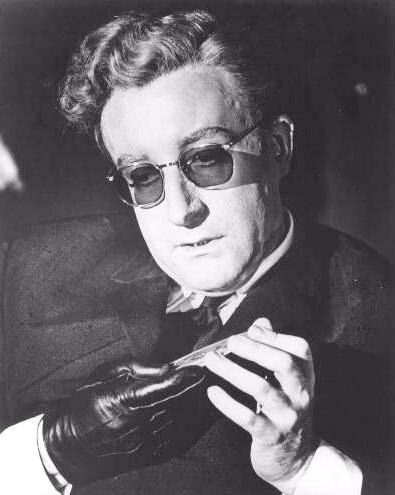
Dr. Strangelove by Peter Sellers. Must see movie.
Thus the fifties was a long intense struggle that was fought out in the movies, phonograph records, publishing and radio with an increasing boot from television. While we knew we were fighting the Communists for survival the means of the warfare were noticed but by a few and they were demonized by the Communist controlled media as cranks. Most frequently the accusations were made by wild eyed hysterical sounding Fundamentalist ministers. As the majority couldn’t see the accusations that Fluoride and Rock and Roll were Communist plots the accusers were laughed off. I could never understand how something I loved, Rock and Roll, was a Communist plot.
I did note the accusation was uttered with such complete sincerity however that it troubled my mind over the decades as to how these ministers could make such an accusation. I suppose the first seeds of comprehension were planted by the Peter Sellers’ movie ’Dr. Strangelove or How I Learned To Love The Bomb And Stop Worrying.’ The movie while hilariously funny was so skewed toward the Communist cause that it gave me pause. I vaguely comprehended that I was being manipulated.
Shifting The Mores
Now, after something like sixty years of thought and study, including Plato and Sullivan, I have I believe the explanation.
The Mores of the US have probably always been relatively fluid. Almost from the beginning the mores of East Anglia clashed with those of Wessex and then came the Scots, the Rhineland Germans (known as the Pennsylvania Dutch), the Anglo-Scots of the Border Country, the Midland English Quakers and a smattering of others along with the strong Negro element.
After Independence the Negro population burgeoned when the invention of the cotton gin created the cotton culture of the South. This population would create the tension that led to the Civil War and from that conflict the tension that would lead to the post-WWII Negro revolt.
The Irish invasion of the 1840-60 period brought the great clash of mores between the Celts and Anglos that reached its head in the 1960 election of the Celt, John F. Kennedy.
Along with the Irish came the 48ers of that failed European revolutionary phase that would create the collective-individualist conflict in mores that has resulted in the Communist triumph of Barack Obama of today.
Then in the 1870s began the invasion of the Southern and Eastern Europeans that created a conflict in mores between themselves and the Irish, Anglo and Northern European element. As noted things settled down into a contest of moral wills until 1965 when the gates were thrown open to the entire world as though the fraction of the world’s surface designated the US could house all humanity. Thus any possible hope of a unity of mores was completely shattered. Any center that might have existed was destroyed.
Now, as unpleasant as the facts may be to some intelligences, the control of the creation of a unified set of mores was seized by the Jewish immigrants in the aftermath of WWI.
To merely select a highlight of the process, in 1938 the Stalinist-Jewish agent, Congressman Samuel Dickstein. with the complicity of FDR created the House Un-American Activities Committee to root out anti-Semites and Fascist/Nationalists thus shifting control of mores to the Judaeo-Communists. The move was only partially successful initially as it had to face an intense post-war reaction ultimately conducted by the near great Joseph McCarthy.
As ever the mores of the majority were attacked at the weak joints in their armor. The key point was the long festering Aryan-Negro conflict. In realistic terms it was a conflict that could have only two results, the physical subjugation or extermination of the Whites by the Blacks or vice versa or the amalgamation of the two species.
Like it or not, the Jews and Negroes are calling for the extermination of Whites. The problem in post-war 1946 was how a small minority of Jews and Negroes representing perhaps 14% of the population could eliminate the 86% who were fully armed and dangerous.
The first step would be to knock the majority off its moral center. Without a moral focal point the majority would flounder. The route taken was nothing new. Ever since post WWI when the newly formed Anti-Defamation and NAACP Leagues were formed the majority had been cast as bigots. This caused a polarization among its Liberal and Conservative elements and Immigrants and Natives. By 1950 there was a 50-50 split between descendents of pre-1800 and those who came after. These splits were exacerbated by propaganda. Outside those divisions were the Negroes.
So, then how to fracture and fragment the majority White population even further.
Until 1954 the music that you heard on the radio was all Western, not cowboy but derived from the White or Aryan

The Great Joe McCarthy
population. And there wasn’t much of that music broadcast. Radio was controlled by the networks and they only slotted a couple hours a day of fairly wishy-washy stuff. Then about 1954 when television, commercially introduced after 1946, displaced radio as the source of home entertainment, radio floundered and only saved itself by going to all music that soon developed into Top 40 and teen dominance of the radio airwaves. That was my age cohort.
That was a time when the designation race music meant the stuff that only Negroes listened to. The designation Country and Western replaced the term Hillbilly at this time. Some considered Hillbilly a race music with a degree of accuracy if with malice. Hillbilly was despised by all but a minority not much larger than the Negroes of which I was one.
Strangely at about the same time efforts were made to bring both musics into the mainstream. Actually they would combine with folk to form Rock and Roll- Rhythm and Blues and Rockabilly. Hard to tell which was the harder sell.
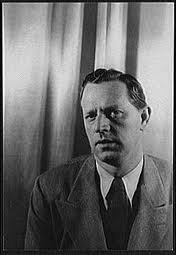
The Vile Erskine Caldwell
H.L. Mencken in the teens and twenties had excoriated the hill people, from which I derive on my father’s side, while the vile Erskine Caldwell vilified and completely defamed Southern Whites in his two hateful and extremely popular novels Tobacco Road and God’s Little Acre. The two novels remained a tremendous influence through the fifties as well as the pervert Al Capp’s cartoon strip L’il Abner. Thus a large part of the majority population was more receptive to Negro music than Hillbilly.
Naturally the agents in the forcing of Negro music on the Aryans were the Jews. The actual recordings of real Negroes were pretty raw and unmusical. Though stuff to digest. Of course there had always been Negroes catering to White audiences such as Duke Ellington, Louis Armstrong, Billie Holliday, the Ink Spots and Mills Brothers of the earlier generation and the great Platters, Fats Domino and Johnny Mathis of the next generation but the real Negro music was unmistakable.
Thus Jewish songwriters such as Leiber-Stoller, Doc Pomus, Mort Shuman and others adopted Negro personas and wrote most of the Rhythm and Blues performed by Negroes. It was this Negro music geared to Aryans by Jewish song writers with a foot in each camp that made the inroads leading up to Berry Gordy’s Motown Sound where you had a new generation of Negroes packaged exclusively for
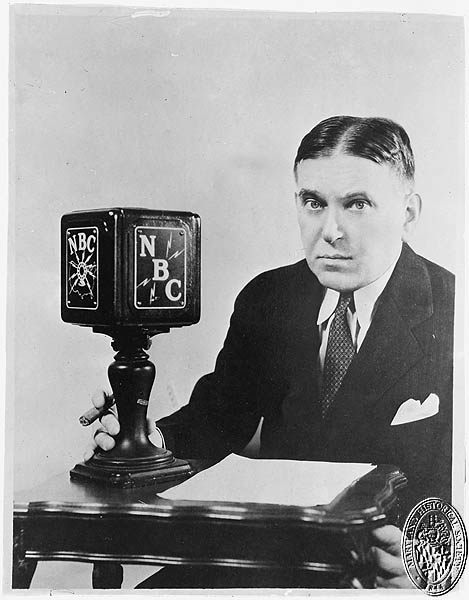
H.L. Mencken
Aryans singing songs largely written by Negroes and, of course, from there it melded into the more racial Soul Music of the sixties.
So, in 1954 Rock and Roll began to develop. First was Bill Haley, the former leader of a Country band who picked up on some Negro/Jewish shouts like Shake, Rattle And Roll and moved them over to the White side of the tracks. And then came acceptable cuddly Negroes like Fats Domino and the respectable Bill Doggett with his great Honky Tonk Pts. I & II. I don’t know how Little Richard squeezed between Fats and The Platters but he did. Of course he wasn’t even of this planet and there was no discrimination toward extra-terrestrials.
Acts like James Brown And His Famous Flames were rejected out of hand. There were no crossover possibilities there. The greatest hit he ever made was his beloved televised funeral. That was something else.
The Chess artists that the Brits idolized made absolutely no impression at all with the exception of Chuck Berry. After Maybelline Chuck had tough sledding although he has fared reasonable well in the aftermath. Memphis, Tennessee, a true classic.

The One And Only
The Commies Were Everywhere
The Law Of Unintended Consequences
When the Fundamentalist ministers objected to Rock and Roll as a Communist plot I’m sure they were ignorant of the actual evolution of Rock so I am not clear on what their antennae were picking up. They may have been watching something that isn’t so obvious now.
The world of Folk Music was clearly Communist run with a very strong Jewish influence. While other people knew of the Red influence in the arch Commie group The Weavers, it was not at all obvious to kids like myself. The Weavers’ great hit On Top Of Old Smoky betrayed nothing that could be considered Communist. However the idea of Folk Music which I have always interpreted as Appalachian style music, essentially real oldtime hillbilly, was slowly expanded into a political notion of poor people’s music, the music of the ‘oppressed.’ Now, let me tell you, I come from this social group but have never considered myself ‘oppressed.’ That attitude comes from some very well situated people who have never been at the bottom. Seeger and his Almanac singers brought Depression songs into the mix so that ‘real’ people went around saying things like ‘I knowed it wan’t no good.’ Poor people with the folkies were always illiterates who ‘knowed’ things.
Seeger and the Weavers had a hit with the Israeli song Tzena, Tzena, Tzena that was a sprightly song but hardly folk. Apparently not realizing the song was a success because of its tune not its Jewishness the Weavers followed that song with some propaganda called The Song Of The Sabra, some kind of Israeli kibbutz song.

The Weavers w/ Pete Seeger
At that time the TV Hit Parade show was big and practically the only source of hit songs so Seeger got his song on as an extra because no one bought the record. It may have been the first Israel as the fifty-first state attempt. If so the reaction was completely negative. Shortly after, Seeger and The Weavers were investigated as Reds and disappeared.
Seeger became an anti-commercial purist but a major guru of the heavily Communist and Jewish New York folk scene of the late fifties and early sixties from whence the young Bob Dylan became a stellar performer. So, between the Negro race music and the Aryan Hillbilly race music along with the Folk music that became a part of the meld, Rock and Roll was sort of the unintended consequence of the effort to force Negro music on Aryans and the Red influence of Folk.
When Fred Hallerman of the Weavers became a consultant for the Kingston Trio in the late fifties revival of the Weaver ethic, the Kingstons did follow a Communist musical agenda that most folkies adopted. Once again, you had to have a score card to know the players and follow the game.
In England beginning around 1960 a funny thing happened on the way to the recording studio that the Judaeo-Communists could not have anticipated. The second generation of rockers worshipped Negroes and Negro American music especially the urban electric bluesmen of the fifties that White Americans had already rejected. It is true that the small coterie of American White Negroes were fanatical about Negro artists like Muddy Waters, John Lee Hooker, Chuck Berry, Bo Diddley and a few others but the mass market would have nothing to do with them either in the fifties or after thirty years of ballyhoo. The fanaticism was not contagious. Indeed a really nice picker like Mississippi John Hurt is unknown. You can count the number of records sold by the Blues hero Robert Johnson on one hand.
Yet the English rockers born from 1940 to 1944 literally worshipped these Negro guys, listening to their records until they had them note for note, even attempting to be Negro, chasing Negro women. Of course the music had to be adapted to the mass taste to succeed and in the adaptation a new, or at least different, style of music was created. As strange as it may seem both the Communist Jagger and Richards of the Rolling Stones had an attraction to American Country and Western while being reared on the Englishman, Scots actually, Lonnie Donegan’s big beat folk rock.
What came out of the Stones then was a strange Negro-Country and Western sound performed by White Negroes.
Thus Negro slave music despondent and defeated was successfully laid as the basis for the Folkways of a generation or two of Whites. Musically the revolutionary program was on course as the sixties dawned developing rapidly. The Fundamentalist ministers as it turns out were right about Rock and Roll being a Communist plot or turning into one.
Organizing The Future

Procol Harum 1967
She wandered through the garden fence
And said I’ve brought at great expense
A potion guaranteed to bring
Relief from all your suffering.
And though I said: You don’t exist
She grasped me firmly by the wrist
And threw me down upon my back
And strapped me to her torture rack
And without further argument
I found my mind was all so bent
Upon a course so devious
It only made my torment worse.
–Procol Harum
The Communist strategy was to break up prevailing mores and replace them with its own. Thus the so-called concept of Critical Theory, which was Jewish, was used. Critical Theory is mostly taking a superior moral attitude as though one knew best and then carping at the existing society as though only fools had devised it and they could do better if they only had the chance. This attitude applies to all established standards and customs.
Key to our argument here is the assault on artistic standards. The Semitic religions of Judaism and Moslemism reject the representation of living life forms especially that the human relying on abstract designs instead. Thus Aryan representational art is anathema to them. More or less as the twentieth century began, coeval with the rise of Freudian psychology, the assault on representational art began.
In the US the assault began with the New York Armory show of 1913. The most sensational work of this seminal deconstructive exhibit was the Marcel DuChamp picture of The Nude Descending A Staircase, he, himself was a Communist agent. The process continued led by Jewish artists who formed a blobs and dabs ethic leading into Abstract Expressionism and finally completed by the anti-art of Andy Warhol in the early sixties.

Andy Warhol-Yoko Ono Practicing The Black Arts
In 1959 thirty-two short years after the American hero Charles Lindbergh flew his single engine prop airplane across the Atlantic over a period of days a four engine Jet 707 lifted from the runway of Idlewilde airport in New York City to cross the Atlantic non-stop to London in a few hours. This inaugurated the Jet Era while creating a new phenomenon, the Jet Set. Logistics had been made incomparably quicker and easier. Revolution could be co-ordinated as never before.
One imagines that David Bailey watching this first flight recognized its momentousness. I like to think his breath was taken away by this miracle of science and that he rushed down to get a ticket for the return flight to New York. Who was David Bailey? He was a young fashion photographer for British Vogue. Antonioni’s film Blow Up was based on his career in what would be known as Swinging London in a few years. Dave in his early twenties would catch the wave at its inception and ride the wave all the way up and all the way down. As I write he’s still out there.
As a result of the 707 Fashion itself was made identical on both sides of the Atlantic. New York and London became one huge metropolis for lucky Jet Setters. While Dave Bailey was in New York either this time or another time he met fellow revolutionary Andy Warhol. Andy was a fashion illustrator of shoes during the fifties so it is not improbable that someone at American Vogue called Andy to Dave’s attention. Or, perhaps as Dave was a switch hitter he wandered into the Serendipity where Andy was a fixture and formed an acquaintance there.
In any event in 1963 Dave Bailey took Mick Jagger on a 707 jet flight to New York. Mick, as we all know, was a revolutionary who at that time was attending the Communist London School of Economics while singing with the nascent Rolling Stones. Dave took Mick to call on Andy and the three became fast friends, mates as Dave would say. Mick revered Andy. Andy himself playing the fey fool for security became a very important figure in revolutionary circles until his death in 1987. Andy himself revered Marcel DuChamp while considering himself DuChamp’s disciple.

David Bailey and Jean Shrimpton today. First she’s yours and then she’s his.
Just as Yoko Ono realized the potential of the Happenings for bending society to her will so did Andy. Having put the finishing touches to art, pop art would be followed by graffiti artists like Keith Haring and Basquiat, Andy turned to film. His atelier known as The Factory became a very long Happening from ‘64 to’67 when Andy was turned out of his quarters. After a hiatus of a decade the torch was picked up by the nightclub Studio 54 which in many ways was a continuation of The Factory as a social scene. Andy was no less a fixture at Studio 54 than he had been at his own Factory.
The Union of Jagger and Warhol was fortuitous as with Andy’s blessing the Stones became practically the Village house band. The Village was a stronghold for the Stones. Perhaps inspired by the success of the Stones as well as Bob Dylan Andy made a foray into music when he adopted the Velvet Underground as the Factory house band launching their very short career and the much longer one of Lou Reed.
The stage on which the ‘60s revolutionaries played out their gig was gradually falling into place as the unintended consequence of the foisting of Negro music on White youth by the Jews. As it turns out it was a Communist plot.
The Communist strategy was to break up prevailing mores and replace them with its own. This is an age old technique. No surprises here but to the uninformed. To mention only one example common to all religions, when a new religion is seeking to replace an old religion the simplest thing is to build new shrines on old sites. Thus a Christian church replaces a pagan shrine, then a Moslem mosque replaces the Christian church. The ‘Holy’ site remains the same but faith replaces faith.
Thus, the Communists made their assault on popular culture. Several very potent technologies had been developed by the ‘Capitalists’ that would never have come into existence under Communism, movies, TV, radio, records and print as well as the art world. They have used them all effectively. In authoritarian societies such as the USSR content could be strictly controlled and any deviants punished unlike the West with a long habit of freedom of expression. As the sixties progressed any attempt to control such things as pornography, nudity and actual sexual perversity were removed. By the end of the decade the cherished Holy Grail of the revolutionaries of being able to say ‘fuck’ in movies or on TV had been realized. The Warhol movies of Paul Morrissey, Blood For Dracula and Flesh For Frankenstein, carried the portrayal of Sado-Masochism to lengths that would have delighted De Sade and Sacher-Masoch themselves.
In an extreme pornographic Happening in 1971 Mick Jagger before an audience of millions would have a huge inflatable penis unroll from the back of the stage, which he mounted. If there was any community objection it was hooted down in the name of freedom of expression. Truly a cultural revolution of some sort had been achieved by a small minority.
Sussing Out The Ghouls

Groovy Bob Fraser- Good book.
The key to the psychology of the twentieth and twenty-first centuries is Sigmund Freud and where he fits into the culture. Unfortunately he was not on the side of the angels. In the struggle between Reason and Un-reason Freud was the champion of un-reason, the Lord of Misrule. He aligned himself with ancient traditions, none of them Jewish as when they were formed there were no Jews, at the dawn of human history.
Freud discussed these ancient attitudes, in one guise or another, in his 1930 complaint Civilization And Its Discontents. To mention merely one strain, that of sex. While we cannot hope to recreate the mind of early man let us assume that early man took a cop from the nearest available woman where he found her. Rape was not yet a concept so for our purpose here, like Freud we’ll assume that forced sex was common and men, at least, suffered from no sexual repression. This is the very core of Freudian psychology.
Thus in the good old days a man in the mood who came across a woman drawing water at the spring simply grabbed the woman copped and strolled away without so much as a thank you. Nine months late the woman said a god appeared to her and the baby was his. Easy. But as populations evolved civilized new rules were introduced and men, at least, began to suffer the horrors of repressing their sexual appetites. This was very nearly original sin in Freud’s mind. Restrictions were placed on uninhibited copulation. However the memories of the good old days lived on and men subjected to the new discipline complained of their loss of rights.
At that point society thought something had to be done to satisfy these reactionaries. One possible solution was sacred prostitution. Thus young girls were taken down to the temple precincts and couldn’t leave until they offered themselves to the first taker.
In other instances girls stayed until they earned their dowries. In any event the illusion was created that any man could have any woman when he wanted her- if he had a shekel. If not then back to laboring in the vineyards of the Lord until he earned one.
Presumably this system worked reasonably well until the mores of the Matriarchy were replaced by the mores of the Patriarchy and women became private property with the woman secluded out sight of leering male eyes. This system had its problems, one being that some guys were so greedy for women that they collected hundreds in what they called a harem and said that these women were exclusively theirs. A neat turnaround of temple prostitution. Well, all systems have inherent flaws.
Middle Easterners then carried it so far that to prevent impertinent glances from passing fellow men they clothed their women cap-a-pie and then put a screen in front of their faces. Wow! That’s thorough.
As odd as it may seem those memories persisted for thousands of years perpetuated by cults and secret societies. In reaction to Catholic discipline societies such as the Free Spirits, the Anabaptists and such rebelled against the church in an attempt to re-establish that golden age of yore when it was supposed that men, at least, were unrepressed and could do as they pleased with any woman. As Rabelais phrased it: Do what thou wilt shall be the whole of the Law. Law and Civilization go together so to get rid of one you have to get rid of the other. Freud wasn’t dumb.
Then the Enlightenment evolved and the Free Spirits morphed into the Libertines and the Libertines morphed into the Bohemians and Organized Crime and, et voila! Here we are. Today! Or at least New York City today. We’re getting closer to Andy and Mick’s paradise.
And then we have the problem of good and evil or, in other words, God and Satan. A lively division was carried on in ancient times that gradually evolved into Christian Orthodoxy and Gnostic heterodoxy. These went through additions and subtractions, mutation and changes until there gradually emerged a clarification of the Godly Church and the Satanic occult. The Church was able to successfully manage Satanism until the Enlightenment when with their power broken Satanism, Bohemianism and Organized Crime were able to surface and operate in the open.
Many were the advocates and cults. The central figure of Satanism was the Frenchman Eliphas Levy (French not Jewish, Levy was an assumed name). Levy organized modern Satanism. The novels of J.K. Huysmans give a good insight into this period as well as being good reading. Important to the US was the Golden Dawn of Aleister Crowley who managed to leave England and live and die in Los Angeles. His publishing house still survives in the desert town of Barstow.
Thus Satanism grew in significance into the twentieth century when it aligned itself with Warhol and popular music. When opportunity presents itself, snatch it.
Today, many self-styled adepts and magi have made their appearance over the decades usually with some sort of sex therapy that involves total indulgence or submersion in sexual congress. Thus the link between Satanism and Freudianism is strengthened. Freud himself has an appearance of a magus. He was steeped in the Jewish occult, Frankism, the Zohar, Kaballah and so forth. His answer to mental health was also unlimited sexual intercourse. He believed that the more ejaculations per day the better a man would be. Thus, once again, we have New York City of toady in which women are expected to indulge men in the most casual of sexual encounters. It will be remembered that the Jewish psycho-analysts fleeing the Third Reich mainly settled in New York thus once again strengthening the Freudian connection.
Thus the anger of ancient sexual reactionaries has been made the ‘sexual liberation’ of today. Sexual revolution? What sexual revolution? Just a return to the most primitive sexual indulgence.
As Freud was himself a homosexual it is no accident that he quietly promoted homosexuality or, at least, the end of sexual repression leading to…what appeared to be sexual liberation in his imagination.
Now, Mick Jagger first appeared in New York in 1963 with David Bailey as his cicerone just when all this fustian was about to ignite. A later fellow revolutionary future associate, Bob Fraser was working in New York, learning his craft, at the time so it is possible the Dave and Mick met him at that time. We don’t know as yet what all Bailey introduced Mick to. Kenneth Anger, the homosexual filmmaker and self styled magus and Black Magician from California was very influential not only in New York but in London as well. He would associate himself with the leading revolutionists such as Warhol, Jagger, Bailey, Lennon-Ono and the English art dealer Robert Fraser. Fraser spent the first few years of the sixties in New York learning the art trade while he mingled with Warhol and the NY pop artists. He was then to introduce their work to London.
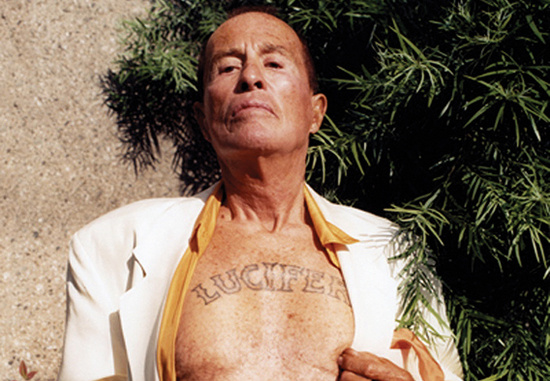
Kenneth Anglemeyer aka Kenneth Anger
Kenneth Anger made ‘experimental’ films such as the influential ‘Scorpio Rising’ the movie had a great influence on Andy when he turned to films in 1963. Scorpio Rising is a homosexual film about a gay primping to go out catting on his motorcycle in some Brando ‘Wild Ones’ setting. It is a silent film except for the girl group soundtrack of a dozen or so songs.
Anger would then insinuate himself into Jagger’s entourage as he tried to bring Jagger into his Satanic circle. Mick was supposed to write the sound track for an Anger film but didn’t produce causing Anger in revenge to claim the soundtrack was by Jagger then using some horrid static as a soundtrack. Anger would also con Jagger’s then girl friend, Marianne Faithfull, into appearing in what he considered his magnum opus Lucifer Rising. That movie was pretty much a waste which considering Anger’s other efforts is saying a great deal.
Nevertheless Anger influenced Jagger bringing Mick into the orbit of Satanic religion at least through the sixties. Satanic tropes also began to be marketed to the general public in the mid-sixties with dozens of Satanic movies released over the next decade. In much more than a symbolic way the birth of Satan, Lucifer rising, was for the modern age portrayed in the 1968 movie Rosemary’s Baby directed by the Jewish Roman Polansky based on the 1967 novel of the same name by the Jewish Ira Levin.
The movie purported to be filmed in New York’s legendary Dakota Apartment building, now condos. The movie would

The Magus- Aleister Crowley
make the Dakota a Mecca for Satanists in the upcoming years. John Lennon and Yoko Ono would acquire three apartments in the Dakota in the seventies including two on the seventh floor on which Rosemary’s Baby took place.
Ono herself was a devotee of the Black Arts (black doesn’t mean Negro in this context nor in the term Black Magic) so that her move into the apartment building may have had deep meaning to her.
The previous year, 1967, the Stones had released their record Their Satanic Majesties Request in which Mick introduces himself as Satan. The disc was released on the eighth of December just before the birth of the baby Jesus. This might have been coincidental or it might have been a Jewish joke. At any rate the heavily Fundamentalist US audience of ‘kids’ took it literally thus identifying the ‘bad boy’ Stones as Satanists. The record also set a tone for the next few years.
According to sources such as Marianne Faithfull Mick was not seriously into Satanism. She says that he was influenced by the Russian novel The Master And Margarita. That novel itself has a Wag The Dog quality. Wag The Dog was a 1997 movie in which a fake war has been reported by a compliant media for political reasons. However man proposes and God disposes. The scenario has to be regulary adapted to changing circumstances that often fail to occur as planned. A key point is when a song was faked, made to sound old, then inserted into the Congressional Library to be ‘discovered.’ The Master And Margarita has that quality.
Supposedly written by one Bulgakov, nearly a legend in his time but forgotten today, for whom a romantic biography has been concocted, he was too cautious to publish in his lifetime as he was already in disfavor with Stalin. The manuscript was placed in a drawer where it lay undiscovered until 1966. At that time it was discovered and not only rushed through the presses but this would be classic was considered such a phenomenal find that it was also rushed through a translation that was also published in 1966.
For some extraordinary reason a copy of this amusing but hardly earth shaking novel in which Satan comes to Moscow was also rushed to the hands of the singer in a rock and roll band, Mick Jagger. Mick not only received a copy but immediately sat down and read it. Thunderstruck, apparently, he, one supposes, in a blind daze dashed off the lyrics in time to include the then composed music into the new album: Their Satanic Majesties Request. The novel ain’t that good.
While Marianne may be correct the sequence of events seems contrived.
However his movie Performance of 1968 goes a long way in reinforcing the impression that he was somewhat into Satanism. So, within several months the Stones released their record, Jagger released his movie and Rosemary’s Baby appeared. These were dark years and growing darker and when ‘Satan’ appeared at Altamont the result was a foregone conclusion. It didn’t help subsequently when Mick mounted his giant inflated penis.
Nineteen sixty-eight and nine were tumultuous years in the record business as the industry moved from an entertainment backwater into a major billion dollar player. It was then that Mick and his fellow Stones realized that although their group was earning tens of millions of dollars very little of that money was coming their way. It could hardly escape them that while their ‘managers’ Eric Easton and Andrew Oldham showed evidence of big money they were still living hand to mouth. They sacked Oldham and Easton only to be tossed into the mouth of Leviathan, Allen Klein, by the departing Oldham.
Klein himself would manage to snag several major British groups including the two biggest, the Stones and the Beatles, any ogre’s dream. One imagines that he and his heirs have made hundreds of millions if not billions as a result of their thefts albeit conducted through legal methods.
It was not too long after the departure of Oldham and Easton that Jagger realized the monstrous trap that was Klein that Oldham had led the Stones into.
Actually the relationship of the goyish artists and their Jewish managers and record corporation execs is an interesting sociological and psychological study. I, of course, follow Freudian group theory from a Critical Theory perspective hence cannot be accused of anti-Semitism as Freud approached psychology from a scientific rather than a religious perspective himself being an atheist or so he said.
In Jewish thought they believe themselves to be Chosen of God hence occupying a position halfway between the godhead and humanity. As such they consider themselves as owners of the goyim or, in other words, human cattle. As the very Jewish Bob Dylan was to sing- Give me some milk or go home. Thus the Jewish personnel in the record industry consider the artists as something to be milked.
As with any cattle there are certain maintenance expenses that are unavoidable. It isn’t all profit. Thus of the billions milked from the British artists alone it is doubtful that the artists were allowed a penny on the dollar in compensation if that. The ‘milk’ obtained from the most fabulously successful act, the Beatles, is almost unbelievable. Both the Stones and the Beatles only amassed fortunes after they had freed themselves from their Jewish owners. Which is to say they buy their way out trailing mega dollars.
When Jagger realized the enormity of the criminality of Allen Klein he was desperate to escape his clutches. Interestingly he turned to, Prince Rupert Loewenstein, to free his group from the clutches of Klein.
When Klein took over the Stones from Oldham they were successful but not the icons they were fast becoming as the seventies neared. After freeing themselves from Klein the Stones went on to actually earn billions. Their concerts alone grossed over a billion dollars from 1971 to the present with another supposedly on the horizon that could possibly take in a quarter billion or more.
Now, it is nearly impossible for an artist to manage money period but money in the billions can only be managed by a competent financial staff. Rupert serves that function. I do note that when Jerry Hall was divorcing Mick she thought it prudent to check with Rupert to see if her money was still there. Apparently she was aware of the financial shenanigans of money managers. Historically they can’t be trusted. One never knows whether the money is there until one asks for the check.
However whether Klein or Loewenstein, the management, the control, virtually the possession of those billions is in the hands of others.
One can only imagine the fear, the panic, that gripped Mick’s mind when he realized that all his and the Stones efforts of ten years had changed hands without any compensation. One can only imagine the horror with which he received the news that he and his fellows were penniless. One probably cannot imagine Mick’s reaction as Allen Klein told him- tough shit, so sue me.
Sue him the Stones did but operators like Klein know how to stonewall court orders while using accounting methods to conceal tens or even hundreds of millions of dollars. The Stones sued for a mere seventeen million dollars while settling for bankruptcy returns of ten cents on the dollar. A little joke of Klein’s as he laughed merrily on the way to the bank. How much the Stones got of the settlement and how much their lawyers took has yet to be revealed.
He was fortunate to obtain the services of Rupert Loewenstein who bore the honorific title Prince. Rupert extricated the Stones from Klein while being associated with the City banking establishment of London and already managing the money of a couple dozen of the mega rich seems to have been a fortunate choice. Letting himself out to pasture in 2007, Rupert will release an account of his experiences with the Stones in a March 2013 memoir ‘A Prince Among Stones.’ Sounds promising but we’ll see. Place an advance order now and wait.

Andrew Loog Oldham
When Klein took over the Stones from Oldham they were very successful but not the icons they were becoming. After freeing themselves from Klein the Stones went on to actually earn billions. Never forget their are expenses, including Rupert. I don’t know what Rupert’s fees were, perhaps he’ll tell but I imagine the Stones have made him wealthier than he had been before.
Now, artists are artists who must pay attention to their art rather than their finances so a manager like Rupert is an essential. How trustworthy he actually was remains to be seen although no complaints from the Stones as yet.
Certainly Mick must have entered an extreme darkness of mind as he passed through the years from ‘67 to ‘71. Psychologically he had been emasculated by Easton, Oldham and Klein. One way to interpret his riding the inflatable penis could be as an attempt to regain the illusion of his manhood. One could also interpret his extreme effeminacy of this period as a result of his emasculation. Psychologically Klein had stolen his manhood along with his money. Not that Mick wasn’t always on the ambiguous side.
Mick’s association with Satanism then may have been prompted by his realization of just how evil life could be. Indeed in Manichean terms the flesh and world belong to Satan while God, the higher powers, deal in spirituality which is the rejection of Satan and his works I.e. money. Depending on what Mick was reading other than The Master And Margarita his mind may have been led to the conclusion that he was Rosemary’s Baby, that he was the Prince of Darkness. Certainly he seems to have realized the ambitions of Their Satanic Majesties Request and become a man of wealth and taste. Interestingly he seems able to move from the exquisite to clownish with the maximum of ease.

Prince Rupert Loewenstein
A Review: Larry Hosford’s New Release, Mometarily Yours
August 21, 2012
A Review:
Momentarily Yours
Larry Hosford’s New Release
By
R.E. Prindle

Here’s Larry
Larry Hosford has been singing and playing for the last fifty years giving him longevity to match that of the Rolling Stones and while he has a tremendous reputation on the Central Coast of California he’s not as well known outside his home territory. I hope to introduce him to a wider audience such as he deserves.
Larry was a war baby born in ‘43 in what was then the lettuce capitol of the United States- Salinas, California. Those unfamiliar with Larry’s extensive body of work will probably be unfamiliar with the Central Coast of California. The CC is a fairly extraordinary area not only of California but the world. Let me give my impression of the CC in the sixties when I was there as well as of Larry.
Salinas is the seat of Monterey County home to the fabled Monterey Rock Festival of ‘67 that Larry may have attended. Monterey lies due West of the better known central valley city of Fresno but on the West side of the very arid Coast Range of mountains. Wild, wild mountains. Today Salinas is a city of 150,000. Back in ‘60 when Larry began his career it was much smaller. The city lies athwart fabled Highway 101 with California Highway 1 a few more miles to the West.
You want to stay off Highway 1 unless you have time on your hands, a lot of patience and a full tank of gas. 1 is perhaps the dreariest and most isolated highway I have ever driven. I have absolutely no desire to drive it again. Forget The Graduate.
A few more miles down the road from Salinas is the town of Carmel that Clint Eastwood put on the map when he went political and became its mayor. Hi Clint.
In those days, 1964, I had a job with a mortgage banking firm for whom I covered the entire Northern half of California from Fresno/Salinas to the Oregon border. While the majority of the mortgages were in my home base of the San Francisco Bay Area I made the trip to what I called Monterey once a quarter.
At the time I lived in Larkspur in Marin County so it was a three hour drive, maybe four, down through San Jose and the town the Hell’s Angels trashed, Hollister, into Monterey. I was listening to Country at the time so my radio was tuned to an SF jock whose moniker was Black Jack Wayne. He was an odd duck Country announcer I could never get to used to but he was what was.
In addition to DJing Black Jack aspired to be a country singer. He had his own label which ensured that he was recorded, and a number of singles all of which, apparently, can be heard on the internet. Black Jack wasn’t deterred by a lack of success. At the time, just after the Beatles had landed, Larry would at one time be signed to George Harrison’s Dark Horse Records, Black Jack was pushing a young Buck Owens who he styled the Bouncing Beatle from Bakersfield.
After the Okie invasion of the thirties Bakersfield/Fresno became the West Coast center for hillbilly music. Nashville in the East, Bakersfield in the West. The area produced the great Ferlin Husky, Tommy Collins, Merle and Buck as well as the wonderful Rosie Maddox and her brothers. Rosie and Cal backed Black Jack up on a couple of his efforts- to no avail.

Black Jack Wayne
Black Jack and his brother Chuck used to have a Country place down in Niles, one of the five burgs that later formed Fremont, called The Garden Of Allah. Perhaps Larry played there. Rough place, good place to leave a few teeth in the parking lot.
Black Jack was a big hero down in Niles. I saw him leading the parade for the annual Essanay Days back in ‘59. Niles Canyon was the location they made the Bronco Billy western movies back in the silent era. Bronco’s company was Essanay.
So with Black Jack on the radio I planed down 101 at 85 per to Monterey. It was always fascinating country. Real wild west, just like Bronco Billy’s movies. You could imagine yourself coming up behind John Wayne’s Stagecoach trundling down the highway. It was a two laner at the time, probably four today, and almost empty on a week day. I was almost all alone out there. Sometimes my mind would plane along at 85 plus.
The mountains were just stunning. Following the Salinas River upstream on an exploratory venture the road stood a hundred feet or more above the stream, head watered down by the mission of San Luis Obispo. As it was Spring the river was flowing nicely above ground. Later in the year the river becomes what is called an intermittent stream, even if you can’t see the water it’s still flowing underground.

Salinas River
I got out to admire the scene when looking down I saw a man coming out of his house carrying a shot gun which he proceeded to point at me. The range wasn’t very good for a shot gun but the attitude was telling so I sauntered back to my car and returned to the valley. Discretion being the better part etc.
How very hostile I thought to myself.
Given my job the scene down in the valley was hardly less hostile, in fact, one might say threatening- bodily harm and all that sort of thing. With the imagined sound of a shot gun blast resonating in my ears I took these All American types more seriously.
I was walking a little lighter in my loafers but not for the reason you might imagine. Still, I found time to wander down to where the river braided through the sands. A beautiful sight that was. I hope Larry enjoyed it as he passed his childhood hours down on the South Coast among the refugees from civilization.
Things weren’t much better down in Clint’s future bailiwick. I was driving a white ‘63 Chevy that was a famous car among the deadbeats of the territory. I seemed to be recognized everywhere; when they saw the car coming the alert was sounded. Someone must have phoned down there to tell them I was on the way. While they wanted to beat me up in Salinas and even Monterey, another tough town, all the Carmelites, being more affluent, wanted to do was call the cops on me. A strange solution I thought when all they had to do was send the mortgage payment in. But I was in high learning mode; it was sort of like Poe’s story of Tarr and Fether in which the inmates had taken control of the asylum. Their’s was a different line of logic.
Larry was in good literary company in the area though. Henry Miller, the famous pornographer, lived around there; Jack Kerouac spent some time around the area bounding down the hillsides to the sea, even Joan Baez had a place there where she was entertaining her brother-in-law Richard Farina and Bob Dylan, even at that very time. Farina went off the road on his bike there ending his sojourn in the basement of life.
Oh yeah, and a few years back John Steinbeck had made his fame in the area. Pulling weeds out there in the lettuce patch he undoubtedly looked at all that lettuce, thought of the lettuce the lettuce growers were making from all that lettuce and wondered how he could turn that lettuce into lettuce for himself. Then as the unforgiving sun beat down on head he had a flash of inspiration, or perhaps sunstroke, and wrote East Of Eden about all that lettuce. When he wrote it up he had a best seller that did make him a lot of lettuce. Later East Of Eden became a very successful movie starring James Dean that kept the lettuce flowing in.

Those Old Lettuce Fields Back Home
Larry, of course wasn’t too interested in working the lettuce fields so he became a musician. That was somewhen about 1960 when he was seventeen. He didn’t have to study the situation and agonize over it; he just picked up his guitar and began to yodel. A great folk music scene was going on in Monterey as well as the rest of the country. It was a folk singing time folks, Harry Belafonte, Chad Mitchell Trio, Lonnie Donegan, Bud and Travis and let’s not forget the immortal Kingstons among a folk singing host. New Christy Minstrels, Jesus, let me tell ya’, all lustily singing This Land Is My Land, This Land Is Your Land. God bless that old folky Woody Guthrie, hey?
The Kingston Trio. Boy, there was a blow that would getcha. Who that was there wasn’t knocked silly by the great Kingston Trio In Concert disc? No wonder Larry wanted to try his hand at folk singing. Steinbeck’s Cannery Row had given up canning fish as that bank was overdrawn. Now it was trying to be a tourist attraction offering folk music. Very dismal looking place. Lotta heavy overcast on the coast at Monterey, most days the sun didn’t even come out. You have to cross that first ridge of hills to find the sunshine.

Kingston Trio
Folk music wasn’t that rewarding for Larry so passing through musical phases he found himself where he belonged, deep in Country music. That was where I first came across him in my own record store owner incarnation. The yo-yos at Shelter signed him and released his very fine record titled Larry Hosford aka Lorenzo. His mother must have called him that. Great songs- Long Line To Chicago, Everything’s Broken Down, memorable stuff. Never could figure out why a good lookin’ guy like Larry didn’t put his picture on the cover, a sine qua non for a first record. Everyone wants to know what the artist looks like. How else can you tell how good they are?
I tried hard to sell the record but with minimal success. And then in the hurry and rush of daily affairs I lost track of Larry until just this July when Adam Zerbe of Carmel’s 4th Avenue Records asked me to write review of Larry’s new record. I don’t know why me but, there you have it, Adam did. That’s it. Gosh, you know, when a guy’s first record tanks, as a record buyer you think the artist went back to house painting or something, like Arthur Brown did. But, no, fifty years later here’s Larry still strumming’ and singin’ with a new release. I couldn’t hardly believe he was still alive let alone myself. It’s not that the years aren’t stacking up. Both of us have a huge pile, I’m five ahead of Larry. I’ll give ‘em to him if he wants them.
Adam sent me a copy of the new release and I was surprised to find that Larry sounded as good as ever, maybe better. The years had added a mellow richness to his voice and a couple hard bounces after the first kick have given him a certain understanding of the true nature of life. I was, am, impressed.
It’s like the whole history of country music has been assimilated by Larry’s mind. It is like listening to everything that was ever good about Country rolled up into sixteen little pills. Pretty extraordinary.
I would have liked a little more of the Maddox Brothers and Rose in evidence but Larry leans more heavily to Texas music
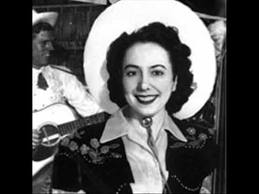
Rosie Maddox
and especially the Western Swing of the great Bob Wills and Texas Cowboys. You can hear a lot of Ernest Tubb and some of them other good old boys too. Larry’s voice encompasses them all while having its own distinct Country twang. A great country voice. If he keeps it up for another few years he’ll be the real Voice of America. I like the record, or CD. Used to be records but time moves on and you have to keep your canoe midstream to keep up. I’m tryin’ but I sure like the sound of Larry’s new record, er, CD. Buy a copy and make yourself feel good.
Mick Jagger, The Rolling Stones And The Yobbo Revolution
Part III
By
R.E. Prindle
Mick And Keith Come Face To Face With Nemesis
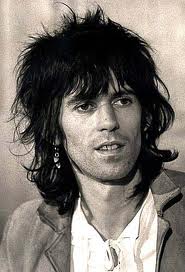
Keith Richards- Face Of The Stones
The sixties were very critical years for the various revolutions that made up The Revolution. Yet their activities were very disguised to prevent detection. At no time could they admit who they were or what they were doing. For Instance the takeover of the university system of the US that began at UC Berkeley in 1964 was disguised as some sort of ‘student protest’ over some supposed lack of or suppression of free speech, hence its name, The Free Speech Movement. While it appeared spontaneous it must have been a planned maneuver. I was at Cal State Hayward a couple of miles down the road. We had library privileges at UC that had one of the spectacular libraries of the world that I used so I was on campus when this noise was going down. It was quite professional, extremely well organized and no student revolt per se. The leaders were well instructed in the psychology of crowds. Something the ordinary person would never recognize. From UC it spread throughout the US intensifying in the years 1968-72.

Chairman Mao Ze Dong
Nineteen sixty-eight, of course, kicked off the worldwide Cultural Revolution orchestrated by Chairman Mao’s China. It was all organized from China. The Paris fiasco, everything even into remote corners such as the University of Oregon in Eugene was run from China. By 1968 I was a grad student at UOregon and in the poster and record business. Some crazed Chinese styled Communists from out on the rural route opened this Communist book store right next to my store. Needless to say police surveillance increased drastically as I was already under suspicion for selling posters and rock and roll music, literally the devil’s music in fundamentalist Eugene. As the whole world knew anyone in the record business was also dealing drugs whether they were or not and I wasn’t. And then the nutty SDS Jews from New York City flooded into town in their hip denims and abetted the Maoists. This increased the fun.
Wait a minute now, there’s more. Eldridge Cleaver and the loony revolutionaries in the Bay Area were conducting open
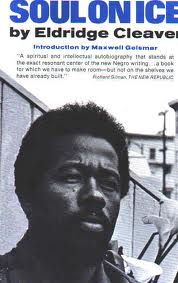
Eldridge Cleaver
warfare, guns and bombs you know, with the Feds and local police that naturally enough led to the arrest of such Negro revolutionists. But then, quite naturally, Eldridge escaped from maximum custody or something just like it and disappeared. No one knew where he was and they really wanted to. He didn’t surface for a few weeks so in the interim where did they look for him?
I hesitate to say this because I know you’re not going to believe it. They asked me if I had him hidden in my four hundred square foot record store. You see the logical progression, revolution= rock and roll= dope, Marxist store next door- where else is Eldridge going to hide, right? The store was an open square with a two by four enclosure for a toilet in the right corner. I pointed out to the cop that he was already looking at the entire store and he could see that there was no Eldridge Cleaver. But he wanted to check the 2×4 enclosure. I knew better than to laugh but I could barely contain myself. The cop opened the door to find himself staring into a toilet bowl. Eldridge cabled from Algeria shortly after.
I certainly was not aware of revolutionary activity per se or else I couldn’t take their stuff seriously but looking back things remained on red alert until at least ‘72. For the election of the second Nixon term, which I now see as serious potential danger, I saw them move several truckloads of Army troops out beyond Spencer’s Butte. One might say Mick Jagger and John Lennon, and I say this modestly in a local way, myself, had them worried.
I’ve always respected the intelligence agencies but placing me in the same category with Mick and John makes me have some doubts. I had no revolutionary or drug connections. It wasn’t that they couldn’t find them, as they thought, they didn’t exist.
There you have it, ‘68 was the crucial year. The authorities in both Europe and America were aware that something was going down. They were not taken by surprise. The Stones were.
They might have asked why are they busting us in ‘67 when they had plenty of cause for at least three years. Undoubtedly in an attempt to defuse the ‘68 show as much as possible. The direct action of the revolution failed so whatever counter revolutionary action the authorities took voided that while the revolutionaries themselves misgauged their popular support by a little more than somewhat. There were only a few fanatics backing them. The ‘kids’ were just not that dissatisfied. We were getting plenty of satisfaction.
According to Tony Sanchez/John Blake in their Up And Down With The Rolling Stones Mick fumed thusly after the ‘67 bust, p. 62:
I see a great deal of danger in the air. Teenagers are not screaming over pop music anymore, they’re screaming for much

Tony Sanchez
deeper reasons. Pop music is just the superficial issue….When I’m on that stage I sense that the teenagers are trying to communicate with me, like by telepathy, a message of some urgency. Not about me or our music, but about the world and the way they live. I interpret it as their demonstration against society and its sick attitude. Teenagers the world over are weary of being pushed around by half-assed politicians who attempt to dominate their way of thinking and set a code for their living…..This is a protest against the system. And I see a lot of trouble coming in the dawn.
I don’t know about Mick’s mental telecommunications but the message he was getting was maybe being scrambled by some alien force. Apart from some experts at crowd control and excitation there wasn’t that much interest in fighting in the streets.
Mick remained pugnacious personally, according to Sanchez/Blake:
They think they can break us, man, but no way. We’ll take everything that they can throw at us, and we’ll still win. We’re in a position to tell the kids about all the shit that’s going down, and that’s just what we’re going to do.
Mick was smoking some powerful stuff while taking the teaching of the London School Of Economics a little too seriously. He should have said ‘some kids’, by no means all the kids were concerned with the Stones while as the events in Chicago during the worldwide insurrection of ‘68 showed that concentrating on sex and drugs was not conducive to direct political action. ‘The kids’ made a poor showing. Besides which teenagers were only a part of the rock audience; most of us were at least over twenty.
Nor in ‘72 in Miami after much hoopla and the expenditure of large sums of John and Yoko’s money was there much of an insurrection. Keith in his auto of 2010 speaking of 1985 and 1972 had this to say about that on page one no less.
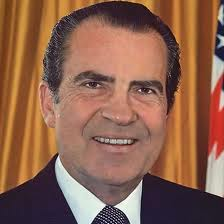
Every copper wanted to bust us by any means available, to get promoted and potentially rid America of these little fairy Englishmen. It was 1975, a time of brutality and confrontation. Open season on the Stones had been declared on our last tour [that of the inflatable penis], the tour of ‘72, known as the STP. The Department had noted riots (true), civil disobedience (also true), illicit sex, (whatever that is) and violence across the United States. All the fault of us, mere minstrels. We had been inciting youth to rebellion, we were corrupting America, and they ruled never to let us travel in the United States again. It had become, in the time of Nixon, a serious political matter. He had personally deployed his dogs and dirty tricks against John Lennon, who he thought might cost him an election. We…they told our lawyer officially, where the most dangerous rock-and-roll band in the world.
Richard Nixon
Kind of tells it like it was. I was in the record business, considered an arch liberal, and I thought the Stones were attempting to corrupt the US if not succeeding. I mean, you have only to look at the original picture inside their Black And Blue album to confirm that. The Stones, Lennon-Ono, Dylan, the outlaw groups like the Baader-Meinhoff gang, the Weathermen, the Red Brigades and their ilk saw the world through some drug induced mental haze in which the finest, most just, most democratic and widest opportunity society the world had ever seen and will see was just the opposite of repressive and undemocratic.
I mean, I had been pushed down hard in life, I come from the orphanage, and I still made a major success in the record business and that was against the wishes, not of the system, but the people, the shitheads, I had to deal with. Good god, you have to bully the bullies, elude their repression. It will never be any other way.
Whence came such a bizarre interpretation of reality. As the German politician in the movie, The Baader Meinhoff Complex thought, the insurrectionists were motivated by a myth. The Robin Hood Complex.
Yes, by a sense of materialistic frustration which they justified by the myth of Robin Hood. The problem was the same as the Negro insurrectionists in Watts. The range and quality of material goods increased on a daily basis continually out of reach. Yobbos like the Stones with no discernible abilities other than to write trite lines of lyrics and play hashed over music taken from nearly musically illiterate street corner Negro bands were realizing their material fantasies. What did they do in their rebellion in Watts? Break into stores and steal Tvs and stuff. Mere economic frustration. The Beatles were buying Rollers then desecrating them with psychedelic mockery. Richards himself driving without a legitimate license bought Rollers and smashed them up with glee laughing as he skipped away to avoid arrest. Keith was living the Yobbos dream. Baader-Meinhoff tried to replicate the dream by stealing Mercedes to go joy riding through the night. Same thing the Negroes were doing. That was what the revolution was about. To revel in cash money as the Stones, Beatles and other rockers did they robbed banks to ease their frustration. A leading hatred of the revolutionists was Consumerism. In other words there were more goods than they could come up with money to buy.
Then, as that would garner no sympathy from hardworking people who looked on the cynosure of their eye- the Mercedes and Rolls Royces being destroyed- with horror the gang claimed to be expropriating the expropriators a la Robin Hood and many another criminal but they bought no Thanksgiving dinner for the starving a la Pretty Boy Floyd.
Did the Stones believe the authorities so stupid that they didn’t know what was going on? Apparently so. Didn’t the Stones realize that they were merely taking advantage of the system the claimed to despise? Apparently not. The intelligence agencies infiltrated even the one man organizations of a nincompoop without a chance of success. I was invited to join one by agents in which the ‘mastermind’ was the only non-agency member. What are you supposed to think?
Who was this cocaine supplier to Keith, Freddie Sessler, if not a government agent? I’ll go into him later. Ask yourself, who can obtain unlimited quantities of sealed Merck cocaine containers if not government agents. Some believe that during the sixties the availability of LSD was provided by the CIA/FBI. There was so much LSD coming out of UC/Berkeley and Stanford programs that the whole Bay Area could have been supplied. Who was Owsley? Ask yourself.
The Agencies were funding programs by importing Indo-Chinese heroin also plentiful at that time. What was the result of plentiful Acid, Cocaine and Heroin? Incompetent malcontents. Work it over in your mind. Think about it. Electro-shock therapy? There’s a good one; scrambles your brain forever. Then add Acid and Heroin. Whoo-ee baby.
Anyway, the authorities knew what the Stones, Warhol, Lennon-Ono and the revolutionary crowd were up to. If the West had been the Soviet Union the whole lot would have been shivering the winter through out in the gulag instead of making millions riding giant inflated penises. Hello Mick, are you listening?

Andy Warhol
But, back to 1967 and the Redlands bust.
It is difficult to know exactly when Oldham and the Stones appeared on the authorities radar. A reasonable assumption would be perhaps sometime in late ‘64 or early ‘65. On the other hand Mick associated himself with David Bailey who probably was politically active since the late fifties who then drew Mick into a revolutionary circle including Andy Warhol in New York. Perhaps some sort of notice was taken at that time but probably of a cursory sort.
Why the Stones would have gotten a shot on the Ed Sullivan show isn’t all that clear to me; they had no reputation in the States at all. Or, for that matter why the Beatles got a shot. Nor why Dave Clark and all the early Invasion groups were hooplaed and accepted so readily as the next big thing by the Sullivan show. Obviously something was going on behind the scenes that we aren’t aware of.

Ed Sullivan
At any rate the Stones got their shot making a not overly favorable impression; definitely inferior to the Beatles although, as we were informed, top competitors of the Beatles over in England. Well, bully. Somebody must have figured out a money angle and it wasn’t in records. In ‘64 a top selling record was 250,000 copies or a million dollars retail. That was the definition of a million seller. And there weren’t a lot of those.
Even drugs were not yet that prominent although the use of grass had been spreading since the fifties. An elite clique in my high school in Michigan was covertly smoking it in 1956 imitating the kids in Scarsdale New York who were apparently leading the curve.
Pharmaceuticals and psychedelics were in use while I was in the Navy ‘56-’59 but not that widespread. Then in the ‘60s psychedelics came into fairly widespread use. I had no idea that amphetamines were practically universal in NY during the early and mid-sixties. LSD became a phenomenon early in the sixties with Leary given the most attention at his post at Harvard becoming the spokesman for turning on, tuning in and dropping out. One way streets were becoming ubiquitous at the time too. That phrase may have sounded the alarm for the authorities as multitudes actually did drop out becoming rather a useless burden on society. I can tell you, Haight-Ashbury wasn’t all that cool.
That ought to have been about ‘65-’66 when the revolution itself was gathering steam.
Mick, of course, was a political revolutionary committed to the cause while his lyrics are a negative portrayal of society if not a put down. Richards was soured on society at age 13 or so when his voice changed. He had been a boy soprano at his school where he and two others were so excellent that they won many prizes. In the process they were excused from certain classes. Then their voices changed and naturally enough they were given their walking papers.
At this point their award winning efforts were thrown back in their faces as they were demoted in grade to make up the classes from which they had been excused. The trio might have tutored to bring them up to speed but Keith felt that had been discarded like so much refuse. Society made itself an enemy who as time would prove would be able to wreak his vengeance with effect.
Keith accepted adoption by the revolutionaries as one being shown the inner sanctum of the Red Brigades of Italy and other revolutionary groups. So he and Mick were more or less of one mind.
Actually by even playing rock music in the fifties and sixties would be to know that he was infuriating the teacher class that had wronged him. Rock was the devil’s music. The notion that rock was part of the Communist conspiracy to corrupt youth was fairly widely believed, speaking of the US. Folk Music was held to be subversive and there is a fair amount of truth in both assertions.
Certainly the Reds didn’t invent Rock but they quickly took advantage of it to inculcate their doctrines.
After the assault on youth in the late fifties when even Dion of the Belmonts was toned down by Mitch Miller and Columbia, the ‘sweet Jewish rock ‘n’ roll of Carole King and Bob Crewe’ and the promotion of a series of bland ballad singers rock seemed to have been contained by the reaction. In Britain the pop scene had been managed so that only bright, pretty faces and perky personas were universal.
The Stones in a very rebellious revolutionary manner broke that mold. On their entry to the United States they struck people as somehow dirty, compared to the Beatles I suppose. They were actually more repulsive, although that might have been Oldham’s hype, although not so much so as The Animals who absolutely horrified the old guard so that it seemed like the scruffy and scruffier were seizing the youth. And of course even on their first Sullivan appearance you could easily see that Brian Jones was under the influence of something. So the Stones may have come under suspicion by the authorities sometime in 1964.
Before 1965 pot and drugs were still somewhat clandestine among youth but by 1965 and after especially with the surfacing of Haight-Ashbury at least pot and LSD were endemic. In very early ‘64 I used to know a guy who kept a bowl of LSD tabs on his living room table. Of course that was Berkeley. In those days acid was considered a sacrament or some kind of transcendental experience. While not that common the experienced walked around like they had been transformed from ordinary mortals into demi-gods. They wouldn’t talk to anyone who hadn’t dropped. It was quite a sight to see although I never indulged myself.
There was one golden moment of, oh, perhaps a half a second in 1966 when the essence of the ‘60s came and went. It was short and quick and even if you got it it was gone before you could grasp it, little golden shimmers filtered through your fingers and that was that. Sic transit gloria and away we went to Altamont. But I anticipate myself.
You’ve heard of the Generation Gap and that was real. Nineteen thirty-eight when I was born was the year of the lowest number of recorded births in some time. We weren’t as rare as hens teeth but even the war babies out numbered us and when they were born half the male population was overseas, so you figure it. Somebody was having a good time. Then in 1946, of course, when the men who survived began to return the population really began to boom, hence baby boomers. So, there was this gap between a huge youth and an older population. The old folks didn’t like us and, well, the relationship was difficult, kind of like between Martians and Earthmen.
The Stones had that jungle beat the old folks couldn’t tolerate. Shucks, the Stones hadn’t even heard real Negro music. All they knew was Motown and that Chicago shit blues music that no one in the US would even listen to. I owned a record store beginning in ‘67 and, let me tell ya, you couldn’t even give that stuff away and that includes Robert Johnson. Oh sure, some stumblebum blues aficionado would shuffle in to ask for Lightning Hopkins, Little Walter or something like that but when you stocked it they would only fondle it say something like I like knowing it’s here. To hell with those guys.
This was a university town and these fanatics would actually bring Lightning Hopkins, for instance, to town for a concert before twenty people in somebody’s living room. Those guys couldn’t play guitar and they couldn’t sing. Leadbelly! Spare me. Memorized Carl Sandburg’s American Song Bag. I never could figure it out.
Shoot! The Stones missed out on the real thing. They should have been in Oakland in ‘60 to ‘66 where I was. Boy, we had the real thing. The most godawful stuff you’d ever want to hear came blasting out of KDIA. White disc jockeys though. The Stones could have learned a lot.
The jungle beat might have garnered them some real attention.

Louis Malle
But then, under Andrew’s urging the Stones began to write and compose their own songs. These were often cruel sexual songs expressing the desire to oppress and hurt women or else mocking the older generation. Very strange, unsettling stuff at the time. Now everyone has been unsettled, can’t move them now. As Jagger and Richards, who wrote the songs, found their way in songwriting, the songs became ever more revolutionary while they meshed with a slew of revolutionary movies released during the mid-sixties on. These were often coded plans of action that an agitator provided with the key could decode for other revolutionaries and direct action. Such a key movie that was very influential for the Baader-Meinhoff gang and among German revolutionaries in general was Louis Malle’s Viva Maria. While on the surface a nonsensical even stupid movie when one has the key the movie becomes coherent indeed. Part of the Matriarchal Revolution for starters, but watch it.
Jean Luc Godard, another Nouvelle Vaguer also filmed the very propagandistic film One + One (reissued as Sympathy For The Devil) built around the Stones song of the same title. There was also a slew of satanic movies such Roman
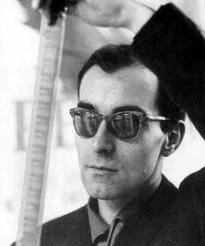
Jean-Luc Godard
Polansky’s Rosemary’s Baby that aimed at undermining Christian Beliefs. I Am Curious: Yellow that aimed at destroying female chastity. But more of that in the appropriate place.
So, by ‘67 the time of the bust the Stones were building up a dangerous reputation. Always remember that all of these outfits were infiltrated by espionage agents. And those guys were the ones bringing in the dope so how couldn’t the authorities know what drugs the Stones were using and in what quantities. Nice calling card, isn’t it: an unopened ounce of Merck cocaine?
At any rate they decided in 1967 to rein the Stones in a little bit. Shoot the old warning shot across the bow. Also remember that as much as the authorities wanted to suppress the Stones there were just as many Communists or revolutionaries in just as high places to thwart their efforts and actually place the Stones above the law. Their credo: To revolutionaries all things are permitted. Now, you figure it out.
In point of fact the older generation just couldn’t understand the youthful attitude. Everything was going along swimmingly as far as they were concerned. The war recovery was proceeding nicely while the economy seemed stabilized, no return of the Depression. That’s what really scared them and now the little creeps benefiting from this wanted to destroy it. Go figure. That high point of Western Civilization has been subverted today.
As far as the bust at Redlands the authorities were just giving the Stones a good razzing, a taste of what could happen if they were serious. In all likelihood they probably had no intention of making Jagger and Richards serve their sentences. Robert Fraser, the art dealer, arrested with them, was a different situation. He was a member of the establishment having held high military responsibility in Kenya possibly during the Mau Mau insurrection. Therefore he had no excuse whatsoever.
The Stones are quite right that it was a setup. The supposed dope dealer, the American Jew Schneiderman was quite obviously a CIA plant, hence his unlimited supply of pharmaceutical Acid.
Rees-Mogg’s editorial ‘Who Breaks A Butterfly On The Wheel’ was obviously an inside joke as well as well as an insult to the effeminate Jagger. One doesn’t take butterflies seriously hence they were calling Mick a little twit. Why bother with someone so inconsequential? Mick and Keith don’t seem to have understood this. Indeed, Mick, according to Tony Sanchez blubbered:
They think they can break us, man but no way. We’ll take everything they can throw at us, and we’ll still win. We’re in a position to tell the kids about all the shit that’s going down, and that’s just what we are going to do.
Well, bravo, Mick. But you might have been speaking from jail, a rather poor pulpit, had they chosen to put you there while you were not speaking for ‘the kids’ just the yobbos who weren’t going to do anything.
Then according to Sanchez/Blake Mick launches into a clairvoyant séance:
I see a great of danger in the air. Teenagers are not screaming over pop music anymore. We’re only serving as a means of giving them an outlet. Pop music is just a superficial issue…When I’m on that stage I sense that the teenagers are trying to communicate to me, like by telepathy, a message of some urgency. Not about me or our music but about the world and the way they live. I interpret it as their demonstration against society and its sick attitude…This is a protest against the system. And I see a lot of trouble coming in the dawn.
So did the authorities and they were taking measures if not to avert it at least to minimize it. I fail to see how the Paris imbroglio of 1968 took anyone by surprise. I mean, there was no organization not infiltrated by the intelligence agencies. The Chinese Cultural Revolution of which Paris and the rest was part, was directed from Beijing so the West’s intelligence agencies had to be well informed. But as the enemy was their own children they had to be sparing in the use of force. Even Chicago that would have been a great excuse to eliminate the proven troublemakers wasn’t used. Instead we ended up with the farce of the Chicago Eight trial.
They should have just dumped on them. No one was going to riot; those creeps didn’t have that much sympathy.
And then just to show Mick how little they thought of him they sent a helicopter to bring him to them for a little mocking chat. A helicopter: give me a break. Keith does have this to say about that in his autobiography Life of 2010:
The same day we were released the strangest TV discussion ever took place between Mick- flown in by helicopter to some English lawn- and representatives of the ruling establishment. They were like figures from Alice, chessmen: a bishop, a Jesuit, an attorney general and Rees-Mogg. They’d been sent out as a scouting party, waving a white flag, to discuss whether the new youth culture was a threat to the established order. Trying to bridge the unbridgeable gap between the generations. They were earnest and awkward, and it was ludicrous. Their questions amounted to: what do you want?….They were trying to make peace with us, like Chamberlin. Little bit of paper…Yet you know they’re carrying weight, they can bring down some heavy duty shit, so there was this underlying aggressiveness. In a way they were begging Mick for answers. I thought Mick came off pretty well. He didn’t attempt to answer them; he just said, you’re living in the past.
They flew Mick in a helicopter. It was a mocking importance and it came off that way. I saw the bit at the time and came to some different conclusions than Keith. Mick staggered out of the chopper and had to walk across a broad expanse of lawn as though a suppliant to the haughty waiting establishment, sort of like going to see the school principal. They awaited on the patio of a huge house. It was the back door and Mick wasn’t even invited into the kitchen: he was treated like a servant or better yet, a beggar. Butterfly indeed.
They were condescending enough to make your bones ache, Rees-Mogg, one of the establishment, included. They asked the spokesperson of the generation: What do the kids want? Mick flopped. He just stuttered. Keith may have thought he came off well but at my end of the tube I burst out laughing. As far as I was concerned Mick humiliated himself, but then, it was planned that way. All the power was on their side; Mick could really only stand like some penitent school boy and that’s pretty much what he did. Mick wasn’t and couldn’t have been prepared. The deck was stacked against him. But then he, in his turn, shouldn’t have blustered in the aftermath. I wonder if he had to walk home as the heli lifted off without him. That would have been the usual part of the trick; to leave the victim stranded.
In their own way the establishment succeeded in that they knocked the Jagger-Richards writing team off center. Or possibly the duo had exhausted their first momentum, much as Dylan had done and had to regroup as Dylan did. Keith acknowledged that they were dry after the bust. As he says the duo was able to find a new center that was just as successful, perhaps moreso, than the first.
The revolutions were still on and about to reach their first climax.

William Rees-Mogg 1967: An interesting article about the case:http://www.nickelinthemachine.com/2008/09/brixton-prison-and-mick-jagger/
Next: Leading to Altamont
Mick Jagger, The Rolling Stones And The Revolt Of The Yobbos
Part II
by
R.E. Prindle
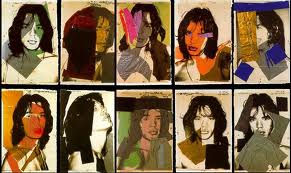
Warhol Jagger
Mick, Dave And Andy
If you had looked you wouldn’t have seen it but Sigmund Freud, or at least, his ghost was quietly at work transforming the psychology of Western Man. The old chivalric ideals of the Arthurian sagas was rapidly being replaced by the Jewish hopes and fears of Sigmund Freud and the Jewish people.
The Aryan ideal was based on an intense consciousness and objectivity while the Jewish understanding was unconscious and subjective. Aryans followed a concept of honor, Jews followed a concept of chutzpah. The transformation was understood if not clearly seen by the science fiction writers of the fifties. Stories subsequently made into movies such as The Blob, Invasion Of The Body Snatchers, book title: The Body Snatchers, and I Am Legend told the tale of the subversion of the conscious as people were portrayed as the living dead or zombies.

Warhol Jagger
With the way prepared then the next step was the free expression of subconscious desires undeterred by reflection and the subversion of men and women in sex. Freud proclaimed that the more frequently men ejaculated the better a person they would be, at the same time preaching the dangers of repressing those psychological ‘needs’ or desires to the exclusion of all others.
The Libertine element or Bohemians of society seized the opportunity while those yet imbued with Chivalric or Christian ideals held out while those ideals were slowly eroded replaced by Jewish ideals. Of course the Pill and drugs came along to push Freudian ideals into fast forward, a bunch of Charlie Chaplins rushing to the future.

Warhol Jagger
At the same time movies and TV began to glorify the expression of an undefined rage against Western ideals and justifications of its impression appeared regularly in ever more sadistic and uncontrolled expressions. Movies glorifying drug use and homosexuality appeared regularly. This enabled homosexuals, sadists and what have you to recognize and find each other thus being able to organize in associations. The Homosexual, Sexual and Yobbo, or Undermen, revolutions were thus able to more forward much more rapidly. One was able to discuss these aberrations as normal conversation, mere expressions of the varieties of sexual experience. Then in 1962 Anthony Burgess published the Yobbo bible, A Clockwork Orange, which in 1971 was made into the most despicable of movies.
The Yobbo bible apparently found a ready audience awaiting it. In New York, the Prince, even the King, of the Yobbos, Andy Warhol, teamed up with the London fashion photographer David Bailey to buy the screen rights from Burgess at bargain basement rates. They obviously saw the book’s potential for forwarding the revolutions on the screen for the corruption of Western youth. Bailey who must have been one the earliest jet setters having met Andy on an earlier occasion perhaps after Andy had introduced his soup cans unless Andy had been recognized as a leader of the revolutions before he had gained fame as an artist.
Warhol and Bailey were quick off the block obtaining the rights in either late ‘62 or early ‘63. Certainly a prescient move. As Andy was just beginning his switch from art to film while having no experience in film making Bailey’s collaboration seems as though it were a leap of faith. Perhaps if they met in ‘62 or even earlier he and Andy jabbered about the potential of movies while riding a white horse name Obetrol.
David Bailey who had risen rapidly in the late fifties at British Vogue is credited with being one of the originators of
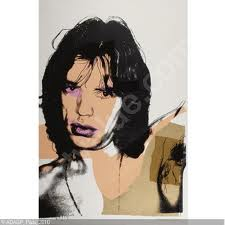
Warhol Jagger
Swinging London. What a knockout combination that was, had us all slavering at the mouth wishing we were part of it. Bailey even had his career commemorated in Antonioni’s film, Blow Up of 1966. A sensational film in its day though I find it difficult to see the significance today although still good mood and photography.
David had met Mick sometime in 1963 through his girl friend model Jean Shrimpton. Mick was dating Jean’s sister Chrissie who introduced him to Jean. Jean had no trouble spotting the Stones potential introducing David to Mick with the giddy news that he and the Stones were going to be bigger than the Beatles. Slightly enthusiastic; the Stones were going to be big but not bigger. Nothing really approaches the impact of the Beatles. The dead Lennon is either a god or nearly one while none of the Stones will reach that status.
David and Mick bonded immediately becoming in David’s word, mates. David was five years older than Mick and already successful so that must have enhanced his appeal to Mick. As David looked at Mick and saw the Stones play he apparently said to himself; These are the yobbos I need for my movie, droogs if I ever saw them. He and Mick boarded a big 707 jetliner, one assumes, in mid to late ’63 to be introduced to co-owner of the movie rights of the intellectual property as the star of the semi-porn flick, at least as it would be filmed in 1971.

David Bailey- Fashion Photographer
This was a fateful connection for Mick and the Stones. Now, Mick had been attending the London School of Economics, LSE, during ‘62 and ‘63 only leaving university in late ‘63 when he believed the Stones were going to make it. It is hard to believe that he would give up school for the ephemeral success of England- two good years and out, replaced by the next pretty face. Perhaps Bailey and Warhol were already planning the exploitation of the record industry as a propaganda tool. Certainly Bailey was conscious of the trans-Atlantic connection between British and American Vogue. For guys on the qui vive it wouldn’t be much of a leap to imagine trans-Atlantic musicians, after all, the Englishman (Scot, I know) Lonnie Donnegan had already had a few hits, including a monster, The Rock Island Line, in America. If, in their discussion Mick could have seen the potential, leaving university would be a bet on a bigger and more glorious future.
Some think Bailey and Warhol would have made the movie but ALO placed the price of the Stone’s too high. As Oldham was as keen on Clockwork Orange as anyone that doesn’t necessarily ring true. There must have been other reasons.
Nor was Mick studying bookkeeping at LSE as often represented. The school was established by the Fabian socialist Webbs c. 1900 and was a Communist training ground. Mick did have a scholarship which means he must have been vetted as good future material. Although LSE does have an accounting department Mick was enrolled in political science with the intention of being a Communist politician. So, Mick, David and Andy were to follow a revolutionary agenda pushing the envelope in sex and unruliness. The emerging drug scene promoted both aspects and added a new one.
Shortly after Mick returned home the Beatles burst upon the scene from the Ed Sullivan show in February of ‘64. This was the avant garde of the British Invasion opening up fabulous new vistas for the yobbos of small insular England. For whatever reason the Beatles were an immediate sensation. I’ve got a very good ear but I couldn’t hear it then and I still can’t. The Stones, not really that big a deal yet, followed shortly after gaining full national exposure on Sullivan’s show. Young America was watching. Regardless of the opinion of Stones’ fans they didn’t cut it. There didn’t seem to be much there other than the hype. Mick couldn’t sing while having a very weird appearance. All eyes were on the magnetism of Brian Jones, looking right past Mick. You can see him noticing where the attention was going and looking over at Brian as though to say: But I’m the singer and should be the center of attention. Perhaps Brian’s fate was sealed at that moment. Certainly if he had been brought up front, as all four Beatles had been, there might have been more interest.
No matter, the first tour may have been a bummer but the conquest was still quick enough. The Stones were after all British. Gold, at the moment.
In any event Warhol and Jagger became fast friends. A friendship that was to endure to Andy’s death in 1987. By the time the Stones had gotten settled in Andy had been shot in 1968 actually killing him but the doctors brought him back.
The early endorsement of Warhol had cemented the relationship of the Stones with the yobbos of Bohemia. In ‘63-64 Warhol was only just getting the Factory, the clubhouse of homosexual drug addicted Yobbos, going but that gang would have spread the word effectively in Manhattan club land.
I’m sure Mick’s sexual ambiguity, bi-sexuality, or whatever you wanted to call it kept the enormous homosexual population of Greenwich Village Bohemia in his corner. After Andy’s recovery in 1969-70 the relationship between the two men developed.

Andy Warhol
To quote the website
http://www.montauklife.com/history/hist-main2.htm :
Mick Jagger was painted [by Warhol] while he was at the height of fame. Andy and Jagger first met in 1963. Warhol spent a lot of time with Jagger and his wife, Bianca, but claimed he was the closest to their daughter Jade, whom Andy remembers teaching to paint. Over the years the artistically inclined Jagger kept tabs on the musically inclined Warhol. Mick was such an admirer, that in 1972 when the Stones formed their own record company, they tapped Andy to design their logo.
Montauk is the easternmost town at the end of Long Island. Andy and Paul Morrisey had bought a twenty acre compound there that they rented out. In 1975 they would rent it to the Stones for 5K a month while they were making Black and Blue.
In the meantime the Stones expanded their list of celebrity acquaintances on their 1972 Exile On Main Street tour. Needless to say these celebrities were all related to Warhol and the Bohemian scene. This included meeting the Warholite photographer Peter Beard who directed the Stones to Montauk. The linked Montauk site is worth reading.

Clockwork Orange Poster
All right. A Clockwork Orange was released in 1971 with devastating results. Just previously in 1969 the Homosexual Revolution had succeeded in escaping the restraints of New York City laws with the Stonewall Riots leading to the golden age of homosexuality before AIDS hit. The Stonewall Inn was on Christopher Street in the Village, the very heart of the Homosexual Revolution and Warhol’s empire. This led to an increase in the corruption of society. Following on the heels of the Riots perhaps encouraged by them the effects of A Clockwork Orange were much greater than The Blackboard Jungle and Rebel Without A Cause of the mid-fifties.
There were serious consequences not least of which was a sado-masochistic tone to the Stones as exhibited in their Black And Blue release of 1975. It is hard to believe that this record didn’t reflect Andy’s sado-masochistic influence. The inside cover depicting a bound woman being brutalized, the title Black and Blue seeming to indicate the bruises she was getting from the beating caused a major uproar, especially amongst Lesbian groups, resulting in the photo’s being withdrawn to be replaced by a group shot. Warhol and Mick were in sync.
In addition to providing the Stones’ logo Andy also designed three record covers for them which advanced the homosexual sadistic agenda. The first was the blatantly homo Sticky Fingers. The title was interpreted to mean the result of beating off while the cover has the famous zippered jeans with the working zipper.
The second cover was Love You Live with its double entendre of cannibalism. The third, Emotional Tattoo, a bootleg, featured Mick on the cover of 1983.
In 1975 showing Andy’s great admiration or love or Mick he made a portfolio of large 42 x29 inch prints reproduced in this article.

During this whole period of the seventies Mick’s wife Bianca was the reigning queen of the Warhol/Halston entourage. While Mick promoted satanic sex riding an enormous inflated penis on the stage he was somewhat more puritan with his wife off stage. He found Bianca’s sexual behavior in the Warhol entourage so humiliating that he was forced to divorce her. One can say that he was patient with her past the endurance of most guys.
But Andy and Mick remained good friends. In 1987 when Andy took the one way barge trip to a new life Mick was the only celebrity friend who took the time to attend Andy’s funeral in Pittsburgh. Thus ended probably one of the most significant friendships of our time.
By the time Andy died they and one presumes, David Bailey, had been more successful in achieving their goals than they might have hoped. Of course Sigmund Freud gave them more than a leg up.
Next: Nemesis Catches Up With The Stones.
Part I, Mick Jagger, The Rolling Stones And The Sixties
July 19, 2012
Part I
Mick Jagger, The Rolling Stones And The Sixties
by
R.E. Prindle

Andrew Look Oldham Learning The Ropes
The Sixth Rolling Stone
I’m in the James Dean suite, better known as two shoe boxes at the back of the Hotel Iroquois on West 44th Street in Manhattan and life has definitely lost its color.
You try for a few things to forget that he who is not busy being born is busy dying, to block out the thought of yourself as a wingless, hurt, spineless bird of the 60s.
Another grey-line- they’re not even white anymore- another grappa or Southern-anything-without-Comfort can bring you back for a few minutes but it’s not a given. Occasionally you get up from the couch and have to check yourself out in the mirror above the fireplace to make sure you are still there, and that’s an effort.
One could say that when life becomes too painful, the body sickens and withers and the soul departs.
–Andrew Loog Oldham, Stoned, 1995
Andrew Loog Oldham was the promoter, the guiding light, who led the five lads comprising the Rolling Stones from a squalid existence to the top of revolutionary society. As he wrote the above quote from Vol. 1 of his excellent two volume autobiography, Stoned, he viewed his past from the perspective of drug induced oblivion. It hadn’t always been that way.
Andrew had been present at the creation of that part of the Revolution known as the British Invasion in the history of Rock and Roll. He had in fact been one of its principal guides.
But, as even the most obscure molecule has its origins in a more distant past a background of the macro cosmos leading to the micro-cosmos Andrew Oldham might provide some insights.
The actual starting point of what became Andrew Loog Oldham is, oh, say, 1789 and the French Revolution of which, of course the future molecule of Andrew had no part. Let us skip lightly over the intervening hundred years or so to the defining moment of our own existence, the years after 1900.
Of supreme importance is the career of that master demolition artist, Sigmund Freud, but we’re just going to be dealing with conclusions not origins or development. Nevertheless Freud began his assault on Western consciousness in 1900 with his Interpretation Of Dreams- the excavations of the unconscious and demolition of the conscious. We will bear this is mind because Freud’s vision of psychology is important.
The stately self-confidence of the Victorian Age was destroyed by the horrors of what at that time was known as The Great War, the term WWI evolving only after twenty-five years or so later. WWII gave that previous war its modern nomenclature.
Thus 1914 commenced a hundred years war in which WWII, the Korean War, The Viet Nam War and the Communist subversion of US institutions was done reaching a culmination under a world wide Communist government led by China with Barack Obama as its king, emperor or dictator.
The First World War destroyed the flower of Western manhood, compounded by the destruction of European manhoodof the succeeding WWII the loss was not reparable up to our time. While the ‘Pacifists’, the physically weak and mental imbeciles remained at home with the elderly and women the best and bravest were sent on an unproductive suicide mission. As the undrafted at least were the patriotic and nationalists that also left the international Communists at home to assume positions of real power- the directors of the war, that is, the beneficiaries of the slaughter.
After the War the Third International interfered in the internal affairs of the nations nourished by the West’s absurd notion of democracy setting up power points in Western capitols that resulted in Popular Front qua Communist governments in all Western States with the exception of the Axis powers who nevertheless adopted socialist administrations.
In the meantime the soldiers returned after the war in various stages of shell shock or mental discomfort of some kind to try to put their lives in order without any assistance from the State that put them in harm’s way in the charnel house. They were greeted on their return by enormous social disorganization caused by the Communists who for instance led the general strike of 1929 in Great Britain and in general caused a conflict between two different economic or essentially religious approaches.
The General Strike was followed by the world wide economic depression that lasted until the religious war of 1939-45 between Communism and Rationality. The former was led by the USSR and Stalin while the latter was led by Hitler, his Germany and the Axis. The result was a forgone conclusion as both the US and USSR were united against a pitifully weak German and Axis Powers.
In this second major incident of the Hundred Years War Britain was all but demolished. She was the big loser. As the incident ended in 1945 London was all put a pile of rubble. From the rubble came the second phase of the Rock and Roll generations.
Since the discussion is centered around the Rolling Stones , Bill Wyman the eldest of the group was born in 1935 thereby having definite memories of the bombing. Charlie Watts, Jagger, Richards and Jones came along in ‘42 and ‘43. The genius who promoted the group, Andrew Loog Oldham, was born in 1944 a couple years earlier than the baby boomers, remaining a part of the war babies.
London from the end of the incident to 1960 and even beyond retained evidence of the bombing. The devastation was nearly terminal.
Replacing English manhood on the front during the war years were millions of US soldiers, sailors and airmen. Thus the women were not necessarily without men. Most such relations did not lead to stable commitments resulting in many illegitimate children. Yet many American men wed their English girlfriends returning them to the US. In my boyhood I knew or knew of several English war brides, so there must have thousands or tens of thousands of them. This may to some extent have relieved the disparity between the abundance of women and the paucity of men, balancing society somewhat.
As it turned out the fulcrum of the Stones, Andrew Loog Oldham, was one of those unfortunate bastards. Even though his mother took his father’s name his status affected the development of his character.
Rationing of essentials continued until 1953 so that Wyman fully experienced the deprivation while the others endured some of it, Oldham the least. Let’s say that they all had less than cheery childhoods while those of us of the same age cohort in the US while having reduced comforts, which were scarcely noticeable to me if at all, knew little deprivation saving that there were few men around. Richards’ felt the rationing of candy rather intensely while I, in the US, could spend whatever little money I had on candy and you can bet I did. Loved candy and ice cream then and love them now.
II.

ALO Somewhere In Space And Time
We’ll begin then with Andrew Loog Oldham as he knew how to take some self-absorbed nearly amateur musicians with a group identity and market them not only to England but the US and ultimately, the world. The Stones were among the first global bands.
Coming from a world scarred by war and a son of an unwed mother who next formed a long standing relationship with a married man who did treat Andrew well the boy still developed a psychosis. Caught up in the glamour he tried to make his way from age seventeen. He was part of the first generation that had difficulties separating movies from real life. Andrew saw a lot of them taking them as education developing his persona from them. Two influential movies and characters around which he formed the core of his persona he mentions frequently. Expresso Bongo, a not bad rock and roll vehicle for Cliff Richards, contributed the character Johnny Jackson very convincingly played by Laurence Harvey. Jackson was essentially a street hustler who overplayed his hand as Andrew himself would do.
Laurence Harvey as Johnny Jackson
A second personality forming movie was the grim, even repulsive The Sweet Smell Of Success starring Burt Lancaster and Tony Curtis and based on the life of the reptile journalist Walter Winchell. Once again a couple characters who overplayed their hand ending in disaster.
Tony Curtis, Burt Lancaster In Sweet Smell Of Success
Andrew took flings around the incipient glamour industries that would form Swinging England including Mary Quant and others before settling on the truly surface glamour of the recording industry.
He introduced himself to Brian Epstein becoming a publicist for the Beatles. There could have been no premonition of the phenomenal success of the Beatles leading to the British Invasion. The Beatles success itself remains a mystery to me. I can guess who engineered the situation but I can’t explain its success. Certainly when Andrew heard of the Rolling Stones in 1963 before the Beatles’ success in the US he could only have been thinking of conquering England.
At the time Andrew found them the Stones were building a reputation as a stage band, but small. Appearing in Rochester they performed before only thirty people, which swelled to sixty shortly, hardly enough to build an empire on, yet it worked. When he saw this very small situation he realized he had the chance of a lifetime; a seize it or lose it situation. Andrew was definitely a visionary of no mean farsightedness. His problem was that he was underage unable to legally act on his own. He was forced to include an old line manager to front for him named Eric Easton. Formed in a small time England Easton hadn’t the imagination to take the Stones global while Andrew did.
Andrew then had to bide his time until he was twenty-one and able to act in his own name. This was dangerous because artist management was and is basically dishonest and Easton was of the cloth, but we will get into that later when we discuss the concept of intellectual properties.
For the time being Andrew guided the Stones to Easton.
III.
The Rolling Stones

Brian Jones
As I say, the Stones, with the exception of Bill Wyman, were of the second generation of rockers being War Babies. They, then, experienced the bombed over London of the forties along with food rationing that lasted until 1953-54. According to Richards the lifting of the candy ration was the battle cry of freedom for British youth. One wonders why some astute entrepreneur didn’t smuggle in some M & Ms or Mars Bars from the US. Lord knows we never suffered from sugar deprivation.
Nevertheless the older age cohorts brought Dixieland music called Trad Jazz in England to the fore in the post war years
Charlie Watts
while the War Babies progressed to Negro R&B and straight Blues which the first rockers had already converted to rock and roll in the US mid-fifties. At the same time Jazz had a following so that the whole of British music after 1960 or so was derived from American Negro depression music. At the line goes: The Blues ain’t nothing’ but a good man feelin’ bad, that is to say, depressed.
So the trajectory was the first group of British musicians picked up on Dixieland or Trad which is pretty much the music of depressed people trying to convince themselves they are joyous, a sort of Singing In The Rain spirit, correlating with the spirit of the immediate post-war generation. Dixieland, originating in the old French colony of New Orleans then was Negro music that tried to lift depressed spirits. It was only natural, so to speak, that a totally depressed post-war English generation would find Trad so emotionally satisfying.
In the fifties, Rock and Roll music evolved in the US based on Country music, or White blues, and certain Negro Blues influences. However the White American experience with Negroes and Negro music had been integrated into White consciousness while Negritude was rejected. It should be remembered that the cowboy singer Gene Autry not infrequently sang blues based material.
The spirit of Blues is much different than the spirit of Dixieland. R&B livened the spirits of the War Babies while still
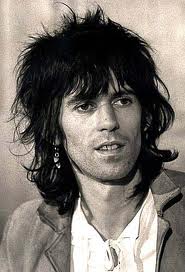
Keith Richards
being depressed but cheered and encouraged by increasing prosperity the moved up the evolution of US Negro music from Dixieland to R&B. Thus a crossing or melding of Aryan and Negro sentiments with a heavy reverence for African culture. ‘Drop down mama, and spread yo’ legs, I’s comin’ fo’ ya and I don’t begs…’ Wonderful Lenny Bruce style stuff, that.
The R&B strain began to emerge then about 1960. Jagger, Jones, Richards were all R&B crusaders from post-puberty. Wyman came from a pop R&R background while Watts came from a Jazz backdrop. Ian Stewart was a solid Boogie Woogie pianist. Although dropped from the line up he contributed significantly to the band musically.
Of the group, including Oldham, the only member with a political consciousness and agenda was Mick Jagger. The others were either yobbos or living close to the line. It would be Jagger who gave the political direction to the group. Mick obtained a scholarship to the Communist London School of Economics where he assumed a Communist stance that he carried over to his lyrics and posturing in the Stones. He tempered his enthusiasm after 1970 as he says for ‘pragmatic’ reasons. Richards while not appearing political aided and abetted Jagger’s approach because of resentment against the ‘system’, in other words, a rebel with cause enough.

Bill Wyman
Part IV
Going With The Flow
Bob Crewe
The music business was a fairly tight knit community fully under Jewish control. The financial engine that drove it was the body of intellectual property, songs, which was known as publishing. Publishing includes all royalties whether from sheet music, recording or media play. The money from media play, mainly radio and television is collected by ASCAP and BMI. Both publishing and media are firmly under Jewish control. Aryan artists then, like it or not, always work for Jews entirely, under contract they are essentially slaves with their earnings kept ‘in trust’ by their masters, doled out on an as need basis. The absurdity of these ‘legal’ contracts is shown by the clause in the Stones contract with Allen Klein in which he wasn’t required to even pay out recording advances for twenty years after receipt. How such a clause could be supported by the courts is beyond me. But, on that later.
Now, intellectual properties are the easiest property to steal. Quite frequently the artists don’t or didn’t even know what they were or how valuable they were. Jac Holzman of Elektra records just assigned the Doors rights to himself. Klein in some manner did the same with Jagger-Richards’ intellectual properties and he or his estate still owns them. And the law allows this.
Frequently a portion of the royalties are assigned to another entity with or without the knowledge of the writers. Then a situation arose as a result ot technology that was unforeseen and had immeasurable consequences.
Until the mid-fifties, that is from c. 1930 to 1954 radio had been a melange of programs with very few minutes a day devoted to music programming, especially of the popular sort which intellectuals have always despised. Then TV, introduced commercially after the war knocked the legs from under syndicated radio programs. For a moment it was believed that radio itself would go bankrupt. However, we teens of the era were clamoring for more popular music on the radio. It was believed that all music radio couldn’t succeed but this notion was speedily proven wrong.
We wanted to hear our records and wanted to hear the same songs and we wanted to hear them often. This led to the innovation of Top 40 radio that seldom was more than the Top Ten with new introductions. We demanded that smash hits like Lonnie Donnegan’s Rock Island Line be played once every quarter hour. This would go on for a week or two until a new hit came along. I once manipulated the dial to get seven consecutive plays of Rock Island Line before I lost my rhythm. Now, multiply 2 ½ cents a play by several tens of millions and you’ve got yourself some pocket change.
Of course a record had to be introduced or ‘broken’ as they said. The key break out markets were New York City and Los Angeles with Chicago a distant third. By the time you got those three markets behind a record every other station in the country fell in line. You had a hit. The process usually took about six months to penetrate all markets. So the top DJs in those three markets had to be serviced. You can imagine the competition for those DJ jobs. Produced some remarkable disc spinners. To listen to the radio back then was to participate in a non-stop party 24/7.
As a national break out center all at one time TV came along. Ed Sullivan could introduce the entire nation to such as Elvis Presley or the Beatles or Stones in one three minute segment. Bravo! Ed more or less led to American Bandstand fronted by the eternal teenager, now gone to his eternal rest, Dick Clark. Clark became the most powerful DJ in the history of the world. But…you had to get your record and artist on his show.
The men responsible for getting records played were called song pluggers. This was a time honored practice going back to before the electronic media to hard copy sheet music. No one had found fault with the practice of offering incentives to play records up to this point.
But now Dick Clark and American Bandstand. The incentive that would get you artist’s appearance and record played on

Dick Clark
Bandstand was a piece of the ‘action’ also called publishing. If Clark played your song, and it had to be a good one, presto! There were millions of plays on radio the very next day or sooner at 2 ½ cents a play and with luck a million sales of the 45. I think the moral is clear here. If Clark were allowed to go on collecting pieces of intellectual properties, or copyrights, within a decade or so he might be worth many times the value of Tin Pan Alley and the Brill Building put together. Now, here’s the rub…Dick Clark wasn’t Jewish.
The word from the Alley was stop Dick Clark. But how?
Well, Clark wasn’t doing anything that hadn’t been kosher from time immemorial so the only thing to do was to make the ancient practice of song plugging sound immoral; hence the name of song plugging was changed to the morally reprehensible sounding label- PAYOLA. Well, so what? So pressure was put on Congress, this became a Federal case, to investigate Dick Clark and to make it ecumenical, certain important DJs like Allen Freed, who was Jewish but not of the synagogue, and make payola if not a crime at least something that certain people were prohibited from doing.
Alan Freed, the poor fish, was totally destroyed, his life ending shortly after his condemnation. Clark, so as not to seem unfair, especially as no known crime had been violated was offered the choice of keeping Bandstand or the publishing of the songs he had already accumulated. Dick chose Bandstand although he later said that was a mistake. Tin Pan Alley was safe for a time as its power was returned to it. Once again they could control what was played and who could and could not succeed.
Now, enter Andrew Loog Oldham and The Rolling Stones.
Bob Dylan in one of his fits of delusions of grandeur claims that he was the man who brought the giant Tin Pan Alley to earth. There is no denying he made his contribution but Oldham gives greater credit to the Beatles which is probably true. By 1964 the time of the following story of Andrew’s the demise of the Alley hadn’t yet happened. This is a great story.
This story involves two people with whom the reader may or may not be familiar. One is a DJ, powerful in the business, and the other was a very powerful member of both the Gay and Jewish mafias, capable of making or breaking any aspirant to recording fame and a fixture of the Tin Pan Alley/Brill Building who most likely had a hand, if not the guiding hand, in stripping Dick Clark of his looming power over the Alley. Murray Kaufman- Murray the K- was the former and Bob Crewe was the latter.
Both of these gentlemen were Jewish, as indeed most similar positions in the music business are, hence wishing to continue Jewish control over artists and repertoire – A&R in the business.
Clark’s assault on Alley dominance was just the opening volley. The years ’60- ’64 were quiescent perhaps giving false assurance of victory to the Alley. The next assault on the Alley was to begin, or was already in its birth throes about 1964 when the Beatles who wrote their own songs and published them dominated the airwaves hurt the Alley worse than Dick Clark. Remember at the Beatles’ peak four or five of the Top Ten were Beatles songs. Assuming those songs were played twice an hour at three minutes each 8 x 3 equals 24 minutes of non-Alley credits allowing for ads that means the Alley was virtually shut out of AM radio thus earning severely reduced royalties.
An assault requires a counter assault so any vulnerabilities in the Beatles armor had to be sought out. Brian Epstein, the Beatles’ manager was Jewish, indeed the Beatles would be surrounded by Jews siphoning off their riches, but I don’t think Epstein was a member of the synagogue while being quite protective of what was his. So, Epstein was in the way. He conveniently committed suicide, as… who knows: At this point the entire
Beatles empire was up for grabs while the Beatles themselves had never been involved in the business aspects of their success and had no idea what to do. Who stepped in to turn their money green but two Jewish characters, Allen Klein and Leonard Epstein to divvy it up. Leonard Epstein went by the nom de guerre of Lee Eastman, Linda’s father. So, in the end the Jews got it back from the Beatles.
Another big factor in the demise of the Alley was the self-confessed assassin, Bob Dylan. Dylan claims full credit for the demise of the Alley but he exaggerates. His stuff which defies description as much as his hero’s, Little Richard, was certainly not acceptable to the Alley. His application being rejected, Bobby, one assumes, swore revenge. His major contribution was that his success encouraged the success of the singer-songwriters who were not of the Alley and a great many not of the Faith thus removing precious minutes of play time if not hours which obviated the need for roomsful of writers in the Alley putting them out of work. Carole King had to make her own records becoming a singer-songwriter.
By the time of Andrew’s story one imagines that the perceptive Bob Crewe was aware of the developing problem, at least from the incipient British Invasion. While I have always been familiar with the name of Bob Crewe it had little meaning to me. I thought he was just an arranger of orchestral versions of rock songs; in other words, cashing in. As Andrew explains he was a major songwriter of the fifties and sixties. Sixty to sixty-four are considered very fallow years in R&R and this period is when Crewe shown. Indeed, the music of the period so disgusted me that I refused to listen to Top 40 spending my time on the Country end of the dial. The period was the end of the Golden Age of Country. Well, what doesn’t die moves on.
It turns out that Crewe wrote all of that falsetto crap of Frankie Valli and the Four Seasons with all its homosexual double entendres: Walk Like A Man, (Talk Like A Girl), my son.
Murray the K was one of the most important DJs in an age when DJs walked with the gods. He originally fastened himself on the Beatles like a barnacle on the bottom side of a ship, calling himself the Fifth Beatle. As Andrew says in this story he is attempting the same hoping to become the Sixth Rolling Stone. Murray went around in fifths and sixths.
Andrew’s description of Crewe’s digs at the Dakota Apartments in front of which John Lennon would be shot sixteen years later:
We grabbed some hasty victuals from the hot dog stand on the corner of Fifth, then cabbed west across the park and back into our own Holly Golightly world to attend a Bob Crewe party in our honor. The yellow stretch cab wheeled out of the park at 72nd across Central park West and let us out at the austere and majestic granite entrance to the Dakota. Three short 60s-filled years later, the building would become famous for housing Roman Polansky’s Rosemary’s Baby. Sixteen years on, it would become the site of the killing of John Lennon. Keith and I asked for ‘Bob Crewe, please.’ The rest of the Stones were already there. Bob’s apartment was a film set, all ornate and Roman gay splendour over the park – marbled floors, bronzed Ma Bell’s, African motif zebra and leopard throw rugs, and enough brocade tassel and gilt to assure you that you weren’t visiting John Huston. The living room was sunk down to a waist-high setting with an aqua-Nero motif, complete with statues of nubile youth that gushed water. Bob Crewe was Doris Day, if Doris Day had been all man and stayed gorgeous. Leonard Bernstein chatted with actor/neighbor Robert Ryan who asked Mick if he knew Terence Stamp who he’d worked with two years before in Billy Budd. Mick didn’t or wouldn’t. Lenny B. and Ryan turned away from Jagger and resumed discussing elevator problems at the Dakota. Bob Crewe was above it all and flying.
So you see what royalties and a few intellectual properties are worth. You could kill for them, at the very least, steal them. You can see what became available of the Beatles when Epstein committed ‘suicide’ and the value of the Jagger-Richards properties that Klein, Easton and Oldham- all Jews- stole. As mere artists the Stones are actually inconsequential, they are the mere raw material, the gold mine, to be exploited by the prospectors of pop. Thus Crewe’s confederate Murray the K cornered the key figure in the Stone’s organization, Andrew Loog Oldham, p. 16:
Sometime during the evening, Murray the K pulled me aside and put a 45 single between my hand and his. Murray stood out in these svelte surroundings, grey-blue straw titfer atop his hair replacement and ghastly tangerine skin. He was wearing a Cadillac upholstery colored Teflon sweater with winkle pickers that set off fuchsia flared trews that wouldn’t even pass for wallpaper in Slough. Murray had no shame but was master of his game…pop kingmaker.
Murray The K
He backed me against the wall, both of us still holding the 45, his free hand gripping my beige suede jacketed elbow. ‘Andy, I love the guys. I think they are fabulous. I know the Beatles love ‘em too- George told me so. I don’t go out of my way for many people y’know, but I’m promoting the hell out of them- you’re gonna sell tickets. The Stones are special. I really like them.’
This rotund puck of pop caught his breath and allowed me time to acknowledge this outpouring. ‘Murray they like you too’ was all I could muster.
‘They do?’ He came back at me smiling vices. ‘Great. I could feel it, especially Brian, real straight guy, sweetheart, really genuine, Mick too. Listen Andy, I don’t often do this and I promise you, forget whatever you’ve heard- I don’t want anything for it, I just love this business we’re in and that’s the truth of it. Don’t want no freebies, no B-sides.’
He paused and grinned- this was pure pop oxymoronic air we were breathing. ‘All I want,’ he continued, ‘is to know that whenever the guys play New york- and you will, often, I promise- you have ol’ Murray the K behind you, man you’re gonna be big…’ (The wonderful thing about America I somehow found time to think, is that you have nothing to do with getting there. Other people do it for you and you are merely beholding, beholding- left holding the bag.) Murray meanwhile droned on, ‘Anyway, all I want is that Murray here is the only disc jockey who MC’s your New York shows and-’ Murray pushed me further against the African motif’d wall- ‘and you and the guys remember Murray when those cocksuckers put me down…and they will, just you remember.’
America was turning into beads of sweat trickling from questionable hairlines and Paul Simon was still Tom of Tom and Jerry. I felt the vinyl, now it was all mine. ‘Feel what’s in your hand, Andy. It’s yours; it’s for you and the boys. Just take it and record it. I guarantee it. Murray guarantees it babe. I just gave you your very first American hit.’ He had, and God Bless America, land of a thousand dances. I’d just gone to the perfect party and got laid by the perfect partner, Murray the K. Bob Crewe beamed knowingly from the other side of the room and raised his glass in a welcome-to-the-good-ship-lollipop salute while musical guest Tiny Tim entertained guests with that and other ditties from another room.

The 45 was It’s All Over Now. It went to 30 US, the lower reaches of success. Not much of a pottage to sell your birthright for but you should catch the threat. So, what’s going on here? Remember you’re in a Jewish milieu on Jewish turf.
You’re standing in a magnificent Dakota apartment of 3 or 4,000 square feet. The apartment is expensively and magnificently appointed in an occult mysterioso manner in what may have been the center of New York Saturnian Satanism, more on that in its place. Crewe is in the bucks and he got there in 2 ½ cent bits. The power of intellectual properties x tens or hundreds of millions.
Over in a smaller room of the apartment Crewe is supporting the once successful British songwriter, Lionel Bart, also Jewish who has apparently fallen on hard times, perhaps wiped clean by Crewe as Andrew will be by Allen Klein.
The impression of great power is clear. As Crewe watches from the other side of the room Murray the K acting as his agent or, perhaps, stooge, has pinned Andrew to the wall at the same time wrapping their hands around a mysterious object.
Murray the K then lays out the terms on which he as the most powerful DJ in the most powerful break out market in the US, save Dick Clark, will allow the Rolling Stones to market themselves in NYC and hence the United States. All Murray’s negotiations were positive from his side although expressed in negatives. These are the items Murray wants in exchange for the Stones’ soul. Remember this apartment might actually be the apartment replicated in Rosemary’s Baby in which Satan was cradled. The movie was released after this incident but Andrew has already mentioned it so that this incident to him seemed like a scene in Rosemary’s Baby. He is conflating the two.
Murray says: The Stones are special. I really like them. In other words you’ve got our attention and we can see our way to make a bundle off you.
Murray says: He doesn’t want any freebies, no B sides. In other words that is exactly what he is asking for. The A side of a 45 is the hit side; the B side whose royalties are the same as the A side can by a throw away. Indeed, Andrew would make crowd noise a side just for the royalties. At this point the Stones are merely a cover band- they re-record other people’s records hence the B side Murray wants for his own publishing account is worth potentially tens of thousands of dollars. Hence, as we can plainly see Congress effectively put an end to ‘payola.’
Then Murray threatens that if they don’t they will never play NYC again and if they do they won’t get any help from his hand.
In addition Murray does demand the prestige of MCing the Stones shows. So essentially at this point he’s got the farm. He would become the Sixth Stone.
Then as Crewe beams approvingly from across the room Murray tells Andrew that the thing they’re holding onto is the next song the Stones are going to record (was that a command?) – publishing obviously going to Crewe while Murray guarantees that he will play it on his show.
Murray looks to Crewe and Crewe blesses the transaction by raising his glass. Of course this was written well after Andrew had seen Rosemary’s Baby so maybe he just portrayed the scene in that context with Crewe as Satan.
Andrew had no trouble catching the drift. He buckled or perhaps wisely acceded. The 45 was It’s All Over Now and it was the Stones next release and not much of a hit, reaching only thirty but indicating Andrew has caught the ball and would play the game. Andrew had his own counter attack however.
Andrew perhaps compared the Beatles as songwriters to the Stones as a copy band and got that point. On returning home he demanded that Mick and Keith begin writing their own songs. That would more or less place them beyond the reach of Crewe and his ilk. But then whose smiling face showed up in England? Allen Klein and there went the publishing until the next Stones counter attack.
If Andrew had just stayed off all those drugs.
The Stones loved the attitude and energy of New York; we’d walk it and we’d talk it. Andrew loved New York, too. It was a movie come true for him- the Brill Building and 1650 Broadway, running around from office to office listening to that Jewish rock ‘n’ roll coming out of New York. It all had that sweet sound. The Carole King sound, the music of Bob Crewe. It wasn’t ‘I see a red door and I want to paint it black.’ It was more up; it was pop.
Roberta Goldstein, p.1, 2Stoned
You don’t really have to read between the lines to get that point but there is a lot between the lines too.
Next: Jagger, Bailey and the Yobbo Revolution
R.E. Prindle 101: Basic Facts, Or Close To It
July 1, 2012
Re: Text
No responsibilty is accepted for the accuracy of any of the below. As Ripley said: Believe it or not.
- FROM:
- TO:

R.E. Prindle
—– Original Message —–From:Ronald E. PrindleSent: Sunday, July 01, 2012 6:03 PMSubject: Re: TextRight clicking won’t allow me to save the page and while I can get the header and footer and the index the text doesn’t show. Try the email if you can.
Reply to Bill and Sue-On Hillman
Who Is Mick Jagger?
June 16, 2012
Who Is Mick Jagger?
by
R.E. Prindle

Mick
In one’s reading one often comes across the odd fact that makes one pause. Such a fact was when I read that Mick Jagger was in New York City in 1963 where he became the fast friend of Andy Warhol. This was a friendship that was to last for Andy’s lifetime. How odd, I thought, what can that mean? A year or two later now, I think I’ve begun to make sense of it after rereading A. E. Hotchkins Blown Away: The Rolling Stones And The Death Of The Sixties.
I’ve always found the Stones repellant so while I’ve read the odd volume It’s always been with a certain amount of disdain; I don’t pay any real attention then toss the book aside. But Mick keeps popping up in the odd places, mostly in conjunction with Andy. Consider that Bianca was a member of his entourage.
So, reading Hotchkins: Nineteen sixty-three was the coldest winter in England in perhaps four hundred years. That found Mick and Brian and Keith freezing because they couldn’t afford to buy heat and starving to death because they had no money for food. Yet, later in the year Mick has flown a big 707 to New York while being able to afford the time he spent there. How could that be? Why was it important for Mick to be in New York at twenty years of age never having held a job and in 1963 with no real rock and roll prospects. Certainly not a hope of becoming what they did. One couldn’t be a bigger nobody and yet he and Andy became buds.
As we are constantly reminded Mick attended the London School of Economics- the LSE. So, while Brian and Keith sat facing each other over the dead heater playing their fingers off, developing that two guitar style that so distinguished them Mick was off warm and toasty at the LSE. Probably a little better nourished too. Mick always takes care of himself.
The London School of Economics. While I have never seen Mick’s curriculum or how many units he earned, from the name of the school it has always been assumed that Mick was taking business classes and accounting. But is the LSE a business school? No. It isn’t. It’s a socialist or Communist university that is more interested in political and social issues than accounting, although that discipline is offered.
The London School Of Economics was founded by Beatrice and Sidney Webb. At the end of the nineteenth century and the beginning of the twentieth they were the leaders of the Fabian Socialist Society. That society whose most famous members were George Bernard Shaw and H.G. Wells. One might expect the LSE to be utopian in outlook and surprise! it is.
The school is a relatively select small one accepting only 1200 new entrants a year out 20,000 applicants. From all over the world, actually. So one must obviously meet certain rigorous requirements. I suspect grades are a very small part of this. One’s political and social views are much more important. In other words, if you’re of the British Nationalist Party it wouldn’t make any difference if you were a second Einstein, you won’t be accepted. So we can safely assume that Mick was thoroughly vetted and thought to be safely socialist to be admitted.
Mick attended classes through 1963 leaving only when the success of the Stones was assured. As his subsequent career furthered the LSE agenda it would seem that the LSE or someone associated with it linked him up with Andy in New York. In 1963 Andy had gained a degree of notoriety with his Soup Cans but was not yet the social force that he

Keith
would become. However, it is fairly clear to me that he was active, had been active through the fifties, if not yet a force, in the Homosexual and Underman Revolutions. He and Mick together would be very active and influential in the Sexual, Homosexual and Underman Revolutions. There may then have been the purpose in linking Mick and Andy up. Remember, these two were tight until Andy’s death. Mick was the sole celebrity to attend Andy’s funeral and he had to fly to Pittsburgh to do it.
Specifically who financed this meeting in 1963 isn’t clear but the faith placed in both men was astounding.
Mick carried through for whoever placed this faith in him. His stage persona promoted homosexuality specifically and sexual liberation in general moving those Revolutions forward.
The Stones were also leaders in the Underman Revolution. As events led up to the social Revolution of 1968 the Stones were in the forefront recognized as revolutionary leaders in both the US and Europe. Of course when the dominoes began to fall- Hendrix, Morrison, and Janice Joplin et al. Mick beat a hasty retreat and turned from a Street Fighting Man into ‘just a singer in a rock and roll band.’ His stage persona turned even more femmy than ever. No threat here, Mick telegraphed.
Mick then lived out the socialist revolutionary agenda openly through the sixties accepting emasculation rather than death when the ‘establishment’ became aroused.
Who is Mick Jagger? and where did he come from? and for what purpose? As his career lines up perfectly with the agenda of the LSE what compact with that particular devil did he make?
Of course the Stones were talented but doors could have been closed, half-open or wide open. They were wide open so the Stones had somebody’s approval. In the music business that would would be somebody from the Left/Socialist/Communist influence.
7/10/12 Update

Young David Bailey
Jagger’s 1963 or ’64 trip to New York was in company with the photog of 60s Swinging London David Bailey the model for Antonioni’s movie Blow Up. He presumably paid Mick’s way. He and Mick considered themselves Mates. Bailey was running with model Jean Shrimpton while Mick had picked up on her sister Chrissie. Chrissie introduced Jean to Mick who then advised David that Mick was going to be bigger than the Beatles. The two men hit it off, David describing Mick as his mate.

After 40 Miles Of Bad Road
Bailey apparently had a close or fairly close relationship with Andy Warhol thus in 1963 he flew Mick to New York introducing Mick into Andy’s circle. Mick and Andy remained close friends throughout Andy’s lifetime. Bailey was hugely influenced by Andy’s art while both as portrait artists may have been in synch or influenced each other.
Bailey as in these pictures seems to have been a wild man probably open to any thing in the sexual way. Looks to have been a hard traveling man. He was born in the 1938 the same year as myself.
After The Crash And Reconstruction
Update 7/12/12
On p. 548 of Stephen Davis’ biography of the Stones- Old Gods Almost Dead- I got the piece of evidence I most coveted in unequivocal terms.
On the Moscow date of the 1998 European tour Mick announced to his audience: ‘I was a Communist in college.’ That is at the London School Of Economics.
But then money being the magic solvent of politics, that it is, with a hundred million in the bank ‘…things tend to fall away, and you become more pragmatic.’ Perhaps in defense of those millions Mick would scream into the microphone some time later: God gave me what I have. A startling defense coming from an avowed atheist, but then money can paint a color from black to white.
There you have it from the horse’s mouth. The runways are now cleared; it’s time for lift off. I don’t have to defend my studies; I can tell it like it is: How the Stones corrupted the youth of the world in the name of Communism.

Edgar Rice Burroughs And The Accreted Personality
by
R.E. Prindle
Book Two

Ed And Emma
Part VII
The Big Change
For a convenient date, in 1920 the post French Revolution age came to an end and the post-Bolshevik Revolution began. For all practical purposes the Communists had ended the Bourgeois Era. The technological era that began c. 1900 now began to mature.
The impossibility of heavier than air flight conquered by the Wright Bros. in 1903 would in a scant twenty-some odd years in the very near future evolve into supersonic flight. By 1950 not only would the Cape to Cairo flight be a reality but the London to Cape flight would be a fact. Vitamins would be discovered. A mere twenty-seven years in the future the discovery of DNA would begin the revelation of the human genome. The future was glittering like mica in granite. Science fiction was slowly becoming the most important fiction genre.
Just as Ed’s life had forced a succession of personalities on him beginning at eight or nine so the discontinuity of 1920 would obliterate the twenty four years he had spent in the nineteenth century and the twenty years of early twentieth century technology. There was no time to prepare. The future, as it were, was on him. The New Era but not as anyone had imagined it.
The insane politics America had been preparing through unrestricted unlimited immigration was upon it. The nut cake experimentalists had forced both prohibition and the female vote through at the same time. And then there was the income tax that became a political weapon that destroyed the whole notion of wealth. Huge fortunes were reduced to a shambles by various forms of taxation meant to ‘redistribute’ the wealth. Despoiled people like W.R. Hearst, a Liberal bete noir, who had been protected by their wealth were brought crashing to the ground. Even Edgar Rice Burroughs as absurd as it may seem would be levied a heavy ‘excess profits’ tax.
Yea, verily, the last were becoming the first and the first were becoming last. Culture was in a shambles.
And at this time Ed moved to Los Angeles to begin a new life, assume a new personality. A life that began as the realization of all his dreams but one. The missing dream was sexual satisfaction; but he would try.
His intent as he came West was to begin a new life as, get this, a hog raiser. His idea was to obtain twenty acres and raise prize pigs. It seems like a stretch but if one remembers in Little Lord Fauntleroy, Fauntleroy’s newsboy friend went to California where he became a successful ranch manager. Ed had read the book many times so, perhaps, under personal and societal stresses he thought to live the fantasy.
He was at a financial peak having just earned a hundred thousand dollars in one year with every indication that such prosperity would continue for a few years at least. But he had not had time to assimilate two new realities- The Communist and Jewish Revolutions.
Of course the Communist Revolution had been brewing for some time. For at least thirty five years the turmoil had been increasing. The Haymarket Riot had been a precursor. Jack London’s The Iron Heel had appeared in 1908, Thomas Dixon’s Comrades in 1909. In 1916 Dixon had published The Fall Of A Nation in which the US was undermined by Communism; after the fact of the Bolshevik Revolution Dixon had been ready with his play Bolshevism On Trial.
Combined with and leading the Communist Revolution was the Jewish Revolution. The Jews hoped to realize their Messianic dreams of a thousand year reich held for centuries even millennia through the combined efforts of the people rather than a single savior. This Revolution was hoped to be realized between 1913 and 1928. While the terminal date was optimistic the beginning date of 1913 was activated.
Neither Dixon nor Ed understood what a game changer the Russian Revolution would be in the US. Freedom of speech disappeared over night as Communists and their fellow travelers punished writers who deviated from their ideology while the Jews were ever on the lookout for evidence of anti-Semitism which was very broadly construed. Thus both Dixon and Ed would be punished for dissenting from either’s plans.
As the Bolshevik Revolution triumphed in Russia in 1917 so by 1919 the frontal assault was being undertaken against American institutions. Imitating American political forms the Jews drew up a Jewish Bill Of Rights nearly mocking the US Bill Of Rights. The Jewish Bill of Rights along with a questionnaire was sent to all prominent Americans of which the creator of Tarzan was one.
If you failed to respond in the approved manner or not at all this placed you in the category of anti-Semite. So, while Ed responded he questioned a few tenets thereby placing himself on the Hollywood blacklist. He found himself there with Henry Ford and this will lead us to some interesting subterranean history that one might say was forgotten but the question is was it ever recognized?
The Judaeo-Communist war against the reputations of those who questioned either’s motives did not end in the twenties and thirties as one might suppose but continues to this very day.
Among other efforts to further discrediting these bete noirs of the post-war period has been an effort by a current Jewish professor at Case Western Reserve by the name of Richard Slotkin. Now, unless you’re investigating the dark corridors of subterranean history nearly everything I’m going to talk about here will be new to you. Just as the Catholic Church has its index of forbidden literature so do the Jews. Over the years editions have been published of what is termed arch anti-Semitic literature. These books are always worth investigating.
Two authors who published in 1916 and 1920 have been anathemized as arch anti-Semites a notch below Adolf Hitler. These men are Madison Grant and his book The Passing Of The Great Race and Lothrop Stoddard and his books The Rising Tide Of Color Against White World Supremacy, The New World Of Islam and The Revolt Against Civilization: The Menace Of The Under Man. Mr. Slotkin in his book revives the discussion of these two authors and associates them with Edgar Rice Burroughs as though all three were involved in some White Supremacist conspiracy to bring Hitler’s version of the thousand year reich into existence while causing the My Lai massacre.
I would have known nothing of this had I not discovered the Jewish Classics Of Anti-Semitic Literature. Having learned I decided to investigate.
My first reaction, even second reaction was that the two authors had nothing to do with Ed. But then my study of Ed’s 1924 novel Marcia Of The Doorstep led to the discovery that a large part of the story was based on three theatrical articles in Henry Ford’s collection of Jewish studies titled The International Jew as well as three more that were based on The Jewish Bill Of Rights mailed to all those prominent Americans.
Before we get to an analysis of Grant and Stoddard we have to examine certain aspects of the career of the organizer of psycho-analysis, Sigmund Freud, over the years from 1895 to 1917. You see, in subterranean history one dark corridor leads into another something like the corridors beneath Ed’s imagined city of Opar. Sometimes you have to keep your hand on the right hand wall so as to find your way through the labyrinth.
Most people think of Ed as a dummy without a real thought in his head. In fact he was interested in psychology and did have some background in it. If one takes for instance the labyrinthine corridors that constantly recur one should ask what they represent. Ed knew they represented the subconscious. He indicates his knowledge of the subconscious for instance in The Gods Of Mars when fighting in the Thern chambers. Then the symbolism with La beneath the labyrinth of Opar in Tarzan The Invincible is more than striking.
La had been deposed by the rebels and placed in a cell within a chamber guarded by a lion. The lion had urinated and defecated creating an almost impenetrable barrier between Tarzan and La. As La represented Tarzan’s Anima the imprisonment of La in such deplorable conditions and the difficult path to her is very symbolic, while revealing Ed’s knowledge of psychology.
Sigmund Freud was the mastermind who brought the current situation into existence beginning about 1895 when he joined the International Brotherhood of B’nai B’rith. Here he said he found a society of like minded men in which he was very comfortable. Like minded in what way? In the sense that they wanted to destroy Aryan Europe and remake it under a Jewish sovereignty. As Barbara Spector of the current Judaeo-Swedish organization Paideia puts it the idea is to replace Aryan knowledge with Jewish knowledge. If so, this gives some meaning to the Nazi resistance to Judaism in the twenties and thirties and the resultant Final Solution. Thus, while the world’s attention was focused on the flamboyant figures of Lenin and his group in the political field, Freud and B’nai B’rith were quietly working out psychological problems, setting up the intellectual infrastructure for the aftermath of the Revolution. I suspected for some time that Freud was only revealing a fraction of what he had learned about the functioning of the mind.
This was confirmed on a reading of Marie Bonaparte’s psychological analysis of Edgar Allan Poe’s poems and stories. Marie Bonaparte was one of Freud’s coterie of female protégées. His harem so to speak. Marie Bonaparte was a Grecian Princess whose devotion inflated Freud’s ego more than somewhat. Her analysis also indicated that Freud’s disciple Otto Rank, frequently disparaged by other psychoanalysts, was much more important to Freud’s theories than he is credited.
Bonaparte’s analysis from whom she credits Freud for her most significant interpretations demonstrates the profound level of psychological manipulation available to Freud and which he employed. Without awareness of Freud’s lower researches one might as well not have a mind one would be so defenseless.
It seems more than probable then that such organizations as the Anti-Defamation League of B’nai B’rith was Freud’s brain child. And from that sprang the whole method of attacking Aryan institutions. Freud’s theories might even be construed as a sneak attack. While some, such as the English writer D.H. Lawrence, understood Freud’s goals and methods only too well, the majority of psychologists were looking at the scientific aspects of what Freud publicly proclaimed.
Hence the turn of the century was widely recognized as a turning point, the high water mark of Aryan success. The tide had turned. And then in 1914 the greatest disaster ever to overtake the Aryan world happened when the Central Powers took on the Allies in WWII. The Great War was virtually the suicide of the Aryans.
Now, in conjunction with Freud and B’nai B’rith Jewish religious fundamentalists moved into the sciences to corrupt the science according to religious doctrines. The area now to concern us will be anthropology. Ed’s stories are very easily fitted into an anthropological context. Once you accept that he is writing within the context of the problems of his day the stories begin to make more sense.
We return now to the anthropologist Madison Grant and his Passing Of The Great Race. In Jewish eyes they are the great race, but Grant was talking about the Aryan race or the Nordics. Aryan and Nordic are two terms that constrict Jewish throats. They form the conflict between European and Jewish knowledge; science versus magic or the supernatural. One can easily see the threat of science to magic and hence Judaism.
Grant called his book The Passing Of The Great Race because the Great War was destroying the very flower of the Aryans no matter which side they were dying for. Thus the entire ‘race’ was suffering irreparable losses.
Within this concern Grant employs the scientific anthropology of his time beginning with the researches of the great English anthropologist Francis Galton. Grant traces the migrations of the various Aryan peoples from their origin in Central Asia throughout the world and their absorption by numerically superior races.
Although Grant only obliquely hints at Jews a couple times he ignores their ethnicity completely merely including them in what he calls the Alpine Race. And in truth, according to Jewish legends the Jews are not a race per se having evolved as a mere religious splinter group from the Semites of Mesopotamia c. 2000 BC. No different a situation actually than the Scientologists of today.
Scientifically Grant was correct. There is really nothing about his book that a scientific observer could find to be anti-Semitic. However in a Freudian religious interpretation the volume is an extreme threat to Jewish claims of uniqueness. Thus, following Freud the anthropology of the Jewish Franz Boas deflects anthropology from the scientific basis such as Grant’s to the religious basis of Jewish fundamentalism in that all men were created by god on a specified date hence being all the same with the exception of the Jews who are semi-angels sent to earth to bring the knowledge of god to mankind, in other words, the Chosen People. Hence we have magic versus science.
While we can’t be certain that Ed read Grant, the author was a close associate of Teddy Roosevelt of whom Ed was in thrall. That would have been a recommendation while the thoughts expressed by Grant don’t differ widely from those expressed by Ed.
Shortly after Grant’s opus was published Lothrop Stoddard (1883-1950) began his anthropological series led by his The Rising Tide Of Color Against The White World-Supremacy (1920), The New World Of Islamism (1921) and The Revolt Against Civilization: The Menace Of The Under Man (1922). At the same time, in 1920, Henry Ford began his series of exposes of Jewish machinations in the Dearborn Independent collected into the four little volumes of The International Jew. And then, because of his 1919 response to the Jewish questionnaire Edgar Rice Burroughs was blacklisted in Hollywood.
How do all these strands relate? I’m going to have to go into more detail than I wanted to bring Ed into this larger picture. The Small in the Big Picture.
2.
The Small In The Big
During the Middle Ages the Jews seeking a refuge found one in the poorly organized and thinly populated spaces of what would become known as the Pale Of Settlement when the whole area came under Russian sovereignty after the First Partition of Poland at the end of the eighteenth century.
The whole area between the Baltic and the Black Sea in the strip that included Poland Byelorussia and the Ukraine became the designated settlement area for Jews. They were forbidden Great Russia. Prior to Russian annexation of these territories Jews had led a semi-autonomous existence under the Poles. The Russians refused to acknowledge this autonomy demanding that the Jews as well as all subject peoples assimilate to Russia. The Jewish fancy is that they can only be subject to ‘God’ and ‘his laws.’ Hence the governance of all others is rejected. Thus, about 1800, began the century long conflict between the Russians and the Jews that resulted in 1917 in the victory of the Jews over the Russians. Like the Amalekites of old the name of Russia was obliterated replaced by the Union Of Soviet Socialist Republics while the Czar and his entire family were erased from the face of the earth, hurled down a mine shaft.
Beginning about 1871 the Jews discovered America; as steam had replaced sail wholesale emigration became possible (steerage). Thus an accelerating stream crossed Europe to Hamburg from Russia. Over the next forty years roughly half of Russia’s Jews emigrated. The infra-structure had been put in place to receive the entire remaining population beginning in 1914 but the Great War disturbed that plan while the doors to America were slammed shut after the War.
The way had been prepared for the Russian Jews, so to speak, by the German Jews who had emigrated after the failed revolution of 1848. The German Jews were among the most eminent bankers of the US controlling enormous sums of money.
Thus the transfer of half the Russian Jews combined with the economic power of the German Jews gave the international Jewish community a power base on each side of the Atlantic. Thus the First Russian Revolution of 1905 was engineered from within Russia while the Russo-Japanese War of 1903-05 resulting in that revolution was brought about by the US Jews.
For a few previous decades the International Jewish Government had been run by the Alliance Israelite Universelle from Paris. In about 1900 this government was transferred to the US becoming the American Jewish Committee. Jewish affairs were then led from the US under guidance of its President, the banker Jacob Schiff. Schiff obtained the money to lend the Japanese by raiding the reserves of the Equitable Assurance Society creating quite a scandal and investigation. This came to naught needless to say.
Thus the Japanese were able to war on Russia resulting in their victory of 1905. Schiff then arranged for the peace treaty to be drawn in the US under the auspices of Theodore Roosevelt under the guidance of Jews who participated in the negotiations. So Russia was taken to the cleaners.
Now, the Jews in America were US citizens while to the Russians more importantly they were American Jews conspiring with Russian Jews. They therefore forbade US Jews entry into Russia. The US Jews then claimed all the rights and privileges granted to US citizens including the right to enter Russia as US citizens whether they were Jewish or not.
This conflict of interests caused great friction between the US and Russia. In 1913 the Jews succeeded in exacerbating the situation to the point where diplomatic relations were broken off between Russia and the United States for their sole benefit. Thus the two percent, the tail, wagged the dog of the 98%. Between 1913 and 1917 there were no diplomatic relations between the two countries.
This situation then was portrayed correctly in Ford’s The International Jew.
Now, the Jewish Revolution advanced by the logic of ‘by any means necessary.’ Think about that: ‘any means necessary.’ That means by any method that produces effective results. No morality when necessary; sanctimonious morality when that works. Once again this was all organized by Freud and the International Brotherhood of B’nai B’rith from Vienna. What the American Jewish Committee in America did was in conjunction with Vienna, Paris, Moscow and wherever.
In Russia, then, where the Jews had seized the reins of government the means was one of murderous brutality while the revolutionaries flooded back into German and Hungary in the attempt to seize power in Central Europe while at the same time denying what they were doing. That attempt was blocked by Hitler and the other Volkist Partys.
In the United States it was impossible to actually seize the reins of government although that was tried and denied and events had to proceed by other means but the Jewish Revolution was one revolution going on in both the US and the USSR. This is what Ford meant by ‘the International Jew.’
In 1913 the socialist revolution in the US advanced when Woodrow Wilson stole the election through the antics of Peck’s Bad Boy, Theodore Roosevelt. Otherwise he would have lost the election by 60% to 40%. With the accession of Wilson Jews flowed into Washington to share government al control with the Wilsonian Socialists. It is no coincidence that the Anti-Defamation League of B’nai B’rith came into existence at the same time. The ADL rapidly seized power and by the end of the war was pretty much in the unassailable position they are today.
To be brief, a great many of the wartime agencies were under the control of Jews including the all important War Industries Board in charge of reorganizing the industries into soviets. The WIB then was in the process of socializing industry when the end of the war aborted that plan. The WIB was the bedeviling agency that alerted Ford to the Jewish threat. This threat was exacerbated after the War when he received his copy of The Jewish Bill Of Rights to which he reacted defensively by buying The Dearborn Independent and beginning his series of articles exposing Jewish machinations.
So we are now at 1920 and a new America with a combined Jewish-Socialist government. The only real problem Woodrow Wilson had with Bolshevism is that he too had a messianic complex and wouldn’t cede the leadership of the Revolution to Lenin.
This became a moot point when he was incapacitated by his stroke and the repudiation of the socialist Democrats by the election of Warren G. Harding in 1920. It was the return to normalcy as Harding put it. The Jews were expelled from Washington for twelve years returning with the Wilson Redux administration of Franklin Delano Roosevelt.
Alright. There’s the broad outline of the subterranean history before glossing over by the official ‘victor’s’ version.
As the Jewish opponents such as Madison Grant, Lothrop Stoddard, Henry Ford and Ed Burroughs couldn’t be eliminated by the means of murder, defamation and character assassination were the means conveniently accessible.
III
The conflict was and is between Aryan Knowledge and Jewish Knowledge. That is, between Science and Magic or magic in its religious manifestation. In anthropology Grant and Stoddard represented Science while Boasian anthropology represents the magical or religious point of view. Thus while there is nothing overtly anti-Semitic, that is say anti-Jewish, in Grant or Stoddard the scientific approach is that per se. There is no room for magic in the Scientific approach. Therefore Grant and Stoddard had to be neutralized. Freud and the B’nai B’rith had devised the method of merely defaming anyone they wanted to neutralize by the accusation of anti-Semitism. This was done. By 1940 neither man had an ounce of credibility while Boasian anthropology was the standard.
While Ed has always been considered an ignorant boob who knew how to write wild action stories, as I have been trying to point out in my essays he was an exceptionally well informed person on all the issues of the day. Thus his stories are founded on sound scientific principles no matter how he distorts them for the amusement of his readers.
Ed did read Grant and Stoddard generally sharing their views. In that sense then his critic, Richard Slotkin, is right. However Slotkin is a Jewish fundamentalist religious writer forwarding Boasian anthropology whether consciously or not.
To return to Henry Ford. Ford’s contact with the Jewish socialist government of Woodrow Wilson convinced him and the majority of US industrialists of the dangers from both Jews and the Wilsonian socialists. While the history has been suppressed and the connections between the International Jewish machinations have never been explored, the Jews were engaged in furious activity, at least until the immigration door was closed beginning in 1921 which frustrated their efforts.
Having been made very wary of Jewish activities then in the last few months of the War and the very alarming year of 1919 when both Ford personally and his company were under attack one can only guess at his reaction when he received his copy of The Jewish Bill Of Rights. One doesn’t have to guess as to the consequence because they were spelled out in the Dearborn Independent beginning in 1920.
His articles, of course, brought the entire International Jewish government down on his head. How much this diverted his attention from his business isn’t clear but in the years from 1920 to 1927 the auto business got away from him as Chevy and General Motors took dominance from him. The Model T was an anachronism by 1927 when Ford shut down his plants for over a year to redesign and update the car as the Model A.
Is it coincidence that he threw in the sponge on the Jewish front in 1927 when he could no longer divide his attention between his anthropology and his business?
Ed had received his copy of The Jewish Bill Of Rights in the Spring of 1919 and rather than wholeheartedly endorsing the Bill’s absurdities made a few pointed objections. This immediately put him on the Hollywood black list of anti-Semites. Combined with his avowed anti-Communism he was then hit from two sides. His income was to be denied him.
Ed put himself in an incredibly vulnerable situation when he bought Tarzana. Rather than buying his twenty acres to raise prize pigs upon his arrival in LA Ed bought the incredible five hundred acre plus Otis Estate that he renamed Tarzana.
He was coming off his best year so that at a purchase price that didn’t exceed his income by that much it probably looked like not that much of a stretch. However Ed was never a practical guy as Emma knew so well. He had never been a farmer, stock breeder or orchardist in his life and now he attempted all three at once. Nor did he have a plan as to how to go about it. He spent money extravagantly as though he had millions in the bank.
It is true that you would have to have been very prescient to understand the deeper meaning of the Communist triumph in Russia that gave them the means to carry the Revolution to the world but the events of 1919 should have given cause for reconsideration. But, Ed was very busy living his life. He probably didn’t have time to think about it that much. Things only become really clear in retrospect.
However, his enemies were watching his every move, quickly perceiving his vulnerability, moving to exploit it. His lack of attention to detail didn’t hinder their plans. His income was immediately attacked making it impossible to sustain his expenses.
The publication of his 1922 novel The Girl From Hollywood that detailed some unsavory aspects of the film capitol at a time it was already beset by scandals such as those of Fatty Arbuckle and the Taylor murder was not well received. Thus after 1922 his movie income dried up with no movies being made until 1927. To compound the problem Ed took the whole year of 1924 to write his literary novel Marcia Of The Doorstep in which he tried to flatter his way back into Hollywood’s good graces. The effort failed when no publisher could be found including his own, McClurg’s.
After a good start in England and Germany his English publisher showed little interest, making no real effort to sell the author. The German market was doing very well for him when it was brought to the attention of the German public that Ed’s pro-ally novels of the war period conflicted with the aims of the Central Powers. Ed’s German sales then tanked so that his income was seriously impacted. One can be sure the objections were Communist inspired and managed.
While he had incurred indebtedness and heavy expense with the Tarzan Estate he now found he was beyond his means. He had to scrabble to save himself from bankruptcy and ruin. It was at this time that he incorporated himself as ERB, Inc. transferring his copyrights and other valuable assets to the corporation out of reach of his creditors. He also tried to develop the Caballero golf course while creating a subdivision of part of Tarzana.
In a really desperate attempt to find quick and easy cash he tried to find oil on Tarzana. That failing he could be seen in the oil marts of LA trying to cook up some deal. Apart from some memorable experiences that he never converted to stories nothing came of it.
Another ploy to raise money was to force McClurg’s to publish many of his lesser works of the second decade that McClurg’s thought lacked sufficient commercial appeal of which opinion they were proved right.
Ed also turned his hand to a couple Westerns and his two Apache novels that he found difficult to get published and when published met with slight success. They are good enough as far as that sort of fiction goes but Ed had so successfully established his reputation as a fantasy/sci-fi writer that he had typecast himself leaving no room for other genres.
For myself, to illustrate the attitude, when I as a young Tarzan fan discovered that he had written Martian novels I was so scandalized that I refused to accept the fact. Tarzan was so sacred I didn’t think Ed had the right to write anything else. If I had known of the Westerns/Apache novels I don’t know how I would have reacted. So, his fans may have been conditioned to the Tarzan/Martian novels so that they would tolerate nothing else.
Whether Ed’s concentration was affected by his financial and political/social woes or not, the mid years of the decade were relatively unproductive for him.
His McClurg’s contract expired toward the end of the decade. Not surprisingly, perhaps, given the political situation, none of the major publishers were interested in him forcing him ultimately to begin self-publishing commencing in 1930. In this he was successful but more of that later.
As the twenties began then Ed was under assault from the Communists because he was anti-Bolshevik and under a black list in Hollywood because he failed to endorse the Jewish Bill Of Rights.
At the same time his sexual needs were reaching a critical point. Ed was not getting any younger while his marital situation provided him no satisfaction and the need ‘to live’ a little before he died began to occupy his mind.
Thus personality reformation was forced on him from all sides.
Part VIII follows.
Edgar Rice Burroughs
And
The Accreted Personality
Part VI
by
R.E. Prindle

Edgar Rice Burroughs
On The Road To Success: 1911-1920
The Porges wrote the most comprehensive biography of Ed: Edgar Rice Burroughs: The Man Who Created Tarzan. They were allowed to use the archives and to this date they are the only researchers who have. Although give the freedom of the archives they were apparently denied the freedom to write as they chose. There were others who were selected to write the biography but as they found information that it was considered inappropriate to disclose they were dismissed. The Porges were willing to write hagiography.

Bill And Sue On Hillman
As Ed’s work reflects his life both before and as the books were written one can compare Porges’ biography with the novels to get some idea about the banned material. Some portions of this piece then will be guesswork from the biography and the novels. Bill Hillman at ERBzine has also unearthed details not in Porges on his ERBzine site. ERBzine is one of the great internet sites not only as concerns Burroughs but as a site. It is worthwhile to check out Bill’s work if you’re not familiar with it.
By 1911 then Ed’s psychology, his memories that he would use in writing his novels was in place. He already had a multi-faceted personality and he would add facets to that personality. He was quite extraordinary in being able to incorporate, seemingly, the whole of his memory banks. The question is were his references more obvious to his readers at the time than they are today. For instance the Dreyfus Affair in France of the 1890s gets a fairly comprehensive treatment in The Return Of Tarzan although today it would go unnoticed unless one were historically aware and then recognized what he was talking about.
The same goes with the Sky Pilot/Big Bill Haywood episode of The Oakdale Affair. Of course Sky Pilot/ Haywood merger

Big Bill Haywood
into John the Bully. (See my https://idynamo.wordpress.com/2012/03/30/pt-i-only-the-strong-survive/ , http://www.erbzine.com/mag14/1483a.html ) With the proper historical background what he’s talking about becomes clear if you read between the lines.
The novels of 1912-1914 directly refer to events and reading, questions and cultural problems, surrounding his pre-1900 reading and his reading of current writers after 1900. So far I have able to trace the contents of the novels back to that reading and those cultural questions. Other references I have picked up from other writers but may not have read the volumes themselves. I’m working at it.
In 1910 Ed was thirty-five years old. He had had a life of, shall we say, limited success so that he was becoming anxious about his possibilities for the future. As he approached the mid-life crisis that every man faces at forty the fear of failing self-realization gripped his soul. His was now a do or die situation. His only chance of success that he could see was to succeed as a writer and that was a million to one chance. Ed was an inveterate gambler.
By the time Ed began to write he was dealing with the problems of a world gone by. Since his youth from 1875 to 1900 and young manhood of 1900-1912 worlds had slipped away beneath his feet. There was a great difference between the world of his psychological and intellectual understanding of the world that had just passed away and the emerging world that would affect his future reputation.
Immigration had brought millions of Jews from Eastern Europe and millions of Italians from Southern Europe while the Negro revolt against Jim Crow would quickly gain momentum with the great Negro emigration North during the Great

Marcus Garvey
War the resistance to White rule was beginning organization by the Negro chief, Marcus Garvey.
Ed’s activities in those matters were rooted in a pre-1900 milieu. While he himself was no bigot in any way, the mere accurate reporting of existing attitudes would be interpreted after 1950 as endorsement of them. Thus in merely participating in the attitude of his day Ed has been interpreted as a bigot by the various members of the Liberal Coalition. They have caused his books to be excised of any term or passage they deem offensive to their sensibilities. In doing so, of course, they have destroyed any evidence while there is nothing today in his published book that could offend the most Liberal. Hence, it never happened and Liberals can’t prove it did.
In addition as an avowed anti-Communist his successors have to fight the obliteration of his reputation from that quarter. The main threat is the TV and movie reformulation of Tarzan and John Carter into a Communist mold.
While Ed’s problems with accusations of anti-Semitism wouldn’t surface until 1919 after the success of the Bolshevik Revolution, the groundwork was being laid as the second decade opened. But a survey of that situation can wait to Book II and the years from 1920 to his death.
It may be sufficient for the present to note that the texts have been bowlderized to meet the prejudices of the current age. Thus any references that Jews and Negroes might find ‘offensive’ have been excised from the texts with the full compliance of ERB, Inc. since the sixties.
In the year or so before the acceptance of the Princess Of Mars Ed appears to have accepted the inevitable taking a job with Systems Magazine where he dispensed advice to readers on how to be a successful businessman. Interesting occupation for a guy who failed at selling pencil sharpeners.
During this period Ed pleads extreme poverty even to the extent of pawning Emma’s jewelry. I think the claim can be significantly discounted. As Ed had thrown over a promising career at Sears then such poverty if it existed was self chosen. In the second, his income at Systems, which seems to have been a profitable firm, must have been somewhere in the neighborhood of $3000 a year, well above the destitution level. And then he had no sooner sold Tarzan Of The Apes to Munsey’s than he quit Systems to assume a fulltime career as a writer.
One admires his boldness but one is appalled at the huge risk he took. As Emma, his friends and relations were shocked at the leap of faith Ed must have been thought of as foolish. Now, not only did he quit his day job but he immediately made plans to take a nine month long vacation to San Diego. This is without any money in the bank and no source of income other than the hope that whatever he wrote would sell. His only source of income being from the relatively low paying pulps as compared to the slicks such as the Saturday Evening Post.
I doubt that there was anyone who didn’t think he was out of his mind. If I’d been there I would have had to agree. The act was at the very least premature. Ed didn’t do anything on the cheap so he bought first class rail tickets including the freight for his second hand car and, I repeat, this is with only current cash in hand. Any expenses in San Diego would have to be met by receipts from the sale of his stories. This blows my mind whenever I think about it.
As it turned out he got along by the skin of his teeth leaving San Diego with about as much pocket money as he had when he arrived nine months earlier. Now, this goes further: his income for 1913 was ten thousand dollars- a handsome income for the time- which he blew as fast as it came in. One can only imagine the strain this placed on his marriage. While Ed Undoubtedly thought the money would come rolling in forever, in which as it turned out he wasn’t wrong, Emma must have been distracted to the point of her endurance.
Why would Ed do this? He obviously had a compelling psychological need: His desire to reclaim the lost kingdom of his youth, the repressed life since then, found release in the merest glimmer of success. He expressed his self-realization in the most extreme acts of the nouveau riche.
Once back in Chicago in the Spring of 1914 with the first efflorescence of repressed self-expression over Ed now had to settle down into continued production.
A Writer’s Life
He still had no other outlet for his stories than Munsey’s and other pulp magazines. While Tarzan had had a blockbuster effect within the small and despised universe of pulp readers, that smash was a mere ripple in the rest of the literary world. Besides in realistic terms Ed’s stories were obviously derivative as well as preposterous.
As he himself later acknowledged his career was really jump started when the New York Evening World began the serialization of Tarzan Of The Apes in newspapers. From the World the story was picked up by several other newspapers so that he earned another thousand dollars from that source while having the fame of the Tarzan story broadcast to a much larger audience than the pulps.
However, it was essential that Ed find a book publisher. His writing was so outre that there was no publisher that would touch him regardless of the obvious popularity of Tarzan. He was turned down by all the major houses. Ed was a literary pioneer. To be a success in the pulps at that time was not a respectable achievement. It would take another ten to fifteen years for publishers to recognize the market and that only after the phenomenal success of Bernarr Macfadden’s True Romance pulps that began after the War. Ed had the proverbial million dollar idea with no way to get it to realization.
Ed was forced to attempt to get local publisher McClurg’s to publish his wildly successful novel in pulps and newspapers. McClurg’s who after all had published Zane Grey’s The Short Stop who now in 1914 after The Riders Of The Purple Sage was wildly successful, would soon go on to publish some astoundingly stupid titles, stoutly rejected Tarzan Of The Apes.
It was only when Ed was making arrangements with a Cincinnati publisher that McClurg’s had a sudden change of mind. Thus a very small press run was published in 1914.
This is where the elation of success ended and the drudgery of management began. I haven’t seen the contract but I’m sure it’s interesting. Apparently Ed gave the publishing rights to McClurg’s for everything for fifteen years. Now, the prevailing opinion was that Ed was writing indescribable trash that for some miraculous reason sold. Even then Tarzan Of The Apes was received by the reprint house, A.L. Burt, with some trepidation. They required McClurg’s to guarantee the run by agreeing to buy all unsold copies. McClurg’s must have forced the book on them.
Contrary to reports of millions of copies having been sold when AL Burt turned the volume over to Grosset and Dunlap they reported somewhat less than seven hundred thousand copies sold. Of course Burt may have fudged selling perhaps twice as many but reporting the lesser figure but we can’t know.
As the Burt figures covered the first rush and G&D discontinued publication of Tarzan Of The Apes within a few years it is perhaps doubtful that the first of the series even sold a million copies. McClurg’s themselves contracted to print only 15,000 copies of the first edition of which there is doubt that they printed even that many copies.
So, by 1915 Ed had a pretty good backlog of titles available for publication of which McClurg’s published only one Tarzan title a year although later that decade they began to release the Mars books.
During all the decade Ed was hot in the pulp market. His work was eagerly received by the pulp readership. At the same time it wasn’t unusual for the popular writers at this time to issue two, three or even four books a year. Why then as there was a proven market for Burroughs’ name McClurg’s policy was not to market a hot author aggressively requires some explanation. Unfortunately that isn’t likely to be forthcoming. All the principals are dead while the successor company to McClurg’s advised me that all those files were lost while seeming reluctant to even discuss the issue.
Even though sales were good McClurg’s refused to print much more than ten or fifteen thousand copies of new titles, turning the volumes immediately over to the reprint publisher who put a fifty cent price on the books refusing Ed’s pleas to sell them for at least a dollar. This they steadfastly refused to do until 1948. The appearance is that they even refused to satisfy the market finally allowing their titles to go out of print for a couple years after WWII. When Ed published the titles under his control in 1948 at a dollar apiece G&D followed suit with theirs finally getting the price above fifty cents. There’s a story there that needs to be investigated.
Late in second decade of the century Ed was pleading with McClurg’s to print at least forty thousand copies of the first edition which they stoutly refused to do. This was important to Ed who received ten percent of the $1.30 retail price on the first edition and only 2 ½ cents on the reprint edition.
There was an ongoing struggle with McClurg’s for the length of the contract. At the same time the movie industry was developing by leaps and bounds. Merely a collection of one reelers at the beginning of the decade what were called seven and eight reel photo plays that actually told a story were being made. Hollywood was about to become the movie making capitol of the country but there were still companies in New York and Chicago. Ed hooked up with a Chicago company where he learned the woes of the fast and loose manner of the flickers. Boy, you really had to read those contracts and even that didn’t help. When I was in the record business in the seventies a major firm told me that a verbal contract was worthless and even if I had a written contract it wouldn’t be honored. If I wanted to sue it would take me decades and big money and then I still wouldn’t win and if I did win they still wouldn’t pay. Of course, by the seventies they had really developed their system.
Ed had an early success when The Oakdale Affair was filmed and a blockbuster when Tarzan Of The Apes was released. Collecting your money from the producers then and now was and is no easy task. I have other stories but this isn’t the place. But, the movies were essentially out of Ed’s hands so they don’t particularly pertain to Ed’s writing.
However, having devoted his time more or less fully to his writing through mid-1914 Ed began to squander his attention into less productive areas than his writing. I think this was a major mistake.
After the first gush was over in 1914 Ed had to search for his stories a little more. Rather than blasting them out one after the other in writings of thirty to sixty days Ed settled down to two or three a year.
When Ed incorporated himself in 1923 many think this was an innovation but in fact writing factories existed that issued titles under the same name although written by various writers, hence all those series like The Motor Boys and Tom Swift. Some writers were so prolific they wrote several stories a year using many different names. Baum himself published under both male and female pseudonyms.
Rather than settling down and attending to his writing Ed began to try to write movie scenarios that weren’t successful thus being a total waste of time. Perhaps antsy about getting his money Ed was a querulous presence on the movie lots making such a nuisance of himself that he was ultimately banned.
This was the beginning of a heady time for writers who could collect from several media: magazines, newspapers, books movies and even radio. As O. Henry explained it to Ed’s editor, Bob Davis:
Under the influence O. Henry turned to philosophizing until finally his thoughts led him to the salability of the printed word.
“For example, here is a notebook,” he said, taking the sheaf from his coat pocket. “It contains a dozen sheets of blank, white paper. With a lead pencil on these several sheets I write a tale three or four thousand words in length. You buy the story and print it in one of the magazines you edit. If it is a good story it gets into a book, or perhaps is dramatized and put on the stage. Very well; that’s a beginning that has to do with its earning power. I begin to get royalties on the volume, the serial rights, the drama and maybe some day a motion picture. It goes on and on reaping profit and yet it is never anything put the figment of my imagination converted into words. Is that clear.”
The term intellectual property began to have real cash value. Even the writing style began to conform to a scenario format. If one were fortunate to create a stellar character like Tarzan your fortune was made. While Ed’s personality prevented the success he should have enjoyed others profited greatly. With the advent of sound movies the Charlie Chan series released three and four movies a year for a decade or more. The series made the phrase ‘Number One Son’ a household term but Ed languished at the rate of a movie every two or three years. But, more on that later.
If ever someone’s past rose up to nip them from behind it was Ed’s. In psychological terms Ed was severely emasculated while being hysterical in nature. Just as memory constellates around its fixations so a type of writer constellates readers of the same type as himself. It may not be pleasant to realize it but if you are a Burroughs reader you are hysterical and emasculated to some degree.
Thus in writing his stories Ed constellated around his fixations. Having created his original characters, Tarzan, John Carter, and associated them with his mental fixations Ed then ransacked the literature he had read for incident and plot lines. This was partly done because Ed really admired the books he ‘quoted’ and wanted to write stories like them. If one is familiar with his reading then one can easily find the framework for his novels.
After 1912 when Ed quit his job to rely on his writing for an income he was confronted by new realities and temptations. One key reality was that he had a wife he didn’t want. Quite possibly he had never wanted Emma as a wife merely marrying her to spite Frank Martin. When he told this to his long time friend Bert Weston, Weston scoffed but I believe it is true.
Ed said that he walked out on Emma three times. While those times are not glaringly obvious one may have been somewhere between 1908-10 when he is reported calling her on the phone from East Bend, Indiana and a second may have been in 1918 before leaving Chicago. Certainly Ed’s success created great turmoil in his mind.
Having been put down most of his life while knowing he had a great talent, the realization of that talent caused a great sense of elation and self-confidence. However, because of his emasculation he still retained, at least for the time, a semi-dependent personality. He was easily influenced. Thus, after the publication of A Princess Of Mars when I believe he had the Carter Trilogy blocked out in his mind, while having formed the Tarzan conception in his head, he allowed his editor, Metcalf, to persuade him to write a medieval Men In Iron type story that was popular at the time in stories such as those of Howard Pyle.
Ed complied writing The Outlaw Of Torn that might have been well received by the readership but would also have presented Ed as a conventional writer rather continuing the sensationalist departure of Princess. In any event Metcalf rejected the story and rather than spend god knows how long tampering with the story for Metcalf’s satisfaction Ed wisely chose to shelve it and move on to Tarzan Of The Apes confirming his innovative status.
Metcalf accepted the story while running the entire novel in one issue. But remember you’re only talking about a potential hundred thousand readers in a despised literature. While Ed’s success was immediate it was like summer lightening, all flash and no thunder. Still he was a flash in the pulp sky that caught the attention of other publishers.
Ed followed Tarzan Of The Apes with The Return Of Tarzan that Metcalf also rejected. Enraged Ed shopped the story around to other pulps where it was accepted. In the pulp world Ed was already a commodity so Metcalf, who let the story and possibly the author, get away was axed as Ed’s editor and replaced by the irascible Bob Davis who remained his editor until 1920 when Davis departed for what he hoped were greener pastures.
Thus as 1914 closed Ed had a guaranteed income from Munsey’s , a more or less guaranteed income from book publishing and a soon to be realized erratic but potentially long term movie income. As the decade closed he earned peak income of a hundred thousand dollars, equivalent to several million today while with the addition of post-war global royalties life for that brief moment might have been viewed with quiet satisfaction. He had seemingly regained his princely status as prognosticated by his three favorite books. In addition John Carter was Warlord Of Mars and Tarzan was King of the Jungle. One big thorn on the rose bush appeared in far off Russia where the communistic Bolshevik Revolution had succeeded. But, that’s for later.
Back in 1912 when Ed’s old problems disappeared new ones arose to replace them. Ever since 1899 Ed had had problems with those excruciating headaches which still plagued him. Back in 1893 at the Columbian Expo Ed had seen the proto-body builder, The Great Sandow. Sandow was a legend in his own time and for some thereafter, at least into my childhood. Even today the top prize in body building is called the Sandow.
If Tarzan had a beginning the seed was surely planted in Ed’s mind by Sandow. Ed was awed by Sandow but objected to the bunchy muscles preferring those, as he put it, that flowed like molten metal beneath the skin. Ed mentions one of Sandow’s feats in Tarzan Of The Apes and in Tarzan And The City Of Gold a few years after Sandow’s death models a character on him. (see my review https://idynamo.wordpress.com/2008/08/16/a-review-tarzan-and-the-city-of-gold-pt-1/ . In that story Tarzan defeats the Sandow clone thereby settling the issue of which muscles were best.
Also a nonentity in the Exposition audience was Bernie McFadden. Bernie was not long to remain a non-entity. He was soon to become the Father of American Body Building under the name of Bernarr Macfadden. Within six years he had founded Physical Culture magazine and become active in the American pursuit of the perfect food of the gods.
He originally set up in the center of the health food fadists, Battle Creek, Michigan, home of that perfect food Kellogg’s Corn Flakes. Along about 1908 Bernarr recognized the limited commercial possibilities of Battle Creek, removing to Chicago. Here he began a highly successful chain of health food restaurants while developing his concept of the Juice Bar. You cold go in and get a nice big glass of carrot juice for instance. The discovery of vitamins in the 1920s was a ways in the future so while Bernarr didn’t know he was providing essential vitamins such as A and C he knew the juice did something for you. Of course he was thought of as nut cake and was lucky to escape the asylum,
It hadn’t been too many years earlier that that fate had overtaken the discoverer of antisepsis Ignaz Semelweiss. That poor guy after discovering that a simple washing of the hands could save the lives of several thousands of women lost in childbirth, and demonstrated it, was rejected by the medical community who refused to believe the facts before their eyes. Poor old Ignaz campaigned so violently for those lives that he was thrown in the loony bin where he died. When Lister discovered germs giving the doctors a handle for belief Ignaz was of course exonerated but…dead.
A lot of water goes under the bridge in a few decades so that what would get you killed in ancient Athens, committed in nineteenth century Germany was dismissed as mere eccentricity in 1900 as Bernarr went on to a fortune. That’s what’s called social progress.
So Bernie, pardon me, Bernarr like or not was a benefactor of the people. If you followed his program of exercises and diet he would make you big and tough. What he did for Charles Atlas he could do for you and me. If we had the determination. I never did.

Bernarr Macfadden
Now, Ed had been everywhere trying to find a cure for those headaches. There are indications that he found his way to Bernarr’s door. Whether or not Bernarr’s remedies were helpful by the mid-teens Ed’s headaches lessened or disappeared over the decade while if this picture isn’t a body building pose I don’t know what it.
Macfadden didn’t limit his activities to physical culture; he was a real game changer. From Physical Culture Magazine he moved into pulps creating the Romance genre. Among his many pulps were True Detective, True Story, True Romances, and moving into the paranormal, Dream World and Ghost Stories. Dealing with the more mundane he founded the great movie magazine, Photo Play, that had a very long run.
Bernarr entered the newspaper field with the sensationalist New York Graphic. It featured the despised journalistic innovation, the Composograph, in which actors enacted crime scenes and whatever. Macfadden was a sensation for over thirty years. Of course like Dr. Semmelweiss, his innovations far exceeded the imaginations of his peers and while escaping the gallows or the asylum his competitors worked very hard to destroy his success in which they ultimately succeeded. Fabulous story though.
Thus while probably not having the influence on the creation of Tarzan that the Great Sandow had, I’m sure that Physical Culture Magazine and the Juice Bars figured in there somewhere. That magic food has yet to be discovered though. Henry Ford thought maybe soybeans…
Along with his improving health in the decade Ed’s financial status, of course, bloomed like the fabled Century plant, it only blooms once in a hundred years but with spectacular result. Unfortunately as Bob Dylan, who should know, says: There’s no success like failure and failure is no success at all. Everyone wants success but success is frequently the greatest challenge of all.
After imagining himself a slighted genius for thirty-five years Ed had his wildest fantasies realized in his fabulous year of 1913. He had pulled the Big Carrot up by the root. One imagines he was delirious with the sense of achievement and power.
If anything he would have been able to show his father that he was a good man, that he had amounted to something. Unfortunately for his ego his father died in March of 1913 before he had plucked the big fruit from the tree. He had sold Princess and Tarzan but an unforgiving father might easily have considered those flukes while being dismayed that Ed would give up his day job in the wild hope of continued literary success.
Ed himself had no misgivings. Having pawned Emma’s jewelry a couple years earlier to buy coal he was in a position to turn those chunks of coal into diamonds as big as the Ritz. He believed he had money to do all those things he’d always wanted to do and he went out and did them even before he had the check in the bank. God almighty, he even bought himself a set of Gibbon’s Decline and Fall Of The Roman Empire and read it as one of his first acts. How long had he been yearning for that wonderful history, I wonder.
Naturally an auto was top priority. Ed was in such a rush for that that he bought a used car, a Vellie, possibly from the proceeds of Tarzan. After he sold that car in 1913 in San Diego he bought a new car every year of the decade. Despising the poor man’s wheels, the Ford, he bought more expensive marques until he ended up with the royal Packard from the twenties till his death.
Ed just bought and bought and bought. Old memories rose up and bit him.
The memory of the trip to NYC in Frank Martin’s private railroad car left the old indelible impression on him quite apart from Toronto. It was the only way to travel, he said. Thus at the first glimmer of future, not present, earnings Ed packed up wife and kids, dog and used Vellie and left for California a couple months after his father died. They traveled first class, that is, Pullman. It would have been possible to book a whole car for himself. It would be interesting to know if he did which then would have been a simulation of a private car thus rectifying that memory. As the private car was related to Emma the question would be was Ed showing Emma he could do anything that Martin could do? The trip would also probably refer back to the guilt fixation Ed incurred when he gambled away their last forty dollars in Idaho. While the couple was essentially traveling on empty pockets yet a substantial sum would be spent thus correcting the forty dollars while rather than taking Emma to the wilderness, to which she must have objected, he showed her the luxury of San Diego.
In his mind this probably wiped the slate clean making up to Emma his previous feelings. The psychodynamic didn’t work quite that way. One can only guess the humiliation and fear Emma felt when Ed announced he’d lost their stake. Emma had put a lot of faith in Ed when she married him electing him over a suitable rich man. To then learn the man she married was an irresponsible fool may have embittered her a great deal.
Now when she could hope for security here Ed is out spending extravagant sums before he earned them. One can only guess at her mental state but I’m sure Ed’s success, that might very well be fleeting, alone could not restore her confidence without some demonstration of stability and responsibility from Ed. Forget that; Ed would never live with both feet on the ground.
Thus Ed wrote his two pleas in the two stories of The Mad King. Barney and the Mad King are twins just as Tarzan and Esteban Miranda will be twins in Ant Men. Barney is the new competent breadwinner Ed while the Mad King is the old ‘inefficient’ Ed. In this story the new Ed switches places with the old Ed with the Princess Emma as the prize. But Emma was still too hurt by the past to forgive and forget. It would take more wooing, more abasement but here Ed through in the sponge.
One can only guess at her mental state in San Diego but I’m sure Ed’s success, not yet confirmed, which might very well be fleeting, alone could not restore her confidence without some stability and responsibility from Ed. Forget that. Ed would live with both feet on the ground.
Thus Ed wrote his pleas to Emma in the two stories of The Mad King. The implication there is that the two lookalike men, Barney and the King were both Ed in the guise of The Prince And The Pauper. Ed felt restored to his lost kingdom but as this would have been while they were living hand to mouth in San Diego, albeit luxuriously, Emma was belieing and rejecting Ed’s fantasy.
Thus in the succeeding The Eternal Lover, Emma the faithless is replaced by Barney’s sister, Victoria. The memory fixation remained unexorcised leaving Ed now greatly embittered as in his eyes he had done his part and made himself a man. Soon as the Happy Hobo of the Return Of The Mucker he would be on the road looking for the perfect lover by the sea. The seeds of divorce had been sown. The path would now lead to Florence.
Back in Chicago in the Spring of ‘14 Ed had to deal with some problems. He still had to find a book publisher. When a Cincinatti publisher showed interest McClurg’s suddenly buckled and signed Ed to their disastrous contract.
Ed had every reason to expect the books to be a best seller. By 1914 Tarzan was close to a household word, virtually the wonder of the age. I have no doubt Ed built castles in air, yachts on the sea, based on his expectations. These were cruelly dashed when McClurg’s failed to promote the book leaving him with virtual peanuts.
Ed was still at a different transitional point that even if he had realized it he was too inexperienced to take the appropriate actions. One soon reaches a point having achieved success in which one finds oneself the key point in a broader enterprise. As the artist one should concentrate on one’s art and begin to organize a corporate entity to handle the more mundane details.
One needs agents and managers. It is necessary to entrust your earnings to these people to a very large extent. History has shown that with rare exceptions these agents are dishonest men or women who fleece their clients.
H.G. Wells solved this problem by entrusting these details to his wife, Jane. She was both competent and honest serving Wells’ interests ably. Emma might certainly have been able to perform these functions for Ed if she had been willing and he had been so minded. Ed however considered himself or wanted to be a businessman. Repeated failures didn’t convince him he should remain an artist.
The artist and the businessman are two different roles. Mark Twain to his chagrin learned that he should have stuck to his pen and let businessmen run businesses when he managed to bankrupt himself. Ed very nearly bankrupted himself when he tried to run Tarzana as a business. You may be sure Emma would never have done that although she might not have been able to maximize the finances, at least they wouldn’t have been broke.
Thus, Ed dissipated his talent in unfruitful endeavors. His McClurg’s contract was a done deal however his movie contracts absorbed a great deal of his time and attention that might better have been handled by professionals. It can be said for Ed that the relationship between authors and studios was a new phenomenon. It was not clear to him that movies and novels were two different things with different requirements. The complexities possible in a novel have to be simplified into a few scenes in movies.
Against Ed it may be said that while he hadn’t figured it out other authors had. They were more successful in exploiting the movies.
The coming of the Great War disrupted the world and the country. Ed’s European royalties were non-existent until the post war realities set in. This included the Bolshevik Revolution in 1917 and the rise of the Jews as a semi-autonomous power in the US in conflict with the mores of the Aryans while they were in control of the movies as a culture forming medium. They could determine what would be filmed and how.
The worlds that Ed had known before 1919 then just slipped away and were seen no more. Just as 1900 had been a transition into a new world of a larger scale so was 1919. The scale of operations increased enormously. But, that’s for the next installment.
Ed had barely settled down on return from the 1913-14 California adventure when he determined on another in 1916. This began as a trip to New England possibly to show his success to the Phillips Academy from which he had been ejected but having gotten as far of Emma’s mother’s summer home in Coldwater, Michigan the cavalcade turned around heading West for Los Angeles, California.
By this time Ed had achieved a certain level of prosperity so that his road show included his car and a Republic truck, a drive and a couple tons of possessions and a large blue striped tent. While these expeditions shine in one’s imagination before leaving the reality is often too tedious to be endured. This was one of the latter for Ed and Emma. See my essay http://www.erbzine.com/mag23/2316.html After a good start on pavement the trip turned into a nightmare on the dirt and mud roads. The marriage did survive the trip though; the kids had a great time.
Upon the return from California within a very short time the US was embroiled in the world war. This too took up Ed’s time as he tried to get a job as a war correspondent. Failing that he secured an appointment as a Major in the Illinois National Guard. He engaged in some embarrassing street antics that I am sure did his reputation no good. By January of 1919 when he fled Chicago for LA I am sure that he was considered a bit more than eccentric. Whether other scandals were concealed I can only speculate. As that involves Ed’s sexual attitudes it is necessary to return to 1912.
An Author Searching For Love
While Ed’s writing is highly autobiographical, still it was necessary for him to keep his eye on the tastes of his pulp readership. As Woodrow Nichols, writing in the ERBzine, has emphasized, that audience appreciated titillating soft porn or at least a significant part of them did. There is also a line where a certain type of reader’s tastes are emphasized by an author so that he expands that audience, creating it so to speak. Nevertheless Ed’s writing is highly sexually charged although in a repressed way. As a young boy reading Ed any sexual innuendo passed over my head although in a vaguely comprehending way it may have struck a response in my subconscious. Nichols’ mother, however, got it and forbade Tarzan to him. Still, Ed rather embarrassingly confessed that he was a ‘dirty’ writer.
At the same time his opinions were of the sexually tolerant sort. He didn’t feel the need of marriage for sex; that was a minority opinion at that time. He adopted a more libertine life style as time went on while after his divorce he seems to have adopted a more carefree sexual attitude. The little book he did for the flapper Colleen Moore was quite a production of coy pornography.
I think it’s fair then to try to understand his sexual life in the times before he really began to spread his wings.
Now, Ed was sexually repressed. That repression began on the street corner on the way to Brown School. When John shamed Ed he emasculated him to a high degree, while actually destroying Ed’s Anima. Ed’s Anima became male in female clothing. It apparently took him several years to assimilate the psychic changes. When he had assumed his new personality at ages 12-14 he immediately began proposing to Emma who symbolically was the clothing John assumed. Thus Emma was essential for Ed’s mental balance.
From that time forward Emma saved herself for Ed not even forsaking him when he had disappeared to Arizona without notice. Indeed, she sent him a forget me not letter in September of ‘96. So Ed needed her but didn’t necessarily want to marry her or anyone. As he was knowledgeable in all the philosophical arguments of his day he probably always tended to the free love, free spirit side.
He was forced to change sides in 1900 in order to prevent Martin from possibly taking Emma. He then destroyed Emma’s confidence in him in 1904 when he gambled away their last forty dollars. The marriage road was rocky from that point on especially given Ed’s employment record.
The key question is what happened to Frank Martin after Ed’s marriage?
I don’t know about your hometown but in my hometown and, indeed, any town I’ve ever lived in if you have competition for a woman that competition doesn’t go away just because you married the woman. We know that Martin watched the couple closely because when they divorced Patchin showed up to question Ed for the details while on Ed’s death he sent a condolence letter to son John Coleman Burroughs reminding him of the Toronto bashing. If it is to be believed John Coleman said he and his father had been talking about it just before Ed died. If so, it was still green in Ed’s mind.
It seems probable then that Martin would have been interfering in the marriage to the best of his abilities. Ed’s near pathological fixation on cars very likely was the result of not being able to compete with the millionaire Martin who probably tried to impress Emma with his own. Parking out by the curb, whatever. This does show up in Tarzan Of The Apes, the very first of the Tarzan novels begun in 1911 where Robert Canler/Martin, a competitor for Jane/Emma, using his money as a tool, has a large automobile. Significantly Jane rejects Canler. For whatever reason McClurg’s/G&D suppressed the novel after 1920 when it was never printed again until the revival in the sixties.
Lacking further evidence of Martin’s interference I, myself, accept that the man was unrelenting.
That very real external threat was added to Ed’s internal memory conflicts that he was desperate to resolve. Like many another author he attempted to write them out.
The early struggle between he and Emma was worked out in the early burst of stories and completed in the Mucker Trilogy with its supplement of Marcia Of The Doorstep.
Ed intended Billy Byrne, the Mucker, to be a continuing series like Tarzan but centered around the ‘three musketeers’ Bridge, Byrne and Burke but his memories arose to abort that plan.
Byrne was intended as another Tarzan figure that represented the more uncouth, low brow aspect of Ed’s personality. While he had no aspirations to be high brow yet he wished to become more sophisticated. Thus, his alter ego Byrne begins as a hoodlum boxer from the amazing slum of Maxwell Street.
Implicated in a murder Byrne has to get out of town. In a rather amazing series of adventures beginning with his shanghai in San Francisco he ended up on a Pacific Island with a crew of murderers and ‘Lady’ Barbara, reminiscent of Stevenson’s Treasure Island of Long John Silver and the Wooded Island with the Japanese Pavilion of the Chicago Exposition.
The relationship between the low brow Byrne and the high brow Barbara seems to reflect that of Ed and Emma. In the first novel of the trilogy Byrne and Barbara part as Byrne realizes the cultural gap between them is something he can’t surmount. By the way, notice all those Bs. Bridge, Byrne, Burke, Barbara. What does that mean?
Between the 1913 novel and its 1915 sequel, The Return Of The Mucker, Ed seems to have acquired some polish. He no longer thinks of himself as Byrne thus splitting off the character of The Happy Hobo, Bridge as his new alter ego. So by 1915 he is multiplying his personalities at a pretty good rate as he seeks to realize his own ultimate vision of himself. Thus the name Bridge symbolically represents the transition from Byrne to a return to his original identity as the child Prince.
At story’s end Ed surrenders Barbara/Emma to Byrne while going in search of his ideal woman. At that point then Ed rejected Emma seeking solace in other quarters. Of course he does have three children so it is not as easy as walking away although he did say that he had walked out on Emma three times. The first time was circa 1908 and the next might have been 1918 when he began Tarzan the Untamed followed by Tarzan The Terrible and Tarzan And The Golden Lion with Tarzan And The Ant Men for a quartet.
The first novel tells of the separation, the second the effort to reconcile, and the reconciliation while the fourth, the ultimate rejection.
The third novel of The Mucker Trilogy, The Oakdale Affair has Bridge on the road where he hooks up with the boy/girl Gail Prim. That story may signify an actual extra-marital romance that in turn led to the 1916 trip to California and something similar to the exit from Chicago in 1919.
The question here then, is did Ed have an affair or more between 1913 and 1919? Ed did have libertine tendencies. He and Emma appear to have been living a sort of Bohemian existence in the first decade of the century. Ed stated he didn’t feel marriage necessary for sexual relations while when he created his subdivision of Tarzan in the twenties he advertised that he wanted to appeal to Bohemian tastes. Somewhat of a social scandal actually.
As a down and outer before the teens Ed may have had difficulties in attracting women but certainly by 1915 his reputation would have attracted literary groupies and the woman looking for the main chance. The groupie is usually associated with rock and roll but there are sports groupies, literary groupies, and woman attracted to men of any well paying profession. So one has to assume that sexual conquests were easier for Ed as his reputation grew. Any woman reading the Tarzan books would have had to have seen the sexual longing evident on nearly every page and realized the possibilities.
Let us assume then that long before Florence turned up Ed was searching, a la Bridge, for the woman who wasn’t Emma.
ERBzine contributor Woodrow Nichols who is very sensitive to the sexual implications of the novels, probably because his mother denied them to him because of their sexual implications, has extrapolated advanced conclusions from the stories and Ed’s biography. While I’m not sure Ed, Florence and Ashton Dearholt where as sexually abandoned as Woodrow represents, I’m positive Ed would have like to have been.
Woodrow posits some possibilities that Ed knew Florence long before their putative first meeting in 1927. I can find no clear evidence that this is so yet I can’t dismiss the possibility out of hand without further research.
Woodrow thinks it possible that Ed knew Florence as early as 1918 in Chicago. Florence was a Chicago native born in 1904, who would have been fourteen in 1918. At first glance one dismisses the possibility out of hand. It seems incredible, yet…. Ed makes three references in the Tarzan series to fourteen year girls while the last experience in 1930’s Tarzan the Invincible can be directly associated with Florence. I have always found the references to fourteen year olds puzzling dismissing them as appeals to the prurient interests of his readership. But if one relates the incidents to one another they tell a story.
If Ed fixated on Emma at fourteen then he was likely open to a relationship with a fourteen year old girl. Just as Emma stopped his sexual development at fourteen in reaction to John the Bully, a relationship with a fourteen year old girl would free him from the past and allow him to go forward as though beginning a new life.
The problem is how would Ed meet a fourteen year old Florence in Chicago. Probably a lot of possible ways but Woodrow feels that The Girl From Hollywood holds the key. I consider Woodrow an acute analyst so I seldom wish to contradict him outright, in that novel Shannon Burke and her mother move in up the road from Rancho Ganado. Her mother dies shortly thereafter. In this scenario the mother is the key. She was a stage mother eager to get her daughter in the movies. A great many of these early movie heroines began careers at the putative age of sixteen or possibly younger. It will be remembered that Ed became associated with the movies in 1917 or ‘18 while being the author of a household word. Tarzan was a rage before the first movie was released and a phenomenon after. Who better to choose to get her daughter into the movies?
To cite an example: The mother of Natalie Wood also wished to get her daughter in the movies. She thought Frank Sinatra could be of assistance. The mother then gave the sixteen year old Natalie to Frank as a sex toy. Frank and Natalie then had a sexual relationship that was broken up because it would have been so dangerous for his career if discovered.
Now, Shannon’s mother in Girl From Hollywood is treated very tenderly by Ed in the story as if he had something to be grateful for. This is fairly obvious.
I don’t say it is so but it is possible that Florence’s mother offered Ed Florence in the same manner. If so this would have been sometime in 1918 when Ed was particularly vulnerable. Florence and her mother left Chicago for Hollywood late in 1918 followed by Ed at the beginning of 1919. It is possible that his departure was necessitated while somewhere in this period Ed and Emma were separated requiring three novels to reconcile them. Also the trip to Opar in Tarzan and the Golden Lion was the longest of the oeuvre while Tarzan and La leave Opar together to spend some time in one of the beehive houses in the Valley of Diamonds. Diamonds being a sex symbol for Ed also associated with Balza/Florence in Tarzan And The Lion Man as Ed and Emma divorced.
In Tarzan And The Ant Men Esteban Miranda takes up with a fourteen year old Negro girl with whom he sleeps but like Tarzan and La in Jewels of Opar no sex is involved. In this case Miranda is the weak pre-success Ed while the ‘real’ Tarzan is post-success Ed.
And then in 1930’s Tarzan The Invincible Wayne Colt, the pre-success Burroughs is imprisoned in Opar from which the fourteen year old Oah releases him. Burroughs, the author, casts her to her fate with the Oparians without a backward look. This reinforces the transition from 14 year old Emma to 14 year Florence with whom he had reconnected in 1927. The connection would have been reestablished now that she was twenty-six and the fourteen year old would no longer be needed. Bear in mind this is speculation but Ed lived vicariously through Tarzan as The-Man-Who-Would-Be-Tarzan melding his own activities into his Tarzan surrogate.
Florence left Chicago in 1918 at fourteen which means that in 1920 she was sixteen and eighteen in 1922 when she was in a Western film with Ashton Dearholt. She and he married four years later in 1926. Thus, also immediately after bearing her own little Eddie she insinuated herself into Joan Burroughs’ good graces bringing about her supposed first introduction to Ed when he ‘fell in love at first sight.’
After Tarzan The Magnificent both La and Opar disappear from the oeuvre while a few years hence La/Florence and Ed would be married. Opar and La first appeared in 1913’s Return Of Tarzan when Ed was feeling rejected and ended in 1930 when Ed effectively rejected Emma. So in 1913 he must have created his dream girl in La thinking he had found her in 1918 while not realizing his desires until 1927-34.
In the interim Florence at sixteen in 1920 would still have been too young for Ed to have exchanged Emma for her. At eighteen in 1922 Florence met Ashton Dearholt marrying him in 1926 while somewhen between 1920 and 1926 marrying and divorcing this fellow named Smith of whom apparently nothing is known.
Ed then would have referred to Florence as being in the arms of Esteban Miranda in 1923’s Tarzan And The Ant Men and possibly he also referred to her in 1922’s The Girl From Hollywood.
I’ve always had difficulty understanding why a young mother would have set her sights on a sixty year old author to the extent that she insinuated herself into daughter Joan’s company in order to meet and seduce this perfect stranger.
While there is no definite proof that Ed knew Florence before 1927 the literary evidence and the improbability of Florence hoping to catch Ed through Joan lends credibility to the possibility.
Certainly the dismissed biographers before Porges agreed to censor his findings must have come up with something that was thought better to conceal.
Well, no matter, I do think Woodrow Nichols is on to something although he has his own analysis.
With nineteen-nineteen Ed’s life as well as the course of world civilization takes a turn. Book II, Part VII then will commence The New Era, as it was known.
Edgar Rice Burroughs
And
The Accreted Personality
Part V
by
R.E. Prindle

Edgar Rice Burroughs
Hours In The Library
As the fabulous Twentieth Century dawned virtually a new world different than anything that had gone before came into existence requiring a new consciousness. As usual some could adapt and some couldn’t. In an evolutionary sense those that couldn’t adapt disappeared, those that could survived while those born into the new world accepted it as normal.
Many authors who were very successful in the old world faded from importance not because what they had to say was necessarily irrelevant but because it was no longer relevant to a changed consciousness. Even if their message was universal it had to be expressed in new terms. Some like Rider Haggard and Conan Doyle trundled right along until they died two or three decades later. Some like H.G. Wells whose contemporary novels lost significance and sales potential even though in Wells case his sci-fi output of the nineties has survived strongly until today. His omnibus volume Seven Science Fiction Novels has been a strong seller for nearly a hundred years. A dozen or so handsome editions adorn the shelves of second hand dealers where they turn over at a quick rate.
Still, around 1900 a new generation of writers began to move onto the literary field; the next wave after the crop of the eighteen eighties. The new writers were mainly in the age cohort of 1865 to 1876 as was Ed but he would make a late start in 1912. Memory is the key to psychology. If nothing goes into the memory nothing comes out so it is important to include only the beneficial as much as is possible. It is for that reason that pornography is pernicious. It has little social value; its main function being to stroke one’s fixations. In these crucial years Ed filled his memory banks with the works of the current crop of writers. He unerringly went, as we all do, to those writers and books that talked around his own fixations thus being capable of being incorporated into his own writing.
While he seems to be almost plagiarizing his sources, by the end of the nineteenth century the body of work available had grown to significant proportions. He was not alone in incorporating his reading into his own work. The reading had become part of the social fabric not much different than trolley cars and the soup cans Andy Warhol would later make famous. Burroughs now is part of our mental furniture and while it may not be pertinent to our writing, images and phrases from what we have read may come out of our pen without our realizing it. Almost like saying for dinner I opened a can of Campbell’s tomato soup.
The thousands of movies and records we have seen and know cannot be excluded from our mental processes. So, just as George Du Maurier named his novel Trilby after that of Charles Nodier of the turn of the nineteenth century patterning his story based on that novel that he admired greatly, why shouldn’t Burroughs in his turn do the same. Such referencing was quite common if you read enough and look for it.
It is difficult to know where to begin in listing Ed’s post-1900 reading but as the South formed such a large part of his consciousness it may be well to start with the apostle of the Lost Cause, Thomas Dixon Jr.
Thomas Dixon Jr. (1864-1846)

Thomas Dixon Jr.
Dixon’s social views differed quite wildly from those of his contemporary H.G. Wells. Indeed, Dixon was of the class that Wells said must not be allowed to express their views lest they cloud those of the Revolution in the minds of the proletariat which must be forced to accept the official views of Wells’ Open Conspiracy version of socialism. No dissent was to be allowed. In keeping with this dictum Anthony Slide gave the scare title American Racist to his 2004 biography of Dixon published by the UKentucky Press in an attempt to make sure Dixon was buried and doesn’t rise again.
Abraham Lincoln
Be that as it may Dixon was extremely popular in the years before the Bolshevik Revolution going into eclipse after his 1919 movie Bolshevism On Trial. So he was both a Southerner, although not a Virginian, and an anti-Communist giving him special appeal to Ed.
Born in 1864 he was old enough to have been aware during the last years of Reconstruction, hence an eyewitness. The grand tragedy of the Civil War for him was that Aryans exterminated Aryans over a worthless cause like Negro slavery. During Reconstruction the Puritan bigots of the North oppressed the Southern Aryans mercilessly so that Dixon made it his goal to reconcile Northern and Southern Aryans, thus the title of his and Griffith’s 1915 movie titled The Birth Of A Nation, in other words, The Birth Of The Aryans as a Nation.
While slavery was the proximate cause of the war the issue takes a subordinate place in the minds of romanticists of the South such as Ed. Dixie is the home of courtly manners and magnolia blossoms, decency and self-respect.

Jefferson Davis
That notion of a Utopia is still shared by many of us today.
The men who settled Virginia were the displaced younger sons of English aristocrats who gave their flavor to the Cavalier State. They were the epitome of desired manhood, the quality versus the equality- hence John Carter of Virginia. Carter is not only a man but the apex of what a man should be.
Dixon wrote several Civil War and Reconstruction novels, all rather good literature. His most famous trilogy of the conflict was composed of The Leopard’s Spots (1902), The Clansman (1905), and The Traitor (1907). As The Traitor is found in Burroughs’ surviving library it is not unreasonable to believe he read all three and that before he began writing. Dixon wrote two further volumes, The Southerner: A Romance Of The Real Lincoln and The Victim: A Romance Of The Real Jefferson Davis of 1913 and 14 respectively. I’m sure Ed read them both but they were too late to be formative for his writing. I recommend them both highly for a near contemporary history of the events from the perspective of both sides. While it doesn’t seem to be Dixon’s purpose his presentation leaves no doubt in my mind that the assassination of Lincoln was plotted by a cabal of Northern bigots who really wanted to exterminate Southern Aryans replacing them with what they believed to be a pure Negro Republic.
As the Negroes were not welcome in the North these Northern loonies may have believed with Lincoln that Negroes and Aryans could not live together. They probably believed that by ceding the South to the Negroes they had solved the problem. I’m sure it goes much deeper than current research cares to deal with.
Fortunately that didn’t happen. Reconstruction was overturned and the Jim Crow period took form resulting in the current Negro revolution with the threat of a San Domingo Moment.
In addition Dixon wrote an anti-socialist trilogy composed of One Woman (1903), Comrades (1909) and The Root Of Evil (1911). Other than reflecting the attitude of Ed’s thoughts they don’t seem reflected in his own work before 1919 although they may appear in his 1926 novel The Moon Maid.
After the rejection of Ed’s own 1919 anti-Communist tract Under The Red Flag by publishers another work of Dixon’s, The Fall Of A Nation (1916, both book and movie) seem to have been read and seen by Ed. The work would greatly influence Ed’s 1926 novel, The Moon Maid.
So, Thomas Dixon has to be considered a major influence of Ed‘s.
L. Frank Baum (1856-1919)

L. Frank Baum- The Wizard Of Oz
A second major influence, not inferior to Dixon, was the great creator of the Wizard Of Oz series, Lyman Frank Baum. Although chronologically belonging to an earlier age cohort of writers he only began writing at the turn of the century, turning out his fabulously successful The Wonderful Wizard Of Oz in 1900. It is said that Oz was based on the White City of the Columbian Exposition of 1893 and most likely was. In those days before movies successful books were turned into equally successful plays as was the case with The Wizard; thus at forty-four Baum was launched on a successful literary career. As with so many writers he squandered his millions ending up virtually broke. He didn’t live long enough for the movies to come to the rescue.
The original Wonderful Wizard Of Oz was written as a political satire which content went missing in 1939’s movie, indeed, it was no longer relevant. Baum should have lived so long.
The Wonderful Wizard Of Oz (1900) was followed by The Marvelous Land Of Oz (1904), Ozma Of Oz (1907), Dorothy And The Wizard Of Oz (1908), The Road To Oz (1909) and the Emerald City Of Oz (1910). These were published before Ed began to write so they highly influenced his Martian Chronicles while subsequently issued titles influenced his later work.
Baum grew tired of the series trying to kill it off in 1910’s Emerald City Of Oz but the clamor urging him to write more resulted in the series being resumed in 1913. These titles in order where The Patchwork Girl Of Oz 1913), Tik Tok Of Oz, 1914, The Scarecrow Of Oz (1915), Rinkitink In Oz, (1916), The Lost Princess Of Oz, (1917), The Tin Woodman Of Oz (1918), The Magic Of Oz, (1919) and Glinda Of Oz (1920). There are an additional dozen or so Oz titles but they were commissioned (pastiches) after Baum’s death to Ruth Plumly Thompson and another writer after her. Nice enough but don’t have the spark.
On might say the Wizard far exceeds John Carter in the American consciousness while matching or even, possibly, exceeding that of Tarzan. Without the Tarzan movies the reputation of the Wizard would be as great while that of Tarzan would be significantly diminished.
Baum also wrote a comic strip of stories in 1905 and The Woggle Bug Book in 1905 that Ed may have seen but I haven’t.
One imagines Ed greatly anticipating each Oz book as it was released, stunned by both the stories and the W.W. Denslow and John R. Neill artwork. Always remember that Ed was a failed artist or cartoonist, so the illustration always remained important to him.
Baum like Ed, after having created, an original framework, unmercifully plundered past literature to give substance to his stories. As Ed would follow in his own Symmes’ Hollow Earth stories Baum wrote an entire Oz novel around a version of the Symmes’s theory.
Ed so completely ingested the Baumian parallel universe that it is impossible to conceive of either Helium or Opar without reference to the Emerald City and hence back to Chicago’s White City. John Carter may be conceived of as a male Dorothy off to see the Wizard except that Helium was on Mars. Carter’s accession to the Warlord of Mars may even be seen as a replacement of the Wizard. One suspects that for Ed Baum was the transcendent imagination.
Another important point, as David Adams points out, is that Baum was a theosophist versed in esoteric lore. Baum was among the writers of his day that Ed went out of the way to meet, to introduce himself. It may even be said that he had a relationship with Baum. Ed first introduced himself to Baum in 1913, driving up to Ozcot in Hollywood. The two men were reunited in 1916 during Ed’s stay in LA and again in 1919 for the few remaining months of Baum’s life. He died in May of that year.
So Baum was a central figure in Ed’s career.
George Barr McCutcheon (1866-1926)
Anthony Hope (1863-1933)

George Barr McCutcheon
The third major figure of the decade succeeding 1900 was one George Barr McCutcheon and his Graustark series. Not so well known today he was a major figure in the early years of the century. Reminiscing in the forties in the midst of the disappointment of a second world war in his lifetime Ed remarked that the people then lacked a Graustark so that Ed added that imaginary land to the Oz in his literary memories.
Born in the same year as H.G. Wells, McCutcheon’s first published title Graustark: The Story Of A Love Behind A Throne appeared in 1901 as the century began. Graustark was some Ruritanian paradise located in some imaginary middle European land of wine and waltzes. While a fine imaginary setting I find the novels unappealing. As usual one has the enterprising American lad among torpid European lumpkins.
Of the six Graustark novels three were published before 1912- Graustark (1901), Beverly Of Graustark (1904) and Truxton King: A Story Of Graustark (1909), and three after- The Prince of Graustark (1914), East Of The Setting Sun (1924) and the Inn Of The Hawk And The Raven (1927). Thus only the first three were part of the formation of Ed’s memories when he began writing.
These three were however buttressed by two novels of Anthony Hope the man who invented Ruritanian romances and on whom McCutcheon undoubtedly based Graustark. Hope began his three dozed novel career with the The Prisoner Of Zenda in 1894 followed by the sequel Rupert Of Hentzau in 1898. It would be truly astonishing if you’ve heard of any of the rest of his oeuvre. I certainly never had.
The content of these novelists was directly incorporated into Ed’s two Ruritanian novels The Mad King and HRH The Rider.
The Mad King was a re-courting of Emma that apparently failed.
Booth Tarkington (1869-1946)

Booth Tarkington
A man who Ed thought was the greatest American writer when interviewed in the teens was the enchanting Booth Tarkington, one of the favorites of my childhood. I was enthralled by Tarkington’s Tom Sawyer figure Penrod (1914) Scholfield and Penrod and Sam of 1916. The other titles I read back when were Seventeen (1916), The Magnificent Ambersons (1918), and Alice Adams of 1922.
Tarkington was a prolific writer turning out four dozen or so novels during his lifetime, some in collaboration with Harry Leon Wilson of Merton Of The Movies and Ruggles Of Red Gap fame along with several other significant titles of the day. Burroughs had Ruggles and couple others in his library.
Born between Wells and Ed, Tarkington’s first novel, The Gentleman From Indiana appeared in 1899 followed by his Monsieur Beaucaire in 1900. A whole series of novels followed up to 1912 including The Two Vanrevels so Ed probably had imbibed a lot of Tarkington before and much after 1912. Tarkington was a major influence on Ed’s novels such as The Oakdale Affair and the Efficiency Expert of the teens while The Ambersons and Alice Adams influences show up in Ed’s 1924 novel Marcia Of The Doorstep.
Jack London (1876-1916)
Robert Service (1874-1958)
H.H. Knibbs (1874-1945)
Jack London
Certainly not to be neglected as an influence is the still well known and often read Jack London. The making of London as a writer was the great Klondike Gold Rush beginning in 1896. In 1897 London packed his gear and went North. His experiences in the land of ice and snow provided the material that made his name. A stream of short stories and adventure novels erupted through his pen beginning in 1898 while the novels began in 1902. The Call Of The Wild of 1903 spoke to the wanderlust in Ed’s soul. London did everything that Ed wanted to do, he ranged freely over the entire world in his yacht The Snark, interestingly named after the great poem of Lewis Carroll…beware lest your Snark be a boo…. He was an eyewitness reporter of the San Francisco earthquake of 1906, like Ed he was a boxing aficionado, he was ringside as a reporter when Jack Johnson put down the great Jim Jeffries to become the first Negro heavyweight champion.
Ed’s fascination with hoboing had never abated since he mingled with them on Madison, Chicago’s Main Stem, on
Herbert Henry Knibbs
which his father’s factory was located. London’s 1907 memoir of his cross country trip with Kelley’s Army, a part of Coxey’s Army in 1894 must have excited Ed enormously. But, Ed was tied to Emma and unable to roam.
In many ways London’s and Ed’s views were in synch as part of the same age cohort. A Negro’s winning of the boxing championship was really too much for either man to bear. London himself was an amateur boxer. The failure of a White man to appear to wrest the championship from the Negro Johnson drove him to distraction as it did Ed. Although living on either side of the country both expressed their anguish at the same time.
London wrote a preliminary study titled The Abysmal Brute following it with a full scale concerning the championship, The Valley Of The Moon in 1913. Ed set down and wrote The Mucker about his own hobo boxer, Billy Byrne also in 1913. One can only wonder how many other stories were written about an imaginary White boxer recapturing the crown.
The second novel of the Mucker Trilogy all but named London as its inspiration. The Return is a very good novel that celebrated the golden age of hoboing.
Robert W. Service
The novel tied in a number of Ed’s literary hobo sources. In addition to London the poet H.H. Knibbs provided a sort of framing device as Ed wove verses of his great poem Out There Somewhere through the story, essentially basing the novel on the poem. He also included snatches of verse from the Kiplingesque Robert W. Service of The Cremation Of Sam McGee fame.
The Return then might be said to be a celebration of the road based on London’s The Road and poems by Knibbs and Service. Byrne was also probably an attempt to create another series based on The Road to supplement Tarzan but it didn’t take.
Zane Grey (1972-1939)
Grey might be one of the weaker influences before 1910 but Ed was destined to be thought a rival by his publishers. Grey had the magic touch in being able to pitch his is stories toward women thus garnering the big money of the slick magazines. Grey thus earned enough to buy himself a yacht making him the envy of Ed.
Grey began in 1903 with his story of Betty Zane. This was followed three years later by The Spirit Of The Border, then in 1908’s Last Of The Plainsmen. Nineteen nine brought The Last Trail and The Shortstop. The earlier titles were on small imprints while The Shortstop was publishing by McClurg’s, the future publisher of Burroughs. From McClurg’s Grey went to Harper And Bros. who remained his publisher from then on. One wonders if McClurg’s sold his contract to Harper’s or whether they signed him to a one book deal. They certainly tied Ed up contractually so he couldn’t get away.
Grey’s first book for Harper’s in 1910 is the only story to indicate Ed’s readership, The Heritage Of The Desert concerning the Mormons. That influence showed up in 1913’sThe Cave Girl.
I could never get into Grey as a kid although I was given a copy of The Shortstop that I didn’t read then and never have. Still have it though. Grey broke through in 1912 with Riders Of The Purple Sage. The Rainbow Trail and The Mysterious Rider are found in Ed’s library.
I’ve only read Ed’s two Western novels once so I would have to read them again to see how influenced they were by Grey.
Grey’s stuff is alright I guess but the guy’s a real dud writer as far as I’m concerned.
In addition to these major influences Ed also stuffed his memory with reams of poems and magazine articles. The newspapers which were much different then also provided much grist for his mill.
In the background, of course, was Ed’s interest in mythology. He did read Howard Pyle’s four volume version of the Vulgate-Lancelot that appeared after the turn of the century. The two and a half years he spent at Harvard Latin School undoubtedly gave him a good background while in those formative years conditioning his mind to deal with difficult thought processes. After all the mind has to be trained to manage the mass of memories that make the person.
The question during this period is whether or not he read ancient Greek mythology or learned any Greek. I think not. He may have some familiarity with Homer especially the Odyssey on which many of his stories may be based. He was probably familiar with The Labors Of Hercules but I don’t see any evidence of understanding of The Iliad.
The Iliad is important for psychology as Homer introduces the notion of the infinitely powerful mind of Zeus. Zeus could remember everything while having such a powerful mind that he could order the whole of it in sequence while finding his way through any number of conundrums. The only thing he couldn’t do was set aside what was fated.
What goes into one’s memory or mind is of cardinal importance. Trash goes in, trash comes out. Ed filled his memory banks with useful information and wonderful speculative literature. The question, then, is what does one do with those memories now transformed into knowledge. Remembering is the sine qua non but organization is equally important. The mind must be trained. Remembered and organized, then what? Then comes intelligence and application. A flexible intelligence is probably known as imagination. One can combine, rearrange, and recombine one’s memories into new uses. Make meaningful what was formerly incoherent.
Ed well-satisfied with himself remarked that only one in a hundred thousand had a good imagination in which number he obviously included himself among the elite. I don’t know where he got his stat but I’m sure a mind such as his was rare enough. There really aren’t many who can use their mind as he did. One only has to read the Martian writers who preceded him to see the astonishing distance between their work and his. Wells’ War Of The Worlds for instance is a fairly pedestrian work. A missile shot from a cannon on Mars arrives on Earth and some spindly creatures get out who then mount some tripods that begin walking through London spewing some black gas. Fresh at the time but not wildly imaginative. Ed would challenge Wells when he wrote the first third of The Moon Maid. That book was so imaginative, superior to Wells’ First Men In The Moon, as to be the work of a master taunting an obstreperous pupil.
So, when Ed Began 1912 his memory banks were full of experience and stuffed with literature and scientific knowledge that he was able to use so imaginatively that most people were completely unaware of the amount of learning incorporated into his stories.
Part VI chronicles Ed’s life from the beginning of his success to 1920.
 I, Dynamo