A Review: Martin Scorsese’s No Direction Home
September 20, 2008
Greil Marcus, Bob Dylan And Martin Scorsese
A Review of the Movie
No Direction Home by Martin Scorsese
by
R.E. Prindle
Texts:
Scorsese, Martin: No Direction Home- A Film
Marcus, Greil: http://www.powells.com/essays/marcus.html
I’m not the only one that shakes his head over the rants of Greil Marcus. The perspective he’s coming from deserves some attention. Greil Marcus in the disciple, probably the successor. of the decadent leader of the Situationist International, Guy Debord.
The SI is a crank organization. Like Hitler they place a lot of emphasis on architecture. Architecture seems to go with the totalitarian personality. Unlike Hitler whose goal was a Roman grandiosity to match his Thousand Year Reich, we can’t be sure what SI architecture would be like other than ‘human to make people happy.’ In other words Debord found fault with architecture that the majority were happy with but displeased him. He seemed to think that he could create some stunning new architecture that might please someone other than himself. We all know how hard a feat that is.
But he ranted and raved actually being influential in the moronic disturbances in France in 1968. Whatever beauty he proposed we’re still waiting to see. Greil Marcus still thinks the ability of the SI to transform God, life and beauty is within his grasp. He runs around America at the public expense trying to drum up the Revolution. Bob Dylan seems to be the centerpiece of his plans. Greil’s reaction to Martin Scorcese’s Dylan movie might then be a little more understandable.
As film biographies go, and they don’t go very well on average, I thought Scorsese’s effort made the most of not too much. After all there is really very little earth shattering in the career of Bob Dylan. Greil thinks Bob brought in something new; at best Bob just brought in something a little different no matter how startling it seemed from the perspective of the times. From the perspective of this time one wonders what the fuss was all about. Nevertheless Scorcese maintained a nice tension of interest. But not for Greil.
Martin Scorsese’s Dylan documentary- a shape-shifting assemblage of 1950s and 1960s film footage, still photos, strange music, and interviews with Dylan and compatriots conducted over the past years by Dylan’s manager, Jeff Rosen- never holds still, it allows, say, the Irish folksinger Liam Clancy, telling stories of Dylan in Greenwich Village, to contradict Dylan telling his own stories about the same thing; the film contradicts itself. There is nothing definitive here; within the film there is not a single version of a single song that runs from beginning to end.
So now we’re essentially back to Guy Debord’s SI architecture argument. Whatever has been created is no good and must be replaced by Debord’s ideas which unfortunately for us we cannot evaluate because Debord gave no examples. It doesn’t really matter, of course, because if he did their ‘definitive’ beauty and utility would not be, perhaps, so apparent to the rest of us as it was to him.
So, as Debord’s successor Marcus implies that Scorsese has made a movie as ugly as the architecture that Debord and presumably Marcus despises. The implication is the Greil would have done much better.
You can imagine Rosen driving up to Scorsese’s door with a truck and dumping thousands of pounds of books, interview tapes, film reels, loose photographs, a complete collection of Dylan albums along with a few hundred or a few thousand bootlegs, and then leaving, trusting that a fan who also knows how to make a movie to make you watch…could wave his hands and just like that a movie would emerge…
Well, why not? I’m not aware of Scorsese’s process but a very fine movie of its type does emerge. With unerring insight Scorsese seeks out key influences, the most important artists in Dylan’s life, introduces them to the viewer, very likely for the first time, and brings some coherence into the Dylan story. It’s only a movie though, no substitute for study.
I do not consider it a fault that Scorsese presents all the high points covered by the four main biographies. His purpose seems to be to cover the years from Dylan’s high school beginnings to Bob’s nervous breakdown in 1966 which he does. Although already a long film it is never boring while to cover more ground it would be necessary to condense and eliminate to add anything beyond 1966 making the film unintelligible- something like Greil’s own prose. Of course, the Situationist International that believes in magic might be able to snap its fingers and make it happen, although I think their blank screen notion might be easier to conceive than something with content. Besides I don’t believe in magic.
Greil apparently doesn’t believe in differences of opinion or else he feels that loyalty to his ideal requires everyone to ask what Bob said and confirm it. Marcusian version of freedom of speech.
As it is I thought Scorcese very skillfully selected song snippets to bring out the very best of artists like Hank Williams, John Jacob Niles, Makem and the Clancys and others. His interviews with Dave Van Ronk, Liam Clancy, John Cohen and Suze Rotolo were apt and to the point presenting each as attractively as possible.
I mean Bob left some bad vibes behind that were not accentuated, nay, even glossed over.
The key point of the movie was the actual monologue or dialogue carried on with a very careworn looking Dylan. Time has treated him fairly viciously. Bob revealed himself as much as a modest man could. There was very little braggadocio while Bob explained himself in a very natural droll manner. He was much more charming than first person reports of him would lead you to believe.
Of course, Greil is fixated on what he considers the revolutionary break with the Folk Tradition with Bob as the Promethean figure bringing electricity to ‘weird old America.’
Greil apparently believes we viewer have been hoodwinked by Scorsese of malevolent intent as a result.
So you enter the movie with your ideas suspended and your prejudices disarmed, thrown back- eager to be moved- as in moved from one place to another- as you were. You’ve been set up; you’re ready for anything. You’ll buy whatever the movie is selling.
But by the end- when the film has taken the viewer from Dylan’s childhood to those halcyon days in the spring of 1966, then cutting the story off, cold, with just a little card to indicate that the story went on, Bob Dylan continued to do various things, but it’s not the movie’s problem so good night- you don’t know how it got to “Like A Rolling Stone” starting up on stage one more time.
By this point Marcus has divorced himself from reality and vanished into the pure rhetoric of his armed prejudices. He’s no longer talking about the content of Scorsese’s movie. Greil is contrasting the movie he thinks he would have made, Debordian architecture, with the movie or architecture that actually exists. An inability to perceive reality that is quite mad in its own way.
It’s what the Jews call building a fence around Torah. A mad attempt to prevent reality from disturbing the lovely inner version of not only the way they think things could be but shoud be. Once again as with Debordian architecture or Marcus’ movie not a vision likely to be shared by many others. One’s private dreams never would be.
Greil even disagrees with Scorsese’s title in a rather vehement way:
…despite that title, “No Direction Home,” from Dylan’s greatest hit, “Like A Rolling Stone”- already used as a title for Robert Shelton’s 1986 Dylan biography- such a cliche, isolated like that, so “On The Road”, so “it’s the journey, not the destination,” so corny.
LOL. I suppose so, but it didn’t bother me nor affect my enjoyment of the movie. The running interview with Dylan unifies the movie while giving us an open window to Bob’s motivations and the working of his mind. While no song was finished Scorcese has great taste and selected the most moving passages from the songs he showed displaying the remarkable vocal talents of the singers. I was astonished at the mad approach of John Jacob Niles with its odd setting of his auditors standing over him as he sang. I melted before Tommy Makem’s rendition of the Butcher Boy. (Don’t know the real title.) while the Clancys were superb. I’d heard all these artists on record before but the recordings lost all the dynamics of the performances. Even the old Red Pete Seeger really put his song across live. The New Lost City Ramblers unfortunately were as stiff as their recordings.
By this time I suppose most people reading this have seen Scorsese’s movie but for those Dylan fans who haven’t the movie is highly recommended.
As for Greil I can only cite the words of the old Children’s game: Greil Marcus, Greil Marcus, come out, come out, from wherever you are.
Exhuming Bob IX, Pensees 7: Into The Lost Land
July 6, 2008
Exhuming Bob IX, Pensees 7:
Into The Lost Land
by
R.E. Prindle
Texts:
Dylan, Bob, Chronicles Vol. I, Simon And Schuster, 2004
Prindle, R.E. Exhuming Bob, VIII The Walls Of Red Wing, idynamo,wordpress.com 2008
Thompson, Toby, Positively Main Street, U. Minnesota, 2008, reprint from 1971
http://www.hibbing.org/dylan1/story.html Life In Hibbing: Hibbing Chamber Of Commerce
http://www.interferenza.com/bcs/interw/85-dec.htm Bob Dylan Is Not Like A Rolling Stone Interview, Spin Magazine, Volume One, Number Eight, December 1985
http://www.interferenza.com/bcs/interw/play78.htm Playboy Interview: Bob Dylan 1978
http://www.interferenza.com/bcs/interw/66-jan.htm Playboy Interview: Bob Dylan February 1966
1940
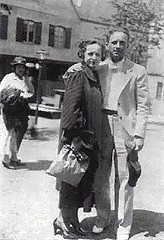
Abe And Beattie
In attempting to put together a reasonable facsimile of Bob’s life in Hibbing and Minneapolis, Minnesota and New York City as he mythologized it in his chapter of Chronicles, The Lost Land, I have come to the following tentative conclusions.
Bob was born in Duluth, Minnesota on 5/24/41. In 1943 he was taken to Hibbing where he lived from then until graduation from high school in the Spring of 1959.
Within the concept of normal Bob had a fairly advantaged childhood. His parents were indulgent buying him anything he wanted while providing adequate pocket cash. Bob’s family was one of the more important in town both within the Jewish community and the town at large. In what appears to have been a tight small town social scene Bob either excluded himself or was excluded from the dominant social groups within which he had a right to be included.
Perhaps Bob’s conception of the Hibbing period could be best interpreted from his favorite movie, Rebel Without A Cause, starring James Dean. Bob is said to have seen the movie several times. This was unusual as few people ever saw a movie more than once. He would have been a very impressionable fifteen at the time. Most of us didn’t have the money while quite frankly few movies, if any, were worth watching twice including Rebel Without A Cause. I was seventeen when I saw it and while I was in awe I wasn’t submerged. Of course Bob’s relatives owned the theatres so he got in for free.
As he set up a Dean shrine in his basement which greatly offended Father Abe we may be justified in assuming that Dean was a controlling influence in his life from the time he saw the movie. It is of interest that Abe was to remove the Dean shrine from the basement after Bob left replacing it with a shrine to his own son Bob Dylan ne Zimmerman.
Abe Zimmerman (1911-1968) worked for Standard Oil in Duluth when Bob was born. According to the C of C he lost his job in 1943 moving to Hibbing where his wife’s family, the Stones, could help the young couple. Why Standard Oil should lay Abe off in the middle of the war during a manpower shortage seems to pose a question. As can be seen from the photograph of Abe and Beattie above borrowed from the Flickr photostream of <drineevar> he was a well set up handsome man. He appears to be exceptionally self-possessed, sound in the eyes. Beattie appears to be a haughty high fashion queen which would accord with later facts.
Abram Zimmerman, for such was his name. Usually called Abraham, the name on his tombstone is Abram, and his two brothers Maurice and Paul bought the Micka Electric Company in 1943 changing the name to Zimmerman Appliance. In 1968 Paul Zimmerman told Thompson that they had been in business for twenty-five years which would mean 1943 although the date seems odd.
According to the C of C Abe came down with polio in 1946 requiring a lengthy convalescence. The C of C says that the Zimmermans bought Micka’s after his convalescence but if Paul Zimmerman is accurate it would have to have been 1943. There would be no record of what Abe did for a living then from 1943 to 1946. As Bob says both his uncles served in the Army it would seem that they bought Micka’s going into the Army shortly thereafter leaving Abe to tend the business.
Maurice and Paul became President and Vice-President of the corporation while Abe siginficantly assumed the controlling post of Secretary-Treasurer. Managed the money, paid the bills.
During the fifties at least Abe spent a fair amount of money on both Bob and Beattie. Angel Marolt whose family bought the Zimmerman residence after Abe’s death was trying to tell him of Beattie’s several fur coats, diamonds and Cadillac but Thompson says he wasn’t paying attention.
Thompson quotes Echo Helstrom as saying that the Zimmermans had stores in both Hibbing and Duluth. Having a customer base of approx. 250,000 makes more sense when one considers the amounts of Abe’s expenditures and the fact that the profits had to be split three ways.
The C of C describes Abe as a ‘big man’ in town partial to those big thick long cigars.

The Dylan Home
The couple had enough money on arrival to buy the large nine room house that Bob grew up in so Abe must have been well paid at Standard Oil before he was laid off. Both he and Beattie are well dressed in the picture while Beattie is actually overdressed.
Bob was entrolled at Alice School for his kindergarten year in 1946 at five years of age. The status of Alice School is unclear. Perhaps it was closed the following year or consolidated with the Hibbing High complex as Bob was transferred. Hibbing High housed kindergarten through twelve as well as the Jr. College. Thompson describes it as a huge and rambling building.
So from first grade to graduation Bob was with the same group of students. I sure wouldn’t have wanted to move into town in tenth grade and try to break into that one. While he wouldn’t have known them all well he must have known the entire student population on sight. This presents the problem then of why Bob, who was the son of the Big Man in town, wasn’t included in the top social cliques. Those cliques undoubtedly formed early persisting through graduation. If Bob was in one he was either forced out early or found it uncongenial to remain for whatever reason. Perhaps he thought his Jewishness excluded him. So if something happened we don’t know what it was and won’t; unless Bob tells it’s going to be difficult to trace.
Growing up in a small town anyone with any ambition looks around and sees very limited opportunities. Working for his father wasn’t a viable option. Not everyone wants to be a doctor or lawyer either. Nuclear Science is OK but a lot of those guys are out of a job now too. My next door neighbor when I was a kid for one.
Bob’s mind turned early to music and then to Rock and Roll. While Rn’R went on to conquer the world and become as respectable as such a spectacle could it was definitely considered discreditible and low class almost volunteer outlawry in the fifties. At the very least it was ‘pimple’ music. It took a certain amount of courage to say you liked Elvis Presley. Pat Boone was set up as his rival and you had better say you liked ol’ White Bucks. If you don’t think Elvis was considered a social criminal check out a couple of his movie roles like King Creole or Jailhouse Rock. What was the Colonel thinking? Clown roles, that’s all Elvis ever got.
And then Bob chose as his hero and model Little Richard. People looked at you funny if you said you
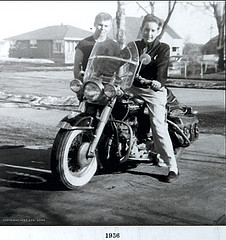
Young Bob On Harley
liked Little Richard! I mean, Bill Doggett was a respectable Negro with music you could understand, Fats Domino was as lovable as a chubby ten year old but Little Richard! They hadn’t even created the ghetto he could come out of. His band might have passed but then he opened his mouth. If there was ever a direct challenge to middle class sensibilities Tutti-Frutti was it. Not only was the song incomprehensible it was about queers. Nobody ever quoted the lyrics correctly, while I’m walking around saying ‘Tutti Frutti, I want Rudy?’ What does that mean? I hope no one overheard me. So when Bob gets up, ignoring Pat Boone entirely, and launches into some screaming vision like Rip It Up or She’s Got It or God only knows what, was the crowd taken aback? Chuckle, chuckle.
So Bob having opted for the lifestyle was forced to associate with the hoody crowd or have become a loner. Besides Colin Wilson’s book The Outsider had appeared in 1956 that began a cult of The Loner that peopled the early sixties. These guys, who were by no means rebels but deep thoughtful guys who had a line on the truth denied anyone else and that penetrated sham and hypocrisy sat alone ever ready to resolve a situation setting things right were highly romanticized fellows. There were as many Loners in those days as there were Hawkeyes a couple generations later. So Bob wouldn’t necessarily have been thought of as weird, strange but a Loner. A Loner was next door to weird and strange. Thin line if you get my meaning.
On the other hand the C of C describes the L&B Cafe as a regular jumping Bop Street right there in the heart of Hibbing, Minnesota. Bands set up and played continuously. They knew how to party in Hibbing. The C of C even says there was a radio station in town playing Bob’s kind of music thereby contradicting every other source even Bob. He says he had to go to Shreveport on the radio waves to get his kind of music. In this case I’m betting on Bob.
The C of C tells of Bob’s musical debut like this putting the best possible face on it:
Described by fellow students as polite, easy to talk with, and somewhat introspective, it was a total shock when he pushed back the piano bench and stood up to pound the first notes of a song into the auditorium, electrifying the student body. Kids jumped up, stared at each other open mouthed not knowing what the reaction would be.
Well, yes, they were electried but did they like it?

Rockin' Bobby Zimmerman
According to the C of C, looking back fondly, Bob went over real well with his fellow students. If you like this version don’t check the other sources as this is at variance with every other known account but then this is the Chamber Of Commerce speaking. Up to this point in the C of C account there is no reason for Bob to be as bitter as he is about Hibbing at all.
A note of interest is the reoccurence of Fourth Street in Hibbing, Minneapolis and New York City. Quite a coincidence, I knew there had to be some association with Fourth St. in Hibbing. So far we learn that Bob attended Jewish shule there. Whether the synagogue was also located there isn’t clear. The synagogue Bob attended is no longer anywhere at any rate. Tore it down. It was in the way. Had to go. Even though Bob’s father was the most prominent Jew in town, the President of B’nai B’rith and ADL as well as his business interests, and even though Bob had a mega Bar Mitzvah with four hundred people in attendance some say at the most prominent spot in town, the Androy Hotel, some say at the synagogue, he wished to conceal he was Jewish. This attitude may have contributed to his renouncing the Jewish fraternity house to which he pledged at UM while also hiding his religion in New York. The attitude was strange since he seemed to prefer Jewish musicians around him to the exclusion of goys.
Bob’s father Abe, was quite frankly a marvelous provider, spending very large sums of money on son Bob, wife Beattie and his second son, David. When he died in 1968 the house on 7th Ave., now Bob Dylan Ave. was sold. The owners at the time of Thompson’s visit were the Marolts. Angel Marolt who was at home when Thompson called offered to show him around. One thing he learned was that Bob had a clause in the sale’s contract that allowed him to stay in his old room in the Marolt’s house whenever he was in town. Too weird.
What quirk in Bob’s mind compelled him to live in other people’s houses? Perhaps Rebbe Maier back in 1954 impressed on Bob that Biblical scripture presribes that Jews would live in houses they never built. As an article of religion that injuction is a mind boggler. One can’t predict how anyone’s mind will interpret instruction. Bob who functions out of his subconscious very heavily must have accepted such teachings in literal ways. Rebbe Maier was a definite turning point in Bob’s life. Imagine getting out of school, going upstairs at a Rn’R cafe to sit before the only bearded man you may ever have seen, dressed completely in black with a black yarmulke perched on the back of his crown intoning things like: The Jews shall live in houses they never built and then go downstairs to boogie. Pretty spooky, don’t you think? And then as Bob says, he disappeared like a ghost. Let that roll around your brain for little while and see what you come up with.
Mrs. Marolt was trying to tell Thompson something about Mrs. Zimmerman’s multiple furs, heaps of diamonds, I’m sure all the latest fashions and her own Cadillac.
Bob was indulged to the extent of apparently more than one motorcycle, a car, lots of amplifiers and electronic gear for his bands, whatever he wanted plus free movie admissions and plenty of pocket cash. He must have had a large record collection for a kid as he spent his spare time at Crippas record store ordering the odd title. You can bet Crippas didn’t discount either, charging full bore. At the time (after 1958) stereo was 5.98 and mono was 4.98.
As the profits from a sole Hibbing store divided three ways could not have supported this sort of expenditure, having a store in Duluth could account for it. It is significant also tha Abram died in June 1968 and the store closed a few months later. Was the store a losing proposition for the last few years? Did Bob provide the difference so Abe wouldn’t be embarrassed by going banko? Then with his father gone there was no reason to support Uncles Maurice and Paul?
There really is something happening here, isn’t there?
Also as a petty expenditure for Bob (it would have been huge in my life) according to the C of C:
Almost every day Bob came in after school for his regular snack: cherry pie a la mode and coffee (or Coke.)
And then to dinner? No wonder the young Bob had all that baby fat.
If Echo bought those hot dogs for Bob and bought his story that his dad didn’t give him an allowance she was had in more ways than one.
So, Abe was nothing if not a generous father and husband. Beattie as President of Hadassah as well as a Stone must have made the Zimmermans the most powerful Jews in the syngogue while actually giving she and her husband the means to be petty dictators of the town, I saw something like this in Eugene, Oregon in the sixties and seventies, or, as the C of C says a Big Man and big people.
Bob must have a quirk in his mind to misrepresent his childhood so. He was the Fortunate Son John Fogerty only sings about.
In Thompson’s interview with Beattie he quotes her:
How can you know you have a genius in your house, when all my time is spent trying to feed him and keeping his clothes pressed.
In Bob’s story, The Lost Land, Chloe Kiel is shown ironing Bob’s shirts and at the end of the chapter she ‘slaps’ a plate of steak and fried onions in front of him just before he darts out the door to begin the next chapter, A New Morning, just as in the old days when he returned home from school for lunch and was fed by his mother he darted back to school.
Ironing his shirts and providing free steaks was a signal service for bare acquaintances like Ray and Chloe.
Chloe comes across as cold and indifferent and indeed there is a tinge of resentment and anger beneath Beattie’s statement. Motherly, of course, but there. Still, she doesn’t impress me as any Yiddishe Mama of the Mrs. Goldberg variety. Whether Bob was a good boy or not he does have an ambivalent attitude toward his parents. But then he claims that he was really raised by his grandmother, whether Stone or Zimmerman isn’t clear.
I believe the big change came over Bob with his Bar Mitzvah and I’m not talking puberty alone. According to the C of C Bob attended Jewish shule during his young years. This was done after public school hours. Then in 1953-54 when his Bar Mitzvah was approaching Father Abe sent to Brooklyn, New York to have an ultra-orthodox, almost certainly a Lubavitcher Rebbe, sent to Hibbing to indoctrinate Bob in untra-orthodox teachings. It can’t be any surprise that when Bob exhibited his Jewish reverence after his Jesus indoctrination with the Vineyard Fellowship he chose to show himslef as a Lubavitcher. Welcome home, Bob. The C of C tells it this way:
According to a 1985 Spin Magazine interview by Dave Engel, Bob said it was above the (L&B) Cafe that Rabbi Reuben Maier stayed while giving Bob Hebrew lessons in preparation for his Bar Mitzvah. The Rabbi and his wife showed up one day and stayed for a year while Bob got ready for his big event . The article quotes Bob as saying he would learn Hebrew after school or in the evening for an hour, then go downstairs and boogie at the L&B. After completing his Bar Mitzvah the Rabbi just disappeared.
In the interview Bob tells it this way:
There weren’t many Jews in Hibbing, Minnesota. Most of them I was related to. The town didn’t have a rabbi, and it was time for me to be bar mitzvahed. Suddenly a rabbi showed up under strange circumstances for only a year. He and his wife got off the bus in the middle of the winter. He showed up just in time for me to learn this stuff. He was an old man from Brooklyn who had a white beard and wore a black hat and black clothes. They put him upstairs in the cafe, which was the local hangout. It was a rock n’ roll cafe where I used to hang out, too. I used to go there everyday to learn this stuff either after school or after dinner. After studying with him an hour, or so, I’d come down and boogie. The rabbi taught me what I had to learn, and after conducting the bar mitzvah, he just disappeared. The people didn’t want him. He didn’t look like anybody’s idea of a rabbi. He was an embarrassment. All the Jews there shaved their heads and, I think, worked on Saturdays. And I never saw him again. It’s like he came and went like a ghost. Later I found out he was Orthodox. Jews separate themselves like that. Christians, too. Baptists, Assembly of God, Methodists, Calvinists. God has no respect for a person’s title. He don’t care what you call yourself.
The C of C knows the Rebbe’s name was Reuben Maier and Bob Dylan doesn’t? There were enough people in Hibbing to have a temple and shule but they didn’t have a Rabbi? The Rebbe Maier showed up in time for Bobby Zimmerman’s Bar Mitzvah but what? it was the first Bar Mitzvah in Hibbing’s Rabbiless history? No wonder four hundred people showed up. The Jews in Hibbing shaved their heads and worked on Saturday’s? I presume Bob means they didn’t wear beards but shaved their faces unlike the Lubavitcher in white beard and one of those funny round hats. I serously doubt there were three hundred or more Jews walking around Hibbing with shaved heads in 1954.
They took one look at Rebbe Reuben’s weird beard and outre attire and told him to get out of town? Now that I can believe. Beards in ’54 were a sign of great eccentricity or a psychotic desire to draw attention to oneself. But why in ’85 the mysterioso act? He just showed up to teach Bobby Zimmerman, a complete unknown with no direction home Lubavitcher tales like this: (actually this is pretty standard esoteric doctrine adapted for Jewish needs)
The messianic thing has to do with the world of mankind, like it is. This world is scheduled to go for 7,000 years. Six thousand years of this where man has his way and 1,000 years when God has his way. Just like the week. Six days work, one day rest. The last thousand years is called the Messianic Age, Messiah will rule.
Essentially what we have here is a variant of Madame Blavatsky’s Theosophy along with a little Hebrew Theology. If one looks real closely one can see the outline of Sigmund Freud’s notion of the unconscious.
According to Beattie Bob knew, oh, two hundred words of Hebrew. So much for several years of shule and a year of intensive training by Rebbe Reuben.
Whether Bob knows or admits it, it must be true that Father Abram sent for Reuben to instruct Bob in mysteries that Abe thought were essential to his vision of Jewish religion while they were not part of the services of the Hibbing congregation.
It is possible that Abram brought the Rebbe in on the approval of the congregation who rejected him. The comment by Bob of working Saturdays may be signficant here. The Jewish sabbath begins on Friday sundown and continues to Saturday sundown.
As a Lubavitcher, Rebbe Reuben could not have tolerated working during the sabbath while the congregation found it essential amidst a gentile population. Likewise beards are an integral part of the orthodox religion so that the congregation also refused to stop shaving. The only thing mysterious is why it took Reuben so long to catch on. Or maybe he had a contract for one year and the year was up. Of course Bob did need help on those two hundred words.
So Bob’s upstairs memorizing his two hundred words while the throbbing beat pounds insistently through the floor. The super patient Reuben and his wife never object. Bob shortly joins the revelers with his two hundred Hebrew words rattling round his skull, steps up to the mike and begins screaming: I’ve got a girl and her name is Echo. Hmmm. Quite an image out there in the Lost Land of Bob.
Now indoctrinated in quaint antiquarian rites Bob is bundled off to Webster, Wisconsin and Camp Herzl to steep himself in Israeli style Jewish living. Camp Herzl was conducted as Israel in America so those two hundred Hebrew words came in handy in that surrogate for summer in a kibbutz in the Holy Land.
The summer sojourns must have set Abram back a handsome fee for the times. Six to eight weeks of essentially summer boarding school does have expenses. Abe apparently was deeply religious: in Protestant circles he would have been known as a Fundamentalist nut. He and Mike Huckabee would have gotten along fine. One wonders if younger son David was given the same treatment.
So Bob from 1954 on is definitely the product of two nations. The world of the Three Hanks as the C of C puts it and this world of Adam, Moses and the Messiah. Bob was named after Sabbatai Zevi the last acknowledged Jewish messiah in the seventeenth century, his Jewish name is Sabtai.
As kids we all have a lot to reconcile, begin working out at graduation. Bob had a double load; he had two Bobs to reconcile. Personalities wander and widen in those years, Bob made a clean split. On the one hand he was the twerp Bobby Zimmerman of whom it may be said: There’s no success like failure while on the other he was struggling to be the super successful Bob Dylan in which he failed to assume the mantle so that failure is no success at all. At least he made this split off persona’s name mean something. As a note, it was not generally known Dylan was Jewish until after Blonde On Blonde.
Thus in his movie Renaldo and Clara he is not Bob Dylan. Anybody can be Bob Dylan he says, you can be Bob Dylan. Toby Thompson thought he could be and did a pretty good job of it walking a mile or so in Bob’s shoes. Sounded just like him.
As remarkable as it is that Bob realized his fantasy beyond anything he could have dreamed and became the hugely successful Bob Dylan he created an entire new set of problems whose solution eluded him. Well, you know, there’s something lost and something gained while it’s hard to know whether the gain was worth the loss. However the money has disappeared from the table.
The result then is Bob looking backward from 2004 to create a fantasy of how it was in Ray and Chloe’s place on Vestry Street in NYC. The chapter is approriately titled The Lost Land or possibly Never-Never Land might have been better. The chapter isn’t a complete fabrication but it is fiction. Something like the various incidents might have happened but not exactly the way Bob tells it. The framing story of Ray Gooch and Chloe Kiel is pure fiction however. They could not possibly have existed.
Bob tells the whole story of the Lost Land within the reference of Ray and Chloe and their fabulous apartment near Vestry below Canal near the Hudson across the street fromt he Cathedral with its bell tower. Thompson got it right.
A troubling aspect of Bob for me is his insistance on bumming other people’s apartments. This seems to be compulsive behavior.
Bob was actually voluntarily homeless from January of ’61 to October or November of the same year when he and ‘roommate’ Suze Rotolo took up digs on Fourth St. I suspect that Father Abe would have been only too happy to supply Bob with funds to live on Vestry Street if he had asked. Bob is simply untrustworthy in any of his stories. As he said of what he learned from folk music: If you told the truth, well and good; if you told the untruth, well and good also, so in Bob’s mind there are no lies, there is only the truth or untruth both having the same value and whichever is more serviceable at the moment. You can’t believe him.
A troubling aspect of Bob’s behavior is his habit of bumming couches in other people’s nests; gaining meaning, as it were, from other people’s lives. Perhaps that was the way he felt of his life in his mother and father’s house. Or perhaps as a Jewish outsider in a goyish land it was his attempt to insinuate himself in the main stream much as he appropriated Woody Guthrie’s persona. Of the houses I have traced they have all been those of goys; he didn’t choose to insinuate himself into the houses of his fellow Jews. His imaginary hosts Gooch and Kiel are obviously goys.
The Lost Land then is a mythologized version of his childhood and first few months in New York City. To my mind Ray Gooch is a combination of Dave Van Ronk, Paul Clayton, Matt Helstrom and his father. Chloe seems simply to be an idealized notion of his mother. (Study her picture for a few moments again.)
As the Gooch frame brackets the period from Bob’s encounter with Gorgeous George to the apartment with Suze Rotolo it must represent a time frame from sometime in ’58 to October ’61. In October Bob Dylan ceased sponging off others to take up his own apartment.
The only one in this time frame he knew who had a large gun collection was Matt Helstrom. The Helmstroms also had a large record collection that Bob listened to. The couch and apartment undoubtedly belonged to Van Ronk while certain exoticisms of Gooch are characteristic of Clayton. The library of Gooch may simply be the New York City Library of which the long narrow room would merely describe the stacks.
The Southern character of Gooch must represent a time after Bob studied the South in the library since there are several references to his Civil War studies. Gooch himself is a Southerner from Virginia gone North which is a symbol in itself. This can be symbolically described as Father Abe being a Jew in Gentile America.
Here then Bob creates or accentuates the more pleasant aspects of his memories in contrast to the very bitter unpleasant memories of the songs. He tells us a great deal about his dream life but little of its realities. At this point I am of the opinion that the party of Camilla ( who Bob says he gets to know quite intimately) is another fabrication of the based on a true story variety.
As Bob would say, folk music taught him that if what you said was true,well and good; if what you said was untrue well and good also. We may probably construe the Lost Land as both true and untrue while a good folk tale. Even the title has a fictive quality a la Edgar Rice Burroughs.
To round off the period back in the C of C milieu of Hibbing: Bob spent his last summer at Camp Herzl in 1957. In the summer of ’58 he was running back and forth between Hibbing and Minneapolis. At that time he would have become familiar with Highway 61.
In his Junior year of ’57-’58 he took up his relationship with Echo Helstrom. They were going steady hence were not supposed to be dating others. As he was in Minneapolis most of the summer he left Echo sitting home alone. She resented this. As the Senior year began she told Thompson, she took a revenge on Bobby returning his token in public in the hall at school. Boy, that hurts.
The feelings must have been much harder than either Bob or Echo portray them. A key problem area is did Bob spend time in Red Wing Reformatory on Highway 61 below Minneapolis and if he did what did he do to receive his sentence: I examine this more fully in Exhuming Bob VIII: The Walls Of Redwing.
He says in Chronicles that he was absent from school from some time at the beginning of April of ’59. He was back at least by the June 5th graduation. His birthday is May 24th. After that date he would have been eighteen and subject to adult sentencing. For what It’s worth he says in his song that no inmate was over seventeen. I’m suggesting that he spent a month of two at Red Wing returning in time for graduation. Certainly a Big Man in town like Abe could have arranged the graduation if he couldn’t get Bob off that time.
The question is what did Bob do? By the middle of this Senior year it appears that he had been in enough scrapes to be known as a troublesome boy; perhaps living out a Rebel Without A Cause persona. Father Abe used his influence up to that time to avoid unpleasant consequences for the lad.
I believe Bob’s song The Chimes Of Freedom tells the story of his crime. Quite simply Echo set him up. She obviously was not quite as complacent as she tells it. See Exhuming Bob VIII: Walls Of Red Wing.
Returning home from Red Wing his parents threw a graduation party for him. Bob was reluctant to attend the party, perhaps with good reason but was persuaded to do so.
This then leaves a very sketchy account of the three or four months of the summer of ’59 for which Bob provides little information. In Walls Of Red Wing I place his stint at Red Wing in August but that is probably wrong. In any event the period from April of ’59 to September of ’59 needs to be explained more fully.
Bob gives some brief details of his stay at Dinkytown but not much. A little bit of the John Pankake episode while avoiding the important details of his theft of Pankake’s records.
Thompson has some good information from Ellen Baker whose father’s folk song collection Bob used extensively.
Then to NYC and his account of The Lost Land segues into his New Morning.
Exhuming Bob IX: Chronicles I: Pensees 5
May 12, 2008
Exhuming Bob IX
Chronicles I
Pensee 5
by
R.E. Prindle

Younger Pete Seeger
Larry Sloman has an interesting interview with Mike Bloomfield in his On The Road With Bob Dylan of 1978. It takes up twelve pages- 286-297- of the 2002 Revised Edition.
Mike Bloomfield was, or course, the White Southside Chicago Blues guitarist who rose to fame as the lead guitarist of the Paul Butterfield Blues Band. Butterfield’s LP East-West was one of the seminal records of the sixties. If you’re hip and don’t know the record, you should take care of that as soon as possible.
The interview is interesting in a number of ways. Bloomfield who was a Jew ‘hanging out with ‘the niggers’ on the Southside as he puts it, has a rather surprising attitude toward Blacks and opinions on Dylan.
Born in ’43 Bloomfield was two years younger than Dylan thus his mind was more malleable to the propaganda of the fifties as he turned fifteen only in ’58, graduating, if he did, in ’61. The tremendous persecution indoctrination and conditioning of the mid to late fifties in the Jewish community would likely have influenced his mental state more profoundly than Dylan’s.
The Jewish community has always been affected by the Negro mental situation. A low down Jew in his own community was frequently designated a ‘nigger’ often carrying the nickname of Nig or Big Nig. Sloman, also a Jew, repeatedly refers to himself as the ‘nigger’ of the tour while designating Ronee Blaklee as his female nigger counterpart.
While not having enough information to diagnose Bloomfield’s mental state nevertheless since he abjured the White world for the Black world of the Blues it would seem that he interpreted the intense Jewish indoctrination as meaning that since the world hated the Jews only because they were Jews that the Jews were no better than the ‘niggers’ and that he should go live with them. The psychological conditioning young Jews went through in the fifties was just horrid in the effects on their psyches. Really crazy stuff.
So, while feeling no better than the Blacks Bloomfield at the same time recognized his separateness, difference and apparent inferiority.
This was certainly different than the image being projected to the equally impressionable youth of America who through musicians like Bloomfield reverenced the Negro. In fact Bloomfield was a perfect catalogue of prejudices if one looks at it that way. Another way of looking at it is that having had close contact with the various cultures he had a clear idea of their characteristics as compared to the Jews and Whites.
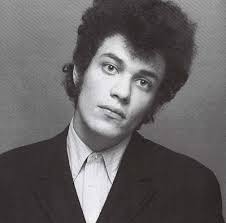
Mike Bloomfield
Still, at Newport he was scandalized by Peter Seeger’s behavior. Quite clearly Bloomfield was not your typical White Liberal. p. 291-292:
To play with anyone at a folk festival, I would have plugged my guitar into Pete Seeger’s tuchus, really man, and put a fuzz tone on his peter. You know what fucking Pete Seeger was doing? He brought a whole bunch of schwartzes from a chain gain to beat on a log and sing schwartze songs, chain gang songs, and he was doing that, can you believe this guy? Here’s a white guy, got money, married to a Japanese woman, beating on a log with schwartzes singing ‘All I hate about lining track, whack, this old chain gang gwine break my back, actually saying ‘gwine’, whack and Seeger’s doing this and he’s pissed off at us for bringing electric guitars to the fucking folk festival! He brings murderers from a schwartze prison to beat on a log! Oh, I couldn’t believer how fucking crazy it was!
Schwartze italicized in the original, of course, is Yiddish for nigger. The above is terrific scene painting that represents about how probably 90% of America at the time would have perceived the scene. Seeger was a Liberal Commie Red American living this incredible fantasy life in which he was the star of his own movie in which there were no consequences while the plot is perpetually arranged to suit his convenience.
This was the beginning of the period when White Americans believed themselves in control of the destinies of the people of the world. Kennedy had just created the Peace Corps under whose auspices raw youths with no worldly experience were sent out into the world to supposedly tell forty and fifty year old men and women that they were doing everything wrong and these mere kids were going to tell them how to do it right. I can’t tell you how the concept boggled my mind. Seeger married to a Japanese while calling these Negros cons to Newport to play chain gang songs is actually treating these people as though they were his toys. The arrogance of this Liberal so-called peace-loving, people-loving creep is amazing.
As Bloomfield says, Seeger came unglued over the violation of his fantasy when electricity was introduced into his rural pre-Civil War fantasy while idolizing Negro murderers that he had had released from prison for the weekend. Imagine, for his convenience without any regard for the feelings of the prisoners he had done that. Then he has them perform a scenario where they are beating on a hollow log as caricatures of themselves of a century earlier singing railroad songs that hadn’t had any relevance for at least fifty years.
Obviously Bloomfield while he had some fantasy that he was a psychological nigger who was at home on the Southside still longed to be Uptown with the White folks. Hence he is so scandalized that Seeger, a man with money, in other words, while Seeger didn’t have to play with schwartzes was actually, and here Mike’s incredulity is palpable, singing Negro dialect like ‘gwine’ and going whack.
I mean, in Seeger’s incredible movie life he’s got a Japanese wife and everything, bank account. If he tires of that fantasy he dumps her and marries a – whatever, whoever the film running through the sprockets of his mind fancies. I mean, the guy’s got a long lead between second and third out on the grass and nobody’s even running him down. Bloomfield is completely flabbergasted.
And then Dylan is toying with him and he does know that. Dylan comes to Chicago right after the first album, Bloomfield grabs his guitar, just like in Crossroads, intending to cut Dylan down which he can do with ease and cutting is done everyday in Chicago so it is legit. Dylan must have blanched with fear knowing Mike could do it. Now, remember this is an intra-Jewish thing. Rather than risk embarrassment Bob abases himself and charms Mike into believing they are friends. Deceived, Mike lets Bob off.

Dylan At Peak
Now safely back in New York Dylan calls Bloomfield to ask him if he wants to play on Highway 61, the most vengeful record ever recorded. Bloomfield accepts showing up in the enemy’s camp at Woodstock. Now Dylan insults Bloomfield and strips him of his dangerous skills. Bob says: ‘I don’t want you to play any of that B.B. King shit, none of that fucking blues I want you to play something else.’ so we fooled around and finally played something he liked, it was very weird…’
So Bob makes himself superior by taking away Bloomfield’s identity (I had to change their faces and give them all brand new names) but he takes the trouble to actually teach Bloomfield the songs because he is going to need him.
I have to give Bob credit for being an improvisational genius. At the Highway 61 session he and Mike are the only guys who know what they’re doing while the other musicians are keying to them. The result in my estimation is sensational. As a musician Bloomfield didn’t think much of it but as a listener without those kinds of professional prejudices the result is astonishing. To be sure the sound is not as tight as a Johnny Rivers record but that is its genius.
Bob assumes that Bloomfield knows he is now Bob’s shadow or guitar player. When Mike goes with Butterfield Bob feels rejected. When Bob’s feelings are hurt Bob gets revenge. A number of years later Bob asks Mike to play on Blood On The Tracks This time he doesn’t need Mike so harking back to their first encounter in Chicago he roars through the songs in one tuning so fast Bloomfield can’t keep up. Bob has cut Bloomfield as Mike had meant to cut him. Bob walks out, king of the Crossroads. Bob has ‘proved’ himself the better musician. End of that story. Bloomfield ODed a few years later.
At one point Sloman asks Mike ‘What was he like?’ pp. 286-287:
“There was this frozen guy there,” Bloomfield says. “It was very disconcerting. It leads you to think, if I hadn’t spent some time in the last ten or eleven years with Bob that were extremely pleasant, where I got the hippie intuition that this was a very, very special and, in some ways, an extremely warm and perceptive human being, I would now say that this dude is a stone prick.’
Bloomfield then describes Dylan in conjunction with Neuwirth and Albert Grossman holding themselves aloof from others while indulging in savage put downs of anyone and everyone. Bob in fact was a stone prick. The question is why?
After this introduction to the problem , in Pensee 6 I will return to the root of the problem built around Bob’s reverence for Mike Seeger.
Exhuming Bob IX: Chronicles I, Pensees 4
May 7, 2008
Exhuming Bob IX:
Chronicles Vol. I, Pensees 4
by
R.E. Prindle
The gist of Chronicles is how Bob became a songwriter. As an auto-biography of his life he is telling us nothing but as to his intellectual development he is telling us a lot.
I find the Lost Land chapter the most interesting in the book. Bob goes back and constructs little dioramas to illustrate the changes he was going through. The chapter is kind of a literary version of Salvador Dali’s picture, The Persistence Of Memory. What is visible has to be reconstructed and interpreted. In the interpretation lies the interest.
Bob is interested in telling us how he became Bob Dylan while wanting to give his impression of people and events. He recalls a concert by Bobby Vee who was riding the crest of his popularity while Bob was a mere nothing waiting in line. He seems to want to prove to us that Vee really did know him from back in Dakota thus verifying the fact that he did play with Vee’s band. Bob sent in his name and Bobby Vee actually came out to talk to him. The situation is reversed now, Bob is something and Vee is a has ben but Bob still has a place in his heart for him. Touching story.
And then he tells his Ricky Nelson story. Bob seemed to think more highly of Rick as singer than I did. Time has softened my attitude to Rick as well as his song ‘Garden Party’ that I have always liked. As Bob said Ricky mentions him in his song- ‘there was Bob Dylan in his Howard Hughes disguise’- or words something like that.
Rick’s song, I think, gave Bob the idea for the story he tells of Camilla Adam’s party. It is actually two parties, the one at Comill’as and another at Alan Lomax’s that Bob loosely joins together around the persona of Mike Seeger. It’s interesting. Bob introduces the party thusly: p.62
…then something immediate happens and you’re in another world, you jump into the unknown, have an instinctive understanding of it- you’re set free. You don’t need to ask questions and you always know the score. It seems like when that happens, it happens fast, like magic, but it’s really not like that. It isn’t like some dull boom goes off and the moment has arrived- your eyes don’t spring open and suddenly you’re very quick and sure about something. It’s more deliberate. Its more like you’ve been working in the the light of day and then you see one day that its getting dark early, that it doesn’t matter where you are- it won’t do any good. It’s a reflective thing. Somebody holds the mirror up, unlocks the door- something jerks it open and you’re shoved in and your head has to go into a different place. Sometimes it takes a certain somebody to make you realize it.
Mike Seeger had that effect on me.
So the rambling account of the Bob’s next few pages is going to be a story of how Mike Seeger put Bob’s head in a different place. It’s going to happen at Camilla’s ‘Garden Party’ combined with Alan Lomax’s affair. Did this party really take place or is this a dream sequence Bob builds up to explain the change he’s going through? The population of the party strikes me as improbable but then I have attended very few celebrity parties and don’t feel I can put myself forward as a judge.
Bob doesn’t tell us when these two melded parties built around Mike Seeger too place but as most of the stories in this essay take place in the winter- baby, it was cold outside- it must have been before 1963. Bob arrived in NYC in the winter of 1960. In relation to Harry Belafonte he does say: ‘I’d be making my professional recording debut with Harry, playing harmonica on one of his albums called Midnight Special. That album was recorded in ’62 so if that was still in the future as Bob makes it sound the intellectual development he’s taking about probably took place in the winter of ’61-’62. He bagan dating Suze Rotolo in the summer of ’61 so the part-time girl friend he was with, Delores Dixon, must have been the part of the time he wasn’t with Suze.
There were a lot of Folk people there but Bob says they all gave him the cold shoulder except for Pete Seeger. p. 64
I saw a lot of people here that I’d meet again not too far off, a lot of the folk community hierarchy, who were all pretty indefferent to me at the time and showed very little enthusiasm. they could tell I wasn’t from the North Carolina mountains nor was I a very comercial, cosmopolitan singer either. I just didn’t fit it.
So if not outright rejection there was probably a feeling of you don’t have to pay attention to that guy, he ain’t goin’ nowhere. So here we have the nucleus of Positively Fourth Street. p. 64
They didn’t know what to make of me. Pete Seeger did, though, and he said hello.
So, who among the multitude had the prescience to recognize the genius of Bob Dylan and said: Hello. That was enough for the moment for the boy in the sheepskin coat and motorcycle boots.
An then Bob runs through a list of attendees: Harold Leventhal the famous Folk manager, Judith Dunne a choreographer, Ken Jacobs the filmmaker, Pete Schumann a puppeteer, Moe Asch from Folkways, Theodore Bikel, Harry Jackson the artist, Cisco Houston.
A whole slew of authentic labor agitators, not those phony bigwigs who went to Pureto Rico to party hearty. Irwin Silber of Sing Out!, There were a lot of Broadway and off-Broadway actors too, a lot of musicians and singers, Erik Darling, Lee Hayes, Sonny Terry and Brownie McGhee. Mike Seeger of course but also the creme de la creme Harry Belafonte. Quite a gathering which makes me believe that Bob is romancing a little.
Bob was knocked out by Belafonte. He eulogizes over Harry. For myself I never really cared for Belafonte. Harry was from New York City. born in ’27 so he’s about eighty now. Still kicking. He went to live with his grandmother in Jamaica for four years when he was from eight to twelve then returned to New York City. Studied to be an actor but first drifted into singing, picked up a folk repertory from Huddie Ledbettor who he apparently knew. He had a hit in 1953 with Matilda and in 1954 released his LP Mark Twain of which the title song became a hit. Harry also did a number of Leadbelly tunes like the slave songs Bring A Little Water, Silvie and Jump Down, Spin Around.
The lyrics in the latter baffled me for decades. In one of those classic mishearings I heard:
Jump down, spin around
Pick a bale of cotton.
Jump down, spin around,
Pick a bale of hay.
I could never figure out the connection between cotton and hay. Then one day I realized, or read the lyrics, I forget which and learned the last line was ‘pick a bale a day.’ Ah, made more sense.
I didn’t understand what it was about Belafonte I didn’t like until a while ago when I subjected myself to another hearing of the first double Carnegie Hall record of ’59. Then I knew why. Harry treated his vocal styling from an art song point of view. He sang Folk but through a glass darkly. (Finally got that old saw in. Thank you Harry.)
He was fighting the image of the Negro as an inarticulate lout so he over compensated. He actually mocked the English of the English on the LP, his hatred flowing out. So he sounds like he’s performing in Porgy and Bess or like John Raitt in Oklahoma or Carousel. Stilted.
If one compares the records of Belafonte to those of the Scotch Folk singer Lonnie Donegan, he began his ascent at the same time, the contrast is startling. Donegan sings as a man of the people giving the songs, same songs, a meaning and value that Belafonte fails to do. Compare both men’s rendition of Bring A Little Water Silvie. Belafonte sounds like he’s singing for a soundtrack of Seven Brides For Seven Brothers or something. Lonnie Donegan sounds like he’s out there in the fields asking Sylvie to bring him a little water as he picks his daily bale of cotton.
All the difference in the world- Lonnie Donegan is the greatest who ever rode the Rock Island Line.
It bothers me that Bob doesn’t seem to know Lonnie. He wasn’t that big in the US but he was huge in Britain. You might possibly know him from the song Does The Chewing Gum Lose Its Flavor On The Bedpost Overnight.
Of course Harry made it big when he made his sentimental Journey back to Jamaica to exhume a repertoir that really struck home. Day-O (The Banana Boat Song) made it for him. Then his acting career revived. He was billed as the Negro Presence which is what Bob seems to referring to here. Every effort was made to make Harry the Black Hero, before Poitier, transcending any Whiteness. As popular as he was he never really caught on. Carmen Jones, a Black takeoff on the opera Carmen was his big movie. He not only sang like but acted like John Raitt. The movie might have done alright at the box office, I don’t know, I didn’t think much of it and I knew it was my duty to like it too.
That would have been 1954, the year of Brown vs. the Board Of Education, just at the time Eartha Kitt, also born in 1927, burst on the scene singing the fabulous C’est Si Bon. Ran us right up the wall. I always couple Belafonte and Kitt in memory. Would have been a dream marriage, like Eddie Fisher and Elizabeth Taylor.
Having written a great eulogy for this major influence in his life, Bob compares Belafonte with Gorgeous George. He then gets to the crux of this story, the life changing event. He moves immediately on to Mike Seeger.
It was getting late and me and Delores were about to leave when I suddenly spotted Mike Seeger in the room. I hadn’t noticed him before and I watched him walk from the wall to the table. When I saw him my brain became wide awake and I was instantly in a good mood. I’d seen Mike play previously with The New Lost City Ramblers at a schoolhouse on East 10th Street. He was extraordinary, gave me an eerie feeling. Mike was unprecedented. He was like a duke, the knight errant. As for being a folk musician, he was the supreme archetype. He could push a stake through Dracula’s black heart…
Bob rambles on, he’s got enthusiasm for Mike. Bob’s eulogy of Mike Seeger exceeded that of Belafonte by a factor of 10, but he doesn’t say Mike could knock anybody out with one punch, his ultimate accolade that he uses for Harry.. Bob muses:
The thought occurred to me that maybe I’d have to write my own folk songs, ones that Mike didn’t know.
And so the epiphany. Bob knew he could never come close to equaling Mike Seeger as either a folk singer or instrumentalist.. He left the field of folksinger to Mike and apparently still feeling inferior having written some well received folk style songs he escaped Mike’s shadow by adding electricity. There was no way Mike could go there. And there Bob got bigger than any hundred or thousand Mike Seegers.
Exhuming Bob IX: Chronicles I Pensees3
April 27, 2008
Exhuming Bob IX
Chronicles Vol. I
Pensees 3
by
R.E. Prindle
…I needed to get my own place, one with my own bed, stove and tables. It was about time. I guess it could have happened earlier, but I liked staying with others. It was a less of a hassle, easier, with little responsibility- places where i could freely come and go, sometimes even with a key, rooms with plenty of hardback books on shelves and stacks of phonograph records. When I wasn’t doing anything else, I’d thumb through the books and listen to records.
Not having a place of my own was beginning to affect my super-sensitive nature, so after being in town close to a year I rented a third floor walkup apartent…
Bob Dylan, Chronicles Vol. I
Yes. Bob’s super-sensitive nature needed his own bed. He and Suze Rotolo were an item soon after he met her in July of ’61. He had to give up the the comfort of other people’s books and records in other people’s digs. He needed his own privacy now.
Suze would be an important influence in his life. She came from a long line of Communist agitators. She was not only Red to the- but was working for- CORE there in New York City. Bob wasn’t writing much as yet since his major influences hadn’t come together. While Bob doesn’t mention all those old C&W records as a songwriting influence he nevertheless has always written within a Country and Western context. Guthrie, his first attested major influence rose from a C&W milieu.
From being an apparent pauper, one reason Suze’s mother didn’t like him, Bob suddenly had the affluence to rent an apartment while being able to furnish it, even buying a used TV. He and Suze moved in. Suze is putting out an autobiography this month (May, 2008) so we’ll see if we can see what Bob saw in the girl.
As a Communist lass working for CORE Suze must have talked up Civil Rights and other Reconstruction views a bit so we may probably accurately assume that she influenced Bob’s songwriting direction when he gets his songwriting attitude organized here in a paragraph or two.
Bob came from small town Mid-West Hibbing. I do know where that’s at. While he was interested in records there was no indication he was ever interested in any other cultural areas. He doesn’t seem to have evidenced any interest in the varied cultural life of New York City before he met Suze. He was no habitue of museums although he does tell us he haunted the library where he read newspapers- those from 1855 to 1865. No news like old news.
His mind had been little prepared for what Suze had to show him. Mid-West small towns can be stifling and that’s no joke.
As Bob says: I began to braoden my horizons, see a lot of what the world was like, especially the off-Broadway scene. Then he mentions Le Roi Jones’ (Amiri Baraka) and the Living Theatre play, The Brig. Bob may have seeen those plays with Suze but he didn’t see them within the time limits of his story so they could have had no influence on his songwriting development at this time. Dutchman and The Baptism of Jones that he mentions were first performed in 1964 as was the Living Theatre’s, The Brig. It is interesting that Jones’ The Bapstism is described as anti-religious when Jones turned Moslem and became Baraka shortly thereafter. Baptism must have been more anti-White.
Jack Gelber’s The Connection was made into a movie in ’62 so he could have seen the play within this time period. I couldn’t find any time period for the play but it ran for over two years. I didn’t come up with anything for the Comedia Del Arte.
The Brecht-Weil show drew a blank but as he seems to have been knocked out by the song Pirate Jenny that may have influenced his song When The Ship Comes In, while he gives it prime importance as an influence that formed his skills he must have seen that sometime in the Fall of ”61 or the Spring of ’62.
He and Suze did visit the artist hangouts she was familiar with while broadening Bob’s horizons by trips to MOMA and the Metropolitan. Bob probably saw Picasso’s Guernica at MOMA where it was on display at the time. Bob developed a real interest in painting during this period.
So, we have the book thumbings from his freeloading days, the records, Suze and her art influences and then when John Hammond signed him he gave Bob an acetate of the first Robert Johnson album, which didn’t sell for beans I might add. The first Robert Johnson LP was released in 1960 so I don’t understand why Bob was given an acetate unless it was just lying around and Hammond picked it up or else acetates were a sop to new signees who had just been contractually screwed. You think managers are bad, try record companies.
Johnson was a revelation for Bob. He saw something in the LP which only a few people ever have. I’ve listened to it a couple of times and I’m with Dave Van Ronk. So What? There’s nothing to the vocals and he’s obviously a beginner on guitar. It’s not that he’s inventive he just doesn’t know how to play.
The story Bob tells is that a teenage Johnson is hanging around some Blues heavies and they shoo him off. Johnson then meets a supposed guitar wizard nobody’s ever heard of who teaches this very receptive student mega volumes of guitar lore so that Johnson returns to the Blues heavies a year later to knock their socks off with his virtuosity. As Van Ronk says: ‘…oh that lick’s from here, this one’s from there; that song is a reworking of another and so on. Greil Marcus quotes Johnson’s lyrics extensively in his Mystery Train. Wow! I guess too much of nothing can be a good thing.
But anyway Bob learned three or four times as fast from Johnson as Johnson learned from the old coot who taught him. Bob was up and running within three months.
However Superbob the Songwriter wasn’t ready to step forth from the phone booth yet, there was something else lacking, what was it, something or other. That’s it, in French, l’ autre. Bob had discovered that he was someone else. I know where that’s at too; I’ve been called somethin’ else a couple times I can remember. So Bob was somewhere between Bob1 and Bob2. The transition from Bobby Zimmerman to Bob Dylan had to be completed. Bob picked up a copy of Arthur Rimbaud. The book fell open in his hands and the words ‘Je suis un autre’ floated up before his eyes and were sucked into his soul. Bob too realized that he had or was un autre. Now Bob was ready to rock and roll.
This is a pretty story and I like it. I like it a lot. It might even be true, I’m sure I don’t know and maybe Bob isn’t real positive. Anyway the songs began to roll out. John Hammond who had seen only a couple when he suspicioned there might be more in Bob’s head so he sent the underaged lad to be signed by Lou Levy. Songs were in the air I guess and Albert Grossman had his radio tuned to Bob’s brain and must have heard them. Like a vulture spotting a dying man from several thousand feet in the air the eagle eyed Albert, and that is not meant as an insult, descended on Bob and scooped him up. Wish I’d been there with the gift of gab, a shovelful of chutzpah. A dream of a life time and Albert split it in two to come up with Bob and Peter, Paul And Mary. The Fearsome Foursome.
Although Bob was to have difficulties with Albert in later years when Albert’s cut was growing larger than Bob’s he seemed to have been welcome at this time. Peter Yarrow says that without Albert Grossman there wouldn’t have been a Bob Dylan and this may be God’s own truth. So how much did Bob really owe Albert? But like The Colonel and Elvis a manager seems to inevitably believe the whole belongs to him. The manager’s cut just seems to get larger and larger while the artist he’s working over gets to lick the plate. But, those problems were in the future and as Bob’s songwriting skills matured Albert got him much more money than he could have gotten otherwise.
 I, Dynamo