Chap. 6: Marianne Faithfull, Faerie Queene Of The Sixties
January 1, 2013
Chap. 6, Marianne Faithfull: Faerie Queene Of The Sixties
by
R.E. Prindle
Chapter 6
Orders From Headquarters
This chapter will center around the Global Communist Cultural Revolution phase kicked off in 1968 while being managed by Mao Tse Tung who replaced the Russians as managing director.
The purpose of the CR was to destroy the Bourgeois past replacing it with itself. Hence Ira Levin who wrote Rosemary’s Baby in which Satan’s child is named Andy posited 1966 as the Year One much as the failed new dating of the French Revolution of 1789. ‘89 was the Year One of that Revolutionary calendar. Perhaps in preparation for the CR in 1965 in the US new immigration reform was pushed through Congress that opened the gates of the US to the world, especially Africa, Mexico and the East. By 1968 West and East Asians were flooding into the country. As seems obvious now this was with the intent to subvert and destroy the Aryan hold on the US.
In his song Bob Dylan would sing: In the museums infinity goes up on trial, in an opening blast on destroying past culture as displayed in museums. In China Mao was less timorous as huge gangs of the Red Guards coursed through museums smashing irreplaceable cultural artefacts. They even invaded peoples homes ransacking the houses destroying anything of value. Culture bearers such as college professors or any educated persons were rounded up and sent out to reeducation camps to work at manual labor; tens of millions were murdered outright. Regular people were called before neighborhood re-education cells to confess their bourgeois faults and pledge to Communists faults.
Outside of China local agents were recruited from Communist ranks; college campuses suddenly sprouted Chinese Communist stores selling Mao’s Little Red Book and those pretty little pins sporting a

Chairman Mao Ze Dong
gold Mao against a red enameled background. Nice work and cheap too. Any campus that hadn’t been disrupted by ‘Free Speech Movements’ now came under attack by the Cultural Revolution. The end result would be Kent State.
As no one knew what was going on the Cultural Revolutionists seized the institutions beginning to establish the tone, the matrix with which opinions would be considered. This was established in subtle ways that few noticed and even they hadn’t a clue as to who or why. The Revolutionists had seized the cultural venues of movies, TV, newspapers, magazines and music, or, recordings. One of the key units in recorded music was the Rolling Stones. Mick was a Communist, at least since his London School of Economics days.
Even before the Redlands Bust he had been bleating that victory was his side’s because ‘they had the kids’ in the palm of their hands. The bust had been a cold douche that rankled Mick to his core. The revolutionists were of the mind set that they were going to fight and win and never lose. Thus the mild reprimand of the bust struck Mick as foul play, an unforgivable insult and injury.
Many people in the US were brought up short when their outrages were tried and sentences passed. I know people who went to prison for their outrageous criminal acts. They were considered martyrs. They couldn’t comprehend what they had done wrong anyway. Of course, by their own revolutionary lights what they had done was right; unfortunately the law, the authorities and the people, who Nixon called the Silent Majority were not of the same mind.
Mick found this out to his chagrin although he vowed revenge. Like Sigmund Freud and many another if he couldn’t move the higher powers he would enlist the aid of the lower. Thus after escaping his prison sentence the Stones metamorphosed into Satanic sorcerers for the cover of their Dec. 1968 album, Their Satanic Majesties Request.
Mick After A Lifetime Walking Down The Long And Winding Road
The title itself was a play on the Queen’s request on British passports for the visited countries to allow the visitor to pass. Thus in the Freudian sense Mick elevated himself to a competing royal status with the crown as their Satanic enemy. One presumes that being a Stones’ fan was the entre into Satanic circles.
Mick was not new to Satanic ideas. He ran with Bob Fraser and Chris Gibbs while having at least met the US Satanist Kenneth Anger who was associated with the West Coast big daddy of Satanists, Anton La Vey. In addition he was probably already known to Donald Cammell who would star Mick in his film Performance and Marianne in his Lucifer Rising.
In June of ‘68 Mick would be recording his song Sympathy For The Devil in studio while being filmed by Jean Luc Godard for his revolutionary film One+One, retitled Sympathy For The Devil. Sympathy was inspired by Satanic Russian novel titled: The Master And Margarita. The novel had been given to him to read by Marianne.
The Master And Margarita
For the promoters of The Master And Margarita the novel is an astounding mind blower. Maybe if you’re Russian and haven’t been exposed to the stunning variety of truly astonishing unending mind blowing fiction and movies of the US. The cultural scene in Russia was primitive compared to the unbroken line of development in the West where very few limitations, none actually, were placed on expression. Bulgakov has his Satanic girls running around without clothes as though that were something not routine in the West. I mean, beginning in the sixties there was a pornographic explosion. Movies were made that would have made the Marquis de Sade blush. That poor guy was egregiously defamed according to current standards. De Sade’s puerile novels were thrown into the shade. By 1972 a movie like Deep Throat was being shown in legitimate theaters to the general public. How’s that for a cultural revolution?
Before the wars we had Edgar Rice Burroughs whose female characters on both Earth and Mars ran around robust except for a few ornaments. Woo woo Bulkagov.
My god, we had the Shadow and Doc Savage and then in the thirties comic books were invented. Superman was born the same year I was in 1938 but he grew up faster and already had a job by 1948 while I was sitting in the orphanage as a kid. Superman, Batman, Capt. America came in a flood of characters that was unceasing. There were marvels presented every month that exceeded anything Bulgakov can come up with. And then…and then…William C. Gaines at EC Comics (Educational Comics, and what an education it was) came out with Tales From The Crypt with its copycats. You want to talk about mind blowing!!! There I was a ten year old kid permeated with terrific pornographic images, sadistic violence and mayhem that even I said, reading on, they shouldn’t let ten year old kids see this. I don’t know what kind of brain damage they did but I feel OK. But they did and I read every single story. Now that was mind expanding.
Of course the parents of America did catch up with Gaines forcing him to withdraw the comics. Then as if to thumb his nose at the United Parents of America he created the aptly named Mad Magazine. Boy oh boy, those were the days. Never see those again.
And then the science fiction through the fifties. My god. There was school and there was school and the best school was the sci-fi. Arthur Clarke’s Childhood’s End, John Wyndham’s Midwich Cuckoos and its two movies The Village Of The Damned and the sequel Children Of The Damned. I mean, Jack Schaefer and William Tenn. Try to top those two. The movie Dr. Strangelove Or How I Learned To Stop Worrying And Love The Bomb. Christ! And for God’s sake the stunning James Bond movies. I could go on an on. The clearly Satanic Bus Stop TV series. Jesus Christ! All the scripts could have been written by Charlie Starkweather. All that and more. Much, much more before 1967 when M&M was published. Since then, I mean, have you seen the TV shows Dexter or Breaking Bad? Hell on wheels, guys, hell on wheels. All men to their battle stations. It’s not that M&M isn’t decent sci-fi/fantasy/horror, but that’s all it is. Doesn’t even compare with Bram Stoker’s Dracula. But, then, maybe I’m over educated. Still, I think of myself as an average All American Boy.
Hey, have you seen A Giant Crab Come Forth? I have. Have you seen a single octopus tentacle demolish the city of San Francisco? I have. Have you seen the eggplant that ate Chicago…I could go on.
I don’t know how deeply or extensively the Russian author Mikhail Bugakov’s novel has penetrated the Western mind. It was certainly unknown in the sixties except to the initiated. Definitely not a best seller. I can’t remember ever hearing of it until the turn of the century when references to it as a literary marvel began popping up in my reading. In 2010 the book was published as a selection of the Folio Society of which I have been a long time member and so I acquired a copy. I have read it twice and while I recognize its purpose I am unimpressed with it as a novel.
Essentially a manual of social deconstruction the book is being heavily promoted in Communist circles. In Russia the book has been turned into a TV series, at least a couple movies and several stage plays for Western consumption.
In addition to the book I have acquired a three disc set of Vladimir Bercko’s film version and the TV series. The blurb on the back cover gives some idea of what the book means to its promoters:
Quote:
…An imagined world where one’s consciousness actually perceives and experiences sorcery. The Master And Margarita by Mikhail Bulgakov, the novel on which this film is based, is a rare, mind-expanding pleasure, a journey whenever one takes and reads. The book is about the great, burning, perennial areas of the human predicament, story of the Christ, seen by Matthew, Judas and Pilate; the tale of Faust’s pact with the devil; the confrontation between individual genius and the demands of an ideologically driven State; the meaning of entertainment in society; and the love of man and woman. Bulgakov is an early precursor of the literary genre of magic realism exemplified by the South American writers Jorge Luis Borges and Gabriel Garcia Marquez.
Unquote.
The above seems somewhat overblown to me; about the only thing I would agree to unequivocally is that it is of the sci-fi/fantasy/horror genre. Its actual purpose is as a manual for disrupting society, of cultural upending; in other words, of furthering the Cultural Revolution.
After the novel was finished , in a long post-climax, this passage is inserted into the novel.
Quote:
…the two blackguards marched down the asphalt path under the lindens straight to the veranda of the unsuspecting restaurant.
A pale and bored citizeness in white socks and a white beret with a nib sat on a Viennese chair at the corner entrance to the veranda, where amid the greenery of the trellis an opening for the entrance had been made. In front of her on simple kitchen table lay a fat book of the ledger variety, in which the citizeness for unknown reasons wrote down all those who entered the restaurant. It was precisely this citizeness who stopped Koroviev and Behemoth.
‘Your identification cards?’ She was gazing in amazement at Koroviev’s pince nez, and also at Behemoth’s primus and Behemoth’s torn elbow.
‘A thousand pardons, but what identification cards?’ asked Koroviev in surprise.
‘You’re writers?’ The citizeness asked in her turn.
‘Unquestionably,’ Koroviev answered with dignity.
‘My sweetie…’ Koroviev began tenderly.
‘I’m no sweetie,’ interrupted the citizeness.
‘More’s the pity,’ Koroviev said disappointedly and went on: ‘Well, so, if you don’t want to be a sweetie, which would be quite pleasant, you don’t have to be. So, then, to convince yourself that Dostoevsky was a writer, do you have to ask for his identification card? Just take any five pages from any one of novels and you’ll be convinced, without any identification card that you’re dealing with a writer? And I don’t think he even had an identification card, what do you think?’
‘…You’re not Dostoevsky,’ said the citizeness who was getting muddled by Koroviev.
‘Well, who knows, who knows,’ he replied.
‘Dostoevsky’s dead.’ Said the citizeness…
‘I protest!’ Behemoth exclaimed hotly. ‘Dostoevsky is immortal!’
‘Your identification cards, citizens,’ said the citizeness.
Unquote.
This passage served as a blueprint for obstructionists. Passing into common use by the late seventies Village Fucks of this variety harassed innocent clerks to distraction. As an instruction manual how then did the book fit into the continuum of the proto-Cultural Revolution from the end of WWI to the present, for there is a question of authorship found here.
The passage concerning Koroviev and Behemoth might well have been written by the Dadaists of the Café Voltaire in Zurich. Their efforts were meant to disorient European culture, knock it off center. Themselves Jewish they were followed by the establishment of the Jewish Critical Theory school in Germany. Critical Theory meant that European customs, ideas and politics were to be denigrated whether virtues or vices as though by superior beings viewing from above and apart. This led to the debunking school of the twenties in the US by which all American heroes were attacked turning their virtues into vices and vices as evidence of ghastly criminality. Eventually the Critical Theorists would leave Germany migrating to the US en masse along with the entire Freudian psycho-analytic establishment. How this must have cheered Hitler.
One then begins to see the similarities between The Master And Margarita and this Jewish continuum. The protagonist of the novel was Satan going by the name of Woland (Woe to the Land) who was a master hypnotist dealing in counterfeiting.
Woland is almost a duplicate of Fritz Lang’s Dr. Mabuse who was also a counterfeiter and a master hypnotist. He also was out to destroy European society. Lang’s first effort was the silent flick Dr. Mabuse: The Gambler of 1922 which it is possible Bulgakov might seen but the events of the Russian Civil War make that improbable. There is no chance that Bulgakov could have seen Lang’s talkie sequel of 1933 The Testament Of Dr. Mabuse in which Dr. Mabuse having been placed in an insane asylum in 1922 has hypnotized his analyst, Dr. Baum, through his writing, into carrying out his subversive schemes. While Bulgakov couldn’t have been influenced by Lang the similarities are so close one may posit a central organization directing the publication of books and movies of this sort. This becomes more evident when one looks for similarities in the US.
In the US a coordinating agency had been founded in 1906 called the American Jewish Committee, the AJC, under the direction of Jacob Schiff and Louis Marshall. Those are two names that don’t mean much outside of Jewish circles but they should. Louis Marshall’s collected correspondence is very interesting.
Now, the Great War of 1914-18 devastated Europe to be following by the greater devastation of WWII from approximately 1938 to 1945. At the same time in the Far East Japan opened hostilities that engulfed and unsettled that area beginning in the 1930s also through 1945. Hostilities continued in China through 1950 between the Communists and the Nationalists aided and abetted by massive shipments of US arms which even though granted to the Nationalists passed directly into Communist hands and then the Korean conflict began that ran through 1953.
In contrast the US and North America were not directly affected by these wars allowing permitting a unique uninterrupted culture to develop.
This period also coincided with astonishing technological advances that only the US was able to take full advantage. Thus radio became a reality beginning in the twenties although it didn’t become commercially effective until the early thirties. Perhaps even more significant was the introduction of sound to movies. The talkies made movies the most effective propaganda tool available until the emergence of television in the fifties.
As is probably not all that well known TV was commercially feasible in the late thirties but WWII postponed its introduction into homes until after the war.
Significantly the first successful talkie was the Jewish themed The Jazz Singer starring Al Jolson. Following that would be the series of films featuring the Marx Bros. Their movies would mesh with the Dada attack in art and the emerging Critical Theory school riding over a bed of Freudian psychology. All were direct attacks on Aryan Culture. As Joseph Goebbels told Fritz Lang when he denied a license to show The Testament Of Dr. Mabuse: No government could withstand propaganda if its kind. The truth of Goebbels statement was proven in 2008 with the US election of the Communist Barack Obama. After decades of the most vitriolic criticism and denunciation of US politics and society by the Left, all of a sudden such criticism was denied the opposition who were described as Domestic Terrorists and denied access to the media with the exception of the internet.
So, from 1930 to 1954 the Marx Bros. systematically mocked and vilified as many social institutions and Aryan mores as they could. In Germany before the wars this was called the Kultur kampf or culture wars, an early version of the Cultural Revolution. And of course the same program was carried on in films in general. Naturally it was all denied but now looking at those same films through the new spectacles provided post 9/11 it all seems clear and apparent. One sees with new eyes. Thus there are great similarities between the techniques of the Marx Bros. and The Master And Margarita.

What I consider the greatest of the Marx Bros. movies, although the Marx Bros. didn’t appear in it, was the movie of the Year One, 1966, A Funny Think Happened On The Way To The Forum starring the very Jewish Zero Mostel. The movie was the ultimate instruction manual for the demolition of society that The Master And Margarita follows very closely. Forum appeared in 1966 in the US while M&M was discovered in Russia the very same year #1. A succession of similarly themed movies followed of which the most significant perhaps was the movie Cabaret.
The question of the provenance of The Master And Margarita remains. Its similarities to the cultural trend of the previous decades is too strong to be coincidental. It is possible that in old religious terms the book could be called a pious fraud, something along the lines of The Protocols of Zion.
The provenance is certainly somewhat suspect. According to the legend that is impossible to adequately check, the novel was labored over for ten years by Bulgakov at which time he realized that Stalin would take the novel as a personal affront insuring that it would never be published while he would end up in the infamous Lubyanka Prison where in all likelihood he would receive a bullet to the base of his skull. No, better to put it in a drawer and forget about it until a better day should a better day ever come.
So who was Mikhail Bulgakov? He was apparently a novelist and a playwright. As improbable as it may seem, during the Russian civil war between the Communist Reds and the Royalist Whites after the Great War ended he was on the side of the Whites. In Revolutionary terminology white referred to the white cockade of the French royalists and not the color or their skin. Nevertheless according to legend he was a favorite of Stalin who actually favored this enemy of the State. Wouldn’t let his stuff be published but still thought him a fine fellow worth preserving. Bulgakov survived all the purges so common to the era.
Time passes, WWII, the rape of the German women, the Atom Bomb, the Korean War, the death of Stalin in 1953 while the precious manuscript sits quietly yellowing in its drawer. I might add that five hundred hand written pages fills a good sized drawer.
Beria and Khruschev follow Stalin followed in turn by Leonid Brezhnev and then this astonishing twist of fate happened. From the Orlando Figes Folio introduction:
Quote:
After Bulgakov’s death in 1940, the manuscript was hidden in a drawer by Elena Sergeevna until 1966, when, by one of the most ironic twists in Russian literary history, unknown until recently, it was prepared for publication by Konstantin Simonov, one of Stalin’s henchmen in the Writers’ Union who had taken part in the persecution of many writers before the Khruschev thaw. In 1956 Simonov had been made the chairman of the commission in charge of Bulgakov’s literary estate by the writer’s widow, who was an old acquaintance of Simonov’s mother, Alexandra Ivanisheva. (nee Princess Obolenskaya). Simonov then gave the manuscript ..to his ex-wife Evgenia Laskina, who was the working at Moskva (Magazine)…
Unquote.
To make a long story short, Moskva was a failing magazine and as there was great doubt in Simonov’s mind as to whether it would pass the censorship of now premier Leonid Brezhnev’s stringent rule he, I guess, decided to let his ex-wife take the fall if it didn’t pass. Better her than him and a subtle revenge indeed. But, why even take the chance against apparently insuperable odds.
Well, golly, the book did get past some very stupid or traitorous censors and the rest, as they say, is history, although the time line is very tight.
Moskva published Part One in its November 1967 issue doubling its subscriber list Moscow was so bowled over, and Part Two in January 1968. Now, Marianne received a copy of the translation of the American Grove Press imprint, read it, got it to Mick who by the June recording sessions for Sympathy For The Devil had read and digested it. Not much time in there for the Russian publication, translation into English and publication and distribution by the Grove Press, shipment to England and acquisition by Marianne. I mean, what was the big rush for something that might not sell? Therefore I believe something else must have been uppermost in certain minds. As I said earlier this book reeks of a fraud or forgery. Its happened before. The Donation Of Constantine as an egregious example.
The 1997 Hollywood movie Wag The Dog demonstrated exactly how it is done. In Wag The Dog the President of the US asks a Hollywood producer to stage a phony war to shore up his flagging popularity. The producer does this but as Shakespeare wrote: What a tangled web we weave when first we deceive. As the variables unfold in unforeseen manner the producer’s ingenuity is strained but equal to the task. He creates a war hero who while on the way to the ceremony dies. Consequently he manufacturers a sentimental story about Schumacher, the dead would be hero, who they dub Old Shoe.
The producer contacts a couple songwriters, explains his needs and they come up with an old timey 20s-30s type country cum folk ditty. The performance is doctored to sound like a scratchy old 78RPM.
Now, here’s the key point. It is arranged to place a copy of this forgery in the appropriate thirties archive location in The Library Of Congress. Miracle of miracles the forgery is ‘discovered’ becoming a hit generating a worshipful attitude for ‘Old Shoe.’ Old Shoe is buried in Arlington Cemetery, full military honors and mission accomplished.
There you have it- that was a forgery no different than, say, The Donation of Constantine or The Protocols of Zion.
The question then is why did The Master And Margarita surface in Year One in 1966 in time for the Cultural Revolution already begun actually but not announced by Mao until 1968, Year Three.
Quite simply it was necessary to place an instruction manual into the hands of certain key people and agitators. The passage I quoted at the beginning of this chapter is an example of a lesson. Mick received his copy through Marianne and understood. How then did this unknown Russian novel immediately find its way into Marianne’s hands upon publication of the English translation of Grove Press?
I mean, how did the Jewish translator, Mirra Ginsburg, receive a copy immediately after the Russian book publication. I imagine she didn’t. The window of opportunity between January 1968 and end of May 1968 is too narrow. She must have been involved either immediately after the Moskva publication of Part One or possibly even before. Therefore that indicates a plan by somebody.
We know for a fact that the novel as published was not as written by Bulgakov. We are told that several hands altered the text including various censors. A full sixty pages were deleted in Mirra Ginsburg’s translation to be restored thirty years later…to reflect what?
There is plenty of reason then to believe the book was a put up job or, indeed, intended as a disguised instruction manual for easier distribution to interested parties…like Mick.
Mick when he received his copy immediately began to write or conceive the lyrics for Sympathy For The Devil. Satan the key figure in the novel is a master magician and hypnotist. He hypnotizes virtually the entire city of Moscow. As a refresher on continuity lets remember that Dr. Sigmund Freud was a master hypnotist seeking the destruction of European civilization and so was Lang’s Dr. Mabuse who was based on Freud.
We know that Bulgakov couldn’t have been aware of Lang’s Mabuse and I doubt that Bulgakov was much of a Freudian so that leaves forgery as the most probable explanation. As a point of fact the AJC, American Jewish Committee, has employed a stable of writers in the US since at least the thirties to churn out plausibly academic diatribes condemning those they consider anti-Semites. The AJC was global in scope having been active in European politics from its beginning so it would be easy enough to concoct The Master And Margarita either in toto or possibly a revision and claim to have discovered it in a drawer in 1966 The Year One by one Simon-ov in much the same manner that the fictional ‘Old Shoe’ was discovered in the Library Of Congress.
 Jean Luc Godard
In an interview Mick said that the Master and Margarita influenced the writing of Sympathy For The Devil. In the furtherance of the Cultural Revolution Jean Luc Godard of the French Nouvelle Vague school of film makers made his revolutionary movie One+One, reissued as Sympathy For The Devil filming the Stones recording the song. So the Stones are placed in the heart of The Cultural Revolution.
Mick was fully aware of hypnosis as, actually, were a very great many of the rockers, so that he and Keith set the piece to a Samba rhythm. As Mick said in the interview the Samba is a very hypnotic rhythm. Thus, by creating a hypnotic mode everyone would receive the lyrics as suggestion. The suggestion being that the devil is a good fellow and one should have sympathy for him discarding one’s prejudices. There was actually a strong effort to rehabilitate Satan in the years following Year One. It will be remembered that both Mick and Marianne were tight with the Satanist Kenneth Anger who had a huge LUCIFER tattooed across his chest. Marianne would later perform in Anger’s Lucifer Rising while Mick performed a soundtrack for another of Anger’s offerings.
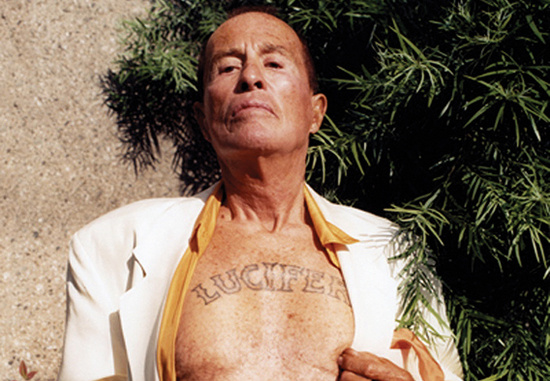
Kenneth Anglemeyer aka Kenneth Anger
Mick beginning shortly after Year Three would turn his act into performance art of a highly suggestive nature accompanied by an intentional hypnotic beat with stun gun volume, flashing lights and the stimulated hysteria of the crowd reaction. A proper atmosphere for hypnotic suggestion.
Mick’s vengeance for the drug bust then was to play the Pied Piper to lead the ‘kids’ to their destruction.
Marianne would be a casualty of his mania as she sank into the deepest of depression.

Chapter 7 follows.
Chaps 3,4,5: Marianne Faithfull: The Faerie Queene Of The Sixties
December 15, 2012
Marianne Faithfull: The Faerie Queene Of The Sixties
by
R.E. Prindle
Chaps. 3, 4,5
Chapter 3

Of all the performers of the Rock era Mick Jagger and Paul McCartney have been the most successful while I would give the nod of most successful to Jagger. One must admire the way he learned the ropes and then used them to strangle others as he had been strangled. Mick in his own way was the Midnight Rambler and the Street Fighting Man. Don’t think I blame him; you either rule or are ruled. But, one does have to live with the reputation one creates.
Mick began cultivating his image from the beginning. As this story concerns Mick’s relationship to Marianne I will concentrate on aspects of their sexuality. Andrew Loog Oldham made a movie of the Stones’ January 1965 Irish tour. Unfortunately he sold the rights to it along with the Stones 1963-70 master recordings to Allen Klein along with, by the way, the first Marianne Faithfull masters. Klein then became the Stones’ manager.
The movie disappeared into Klein’s archives to surface in November 2012 when the Klein estate released it to DVD. It can now be purchased as I did. The DVD features both the Abkco edit and Oldham’s original Director’s Cut.
Mainly a concert film it also features group member interviews and Richards and Jagger cutting up. While they were horsing around they appear to improvise a song with the lyric: I’d rather be with the boys than here with a stupid girl like you.
While Jagger has always cultivated an ambiguous image he has also announced a record of having had sex with four thousand or more different girls. That’s only eighty per annum over fifty years so I imagine that shows an admirable restraint. Yet, at the same time Mick has always been misogynistic while always seeking to emasculate or squash his closer women under his thumb. In fact Mick probably has a domination or emasculation complex. He may have rather been with the boys but in his competition with them he sought to emasculate or squash them too. One of the favorite forms of emasculation and domination is to take other men’s women from them.
Thus when he took Jerry Hall from Bryan Ferry he quipped he had to do it to save her from going through life as Jerry Ferry. One winces when one reads of Eric Clapton begging Mick not to take Carla Bruni from him. Mick even took one of Eric’s temps, Catherine James from him.
Mick And Chrissie

Mick And Chrissie Shrimpton
When Mick first enters the scene for Andrew Oldham he is in an alley fighting it out with Chrissie Shrimpton, the model Jean Shrimpton’s younger sister. If one reads more deeply into that situation it shows a very cruel sadistic streak in Mick, quite shameful in a celebrity of Mick’s first magnitude of brightness.
Chrissie began the relationship as a strong willed girl battered by and battering Mick. In that day before the change in sexual mores girls weren’t quite so sexually open so Chrissie didn’t want her parents to know she was shacking up with Mick. They insisted to Mick that they not. As a humiliation tactic to break the girl down he let it be known to her parents that in his eyes she was little more than a common whore and she and they should see it that way too as he was in fact shacking with her.
Gradually the monster beat her down completely destroying her self-respect then, more than publicly, he broadcast his triumph on records and over the radio with such songs as Stupid Girl and Under My Thumb which their whole circle knew referred to her. Dylan would later use the same tactic against Edie Sedgwick when he wrote Like A Rolling Stone to break her down.
Both Chrissie and her parents believed Mick and she were to marry but having crushed her beneath his thumb, as it were, with a toss of his curly locks Mick sneeringly walked away adding insult to injury. Cruel in this instance it became psychotic with repeated use.
Years after word got back to Mick that Chrissie had a bundle of his letters, and, now this is unforgivable, without a word to her he immediately set his attorneys on her threatening an expensive law suit while demanding she return his letters. Even though Chrissie had not intended to publish them, still shaking this long after Mick’s brutal treatment, Chrissie without delay forwarded her letters from Mick to him. Shameful.
Mick And Marianne

Mick And Marianne
Mick then turned his attentions to the Guinevere, the Ophelia, the Faerie Queene of pop music, our own Marianne. While I’m sure Mick was somewhat enamored with Marianne I’m also sure he had a couple ulterior motives. Marianne was married to John Dunbar at the time while living with Mick so Mick had the pleasure of emasculating and humiliating Dunbar.
At the same time I’m sure he was envious of Marianne’s fame which was probably greater than his at the time. No room in the spotlight for two. He couldn’t stand that Marianne was getting even more press than himself. Thus he undertook to destroy her career. In the process he emasculated her and humiliated her to an astounding degree.
Marianne and Mick were playing with psychologies in a very destructive manner. The events I am going to describe did incalculable damage to their psyches while altering the direction of their subsequent lives dramatically, especially Marianne’s. Of course, few people seem to realize they have a psychology or how it was formed, what expectations they devised. Those hopes and dreams were more especially dashed when they turned to drugs. That was certainly the case with Marianne.
I don’t know how seriously Marianne took her Medieval interest and reading but she was influenced by her Arthurian studies. Like the most or possibly rest of the generation she was also influenced quite heavily by Alice In Wonderland and Peter Pan, probably both books and movies.
The key for the generation in Peter Pan was his refusal to grow up or accept adulthood. It was quite fashionable at the time to pretend that you would always be young, keep in contact with your ‘inner child.’ I was a victim of the psychosis myself.
At any rate Marianne was influenced by all three. Thus, when she and Mick met she quizzed him extensively on his knowledge of King Arthur to see how much he knew as though that litmus test would seal his fate. Mick passed and Marianne moved in still married to John Dunbar. Thus her life clashed with her Catholic upbringing. At first Marianne had royalties coming in from her records enabling her to maintain a certain independence but gradually the royalty checks decreased making Marianne financially dependent on Mick.
At the same time Mick was under no obligations to Marianne and observed none. How this clashed with Marianne’s Arthurian expectations in an atmosphere of Peter Pan and Alice she doesn’t go into but there must have been a severe disappointment as Mick treated her as a mere possession.
While in California he was the object of desire for all the groupies including the doyenne Miss Pamela- Pamela Des Barres nee Miller- of Frank Zappa’s girl group the GTOs (Girls Totally Ornery or else in reference to the hottest car of the period, the GTO). Miss Pamela as well as the rest of the California groupies studied to come up with better and better more outrageous sexual thrills with which to astonish the boys in the band which easily surpassed the imaginations of the boys in the band including Mick.
Mick returned home and demanded of Marianne that she perform these tricks which astonished Marianne no less than Mick had been astonished. However she believed the tricks degrading. Marianne quite rightly refused to perform them.
But the repertoire of the boys in the band kept expanding so that the home girls were led to view new horizons. Group sex and that sort of thing became the norm.
As with all loosely knit movements or phenomena this sort of reputation brought more and more of the sado-masochistic libertine drug oriented element gradually forcing out the less inclined to sexual erotica just as bad money drives out good money. Rock and Roll became progressively more degenerate from 1964-65 on until it was disgraceful to be associated with it.
Mick and the Stones were leaders of this degeneration whether the Stones embraced sexual sado-masochism personally their public persona was based on it making them leading corruptors of youth and society in general. They did as much or more to change the sexual mores of the present than anyone. Their LP cover for Black and Blue was the apex of this very sado-masochistic misogynistic persona. The cover caused me all kinds of trouble in running my record store.
As one presents oneself so must one be.
Chapter 4
The Redlands Bust.
Many psychologically devastating events happened to Marianne in the years from 1967-70. It is very difficult from this perspective to evaluate some of them. One can’t tell how Marianne’s renunciation of her career affected her mind. After all in 1964-65 and 66 she went from just another teenager to superb success far beyond her expectations financially, while becoming the female idol of the youth of England and a phenom in the US- ultimately the Faerie Queen of rock and roll. That’s really only two short years until the Redlands bust.
In those two years she passed through several sexual transmogrifications. She went from virgin to the most outre of sexual practices. Its all very well to say that this was her decision but as Paul McCartney said of his own experience in Miles’ biography it was impossible for him to resist peer pressure, especially in the use of drugs. He was ‘forced’ to try heroin even though he was dead set against.
So peer pressure on Marianne and any young girl to be sexual ‘free spirits’ was impossible unless you were prepared to accept group rejection. The same with drugs that couldn’t be resisted so that when depression set in she ended up addicted to the greatest depression drug available- heroin. It was up to Mick to give what protection he could. Regardless of current sexual nonsense it us up to the man to guide his woman.
Now, the era began in relatively clean-cut innocence . It was never quite so white bread as it is depicted, trying to escape the sleaziness, even then, was no easy matter. Then as the decade wore on it all got worse, then it got disgusting. First pot, pills and amphetamines, then LSD that came on like a hurricane. LSD more than anything else conditioned you for cocaine that in at the end of the decade, at least on the West Coast where I was. Remember that there was no national consensus in the US
In 1964 or so when the ‘counter-culture’ hit in the Bay Area it was a very local manifestation not shared by the East Coast the Mid-West or even for that matter LA. LA was never hip in the way the Bay Area was. While the Beatles are credited with introducing long hair, when the Charlatans came down from Virginia City they had hair and they must have been growing it long before the Mop Tops showed up.
The West Coast could not tolerate New York groups. Mafia outfits like the Rascals nee Young Rascals and Vanilla Fudge made the West Coast puke. There really wasn’t any place for The Velvet Underground either. Of course the British groups that had their own sound that really couldn’t compete with that of say, The Doors, an LA group. The LA groups being more commercially oriented pretty much shoved the Bay Area groups aside, although were a couple of real successes. I don’t include freak groups like the Grateful Dead as commercial successes. Cults are cults.
But to the point, boy, LSD. Owsley Stanley kept the West supplied and how. By the time of Altamont and Stonewall the atmosphere was really foul. And then it got worse still.
About the time of the Redlands bust society and the police were losing their patience. Kesey and Leary had them terrified. The drug thing kept growing. When one says that marijuana was generational it is true only to the extent that a significant minority of the generation smoked it. The hippies were only a small and despised part of the generation but they, we, made a lot of noise and got a lot of notice. Without the radio, rock and corrupt record companies the Movement probably wouldn’t have broken the bounds of Bohemia. But, the time was ripe for the Bohemian conquest of America. That was led from New York, principally by Andy Warhol.
The records made the Bohemian life seem very glamorous. Thus the cops focused on groups where actually the greatest drug activity was located and the propaganda the strongest. As the groups began to make good and even big, very big, money they were the natural prey of the drug dealers. And don’t underestimate the role of LSD. The groups also chose to flaunt their drug use- ‘I’ve got to be free to put anything into my body and life I want to’, disdaining the law, the police and actually common decency. This was the case with the Stones and it’s the flaunting, not the use, that got them in trouble.
In 1967 they naturally were set up. Brian Jones in an interview, barroom chat actually, with News Of The World reporters boasted of his drug use. The journalists then attributed the statements to Mick, whether from ignorance or design I leave to your imagination.
When Mick read the article he was indignant. As I said, while Mick and the rockers thought they were big because of records, radio and TV they were actually socially marginal and not particularly appreciated. Musicians get no respect outside their own circle.
Rather than evaluate his situation, considering that he was doing drugs and everyone knew it thus making him an obvious target, he foolishly brought suit against the newspaper. You don’t have to be brilliant to know News Of The World wasn’t going to let that one fly. Hey! Hey! What’d I say! Mick was sleeping or day dreaming.
The police wanted to get England’s bad boys anyway. There may or may not have been collusion between the News Of The World and the police but the way the raid was conducted indicates there was.
Shortly before the bust some guy named Schneiderman drops from the sky with a brief case reportedly filled with whatever you required. Mick, Marianne and Keith and a couple others, I will mention in the next section, were having an LSD weekend at Keith’s house, the Redlands. Schneiderman insinuated himself into the party with his briefcase while probably being in the employ of the News informed them and they in turn notified the police.
For Schneiderman allegedly having a briefcase full of drugs there were remarkably few drugs in evidence at the bust. Jagger was booked only for possession of four pep pills bought legally in Italy, while Keith had no drug charges at all except for being charged with ‘knowingly’ providing a place where pot was smoked. Robert Fraser actually had heroin jacks of his own on him but Schneiderman produced nothing from his briefcase and indeed no drugs were visible in it when the police required him to open it. No drugs were seen only packaging that were assumed to contain drugs by the Bohemians. In any event he hopped the first flight to elsewhere.
While Marianne had no drugs concealed on her person her situation was the most tragic of all. The Faerie Queen would lose her official status.
When the cops came calling the crowd was of course flipped out on LSD but then that was always the danger; the cops would come calling when you’re least prepared to deal with them. Come on, this was just one of the hazards of using illegal substances. And naturally, you tend to be flippant, wise cracking and mocking. Very bad behavior in such a situation when maximum seriousness is the order of the moment. It’s not like everyone didn’t live in fear of being busted. They used to call it deep paranoia.
Marianne whose clothes had become wet from walking in the rain laid them out to dry dressing in nothing more than some sort of rug wrapped around her. Well, what is one to think of a nude woman amongst a bunch of men; what is this Dejeuner Sur L’herbe redux? Even if two thirds of them were screaming fairies as they were, how is one to know that and what to think?
It was said that Marianne let her wrap slip giving the coppers an eyeful. Of course the cops were square and the gang was hip but squares outnumber hips by a very large margin while as Roger Miller sings: Squares make the world go round. And a good thing too. Roger said that hips have too much water for their land; this was a gathering of pretty watery people. Oh, OK, my people, but folks you have to be realistic. That’s what hip means in my book.
And then someone probably at News Of The World concocted the story that Marianne had a Mars bar slipped between her legs and that Mick was grazing away at it. Preposterous, wouldn’t you think? Boy, now that was a blow that will getcha and you’ll be down for a long time too. As might be expected Marianne was devastated. Boy, that opened a lot of anfractuosities in her brain. A hit like two trains running in opposite directions at top speed on the same tracks over a two hundred foot high trestle. That’s a big crash and a long way to tumble, buddy.
It ended any hope Marianne may have had of appearing on a stage. Can you imagine stepping up to the microphone and being showered with Mars bars. Oh no, no,no, better to board a rocket ship for…oops…Mars.
Marianne and Mick may have thought they were handling it well but the bile and psycho-somatic reactions entering the sub-conscious aren’t so easily dismissed. This horror was merely added to their childhood fixations.
In the turmoil of the months succeeding this mind wrenching event fixations would only worsen. Of course the intent of the establishment was not so much to succeed in jailing them but making an example of them while hopefully destroying their careers. The bust should have been career destroying but for the generational gap. When a teacher chastises a student the other students smirk but don’t disown him. After busting Mick and Keith the establishment then went after the more fragile Brian Jones, the guy who got this whole thing rolling by shooting off his mouth. If the three could have been jailed they wouldn’t subsequently have been allowed to enter the US or so it seemed. No one could have forecast the incredible changes that were about to occur that essentially placed the Stones above the law.
Chapter 5
Enter Donald Cammell And His Movie Performance
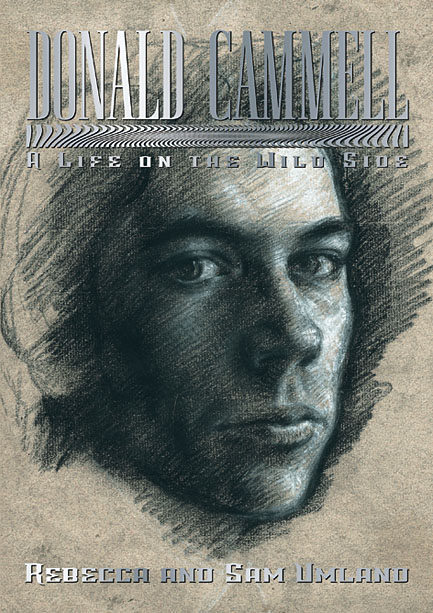
One reads many amusing reasons for the incredible social disintegration of the sixties. One of the most preposterous to come to my attention is the notion that it was caused by lead poisoning.. There’s a hobby horse for you. While I couldn’t rule it out I think lead poisoning would be among the most obscure of reasons. No, the sixties was no more an aberration than was Hitler’s Germany; like the latter it was the result of long historical development, a part of psychological history.
If one reads a good deal with the purpose of understanding the historical background of the sixties things begin to take form. Then if one tries to make one’s intellect rise and float over the information gleaned from that reading patterns will form, a map of the past will appear. Then of course one notes nodes and axons, connections that require further reading and rereading what’s already been read so that a fair approximation of what happened can be more or less confidently stated. Much of it will be subterranean history that doesn’t make it to the history books.
Such is the psycho-sexual mind set that began to develop oh, say, about from 1890 on which a key node was from 1900 to 1920. Western understanding of the human mind developed fairly rapidly from the mid-eighteenth century rapidly gaining momentum after say 1860 and the spectacular doings at Paris’ Salpetriere mental hospital under the tutelage of the amazing Dr. Jean-Martin Charcot.
While his investigations were of a psycho-sexual nature they were not perceived as such except perhaps by a transient student by the name of Sigmund Freud. Sometime after Charcot’s studies toward the nineties people calling themselves sexologists, sex therapists and sex magicians began to appear.
Along with Freud who might be called a sex therapist two leading figures slightly earlier than he were the German Richard von Krafft-Ebing (1840-1902) and the Englishman Havelock Ellis (1859-1939). In the academic scientific or pseudo-scientific manner all three made their contributions although Freud managed to incorporate their discoveries or understandings into his system acquiring preeminence in the field.
Goerg Groddeck and Wilhelm Reich, two of Freud’s disciples also gained prominence in the sex therapist field.
On the religious or supernatural side the most prominent and influential of the sex magicians was the so-called Magus Aleister Crowley and his organization of the Golden Dawn.
With the exception of Krafft-Ebing all were out to overturn European sexual mores, designated disparagingly as Victorian. Of course there was never a time when men and women didn’t behave sexually because…well, how could they? The real goal then was to disturb prevailing sexual mores and replace them with sexual license. This essentially came to fruition in the 1960s when the influence of Freud and Crowley were at their peak. The two principal cultural nodes of the US, New York and Los Angeles, were flooded with European Jewish émigrés of the Freudian school while Aleister Crowley had established himself and his Golden Dawn in Los Angeles.
The corrosive sexual mores of Freud and Crowley were aided and abetted by the rise of the equally corrosive drug use and, of course, ‘lead poisoning.’
Our next object then is to discover who Donald Cammel might be.
Searching For Donald
Cammell is the central figure in this little drama so we will begin with him although even though the Stones biographers don’t delve into these other characters they are integral to the social scene of Mick, Marianne and Keith. It appears that Brian Jones, Bill Wyman and Charlie Watts served a peripherals to Mick primarily and Mick and Keith secondarily. Oldham tried to make himself a third but apparently was incompatible or other interests pulled him in a different direction. By ‘67 he would be out of the picture.
In Marianne’s biography she makes it sound like Cammell was a stranger to the group while actually he was well known to Bob Fraser, and Chrissie Gibbs who were at the Redlands bust and quite familiar with Mick, Keith and Marianne. They all knew each other before the movie began to be filmed.
Cammell was older than the three being contemporary with the first generations of rockers; he was born in 1934 in Scotland. He came from a well to do family immersed in the occult; his father actually knew Aleister Crowley and wrote a biography of him. One may then assume that his father was something of a sex magician as Marianne’s father was a sexologist. It was impossible to escape Freudian influences from at least 1920 through the fifties. So some reference to repression and the unconscious is inevitable.
Cammell’s father was likely familiar with Krafft-Ebing’s Psychopathia Sexualis with its emphasis on psychotic sexual practices. All the sexologists and magicians immersed themselves in bizarre sexual practices. If a reader counters that all sex is legitimate it shows how perverted he or she is. No argument from me, we know where each other stands.
As Cammell was born in ‘34, in ‘44 he would have been 10 and 20 in 1954. Thus he would have been aware of the war between the ages of 4, 5, 6, or so and 10 but perhaps in a muddled and uncomprehending manner but in ‘44 and ‘45 he would have been aware enough to partially comprehend. Certainly when the Big Baby turned Hiroshima to ashes in August of ‘45 something would have registered affecting his mind and outlook.
I was 7 in ‘45 and while I have a clear remembrance of VE Day I don’t have any recollection at all of the Bomb or if I do it had little or no significance to me. I have never had a horror of the A-bomb.
Obviously something other than lead poisoning affected the psyches of the crop of kids from ‘33-’34 to 1942-43. It may have had something to do with the total destruction of the world capped by the Bomb. What a terrific exclamation mark to the end of hostilities. What Cammell’s reaction to this destruction was isn’t clear to me while it probably wasn’t clear to himself.
After the war he experienced rationing during the whole of his teen years. He was probably less affected than others as he became prosperous in his teens on his own as a painter. He was successful as a portrait painter. From the pictures I’ve seen he was more than talented while possibly possessing genius. His mind already exhibited an extreme darkness with sexual confusion easily perceived.
Much of the following information comes from web sites such as the fabulous Another Nickel In The Machine that records the history of London, Sam Umland’s 60X50 and many others. I have not read Umland’s biography of Cammell as yet.
Cammell divorced his first wife and then married a very successful model, the American Deborah Dixon, moving to Paris where they both lived. Cammell apparently was supported by his wife.
Bored with painting, not unlike Andy Warhol, he began to take an interest in film. There is nothing like a movie to exhibit one’s sexual fantasies in real life; indeed a movie is a record of the unconscious. Cammell and Dixon were sexually compatible taking an interest in anything remotely copulatory. Cammell’s first few attempts at filmmaking were not successful or, at least, lacked box office magic.
Along with his lack of interest in painting and his attraction to the movies Cammell gravitated toward the pop world of rock and roll seeking out Jagger. Where was a sexual degenerate to turn? The bad boys of Rock, the Rolling Stones, Mick, Keith and Marianne at least. He found Mick and Marianne’s talked about sexual escapades irresistible. He was undoubtedly attracted by Mick’s dope legend also. Mick claims not to have been an excessive user of drugs, which may be true but I doubt there was anyone at the time who didn’t think he was a heroin addict and druggie par excellence.
As an artist Cammell was acquainted with Bob Fraser and that pop art crowd. Both he and Fraser were known to the infamous crime lords, the Kray Brothers. The Krays, of course, were homosexuals as were Fraser and Gibbs. Mick’s legend is that he is bi-sexual, at least, so there is no reason that he wasn’t sexually involved with the bunch in some manner.
Cammell and Fraser also knew the Satanist and sex magician, the American experimental film maker, Kenneth Anger, as did Mick and Marianne. Fraser introduced Anger to the underground film crowd.
In addition Anita Pallenberg knew Cammell from her pre-Brian Jones, Keith Richard days. She was shown the script in the south of France the year before filming began. So, unless I have seriously misread Marianne’s first auto-biography, Cammell didn’t just show up one day with a movie proposal; it was actually old home week.
Cammell did go on to make an additional three or four movies of which I have seen two, Demon Seed and Wild Side. The last movie has escaped my vigilance so far. Wild Side is a virtual remake or variation of Performance. Demon Seed that I will review in an addendum to Chapter 5 is actually a great movie handling a major sci-fi them to perfection.
Just prior to the beginning of filming in 1968 Mick impregnated Marianne. This is 1968 and if Marianne hadn’t been on the Pill she would have had a number of children now in addition to Nicholas her child by John Dunbar. The question then is why she allowed herself to get pregnant at this time. She was still married to Dunbar so one must think he must have suffered humiliation and emasculation to have another man impregnate his wife. Perhaps Mick’s emasculation genes or maybe just a drug haze.
At any rate Marianne was exiled to Ireland while filming was going on. One can only imagine the anxiety she felt separated from her lover in her condition. One doesn’t have to imagine; she suffered a miscarriage.
Point Blank
The Movie
In 1967 the English director John Boorman had filmed a movie that took
Cammell’s mind by storm. The movie was Point Blank starring Lee Marvin as the protagonist Walker. Cammell recommended that all the cast see the move and bear it in mind. It might be advantageous to review the movie here.
Point Blank was only Boorman’s second effort. Unsuccessful on release it has apparently become a cult classic. His movie is obviously a dream sequence or nightmare. Nothing is real. This indicated by the hero’s name of Walker. He has only one name, no first. No one even knows what his first name could be. The name seemed significant to me but I hadn’t a clue as to what it could mean. Well, you know, when the student is ready the teacher will appear. While writing this piece I was also reading Denis Machail’s 1941 biography of J.M. Barrie, the author of Peter Pan. There on page 190 was the explanation of Walker. Barrie had written a play titled Walker, London. That was a telegraphic address. Quote:
Two impudent jokes in one, the second even more mysterious then as it is now. For the word ‘Walker’ is still in the dictionary- “interjection (slang) expressing incredulity and suspicion of being hoaxed” but when was it last used? Not during the present century, one would say; yet before that there was a time when it was the very crystalization of Cockney humor. “Walker!” you said, to show that you could never be caught with chaff. It was the standard answer to the attempted leg pull. It was also one of those blessed with with which any comedian could bring down the house.
So now the viewer knows he is being hoaxed and can suspend belief. The plot involves Lee Marvin as Walker who takes part in a heist then is shot by his partner who runs off with Walker’s share or 93,000 and adding insult to injury Walker’s wife. The rest of the story involves Walker trying to retrieve his money forget the wife. The story is told through a series of frustrations to a paranoid Walker. So, we have a dream study of a frustrated paranoid.
The opening and closing settings are the same; the walking or exercise area inside Alcatraz prison. The joke seemingly being that one walks around and around, never getting anywhere while returning to the same place. Cry “Walker” and then start laughing like a Cockney at the joke.
Alcatraz, the Rock, is of course a small island in the middle of San Francisco Bay between the Golden Gate and the Bay Bridge. Established in 1934 it was closed in 1963, so the filming was done in a closed facility and before the Indians occupied the island claiming it as their heritage. The filming was done, then, in vacated premises.
As a dream story it concerns the psychic life of Walker. It’s all going on inside his head. The prison, castle or house represents the psychic the self so that Walker lives a bleak, barren, paranoid inner life.
A helicopter lands in the enclosure, picks up a package and leaves a bundle of money. Walker and his pal Mal (mal, French for bad) kill the messenger while robbing him. Walker is then examining an empty cell signifying his empty life when Mal with Walker’s wife looking on puts a couple bullets in him leaving him for dead while appropriating Walker’s share of the money and his wife. Thus we have some basic paranoia that, of course, might possibly be true. As his wife would say later, Walker just kind of left her cold.
Left for dead Walker somehow recovers while being compelled to take the only way off the island available to him- swim for it. Another grim joke as legend has it that no one who tried ever succeeded.
The rest of the story concerns surmounting the treachery and double crosses Walker encounters in trying to recover his money. He finds his wife, abandons her and takes up with her sister. While he seems a little obsessive-compulsive in the matter, the money in fact represents his lost identity, purpose in life or masculinity. The recovery of the money is central for his personality.
As in the Cockney joke whenever he shows up people exclaim “Walker!” If you’re in on the joke it might be funny. Angie Dickenson makes up the sex interest as Chris as there is no love interest. Just a four letter word in this movie. The three kingpins Walker must knock down are Carter, Brewster and Fairfax. Ironically Carter and Brewster are disposed of by their own team when Walker’s paranoia protects him while the others take the hit meant for him.
The actual climax takes place in Brewster’s house when Walker and Chris have spent the night together, the only consummated sex in the movie. As Walker is walking out the door Chris asks what her last name is. Walker doesn’t know and neither do we. Walker counters, seemingly weakly, does she know his first name. Either check mate or an uproarious joke to Cockneys. But as Walker in joke is a hoax or a put on then it doesn’t matter anyway. Dreams are like that, they follow a different logic than the waking mind.
The denouement returns to the opening at Alcatraz but now Walker is more canny staying out if sight. The drop is made, Brewster calls to him to come get the money. But, as when Walker was supposed to get the money from Carter, after he survived the assassination attempt, the bundle proved to be waste paper, Walker’s paranoia saves him again. A shot rings out and Brewster takes a long walk off a short pier never to return again. Now enter Fairfax who is the head man and the assassin who shot Carter and Brewster and would have shot Walker. Fairfax shouts Walker several times that in another century would have brought the house down.
Walker’s paranoia prevents him from taking what might be money in the bundle but is probably waste paper so that as the bundle of funny paper represents his ego he is left stranded in the haunted empty house of Alcatraz representing his mind for one presumes the rest of his life.
The movie was a box office failure, except for the few like Cammell but holds up well as a psychological thriller. That is what Cammell saw. So, now, he’s basing his own movie ‘Performance’ directly on Point Blank.
Performance
He gathers together essentially the ‘gang’ to make his movie. Even Deborah Dixon took part. He already knew and was friends with James Fox as was apparently Mick, cast as the criminal Chas. Cammell had known Anita Pallenberg in Paris where it is said she formed a brief menage a trois with Cammel and Deborah. Chrissie Gibbs was the set designer…Mick was an old friend, a few outsiders and Cammel had his movie.
Mick sent Marianne to Ireland for the duration. Keith who was shacking with Anita was so unhappy about Cammell’s pairing of Anita with Mick that he found it impossible to visit the set. Instead he brooded outside in his car sending Bob Fraser in to keep tabs until Cammell banned him from the set.
I can’t be sure that Cammell understood the Cockney meaning of Walker but he so admired the character that he based Mick’s role on Walker giving Mick the single name of Turner. No first name. Turner is also meant to be significant. A turner is a sort of acrobat. The word could also be used in the sense of changeling, or perhaps in the homosexual sense or turning a man gay. Turner does turn Chas. from a tough guy to a passive fairy, his sort of changeling. Turner changes the tough hoods into faggots. Probably then that is the meaning of the name. So maybe Cammell was in on the Walker joke.
As the movie is permeated by sex magic and sex as a sort of therapy the influence of Krafft-Ebing, Ellis, Freud and especially Aleister Crowley is very apparent. Kenneth Anger was around at the time while being known to all the participants thus reinforcing the Crowley connection.
All the sex therapists were concerned with aberrant sexual practices that the movie concentrates on. Cammell elaborates the sexual implications of Boorman’s Point Blank, while the decaying mansion obviously represent Cammell’s mind. In the end the sex therapy or magick doesn’t seem to work as Turner turns suicidal obsessed with a death wish.
Boorman’s crime angle comes in through Chas. In order for Fox to appear authentic Cammell actually required him to live the criminal life under the tutelage of a mobster, even to the extent of taking part in actual crimes. Of course, madness is the theme of the movie but even madness can go too far.
Chas. has offended the criminal chief, based on the Kray Bros., who has commanded a man hunt to track Chas. down. When he is located he is summoned to his execution. Turner says: Don’t leave me, take me where you’re going. Chas. says ‘You don’t want to go where I’m going.’ Turner: ‘Yes I do.’ Chas. then blows Turner’s head off, gets into the car and the car drives off, as he looks out the window we see Turners face. Thus the turning or change is complete as each becomes the other.
The version now available for purchase or rental is apparently much different from the original. While even the available version is violent and pornographic the original must have anticipated the current pornographic output of Hollywood . While I wouldn’t call Performance tame almost every movie you see today is as or more explicit. At any rate the movie has no redeeming moral value. If you want porn plain and simple, there it is.
The legend has it that the movie changed the lives of the participants. Perhaps so, but perhaps not. Michele Breton was already a lost child and stayed lost. Anita, no stranger to drugs moved into intense familiarity. James Fox, who was criminally mistreated by Cammell, gave up movies for ten years but he says he was already fed up with the seedy side of movie making so perhaps Performance just capped it. Keith? God, what can you say? Who was going to keep him from drugs? If Cammell was already inclined toward suicide he topped himself off in 1996 finally taking Keith’s advice.
But, now, Mick and Marianne. Mick was advised to play himself but Marianne wisely overruled that advice perhaps saving Mick’s sanity but still leaving him off balance. Marianne advised him to adopt some of the fey characteristics of Brian Jones’ character along with some of Keith’s tough guy stance. Not too difficult as that is the way Mick already appeared but it permanently shifted his personality in that skew. Nevertheless Mick has always remained supremely functional.
As to Marianne, how did she relate to Mick’s rejection of her by sending her to Ireland and the subsequent miscarriage of her child. That is a lot of psychological battering. I think that it is certain that as 1968 progressed she was already in a depression and sinking rapidly. While she was able to hold on for another year or so, by 1969 she would be spinning out of control as further events tested the strength of her mind.
A Review: Isidor Sadger Recollects Freud: Emasculating Freudian Theory
December 16, 2011
A Review
ISIDOR SADGER RECOLLECTS FREUD
Emasculating Freudian Theory
By
R.E. Prindle
…Jung had been infected with Aryan blood from his family.
Deep in his heart,
he was anything from a philosemite.
Now, however, he encountered Judaism
in its most highly gifted embodiment
Of Jewish knowledge shining in front of him.
Was it any wonder that he began by being blinded
With the feeling that never before had he stood before
The countenance of a greater genius?
But his lineage was not to be denied.
One day he sat down and carried out scholarly studies for months
Which resulted in his finding his way back
Through the Mithraic cult to primitive Christianity.
In practical terms
This may be seen that as a Christian prophet,
He fully stripped the libido of its sexual character
And reduced it to merely spiritual energy.
This was, so to speak, the decontamination
Of the poisonous Freudian teachings
Through Christianization and total cleansing.
But since the master could not easily go along
With the desexualization of his teaching,
Which went to the foundation of his theories,
He saw with a heavy heart
That he needed to cut the cord between him and the clinic. (Bergholzi)
Isidor Sadger, Recollecting Freud pp. 71-72

Sigmund Freud: Smoke Rings
Sadger, Isidor: Recollecting Freud, 1930, first published 2005, UWisconsin
It is very difficult to know where to start in analyzing the above quote from Isidor Sadger. First it might be pertinent to identify Isidor Sadger. He had a history with Freud from 1895 into the 1930s. He attended with two others Freud’s first psychoanalytic lecture. He was a founding member of Freud’s Vienna Psychoanalytic Society. In 1930 he published this little volume of biographical notes on his relationship with Freud.
Freud’s circle did not take kindly to the publication of these memoirs doing everything they could to suppress them. In this they were successful. The book was never distributed and only rumored to be in print until this publication in 2005 by Alan Dundes and UWisconsin. Even acquiring a copy of the book by Dundes was nearly impossible. He relates pp. xlii-xliii:
Recollecting Freud
When I looked up Sadger on my computer data base, I found not only the article (Sadger had written) in question but the title of a book: Sigmund Freud: Personliche Erwinnerunger. As I was not familiar with that work, I decided to send for it via interlibrary loan….In due course, the latter arrived but the effort to procure a copy of the former proved unsuccessful. I was informed that there was no known copy in the United States available for borrowing. Since I knew the book had been published in Vienna, I asked if we could try to locate a copy in Europe and the obliging staff in interlibrary loan agreed to do so. A few weeks later, I learned that there was no known copy in any European library available for borrowing.
I was told, however, that there was one, just one, copy listed that might be utilized and that copy was located in the library of Keio University in Japan. Again, inter library loan made a request on my behalf and this time with some partial success….I next asked interlibrary loan to request a photocopy of the entire book…The Keio University Mata Media Center informed (me) that it was unable to comply with my request….
…One of my anthropology doctoral students…was returning to Japan. I asked him to do me a favor and get me a photocopy…
Which he did and almost by a miracle the text was recovered to be published for human consumption some seventy-five years on. As Freud claimed to be a scientist one is amazed that supposed scientists would go so far as to deny publication of Sadger’s memoirs. But, so it was.
In tackling the quote from Sadger let me approach it from the point of view of ‘Jewish knowledge shining in front of him.’
One must ask the question of what is Jewish knowledge and how is it special to their culture? This is important not only from past implications but also in light of today’s Barbara Spectre and her Paideia organization whose intent is to place ‘Jewish knowledge’ on a par with Aryan knowledge or what Sadger calls Christian knowledge.
While Freud may have been a Jew working in the scientific field of psychology and psychiatry and while he may have made some important discoveries in the field that had been developed by Aryans his own contributions arose from that body of accumulated Aryan learning. Since Dr. Anton Mesmer in the mid-eighteenth century until Freud’s Interpretation of Dreams Aryans had been slowly accumulating the knowledge on which Freud built his theories. That knowledge had no racial identity per se nor did that which Freud added to it. As Freud claimed that he was a scientist then his contributions were scientific, not Jewish, and the common property of mankind. He may have been Jewish but the scientific field he was contributing to had no ethnic identity but Science, which is to say, none at all.
Sadger himself is taking a bigoted view in attempting to sequester Freud’s theories to the Jews. In fact, as Sadger indicates Freud did not want his theories to be studied and furthered by anyone else. When C.G. Jung, who Freud tried to make his disciple attempted to examine Freud’s concept of the libido and came to perhaps a more correct understanding of the concept, which after all was scientifically unproven, Freud broke off his relationship with him and the Bergholzli Clinic of Switzerland. He, in fact, severed any Aryan connections. He became interested only in Jewish contributions which then became Jewish knowledge in Sadger’s mind.
Sadger who had been Freud’s earliest disciple deeply coveted the role of being Freud’s pet or ‘favorite son.’ Freud for whom ambivalence was central to his character, even though he hated Aryans as a homosexual he was attracted to the ‘great blond beast’; hence, while carefully concealing his motive he selected Jung who had the requisite scientific qualification to be not his ‘son’ but a necessarily platonic lover. Sadger could never qualify.
Now, what was Jung’s sin that brought about his rejection by Freud:
One day (Jung) sat down and carried out scholarly studies for months which resulted in his finding his way back through the Mithraic cult to primeval Christianity…this may be seen as a Christian prophet, he fully stripped the libido of its sexual character and reduced it to merely spiritual energy.
Unquote.
So, having committed to Freud although ‘infected with Aryan blood from his family’ that he would abandon certain anti-Semitic understandings that he had. In what seems an obvious betrayal of his pledge to Sadger Jung ‘carried out scholarly studies for months; which resulted in his coming up with a different perception of the libido that downplayed the rutty sexual projection of Freud’s Jewish psyche for what Sadger terms Christian spirituality. To Sadger’s mind Jung had betrayed his pseudo-Judaism pledge to return to Christianity.
This raises several problems. Is anti-Semitism a mere prejudice or is it based on observations of how Semitism functions and its rejection on that basis? In other words, based on observed actions Semitism is rejected and not on prejudicial grounds but for accurate scientific reasons.
Further, in dogmatically insisting on his own interpretation of his creation, the libido, Freud was definitely unscientific. At the same time his topography of the mind was completely off base. In point of fact the libido is neither sexual nor spiritual, it doesn’t exist. While Freud had a good working hypothesis his ideas were merely that based on the scientific, not Jewish, knowledge of his time. Freud became dogmatic at a time when he knew, or should have known, what he didn’t know. There was a lot of physiology to be yet discovered that would uncover the biology of life.
This biology would be clarified in 1947 when Crick and Watson discovered the genetic code of DNA.
Freud in his rutty, close to pornographic, interest in sex, by which he meant sexual intercourse made the absurd statement that the more frequently a man ejaculated the better person he would be. Is it any wonder that Jung was turned away from Freud in disgust? While Freud may have thought he was severing ties with the Bergholzli; the reverse would seem to be true.
With the discovery of DNA the biology became clear making it possible to elucidate the psychological basis of sex based on that biology.
Freud frequently had the right idea but he seldom thought the application through being infected with his own need for greatness by creating a science of his very own and his Judaism to whose Weltanschauung he was totally committed as Sadger indicates.
To take the psychology first: Freud correctly differentiates between the individuals inner wishful thinking and his confrontation with outer reality. Or, in other words, religious superstition versus a scientific understanding of objective reality.
Thus, when the child is expelled from the womb he comes into contact with the outer world. Whatever conception of reality he had in the womb bears no relationship to the reality of the world beyond the womb. In the Freudian sense then the child’s mind is all Id with at best a nascent Ego. As Freud’s desideratum is Ego shall displace Id the child has some serious adjusting to do.
This adjustment is called experience and education. In the absence of education the child would grow up to be ignorant savage with an improper understanding of reality causing him to give all the wrong reasons for the phenomena he encounters. This being mankind’s original condition over the millennia this ignorance was replaced by religious speculation based solely on inner wishful thinking. Nor was not adequately understood. As people might, for instance, decide that they are the chosen people of their god, make that god a universal deity and then weave their notions of external reality around that projection. That was the condition of Freud and his Jewish people.
The conflict for Freud and his Jews became acute when the Aryans with a different Weltanschauung sought to understand external reality on its own terms and adjusted their inner world of wishful thinking to reflect as much as possible objective reality. When Freud mentions the science of Kepler and Darwin as being shocks to the human mind, he meant Jewish mind which was now faced with the irreconcilable fact that their Arien Age Weltanschauung being based on false data was obsolete. While Freud considered the organization of the mind the third great shock it was one that could be manipulated for his own ends, unlike Astronomy and Biology, and perverted to serve those ends. Hence his dogmatic and ridiculous view of the unconscious and sex.
Now let us look at the nature of the human sexual function. DNA with its double helix, one strand from each contributor, each remaining separate but combining information through bridges, visibly demonstrates how the entity is constructed. The spermatic strand contributed by the male forms the stronger, more active, and slightly larger right side of the body and left side of the brain; the ovate strand contributed by the female forms the weaker, more passive, slightly smaller left side of the body and right side of the brain.
This means that the Xy chromosome of the male carries a male version and a female version, thus there is a female component to the male. This was picked up the psychoanalysts as bi-sexuality in the carnal sense. This is not true. A man is not by nature available for sex by either sex. Hormones reaffirm the sexual identity.
As should be easy to see all activity is controlled by the brain. Information is communicated up and down the spinal cords which emanate from the brain. One cord for each chromosome. Thus, there is a nerve connection from each side of the brain to the commensurate testicle or ovary. Sperm is manufactured according to the dictates of the autonomic system. After one reaches puberty the seminal fluid builds up. Without any other release the fluid will discharge automatically whether one wills it or not; these are usually termed nocturnal emissions. These alone are all that is necessary to relieve the over supply.
As the only biological function of sex is reproduction the male is always ready to penetrate the female. In a normal psychological function a comfort level can be maintained by one or two ejaculations a day or even less. That Freud could make the absurd statement that the more ejaculations a day the better the person means that as a homosexual he had a psychic need or that the was merely trying to pervert Aryan society.
Now, the spinal cords run down the length of the body from the brain to the testicles where they terminate, making the brain and testicles a unit. Nerves run from the spine to the various organs. There we have the basis for psychosomatic reactions. While the cords are grounded at the testicles I believe they have more free play at the brain level. The bi-sexuality the psychoanalysts noted is caused by the Xy and XX chromosome combinations. Both Freud and Jung given the biology of their day had differently accounts for the apparent bi-sexuality thus they called the spermatic brain ending the Ego while Jung claimed that the male had an Anima and the female an Animus. In actuality both males and females have an Anima and an Animus or, in Freudian terms, a Libido and Ego.
Freud also discovered the concept of Emasculation. When the Ego or Animus, male or female, is given an affront or insult to which it cannot properly respond this creates a reaction or hypnotic suggestion that forms a fixation. This fixation will have a psychic or physical or both affect. Fixations are of different intensities and qualities; the most severe is the central childhood fixation, also with psychosomatic affects an example of which each fixation creates.
In the case of the homosexual the affront is give by the male who thus creates a severe psychosomatic reaction which is what homosexuality is. In the attempt to negate the reaction the homosexual then seeks to visit his fixations on other males while being compelled to seek multiple ejaculations many times a day which he equates with masculinity.
Thus a normal male can be satisfied with a normal schedule of ejaculation or relieving the pressure of the sperm build up, while a fixated person is compelled to more frequent ejaculation. Thus Freud completely misunderstood sex erring on the side of homosexual emasculation. Thus he was transferring his sexual neurosis or psychosis to Aryan society. Probably in vengeance as he undoubtedly believed his own emasculation was caused by Aryans.
So, Freud’s whole conception of sex is skewed and should be rejected, replaced by a more accurate and balanced interpretation. Jung had good reason to reject the libido or sexual theory of Freud that Sadger and the Psychoanalytic Society was required to embrace because Freud, their master, had spoken. Freud must, or should have known, the limits of the biological knowledge of his time while understanding that great advances would come that might invalidate or require adjustments to his theory. Therefore his attempt to dogmatize his first thoughts was unscientific to the extreme.
Contrary to Sadger’s orthodoxy Jung was quite right to pursue the libido theory further. In desexualizing it, in Sadger’s term, Jung was on the right track as Freud’s interpretation was absurd on the face of it. While Jung was certainly ‘infected’ with a Christian based view, as a scientist he was trying to give a scientific basis to sex rather than ‘Christianizing’ it as Sadger thought. But then, Sadger was definitely intellectually limited by his Judaism.
In using such terms Sadger gives away the intense Jewish separation of Jewish and Aryan Kulturs. There can be no specific Aryan or Jewish knowledge; there can only be one knowledge and that is Scientific truth. If you can’t stand the heat get out of the kitchen.
While Freud built his theories on Aryan scientific psychological investigations he then infused the knowledge with Jewish superstition and goals which bent the science of psychology back toward a religious application which Freud undoubtedly hoped would negate the Astronomical and Biological shocks to the foundations of Judaism or Semitism.
Not only had Freud and his followers buried the reputation of the great French psychologist, Pierre Janet, from whom they borrowed or stole so much but in their successful attempt to freeze psychoanalytic investigation into the Freudian framework they brutally slandered Jung while discrediting his own scientific work. It was not until the sixties of the twentieth century that Jung began to be understood and credited for his contributions which were certainly equal to and mainly independent of Freud.
Thus we have the persistence of Alan Dundes pursuit of Sadger’s little volume to thank for casting a few rays of light on this thorny problem of psychoanalysis.
A Review: Part I, The Prague Cemetery By Umberto Eco
November 20, 2011
A Review
THE PRAGUE CEMETERY
By
Umbert Eco
Review by R.E. Prindle
Eco, Umberto: The Prague Cemetery, A Novel, 2010, Houghton Mifflin, NYC
Part I: Prologue
Little Bags Of Memory

Umberto Eco As Atlas
In this novel Eco attacks the dark subconscious mind of nineteenth century Europe. It was the moment when Europeans discovered the difference between their conscious and subconscious minds. As a historical novel Eco mines his fifty thousand volume private library to construct his story. His sources range from Dumas and Eugene Sue at one end to George Du Maurier and J.K. Huysmans at the other. At this point in history, other than Dumas I presume the other authors are virtually unread if not unknown. Fortunately I have read most of Eco’s sources with my more modest five thousand volume library.
Eco seems to have a very fond spot in his heart for George Du Maurier and I found his treatment of the author most interesting.. Du Maurier was a long time contributor to the English humor magazine, Punch in both text and artworks through the heart of the nineteenth century. The illustrations Eco uses in his novel are very reminiscent in style to those of Du Maurier. Indeed, Du Maurier is very seductive both artistically and literarily. When he was turned down for the editorship of Punch he was crushed, turning away to write and illustrate his subtly fantastic three novels Peter Ibbetson, Trilby and The Martian, the last finished just before his death in 1896.
Like Eco Du Maurier lugged a lifetime of memories, literary and personal through his novels. I’m still working my way through his sources, or favorites at least. Du Maurier was a Bohemian artist in Paris at about the same time as Henri Murger who wrote his fabulous description of Bohemian life, The Bohemians Of The Latin Quarter that was turned into Puccini’s opera, La Boheme. DuMaurier found Murger’s description of Bohemian life repellent to his own sensibilities so he romanticized the nearly same story into the lovely fairy tale of his own version, Trilby. Trilby was a sensation of its time and remains a classic.
Eco has read and thoughtfully considered Du Maurier and while Du Maurier tended to romanticize painful or repellant memories into order to create a fairy tale existence for himself all that sunshine seems to cover a bitter undergrowth. Eco who astutely perceives this was led to parody him in Eco’s own fabulous first chapter of Prague that is a hilarious stand up comedy routine worthy of the mordant, sick humor of Lenny Bruce. Eco then makes his character Dr. Du Maurier the chief of an insane asylum parodying Du Maurier’s Peter Ibbetson while reversing the roles of Ibbetson and the Duchess of Towers in the character of Diana Vaughan. Very nice bit of inside humor on the part of Eco.
While I make it a rule to not recommend books, a rule I often violate, if you’re reading this I presume you’re simpatico. I heartily recommend any of these sources of Eco if you haven’t already read them.
Obviously Du Maurier’s novels holds a special place in Eco’s heart and a well merited place both in his and mine. However, Eco gives precedence to two of the greatest French novelists of the nineteenth century, Alexander Dumas and Eugene Sue. As it happens I revere both authors as much as Eco. Dumas’ most famous titles are still widely read while Sue’s much less so or, perhaps, not at all.
Eco mentions Dumas’ The Three Musketeers and The Count Of Monte Cristo and the French Revolution novels centered around the magician Cagliostro or by his other name, Joseph Balsamo. I first read The Three Musketeers as a youth while I have reread it again along with first time readings of Monte Cristo and the Cagliostro series within the last ten years.
What Eco is doing in the Prague Cemetery is writing his version of a Dumas novel. While a good novel Prague falls far short of Dumas. What Eco lacked that Dumas had was a collaborator of the quality of Auguste Maquet who researched and worked up the material in outline so that Dumas could concentrate on composing the dramatic touches of the story. This allowed Dumas a much wider scope and deeper detail that brought out the fabulous myth of Three Musketeers or the huge scope and depth of Monte Cristo and the Revolution novels.
I’ve read reviews of Prague where Cagliostro is apparently thought of as a Dumas creation. Oh no, Dumas could write historical novels to place alongside his role model, the great Walter Scott, or as a model here for Eco. While novels, Dumas’ Revolution stories are accurate as history. Cagliostro was a real person. Such a collaborator as Maquet might have given Eco room to expand his horizon and widen the scope of his novel to include for instance the rise of psychology and the discovery of the European unconscious while introducing some of the stage hypnotists and magicians such Robert Houdin, the model for the subsequent Houdini who used his name.
Eco’s novel is OK but he could have made it much better. The Simonini dual personality touch is a surface probe of the unconscious that had real potential perhaps bringing in the Society for Psychic Research but I think the execution of Simonini was weak and not properly developed. Still the character was a nice stab at Dumas’ and more especially the unbelievably fantastic Eugene Sue. What a madman. One could think him insane but I choose to believe he was touched by the divine afflatus. Sue, if mad, had the madness of the gods. If Dumas was more than human, Sue far exceeded Dumas. I have never read anything that comes near Sue’s The Wandering Jew or The Mysteries Of Paris, especially the latter which probes the outer limits of sanity.
The unfortunately named Wandering Jew will drive off most American readers who have been conditioned to avoid anything concerning Jews lest they be considered anti-Semitic. Although as Eco points out the hidden hand of the Jesuit priest Rodin that haunts the novel from beginning to end is one of the most terrifying apparitions in all literature and Sue was the master of terrifying images.
Both he and Dumas were obsessed shall we say by the historical memory. Eco himself is obsessed by memory as am I. I have that in common with these writers. I have explored my personal memories in several novels I have post the internet and most of my essays here on I, Dynamo are concerned with ordering the historical memory. Eco sought to recapture the memories of his youth in his previous novel The Mysterious Flame Of Queen Loana. Both Eco’s and my own efforts are much after the fashion of George Du Maurier. I would recommend Du Maurier highly except that it takes some dedication to understand the luxuriant beauty of his work; his three novels have to be read several times to acquire his intense longing to never lose his memories, taking them with into the Great Beyond. But, if you are of a like mind and feel up to it, have at it.
So, Dumas proposed to novelize the whole of French history, the racial memory and had a magnificent go at it. The guy is really spectacular. Eco mentions also the last novel of Eugene Sue, The Mysteres Du Peuple which is has yet to be translated; as Eco says he labored through the French. Apparently Sue took the task he set for himself quite seriously as Eco says the story is quite complex and I imagine very long. Mysteries Of Paris itself is three volumes or about fifteen hundred pages.
The title translates as I see it, The Mysteries Of The Folk. As Eco says Sue begins his story with the Frankish invasions of the fourth to sixth centuries, then tells his story along two family lines one Frankish, one Gallic. This would be a prodigious feat of historical and racial memory, an explosion of Sue’s past educational imprinting in both society and school. This would be especially important to him as both he and Dumas were of the first post-Revolution generation of which they very likely heard many first hand reminiscences growing up while reading reams of memoirs. As the Revolution was primarily racial in character, Gauls versus Franks, this would give added poignancy to Sue’s search to retrieve the history of the two races.
So, what Eco seems to be doing in the Prague Cemetery is carrying the personal, racial and historical European memory forward from the work of Dumas and Sue. How well I think he did it will be in the concluding part of the review. First we have to take a huge memory detour in order to bring the historical and racial memories from the beginning back up to Dumas, Sue, and Eco and late nineteenth century history. When I say huge detour, let us begin our magical memory tour at the beginning, Pangaea.
Part II will follow.
A Review: Pt. V: Tarzan And The Leopard Men by Edgar Rice Burroughs
November 8, 2011
A Review
Themes And Variations
The Tarzan Novels Of Edgar Rice Burroughs
#16 TARZAN AND THE LEOPARD MEN
by
R.E. Prindle
Part V
How The Story Is Told
Obscure but persistent workers in these decades of disaster
Pieced together the puzzle bit by bit.
There is a scale of fantastic disproportion
Between the scale of the labourers and the immense consequences
They released.
The psychology of association,
group psychology,
Was a side of social biology that had been disregarded
Almost entirely before the time of which we are writing.
People still had only the vaguest ideas
of the social structure in and by which they lived.
They accepted the most arbitrary and simple explanations
Of their accumulated set of relationships
And they were oblivious even to fundamental changes in that set.
Wild hopes, delusions and catastrophes
Ensued inevitably.
–H.G. Wells, The Shape Of Things To Come, pp. 245-46

Possibly The Real Thing
This is actually an interesting story. If you search for references they are there aplenty. I’ve already referred to some but another that might be overlooked is the apparent reference to Edward Bulyer-Lytton’s famous opening sentence to his 1830 novel Paul Clifford. The original goes:
It was a dark and story night, the rain fell in torrents- except at occasional intervals, when it was checked by a violent gust of wind which swept up the streets (for this is in London our scene lies), rattling along the housetops and fiercely agitating the scanty flames of the lamps that struggled against the darkness.
There is even an annual contest to see who can write the most successful parody. The line has such a reputation that many writers seek to write a variation on it to open one of their own stories. ERB has successfully replicated the feel as this story opens on a dark and stormy night.
The lurid horror of the story is set in this opening scene in which the headman of Kali Bwana’s safari attempts to rape her. She shoots him but only wounds him in the arm. Her safari then deserts her leaving her alone in the middle of the Ituri Rain Forest where even on a bright sunny day the gloom is never lifted. Now, that was a dark and stormy night.
She is discovered by Old Timer who himself takes it into his mind to rape her. He is prevented from shaming himself by the abduction of Kali Bwana by the Leopard Men in his abscence. The story of Kali Bwana and Old Timer is set in motion then as he sets out to rescue her from the deplorable fate of being Leopard Goddess to the Leopard God.
The complementary story of Tarzan And The Leopard Men is set in motion by A. The murder of an African swain, Nyamwegi by the Leopard Men during the story. B. The felling of Tarzan by a blown down tree with subsequent amnesia and C. his rescue by Nyamwegi’s friend Orando and his assuming the identity of Orando’s guardian angel or muzimo.
We are first introduced to Old Timer as he sits around the campfire with his partner, The Kid. They are ivory poachers, very disreputable. They split up to search for elephant in two different areas which leads to Old Timer’s discovery of Kali Bwana.
The protagonists of the story are the Leopard Men. They are an African clandestine religious cult who terrorize all the tribes over a large but unspecified area although they originated in a far away place, probably the Calabar Coast as in real life. They have been active as far away as among Tarzan’s Kenyan Waziri which has drawn his attention to them. He doesn’t want that kind of trouble on his estate.
The Leopard Men were a real phenomenon although not too much is known about them. Burroughs was apparently working from newspaper or magazine articles about them, National Geographic maybe. If he had a book or two they don’t appear in his library. To accentuate their horrific nature ERB makes them not only murderous but cannibalistic. They probably were both.
Cannibalism is a theme which recurs throughout ERB’s corpus not just in his African novels. Whether he leaned on the ntion for horrific effect or whether it has some deeper psychological meaning for him I have yet to determine. The fate of the Donner Party with its alleged cannibalism has always been discussed in hushed tones in California so he may have picked up the theme from that although the theme was prominent in earlier novels like The Mucker and Marcia Of The Doorstep. Burroughs has a way of working it in.
It becomes necessary for the Old Timer to rescue Kali Bwana from the Leopard Men. The Utengans wish to destroy them while Tarzan’s goal for coming to the Utengan country in the first place was to seach out their ‘fabled village and temple.’ As ERB explains coincidence allowed Tarzan not only to discover them but to destroy them.
Old Timer in his attempt to rescue Kali Bwana is led to the town of Gato Mgungu who is the political leader of the Leopard Men. Old Timer who has traded with Mgungu never knew his connection with the Leopard Cult. Whereas before he was welcomed now he is made captive to become the feast at the Leopard cult orgy. Then to the temple where he discovers Kali Bwana decked out in the regalia of the Leopard cult presiding at the festivities.
Burroughs introduces some wonderful details such as that the high priest is a ventriloquist who has deluded the Leopard Men into believing that the Leopard God actually speaks in their dialect. Tarzan, watching from the rafters, on behlaf of the Utengans although he has neither heard or seen ventriloquism before applies his mighty intellect, this guy learned to read an unknown language from a picture book, to the problem of divining the secret. Of course Tarzan had been to Paris and was familiar with London music halls so ERB may be laying it on a little thick here. Tarzan was surely sophisticated enough to know of ventriloquism. In his defense, however, he was suffering from amnesia so that while he did know of ventriloquism he had to work it out anew. I do detect a slight inconsistency here nonetheless.
Let us retrace out steps to recover Tarzan’s story after he was released by Oranda the Utengan. Tarzan has absolutely no recollection of who he is or where. Thus when Orando suggests to him that he is his muzimo Tarzan readily accepts the role. His companion, Nkima the monkey, who has not lost his memory can’t understand why Tarzan doesn’t accept the information when he tells Tarzan that Tarzan is Tarzan and Nkima is Nkima and not the spirit of Nyamwegi. Tarzan is unconvinced and even Burroughs refers to Tarzan only as Muzimo until he regains his memory.
Muzimo and Orando then set out on the trail of the Leopard Men to avenge Nyamwegi. Four Leopard Men were involved. Muzimo and Oranda kill three while the fourth escapes.
The next task is lunch. For this Tarzan, who only kills for food, never for sport, dispatches an Okapi described as bigger than a cow. The two hunters cut off a couple pounds for lunch and leave the rest for roving scavengers.
The Okapi would have been unknown to most of Burroughs’ readers. The beast was a native only to the Ituri. Its existence was only confirmed in 1900, so definitely an exotic touch to the story for its time.
The next task is to organize an army to attack the Leopard Men. The Leopard Men were much feared so this was not only difficult but nearly impossible. Only a hundred men showed up for the summons including the secret Leopard Man, Lupingu. Orando also has to counter the influence of the witch-doctor, Sobito, another secret Leopard Man. Even though Sobito’s influence is enormous Muzimo is able to counter it with his own seeming supernatural influence.
Sobito and Lupingu have a conference from which Lupingu is sent to betray Orando’s force to the Leopard Men. While Orando attends to the details of marshalling his force Muzimo acts as the intelligence wing reconnoitering Gato Mgungu’s village. Gazing down from the large lower branch of the ubiquitous tree Tarzan detects Lupingu betraying the force. The Leopard Men arrange a 300 man force within minutes attacking the Utengans while meeting Muzimo on their return.
The Utengan force had been decimated which is to say one in ten had been killed which is what decimated means. As someone interested in military matters one wonders if this is an inside joke of ERB’s.
Reconnoitering further Tarzan attends the installation ceremony of Kali Bwana. He is surprised to find the two white people there, Old Timer was there as a prisoner, but as a Utengan Muzimo, in fact as in name, has no racial interest in Whites.
He returns to Orando to tell him that the Leopard Men will be returning completely hungover so a perfect opportunity has presented itself. Orando takes advantage of the opportunity completely routing the returning Leopard Men while exterminating the men, women and children of Mgungu’s village and appropriating their left over beer. To the victor belongs the spoils.
In the battle Muzimo is knocked unconscious who when he comes to is Tarzan once again. Muzimo disappears from the story. Tarzan informs the awestruck Utengans that he is really the legendary Tarzan of the Apes whose exploits are the stuff of the campfire tales of the Utengans. Yes, friends, even in the depths of the Ituri Rain Forest the legend of Tarzan is a huthold word. The goddess Kali must have been running a close second.
Apparently when amnesia strikes one forgets one’s life prior to the attack but when one regains one’s memory one can remember the amnesicac details because Tarzan now remembers the two White people at the Leopard temple deciding to check up on them because of some faint racial affinity.
In the meantime without the aid of Tarzan Kali Bwana and Old Timer manage to escape with the bumbling aid of the African chief, Bobolo.
They manage to appropriate a gigantic dugout that Old Timer is able to manipulate on his own. Leaving the mysterious and silent river of death they enter the main river, one presumes the Aruwimi. While they are thus engaged the Leopard Men between them and downstream at their village are defeated and the survivors flee back to the temple. Old Timer perceives the first batch of canoes, steering his lumbering craft into the shadows of the bank where he is perceived. Rather than waiting to see if any others are following he immediately heads to center stream where he encounters Bobolo’s contingent. Old Timer is captured while Bobolo captures the glowing white Kali Bwana. Raising a warning cry he is able to detach himself from the little flotilla carrying Kali Bwana back to his own village to be his White wife.
Old Timer is taken back to the Leopard temple to serve the noble function of lunch. All this is convincingly well described by Burroughs with his usual economy. All this takes fewer pages than one might imagine.
Tarzan returning as Tarzan to the Leopard temple sends all the canoes save one downstream. He reenters the temple in the nick of time to save Old Timer who he sends downstream in the single canoe. Apparently all those canoes he released didn’t form a log jam on that narrow nearly stagnant slow moving mysterious and silent river of death.
As Old Timer poles his pirogue laboriously downstream Tarzan demands the Leopard Men give him Sobito who he had recognized behind his mask as a hostage. He then leaves carrying Sobito through the otherwise trackless and impenetrable swamp and jungle. The Leopard Men find all their canoes missing seeing only rows of crocodile eyes facing them. They have no way to escape the temple and…they are all cannibals, if you know what I mean.
So now Tarzan has destroyed this whole Leopard Man contingent. He leaves Sobito with Orando. Sobito contrives to escape himself heading downstream to his old friend Bobolo. So the whole crew is moving toward an assemblage at Bobolo’s village.
Now, when Bobolo showed up with this White wife his Black wives objected especially the Mduze like older wife. Bobolo is compelled to remove Kali Bwana. Rather than giving her up he transfers her to the Betetes, a tribe of Pygmies, for safekeeping intending to visit her on the sly. He promises to send food in recompense for her keep to the hapless Pygmies. Before he can the escaped Sobito shows up placing himself under Bobolo’s protection.
Old Timer who has been treed for several hours notices the canoe of Sobito coming along just behind him while from his tree he hears some native women discussing the fate of Kali Bwana. From them he learns Kali Bwana has been transferred to the Pygmy village. He sets out to the rscue. If you notice, through this whole story there has been nary a lion. Tarzan hasn’t killed his usual half dozen nor has Jad-Bal-Ja made an appearance. Instead Nikima has spent the book complaining about the overwhelming aroma of Sheeta.
Burroughs during his long career has made several errors of fact concerning the fauna of Africa. One of them is placing lions in the jungle. Lions are savanna dwellers. In Invincible Burroughs acknowledged there were no deer in Africa by changing Bara the deer to Bara the antelope. In this volume the antelope is known as Wappi. As there are no lions in the jungle Tarzan finds a savanna in the middle of the Ituri full of lions. While there are no lions in the jungle there are also no savannas in the Ituri but one assumes it will take his critics some time to discover the fact. You always have to be one step ahead.
Apparently Burroughs cannot write a book without a lion kill or two by Tarzan so he gratuitously throws in Chapter XVII: Charging Lions. This is a completely unnecessary episode that adds nothing to the story. It is interesting nonetheless.
Tarzan is hungry. Game is scarce. He reaches a savanna in the forest. The grass is tall, over his head. he spots a herd of herbivores off in the distance. Tarzan has eaten carnivores in the past when necessity dictated it but he much prefers herbivores.
Leaving the cowardly Nkima in a tree quaking because of the smell of Sheeta that pervades the forest Tarzan starts out over the savanna. He hasn’t gone too far when the aroma of lions assails his sensitive nostrils. But, he can smell that they have just fed so he is not worried. Well fed lions never charge. However worse than being unfed he has stumbled upon a mating pair which did escape his sensitive nostrils. Bad news, because a lion disturbed in copulation will always charge. Information like this has prevented me from making reservations for the Serengeti. Now the story actually gets not only improbable but a little bit on the looney side.

Disturbed In This State A Lion Will Always Charge- E.R. Burroughs
Apparently ERB is psychologically compelled to include this episode that adds nothing to the story while being difficult to understand. Tarzan and the lions which include the copulating pair and another four or five males are in tall grass so they can’t see each other. Only the grass waves indicating the seven lions. Tarzan has carefully kept a tree within fifty feet which with his lightning speed he can reach before any lion. However Tarzan is irked at having to run. He doesn’t mind a dignified advance to the rear but he resents having to make a headlong flight. Thus as the great male head appears through the grass the Big Bwana decides to kill him. His giant muscles rolling like molten steel beneath his bronzed skin he launches his heavy war spear at the charging lion. Muscles, weight and charge add up to a skewered lion.
Tarzan hasn’t counted on the female who is right behind her lover so he has to make his undignified pell mell flight anyway.
The female is plenty sore. She won’t go away. Just hangs around, waiting. The other male lions sit in a semi-circle first looking up at Tarzan, over the at the female and then at each other. A very peculiar and incongruous image.
The reluctance to flee and the brutal killing of the male are easy to understand. The male obviously represents John the Bully on the Chicago street corner. Burroughs was ashamed of having run so he stands his ground killing the image of John.
What of the enraged female and other males? Don’t know. Possibly the female represents his failed Anima. The strange image of his Anima and John the Bully copulating is very difficult. The four male lions looking on might easily be imagined as four boys watching ERB’s humiliation on the street corner. As Caz Casadesus points out Tarzan in the tree pelting the lions may represent the story of Kit Carson treed by a bear. The story must have tickled Burroughs so much he often places Tarzan in a tree tormenting the beasts below. Caz is probably correct in making Kit Carson a hero figure to ERB as Carson Napier of Venus is obviously named after him
I will get into this next section but as David Adams points out much of these stories are reported as viewed from above. We may have the reason explained here as John symbolically ran ERB up a tree causing dissociation or a splitting of the personality.
About noon of the next day the female gets tired of waiting, moving off. Tarzan retrieves his spear, which in itself was a great feat of strength withdrawing it from the carcass of the lion, returning to Nkima.
After this strange, irrelevant episode Tarzan is heading for Bobolo’s village because Old Timer had said Bobolo took Kali Bwana there when he passed near, not too near, Betete’s village. In Van Dyke’s Horning Into Africa he mentions that the Pygmies he dealt with had an overwhelming stench. Tarzan is downwind so this stench is wafted by Usha the wind right to him. Amidst this stench he detects a more delicate aroma that reminds him of something. Oh yes, a White Woman. Not bad work even for so sensitive a nose as his. Could there be two White women in the same patch of the Ituri Rain Forest? Not likely. Tarzan will peek in.
Now, Kali Bwana’s situation is getting desperate. No supplies have arrived from Bobolo and these cannibals are pretty darn hungry. You get the idea. Both Tarzan and Old Timer arrive at this particular spot in the Ituri at the same time. Fortunately the Leopard Men had overlooked a jackknife in Old Timer’s pocket so he is able to cut through the hinges of the gate in the nick of time. His daring attempt of rescue is about to fail when a shower of arrows from ye olde overhanging bough cinches his opportunity. Chucking the naked Kali Bwana over one shoulder he hightails out the gate as he hears a crash behind him.
As Tarzan turned to leave the branch he was standing on sheared from the bole. Stunned by the fall, like Lilliputians the Pygmies bound him and tossed him in a hut. ERB uses a device he has fine tuned several times, most recently the previous year in Invincible.
Burroughs always establishes these things. On his way to Bobolo’s Tarzan chanced to run into some great apes he knew who had only recently moved into the Ituri. Zutho and Gayat were old acquaintances for the wide roaming ape man.
Nkima is waiting in a tree trembling in fear of Sheeta. The fear of the feminine is very pronounced in our little monkey. Nevertheless Tarzan gets him to direct Zutho and his fellow tribesmen to the village for his relief. These apes are seven and eight foot giants so when they scramble over the wall the Pygmies move back. Tossing Tarzan over a shoulder they scramble away. An entertaining page or two.
The diabolical Betetes had not only bound the Big Guy with thongs but they had also used copper wire. Nkima could chew through the thongs but neither he nor the apes could manipulate the copper wire.
Tarzan tells Goyat to go find him a Gomangani to unwind the wire.
Back again to Kali Bwana and Old Timer.
Having been gotten safely into the jungle Kali Bwana is surprised that her new abductor is Old Timer. As she wearily says she is getting used to being abducted. As the two tramp through the jungle Old Timer gains his redemption while Kali Bwana falls in love with him. They are busy building a shelter when who shows up but Gayat. His instructions are for a Gomangani but his primitive brain figures a Tarmangani will do just as well. Not only do all the humans in this comedy want the delectable White Woman but Old Timer figures the apes do too. ‘Run, Kali,’ he exlaims, ‘he wants you.’ Old Timer was wrong there as he discovered as Gayat tucks him under his arm.
Old Timer releases Tarzan who hurries back to Kali Bwana. Not only do the humans and apes want Kali but so does a Leopard who now crouches for the leap. Employing a new variation on an old theme as the Leopard leaps Tarzan launches landing on his back in each’s mid leap. Work the geometry out on that one. Although unarmed the Mighty One wrenches the Leopard’s head breaking his neck. Boy, would I have liked to have been there to see that one while sneaking a peek at the voluptuous Kali Bwana at the same time. She doesn’t faze Tarzan though.
OK. We’re almost there. Only a few paragraphs to go but with Burroughs a few paragraphs are always a near lifetime. Tarzan is leading his party through the forest with his unerring nose as a compass when they come upon an army detachment searching for them. The native contingent is led by a couple White French officers. The French are invariably good in Burroughs for some strange reason. With them is the Kid, Jerry Jerome. Old Timer feels out in the cold until Jerry explains that Kali is his sister. ‘Your sister,’ ejaculates the incredulous Old Timer. Why not? Coincidence is coincidence but if Burroughs strains anything in the oeuvre it is coincidence.
Well, you know, it only take another couple paragraphs but everything ends happily. Tarzan takes Sobito back to his just deserts, Bobolo and the remaining Leopard Men are arrested and Old Timer is not only redeemed but gets the girl. What a story, hey? Almost too incredible to believe. Well, it is too incredible to believe. This issue is not the issue though and it’s the other issue that is believable.

Ready, Set...
Next the sixth and last part.
A Review: Part I,Tarzan And The Leopard Men by Edgar Rice Burroughs
October 25, 2011
A Review
The Tarzan Novels Of Edgar Rice Burroughs
Themes And Variations
#16 TARZAN AND THE LEOPARD MEN
by
R.E. Prindle
Introduction

Edgar Rice Burroughs.
While Tarzan And The Leopard Men is not well thought of by Bibliophiles being considered the worst of the series, I can’t find any reason to believe this. I couldn’t place it in the top five but the book is on a general par with the rest of the series, perhaps a little better.
I think the problem arises because it is thought to portray the African in a negative light. As with the Mafia there are those who deny the Leopard cult because it is offensive to their sensibilities. They prefer to see the African as a ‘noble savage.’ I have no problem with this attitude but I prefer historical accuracy to anything I might wish to believe.

Trader Horn
The existence of the Leopard cult in no way diminishes the character of the African. Secret societies are part of every culture in this multi-cultural world. Many of them are murderous. The Assasins of Hasani Sabah of Persia are a notorious example. The Illuminati who were responsible for the worst atrocities of the French Revolution are another. The Freemasons who while perhaps not so violent function, have functioned and do function as a secret brotherhood who help each other against society. The Mafia and Organized Crime in general are secret societies on a par with Leopard Men. During the thirties Lepke Buchalter ran the infamous Murder, Inc. So I see no reason to lower one’s opinion of the book because it may seem to certain sensibilities, by no means shared by all, to disparage the Negro. The events in the Congo after independence and the events in Shonaland happening now are so horrific they make the Leopard Men seem like novices.
The book Tarzan And The Leopard Men was written over July-September of 1931; a trifle of a rush job even for a fast writer like Burroughs. The story was published in Blue Book from Auguast 1932 to January 1933. Book publication was delayed until 1936 so there may have been some editing to reflect personal events over that period.
As the novel shows a rather direct influence from both the book and movie of Trader Horn Burroughs may have received some criticism from the magazine publication hence delaying book publication until time had dimmed the memory.
When Burroughs formed his publishing company he had expected to write a Tarzan novel a year. That schedule would have been adhered to except for this novel that was interjected into the series out of order of its writing.
The cause of the disturbance is very easy to find. In February of 1931 MGM released it great African epic Trader Horn. According to the ERBzine Bio Timeline for the 1930s, on February 23 ERB and Emma drove into Hollywood to catch the show. So we do know exactly when he saw the movie, or, at least, the first half of it. At intermission Emma remembered that they were to babysit for daughter Joan drawing her husband from the theatre. I’m sure ERB steamed over that for more than a day.
At that date he was in the midst of writing Tarzan Triumphant but Trader Horn aroused him so much that he began to plan a rejoinder. After completing Triumphant in May he conceived Leopard Men and rushed it through. Perhaps ERB thought Horn infringed on the Big Bwana’s African domain as Leopard Men is a virtual reformulation of Horn using elements from both the book and movie. Of course ERB ‘adapted’ Horn for his own needs. Trader Horn was to be an influence on the rest of the series.

The African Chief
Trader Horn as a book first appeared in 1927. It was a non-fiction best seller in both ’27 and ’28, in the top five for both years, a tremendous success. That alone might have aroused ERB’s jealousy. Whether he read the book between its issue date and his viewing of the movie isn’t known but that he had read it by the time he wrote Leopard Men is clear. The title does not appear in his library although Director W.S. Van Dyke’s 1931 story of the African filming, Horning Into Africa, does. ERB undoubtedly used Van Dyke’s book as background for his 1933 effort, Tarzan And The Lion Man.
Don’t look for a copy of Van Dyke in your library; the book was privately printed and distributed. Copies are available on the internet but at collector prices of from one to several hundreds of dollars. Thus it will readily be seen how large a space Trader Horn formed in ERB’s consciousness.
I’m sure that when Emma dragged him from the theatre to babysit, ERB had no idea how influential Trader Horn was going to be in his life. For at least three years his career centered around it. In 1931 he saw the movie, possibly read the book for the first time and wrote Leopard Men. In ’31 the contract with MGM surrendering the rights to the portrayal of his Tarzan characters was signed. Then Van Dyke and Hume fashioned Tarzan, The Ape Man after Trader Horn. Tarzan, The Ape Man was a major success changing the public’s understanding of the character of Tarzan from a literate cosmopolite to feral child. In answer Burroughs wrote a parody of Van Dyke’s African filming of Trader Horn. When the screen Tarzan, Johnny Weissmuller, gave up the role in the late forties he put on some clothes and became Jungle Jim who might very well have been modeled on Trader Horn. Perhaps an inside joke.
2.
Trader Horn and Ethelreda Lewis
At the time Alfred Aloysius ‘Wish’ Smith otherwise known as Trader Horn told his story to the woman who wrote it up and got it published, Ethelreda Lewis, he was a seventy year old derelict living in a doss house in Johannesburg, South Africa. Etheldreda Lewis was a well-known South African novelist.
Horn made his meager living by making wire gridirons and selling them door to door. He had developed a sad sack routine meant to induce housewives to buy his gridirons out pity. It worked with Mrs. Lewis.
She engaged him in conversation. As a novelist she realized he had a story to tell, she encouraged him to do so. Horn wrote up a chapter a week bringing it to her on Mondays. As she treated him respectfully offering him tea and cakes and a last chance at self-respect before he peeled off for the other side of the river he managed to prolong his story over twenty-six chapters and one presumes as many weeks of tea and cakes. Trader Horn the book is indicated to be Vol. I. There is a volume two telling of his other adventures. Vol. I is currently in print for 16.95, probably less on Amazon. Highly recommended.
In addition to Horn’s story Mrs. Lewis also recorded their weekly conversation which she appends to each chapter. Horn makes some very interesting and timely observations, a little sad but on the knowing side. I’m sure ERB was sympathetic as Horn confirmed his own beliefs. Altogether a very interesting and entertaining book which should have been a best seller not only for two years but more.
Horn’s experiences were so wonderful that naturally the question has arisen as to how accurate his recollections may be. I have read a number of vulgar opinions stating that Mr. Horn was a liar. I take offense at such an assertion. The man was relating his life. He may possibly have gotten a few details wrong but, as they say in Hollywood, his life was based on a true story.
I have read the book five times now within the last four years. My opinion as to Horn’s veracity is this. He very much wants to please and prolong a pleasant interlude to a rather grim life at the time. He had read a number of books including Burroughs and Du Chaillu. He claims to have known the French explorer De Brazza. He was an educated, intelligent and experienced man. He had apparently always had literary leanings.
Everyone has to be somewhere every moment of their lives and I have no doubt that Horn was on the Ogowe River in Gabon at the time he says he was. As a reader I hope I can perceive the ring of authenticity in a man’s reminiscences . Also I have been around myself enough to have seen some things, even seen some repeatedly, for which I get looks of incredulity, so just because I haven’t seen some things doesn’t mean they aren’t true. I reserve the right to question them to myself but stranger things have happened than I’ve ever seen.
While Horn is telling his own story I think he tries to make a good story better combining fiction with a factual tale. One questions his story of the White Goddess, Nina T. That story just doesn’t ring true. It seems like he borrows a little from ERB. Nina T. has been the Egbo goddess since the age of four, five or six being now in her twenties. She was the daughter of an English trader George T. who died when amongst the Blacks. They then appropriated her to groom as their White Goddess.
While Horn is plotting to spirit her away he has to communicate with her in writing, one imagines cursive. He has to explain how she can read, write and understand English. Nina T. and Tarzan should have gotten together. Horn explains that before George T. died he taught the very young Nina how to read and write using a picture alphabet book. Over the intervening twenty years or so Nina never forgot, itself a great feat of memory. Not quite as amazing an accomplishment as Tarzan teaching himself to read and write from possibly the identical picture alphabet book but still very impressive.
The natives also have a giant ruby as a fetish that Horn says he lifted by having a replica made solely from a description he sent to his friend Peru. As he was the first White man to be initiated into Egbo such a betrayal of his oath doesn’t speak well for his integrity or trustworthiness.
Thus, while I don’t have any trouble believing his trading and hunting adventures I have to conclude that as Burroughs would say, he was ‘fictionizing’ the rest. Nevertheless it makes a good story and if relating it made him feel good so much the better. No reason to call him a liar and his story lies.
One has conflicting reports on his subsequent life. On one hand there is a story he lived well off the proceeds of the book in England. When he was about to die the story goes that he said: Where’s me passport, boys, I’m off to Africa. Famous last words, indeed. On the other hand it is said that he died in 1927 in SA before he received the fruits of his labor. I would like to think he lived long enough to see a version of his story on the silver screen. If he had one imagines he would have been brought to Hollywood for the premier. He wasn’t.
So, whichever way he went, a tip of the hat for you Trader Horn.

Filming Trader Horn
3.
Horn, Van Dyke, Hume and Burroughs
Had ERB known of Trader Horn in far off South Africa turning in his weekly installments to Mrs. Lewis I doubt if he would have realized how large a part Horn’s story was to play in his own life.
When the book was published and became a bestseller, something which Burroughs must have heard of, there must have been a glimmer of interest but still no recognition of Horn’s future impact on his life. When he saw Van Dyke’s movie he was duly impressed and was influenced but still probably had no idea of what loomed ahead.
By 1932’s MGM movie, Tarzan, The Ape Man, he had begun to realize the significance of Trader Horn to his own life. When he sat down to write Tarzan And The Lion Man the Old Campaigner was aware. While no copy of Trader Horn found its way into his library we know for certain he read it. A book that did find its way into his library was W.S. Van Dyke’s account of the filming of Trader Horn, Horning Into Africa of 1931. This book was used as the basis for Tarzan And The Lion Man.
It seems certain that Van Dyke read Trader Horn shortly after issue. By 1929 as the book was moving down the charts Van Dyke, a cast of many and several tens of tons of equipment were moving to Africa to form a safari to end all safaris. Not since Henry Morton Stanley in his quest for Livingstone had Africa seen such a spectacle.
Trader Horn was the first entertainment film shot on location in Africa. All the footage was authentic except those scenes shot on lot in Hollywood. I’m learning to talk Hollywood…all, except. The movie was a mind blower when it hit the theatres being one of the biggest grossers of all time. Burroughs saw it, picked up his pen, dictaphone or whatever, and following the script and book closely dashed off Tarzan And The Leopard Men leaving out the bit about the music box. Let’s compare the three versions of Trader Horn.
In the book Horn is the central character. He is a young man of seventeen or eighteen who has run away from school. Peru, his schoolhood chum, does not enter the story until the very end. His faithful Black companion, Renchoro, plays a very secondary auxliary role.
In the movie Horn is a grizzled Old Africa Hand tutoring his young pal, Peru. In the opening scene they are sitting around the campfire before setting out for the interior.
Burroughs follows the movie in having Old Timer teaming up with his young pal, The Kid. Even though the character of Old Timer seems to be based on a man of Burroughs’ age it is explained that he is under thirty while the Kid is twenty-two. Maybe ERB looked old but felt young.
In Horn Nina T. is a dark haired beauty the daughter of an Englishman George T. and an octaroon which means Nina is one sixteenth Negro but not so’s you could tell. She is literate, after a fashion, being able to read Horn’s handwritten notes in English. Horn buys her European clothes which she wears while yet a goddess.
In the movie Nina is a real primitive with the brain of an ape. Burroughs may have been thinking of her when he created Balza of Lion Man. She is astonishingly well played by Edwina Booth who has a mane of blond hair that would have gained her entrance as the queen of the Hippies in the sixties. A very exciting appearance. Just as Van Dyke and Hume made Tarzan an illiterate they show no favors to Nina. She couldn’t have begun the the alphabet let alone recite it.

The White Goddess And Her Subjects
In the book her mother died before her father. In the movie Horn and Peru encounter her mother walking through the jungle in search of a daughter lost twenty years previously. I laughed. I wouldn’t know if anyone else did as I was watching alone in front of my TV. By the way the VHS I was fortunate enough to buy new for twenty dollars, now out of print, is advertised on Amazon for up to one hundred seventy-five dollars. What a strange world. I hope they issue it on DVD. Maybe this essay will spur enough interest.
Horn coyly refused to give Nina’s last name as she is an heiress to the T. fortune which had been claimed long before. The movie boldly proclaims her as Nina Trent.
As Burroughs tells it, the future White Goddess is known as Kali Bwana, a name the natives gave to her. Her real name is Jessie Jerome. Her brother is Jerome Jerome. This is probably a coy reference to the English writer Jerome K. Jerome whose classic Three Men In A Boat was in ERB’s library as well as Idle Thoughts Of An Idle Fellow. Three Men is supposed to be one of the most comic books in the English language. If so, it was too subtle or too broad for this reader. I didn’t find it amusing. ERB must have liked it. Jerry Jerome covers the Jerome Jerome parts of the name while the K of Kid provides the middle initial. Jerome K. Jerome.
The names are conceald from us until the very end of the book so there must be a haw haw there for the knowing reader. ERB calls Jerome Jerry never calling him Jerome Jerome.
Kali Bwana or Jessie Jerome is ‘what is known as a platinum blonde.’ So the goddess has gone from dark hair to the blondest. Jean Harlow had starred in Howard Hughes 1930 production of Hell’s Angels making her the Blonde Bombshell of Htown so ERB was duly impressed.
In the book Horn was a bright young man, in the movie, an old African hand. In Burroughs although ‘not yet thirty’ he is an Old Timer, a bum because of what a woman done to him. Since Kali Bwana/Florence redeems his attitude toward women we are free to assume that Emma was the woman what done it to ERB.

Kali Bwana is deserted in the jungle by her safari because she refuses to submit to the embraces of her Negro headman. Old Timer discovers her camp where she tells him she is looking for her brother Jerry Jerome, in yet another parody of Stanley and Livingstone. Old Timer and the Kid have never asked each other’s names so Old Timer has never heard of Jerry Jerome, even though he is Old Timer’s partner. Thus the rest of the story need never have happened had they known each other’s names. ERB likes this sort of thing, using it often.
Old Timer puts Kali Bwana under his protection which proves ineffective against the Leopard Men who seize her and carry her away to their Josh house to be their goddess.
In the book Renchoro is merely an associate of Horn. In the movie Renchoro becomes virtually a romantic interest of Horn. Several scenes are tinged with homosexual overtones, especially Renchoro’s death scene while when Peru and Nina T. board the paddle wheeler for the return to civilization and Horn remains behind a big balloon containing a picture of Renchoro appears as a hearthrob for Horn. Horn returns to the jungle presumably to find a substitute for Renchoro. Interesting comment on the Black-White relationship.
In the Burroughs’ story the Black-White relationship is removed to one between Tarzan and Orando. Tarzan has a tree fall on his head as the story opens not unsurprisingly giving him another case of amnesia. Orando happens along. He is about to put an arrow through the Big Bwana when Tarzan speaks to him in his own dialect. A handy thing to not only know every dialect in Africa, human and animal, but to know when to employ the appropriate one. Probably has something to do with a refined sense of smell.
Speaking of ape languages, Spain is about to vote on a measure giving apes human status in the country. So not only is the human species to be counted politically in Spain but leaping the Last Hominid Predecessor, an entirely different evolutionary strain is to be accounted human. It will be interesting to see how the Spanish ape population votes.
Orando then mistakes Tarzan for Muzimo or his guardian spirit. Thus for most of the book the relationship between Muzimo and Orando is that of the movie between Horn and Renchoro. And also between God and Human.
Horn traded on the Ogowe River in Gabon. Much of his story concerns his navigation of the Ogowe and its tributaries. Unlike every other African explorer I have read Horn makes Africa seem a wonderland. Every other writer makes Africa dark and forboding with piles of human skulls laying around, walkways lined with skulls. Horn’s Africans are laughing back slappers who are merry even as they are shooting and killing each other. The rain forest along the Congo depresses all other explorers but Horn finds the Ogowe otherwise. The skulls are still there but Horn apparently finds them amusing. The river Horn navigates unlike those of Conrad’s Heart Of Darkness or Stanley’s Through The Dark Continent and In Darkest Africa is a bright cheery place. Maybe it’s all a state of mind.
Van Dyke has only one river and that does not play a central role while it is on the dark side, a river of death. It is also the Nile in East Africa. Most of the movie takes place on terra firma.
Burroughs makes the rivers central to his story but they are dark, violent rivers of death. ERB borrows more heavily from Stanley on this score than he does from Horn. Actually, if one is looking for similarities there is some resemblance of Horn’s story to the Beasts Of Tarzan, but the latter is based on Edgar Wallace’s Sanders Of The River. We don’t know what of Burroughs Horn read; it is quite possible that he read a few of the six or seven Tarzans available in his time.
Horn has the Egbo fraternity practicing their rites in a long building quite similar to that employed in Burroughs’ Cave Girl of 1913. Horn would have had to have read that in magazine form which is possible but seems a stretch.
Van Dyke has his rites practiced in the open. Horn originates the idea of crucifying the victims upside down so that when the head is cut off the blood drains into a pot for ritual uses. Van Dyke includes an upside down crucifixion but leaves out the more grisly details.
Burroughs dispenses with the crucifixion scene entirely relying on his often used cannibalism. This may be one of the reasons the book is disliked. In the sixties the traditional cannibal cooking pot was derided as a false stereotype of the African. It was denied that cannibalism had ever been practiced in Africa. Black musical groups in the US like Cannibal And The Headhunters ridiculed the facts. Thus imputing cannibalism to Africa became bad taste. Perhaps when Leopard Men was reprinted in 1964 its heavy reliance on such rituals prejudiced a certain mental outlook against it so the story was derided as the worst of Burroughs novels. While very dark and even gruesome the story isn’t noticeably inferior to any of the others.
In the book Horn is not only on good terms with the various tribes but he was the first White man initiated into the Egbo society. Egbo is at its most innocent a sort of Freemasonic society and at its worst on a par with the Leopard Men. Horn describes Egbo as a sort of vigilante society who do in anyone any member has a grievance against. Neither Egbo nor Leopard Men figure into Van Dyke’s movie. As I understand it , Nina T.’s people merely practice savage primitive rites.
Burroughs who has moved his story from the Ogowe of Gabon to the Aruwimi of the Ituri Rain Forest with which he was familair from Stanley’s account in his In Darkest Africa relates the Leopard cult that was notorious at the time. Horn does have a lot of leopards in his story giving a detailed description of how their talons leave cuts looking like they were sliced by knives. His natives wear a lot of leopard skins. There isn’t much on Egbo available on the internet except a notice that it originated on the Calabar Coast which, if I’m not mistaken is where the Leopard cult comes from.
Fellow Bibliophile David Adams gives a good short account of the Leopard Men.
Burroughs undoubtedly had sources so that his presentation is based on facts of the Leopard Men but adapted for his own purposes. Thus he makes the Leopard Men the central idea of the story. Tarzan becomes involved with the Leopard Men through his role as the Muzimo of Orando. As an ally of Orando’s Utenga people Tarzan engineers the destruction of the Leopard Men’s village and cult in that part of his domain.
In Horn’s book as a member of Egbo he is familiar with the Negroes, a member of the cult and has full access to the ldge and, in fact, Nina T. He has no difficulty in rescuing her whatever. He had just previously defeated the Egbo chief in battle so that worthy was thoroughly cowed refusing to even give chase.
In Van Dyke’s movie Horn and Peru wander into an African Chief’s village attempting to trade. The chief is uninterested in trading seizing them as victims for his sacrifical rites.
Horn and and Peru as trade goods offer the chief a music box that the chief scorns. In the book the music box is known as Du Chaillu’s Music Box. At some earlier time Du Chaillu while researching gorillas had left a music box and compass behind that enthralled the Africans. Peru shows up with another that they leave behind, presumably in payment for the monster ruby.
Van Dyke apparently thought the music box ridiculous while Burroughs doesn’t use it at all although he does follow the movie scene with the African chief closely.
In his version the Old Timer in pursuit of Kali Bwana learns that she was abducted by Gato Mgungu and taken to his village. Gato means cat so perhaps the name has some reference to leopards. Gato Mgungu is chief of the Leopard Men. Old Timer who has traded with Mgungu before barges into his village alone demanding he release Kali Bwana. In the movie the chief is a tall, extremely well built, handsome fellow. Quite astonishing actually, while Burroughs gives Mgungu a huge pot belly. Old Timer is given as short a shrift as the movie Horn. He is seized, dumped in a canoe and taken down river to the Leopard Men’s lodge also, as in the movie, destined for the stew pot.
In the book Horn and Nina T. are well acquainted. She trusts him and is eager to be rescued. They easily escape down river in Horn’s boat. In the movie Horn and Peru are shown o Nina T. who falls in love with Peru. Somehow an escape plan is concocted that she more or less leads. They are hotly pursued by her people. The band finds its way to the trading post on the river although Renchoro is killed.
Burroughs has Kali Bwana taken to the lodge where with titillating details involving gorgeous nudity she is prepared to serve as chief goddess of the Leopard King who is a real leopard along the lines of the various lion kings of Burrough’s stories.
Old Timer is held captive among the crowd of Leopard Men gathered for the rites. As Kali Bwana is led out they both recognize each other and gasp. Unknown to everyone the Big Bwana is up in the rafters observing everything. From then on he becomes the agent of deliverance.
In the book Nina T. having been rescued, Horn provides the happiest of endings. Horn and Peru have only one goddess between them. She must go to one or the other. The happy-go-lucky goddess is willing to take either the one or the other so they flip a coin for her. The outcome is obvious since Horn didn’t marry her. Peru wins the toss and gets the goddess. Peru is the son of the owner of one of the richest silver mines in the world in his namesake Peru. He has just come of age so he is one Porfirio Rubirosa. Nina T. has left the jungle to fall into unimaginable wealth. As I see her as nearly a feral child I do not envy Peru.
The two are married aboard ship by the captain then after a pleasant interlude in Madeira Peru and Nina go their way while Trader Horn and his ruby go another. Horn sells his ruby to Tiffany’s from whom he does quite well. The stone while large has flaws so he didn’t do was well as he might have.
In this volume at least Horn doesn’t mention ever hearing from Peru and Nina T. again. He may mention them in volume two but I haven’t read it.
In the movie with Nina’s tribesmen hot on their trail Nina and Peru go off in one direction while Horn and Renchoro lead the tribesmen on a wild goose chase. Renchoro is killed but Horn makes it back to the trading post. Peru and Nina are now an item. She has either quickly picked up enough English to understand a proposal and say yes or she just likes the color of Peru’s eyes. They offer to take Horn with them but that balloon of Renchoro pops up with the implication that Horn can find himself another African ‘boy’, which he seems to prefer. The paddlewheeler steams down the river with Nina and Peru while Horn turns back toward the jungle presumably in search of another ‘boy.’
Burroughs version is much more involved. Suffice it to say that after many tribulations the French army shows up to suppress the remnants of the Leopard Men who were destroyed by Tarzan and the Utengas. Jerome K. Jerome locates Old Timer and the goddess Kali Bwana. The latter two have been reconciled and now are in love with each other. When Old Timer learns that her real name is Jessie Jerome he fears the worst.
In one of Buroughs, name games Kali Bwana had refused to give him her real name insisting he should call her Kali. Old Timer refused to give his last name but confessed to being named Hiram. Perhaps his last name was Walker. Kali could him ‘Hi.’ Just as there is a joke in the Kid being Jerome K. Jerome there is probably a joke in Old Timer being called Hi.
I refer you to Lewish Carroll’s Hunting Of The Snark:
There was one who was famed for the number of things
He forgot when he entered the ship- but the worst of it was
He had wholly forgotten his name.
He would answer to “Hi!” or any loud cry,
Such as “Fry me!” or
Fritter My Wig!”
There is a copy of The Hunting Of The Snark in ERB’s library so he must have read and reread the poem, as well as, one might note, The Rubaiyat Of Omar Khayyam, so I think telling Kali Bwana she could call him Hi or any old thing is another of his literary jokes which are sprinkled throughout the novels.
Old Timer is overjoyed when he learns that Jerry and Jessie are brother and sister instead of husband and wife. As they are about to board the old paddle-wheeler, as in the movie, Jessie asks Old Timer to come with her. (Old Timer plays coy.)
The sun was sinking behind the western forest, the light playing on the surging current of the great river that rolled past the village of Bobolo. A man and a woman stood looking out across the water that plunged westward on its long journey to the sea, down to the trading posts and the towns and the ships, which are the frail links that connect the dark forest with civilization.
“Tomorrow you will start,” said the man. “In six or eight weeks you will be home. Home!” There was a world of wistfulness inn the simple, homely word. He sighed, “I am so glad for both of you.”
She came closer to him and stood directly in front of him, looking straight into his eyes. “You are coming with us,” she said.
“What makes you think so?” he asked.
“Because I love you, you will come.”
It can be plainly seen how all three versions of this scene are related while being derived from the original of the novel. As Burroughs adapted the movie version of the relationship between Horn and Peru he followed the movie ending.
Thus the novel and movie reoriented his own approach to Tarzan novels. The relationship of the three stories has literary repercussions. While it is plainly seen that Burroughs was, shall we say, highly inspired by Horn’s novel and Van Dyke’s movie, what might not be so apparent to the untrained eye is the extent to which both Horn and Van Dyke were influenced by the work of Burroughs which preceded theirs by a couple decades.
Horn admits to being familiar with the Tarzan stories. He was a first time writer here, while he had his own story to tell, he needed a format. He has chosen to emphasize many characteristics of the few Tarzan novels he could have read by 1925. While the Ogowe River figures in his life he probably would have been excited by the river scenes in Beasts Of Tarzan. He treats elephants and gorillas that he had actually seen in the wild differently than Burroughs but includes generous doses of both because they have worked for Burroughs.
Viewing from a distance as we are compelled to do one loses the savor of the times. A Burroughs reading Horn carefully might easily have picked up many references that slip by us.
Van Dyke and Hume on the other hand had been exposed to Tarzan movies for a dozen years or so. What they read can’t be so obvious. But the very format of the jungle thriller would have derived from previous Tarzan movies. ERB may have felt he was entering a turf war as the Big Bwana’s domain was being invaded.
Timber Raft On Ogowe River
He may have believed himself justified in expropriating the expropriators. If Horn died in 1927 his opinion no long mattered. What Ethelreda Lewis may have thought isn’t known. She apparently had a hand in writing the movie script for Swiss Family Robinson. Whether she came to Hollywood to do it I am not informed although she was around the movie capitol for a number of years. A meeting between her and ERB would have been interesting.
What Van Dyke and Hume may have thought I am equally uninformed, however between the release of Horn in February 1931 and the release of Tarzan, The Ape Man in March of 1932 was a year during which a contract was negotiated between MGM and Burroughs for the use of his characters but not of any of his material on April 15 of 1932. (Erzine Bio Timeline, 1930s). Within nine months then the movie Tarzan, The Ape Man was in the theatres.
The generally expressed view is that Hume first wrote up a script involving a combination Horn and Tarzan story. This was before they might have seen Leopard Men in print. To quote William Armstrong from ERBzine 0610:
Cyril Hume who had turned the filming of “Trader Horn” in Africa into a suitable story outline, was given the assignment of writing the script for Tarzan The Ape Man, Hume’s original script had Trader Horn leading an expedition to Africa to search for a lost tribe. En route, they discover Tarzan, who kidnaps the woman scientist member of the safari. She eventually returns to the safari and they are captured by the tribe they seek (who worship the moon), and are to be human sacrifices to a sacred gorilla. Tarzan leading a pack of elephants, arrives in time to save the safari. The woman scientist decides to stay with Tarzan while Trader Horn and his party return to the trading post.
Map Of Gabon And Ogowe River

This script may give some idea of how conventional Hollywood minds viewed both Horn and Tarzan. Apparently the relationship between th two was very close in their minds. This script leaves little room for the development of the Tarzan yell while it gives the feel of making Tarzan a subordinate character to Horn. Tarzan might or might not have been a part of the next Horn movie. If MGM continued to use Harry Carey in the Horn role he may very likely have had a stronger film presence than Tarzan who, one imagines would still have been portrayed as a feral boy as he essentially was in Tarzan, The Ape Man.
It would be interesting to know when MGM decided to film a Tarzan movie and in what connection to Trader Horn. The success of Horn may have prodded them but one is astonished at the speed at which the project was conceived and executed especially as we are led to believe that they had no actor to play Tarzan in mind when the contract with ERB was signed.
As Leopard Men was probably not even fully conceived in ERB’s mind when he signed it could have had no effect on the signing. The release of Tarzan, The Ape Man in 1932 did have an effect on Burroughs. After writing Tarzan And the City Of Gold from November of 1931 to January of 1932 he was stunned by the MGM characterization of his great creation.
That shock resulted in early 1933’s novel Tarzan And The Lion Man.
As influential as Horn was for the main frame of the story of Leopard Men ERB had all his usual themes and variations to employ which he lavishly did. This is a very dark story that I do not fully understand. The Trader Horn connection was the easy part. Now to the hard stuff.

Edgar Rice Burroughs Vs. The Comic Book Superheroes
September 20, 2011
EDGAR RICE BURROUGHS VS. THE COMIC BOOK HEROES
by
R.E. Prindle

Adventures In The Unconscious
In the attempt to put together a historical puzzle the missing piece or pieces, the clarifying pieces, appear from time to time. Thus with the release of the movie, Captain America this year a significant piece of the puzzle falls into place that clarifies the role of Edgar Rice Burroughs and his literary creations in the panorama of the twentieth century- the fabulous twentieth century.
It is difficult today to conceive of how the early twentieth century was perceived as a complete break with the Victorian nineteenth. One only has to compare the streamlined Santa Fe Chief in this picture alongside a nineteenth century locomotive to see how the Twentieth Century was perceived as the century of absolute exciting progress. The time certainly justified General Electric’s motto: Progress is our most important product.

Twentieth Century Unlimitied. Santa Fe Super Chief Alongside Nineteenth Century Locomotive- San Diego Calif. Back when the future was something to look forward to.
Burroughs role in this fabulous century is essentially the story of how Edgar Rice Burroughs created the concept of the super hero on the cusp of the emergent movie and comic book industries. It is in the latter two industries that the super hero found his definition.

Photographing The Past- Edgar Rice Burroughs
Just as in the days of yore mankind projected its needs in the psychological projection of Gods so the twentieth century saw the beginning of the demise of the old gods and the birth of the new. While the creators of the Old Gods have disappeared into the mists of time, and there must have been human creators of the Gods, the creators of the new gods can be easily traced.
The predecessors of the Superheroes can be found in the rise of the mega intellects of the nineteenth century detectives such as Monsieur LeCoq, Sherlock Holmes and arch fiends such as Dr. Moriarty and the French Fantomas. Influenced by such as these Edgar Rice Burroughs created the actual prototypes of the mid-century superheroes in the characters of John Carter of Mars and Tarzan The Ape Man. While John Carter is less well known than Tarzan, who became a household word within a half dozen years of his creation, Carter truly had super human powers having been transported from the higher gravity of Earth to the lower gravitational field of Mars, or Barsoom, as Burroughs renamed the planet.
While not able to leap over tall buildings his saltational powers functioned at a level of efficiency unattained by any other Barsoomian. For a decade or so Burroughs had the superhero field to himself while his lessons sunk in to the minds of those following him.

The Shadow Knows
The two most significant men of extraordinary if not super human powers to follow Tarzan and John Carter were Maxwell Grant’s superb character, The Shadow and Lester Dent’s Doc Savage. Preceding the comic book character Superman by a few years Doc Savage was actually advertised as a superman, undoubtedly in reference to Nietzsche.
Then in the early thirties in addition to movies, in which Tarzan was a stellar attraction, the modern comic book or magazine came into existence. Of course newspaper comic strips had been developing from the turn of the century but the actual comic book was a development of the thirties.
As fate would have it the comic book industry like the movie industry became a province of the Jews.
Doc Savage- The Man Of Bronze And Crew
Thus two streams of influence formed comic book heroes. On the one hand the Jewish writers and cartoonists were influenced by John Carter, Tarzan, The Shadow, and Doc Savage and on the other by a fifteenth century Jewish super creature known as the Golem. This was a creature fashioned from clay, as per Adam of the Old Testament, by a Prague Rabbi named Loewe who breathed life into his creation as God had breathed life into Adam. The Golem was created to wreak vengeance on Jewish victims as a sort of avenger as would be the status and role of the latter day Jewish superheroes of the comic books.
First out of the box in 1938 was the prototype of the rest of the comic book heroes, Superman. Like Burroughs with his creations the two Jewish creators built Superman’s origins from the Biblical story of the Exodus. Tarzan of course was born to noble English parents in Darkest Africa who then died or were killed by the Great Apes while the she ape, Kala, snatched him from the cradle and raised him as an ape.
Superman was born of noble parents on the planet Krypton which was about to be destroyed, and sent on a rocket ship to Earth while his parents died. On Earth he was raised by kindly goy Earth people. Thus we have two different versions of Moses in the bullrushes. Superman, then, combined John Carter and Tarzan.
Superman was a good thing in commercial terms being the equivalent of a literary best seller. Imitation is the sincerest form of flattery so that while Superman imitated Burroughs’ great characters a host of comic book superheroes soon trod in Superman’s footsteps. Next in 1939 there was Batman, probably the most successful of the Jewish superheroes, and then in 1940 the temporarily successful Captain America, really the product of WWII, losing his popularity with the end of the war. The most successful of all the superheroes was the strange goyish creation, Capt. Marvel but he doesn’t concern us here.
2.

From Out Of The Unconscious Depths
The above is very interesting I’m sure but what significance does it have; what is its meaning; what is going on? Well, the back story is very interesting indeed. One must remember that our lives are not lived in a social vacuum of unrelated incidents. All is part of a continuum that does not just happen but is created by the participants. All is a drive to attain a desire. The question is who are the participants? As has already been indicated, the Jews and the Gentiles or goyim. From what do those desires arise? Suggestion. Suggestions having been received, when a body of suggestions have been ingested, our minds begin to digest those suggestions. One then interprets the suggested reality according to one’s temperament which itself has been built on a body of suggestions.
All society is education, indoctrination and conditioning, in other words hypnotic suggestion. Burroughs was born in 1875 as the scientific revolution was in an advanced stage of development; by 1893 when Burroughs was seventeen the whole of human knowledge and scientific advances was put on exhibition at the Chicago Columbian Exposition. The Expo was probably the high water mark in Western Civilization or, at least, its confidence in itself. The Expo was an unparalleled achievement of human endeavor far surpassing all expos of the nineteenth century with the possible exception of the 1851 London Exposition. Interestingly both were burned to the ground by anti-civilization elements. The Columbian Expo of 1893 was the most powerful element of Burroughs’ education.
Shortly before the boy’s birth in 1875 the character of immigration changed. In 1871 Jews from the eastern European Pale of Settlement began to flood the country until in 1914 possibly half of European Jewry had been transferred to the United States. The great immigration myth is that the immigrants were assimilated into the ‘Melting Pot’ of the United States; nothing could be further from the truth. The immigrants merely transferred their national cultures to the United States where because they were compelled to speak English it appeared that they had been assimilated. In reality the immigrants came to the sparsely populated United States where they established an outremer population on the New Island as the Irish had it, a new Sicily, a new Zion etc. They came in such numbers that they actually were colonists. The old cultures were merely adapted to the new realities and developed along side the Native peoples.
These alien or invading cultures then shaped the development of the United States in their image as much as possible. Thus they were able to blame their cultural shortcomings on ‘America’ while emphasizing their virtues as their own. Hence ‘America’ developed into a sort of dirty word, a catchall for the crimes of the immigrant cultures. This state of affairs was masked until the Great War when the social conflicts came into the open and were immediately subsumed into the Communist ideology after 1917.
Young Burroughs observed this immigration phenomenon or suggestion with misgivings associating himself with Nativist views although he remained independent to our knowledge of association with Nativist organizations. Thus while interpretations of these social suggestions are found through out his early writings the conflict didn’t come to a head until after the 1917 Bolshevik Revolution in what became the USSR as Russia disappeared from the map. With all the national dissidents operating under the rubric of Communism the world was divided into us and them- ostensibly Communism and Capitalism. The dichotomy was created by the Communists. However each national culture could function with representatives in each camp while furthering their parochial objectives.
It was a new world the morning after the Bolshevik Revolution. Burroughs immediately came into collision with the new realities. As this new world was us and them it was possible to hate Communism while retaining virtue in the Capitalist camp. However one couldn’t detest national, religious or racial components even though they may have been Communists. As Communists always denied being Communists one was always dealing with cultural groups that dissembled their Communism.
When Burroughs began his career in literature even as he wrote the movies began to assume a transcendent place in US and world culture. By the end of the second decade it was evident that movies were where the big money was. That’s when Burroughs’ troubles began.
He quickly ran afoul of the Communists who controlled publishing and the Jews who controlled the movies. The Communists wished to suppress all non-Communist writers who refused to put out the Communist message. The Jews wished to discourage all criticism of their activities. Burroughs was marked out as one to be destroyed.
Rabbi Silver- A History Of Messianic Speculation In Israel, 1927
Behind the Communist outrage and obscured by it was the Jewish attempt to realize the Messianic age which assault was begun in Europe and the United States in 1913 and was to continue to 1928 according to Rabbi Abba Hillel Silver. While the assault was violent in Europe emanating from the transformation of Russia to the USSR, in the United States it was more peaceable after the violent year of 1919 while being conducted on a propagandistic and social level buttressed by the doctrines of Sigmund Freud as executed by his nephew and disciple Edward L. Bernays and others. You should become acquainted with Edward Bernays if you aren’t already.
Among the first of these propagandistic efforts was the promulgation of a ‘Jewish Bill Of Rights.’ This document along with a questionnaire was sent to the prominent men and women of America to discover their ‘anti-Semitic’ propensities. Burroughs failed this test so that he was black balled in Hollywood after 1922. The blacklist was broken by Joseph Kennedy and his FBO Studios in 1928. MGM then stepped in with a different approach from blacklisting. They bought the movie rights to Tarzan from Burroughs for much less than a song. Burroughs then was essentially neutralized in 1931 while MGM acquired the supreme super hero Tarzan to shape or mishape as they pleased. Within a few years there were not many who remembered that there was a literary Tarzan. My amazement when I learned there were Tarzan books when I was twelve in 1950 was a revelation of the first order.
The movies were able, of course, to shape all the goy literary heroes from Frankenstein to Sherlock Holmes into their own intellectual mold from then into the present while comic books added Jewish superheroes to displace them.
3.

Tired Old Man- Easy To Manipulate
The planned Jewish revolution hadn’t succeeded by 1928 but the groundwork had been laid leaving the future promising and open. While in the US the Jews were able to sweep all opposition aside even to the extent of putting their creature, Franklin Delano Roosevelt, into the White House for an unprecedented four terms, in Europe unexpected opposition occurred when Wolf Hitler was elected chancellor of German in 1933. While having their creatures Joseph Stalin as Premier of the USSR and FDR in the USA with Popular Front governments if office throughout Europe with the exception of Germany, Italy and Spain, the Jews seemed to be in a position to realize their millennium.
Indoctrination and conditioning was still important in the US thus when sound movies were introduced at the very end of the twenties and the comic book in the early thirties the Jews had two of the most powerful propaganda tools available under their ownership and control.
Their need in the thirties was to isolate and marginalize the Nativist opposition. This would be achieved in the forties wartime conditions when FDR had the prominent Nativists arrested and charged with sedition. At that point the Jews had succeeded in capturing the government and mind of the country although a long mopping up process would be necessary into the fifties and sixties. Thus while Wolf Hitler rounded up Jews in Europe, Jews were rounding up Nativists Americans in the US while advising any dissidents to keep their heads low.
The movies and comic books would play a big role in indoctrinating Americans to believe that the Nativists were Fascists and/or Nazis and not true Americans. It was at this time that Edward L. Bernays succeeded in changing the definition of Democracy from that of individual opportunity to recognition of groups having rights to a share of government based on group identity rather than individual identity. This would be a key concept as the century developed.
4.
After the Bolshevik Revolution the American reaction to Communism was strongly against it. The Communist Party was even outlawed for a time until the Fellow Travelers and Parlor Pinks had the ban lifted. The silent movies of the twenties then were not heavily influenced by the Reds although as indicated the Tarzan movies of Edgar Rice Burroughs were blacklisted. By the thirties the Reds were better organized while with the arrival of sound playwrights capable of producing dialog were needed. The Red exodus to Hollywood began.
The US Communist Party as with all national Communist Parties, was a majority or plurality Jewish affair to the point where an attack on one was an attack on the other. Thus as the thirties advanced the drum roll for US involvement in a war against the Nazis began. This would involve the formation in the US of an opposition led by the America First Committee which was opposed to any involvement in foreign wars as a reaction. As this was opposed to Jewish wishes the America First Committee was designated as Fascist while its putative leader, Charles Lindbergh was designated Hitler’s stooge.

Samuel Dickstein- Congressman From Hell
In order to discredit the opposition, no sooner was FDR sworn in than Samuel Dickstein, a Jewish representative from New York, began to agitate for a House Un-American Activities Committee to stamp out Nativist opposition. As Dickstein was a Soviet agent this meant that the Nativist opposition was un-American while the Jewish Roosevelt government were the true Americans. So, the Jews were well on the way to usurping the American identity which the comic book superheroes represented. Dickstein was successful in establishing his HUAC committee in 1938 but the chair eluded him and went to a real American, Martin Dies of Texas, who then used the committee to harass Communists as well as ‘Fascists’ much to the dismay of Dickstein and FDR.
Hollywood in support of Dickstein began turning out anti-German movies and by implication anti-Nativist well in advance of American involvement in 1942. Involvement in the European conflict was of course brought about by forcing Japan to declare war on the US in late ‘41.
The comic book industry forming about 1932 was becoming real by 1938 when the two Jews from Cleveland devised their Golem character Superman followed by Batman and Captain America. The comic book heroes fell in with the anti-German propaganda. If the Jews, British and FDR were not yet openly promoting the war against Germany the tendency was well formed in that direction.
All those comics were openly anti- German with Capt. America socking Hitler on the cover of the first issue. Capt. America was a creation of two Jews from Brooklyn, Joe Simon and Jack Kirby. To quote the Rabbi Simcha Weinstein from his book Up, Up, And Oy Vey!: How Jewish Culture And Values Shaped The Comic Book Superhero:
Rabbi Simcha Weinstein
Kirby and his partner, Joe Simon, worked at Martin Goodman’s Timely Comics, where the mostly Jewish staff openly despised Hitler. When Goodman saw the preliminary sketches for Captain America, he immediately gave Kirby and Simon their own comic book. The character was an instant hit, selling almost one million copies an issue. “The U.S. hadn’t yet entered the war when Jack and I did Captain America, so maybe he was our way of lashing out at the Nazi menace. Evidently, Captain America symbolized the American people’s sentiments. When we were producing Captain America we were outselling Batman, Superman and all the others.” Simon later commented.

Well, not quite all the others, as Whiz Comics Captain Marvel was the best selling comic of both the war years and later forties. Certainly my favorite. As in the years before the war the America First Committee enjoyed overwhelming popularity amongst ‘Americans’ I would question Simon’s notion that Captain America overwhelmingly represented American opinion. As there were six million Jewish ‘Americans’ in the country I might suggest that the response from that culture of ‘Americans’ was more overwhelming than elsewhere. Jews might easily have accounted for sixty to eighty percent of sales.
It is also probable that no real American would ever have invented a corny jingoistic persona like Captain America, in fact, none did. The image was certainly repulsive to me as a child. My prime comic reading years were from 1947 to 1950 and I and my entire generation rejected Captain America while embracing Captain Marvel. Even then Superman was a distant competitor to Captain Marvel which is why DC comics sued Whiz for copyright violation.

Rabbi Simcha Weinstein- The Story Of Jewish Comic Books.
All the Jewish comics were openly anti-German, thus the FDR administration, the movies and comic books were fighting for the Jewish ‘good war.’ When Charles Lindbergh pointed this out he was immediately portrayed as an agent of the Nazis whereas he was merely telling the truth while being an ideal American. Philip Roth in his 2004 novel, The Plot Against America, recounts the Jewish atmosphere of the time while he postulates that Lindbergh was elected president in 1940 as a satrap of Hitler. Thus the Jews became the real Americans and the real Americans were totalitarians out to destroy the Democracy the Jews had created.
In his essay in the New York Times of 9/19/04 titled: The Story Behind The Plot Against America Roth says that he is recreating America as it really was in 1940 but that is not so. As Roth lived in a New Jersey Jewish colony he and his family was out of touch with the real America as his fictional brother who had gone to Kentucky tries to tell him.
In fact in the America of the time in which Samuel Dickstein was an evil presence the American Jewish Committee and The Anti Defamation League were paramilitary organizations conducting spying operations against the non-Jewish public. Numerous agents unaffiliated with any government agency crisscrossed society looking for any activity that might be considered against Jewish interests. These forays were gathered together in 1943 under the assumed name of John Roy Carlson and published as an indictment against Jewish ‘enemies.’ Many of them were arrested and tried as ‘un-Americans in 1944. So, Roth’s paranoia is at best unbalanced.
Roth says the idea of Lindbergh’s having been elected occured to him while reading Arthur Schlesinger’s autobiography:
I came upon a sentence in which Schlesinger notes that there were some Republican isolationists who wanted to run Lindbergh for president in 1940. That’s all there was, that one sentence with its reference to Lindbergh and to a fact about him I’d not known. It made me think, “What if they had?” and I wrote the question in the margin.
While this may be how Roth came upon the notion his was not the first such idea. As Paul Buhle and Dave Wagner in their Radical Hollywood of 2002 point out, Donald Ogden Stewart in his script for 1943’s Keeper Of The Flame, Charles Lindbergh is posited as a plotter of a coup to replace FDR in alliance with Hitler. This would have been propaganda to indict Lindbergh for the upcoming trial of the Nativists. I don’t know whether Roth saw the movie as a boy but if he did perhaps the idea festered in his brain for several decades until he was reminded by Schlesinger’s book while his mind was half prepared.
So the actual plot of the Jews to take over the American government was displaced to Lindbergh and the Nativists. The Jewish coup was represented in the comic book character of Captain America. This situation is made clear in the current (2011) movie Capt. America: The First Avenger. Thus Philip Roth and Stan Lee of the comics recapitulate and clarify Jewish activities in the 1933-43 era. Captain America is actually Jewish assuming an ultimate American identity.
The origins of Captain America then emanated from the Jewish dream subconscious of Jack Kirby which was quite different form real Americans. He therefore, as all writers must, made Capt. America in his comic book existence from his own dream fantasies. Thus giving his creation the goy name of Steve Rogers he nevertheless gave him a Brooklyn Jewish origin. As Rabbi Weinstein also a Brooklyn Jew explains, Jews have a sort of dual identity as powerless Jews posing as goys in a powerful goy world. Thus the sickly ineffective Rogers undergoes a scientific experiment that turns him essentially from a 98 lb. weakling into an all powerful goy Charles Atlas without the hard work of body building. I’m sure Kirby saw those ads growing up.
Rogers having now been turned into a Superman had to have a name. Superman being taken Super Jew was out for obvious reasons, or even Super Hebrew, there was no Israel at the time, so Kirby settled on Captain America. Rabbi Weinstein again:
Of course a more literal reading of the costume is that it is the American flag brought to life. Captain America’s star is, after all, five pointed, not six pointed like the Star of David. The flag-as-costume [this is what used to make we boys puke] notion reinforces the ideal of assimilation [Jews ‘becoming’ Americans.] By literally cloaking their character in patriotism, Kirby and Simon became true Americans.
In 1940 there was a desperate struggle going on between the Jews and America First who the Jews styled as American Fascists, I.e. actual Hitlerites. By that line of reasoning the Jews became the true Americans, creators and protectors of genuine American Democracy while Anglo-Americans or Native Americans or America Firsters were out to destroy the great American Dream the Jews had created. This is the theme of Philip Roth’s novel The Plot Against America backdated to this period. The current movie Captain America could easily be subtitled The Plot Against America Foiled.
Rabbi Weinstein again:
Despite the patriotic appearance, Captain America’s costume also denotes deeply rooted [Jewish] tradition. Along with other Jewish-penned superheroes, Captain America was in part an allusion to the golem, the legendary creature said to have been constructed by the sixteenth century mystic Rabbi Judah Loew to defend the Jews of medieval Prague. “The golem was pretty much the precursor of the Superhero in that in every society there is a need for mythological characters, wish fulfillment. And the wish fulfillment in the Jewish case of the hero would be someone who could protect us. This kind of storytelling seems to dominate in Jewish culture,” commented Will Eisner.
According to tradition a golem is sustained by inscribing the Hebrew word emet (truth) upon its forehead. When the first letter is removed, leaving the word met (death) the golem will be destroyed. Emet is spelled with the letters aleph, rem and tav. The first letter, aleph, is also the first letter of the Hebrew alphabet, the equivalent of the letter A. Captain America wears a mask with a white A on his forehead- the very letter needed to empower the golem.
I hope this makes clear that Superman, Batman and Captain America are Jewish in identity and what their purpose is in American society.
5.
Having created a competing line of Jewish superheroes the problem then became how to discredit and supplant the goy super heroes. As should be clear by now what we have going on is a religious war but fought by propagandistic means. In other words the battle field was literature, comic books and the movies. As in all religious conflicts the goal is to displace the religious icons of the other; thus, in early Christian times churches were built on the sites of pagan temples while sacred groves were cut down. Nothing has changed; nothing can change. The Jewish goal was the elimination of ‘Christian’ or goy symbols.
Capt. Marvel was gotten rid of in 1953 when the Jews sued him out of his cape. As I’ve pointed out in my review of Tarzan And The Lion Man, parts 8,9.10, a key text in this colossal battle, MGM attempted to destroy the character as well as Burroughs when they bought movie rights to Tarzan in 1931. They got his birthright for a mess of pottage. It may be coincidental but in 1942 after the success of the Jewish comic book super heroes MGM discarded their lucrative rights to Tarzan to movie maker Sol Lesser presumably as worthless or, at least, of no more interest to them. Of course Lesser continued the franchise with phenomenal success. This necessitated a continued campaign to debase the character continuing today. At the same time that Tarzan is debased the Jewish characters, Capt. America is now one of a group of four ‘Avengers’, hence the double entendre of ‘The First Avenger’, who are increasingly Judaisized, while presented in a positive way in the attempt to marginalize Tarzan.
Now, some seventy years after the demise of the man, the continued demonization of Wolf Hitler is becoming less relevant, even annoying if you’re not Jewish, so in Capt. America Wolf Hitler is demoted to an incompetent dead threat while the scepter is passed to the mega Nazi/anti-Semite recreated in the mental projection of Red Skull or the Hydra. The mythical symbol of the Hydra is well chosen to represent anti-Semitism as no matter how many heads you cut off another one, two or three grow back. The threat never ends and the paranoia is justified.
Thus in the Freudian sense Jews have a dual personality: on the one hand you have the ineffective completely innocent assumed goy persona of Steve Rogers, who is the equivalent of Abel, the Chosen one and the crazed madman Hydra who is a projection of the negative aspects of the Jewish character imposed on the other as the anti-Semite. Thus the Jewish character is always at war with itself in the Freudian sense and hence never successful in its aims.

Captain Marvel And Billy Batson
A Review: Pt. II Lick Me by Cherry Vanilla
August 21, 2011
A Review
Cherry Vanilla
Lick Me: How I Became Cherry Vanilla
by
R.E. Prindle
II

Living In The System
Kathy was born in 1943 so as she left high school the sixties were emerging. Everybody talks about the sixties but nobody does anything about them. The sixties didn’t just happen, they erupted, the Exploding Plastic Inevitable as Warhol put it. Andy was right. The reason no one can remember the sixties is because so much was going on all anyone could see was their little fragment, that includes the so-called taste makers. All that crap you get from the sixties politicos glorifying themselves and their exploits is just crap. They were performing their act in a small little corner or the room pretending it was the whole stage. They were just a bunch of hard core losers anyway. Abbie Hoffman! Excuse me! Jerry Rubin, get out of my way. Allen Ginsburg? Pardon me while I puke.
No, no. The sixties were a happening no matter where you were. I’ve already touched on the drugs in Part One. Trust me, everyone but we happy few was on drugs whether prescription or street. I mean, Valium, my god! Straights ‘needed’ it to get through the day.
As I touched on in my Edie Sedgwick series the sixties were ushered in by the big 707 flying non-stop between NY and Europe beginning in 1959. That created the Jet Set who were the envy of all. Airports were small and intimate at the beginning of the decade burgeoning into the behemoths they have become as the airlines reduced prices and seduced people to fly. Not that I was, I didn’t get into the air until the seventies but as soon as I could I emulated the Jet Set flying to Europe and back three times in my best year.
So there were drugs and the Jet Set and the Kennedies. The Kennedies were the worst thing that ever

John F. Kennedy
happened to the country. Of course in pedigree sensitive USA we are all conditioned to ignore national, religious and racial origins as if they don’t count but, let me tell you, they do. John F. Kennedy began the decade in 1960 replacing the vacated spot of Dwight David Eisenhower. The change was not nominal. Eisenhower knew what he was doing, Kennedy didn’t. Ike, as he was affectionately known, engineered the victory in Europe in WWII. He’d done a stellar job from ‘52 to ‘60. Knowing the devastation of war he resisted the hawks to keep the peace, and we hawks were quite vocal. Having inherited the Viet Nam situation from the French and FFL collapse he had contention in Indo-China under control which Nixon, had he been elected, was pledged to honor, if he could have executed.
Like I said, we’re not supposed to think, much less talk about, race, religion and nationality but the Kennedies were Irish Catholics who finally won the triumph over the Anglo-Saxon Protestants in America. The war between the Irish and English was hundreds of years old in 1923 when the Irish freed themselves from the English yoke. The Irish and Anglo-Saxon war in America had only been going on since the 1840s when the potato famine drove the Celtic lads to our shores at which time, in reaction, the so-called Know Nothing Party was created. In 1928 the Irish put Al Smith up as the Irish attempt to capture the New Island after De Valera’s 1923 success on the Ould Sod.
Times were not propitious for an Irish Catholic and Al was soundly defeated. But a gentleman named Joseph P. Kennedy, accruing a bootleg fortune with solid connections to Organized Crime was about to engineer the election of one of his sons to the highest office in the land. God only knows what goes on behind the scenes but his first choice, Joe Jr., was blown up flying over the channel. His second son John F. was given one of the most dangerous posts in the Navy, commanding a PT boat. It’s hard to believe that whoever it was that got Joe Jr. didn’t want him dead but John survived the war and began the corruption of the land from the highest office in 1960.
Kenney with amphetamines coursing through his veins and a mind centered on sex, which is to say fucking, was clueless along with his brother Bobby and his other nitwit sibling, Teddy. Within a matter of months he had us involved in a shooting war in Viet Nam, threatened by Khrushchev in the Cuban missile crisis, after he had taken the drug addicts measure at the summit, and then aborting the reconquest of Cuba at the Bay of Pigs. Is it any wonder the magnificent crew Ike had assembled offed him. Regardless of how history has been revised their were a great many us who sighed and said: Good riddance.
When Bobby stuck his head up from under his rock in 1968 there was no doubt he’d get it blown off, and he did. If you think the two assassinations aren’t connected, think again. So ’63 and ’68 were big years of a decade of big years. Teddy kept his head down after that but gained a measure of revenge by sponsoring the 1965 immigration bill.
In far off Africa a gentleman by the name of Barack Obama Sr. was leaving for Hawaii to get a college degree and beget the future President of the United States on a little simple minded White girl. It was in 1957 when the African colonies renounced their allegiance to their European overlords that Ghana proclaimed independence from Britain. Thus the complexion of the United Nations was changed overnight as colony after colony of a congeries of warring tribes, now known as countries, declared independence and sent emissaries to the UN. Thus the balance of power was shifted from the capable to the incapable in that momentous decade.
It should be noticed that Marcus Garvey began the coordination of the African peoples of the world a
Marcus Garvey
few decades before independence was achieved by Africans and not improbably Garvey also furthered the beginnings of the Civil Rights Movement in the US, thus the African independence movement and the Civil Rights Movement were occurring simultaneously and I suspect coordinated. Thus the African presence in the UN complemented the enormous Black riots that began in LA in ‘65 and reached their apex through ‘67, ‘68 and ‘69. The fabric of the country was rent and torn. The future of the country became increasingly ugly.
It’s difficult to say but after the double whammy of the movies The Blackboard Jungle and Rebel Without A Cause of the mid-50s a new tone emerged in which the youthful violence came to the fore and not just lower class kids. This senseless rebellion without a cause represented a change in outlook occurring in the mid-fifties perhaps aggravated by Elia Kazan’s influential movie. Gangs of young rich guys terrorized the well to do sections of LA in ways that were inexplicable. The graduating classes of ‘53, ‘54 and ‘55 belonged to the previous era while 1956, the year I graduated, was the swing year between what was and what would be that began with the class of ‘57. About half the class of ‘56 looked backward and half, maybe less, faced forward toward the future. I was in the latter half.
Then in 1958, a twenty year old, class of ‘56 actually inspired by Rebel Without A Cause and James
James Dean- Rebel Without A Cause
Dean, so it was said, by the name of Charlie Starkweather went on a murderous rampage in Nebraska murdering several people simply for the sadistic thrills. It was bone chilling, perhaps the first of its kind. Charlie was quickly apprehended and executed in 1959.
Also in the fifties the homosexual, William Inge, wrote and produced the play Bus Stop, turned into a movie starring Marilyn Monroe and Don Murray in 1956. From those emerged the astonishingly violent TV series of one year only, Bus Stop, the production of which was supervised by Inge. That TV series transcended by miles any sadism and violence seen as yet in either TV or the movies. It even made the comic book Tales From The Crypt look tame by comparison.
Perhaps the most sickening episode in a season of sickening episodes was the one starring the teen idol Fabian as a sadistic murderous thrill killer who was obviously based on Charlie Starkweather. The episode by Altman was ambiguously titled: A Lion Walks Among Us. So the sadist was compared to a lion. The episode altered the direction of TV drama breaking down the doors for whatever followed and you know what that’s like. The impact was so strong that a Congressional hearing was called immediately to denounce it.
Already in an excited delirium young people were shown a new direction that was seized. Serial murderers that were unheard of during the early and mid-fifties became commonplace escalating, so it seemed, year by year.
Thus the scene in New York where Kathy was living her life became more violent by the month until after 1969 and the liberation of the homosexual psyche by the Stonewall Riot, when the crime became ultra sadistic and unbearable.
By the early seventies Dirty Harry and Death Wish symbolized the era moving well beyond Rebel Without A Cause or even Bus Stop as sadistic sick, sick violence. Insanity, really, and it characterized the country in the coming decades.
At the same time beginning in the early sixties pornography began its rise into the mainstream. While it was a good sized underground business before, in 1953 Hugh Heffner began publication of Playboy Magazine which brought porn into the mainstream. Playboy was followed by a host of ‘men’s’ magazines that got raunchier and raunchier. In the early sixties in San Francisco I noticed for the first time open advertisements in the Chronicle of porn films. There was a very active push to further pornography which was participated in by Andy Warhol, Paul Morrissey and the Factory. In 1968 I Am

Curious: Yellow Poster
Curious: Yellow and Curious Blue were released. I Am Curious: Yellow was very influential in loosening sexual mores. Blue and Yellow were the colors of the Swedish flag. A Swedish pervert made the movie. This all led up to 1972’s Deep Throat which for all practical purpose shot porn into the mainstream. Porn and the so-called Sexual Revolution went hand in hand.
Since sex had been practiced the same ways since the origin of mankind the real sexual revolution was whether you could say ‘fuck’ in public. The pervert Lenny Bruce led that charge followed by George Carlin and certainly by the mid-seventies few movies were made where the word didn’t constitute 20% or so of the dialogue.
And then, of course there was the Viet Nam war. This effort was hampered in the US by the Judaeo-Communist allies of the Viet Namese. Naturally the US Communists said that there was no reason for the US to be involved blithely ignoring the history of the situation. Actually the war was part of the US-Soviet confrontation in which the US had made several mutual defense pacts with countries on the Communist borders in an effort to contain it. South Viet Nam which came into existence when the French Foreign Legion forsook their reputation was part of a mutual defense pack called SEATO- South East Asian Treaty Organization. When they were attacked by North Viet nam, of which there an be no doubt they were, the clause of the treaty was invoked involving the US in the defense of South Viet Nam. So, the US was legitimate if foolish in going to the defense of South Viet Nam.
Now, because of the seeming passiveness of the Jews during the so-called holocaust the Jews had acquired a reputation for being a weak ineffective people. The skullduggery that established the State of Israel in 1948 did nothing for their pride but the seemingly easy triumph of 1956 against the Egyptians through which war Israel purloined the Negev Desert Jewish pride of prowess began to blossom. You started seeing identifying marks like gold Stars of David necklaces appearing on bosoms of Jewish men with wide open shirt collars unbuttoned to the penis. Little different than Nazi insignia they were now worn with pride.
The 1967 war against the allied Arab States completed the transformation of Israel into the Neighborhood Bully. Jews now began to strut down the streets virtually knocking people out of the way with the Stars of David dangling everywhere. The Jewish Defense League followed in 1968 soon splitting into an even more violent Jewish Defense Organization. Under their leader Rabbi Kahane a war not too different from the Jabotinsky days in Palestine ensued with the ubiquitous bomb exploding in NYC instead of Jerusalem.
Now, as has recently emerged, the crucial years for Jews in the United States, which had nothing to do with any so-called holocaust, were the years between 1933 and the accession of Wolf Hitler in German and the US entry into WWII in 1942. Before the war in the ‘30s the Jews called opponents to their machinations, Fascists. The name included anyone from Henry Ford to Charles Lindbergh. A marginalization campaign was begun against all American nationalists that largely succeeded. In that period the Jews created the notion in their minds that they were the true Americans who had created this near-perfect democracy and the Anglo-Saxons who had preceded them were out to destroy the country and turn it into a Nazi satrapy.
Philip Roth commemorated this attitude in his novel back dated to this period, The Plot To Destroy

Philip Roth- The Plotter
America. Thus through the fifties and sixties the Jews conspired to dispossess the ‘New Nazis’, that is non-Jewish White Americans. The war of ‘56 emboldened them so that by 1964 they were encouraged to seize the university system of the US. The first front opened was the so-called Free Speech Movement on the UC Berkeley campus whose real purpose was to displace Free Speech with Jewish controlled speech.
This was successful and when the dust had settled the Jews were in control of the campus stifling the free speech that had been the ostensible reason for the battle. As Mark Rudd would later say: The issue is not the issue. Jewish commissars set up tables at the Sather Gate to which students were demanded to submit to Jewish governance or else.
From Berkeley the battles strung out to other campuses, the most notable being Columbia in NYC while the other Ivy League campuses fell in line. Freedom of speech was the last thing on their mind.
Having achieved their goal at Berkeley the next step was to escalate the resistance to the Viet Nam war hence shielding their Communist allies in Hanoi. This was furthered significantly by the 1968 world wide offensive led by Chairman Mao and his Cultural Revolution so that by the time of Nixon’s reelection in 1972 the country was in a State of near revolution although it wasn’t that apparent on the street. I was amazed just before the election to see truckloads of soldiers brought into Eugene where I was living and a revolutionary hotbed, to be secreted in the hills in the event of an insurrection.
I have no idea if John Lennon and Yoko Ono knew how close they were to the edge but in retrospect they were not only lucky to be allowed to stay in the country let alone avoid imprisonment. If they hadn’t been so high profile I’m sure they would have been arrested. They were committing some pretty provocative acts. I’m sure that the money they gave to the movement through A.J. Weberman found its way into bombs.
Back in 1964 when Lyndon Johnson had inherited the White House after John F. Kennedy had escalated the war so that there was no way out but to go forward, Johnson was presented with the choice of guns or butter. Would there be a period of austerity as in WWII when the choice had been guns or butter. Between those two choices Lyndon chose a third- guns and butter. Things would go on as close to normal as possible. It was weird. His administration occupied the center years of the decade while the Judaeo-Communists would give him no peace. I mean, you know, the hundreds of bombings went on with no qualms on the part of the domestic terrorists.
And lastly, while all previous generation had been known by their literature the current generation, my generation, was known by its song writers and music. Everyone picked up a guitar and wrote songs. This essentially came in two, maybe, three waves. The first was spearheaded by Elvis Presley, the second by the British Invasion from 1964 to 1966 and the possible third from 1966 to 1974 after which the generation exhausted itself. It was along about 1966 that Kathy made the fateful decision to become a groupie and this would define her life until her mental breakdown in the late seventies.
When the Beatles and the Stones hit these shores they were just singers and bandsmen, popular, but nothing more. The notion of the Group began to be deified in San Francisco after Ken Kesey’s Acid Test. The group members were suddenly invested with nearly superhuman powers and wisdom. All you had to do to become a Holy Guru was stand up on stage, hit a couple of chords, and shout out ‘Mercy, mercy me, the ecology.’ with a raised fist. The Grateful Dead, Jefferson Airplane, Big Brother And The Holding Company, people of questionable character all became secular saints. One grows faint thinking it but, yea verily, gods. And this only from playing the guitar badly and voicing universal popular sentiments. Don’t trust anyone over thirty said a twenty-nine year old and immediately thirty-somethings were posing as teenagers. Too late now, isn’t it?
If you break down the ages, the first wave was born sometime in the early to mid-thirties, Presley was born in ‘35, Little Richard in ‘32.
The first wave of Rockers was spent by the late fifties succeeded by an interim group of nondescripts like Bobby Vee and Bobby Vinton. Nice enough but not essential or memorable. The Beach Boys were the top American group from 1960-64. Then came the second wave, these were men born from 1938 to 1945- Lennon ‘40, Dylan ‘41, Jagger ‘43 and this was the core age through the sixties. So the second wave, the true Rock phenomenon was a product of people born from 1938 to 1945. In the seventies Bowie ‘47, Billy Joel ‘49, those of the fifties came to fore as the generational impetus sputtered out. The Bowies and Joels were of a different sensibility than the main second wave. They grew up under different circumstances.
As the second wave gathered strength not as mere entertainers but as potent pop culture figures, adoring young girls emerged as groupies. Their sexual excesses were scandals although the concept of groupie was nothing new. Anywhere there are glamorous or powerful men accessible women will appear as well as, one might add, homosexuals. There are literary groupies and business groupies, etc. However Rock groupies tended toward being under aged jail bait not infrequently barely out of puberty and unconcerned for any consequences, indeed, not knowing of any.
So when Kathy discovered groupies she determined to become one although incongruously as old as the musicians themselves as she had been born in ‘43. It was kind of like somebody’s mother turning groupie. As she said of her groupie career she wanted a band to offer her a job. Finally David Bowie did.
This was the world in which Kathy Dorrotie was making her way.
Great Groupies Of The Sixties Series
A Review
Cherry Vanilla: Lick Me
by
R.E. Prindle
Part I
Drug Culture

Vanilla, Cherry: Lick Me, How I Became Cherry Vanilla, 2010, Chicago Review Press
The sixties were the first period of excessive drug use. Nearly everyone carried something, whether prescription or street. How influential drugs would have been without psychedelics is questionable. Psychedelics were legal for most of the sixties while enjoying great cachet. LSD led many a poor boy and girl into drug use. Live Better Through Chemistry was the parody of the motto. LSD stories are legendary, people taking thousands of mics. People dropping LSD daily for months on end. Doug Dillard of the Dillards Band according to legend dropped daily for a couple of years or so. Hendrix found in the desert crawling around on his hands and knees. Incredible stuff.
Cherry Vanilla, nee Kathy Dorritie, certainly qualifies as a heavy drug and LSD user. Staggering amounts. She tells of a friend of hers who had a vial of what she believed to be pure liquid LSD. She describes him saturating sugar cubes with it until the cubes began to disintegrate, then swallowing the cube. I can’t comprehend the dosage. After one massive dose she experienced a white out of her mind during which she went blind experiencing only a sense of blinding light. She doesn’t say, probably doesn’t know, how long it lasted. Life changing though.
Kathie was already an accomplished writer before beginning her autobiography so needed no co-writer. I had recognized her style of writing before I read the account of her LSD intake. LSD has an amazing effect on the mind which produces a very distinctive writing style. Very clear, very organized, written at a very intense level with the little variation in dynamics that inevitably becomes a numbing bore, but so well constructed that it reflects the blinding light that Kathy experienced.
Tim Leary who was a major acid freak wrote some truly amazing books reflecting the LSD experience while if you want to read an amazing virtuoso performance find a copy of Stephen Gaskins Haight Ashbury Flashbacks. These authors write with such amazing clarity and precision as to astound.
But, LSD is a totally inward experience, a complete divorce from the outside world which ceases to exist or becomes a sort of movie set. There is such an intense preoccupation with self that even though the writing is crisp and exciting the tone becomes boring as the inner self isn’t that interesting. The writing is on such an intense, unvarying level that there are no dynamics. (That I’ve repeated myself means I mean it.)
The dissociation from external reality is so complete that one loses all self-consciousness, thus Kathie, or Cherry Vanilla, is able to copulate in public without any sense of embarrassment, indeed, even with a sense of liberation. One might think she was an exhibitionist except that she is so preoccupied that she is almost unaware.
In time the inner world takes such precedence that one is unable to distinguish between the inner world of wishful thinking and the outer world of appearances. Thus Tim Leary could imagine shrinking a few acres of earth into a small size to take with him on a space trip to other planets and believe it possible. As if he wasn’t spaced enough. His final fantasy was incredible enough and he was actually able to realize it.
When he died he willed that he be cremated and his ashes put in a real space ship and rocketed into space. He’s up there now orbiting the planet every couple hours. As his orbit degrades he will one day reenter the atmosphere as a shooting star. Just absolutely incredible.
I don’t know how far out Kathy is but I imagine she finds it quite easy to draw a straight line from Point A to Point 9.
Now, not only did Kathy do amazing amounts of LSD but she was on the money on other drugs too provided they gave the proper result. She rejected heroin after a few times because it didn’t take her where she wanted to go.
She was a perfect child of the sixties even having a fine Dr. Feelgood. One finds her memoirs less than trustworthy because she feels compelled to change names, not all, but some, we just don’t know which ones.
For instance she calls her Feelgood, Dr. Bishop. That good doctor is the same as Dr. Roberts in Jean Stein and George Plimpton’s book, Edie about Edie Sedgwick. Dr. Roberts is also a false name so we can’t be sure. Perhaps Dr. Bishop is his real name but I can’t be sure. Jean Stein and George Plimpton also quote Kathy under the name of Cherry Vanilla concerning an encounter with Dr. Roberts/Bishop that Kathy repeats here but quite differently. Kathy’s memoirs were published in 2010 while Edie was published in 1982 so Kathy has had plenty of time to think about Dr. Bishop; while on the other hand Stein and Plimpton appear to have used a heavy editing hand. All of the dozens of people they interviewed sound remarkably alike so the interviews may reflect more of Stein and Plimpton’s modes of thought. Perhaps they edited to make the text more exciting.
It is quite possible that Dr. Roberts/Bishop may have been with the CIA doing drug experiments. The CIA was certainly active in the field at the time. Bishop was even happy to participate as his own guinea pig. This is an interesting topic so I am going to quote Kathy extensively as she repeats and edits her account from Edie.
By the summer of 1963 (when she was twenty) I had already become quite familiar with booze, grass, hash, coke, speed, opium, uppers, downers, and hallucinogens like mescaline, peyote and psilocybin because they were my favorites.
Those were just her favorites. So in two years since she left home she had really been doing some living while at the same time performing well at her advertising job on Madison Avenue.
And then, pp 50-53:
I’m in with the in crowd;
I go where the in crowd goes,
I’m in with the in crowd:
And I know what the in crowd knows.
By Billy Page as sung by Dobie Gray
c. Warner/Chappell Music
The Jet Set and the In Crowd
Two sixties institutions
Keeping up with the schedule I was on back then would have been impossible were it not for the drugs. And in 1966 I got introduced to the in crowd’s newest elixir. Dr. Bishop’s vitamin shots. At thirty-five dollars a pop, they were pretty expensive, but one or two a day would keep you up forever, and keep you looking fresh and vibrant the whole time. I forget who first introduced me to Dr. Bishop. It might have been Joel Schumacher (one of the original designers of the Paraphernalia store), whom I’d recently met at the Pines (Fire Island homosexual hangout), or Wally Clapham, a friend of Joel’s I knew from Mad Ave. Anyway, someone had to bring you there. You couldn’t just walk in off the street.
Dr. Bishop’s office was located on the ground floor of a highrise near First Avenue and later in a mansion at 53rd and Madison. It was a scene so quintessentially sixties you couldn’t even imagine a doctor’s office like it today. The clubby drug buzz in the waiting room was so dense and intense, you got high on anticipation just walking in there. The “nurses” (none of us knew or cared if they were really nurses or not) wore seductively modern sportswear and often pulled down your pants and gave you your shot in the hallway, while the examining room might be occupied by Dr. Bishop giving someone the sixty dollar special and/or somebody “having a bad reaction.” Everyone was always in a rush, wanted to be seen first, had somewhere to be, had a taxi waiting, whatever. But then once they got that shot in the ass, they often couldn’t tear themselves away from the clinically and socially charged atmosphere and would get caught up in the speed rap session that was always going on among the patients.
When the taste of the iron, or whatever it was, hit your mouth, you started getting off on the shot. And as long as the soreness in your ass lasted, your stamina pretty well lasted too, a good six to eight hours anyway. The first half hour after the shot was dangerous, because you often got a sudden urge to shop, buy someone a gift, spend the rent money on something pretty. And right across the street from the 53rd Street office was a shop called Hunter’s World and, oh my God, how many elephant hair bracelets and zebra skin notebooks could anyone possibly need?….The other temptation was a nearby crystal and rock shop, where it was especially hard to resist the colorful sparklers.
Dr. Bishop had his favorite patients, especially the one male and one female he’d singled out from each sign of the zodiac. I was his Libra girl. I can’t believe I had a huge sense of pride about that. It meant that, along with the vitamins and speed, my shot might get an extra dose of whatever he was experimenting with that week- things like adrenaline stimulants, niacin and even LSD. And he’d have his favorites call him about an hour after getting a shot to let him know what we were feeling. The guy was using us all as guinea pigs, and I thought he was some kind of savior, freeing us all from the need for food and sleep.
One night Dr. Bishop came by Aux Puces while I was spinning and offered me a free shot of something special if I’d come to his office after work. All night at the turntables my mouth was watering at the prospect of what was to come. And as soon as we closed I ran the two blocks over there to take him up on his offer. As his building’s open-sided elevator rose through its day-glo painted, black-lit shaft, I felt positively dizzy with excitement. A minute later I was alone with Dr. B. in his fabulous office space, with it high ceilings, mahogany paneled walls, dance studio, and all those delicious drugs in the cabinets. He loaded the needles and instructed me to slap his ass, poke him fast, and slowly push the plunger on the first one. And then he shot me up on the second. A few minutes later, he had his fingers up my pussy and I was rushing beyond belief.
Pretty soon, I was going numb all over, even in my brain. Then all of a sudden there was blood everywhere and Dr. Bishop just laughed and said rather flippantly, “My dear, you’re bleeding. Maybe you should see a doctor.” I knew I didn’t have my period and I didn’t feel any pain, but the shock of seeing the blood running down my legs made me come to my senses. Even though the bleeding seemed to be subsiding, I just wanted to get out of there and get away from him as fast as I could. It wasn’t easy, since he’d become perturbed and paranoid about the fact I was leaving.
I went back to Aux Puces, where the new maitre d’, David Smith, was tripping after hours with Jay Martin and a couple of friends. I banged desperately hard on the locked front door and, luckily, they heard me above the loud music they were playing. My shaken state and gory story must have been a real bummer for them on their LSD high but they snapped into action immediately and got a limo to take me to the emergency room. Turned out I had cuts and scratches inside my vagina made by a ring or more sinister object, though the doctors said no major damage had been done. By that time the bleeding had stopped and I still wasn’t feeling any pain. Though questioned I refused to rat out Dr. Bishop and was quickly released. I went back to join the gang at Aux Puces, where we opened a few bottles of Chateau Lafitte Rothschild ‘60, smoked some hash-oiled joints and partied until dawn.
Let’s examine the above. As I said Stein’s Edie was about twenty-eight years old when Kathy wrote this. She undoubtedly read Edie so was familiar with her testimony then and as the account combines and adds to Joel Schumacher’s and her own story it is possible she had a copy of the book before her and wrote from it.
The time she is writing about is 1966 which was the heyday of the Doctor Feelgoods. I don’t know that a study has been done on them yet but there were apparently dozens of these guys practicing dope medicine beginning in approximately 1960. As is well known a Dr. Max Jacobson was operating in the early sixties with an extensive elite clientele that included then President John F. Kennedy. Dr. Jacobson even accompanied Kennedy to the Khruschev summit meeting where he kept Kennedy loaded on these shots. So for roughly six years New York City had been speeding along and whatnot.
At the same time the uptown Doctor, E. 87th, that the Beatles refer to as Dr. Robert was managing an extensive clientele. Kathy refers to her guy as Dr. Bishop who is the same guy Jean Stein refers to as Dr. Roberts. We may assume that neither name is correct. Both Dr. Robert and Jacobson were Jewish, I believe Bishop probably was also. In fact all, or nearly all, of these doctors were probably Jewish.
Now Kathy believed Dr. Bishop was experimenting on his clients. If he was shooting them up with unknown drugs without their knowledge that was at the very least unethical not to mention shooting them up with amphetamines at all. To say that no one knew the effects of amphetamines at the time is nonsense. Amphetamines had been around since 1887 while every army of WWII issued tablets to their troops. Hitler’s own Dr. Feelgood kept him filled with amphetamines for years and his deterioration was obvious. But, perhaps, more clinical observations were wanted or a more precise understanding of how large numbers of people reacted and could be controlled was needed. Maybe they wanted to know how easy it would be to control and direct populations on drugs.
It is well known that the CIA and other governmental agencies experimented with drugs on soldiers and even to unknowing members of the civilian population. Extensive experiments with LSD were carried on by the CIA in the late fifties and early sixties. Stanford and UC Berkeley for instance were running programs in the mid-sixties running ads in the newspapers for volunteers as this was happening in NYC.
So who would have been the beneficiaries of knowledge obtained by these Jewish Dr. Feelgoods who had very large supplies of amphetamines, cocaine which wasn’t too common in ‘66 and was definitely illegal, LSD was just being made illegal, and who knows what experimental drugs? It could have been conducted under the auspices of the US Government agencies who were researching mind control. But the information most likely was going two ways- one to the US authorities, the other way to Jewish psychological ops who could draw their own conclusions for their own purposes. Let’s face it old drugs have been made available while new drugs are invented everyday and find easy distribution so every young person has had his or her consciousness altered beyond recognition.
At any rate with all those doctors with crowded waiting rooms the buzz over New York City must have been audible for miles and miles. And all that didn’t include freelancers like Brigit Berlin of the Andy Warhol crowd.
A Review: Psychoanalyzing Captain America
August 10, 2011
A Review
Psychoanalyzing Captain America
by
R.E. Prindle
From Out Of The Depths
Must we be responsible for our own dreams?
–Sigmund Freud
In answer to the above question by Herr Doktor Professor Freud in his dream book, The Interpretation Of Dreams. published in the year 1900 Prof. Freud said that dreams were the royal road to the unconscious. He then proceeded to suppress the conscious will releasing the unconscious will to dominate the personality.
Of course in 1900 movies, TV and comic books were in the future and unforeseen by the Professor. It is through those media that the unconscious visualizes itself. The Dream is manifested, the unconscious becomes realized.
In the case of the movie, Captain America: The First Avenger, first came the dream then came the comic book, then with movie technology undreamed of in 1940 when Joe Simon and Jack Kirby conceived the character, brought to the screen today. Comic books and movies are true projections of the unconscious. As might be seen by anyone with a ticket Capt. America is less a story than a dream, a dream that Sigmund Freud defined as wish fulfillment. So, one must examine the movie as a wish from the subconscious fulfilled as a visualization on the screen. What does the dream-wish fulfill?
First off we have a powerless wimp being knocked about by the big bad bully. We have a brief anti-bully list and then move on. However in this Cain and Abel story the rolls of bully and bullied are clear. The wimp then wishes to join the army to fight Hitler and is rejected on several counts of inferiority. But, never fear, the last shall be first.
Now, in 1940 the US was not at war with anybody while the America First Committee was determined to keep the country that way. But a powerful coalition led by the Jews had determined the European conflict was a ‘just’ war while it was morally compulsory for the US to butt in somewhat like Iraq, Afghanistan, Egypt, Libya and a few other places today. Unlike Viet Nam the usual suspects who opposed that war endorse all the current wars. The voice of dissent is unheard throughout the land.
So, bearing Freud’s Interpretation Of Dreams in mind that demonstrates the connection between dreams and the unconscious, Captain America is a daydream or psychological projection of Jack Kirby’s ne Jacob Kurtzberg and Joe Simon’s of Brooklyn N.Y. The relationship of these comic book writers to Judaism is explained by Rabbi Simcha Weinstein in his book Up, Up, And Oy Vey!: How Jewish History, Culture, And Values Shaped The Comic Book Superhero. This quote explains the real life origin of Capt. America:
Growing up in poverty, Kirby (born Jacob Kurtzberg) dreamed of being an artist but was forced to drop out of Brooklyn’s Pratt Institute after only one day because of financial hardship. Instead Kirby worked on newspaper comic strips under gentile-sounding pseudonyms such as Jack Curtis, Curt Davis, and Lance Kirby until he finally settled on the name Jack Kirby.
Kirby and his partner, Joe Simon, worked at Martin Goodman’s Timely Comics, where the mostly Jewish staff openly despised Hitler. When Goodman saw the preliminary sketches for Captain America, he immediately give Kirby and Simon their own comic book. The character was an instant hit, selling almost one million copies an issue. “The U.S. hadn’t yet entered the war when Jack and I did Captain America, so maybe he was our way of lashing out against the Nazi menace. Evidently, Captain America symbolized the American people’s sentiments. When we were producing Captain America we were outselling Batman, Superman and all the others.” Simon later commented.
Well, not quite all the others, as Whiz Comics Captain Marvel was the best selling comic of both the war years and the later forties. Certainly my favorite.
As in the years before the War The America First Committee enjoyed overwhelming popularity amongst Americans I would question Simon’s notion that Captain America overwhelmingly represented American opinion. As there were six million Jews in the country I might suggest the response from that quarter of ‘Americans’ was more overwhelming than elsewhere. Jews might easily have accounted for sixty to eighty percent of sales.
It is also probable that no real American would ever have invented a corny jingoistic persona like Captain American. The image was certainly repulsive to me as a child. My prime comic reading years were from 1947 to 1950 and I and my entire generation rejected Captain America while embracing Captain Marvel. Even then Superman was a distant competitor to Captain Marvel which is why DC comics sued Whiz for copyright violation.
We disliked the hokey repulsive jingoism of Captain America as well as his dumb outfit and the stupid shield. (I’m speaking as a nine year old here.) Of course we knew from nothing about Judaism and almost less about any other religious sects but there was something othery about Capt. America and Superman although we embraced the equally Jewish Batman.
The origins of Captain America then emanated from the Jewish dream subconscious of Jack Kirby which was quite different from ours. He, therefor, as all writers must, made Capt. America in his real existence and from his dream fantasies. Thus, giving his creation the goy name of Steve Rogers he nevertheless gave him a Brooklyn Jewish origin. As Rabbi Weinstein also a Brooklyn Jew explains Jews had a sort of dual identity as powerless Jews posing as goys in a powerful goy world. Thus the sickly ineffective Rogers undergoes a scientific experiment that turns him essentially from a 98 lb. Jewish weakling into an all powerful goy Charles Atlas. I’m sure Kirby saw those ads while growing up.
Rogers having now been turned into a Superman had to have a name. Superman being taken Super Jew was out for obvious reasons or even Super Hebrew, there was no Israel at the time, so Kirby settled on Captain America. Rabbi Weinstein again:
Of course a more literal reading of the costume is that it is the American flag brought to life. Captain America’s star is, after all, five-pointed, not six pointed like the Star of David. The flag-as-costume notion reinforces the ideal of assimilation [Jews ‘becoming’ Americans]. By literally cloaking their character in patriotism, Kirby and Simon became true Americans.
In 1940 there was a desperate struggle going on between the Jews and America First who the Jews styled as American Fascists, i.e. actual Hitlerites. By that line of reasoning the Jews became the true Americans, creators and protector of genuine American Democracy while Anglo-Americans or Native Americans or America Firsters were out to destroy the great American Dream the Jews had discovered. This is the theme of Philip Roth’s novel The Plot Against America backdated to this period. The movie Captain America could easily be subtitled The Plot Against America Foiled.
Rabbi Weinstein once again:
Despite the patriotic appearance, Captain America’s costume also denotes deeply rooted [Jewish] tradition. Along with other Jewish-penned superheroes, Captain America was in part an allusion to the golem, the legendary creature said to have been constructed by the sixteenth century mystic Rabbi Judah Loew to defend the Jews of medieval Prague. “The golem was pretty much the precursor of the superhero in that in every society there is a need for mythological chracters, wish fulfillment. And the wish fulfillment in the Jewish case of the hero would be someone who could protect us. This kind of storytelling seems to dominate in Jewish culture,” commented Will Eisner.
According to tradition a golem is sustained by inscribing the Hebrew word emet (truth) upon its forehead. When the first letter is removed, leaving the word met (death) the golem will be destroyed. Emet is spelled with the letters aleph, rem and tav. The first letter, aleph, is also the first letter of the Hebrew alphabet, the equivalent of the letter A. Captain America wears a mask with a white A on his forehead- the very letter needed to empower the golem.

So, you and I thought the A stood for America but it is actually a symbol of Judaism. Captain America then is an unconscious dream projection of the Jewish subconscious following Freud’s thought in his Interpretation of Dreams. Now we know who and what the Captain America or The First Avenger is.
2.
Like Philip Roth’s The Plot Against America the movie is backdated to 1940 although as the US is already in the war perhaps 1942-43 although in Kirby and Simon’s dream vision they could have already employed the usurped power of America in 1940. However the movie writers, are writing today so assume different interpretations and aspects.
In point of fact Hitler no longer exists except in the Jewish mind so the relevance of the movie is hampered. Goys are not reliving the Hitler experience on a daily basis. To correct this and bring the Nazi threat forward Hitler is relegated to an inept showman while the real brain behind Nazism is the Hydra.
The Hydra in Greek mythology was a matriarchal year deity with seven heads and one neck, Six of the heads prepresented the last six months of the year while the seventh head and neck represented the recurring and indestructible year. Everytime a head was cut off it grew back as time does march on.
When the Patriarchy was displacing the Matriarchy the story changed somewhat. Hercules was sent to fight the Hydra and everytime he cut off a head three grew back. Thus the Hydra is represented in the movie as a Red Octopus with eight arms thus embracing the world. Ils sont partout. Obviously Hydra is a dream projection of anti-Semitism the arch fiend of the Jewish unconscious.
The Jewish Doctor Erskine, Reinstein in the comic, playing God botches his first attempt at creating the superman, Hydra/Cain, but finds perfection in Capt. America/Abel. Thus Cain is blighted while Abel is God’s favorite. While Captain America begins as a song and dance man belittling Hitler on stage, when the fighting starts Hitler is relegated offstage while the super-Hitler, Hydra, steps front and center.
While the Americans that Rogers as Capt. America have nothing like the incredible weapons and organization of Hydra they are nevertheless with their bare hands able to defeat him. He is however immortal like all dream fears so that as Arnold said: He’ll be back.
The action is standard comic book action fare and needs no further comment. You could have written it yourself. Pretty clicheed but if you like this stuff you’ll find it very satisfying.
However Captain America remains a Jewish hero in American drag with a purloined identity.

Cartoon Jack Kirby
 I, Dynamo