Pt. 2 Greil Marcus In The Threepenny Review
March 16, 2008
Greil Marcus In The Threepenny Review
Part II
Greil Marcus At Sea
When in doubt consult the internet. It would seem that the USS Hull along with the Monaghan and Spence is a celebrated episode in Naval history.
A history of the movements of the Hull during the war is to be found on Wikipedia. There have been several Hulls. The one is question is DD 350. Fox News appears to replicate whatever Mr. Marcus saw on TV. That site may be found at HTTP://www.patriotwatch.com/
These sites provide us with dates to deal with. The Hull went down on December 18, 1944. Therefore Mr. Marcus was born on June 19, 1945 or possibly July 19.
The Hull was active during the entire war having a very distinguished record. On August 25, 1944 it entered Puget Sound for repairs. Although the biography says Seattle, I suppose that means the Bremeton Naval Yards on the West side of the Sound opposite Seattle.
Depending on whether Greil Gerstley had been with the Hull several years or only recently he obtained a much needed leave heading for the flesh pots of San Francisco. The leave was probably a thirty day leave so he had to back in Seattle sometime in October. He probably left the ship at the beginning of September or shortly after so he may have been in San Francisco about September 10th. If he met and married Mr. Marcus’ mother in September that was indeed a whirlwind romance. I don’t mean to be snide but after several years at sea Gerstley was ready for anything. And then he may have thought it’s now or never, unlike MacArthur I may not return.
The Hull put out to sea again on October 23, 1944 so that the newly weds had probably less than a month together so truly Mr. Marcus’ mother had little to tell him other than that his dad was a nice guy.
And then on December 18th the Hull caught a wave and wiped out.
Now, was any one person responsible as Mr. Marcus thinks? I think not. Unless Mr. Marcus has a verifiable alternate version the official version is that the whole fleet under the command of Admiral Halsey was taken by surprise by the typhoon. Halsey didn’t maliciously order the three DDs into the typhoon to see what they were made of. I feel certain there was no talk of a mutiny involving Gerstley or anyone else. The storm hit, the ship sank within a day. No possiblity for mutiny talk. No reason for it. Mr. Marcus’ imagination is overheated by the Caine Mutiny nonsense aboard, get this, a Minesweeper.
In Seattle he (the former Captain) was replaced by a martinet from Annapolis, a man so vain and incompetent, so impatient with advice from experienced sailors and sure of his own right way, that…twenty men went AWOL… in Seattle.
The above is from Mr. Marcus’ article. It appears that he believes that Capt. Marks (for that was his name) came directly from Annapolis to assume command. If so, that is an impossibility. DDs (Destroyers) had a Commander as Captain. I served on a DE (Destroyer Escort) which required only a Lieutenant Commander as Captain. To become a Commander one must have first passed through the grades of Ensign, Lieutenant JG, Lieutenant and Lieutenant Commander so that apart from possibly over rapid wartime promotion Captain Marks was an experienced sailor. What his commanding syle was I can’t say but I wouldn’t take Capt. Queeg of the fictional novel The Caine Mutiny as a model for Naval officers. If anything both of the Captains I had were over lenient. Twenty men going AWOL, apparently wisely, to avoid entering a war zone doesn’t strike me as unusual.
Now, when the storm struck it caught Halsey and his fleet unawares. More damage was caused than most minor naval engagements. Not only were the three DDs lost but another 26 ships were seriously damaged while the carriers had 145 aircraft destroyed.
So while it is tragic for Mr. Marcus that his father was lost at sea that was only one very small part of a natural disaster no different than a hurricane leveling a midwest town. Mr. Marcus should get over this feeling of official dereliction on Halsey’s part. There was a war going on, the ships were involved in an invasion of Mindanao. Good god, somebody is going to die.
As it was the Hull came off better than the other two ships. Only six survived the Monaghan, twenty-four the Spence, while sixty-two survived the Hull. Whether Capt. Marks was a martinet or not he managed to save the largest proportion of his crew. He himself says he stepped into the water from the bridge as the ship rolled over. Sounds OK to me.
Now, sailing Tin Cans through typhoons. DDs and DEs were called Tin Cans hence I or any who served on them are called Tin Can Sailors. The Hull was relatively small for a DD at 341 feet and a beam of 34 feet. The DE I served on was only 306 feet with a comparable beam to the Hull. The DDs I saw were all of the order of 400+ feet.
Except for the Hull the ships were top heavy having deballasted preparatory to refueling at sea. Refueling became impossible as the seas rose. It is quite possible that with a normal center of gravity the ships would not have rolled. The Hull is stated as having 70% of its fuel so it was riding lower.
Next, Mr. Marcus blames Capt. Marks for being an inept sailor making a wrong decision in a ‘trough.’
A this point let me say that myself and my shipmates are of the few sailors to have experienced an actual typhoon. At the end of 1958 we were ordered to sail thorugh a typhoon two days sail above Mindanao off the coast of Japan. As the rest of the squadron sailed around the typhoon one may conclude our orders were of the malicious sort. If you want the whole story see Part V of my novel Our Lady Of The Blues especially Clip on my R.E. Prindle blog here on WordPress.
What is a trough? A trough is the depression between waves. A ship will have a crest fore and aft and a crest on both the port and starboard. In our case the trough was actually a good sized valley perhaps a half mile in circumference. As I describe in Our lady at one time we entered a trough crossing over a crest and descending head first toward the bottom. This is a heartstopper because when the ship levels at the bottom the whole ship from stem to stern except for the superstructure is under water. I know that’s an impossibility but it is also a fact. Good god almighty, one doesn’t say prayers, one says: Hello Davy Jones, good bye world. I can get tears in my eyes just thinking about it. Like now. The water is always moving under the ship so troughs are not stationary. They may lift you relative to your stem and stern or they may lift the ship broadside up the whole height of a seventy foot wave then rolling you over the crest and into the next trough. That one give a whole noter idea on the value you place on your life. But I and the crew sailed into Tokyo Harbor on the ship.
The question is then was our Captain a good sailor? Yes, I believe he was, but no matter how good he was survival was always a matter of luck. There were times when we had no control of the ship, one factor or another could have been the end. Perhaps a gust of wind at an inappropriate moment.
The next question then is was Capt. Marks at least a good sailor. The large number of survivors of the the Hull relative to the other two ships would indicate to me that he was a conscientious Captain and heads up sailor.
Anybody who would cut their engines at any point in a typhoon should have his head examined. You cannot maintain control without power. Also you cannot ‘break out’ of a trough. If the commentators suggest the trough was ‘stationary’ I suggest that the commentators have never been to sea let alone been in a typhoon.
I think I can state that the Hull didn’t go down because of a trough. It rolled, hence it was ascending or descending a wave. Case closed. You can’t ride out a typhoon without ascending or descending waves.
It is tragic that the Hull rolled over and Gerstley was killed. Still, the man was simply doing his duty and like a million or so others had his head up at the wrong time. Mr. Marcus should be proud of his father. He wasn’t one of the cowards who went AWOL.
As far as this convention in 2006, sixty years after the event, I wouldn’t take seriously anything these eighty some year old guys said. I couldn’t even remember my last Captain’s name the day after I left the ship. I have recently learned from a website that his name was Dodge. I can’t ever remember my mouth forming the name Dodge and Captain Dodge doesn’t even look like the Captain I remember.
Crews shift and change so often one can remember only the handful of men you were in constant contact with, if those. First Division, of which I was part, must have had six First Louies while I was aboard and I can remember the name of only the first one, Mossbarger. I wouldn’t be able to recognize him today.
So, I would suggest that these old duffs were just trying to make Mr. Marcus’ cute young daughter feel good. Telling her what they thought she wanted to hear. Perhaps what her father told her to ask.
I’m sure Mr. Marcus’ father was as conscientious and heroic as he could be. He was a fine man who went down with his ship. Mr. Marcus should be content with this proud fact. Indeed, he has no choice. Make a virtue of necessity.
Personally, if I knew my ship was going to be involved in a typhoon I would go AWOL too. Surviving one once is all luck. I might not be so lucky the second time.
What the hell. Greil Gerstley helped us win the war. It was the peace we lost.
A Review Of The Traitor By Thomas Dixon Jr.
March 15, 2008
A Contribution To The ERB Library Project
A Review of
THE TRAITOR
by
Thomas F. Dixon Jr.

Thomas F. Dixon, Jr.
Review by R.E. Prindle
Of Thomas Dixon’s Reconstruction Trilogy- The Leopard’s Spots, The Clansman and The Traitor- only the last is found in ERB’s library. It would seem reasonably sure that he read the other two also. As The Traitor was published in 1907 it seems certain that the trilogy was read before ERB put pen to paper so that Dixon was influential on the whole of ERB’s career.
This is no small influence as the Civil War and Reconstruction are central to ERB’s works. Once again, one is amazed at how ERB could absorb so many influences and keep each nearly discrete. Further on I will postulate the possible influence of Alexandre Dumas’ French Revolution series.
Of interest to ERB’s reading habits Bill Hillman recently posted a list of books in ERBzine of ERB’s post WWII reading list that Burroughs described as a few of the books he’d read. As the list was substantial the complete list must have been enormous. The list mainly consisted of books in the areas of crime and other topics which certain minds share. As I happen to be one of those minds based on the internal evidence of the novels and shared intellectual direction I feel a fair amount of confidence in my speculations concerning his reading although I leave room for error.
I am also of the opinion now that he could have read from 500 to 750 books from, say, fifteen to thirty-five when he began writing. His consumption from 1911 to 1940 must have been enormous. Fortunately we can get a pretty good fix on the type of books he preferred from his library.
Thomas Dixon Jr. lived from 1864 to 1946. Reconstruction was in effect from 1865 to 1877 when the last occupation troops were withdrawn. Dixon grew up in Shelby, North Carolina where his father was an important figure in the first Ku Klux Klan. The Traitor is apparently based on his father’s career. It is said that because of corruption in the Klan his father was instrumental in disbanding it.
Dixon although young would then have had first hand experience with both Reconstruction and the Clan.
Dixon believed, and I second him, that Reconstruction was one of the most brutal crimes in history. It certainly ranks in the same category as the French Revolution’s criminal acts in The Vendee and Hitler and Stalin’s actions from 1925 to 1945. One should not underestimate the horrors of Reconstruction. Liberals, for their own reasons, have attempted to excise the period from US history while sanitizing what little is taught. One is certain than an inquiring mind like Burroughs sought out the true and whole story.
Liberals have blackened Dixon’s name as they have that of Dixon’s fellow Southerner, D.W. Griffith, who produced the Dixon trilogy as the most amazing movie of its time- The Birth Of A Nation. In 1915.
While both Griffith and Dixon have been defamed as racists in today’s multi-cultural society they must no longer be seen as racists merely as representatives of an anti-Liberal segment of White culture.
Dixon was one of the most popular American writers of the period to at least until the aftermath of the Russian Revolution when he and writers like him, including Burroughs, came under attack from the Communists. With the exception of Burroughs all have been defamed into oblivion today.
As we know Burroughs’ father, George T., served in the Union Army during the Civil War. His father’s more admirable attributes seem to have gone into the character of John Carter, the hero of the first three Martian stories. He seems to have been combined with a Confederate Officer of Virginia stock as well as a character of the nature of Count Caliogstro of the pre-French Revolution period.
Here the problem of Alexandre Dumas and his Revolutionary romances enters. John Carter’s tomb in Connecticut is probably based on Graham’s tomb in The Traitor. The similarity is striking. Carter’s longevity may be based in part on Dumas’ description of the charlatanry of Cagliostro who claimed to be as old as the Great Historical Bum while rationalizing his ability to survive much as the thousand year old Martians did.

The Great Alexandre Dumas
The Martians were in fact deathless as was Cagliostro’s claim unless they were killed by some sort of physical accident. Dumas’ Caliogstro describes his situation in these exact terms. The novels in Dumas’ roman a fleuve are the Memoirs Of A Physician, Joseph Balsamo, The Queen’s Necklace, Ange Pitou, The Countess Of Charny, The Chevalier Of The Maison Rouge and The Blue And The White. I can recommend them highly. We know that Burroughs read The Three Musketeers and probably The Count Of Monte Cristo. He may have read one, two or more of the Revolution series also.
There is an interesting passage in the Physician in which an ignorant country boy teaches himself to write both printed and cursive letters after a very rudimentary instruction in reading. The passage bears comparison to Tarzan’s teaching himself to read and write. The point being that Burrough’s imagination was probably fired by this series.
Now, we know that Burroughs was always opposed to the Revolution. Dumas would have introduced him to conspiracy theory. I would guess that ERB read Dumas before 1900 but that is just a guess. Also bear in mind what we consider ‘classical’ literature was current in Burroughs’ youth. All these books would have been new and therefore doubly exiting. As David Adams noted to me concerning Baum’s Oz series the books would have been equivalent to a new Beatles record in the sixties when people rushed to stores at the earliest possible moment to get their copy. Knowing this stuff would have made one a very hep cat.
We also know that prior to 1911 Burroughs associated with several knowing people among which were Sweetser and Dr. Stace. These buys are always into conspiracy theory as, indeed, am I . As I have said as Burroughs and I share the same reading tastes I think it less than pure speculation that Burroughs also knew something about the Revolutionary conspiracy. Difficult to tell what.
It doesn’t appear that ERB was ever a Freemason. The Revolution was attributed to the Masons. The lodges then would have been thought Communist then by their opponents. Communist and Illuminated. The Illuminati are, of course, central to any conspiracy theory.
In theory and certainly in fact the lodges were instrumental in the overthrow of the French monarchy. I have even read that Oliver Cromwell and the Puritans were involved with the Rosicrucians, hence the Freemasons and hence the Masonic revolution against thrones. While I don’t find the idea improbable I haven’t got enough evidence to speculate one way or the other. I find it interesting though to see that John Adams was thought to be Illuminated. It is certain that Revolutionary cadres in the form of Libertines were active in England during the seventeenth century and were certainly instrumental in the destruction of London’s Newgate Prison some few years before the destruction of the Bastille.
It is also certain that Adam Weishaupt’s Illuminati infiltrated the French Freemasons some few years before 1789 and that the Jacobins arose from them. It is also clear that the Illuminatti infiltrated American Freemasons at least by 1799. There are those who believe with good evidence that Thomas Jefferson was Illuminated. Indeed, the Communists of the twenties called Jefferson one of their own. It seemed ridiculous until one looks a little further. Whether Lincoln was one of the Communists’ own along with Jefferson as they claim seems preposterous on the surface of it.
However an illuminated Mason by the name of Morgan was about to publish a book exposing the Masonic plot in 1843 when he was abducted and murdered. A symbol of the Illuminatti was the Phrygian Cap. The Union enlisted cap is nothing less than the Phrygian Cap with the front knob truncated and replaced by a flat board. So, shall we say that the Illuminatti took a prominent but disguised role in the Civil War.
If this Jacobin-Illuminatti attitude was in the Northern attitude then it must have been represented in the Abolitionist attitude. Their hatred always directed against authority was the directed against the Southern Whites and in favor of the Negroes. And in fact it was attempted to make Whites slaves to the Negroes. Just as in France the hatred was directed against not only Aristocracy but against peasants or anyone who resisted the Jacobin or Liberal will. In the Vendee of France which remained loyalist genocide was carried out on the Vendeans. I have no doubt out and out genocide would have been committed against Southerners if it had been possible. In that respect perhaps Sherman’s antecedents should be examined to determine unrecognized motives for the march from Atlanta to the sea.
There is no question that a great many of the post-Civil War immigrants were Communists or socialists and that they refused to accept a non-socialist America. Many if not most of the 48ers who fled Europe after the failure of the Revolution of 1848 were socialist while there is no reason to suppose that a large number of those were Jacobins or Illuminated.
Burroughs first contact with these people was as a child or teenager when he saw them parading through Chicago under the Red banner. It seems very unlikely that he wouldn’t have picked up a lot of anti-Socialist information. At any rate his hatred of German and things German began at that time developing into a near mania during the Great War and a firmest attitude by WWII.
I can’t guarantee that he read Dumas’ Revolutionary novels but there are enough seeming contact points in the novels to indicate that he may have. Thus John Carter’s longevity may be based on Dumas’ portrayal of Cagliostro. This input Burroughs combined then combined with his readings of The Virginian and the positive aspects of his father to create John Carter. It is probably significant that Carter was the main character in only the first three Martian novels before ERB’s father died. When George T. died John Carter ceased being the dominant character being replaced by his son Carthoris in the next novel, Thuvia, Maid Of Mars. Burroughs may not have been able to divide his own alter-ego between Carthoris and Tarzan as the former disappears being replaced by a number of different personae.
However ERB understood the Civil War and Reconstruction the two events were a significant part of his mental makeup.

Pioneering Filmmaker, D.W. Griffith
The three Dixon novels were formative before he began to wirte while the Dixon scripted The Birth Of A Nation filmed by D.W. Griffith and released in 1915 had a terrific impact on Burroughs as well as the Nation.
The movie would have revived all his emotions on the two topics. I have read the novels of the subsequent years with this thought in mind but echoes may be there.
Over the following decades Liberals have succeeded in characterizing Birth Of A Nation as ‘racist’ which it is not. The story may be culturally centered on the White side of the story rather than the Black but this fact doesn’t make the movie any more racist than if it had been culturally centered on the Black aspect. The issue of race simply cannot be avoided.
The movie misunderstands the breach between the two White viewpoints of the North and the South. While the movie is plea for Whites to never do this again and to reunite as one people, the bigots of the North wished only for the destruction of Southern Whites. As the Jewish historian Eric Foner writes, Reconstruction is the unfinished Revolution that is still going on today and will culminate in the election of Barry Dunham-Obama and its sequel.

Eric Foner
Eric Foner is part of the Foner dynasty of Communist historians. His uncle Phil Foner wrote distorted labor chronicles while his Pappy Jack was dismissed from his academic position in the ‘50s as a Communist.
The movie was the most successful of its time providing the funds for the MGM empire. Louis B. Mayer who was a theatre operator at the time made enough from the movie to go to Hollywood and establish the Mayer studios which Loews later combined into Metro-Goldwyn-Mayer when they crushed William Fox of Fox Studios which then was combined with Twentieth Century to become Twentieth-Century Fox.
The movie certainly was not considered racist at the time except by the Jacobin faction who were not as influential then as they have become today. The Democratic president of the time, Woodrow Wilson, thought it a superb movie.
Interestingly both Wilson (1856-1924) and Dixon were together at Johns Hopkins University with Dixon being a champion of Wilson. D.W. Griffith, from the South as was Wilson, was Burroughs nearly exact contemporary. Griffith was born in Louisville, Kentucky also in 1875 dying in 1948 two years before Burroughs. Griffith was another who was marginalized by the Communists.
Thus the essential Edgar Rice Burroughs was taking its final form in the years from 1900-1911. I would like to organize those years as part of his early married years. This is not easy. As we are aware when he and Emma returned to Chicago from Idaho and Salt Lake City in 1904 ERB was suffering from the excruciating headaches that lasted half a day incurred from his beating in Toronto.
His sojourn in Salt Lake must also be included as part of his education as with his innate anthropological curiosity he would have investigated the absurdities of that religion. Once again he was much closer to the origins of the religion as it had only about sixty years of history to deal with rather than one hundred and sixty.
Even on the train trip back to Chicago ERB would have traveled through an entirely different landscape along approximately the Mormon Trail than today. The geographic changes have been enormous. The earlier geography would have influenced Mormon memories and stories that he would have heard. As an example of a feature that has been completely destroyed is a description from a book titled: The Mormon Trail: Voyage Of Discovery, The Story Behind The Scenery by Stanley B. and Violet Kimball. Page 35:
Weary teamsters and tired oxen struggled onward despite the difficult, rocky terrain. Many journals commented on the hordes of grasshoppers that had helped deplete the area of grass. Still, the optimism remained high in camp for they knew the Sweetwater River was just around the bend. The ground here proved to be miry, “smelled bad”, was swampy and many oxen got “buried in the mud.” Mosquitoes and “Gad flies” were numerous, and both oxen and humans were plagued for miles. The water along this route was so bad that even the cattle refused to drink. Most of the time they had to use sage for firewood here because buffalo chips were scarce and so was wood.Among the several landmarks along this part of the Trail were the Avenue Of Rocks and The Devil’s Backbone. Today the quarter-mile-long Avenue Of Rocks is gone, a victim of road widening.
That’s how little Americans care for their environment. Possibly the Avenue of Rocks was used by Fennimore Cooper as a locale in his novel The Prairie that Burroughs was certain to have read.
The Mormons would have made the trip a scant thirty or so years before so Burroughs would have been regaled with stories by those who had made the trip, probably before Buffalo Bill cleared the prairie of buffalo. Certainly before the tremendous network of reservoirs that now cover the area.
Having returned to Chicago Burroughs had to get down to some serious living; something he wasn’t good at. One would imagine that his father with a long history in business in Chicago could have gotten him a decent job to start but for some reason of which we are not informed he seemed to be in disrepute. ERB literally started at the bottom taking jobs for which there were few applicants.
Burroughs ran through an odd assortment of jobs over the next seven or nine years. After all it was only seven years from 1904 to 1911. Short enough in the telling but the equivalent of several lifetimes in the living. I won’t do a recital of the jobs as I’ve done it before while everyone is familiar with the story.
Intellectually these were stimulating times for Burroughs. L. Frank Baum’s Oz books began at the turn of the century, Baum trying to end the series in 1910. The Oz stories had a great influence on ERB. Jack London began publishing whose hobo experiences probably rekindled Burroughs interest in that life find expression in the trilogy of novel involving Billy Byrne that began in 1913 shortly after ERB began writing.
Owen Wister published The Virginian that would be so influential on Burroughs’ writing going into the character of John Carter. The Graustark novels of George Barr McCutcheon also began appearing the memory of which ERB would cherish to his dying day.
And of course ERB had his relationship with Dr. Stace. Now, Porges gives us very little information on this period in ERB’s life. However John Dos Passos in his USA trilogy includes a character who closely resembles Burroughs. This is in the third volume, The Big Money. Dos Passos was a vicious little man. At the time he was an open Red. Somewhat later in life he supposedly became a ‘conservative.’ As Reds go becoming ‘conservative’ in my opinion merely means getting old. I don’t see how anyone who has based their life on Communist principles can ever embrace opposite principles but many people can, or at least, they allow themselves to think they can.
It would be absurd to think that there would be no stories circulating about one of the most successful writers in the world. Dos Passos was actually from Chicago although absent most of his life, still he undoubtedly picked up some stories on Burroughs who would have been thought of, at the very least, as a colorful character. Thus writing in the thirties Dos Passos may very well have picked up stories from people like Frank Martin himself. Can’t be sure at this time of course…but if you look…
John Dos Passos
Dos Passos carefully describes the type of businessman ERB was. There apparently was a type of scrabbler who while not being able to afford an office of their own would rent space for a desk in someone else’s office so they could have an address. Sort of like the mail box addresses existing today. As an independent businessman Burroughs was of this type. In this capacity Dos Passos has his character turn up with a patent medicine type who go through Michigan trying to sell their wares. Dos Passos details of the foray are unimportant and probably highly imaginative but definitely derogatory. But then his whole corpus is of a mocking nature.
The point is Porges describes about this time, 1907 or so, that Burroughs sent Emma a note from South Bend, Indiana lauding the town saying that he would be back home soon. Porges doesn’t say what he was doing in South Bend. We are left to guess.
I would imagine it was something along the lines that Dos Passos describes. Or perhaps this was about the time the Feds cracked down on the Patent Medicine business and Burroughs and Stace may have found it convenient to absent themselves from the Windy City. I haven’t been able to find a reference to such a trip in the corpus as yet.
More to follow.
Exhuming Bob VI Ramblin’ Jack Elliott And Bob Dylan
February 21, 2008
Exhuming Bob VI
Ramblin’ Jack Elliott And Bob Dylan
by
R.E. Prindle
I had the privilege the other night of viewing The Ballad Of Ramblin’ Jack Elliott which was filmed by Jack’s daughter. A little on the lengthy, repetitive side, could have used a judicious edit or two, but a very

Ramblin
creditable and enjoyable effort. She is to be commended.
The movie helped to put into perspective Bob in his relation to both the New York folk scene and Elliott himself. Both Jewish their careers have had great similarities from childhood to the present. Currently they are running parallel with the money going into Bob’s pocket.
Both have aspired to be cowboy or Western singers and both have succeeded. Elliott in his Ramblin’ Jack role and Bob in his Texas Bob Dylan persona. Both have tried to efface their Jewish heritage actually modeling their faces along cowboy lines. In the movie the transition from the Jewish face of Jack’s youth to his current cowboy face is readily apparent.
Elliot was born Adnopoz and Dylan was born Zimmerman.
There appears to be some real hard feelings towards Bob by Ramblin’ Jack. The cause is not far to seek.
Elliott was himself a disciple of Woody Guthrie as is Dylan. The difference is that Elliott had a ten year start on Dylan. Thus while Dylan was still in high school Ramblin’ Jack was over there in London town recording those records on Topic that would show up in Minneapolis in 1960. At that time the succession of Guthrie-Elliott-Dylan began, at least in Bob’s mind. If anybody else didn’t know what difference did that make? Already making a model of Guthrie Bob added Elliott and stole copies of the Topic records from a fellow named John Pankake and Bob was off to the races or at least New York City. By one of those strange coincidences, genuine in this case, Bob arrived in the Big Apple from the West at the same time that Elliott’s ship from London town docked New York City from the East. East met West so to speak. Now Bob not only had Elliott’s records to practice from but the living model himself. Ramblin’ Jack was living the exact life that Bob wanted to lead so Bob moved right in on him to learn everything he could.
When Jack left America’s sunny shores he was a nobody. He arrived in England just as the great Lonnie Donegan was introducing the Skiffle craze. Jack snapped right in there like the interchangeable part of an automobile. They liked him. They liked everything about him. Made him so comfortable he invited his friend Darrel Adams to come over and sing with him. Darrel did. They made one of those Topic records together that Bob stole from Pankake.

Caricature Of Bob
Well, to make a long story shorter those recordings found their way from London town to New York City making Jack a celebrity in the burgeoning New York folk scene. Jack was a hero. Bob got close to him. In one scene Bob is on stage telling Darrel Adams in the audience that he has a record of Darrel and Jack’s. Thus no further proof is needed that Bob stole Pankake’s records and wouldn’t give them back.
Over the course of a few months Bob studied Jack’s act and by the end of those months he was a Ramblin’ Jack Elliott in a Bob Dillon disguise. I never realized how completely Bob became Jack until I saw the movie.
At the time Jack didn’t think much of Bob’s stealing his act but over time he seems to have developed hard feelings towards Bob. He was real resentful in the movie. Did an interesting but bitter version of Don’t Think Twice It’s Alright. Were you listening Bob?
The fact of the matter is both Bob and Jack knew where they were going and they were going to different places by the same route. Bob wanted to be a star and Jack wanted to ramble. So while this single persona in two forms was a star ramblin’ round the world the other side was an irresponsible troubador ramblin; his serendipitous way round the highways and byways of Americky.
They both got what they wanted so there’s no reason for Jack to be bitter about the boy he called his ‘son.’ The only one with the right to be bitter is John Pankake who lost those great Topic records. But nowadays who’s ever heard of John Pankake?
A Review: Exhuming Bob 3: Weird Old Greil Marcus
January 17, 2008
A Review
Exhuming Bob 3
Weird Old Greil Marcus
by
R.E. Prindle
We have a very interesting phenomenon here. Greil Marcus is technically a non-fiction writer. I don’t know if I can fully agree with that. I think I would classify him as a fiction writer using a non-fiction base. I always have the feeling of reading a novel. That’s not bad but it’s not non-fiction. This is nowhere more evident than in his amusing The Old Weird America.
The interesting thing is that he has managed to convince his readers that his personal vision of Al Capp’s Dog Patch is in reality true, or factual. Yes, I’m afraid Greil’s vision of America falls into the Anglo-Saxon baiting genre I noted in my essay Exhuming Bob 2-2: Detourning The Folks. In this effort Greil continues to make a specific minority of people look goofy damning the whole people in the process.
In this respect he is reminiscent of the movies of Adam Sandler and Steven Seagal. Both of these Jewish actors, Greil is Jewish of course, constantly put down non-Jews in their movie roles. In Fire Down Below Seagal goes into the hills of old Kaintuck to show the Anglo-Saxon Hillbillies how to stand up for theyselves.
Part of Greil’s success is that the majority of his readers seemingly are as unfamiliar with country music as he is. As I pointed out in Exhuming Bob 2-2 the majority of White Americans despise, to use the old and correct term, Hillbilly music.
That is what the performers on Harry Smith’s Anthology Of American Folk Music are. In a country of, shall we say, unusual ethnic musics it is difficult to understand why Hillbilly music should be considered quintessentially weird. Actually I’ve already explained it in Bob 2-2 but we’ll ignore that. Certainly the Country Blues of the Blacks, which is not so distant from Hillbilly, the Blacks had to learn somewhere and where closer than their Southern roots, is virtually unlistenable music. It take a lot of good will toward Negroes to sit through that stuff and that goes for the majority of Black Gospel.
The Klezmer music of Greil’s own Jews is some of the least listenable stuff available. If you want weird try Klezmer music of Weird Old Judaism. I could go on but I won’t.
The problem with greil’s reverence for Harry Smith is that he lacks background while having no real appreciation for the music. It’s too weird. Some of my ancestors came down from the hills of old Kaintuck so I was raised on Hillbilly music. I know most of the tunes of Harry’s Anthology without ever having heard the records. I mean, this stuff used to be played on the radio. Back in 1950 there wasn’t really all that much else to play. Heck, even guys like Hank Snow and Webb Pierce were just getting started. The great Hillbilly recordings of the fifties were still in the future. The world of the LP hadn’t even been thought of yet. 45 RPM records were introduced only in 1949 although they caught on fast. I remember the first spindle I ever saw with amazement yet. You just bought a spindle to connect to your radio. Amazing innovation. Unlike 78s, 45s didn’t break when you looked at them.
So, really, as far as Hillbilly went back then there wasn’t much else to listen to other than the stuff Harry collected. Patsy Montana’s I Want To Be A Cowboy’s Sweetheart could easily have made Harry’s collection if it had fit his particular psychosis. I mean, really, the guy was straining it, booze, drugs and all; living on the same street Greil Marcus would live on. That could unsettle an intellect…or two.
By the time Greil got hold of Harry’s compendium he was four or five times removed from the music, maybe more. He never talks about remembering Lonnie Donnegan so I don’t know if he knows him but Lonnie sang a lot of stuff as ‘weird’ as anything Harry Smith ever collected. I’ll even go on record as saying that old Lon was the greatest recording singer who ever lived. Yes, Sir, I would say that. He was that good.
Greil has Bob down in the basement mixin’ up the medicine at Big Pink which he surely was. Now, Bob goes back musically almost as far as I do.
He grew up in the same kind of semi-rural backwater. I mean, Little Jimmy Dickens held down the quarter hour Hillbilly show at noon right after the farm report on our local station. Little Jimmy was definitely Harry material if he had fit Harry’s psychosis. Little Jimmy sang such humorous, but ain’t they true, though sad songs, rueful actually, such as Take An Old Cold Tater And Wait and Sleepin’ At The Foot Of The Bed. I’ve been there done both those things so I didn’t think they was so weird. I knowed how it felt.
Having access to the same kind of midwest mega blaster radio stations that I had I’m sure Bob didn’t need Harry’s memorable compendium to give him any roots although he sure goes on like he did. Still, I think anyone who could sing Accentuate The Positive at four didn’t need Harry to give himself much help. There’s musical stuff going on in Bob Dylan’s mind that he cain’t even remember. I mean, that there boy’s got roots, roots down below the roots where they don’t even show and there ain’t nobody can never convince me other wise. Weird Old Bob they usta call him. Weird Old America. Weird Old Greil Marcus. Weird Old…well, just plain weird and old. I’ve been to both places and I’ll take weird over old. There, I said it and I ain’t sorry for it either and I ain’t goin’ ta ‘pologize to nobody neither. Don’t ask.
So, in point of fact bob’s got some weird old stuff running ’round his mind mixed in with the cocaine or whatever. Bob had seen a lot of movies. Weird Old Cinema, read some Weird Old Books. Weird old American stuff. Weird Old Jewish stuff; Bob was just into weird I guess. Sounds like it some times if you listen real close.
Greil locked onto this weird thing and began to run with it. Tom Wolfe did it lots better though. What was it the Tangerine Flake something or other. I can see the influence of Wolfe on Greil even if it’s not there. Remember that piece about the stock car driver? Compare that with Greil’s handling of Dock Boggs. There’s some real similarities there or I ain’t as weird as I usta be. Still just a Hillbilly boy though. You knowed that though didn’t yuh. I always like it in those hillbilly sharecropper movies when you can tell you’re dealing with real rural types when they say ‘knowed’ even though they look like they have a luxury apartment on Wilshire Blvd. I knowed that when I fust seen him. Yes, Sir, I did.
Greil creates this novelistic atmosphere out of his material but he doesn’t have the feel of the material. What did Bob say? Everything is phony. Actually Bob portrays himself as a better hick in Chronicles Vol. I. Some his book is OK.
So, really, I think Greil should have written after a couple of hours of reading Tom Wolfe. While the glow lasted he might have turned out some hot stuff; wouldn’t sounded any more authentic but the heat would have covered up the lack of authenticity.
Kandy Kolored Tangerine Flake Baby was pretty flashy but its a lot harder to do than it looks, even Tom Wolfe couldn’t keep it up but when he was hot he was hot like with that Hillbilly stock car driver. Loved it.
Even though Greil has made a terrific impact with Weird Old America very successfully detourning the image of Anglo-Saxon America in the direction he wanted it to go I’m afraid I’m going to have to give him his second C. If he had wanted to be more convincing he should have gone back to them hills of old Kaintuck and immersed himself in the culture for a weekend and made it his own. They got some snappy new modern motels now although yu can still find the old cabins if yu really want to do it up authentic.
End.
Exhuming Bob 2: With One Hand Waving Free
December 19, 2007
A Critique
Exhuming Bob 2:
With One Hand Waving Free
by
R.E. Prindle
TEXTS
Scaduto, Anthony: Bob Dylan 1972
Shelton, Robert: No Direction Home 1986
Heylin, Clinton: Behind The Shades Revisited 2000
Sounes, Howard: Down The Highway 2001
Marcus, Greil: Articles and Essays.
Prindle, R.E.: Essays
Come on, give it to me,
I’ll keep it with mine.
-Bob Dylan
Time to tackle a few basic assumptions. For instance what is the conception of freedom as entertained by Bob Dylan and latterly his alter ego, Greil Marcus. Both are Jews so freedom must be examined in the context of the Jewish understanding of the term and contrasted with the Gentile understanding.
With the emergence of the supremacy of cultural differences in the United States made stark by the doctrine of Multi-culturalism such a definition seems to be demanded. Cultural expectations are quite different. What is freedom for Jews is not freedom for others. My concept of freedom differs markedly from that of Dylan, Marcus and their fellow Jews.
As is pointed out by both Sounes and Heylin Dylan’s given Jewish name is Sabbatai. That means that his father was probably of the Sabbatian-Frankist Jewish sect. This sect holds that the messiah can never come until the Jews have expelled all the evil from their souls. Therefore they should commit any and all crimes in the effort to purge their souls of evil. In other words apparently according to Frankist beliefs there is, oh, about a quart and half of evil in a Jew which once that is poured out their souls will be purged of evil.
In his 12/30/04 review in Rolling Stone of Dylan’s Chronicles Vol. I Greil Marcus quotes Dylan recollecting a saying of his father:
Quote:
“My father,” Dylan writes of Abraham Zimmerman, “wasn’t so sure the truth would set anybody free”- and those words sound down through the book.
Unquote.
Marcus goes on to say:
Quote:
This isn’t just the stiff-necked Jew turning on Jesus pronouncing that “the truth shall set you free.”
Unquote.
Thus we are led to the core of the issue. If the truth won’t set you free, what will? This seems to be an internal Jewish problem as at the time Jesus is quoted he was merely an itinerant Jewish prophet speaking solely to his fellow Jews as a Jew while demanding recognition as a prophet.
It is often forgotten that prior to Paul’s universalizing of the teaching of the Jew, Jesus of Nazareth, the Jesus cult was confined to the Jews.
The Jewish Jesus cult only became Christian after it was grafted on to the Greek Kyrios Christos cult and therefore became Christian through the association with Aryan Greek religious thinking. Christos means merely the Expected One, the same as the Jewish term Messiah and the Moslem Mahdi. Who are you going to believe, right?
So, the question is what Truth did Jesus have to offer to his fellow Jews that would set them free and free from what? This seems to have been a problem that Abraham Zimmerman was pondering. As he was most likely a Frankist the struggle would have been between expelling the quart and half of evil by committing it while rejecting ‘the truth’ as expounded by the Jewish would be prophet, Jesus of Nazareth.
The Jews reacted violently to Jesus and his message causing his death, then persecuting his following attempting genocide on them. So whatever ‘truth’ Jesus sought to impart to his fellow Jews was thoroughly rejected.
Symbolically Dylan whose personality was divided between the goiish world of Hibbing and the Jewish world of his father speaks of ‘dancing with one hand waving free.’ Which hand?
There is quite obviously a terrific conflict going on in Dylan’s mind from then to now. Not only was his father probably a Frankist but Bob was sent to a Jewish summer camp over several years. This was Camp Herzl. Theodore Herzl was the founder of the Zionism that captured the Jewish identity in the twentieth century. Bob attended those camps in the decade or so after the realization of the Nazi extermination camps. He must therefore have been indoctrinated with the paranoia of post-war Jewry. When he is described as ‘plenty Jewish’ he obviously endured heavy indoctrination with the endless showing of heaps of dead bodies being pushed around with bulldozers.
So then, ‘one hand waving free?’
As Jesus’ message to the world was that God so loved the world that he gave his only begotten son this notion was in conflict with the traditional Jewish notion that God so loved the Jews exclusively that he made them his chosen people. The plea of the Jewish prophet Jesus of Nazareth to his people may well have been to come out of the isolation of their chosenness to join the rest of humanity and become ‘free’ of a ridiculous prejudice. This the Jews refused to do choosing to eliminate the messenger instead.
Abraham Zimmerman obviously understood this but chose the Frankist approach rather than the Jesusite. As Greil Marcus so aptly noticed he seems to have been successful in passing this notion on his son. Bob himself, it seems to me, has lived his life in the most represhensible manner running roughshod over everyone, indulging his evil impulses.
A key issue that Heylin emphasizes is what happened in the summer of ’59? This was the summer of Bob’s graduation and a year before he spent the summer in Colorado. The period seems to have been one of extreme psychological turmoil as Bob’s Jewish persona took over his life.
It seems pretty obvious that Dylan committed some crime around his graduation for which he was sent to the Redwing Reformatory of Minnesota. Heylin accepts Beatty Zimmerman’s explanation that Abraham for some reason voluntarily sent Bob to a reformatory in Pennsylvania. This makes no sense to me. As we know Bob committed more than one theft in the year after he began at U. Minnesota. I think it more likely that he appropriated something of someone else in Hibbing and ‘kept it with his.’ What it could have been must have been pretty serious to send a first time offender to the reformatory for a couple months expecially at the age of 18.
It seems possible if not probable that the offence was not Bob’s first and that he had been let off with a warning on earlier offences. At any rate Bob wrote a song concerning the walls of Redwing. It would seem likely that he was familiar with them from the inside.
If so he didn’t learn his lesson as he took to theft at Minnesota. It is also interesting that he also sang ‘why am I always the thief?’ The Pankake record theft at Minnesota was a most ill-considered and egregious theft as the material ‘kept with his’ led directly to him. Bob continued his thefts in Colorado where when the police were called, according to Sounes, he went into a real panic. The panic may have been caused by the fact that if the Minnesota police history became known, as a second offender and an adult, he may have been facing a more serious sentence and that in the men’s prison rather than the boy’s reformatory. Realizing he had outworn his welcome Bob skipped back to Minnesota.
When Pankake was tracking Bob down he discovered that a lot of people were looking for Bob. Why would they be looking for him? Either he owed them money or they too were missing something that Bob was ‘keeping with his.’
Whether Dylan actually wanted to go East to meet Woody or whether the times were changing enough that it was opportune for him to skip Minneapolis requires further investigation but it is probable that it was time to move along.
His mental turmoil was such that people posted an unwanted sign upon their hearts whenever he came around. Heylin quotes Bonnie Beecher concerning an incident that would have made me want to leave the planet. Apparently in mid-day Bob got so drunk that he collapsed in the middle of a campus sidewalk soaking in his own vomit. Beecher was more than a good friend to him in helping the besotted boy to his feet. When Dylan later described his song Like A Rolling Stone as pure vomit his mental state in both instances must have been the same.
At any rate at this point Dylan took his problems to New York City where he began to live out the most improbable of fantasies although in an almost 100% Jewish milieu.
2.
Go to: Exhuming Bob 2-2 Detourning The Folks
Addendum To Springtime For Edgar Rice Burroughs
November 16, 2007
Addendum To Springtime For Edgar Rice Burroughs
An Analysis Of Chap. I, Tarzan The Untamed
By
R.E. Prindle
I hope I will be excused for submitting an analysis of only the first Chapter of Tarzan The Untamed. It seems to be very significant while justice couldn’t be done to its remarkable content within a full book review.
Tarzan The Untamed is unusual in that it took ERB a little over a year to write. A very long time for him. The book is also one of the longest Tarzan volumes.
The book was begun three months before Armistice Day on November 11, 1918. This was a tremendously busy period for Burroughs as in January of 1919 he severed his lifelong ties with Chicago forever, moving to Los Angeles. The evidence of the first chapter undoubtedly written by him in August of ‘18 is that this was an especially traumatic period of life for him.
He said he walked out on Emma several times during their marriage. The external evidence of Tarzan The Untamed, Tarzan The Terrible and Tarzan And The Golden Lion is that this period was one of them. At the very least this was a very stormy period for him in his marriage.
The Chapter in question can be divided into three episodes: The killing of Jane and Tarzans discovery of the deed, his reversion to a ‘great white ape’, and the confrontation with the panther. As David Adams has pointed out, whenever a leopard or panther is involved Burroughs is dealing with his sexual problems.
Writing in 1918-19 Burroughs antedates the story to the Fall of 1914 just after the Great War began. He seems to have been particularly aroused by the War. Much to the amazement of his publisher he wanted to become a war correspondent. He was unable to find a place. His writing during this period is replete with references to the War.
It seems possible to relate the death of Jane in the Fall of 1914 to Emma and the Mad King which was written between 9/26 and 11/2 in the Fall of 1914 when the Great War was in progress as reflected in ERB’s story. In the earlier story, ‘Barney Custer of Beatrice’, Barney had performed great services for the Princess Emma, done everything he could do to win her love and trust but she remained distant and distrustful. As the Princess Emma’s attitude refects that of Emma Burroughs this refusal to trust him must have infuriated ERB who at the time must have felt that he done everything a woman could expect of a man. He, in the character of Waldo in 1913’s Cave Girl Part I, actually tells Nadara, who had the same attitude as Princess Emma, that.
ERB’s and Emma’s relationship must have been strained over the intervening four years perhaps reaching a crisis at this time as ERB appears to have walked out at some time in this period although with the turmoil of moving and resettling it is difficult to tell when.
At any rate the brutal murder of Jane burned beyond all recognition except significantly her jewelry indicates the depth of ERB’s emotions. The jewelry may be especially significant in that ERB lamented that in his impoverished days he had to pawn Emma’s jewelry. That time or those times may have been especially bitter for him.
While it is true that he was persuaded to change the story bringing Jane back to life there seems little possibility for the reader to believe anything but that Jane was actually killed. The implication then is that Emma was dead to ERB. He had always regretted marrying Emma, or marrying at all, even going to the extent of saying that Tarzan should never have married which is to say himself. One wonders why, if he felt so strongly he didn’t seek a divorce at this time.
That is how ERB resolves that sexual problem of his wife. ERB then inserts a long paragraph explaining that now that Jane is dead Tarzan reverts to his original identity of the ‘great White ape’ or pure beast. It is explained that he never felt comfortable in his thin veneer of civilization. He assumed it merely because it pleased Jane and now that she is dead he no longer has any use for the guise. Hence as he stalks through the jungle in pursuit of the Germans he does so as a stalking beast no different than a lion or tiger. But more intelligent. He may revert to the beast but he doesn’t abandon the intellectual trappings of the veneer of civilization. Still got Daddy’s knife at his side.
Then in the last third of the chapter having resolved his heterosexual problem he turns to another serious aspect of his sexuality, that of his feeling of emasculation. That aroused homosexual feelings in him that he stoutly rejected.
ERB gave voice to this part of his psychology in Bridge And The Oskaloosa Kid, or otherwise, The Oakdale Affair of 1917, the previous year. Whether there are indications of homosexual feeling between Bridge and Billy Byrne in ‘Out There Somewhere’ is not clear to me at this time. I would have to read it again with that object in mind but they are probably there. As there are abundant indications of the sexual malaise in his subsequent writings it would seem clear that having solved one sexual problem by having others kill it he then turned to the emasculation problem that he had to deal with by himself alone, killing it.
In all other instances where the leopard or panther symbol appears women are involved except in one instance involving the male ape, Akut, in Beasts of Tarzan. There are definite homosexual overtones in that episode. As Tarzan confronts the male panther in this instance alone the beast must refer to Burroughs own sexual ambivalence. Especially as in this instance ERB combines the Panther motif with the terrific storm and extreme darkness.
The theme of storm and leopard is most dramatically portrayed in Tarzan And The Leopard Men of 1931 that opens with leopard men slashing victims, is followed by a terrific storm and succeeds to the confrontation between Old Timer/ERB and Kali Bwana/Florence.
Tarzan the Invincible of 1930 has the terrific storm as Tarzan and La come close to sexual consummation.
So, in this story almost separate from the rest of the novel, the story opens with the brutal murder of Jane followed by Tarzan’s confrontation with Sheeta in the terrific storm.
In this story we learn that Tarzan has some favorite trees. I can’t think of another instance in the oeuvre where Tarzan returns to a tree. In every other instance he merely selects a new tree for the night. In this instance having discovered the murdered Jane he goes to a tree he has often used. I don’t know what that means sexually. Perhaps if he had walked out on her before this he had some place he favored until reconciled.
Goro plays a prominent role. Unlike Greek mythology with which ERB was familiar where the moon is feminine in Burroughs mind the moon is masculine.
Thus it is night with the moon shining although a storm is building. Tarzan climbs the giant bole of the tree to find Sheeta sleeping on his mat in the crotch of the great limb. Thus the emasculation lurking in Burroughs’ subconscious haunts his nighttime bed. At this point the storm begins to break with gale force winds. Clouds obscure the moon and it gets dark, very dark, as dark, one might say as the tomb. It is a peculiarity of Burroughs’ heroes that they can see or find their way in the dark where you or I couldn’t. This is a very potent subconscious symbol. I’m not yet clear on Burroughs’ use of the symbol of darkness.
The Panther in this instance is a male as Burroughs refers to it as ‘he’. Thus in the night in his bed Tarzan comes upon a male sexual symbol. A quote:
Quote:
It was very dark now, darker even than it had ever been before, (see, we’re getting very serious) for almost the entire sky was overcast by thick black clouds.
Presently the man-beast paused, his sensitive nostrils dilating as he sniffed the air about him. Then with the swiftness and agility of a cat, he leaped far outward upon a swaying branch, sprang upward through the darkness, caught another, swung himself upon it and then to one still higher. What could so suddenly have transformed this matter-of-fact ascent (matter-of-fact ascent? What does that mean?) of the giant bole to the swift and wary action of his detour among the branches? You or I could have seen nothing- not even the little platform that an instant before had been just above him and which now was immediately below- but as he swung above it we should have heard an ominous growl; and then as the moon was momentarily uncovered , we should have seen both the platform dimly, and a dark mass that lay stretched upon it- A dark mass that presently, as our eyes became accustomed to the lesser darkness, would take the form of Sheeta, the panther.
Unquote.
As this is obviously a dream or subconscious sequence we don’t have to take into account improbabilities such as the moon breaking through the thick black clouds so conveniently.
Security for Tarzan is always being above things so that once his sensitive nostrils pick out Sheeta on his platform by a series of amazing acrobatics among the waving boughs in the rising gale Tarzan finds a secure place on a branch above the platform. He is now in a position to manage Sheeta. Tarzan always deals with Sheeta by descending upon him or leaping on his back.
In ‘Beasts’ he saves Akut by falling on Sheeta’s back as Sheeta descends from a tree on Akut. At the end of Leopard Men he does a standing leap onto Sheeta’s back. In this instance in a driving rain storm amidst lightening and thunder, on a whipping branch in a gale he does a somersault over Sheeta’s snout onto his back. These are acrobatics I would like to witness.
Now, in 1913’s Cave girl Part I Waldo killed the panther when it fell onto his upright spear. Spear equals penis as symbol. That pelt was given to Nadara after Waldo had worn it himself for some time. If the pelt is associated with both a homo and hetero sexuality homo in the sense of emasculation then there is a real sexual ambivalence indicated. In the case of Cave Girl Waldo assumed the masculinity of the Panther thus augmenting his own to its former state then having regained his masculinity he was able to invest Nadara with his love.
Jane is dead here so that it appears that Tarzan/Burroughs, still troubled by ambivalence as is also evidenced in 1917’s Bridge And The Kid where the Kid is a woman dressed as a man very ambivalently. In that story Bridge/Burroughs is very relieved to discover this boy he has fallen in love with is really a girl. Using his spear, a symbol of the penis, to goad Sheeta to an attack Tarzan retreats in gale force winds to the extremity of a large limb followed by the cat. Had the limb broken one assumes that ERB may have succumbed to his emasculation or latent homosexuality as he plunged back to earth. On earth he has to deal with realities. This is reminiscent of Heracles. Tarzan is a jungle Heracles. Having gotten Sheeta far out on the limb where his footing is insecure, it is at this point in the violence of the storm and wind that he somersaults onto Sheeta’s back.
Sheeta then loses his balance falling from the safety of the trees to earth with Tarzan on his back. Landing splay footed he is smashed to the ground by Tarzan’s weight. Unable to rise in time he is stabbed to death by Tarzan using his father’s knife.
Thus it would appear that so long as Tarzan is in the trees or his imagination he doesn’t really have to deal with earthly problems. But, once on the earth he has to deal with problems directly. As he has killed Sheeta on the earth one is to assume that he believes he has solved the problem of his sexual ambivalence. However the storm rages for a full twenty-four hours with whatever meaning that may have.
Thus in this traumatic day and night Tarzan/ERB’s heterosexual relationship is ended while we are led to believe he slays his emasculated homosexual ambivalence.
Having killed Sheeta Tarzan gathers an armful of fronds that in no way hinder his climbing the giant bole of the tree.
Quote:
Laying a few of the fronds upon the poles he lay down and covered himself against the rain with the others and despite the wailing of the wind and the crashing of thunder, immediately fell asleep.
Unquote.
Good thing the gale didn’t blow the fronds that covered him away. But this is a dream sequence, why would they?
Remember that these scenes of the killing of Jane and ERB’s dealing with his senseof emasculation are occurring in the Fall of 1914 at the time he was in fact writing the sequel to The Mad King, Barney Custer.
In that case Maenck was killing Barney’s alter ego Leopold while Emma/Emma stood round indecisively pondering whether to accept Barney/ERB in his new role as King. In other words ERB’s old loser self was dead while he was permanently assuming his new role as the successful ERB. In Untamed Jane/Emma is killed while Tarzan/ERB slays another troublesome alter ego or sexual problem.
In point of fact Emma Burroughs was quite right to insist that Jane not be killed. Had ERB let the death stand there would have been a gross inconsistency in the oeuvre as he already had Jane playing a prominent role in Jewels of Opar in 1915. Such a glaring inconsistency might have seriously compromised the on going story, actually a roman-a-fleuve, perhaps endangering its continuing success.
The Untamed in the title undoubtedly refers to ERB who is proclaiming his independence from Emma and the bonds of marriage. This theme too was explored in 1913’s Cave Girl which was concerned with the issue of marriage and free love.
Waldo in that story insisted upon waiting to consummate the love between he and Nadara until a minister was handy while she was puzzled as to why there was a need to wait when they were obviously meant for each other.
Untamed begun in Chicago would be finished in Los Angeles under very different circumstances than Burroughs’ life in the Windy City. As the story finished he would be the proud possessor of his own empire- Tarzana.
Burroughs just keeps getting more and more complex.
A Review: 1921’s The Sheik by E.M. Hull
October 12, 2007
A Contribution To The Edgar Rice Burroughs
Library Project.
A Review
The Sheik
by
E.M. Hull
by R.E. Prindle
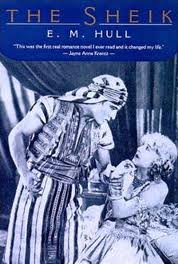
The Novel
The Sheik by E.M. Hull is found in ERB’s library. The novel published at the beginning of 1921 was a runaway bestseller going through thirty-0ne printings by October. My copy is of the thirty-first printing. How many more it may have gone through I am not aware.
The book was quickly made into the movie of the same name starring Rudolph Valentino and released on November 20th of the same year. Thus the impact would have been redoubled on ERB reading the book and seeing the movie.
Having troubles in his relations with Emma, he was somewhat bedeviled by what she wanted as Freud was by what women wanted. The Sheik presented one woman’s solution to the problem of what women want. The Englishwoman E.M. Hull examined the problem in some detail. Her solution would find expression in ERB’s Tarzan And The Ant Men of 1923 in the story of the Alalus women.
2.
While Mrs. Hull’s novel is invariably reviewed as a soft core porn novel it is actually quite a serious attempt to explore what women want. Not a potboiler, the story is well thought out and carefully constructed.
The story falls into the category of the desert nomad thriller.
The scene is somewhere between Biskra and Oran in Algeria. Biskra is the southernmost point on the railroad from the coast to the Sahara in the East of Algeria. It is an oasis area and was a winter resort for Europeans. This area was also the scene of Robert Hitchen’s The Garden Of Allah and the Sahara scenes from Edgar Rice Burroughs’ The Return Of Tarzan.

The Author
As with Hitchens’ the desert serves as a symbol for self-realization and redemption. The story was written as the career of the rebel Abd El Krim was reaching its apex in the Rif. Krim’s story was terrifically romantic for women of the era. I had a high school history teacher in the fifties who was still capable of gushing about Krim thinking him the most manly and desirable of men.
As with Hitchens the story revolves around a man and a woman. The woman an Englishwoman and the man a Krim like sheik of the desert.
3.
The woman is appropriately named Diana. Diana was the virgin huntress of Greek mythology who spurned all relations with men thus putting her in enmity with Aphrodite. She is somehow related to the Lady Of The Lake of ancient Lacedaemon which name means Lady Of The Lake and in a line of progression to the Northern European archetype of the second half of the Piscean Age. This is a rather strange female archetype to represent the Northern European psyche. She is a cold unloving symbol that may have something to do with the European character.
Whether Mrs. Hull knew these things or not she represents them perfectly in her story. This is quite extraordinary.
Thus her Diana was raised by her brother as a boy. She is represented throughout the story as an ambiguous girl-boy, nearly a hermaphrodite. She is herself a skilled huntress who has no use for men. As the story opens she has yet to be kissed. Mrs. Hull skillfully represents the respect that Northern European men have for their women which in itself may be conditioned by the Diana image. They are easily put off. When one man asks Diana for a kiss he accepts his rejection with equanimity asking only if they can at least be pals.
The Sheik as the wild man of the desert knowing no law but his will offers quite a contrast. By the time of Mrs. Hull’s novel ERB had already explored the same literary territory in the Return Of Tarzan and The Lad And The Lion as well as The Cave Girl. I would hesitate to say Mrs. Hull had read Burroughs but the Sheik is portrayed as a Tarzan like superman in a decidedly pulp manner.
The Sheik does not observe any civilized niceties. At one point Mrs. Hull refers to his civilization being less than skin deep. As the Sheik, Ahmed, says, if he wants something he takes it. Having seen Diana in the marketplace of Biskra he sets out to kidnap and rape her. There are no other words for it and Mrs. Hull does not mince them.
His plan worked out so that he buys off Diana’s desert guide to deliver her to him on the first night out of Biskra. Prior to that he surreptitiously serenaded her on the night before even entering her room in the dark while she is there to replace the bullets in her pistol with blanks to prevent her from shooting him in the desert which she did attempt to do.
4.
Now, Mrs. Hull is presenting an allegory so the novel is filled with symbols. The key symbol is the horse. The horse is, of course, a symbol of the female associated with the Greek god Poseidon. In ancient times the symbol of the bull was associated with the missing y chromosome of the female being replaced in Patriarchal times with the horse. Thus the Patriarchal goddess Athene is sometimes represented as horse headed.
When the guide brings Diana a horse to ride it is a magnificent creature much better than she might have expected from a commercial enterprise. The horse has actually been provided by Ahmed the Sheik so as Diana leaves Biskra she is already mounted on the Sheik’s horse- a powerful sexual symbol. The horse is trained to respond to signals from The Sheik.
The story is filled with horses and horse races between she and the Sheik. In one race the Sheik gives her a minute to stop or he will shoot her horse dead which he does. He then places Diana in front of him on his horse (these horses are all magnificent and beyond magnificent) at which point she realizes that she is not only in love with the Sheik but has been for some time.
Previous to this time she had noted in the camp
…but it was the horses that struck Diana principally. They were everywhere, some tethered, some wandering loose, some excercising in the hands of grooms.
So everywhere is the symbol of the female. At this stage Diana has been sexually subordinated to the Sheik but she is intellectually resisting. The Sheik puts on a demonstration of how useless her resistance is as he fully intends to break her.
A man eater is brought out who has killed a man earlier that morning. The horse obviously represents Diana. Some two or three men attempt to break the horse but they all fail. Then the Sheik mounts. The result is a thoroughly exhausted and beaten horse. She stops fighting with her legs splayed while the Sheik jumps off. Then the horse rolls over left with no will of its own.
This is exactly Diana’s situation. Earlier she had boasted to her brother: I will do what I choose, and I will never obey any will but my own.
That is now proven an empty boast as the Diana riding in front of the Sheik chooses to obey the Sheik’s will.
Perhaps Mrs. Hull has prophesied the submission of England’s will of today to the desert Sheiks. As of now the Moslems have all but assumed religious control of England. Thus England as Diana has submitted its sexuality to the sons of the Sheiks.
However Diana’s Sheik still has to prove himself as the dominant male of his society to retain her allegiance. One hesitates to say that she perversely tests him nevertheless having been cautioned to take care on her desert rides she insists on going too far afield. Naturally she and her seven man escort are ambushed by the fat swarthy greasy rival sheik’s men. Six of the seven escorts die joyously defending their sheik’s property. The seventh, the sheik’s European manservant gets the classic bullet crease alongside the head. Diana disappears into the fat greasy sheik’s tent. This guy is everything an Arab sheik should have been in contemporary European eyes. Fat, greasy, swarthy, unbelievably smelly, uncouth to the nth degree. There’s no doubt there’s the fate worse than death for the boyish, sylphlike, slender, lithe Diana. Yes, it seems pretty certain, unless…
Here comes the Sheik with a small but loyal and dedicated band of followers eager to die for their leader. Just as the greasy, swarthy sheik has got it out and ready in crashes Ahmed in the nick of time. Rather than shooting the bastard and getting it over with he wants to dispatch El Greaso by hand. As we all know strangling a a struggling strong man takes a little time. Enough time for El Greaso’s vile Ebon followers to burst into the tent. Right behind them come Ahmed’s men. Shades of Tarzan! Ahmed takes a severe blow to the head and a couple long blades in the back.
Will he live? After muttering a couple pages similar to the last words of Dutch Schultz the matter is in the hands of Allah and the European surgeon. As much as I like having god on my side, in certain situations a good surgeon is even better.
Nevertheless if Ahmed lives he has proven himself to be the right man for Diana. Interestingly the virgin huntress has submitted to the law of Aphrodite. The European archetype has accepted the dominance of the Moslem Arab.
Well, almost. In the first place the tribe of Ahmed is very interesting according to his French friend who arrived in time for the big battle. It seems that Ahmed’s tribe is different from the rest of the desert greasers. It is inferred that his tribe is one of the legendary White tribes supposed to be living in the Sahara. Undoubtedly a surviving remnant of Atlantis that moved South when the Mediterranean flooded.
Why, in addition, it turns out that Ahmed isn’t even an Arab. It seems that he’s actually English. Well, an English Spanish blend. His English father when in his cups did some unspeakable thing to Ahmed’s mother when she was pregnant with him and she was found by Ahmed Sr. Ahmed Jr.’s adopted father wandering dazed and confused beneath the broiling desert sun.
Taken in she dropped Ahmed Jr. and died. The baby was raised as the successor to Ahmed Sr. But he developed an uncontrollable hatred for England, its people and all things English. That’s why he captured and raped Diana over and over. But it’s OK, they both realize they love each other now.
The lesson seems to be that that’s what woman wants: a man who can earn her repect by dominating and controlling her while at the same time being the dominant male in his society, being able to provide all her wants and desires while being able to defend her from the El Greasos of the world. So all the necessary elements come together here and we have a marriage if not made in heaven perfect for terrestrial travails.
If nothing else ERB learned where he had failed Emma in the beginning but who now wondered in his own role of sheik where the rewards from Emma were.
I’m going to speculate that ERB read the story in 1921. He might have enjoyed Valentino in the movie but I think it improbable that the silent film came near capturing the nuances of the novel. I’m sure the signficance of Diana as female European archetype didn’t come through on celluloid.
Was it even in Mrs. Hull’s mind one may perhaps ask. Is it possible I’m projecting my beliefs on Mrs. Hull’s story? It is possible but consider this passage in The Sheik:
He was so young, so strong, so made to live. He had so much to live for. He was essential to his people. They needed him. If she could only die for him. In the days when the world was young the gods were kind, they listened to the prayers of hapless lovers and accepted the life they were offered in the place of the beloved whose life was claimed. If God would but listen to her now.
So we know that Mrs. Hull was read in Greek mythology. It would seem inevitable that she was familiar with the stories of King Arthur to some degree. Certainly she knew the story of Merlin and Vivian. She was a writer. Knowing little about Mrs. Hull it is impossible for me to know for certain exactly what she read or understood. And yet, there it is in the pages of her novel if one has eyes to see. The Sheik is as much a work of mythology as is that of Burroughs’ Tarzan. It is possible that neither was conscious of what they were saying but the information taken into their minds was transformed subconsciously, at least, into the form in which it issued forth from their pens. It works that way for writers. I am often astonished at the subliminal message of what I write. Did I intend it? Must have. There it is. Still, I do put myself into a mild trance when I’m writing so that I concentrate on words rather than ideas. So the words are more conscious while the content is more subliminal. We know ERB wrote from a trancelike state and Mrs. Hull’s story has that quality. I think we have enough evidence to know that she had read the mythological material so that whether she had consciously formulated her ideas they come out in her writing. In short, I don’t think I’m projecting much if anything. Tra la.
There is no doubt that The Sheik made a big impression on ERB. The question is how did he understand it. His first reaction appeared in 1923’s Tarzan And The Ant Men in the weird parody of the Alalus people in which he reverses the male-female roles with the women being stronger and dominant. As Ahmed figures the women brutally dominate the men. Using them for sexual pleasure then discarding them. ERB’s story seems to be tongue in cheek but without a reference point the ridiculous story is hard to follow. With E.M. Hull’s The Sheik I believe we have the reference point.
It seems clear that Mrs. Hull was influenced by Robert Hitchens’ The Garden Of Allah. What is not clear is whether she was influenced by Edgar Rice Burroughs and if so by what novels. The Sheik follows a pulp format. So, if Mrs. Hull read the pulps on a regular basis there is no reason to believe that she was not familiar with some of his work as Burroughs certainly by 1920 when she probably began the novel was already the premier pulp writer.
If that was the case it seems likely that she might have read The Return Of Tarzan and The Lad And The Lion, perhaps The Cave Girl. If she read Lad then she reversed the roles of the chief male and female characters making the Woman English and the man Arab.
I haven’t read the magazine version of The Lad And The Lion so I am not sure of the specific changes ERB made between the 1913 version and the 1938 rewrite for book publication. The rewrite shows clear evidence of influence from The Sheik unless of course Mrs. Hull was reflecting the influence of the Lad on herself. In any event the two books reflect an influence from one to the other.
So, as with Trader Horn and Burroughs it is possible that Hull was influenced by Burroughs and with both of these authors Burroughs reading of them was reflected in his subsequent writing.
Our list of reciprocal influences is growing when one adds that of H.G. Wells. What once seemed simple grows more complex.
Postscript: I have since learned that Mrs. Hull was a student of mythology.
Lipstick Traces Pt. IX: Greil Marcus
September 11, 2007
A Review
Lipstick Traces:
Greil Marcus
Part IX
Into The Abyss
It sounded like a lot of fun wrecking the world.
It felt like freedom.
Greil Marcus: Lipstick Traces
It is probably time to look a little into Mr. Marcus’ antecedents. He was born in the summer of 1945 between VE and VJ day as he tells us. He was ten, then, in 1954-55 when Rock and Roll came into existence. He doesn’t seem to imply that he was particularly interested in records in the next decade that would have made him twenty in 1964-65. He would have been 15 to 20 from 1960-65 during which time he would have listened to the radio. He also seems to have been in Philadelphia at some time during that period when he attended a Bob Dylan concert. I haven’t read yet where he mentioned that he had a record collection during that period. He doesn’t seem to recall much from memory before 1965 with the possible exception of Bob Dylan.
One is forced to conclude then that most if not all his record lore was acquired between his twentieth and thirtieth years from 1965 to 1974-75. He began his career as a critic in 1966 when he went to work for Rolling Stone. He left that post a year later to write for Creem Magazine. His first book Mystery Train was published in 1975 so he should have acquired his lore over maybe eight years.
He should have been a sophomore in ’64 which means he should have graduated in’66 so his real record education would have been from ’66 to ’74. Not much time for someone posing as an expert in ’75.
He says he was born in San Francisco moving into Menlo Park in 1955 so that he went to Menlo Park-Atherton High. The area is one of the ritziest in the Bay Area. Atherton is top of the line for the Bay so his step-father must have been doing pretty well. In other words Mr. Marcus is a rich kid. I haven’t read exactly where he lived between 1948 when his mother remarried and 1955.
At any rate he comes from a very well to do background. After graduating from MPA he went over to Berkeley to attend UC. He was there for the whole Free Speech brouhaha. At some time after graduation from UC he returned to Berkeley to live which is his home base at the present time.
At the time he wrote Mystery Train I would question the depth and breadth of his knowledge.
He published Mystery Train at the last possible moment such a book could be published. From ’66 to ’75 those of us concerned with records were convinced that something monumental and earth shaking was happening. Wonderful theories of the music’s importance were spun of which Mystery Train is one. I think it probable that Mr. Marcus saw a string of such books rolling off his pen. A funny thing happened on the way to the forum however. Disco and Punk blew up the Rock monolith about the same year destroying the grandiose notions we were all believing in. All of a sudden as Mr. Marcus points out confidence was destroyed and survival became the issue. Mr. Marcus and his plans were thrown for a loop.
Not until 1989 did he find another tack to try to get back on track. In that year he published Lipstick Traces. Feeling that his first career had been blown out of the water by Punk he paid homage to it by concentrating on Johnny Rotten and the Sex Pistols. Broadening out some he incorporated the history of what he considered various Dada movements. His concern with Dada had found expression in Mystery Train so it was only necessary to relate Dada to Punk with which he had no trouble.
Since ’89 he has published a continuous series of books, the most recent being The Shape Of Things To Come.
2.
I hesitate to do this but I feel the reader should know something of my credentials to give some basis for judging my criticism and analysis.
I’m about seven years older than Mr. Marcus having been born in 1938. I was therefore sixteen in 1954 which is more or less the cut off date for the beginning of Rock and Roll.
I grew up in Saginaw, Michigan. We were apparently out of the mainstream of Rock development. Even though we had a fairly large Black population there was no Rhythm And Blues or Black music on the local radio. There were only traditional music shows on radio in 1954 when Top Forty was in embryo. By ’55 and ’56 we had full fledged Top 40 and what a blast it was.
With Top 40 came Black artists like Bill Doggett, Fats Domino and Little Richard but they were a Top 40 sound whether they called it Rhythm And Blues or not. One could tune into Detroit for Black records but I didn’t know anyone who did. I tuned in a couple times but Black music per se repelled me.
I was in the class of ’56. The class of ’55 knew nothing of Rock and Roll at the time and very little of Top 40 radio. I was in a distinct minority in the class of ’56 who listened to Rock at all. The class of ’57 was the first class attuned to the music.
As to first R & R records, who knows? The early and mid-fifties were a blend of musics so I heard a fair amount of Swing. Anyone who traces Rock and Roll directly to Swing is dreaming. I know Buddy Rich, Gene Krupa and the Swing drummers. None of them had the R&R feel. Swing rhythm sections were miniscule compared to Rock which to my mind is a singer, lead guitar and a two or three piece rhythm section. Very faint resemblance to Swing.
When it became financially impossible for Big Band to survive I suppose the instrumental quartet was the next logical step which led to the Big Beat. Neither Elvis nor Sun had a Big Beat. He had rhythm but no beat; he was essentially a hillbilly singer doing fast songs which is how everyone thought of him. That’s what I heard and none of the people I knew would listen to him because he was a hillbilly. As far as I’m concerned the Big Beat was developed by Lonnie Donegan and that is where the English Beat groups come from. Lonnie’s early stuff was as much Rock as anything else although he was primarily a terrific Folk and Blues singers. Unparalleled. He was as good as Elvis but somewhat more traditional sounding than Presley. Elvis could really move you.
Elvis was virtually unknown in Saginaw before Heartbreak Hotel. I missed out on the Sun records by a day. The record store had returned them the day before I got there so I have all RCAs. I never knew anyone else who had heard of Elvis between the time I bought my 45s and Heartbreak Hotel.
I never thought of Elvis as a Rock and Roller on those early records. There really was no Rock and Roll except for Bill Haley And The Comets and that stuff was really leadfooted. I didn’t really enjoy Rock Around The Clock and I never bought it. Elvis was just a hillbilly cat who could really sing a song. I knew from reading the labels that Arthur Crudup wrote That’s All Right Mama but that meant nothing to me. Who ever heard of Arthur Crudup?
I don’t understand why I don’t have Sun Presleys as I bought every Sun record as it came out. I had to have them special ordered as nobody wanted them but I was very familiar with the Sun sound. Not impossibly Sam Phillips had as much to do with Rock and Roll as anyone because all the records he produced had that forward leaning scudding way. You could have substituted Elvis for Johnny Cash on Get Rhythm and there wouldn’t have been much difference.
When Elvis left Sun his production values changed with the sound becoming flat footed and vertical rather than forward leaning. Elvis was always Elvis for me but I never had the incentive to buy his RCA produced 45s.
Some may say the music died with Buddy Holly’s plane crash but that is a gross exaggeration. Holly’s career was virtually over by February ’59. He was singing solo and fading fast. The Big Bopper was a no one who had one trash talking record while Richie Valens was as close to a zero as you can get.
Elvis was kept alive by RCA during his Army years but Little Richard was finished after Heebie Jeebies and Jerry Lee’s Rock career was stalled. High School Confidential was so-so. Jerry Lee’s marriage to his cousin may have put him in bad odor in some quarters but that was a fishing expedition to discredit him. Might have hurt his personal appearances but not his record sales, they were already down. To my mind Duane Eddy came out with Rebel Rouser on the heel of the plane crash and Rock and Roll bounced right along without missing a beat. Apparently not too many people remember the effect of Eddy and Rebel Rouser but it was the second kick in the pants after Presley. Kept us all going.
The big problem for Rock and Roll was Organized Crime. The Mafia and Chicago Outfit controlled Juke boxes. Those idiots determined that only their acts got on the Juke boxes. If you want a good representation of what the record industry was like check out the best Rock and Roll movie ever made- The Girl Can’t Help It. If you watch closely and pay attention you are being told exactly how it was.
An Outfit figure greatly resembling Al Capone, although the time period was long after Capone, controls the Juke boxes for the Outfit. That means the Juke boxes at least West of the Appalachians to the Coast. The Juke boxes in Saginaw were stocked by the Outfit that for all practical purposes controlled the town. All towns.
Girl Can’t Help It stars Jayne Mansfield and Tommy Ewell. Mansfield is the Mafia figure’s moll. He wants to make her a record star which he figures he can do because he controls the Juke boxes. All of ’em. But the Girl Can’t Sing. The producers are at their wits ends because they have to do something with her. They accidentally discover that she has this high pitched squeal. So, a la Tequila in which periodically the instrumental music stops and someone announces ‘Tequila’, at certain points in the record the music stops and Mansfield squeals. This is so captivating the record does become a hit.
Now, the movie highlights several Mafia acts like Teddy Randazzo and the Gum Drops that would never draw anyone into the theatres. Teddy didn’t even have an attractive high pitched squeal to go along with his great accordion playing. But as is usual with non-record types the belief is that if you can expose non-talent acts to enough people they will sell. So the Outfit did understand they needed some draws to get people in to expose the non-talent. Who are you going to go to? Well, Gene Vincent, Eddie Cochran, Little Richard for starters. I went because of Gene Vincent.
The movie was released in ’58 so not many of us had ever actually seen any of these guys. The Mob had their draws but they wanted to showcase the Italian acts which they did. Gene Vincent was shot through the window of a recording studio for about half of Be Bop A Lula; Eddie Cochran did his Twenty Flight Rock shot off a TV set and Little Richard was shot through a crowd in a club about fifty feet away.
As I say if you pay attention you can get a very good idea of what was going on. Mansfield and Ewell were great but they were at the terminal point of their careers.
The early sixties were pretty duddy as far as I was concerned, but that doesn’t necessarily mean I was right, so I went back to my true love, Country and Western. As I noted in Part One I was drawn back into pop by my brother-in -law. As I said I then graduated from college in ’66 going up to Oregon from the Bay Area. It was there in ’67 that I opened a record store. From ’67 to ’80 I was a decent sized player in the record business. I thought I heard everything but I am always amazed at the records for which I have no recollection even seeing.
I was there when the first Rolling Stone came out. I don’t know where the magazine sold but it wasn’t Oregon. Pretty boring actually. Got worse as time went on and then it got Political.
I quit listening to records in 1980 when I closed my record store. Punk was too ridiculous to waste your time on although I do have two or three Disco records I value. Well, Rock and Roll was great while it lasted but it really did die in ’75. Not only Punk and Disco but the untalented Epigone came along. The splitting out of Heavy Metal as a genre didn’t help either. God! I know how Marcus felt. Everything just crashed to the ground.
3.
Mr. Marcus’ themes and direction remain the same from Mystery Train to The Shape Of Things To Come. His attitudes are controlled by his dual Israeli and American passports: his Semitism and anti-Semitism. These two citizenships coincide in his psyche with his twin racial concerns. The Israeli citizenship as Semitism and his American citizenship with anti-Semitism. Naturally his Israeli Semitism takes precedence in his loyalty over his American anti-Semitism. Americans are Nazis in his mind. As with Adam in the Garden of Paradise and God, the twin concepts exist side by side in his mind with Adam representing Semitism and God anti-Semitism. Thus his Jewish/Adamic/Israeli identity represents his absolute purity in his mind while America/God represent his foul or Devil side. He and his fellow Jews think that by trashing the Garden, Europe, Palestine, America or wherever they happen to reside that their ‘purity’ will triumph and they will be as they represent themselves: a Holy People suited to govern mankind, Judge-Penitents. That is what the eighteenth century messiah, Jacob Frank, meant by saying that if the Jews commited all the evil in their minds then this ‘purity’ will shine to light the way for the peoples. You don’t have to be Freud to know it ain’t going to work. Thus Mr. Marcus’ subliminal message is all good comes from Jewish musicians and all evil from American musicians. The Jewish Bob Dylan becomes his ultimate hero taking precedence over the American anti-hero, Elvis Presley.
That’s why in Lipstick Traces he juxtaposes the anti-hero Presley and the Jewish hero Isidore Isou.
Mr. Marcus scatters several clues throughout his work to hint at what he’s attempting. He mentions John Ford’s movie The Man Who Shot Liberty Valence and one of its morals a couple times concentrating on the movie’s stated notion that once an event becomes legendary even though the received version may be untrue people prefer the myth to the fact. There may be some truth to the notion although as Mr. Marcus explores the counter notion of detournement he gives us the means to strip such an ingrained notion from the story and turn it in any direction we want. Thus in the twenties the Judaeo-Communists on the one hand debunked American heroes and myths while at the same time detourning them so that Jefferson and Lincoln become founding members of Communism as Communism in turn becomes Twentieth Century Americanism. A neat trick that didn’t quite work.
Actually the two practices denote the transition from one religion to another which also lays bare Mr. Marcus’ intent. Thus in the first few centuries of the Piscean Age the Catholic Church detourned ancient Taurian and Arien religious sites by stripping them of their pagan connotations replacing the meaning with little balloons containing Christian messages. Eventually they replaced Arien temples with Piscean churches.
Jack Finney’s 1950’s novel The Invasion Of The Body Snatchers describes the same thing in which aliens while maintaining exact replicas of the bodies they take over inform the minds with entirely different content. Finney understood detournement completely long before Guy Debord had it figured out.
That is exactly what the Jews, who are attempting to replace Christianity are doing. Mr. Marcus mentions Philip Roth’s The Plot To Destroy America approvingly. Of course Mr. Marcus and Roth are both Jewish. In Roth’s detournement of American history he portrays the Jewish rescue of the true America, which the Jews in their wisdom created, from the Weird Old Americans who are trying to twist the Promised Land into some Nazi hate filled paranoid perversion of what one is led to believe was the American paradise Jews had created.
Roth chooses to recklessly defame Charles Lindhberg, a great and true American, but that is what detournement is all about. Thus on the one hand Roth detournes ‘Weird Old American’ heroes into villains while at the same time creating the myth of the Jewish saviors a la Liberty Valence.
The Jews then become the men who shot Liberty Valence thus destroying the Weird Old America while bringing into existence this Jewish paradise we enjoy today. Shut your mouth, you anti-Semite.
Why Liberty Valence?
Well, Liberty is the opposite of collectivity or the Jewish Law. He represents the sort of ‘rugged individualism’ that threatened Jewish collectivity or subordination to the Mosaic Law. Valence means valour, courage or valiance. That is, a man who has what it takes to stand out against the crowd or Mosaic Law. I’m sure it was an unintended compliment. No one of the collectivity has what it takes to stand up against him, not even the hero of the collectivity, John Wayne.
The legend that is so hard to kill is that Jimmie Stewart shot Liberty Valance down in a fair and square man to man fight. Actually Wayne is the agent of the collectivity who bushwhacked Liberty from a dark alley, Wayne and his Negro servitor and alter ego who tossed his rifle to him.
So this is the secret message of Lipstick Traces creating a legend and detourning existing beliefs that run counter to those of the collectivity. For that reason the branch of academic history known as American Studies has been captured by Jews who stand up laughingly epatering the Americans, debunking and detourning as they go.
I see where Mr. Marcus and a yoyo by the name of Todd Gitlin are joining forces to epater the Americans together. Ought to be funny if you’ve got the right sense of humor.
4.
All the seeds of Mr. Marcus later work are apparent in his 1975 Mystery Train. One should examine Mr. Marcus construction of Train carefully.
He examines six recording stars. Two of which he calls ancestors and four ‘Inheritors.’ The six are Harmonica Frank, Robert Johnson, Dylan/The Band, Sly Stone, Randy Newman and Elvis Presley.
Out of the period of 1950-75 Mr. Marcus chooses a very personal list of bands. One would call the list debateable but there’s not much to debate. Whether they are supposed to be important or influential isn’t clear. Apart from Presley none of them were overwhelming important or influential. Pink Floyd, Grateful Dead, the Doors? No, they aren’t on board Mr. Marcus’ Mystery Train. So, what do we have?
The list is bracketed by two White performers, Harmonica Frank and Elvis Presley. Robert Johnson and Sly Stone are Black. Dylan/The Band are Jewish and Canadian while Robbie Robertson is mentioned as having a Jewish father. Thus Dylan/The Band and Randy Newman are two Jewish outfits. Two Whites, two Blacks, two Jews. Obviously we have an agenda here.
The two ancestors are questionable. I may have a vague memory of having heard the name Harmonica Frank but the man influenced absolutely no one. Technically he is no ancestor. His only connection with, say, Elvis, is that both were produced by Sam Phillips at Sun records. In that sense Harmonica Frank may be representative of what Phillips as a producer was trying to do but that represents Phillips and not Harmonica Frank.
Thus when Phillips decided to produce Presley he used the same musical tenets or ‘ear.’ Elvis was very fortunate to have Phillips to hear his talent and draw him out. Without Phillips there would never have been an Elvis Presley other than this guy driving a truck.
As far as ‘White’ ancestors go Phillips would have been more appropriate than Frank. I suppose what I am saying is that I find Mr. Marcus either too shallow or too tendentious.
Mr. Marcus doesn’t use a Jewish ancestor but as a Black ancestor he chooses Robert Johnson. As he states there were no Robert Johnson recordings available for anyone to hear before the 1960 Columbia release. Huddie ‘Leadbelly’ Ledbettor would have been a much more influential ancestor. Not only had his recordings been continuously available but his songs formed a staple for Folk artists from the post-war years on. His Good Night Irene and Midnight Special were ten times more influential than anything Robert Johnson ever wrote, a hundred times…heck, a thousand times, more. Johnson’s songs began to appear by other artists only in late sixties.
Mr. Marcus’ enthusiasm for Johnson’s lyrics is absolutely inexplicable. He quotes the following as an example of Johnson’s genius:
Me and the devil, was walking side by side
Oooo, me and the devil was walking side by side.
I’m going to beat my woman until I get satisfied.
Pretty choice stuff, huh? I’m surprised the ladies haven’t boycotted both Johnson and Mr. Marcus’ Mystery Train.
Nevertheless his choice of Johnson seems arbitrary at the best and tendentious at the worst.
I presume he chose the Band because of their association with Bob Dylan. Mr. Marcus definitely sets Dylan up as the greatest of the era replacing Presley. This is patently ridiculous.
His final paragraph detournes Elvis in favor of Dylan. Bear in mind that in 1975 Elvis still had two years to live so Mr. Marcus may be understood to be addressing Presley indirectly:
Quote:
All in all there is one remaining moment I want to see; One epiphany that would somehow bring his (Elvis’) story home. Elvis would take the stage as he always has; the roar of the audience would surround him, as it always will. After a time, he would begin a song by Bob Dylan, singing slowly. Elvis would give it everything he has. “I must have been mad,” he would cry, “I didn’t know what I had- until I threw it all away.”
And then with love in his heart, he would laugh.
Unquote.
That’s a pretty tale. As a detournement the kingof rock n’ roll passes the scepter to Dylan. While as a hypnotic suggestion to the living Elvis Mr. Marcus is attempting to bring his dream to come to pass. We’ll never know if it would have worked but it was the traditional Judaeo-Freudian method.
Thus the two sections on Harmonica Frank and Elvis are slurs on Mr. Marcus’ concept of The Weird Old America. That title of another of his books is itself a detournement of America.
For the last few years I have been wavering but after reading Mr. Marcus’ ideas on Dylan I have probably irrevocably turned against him. To write of the Band is to write of Dylan. Dylan would always have been Dylan but the Band would never have been anything without Dylan. The Band probably stands to Dylan as Presley does to Sam Phillips.
The first two Band LPs are the result of direct contact with Dylan in the sessions that resulted in the basement tapes. With the separation from Dylan the effect wore off with the Band returning to their R & R roots. At their peak they were no Doors or Led Zeppelin. Like Dylan I find them unlistenable today.
Mr. Marcus wrote a two or three hundred page essay on Dylan’s Like A Rolling Stone which he seems to consider the greatest song ever written. He perversely refuses to accept the song for what it is- a hymn to ingratitude. In the song Dylan clearly resents his dependence on Joan Baez for his early success. He, in fact, used her but now in his pride of success he spurns her from him- with his foot so to speak. A real ingrate as a matter of fact.
Mr. Marcus reproduces the lyrics in their entirety as a preface to the book. I’m not going to do the same here but Like A Rolling Stone is in a genre of Dylan songs that can be defined only as mocking or ‘hate songs.’ Along with Rolling Stone one can include Positively Fourth Street, Please, Crawl Out Your Window, Ballad Of A Thin Man, Desolation Row and any number of others. Sooner Or Later, One Of Us Must Know.
Again with Dylan the tone of his voice is more important than the words. For me I responded to the pain and anger in his voice that seemed to reflect my own experiences and which I interpreted in my own way. The same attitude would be reflected differently by the baby boomers born in the early fifties. As noted they came along at the time of Mystery Train’s writing to shatter Mr. Marcus immediate dream of a Rock And Roll Czardom.
One presumes that the song Mr. Marcus wanted Presley to sing in order to detourne himself in favor of Bob Dylan ‘with love in his heart and a laugh’ thus allowing one religious idol to replace another was ‘Like A Rolling Stone.’
Unfortunately due to Mr. Marcus’ interpretation I now see ‘Like A Rolling Stone’ as an actual hymn of hate scorning and mocking Joan Baez. Throughout Bob Dylan’s career he had the habit of purloining things of others…said the Joker to the Thief. In Minneapolis and Colorado he actually stole records from other people. His excuse was that he really needed them. In New york he lifted the arrangement of a song of Dave Von Ronk’s and recorded it without permission. He had a ‘good excuse’ for that too. He needed it.
Perhaps his greatest theft was of the career of Joan Baez. Baez out of a generous heart used her influence and reputation to gain acceptance for the caterwauling Dylan. He couldn’t admit this theft without exposing himself as an ingrate subject to the scorn of the Folk community of Greenwich Village. This may possibly be the secret meaning of Positively Fourth Street in which he seems to heap scorn on the whole Folk community.
Mr. Marcus is especially impressed with the disgustingly hateful lines:
Ain’t it hard
When you discover that
He really wasn’t
Where It’s at
After he took from you everything
He could steal?
How does it feel?
How does it feel to be on your own
No direction home
Like a complete unknown
Like a rolling stone.
Dylan has identified the person he is speaking to as ‘Miss Lowly’ who went to a fine school and here he says that he has stolen everything from her that he can steal and then he taunts her as though he had reduced her to his condition when he first arrived in New York City. ‘How does it feel to be on your own with no direction home like a complete unknown?’
Yes. It must have been terrifying for Dylan to arrive in New York City as a complete unknown with no understanding of how to get started, homeless and starving. Dylan solved his problem by scrounging lodging and his next meal. He just moved in on people, ate their food, read their books, listened to their records, picked their minds, stole from them everything he could steal and then turned his back on them. Cut them cold. Scorned them as in Positively Fourth St. Well, all right. OK. But I don’t find it as admirable as Mr. Marcus does. As I say I never really thought of Like A Rolling Stone deeply before reading Bob Dylan At The Crossroads. (Robert Johnson again. Is Mr. Marcus suggesting that Dylan sold his soul to the Devil?) but now that I have I am appalled at the coarseness of actually composing a song about your perfidy and advertising it to the world.
If Mr. Marcus had handed Presley the song saying this is going to be what you’ll sing next, Presley who had perfect musical sense would have said: ‘Not on your life, Baby Blue.’
No laugh and a shrug from the King.
After Dylan/The Band Mr. Marcus moves on to Sly Stone. Sly was not a major talent. He had a couple fair R&B songs bordering on open racism. Sinking rapidly beneath drugs Sly Stone rapidly sunk his career.
Moving next to Randy Newman I must confess that Mr. Marcus has lost me. Perhaps he is trying to help the career of a fellow Semite along. Got me. Newman’s songs were always repulsive to me and Mr. Marcus’ quotes merely make them more repellent. Gee, I wonder why Elvis never sang ‘Short People?’
And then of course we come to what Mr. Marcus intends as his piece de resistance of criticism, Elvis himself. This piece is a regular tear down job.
Mr. Marcus was a trifle too young during the late forties and first half of the fifties to understand the situation. During those years the musical culture was in the hands of Jews and Italians. New York’s Tin Pan Alley from the twenties on had controlled American popular music. The clubs in which artists performed were all mobbed up as all the artists were mobbed up will they nil they. Thus nobody got through who wasn’t thoroughly vetted.
On the fringes one had areas of Black musicians who were outside the scope of popular music hence not worried about. At the same time one had Hillbilly music that was so despised that proper Whites retched at the mere mention of it and that is no exaggeration. Concomitant with Hillbilly although culturally acceptable was Folk music. Postwar from 1946 to 1964 in my estimation Folk was the only listenable pop musical expression. Unfortunately Folk music was in the hands of the Reds making it culturally suspect.
During the twenties and thirties Tin Pan Alley songs were vital enough to satisfy the nation’s listening ear although there were those who complained about it. Whatever had worked for Tin Pan Alley between the wars the ethic had worn too thin between ’46 and ’54. The music was so godawful and stiff that few could listen to it especially the young. Into the Jewish vacuum stepped the Black and Hillbilly songwriters and performers. While Hank Williams may have slipped slightly over the line of pop his songs were welcomed with open arms by pop cover artists. At that time there was no shame in covering a song made popular by another artist, even as the original version was still moving up the charts.
A golden time was created for unvetted performers and songwriters to step into the vacuum. While Eddie Fisher, Ezio Pinza and Mario Lanza and a stable of Italian pop singers attempted to hold the Tin Pan Alley fort Black street singers were emerging as Doo Wop groups while in Memphis Sam Phillips was developing the distinctive Sun Sound of which Elvis was the cornerstone. Elvis and his songs were completely unvetted by Tin Pan Alley and the Mob. As far as I’m concerned Presley’s breakthrough was such a fortunate concatenation of circumstances as to be miraculous. There are few times when things work out so perfectly for all concerned from Sam Phillips to Elvis to Colonel Parker and RCA. While Elvis was the transcendant talent he was only a component in the Elvis Presley success story. He had the good sense to stick to singing while he had the good fortune to be associated with managers of talent, circumspection, genius and above average integrity. So rare as to be almost unbelievable.
Phillips brought the talent to the surface that anyone else would have overlooked. A shy retiring Elvis given the opportunity dug deep to release the inner singer to become a polished singer almost immediately- in fact immediately. All of his Sun singles are absolutely stunning. There was no reason not to be swept off your feet from the first note of That’s All Right Mama.
Elvis’ genius was that he handled songs in a perfect blend of hillbilly and pop. He may have used some songs written by Blacks but there was no Black singer that could possibly have made of those songs what Elvis did.
Greil Marcus, Guralnick and others seem to be of the opinion that something went wrong with Elvis. Nothing went wrong with Elvis; he had the perfect career from his first single to his death in 1977. He was unable to withstand the pressures of his unparalled success. Unable to move in public because of his fans he was virtually under house arrest. For crying out loud, the guy couldn’t even go to McDonald’s. On top of that he aroused the anger and enmity of the ‘greatest generation’, the Mob and if Mr. Marcus is any example, the Jews. I’m sure he had difficulty just staying alive.
His goal was the movies. Thus his singing style changed to fit the venue. As much as I loved the Sun Elvis there is no possible way he could have continued in the same vein and sustained popularity for twenty some odd years. The new Elvis of Heartbreak Hotel and the early RCA years lost me as a record buyer. Still, as Dr. Hook sang: Elvis, he’s a hero, he’s a superstar…. as a hero Elvis always retained my loyalty.
While the Army seemed a disaster, his tour of duty may have been fortuitous for his career. The Army allowed the excitement to abate even as anticipation increased but when he returned it was as a return with a different feel. His style once again changed from the early RCA years. Listening to those old Mario Lanza and Ezio Pinza records inspired him to sing operatic C&W. Rather startling to my ear but with sure musical sensibility it worked for Elvis.
And then his popularity was so immense that he was able to star in two to three movies a year with all of them being money makers. The songs may have been less than memorable but he had to reach a mass audience for which popular music allowed of no vocal eccentricities. His fan base was strong enough and his talent great enough to sustain his popularity through a couple dozen movies that were frequently scorned and mocked but as Mr. Marcus generously points out they offered something that set them apart.
As all things must his movie career passed its ethic and cannily realizing it Elvis moved on. Thus in 1968 he produced a special that catapulted him back to the top of the musical scene. Even Mr. Marcus was overwhelmed by the ’68 transition from movie star back to recording master.
Nor did Elvis stop there but went on to a musical triumph that dwarfed anything that had gone before it including Frank Sinatra’s whole career- that was the satellite transmission form Hawaii to the whole world, the entire planet, simultaneously. The whole world tuned in to Elvis at one time. The equivalent of several hundred Woodstocks and something that has never been equaled by any other performer or groups of performers.
So, what did go wrong? Elvis had an unimaginably perfect career. The tragedy is that the enormous pressures were too great for this amazingly centered performer. It took a lot to beat him down.
Now, Elvis had a popularity that Bob Dylan couldn’t even dream about. Dylan could sing cranky little songs of hatred and viciousness such as Like A Rolling Stone to the ‘abused, confused, misused strung out ones and worse’ but Elvis couldn’t sing such viciousness to a worldwide audience. Imagine Elvis Live from Hawaii singing to a mob of adoring women lines like this:
Aw, you’ve
Gone to the finest school alright Miss Lowly but you know you only used to get
Juiced in it.
Nobody’s ever taught you to live out on the street
And now you’re gonna
Have to get
Used to it.
You say you never
Compromise
With the mystery tramp but now you
Realize
He’s not selling any
Alibis
As you stare into the vacuum
Of his eyes
And say:
Do you want to
Make a deal?
How does it feel?
How does it feel?
To be on your own
With no direction home
A complete unknown…
Pardon me, I’m laughing so hard at the image I’m falling out of my chair. Oops, there I go.
—–
I’m back. Didn’t hurt myself.
So, anyway I consider Mr. Marcus’ whole critique so skewed as to be vitiated. It would take a whole lot of love in Elvis heart to make such a musical gaffe, blowing his career in one misguided song and then say: ‘I didn’t know what I had until I till I threw it all away.’ Sorry Greil, Bob Dylan is actually a minor talent. Let us not forget that he once opened a show for the Rolling Stones.
5.
There was a long hiatus of fourteen years between Mystery Train and the appearance of Lipstick Traces in 1989. During that period one assumes that Mr. Marcus had ‘no direction home.’ How the elements that make up Lipstick Traces formed is open to conjecture. He attributes his direction to one John Rockwell on the dedication page. His style was also apparently heavily influenced by the Firesign Theatre hence the herky jerky, jumpy non-sequitur style. The Firesign Theatre was one of the great recording acts of the late 60s and the 70s, still going too. They have continued to release CDs on into their old age, such as it is, but, as I say, I stopped listening to anything after 1980.
As the Firesign is essential to Mr. Marcus I suspect there is loads of humor in Traces that I’m not getting. Hard enough to make those difficult jumps. Juxtaposing Presley and Isou wasn’t even a jump, it was a gap.
John Rockwell was some sort of music critic at the NYT so not exactly the sort of influence one would want. As Mr. Marcus would have been already familiar with the Frankfurt School of which he is a continuator and mentions Dada in Mystery Train one imagines that critic Rockwell pushed him in the direction of the Presley lookalike Isidore Isou and incidents like the rather obscure Invasion of Notre Dame. Mr. Marcus was five at the time of the Invasion; one doubts he remembers it. Thus, perhaps Mr. Rockwell directed his eyes to the morgue of intriguing but all but forgotten news clippings with which he would have been familiar. Thus Mr. Marcus found the Lettrist/Situationist International.
The Paris disturbance following on the heels of the Free Speech brouhaha would then have given him a focal point. It appears that at some point Mr. Marcus met Debord becoming very well acquainted with the old drunk and pervert, as it were, a disciple. When Debord shot himself through the heart in 1994 as with Drs. Mabuse and Baum Debord’s soul apparently entered Mr. Marcus’ body so that he appears to have assumed leadership of the SI.
Traumatized by the Punkers who he gives credit for bringing down Rock he also became fascinated with Johnny Rotten and the Sex Pistols as well as several other Punk units. Personally I have always thought Punk was absolutely useless hence I find Mr. Marcus’ fascination with this sub-marginal trash actually objectionable. While his subjects knew that they were nothing and sought to be everything the means they chose to raise their chances of becoming something were ill advised.
However as Mr. Marcus integrates them into the Dada/Lettrist/Situationist program it may be worth considering at least Johnny Rotten and the Sex Pistols who according to Mr. Marcus are an outgrowth of the SI.
After the failure of the 1968 disturbance in Paris Debord’s SI seems to have become truly international what with Greil Marcus in the US and people like Malcom McLaren and Jamie Reid in England. God only knows how many covert cells there were and what looneys they were allied with.
McLaren and Reid were casting about for some way to epater the bourgeois when McLaren had an interview with the New York Dolls. From them he conceived the notion that no talent was needed at all to become a rock band. One only needed the ability to make noise. Fortunately for Reid and McLaren there were myriads of young losers who felt the same way. One only had to pick and choose the most likely candidates on a cosmetic basis and give their repertoire a Situationist slant. You know, create a situation.
Mr. Marcus wonders from where the musical infuences for the Punkers came. I have to say that their inspiration was largely Bob Dylan. Johnny Rotten (ne Lydon) was born in 1956 so in 1975 he was twenty years old. The Punks then would have been eighteen to twenty-five. A primary influence on them would have been Bob Dylan. Dylan’s first records give the impression of an untutored musician. The stuff was just noisy. He could neither sing nor play.
The mean streak that Mr. Marcus finds so attractive in Like A Rolling Stone runs throughout the corpus. As much as I hate to admit it that hateful mocking derisive attitude is the essence of Dylan’s style. After having Mr. Marcus point this out to me so unmistakably I’m having to rearrange my memories of Bob to change their faces and give them all brand new names. I’m having to become a revisionist of my own history.
While Dylan is a real cultural name dropper so that he gives the impression of being learned, he isn’t. Chronicles proved that. His criticisms of society are merely emotional rants rather than informed or intellectual critiques. That he could wing tripe like Masters of War past what must have been a fairly sophisticated Folk crowd is truly phenomenal. Or, maybe I was wrong about them too.
At any rate the Punkers were merely unhappy with their teenage angst. I can assure you that I and my age cohort were too. If the right social environment had been provided perhaps we would have responded in the same way.
Johnny Rotten could not have had many of the thoughts Mr. Marcus attributes to him, the kid was only nineteen, so one must believe that McLaren and Reid filled in the blanks with Situationese and Rotten rearranged the words. While McLaren and Reid may have turned a few dollars from the act it is difficult to see what else they accomplished.
Society was developing rapidly without their help. The band Devo released their significant LP Are We Not Men? A. We Are Devo that quite clearly reflected the direction in which society was headed.
The amazing thing is that Mr. Marcus can discuss these insignificant nits at such length and with such seriousness. His long discussion of Johnathon Richman’s ‘Roadrunner’ was entirely uncalled for. Neither Richman nor his song had any influence in record circles. The record wasn’t even available for sale.
As Mr. Marcus neither owns up to being in the SI or gives any idea of the direction of the SI and ‘revolutionary’ groups I find that his book while full of interesting details is pointless. I have read the thing five or six times for this review. I have given the book more thought than it deserves. If the intent is a sly joke I don’t find it very funny. If the intent is to recruit members for the SI I find nothing agreable in the organization. I remain unrecruited. As a collection of non-sequiturs I find the book actually unreadable.
If Mr. Marcus modeled himself on the Firesign Theatre his choice was admirable but his execution was execrable. As a historian I’m afraid I would have to grade him below a C. Perhaps the quality of the book is best expressed by the cover.
Why is he nothing when he should be everything?
End Of Review
Lipstick Traces: Greil Marcus Part VIII
September 1, 2007
A Review
Lipstick Traces: Greil Marcus
Escape From Reality
by R.E. Prindle
One gathers the impression from Mr. Marcus’ work that all his characters are in an extreme flight from reality. This would be equally true of the historical movements he describes of the Begins and Beguines and Free Spirit. His conception of the Free Spirit is a downright denial of reality and a full scale unlimited retreat into fantasy. Coinciding with this is an impossible demand for absolute freedom. The freedom of the Free Spirits, the Dadaist/Lettrist/Situationists and indeed, the Jews in general, is a freedom that requires passive objects- in other words Masters and Slaves. The freedom of the Free Spirits that on one level demanded unlimited sexual gratification for men at the same time required the abuse and degradation of women. Indeed, the image of a woman having sex with ten different men in succession is sexual abuse of a major kind that must irreparably damage the psyche of the woman.
I return again to the striking images of the insane asylum or Maison de Sante of Poe’s The System Of Dr. Tarr And Professor Fether. There is a great similarity in that story between the inmates seizing control of the asylum and the present situation in which all the disaffected factions such as homosexuals, Jews, Blacks and whatever have turned society on its head suppressing the asylum attendants or establishing an order in their own favor.
As I read Mr. Marcus’ remarkable book there is no one loonier than Guy Debord and the Lettrist/Situationist International. Both he and Isou are busy inventing systems that have no relationship to a just or benevolent society.
Their purpose while framed in grandiose proclamations of ‘changing society for a better world’ merely mask a desire of revolution for revolution’s sake as with the 1968 Paris disturbance that seems to have been meant only to ‘epater le bourgeoisie.’ To sow discord for the sole purpose of giving meaning to Debord’s life, to make him feel that indeed he was a Mastermind and powerful individual.
How the Situationist International meshed with the Frankfurt School for the furtherance of the Jewish Revolution is predictably left unexamined by Mr. Marcus. By the early fifties the Institute For Social Research was once again headquartered in Europe. Herbert Marcuse had been left behind in the US where he took up residence at UC- San Diego translating the claptrap of Adorno and others into English.
As a continuator of the Frankfurt School then Mr. Marcus provides a link between the Dadaists of 1916, The Frankfurt School of 1923 and the postwar Lettrist/Situationist International.
Thus as Debord replaced Isou in ’57-’58 the path then led into the so-called Free Speech Movement at UC- Berkeley and spreading from there to US campuses during the decade of the sixties linking up with the Cultural Revolution of Mao that made 1968 such a significant year not only in Paris but worldwide.
Mr. Marcus gives us a stirring account of his peripheral involvement in the Free Speech Movement of Berkeley of which he seems to be very proud. While he doesn’t inform us that he himself was a chief in any committees of public safety or actually involved in any sit-ins with consequent arrest he was present at several large rallies and assemblies in which as he tells us he cheered lustily.
He seems to be convinced that the cause of ‘freedom’ was thereby greatly advanced. If so, one asks, ‘freedom’ for whom? As in Poe’s Maison De Sante for the inmates as opposed to the guards obviously. The inmates won their freedom from the asylum administrators and guards by capturing and imprisoning them. Thus as Paul Simon has been known to chant: One man’s ceiling is another man’s floor. Oh, yes, indeed!
Now, Mr. Marcus’ works are sprinkled with images and metaphors drawn from the act of fellatio. While I have drawn my conclusions on the matter I leave it to the reader to draw theirs. No matter what happens then the issue at hand is of a not so subconscious sexual nature. Ultimately Mr. Marcus’ ‘total freedom’ gets down to the unlimited sexual gratification of an elite.
In pre-Revolutionary France this elite was the hereditary aristocracy. Their victims were drawn from the ‘lower orders’. For a fair example of how that aristocracy conducted itself it is only necessary to turn the pages of the works of the Marquis de Sade which Mr. Marcus undoubtedly has.
I hope I won’t offend if I say that what the Revolutionaries want is purely to displace the old elite and substitute themselves if for no other reason than to be able to gratify their sexual fantasies.
There have been several sex havens in the twentieth century where Western men could go to gratify these illicit passions. One need only mention Marrakesh, Tangiers, Thailand and locations where one can or could get all the dope one wanted, young girls and boys whose bodies could be violated at will for the appropriate price. One man’s ceiling is another man’s floor. One’s sexual passions can only be gratified on someone else’s body. That is what makes de Sade’s writings so terrifying.
While these sexual retreats are balms for perverted souls it is damned inconvenient to have to go so far at such great expense for such transient pleasures that require constant renewal. What to do? Why create possibilities closer to home of course.
Thus one has women lured from far away with false promises, to be installed in brothels in your home town. Or local girls plied with drugs until they will do anything you want. Better still are the hypnotic drugs, but I don’t have to go into detail on the date rape drugs.
Or, better yet, train whole generations to perverted sexual practices in the public schools from kindergarten up. Catch the little bastards at five and fill their brains with sexual filth in the name of mental health and sexual liberation.
This stuff isn’t new but what is new is its public nature and audacity. There have been small scale attempts to train men and women to gratify an elite. The Geishas of Japan are a famous example. And then there were the Irish slave women and mulattoes of the West Indies brought up to gratify the sexual needs of the planter elite with no unpleasant frictions.
One man’s ceiling is another man’s floor. Full freedom for the elite is complete slavery for the majority. If Huxley’s gammas are needed they will be created, for elites need gammas.
The elite has even cleverly arranged matters so that they can train five year old little boys and girls to be buggers and whores. In control of the mainstream media they plump continuously for ‘freedom’ from ‘Puritanical strictures.’ They demand sex ‘education’ in the name of developing the full ‘human’ potential of the little buggers.
The law is perverted for the purpose. While the concept of the Law may be sacred, laws created by a minority for their convenience aren’t. As in the sixties when civil disobedience was a sacred duty it is now no less a sacred duty to disobey these laws that benefit the few to the injury of all. The principle of Law will not be violated anymore now than it was in the sixties. That was when Greil Marcus was in the bleachers of Freedom howling his lungs out.
Well, so Guy Debord somehow brought this civil disturbance in France in 1968 to fruition or so he claimed and believed. As Mr. Marcus justly points out President De Gaulle lamented the fact that the entire disturbance was caused by a few malcontents. The ‘freedom’ of Debord and the French Situationists meant the disruption if not the destruction of the lives and happiness of those who were trying to create a better civilization. But, and this is a key point, in order to do so they had to work. Debord’s key slogan was ‘ne travaille jamais’. Never work- suck off the productive.
This is where I disagree with Mr. Marcus, I don’t find the attitude admirable. One again asks the question who is the new elite that will replace the pre-Revolutionary elite? One asks for whose benefit was the babel of languages introduced in that ancient never never land or multi-culturalism into today’s Europe and America? There’s the real question Mr. Marcus isn’t critiquing. When the old world is destroyed who will rule the new order? Who will be masters and who will be the slaves? Where will the new Law and laws come from? Ah, Mr. Marcus, write a new book and tell us.
I don’t think we’ll be hearing from Mr. Marcus on that issue soon even though I am eager.
So, by 1968 the inmates were well on the way to being in charge of the asylum trying to get outside their clothes rather than in them. As I noted earlier Mr. Marcus begins his story at the end. I will now continue, taking the head of the ouroboros and place its tail in its mouth. We proceed to the first chapter of Mr. Marcus’ book, Lipstick Traces and the last part of my review.
Lipstick Traces Pt. VII: Greil Marcus
August 29, 2007
A Review
Lipstick Traces: Greil Marcus
Part VII
The Assault On Charlie Chaplin
by R.E. Prindle
Apparently satisfied with the attention called to themselves by The Invasion Of Notre Dame in 1950 Isou and the Lettrist International next made an assault on the film industry and Charlie Chaplin.
Mr. Marcus doesn’t say where Isou announced his views on film or if anyone was listening but…
Qu0te:
…(Isou) both pronounced and demonstrated the manifesto of cinema decrepant, mixing up his images and his soundtrack, negating the filmic aspect of the film with torn and scratched celluloid, intentional flickering and passages of blank screen. “I believe first of all that the cinema is too rich,” he proclaimed. “It is obese. I announce the destruction of the cinema, the first apocalyptic sign of rupture in this fat organism we call film.”
Unquote.
What does one say to such grandiose nonsense as this? What does “the first apocalyptic sign of rupture” mean? While Isou was concentrating so heavily on letters he should have worked on the vocabulary of words a little bit. How many people listened or cared? Not many. No one, actually. Cinema decrepant? Well, it was a concept but when you peeled away all the meaning, the ‘fat’, and showed nothing but black or white film, and made the strips of blank film unconscionably long, what then? No one was willing to sit thrugh four and a half hours of blank film. Once you’d seen one frame you’d seen them all, literally.
Attention was required. How to get it? The Invasion Of Notre Dame had gotten the proto-Lettrists world wide attention. That was one successful prank. If coopting someone else’s gig worked once then it ought to work twice or perhaps three or four times running. Well, that’s questionable, the old adage is never try the same joke three times running. Isou, Debord and the other guy hadn’t heard that old adage.
The second running of the joke got results but not all that much attention.
The Lettrists stormed the citadel of the cinema at the Cannes Film Festival in a blazing display of chutzpah. The boys were resisted but through the efforts of the homosexual lobby led by Jean Cocteau the Lettrists had a modest success.
Quote:
Through the graces of Cocteau, the festival actually awarded Isou the ‘Prix de l’ Avant Garde’ which was contrived on the spot.
Unquote.
With or without the Prix de l’ Avant Garde few people were interested in viewing four and a half hours of blank film.
The joke worked twice so the boys decided to ‘epater le bourgeouisie’ one more time without variation.
Charlie Chaplin was coming to Paris to premier his film ‘Limelight’. Chaplin was already in the afterglow of his long career. Limelight wasn’t his last film but it should have been. By the time he produced A Countess Of Hong Kong his career had turned into one eternal yawn.
The boys launched a campaign printing leaflets of the most insulting and tasteless content. Except that they were of the Left they would have been jailed. An excerpt:
Quote:
Go to sleep, you fascist insect. Rake in the dough. Make it with high society (we loved it when you crawled on your stomach in front of little Elizabeth.) Have a quick death, we promise you a first class funeral.
Unquote.
All chutzpah and no civility. It’s like these guys crawled out of the sewer for the occasion. Three in a row was no charm. Who the hell cared about Charlie Chaplin? In the first place he was a Commie not a Fascist. But you can’t call a guy a Commie and insult him in France. What was he compared to Easter Mass at Notre Dame or even the pitiful Cannes Film Festival. Next to nothing. Nothing. Three strikes and you’re out. The not very interesting notion of cinema decrepant made little progress. Even the ‘films’ have disappeared.
I hope Mr. Marcus was being intentionally funny or perhaps his humor was unconscious but he says that although the film had disappeared he was working from a printed ‘script.’ It apparently takes more to write about a blank screen than to show it.
So much for cinema decrepant. So now the Lettrist-Situationist International is in mid-career from 1950-52 to 57 when Debord and Isou split. So far these guys have made no impression at all. It might be of interest to note that Lawrence Sterne in his eighteenth century novel, Tristram Shandy, had a chapter that was a blank page so Debord and Isou had an illustrious predecessor.
At any rate we’ll next attempt a review of the last chapter, titled Lipstick Traces, before returning to the first chapter. When I first saw the title Lipstick Traces I leaped to the conclusion of lipstick traces on a man’s collar betraying clandestine activities but Mr. Marcus following his song source closely gives the chapter title in full as Lipstick Traces (On A Cigarette.) Nothing clandestine there, just vulgarity. To Part VIII.
 I, Dynamo