A Review

Themes And Variations

The Tarzan Novels Of Edgar Rice Burroughs

#18 Tarzan And The Lion Man

Part 5

by

R.E. Prindle

First published on the ezine, ERBzine

Tarzan, Obroski And Burroughs


     Burroughs has been ridiculing Obroski right along as an arrant coward.  Wherever the action is, Stanley isn’t.  When it’s over he shows up ready to fight.  When a call for the safe job of kitchen help is made after the porters desert Stanley raises his hand.

     The cowardice is in contrast to his magnficent physique.  Standing 6’8″ or 9″  in his bare feet while his strength is as prodigious as that of Tarzan.  No one in the safari has yet seen Tarzan but he and Stanley are as identical twins.  When Stanley becomes fever stricken and disappears from the story the movie cast will confuse Tarzan for Obroski providing some amusing moments.

     Over the oeuvre Burroughs uses the divice of a Tarzan double a number of time  times.  Esteban Miranda in Tarzan And The Golden Lion/Ant Men, here as Stanley Obroski and again in Tarzan And The Forbidden City  as Brian Gregory stand out.  The doubles are quite obviously aspects of Burroughs’ own character.  As the doubles are all cowardly, inept or both one has to assume they represent Burroughs as he perceived himself before becoming a success while Tarzan represents Burroughs as a success.  There was obviously a constant psychic tug of war between the two Burroughs.  This was something ERB was desperately trying to resolve in favor of the Tarzan persona.

     The quesiton is, was he ever successful in resolving the problem by psychologically integrating his personality?  At several times in the corpus he seems to have succeeded even to the extent of killing off his old persona.  But then there are doubts and Brian Gregory appears a few years later.

     If I live long enough I will try a comparison of Miranda, Obroski, Gregory and Burroughs.  Notiice the progression of the double from Spanish to Slav to Anglo. The Spaniard was the epitome of worthlessness at the turn of the century while the Slav though higher was despised.  Gregory as an Anglo would indicate that Burroughs may have reconciled his self-esteem at least.

     As a more or less irrelevant aside it is known that Tennessee Williams (1911-83) was a Tarzan fan.  He was twenty-three years old when Lion Man was issued while A Streetcar Named Desire was staged in 1947.  It may seem tenuous to make the connection between the names of Stanley Obroski and Stanley Kowalski but there it is.  There are resemblances between Stanley-Naomi and Stanley-Blanche allowing for the fictionalizing powers of Williams.  There is no proof that Williams specifically read Lion Man that I know of but it is neither impossible or improbable given his admiration for the character.  Perhaps the germ of Stanley-Blanche was placed in Williams’ mind in 1934-35 germinating away in his subconscious to blossom eleven or twelve years later.  I don’t say it’s so but it is worth investigating.

     In the construction of this novel the story of Obroski and Tarzan forms Ring Three.  The story moves from Ring Two, The Safari and will segue into the inner ring.

     In Chaper 8, The Coward, Burroughs devotes six pages to explaining or rather justifying the character of Obroski.  In justifying Obroski Burroughs is justifying himself which is why he took such pains with this book.

     During the last Bansuto attack in Chapter 8 Obroski panicked.  As the Bansuto attacked from one side Obroski ran off in the opposite direction.  Unfortunately the Bansuto were on both sides and Obroski ran into their open arms.  Now cornered Obroski fought from reflex:  pp.  46-47:

     Death stared him in the face!  Heretofore Obroski’s dangers had been more or less imaginary; now he was faced with a stark reality.

     Terror galvanized his mind and his giant muscles into instant action.  He seized the black and lifted him above his head; then he hurled him heavily to the ground.

     The black, fearful for his life, started to rise.  Obroski fearful for his own, lifted him high overhead and again cast him down.  As he did so a half dozen blacks, closed upon him from the tall surrounding grasses and bore him to earth.

     His mind half numb with terror, Obroski fought like a cornered rat.  The blacks were no match for his great muscles.  He seized them and tossed them aside, then he turned to run.  But the black he had first hurled to the ground reached out and seized him by an ankle, gripping him; then the others were upon him again and more came to their assistance…In all his life Stanley Obroski had never fought before.  A good disposition and his strange complex had prevented him from seeking trouble and his great size and strength had deterred others from picking quarrels with him.

     So, while Obroski was a coward when he had time to consider, in the grip of terror he was quite capable of using his great strength and size to fight back.

     His cowardice was not his fault or part of his nature.  Burroughs reflects further.   p. 45:

     We are either the victims or beneficiaries of heredity or environment.

     Obroski was obviously the result of nurture.  Thus we have no responsibility for what we are and can take no credit as we are either victims or beneficiaries.  This is a fairly serious position statement.

     Stanley Obroski (Burroughs) was one of the victims.  Heredity had given him a mighty physique, a noble bearing and a handsome face.  Environment had sheltered  and protected him throughout his life.  Also everyone with whom he had come in contact had admired his great strength and attributed to him courage commensurate with it.

     Never until the past few days had Obroski been confronted by an emergency that might test his courage, and so all his life had been wondering if his courage would measure up to what was expected of it when the emergency developed.

     He had given the matter far more thought than does the man of ordinary physique because he knew so much more was expected of him than of the ordinary man.  It had become an obsession together with the fear that he might not live up to the expectations of his admirers.  And finally he became afraid- afraid of being afraid.

     It is a failing of nearly all large men to be keenly affected by ridicule.  It was the fear of ridicule, should he show fear, rather than the fear of physical suffering, that Obroski shrank from, though perhaps he did not realize this.  It was a psyche far too complex for easy analysis.

     It is impossible to know for certain at this time what psychology texts Burroughs had been studying but ‘a psyche far too complex for easy analysis’ points in the direction of Freud, Jung or both.  ERB seems to have been involved in Depth Psychology of some sort.  David Adams finds traces of Jung.  I am not prepared to concede so much at present but David may be much more sensitive on that score than myself.  I don’t rule it out although I would lean more to Freud as the better known.  Still, as I find ERB to be a very inquisitive guy there is no reason he couldn’t have known of both.  Either would likely have been mentioned in his varied reading and we know he was an omnivorous reader.

     At any rate it seems clear that Obroski’s heredity was overridden by the conditioning of environment.  Unable to overcome the conditioning or hypnotic suggestion he became as we find him.

     There seems little doubt that here ERB is explaining himself.  Obroski and Tarzan are identical in stature and abilities but in order to realize his Tarzanic potential he must overcome his environmental conditionings and assume his proper being.

     Whether the emergency Tarzan/Burroughs is facing in his difficulty with MGM or something else it seems likely MGM as the struggle is placed in the context of the MGM/BO Studios filming Trader Horn/Tarzan, The Ape Man.

     So Obroski is captured by the Bansuto and made prisoner in their village.  Here he encounters Kwamudi, captain of the safari Blacks and a couple porters who had been captured after deserting.  Obroski learns that the Bansuto are cannibals and that he will be the man who came to dinner.

     Burroughs gets in some sly humor here.  Bound and starved Obroski complains about his treatment.  p. 51:

     “This is no way to treat people you’re going to eat.”  grumbled Obroski.  “You ought to get ’em fat, not starve ’em thin.”

     ERB has already given notice that he is in psychological mode.  He says that Obroski’s psyche is too complex for easy analysis, whatever that might be.  That’s what we all say and it’s bosh.  When I was younger I thought my psyche so unique and complex I wanted to offer myself to science as a specimen.  As my own self-psychoanalysis evolved I realized the only thing that made it so complex was the resistance involved in facing the fixations.  So with Burroughs.  In a few pages he lays out out completely the problem he is facing in symbolical or dream imagery.  Only resistance anf fear prevent him from breaking on through.

     A psychoanalyst could lay your whole problem before you but if you weren’t ready to deal with it, in other words, overcome the resistance, you wouldn’t be able to see it.  You’d think he was talking about someone else.  So here ERB lays out his whole problem before you but if you weren’t ready to deal with it, in other words, over come the resistance, you wouldn’t be able to see it.  You’d think he was talking about someone else.  So here ERB lays out his whole problem.  Whether he resolved it is a matter of debate.  David Adams thinks not while I have not yet made up my mind.

     The problem he is dealing with is his central childhood fixation of John The Bully.  I have already gone into this in Doubles and Insanity but it won’t hurt to give a variant interpretation as this very key incident meets with a lot of resistance from Bibliophiles  on its own.

     As has been noted Burroughs was plagued by dreams of appearing naked in public.  Nakedness is a significant theme in the oeuvre.  Tarzan himself runs around naked except for a skimpy g-string; so Tarzan’s natural condition and Burroughs dream fears mesh.  He has made a virtue of necessity.

     In psychological terms John The Bully so emasculated Burroughs that he lost his offensive and defensive armor which is to say to the civilized man his clothes.  Burroughs always says of Tarzan that his veneer of civilization went no deeper than his clothes.  Nothing could be clearer than the relationship to ERB’s situation on the corner.  ERB explains the nature of nakedness to the civilized man.  p. 58:

     “He says for you to take off your clothers, Bwana.”  said Kwamudi,   “he wants them.”

     “All of them?” inquired Obroski.

     “All of them, Bwana.”

     (Note the excruciating deliberateness as ERB painfully drags this scene out.)

     Exhausted by sleeplessness, discomfort, and terror, (Here ERB makes excuses for himself.)  Obroski had felt that nothing but torture and death could add to his misery, but now the thought of nakedness awoke him to new horrors.  To the civlilized man clothing imports a confidence that is stripped away with his garments.

     So, in real life, Burroughs had been psychologically stripped naked by John having lost his self-confidence.  This is an accurate understanding.  When he constructed his alter ego, Tarzan, he made him naked in his uncivilized state, hence full of self-confidence though naked, but then clothed him handsomely in his civilized state in which he was uncomfortable.  Thus ERB attempted to resolve the problem.

     Now when John bullied ERB he forced a split in his personality.  while his physical self was humiliated his psychological self split off symbolically taking to the trees for refuge.  Hence Tarzan’s fabulous arboreal exploits while he views so many scenes from above in a tree.

     Now comes the very interesting scene in Rungula’s village where Tarzan suffers the shock of recognition as he looks down on his own replica from the tree to the ground.

     Tarzan is in no rush to visit Rungula’s village, perhaps indicating resistance.  Here’s how ERB describes it.  p.61:

     Tarzan of the Apes was ranging a district new to him, and with the keen alertness of the wild creature he was alive to all that was strange or unusual.  Upon the range of his knowledge depended his ability to cope with the emergencies of an unaccustomed environment.  Nothing was so trivial that it did not require investigation: and already, in certain matters concerning the haunts and habits of game, both large and small, he knew quite as much if not more than many creatures that had been born here.

     For three nights he had heard the almost continuous booming of tom-toms, faintly, from afar; and during the day following the third night he had drifted slowly in his hunting in the direction from which the sounds had come.

     Surely an old jungle baby like Tarzan could understand the language of the drums?  That is called procrastination.

     And so on the third day ‘He was arisen.’  Hmmm.  In Tarzan Of The Apes the birth of Tarzan replicated that of Moses and now Obroski is to die while a new Tarzan arises a la Jesus.

     I had my attention called to this Moses part while visiting a Jewish site.  The writer was marveling that Superman was Jewish and that his birth replicated that of Moses which it does.  I had always thought that the two teenage Jewish boys who created Superman were replicating Tarzan’s birth and that may be equally true.

     In the Moses story he is born to a Jewish woman who places him in an ark  then puts it in the Nile on which  he floats downstream to be rescued by an Egyptian princess who rears him among a different people.  This story presupposes that heredity overcomes environment which is nonsense.  One is not born a Jew one is educated into the identity.

     Superman is born a Kryptonite, placed in a rocket ship that crashes into this goyish earth couple’s backyard.  They then rear the Kryptonite child as their own who then has a double identity as an ineffective Earthman while retaining his Kryptonite powers.  Thus the Jew represents himself as superior to the goy.

     Tarzan too is born to a human mother who dies.  He is lying in his cradle when the ape, Kala, snatches him up rearing him as her own.  The different people Tarzan grows up with are apes.  Thus he too has a double identity.

     All three stories are identical while Moses is first, Tarzan second and Superman third.  Thus in his first incarnation Tarzan appears to be a Moses figure.

     In Lion Man Tarzan apperas to be born again when he absorbs his other split off half- Obroski.  Thus on the third day Tarzan assumes a Christ like identity.

     Many have noted that the intitials of John Carter and John Clayton are JC and they call attention to the fact that they are the same initials as Jesus Christ.

     So, here we have Tarzan, a walking dead man so to speak, who after three nights -Good Friday to Easter Sunday- looks down on the other half of his split personality and recognizes himself.  The two halves then begin a process of amalgamation becoming one again.  So Tarzan/Burroughs is born again or arises from the dead.

     Tarzan then unites the Old  and New Testaments being at one and the same time both Moses and Jesus Christ.  The old Adam and the new Adam.  Fairly astonishing stuff.  What does it mean?

     Tarzan then hauls Rungula up into his tree i.e. John the Bully is brought up to Burroughs split off personality where Tarzan demands that he release Obroski i.e. John restore Burroughs other half to himself while at the same time making him promise to be always kind to Whites.

     Obroski then leaves Rungula/John’s village where he joins Tarzan.  Thus Burroughs symbolically reunites his split personality or in other words appears to integrate his personality.  At least he makes the attempt.

     At the very least he has analyzed himself to the threshold of integration.  Whether he actually stepped over the threshold is open to doubt.  As a comparison let us examine Feodor Dostoievsky’s great nineteenth century novel Crime And Punishment.  There is no direct evidence that Burroughs might have read the book but the possibility exists that his curiosity led him to this very famous 1866 novel.  If so, Dostoievsky’s analysis of Raskolnikov might have influenced ERB on the unconscious level.  I had to read the novel three times to get a conscious grasp of it.

     The novel concerns the character’s dependence on women.  Raskolnikov is dependent on his mother and sister who make tremendous sacrifices of their own well being to put him through law school.  Raskolnikov resents his dependence yet can’t tear himself from it even when offered a simple and easy opportunity to do so.  His solution to his psychological problem bypasses analysis for an impossible external one.  He decides to symbolically kill his mother and sister hoping thus to free himself.  Psychologically this is not a viable method.

     As his victim he selects an old female pawnbroker.  This woman has large assets stored in her apartment.  Thus Raskolnikov takes valuables from her in lieu of the money he is receiving from his mother.  In the process he kills the old woman and when her daughter appears he kills her too.  Thus he has killed surrogates of his own women.   The pawn broker’s  body lies before him.  To free himself, according to Dostoievsky it is necessary for him to step over the body thus completing the crime.  Raskolnikov cannot do this, walking around the body instead thus negating the benefits of his murder.

     In Burroughs’ case his imaginary alter ego, Tarzan, convinces Rungula/John to release Obroski/Burroughs from custody.  In other words, exorcise the fixation.  However, psychologically Rungula/John cannot do this.  It is necessary for Burroughs to confront his fixation and recognize it thus negating the hypnotic suggestion that made it his fixation that he is a coward thus freeing himself.  That is the only way it can be done.  Thus as Raskolnikov did not step over the pawnbroker’s body so Burroughs does not cross over the threshold of integration at this time.

      Instead his imaginary self, Tarzan, attempts to teach his temporal self, Obroski, to be brave and fearless.  Hence, in what might be seen as high comedy, Tarzan introduces the Faux Lion Man to the real lion.  However Tarzan advises Obroski to be careful around Jad-Bal-Ja’s new love of whom Tarzan has no experience.

     As soon as Tarzan disappears Obroski/Burroughs who had been freed by John scurries for the security of the lower terrace where he cowers until the Big Bwana’s return.  Subsequently he catches fever not unlike Raskolnikov, if Burroughs read Crime And Punishment.   Tarzan entrusts the unconscious Obroski to a native chief to nurse.  From that point on Tarzan assumes both identities as the movie company who have never seen him and are unaware that he and Obroski are twinlike mistake him for Obroski which Tarzan lets them do.  Obroski then dies.

     If Burroughs thought he had solved his problem by wishing himself into the role of Tarzan he had to be mistaken.  As Jung pointed out in Mysterium Coniunctionis one cannot will one’s fixations away.  No matter what temporary success you may enjoy the fixation will out.

     In the role of Tarzan Burroughs set himself an impossible task to perform.  Tarzan is an ideal to hold before oneself for emulation’s sake but an impossible role to fill.  Burroughs admitted this in his posthumously published novel Tarzan And The Madman in which in the end he simply gets into a plane and flies off into the sunset.

     The story of the two Lion Men forms the third ring in the story.  We will now examine the inner ring, the center of the storm, and then the other side of ring three, the parellel story of the two female lookalikes, Naomi and Rhonda.

Advance to Part 6: The Center Of The Circle


A Review

Themes And Variations

The Tarzan Novels Of Edgar Rice Burroughs

#18 Tarzan And The Lion Man

Part 4 of 10 parts

by

R.E. Prindle

First published on the ezine, ERBzine


The Safari To The Capture Of Stanley Obroski


     I consider this novel to be the magnum opus of the Tarzan series.  If it doesn’t have everything it’s not lacking anything essential.  Like most of Burroughs’ stuff the story expands in the transition from the page to the mind.  This one blossoms into a giant bouquet.  The enormous spectacular story is condensed into a hundred eighty-five pages.  As always the pace is astonishingly rapid while entirely coherent; nothing is left our nor is the story jumpy.

     Do the critics condemn ERB?  Well, he was somewhat of the same mind as H.G. Wells of whom it was said:

“…he…had a horror of being ambushed in the grove of academe.  ‘Better the wild rush of the Boomster and the Quack,’  he told Henry James in 1912, ‘than the cold politeness of the established thing.’

As quoted by W. Warren Wagar, H.G. Wells:

Jouranlism and Prophecy 1893-1946, Houghton Mifflin Co. 1964, p. 12

     ERB put it a little differently when he explained that every once and a while an important novel came along but that those were few and far between.  Even time erases that significance except for the specialist.  Burroughs is still read both by the specialist and the hoi polloi.

     That this book was important for the author is evident by the extended period of time of writing, for him, of 110 days that he took to write the novel.  He wanted it to be his major best seller in which hope he was disappointed.

     After a very amusing, even funny, first chapter ERB got his story rolling in the chapter titled ‘Mud’ in which in a masterful five and a half pages he introduces his story in media res, places the scene and introduces several key characters.  The atmosphere is terrific.  In just five and a half pages!

     The amount of content in the first paragraph is actually astonishing.  p. 11:

     Sheykh Ab El-Ghrennem and his swarthy followers sat in silence on their ponies and watched the mad Nasara sweating and cursing as they urged on two hundred blacks in an effort to drag a nine-ton generator truck through the muddy bottom of a small stream.

     The quote features a unique spelling of Sheykh which ERB didn’t use again reverting to the usual Sheik  An oddity.  Plus he couldn’t have gotten more letters into the Sheykh’s title.  That the Sheik and his followers are not good guys is indicated by the word ‘swarthy.’  If you’re swarthy you’re bad.  ERB confirms this as he contrasts the idle Arabs on their ponies with the ‘mad Nasara sweating and cursing.’

     Arabs don’t do the work of the world, they get others to do it for them.  Thus for a thousand years they had depopulated Africa in the search for slaves to fetch and hew.  Their contempt for the mad Nasara, or White people, who are working alongside the Blacks is apparent and accurate.  ERB is a superb multi-culturalist who has studied cultural attitudes, in fact, he could have invented the term.  He is not of either the utopian or sentimental multi-cultural schools however but of the factual kind.

     In the next two pages ERB instroduces the female leads Naomi Madison and Rhonda Terry while quickly establishing their characters.  Then he quickly brings attention back to the Arabs.  p. 12:

     Naomi: …It is no more your fault that you can’t act than it is the fault of that sheik over there that he was not born a white man.”

     “What a disillusionment that sheik was!”  exclaimed Rhonda.

     “How so?”  asked Blaine.

     “When I was a little girl I saw Rudolph Valentino on the screen, ah, brothers, sheiks was sheiks in them days!”

     “This bird doesn’t look much like Valentino,” agreed Blaine.

     “Imagine being carried off into the desert by that bunch of whiskers and dirt!  And here I’ve been waiting all these years to be carried off.”

      Once again we are advised of the unsavoriness of the Arabs while ERB evokes the sentimental memory of Valentino, the female hearthrob whose funeral in 1926 was swamped by adoring admirers.

     He contrasts the film variety to the real thing by portraying the real thing as ‘whiskers and dirt.’  In the novelistic manner he also gives the premonition that Rhonda will be carried off by this repulsive speciment.  We are alerted to watch for when.

     Then the spotlight is turned on the Sheik who explains the Arab presence:

“Which of the benat, Atewy, is she who holds the secret of the valley of diamonds?”

     Thus we are advised again what to expect but not when.  The secret is, of course, a map of doubtful authenicity.  The map serves the function of the Jewels Of Opar, the locket of Ant Men and Kali Bwana of Leopard Men.  It is full of astonishing surprises not least of which is that it is an authentic map.  Working all that out must be part of the reason the book took 110 days to write.

     ERB then once again denotes cultural differences between the Arabs and Whites.  Not in any sense derogatory to the Arabs but merely noting cultural differences in interpretation.  Once again this novel will be an exploration in multi-culturalism

     ERB then introduces the director, Tom Orman.  p. 14:

Sweating, mud covered, Mr. Thomas Orman stood near the line of natives straining on the ropes attached to a heavy truck.  In one hand he carred a long whip.  At his elbow stood a bearer, but in lieu of a rifle he carried a bottle of Scotch.

     Well, that’s quite a description.  Orman is down in the mud ‘working’ which might be commendable by Western standards but not Arab and the long whip indicates he is a cruel taskmaster, once again by Western standards, and the bottle of Scotch gives the reason why.  After some quick but comprehensive scene setting and character sketching the safari gets underway.  By now we know everything we have to know to get a complete image of the story in our minds.

     There may be people who say ERB can’t write but I defy anyone to do a better job in as few pages.  Henry James would have taken a hundred fifty and accomplished no more.

     In the next seven pages ‘Poisoned Arrows’ ERB rings the story to a crux, even a mini-climax.

     ERB once said that he learned Greek and Latin almost before English and that it affected his writing.  I found that difficult to understand until I recently read Erling Holtsmark’s  Tarzan And Tradition.  Holtsmark points out that Burroughs used the ring construction of the Iliad and the Odyssey  of Homer rather than the current construction of a sequence of events leading up to a grand climax and out.  As one is used to the modern usage of the climax the ring construction makes Burroughs read awkwardly.   If one bears in mind the ring construction the stories become more comprehensible.

     In Lion Man ERB constructs a perfect ring novel.

     The opening and closing Hollywood scenes form the outer ring.  Thus once Burroughs wrote The Conference he was obligated to write a closing Hollywood scene.  The safari sequence is balanced by the story of God.  The story of the twin Lion Men is balanced by the story of the twins Naomi and Rhonda just before the story of God.  The inner ring of the concentric circles is the transition from Bansuto territory to the Omwamwi Falls.  If one reads the novel with this construction in mind it reads very smoothly.

     In addition it appears that ERB was writing a movie scenario as each chapter represents a scene in a movie.  After all ERB appears to be telling MGM how to write a truly imaginative movie quite superior to the rather commonplace story of Cyril Hume.  Hume essentially wrote an H. Rider Haggard story based on The  Ivory Child leaving out the imagination.  ERB even supplies snappy dialogue that would come across well on the screen.

     So, in this scene the Bansuto of Rungula begin a series of guerilla attacks to set up the next scene ‘Dissension’ while allowing ERB to develop characters and internal tensions.  In Dissension the porters warn that they will desert if Orman doesn’t retreat and take the longer way around.  Also ERB develops the relationship between Obroski and Naomi while once again contrasting the characters of Naomi and Rhonda.

     ERB makes an interesting comment in this chapter.  On p. 26 he says:

     “No,” (Naomi) acquiesced thoughtfully, “that wouldn’t be good.  He’s (Orman) got a nasty temper, and there’s lots of things a director can do if he gets sore.”

     “In a piture like this he could get a guy killed and make it look like an accident.”  said Obroski.

     She nodded.  “Yes.  I saw it done once.  The director and the leading man were both stuck on the same girl.  The director had the wrong command given to a trained elephant.”

     Here ERB must be alluding to Kamuela Searle who appeared in the 1921 film Son Of Tarzan.  Accounts vary but according to Porges, Edgar Rice Burroughs: The Man Who Created Tarzan, p.20:

     Kamuela Searle, handled roughly by the elephant that was carrying him, sustained injuries which resulted in his death.

     If that is true ERB is explaining why Searle, bound to a pole, was dropped.  ERB may be giving us some very pertinent inside information.

     The chapter also shows Obroski and Naomi in the girl’s tent when the drunken Orman bursts in.  Naomi is shown as cowering while Rhonda with presence of mind orders Orman out of the tent.

     Chapter 5, Death, introduces Tarzan into the story in a rather unusual way for the Big Bwana.  p. 20:

     While the camp slept, a bronzed white giant, naked but for a loin cloth, surveyed – sometimes from the branch of overhanging trees, again from the ground inside the circle of sentries.  Then, he moved among the tents of the whites and the shelters of the natives as soundlessly as a shadow.  He saw everything, he heard much.  With the coming of dawn, he melted away into the mist that enveloped the forest.

      This seems more like a movie stunt than the real Tarzan.

     A number of porters desert and the column is attacked once again.

     In Chapter 6, Remorse, in three and a half pages the Arabs learn the whereabouts of the treasure map, setting up the abduction of both Rhonda and Naomi because the two are identical in appearance.  Orman gives up drinking.

     In chapter 7, ‘Disaster’, the next to worst thing that could happen happens, the porters all desert during the night.  The company slogs on with tensions increasing.  They leave the forest into a grassy area in which they feel safe.  This corresponds to the scene in Trader Horn when the Blacks chase Horn’s party after they leave the village with Nina T.  Instead the safari is attacked by the Bansuto in force.  Fearing the grass might be fired they push on into the forest.  Here they discover that Stanley Obroski is missing.

     This is the transition point from the second ring into the third ring.  Chapter 8, The Coward, is devoted to examining Obroski’s state of mind which we will consider in a moment.  While in Chapter 9 the Arabs abscond abducting Naomi and Rhonda while stealing the treasure map.

     Thus Chapter 8 sets up the third ring dealing with the adventures of Stanley Obroski and Tarzan while Chapter 9 leads into the inner ring or center of the story.

      Up to this point following the classical ring model ERB has ordered Ring 1:  The conference in Hollywood, 2.  Brought the safari to the center of Africa, set the stage for Ring 3 and the center of the ring, all in thirty-eight pages.

     Further he has created a viable movie scenario with both story and dialogue.  It was apparently common usage for one writer to create the story and another to write the dialogue.  So in Tarzan, The Ape Man Cyril Hume had written a commonplace story while Ivor Novello wrote some limp dialogue.  Here Burroughs has written an exciting story with much snappier dialogue than Novello.  He seems to be taking MGM by the hand to show them how.

Now to part 5, the story of Stanley Obroski and Tarzan.


A Review

Themes And Variation

The Tarzan Novels Of Edgar Rice Burroughs

#18  Tarzan And The Lion Man

Part 3 of 10 parts

by

R.E. Prindle

First published on the ezine- ERBzine


Part 3: The Source


     Unlike the rest of Burroughs’ novels you don’t have to look very far for the main source of this one.  While Tarzan And  The Leopard Men was heavily influenced by the MGM movie Trader Horn Lion Man is the story of the famed MGM expedition to Africa to film it.

     In Chapter 1 ERB provides  a fictional account of the decision to make the expedition.  In the next few chapters he gives a fictional account of the safari.  Excising the story within the story Burroughs’ account is reasonably accurate, allowing for a little authorial license that is.

     The safare was active for seven months in 1929.  The safari was a cause celebre in Hollywood as the expedition ran up what were enormous costs for the time.  While they were in Africa Black Friday, the collapse of the stock market, occured plunging the nation into depression so that money became of more consequence to MGM.  There was speculation that the dirctor, W.S. Van Dyke would bankrupt the company.  Like Howard Hughes’ famous difficulties with Hell’s Angels of 1930 the bills kept rolling in but when the receipts were counted like Hughes’ movie there was a tidy profit left over.  If nothing else the hullabaloo was mere advance publicity and cheap at the price.

     MGM even liked the movie so much they did it again in 1953’s Mogambo.  While I see Mogambo as a remake of Trader Horn the movie site lists its antecedents as Red Dust, 1932 and Congo Maisie of 1940.  Haven’t seen either. 

     The 1929 expedition was incredibly audacious.  On the liner notes of my VCR copy of Trader Horn MGM describes the expedition like this:

     When this landmark film ws made, parts of Africa were still uncharted.  The savannahs teemed with big game, the rivers with crocodiles and snakes.  Few Europeans or Americans dared enter what was then called the Congo.

     That was true and still is, MGM rushed in where few Europeans and Americans dared to tread.  Africa was to transit from the stone age to the age of science in the blink of an eye.  As Van Dyke noted, barely pacified, already the Kikiyu or Kukuas as Van Dyke called them were organizing resistance.  A mere savage like Jomo Kenyatta was attending Oxford University in England.  Truly astonishing that a stone age African with no familiarity with either techonology or science could be listened to attentively by the most highly educated Europeans.  What could Kenyatta actually understand?  Would they have given equal attention to the mutterings of an Appalachian farm boy?  The mind boggles.

     It had been a mere forty years since Henry Morton Stanley had covered the same ground to relieve Emin Pasha.  Only Forty years earlier Stanley had been the first Euro-American to penetrate the Ituri Rain Forest  Only forty years earlier Stanley could claim the discovery of the fabled Mountains Of The Moon.  In the interim few Euro-Americans had been there.  Gosh, even the great beast the Okapi had just been discovered in the Ituri..

     Kampala and Entebbe in Uganda were now occupied by British governors.  The ancient kings of Uganda and Unyoro were no more.  As Van Dyke states, the Africans were held down by the few Europeans with an Iron Hand.  Ah, you say, the European Iron hand.  Abominable.  But when weren’t the African tribesmen held down by an Iron Hand.  But then it was Black or Moslem and not White.  The venerable ancient kings of Uganda wanted to hold a funeral for some distant relative during the time of Stanley so they selected a couple thousand Ugandans, slit their throats and dumped them in the grave as company for their dead relative.  The Ugandan king slaughtered a few of his own people in an attempt to amuse Stanley.  TV had not reached Uganda back then.

     King Mteses’ gangs roamed the countryside after dark murdering any citizens they met.  Well, that was normal.  Now White Bwanas arrested troublesome tribesmen and threw them in jail for a period rather than killing them.  That wasn’t normal.  Dead men file no complaints.

     So a benign rule in White hands was less desirable than a malign rule in Black hands.  Such is the way the human mind works.  In the African case the native king owns everything including oneself and that is acceptable.  In another invaders occupy a few thousand acres producing food that makes you better fed than ever you were on your own and that is bad.  Better savagery among equals than civilization as an inferior.

     Africa was not yet familiar with the wheel when a guy with the nickname ‘Woody’ shows up with nine-ton genearator trucks.  Sound trucks!  The talkies had been around only two years and they already had sound trucks.

     Van Dyke in his justification of himself to MGM in his Horning  Into Africa has this to say.  p. 212:

    On the screen we had over thirty-five varieties of African big game, with our actors working in the scenes with them.  We had the dances, the songs, the native life of over fifteen African tribes, and on our film was a thin dark strip running down the edge which constituted the sound they made in all their different activities.

     …on our film we had a thin dark strip running down the edge which constituted the sound they made in all their different activities….  Think of it.  Stone age Africans captured as stone age people by equipment of which the Africans could have no concept, no possible way of accounting for, let alone understanding it, that might have as well have been the work of aliens beamed down from outer space or one of Bertie Well’ visitors slipped through the plane of a parallel universe.  Was there any difference between Wells’ English visitors to his utopia of 1923 when he viewed the men of a parallel universe as gods and the Hollywood Mutia and Riano saw when transported from or ‘beamed’ down from Africa?  Not much I would say.

     If the Africans thought Henry Morton Stanley was supernatural what in the world did they think of Woody Van Dyke, his cameras and fleet of trucks.

     What did Van Dyke think about, talk about, such an excellent adventure?  p. 26:

     I did not realize what he meant by the adjective “amazing”.  It made me think of certain American film producers.  The only thing about it that had been amazing, to my mind, was its inception.  After all, for a Hollywood producer (Irving Thalberg) to conceive the idea of sending twenty-five or thirty Hollywood motion picture actors with ninety-two tons of equipment into the center of Africa, to go prancing around over the thorn bush terrain, considering the great cost in dollars and cents involved was a rather amazing idea.  Nobody but an adventurer would have thought of it, no one but a goof would have tried to do it, and no but a clown could have gotten away with it.

     Van Dyke considering the term ‘amazing’ further:

     Previous to our debut the largest safari to enter Africa had been that of Prince Edward, a stupendous undertaking with about a dozen whites, fifty blacks, ten or twelve cars, and possibly seven or eight tons of equipment.  His safari had not been underway many days when his Royal Highness was called home by the illness of his fathr, King George, but the fact that the white hunters had maneuvered such a large safari over several miles of Africa without a casualty and with no one dying from fever was considered remarkable.

     We had been in Africa more than seven months with thirty-five whites, one hundred ninety-two blacks, thirty-four cars, one generator truck and two sound wagons.  The speedometers on the cars showed that we had traveled over nine thousand miles of African soil, to say nothing of rail, lake and river travel and distances covered on foot, and we had brought everyone back- black and white.

     And furthermore they not only had it on a film strip, which was old technology by white standards but unimaginable by African standards and running down that strip of film was a thin black line indicating sound.  What would a stone age African think seeing and hearing himself on film going around and around on reels like wheels which in themselves had been but recently seen in Africa.  Jomo Kenyatta was at university in England.  They would have laughed at that Appalachian farm boy if he showed up for registration.

     So, MGM and Van Dyke provided ERB with a readymade story of epic proportions.

     We know he read the book.  The question is did Van Dyke regale him with other stories and details during ERB’s five week stint on the MGM lot, a little additional color not found in the book.

     Now we can turn to Burroughs’ story and align it with that of Van Dyke.  ERB is writing a novel so he doesn’t have to stay too close to the facts, he can play fast and loose with them.  Let’s see how he does.

     In the first place he converts the story from that of Trader Horn to Tarzan, The Ape Man.  Rather than filming Trader Horn they are filming the story of a feral boy who was raised among the lions.  p. 9

     “Joe’s written a great story- it’s going to be a knock-out.  You see this fellow’s born in the jungle and brought up by a lioness.  He pals around with the lions all his life- doesn’t know any other friends.  The lion is king of beasts; when the boy grows up he’s king of the lions; so he bosses the whole menagerie.  See?  Big shot of the jungle.”

     “Sounds familiar.”  Commented Orman.

     Yes, it does sound familiar, ERB says with tongue in cheek and a wink at we readers.  It sounds familiar to us too.  As the Lion Man the studio has picked Stanley Obroski, a giant cowardly fellow.

     As Harry Carey, a bete noire of ERB, played Trader Horn Burroughs may be projecting a little Carey into Obroski’s cowardice as vengeance although one assumes that Johnny Weissmuller is the model but Obroski isn’t that similar to him either.

     As a leading lady ERB creates Naomi Madison.  I’m sure there are a lot of insults and jokes about MGM in the book.  A lot or most of them may be lost on us today.  However Naomi may have been modeled on Irving Thalberg’s wife Norma Shearer.  Naomi=Norma.

     Some say Shearer made it on her own while there are those backbiters who say she got all those plum roles because she was married to the producer, Irving Thalberg.  I’m not too hep on early thirties films but it is possible a little favoritism may have been involved.  In the novel Burroughs casts Naomi in a rather unfavorable light as the lover of Director Orman.  Perhaps Thalberg saws such things in a negative light.

     It may be possible that Shearer was or was reported to be seeing someone on the side.  If so, ERB was taking some chances.

     He does have her down as having been a hash slinger before becoming The Madison.  There was a period in New York when the Shearer family was down at the heels when Norma was seeking theatrical work that she waited tables.  Bringing up that fact would not have endeared ERB to the Thalbergs or MGM.  Norma would probably have been more dangerous than Irving.

     The Thalbergs wouldn’t have mattered too much because Irving had a heart attack in 1933.  When he returned to work several months later Mayer had stripped him of his position.  He became just another producer for a couple years before he died in 1936.  Shearer got no more roles, plums or otherwise.  So as it turned out ERB wouldn’t have had to worry about either.

     ERB doubles Naomi with a stunt woman named Rhonda Terry.  As no comparable figure was on the safarie she must have been only necessary for the story.

     Van Dyke organized and led the expedition being the supreme authority, the actual Big Bwana.  As might be expected of a safari of this size and complexity there were numerous problems naturally occurrring while Van Dyke himself as a Hollywood director trying to realize his vision of the movie was rather cavalier with the landscape.  The native hierarchy was in disarray from the time of Stanley now having a Birtish hierarchy overlain on the native.  But the British had only been there for a couple decades while the native revolt led by Kenyatta and his Kikiyu was already underway.  As Burroughs indicates Leopard Men were roaming Africa while the Kikiyu would erupt as the Mau Mau only twenty years hence.

     The African chiefs considered every human, every animal, every stick or tree on their territory as their personal private property.  There hadn’t been enough time as yet for that understanding to die out.  And now we have a real muilti-cultural conflict brewing.  Van Dyke shows up with a fleet of cars and trucks such as was new to the sight of the Africans.  Van Dyke proceeds to drive these trucks all over Kenya, Uganda, the Congo and Tanganyika as they were then known.  Along the way he chops down trees that don’t belong to him, if you see what I mean, as though he was the sovereign of the land and not the chiefs.

     From the African point of view the man was contemptuous of Africans and disrespectful.  Van Dyke, in what we must assume was his innocence, was completely unaware of his desecrations.  His culture was not only White American, which would have been insult enough to the Africans, but he was of the fiilm capitol of the world, Hollywood, which respects no man or mountain in making a movie.  Van Dyke’s mind functioned on one premise alone- make this movie.

     At one point he wanted to shoot a scene near Lake Albert, probably didn’t even make the final cut.  At that point of the lake a volcanic dyke serveral feet high formed a barrier preventing access.  There was no way to get the trucks and equipment over the barrier.   The solution seemed rational to Van Dyke.  When no one was looking he got some dynamite and blew a big hole in this barrier.  Problem solved from Woody’s point of view.  I don’t know what the Africans thought about this desecration of the landscape but Van Dyke does report what seems to be a fair amount of unrest among the African bearers.

     In Burroughs’ story the movie company goes directly to the Ituri Rain Forest but Van Dyke began his filming at Murchison Falls where the  Nile flows from Lake Victoria.  After having brought his crew and equipment to the railhead at Jinja he crossed the lake to Kampala and Entebbe in Uganda.

     He wanted to film at Murchison Falls where, as he says, the entire flood of the Nile passing from Lake Victoria passes through a gorge only fifteen feet wide.  As he said a good broad jumper could leap the Nile at that point.  If he wanted to take the chance.

     Now, the British had determined the area at the foot of the falls to be so infested with the sleeping sickness bearing Tsetse flies that they had made it off limits to man and beast.  Well, Woody had a movie to make and wanted to make it in that exact spot.  In fact several scenes in Trader Horn are filmed there.

     Disregarding what we must assume were the real dangers of the place Van Dyke cajoled an exception for this safari taking his cast and bearers into this Tsetse infested area.  It will be remembered that Edwina Booth, the female star, was incapacitated for life because of diseases contracted in Africa.

     What seems normal to a movie maker may seem bizarre to a less interested observer.  Van Dyke wanted a crocodile scene involving an island.  There was no island where he wanted so he loaded the spot with fill until there was one.  Another neat job of problem solving.  Then he wanted a large nuber of crocodiles around the island so he slaughered game as lure for the crocs.  They came, they saw, the ate, but they wouldn’t spend the night as Woody wanted.

     So now Woody shoots some more wild life to lure the crocs to the island while he built a large barrier.  Once the crocs were within he closed the gate.  Well and good from Woody’s point of view but from the multi-cultural point of view of the crocs they either just broke through or climbed the six foot barrier.  Wasn’t high enough.

     W.S. Van Dyke was one determined guy.  He had a movie to make.  His next step was once the crocs got inside and they wanted out at, oh say, 2:00 AM, Woody got his whole crew of actors armed with torches and poles to place themselves between the crocs and freedom to force them to stay inside.  In a quite thrilling description he tells of stuffing burning torches down the throats of crocodiles.  When he said stay, he meant it.  Harry Carey, apparently some sort of testosterone driven madman, was a stalwart but Van Dyke even had Edwina Booth on the barrier torch in hand.  Van Dyke lauds his crew as well he should have but one is struck by a certain degree of lunacy.  Or, perhaps, Scotch.

     Burroughs draws inference away from Van Dyke by making Tom Orman a different physical type but as ERB was working from Van Dyke’s Horning Into Africa and possibly personal communication from Van Dyke, or members of his crew it is impossible for Orman not to reflect W.W. ‘One Shot’ Woody Van Dyke.

     Burroughs makes Orman a drunk or at least a real tyrant when he has been drinking.  Van Dyke records some heavy drinking of his own.  He slipped right into the colonial practice of’Sundowners’, that is when the sun went down the bottle came out.  There may be some factual basis then for Orman’s behavior.

     Orman heads for the Ituri through an area he has been warned not to go that would correspond to Van Dyke’s insistence on filming at the Murchison Falls where he ws forbidden to go but overcame the injunction.

     The attack of the Bansutos is ERB’s invention however there were a couple serious native disaffections in the safari.  Late in the expedition the Kikiyu show up, which I would think meant that they were unhappy with the expedition while Van Dyke describes them as a surly lot.

     In Burroughs’ story the safari falls apart after the Bansuto attack but then at the end of the story he reforms the safari at the Omwami Falls in the story or Murchison Falls in fact.  The party atmosphere at the Falls may reflect his impression of Van Dyke’s account.

     It was probably with a sigh of relief that the British bid farewell to this troublemaking Hollywood film crew.  Or perhaps, just perhaps, they wired MGM to get these people out of here.  I don’t know but I wouldn’t be surprised.

     So far as I know the only two accounts of Van Dyke’s excellent African adventure are his own and that of Burroughs.

     It is a pity MGM didn’t have the foresight to compile an extended account of the safari with hundreds of pictures.  In the liner notes to my VCR copy they say:

…director W.S. Van Dyke and his heroic cast and crew camped there for a year, hauling eighty tons of equipment through the equatorial jungle.  They battled disease and predators, to risk their lives to film this story of two men- legendary trader Alfred Aloysius Horn (Harry Carey) and his naive protoge Peru (Cisco Kid Duncan Renaldo)- and their struggle to reclaim a beautiful woman (Edwina Booth) who was lost in the jungle as a baby and raised by indigenous tribes.

     True enough as far as it goes.  Van Dyke’s obviously sanitized narrative takes it a little further, Burroughs’ fiction may reveal a little more, but Edwina Booth who was never able to work again adds another detail.  She petitioned MGM for compensation but MGM refused to consider it for this heroic, crocodile battling member of the cast who battled predators and disease and lost.

     What a fabulouss story.  ERB had a lot to work with and turned out a fabulous effort.

Next Part four of ten parts: The Safari To The Capture Of Stanley Obroski


Part 2 Tarzan And The Lion Man


Themes And Variations

The Tarzan Novels Of Edgar Rice Burroughs

#18 Tarzan And The Lion Man

Part 2 of 10 parts

by R.E. Prindle

Doubles And Insanity

First published on the ezine- ERBzine


Sometimes I feel like I’m dreaming.

-Tarzan

Penguin Dictionary Of Symbols p. 306

Doubles:  In every culture artists have depicted double-headed creatures, SERPENTS, DRAGONS, BIRDS, LIONS, BEARS and so on.  This is due neither to mere love of ornamentation nor to some Manichean influence, the creatures so depicted all have a bipolarity, both benign and malign, and this is described in their individual entries in this dictionary.  It is very likely that it is this double aspect of the live creature which is suggested by its depiction with two heads. For example, the lions strength symboizes both sovereign power and a consuming lust, whether it be for justice, or for the exercise of absolute authroity in a bloodthirsty tyrant.  Similarly, ribbons or wreaths depicted round a person’s head may symbolize, if they form a CLOSED circle, confinement in difficulty and misfortune, but if broken, release.

Sometimes duplication serves merely to re enforce and redouble the meaning attached to one of the POLES of the symbol.

Traditonal religions generally thought of the soul as being the double of the living owner, able to leave the body at death, in dreams or through magical practices, and to return to the same or some other body.  Mankind thus provided its own self-portrait in duplicate.  In any case, instances of hysterical or schizophrenic duplication of personality are well known to psychotherapy.

German Romanticism endowed this notion of a person’s double (Doppelganger)  with tragic and fatal overtones….It may sometimes be our complement, but it is more often the foe with whom we are lured to fight….In some ancient traditons, meeting one’s double is an unlucky occurrence, and is sometimes even a presage of death.

—————
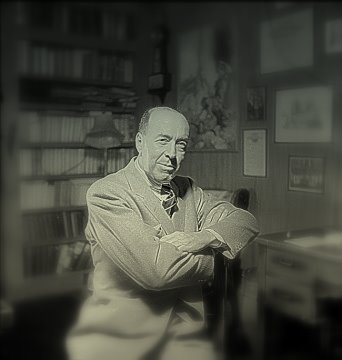
 

Edgar Rice Burroughs

Lion Man is overwhelmingly a novel of doubles or duplicity.  The number of things doubled is bewildering.  I deal only with the most obvious here.  The reason Burroughs concentrates on doubling, I believe is because he discovered the double meaning of the terms of the contract he signed with MGM.  He was stunned by the duplicity.

On p. 154 Burroughs comments on duplicity such as he found at MGM.  Remember he names them BO or Stinky studios in the novel.

Tarzan was suspicious.  He saw a trap, he saw duplicity in every thing conceived by the mind of man.

Thus having been betrayed Burroughs is now alert seeing doubling or duplicitness everywhere.

St. John, the illustrator of the book also picked up on the aspect of doubling.  This novel was so extremely important to Burroughs, he even issued it on his birthday, September 1st, 1934, that he asked St. John for something different for a jacket illustration.  St. John concentrated on the Obraoski/Tarzan doubling, producing a Janus like cameo of Tarzan/Obroski facing in opposte directions.  As in the Penguin definition representing both characters of the Lion Men Tarzan and Obroski.

In this case the two faces represent the earlier cowardly Bureroughs who has to die and the strong masterly Tarzan figure Burroughs wishes to be.

Thus, before considering the story it would be fruitful to examine ERB’s use of doubling and confusion of reality, or in other words craziness, madness or insanity.

It is obvious that when ERB is passing rhough a period of extreme stress Tarzan loses his memory and/or doubles- that is to say splits his personality in a hysterical or schizophrenic way.  At this point in his life Burroughs is enduring the stress of sexual conflict – the change in affections from Emma to Florence- as well as the extreme stress of having lost control of his creation and actual alter ego to MGM as representatives of his Judaeo-Communist enemies.  In point of fact, as Burroughs may have realized, the battle, even the war, was lost.  As MGM’s 1936 movie Tarzan Escapes, indicates Tarzan/Burroughs had been captured.  Hence the tenuous grasp on sanity in this book.

In Burroughs’ mind and in fact he had been trapped by duplicity, itself a form of doubling.  When Tarzan, having climbed the Stairway To Heaven finds the front door standing open he scents a trap but as his intention was to enter anyway he enters.  He is now only in the antechamber of fate, he could still back out.  He notices six doors of which Door #3 is standing open.  He does try the other five doors but they are locked.  Entering Door #3 he begins the descent down a dark stairwell.  He encounters another door.  Rather than checking the door first he merely enters to have the door click shut behind him.  The wall is smooth, there is now no way out.

This scene may well be a fictionalized account of his negotiations with MGM.  The Studio, perhaps representing Door #3 was offering him a contract which no other studio, doors 1,2,4,,5,6 was willing to do.  Granted not everyone can spot a sterling opportunity that is staring them in the face but it does seem odd that no other studio was interested in a proven character.  After all Twentieth Century-Fox was working Charlie Chan movies hard and doing well.  But all doors were closed to Burroughs/Tarzan except Door #3, MGM.  Not a bad thing on the surface of it as MGM was far and away the best studio in Hollywood.

So Burroughs entered into negotiations with MGM in the same manner as Tarzan descended the dark staircase in which he couldn’t see very well, i.e. Burroughs didn’t understand the clauses.  Like Tarzan ERB didn’t exercise caution and while the door snapped shut trapping Tarzan so Burroughs signed the contract which he represented as the prison Tarzan found himself in.

The reader may find the above farfetched but remember the first third of the story is an account of MGM’s Trader Horn expedition that he ridicules.  This book is about MGM.

Before dealing with the main doubles of the story let’s consider the story within the story- a form of doubling itself.  We have God on Earth doubling God in Heaven.  This becomes the source of many jokes.  Stress or no stress Burroughs doesn’t lose his sense of humor.  God’s castle is known as Heaven thus doubling Heaven.  The Stairway to Heaven doubles Jacob’s Ladder thus calling to mind the biblical story.  Tarzan then doubles Jacob.  That’s just part of sly old Burroughs’s humor.

God himself has created a parallel universe doubling England, London and the Thames.  Thus the gorilla plateau is called England while they live in London on the Thames River.  Thus a doubling of Africa and an island off the coast of Europe.

Just as God in Heaven in the biblical story created Man so God in this story has hybridized gorillas into a new species of gorilla men.  The hybrid gorillas are doubles of both gorillas and men while God is a double of man and Gorilla.

In this dizzying array of doubles the gorillas are not just a doubling of men but a doubling of the fifteenth century court of Henry VIII of England.  They have been altered by the use of deathless genes  or, atually, DNA, which was unknown to Burroughs at the time but the nature of which he dimly perceives.  The DNA has been inserted or spliced into the genes of the gorillas, thus the gorilla Henry VIII is actually, Henry VIII.  The Fifteenth century is doubled in the twentieth century while the political scene of the twentieth duplicates that of the fifteenth.  ERB may here be influenced by Mark Twain’s The Mysterious Stanger with his notion of ascending and descending staircases of time.

During this phase of the story within the story Tarzan is actually himself while posing as, or doubling, Stanley Obroski thus actually being self contained twins; in other words the personality formerly split between he and Stanley Obroski is reunited with Tarzan dominant.  Thus Tarzan redeems Burroughs’ former shamed self.  At this moment Stanley is dying of fever and when he does the double disappears leaving Tarzan or Burroughs then undivided.  The dead body of Obroski is shipped back to the States while Tarzan remains in the jungle.

The story within the story is a stunning achievement whose genius has gone unrecognized.

b.

The most obvious examples of doubling is in the main characters.  As incredible as it may seem not only are Tarzan and Stanley Obroski so close they can’t be told apart but so are the female leads Naomi Madison and Rhonda Terry.

I’m sure there are doubles I’m missing here but even Tom Orman, the Dirctor, is a double of himself when he’s under the influence of alcohol.  Drunk he becomes a different Tom Orman than when sober.  Obroski himself is two people.  An errant coward when he has time to think he become ferociously brave when his back is against the wall and there is no time for reflection.

Naomi Madison who has become a prima donna or an artiste was at one time a waitress in a cheap restaurant which role she is forced to assume again which is another form of doubling.  In this joke Naomi is an insult to Irving Thalberg’s wife, Norma Shearer, whose early career is duplicated.

Also this movie Tarzan is a doubling of the literary Tarzan so both Obroski and Tarzan are doubles of Johnny Weissmuller who played the MGM Tarzan.  As Burroughs suggests in this novel he was half out of his mind from the terrific stresses.  The stress did produce however a terrific novel.

It would seem that Burroughs was Tarzan and Obroski as twin aspects of his own Animus while Naomi and Rhonda represented the twin aspects of his Anima.  Naomi obviously represents Emma while Rhonda is an extension of La of Opar combined with Florence.  Naomi disappears from the story apparently replaced by Balza, The Golden Girl, while Burroughs marries Rhonda to Orman.

As regards the doubling of Tarzan who is actually a double of Burroughs himself, Bibliophile David Adams has emphasized that Tarzan usually views from above so that it might be the time to look into this aspect of the character.  In Lion Man Obroski is captured and held prisoner by Rungula, chief of the Bansuto.  this whole scene of Obroski with the Bansuto is one of the numerous variations of the theme of Burroughs humiliation by John the Bully.

Burroughs was plagued with the dream, as he notes the dream frequent among dreamers, of going naked in public.  It is a frequent dream because multitudes of people have suffered similar humiliation as his.

ERB has Obroski stand before Rungula who demands his clothes, in other words his defensive and offensive armor, that without which Obroski is exposed defenseless to the world, he loses his ‘front.’  John had symbolically stripped young ERB.  Burrughs describes his humiliation in excruciating detail as Obroski does a virtual striptease.  First his shirt on down until Burroughs makes a joke of his gaily printed boxer shorts.  While the Bansuto would not have understood the signficance of the shorts ERB takes a certain pleasure in humiliating himself further.  To cover rhis nakedness Obroski pleads for the proverbial fig leaf and is given a skimpy dirty g-string.  Thus when he is led out for torture he fights the Bansuto naked but in a Tarzan guise.  Heck, Tarzan, who is not civilized in the jungle, walks around naked anyway.  Although the natives themselves are naked Obroski is civilized while they are savages.  Having been subdued Obroski is lain before Rungula.  By this time Tarzan is in a tree, apparently planted there for his convenience.  He looks down on Obroski in amazement to see a replica of himself.  p. 104:

In the light of a new day Tarzan of the Apes stood looking down upon the man who resembled him so closely that the ape-man experienced the uncanny sensation of standing apart, like a disembodied spirit, viewing his corporeal self.

What Burroughs is describing here is the splitting of the personality.  He may have the correct psychologically sequence, first the stripping of the armor- i.e. emasculation, and then the disembodiment, the dissociation of the mind and body.  The mind unable to deal with the reality seems to leave the body rising above and looking down on the humiliation of his poor self.  This theme runs all through Burroughs work although this is his most exact and detailed description.

Obroski has been led out to be tortured to death and eaten by Rungula the cannibal chief.  Usually Tarzan is placed in an arena to fight one or more wild beasts.  In a normal confrontation Obroski is a coward which is to say he is unable to defend himself.  In other words his subconscious mind has been conditioned to accept the dominance and authority of hte oppressor.  In still other words in a state of terror his subconscious had been accessed to accept certain hypnotic suggestions.  But, with his back to the wall his instinct of self-preservation overrules the hypnotic suggestion and he fights like the proverbial cornered rat.

In this instance he used his full potential to fell a whole battalion of Rungula’s men, performing authentic Tarzanic feats like lifting men above his head casting them among his foes.  At the time Tarzan is looking down at him he has finally been subdued lying at Rungula’s feet.

You know whre I’m going , don’t you?  Right.  that street corner in Chicago where John the Bully confronted young ERB.  Burroughs didn’t fight like a berserker though, he ran.  (Chief Run-gu-la?) But that was when he split his personality being able to look down on his corporeal self like a disembodied spirit.

As the Penguin Dictionary says:  Instances of hysterical or schizophrenic duplication of personality are well know to psychotherpy.  There are many examples of this phenomenon.  Here are a couple to show how it works.

When a person is enduring an unbearable situation in which he is powerless to resist, rather than believe the situation is happening to him he does split off a psychological projection of himself as a disembodied spirit who sympathetically views his now alter ego’s humiliation.

For instance when Jean Genet, the author and playwright was at the Mettray Reformatory he was caught out by a gang of homosexuals and gang raped.  As the rape progressed, escape being impossible while becoming so unbearable for him, to retain his sanity he split off a projection, a disembodied spirit, if you will, that floated above the scene.  Thus Genet was able to actually observe his rape without participating in it.  As he watched he muttered ‘Poor Jean, poor poor Jean.’  Thus the mind provides a somewhat feeble defense but one that allows one to keep one’s sanity after a fashion.  Of course the hypnotic suggestion  from this terrifically shameful event caused him to relinquish his will to the oppressor, part of the deal to keep one’s sanity.  Genet’s character was changed for life; he became a homosexual who had no will to resist that of men while becoming an active agent in his future degradation.  He was always able to rationalize his actions so that they seemed right.

I will use my own experience as a second example.  In kindergarten the elite group forced a confrontation with me in which they lost and looked bad.  Circumstances removed me to a different school before they had a chance to relaliate on me.   But then in second grade I was returned to that school.  At that point they were waiting for me.  This situation is more analogous to Burroughs than Genet but all three involve a rape of the mind which is what emasculation is.

The general conclusion is that my and Burroughs situations are normal, they happen to everyone.  Perhaps.  And everyone reacts in their individual way but everyone reacts.  A few years later and I would have been able to handle this situation without a problem as would have been true with Burroughs.  Remember with Burroughs however that while John the Bully only threatened him in 1884-85 fifteen years later in a similar to identical situation he had his head broken thus reinforcing the original situation.

In my case the situation formed my central childhood fixation as did Burroughs’.  My subconscious was opened to admit certain hypnotic suggestions which were fixed in my subconscious.  It then closed but refused to allow me to remember which of course is why the situation became a fixation, or suggestion I could not refuse to observe.

At recess in the second grade a group of, shall we say, twelve formed a semi-circle around me.  Like Burroughs I am compelled to make excuses for myself.  For the previous year I had been shuttled between foster homes and thus I had no support or defense.  I was alone.  In kindergarten the boy, the leaderof the pack, had ordered two new kids, the first Negroes in the school, to sit on the sandbox and not move during recess.  I took the Blacks’ side offering to fight the leader.  He, standing at point, declined combat stepping back into the support of his crowd gathered behind him.  That was his mistake.  He and his crowd had realized this.  Now in the second grade the boy still refused to challenge me individually.  Now they formed a semi-circle around me while their leader stood at keystone, still enveloped by his gang so that, I presume, they could fall on me if I resisted.

They all beamed hatred and contempt at me.  I was unable to resist the projected hatred of the boys and girls while at this date having only the vaguest or no notion of what I was guilty of, I was ordered to take a step forward which to my eternal shame I did.  In midstep I was ordered to stop and stay in that suspended step throughout recess.  To my shame, I did.  He said:  You’re going to have to be our nigger now.  The shame killed my personality, my identity, my ego.  I assumed the role of ‘nigger.’  Terror opened the way to the subconscious and the suggestion, you are a nigger, among others was entered.  Like Jean Genet a projection of myself arose above to say something like:  Poor kid, poor poor kid.’

The suggestion was so horrific to me that I immediately forgot it or, perhaps since that ego died the incident was not part of the life of the survivor.  The memory was accepted and encysted in my subconscious what Freud and Jung would call the unconscious.  I not only forgot the situation but I forgot the faces and names of the kids involved.  I could not remember them from that day forward although I could talk to them as though I did know them.

The consequence was that I had to do what I was told to do by nearly anyone.  Much the same as Burroughs who wrote a medieval story, of which he knew nothing, at the suggestion or command of Metcalf and wrote Son Of Tarzan which he later regretted, and Tarzan And The Ant Men at the suggestion or command of Bob Davis.  Buroughs became a variation of the dependent personality as did I.

On the one hand my conscious mind understood the proper means of defense but as I began to do so my subconscious mind overruled or shoved my conscious mind aside and obsequiously obeyed.

This plight was only changed when I succeeded in integrating my personality in the year of around forty-two.  That is to say the subconscious contents of my mind centered around the cyst of my central childhood fixation was made manifest to my conscious mind allowing the subconscious to be integrated into consciousness.  Where the ‘Id’ was ‘Ego’ shall be, as Freud put it.

Burroughs in  Lion Man at fifty-eight is describing the same situation as that experienced by Genet and myself but in a different way.  Like myself and Genet he would have been easy to direct.  So at that age he had not yet exorcised that particular demon.  As ERB kills Obroski off in this novel assuming both identities while discarding that of Obroski, returning the corpse to Hollywood, becoming solely Tarzan of the Apes one wonders if he succeeded in integraing his personality at that point.  That is what he is describing.

His experiences with John The Bully, the splitting of his personality explains why Tarzan observes from above rather than as a participant on the ground. In Lion Man perhaps agitated by the movie duplicate of the literary Tarzan he brought the situation of John the Bully to consciousness. Rungula the Bansuto taking John’s place while the aspect of Tarzan or his split off alter ego watches from above while Obroski fought like a berserker on the ground but was overcome by numbers or in the John situation, size.

Thus Tarzan spies on the safari from the trees by day while walking rhough the camp at night.  Having dealt with his humiliation in some way in Rungula’s village, when Orman and West are threatened by a lion Tarzan plummets from his tree to kill the lion on the ground then without a word vaults back into the tree.  Orman and West mistake him for his lookalike Obroski.  Thus we have the beginning of the reuniting of the split personality which will continue in the Heaven of the gorilla god.

Burroughs was under such extreme stress from both his sexual desires and the MGM betrayal that he must have felt half mad.  While he and Rhonda are captive in Heaven he says:  Sometimes I think I must be dreaming.  A statement that seems to be out of character for the Big Bwana.  The scene might be interpreted as ERB’s Anima and Animus being imprisoned while on one level God might represent MGM.

Tarzan comes into contact with Stanley Obroski which Tarzan finds amusing and lets them do.  Both women pinch tmeselves to see if they are dreaming or mad as well they might.  Tarzan rejects Naomi which must have confused her as she and Obroski were in love with each other.  Having ditched Naomi Tarzan/Obroski goes back for the wise cracking Rhonda.

Then too Burroughs actually describes Tarzan as a madman at one point.  This would be tantamount to describing himself as mad.  Indeed the whole novel centers on mad or insane happenings.

The madness or insanity would be an aspect of Tarzan’s viewing from above as a disembodied spirit.  The splitting off of the aspect from his and ERB’s personality would be the result of the extreme stress of the moment that produced the feeling of dizzying  madness.

Burroughs handling of the stress in what I consider a very extraordinary novel is abolutely masterly.  I can’t think of a finer science fiction story that the story within the story of God’s in his Heaven and all’s wrong with the world.

ADDENDUM

David Adams who had an advance copy of this piece brought up the point that perhaps Tom Orman in his drunken state was a comment on Emma’s drinking problem.  A scenario instantly suggested itself.

Imagine Orman in his drunken state as a personification of John Barleycorn.  Imagine sweet sober Naomi as Emma in her sober state and Obroski as Burroughs in his non-Tarzan, actually Obroski state.

John Barleycorn claimed Emma as his own as Orman claimed Naomi.  Barleycorn is a jealous man and won’t tolerate Burroughs as a lover of Emma.  So the couple have to sneak a moment or two when John Barleycorn isn’t around.  In other words, when Emma is sober.

As Burroughs fictionally represents the situation Obroski/Burroughs is visiting Naomi/Emma in her tent.  they appear to be in love and accord.  Orman is drunk in his tent and isn’t expected to be abroad.  Then Obroski hears the drunken Orman approaching the tent.  Unable to stand up to Orman Obroski obsequiously flees.

So in real life Burroughs and Emma are getting along fine until Emma hits the bottle conjuring up John Barleycorn.  ERB can’t compete with the bottle while Emma becomes verbally abusive under the influence just as Orman used the lash on bearers while drunk.  ERB can’t take it so like the bearers he vanishes into the night.

I think it may be a viable scenario although obviously ERB’s version of the truth.

End of Part II.  Part III, The Source follows.


A Review

Themes And Variations

The Tarzan Novels Of Edgar Rice Burroughs

#18 Tarzan And The Lion Man

Part one of ten parts

by

R.E. Prindle

First published on the ezine-ERBzine

Preface

     As has been seen 1931 was a very eventful year for ERB.  The viewing of Trader Horn was a seminal event in his life.  The movie became a major influence on his next Tarzan novel- Tarzan And The Leopard Men.  As has been noted, in April he signed the contract with MGM.

     Reports vary but it appears that he may have sold the movie rights for the first film for twenty-two thousand dollars plus a five week employment contract at a thousand dollars a week.  It is fair to assume that ERB spent his five weeks on the MGM lot in Culver City.

     During that period of time he obviously attended conferences with Irving Thalberg so his descriptions of the ‘Boy Wonder’ are taken first hand.  One imagines that he became acquainted with the Director Woody ‘One Take’ Van Dyke.  I like to think they hit off with ERB getting some first hand accounts of Africa that showed up in Lion Man.  As he had a copy of Van Dyke’s privately printed Horning Into Africa in his library it would seem obvious that Van Dyke presented him with a copy.  Thus ERB had a fund of first hand information lacking in his earlier novels.

     One also imagines he met the African stars Mutia and Riano when they visited Hollywood.  They would have been the first Africans he had met.  There is a world of difference between Africans and American Negroes.  Perhaps for these reasons his Leopard Men varies somewhat from his usual hidden civilizations formula.

     And also he would have met his script writing counterpart Cyril Hume.  His new partner one might say.  And coincidentally Johnny Weissmuller and Maureen O’ Sullivan.

     One is astonished at the speed with which MGM signed Burroughs, developed a script, found actors for Tarzan and Jane, made a movie and released it a bare ten months later.  What orgzainization.!

     We know that ERB watched the result with sinking heart and bitter remorse for signing the contract.  The MGM version of his creation was the antithesis of his own.  Rather than a literate, cosmopolitan Tarzan at home both in the jungle and the capitols of Europe and cities of America the MGM Tarzan was a feral boy who wasn’t even a lord, let alone  the lord of the jungle.

     Our Man had just finished Tarzan And The City Of Gold  when he viewed the movie.  Now with his brain reeling in shock it would be a year before he got out his reply.

     In my estimation it would be his last great Tarzan novel.  The Big Bwana had been emasculated.  But the greatest of the Tarzan novels was the result.

     ERB also made it a Hollywood novel, perhaps as trenchant a criticism of the film capitol as his 1922 effort The Girl From Hollywood.   He ridiculed the whole thing.  MGM, Thalberg, the African expedition, the movie Tarzan and in a closing chapter Hollywood itself.  In his pain and hurt he drove himself to heights he had never before attained.

     Stunned by the duplicity of MGM his novel is a story of duplicity, of doubles and more doubles until one has doubles coming out one’s ears.  The story within the story, the double of the story itself, of God in Heaven but all wrong with the world is a masterpiece of imaginative fiction that transcends even the exploits of his Martian creation, Ras Thavas.

     As Leopard Men was permeated with sexual desire with a hint of madness, Lion Man is deeply involved with madness, insanity and a complete feeling of unreality.  As Tarzan says:  Sometimes I think I must be dreaming.  Yea, verily, brothers and sisters.  This story is one of dreams and nightmares but a dream of a story.

1.

     In the novel Burroughs had two major objectives: 1.  To ridicule and humiliate MGM and 2.  To show them how to use all new material in a much more imaginative way than Cyril Hume had.  Hume is probably ridiculed as both the writer Joe in the foreword and the scenarist Pluant in the Hollywood afterword.

     There can be no mistake that the introductory story refers to the Trader Horn expedition while Burroughs includes a planning session with Milt Smith/Irving Thalberg in his MGM/BO office.  Let us look at the introductory chapter carefully.

     There can be no doubt that Burroughs was included in such sessions concerning the movie Tarzan, The Ape Man so that the chapter ‘In Conference’ is an authentic snapshot of how business was conducted.

     The opening sentence is:  Mr. Milton Smith, Executive Vice President In Charge Of Productions was in conference.  There is no doubt that here Burroughs is referring to Irving Thalberg.  Burroughs goes on to describe Thalberg’s actions which were considered peculiar by everyone in Hollywood.

     Mr. Smith had a chair behind a big desk, but he seldom occupied it.  He was an imaginative dynamic person.  He required freedom and space in which to express himself.  His large chair was too small; so he paced about his office more often than he occupied the chair, and his hands interpreted his thoughts quite as fluently as his tongue.

p9.  Smith was walking around the room, acting out the scente.  He was the girl bathing in the pool in one corner of the room, and then he went to the opposite corner and was the Lion Man.

     That doesn’t sound unfriendly or hostile to me but as ERB has already identified MGM as BO (Body Odor) or Stinky Pictures Louis B. Mayer, MGM’s president, may have taken all ERB’s comments from then on as intended insults.

     In point of fact ERB’s descriptions of Smith/Thalberg seem to be accurate.  Thalberg was the subject of Scott Fitzgerald’s unfinished final book The Last Tycoon.  The novel was made into a movie of the same name in 1976, the last movie directed by Elia Kazan.  Thalberg is portrayed exactly as Burroughs depicted him.

      The conventional mind seems to be unable to grasp the idiosyncrasies of genius.  The genius of Thalberg was that he was able to visualize the film in the manner Burroughs describes, alsmost as the author.  Had he failed he would have been merely weird but as he was the greatest and surest producer of the studio era the seeming eccentricity becomes an attribute of his genius.  As a writer of genius I think ERB saw Thalberg that way; how the latter of MGM interpreted ERB’s remarks may have been less generous.

     The director, Tom Orman’s character is quite similar to that of Woody Van Dyke although as the physique of Orman is opposite that of Van Dyke it is clear that Orman is intended to be more fictional.  The name Or-man can interpreted as Gold-man from the French Or which translates as gold.  As Goldman ERB may have been slamming the Jews.  ERB was less than careful in that respect in the novel.  In the last chapter ERB definitely characterized Abe Potkin as a Jew placing his conversation in dialect.  By Abe Potkin ERB may have been referring to Louis B. Mayer.  The introduction of Clayton to Abe leaves this open to conjecture.  p. 186:

     This is Mr. Potkin, John Clayton, Abe Potkin, you know,  (italics mine)

     If ERB did ridicule both Thalberg and Mayer or was perceived as doing so then he was definitely asking for trouble.  Fighting the Law in Hollywood as it were.

     Like Van Dyke who had been called in to relieve director Robert J. Flaherty on a behind schedule film White Shadows On The South Seas in which Van Dyke was successful so Orman had been called in to complete a picture being shot in Borneo.

     Just as Van Dyke was then assigned Trader Horn on location in Africa so now Orman is assigned to make the biggest African picture ever in the Ituri Rain Forest.

     ERB probably met Van Dyke in the summer of ’31 on the MGM lot.  It would seem that the two men hit it off as Orman is as well treated as Lion Man allows.  It  is to be presumed that Van Dyke presented ERB with a copy of his privately printed Horning Into Africa  at that time.

      The rest of the chapter is joshing around in a light hearted banter that was characteristic of this type of conference and introducing the members of the cast thus establishing the nature of their characters.

     A detail of interest is the following quote.  p. 8:

     “And are we going to shoot:” inquired Orman, “fifty miles from Hollywood?”

     ‘No, sir!  We’re going to send a company right to the heart of Africa to the -er-ah- what’s the name of that forest, Joe?’

     “The Ituri Forest.”

      “Yes, right to the Ituri Forest with sound equipment and everything.  Think of it, Tom!  You get the real stuff, the real natives, the jungle, the animals, the sounds.  You ‘shoot’ a giraffe and at the same time you record the actual sound of his voice.”

     “You won’t need much sound equipment for that, Milt.”

     “Why?”

     “Giraffes don’t make sounds; they’re not supposed to have any vocal organs.”

     “Well, what of it?  That was just an illustration.  But take the other animals for instance; Lions, elephants, tigers- Joe’s written a gret tiger sequence.  It’s going to yank them right out of their seats.”

     “There ain’t any tigers in Africa, Milt,”  explained the director.

     “Who says there ain’t?”    

     “I do,”  replied Orman grinning.

     “How about it, Joe?”  Smith turned toward the scenarist.

     “Well, Chief, you said you wanted a tiger sequence.”

     “Oh, what’s the difference?  We’ll make it a crocodile sequence.”

     In this instance ERB is spoofing himself.  Over the years he had all kinds of complaints for faunal inaccuracies.  The tiger bit probably hurt him the worst.  He had written a great tiger scene for the first Tarzan novel that had to be changed from the All Story magazine version to the book version.  ERB finally gets a chance to exorcise his frustration over that one.  He was also criticized for having deer in Africa, Bara the deer, of which there are none.  He first tried to bull his way through by saying he just wanted Bara the deer there.  He gave in by Tarzan The Invincible  and spoke of Bara the antelope.  This also apparently proved unacceptable as in Leopard Men he speaks of Wappi the antelope, while the name Bara disappears completely.  In the joke about the giraffe voice he is showing off knowledge while venting a little steam.

     Thus he sets the scene for the first stage of the novel, the penetration of the film company into the Ituri Rain Forest.  I found this sequence as well handled as any movie version might have been.  ERB doesn’t try to follow Van Dyke’s narrative but creates his own story based on Van Dyke’s.

     I have no doubt that there are references in this introduction and throughout the book to real people and real incidents that have gone over my head.  I have located what I can with my present knowledge but I’m sure the novel is loaded with many others.

Go to:  Part 2:  Doubles And Insanity

Exhuming Bob IX

Chronicles I

Pensee 5

by

R.E. Prindle

Younger Pete Seeger

Younger Pete Seeger

     Larry Sloman has an interesting interview with Mike Bloomfield in his On The Road With Bob Dylan of 1978.  It takes up twelve pages- 286-297- of the 2002 Revised Edition.

     Mike Bloomfield was, or course, the White Southside Chicago Blues guitarist who rose to fame as the lead guitarist of the Paul Butterfield Blues Band.  Butterfield’s LP East-West was one of the seminal records of the sixties.  If you’re hip and don’t know the record, you should take care of that as soon as possible.

     The interview is interesting in a number of ways.  Bloomfield who was a Jew ‘hanging out with ‘the niggers’ on the Southside as he puts it, has a rather surprising attitude toward Blacks and opinions on Dylan.

     Born in ’43 Bloomfield was two years younger than Dylan thus his mind was more malleable to the propaganda of the fifties as he turned fifteen only in ’58, graduating, if he did, in ’61.  The tremendous persecution indoctrination and conditioning of the mid to late fifties in the Jewish community would likely have influenced his mental state more profoundly than Dylan’s.

     The Jewish community has always been affected by the Negro mental situation.  A low down Jew in his own community was frequently designated a ‘nigger’ often carrying the nickname of Nig or Big Nig.  Sloman, also a Jew, repeatedly refers to himself as the ‘nigger’ of the tour while designating Ronee Blaklee as his female nigger counterpart.

     While not having enough information to diagnose Bloomfield’s mental state nevertheless since he abjured the White world for the Black world of the Blues it would seem that he interpreted the intense Jewish indoctrination as meaning that since the world hated the Jews only because they were Jews that the Jews were no better than the ‘niggers’ and that he should go live with them.  The psychological conditioning young Jews went through in the fifties was just horrid in the effects on their psyches.  Really crazy stuff.

     So, while feeling no better than the Blacks Bloomfield at the same time recognized his separateness, difference and apparent inferiority.

     This was certainly different than the image being projected to the equally impressionable youth of America who through musicians like Bloomfield reverenced the Negro.  In fact Bloomfield was a perfect catalogue of prejudices if one looks at it that way.  Another way of looking at it is that having had close contact with the various cultures he had a clear idea of their characteristics as compared to the Jews and Whites.

Mike Bloomfield

Mike Bloomfield

     Still, at Newport he was scandalized by Peter Seeger’s behavior.  Quite clearly Bloomfield was not your typical White Liberal.  p. 291-292:

     To play with anyone at a folk festival, I would have plugged my guitar into Pete Seeger’s tuchus, really man, and put a fuzz tone on his peter.  You know what fucking Pete Seeger was doing?  He brought a whole bunch of schwartzes from a chain gain to beat on a log and sing schwartze songs, chain gang songs, and he was doing that, can you believe this guy?  Here’s a white guy, got money, married to a Japanese woman, beating on a log with schwartzes singing ‘All I hate about lining track, whack, this old chain gang gwine break my back,  actually saying ‘gwine’, whack and Seeger’s doing this and he’s pissed off at us for bringing electric guitars to the fucking folk festival!  He brings murderers from a schwartze prison to beat on a log!  Oh, I couldn’t believer how fucking crazy it was!

     Schwartze italicized in the original, of course, is Yiddish for nigger.  The above is terrific scene painting that represents  about how probably 90% of America at the time would have perceived the scene.  Seeger was a Liberal Commie Red American living this incredible fantasy life in which he was the star of his own movie in which there were no consequences while the plot is perpetually arranged  to suit his convenience.

     This was the beginning of the period when White Americans believed themselves in control of the destinies of the people of the world.  Kennedy had just created the Peace Corps under whose auspices raw youths with no worldly experience were sent out into the world to supposedly tell forty and fifty year old men and women that they were doing everything wrong and these mere kids were going to tell them how to do it right.  I can’t tell you how the concept boggled my mind.  Seeger married to a Japanese while calling these Negros cons to Newport to play chain gang songs is actually treating these people as though they were his toys.  The arrogance of this Liberal so-called peace-loving, people-loving creep is amazing.

     As Bloomfield says, Seeger came unglued over the violation of his fantasy when electricity was introduced into his rural pre-Civil War fantasy while idolizing Negro murderers that he had had released from prison for the weekend.  Imagine, for his convenience without any regard for the feelings of the prisoners he had done that.  Then he has them perform a scenario where they are beating on a hollow log as caricatures of themselves of a century earlier singing railroad songs that hadn’t had any relevance for at least fifty years.

     Obviously Bloomfield while he had some fantasy that he was a psychological nigger who was at home on the Southside still longed to be Uptown with the White folks.  Hence he is so scandalized that Seeger, a man with money, in other words, while Seeger didn’t have to play with schwartzes was actually, and here Mike’s incredulity is palpable, singing Negro dialect like ‘gwine’ and going whack.

     I mean, in Seeger’s incredible movie life he’s got a Japanese wife and everything, bank account.  If he tires of that fantasy he dumps her and marries a – whatever, whoever the film running through the sprockets of his mind fancies.  I mean, the guy’s got a long lead between second and third out on the grass and nobody’s even running him down.  Bloomfield is completely flabbergasted.

     And then Dylan is toying with him and he does know that.  Dylan comes to Chicago right after the first album, Bloomfield grabs his guitar, just like in Crossroads, intending to cut Dylan down which he can do with ease and cutting is done everyday in Chicago so it is legit.  Dylan must have blanched with fear knowing Mike could do it.  Now, remember this is an intra-Jewish thing.  Rather than risk embarrassment Bob abases himself and charms Mike into believing they are friends.  Deceived, Mike lets Bob off.

Dylan At Peak

Dylan At Peak

     Now safely back in New York Dylan calls Bloomfield to ask him if he wants to play on Highway 61, the most vengeful record ever recorded.  Bloomfield accepts showing up in the enemy’s camp at Woodstock.  Now Dylan insults Bloomfield and strips him of his dangerous skills.  Bob says:  ‘I don’t want you to play any of that B.B. King shit, none of that fucking blues I want you to play something else.’  so we fooled around and finally played something he liked, it was very weird…’

     So Bob makes himself superior by taking away Bloomfield’s identity (I had to change their faces and give them all brand new names) but he takes the trouble to actually teach Bloomfield the songs because he is going to need him.

     I have to give Bob credit for being an improvisational genius.  At the Highway 61 session he and Mike are the only guys who know what they’re doing while the other musicians are keying to them.  The result in my estimation is sensational.  As a musician Bloomfield didn’t think much of it but as a listener without those kinds of professional prejudices the result is astonishing.  To be sure the sound is not as tight as a Johnny Rivers record but that is its genius.

     Bob assumes that Bloomfield knows he is now Bob’s shadow or guitar player.  When Mike goes with Butterfield Bob feels rejected.  When Bob’s feelings are hurt Bob gets revenge.  A number of years later Bob asks Mike to play on Blood On The Tracks This time he doesn’t need Mike so harking back to their first encounter in Chicago he roars through the songs in one tuning so fast Bloomfield can’t keep up.  Bob has cut Bloomfield as Mike had meant to cut him.  Bob walks out, king of the Crossroads.  Bob has ‘proved’ himself the better musician.  End of that story.  Bloomfield ODed a few years later.

     At one point Sloman asks Mike ‘What was he like?’  pp. 286-287:

     “There was this frozen guy there,” Bloomfield says.  “It was very disconcerting.  It leads you to think, if I hadn’t spent some time in the last ten or eleven years with Bob that were extremely pleasant, where I got the hippie intuition that this was a very, very special and, in some ways, an extremely warm and perceptive human being, I would now say that this dude is a stone prick.’

     Bloomfield then describes Dylan in conjunction with Neuwirth and Albert Grossman holding themselves aloof from others while indulging in savage put downs of anyone and everyone.  Bob in fact was a stone prick.  The question is why?

     After this introduction to the problem , in Pensee 6 I will return to the root of the problem built around Bob’s reverence for Mike Seeger.

A Review

Reconstruction:

Foner, Du Bois, Bowers

by

R.E. Prindle

Bowers, Claude:  The Tragic Era, 1929

Du Bois:  Black Reconstruction In America:  1860-1880, 1935

Foner, Eric:  Reconstruction:  America’s Unfinished Revolution 1988

     While race, or species, is the cental problem of Reconstruction none of the above writers bothers to really examine the issue.

     On the one hand the United States was settled by the highest exemplars of human development at that time.  The evolutionary nature of the European settlers was unfolding at a rapid rate that was to blossom in the nineteenth century although still at a relatively low stage of development.

     Added to this species of Homo Sapiens was the infusion of diverse African species fresh from the jungles of Africa.  The African peoples are believed to be the first Homo Sapiens to evolve.  They had been in Africa for 150,000 years or more and had attained no indigenous level of civilization.

     Not all African peoples are the same age.  For instance, the Bantu peoples who came into existence in the Sahel near Ubang-Chari are an obvious Negro-Arab hybrid.  The hybrid developed about 1000AD spreading South and East across the continent.  The Bantus drove the indigenous Bushmen before them eventually forcing the remnant into the Kalihari desert.

     The West Africans may be the stock on which the Arab was grafted.  Now, the anthropologists tell us that at some point the previous hominid strain evolved into Homo Sapiens I, which is to say the Black African.  But, they don’t tell us, nor are they capable of it, exactly what separates the Last Hominid Predecessor from Homo Sapiens.  We don’t know what those indicators are.  Either the Last Hominid Predecessor has disappeared without a trace or the Bushmen may be the LHP or even the West African.  Certainly there are marked differences between the African and the Semite, Caucasian and Mongolid.  The difference is of an intellectual character as well as a number of physical ones, which is to say, genetic.

     No one will deny the physical differences, they are maintained to be merely cosmetic.  It is in the intellectual field we encounter resistance.

     Science has given ample proof that there is a difference in mental capacity between Africans and Caucasians, Mongolids and Semites.  There is an emotional problem with the Biblically oriented because the bible says God created man whole and entire apparently  from nothing and The Declaration Of Independence of the United States says that:  ‘We hold these truths to be self-evident, that all men are created equal…’  The authors provided no evidence of this.

     So we have the statements of men against the scientific evidence of nature.  I opt for science and nature.

     The European discovered America, that they found a continent that they didn’t know was there and invaded it or settled it depending on how you choose to see it.  Following the scientific approach of Darwin I understand that the Europeans invaded the continent driving the earlier settlers before them in the exact same way that one species of bird, for instance, supplants another.

     The Europeans had not yet developed the notion of free labor the way they would in the nineteenth century so they brought indentured White ‘servants’ over who were in fact, slaves.  Shortly thereafter a sea captain unloaded a cargo of Africans as laborers who became chattel slaves.  Over a period of decades the Africans displaced the Europeans as slaves but not before extensive interbreeding as both species were used as field hands.

     In Darwinian terms then, as a competing human species Europeans displaced the Native Americans, or Indians, while at the same time introducing the various African species which by the time of the end of slavery and  Reconstruction would enter into competition with the Caucasians for possession of the  continent.  The difference in species was an irreconcilable difference, an either-or situation.  This is the tragedy of the United States of America and the Western Hemisphere.

     Africans were always a signficant portion of the population of the United States, moreso in the South but they were not inknown in the North where they were treated little differently than in the South.  Edgar Allan Poe records an instance of Negro slavery in Pennsylvania that was not all that unusual.

     Prior to 1793 the ratio of Black to White was much smaller but in that year Eli Whitney invented the cotton gin.  This invention opened the black lands across the South from the coast through Mississippi, Louisiana, Arkansas to Texas to cotton cultivation.  Black lands does not refer to Negroes but to the soil.

     Thus from 1793 to 1860 the importation of Africans increased greatly.  The African population skyrocketed.  At the time of the Civil War Du Bois estimates that 10% were African born.  That is one in ten.  The percentage born to mothers from from Africa and first Generation Africans must therefore represent a full 25% of the African population.  Thus, at the time of Emancipation at least one Negro in four can be said to be African in culture.

     Indeed, Mark Sullivan (1874-1952) in his wonderful multi-volume popular American history, Our Times, recalls the charm of the Africanisms of the Negro that had disappeared by the turn of the century.

      Contrary to common belief the number of slaveholders in the South was relatively small.  Non-slaveholders outnumbered slaveholder by a considerable margin.  Also contrary to common belief Whites, Blacks and Indians all owned slaves.  As one progressed from East to West conditions became more barbarous.  Relatively benign in the East by the time one reached Louisiana where the majority of Black slave owners domiciled, according to Du Bois, slaves were actually worked to death, the owners then buying replacements.  Although it was denied and covered up Kentucky and virginia bred Africans for sale to the Deep South.

     There are those who say that slavery was a dying institution that would have disappeared on its own.  Whether it would have or not I see little to indicate such a development.

     The plantations could be huge affairs of a hundred thousand acres or more; self-contained cotton growing duchies.  Having the economic power the Planters controlled politics.  The much larger non-slave owning White majority was despised by both Planters and Blacks while being bent to the will of the Planters.  It is interesting to watch Du Bois twist and turn trying to explain why it was right for the slaves to despise the ‘po’ white trash.’

     The Planters built up a very pleasant situation for themselves on the backs of both Blacks and Whites.  ‘Oh, Darkies, how my heart grows weary’, Br’er Rabbit, Br’er Fox and that sort of thing.  Disney’s Song Of The South really cranked out the Blacks.  The Planter-Black alliance against the Southern Whites has evolved today into the Liberal-Black alliance against ‘Whiteness.’

     At the time the Planters had abundant opportunity to study the Blacks.  They came to the conclusion, without using the term, that the Africans were a different species, since corroborated by science.

     Thus, when Reconstruction began we had two species competing for the same territory.  The species were inherently unequal.  Equality of intellect could only be obtained by education, if at all.  In addition, as I noted, fully 25% or, one in four, had but recently been removed from the African jungles.  The remaining three quarters had been in the state of slavery for generations.  They were thoroughly cowed.  Any hope of freedom they had was hundreds of years old.  They were in a body illiterate.  Indeed, it was against the law to school them.

     As Du Bois points out because of its historical relation to the French Caribbean, Haiti, Louisiana had the largest group of educated and cultured Blacks.  Indeed, the early cultural history of New Orleans is worthy of study.  There were things going on there that weren’t going on in other places.

     At one stroke then in 1863 the bonds of the community were broken apart and this Black population nearly equal in size to the Whites, in some places exceeding it, was placed on a political parity by Northern bayonets.  Truly a second Civil War in the South between Blacks and Whites was the only possible result  and that’s what Reconstruction was.  The first result as Eric Foner says was the Unfinished American Revolution.

2.

         The argument of Du Bois depends on the character of the Negro.  That it is both wrong to enslave another and that the introduction of the Negro into the Americas as the greatest error of all goes without saying.  The point is that we have at least two Homo Sapiens species competing for the same land.  The differences are irreconcilable and can only be solved by the elimination of one or the other.  The problem as an evolutionary one is beyond reason.  No amount of good will can resolve it.  Tor those who haven’t thought this situation through that statement may sound strong but the current New Abolitionist movement is dedicated to the genocide of Whites.  That simple fact cannot be denied.

     Du Bois, who writes as a Black apologist and not an historian, has , or ast least displays, absolutely no psychological understanding of the participants.  He believes he is an excellent historian but I’m not prepared to allow him that without a grasp of psychology.

     In his view which he shares the opinion with Liberals that the Negro is by nature an inoffensive, happy-go-lucky fellow who wouldn’t harm a fly.  Why, during the war didn’t he stand by the Missus and the kids while the menfolk were off shooting the Negroes who had joined the Yankee war machine and made it work?  According to Du Bois the war couldn’t have been won if those Negro soldiers hadn’t joined up.

     Supposing that Blacks in the heart of the South did remain quiescent,  Does that mean it was because they were happy and contented or does it mean they were waiting for the results before stirring? Actually the Southern states were the only place Africans in the world were so quiescent so we have to look for other reasons than good natured joviality.

     Earlier in the century nineteenth century when a majority population of Africans revolted against a small minority of Whites in Haiti the Africans slaughtered the White males while retaining the White females as sex slaves.

     In Jamaica where the small minority of Whites couldn’t control the large majority of Africans, Africans escaped to the hinterlands where they formed their own district and carried on guerilla warfare from there.

     Their earlier African heritage had been no different than the Africans of the South.  Tribal wars of extermination were the sole constant of African life.  Tribal centers rose and fell.  Livingstone and others discovered burnt over ruin after burnt over ruin, formerly populous lands entirely deserted.

     In today’s Africa Robert Mugabe of Zimbabwe has completely demolished the civilization Whites had built up.  One of his first acts upon taking office was to attempt the extermination of the Matabele Zulu over a hundred and fifty year old grievance.

     Now that the Africans in South Africa have been granted power over the Whites they are committing genocide against them while dismantling the civilization the Whites built up.  They simply cannot sustain it.

     In the United States today the Blacks of New Abolitionism are calling for the disappearance of Whiteness now that the United States’ ‘unfinished revolution,’ as Foner expresses it, is rushing to its conclusion.  Unless the Whites of America wake up Whiteness will disappear and the unfinished revolution conclude in their destruction.  In other words, in the Darwinian sense the African species of Homo Sapiens in competition with the White Homo Sapiens species will eliminate them completely.  Human abilities to speak and reason mean nothing compared to the forces of nature, especially when those forces go unrecognized.

     Thus the major weakness of Du Bois’ thesis is that he fails to understand, or at least state, the causes of irreconcilable differences.  African people are not as he describes them.  Nor are Whites.

     Bowers makes it more clear that from the White point of view the battle between Whites was the great tragedy.  From that point of view the whole purpose of Reconstruction was to reconcile the Whites without any reference to Africans.  The Africans were an unpleasant reality that cvould be disposed of in only one way and extermination was too horrible for the Whites to contemplate while, as we have seen, it wasn’t for the Africans of Haiti and isn’t for the Africans of today not only in Zimbabwe and South africa but in the United States of America.  New Abolitionism means the genocide of Whites.

     Bowers wrote in 1929 with popular success so that Du Bois’ volume seems to have been conceived in answer to Bowers.  Bowers takes a pessimistic view of the capabilities of Africans while Du Bois stoutly defends their abilities.  One is led to believe that there was no public edcuation in the South before the war while the bulk of the Whites were as illiterate as the Africans by Du Bois.  The Africans in their desire for learning then organized the entire public school system generously including Whites who promptly segregated the schools.

     A.W. Tourgee in his novel Bricks Without Straw that Du Bois refers to constantly has an interesting passage in which this notion apparently began and persists to this day.  Bricks Without Straw p. 127:

     As they rode away the two representatives of antipodal thought discussed the scenes they had witnessed that day, which were equally new to them both, and naturally enough drew from them entirely different conclusions.  The Northern man enthusiastically prophesied the rapid rise and miraculous development of the colored race under the impetus of free schools and free thought.  The Southern man only saw in it a prospect of more “sassy niggers,” like Nimbus, who was “a good enough nigger, but mighty aggravating to the white folks.”

     With regard to the teachers, he ventured only this comment:  “Captain, it’s a mighty pity them gals are teaching a nigger school.  They’re too likely for such work- too likely by half.”

      The man whom he addressed only gave a low, quiet laugh at this remark, which the other found it difficult to interpret.

Over the succeeding century and a half the Africans seem to have lost their zeal for education while being less cpable of it than the Northern man thought.  No miraculous development of Africans has ocurred.  The facts seem to be that the average intelligence as measured by IQ testing of the African species is fifteen or twenty points below that of the Whites while being even higher in Africa where the Africans have not come into direct contact with Western Civilization.

That this fact is true can be seen by the institution of Affirmative Action.  Blacks have access to equal education but in order to get ‘equalization of results’ the Liberal reactionaries have essentially given Africans a fifteen to twenty point handicap and then declared results equal.

I wonder what Tiger Woods would thinks about Affirmative Action in golf were his opponents  given a ten or fifteen point handicap?

The Liberals tacitly acknowledge the unbridgeable gap in intellectual capabilities between the two species by the institution of Affirmative Action.

Thus, following the defeat of the South, Northern troops were garrisoned in the South to establish equality on the point of a bayonet which was the only way it could be done.

Both Bowers and Du Bois point out the hyprocrisy of the North forcing recial equality on the South when they denied such equality to Africans in the North.  The hypocrisy was stifling.  While the North insisted on the enfranchisement of the Africans in the South there were very, very few places in the North where Africans were allowed to vote.

Du Bois repeatedly refers to Tourgee’s (with a soft G) Bricks Without Straw in corroboration of his view.  I have since read Bricks Without Straw which I found a good novel and historically valuable but my reading of the story doesn’t produce the same results as that of Du Bois.  It seems that there is more than one way to approach the story.

Tourgee was a carpetbagger who went South to make his fortune.  While I have faith that his representation is accurate he still describes two different species, as in the above quote, competing for the same space within the framework of the recent past.  If he is speaking his own thoughts through the mouth of the Captain then if he were alive today he would have to admit his error.

The Africans were still a freed people with a two hundred year history of subjection. There was no way they could function in a free society.  The situation was impossible.   Ante-bellum laws had made it a crime to school slaves so that according to Tourgee not one African in a thousand could read or write.  Du Bois in his depiction of the African’s eagerness for education places the figure much higher.  It is difficult in the circumstances to understand how the millions of Africans in the black belt of the Cotton Kingdom could have gotten even a smidgeon of education.  It was against the law.  Laws are wonderful things, watch out for them.

Even freed it is impossible to believe that many adult Africans could learn to read or write.  Education requires the pliable minds of the young.  It takes real determination to learn to read and write as an adult which very few have.   To be law abiding can be criminal under certain laws.  Witness the lawful Nazi society.

Bowers gives a feel for the conflict between the species with atrocities on either side.  Du Bois takes the position of the poor suffering amiable negro who was harassed and brutalized by the Whites while patiently relying on the courts for justice.  Remember he believes this the Negro nature.

Bowers is closer to the truth but that is irrelevant.  As Foner says this was the beginning of America’s  unfinished revolution.  Reconstruction was the first phase followed by the counter revolution of the Jim Crow period.  That period ended, to use a convenient date in 1954 with the Supreme Court decision in Brown Vs. The Board Of Education.

Thus the African revolt renewed into the present time.  The candidacy of Barry Dunham-Obama signifies the completion of Foner’s unfinished revolution.  If elected the Liberal-African combine will begin in earnest to eliminate Whiteness in America.  The genocide of Whites which has already commenced and is fairly well advanced will be prosecuted in earnest.

Open your eyes and actually see what is happening.

Exhuming Bob

Part IX

Chronicles Vol. I:

Pensees 2

by

R.E. Prindle


     I rather admire Bob’s method of integrating his life into history.  He makes himself part of the unfolding plan of historical development.  As some very ancient fellow once said:  The unexamined life is not worth living.  Having posted the rather narrow parameters of his story- that of his signing by Lou Levy and his subsequent redemption of the contract- he fits in most of his intellectual development to the time of the redemption of the contract.

     He does this in an interesting way.  In Chaper 2, The Lost Land, an interesting title in itself, gives the feel of prehistory, he begins by describing how like some insect he burrowed into the nest of Ray Gooch and Chloe Kiel where he lived in parasitic comfort.

     The path to Ray and Chloe’s door is interesting.  First he met Dave Van Ronk, through Van Ronk he met Paul Clayton and through Clayton Gooch and Kiel.  Bob is going to suck off Van Ronk and Clayton to a very large extent also.  Bob describes his hosts as quite eccentric, one might almost say, weird.  As a foreign body in the cocoon he even studies them dispassionately, clinically, one might say.  As one species of another.

     As with the other people he attached himself to they had a terrific record collection and what appears to be a large very eclectic library.  While Bob appreciates the library one feels that he believes the selection of books as odd and weird his hosts.  The library apparently formed the basis of his adult education as he thumbed the books.  This is really the first step in how Bobby Zimmerman became Bob Dylan the songwriter.  Remember he has only a year or so before his career is fairly launched and he no longer has any use for people like Ray and Chloe.  Both appear to have been queintessential Bohemians- or Bohos in brief.

     In this environment Bob provides us with this biographical sketch.  P. 28

     I was born in the spring (5/24) of 1941.  The Second World War was alreadey raging in Europe, and America would soon be in it.  The world was being blown apart and chaos was already driving its fist into the face of all new visitors.  If you were born around this time or were living and alive, you could feel the old world go and the new one beginning.  It was like putting the clock back to when B.C. became A.D.  Everybody born around my time was a part of both.  Hitler, Churchill, Mussolini, Stalin, Roosevelt- towering figures that the world would never see the likes of again, men who relied on their own resolve, for better or worse, every one of them prepared to act alone, indifferent to approval, indifferent to wealth or love, all presiding over the destiny of mankind and reducing the world to rubble.  Coming from a long line of Alexanders and Julius Caesars, Ghengis Khans, Charlemagnes and Naopleons, they carved up the world like a really dainty dinner.  Whether they parted their hair in the middle or wore a Viking helmet, they would not be denied and were impossible to reckon with- rude barbarians stampeding cross the earth and hammering out their own ideas of geography.

     I don’t necessarily agree with the interpretation but one might ask what its intellectual background is.   As bob was writing at the age of 53 of a period he didn’t remember and probably hadn’t formulated his opinions by 1959 he is projecting subsequently obtained knowledge back on his birth as falsified Persistence of Memory.  I admire that.  One has to have order in one’s life.

     Actually if one has read more than somewhat in certain areas the intellectual foundations are more than apparent.  Bob was born Jewish and for four years after his Bar Mitzvah- turning 13- he attended a Zionist summer camp for a month or month and a half in those summers.

     There was a synagogue in Hibbing but it isn’t clear that Bob regularly attended services or was very observant.  As an illustration of what being Jewish means let me cite an ad for the new cable channel called Shalom.  This is the first all Jewish channel.  In the ad or blurb a man is discussing his Jewish education.  He says that they tell you that you will attend a goi school where you will learn to be an educated man.  And then you will also attend this other school where you will learn what it means to be a Jew.  The man says that he already knows what it means to be a Jew-  You suffer.  You suffer.

     Thus at Camp Herzl- the Zionist Camp- Bob spent four summers learning to suffer as a Jew.  Bob didn’t mention Camp Herzl in his book.

     Now, Jewish teaching is that only Jews can rule a just world.  Only Jews are cultured and learned, all others are like ignorant bulls in a china shop- mere barbarians.  The last phrase In the quote from Bob is that the goi leaders were- rude barbarians stampeding across the  earth and hammering out thier own ideas of geography.  This is the exact opposite of how Jews imagine that they would be managing things.

     the notion is that only Jews are capable of creating a just sane society.  This notion hasn’t proven out well in post-WWI Russia, Hungary, and Central Europe or today’s Palestine but facts don’t disturb the notions of ideologues.  We know that Bob is an Israeli citizen and it appears he follows the Party line.  Can’t help himself, really, that was the way he was educated on the Jewish side.

     Then, on pages 27 and 28 bob finds it important to mention Adolf Eichmann.  Now, Bob only has 300 pages to work with here so we may assume he has selected only very key items to discuss.  One could easily write 300 pages without mentioning Eichmann.  I’ve written close to 3000 pages of autobiographical fiction and I don’t believe Eichmann has come up once.  Nevertheless Bob writing of the time at the age of 53 has this to say:

     (Ray worked) also an Omaha slaughterhouse on the kill floor.  Once I asked him what it was like.  “You ever heard of Auschwitz?”  Sure I had, who hadn’t?  It was one of the Nazi death camps in Europe and Adolf Eichmann, the chief Nazi Gestapo organizer who’d managed this, had been put on  trial recently, in Jerusalem….His trial was a big deal.  On the witness stand Eichmann  declared he was merely following orders, but his prosecutors had no problem proving that he had carried out his mission with monstrous zeal and relish.  Eichmann had been convicted and his fate was now being decided on….The State of Israel claimed the right to act as heir and executor of all who perished in the final solution.  the trial reminds the whole world of what led to the formation of the Israeli State.

     Spoken like a true Israeli patriot.  There is no need to defend Eichamnn, the disposal of the conquered belongs to the conqueror without the legal hocus pocus of a trial.  Did anyone believe that the Nuremburg Trial wouldn’t find the defendants guilty?  Why the charade?  There was no exonerting evidence that was going to be considered.  The Israeli State was not even in existence during the Second Wrold War so by what right does the State of Israel act.  None.  Their own will.  Be honest, they wanted to kill this guy, that’s all.  They weren’t even one of the conquerors.  They had nothing to do with the defeat of the Axis.

     So what does the trial of Eichmann mean?  The Israelis violated all international law by abducting an Argentine citizen without authority or extradition.  If Eichmann was a thug the Israelis were no less so.  Did they feel they had an overriding grievance?  Bully for them.  If they’re interested I’ll send a list of mine which I feel no less passionately.

     And then the State of Israel has appointed itself to act as heir and executor of all who perished.  That’s a convenient right to assign oneself.  I, The Jury as Mickey Spillane said.  What a convenient right.  It doesn’t square with justice but then who among them are objecting.  The Jews were self-righteously against capital punishment in all the other barbaric countries of the world.  But…they would make an exception in Eichmann’s case.  As time would show they would make a lot of exceptions.  Assassination became there mode of operations.

     As I say there is no need to defend Eichmann, if you want to kill him, kill him.  No one will object, but to set aside all the rules, all the laws that separate civilization from barbarism seems a bit extreme.  It does make one question one’s sincerity.

     The trial does fit within the time frame of the novel though, so Bravo! Bob.

      After that little moriaistic lesson for us all Bob brings us up to date on some of his musical influences, which were all excellent and then acquaints us with the foundation of his literary and intellectual education as provided by Ray and Chloe.

     He says he did little reading as a kid.  He also says he was not much of a student.  One gathers then that the talk of the biographers about Bob being on the honor roll was a figment of Mother Beatttie’s imagination.  She was apparently telling them of the Bob she wished Bob had been instead of the Bob that was.  Primarily his own reading considted of Edgar Rice Burroughs, Luke Short and H.G. Wells.

     Good influences all.  Luke Short was also my favorite Western writer, him and Ernest Haycox.  Of course I remember not a shred.  The choice of H.G. Wells is probably represented by Seven Science Fiction Novels  of H.G. Wells.  His reading or Wells probably consisted of The War Of The Worlds, The Island Of Dr. Moreau and The Invisible Man.  The other four didn’t get read very often but I have come to really appreciate The Food Of The Gods and In The Days Of The Comet.  I’m a big Wells fancier myself having read about 90% of a very large corpus, some of it two or three times.  At Bob’s age however I was only familiar with the volume Seven Science Fiction Novels Of H.G. Wells.

     Edgar Rice Burroughs is my forte as my essays on I, Dynamo and ERBzine will attest.  So both Bob’s and my own influences closely mesh.  It is of interest to note that having read Tarzan Bob married a Black woman and installed her in Tarzana.  Burroughs of course founded Tarzana naming it after Tarzan.  Cute.

     Bob goes on to discuss items he read in Ray’s library.  Ray was a pretty interesting reader.  Bob really fell through the rabbit hole when he moved in with Ray and Chloe.

     I don’t feel the need to run through what he read, the reader can check it out himself if he wishes, but Ray provided Bob with a nagnificent foundation in a very short time.  I am impressed that Bob found Honore de Balzac a great writer.  Damn, that Bob does have an unerring nose for the best in both records and literature.  Balzac is one of my favorites too although I’ve only read about twenty volumes of the immense corpus Balzac called the Human Comedy.  If you want to read a really stunning story, a novelette, get The Girl With The Golden Eyes and have your life changed.  Too bad Bob got confused by being forced to try to combine a liberal education with a Jewish one.  I’ve got a Jewish one too, acquired late however, but I scrapped it as useless.


Exhuming Bob

Part IX

Chronicles I: Pensees

by

R.E. Prindle

     It has been four years since Chronicles appeared.  Plenty of time to think about it.  I reread it recently and may read it again while I’m writing this.

     If you listen to the bitter denunciatory songs and read the various biographers of Bob’s life as it appeared from the outside one is astonished at the Happy Talk quality of the auto.  We don’t even have an auto-biography here or even a memoir actually: what we have is a series of autobiographical essays that are more or less centered on the theme of how Bobby Zimmerman became Bob Dylan.

     Bobby Zimmerman is telling the story but he’s not really mentioned by name.  Bob was impressed by Rimbaud’s ‘Je suis an autre’ which translates I am someone else.  In that sense it seems as if the ‘autre’ is talking about Bob.  So the ‘autre’ is sort of an unnamed narrator.   Bob carefully details the experiences that led to the transition from Bobby to Bob.

     The key points are not those of either the songs or the biography.  For instance no biography has mentioned Bobby Zimmerman’s close encounter with Gorgeous George.  The experience seems to have centered Bobby’s life.  I’m sure most people are too young to have even heard of Gorgeous George.  Gorgeous flamed across the skies during the fifties.

      Bob may have seen him on TV as early as 1951 when his family got their TV.  Only ten at the time it would have been a major experience.  According to Steve Slagle writing at:

http://.wrestlingmuseum.com/pages/bios/halloffame/georgebio.html

     In a very real sense, Gorgeous George single handedly established the unproven new technology of television as a viable entertaining new medium that could reach literally millions (of) homes all across the country.  Pro wrestling was TV;s fisrt real “hit” with the public- the first programs that ever drew any real numbers for the new technology, and Gorgeous George was directly responsible for all the commotion.  It was a turning point for Wagner (Gorgeous George Wagner), wrestling, and the country itself.  Gorgeous George was probably responsible for selling more television sets in the early days of TV than any other factor.

—–

     He influenced…even Muhammed Ali, Little Richard, Liberace, and numerous other figures in both sports and entertainment.

—–

     He grew his hair out so it was long, could be curled and pinned back with gold plated bobby pins, and dyed it platinum blond.  He wore elegant robes, dubbed himself “The Human Orchid” and was always escorted by one of his male ring valets (Geoffrey or Thomas Ross) who would spray his corner of the ring, as well as George’s opponents, with disinfectant and perfume.

      No kidding, George was something else.  That spraying bit brought a vocal response from the couches of America.  He didn’t necessarily make you want to be like him but what he’d done was so phenomenal you wanted to do something to get that effect.  Other phenoms like Mickey Mantle, Liberace and Little Richard captured that supernatural something, that aura, that charisma without being much themselves as was the case with Gorgeous George.

     So you can imagine the effect on Bobby Zimmerman when George entered the arena as Bobby was playing and virtually acknowledged the kid’s existence.  I mean, you could live a lifetime and never have that happen to you.  And out of a lifetime of happenings the event was so fixating Bob chose to give it a central part in his essay.

     The book begins and ends with Lou Levy, a song plugger, appropriately enough.  Bob had been sent to Levy by John Hammond, his record producer, to be signed and sent to Lou Levy again by Albert Grossman, his manager to be unsigned.  So the story Bob tells in his novel  fits into a space between his signing and unsigning.  By novel’s end, did I say novel, Bob Dylan is poised to step onto the world stage, Folk Music’s version of Gorgeous George.

     In between he gives the details of the formation of Bob Dylan the songwriter.  But it’s all Happy Talk; nothing bad happening .  In contrast to Ballad In Plain D lamenting his breakup with Suze Rotolo which is almost too bitter why, all that happened was they came to an intersection, Suze turned left and Bob kept on going.  That’s all there was to it, the inevitable going of different ways.  Well, OK.  Maybe at this stage in his life Bob wants to do the gallant thing.  So, if these are just a series of impressionistic essays no problem.  I thought Barefoot In The Park was good movie too.  Bob’s got an OK story.  Nice novelistic touch, but if this is supposed to be a memoir or autobiography the rendering is fully inadequate.  Given the songs and the versions of the biographers I can’t believe it.  The tale is woefully inadequate.  Bob does call these chronicles although they aren’t that either.  I thought I was buying an auto-biography; I really wanted more.  Where’s the beef? as the saying went.

     However Suze did have an infuence on Our Man.  Bob doesn’t mention the political influence apparent in the songs and dwelt on by the biographers though.  Suze introuduced him to the art world, the avant garde theatre.  One of what he considers his major influences, Brecht-Weil, came through her.  Bob makes it sound like this was an exotic world and one to which he didn’t return when he and Suze, not so much as broke up but, went their separate ways.  He gives the impression that he was an outsider looking in to Suze’s world.  Nice, but not that nice.  Maybe his lack of appreciation had something to do with the drawing apart.

     But, hey, life was blissful.  He moved in on Fred Neil at the Cafe Wha; much as he tells it in Talking New York, who was useful but Bob had eyes on the Gaslight and Dave Van Ronk.  He met Van Ronk, the story is worth dwelling on, moved in on him, gained access to the Gaslight through Van Ronk and never entered the Cafe Wha’ or one assumes spoke to Fred Neil, again.  Bob doesn’t look back.

     Bob also moved in with Van Ronk and his wife Terri.  He moved in with several people but first he made sure they had large record collections and libraries.  Bob made good use of both so that he became conversant with books and authors, recording artists.  Happy talk, life was good.  So, one has to ask, where does Positively Fourth Street and its bitter taunting tone enter in?  Not in this novel.

     His apartment  on Fourth Street where he lived with Suze was blissful too. It was all great, except for maybe Suze’s mother.  Then John Hammond discovered him, signed him to Lou Levy.  That brought the attention of Albert Grossman, exit Lou Levy, end of story.

     But by then Bobby Zimmerman was the eseential Bob Dylan and the great adventure was about to begin.

      I enjoyed the book.  It was a good novel.  I even learned some things about Bob Dylan.  Bob clarified the provenance of his born again last name.  Came from Dylan Thomas just like we knew all along.  There was an awful lot of stuff left out and a lot just skimmed over.  For instance it seems that Bob left high school in early Spring which would mean that he didn’t graduate.  He talks of playing with Bobby Vee in the Summer of ’59 yet he also says that he went down to Minneapolis in early June and hung around Dinkytown and U. Minnesota for the whole Summer.  So, there is some mixed up confusion from, say, April to August that is very vague.

     These were medium good essays but far short of having any real auto-biographical substance.  Didn’t really tell us too much of nothin’.

     I will certainly buy Vol II when it comes out but I suspect it will be about 300 pages of Happy Talk about his most productive period possible edging into his ‘Middle Period’ and the Rolling Thunder Revue.  Or perhaps it will mainly concentrate on his ‘protest’ years with forays elsewhere.  If the volume is as superficial as this one however I’ll not only abandon the happy talk but be a little disgruntled.

A Review

Reconstruction:

America’s Unfinished Revolution 1863-1877

by

Eric Foner

Review by R.E. Prindle

Eric Foner

     Foner’s Reconstruction was originally published in 1988 some twenty years ago.  Some water has passed under the bridge since then.  For instance genetic advances have been startling.  The role of biology in the various species of Homo Sapiens is becoming more apparent and clear.  The question is now not one of prejudice but of science, of knowing.  One imagines that Mr. Foner would have or should have incorporated these discoveries into his study.  One might say that the study of history has been profoundly affected by the new findings.

     Mr. Foner takes the old sentimental view of the race, or species rather, problem in the United States.  While we may all agree that slavery is an evil that should never be tolerated in a society or be begun by one, slavery has nevertheless been ever present , even endemic, in human society for many thousands of years down to the present.  Slavery has been practiced in every society on every continent, there are no innocents.  There were slave cities in China at the beginning of WWII and there are those who say that current labor conditions in China differ not at all from slavery.  Indeed there are tens of thousands of women and children serving as sex slaves on every continent at the present.  Nothing is done about sex slavery, in fact, there is little or no publicity or protest.

      Granting then that slavery is and has been endemic to human society, there is no reason to consider White slave owners in the South of the United States as worse than any other slave owners whether we are revolted at the concept of slavery or not.  And, I might point out, not everyone is.  As slave owners in Africa, for instance, had the right of life, death and mutilation over their slaves and the US slave owners didn’t it is clear that US slave owning was much more humane than the African.  That’s not an awful lot to be proud of but, as I say, the issue of slavery in the world and in the US is not a dead letter yet.  The future looks more bleak than promising.

     While not unique, slavery in the US was characterized by one race or species being paramount and the other subordinate.  A peculuarity of US slavery is that the slaves were classed as a sort of farm animal.  I think it clear that we are dealing with two different Homo Sapiens species one of which is more highly evolved than the other.  As the African was first evolved as all agree it would follow that the first evolved, the African, would be a predecessor to following more highly evolved human species.  Thus the problem shifts from merely freeing equals to what to do with the less highly evolved species.  That has been the central problem of Reconstruction past and present.

     The reading of the human genome has proven the ongoing evolution of the human species to be true.  The scientific fact or reality runs counter to human inner wishful thinking, at least White inner wishful thinking, that desires all Men to be equal.  The majority prefer wishful thinking to reality.  Reality must assert itself over wishful thinking however.

     The myth that powerful White people went to Africa and ripped these poor defenseless Africans forcefully from their soil is also false.  The slaves were legally sold by their chiefs to the Whites.  It is erroneous to think that Whites were ever the uncontested lords of Africa.  Until the introduction of modern firearms human physical realities were paramount and the Africans were physical equals.  Europeans by no means have ever had a physical advantage.  With the development of modern arms, military tactics and discipline Europeans developed a clear advantage over the mentally limited Africans.  Still Europeans never had the will or were able to dictate to Africans in the manner that slave owners could dictate to their slaves.

     The ability to command only came into existence briefly in the last quarter or so of the nineteenth century.  African resistance movements began after this brief window opened and closed.

     Whatever conception the average person has of Euroean-African relationships is certainly erroneous.

     Now, the Africans who came out of the jungles to be taken to the United States were primitive beyond belief while all concepts of civilization as practiced in the United States were foreign to them  The transition was no different than entering a parallel universe.

     Indeed as Foner points out when the former slaves were encouraged to return to Africa, the return to the jungles after having been elevated by White civilization was no longer possible for them.  The nation of Liberia created for them was not more enticing than discrimination against them in the United States.  Those who could quickly returned from Liberia to conditions in the Reconstruction South.

     The Southern planter who bought these slaves may perhaps be forgiven because he believed that he was dealing with a superior form of farm animal but a lower form of humanity- something between a cross of ape and human.  I do not say this is true only that it was believed.  As near as I can tell this was a common belief.  Indeed, I know of no early African explorer who believed differently.

     One has only to compare National Geographic photos of Africans from the twenties with current pictures to see that contact with Western civilization has worked a mremarkable transformation in the appearance of the of the African.

     While African slavery began toward the end of the seventeenth century in the US importation was the heaviest from 1790 to 1860.  A large number of Africans entered the country as slaves, albeit illegally, between 1810 and 1860.  Thus at the beginning of the Civil War a fairly large number of Africans had had little time to become acclimated to civilization at the time of emancipation.  Thus there were a fair number of literal savages that the North attempted to elevate over Southern Whites during Reconstruction.

     Mr. Foner does not seem to take into account the impossibility of near savages and Africans who had been in slavery for actual generations becoming citizens capable of governing a heterogeneous population  in a system that was completely foreign to their experience in Africa overnight if at all.  This is to make no adverse reflections on the Africans as people.  You might just as well take a homeless person from the streets and make him President of the United States.

     The number of Africans in the South were almost equal to the Whites.  In South Carolina, Louisiana and Mississippi the Africans were actually in the majority.   Thus as Southern society disintegrated and the full weight of Northern bigots was thrown behind the Africans in order to subjugate the Whites there was a real recipe for trouble.

     Nor was White society North or South all that developed in 1860 compared to that of today.  Universal education was far from a fact with compulsary schooling still in the future.  The University system was miniscule compared to the enormous industry of today.  Illiteracy in fact was quite high North or South.  Northern laborers in fact thought of themselves as wage slaves less well off even than the Southern Africans and this is too close to the truth to be lightly dismissed.  Small White children were forced to work in mines, for instance, at wages that would have shamed an ogre let alone should have shamed an ‘enlightened industrialist.’  If that wasn’t child slavery then no African was ever a slave in the US.

     So for the North to be condemnatory of the South was hypocrisy of the highest order.  It is all in how you characterize yourself compared to the other fellow.  Nevertheless there were different intellectual approaches to reality.

     Mr. Foner, who is an Israeli citizen, has little to feel superior about himself.  While Mr. Foner expresses great sympathy for the African while condemning Southern Whites, the Israeli solution to the Arab problem in Palestine makes one’s eyebrows rise, while they wish to expel recent Black African immigrants from the country so as not to pollute White Israelis.  While condemning segregation in the South one can’t help but notice that Mr. Foner’s own Israelis have built a fence between Israelis and Arabs and allow no Arabs on their side.  The Arabs are even Semites of the same human species as the Israelis and yet the Israelis call the Palestinians sub-human worthy of extermination.

     The Israelis just pound their cousins to death too.  I don’t even want to got into the detestable state of Lebanon.  I suppose my question is from whence this moral superiority of Mr. Foner and his Israelis arises.  His fellows even have terrorist camps like the ADL, AJC and SPLC that they run on American soil itself in order to control American opinion.

     US race relations have never been anything like relations between the Israelis and the Palestinians or even between them and us.  Thus while I’m sure that Mr. Foner has done quite a bit of research, at least as indicated by his footnotes, I’m not sure his vision is so unclouded as to make an accurate assessment of the facts.  One feels what’s sauce for the goose is not sauce for the gander in Mr. Foner’s book and with his Israelis as well.

     I’m happy that Mr. Foner has made a lucrative home for himself here in the US with a darn good paying prestigious job in the University industry.  I don’t quarrel with his scholarship, such as it is, but I think his interpretation is a trifle suspect.