Exhuming Bob 11:
Bob Dylan And Toby Thompson
A Review
Positively Main Street
Text:
Thompson, Toby: Positively Main Street, U Minnesota Press, 2008 reprint of the 1971 edition.

Forty Miles Of Bad Road Later
Toby Thompson’s self identification with Bob Dylan is an interesting situation. In a way he predated the Elvis impersonators; blazing a new trail. That he recorded his infatuation on the spot and got it into print is even more fascinating.
I suppose people have always identified with important people as the insane asylums full of Napoleon Bonapartes indicate, but when the movies came into existence things changed. Movie actors were designed to appeal to certain character traits making identification with the actors more accessible. That the actors came from social strata much like one’s own with no apparent effort or skills made identification easier. (See the novel Merton Of The Movies by Harry Leon Wilson) When sound was matched to image one could act like and even talk like these heroes.
Older people being formed already were more immune than younger people so that the John Wayne imitators, Bogarts, Jimmie Stewarts or what have you began to surface in numbers beginning in the fifties. Still there was a psychological distance between the people on the screen and oneself while a direct imitation brought ridicule on oneself.
Then in the mid-fifties Presley burst on the scene. Here was a guy who drove truck, we were told, one day and was a major recording star the next. Then, as immediately as it seemed to all of us, more to some of us than others, he parlayed that into becoming a movie star. That was just about every teenagers dream. Now that was something we all could do and a great many of the most venturesome did get at least to the level of recording stars but they all wanted the movies.
Presley was the first who created a legion of impersonators. The movies formed a cadre of amateur impersonators but Presley spawned a full frontal impersonation for a profit; People who became Elvis Presley as a surrogate for themselves. This began fairly early in the Presley career too.
Then as the sixties hit young people were conditioned by phonograph records. Records were the way the generation communicated with each other; They took the place of movies and literature. One could still write books or rarely, like Presley, make it into the movies but anyone with enough ambition, little training during the sixties and none in the seventies, could make a record.
This was no more evident than in the case of Bob Dylan. Quite frankly my own first impression was that here is a talentless guy putting out records. If Dylan could do it, if I wanted to, I could. It then became easy to identify with Dylan. Plus he was a nobody, had never even been to college.
After I and many others had written his early records off he surfaced in a way to seize your attention, however his appeal was limited to a certain psychology. But, now, in the twentieth century via records and radio if there were only a million of any certain type those million could make an artist very, very successful, viz. Janis Joplin.
When Big Brother And The Holding Company with Janis Joplin released its first CBS disc the record went to the top of the charts on the strength of a small minority of the public. The vast, and I mean vast, majority of the public had never heard of the band or Joplin. I was in the record business at that time and was astounded that a relatively few hippies made a group and singer unkown to 9 1/2 out of ten, at the minimum, could send a record to the top. Hippies were not known to take care of their possessions. They trashed that record in a week or two playing it perhaps a hundred times or more then coming back to buy another one after another. Each one of those sales contributed to the accumulation of a million so the entire course of American music was swayed by the success of a record purchased by a very small percentage of the population, and the lunatic fringe at that.
So with Dylan. Dylan provoked a violent split in society. Just as Pat Boone was opposed to Elvis as a role model so Simon and Garfunkle were opposed to Bob Dylan. In 1966-67 the S & G faction was much larger than Dylan’s. Bob got more TV attention however. His cult was as the misunderstood, oppressed genius, the Outsider who was shucking the world. You can see where his fan base came from. So, all of us who were in that category became devoted, almost obsessed, advocates of Bob Dylan. I was one, I’m merely analyzing not being superior. I never went as far as Toby Thompson in my obsession but then I didn’t think of what he did either and I was six years older. I already had a life of my own, such as it was.
The younger people took to the pop stars with ease. We had Jim Morrisons, various Beatles and Stones or whatever as well as Dylans walking around campus, people completely immersed in the various identies. I don’t even have to p[oint out the Deadheads and they were truly legion.
So Thompson’s notion of reliving Bob’s youth in his own person while extreme was not completely imcomprehensible. Still psychotic but borderline as he never completely lost contact with reality. Really interesting because unlike Freud’s Schreiber he was able to write a book about it even as it happened.
Thompson was born in 1944 being three years younger than Bob thus being able to look up to him as a role model. Being three years older than Bob I always looked down on him as a younger sibling who was somehow outshining me. The identification was there nonetheless.
Through 1966 Bob befogged us all. Blonde On Blonde was such a towering effort both musically and lyrically that it was incomprehensible. No one could understand it. Some of it you couldn’t even listen to but you were convinced it was a work of genius. The people who called it mere noise weren’t entirely wrong either. Philistines nonetheless.
I knew that Bob had peaked along those musical lines and there would have to be a model change. But then the word came out that Bob was dead, close to it or paralyzed from the eyes down. He disappeared from the stage for a while but as he wasn’t dead or paralyzed we all stood with out faces turned to Woodstock waiting for news from the East. We all, being those of like psychology.
Then Bob dressed like Billy the Kid or some other Western desperado released John Wesley Harding. the psychology was changed. What had drawn us in for ’64 to ’66 was the muse using Bob Dylan as an instrument and he now had been discarded. I dropped him as did many others.
A year later Toby Thompson conceived the idea of searching out Dylan’s roots in Minnesota. He didn’t go as a mere reporter though. He went as a Bob Dylan impersonator. There was Toby Thompson standing in Bob Dylan’s shoes.
The Thompson that emerges from his telling is a very disturbed young man of twenty-four. His intake of alcohol and marijuana was prodigious. Of course, he’s telling a story, but I can’t recall one day that he wasn’t stone drunk. He keeps a pint in his glove compartment. He gets so drunk he stands on his head in the middle of a dance floor and can’t remember it the next day. The guy must have smelled like a brewery all the time. I’m sure the fumes coming from him when he interviewed Dylan’s mother in the daytime gave her a very negative opinion of him. Robert Shelton, Dylan’s biographer, future biographer at this time, had been out to Minnesota the year before. He was a professional Journalistic persona older than Dylan’s friends. Thompson was three years younger and appears to have been accepted on a personal rather than professional basis. After all he had no journalistic history, he was only going to write.
On that basis he formed an intimate relationship with Dylan’s high school sweetheart, Echo Helstrom. I’m going to concentrate on that aspect of the book for this review. Bear in mind that she is three years older than Thompson.
Thompson’s visit to Hibbing must have had the locals’ heads spinning. Thompson, in his book, doesn’t seem to be aware of the impression he was creating. From his description it seems that he appeared among them as a Bob Dylan impersonator. Bobby Zimmerman left Hibbing ten years earlier, became Bob Dylan, and now ten years later this guy shows up impersonating him. Doing a good job of it too.
One can only imagine what Hibbingites thought.
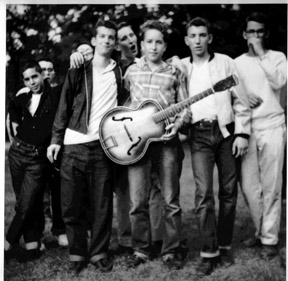
The idea of this guy pictured below going forth to conquer the world of popular music appears to be absurd. We all have known kids who wanted to do the same. We may even be one of those kids but the odd
Look Out Little Richard
of succeeding were about a million and a half to one. How could anyone even suspect that Bobby Zimmerman, the kid above, from the virtually uninhabited North Country would be the ONE. Everyone in town must have been laughing up their sleeve, like the guy on the right above, when Bobby Zimmerman sallied forth to ‘join Little Richard’ and conquer the world.
Now, this guy Thompson using his own name came posing as a journalist but impersonating Bob shows up. Thompson seems surprised at the reaction of Maurice and Paul Zimmerman, Bob’s uncles, but can you imagine being interviewed by a guy talking and acting like your nephew Bob. It’s kind of crazy. Imagine what Beattie Zimmerman, Bob’s mother, thought sitting across from Toby doing Bob. Maybe that’s what Bob meant when he said ‘This guy Toby Thompson has got some things to learn.’
Nobody knew what was going on there, did they?
When Bob and John Bucklen and Echo Helstrom were kids, like many another group of Musketeers, they swore that if one of them made it he or she would help the others along. Well, Bob made it but he forgot John and Echo. No big deal. Teenage vows even spoken in earnest have no meaning after the fact but the promise lives on in the innocent hearts of those who aren’t pulled through by the successful one. There is a sense of betrayal. Added to that there was romantic ill will on Echo’s part because of Bob’s eleventh and twelfth grade betrayal.
Bob is making it big while Echo just has a job. A young woman trying to make her way has a tougher row to hoe than a guy. But, if she knows how to work it she does have a story that’s worth at least a couple three or four years worth of wages. She doesn’t know how to market it though. Robert Shelton came out to Minneapolis a year before Thompson and paid her a hundred dollars for an interview. She held the hundred up to Toby as hint but he wasn’t thinking that way. She was only going to get screwed by Toby, literally.
If Toby hadn’t been in an alcholic haze he might have realized that the story Positively Main Street was only subsidiary to Absolutely Sweet Echo. The money was with Echo.

Echo When She Knew Bob
As they’re driving up Highway 61 Echo pulls out a hundred dollar bill and says ‘See what Robert Shelton gave me for an interview.’ The light still didn’t go off in Thompson’s head. He reached into the glove compartment for his pint.
I am astonished at the amount of alcohol Thompson consumed on these trips. If he isn’t novelizing the guy was in a virtual stupor the whole time. When he and Echo arrive in Hibbing they go to a bar where Toby becomes blotto on beer, no less. He has no memory of the moment but Echo tells him that he stood on his head in the middle of the dance floor as coins and keys showered out of his pockets.
Echo must have been one tolerant girl or else she was hoping for something to happen. Perhaps a large part of the charm of Positively Main Street is the stunning unconciousness of Thompson. The guy was twenty-four years old at the time, not a kid- exactly. He had been telling Echo he was going to write a book. When he gets the first trip written up he sends her sixty pages. Echo writes back: ‘Sixty pages isn’t enough for a book is it?’ She has reasons to be disappointed. Heck, Toby is using her to attempt to make his fortune and he hasn’t even promised to cut Echo in for a dime. Think about this. The self centered naivete shines through with startling clarity. For that reason it is one of the most interesting books in the the Dylan canon.

Echo When She Knew Toby
Now, in these sixty pages Toby has misunderstood what Echo told him about the time Bob called her on the phone and played Bobby Freeman’s Do You Want To Dance claiming to be singing the song.
In his sixty pages he projects a better story where Bob shows up on Echo’s front porch playing guitar and sings Do You Want To Dance then strutting all through the house singing and playing somewhat like Elvis in the dime store in King Creole.
Echo points out this error. Toby liked his version so much he left it in the way he first wrote it. Then when Echo introduces this Bob Dylan impersonator into his parents home Toby whips out his quitar and reenacts his version of the incident strutting around the house as he plays and sings. The guy was absolutely out of his mind in his alcohol haze. He must have smelled like a brewery the whole time.
One is astonished that he was so well tolerated. Of course maybe everyone was thinking: ‘This is amazing, but it won’t last long’ and let it pass. Waved his car goodbe as he sped away.
One wonders what Echo’s emotional rection to the Bob Dylan impersonator was. Toby must have reactivated dormant affections for Bobby Zimmerman as he came on to her strongly in Bob’s persona. Echo had ten year old memories of Bob and now here he was, his double, coming onto her again. Frightening actually.
Toby left again and never returned. In the book he seems oblivious to the havoc he created in Echo’s life. In the interview at the end of Main Street given many years later he doesn’t seem to be any more aware. In fact he seems to be still posing as Dylan’s double. He mentions that he still contacts Echo, who has moved to LA, occasionally as does Bob but Bob seems to have better success in finding her.
Hurt and mystified that Thompson had no more use for her she wrote a poem for him that she mailed to him in far off Washington D.C.
Hey! Toby!
Where can you be?
Somebody told me
That you went back to
Washing Machine D.C.
How can that be?
You came to town in your Volkswagen
And I’ll tell you we sure had fun!
And now you’re gone!
You played for me on your old guitar,
Took me for a ride in your little car,
Drove me near and drove me far,
We looked at the moon,
And stared at the stars,
You stood on your head in my hometown bar…
How could it be you’ve gone so far?
Hey Toby? Where are you?
– Echo Helstrom
Toby hadn’t gone anywhere. Like Bob he’d just never been there. His fantasy like Bob’s didn’t include anyone else, they were just bit players in his own movie. Toby was no longer thinking of Echo. He was married to the bottle. He was touring bars across the country to get material for his next book. Echo could just consider herself as one of those bars. Once Toby had visited it there was no reason to return.
The tragedy for Echo was that she was betrayed once by Bob in 1958 and then again by a Bob impersonator in 1968. Perhaps a wound was created in her heart that could never heal. One wonders what her later history was after she left Minneapolis and drifted West.
I wonder where you are tonight.
I wonder if you are alright.
I wonder if you think of me
In my lonely misery.
There stands the glass,
Fill it up to the brim,
Till it flows o’er the rim,
It’s my first one today.
-Webb Pierce.
Here’s to old memories. Bottoms up.
Exhuming Bob IX, Pensees 7: Into The Lost Land
July 6, 2008
Exhuming Bob IX, Pensees 7:
Into The Lost Land
by
R.E. Prindle
Texts:
Dylan, Bob, Chronicles Vol. I, Simon And Schuster, 2004
Prindle, R.E. Exhuming Bob, VIII The Walls Of Red Wing, idynamo,wordpress.com 2008
Thompson, Toby, Positively Main Street, U. Minnesota, 2008, reprint from 1971
http://www.hibbing.org/dylan1/story.html Life In Hibbing: Hibbing Chamber Of Commerce
http://www.interferenza.com/bcs/interw/85-dec.htm Bob Dylan Is Not Like A Rolling Stone Interview, Spin Magazine, Volume One, Number Eight, December 1985
http://www.interferenza.com/bcs/interw/play78.htm Playboy Interview: Bob Dylan 1978
http://www.interferenza.com/bcs/interw/66-jan.htm Playboy Interview: Bob Dylan February 1966
1940
Abe And Beattie
In attempting to put together a reasonable facsimile of Bob’s life in Hibbing and Minneapolis, Minnesota and New York City as he mythologized it in his chapter of Chronicles, The Lost Land, I have come to the following tentative conclusions.
Bob was born in Duluth, Minnesota on 5/24/41. In 1943 he was taken to Hibbing where he lived from then until graduation from high school in the Spring of 1959.
Within the concept of normal Bob had a fairly advantaged childhood. His parents were indulgent buying him anything he wanted while providing adequate pocket cash. Bob’s family was one of the more important in town both within the Jewish community and the town at large. In what appears to have been a tight small town social scene Bob either excluded himself or was excluded from the dominant social groups within which he had a right to be included.
Perhaps Bob’s conception of the Hibbing period could be best interpreted from his favorite movie, Rebel Without A Cause, starring James Dean. Bob is said to have seen the movie several times. This was unusual as few people ever saw a movie more than once. He would have been a very impressionable fifteen at the time. Most of us didn’t have the money while quite frankly few movies, if any, were worth watching twice including Rebel Without A Cause. I was seventeen when I saw it and while I was in awe I wasn’t submerged. Of course Bob’s relatives owned the theatres so he got in for free.
As he set up a Dean shrine in his basement which greatly offended Father Abe we may be justified in assuming that Dean was a controlling influence in his life from the time he saw the movie. It is of interest that Abe was to remove the Dean shrine from the basement after Bob left replacing it with a shrine to his own son Bob Dylan ne Zimmerman.
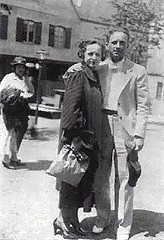
Abe Zimmerman (1911-1968) worked for Standard Oil in Duluth when Bob was born. According to the C of C he lost his job in 1943 moving to Hibbing where his wife’s family, the Stones, could help the young couple. Why Standard Oil should lay Abe off in the middle of the war during a manpower shortage seems to pose a question. As can be seen from the photograph of Abe and Beattie above borrowed from the Flickr photostream of <drineevar> he was a well set up handsome man. He appears to be exceptionally self-possessed, sound in the eyes. Beattie appears to be a haughty high fashion queen which would accord with later facts.
Abram Zimmerman, for such was his name. Usually called Abraham, the name on his tombstone is Abram, and his two brothers Maurice and Paul bought the Micka Electric Company in 1943 changing the name to Zimmerman Appliance. In 1968 Paul Zimmerman told Thompson that they had been in business for twenty-five years which would mean 1943 although the date seems odd.
According to the C of C Abe came down with polio in 1946 requiring a lengthy convalescence. The C of C says that the Zimmermans bought Micka’s after his convalescence but if Paul Zimmerman is accurate it would have to have been 1943. There would be no record of what Abe did for a living then from 1943 to 1946. As Bob says both his uncles served in the Army it would seem that they bought Micka’s going into the Army shortly thereafter leaving Abe to tend the business.
Maurice and Paul became President and Vice-President of the corporation while Abe siginficantly assumed the controlling post of Secretary-Treasurer. Managed the money, paid the bills.
During the fifties at least Abe spent a fair amount of money on both Bob and Beattie. Angel Marolt whose family bought the Zimmerman residence after Abe’s death was trying to tell him of Beattie’s several fur coats, diamonds and Cadillac but Thompson says he wasn’t paying attention.
Thompson quotes Echo Helstrom as saying that the Zimmermans had stores in both Hibbing and Duluth. Having a customer base of approx. 250,000 makes more sense when one considers the amounts of Abe’s expenditures and the fact that the profits had to be split three ways.
The C of C describes Abe as a ‘big man’ in town partial to those big thick long cigars.

The Dylan Home
The couple had enough money on arrival to buy the large nine room house that Bob grew up in so Abe must have been well paid at Standard Oil before he was laid off. Both he and Beattie are well dressed in the picture while Beattie is actually overdressed.
Bob was entrolled at Alice School for his kindergarten year in 1946 at five years of age. The status of Alice School is unclear. Perhaps it was closed the following year or consolidated with the Hibbing High complex as Bob was transferred. Hibbing High housed kindergarten through twelve as well as the Jr. College. Thompson describes it as a huge and rambling building.
So from first grade to graduation Bob was with the same group of students. I sure wouldn’t have wanted to move into town in tenth grade and try to break into that one. While he wouldn’t have known them all well he must have known the entire student population on sight. This presents the problem then of why Bob, who was the son of the Big Man in town, wasn’t included in the top social cliques. Those cliques undoubtedly formed early persisting through graduation. If Bob was in one he was either forced out early or found it uncongenial to remain for whatever reason. Perhaps he thought his Jewishness excluded him. So if something happened we don’t know what it was and won’t; unless Bob tells it’s going to be difficult to trace.
Growing up in a small town anyone with any ambition looks around and sees very limited opportunities. Working for his father wasn’t a viable option. Not everyone wants to be a doctor or lawyer either. Nuclear Science is OK but a lot of those guys are out of a job now too. My next door neighbor when I was a kid for one.
Bob’s mind turned early to music and then to Rock and Roll. While Rn’R went on to conquer the world and become as respectable as such a spectacle could it was definitely considered discreditible and low class almost volunteer outlawry in the fifties. At the very least it was ‘pimple’ music. It took a certain amount of courage to say you liked Elvis Presley. Pat Boone was set up as his rival and you had better say you liked ol’ White Bucks. If you don’t think Elvis was considered a social criminal check out a couple of his movie roles like King Creole or Jailhouse Rock. What was the Colonel thinking? Clown roles, that’s all Elvis ever got.
And then Bob chose as his hero and model Little Richard. People looked at you funny if you said you
Young Bob On Harley
liked Little Richard! I mean, Bill Doggett was a respectable Negro with music you could understand, Fats Domino was as lovable as a chubby ten year old but Little Richard! They hadn’t even created the ghetto he could come out of. His band might have passed but then he opened his mouth. If there was ever a direct challenge to middle class sensibilities Tutti-Frutti was it. Not only was the song incomprehensible it was about queers. Nobody ever quoted the lyrics correctly, while I’m walking around saying ‘Tutti Frutti, I want Rudy?’ What does that mean? I hope no one overheard me. So when Bob gets up, ignoring Pat Boone entirely, and launches into some screaming vision like Rip It Up or She’s Got It or God only knows what, was the crowd taken aback? Chuckle, chuckle.
So Bob having opted for the lifestyle was forced to associate with the hoody crowd or have become a loner. Besides Colin Wilson’s book The Outsider had appeared in 1956 that began a cult of The Loner that peopled the early sixties. These guys, who were by no means rebels but deep thoughtful guys who had a line on the truth denied anyone else and that penetrated sham and hypocrisy sat alone ever ready to resolve a situation setting things right were highly romanticized fellows. There were as many Loners in those days as there were Hawkeyes a couple generations later. So Bob wouldn’t necessarily have been thought of as weird, strange but a Loner. A Loner was next door to weird and strange. Thin line if you get my meaning.
On the other hand the C of C describes the L&B Cafe as a regular jumping Bop Street right there in the heart of Hibbing, Minnesota. Bands set up and played continuously. They knew how to party in Hibbing. The C of C even says there was a radio station in town playing Bob’s kind of music thereby contradicting every other source even Bob. He says he had to go to Shreveport on the radio waves to get his kind of music. In this case I’m betting on Bob.
The C of C tells of Bob’s musical debut like this putting the best possible face on it:
Described by fellow students as polite, easy to talk with, and somewhat introspective, it was a total shock when he pushed back the piano bench and stood up to pound the first notes of a song into the auditorium, electrifying the student body. Kids jumped up, stared at each other open mouthed not knowing what the reaction would be.
Well, yes, they were electried but did they like it?

Rockin' Bobby Zimmerman
According to the C of C, looking back fondly, Bob went over real well with his fellow students. If you like this version don’t check the other sources as this is at variance with every other known account but then this is the Chamber Of Commerce speaking. Up to this point in the C of C account there is no reason for Bob to be as bitter as he is about Hibbing at all.
A note of interest is the reoccurence of Fourth Street in Hibbing, Minneapolis and New York City. Quite a coincidence, I knew there had to be some association with Fourth St. in Hibbing. So far we learn that Bob attended Jewish shule there. Whether the synagogue was also located there isn’t clear. The synagogue Bob attended is no longer anywhere at any rate. Tore it down. It was in the way. Had to go. Even though Bob’s father was the most prominent Jew in town, the President of B’nai B’rith and ADL as well as his business interests, and even though Bob had a mega Bar Mitzvah with four hundred people in attendance some say at the most prominent spot in town, the Androy Hotel, some say at the synagogue, he wished to conceal he was Jewish. This attitude may have contributed to his renouncing the Jewish fraternity house to which he pledged at UM while also hiding his religion in New York. The attitude was strange since he seemed to prefer Jewish musicians around him to the exclusion of goys.
Bob’s father Abe, was quite frankly a marvelous provider, spending very large sums of money on son Bob, wife Beattie and his second son, David. When he died in 1968 the house on 7th Ave., now Bob Dylan Ave. was sold. The owners at the time of Thompson’s visit were the Marolts. Angel Marolt who was at home when Thompson called offered to show him around. One thing he learned was that Bob had a clause in the sale’s contract that allowed him to stay in his old room in the Marolt’s house whenever he was in town. Too weird.
What quirk in Bob’s mind compelled him to live in other people’s houses? Perhaps Rebbe Maier back in 1954 impressed on Bob that Biblical scripture presribes that Jews would live in houses they never built. As an article of religion that injuction is a mind boggler. One can’t predict how anyone’s mind will interpret instruction. Bob who functions out of his subconscious very heavily must have accepted such teachings in literal ways. Rebbe Maier was a definite turning point in Bob’s life. Imagine getting out of school, going upstairs at a Rn’R cafe to sit before the only bearded man you may ever have seen, dressed completely in black with a black yarmulke perched on the back of his crown intoning things like: The Jews shall live in houses they never built and then go downstairs to boogie. Pretty spooky, don’t you think? And then as Bob says, he disappeared like a ghost. Let that roll around your brain for little while and see what you come up with.
Mrs. Marolt was trying to tell Thompson something about Mrs. Zimmerman’s multiple furs, heaps of diamonds, I’m sure all the latest fashions and her own Cadillac.
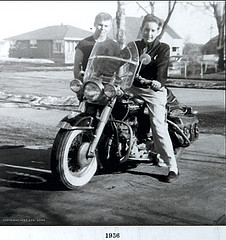
Bob was indulged to the extent of apparently more than one motorcycle, a car, lots of amplifiers and electronic gear for his bands, whatever he wanted plus free movie admissions and plenty of pocket cash. He must have had a large record collection for a kid as he spent his spare time at Crippas record store ordering the odd title. You can bet Crippas didn’t discount either, charging full bore. At the time (after 1958) stereo was 5.98 and mono was 4.98.
As the profits from a sole Hibbing store divided three ways could not have supported this sort of expenditure, having a store in Duluth could account for it. It is significant also tha Abram died in June 1968 and the store closed a few months later. Was the store a losing proposition for the last few years? Did Bob provide the difference so Abe wouldn’t be embarrassed by going banko? Then with his father gone there was no reason to support Uncles Maurice and Paul?
There really is something happening here, isn’t there?
Also as a petty expenditure for Bob (it would have been huge in my life) according to the C of C:
Almost every day Bob came in after school for his regular snack: cherry pie a la mode and coffee (or Coke.)
And then to dinner? No wonder the young Bob had all that baby fat.
If Echo bought those hot dogs for Bob and bought his story that his dad didn’t give him an allowance she was had in more ways than one.
So, Abe was nothing if not a generous father and husband. Beattie as President of Hadassah as well as a Stone must have made the Zimmermans the most powerful Jews in the syngogue while actually giving she and her husband the means to be petty dictators of the town, I saw something like this in Eugene, Oregon in the sixties and seventies, or, as the C of C says a Big Man and big people.
Bob must have a quirk in his mind to misrepresent his childhood so. He was the Fortunate Son John Fogerty only sings about.
In Thompson’s interview with Beattie he quotes her:
How can you know you have a genius in your house, when all my time is spent trying to feed him and keeping his clothes pressed.
In Bob’s story, The Lost Land, Chloe Kiel is shown ironing Bob’s shirts and at the end of the chapter she ‘slaps’ a plate of steak and fried onions in front of him just before he darts out the door to begin the next chapter, A New Morning, just as in the old days when he returned home from school for lunch and was fed by his mother he darted back to school.
Ironing his shirts and providing free steaks was a signal service for bare acquaintances like Ray and Chloe.
Chloe comes across as cold and indifferent and indeed there is a tinge of resentment and anger beneath Beattie’s statement. Motherly, of course, but there. Still, she doesn’t impress me as any Yiddishe Mama of the Mrs. Goldberg variety. Whether Bob was a good boy or not he does have an ambivalent attitude toward his parents. But then he claims that he was really raised by his grandmother, whether Stone or Zimmerman isn’t clear.
I believe the big change came over Bob with his Bar Mitzvah and I’m not talking puberty alone. According to the C of C Bob attended Jewish shule during his young years. This was done after public school hours. Then in 1953-54 when his Bar Mitzvah was approaching Father Abe sent to Brooklyn, New York to have an ultra-orthodox, almost certainly a Lubavitcher Rebbe, sent to Hibbing to indoctrinate Bob in untra-orthodox teachings. It can’t be any surprise that when Bob exhibited his Jewish reverence after his Jesus indoctrination with the Vineyard Fellowship he chose to show himslef as a Lubavitcher. Welcome home, Bob. The C of C tells it this way:
According to a 1985 Spin Magazine interview by Dave Engel, Bob said it was above the (L&B) Cafe that Rabbi Reuben Maier stayed while giving Bob Hebrew lessons in preparation for his Bar Mitzvah. The Rabbi and his wife showed up one day and stayed for a year while Bob got ready for his big event . The article quotes Bob as saying he would learn Hebrew after school or in the evening for an hour, then go downstairs and boogie at the L&B. After completing his Bar Mitzvah the Rabbi just disappeared.
In the interview Bob tells it this way:
There weren’t many Jews in Hibbing, Minnesota. Most of them I was related to. The town didn’t have a rabbi, and it was time for me to be bar mitzvahed. Suddenly a rabbi showed up under strange circumstances for only a year. He and his wife got off the bus in the middle of the winter. He showed up just in time for me to learn this stuff. He was an old man from Brooklyn who had a white beard and wore a black hat and black clothes. They put him upstairs in the cafe, which was the local hangout. It was a rock n’ roll cafe where I used to hang out, too. I used to go there everyday to learn this stuff either after school or after dinner. After studying with him an hour, or so, I’d come down and boogie. The rabbi taught me what I had to learn, and after conducting the bar mitzvah, he just disappeared. The people didn’t want him. He didn’t look like anybody’s idea of a rabbi. He was an embarrassment. All the Jews there shaved their heads and, I think, worked on Saturdays. And I never saw him again. It’s like he came and went like a ghost. Later I found out he was Orthodox. Jews separate themselves like that. Christians, too. Baptists, Assembly of God, Methodists, Calvinists. God has no respect for a person’s title. He don’t care what you call yourself.
The C of C knows the Rebbe’s name was Reuben Maier and Bob Dylan doesn’t? There were enough people in Hibbing to have a temple and shule but they didn’t have a Rabbi? The Rebbe Maier showed up in time for Bobby Zimmerman’s Bar Mitzvah but what? it was the first Bar Mitzvah in Hibbing’s Rabbiless history? No wonder four hundred people showed up. The Jews in Hibbing shaved their heads and worked on Saturday’s? I presume Bob means they didn’t wear beards but shaved their faces unlike the Lubavitcher in white beard and one of those funny round hats. I serously doubt there were three hundred or more Jews walking around Hibbing with shaved heads in 1954.
They took one look at Rebbe Reuben’s weird beard and outre attire and told him to get out of town? Now that I can believe. Beards in ’54 were a sign of great eccentricity or a psychotic desire to draw attention to oneself. But why in ’85 the mysterioso act? He just showed up to teach Bobby Zimmerman, a complete unknown with no direction home Lubavitcher tales like this: (actually this is pretty standard esoteric doctrine adapted for Jewish needs)
The messianic thing has to do with the world of mankind, like it is. This world is scheduled to go for 7,000 years. Six thousand years of this where man has his way and 1,000 years when God has his way. Just like the week. Six days work, one day rest. The last thousand years is called the Messianic Age, Messiah will rule.
Essentially what we have here is a variant of Madame Blavatsky’s Theosophy along with a little Hebrew Theology. If one looks real closely one can see the outline of Sigmund Freud’s notion of the unconscious.
According to Beattie Bob knew, oh, two hundred words of Hebrew. So much for several years of shule and a year of intensive training by Rebbe Reuben.
Whether Bob knows or admits it, it must be true that Father Abram sent for Reuben to instruct Bob in mysteries that Abe thought were essential to his vision of Jewish religion while they were not part of the services of the Hibbing congregation.
It is possible that Abram brought the Rebbe in on the approval of the congregation who rejected him. The comment by Bob of working Saturdays may be signficant here. The Jewish sabbath begins on Friday sundown and continues to Saturday sundown.
As a Lubavitcher, Rebbe Reuben could not have tolerated working during the sabbath while the congregation found it essential amidst a gentile population. Likewise beards are an integral part of the orthodox religion so that the congregation also refused to stop shaving. The only thing mysterious is why it took Reuben so long to catch on. Or maybe he had a contract for one year and the year was up. Of course Bob did need help on those two hundred words.
So Bob’s upstairs memorizing his two hundred words while the throbbing beat pounds insistently through the floor. The super patient Reuben and his wife never object. Bob shortly joins the revelers with his two hundred Hebrew words rattling round his skull, steps up to the mike and begins screaming: I’ve got a girl and her name is Echo. Hmmm. Quite an image out there in the Lost Land of Bob.
Now indoctrinated in quaint antiquarian rites Bob is bundled off to Webster, Wisconsin and Camp Herzl to steep himself in Israeli style Jewish living. Camp Herzl was conducted as Israel in America so those two hundred Hebrew words came in handy in that surrogate for summer in a kibbutz in the Holy Land.
The summer sojourns must have set Abram back a handsome fee for the times. Six to eight weeks of essentially summer boarding school does have expenses. Abe apparently was deeply religious: in Protestant circles he would have been known as a Fundamentalist nut. He and Mike Huckabee would have gotten along fine. One wonders if younger son David was given the same treatment.
So Bob from 1954 on is definitely the product of two nations. The world of the Three Hanks as the C of C puts it and this world of Adam, Moses and the Messiah. Bob was named after Sabbatai Zevi the last acknowledged Jewish messiah in the seventeenth century, his Jewish name is Sabtai.
As kids we all have a lot to reconcile, begin working out at graduation. Bob had a double load; he had two Bobs to reconcile. Personalities wander and widen in those years, Bob made a clean split. On the one hand he was the twerp Bobby Zimmerman of whom it may be said: There’s no success like failure while on the other he was struggling to be the super successful Bob Dylan in which he failed to assume the mantle so that failure is no success at all. At least he made this split off persona’s name mean something. As a note, it was not generally known Dylan was Jewish until after Blonde On Blonde.
Thus in his movie Renaldo and Clara he is not Bob Dylan. Anybody can be Bob Dylan he says, you can be Bob Dylan. Toby Thompson thought he could be and did a pretty good job of it walking a mile or so in Bob’s shoes. Sounded just like him.
As remarkable as it is that Bob realized his fantasy beyond anything he could have dreamed and became the hugely successful Bob Dylan he created an entire new set of problems whose solution eluded him. Well, you know, there’s something lost and something gained while it’s hard to know whether the gain was worth the loss. However the money has disappeared from the table.
The result then is Bob looking backward from 2004 to create a fantasy of how it was in Ray and Chloe’s place on Vestry Street in NYC. The chapter is approriately titled The Lost Land or possibly Never-Never Land might have been better. The chapter isn’t a complete fabrication but it is fiction. Something like the various incidents might have happened but not exactly the way Bob tells it. The framing story of Ray Gooch and Chloe Kiel is pure fiction however. They could not possibly have existed.
Bob tells the whole story of the Lost Land within the reference of Ray and Chloe and their fabulous apartment near Vestry below Canal near the Hudson across the street fromt he Cathedral with its bell tower. Thompson got it right.
A troubling aspect of Bob for me is his insistance on bumming other people’s apartments. This seems to be compulsive behavior.
Bob was actually voluntarily homeless from January of ’61 to October or November of the same year when he and ‘roommate’ Suze Rotolo took up digs on Fourth St. I suspect that Father Abe would have been only too happy to supply Bob with funds to live on Vestry Street if he had asked. Bob is simply untrustworthy in any of his stories. As he said of what he learned from folk music: If you told the truth, well and good; if you told the untruth, well and good also, so in Bob’s mind there are no lies, there is only the truth or untruth both having the same value and whichever is more serviceable at the moment. You can’t believe him.
A troubling aspect of Bob’s behavior is his habit of bumming couches in other people’s nests; gaining meaning, as it were, from other people’s lives. Perhaps that was the way he felt of his life in his mother and father’s house. Or perhaps as a Jewish outsider in a goyish land it was his attempt to insinuate himself in the main stream much as he appropriated Woody Guthrie’s persona. Of the houses I have traced they have all been those of goys; he didn’t choose to insinuate himself into the houses of his fellow Jews. His imaginary hosts Gooch and Kiel are obviously goys.
The Lost Land then is a mythologized version of his childhood and first few months in New York City. To my mind Ray Gooch is a combination of Dave Van Ronk, Paul Clayton, Matt Helstrom and his father. Chloe seems simply to be an idealized notion of his mother. (Study her picture for a few moments again.)
As the Gooch frame brackets the period from Bob’s encounter with Gorgeous George to the apartment with Suze Rotolo it must represent a time frame from sometime in ’58 to October ’61. In October Bob Dylan ceased sponging off others to take up his own apartment.
The only one in this time frame he knew who had a large gun collection was Matt Helstrom. The Helmstroms also had a large record collection that Bob listened to. The couch and apartment undoubtedly belonged to Van Ronk while certain exoticisms of Gooch are characteristic of Clayton. The library of Gooch may simply be the New York City Library of which the long narrow room would merely describe the stacks.
The Southern character of Gooch must represent a time after Bob studied the South in the library since there are several references to his Civil War studies. Gooch himself is a Southerner from Virginia gone North which is a symbol in itself. This can be symbolically described as Father Abe being a Jew in Gentile America.
Here then Bob creates or accentuates the more pleasant aspects of his memories in contrast to the very bitter unpleasant memories of the songs. He tells us a great deal about his dream life but little of its realities. At this point I am of the opinion that the party of Camilla ( who Bob says he gets to know quite intimately) is another fabrication of the based on a true story variety.
As Bob would say, folk music taught him that if what you said was true,well and good; if what you said was untrue well and good also. We may probably construe the Lost Land as both true and untrue while a good folk tale. Even the title has a fictive quality a la Edgar Rice Burroughs.
To round off the period back in the C of C milieu of Hibbing: Bob spent his last summer at Camp Herzl in 1957. In the summer of ’58 he was running back and forth between Hibbing and Minneapolis. At that time he would have become familiar with Highway 61.
In his Junior year of ’57-’58 he took up his relationship with Echo Helstrom. They were going steady hence were not supposed to be dating others. As he was in Minneapolis most of the summer he left Echo sitting home alone. She resented this. As the Senior year began she told Thompson, she took a revenge on Bobby returning his token in public in the hall at school. Boy, that hurts.
The feelings must have been much harder than either Bob or Echo portray them. A key problem area is did Bob spend time in Red Wing Reformatory on Highway 61 below Minneapolis and if he did what did he do to receive his sentence: I examine this more fully in Exhuming Bob VIII: The Walls Of Redwing.
He says in Chronicles that he was absent from school from some time at the beginning of April of ’59. He was back at least by the June 5th graduation. His birthday is May 24th. After that date he would have been eighteen and subject to adult sentencing. For what It’s worth he says in his song that no inmate was over seventeen. I’m suggesting that he spent a month of two at Red Wing returning in time for graduation. Certainly a Big Man in town like Abe could have arranged the graduation if he couldn’t get Bob off that time.
The question is what did Bob do? By the middle of this Senior year it appears that he had been in enough scrapes to be known as a troublesome boy; perhaps living out a Rebel Without A Cause persona. Father Abe used his influence up to that time to avoid unpleasant consequences for the lad.
I believe Bob’s song The Chimes Of Freedom tells the story of his crime. Quite simply Echo set him up. She obviously was not quite as complacent as she tells it. See Exhuming Bob VIII: Walls Of Red Wing.
Returning home from Red Wing his parents threw a graduation party for him. Bob was reluctant to attend the party, perhaps with good reason but was persuaded to do so.
This then leaves a very sketchy account of the three or four months of the summer of ’59 for which Bob provides little information. In Walls Of Red Wing I place his stint at Red Wing in August but that is probably wrong. In any event the period from April of ’59 to September of ’59 needs to be explained more fully.
Bob gives some brief details of his stay at Dinkytown but not much. A little bit of the John Pankake episode while avoiding the important details of his theft of Pankake’s records.
Thompson has some good information from Ellen Baker whose father’s folk song collection Bob used extensively.
Then to NYC and his account of The Lost Land segues into his New Morning.
Exhuming Bob IX: Chronicles I Pensees3
April 27, 2008
Exhuming Bob IX
Chronicles Vol. I
Pensees 3
by
R.E. Prindle
…I needed to get my own place, one with my own bed, stove and tables. It was about time. I guess it could have happened earlier, but I liked staying with others. It was a less of a hassle, easier, with little responsibility- places where i could freely come and go, sometimes even with a key, rooms with plenty of hardback books on shelves and stacks of phonograph records. When I wasn’t doing anything else, I’d thumb through the books and listen to records.
Not having a place of my own was beginning to affect my super-sensitive nature, so after being in town close to a year I rented a third floor walkup apartent…
Bob Dylan, Chronicles Vol. I
Yes. Bob’s super-sensitive nature needed his own bed. He and Suze Rotolo were an item soon after he met her in July of ’61. He had to give up the the comfort of other people’s books and records in other people’s digs. He needed his own privacy now.
Suze would be an important influence in his life. She came from a long line of Communist agitators. She was not only Red to the- but was working for- CORE there in New York City. Bob wasn’t writing much as yet since his major influences hadn’t come together. While Bob doesn’t mention all those old C&W records as a songwriting influence he nevertheless has always written within a Country and Western context. Guthrie, his first attested major influence rose from a C&W milieu.
From being an apparent pauper, one reason Suze’s mother didn’t like him, Bob suddenly had the affluence to rent an apartment while being able to furnish it, even buying a used TV. He and Suze moved in. Suze is putting out an autobiography this month (May, 2008) so we’ll see if we can see what Bob saw in the girl.
As a Communist lass working for CORE Suze must have talked up Civil Rights and other Reconstruction views a bit so we may probably accurately assume that she influenced Bob’s songwriting direction when he gets his songwriting attitude organized here in a paragraph or two.
Bob came from small town Mid-West Hibbing. I do know where that’s at. While he was interested in records there was no indication he was ever interested in any other cultural areas. He doesn’t seem to have evidenced any interest in the varied cultural life of New York City before he met Suze. He was no habitue of museums although he does tell us he haunted the library where he read newspapers- those from 1855 to 1865. No news like old news.
His mind had been little prepared for what Suze had to show him. Mid-West small towns can be stifling and that’s no joke.
As Bob says: I began to braoden my horizons, see a lot of what the world was like, especially the off-Broadway scene. Then he mentions Le Roi Jones’ (Amiri Baraka) and the Living Theatre play, The Brig. Bob may have seeen those plays with Suze but he didn’t see them within the time limits of his story so they could have had no influence on his songwriting development at this time. Dutchman and The Baptism of Jones that he mentions were first performed in 1964 as was the Living Theatre’s, The Brig. It is interesting that Jones’ The Bapstism is described as anti-religious when Jones turned Moslem and became Baraka shortly thereafter. Baptism must have been more anti-White.
Jack Gelber’s The Connection was made into a movie in ’62 so he could have seen the play within this time period. I couldn’t find any time period for the play but it ran for over two years. I didn’t come up with anything for the Comedia Del Arte.
The Brecht-Weil show drew a blank but as he seems to have been knocked out by the song Pirate Jenny that may have influenced his song When The Ship Comes In, while he gives it prime importance as an influence that formed his skills he must have seen that sometime in the Fall of ”61 or the Spring of ’62.
He and Suze did visit the artist hangouts she was familiar with while broadening Bob’s horizons by trips to MOMA and the Metropolitan. Bob probably saw Picasso’s Guernica at MOMA where it was on display at the time. Bob developed a real interest in painting during this period.
So, we have the book thumbings from his freeloading days, the records, Suze and her art influences and then when John Hammond signed him he gave Bob an acetate of the first Robert Johnson album, which didn’t sell for beans I might add. The first Robert Johnson LP was released in 1960 so I don’t understand why Bob was given an acetate unless it was just lying around and Hammond picked it up or else acetates were a sop to new signees who had just been contractually screwed. You think managers are bad, try record companies.
Johnson was a revelation for Bob. He saw something in the LP which only a few people ever have. I’ve listened to it a couple of times and I’m with Dave Van Ronk. So What? There’s nothing to the vocals and he’s obviously a beginner on guitar. It’s not that he’s inventive he just doesn’t know how to play.
The story Bob tells is that a teenage Johnson is hanging around some Blues heavies and they shoo him off. Johnson then meets a supposed guitar wizard nobody’s ever heard of who teaches this very receptive student mega volumes of guitar lore so that Johnson returns to the Blues heavies a year later to knock their socks off with his virtuosity. As Van Ronk says: ‘…oh that lick’s from here, this one’s from there; that song is a reworking of another and so on. Greil Marcus quotes Johnson’s lyrics extensively in his Mystery Train. Wow! I guess too much of nothing can be a good thing.
But anyway Bob learned three or four times as fast from Johnson as Johnson learned from the old coot who taught him. Bob was up and running within three months.
However Superbob the Songwriter wasn’t ready to step forth from the phone booth yet, there was something else lacking, what was it, something or other. That’s it, in French, l’ autre. Bob had discovered that he was someone else. I know where that’s at too; I’ve been called somethin’ else a couple times I can remember. So Bob was somewhere between Bob1 and Bob2. The transition from Bobby Zimmerman to Bob Dylan had to be completed. Bob picked up a copy of Arthur Rimbaud. The book fell open in his hands and the words ‘Je suis un autre’ floated up before his eyes and were sucked into his soul. Bob too realized that he had or was un autre. Now Bob was ready to rock and roll.
This is a pretty story and I like it. I like it a lot. It might even be true, I’m sure I don’t know and maybe Bob isn’t real positive. Anyway the songs began to roll out. John Hammond who had seen only a couple when he suspicioned there might be more in Bob’s head so he sent the underaged lad to be signed by Lou Levy. Songs were in the air I guess and Albert Grossman had his radio tuned to Bob’s brain and must have heard them. Like a vulture spotting a dying man from several thousand feet in the air the eagle eyed Albert, and that is not meant as an insult, descended on Bob and scooped him up. Wish I’d been there with the gift of gab, a shovelful of chutzpah. A dream of a life time and Albert split it in two to come up with Bob and Peter, Paul And Mary. The Fearsome Foursome.
Although Bob was to have difficulties with Albert in later years when Albert’s cut was growing larger than Bob’s he seemed to have been welcome at this time. Peter Yarrow says that without Albert Grossman there wouldn’t have been a Bob Dylan and this may be God’s own truth. So how much did Bob really owe Albert? But like The Colonel and Elvis a manager seems to inevitably believe the whole belongs to him. The manager’s cut just seems to get larger and larger while the artist he’s working over gets to lick the plate. But, those problems were in the future and as Bob’s songwriting skills matured Albert got him much more money than he could have gotten otherwise.
Exhuming Bob 2-2 Detourning The Folks
December 24, 2007
A Critique
Exhuming Bob 2-2
Detourning The Folks
Greil Marcus has written of detournment extensively especially in his Lipstick Traces. The French word means hijacking, rerouting or diversion, or in other words changing the direction of the flow or meaning. Thus one strips an object of its familiar values and replaces them with others but leaves the object intact. In a conflict of cultures the question becomes who will assign the values or meanings to objects and words.
I will use as a starting point for my purposes here H.L. Mencken of the twenties. The values into which immigrants migrated were those of the Anglo-Saxons. From the immigrant viewpoint the Anglo-Saxons detourned their languages and cultures attempting to replace them with English and Anglo-Saxon values. The inevitable result was that immigrants felt that they had been devalued and demeaned. So it is no wonder that having recovered some balance by the end of WWII they fought back by attempting to detourne Anglo-Saxon culture in their favor.
This is nowhere more apparent than between the Jews and Angl0-Saxons. No matter whether you place the conflict between the Old Dispensation or the New Dispensation the Jews always view themselves as a separate, independant and potentially dominant culture. Hence the drive is always first for autonomy and then detourning the host culture to reflect Jewish laws and customs, hopefully making Hebrew the official language. To Jews, like Greil Marcus and Bob Dylan then ‘freedom’ means the replacement of the Anglo-Saxon law and culture with Jewish law and culture with the Jews as arbiters of the fate of what become essentially subject peoples. The Jews can never be ‘free’ no matter how unrestrained they may be so long as they are subject to others legal and social systems. This is the central problem the United States and the West refuse to face. The same is true of the Semitic Moslems. It is the purpose of Moslems to detourne Western culture for a Moslem Culture. It is quite simple.
By the time H.L. Mencken was making his rise Anglo-Saxon pride was at its maximum. I haven’t been able to determine whether Mencken was Jewish but he allied himself with the Jews making common cause with them. The approach naturally was to defame Anglo-Saxonism. Mencken naturally chose the least sophisticated Anglo-Saxons to represent the whole. Thus he went to the mountain folk of Appalachia and the hill country all along the Line. He began to ridicule these people as representative of all Anglo-Saxons. I mean, he was mean; he was vicious; his Jews caused a huge fuss for much less criticism or in their terms- defamation.
Expanding the arena, using these rural folk as their model the Communists then picked up on these people with the least possibility of education as the example of Anglo-Saxonism. In 1932 and 1933 following Mencken’s example Erskine Caldwell, a Communist writer, published two mammoth best sellers, Tobacco Road and God’s Little Acre. These books were especially mean and vicious making Mencken look laudatory in comparison. Perhaps using Mencken and Caldwell as inspirations a Jewish cartoonist by the name of Al Capp created the L’il Abner comic strip in 1934. This strip also ridiculed Anglo-Saxons but in a less demeaning manner that not only didn’t offend the majority but actually pleased them. There were some few of us who saw through the sham but there was nothing obvious enough that the majority could see.
Capp would be convicted on a morals charge late in his career that effectively ended his influence. The motif was carried forward on television in the series Archie Bunker.
Now, the Anglo-Saxons used to represent the whole were the custodians of the Folk music that was so revered by the New York City Jews of the late fifties and early sixties. So you actually have Jews imitating Hillbillies.
The vilification the Mountain Folk endured actually shamed the city Anglo-Saxons causing a dichotomy in their character. They rejected the Mountain Folk as representing all Anglo-Saxons. This is made quite clear in Caldwell’s novel when his urban relative throws his rural cousins out of his house and tells them to never come back. Something like a son testifying against his father. The Liberal-Conservative split was given a difinitive form.
The Mountain Folk formed what Greil Marcus calls the Weird Old America. After the Roosevelt administration was elected and the New Deal was established as a continuation of the Wilsonian New Democracy Jews flooded back into Washington as under Wilson.
During the twenties as radio became a reality and recording technology became more widespread and available a number of Mountain Folk and/or White Trash as they were alternately known, recorded their distinctive music in their own voice. Nor was this music ill received, many of the recordings were huge sellers according to the standards of the times while some like Jimmie Rodgers and the Carter Family became very successful recording acts. Thus what was known as Hillbilly music until 1954 came into existence. For whatever reason whoever controls these things thought the term Hillbilly was insulting so the various rural flavored musics were grouped under the term, Country and Western. Hicks are hicks to me whatever you call them, Hillbilly or Country, I’ve been called worse. Having ancestors that came down from the Kentucky hills I have no objection to my Hillbilly ancestry.
The Anglo-Saxon dichotomy was such that those who were shamed by Communist efforts had an extreme aversion to Hillbilly or Country music that they considered ignorant while professing to admire the Blues simply because it was performed by Blacks even though the intellectual content was well below that of Hillbilly music.
Nevertheless the Hill Folk were the custodians of the old English folk traditions. Folk music was then separated from Hillbilly music and approved on that basis. Thus after the Roosevelt administration was installed in an effort to counter the Depression certain cultural programs were developed. One involved the attempt to preserve the quaint customs and music of the Hill Folk and the rural Blacks. These two peoples were treated as anthropological specimens on the same level as Tobriand Islanders and others.
The New Deal of the Roosevelt administration was a direct continuation of Wilsonian New Democracy. It was as though they’d never been gone. With the creation of a huge new bureaucracy Jews came flooding back into Washington as they had in the two Wilson administrations. In many if not most cases these people were the ones sent out to deal with our homegrown anthropological specimens as Superior to Inferior. Sort of a domestic Peace Corps. Yes, they did profess to revere the music of these simple folks.
So Folk Music always had an honored place in Anglo-Saxon cultivated circles perhaps spurred to some extent by the ‘field’ recordings of the New Dealers. Folk played a prominent part in popular music from the end of WWII on. Foremost practioners of the genre were the Almanac Singers and their successors The Weavers.
A key member of both groups was Pete Seeger. Pete was both Jewish and Red. This was a bad combination during the post-war anti-Communist reaction. While making hits of a number of Leadbelly songs under Seeger’s guidance The Weavers had a major success with the Jewish melody Hava Nagila. It was a catchy tune. I liked it.
Capitalizing on this success The Weaver’s under Seeger’s guidance concocted a ‘folk’ tune called Song of the Sabra celebrating Jewish ‘pioneer’ efforts in Israel. Apparently the Sabras were some kind of hobo outfit that sat around campfires and ate stew a lot. Thus the effort to detourne American Folk Music began. The Song of the Sabras was so egregiously promotive of Israeli/Jewish interests that the song caused a big reaction. If I remember correctly it was staged at least once on a TV version of the Lucky Strike Hit Parade. That’s where I got the camp fire bit as Pete roasted his weeny and sang. Whether it was an extra or supposedly in the Top Ten I can’t remember.
Somewhere about then Seeger and The Weavers were found to be subservice giving a bad name to Folk Music as long as the genre lasted in 1966 or ’67. The Weavers disappeared from the air waves. However at least one member would be instrumental in guiding the musical direction of the Kingston Trio.
Folk music continued strong between the demise of The Weavers and the emergence of the Kingston Trio both as popular music and ‘purist’ Folk. The greatest of them all was Lonnie Donegan who had a successful career in the US and a tremendous impact on the British scene from England to Australia as Skiffle Music. Josh White, Odetta, Harry Belafonte, Terry Gilkyson and the Easy Riders among others, one might add Mitch Miller, had many memorable folk tunes competing equally with Rock and Roll if not its superior. If one considers the Presley Sun recordings objectively they also can be seen as Folk or highly influenced by Folk. After all Elvis was known as the Hillbilly Cat.
The Kingston Trio with their Tom Dooley that was an actual sensation in 1958 sort of broke the taboo against Folk music although the Kingstons were plenty subversive. The great Chad Mitchell Trio emerged at this time also as an even more politically subversive group but also with a popular sound and enough bite to defuse Dylan’s claim to have introduced serious lyrics into popular music. The Chad Mitchell Trio is probably running neck and neck with the Kingstons as my favorite folk groups although Terry Gilkyson along with the Pozo-Seco Singers are right behind them. The old Seekers from Australia are hot stuff too.
So that brings us up to Grossman’s Gate of Horn in Chicago of ’58 and the founding of the Newport Folk Festival in ’59 as well as Dylan’s entry into the New York Folk Scene in ’61.
3.
After WWII the Jews had introduced the raw form of multi-culturalism designed to replace the Anglo-Saxon model of society with the Jewish. With the election of the Irish Catholic John F. Kennedy it appeared that the Anglos had been defeated.
The next phase of the Jewish program was put in place. The thing was to detourne or hijack American culture.
Detourning Folk music was part of it. The study of Dylan concentrates on the New York City East Village group that was virtually Jewish with its specific outlook. Actually the Folk scene was very diverse and different in its emphasis in each locale. Bob would focus the entire Folk movement in himself.
Boston with the Mel Lyman family and Jim Kweskin Jug Band, Geoff and Maria Muldaur was quite different from NYC. The strictly commercial LA scene with Randy Sparks’ New Christy Minstrels had its own flavor. In San Francisco Jerry Garcia, Robert Hunter and others had credentials that easily matched those of Dylan. The whole San Francisco Sound was Folk based.
The top bands like Kingston Trio, Chad Mitchell Trio and semi-pop groups like the Brothers Four and the Christy Minstrels really carried the banner for folk.
And then there was the Country or Hillbilly faction that was considerable. Great old tunes like Jimmy Brown The News Boy were Country smashes. Hank Snow recorded a passel of old Folk songs like Nobody’s Child. New murder ballads appeared for people who like that sort of thing that were fabulous like Snow’s Miller’s Cave and Lefty Frizzell’s dazzling The Long Black Veil. It would be years before it was known that Veil was newly written and not an old Hillbilly song. If you compare the Kingston’s Tom Dooley with Frizzell’s Long Black Veil you can’t tell the difference.
A word about Harry Smith’s Anthology Of American Folk Music that Greil Marcus and Bob Dylan revere so much. The collection is a very small selection of songs culled from a huge mass of material that just happened to fit Harry Smith’s personal psychosis. Anyone going over the same mass of material could select an entirely different selection of songs that reflected their own personal outlook and would be just as ‘authentic.’ I mean, I heard The Cuckoo and I Wish I Was A Mole In The Ground over the radio decades ago as a kid. I was signally unimpressed. I never called in to hear either again. So as far as being some authentic voice of America I rather think the collection reflects Jewish and Communist ideals.
What is the message exactly of ‘I wish I were a mole in the ground, I would burrow until I brought that mountain down.’
It that isn’t a call to detournement I don’t know what is. So Harry Smith is Harry Smith and welcome to him but I have my own agenda.
So Dylan left his old life behind to begin a new life in New york City but with an old agenda. His secret agenda was to detourne American culture. Of course the word ‘detourne’ was unknown in America at that time. I have to thank Greil Marcus for adding that very useful word to my vocabulary.
Bob started out detourning Woody Guthrie. Within a couple months he had hijacked Woody’s life. Clinton Heylin believes that even the Guthrie persona was second hand having been detourned from Jack Elliot who had of course detourned it from Guthrie. Boy, there was another stone bore I never could listen to, Ramblin’ Jack Elliot.
Dylan more or less confirms this in his Chronicles Vol. I. I’m copying a quote from Chronicles as noted by Jim Kunstler in his excellent review of Bob’s memoir:
http://www.kunstler.com/mags_dylan.html
Quote:
“You’re trying hard, but you’ll never turn into Woody Guthrie,’ (John) Pankake says to me as if he’s looking down from some high hill, like something has violated his instincts. It was no fun being around Pankake. He made me nervous. He breathed fire through his nose. ‘You’d better think of something else. You’re doing it for nothing. Jack Elliot’s already been where you are and gone. Ever heard of him?’ No, I ‘d never heard of Jack Elliot. When Pankake said his name it was the first time I’d heard it. ‘Never heard of him, no….’ Pankake lived in an apartment over McCosh’s bookstore, a place that specialized in eclectic, ancient texts, philosophical political pamphlets from the 1800s on up. It was a neighborhood hangout for intellectuals and Beat types, on the main floor of an old Victorian house only a few blocks away. I went there with Pankake and saw it was true, he had all the incredible records, ones you never saw and wouldn’t know where to get. For somone who didn’t sing and play it was amazing he had so many….Pankake was right. Elliot was far beyond me….I sheepishly left the apartment and went back out in the cold street, aimlessly walked around, I felt like I had nowhere to go, felt like one of the deadmen walking through the catacombs. It would be hard not to be influenced by the guy….He was overseas in Europe, anyway, in a self-imposed exile. The US hadn’t been ready for him. Good. I was hoping he’d stay gone, and I kept hunting for Guthrie songs.”
Unquote.
Of course the US hadn’t been ready for Elliot. One Guthrie was one too many. Who needed a Guthrie detourned by another Jew? Let the English have Elliot. But that didn’t stop Bob from detourning both Guthrie and Elliot when he got to the Big Apple. He followed Elliot around studying and copying his mannerisms. Elliot should have painted on his guitar the slogan: This machine kills copycats.
Well, no matter Bob learned his error when he learned another Guthrie copycat wasn’t needed in NYC but Bob had mastered a style, a persona on which he could build. That was more than he had had before.
Pete Seeger and the Jewish busybodies were busy fomenting discord in the South. Already knee deep in the Big Muddy Seeger was encourging others to write political diatribe songs. The path was clear and Bob met a girl named Suze Rotolo. Rotolo worked at CORE. She then encouraged Bob to write ‘politically relevant’ songs. Well, what are you going to do but go with the flow, swim with the current? Bob didn’t like the topical songs though. You have to give him credit for good sense there. He wrote literary style lyrics that talked around the political issues without dealing with them directly.
Now there were songs that other voices could sing.
As a lyricist Bob was not a tunesmith so he merely borrowed tunes from old ballads and other people. In other words he detourned Anglo-Saxon folk tunes grafting on Jewish sensibilities. Heylin gives a perfect example in an exchange Dylan had with Martin Carthy in England. Carthy showed him the old English ballad Greensleeves. Bob dutifully learned the song. Then he went away for a few weeks. When he came back he collared Carthy and played him Greensleeves. Here’s your Greensleeves he said. Then he played the tune set to the words of Girl From The North Country. Thus he detourned tune after tune to his own Jewish sensibilities.
Now things were heating up on the Jewish revolutionary front. The so-called Free Speech Movement was being launched at UC Berkeley.
As I mentioned Jews could never be ‘free’ so long as they were merely part of a dominant other culture. So ‘Freedom’ meant to them detourning the dominant culture so that their own law and culture was supreme. Freedom for the Jews meant slavery for everyone else. Thus we have Greil Marcus in the bleachers cheering his heart out at Free Speech rallies for ‘freedom.’ There were many of us in the bleachers much less enthusiastic. But then we weren’t Jewish and we weren’t clear as to what was going on.
Dylan as a Jew came to Berkeley to play where he was received as a hero by his fellow Jews. Both must have been aware of what they were doing. Jerry Rubin was the sparkplug whether Greil Marcus slyly disagrees with him or not.
The revolt at Berkeley soon spread to Columbia and the rest of the Ivy League and across the country where it meshed with Mao’s Cultural Revolution.
Dylan himself progressed from his political associations to Another Side of Bob Dylan in which he worked out his own personal problems in a Jewish social context in highly symbolic language. The lyrics are complex, poetical and not easily understood. the concept of ‘Freedom’ plays a prominent role.
4.
Freedom as the idea of a complete lack of constraints developed in the latter half of the twentieth century. Prior to this ‘freedom’ meant to be free so long as your own freedom didn’t conflict with the freedom of others. Latterly it has taken the meaning that others be damned so long as one can do what one wants. This entails the related notion: consequences be damned. Consequences won’t be damned so if one does the crime one must do the time. I suppose the notion is that if you can run fast enough you can avoid the consequences. I don’t know if one can but some have done a very presentable job of it. Mao was one, Dylan is another. Of course there was that one little incident at Redwing that didn’t work out too well but since then it has been fairly smooth sailing for Bob and he may leave the building without suffering too many serious consequences.
Now, in order to be free one has to dominate everyone else. If one is obligated to an other then one isn’t free according to this latter day interpretation of ‘freedom.’ In that sense in the entertainment industry Frank Sinatra was as free as anyone has ever been. The man need only place a call to anyone elses wife and she would leave her husband’s bed and run over and give Frank a blow job and there was nothing the husband could do about it. This is no joke. Sinatra could have anyone beaten up with impunity. When he was offended by President Kennedy, Kennedy was shot. There are those who maintain Frank had a hand in it. Never been proven but there are reasons to so believe. Frank Sinatra had ‘freedom’ while he escaped the most serious consquences dying in bed a very old man. Alone and despised perhaps but then one can’t escape all the consequences.
So while limiting himself to a field in which he could be successful Bob has perhaps been the most ‘free’ of the Rock ‘n Rollers. He never took on Frank however and if he had he would have discovered the limits of his ‘freedom.’ Although Albert Grossman may have limited Bob’s ‘freedom’ somewhat I find it interesting that Bob came out at least even in his brush with the current Hollywood hard-on, David Geffen.
Now, Bob wasn’t so free that he could achieve his goals without leaning on or being dependent on others. However to compensate himself he destroyed, trashed whoever and whatever he had used as stepping stones to achieve his ‘freedom.’ In the pursuit of his freedom he became a very vicious and nasty man.
There is no reason to believe that at the 1965 Newport Folk Festival he wasn’t trashing the whole Folk scene that he had used to get him to the launching pad of his Rock ‘n Roll dream.
The arguments about how or who brought Folk Rock into existence may well be interminable. The fact is that both Folk and Rock at the time were stagnant. Whether the music died in that corn field in Iowa in 1959 or not the big labels had pretty well tamed the music of the fifties. Columbia had separated Dion from the Belmonts and had him singing standards to syrupy instrumentals. Ruby Baby was his last great effort before Columbia detourned him. Safe teen acts and emasculated falsettos dominated the airwaves . By late 1963 and early 1964 the Folk ethic had worn out as Folk groups dressed in loden green pull overs and sang like the Brothers Four. Even the emasculated and detourned version of Michael Row The Boat Ashore couldn’t prop up Folk for long.
So musicians had to be searching for something different if not new. Folk Rock was as new as anything while the electric blues served as different. Thus as the middle sixties came in one had Folk Rock, the electric blues and rough sounding garage bands like the Seeds. Oh yes, that was another development temper tantrum teenagers screaming ‘I don’t want to be like anybody else.’ Not to worry.
Folk rock would have or did develop without any real help from Bob. He already had electric recordings out so that if he didn’t want to stick it in their ear he could have done an acoustic set at Newport and let his electric side take its natural course.
I’m not so sure even then that electricity was the problem. Personally I welcomed the electric Bob. I was glad to see him leave the Folk stuff behind. I was on the West Coast but I didn’t run into many or any people who were emotionally involved. Even Greil Marcus doesn’t seem to be put out by the change.
I think you had to be emotionally invested in Bob the protest singer. When that fellow in Manchester cried out Judas I would have to think that his problem wasn’t an electric guitar but the fact that Bob seemingly betrayed the political stuff he had been singing. He had pandered to the protest crowd and now he wasn’t letting them down easy. He was turning his back on them. Rathr than being the standard bearer of spokesman for the generation that he had let them believe he was he now trashed everything they believed in. They had given him his and now he didn’t need them anymore.
His whole career was based on trashing his believers. Not that I understood any of this at the time. I didn’t even know about it and if I had I wouldn’t have cared.
Positively Fourth Street was his ‘kiss my ass’ song to all those Folkies he had used and abused and now abandoned.
An interesting aside that could use closer examination was his visit to Carl Sandburg in 1964. All the biographers assume that Carl Sandburg snubbed Bob because he hadn’t heard of him. Maybe, I can’t say but it is significant that Sandburg was a folksinger himself or, at least, he sang folk songs. While Bob and Greil are enthusiastic about Harry Smith Sandburg himself had published his American Songbag in 1928 and then followed it up in 1950 with a new collection. Unless he was brain dead in ’64 there is little reason to believe he hadn’t maintained his interest in folk into the sixties and kept up with it.
After all the Christies were doing a number of songs from the 1928 Songbag so Sandburg must have experienced great satisfaction that everything he had been hoping for had come to pass. I don’t know his singing style, and he did publicly perform the songs, but I suspect it was more Christy style than the cacophony of Bob.
I don’t think it improbable that he in fact knew exactly who Bob Dylan was, had probably heard him on record and/or the radio and fully detested him, so that when he opened his door and found Bob Dylan, let us say the folk devil himself, standing there he just froze. It would be nice to know exactly what was said. I think it unlikely that he would have been familiar with Paul Clayton but as Clinton Heylin suggests if he had dropped the needle into the groove there is little doubt which record would have been played through.
If Sandburg had shown any preference for Clayton at all for any reason, manners for instance, there is little doubt that that sealed Clayton’s fate with Bob.
If It’s All Over Now Baby Blue was a put down of Clayton which seems likely then the odds are that it was resentment over something that was said or done at Sandburg’s is the reason.
That would have been added to the fact that Bob had stolen a couple tunes from Clayton that required the trashing of the man in ’64 to cover up the evidence. One can’t hold it against Bob that Clayton committed suicide, after all, we’re all big boys here, but he must certainly have contributed to a deteriorating mental state.
The trashing of Joan Baez also at this time doesn’t require further comment in this place. Suffice it to say that Bob had taken hers to keep with his and now it was her turn for the circular file. It is hard to believe Bob didn’t enjoy what he was doing amidst the flashing gongs on the road to ‘freedom.’
In ’66 Bob’s mind broke. He had what used to be called a nervous breakdown. In his terms a motorcycle accident. There was a long recovery period of several years. I certainly don’t hold the nervous breakdown against him. He was pushing too hard. Even if he had been straight he would have become distraught, but under the influence of what all his biographers agree were monumental amounts of drugs washed down with quantities of alcohol it is a wonder if not a miracle that he lasted as long as he did. Apparently he was driven to complete the sound in his head and vomit out all his rage accumulated up there in the North country before he cracked.
When he went down he went down hard but in pleasant enough circumstances.
Why he came out isn’t clear unless it was to trash his fans. It didn’t take much for me to catch on back then but then on the first hearing of Blonde on Blonde I realized he’d ridden his board all the way to shore. From there he would have to start all over again while he would never catch a wave like that again.
Bob still had a lot of past to bury though.
He achieved this in spectacular fashion in 1975 on his Rolling Thunder tour as an overseer on his very own Maggie’s Farm. The tour mayby be considered as a vision of Plantation Bob. And he was a sadistic overseer too.
As Heylin points out the shows were over four hours long while Bob may have been on stage only a few minutes to a half hour or possibly a little more. Thus his cast of characters were slaving on Maggie’s Farm while Maggie or Bob showed up from time to time to make sure his darkies were singing as they slaved. A very good joke. If you step back and look at it the gig is pretty transparent.
Now, Dylan asked people if they were for it. As the only ‘free’ man in the group Bob had no trouble in getting his victims to come on board his ship that had just come in. The performers couldn’t have been paid much if at all. The payroll and expenses of such an extravaganza couldn’t have been recouped at all. If there was any money left over it went into Bob’s pocket.
Bob reached way back in the past to bring Ramblin’ Jack Elliot aboard. Bob owed Elliot a lot so the old man had to be trashed. McGuinn was brought along because he had traded on Bob’s talent or else had done such sparkling versions of Bob’s songs that he had made Bob look bad.
Phil Ochs wasn’t allowed to come along not because Bob had pity on his fragile mental state but simply because Bob didn’t owe him anything. If he had had reason to trash Ochs you may be sure he would have.
One may guess that he was already finished with Sara, his wife, as he not only allowed her to come along to witness his degenerate behavior but actually cast her as a prositute in his movie Reynaldo and Clara. One just doesn’t allow the mother of one’s children much less a woman one respects to play a prostitute. I find it unforgiveable while Sara took him for much much more than thirty-five million if Heylin and Sounes are correct which is pretty good wages of sin.
As if that wasn’t enough Bob brought along his old inamorata Joan Baez to confront his wife, Sara. Gratuitously cruel and unnecessary so I suppose Bob was attempting to trash his entire pre-1975 past. Like a snake shedding his skin he was attempting to begin a new existence.
Here his Frankist upbringing rose up to bite him because you can’t pour out that quart and half of evil. As Bob said you can change your name but you can’t run from yourself. Bob wasn’t released and one can never be released, only the truth can set you free. You have to come to terms with yourself and acept things as they were and are. Even then your freedom is conditional; at best you are only out on parole. You can’t trash reality.
End of Exhuming Bob 2-2
Lipstick Traces Pt. IX: Greil Marcus
September 11, 2007
A Review
Lipstick Traces:
Greil Marcus
Part IX
Into The Abyss
It sounded like a lot of fun wrecking the world.
It felt like freedom.
Greil Marcus: Lipstick Traces
It is probably time to look a little into Mr. Marcus’ antecedents. He was born in the summer of 1945 between VE and VJ day as he tells us. He was ten, then, in 1954-55 when Rock and Roll came into existence. He doesn’t seem to imply that he was particularly interested in records in the next decade that would have made him twenty in 1964-65. He would have been 15 to 20 from 1960-65 during which time he would have listened to the radio. He also seems to have been in Philadelphia at some time during that period when he attended a Bob Dylan concert. I haven’t read yet where he mentioned that he had a record collection during that period. He doesn’t seem to recall much from memory before 1965 with the possible exception of Bob Dylan.
One is forced to conclude then that most if not all his record lore was acquired between his twentieth and thirtieth years from 1965 to 1974-75. He began his career as a critic in 1966 when he went to work for Rolling Stone. He left that post a year later to write for Creem Magazine. His first book Mystery Train was published in 1975 so he should have acquired his lore over maybe eight years.
He should have been a sophomore in ’64 which means he should have graduated in’66 so his real record education would have been from ’66 to ’74. Not much time for someone posing as an expert in ’75.
He says he was born in San Francisco moving into Menlo Park in 1955 so that he went to Menlo Park-Atherton High. The area is one of the ritziest in the Bay Area. Atherton is top of the line for the Bay so his step-father must have been doing pretty well. In other words Mr. Marcus is a rich kid. I haven’t read exactly where he lived between 1948 when his mother remarried and 1955.
At any rate he comes from a very well to do background. After graduating from MPA he went over to Berkeley to attend UC. He was there for the whole Free Speech brouhaha. At some time after graduation from UC he returned to Berkeley to live which is his home base at the present time.
At the time he wrote Mystery Train I would question the depth and breadth of his knowledge.
He published Mystery Train at the last possible moment such a book could be published. From ’66 to ’75 those of us concerned with records were convinced that something monumental and earth shaking was happening. Wonderful theories of the music’s importance were spun of which Mystery Train is one. I think it probable that Mr. Marcus saw a string of such books rolling off his pen. A funny thing happened on the way to the forum however. Disco and Punk blew up the Rock monolith about the same year destroying the grandiose notions we were all believing in. All of a sudden as Mr. Marcus points out confidence was destroyed and survival became the issue. Mr. Marcus and his plans were thrown for a loop.
Not until 1989 did he find another tack to try to get back on track. In that year he published Lipstick Traces. Feeling that his first career had been blown out of the water by Punk he paid homage to it by concentrating on Johnny Rotten and the Sex Pistols. Broadening out some he incorporated the history of what he considered various Dada movements. His concern with Dada had found expression in Mystery Train so it was only necessary to relate Dada to Punk with which he had no trouble.
Since ’89 he has published a continuous series of books, the most recent being The Shape Of Things To Come.
2.
I hesitate to do this but I feel the reader should know something of my credentials to give some basis for judging my criticism and analysis.
I’m about seven years older than Mr. Marcus having been born in 1938. I was therefore sixteen in 1954 which is more or less the cut off date for the beginning of Rock and Roll.
I grew up in Saginaw, Michigan. We were apparently out of the mainstream of Rock development. Even though we had a fairly large Black population there was no Rhythm And Blues or Black music on the local radio. There were only traditional music shows on radio in 1954 when Top Forty was in embryo. By ’55 and ’56 we had full fledged Top 40 and what a blast it was.
With Top 40 came Black artists like Bill Doggett, Fats Domino and Little Richard but they were a Top 40 sound whether they called it Rhythm And Blues or not. One could tune into Detroit for Black records but I didn’t know anyone who did. I tuned in a couple times but Black music per se repelled me.
I was in the class of ’56. The class of ’55 knew nothing of Rock and Roll at the time and very little of Top 40 radio. I was in a distinct minority in the class of ’56 who listened to Rock at all. The class of ’57 was the first class attuned to the music.
As to first R & R records, who knows? The early and mid-fifties were a blend of musics so I heard a fair amount of Swing. Anyone who traces Rock and Roll directly to Swing is dreaming. I know Buddy Rich, Gene Krupa and the Swing drummers. None of them had the R&R feel. Swing rhythm sections were miniscule compared to Rock which to my mind is a singer, lead guitar and a two or three piece rhythm section. Very faint resemblance to Swing.
When it became financially impossible for Big Band to survive I suppose the instrumental quartet was the next logical step which led to the Big Beat. Neither Elvis nor Sun had a Big Beat. He had rhythm but no beat; he was essentially a hillbilly singer doing fast songs which is how everyone thought of him. That’s what I heard and none of the people I knew would listen to him because he was a hillbilly. As far as I’m concerned the Big Beat was developed by Lonnie Donegan and that is where the English Beat groups come from. Lonnie’s early stuff was as much Rock as anything else although he was primarily a terrific Folk and Blues singers. Unparalleled. He was as good as Elvis but somewhat more traditional sounding than Presley. Elvis could really move you.
Elvis was virtually unknown in Saginaw before Heartbreak Hotel. I missed out on the Sun records by a day. The record store had returned them the day before I got there so I have all RCAs. I never knew anyone else who had heard of Elvis between the time I bought my 45s and Heartbreak Hotel.
I never thought of Elvis as a Rock and Roller on those early records. There really was no Rock and Roll except for Bill Haley And The Comets and that stuff was really leadfooted. I didn’t really enjoy Rock Around The Clock and I never bought it. Elvis was just a hillbilly cat who could really sing a song. I knew from reading the labels that Arthur Crudup wrote That’s All Right Mama but that meant nothing to me. Who ever heard of Arthur Crudup?
I don’t understand why I don’t have Sun Presleys as I bought every Sun record as it came out. I had to have them special ordered as nobody wanted them but I was very familiar with the Sun sound. Not impossibly Sam Phillips had as much to do with Rock and Roll as anyone because all the records he produced had that forward leaning scudding way. You could have substituted Elvis for Johnny Cash on Get Rhythm and there wouldn’t have been much difference.
When Elvis left Sun his production values changed with the sound becoming flat footed and vertical rather than forward leaning. Elvis was always Elvis for me but I never had the incentive to buy his RCA produced 45s.
Some may say the music died with Buddy Holly’s plane crash but that is a gross exaggeration. Holly’s career was virtually over by February ’59. He was singing solo and fading fast. The Big Bopper was a no one who had one trash talking record while Richie Valens was as close to a zero as you can get.
Elvis was kept alive by RCA during his Army years but Little Richard was finished after Heebie Jeebies and Jerry Lee’s Rock career was stalled. High School Confidential was so-so. Jerry Lee’s marriage to his cousin may have put him in bad odor in some quarters but that was a fishing expedition to discredit him. Might have hurt his personal appearances but not his record sales, they were already down. To my mind Duane Eddy came out with Rebel Rouser on the heel of the plane crash and Rock and Roll bounced right along without missing a beat. Apparently not too many people remember the effect of Eddy and Rebel Rouser but it was the second kick in the pants after Presley. Kept us all going.
The big problem for Rock and Roll was Organized Crime. The Mafia and Chicago Outfit controlled Juke boxes. Those idiots determined that only their acts got on the Juke boxes. If you want a good representation of what the record industry was like check out the best Rock and Roll movie ever made- The Girl Can’t Help It. If you watch closely and pay attention you are being told exactly how it was.
An Outfit figure greatly resembling Al Capone, although the time period was long after Capone, controls the Juke boxes for the Outfit. That means the Juke boxes at least West of the Appalachians to the Coast. The Juke boxes in Saginaw were stocked by the Outfit that for all practical purposes controlled the town. All towns.
Girl Can’t Help It stars Jayne Mansfield and Tommy Ewell. Mansfield is the Mafia figure’s moll. He wants to make her a record star which he figures he can do because he controls the Juke boxes. All of ’em. But the Girl Can’t Sing. The producers are at their wits ends because they have to do something with her. They accidentally discover that she has this high pitched squeal. So, a la Tequila in which periodically the instrumental music stops and someone announces ‘Tequila’, at certain points in the record the music stops and Mansfield squeals. This is so captivating the record does become a hit.
Now, the movie highlights several Mafia acts like Teddy Randazzo and the Gum Drops that would never draw anyone into the theatres. Teddy didn’t even have an attractive high pitched squeal to go along with his great accordion playing. But as is usual with non-record types the belief is that if you can expose non-talent acts to enough people they will sell. So the Outfit did understand they needed some draws to get people in to expose the non-talent. Who are you going to go to? Well, Gene Vincent, Eddie Cochran, Little Richard for starters. I went because of Gene Vincent.
The movie was released in ’58 so not many of us had ever actually seen any of these guys. The Mob had their draws but they wanted to showcase the Italian acts which they did. Gene Vincent was shot through the window of a recording studio for about half of Be Bop A Lula; Eddie Cochran did his Twenty Flight Rock shot off a TV set and Little Richard was shot through a crowd in a club about fifty feet away.
As I say if you pay attention you can get a very good idea of what was going on. Mansfield and Ewell were great but they were at the terminal point of their careers.
The early sixties were pretty duddy as far as I was concerned, but that doesn’t necessarily mean I was right, so I went back to my true love, Country and Western. As I noted in Part One I was drawn back into pop by my brother-in -law. As I said I then graduated from college in ’66 going up to Oregon from the Bay Area. It was there in ’67 that I opened a record store. From ’67 to ’80 I was a decent sized player in the record business. I thought I heard everything but I am always amazed at the records for which I have no recollection even seeing.
I was there when the first Rolling Stone came out. I don’t know where the magazine sold but it wasn’t Oregon. Pretty boring actually. Got worse as time went on and then it got Political.
I quit listening to records in 1980 when I closed my record store. Punk was too ridiculous to waste your time on although I do have two or three Disco records I value. Well, Rock and Roll was great while it lasted but it really did die in ’75. Not only Punk and Disco but the untalented Epigone came along. The splitting out of Heavy Metal as a genre didn’t help either. God! I know how Marcus felt. Everything just crashed to the ground.
3.
Mr. Marcus’ themes and direction remain the same from Mystery Train to The Shape Of Things To Come. His attitudes are controlled by his dual Israeli and American passports: his Semitism and anti-Semitism. These two citizenships coincide in his psyche with his twin racial concerns. The Israeli citizenship as Semitism and his American citizenship with anti-Semitism. Naturally his Israeli Semitism takes precedence in his loyalty over his American anti-Semitism. Americans are Nazis in his mind. As with Adam in the Garden of Paradise and God, the twin concepts exist side by side in his mind with Adam representing Semitism and God anti-Semitism. Thus his Jewish/Adamic/Israeli identity represents his absolute purity in his mind while America/God represent his foul or Devil side. He and his fellow Jews think that by trashing the Garden, Europe, Palestine, America or wherever they happen to reside that their ‘purity’ will triumph and they will be as they represent themselves: a Holy People suited to govern mankind, Judge-Penitents. That is what the eighteenth century messiah, Jacob Frank, meant by saying that if the Jews commited all the evil in their minds then this ‘purity’ will shine to light the way for the peoples. You don’t have to be Freud to know it ain’t going to work. Thus Mr. Marcus’ subliminal message is all good comes from Jewish musicians and all evil from American musicians. The Jewish Bob Dylan becomes his ultimate hero taking precedence over the American anti-hero, Elvis Presley.
That’s why in Lipstick Traces he juxtaposes the anti-hero Presley and the Jewish hero Isidore Isou.
Mr. Marcus scatters several clues throughout his work to hint at what he’s attempting. He mentions John Ford’s movie The Man Who Shot Liberty Valence and one of its morals a couple times concentrating on the movie’s stated notion that once an event becomes legendary even though the received version may be untrue people prefer the myth to the fact. There may be some truth to the notion although as Mr. Marcus explores the counter notion of detournement he gives us the means to strip such an ingrained notion from the story and turn it in any direction we want. Thus in the twenties the Judaeo-Communists on the one hand debunked American heroes and myths while at the same time detourning them so that Jefferson and Lincoln become founding members of Communism as Communism in turn becomes Twentieth Century Americanism. A neat trick that didn’t quite work.
Actually the two practices denote the transition from one religion to another which also lays bare Mr. Marcus’ intent. Thus in the first few centuries of the Piscean Age the Catholic Church detourned ancient Taurian and Arien religious sites by stripping them of their pagan connotations replacing the meaning with little balloons containing Christian messages. Eventually they replaced Arien temples with Piscean churches.
Jack Finney’s 1950’s novel The Invasion Of The Body Snatchers describes the same thing in which aliens while maintaining exact replicas of the bodies they take over inform the minds with entirely different content. Finney understood detournement completely long before Guy Debord had it figured out.
That is exactly what the Jews, who are attempting to replace Christianity are doing. Mr. Marcus mentions Philip Roth’s The Plot To Destroy America approvingly. Of course Mr. Marcus and Roth are both Jewish. In Roth’s detournement of American history he portrays the Jewish rescue of the true America, which the Jews in their wisdom created, from the Weird Old Americans who are trying to twist the Promised Land into some Nazi hate filled paranoid perversion of what one is led to believe was the American paradise Jews had created.
Roth chooses to recklessly defame Charles Lindhberg, a great and true American, but that is what detournement is all about. Thus on the one hand Roth detournes ‘Weird Old American’ heroes into villains while at the same time creating the myth of the Jewish saviors a la Liberty Valence.
The Jews then become the men who shot Liberty Valence thus destroying the Weird Old America while bringing into existence this Jewish paradise we enjoy today. Shut your mouth, you anti-Semite.
Why Liberty Valence?
Well, Liberty is the opposite of collectivity or the Jewish Law. He represents the sort of ‘rugged individualism’ that threatened Jewish collectivity or subordination to the Mosaic Law. Valence means valour, courage or valiance. That is, a man who has what it takes to stand out against the crowd or Mosaic Law. I’m sure it was an unintended compliment. No one of the collectivity has what it takes to stand up against him, not even the hero of the collectivity, John Wayne.
The legend that is so hard to kill is that Jimmie Stewart shot Liberty Valance down in a fair and square man to man fight. Actually Wayne is the agent of the collectivity who bushwhacked Liberty from a dark alley, Wayne and his Negro servitor and alter ego who tossed his rifle to him.
So this is the secret message of Lipstick Traces creating a legend and detourning existing beliefs that run counter to those of the collectivity. For that reason the branch of academic history known as American Studies has been captured by Jews who stand up laughingly epatering the Americans, debunking and detourning as they go.
I see where Mr. Marcus and a yoyo by the name of Todd Gitlin are joining forces to epater the Americans together. Ought to be funny if you’ve got the right sense of humor.
4.
All the seeds of Mr. Marcus later work are apparent in his 1975 Mystery Train. One should examine Mr. Marcus construction of Train carefully.
He examines six recording stars. Two of which he calls ancestors and four ‘Inheritors.’ The six are Harmonica Frank, Robert Johnson, Dylan/The Band, Sly Stone, Randy Newman and Elvis Presley.
Out of the period of 1950-75 Mr. Marcus chooses a very personal list of bands. One would call the list debateable but there’s not much to debate. Whether they are supposed to be important or influential isn’t clear. Apart from Presley none of them were overwhelming important or influential. Pink Floyd, Grateful Dead, the Doors? No, they aren’t on board Mr. Marcus’ Mystery Train. So, what do we have?
The list is bracketed by two White performers, Harmonica Frank and Elvis Presley. Robert Johnson and Sly Stone are Black. Dylan/The Band are Jewish and Canadian while Robbie Robertson is mentioned as having a Jewish father. Thus Dylan/The Band and Randy Newman are two Jewish outfits. Two Whites, two Blacks, two Jews. Obviously we have an agenda here.
The two ancestors are questionable. I may have a vague memory of having heard the name Harmonica Frank but the man influenced absolutely no one. Technically he is no ancestor. His only connection with, say, Elvis, is that both were produced by Sam Phillips at Sun records. In that sense Harmonica Frank may be representative of what Phillips as a producer was trying to do but that represents Phillips and not Harmonica Frank.
Thus when Phillips decided to produce Presley he used the same musical tenets or ‘ear.’ Elvis was very fortunate to have Phillips to hear his talent and draw him out. Without Phillips there would never have been an Elvis Presley other than this guy driving a truck.
As far as ‘White’ ancestors go Phillips would have been more appropriate than Frank. I suppose what I am saying is that I find Mr. Marcus either too shallow or too tendentious.
Mr. Marcus doesn’t use a Jewish ancestor but as a Black ancestor he chooses Robert Johnson. As he states there were no Robert Johnson recordings available for anyone to hear before the 1960 Columbia release. Huddie ‘Leadbelly’ Ledbettor would have been a much more influential ancestor. Not only had his recordings been continuously available but his songs formed a staple for Folk artists from the post-war years on. His Good Night Irene and Midnight Special were ten times more influential than anything Robert Johnson ever wrote, a hundred times…heck, a thousand times, more. Johnson’s songs began to appear by other artists only in late sixties.
Mr. Marcus’ enthusiasm for Johnson’s lyrics is absolutely inexplicable. He quotes the following as an example of Johnson’s genius:
Me and the devil, was walking side by side
Oooo, me and the devil was walking side by side.
I’m going to beat my woman until I get satisfied.
Pretty choice stuff, huh? I’m surprised the ladies haven’t boycotted both Johnson and Mr. Marcus’ Mystery Train.
Nevertheless his choice of Johnson seems arbitrary at the best and tendentious at the worst.
I presume he chose the Band because of their association with Bob Dylan. Mr. Marcus definitely sets Dylan up as the greatest of the era replacing Presley. This is patently ridiculous.
His final paragraph detournes Elvis in favor of Dylan. Bear in mind that in 1975 Elvis still had two years to live so Mr. Marcus may be understood to be addressing Presley indirectly:
Quote:
All in all there is one remaining moment I want to see; One epiphany that would somehow bring his (Elvis’) story home. Elvis would take the stage as he always has; the roar of the audience would surround him, as it always will. After a time, he would begin a song by Bob Dylan, singing slowly. Elvis would give it everything he has. “I must have been mad,” he would cry, “I didn’t know what I had- until I threw it all away.”
And then with love in his heart, he would laugh.
Unquote.
That’s a pretty tale. As a detournement the kingof rock n’ roll passes the scepter to Dylan. While as a hypnotic suggestion to the living Elvis Mr. Marcus is attempting to bring his dream to come to pass. We’ll never know if it would have worked but it was the traditional Judaeo-Freudian method.
Thus the two sections on Harmonica Frank and Elvis are slurs on Mr. Marcus’ concept of The Weird Old America. That title of another of his books is itself a detournement of America.
For the last few years I have been wavering but after reading Mr. Marcus’ ideas on Dylan I have probably irrevocably turned against him. To write of the Band is to write of Dylan. Dylan would always have been Dylan but the Band would never have been anything without Dylan. The Band probably stands to Dylan as Presley does to Sam Phillips.
The first two Band LPs are the result of direct contact with Dylan in the sessions that resulted in the basement tapes. With the separation from Dylan the effect wore off with the Band returning to their R & R roots. At their peak they were no Doors or Led Zeppelin. Like Dylan I find them unlistenable today.
Mr. Marcus wrote a two or three hundred page essay on Dylan’s Like A Rolling Stone which he seems to consider the greatest song ever written. He perversely refuses to accept the song for what it is- a hymn to ingratitude. In the song Dylan clearly resents his dependence on Joan Baez for his early success. He, in fact, used her but now in his pride of success he spurns her from him- with his foot so to speak. A real ingrate as a matter of fact.
Mr. Marcus reproduces the lyrics in their entirety as a preface to the book. I’m not going to do the same here but Like A Rolling Stone is in a genre of Dylan songs that can be defined only as mocking or ‘hate songs.’ Along with Rolling Stone one can include Positively Fourth Street, Please, Crawl Out Your Window, Ballad Of A Thin Man, Desolation Row and any number of others. Sooner Or Later, One Of Us Must Know.
Again with Dylan the tone of his voice is more important than the words. For me I responded to the pain and anger in his voice that seemed to reflect my own experiences and which I interpreted in my own way. The same attitude would be reflected differently by the baby boomers born in the early fifties. As noted they came along at the time of Mystery Train’s writing to shatter Mr. Marcus immediate dream of a Rock And Roll Czardom.
One presumes that the song Mr. Marcus wanted Presley to sing in order to detourne himself in favor of Bob Dylan ‘with love in his heart and a laugh’ thus allowing one religious idol to replace another was ‘Like A Rolling Stone.’
Unfortunately due to Mr. Marcus’ interpretation I now see ‘Like A Rolling Stone’ as an actual hymn of hate scorning and mocking Joan Baez. Throughout Bob Dylan’s career he had the habit of purloining things of others…said the Joker to the Thief. In Minneapolis and Colorado he actually stole records from other people. His excuse was that he really needed them. In New york he lifted the arrangement of a song of Dave Von Ronk’s and recorded it without permission. He had a ‘good excuse’ for that too. He needed it.
Perhaps his greatest theft was of the career of Joan Baez. Baez out of a generous heart used her influence and reputation to gain acceptance for the caterwauling Dylan. He couldn’t admit this theft without exposing himself as an ingrate subject to the scorn of the Folk community of Greenwich Village. This may possibly be the secret meaning of Positively Fourth Street in which he seems to heap scorn on the whole Folk community.
Mr. Marcus is especially impressed with the disgustingly hateful lines:
Ain’t it hard
When you discover that
He really wasn’t
Where It’s at
After he took from you everything
He could steal?
How does it feel?
How does it feel to be on your own
No direction home
Like a complete unknown
Like a rolling stone.
Dylan has identified the person he is speaking to as ‘Miss Lowly’ who went to a fine school and here he says that he has stolen everything from her that he can steal and then he taunts her as though he had reduced her to his condition when he first arrived in New York City. ‘How does it feel to be on your own with no direction home like a complete unknown?’
Yes. It must have been terrifying for Dylan to arrive in New York City as a complete unknown with no understanding of how to get started, homeless and starving. Dylan solved his problem by scrounging lodging and his next meal. He just moved in on people, ate their food, read their books, listened to their records, picked their minds, stole from them everything he could steal and then turned his back on them. Cut them cold. Scorned them as in Positively Fourth St. Well, all right. OK. But I don’t find it as admirable as Mr. Marcus does. As I say I never really thought of Like A Rolling Stone deeply before reading Bob Dylan At The Crossroads. (Robert Johnson again. Is Mr. Marcus suggesting that Dylan sold his soul to the Devil?) but now that I have I am appalled at the coarseness of actually composing a song about your perfidy and advertising it to the world.
If Mr. Marcus had handed Presley the song saying this is going to be what you’ll sing next, Presley who had perfect musical sense would have said: ‘Not on your life, Baby Blue.’
No laugh and a shrug from the King.
After Dylan/The Band Mr. Marcus moves on to Sly Stone. Sly was not a major talent. He had a couple fair R&B songs bordering on open racism. Sinking rapidly beneath drugs Sly Stone rapidly sunk his career.
Moving next to Randy Newman I must confess that Mr. Marcus has lost me. Perhaps he is trying to help the career of a fellow Semite along. Got me. Newman’s songs were always repulsive to me and Mr. Marcus’ quotes merely make them more repellent. Gee, I wonder why Elvis never sang ‘Short People?’
And then of course we come to what Mr. Marcus intends as his piece de resistance of criticism, Elvis himself. This piece is a regular tear down job.
Mr. Marcus was a trifle too young during the late forties and first half of the fifties to understand the situation. During those years the musical culture was in the hands of Jews and Italians. New York’s Tin Pan Alley from the twenties on had controlled American popular music. The clubs in which artists performed were all mobbed up as all the artists were mobbed up will they nil they. Thus nobody got through who wasn’t thoroughly vetted.
On the fringes one had areas of Black musicians who were outside the scope of popular music hence not worried about. At the same time one had Hillbilly music that was so despised that proper Whites retched at the mere mention of it and that is no exaggeration. Concomitant with Hillbilly although culturally acceptable was Folk music. Postwar from 1946 to 1964 in my estimation Folk was the only listenable pop musical expression. Unfortunately Folk music was in the hands of the Reds making it culturally suspect.
During the twenties and thirties Tin Pan Alley songs were vital enough to satisfy the nation’s listening ear although there were those who complained about it. Whatever had worked for Tin Pan Alley between the wars the ethic had worn too thin between ’46 and ’54. The music was so godawful and stiff that few could listen to it especially the young. Into the Jewish vacuum stepped the Black and Hillbilly songwriters and performers. While Hank Williams may have slipped slightly over the line of pop his songs were welcomed with open arms by pop cover artists. At that time there was no shame in covering a song made popular by another artist, even as the original version was still moving up the charts.
A golden time was created for unvetted performers and songwriters to step into the vacuum. While Eddie Fisher, Ezio Pinza and Mario Lanza and a stable of Italian pop singers attempted to hold the Tin Pan Alley fort Black street singers were emerging as Doo Wop groups while in Memphis Sam Phillips was developing the distinctive Sun Sound of which Elvis was the cornerstone. Elvis and his songs were completely unvetted by Tin Pan Alley and the Mob. As far as I’m concerned Presley’s breakthrough was such a fortunate concatenation of circumstances as to be miraculous. There are few times when things work out so perfectly for all concerned from Sam Phillips to Elvis to Colonel Parker and RCA. While Elvis was the transcendant talent he was only a component in the Elvis Presley success story. He had the good sense to stick to singing while he had the good fortune to be associated with managers of talent, circumspection, genius and above average integrity. So rare as to be almost unbelievable.
Phillips brought the talent to the surface that anyone else would have overlooked. A shy retiring Elvis given the opportunity dug deep to release the inner singer to become a polished singer almost immediately- in fact immediately. All of his Sun singles are absolutely stunning. There was no reason not to be swept off your feet from the first note of That’s All Right Mama.
Elvis’ genius was that he handled songs in a perfect blend of hillbilly and pop. He may have used some songs written by Blacks but there was no Black singer that could possibly have made of those songs what Elvis did.
Greil Marcus, Guralnick and others seem to be of the opinion that something went wrong with Elvis. Nothing went wrong with Elvis; he had the perfect career from his first single to his death in 1977. He was unable to withstand the pressures of his unparalled success. Unable to move in public because of his fans he was virtually under house arrest. For crying out loud, the guy couldn’t even go to McDonald’s. On top of that he aroused the anger and enmity of the ‘greatest generation’, the Mob and if Mr. Marcus is any example, the Jews. I’m sure he had difficulty just staying alive.
His goal was the movies. Thus his singing style changed to fit the venue. As much as I loved the Sun Elvis there is no possible way he could have continued in the same vein and sustained popularity for twenty some odd years. The new Elvis of Heartbreak Hotel and the early RCA years lost me as a record buyer. Still, as Dr. Hook sang: Elvis, he’s a hero, he’s a superstar…. as a hero Elvis always retained my loyalty.
While the Army seemed a disaster, his tour of duty may have been fortuitous for his career. The Army allowed the excitement to abate even as anticipation increased but when he returned it was as a return with a different feel. His style once again changed from the early RCA years. Listening to those old Mario Lanza and Ezio Pinza records inspired him to sing operatic C&W. Rather startling to my ear but with sure musical sensibility it worked for Elvis.
And then his popularity was so immense that he was able to star in two to three movies a year with all of them being money makers. The songs may have been less than memorable but he had to reach a mass audience for which popular music allowed of no vocal eccentricities. His fan base was strong enough and his talent great enough to sustain his popularity through a couple dozen movies that were frequently scorned and mocked but as Mr. Marcus generously points out they offered something that set them apart.
As all things must his movie career passed its ethic and cannily realizing it Elvis moved on. Thus in 1968 he produced a special that catapulted him back to the top of the musical scene. Even Mr. Marcus was overwhelmed by the ’68 transition from movie star back to recording master.
Nor did Elvis stop there but went on to a musical triumph that dwarfed anything that had gone before it including Frank Sinatra’s whole career- that was the satellite transmission form Hawaii to the whole world, the entire planet, simultaneously. The whole world tuned in to Elvis at one time. The equivalent of several hundred Woodstocks and something that has never been equaled by any other performer or groups of performers.
So, what did go wrong? Elvis had an unimaginably perfect career. The tragedy is that the enormous pressures were too great for this amazingly centered performer. It took a lot to beat him down.
Now, Elvis had a popularity that Bob Dylan couldn’t even dream about. Dylan could sing cranky little songs of hatred and viciousness such as Like A Rolling Stone to the ‘abused, confused, misused strung out ones and worse’ but Elvis couldn’t sing such viciousness to a worldwide audience. Imagine Elvis Live from Hawaii singing to a mob of adoring women lines like this:
Aw, you’ve
Gone to the finest school alright Miss Lowly but you know you only used to get
Juiced in it.
Nobody’s ever taught you to live out on the street
And now you’re gonna
Have to get
Used to it.
You say you never
Compromise
With the mystery tramp but now you
Realize
He’s not selling any
Alibis
As you stare into the vacuum
Of his eyes
And say:
Do you want to
Make a deal?
How does it feel?
How does it feel?
To be on your own
With no direction home
A complete unknown…
Pardon me, I’m laughing so hard at the image I’m falling out of my chair. Oops, there I go.
—–
I’m back. Didn’t hurt myself.
So, anyway I consider Mr. Marcus’ whole critique so skewed as to be vitiated. It would take a whole lot of love in Elvis heart to make such a musical gaffe, blowing his career in one misguided song and then say: ‘I didn’t know what I had until I till I threw it all away.’ Sorry Greil, Bob Dylan is actually a minor talent. Let us not forget that he once opened a show for the Rolling Stones.
5.
There was a long hiatus of fourteen years between Mystery Train and the appearance of Lipstick Traces in 1989. During that period one assumes that Mr. Marcus had ‘no direction home.’ How the elements that make up Lipstick Traces formed is open to conjecture. He attributes his direction to one John Rockwell on the dedication page. His style was also apparently heavily influenced by the Firesign Theatre hence the herky jerky, jumpy non-sequitur style. The Firesign Theatre was one of the great recording acts of the late 60s and the 70s, still going too. They have continued to release CDs on into their old age, such as it is, but, as I say, I stopped listening to anything after 1980.
As the Firesign is essential to Mr. Marcus I suspect there is loads of humor in Traces that I’m not getting. Hard enough to make those difficult jumps. Juxtaposing Presley and Isou wasn’t even a jump, it was a gap.
John Rockwell was some sort of music critic at the NYT so not exactly the sort of influence one would want. As Mr. Marcus would have been already familiar with the Frankfurt School of which he is a continuator and mentions Dada in Mystery Train one imagines that critic Rockwell pushed him in the direction of the Presley lookalike Isidore Isou and incidents like the rather obscure Invasion of Notre Dame. Mr. Marcus was five at the time of the Invasion; one doubts he remembers it. Thus, perhaps Mr. Rockwell directed his eyes to the morgue of intriguing but all but forgotten news clippings with which he would have been familiar. Thus Mr. Marcus found the Lettrist/Situationist International.
The Paris disturbance following on the heels of the Free Speech brouhaha would then have given him a focal point. It appears that at some point Mr. Marcus met Debord becoming very well acquainted with the old drunk and pervert, as it were, a disciple. When Debord shot himself through the heart in 1994 as with Drs. Mabuse and Baum Debord’s soul apparently entered Mr. Marcus’ body so that he appears to have assumed leadership of the SI.
Traumatized by the Punkers who he gives credit for bringing down Rock he also became fascinated with Johnny Rotten and the Sex Pistols as well as several other Punk units. Personally I have always thought Punk was absolutely useless hence I find Mr. Marcus’ fascination with this sub-marginal trash actually objectionable. While his subjects knew that they were nothing and sought to be everything the means they chose to raise their chances of becoming something were ill advised.
However as Mr. Marcus integrates them into the Dada/Lettrist/Situationist program it may be worth considering at least Johnny Rotten and the Sex Pistols who according to Mr. Marcus are an outgrowth of the SI.
After the failure of the 1968 disturbance in Paris Debord’s SI seems to have become truly international what with Greil Marcus in the US and people like Malcom McLaren and Jamie Reid in England. God only knows how many covert cells there were and what looneys they were allied with.
McLaren and Reid were casting about for some way to epater the bourgeois when McLaren had an interview with the New York Dolls. From them he conceived the notion that no talent was needed at all to become a rock band. One only needed the ability to make noise. Fortunately for Reid and McLaren there were myriads of young losers who felt the same way. One only had to pick and choose the most likely candidates on a cosmetic basis and give their repertoire a Situationist slant. You know, create a situation.
Mr. Marcus wonders from where the musical infuences for the Punkers came. I have to say that their inspiration was largely Bob Dylan. Johnny Rotten (ne Lydon) was born in 1956 so in 1975 he was twenty years old. The Punks then would have been eighteen to twenty-five. A primary influence on them would have been Bob Dylan. Dylan’s first records give the impression of an untutored musician. The stuff was just noisy. He could neither sing nor play.
The mean streak that Mr. Marcus finds so attractive in Like A Rolling Stone runs throughout the corpus. As much as I hate to admit it that hateful mocking derisive attitude is the essence of Dylan’s style. After having Mr. Marcus point this out to me so unmistakably I’m having to rearrange my memories of Bob to change their faces and give them all brand new names. I’m having to become a revisionist of my own history.
While Dylan is a real cultural name dropper so that he gives the impression of being learned, he isn’t. Chronicles proved that. His criticisms of society are merely emotional rants rather than informed or intellectual critiques. That he could wing tripe like Masters of War past what must have been a fairly sophisticated Folk crowd is truly phenomenal. Or, maybe I was wrong about them too.
At any rate the Punkers were merely unhappy with their teenage angst. I can assure you that I and my age cohort were too. If the right social environment had been provided perhaps we would have responded in the same way.
Johnny Rotten could not have had many of the thoughts Mr. Marcus attributes to him, the kid was only nineteen, so one must believe that McLaren and Reid filled in the blanks with Situationese and Rotten rearranged the words. While McLaren and Reid may have turned a few dollars from the act it is difficult to see what else they accomplished.
Society was developing rapidly without their help. The band Devo released their significant LP Are We Not Men? A. We Are Devo that quite clearly reflected the direction in which society was headed.
The amazing thing is that Mr. Marcus can discuss these insignificant nits at such length and with such seriousness. His long discussion of Johnathon Richman’s ‘Roadrunner’ was entirely uncalled for. Neither Richman nor his song had any influence in record circles. The record wasn’t even available for sale.
As Mr. Marcus neither owns up to being in the SI or gives any idea of the direction of the SI and ‘revolutionary’ groups I find that his book while full of interesting details is pointless. I have read the thing five or six times for this review. I have given the book more thought than it deserves. If the intent is a sly joke I don’t find it very funny. If the intent is to recruit members for the SI I find nothing agreable in the organization. I remain unrecruited. As a collection of non-sequiturs I find the book actually unreadable.
If Mr. Marcus modeled himself on the Firesign Theatre his choice was admirable but his execution was execrable. As a historian I’m afraid I would have to grade him below a C. Perhaps the quality of the book is best expressed by the cover.
Why is he nothing when he should be everything?
End Of Review
Lipstick Traces: Part VI: Greil Marcus
August 24, 2007
A Review
Lipstick Traces:
Greil Marcus
Part VI
by R.E. Prindle
Sometime in the early 1920s that supreme fantasist Sigmund Freud belatedly discovered the supreme impediment to the Jewish fantasy of world dominion- the Reality Principle. He should have discovered it in the Garden Of Paradise right at the beginning.
Freud had spent most of his life constructing a shining vision of the realization of Jewish dreams but he encountered that wall so wide you can’t go around it and so high you can’t go over it and it wouldn’t matter how many masochists beat their head against it that wall won’t fall down.
This was exactly the problem that the Free Spirits who are the centerpiece of this chapter faced. The Free Spirits of the 13th, 14th and 15th centuries sect who evolved into the Libertines of the 18th century essentially were precursors of the ancient Jewish attitude that nothing was to be denied them; all things were permitted to the elect. As wild fantasists as the Jews they purportedly believed that if a woman had consecutive sex with ten different men if the last was a Free Spirit her virginity would be restored. As you can see the Reality Principle had no meaning for either sect.
Freud in the end chose to ignore the Reality Principle although how he maintained hope for the redemption of Jewish hopes is difficult to follow. It should have been clear to him that no matter how strenuously Jews pursued their dreams and fantasies they would always be doomed to failure.
As with the Garden of Paradise expulsion destruction would always be their lot. Ah, but there would always be that…remnant. What sort of dream is that?
Thus as Mr. Marcus points out even after the devastation of the death camps the Jews of Europe bounced back even before the ovens were cold with schemes to take over ‘our’ Europe. That is the remarkable story that Mr. Marcus tells us in this chapter.
I don’t know if Mr. Marcus is aware that every character in his historical novel is a psychotic. All of them are in full retreat from the Reality Principle. While I’m not sure he intends it all of them are facing terrific tensions in their daily living especially the ostensible protagonist of this story, Michel Mourre. I’m going to treat Mr. Marcus’ book as a novel and accept his interpretation of the feelings and emotions of his characters as real. Certainly he puts thoughts and notions in their minds that are beyond historians. So while the situations and characters he portrays may be factual enough his story isn’t.
The ostensible protagonist of the Invasion Of Notre Dame is a disturbed, psychotic Roman Catholic by the name of Michel Mourre. He had been reared a Communist with all the attendant utopian projections and fantasies. The test of the Communists and Mourre’s disillusionment came in 1940 when the Nazis arrived and the brave Communists including his father who had indoctrinated him crowded the train stations in an attempt to flee South.
Having lost one faith Mourre attempted a replacement in Catholicism. Catholicism failing him he was intellectually adrift wandering around the cafes of Paris spouting his discontent. He was a perfect tool. He quickly found those who knew how to use him.
These were a group of young Jews seeking to epater l’eglise. Scarcely skipping a beat on the way back from the extermination camps if they were ever in one they were continuing the Jewish war on Christianity and Europe that began long before Hitler and Stalin.
The group worked up a plan using Mourre as a tool to disrupt Easter services at Notre Dame in the year of Our Lord, 1950. How Mourre could allow himself to be duped in such an egregious manner is beyond me. Well, maybe it’s not. I was absolutely amazed- non-plussed, blown out of the water- to watch on television when Queen Elizabeth visited Jamaica to watch her being handed a sheaf of paper just before the cameras rolled and told that this was her speech. She actually read it sight unseen. If the Queen of England with a body of advisors to protect her from just such egregious errors can be duped, managed, hustled by bunch of ganja smoking hustlers then perhaps Mourre wasn’t at fault or perhaps White people are just fools. I’m still working on that one but I’m afraid of the conclusion I might have to reach.
At any rate Mourre wearing a Dominican outfit rushed up the aisles bearing a speech written for him by his Jewish confreres. Mourre must have been drugged or hypnotized. I don’t know what Queen Elizabeth’s excuse might be.
According to Mr. Marcus the speech was written by a Serge Berna one of Mourre’s Jewish handlers. The speech is written in the familiar J’ accuse manner made popular by the dupe and fool Emile Zola during the Dreyfuss Affair of the 1890s. One wonders whether Zola drafted his own letter or whether his Jewish handlers wrote it for him as in the case of Mourre. One is reminded of the ‘apology’ of Henry Ford that the American Jews wrote for him.
Although written in the first person so that Mourre mouthing the words would appear to be voicing his own thoughts he is actually expressing the views of his Jewish handlers. The language is violent, vicious and coarse expressing the deep Jewish hatred of Europe and America. It seems incredible that this message went unheeded especially coming as it did on the heels of the war. Despite both Hitler and Stalin the Jews had learned nothing.
Two quotes are outstanding of this deep abiding hatred. One should never hate nothing but hatred- Bob Dylan.
Quote:
I accuse the Catholic Church…of being the running sore on the decomposed body of the West (and)…your prayers have been the greasy smoke over the battlefields of our Europe.
Unquote.
That is very strong and violent language. The reference to our Europe clearly states that the conflict between Hitler, Stalin and the Jews was not one sided. It is less a question of Hitler and Stalin exterminating Jews than whether they authorized the killing of Jews before the Jews authorized the killing of Europeans. I have already mentioned the Jewish plan as expressed by their spokesperson, Noel Ignatiev, to exterminate the entire billion strong White species. The plan has been made public. If the reader refuses to take the plan and threat seriously the more fool he.
Once can cite numerous examples of Jewish murderousness as I have in my writing both on I, Dynamo and my writing on the site, ERBzine. I’m not going to repeat them now. You may consider me a prophet as Mr. Marcus considers himself.
The whole plan to bring ‘multi-culturism’ to the West is merely a variation on the Biblical story of the Tower of Babel. Just as the story of the expulsion from the Garden of Paradise shows the contradiction of the Jewish mind in which Semitism and anti-Semitism exist side by side so the story of the Tower of Babel that is a product of Jewish aspirations merely elucidates the principle of divide and conquer. The original notion said to be that in the building of the tower all spoke one language hence they could effectively coordinate their efforts. ‘God’, or the Jewish intellect, realized that if they spoke many languages i.e. if ‘multi-culturalism’ were introduced the peoples would not only not be unable to coordinate their efforts but there would be perpetual fighting.
Hence ‘multi-culturalism’ was introduced into Europe and America after the holocaust. That the Euroamericans would eagerly buy such a bill of goods shows what superb salesmen the Jews are.
Mr Marcus rather confusingly posits the origin of Lettrism to 1952 but then, if I read correctly, attributes the invasion of Notre Dame in 1950 to Isou and the Lettrists. I’m sure if I make Lipstick Traces my life’s work all will come clear.
At any rate Isou and disciple somehow kept Lettrism alive until 1957 when Guy Debord became involved and began the conversion of Lettrism to Situationism. Situationism somehow became involved with Theodore Adorno and the Frankfurt School. As soon as things calmed down in Europe and the Jews were safe again Adorno and the School sans Herbert Marcuse returned to the scene. Thus in this mysterious way Debord and the Situationist International, Adorno and the Frankfort School and Greil Marcus are brought into the same bundle and Mr. Marcus assumes his prophetic role.
It takes a tangled mind to tell a tangled tale.
The next stop on Mr. Marcus’ itinerary is entitled The Attack On Charlie Chaplin. A review of that will follow in Part VII.
 I, Dynamo