Mourning Becomes Yoko: Part I
March 1, 2010
Mourning Becomes Yoko: Part I
The Passing Of John Lennon:
Part One
by
R.E. Prindle
Main Texts:
Goldman, Albert: The Lives Of John Lennon, Chicago Review Press, 1988
Green, John: Dakota Days, St. Martin’s, 1983
Norman, Philip: John Lennon, Ecco, 2008
Pang, May: Loving John
Seaman, Frederic: The Last Days Of John Lennon, 1991
Warhol, Andy: POPism: Harcourt, Brace, 1980
Numerous internet sites of the many thousands, most of which I haven’t investigated, concerning principal and minor characters of which Warholstars is most prominent.
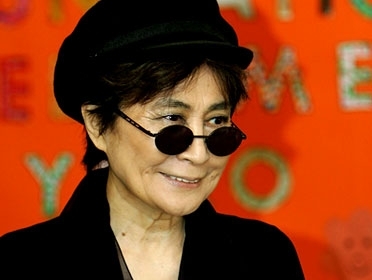
Yoko One in Lennon Cap And Glasses
There were many changes that ushered in the sixties, changes that made the sixties possible. Not least of these was the introduction of the commercial jet fleet. Gone were the much smaller, less comfortable propeller planes, slow and relatively uncomfortable with limited range. The Boeing 707s, DC 8s, mammoth in their time quickly evolved into the flying cities of the 747s and DC10s. With the big jets came the envy of the sixties, The Jet Set. Golden people off to the capitols of Europe so stunningly portrayed in Hollywood movies and travel posters. One can’t imagine the effect of travel posters today but then they created unfulfillable desires.
With ease not only were the capitols of Europe within spitting distance but also the exotic cities of the East- Tokyo.
The entertainment industry was about to spike as technology revolutionized the recording studio as well as the stage. Guitar amps as the sixties began were small, portable units. Amplifiers rapidly grew in size. Massive arrays of Marshalls rose behind the first of the heavy metal bands, Blue Cheer, like a low mountain towering above the group. Greatful Dead took the stage in front of tens of thousands of dollars of electronic equipment. Four guys could sound like Krakatoa on that fateful day.
In those far off sunny days when our world began the old world crumbled before the onsllught of bold intrepid pioneers, and behind them came the leeches and parasites.
The sixties started slowly almost imperceptibly changing until the Beatles stepped off one of those big jetliners in 1964. Seemingly innocuous, their arrival was to change the whole paradigm. Through the fifties and early sixties, before the Jet Set, was the Avant Garde, those bold experimenters moving in advance, well to the fore, of the dull plodding Middletown Babbitry and those mental habits the hip, the aware, the Avant Garde despised. There were still such things as modern art, experimental novels, cutting edge jazz. They were all swept away in ’64 when the Beatles led the British Invasion. All of a sudden the Avant Garde was turned inside out as Pop took possession of the field.
The first intimations of change took place in Art. As the 50s ended the dominant art form was Abstract Expressionism. From those ranks rose what would be known as POPart. Roy Lichtenstein with his comic book panels, Jasper Johns with his flags, Robert Rauschenberg with his messy effort and, of course, Andy Warhol and his soup cans. Interestingly they were all homosexuals. With the exception of Warhol they were all discreet, in the closet, Warhol was a man with an agenda, he wanted to legitimize himself and

Yoko, John, Andy
whatever he liked or did. He was an advocate.
One of the big changes of the sixties was the rise of the cult of the homosexual. Let Leroi Jones as a Negro spokesman rail against the cult as he might he was powerless to resist its course. Homosexuality was then illegal all over America until the great homosexual revolt at Manhattan’s Stonewall Bar in 1969 as the decade drew to a close. Homosexuals were aggressively out of the closet roaring for revenge. One item on Warhol’s agenda in fact.
Warhol began his fine art career about 1960. By 1964 when the Beatles deplaned he had completed another item on his agenda, the destruction of fine art. Thus, although few of us realized it at that time POPism was overtaking Euroamerica like a tidal wave lifting the level of the sea.
The Beatles would of course be the core, the heart of the sixties. They defined the sixties and gave the decade its form. While they were busy conquering the world a little Japanese woman who desperately wished to incarnate and represent the Avant Garde was beginning her career on the Lower East Side as a ‘performance’ artist. Zany beyond description was Yoko Ono. By 1967 she will have entrapped the leader of the free musical world and the Beatles, John Lennon. Together they will dominate what became of the Avant Garde until Lennon’s passing in 1980.
YOKO ONO
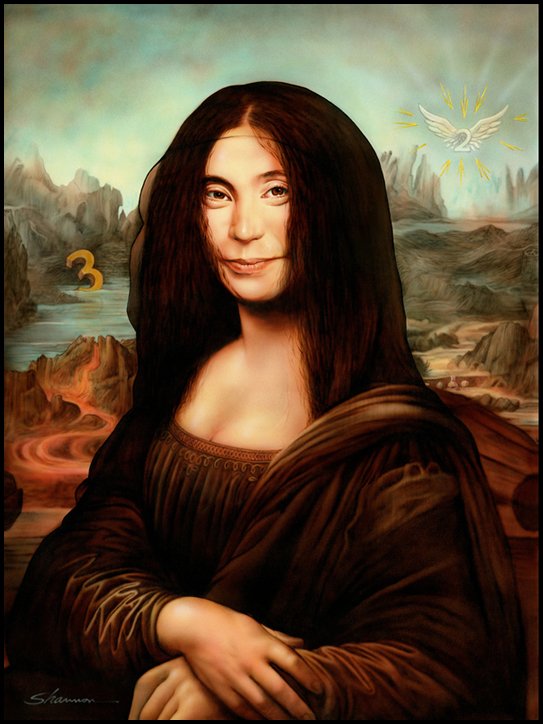
Yoko Lisa- One of many facets,
A description of Yoko to begin. A Spider Woman, a self professed witch, a psychotic obsessive-compulsive who was driven and completely organized to realize her goals. She however lacked the talent to realize those goals. As she searched for a way the seemingly unrelated success of the Beatles fortuitously occurred.
The success of the Beatles was uprecedented. Once their success had been achieved then the parasites and exploiters moved in to get whatever they could steal. While the Beatles were revered for their success one member, John Lennon, was selected to fill the almost messianic needs of the sixties.
Needless to say succes on the order of the Beatles who were after all of lower middle class origins with no preparation for dealing with success of the magnitude they achieved were completely overwhelmed while nevertheless comporting themselves creditably. Still, as Paul McCartney’s song Fool On The Hill demonstrates their heads were swimming. John Lennon even issued a musical plea in his song Help! which was a forthright request for guidance for whoever might recognize it while being able to fill his need.
As it was, this young Japanese avant garde artist, Yoko Ono, understood the plea and acted on it. John Lennon was tailor made to fulfill her own needs and ambitions.
Yoko Ono was born in Japan in 1933 as the Japanese were initiating their plan to impose the Greater East Asian Co-Prosperity Sphere on the whole of the East from India through China to Japan. In 1942 when she was ten the Japanese made their move to annex the oil reserves of Indonesia, bombing Pearl Harbor at the same time in the attempt to secure their ocean perimeter. The invasion did not come off as planned so a short three years later in 1945 the B-29s unloaded their incendiary devices over the capitol city of Tokyo where Yoko Ono’s family lived.
Now thirteen she was aware of what was happening. Moved to the country outside Tokyo Yoko Ono witnessed the massive clouds of smoke obscurring the blue sky, one presumes, for hundreds of square miles. Within a few days Hiroshima and Nagasaki had been wholly obliterated by atomic bombs. Yoko imagined the blue sky over those two cities obscured as was the sky of Tokyo. This made an indelible impression on her mind causing a psychological disturbance. She would be haunted by the memory. Thus having appropriated John Lennon in the late sixties she and he created the Plastic Ono Band whose LP was a picture of a blue sky with fluffy white clouds. After 1973 she had her office in the Dakota painted in replica of the cover. Thus she would always have a blue sky above her.
Even though the Japanese had attacked the United States first in this instance, not without provocation to my mind, thereby acquiring guilt for beginning the war there can be little doubt that Yoko blamed the West for Japan’s shame.
While Yoko experienced some discomfort after the bombing of Tokyo, as her father was a banking executive with experience in dealing with Westerners, she shortly after the war moved to the US where she lived in luxurious circumstances eventually attending Sarah Lawrence College from 1957 to 1960 but leaving without a degree.
As of 1960 Yoko Ono had experienced little of the hardships caused by the Wars in Europe and Asia. Indeed, as Philip Norman points out John Lennon’s England suffered greater hardship from 1945 to the sixties. Japan, once defeated, was given extremely benevolent treatment by the US. The paternalistic approach of the US can be seen in the picture of the tiny five foot Emperor, Hirohito, beside the relatively giant protective figure of Douglas MacArthur. Efforts began immediatly to rebuild the Japanese economy. The millions of Japanese soldiers throughout the Pacific and China were repatriated to Japan without consequences, forgiven as it were. In contrast to Europe where the carnage had been enormous there was relatively little damge to the Japanese homeland. If you watch Japanese movies of the late forties and early fifties there is only a slight indication that there has been a war. A few references are made to soldiers who never returned but the landscape is intact and undisturbed.
In Europe Germany had been flattened, German civilians slaughtered in the millions. Armies of German soldiers disappeared into the Gulag never to be seen live again. The allies exposed millions of Germans in the depth of winter while depriving them of food. The entire continent was desolated, England itself had suffered terrific bombing damage that was still being repaired into the sixties. POP star Marianne Faithfull in her biography tells of sitting aove a bomb crater in the mid-sixties. Thus any complaits of racism against the Japanese are ridiculous.
In 1957 when Yoko Ono was beginning her cushy life at Sarah Lawrence I was sailing into Tokyo Bay aboard a US Navy Destroyer Escort. We docked in Yokosuka across the strait from Yokohama. There was absolutely no evidence of there ever having been war damage to Yokosuka. Looking across the strait to the shipyards of Yokohama one was astonished at the glittering brand new derricks of the most modern design. The stuff made ours look positively medieval. Twelve years after the war Japanese shipbuilders were becoming the dominant force in that industry displacing the West under the guidance of the US which complacently ceded the industry to them.
In 1960 as Yoko Ono was beginning her career as an avant garde artist in NYC the first Japanese autos were being landed on the West Coast.
Now, Philip Norman tut tuts the English for supposedly outrageous racist comments against Yoko Ono in the late sixties as though the English had no grievances against their own racial treatment by the Japanese in WWII. In point of fact the Japanese Greater East Asian Co-Prosperity Sphere was a racist organization directed at the West. The Pacific war was a racist war if you wish to put things in those terms. There are other definitions. This isn’t the place to discuss the racial antecedents to the Co-Prosperity Sphere so I won’t but one should look into the historical background which is very complex.
The question is, did Japanese racism end with their defeat and if it didn’t how was the war carried on by other means? In 1964 Yoko Ono published a small book of haiku style statements called Grapefruit ‘which aimed to make words like the commands of musical notation’: “Steal a moon on the water with a bucket. Keep stealing until no moon is seen on the water.” Norman, John Lennon p. 475.
I have a feeling the image is not original to Yoko but is part of Japanese culture much as Bob Dylan used commonplace mid-western phrases like It’s All Over Now, Baby Blue appropriating them to himself. Of interest here is that Yoko used the verb ‘to steal.’ Her mental state then was one of taking what doesn’t belong to oneself much as in the Jewish prophecy that they will live in houses they didn’t build. While the command seems nonsensical the results will not be. The reflection of the moon on the water is beautiful but is only the image of the moon. Removing buckets of water will not destroy the reflection unless and until all the water or substance on which the image is reflected is removed. Thus the substance has been stolen while the image is disappears. At the same time, one imagines, the moon is flattered by the attempt not realizing what is being done.
Yoko Ono will apply the method to John Lennon while the Japanese applied the method to the US and the West. All those unpunished repatriated Japanese warriors lost none of the hatred of the West now reinforced by the ignominy of defeat. They could even believe that they were better warriors than the Americans being defeated by greater American resources for which there was some justification. So, in 1957 under American tutelage the Japanese had lost noe of their aggressive hatred when I and my shipmates came ashore.
Now, as Americans we were never allowed to celebrate our victory thus relieving the hardships we endured. After three years of being taught ourtrageous racial caricatures of demonic enemies we were now the day after victory forbidden to call them Japs, for instance, upon pain of disciplining. We were commanded to believe that our victury had been evil and unjustified. Shortly after the war the Hiroshima ‘maidens’ were brought over to receive free medical treatment. You won’t find anything in history books but there was a strong murmur of protest. Less than a decade after ‘The Day Of Infamy’ we were commanded to shut up or we would be shut up and we wouldn’t like it. I don’t know what the exact effect of what this was on the American psyche but their was a serious reaction.
Now going into Japan in 1957, ostensibly as conquerors, remember the Korean War had only ended in 1954, we were told that if we had any confrontations with the Japanese we would automatically be considered the aggressors, judged guilty and punished regardless of the facts. This was Tom Brokaw’s Greatest Generation speaking to its sons. So, our fathers castrated their sons for whatever idiotic reason they had. Is it any wonder we revolted against the bastards in the sixties?
The Japanese knew of the conditions imposed on us and used them to aggrandize themselves at our expense. Of course, as epigoni we were callow teenage boys rather than the fierce warriors who had driven them through the islands. As an example of what we were compelled to endure being unable to resist on pain of punishment was something like this. As might be expected the souvenir joints exploiting us were set up next to the docks. I entered a booth where I was treated insultingly by the middle aged female clerk. As I turned to leave the booth she slugged me with a shore patrol baton, which they sold, between the shoulders on the upper vertebrae. the sound was terrific but I was unhurt. Expecting me to retaliate a couple of repatriated soldiers of the Bataan Death March started moving toward me to pound me to dust while mah fellow Americans moved away from me as though poison. Heeding the advice of my Captain I walked unconcernedly away to the jeers of the former Death Marchers trying to further provoke me. This is what the Greatest Generation did to their sons. I would imagine that the lesson to the Japanese was that they had nothing to fear from Americans, young or old, while my own feeling of betrayal left me with an abiding distaste even hatred for the fathers that would turn me, a victor, over to the mercies of the defeated.
So, by flattering the Americans (the reflection of the moon on the unresisting water) the Japanese began to ladle out the American substance itself. With the simple minded Americans there to instruct them the Japanese studied American technological achievements and began to reproduce them much more cheaply because of their lower wage differential. At first the reproductions were clumsy, the first cars were laughable but they quickly honed their skills even, eventually, making improvements.
Because of their relatively quick and easy victory over Japan the American veterans in Detroit refused to take the Japanese seriously even though they were warned by quicker witted countrymen. The Japanese kept ladling the image out until today the
American auto industry is all but defunct today while Toyota has replaced GM as the dominant auto maker worldwide. I won’t say the bastards of the ‘Greatest Generation’ didn’t have it coming but I still regret it for my country’s sake.
In 1960 then Yoko Ono left Sarah Lawrence as I left the Navy to attempt a career as an artist in NYC. In 1960 John Lennon was at the very beginning of his career as, actually, an avant garde musician although he may not have realized it. It would be six years before their paths crossed in London.
In the meantime Yoko attempted to storm avant garde New York demanding instant success and considering herself so talented that she couldn’t contemplate failure. She took up with the unlistenable avant garde composers, John Cage, the premier electronic composer Robert Maxwell and people of that ilk. At one time I wanted to be avant garde so I actually listened to people like Cage, Maxwell, Pauline Oliveros, Steve Reich and people like that. If you want to you can make yourself listen to anything but I don’t want to make myself do it again. Once was more education than I needed.
So, Yoko was breaking into a very minority taste, even at the height of my enthusiasm I couldn’t make anyone sit through the stuff. At the same time Yoko was trying to appeal to the uptown crowd who cut her cold creating deep resentment in her.
Having stormed the gates and failed Yoko fled back to Japan awhere she had a psychotic reaction, nervous breakdown or depression. At any rate she was committed to a mental hospital where she was heavily sedated, massive drugging. Interestingly Norman say that before she went to London she had never used drugs. I don’t know what you would call the stuff given to her at the hospital but I’d call them drugs. Just because a dentist gave me Nembutal doesn’t mean I never had drugs although I never used them otherwise. As incredible as it may seem a fellow named Tony Cox heard stories about Yoko in New York that he found so intriguing he hopped a big jetliner and flew to Tokyo to find her. Real fairy tale stuff. Maybe he heard she came from a fabulously wealthy family.
And Tony did find Yoko stumbling through the halls of the asylum under the influence. He discovered a means to get her released then only had to deal with her Japanese husband Yoko had picked up along the way. Apparently a smooth talker Tony convinced hubby to form a menage a trois. This, of course, disintegrated the marriage 1964 finding Yoko and Tony back in New York.
Now, back in 1960-61 Yoko had been sleeping around, she had a menage a trois in Japan while subsequently not taking the marriage vows to Tony overly seriously. Yet in Norman’s biography she repeatedly tries to pass herself off as some virginal girl unable to deal with the rabid sexuality of her third husband. Clearly Yoko suffers from cognitive dissonance, meaning her version of things is always questionable if not immediately dismissable.
Yoko as a feminist wrote the song Woman Is The Nigger Of The World. In rebellion of what she saw as the status of women she became what we boys call a man eater. She emasculated the men of her life assigning them traditional female roles while she assumed the male role. Thus all three of her husbands assumed the role of house husbands, housewife being a demeaning term in her lexicon while she tried to play the role of provider through her art although unsuccessfully. Needless to say that she was a failure as a provider in all three marriages although in her last she proved an efficient money manager of the millions provided by her last house husband, John Lennon.
Cox and Yoko left NYC for London in 1966. By 1966 the decade was well along in its formation actually tipping into its demise. By 1966 the British invasion of musical groups was entering its second phase. A dozen or so groups had succeeded very well chief among them the Beatles and Rolling Stones. They had pre-empted the avant garde becoming themselves an avant garde. The chief American representative who had survived the British onslaught was Bob Dylan.
The art scene Yoko was trying to influence had been taken over lock, stock and barrelo by POPart whose leading representative was
Andy In Full Are Mode
Andy Warhol who had a zoo of addicts and perverts known as the Factory. Warhol, himself a homosexual, had always been a connoisseur of pop music playing 45s constantly. He would have been aware, perhaps uniquely, of the significance of the British Invasion for POPart and the old Abstract Expressionist avant garde. By 1965 he had aligned himself with the musical scene by adopting the Velvet Underground as the Factory house band. He attempted to form connections with all the top musicians from Lennon, Mick Jagger, Dylan and on to Jim Morrison of the Doors not always successfully. Most of the musicians waere as psychotic as he was, recotgnized him for what he was and were too canny to become involved with him.
Yoko on her return from Japan, then, was dealing with a very different art scene than in her first foray. She had to at some time between ’64-’66 make contact with Warhol. As she left NYC in ’66 for London Dylan’s evaluation of her relayed through George Harrison as quoted in Norman p. 671 must refer to this period:
George by contrast, despite long marinading in soft-tongued Buddha-speak, was his most bluntly charmless. “[He] insulted [Yoko] right to her face in the Apple office,” John would remember. “Just being straightforward, that game of ‘Well, I’m going to be upfront because this is what I’ve heard, and Dylan and a few people said you’ve got a lousy name in New York and you give off bad vibes.’ That’s what George said to her and we both sat through it.”
Dylan would have been speaking of Yoko in NYC from ’64 to ’66. During the latter part of that period Dylan was in conrflict with Warhol and his Factory crowd because of Edie Sedgwick. That Yoko Ono could have come within his ken is interesting. Yoko wouldn’t have know of Warhol during her first assault on NYC but as she kowtowed to Warhol on her return after 1968 that might indicate that she might have visited the Factory, which was open to all, met and conversed with Warhol. I haven’t found a mention of her on the main Warhol site, Warholstars, as yet but there must be a connection no matter how slight. It is impossible to know what was said between them but as Yoko got into making Warhol style avant garde movies she must have at least made some notes.
Whether music in relation to the avant garde came up with Warhol’s preference for Rock n’ Roll and possibly he Beatles isn’t known although she did drag Lennon down to do obeisance to Warhol when they eturned. Then, too, she used Sam Green, Samuel Adams Green had presented the Warhol exhibition at UPennsylvania a couple years previously, as her agent for acquistion of art.
In 1980 she was thick with Sam Green leading Lennon to express discomfort because of Green’s association with the Warhol crowd. There seems to have been a rather strong conection of Yoko to Warhol. Certainly her husband of the time, Tony Cox, was well known around the Factory having stolen one of their cars and taken it to California. Cox, who had criminal tendencies, is worth a little study too. It would seem impossible that he knew nothing of the Beatles- I think Yoko Ono’s claim to have never heard of them can be dismissed too- as Cox seemed to have been always scheming he may have heard Lennon songs like Help and I’m A Loser and drawn the obvious conclusions. Lennon in the right hands could be used.
In 1966 then, Cox and Ono left for London presumably to take that art world by storm. I think it quite probable that Yoko believed she could get inside Lennon’s head to use his wealth to further her art career. Her bagism notion was well conceived by 1965 in NYC. Her displays at London’s Indica gallery seem designed to get Lennon’s attention. An apple on a stand priced at 200 pounds…how obvious can you get? The tinyYES on the ceiling. Yoko was very good at hypnotic suggestion.
How did she find her way to the Indica anyway? The gallery had just opened in 1965 and would only survive for two years, which isn’t to say Yoko’s exhibit killed it.
Her claim that she had never heard of Lennon before the show is contradicted by both John Dunbar, the owner, and Barry Miles, who wrote under the name of Miles. He says that instead of coolly walking away not overly impressed with Lennon she actually tried to force her way into his car. Certainly flooding his mailbox with cards and letters doesn’t indicate indifference. No. Yoko wanted access to Lennon’s money and she got it.
There’s no need here to recount how she forced Cynthia Lennon out. Suffice it to say that she quickly captured Lennon; by 1968 they were back in ‘her town’, NYC. For a person who was there for maybe two years in 1960-61 and two more years in ’64-’66 I think it takes a certain amount of chutzpah to call New York ‘your town.’
Once in New York she had Lennon dependent on her while with the acquisition of the Dakota Apartment in 1973 the real action began. First let us do a character review of Lennon before beginning the denouement.
I am assuming that any readers will be familiar with the main lines of Ono’s and Lennon’s biographies. If I’ve glided too quickly over certain points don’t hesitate to ask for clarification. There are literally thousands of websites dedicated to all principals and minor characters, some of them very extensive so my exploration of all these sites is ongoing.
A Review:
Dakota Days
The True Story Of John Lennon’s Final Years
by
John Green
Review by R.E. Prindle
Green, John: Dakota Days- The True Story Of John Lennon’s Final Years, St. Martin’s Press, 1983

John and Yoko looking pretty palmy.
The book should perhaps be subtitled: A True Story. John Green has crafted very nice portraits here of Yoko Ono and John Lennon, especially that of Yoko. She was very superstitious being dedicated to the occult from witchcraft to Japanese numerology to Tarot readings. It was the last that brought Green within her ken. She not only wanted a reading of the Tarot cards but she kept Green hopping day and night giving her readings on whatever little problem that pressed her mind. So for six years Green made a very good living reading for John and Yoko while developing a profound familiarity with their characters; in other words, he knows whereof he speaks.
Neither he nor the Japanese numerologist who he mever met were the only occultists Yoko was consulting but Green seems to have been unaware of the others. He is very careful and doesn’t overstep the bounds of what he knows first hand. There was a great deal that Green wasn’t privy to making this A rather than The true story.
While I know that many people know what the Tarot is I will give an explanation for those who don’t. While I don’t participate in Tarot myself I do have a deck of cards on hand to study for historical reasons.
The Tarot is a deck of 78 cards of some psychological subtlety. It arose as a means to preserve the Egyptian religion when after the various invasions of the first millennium BC the matrix of the religion was shattered. The Tarot was devised as a means of perpetuating the religion. The various spreads of cards provide means of interpreting responses to a problem.
Over the centuries many different decks have evolved representing various time periods. I have the Egyptian deck. It would be
Tarot Card From Deck
interesting to know which deck Green used. He fails to tell us.
To be able to read well one must have an implicit understanding of each of the cards as well as being a subtle enough psychologist to apply the meanings to he or she for whom you read. Green apparently had both qualifications. Thus over thousands of readings over the six years he became very familiar with the characters and personalities of his subjects John and Yoko. Still, they seem to have been very successful in letting him know only what they wanted him to know.
As he apparently didn’t take notes, limiting in itself, he relies on his memory and familiarity with the Ono’s mental processes to reconstruct a continuum of the six years. While one may question the veracity of his method he seems to capture the mental and vocal traits of both John and Yoko. I have no trouble accepting the portraits while as the details can be corroborated elsewhere I see no reason to question Green’s general accuracy. Otherwise there is no one who doesn’t make mistakes in fact or interpretation.
His two portraits while revealing conflict with other accounts such as that of May Pang or Fred Seaman the obvious reason is that

May Pang
the Onos are only letting him see what they want him to see. For instance, in their 1980 interview the Onos state that Yoko had brought the estate up to 150 million dollars yet Green has Yoko spending so fast that they are always on the brink of insolvency. At times expenditures seem to exceed cash on hand.
Green believes himself to be their only investment advisor but that isn’t the case. Just as Yoko had her Japanese numerologist who Green didn’t come into contact with and other occult advisors she must have had other financial advisors.
The picture Green paints of Yoko is far from pretty while he never openly denigrates her yet as he creates his layers of detail she not only becomes but goes beyond eccentric. Her dependence on the occult is such that when someone advised her of a ‘genuine’ witch in Colombia she dragged Green along on the trip to South America to visit the woman. Always lavish in her expenditures, she gave one medium a blank check for her to fill out, she gave this woman 60,000 dollars for her ministrations. When Green protested that the woman had meant pesetas rather than dollars Yoko was unfazed.
Thus while Yoko denied any dependence on John she only was able to realize her vision of herself through the former Beatle’s wealth and influence.

Yoko in one of her many guises.
This was no more evident than in Yoko’s competition with her mother. For two successive summers John and Yoko visited Japan. According to Yoko the intent was to establish some rapport so that her son Sean wouldn’t be cut out of the family fortune that was considerable. The trips were conducted on such an extravagant scale that according to Green the Onos were cash poor as a result. Nevertheless Yoko went on spending so either they had funds of which Green knew nothing or they got money from somewhere.
The fact that they always seemed to have enough cash to do anything from spending a few millions on dairy farms and cows to Japanese vacations that it seems strange that when they received an extortion attempt for 200,000 dollars Yoko said they had no money. The extortion attempt seems to have been a protection racket- pay and live or go the police and die. As the extortioners told Yoko that if she went to the cops they would only protect her for a while. When they left whether a year or two later the extortioners would strike.
The Onos refused to comply calling in the FBI. The FBI advised them to substitute newspaper for money and they would arrest the pickup man. Strangely the pick up man was able to elude the FBI. And then two years or so later Lennon was hit by exploding bullets and killed on his doorstep. While one cannot say the two events are connected yet the assassination followed the extortionists plans. Chapman did make a stop to speak to an unidentified party before he pulled the trigger. But nothing is clear.
Yoko first contacted Green during Lennon’s ‘Lost Weekend.’ While Lennon believed, and it seems clear, that Yoko had informants watching John while he was in LA, Green has her denying this saying that it was his card readings that kept her informed of John’s doings. In all likelihood she checked her spies’ information against his readings.
From ’75 to ’80 Lennon was in a severe depression being unable or unwilling to function in a normal way. Of course there was no reason for him to act ‘normal’ as he was able to deal with his funk in his own way. Who is there to say that ‘normal’ was better? As he told Green his muse had left him leaving him unable to write. As he said, call it writer’s block or whatever, he couldn’t work. Enough reason for depression in an artist.
Then in 1980 when he came out of it being again able to write, Yoko in her desperate attempt to be his equal insisted on being part of the new record she called Double Fantasy. John adamantly refused to let her perform on his own tracks while she didn’t want her tracks all on one side for fear that no one would listen to side B, so they alternated tracks.
Thus, even though Yoko insisted that she was the most talented artistically and musically of the two she was forced to hitch her wagon to John’s star.

Yoko in one of her variety of men's hats and double fantasy glasses.
2.
I found Green’s treatment of Lennon to be more sympathetic than his treatment of Yoko. The inevitable conclusion one comes to about Yoko is that at best she was a pathetic human being while at worst an obsessive-compulsive and a dangerous one at that.
The portrait he depicted of John is that of a man with a completely disintegrated personality entering the mid-life crisis. During this five year period he begins a process of reintegration. Actually his course is that of the mythological hero who experiences his ‘madness’ at this period of the mid-life crisis.
During this period Lennon is essentially egoless. Part of Timothy Leary’s LSD mantra was that one should abandon the ego. Of course to abandon the ego leaves one defenseless and a prey to sharpers who use their ego only too well, nevertheless Lennon bought in and abandoned his ego, or so he says. As he abdicated his identity to the use of Yoko Ono this was obviously the case.
So, he allowed himself to be manipulated by Yoko spending long periods of months over years ruminating naked in his bed, totally exposed as it were protected only by the good will of Yoko. Then, for whatever ulterior motive, Yoko sent John on a solo trip around the world. This was her mistake.
While in Macau, China Lennon had an epiphany in his hotel room. This is a fairly common one but self-revelatory. One might name it the peeling of the onion. In Lennon’s case he obviously felt that he had multiple personalities acquired through various traumatic events in his life.
As he described it to Green he was in his hotel room when he succeeded in peeling a layer of the onion, a personality, off which appeared as real and visible to him as shirt or a suit of clothes. He draped the personality over a chair then began to peel off layer after layer hanging them about the room or draping them over the furniture. When he awoke the next morning he could see them just where he put them. He then conceived the notion of leaving them there as he ran away from their influence.
This is a beautiful little fantasy. But then he turned the corner and there was oneof his selves waiting for him. Visualize the Rock And Roll cover and I think you begin to have it. He then realized he couldn’t escape in that fashion so he went back to his hotel and said ‘C’mon’ to his personalities and continued on his journey. However having identified his ‘problems’ by name, as it were, the seeds for resolving those problems had been sown.
He then returned to the Dakota and while he confined himself to his room rather than merely sinking into depression he began working through those layers of fixations or depression gradually recovering his muse and removing his writer’s block enabling him to compose again.
It would seem that Yoko preferred John psychologically incapacitated so that she could either control him or make herself believe that she was the more talented. Green notes that as John improved Yoko seemed to deteriorate. He quotes her as saying that she had heard some of John’s new songs and they were not very good while hers were.
Dissociated from reality as she was then she couldn’t let John record an LP of songs that might be a hit while anything she recorded on her own would be relegated to the garbage. She even refused to record one side all John and one side all her for fear that no one would listen to her side so she demanded they alternate tracks. I presume that is one reason the LP is entitled Double Fantasy.
While Yoko actually believed in the Tarot and her Japanese numerology, witchcraft and whatever John intelligently disregarded the occult aspects while he might have seen the utility of the Egyptian religous aspects to reveal character and motivation. In fact the innumerable readings of the Tarot might have led up to the revelatory epiphany in China and hence the lifting of his depression.
If that were the case then there would have been little difference between the Egyptian system of Tarot and psychoanalysis. But, as I say, I have no idea of which deck Green was using although the principle remains the same.
3.
After having been on 24/7 call for six years as the Onos moved into what seems to have been a new phase Green lost his usefulness to Yoko sitting by a phone that never rang.
Green had succeeded too well. As he has John explain to him when Yoko first employed him she set him seven tasks. He had successfully completed all seven being now redundant. While John promised to look out for him, of course events eliminated any such possibility.
Regardless of whether the Ono Lennons were the subject of Green’s book I found the whole concept interesting. I like the way Green told his story, his tone and his outlook. His telling made me take an interest in himself. Unfortunately his name being so common makes it too difficult to search out anything of his subsequent career other than he moved to Washington DC.
Perhaps he could write a sequel to Dakota Days from another angle and with more detail. Pressing issues might not be so pressing now. I’d be interested.

Happy Trails To You.
A Review: John By Cynthia Lennon
January 14, 2010
A Review
John
by
Cynthia Lennon
One Giant Step For Somebody
Review by R.E. Prindle
Lennon, Cythia: John, Three Rivers Press, 2005
Remember what the door knob said…
–Grace Slick
We built this city on Rock and Roll.
–Jefferson Starship
If you want to be a girl of mine
You’d better bring it with you when you come,
–Trad.
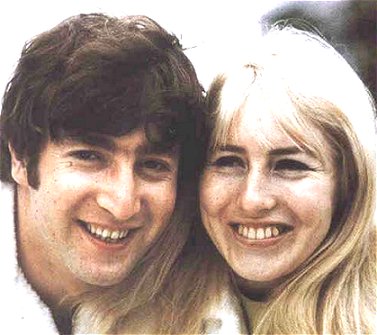
John and Cynthia- Sometime In Liverpool
Cynthia Lennon’s autobiography of her life with John Lennon opens the door to a number of possibilities of which I’ll explore one, at least, here.
Let’s begin with Lonnie Donegan’s 1955 hit The Rock Island Line. Lonnie was the originator of his own genre- Skiffle Music. Skiffle was all the rage in the British world from England to Australia to New Zealand while passing very lightly over the States except for the fortunate few of which I was one. Rock Island Line was a major hit in the US though.
Lonnie, may he rest in peace, was also the originator of the Big Beat. Of course Lennon and most of the young English rockers studied at Lonnie’s feet. The first band Lennon formed, the Quarrymen, was a Skiffle band. That was back in the fifties before the second stage of the big change kicked off. The first stage began about 1950 with Johnny Ray and his song Cry.
Eisenhower had the world pretty well organized in 1960 before John Kennedy stole the baton from the intended successor, Richard Nixon. With the accession of Kennedy the American personality or identity, such as it was, began to disintegrate- I mean in the psychological sense.
The Celts tried to establish Kennedy as the second coming of King Arthur and his Camelot. Not the smartest thing they could have done; a couple bullets fired in Dallas on November 22, 1963 put a period to that dream. By the then the sixties were fairly launched about to begin in earnest in January of 1964 when Lennon’s next group, the Beatles, hit.
The Beatles began as a Big Beat band rooted in the fifties. Seized by the avant garde they were made the avatar of the sixties. In their own way they launched the sixties although the makins’ were already out of the can. Kennedy was shot almost in December and in January the Fab Four washed his memory out on the Ed Sullivan Show. The Kennedy assassination was so then, then. The Beatles were NOW. IS in capital letters.
While the Beatles were revamping fifties music they edged into the future with modified Prince Valiant haircuts and collarless suit jackets. They were then NEW emerging into a brave new world.
Almost at the beginning of 1960 the art world was shaken by the emergence of Pop Art. Jasper Johns, Claes Oldenburg, Robert Indiana, Roy Lichtenstein, Robert Rauschenberg and especially Andy Warhol with his Campbell’s Soup Can set the sixties on its ear. On

Premier example of Pop Art
the film scene the James Bond series with its new sensibility began. Bond also was a revelation portending changes with unintended consequences.
Pop Art would figure signficantly in Cynthia Lennon’s life in a few years when one of its more laughable practitioners, Yoko Ono, would step into her life and filch her husband from her. In fact Pop Art would be inextricably linked with the record industry. All the pop motifs would find their way onto record covers with increasing frequency. Tiny Alice would have a cover that opened like a match book. Talking Head’s colored disc would even become a happening designed by Rauschenberg himself. The burgeoning poster business would find its way into record sleeves. Astonishing packages never seen before in the record business although perhaps anticipated by the experimental ESP label of NYC. Some interesting stuff. Perhaps Milton Glaser’s poster of Bob Dylan could run for the distinction of the most popular poster design of the whole era. It was innovation itself at the time although not quite so fresh today.
Now, all this was happening so fast and from so many directions that it was impossible to get it all or even keep up on what you did get; after all people had lives to live.
In the San Francisco Bay Area where I was during the sixties the Scene was especially heavy. I wasn’t in the thick of things but a little off to the side. Thus while the UC Berkeley Free Speech Brouhaha took center stage in the East Bay, Ken Kesey, the Merry Pranksters and the Acid Tests were simmering on the Peninsula, but actually invading the middle class especially at Stanford and UC Berkeley. The San Fransciso Mime Troupe was very important in the early stages while Bill Graham was commercializing the Trips Festival with his Fillmore shows and Chet Helms was organizing the Avalon Ballroom out at the beach. The posters for the ballrooms which epitomized the psychedelic was the first inkling I had that something ‘new’ was happening. I don’t know how quick on the uptake I was but the first inkling of New York Pop I had was 1966-67 when I opened a poster store soon to be a record store.
LA, always commercial, would nevertheless provide the great Ron Cobb political cartoons for the LA Free Press one of the best of the Hippie papers soon to degenerate into porn as did the Berkeley Barb and all the rest. R. Crumb in San Francisco became the king of Hippie porn which characterized the movement from then on. The scene was then set for George and Pattie Harrison’s famous descent on the Haight-Ashbury that disappointed them so.
This brief sketch only contains a few of the highlights of the period. It was into this world that John and Cynthia Lennon stepped unprepared. Both Cynthia and John came from a background of very low expectations. Cynthia’s dreams were very modest while per her John’s dreaming was no bigger than reaching the tops of the pops in England.
Indeed the much touted German clubs showed no promise of a future whatever. Essentially playing in brothels in Hamburg one wonders what the ‘lads’ were thinking of the whole process. The wonder is that they paid enough attention to hone their skills. One of those making lemonade from lemons situations.
Only the greatest good luck showed them to success and fortune. They would have labored in the vineyard for a while and then drifted off into jobs but for the fact that an entrepreneurial romantic by the name of Brian Epstein saw them as the vehicle to realize his own dreams. He had the direction and energy to galvanize their careers. Still they were rejected by all the labels until a producer, George Martin, apparently heard what the rest of the world would hear and agreed to record them. It was then that the unbelievable happened elevating the Beatles into the most successful pop group ever. It was success far beyond their imaginations. With that success came challenges that neither John nor Cynthia could meet. The fact that they failed is no reflection on either one; they came from very low expectations and having fallen down the rabbit hole they were slightly unprepared. ‘One side makes you larger, the other side makes you smaller.’
To this time in their lives neither had even eaten at anything other than the English equivalent of McDonald’s, fish and chips or whatever. Now in one great step they were introduced into the haut ton by their manager Brian Epstein. Cynthia leads us to believe that Epstein gave special attention to John over the other ‘lads.’ As Epstein was a homosexual and as other sources, Peter Brown, Goldman actually state that Epstein seduced Lennon he obviously had a crush on John seeking to mold him in his own image. Indeed, John may have been his incentive for taking the Beatles on. Lust at first sight.
John had an attractive flip attitude that left the impression that he was much better educated than he was. Actually he left Art School, already a step down from the top, flunked out or whatever preferring to devote himself to his guitar chords. Most of the rockers were in the same situation. It’s amazing that their fans looked to them for salvation. This was tragic, because the generation invested all their hopes and dreams in these muscians attributing universal knowledge and genius to them, each and everyone. While they all did changes on certain political and social themes there was an appearance of ‘deep’ knowledge. Being anti-pollution was a badge of authority. Grace Slick of the Jefferson Airplane made the mistake if, one hopes, jesting that one should never trust anyone over thirty; this while she, John and others were about twenty-nine.
The phrase stuck. Those under thirty trusted these youthful, perhaps well-meaning rock stars. Being somewhat older at the time I could only see some very ordinary boys and girls who were just youthful wiseacres as we all were in that phase of our journey through life. Give me a break.
The most revered of all were the three Beatles John, Paul and George with Ringo thought of more as the court jester. John seemed to take his role most seriously as the guru of the generation, especially after he abandoned Cynthia for, spare me, the psychotic Yoko Ono.
Her abandonment by John for Yoko Ono is of course the most traumatic incident in her story. One can only commiserate with Cynthia. Then one has to search for reasons why; there was certainly no physical attraction there. Lennon did release a solo album called Mind Games so perhaps the best place to look is the mental. Lennon’s success must have placed great stresses of various kinds on him. The transition from a fair degree of poverty to one of a very large income to great wealth under the management of Yoko Ono would be psychologically unsettling in itself. Cynthia was unable to transit from poverty to wealth always remaining a lower middle class haus frau while John appears to have lacked the social climbing instincts of, say, Mick Jagger.
Musicians in general are held in very low esteem by the social elite so without unbounded desire and chutzpah, an ability to endure slights of the most painful kind it is highly unlikely that a musician would ever find acceptance in society. The aristocrats, Marrianne Faithfull describes as associating with Jagger appear to me to be more of the Black Sheep variety. So, Lennon may have been experiencing some frustration at that level.
At the same time there are numerous flatterers who are adept at putting ideas of omnipotence into your head not only intimating but saying that you are godlike. Even though one rejects the notion on the conscious level still a feeling of super powers creeps into your subliminal mind. One feels invulnerable, that one can do what’s never been done, that one can do drugs with impunity. There was never a time when the availability of drugs was ever greater or more socially acceptable.
At the time rumors abounded which have since turned into facts. During the Kennedy administration there was one Dr. Feelgood operating in New York to whom the social elite went for their drugs. His name was Dr. Max Jacobson and he was your friendly amphetamine pusher. His speed cocktails were extraordinary and they lasted for days. It’s comforting to know that President John F. Kennedy was amphetamine fueled while he was making those difficult international decisions- like Cuba. Nothing like having an A-man on the job. He wasn’t alone, VP Lyndon Johnson, followed in his footsteps into the office of Dr. Feelgood. He would have found his place at the end of the line of the NYC elite.
One person who took the good doctor’s prescription said that he went blind for three days staying high for several. Max was the economic type, dirty needles too.
At the same time Dr. Timothy Leary was sending everyone from prison inmates to Beat poet Allen Ginsberg tripping into inner space with his free handed distribution of LSD. Kennedy was involved in that too.
Prior to their arrival for the Sullivan show we are led to believe that the Mop Tops had only used pep pills in Hamburg to fuel their twelve hour sets. We are told that Bob Dylan was the one who turned them on to La Cucuracha, the most mild of the intoxicants. From there the boys graduated to LSD through spiked drinks or food.
Just as Harrison’s wife, Patti, records a spiked introduction to LSD so does Cynthia Lennon. Cynthia quite properly was revolted by drugs having no use for them. John was quite the opposite. He embraced LSD apparently ingesting regularly for long periods of time. As he would describe it, thousands of trips. At that point in my estimation the marriage was over. There is nothing for which Cynthia has to reproach herself except for her small divorce settlement. Nothing disintegrates the personality like drugs.

The Ghost In The Machine- Albert Hofmann
The drug influence was followed by a change in their music patterned after Dylan. When I first heard the Rubber Soul album I found it extremely noisy and unpleasant. This album was probably influenced by the Band’s playing behind Dylan on the ’65-’66 tour or perhaps the Bringing It All Back Home and Highway ’61 albums. It seems p;robable to me that the song Norwegian Wood commemorated Dylan’s turning them on to marijuana. The girl obviously represents Dylan.
Succeeding albums would aim for a ‘heavier’ feel with more social significance. As Lennon said in his ’80 Playboy interview, I Am The Walrus was written in imitation of Dylan.
The cover of Rubber Soul was traditional uninfluenced by pop art trends. The succeeding cover in the US, the famous ‘Butcher’ cover would be widely interpreted in the US as a comment on the Viet Nam War. It may have been meant as a pun- prime cuts of both meat and record tracks, but I don’t know. Whether there was a Pop Art influence isn’t clear.
The cover for the following Revolver by Klaus Voorman seems to indicate an awareness of Pop. For a band that was thought to be on the cutting edge of everything there are only two covers very avant garde with neither being very satisfying to me.

Acid Art- Victor Vasarely
Sgt. Peppers Lonely Hearts Club Band that follows Revolver is a complete Pop Art package. A bizarre and macabre conception it does succeed. The grave in the foreground with the floral Beatles is chilling, perhaps a presage of the break up of the band. As Dylan said: If you’re not busy being born you’re busy dying.’ The Beatles are pictured in dead black and white looking down mournfully on their grave while the newly born Sgt. Peppers Lonely Hearts Club Band stand front and center in vibrant living color. Obviously the one has risen from the other.
Behind the band are row on row of ‘ancestors’ or, as was commonly assumed, influences. In fact members of the band contributed only a few of the names while the rest were contributed by others. Dylan is certainly among the pictures. The album comes complete with a childhood toy, a sheet of cut outs, making a complete Pop Art package. They could have had a designed inner sleeve but they overlooked that. Peter Blake, the main designer, is known as a Pop Artist.
The musical content follows the downer social significance motif with aural pyrotechnics such as had not been heard on record before. The release, as everyone is aware, was a complete smash, but it went beyond smash into realms not achieved until Michael Jackson’s Thriller. Thriller failed to excite as did Sgt. Peppers. That summer of ’67 was literally a surround of Sgt. Peppers. It was almost the only record anyone played. The Beatles easily trumped Dylan’s Blonde On Blonde of the summer of ’66.
The rest of the Beatles’ covers are pedestrian. The White LP probably influenced by One was trite at the time.
Cynthia seems to lack all understanding of what tremendous pressures the very unstable Lennon was subjected to , how his mind was being affected by adulation from the fans and respect from the world at large. Kid me, being named one of the three most influential men in the world wouldn’t have inflated the head of a Liverpool loser? My god, the Beatles even sung ‘I’m a loser.’ I couldn’t believe anyhone would sing such a song much less the Beatles who were clearly winners. How does one endure thinking of oneself as a loser on one hand and one of the most influential men in the world on the other?
At the same time that Lennon was enlarged Cynthia shrunk into the Liverpool realities of her youth. The couple had a mansion but unfamiliar with so much space Cynthia preferred to live in one small room! Clearly she was not equal to the demands of her situation.
The situation became critical when Lennon began mass consumption of drugs, including heroin, which Cynthia correctly declined to do while at the same time the poisonous Yoko Ono injected herself into Lennon’s life. There was no hope for Cynthia. Yoko Ono was a walking disaster looking for a place to happen- and then there was John.
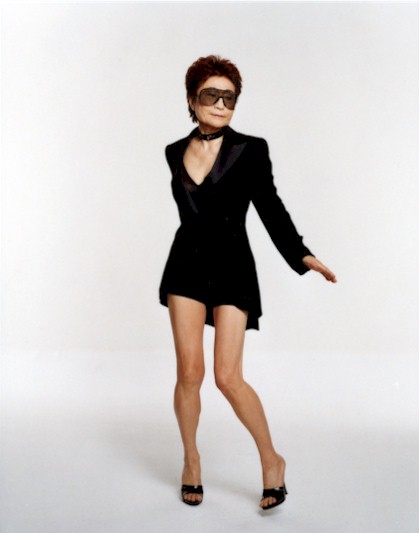
Yoko Ono- Single Fantasy
Quite frankly Yoko Ono’s ‘career’ was going nowhere. Born in 1933 she was 33 in 1966 when she began her assault on John who was 25.
The sexual dynamic is that Lennon seemed to prefer older women than himself having a masochistic submission impulse. Cynthia herself was a year older. She too apparently sought security in younger men. Her second husband was two years younger and her third six. She seemed to lack the dominating impulse to make such marriages work. Ono had it in spades.
While John was by this time psychotic, Ono had been so from childhood, in addition she seems to suffer from extreme cognitive dissonance. Ono got the rock critic Robert Palmer to shill for her in her 1992 release, Onobox. In the essay Palmer states:
It is quite likely that having John Lennon fall in love with her was the worst thing that could have happened to Yoko Ono’s career as an artist.
Notice the lack of mention of falling in love with Lennon. This was written, I almost said, dictated to Palmer, in 1992 twelve years after Lennon’s death. No serious critic could have written that line so one must assume that it was dictated by Ono herself. The line shows how far she has distanced herself from reality.
Ono was in fact, a poor little rich girl. As a woman she felt inferior to the male writing such pieces as ‘Woman Is The Nigger Of The World.’ Once again cognitive dissonance. Yoko Ono was never in the position of being ‘a nigger in the world.’ It is true that her father advised her against attempting composing believing that women didn’t make good composers. How wrong was he, hey? Ono milked every man she was ever with before actually going into the dairy business herself. Secondly, having chosen to enter the Western world as an Asian she places her artistic neglect on the twin facts that he is a woman and an Asian. It never occurs to her that her art is unpleasing.
As an artist, whether woman or not, Asian or not, she had nothing to offer the art loving peoples of the world. In this increasingly globalized world of the sixties being Asian meant nothing while being a woman held no one with talent back. Indeed, male artists were increasingly being suppressed in favor of women in all the arts. If all girl rock bands isn’t an oxymoron I don’t know what is.
By her own admission she thought she was an influential person in the New York City art world of the early sixties after an apprenticeship of one year even gaining ‘an international reputation.’ As she told May Pang: I was famous before I met John. So, one asks how does one reconcile her imagined great success with the feeling of being held back as an Asian and woman?
She rented a loft for fifty dollars a month which she coyly implies that as a starving artist the money was not easy to find. Well, Daddy was only a phone call away, she should have reached out and touched him. You can be sure he wasn’t going to let his little girl starve. By comparison I was paying 125.00 a month for an apartment in the Bay Area. I think we can dismiss the impoverished struggling artist scenario as so much more cognitive dissonance.
Ono spread herself pretty thin apparently attempting to cover all aspects of the avant garde. She’s keen on belonging to the avant garde. In music she patterned herself after John Cage and that weird contemporary ‘classical music’ approach with perhaps more than a nod to the early electronic composers such as Robert Maxwell who she mentions. She began her career in 1969 between the end of the Absract Expression mode and the beginningof the Pop movement so she was too late for the one and too early for the other. She and Lennon would try to rectify this in 1971 by doing obeisance to the Pop guru, Andy Warhol.
In 1961 she threw a party and was devastated that a snow storm discouraged the uptown crowd she had invited from coming. At least she said there was a snow storm. This may be another instance of cognitive dissonance. As she was an actual nobody she had no reason to expect society people to attend, snow storm or no snow storm. Nevertheless she was devastated, leaving town for Japan shortly thereafter. One may question where she obtained the fare for that flight when she had difficulty of meeting a fifty dollar rent bill.
In Japan she acquired her first husband simultaneously being committed to an insane asylum. As difficult as it may be to believe, her soon to be second husband, Tony Cox, heard these marvelous things about Ono in NYC deciding to fly to Japan to look her up. He found her thoroughly doped staggering around the halls of the asylum. He succeeded in getting her released then he, Ono and her first husband formed a menage a trois. The first husband wisely was the first to leave so Cox claimed the prize and the couple returned to NYC in 1964 so she is having an eventful four years. Shortly after their arrival they pulled up stakes and headed further East to London. Of the move Ono says:
I thought (the) avant garde world in New York was still very exciting but that it was starting to become an institution in itself, and there were rules and regulations in an invisible way, and I just wanted to get out of it. I never considered myself a member of any group. I was just doing my own thing.
That is just another way of saying that the art scene was a cliquish group in its terminal stages that was difficult or impossible to break into so unable to do so Ono was ‘just doing her own thing.’ It might be noted however that the NYC art scene was or was in becoming a nearly totally homosexual affair. At any rate we have evidence of sour grapes- I never considered myself a member of any group. And the result of rejection- I was just doing my own thing.
After her rejection she ‘composed’ a musical piece called Wall Piece For Orchestra in which she knelt on a stage and repeatedly banged her heard on the floor. Today that would be called ‘acting out.’
Off to new worlds to conquer in London and at the Indica Gallery of John Dunbar, the resident ‘head’ art gallery. Now, at this point she ‘ruined her career’ by pursuing John Lennon until he caught her. I imagine that she had been shrewdly observing his career and undoubtedly came to the psychological conclusion that he was a dependent personality who could be easily manipulated by the older maternal type with the right touch. That John Lennon could be made dependent on this woman eight years his senior is proof positive. Indeed, John even referred to her as Mother.
Cynthia for whom the role was impossible correctly assessed the situation noting the influence of Lennon’s Aunt Mimi who brought him up. Ono courted Lennon, interfering directly in his marriage. Ono was quite willing to drug herself along with Lennon so that both were heroin addicts. Ono thus established a sado-masochistic control over Lennon that Cynthia had no chance of breaking.
Rather than ruining Ono’s career the ‘third most influential man’ in the world gave her a stage on which to perform that she could never have found on her own. She now considered herself a collaborator with the Beatles. The injection of the Cage and Maxwell garbage combined with Lennon’s erratic behavior produced the nonsense of Revolution #9 on the White Album.
Lennon on drugs and under the influenceof Ono, who had her motives, according to Dire Corrector’s blog quoting the biographer of Paul McCartney, Many Years From Now, says:
The meditation had essentially precipitated a nervous breakdnown which was not helped by John’s tremendous drug intake. On May 18, 1966 he summoned a meeting of the Beatles at Apple and announced to them that he was Jesus Christ…the night after he told the other Beatles that he was the Savior, he finally called Yoko Ono and told her to come over.
Quite obviously Lennon was either teetering on the brink or had fallen over the edge. If he hadn’t broken with Cynthia by this time it is quite clear that apart from a certain inappropriateness of being wed to the Savior she was quite innocent of causing the break in any manner and should have a clear conscience.
Lennon’s state of mind would explain the insensitive manner in which he broke with Cynthia and its aftermath. The man must not have been in his right mind. While easing Cynthia out was relatively easy, from Ono’s end Tony Cox to whom she was still married was not such a simple matter. One wonders why he would fight so hard to keep a women who was so psychotic. Perhaps it was their daughter who he later took into hiding to keep her away from Ono. Justly so, it seems.
At any rate by ’69 Ono and Lennon were free to marry. Definitely by this point Lennon had all but surrendered his identity to Ono. She was now in possession of the reputation of one of the three most influential men in the world. Blending her identity with his she was about to become hermaphroditic. Perhaps Lennon was overawed by her avant garde credentials, such as they were, as well as whatever passed for her musical sensibilities.
She became Yoko Ono Lennon while he legally changed his name to John Ono Lennon so they both became Ono Lennons. After a number of happenings which one must believe were entirely Ono’s conceptions, such as the ‘bed in’ in Holland and the organization of the Plastic Ono Band, the pair settled in New York in an apartment building known as the Dakota. The Dakota was a connection to Ono’s past fulfilling an old desire to surpass those uptown types who she felt had slighted her.
In that connection also the cover of the Plastic Ono Band is a fulfillment of an old desire of Ono’s. While a child she witnessed the fire bombing of Tokyo in the US attempt to bring an end to the war. The blue sky was obliterated by the billowing clouds of smoke. While she didn’t witness Hiroshima yet she imagined the same sky as that over Tokyo. She then developed a blue sky obsession. If you notice the cover of the Plastic Ono Band is just a blue sky. One assumes then that Ono’s plans were coming together.
The NYC art world of 1960-’61 had shifted totally, the Abstract Expressionists she had tried to piggyback on were gone having been replaced by Pop Art of which Andy Warhol was the reigning doyen. If the Abstract Expressionists had been exclusive Warhol was nothing if not inclusive. He worshipped celebrities and Lennon was the number one celebrity. Himself a groupie and maximum social climber he welcomed an association with the Onos. For Yoko Ono the association with the leaderof the NYC art scene was her dream come true. Nothing but blue skies from now on.
In the accompanying picture you will notice that Warhol is seated in between a standing Yoko Ono with one hand on her right tit while his hand is on a drugged out looking John Ono with his hand on Warhol’s crotch. The symbolism is quite clear. The standing Yoko
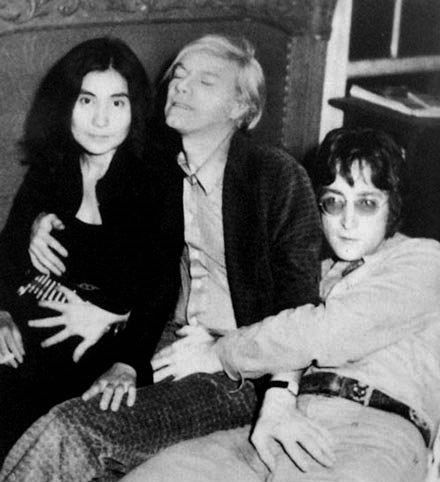
The transfer of power.
is the master of two emasculated males who happen to be two of the most influential men in the world. She ain’t no nigger no more, Maggie’s Farm is a thing of the past, yes, men are now niggers in relation to herself. Warhol as an artist takes precedence over the disposable oafish John Ono. Yoko is tallest and standing, Warhol is second tallest and sitting while the now disposable John is lowest, lying on his back. The future is clear. Study John’s face; study all three faces.
The sexually besotted John Ono has surrendered his entire identity even as a musician allowing Yoko Ono to usurp his place by putting out those horrid hideous LP musical montrosities. Robert Palmer aside, with song titles reminiscent of her head bashing days: What A Bastard The World Is, I Felt Like Smashing My Face In A Glass Window, Woman Of Salem (Witches), Coffin Car, Hell In Paradise and Walking On Thin Ice. Clearly this woman had an unsettled, disturbed mind.
Having usuped Lennon’s role and identity he became expendable. Her problem now was to transfer his past and his wealth to herself thereby becoming Yoko-John Ono, Double Fantasy. Two fantasies melding into her one personality.
John Ono’s finances were, of course, in complete disorder. As Yoko was soon to show billions of dollars were disappearing down a sink hole. She rapidly organized his finances turning his money green. Within short order the Onos were worth a hundred million or so which she would swell to a billion or more after John’s death.
I imagine it was fairly easy to have John Ono give her a power of attorney, indeed he forked over his identity allowing her to function in his stead as himself. An awesome abdication. A POA would negate the need for a will, and indeed having made herself not only co-owner of John’s assets as well as his identity Yoko Ono would merely acquire full ownership leaving no assets to be willed. Indeed, she could have turned him out penniless at any time. When Cynthia was clamoring for a reading of the will she was wasting her breath; if a will existed, unlikely in itself, there would have been no assets to bequeath.
Yoko Ono having now incorporated John Ono’s reputation and identity into her own had also incorporated the assets and with the assets the legacy of all copyrights held by John Lennon as the double fantasy melded into one fantasy. The only obstacle to Yoko’s apotheosis into man-woman was John himself as he was alive. However John was only thirty-five. To wait thirty-five years or more with a man she didn’t love or even like would be unbearable. Some hard thinking was in order.
She manipulated the poor dolt into thinking he was a boorish oaf who needed to go off to get himself together. Rather than just sending him off she chose an employee, May Pang, an Asian like herself, to be John’s consort while away.
In reading May Pang’s book, Loving John, it becomes clear that Yoko Ono was a master hypnotist. She knew how to make suggestions and have people act on them. Acccording to Pang she fixed an hypnotic glare on one, assuming an authoritative posture while intoning her suggestion. She had the reputation of always getting her way.
Of course her version of what happened is different than Pang’s. Yoko having suggested she go off with John, the act was soon consummated. Pang insists she and John were in love, yet a year and a half later when Yoko called John back he came running.
Thus, from 1975 to Double Fantasy in 1980 Yoko and John Ono were out of public life living as a double fantasy of Howard Hughes. Then in 1980 Mark Chapman became the man who shot John Lennon. There have been speculations that Chapman was hypnotized when he committed his deed. Conspiracy theories therefore have sprung up.
One must ask who the death of John Lennon benefited. Two possible people. Yoko One on one hand and possibly Chapman on the other. On the one hand Yoko Ono achieved the psychotic desire to escape being the ‘nigger of the world’ by becoming John Ono Lennon while physically remaining the sweet little girl she had been before the fire bombing of Tokyo. She was unable to manage the memory of that transformative experience. In her mind, then, she became the prominent artist-musician of the world.
I don’t believe the government had anything to do with the assassination.
As we know Yoko Ono was a master hypnotist; the question is how did she find Mark Chapman and how did she hypnotize him?
Earlier in the day Chapman had approached Lennon for an autograph. He can be seen worshipfully smiling beside his hero in the picture. There appears to be no indication he meant to harm Lennon. He might easily have shot him point blank at the time, yet when he came back in the afternoon with a voice in his head insistently saying: Do it. Do it. Do it. he gunned his hero down.
At the time Yoko Ono had dropped a few steps behind John. In similar murder attempts, people step away from the intended victim so as not to be caught in the line of fire. This may have been the case with Yoko.
Certainly Yoko is opposed to Chapman’s release from prison even though he has fulfilled the twenty year requirement of twenty to life. I doubt if he is a threat to society however he may be a threat to Yoko Ono if he were to remember or reveal the details leading up to his shooting of John Ono Lennon.
Of course, I don’t know why Chapman shot but I do know that Yoko Ono Lennon was the sole beneficiary. She left Cynthia holding the bag while she realized her double fantasy.

Double Fantasy- Yoko Looking Over John's Granny Glasses
Exhuming Bob 13 Fit 5: Bob As Messiah
October 19, 2008
Exhuming Bob 13
Fit 5:
Bob As Messiah
by
R.E. Prindle
Are you that Man Of Constant Sorrow
Of whom the authors write-
Grief comes with every morrow
And wretchedness at night?
Anon.
Source of quotes: Scott Marshall, Bob Dylan’s Unshakeable Monotheism- downloaded from Jewseek.com  but no longer available. The site is no longer functioning. Roughly the same material can be found in Scott M. Marshall with Marion Ford, Restless Pilgrim: The Spiritual Journey Of Bob Dylan, Relevant Media, 2004. No longer in print new copies may still be obtained for under three dollars at Alibris.com for any who are interested.
In the dead of winter in 1961 Bob Dylan, ne Bobby Zimmerman, left Minnesota to try his chances in New York City. At this point he must have realized that his better chances lay with Folk Music than Rock n’ Roll. Indeed, upon his arrival in New York he realized that Tin Pan Alley had the recording world sewn up except for the ‘race’ musics of Country And Western and R&B, and the Alley was already fairly tight with R&B. He quickly and astutely realized that whatever he intended to do would find no home on the Great White Way.
While Bob traveled light as far as material possessions went he brought a lot of psychological and religious baggage with him. The kind of stuff you can’t leave in a locker at the bus station. As his whole career has been an unfolding of this religious impulse it would behoove us to examine it somewhat closely.
Bob received intense religious indoctrination in his youth until the time he left home in the Summer of 1959. This religious education was of an intense Orthodox Jewish kind. He recieved this from his family, both parents were deeply religious in the Orthodox mode, although the Hibbing syngogue was more often without a Rabbi of any kind than not. Perhaps of premier importance was his Bar Mitzvah indoctrination in 1954 from a Lubavitcher Orthodox Rabbi direct from Brooklyn. That combined with four years of extended stays at the Zionist summer camp, Camp Herzl in Webster, Wisconsin.
In speaking to Paul Vitello of the Kansas City Times after announcing his call to Jesus/God, Bob told him:
I believe in the Bible, literally. Everything in it, I believe, was written by the hand of God.
That is the statement of a religious fundamentalist and one without much sense or discernment. If Bob doesn’t know the the ‘hand of God’ has written nothing then he can be written off as a rational human being. Bob in the same interview went further:
Everything that’s happening in the news today is prophesied in the scriptures. It’s all in the Book of Daniel and the Book of Revelations.
For myself, I begin to run when I hear some Christian fundamentalist bring up the Book of Revelations. It has the same effect on me as anti-Semite has for the Jew.
We can assume therefore that upon his arrival in New York in 1961 Bob was a card carrying Biblical devotee. This religious baggage for the time being took a back seat to Bob’s psychological baggage but was absorbed into it. Hence the Biblical sounding ranting of Like A Rolling Stone.
At the same time as with most young people Bob was in rebellion against his upbringing. That is to say he was trying to find his own place in life while reconciling his upbringing to the emerging realities presented to him by life. As his line from his song My Back Pages would seem to indicate: I become my own enemy when I begin to preach. he realized that his religious beliefs would alienate any listeners and abort the possibility of establishing his career and reaching them later.
Indeed, the sixties, and expecially the New york fold crowd was intensely anti-religious. It was about this time that Bob read a headline on a Time Magazine cover asking the rhetorical quesiton: ‘Is God dead?’ Bob was extremely offended by it dating the decline of Western Civilization from that headline.
From 1961 to 1966 then Bob wrote mainly of his psychological problems and frustrations. His dream life, which is to say, subconscious, received a lot of attention during this period as well as later in his career.
It was precisely the speaking from his subconscious to the subconscious of his audience that drew this specific type of person to him.
Phil Ochs, a contemporary Folkie of Dylan, recognized what he was doing in stirring up deeply held resentment and thought he was brewing trouble for himself. However Dylan, while hating, did not necessarily stir up emotions that would lead to violent actions. Instead his hate was characterized by self-pity and resentment that would be satisfied by showing people how wrong people were in their judgement of him. Thus he would accentuate his God as a god of judgement. He left the actual judgemental punishment of them up to his god. Thus those of us in his audience who linked up were also characterized by self-pity and resentment but not violent.
For instance, in a 1983 interview with Martin keller he was quoted:
My so-called Jewish roots are in Egypt. They went down there with Joseph, and they came back out with Moses- you know, the guy that killed the Egyptian, married an Ethiopian girl, and brought the Law down from the mountain. The same Moses whose staff turned into a serpent. The same person who killed 3,000 Hebrews for getting down, stripping off their clothes, and dancing around a golden calf. These are my roots. (My italics.) Jacob had four wives and thirteen children, who fathered thirteen chiidren, who fathered an entire people. These are my roots, too. Gideon with a small army, defeating an army of thousands. Deborah, the prophetess; Esther the Queen, and many Canaanite women, Reuben slipping into his father’s bed when his father wasn’t home. These are my roots.
Delilah tempting Samson, killing him softly with her song. The mighty King David was an outlaw before he was king, you know. He had to hide in caves and get his meals at back doors. The wonderful King Saul had a warrant out on him- a ‘no knock’ search warrant. They wanted to cut his head off. John the Baptist could tell you more about it. [That’s a joke in this standup routine, Son.] Roots, man- we’re talking Jewish roots, you want to know more? Check up on Elijah the prophet. He could make rain. Isaiah the prophet, even Jeremiah, see if their brethren didn’t want to bust their brains for telling it right like it is. Yeah, these are my roots, I suppose.
Now, those are extremely violent, murderous roots but they form the staples of Bob’s conscious and unconscious minds. The selected examples, all from the Old Testament, are revealing in the Freudian sense. Vengeance dominates.
Nor are these ‘Jewish’ roots in any exlusive sense. These actors were Hebrews and not Jews. I know all this bullroar from Christian (Methodist) services. I was repelled at once and rejected this crap when I escaped the stultifying influence of my childhood. This crap is unworthy stuffing for human minds.
This mean spirit is felt throughout the whole of Bob’s corpus from 1961 to 1966, more especially in that most puerile of all his songs: Masters Of War.
Significantly Bob mentions nothing about Jesus or the New Testament; his roots are all Old Testament. This raises the question of whether his embracing of Jesus in 1979 was calculated or not. There is in fact little differentiation between his conception of jesus and the Jewish Yahweh. Indeed the idiot church I attended as a youth seemed to accentuate the Old Testament Yahweh over the New Testament Jesus. I have a much stronger conception of Yahwey over Jesus so one might say I share ‘Jewish roots’ as much as Bob does. I am as much a dual citizen as Bob is except more American/Ancient Hebrew rather than Israeli/American.
As of 1964 Bob Dylan wasn’t really going anywhere. True, his manager Albert Grossman was busy promoting his songs to others whose recordings then inflated Bob’s reputation but that didn’t necessarily translate into big sales for his own albums.
Then in 1964 Bob had a stroke of luck, the Beatles came to America. There had been a massive promotion along the lines- The Beatles Are Coming, The Beatles Are Coming. No one had ever heard of them but when they appeared on Ed Sullivan everyone was tuned in to see what the fuss was about. After it was over, other than the screaming girls in the audience, that, I might add, was a new phenomenon, few of us still knew what the fuss was about.
Nevertheless it seemed that from that point on the Beatles were on the news nearly every night. This was unprecedented attention for a mere ‘pimple’ music pop group which is all the Beatles were at that time.
Why the Beatles received this attention has never been clear to me. However these were four goi musicians although their manager Brian Epstein was Jewish. In the inter-cultural competition a Jewish super-star was now required. After all the first of the superstars Elvis Presley was an all-American hillbilly. Fabian the last before the Beatles was Italian. These four English kids then came up and so a Jewish kid was required to keep up the Jewish image. The only real alternative was Bob Dylan although few or any of us knew, or even suspected he was Jewish. Bob had sure worked hard to keep that a secret. Even his girlfriend Suze Rotolo was slow to find out.
Bob then was given the big media buildup also being on the news frequently, also being given the star treatment in the big national magazines. While the Beatles handled their fame with chipper aplomb Bob approached it with negative depression. But, it worked just as well. The pressure was enormous, plus Albert Grossman was pushing him too hard, working the kid to death. Literally according to Bob.
Whether there really was a motorcycle accident or Bob had a nervous breakdown from contemplating the next killer tour his manager had arranged may never be known for sure. After completing Blonde On Blonde that filled out his core oeuvre Bob went into seclusion for a period.
He put this seclusion to good use. Although his premier creative period was over, his golden age so to speak, he succeeded in a magnificent Silver Age. He and the members of his backup band, later known simply as The Band, created a huge and significant body of work. Dozens of songs, some of them really good while most of them were good. It was here that Bob perfected the technique of clothing his religious thoughts in Amerian indigenous Folk forms. This ability was exhibited on his next LP, John Wesley Harding, that was released not that long after Blonde On Blonde.
In one of this period’s songs, You Ain’t Going Nowhere, Bob had this to say: ‘Find ourself a tree with roots.’ Thus the cover of the Harding album showed Bob standing next to a tree with roots dressed in Jesse James era Western foul weather gear. Now, Bob had also sung: ‘I may look like Robert Ford, but I feel just like Jesse James.’ This guy looked like the Minnesota Northfield raid while the tree with roots reprsented his Jewish affiliation.
Now Bob was on track for his Jewish liaison and subsequent demonstration of his Jewish Lubavitcher roots. Those who follow Bob’s religious odyssey, and there have been several books written on this topic, all call attention to the close relation of Biblical topics to his lyrics from 1961 to the present. If you have the backgound and take both a broad and narrow approach to looking for them you will find that they abound. The method becomes second nature for Bob so that he may not ever be aware of many of the references himself until they’re pointed out to him; or he may be conscious of them all.
What is clear is that Bob views his career as a religious calling; that is to say a messianic mission to bring the word of God to as many people as he can. In May 1980 he told interviewer Karen Hughes:
He was disarmingly honest with Hughes about his sense of God’s call: “I guess He’s always been calling me. Of course, how would I have ever known that, that it was Jesus calling me….
So now we have the anomaly of God calling to a Jew through Jesus. While both Christians and Jews who now view Jesus as a Western and not a Jewish figure had trouble accepting the fact that a Jew could accept Jesus and remain a Jew nothing is more reasonable. That Bob, a Jew living in a Christian country, could amalgamate Judaism and Jesus wasn’t even all that odd.
Jesus himself was a Jew while the early Christians were all Jews who accepted every Jewish rite including circumcision and the dietary laws. It was only when Saint Paul separated Christianity from these Judaic laws that Christianity succeeded.
As Marshall’s interviewees point out, the New Testament is a Jewish novel in which 25 out 27 books were written by Jews. John and Revelations being the exceptions. Even as Bob embraced Jesus, the Jews for Jesus, based in San Francisco, who themselves did not convert to Christianity were active. Just as the Jews persecuted the early Jewish Christians even to death so they put the screws to Jews For Jesus and have at least destroyed their effectiveness.
Thus in 1983 the Lubavitchers re-entered Bob’s life when as they thought they attempted ot reconvert him. As Bob had never left the faith, he has said in effect, I am a Jew of the Jews, I suppose he played along until they were satisfied then went along his way as a Jewish Christian. Makes perfect sense to me, I don’t have a problem with the manner in which Bob expresses his religiosity.
I have a problem in that he expresses it at all. I find it incredible in this this day and age of scientific reallty that anyone can make the statement that the Bible is the actual word of Yahweh or any other god.
Goodness gracious, Bob, shape up before it’s too late. We’re almost down to that last grain of sand. The lights are beginning to dim. It is getting dark.
:
 I, Dynamo