A Review: Pt II Tarzan And The Leopard Men by Edgar Rice Burroughs
October 28, 2011
A Review
Themes And Variations
The Tarzan Novels Of Edgar Rice Burroughs
#16 TARZAN AND THE LEOPARD MEN
by
R.E. Prindle
Part II
Debunking The Debunkers
Here with a loaf of Bread beneath the bough,
A flask of Wine, A Book of Verse- and thou
Beside me singing in the Wilderness
And Wilderness is Paradise enow.
–Omar Khayyam
I started out on Burgundy
But soon hit the harder stuff.
–Bob Dylan

Edgar Rice Burroughs
1.
H.G. Wells, Uncle Joe Stalin, Multi-Culturalism And Edgar Rice Burroughs
Unraveling Burroughs’ political situation in the thirties, particularly the years from 1930-36 is difficult. I don’t think anyone has ever conceived that there might be a political situation involved. Porges passes right over it. Fenton doesn’t deal with it. The BB and ERBzine scholars don’t seem concerned with a political environment, yet Burroughs was in the crosshairs of the Left.
The world in which ERB emerged as a writer had long passed away. That America had been wiped from the face of the earth. The thirties was the new post-war America that evolved into whatever we call this mess today. The America I grew up in has been wiped off the map also. Time toddles right along changing everyhthing on a daily basis except for our attitudes. It isn’t easy, it is even impossible to keep up, to run abreast of Time. Life isn’t as orderly as a baseball diamond, that particular Field of Dreams where everyone knows his place and stays in it.
The basis for interpreting the period then is what has become known as Multi-culturalism, the Kultur Kampf or in English, Culture Wars. The question has been and is, which culture is going to be Top Dog. That’s an English term to describe the nineteenth century culture wars. Trader Horn understood it well. If you read his book you will have an accurate understanding of what Top Dog means. He had it, his boss didn’t. Rhodes had it. In multi-cultural terms the Semites have it. Today’s Whites don’t.
Thus during the Jewish Emancipation since the French Revolution Jews have unerringly striven to be Top Dog or Nation. Their Semitic cousins, the Arabs, have the desire and just to give it a date, since 9/11 they have given notice that they intend to be Top Dog. The Western World, Europeans and Americans have lost the desire to be Top Dog. They kind of walk around with their tail between their legs. As the West has lost the instinct of Top Dog there is no doubt the Arabs will attain their goal too, shoving their Jewish cousins aside.

Rabbi Yitzhak Ginzburg
But, our story concerns the years 1900-1936 and is concerned only with the Semites in the United States which is to say the Jewish culture.
Socially they have attempted and succeeded in making ‘bigotry’ the issue. But the issue isn’t the issue. Charges of racism and hatred are thrown about to obsfuscate the true issue which is naturally what is termed ‘race.’ Race is the issue; bigotry is the obfuscation in the drive to be Top Dog. Semitic goals and attitudes, regardless of the language employed have remained the same since their first encounter with the HSII Sumerians four thousand years ago. Who knows how far back these things stretch. It might not be out of line to say seven or possibly eight thousand years ago. Foundations take a long time to lay; the superstructure goes up relatively quickly; the finishing touces even more quickly.
Whether speaking in Biblical or scientific terms the result is the same. Semites believe there is a special relationship between themselves and their god. In Freudian terms the Semites basing their identity on an unreal foundation are psychotic. See The Future Of An Illusion by Freud. Jewish religious notions may have been best expressed by a Rabbi Schneerson of the Chabad-Lubavitch movement of Judaism centered in New York City transplanted from the Lithuanian community. First a quote from the Lubaviticher Rabbi Yitzhak Ginzburg:
“If every simple cell in a Jewish body entails divinity, is a part of God, then every strand of DNA is part of God. Therefore something is special about Jewish DNA.”
Here we have a mind completely distorted by his religious preoccupations. We have bad science

Rabbi Schneerson
compounded by worse logic. The universe including the human body is made of chemical elements of mainly oxygen and hydrogen. If the Rabbi wants to argue that the chemical elements making up the Jewish body are different from the chemical elements making up the universe then let him. However his conditional if-then format leaves him an escape route. Every ‘simple’ cell of a Jewish body doesn’t equal divinity. Divinity is a metaphysical term that bears no relationship to chemistry. If the Rabbi is truly going to be scientific he has to assume the position that there is no such thing as divinity. If he wishes to maintain that there is, then he has to limit his argument about other religious types as being as out of touch with reality as he is but each religion has equal validity with his own. The Rabbi may be able to argue his case on these terms with his fellow religious types, atavistic as they are, but being of scientific persuasion I can’t have any truck with such puerility.
Further, if every strand of DNA, which means both the male and female contribution to the Jewish body is part of God, then that means every Jew is, in fact, God. If in Rabbi Ginsburg’s mind each Jew is God then let’s see a world full of miracles. Without the ability to act as God, not gods, but God, Rabbi Ginsburg’s premiss falls to the ground. He becomes not only stupid but possibly demented as well. The Rabbi is incapable of sound reasoning. The challenge of Science to his religion has driven him off the deep end. This guy is not Top Dog material.
Rabbi Scheerson writing in his Gatherings of Conversations of 1965 trundles a little further out to the end of the pier:
“The difference between a Jewish and a non-Jewish person stems from the common expression: “Let us differentiate.” Thus, we do not have a profound change in which a person is merely on a superior level. Rather, we have a case of ‘let us differentiate’ between totally different species. This is what needs to be said about the body; the body of a Jewish person is of a totally different quality from the the body of (members of) all the nations of the world…”
So, in Rabbi Schneerson’s mind the world is composed of two different Homo Sapiens species: the Jews and everyone else. Sitting around the basements of Brooklyn meditation this stuff the fumes from the sewer go right to your head. In so far as the Semites, not Jews specifically, being a different species, on that score Rabbi Schneerson and I are in agreement. I have so stated in earlier essays so there is no argument there. Writing in 1965 Rabbi Schneerson was even prescient as the study of genetics had advanced insufficiently for the statement to be made authoritatively. Nineteen sixty-five was the year also that homoseuxals discovered the homosexual gene. So shall we say that at the time the Rabbi was in good company.
That he could make the leap from a feeling of genetic superiority to the notion that Jewish ‘bodies’ are differently composed than other bodies shows the degree of raligious fanaticism that distorts his reason. Remember that these people are now influential with the government of the United States.
Rabbi Schneerson carries his folly even further going on to state:
An even greater difference exists in regard to the soul. Two contrary types of soul exist, a non-Jewish soul comes from three satanic spheres, while the Jewish soul stems from holiness…
One trembles at the thought of Einstein and Schneerson having ever gotten together. Whew!
It can be plainly seen that the Rabbi Schneerson is the last of the line of great Jewish ‘scientists’ which includes Marx, Einstein and Freud.

H.G. Wells
If there is anyone who can believe such twaddle then let them but for my purposes I quote this only to show the basic attitude of the members of the Jewish culture who reached these shores froms 1870 to 1920 plus the later colonists and stragglers. In the struggle to be Top Dog it is this attitude that has shaped American culture into what it has become beginning in 1900.
Burroughs when he began writing in 1911 was only trying to redeem his life. He would have been unaware that Anglo-America was being challenged for the role of Top Dog within the United States. Nor, could he have had any idea what a threat he was in the contest with the Semites. He would have had no idea that he failed the test when he answered the AJC questionnarie in 1919. A little over a decade later he had been drawn unknowingly into the thick of the battle, indeed, a significant target.
Now, the twenties began the great age of the debunkers. Volume after volume appeared discrediting every Anglo-American hero from Patrick Henry to Henry Ford. I don’t see any reason to challenge the fact that George Washington ever told a lie or whether he threw a silver dollar across the Delaware, the Mississippi, or the wide Missouri before that river was channeled. But some others did.
This was a good approach for the Underdog to dispose of the Top Dog. First one emasculates him by making him ashamed of his ancestors then one destroys his own confidence in himself, in his own decency.
In a society in which the Negro was an intrusive and unresolvable problem this was not at all difficult. The Jewish culture sided with the Black culture against the White culture. Even a careless reading of Rabbi Schneerson will show the Culture was not interested in eight Blacks or Social Justice. Schneerson clearly states his culture is of a different and superior species from everyone else which means Whites and Blacks are destined to be hewers of wood and carriers of water for the Jewish Culture.
Jewish support of Black culture, then, could only intend to be divisive. They wished to exacerbate an already difficult and untenable situation in their drive to be Top Dog.
As the Jews were part of the Liberal Coalition the Coalition swung in behind them.
Now, at the same time they were debunking White heroes they were elevating Jewish heroes replacing those of the Whites. Thus Maimonides and Spinoza, Moses Mendelsohn and others were lauded as the greatest of philosophers while Socrates, Hegel and Kant and others were belittled. I have no brief for philosphers, I belittle them all. But it should be noted that such as Maimanides and Spinoza are cut from the same cloth as Rabbi Schneerson. Indeed, they all climb up out of the Talmud.
In their conquest of Top Dog it was necessary to create an ‘us and them’ polarity. Judaeo-Communists as ‘us’ were the good guys. Afer 1933 anyone who disagreed was labelled a Fascist or Nazi, a little Hitler. At that point ‘us and them’ good and bad was clear. Prior to the success of Fascism in Germany their opponents could only be denounced as prejudiced which was termed a major sin. The term ‘bigot’ in its current racial meaning was not yet in common use but we will use it here.
In the Judaeo-Communist lexicon Burroughs was a bigot. The AJC typed him as an anti-Semite in 1919. But that typing was too tenuous to use. However there was no doubt that Burroughs considered Whites superior to Blacks. The attitude was not lost on Blacks who to this very day are accused of being anti-Semites because they resent being condescended to.
It would be very worthwhile to know what pressures were being placed on Burroughs. Indeed, as a defensive move Leopard Men may very likely have been written to show that while Whites might be construed in a negative light for the treatment of Blacks that Blacks themselves could be just as oppressive and violent when they were Top Dog. On p. 129 he says:
It was with a feeling of relief that Kali Bwana saw Bobolo and Kapopa depart. During the interview with Rebega no one had once addressed her, just as no one would have addressed a cow he was arranging to stable. She recalled the plaints of American Negroes that they were not treated with equality by the whites. Evidently it all depended on which was the more powerful and had nothing whatever to do with innate gentleness or spirit or charity.
This has the sound of being an answer to someone. One asks what might be the occasion? A possible source may have been the row kicked up by the Scottboro Boys. This case was the centerpiece of Communist propaganda against America and Americans.
For those not familir with the situation, on March 25, 1931 an incident had occurred between Black and White hoboes on a train traveling from Chattanooga through Alabama on the Southern Railroad. The only evidence is the testimony of the participants so really the only question is which side are you on? Us or them?
According to ascertainable facts two groups were hoboing. One Black, one White. The Whites were in a gondola car while the Blacks were in the trailing boxcar. It seems clear that the Blacks decided to invade the gondola of the Whites, else there could have been no trouble. For what purpose isn’t clear but a battle then broke out during which the Blacks threw the Whites off the train with the exception of two White girls and one White boy.
The Whites thrown off the train asked the station master at a town called Stevenson, Alabama to call ahead to have the Blacks arrested for assault. Irate citizens in Paint Rock, Alabama stopped the train taking the Blacks off. The two girls said they were gang raped by the Blacks. The Blacks were arrested and given a speedy trial and conviction well before Burroughs began to write. Were they guilty? That depends solely on whether you believe them or the Whites. That there was a fight and the Whites lost is without question. No one contests that.

Uncle Joe
It was a perfect issue for the Reds. The Blacks were held up by the Communists as sterling ‘youths’ while the White girls were labeled tramps and whores. Well, you can see where is this going nowhere. The only question is who are you going to believe? I have no doubt that a group of Blacks who had just triumphed over Whites in the deep South with their blood up, exultant, would do the obvious and physically assault the girls, they had just assaulted the boys, or men, and thrown them off the train, why not? Seems logical to me. There is no answer.
The Communists over the next several years made political hay out of the case arousing Northern White prejudices against the South and Southern ‘bigots’ while posing as being really interested in the fate of the Scottsboro Boys.
Burroughs would have read the news through clenched teeth. Here was all the evidence he needed that Blacks would assault White women given the opportunity. When conditions were reversed Blacks were not the Stepan Fetchit stumblebums Liberals like to represent them as. If Blacks were ‘shuffling along’ it was because they were held down, they were not naturally as Liberals believed them to be. That is what Burroughs is saying.
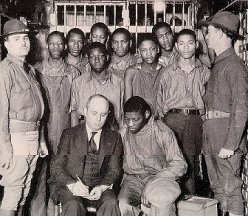
Scottsboro Boys
It may be coincidence but Leopard Men opens with the attempted rape of a White woman by a Black. Kali Bwana’s head man Golato enters her tent as the storm breaks with intent to rape her. Kali Bwana fires a shot at him wounding and driving him off. Golato then organizes a mutiny. Kali Bwana’s safari deserts her leaving her alone in the heart of the Ituri Rain Forest.
Storm and forest are sexually laden symbols.
So, a second impetus for the hurried writing of Leopard Men may have been the arrest, trial and conviction of the Scottsboro Boys. Boys, not men, to make them seem less offensive although it would be construed as a racial insult by Blacks.
Now, the pressures on Burroughs were coming from the Left. The pressure was not obvious and overt but clandestine and secretive. Could he be provoked to make the first obvious move placing the onus on him? The question then arises as to whether Leopard Men represented the Communists and their Fellow Travelers who functioned as a secret society in America. As the post-WWII investigators into the Communist influence in Hollywood would prove, none of these Communists, many of them Soviet agensts, would even admit that they had ever been more than ‘liberal.’ When asked where they now or had they ever been Communists none of them would give a simple yes or no answer. They took the Fifth. To answer would incriminate them. Right.
Many of these Hollywood people, Dalton Tumbo, John Howard Lawson and others were already established in Hollywood by 1934. Communist sites on the internet now list them as having been Communists at the time. Soviet documentation obtained after the fall also confirms this. A leading Jewish Congressman from New York, Samuel Dickstein, was on the Soviet payroll. It was he who originated the House Un-American Activities Committee of which the purpose was meant to be to run anti-Communists to earth. To Dickstein and his Soviet handlers it seemed like a good idea at the time.
The key fact is that, through Dickstein, Stalin and the Soviets were able to exercise extreme influence on the American political system even directing American policy. Had the chairmanship of HUAC fallen into Dickstein’s hands there is no doubt that he would have forwarded Judaeo-Communist goals while putting what he was pleased to call un-American citizens in jail. In 1944 the ADL/AJC did just that causing pre-war dissidents to be arrested and tried for treason.
Hollywood Reds insisted that they were ‘liberals’ seeking ‘social justice’ and were completely uninfluenced by Soviet agents or handlers. Using Dickstein as your model you can see that the probability of this being true is nil. While Studio heads like Mayer, the Warners, and Harry Cohn maintained a cover of being All-American Boys while not recognizing that their Studios which were managed closely from the top were not controlled by Reds must be pure bushwa. They had to be involved if not ringlearders. But none of the Hollywood people wished to be known as Communists. They were all taken advantage of by Left wing groups. What a bunch of overly naive innocents.
So, Leopard Men can be read as a portrayal of this very dangerous situation in which ERB found himself. The Leopard Men with their secrecy and infiltration of all the tribes can easily be equated with the Communists. The witch doctor, Sobito, of the Utengas who pretends to be a loyal Utengan while he is actually a Leopard Man betraying his own people into their hands is a prime example as on a more proletarian level is Lupingu who actually betrays the army of Orando.
So, one might say that Uncle Joe Stalin, to use FDR’s term, with his love of movies had an actual hand in Hollywood, one of the two capitols of the Communist world, the other being Moscow. It is not improbable that story lines were formulated in Moscow being sent to traitors like Dalton Trumbo to be worked up into serviceable scripts for American consumption.
Stalin’s agent H.G. Wells who was making derogatory attacks on several honest writers was writing furiously at this moment. As much as I personally like Wells, the man must be debunked. Wells met with Charlie Chaplin, another notorious Red, in Hollywood in 1935. Already a courier between Uncle Joe and Roosevelt, what messages did he carry to Chaplin and the Hollywood Reds? Remember Wells wrote the propaganda novel The Shape Of Things To Come in 1933, followed by the movie Things To Come in 1935. If you haven’t seen the movie of which Wells had nearly complete control it is worth seeing. More than once.
Leopard Men as a possible commentary on the Utopian Wells presents what must be the most vile dystopia ever conceived. Worse than Orwell. As in Invincible of the year or so before in which Tarzan singlehandedly foils Stalin and the Soviet plot, in this one he destroys the Leopard Men. At least within the vicinity of Utengans which might be to say, Hollywood. It is only after the Leopard Men are destroyed that Tarzan pays any attention to Kali Bwana and Old Timer thus there are two stories. In the battle between the Utengans and Leopard Men , Tarzan once again gets his head bashed but when he comes to he has regained his memory. No longer Orando’s Muzimo he goes back to his old ways as Lord Of The Jungle.
Interestingly the first thing he does when he comes to is call for Nkima. The two are inseparable in this novel. The relationship between the two and their characters deserves an in depth study.
By the time the novel was written in July-September the proceedings for the making of Tarzan, The Ape Man must have been well advanced. I’m not ware of the date that Weissmuller was selected for the role but probably by or during this time. He would have needed time to memorize the lines or at least perfect the Tarzan yell. Nor do I know the exact date ERB obtained his copy of W.S. Van Dyke’s Horning Into Africa. I would imagine that he had at least met Van Dyke by the time of writing. Possibly ERB’s rather gruesome concentration on cannibalism may have been meant as a refutation of Van Dyke’s statement that there was absolutely no proof any African had ever been a cannibal. There’s fair evidence in Horning Into Africa that Van Dyke knew which side his bread was buttered on expressing himself accordingly.
While ERB took his main frame from the Horn book and movie he gussied the story up with plenty of his own motives and themes. Just as Invincible was anti-Communist so Leopard Men probably is too. Since we’ve covered the politics we might as well go on to religion in Part III.
A Review: Part I,Tarzan And The Leopard Men by Edgar Rice Burroughs
October 25, 2011
A Review
The Tarzan Novels Of Edgar Rice Burroughs
Themes And Variations
#16 TARZAN AND THE LEOPARD MEN
by
R.E. Prindle
Introduction

Edgar Rice Burroughs.
While Tarzan And The Leopard Men is not well thought of by Bibliophiles being considered the worst of the series, I can’t find any reason to believe this. I couldn’t place it in the top five but the book is on a general par with the rest of the series, perhaps a little better.
I think the problem arises because it is thought to portray the African in a negative light. As with the Mafia there are those who deny the Leopard cult because it is offensive to their sensibilities. They prefer to see the African as a ‘noble savage.’ I have no problem with this attitude but I prefer historical accuracy to anything I might wish to believe.

Trader Horn
The existence of the Leopard cult in no way diminishes the character of the African. Secret societies are part of every culture in this multi-cultural world. Many of them are murderous. The Assasins of Hasani Sabah of Persia are a notorious example. The Illuminati who were responsible for the worst atrocities of the French Revolution are another. The Freemasons who while perhaps not so violent function, have functioned and do function as a secret brotherhood who help each other against society. The Mafia and Organized Crime in general are secret societies on a par with Leopard Men. During the thirties Lepke Buchalter ran the infamous Murder, Inc. So I see no reason to lower one’s opinion of the book because it may seem to certain sensibilities, by no means shared by all, to disparage the Negro. The events in the Congo after independence and the events in Shonaland happening now are so horrific they make the Leopard Men seem like novices.
The book Tarzan And The Leopard Men was written over July-September of 1931; a trifle of a rush job even for a fast writer like Burroughs. The story was published in Blue Book from Auguast 1932 to January 1933. Book publication was delayed until 1936 so there may have been some editing to reflect personal events over that period.
As the novel shows a rather direct influence from both the book and movie of Trader Horn Burroughs may have received some criticism from the magazine publication hence delaying book publication until time had dimmed the memory.
When Burroughs formed his publishing company he had expected to write a Tarzan novel a year. That schedule would have been adhered to except for this novel that was interjected into the series out of order of its writing.
The cause of the disturbance is very easy to find. In February of 1931 MGM released it great African epic Trader Horn. According to the ERBzine Bio Timeline for the 1930s, on February 23 ERB and Emma drove into Hollywood to catch the show. So we do know exactly when he saw the movie, or, at least, the first half of it. At intermission Emma remembered that they were to babysit for daughter Joan drawing her husband from the theatre. I’m sure ERB steamed over that for more than a day.
At that date he was in the midst of writing Tarzan Triumphant but Trader Horn aroused him so much that he began to plan a rejoinder. After completing Triumphant in May he conceived Leopard Men and rushed it through. Perhaps ERB thought Horn infringed on the Big Bwana’s African domain as Leopard Men is a virtual reformulation of Horn using elements from both the book and movie. Of course ERB ‘adapted’ Horn for his own needs. Trader Horn was to be an influence on the rest of the series.

The African Chief
Trader Horn as a book first appeared in 1927. It was a non-fiction best seller in both ’27 and ’28, in the top five for both years, a tremendous success. That alone might have aroused ERB’s jealousy. Whether he read the book between its issue date and his viewing of the movie isn’t known but that he had read it by the time he wrote Leopard Men is clear. The title does not appear in his library although Director W.S. Van Dyke’s 1931 story of the African filming, Horning Into Africa, does. ERB undoubtedly used Van Dyke’s book as background for his 1933 effort, Tarzan And The Lion Man.
Don’t look for a copy of Van Dyke in your library; the book was privately printed and distributed. Copies are available on the internet but at collector prices of from one to several hundreds of dollars. Thus it will readily be seen how large a space Trader Horn formed in ERB’s consciousness.
I’m sure that when Emma dragged him from the theatre to babysit, ERB had no idea how influential Trader Horn was going to be in his life. For at least three years his career centered around it. In 1931 he saw the movie, possibly read the book for the first time and wrote Leopard Men. In ’31 the contract with MGM surrendering the rights to the portrayal of his Tarzan characters was signed. Then Van Dyke and Hume fashioned Tarzan, The Ape Man after Trader Horn. Tarzan, The Ape Man was a major success changing the public’s understanding of the character of Tarzan from a literate cosmopolite to feral child. In answer Burroughs wrote a parody of Van Dyke’s African filming of Trader Horn. When the screen Tarzan, Johnny Weissmuller, gave up the role in the late forties he put on some clothes and became Jungle Jim who might very well have been modeled on Trader Horn. Perhaps an inside joke.
2.
Trader Horn and Ethelreda Lewis
At the time Alfred Aloysius ‘Wish’ Smith otherwise known as Trader Horn told his story to the woman who wrote it up and got it published, Ethelreda Lewis, he was a seventy year old derelict living in a doss house in Johannesburg, South Africa. Etheldreda Lewis was a well-known South African novelist.
Horn made his meager living by making wire gridirons and selling them door to door. He had developed a sad sack routine meant to induce housewives to buy his gridirons out pity. It worked with Mrs. Lewis.
She engaged him in conversation. As a novelist she realized he had a story to tell, she encouraged him to do so. Horn wrote up a chapter a week bringing it to her on Mondays. As she treated him respectfully offering him tea and cakes and a last chance at self-respect before he peeled off for the other side of the river he managed to prolong his story over twenty-six chapters and one presumes as many weeks of tea and cakes. Trader Horn the book is indicated to be Vol. I. There is a volume two telling of his other adventures. Vol. I is currently in print for 16.95, probably less on Amazon. Highly recommended.
In addition to Horn’s story Mrs. Lewis also recorded their weekly conversation which she appends to each chapter. Horn makes some very interesting and timely observations, a little sad but on the knowing side. I’m sure ERB was sympathetic as Horn confirmed his own beliefs. Altogether a very interesting and entertaining book which should have been a best seller not only for two years but more.
Horn’s experiences were so wonderful that naturally the question has arisen as to how accurate his recollections may be. I have read a number of vulgar opinions stating that Mr. Horn was a liar. I take offense at such an assertion. The man was relating his life. He may possibly have gotten a few details wrong but, as they say in Hollywood, his life was based on a true story.
I have read the book five times now within the last four years. My opinion as to Horn’s veracity is this. He very much wants to please and prolong a pleasant interlude to a rather grim life at the time. He had read a number of books including Burroughs and Du Chaillu. He claims to have known the French explorer De Brazza. He was an educated, intelligent and experienced man. He had apparently always had literary leanings.
Everyone has to be somewhere every moment of their lives and I have no doubt that Horn was on the Ogowe River in Gabon at the time he says he was. As a reader I hope I can perceive the ring of authenticity in a man’s reminiscences . Also I have been around myself enough to have seen some things, even seen some repeatedly, for which I get looks of incredulity, so just because I haven’t seen some things doesn’t mean they aren’t true. I reserve the right to question them to myself but stranger things have happened than I’ve ever seen.
While Horn is telling his own story I think he tries to make a good story better combining fiction with a factual tale. One questions his story of the White Goddess, Nina T. That story just doesn’t ring true. It seems like he borrows a little from ERB. Nina T. has been the Egbo goddess since the age of four, five or six being now in her twenties. She was the daughter of an English trader George T. who died when amongst the Blacks. They then appropriated her to groom as their White Goddess.
While Horn is plotting to spirit her away he has to communicate with her in writing, one imagines cursive. He has to explain how she can read, write and understand English. Nina T. and Tarzan should have gotten together. Horn explains that before George T. died he taught the very young Nina how to read and write using a picture alphabet book. Over the intervening twenty years or so Nina never forgot, itself a great feat of memory. Not quite as amazing an accomplishment as Tarzan teaching himself to read and write from possibly the identical picture alphabet book but still very impressive.
The natives also have a giant ruby as a fetish that Horn says he lifted by having a replica made solely from a description he sent to his friend Peru. As he was the first White man to be initiated into Egbo such a betrayal of his oath doesn’t speak well for his integrity or trustworthiness.
Thus, while I don’t have any trouble believing his trading and hunting adventures I have to conclude that as Burroughs would say, he was ‘fictionizing’ the rest. Nevertheless it makes a good story and if relating it made him feel good so much the better. No reason to call him a liar and his story lies.
One has conflicting reports on his subsequent life. On one hand there is a story he lived well off the proceeds of the book in England. When he was about to die the story goes that he said: Where’s me passport, boys, I’m off to Africa. Famous last words, indeed. On the other hand it is said that he died in 1927 in SA before he received the fruits of his labor. I would like to think he lived long enough to see a version of his story on the silver screen. If he had one imagines he would have been brought to Hollywood for the premier. He wasn’t.
So, whichever way he went, a tip of the hat for you Trader Horn.

Filming Trader Horn
3.
Horn, Van Dyke, Hume and Burroughs
Had ERB known of Trader Horn in far off South Africa turning in his weekly installments to Mrs. Lewis I doubt if he would have realized how large a part Horn’s story was to play in his own life.
When the book was published and became a bestseller, something which Burroughs must have heard of, there must have been a glimmer of interest but still no recognition of Horn’s future impact on his life. When he saw Van Dyke’s movie he was duly impressed and was influenced but still probably had no idea of what loomed ahead.
By 1932’s MGM movie, Tarzan, The Ape Man, he had begun to realize the significance of Trader Horn to his own life. When he sat down to write Tarzan And The Lion Man the Old Campaigner was aware. While no copy of Trader Horn found its way into his library we know for certain he read it. A book that did find its way into his library was W.S. Van Dyke’s account of the filming of Trader Horn, Horning Into Africa of 1931. This book was used as the basis for Tarzan And The Lion Man.
It seems certain that Van Dyke read Trader Horn shortly after issue. By 1929 as the book was moving down the charts Van Dyke, a cast of many and several tens of tons of equipment were moving to Africa to form a safari to end all safaris. Not since Henry Morton Stanley in his quest for Livingstone had Africa seen such a spectacle.
Trader Horn was the first entertainment film shot on location in Africa. All the footage was authentic except those scenes shot on lot in Hollywood. I’m learning to talk Hollywood…all, except. The movie was a mind blower when it hit the theatres being one of the biggest grossers of all time. Burroughs saw it, picked up his pen, dictaphone or whatever, and following the script and book closely dashed off Tarzan And The Leopard Men leaving out the bit about the music box. Let’s compare the three versions of Trader Horn.
In the book Horn is the central character. He is a young man of seventeen or eighteen who has run away from school. Peru, his schoolhood chum, does not enter the story until the very end. His faithful Black companion, Renchoro, plays a very secondary auxliary role.
In the movie Horn is a grizzled Old Africa Hand tutoring his young pal, Peru. In the opening scene they are sitting around the campfire before setting out for the interior.
Burroughs follows the movie in having Old Timer teaming up with his young pal, The Kid. Even though the character of Old Timer seems to be based on a man of Burroughs’ age it is explained that he is under thirty while the Kid is twenty-two. Maybe ERB looked old but felt young.
In Horn Nina T. is a dark haired beauty the daughter of an Englishman George T. and an octaroon which means Nina is one sixteenth Negro but not so’s you could tell. She is literate, after a fashion, being able to read Horn’s handwritten notes in English. Horn buys her European clothes which she wears while yet a goddess.
In the movie Nina is a real primitive with the brain of an ape. Burroughs may have been thinking of her when he created Balza of Lion Man. She is astonishingly well played by Edwina Booth who has a mane of blond hair that would have gained her entrance as the queen of the Hippies in the sixties. A very exciting appearance. Just as Van Dyke and Hume made Tarzan an illiterate they show no favors to Nina. She couldn’t have begun the the alphabet let alone recite it.

The White Goddess And Her Subjects
In the book her mother died before her father. In the movie Horn and Peru encounter her mother walking through the jungle in search of a daughter lost twenty years previously. I laughed. I wouldn’t know if anyone else did as I was watching alone in front of my TV. By the way the VHS I was fortunate enough to buy new for twenty dollars, now out of print, is advertised on Amazon for up to one hundred seventy-five dollars. What a strange world. I hope they issue it on DVD. Maybe this essay will spur enough interest.
Horn coyly refused to give Nina’s last name as she is an heiress to the T. fortune which had been claimed long before. The movie boldly proclaims her as Nina Trent.
As Burroughs tells it, the future White Goddess is known as Kali Bwana, a name the natives gave to her. Her real name is Jessie Jerome. Her brother is Jerome Jerome. This is probably a coy reference to the English writer Jerome K. Jerome whose classic Three Men In A Boat was in ERB’s library as well as Idle Thoughts Of An Idle Fellow. Three Men is supposed to be one of the most comic books in the English language. If so, it was too subtle or too broad for this reader. I didn’t find it amusing. ERB must have liked it. Jerry Jerome covers the Jerome Jerome parts of the name while the K of Kid provides the middle initial. Jerome K. Jerome.
The names are conceald from us until the very end of the book so there must be a haw haw there for the knowing reader. ERB calls Jerome Jerry never calling him Jerome Jerome.
Kali Bwana or Jessie Jerome is ‘what is known as a platinum blonde.’ So the goddess has gone from dark hair to the blondest. Jean Harlow had starred in Howard Hughes 1930 production of Hell’s Angels making her the Blonde Bombshell of Htown so ERB was duly impressed.
In the book Horn was a bright young man, in the movie, an old African hand. In Burroughs although ‘not yet thirty’ he is an Old Timer, a bum because of what a woman done to him. Since Kali Bwana/Florence redeems his attitude toward women we are free to assume that Emma was the woman what done it to ERB.

Kali Bwana is deserted in the jungle by her safari because she refuses to submit to the embraces of her Negro headman. Old Timer discovers her camp where she tells him she is looking for her brother Jerry Jerome, in yet another parody of Stanley and Livingstone. Old Timer and the Kid have never asked each other’s names so Old Timer has never heard of Jerry Jerome, even though he is Old Timer’s partner. Thus the rest of the story need never have happened had they known each other’s names. ERB likes this sort of thing, using it often.
Old Timer puts Kali Bwana under his protection which proves ineffective against the Leopard Men who seize her and carry her away to their Josh house to be their goddess.
In the book Renchoro is merely an associate of Horn. In the movie Renchoro becomes virtually a romantic interest of Horn. Several scenes are tinged with homosexual overtones, especially Renchoro’s death scene while when Peru and Nina T. board the paddle wheeler for the return to civilization and Horn remains behind a big balloon containing a picture of Renchoro appears as a hearthrob for Horn. Horn returns to the jungle presumably to find a substitute for Renchoro. Interesting comment on the Black-White relationship.
In the Burroughs’ story the Black-White relationship is removed to one between Tarzan and Orando. Tarzan has a tree fall on his head as the story opens not unsurprisingly giving him another case of amnesia. Orando happens along. He is about to put an arrow through the Big Bwana when Tarzan speaks to him in his own dialect. A handy thing to not only know every dialect in Africa, human and animal, but to know when to employ the appropriate one. Probably has something to do with a refined sense of smell.
Speaking of ape languages, Spain is about to vote on a measure giving apes human status in the country. So not only is the human species to be counted politically in Spain but leaping the Last Hominid Predecessor, an entirely different evolutionary strain is to be accounted human. It will be interesting to see how the Spanish ape population votes.
Orando then mistakes Tarzan for Muzimo or his guardian spirit. Thus for most of the book the relationship between Muzimo and Orando is that of the movie between Horn and Renchoro. And also between God and Human.
Horn traded on the Ogowe River in Gabon. Much of his story concerns his navigation of the Ogowe and its tributaries. Unlike every other African explorer I have read Horn makes Africa seem a wonderland. Every other writer makes Africa dark and forboding with piles of human skulls laying around, walkways lined with skulls. Horn’s Africans are laughing back slappers who are merry even as they are shooting and killing each other. The rain forest along the Congo depresses all other explorers but Horn finds the Ogowe otherwise. The skulls are still there but Horn apparently finds them amusing. The river Horn navigates unlike those of Conrad’s Heart Of Darkness or Stanley’s Through The Dark Continent and In Darkest Africa is a bright cheery place. Maybe it’s all a state of mind.
Van Dyke has only one river and that does not play a central role while it is on the dark side, a river of death. It is also the Nile in East Africa. Most of the movie takes place on terra firma.
Burroughs makes the rivers central to his story but they are dark, violent rivers of death. ERB borrows more heavily from Stanley on this score than he does from Horn. Actually, if one is looking for similarities there is some resemblance of Horn’s story to the Beasts Of Tarzan, but the latter is based on Edgar Wallace’s Sanders Of The River. We don’t know what of Burroughs Horn read; it is quite possible that he read a few of the six or seven Tarzans available in his time.
Horn has the Egbo fraternity practicing their rites in a long building quite similar to that employed in Burroughs’ Cave Girl of 1913. Horn would have had to have read that in magazine form which is possible but seems a stretch.
Van Dyke has his rites practiced in the open. Horn originates the idea of crucifying the victims upside down so that when the head is cut off the blood drains into a pot for ritual uses. Van Dyke includes an upside down crucifixion but leaves out the more grisly details.
Burroughs dispenses with the crucifixion scene entirely relying on his often used cannibalism. This may be one of the reasons the book is disliked. In the sixties the traditional cannibal cooking pot was derided as a false stereotype of the African. It was denied that cannibalism had ever been practiced in Africa. Black musical groups in the US like Cannibal And The Headhunters ridiculed the facts. Thus imputing cannibalism to Africa became bad taste. Perhaps when Leopard Men was reprinted in 1964 its heavy reliance on such rituals prejudiced a certain mental outlook against it so the story was derided as the worst of Burroughs novels. While very dark and even gruesome the story isn’t noticeably inferior to any of the others.
In the book Horn is not only on good terms with the various tribes but he was the first White man initiated into the Egbo society. Egbo is at its most innocent a sort of Freemasonic society and at its worst on a par with the Leopard Men. Horn describes Egbo as a sort of vigilante society who do in anyone any member has a grievance against. Neither Egbo nor Leopard Men figure into Van Dyke’s movie. As I understand it , Nina T.’s people merely practice savage primitive rites.
Burroughs who has moved his story from the Ogowe of Gabon to the Aruwimi of the Ituri Rain Forest with which he was familair from Stanley’s account in his In Darkest Africa relates the Leopard cult that was notorious at the time. Horn does have a lot of leopards in his story giving a detailed description of how their talons leave cuts looking like they were sliced by knives. His natives wear a lot of leopard skins. There isn’t much on Egbo available on the internet except a notice that it originated on the Calabar Coast which, if I’m not mistaken is where the Leopard cult comes from.
Fellow Bibliophile David Adams gives a good short account of the Leopard Men.
Burroughs undoubtedly had sources so that his presentation is based on facts of the Leopard Men but adapted for his own purposes. Thus he makes the Leopard Men the central idea of the story. Tarzan becomes involved with the Leopard Men through his role as the Muzimo of Orando. As an ally of Orando’s Utenga people Tarzan engineers the destruction of the Leopard Men’s village and cult in that part of his domain.
In Horn’s book as a member of Egbo he is familiar with the Negroes, a member of the cult and has full access to the ldge and, in fact, Nina T. He has no difficulty in rescuing her whatever. He had just previously defeated the Egbo chief in battle so that worthy was thoroughly cowed refusing to even give chase.
In Van Dyke’s movie Horn and Peru wander into an African Chief’s village attempting to trade. The chief is uninterested in trading seizing them as victims for his sacrifical rites.
Horn and and Peru as trade goods offer the chief a music box that the chief scorns. In the book the music box is known as Du Chaillu’s Music Box. At some earlier time Du Chaillu while researching gorillas had left a music box and compass behind that enthralled the Africans. Peru shows up with another that they leave behind, presumably in payment for the monster ruby.
Van Dyke apparently thought the music box ridiculous while Burroughs doesn’t use it at all although he does follow the movie scene with the African chief closely.
In his version the Old Timer in pursuit of Kali Bwana learns that she was abducted by Gato Mgungu and taken to his village. Gato means cat so perhaps the name has some reference to leopards. Gato Mgungu is chief of the Leopard Men. Old Timer who has traded with Mgungu before barges into his village alone demanding he release Kali Bwana. In the movie the chief is a tall, extremely well built, handsome fellow. Quite astonishing actually, while Burroughs gives Mgungu a huge pot belly. Old Timer is given as short a shrift as the movie Horn. He is seized, dumped in a canoe and taken down river to the Leopard Men’s lodge also, as in the movie, destined for the stew pot.
In the book Horn and Nina T. are well acquainted. She trusts him and is eager to be rescued. They easily escape down river in Horn’s boat. In the movie Horn and Peru are shown o Nina T. who falls in love with Peru. Somehow an escape plan is concocted that she more or less leads. They are hotly pursued by her people. The band finds its way to the trading post on the river although Renchoro is killed.
Burroughs has Kali Bwana taken to the lodge where with titillating details involving gorgeous nudity she is prepared to serve as chief goddess of the Leopard King who is a real leopard along the lines of the various lion kings of Burrough’s stories.
Old Timer is held captive among the crowd of Leopard Men gathered for the rites. As Kali Bwana is led out they both recognize each other and gasp. Unknown to everyone the Big Bwana is up in the rafters observing everything. From then on he becomes the agent of deliverance.
In the book Nina T. having been rescued, Horn provides the happiest of endings. Horn and Peru have only one goddess between them. She must go to one or the other. The happy-go-lucky goddess is willing to take either the one or the other so they flip a coin for her. The outcome is obvious since Horn didn’t marry her. Peru wins the toss and gets the goddess. Peru is the son of the owner of one of the richest silver mines in the world in his namesake Peru. He has just come of age so he is one Porfirio Rubirosa. Nina T. has left the jungle to fall into unimaginable wealth. As I see her as nearly a feral child I do not envy Peru.
The two are married aboard ship by the captain then after a pleasant interlude in Madeira Peru and Nina go their way while Trader Horn and his ruby go another. Horn sells his ruby to Tiffany’s from whom he does quite well. The stone while large has flaws so he didn’t do was well as he might have.
In this volume at least Horn doesn’t mention ever hearing from Peru and Nina T. again. He may mention them in volume two but I haven’t read it.
In the movie with Nina’s tribesmen hot on their trail Nina and Peru go off in one direction while Horn and Renchoro lead the tribesmen on a wild goose chase. Renchoro is killed but Horn makes it back to the trading post. Peru and Nina are now an item. She has either quickly picked up enough English to understand a proposal and say yes or she just likes the color of Peru’s eyes. They offer to take Horn with them but that balloon of Renchoro pops up with the implication that Horn can find himself another African ‘boy’, which he seems to prefer. The paddlewheeler steams down the river with Nina and Peru while Horn turns back toward the jungle presumably in search of another ‘boy.’
Burroughs version is much more involved. Suffice it to say that after many tribulations the French army shows up to suppress the remnants of the Leopard Men who were destroyed by Tarzan and the Utengas. Jerome K. Jerome locates Old Timer and the goddess Kali Bwana. The latter two have been reconciled and now are in love with each other. When Old Timer learns that her real name is Jessie Jerome he fears the worst.
In one of Buroughs, name games Kali Bwana had refused to give him her real name insisting he should call her Kali. Old Timer refused to give his last name but confessed to being named Hiram. Perhaps his last name was Walker. Kali could him ‘Hi.’ Just as there is a joke in the Kid being Jerome K. Jerome there is probably a joke in Old Timer being called Hi.
I refer you to Lewish Carroll’s Hunting Of The Snark:
There was one who was famed for the number of things
He forgot when he entered the ship- but the worst of it was
He had wholly forgotten his name.
He would answer to “Hi!” or any loud cry,
Such as “Fry me!” or
Fritter My Wig!”
There is a copy of The Hunting Of The Snark in ERB’s library so he must have read and reread the poem, as well as, one might note, The Rubaiyat Of Omar Khayyam, so I think telling Kali Bwana she could call him Hi or any old thing is another of his literary jokes which are sprinkled throughout the novels.
Old Timer is overjoyed when he learns that Jerry and Jessie are brother and sister instead of husband and wife. As they are about to board the old paddle-wheeler, as in the movie, Jessie asks Old Timer to come with her. (Old Timer plays coy.)
The sun was sinking behind the western forest, the light playing on the surging current of the great river that rolled past the village of Bobolo. A man and a woman stood looking out across the water that plunged westward on its long journey to the sea, down to the trading posts and the towns and the ships, which are the frail links that connect the dark forest with civilization.
“Tomorrow you will start,” said the man. “In six or eight weeks you will be home. Home!” There was a world of wistfulness inn the simple, homely word. He sighed, “I am so glad for both of you.”
She came closer to him and stood directly in front of him, looking straight into his eyes. “You are coming with us,” she said.
“What makes you think so?” he asked.
“Because I love you, you will come.”
It can be plainly seen how all three versions of this scene are related while being derived from the original of the novel. As Burroughs adapted the movie version of the relationship between Horn and Peru he followed the movie ending.
Thus the novel and movie reoriented his own approach to Tarzan novels. The relationship of the three stories has literary repercussions. While it is plainly seen that Burroughs was, shall we say, highly inspired by Horn’s novel and Van Dyke’s movie, what might not be so apparent to the untrained eye is the extent to which both Horn and Van Dyke were influenced by the work of Burroughs which preceded theirs by a couple decades.
Horn admits to being familiar with the Tarzan stories. He was a first time writer here, while he had his own story to tell, he needed a format. He has chosen to emphasize many characteristics of the few Tarzan novels he could have read by 1925. While the Ogowe River figures in his life he probably would have been excited by the river scenes in Beasts Of Tarzan. He treats elephants and gorillas that he had actually seen in the wild differently than Burroughs but includes generous doses of both because they have worked for Burroughs.
Viewing from a distance as we are compelled to do one loses the savor of the times. A Burroughs reading Horn carefully might easily have picked up many references that slip by us.
Van Dyke and Hume on the other hand had been exposed to Tarzan movies for a dozen years or so. What they read can’t be so obvious. But the very format of the jungle thriller would have derived from previous Tarzan movies. ERB may have felt he was entering a turf war as the Big Bwana’s domain was being invaded.
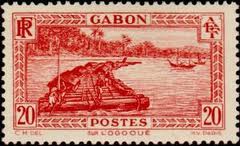
Timber Raft On Ogowe River
He may have believed himself justified in expropriating the expropriators. If Horn died in 1927 his opinion no long mattered. What Ethelreda Lewis may have thought isn’t known. She apparently had a hand in writing the movie script for Swiss Family Robinson. Whether she came to Hollywood to do it I am not informed although she was around the movie capitol for a number of years. A meeting between her and ERB would have been interesting.
What Van Dyke and Hume may have thought I am equally uninformed, however between the release of Horn in February 1931 and the release of Tarzan, The Ape Man in March of 1932 was a year during which a contract was negotiated between MGM and Burroughs for the use of his characters but not of any of his material on April 15 of 1932. (Erzine Bio Timeline, 1930s). Within nine months then the movie Tarzan, The Ape Man was in the theatres.
The generally expressed view is that Hume first wrote up a script involving a combination Horn and Tarzan story. This was before they might have seen Leopard Men in print. To quote William Armstrong from ERBzine 0610:
Cyril Hume who had turned the filming of “Trader Horn” in Africa into a suitable story outline, was given the assignment of writing the script for Tarzan The Ape Man, Hume’s original script had Trader Horn leading an expedition to Africa to search for a lost tribe. En route, they discover Tarzan, who kidnaps the woman scientist member of the safari. She eventually returns to the safari and they are captured by the tribe they seek (who worship the moon), and are to be human sacrifices to a sacred gorilla. Tarzan leading a pack of elephants, arrives in time to save the safari. The woman scientist decides to stay with Tarzan while Trader Horn and his party return to the trading post.
Map Of Gabon And Ogowe River

This script may give some idea of how conventional Hollywood minds viewed both Horn and Tarzan. Apparently the relationship between th two was very close in their minds. This script leaves little room for the development of the Tarzan yell while it gives the feel of making Tarzan a subordinate character to Horn. Tarzan might or might not have been a part of the next Horn movie. If MGM continued to use Harry Carey in the Horn role he may very likely have had a stronger film presence than Tarzan who, one imagines would still have been portrayed as a feral boy as he essentially was in Tarzan, The Ape Man.
It would be interesting to know when MGM decided to film a Tarzan movie and in what connection to Trader Horn. The success of Horn may have prodded them but one is astonished at the speed at which the project was conceived and executed especially as we are led to believe that they had no actor to play Tarzan in mind when the contract with ERB was signed.
As Leopard Men was probably not even fully conceived in ERB’s mind when he signed it could have had no effect on the signing. The release of Tarzan, The Ape Man in 1932 did have an effect on Burroughs. After writing Tarzan And the City Of Gold from November of 1931 to January of 1932 he was stunned by the MGM characterization of his great creation.
That shock resulted in early 1933’s novel Tarzan And The Lion Man.
As influential as Horn was for the main frame of the story of Leopard Men ERB had all his usual themes and variations to employ which he lavishly did. This is a very dark story that I do not fully understand. The Trader Horn connection was the easy part. Now to the hard stuff.

A Review
Great Groupies Of The Sixties Series
Lick Me
by
Cherry Vanilla
Review by R.E. Prindle
Vanilla, Cherry: Lick Me, 2010, Chicago Review Press
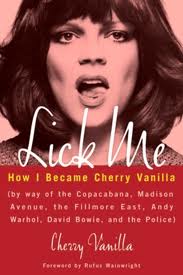
Kathie
Part 3
Intro
Since writing Part 2 an interesting development has occurred. In what might seem an unexpected twist, according to the Cherry Vanilla website it has been decided to make a TV series of her autobiography. Given the life she has lived it is hard to believe the series wouldn’t be a salacious affair. Her biography is mainly a list of her sexual and drug escapades some of which are almost too much for the printed page. We will have to see.
Having brought her story up to graduation Kathie’s post high school life can be divided into three segments with an aftermath. The first period from 1960-66 might be described as exploratory, the second commencing from her introduction to Dr. Bishop in 1966 to 1971 might be described as a period of wild abandonment when she decided to become a relatively aged groupie, the last period can be divided into the Warhol period when she starred in his stage play, Pork, and her time with Bowie before attempting to become a Punk star. With the collapse of her hopes when her Punk escapade failed and all her hopes were disappointed she was plunged into a period of despair and depression as her personality disintegrated leaving her life a wreck of her hopes. She was finally saved when a hand was extended to her by the musician Ianni.
Whatever financial gain she receives from the projected TV series with a little luck now that she is sixty-eight might give her some financial stability for the rest of her life unless she blows that ruining what is probably her last chance.
1.
There are many who believe the individual is completely responsible for his choices in life but I’m a firm believer that you have to play the cards you’re dealt. Even if the choices are yours they are limited by the possible. It’s possible to squander a good hand but very difficult to parley a bum deal into a pot winner.
Kathie’s childhood had its difficulties, its highs and lows but the significant incident of aborting her dog Lady’s pups seems to have formed the psychological basis for Kathie’s choices in life.
On the one hand she had a dismal home life with a boorish uncultured father but on the other she was introduced to cultural society by being introduced into the household of the actor Don Ameche through a friend. She spent weekends living a childhood high life in Amerche’s hotel suite as a friend of his daughter where none of the pleasures of room service and other amenities were denied them. She was allowed, as it were, to participate in the pleasures of Fifth Avenue society in ways that positively affected her future expectations while giving her a background that allowed her to fit in. The contrast between the two modes of life would greatly influence her outlook and early success. She did have a promising start in life that she threw away.
The most influential incident in her life was when her father discovered that her Dalmatian, Lady, had been mounted by some black mongrel. Rather than accept the situation, for some seemingly irrational reason, her father decided to destroy any chance of fertilization by scouring the dogs womb with boiling water.
The shrieks and howling of the poor dog penetrated deep into the subconscious of the young girl giving her her central childhood fixation. Shortly thereafter she developed an Obsessive-Compulsive Disorder that plagued her throughout her autobiography; what she called her OCD. While she doesn’t describe the wounds she inflicted on herself by tearing at her skin she apparently tore her flesh to the point of leaving scars.
Thus the Aces and Kings were removed from her hand severely limiting her decisions while compelling her to go in directions better avoided. The tragedy is that she chose the road of drugs and sex rather than some serious self-analysis. Like most central childhood fixations the memory of the event is strong but the reaction to the event is obscured and hidden while too difficult to face without some direction. Having suffered a similar childhood fixation myself, which I was able to solve by self-analysis, my sympathies are with Kathie.
The worst of it for Kathie was her excessive use of drugs. Drugs tend to destroy the conscious resistance to the fixation eliminating the barrier to the full expression of sub-conscious compulsions giving the unconscious full unobstructed expression. At the height of her sexual activity as Kathie notes her OCD disappeared being replaced by the repressed sexual equivalent. Old OCDs for new. That was the hand she was dealt.
2.
Growing up in a poor area of Queens might have been an impediment to success except for her friendship with the Ameches and also with a sort of introduction to show business because her mother worked above the Copacabana nightclub which led to Kathie’s seeing many of the big stars and meeting several of them, most notably her favorite, Dean Martin.
After graduating from high school Kathie was first attracted to the Madison Avenue advertising world. He landed a job with the Sullivan, Stauffer, Colwell & Bayles advertising agency. She landed a plum of a job straight out of the box. She assumed a role not too different from the portrayal of Peggy Olson in the Mad Men AMC TV series.
Seeking other opportunities she quit that job to join the firm of Kastor,Hilton, Chesley, Clifford & Atherton in a similar capacity. There she was introduced to the homosexual world as her associates there were all or mostly gay. As a young woman she could not have been aware of the rapidly developing influence of homosexuality on life in New York City. The Stonewall Riot was a short eight years away after which for all practical purposes homosexuals took over the cultural life the city.
For decades New York City had been the destination of homosexuals from the South and Mid West who flocked to New York as a haven. Over the decades the homo population grew. As the sixties began critical mass for their conquest of the Big Apple was reached. Kathie fell into the group through her advertising connections.
The obvious became undeniable in 1966 when Time Magazine published an article lamenting the degree to which homosexuality had infiltrated the infra-structure of NYC. It has to be obvious to the blind, deaf and dumb before the media notices anything. Kathie relates this influence in a sort of perplexed tone. Perhaps Queens in the fifties was relatively straight or closeted so that Manhattan was a revelation to her.
The homosexual migration to NYC might even be considered in the light of the Great Internal Migration of the Negroes from South to North and West. During the Great Coming Out from 1960 to Stonewall in 1969 homosexuals became increasingly open while increasingly setting the sexual and social mores of the city. Kathie first began here working career in advertising on Madison Avenue. She appears to have become enamored of what she calls Mad Men, perhaps after the TV show or perhaps the TV show aped reality, at least to that extent. Don’t know.
Kathie’s second agency job turned out to be a nest of homos. Thus per the Time article homos were not only becoming paramount in NYC but began, or perhaps continued, to shape continent wide mores always tending to stretch sexual limits.
Of course as Kathie was already stretching heterosexual mores to the limit this presented no problem to her. Just as she indulged her drug usage with few limits so she indulged her sexual activities with no limits being open as she proudly acclaims to anything.
She was first taken to Fire Island by Mad Men at the hetero resort. Her curiosity drove her to the homo enclaves of the Pines and Cherry Grove which became a fascination to her. According to her LSD had not yet reached the Pines, so ever a pioneer, Kathie made the trek to the Pines with her purse laden with tabs. As no cars were allowed on the island Kathie had to walk down the beach. She says she changed the direction of the gay crowd.
Whacked out on whatever there was no barrier to her unconscious desires so Kathie was able to do things without qualms while she associated the impregnation and aborting of her dog as a reason for her uninhibited exhibitionism. She was however compulsive in avoided impregnation herself. Although the pill was around she preferred to use an IUD. Kathie was ready to copulate in public at the drop of a hat. Thus in this 1960-66 period at a big bash at the Pines the homos had hired a hetero bartender by mistake. A little eye contact between he and Kathie was enough to incite them. They jumped up on the counter and went at it.
As Kathie says if it had been two homos nothing would have been said but hetero sex was too much for the Guys who expressed their displeasure. Strange attitude in a bunch that would make fisting a form of public entertainment a few years hence.
It may prove interesting to see what they make of the TV series as Kathie’s whole book is a record of her really extraordinary sexual and drug escapades. While she was still working on Madison Avenue she began moonlighting as a disc jockey at the club Aux Puces. The night club scene was still tightly controlled in NYC at this period. The most that the Guys at Stonewall were doing as late as ‘69 was dancing together. The wide open S&M and fisting surfaced after Stonewall which resulted at the end of the seventies in the public hetero and homo sex at first Studio 54 and subsequently throughout Bohemia. Kathie once again was a pioneer which is what perhaps the TV series will concentrate on.
In 1966 Kathie was introduced to the Feelgood Dr. Bishop (this may be his real name) who she patronized until 1970 when she was persuaded to stop. Dr. Bishop brought in a whole new level of drug taking further erasing the line between the conscious and subconscious- in other words, Kathie was now in full dream mode. In the Freudian sense Kathie had accessed her unconscious with little or no censorship from the conscious mind. She was free to indulge her libido with no sense of shame or guilt as we shall see when she becomes a groupie.
While drugs made her oblivious to the reactions of others by 1966 if not before she had created a reputation of sexual abandonment that made her repellant to many men and this may have influenced her decision to become a groupie. She slowly moved downtown from Madison Ave. into the lower reaches of the Bohemian East Side. She was no longer employable on Madison Avenue although they still threw her a bone occasionally.
She was still working at Aux Puces as a disc jockey but as the decade progressed and the homos became more and more obvious and open the hetero clientele of Aux Puces was driven away leaving the club 100% gay. This was too much for Kathie who had become progressively disenchanted of the homo scene, perhaps still brooding over her chastisement for performing hetero sex at the Pines, so she quit Aux Puces and decided that perhaps Groupieism was for her, especially as she was drawn to the musicians by her experience as a DJ.
Nineteen sixty-nine then marked a sea change in culture for herself post-Stonewall as well as for society at large. I don’t know how many of us were aware of Stonewall at the time and if we had been I’m sure we couldn’t have projected the societal changes of the next ten years. I don’t think anyone had even thought of disco in ‘69. I was in the record business on the West Coast at the time. I began a record store in a medium sized college town in ‘67 while my store was just taking off at the end of ‘69. While I was into pop culture- records and posters- I was still in a definite minority, almost of one. What the general population knew of pop culture was not good. Not that many at the university were aware of the sea change while none of the faculty was nor did they approve of it. Even posters were a relatively new phenomenon while the forms they were taking were well beyond the imaginations of most of us including myself. Warhol may have been old hat in NYC but the soup cans were still news out West.
New York was alien to those of us on the West Coast. We despised and reviled it. From San Francisco to the Canadian border along I5 the SF scene was what was happening. LA and SoCal was different. We were familiar with Warhol and when the Warhol tour of ‘67 appeared at the university as its last stop it was able to fill the university auditorium., perhaps a thousand people. That it was a faux Andy didn’t seem to bother the students so much. It was pretty clear that Midgette was an imposter. The administration felt defrauded however and demanded their money back. Rather our money although no attempt was made to refund our tickets.
The image of Warhol was a bit hazy. We’d read about him, heard of the superstars not knowing what to make of them but rushing events eclipsed their importance. I don’t think I even knew that Warhol was shot in ‘68. Perhaps his shooting was eclipsed by Robert Kennedy’s.
At the time Kathie decided to be a groupie the scene was already in decline. Altamont definitely ended the sixties. In 1970-71 the record business even became precarious supported during the entire summer of ‘71 by two releases: Carole King’s Tapestry and Cat Stevens’ Tea For The Tillerman. There were many days when those two records were virtually all that I sold. Then the Columbia Big Brother started to break the logjam; Janis Joplin somehow broke through to the middle class while the bands from ‘66 to ‘68 put out greatest hits packages and these and Led Zeppelin carried the industry through to ‘74. Then it was a disco run as homoseuxals took over the industry to the industry collapse of ‘79.
In 1969 then when Kathie decided to be a groupie, as I see it, she was running from a bad reputation into one that became much worse. Whatever talk there may have been about her could not have been good. Most of the groupies were very young girls; any rocker could have been picked up on a morals charge any day. That the federales didn’t do it is a wonder. Why worry about drugs which were difficult to prove when you got ‘em in a headlock over a thirteen year old girl. When Kathie decided to compete with the young stuff she was already a twenty-seven year old woman with sexual experience that few attain. I mean, when you reach a certain age you’re just not that cute anymore, you’ve crossed the line. Perhaps there was an aura of desperation about her.
She did manage to latch onto Burton Cummings of Guess Who in a very humiliating encounter. God, I don’t know how she survived it. In the first place Burton Cummings! I don’t mean to put Cummings down personally, who I am sure is a very fine person, but out on the consuming end of the industry Cummings and the Guess Who (Guess Who- what a super dumb name when there was already a group named The Who, also pretty dumb, had a semi stupid hit in American Woman and never could put together a first rate album) even then the rhythm section under the name of Bachman-Turner Overdrive put out a bigger LP than Guess Who ever could. The Guess Who were definitely third rate material. I used to groan every time Guess Who released another LP, them and Harry Nilsson- The Point!
The first time around was enough for Burton and then on her second attempt Burton deleted Kathie in New Jersey after all public transportation had closed down for the night leaving her without a dime in her pocket and no way back to NYC. A pretty desperate situation.
Indeed, desperate she ran back to the venue to beg the boys in the band to let her on the bus. They took her along on the loop through Philly and back to NYC. This is painful to relate and frankly I don’t know how Kathie could tell it but she gave blow jobs to all the boys in the band, minus Cummings, and then a their insistence blew the bus driver. The band dropped her off in the worst part of the Bronx, this is 1970, where she somehow cadged subway fare, found an entrance and got safely back to the Village.
I don’t know how she could psychologically survive that except that the drugs placed her mind safely outside reality. I can’t even guess how this is going to be told in the TV series.
Kathie had many other groupie adventures that I am only going to sum up in a poem she wrote commemorating her groupie adventures. I hope she won’t mind my quoting it in full. P. 95:
A GROUPIE’S LAMENT
Diamonds twinkle beneath my feet
On the Labor Day weekend street
Sunlight shines warm through my hair
You’d think there was no pollution there
Pimples sprout on my sleepless face
Varicose veins show the endless pace
My white dress dirty as I walk it home
But my head is up, so I’ll write a poem
I’m feeling beauty in my ghetto land
‘Cause I got it on with a rock and roll band
The trip was a long one; the bus was crazed
The guys and I were mostly dazed
We sang a few tunes from old rock and roll
And we hid the dope when we paid the toll
Burton ignored me, the silly fool
But the rest of the guys thought I was cool
From Asbury Park to Virginia Beach
I gave head like daybed philosophies teach
I feel good and I should and I even got a tan
On my two-day tour with a rock and roll band
You see I missed the last bus from the Jersey shore
And a taxi driver said that there were no more
So I went back to Convention Hall
And I got on their bus and I had a ball
The motels were sterile and the food was all plastic
But at their last set on Sunday I got freaked-out spastic
I know they all love me, ‘cause they told me so
As for Burton, well, I just don’t know
I’m the happiest broken heart, can you understand
‘Cause now I’m the friend of a rock and roll band
At that point Kathie’s life was going nowhere. Then Andy Warhol had Brigid Berlin’s taped phone conversations with her mother turned into a play he named Pork, tapped Kathie as Cherry Vanilla for the lead role of Brigid.
Part 4 follows.
Edgar Rice Burroughs Vs. The Comic Book Superheroes
September 20, 2011
EDGAR RICE BURROUGHS VS. THE COMIC BOOK HEROES
by
R.E. Prindle

Adventures In The Unconscious
In the attempt to put together a historical puzzle the missing piece or pieces, the clarifying pieces, appear from time to time. Thus with the release of the movie, Captain America this year a significant piece of the puzzle falls into place that clarifies the role of Edgar Rice Burroughs and his literary creations in the panorama of the twentieth century- the fabulous twentieth century.
It is difficult today to conceive of how the early twentieth century was perceived as a complete break with the Victorian nineteenth. One only has to compare the streamlined Santa Fe Chief in this picture alongside a nineteenth century locomotive to see how the Twentieth Century was perceived as the century of absolute exciting progress. The time certainly justified General Electric’s motto: Progress is our most important product.

Twentieth Century Unlimitied. Santa Fe Super Chief Alongside Nineteenth Century Locomotive- San Diego Calif. Back when the future was something to look forward to.
Burroughs role in this fabulous century is essentially the story of how Edgar Rice Burroughs created the concept of the super hero on the cusp of the emergent movie and comic book industries. It is in the latter two industries that the super hero found his definition.

Photographing The Past- Edgar Rice Burroughs
Just as in the days of yore mankind projected its needs in the psychological projection of Gods so the twentieth century saw the beginning of the demise of the old gods and the birth of the new. While the creators of the Old Gods have disappeared into the mists of time, and there must have been human creators of the Gods, the creators of the new gods can be easily traced.
The predecessors of the Superheroes can be found in the rise of the mega intellects of the nineteenth century detectives such as Monsieur LeCoq, Sherlock Holmes and arch fiends such as Dr. Moriarty and the French Fantomas. Influenced by such as these Edgar Rice Burroughs created the actual prototypes of the mid-century superheroes in the characters of John Carter of Mars and Tarzan The Ape Man. While John Carter is less well known than Tarzan, who became a household word within a half dozen years of his creation, Carter truly had super human powers having been transported from the higher gravity of Earth to the lower gravitational field of Mars, or Barsoom, as Burroughs renamed the planet.
While not able to leap over tall buildings his saltational powers functioned at a level of efficiency unattained by any other Barsoomian. For a decade or so Burroughs had the superhero field to himself while his lessons sunk in to the minds of those following him.

The Shadow Knows
The two most significant men of extraordinary if not super human powers to follow Tarzan and John Carter were Maxwell Grant’s superb character, The Shadow and Lester Dent’s Doc Savage. Preceding the comic book character Superman by a few years Doc Savage was actually advertised as a superman, undoubtedly in reference to Nietzsche.
Then in the early thirties in addition to movies, in which Tarzan was a stellar attraction, the modern comic book or magazine came into existence. Of course newspaper comic strips had been developing from the turn of the century but the actual comic book was a development of the thirties.
As fate would have it the comic book industry like the movie industry became a province of the Jews.
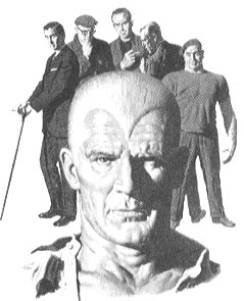
Doc Savage- The Man Of Bronze And Crew
Thus two streams of influence formed comic book heroes. On the one hand the Jewish writers and cartoonists were influenced by John Carter, Tarzan, The Shadow, and Doc Savage and on the other by a fifteenth century Jewish super creature known as the Golem. This was a creature fashioned from clay, as per Adam of the Old Testament, by a Prague Rabbi named Loewe who breathed life into his creation as God had breathed life into Adam. The Golem was created to wreak vengeance on Jewish victims as a sort of avenger as would be the status and role of the latter day Jewish superheroes of the comic books.
First out of the box in 1938 was the prototype of the rest of the comic book heroes, Superman. Like Burroughs with his creations the two Jewish creators built Superman’s origins from the Biblical story of the Exodus. Tarzan of course was born to noble English parents in Darkest Africa who then died or were killed by the Great Apes while the she ape, Kala, snatched him from the cradle and raised him as an ape.
Superman was born of noble parents on the planet Krypton which was about to be destroyed, and sent on a rocket ship to Earth while his parents died. On Earth he was raised by kindly goy Earth people. Thus we have two different versions of Moses in the bullrushes. Superman, then, combined John Carter and Tarzan.
Superman was a good thing in commercial terms being the equivalent of a literary best seller. Imitation is the sincerest form of flattery so that while Superman imitated Burroughs’ great characters a host of comic book superheroes soon trod in Superman’s footsteps. Next in 1939 there was Batman, probably the most successful of the Jewish superheroes, and then in 1940 the temporarily successful Captain America, really the product of WWII, losing his popularity with the end of the war. The most successful of all the superheroes was the strange goyish creation, Capt. Marvel but he doesn’t concern us here.
2.

From Out Of The Unconscious Depths
The above is very interesting I’m sure but what significance does it have; what is its meaning; what is going on? Well, the back story is very interesting indeed. One must remember that our lives are not lived in a social vacuum of unrelated incidents. All is part of a continuum that does not just happen but is created by the participants. All is a drive to attain a desire. The question is who are the participants? As has already been indicated, the Jews and the Gentiles or goyim. From what do those desires arise? Suggestion. Suggestions having been received, when a body of suggestions have been ingested, our minds begin to digest those suggestions. One then interprets the suggested reality according to one’s temperament which itself has been built on a body of suggestions.
All society is education, indoctrination and conditioning, in other words hypnotic suggestion. Burroughs was born in 1875 as the scientific revolution was in an advanced stage of development; by 1893 when Burroughs was seventeen the whole of human knowledge and scientific advances was put on exhibition at the Chicago Columbian Exposition. The Expo was probably the high water mark in Western Civilization or, at least, its confidence in itself. The Expo was an unparalleled achievement of human endeavor far surpassing all expos of the nineteenth century with the possible exception of the 1851 London Exposition. Interestingly both were burned to the ground by anti-civilization elements. The Columbian Expo of 1893 was the most powerful element of Burroughs’ education.
Shortly before the boy’s birth in 1875 the character of immigration changed. In 1871 Jews from the eastern European Pale of Settlement began to flood the country until in 1914 possibly half of European Jewry had been transferred to the United States. The great immigration myth is that the immigrants were assimilated into the ‘Melting Pot’ of the United States; nothing could be further from the truth. The immigrants merely transferred their national cultures to the United States where because they were compelled to speak English it appeared that they had been assimilated. In reality the immigrants came to the sparsely populated United States where they established an outremer population on the New Island as the Irish had it, a new Sicily, a new Zion etc. They came in such numbers that they actually were colonists. The old cultures were merely adapted to the new realities and developed along side the Native peoples.
These alien or invading cultures then shaped the development of the United States in their image as much as possible. Thus they were able to blame their cultural shortcomings on ‘America’ while emphasizing their virtues as their own. Hence ‘America’ developed into a sort of dirty word, a catchall for the crimes of the immigrant cultures. This state of affairs was masked until the Great War when the social conflicts came into the open and were immediately subsumed into the Communist ideology after 1917.
Young Burroughs observed this immigration phenomenon or suggestion with misgivings associating himself with Nativist views although he remained independent to our knowledge of association with Nativist organizations. Thus while interpretations of these social suggestions are found through out his early writings the conflict didn’t come to a head until after the 1917 Bolshevik Revolution in what became the USSR as Russia disappeared from the map. With all the national dissidents operating under the rubric of Communism the world was divided into us and them- ostensibly Communism and Capitalism. The dichotomy was created by the Communists. However each national culture could function with representatives in each camp while furthering their parochial objectives.
It was a new world the morning after the Bolshevik Revolution. Burroughs immediately came into collision with the new realities. As this new world was us and them it was possible to hate Communism while retaining virtue in the Capitalist camp. However one couldn’t detest national, religious or racial components even though they may have been Communists. As Communists always denied being Communists one was always dealing with cultural groups that dissembled their Communism.
When Burroughs began his career in literature even as he wrote the movies began to assume a transcendent place in US and world culture. By the end of the second decade it was evident that movies were where the big money was. That’s when Burroughs’ troubles began.
He quickly ran afoul of the Communists who controlled publishing and the Jews who controlled the movies. The Communists wished to suppress all non-Communist writers who refused to put out the Communist message. The Jews wished to discourage all criticism of their activities. Burroughs was marked out as one to be destroyed.
Rabbi Silver- A History Of Messianic Speculation In Israel, 1927
Behind the Communist outrage and obscured by it was the Jewish attempt to realize the Messianic age which assault was begun in Europe and the United States in 1913 and was to continue to 1928 according to Rabbi Abba Hillel Silver. While the assault was violent in Europe emanating from the transformation of Russia to the USSR, in the United States it was more peaceable after the violent year of 1919 while being conducted on a propagandistic and social level buttressed by the doctrines of Sigmund Freud as executed by his nephew and disciple Edward L. Bernays and others. You should become acquainted with Edward Bernays if you aren’t already.
Among the first of these propagandistic efforts was the promulgation of a ‘Jewish Bill Of Rights.’ This document along with a questionnaire was sent to the prominent men and women of America to discover their ‘anti-Semitic’ propensities. Burroughs failed this test so that he was black balled in Hollywood after 1922. The blacklist was broken by Joseph Kennedy and his FBO Studios in 1928. MGM then stepped in with a different approach from blacklisting. They bought the movie rights to Tarzan from Burroughs for much less than a song. Burroughs then was essentially neutralized in 1931 while MGM acquired the supreme super hero Tarzan to shape or mishape as they pleased. Within a few years there were not many who remembered that there was a literary Tarzan. My amazement when I learned there were Tarzan books when I was twelve in 1950 was a revelation of the first order.
The movies were able, of course, to shape all the goy literary heroes from Frankenstein to Sherlock Holmes into their own intellectual mold from then into the present while comic books added Jewish superheroes to displace them.
3.

Tired Old Man- Easy To Manipulate
The planned Jewish revolution hadn’t succeeded by 1928 but the groundwork had been laid leaving the future promising and open. While in the US the Jews were able to sweep all opposition aside even to the extent of putting their creature, Franklin Delano Roosevelt, into the White House for an unprecedented four terms, in Europe unexpected opposition occurred when Wolf Hitler was elected chancellor of German in 1933. While having their creatures Joseph Stalin as Premier of the USSR and FDR in the USA with Popular Front governments if office throughout Europe with the exception of Germany, Italy and Spain, the Jews seemed to be in a position to realize their millennium.
Indoctrination and conditioning was still important in the US thus when sound movies were introduced at the very end of the twenties and the comic book in the early thirties the Jews had two of the most powerful propaganda tools available under their ownership and control.
Their need in the thirties was to isolate and marginalize the Nativist opposition. This would be achieved in the forties wartime conditions when FDR had the prominent Nativists arrested and charged with sedition. At that point the Jews had succeeded in capturing the government and mind of the country although a long mopping up process would be necessary into the fifties and sixties. Thus while Wolf Hitler rounded up Jews in Europe, Jews were rounding up Nativists Americans in the US while advising any dissidents to keep their heads low.
The movies and comic books would play a big role in indoctrinating Americans to believe that the Nativists were Fascists and/or Nazis and not true Americans. It was at this time that Edward L. Bernays succeeded in changing the definition of Democracy from that of individual opportunity to recognition of groups having rights to a share of government based on group identity rather than individual identity. This would be a key concept as the century developed.
4.
After the Bolshevik Revolution the American reaction to Communism was strongly against it. The Communist Party was even outlawed for a time until the Fellow Travelers and Parlor Pinks had the ban lifted. The silent movies of the twenties then were not heavily influenced by the Reds although as indicated the Tarzan movies of Edgar Rice Burroughs were blacklisted. By the thirties the Reds were better organized while with the arrival of sound playwrights capable of producing dialog were needed. The Red exodus to Hollywood began.
The US Communist Party as with all national Communist Parties, was a majority or plurality Jewish affair to the point where an attack on one was an attack on the other. Thus as the thirties advanced the drum roll for US involvement in a war against the Nazis began. This would involve the formation in the US of an opposition led by the America First Committee which was opposed to any involvement in foreign wars as a reaction. As this was opposed to Jewish wishes the America First Committee was designated as Fascist while its putative leader, Charles Lindbergh was designated Hitler’s stooge.

Samuel Dickstein- Congressman From Hell
In order to discredit the opposition, no sooner was FDR sworn in than Samuel Dickstein, a Jewish representative from New York, began to agitate for a House Un-American Activities Committee to stamp out Nativist opposition. As Dickstein was a Soviet agent this meant that the Nativist opposition was un-American while the Jewish Roosevelt government were the true Americans. So, the Jews were well on the way to usurping the American identity which the comic book superheroes represented. Dickstein was successful in establishing his HUAC committee in 1938 but the chair eluded him and went to a real American, Martin Dies of Texas, who then used the committee to harass Communists as well as ‘Fascists’ much to the dismay of Dickstein and FDR.
Hollywood in support of Dickstein began turning out anti-German movies and by implication anti-Nativist well in advance of American involvement in 1942. Involvement in the European conflict was of course brought about by forcing Japan to declare war on the US in late ‘41.
The comic book industry forming about 1932 was becoming real by 1938 when the two Jews from Cleveland devised their Golem character Superman followed by Batman and Captain America. The comic book heroes fell in with the anti-German propaganda. If the Jews, British and FDR were not yet openly promoting the war against Germany the tendency was well formed in that direction.
All those comics were openly anti- German with Capt. America socking Hitler on the cover of the first issue. Capt. America was a creation of two Jews from Brooklyn, Joe Simon and Jack Kirby. To quote the Rabbi Simcha Weinstein from his book Up, Up, And Oy Vey!: How Jewish Culture And Values Shaped The Comic Book Superhero:
Rabbi Simcha Weinstein
Kirby and his partner, Joe Simon, worked at Martin Goodman’s Timely Comics, where the mostly Jewish staff openly despised Hitler. When Goodman saw the preliminary sketches for Captain America, he immediately gave Kirby and Simon their own comic book. The character was an instant hit, selling almost one million copies an issue. “The U.S. hadn’t yet entered the war when Jack and I did Captain America, so maybe he was our way of lashing out at the Nazi menace. Evidently, Captain America symbolized the American people’s sentiments. When we were producing Captain America we were outselling Batman, Superman and all the others.” Simon later commented.

Well, not quite all the others, as Whiz Comics Captain Marvel was the best selling comic of both the war years and later forties. Certainly my favorite. As in the years before the war the America First Committee enjoyed overwhelming popularity amongst ‘Americans’ I would question Simon’s notion that Captain America overwhelmingly represented American opinion. As there were six million Jewish ‘Americans’ in the country I might suggest that the response from that culture of ‘Americans’ was more overwhelming than elsewhere. Jews might easily have accounted for sixty to eighty percent of sales.
It is also probable that no real American would ever have invented a corny jingoistic persona like Captain America, in fact, none did. The image was certainly repulsive to me as a child. My prime comic reading years were from 1947 to 1950 and I and my entire generation rejected Captain America while embracing Captain Marvel. Even then Superman was a distant competitor to Captain Marvel which is why DC comics sued Whiz for copyright violation.

Rabbi Simcha Weinstein- The Story Of Jewish Comic Books.
All the Jewish comics were openly anti-German, thus the FDR administration, the movies and comic books were fighting for the Jewish ‘good war.’ When Charles Lindbergh pointed this out he was immediately portrayed as an agent of the Nazis whereas he was merely telling the truth while being an ideal American. Philip Roth in his 2004 novel, The Plot Against America, recounts the Jewish atmosphere of the time while he postulates that Lindbergh was elected president in 1940 as a satrap of Hitler. Thus the Jews became the real Americans and the real Americans were totalitarians out to destroy the Democracy the Jews had created.
In his essay in the New York Times of 9/19/04 titled: The Story Behind The Plot Against America Roth says that he is recreating America as it really was in 1940 but that is not so. As Roth lived in a New Jersey Jewish colony he and his family was out of touch with the real America as his fictional brother who had gone to Kentucky tries to tell him.
In fact in the America of the time in which Samuel Dickstein was an evil presence the American Jewish Committee and The Anti Defamation League were paramilitary organizations conducting spying operations against the non-Jewish public. Numerous agents unaffiliated with any government agency crisscrossed society looking for any activity that might be considered against Jewish interests. These forays were gathered together in 1943 under the assumed name of John Roy Carlson and published as an indictment against Jewish ‘enemies.’ Many of them were arrested and tried as ‘un-Americans in 1944. So, Roth’s paranoia is at best unbalanced.
Roth says the idea of Lindbergh’s having been elected occured to him while reading Arthur Schlesinger’s autobiography:
I came upon a sentence in which Schlesinger notes that there were some Republican isolationists who wanted to run Lindbergh for president in 1940. That’s all there was, that one sentence with its reference to Lindbergh and to a fact about him I’d not known. It made me think, “What if they had?” and I wrote the question in the margin.
While this may be how Roth came upon the notion his was not the first such idea. As Paul Buhle and Dave Wagner in their Radical Hollywood of 2002 point out, Donald Ogden Stewart in his script for 1943’s Keeper Of The Flame, Charles Lindbergh is posited as a plotter of a coup to replace FDR in alliance with Hitler. This would have been propaganda to indict Lindbergh for the upcoming trial of the Nativists. I don’t know whether Roth saw the movie as a boy but if he did perhaps the idea festered in his brain for several decades until he was reminded by Schlesinger’s book while his mind was half prepared.
So the actual plot of the Jews to take over the American government was displaced to Lindbergh and the Nativists. The Jewish coup was represented in the comic book character of Captain America. This situation is made clear in the current (2011) movie Capt. America: The First Avenger. Thus Philip Roth and Stan Lee of the comics recapitulate and clarify Jewish activities in the 1933-43 era. Captain America is actually Jewish assuming an ultimate American identity.
The origins of Captain America then emanated from the Jewish dream subconscious of Jack Kirby which was quite different form real Americans. He therefore, as all writers must, made Capt. America in his comic book existence from his own dream fantasies. Thus giving his creation the goy name of Steve Rogers he nevertheless gave him a Brooklyn Jewish origin. As Rabbi Weinstein also a Brooklyn Jew explains, Jews have a sort of dual identity as powerless Jews posing as goys in a powerful goy world. Thus the sickly ineffective Rogers undergoes a scientific experiment that turns him essentially from a 98 lb. weakling into an all powerful goy Charles Atlas without the hard work of body building. I’m sure Kirby saw those ads growing up.
Rogers having now been turned into a Superman had to have a name. Superman being taken Super Jew was out for obvious reasons, or even Super Hebrew, there was no Israel at the time, so Kirby settled on Captain America. Rabbi Weinstein again:
Of course a more literal reading of the costume is that it is the American flag brought to life. Captain America’s star is, after all, five pointed, not six pointed like the Star of David. The flag-as-costume [this is what used to make we boys puke] notion reinforces the ideal of assimilation [Jews ‘becoming’ Americans.] By literally cloaking their character in patriotism, Kirby and Simon became true Americans.
In 1940 there was a desperate struggle going on between the Jews and America First who the Jews styled as American Fascists, I.e. actual Hitlerites. By that line of reasoning the Jews became the true Americans, creators and protectors of genuine American Democracy while Anglo-Americans or Native Americans or America Firsters were out to destroy the great American Dream the Jews had created. This is the theme of Philip Roth’s novel The Plot Against America backdated to this period. The current movie Captain America could easily be subtitled The Plot Against America Foiled.
Rabbi Weinstein again:
Despite the patriotic appearance, Captain America’s costume also denotes deeply rooted [Jewish] tradition. Along with other Jewish-penned superheroes, Captain America was in part an allusion to the golem, the legendary creature said to have been constructed by the sixteenth century mystic Rabbi Judah Loew to defend the Jews of medieval Prague. “The golem was pretty much the precursor of the Superhero in that in every society there is a need for mythological characters, wish fulfillment. And the wish fulfillment in the Jewish case of the hero would be someone who could protect us. This kind of storytelling seems to dominate in Jewish culture,” commented Will Eisner.
According to tradition a golem is sustained by inscribing the Hebrew word emet (truth) upon its forehead. When the first letter is removed, leaving the word met (death) the golem will be destroyed. Emet is spelled with the letters aleph, rem and tav. The first letter, aleph, is also the first letter of the Hebrew alphabet, the equivalent of the letter A. Captain America wears a mask with a white A on his forehead- the very letter needed to empower the golem.
I hope this makes clear that Superman, Batman and Captain America are Jewish in identity and what their purpose is in American society.
5.
Having created a competing line of Jewish superheroes the problem then became how to discredit and supplant the goy super heroes. As should be clear by now what we have going on is a religious war but fought by propagandistic means. In other words the battle field was literature, comic books and the movies. As in all religious conflicts the goal is to displace the religious icons of the other; thus, in early Christian times churches were built on the sites of pagan temples while sacred groves were cut down. Nothing has changed; nothing can change. The Jewish goal was the elimination of ‘Christian’ or goy symbols.
Capt. Marvel was gotten rid of in 1953 when the Jews sued him out of his cape. As I’ve pointed out in my review of Tarzan And The Lion Man, parts 8,9.10, a key text in this colossal battle, MGM attempted to destroy the character as well as Burroughs when they bought movie rights to Tarzan in 1931. They got his birthright for a mess of pottage. It may be coincidental but in 1942 after the success of the Jewish comic book super heroes MGM discarded their lucrative rights to Tarzan to movie maker Sol Lesser presumably as worthless or, at least, of no more interest to them. Of course Lesser continued the franchise with phenomenal success. This necessitated a continued campaign to debase the character continuing today. At the same time that Tarzan is debased the Jewish characters, Capt. America is now one of a group of four ‘Avengers’, hence the double entendre of ‘The First Avenger’, who are increasingly Judaisized, while presented in a positive way in the attempt to marginalize Tarzan.
Now, some seventy years after the demise of the man, the continued demonization of Wolf Hitler is becoming less relevant, even annoying if you’re not Jewish, so in Capt. America Wolf Hitler is demoted to an incompetent dead threat while the scepter is passed to the mega Nazi/anti-Semite recreated in the mental projection of Red Skull or the Hydra. The mythical symbol of the Hydra is well chosen to represent anti-Semitism as no matter how many heads you cut off another one, two or three grow back. The threat never ends and the paranoia is justified.
Thus in the Freudian sense Jews have a dual personality: on the one hand you have the ineffective completely innocent assumed goy persona of Steve Rogers, who is the equivalent of Abel, the Chosen one and the crazed madman Hydra who is a projection of the negative aspects of the Jewish character imposed on the other as the anti-Semite. Thus the Jewish character is always at war with itself in the Freudian sense and hence never successful in its aims.

Captain Marvel And Billy Batson
A Review: Pt. II Lick Me by Cherry Vanilla
August 21, 2011
A Review
Cherry Vanilla
Lick Me: How I Became Cherry Vanilla
by
R.E. Prindle
II

Living In The System
Kathy was born in 1943 so as she left high school the sixties were emerging. Everybody talks about the sixties but nobody does anything about them. The sixties didn’t just happen, they erupted, the Exploding Plastic Inevitable as Warhol put it. Andy was right. The reason no one can remember the sixties is because so much was going on all anyone could see was their little fragment, that includes the so-called taste makers. All that crap you get from the sixties politicos glorifying themselves and their exploits is just crap. They were performing their act in a small little corner or the room pretending it was the whole stage. They were just a bunch of hard core losers anyway. Abbie Hoffman! Excuse me! Jerry Rubin, get out of my way. Allen Ginsburg? Pardon me while I puke.
No, no. The sixties were a happening no matter where you were. I’ve already touched on the drugs in Part One. Trust me, everyone but we happy few was on drugs whether prescription or street. I mean, Valium, my god! Straights ‘needed’ it to get through the day.
As I touched on in my Edie Sedgwick series the sixties were ushered in by the big 707 flying non-stop between NY and Europe beginning in 1959. That created the Jet Set who were the envy of all. Airports were small and intimate at the beginning of the decade burgeoning into the behemoths they have become as the airlines reduced prices and seduced people to fly. Not that I was, I didn’t get into the air until the seventies but as soon as I could I emulated the Jet Set flying to Europe and back three times in my best year.
So there were drugs and the Jet Set and the Kennedies. The Kennedies were the worst thing that ever

John F. Kennedy
happened to the country. Of course in pedigree sensitive USA we are all conditioned to ignore national, religious and racial origins as if they don’t count but, let me tell you, they do. John F. Kennedy began the decade in 1960 replacing the vacated spot of Dwight David Eisenhower. The change was not nominal. Eisenhower knew what he was doing, Kennedy didn’t. Ike, as he was affectionately known, engineered the victory in Europe in WWII. He’d done a stellar job from ‘52 to ‘60. Knowing the devastation of war he resisted the hawks to keep the peace, and we hawks were quite vocal. Having inherited the Viet Nam situation from the French and FFL collapse he had contention in Indo-China under control which Nixon, had he been elected, was pledged to honor, if he could have executed.
Like I said, we’re not supposed to think, much less talk about, race, religion and nationality but the Kennedies were Irish Catholics who finally won the triumph over the Anglo-Saxon Protestants in America. The war between the Irish and English was hundreds of years old in 1923 when the Irish freed themselves from the English yoke. The Irish and Anglo-Saxon war in America had only been going on since the 1840s when the potato famine drove the Celtic lads to our shores at which time, in reaction, the so-called Know Nothing Party was created. In 1928 the Irish put Al Smith up as the Irish attempt to capture the New Island after De Valera’s 1923 success on the Ould Sod.
Times were not propitious for an Irish Catholic and Al was soundly defeated. But a gentleman named Joseph P. Kennedy, accruing a bootleg fortune with solid connections to Organized Crime was about to engineer the election of one of his sons to the highest office in the land. God only knows what goes on behind the scenes but his first choice, Joe Jr., was blown up flying over the channel. His second son John F. was given one of the most dangerous posts in the Navy, commanding a PT boat. It’s hard to believe that whoever it was that got Joe Jr. didn’t want him dead but John survived the war and began the corruption of the land from the highest office in 1960.
Kenney with amphetamines coursing through his veins and a mind centered on sex, which is to say fucking, was clueless along with his brother Bobby and his other nitwit sibling, Teddy. Within a matter of months he had us involved in a shooting war in Viet Nam, threatened by Khrushchev in the Cuban missile crisis, after he had taken the drug addicts measure at the summit, and then aborting the reconquest of Cuba at the Bay of Pigs. Is it any wonder the magnificent crew Ike had assembled offed him. Regardless of how history has been revised their were a great many us who sighed and said: Good riddance.
When Bobby stuck his head up from under his rock in 1968 there was no doubt he’d get it blown off, and he did. If you think the two assassinations aren’t connected, think again. So ’63 and ’68 were big years of a decade of big years. Teddy kept his head down after that but gained a measure of revenge by sponsoring the 1965 immigration bill.
In far off Africa a gentleman by the name of Barack Obama Sr. was leaving for Hawaii to get a college degree and beget the future President of the United States on a little simple minded White girl. It was in 1957 when the African colonies renounced their allegiance to their European overlords that Ghana proclaimed independence from Britain. Thus the complexion of the United Nations was changed overnight as colony after colony of a congeries of warring tribes, now known as countries, declared independence and sent emissaries to the UN. Thus the balance of power was shifted from the capable to the incapable in that momentous decade.
It should be noticed that Marcus Garvey began the coordination of the African peoples of the world a
Marcus Garvey
few decades before independence was achieved by Africans and not improbably Garvey also furthered the beginnings of the Civil Rights Movement in the US, thus the African independence movement and the Civil Rights Movement were occurring simultaneously and I suspect coordinated. Thus the African presence in the UN complemented the enormous Black riots that began in LA in ‘65 and reached their apex through ‘67, ‘68 and ‘69. The fabric of the country was rent and torn. The future of the country became increasingly ugly.
It’s difficult to say but after the double whammy of the movies The Blackboard Jungle and Rebel Without A Cause of the mid-50s a new tone emerged in which the youthful violence came to the fore and not just lower class kids. This senseless rebellion without a cause represented a change in outlook occurring in the mid-fifties perhaps aggravated by Elia Kazan’s influential movie. Gangs of young rich guys terrorized the well to do sections of LA in ways that were inexplicable. The graduating classes of ‘53, ‘54 and ‘55 belonged to the previous era while 1956, the year I graduated, was the swing year between what was and what would be that began with the class of ‘57. About half the class of ‘56 looked backward and half, maybe less, faced forward toward the future. I was in the latter half.
Then in 1958, a twenty year old, class of ‘56 actually inspired by Rebel Without A Cause and James
James Dean- Rebel Without A Cause
Dean, so it was said, by the name of Charlie Starkweather went on a murderous rampage in Nebraska murdering several people simply for the sadistic thrills. It was bone chilling, perhaps the first of its kind. Charlie was quickly apprehended and executed in 1959.
Also in the fifties the homosexual, William Inge, wrote and produced the play Bus Stop, turned into a movie starring Marilyn Monroe and Don Murray in 1956. From those emerged the astonishingly violent TV series of one year only, Bus Stop, the production of which was supervised by Inge. That TV series transcended by miles any sadism and violence seen as yet in either TV or the movies. It even made the comic book Tales From The Crypt look tame by comparison.
Perhaps the most sickening episode in a season of sickening episodes was the one starring the teen idol Fabian as a sadistic murderous thrill killer who was obviously based on Charlie Starkweather. The episode by Altman was ambiguously titled: A Lion Walks Among Us. So the sadist was compared to a lion. The episode altered the direction of TV drama breaking down the doors for whatever followed and you know what that’s like. The impact was so strong that a Congressional hearing was called immediately to denounce it.
Already in an excited delirium young people were shown a new direction that was seized. Serial murderers that were unheard of during the early and mid-fifties became commonplace escalating, so it seemed, year by year.
Thus the scene in New York where Kathy was living her life became more violent by the month until after 1969 and the liberation of the homosexual psyche by the Stonewall Riot, when the crime became ultra sadistic and unbearable.
By the early seventies Dirty Harry and Death Wish symbolized the era moving well beyond Rebel Without A Cause or even Bus Stop as sadistic sick, sick violence. Insanity, really, and it characterized the country in the coming decades.
At the same time beginning in the early sixties pornography began its rise into the mainstream. While it was a good sized underground business before, in 1953 Hugh Heffner began publication of Playboy Magazine which brought porn into the mainstream. Playboy was followed by a host of ‘men’s’ magazines that got raunchier and raunchier. In the early sixties in San Francisco I noticed for the first time open advertisements in the Chronicle of porn films. There was a very active push to further pornography which was participated in by Andy Warhol, Paul Morrissey and the Factory. In 1968 I Am

Curious: Yellow Poster
Curious: Yellow and Curious Blue were released. I Am Curious: Yellow was very influential in loosening sexual mores. Blue and Yellow were the colors of the Swedish flag. A Swedish pervert made the movie. This all led up to 1972’s Deep Throat which for all practical purpose shot porn into the mainstream. Porn and the so-called Sexual Revolution went hand in hand.
Since sex had been practiced the same ways since the origin of mankind the real sexual revolution was whether you could say ‘fuck’ in public. The pervert Lenny Bruce led that charge followed by George Carlin and certainly by the mid-seventies few movies were made where the word didn’t constitute 20% or so of the dialogue.
And then, of course there was the Viet Nam war. This effort was hampered in the US by the Judaeo-Communist allies of the Viet Namese. Naturally the US Communists said that there was no reason for the US to be involved blithely ignoring the history of the situation. Actually the war was part of the US-Soviet confrontation in which the US had made several mutual defense pacts with countries on the Communist borders in an effort to contain it. South Viet Nam which came into existence when the French Foreign Legion forsook their reputation was part of a mutual defense pack called SEATO- South East Asian Treaty Organization. When they were attacked by North Viet nam, of which there an be no doubt they were, the clause of the treaty was invoked involving the US in the defense of South Viet Nam. So, the US was legitimate if foolish in going to the defense of South Viet Nam.
Now, because of the seeming passiveness of the Jews during the so-called holocaust the Jews had acquired a reputation for being a weak ineffective people. The skullduggery that established the State of Israel in 1948 did nothing for their pride but the seemingly easy triumph of 1956 against the Egyptians through which war Israel purloined the Negev Desert Jewish pride of prowess began to blossom. You started seeing identifying marks like gold Stars of David necklaces appearing on bosoms of Jewish men with wide open shirt collars unbuttoned to the penis. Little different than Nazi insignia they were now worn with pride.
The 1967 war against the allied Arab States completed the transformation of Israel into the Neighborhood Bully. Jews now began to strut down the streets virtually knocking people out of the way with the Stars of David dangling everywhere. The Jewish Defense League followed in 1968 soon splitting into an even more violent Jewish Defense Organization. Under their leader Rabbi Kahane a war not too different from the Jabotinsky days in Palestine ensued with the ubiquitous bomb exploding in NYC instead of Jerusalem.
Now, as has recently emerged, the crucial years for Jews in the United States, which had nothing to do with any so-called holocaust, were the years between 1933 and the accession of Wolf Hitler in German and the US entry into WWII in 1942. Before the war in the ‘30s the Jews called opponents to their machinations, Fascists. The name included anyone from Henry Ford to Charles Lindbergh. A marginalization campaign was begun against all American nationalists that largely succeeded. In that period the Jews created the notion in their minds that they were the true Americans who had created this near-perfect democracy and the Anglo-Saxons who had preceded them were out to destroy the country and turn it into a Nazi satrapy.
Philip Roth commemorated this attitude in his novel back dated to this period, The Plot To Destroy

Philip Roth- The Plotter
America. Thus through the fifties and sixties the Jews conspired to dispossess the ‘New Nazis’, that is non-Jewish White Americans. The war of ‘56 emboldened them so that by 1964 they were encouraged to seize the university system of the US. The first front opened was the so-called Free Speech Movement on the UC Berkeley campus whose real purpose was to displace Free Speech with Jewish controlled speech.
This was successful and when the dust had settled the Jews were in control of the campus stifling the free speech that had been the ostensible reason for the battle. As Mark Rudd would later say: The issue is not the issue. Jewish commissars set up tables at the Sather Gate to which students were demanded to submit to Jewish governance or else.
From Berkeley the battles strung out to other campuses, the most notable being Columbia in NYC while the other Ivy League campuses fell in line. Freedom of speech was the last thing on their mind.
Having achieved their goal at Berkeley the next step was to escalate the resistance to the Viet Nam war hence shielding their Communist allies in Hanoi. This was furthered significantly by the 1968 world wide offensive led by Chairman Mao and his Cultural Revolution so that by the time of Nixon’s reelection in 1972 the country was in a State of near revolution although it wasn’t that apparent on the street. I was amazed just before the election to see truckloads of soldiers brought into Eugene where I was living and a revolutionary hotbed, to be secreted in the hills in the event of an insurrection.
I have no idea if John Lennon and Yoko Ono knew how close they were to the edge but in retrospect they were not only lucky to be allowed to stay in the country let alone avoid imprisonment. If they hadn’t been so high profile I’m sure they would have been arrested. They were committing some pretty provocative acts. I’m sure that the money they gave to the movement through A.J. Weberman found its way into bombs.
Back in 1964 when Lyndon Johnson had inherited the White House after John F. Kennedy had escalated the war so that there was no way out but to go forward, Johnson was presented with the choice of guns or butter. Would there be a period of austerity as in WWII when the choice had been guns or butter. Between those two choices Lyndon chose a third- guns and butter. Things would go on as close to normal as possible. It was weird. His administration occupied the center years of the decade while the Judaeo-Communists would give him no peace. I mean, you know, the hundreds of bombings went on with no qualms on the part of the domestic terrorists.
And lastly, while all previous generation had been known by their literature the current generation, my generation, was known by its song writers and music. Everyone picked up a guitar and wrote songs. This essentially came in two, maybe, three waves. The first was spearheaded by Elvis Presley, the second by the British Invasion from 1964 to 1966 and the possible third from 1966 to 1974 after which the generation exhausted itself. It was along about 1966 that Kathy made the fateful decision to become a groupie and this would define her life until her mental breakdown in the late seventies.
When the Beatles and the Stones hit these shores they were just singers and bandsmen, popular, but nothing more. The notion of the Group began to be deified in San Francisco after Ken Kesey’s Acid Test. The group members were suddenly invested with nearly superhuman powers and wisdom. All you had to do to become a Holy Guru was stand up on stage, hit a couple of chords, and shout out ‘Mercy, mercy me, the ecology.’ with a raised fist. The Grateful Dead, Jefferson Airplane, Big Brother And The Holding Company, people of questionable character all became secular saints. One grows faint thinking it but, yea verily, gods. And this only from playing the guitar badly and voicing universal popular sentiments. Don’t trust anyone over thirty said a twenty-nine year old and immediately thirty-somethings were posing as teenagers. Too late now, isn’t it?
If you break down the ages, the first wave was born sometime in the early to mid-thirties, Presley was born in ‘35, Little Richard in ‘32.
The first wave of Rockers was spent by the late fifties succeeded by an interim group of nondescripts like Bobby Vee and Bobby Vinton. Nice enough but not essential or memorable. The Beach Boys were the top American group from 1960-64. Then came the second wave, these were men born from 1938 to 1945- Lennon ‘40, Dylan ‘41, Jagger ‘43 and this was the core age through the sixties. So the second wave, the true Rock phenomenon was a product of people born from 1938 to 1945. In the seventies Bowie ‘47, Billy Joel ‘49, those of the fifties came to fore as the generational impetus sputtered out. The Bowies and Joels were of a different sensibility than the main second wave. They grew up under different circumstances.
As the second wave gathered strength not as mere entertainers but as potent pop culture figures, adoring young girls emerged as groupies. Their sexual excesses were scandals although the concept of groupie was nothing new. Anywhere there are glamorous or powerful men accessible women will appear as well as, one might add, homosexuals. There are literary groupies and business groupies, etc. However Rock groupies tended toward being under aged jail bait not infrequently barely out of puberty and unconcerned for any consequences, indeed, not knowing of any.
So when Kathy discovered groupies she determined to become one although incongruously as old as the musicians themselves as she had been born in ‘43. It was kind of like somebody’s mother turning groupie. As she said of her groupie career she wanted a band to offer her a job. Finally David Bowie did.
This was the world in which Kathy Dorrotie was making her way.
Great Groupies Of The Sixties Series
A Review
Cherry Vanilla: Lick Me
by
R.E. Prindle
Part I
Drug Culture

Vanilla, Cherry: Lick Me, How I Became Cherry Vanilla, 2010, Chicago Review Press
The sixties were the first period of excessive drug use. Nearly everyone carried something, whether prescription or street. How influential drugs would have been without psychedelics is questionable. Psychedelics were legal for most of the sixties while enjoying great cachet. LSD led many a poor boy and girl into drug use. Live Better Through Chemistry was the parody of the motto. LSD stories are legendary, people taking thousands of mics. People dropping LSD daily for months on end. Doug Dillard of the Dillards Band according to legend dropped daily for a couple of years or so. Hendrix found in the desert crawling around on his hands and knees. Incredible stuff.
Cherry Vanilla, nee Kathy Dorritie, certainly qualifies as a heavy drug and LSD user. Staggering amounts. She tells of a friend of hers who had a vial of what she believed to be pure liquid LSD. She describes him saturating sugar cubes with it until the cubes began to disintegrate, then swallowing the cube. I can’t comprehend the dosage. After one massive dose she experienced a white out of her mind during which she went blind experiencing only a sense of blinding light. She doesn’t say, probably doesn’t know, how long it lasted. Life changing though.
Kathie was already an accomplished writer before beginning her autobiography so needed no co-writer. I had recognized her style of writing before I read the account of her LSD intake. LSD has an amazing effect on the mind which produces a very distinctive writing style. Very clear, very organized, written at a very intense level with the little variation in dynamics that inevitably becomes a numbing bore, but so well constructed that it reflects the blinding light that Kathy experienced.
Tim Leary who was a major acid freak wrote some truly amazing books reflecting the LSD experience while if you want to read an amazing virtuoso performance find a copy of Stephen Gaskins Haight Ashbury Flashbacks. These authors write with such amazing clarity and precision as to astound.
But, LSD is a totally inward experience, a complete divorce from the outside world which ceases to exist or becomes a sort of movie set. There is such an intense preoccupation with self that even though the writing is crisp and exciting the tone becomes boring as the inner self isn’t that interesting. The writing is on such an intense, unvarying level that there are no dynamics. (That I’ve repeated myself means I mean it.)
The dissociation from external reality is so complete that one loses all self-consciousness, thus Kathie, or Cherry Vanilla, is able to copulate in public without any sense of embarrassment, indeed, even with a sense of liberation. One might think she was an exhibitionist except that she is so preoccupied that she is almost unaware.
In time the inner world takes such precedence that one is unable to distinguish between the inner world of wishful thinking and the outer world of appearances. Thus Tim Leary could imagine shrinking a few acres of earth into a small size to take with him on a space trip to other planets and believe it possible. As if he wasn’t spaced enough. His final fantasy was incredible enough and he was actually able to realize it.
When he died he willed that he be cremated and his ashes put in a real space ship and rocketed into space. He’s up there now orbiting the planet every couple hours. As his orbit degrades he will one day reenter the atmosphere as a shooting star. Just absolutely incredible.
I don’t know how far out Kathy is but I imagine she finds it quite easy to draw a straight line from Point A to Point 9.
Now, not only did Kathy do amazing amounts of LSD but she was on the money on other drugs too provided they gave the proper result. She rejected heroin after a few times because it didn’t take her where she wanted to go.
She was a perfect child of the sixties even having a fine Dr. Feelgood. One finds her memoirs less than trustworthy because she feels compelled to change names, not all, but some, we just don’t know which ones.
For instance she calls her Feelgood, Dr. Bishop. That good doctor is the same as Dr. Roberts in Jean Stein and George Plimpton’s book, Edie about Edie Sedgwick. Dr. Roberts is also a false name so we can’t be sure. Perhaps Dr. Bishop is his real name but I can’t be sure. Jean Stein and George Plimpton also quote Kathy under the name of Cherry Vanilla concerning an encounter with Dr. Roberts/Bishop that Kathy repeats here but quite differently. Kathy’s memoirs were published in 2010 while Edie was published in 1982 so Kathy has had plenty of time to think about Dr. Bishop; while on the other hand Stein and Plimpton appear to have used a heavy editing hand. All of the dozens of people they interviewed sound remarkably alike so the interviews may reflect more of Stein and Plimpton’s modes of thought. Perhaps they edited to make the text more exciting.
It is quite possible that Dr. Roberts/Bishop may have been with the CIA doing drug experiments. The CIA was certainly active in the field at the time. Bishop was even happy to participate as his own guinea pig. This is an interesting topic so I am going to quote Kathy extensively as she repeats and edits her account from Edie.
By the summer of 1963 (when she was twenty) I had already become quite familiar with booze, grass, hash, coke, speed, opium, uppers, downers, and hallucinogens like mescaline, peyote and psilocybin because they were my favorites.
Those were just her favorites. So in two years since she left home she had really been doing some living while at the same time performing well at her advertising job on Madison Avenue.
And then, pp 50-53:
I’m in with the in crowd;
I go where the in crowd goes,
I’m in with the in crowd:
And I know what the in crowd knows.
By Billy Page as sung by Dobie Gray
c. Warner/Chappell Music
The Jet Set and the In Crowd
Two sixties institutions
Keeping up with the schedule I was on back then would have been impossible were it not for the drugs. And in 1966 I got introduced to the in crowd’s newest elixir. Dr. Bishop’s vitamin shots. At thirty-five dollars a pop, they were pretty expensive, but one or two a day would keep you up forever, and keep you looking fresh and vibrant the whole time. I forget who first introduced me to Dr. Bishop. It might have been Joel Schumacher (one of the original designers of the Paraphernalia store), whom I’d recently met at the Pines (Fire Island homosexual hangout), or Wally Clapham, a friend of Joel’s I knew from Mad Ave. Anyway, someone had to bring you there. You couldn’t just walk in off the street.
Dr. Bishop’s office was located on the ground floor of a highrise near First Avenue and later in a mansion at 53rd and Madison. It was a scene so quintessentially sixties you couldn’t even imagine a doctor’s office like it today. The clubby drug buzz in the waiting room was so dense and intense, you got high on anticipation just walking in there. The “nurses” (none of us knew or cared if they were really nurses or not) wore seductively modern sportswear and often pulled down your pants and gave you your shot in the hallway, while the examining room might be occupied by Dr. Bishop giving someone the sixty dollar special and/or somebody “having a bad reaction.” Everyone was always in a rush, wanted to be seen first, had somewhere to be, had a taxi waiting, whatever. But then once they got that shot in the ass, they often couldn’t tear themselves away from the clinically and socially charged atmosphere and would get caught up in the speed rap session that was always going on among the patients.
When the taste of the iron, or whatever it was, hit your mouth, you started getting off on the shot. And as long as the soreness in your ass lasted, your stamina pretty well lasted too, a good six to eight hours anyway. The first half hour after the shot was dangerous, because you often got a sudden urge to shop, buy someone a gift, spend the rent money on something pretty. And right across the street from the 53rd Street office was a shop called Hunter’s World and, oh my God, how many elephant hair bracelets and zebra skin notebooks could anyone possibly need?….The other temptation was a nearby crystal and rock shop, where it was especially hard to resist the colorful sparklers.
Dr. Bishop had his favorite patients, especially the one male and one female he’d singled out from each sign of the zodiac. I was his Libra girl. I can’t believe I had a huge sense of pride about that. It meant that, along with the vitamins and speed, my shot might get an extra dose of whatever he was experimenting with that week- things like adrenaline stimulants, niacin and even LSD. And he’d have his favorites call him about an hour after getting a shot to let him know what we were feeling. The guy was using us all as guinea pigs, and I thought he was some kind of savior, freeing us all from the need for food and sleep.
One night Dr. Bishop came by Aux Puces while I was spinning and offered me a free shot of something special if I’d come to his office after work. All night at the turntables my mouth was watering at the prospect of what was to come. And as soon as we closed I ran the two blocks over there to take him up on his offer. As his building’s open-sided elevator rose through its day-glo painted, black-lit shaft, I felt positively dizzy with excitement. A minute later I was alone with Dr. B. in his fabulous office space, with it high ceilings, mahogany paneled walls, dance studio, and all those delicious drugs in the cabinets. He loaded the needles and instructed me to slap his ass, poke him fast, and slowly push the plunger on the first one. And then he shot me up on the second. A few minutes later, he had his fingers up my pussy and I was rushing beyond belief.
Pretty soon, I was going numb all over, even in my brain. Then all of a sudden there was blood everywhere and Dr. Bishop just laughed and said rather flippantly, “My dear, you’re bleeding. Maybe you should see a doctor.” I knew I didn’t have my period and I didn’t feel any pain, but the shock of seeing the blood running down my legs made me come to my senses. Even though the bleeding seemed to be subsiding, I just wanted to get out of there and get away from him as fast as I could. It wasn’t easy, since he’d become perturbed and paranoid about the fact I was leaving.
I went back to Aux Puces, where the new maitre d’, David Smith, was tripping after hours with Jay Martin and a couple of friends. I banged desperately hard on the locked front door and, luckily, they heard me above the loud music they were playing. My shaken state and gory story must have been a real bummer for them on their LSD high but they snapped into action immediately and got a limo to take me to the emergency room. Turned out I had cuts and scratches inside my vagina made by a ring or more sinister object, though the doctors said no major damage had been done. By that time the bleeding had stopped and I still wasn’t feeling any pain. Though questioned I refused to rat out Dr. Bishop and was quickly released. I went back to join the gang at Aux Puces, where we opened a few bottles of Chateau Lafitte Rothschild ‘60, smoked some hash-oiled joints and partied until dawn.
Let’s examine the above. As I said Stein’s Edie was about twenty-eight years old when Kathy wrote this. She undoubtedly read Edie so was familiar with her testimony then and as the account combines and adds to Joel Schumacher’s and her own story it is possible she had a copy of the book before her and wrote from it.
The time she is writing about is 1966 which was the heyday of the Doctor Feelgoods. I don’t know that a study has been done on them yet but there were apparently dozens of these guys practicing dope medicine beginning in approximately 1960. As is well known a Dr. Max Jacobson was operating in the early sixties with an extensive elite clientele that included then President John F. Kennedy. Dr. Jacobson even accompanied Kennedy to the Khruschev summit meeting where he kept Kennedy loaded on these shots. So for roughly six years New York City had been speeding along and whatnot.
At the same time the uptown Doctor, E. 87th, that the Beatles refer to as Dr. Robert was managing an extensive clientele. Kathy refers to her guy as Dr. Bishop who is the same guy Jean Stein refers to as Dr. Roberts. We may assume that neither name is correct. Both Dr. Robert and Jacobson were Jewish, I believe Bishop probably was also. In fact all, or nearly all, of these doctors were probably Jewish.
Now Kathy believed Dr. Bishop was experimenting on his clients. If he was shooting them up with unknown drugs without their knowledge that was at the very least unethical not to mention shooting them up with amphetamines at all. To say that no one knew the effects of amphetamines at the time is nonsense. Amphetamines had been around since 1887 while every army of WWII issued tablets to their troops. Hitler’s own Dr. Feelgood kept him filled with amphetamines for years and his deterioration was obvious. But, perhaps, more clinical observations were wanted or a more precise understanding of how large numbers of people reacted and could be controlled was needed. Maybe they wanted to know how easy it would be to control and direct populations on drugs.
It is well known that the CIA and other governmental agencies experimented with drugs on soldiers and even to unknowing members of the civilian population. Extensive experiments with LSD were carried on by the CIA in the late fifties and early sixties. Stanford and UC Berkeley for instance were running programs in the mid-sixties running ads in the newspapers for volunteers as this was happening in NYC.
So who would have been the beneficiaries of knowledge obtained by these Jewish Dr. Feelgoods who had very large supplies of amphetamines, cocaine which wasn’t too common in ‘66 and was definitely illegal, LSD was just being made illegal, and who knows what experimental drugs? It could have been conducted under the auspices of the US Government agencies who were researching mind control. But the information most likely was going two ways- one to the US authorities, the other way to Jewish psychological ops who could draw their own conclusions for their own purposes. Let’s face it old drugs have been made available while new drugs are invented everyday and find easy distribution so every young person has had his or her consciousness altered beyond recognition.
At any rate with all those doctors with crowded waiting rooms the buzz over New York City must have been audible for miles and miles. And all that didn’t include freelancers like Brigit Berlin of the Andy Warhol crowd.
A Review: Psychoanalyzing Captain America
August 10, 2011
A Review
Psychoanalyzing Captain America
by
R.E. Prindle
From Out Of The Depths
Must we be responsible for our own dreams?
–Sigmund Freud
In answer to the above question by Herr Doktor Professor Freud in his dream book, The Interpretation Of Dreams. published in the year 1900 Prof. Freud said that dreams were the royal road to the unconscious. He then proceeded to suppress the conscious will releasing the unconscious will to dominate the personality.
Of course in 1900 movies, TV and comic books were in the future and unforeseen by the Professor. It is through those media that the unconscious visualizes itself. The Dream is manifested, the unconscious becomes realized.
In the case of the movie, Captain America: The First Avenger, first came the dream then came the comic book, then with movie technology undreamed of in 1940 when Joe Simon and Jack Kirby conceived the character, brought to the screen today. Comic books and movies are true projections of the unconscious. As might be seen by anyone with a ticket Capt. America is less a story than a dream, a dream that Sigmund Freud defined as wish fulfillment. So, one must examine the movie as a wish from the subconscious fulfilled as a visualization on the screen. What does the dream-wish fulfill?
First off we have a powerless wimp being knocked about by the big bad bully. We have a brief anti-bully list and then move on. However in this Cain and Abel story the rolls of bully and bullied are clear. The wimp then wishes to join the army to fight Hitler and is rejected on several counts of inferiority. But, never fear, the last shall be first.
Now, in 1940 the US was not at war with anybody while the America First Committee was determined to keep the country that way. But a powerful coalition led by the Jews had determined the European conflict was a ‘just’ war while it was morally compulsory for the US to butt in somewhat like Iraq, Afghanistan, Egypt, Libya and a few other places today. Unlike Viet Nam the usual suspects who opposed that war endorse all the current wars. The voice of dissent is unheard throughout the land.
So, bearing Freud’s Interpretation Of Dreams in mind that demonstrates the connection between dreams and the unconscious, Captain America is a daydream or psychological projection of Jack Kirby’s ne Jacob Kurtzberg and Joe Simon’s of Brooklyn N.Y. The relationship of these comic book writers to Judaism is explained by Rabbi Simcha Weinstein in his book Up, Up, And Oy Vey!: How Jewish History, Culture, And Values Shaped The Comic Book Superhero. This quote explains the real life origin of Capt. America:
Growing up in poverty, Kirby (born Jacob Kurtzberg) dreamed of being an artist but was forced to drop out of Brooklyn’s Pratt Institute after only one day because of financial hardship. Instead Kirby worked on newspaper comic strips under gentile-sounding pseudonyms such as Jack Curtis, Curt Davis, and Lance Kirby until he finally settled on the name Jack Kirby.
Kirby and his partner, Joe Simon, worked at Martin Goodman’s Timely Comics, where the mostly Jewish staff openly despised Hitler. When Goodman saw the preliminary sketches for Captain America, he immediately give Kirby and Simon their own comic book. The character was an instant hit, selling almost one million copies an issue. “The U.S. hadn’t yet entered the war when Jack and I did Captain America, so maybe he was our way of lashing out against the Nazi menace. Evidently, Captain America symbolized the American people’s sentiments. When we were producing Captain America we were outselling Batman, Superman and all the others.” Simon later commented.
Well, not quite all the others, as Whiz Comics Captain Marvel was the best selling comic of both the war years and the later forties. Certainly my favorite.
As in the years before the War The America First Committee enjoyed overwhelming popularity amongst Americans I would question Simon’s notion that Captain America overwhelmingly represented American opinion. As there were six million Jews in the country I might suggest the response from that quarter of ‘Americans’ was more overwhelming than elsewhere. Jews might easily have accounted for sixty to eighty percent of sales.
It is also probable that no real American would ever have invented a corny jingoistic persona like Captain American. The image was certainly repulsive to me as a child. My prime comic reading years were from 1947 to 1950 and I and my entire generation rejected Captain America while embracing Captain Marvel. Even then Superman was a distant competitor to Captain Marvel which is why DC comics sued Whiz for copyright violation.
We disliked the hokey repulsive jingoism of Captain America as well as his dumb outfit and the stupid shield. (I’m speaking as a nine year old here.) Of course we knew from nothing about Judaism and almost less about any other religious sects but there was something othery about Capt. America and Superman although we embraced the equally Jewish Batman.
The origins of Captain America then emanated from the Jewish dream subconscious of Jack Kirby which was quite different from ours. He, therefor, as all writers must, made Capt. America in his real existence and from his dream fantasies. Thus, giving his creation the goy name of Steve Rogers he nevertheless gave him a Brooklyn Jewish origin. As Rabbi Weinstein also a Brooklyn Jew explains Jews had a sort of dual identity as powerless Jews posing as goys in a powerful goy world. Thus the sickly ineffective Rogers undergoes a scientific experiment that turns him essentially from a 98 lb. Jewish weakling into an all powerful goy Charles Atlas. I’m sure Kirby saw those ads while growing up.
Rogers having now been turned into a Superman had to have a name. Superman being taken Super Jew was out for obvious reasons or even Super Hebrew, there was no Israel at the time, so Kirby settled on Captain America. Rabbi Weinstein again:
Of course a more literal reading of the costume is that it is the American flag brought to life. Captain America’s star is, after all, five-pointed, not six pointed like the Star of David. The flag-as-costume notion reinforces the ideal of assimilation [Jews ‘becoming’ Americans]. By literally cloaking their character in patriotism, Kirby and Simon became true Americans.
In 1940 there was a desperate struggle going on between the Jews and America First who the Jews styled as American Fascists, i.e. actual Hitlerites. By that line of reasoning the Jews became the true Americans, creators and protector of genuine American Democracy while Anglo-Americans or Native Americans or America Firsters were out to destroy the great American Dream the Jews had discovered. This is the theme of Philip Roth’s novel The Plot Against America backdated to this period. The movie Captain America could easily be subtitled The Plot Against America Foiled.
Rabbi Weinstein once again:
Despite the patriotic appearance, Captain America’s costume also denotes deeply rooted [Jewish] tradition. Along with other Jewish-penned superheroes, Captain America was in part an allusion to the golem, the legendary creature said to have been constructed by the sixteenth century mystic Rabbi Judah Loew to defend the Jews of medieval Prague. “The golem was pretty much the precursor of the superhero in that in every society there is a need for mythological chracters, wish fulfillment. And the wish fulfillment in the Jewish case of the hero would be someone who could protect us. This kind of storytelling seems to dominate in Jewish culture,” commented Will Eisner.
According to tradition a golem is sustained by inscribing the Hebrew word emet (truth) upon its forehead. When the first letter is removed, leaving the word met (death) the golem will be destroyed. Emet is spelled with the letters aleph, rem and tav. The first letter, aleph, is also the first letter of the Hebrew alphabet, the equivalent of the letter A. Captain America wears a mask with a white A on his forehead- the very letter needed to empower the golem.

So, you and I thought the A stood for America but it is actually a symbol of Judaism. Captain America then is an unconscious dream projection of the Jewish subconscious following Freud’s thought in his Interpretation of Dreams. Now we know who and what the Captain America or The First Avenger is.
2.
Like Philip Roth’s The Plot Against America the movie is backdated to 1940 although as the US is already in the war perhaps 1942-43 although in Kirby and Simon’s dream vision they could have already employed the usurped power of America in 1940. However the movie writers, are writing today so assume different interpretations and aspects.
In point of fact Hitler no longer exists except in the Jewish mind so the relevance of the movie is hampered. Goys are not reliving the Hitler experience on a daily basis. To correct this and bring the Nazi threat forward Hitler is relegated to an inept showman while the real brain behind Nazism is the Hydra.
The Hydra in Greek mythology was a matriarchal year deity with seven heads and one neck, Six of the heads prepresented the last six months of the year while the seventh head and neck represented the recurring and indestructible year. Everytime a head was cut off it grew back as time does march on.
When the Patriarchy was displacing the Matriarchy the story changed somewhat. Hercules was sent to fight the Hydra and everytime he cut off a head three grew back. Thus the Hydra is represented in the movie as a Red Octopus with eight arms thus embracing the world. Ils sont partout. Obviously Hydra is a dream projection of anti-Semitism the arch fiend of the Jewish unconscious.
The Jewish Doctor Erskine, Reinstein in the comic, playing God botches his first attempt at creating the superman, Hydra/Cain, but finds perfection in Capt. America/Abel. Thus Cain is blighted while Abel is God’s favorite. While Captain America begins as a song and dance man belittling Hitler on stage, when the fighting starts Hitler is relegated offstage while the super-Hitler, Hydra, steps front and center.
While the Americans that Rogers as Capt. America have nothing like the incredible weapons and organization of Hydra they are nevertheless with their bare hands able to defeat him. He is however immortal like all dream fears so that as Arnold said: He’ll be back.
The action is standard comic book action fare and needs no further comment. You could have written it yourself. Pretty clicheed but if you like this stuff you’ll find it very satisfying.
However Captain America remains a Jewish hero in American drag with a purloined identity.

Cartoon Jack Kirby
A Review: Captain America: The First Avenger Movie.
August 8, 2011
A-Head Vs. The Hydra
A Review of Captain America,
The First Avenger
by
R.E. Prindle
Weinstein, Rabbi Simcha: Up, Up And Oy Vey!: How Jewish History, Culture And Values Shaped The Comic book Superhero, 2006, Leviathan Press.
Must a man be held responsible for his own dreams?
–Sigmund Freud
PLEASE NOTE. THIS REVIEW WAS APPARENTLY SO OBJECTIONABLE TO THE JEWS THAT THEY HAVE TRUNCATED IT BELOW THE INTRODUCTION HAVING HACKED MY MACHINE TO DO SO. IS THE TRUTH SO REPELLENT TO THE JEWS THAT THEY HAVE NO MORALITY?
I will have to rewrite it.

Rabbi Weinstein
I set foot inside a theatre for the first time in twenty years lured by the comic book character of Captain America. Capt. America was about the least favorite of the superheroes for the post-war generation of kids. My primary years for comic books were 1947-50. I was revolted by the jingoism of the strip as well as the stupid costume
While Rabbi Weinstein touts the Jewish superheroes as seminal I should point out that our favorites and the best selling superhero during and after the war was the goy Captain Marvel, much more popular than even Superman. Further while superhero comics declined in sales after WWII I would suggest that it wasn’t loss of interest in the characters so much as a lack of interest in the material. If the comics had shifted from anti-Nazi to anti-Communist the sales might have become inflated. Of course such a shift was impossible as Communists were more or less in cultural control
This movie did nothing to refresh my memories pleasantly. And, further it turns out per Rabbi Weinstein that Captain America was 100% Jewish. Capt. America was the creation of two Jewish young men, Joe Simon and Jack Kirby, assumed names of course. In keeping with that Kirby and Simon had their character socking Hitler on the jaw long before ‘America’ entered the war while being obsessed with Nazis so we may conclude along with the Rabbi that the Capt. was indeed Jewish.
The movie purportedly takes place sometime during WWII. In this movie Hitler has been demoted to a minor threat as the super Nazi, The Hydra, has usurped his place while being immortal so that the Nazi threat can never die. In that case the Hydra must be on Steroids as Hitler was only fueled by amphetamines. Perhaps the A on America’s helmet stands for amphetamines and the Capt. was an a-head. Actually Capt. America’s striped mask or helmet has an A cut in the forehead which the Hydra slyly suggests stands for American arrogance. American arrogance came up two or three times.
So, essentially we have the Jewish Capt. America versus the arch-anti-Semite, the Hydra. It doesn’t stop there though as Hydra appears to be an alter-ego of the Jews. America, as they like to think of themselves and Hydra as they often behave. If you were to read Rabbi Weinstein before you saw the movie it would take on a whole different aspect and signficance.
The story itself is trite with no attempt at believability, after all this is a comic book. It is actually quite camped up. All action with a lot of slap bang stuff, stock characters and horrendous noise effects at a mind numbing volume.
Even though Capt. America crashes Hydra’s flying wing into an ice field at the North Pole Capt. America wakes up seventy years later in a New York CIA facility. Well, Christ, it is a comic book, I had already insulted my own intelligence by buying a ticket. Still, I think Stan Lee should be more than a little ashamed of himself.
Two stars if you’re mentally alert; four stars if you like noise and fireworks, five stars if this is your kind of movie. Pretty dumb in my book.
A Review: Pt. 6, Tarzan Triumphant by Edgar Rice Burroughs
August 5, 2011
Themes And Variations
The Tarzan Novels Of Edgar Rice Burroughs
#15 Tarzan Triumphant
by
R.E. Prindle
Part 6
Threads And Strands Of The Web
For I must speak what wisdom would conceal,
And truth, invidious to the great, reveal.
–Homer
More than likely it is a coincidence that Burroughs wrote a fictional account of time and space weaving a web at this time, for Fate was bringing together threads and strands of the web of his own life in a picture of unparalleled opportunity and deadly peril. The decisions Burroughs would make would determine the outcome. His life could have gone another way. Or, perhaps, Burroughs sensed the impending crises and fictioned them in an attempt to deal with them.
We are already aware of the conflicts with the Judaeo-Communists. It seems clear that they were the original aggressors and that Burroughs was in reaction to them, in other words, on the defensive. Thus these first two Tarzan novels of the thirties are direct attacks on both aggressors. If Burroughs expected counter attacks there seems to be no evidence that he prepared for them. He never seems to have sat down to coolly analyze the problem in order to have a plan.
In fact, there seems to be little evidence that he ever actually realized the consequences of his success or how to handle it. While he had incorporated himself he made no effort to corporately structure his writing enterprise. In point of fact as a creative artist he was fundamentally incapable of running a structured business. Doing so would have interfered with his creative function. In fact, I am convinced that he dissipated his creative energies by becoming involved in business decisions to the extent he did.
Developing an organization is very difficult. While he should have done this, without a very fortuitous combination of circumstances it is very doubtful he could have. Hollywood was full of sharpers ready to take advantage of creative talent and in this case and nearly all others they did.
On the positive side, from 1911 to, say, 1928 ERB had created an unparalleled intellectual property in Tarzan. One in a zillion chance. As the twenties developed unparalleled opportunities to exploit the property evolved.
Apart from publishing, the three key profit centers were comics, movies and radio. All three strands came to fruition as the thirties began. Each required a slightly different approach. Each required thinking out with an intellectual departure from the past.
At this crucial moment ERB’s past arose to drag him down from behind. He was unable to make the emotional transition from what was essentially an emotionally battered youth to a successful, affluent man in control of his destiny. He remained psychologically attached to his personal relationship to Tarzan as an aspect of his personality rather than objectifying the character as a psychological projection for the world. He had prepared the way to make Tarzan a savior man-god but then couldn’t separate him from his own personality. If Fate had thrown the right people in his way they could have done this for him.
Thus rather than maximize his financial returns he essentially shot his feet off. He carped at the various media companies to the point where he was viewed as troublesome, an undesirable actually. Thus while he expected great financial returns including the means to buy a yacht, he sabotaged his own efforts to obtain them.
He belittled the returns of the comic strip for instance, bemoaning that it only returned thirty dollars a day. Well, that was eleven thousand dollars a year, every year. He could count on it. His MGM contract for Tarzan, The Ape Man provided him the exact same return. Twenty-two thousand divided by two years is eleven thousand a year.
At the time ERB signed the MGM contract he had a very valuable intellectual property already fully developed but he had developed a reputation among the Studios. The Studios had already had extensive dealings with him from the silent era. ERB, without a plan to market Tarzan had accepted whatever money came his way. Two of his titles had been sold in 1921 although production of them had been shelved. In 1927 FBO Studios decided to film Tarzan And The Golden Lion. While this film was lost for decades a print of the film was discovered which was issued on DVD in 2006 so that it can now be viewed.
In my opinion FBO did handsomely by ERB. A good clear scenario was written by William Wing that remained true to the spirit of Burroughs’ work; perhaps more than it ought to have in a movie sense. The filming, the photography is terrific; it has never been done better, not by MGM, not by RKO. It is true that Wing invented a sister for Tarzan but this is a minor point.
I find it difficult to undertand what ERB was disgruntled about except that another writer was handling his alter ego. The difference between a movie scenario and a book is very distinct. There would have been no way to get the entire convoluted story of Golden Lion on the screen so Wing wisely chose to develop a variation on the story of the Valley of Diamonds. Even so he threw in an earthquake scene a la Jewels Of Opar and Tarzan’s jumping the gap in the tunnel.
If anything his attempt to write as closely to Burroughs as he did lessened the impact of the film with some needless clutter. If, in 1935’s New Adventures Of Tarzan for which Burroughs provided the story idea, Dearholt attempted to tell the story more or less as Burroughs wrote, then the result was a hopeless mish mash. The movie was no truer to Burroughs’ Tarzan than FBO’s film, while lacking the clarity and force of the latter. Burroughs should have been grateful to FBO for an excellent movie. My idea of the best of the lot even though silent.
Had I been associated with FBO I would have found ERB’s criticisms nitpicking and offensive. After all FBO broke the boycott ERB had been under since 1922. The FBO movie triggered a response from Universal which held the rights to Jungle Tales and Jewels Of Opar. These titles were released as Tarzan The Mighty and Tarzan The Tiger starring Frank Merrill. At present there is no print of Tarzan The Mighty while as of December 5, 2006 I am still awaiting the release of Tarzan The Tiger. ERB once again was unhappy with these films, voicing loud complaints. All this carping could have done little for his reputation among the Studios. Before the long hiatus of Tarzan movies from 1921 to 1927 he had been run off the lot during the filming.
According to the ERBzine Timeline for the ’30s ERB approached MGM in 1930 asking $75,000 for a movie and was rebuffed. If this is true, $22,000 in 1931 was quite a comedown. MGM solved ERB’s querulousness by obtaining the rights to do with the character as they wished. They promptly disdained Burrughs’ storylines for their own while changing the character of Tarzan from that of an international sophisticate to that of a feral boy.
As the first full sound Tarzan, MGM hit the jackpot with the victory cry of the bull ape. The Tarzan yell would be the trademark of the charcter, although hardly a blood chilling fearsome holler. Burroughs himself couldn’t do better as Herman Brix in New Adventures merely growls out a long drawn Tar-man-gan-eee with the last sylable in falsetto. More laughable than fearsome.
In between these two films Sol Lesser released a monstrosity starring Buster Crabbe. Lesser never got the handle on Tarzan on his own, instead borrowing the MGM Characterization when he acquired the rights from them.
Lesser and his brother Irving were independent producers of some substance. Sol was born in 1890 in Spokane, Washington, dying at 90 in 1980. There is even a biography of his life. Not easy to find and not available on any site when I looked. If anybody knows where one is or having one could make a copy for me it would be much appreciated.
Lesser’s father who was in the nickelodeon business died in 1907 in San Francisco leaving the business to Sol and brother Irving. Sol got involved in distribution in 1910 eventually forming the Golden Gate Film Exchange in 1915.
In that year San Francisco’s infamous Barbary Coast was shuttered. Before the closure Lesser filmed the area, selling the movie. It would be interesting if the film was still around.
He made the right moves. After distribution he became a producer for First National and then formed a chain of movie theatres. After an aborted retirement he reentered production forming his own independent studio called either Principle or Principal Pictures. David Fury spells the name Principal in his Kings Of The Jungle and that sounds right. This was apparently Sol’s status when he acquired the rights to Tarzan from a third party in 1928 and when he made the Crabbe abortion in 1933.
Lesser was influential in Hollywood. He made it a point to know and be known. In the early thirties it was he who was responsible for introducing Disney to Joseph Schench (pronounced Skenk) and facilitating Disney’s move from Columbia to United Artists.
One can’t be sure of his politics from the sources cited but according to the New York Times:
…Lesser forsook production for distribution again, returning to the creative end of moviemaking in 1931 when, through is friendshlip with writer Upton Sinclair, he became involved with the Sergei Eisenstein project, Thunder Over Mexico.
Thunder Over Mexico was undoubtedly a Communist diatribe. Sol Lesser while involved with consevatives like Disney and Burroughs, also played the other side of the street with the likes of Upton Sinclair and the Jewish film maker, Sergei Eisenstein of Battleship Potemkin fame.
It would seem probable that he at least knew such luminaries as Louis B. Mayer and possibly Irving Thalberg. Even though he could have foiled both Burroughs and MGM with his prior rights to Tarzan, he characteristically stepped aside, for remuneration of course, to let their films play through. It would be interesting to know how and why he obtained his rights from a third party and how they had obtained theirs.
One doesn’t know what his relationship to Mayer and MGM was at this time but it is noteworthy that he acquired exclusive rights to Tarzan when MGM abandoned the profitable series. Under Lesser the movies continued to gross two to three million a picture.
Sound movies should have been a gold mine for Burroughs if he had handled himself properly. Instead through his impulsiveness and vanity there were at least four competing Tarzans on the screens from 1930 to 1935. This must have created confusion in the public’s mind, while injuring Burroughs’ financial returns.
At the time sound brought the potential of immense movie profits to Burroughs the thread of radio also came to maturity about 1930. While the evangelists were quick to capitalize on the potential of radio, Burroughs wasn’t far behind. Perhaps the success of Aimee Semple Mcpherson showed him the way.
As the decade dawned, his eye turned in radio’s direction. By 1932 he was successful in launching a show. Once again ERB failed to analyze the difference between books and a new medium. Radio was for him the most lucrative of all his ventures. His revenues from radio equaled his income from all other sources combined. This income stream could have continued unabated through the thirties but, once again, ERB interfered with the show rather than contributed. Undoubtedly because of his constant carping the first series was not renewed. A second series was launched which was also discontinued. From 1935 until his death he was unable to get on radio again. After his death in 1950 a new series was launched.
Thus, between publishing, comics, movies and radio ERB was provided opportunities to exploit his great labor in creating the ultimate intellectual property of the twentieth century and blew it. The personality forming psychology of his youth popped up to prevent his realizing his most cherished dreams in this sphere of his life as it did in his relationship to women.
b.
If ERB had read his Homer at some earlier time, or possibly, earlier times in his life, it seems evident that he reread the Odyssey, for sure, at this time. The evidence is prominent in these five novels, especially Triumphant and City Of Gold. A text in all five novels is the struggle between the La aspect of his Anima and that of Jane. Subconsciously he had steered his love life to this critical juncture where he would have to choose one and reject the other.
There may have been a fortuitousness in his choosing to concentrate on his own Odyssey at this time. He was able to capitalize on a number of good story ideas, while on the other hand a major story line of the Odyssey is the examination of a man’s control of his sexual desires. A key story of this aspect is the story of the seductress Circe. By inducing all men to abandon themselves to unbridled sexual desire she turns them all into pigs. A lesson for contemporary times. Odysseus avoids this by having a pocketful of Moly. Moly is some sort of charm that allows him to resist Circe’s seductions.
Thus Odysseus retains his manly integrity while securing the release of his crew. The Sirens, Calypso and the other women are all temptations for Odysseus to abandon his manhood for the luxuries of sex or in other word, the Matriarchy. He resists them all to return home to Penelope in Ithaca where she sits lonely endlessly weaving her web.
One can’t know directly how Burroughs read the story or even if the above details registered with him; nevertheless these five novels are about a man’s relationships with women and more specifically they concern the details of ERB’s relationships with women. The story as told by him is a troubled one.
It would appear that his cherished Anima image of the previous forty years or so, La of Opar, no longer answered his needs, so at the end of Invincible Tarzan abandons La of Opar. She and Opar disappear from the oeuvre never to be mentioned again.
In real life perhaps La has been replaced by Florence who now figures as the Golden Girl. With the appearance of Jezebel in Triumphant the Golden Girl makes her first appearance to dominate the stage until Lion Man and the end of this five novel series.
In Triumphant the Jane aspect which has been missing for the last couple novels parachutes back into ERB’s life. He marries her off to the stable aspect of his Animus while pairing the Golden Girl with the low life aspect of his Animus.
Emma had always said ERB was a low brow so perhaps he found it too unpleasant aping high brow manners giving up the fight to indulge that aspect of his Animus more comfortable to him.
In this struggle Florence had been removed from the scene. Back during the writing of this novel Burroughs quickly opted to join his low life aspect with his sexual desire for the Golden Girl. His Moly gave out on him. Thus Danny ‘Gunner’ Patrick is transformed into Old Timer of Leopard Man while Jezebel becomes the platinum blonde, Kali Bwana.
Having made the decision to take the Golden Girl he has to eliminate the Jane aspect which he does in City Of Gold. Perhaps wavering a trifle in Lion Man he seems to have created a type of middle Tarzan Anima figure in Rhonda Terry. While he rejects Naomi/Jane he seems to have misgivings about Balza/Florence as the Golden Girl.
But, by this time the die had been cast so that in real life he does leave Emma to begin his life with Florence as a born again sex hound. As Old Timer in Leopard Men he says he was entitled to some pleasure in life and by God he was going to take it.
So, in both his business life and his personal life his past rose up and bit him in the behind destroying any chance he had to realize his true desires. I’m afraid I have to look at the remainder of his life as a failure as he was unable to eliminate the psychological impediments placed in his way by his early life. Not that he didn’t try. He appears to have studied psychology trying to find a way through to the other side of the maze of consciousness. Thus we have the subterranean passages too dark for anyone to find their way, yet his characters do. As he searches for a way out, the past rises up in the shape of deformed monsters like the Oparians beneath the Sacred City.
Or the round about way Tarzan and La found their way out of the lion cage in Invincible to be betrayed by the Old Man who professed to be true to La. Who was the Old Man? The shade of the past? David Adams has brought emphasis to this scene in his review of “The Ancient Dead of the City of Horz,” itself a dead city on the shores of a dead sea in Burroughs Bulletin #68.
By the writing of The Ancient Dead, ERB no longer had any hope to escape his past, while at the same time it was too late.
So, as the matter turned out, this period from 1930 to 1934 was the final crucial period in ERB’s life where he could have taken control of his destiny. He apparently sensed that the threads and strands of the web of his life were being brought together by Fate.
I neither condemn nor advise, unlike the literary fashion of today. I assume no superior airs, nor do I have a right to do so, but the fact is that had he been able to control his sexuality while restraining his impulsiveness, Fate might have been kinder to him at this juncture. As he was unable to order his psychology Fate, as it were, laid him low.
The critical junctures were the impetuous signing with MGM, his abandonment of Emma and his mismanagement of his radio affairs.
I have now covered four of the five Tarzan novels of this period. The last, The City City Of Gold deals with his ferocious sexual needs that destroyed his chances for success.
A Review: Pt. 5, Tarzan Triumphant by Edgar Rice Burroughs
August 4, 2011
Themes And Variations
The Tarzan Novels Of Edgar Rice Burroughs
#15 Tarzan Triumphant
by
R.E. Prindle
Part 5
In The Footsteps Of The Lord
a.
If anything the action of this novel reminds me of Ray Bradbury’s Illustrated Man just as the invasion of Opar brings strong recollections of the last story of Bradbury’s Martian Chronicles. In the latter all the great fictions of mankind, fairies, ogres, and whatnot have been driven from earth by Reason taking refuge on Mars. But as the true condition of Mars becomes known their world crumbles and disappears as there is no place in the universe left for them.
That fate will never overtake Tarzan as he represents very real hopes, dreams and desires of mankind. Even as the old world and old heaven of the Piscean Age begins to heave and crack as the new Age of Aquarius struggles to come into existence, the archetype of the Age is forming around Tarzan. Tarzan will emerge triumphant.
The next two scenes of Burroughs’ tapestry which come to life not unlike the pictures on the tattooed man are as vivid as any scenes Burroughs wrote. The agony of Gunner Patrick when he awakes to find himself alone is palpable. There is even an element of tragedy in his situation if one has sympathy for murderous criminals. Burroughs rather sneers that without his machine gun Patrick is a pathetic figure. But, while the machine gun represents advanced tochnology man’s prowess has always depended on his weapons, whether they be stones, spears and bows and arrows, an old harquebus or the machine gun or stealth bombers and self-guided blockbusters. The fellow with the latest model is always top gun on the block. Without his weapon he is naturally nothing. Even Tarzan would have been a dead man long before this without his father’s knife. What makes Gunner Patrick so reprehensible is that he uses his weapon for injustice rather than justice. Thus without his weapon he is subject to the same injustice he would inflict on others.
Still, he’s our criminal so we have to take his side. One would say he is less criminal than the men who stole Jezebel from him except that out there they live by a different lawless code. As Patrick would say: They ain’t no cops out there.
Law is a matter of the strongest; so Tarzan as the strongest and justest will reestablish Law and Order according to his terms. He acts as the judge and jury which some people with an opposing notion of Law might find offensive or even dangerous to their plans. How much of a coincidence then is it that in Tarzan’s New York Adventure he is stripped of his status as lawgiver and subsumed to a different legal code? No coincidence at all in my mind. The legal decision declaring Tarzan a criminal also showed who was strongest in Hollywood. In fact, in late 1941 and into ’42 Burroughs had been ousted from Hollywood himself, living in exile in Hawaii.
The Golden Girl, Jezebel, had been taken into custody by Capietro but Stabutch has eyes for her. The two men decide to play poker for her, best three out of five. Strange that an Italian and a Russian should be familiar with the quintessential American card game, but there you have it, they were.
Stabutch loses but calls Capietro a cheat.
This scene recalls ERB’s own loss when he and Emma were in transit in Parma, Idaho. While Emma waited upstairs ERB got cleaned of the couple’s last forty dollars in what may very well have been a crooked game. I haven’t played poker a lot but I’ve never been in a straight game, so as a stranger in Parma, the odds are that Burroughs’ game was crooked. He doesn’t say so, of course, but I’d be willing to bet he thought so. The memory was a horrendous one for ERB; it crops up frequently in the corpus. My memory of a Navy game is always with me. In fact, someone I hadn’t seen for forty years brought it up the first thing. These things are like the scar on Tarzan’s forehead.
Capietro and Stabutch fight, one out of one, that Stabutch wins. He then flees with Jezebel. the Gunner who has been gathering his wits above the scene sees the two ride out the gate. He follows in pursuit on foot.
Stabutch and Jezebel put up for the night during which a lion scares their horses away. Hungry the next day, Stabutch stashes the Golden Girl in a tree while he goes hunting. Staking out a water hole he is surprised to see Tarzan drinking. A golden opportunity to accomplish his mission but the strain is too much for his nerves; he misses his shot. Running as fast as he can, Tarzan following torments his victim with a couple of arrows before, as Stabutch begs for his life, putting an arrow through his throat. His throat! I was ready for ‘his black heart’ but was surprised by ‘his throat.’ As a probable surrogate for Stalin who sent him, why his throat? At any rate Tarzan has now completely defeated the Communists; once in Invincible and again here.
Patrick has been miraculously reunited with Jezebel but now all three are captured by the shiftas. The outcome is clear. The faithful Waziri stage a frontal attack on the shifta stockade. Patrick and Jezebel, who have been bound and left in the same tent, free themselves. The hard thing Patrick has been lying on turns out to be ‘his better half’, the machine gun. He then opens up on the shiftas from the rear. No contest.
b.
The final picture in the web then, is the successful bringing together of all the threads and strands which began two thousand years previously in an entirely unrelated event, when Paul was martyred in Rome and Angustus fled for the African hinterland bringing his slave girl with him.
Lord Passmore as it turns out is Tarzan in disguise. He assumed the identity so as not to arouse suspicion. So once again Tarzan displays an effeminate side. A disguise hardly seems necessary for the Big Bwana but as ERB needed the faithful Waziri for the big battle scene finale, perhaps so.
Tarzan at this point seems to be a solo act; there is no hint of Jane awaiting him back in Kenya. Lafe Smith and Lady Barbara are brought together. Thus the bright alter ego of Burroughs is paired up with a member of the English aristocracy who may represent the writer Dorothy Sayers, perhaps a match ERB would have liked in real life.
Already three or four years into his affair with Florence, of which surely Emma was aware, one wonders what she thought when she realized she had been written out of the story. Well, she did turn to drink.
More interestingly, Burroughs’ dark alter ego, Danny ‘Gunner’ Patrick and the Golden Girl, Jezebel are brought together. He is going to leave Chicago taking Jezebel to somewhere in LA to buy a service station. A worthy ambition; for some reason the movie, The Postman Always Rings Twice, pops into my mind. The screenplay for that movie was written by Raymond Chandler who, for no explicable reason, I associate with Burroughs. There must be some similarity between Philip Marlowe and Tarzan. Marlowe did get sapped a lot. Chandler even turns sapping into an art form.
In pairing Jezebel/Florence off with his dark side ERB may be hinting at the direction his relationship with Florence will take. His life with her was certainly different than his life with Emma as he let his hair down and began dressing like quite a dandy, or, perhaps, Lord Passmore.
On that score, in this novel, Burroughs selects his dark side to take the obligatory bashing. One wonders then if he attributes this dark side to the bashing in Toronto. Is he saying that his dark side was the result of the bashing? Did he begin living some sort of double life some few years after he was laid out? Was his character even more erratic than it appears? How much did Emma put up with?
His emphasis on the notion that every man has two characters that may diverge as did Jekyll and Hyde give reason to think so. At any rate the following couple years ERB himself would be leading a double life. As Lafe Smith with Lady Barbara/Emma and as the desperado Danny ‘Gunner’ Patrick with his amour Jezebel/Florence Gilbert Dearholt. Jezebel is certainly appropriately named.
The next two novels explain his own relationship to Florence and Emma. Leopard Men, which I have already reviewed, deals with his opting for Florence while City Of Gold deals with his rejection of Emma. But first some conclusions and organization.
To be concluded in Part 6: Threads and Stands Of The Web
 I, Dynamo