Pt. I: Edgar Rice Burroughs And The Accreted Personality
March 6, 2012
Edgar Rice Burroughs
And
The Accreted Personality
Part I
by
R.E. Prindle

Dr. Pinel Unchaining The Inmates
The post-French Revolution period begins the rapid development of the Aryan mind. The Enlightenment laid the foundation of that development. Shortly after mid-nineteenth century the French astronomer, Camille Flammarion, was able to announce that Astronomy and Psychology would be the key disciplines of the future. The break with the religious consciousness of the past ten thousand years or so would be fraught with immense dangers, dangers which we are still combating.
The social ideology of the present asserts that all people are of the same stage of mental development. This is, of course, absolute nonsense. There are still hundreds of millions if not a billion or two who still maintain a stone age view of the world. Nor are all of them in other parts of the world, a vast number are here in the Americas and Europe. In addition there are billions still enmeshed in a religious consciousness while only perhaps a hundred million or two have actually evolved into the scientific consciousness. Hence we have the terrifically repressive attempted subversion of science by the Semitic religions.
So, it should be clear at first glance that not all people are equally developed or endowed nor are all cultures of the same value.
The French scientist and neo-romantic novelist Camille Flammarion noted mid-nineteenth century that the two most important intellectual disciplines for the future would be Astronomy and Psychology. I think that has proven true.
A major discovery of the century was the notion of the split or multiple personality. A term currently in use is Dissociation. Neither is accurate. I advance the term Accretive Personality. That is one’s personality is made up of many personality variations as a result of growth and experience. In periods of stress it is quite easy to escape oppressive reality by slipping into what is essentially an alternate reality or a parallel personality, if you will.
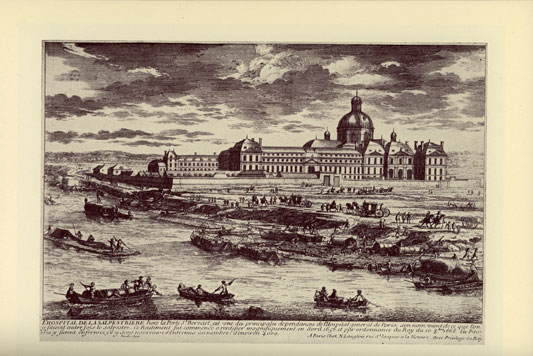
The Salpetriere
This was not a new phenomenon, merely the shock of recognition. In Greek mythology, for instance, when the stress of the mid life crisis hit, the hero went through a period of madness, that is to say he adopted a parallel personality until he was able to reorganize his mental attitude to new realities.
In Europe, under the stress of an insane quasi-Semitic religion in which Satan took a prominent role, it was common for the stressed to become ‘possessed’ by demons or, in other words, to split the personality. That is the person showed a parallel personality. The transition point to the beginning of secular understanding came when Dr. Anton Mesmer matched his secular method of exorcism against the ecclesiastical method of exorcism and won. So one might say that modern psychology derived from the problem of the dual personality- the Jekyll and Hyde effect. However dual or multiple personality was not recognized as such until announced in Jean-Martin Charcot’s clinic at the Salpetriere hospital in Paris in the mid-eighties.
Charcot studied hysterics. Hysterics are dealing with a lot of stress, hence escape through an alternate personality would be an easy choice. Charcot and the Salpetriere aren’t exactly household words so let’s take a moment to explain the situation in which modern psychology was born.
It is also necessary to bear in mind changes in scale. What is good for one stage of growth is not good for another. As the scale of things progresses from tiny to small to medium to large to huge to gigantic new forms have to be adopted to suit the new circumstances. These transition points are difficult to adjust to but once adjusted to are considered so normal that those who resisted the old change are equally resistant to adapt to the next level. Of course the young of each scale is born into it and has no adaptation to make although they will at the next change of scale.
Thus the French Revolution and the Napoleonic Era masked to a very large degree a major change of scale so that after Waterloo a seemingly complete break with the past had taken place. It was a new world in the morning. So in the years leading up to the Great War another change of scale had taken place that masked the new world that popped into place in the twenties. I picked up the concept from that astute observer, H.G. Wells, who noted the emerging change in scale at the turn of the century. That great ship, the Titanic, that went down in ‘12 may be considered as representative of that change.
Thus with the change of consciousness that actually took place in 1795 the new consciousness became clear after Waterloo. Gone was the religious notion of ‘possession by evil spirits’ to be replaced soon by the concept of multiple personality. Thus whereas in the past the insane had been treated as raving beasts, chained to walls and whatever a Dr. Pinel at Paris’ Salpetriere began a more humane treatment with an attempt to understand the causes of insanity. The approach was parodied amusingly by Edgar Allen Poe in his story The System of Dr. Tarr and Professor Fether in which the inmates revolted and took over the asylum.
The Salpetriere was a large compound of several acres with thousands of residents, mainly women from whom the subjects who became the hysterics that the great Dr. Jean-Martin Charcot began to study as a neurologist, as the early psychiatrists were known. The field of Psychology is divided in two. On the one side psychiatrists who must be MDs and who believe mental ailments are biologically derived and hence to be treated medically with drugs or, one shudders to think of it, operations like pre-frontal lobotomy or electric or insulin shock ‘therapy.’ Psychologists, who are PhDs with little or no medical training treat neuroses and psychoses as malfunctions of reason caused by experiential traumas.
Charcot as an MD originally sought biological causes for the hysteria he studied although he was coming around to a psychological viewpoint just before he died in 1893. Thus from being chained before Dr. Pinel released them these women, hysterics, while being confined to the Salpetriere were given freedom of movement within the hospital with its flowers and walkways making for a much more pleasant environment for them and one unobtainable to them on the outside.
Now, the great Dr. Anton Mesmer introduced hypnotism to Europe as a discipline in the years just before the Revolution. Naturally something so new and seemingly revelatory did not find immediate acceptance, indeed, it was treated as nonsense. Nevertheless people of learning, doctors, persisted in experimenting with it. Thus, when Charcot came to be the director of the Salpetriere, to the dismay of his profession he introduced the practice in his treatment of his hysterics and thus legitimized its use. Hypnosis, too, was new and little understood.
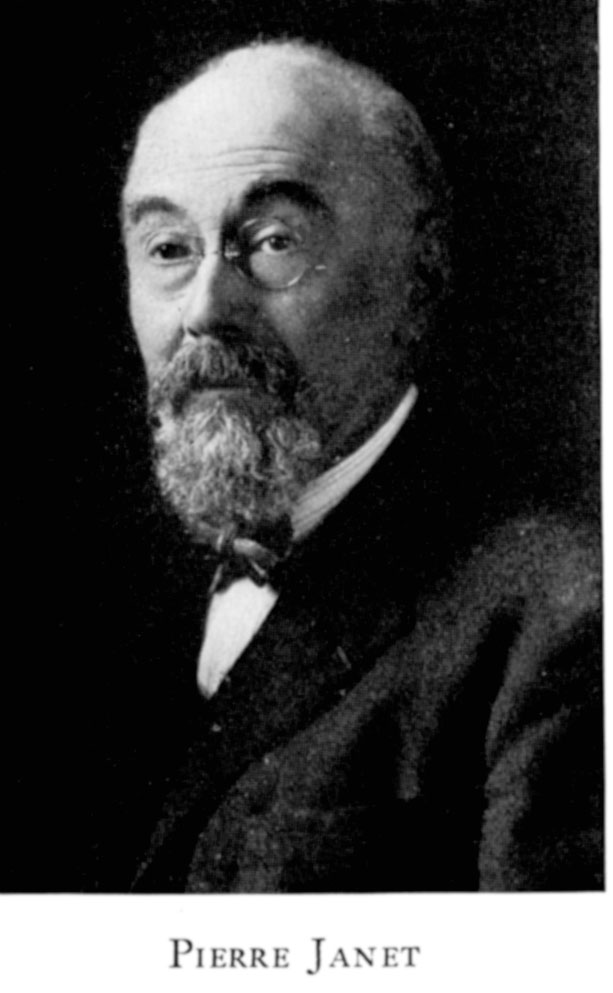
Pierre Janet
The essence of hypnosis is suggestion and Charcot did not understand suggestion. The rival hypnosis school led by Auguste Liebeault and Hippolyte Bernstein at Nancy to the East of Paris was aware of the effect of suggestion but not necessarily the nature of what it was. Actually suggestion is whatever enters the mind and is accepted. If one wakes to a beautiful sunny morning it is suggested to oneself that the day will be a good day. Acting on that suggestion, post-hypnotic one might say, one will try to make the day a great one to hang onto that feeling. The mind is naturally open to suggestion as it must be; in an active mind one can discriminate to some extent as to what suggestions will be accepted and which rejected. Under hypnosis in which the mind has been put into a passive state the ability to discriminate and reject has been greatly reduced so that a hypnotist can plant a suggestion that then becomes what Charcot’s associate, Pierre Janet, called an idee fixe, or in other words, a fixation that will remain in your mind until executed. This notion may be imparted by a human agent, books, movies, radio or any medium that is capable of influencing the mind. One must be aware of this. It isn’t necessary to have a hypnotist standing in front of you saying ‘look into my eyes.’
As I say, Charcot was convinced that hysteria was biological, that is to say caused by a lesion to the brain, so that while he hypnotized his female subjects at the Salpetriere he wasn’t aware of the nature of suggestion.

Marie Corelli
Now, the eighteen seventies and eighties were terrifically exciting at all levels. They did things differently then. As has been said: The past is another country; they do things differently there. The past is never to be judged by current standards although the latter are useful for comparison. Thus when Lister suggested that antiseptics ought to be used in the operating room his suggestion was stoutly resisted although true and nearly universally accepted today. On the other hand Evolution although true is more stoutly resisted today in a religious reaction than it was in the last quarter of the nineteenth century so don’t feel all that superior.
While Charcot was arguing with himself as to whether hysteria was biological or mental, in the mid-eighties two of his associates easily grasped that hysteria was a mental problem. These two were Sigmund Freud and Pierre Janet.
Freud at that time, 1886, was making the transition to psychology from medicine. He was an MD. Charcot was not alone in dealing with mental matters. The understanding of dreams for instance was developing rapidly. When Freud published his Interpretation Of Dreams in 1900 he cited dozens of competent researchers dating as far back as the 1860s. In 1886 alone two novels dealing with the subconscious and split personality were published, Robert Louis Stevenson’s Dr. Jekyll And Mr. Hyde and Marie Corelli’s Wormwood. Corelli cites Charcot as an influence so she very likely had attended his semi-public presentations of hysterics under hypnosis at his hospital.

Sigmund Freud
Going back further, Freud, a German Jew, was undoubtedly familiar with the psychological work of the German romantics. At any rate he spent about four months at the Salpetriere studying Charcot’s work and methods. It is likely that the foundation of his psychoanalysis was laid there. While Charcot was struggling to determine whether hysteria was biological or mental, Freud, himself a neurologist, was able to perceive that, as he later put it, hysterics were suffering from reminiscences. In other words they fixated on past experiences which dominated their minds and behavior.
Pierre Janet, Charcot’s student and associate, came to the same conclusion probably at the same time. He expressed the problem more accurately when he determined that hysterics suffered from one or more idee fixes, that is a fixed idea or, in other words, a fixation centered around a specific past event or events.
Indeed, all the women at the Salpetriere had been battered and brutalized by life with no means of self-assertion or resistance. Unable to express their own will they retreated into ineffective hysterics finally ending up as semi-insane in Charcot’s hospital.
Now, split or multiple personality. No one, especially these women, have the personality they are born with. Over the course of our lives circumstances require us to respond in different ways, sometimes a personality is overwhelmed with a consequent personality adaptation or change and in extreme cases, insanity.
All very well, but what happens to the original and/or various personalities that were submerged. It is impossible for them to vanish from the mind so they must live on submerged by a more powerful personality impulse. Depending on the individual then, everybody must have at least one alternate personality. Stevenson and Corelli were demonstrating this in their novels.
The good Dr. Jekyll had had a wild streak in his youth that he forcefully repressed to become the totally respectable man of medicine. But, he longed for his rough and rowdy days so in Stevenson’s story he invents a potion, I’m sure whisky would have been just as effective, that allows him to free his original personality. In the course of his experiment the earlier personality suppresses the later one assuming control of Jekyll’s mind. Much the same thing happens in Corelli’s novel. Thus we have personality accretion.
Charcot’s hysterics, because of the side show atmosphere the Good Doctor created, became world famous, a sort of show people. Charcot even took them on the road for demonstrations and, heaven forbid, loaned them to other doctors for experimentation.
It was during one such loan in 1888 that Jules Janet, Pierre’s brother, made a startling discovery. He was experimenting on Blanche Wittman, the Queen of Hysterics, when having hypnotized her into what Charcot called the first state, instead of progressing to the second state, he decided to put her into a deeper trance. At that point Blanche was able to dissociate her personality from her normal state to what I assume was her original personality. She turned into a happy effervescent bubbly girl. In other words she had stripped every accreted personality adjustment to return to the period before society violated her womanhood.
One might ask where this personality came from? It is not necessary to assume either the supernatural or the paranormal. The personality did not come from outside her but was merely an early personality that had been submerged and denied existence by repeated abuse. If Jules Janet had pressed on he might have found three, four or more variations of Blanche Wittman. Indeed, when Charcot died in 1893 Blanche ceased having hysterical attacks and became quite normal assuming yet another personality although it was not recognized as such. She then took responsible employment at the hospital until she died under tragic circumstances.
Thus during one’s life one assumes many variations as one’s personal circumstances dictate. And one expresses them in many different ways. As an example of personality accretion I am going to use the history of the American fantasy and science fiction writer, Edgar Rice Burroughs. He has especial value as his biography is well developed and he has talked voluminously about his mental states through his large body of fiction which is all autobiographical in nature.
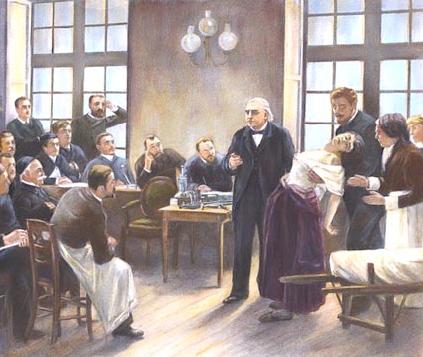
Dr. Jean Martin Charcot Demonstrating Hypnosis And Hysteria
Part II follows.
A Review: Wormwood by Marie Corelli
February 4, 2012
A Review
Wormwood
by
Marie Corelli
Essay by
R.E. Prindle
And Essay On Dual Personality From 1886 To The Present

Saginaw Bay In Winter
Key texts:
Burroughs, Edgar Rice: Corpus
Corelli, Marie: Wormwood, 1886
Ouida: Under Two Flags, 1867
Stevenson, Robert Louis: Dr. Jekyll And Mr. Hyde, 1886
Intro
When I grew up in Michigan not too far from the Saginaw Bay, in a good, cold winter the Bay froze over several feet thick. People drove their cars far out over it to laboriously dig holes through the ice in hopes of catching a fish. Then one day in late Spring when the warmer weather relaxed the bond of the frozen H2O molecules, if you happened to be there at the right time, a loud sharp crack not unlike thunder rose from the ice as the grip of winter ceased its hold and the tens of thousands of acres of ice began their metamorphosis back to water
As the water of the Bay began once more to heave they inexorably drove floes back on the beach in an incredible mountain or ridge of ice twenty feet high stretching for miles that began slowly to dissolve until in the early summer the beach was clear.
In Europe in the eighteenth century a similar process began in 1789-93 when the old social order with a similar loud noise began to dissolve until after Napoleon’s defeat at Waterloo in 1815. A new world order became discernable as different as the ice and water on Saginaw Bay, yet clearly recognizable as the Bay under its two regimes. The reign of the fabulous nineteenth century had made its appearance. Now, at least Western Man had emerged from the cocoon able to assume its powers but first going through a growth period. This was a necessary but difficult period that produced differing results.
A number of conflicting dichotomies arose. Science struggled to be born while its religious antagonist refused to die. Old gods trying the swallow the new. The agrarian basis of wealth began to be supplanted by the Money Trust as the nouveaux riches paired off against the landed nobility. The money managers quickly became the new lords of the earth.
The old standard of slavery began to disappear with the end of the agrarian supremacy as after the American Revolution White Slaves were freed first, then the Black Slaves, the serfs of Central and Eastern Europe were liberated to a freedom they scarce knew how to use. Populations left the countryside to migrate to cities to work in industries as wage slaves until Henry Ford gave them independence and dignity in 1914. Change was everywhere as singers and dancers and fine romancers rose from being members of ignoble professions to become the most admired and wealthy members of the new world order far surpassing in wealth the old landed aristocracy.
The son of a servant and a cricket player, H.G. Wells, became a famous author and savant. Conan Doyle created Sherlock Holmes from nothing but his imagination and made fortunes while directing the future course of the world. Robert Louis Stevenson wove dream portraits and became a playboy of the western world. Reality as it had been known dissolved like the ice of Saginaw Bay.
Naturally all this very rapid change caused intolerable stresses on society and the personalities of its members as it and they struggled to understand the changes and organize the consequences of those flying changes. As a fact, the last known witness of Waterloo where Napoleon lost his bid died on 5/10/1904. She had witnessed it all from Waterloo to the Wright Bros. flight, if she paid attention to what was going on.
In 1886 two remarkable novels made their appearance on this incredible stage. Robert Louis Stevenson’s Dr. Jekyll And Mr. Hyde and Marie Corelli’s Wormwood. Perhaps the subject of split personalities had been suggested to their intellects by the multitude of dichotomies cast up on the beach from the old world order to exist in conflict with the new. Perhaps it was the discovery and investigation of the unconscious mind as the unconscious was first exposed by Dr. Anton Mesmer just before the cataclysm began. Whatever it was, before Freud, it began the long investigation of dual and multiple personalities surviving to this day.
I concern myself here with the novelists Marie Corelli, Ouida and Edgar Rice Burroughs.

Ice On The Move- Saginaw Bay
1.
As much as the revolutionaries would have liked to smash the Catholic Church and religion in general they only succeeded in ending its dominance of European culture which was indeed a good thing. In the process the heresies formerly suppressed by the Church were released to flower in all their glory plus a whole catalog of new ones created by Science. The more ancient heretical sects springing from the destruction of the Knights Templar such as Freemasonry and Rosicrucianism and, even, Satanism rapidly spawned a host of related sects not least of which was Spiritualism. Hindu and Buddhist missionaries began to proselytize Europe and the Americas. Related to these were the various Theosophical groups. Thus the Church had to contend with all these plus the Jews who were emancipated with the Revolution and thus placed on a par, as it were, with the Church and hence actual competitors for the soul of Europe.
Science had destroyed the intellectual basis of both Christianity and Judaism at the first blow; Darwin gave both sects a body blow in ‘59 so that after 1859 all was in a state of religious confusion. One consequence of the shattering of religious pretensions was that life after death was put in doubt. This loss was more than most people could bear who cherished an afterlife even if heaven had disappeared in smoke hence the efflorescence of Spiritualism which promised at least contact with the dear departed in some Great Beyond. At the same time psychology initiated by the discoveries of Dr. Anton Mesmer with the recognition of an unconscious was making inroads on ancient views of the mind. Scientists worked with Spiritualists in such organizations as the English Society For Psychical Research in the hopes of demonstrating life after death. While we today minimize the significance of Spiritualism at the time it was quite a serious matter. The writers who began their careers sometime after Darwin’s announcement of Evolution dealt with what we would call occult phenomena as a distinct scientific possibility if not probability.
Arising out of this intellectual milieu was Robert Lewis Stevenson (1850-1894). Coming aware shortly after the Origin Of Species was published he came to maturity during this important era of rapid scientific development. He captured the tone of the period magnificently in his novella Dr. Jekyll And Mr. Hyde. While not the first split personality story, Poe had explored the idea in various stories during the 1830s and 40s, his was the story that riveted world attention then and now.

Robert Louis Stevenson
Most of us I’m sure base our ideas of the story on the 1930s’ movie which differs significantly from the book being more involved with the sexual exploits of a sadistic Edward Hyde. His other side, Henry Jekyll, was in his fifties which means he would have been born about 1830, post-Napoleonic but wholly within the reign of Queen Victoria and the height of the Empire. While something of a rake in his youth Jekyll believes he has his wild side under control but longs for his rowdy ways. He would have been about twenty-nine in ‘59 so that he is more or less au courant in scientific ideas, apparently a chemist of some merit. Employing that skill he concocts a beverage that made LSD look as weak as tea, definitely more powerful than any single malt whiskey, which not only releases him from the restraints of conventional morality but physically converts him into a monster. Thus he splits his personality in two becoming alternately Henry Jekyll or Edward Hyde. While as mild mannered as Clark Kent when Dr. Jekyll he becomes the devil incarnate as Edward Hyde. But, of course you know the story, at least the movie version. Eventually Jekyll devolves from the civilized Jekyll into the demonic Hyde permanently.
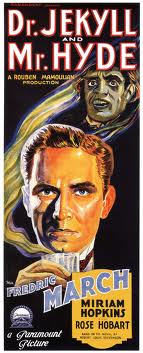
Jekyll And Hyde
The dichotomy of Jekyll-Hyde symbolized and was probably suggested by the many dichotomies of nineteenth century society not least of which was the huge gap between the affluent and the impoverished, the educated and the brutalized, Science and Religion- Jekyll and Hyde.
The story electrified the English speaking world. Indeed two years later a real Edward Hyde stalked the East End killing women along the way. He was known as Jack The Ripper.
Perhaps at the same time in far off Chicago a thirteen year old Edgar Rice Burroughs read the book which made an indelible impression on him as we shall see.
2.
Something that is seldom mentioned is that Europe had quite a drug problem in the nineteenth century. The opiates were quite common. Laudamun may have been the first of the opiates, apart from opium itself, which was first created by the great Paracelsus sometime in his life between 1493-1541 which went through many changes before being marketed in England as a cough depressant. In order to calm babies mothers gave them a little dollop. So, perhaps a sizable proportion of the population had known opiates from babyhood.
Morphine was reduced by Friedrich Suternus in 1804, distributed by him beginning in 1817 and marketed by Merck from 1827. It came into its own in 1857 when the hypodermic needle was invented.
By the time of Marie Corelli’s novel, Wormwood, morphine was a recreational drug for society ladies.
Heroin was synthesized in 1874 being marketed by Bayer from 1895 to the time it became a controlled substance in the second decade of the next century. Bayer originally sold Heroin as a non-addictive replacement for morphine. Missed the boat on that one. Hard to believe that mankind was so backward in recognizing addictive drugs for what they are.
Cocaine was first isolated in 1855 from which point it began its career. Perhaps its most famous user was the fictional Sherlock Holmes and his 7% solution. He made his first appearance in 1886 along with Stevenson’s and Corelli’s novels. Cocaine’s most famous pusher man was the deviser of psychoanalysis, Sigmund Freud, who turned everyone within reach on during these same 1880s.
And while it little effect in the nineteenth century, amphetamine was isolated in 1885. Subsequently famously used by Adolf Hitler and Jack Kennedy.
In 1886 then, the thirty-one year old Marie Corelli (1855-1924) published her novel Wormwood in which morphinism took a minor role while the novel was

Marie Corelli
essentially a polemic against the use of absinthe, an alcoholic drink with apparently hallucinatory side effects while being essentially addictive. Marie Corelli while not being a household word today was one of the best selling authors in the world from 1886 to the Great War. I am newly introduced to Corelli’s work with her novel Wormwood hence can say nothing of her as a possible influence on Edgar Rice Burroughs. It isn’t obvious from Wormwood.
The relation of the novel to the split personality occurs when midway through the novel the hero, Gaston Beauvais, having been shocked out of his senses by disappointed expectations falls into a deep depression which is then abetted by his becoming an absintheur or, essentially, a drug addict thus assuming a second personality not unlike that of Henry Jekyll and Edward Hyde also caused by drugs only more dramatically.
While absinthe didn’t seem to make much of an impression in England, although Ouida in her 1867 novel, Under Two Flags, does mention its use, according to Corelli in 1886 the liqueur was devastating the manhood of France.
As this novel opens Gaston is the prosperous son of a banker for whom the future seems to be clear sailing. Gaston is the proverbial good boy who is outstandingly proper in dress and ideas. He and his father are great friends with the De Charmilles family whose daughter Pauline of eighteen years has just emerged from convent school much as Corelli had in her own life.
Gaston is charmed by the female beauty of Pauline undertaking to win her hand. Being almost a total innocent, although she does not love- i.e. have a grand passion- for Gaston, she accepts. Gaston is elated as he pins his life hopes on this whimsical girl.
Corelli, who is believed to have been a lesbian, was certainly a man hater while placing womanhood on a pedestal higher than any man ever thought of. Thus the snake in the grass arrives as the aspirant priest, Silvion Guidel. While Corelli paints Gaston as a sort of humdrum fellow, Silvion is electricity itself, every girl’s vision of passion painted in high colors.
Despite his fair exterior and the apparent virtue of his calling Silvion is the devil in disguise, a seducer and a cad. Although herself aware of the psychological ideas of the time as evidenced by her references to the contemporary psychologist Jean-Martin Charcot and Pierre Janet Corelli merely draws her picture in such a way that eschews explicit explanations leaving only inferences to the reader to interpret. For instance she casually mention Janet’s idea of the Idee Fixe with which both Pauline and Gaston are possessed but says nothing about it. Thus I am uncertain whether I am reading into the story rather than interpreting her intent.
Guidel, and this interpretation is left open, arriving from the provinces to Paris, introduced into this society quickly sizes up the situation. In his hauteur he despises the simple trust of Beauvais and more to spite him than anything else charms and seduces the lovely airhead, Pauline.
This is not enough. Gaston and Pauline’s wedding date had been set. Within a few weeks of the wedding Gaston is allowed to learn of the romance between Pauline and Guidel. Further which Pauline who has always played the virgin with Gaston we have the first hint of an inference that she is with child by Guidel.
Corelli now poses a moral dilemma in which through her character of Helisie, Pauline’s cousin, she sides with Pauline because every woman lives for a grand passion that no man can possibly understand and hence must be forgiven and forgotten. Gaston is just an average guy; he expects Silvion to step up and assume his responsibilities. He has renounced his right to be a priest and should take Pauline off his hands. Having worked his evil Guidel is satisfied. Rather than face a duel with the enraged Beauvais he flees Paris for the safety of the Church and Brittany where he immediately takes orders placing him out of reach of Beauvais’ vengeance.
Corelli does not see the betrayer and seducer of Pauline as the cad he is but she sees Gaston who has no intention of now marrying Pauline who has distributed her ‘passion’, as the ununderstanding cad. Gaston is between the proverbial rock and the hard place which seems to escape Corelli. He must choose to either marry the girl or shame her by renouncing her. Horrible position for any man but Gaston gets no pity from Corelli, not where a woman’s grand passion is involved.
As Guidel makes no appearance or communication before the wedding day Gaston exposes Pauline’s shame and denounces her at the altar. The consequences are of course horrific. All the blame falls on Gaston’s shoulders who immediately not only loses the girl but all social caste. Having had the greatest expectations of happiness he is now plunged into the deepest of depressions. As the rain pours down he rushes from the altar to find himself a place on a bench in the Champs Elysee where he sits for hours drenched to the bone in the downpour. Very symbolic. There can be no more accurate description of his absolute despondency. His personality splits, he becomes a different man as completely as Jekyll and Hyde.
As the title Wormwood indicates the novel is meant by Corelli to be a denunciation of the drinking of absinthe in France. She equates absinthe drinking as a manly vice while she equates morphinism as a female vice. Thus these two twin addictions are destroying the flower of France in her eyes. In point of fact both absinthe and morphine became controlled substances within a decade or two.
As Gaston wallows in his despondency in the downpour an impoverished artist he had helped out a few times discovers him on his bench. The devil’s helper is always at hand. This fellow in his cynical way consoles Gaston while taking him to a bistro in which he introduces the susceptible Gaston to– absinthe. Absinthe takes the place of Jekyll’s chemical concoction. The result is the same as in all drugs as all sense of social responsibility is dissolved and what remains is a pure sense of self and – anarchy. As Shelly put it:
Last came Anarchy: he rode
On a white horse, splashed with blood;
He was pale even to the lips,
Like Death in the Apocalypse.
And he wore a kingly crown;
And in his grasp a scepter shone;
On his brow this much I saw–
‘I am God and King, and Law!’
And so the course of the last half of the story is worked out as Gaston took his vengeance.
Of course there are consequences to drugs and the exaltation of self and the personation of anarchy. One loses one’s discipline and then one loses the trust of friends and family. And so Gaston neglected his responsibilities while naturally being unable to render a justification of his actions to his father. The end result is that he is cast away by his father.
But the beauteous Silvion Guidel, he of the fair face and lax morals has unleashed a train of horrors that can’t be avoided.
Pauline’s father, old De Chamilles, commits suicide- it was either that or challenge the innocent but increasingly debauched Gaston Beauvais to a duel. The shamed young thing Pauline also cast into a depression because her grand passion is balked leaves home to take up a life on the streets of Paris. Guidel having taken orders, because of his good looks is called to Rome to delight the Cardinals with his handsome presence.
This tale of degradation and woe moves rapidly on in a supremely well told fashion by Corelli. And then comes the denouement.
Gaston’s descent takes only three or four months from August to the onset of cold weather. Taking a turn through the Bois de Boulogne Gaston chances on Silvion and Pauline’s trysting place where his trust had been betrayed. There he finds Silvion who had taken unauthorized leave from his duties in Rome, in other words, he just disappeared, no one knows where he is.
Silvion, who in what he must have known was a mortal insult, asks how Pauline is. ‘You married her, didn’t you?’ Obviously his intent is to resume his liaison behind Gaston’s back. Once again Corelli lectures us on the necessity of this passionate affair before turning Gaston loose to throttle Silvion which he does to my immense satisfaction at least. I find my own moral judgments in direct opposition to those of Corelli.
Having now gratified his sense of injury on Silvion, Gaston still seeks vengeance of Pauline. She has successfully eluded all detection although Gaston has caught a couple of fleeting glimpses of her on the streets. Now, driven by the imp of the perverse, he determines to track her down. He comes across her singing for her supper on a street corner, a real Edith Piaf. By this time after several months of being an absintheur he is reduced to total anarchy. Being told that she is still in love with Silvion he goes into a grand passion of his own telling her that Silvion is dead and when she wouldn’t believe him he informs her that he murdered him with his own hands in their old trysting place.
Of course Corelli takes this opportunity to expatiate further on the grand passion every woman needs and the anarchic precedence this passion takes over everything else not unlike the absinthe or morphine. Pauline has a locket around her neck that she had worn when she and Gaston were engaged which he now discovers contains a picture of Silvion and a lock of his hair. Enough to drive a guy to any violence.
Pauline escapes his rage fleeing for that repository of souls, that which had taken Silvion’s, the Seine, and throws herself in. Good riddance of bad rubbish was my thought while Gaston was much gratified. One doesn’t have to guess Marie Corelli’s thoughts on this point in the history of a grand passion.
At that point Gaston’s anger is rectified so while the story effectively has climaxed an ending is needed. Like many a writer Corelli had her story supremely elaborated until her own psychical crisis was reached, her hysterical grand mal described by Charcot and then she has to limp along for fifty pages or so until she wraps things up. Still, the novel was a very satisfying read. Four and a half stars. If Corelli had studied her Ouida a little more she might have brought the prize home.
3.
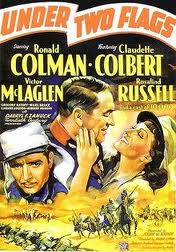
Under Two Flags
In all the dichotomies of the nineteenth century none split the public psyche more than that of the conflict between science and religion. Nor has the split and conflict gone away as the recent recurrence in fundamentalist Jewish, Moslem and Christian sects reveal.
Indeed all three sects have hurled themselves with full ferocity against the science of Evolution. Nothing denies religion more. Indeed Corelli opens Wormwood with a troubled discourse on science contra religion. The conflict can probably be seen in the same light as that between Paganism and Christianity at the turn of the Age of Pisces. Science at the time was viewed as more or less an evil by the majority while that majority has only lessened its opinion by somewhat today.
The conflict with science, quite frankly, is that it denies the evidence of the senses and asks us to accept as fact, not belief, what can’t be seen except perhaps by extremely sophisticated instruments. The religionists make the Scientific Consciousness relatively dangerous too. While we might not have to fear for our lives as in previous centuries, too outspoken a criticism of religion, especially Moslemism, might result in one’s head rolling toward the gutter. College professors at that time had to be very careful. They were permitted to be ‘agnostics’, that is, they didn’t deny the probability of God but were allowed to doubt it. A little concession to science. Corelli appears not to be able to deny science but is troubled by the conflict with religion.
So, this is the social malaise which Freud forty years hence would call Civilization And Its Discontented. The growing demands of Civilization that divided the old ‘natural’ life from the new ‘artificial’ life was disquieting; made people uneasy. Thus in the mother of all French Foreign Legion novels, Ouida’s Under Two Flags of 1867 that author flatly lays the problem out. Life had already grown too complex for the average person to handle.
In Under Two Flags Ouida creates two lives for her hero, Bertie Cecil; thus while his psyche remains unsplit his career requires him to assume a totally

Ouida
different character. The first part showing Cecil in civilization is a superb novel on its own. Compelled, as it were, by his circumstances to seek ruin, Bertie fakes his death in a train crash then hopping the Med to Algeria he renounces his socialite life to enlist in the French Foreign Legion.
In the novel when it resumes his history Cecil has been a Legionnaire for twelve years. As the novel was published in 1867 it must have written in 1866 or perhaps if published late in 1867 possibly that year; Ouida wrote huge novels at the rate of one or two a year. Bertie must have enlisted in about 1855. The French conquered Algeria only in 1830 so that the Legion took form quickly as Bertie would very nearly be in the first draft. Ouida writes as though the Legion was ancient.
At the time of the story 1866-67 the desert had already become a vacation spot for the English, exerting an almost hypnotic attraction for them; the Garden Of Allah as the Bedouins called it. Ouida has already dissociated herself, in mind anyway, from loyalty to England and Europe. Bertie in Algeria is unresolved whether to live his exile from civilization with the Bedouins or the French. He stakes his future on the throw of the dice with a French commander; if Bertie won, to the desert; if the commander won Bertie would go to the French. Thus it is only by chance Bertie remains a European. However having once accepted the French flag, duty makes him loyal.
In his heart, and of necessity in Ouida’s, he regrets the chance that made him French. As Ouida says France was might, while the Bedouins were right. Never mind that the conquest was to remove the Barbary Pirates who had been plundering the European coast for centuries; never mind the conquest by the Arabs as far as France when the Eruption From The Desert seized European lands for Moslemism; in some curous way, the historical memory of Ouida and, indeed, the West, was obliterated. Not only are the Bedouins in the right but they live as Man ought to live, the ‘natural’ man some might say, the primitive, the good life. For myself I would find the social organization of the natural life far too oppressive, the social organization of Civilization suits me fine and the key term here is social organization, one is always under some social discipline and in the primitive one it is as a slave of the chief. Not for me.
Thus in the evolutionary process Western man is still too in touch with his primitive mind to feel comfortable with the new social demands of Western Civilization. So we have this Western love affair so in evidence during this period with a romantic, if false, appreciation of natural life in association with the desert- The Garden Of Allah as in Robert Hitchens’ novel of that name.
Now, while the authors of the central period of the Great Century were mostly born at the end of the Napoleonic Wars, the new crop of writers beginning in the eighties were mostly born mid-century coming to maturity after Science had become fairly developed, certainly after Darwin. Mostly they lived past 1900 when technology changed the whole direction of society virtually creating a whole new civilization. One might say the new civilization was a cause of the Great War.
4.
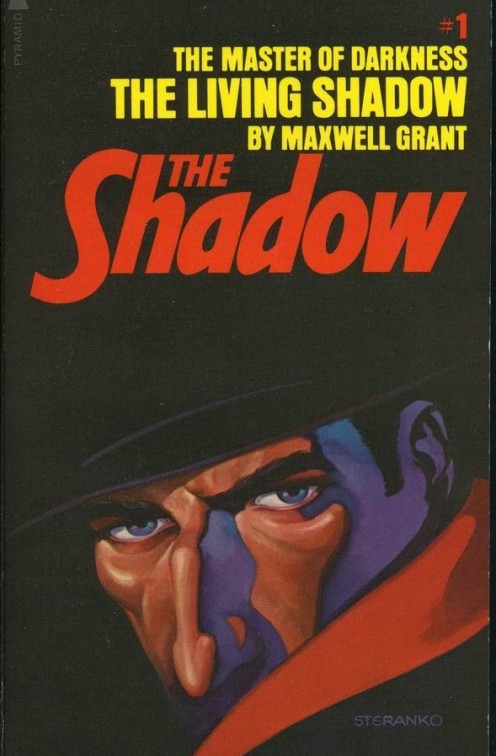
Self-explanatory
As time moves along change is ever present. So we have Edgar Rice Burroughs who emerged as an author in 1912 some few years out of the nineteenth century although he was born in 1875 so he was familiar with that horse and buggy era. The mind set of those writers beginning in the eighties endured from that period to the Great War which put a period to the mind set which in any event was changing rapidly. There was a new mind set after the Great War.
As Burroughs was born on an average, perhaps, of twenty years after the group of authors, he was not a competitor for honors with them but what one might call a synthesizer of the whole body of ideas. Thus until after 1920 when his mind evolved into the new mindset he was a Jr. Member of the set. He shared the mind set of his seniors. To properly understand Burroughs then up to 1920 one must be ware of the problems his older contemporaries were addressing while Burroughs addressed all the problems offering what he believed were conclusive solutions. At the same time he wrote books in all of the new developing genres.
He found the desert romance particularly attractive as he wrote The Return Of Tarzan, partially desert romance, The Lad And The Lion, full desert romance, and Son Of Tarzan, significantly desert romance; in addition the last several Tarzans took place in Ethiopia while in several novels Arabs make slave forays into the South from the North.
The question here is did he read Ouida’s Under Two Flags? I haven’t found an absolutely clear pointer but in Return of Tarzan, the novel begins in Civilization in Paris corresponding the first part of Under Two Flags while Tarzan obtains an appointment as a French secret agent to travel to Algeria which would be equivalent to the Foreign Legion.
Burroughs doesn’t mention the Foreign Legion until his ambiguously titled WWII novel Tarzan And The Foreign Legion in which the Foreign Legion is a group of people Tarzan gathered around himself in Sumatra.
If Burroughs did read Ouida, which wouldn’t be unlikely, then it is quite possible that her Bertie Cecil was one of the inspirations for Tarzan, although in reverse. Ouida like Marie Corelli makes her hero extremely feminine often describing him as womanly with womanly attributes, very nurturing or motherly. He is consequently tender hearted about the enemy while being motherly and concerned for his fellow legionnaires in a manner that would have brought scorn on him in any military organization, but according to Ouida made him much beloved, a saintly figure. Quite a warrior in the field though.
Tarzan on the contrary is never tender; he spares no foe, gleefully, almost taking sadistic pleasure in dispatching his foes in what are often near pre-emptive strikes. There is a large measure of sadism in the Jungle Joker humor in which he delights in tormenting his victims, unless he merely rips their heads off. In many ways then Tarzan is Bertie Cecil turned inside out. Of course Tarzan’s thin veneer of civilization runs no deeper than his clothes and when he takes those off he reverts to pure beast. Tarzan does not equivocate.
Burroughs as he often says was fascinated by the notion of dual personality. While he couldn’t have been influenced by the movie Jekyll and Hyde, Stevensons’ book made a profound impression on his mind. As he said, he believed that all men were two people although maybe not as pronounced as Jekyll and Hyde but he does appear to believe that Jekyll and Hydes could be found in numbers. How pronounced his own disunion was he doesn’t say but a conception of Burruoughs the Night Stalker isn’t difficult to form.
Jekyll and Hyde and the two sides of Corelli’s Gaston Beauvais were chemically induced but Burroughs uses another device when he split’s the personality of Tarzan. In Tarzan’s case the roof usually falls on his head giving him amnesia when he rises as another man. Like Jekyll and Hyde usually Burroughs provides a physical duplicate so that two Tarzan twins, Burroughs even wrote a children’s story the Tarzan Twins, are wandering around one of which is doing things injurious to Tarzan’s reputation; a reflection perhaps on the problems Edward Hyde caused Henry Jekyll.
Thus in Tarzan and the Golden Lion and Tarzan and the Ant Men the Tarzan lookalike Esteban Miranda defames Tarzan by using the steel tipped arrows found in children’s archery sets.
In Tarzan and the Lion Man a movie actor impersonates Tarzan giving the real Big Guy headaches. In Tarzan Triumphant Tarzan himself impersonates a dandy named Lord Passmore. Perhaps an indication of the post-divorce Burroughs. It is interesting the psychological stress resulting in the splitting occurs around Burroughs sexual problems.
Throughout his work, especially to 1920, then, Burroughs recapitulates the themes of his elders of the late nineteenth century, more especially he concerns himself with the problem of split or dual personality. This theme would be further explored by writers following in his footstep beginning in 1920 when his own influence began to be felt.
5.
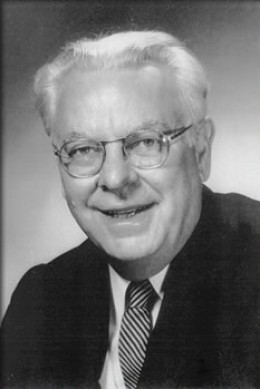
Maxwell Grant/WalterGibson
The New Era as the period of prosperity that began a couple years after the War and ended with the crash of ‘29 was known while seemingly a radical departure from the Victorian and Edwardian periods quite naturally took its origins from that recent past but many of the themes that Burroughs as the last of his era was exploring lost some of their significance or perhaps were transformed by the really incredible advances in science and technology of the first two decades of the century. The addition of Prohibition and the vote for women as the decade began also threw an entirely different cast over the period.
Not one of the least influential changes in the period was the influence of the success as a writer of Edgar Rice Burroughs. Between 1920 and 1940 Tarzan, himself, transformed by the talkies, had become more than a household word, indeed, he was a cultural artefact, one might say the grounding of the New, or Wold Newton, Mythology.
I don’t believe there was any writer working in the period who was not familiar with Burroughs’ writing and in some way influenced by it, not excluding the Man of Steel, Stalin himself. War was declared on Burroughs by the Germans in the first half of the third decade resulting in the banishment of his books from the Weimar Republic. Sic transit gloria.
Burroughs continued to turn out his volumes throughout the period referring frequently to the dual personality. Through his works, but not exclusively, the dual personality became a pervasive trope. A suggestion that one picked up subconsciously.
So many literary characters were doubles that one began to think of oneself as two people. Perhaps the most influential of the new crop was the playboy Lamont Cranston who may or may not have been himself during the day and the Shadow by night. Actually since Cranston was out of the country almost continuously he lent his identity to The Shadow, or so we are told. Figure that one out; how to be in two places at once. Most of we younger people were only familiar with the radio Shadow although the writer Maxwell Grant or, in his true identity, possibly, the magician, Walter Gibson wrote over three hundred titles for those with multiple idle moments to mull over and with a fondness for the trivial. Some historical interesting stuff though.

The Man Of Titanium
Doc Savage split his personality into five parts with his wrecking crew of paramilitary soldats. Savage would be recapitulated by Steve Rogers and his alter ego Captain America with his merry band of five. Capt. America arrived as comic book literature preceded by the first of the comic book double personalities, Superman, and his daytime identity, Clark Kent
The most spectacular of the dual personalities, those who I base my double on, were Capt. Marvel and Billy Batson. One event yet more dual than this. Billy Batson was a little crippled newsboy, just my age at the time, or seemingly so, who was inducted into the superhero Hall Of Fame.
Billy, a little orphan boy like me was out at midnight peddling his Gospel News when a mysterious stranger, not unlike the Shadow, asked the poor but honest lad: ‘Why aren’t you home in bed, son?’ Billy replied: ‘I have no home, sir. I sleep in the subway station, it’s warm there.’ Wasn’t too hard for me to identify with that.
The Mysterious Stranger or hand of fate points and says: ‘Follow me!’ Down in the subway he means. Billy being no fool asks: ‘Where are we going.’ Easily satisfied he receives the answer: ‘Wait and see.’
Suddenly a strange subway car, with headlights glaring like a dragon’s eyes, roars into the station, stops. No one is driving it. The MS intones: ‘Have no fear everything has been arranged.’
Oh, everything has been arranged. Every little crippled orphans’ dream.
The train drops them off into a cavern displaying the seven deadly sins. A propitious beginning. Believe me, this was close to reality for an eight year old kid, like me. The MS takes Billy and introduces him to this grey beard in a long white flowing robe. This is a guy with the unlikely name of Shazam but a guy everyone would want to meet.
Shazam was all virtue, been fighting injustice and cruelty all his very long life but without much success. He explains his name to Billy. The S stood for the wisdom of Solomon; H for the strength of Herecules; A for the stamina of Atlas (I could never remember that one, I knew what stamina meant too); Z for the all powerful mind of Zeus; A for the courage of Achilles (wasn’t sure who he was); and M for the speed of Mercury.
Shazam tells little Billy Batson:
All my life I have fought injustice and cruelty. But I am old now- my time is almost up. You shall be my successor. Merely by speaking my name you can become the strongest and mightiest man in the world- Captain Marvel! Speak my name.’
Billy does and boy! Talk about split personalities, the little crippled orphan becomes the strongest man in the world giving Superman and Clark Kent some mean competition which is why DC Comics sued him out of existence.
I already had the split personality at eight, and how, so I used to sit around shouting Shazam over and over waiting for the lightning flash that never came. There’s always just been me two, although I did get up to five for a while but now I have returned to one and have to be satisfied with myself. It isn’t easy being single when you’ve been double for so long. No one to talk to. But me? I take it easy, play it as it lays. Always have, always will. For the next couple years anyway, maybe, until I keep my appointment with the Grim Reaper. As the saying goes: My days are numbered.
As Eddie Burroughs believed that every person has a second self I suppose it may be true, at least Western Man; perhaps not as extreme as Jekyll and Hyde or Billy Batson and Capt. Marvel but a psychological phenomenon created both by evolution and the dichotomies created by the conflicts of the nineteenth century as well perhaps as the multiple conflicts of this global, multi-cultural world.
Say goodnight Ed I, Ed II, Ed III, ED IV and Ed V. Goodnight all.

Billy Gets His Personality Split
2011 in review
January 7, 2012
The WordPress.com stats helper monkeys prepared a 2011 annual report for this blog.

Here’s an excerpt:
The Louvre Museum has 8.5 million visitors per year. This blog was viewed about 170,000 times in 2011. If it were an exhibit at the Louvre Museum, it would take about 7 days for that many people to see it.
Pt. I: Edgar Rice Burroughs Rides The Rocket, A Short Life
January 3, 2012
Part I
Edgar Rice Burroughs Rides The Rocket
A Short Life
by
R.E. Prindle

ERB: What, Me Worry?
Eddie was a ramblin’ gambling’ man. He was born in a pair of ramblin’ shoes and he always took the most desperate chances. When he succeeded he was spectacular but when he failed…oh, well.
Perhaps the biggest gamble he ever took was being born but then, as Eddie always said: to me to conceive is to act. Things started out well as he began his life as a little prince but would soon turn sour when he was eight and lost a confrontation with a twelve year old bully on a street corner on the way to school. That was a life changer; he’d gone from prince to pauper and worse was yet to come. But, hey, it’s all education, isn’t it now?
The next year he began a foot race with the plague which he would ultimately lose. But as with being born he was initially successful. In an effort to escape the epidemic he was transferred to an all girls school. Apparently this was a polite plague selecting only boys. So like young Achilles Eddie took his place among the young ladies.
Still pursued, as one imagines, he was put for safety in a Latin School, one imagines as a place the fever would never look for him and if it found him would never enter the abode of such objectionable learning. Still, a young man of means he owned both a pony and a bicycle. The pony he rode back and forth to school leaving it tethered outside while he soaked up the classical knowledge. The bicycle he rode for fun but tipped over banging his head against a curb. This left him dizzy for days perhaps contributing to his later character which was formed by a similar incident.
While secure at the Harvard Latin School of Chicago for a couple years, the plague was not to be baffled forever. Eddie took to his heels running as fast as he could way out across the Western Plains to Idaho to become a Jr. cowboy. No box tops necessary.

If this picture is any indication he was quite a dude. Look at those chaps! The rowels of those spurs were so big they dragged on the ground announcing his approach from some distance. It was not all bravado however as he did have quite a way with the horses. Eddie was quite happy on the ranch and he might have become a Sr. cowboy but fate put some itchin’ powder in Eddie’s ramblin’ shoes and he resumed his ramblin’ ways. Doing an intellectual about face he and his guitar showed up at a Harvard prep school called the Phillips Academy. It was soon discovered that he didn’t know how to play guitar and hadn’t even learned any good cowboy songs such as The Streets Of Laredo, The Chisholm Trail and other titles of that ilk. Didn’t even know how to sing, either.
This disappointed the faculty, as well as his low grades, so that they couldn’t bear Eddie’s presence. Thus he was told to put his ramblin’ shoes back on and git along.
As you can tell, by this time Eddie was accumulating a fair amount of educational experience though not of the academic sort. Still of tender years and still outdistancing the plague Eddie had to find another educational emporium to fill out his youthful years. His father, actually the agent of all this agitation, for some reason thinking him a delinquent, did what all fathers of delinquent kids do, he enrolled the lad in a military academy. Supposed to make you learn to stand up straight or something like that. Yep. If the plague showed up there they’d most likely make him stand at attention until he got tired of it.
After all this ramblin’ Eddie was becoming quite a character. In addition to performing some typical goofy stunts Ed was a star rider on the Equestrian team as well captaining the football team as a quarterback. Just to put in some good words for Eddie here and raise him in your estimation, Ed led the Michigan Military Academy Tigers, or whatever they were called, to a draw against the mighty University Of Michigan Wolverines. Always an odd sobriquet I thought and in a competition between a tiger and wolverine which would you bet on.
Now, this nearly miraculous feat did not go unnoticed. He so impressed the Wolverine coach that Ed was offered a full football ride at Ann Arbor. Well, you might say, that was really wonderful. Yes, it could have been. But the imp of the perverse was down in those ramblin’ shoes as well as the itching powder as Eddie turned the coach down. If the offer had come from Yale that would have been different, but UM? Eddie had his heart set on Yale, which his brothers had attended, and it was Yale or nothing. Yale was uninterested.
That was a positive life changing experience that Eddie missed but fate was cramming the next few years with a bunch more, some of them very memorable. Plus the plague was waiting for him just around the corner. That was going to be a stunner.
First up was one of those glorious once in a lifetime experiences that only succeeds if you’re at the right age. Eddie was and he had one glorious summer in the year of ‘93. The Chicago Columbian Exposition. The promoters couldn’t get it together to open in ‘92 which would have been that actual 400th anniversary year of the intrepid navigator’s voyage but the promoters were ready in ‘93. Eddie was seventeen and spent the summer of his life at the Expo grounds.
I’m going to have to try to set the Expo up for you because in its own way it was the highpoint of Western Civilization before and since. Western confidence just began to sort of evaporate after the fair was over.
II.
Eddie In Wonderland

Built In A Matter Of Months
The nineteenth century was quite something. It was the century of magnificent discoveries and achievement. Society chooses to diminish those wonderful scientists by derogatorily calling them Dead White Men while sneeringly dismissing them. Pardon me, if I’m sentimental but those were the guys that made the present possible and I can’t admire them too much. They’ll always be my revered ancestors to me and not Dead White Men. Down with negativity.
Technology and Science just exploded as scientific research opened new and very broad vistas to human view that never would have been opened without them. The machinery was incredible. The accumulated wonders were first put on display at London’s Crystal Palace Exhibition of 1851. Six million people wandered through. It was breathtaking as the world of tomorrow went on display.

Water Gate From Lake Michigan
The Centennial Exposition of 1876 in Philadelphia followed as an international competition began to form. Next came the 1889 fair in Paris for which the Eiffel Tower was created to form the triumphal arch through people entered the fair. Boy, there was an eye opener. Over a thousand feet tall, 300 steps up to the first level and 300 more up to the second. Tough act to follow but out there on the very edge of civilization existed the city to do it. Chicago. Chicago itself was considered exhibition enough. The Iron Chancellor, Bismarck himself, said that his only regret was dying without ever having seen that Chicago.
By 1893 the conditions for a perfect fair had formed. Steam safely delivered hordes from across the seas and steam brought them to Chicago in long lines of Pullman cars pulled by a mighty eight wheeler. The conditions were perfect and Chicago had the men of vision to realize the perfect fair- and how! And there were men to commemorate it as it deserved. H.H. Bancroft published a large size five volume set displaying its wonders in detail

The setting on Lake Michigan was spectacular; a one of a kind creation, never since replicated or even close to it. The Century Of Progress of 1933 was but a pale imitation. If you’ve read The Devil In The White City you know a fuller description than I’m going to give here. The White City, as the fair grounds were called, was a fairy land, life as it could be. It contrasted with the Black City, life as it was, of everyday Chicago. Industrialism was a recent phenomenon in the nineteenth century so that in the giddiness of creation such things as environmental concerns and labor relations had been neglected or at least not seen in their true importance. Everyday Chicago was a grim place; Eddie often makes unflattering remarks about his home town throughout his novels. It was smelly, smoky and dirty with huge slums not to mention institutionalized crime. They’ve shut down the stockyards but the criminal mentality remains.
The White City in contrast was a city as it could be and should. L. Frank Baum would later use it as the model for his Emerald City. As there was great labor unrest in Chicago at the time the labor force was critical. Those who signed on were quarantined to the site while work was in progress so as not to be corrupted by the labor dissidents. They threw up some of the most massive buildings in existence, practically overnight. They created pleasure gardens and a whole pleasure island. They had the midway of midways, in fact the term Midway was originated at the Expo. In competition with Paris’s Eiffel Tower the worlds’ first monster Ferris Wheel was brought into existence. While in the US the Wheel was turned into a carnival ride now many European capitols display huge four hundred foot Ferris Wheels next to their Houses of Parliament. No US city does; even the original Ferris Wheel was dismantled and has disappeared into some junkyard, perhaps having been converted into the steel beams of a skyscraper.

Japanese Pavilion
The Expo not only featured the technological and scientific triumphs of that fabulous nineteenth century but all the intellectual advances; Francis Galton the English psychologist displayed his achievements; Frederick Jackson Turner announced his seminal work on the disappearance of the frontier; The Congress of World Religions set up its tent over in the Black City to discuss how religion was to meet the challenge of science.
One of the first of the body builders, The Great Sandow, performed his strength stunts and flexed his muscles giving Eddie the germ for his seminal literary creation a few years hence.
Imitation Zuni Cliff Dwellings were created, a whole Dahomian village was thrown up, staffed with real Dahomians brought over for the fair. Eddie was influenced by these but he really enjoyed the peep show- forty beautiful women, count ‘em, forty, on display for your delectation.
Dozens of huge buildings from nearly every State and country, art works created an instant museum to rival the great museums of the world. Just outside the gates, too late to be included within, the fabulous Buffalo Bill’s Wild West. History portrayed while it was still in making out on the Western Plains. As incredible as it may seem among the performers was no less than Sitting Bull himself, the engineer of Custer’s defeat at his Last Stand. Amazing. It’s all show biz, folks.
The White City shot up out of the beach sands and chiggers, existed for a few months and then it was gone, burned to the grounds by the labor malcontents of the Black City. Fire is the devil’s best friend. Before it was gone Eddie and his fellows from the Michigan Military Academy marched into that Sacred City like so many Greeks at Troy, in pomp and circumstance. The troops of the MMA strutted in while the band played on. It filled Eddie’s heart with pride. Five years later, slightly inebriated, he and a friend would hire a band parading along behind it through the street of downtown Denver. Let’s just say the fair entrance was one of those thrills.
The summer of ‘93 was one for Eddie to remember. In a few years automobiles would begin to fill the streets of the Black City. In the White City of ‘93 Eddie beat them to the punch driving fair patrons around in his dad’s electric Morrison. The Morrison wasn’t much in the way of self propelled vehicles, being little more than a buckboard with benches on it, but, there was no horse in front of it and Ed was behind the wheel.
There was so much at the fair that a casual weekend visit was merely the smallest of sips, a week was a swallow, two weeks perhaps a draught. Nobody could take it in, nobody, but Ed that is. He had the full three months of that glorious summer to walk the walks, cross the bridges, stroll the romantic Wooded Island to the fabulous Japanese pavilion, gape and take it all in. You’ve got to remember that in those days before movies, TV, videos and color photography bound in convenient volumes no one, or at least very few, had ever seen such things. The fair was the prototype for all the Disney Lands and Worlds now dotting the planet.
What Ed might have missed he may have spotted in a newspaper account, rushing back to the grounds to take it in. Not everyone would know how to use what he saw and experienced, Ed did. Even if it was impossible for him to understand what he saw at the time, Eddie tucked it into the back of his mind from which it emerged in dribbles into his fiction over the thirty years of his writing career.
How lucky he was to pass the Summer of ‘93 in this wonderland. Truly a life changing experience. Not the only one coming up, Eddie had a lot more awaiting him in what he described as a boring life.
III.
Life Begins To Get Serious
First up was graduation from the MMA and the year he spent as a Geology instructor there. Then at the end of the year a depression seized Ed, probably caused by his failure to get an appointment to West Point. He joined the Army anyway leaving the MMA in the lurch while asking for the worst post in the Army’s jurisdiction. He got it. He was very lucky the Army wasn’t the French Foreign Legion or they might have assigned him to a post that made hell look a luxury resort, with no way out. The Army was more considerate, they sent him to Fort Grant in Arizona which was a few degrees cooler than hell although the accommodations were not much better.
The bad news was that Ed was in the Army finding this particular life changing experience, decidedly unpleasant; the good news was that Eddie really liked the desert and the Apaches. Zane Grey beat him to the punch writing about it but Eddie read Zane’s books assiduously. Both Arizona and Southern Utah, the border was disputed at that time, formed an irresistible attraction to him and he and Emma in their later years of marriage returned to it often. Even as Eddie was sadly contemplating divorcing this woman who had stuck with him through thick and thin, he retreated to the White Mountains Apache Reservation to ponder his situation. A deep respect for the Apaches was another consequence of his abbreviated tour of duty. Abbreviated because Ed developed what the Old Timers called a ‘tobacco heart’ and Ed had his dad use his influence to get him out. When the going got tough Eddie always took off running. He remembered that street corner in Chicago.
Well there he was, nearly twenty-five years old with no directions home although he did find his way back to Chicago, a story in itself, which I’m not going to tell here, but fragments of it can be found in The Return Of The Mucker. Ed knew how to use every scrap of his experience to advantage. For a couple years Ed hopped back and forth between Chicago and Idaho where his brothers were still running the ranch where Eddie earned those gigantic spurs.
It was on one of these trips he and an old Army buddy, a member of the Might Have Seen Better Days Club of that brief Army period, hired the band in Denver. It was also in Denver that Ed showed his gambling proclivities losing the money to cover the stretch from Denver to Idaho. As the baby brother, Big Brother Harry covered his act but Ed had set a dangerous precedent.
Part of the reason for Ed’s motation at this particular stage of his life was the maturing of his relationship with future wife Emma. As girls often do, she matured faster than Eddie and hearing her biological clock ticking was ready for the altar. Time was no longer on her side. Whether she could have ever rustled Ed out of bachelorhood is a topic for some rumination if she wasn’t at the same time being courted also by a rich handsome young fellow by the name of Frank Martin. Irish; always a red flag for Eddie who had some Irish blood of his own but considered himself a full blooded English type.
Rich and Irish. Franks’ dad was a big railroad magnate. Had his own private car to hitch at the back of the train. Well, to make a long story short Frank correctly discerned Ed’s intentions of wanting to remain a bachelor yet keep Emma on his string. Ed would go away but he wouldn’t stay away. Frank sat down and thought for a while, perhaps between breakfast and lunch, and thought he had devised a way to keep Eddie away…permanently.
It was a good plan and should have worked but it didn’t. Frank had his dad hook up the private car to a New York City bound train and then invited Ed along for the ride. Our Blithe Spirit got on the train without a qualm. One should never trust the other guy in matters concerning love or money. There are some guys who take the old saying everything’s fair in love and war quite seriously. Ed was to be given the coup de grace in Toronto on the way back. The boys went to the Toronto equivalent of Chicago’s Levee for a night’s entertainment. A couple thugs approached Ed flashing a black jack of sufficient weight and criminal dexterity to kill him but the coup and the grace separated. Ed was down and bloody but he survived. He promptly went back to Chicago and married Emma to keep her out of Frank’s hands. Now it was Frankie’s turn to cry.
We know he was a sore loser and if he didn’t stalk Ed he didn’t let him out of his sight either. Thirty-four years later when Ed and Emma parted Frank’s man Patchin was sent to LA to gloat over the divorce. Even when Eddie died, Frank had preceded him, Patchin sent a mocking letter to Ed’s son.
What I’m leading up to here is not even conjecture but just a bit of imagination, but since I know more than I’m telling, a possibility. As I pointed out for the last twenty years Ed had been dodging the plague; in 1901 he turned a corner and there he was face to face Mr. Typhoid Fever. Fever shook his hand and that was it. Eddie was down and almost out. It was a terrible bout but Ed did survive or else I might be writing about Zane Grey, a decidedly stuffy creature in whom I have no interest.
It was only a little over a year since Frank had been aced out of Emma. Definitely not long enough to cool off his hot Irish temper. A man who will attempt murder once will hold a long grudge and we know that Martin never stopped thinking of Emma and Ed. It may sound far fetched and may be it is, but as Ed caught the Typhus a year or so after snagging Emma I wouldn’t be surprised to learn that Frank Martin passed a stolen bacillus on to Ed in some way. Certainly he couldn’t have him assaulted again, an accident might have been difficult, so perhaps he introduced the disease into Ed’s food in some way. Just a suspicion.
Eddie didn’t bounce back to his feet but while he convalescing a very important book to him was issued which he devoured as it appealed to his romantic soul. He would read Owen Wister’s Virginian six or seven times by 1920. If one looks at in this way Ed made several attempts to escape Chicago until he finally succeeded in 1919. If one looks at it like that, as I say, Ed fled with Emma in 1903, 1913, 1916 and 1919.
I always look for a chain of events, the reason why. Wister’s The Virginian has a terrific reputation although it is one of those classics that leaves me cold. Wister was one of Teddy Roosevelt’s buddies. The book he wrote smells like a Gent roughing it in the wilds. Perhaps the appeal to Ed. On the one hand the novel deals with the Johnson County Range War in Wyoming of which Eddie was peripherally associated when he was an Idaho cowboy in ‘91. Several of the rebels who had killed men fled Wyoming while one or two went into hiding in Idaho. Ed apparently knew one of these desperadoes so The Virginian would have had a personal interest for him.
The love story of the book concerns a rough hewn poorly educated cowboy and a school teacher much above him who he woos and wins. They then wed while for their cowboy honeymoon the hero takes his new wife out into the picturesque mountains of Wyoming.
IV.
Buttons And Bows.
A Western ranch is just a branch
Of Nowhere Junction to me.
Give me that city
Where the living’s pretty
And the girls wear finery.
Ray Evans, Buttons and Bows
From Paleface of 1948 starring Bob Hope.
I haven’t read a study on Ed that gave any attention to understanding Emma or her history and yet she was a key figure in his success while after Ed divorced her his production declined in both quantity and quality. It would seem then that whatever drove him as a writer was connected to Emma
There were striking differences between Ed and Emma. Whereas Ed was shifted not only from school to school but from Illinois to Idaho to Massachusetts and finally to Michigan, Emma continued on at Brown School to graduation giving her a much more stable outlook on life. After graduation she studied voice in Chicago becoming familiar with the higher culture while Ed was much more familiar with the lower reaches of culture. Emma would often chide Ed for his lack of culture as he preferred boxing to opera and in later life would become a devotee of professional wrestling with all its vulgar connotations.
The Hulberts, Emma’s family, considered themselves as high class people and, indeed they were. Thus when Frank Martin came calling Emma’s father, Alvin was overjoyed finding Frank a perfect match for his daughter. Alvin quite frankly despised Eddie considering him a ne’er do well and young failure. There was certainly enough evidence to support his point of view. Before the marriage, in order to encourage Frank’s attentions to his daughter, Ed was forbidden the house. And yet Emma had her heart set on Ed and would have him. Apparently her affection never wavered although her opinion of her husband varied. As it would turn out Alvin’s view of the marriage was much more correct than Emma’s. She should have listened to her papa.
As a young girl and woman the Hulberts treated Emma to the best of everything. While her heart was set on Ed, it is obvious that she dated during all those years when Ed was not in Chicago. It is important to remember that Ed was from Chicago but his youth was spent elsewhere so that he was only faintly culturally of Chicago.
Emma was a clotheshorse. As the pictures show she was used to finery. Those are not only a lot of clothes she’s wearing but fairly expensive clothes. Clothes that Ed definitely could not provide her during the first decade or so of their marriage. When he did come into his money it was his pride that Emma could buy any clothes she wanted and he was happy to have her do so.
So, Ed, his head spinning from the Toronto bashing, and woozy from his fever attack, never particularly stable anyway, conceived the notion of taking Emma to the foothills of Idaho to reenact Wister’s novel. In 1903 then, Ed packed Emma and all their belongings to catch a train to Idaho riding baggage with Emma and their dog.
We have no record as yet of what Emma may have thought of this or whether she protested vehemently being overruled by Ed’s unreasoning passion. Of course between bashing, fever and excruciating headaches anyone might be excused erratic but innocent behavior.
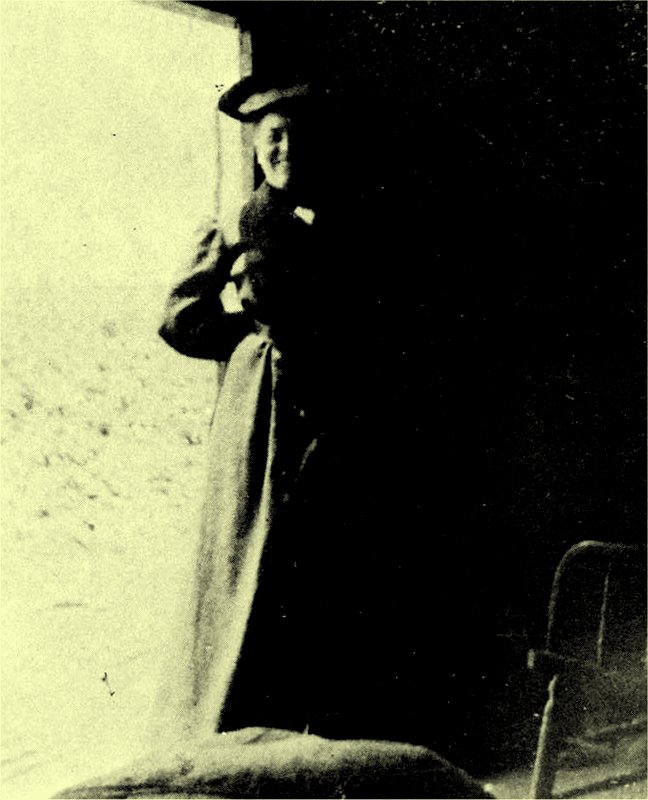
Emma Riding Baggage Dressed Chicago Style
Perhaps she objected using an analogous argument to Ray Evans’
My bones denounce the buckboard bounce
And the cactus hurts my toes
Let’s stay here where gals keep usin’
Those silks and satins and linen that shows
And I’m all yours in buttons and bows.
If she did use such an argument she was still in the baggage car with Ed and the dog.
I’m sure the trip was wildly romantic to Ed. His dad’s battery factory was on Madison, the hobo main stem so that I’m sure Ed had discussed the hobo life with them. His 1915 novel The Return Of The Mucker would celebrate the hobo life style as well as its successor The Oakdale Affair. So there they were, he, Emma and the dog in the baggage car like three hoboes.
Look at the picture of Emma in her finery standing in the boxcar. The look on her face echoes the lyric:
Don’t bury me in this prairie
Take me where the cement grows
Let’s go back to where I’ll keep on wearin’
Those frills and flowers and buttons and bows
Rings and things and buttons and bows.
I wonder if that was what was going through her mind.
Those long skirts didn’t work well out in the brambles, Emma didn’t have any other clothes, probably wouldn’t have worn pants if available, nor was Emma entranced with the one room balloon shack Ed threw up so their stay way out there was romantic to only one of them and of short duration.

Ed And Emma Dressed To Kill In The Wilds Of Idaho
Now comes an event painful to relate. Emma in her finery is way out there feeling miserable while Ed having removed wife and possessions to the romantic wilderness has only forty dollars in his pocket with no way to earn more. He was a rambler, he was a gambler.
Ed’s brother Harry was off in Parma so he and Emma went down to the station to catch a train to visit Harry. They had to put up for the night in what passed for a hotel room above the saloon. To this point in her life Emma had never even thought of roughing it and now she was learning all about it. To compound matters Eddie kissed her goodbye just like in Frankie and Johnny and went downstairs to find a poker game. His head must really have been hurting. They could have written the song Stagger Lee about him.
Well, he started with forty dollars thinking to inflate his stake to sixty or maybe eighty dollars but fate decreed that he come away with empty pockets. The possible reward wasn’t worth the risk. He had to have been playing with sharpies who took his cash and commiserated with his hard luck.
Let me illustrate how slick it can be. I was nineteen on the California Zephyr and two would be sharpers were trying entice me into a game of poker. They were really obvious and I wasn’t biting, I’d already dealt with sharpers aboard ship and come away cleaned. But, the railroad had an employee on board who must have been an amateur magician, he knew his cards. Dressed like a hick, walking and talking like one, he bustled up with his own deck of cards, invited me to stay, probably would have given me the best hands I’d ever seen because he meant me well, but I wasn’t really interested. Anyway he cleaned those two guys out in ten minutes and bustled off the way he came. They sat there stunned.
Now, I wasn’t present at the game Ed was in but I’d be totally amazed if those boys didn’t have a good laugh and dinner at Ed’s expense. Bad luck, good luck, Ed now stood at the bottom of the stairs swallowing hard, trying to figure out just how he was going to explain their dilemma to Emma. To be short about it, this was another one of those life changing experiences for Ed. No, sir, Ed didn’t have an explanation that Emma would accept. I mean, she could have married a millionaire and here she was in a wretched so-called hotel room a thousand miles from nowhere without a dime. Think about it. What was going through her mind?
Their relationship changed right there. It was a change that Ed would never be able to overcome; I’m sure it was the primary cause for the divorce thirty years later as Emma could never forget while Ed could never get over his shame. But, Ed hung in there for now. He recorded much of this period in his novel The Girl From Ferriss’s While a romanticized view of the years between 1900 and 1922 can be found in Marcia Of The Doorstep when Ed was again in hot water for overextending himself financially in LA.
I’m sure the railroads had a bitter taste for Ed after Frank Martin and Toronto. The memory of that private car shone in Ed’s mind like a diamond, but for now he took a job on the Oregon Shortline as a yard policeman in Salt Lake City. That is until Emma rebelled at taking in boarders ordering Ed to take her back to Chicago:
Let’s move back to that big town
Where they love a gal by the cut o’ her clothes
And I’ll stand out in buttons and bows.
Ed had a garage sale or whatever they called them back then actually selling Emma’s ornately carved marriage bed for a pittance. I’m sure that left a little scar too. Then, perhaps because Emma ragged him about riding baggage he bought a couple first class tickets back to the Black City which now appeared blacker than ever, I’m sure.
Ed was now a lost boy with responsibilities. The next seven years must have been a period of the blackest despair for him. He just couldn’t get his act together. He wandered from job to job. He landed a job at Sears, Roebuck that was a good job paying three thousand dollars a year. Not bad money in those days when unskilled labor worked six twelve hour days for from five hundred to seven-fifty a year. Ed’s prospects were good. He probably could have moved up into the five to ten thousand class in a few years. He showed up at his front door saying: Honey, I quit. Emma’s reaction wasn’t recorded but I’m sure it was voluble.
And then, of course, there were the pencil sharpeners. Ed never did sell one but he did sit down and write half of A Princess Of Mars. Who would have believed it? Munsey’s Magazine to who he had submitted it asked for the other half and gave him four hundred dollars to boot. Whether Ed and Emma sensed it or not they were on their way aboard the rocket, ready to ride.
We all hope for the success of our wildest dreams but few if any of us are prepared to manage the consequences of that success. It’s not as easy as it might seem. It’s sort of like the town bum spending a dollar for a lottery ticket and getting fifty million in return. If the bum thought he knew money before he is now introduced to the real thing.
For Ed who in his conception was born a prince, made a pauper, spending decades in disappointed expectations, now realized his destiny again. Upbraided by Emma for being a poor provider he was now in a position to provide her every desire, after taking care of his first, of course. The past weighed heavy on Eddie. The difficulties of his courtship and the shame of that gambling night in Idaho had to be rectified, reversed.
It couldn’t be, of course. One’s failures can only be recognized, accepted and lived with. But in a frenzy Ed thought that by repeating the private car incident and the disastrous trip to Idaho he could wash away the stains. Thus, having established a market for his goods, most especially with the creation of his ‘meal ticket’ Tarzan, Ed did an incredible thing. Remember he still had no money in the bank, betting entirely on the come.
As with Idaho he packed up all his goods including his useless second hand car, wife and by now three kids, bought five first class tickets to San Diego and made another attempt at fleeing Chicago. First class wasn’t the same as a private car but it was pretty close so Ed hopefully erased the shame of Frank Martin’s trip to New York City and back.
Once in San Diego, which stay lasted nine months, or long enough to be born again as the New Ed, he must have lived a princely existence going through most of the ten thousand he earned that year while returning to Chicago as broke as he had been when he and Emma boarded the train in Salt Lake City. So, he tried to eliminate his shame.
Once back in the Black City, having sold his production while in San Diego, he wrote some more, sold some more and made a seamless transition from the old Ed to the reincarnated Ed.
I would imagine that part of the plan was to get Tarzan published as a book and with that money establish himself as a man of means in his old home town. Move on up to the Gold Coast.
That would seem to be a very reasonable plan from our point of view but it was not that easy. Perhaps Tarzan, which is pure fantasy of the extravagant kind went well beyond publisher’ literary expectations. No one would touch it then, even though from our perspective the story was pure gold as, indeed, it turned out to be although not for Ed. Perhaps the novel appeared to the literary taste of Ed’s day as comic books did to literary lights in the forties and fifties of the last century, something to be burned and banned, hence Ed’s success was of the bastard sort.
He finally did get his novel published in book form in 1914 but he was stripped of most of the financial benefits as it went almost directly to reprint publishers; thus his royalties were more than halved and mere pittances of what they might have been. Still, by the time royalties began to come in Ed had created a backlog of Tarzan novels so that with current production one a year would be published for about ten years.
As the profit motive didn’t seem to be activating his publisher, the Chicago firm of McClurg’s, Ed was reduced to pleading with them to print at least twenty to thirty thousand copies before a novel was sent to the reprint house. It seems incomprehensible that McClurg’s wouldn’t do so on their own but they obstinately refused to make money for themselves and hence for Ed.
Well, the records, as I’ve been told, have been destroyed so what’s to be said. Once again I suspect outside interference. McClurg’s was an Irish house; Frank Martin was Irish. McClurg’s a was semi-public company open to investors one assumes; Frank Martin had money to invest. Until a better explanation is provided I have to believe something along those lines was happening.
But, if Eddie could have lived long enough the wonders he would have seen. At one hundred he would have been a very rich man. Those successful intellectual properties just keep gaining in value. Better than stamp collecting.
While Ed appears to have been stymied at the publishing end, that enterprise was old hat, the new wonder of the authorial imagination was movies. The Big Money, to quote John Dos Passos, Thus to some extent the movies made up for what Ed was being cheated out of in publishing. The first film production of Tarzan was the industries first million grosser. Thus when Ed successfully fled Chicago in 1919 his income was ten times what it had been in 1913. If his work was disparaged, as the say goes, he laughed all the way to the bank. Ed left Chicago with his pockets jingling.
Next: Part II: If Pigs Had Wings
Edgar Rice Burroughs Rides The Rocket: A Short Life
Eddie was a ramblin’ gambling’ man. He was born in a pair of ramblin’ shoes and he always took the most desperate chances. When he succeeded he was spectacular but when he failed…oh, well.
Perhaps the biggest gamble he ever took was being born but then, as Eddie always said: to me to conceive is to act. Things started out well as he began his life as a little prince but would soon turn sour when he was eight and lost a confrontation with a twelve year old bully on a street corner on the way to school. That was a life changer; he’d gone from prince to pauper and worse was yet to come. But, hey, it’s all education, isn’t it now?
The next year he began a foot race with the plague which he would ultimately lose. But as with being born he was initially successful. In an effort to escape the epidemic he was transferred to an all girls school. Apparently this was a polite plague selecting only boys. So like young Achilles Eddie took his place among the young ladies.
Still pursued, as one imagines, he was put for safety in a Latin School, one imagines as a place the fever would never look for him and if it found him would never enter the abode of such objectionable learning. Still, a young man of means he owned both a pony and a bicycle. The pony he rode back and forth to school leaving it tethered outside while he soaked up the classical knowledge. The bicycle he rode for fun but tipped over banging his head against a curb. This left him dizzy for days perhaps contributing to his later character which was formed by a similar incident.
While secure at the Harvard Latin School of Chicago for a couple years, the plague was not to be baffled forever. Eddie took to his heels running as fast as he could way out across the Western Plains to Idaho to become a Jr. cowboy. No box tops necessary.
If this picture is any indication he was quite a dude. Look at those chaps! The rowels of those spurs were so big they dragged on the ground announcing his approach from some distance. It was not all bravado however as he did have quite a way with the horses. Eddie was quite happy on the ranch and he might have become a Sr. cowboy but fate put some itchin’ powder in Eddie’s ramblin’ shoes and he resumed his ramblin’ ways. Doing an intellectual about face he and his guitar showed up at a Harvard prep school called the Phillips Academy. It was soon discovered that he didn’t know how to play guitar and hadn’t even learned any good cowboy songs such as The Streets Of Laredo, The Chisholm Trail and other titles of that ilk. Didn’t even know how to sing, either.
This disappointed the faculty, as well as his low grades, so that they couldn’t bear Eddie’s presence. Thus he was told to put his ramblin’ shoes back on and git along.
As you can tell, by this time Eddie was accumulating a fair amount of educational experience though not of the academic sort. Still of tender years and still outdistancing the plague Eddie had to find another educational emporium to fill out his youthful years. His father, actually the agent of all this agitation, for some reason thinking him a delinquent, did what all fathers of delinquent kids do, he enrolled the lad in a military academy. Supposed to make you learn to stand up straight or something like that. Yep. If the plague showed up there they’d most likely make him stand at attention until he got tired of it.
After all this ramblin’ Eddie was becoming quite a character. In addition to performing some typical goofy stunts Ed was a star rider on the Equestrian team as well captaining the football team as a quarterback. Just to put in some good words for Eddie here and raise him in your estimation, Ed led the Michigan Military Academy Tigers, or whatever they were called, to a draw against the mighty University Of Michigan Wolverines. Always an odd sobriquet I thought and in a competition between a tiger and wolverine which would you bet on.
Now, this nearly miraculous feat did not go unnoticed. He so impressed the Wolverine coach that Ed was offered a full football ride at Ann Arbor. Well, you might say, that was really wonderful. Yes, it could have been. But the imp of the perverse was down in those ramblin’ shoes as well as the itching powder as Eddie turned the coach down. If the offer had come from Yale that would have been different, but UM? Eddie had his heart set on Yale, which his brothers had attended, and it was Yale or nothing. Yale was uninterested.
That was a positive life changing experience that Eddie missed but fate was cramming the next few years with a bunch more, some of them very memorable. Plus the plague was waiting for him just around the corner. That was going to be a stunner.
First up was one of those glorious once in a lifetime experiences that only succeeds if you’re at the right age. Eddie was and he had one glorious summer in the year of ‘93. The Chicago Columbian Exposition. The promoters couldn’t get it together to open in ‘92 which would have been that actual 400th anniversary year of the intrepid navigator’s voyage but the promoters were ready in ‘93. Eddie was seventeen and spent the summer of his life at the Expo grounds.
I’m going to have to try to set the Expo up for you because in its own way it was the highpoint of Western Civilization before and since. Western confidence just began to sort of evaporate after the fair was over.
II.
Eddie In Wonderland
The nineteenth century was quite something. It was the century of magnificent discoveries and achievement. Society chooses to diminish those wonderful scientists by derogatorily calling them Dead White Men while sneeringly dismissing them. Pardon me, if I’m sentimental but those were the guys that made the present possible and I can’t admire them too much. They’ll always be my revered ancestors to me and not Dead White Men. Down with negativity.
Technology and Science just exploded as scientific research opened new and very broad vistas to human view that never would have been opened without them. The machinery was incredible. The accumulated wonders were first put on display at London’s Crystal Palace Exhibition of 1851. Six million people wandered through. It was breathtaking as the world of tomorrow went on display.
The Centennial Exposition of 1876 in Philadelphia followed as an international competition began to form. Next came the 1889 fair in Paris for which the Eiffel Tower was created to form the triumphal arch through people entered the fair. Boy, there was an eye opener. Over a thousand feet tall, 300 steps up to the first level and 300 more up to the second. Tough act to follow but out there on the very edge of civilization existed the city to do it. Chicago. Chicago itself was considered exhibition enough. The Iron Chancellor, Bismarck himself, said that his only regret was dying without ever having seen that Chicago.
By 1893 the conditions for a perfect fair had formed. Steam safely delivered hordes from across the seas and steam brought them to Chicago in long lines of Pullman cars pulled by a mighty eight wheeler. The conditions were perfect and Chicago had the men of vision to realize the perfect fair- and how! And there were men to commemorate it as it deserved. H.H. Bancroft published a large size five volume set displaying its wonders in detail
The setting on Lake Michigan was spectacular; a one of a kind creation, never since replicated or even close to it. The Century Of Progress of 1933 was but a pale imitation. If you’ve read The Devil In The White City you know a fuller description than I’m going to give here. The White City, as the fair grounds were called, was a fairy land, life as it could be. It contrasted with the Black City, life as it was, of everyday Chicago. Industrialism was a recent phenomenon in the nineteenth century so that in the giddiness of creation such things as environmental concerns and labor relations had been neglected or at least not seen in their true importance. Everyday Chicago was a grim place; Eddie often makes unflattering remarks about his home town throughout his novels. It was smelly, smoky and dirty with huge slums not to mention institutionalized crime. They’ve shut down the stockyards but the criminal mentality remains.
The White City in contrast was a city as it could be and should. L. Frank Baum would later use it as the model for his Emerald City. As there was great labor unrest in Chicago at the time the labor force was critical. Those who signed on were quarantined to the site while work was in progress so as not to be corrupted by the labor dissidents. They threw up some of the most massive buildings in existence, practically overnight. They created pleasure gardens and a whole pleasure island. They had the midway of midways, in fact the term Midway was originated at the Expo. In competition with Paris’s Eiffel Tower the worlds’ first monster Ferris Wheel was brought into existence. While in the US the Wheel was turned into a carnival ride now many European capitols display huge four hundred foot Ferris Wheels next to their Houses of Parliament. No US city does; even the original Ferris Wheel was dismantled and has disappeared into some junkyard, perhaps having been converted into the steel beams of a skyscraper.
The Expo not only featured the technological and scientific triumphs of that fabulous nineteenth century but all the intellectual advances; Francis Galton the English psychologist displayed his achievements; Frederick Jackson Turner announced his seminal work on the disappearance of the frontier; The Congress of World Religions set up its tent over in the Black City to discuss how religion was to meet the challenge of science.
One of the first of the body builders, The Great Sandow, performed his strength stunts and flexed his muscles giving Eddie the germ for his seminal literary creation a few years hence.
Imitation Zuni Cliff Dwellings were created, a whole Dahomian village was thrown up, staffed with real Dahomians brought over for the fair. Eddie was influenced by these but he really enjoyed the peep show- forty beautiful women, count ‘em, forty, on display for your delectation.
Dozens of huge buildings from nearly every State and country, art works created an instant museum to rival the great museums of the world. Just outside the gates, too late to be included within, the fabulous Buffalo Bill’s Wild West. History portrayed while it was still in making out on the Western Plains. As incredible as it may seem among the performers was no less than Sitting Bull himself, the engineer of Custer’s defeat at his Last Stand. Amazing. It’s all show biz, folks.
The White City shot up out of the beach sands and chiggers, existed for a few months and then it was gone, burned to the grounds by the labor malcontents of the Black City. Fire is the devil’s best friend. Before it was gone Eddie and his fellows from the Michigan Military Academy marched into that Sacred City like so many Greeks at Troy, in pomp and circumstance. The troops of the MMA strutted in while the band played on. It filled Eddie’s heart with pride. Five years later, slightly inebriated, he and a friend would hire a band parading along behind it through the street of downtown Denver. Let’s just say the fair entrance was one of those thrills.
The summer of ‘93 was one for Eddie to remember. In a few years automobiles would begin to fill the streets of the Black City. In the White City of ‘93 Eddie beat them to the punch driving fair patrons around in his dad’s electric Morrison. The Morrison wasn’t much in the way of self propelled vehicles, being little more than a buckboard with benches on it, but, there was no horse in front of it and Ed was behind the wheel.
There was so much at the fair that a casual weekend visit was merely the smallest of sips, a week was a swallow, two weeks perhaps a draught. Nobody could take it in, nobody, but Ed that is. He had the full three months of that glorious summer to walk the walks, cross the bridges, stroll the romantic Wooded Island to the fabulous Japanese pavilion, gape and take it all in. You’ve got to remember that in those days before movies, TV, videos and color photography bound in convenient volumes no one, or at least very few, had ever seen such things. The fair was the prototype for all the Disney Lands and Worlds now dotting the planet.
What Ed might have missed he may have spotted in a newspaper account, rushing back to the grounds to take it in. Not everyone would know how to use what he saw and experienced, Ed did. Even if it was impossible for him to understand what he saw at the time, Eddie tucked it into the back of his mind from which it emerged in dribbles into his fiction over the thirty years of his writing career.
How lucky he was to pass the Summer of ‘93 in this wonderland. Truly a life changing experience. Not the only one coming up, Eddie had a lot more awaiting him in what he described as a boring life.
3.
Life Begins To Get Serious
First up was graduation from the MMA and the year he spent as a Geology instructor there. Then at the end of the year a depression seized Ed, probably caused by his failure to get an appointment to West Point. He joined the Army anyway leaving the MMA in the lurch while asking for the worst post in the Army’s jurisdiction. He got it. He was very lucky the Army wasn’t the French Foreign Legion or they might have assigned him to a post that made hell look a luxury resort, with no way out. The Army was more considerate, they sent him to Fort Grant in Arizona which was a few degrees cooler than hell although the accommodations were not much better.
The bad news was that Ed was in the Army finding this particular life changing experience, decidedly unpleasant; the good news was that Eddie really liked the desert and the Apaches. Zane Grey beat him to the punch writing about it but Eddie read Zane’s books assiduously. Both Arizona and Southern Utah, the border was disputed at that time, formed an irresistible attraction to him and he and Emma in their later years of marriage returned to it often. Even as Eddie was sadly contemplating divorcing this woman who had stuck with him through thick and thin, he retreated to the White Mountains Apache Reservation to ponder his situation. A deep respect for the Apaches was another consequence of his abbreviated tour of duty. Abbreviated because Ed developed what the Old Timers called a ‘tobacco heart’ and Ed had his dad use his influence to get him out. When the going got tough Eddie always took off running. He remembered that street corner in Chicago.
Well there he was, nearly twenty-five years old with no directions home although he did find his way back to Chicago, a story in itself, which I’m not going to tell here, but fragments of it can be found in The Return Of The Mucker. Ed knew how to use every scrap of his experience to advantage. For a couple years Ed hopped back and forth between Chicago and Idaho where his brothers were still running the ranch where Eddie earned those gigantic spurs.
It was on one of these trips he and an old Army buddy, a member of the Might Have Seen Better Days Club of that brief Army period, hired the band in Denver. It was also in Denver that Ed showed his gambling proclivities losing the money to cover the stretch from Denver to Idaho. As the baby brother, Big Brother Harry covered his act but Ed had set a dangerous precedent.
Part of the reason for Ed’s motation at this particular stage of his life was the maturing of his relationship with future wife Emma. As girls often do, she matured faster than Eddie and hearing her biological clock ticking was ready for the altar. Time was no longer on her side. Whether she could have ever rustled Ed out of bachelorhood is a topic for some rumination if she wasn’t at the same time being courted also by a rich handsome young fellow by the name of Frank Martin. Irish; always a red flag for Eddie who had some Irish blood of his own but considered himself a full blooded English type.
Rich and Irish. Franks’ dad was a big railroad magnate. Had his own private car to hitch at the back of the train. Well, to make a long story short Frank correctly discerned Ed’s intentions of wanting to remain a bachelor yet keep Emma on his string. Ed would go away but he wouldn’t stay away. Frank sat down and thought for a while, perhaps between breakfast and lunch, and thought he had devised a way to keep Eddie away…permanently.
It was a good plan and should have worked but it didn’t. Frank had his dad hook up the private car to a New York City bound train and then invited Ed along for the ride. Our Blithe Spirit got on the train without a qualm. One should never trust the other guy in matters concerning love or money. There are some guys who take the old saying everything’s fair in love and war quite seriously. Ed was to be given the coup de grace in Toronto on the way back. The boys went to the Toronto equivalent of Chicago’s Levee for a night’s entertainment. A couple thugs approached Ed flashing a black jack of sufficient weight and criminal dexterity to kill him but the coup and the grace separated. Ed was down and bloody but he survived. He promptly went back to Chicago and married Emma to keep her out of Frank’s hands. Now it was Frankie’s turn to cry.
We know he was a sore loser and if he didn’t stalk Ed he didn’t let him out of his sight either. Thirty-four years later when Ed and Emma parted Frank’s man Patchin was sent to LA to gloat over the divorce. Even when Eddie died, Frank had preceded him, Patchin sent a mocking letter to Ed’s son.
What I’m leading up to here is not even conjecture but just a bit of imagination, but since I know more than I’m telling, a possibility. As I pointed out for the last twenty years Ed had been dodging the plague; in 1901 he turned a corner and there he was face to face Mr. Typhoid Fever. Fever shook his hand and that was it. Eddie was down and almost out. It was a terrible bout but Ed did survive or else I might be writing about Zane Grey, a decidedly stuffy creature in whom I have no interest.
It was only a little over a year since Frank had been aced out of Emma. Definitely not long enough to cool off his hot Irish temper. A man who will attempt murder once will hold a long grudge and we know that Martin never stopped thinking of Emma and Ed. It may sound far fetched and may be it is, but as Ed caught the Typhus a year or so after snagging Emma I wouldn’t be surprised to learn that Frank Martin passed a stolen bacillus on to Ed in some way. Certainly he couldn’t have him assaulted again, an accident might have been difficult, so perhaps he introduced the disease into Ed’s food in some way. Just a suspicion.
Eddie didn’t bounce back to his feet but while he convalescing a very important book to him was issued which he devoured as it appealed to his romantic soul. He would read Owen Wister’s Virginian six or seven times by 1920. If one looks at in this way Ed made several attempts to escape Chicago until he finally succeeded in 1919. If one looks at it like that, as I say, Ed fled with Emma in 1903, 1913, 1916 and 1919.
I always look for a chain of events, the reason why. Wister’s The Virginian has a terrific reputation although it is one of those classics that leaves me cold. Wister was one of Teddy Roosevelt’s buddies. The book he wrote smells like a Gent roughing it in the wilds. Perhaps the appeal to Ed. On the one hand the novel deals with the Johnson County Range War in Wyoming of which Eddie was peripherally associated when he was an Idaho cowboy in ‘91. Several of the rebels who had killed men fled Wyoming while one or two went into hiding in Idaho. Ed apparently knew one of these desperadoes so The Virginian would have had a personal interest for him.
The love story of the book concerns a rough hewn poorly educated cowboy and a school teacher much above him who he woos and wins. They then wed while for their cowboy honeymoon the hero takes his new wife out into the picturesque mountains of Wyoming.
IV.
Buttons And Bows.
A Western ranch is just a branch
Of Nowhere Junction to me.
Give me that city
Where the living’s pretty
And the girls wear finery.
Ray Evans, Buttons and Bows
From Paleface of 1948 starring Bob Hope.
I haven’t read a study on Ed that gave any attention to understanding Emma or her history and yet she was a key figure in his success while after Ed divorced her his production declined in both quantity and quality. It would seem then that whatever drove him as a writer was connected to Emma
There were striking differences between Ed and Emma. Whereas Ed was shifted not only from school to school but from Illinois to Idaho to Massachusetts and finally to Michigan, Emma continued on at Brown School to graduation giving her a much more stable outlook on life. After graduation she studied voice in Chicago becoming familiar with the higher culture while Ed was much more familiar with the lower reaches of culture. Emma would often chide Ed for his lack of culture as he preferred boxing to opera and in later life would become a devotee of professional wrestling with all its vulgar connotations.
The Hulberts, Emma’s family, considered themselves as high class people and, indeed they were. Thus when Frank Martin came calling Emma’s father, Alvin was overjoyed finding Frank a perfect match for his daughter. Alvin quite frankly despised Eddie considering him a ne’er do well and young failure. There was certainly enough evidence to support his point of view. Before the marriage, in order to encourage Frank’s attentions to his daughter, Ed was forbidden the house. And yet Emma had her heart set on Ed and would have him. Apparently her affection never wavered although her opinion of her husband varied. As it would turn out Alvin’s view of the marriage was much more correct than Emma’s. She should have listened to her papa.
As a young girl and woman the Hulberts treated Emma to the best of everything. While her heart was set on Ed, it is obvious that she dated during all those years when Ed was not in Chicago. It is important to remember that Ed was from Chicago but his youth was spent elsewhere so that he was only faintly culturally of Chicago.
Emma was a clotheshorse. As the pictures show she was used to finery. Those are not only a lot of clothes she’s wearing but fairly expensive clothes. Clothes that Ed definitely could not provide her during the first decade or so of their marriage. When he did come into his money it was his pride that Emma could buy any clothes she wanted and he was happy to have her do so.
So, Ed, his head spinning from the Toronto bashing, and woozy from his fever attack, never particularly stable anyway, conceived the notion of taking Emma to the foothills of Idaho to reenact Wister’s novel. In 1903 then, Ed packed Emma and all their belongings to catch a train to Idaho riding baggage with Emma and their dog.
We have no record as yet of what Emma may have thought of this or whether she protested vehemently being overruled by Ed’s unreasoning passion. Of course between bashing, fever and excruciating headaches anyone might be excused erratic but innocent behavior.
Perhaps she objected using an analogous argument to Ray Evans’
My bones denounce the buckboard bounce
And the cactus hurts my toes
Let’s stay here where gals keep usin’
Those silks and satins and linen that shows
And I’m all yours in buttons and bows.
If she did use such an argument she was still in the baggage car with Ed and the dog.
I’m sure the trip was wildly romantic to Ed. His dad’s battery factory was on Madison, the hobo main stem so that I’m sure Ed had discussed the hobo life with them. His 1915 novel The Return Of The Mucker would celebrate the hobo life style as well as its successor The Oakdale Affair. So there they were, he, Emma and the dog in the baggage car like three hoboes.
Look at the picture of Emma in her finery standing in the boxcar. The look on her face echoes the lyric:
Don’t bury me in this prairie
Take me where the cement grows
Let’s go back to where I’ll keep on wearin’
Those frills and flowers and buttons and bows
Rings and things and buttons and bows.
I wonder if that was what was going through her mind.
Those long skirts didn’t work well out in the brambles, Emma didn’t have any other clothes, probably wouldn’t have worn pants if available, nor was Emma entranced with the one room balloon shack Ed threw up so their stay way out there was romantic to only one of them and of short duration.
Now comes an event painful to relate. Emma in her finery is way out there feeling miserable while Ed having removed wife and possessions to the romantic wilderness has only forty dollars in his pocket with no way to earn more. He was a rambler, he was a gambler.
Ed’s brother Harry was off in Parma so he and Emma went down to the station to catch a train to visit Harry. They had to put up for the night in what passed for a hotel room above the saloon. To this point in her life Emma had never even thought of roughing it and now she was learning all about it. To compound matters Eddie kissed her goodbye just like in Frankie and Johnny and went downstairs to find a poker game. His head must really have been hurting. They could have written the song Stagger Lee about him.
Well, he started with forty dollars thinking to inflate his stake to sixty or maybe eighty dollars but fate decreed that he come away with empty pockets. The possible reward wasn’t worth the risk. He had to have been playing with sharpies who took his cash and commiserated with his hard luck.
Let me illustrate how slick it can be. I was nineteen on the California Zephyr and two would be sharpers were trying entice me into a game of poker. They were really obvious and I wasn’t biting, I’d already dealt with sharpers aboard ship and come away cleaned. But, the railroad had an employee on board who must have been an amateur magician, he knew his cards. Dressed like a hick, walking and talking like one, he bustled up with his own deck of cards, invited me to stay, probably would have given me the best hands I’d ever seen because he meant me well, but I wasn’t really interested. Anyway he cleaned those two guys out in ten minutes and bustled off the way he came. They sat there stunned.
Now, I wasn’t present at the game Ed was in but I’d be totally amazed if those boys didn’t have a good laugh and dinner at Ed’s expense. Bad luck, good luck, Ed now stood at the bottom of the stairs swallowing hard, trying to figure out just how he was going to explain their dilemma to Emma. To be short about it, this was another one of those life changing experiences for Ed. No, sir, Ed didn’t have an explanation that Emma would accept. I mean, she could have married a millionaire and here she was in a wretched so-called hotel room a thousand miles from nowhere without a dime. Think about it. What was going through her mind?
Their relationship changed right there. It was a change that Ed would never be able to overcome; I’m sure it was the primary cause for the divorce thirty years later as Emma could never forget while Ed could never get over his shame. But, Ed hung in there for now. He recorded much of this period in his novel The Girl From Ferriss’s While a romanticized view of the years between 1900 and 1922 can be found in Marcia Of The Doorstep when Ed was again in hot water for overextending himself financially in LA.
I’m sure the railroads had a bitter taste for Ed after Frank Martin and Toronto. The memory of that private car shone in Ed’s mind like a diamond, but for now he took a job on the Oregon Shortline as a yard policeman in Salt Lake City. That is until Emma rebelled at taking in boarders ordering Ed to take her back to Chicago:
Let’s move back to that big town
Where they love a gal by the cut o’ her clothes
And I’ll stand out in buttons and bows.
Ed had a garage sale or whatever they called them back then actually selling Emma’s ornately carved marriage bed for a pittance. I’m sure that left a little scar too. Then, perhaps because Emma ragged him about riding baggage he bought a couple first class tickets back to the Black City which now appeared blacker than ever, I’m sure.
Ed was now a lost boy with responsibilities. The next seven years must have been a period of the blackest despair for him. He just couldn’t get his act together. He wandered from job to job. He landed a job at Sears, Roebuck that was a good job paying three thousand dollars a year. Not bad money in those days when unskilled labor worked six twelve hour days for from five hundred to seven-fifty a year. Ed’s prospects were good. He probably could have moved up into the five to ten thousand class in a few years. He showed up at his front door saying: Honey, I quit. Emma’s reaction wasn’t recorded but I’m sure it was voluble.
And then, of course, there were the pencil sharpeners. Ed never did sell one but he did sit down and write half of A Princess Of Mars. Who would have believed it? Munsey’s Magazine to who he had submitted it asked for the other half and gave him four hundred dollars to boot. Whether Ed and Emma sensed it or not they were on their way aboard the rocket, ready to ride.
We all hope for the success of our wildest dreams but few if any of us are prepared to manage the consequences of that success. It’s not as easy as it might seem. It’s sort of like the town bum spending a dollar for a lottery ticket and getting fifty million in return. If the bum thought he knew money before he is now introduced to the real thing.
For Ed who in his conception was born a prince, made a pauper, spending decades in disappointed expectations, now realized his destiny again. Upbraided by Emma for being a poor provider he was now in a position to provide her every desire, after taking care of his first, of course. The past weighed heavy on Eddie. The difficulties of his courtship and the shame of that gambling night in Idaho had to be rectified, reversed.
It couldn’t be, of course. One’s failures can only be recognized, accepted and lived with. But in a frenzy Ed thought that by repeating the private car incident and the disastrous trip to Idaho he could wash away the stains. Thus, having established a market for his goods, most especially with the creation of his ‘meal ticket’ Tarzan, Ed did an incredible thing. Remember he still had no money in the bank, betting entirely on the come.
As with Idaho he packed up all his goods including his useless second hand car, wife and by now three kids, bought five first class tickets to San Diego and made another attempt at fleeing Chicago. First class wasn’t the same as a private car but it was pretty close so Ed hopefully erased the shame of Frank Martin’s trip to New York City and back.
Once in San Diego, which stay lasted nine months, or long enough to be born again as the New Ed, he must have lived a princely existence going through most of the ten thousand he earned that year while returning to Chicago as broke as he had been when he and Emma boarded the train in Salt Lake City. So, he tried to eliminate his shame.
Once back in the Black City, having sold his production while in San Diego, he wrote some more, sold some more and made a seamless transition from the old Ed to the reincarnated Ed.
I would imagine that part of the plan was to get Tarzan published as a book and with that money establish himself as a man of means in his old home town. Move on up to the Gold Coast.
That would seem to be a very reasonable plan from our point of view but it was not that easy. Perhaps Tarzan, which is pure fantasy of the extravagant kind went well beyond publisher’ literary expectations. No one would touch it then, even though from our perspective the story was pure gold as, indeed, it turned out to be although not for Ed. Perhaps the novel appeared to the literary taste of Ed’s day as comic books did to literary lights in the forties and fifties of the last century, something to be burned and banned, hence Ed’s success was of the bastard sort.
He finally did get his novel published in book form in 1914 but he was stripped of most of the financial benefits as it went almost directly to reprint publishers; thus his royalties were more than halved and mere pittances of what they might have been. Still, by the time royalties began to come in Ed had created a backlog of Tarzan novels so that with current production one a year would be published for about ten years.
As the profit motive didn’t seem to be activating his publisher, the Chicago firm of McClurg’s, Ed was reduced to pleading with them to print at least twenty to thirty thousand copies before a novel was sent to the reprint house. It seems incomprehensible that McClurg’s wouldn’t do so on their own but they obstinately refused to make money for themselves and hence for Ed.
Well, the records, as I’ve been told, have been destroyed so what’s to be said. Once again I suspect outside interference. McClurg’s was an Irish house; Frank Martin was Irish. McClurg’s a was semi-public company open to investors one assumes; Frank Martin had money to invest. Until a better explanation is provided I have to believe something along those lines was happening.
But, if Eddie could have lived long enough the wonders he would have seen. At one hundred he would have been a very rich man. Those successful intellectual properties just keep gaining in value. Better than stamp collecting.
While Ed appears to have been stymied at the publishing end, that enterprise was old hat, the new wonder of the authorial imagination was movies. The Big Money, to quote John Dos Passos, Thus to some extent the movies made up for what Ed was being cheated out of in publishing. The first film production of Tarzan was the industries first million grosser. Thus when Ed successfully fled Chicago in 1919 his income was ten times what it had been in 1913. If his work was disparaged, as the say goes, he laughed all the way to the bank. Ed left Chicago with his pockets jingling.
Next: Part II: If Pigs Had Wings
2011 in review
December 31, 2011
The WordPress.com stats helper monkeys prepared a 2011 annual report for this blog.
Here’s an excerpt:
The Louvre Museum has 8.5 million visitors per year. This blog was viewed about 160,000 times in 2011. If it were an exhibit at the Louvre Museum, it would take about 7 days for that many people to see it.
A Review: Part IV, The Prague Cemetery By Umberto Eco
December 11, 2011
A Review
The Prague Cemetery
by
Umberto Eco
Review by
R.E. Prindle
Eco, Umberto: The Prague Cemetery, 2010, Houghton, Mifflin
Umberto Eco
Part IV
Prior to Prague the only thing of Eco’s I’d ever read was Foucault’s Pendulum which while interesting was not a great novel. Since reading Prague I have read the Mysterious Flame Of Queen Loana and Baudolino. These are fairly interesting novels while giving some idea of Eco’s themes and variations. Thus one sees that religious frauds, hoaxes or forgeries depending on how you view them, are a fixation of Eco’s. He likes the rustle of paper. In these two novels he treats of their manufacture with some sophistication that he seems to have lost in his treatment of the Protocols which novel is neither full nor penetrating. Therefore I can only conjecture that despite Jewish hysterics and condemnations Eco was pleased to reinforce the Jewish versions of the situations he treats as we are being led to believe by current news reports that anti-Semitism is on the rise worldwide. I don’t see it that way but then I don’t fear it.
What I do see is the continuing Jewish attempt to subvert Western Science accelerating. For instance the Paideia organization of Sweden’s move to fill Europe with what its founder, Barbara Spectre calls ‘Jewish knowledge.’ She neglected to tell us just what the Jewish knowledge as opposed to ‘European knowledge’, Science in another word, might be.
Before getting into Eco’s vision of the late nineteenth century which centers around Semitic superstition and Aryan Science it might pay to review the emergence of Science from the Enlightenment to the Protocols concentrating on the nineteenth century.
The nineteenth century witnessed the unfolding of the Aryan mind, certainly the most astonishing event in the intellectual history of mankind. First it may be instructive to differentiate between technology and Science. I haven’t always been clear on the difference and I know most of the people I know aren’t. Confusion of the two is common.
The Africans, of course, have always lacked even the most rudimentary technology. They couldn’t even pile one stone atop another. The Chinese are often mentioned as being scientifically advanced two thousand years ago but sterile since. As evidence of ‘science’ the discovery of gunpowder and paper are triumphantly paraded before our eyes. Those are two technological advantages were probably obtained by happenstance and not by scientific investigation. In the first place gunpowder is easy to discover and so limited in application that the stuff is meaningless and virtually useless without further technological advances requiring some thought. Even then, a cannon is a sort of scattergun lacking the advance of a rifled bore which is where science comes in.
In the Bible it mentions that at Hebrew sacrifices in order to prove the presence of the god the priest waved his hands over the burning sacrifice and mouthed some magical incantations making the flames flare signaling the god’s acceptance of the sacrifice. Obviously the priest had thrown a handful of gunpowder or something just like it into the flames. Of course, the Chinese wrapped the paper they discovered around the gunpowder and made firecrackers. Whoopee! I’m sure that gunpowder was discovered many times and in many places soon being forgotten as an amusing useless toy.
As for paper the Egyptians had papyrus which depends on having the papyrus reed but they found its perfect technological application. As I understand it Chinese paper was made from the long bamboo fibers which being processed for whatever purpose the wet fibers were piled up and perhaps being idly pounded with a rock it was realized that the flat sheet of fibers could be used to wrap gunpowder. That’s sarcastic, son. I’m sure the felt making process was discovered the same way. But there is no science there, merely a technological application of refuse.
Not having bamboo or cotton, the paper making process awaited the proper materials. There is no cause for revering Chinese intelligence because of their use of paper and gunpowder. Their technology was sufficiently advanced.
However the Chinese never were able to discover that water is a chemical compound being two parts hydrogen and one part oxygen. The Chinese didn’t even know about hydrogen and oxygen. That is Science not technology. African or Chinese mental potential has been unfolded or realized for some time. The same holds true for the Semitic mind- Jewish and Arab. The Aryan mind was the last to begin to realize its potential which, like it or not, is of a higher order.
This realization began in earnest in the seventeenth and eighteenth centuries. Prior to that all the human species were more or less at the same intellectual level of advancement. Thus moving from its earlier attained base, in the nineteenth century the Aryan mind just blossomed far surpassing previous levels in intellectual evolution. All the physical and psychological sciences advanced at a very rapid pace until today in the twenty-first century Nature has been revealed in its entirety or near entirety. Once that is achieved I don’t know how learning can go beyond Nature. We would truly have to make a leap into the supernatural.
Thus the capacity for Science is part and parcel of the Aryan mind not shared by other human species. If others have since made contributions the contribution was made to Aryan Science once the other had come into contact with it. The above is an inescapable fact.
My problem with The Prague Cemetery is that Eco doesn’t actually acknowledge the different levels at which the Semitic mind of the Jews and the Aryan mind are functioning. He doesn’t seem to understand or at least express the fact that the two minds are differently constituted. Even Barbara Spectre of Padeia understands that the two different types of knowledge exist- Jewish magical knowledge and Aryan Scientific knowledge. She knows the difference and she wants by legal fiat to make the two equal.
OK. So when did this difference become apparent. Freud notes three signal discoveries which he says shook man’s confidence. Most likely he means Jewish self-confidence as the discoveries invalidated magical thinking of any kind. The first was Copernicus’ proclamation that the earth was not the center of the universe which was realized in the sixteenth century, the second was Darwin’s mid-nineteenth century proclamation of Evolution which demonstrated that mankind was not unique and the third was Mesmer’s revelation of the unconscious. In truth, science sent religion reeling.
The incompatibility of Jewish knowledge only became apparent with the end of the Middle Ages beginning with the Enlightenment. Prior to that all religious thinking was on one level. Jews and Catholics may have disputed religious issues but they were both using the same knowledge and approach.
But then the Aryan scientific knowledge not only shot ahead of Jewish and Christian religious knowledge but invalidated everything they believed. This was a very serious dislocation of the intellect. Further, the Semitic mind found it impossible to compete on the scientific level while it took them until about the year nineteen hundred to even get the drift. Thus with Jewish Emancipation c. 1789 into the Aryan scientific reality anti-Semitism was born although it wouldn’t be known as that until after 1875 when the German Wilhelm Marr coined the term.
As scientific knowledge developed in Western Europe the Jews of the West- England, France and Germany- acclimated themselves to the scientific learning while imitating Westerners in clothes and manners.
In the compacted Pale of Settlement in which the bulk of Jewry was located and the traditional Jewish culture resisted scientific ideas that were slow to penetrate while being stoutly resisted by the Rabbis who realized that Science was antithetical to ‘Jewish knowledge’, that is to say, the Talmud.
Beginning in 1871 and the coming of the steamship mass migration from the Pale to the United States was organized. Emigration was developed then organized to the point where the complete transfer of the Jewish population from the Pale to the US (New Orleans and Galveston as ports of entry) was to begin in 1914. Obviously the plan was aborted by the Great War and was unable to be resumed post-war due to American resistance.
Now, the complexion of the Jewish intellect was changed beginning in 1896 when Theodor Herzl created the concept of Zionism. While the Jews of the Pale were slow to accept Science they were quick to embrace Zionism, thus from 1900 to 1914 the concept of Zionism was introduced to the United States, or as the Jews called it, The New Promised Land.
The conflict between post scientific Aryans and Jews thus began in earnest in the eighteen-sixties when Adolphe Cremieux took a hand in founding the Alliance Israelite Universelle while increasing in virulence into the seventies, eighties and nineties and the decade and a half before the Great War. Emigration from Europe to the US lessened the pressure within Europe but increased it from the outside- the US.
Even though resisted in the US by ‘nativists’ the Jewish cause was forwarded by Liberals. This was a curious situation which has baffled my understanding for some time but I may now have a probable explanation. There are past analogies with these events and attitudes. In speaking of the intellect of Spain during its long history Henry Thomas Buckle, the English historian, betrays the Liberal dichotomy in assessing national character. He displays the need of the Liberal character to exalt the other while condemning it’s own.
He describes the invasion of Spain and its near conquest by the Moors from the eighth to fifteenth centuries without negative comment. He then describes the near millennial warfare to reclaim Spain by the Spaniards. There is a hint of distaste as Buckle describes the reconquest. Then in 1492 after nearly a thousand years of incessant warfare the Spaniards reconquered the last Moslem stronghold.
Having conquered, the Spaniards had to control the conquered peoples that included both Moslems and Jews. Now, when the Moslems invaded the country, the Jews, as per their custom had opened the gates of the cities for the Moslems. Not only does this not offend Buckle but he doesn’t mention it. You may compare that with the current situation in which the Jews have prepared the triumph of China over the West. They are currently attempting to establish a foothold for themselves in China which will probably involve a transfer of population.
Now, because you have defeated an enemy’s army in the field doesn’t mean you have defeated the enemy. Over a millennium one assumes that the populations of Jews and Moslems of Spain had increased immensely. There might have been many millions of each. While the Jews characterize the Moslem Era in Spain as a golden age of The Land Of The Three Religions, the poetry may be misleading. There must have been a very uneasy relationship between the three as the Christians within Moslem lines must have worked against Moslem interests to further the steadily increasing Reconquista while Jews tried to play both sides. Therefore the Spaniards would have been fools to trust the good intentions of the defeated Moslems and Jews. One only has to consider the conquered Poles reaction to the Russian occupation to understand the threat.
The Spaniards therefore offered the two religions the choice between becoming Christians, that is say, loyal Spaniards, or expulsion. The numbers here get a little hazy but Buckle says that only 150,000 Moslems elected to leave while anywhere between 60K and 600K Jews chose to emigrate. That means there must have been millions who chose to change their collars. Of course these were put under close surveillance and Spain entered the hell of the Inquisition and undying infamy.
Having finally won back their kingdom, if you choose to see it that way or, having conquered their enemies in the historical free play of might, Buckle chooses to portray the expulsion and forced conversion as a huge injustice on the part of the Aryans thus acknowledging this curious sentimental division of his own people into two groups; on the one hand the Pure Liberals, and on the other the Impure Beasts. This is a very curious belief in the virtue of the other- Jews and Moslems in this case- and the vice of his own people which he and Liberals place below the other embracing the latter and condemning the former. As I say this is a curious state of mind coloring all subsequent Euroamerican history from the Liberal sanctification of the African in Africa to their counterparts in the US. This attitude is so extreme that having condemned the Aryans of the Rhodesias and South Africa to abandon control they now sit placidly, one might say cheering, as the Aryans are massacred by the Africans.
Now, while Buckle and the Liberals essentially reject the Reconquest by the Spaniards as neither worthy or necessary, in the exact same situation of what the Mexicans call a reconquista of Aztlan, modern Liberals support the Mexican Reconquest which has puzzled most of us. In that sense Newt Gingrich who passes as an Aryan Conservative is actually an anti-Aryan Liberal and cannot be thought of otherwise.
While the Mexicans have a historical ‘right’ to invade whomever they please, they wish to base their invasion, Reconquest as they call it, on a moral or legal right as did the Spaniards in their reconquest.
In fact they have no legal or moral right. As with the Moslems invading and conquering Spain, the Spaniards invaded and conquered the Aztec nation which was very small occupying but a small portion of Southern Mexico. The Spaniards then occupied what became Northern Mexico, Texas, the Southwest and California and that but very sparsely. Texas and the Southwest plus Northern Mexico were more or less parts of Comancheria and Apacheria. So the Spaniards of Mexico were essentially occupying lands under the control of the Comanche and Apache peoples as well as lesser tribes.
Having established a very sparse presence in the territories, other settlers from the East and North drifted into these territories. As they became more numerous they became dissatisfied with Mexican authorities just as the Mexican had become dissatisfied with that of the Spaniards. As the Mexicans had a natural or historical right to revolt against the Spaniards so the dissidents of the territories had a right to revolt against the Mexicans which they in their turn did. Thus the revolutionaries of Texas threw off the Mexican yoke proclaiming themselves the sovereign and independent country of Texas but at no time were they associated with the United States although at a later date they did choose to associate themselves with the US as was their sovereign right.
As you can see one revolution is as valid as another. It only requires the will to separate.
In California also the Bear flag was raised in which Californian rebels threw off the Mexican yoke with much less difficulty than the Texans as the Mexican presence was very thin and a military presence nearly non-existent. That was the Bear Flag Revolution. If the Mexican Revolution from Spain was valid then so were the Texan and Californian Revolutions from Mexico. The Mexicans have no legal or moral claim to the four Southwest States although if they wish to exercise their historical ‘right’- i.e. the Hunnish invasion of Europe- it is up to the US which has legally acquired title to the States from their lawful citizens, to stop them.
However the Liberals of the exact same mindset of Buckle take the side of the Mexicans against both themselves and the hated internal enemy, the Conservatives or Aryan other. The latter are now labeled a terrorist group by the Liberal government.
A very curious situation in which any legal or moral arguments are disregarded in favor of inner wishful thinking.

Robert Louis Stevenson
I’m going to go out on a limb here and trace the mental state back to the Norman Conquest of England. After the conquest the Normans disenfranchised the Anglo-Saxons and made slaves of them. The more remote eastern counties of Angles resented this the most and never forgave the Normans which resulted in the Anglian revolt against Charles I as a Norman representative.
The New England colonists among whom this Liberal feeling arose came from East Anglia and thus rather than the Northeast American States being termed New England they should be titled New Anglia.
Their hatred of the Norman settlers of the South then led to the Civil War. After that war the
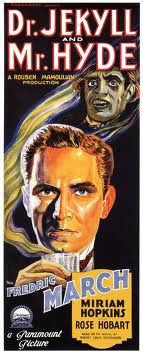
Dynamic Duo
Liberals sought to humiliate their old enemies qua Normans by subjecting them to the semi-savage authority of the Negroes.
Thus, while Liberals care nothing for Negroes they embrace them on the principle of the enemy of my enemy is my friend, the same as Buckle and the Moors, Jews or anyone else who hates Aryans. The Liberals turn over the ‘Normans’ or Aryans to these ‘minorities’ to use as they wish, even passing hate laws to disenfranchise the Aryans and empower the ‘minorities.’ That’s called the transformation of society. That’s as close as I can come to this curious Liberal attitude at the moment. If not the truth it must be very close to it. Buckle himself must have been of Anglo-Saxon descent.
To return to Eco: While it is true that Herman Goedsche wrote his Jewish graveyard scene in Prague during the sixties this would have been a very peripheral event making little or no impression at the time. The fictional story became prominent only in retrospect after 1905. Thus, while I don’t wish to criticize Eco I think he should have maintained perspective making Goedsche ancillary to the Franco-Prussian war which certainly dwarfed any scene in anyone’s novel let alone a fictional meeting of Jewish conspirators in an ancient cemetery with far less cachet than the Pere Lachaise.
It might have been better to concentrate on Drumont and the French reaction to the Jewish cultural conflict that led to the Dreyfus Affair to demonstrate how and why the Aryans became alarmed by the Jewish culture war against them. It is no coincidence that the German concept of Kultur become prominent at that time. Eco could have presented a much more balanced version of the Dreyfus Affair rather than merely echoing the hysterical Jewish version. Also, of course, there was no need to mention Freud except as a future development of Anglo-European psychology and psychiatry.
That said, Eco succeeded in creating a fine ambience in which to set his excellent creation, Simone Simonini. I found him lifelike and I was genuinely interested in his career. The Jekyll-Hyde personality split was nicely handled although more attention might have been paid to the adventures of each half and how they interacted creating difficulties for the other. There was no need to create mystification in the reader’s mind as I’m sure we all got it from page one.
For those who have read Sue and Dumas, Eco’s indebtedness to both was clear. Eco was able to capture the ambience and horror of Sue quite well. The bodies under Simonini’s house was lifted almost intact from Sue’s Mysteries of Paris.
By the way, I erred in saying Les Mysteres Du Peuple hasn’t been translated into English. The prominent Jewish-American socialist, Daniel De Leon translated the story in the years after 1900. However as the novel was published in twenty-one fascicles of 200-300 pages under the names of the lead characters of each fascicle it took awhile to make the association. Most of the fascicles have been published by print on demand publishers.
With the rich resource of two characters in one, of which one is as virtuous as Jekyll and the other verging toward the amorality of Hyde, Eco could have exploited the conflict of morality between the two halves having the Priest working to foil, the efforts of Simonini, perhaps even exposing him as a police agent to the revolutionaries and as a double agent to the authorities.
I guess, what I’m saying is that while I found the story engrossing I was annoyed because the potentialities were not more fully exploited. I mean, why mention the criminal turned police inspector, Vidocq, if you aren’t going to develop him somewhat. Vidocq was a terrifically interesting person. A great memoir written by him too. As I said, it wouldn’t have hurt to have followed Dumas’ example and had a team researching and organizing while Eco wrote it up.
Since I’ve felt constrained to read Eco’s corpus of novels I may add to this at a later date.
A Review: Pt. III, The Prague Cemetery By Umberto Eco
December 5, 2011
A Review
THE PRAGUE CEMETERY
by
Umberto Eco
Part III
Review by
R.E. Prindle
Eco, Umberto: The Prague Cemetery, 2010, Houghton Mifflin

Umberto Eco
1.
The French Revolution was perhaps the most horrific event in the history of the world. More pernicious still in the shadow it cast into our times. Our societies were born in blood; we became instantly conditioned in the most incredible, inconceivable way to crime and political murder; worse by far than the so-called holocaust, itself an echo of the Revolution. No was safe, psychopaths and morons controlled the fates of the sane and intelligent. Truly the inmates were in control of the asylum just as Edgar Allan Poe represented in his story The System Of Doctor Tarr And Professor Feather. There are no words to accurately describe the crimes of ‘93.
The most amazing thing is that amid the chaos the Enlightenment proceeded apace. The period remained one of incredible scientific advances. Beneath the horrors of the Revolution and the Napoleonic years the Romantic reaction to the Enlightenment produced astonishing literature and writers many of which will figure in the late nineteenth century history during the Romantic revival.
Interestingly one of the early manifestations of the modern Liberal mentality appeared in Henry Thomas Buckle’s History Of Civilization In England of 1860. In discussing the career of Edmund Burke, after a eulogy on Burke’s subtle command of English politics in which the most fulsome praise was heaped on the writer came the time for Burke’s evaluation of the French Revolution and the Great Year of ‘93.
Burke correctly perceived that the Revolution was a religious transit from one ideology to another and that the Revolution was the opening salvo of a new religious war- Socialism being the new religion, or Liberalism in another form. Burke deplored the violence and criminality in the strongest terms. Up to that point in history, Buckle (a very famous historian of his time) who had been writing a very measured and subtle history of the intellectual development of Western Europe and England vituperatively denounced Burke as becoming unbalanced and indeed, insane. This was over a mere difference of opinion. The denunciation was not unlike that of today’s Obama and his denunciation of the Republicans. Yes, he has characterized them as insane.
One then asks what was Buckle’s relationship to Communism? How well did he reflect Liberal opinion? Burke’s reaction occurred in ‘93 and ‘94.
2.
Beneath The Limn
The nineteenth century was one of great psychological advances. As such they were unsettling creating great psychic stresses. Eco gives his character Simone Simonini a split dual personality. He also mentions Anton Mesmer and Jean-Martin Charcot. While many if not most people believe Sigmund Freud discovered or invented the Unconscious the concept was well developed in the nineteenth century before Freud. Freud merely consolidated earlier investigations and gave his own peculiar Jewish twist to the concept.
The beginning of the recognition of an unconscious was articulated by the much misunderstood, but surely great man, Dr.

Franz Anton Mesmer
Anton Mesmer in the pre-Revolution days of the eighteenth century. Mesmer’s shortcoming was that he was more of a mystic than a scientist. The French academy called him to account on scientific grounds and he either couldn’t or wouldn’t comply, hence being discredited as a charlatan. He was an honest man discovering a new scientist; more a pioneer than a charlatan.
Nevertheless as Mesmerism or as later renamed, Hypnotism, was a real phenomenon so even though discountenanced by official academics, research continued until it became clear that hypnotism was a condition of the mind or unconscious and not a quality of the operator or hypnotist as Mesmer mistakenly believed.
A few words on the nature of hypnotism and suggestion. Suggestion is the active component and the mind the passive of hypnotism. Essentially the mind is a slate on which the suggestion is imprinted.
What is a suggestion? Everything is a suggestion but suggestions of different qualities. For instance one wakes to a sunny day and the suggestion is one of anticipated pleasure, an overcast day one of a deflated spirit. The mind at birth is a blank slate with nothing on it so that education begins and education itself is suggestion but positive beneficent suggestion although education can be perverted for special ends. You might say the post-hypnotic consequences of education which teaches the mind to analyze other suggestions permanently survives the input. It is imprinted.
And then there is indoctrination in which a specific point of view is forced upon you to condition your mind in a permanent post-hypnotic state whether the information is good or bad. The current indoctrination in racism is a case in point. To confirm the suggestion of indoctrination one uses conditioning to confirm the imprinting. Thus one is bombarded constantly with racist images.
You may not think of the above as examples of hypnotism but they are. One may or can refuse a suggestion and indeed many people are uneducable because they resist the process of learning either because they won’t or can’t learn. The above are examples of open hypnotism or suggestion. There are involuntary acceptances of suggestion resulting in fixation that cause neuroses or psychoses, what the great French psychologist, Pierre Janet called the idee fixe. In other words a permanent post-hypnotic suggestion.
One means to achieve a fixation then is through terror. In a state of terror the mind is stripped of all defenses so that the suggestion is implanted with no resistance. An example comes to mind from the life of Edgar Rice Burroughs the creator of the Tarzan series. One day as an eight year old on the way to school he was confronted by a much larger twelve year old who began badgering him. The young Burroughs in a state of terror took to his heels. Among other things for his flight fixed in his mind that he was a coward. That affected his life thereafter. The theme appears in each and all of his scores of books. So Burroughs received a fixation, a suggestion, an idee fixe in Janet’s terms.
Freud presents many examples of various ways in which fixations occur. The point is that they are all hypnotic suggestions containing post-hypnotic commands. Once accepted they have to be discovered but once recognized the affects disappear. But every affect arises from a fixated suggestion. One was hypnotized.
What Freud did was to discover the true nature of suggestion and hypnotism so that it was not necessary to put a person in a trance to access his unconscious. In the process Freud learned how to hypnotize an entire audience and then with movies and recorded songs a whole population. But that was in the future.
For a good history of the nineteenth century pre-Freudian discovery of the unconscious the best introduction is Henri F. Ellenberger: The Discovery Of The Unconscious.

Fun And Games With Charcot At The Salpetriere
3.
Books And Bookmen
Ilan Stevens begins his remarkably obtuse review of The Prague Cemetery as follows:
http://forward.com/articles/146732/?p=all :
There’s no hiding it. Umberto Eco is a lousy novelist. Try as one may, it is difficult to make sense of his new novel, “The Prague Cemetery”. As is often the case with him, the plot is built on a mystery of sorts, on this occasion the quest to discover the true author of “The Protocols of the Elders of Zion”, an anti-Semitic pamphlet that remains one of the world’s biggest hoaxes and whose true author remains unknown. Oddly, Eco is less interested in solving the puzzle than in incensing his readers. The protagonist’s anti-Semitic rampages running through hundreds of pages, appears to be a parody. But the joke is impossible to decode. Worse, it isn’t funny!
Ilan should realize that he is not speaking for the entire reading public but only for himself. Eco is as funny as Lenny Bruce or Mort Sahl, or, perhaps Ilan has never listened to St. Lenny’s diatribes himself. I would recommend the one about the Vegas comic at the Palladium Theatre of London.
In the first case Eco is plowing his furrow down a row that has already been disced, perhaps several times and in the second the Protocols take a subordinate place in the story. Perhaps Ilan is letting his Judaic heritage distort his sense of reality. Freud had a few things to say about group psychology. I recommend them to Ilan. In the third place without a fair background knowledge of the sources the novel might indeed be difficult if not impossible to follow. It requires some knowledge of nineteenth century books and bookmen.
Eco is a European, relatively unaffected by American attitudes and I suspect Jewish history although with someone of Eco’s erudition, that far exceeds Ilan’s, one must step cautiously, especially knowing what Eco does in his furrows.
The flowering of European and English literature began about mid-eighteenth century when the number of books published increased dramatically. After Napoleon organized the Revolution along rational lines beginning in 1799 one might say the modern era of literature began. Most significantly for our story was the emergence of the great Walter Scott in England. Scott originated the historical novel and as such became the template of the great French authors Balzac, Dumas and Sue. Dumas, the son of one of Napoleon’s generals was born in 1802; Sue, the son of Napoleon’s surgeon general was born in 1804. Both thus were old enough to have personal memories of the Napoleonic period and certainly of his defeat on the field of Waterloo. The events of the Revolution, tales of ‘93, must have been the stories of their childhood and early years. They lived through most of the Romantic reaction to the Enlightenment.
At the same time they were present at the revolutionary shocks of 1830 and 1848 while taking part in political events of the time. Indeed, in Eco’s story she shows Dumas as a gun runner in Garibaldi’s attempted establishment of a unified Italy.
Garibaldi’s activities which had nothing to do with Jews or Protocols takes up a substantial part of Eco’s story. I found it one of the more intriguing parts of the novel. Certainly Eco’s portrayal of Simonini’s activities as a spy were well drawn establishing him as ‘flesh and blood’ character. While I thought Prague could have been better developed Simonini was perfection.
Rather than the book running on for hundreds of pages as Ilan thinks, I thought it much too short. Further, four hundred pages in the largish typeface is not a long book. I had rather seen Eco emulate his heroes Dumas and Sue and turn out a whopper of one or two thousand pages. If I have any complaint it is that Eco didn’t really pull out the stopper and throw himself into it. He does give us a trifle on the Commune of Paris ‘71 but that alone could have taken two or three hundred pages. Arnold Bennett in his Old Wife’s Tale give a little more. I mean, the nineteenth century is great stuff especially for a historical imagination like Eco’s; there’s plenty of material for romancing.
Since Eco put some effort into developing a psychological profile for his hero, Simonini, he might have dealt with the development of psychology from Mesmer to 1897 his cutting off point. He could have invented, well, there was no need to invent, he could included some of the stage magicians and hypnotists sort of after the fashion of the movie, Children Of Paradise. Too long a novel? Oh, no Eco shouldn’t have reined himself in. Probably too afraid of the Jews and their anti-Semitism. There was no reason to include Freud who at that time was unknown.
Eco did mention Mesmer and could certainly have cast an uncle of Simonini as a stage hypnotist then allowing him to

George Du Maurier
develop a history of hypnotism down to Jean-Martin Charcot at the Salpetriere in the sixties, seventies and eighties. It was Charcot who legitimized hypnotism.
Eco could also have taken time to give mini biographies of the actual historical figures most of whom are today known only by name if that. After all this is well over two hundred years after the Revolution of 1789. That is an immense stretch of well documented history impossible for someone not dedicated to studying the period to know. If education is in trouble it is merely because the period and its contribution to knowledge has not been organized in a comprehensible manner. Nor given the current political and religious situation is it likely to be. History itself is both anti-Semitic and racist, you know.
Amazingly enough the amateurs of the internet are making a better attempt to orgainize the period than the academic ‘pros’. The various Wold Newton Universe’s on the internet which mesh into Eco’s approach have done a great deal to evolve a time line progression. Since Eco is a European writer the work of Jean-Marc and Randy (wife) Lofficier with their site of the French Wold Newton Universe have made a great advance in organizing French literature into a continuation not too different in intent than the Arthurian epic.
They began much as Eco does here with the Carbonari based on the novels of Paul Feval who chronicles the rise of organized crime in France which is another theme Eco could have included in an expanded novel. Rocambole, Arsene Lupin and Fantomas, (characters larger than the creators) form part of the French WNU and Eco’s memories as he recorded them in the Mysterious Flame Of Queen Loana, but that opportunity was missed.
I’m also not sure why Eco passed over Madame Blavatsky, Theosophy and the whole Spiritist Movement that turns toward the idea of the Protocols since their religious view was quite in opposition to Judaism.
Another line of investigation although not quite so obvious as others was the rise of the Vampire novel which I believe is directly related to Jewish emancipation.
Prior to the Revolution and Jewish Emancipation the Jews had been tightly controlled being confined to the Pale of Settlement running the breadth of Europe between Eastern Poland and Western Russia. With emancipation Jews could function freely without restriction as citizens of their respective hosts. How Jewish activities are characterized depends on your nationality. Jews of course depict themselves as both ardent Jews and loyal citizens of the host country while each country universally depicts them as self-interested traitors. But to say so left an individual open to censure as an anti-Semite. That is the same charge that Ilan in his review brings against Eco. To disagree with the Jews is to be an anti-Semite. Thus in order to express one’s true opinion one must resort to subterfuge. One has to speak of one thing to refer to another. One of the major criticism of the Jews over the centuries in all societies is that Jews are parasites. Of course, the Vampire is the ultimate parasite. Thus in creating stories of Vampires, the bloodsuckers are meant to represent Jews.
This is made nowhere more explicit than in George Du Maurier’s 1894 novel, Trilby. Eco has his character in Prague named Dr. Du Maurier who is obviously based on the novelist George. As it seems appropriate I will digress here to consider Du Maurier’s novel, Trilby. Du Maurier still has a significant following as my three reviews of his novels have found a good readership, especially the first, Peter Ibbetson.
Trilby is a complex and very interesting novel. Du Maurier was a prominent neo-Romanticist and Bohemian. A base of his story is an earlier 1822 novelette by the French Romanticist Charles Nodier from whose title, Trilby, Du Maurier took his own.
Nodier’s story concerned a Scots girl named Jeannie and an elf or fairy named Trilby. We are led to believe that Trilby actually exists but was apparent only to Jeannie so that the churchmen or rationalists believing her deluded insist that she renounce her elfin friend; therein lies the tragedy.
In Du Maurier’s story he reverses the sexes making Trilby a young woman while giving Jeannie’s identity to a young artist named Little Billee who, himself, is based on a Thackeray poem of the same name. Du Maurier is more obsessed with memory than even Umberto Eco. Du Maurier convinced of the reality of an after life devised it so that he could take his little bags of memory with him for, what is the purpose of memories is they are to be lost at death, he said?
The novel Trilby is, of course, famous for Du Maurier’s creation of the hypnotist, Svengali, very close to a mythical figure himself. One hears reference to Svengali constantly. Svengali was what was then known as a Beteljew, sort of a bum or hobo, in Hebrew a Schnorrer. He is not appreciated by Billee and his friends but he was always a forced presence in their entourage. According to the prejudice of Jews then and now he was a good musician. Thus in hanging around the digs of Little Billee and his Bohemian artist friends he meets Trilby who is a grisette. A grisette in Parisian is what we would call ‘a good lovin’ woman.’ Trilby posed nude for the artists but she was never of easy virtue being quite an exception in Bohemian artists’ circles. The point is made that she cannot sing, unable to carry a tune or hit a note with a tennis racquet . However Svengali notices that she has a one in a million oral cavity, hence she should be able to sing much better than Jenny Lind, a sensation at the time.
As the story falls out the English artists break up as age takes it toll while after a series of adventures Trilby having no other place to go shows up on Svengali’s doorstep who seizes his chance. He removes to Eastern Europe where being an expert hypnotist he entrances Trilby, much as a vampire, and keeps her in a perpetual trance as he wants so much to use that spectacular oral cavity and make Trilby sing as no other. To do that he has to project his musical sensibilities into her and sing through her himself. Thus she is only able to sing while hypnotized and with Svengali directly in front of her making eye contact.
After a while the two master the act and Svengali begins to build her career in which he is successful. As she is perpetually hypnotized Trilby has no memory of those years. One imagines Du Maurier might consider the loss of memories the most tragic of all.
Back in Paris on holiday after a period of years the now mature Billee and his two friends are astonished to discover that their Trilby is the singing sensation that they have been hearing about while Svengali to their eyes has an ambiguous relationship with her. He claims that he is her husband but this is, of course, bushwa as he has another wife. While driving by in their carriage Svengali spots the three on the sidewalk. His hatred and rage at the three welling up he orders Trilby to cut them dead which she does.
Unable to get tickets to the sold out performances the three go back to London. Trilby is scheduled for a London tour. Billee and his friends have a box seat. About half way through the performance Svengali looks up and notices them. His hatred is so strong he breaks eye contact with Trilby who at once stops singing and while glaring at the three his blood pressure rising Svengali has an apoplectic fit and dies. Trilby is unable to continue the show on her own. However Svengali having kept her hypnotized for years vampire like has sapped her vital energy and Trilby withers and dies.
Thus as though a vampire Svengali has drained his victim of life’s blood exploiting her for his own profit. Du Maurier makes it quite clear that the story is an allegory of the Jews and Europeans. Thus unable to criticize the Jews directly unless he be labelled an anti-Semite Du Maurier makes a species of Vampire of them. In the process probably a much better novel than he might have otherwise. The novel really is a masterpiece.
It is perhaps no coincidence that Bram Stoker’s novel, Dracula, was issued at this time. While the nineteenth century began to explore the Aryan racial subconscious in tentative manner pursuing vampires, werewolves, Frankensteins, perpetual wanderers of one type or another, split personalities it was not until later in the century after a few decades of serious study that some clear results were achieved. The most notable example in which a clear separation of the conscious and unconscious was achieved was in Robert Louis Stevenson’s Dr. Jekyll And Mr. Hyde. There may be an unconscious referral on Eco’s part as he may have combined Du Maurier and Dr. Jekyll in his imagination. During the same years the Society For Psychical Research was formed of which the significant researches of F.W.H. Myers in the unconscious were important contributions. The work of the Frenchman Pierre Janet, student of Charcot’s is not to be despised either. Freud’s twentieth century vehement denial of any use of Janet’s ideas is proof positive of his influence.
In the realm of dreams also significant work had been done by Aryans before Freud synthesized their work in his study of 1899-1900, The Interpretation Of Dreams. While verging toward mysticism Du Maurier’s notion of Dreaming True and Stevenson’s notion of Directed Dreaming are significant variations on Freud’s theory. Not that I mean to totally disparage Freud’s contribution but he essentially serves in the Jewish role of the middleman between the producer and the consumer.
So, as a slight criticism of Eco, as Freud was still of the future as Prague ends, he might have better constructed Simonini from existing psychological elements. There was no need to create ‘Froide’. Nor was it necessary to interject the Protocols and Dreyfus into the story so prominently.
It appears that Eco used the body of books or sources that all of us familiar with this line of research have used. If fact so many people have been plowing this furrow that nearly every book suppressed by the Jewish Index of Forbidden Books has found its way into print with the exception of Drumont of the Libre Parole and Goedsche himself. One can with some confidence then speak in this area.
Eco slights his Jewish studies. He makes an offhand comment about the Father Thomas murder in Syria but without prior
Mastermind- Adolphe Cremieux
knowledge of that crime, if the uninformed reader noticed the reference he must have been puzzled. While the author of the Protocols has never been determined, internal evidence indicates the work was probably cobbled together c. 1885. It may have been based on Maurice Joly’s Dialogues Between Machiavelli and Montesquiou In Hell or the Dialogues may have been written after the Protocols became infamous to provide a source, thus we may have a hoax based on a hoax.
Of course, over the decades the story keeps changing, but in one version Napoleon III confiscated all the copies at the printers but one copy got away. The book showed up much later after the Russian Revolution when a fleeing White officer miraculously sold the only existing copy to a Jewish second hand book dealer in Constantinople. Ever see the movie, Wag The Dog? You should. Not only did this astute book dealer buy a wreck of a book without a cover or title page but while idly reading through it he recognized it as the source of the Protocols, as the proverbial light went off in head he knew he had a copy of the Dialogues in his sweaty little hands. Quickly notifying the Alliance Israelite Universelle he sent the copy along and- eh voila!- the problem with the source was solved, proven. But the question is, who was this Maurice Joly and what did he know of Machiavelli and Monstesquiou? Who the hell was Montesquiou? That Joly was Jewish goes without saying but to my mind there is a question as to whether he wrote the Dialogues. I mean, you know, we’re dealing with mis-, dis- and re-directed matters here. Try reading Edgar Wallace’s Four Just Men to learn some real head fakes.
Eco doesn’t go into the Jewish history very deeply although all accounts of the origin of the Protocols I’ve read have been

Maurice Joly
written by Jewish hands and therefore are thoroughly questionable. He does make a passing reference to someone he call Cremiu. This may or may not be a reference to a very important Jewish figure named Adolphe Cremieux. His career spanned the years before the 1830 revolution which coincided with the French acquisition of Algeria of that year. Cremieux drafted and penned the law making Jewish residents of Algeria French citizens thus catapulting them over their Moslem masters corrupting the French conquest.
Cremieux was politically prominent in the sixties taking part in the formation of the Alliance Israelite Universelle which was created as an international organization to coordinate Jewish European activities, thus was formed a Jewish national government. At the turn of the century it would be sent to the US becoming the American Jewish Committee as the US was deemed more cordial and pertinent to Jewish affairs. Indeed, it was from New York that President Jacob Schiff engineered the 1905 defeat of Russia by Japan for which the Japanese duly honored him.
But in the 1860s when European Jewish affairs were being organized Cremieux was undoubtedly behind the writing of the Dialogues which were very likely written by committee and merely issued under Joly’s name. The Dialogues Between Machiavelli and Montesquiou is a sophisticated piece of writing. I suppose most people have heard of Machiavelli and probably many of those have read his book; however I doubt if many have ever heard of Montesquiou and fewer by far have read him. His Spirit Of The Laws is one of those key texts recently made available. In Conspiracy circles it had been thought of as evil but it is nothing of the kind. It is a very valuable intellectual contribution which ought to be studied by Conservatives.
As the title implies Montesquiou historically examines what laws were meant to effect- their spirit. Thus as with today’s ‘anti-hate’ laws, what is their spirit? What is their intended effect? On the surface the laws are absurd as they imply that the protected parties are above ‘hate’ while the unprotected parties are directing their innate unreasoning hatred toward them. The ‘anti-hate’ laws are American so one must ask who they are meant to protect and who they are meant to punish. The protected parties are what Americans call ‘minorities’; what the Canadians laughably call ‘visible minorities’ which by the way would exclude Jews and homosexuals who are invisible. The promoters of these laws are obviously Jewish.
The laws then create franchised and disenfranchised classes. That is exactly the way the protected classes understand the laws. They have been legally granted ‘minority skin’ privileges.
So, now as the Jews understand the spirit of the laws in these days it is not unreasonable to believe that they understood their spirit in those days. They had and have a very specialized understanding.
Just as today the AJC/ADL have a college turning out books of the same nature as the Dialogues, see the books of fictional author ‘John Roy Carlson’, it is not unreasonable to suppose that Cremieux and the Alliance Israelite did the same in those days. The racial mind always works according to certain static principles. Thus, I have no doubt myself, that the college turned out the book merely duping the Jew Maurice Joly to put his name on it. In any event we are told that Louis Napoleon had the whole press run confiscated at the printers; however the handwritten original may have escaped that surfaced around 1885 when the Protocols were written. The text would have to have been supplied by the Alliance in that instance. From my reading of both documents there is only the most tenuous connection between them while the ideas contained in the Protocols could have been written and probably were without any reference to the Dialogues at all. I see no logical connection between the two.
Now, if the Protocols were a forgery drawn up by the Russian Ohkrana who could not possibly have had a copy of the Dialogues in 1885 and they wouldn’t have needed it in any event why would they wait to 1905 to broadcast the news? Why not before the 1905 revolution in an attempt to stave it off? So, you see, things just really add up; the bottom line is just a bit fuzzy.
While the Jews attack Eco on the improbable grounds that his novel is going to stir up ancient hatreds, at the same time they leap at Eco’s suggestion that the German writer of the period, Herman Goedsche’s scene in the Jewish Cemetery is based on Cagliostro’s confrontation with the Freemasons in the pages of Dumas’ novel Joseph Balsamo. Balsamo was Cagliostro’s real name while the latter is his magician’s name.
There is no need for a relationship between the two while at the same time both are fictional situations. I’ve never understood why the Jews chose to make an issue of this scene. Biarritz, Goedsche’s novel was just that, a story. For a story to be read it has to be as close to reality as possible while exaggerating it for effect. While it is improbable that any such meeting would take place in a graveyard it is certainly probable that such a meeting took place at AIU headquarters in Paris. How else will you coordinate efforts and Jewish efforts were coordinated.
Just ask yourself, what is the purpose of an undeniable organization named the Alliance Israelite Universelle? Doesn’t the name say it all? And then in 1900 when the Pale Of Settlement is being emptied out as the Jews are being transferred to the US with every intent of transferring all the Jews to the US which was only aborted by the outbreak of The Great War, why was the Alliance transferred from France to the US to become the American Jewish Committee? I mean, you know, I don’t mind being called an anti-Semite but I certain do object to being called stupid.
In fact, the Jews were one of the nations of Europe, functioning fully as a nation although without a homeland, ‘rootless cosmopolitans’ they were called and what else would they be called given their situation? Think about this stuff, don’t allow your thinking to be directed by Jews. When the going gets tough the Jews pack up and get moving. That’s what rootless means. The Germans, the French et al., they have roots, when the going gets tough they have nowhere to go, they have to tough it out.
Thus the mere existence of institutions presupposes organization and goals. Goedsche was just a writer, he doesn’t have to be taken anymore seriously than that. Does he have a good story or not? In fact, his novel is one of the works on the Jewish Index still waiting translation. I’m ready to buy.
Eco could have gone into more detail on the Protocols. They excite only the Jews. They only claim to prove the obvious. Check out the goals of today’s Jewish Paideia Society of Sweden organized by the US Jew Barbara Spectre which is pursuing the same end. Good name, Spectre.
That leaves the old chestnut, the Dreyfus Affair to be examined. Why Eco threw this into a book called The Prague Cemetery is beyond me but there it is.
Dreyfus was certainly guilty of spying, not necessarily for the Germans as he was charged, but spying. Leaping ahead a hundred years and shifting to the New Promised Land, the US, let us consider the case of the notorious Israeli spy, Jonathon Pollard whose thefts were so serious that he is still withering away in prison. While his fellow Jews haven’t been able to force a new trial, they’re now asking for parole if not pardon. After all they say Pollard wasn’t spying for an enemy but for the US’ best friend, Israel, with which we should have been sharing our information like a good friend anyway.
Now, move Pollard back a hundred years, shift him to France and change his name to Dreyfus. Eh, voila! Dreyfus was sending his purloined info to the Alliance Israelite Universelle headquarters. How else can the Jews by so well informed?
As Eco informs us, the real German spy was named Esterhazy. What he neglects to tell us is the Esterhazy was a Hungarian Jew. So, if there was a spy dealing with the Germans, he was Jewish, as well as another Jewish spy providing his fellow Jews with information.
Now, it is said that Dreyfus was framed and wasn’t guilty. The big bad nasty Aryans convicted him falsely out of mere pique and he was later proved innocent. Over the years from his conviction to his second trial key evidence disappeared while key witnesses had died and money had changed hands. Therefore Dreyfus was released for lack of evidence not proven innocent besides which the Jews had gotten themselves into a hissy fit while alarming France and dividing the country along Dreyfusard and anti-Dreyfusard lines. What other political choice did the authorities have?
Consider nearly every other European conviction of Jews along similar lines most notably the murder of children or the so-called ‘blood libel.’ According to the Jews each incident, and these occurred over centuries, was trumped up for bigoted reasons. Thus, the culprit is first convicted on what appears to be good evidence to a court of law. A few years go by, evidence disappears, witnesses die, money changes hands and then the case is reopened and the verdict is reversed.
Then it is said that the charge of child murder by Jews is absurd, there is nothing in the Jewish culture to indicate that they were even capable of such crimes. But, consider the Last Supper. All Jews agree that Jesus was Jewish although there are some Aryan diehards who insist he wasn’t and want to claim the creep. Nevertheless at the Last Supper the Jewish Jesus holds up the wafer and says this is my body; he holds up his wine and says this is my blood. Not only do we have the blood libel but we have cannibalism in a Jewish setting completely among Jews. According to the doctrine of transubstantiation a modern communicant is literally eating the flesh of Jesus and drinking his blood. Now, if one mixes wine with the wafer one has the deed for which the Jews were accused. A child among both Semites and Aryans is an unpolluted innocent, of course.
The Bible has very strong injunctions enjoining Jews to abjure eating or drinking blood because according to their belief that is where life or the soul resides. So, on the one hand the Jewish ceremony of eating the child’s blood in the wafer mocks the Catholic ritual while eating the life of Christians by proxy of a pure innocent child. I don’t say the Jews actually did this, although they were convicted of the crime, however to say the charges are absurd on the face of it contradicts both facts and reason. I could provide more examples but one is as good as a hundred.

Jonathon Pollard
As in Jonathon Pollard’s case, as they can’t get the conviction overturned or set aside then humanity demands that he be released.
In Prague Eco exonerates the Jews on the count of the Protocols and also the Dreyfus Affair. According to Ilan this is not enough, he is still activating ancient hatreds. Whose ancient hatreds Ilan doesn’t say. One always suspects the charge is that of crying Wolf. There is no reason not suspect ulterior motives. At the very least Eco is playing into their hands.
As I said before, these two historical events are so old hat that no one except interested parties are concerned or even know of the incidents; at this late date there is no one who remembers them personally, they have passed into the historical or racial memories.
So Eco’s work is merely an exercise in historical memory combined with the Jewish racial memory. We should always try to unravel the mysteries of the folk so that having an accurate historical memory from both sides we can demand in unison- Never Again! Not likely to happen but a good thought.
I had meant to conclude the review with this part but as it got more involved than I thought I will have to add a Part IV.
A Review: Pt. II, The Prague Cemetery By Umberto Eco
November 26, 2011
A Review
The Prague Cemetery
Part II
by
Umberto Eco
Review by:
R.E. Prindle

Umberto Eco
Part II
Tracing The Racial Memory
For what is history but the attempt to remember or reconstruct the racial past and therefore one’s own pre-history. For as the ancients said: The unexamined life is not worth living. Where better to begin than with the origins of life.
The key fact of existence on earth is that the planet is a huge dynamo generating an electro-magnetic field. In other words the core of the planet is moving at a different rate of speed than the outer layers. There could be no life without this fact. The movement of the core also generates a combination of the elements hydrogen and oxygen we humans call water which is extruded to the surface creating the oceans.
Isaac Asimov describes the human body as big sack of water where H2O comprises very nearly the whole body. So, in contradiction to the ignorant Semitic model ‘dirt’ has no part in the composition of the body.
It is said that the early atmosphere was 100% hydrogen. Thus the extrusion of water and its evaporation must have freed oxygen atoms. As air is 21% oxygen, that fixes the origin of life at the time when oxygen displaced hydrogen in the atmosphere to the extent of 21% at which level it remains today. That also means that if the percentage varied by very much life as now constituted could not survive.
All matter can be deconstructed into its constituent chemical atoms, primarily four gases. While hydrogen and oxygen are the bases of life forms, a dozen or so other trace elements are used in the amounts that were in the sea when life began. All were therefore dissolved in water. It therefore follows by a chain of those atoms proto-life was formed. As life is activated by electricity it follows that electricity was imparted from the electro-magnetic field, the sun or possibly activated by an electrical charge from lightning in conjunction with the electro-magnetic field.
Thus life, a single cell, was formed in the ocean waters which as everyone knows is salty. Hence human are salty. From then in some mysterious process not yet discovered the single cell evolved into all the myriad forms of life that have been and are. At some point ocean forms evolved into land forms which became increasingly complex until one has the human form the most evolved and complex of all. Just because the process can’t be described in full as yet doesn’t mean that Evolution isn’t a reality.

The Thought Original World Island
The World Island, Pangaea, is said to have to have begun breaking up 250 million years ago. The planet is said to be about four billion years old so in all probability the land mass was not the same for that entire time period. Pangaea was an intermediate period. As the planet is essentially a top spinning freely in space all the rules of physics pertaining to tops apply.
If you have a water filled top with solid bits in it when you spin the top the solid bits will be drawn to the upper hemisphere. This is what happened to the land mass of the earth. The rotational stresses were such that the surface cracked into large plates that began drifting North. Hence today the land mass forms a circle around the North Pole. Above Russia and Siberia long transverse islands have pulled away from the main mass to gravitate further toward the Pole.

The Disintegration Of Pangaea
Africa occupies the central position of Pangaea so that as the continents moved they were essentially split off from Africa. Asia moved up and curved around the Pole. The Atlantic Rift separated North and South America moving them to the North and West. India split off moving East and North to collide with Asia forcing the great transverse mountain range of the Himalayas up. And of course Indonesia and Australia trailed out across the ocean to their current stations. Antarctica was drawn South to form that Pole.
As the parcels separated whatever life there was must have traveled on their respective parcels. Thus, even though it may be said the life began in Africa the various life forms must have evolved separately on their land masses.

Full Displacement
There have been several mass extinctions not least of all that which occurred at the end of the last ice age when, for instance, many life forms including horses, mastodons, saber tooth tigers and possibly humans disappeared from the Americas. Huge death rate. The remains of least tens of thousands of mammoths were killed and in Siberia and the American North frozen quickly enough and permanently enough to preserve their flesh which was still edible, although gamey, when the bodies were unearthed in recent times.
As this disaster occurred as recently as probably ten thousand years ago it must have left a memory trace in the traditions of humans
We are told that Homo Sapiens came into existence about 150- 200 thousand years ago in Africa. This may possibly or probably be true but it cannot be stated positively. What can be known is that the earliest remains of Homo Sapiens have been found in Africa. At any rate at the beginning of the Age Of Leo dawned, Ages are how the ancients kept track of immense reaches of time, every part of the Earth bore some human population. These populations were in different evolutionary states. The least evolved human species was in Africa. The East of Asia was populated by Mongols who are evidently a sterile branch of the human species. Europe had a population but not a large one of Neanderthals and various human races while the population flooded out of the previously exposed Mediterranean Basin gathered around the shores of the sea, most notably at the effluence of the Nile.
Now, the ancestors of the Folk of which Eugene Sue speaks were centered somewhere in Central Asia probably around the Aral Sea. This was the great hive from which the Aryans were to spread across the World.
There are many, many legends of these distant times such as Atlantis, the land of Mu and Shambala., the last of which was located in Central Asia. These legends must have some basis in fact; the imagination of man is incapable of creating anything out of whole cloth; whatever man believes must have been suggested to it by actual circumstances.
While little is known of the actual origins of the Aryans that can be ascertained as fact is that beginning around the year 2000 BC the Aryans began to move out of their hive lands. We know that they moved West into the Middle East and South into India. There is no reason not to believe that bands or hordes didn’t also move East into China.
The first migrations into India and the West did so with a fully developed religious system or world view, a Weltanschauung. This means that the system and view were well developed in the Hivelands before the Aryans began their migrations. Thus the similarities between the Hindu religion and the Homeric religion were probably deviations from the old time Hive religion adapted to their specific new conditions.
It is possible that there was cross fertilization between India and Greece but since the entire North from Greece to Northern Europe to Iran/Persia and India were invaded and dominated by the Aryans I think it is just as likely that the core beliefs were common to all the Aryans shifting forms to adapt to religions established in the occupied areas.
Thus while I can offer no proof, I think it probable that Shambala did exist and that it was the Aryan home citadel. In legend Shambala was on an island in the middle of a lake in what is now the Gobi Desert. At the end of the ice age both the Caspian and Aral seas were much more extensive than they are while the Gobi may have been wet also. It seems more probable that a temple city may have been on an island of either of those two more expansive seas. Still the legend is the legend. Increasing desiccation would in any event have forced population dislocations in Central Asia. In any event about the year –2000 the Aryans began to move. However they were located, whether strung out from the Himalayas to the Caspian or whatever, one branch crossed the Hindu Kush down into India. Wherever the Aryans went they wrote these huge long Weltanschauungs, at least after writing reached them which they don’t seem to have had on their own.
Because the Indian books were written in Sanskrit and because Sanskrit was determined to be the most ancient Aryan language words common to the Aryan languages were said to be derived from Sanskrit. This needn’t be the case. I think it more likely that since all Aryans derive from the same stock the language was their common inheritance from the Hivelands. Thus while there may have been contacts between Greek and Indian the similarity more likely reflects the common religious heritage of both peoples. Thus, the Indian Aryans wrote their huge corpus while at about the same time the Greeks were composing their own version of the national epic in Greece and Troy.
Over the centuries the various hordes descended into Persia and Anatolia while when the Scyths appeared in Southern Russia they were then nomadic rather than settlers. Assuming that the Aryans of the Shambala period were sedentary it follows then that climatic conditions forced the Folk into a different economic niche. That the Scyths were of the same Aryan stock as the Greeks is evident from their metal working.

Scythic Goldsmithing
After the Scyths we have the Celtic migrations many of whom ended up at the End of the World in Ireland. Along the way they caused havoc in Anatolia where they were known as the Galatians, harassed the Greeks, gave the Romans the willies from their settlements on the Po and finally became the Gauls of what would become France then came the German tribes who would establish themselves in Northern Europe.
When the Aryans migrated into more populous areas they lost their identity. Probably mere hordes, those who reached China were completely absorbed just as later Jewish migrants to China being few in relation the Chinese were also absorbed. Depending on the size of the Indian contingent they were able to shape the mores of the India with its huge Black population but were absorbed racially. The caste system came into existence as a result of the Aryan’s desperate attempt to maintain racial purity.
Even in the Middle East the Aryan influence has been diluted and all but extinguished. The Aryans of Iran are now adherents to the alien Semitic religion of the Arabs.
Over several centuries the Aryan tribes were able to conquer the Romans but in the process destroyed the Roman Civilization bringing about the long social reorganization of society known as the Dark or Middle Ages. It is here in the German or Frankish conquest of France that Eugene Sue must begin his novel of The Mysteries Of The Folk.
It’s a pity the novel has never been translated into English because Sue must cover the whole of European history including the period of the Crusades. The Indian and Greek epics had long been written when the now European Aryans began the third great national epic, the story of Chivalry of King Arthur and his Knights of the Round Table. This is one huge story. The Vulgate-Lancelot alone runs to several thousand pages with numerous very long branches.
Now, the roots of the Arthurian epic still date back to the Homeric epic while receiving input from myths and legends from the Aryan Hivelands. There is then continuity from the very beginning, so to speak.
The Arthurian epic is a curious European recreation of the Indian books and the Homeric cycle with a Semitic add layer of course. In addition to curious crises at the intra changeover of the Piscean Age. We are not talking of the personal astrology of the newspapers here. Astrology was once a serious part of astronomy. We are talking of the great Astrological religious system that began development eons ago. If you wish to believe Sumerian mythology or sources it has vague memories of tens of thousands of years previously. I have no reason to question the veracity of these Sumerian sages. An age, of course, is one twelfth segment of the Great Year of 25 thousand something years. Thus after the cycle of twelve ages Pisces will once again return. The symbol of Pisces is of two connected fish swimming in opposite directions, perhaps indicating Dionysian androgyny. Thus halfway through the age the archetype of the age changed from the male domination of Jesus to the female archetype of Mary in Southern Europe and Diana in Northern Europe. This actually happened.
In the South Mariolatry emerged while in the North Diana replaced Merlin in Pagan circles. According to the legend Vivian (Diana, Artemis) The Lady Of The Lake, charmed Merlin into revealing all his magic to her. Once she obtained it she threw a hex on Merlin entombing him either under a rock or in a tree. Thus Diana replaced Merlin as the pagan archetype of the Piscean Age. Artemis in Greek, Diana in Latin and Vivian with the Norse, the Virgin Huntress, Mistress Of the Animals and The Lady Of The Lake who abhorred the company of men, became Northern Europe’s ruling archetype or Anima while the Virgin Mother became that of the South.
Having eliminated Merlin, Vivian then kidnapped Lancelot as a boy (because she was the Virgin Huntress and couldn’t bear her own son) taking him to her enchanted palace beneath the lake where as the Alpha female she taught him to be a preeminent knight or the Alpha male in Arthur’s court. Arthur was a creature of Merlin but lost the use of the latter’s magic when he was entombed. Thus Arthur was unprotected against Vivian’s purloined magic.
As Lancelot was Vivian’s or Diana’s creature there had to be conflict between the two halves of the Piscean Age. That was naturally caused by a woman, Arthur’s flirtatious wife, Guinevere. As a result the golden age of the Round Table came to an end.
The Arthurians were acquainted with some Homeric traditions that I have not found in the mythological sources. Thus the Arthurian cycle was a continuation in the mold of the Homeric cycle. Vivian or Artemis in Greek, was traced back to the Greek Peloponnese or Lacedaemon. Lacedaemon means the Demon or Lady Of The Lake. So Diana, in Roman Myth or The Lady as she appears in Dumas’ Three Musketeers. But, I can’t find any extant record of the myth.
Arthur and his characteristics can be traced back into the Caspian and Aral Hivelands of the Aryans so that the three traditions come together in the Arthurian cycle of Europe. The cycle also combines Gallic legends of Britain bringing in that great Aryan race.
This is the rich stew then that Eugene Sue had to work with in his mysteries of the Folk. My ancestors and yours. The Arthurian cycle was active from c. 1060 to 1300. Malory is a late compilation. When the Crusades ended and the Templars were suppressed the period ended. Thus the second half of the millennium began.
We will skip the intervening history until the great European upheaval of the Enlightenment and French Revolution.

Eugene Sue
2.
The Jews In Europe
As Eco’s story is centered around the Jews concerning the Protocols of Zion and the Dreyfus case it will be necessary to say a few words concerning their history to set the stage.
I hope I have demonstrated the persistence of the racial memory in my brief tracing of the movements of the Aryans. Their motif is the scientific explanation of nature which they have pursued with varying success in all their movement from the Hivelands to India and Great Britain and from there to North America and Australia and New Zealand. The scientific goal has never been lost sight of.
There is no other people on Earth with a stronger racial memory and an inflexible but criminal will than the Jews while at the same time, like the Aryans, they have recorded their goals in print. They too persist doggedly in the attempt to realize their plan.
Briefly the place and time the tribe came into existence can be pinpointed if their writings are accurate. That place was Ur of the Chaldees and the time was the transition from the Age of Taurus to the Age of Aries c. 2000 BC. Their pedigree goes back no further than that. They are an artificial Semitic creation; they have no roots in antiquity.
Challenging the authority of the Chaldean astronomers the Jews were expelled from Ur for their impertinence. Thus they were born of disappointed expectations; their future was cast; they were doomed to disappointed expectations.
However they knew how to push their luck to the limit; call it chutzpah.
Skipping over two thousand years of conflict we find the Jews established throughout the Roman Empire challenging the Romans for supremacy. Defiant of Roman authority even in the capitol Rome, the Jews taxed their fellows sending the gold to Jerusalem which they established as their capitol contra Rome. Hence the famous Rome-Jerusalem dichotomy. While their prophet Jesus counseled them to cede temporal authority to Rome- render unto to Caesar that which is his and unto God his own- open rebellion began which was crushed, the people killed or dispersed, Jerusalem leveled with Jews being forbidden to set foot in the city again. An early version of the final solution.
Briefly, we next find the Jews in Spain. Here the Roman Catholic Church has established itself and for superstitious reasons granted the Jews an invaluable monopoly, that of loaning money at interest. A one of a kind gift. Wheedling their way into another monopoly, that of being royal tax farmers, they did indeed farm their Spanish cattle, not unlike the Greek and Italian situation today. This was an intolerable situation that took a long time to culminate but in 1492 the Jews were expelled from Spain. This was a crushing blow for them.
Due to the Spanish expulsion and various other expulsions Jews migrated into the sparsely inhabited area of Eastern Poland which then included Byelorussia and the Ukraine, later to be called the Pale Of The Settlement.
Then, the worst catastrophe ever hit the tribe. The Northern Europeans began to assert their birthright of free inquiry while at the same time rejecting the Judaeo-Christian incubus. It was called the Enlightenment. Aryan scientific thought asserted itself against the Semitic stultification throwing the Semitic religions- Christianity, Judaism and Moslemism- into an atavistic status of a prior and lower intellectual state.
The Enlightenment would quickly result in the French Revolution which was to change the course of both Jewish and Aryan history. With the Revolution came the emancipation of the Jews. They were placed on an ‘equal’ footing with the Europeans. Emancipation was more quickly achieved in France while in Central Europe it moved in stages reaching fulfillment after the 1848 revolution.
It was then that Europeans became aware that equality was a one way street; it was not what the Jews were after. In the reaction about 1875 the German Wilhelm Mars invented the term anti-Semitism and the stage was set for the Protocols of Zion and the Dreyfus Affair.
In the wake of the Revolution Eco’s heroes Eugene Sue and Alexander Dumas were born whose novels filled Eco’s imagination and memories with their fantastic works.
We’ll move in that direction in Part III.
A Review: Part I, The Prague Cemetery By Umberto Eco
November 20, 2011
A Review
THE PRAGUE CEMETERY
By
Umbert Eco
Review by R.E. Prindle
Eco, Umberto: The Prague Cemetery, A Novel, 2010, Houghton Mifflin, NYC
Part I: Prologue
Little Bags Of Memory

Umberto Eco As Atlas
In this novel Eco attacks the dark subconscious mind of nineteenth century Europe. It was the moment when Europeans discovered the difference between their conscious and subconscious minds. As a historical novel Eco mines his fifty thousand volume private library to construct his story. His sources range from Dumas and Eugene Sue at one end to George Du Maurier and J.K. Huysmans at the other. At this point in history, other than Dumas I presume the other authors are virtually unread if not unknown. Fortunately I have read most of Eco’s sources with my more modest five thousand volume library.
Eco seems to have a very fond spot in his heart for George Du Maurier and I found his treatment of the author most interesting.. Du Maurier was a long time contributor to the English humor magazine, Punch in both text and artworks through the heart of the nineteenth century. The illustrations Eco uses in his novel are very reminiscent in style to those of Du Maurier. Indeed, Du Maurier is very seductive both artistically and literarily. When he was turned down for the editorship of Punch he was crushed, turning away to write and illustrate his subtly fantastic three novels Peter Ibbetson, Trilby and The Martian, the last finished just before his death in 1896.
Like Eco Du Maurier lugged a lifetime of memories, literary and personal through his novels. I’m still working my way through his sources, or favorites at least. Du Maurier was a Bohemian artist in Paris at about the same time as Henri Murger who wrote his fabulous description of Bohemian life, The Bohemians Of The Latin Quarter that was turned into Puccini’s opera, La Boheme. DuMaurier found Murger’s description of Bohemian life repellent to his own sensibilities so he romanticized the nearly same story into the lovely fairy tale of his own version, Trilby. Trilby was a sensation of its time and remains a classic.
Eco has read and thoughtfully considered Du Maurier and while Du Maurier tended to romanticize painful or repellant memories into order to create a fairy tale existence for himself all that sunshine seems to cover a bitter undergrowth. Eco who astutely perceives this was led to parody him in Eco’s own fabulous first chapter of Prague that is a hilarious stand up comedy routine worthy of the mordant, sick humor of Lenny Bruce. Eco then makes his character Dr. Du Maurier the chief of an insane asylum parodying Du Maurier’s Peter Ibbetson while reversing the roles of Ibbetson and the Duchess of Towers in the character of Diana Vaughan. Very nice bit of inside humor on the part of Eco.
While I make it a rule to not recommend books, a rule I often violate, if you’re reading this I presume you’re simpatico. I heartily recommend any of these sources of Eco if you haven’t already read them.
Obviously Du Maurier’s novels holds a special place in Eco’s heart and a well merited place both in his and mine. However, Eco gives precedence to two of the greatest French novelists of the nineteenth century, Alexander Dumas and Eugene Sue. As it happens I revere both authors as much as Eco. Dumas’ most famous titles are still widely read while Sue’s much less so or, perhaps, not at all.
Eco mentions Dumas’ The Three Musketeers and The Count Of Monte Cristo and the French Revolution novels centered around the magician Cagliostro or by his other name, Joseph Balsamo. I first read The Three Musketeers as a youth while I have reread it again along with first time readings of Monte Cristo and the Cagliostro series within the last ten years.
What Eco is doing in the Prague Cemetery is writing his version of a Dumas novel. While a good novel Prague falls far short of Dumas. What Eco lacked that Dumas had was a collaborator of the quality of Auguste Maquet who researched and worked up the material in outline so that Dumas could concentrate on composing the dramatic touches of the story. This allowed Dumas a much wider scope and deeper detail that brought out the fabulous myth of Three Musketeers or the huge scope and depth of Monte Cristo and the Revolution novels.
I’ve read reviews of Prague where Cagliostro is apparently thought of as a Dumas creation. Oh no, Dumas could write historical novels to place alongside his role model, the great Walter Scott, or as a model here for Eco. While novels, Dumas’ Revolution stories are accurate as history. Cagliostro was a real person. Such a collaborator as Maquet might have given Eco room to expand his horizon and widen the scope of his novel to include for instance the rise of psychology and the discovery of the European unconscious while introducing some of the stage hypnotists and magicians such Robert Houdin, the model for the subsequent Houdini who used his name.
Eco’s novel is OK but he could have made it much better. The Simonini dual personality touch is a surface probe of the unconscious that had real potential perhaps bringing in the Society for Psychic Research but I think the execution of Simonini was weak and not properly developed. Still the character was a nice stab at Dumas’ and more especially the unbelievably fantastic Eugene Sue. What a madman. One could think him insane but I choose to believe he was touched by the divine afflatus. Sue, if mad, had the madness of the gods. If Dumas was more than human, Sue far exceeded Dumas. I have never read anything that comes near Sue’s The Wandering Jew or The Mysteries Of Paris, especially the latter which probes the outer limits of sanity.
The unfortunately named Wandering Jew will drive off most American readers who have been conditioned to avoid anything concerning Jews lest they be considered anti-Semitic. Although as Eco points out the hidden hand of the Jesuit priest Rodin that haunts the novel from beginning to end is one of the most terrifying apparitions in all literature and Sue was the master of terrifying images.
Both he and Dumas were obsessed shall we say by the historical memory. Eco himself is obsessed by memory as am I. I have that in common with these writers. I have explored my personal memories in several novels I have post the internet and most of my essays here on I, Dynamo are concerned with ordering the historical memory. Eco sought to recapture the memories of his youth in his previous novel The Mysterious Flame Of Queen Loana. Both Eco’s and my own efforts are much after the fashion of George Du Maurier. I would recommend Du Maurier highly except that it takes some dedication to understand the luxuriant beauty of his work; his three novels have to be read several times to acquire his intense longing to never lose his memories, taking them with into the Great Beyond. But, if you are of a like mind and feel up to it, have at it.
So, Dumas proposed to novelize the whole of French history, the racial memory and had a magnificent go at it. The guy is really spectacular. Eco mentions also the last novel of Eugene Sue, The Mysteres Du Peuple which is has yet to be translated; as Eco says he labored through the French. Apparently Sue took the task he set for himself quite seriously as Eco says the story is quite complex and I imagine very long. Mysteries Of Paris itself is three volumes or about fifteen hundred pages.
The title translates as I see it, The Mysteries Of The Folk. As Eco says Sue begins his story with the Frankish invasions of the fourth to sixth centuries, then tells his story along two family lines one Frankish, one Gallic. This would be a prodigious feat of historical and racial memory, an explosion of Sue’s past educational imprinting in both society and school. This would be especially important to him as both he and Dumas were of the first post-Revolution generation of which they very likely heard many first hand reminiscences growing up while reading reams of memoirs. As the Revolution was primarily racial in character, Gauls versus Franks, this would give added poignancy to Sue’s search to retrieve the history of the two races.
So, what Eco seems to be doing in the Prague Cemetery is carrying the personal, racial and historical European memory forward from the work of Dumas and Sue. How well I think he did it will be in the concluding part of the review. First we have to take a huge memory detour in order to bring the historical and racial memories from the beginning back up to Dumas, Sue, and Eco and late nineteenth century history. When I say huge detour, let us begin our magical memory tour at the beginning, Pangaea.
Part II will follow.
A Review: Pt XI Tarzan The Invincible By Edgar Rice Burroughs
November 14, 2011
A Review
Themes And Variations
The Tarzan Novels Of Edgar Rice Burroughs
#14 TARZAN THE INVINCIBLE
by
R.E. Prindle
Part XI and last
Love Is A Hurting Game
1.
Having dealt with politics and religion let us now turn to the social backgrounds of Burroughs and Tarzan. Once again I will treat the subject within the framework of Multi-culturalism.
I will treat of the cultures in the manner of the great warts and all school of the debunkers of Burroughs time in the twenties. There will be no sacred cows as in the tradition of the great debunking school. I will consider vices as well as virtues. As with men a culture of the greatest virtues also matches them with the greatest vices. Such is the nature of life; there is no escaping it.
To speak of the culture of both Burroughs’ period and the twentieth century is to speak of Sigmund Freud. For better or worse Freud’s psychological ideas have created the form of subsequent society. Any positive benefits of Freud are restricted to a few individuals while the negative effects of his ‘science’ have been reflected on society as a whole.
He began his career as a biologist but soon felt constricted by the strict limitations of the scientific method. Probably science conflicted with his religion thus he desired a more free form mode of expression. There is talk of his academic career being hampered by anti-Semitism in Vienna at that time but that is sheer nonsense. As in all countries dthe careers of medicine and law were populated by Jews to the extent of a majority or near majority representation. One is hard pressed to find discrimination in those statistics.
Rather as Freudian psychology suggests one is drawn in the direction of one’s true desires or in Freudian terms: inner wishful thinking. Freud felt a deep antipathy toward Europeans and non-Jewish culture in general. Those were the years of the first Kultur Kampf in Germany. That is a war between cultures. In the German case between the German and Jewish cultures. That’s what multi-culturalism is.
Freud correctly saw that the Jewish culture was unable to win on any military battlefield and that the real war would indeed be a war for cultural and sociological dominance. He saw that it would be a war of centuries.
Hence when he learned of the psychological experiments of Jean-Martin Charcot in Paris, though impecunious he packed his bags and legged it for the City Of Lights. His scientific credentials were adequate to gain an entrance to the Salpetriere where Charcot taught. Once there he pushed himself into Charcot’s attention enough to be invited to his home although I think he found himself unpalatable. However, chutzpah done right almost never fails.
Charcot was conducting studies on hysteria. One must remember that as little understood as such psychological states of mind are today they were even less understood then. In his studies Charcot used hypnosis which also was little understood at the time although well developed today. While hypnosis is an ancient art it was only begun to be developed as a scientific discipline in pre-Revolution France in the eighteenth century by Dr. Anton Mesmer. The art fell into disrepute when Mesmer was discredited because he made excessive claims that couldn’t be authenticated. But, it still continued to develop. There were two schools of hypnotism in France, Charcot’s in Paris and Bernstein’s in Nancy. Freud would acquaint himself with both. It seems then, that hypnotism was the major attraction for him.
Writing of Charcot’s school the great esotericist Madame Blavatsky pointed out that in Charcot’s hands the use of hypnotism may have been used benevolently but its potential for evil in evil hands was a very great danger. Those evil hands were at the end of Freud’s arms as he lurked about the Salpetriere and Nancy.
Nancy was a very influential school of hypnotism. The school’s basis was the work of Auguste Liebeault, a goy, who attracted the attention of Hippolyte Bernstein. The latter, like Freud, was of the Jewish culture. Thus the importance of hypnotism while developed by the goyim quickly drew the attention of the Jewish culture, just as it was quick to realize the potential of movies which were also developed by the goyim and meshed with hypnotism as the proverbial hand and glove.
Apparently having soaked up what he could from Charcot, Freud drifted over to Nancy where he spent some time with Bernstein where he learned the importance of suggestion. Freud found Bernstein’s methods too heavy handed but learned what the man had to offer. From thence he returned to Vienna where he linked up with a student of hysteria by the name of Joseph Breuer, another Jew. At that point Freud may have realized that hysteria was created by suggestion and was a manifestation of a hypnotic situation. When the suggestion or fixation was removed by the victim’s recognition of the suggestion the symptoms disappeared. In other words the suggestion was obviated and the fixtation resolved.
Very little of Freud’s work was original but built directly on other men’s work, most of whom, if not all, were goyim. So the source of the knowledge came from the European culture and not the Jewish. Thus the idea of the unconscious was well developed before Freud associated it with dreaming. His one original contribution to the science of psychology was the recognition of the origins and the intent of dreams.
Dreams then are a sort of hypnotic trance. Thus in those days it was thought that to hypnotize a person he had to be put into a sleeplike trance gaining the unconscious mind by passing conscious censorship.
Once Freud realized that free association and a relaxed inattentive attitude were all that was necessary to make a person begin reminiscing in an unconscious manner he had the key to the notion not only of mass hypnotism but the hypnotizing of whole societies in ways that Ignatius Loyola never imagined.
One can’t know when he read Gustav Lebon’s The Crowd: A Study Of The Popular Mind published in 1895 some few years before Freud’s dream book but by 1921’s Group Psychology And The Analysis Of The Ego, which title is self-explanatory, Freud had understood the implications of Le Bon’s study incorporating them into his own program for the hypnosis of Euroamerican society.
Having earlier successfully imposed his static vision of the unconscius on society as the only possible viewpoint he then attempted to concentrate the attention of the peoples on that great social dissolvent, sex. By sex Freud meant simply a concentration of the mind on sexual intercourse. If he understood the nature of the sexual organization of the species it is nowhere apparent in his writings. Thus when the extreme stress of coeducational sex education was brought to fruition in the last few decades, sex education merely stressed frequent fornication while giving equal validation to all forms of sexual intercourse including anal and oral but disparaging masturbation which as a private act could have little social impact.
So, having deemphasized the contribution of the conscious rational mind in favor of the irrational unconscious combined with sex the mind was open to suggestion. A great conditioning propaganda was organized by the Jewish culture using the hypnopaedic media which the majority of the goyim have been unable to resist. That is, that the Jews are morally superior while having an extra gene that makes them incomparably more intelligent than the peoples. At the same time they emphasized the idea that the Euroamericans are inherently stupid and actually evil needing Jewish guidance to keep them on the right track.
What with the hypnopaedic media which they control and the disaster of Hitler that the Jewish culture has been able to use to convince Euroamericans that they all share that particular original sin from which the Jewish culture is exempt while they must constantly examine themselves to root out all vestiges of anti-Semitism. That is to say that they must forego their own culture and support the minority position of Semitism. Not a bad plan if you can pull it off. It seems that they have.
Thus, as of 2012, Euroamerica has been successfully hypnotized along Freudian lines.
In 1900 when Freud was forty-four Edgar Rice Burroughs was twenty-five. I hope I have demonstrated from the novels of Burroughs that from the beginning of A Princess Of Mars he had a fair knowledge of psychological principles. His novels are flush with pyschological references if you look for them and pay attention to them. The question is how did he come by his interest and knowledge as I have been able to find no psychological works in his library as present by ERBzine.
While Freud visited the United States at Clark College in 1909 during the time his influence was widespread being discussed constantly in magazines. There is no record that Burroughs read German so any familiarity with the texts in English had to await translation. A.A. Brill began this in 1909-10. The Interpretation Of Dreams appeared in the US in 1913. Tarzan’s First Nightmare gives clear indications of Burroughs having read The Interpretation Of Dreams by 1916-17.
But the basis of Burroughs’ psychological thinking had been formed well before then. I have to think that the origins of his education in both psychology and hypnotism began with his first stay in Idaho in 1891. At that point he met the recent Yale graduate, Lew Sweetser. Sweetser was in partnership with the Burroughs Boys in ranching. Sweetser and Harry Burroughs were great friends from Yale. Brother George as I read it tagged along. ERB was especially close to brother Harry and Sweetser. Sweetser had nothing but the finest encomiums for ERB.
Sweetser at Yale had apparently been a psychology major or at least taken several courses. He was not only conversant in psychology but familiar with the theory of hypnosis. Now, this was well before Freud had even begun to study hypnosis and hysteria; this was before the great psychological discoveries of the nineties. This was before William James was made a Professor of psychology at Harvard.
Just for perspective. Sweetser was two years out of college in 1889 while 1891 was a full nine years before Freud’s Interpretation Of Dreams so whatever knowledge Sweetser imparted most probably was of an original nature independent of either Jungian or Freudian influences. One wonders what psychology they were teaching at Yale in the 1880s.
It will be remembered that Thuvia, Maid of Mars has a rather amazing sequence concerning mass, if not societal hypnosis, hypnosis that could only have reflected information Burroughs had acquired well before Freud could have been an influence on him or probably any academic.
As Sweetser took up lecturing on suggestion, auto-suggestion, hypnotism and the unconcious in the 1920s I believe that shows the depth of his commitment to his study of psychology.
So, while Burroughs was certainly open to any Freudian, Jungian or other psychological sources he seems to have developed a singularly independent approach to the topic. I have discussed this independence of Freudian and Jungian schools with fellow Bibliophile David Adams who while unwilling to deny its possiblity thinks it rather a stretcher.
Possible, but I am waiting to hear other explanations for Burroughs’ otherwise unaccountable knowledge and interest in both psychology and hypnotism.
Now, how far is it from his knowledge to the realization that, in the manner of Freud, he could possibly suggest Tarzan to be the man-god archetype of the Aquarian Age?
However the Tarzan ethos of self-sufficiency is the antipodal position from Freud’s notion of collective consciousness. For Freud all members of society must be a unit of the whole while for Burroughs each member should stand alone. As you can see there is a basis for the tripe written by Richard Slotkin.
2.
For some reason the quality of Burroughs’ writing has always been impugned. That is from his day to this. Of course when someone wishes to denigrate a writer they disapprove of they always point to some spelling, punctuation or grammatical error. Or they criticize such intanigibles as ‘style.’ The authors style they say is faulty.
Burroughs was subjected to a barrage of criticism denying him any literary skills. In point of fact the greatest stylists often write the most boring books simply because they are concentrating on ‘literary’ style. I didn’t mention the current darling of the ‘salons’, Henry James. Didn’t think it was necessary.
My own feeling is that anyone who can sell a few million copies knows how to write much better than those who can’t. Yes, that’s right, commercial success is an infallible gauge of ability, at least, to judge the public.
That said, Burroughs’ style does break from that of the nineteenth century, not that the literary style of the nineteenth century was that superior. By my own criteria all of the following writers were great writers, classics but far from perfect. The best of the lot and perhaps the greatest novelist ever was Walter Scott. I have recently seen him demoted to the ranks of ‘adventure’ writers while soon after his death his work began to be disparaged for irrelevant reasons and has been so construed since. Nevertheless he is the greatest novelist in the English or any other language or culture in existence in this or any parallel universe.
The current most popular writer of all time, Charles Dickens, has always left me cold. Personally, I couldn’t say he’s any better than Burroughs. He always sacrifices his stories for effect although wonderful effects. But, who really cares? The only question is, did you enjoy the book? Did the book sell?
Anthony Trollope, an actual favorite of mine, writes the most intolerably long soap operas in existence. The same can be said of another excellent author, Jane Austin, although I don’t intend to go near ‘Emma’ again.
Wilkie Collins, another currently popular author is very spotty in plot development. Thackeray is terrific if you don’t mind a little stultifying boredom. He’s supposed to have the most subtle humor but as subtle as I like to think myself, I haven’t gotten it yet. George Eliot survives because she was a woman in drag. Keeps the lesbians happy. I can’t stomach her approach to life.
I could go through the French and Russian writers but it would be more of the same. Dostoyevsky, for instance is very difficult to read and appreciate. The construction of Crime and Punishment is so jagged it obscures his point which isn’t the commission of a conscienceless crime.
The great literature of the nineteenth century was written before the rise of the popular press but finding a serial presence in the magazines of the day. This fact alone pushed literature toward sensationalism and a less complex literary style more in accord with mass tastes.
Thus Burroughs’ great predecessor Arthur Conan Doyle discarded all the arabesques, writing in a simple straightforward manner. He still has a strong nineteenth century flavor, as why not, compared to Burroughs modern twentieth century style. That style was evolving to the simple short sentences of Hemingway.
While the popular press had its influence, perhaps the greatest of all solvents of nineteenth century literary style was the advent of the movies. If not invented by Thomas Alva Edison he at least gave moving pictures their commercial application. Thus with 1903’s Great Train Robbery the first of the great hypnopaedic media took form. Burroughs didn’t begin writing until eight years after The Great Train Robbery so he had plenty of time to absorb cinematic techniques.
When he began writing most others were still writing nineteenth century novels. I contend that Burroughs’ writing is a major departure from that style and that he was heavily influenced by the cinematic story telling method. That he, as well as the whole country, was enamored of the flickers is attested by the fact that he personally rented movies to show at Tarzana. He was supposed to be too broke to afford such extravagances from 1903 to 1913 but something tells me he found ways of keeping up.
One is always astounded by the concrete pictures Burroughs conjures up, the astonishing images he is able to create in the reader’s mind. There is little more vivid to me than the scene in Thuvia, Maid Of Mars when the Green Men attack the Invisible Men’s castle. I might point out that the Invisible Men who were themselves an illusion had mastered the techniques of hypnotism to the point that the Green Men imagined themselves killed by illusory arrows, and hence were. I refer you to Fritz Lang’s Mabuse The Gambler who could also create such effects.
Allowing that Burroughs learned of hypnotism from Lew Sweetser in 1891, had he ever seen an hypnotic demonstration of the type he describes and if so, where?
Thus Burroughs has a perfect cinematic style perhaps improved by his interest in hypnotism in such a way that he can make the reader see what he wants them to see. This is the art of suggestion. When one looks more closely one finds a great more depth in Burroughs than one supposes was there while the distance between him, Jung and Freud narrows. His psychological ideas owe nothing or very little to either Jung or Freud however.
Enthralled by the movies, as his whole generation was, Burroughs worked very hard to break into films as a scenarist. He diverted much of his prodigious energy from novels to working up scenarios to submit to films. So far as I know they were universally rejected.
The rise of Hollywood itself was a remarkable story. When L. Frank Baum moved there in 1910 it was just another small suburb of LA. Then the film makers discovered the place in 1914. Within a very few years Hollywood almost as it is now became a reality. During the teens probably as many movies were made in Chicago as LA but by 1919 when he moved there Hollywood was the established movie capitol. ERB missed putting his best foot forward by quite a lot when he published The Girl From Hollywood criticizing the film community for things they now take great pride in, dope and sex. Then it was the putative porn capitol of the world, now it is the legally established one. Still, ERB was in his element. He made no effort to leave, gradually acclimatizing himself to the mores of the film colony.
Actually the filmmakers took kindly to his Tarzan series, easily recognizing its commercial potential if not its psychological appeal. After a hiatus from 1921 to 1927 when no Tarzan films were made, when the talkies came in, 1932’s Tarzan, The Ape Man by MGM established Tarzan in the psyche of the country if not the world.
This from a man on the edge of failure if not psychological disintegration in 1911. From there he rode the medium of the age to fame and fortune. He may not have realized the extent of his success but he had established both Tarzan and himself as a centerpiece of American and World culture.
3.
The automobile became a reality in the first decade of the twentieth century. Ford was not the first, but he was the most influential depending on how you view William Durant first of Buick and then General Motors.
From 1900 to 1913 the impoverished Edgar Rice Burroughs walked around Chicago with his tongue hanging out watching the machines roll by. Perhaps he even saw the future heavyweight champion of the world, Jack Johnson, tool by in one of the first automobiles seen in the Big Windy. Certainly he must have seen his old rival Frank Martin passing by in any one of a number of cars Martin probably owned. Certain amount of humiliation there. Perhaps Martin was still trying to impress Emma, maybe even parking his machine at the curb intruding his presence into their marriage.
Americans have universally been in love with the automobile but there still seems something almost pathological in Burroughs’ fixation on them. Among the first things he did with his money in his anno mirabilis of 1913 was to buy a second hand car- a Velie, whatever they were. One assumes he got a real good deal. Never an astute financial man ERB paid rail fare to cart this thing to San Diego. As a spendthrift he may have been nearly as broke as he was in Idaho so he sold the vehicle in San Diego rather than pay to haul it back to Chicago. One of the first smart things he ever did other than marrying Emma.
From then on ERB had a succession of cars and none of them were the most economical models available. When he came back from San Diego he bought a Hudson in emulation of his hero Frank Baum. ERB sneered at the poor man’s car, the Ford.
I don’t have a list of the various cars ERB owned between 1913 and his demise but his car buying ways in the thirties were spectacular. We are all familiar with the story of his buying five Packards at one time from the proceeds of the sale of Tarzan to MGM.

1931 Packard
For those unfamiliar with the Packard it used to be on a par with the Cadillac and Lincoln. This was well before the Mercedes was introduced into America. Packard never recovered from the War, going out of buisness, I think, in 1956. None but an eccentric few ever favored the Lincoln, so any comparison must be between Packard and Cadillac. As a boy at the time I favored the looks of the Packard. The Cadillac even at the time had the reputation of being a pimpmobile. Anyway, Packard didn’t make it past 1956.
Frank Puncer of ERBzine in his fascinating article reporting his interview with Lee Chase-Burroughs has a revealing passage:
He (Burroughs) was adventurous and, of course, had all the toys. A Cord automobile, a Packard sedan, also a “woodie” for running errands. The one I liked was the Pierce Arrow roadster with a rumble seat.
All those cars were in addition to his airplane. By the time he married Florence he had already taken his financial bath with the airport and Apache engine investments.
Owning all those cars at one time seems an excessive indulgence to me. However I have never been interested in fancy cars enough to buy one. I often thought I wanted a red car but having rented one I find I much prefer basic black. So I may not be the best judge on this matter.
Sill a guy who is willing to spend to take his car along him possibly to China seems to have a fixation. Puncer records a detail from Chase that is most tantalizing.
Lee: I suspected they went to China but I never knew for sure. There are some artefacts, in fact, two of them are in our dining room, that came from China. I had a great picture of Ebby standing in front of the Packard on a pier. Behind him was a ship called the Empress of Japan. They did take a voyage on that ship and they took the Packard with them. Where exactly they went I don’t know. There were some trips that the children were not part of. I think the Empress of Japan cruise went through the Panama Canal. I do know they ended up in New York. The Packard was a new 1937 model and they drove it home.
Thus ERB replicated his trips with Emma if part of the cruise went through the Panama Canal. One imagines the cross-country drive in 1937-38 was considerably easier than the 1916 trip twenty-two years earlier. Here’s a side of ERB that hasn’t been explained by his biographers.
The expense of the trip would have been enormous. The extra cost of unloading and loading the Packard at each port must have been substantial. The vanity of such a thing throws a new light on ERB’s character. Especially as photos of him at this time show him to be a real dandy in fitted suits. One wonders how he could possibly have been so affluent in 1937-38 and so broke two years later that he was reduced to living on $250 a month in Hawaii. I hope the inconsistency is clear.
Of course WWII terminated ERB’s love affair with the automobile. When he returned to the US after the War the wonder of the pre-war years was gone. There were no post-war Cords or Pierce Arrows while by the time cars would have been readily agailable again age and disease had rendered driving impossible for ERB.
One does admire ERB’s taste in automobiles though, doesn’t one?
4.
Finally, for this essay, let us turn to ERB’s sexual and marriage problems. He may very well have been blithe and carefree in his handling of them but they look like problems to me.
It seems quite clear that ERB had a serious emotional problem with women. Bearing in mind this is a quote from a novel and may not necessarily reflect Burroughs’ most deeply held feeling yet the Tarzan series is so autobiographical of what was happening in his life or going through his mind at the moment that I believe it does. On p.51 of Tarzan And The Leopard Man Burroughs in his persona of Old Timer has him ruminate:
What had women ever done for him? “Made a bum of me,” he soliloquized; “ruined my life. This girl would have been lost but for me. She owes me something. All women owe me something for what that one woman did to me. This girl is going to pay that debt.
“God, but she’s beautiful!” And she belongs to me. I found her, and I am going to keep her until I am tired of her. Then I’ll throw her over the way I was thrown over. See how the woman will like it! God, what lips! Tonight they will be all mine, and I’ll make her like it. It’s only fair. I’ve got something coming to me in this world. I’m entitled to a little happiness; and by God, I’m going to have it.”
Now, that’s a fairly psychotic statement. How does it correlate to ERB’s life? So far as we know he had serious relationships with three women: Emma, Florence and Dorothy. In point of fact he threw each over as he had been thrown over. There is no doubt that he meant to hurt them as severely as he could cherishing their pain.
As these are his three women and none of them threw him over then one must ask, who was the woman who threw him over? There is no actual living woman involved. The only possible candidate can be his Anima. So that his attitude toward women, wich is actually fairly extreme, can be traced back only to his disastrous encounter with John the Bully as an eight or nine year old. I know, but it has to be true.
One can’t be certain but I surmise that he was walking to shool with Emma and possibly another person or two which would be normal when John glowered threateningly over him demanding he fight. At that point, as he panicked, he must have associated his Anima with Emma, thus as he ran he left his Anima behind which was then attached to John. Thus in the intensely autobiographical The Outlaw Of Torn De Vac/John murders his Anima figure Maud and then assumes her role dressed in drag.
Thus, as ERB expresses it in Leopard Men, his Anima threw him over.
Now, Burroughs would have been able to portray this situation endlessly without being able to associate his stories with the event. He was able to remember John all his life even apparently idolizing him without realizing how much he hated or feared him. He was unable to counter the psychological suggestion that John was a greater than he, hence he was emasculated.
If one asked ERB who was the woman who threw him over he would probably have been able only to make a few confused utterances and then turn away.
In my experience this sort of reaction occurs even below the level of fixation. It occurs as though transfixed by a lightning bolt separating the mind from reality. I don’t mean to bore you with my own experiences but they are illustrative. My own relationship with women, for instance, was conditioned by my mother when she lied to me and dropped me off at the children’s home or orphanage.
Of course I was consciously shattered even being able to associate the situation with immense electrical discharges or lightning bolts but more importantly in unreachable areas of the mind certain notions were formed. I didn’t reach this understanding by analysis although I did prepare the psychological ground. The attitude only surfaced in a certain situation which might never have occurred in my life but did twice. That situation was when a woman I was associated with left me when I expected her to be with me. My reaction was not conscious, which isn’t to say I wasn’t aware of what I was doing but I wasn’t aware of why I was doing it although I naturally had my reasons.
The first manifestation occurred when I was fifteen with my first girl friend. She said she loved me and demanded I love her with the same intensity. I agreed to reciprocate. Then as Christmas vacation came around and I planned on spending those pleasant two weeks with her she said she had to go visit relatives in a distant city. A feeling of terror gripped my soul as I insisted that she not go. Reason has nothing to do with this. It didn’t matter to me then that perhaps she couldn’t refuse to go and it doesn’t matter to me now. She went. In doing so she replicated the original event with my mother. It broke my heart but on the succeeding Valentines Day I broke a date and without any explanation whatsoever never saw her again. It wasn’t her fault but neither was I responsible for my action although guilty of it.
I recovered the memory in a novel I was writing when I named the cross streets of the orphanage after her two names. When writing it is best not to correct yourself so rather than change the street names which seemed silly to me I left them as they were. Then I asked myself why I would associate this girl, who I really loved, with the children’s home with which she had no connection. The lightning bolt backed out of my mind and I was able to make the association between my mother leaving me and this girl leaving me. So I lost my psychosis.
The situation recurred when I was courting my wife. I came very close to walking away at that time. Why I didn’t I don’t know. Somewhere deep inside I resent the fact that I didn’t.
So, the woman who threw ERB over couldn’t have been real as there is no record of her. She must have been his Anima.
He attempted to get even using Emma by stringing her along indefinitely probably with the intention of ruining her life by turning her into a frustrated spinster. This plan was ruined when Frank Martin made his pitch for Emma forcing ERB to marry her. Thus Burroughs had to devise a new plan to ruin her life. Of course there was conflict between his conscious and unconscious minds.
There must have contending emotions in his mind that kept him with her for thirty-four years. Or perhaps, as a one man woman, she put up with anything from him rather than lose him. That is certainly the implication in Herb Weston’s letters when he says that no other woman would have tolerated his antics. In the end he certainly treated her like a cad and a heel.
I suppose no life is lived without causing injury or destress to other individuals some intentional, some not. In relation to women in ERB’s life the injuries were intentional and perhaps even planned but ultimately ERB was in the meshes of psychological forces he apparently neither understood nor could control. He was ultimately not responsible for his actions but guilty of them. This is one of the great quandaries of life, even though one may commit heinous acts such as in the case of John Wayne Gacy, at bottom one is compelled by psychological forces and are truly not responsible but still, of course, guilty. Thus when Gacy said of himself that John Wayne Gacy would never have committed such crimes I believe he was speaking the truth. John Wayne Gacy I could never have killed those boys. But John Wayne Gacy II could. So Gacy must have had a split personality in the manner of Dr. Jekyll nad Mr. Hyde. Jekyll wouldn’t but Hyde was compelled to. Thus we have Tarzan I, a blow to the head and we have Tarzan II. Did this split also occur in Burroughs’ real life?
Now, ERB in his Tarzan novels on several occasions attributes a split personality to Tarzan usually caused by a blow to the head. It seems probable that Burroughs who did receive such a blow knows whereof he speaks.
So with this trauma caused by his confrontation with John and blow to the head in Toronto one begins to get a picture of a man with a brilliant intellect much as Dr. Jekyll, as evidenced by his writing, in a confused state of mind that resulted in Hyde like actions. It is quite possible that H.G. Wells, perhaps on his own, perhaps in consultation with others, evaluation of Burroughs as insane in his Mr. Blettsworthy On Rampole Island, may have some substance while not being completely justified.
At any rate ERB was extremely emotionally violent to his women. One recalls the image of the dead Alalus woman used for target practice in Ant Men. Whether ERB was true to Emma throughout her life or not. I used to believe so but now have my doubts, he certainly tortured her for seven long years before he brutally threw her over after thirty-four year long ties.
He enjoyed; he relished her pain. When she died he even danced on her grave.
The period from 1930 to 1934 was crucial to ERB’s psychological sexual stress. Leopard Men of mid ’31 must have been written in a period of deep and disturbed emotional distress. Once again Tarzan’s personality splits. Before it splits Old Timer/Burroughs has his confrontatin with Kali Bwana/Florence in which they appear to hate each other. When Tarzan regains his memory Old Timer/Burroughs and Kali Bwana/Florence have reconciled and become a pair.
Thus it appears that this was the crucial moment when ERB made up his mind to leave Emma and unite with Florence.
Did he have honorable intentions toward Florence? I don’t think so. Let us review the quote of Old Timer from Leopard Men:
God, she’s beautiful. And she belongs to me. I found her and I am going to keep her until I am tired of her. Then I will throw her over…I’ve got something coming to me in this world. I’m entitled to a little happiness; and by God I’m going to have it,
It would appear that his relationship with Florence was expedient. He from the first intended to ruin her life by dumping her, see how she liked it. Thus the denouement of the marriage in Hawaii was understood by ERB from the beginning.
At one time I believed that Florence calculatedly used ERB to get a trophy husband for status in Hollywood. As the story evolves I am now realizing that ERB was no innocent party. He had been long enough in Hollywood to be seduced by its standards. He was on the edge of sixty and if he was to salvage a little happiness, by God, than this was the time to do it before it was too late. While I haven’t seen any photographs that would make me think Florence was beautiful she apparently was better looking than her photographs while being young and an actual movie star of some fame one presumes. I am not up on silent pictures but the attraction to an aging Burroughs is obvious.
According to Puncer’s Lee Chase interview in ERBzine 1632 ERB became a party animal compared to his life with Emma. While Chase doesn’t have any definite proof it is possible that ERB began to travel to foreign climes with perhaps a tour of the Orient. When that life palled and he began to tire of Florence in other words, she had served her purpose, as Old Timer said he would, ERB threw her over to she how the woman liked it.
As with a psychosis, not yet sexually satisfied he took up with the third woman in his life, Dorothy. When ERB married Emma he actually took her from Frank Martin who would have been a good catch for Emma. In the over thirty-four years he proceeded to ruin her life in which he absolutely succeeded when he walked out on her. When he married Florence he took her from Dearholt. Florence proved more resilient when he threw her over quickly remarrying. Dorothy, who seems to have been a rather ordinary woman, was also married. In this case when ERB had destroyed her marriage he just left her standing. In that manner he threw her over and let the woman see how she liked it.
At that time age and disease caight up with him so that he was unable to make a fourth attempt which he very likely would have done. He was sort of a serial psychological destroyer of women. Once again, he was guilty but not responsible.
His sexual problems then were caused by a damaged or even murdered Anima. Sexual information of this sort is not taught in those ridiculous coeducational sex courses in high school or college where the ideas are only concerned with the varieties of sexual intercourse. As the song says: Put it where you want it. These sex courses are a bigger crime than any actual sex crime- they are a sex crime. I can’t believe the big brains don’t know what they’re doing so I have to conclude that they are knowingly betraying mankind.
This concludes my review of Tarzan The Invincible, the first of the mature novels of ERB. I think now I will examine what many consider the worst of the series, Tarzan And The Leopard Men. I’ve always considered it a difficult story but I think I have enough of a handle on it to at least open the exploration.
 I, Dynamo