Part IV: Mick Jagger, The Rolling Stones And The Yobbo Revolution
September 22, 2012
Part IV
Mick Jagger, The Rolling Stones And The Yobbo Revolution
Mick, Kenneth Anger And Satan
by
R.E. Prindle

R.E. Prindle
1.
A Musical Digression
While this part deals with the rise of the occult it will require a digression or two to flesh out the argument to provide credibility.
Mark Sullivan, the author of the fabulous turn of the twentieth century study, Our Times, quotes Plato as observing that when a people’s music changes it signifies a great change of consciousness; the only question is, for what duration.
As Sullivan notes, the incoming waves of immigration to the US during the nineteenth century each brought its musical consciousness with it which was grafted onto American consciousness; thus the German, Polish, Italian and Irish musics etc. all had their influence. Sullivan was somewhat puzzled because with the huge Jewish influx he couldn’t find a commensurate Jewish music.
Sullivan failed to note that while the Jews had no national music of their own they were past adepts at mimicking the music of other nationalities; hence a large percentage of US music of other nationalities, Irish, Polish and German songs were actually written by Jews in the appropriate idiom. Jack Yellin for instant within ten years of his arrival was writing quintessential Southern songs such as ‘Are You From Dixie.’ A very high percentage of what is considered quintessential Americana has been penned by Jews thus infusing Jewish culture into and replacing American culture with their own.
While immigration was held to a minimum from 1914 to 1965 there was a huge internal migration of Negroes from the South to the North and West. The Jews served the same function with Negro music as they had with the external migrants. They wrote the songs for Negroes to sing. This was especially evident during the fifties and sixties of the twentieth century when the terms Negro and Jew became synonymous.
In the fifties when I was a boy Rock and Roll made its entry into musical history. From an elders’ point of view Rock and Roll was a corruption of our musical tastes that extended into our morality. This was as Plato and Sullivan predicted. The intense tough and decisive battles for supremacy in American culture were being fought between Communists and Americanists- Collectivism vs. Individualism. The decisive battle was the failure of Joe McCarthy. When McCarthy went down the war was lost although a long rear guard action delayed the Communist triumph that actually only took place in 2008 with the election of the Negro Barack Obama.
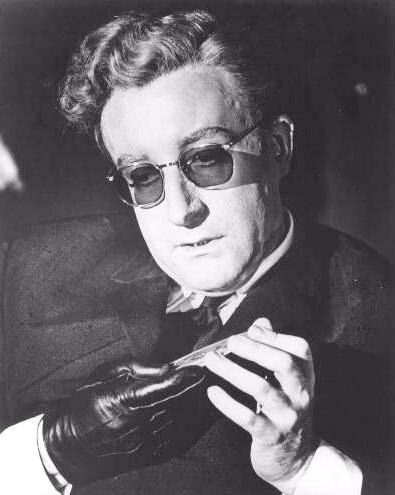
Dr. Strangelove by Peter Sellers. Must see movie.
Thus the fifties was a long intense struggle that was fought out in the movies, phonograph records, publishing and radio with an increasing boot from television. While we knew we were fighting the Communists for survival the means of the warfare were noticed but by a few and they were demonized by the Communist controlled media as cranks. Most frequently the accusations were made by wild eyed hysterical sounding Fundamentalist ministers. As the majority couldn’t see the accusations that Fluoride and Rock and Roll were Communist plots the accusers were laughed off. I could never understand how something I loved, Rock and Roll, was a Communist plot.
I did note the accusation was uttered with such complete sincerity however that it troubled my mind over the decades as to how these ministers could make such an accusation. I suppose the first seeds of comprehension were planted by the Peter Sellers’ movie ’Dr. Strangelove or How I Learned To Love The Bomb And Stop Worrying.’ The movie while hilariously funny was so skewed toward the Communist cause that it gave me pause. I vaguely comprehended that I was being manipulated.
Shifting The Mores
Now, after something like sixty years of thought and study, including Plato and Sullivan, I have I believe the explanation.
The Mores of the US have probably always been relatively fluid. Almost from the beginning the mores of East Anglia clashed with those of Wessex and then came the Scots, the Rhineland Germans (known as the Pennsylvania Dutch), the Anglo-Scots of the Border Country, the Midland English Quakers and a smattering of others along with the strong Negro element.
After Independence the Negro population burgeoned when the invention of the cotton gin created the cotton culture of the South. This population would create the tension that led to the Civil War and from that conflict the tension that would lead to the post-WWII Negro revolt.
The Irish invasion of the 1840-60 period brought the great clash of mores between the Celts and Anglos that reached its head in the 1960 election of the Celt, John F. Kennedy.
Along with the Irish came the 48ers of that failed European revolutionary phase that would create the collective-individualist conflict in mores that has resulted in the Communist triumph of Barack Obama of today.
Then in the 1870s began the invasion of the Southern and Eastern Europeans that created a conflict in mores between themselves and the Irish, Anglo and Northern European element. As noted things settled down into a contest of moral wills until 1965 when the gates were thrown open to the entire world as though the fraction of the world’s surface designated the US could house all humanity. Thus any possible hope of a unity of mores was completely shattered. Any center that might have existed was destroyed.
Now, as unpleasant as the facts may be to some intelligences, the control of the creation of a unified set of mores was seized by the Jewish immigrants in the aftermath of WWI.
To merely select a highlight of the process, in 1938 the Stalinist-Jewish agent, Congressman Samuel Dickstein. with the complicity of FDR created the House Un-American Activities Committee to root out anti-Semites and Fascist/Nationalists thus shifting control of mores to the Judaeo-Communists. The move was only partially successful initially as it had to face an intense post-war reaction ultimately conducted by the near great Joseph McCarthy.
As ever the mores of the majority were attacked at the weak joints in their armor. The key point was the long festering Aryan-Negro conflict. In realistic terms it was a conflict that could have only two results, the physical subjugation or extermination of the Whites by the Blacks or vice versa or the amalgamation of the two species.
Like it or not, the Jews and Negroes are calling for the extermination of Whites. The problem in post-war 1946 was how a small minority of Jews and Negroes representing perhaps 14% of the population could eliminate the 86% who were fully armed and dangerous.
The first step would be to knock the majority off its moral center. Without a moral focal point the majority would flounder. The route taken was nothing new. Ever since post WWI when the newly formed Anti-Defamation and NAACP Leagues were formed the majority had been cast as bigots. This caused a polarization among its Liberal and Conservative elements and Immigrants and Natives. By 1950 there was a 50-50 split between descendents of pre-1800 and those who came after. These splits were exacerbated by propaganda. Outside those divisions were the Negroes.
So, then how to fracture and fragment the majority White population even further.
Until 1954 the music that you heard on the radio was all Western, not cowboy but derived from the White or Aryan

The Great Joe McCarthy
population. And there wasn’t much of that music broadcast. Radio was controlled by the networks and they only slotted a couple hours a day of fairly wishy-washy stuff. Then about 1954 when television, commercially introduced after 1946, displaced radio as the source of home entertainment, radio floundered and only saved itself by going to all music that soon developed into Top 40 and teen dominance of the radio airwaves. That was my age cohort.
That was a time when the designation race music meant the stuff that only Negroes listened to. The designation Country and Western replaced the term Hillbilly at this time. Some considered Hillbilly a race music with a degree of accuracy if with malice. Hillbilly was despised by all but a minority not much larger than the Negroes of which I was one.
Strangely at about the same time efforts were made to bring both musics into the mainstream. Actually they would combine with folk to form Rock and Roll- Rhythm and Blues and Rockabilly. Hard to tell which was the harder sell.
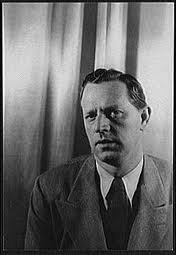
The Vile Erskine Caldwell
H.L. Mencken in the teens and twenties had excoriated the hill people, from which I derive on my father’s side, while the vile Erskine Caldwell vilified and completely defamed Southern Whites in his two hateful and extremely popular novels Tobacco Road and God’s Little Acre. The two novels remained a tremendous influence through the fifties as well as the pervert Al Capp’s cartoon strip L’il Abner. Thus a large part of the majority population was more receptive to Negro music than Hillbilly.
Naturally the agents in the forcing of Negro music on the Aryans were the Jews. The actual recordings of real Negroes were pretty raw and unmusical. Though stuff to digest. Of course there had always been Negroes catering to White audiences such as Duke Ellington, Louis Armstrong, Billie Holliday, the Ink Spots and Mills Brothers of the earlier generation and the great Platters, Fats Domino and Johnny Mathis of the next generation but the real Negro music was unmistakable.
Thus Jewish songwriters such as Leiber-Stoller, Doc Pomus, Mort Shuman and others adopted Negro personas and wrote most of the Rhythm and Blues performed by Negroes. It was this Negro music geared to Aryans by Jewish song writers with a foot in each camp that made the inroads leading up to Berry Gordy’s Motown Sound where you had a new generation of Negroes packaged exclusively for
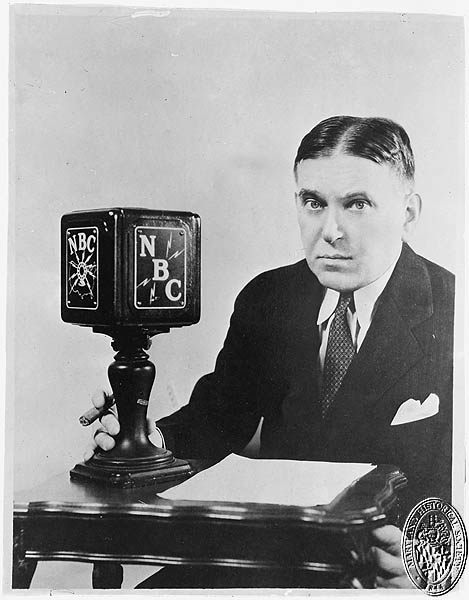
H.L. Mencken
Aryans singing songs largely written by Negroes and, of course, from there it melded into the more racial Soul Music of the sixties.
So, in 1954 Rock and Roll began to develop. First was Bill Haley, the former leader of a Country band who picked up on some Negro/Jewish shouts like Shake, Rattle And Roll and moved them over to the White side of the tracks. And then came acceptable cuddly Negroes like Fats Domino and the respectable Bill Doggett with his great Honky Tonk Pts. I & II. I don’t know how Little Richard squeezed between Fats and The Platters but he did. Of course he wasn’t even of this planet and there was no discrimination toward extra-terrestrials.
Acts like James Brown And His Famous Flames were rejected out of hand. There were no crossover possibilities there. The greatest hit he ever made was his beloved televised funeral. That was something else.
The Chess artists that the Brits idolized made absolutely no impression at all with the exception of Chuck Berry. After Maybelline Chuck had tough sledding although he has fared reasonable well in the aftermath. Memphis, Tennessee, a true classic.

The One And Only
The Commies Were Everywhere
The Law Of Unintended Consequences
When the Fundamentalist ministers objected to Rock and Roll as a Communist plot I’m sure they were ignorant of the actual evolution of Rock so I am not clear on what their antennae were picking up. They may have been watching something that isn’t so obvious now.
The world of Folk Music was clearly Communist run with a very strong Jewish influence. While other people knew of the Red influence in the arch Commie group The Weavers, it was not at all obvious to kids like myself. The Weavers’ great hit On Top Of Old Smoky betrayed nothing that could be considered Communist. However the idea of Folk Music which I have always interpreted as Appalachian style music, essentially real oldtime hillbilly, was slowly expanded into a political notion of poor people’s music, the music of the ‘oppressed.’ Now, let me tell you, I come from this social group but have never considered myself ‘oppressed.’ That attitude comes from some very well situated people who have never been at the bottom. Seeger and his Almanac singers brought Depression songs into the mix so that ‘real’ people went around saying things like ‘I knowed it wan’t no good.’ Poor people with the folkies were always illiterates who ‘knowed’ things.
Seeger and the Weavers had a hit with the Israeli song Tzena, Tzena, Tzena that was a sprightly song but hardly folk. Apparently not realizing the song was a success because of its tune not its Jewishness the Weavers followed that song with some propaganda called The Song Of The Sabra, some kind of Israeli kibbutz song.

The Weavers w/ Pete Seeger
At that time the TV Hit Parade show was big and practically the only source of hit songs so Seeger got his song on as an extra because no one bought the record. It may have been the first Israel as the fifty-first state attempt. If so the reaction was completely negative. Shortly after, Seeger and The Weavers were investigated as Reds and disappeared.
Seeger became an anti-commercial purist but a major guru of the heavily Communist and Jewish New York folk scene of the late fifties and early sixties from whence the young Bob Dylan became a stellar performer. So, between the Negro race music and the Aryan Hillbilly race music along with the Folk music that became a part of the meld, Rock and Roll was sort of the unintended consequence of the effort to force Negro music on Aryans and the Red influence of Folk.
When Fred Hallerman of the Weavers became a consultant for the Kingston Trio in the late fifties revival of the Weaver ethic, the Kingstons did follow a Communist musical agenda that most folkies adopted. Once again, you had to have a score card to know the players and follow the game.
In England beginning around 1960 a funny thing happened on the way to the recording studio that the Judaeo-Communists could not have anticipated. The second generation of rockers worshipped Negroes and Negro American music especially the urban electric bluesmen of the fifties that White Americans had already rejected. It is true that the small coterie of American White Negroes were fanatical about Negro artists like Muddy Waters, John Lee Hooker, Chuck Berry, Bo Diddley and a few others but the mass market would have nothing to do with them either in the fifties or after thirty years of ballyhoo. The fanaticism was not contagious. Indeed a really nice picker like Mississippi John Hurt is unknown. You can count the number of records sold by the Blues hero Robert Johnson on one hand.
Yet the English rockers born from 1940 to 1944 literally worshipped these Negro guys, listening to their records until they had them note for note, even attempting to be Negro, chasing Negro women. Of course the music had to be adapted to the mass taste to succeed and in the adaptation a new, or at least different, style of music was created. As strange as it may seem both the Communist Jagger and Richards of the Rolling Stones had an attraction to American Country and Western while being reared on the Englishman, Scots actually, Lonnie Donegan’s big beat folk rock.
What came out of the Stones then was a strange Negro-Country and Western sound performed by White Negroes.
Thus Negro slave music despondent and defeated was successfully laid as the basis for the Folkways of a generation or two of Whites. Musically the revolutionary program was on course as the sixties dawned developing rapidly. The Fundamentalist ministers as it turns out were right about Rock and Roll being a Communist plot or turning into one.
Organizing The Future

Procol Harum 1967
She wandered through the garden fence
And said I’ve brought at great expense
A potion guaranteed to bring
Relief from all your suffering.
And though I said: You don’t exist
She grasped me firmly by the wrist
And threw me down upon my back
And strapped me to her torture rack
And without further argument
I found my mind was all so bent
Upon a course so devious
It only made my torment worse.
–Procol Harum
The Communist strategy was to break up prevailing mores and replace them with its own. Thus the so-called concept of Critical Theory, which was Jewish, was used. Critical Theory is mostly taking a superior moral attitude as though one knew best and then carping at the existing society as though only fools had devised it and they could do better if they only had the chance. This attitude applies to all established standards and customs.
Key to our argument here is the assault on artistic standards. The Semitic religions of Judaism and Moslemism reject the representation of living life forms especially that the human relying on abstract designs instead. Thus Aryan representational art is anathema to them. More or less as the twentieth century began, coeval with the rise of Freudian psychology, the assault on representational art began.
In the US the assault began with the New York Armory show of 1913. The most sensational work of this seminal deconstructive exhibit was the Marcel DuChamp picture of The Nude Descending A Staircase, he, himself was a Communist agent. The process continued led by Jewish artists who formed a blobs and dabs ethic leading into Abstract Expressionism and finally completed by the anti-art of Andy Warhol in the early sixties.

Andy Warhol-Yoko Ono Practicing The Black Arts
In 1959 thirty-two short years after the American hero Charles Lindbergh flew his single engine prop airplane across the Atlantic over a period of days a four engine Jet 707 lifted from the runway of Idlewilde airport in New York City to cross the Atlantic non-stop to London in a few hours. This inaugurated the Jet Era while creating a new phenomenon, the Jet Set. Logistics had been made incomparably quicker and easier. Revolution could be co-ordinated as never before.
One imagines that David Bailey watching this first flight recognized its momentousness. I like to think his breath was taken away by this miracle of science and that he rushed down to get a ticket for the return flight to New York. Who was David Bailey? He was a young fashion photographer for British Vogue. Antonioni’s film Blow Up was based on his career in what would be known as Swinging London in a few years. Dave in his early twenties would catch the wave at its inception and ride the wave all the way up and all the way down. As I write he’s still out there.
As a result of the 707 Fashion itself was made identical on both sides of the Atlantic. New York and London became one huge metropolis for lucky Jet Setters. While Dave Bailey was in New York either this time or another time he met fellow revolutionary Andy Warhol. Andy was a fashion illustrator of shoes during the fifties so it is not improbable that someone at American Vogue called Andy to Dave’s attention. Or, perhaps as Dave was a switch hitter he wandered into the Serendipity where Andy was a fixture and formed an acquaintance there.
In any event in 1963 Dave Bailey took Mick Jagger on a 707 jet flight to New York. Mick, as we all know, was a revolutionary who at that time was attending the Communist London School of Economics while singing with the nascent Rolling Stones. Dave took Mick to call on Andy and the three became fast friends, mates as Dave would say. Mick revered Andy. Andy himself playing the fey fool for security became a very important figure in revolutionary circles until his death in 1987. Andy himself revered Marcel DuChamp while considering himself DuChamp’s disciple.

David Bailey and Jean Shrimpton today. First she’s yours and then she’s his.
Just as Yoko Ono realized the potential of the Happenings for bending society to her will so did Andy. Having put the finishing touches to art, pop art would be followed by graffiti artists like Keith Haring and Basquiat, Andy turned to film. His atelier known as The Factory became a very long Happening from ‘64 to’67 when Andy was turned out of his quarters. After a hiatus of a decade the torch was picked up by the nightclub Studio 54 which in many ways was a continuation of The Factory as a social scene. Andy was no less a fixture at Studio 54 than he had been at his own Factory.
The Union of Jagger and Warhol was fortuitous as with Andy’s blessing the Stones became practically the Village house band. The Village was a stronghold for the Stones. Perhaps inspired by the success of the Stones as well as Bob Dylan Andy made a foray into music when he adopted the Velvet Underground as the Factory house band launching their very short career and the much longer one of Lou Reed.
The stage on which the ‘60s revolutionaries played out their gig was gradually falling into place as the unintended consequence of the foisting of Negro music on White youth by the Jews. As it turns out it was a Communist plot.
The Communist strategy was to break up prevailing mores and replace them with its own. This is an age old technique. No surprises here but to the uninformed. To mention only one example common to all religions, when a new religion is seeking to replace an old religion the simplest thing is to build new shrines on old sites. Thus a Christian church replaces a pagan shrine, then a Moslem mosque replaces the Christian church. The ‘Holy’ site remains the same but faith replaces faith.
Thus, the Communists made their assault on popular culture. Several very potent technologies had been developed by the ‘Capitalists’ that would never have come into existence under Communism, movies, TV, radio, records and print as well as the art world. They have used them all effectively. In authoritarian societies such as the USSR content could be strictly controlled and any deviants punished unlike the West with a long habit of freedom of expression. As the sixties progressed any attempt to control such things as pornography, nudity and actual sexual perversity were removed. By the end of the decade the cherished Holy Grail of the revolutionaries of being able to say ‘fuck’ in movies or on TV had been realized. The Warhol movies of Paul Morrissey, Blood For Dracula and Flesh For Frankenstein, carried the portrayal of Sado-Masochism to lengths that would have delighted De Sade and Sacher-Masoch themselves.
In an extreme pornographic Happening in 1971 Mick Jagger before an audience of millions would have a huge inflatable penis unroll from the back of the stage, which he mounted. If there was any community objection it was hooted down in the name of freedom of expression. Truly a cultural revolution of some sort had been achieved by a small minority.
Sussing Out The Ghouls

Groovy Bob Fraser- Good book.
The key to the psychology of the twentieth and twenty-first centuries is Sigmund Freud and where he fits into the culture. Unfortunately he was not on the side of the angels. In the struggle between Reason and Un-reason Freud was the champion of un-reason, the Lord of Misrule. He aligned himself with ancient traditions, none of them Jewish as when they were formed there were no Jews, at the dawn of human history.
Freud discussed these ancient attitudes, in one guise or another, in his 1930 complaint Civilization And Its Discontents. To mention merely one strain, that of sex. While we cannot hope to recreate the mind of early man let us assume that early man took a cop from the nearest available woman where he found her. Rape was not yet a concept so for our purpose here, like Freud we’ll assume that forced sex was common and men, at least, suffered from no sexual repression. This is the very core of Freudian psychology.
Thus in the good old days a man in the mood who came across a woman drawing water at the spring simply grabbed the woman copped and strolled away without so much as a thank you. Nine months late the woman said a god appeared to her and the baby was his. Easy. But as populations evolved civilized new rules were introduced and men, at least, began to suffer the horrors of repressing their sexual appetites. This was very nearly original sin in Freud’s mind. Restrictions were placed on uninhibited copulation. However the memories of the good old days lived on and men subjected to the new discipline complained of their loss of rights.
At that point society thought something had to be done to satisfy these reactionaries. One possible solution was sacred prostitution. Thus young girls were taken down to the temple precincts and couldn’t leave until they offered themselves to the first taker.
In other instances girls stayed until they earned their dowries. In any event the illusion was created that any man could have any woman when he wanted her- if he had a shekel. If not then back to laboring in the vineyards of the Lord until he earned one.
Presumably this system worked reasonably well until the mores of the Matriarchy were replaced by the mores of the Patriarchy and women became private property with the woman secluded out sight of leering male eyes. This system had its problems, one being that some guys were so greedy for women that they collected hundreds in what they called a harem and said that these women were exclusively theirs. A neat turnaround of temple prostitution. Well, all systems have inherent flaws.
Middle Easterners then carried it so far that to prevent impertinent glances from passing fellow men they clothed their women cap-a-pie and then put a screen in front of their faces. Wow! That’s thorough.
As odd as it may seem those memories persisted for thousands of years perpetuated by cults and secret societies. In reaction to Catholic discipline societies such as the Free Spirits, the Anabaptists and such rebelled against the church in an attempt to re-establish that golden age of yore when it was supposed that men, at least, were unrepressed and could do as they pleased with any woman. As Rabelais phrased it: Do what thou wilt shall be the whole of the Law. Law and Civilization go together so to get rid of one you have to get rid of the other. Freud wasn’t dumb.
Then the Enlightenment evolved and the Free Spirits morphed into the Libertines and the Libertines morphed into the Bohemians and Organized Crime and, et voila! Here we are. Today! Or at least New York City today. We’re getting closer to Andy and Mick’s paradise.
And then we have the problem of good and evil or, in other words, God and Satan. A lively division was carried on in ancient times that gradually evolved into Christian Orthodoxy and Gnostic heterodoxy. These went through additions and subtractions, mutation and changes until there gradually emerged a clarification of the Godly Church and the Satanic occult. The Church was able to successfully manage Satanism until the Enlightenment when with their power broken Satanism, Bohemianism and Organized Crime were able to surface and operate in the open.
Many were the advocates and cults. The central figure of Satanism was the Frenchman Eliphas Levy (French not Jewish, Levy was an assumed name). Levy organized modern Satanism. The novels of J.K. Huysmans give a good insight into this period as well as being good reading. Important to the US was the Golden Dawn of Aleister Crowley who managed to leave England and live and die in Los Angeles. His publishing house still survives in the desert town of Barstow.
Thus Satanism grew in significance into the twentieth century when it aligned itself with Warhol and popular music. When opportunity presents itself, snatch it.
Today, many self-styled adepts and magi have made their appearance over the decades usually with some sort of sex therapy that involves total indulgence or submersion in sexual congress. Thus the link between Satanism and Freudianism is strengthened. Freud himself has an appearance of a magus. He was steeped in the Jewish occult, Frankism, the Zohar, Kaballah and so forth. His answer to mental health was also unlimited sexual intercourse. He believed that the more ejaculations per day the better a man would be. Thus, once again, we have New York City of toady in which women are expected to indulge men in the most casual of sexual encounters. It will be remembered that the Jewish psycho-analysts fleeing the Third Reich mainly settled in New York thus once again strengthening the Freudian connection.
Thus the anger of ancient sexual reactionaries has been made the ‘sexual liberation’ of today. Sexual revolution? What sexual revolution? Just a return to the most primitive sexual indulgence.
As Freud was himself a homosexual it is no accident that he quietly promoted homosexuality or, at least, the end of sexual repression leading to…what appeared to be sexual liberation in his imagination.
Now, Mick Jagger first appeared in New York in 1963 with David Bailey as his cicerone just when all this fustian was about to ignite. A later fellow revolutionary future associate, Bob Fraser was working in New York, learning his craft, at the time so it is possible the Dave and Mick met him at that time. We don’t know as yet what all Bailey introduced Mick to. Kenneth Anger, the homosexual filmmaker and self styled magus and Black Magician from California was very influential not only in New York but in London as well. He would associate himself with the leading revolutionists such as Warhol, Jagger, Bailey, Lennon-Ono and the English art dealer Robert Fraser. Fraser spent the first few years of the sixties in New York learning the art trade while he mingled with Warhol and the NY pop artists. He was then to introduce their work to London.
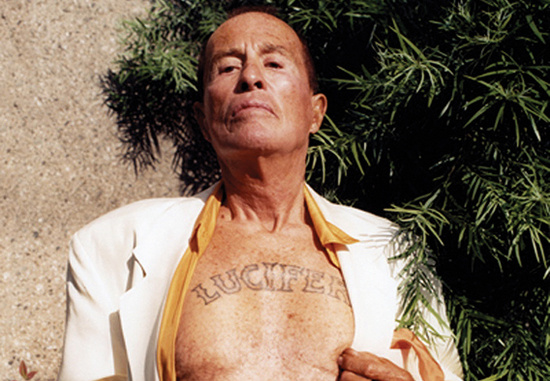
Kenneth Anglemeyer aka Kenneth Anger
Kenneth Anger made ‘experimental’ films such as the influential ‘Scorpio Rising’ the movie had a great influence on Andy when he turned to films in 1963. Scorpio Rising is a homosexual film about a gay primping to go out catting on his motorcycle in some Brando ‘Wild Ones’ setting. It is a silent film except for the girl group soundtrack of a dozen or so songs.
Anger would then insinuate himself into Jagger’s entourage as he tried to bring Jagger into his Satanic circle. Mick was supposed to write the sound track for an Anger film but didn’t produce causing Anger in revenge to claim the soundtrack was by Jagger then using some horrid static as a soundtrack. Anger would also con Jagger’s then girl friend, Marianne Faithfull, into appearing in what he considered his magnum opus Lucifer Rising. That movie was pretty much a waste which considering Anger’s other efforts is saying a great deal.
Nevertheless Anger influenced Jagger bringing Mick into the orbit of Satanic religion at least through the sixties. Satanic tropes also began to be marketed to the general public in the mid-sixties with dozens of Satanic movies released over the next decade. In much more than a symbolic way the birth of Satan, Lucifer rising, was for the modern age portrayed in the 1968 movie Rosemary’s Baby directed by the Jewish Roman Polansky based on the 1967 novel of the same name by the Jewish Ira Levin.
The movie purported to be filmed in New York’s legendary Dakota Apartment building, now condos. The movie would

The Magus- Aleister Crowley
make the Dakota a Mecca for Satanists in the upcoming years. John Lennon and Yoko Ono would acquire three apartments in the Dakota in the seventies including two on the seventh floor on which Rosemary’s Baby took place.
Ono herself was a devotee of the Black Arts (black doesn’t mean Negro in this context nor in the term Black Magic) so that her move into the apartment building may have had deep meaning to her.
The previous year, 1967, the Stones had released their record Their Satanic Majesties Request in which Mick introduces himself as Satan. The disc was released on the eighth of December just before the birth of the baby Jesus. This might have been coincidental or it might have been a Jewish joke. At any rate the heavily Fundamentalist US audience of ‘kids’ took it literally thus identifying the ‘bad boy’ Stones as Satanists. The record also set a tone for the next few years.
According to sources such as Marianne Faithfull Mick was not seriously into Satanism. She says that he was influenced by the Russian novel The Master And Margarita. That novel itself has a Wag The Dog quality. Wag The Dog was a 1997 movie in which a fake war has been reported by a compliant media for political reasons. However man proposes and God disposes. The scenario has to be regulary adapted to changing circumstances that often fail to occur as planned. A key point is when a song was faked, made to sound old, then inserted into the Congressional Library to be ‘discovered.’ The Master And Margarita has that quality.
Supposedly written by one Bulgakov, nearly a legend in his time but forgotten today, for whom a romantic biography has been concocted, he was too cautious to publish in his lifetime as he was already in disfavor with Stalin. The manuscript was placed in a drawer where it lay undiscovered until 1966. At that time it was discovered and not only rushed through the presses but this would be classic was considered such a phenomenal find that it was also rushed through a translation that was also published in 1966.
For some extraordinary reason a copy of this amusing but hardly earth shaking novel in which Satan comes to Moscow was also rushed to the hands of the singer in a rock and roll band, Mick Jagger. Mick not only received a copy but immediately sat down and read it. Thunderstruck, apparently, he, one supposes, in a blind daze dashed off the lyrics in time to include the then composed music into the new album: Their Satanic Majesties Request. The novel ain’t that good.
While Marianne may be correct the sequence of events seems contrived.
However his movie Performance of 1968 goes a long way in reinforcing the impression that he was somewhat into Satanism. So, within several months the Stones released their record, Jagger released his movie and Rosemary’s Baby appeared. These were dark years and growing darker and when ‘Satan’ appeared at Altamont the result was a foregone conclusion. It didn’t help subsequently when Mick mounted his giant inflated penis.
Nineteen sixty-eight and nine were tumultuous years in the record business as the industry moved from an entertainment backwater into a major billion dollar player. It was then that Mick and his fellow Stones realized that although their group was earning tens of millions of dollars very little of that money was coming their way. It could hardly escape them that while their ‘managers’ Eric Easton and Andrew Oldham showed evidence of big money they were still living hand to mouth. They sacked Oldham and Easton only to be tossed into the mouth of Leviathan, Allen Klein, by the departing Oldham.
Klein himself would manage to snag several major British groups including the two biggest, the Stones and the Beatles, any ogre’s dream. One imagines that he and his heirs have made hundreds of millions if not billions as a result of their thefts albeit conducted through legal methods.
It was not too long after the departure of Oldham and Easton that Jagger realized the monstrous trap that was Klein that Oldham had led the Stones into.
Actually the relationship of the goyish artists and their Jewish managers and record corporation execs is an interesting sociological and psychological study. I, of course, follow Freudian group theory from a Critical Theory perspective hence cannot be accused of anti-Semitism as Freud approached psychology from a scientific rather than a religious perspective himself being an atheist or so he said.
In Jewish thought they believe themselves to be Chosen of God hence occupying a position halfway between the godhead and humanity. As such they consider themselves as owners of the goyim or, in other words, human cattle. As the very Jewish Bob Dylan was to sing- Give me some milk or go home. Thus the Jewish personnel in the record industry consider the artists as something to be milked.
As with any cattle there are certain maintenance expenses that are unavoidable. It isn’t all profit. Thus of the billions milked from the British artists alone it is doubtful that the artists were allowed a penny on the dollar in compensation if that. The ‘milk’ obtained from the most fabulously successful act, the Beatles, is almost unbelievable. Both the Stones and the Beatles only amassed fortunes after they had freed themselves from their Jewish owners. Which is to say they buy their way out trailing mega dollars.
When Jagger realized the enormity of the criminality of Allen Klein he was desperate to escape his clutches. Interestingly he turned to, Prince Rupert Loewenstein, to free his group from the clutches of Klein.
When Klein took over the Stones from Oldham they were successful but not the icons they were fast becoming as the seventies neared. After freeing themselves from Klein the Stones went on to actually earn billions. Their concerts alone grossed over a billion dollars from 1971 to the present with another supposedly on the horizon that could possibly take in a quarter billion or more.
Now, it is nearly impossible for an artist to manage money period but money in the billions can only be managed by a competent financial staff. Rupert serves that function. I do note that when Jerry Hall was divorcing Mick she thought it prudent to check with Rupert to see if her money was still there. Apparently she was aware of the financial shenanigans of money managers. Historically they can’t be trusted. One never knows whether the money is there until one asks for the check.
However whether Klein or Loewenstein, the management, the control, virtually the possession of those billions is in the hands of others.
One can only imagine the fear, the panic, that gripped Mick’s mind when he realized that all his and the Stones efforts of ten years had changed hands without any compensation. One can only imagine the horror with which he received the news that he and his fellows were penniless. One probably cannot imagine Mick’s reaction as Allen Klein told him- tough shit, so sue me.
Sue him the Stones did but operators like Klein know how to stonewall court orders while using accounting methods to conceal tens or even hundreds of millions of dollars. The Stones sued for a mere seventeen million dollars while settling for bankruptcy returns of ten cents on the dollar. A little joke of Klein’s as he laughed merrily on the way to the bank. How much the Stones got of the settlement and how much their lawyers took has yet to be revealed.
He was fortunate to obtain the services of Rupert Loewenstein who bore the honorific title Prince. Rupert extricated the Stones from Klein while being associated with the City banking establishment of London and already managing the money of a couple dozen of the mega rich seems to have been a fortunate choice. Letting himself out to pasture in 2007, Rupert will release an account of his experiences with the Stones in a March 2013 memoir ‘A Prince Among Stones.’ Sounds promising but we’ll see. Place an advance order now and wait.

Andrew Loog Oldham
When Klein took over the Stones from Oldham they were very successful but not the icons they were becoming. After freeing themselves from Klein the Stones went on to actually earn billions. Never forget their are expenses, including Rupert. I don’t know what Rupert’s fees were, perhaps he’ll tell but I imagine the Stones have made him wealthier than he had been before.
Now, artists are artists who must pay attention to their art rather than their finances so a manager like Rupert is an essential. How trustworthy he actually was remains to be seen although no complaints from the Stones as yet.
Certainly Mick must have entered an extreme darkness of mind as he passed through the years from ‘67 to ‘71. Psychologically he had been emasculated by Easton, Oldham and Klein. One way to interpret his riding the inflatable penis could be as an attempt to regain the illusion of his manhood. One could also interpret his extreme effeminacy of this period as a result of his emasculation. Psychologically Klein had stolen his manhood along with his money. Not that Mick wasn’t always on the ambiguous side.
Mick’s association with Satanism then may have been prompted by his realization of just how evil life could be. Indeed in Manichean terms the flesh and world belong to Satan while God, the higher powers, deal in spirituality which is the rejection of Satan and his works I.e. money. Depending on what Mick was reading other than The Master And Margarita his mind may have been led to the conclusion that he was Rosemary’s Baby, that he was the Prince of Darkness. Certainly he seems to have realized the ambitions of Their Satanic Majesties Request and become a man of wealth and taste. Interestingly he seems able to move from the exquisite to clownish with the maximum of ease.

Prince Rupert Loewenstein
Mick Jagger, The Rolling Stones And The Yobbo Revolution
Part III
By
R.E. Prindle
Mick And Keith Come Face To Face With Nemesis
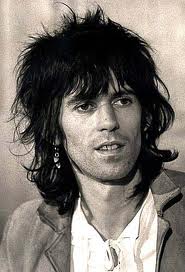
Keith Richards- Face Of The Stones
The sixties were very critical years for the various revolutions that made up The Revolution. Yet their activities were very disguised to prevent detection. At no time could they admit who they were or what they were doing. For Instance the takeover of the university system of the US that began at UC Berkeley in 1964 was disguised as some sort of ‘student protest’ over some supposed lack of or suppression of free speech, hence its name, The Free Speech Movement. While it appeared spontaneous it must have been a planned maneuver. I was at Cal State Hayward a couple of miles down the road. We had library privileges at UC that had one of the spectacular libraries of the world that I used so I was on campus when this noise was going down. It was quite professional, extremely well organized and no student revolt per se. The leaders were well instructed in the psychology of crowds. Something the ordinary person would never recognize. From UC it spread throughout the US intensifying in the years 1968-72.

Chairman Mao Ze Dong
Nineteen sixty-eight, of course, kicked off the worldwide Cultural Revolution orchestrated by Chairman Mao’s China. It was all organized from China. The Paris fiasco, everything even into remote corners such as the University of Oregon in Eugene was run from China. By 1968 I was a grad student at UOregon and in the poster and record business. Some crazed Chinese styled Communists from out on the rural route opened this Communist book store right next to my store. Needless to say police surveillance increased drastically as I was already under suspicion for selling posters and rock and roll music, literally the devil’s music in fundamentalist Eugene. As the whole world knew anyone in the record business was also dealing drugs whether they were or not and I wasn’t. And then the nutty SDS Jews from New York City flooded into town in their hip denims and abetted the Maoists. This increased the fun.
Wait a minute now, there’s more. Eldridge Cleaver and the loony revolutionaries in the Bay Area were conducting open
Eldridge Cleaver
warfare, guns and bombs you know, with the Feds and local police that naturally enough led to the arrest of such Negro revolutionists. But then, quite naturally, Eldridge escaped from maximum custody or something just like it and disappeared. No one knew where he was and they really wanted to. He didn’t surface for a few weeks so in the interim where did they look for him?
I hesitate to say this because I know you’re not going to believe it. They asked me if I had him hidden in my four hundred square foot record store. You see the logical progression, revolution= rock and roll= dope, Marxist store next door- where else is Eldridge going to hide, right? The store was an open square with a two by four enclosure for a toilet in the right corner. I pointed out to the cop that he was already looking at the entire store and he could see that there was no Eldridge Cleaver. But he wanted to check the 2×4 enclosure. I knew better than to laugh but I could barely contain myself. The cop opened the door to find himself staring into a toilet bowl. Eldridge cabled from Algeria shortly after.
I certainly was not aware of revolutionary activity per se or else I couldn’t take their stuff seriously but looking back things remained on red alert until at least ‘72. For the election of the second Nixon term, which I now see as serious potential danger, I saw them move several truckloads of Army troops out beyond Spencer’s Butte. One might say Mick Jagger and John Lennon, and I say this modestly in a local way, myself, had them worried.
I’ve always respected the intelligence agencies but placing me in the same category with Mick and John makes me have some doubts. I had no revolutionary or drug connections. It wasn’t that they couldn’t find them, as they thought, they didn’t exist.
There you have it, ‘68 was the crucial year. The authorities in both Europe and America were aware that something was going down. They were not taken by surprise. The Stones were.
They might have asked why are they busting us in ‘67 when they had plenty of cause for at least three years. Undoubtedly in an attempt to defuse the ‘68 show as much as possible. The direct action of the revolution failed so whatever counter revolutionary action the authorities took voided that while the revolutionaries themselves misgauged their popular support by a little more than somewhat. There were only a few fanatics backing them. The ‘kids’ were just not that dissatisfied. We were getting plenty of satisfaction.
According to Tony Sanchez/John Blake in their Up And Down With The Rolling Stones Mick fumed thusly after the ‘67 bust, p. 62:
I see a great deal of danger in the air. Teenagers are not screaming over pop music anymore, they’re screaming for much

Tony Sanchez
deeper reasons. Pop music is just the superficial issue….When I’m on that stage I sense that the teenagers are trying to communicate with me, like by telepathy, a message of some urgency. Not about me or our music, but about the world and the way they live. I interpret it as their demonstration against society and its sick attitude. Teenagers the world over are weary of being pushed around by half-assed politicians who attempt to dominate their way of thinking and set a code for their living…..This is a protest against the system. And I see a lot of trouble coming in the dawn.
I don’t know about Mick’s mental telecommunications but the message he was getting was maybe being scrambled by some alien force. Apart from some experts at crowd control and excitation there wasn’t that much interest in fighting in the streets.
Mick remained pugnacious personally, according to Sanchez/Blake:
They think they can break us, man, but no way. We’ll take everything that they can throw at us, and we’ll still win. We’re in a position to tell the kids about all the shit that’s going down, and that’s just what we’re going to do.
Mick was smoking some powerful stuff while taking the teaching of the London School Of Economics a little too seriously. He should have said ‘some kids’, by no means all the kids were concerned with the Stones while as the events in Chicago during the worldwide insurrection of ‘68 showed that concentrating on sex and drugs was not conducive to direct political action. ‘The kids’ made a poor showing. Besides which teenagers were only a part of the rock audience; most of us were at least over twenty.
Nor in ‘72 in Miami after much hoopla and the expenditure of large sums of John and Yoko’s money was there much of an insurrection. Keith in his auto of 2010 speaking of 1985 and 1972 had this to say about that on page one no less.
Every copper wanted to bust us by any means available, to get promoted and potentially rid America of these little fairy Englishmen. It was 1975, a time of brutality and confrontation. Open season on the Stones had been declared on our last tour [that of the inflatable penis], the tour of ‘72, known as the STP. The Department had noted riots (true), civil disobedience (also true), illicit sex, (whatever that is) and violence across the United States. All the fault of us, mere minstrels. We had been inciting youth to rebellion, we were corrupting America, and they ruled never to let us travel in the United States again. It had become, in the time of Nixon, a serious political matter. He had personally deployed his dogs and dirty tricks against John Lennon, who he thought might cost him an election. We…they told our lawyer officially, where the most dangerous rock-and-roll band in the world.
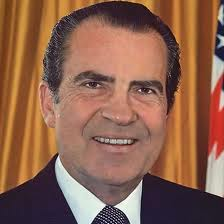
Richard Nixon
Kind of tells it like it was. I was in the record business, considered an arch liberal, and I thought the Stones were attempting to corrupt the US if not succeeding. I mean, you have only to look at the original picture inside their Black And Blue album to confirm that. The Stones, Lennon-Ono, Dylan, the outlaw groups like the Baader-Meinhoff gang, the Weathermen, the Red Brigades and their ilk saw the world through some drug induced mental haze in which the finest, most just, most democratic and widest opportunity society the world had ever seen and will see was just the opposite of repressive and undemocratic.
I mean, I had been pushed down hard in life, I come from the orphanage, and I still made a major success in the record business and that was against the wishes, not of the system, but the people, the shitheads, I had to deal with. Good god, you have to bully the bullies, elude their repression. It will never be any other way.
Whence came such a bizarre interpretation of reality. As the German politician in the movie, The Baader Meinhoff Complex thought, the insurrectionists were motivated by a myth. The Robin Hood Complex.
Yes, by a sense of materialistic frustration which they justified by the myth of Robin Hood. The problem was the same as the Negro insurrectionists in Watts. The range and quality of material goods increased on a daily basis continually out of reach. Yobbos like the Stones with no discernible abilities other than to write trite lines of lyrics and play hashed over music taken from nearly musically illiterate street corner Negro bands were realizing their material fantasies. What did they do in their rebellion in Watts? Break into stores and steal Tvs and stuff. Mere economic frustration. The Beatles were buying Rollers then desecrating them with psychedelic mockery. Richards himself driving without a legitimate license bought Rollers and smashed them up with glee laughing as he skipped away to avoid arrest. Keith was living the Yobbos dream. Baader-Meinhoff tried to replicate the dream by stealing Mercedes to go joy riding through the night. Same thing the Negroes were doing. That was what the revolution was about. To revel in cash money as the Stones, Beatles and other rockers did they robbed banks to ease their frustration. A leading hatred of the revolutionists was Consumerism. In other words there were more goods than they could come up with money to buy.
Then, as that would garner no sympathy from hardworking people who looked on the cynosure of their eye- the Mercedes and Rolls Royces being destroyed- with horror the gang claimed to be expropriating the expropriators a la Robin Hood and many another criminal but they bought no Thanksgiving dinner for the starving a la Pretty Boy Floyd.
Did the Stones believe the authorities so stupid that they didn’t know what was going on? Apparently so. Didn’t the Stones realize that they were merely taking advantage of the system the claimed to despise? Apparently not. The intelligence agencies infiltrated even the one man organizations of a nincompoop without a chance of success. I was invited to join one by agents in which the ‘mastermind’ was the only non-agency member. What are you supposed to think?
Who was this cocaine supplier to Keith, Freddie Sessler, if not a government agent? I’ll go into him later. Ask yourself, who can obtain unlimited quantities of sealed Merck cocaine containers if not government agents. Some believe that during the sixties the availability of LSD was provided by the CIA/FBI. There was so much LSD coming out of UC/Berkeley and Stanford programs that the whole Bay Area could have been supplied. Who was Owsley? Ask yourself.
The Agencies were funding programs by importing Indo-Chinese heroin also plentiful at that time. What was the result of plentiful Acid, Cocaine and Heroin? Incompetent malcontents. Work it over in your mind. Think about it. Electro-shock therapy? There’s a good one; scrambles your brain forever. Then add Acid and Heroin. Whoo-ee baby.
Anyway, the authorities knew what the Stones, Warhol, Lennon-Ono and the revolutionary crowd were up to. If the West had been the Soviet Union the whole lot would have been shivering the winter through out in the gulag instead of making millions riding giant inflated penises. Hello Mick, are you listening?

Andy Warhol
But, back to 1967 and the Redlands bust.
It is difficult to know exactly when Oldham and the Stones appeared on the authorities radar. A reasonable assumption would be perhaps sometime in late ‘64 or early ‘65. On the other hand Mick associated himself with David Bailey who probably was politically active since the late fifties who then drew Mick into a revolutionary circle including Andy Warhol in New York. Perhaps some sort of notice was taken at that time but probably of a cursory sort.
Why the Stones would have gotten a shot on the Ed Sullivan show isn’t all that clear to me; they had no reputation in the States at all. Or, for that matter why the Beatles got a shot. Nor why Dave Clark and all the early Invasion groups were hooplaed and accepted so readily as the next big thing by the Sullivan show. Obviously something was going on behind the scenes that we aren’t aware of.

Ed Sullivan
At any rate the Stones got their shot making a not overly favorable impression; definitely inferior to the Beatles although, as we were informed, top competitors of the Beatles over in England. Well, bully. Somebody must have figured out a money angle and it wasn’t in records. In ‘64 a top selling record was 250,000 copies or a million dollars retail. That was the definition of a million seller. And there weren’t a lot of those.
Even drugs were not yet that prominent although the use of grass had been spreading since the fifties. An elite clique in my high school in Michigan was covertly smoking it in 1956 imitating the kids in Scarsdale New York who were apparently leading the curve.
Pharmaceuticals and psychedelics were in use while I was in the Navy ‘56-’59 but not that widespread. Then in the ‘60s psychedelics came into fairly widespread use. I had no idea that amphetamines were practically universal in NY during the early and mid-sixties. LSD became a phenomenon early in the sixties with Leary given the most attention at his post at Harvard becoming the spokesman for turning on, tuning in and dropping out. One way streets were becoming ubiquitous at the time too. That phrase may have sounded the alarm for the authorities as multitudes actually did drop out becoming rather a useless burden on society. I can tell you, Haight-Ashbury wasn’t all that cool.
That ought to have been about ‘65-’66 when the revolution itself was gathering steam.
Mick, of course, was a political revolutionary committed to the cause while his lyrics are a negative portrayal of society if not a put down. Richards was soured on society at age 13 or so when his voice changed. He had been a boy soprano at his school where he and two others were so excellent that they won many prizes. In the process they were excused from certain classes. Then their voices changed and naturally enough they were given their walking papers.
At this point their award winning efforts were thrown back in their faces as they were demoted in grade to make up the classes from which they had been excused. The trio might have tutored to bring them up to speed but Keith felt that had been discarded like so much refuse. Society made itself an enemy who as time would prove would be able to wreak his vengeance with effect.
Keith accepted adoption by the revolutionaries as one being shown the inner sanctum of the Red Brigades of Italy and other revolutionary groups. So he and Mick were more or less of one mind.
Actually by even playing rock music in the fifties and sixties would be to know that he was infuriating the teacher class that had wronged him. Rock was the devil’s music. The notion that rock was part of the Communist conspiracy to corrupt youth was fairly widely believed, speaking of the US. Folk Music was held to be subversive and there is a fair amount of truth in both assertions.
Certainly the Reds didn’t invent Rock but they quickly took advantage of it to inculcate their doctrines.
After the assault on youth in the late fifties when even Dion of the Belmonts was toned down by Mitch Miller and Columbia, the ‘sweet Jewish rock ‘n’ roll of Carole King and Bob Crewe’ and the promotion of a series of bland ballad singers rock seemed to have been contained by the reaction. In Britain the pop scene had been managed so that only bright, pretty faces and perky personas were universal.
The Stones in a very rebellious revolutionary manner broke that mold. On their entry to the United States they struck people as somehow dirty, compared to the Beatles I suppose. They were actually more repulsive, although that might have been Oldham’s hype, although not so much so as The Animals who absolutely horrified the old guard so that it seemed like the scruffy and scruffier were seizing the youth. And of course even on their first Sullivan appearance you could easily see that Brian Jones was under the influence of something. So the Stones may have come under suspicion by the authorities sometime in 1964.
Before 1965 pot and drugs were still somewhat clandestine among youth but by 1965 and after especially with the surfacing of Haight-Ashbury at least pot and LSD were endemic. In very early ‘64 I used to know a guy who kept a bowl of LSD tabs on his living room table. Of course that was Berkeley. In those days acid was considered a sacrament or some kind of transcendental experience. While not that common the experienced walked around like they had been transformed from ordinary mortals into demi-gods. They wouldn’t talk to anyone who hadn’t dropped. It was quite a sight to see although I never indulged myself.
There was one golden moment of, oh, perhaps a half a second in 1966 when the essence of the ‘60s came and went. It was short and quick and even if you got it it was gone before you could grasp it, little golden shimmers filtered through your fingers and that was that. Sic transit gloria and away we went to Altamont. But I anticipate myself.
You’ve heard of the Generation Gap and that was real. Nineteen thirty-eight when I was born was the year of the lowest number of recorded births in some time. We weren’t as rare as hens teeth but even the war babies out numbered us and when they were born half the male population was overseas, so you figure it. Somebody was having a good time. Then in 1946, of course, when the men who survived began to return the population really began to boom, hence baby boomers. So, there was this gap between a huge youth and an older population. The old folks didn’t like us and, well, the relationship was difficult, kind of like between Martians and Earthmen.
The Stones had that jungle beat the old folks couldn’t tolerate. Shucks, the Stones hadn’t even heard real Negro music. All they knew was Motown and that Chicago shit blues music that no one in the US would even listen to. I owned a record store beginning in ‘67 and, let me tell ya, you couldn’t even give that stuff away and that includes Robert Johnson. Oh sure, some stumblebum blues aficionado would shuffle in to ask for Lightning Hopkins, Little Walter or something like that but when you stocked it they would only fondle it say something like I like knowing it’s here. To hell with those guys.
This was a university town and these fanatics would actually bring Lightning Hopkins, for instance, to town for a concert before twenty people in somebody’s living room. Those guys couldn’t play guitar and they couldn’t sing. Leadbelly! Spare me. Memorized Carl Sandburg’s American Song Bag. I never could figure it out.
Shoot! The Stones missed out on the real thing. They should have been in Oakland in ‘60 to ‘66 where I was. Boy, we had the real thing. The most godawful stuff you’d ever want to hear came blasting out of KDIA. White disc jockeys though. The Stones could have learned a lot.
The jungle beat might have garnered them some real attention.

Louis Malle
But then, under Andrew’s urging the Stones began to write and compose their own songs. These were often cruel sexual songs expressing the desire to oppress and hurt women or else mocking the older generation. Very strange, unsettling stuff at the time. Now everyone has been unsettled, can’t move them now. As Jagger and Richards, who wrote the songs, found their way in songwriting, the songs became ever more revolutionary while they meshed with a slew of revolutionary movies released during the mid-sixties on. These were often coded plans of action that an agitator provided with the key could decode for other revolutionaries and direct action. Such a key movie that was very influential for the Baader-Meinhoff gang and among German revolutionaries in general was Louis Malle’s Viva Maria. While on the surface a nonsensical even stupid movie when one has the key the movie becomes coherent indeed. Part of the Matriarchal Revolution for starters, but watch it.
Jean Luc Godard, another Nouvelle Vaguer also filmed the very propagandistic film One + One (reissued as Sympathy For The Devil) built around the Stones song of the same title. There was also a slew of satanic movies such Roman
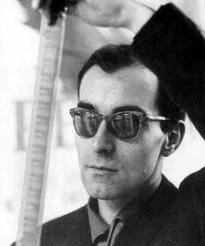
Jean-Luc Godard
Polansky’s Rosemary’s Baby that aimed at undermining Christian Beliefs. I Am Curious: Yellow that aimed at destroying female chastity. But more of that in the appropriate place.
So, by ‘67 the time of the bust the Stones were building up a dangerous reputation. Always remember that all of these outfits were infiltrated by espionage agents. And those guys were the ones bringing in the dope so how couldn’t the authorities know what drugs the Stones were using and in what quantities. Nice calling card, isn’t it: an unopened ounce of Merck cocaine?
At any rate they decided in 1967 to rein the Stones in a little bit. Shoot the old warning shot across the bow. Also remember that as much as the authorities wanted to suppress the Stones there were just as many Communists or revolutionaries in just as high places to thwart their efforts and actually place the Stones above the law. Their credo: To revolutionaries all things are permitted. Now, you figure it out.
In point of fact the older generation just couldn’t understand the youthful attitude. Everything was going along swimmingly as far as they were concerned. The war recovery was proceeding nicely while the economy seemed stabilized, no return of the Depression. That’s what really scared them and now the little creeps benefiting from this wanted to destroy it. Go figure. That high point of Western Civilization has been subverted today.
As far as the bust at Redlands the authorities were just giving the Stones a good razzing, a taste of what could happen if they were serious. In all likelihood they probably had no intention of making Jagger and Richards serve their sentences. Robert Fraser, the art dealer, arrested with them, was a different situation. He was a member of the establishment having held high military responsibility in Kenya possibly during the Mau Mau insurrection. Therefore he had no excuse whatsoever.
The Stones are quite right that it was a setup. The supposed dope dealer, the American Jew Schneiderman was quite obviously a CIA plant, hence his unlimited supply of pharmaceutical Acid.
Rees-Mogg’s editorial ‘Who Breaks A Butterfly On The Wheel’ was obviously an inside joke as well as well as an insult to the effeminate Jagger. One doesn’t take butterflies seriously hence they were calling Mick a little twit. Why bother with someone so inconsequential? Mick and Keith don’t seem to have understood this. Indeed, Mick, according to Tony Sanchez blubbered:
They think they can break us, man but no way. We’ll take everything they can throw at us, and we’ll still win. We’re in a position to tell the kids about all the shit that’s going down, and that’s just what we are going to do.
Well, bravo, Mick. But you might have been speaking from jail, a rather poor pulpit, had they chosen to put you there while you were not speaking for ‘the kids’ just the yobbos who weren’t going to do anything.
Then according to Sanchez/Blake Mick launches into a clairvoyant séance:
I see a great of danger in the air. Teenagers are not screaming over pop music anymore. We’re only serving as a means of giving them an outlet. Pop music is just a superficial issue…When I’m on that stage I sense that the teenagers are trying to communicate to me, like by telepathy, a message of some urgency. Not about me or our music but about the world and the way they live. I interpret it as their demonstration against society and its sick attitude…This is a protest against the system. And I see a lot of trouble coming in the dawn.
So did the authorities and they were taking measures if not to avert it at least to minimize it. I fail to see how the Paris imbroglio of 1968 took anyone by surprise. I mean, there was no organization not infiltrated by the intelligence agencies. The Chinese Cultural Revolution of which Paris and the rest was part, was directed from Beijing so the West’s intelligence agencies had to be well informed. But as the enemy was their own children they had to be sparing in the use of force. Even Chicago that would have been a great excuse to eliminate the proven troublemakers wasn’t used. Instead we ended up with the farce of the Chicago Eight trial.
They should have just dumped on them. No one was going to riot; those creeps didn’t have that much sympathy.
And then just to show Mick how little they thought of him they sent a helicopter to bring him to them for a little mocking chat. A helicopter: give me a break. Keith does have this to say about that in his autobiography Life of 2010:
The same day we were released the strangest TV discussion ever took place between Mick- flown in by helicopter to some English lawn- and representatives of the ruling establishment. They were like figures from Alice, chessmen: a bishop, a Jesuit, an attorney general and Rees-Mogg. They’d been sent out as a scouting party, waving a white flag, to discuss whether the new youth culture was a threat to the established order. Trying to bridge the unbridgeable gap between the generations. They were earnest and awkward, and it was ludicrous. Their questions amounted to: what do you want?….They were trying to make peace with us, like Chamberlin. Little bit of paper…Yet you know they’re carrying weight, they can bring down some heavy duty shit, so there was this underlying aggressiveness. In a way they were begging Mick for answers. I thought Mick came off pretty well. He didn’t attempt to answer them; he just said, you’re living in the past.
They flew Mick in a helicopter. It was a mocking importance and it came off that way. I saw the bit at the time and came to some different conclusions than Keith. Mick staggered out of the chopper and had to walk across a broad expanse of lawn as though a suppliant to the haughty waiting establishment, sort of like going to see the school principal. They awaited on the patio of a huge house. It was the back door and Mick wasn’t even invited into the kitchen: he was treated like a servant or better yet, a beggar. Butterfly indeed.
They were condescending enough to make your bones ache, Rees-Mogg, one of the establishment, included. They asked the spokesperson of the generation: What do the kids want? Mick flopped. He just stuttered. Keith may have thought he came off well but at my end of the tube I burst out laughing. As far as I was concerned Mick humiliated himself, but then, it was planned that way. All the power was on their side; Mick could really only stand like some penitent school boy and that’s pretty much what he did. Mick wasn’t and couldn’t have been prepared. The deck was stacked against him. But then he, in his turn, shouldn’t have blustered in the aftermath. I wonder if he had to walk home as the heli lifted off without him. That would have been the usual part of the trick; to leave the victim stranded.
In their own way the establishment succeeded in that they knocked the Jagger-Richards writing team off center. Or possibly the duo had exhausted their first momentum, much as Dylan had done and had to regroup as Dylan did. Keith acknowledged that they were dry after the bust. As he says the duo was able to find a new center that was just as successful, perhaps moreso, than the first.
The revolutions were still on and about to reach their first climax.

William Rees-Mogg 1967: An interesting article about the case:http://www.nickelinthemachine.com/2008/09/brixton-prison-and-mick-jagger/
Next: Leading to Altamont
Mick Jagger, The Rolling Stones And The Revolt Of The Yobbos
Part II
by
R.E. Prindle
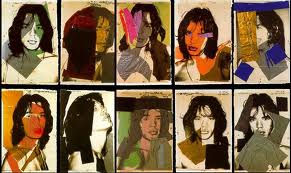
Warhol Jagger
Mick, Dave And Andy
If you had looked you wouldn’t have seen it but Sigmund Freud, or at least, his ghost was quietly at work transforming the psychology of Western Man. The old chivalric ideals of the Arthurian sagas was rapidly being replaced by the Jewish hopes and fears of Sigmund Freud and the Jewish people.
The Aryan ideal was based on an intense consciousness and objectivity while the Jewish understanding was unconscious and subjective. Aryans followed a concept of honor, Jews followed a concept of chutzpah. The transformation was understood if not clearly seen by the science fiction writers of the fifties. Stories subsequently made into movies such as The Blob, Invasion Of The Body Snatchers, book title: The Body Snatchers, and I Am Legend told the tale of the subversion of the conscious as people were portrayed as the living dead or zombies.

Warhol Jagger
With the way prepared then the next step was the free expression of subconscious desires undeterred by reflection and the subversion of men and women in sex. Freud proclaimed that the more frequently men ejaculated the better a person they would be, at the same time preaching the dangers of repressing those psychological ‘needs’ or desires to the exclusion of all others.
The Libertine element or Bohemians of society seized the opportunity while those yet imbued with Chivalric or Christian ideals held out while those ideals were slowly eroded replaced by Jewish ideals. Of course the Pill and drugs came along to push Freudian ideals into fast forward, a bunch of Charlie Chaplins rushing to the future.

Warhol Jagger
At the same time movies and TV began to glorify the expression of an undefined rage against Western ideals and justifications of its impression appeared regularly in ever more sadistic and uncontrolled expressions. Movies glorifying drug use and homosexuality appeared regularly. This enabled homosexuals, sadists and what have you to recognize and find each other thus being able to organize in associations. The Homosexual, Sexual and Yobbo, or Undermen, revolutions were thus able to more forward much more rapidly. One was able to discuss these aberrations as normal conversation, mere expressions of the varieties of sexual experience. Then in 1962 Anthony Burgess published the Yobbo bible, A Clockwork Orange, which in 1971 was made into the most despicable of movies.
The Yobbo bible apparently found a ready audience awaiting it. In New York, the Prince, even the King, of the Yobbos, Andy Warhol, teamed up with the London fashion photographer David Bailey to buy the screen rights from Burgess at bargain basement rates. They obviously saw the book’s potential for forwarding the revolutions on the screen for the corruption of Western youth. Bailey who must have been one the earliest jet setters having met Andy on an earlier occasion perhaps after Andy had introduced his soup cans unless Andy had been recognized as a leader of the revolutions before he had gained fame as an artist.
Warhol and Bailey were quick off the block obtaining the rights in either late ‘62 or early ‘63. Certainly a prescient move. As Andy was just beginning his switch from art to film while having no experience in film making Bailey’s collaboration seems as though it were a leap of faith. Perhaps if they met in ‘62 or even earlier he and Andy jabbered about the potential of movies while riding a white horse name Obetrol.
David Bailey who had risen rapidly in the late fifties at British Vogue is credited with being one of the originators of
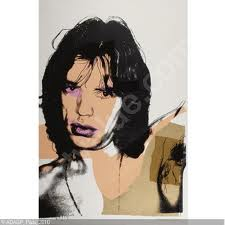
Warhol Jagger
Swinging London. What a knockout combination that was, had us all slavering at the mouth wishing we were part of it. Bailey even had his career commemorated in Antonioni’s film, Blow Up of 1966. A sensational film in its day though I find it difficult to see the significance today although still good mood and photography.
David had met Mick sometime in 1963 through his girl friend model Jean Shrimpton. Mick was dating Jean’s sister Chrissie who introduced him to Jean. Jean had no trouble spotting the Stones potential introducing David to Mick with the giddy news that he and the Stones were going to be bigger than the Beatles. Slightly enthusiastic; the Stones were going to be big but not bigger. Nothing really approaches the impact of the Beatles. The dead Lennon is either a god or nearly one while none of the Stones will reach that status.
David and Mick bonded immediately becoming in David’s word, mates. David was five years older than Mick and already successful so that must have enhanced his appeal to Mick. As David looked at Mick and saw the Stones play he apparently said to himself; These are the yobbos I need for my movie, droogs if I ever saw them. He and Mick boarded a big 707 jetliner, one assumes, in mid to late ’63 to be introduced to co-owner of the movie rights of the intellectual property as the star of the semi-porn flick, at least as it would be filmed in 1971.

David Bailey- Fashion Photographer
This was a fateful connection for Mick and the Stones. Now, Mick had been attending the London School of Economics, LSE, during ‘62 and ‘63 only leaving university in late ‘63 when he believed the Stones were going to make it. It is hard to believe that he would give up school for the ephemeral success of England- two good years and out, replaced by the next pretty face. Perhaps Bailey and Warhol were already planning the exploitation of the record industry as a propaganda tool. Certainly Bailey was conscious of the trans-Atlantic connection between British and American Vogue. For guys on the qui vive it wouldn’t be much of a leap to imagine trans-Atlantic musicians, after all, the Englishman (Scot, I know) Lonnie Donnegan had already had a few hits, including a monster, The Rock Island Line, in America. If, in their discussion Mick could have seen the potential, leaving university would be a bet on a bigger and more glorious future.
Some think Bailey and Warhol would have made the movie but ALO placed the price of the Stone’s too high. As Oldham was as keen on Clockwork Orange as anyone that doesn’t necessarily ring true. There must have been other reasons.
Nor was Mick studying bookkeeping at LSE as often represented. The school was established by the Fabian socialist Webbs c. 1900 and was a Communist training ground. Mick did have a scholarship which means he must have been vetted as good future material. Although LSE does have an accounting department Mick was enrolled in political science with the intention of being a Communist politician. So, Mick, David and Andy were to follow a revolutionary agenda pushing the envelope in sex and unruliness. The emerging drug scene promoted both aspects and added a new one.
Shortly after Mick returned home the Beatles burst upon the scene from the Ed Sullivan show in February of ‘64. This was the avant garde of the British Invasion opening up fabulous new vistas for the yobbos of small insular England. For whatever reason the Beatles were an immediate sensation. I’ve got a very good ear but I couldn’t hear it then and I still can’t. The Stones, not really that big a deal yet, followed shortly after gaining full national exposure on Sullivan’s show. Young America was watching. Regardless of the opinion of Stones’ fans they didn’t cut it. There didn’t seem to be much there other than the hype. Mick couldn’t sing while having a very weird appearance. All eyes were on the magnetism of Brian Jones, looking right past Mick. You can see him noticing where the attention was going and looking over at Brian as though to say: But I’m the singer and should be the center of attention. Perhaps Brian’s fate was sealed at that moment. Certainly if he had been brought up front, as all four Beatles had been, there might have been more interest.
No matter, the first tour may have been a bummer but the conquest was still quick enough. The Stones were after all British. Gold, at the moment.
In any event Warhol and Jagger became fast friends. A friendship that was to endure to Andy’s death in 1987. By the time the Stones had gotten settled in Andy had been shot in 1968 actually killing him but the doctors brought him back.
The early endorsement of Warhol had cemented the relationship of the Stones with the yobbos of Bohemia. In ‘63-64 Warhol was only just getting the Factory, the clubhouse of homosexual drug addicted Yobbos, going but that gang would have spread the word effectively in Manhattan club land.
I’m sure Mick’s sexual ambiguity, bi-sexuality, or whatever you wanted to call it kept the enormous homosexual population of Greenwich Village Bohemia in his corner. After Andy’s recovery in 1969-70 the relationship between the two men developed.

Andy Warhol
To quote the website
http://www.montauklife.com/history/hist-main2.htm :
Mick Jagger was painted [by Warhol] while he was at the height of fame. Andy and Jagger first met in 1963. Warhol spent a lot of time with Jagger and his wife, Bianca, but claimed he was the closest to their daughter Jade, whom Andy remembers teaching to paint. Over the years the artistically inclined Jagger kept tabs on the musically inclined Warhol. Mick was such an admirer, that in 1972 when the Stones formed their own record company, they tapped Andy to design their logo.
Montauk is the easternmost town at the end of Long Island. Andy and Paul Morrisey had bought a twenty acre compound there that they rented out. In 1975 they would rent it to the Stones for 5K a month while they were making Black and Blue.
In the meantime the Stones expanded their list of celebrity acquaintances on their 1972 Exile On Main Street tour. Needless to say these celebrities were all related to Warhol and the Bohemian scene. This included meeting the Warholite photographer Peter Beard who directed the Stones to Montauk. The linked Montauk site is worth reading.

Clockwork Orange Poster
All right. A Clockwork Orange was released in 1971 with devastating results. Just previously in 1969 the Homosexual Revolution had succeeded in escaping the restraints of New York City laws with the Stonewall Riots leading to the golden age of homosexuality before AIDS hit. The Stonewall Inn was on Christopher Street in the Village, the very heart of the Homosexual Revolution and Warhol’s empire. This led to an increase in the corruption of society. Following on the heels of the Riots perhaps encouraged by them the effects of A Clockwork Orange were much greater than The Blackboard Jungle and Rebel Without A Cause of the mid-fifties.
There were serious consequences not least of which was a sado-masochistic tone to the Stones as exhibited in their Black And Blue release of 1975. It is hard to believe that this record didn’t reflect Andy’s sado-masochistic influence. The inside cover depicting a bound woman being brutalized, the title Black and Blue seeming to indicate the bruises she was getting from the beating caused a major uproar, especially amongst Lesbian groups, resulting in the photo’s being withdrawn to be replaced by a group shot. Warhol and Mick were in sync.
In addition to providing the Stones’ logo Andy also designed three record covers for them which advanced the homosexual sadistic agenda. The first was the blatantly homo Sticky Fingers. The title was interpreted to mean the result of beating off while the cover has the famous zippered jeans with the working zipper.
The second cover was Love You Live with its double entendre of cannibalism. The third, Emotional Tattoo, a bootleg, featured Mick on the cover of 1983.
In 1975 showing Andy’s great admiration or love or Mick he made a portfolio of large 42 x29 inch prints reproduced in this article.

During this whole period of the seventies Mick’s wife Bianca was the reigning queen of the Warhol/Halston entourage. While Mick promoted satanic sex riding an enormous inflated penis on the stage he was somewhat more puritan with his wife off stage. He found Bianca’s sexual behavior in the Warhol entourage so humiliating that he was forced to divorce her. One can say that he was patient with her past the endurance of most guys.
But Andy and Mick remained good friends. In 1987 when Andy took the one way barge trip to a new life Mick was the only celebrity friend who took the time to attend Andy’s funeral in Pittsburgh. Thus ended probably one of the most significant friendships of our time.
By the time Andy died they and one presumes, David Bailey, had been more successful in achieving their goals than they might have hoped. Of course Sigmund Freud gave them more than a leg up.
Next: Nemesis Catches Up With The Stones.
A Review: Pt. II Lick Me by Cherry Vanilla
August 21, 2011
A Review
Cherry Vanilla
Lick Me: How I Became Cherry Vanilla
by
R.E. Prindle
II

Living In The System
Kathy was born in 1943 so as she left high school the sixties were emerging. Everybody talks about the sixties but nobody does anything about them. The sixties didn’t just happen, they erupted, the Exploding Plastic Inevitable as Warhol put it. Andy was right. The reason no one can remember the sixties is because so much was going on all anyone could see was their little fragment, that includes the so-called taste makers. All that crap you get from the sixties politicos glorifying themselves and their exploits is just crap. They were performing their act in a small little corner or the room pretending it was the whole stage. They were just a bunch of hard core losers anyway. Abbie Hoffman! Excuse me! Jerry Rubin, get out of my way. Allen Ginsburg? Pardon me while I puke.
No, no. The sixties were a happening no matter where you were. I’ve already touched on the drugs in Part One. Trust me, everyone but we happy few was on drugs whether prescription or street. I mean, Valium, my god! Straights ‘needed’ it to get through the day.
As I touched on in my Edie Sedgwick series the sixties were ushered in by the big 707 flying non-stop between NY and Europe beginning in 1959. That created the Jet Set who were the envy of all. Airports were small and intimate at the beginning of the decade burgeoning into the behemoths they have become as the airlines reduced prices and seduced people to fly. Not that I was, I didn’t get into the air until the seventies but as soon as I could I emulated the Jet Set flying to Europe and back three times in my best year.
So there were drugs and the Jet Set and the Kennedies. The Kennedies were the worst thing that ever

John F. Kennedy
happened to the country. Of course in pedigree sensitive USA we are all conditioned to ignore national, religious and racial origins as if they don’t count but, let me tell you, they do. John F. Kennedy began the decade in 1960 replacing the vacated spot of Dwight David Eisenhower. The change was not nominal. Eisenhower knew what he was doing, Kennedy didn’t. Ike, as he was affectionately known, engineered the victory in Europe in WWII. He’d done a stellar job from ‘52 to ‘60. Knowing the devastation of war he resisted the hawks to keep the peace, and we hawks were quite vocal. Having inherited the Viet Nam situation from the French and FFL collapse he had contention in Indo-China under control which Nixon, had he been elected, was pledged to honor, if he could have executed.
Like I said, we’re not supposed to think, much less talk about, race, religion and nationality but the Kennedies were Irish Catholics who finally won the triumph over the Anglo-Saxon Protestants in America. The war between the Irish and English was hundreds of years old in 1923 when the Irish freed themselves from the English yoke. The Irish and Anglo-Saxon war in America had only been going on since the 1840s when the potato famine drove the Celtic lads to our shores at which time, in reaction, the so-called Know Nothing Party was created. In 1928 the Irish put Al Smith up as the Irish attempt to capture the New Island after De Valera’s 1923 success on the Ould Sod.
Times were not propitious for an Irish Catholic and Al was soundly defeated. But a gentleman named Joseph P. Kennedy, accruing a bootleg fortune with solid connections to Organized Crime was about to engineer the election of one of his sons to the highest office in the land. God only knows what goes on behind the scenes but his first choice, Joe Jr., was blown up flying over the channel. His second son John F. was given one of the most dangerous posts in the Navy, commanding a PT boat. It’s hard to believe that whoever it was that got Joe Jr. didn’t want him dead but John survived the war and began the corruption of the land from the highest office in 1960.
Kenney with amphetamines coursing through his veins and a mind centered on sex, which is to say fucking, was clueless along with his brother Bobby and his other nitwit sibling, Teddy. Within a matter of months he had us involved in a shooting war in Viet Nam, threatened by Khrushchev in the Cuban missile crisis, after he had taken the drug addicts measure at the summit, and then aborting the reconquest of Cuba at the Bay of Pigs. Is it any wonder the magnificent crew Ike had assembled offed him. Regardless of how history has been revised their were a great many us who sighed and said: Good riddance.
When Bobby stuck his head up from under his rock in 1968 there was no doubt he’d get it blown off, and he did. If you think the two assassinations aren’t connected, think again. So ’63 and ’68 were big years of a decade of big years. Teddy kept his head down after that but gained a measure of revenge by sponsoring the 1965 immigration bill.
In far off Africa a gentleman by the name of Barack Obama Sr. was leaving for Hawaii to get a college degree and beget the future President of the United States on a little simple minded White girl. It was in 1957 when the African colonies renounced their allegiance to their European overlords that Ghana proclaimed independence from Britain. Thus the complexion of the United Nations was changed overnight as colony after colony of a congeries of warring tribes, now known as countries, declared independence and sent emissaries to the UN. Thus the balance of power was shifted from the capable to the incapable in that momentous decade.
It should be noticed that Marcus Garvey began the coordination of the African peoples of the world a
Marcus Garvey
few decades before independence was achieved by Africans and not improbably Garvey also furthered the beginnings of the Civil Rights Movement in the US, thus the African independence movement and the Civil Rights Movement were occurring simultaneously and I suspect coordinated. Thus the African presence in the UN complemented the enormous Black riots that began in LA in ‘65 and reached their apex through ‘67, ‘68 and ‘69. The fabric of the country was rent and torn. The future of the country became increasingly ugly.
It’s difficult to say but after the double whammy of the movies The Blackboard Jungle and Rebel Without A Cause of the mid-50s a new tone emerged in which the youthful violence came to the fore and not just lower class kids. This senseless rebellion without a cause represented a change in outlook occurring in the mid-fifties perhaps aggravated by Elia Kazan’s influential movie. Gangs of young rich guys terrorized the well to do sections of LA in ways that were inexplicable. The graduating classes of ‘53, ‘54 and ‘55 belonged to the previous era while 1956, the year I graduated, was the swing year between what was and what would be that began with the class of ‘57. About half the class of ‘56 looked backward and half, maybe less, faced forward toward the future. I was in the latter half.
Then in 1958, a twenty year old, class of ‘56 actually inspired by Rebel Without A Cause and James
James Dean- Rebel Without A Cause
Dean, so it was said, by the name of Charlie Starkweather went on a murderous rampage in Nebraska murdering several people simply for the sadistic thrills. It was bone chilling, perhaps the first of its kind. Charlie was quickly apprehended and executed in 1959.
Also in the fifties the homosexual, William Inge, wrote and produced the play Bus Stop, turned into a movie starring Marilyn Monroe and Don Murray in 1956. From those emerged the astonishingly violent TV series of one year only, Bus Stop, the production of which was supervised by Inge. That TV series transcended by miles any sadism and violence seen as yet in either TV or the movies. It even made the comic book Tales From The Crypt look tame by comparison.
Perhaps the most sickening episode in a season of sickening episodes was the one starring the teen idol Fabian as a sadistic murderous thrill killer who was obviously based on Charlie Starkweather. The episode by Altman was ambiguously titled: A Lion Walks Among Us. So the sadist was compared to a lion. The episode altered the direction of TV drama breaking down the doors for whatever followed and you know what that’s like. The impact was so strong that a Congressional hearing was called immediately to denounce it.
Already in an excited delirium young people were shown a new direction that was seized. Serial murderers that were unheard of during the early and mid-fifties became commonplace escalating, so it seemed, year by year.
Thus the scene in New York where Kathy was living her life became more violent by the month until after 1969 and the liberation of the homosexual psyche by the Stonewall Riot, when the crime became ultra sadistic and unbearable.
By the early seventies Dirty Harry and Death Wish symbolized the era moving well beyond Rebel Without A Cause or even Bus Stop as sadistic sick, sick violence. Insanity, really, and it characterized the country in the coming decades.
At the same time beginning in the early sixties pornography began its rise into the mainstream. While it was a good sized underground business before, in 1953 Hugh Heffner began publication of Playboy Magazine which brought porn into the mainstream. Playboy was followed by a host of ‘men’s’ magazines that got raunchier and raunchier. In the early sixties in San Francisco I noticed for the first time open advertisements in the Chronicle of porn films. There was a very active push to further pornography which was participated in by Andy Warhol, Paul Morrissey and the Factory. In 1968 I Am

Curious: Yellow Poster
Curious: Yellow and Curious Blue were released. I Am Curious: Yellow was very influential in loosening sexual mores. Blue and Yellow were the colors of the Swedish flag. A Swedish pervert made the movie. This all led up to 1972’s Deep Throat which for all practical purpose shot porn into the mainstream. Porn and the so-called Sexual Revolution went hand in hand.
Since sex had been practiced the same ways since the origin of mankind the real sexual revolution was whether you could say ‘fuck’ in public. The pervert Lenny Bruce led that charge followed by George Carlin and certainly by the mid-seventies few movies were made where the word didn’t constitute 20% or so of the dialogue.
And then, of course there was the Viet Nam war. This effort was hampered in the US by the Judaeo-Communist allies of the Viet Namese. Naturally the US Communists said that there was no reason for the US to be involved blithely ignoring the history of the situation. Actually the war was part of the US-Soviet confrontation in which the US had made several mutual defense pacts with countries on the Communist borders in an effort to contain it. South Viet Nam which came into existence when the French Foreign Legion forsook their reputation was part of a mutual defense pack called SEATO- South East Asian Treaty Organization. When they were attacked by North Viet nam, of which there an be no doubt they were, the clause of the treaty was invoked involving the US in the defense of South Viet Nam. So, the US was legitimate if foolish in going to the defense of South Viet Nam.
Now, because of the seeming passiveness of the Jews during the so-called holocaust the Jews had acquired a reputation for being a weak ineffective people. The skullduggery that established the State of Israel in 1948 did nothing for their pride but the seemingly easy triumph of 1956 against the Egyptians through which war Israel purloined the Negev Desert Jewish pride of prowess began to blossom. You started seeing identifying marks like gold Stars of David necklaces appearing on bosoms of Jewish men with wide open shirt collars unbuttoned to the penis. Little different than Nazi insignia they were now worn with pride.
The 1967 war against the allied Arab States completed the transformation of Israel into the Neighborhood Bully. Jews now began to strut down the streets virtually knocking people out of the way with the Stars of David dangling everywhere. The Jewish Defense League followed in 1968 soon splitting into an even more violent Jewish Defense Organization. Under their leader Rabbi Kahane a war not too different from the Jabotinsky days in Palestine ensued with the ubiquitous bomb exploding in NYC instead of Jerusalem.
Now, as has recently emerged, the crucial years for Jews in the United States, which had nothing to do with any so-called holocaust, were the years between 1933 and the accession of Wolf Hitler in German and the US entry into WWII in 1942. Before the war in the ‘30s the Jews called opponents to their machinations, Fascists. The name included anyone from Henry Ford to Charles Lindbergh. A marginalization campaign was begun against all American nationalists that largely succeeded. In that period the Jews created the notion in their minds that they were the true Americans who had created this near-perfect democracy and the Anglo-Saxons who had preceded them were out to destroy the country and turn it into a Nazi satrapy.
Philip Roth commemorated this attitude in his novel back dated to this period, The Plot To Destroy

Philip Roth- The Plotter
America. Thus through the fifties and sixties the Jews conspired to dispossess the ‘New Nazis’, that is non-Jewish White Americans. The war of ‘56 emboldened them so that by 1964 they were encouraged to seize the university system of the US. The first front opened was the so-called Free Speech Movement on the UC Berkeley campus whose real purpose was to displace Free Speech with Jewish controlled speech.
This was successful and when the dust had settled the Jews were in control of the campus stifling the free speech that had been the ostensible reason for the battle. As Mark Rudd would later say: The issue is not the issue. Jewish commissars set up tables at the Sather Gate to which students were demanded to submit to Jewish governance or else.
From Berkeley the battles strung out to other campuses, the most notable being Columbia in NYC while the other Ivy League campuses fell in line. Freedom of speech was the last thing on their mind.
Having achieved their goal at Berkeley the next step was to escalate the resistance to the Viet Nam war hence shielding their Communist allies in Hanoi. This was furthered significantly by the 1968 world wide offensive led by Chairman Mao and his Cultural Revolution so that by the time of Nixon’s reelection in 1972 the country was in a State of near revolution although it wasn’t that apparent on the street. I was amazed just before the election to see truckloads of soldiers brought into Eugene where I was living and a revolutionary hotbed, to be secreted in the hills in the event of an insurrection.
I have no idea if John Lennon and Yoko Ono knew how close they were to the edge but in retrospect they were not only lucky to be allowed to stay in the country let alone avoid imprisonment. If they hadn’t been so high profile I’m sure they would have been arrested. They were committing some pretty provocative acts. I’m sure that the money they gave to the movement through A.J. Weberman found its way into bombs.
Back in 1964 when Lyndon Johnson had inherited the White House after John F. Kennedy had escalated the war so that there was no way out but to go forward, Johnson was presented with the choice of guns or butter. Would there be a period of austerity as in WWII when the choice had been guns or butter. Between those two choices Lyndon chose a third- guns and butter. Things would go on as close to normal as possible. It was weird. His administration occupied the center years of the decade while the Judaeo-Communists would give him no peace. I mean, you know, the hundreds of bombings went on with no qualms on the part of the domestic terrorists.
And lastly, while all previous generation had been known by their literature the current generation, my generation, was known by its song writers and music. Everyone picked up a guitar and wrote songs. This essentially came in two, maybe, three waves. The first was spearheaded by Elvis Presley, the second by the British Invasion from 1964 to 1966 and the possible third from 1966 to 1974 after which the generation exhausted itself. It was along about 1966 that Kathy made the fateful decision to become a groupie and this would define her life until her mental breakdown in the late seventies.
When the Beatles and the Stones hit these shores they were just singers and bandsmen, popular, but nothing more. The notion of the Group began to be deified in San Francisco after Ken Kesey’s Acid Test. The group members were suddenly invested with nearly superhuman powers and wisdom. All you had to do to become a Holy Guru was stand up on stage, hit a couple of chords, and shout out ‘Mercy, mercy me, the ecology.’ with a raised fist. The Grateful Dead, Jefferson Airplane, Big Brother And The Holding Company, people of questionable character all became secular saints. One grows faint thinking it but, yea verily, gods. And this only from playing the guitar badly and voicing universal popular sentiments. Don’t trust anyone over thirty said a twenty-nine year old and immediately thirty-somethings were posing as teenagers. Too late now, isn’t it?
If you break down the ages, the first wave was born sometime in the early to mid-thirties, Presley was born in ‘35, Little Richard in ‘32.
The first wave of Rockers was spent by the late fifties succeeded by an interim group of nondescripts like Bobby Vee and Bobby Vinton. Nice enough but not essential or memorable. The Beach Boys were the top American group from 1960-64. Then came the second wave, these were men born from 1938 to 1945- Lennon ‘40, Dylan ‘41, Jagger ‘43 and this was the core age through the sixties. So the second wave, the true Rock phenomenon was a product of people born from 1938 to 1945. In the seventies Bowie ‘47, Billy Joel ‘49, those of the fifties came to fore as the generational impetus sputtered out. The Bowies and Joels were of a different sensibility than the main second wave. They grew up under different circumstances.
As the second wave gathered strength not as mere entertainers but as potent pop culture figures, adoring young girls emerged as groupies. Their sexual excesses were scandals although the concept of groupie was nothing new. Anywhere there are glamorous or powerful men accessible women will appear as well as, one might add, homosexuals. There are literary groupies and business groupies, etc. However Rock groupies tended toward being under aged jail bait not infrequently barely out of puberty and unconcerned for any consequences, indeed, not knowing of any.
So when Kathy discovered groupies she determined to become one although incongruously as old as the musicians themselves as she had been born in ‘43. It was kind of like somebody’s mother turning groupie. As she said of her groupie career she wanted a band to offer her a job. Finally David Bowie did.
This was the world in which Kathy Dorrotie was making her way.
Chapter 14 Edie Sedgwick, Maid Of Constant Sorrow
June 23, 2011
Chapter 14
Edie Sedgwick, Maid Of Constant Sorrow
by
R.E. Prindle
Edie
In the interest of keeping things in perspective and since a huge part of the readership obviously didn’t experience the sixties, I’d like, if I may, to give a little additional background to understand what happened here. I hope I don’t offend by mixing in some of my own background, not merely from vanity, but so the reader will have some understanding of both my limitations and strengths in interpreting Edie, Andy and Dylan.
Nearly everything you read about the sixties today is written by former activists, usually Jewish, or dopers of one stripe or another. Shall we say they skew the period in the direction of their beliefs. Theirs was only the point of view of small minority. In fact, they seized the leadership playing a much different game than the majority who were busy getting on with their lives.
The period now coming under discussion is 1966-’68 which changed the direction of the sixties. In mid-’66 Dylan had his motorcycle accident and was effectively removed from the scene for the duration. When he resurfaced in the seventies it was in a much diminished role. The first Bob Dylan was dead and the second was busy being born. No matter what he’s done since then, compared to his mid-sixties trilogy it has had minimal impact.
Warhol reached his apogee in this period while he was shot by Vallerie Solanas in 1968 which changed the direction of his career when like Dylan he became a corporation while business affairs were managed by other men, most notably Fred Hughes.
Edie was heartbreakingly dragged through the mud in these years until her evil genius, Chuck Wein, connected her to the movie Ciao, Manhattan which was the most degrading, humiliating experience possible. It eventually killed her. All three of our participants then suffered life threatening experiences within two or three years of each other. Edie was the only one not to survive.
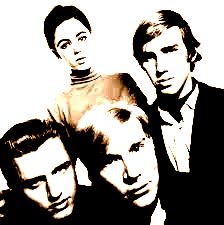
Andy, Edie And Friends
The sixties were tumultuous times; it was like walking around with a perpetual thunderstorm over your head. I was on the West Coast in the San Francisco Bay area till 1966 and at grad school at UOregon in Eugene from ‘66 to ‘68 and then in the record business for the rest of the period. I got my degree from California State College At Hayward now Cal State U. East Bay in 1966. It’s a long and irrelevant story but I entered Cal State in ‘64 taking enormous credit loads of up to 24 hours a quarter. You can do things like that when you’re young and not too bright. Hayward is just South of UC Berkeley. Cal State was a new school with a very small library so we were allowed library privileges at Berkeley of which I availed myself so I was around the Free Speech Movement scene but not of it. I was a first hand observer.
Once in Eugene in the fall of ‘66 things were getting in full swing in our own cultural revolution that would be joined to that of Chairman Mao in ‘68. I was entranced by the poster art work coming out of San Francisco eventually dropping out of grad school to sell posters and then phonograph records at which I was successful. Thus I was involved in the scene on an intimate basis from 1967 on.
While other generations were characterized by their literature our, the, generation was depicted by songwriters on phonograph records, thus records were central to the scene, don’t look for it in novels. The first efflorescence occurred in the US during the mid-fifties while going into an incubation period in England from then until the early sixties when in 1964 the Beatles, Stones and Animals among others provided the transition from fifties Rock n’ Roll to sixties rock. I don’t know how true it is but for me the revolution really got underway with the breathtaking first Doors LP in ‘66. The blues bands and the next wave of British bands provided the impetus to move things into the seventies where the creative impulse ended by 1974 although inertia carried things through until sometime in ‘78. Disco doesn’t count that was the beginning of an entire new ethic based in the homosexual revolution.

Morrison, Densmore, Krieger, Manzarek
When Andy, then in his quest for money, moved into records by managing the Velvet Underground, probably in imitation of Dylan, he did so just before the music scene broke. New York bands were never that popular on the West Coast and the Velvets were no exception. Andy, however, was an innovative guy. Light shows were already news on the West Coast but Andy came up with a new multi-media formulation that blew our minds, as we used to say, while having a very lasting cultural effect.
In the Spring of ‘66 he rented a hall called the Dom in NYC. Using the Velvets as his house band and his light show he managed to overwhelm the hipsters of the Big Apple. He would have had a major success had he continued on but he was fixated on movies, wanting to do his Western put down, so the Factory crowd decamped for Tucson, Arizona, thinking to pick up the strand on their return.
While away Albert Grossman and Dylan leased the Dom from under Warhol and opened it as The Balloon Farm. Between taking Edie from Andy and then the ballroom I’m convinced that Dylan sealed his doom. I hope there aren’t too many people who think the rear wheel of his motorcycle locking was an accident. Once again, conclusive proof is lacking, but there are indications that Andy and the Factory crowd did it.

Before The Fall
By late ‘66 Andy’s brief period in the spotlight was over. His creative burst had run its course and while afloat financially, there was not any great income in sight. Paul Morrissey had come on board as a filmmaker and his vision was more commercial than Andy’s but Andy was in charge so Paul had to bide his time waiting for his opportunity. At the same time a man from Houston by the name of Fred Hughes came on board who knew how to monetize Andy’s reputation and art skills and then, Bang! Andy was writhing on the floor in pain. One of those little zig-zags fate has in store for us sometimes. The sixties were over for Andy but the change in direction made his future in the seventies and eighties.
Now, let’s go back to ‘64 and take a look at one of the defining members of the decade I’ve slighted till now, Prof. Tim Leary. I’m convinced Leary was not in his right mind or, if he was, he shouldn’t have been there. By the time Timmy latched onto psychedelics they were pretty well established. LSD, discovered in 1938 by Hoffman and brought to prominence in 1943 was almost passe when Leary was turned on. Aldous Huxley had published his Doors Of Perception in 1954 and Heaven And Hell in ‘56, that celebrated the joys of mescaline.
When I was in high school maybe ‘54 the kids of Scarsdale were notorious for using marijuana, written up in Time if I remember right. Those were rich kids and by ‘56 our elite were very covertly using it. In the Navy aboard ship from ‘57 to ‘59 Bennies and other pills were prominent while the occasional heroin addict passed through. The Marines of Camp Pendleton were heavy into everything, barbiturates, mescaline, peyote buttons, LSD, you name it. For cryin’ out loud, Hollywood had been the drug capitol of the US for decades. One only has to read Raymond Chandler. There wasn’t anything they didn’t know. Cary Grant had been an old LSD hand for years before Leary, the apostle of acid, made it to town bearing the good news in 1960. He was received with some amusement.
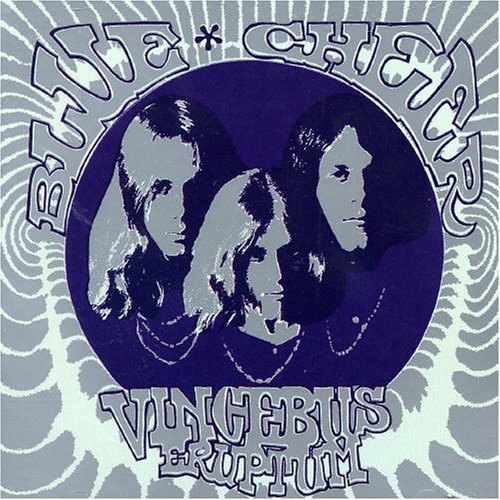
A very amusing story Leary tells in his autobiography is that Marilyn Monroe fell to his lot at a party. They were actually in bed together. As you may know Marilyn knew more about drugs than any pharmacologist. Probably disgusted by Timmy’s ranting about LSD she handed him a pill and said take this. Timmy did then decided to get up to go the dresser for something. ‘Are you sure you want to do that?’ Marilyn asked. Timmy was. He took about two steps and seemed to sink through the carpet until only his nose was above the rug. He lay there inert all night while Marilyn laughed softly from the bed.
From his position on the faculty of Harvard Timmy was a very visible advocate of LSD hogging headlines in Time and other mags that were the envy of Andy. Tim was to amuse us with his antics all through the sixties. Now, all this stuff was happening very fast. It was impossible almost to keep up with the headlines let alone any indepth reporting or analysis. Besides there was no internet so all news was comparatively old news, perhaps weeks after the occurrence if you heard of it at all. Also it was impossible to be where it was happening unless it was happening where you were and then you didn’t know it was happening because you were in the middle of it. I happened on the Free Speech Movement because I was in school but I missed the SF scene going on at the same time because I couldn’t be in two places at once and keep up grades in the third place at the same time. New York was out of the question, London was across a wide, deep ocean, and LA hadn’t caught on yet. Thus, I was invited to the Kesey/Dead Trips Festival but passed on it. For various reasons I only caught the end of the Fillmore/Family Dog scene and then only fleetingly.
Even Morrison and the Doors who can claim to have been in the center could only have caught their small share however central it was. Nobody got it all. How could you be in Swinging London, New York, San Francisco and LA at the same time? Couldn’t be done although there were many who tried spending their time criss crossing the country from West to East and reversed and for all I know popping into London too trying to be jetsetters but they were merely vagrants peripheral to everything.
So marijuana, acid, speed and barbiturates or downers as they were called then made up the pharmacopeia. Amphetamines were obviously big in NYC from the early sixties and must have been in the West too but my first acquaintance with that was the Speed Kills buttons. Heroin was a danger drug for the addict type only. Cocaine came along in the seventies. At the time little or none of the marijuana crop was home grown. It came from Mexico and there are smuggling and pot running stories galore. At first the dealers were amateurs, boys and girls next door, but that slowly turned into the criminal professionals.
Andy’s crew were all what he called A-heads, but you may be sure they smoked and did booze too. It must have been uproarious in the early years but by ‘66 psychotic and physical reactions were beginning to slow the troops down. It was hard to keep up that pace.
Now, Edie when she came to New York in late ‘64 was a naif. Not many of us knew much better but she was a true naif, fresh from the farm, so to speak, while having had her brains addled by electro-shock treatment at Silver Hill Sanitarium. At Radcliffe-Harvard she had hung out with homosexual men gaining the reputation as a fag hag. Alright, I suppose, as she didn’t know how to handle herself around boys anyway. She came down to New York with the group of homosexuals that Andy called the Harvard kids with some distaste. She associated herself with her evil genius, Chuck Wein, who, as a homosexual, sought her destruction.
The Factory of Andy Warhol she entered was created in Andy’s image. In reading of it, I was never there, it comes across as a hell hole from which any reasonable person would have fled at first glance. Many did. Andy hurt a lot of people being of a sado-masochistic frame of mind. Outside his circle he was universally referred to as ‘that Warhol creep’ and yet events conspired with him to realize his perverted dreams and triumph over all.
Andy considered himself ugly and descriptions of him by others are unpleasant but whatever everyone and himself saw doesn’t show up so clearly in his pictures. He may not be the handsomest fellow around but he has a cherubic, pleasant look that I don’t find unattractive. But, because of this feeling he surrounded himself with beautiful people. Fred Hughes his business manager was quite handsome. Morrissey was OK, Malanga had his moments, Edie was considered a knockout, although I can’t see it, and the other women he associated with were quite attractive.
And then, as a little immigrant boy who wasn’t acceptable to mainliners of Pittsburgh Andy was especially pleased to have society women attached to him and especially the titled or rich English girls. Edie fit in as a beauty, as Andy called her then, and as an old line New York society girl. The combination was almost too tantalizing for this lifetime homosexual. Andy said Edie was as close to love with a woman that he ever got. He even took her home to meet mom. Edie apparently missed the import of that.
Andy has been blamed for making an A-head out of Edie. Once she tasted amphetamines it is clear that there was no stopping her. In truth the Factory was no place for her and Chuck Wein who introduced her into it must have known that. Still, as Dylan sang, there’s something going on here and you don’t know what it is, do you? Most people didn’t including Dylan, and I certainly was out of my depth. It was disconcerting metaphorically to step on what was once solid ground to feel it giving beneath your feet.
Actually there were several revolutions going on which would result in massive social changes. Those of us firmly grounded could only see the so-called change as a rising tide of insanity. Aided by drugs these revolutionists became totally dissociated from reality. Drugs alone cause a withdrawal into an inner fantasy world of wishful thinking. The external world appears as something that wishful thinking can manipulate to one’s desires in some magical way. When the two got really out of sync as they inevitably must you ended up in Bellevue psychiatric wards as happened to a heavy user like Edie many times while most of Warhol’s crew checked in at least once.
Andy, who used these people for entertainment and self-aggrandizement, provided a hospitable retreat or club house where the cognitive dissociation wasn’t quite so apparent or, at least, normal. The scene must have been incoherent. A reading of Warhol’s so-called novel, ‘a’, shows that by 1966 his crew was indeed incoherent. Ostensibly a tape recording of Ondine’s conversation over twenty-four hours, whose conversation Andy found engaging, the tapes show Ondine unable to complete a sentence along with Rotten Rita and the rest of the crew including Edie.
Further the whole bunch were absolute thieves. In Edie’s decline through sixty-six they walked into her apartment and chose their favorites from her collection of fur coats along with anything else of value. In her demented state all she could say is that everyone was wearing her coats. One wonders how much internal anguish there was as she knew there was nothing she could do about it.
At the same time Andy was a leader of the Homosexual and Underman revolutions. Perhaps nobody knew what was going on but Warhol, Rotten and others were working for homosexual liberation which they achieved with the Stonewall Riot of 1969.
New York was unique in that for decades homosexuals from the South and Midwest flowed into New York each year in a great internal migration. The chief destination was the Village. Christopher Street was the main fag drag. The Stonewall Tavern was on Christopher. Why the cops would disturb the lads in their own colony is beyond me, but they did and then gave up without a fight.
Perhaps the most astounding revolution of all was that of the Undermen. Untermensch in German. While Warhol’s crew was a prime example of the Other Half rising to control the direction of society, the main impetus seems to have been the West Coast, San Francisco and Haight-Ashbury, specifically the Hippies. It was really there that the poverty look took hold, torn, faded jeans and whatever. LA never really went for it but it spread up the coast to Eugene, Portland and Seattle. The Sorority and Fraternity look went out the window with millionaire’s kids posing as the down and out.
I would imagine a naïve thing like Edie got caught up in the so-called sexual revolution too. We’re not talking Feminist Movement here but the sexual aspect of the Communist Revolution in which women are common property to be had anytime or anyplace by whoever. The Pill that came along in 1960 really facilitated the change in sexual mores. Nothing exemplified that more than the mini-skirt. So you’ve got drugs, the Pill, the Mini Skirt and the Ideology. The world was not so slowly turning upside down.
All these revolutions might have gotten not too far but they were all collected and subsumed under the directing force of the Communist Revolution under the leadership of Chairman Mao and the Chinese Party. The money really flowed in after 1968. Driving the whole thing and what made the turmoil possible was the Viet Nam War. It served the Communist cause more than the American as while taking a beating in Viet Nam the Communists subverted the United States. Strangely Viet Nam had no effect on Warhol at all. His disaster paintings ignored Viet Nam while a couple napalm drops would have made a terrific topic.
In the early days of the war it was filmed like a reality TV show with the daily haps relayed on TV to the US. The reality of napalm drops while our soldiers cheered and howled while a couple dozen Vietnamese where incinerated was too much for the entertainment starved public to take. I sure couldn’t handle it. The films were quickly removed. The reality of war is a private thing between the armies, not quite like the Super Bowl.
I don’t recall a single mention of Viet Nam in Andy’s Diaries, Philosophy From A To B or ‘a’. The war appears in none of the biographies or auto-biographies or even novels written by various denizens of the Factory. Rather strange, but then I can recall no references to it in Dylan’s songs either.
The Communist Revolution connection developed when John and Yoko arrived in NYC in 1971. The two of them were clearly involved in revolutionary activities linking various art and entertainment figures with them including, Dylan, Warhol, David Bowie and others. What exactly they were doing isn’t clear to me yet. Yoko was and is on some Feminist rag.
So, in 1966 while an apparent apex for Warhol, his world was actually coming apart while Edie’s was descending like a Stuka dive bomber.
The period from December ‘65 to Easter of ‘66 must have been traumatic for a crazed and confused A-head like Edie. She sacrificed her position with Andy, seduced by the fallacious promises of Dylan and Grossman who certainly had no plans to make a movie, and if they did, to put Edie in it.

Velvet Underground & Nico
Warhol had all the sadistic cruelty characteristic of homosexuals that he turned on to the distraught girl. Edie must have been thoroughly crushed when Dylan rejected her love while passing her on to Neuwirth. Edie was not at her wit’s end with no money, cut off by her parents who objected to this life style, while having no means to make money to support the station in life she had seemingly attained. Both Dylan and Warhol abandoned her after accepting her largesse for several months. Warhol is especially reprehensible. Dylan sure is a close second.
Her heavy dependence on amphetamines was literally eating away her brain, her body and her personality.
I really can’t believe that Edie loved Neuwirth as she claimed. I don’t think either was capable of love. Yet, she abandoned her body to him claiming she could make love for forty-eight hours straight but crashed whenever he left her. That is a sign of despair and fear. I can only imagine the horror she felt when she looked into the future and saw only a blank wall. As Dylan was to sing of her: Time will tell just who has fell and who’s been left behind.
Perhaps the cruelest trick of all was played on Edie by Dylan, Grossman and Neuwirth at the Easter Parade of 1966 when Neuwirth filmed the promised movie.
In a November issue of Life Magazine in 1965 Edie had been photographed standing on top of a toy leather rhinoceros about two feet high and three feet long, popular at the time. Whether the three of them, Grossman, Dylan and Neuwirth, put their heads together to come up with this or Dylan brainstormed it by himself, Neuwirth persuaded Edie to pull the rhino down Fifth Avenue as the parade progressed, filming as they went. Then Bobby tied the rhino to a parking meter and persuaded a passing cop to write Edie a ticket. Thus Grossman and Dylan fulfilled their obligation to put Edie in a movie while mocking her cruelly. Those guys had a reputation for cruel put downs. They live up to it here.
It was just after Easter that Warhol opened the Dom to stage his Exploding Plastic Inevitable. The reports we got of it on the West Coast made it sound absolutely astounding. If any one thing characterized the sixties I would have to say it was the Exploding Plastic Inevitable. It brought everything the era valued together. As usual with Warhol he couldn’t resist turning it into a sado-masochistic experience. The chaos must have been extraordinary. One can imagine the scene with dope peddlers trying to push their drugs on you, the lights flashing, strobing and pulsing, the howling music, the bodies bumping against each other, Malanga doing his whip dance, Edie bopping around the stage with her odd skip and step. They talk about the Velvet Underground being loud but they must mean for the times. Blue Cheer with its wall of Marshalls was just around the corner while the electronics improved almost daily until the sound passed the limits of endurance. Created a whole generation of deaf Beethovens. Musicians literally without ears.
I actually promoted the Underground once in either ‘68 ot ‘69, might have been pre-Blue Cheer. BC’s main claim to fame was that they were the first mega blasters, loudest band alive for their brief moment. Sort of a Great Divide in Rock music.
Things were still building but it wasn’t that the Velvets were that loud; they were just super strange. Reed was the original one-note man, he played it over and over fast. Sterling was there but he must have been background noise because I don’t remember much of an effect there. Whatever Cale was doing passed over my head but it must have been some kind of La Monte Young dynamo hum, all the songs were. I was most fascinated by Mo on drum. Yeah, right, drum, in the singular. She had a six inch deep tom with an under slung mallet. The mallet hammered away at the bottom skin while Mo pounded the upper skin with the sticks. In keeping with the dynamo hum she never varied the beat once but she was right on time just in case time was important. Quite an experience. You shoulda been there, and paid at the door. I wouldn’t have lost as much money.
Andy made a bundle in the month long run and then he made what would have been the mistake of his life in leaving for Arizona, or would have been if he hadn’t been shot. While he was out of it Hughes and Morrissey put together the means to put Andy over the top.
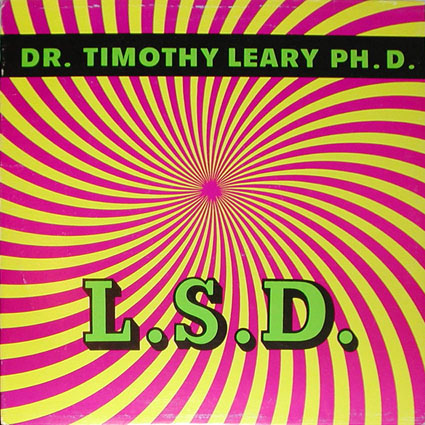
Turn On, Tune In, Drop Out
Chaper 15 follows.
Exhuming Bob XXX: Pt. 3 A Review of Masked And Anonymous
June 11, 2011
Exhuming Bob XXX
Part III
A Review Of Bob Dylan’s Movie
Masked And Anonymous
by
R.E. Prindle

A Catalog Of The Usual Suspects
I will now deal with the leading characters of Masked And Anonymous and what story line the movie has. It is clear that not many have seen this movie so I will try to relate the review of the movie to Dylan’s life as the film is clearly autobiographical.
The characters have their individual roles while being paired up in various combinations. The most obvious is that of Fate and the Promoter or Manager Uncle Sweetheart played by John Goodman. Uncle Sweetheart has a very large dose of Dylan’s real life manager Albert Grossman while being a composite of every promoter who ever existed. Uncle is also paired with Nina Veronica played by Jessica Lange as the exploited female Producer. She also does a very creditable job.
Later in the movie Bobby Cupid is introduced played by Luke Wilson. Cupid is obviously Bobby Neuwirth, Dylan’s sidekick of the early sixties, and who also shared the spotlight with him on the Rolling Thunder extravaganza. Cupid is a smart ass put down artist as Neuwirth was reputed to be. Cupid forms a pair with Uncle Sweetheart also as an antagonist which may have been the case in real life with manager Albert Grossman but one can’t be sure. At any rate Cupid merges his identity with that of Fate while acting as his enforcer.

The interest is not the movie but what Dylan reveals of himself.

2.
A Run Through The Scenes
Influences
In many ways this movie is based on all the Rock n’ Roll movies of the fifties. All of them could have been written by the same hand, at least the American ones. The English Tommy Steele’s Doomsday Rock might have slightly different being from England but probably not. Cliff Richard’s movie that I’ve seen only recently was from the American mold. Dylan ‘s movie is on a par with all except for the greatest of them, the apotheosis of Rock n’ Roll films- The Girl Can’t Help It. That movie told the whole story of Rock n’ Roll while being a perfect summary of the fifties. Can’t recommend it too highly; had more stars than the Big Dipper.
The big drawback of Dylan’s movie is that once he gets out of jail Fate can’t stop droning on about his opinions about everything. He might have thought he was on a par with Phil Marlowe but he wasn’t. Dylan’s close with Greil Marcus and he and his crowd are big on Raymond Chandler, the creator of Philip Marlowe. Chandler is great but not transcendental, and I’ve read all his stuff short stories and novels but not the letters so his mystique for Marcus, Dylan and that crowd escapes me. Marlowe narrates with comment as Dylan does here so there may be a strong Chandler influence.
Enter The Characters
Scene 1 is the fireworks. Scenes 2 through seven introduce, in order, Uncle Sweetheart, Nina Veronica, Jack Fate, Prospero, Tom Friend and Pagan Lace. The scenes establish the main characters while providing the raison d’etre for the movie, or in other words, what passes for a plot.
 Scene one is the violent opening. Scenes two and three present Uncle Sweetheart and Nina Veronica. The name Sweetheart is obviously ironic as Uncle is conniving and irresponsible. John Goodman who plays the role is a big fellow as was Albert Grossman. As the movie is autobiographical Uncle Sweetheart must refer to Grossman who came across to Dylan as doing something for him but who wound up taking more of the earnings than went to the singer and writer of the songs. Still he is a composite of every promoter than ever existed. Nina Veronica played by Jessica Lange is a smart talking long suffering legman for Uncle. Lange co-starred in a Presley movie thus establishing Dylan’s connection to Elvis without whom, as he says, he couldn’t have been doing what he is doing. I can’t really identify a specific model for her but she is blonde. Might be some connection to Edie Sedgwick and Echo Helstrom among others.
Scenes four, five and six introduce Jack Fate with an interlude with Cheech of Cheech and Chong as Prospero referring to A Midsummer Night’s Dream thus establishing Dylan’s connection to Shakespeare to whom some inexplicably compare him. Scene six brings Tom Friend into the stream.
As Uncle cannot find a ‘Star’ to perform solo at this benefit concert he is staging, he is forced to dip into the bottom of the bucket to spring Fate from prison where he is apparently doing life for being a bad singer without parole. Fate collects his guitar and moseys down to the bus stop where he finds his old friend Prospero waiting for him. Here Dylan begins his marvelous collection of clichés. ‘Where you goin’” asks Prospero. ‘That way.’ says Fate pointing to the right. ‘Oh yeah? That way’s pretty good too.’ Prospero says pointing to the left. Whew! Are you prepared? The use of Prospero for this downer film must be ironic.
Boarding the jalopy bus Fate asks the Black female bus driver: ‘This bus cross the border?’ ‘Oh no, you’re going the wrong way, mister.’ ‘Alright’ Fate replies resignedly. And this is only the beginning of the movie. Fates passes the Mexicans and chicken to find a seat at the back of the bus. I presume that this is a racial comment that it is now time for Whites to sit in back. After all as Dylan sings in his song: Them that are first shall be the last. To give credit when credit is due, Dylan with great economy lays out the direction down the midway of his view of Desolation Row that the movie will pursue. This is Dylan’s version of reality that even a hundred million dollars obviously can’t change.
The scene that introduces Friend takes place in the Editor’s office. Here we have a contrast between

Recent Dylan Persona
the archetypical, cynical, hard drinking nineteenth century newspaper editor confronted by a wise ass current edition of Dylan in hoody and dark glasses. This is an interesting contrast in historical periods. Not only do Friend and the Editor come from different periods but the Editor has a copy of the statuette of the monkey reading Darwin’s Origin Of Species on the desk. As Friend is associated with both Dylan’s early New York period and his present this might be a time to note the influence on Dylan’s mind, which he acknowledges, caused by his study of Civil War era newspapers in the New York City library during ‘61-’62. Actually he studied the social scene North and South in the years just before the war. It would be interesting to know how many different papers he read. The old black-face minstrel Oscar Vogel who appears later in the movie refers to these studies as also does probably Dylan’s inexplicable inclusion of his version of the Southern anthem, Dixie. He might have done better to have performed Cowboy Copas’ Alabam‘. One might add his version isn’t very good. Nevertheless those studies color his mind.

The Day The World Changed Eras
Dylan And The Press
Friend also raises the question of Dylan’s relationship with the press. Now, Dylan had before him the example of the Beatles and their amazing exchange with the media upon touchdown at Idlewild airport, renamed JFK, in January of ‘64. We were fairly electrified at the aplomb of the Fab Four and their cheekiness. This was in contrast to the humble pie other musicians ate before the microphones. The Beatles established a superior distance to ‘all that thing’ that struck just the right tone with the generation. In that one brief exchange they changed the direction of the history of the world. Of course, scruffs like the Rolling Stones and Animals who followed them maintained the tone creating the right antagonism between the generation and their elders. This was the beginning of the generation gap. The old timers who had survived the Depression, WWII and the Korean War had developed a definite world outlook that we with different experiences couldn’t share but the cleavage between the two generations was so sharp that conflict was inevitable. This is where it began.

The Bad Boys Of Rock
Dylan’s father in his interview with Walter Eldot of Duluth let the cat out of the bag when he said his son was a corporation and his whole persona was an act, a character that Dylan had assumed to make it. That being said then Dylan had plenty of time to assess the situation and prepare an act for the press when his turn came with good and correct examples before him. Since he couldn’t be flippant and amusing like Lennon and the others of the Fab Four he had to create an antagonism between himself and the press so we may assume his proto-Keith Richards act was a put on from the start. It seems impossible that a young man like Dylan wouldn’t have been flattered and awed by being interviewed by the international press while being broadcast on the evening news on two continents on a regular basis.

The Name Terrified The Old Folks
Nobody expected much from the unknown quality of the Beatles in ‘64 but Dylan in ‘65 was already ‘the spokesman for his generation’ whether he wishes to acknowledge it or not. His shucking and jiving and renunciation of his role did have a cooling effect. He was supposed to be supremely wise, ‘Something’s going on here but you don’t know what it is, do you?’, with answers for everything but he wasn’t and didn’t. He could say anything stupendous nor could anyone have. Knowing his incapacity he chose to pick a fight; probably the wisest thing he could have done. He didn’t answer any questions but asked more questions back than were given him. That way he didn’t have to take a position on anything.
It’s interesting that his alter ego, Friend, is full of sage and trite expressions of opinion, he spouts them non-stop a la Phil Marlowe. Friend who represents the Dylan of ‘61-’65 has Lace/Cruz as his live in. It follows then that Pagan Lace must represent Suze Rotolo.
Searching For The Vacant Couch
In his memoir Chronicles Vol I Dylan creates Ray Gooch and Chloe Kiel who he says he stayed with for some time on the West Side, sort of the Bank Street crowd. There is no possible way to fit them into the time frame nor had anyone ever heard of them before Chronicles so they must be a composite of the MacKenzies, Dave Van Ronk and various other couches he slept on. He very quickly moved in with Suze Rotolo by late ‘61 down on Fourth Street. As near as I can tell he stayed there until perhaps ‘63 when they split up. By 1963 he would have been famous and prosperous enough so that he couldn’t go back to sleeping on other people’s couches so between then and the time he showed up at the Chelsea Hotel it isn’t too clear where he lived. That was before Warhol demolished what was left of the Chelsea’s reputation when he made his movie Chelsea Girls.
Friend’s really great Beatnik pad was probably a composite of locations Dylan knew. It’s terrific. Not a lot of books in it though as Dylan describes in his memoir.
Memories Of Suze
As I noted Pagan Lace was very fearful much as Dylan always described Suze. Suze was intellectually vital in introducing Dylan to art and the theatre while Pagan Lace being Mexican is reminiscent of the Ramona of Dylan’s song To Ramona. ‘I could forever talk to you by my words would soon become a meaningless hum…’ which is essentially the relationship between Friend and Lace. Friend and Lace go in search of the Benefit Concert to track down the elusive Jack Fate.
Scene eight is the totally irrelevant interlude with the paramilitary who has no idea which side he’s on. The movie could have done without it.
Dylan insists on talking over the scenes like some Philip Marlowe but more vapid. If he wouldn’t give the reporters his opinions in his prime he makes up for it here while amply demonstrating the wisdom of having kept his mouth shut previously.
In scene 9 Fate’s father lies dying. Why he’s Mexican isn’t clear to me unless Dylan is merely eliminating as many White faces as possible. Dylan relates the particulars of Fate’s mom and dad which obviously correspond to those of himself and his parents. In another long interlude he checks into a hotel in what is supposed to be a dead pan comedy routine with the desk clerk. Another very long stretch of clichés.

Robert C. Neuwirth
In scene 10 Fate makes a phone call to his old buddy Bobby Cupid who during Fate’s incarceration has been working as a bartender. A very dissatisfying scene takes place between Cupid and a customer. Wretched acting and even more miserable writing. If Warhol was right that amphetamines made Dylan’s lyrics sparkle in the sixties, he should have fortified himself with some while writing this script. Having received his summons from Fate Cupid throws down his towel leaving the cash drawer open and liquor on display and leaves the building.
In the meantime Fate has found his way to the studio cum bar. This scene may be dated back to

A More Mature Neuwirth
Dylan’s teen fantasy that he is living out today. Contrary to what he would have people believe Dylan’s oeuvre is singularly free of Blues or Negro influence. Dylan quite frankly is a pseudo-Hillbilly. Well, maybe not that pseudo. He has been since the first day he showed up in Greenwich Village disguised as Woody Guthrie. In fact one reason it took him two months after arriving in New York to reach the Village was that he was actually scoping it out, reading the scene to develop an act as he couldn’t play straight country and succeed. Not too confident he backed up his Woody Guthrie/James Dean act with a large dollop of the lovable Charlie Chaplin for comedic relief. Still, he knew all the great Country songs and acts of the fifties. He had probably seen all the greats and lesser lights come through Hibbing. Awe inspiring. They used to have these great package shows. Where I lived I remember one show headlined by Ernest Tubb backed up by lesser lights like Johnnie and Jack and others. Both the show and the audience was a trip. I’m sure Dylan on more than one occasion was outside the stage door to watch the performers troop in. A sight to see. They weren’t gods but they’ve never been replaced. The Rocker never even came close.
The whole benefit sequence is Country and Western probably what Dylan calls traditional music. Bearing in mind the country concerts, Dylan makes a marvelous entrance as the traveling country troubadour shot from the back. Wonderful. He has the shambling bowlegged gait, guitar case in hand in the oversized cowboy suit down pat. He even manages the bowlegged stiff back stoop so you might think it was I don’t know who rambling past. He does all kinds of imitations of the Country stars he knew and loved: Hank Snow, Webb Pierce, Slim Whitman, I don’t know who all. If you know country these scenes give away Dylan’s major influences. Heck, when he hired Mike Bloomfield for Highway 61 he told him he didn’t want any of that blues crap and he made Bloomfield play out of his genre. If he could have gotten Country picking out of him he probably would have been happier.
Back In The Country Mode
Once he got out of the miasma he’d fallen into from ‘61-’66 he went straight Western with John Wesley Harding and just in case you didn’t get the message on Nashville Skyline he comes out of the country closet tipping his hat to you as if to introduce himself in his real guise. Obviously that is the real Bob Dylan. My problem with that, as my jaw dropped, was that he’s a lousy country singer and writer. Merle Travis he’s not.

Dylan In White-Face, Rolling Thunder
Now, the bar in the scene is a real old fashioned Country bar although this one is improbably populated by Negroes and Mexicans and the occasional old girl friend. The only thing the scene is missing is the chain link fencing around the band to keep the boys from catching a flying bottle with their teeth. I can tell you that those crowds were rowdy and I’m only alive to talk about it by the grace of god. In Dylan’s fantasy all those peaceable Negroes and Mexicans are so enthralled by Fate’s hillbilly music that they just keep smiling’ and boppin’ along. Heck even the Black Country singer Charlie Pride didn’t like the music that much, he only went to C&W when he realized he wasn’t going to make the major leagues as a ball player. So, during performance time here we’re in Fantasyland.
To put the scene into some kind of perspective it would appear that Dylan is combining the Rolling Thunder Revue and the We Are The World Benefit concert. The stage has a couple different backdrops here and they are quite reminiscent of the backdrops for the Rolling Thunder Revue of 1976 which in turn were based on the drop curtain of the movie, Children of Paradise.. Apparently that was a happy period of Dylan’s life.
Rolling Thunder BackdropHighway 61 RevisitedRemember it’s all symbolism here and Dylan is telling his life story, not as it happened but corrected to what he would have liked to have happened. Thus he has a couple different backdrops based on the designs of the Rolling Thunder Revue. I didn’t get it all but one is revealing. There is some speculation as to whether Dylan was a Juvenile Delinquent who did time at the Minnesota Reform School at Red Wing. Red Wing is a town down on Highway 61. Highway 61 begins in Duluth at the wrong end of 61 and ends down in New Orleans in Blues country. So one should not confuse the wrong end with that end. Dylan is talking abou the Wrong End of Highway 61. It has nothing to do with the Blues. The town of Red Wing is also home to the Red Wing boot and shoe company, the last American made boots and shoes available, if they still are. Even though the very literal minded Duluth reporter, Walter Eldot, made a point of saying that Red Wing did not have walls as claimed in Dylan’s song The Wall Of Red Wing there must still be at least a chain link fence. I’ve never been to Red Wing but I’m speculating that you can see the Red Wing shoe factory through the fence at the reformatory. I may not be right on that speculation but one backdrop advertises American Made Shoes in a cartouche to the right and Retail in a cartouche to the left. If you remember the song Highway 61 Dylan makes reference enigmatically to 40,000 red, white and blue shoe strings. So there are a number of ties to Red Wing for Dylan. The Minnesota Dept. of Corrections isn’t going to tell us whether Robert Zimmerman was an inmate in 1959 but I think there’s enough evidence here to make the surmise conclusive. I’ve never seen Dylan live but if his show is anything like this movie I’m not going to spend seventy dollars to do it. His band are good musicians as far as that goes but Dylan doesn’t believe in a good bottom. He’s got a drummer but no rhythm section. He brings three guitars up front not including his own leaving his drummer flailing away, not particularly concerned with keeping time in the background. If Country drummers can’t do anything else they can at least keep time. The songs he uses here are not distinctive.. I wouldn’t pay money to see Dylan do an insipid Diamond Joe and I’d have walked out before he finished Dixie. God, playing Dixie to an audience of Negroes and Mexicans. He should have had the Stars and Bars suspended behind him to complete the insult.Mississippi On My Mind While we’re on this Southern kick we might as well include the scene between Fate and the black-face minstrel, Oscar Vogel. This appears to be a significant name. Oscar is an old English name meaning Spear of God while Vogel is German, possibly Yiddish, for bird. A singer is a sort of bird while Oscar was assassinated for speaking ‘truth to power’ or a Spear of God. Vogel would seem to refer to Dylan’s stint as a ‘freedom rider’ in the Civil Rights era of the early sixties. In point of fact people were killed during this period while it is likely that Dylan escaped an early demise by a hair’s breadth. For example in his song Motorpsycho Nightmare which take place Bates Motel style from Hitchcock’s recent 1960 movie Psycho the last line is ‘if it hadn’t been for freedom of speech I would have wound up in the swamp.’ If one considers Dylan’s outspoken career during ‘63 and ‘64 it is not inconceivable that he made many powerful enemies. Between songs like Blowin’ In The Wind, The Times They Are A’Changin’ and Masters Of War combined with the his appearance in the Washington Mall with Joan Baez and Martin Luther King it would seem certain that he at least came to the attention of then director of the FBI, J. Edgar Hoover. It is clear that Hoover would like to have discredited King who he correctly believed was either a Communist or Communist inspired. In the early years Dylan might not have counted for much but by 1964 he was becoming the ‘spokesman for his generation’ and much more influential. Hoover would have to have become concerned. Thus when that nerd Pete Seeger induced Dylan to travel to Mississippi to lend his voice to the freedom riders Hoover for one might have said to himself, ‘That boy has got to be stopped.’ In Motorpsycho Nightmare in order to outrage the Farmer Dylan shouts: I like Fidel Castro and I like his beard. The Farmer calls him a Commie as Dylan, the narrator, hit’s the ground running. In another song commentary Dylans says in his 1997 Mississippi, ‘I stayed in Mississippi one day too long.’ Sad Sack Current Dylan
In that light Fate’s confrontation with Vogel is interesting. One imagines Vogel was a pre-Civil War minstrel so that he refers back to Dylan’s Civil War studies undertaken in Dylan’s pre-Civil Rights period. Being in black-face could refer to Dylan’s Mississippi incursion with that twit Pete Seeger. Let us say then that the connection to Vogel is Mississippi.
Now, Dylan had been shooting off his mouth insulting Congressmen or whoever in songs like The Times They Are A’ Changin’, Blowin’ In The Wind and Masters Of War, callow, sophomoric songs all expressing high school essay sentiments. He was at the DC protest so the Mississippi trip and a song like Oxford Town might have been the last straw for the Feds, the tipping point.
Vogel delivers a monologue on his own murder while the doleful, long faced Dylan sits quietly listening. Vogel, played by Ed Harris in a particularly glossy black Shine, tells Fate that at one time he was a very famous minstrel but that a cause came up and as he had a podium as an entertainer he undertook to ‘speak truth to power.’ As he tells Fate it’s not what goes into your mouth that gets you in trouble it’s what comes out. Freedom of Speech didn’t save him from the swamp, so let’s say it was probably a combination of Freedom Of Speech and intervention by Albert Grossman to save his meal ticket that did it. I have read someone’s opinion that Grossman served that function for Dylan more than once.
Fate having heard the story began walking away. When he looks back Vogel is gone, proving he was merely a projection of Fate’s/Dylan’s psyche. In place of Vogel is a real Mississippi Negro with a baseball bat. The implication is- don’t come back. In this connection during 1976’s Rolling Thunder tour Dylan appeared not in black face but in white face perhaps referring back to his Mississippi blunder. Thank you Pete.
Trouble Begins For The Children Of Paradise
On Fate’s arrival at the bar Dylan begins to lose control of his movie as the story gets more complicated. His relationship with Uncle becomes tense as in real life his relationship with his manager Grossman begins to come apart. By 1970 Grossman and Dylan were in court. That tenseness is aggravated by the arrival of both Bobby Cupid and Tom Friend along with Pagan Lace. The key players in Dylan’s life are assembling. To top it the writing becomes even more execrable and the acting worse.
The best scene is the arrival of Cupid. Bobby is not a composite character but seems like a real life characterization of Dylan’s sidekick Bobby Neuwirth. Neuwirth was a fixture with Dylan in the mid-sixties when he served as sort of an enforcer. The two went their separate ways until the 1976 Rolling Thunder tour for which Neuwirth was summoned somewhat as here in Masked And Anonymous. In this scene he returns absurdly bearing Blind Lemon’s old beat up guitar, or reputedly Blind Lemon’s guitar. When Uncle asks where he got it Cupid replies in Houston from a friend of a friend of Blind Lemon’s who said he had been told the guitar had been Blind Lemon’s.
Uncle remarks that he can get a guitar just like that at any pawn shop in town. ‘Well, maybe you can,’ Cupid answers, ‘But it wouldn’t be this guitar.’ That is an unanswerable reply but lame logic. Cupid wanders off saying he is going to restring the guitar. Get it? Fate/Dylan is the new Blind Lemon.
While Cupid is diddling with the guitar Friend shows up asking for directions to Fate. Ha, ha. In the language of today Cupid serves as the Gatekeeper and won’t let Friend through. However Uncle wants the publicity and insists that Fate let himself be interviewed. This leads to the rather incongruous requisition by Friend of Fate. In this instance, as Vogel served as a sort of conscience for Fate so does Friend here. Not exactly what one expects given Dylan’s relationship with the press. Remember that Friend is wearing Dylan’s 1965 clothes while talking to the currently dressed Dylan. ‘Yonder come the vagabond in the clothes that you once wore.’ In that sense Fate or Dylan is talking to himself as though his conscience. Strange conversation.
Friend reprimands Fate for not having been at Woodstock. His absence must have bothered Dylan  more than he lets on. Then Tom runs on about Jimi Hendrix being out in the rain with his guitar in that horrible rendition of the Star Spangled Banner. On and on about Hendrix being a native son. And then even more strangely Tom brings up Frank Zappa and his eight and a half hour movie Uncle Meat. Talk about out of the blue. There is no direct reference to Dylan’s Renaldo and Clara at four and a half hours except that Zappa was able to let it all hang out which took him another four hours apparently to get it all out. I must say whatever was going on in Dylan’s mind it did escape me.
And then comes another irrelevant interlude harking back to 1963 and possibly Mississippi of the genre ‘and a little child shall lead them.’ A White woman leads her little Negro daughter up to the assembled cast and orders her daughter to sing The Times They Are A’ Changin’ for Dylan. The mother says her daughter had memorized every song Fate/Dylan had written. Not exactly a feat like memorizing the Bible but daunting nevertheless. ‘Why did you do that darlin’?’ Fate coaxes. The mean, nasty White woman interjects: ‘Because I made her do it, that’s why.’ That’s one mom from hell.
So then as this little Negro girl begins singing the Master’s song a kind of a hush fell over the world. As the little Negro girl intoned the more than Shakespearian lyrics the screen goes silent except for the little Negro girl’s voice as the cast experiences an epiphany not unlike Paul when he fell down in the dust of Israel. I tell ya folks it was angelic, there was a lump in my throat. I was eating popcorn at the time.
Of course, the girl wouldn’t have given the kid Michael Jackson the tremors, nor Donny Osmond for that matter, but she got all the words right and knew when to quit. About this time Fate decides to walk out on the benefit, he borrows Cupid’s car which he wrecks and goes to visit his faithful old Negro prostitute spouting clichés all the way. This scene is apparently reminiscent of 1968 when Dylan’s dad died before Dylan could reconcile himself with him. Here also Fate’s dad dies as Fate sits quietly on the bed beside him shedding his last tear. It wasn’t as good as Little Nell.
Junior Jive, his putative brother played by Mickey Rourke, then takes over for pop. Once braceros they are now running the country he says. Rourke was unconvincing in the role.
There Must Be Some Way Outta Here
Well, this thing has to end sometime so Fate goes back to the bar to perform the Benefit. One has the feeling that this was some sort of apology for the We Are The World benefit when Dylan and Keith Richards took the stage before the world wide audience and showed how stellars make fools of themselves. In this replay Edmund (Rourke) begins a destruction of Desolation Row and the rest of the world which erases Fate from the television screen and hopefully We Are The World from Dylan’s memory. And then comes what we have all been fervently praying for- The Grande Finale. Probably the lamest scene in a movie of lame scenes.
Edmund has unleashed Armageddon on the world simultaneously eliminating Dylan’s Save The World embarrassment and fulfilling his need for universal destruction a la Hitler down on Desolation Row where everything was broken and is now disintegrating. While all the colored people of the world are off destroying themselves Dylan’s White elite are about to self-immolate a la The Twilight Of The Gods. Ragnarok, Hiroshima a hundred fold.
All the world’s a stage as that minor poet said and this scene appropriately takes place in front of the stage but not on it. It’s a major rumble. I hope I can describe it right. Fate, the fate of fates has arrived. This is the fate that no one can escape. Now you know why Jack’s last name is Fate.
Fat old corrupt Uncle Sweetheart makes a move on Pagan Lace trying to persuade her to have a drink on him. The girl was a teetotaler. She resists Uncle’s enticing. Uncle grabs the delicate thing making a move to pour the firewater down her throat will she, nil she. We hear a dog whistle off stage and its SuperFriend to the rescue. He has apparently always wanted to kill Uncle so he grabs the erratic microphone cord proceeding to throttle Uncle.
Everything might have worked out fine from Friend’s point of view but for the fearful little Pagan Lace who drags him off thereby leading to his death. Fate shows up challenging Friend. Dylan settles accounts with the press here. I don’t know how big Jeff Bridges is but if Dylan is 5’ 10” 150 Bridges is 6’ 5” and 250. Odds do not daunt Fate. They go into a clinch with Friend’s back to the camera. I don’t know what Dylan did to Friend, perhaps twisted his balls, but Friend recoils fifteen feet clutching either his stomach or his gonads- the picture gets fuzzy. In perhaps the hokiest bit ever devised for film a thoroughly unconvincing Fate breaks the fat end off a JD bottle steps coyly up to the prone Friend and wiggles the jagged end in front of his nose, then steps back. You really have to see it to believe it.
Well, Friend is lying down but he’s still not going to take it. He pulls out a flat gun, might be a .45, might be a 9mm., I’m not an expert on firearms, and instead of shooting, leers menacingly while waving the gun around like he intends to shoot it sometime in the future. Or, perhaps Dylan and Charles were expertly building suspense because Bobby Cupid is creeping up behind bearing the murder weapon which is, you guessed it, or maybe not, Blind Lemon’s old guitar. Or, quite possibly as Uncle suggested, it was just an old guitar from a pawn shop. No matter, sneaking up behind Cupid bashes Friend with the unstrung front side. The guitar flies to pieces, it was old and flimsy, leaving Cupid holding the neck stump.
Unlike Fate and his JD bottle neck Cupid plunges the guitar neck into Friend’s throat. Death by guitar, perhaps a Movieland first. Symbolically Blind Lemon and all Negro musicians have avenged themselves for the purloined royalties. But, Bobby is now a murderer although for a good cause. Someone shouts here cum de fuzz. The ever magnanimous Fate gives his own guitar to Bobby thus replacing the broken Blind Lemon and one assumes passing the baton of musical justice on to Cupid while he shows Bobby the door and tells him to run. Cupid does one of the lamest exits ever. You can see him stop running when he thinks he’s out of camera range. So, the faithful servant’s fate is reconciled.
Meanwhile the two Black loan enforcers from the first scene show up to seal Uncle Sweetheart’s fate. They give the sage but cliché’d advice: ‘Everybody pays Sweetheart. Some pay up front some pay at the end. Come with us.’ Uncle resignedly marches off to his fate.
The cops show up. Nina Veronica steps up, points to Fate and says he did it, I saw him do it. This may possibly connect Dylan to 1958 when he and Echo were caught burglarizing in Hibbing and possibly Echo laid it on Bob. Just a guess. Well, the concerts over and it’s back to the Black Hole Of Calcutta for Fate. A woman put him in jail to begin with and a woman returns him to jail. It is Fate’s fate.
Yoicks, can this movie be finished? No. Frank Zappa made an eight and a half hour movie, this one only feels like it. Dylan’s not finished philosophizing. The camera focuses steadily on Dylan full face for four and half minutes as Dylan drones on. I’d given up, I wasn’t listening anymore. I will say this though, consider these pictures of Bob and Dave Zimmerman. If they don’t have two different fathers I’d be amazed.

How Did I Get Roped Into That Picture?
A Note On My Method
A note on my method: I do not compose at the computer. I write my essays out long hand first. I then transfer to the computer using a different site. I save and print a copy then copy and paste to WordPress so I always have backup copies in case the copy flies away from WordPress while all restore methods have been disabled.
So while disabling restore and removing the copy is an inconvenience I always have backup copies. I then enter the photos printing copies page by page so I can always reconstruct the work.
The education has been less than pleasant but I presume it has been worthwhile. Thank you.
A Note On Bob Dylan And His Privacy Lament
Dylan seems to be unaware that by offering his efforts for sale he has sacrificed his privacy. His music and songs are open for criticism whether he likes it or not. Masked And Anonymous and his other films are automatically subject to minute scrutiny and interpretation. If he doesn’t like that then he should not have taken up his pen.
Secondly: Dylan invaded the privacy of every listener by offering his efforts for public consumption. There was no escaping his songs broadcast over the radio so his listeners had their minds violated in that sense. He made a personal mental contact and if he doesn’t like the results of the message he gave out, that is just too bad.
Thirdly: He often says he never asked to be the spokesman of his generation. That shows either a lack of understanding or is an outright lie. The Times They Are A’ Changin’, Blowin’ In The Wind and Masters of War imply that he has answers of which his elders are unaware. Ballad Of A Thin Man positively states that he knows what’s happening and others don’t. Desolation Row is a Ship Of Fools put down song that claims that Dylan has a loftier and more accurate view.
His audience accepted him at his word and when the burden became too heavy for him he betrayed that audience and abandoned them. That was a criminal offence.
It is time Dylan accepts the responsibility of his actions.
Correction: based on the Rolling Thunder Revue should read ‘based on the French movie Children Of Paradise.’
Exhuming Bob XXX
A Review: Part II
Masked And Anonymous
by
R.E. Prindle
Desolation Row

Aww, Sing It , Bob
When Dylan left home in the summer of ’59 for UMinnesota he would have been at the bottom of his despondency in its raw form. His subconscious would have been in possession of his mind. He manifested this condition at UMinnesota by a burst of degraded behavior, drunkeness and an inability to study. He did know his salvation lay in his music. He then practiced hard and assiduously. He apparently realized that he wasn’t rock n’ roll material while Folk Music was the rage, at the height of its popularity, although the slough of its despond could be seen from the heights. It was petering out even as Dylan rode it to fame and fortune. As he says in the revised Shelton he always knew that Folk Music was a shuck but he could do it and use it as a springboard.
Using his friends and acquaintances in Minneapolis to educate him he learned to sing and play quickly. Still deep in the throes of depression, ruled by his subconscious, he left for New York to try his luck there. It was two months after his arrival in New York before he turned up in Greenwich Village. He has said that during those two months he was hustling in Times Square. No one knows whether to take him seriously but given his state of mind he may have attempted to degrade himself beyond redemption to satisfy his father’s prophesy. He remained a heavy drinker in New York adding drugs to his repertoire. According to Andy Warhol who should have known an A Head when he saw

A. Warhol
one Dylan was racing on amphetamines. It wouldn’t have been hard to do as nearly everyone in New York at the time was. The Village was a tough place and getting much tougher as Dylan went along.
He took up his station at a bar called the Kettle Of Fish which was a Mafia owned bar and undoubtedly tough enough. It may have been there that he and Andy Warhol first crossed paths as Andy frequented the place also. While it has not been recognized, they were actually competitors for the role of King of Bohemia. Although Warhol was much older they both began their rise at the same time coming to an apex simultaneously. A war of sorts ensued in which Dylan’s base was Downtown and Warhol’s base Midtown. Later Lennon and Ono would form an Uptown base but by that time Dylan had moved along although he continued to associate with Ono at least through the eighties. They may still meet but I haven’t come across any references.
Despondent people usually see the world as a Zoo, an insane asylum, a desert, a hole or in Dylan’s case as a state of desolation. In 1965 he wrote the song Desolation Row as he fought to free himself from his depression. He has retained this despondent state of mind from then to the present if his movie Masked And Anonymous is any indication. Thus the movie is a visualization of a tour of Desolation Row with ‘all the clowns and jugglers doing their tricks for you.’ The movie is a real side show if seen from that perspective. Indeed Dylan depicts a side show carnival act of The Man Eating Chicken which when you part the curtain shows a man eating chicken. My favorite memory of the midway was the Black Widow Spider Woman. Had a little chat with her too. At any rate Dylan hasn’t really advanced beyond 1959 when he left home.
There is nothing attractive in the movie. The lighting is usually dark and depressing. I don’t remember one scene in which the sun was out. The streets are vile, everything is a shambles or broken as he said in his song, Everything’s Broken. That means that he views himself as a broken man, beyond repair. One can see why Suze Rotolo was fearful. She had every right to be if one judges from the way Dylan treated his madonna, Sara. After psychologically abusing her for a decade she had no choice but to leave when she came down for breakfast one day and found her husband carousing with another woman. Dylan hasn’t been able to change his self-destructive behavior; if he weren’t able to make the money he does he himself would have been a bum on Desolation Row long ago.
Thus we are treated to a longish filmed tour down skid row to look into the blank despairing faces of derelicts as if they were the norm. Normal people do not exist to Dylan’s mind. The streets were dotted with burning oil drums, the streets look pockmarked and unkempt left by a society unable to care and incapable of maintaining its infrastructure. Echoes of Greil Marcus and David Lynch abound.
Dylan injects his religious fundamentalism into the story where the desk of the Editor bears a copy of the statue of the monkey reading Darwin’s Origin Of Species prominently displayed. Again, the building beside which the rundown bar cum TV studio is placed is the Masonic Hall on LA’s preeminent Whilshire Blvd, one of the great streets of the world. The Masons who once shaped the world and were the founders of the United States Of America, competitors with Judaism for rule of the world have fallen on hard times. Members have drifted away and no new ones recruited so the magnificent building stands empty. That old Masonic Lodge is vacant now with its grand ideals inscribed on its outside walls, as are Masonic Lodges across the country. Ours has been taken over by the museum.
Dylan in his Hibbing days was trained for the his Bar Mitzvah by an Orthodox Jewish Rabbi of the Lubavitcher sect brought in by his father who was powerful both among the Jews and Gentiles of Hibbing. Dylan has never lost his Lubavitcher or at least Orthodox sympathies so that the use of the Temple is a mockery of Freemasonry by Judaism in Dylan’s hands. Behold the winner, he says.
At the same time, for the duration of the movie Dylan was able to make a stink pit of the grand Wilshire Miracle Mile making it reflect his vision of reality. He was to project his psycological miasma on it to obliterate the beauty.
As I say, to him, everything is broken down. At one point he borrows his buddy , Bobby Cupid’s car which is a broken down old monster from Detroit’s golden era of the fifties and sixties. He is on the way to visit a Black prostitute. He crashes the car into a telphone pole walking away leaving it there smoking. Once again this is dark, even though night it is a duller dark than need be, a Halloween night before the demons are released from hell to reclaim the night for their annual visit.
The fallen woman, the Negro prostitute, lives in what once was a fine old mansion but now has fallen on hard times itself. What was once a grand approach is now a ruins blending in with the shadows that have no bottom. You can hear the earth groan as Dylan steps on it. The effect is so repulsive and unredeemable that one has no sympathy with the movie or Dylan and Larry Charles.
I could go on describing each degraded, broken scene but the record of that depressing aura would bring me down as well as yourself.
2.
Let us take a look at the way Dylan uses his extras who populate the movie. If you thought the locations were depressing the cast is even more desolated.
The racial composition of the movie is of interest if this is how Dylan sees reality. There are no obvious Jews in the movie. Of course one knows that Dylan is Jewish but he is disguised as a goy cowboy, an incarnation of Rambling Jack Elliott. Perhaps Dylan has patterned this stage of his life after that of Jack Elliott after whom he patterned his early career also, actually studying and imitating him to the point where people said: ‘Look Jack, he’s stealing your act.’ As Elliott had priority in the persona Dylan might almost be perceived as Jack’s doppelganger although more successful. His character is named Jack. Elliott is also a Brooklyn Jewish cowboy.
The main actors are all White except for Penelope Cruz’ Pagan Lace who appears to be Mexican while apparently being a devout Catholic is no pagan. The bit players and extras are predominantly Mexican. They all have a bracero appearance, the kind of look that used to seen as typically Mexican. On Fate’s bus ride to the City the entire bus is filled with Mexicans which means, I suppose, the place was either Mexico or LA.
The Muzak of the background seems to always be a group singing Dylan’s songs in Spanish, rather puzzling. As mentioned, Fate’s father inexplicably seems to be Mexican while Fate’s mother also looks Mexican. The Micky Rourke character, who is apparently Fate’s half brother, is Mexican. Rourke muses that his people began as servants but own the big house now while they are taking over the country.
In the barroom scenes those enraptured by Dylan’s Country and Western tunes are improbably Mexicans and Negroes. To watch them bop out the rhythm rapturously to Dylan’s version of Dixie (I wish I was in the land of cotton…) is a sight to behold- defies all reason and experience. Who ever saw an African American at a Dylan concert? One wonders what Dylan was smoking, snorting, shooting, drinking or perhaps doing a combination of all four.
The manner in which our old Civil Rights activist portrays Blacks is also astounding. They are all thugs, criminals and prostitutes without exception. Well, except for the little mulatto girl who sings The Times They Are A Changin’. However she has a mean, nasty White mother in combat boots. The mother says that her daughter has memorized all of Fate’s songs. Fate asks: ‘Why did you do that, honey?’ The mean, nasty White mother interjects: ‘Because I made her, that’s why.’ Almost made me ashamed to be White. I had to brush up on my nasty act. The little girl launches into the song while everyone listens rapturously, enthralled at truth coming from the mouth of a babe. I know she is supposed to be a scene stealer but the kid was only passable. Not only was she no threat to the reputation of the young Michael Jackson, she wasn’t even a threat to Donnie Osmond. But, this is Dylan’s movie.
The first Negroes we see are two loan enforcers who are explaining the facts of life to Uncle Meat, excuse me, Uncle Sweetheart who owes more than he can pay. The Blacks give him a good beating informing him that they’ll be back.
The next Negroes we are introduced to improbably run the TV Network, possibly CBS, which also seems to be a stretcher. Not only do the Mexicans look like they missed high school but the Black Pres. of the Network acts like he left school after the sixth grade.
The head of the Network conducts business with a loaded .45 automatic on the conference table.
I don’t know what number this is in Dylan’s list of bad dreams but one does wonder what he ate before he climbed into bed. Dylan seems to search out freaks for his Desolation Row. He has a close up after the Animal Lover scene of a guy’s face that looks like a very bad case of scabies after being run over by a truck. I don’t know whether he was made up or Dylan found him somewhere and gave him scale and all the pot he could smoke.
If this movie is Dylan’s version of reality then the congressmen and senators should gather around and lend him a helping hand. Thank god Dylan doesn’t strive for verisimilitude, the whole movie is acted like Jr. High kids playing adults while filming it in the basement. It would help if they were mixing up some medicine. Since everything is fake you don’t have to run from the theatre screaming although I’m told that many did. I’m tough, I’ve sat through ten showings of this thing but, yes, I do believe I’ve had enough.
Part III follows in the next post.
Chap. 13: Edie Sedgwick, Maid Of Constant Sorrow
April 17, 2011
Edie Sedgwick
Maid Of Constant Sorrow
by
R.E. Prindle
https://idynamo.wordpress.com/2010/12/27/exhuming-bob-xxviii-visions-of-johanna-decoded/
Chapter 13
Blonde On Blonde

Her Fogs, Her Amphetamines And Her Pearls
One can only guess at Edie’s feelings when Dylan dismissed her so brutally from the lines of One Of Us Must Know (Sooner Or Later). She must have intuited if not known that her short and glorious career as the toast of New York was going nowhere. She came to New York with a handsome inheritance that she squandered in a trice, her parents disapproved of her conduct to the the point that they cut her off from support leaving her as Dylan had sneered in Like A Rolling Stone, a poor little rich girl ‘who had never lived out on the streets but now she was going to have to get used to it.’ Screamingly in pain from amphetamines one can only imagine her bewilderment with no way to rectify the situation. Whatever golden opportunities she may have had were now gone forever. Frome here to her death in 1971 would be one long wailing ‘horrorous’ nosedive that is terrifying to relive as a writer even. My stomach quakes as I try to organize the course of events.
Chuck Wein, one of the Harvard homosexuals she had associated with and who had come to New York with her was her evil genius, some say Svengali, who had guided her to Warhol and the

The Poet
Factory and then presided over her self-destruction. Then for that brief glorious summer of ’65 she had set New York on its ear as a companion to Andy Warhol. Made her feel giddy and indestructible. Andy was apparently in love with her but as a self-centered homosexual was too flaky to work out a relationship that would give her dignity while he was unable to support her more than extravagant tastes.
Behind Warhol was Dylan competing for Edie’s favors which he won in December of ’65 and then discarded her like an old shoe. He recorded the course of his relationship with Edie in various songs from mid-1965 to the completion of Blonde On Blonde in the Spring of ’66. His own career course was changed dramatically in July of ’66 when he had his motorcycle accident.
It might be well to review the songs that comprise Blonde On Blonde now. The song list of Blonde On Blonde is as follows:
1. Rainy Day Women #12 And 35
2. Pledging My Time
3. Visions Of Johanna
4. One Of Us Must Know (Sooner Or Later)
5. I Want You
6. Stuck Inside Of Mobile With The Memphis Blues Again
7. Leopard Sking Pillbox Hat
8. Just Like A Woman
9. Most Likely You Go Your Way And I’ll Go Mine
10. Temporary Like Achilles
11. Absolutely Sweet Marie
12. Fourth Time Around
13. Obviously Five Believers
14. Sad Eyed Lady Of The Low Lands
With a knowledge of the lyrics the titles themselves read consecutively tell story while the lyrics confirm the tale. The story hinges on who the two women are. One is Dylan’s mother who blasted herson’s psyche when at about the age of twelve she told him in so many words that he had ruined her life by being born. Apparently it was more than Dylan could handle because it was then that his lifelong misogyny began. It is forbidden for a son to revenge himself on his mother so his only recourse was to take it out on another woman or women. Dylan has been a serial misogynist.
One of the women he chose to vent his spleen on was Edie Sedgwick. Thus the two rainy day women most likely are his mother and Edie. All the time Dylan was bedeviling Edie he was courting Sara Lowndes who he eventually married in November of ’65. It was a quiet wedding that didn’t became known for several months and not widely known until later than that. He married just before he succeeded in abstracting Edie from Andy’s entourage so there is no doubt that he was only toying with Edie as a surrogate for his mother.
He may actually have cherished her vulnerability from drugs, inexperience in the world and low self-esteem. She would have been as helpless as a baby, almost like shot gunning fish in a barrel. Sara was his Madonna, Edie his whore. He waits to the very end of Blonde On Blonde to mention Sara and then he wrote Sad Eyed Lady Of The Low Lands for her. Of course, this was all very mysterious for us back in ’66 because we knew nothing of what was happening in New York. None of us had even heard of Sara Lowndes until she showed up as Dylan’s wife
As blogger Jim De Rogatis says, when he sat down to listen to Blonde: What I discovered was an artist who sneered and snarled with more venom and conviction than Johnny Rotten, and

The Artist
finally it dawned on me: Dylan was a punk…
Jim wasn’t there at the creation as I was, he is a younger man. I guess my soul was so canchred at the time that I welcomed the sneering and snarling as an expression of my own trauma while today I find the venom is so grating that I can no longer listen to Dylan’s records. Besides he borrows nearly everything.
The album opens on a note of forced sardonic merriment as though in a house of ill fame and ends with the dirge dedicated to his wife, Sara. I leave the interpretation of that up to you. I can’t pretend at this date to understand the lyrics to Sad Eyed Lady. One would have to know more of her and Dylan’s courtship. Dylan thought she was supposed to be impressed that he wrote a song for her with a title that sounds like another of his caustic insults.
To take the songs in order: Rainy Day Women is a raucous, very noisy mocking song along the lines of Like A Rolling Stone with its refrain of ‘How does it feel?’ On release the song was so noisy it was nearly unlistenable, certainly objectionable and barely music. Time has conditioned our ears. The refrain here: Everyboyd must get stoned, has layers of possible meaning. While the allegory of stoned meaning pelted with rocks is present, stoned can also have a secondary meaning of smoking marijuana. I don’t think the meaning has anything to do with getting ‘stoned’ from dope. I think it’s a combination of the first meaning and what was perceived by Dylan as a devastating insult from his mother.
The refrain must refer on one hand to his mothers perceived ‘stoning’ of Dylan by her announcement to him that he had been basically unwanted. That stoning is turned around to apply to his ‘stoning’ of Edie in vengeance. He then gleefully taunts and mocks her with the refrain: Do not feel so all alone, everybody must get stoned (How does it feel?) which refers back to his earlier song about Edie, Like A Rolling Stone.
In order to make ‘poetry’ of his taunt, our incipient ‘Shakespeare’ gives several poetic references that have nothing to do with rocks or joints. For instance the line ‘They’ll stone you when you’re riding in your car’ must refer to radio DJs pitching products. Thus stoning is meant as a verbal assault. One can compare that line with the Rolling Stone’s Mick Jagger’s lyrics to his song Satisfaction:
When I’m drivin’ in my car
And that man comes on the radio
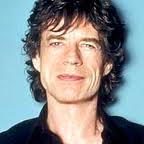
The Singer
He’s tellin’ me more and more
About some useless information
Supposed to fire my imagination
I can’t get no, Oh, no, no, no
Hey, hey, hey, that’ what I say
I can’t get no
Satisfaction
So Dylan’s use of ‘stoning’ is giving or getting unpleasant information.
Song #2, Pledging My Time merely means he is obsessed with his mother’s ‘information’ that he was unwanted which is reflected in song #3, Visions Of Johanna when he sings: These visions of Johanna have conquered my mind. Johanna being his mother. Then there is discussion about Andy and Edie. (see my essay at https://idynamo.wordpress.com/2010/12/27/exhuming-bob-xxviii-visions-of-johanna-decoded/ for a full discussion.)
Song#4 Sooner Or Later mocks Edie who he ‘really did try to get close to’ as he dismisses here as he would have like to have dismissed his mother. Song #5 is self-explanatory.
Song #6, Stuck Inside Of Mobile With The Memphis Blues Again awhile the lyrics are unclear must refer back to I Want You on one hand and forward to Leopard Skin Pill Box Hat and Just Like A Woman on the other. He’s stuck inside of Mobile, i.e. he wants his mother with the Memphis Blues, i.e. he want his vengeance on Edie is a possible interpretation. At any rate it is placed between I Want You and the two Edie songs so it must be related to all three.
Then come two really unnecessarily vicious songs that everyone agrees are about Edie- Leopard Skin Pill Box Hat and Just Like A Woman. There are no obvious reasons for Dylan to express such vehement, disfiguring hatred of the poor girl unless he’s visiting his repressed hatred of his mother on her.
Song #10 Temporary Like Achilles involves Edie and Andy and himself. I doubt if Dylan had any understanding of the Iliad, if he had even read it, so apart from Achilles short life and the seven month interruption of his relationship with Edie by Warhol an interpretation is somewhat of a hazard.
Songs 11, 12, 13, Absolutely Sweet Marie, Fourth Time Around, and Obviously 5 Believers seem to wander off topic. I have read one interpretation in which the blogger thought Obviously 5 Believers was a response to the Beatles Norwegian Wood. Or possibly they lead into song #14 Sad Eyed Lady Of The Low Lands that Dylan says he wrote about Sara Loundes. The lyrics of this ‘poem’ are incomprehensible but if I had been Sara I wouldn’t have taken the title as a compliment, especially not after being locked out of a discussion about Dylan, Edie and his mother. After all, this is a married man lashing out at Edie.
After completing the LP Dylan left for his 1966 tour of England in which there was such a violent reaction to his electric backup band. I don’t remember their being a violent reaction made on the West Coast. For myself I welcome it. I never did like that faux folk crap he did anyway. Apparently Dylan didn’t either. A new expanded edition, lots of new material. of Robert Shelton’s biography, No Direction Home, just released by Omnibus Press is available, speaking in 1965 Shelton quotes Dylan thusly: ‘There never was any change. No instrument will ever change love, death in any soul. My music is my music. Folk music was such a shuck. I never recorded a folk song.’ He did however call himself a folk singer.
So, whoever shouted Judas at the Manchester concert knew what he was talking about. I never listened to those nauseous early Dylan records anyway. Blonde On Blonde was released in June of 1966 while Dylan was thrown by his ‘chrome horse’ on 7/29/66 thus putting an end to the first phase of his career.
I don’t know what Edie thought wen she heard the record that summer but one supposes she would have recognized herself as the topic of the conversation. Warhol certainly did and he was not amused. Knew something about motorcycles too.
Both Edie and Dylan were so heavily into amphetamines that they probably were not responsible for their actions. Drugs tend to put one into an internal state in which the outside world assumes a subordinate position, almost irrelevant, to one’s interior reality. A person functions in his own mind as a sort of magician who can comman the world to his own world. A certain type of insanity I suppose. Right and wrong are merely expressions of one’s own subconscious will. As Dylan confused Edie with his mother who he subconsciously wished to punish he transferred those feelings, that resentment, that hatret onto Edie as his surrogate mother thus gaining his revenge. How much satisfaction he got isn’t known and he’s not telling.
Edie herself was so far gone into amphetamines as to be oblivious to what was happening in her life. As far as she could dissociate her life from reality she could obviously make black white and vice versa.
Having dealt with Dylan’s relationship with Edie, let us return to January of ’66 to take up again the story from there.
Chap. 14 has been posted as of 6/23/11
Exhuming Bob XXIX: Dylan And His Blonde Problems
March 23, 2011
Exhuming Bob XXIX: Dylan And His Blonde Problems
by
R.E. Prindle
An Examination Of Temporary Like Achilles

Searching For Inspiration
Temporary Like Achilles is another ’64-’66 piece. It has the feel of being improvisational, out of focus. I believe it is a companion piece to Visions Of Johanna while it might be connected to Rainy Day Women #12 & 35.
Dylan always said that he had no physical relations with the song’s subject Edie Sedgwick. I’m certainly in no position to say but if this song is accurate then Edie for some reason played the virgin for him. Either that or because she represented his mother to him it would have been an incestuous situation. Edie did say she was pregnant by Dylan but then she says that she was in the psycho ward and that the doctor’s held her down and aborted the baby. Of course she must have been delusional at that time having over dosed on amphetamines. God, how she punished her mind. I’m of the opinion that she probably was not pregnant by Dylan although there may be hospital records.
If one takes the last verse first:
Achilles is in your alleyway
He don’t want me here, he does brag
He’s pointing to the sky
And he’s hungry, like a man in drag.
How come you get someone like him to be your guard
You know I want your lovin’
Honey why are you so hard.
Warhol, the man in drag is obviously Achilles, perhaps meant humorously. Achilles of course lived a short but glorious life. Warhol is temporary because Dylan is moving in on Edie.
In answer to the refrain ‘you know I want your lovin, honey why are you so hard’, it is probably that Edie wanted to marry Dylan but in the way of women wanted to pose as a virgin so as to come to him pure.
When she was at Harvard in Boston she was known as a premier fag hag. The men she knew were all gay so one presumes her chastity was safe there. Of course, Andy Warhol, known here as Achilles here was gay. Insofar as she associated with Andy, and he apparently really was smitten by her, as close to being in love as he could get with anyone, as he put it, her chastity was safe with him too. Perhaps that is why Dylan has Achilles in Edie’s allegory, near but not close sexually.
As there was rivalry between Dylan and Warhol for Edie it follows that ‘he don’t want me here he does brag.’ The line

Her fogs, her amphetamines and her pearls.
would point to the situation as it stood in August or September of ’65. He’s hungry like a man in drag may refer to his homosexuality which prevents him from satisfying his lust I don’t know why he’s pointing at the sky but Dylan says disgustedly ‘how come you get someone (a fag) like him to be your guard. Dylan was known to be macho at the time.
The first verse points to a period perhaps November-December of ’65. Dylan, of course, married Sara in November of ’65 so that at this point Dylan would be playing with Edie as perhaps he thought she was playing with him before.
Hence:
Standing on your window, honey
Yes. I’ve been here before
Feeling so harmless
I’m looking at your second door
How come you don’t send me no regards?
You know I want you lovin’
Honey why are you so hard?
Here is a reference to Dylan and Edie’s first meeting in December of ’64. And then in March Chuck Wein introduced Edie to the Factory although she had met Warhol a couple weeks after Dylan in January of ’65. Dylan may have been too busy at the beginning of ’65 to actively pursue Edie, he also did have to pay attention to Sara who he was courting at the same time, plus engagements and whatever.
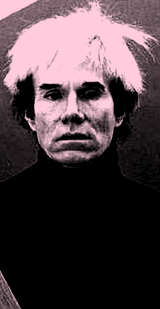
Andy
At any rate Edie teamed up with Warhol from March to about December of ’65. At that point Dylan who was wooing Edie and Grossman his manager were promising to make Edie a star at something. If as a star, she couldn’t sing, but then that didn’t stop Dylan from having a career.
Now, Andy had been trying to make Edie his movie star. According to Ronnie Tavel who scripted many of Andy’s movies Andy saw Edie as his ticket to breaking into Hollywood. That was one of Andy’s chief ambitions that was never realized. Tavel says that he and Andy used to coach Edie in her lines. When time to film came she always dosed herself with amphetamines before hand and, of course, uncoached herself. Thus in Andy’s account of his appearance at the psychiatrists’ banquet in January of ’66 he remarks that it was futile for Dylan and Grossman to work with her because she was unable to concentrate long to get anything done. Edie wouldn’t work hence no career. Andy might have been able to get her something if she had. He sounds rueful and hurt.
So in late ’65 this was Dylan’s second attempt to connect with Edie.
The second verse:
Kneeling ‘neith your ceiling
Yes, I guess I’ll be here for a while
I’m trying to read your portrait, but
I’m helpless, like a rich man’s child.
How come you send someone out to have me barred:
You know I want your lovin’
Honey, why are you so hard?
Kneeling ‘neath your ceiling fits in with standing in your window and looking at your second door. Kneeling ‘neath your ceiling is probably somewhat like Paul Simon’s ‘One man’s ceiling is another man’s floor or Tony Orlando’s Stomp three time on the floor. In other words Dylan is in the room beneath Edie unable to get to her unless she calls him.
Thus the addendum to verse two:
Like a poor fool in his prime
Yes’ I know you can hear me walk
But is our heart made out of stone, or is it lime
Or is it just solid rock?
In other words Edie knows he’s down there pacing anxiously back and forth but a hard hearted woman she refuses to call him to her, stomping three times on the floor.
The fourth verse:
Well, I rush into your hallway
Lean against your velvet door
I watch upon your scorpion
Who crawls across your circus floor
Just what do you think you have to guard?
You know I want your lovin’
Honey why are you so hard?
The ardent and frustrated would be lover can’t breach Edie’s window, door. ceiling, hallway, velvet door. The scorpion/circus reference escapes me except that Edie may have appeared to be leading some circus life as does Ophelia in Desolation Row.
Apparently this was a throw away song for Dylan as other than recording it he has never played it in concert. It was one of my favorites on the album however. Perhaps after Dylan’s motorcycle accident the song became irrelevant to him. Too topical, not universal enough as was its counterpart Visions of Johanna.
As far as Blonde On Blonde goes I’m tentatively of the opinion that Rainy Day Women #12 & 35 refers to Edie and his mother. The only reference to Sara in the album would be Sad Eyed Lady Of The Lowlands.
Your secrets are safe with me, Bob, of course you don’t have anything to hide.
Exhuming Bob XXVIII: Visions Of Johanna Decoded
December 27, 2010
Exhuming Bob XXVIII
Visions of Johanna Decoded
by
R.E. Prindle

This is an attempt to place Visions Of Johanna in a context of Dylan, Andy Warhol and Edie Sedgwick. In this interpretation Louise is Edie, Johanna is Dylan’s mother, Louise’s lover is Andy Warhol and the narrator is Dylan,
Visions of Johanna
Ain’t it just like the night to play tricks when you’re trying to be so quiet?
We sit here stranded though we’re doing our best to deny it.
I.e. we’re alone in the night of the universe doing our best to pretend we aren’t. A night without dawn and we find the situation intolerable.
And Louise holds a handful of rain, temptin’ you to defy it.
Rain is a symbol for the misery of life that one finds inescapable. ‘Raindrops keep falling on my head.’ etc. Louise/Edie who is a bearer of pain mixed with love offers a handful of rain to Dylan essentially saying take it or leave it. If Bob takes it he has to find a way around the pain of loving Louise/Edie.
Lights flicker from the opposite loft
In this room the heat pipes just cough
The country station plays soft
But there’s nothing really, nothing to turn off.
It looks brighter in the opposite loft, greener grass on the other side of the fence, but it is freezing in Dylan’s room where no heat comes from the pipes that just cough. ‘Seems like a freezeout.’ C&W is a lot of songs about love gone wrong so let it play softly in the background.
Just Louise and her lover so entwined
And these visions of Johanna that conquer my mind.
Dylan has a real problem with his mother who he says in his movie Masked and Anonymous rejected him because he upset her life by being born. Thus his love for his mother was turned to dust and his life made miserable. He has confused Edie with his mother who he thinks she resembles. Edie after seeming to be found as a mother surrogate in the first quarter of 1965 then seemingly abandoned him for ‘her lover’ Warhol with whom she is ‘entwined.’ In his confusion and resentment of Edie he sees ‘these visions of Johanna that conquer his mind.’ He looks at Edie and sees his mother. His resentment at his mother’s rejection then turns to hatred of Edie. As a son he can’t revenge himself on his mother but he can on Edie who has become his mother surrogate.
After his father’s death in 1968 Dylan is able to step into his father’s shoes as his mother’s support. Pleading poverty, which was probably real, shortly after her husband’s death Dylan wrote her a five figure check to tide her over. There’s more, but…I’ll save that for the review of Masked And Anonymous.

The Ghost Of Electricity
In the empty lot where the ladies play blind man’s bluff with the key chain
And the all night girls they whisper of escapades out on the “D” train
We can hear the night watchman click his flashlight
Ask himself if it’s him or them that’s really insane
Verbiage setting up the next six lines that get to the heart of the matter:
Louise, she’s all right, she’s just near
She’s delicate and seems like the mirror
But she just makes it all too concise and too clear
That Johanna’s not here.
Here the physically delicate Edie is present but she seems like a reflection of Johanna/Dylan’s mother. Dylan has so identified Edie/Louise with this mother/Johanna that Edie makes it ‘too concise and that too clear’ that Mother/Johanna is not here.
The ghost of ‘lectricity howls in the bones of her face (Edie’s)
Where these visions of Johanna have now taken my place.
Ghosts of electricity is ambiguous but may refer to the traces left by the electro-shock treatments which undoubtedly scarred Edie’s mind indelibly while Dylan has now completely blended Edie/Louise and Mother/Johanna into one.
Now, little boy lost, he takes himself so seriously
He brags of his misery, he likes to live dangerously,
This obviously refers to Warhol of whom it’s a pretty good description. Living dangerously probably refers to the hoodlums hanging around the Factory.
Muttering small talk at the wall while I’m in the hall
How can I explain?
Oh, it’s so hard to get on
And these visions of Johanna, they kept me up past dawn
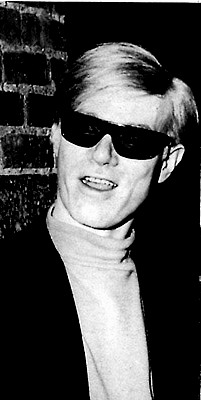
Dapper Andy
Dylan mutters small talk at the wall where he is placed outside the relationship with Edie in the hall ‘while visions of Mother/Johanna trouble him into the small hours of the night.
Verses four and five seem to be verbiage that sounds meaningful and may be to Dylan but escape me. The song is copyrighted 1966 which would be after Dylan had taken his vengeance on Edie so the lines of the last verse:
But like Louise always says
“Ya can’t look at much, can ya man?”
As she herself prepares for him
And Madonna, she still has not showed
We see the empty cage now corrode
Where her cape of the stage once had flowed
The fiddler, he now steps to the road
He writes ev’rything’s been returned which was owed.
Edie/Louise is preparing for ‘him’ who might be Warhol or Neuwirth but it isn’t made clear.
Dylan referred to Sara as a Madonna so she is probably the Madonna referred to. ‘Empty cage’ is personal to Dylan, no idea, anyway he was already married to Sara. So having crushed Edie as his mother had crushed him and passed her to Neuwirth he thinks he has settled his score with Mother/Johanna. ‘Ev’rything’s been returned which was owed.’ Edie has repaid his mother’s debt but he apparently feels some guilt ‘as his conscience explodes.’
After the ball was over, after the dance was through’ these visions of Johanna are now all that remain.’ So, if the song means anything, written in 1966 it must refer to Edie who Dylan has confused with his mother in his mind. While songs like Like A Rolling Stone and She’s Your Lover Now read clearly once you have the Edie key, Johanna is a little more ambigious but while I con’t guarantee this reading as yet, I think it is on whole accurate.
 I, Dynamo